Cambridge IGCSE Accounting 0452 — 2014 May/June Paper 2 · Variant 2
0452/22/M/J/14 · 120 marks · ≈135 min
The question paper and its mark scheme, free to read here and free to download. This is Cambridge’s own paper, exactly as it was sat.
Question paper20 pages

Mark scheme9 pages
Answers below. Sit the paper first if you are practising.
Paper as text
Question paper, page 1
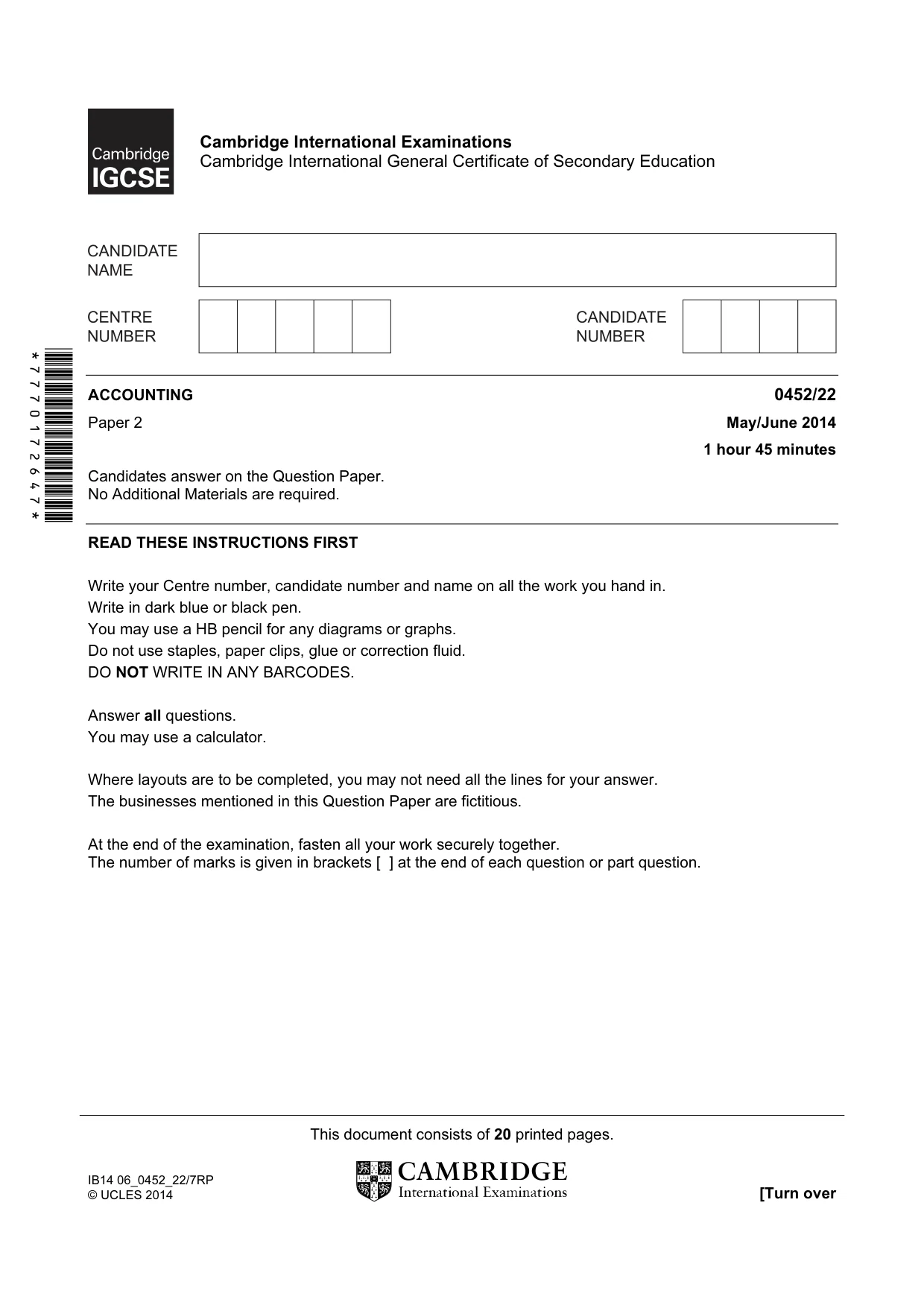
This document consists of 20 printed pages. IB14 06_0452_22/7RP © UCLES 2014 [Turn over *7770172647* Cambridge International Examinations Cambridge International General Certificate of Secondary Education ACCOUNTING 0452/22 Paper 2 May/June 2014 1 hour 45 minutes Candidates answer on the Question Paper. No Additional Materials are required. READ THESE INSTRUCTIONS FIRST Write your Centre number, candidate number and name on all the work you hand in. Write in dark blue or black pen. You may use a HB pencil for any diagrams or graphs. Do not use staples, paper clips, glue or correction fluid. DO NOT WRITE IN ANY BARCODES. Answer all questions. You may use a calculator. Where layouts are to be completed, you may not need all the lines for your answer. The businesses mentioned in this Question Paper are fictitious. At the end of the examination, fasten all your work securely together. The number of marks is given in brackets [ ] at the end of each question or part question.
Question paper, page 2
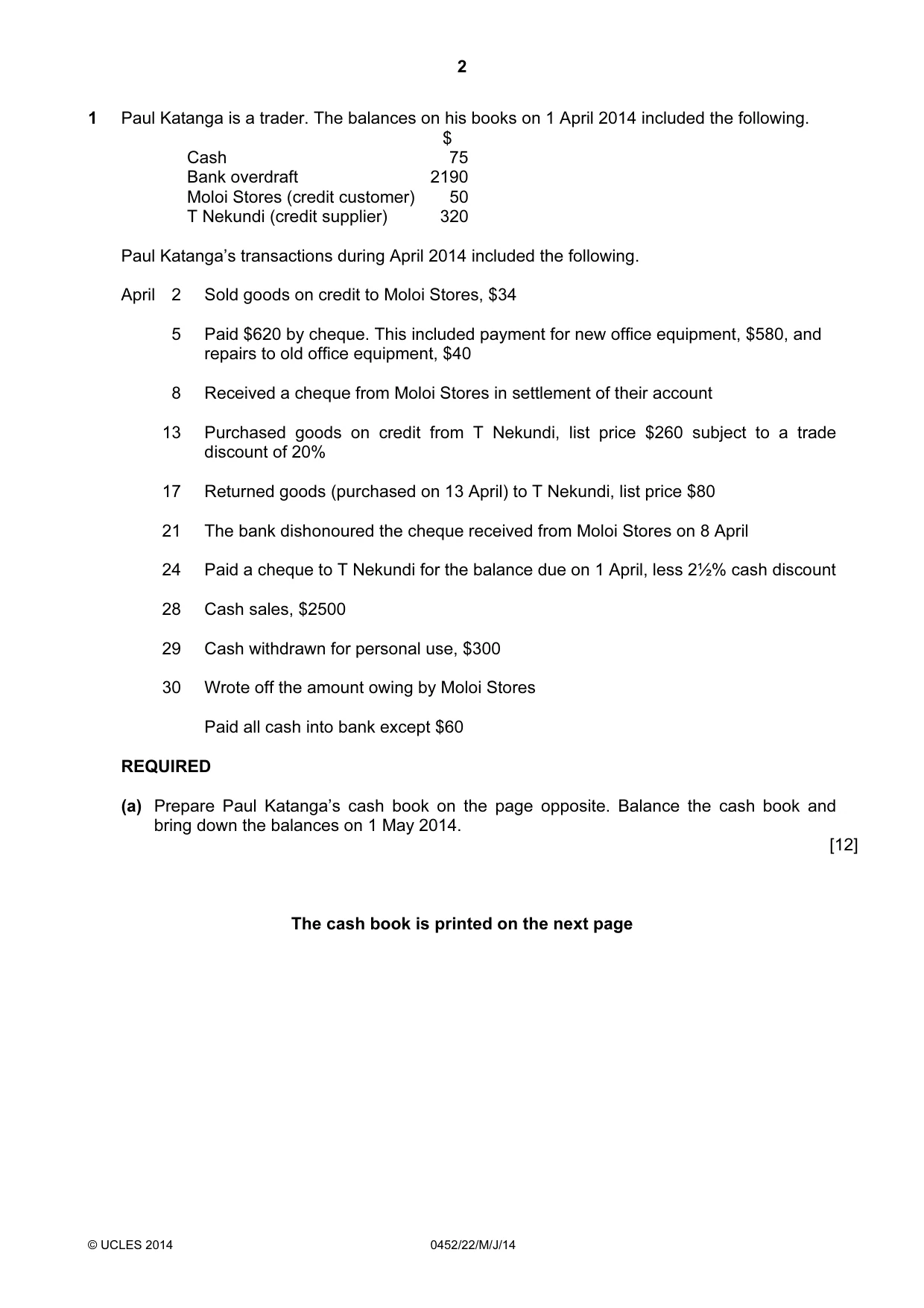
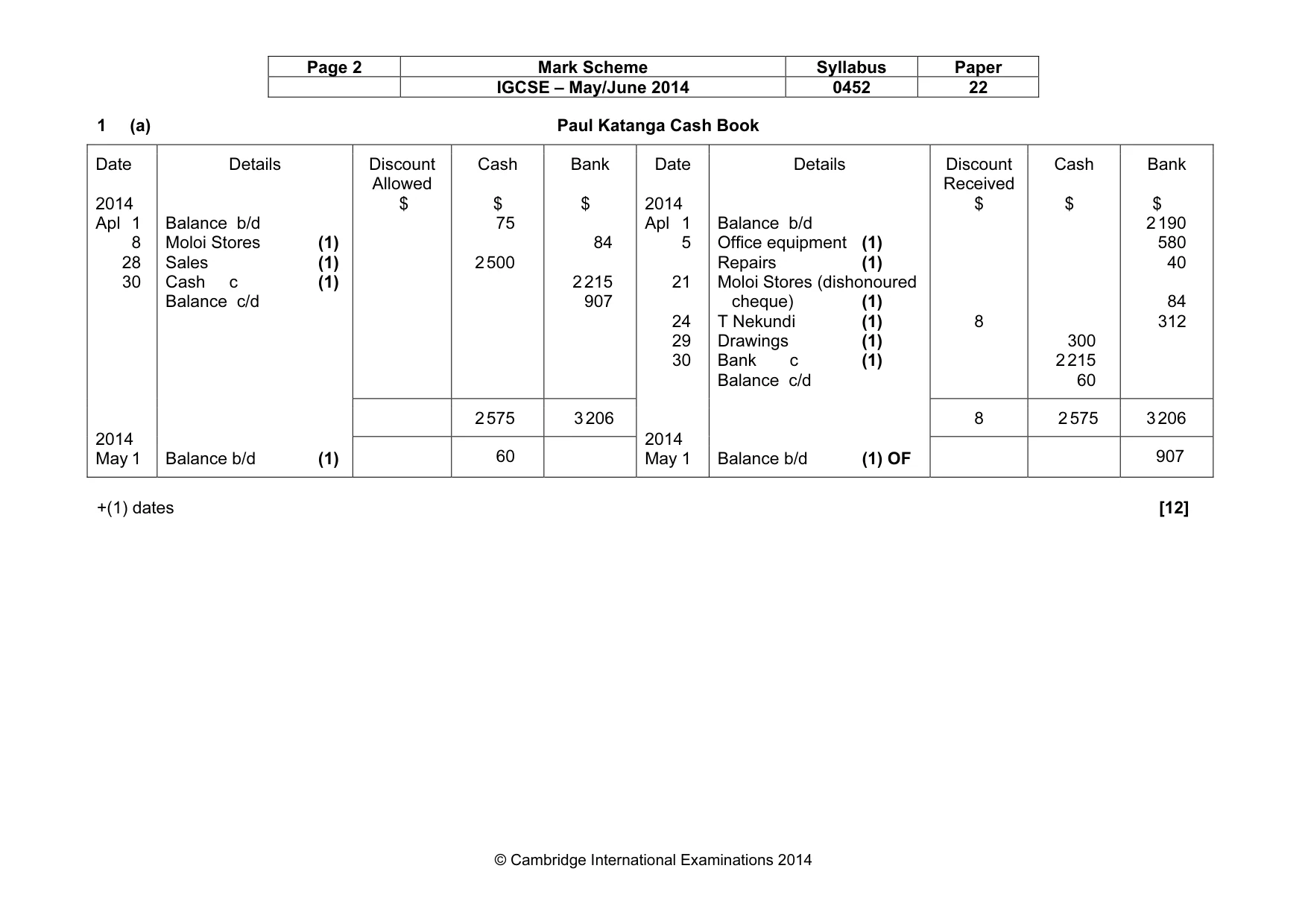
2 © UCLES 2014 0452/22/M/J/14 1 Paul Katanga is a trader. The balances on his books on 1 April 2014 included the following. $ Cash 75 Bank overdraft 2190 Moloi Stores (credit customer) 50 T Nekundi (credit supplier) 320 Paul Katanga’s transactions during April 2014 included the following. April 2 Sold goods on credit to Moloi Stores, $34 5 Paid $620 by cheque. This included payment for new office equipment, $580, and repairs to old office equipment, $40 8 Received a cheque from Moloi Stores in settlement of their account 13 Purchased goods on credit from T Nekundi, list price $260 subject to a trade discount of 20% 17 Returned goods (purchased on 13 April) to T Nekundi, list price $80 21 The bank dishonoured the cheque received from Moloi Stores on 8 April 24 Paid a cheque to T Nekundi for the balance due on 1 April, less 2½% cash discount 28 Cash sales, $2500 29 Cash withdrawn for personal use, $300 30 Wrote off the amount owing by Moloi Stores Paid all cash into bank except $60 REQUIRED (a) Prepare Paul Katanga’s cash book on the page opposite. Balance the cash book and bring down the balances on 1 May 2014. [12] The cash book is printed on the next page
Question paper, page 3
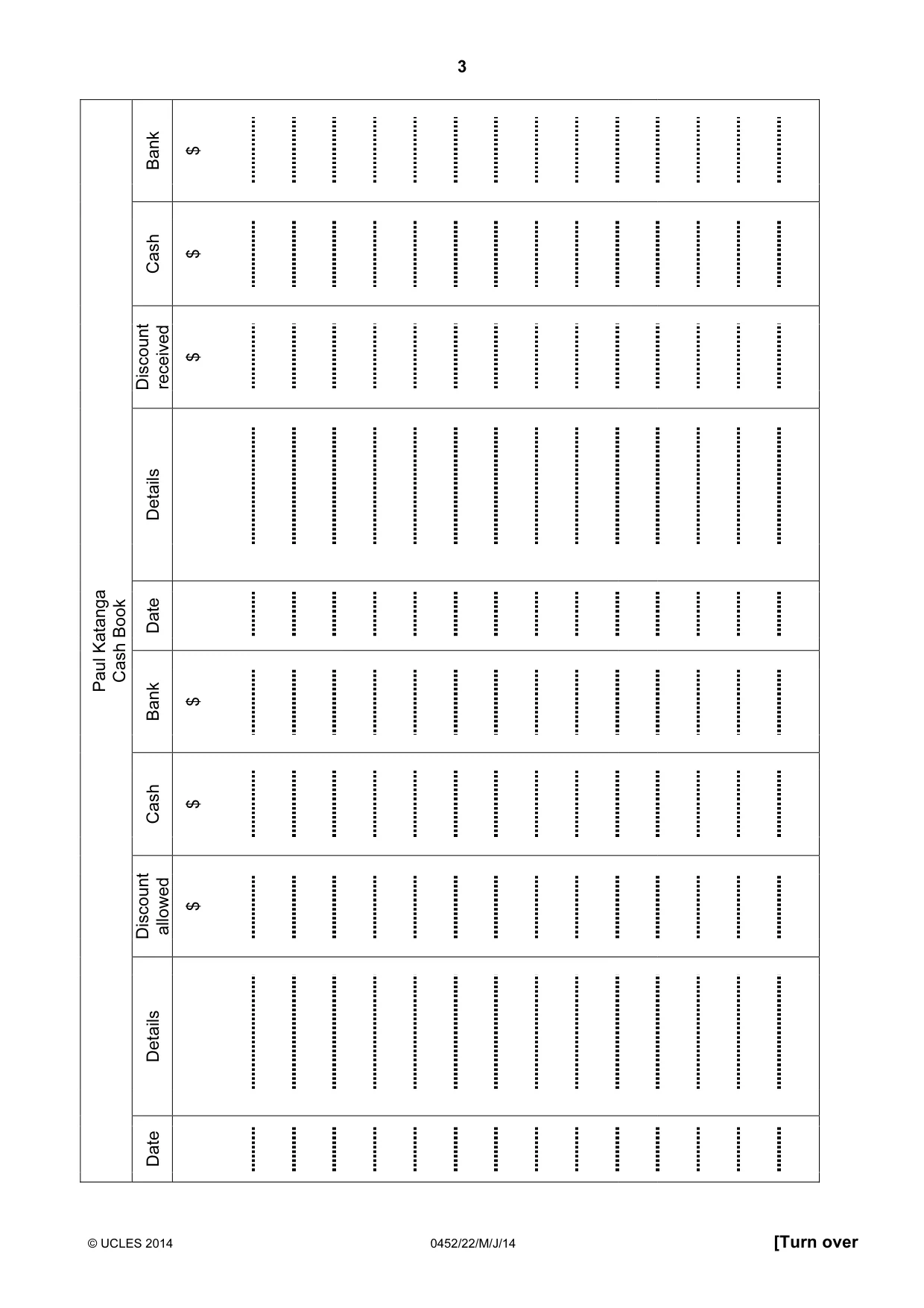
3 © UCLES 2014 0452/22/M/J/14 [Turn over Paul Katanga Cash Book Bank $ Cash $ Discount received $ Details Date Bank $ Cash $ Discount allowed $ Details Date
Question paper, page 4
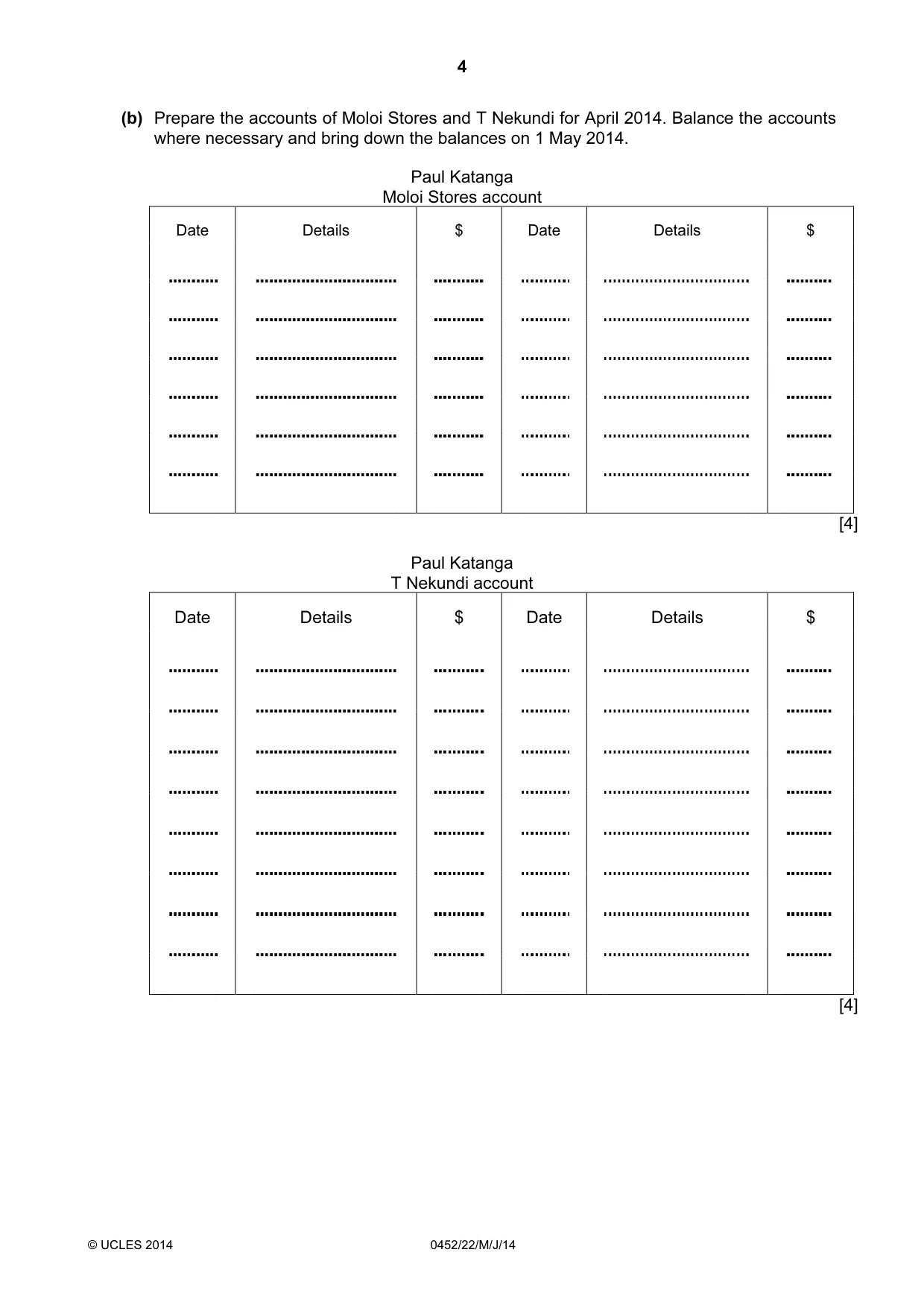
4 © UCLES 2014 0452/22/M/J/14 (b) Prepare the accounts of Moloi Stores and T Nekundi for April 2014. Balance the accounts where necessary and bring down the balances on 1 May 2014. Paul Katanga Moloi Stores account Date Details $ Date Details $ [4] Paul Katanga T Nekundi account Date Details $ Date Details $ [4]
Question paper, page 5
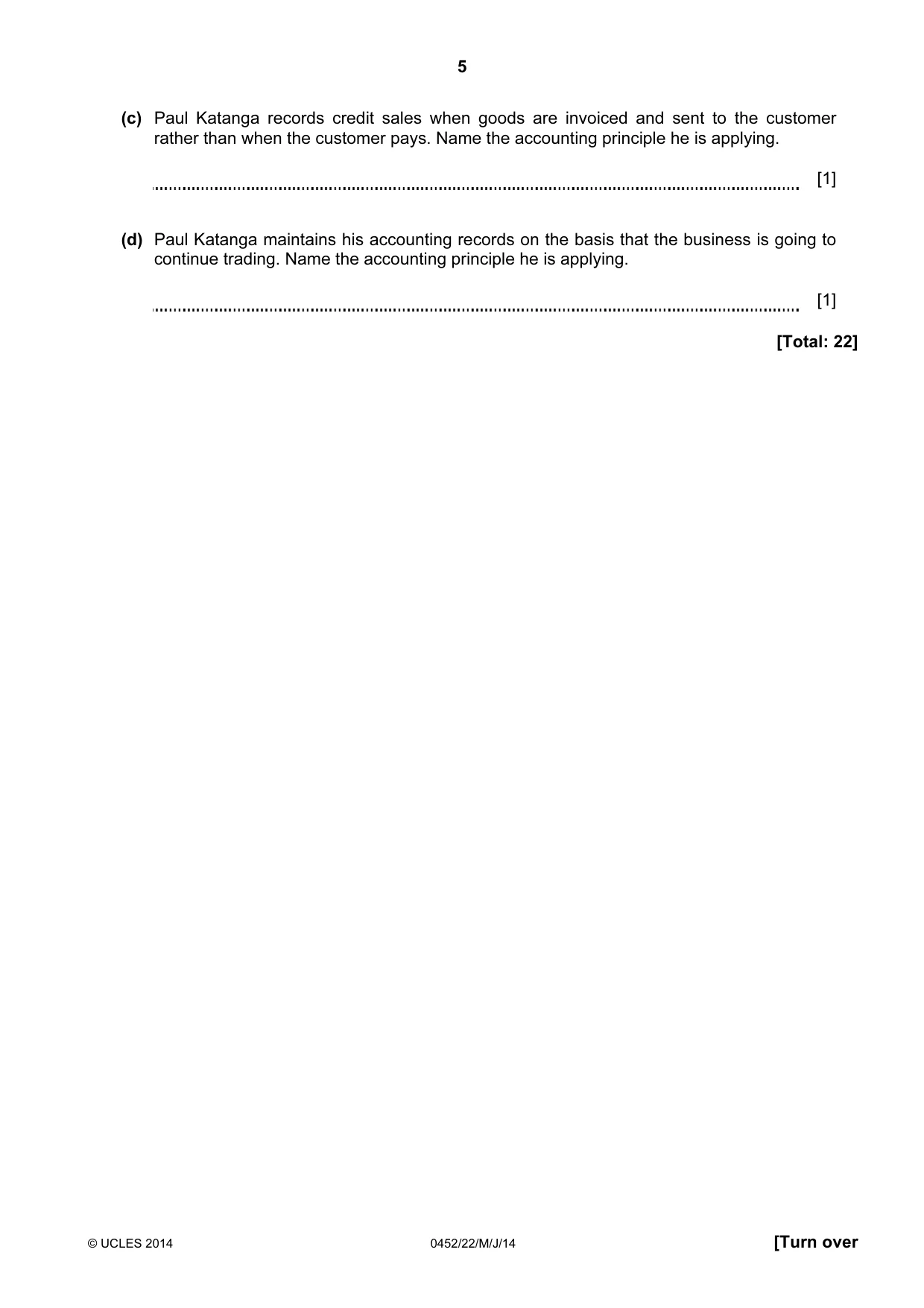
5 © UCLES 2014 0452/22/M/J/14 [Turn over (c) Paul Katanga records credit sales when goods are invoiced and sent to the customer rather than when the customer pays. Name the accounting principle he is applying. [1] (d) Paul Katanga maintains his accounting records on the basis that the business is going to continue trading. Name the accounting principle he is applying. [1] [Total: 22]
Question paper, page 6
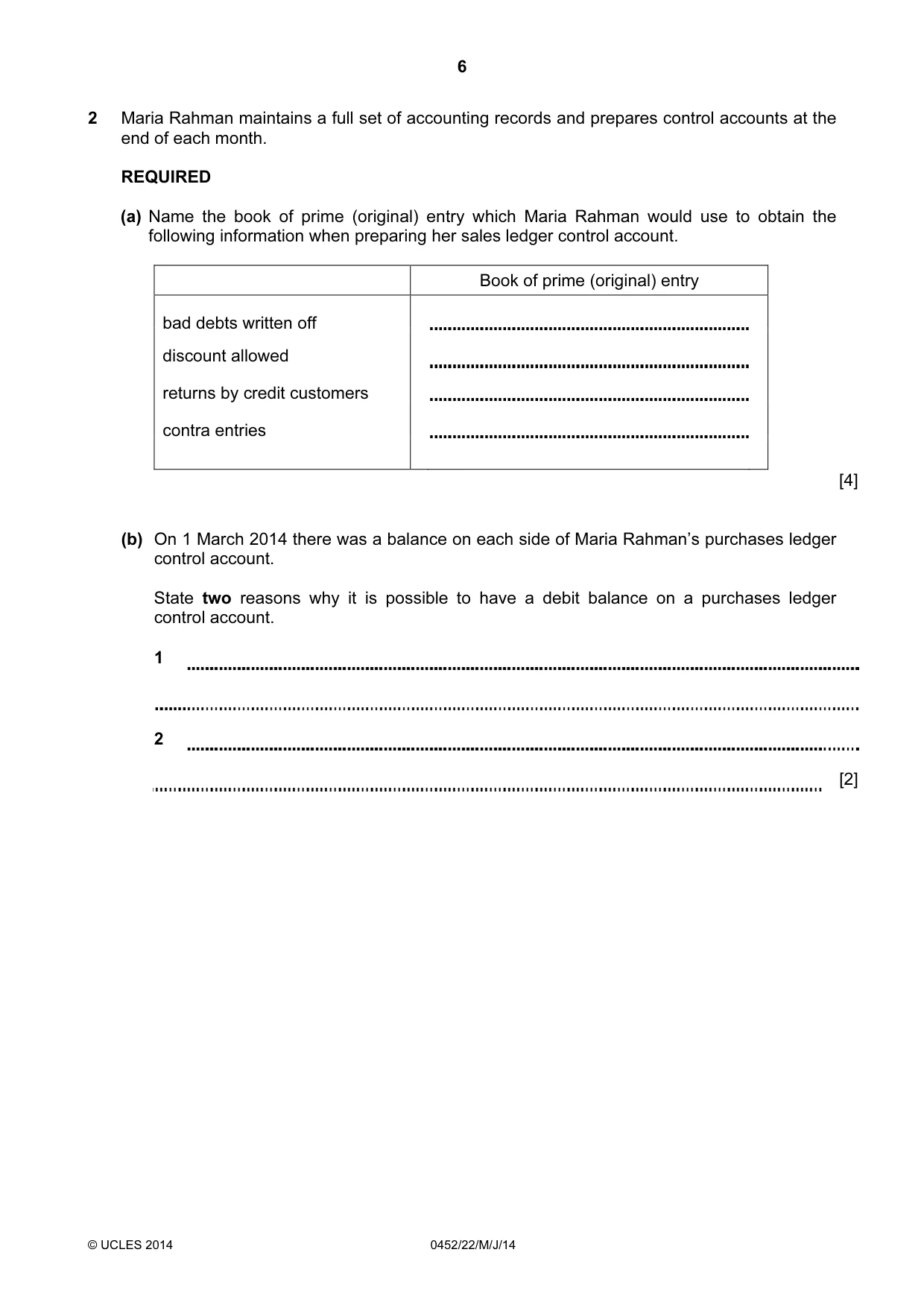
6 © UCLES 2014 0452/22/M/J/14 2 Maria Rahman maintains a full set of accounting records and prepares control accounts at the end of each month. REQUIRED (a) Name the book of prime (original) entry which Maria Rahman would use to obtain the following information when preparing her sales ledger control account. Book of prime (original) entry bad debts written off discount allowed returns by credit customers contra entries [4] (b) On 1 March 2014 there was a balance on each side of Maria Rahman’s purchases ledger control account. State two reasons why it is possible to have a debit balance on a purchases ledger control account. 1 2 [2]
Question paper, page 7
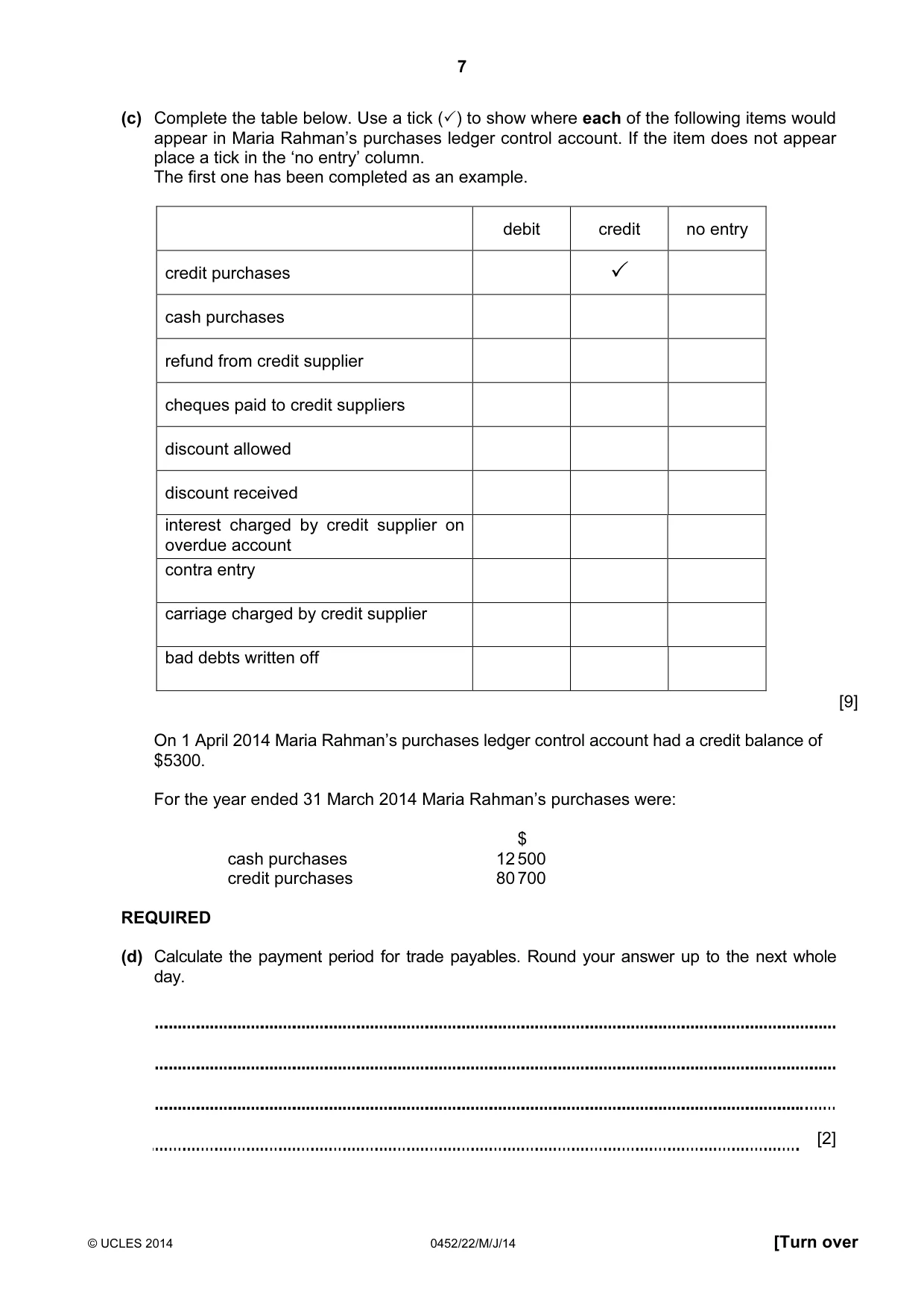
7 © UCLES 2014 0452/22/M/J/14 [Turn over (c) Complete the table below. Use a tick (✓) to show where each of the following items would appear in Maria Rahman’s purchases ledger control account. If the item does not appear place a tick in the ‘no entry’ column. The first one has been completed as an example. debit credit no entry credit purchases ✓ cash purchases refund from credit supplier cheques paid to credit suppliers discount allowed discount received interest charged by credit supplier on overdue account contra entry carriage charged by credit supplier bad debts written off [9] On 1 April 2014 Maria Rahman’s purchases ledger control account had a credit balance of $5300. For the year ended 31 March 2014 Maria Rahman’s purchases were: $ cash purchases 12 500 credit purchases 80 700 REQUIRED (d) Calculate the payment period for trade payables. Round your answer up to the next whole day. [2]
Question paper, page 8
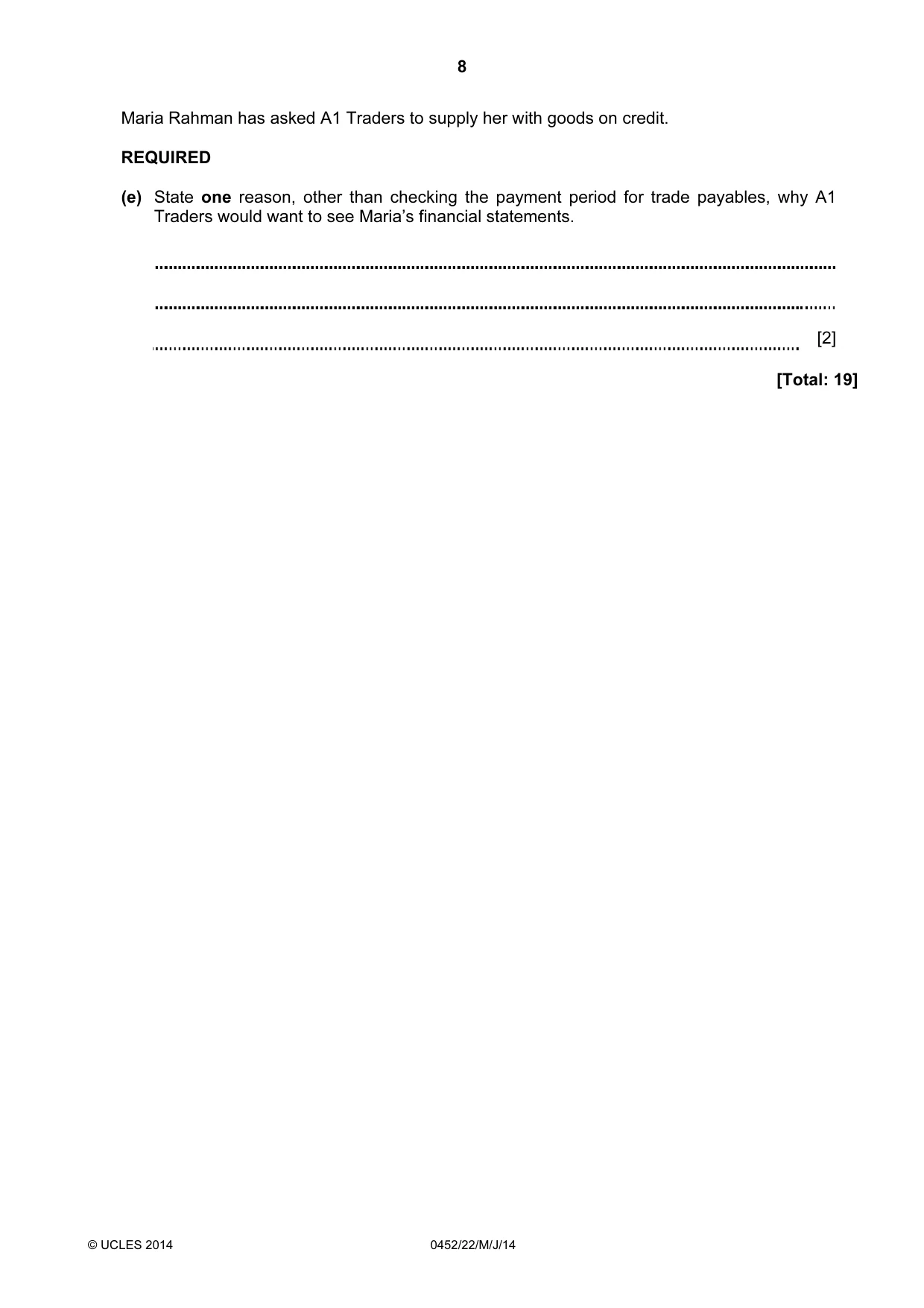
8 © UCLES 2014 0452/22/M/J/14 Maria Rahman has asked A1 Traders to supply her with goods on credit. REQUIRED (e) State one reason, other than checking the payment period for trade payables, why A1 Traders would want to see Maria’s financial statements. [2] [Total: 19]
Question paper, page 9
9 © UCLES 2014 0452/22/M/J/14 [Turn over Question 3 is on the next page.
Question paper, page 10
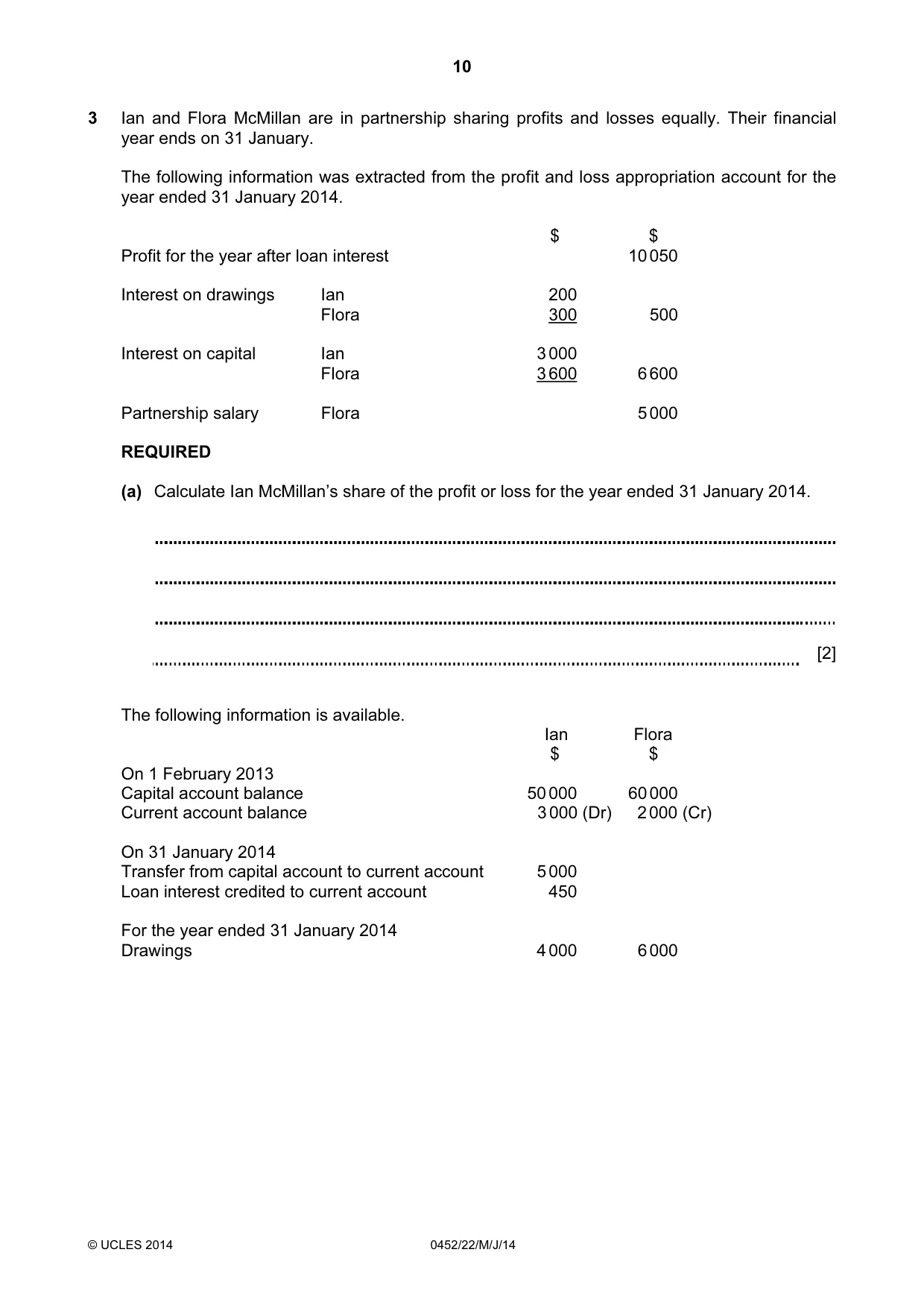
10 © UCLES 2014 0452/22/M/J/14 3 Ian and Flora McMillan are in partnership sharing profits and losses equally. Their financial year ends on 31 January. The following information was extracted from the profit and loss appropriation account for the year ended 31 January 2014. $ $ Profit for the year after loan interest 10 050 Interest on drawings Ian 200 Flora 300 500 Interest on capital Ian 3 000 Flora 3 600 6 600 Partnership salary Flora 5 000 REQUIRED (a) Calculate Ian McMillan’s share of the profit or loss for the year ended 31 January 2014. [2] The following information is available. Ian Flora $ $ On 1 February 2013 Capital account balance 50 000 60 000 Current account balance 3 000 (Dr) 2 000 (Cr) On 31 January 2014 Transfer from capital account to current account 5 000 Loan interest credited to current account 450 For the year ended 31 January 2014 Drawings 4 000 6 000
Question paper, page 11
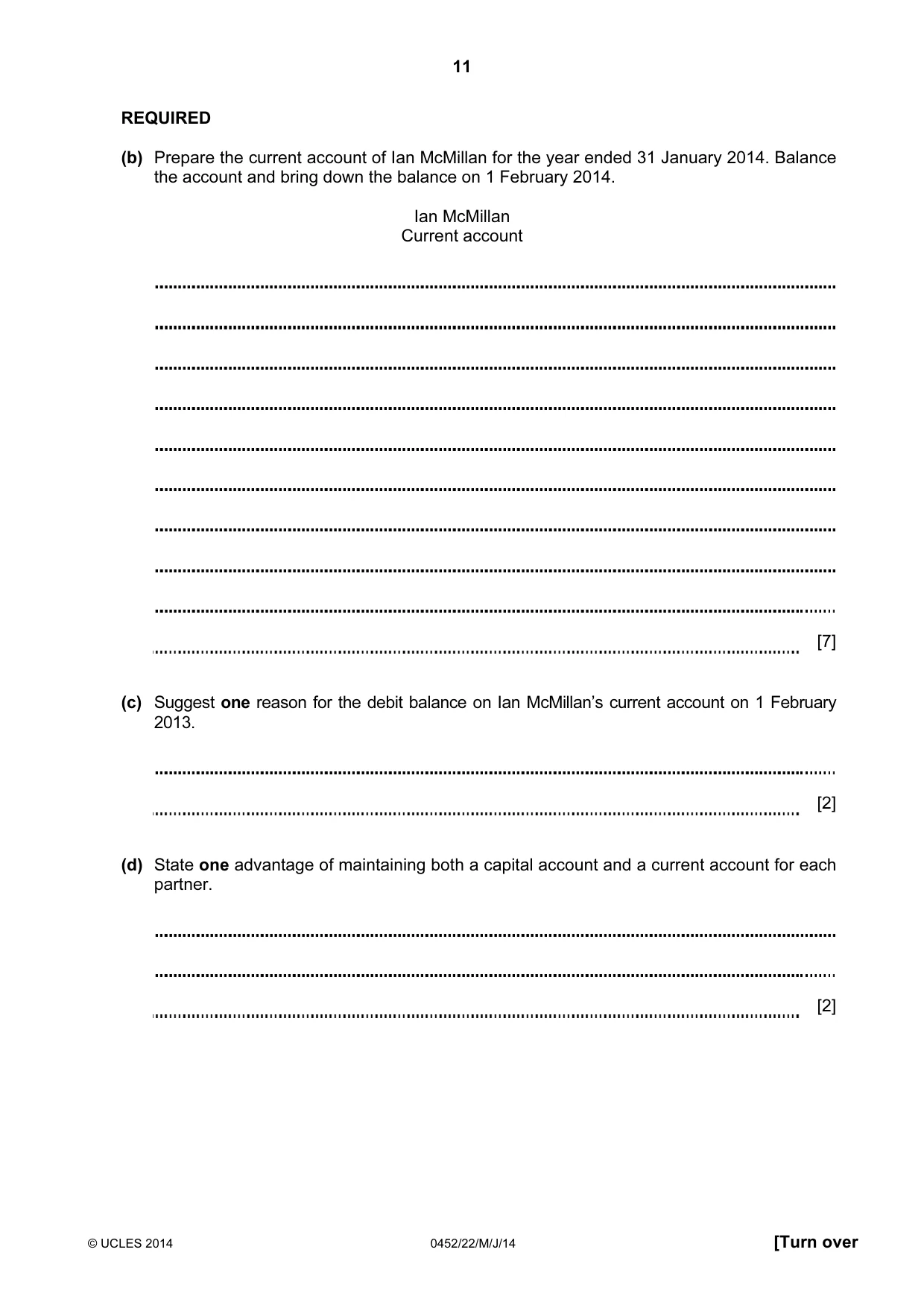
11 © UCLES 2014 0452/22/M/J/14 [Turn over REQUIRED (b) Prepare the current account of Ian McMillan for the year ended 31 January 2014. Balance the account and bring down the balance on 1 February 2014. Ian McMillan Current account [7] (c) Suggest one reason for the debit balance on Ian McMillan’s current account on 1 February 2013. [2] (d) State one advantage of maintaining both a capital account and a current account for each partner. [2]
Question paper, page 12
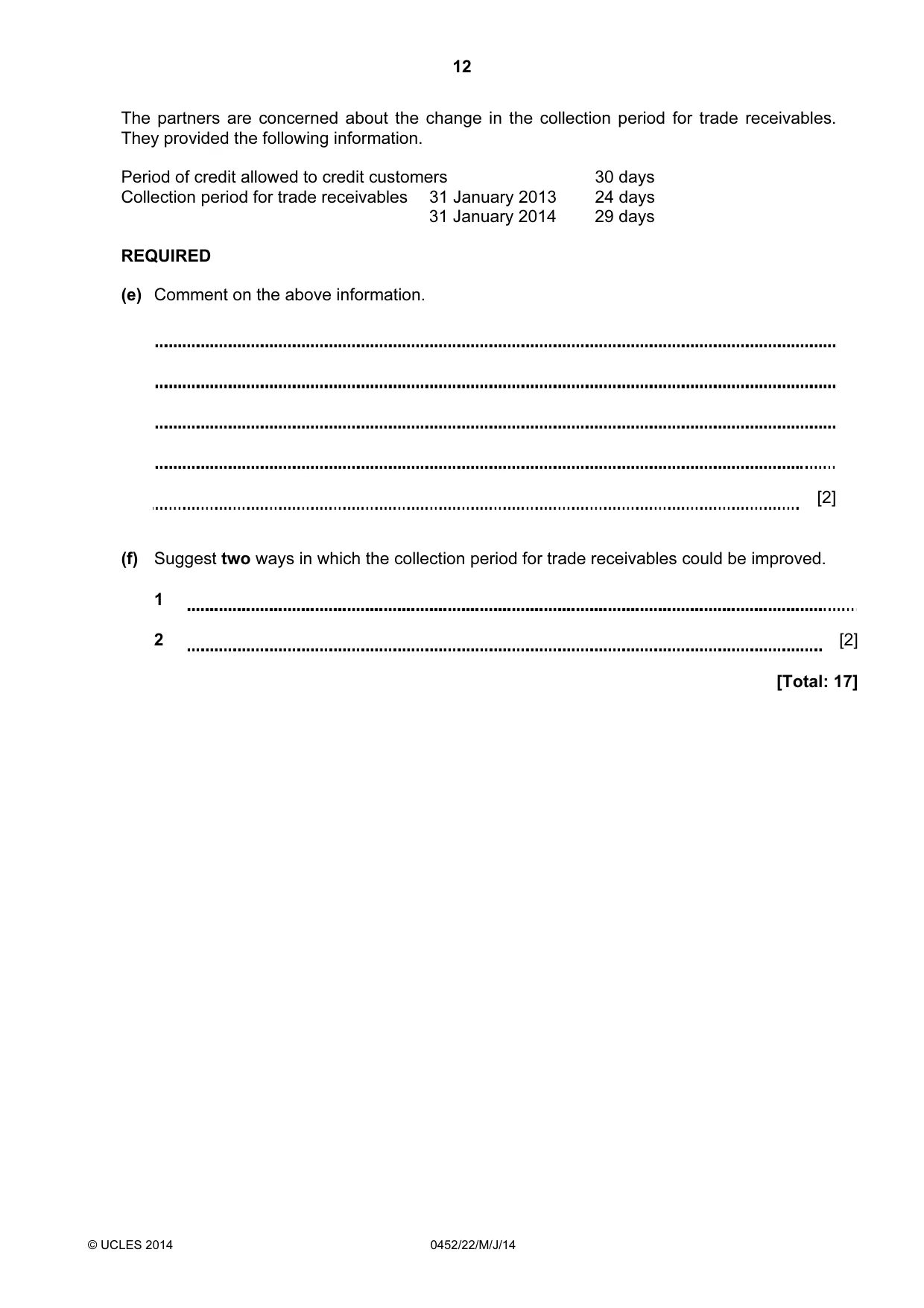
12 © UCLES 2014 0452/22/M/J/14 The partners are concerned about the change in the collection period for trade receivables. They provided the following information. Period of credit allowed to credit customers 30 days Collection period for trade receivables 31 January 2013 24 days 31 January 2014 29 days REQUIRED (e) Comment on the above information. [2] (f) Suggest two ways in which the collection period for trade receivables could be improved. 1 2 [2] [Total: 17]
Question paper, page 13
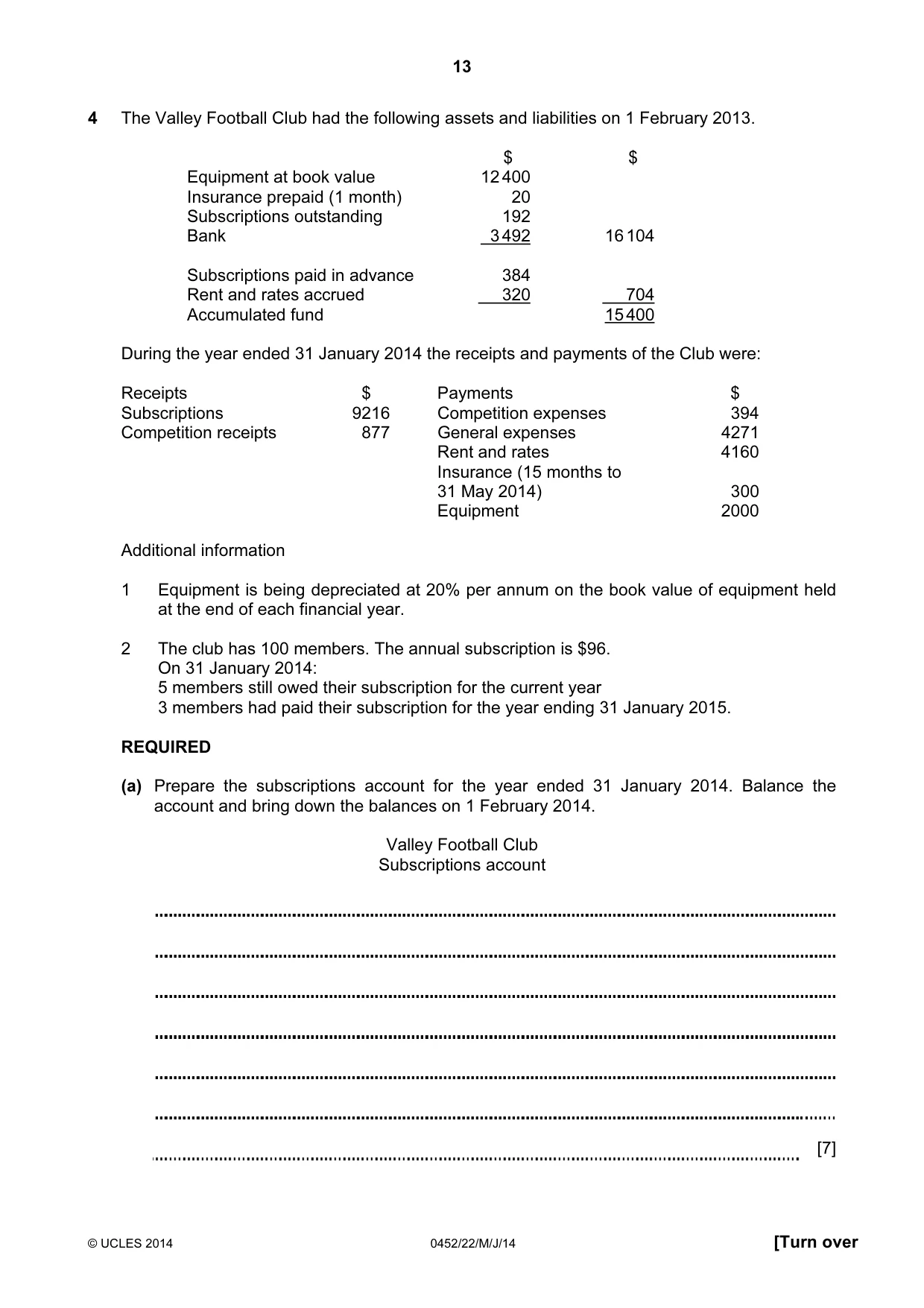
13 © UCLES 2014 0452/22/M/J/14 [Turn over 4 The Valley Football Club had the following assets and liabilities on 1 February 2013. $ $ Equipment at book value 12 400 Insurance prepaid (1 month) 20 Subscriptions outstanding 192 Bank 3 492 16 104 Subscriptions paid in advance 384 Rent and rates accrued 320 704 Accumulated fund 15 400 During the year ended 31 January 2014 the receipts and payments of the Club were: Receipts $ Payments $ Subscriptions 9216 Competition expenses 394 Competition receipts 877 General expenses 4271 Rent and rates 4160 Insurance (15 months to 31 May 2014) 300 Equipment 2000 Additional information 1 Equipment is being depreciated at 20% per annum on the book value of equipment held at the end of each financial year. 2 The club has 100 members. The annual subscription is $96. On 31 January 2014: 5 members still owed their subscription for the current year 3 members had paid their subscription for the year ending 31 January 2015. REQUIRED (a) Prepare the subscriptions account for the year ended 31 January 2014. Balance the account and bring down the balances on 1 February 2014. Valley Football Club Subscriptions account [7]
Question paper, page 14
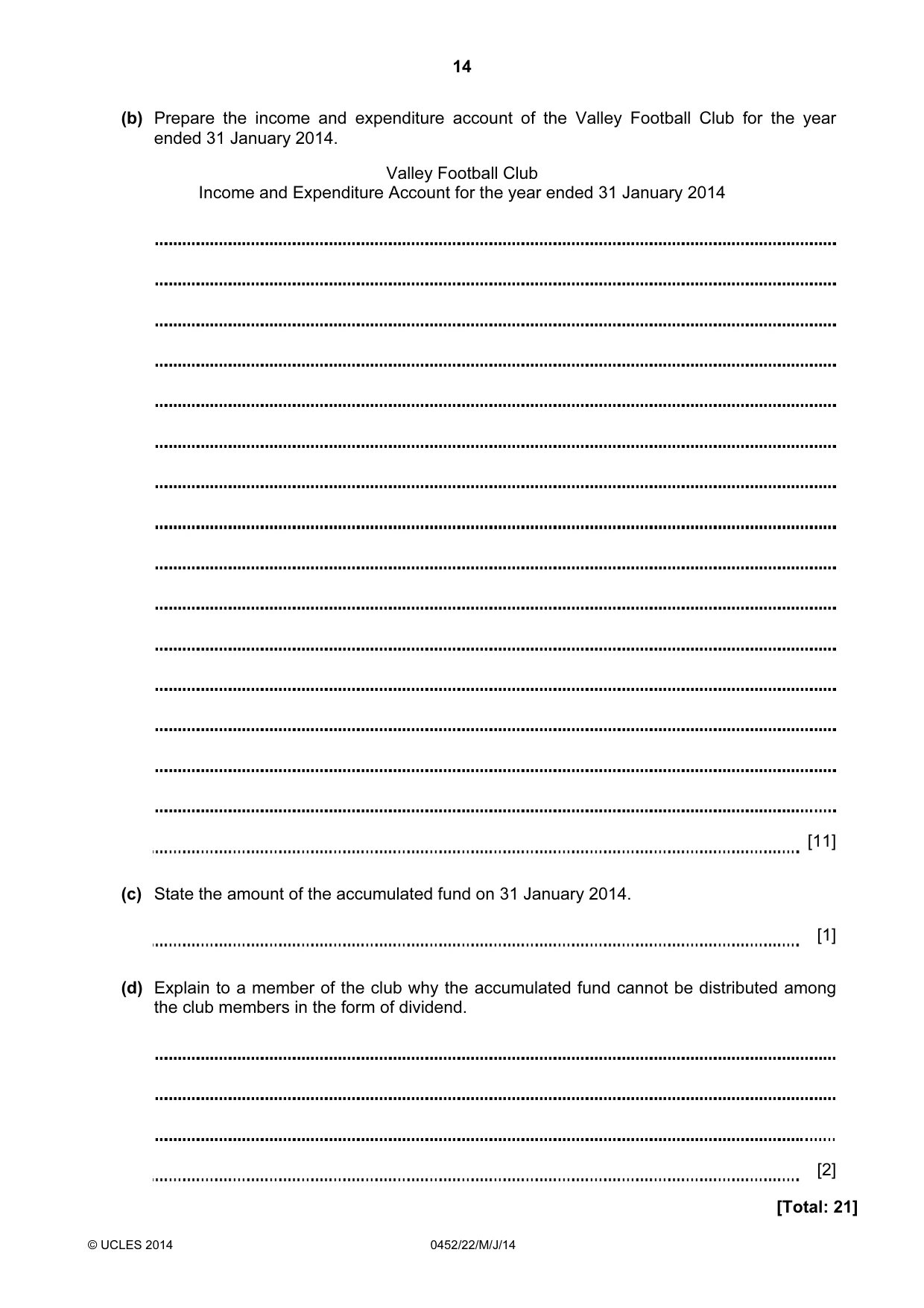
14 © UCLES 2014 0452/22/M/J/14 (b) Prepare the income and expenditure account of the Valley Football Club for the year ended 31 January 2014. Valley Football Club Income and Expenditure Account for the year ended 31 January 2014 [11] (c) State the amount of the accumulated fund on 31 January 2014. [1] (d) Explain to a member of the club why the accumulated fund cannot be distributed among the club members in the form of dividend. [2] [Total: 21]
Question paper, page 15
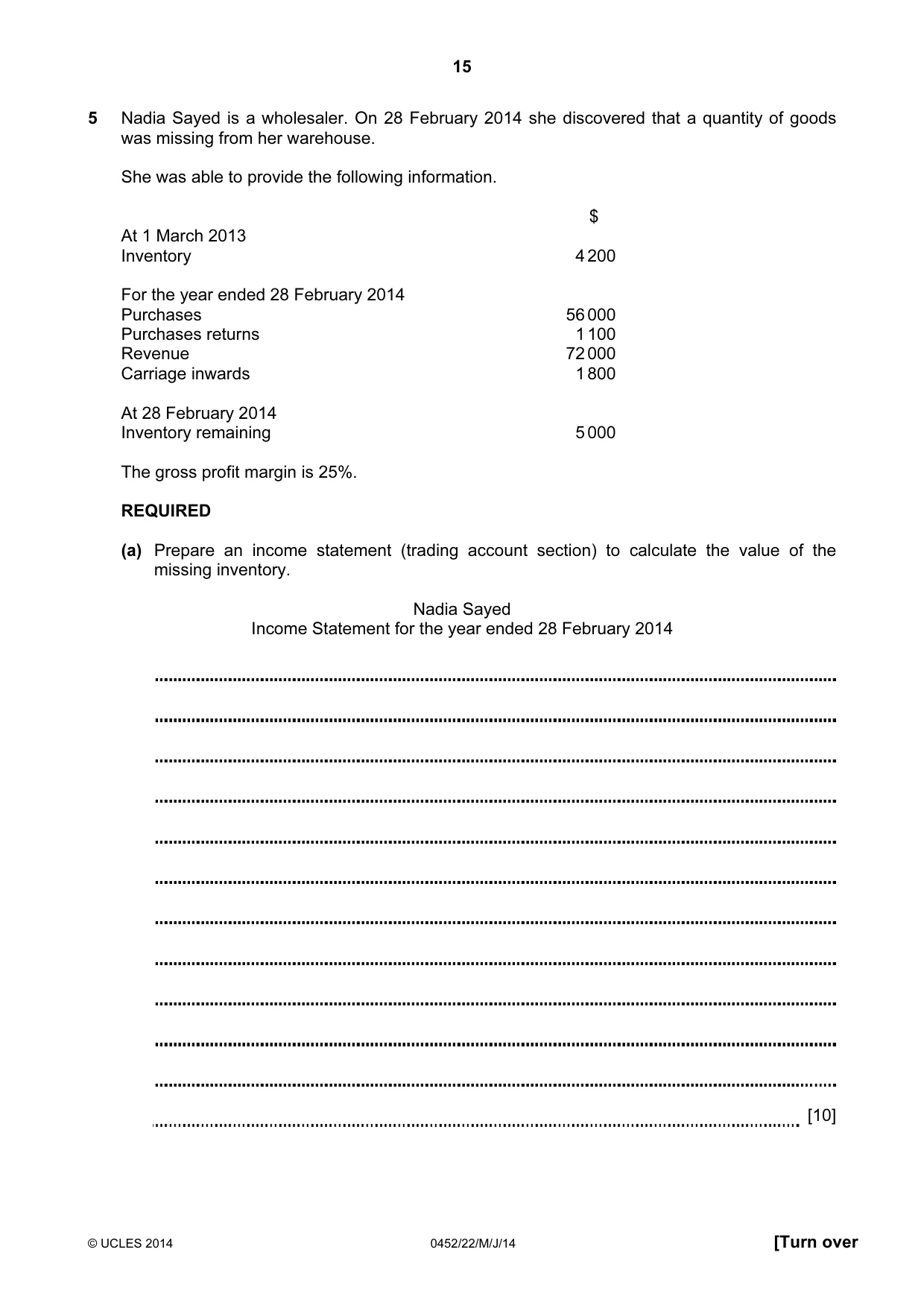
15 © UCLES 2014 0452/22/M/J/14 [Turn over 5 Nadia Sayed is a wholesaler. On 28 February 2014 she discovered that a quantity of goods was missing from her warehouse. She was able to provide the following information. $ At 1 March 2013 Inventory 4 200 For the year ended 28 February 2014 Purchases 56 000 Purchases returns 1 100 Revenue 72 000 Carriage inwards 1 800 At 28 February 2014 Inventory remaining 5 000 The gross profit margin is 25%. REQUIRED (a) Prepare an income statement (trading account section) to calculate the value of the missing inventory. Nadia Sayed Income Statement for the year ended 28 February 2014 [10]
Question paper, page 16
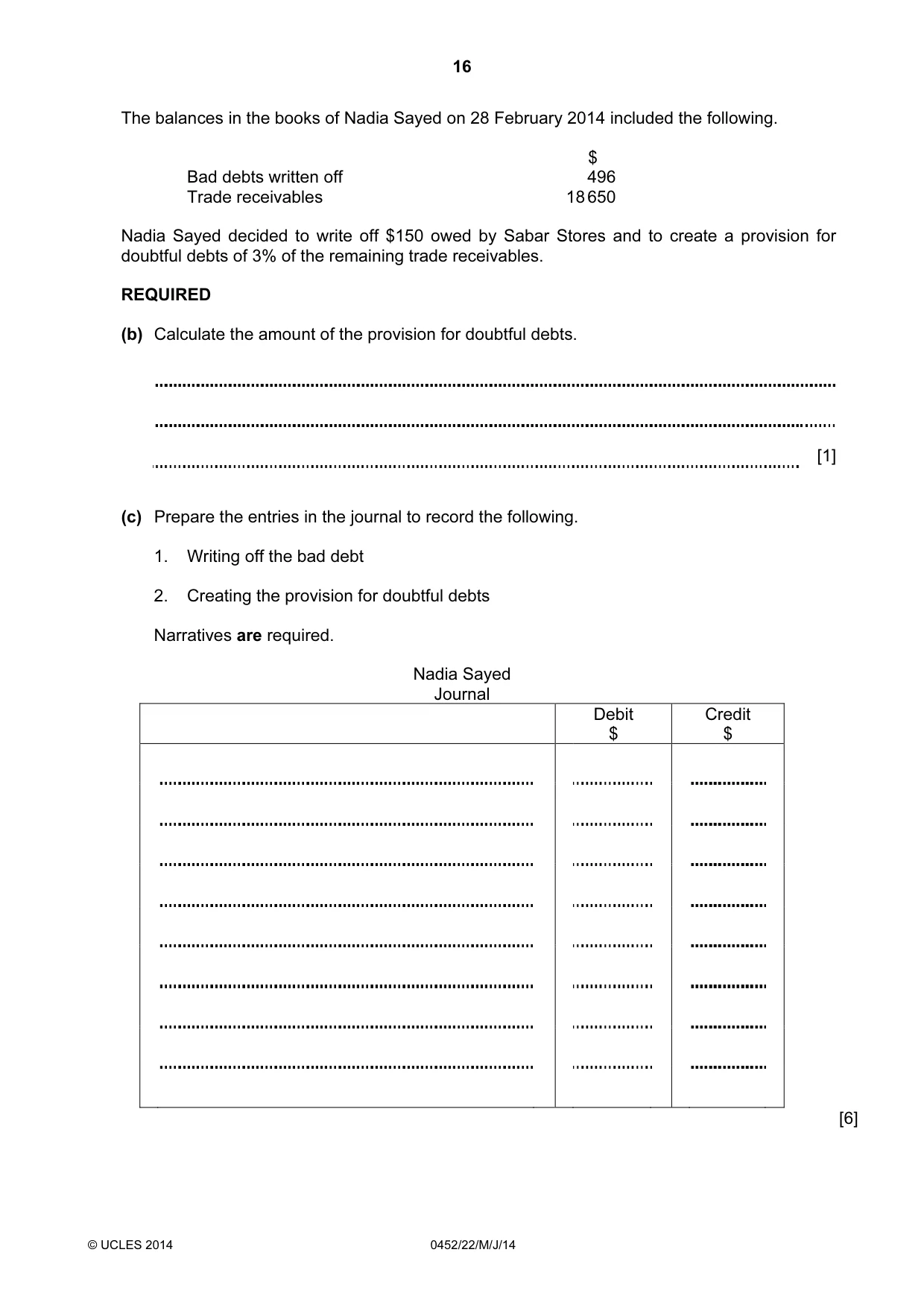
16 © UCLES 2014 0452/22/M/J/14 The balances in the books of Nadia Sayed on 28 February 2014 included the following. $ Bad debts written off 496 Trade receivables 18 650 Nadia Sayed decided to write off $150 owed by Sabar Stores and to create a provision for doubtful debts of 3% of the remaining trade receivables. REQUIRED (b) Calculate the amount of the provision for doubtful debts. [1] (c) Prepare the entries in the journal to record the following. 1. Writing off the bad debt 2. Creating the provision for doubtful debts Narratives are required. Nadia Sayed Journal Debit $ Credit $ [6]
Question paper, page 17
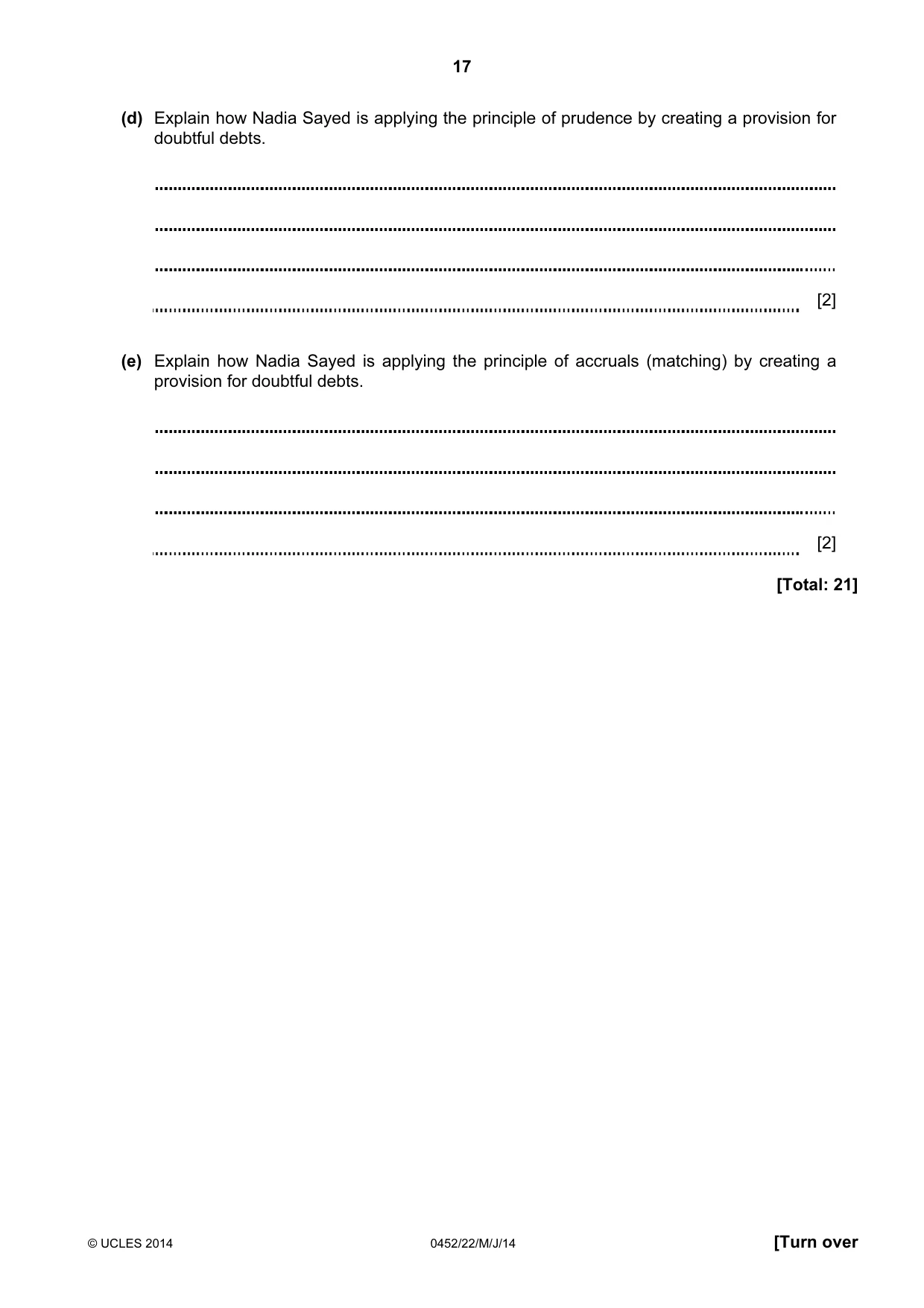
17 © UCLES 2014 0452/22/M/J/14 [Turn over (d) Explain how Nadia Sayed is applying the principle of prudence by creating a provision for doubtful debts. [2] (e) Explain how Nadia Sayed is applying the principle of accruals (matching) by creating a provision for doubtful debts. [2] [Total: 21]
Question paper, page 18
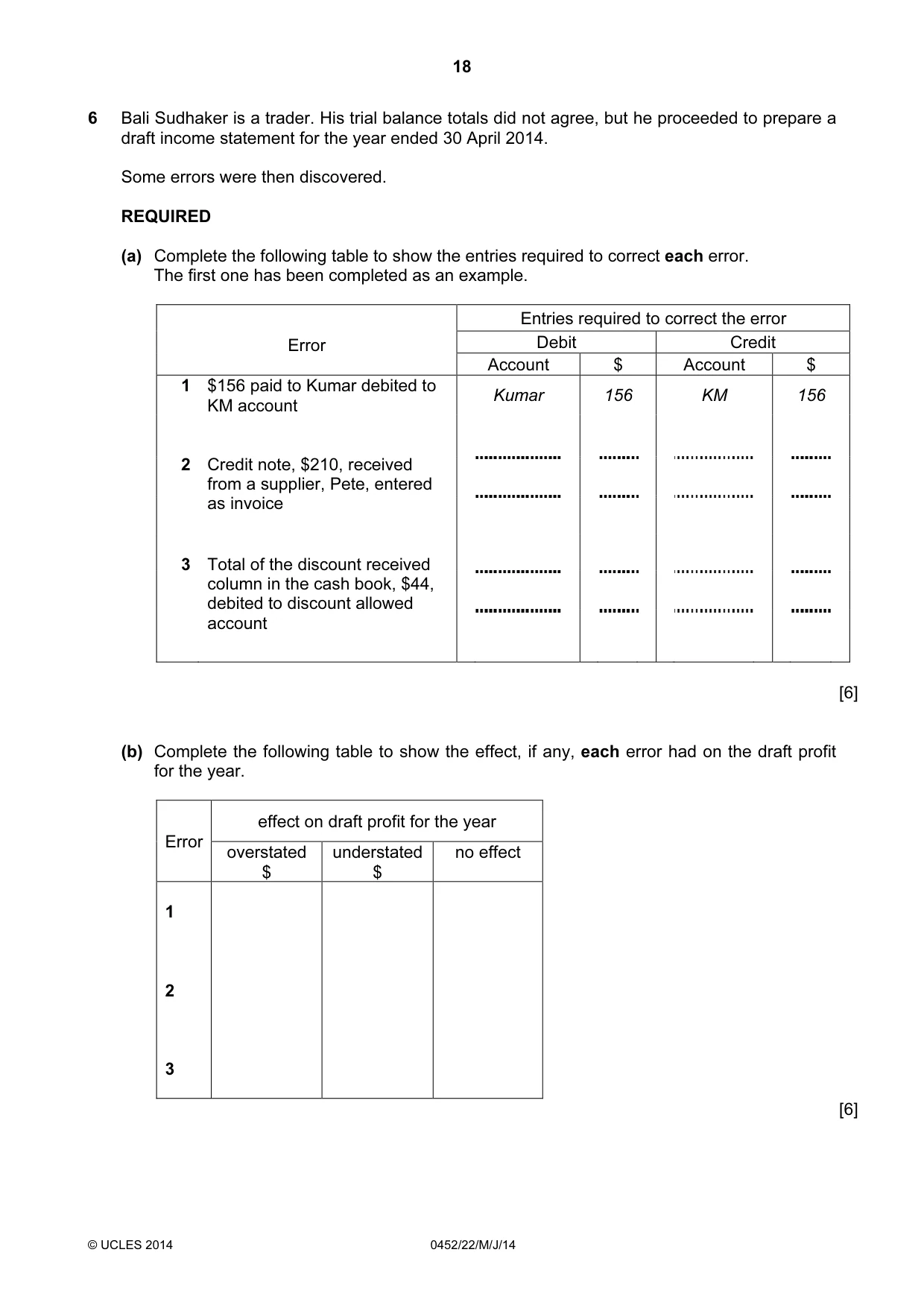
18 © UCLES 2014 0452/22/M/J/14 6 Bali Sudhaker is a trader. His trial balance totals did not agree, but he proceeded to prepare a draft income statement for the year ended 30 April 2014. Some errors were then discovered. REQUIRED (a) Complete the following table to show the entries required to correct each error. The first one has been completed as an example. Error Entries required to correct the error Debit Credit Account $ Account $ 1 $156 paid to Kumar debited to KM account Kumar 156 KM 156 2 Credit note, $210, received from a supplier, Pete, entered as invoice 3 Total of the discount received column in the cash book, $44, debited to discount allowed account [6] (b) Complete the following table to show the effect, if any, each error had on the draft profit for the year. Error effect on draft profit for the year overstated $ understated $ no effect 1 2 3 [6]
Question paper, page 19
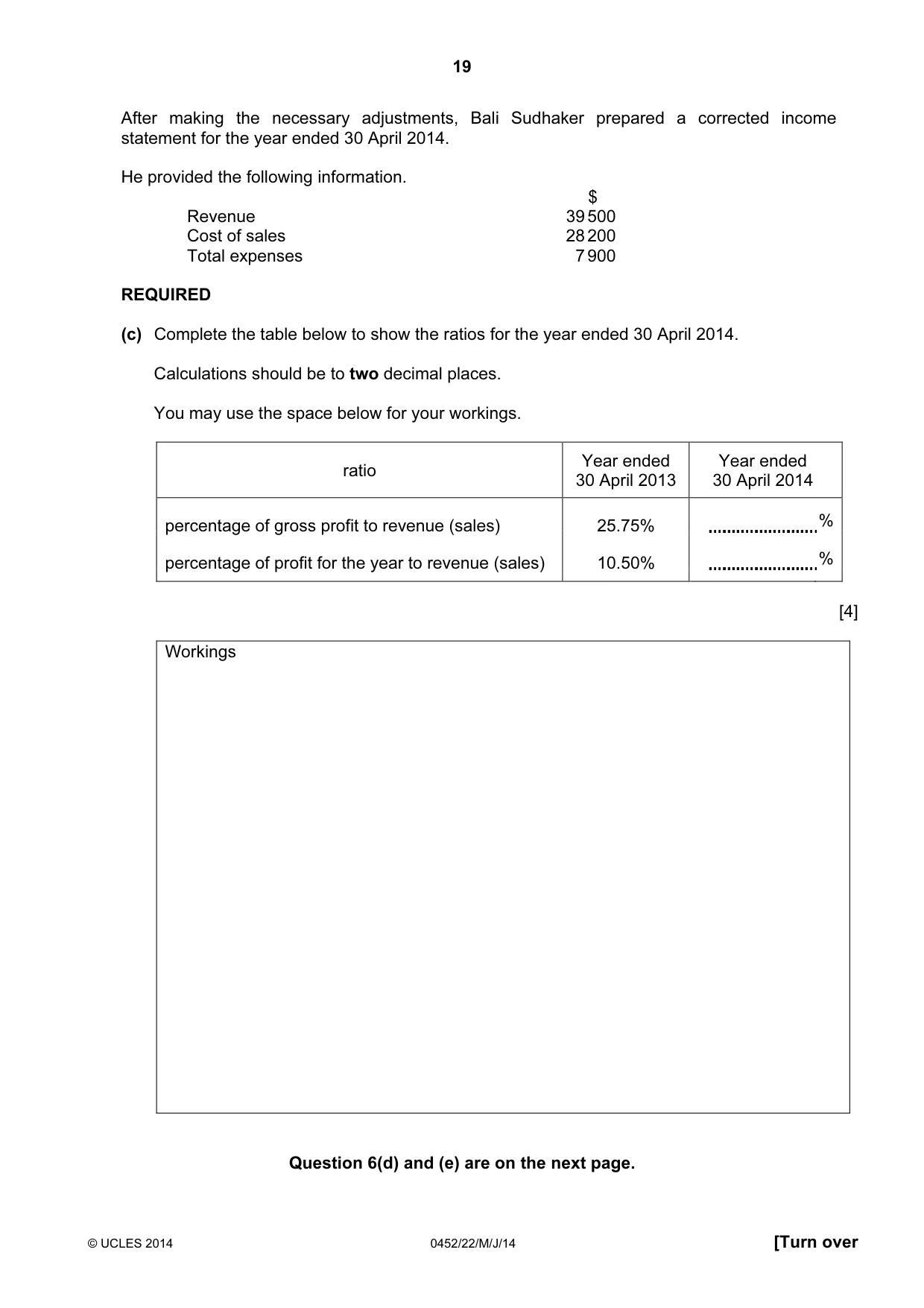
19 © UCLES 2014 0452/22/M/J/14 [Turn over After making the necessary adjustments, Bali Sudhaker prepared a corrected income statement for the year ended 30 April 2014. He provided the following information. $ Revenue 39 500 Cost of sales 28 200 Total expenses 7 900 REQUIRED (c) Complete the table below to show the ratios for the year ended 30 April 2014. Calculations should be to two decimal places. You may use the space below for your workings. ratio Year ended 30 April 2013 Year ended 30 April 2014 percentage of gross profit to revenue (sales) 25.75% % percentage of profit for the year to revenue (sales) 10.50% % [4] Workings Question 6(d) and (e) are on the next page.
Question paper, page 20
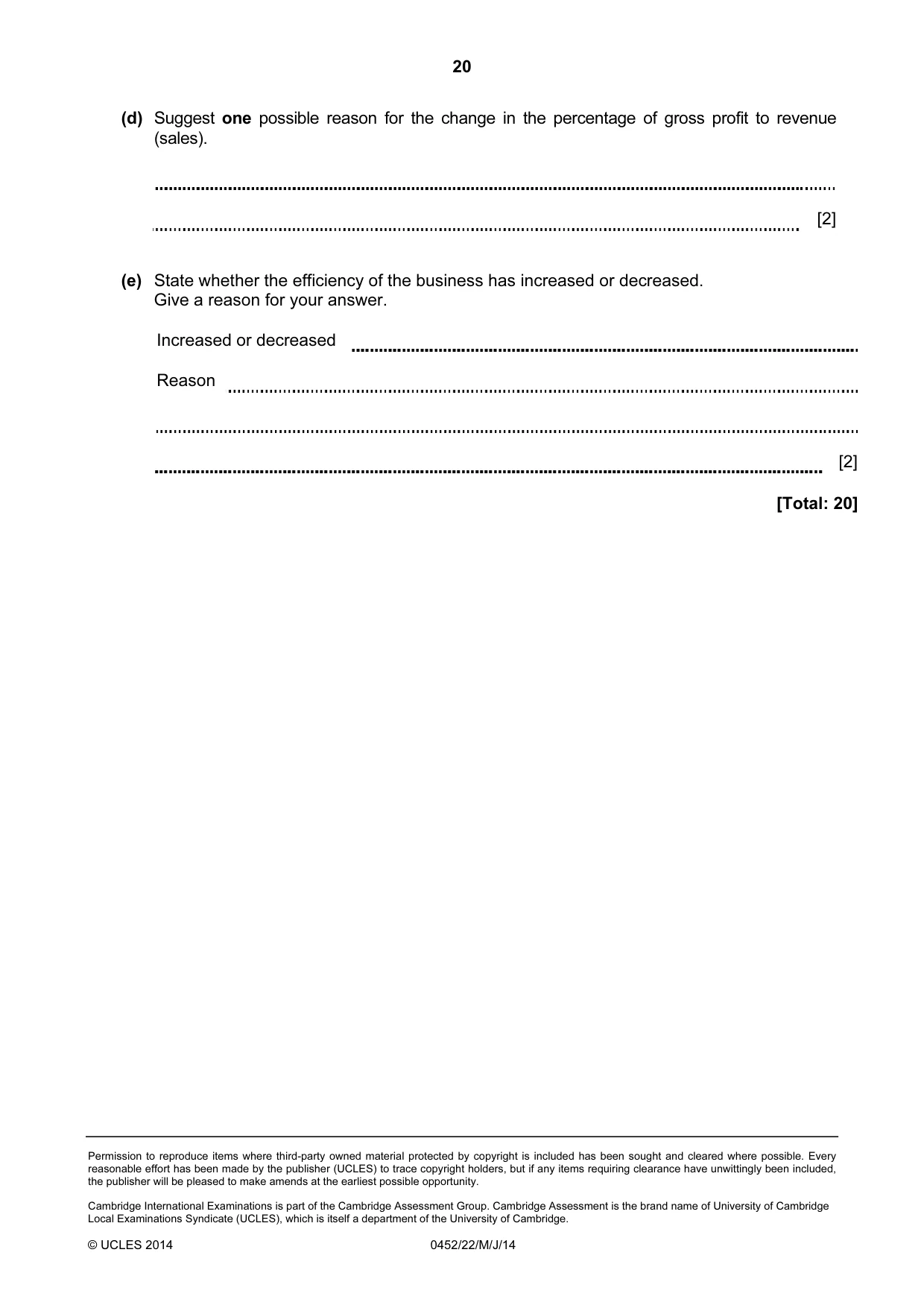
20 Permission to reproduce items where third-party owned material protected by copyright is included has been sought and cleared where possible. Every reasonable effort has been made by the publisher (UCLES) to trace copyright holders, but if any items requiring clearance have unwittingly been included, the publisher will be pleased to make amends at the earliest possible opportunity. Cambridge International Examinations is part of the Cambridge Assessment Group. Cambridge Assessment is the brand name of University of Cambridge Local Examinations Syndicate (UCLES), which is itself a department of the University of Cambridge. © UCLES 2014 0452/22/M/J/14 (d) Suggest one possible reason for the change in the percentage of gross profit to revenue (sales). [2] (e) State whether the efficiency of the business has increased or decreased. Give a reason for your answer. Increased or decreased Reason [2] [Total: 20]
Mark scheme, page 1
CAMBRIDGE INTERNATIONAL EXAMINATIONS International General Certificate of Secondary Education MARK SCHEME for the May/June 2014 series 0452 ACCOUNTING 0452/22 Paper 2, maximum raw mark 120 This mark scheme is published as an aid to teachers and candidates, to indicate the requirements of the examination. It shows the basis on which Examiners were instructed to award marks. It does not indicate the details of the discussions that took place at an Examiners’ meeting before marking began, which would have considered the acceptability of alternative answers. Mark schemes should be read in conjunction with the question paper and the Principal Examiner Report for Teachers. Cambridge will not enter into discussions about these mark schemes. Cambridge is publishing the mark schemes for the May/June 2014 series for most IGCSE, GCE Advanced Level and Advanced Subsidiary Level components and some Ordinary Level components.
Mark scheme, page 2
Page 2 Mark Scheme Syllabus Paper IGCSE – May/June 2014 0452 22 © Cambridge International Examinations 2014 1 (a) Paul Katanga Cash Book Date 2014 Apl 1 8 28 30 2014 May 1 Details Balance b/d Moloi Stores (1) Sales (1) Cash c (1) Balance c/d Balance b/d (1) Discount Allowed $ Cash $ 75 2 500 Bank $ 84 2 215 907 Date 2014 Apl 1 5 21 24 29 30 2014 May 1 Details Balance b/d Office equipment (1) Repairs (1) Moloi Stores (dishonoured cheque) (1) T Nekundi (1) Drawings (1) Bank c (1) Balance c/d Balance b/d (1) OF Discount Received $ 8 Cash $ 300 2 215 60 Bank $ 2 190 580 40 84 312 2 575 3 206 8 2 575 3 206 60 907 +(1) dates [12]
Mark scheme, page 3
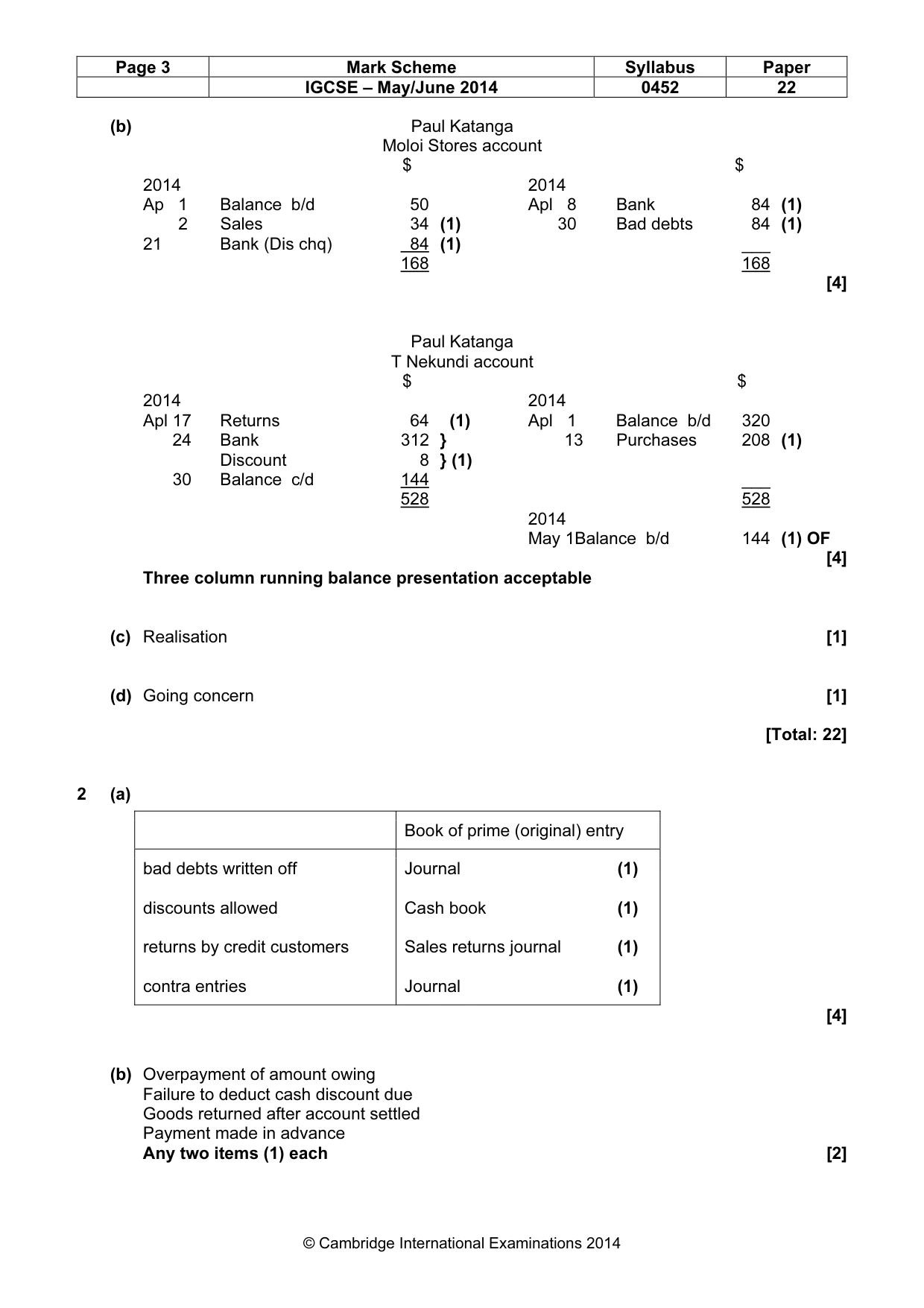
Page 3 Mark Scheme Syllabus Paper IGCSE – May/June 2014 0452 22 © Cambridge International Examinations 2014 (b) Paul Katanga Moloi Stores account $ $ 2014 2014 Ap 1 Balance b/d 50 Apl 8 Bank 84 (1) Ap 2 Sales 34 (1) Apl 30 Bad debts 84 (1) 21 Bank (Dis chq) 84 (1) ___ 168 168 [4] Paul Katanga T Nekundi account $ $ 2014 2014 Apl 17 Returns 64 (1) Apl 1 Balance b/d 320 Apl 24 Bank 312 } Apl 13 Purchases 208 (1) Discount 8 } (1) Apl 30 Balance c/d 144 ___ 528 528 2014 May 1Balance b/d 144 (1) OF [4] Three column running balance presentation acceptable (c) Realisation [1] (d) Going concern [1] [Total: 22] 2 (a) Book of prime (original) entry bad debts written off discounts allowed returns by credit customers contra entries Journal (1) Cash book (1) Sales returns journal (1) Journal (1) [4] (b) Overpayment of amount owing Failure to deduct cash discount due Goods returned after account settled Payment made in advance Any two items (1) each [2]
Mark scheme, page 4
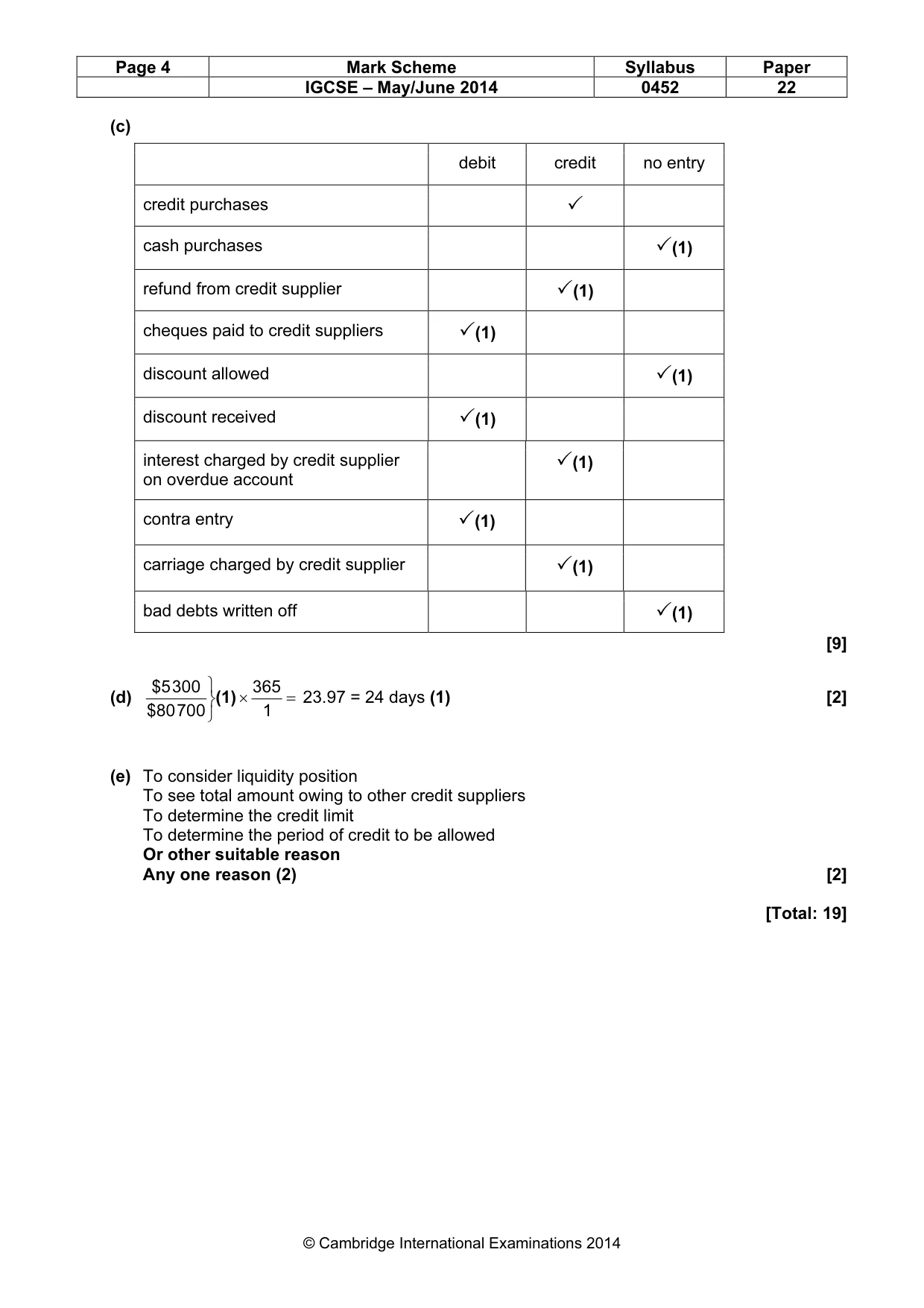
Page 4 Mark Scheme Syllabus Paper IGCSE – May/June 2014 0452 22 © Cambridge International Examinations 2014 (c) debit credit no entry credit purchases ✓ cash purchases ✓(1) refund from credit supplier ✓(1) cheques paid to credit suppliers ✓(1) discount allowed ✓(1) discount received ✓(1) interest charged by credit supplier on overdue account ✓(1) contra entry ✓(1) carriage charged by credit supplier ✓(1) bad debts written off ✓(1) [9] (d) = × 1 365 700 $80 300 $5 (1) 23.97 = 24 days (1) [2] (e) To consider liquidity position To see total amount owing to other credit suppliers To determine the credit limit To determine the period of credit to be allowed Or other suitable reason Any one reason (2) [2] [Total: 19]
Mark scheme, page 5
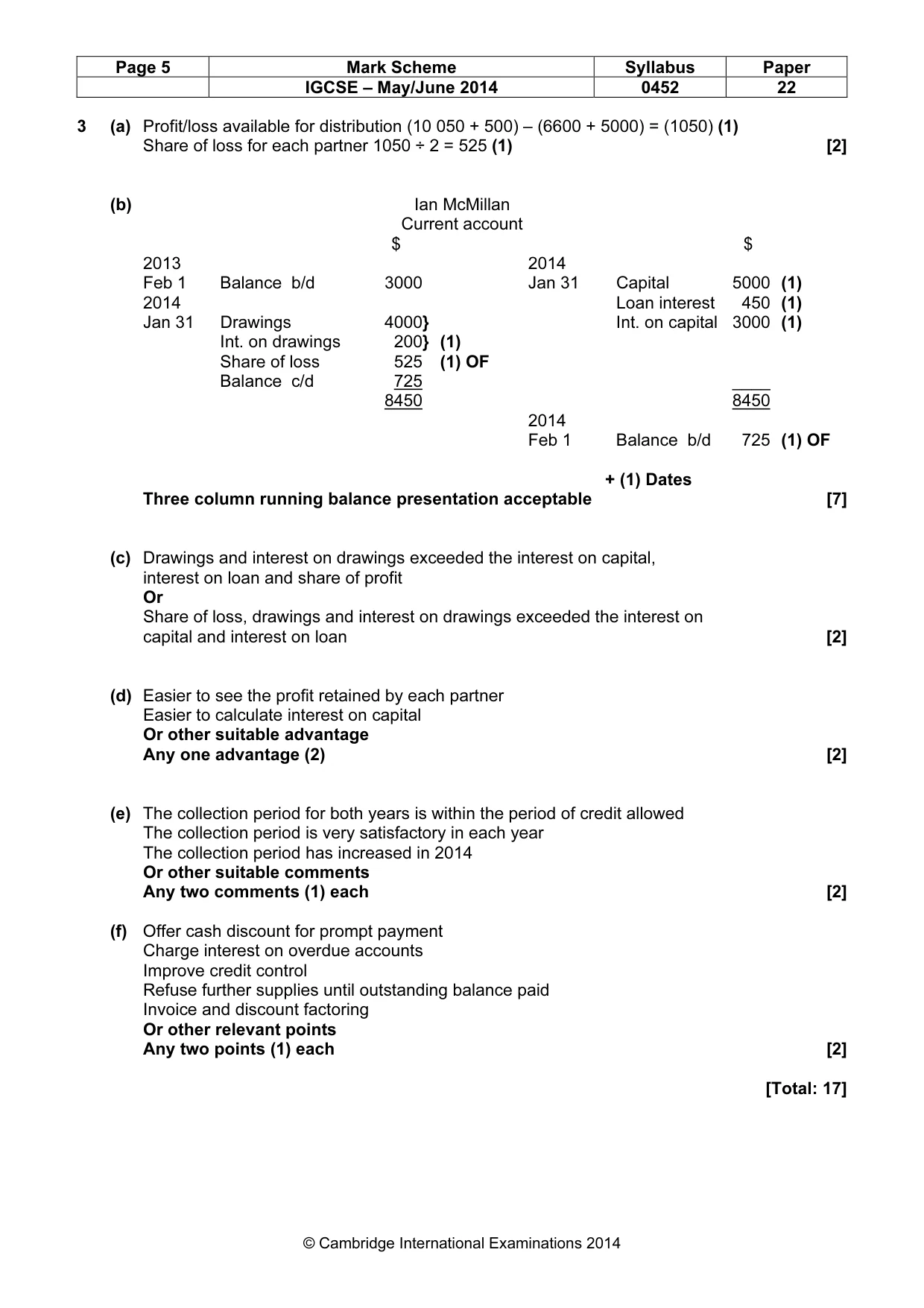
Page 5 Mark Scheme Syllabus Paper IGCSE – May/June 2014 0452 22 © Cambridge International Examinations 2014 3 (a) Profit/loss available for distribution (10 050 + 500) – (6600 + 5000) = (1050) (1) Share of loss for each partner 1050 ÷ 2 = 525 (1) [2] (b) Ian McMillan Current account $ $ 2013 2014 Feb 1 Balance b/d 3000} Jan 31 Capital 5000 (1) 2014 Loan interest 450 (1) Jan 31 Drawings 4000} Int. on capital 3000 (1) Int. on drawings 200} (1) Share of loss 525} (1) OF Balance c/d 725} ____ 8450} 8450 2014 Feb 1 Balance b/d 725 (1) OF + (1) Dates Three column running balance presentation acceptable [7] (c) Drawings and interest on drawings exceeded the interest on capital, interest on loan and share of profit Or Share of loss, drawings and interest on drawings exceeded the interest on capital and interest on loan [2] (d) Easier to see the profit retained by each partner Easier to calculate interest on capital Or other suitable advantage Any one advantage (2) [2] (e) The collection period for both years is within the period of credit allowed The collection period is very satisfactory in each year The collection period has increased in 2014 Or other suitable comments Any two comments (1) each [2] (f) Offer cash discount for prompt payment Charge interest on overdue accounts Improve credit control Refuse further supplies until outstanding balance paid Invoice and discount factoring Or other relevant points Any two points (1) each [2] [Total: 17]
Mark scheme, page 6
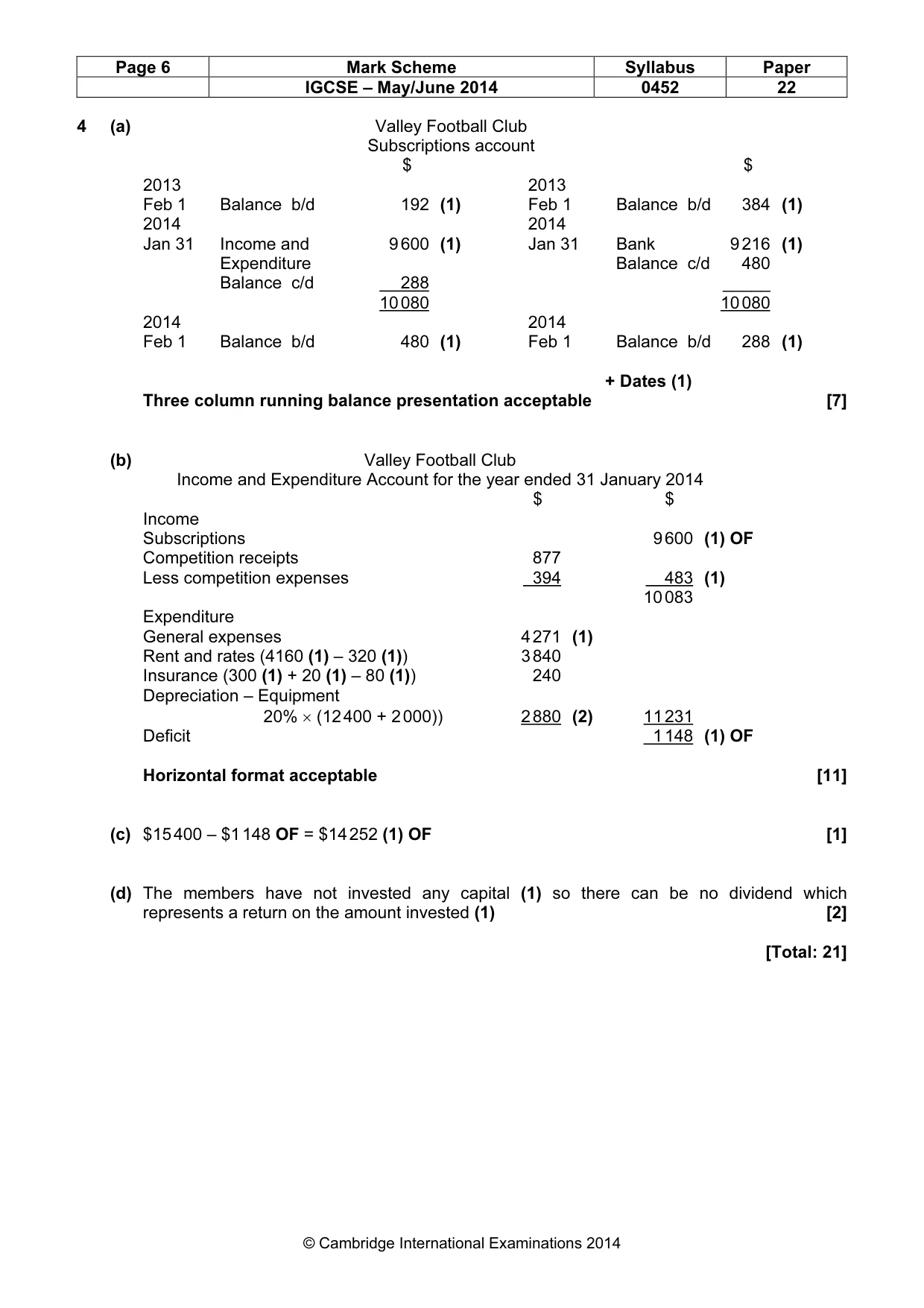
Page 6 Mark Scheme Syllabus Paper IGCSE – May/June 2014 0452 22 © Cambridge International Examinations 2014 4 (a) Valley Football Club Subscriptions account $ $ 2013 2013 Feb 1 Balance b/d 192 (1) Feb 1 Balance b/d 384 (1) 2014 2014 Jan 31 Income and 9 600 (1) Jan 31 Bank 9 216 (1) Expenditure Balance c/d 480 Balance c/d 288 _____ 10 080 10 080 2014 2014 Feb 1 Balance b/d 480 (1) Feb 1 Balance b/d 288 (1) + Dates (1) Three column running balance presentation acceptable [7] (b) Valley Football Club Income and Expenditure Account for the year ended 31 January 2014 $ $ Income Subscriptions 9 600 (1) OF Competition receipts 877 Less competition expenses 394 483 (1) 10 083 Expenditure General expenses 4 271 (1) Rent and rates (4160 (1) – 320 (1)) 3 840 Insurance (300 (1) + 20 (1) – 80 (1)) 240 Depreciation – Equipment Depreciation – (20% × (12 400 + 2 000)) 2 880 (2) 11 231 Deficit 1 148 (1) OF Horizontal format acceptable [11] (c) $15 400 – $1 148 OF = $14 252 (1) OF [1] (d) The members have not invested any capital (1) so there can be no dividend which represents a return on the amount invested (1) [2] [Total: 21]
Mark scheme, page 7
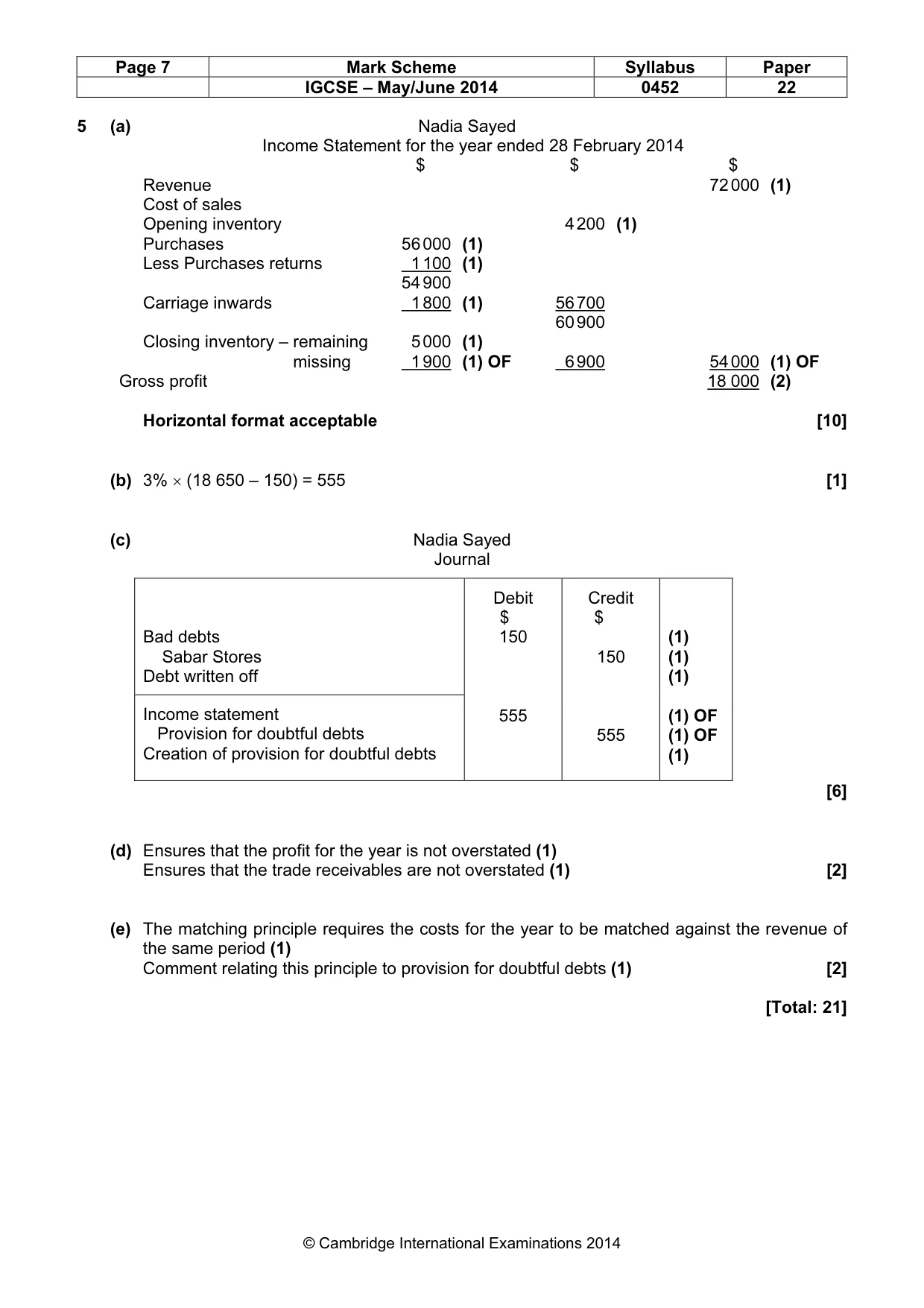
Page 7 Mark Scheme Syllabus Paper IGCSE – May/June 2014 0452 22 © Cambridge International Examinations 2014 5 (a) Nadia Sayed Income Statement for the year ended 28 February 2014 $ $ $ Revenue 72 000 (1) Cost of sales Opening inventory 4 200 (1) Purchases 56 000 (1) Less Purchases returns 1 100 (1) 54 900 Carriage inwards 1 800 (1) 56 700 60 900 Closing inventory – remaining 5 000 (1) Closing inventory – missing 1 900 (1) OF 6 900 54 000 (1) OF Gross profit 18 000 (2) Horizontal format acceptable [10] (b) 3% × (18 650 – 150) = 555 [1] (c) Nadia Sayed Journal Bad debts Sabar Stores Debt written off Debit $ 150 555 Credit $ 150 555 (1) (1) (1) (1) OF (1) OF (1) Income statement Provision for doubtful debts Creation of provision for doubtful debts [6] (d) Ensures that the profit for the year is not overstated (1) Ensures that the trade receivables are not overstated (1) [2] (e) The matching principle requires the costs for the year to be matched against the revenue of the same period (1) Comment relating this principle to provision for doubtful debts (1) [2] [Total: 21]
Mark scheme, page 8
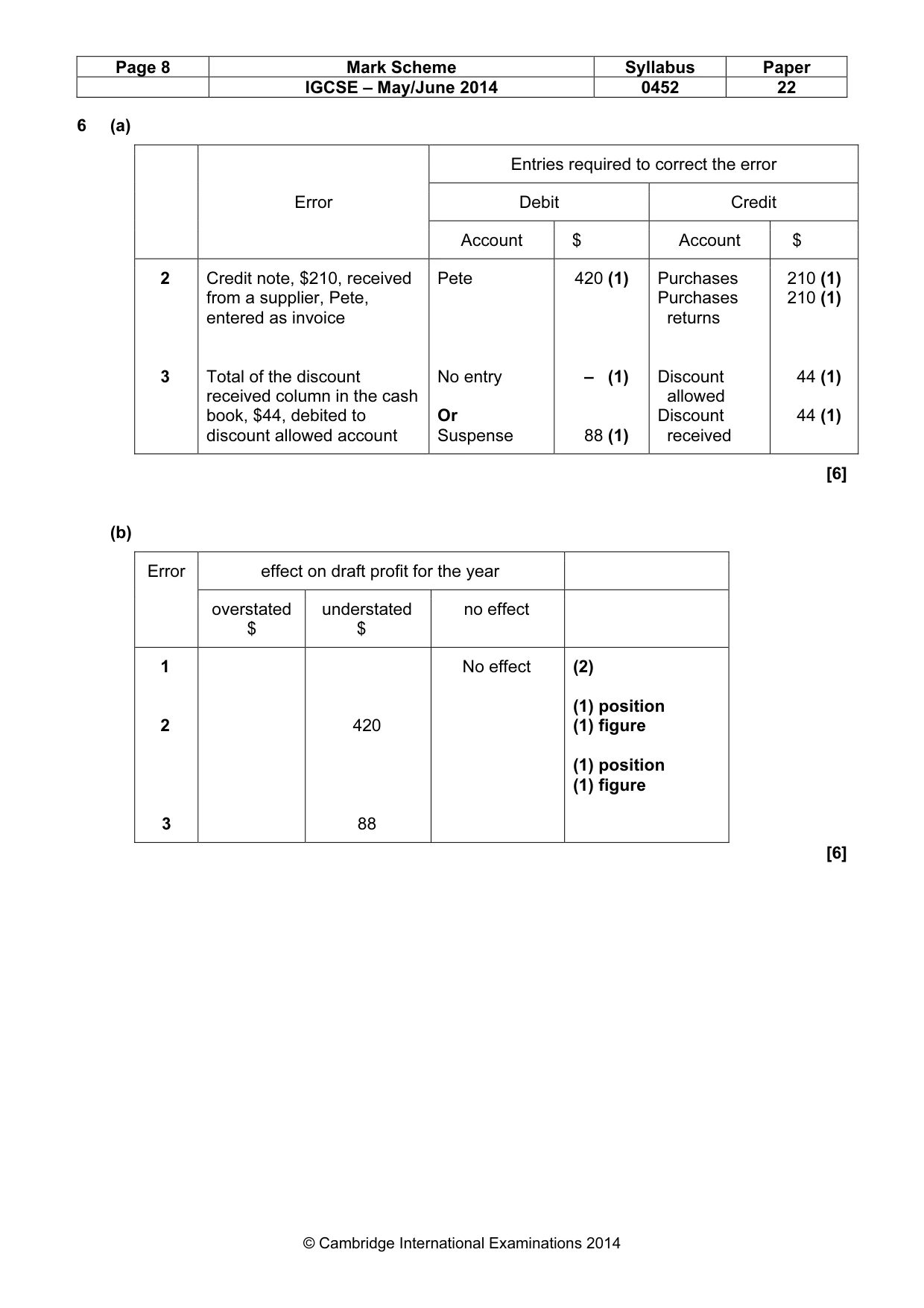
Page 8 Mark Scheme Syllabus Paper IGCSE – May/June 2014 0452 22 © Cambridge International Examinations 2014 6 (a) Error Entries required to correct the error Debit Credit Account $ Account $ 2 3 Credit note, $210, received from a supplier, Pete, entered as invoice Total of the discount received column in the cash book, $44, debited to discount allowed account Pete No entry Or Suspense 420 (1) – (1) 88 (1) Purchases Purchases returns Discount allowed Discount received 210 (1) 210 (1) 44 (1) 44 (1) [6] (b) Error effect on draft profit for the year overstated $ understated $ no effect 1 2 3 420 88 No effect (2) (1) position (1) figure (1) position (1) figure [6]
Mark scheme, page 9
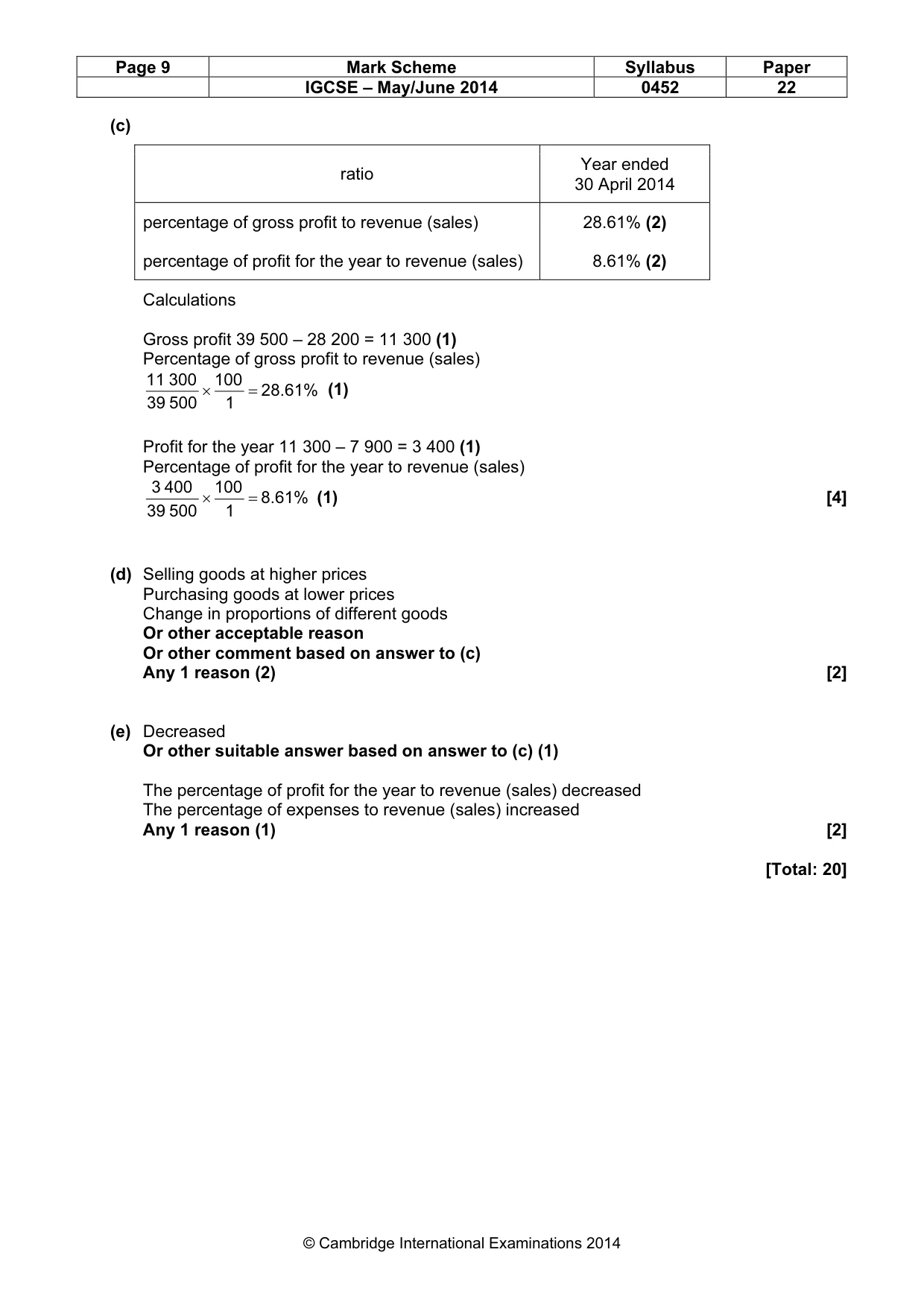
Page 9 Mark Scheme Syllabus Paper IGCSE – May/June 2014 0452 22 © Cambridge International Examinations 2014 (c) ratio Year ended 30 April 2014 percentage of gross profit to revenue (sales) percentage of profit for the year to revenue (sales) 28.61% (2) 8.61% (2) Calculations Gross profit 39 500 – 28 200 = 11 300 (1) Percentage of gross profit to revenue (sales) 28.61% 1 100 500 39 300 11 = × (1) Profit for the year 11 300 – 7 900 = 3 400 (1) Percentage of profit for the year to revenue (sales) 8.61% 1 100 500 39 400 3 = × (1) [4] (d) Selling goods at higher prices Purchasing goods at lower prices Change in proportions of different goods Or other acceptable reason Or other comment based on answer to (c) Any 1 reason (2) [2] (e) Decreased Or other suitable answer based on answer to (c) (1) The percentage of profit for the year to revenue (sales) decreased The percentage of expenses to revenue (sales) increased Any 1 reason (1) [2] [Total: 20]
What you needed in this session
Cambridge’s own grade thresholds for 2014 May/June, Paper 2 · Variant 2. A higher threshold means an easier paper — the bar moves with how the cohort did.