Cambridge IGCSE Accounting 0452 — 2014 May/June Paper 2 · Variant 1
0452/21/M/J/14 · 120 marks · ≈135 min
The question paper and its mark scheme, free to read here and free to download. This is Cambridge’s own paper, exactly as it was sat.
Question paper20 pages

Mark scheme9 pages
Answers below. Sit the paper first if you are practising.
Paper as text
Question paper, page 1
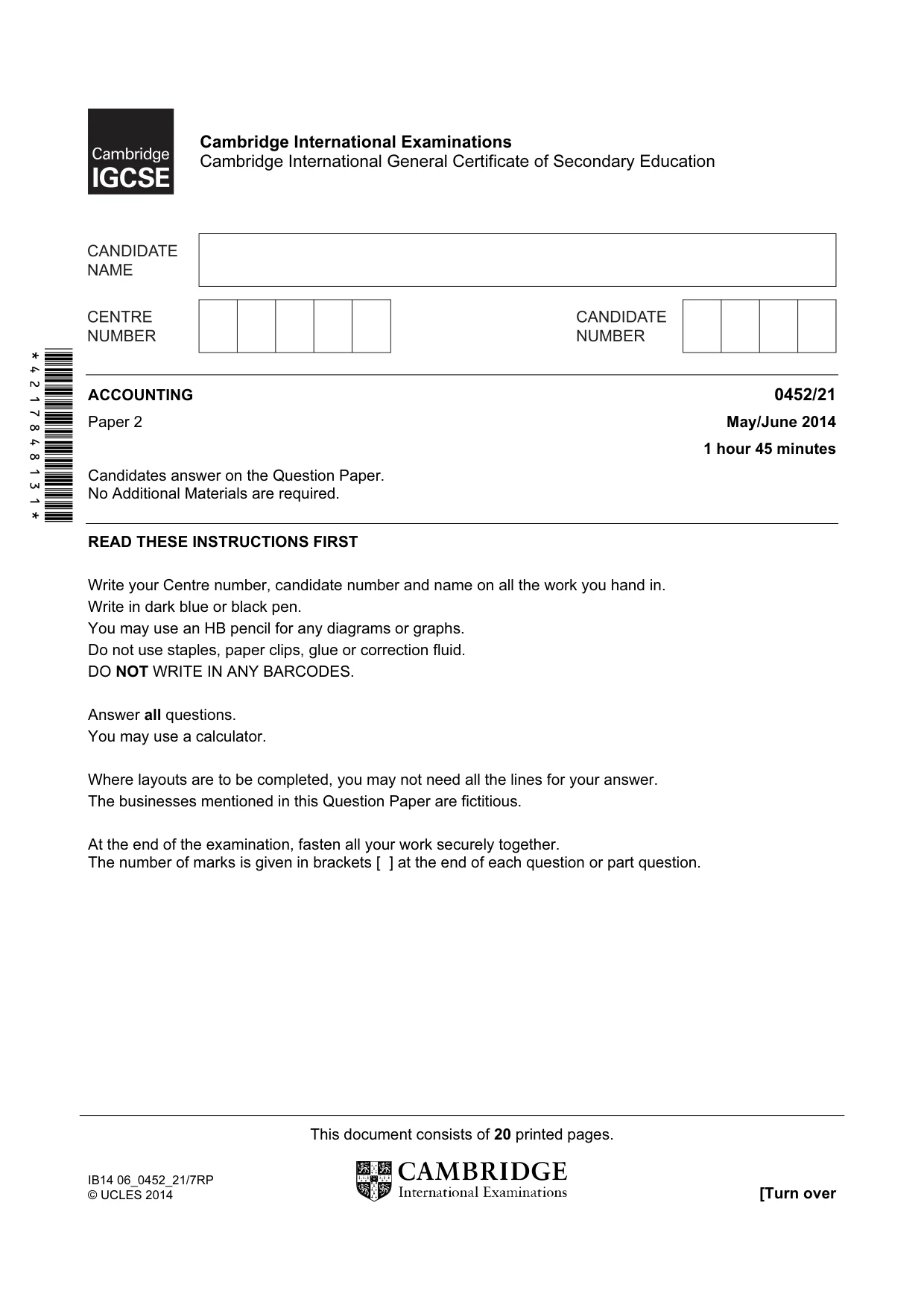
This document consists of 20 printed pages. IB14 06_0452_21/7RP © UCLES 2014 [Turn over *4217848131* Cambridge International Examinations Cambridge International General Certificate of Secondary Education ACCOUNTING 0452/21 Paper 2 May/June 2014 1 hour 45 minutes Candidates answer on the Question Paper. No Additional Materials are required. READ THESE INSTRUCTIONS FIRST Write your Centre number, candidate number and name on all the work you hand in. Write in dark blue or black pen. You may use an HB pencil for any diagrams or graphs. Do not use staples, paper clips, glue or correction fluid. DO NOT WRITE IN ANY BARCODES. Answer all questions. You may use a calculator. Where layouts are to be completed, you may not need all the lines for your answer. The businesses mentioned in this Question Paper are fictitious. At the end of the examination, fasten all your work securely together. The number of marks is given in brackets [ ] at the end of each question or part question.
Question paper, page 2
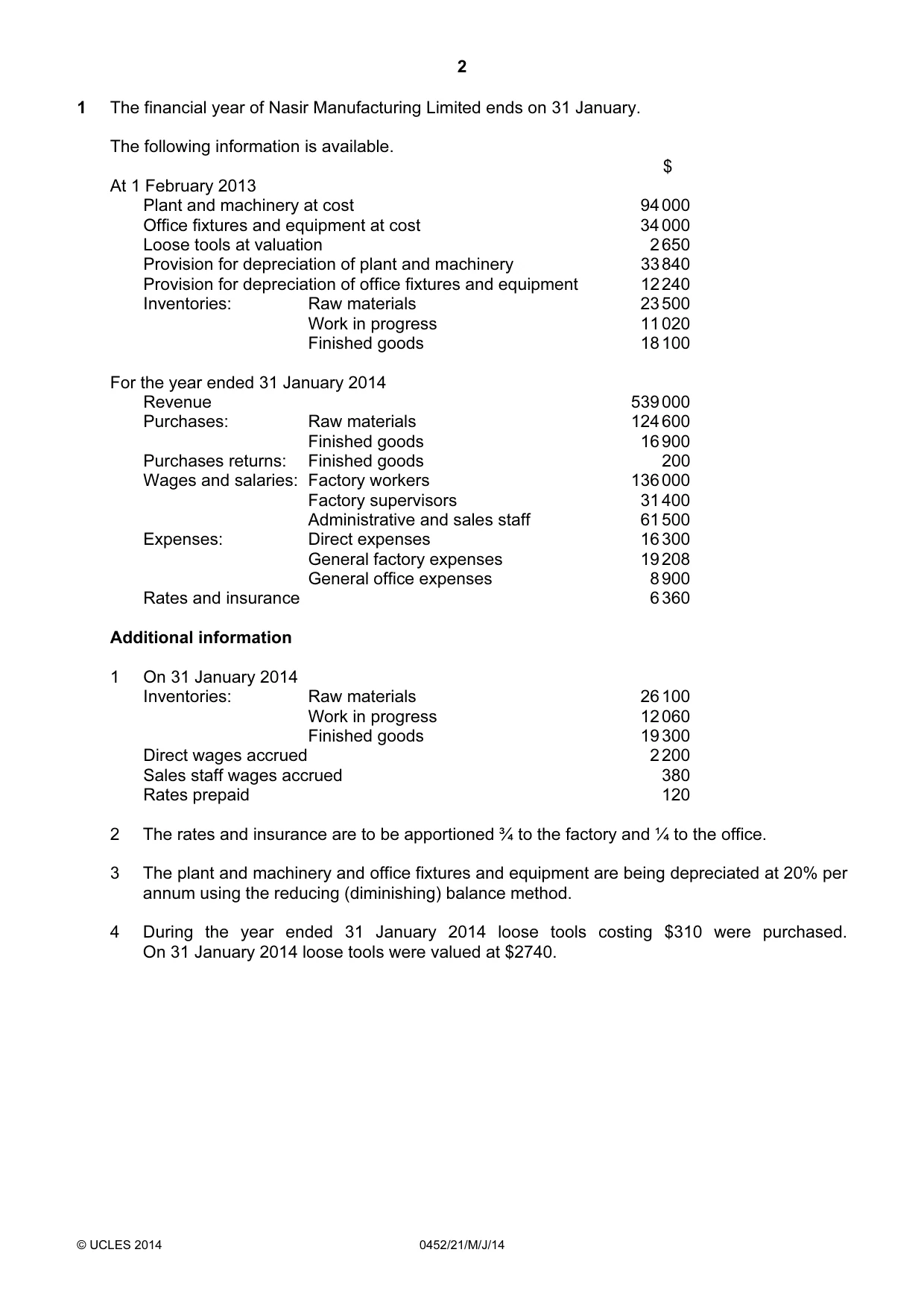
2 © UCLES 2014 0452/21/M/J/14 1 The financial year of Nasir Manufacturing Limited ends on 31 January. The following information is available. $ At 1 February 2013 Plant and machinery at cost 94 000 Office fixtures and equipment at cost 34 000 Loose tools at valuation 2 650 Provision for depreciation of plant and machinery 33 840 Provision for depreciation of office fixtures and equipment 12 240 Inventories: Raw materials 23 500 Work in progress 11 020 Finished goods 18 100 For the year ended 31 January 2014 Revenue 539 000 Purchases: Raw materials 124 600 Finished goods 16 900 Purchases returns: Finished goods 200 Wages and salaries: Factory workers 136 000 Factory supervisors 31 400 Administrative and sales staff 61 500 Expenses: Direct expenses 16 300 General factory expenses 19 208 General office expenses 8 900 Rates and insurance 6 360 Additional information 1 On 31 January 2014 Inventories: Raw materials 26 100 Work in progress 12 060 Finished goods 19 300 Direct wages accrued 2 200 Sales staff wages accrued 380 Rates prepaid 120 2 The rates and insurance are to be apportioned ¾ to the factory and ¼ to the office. 3 The plant and machinery and office fixtures and equipment are being depreciated at 20% per annum using the reducing (diminishing) balance method. 4 During the year ended 31 January 2014 loose tools costing $310 were purchased. On 31 January 2014 loose tools were valued at $2740.
Question paper, page 3
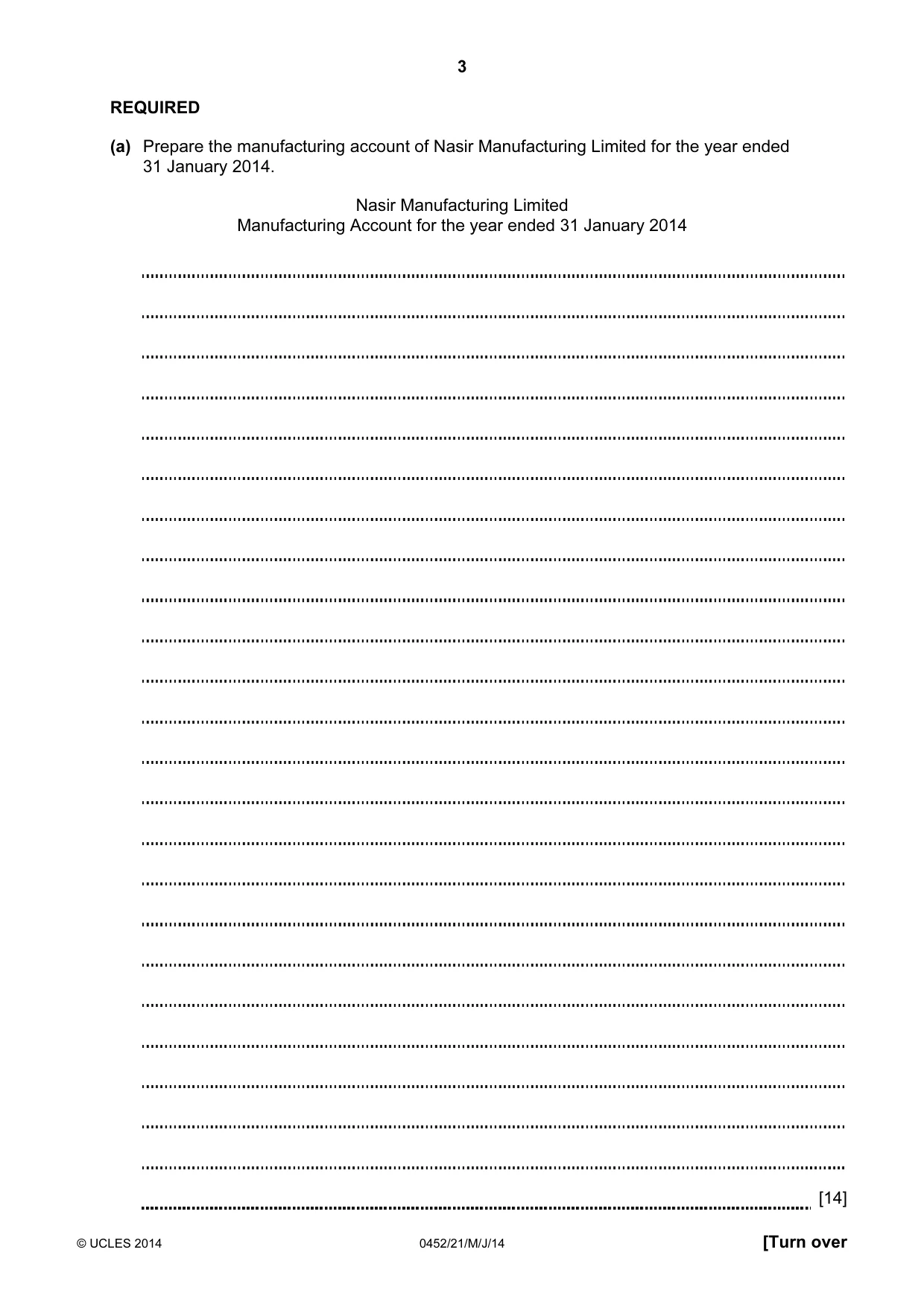
3 © UCLES 2014 0452/21/M/J/14 [Turn over REQUIRED (a) Prepare the manufacturing account of Nasir Manufacturing Limited for the year ended 31 January 2014. Nasir Manufacturing Limited Manufacturing Account for the year ended 31 January 2014 [14]
Question paper, page 4
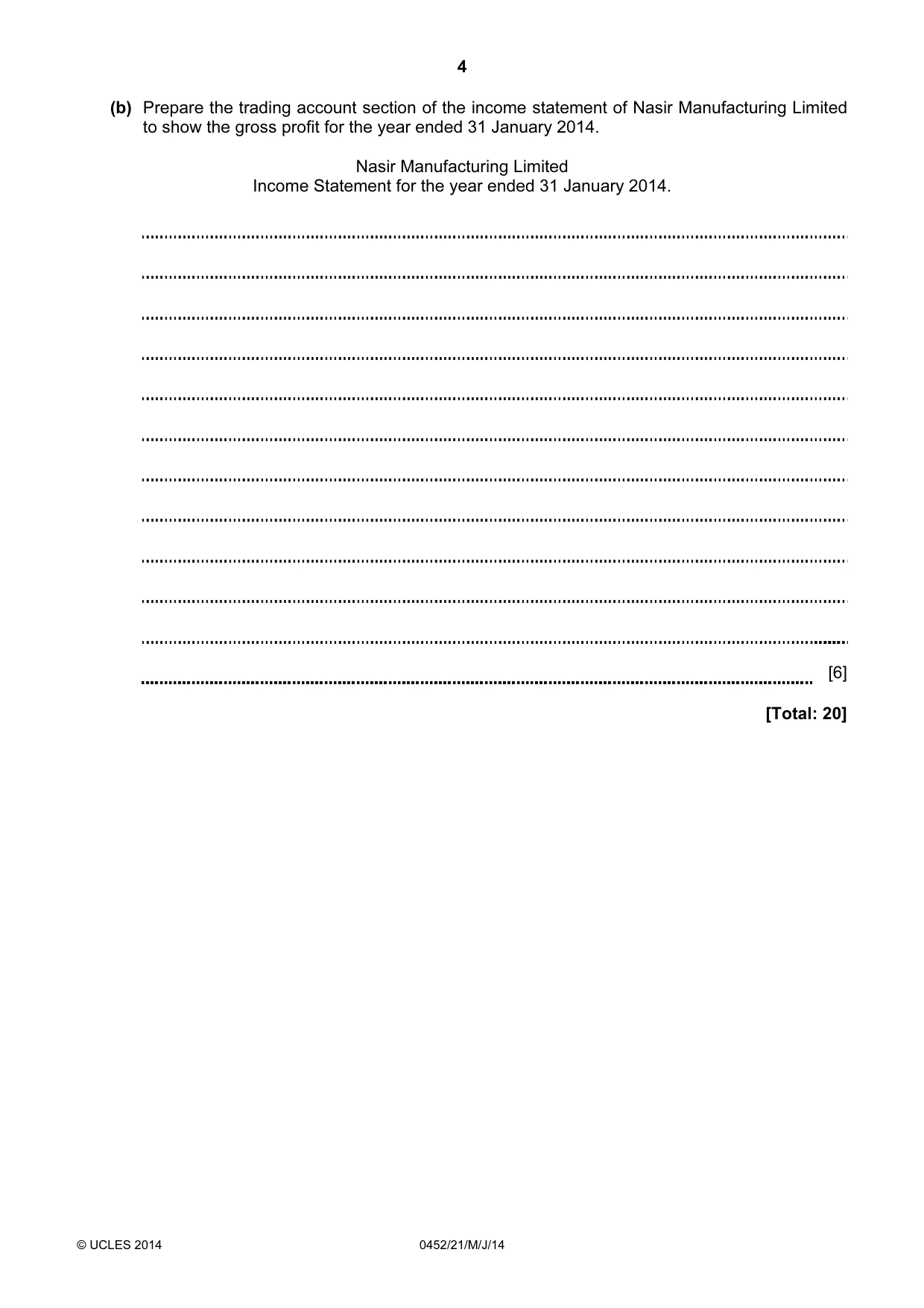
4 © UCLES 2014 0452/21/M/J/14 (b) Prepare the trading account section of the income statement of Nasir Manufacturing Limited to show the gross profit for the year ended 31 January 2014. Nasir Manufacturing Limited Income Statement for the year ended 31 January 2014. [6] [Total: 20]
Question paper, page 5
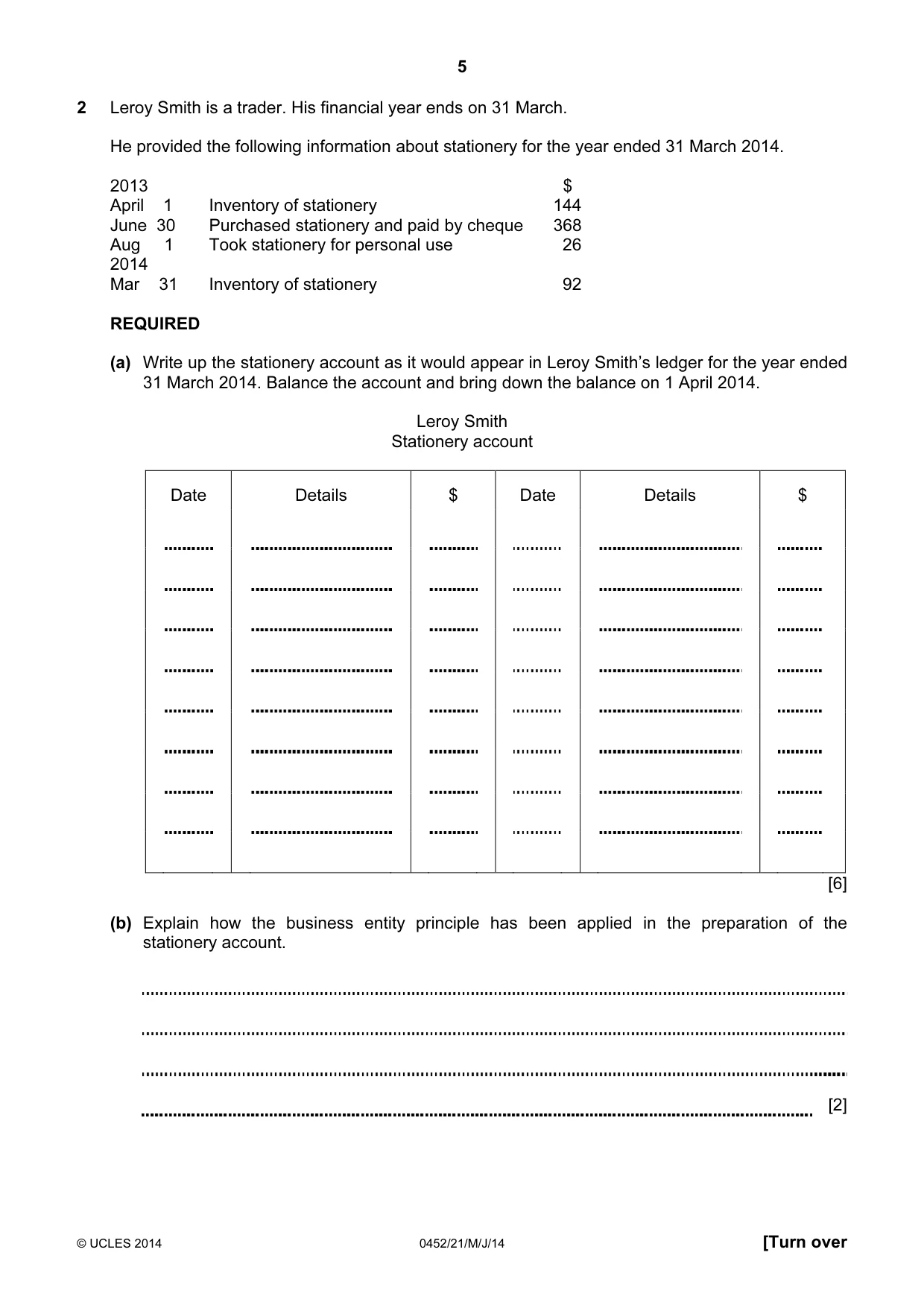
5 © UCLES 2014 0452/21/M/J/14 [Turn over 2 Leroy Smith is a trader. His financial year ends on 31 March. He provided the following information about stationery for the year ended 31 March 2014. 2013 $ April 1 Inventory of stationery 144 June 30 Purchased stationery and paid by cheque 368 Aug 1 Took stationery for personal use 26 2014 Mar 31 Inventory of stationery 92 REQUIRED (a) Write up the stationery account as it would appear in Leroy Smith’s ledger for the year ended 31 March 2014. Balance the account and bring down the balance on 1 April 2014. Leroy Smith Stationery account Date Details $ Date Details $ [6] (b) Explain how the business entity principle has been applied in the preparation of the stationery account. [2]
Question paper, page 6
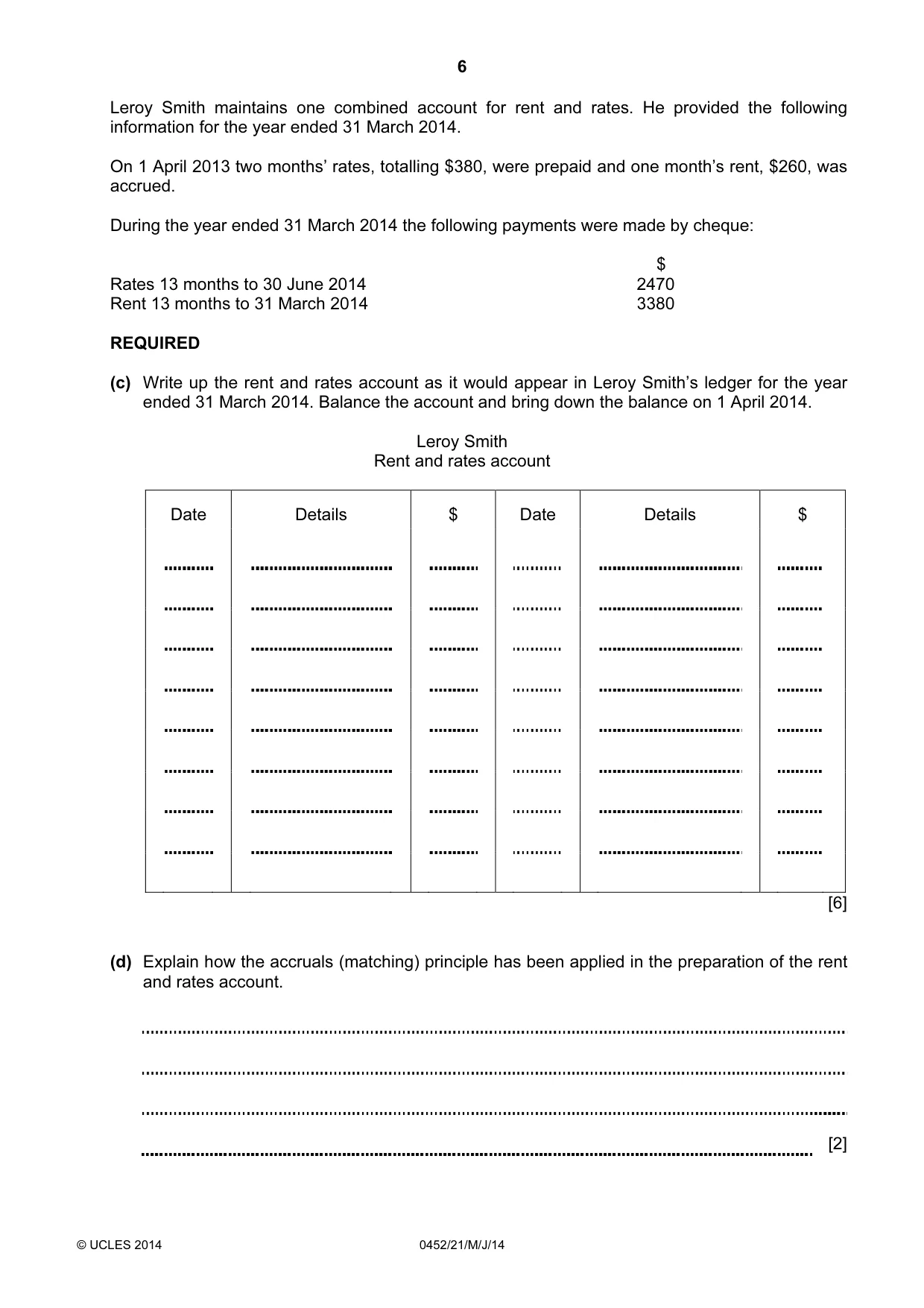
6 © UCLES 2014 0452/21/M/J/14 Leroy Smith maintains one combined account for rent and rates. He provided the following information for the year ended 31 March 2014. On 1 April 2013 two months’ rates, totalling $380, were prepaid and one month’s rent, $260, was accrued. During the year ended 31 March 2014 the following payments were made by cheque: $ Rates 13 months to 30 June 2014 2470 Rent 13 months to 31 March 2014 3380 REQUIRED (c) Write up the rent and rates account as it would appear in Leroy Smith’s ledger for the year ended 31 March 2014. Balance the account and bring down the balance on 1 April 2014. Leroy Smith Rent and rates account Date Details $ Date Details $ [6] (d) Explain how the accruals (matching) principle has been applied in the preparation of the rent and rates account. [2]
Question paper, page 7
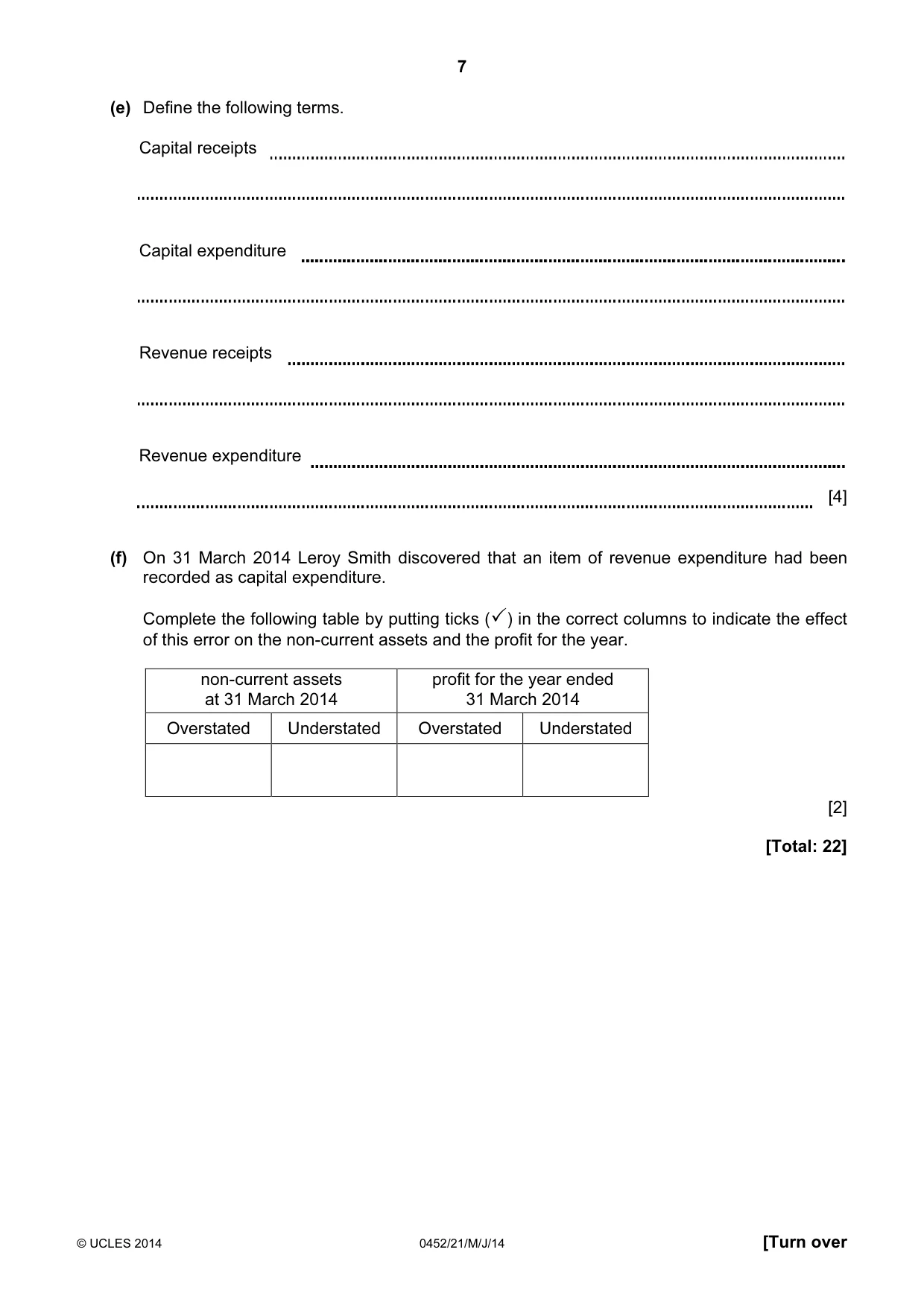
7 © UCLES 2014 0452/21/M/J/14 [Turn over (e) Define the following terms. Capital receipts Capital expenditure Revenue receipts Revenue expenditure [4] (f) On 31 March 2014 Leroy Smith discovered that an item of revenue expenditure had been recorded as capital expenditure. Complete the following table by putting ticks (✓) in the correct columns to indicate the effect of this error on the non-current assets and the profit for the year. non-current assets at 31 March 2014 profit for the year ended 31 March 2014 Overstated Understated Overstated Understated [2] [Total: 22]
Question paper, page 8
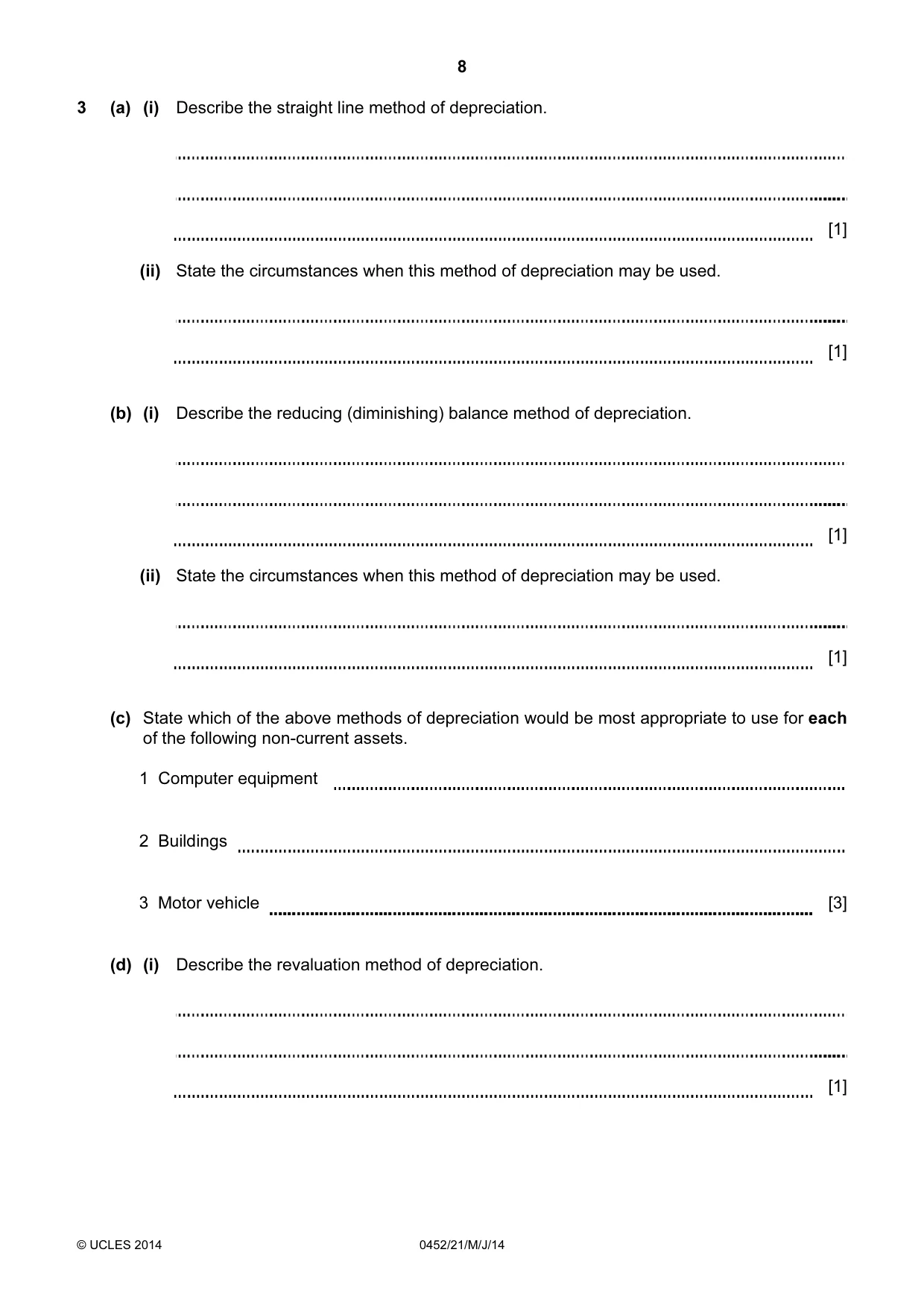
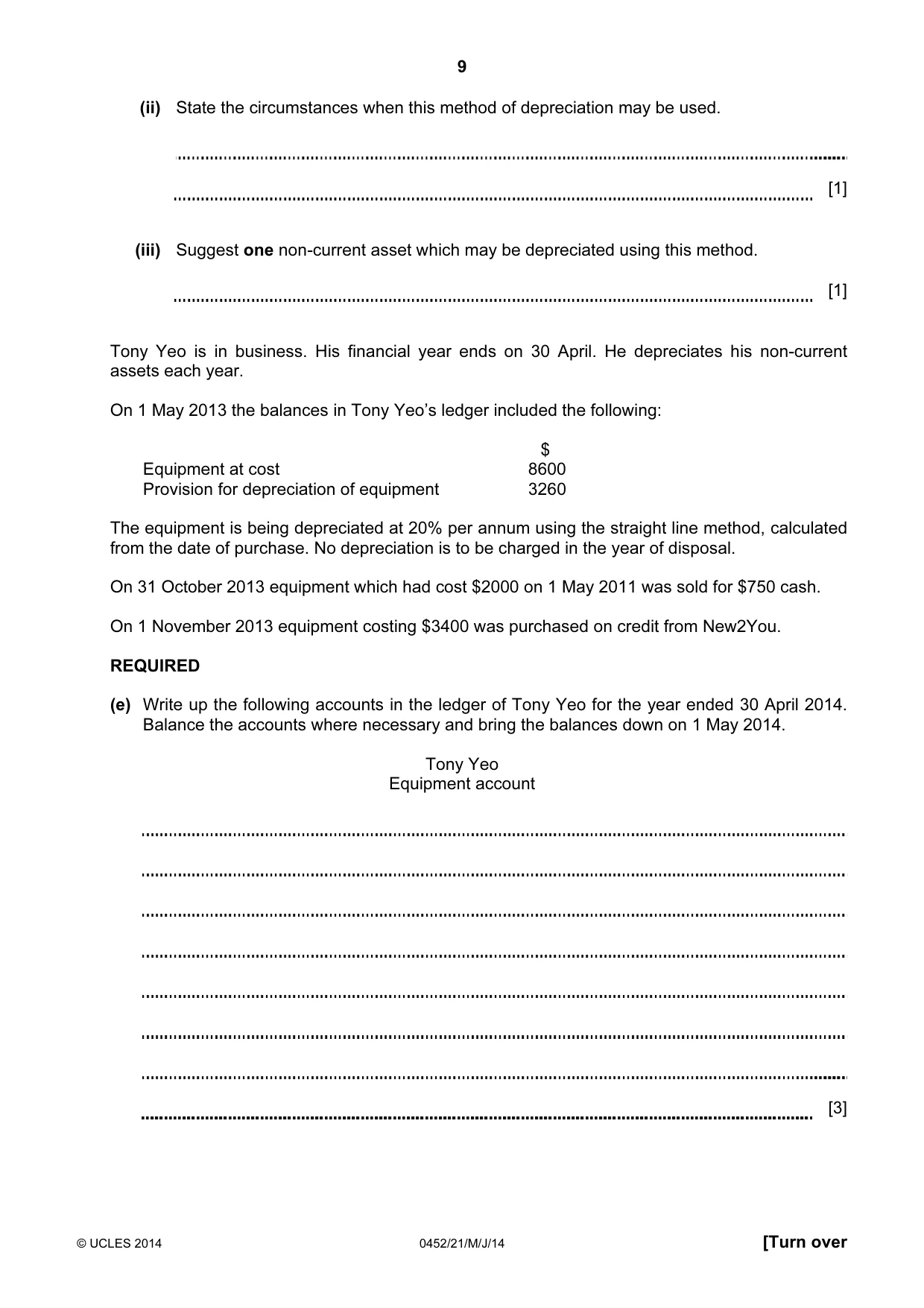
8 © UCLES 2014 0452/21/M/J/14 3 (a) (i) Describe the straight line method of depreciation. [1] (ii) State the circumstances when this method of depreciation may be used. [1] (b) (i) Describe the reducing (diminishing) balance method of depreciation. [1] (ii) State the circumstances when this method of depreciation may be used. [1] (c) State which of the above methods of depreciation would be most appropriate to use for each of the following non-current assets. 1 Computer equipment 2 Buildings 3 Motor vehicle [3] (d) (i) Describe the revaluation method of depreciation. [1]
Question paper, page 9
9 © UCLES 2014 0452/21/M/J/14 [Turn over (ii) State the circumstances when this method of depreciation may be used. [1] (iii) Suggest one non-current asset which may be depreciated using this method. [1] Tony Yeo is in business. His financial year ends on 30 April. He depreciates his non-current assets each year. On 1 May 2013 the balances in Tony Yeo’s ledger included the following: $ Equipment at cost 8600 Provision for depreciation of equipment 3260 The equipment is being depreciated at 20% per annum using the straight line method, calculated from the date of purchase. No depreciation is to be charged in the year of disposal. On 31 October 2013 equipment which had cost $2000 on 1 May 2011 was sold for $750 cash. On 1 November 2013 equipment costing $3400 was purchased on credit from New2You. REQUIRED (e) Write up the following accounts in the ledger of Tony Yeo for the year ended 30 April 2014. Balance the accounts where necessary and bring the balances down on 1 May 2014. Tony Yeo Equipment account [3]
Question paper, page 10
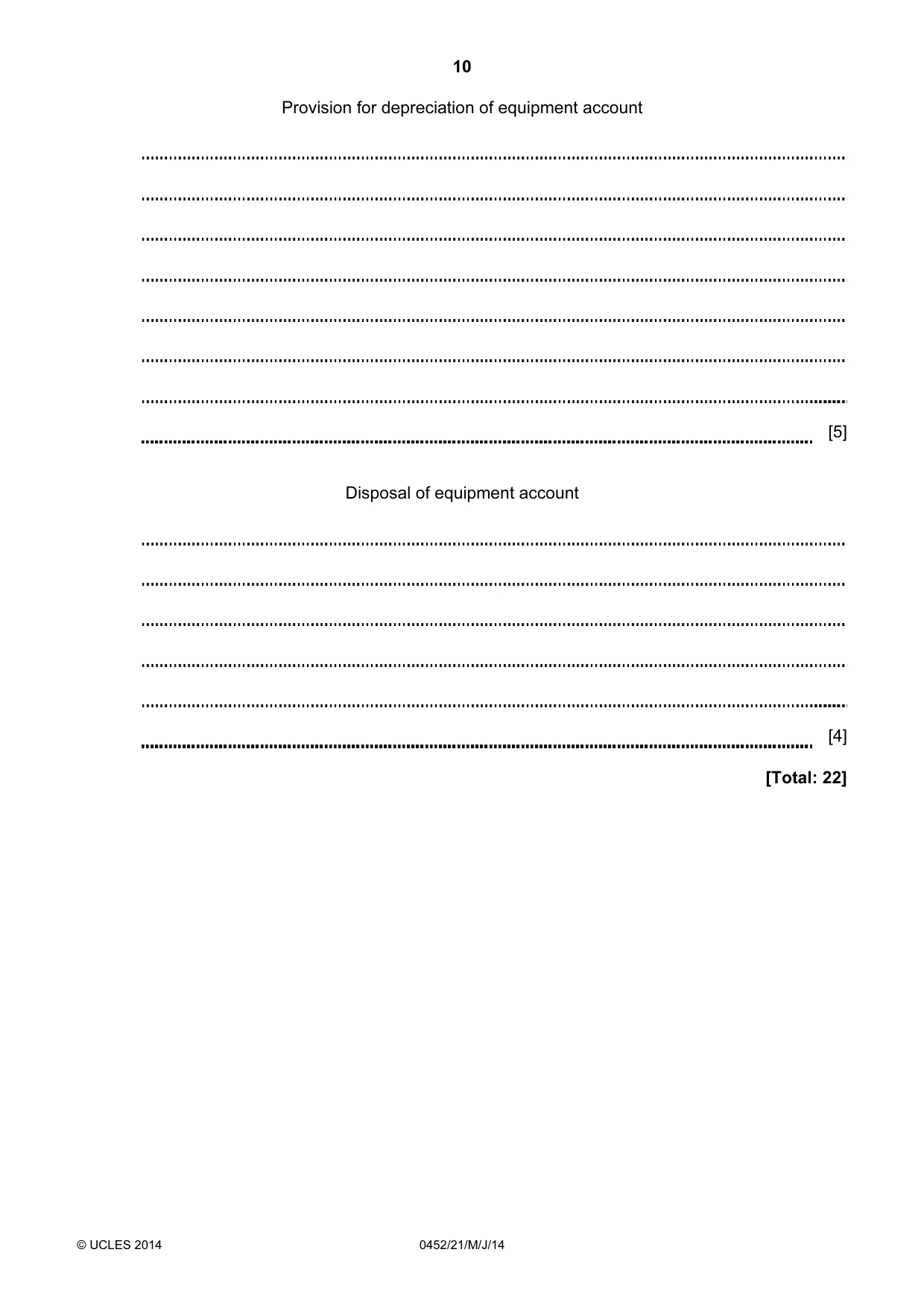
10 © UCLES 2014 0452/21/M/J/14 Provision for depreciation of equipment account [5] Disposal of equipment account [4] [Total: 22]
Question paper, page 11
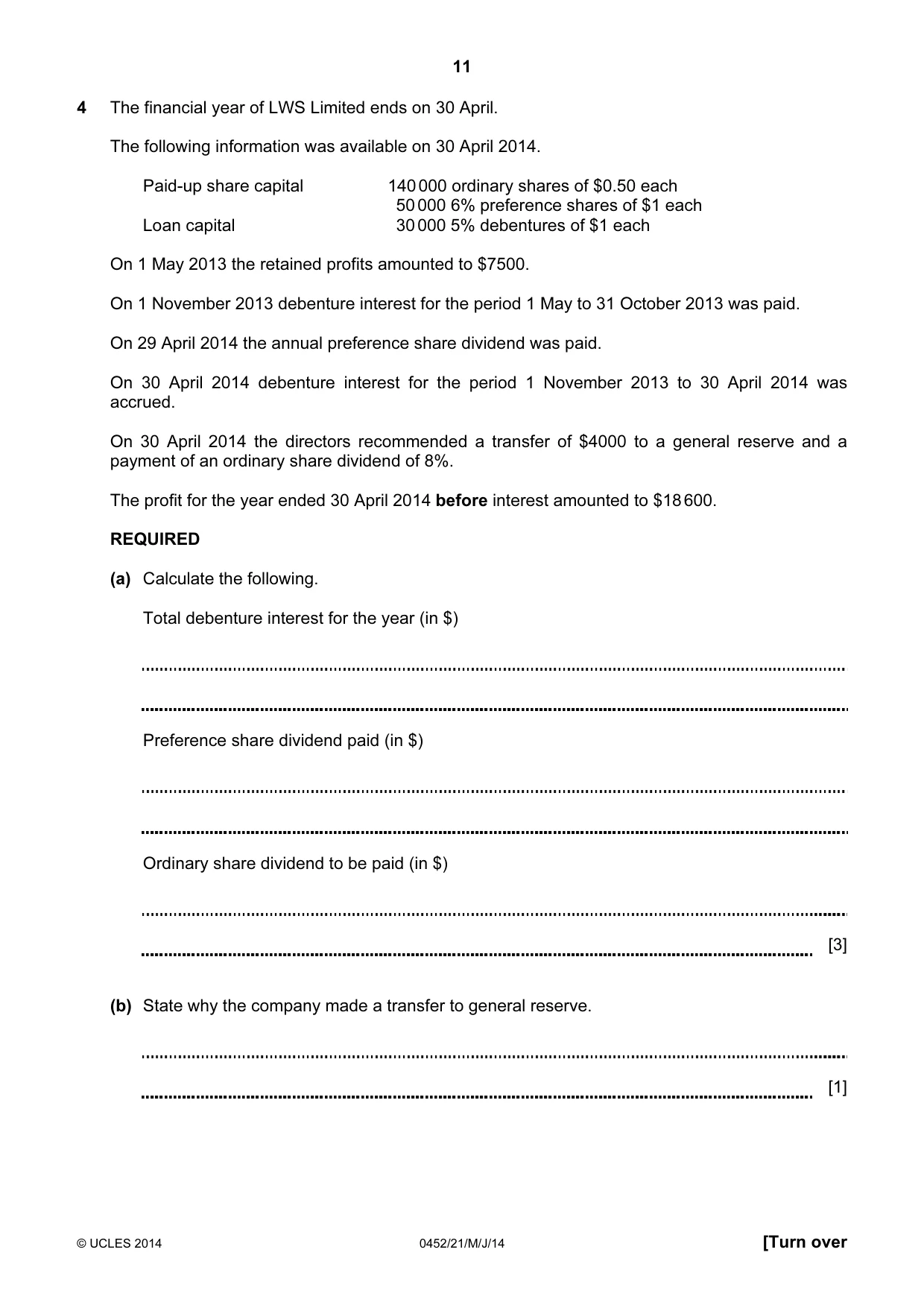
11 © UCLES 2014 0452/21/M/J/14 [Turn over 4 The financial year of LWS Limited ends on 30 April. The following information was available on 30 April 2014. Paid-up share capital 140 000 ordinary shares of $0.50 each 50 000 6% preference shares of $1 each Loan capital 30 000 5% debentures of $1 each On 1 May 2013 the retained profits amounted to $7500. On 1 November 2013 debenture interest for the period 1 May to 31 October 2013 was paid. On 29 April 2014 the annual preference share dividend was paid. On 30 April 2014 debenture interest for the period 1 November 2013 to 30 April 2014 was accrued. On 30 April 2014 the directors recommended a transfer of $4000 to a general reserve and a payment of an ordinary share dividend of 8%. The profit for the year ended 30 April 2014 before interest amounted to $18 600. REQUIRED (a) Calculate the following. Total debenture interest for the year (in $) Preference share dividend paid (in $) Ordinary share dividend to be paid (in $) [3] (b) State why the company made a transfer to general reserve. [1]
Question paper, page 12
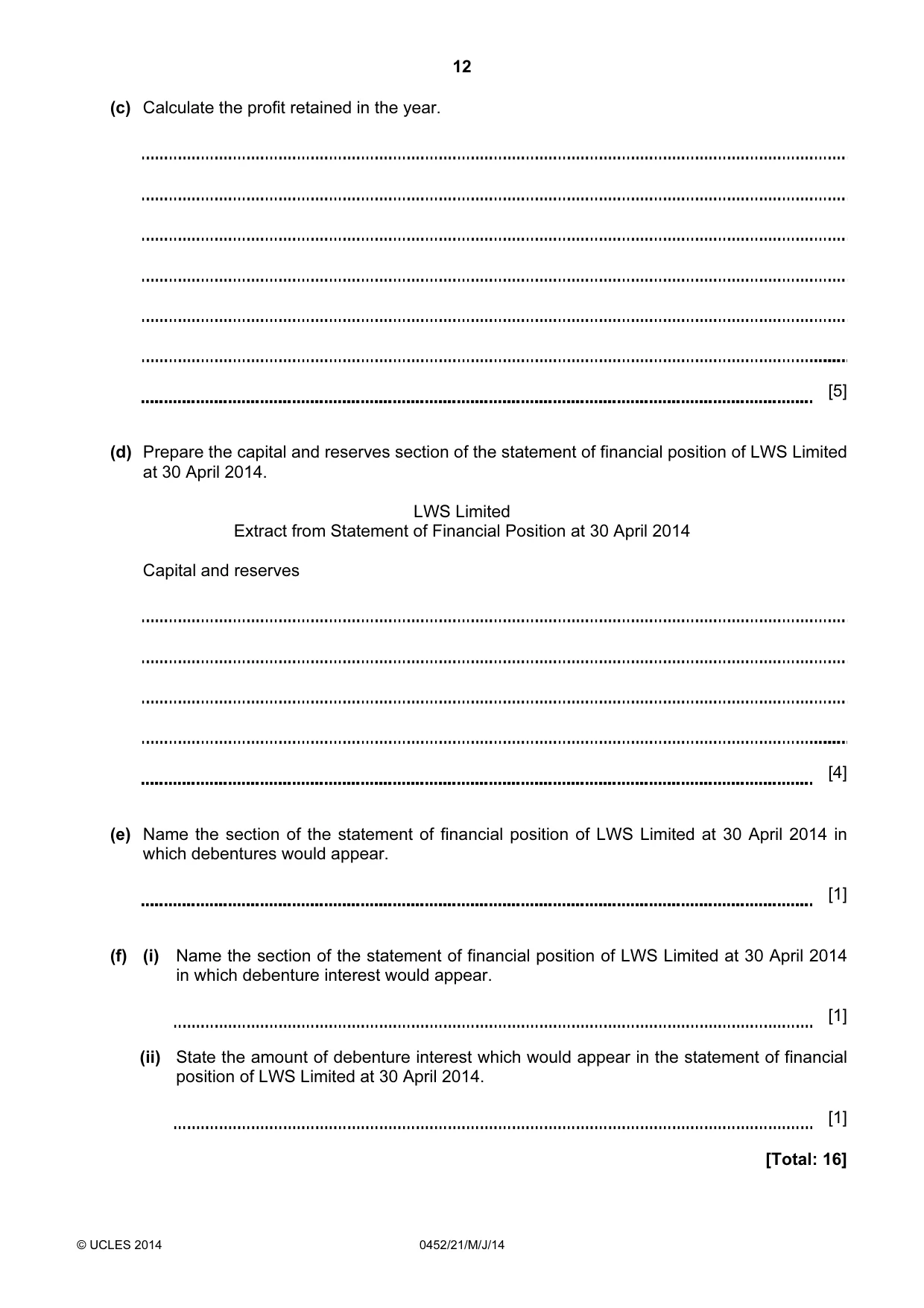
12 © UCLES 2014 0452/21/M/J/14 (c) Calculate the profit retained in the year. [5] (d) Prepare the capital and reserves section of the statement of financial position of LWS Limited at 30 April 2014. LWS Limited Extract from Statement of Financial Position at 30 April 2014 Capital and reserves [4] (e) Name the section of the statement of financial position of LWS Limited at 30 April 2014 in which debentures would appear. [1] (f) (i) Name the section of the statement of financial position of LWS Limited at 30 April 2014 in which debenture interest would appear. [1] (ii) State the amount of debenture interest which would appear in the statement of financial position of LWS Limited at 30 April 2014. [1] [Total: 16]
Question paper, page 13
13 © UCLES 2014 0452/21/M/J/14 [Turn over Question 5 is on the next page.
Question paper, page 14
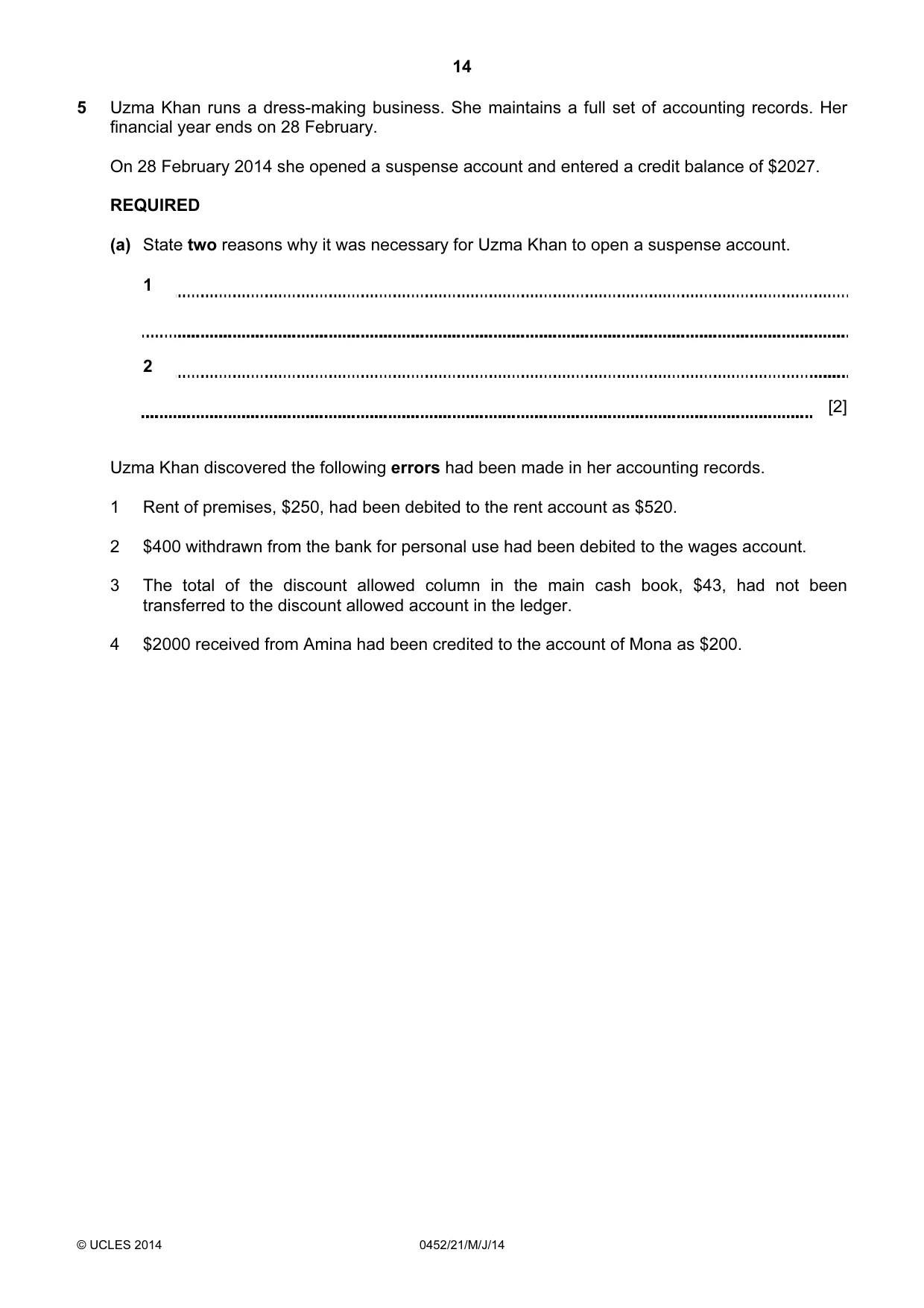
14 © UCLES 2014 0452/21/M/J/14 5 Uzma Khan runs a dress-making business. She maintains a full set of accounting records. Her financial year ends on 28 February. On 28 February 2014 she opened a suspense account and entered a credit balance of $2027. REQUIRED (a) State two reasons why it was necessary for Uzma Khan to open a suspense account. 1 2 [2] Uzma Khan discovered the following errors had been made in her accounting records. 1 Rent of premises, $250, had been debited to the rent account as $520. 2 $400 withdrawn from the bank for personal use had been debited to the wages account. 3 The total of the discount allowed column in the main cash book, $43, had not been transferred to the discount allowed account in the ledger. 4 $2000 received from Amina had been credited to the account of Mona as $200.
Question paper, page 15
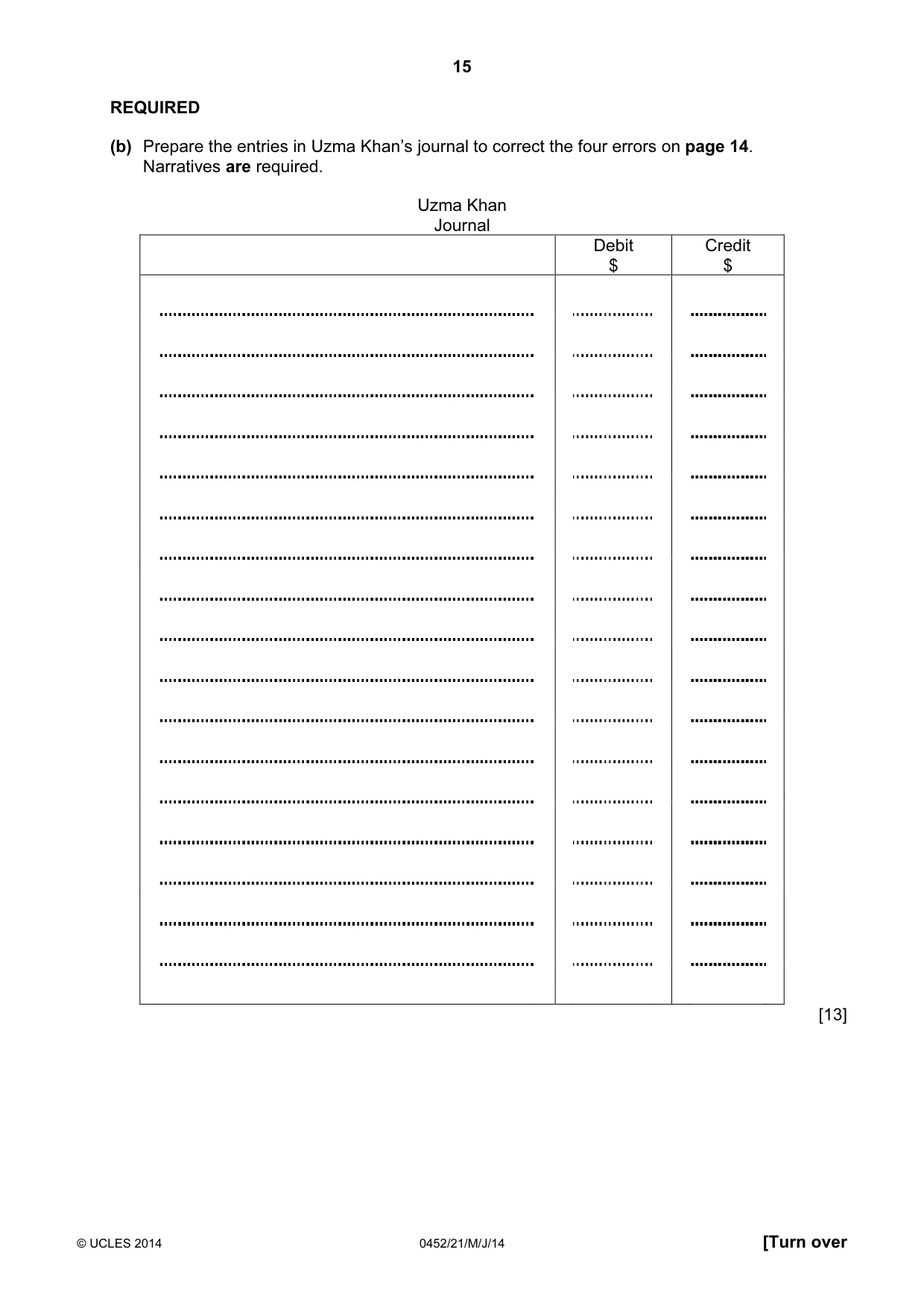
15 © UCLES 2014 0452/21/M/J/14 [Turn over REQUIRED (b) Prepare the entries in Uzma Khan’s journal to correct the four errors on page 14. Narratives are required. Uzma Khan Journal Debit $ Credit $ [13]
Question paper, page 16
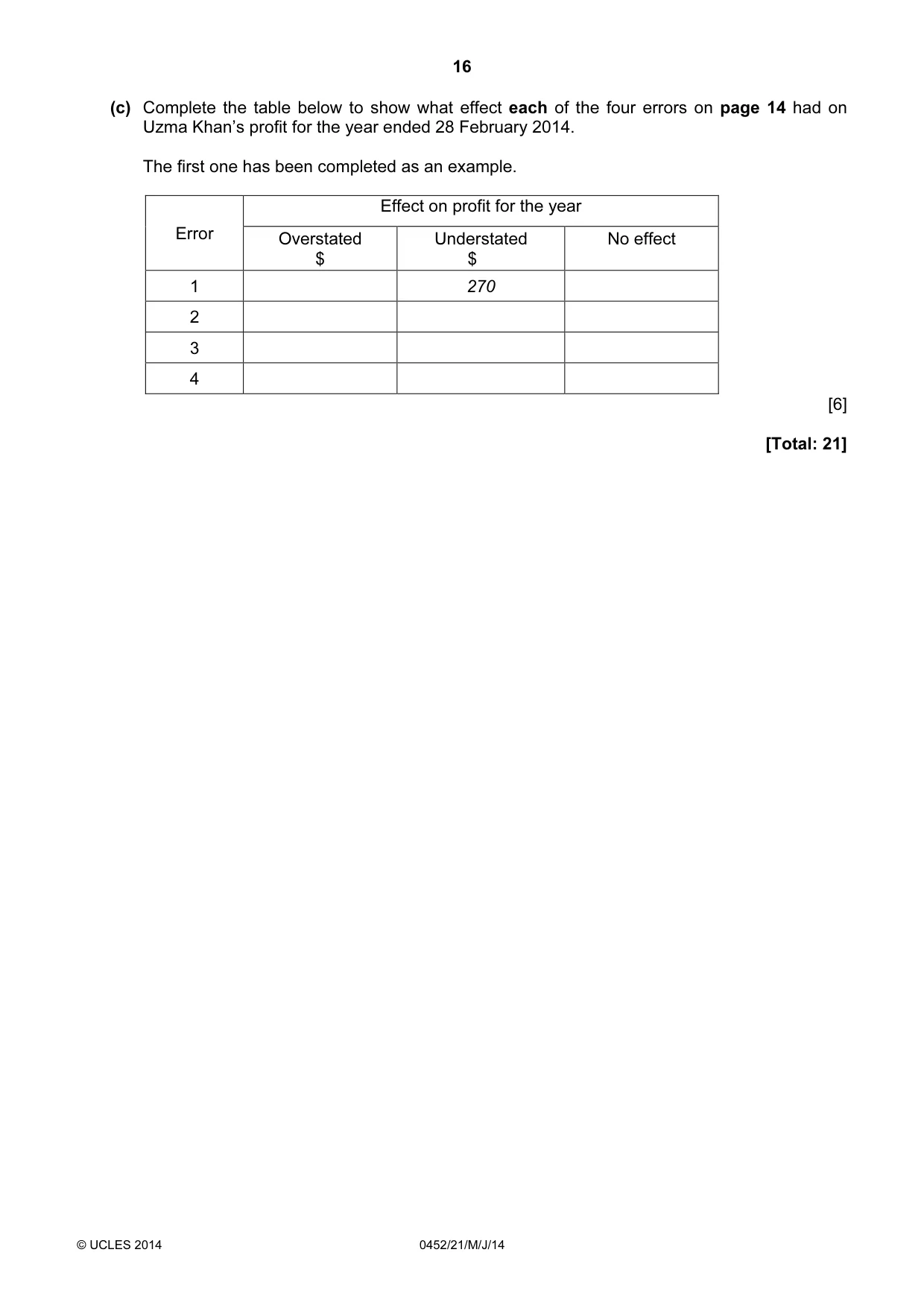
16 © UCLES 2014 0452/21/M/J/14 (c) Complete the table below to show what effect each of the four errors on page 14 had on Uzma Khan’s profit for the year ended 28 February 2014. The first one has been completed as an example. Error Effect on profit for the year Overstated $ Understated $ No effect 1 270 2 3 4 [6] [Total: 21]
Question paper, page 17
17 © UCLES 2014 0452/21/M/J/14 [Turn over Question 6 is on the next page.
Question paper, page 18
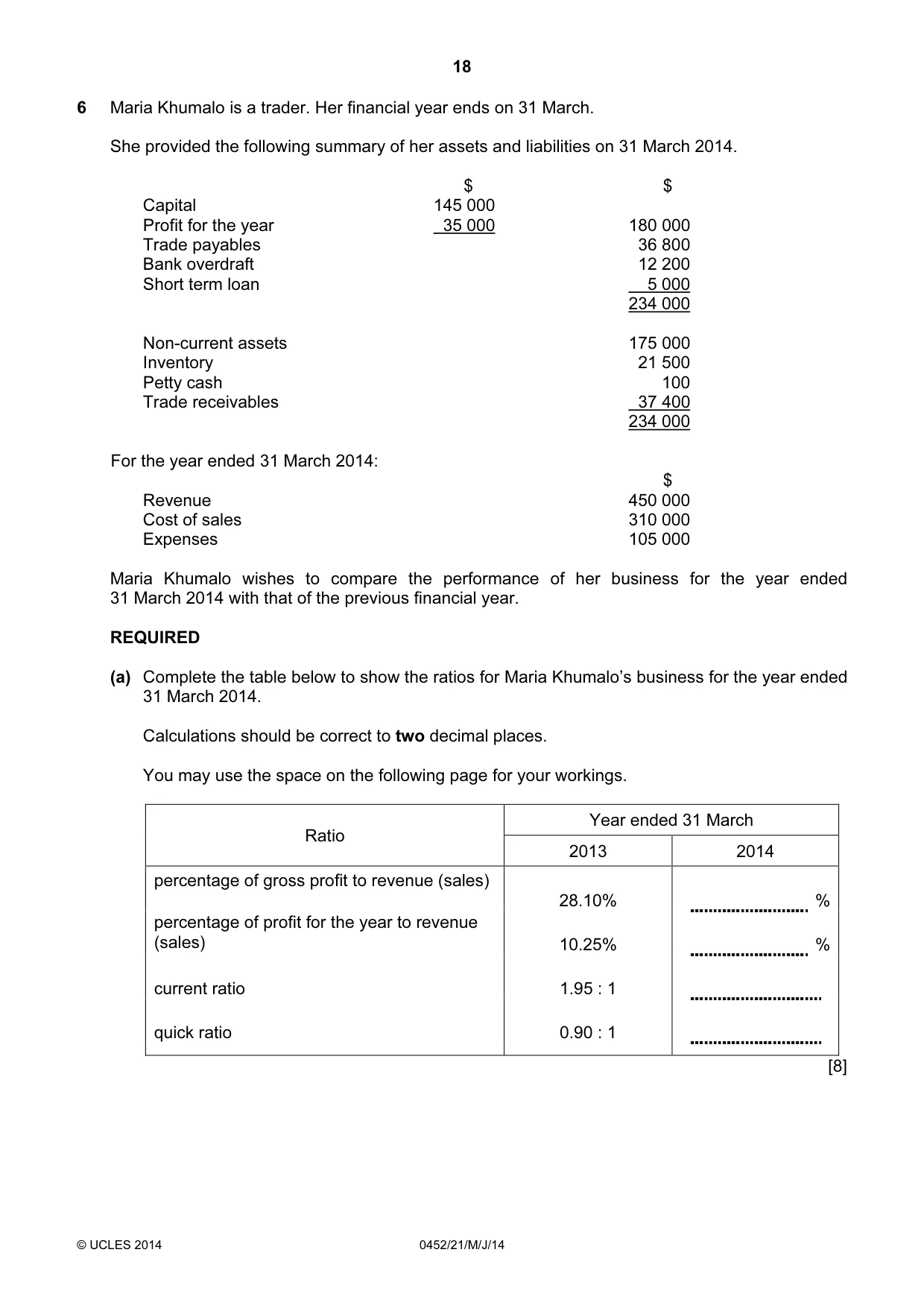
18 © UCLES 2014 0452/21/M/J/14 6 Maria Khumalo is a trader. Her financial year ends on 31 March. She provided the following summary of her assets and liabilities on 31 March 2014. $ $ Capital 145 000 Profit for the year 35 000 180 000 Trade payables 36 800 Bank overdraft 12 200 Short term loan 5 000 234 000 Non-current assets 175 000 Inventory 21 500 Petty cash 100 Trade receivables 37 400 234 000 For the year ended 31 March 2014: $ Revenue 450 000 Cost of sales 310 000 Expenses 105 000 Maria Khumalo wishes to compare the performance of her business for the year ended 31 March 2014 with that of the previous financial year. REQUIRED (a) Complete the table below to show the ratios for Maria Khumalo’s business for the year ended 31 March 2014. Calculations should be correct to two decimal places. You may use the space on the following page for your workings. Ratio Year ended 31 March 2013 2014 percentage of gross profit to revenue (sales) 28.10% % percentage of profit for the year to revenue (sales) 10.25% % current ratio 1.95 : 1 quick ratio 0.90 : 1 [8]
Question paper, page 19
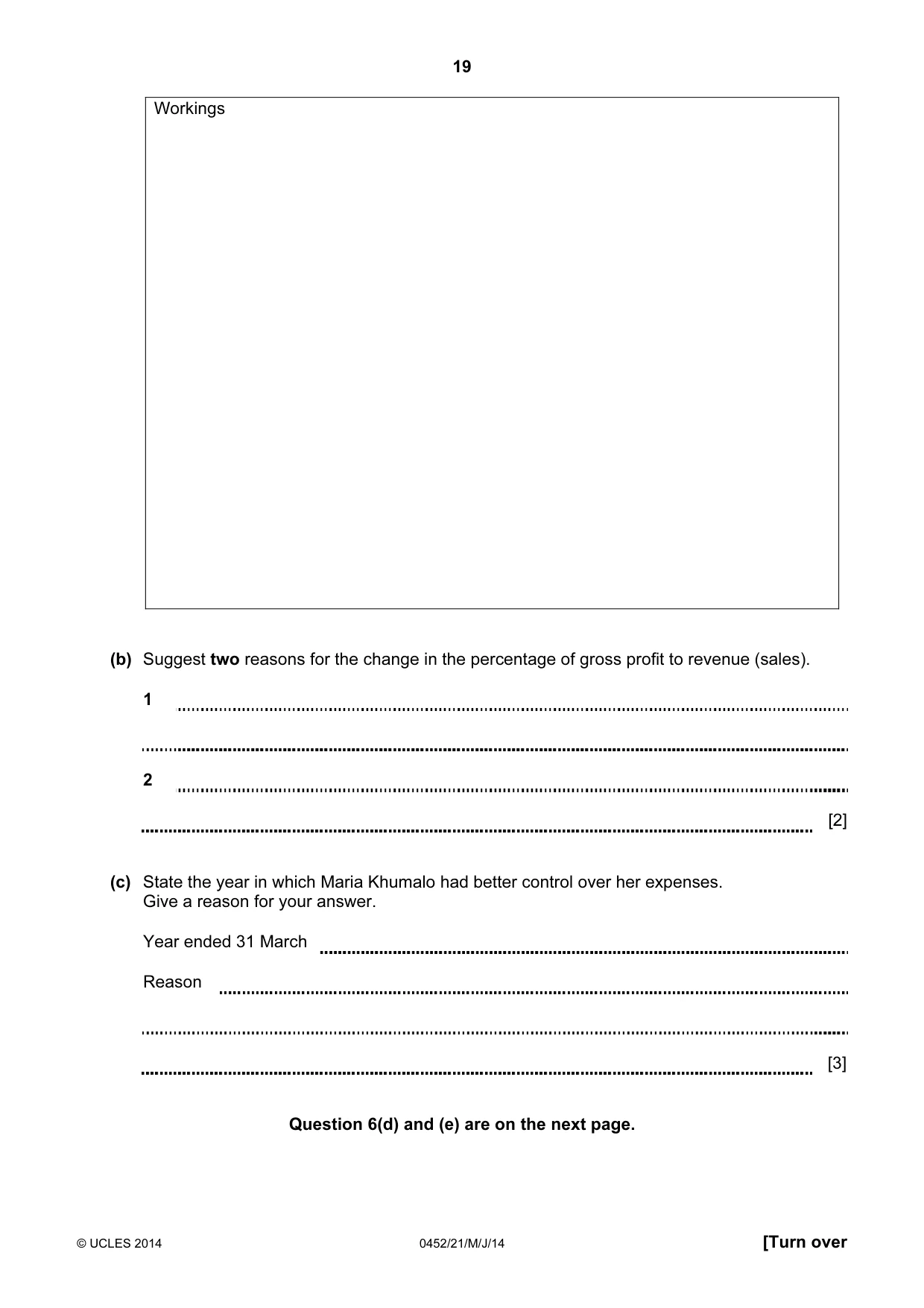
19 © UCLES 2014 0452/21/M/J/14 [Turn over Workings (b) Suggest two reasons for the change in the percentage of gross profit to revenue (sales). 1 2 [2] (c) State the year in which Maria Khumalo had better control over her expenses. Give a reason for your answer. Year ended 31 March Reason [3] Question 6(d) and (e) are on the next page.
Question paper, page 20
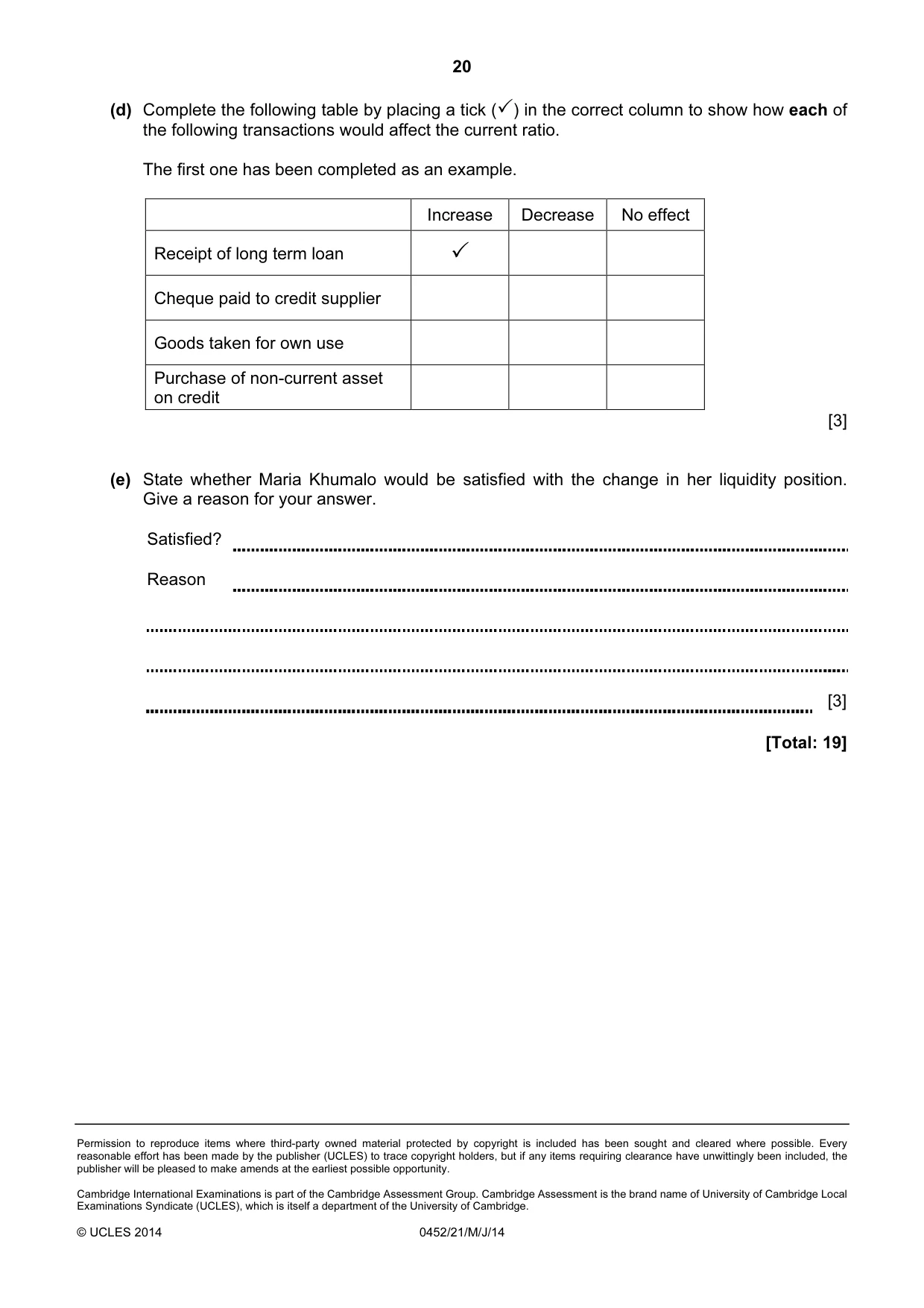
20 Permission to reproduce items where third-party owned material protected by copyright is included has been sought and cleared where possible. Every reasonable effort has been made by the publisher (UCLES) to trace copyright holders, but if any items requiring clearance have unwittingly been included, the publisher will be pleased to make amends at the earliest possible opportunity. Cambridge International Examinations is part of the Cambridge Assessment Group. Cambridge Assessment is the brand name of University of Cambridge Local Examinations Syndicate (UCLES), which is itself a department of the University of Cambridge. © UCLES 2014 0452/21/M/J/14 (d) Complete the following table by placing a tick (✓) in the correct column to show how each of the following transactions would affect the current ratio. The first one has been completed as an example. Increase Decrease No effect Receipt of long term loan ✓ Cheque paid to credit supplier Goods taken for own use Purchase of non-current asset on credit [3] (e) State whether Maria Khumalo would be satisfied with the change in her liquidity position. Give a reason for your answer. Satisfied? Reason [3] [Total: 19]
Mark scheme, page 1
CAMBRIDGE INTERNATIONAL EXAMINATIONS International General Certificate of Secondary Education MARK SCHEME for the May/June 2014 series 0452 ACCOUNTING 0452/21 Paper 2, maximum raw mark 120 This mark scheme is published as an aid to teachers and candidates, to indicate the requirements of the examination. It shows the basis on which Examiners were instructed to award marks. It does not indicate the details of the discussions that took place at an Examiners’ meeting before marking began, which would have considered the acceptability of alternative answers. Mark schemes should be read in conjunction with the question paper and the Principal Examiner Report for Teachers. Cambridge will not enter into discussions about these mark schemes. Cambridge is publishing the mark schemes for the May/June 2014 series for most IGCSE, GCE Advanced Level and Advanced Subsidiary Level components and some Ordinary Level components.
Mark scheme, page 2
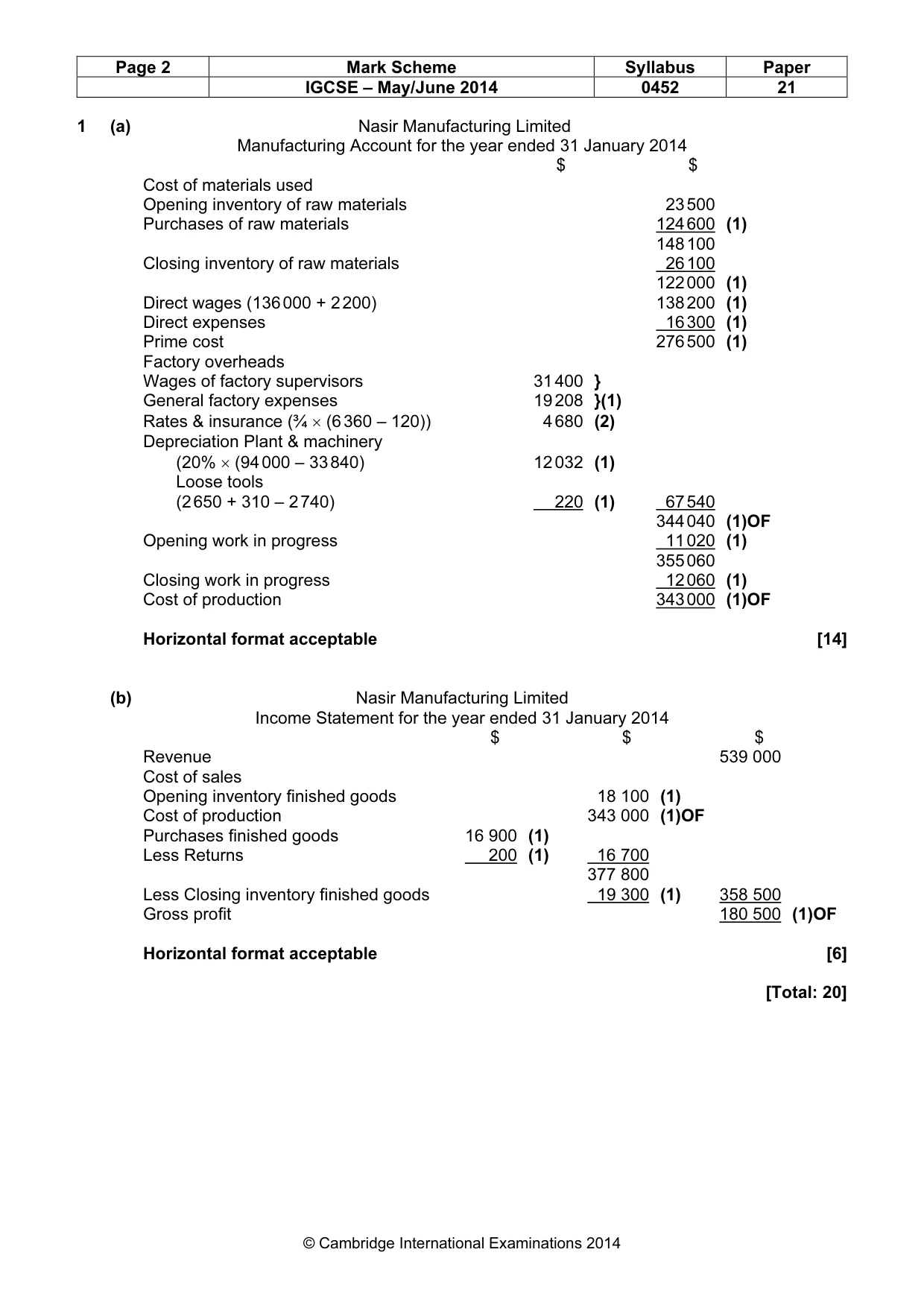
Page 2 Mark Scheme Syllabus Paper IGCSE – May/June 2014 0452 21 © Cambridge International Examinations 2014 1 (a) Nasir Manufacturing Limited Manufacturing Account for the year ended 31 January 2014 $ $ Cost of materials used Opening inventory of raw materials 23 500 Purchases of raw materials 124 600 (1) 148 100 Closing inventory of raw materials 26 100 122 000 (1) Direct wages (136 000 + 2 200) 138 200 (1) Direct expenses 16 300 (1) Prime cost 276 500 (1) Factory overheads Wages of factory supervisors 31 400 } General factory expenses 19 208 }(1) Rates & insurance (¾ × (6 360 – 120)) 4 680 (2) Depreciation Plant & machinery (20% × (94 000 – 33 840) 12 032 (1) Loose tools (2 650 + 310 – 2 740) 220 (1) 67 540 344 040 (1)OF Opening work in progress 11 020 (1) 355 060 Closing work in progress 12 060 (1) Cost of production 343 000 (1)OF Horizontal format acceptable [14] (b) Nasir Manufacturing Limited Income Statement for the year ended 31 January 2014 $ $ $ Revenue 539 000 Cost of sales Opening inventory finished goods 18 100 (1) Cost of production 343 000 (1)OF Purchases finished goods 16 900 (1) Less Returns 200 (1) 16 700 377 800 Less Closing inventory finished goods 19 300 (1) 358 500 Gross profit 180 500 (1)OF Horizontal format acceptable [6] [Total: 20]
Mark scheme, page 3
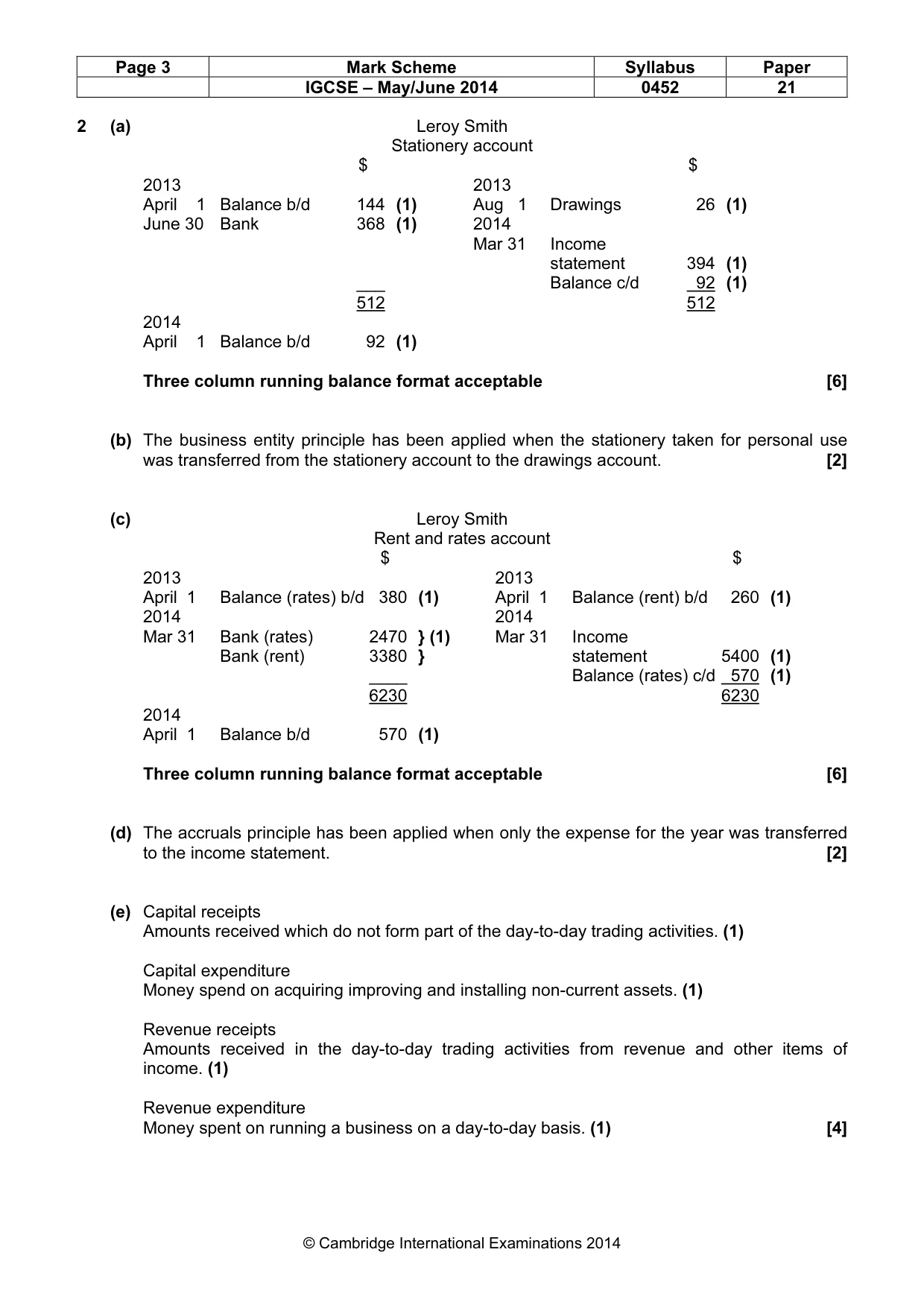
Page 3 Mark Scheme Syllabus Paper IGCSE – May/June 2014 0452 21 © Cambridge International Examinations 2014 2 (a) Leroy Smith Stationery account $ $ 2013 2013 April 1 Balance b/d 144 (1) Aug 1 Drawings 26 (1) June 30 Bank 368 (1) 2014 Mar 31 Income statement 394 (1) ___ Balance c/d 92 (1) 512 512 2014 April 1 Balance b/d 92 (1) Three column running balance format acceptable [6] (b) The business entity principle has been applied when the stationery taken for personal use was transferred from the stationery account to the drawings account. [2] (c) Leroy Smith Rent and rates account $ $ 2013 2013 April 1 Balance (rates) b/d 380 (1) April 1 Balance (rent) b/d 260 (1) 2014 2014 Mar 31 Bank (rates) 2470 } (1) Mar 31 Income Bank (rent) 3380 } statement 5400 (1) ____ Balance (rates) c/d 570 (1) 6230 6230 2014 April 1 Balance b/d 570 (1) Three column running balance format acceptable [6] (d) The accruals principle has been applied when only the expense for the year was transferred to the income statement. [2] (e) Capital receipts Amounts received which do not form part of the day-to-day trading activities. (1) Capital expenditure Money spend on acquiring improving and installing non-current assets. (1) Revenue receipts Amounts received in the day-to-day trading activities from revenue and other items of income. (1) Revenue expenditure Money spent on running a business on a day-to-day basis. (1) [4]
Mark scheme, page 4
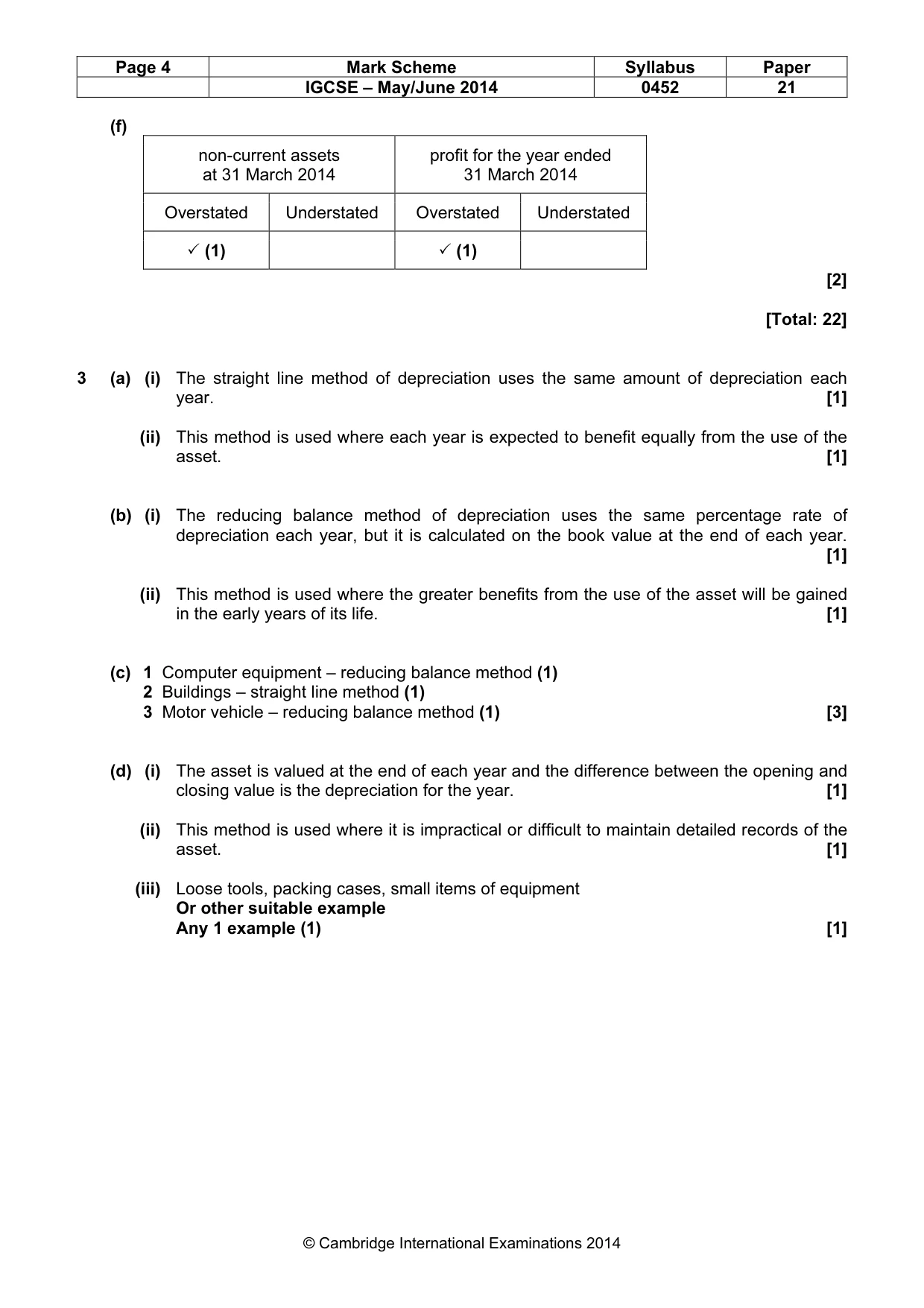
Page 4 Mark Scheme Syllabus Paper IGCSE – May/June 2014 0452 21 © Cambridge International Examinations 2014 (f) non-current assets at 31 March 2014 profit for the year ended 31 March 2014 Overstated Understated Overstated Understated ✓ (1) ✓ (1) [2] [Total: 22] 3 (a) (i) The straight line method of depreciation uses the same amount of depreciation each year. [1] (ii) This method is used where each year is expected to benefit equally from the use of the asset. [1] (b) (i) The reducing balance method of depreciation uses the same percentage rate of depreciation each year, but it is calculated on the book value at the end of each year. [1] (ii) This method is used where the greater benefits from the use of the asset will be gained in the early years of its life. [1] (c) 1 Computer equipment – reducing balance method (1) 2 Buildings – straight line method (1) 3 Motor vehicle – reducing balance method (1) [3] (d) (i) The asset is valued at the end of each year and the difference between the opening and closing value is the depreciation for the year. [1] (ii) This method is used where it is impractical or difficult to maintain detailed records of the asset. [1] (iii) Loose tools, packing cases, small items of equipment Or other suitable example Any 1 example (1) [1]
Mark scheme, page 5
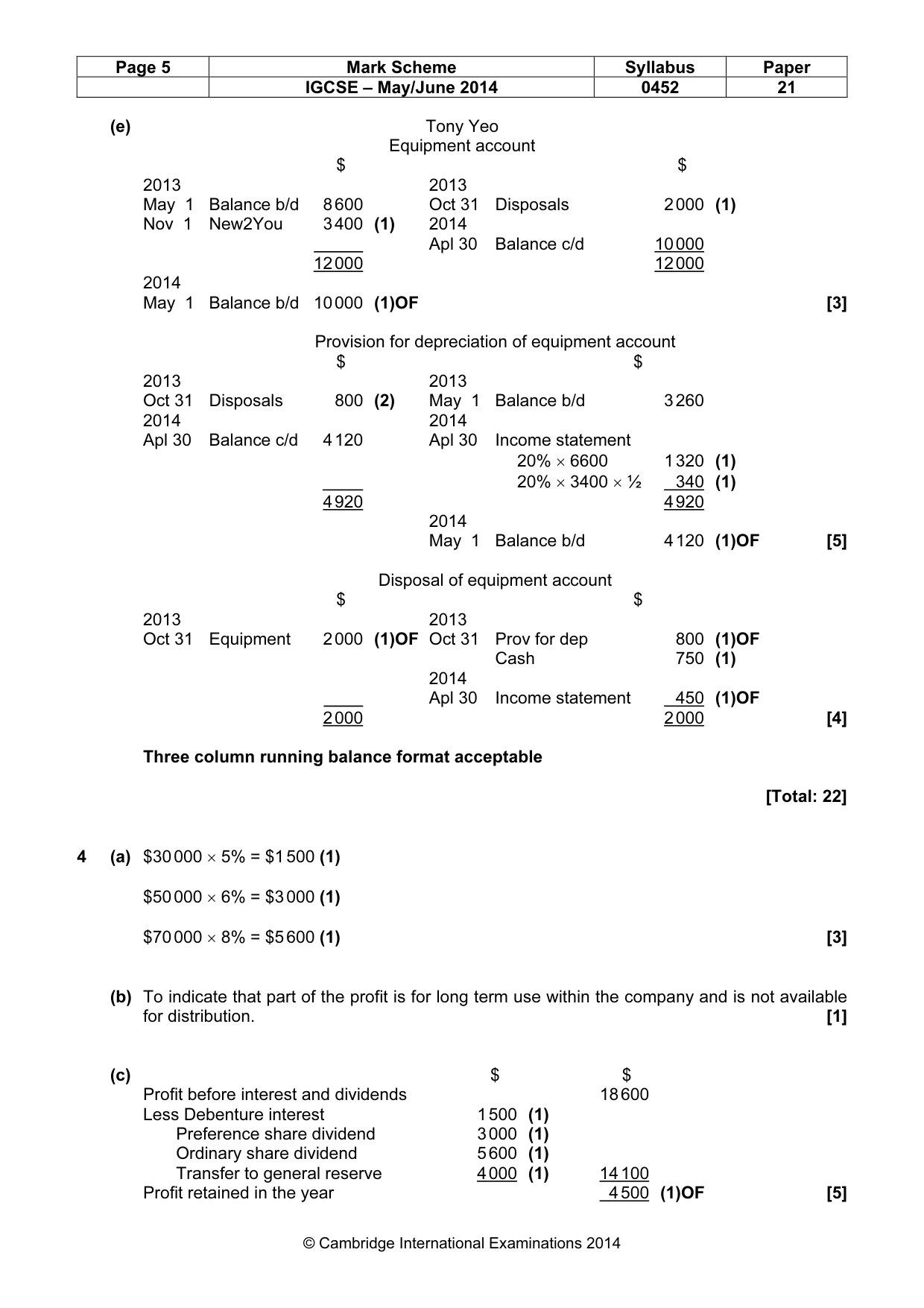
Page 5 Mark Scheme Syllabus Paper IGCSE – May/June 2014 0452 21 © Cambridge International Examinations 2014 (e) Tony Yeo Equipment account $ $ 2013 2013 May 1 Balance b/d 8 600 Oct 31 Disposals 2 000 (1) Nov 1 New2You 3 400 (1) 2014 Apl 30 Balance c/d 10 000 12 000 12 000 2014 May 1 Balance b/d 10 000 (1)OF [3] Provision for depreciation of equipment account $ $ 2013 2013 Oct 31 Disposals 800 (2) May 1 Balance b/d 3 260 2014 2014 Apl 30 Balance c/d 4 120 Apl 30 Income statement 20% × 6600 1 320 (1) 20% × 3400 × ½ 340 (1) 4 920 4 920 2014 May 1 Balance b/d 4 120 (1)OF [5] Disposal of equipment account $ $ 2013 2013 Oct 31 Equipment 2 000 (1)OF Oct 31 Prov for dep 800 (1)OF Cash 750 (1) 2014 Apl 30 Income statement 450 (1)OF 2 000 2 000 [4] Three column running balance format acceptable [Total: 22] 4 (a) $30 000 × 5% = $1 500 (1) $50 000 × 6% = $3 000 (1) $70 000 × 8% = $5 600 (1) [3] (b) To indicate that part of the profit is for long term use within the company and is not available for distribution. [1] (c) $ $ Profit before interest and dividends 18 600 Less Debenture interest 1 500 (1) Preference share dividend 3 000 (1) Ordinary share dividend 5 600 (1) Transfer to general reserve 4 000 (1) 14 100 Profit retained in the year 4 500 (1)OF [5]
Mark scheme, page 6
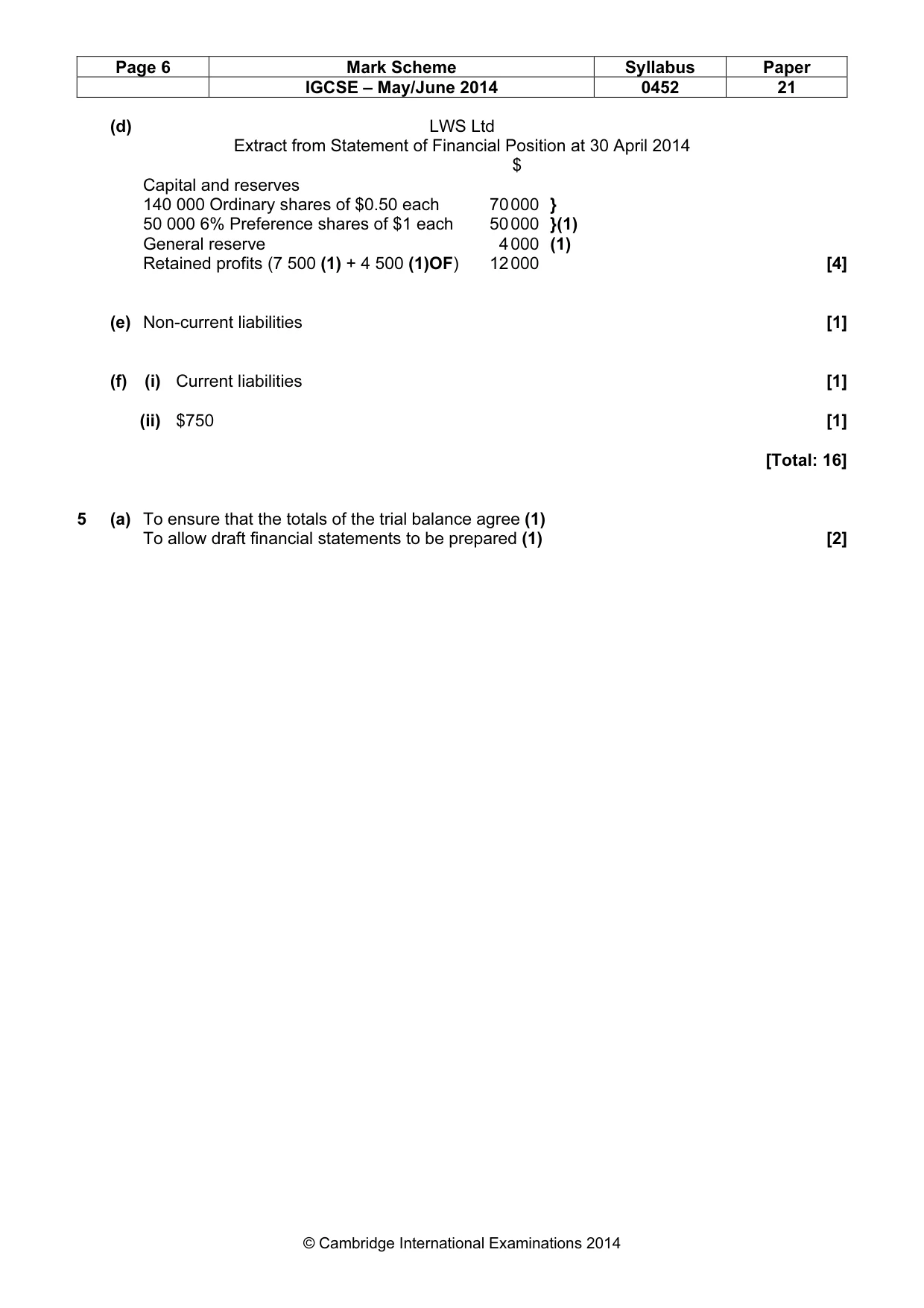
Page 6 Mark Scheme Syllabus Paper IGCSE – May/June 2014 0452 21 © Cambridge International Examinations 2014 (d) LWS Ltd Extract from Statement of Financial Position at 30 April 2014 $ Capital and reserves 140 000 Ordinary shares of $0.50 each 70 000 } 50 000 6% Preference shares of $1 each 50 000 }(1) General reserve 4 000 (1) Retained profits (7 500 (1) + 4 500 (1)OF) 12 000 [4] (e) Non-current liabilities [1] (f) (i) Current liabilities [1] (ii) $750 [1] [Total: 16] 5 (a) To ensure that the totals of the trial balance agree (1) To allow draft financial statements to be prepared (1) [2]
Mark scheme, page 7
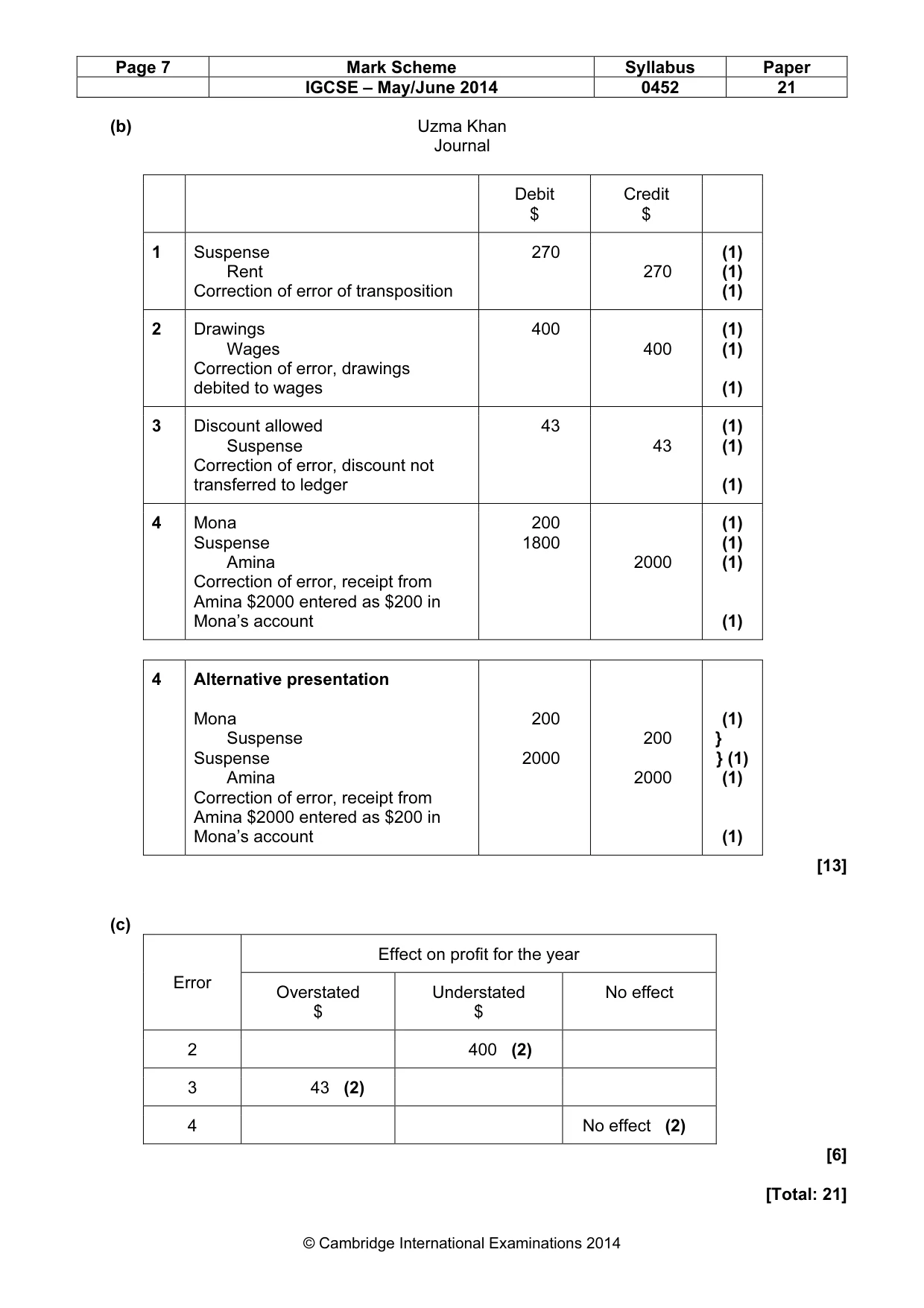
Page 7 Mark Scheme Syllabus Paper IGCSE – May/June 2014 0452 21 © Cambridge International Examinations 2014 (b) Uzma Khan Journal Debit $ Credit $ 1 Suspense Rent Correction of error of transposition 270 270 (1) (1) (1) 2 Drawings Wages Correction of error, drawings debited to wages 400 400 (1) (1) (1) 3 Discount allowed Suspense Correction of error, discount not transferred to ledger 43 43 (1) (1) (1) 4 Mona Suspense Amina Correction of error, receipt from Amina $2000 entered as $200 in Mona’s account 200 1800 2000 (1) (1) (1) (1) 4 Alternative presentation Mona Suspense Suspense Amina Correction of error, receipt from Amina $2000 entered as $200 in Mona’s account 200 2000 200 2000 (1) } } (1) (1) (1) [13] (c) Error Effect on profit for the year Overstated $ Understated $ No effect 2 400 (2) 3 43 (2) 4 No effect (2) [6] [Total: 21]
Mark scheme, page 8
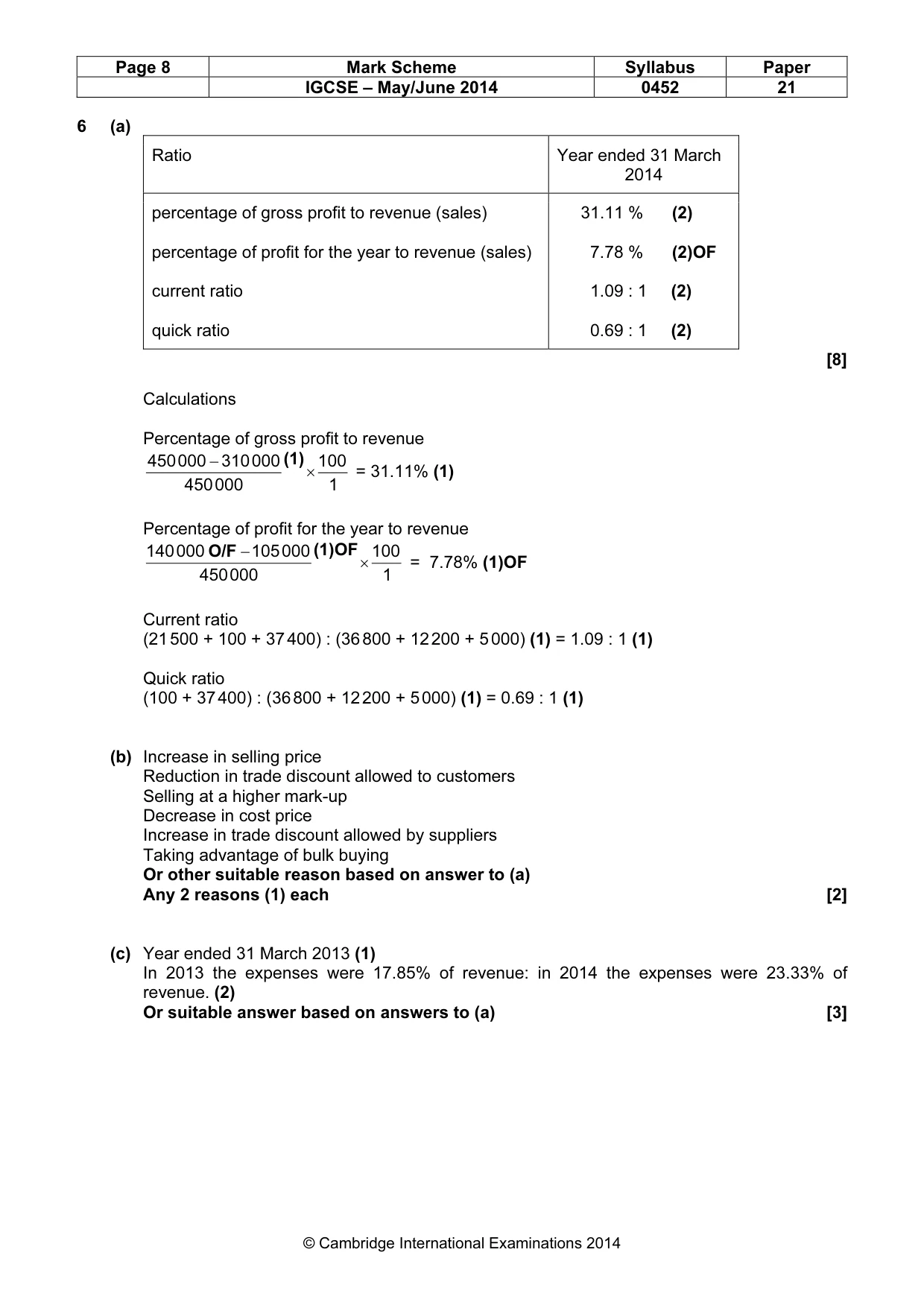
Page 8 Mark Scheme Syllabus Paper IGCSE – May/June 2014 0452 21 © Cambridge International Examinations 2014 6 (a) Ratio Year ended 31 March 2014 percentage of gross profit to revenue (sales) percentage of profit for the year to revenue (sales) current ratio quick ratio 31.11 % (2) 7.78 % (2)OF 1.09 : 1 (2) 0.69 : 1 (2) [8] Calculations Percentage of gross profit to revenue 1 100 000 450 000 310 000 450 × − (1) = 31.11% (1) Percentage of profit for the year to revenue 1 100 000 450 000 105 000 140 × − (1)OF O/F = 7.78% (1)OF Current ratio (21 500 + 100 + 37 400) : (36 800 + 12 200 + 5 000) (1) = 1.09 : 1 (1) Quick ratio (100 + 37 400) : (36 800 + 12 200 + 5 000) (1) = 0.69 : 1 (1) (b) Increase in selling price Reduction in trade discount allowed to customers Selling at a higher mark-up Decrease in cost price Increase in trade discount allowed by suppliers Taking advantage of bulk buying Or other suitable reason based on answer to (a) Any 2 reasons (1) each [2] (c) Year ended 31 March 2013 (1) In 2013 the expenses were 17.85% of revenue: in 2014 the expenses were 23.33% of revenue. (2) Or suitable answer based on answers to (a) [3]
Mark scheme, page 9
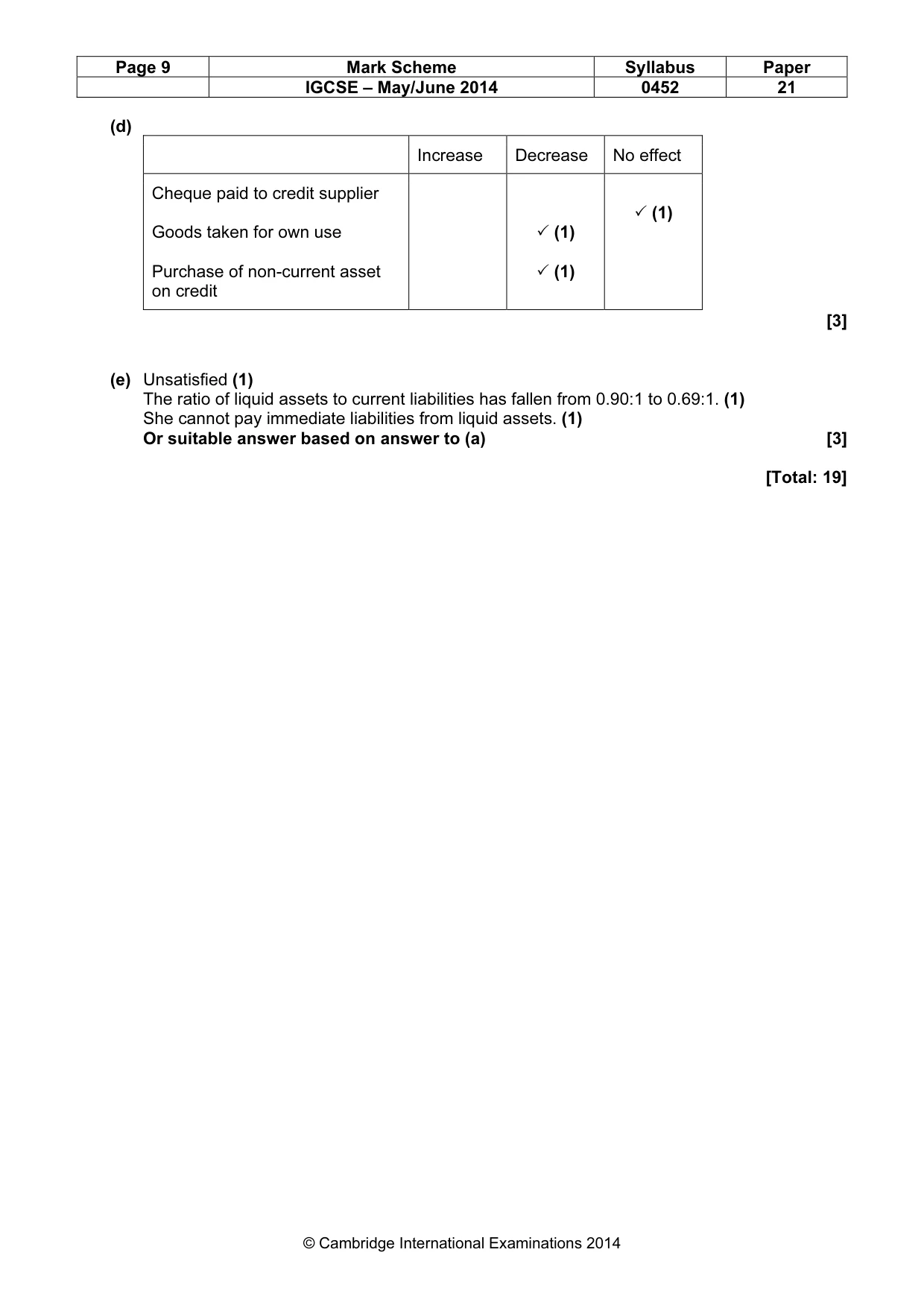
Page 9 Mark Scheme Syllabus Paper IGCSE – May/June 2014 0452 21 © Cambridge International Examinations 2014 (d) Increase Decrease No effect Cheque paid to credit supplier Goods taken for own use Purchase of non-current asset on credit ✓ (1) ✓ (1) ✓ (1) [3] (e) Unsatisfied (1) The ratio of liquid assets to current liabilities has fallen from 0.90:1 to 0.69:1. (1) She cannot pay immediate liabilities from liquid assets. (1) Or suitable answer based on answer to (a) [3] [Total: 19]
What you needed in this session
Cambridge’s own grade thresholds for 2014 May/June, Paper 2 · Variant 1. A higher threshold means an easier paper — the bar moves with how the cohort did.