Cambridge IGCSE Accounting 0452 — 2013 May/June Paper 2 · Variant 2
0452/22/M/J/13 · 120 marks · ≈135 min
The question paper and its mark scheme, free to read here and free to download. This is Cambridge’s own paper, exactly as it was sat.
Question paper20 pages

Mark scheme7 pages
Answers below. Sit the paper first if you are practising.
Paper as text
Question paper, page 1
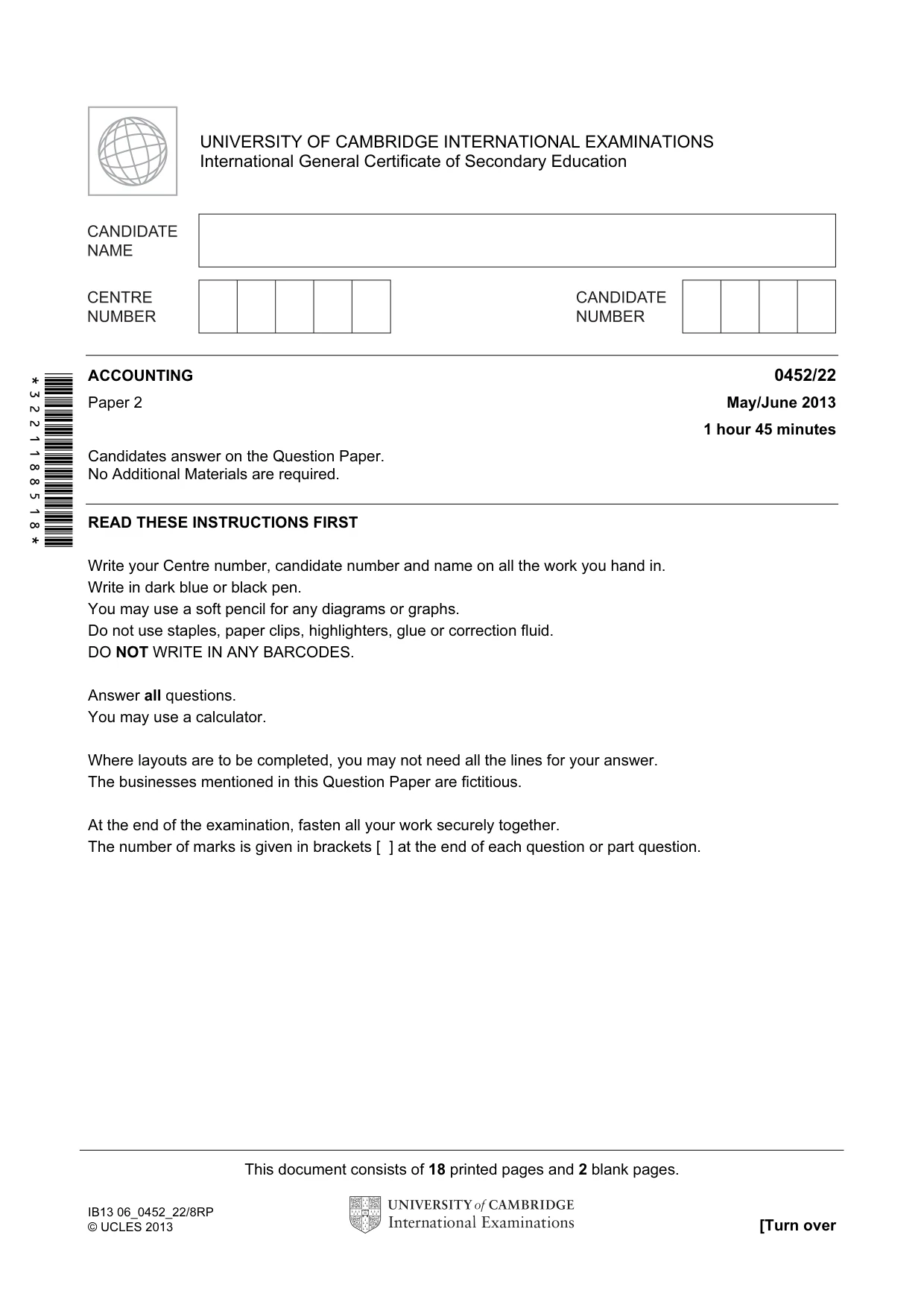
This document consists of 18 printed pages and 2 blank pages. IB13 06_0452_22/8RP © UCLES 2013 [Turn over *3221188518* UNIVERSITY OF CAMBRIDGE INTERNATIONAL EXAMINATIONS International General Certificate of Secondary Education ACCOUNTING 0452/22 Paper 2 May/June 2013 1 hour 45 minutes Candidates answer on the Question Paper. No Additional Materials are required. READ THESE INSTRUCTIONS FIRST Write your Centre number, candidate number and name on all the work you hand in. Write in dark blue or black pen. You may use a soft pencil for any diagrams or graphs. Do not use staples, paper clips, highlighters, glue or correction fluid. DO NOT WRITE IN ANY BARCODES. Answer all questions. You may use a calculator. Where layouts are to be completed, you may not need all the lines for your answer. The businesses mentioned in this Question Paper are fictitious. At the end of the examination, fasten all your work securely together. The number of marks is given in brackets [ ] at the end of each question or part question.
Question paper, page 2
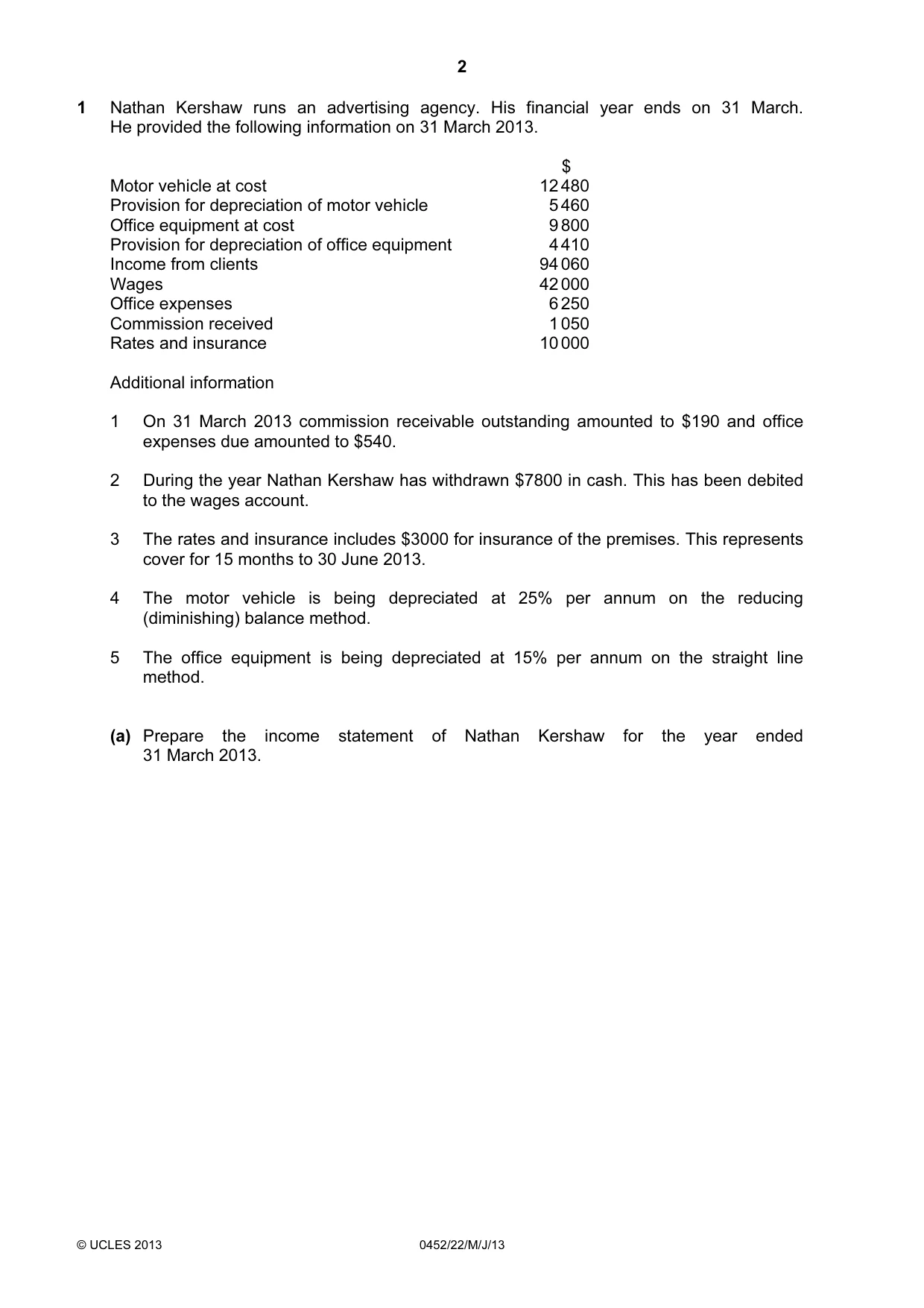
2 © UCLES 2013 0452/22/M/J/13 1 Nathan Kershaw runs an advertising agency. His financial year ends on 31 March. He provided the following information on 31 March 2013. $ Motor vehicle at cost 12 480 Provision for depreciation of motor vehicle 5 460 Office equipment at cost 9 800 Provision for depreciation of office equipment 4 410 Income from clients 94 060 Wages 42 000 Office expenses 6 250 Commission received 1 050 Rates and insurance 10 000 Additional information 1 On 31 March 2013 commission receivable outstanding amounted to $190 and office expenses due amounted to $540. 2 During the year Nathan Kershaw has withdrawn $7800 in cash. This has been debited to the wages account. 3 The rates and insurance includes $3000 for insurance of the premises. This represents cover for 15 months to 30 June 2013. 4 The motor vehicle is being depreciated at 25% per annum on the reducing (diminishing) balance method. 5 The office equipment is being depreciated at 15% per annum on the straight line method. (a) Prepare the income statement of Nathan Kershaw for the year ended 31 March 2013.
Question paper, page 3
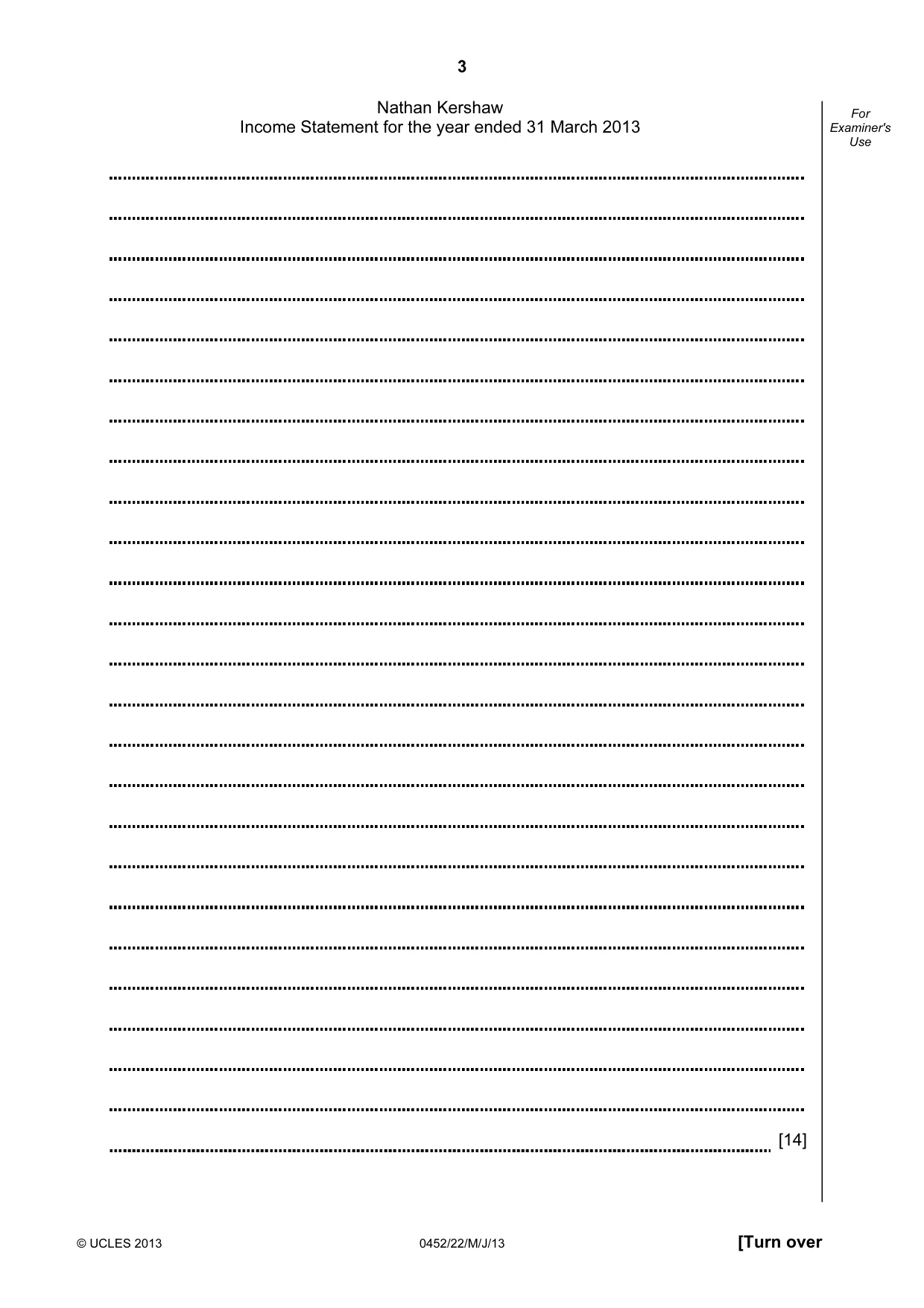
3 © UCLES 2013 0452/22/M/J/13 [Turn over For Examiner's Use Nathan Kershaw Income Statement for the year ended 31 March 2013 [14]
Question paper, page 4
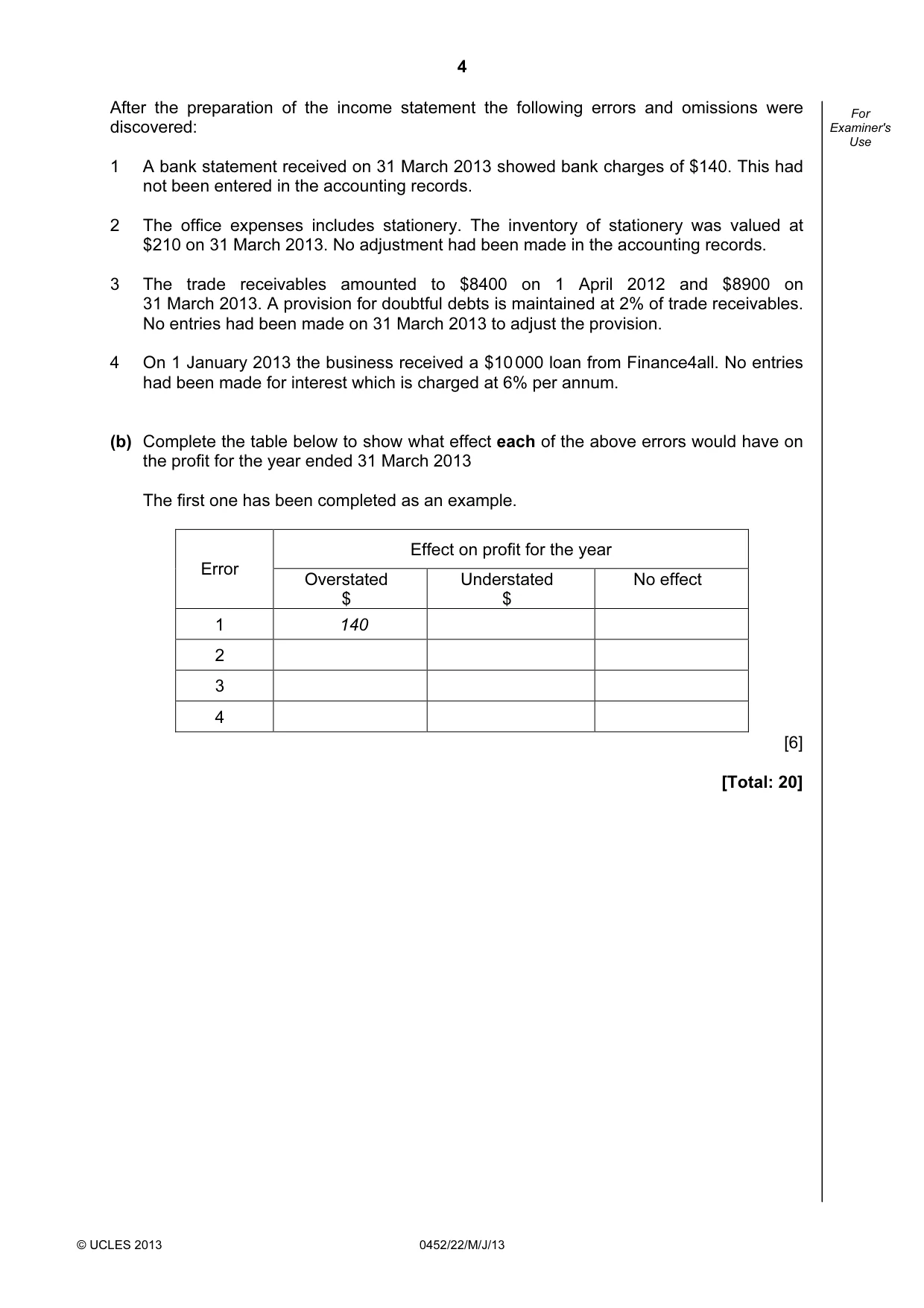
4 © UCLES 2013 0452/22/M/J/13 For Examiner's Use After the preparation of the income statement the following errors and omissions were discovered: 1 A bank statement received on 31 March 2013 showed bank charges of $140. This had not been entered in the accounting records. 2 The office expenses includes stationery. The inventory of stationery was valued at $210 on 31 March 2013. No adjustment had been made in the accounting records. 3 The trade receivables amounted to $8400 on 1 April 2012 and $8900 on 31 March 2013. A provision for doubtful debts is maintained at 2% of trade receivables. No entries had been made on 31 March 2013 to adjust the provision. 4 On 1 January 2013 the business received a $10 000 loan from Finance4all. No entries had been made for interest which is charged at 6% per annum. (b) Complete the table below to show what effect each of the above errors would have on the profit for the year ended 31 March 2013 The first one has been completed as an example. Effect on profit for the year Error Overstated $ Understated $ No effect 1 140 2 3 4 [6] [Total: 20]
Question paper, page 5
5 © UCLES 2013 0452/22/M/J/13 [Turn over Question 2 is on the next page.
Question paper, page 6
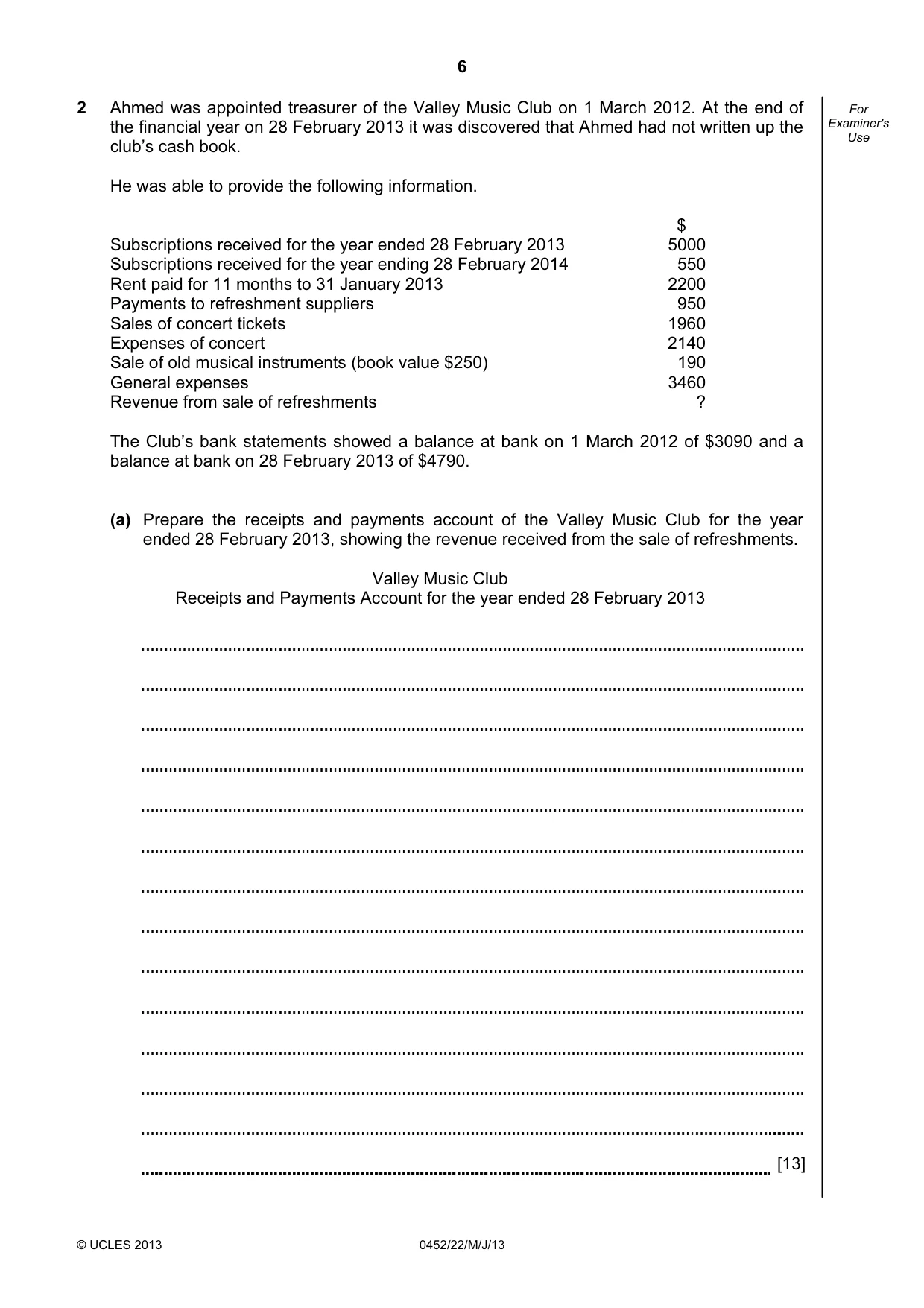
6 © UCLES 2013 0452/22/M/J/13 For Examiner's Use 2 Ahmed was appointed treasurer of the Valley Music Club on 1 March 2012. At the end of the financial year on 28 February 2013 it was discovered that Ahmed had not written up the club’s cash book. He was able to provide the following information. $ Subscriptions received for the year ended 28 February 2013 5000 Subscriptions received for the year ending 28 February 2014 550 Rent paid for 11 months to 31 January 2013 2200 Payments to refreshment suppliers 950 Sales of concert tickets 1960 Expenses of concert 2140 Sale of old musical instruments (book value $250) 190 General expenses 3460 Revenue from sale of refreshments ? The Club’s bank statements showed a balance at bank on 1 March 2012 of $3090 and a balance at bank on 28 February 2013 of $4790. (a) Prepare the receipts and payments account of the Valley Music Club for the year ended 28 February 2013, showing the revenue received from the sale of refreshments. Valley Music Club Receipts and Payments Account for the year ended 28 February 2013 [13]
Question paper, page 7
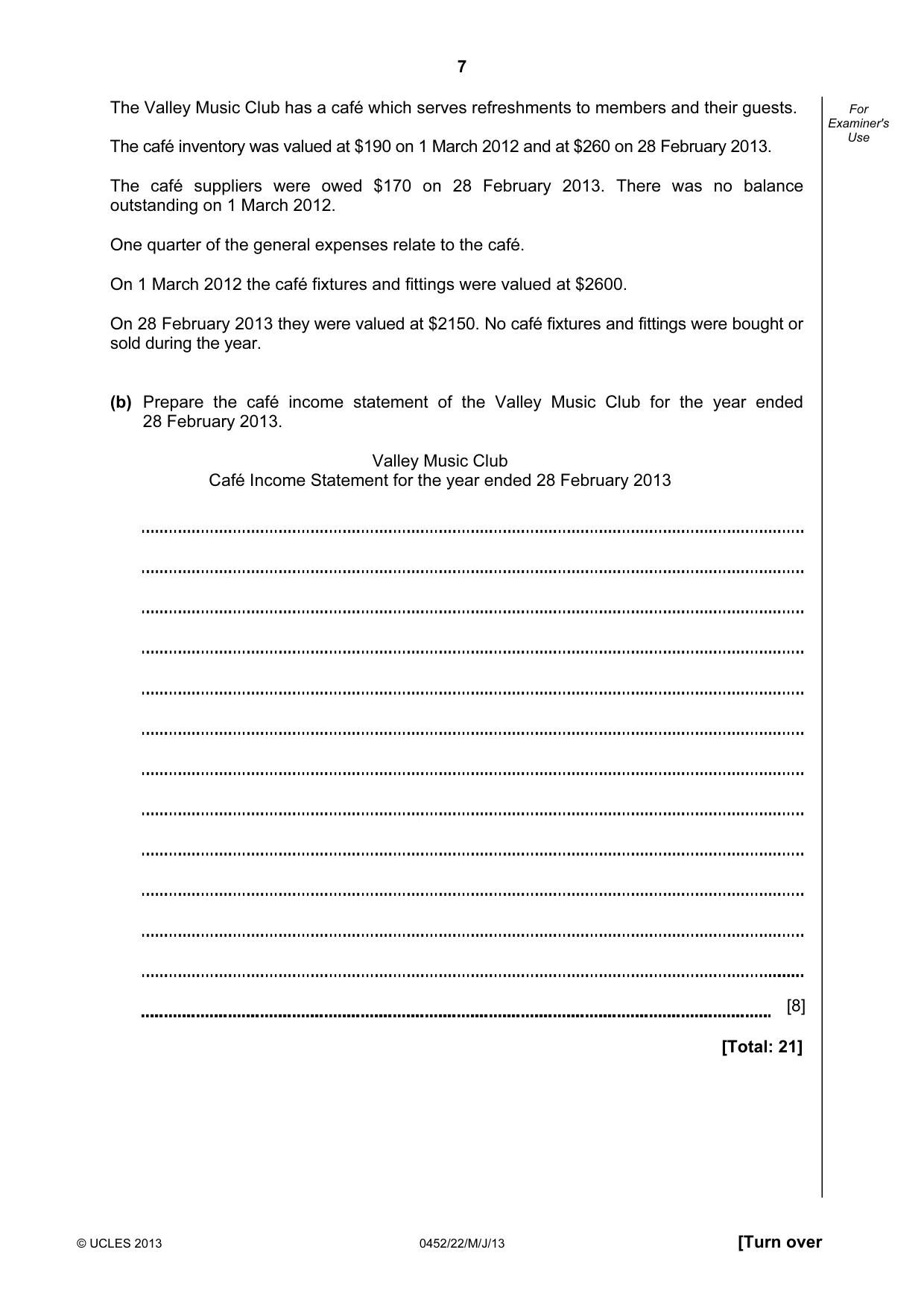
7 © UCLES 2013 0452/22/M/J/13 [Turn over For Examiner's Use The Valley Music Club has a café which serves refreshments to members and their guests. The café inventory was valued at $190 on 1 March 2012 and at $260 on 28 February 2013. The café suppliers were owed $170 on 28 February 2013. There was no balance outstanding on 1 March 2012. One quarter of the general expenses relate to the café. On 1 March 2012 the café fixtures and fittings were valued at $2600. On 28 February 2013 they were valued at $2150. No café fixtures and fittings were bought or sold during the year. (b) Prepare the café income statement of the Valley Music Club for the year ended 28 February 2013. Valley Music Club Café Income Statement for the year ended 28 February 2013 [8] [Total: 21]
Question paper, page 8
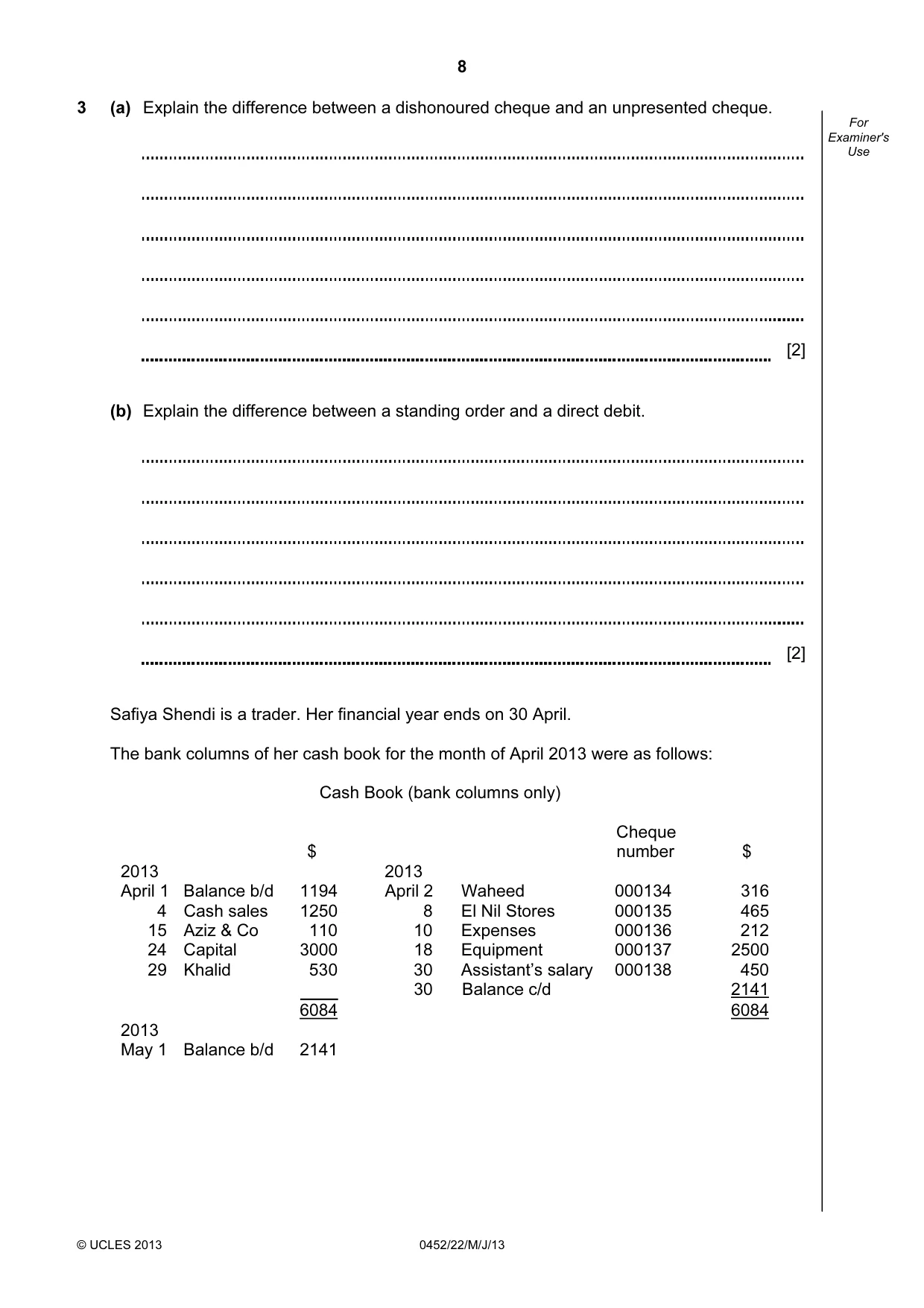
8 © UCLES 2013 0452/22/M/J/13 For Examiner's Use 3 (a) Explain the difference between a dishonoured cheque and an unpresented cheque. [2] (b) Explain the difference between a standing order and a direct debit. [2] Safiya Shendi is a trader. Her financial year ends on 30 April. The bank columns of her cash book for the month of April 2013 were as follows: Cash Book (bank columns only) $ Cheque number $ 2013 2013 April 1 Balance b/d 1194 April 2 Waheed 000134 316 4 Cash sales 1250 8 El Nil Stores 000135 465 15 Aziz & Co 110 10 Expenses 000136 212 24 Capital 3000 18 Equipment 000137 2500 29 Khalid 530 30 Assistant’s salary 000138 450 30 Balance c/d 2141 6084 6084 2013 May 1 Balance b/d 2141
Question paper, page 9
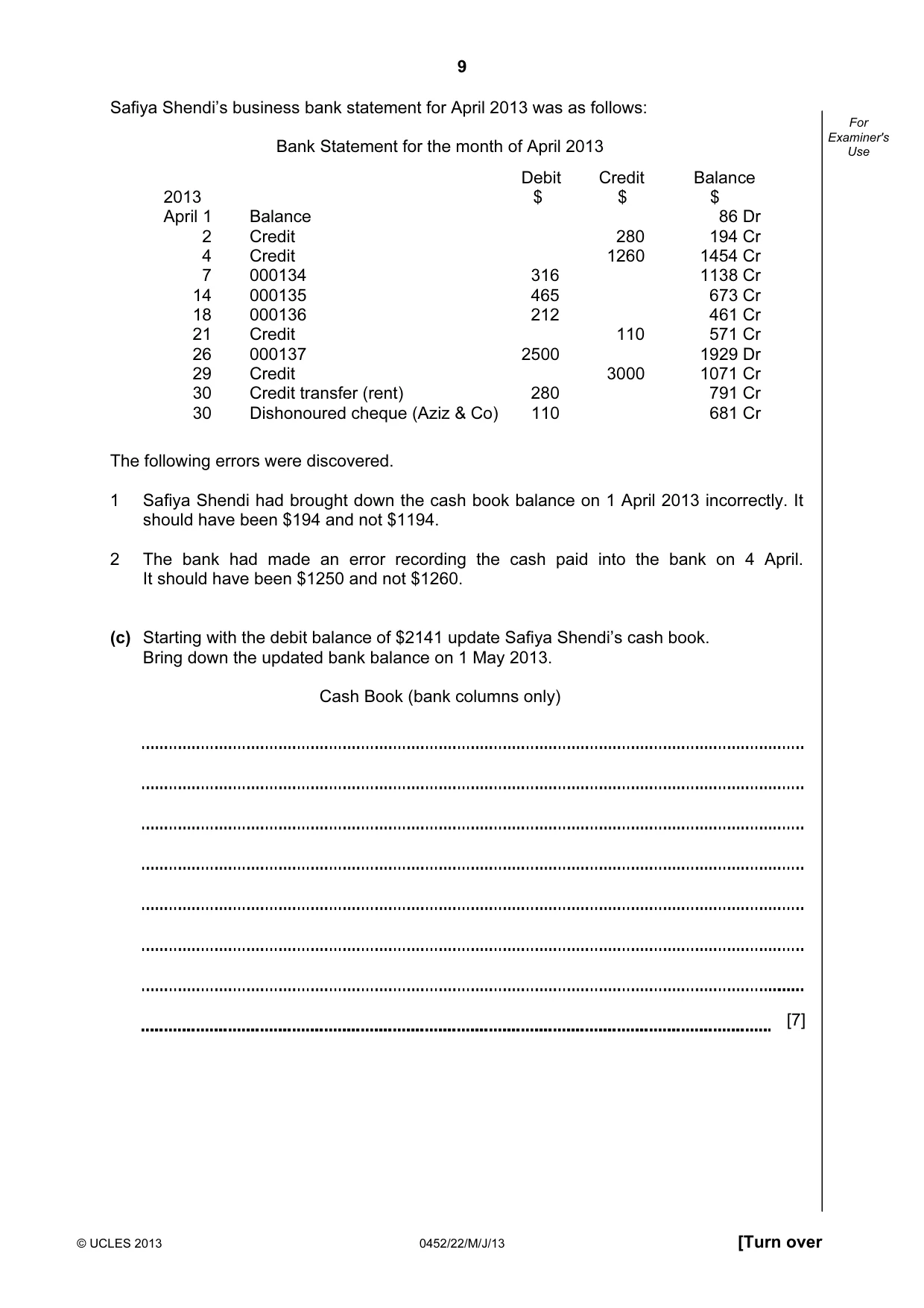
9 © UCLES 2013 0452/22/M/J/13 [Turn over For Examiner's Use Safiya Shendi’s business bank statement for April 2013 was as follows: Bank Statement for the month of April 2013 The following errors were discovered. 1 Safiya Shendi had brought down the cash book balance on 1 April 2013 incorrectly. It should have been $194 and not $1194. 2 The bank had made an error recording the cash paid into the bank on 4 April. It should have been $1250 and not $1260. (c) Starting with the debit balance of $2141 update Safiya Shendi’s cash book. Bring down the updated bank balance on 1 May 2013. Cash Book (bank columns only) [7] Debit Credit Balance 2013 $ $ $ April 1 Balance 86 Dr 2 Credit 280 194 Cr 4 Credit 1260 1454 Cr 7 000134 316 1138 Cr 14 000135 465 673 Cr 18 000136 212 461 Cr 21 Credit 110 571 Cr 26 000137 2500 1929 Dr 29 Credit 3000 1071 Cr 30 Credit transfer (rent) 280 791 Cr 30 Dishonoured cheque (Aziz & Co) 110 681 Cr
Question paper, page 10
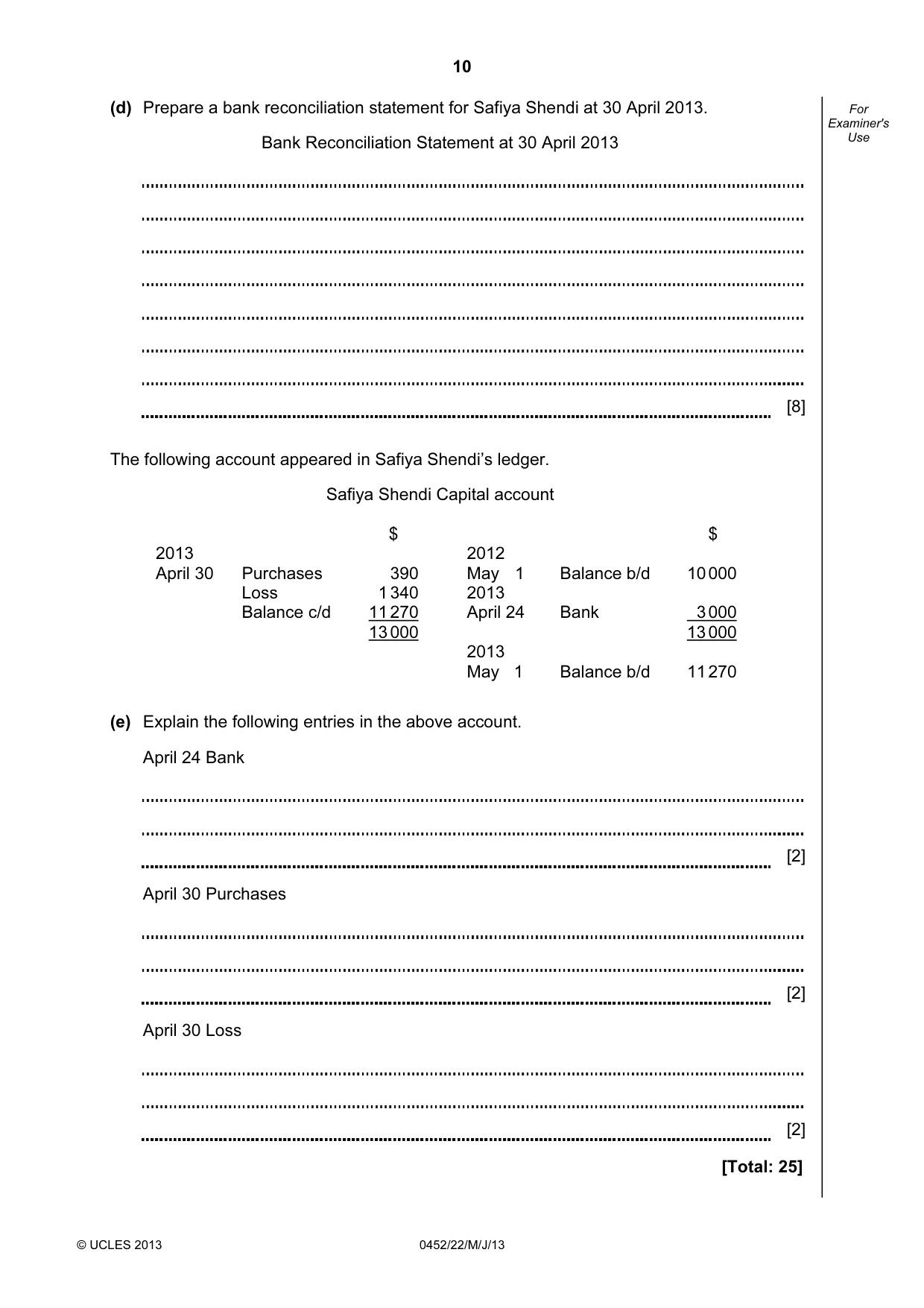
10 © UCLES 2013 0452/22/M/J/13 For Examiner's Use (d) Prepare a bank reconciliation statement for Safiya Shendi at 30 April 2013. Bank Reconciliation Statement at 30 April 2013 [8] The following account appeared in Safiya Shendi’s ledger. Safiya Shendi Capital account $ $ 2013 2012 April 30 Purchases 390 May 1 Balance b/d 10 000 Loss 1 340 2013 Balance c/d 11 270 April 24 Bank 3 000 13 000 13 000 2013 May 1 Balance b/d 11 270 (e) Explain the following entries in the above account. April 24 Bank [2] April 30 Purchases [2] April 30 Loss [2] [Total: 25]
Question paper, page 11
11 © UCLES 2013 0452/22/M/J/13 [Turn over Question 4 is on the next page.
Question paper, page 12
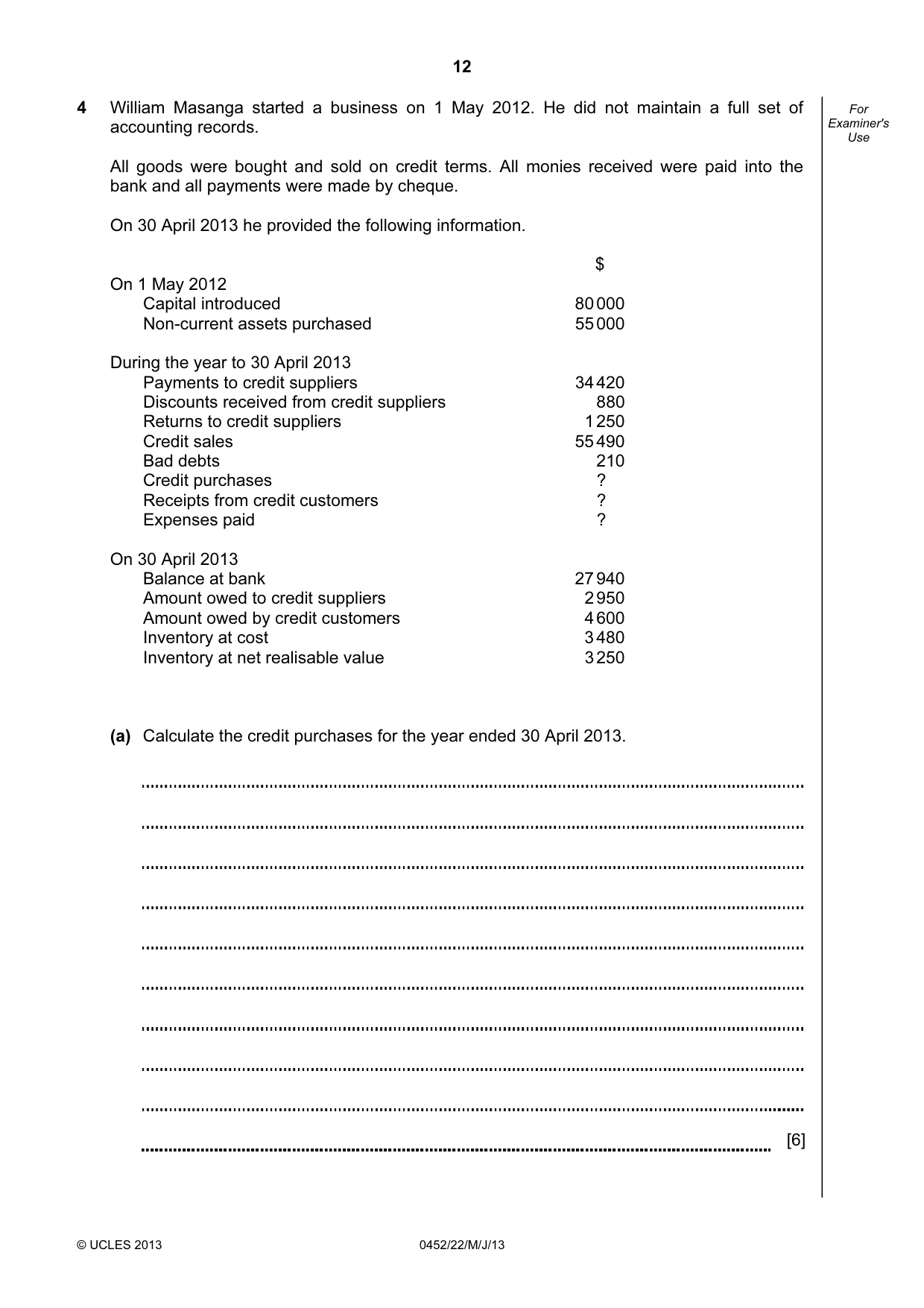
12 © UCLES 2013 0452/22/M/J/13 For Examiner's Use 4 William Masanga started a business on 1 May 2012. He did not maintain a full set of accounting records. All goods were bought and sold on credit terms. All monies received were paid into the bank and all payments were made by cheque. On 30 April 2013 he provided the following information. $ On 1 May 2012 Capital introduced 80 000 Non-current assets purchased 55 000 During the year to 30 April 2013 Payments to credit suppliers 34 420 Discounts received from credit suppliers 880 Returns to credit suppliers 1 250 Credit sales 55 490 Bad debts 210 Credit purchases ? Receipts from credit customers ? Expenses paid ? On 30 April 2013 Balance at bank 27 940 Amount owed to credit suppliers 2 950 Amount owed by credit customers 4 600 Inventory at cost 3 480 Inventory at net realisable value 3 250 (a) Calculate the credit purchases for the year ended 30 April 2013. [6]
Question paper, page 13
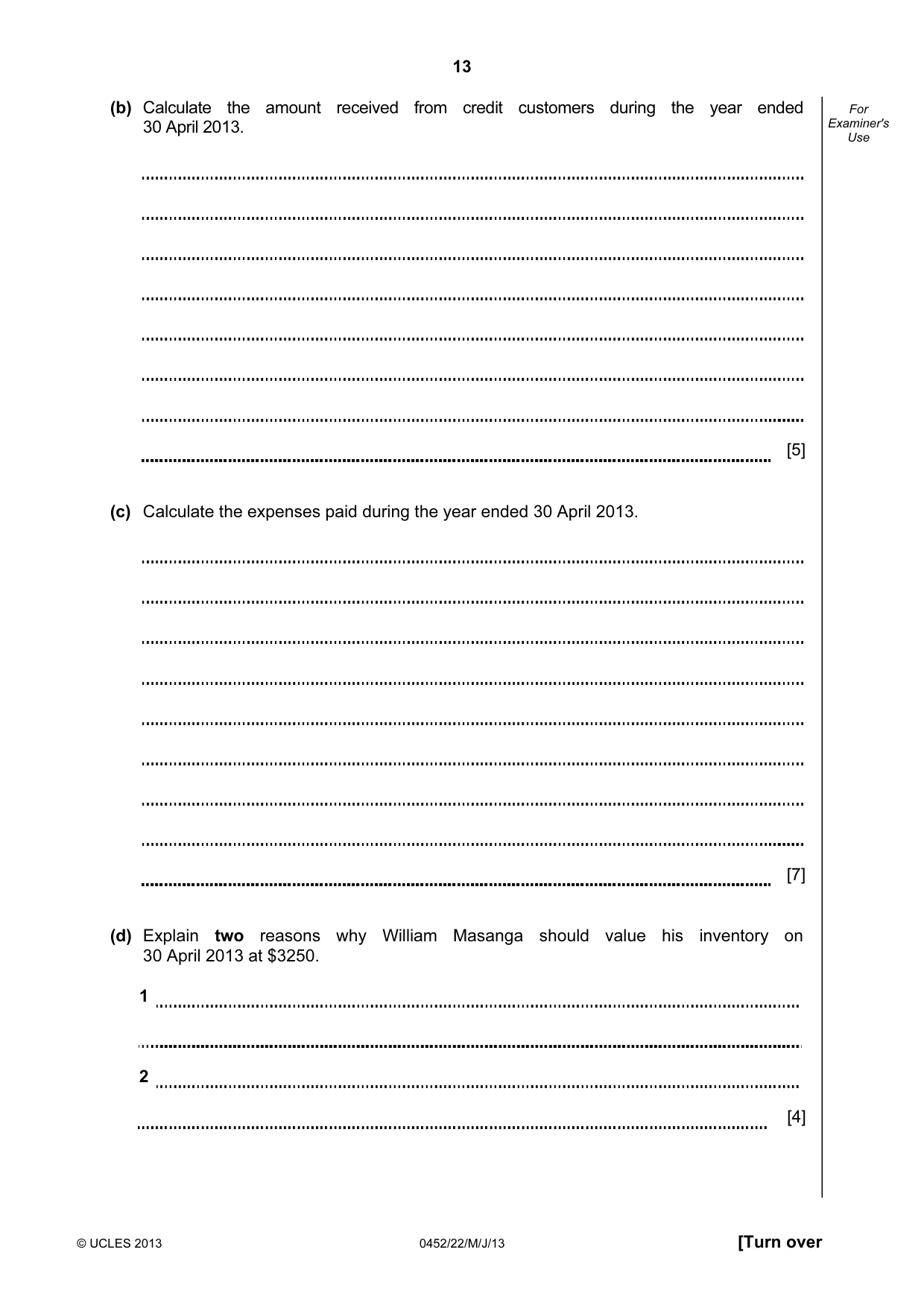
13 © UCLES 2013 0452/22/M/J/13 [Turn over For Examiner's Use (b) Calculate the amount received from credit customers during the year ended 30 April 2013. [5] (c) Calculate the expenses paid during the year ended 30 April 2013. [7] (d) Explain two reasons why William Masanga should value his inventory on 30 April 2013 at $3250. 1 2 [4]
Question paper, page 14
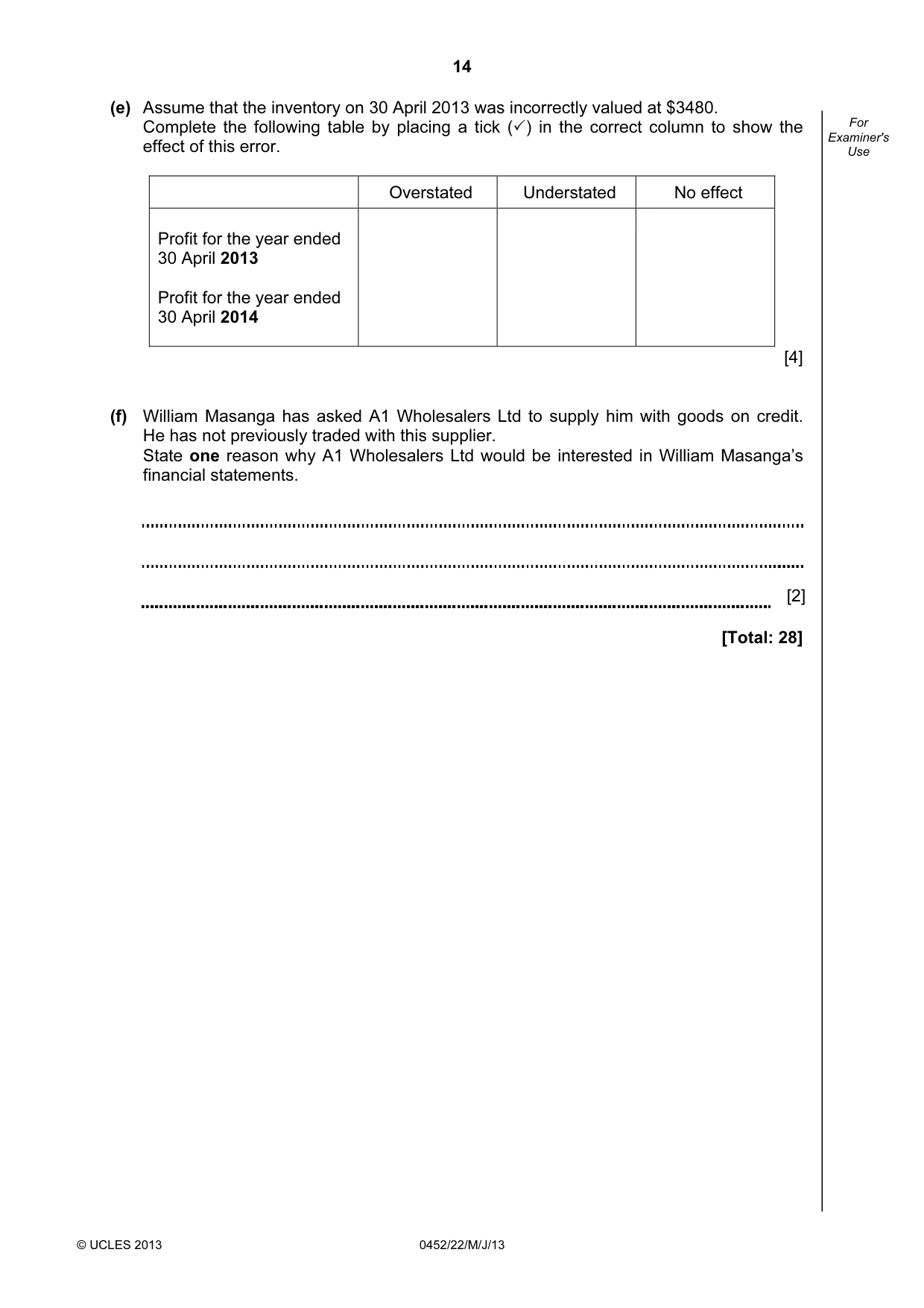
14 © UCLES 2013 0452/22/M/J/13 For Examiner's Use (e) Assume that the inventory on 30 April 2013 was incorrectly valued at $3480. Complete the following table by placing a tick (✓) in the correct column to show the effect of this error. Overstated Understated No effect Profit for the year ended 30 April 2013 Profit for the year ended 30 April 2014 [4] (f) William Masanga has asked A1 Wholesalers Ltd to supply him with goods on credit. He has not previously traded with this supplier. State one reason why A1 Wholesalers Ltd would be interested in William Masanga’s financial statements. [2] [Total: 28]
Question paper, page 15
15 © UCLES 2013 0452/22/M/J/13 [Turn over Question 5 is on the next page.
Question paper, page 16
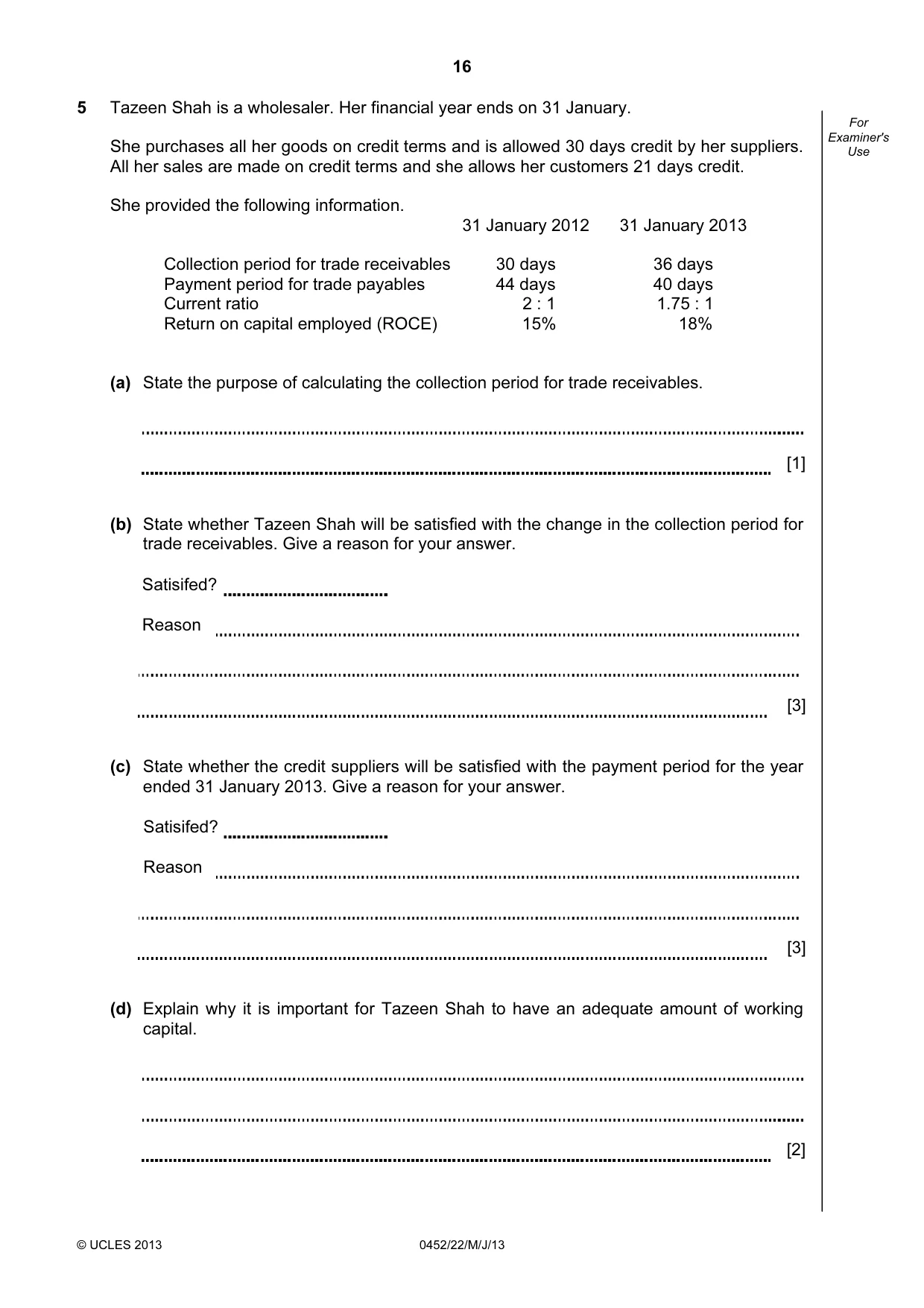
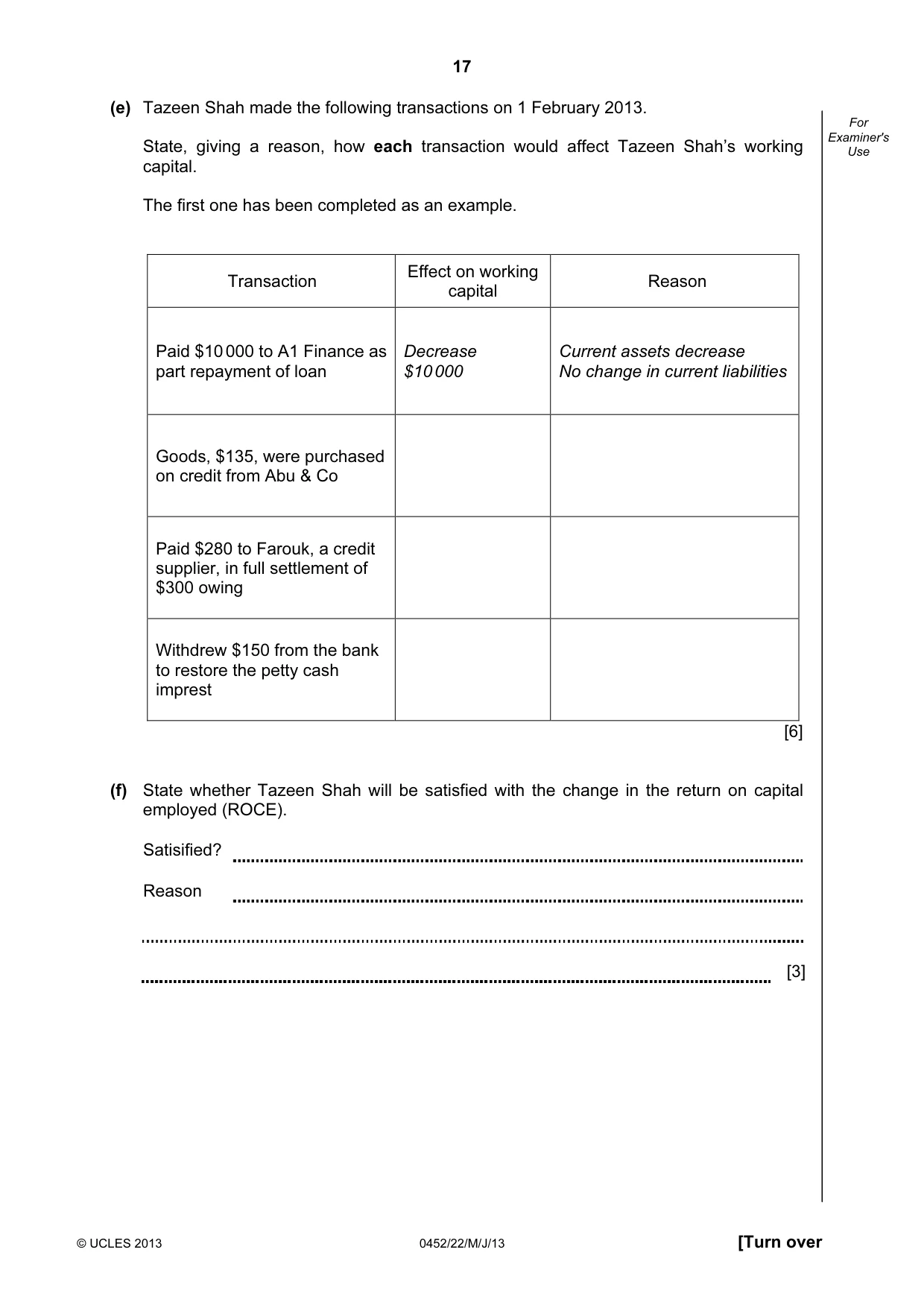
16 © UCLES 2013 0452/22/M/J/13 For Examiner's Use 5 Tazeen Shah is a wholesaler. Her financial year ends on 31 January. She purchases all her goods on credit terms and is allowed 30 days credit by her suppliers. All her sales are made on credit terms and she allows her customers 21 days credit. She provided the following information. 31 January 2012 31 January 2013 Collection period for trade receivables 30 days 36 days Payment period for trade payables 44 days 40 days Current ratio 2 : 1 1.75 : 1 Return on capital employed (ROCE) 15% 18% (a) State the purpose of calculating the collection period for trade receivables. [1] (b) State whether Tazeen Shah will be satisfied with the change in the collection period for trade receivables. Give a reason for your answer. Satisifed? Reason [3] (c) State whether the credit suppliers will be satisfied with the payment period for the year ended 31 January 2013. Give a reason for your answer. Satisifed? Reason [3] (d) Explain why it is important for Tazeen Shah to have an adequate amount of working capital. [2]
Question paper, page 17
17 © UCLES 2013 0452/22/M/J/13 [Turn over For Examiner's Use (e) Tazeen Shah made the following transactions on 1 February 2013. State, giving a reason, how each transaction would affect Tazeen Shah’s working capital. The first one has been completed as an example. Transaction Effect on working capital Reason Paid $10 000 to A1 Finance as part repayment of loan Decrease $10 000 Current assets decrease No change in current liabilities Goods, $135, were purchased on credit from Abu & Co Paid $280 to Farouk, a credit supplier, in full settlement of $300 owing Withdrew $150 from the bank to restore the petty cash imprest [6] (f) State whether Tazeen Shah will be satisfied with the change in the return on capital employed (ROCE). Satisified? Reason [3]
Question paper, page 18
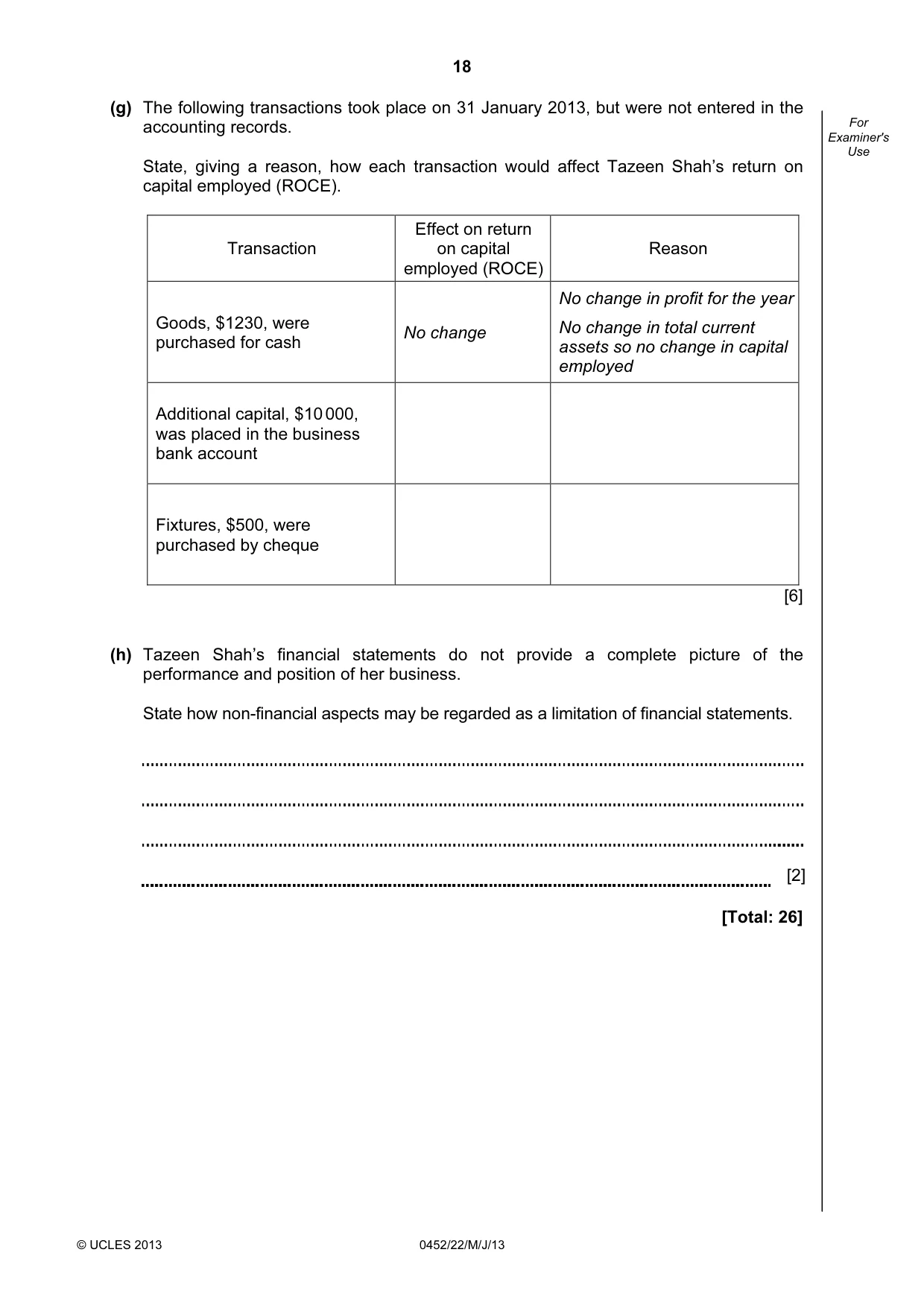
18 © UCLES 2013 0452/22/M/J/13 For Examiner's Use (g) The following transactions took place on 31 January 2013, but were not entered in the accounting records. State, giving a reason, how each transaction would affect Tazeen Shah’s return on capital employed (ROCE). Transaction Effect on return on capital employed (ROCE) Reason Goods, $1230, were purchased for cash No change No change in profit for the year No change in total current assets so no change in capital employed Additional capital, $10 000, was placed in the business bank account Fixtures, $500, were purchased by cheque [6] (h) Tazeen Shah’s financial statements do not provide a complete picture of the performance and position of her business. State how non-financial aspects may be regarded as a limitation of financial statements. [2] [Total: 26]
Question paper, page 19
19 © UCLES 2013 0452/22/M/J/13 BLANK PAGE
Question paper, page 20
20 Permission to reproduce items where third-party owned material protected by copyright is included has been sought and cleared where possible. Every reasonable effort has been made by the publisher (UCLES) to trace copyright holders, but if any items requiring clearance have unwittingly been included, the publisher will be pleased to make amends at the earliest possible opportunity. University of Cambridge International Examinations is part of the Cambridge Assessment Group. Cambridge Assessment is the brand name of University of Cambridge Local Examinations Syndicate (UCLES), which is itself a department of the University of Cambridge. © UCLES 2013 0452/22/M/J/13 BLANK PAGE
Mark scheme, page 1
CAMBRIDGE INTERNATIONAL EXAMINATIONS International General Certificate of Secondary Education MARK SCHEME for the May/June 2013 series 0452 ACCOUNTING 0452/22 Paper 2, maximum raw mark 120 This mark scheme is published as an aid to teachers and candidates, to indicate the requirements of the examination. It shows the basis on which Examiners were instructed to award marks. It does not indicate the details of the discussions that took place at an Examiners’ meeting before marking began, which would have considered the acceptability of alternative answers. Mark schemes should be read in conjunction with the question paper and the Principal Examiner Report for Teachers. Cambridge will not enter into discussions about these mark schemes. Cambridge is publishing the mark schemes for the May/June 2013 series for most IGCSE, GCE Advanced Level and Advanced Subsidiary Level components and some Ordinary Level components.
Mark scheme, page 2
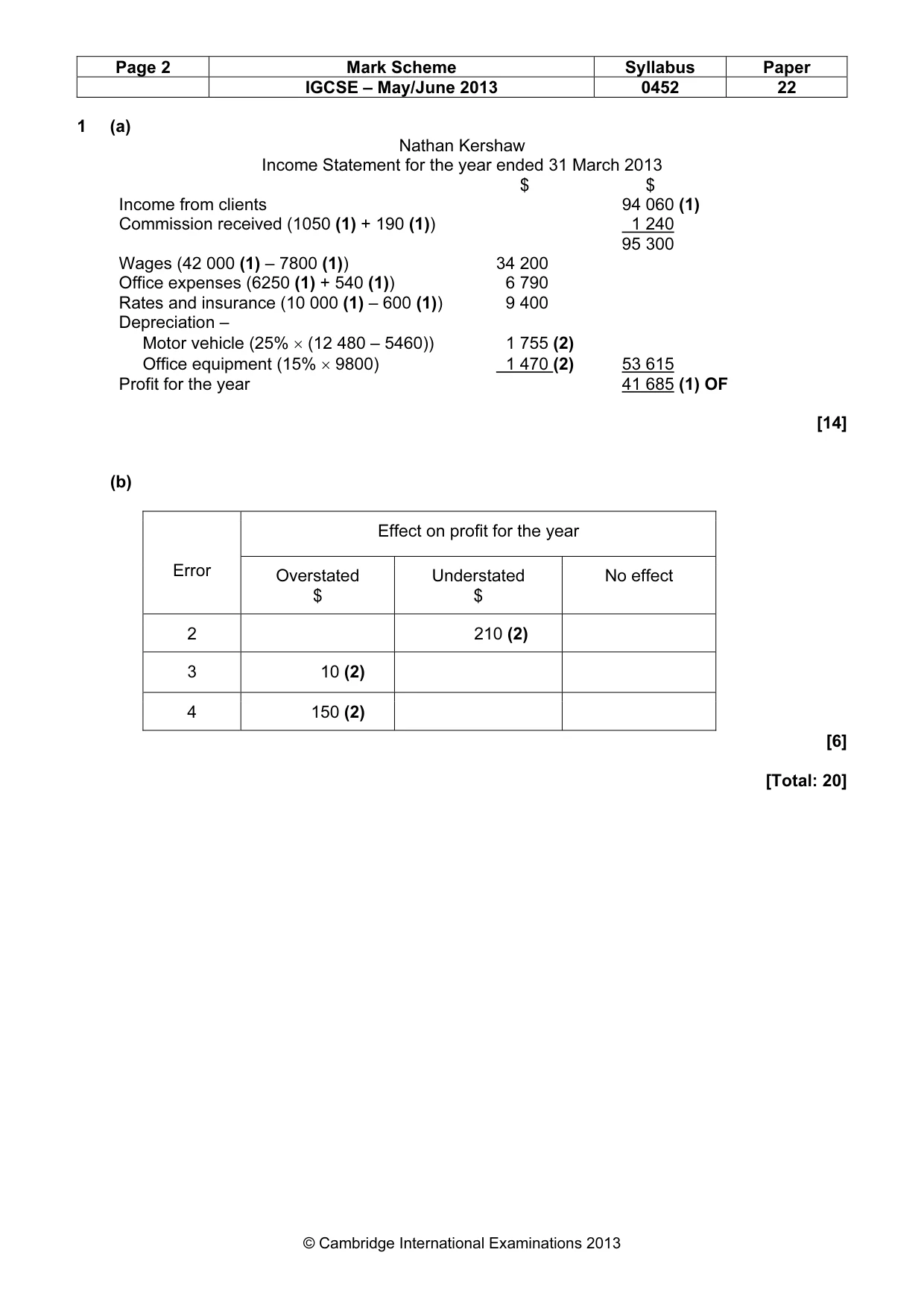
Page 2 Mark Scheme Syllabus Paper IGCSE – May/June 2013 0452 22 © Cambridge International Examinations 2013 1 (a) Nathan Kershaw Income Statement for the year ended 31 March 2013 $ $ Income from clients 94 060 (1) Commission received (1050 (1) + 190 (1)) 1 240 95 300 Wages (42 000 (1) – 7800 (1)) 34 200 Office expenses (6250 (1) + 540 (1)) 6 790 Rates and insurance (10 000 (1) – 600 (1)) 9 400 Depreciation – Motor vehicle (25% × (12 480 – 5460)) 1 755 (2) Office equipment (15% × 9800) 1 470 (2) 53 615 Profit for the year 41 685 (1) OF [14] (b) Error Effect on profit for the year Overstated $ Understated $ No effect 2 210 (2) 3 10 (2) 4 150 (2) [6] [Total: 20]
Mark scheme, page 3
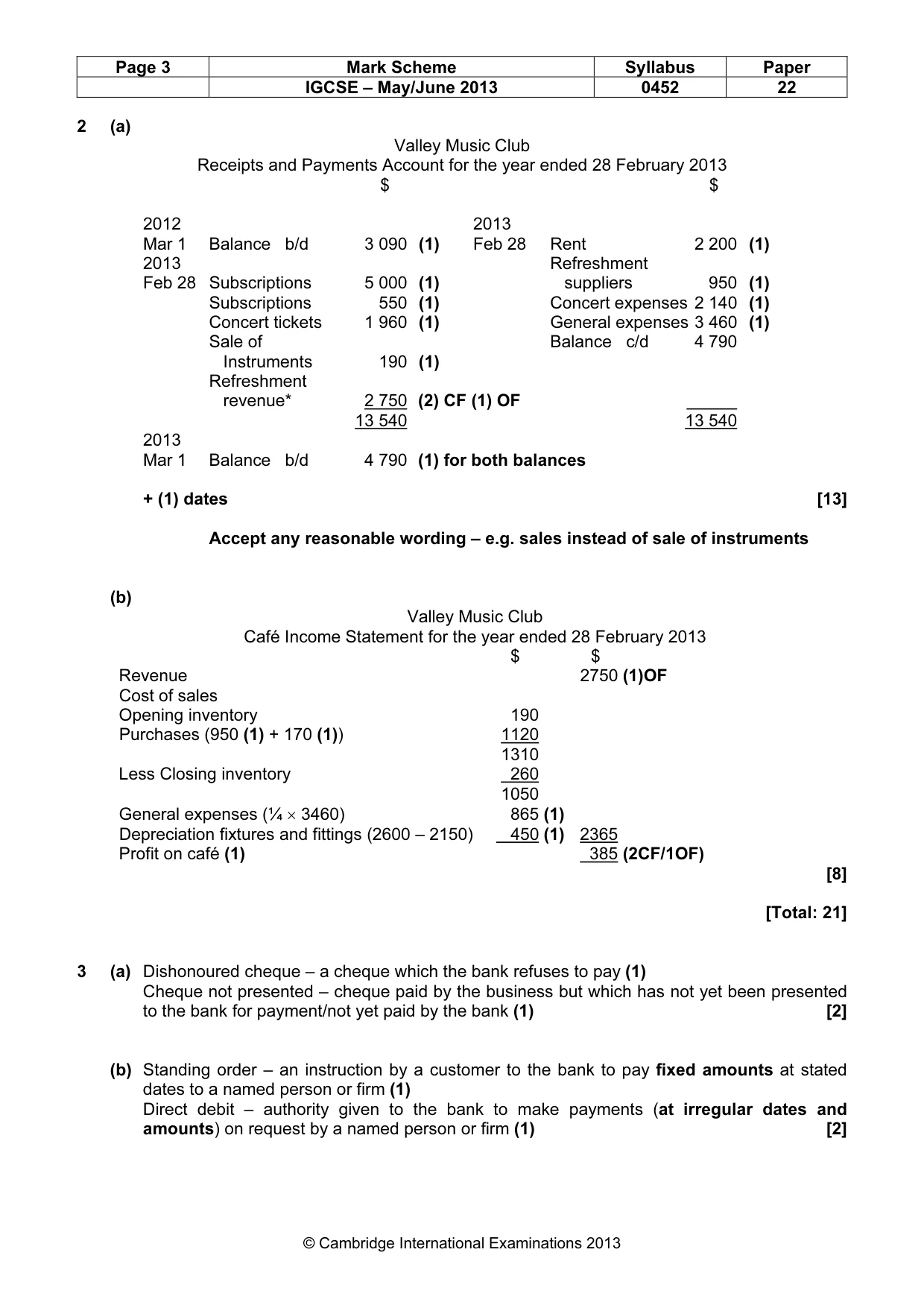
Page 3 Mark Scheme Syllabus Paper IGCSE – May/June 2013 0452 22 © Cambridge International Examinations 2013 2 (a) Valley Music Club Receipts and Payments Account for the year ended 28 February 2013 $ $ 2012 2013 Mar 1 Balance b/d 3 090 (1) Feb 28 Rent 2 200 (1) 2013 Refreshment Feb 28 Subscriptions 5 000 (1) suppliers 950 (1) Subscriptions 550 (1) Concert expenses 2 140 (1) Concert tickets 1 960 (1) General expenses 3 460 (1) Sale of Balance c/d 4 790 Instruments 190 (1) Refreshment revenue* 2 750 (2) CF (1) OF 13 540 13 540 2013 Mar 1 Balance b/d 4 790 (1) for both balances + (1) dates [13] Accept any reasonable wording – e.g. sales instead of sale of instruments (b) Valley Music Club Café Income Statement for the year ended 28 February 2013 $ $ Revenue 2750 (1)OF Cost of sales Opening inventory 190 Purchases (950 (1) + 170 (1)) 1120 1310 Less Closing inventory 260 1050 General expenses (¼ × 3460) 865 (1) Depreciation fixtures and fittings (2600 – 2150) 450 (1) 2365 Profit on café (1) 385 (2CF/1OF) [8] [Total: 21] 3 (a) Dishonoured cheque – a cheque which the bank refuses to pay (1) Cheque not presented – cheque paid by the business but which has not yet been presented to the bank for payment/not yet paid by the bank (1) [2] (b) Standing order – an instruction by a customer to the bank to pay fixed amounts at stated dates to a named person or firm (1) Direct debit – authority given to the bank to make payments (at irregular dates and amounts) on request by a named person or firm (1) [2]
Mark scheme, page 4
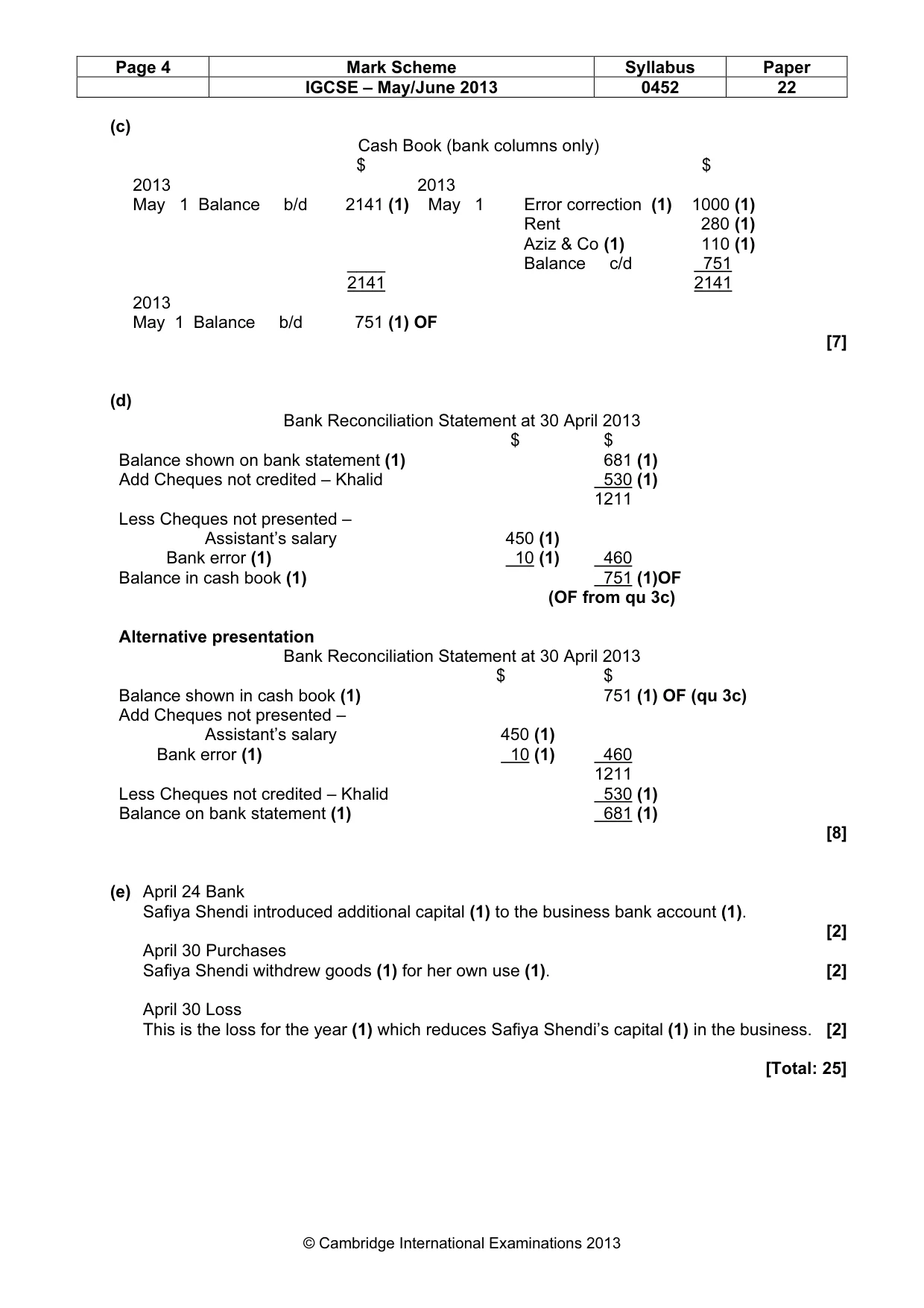
Page 4 Mark Scheme Syllabus Paper IGCSE – May/June 2013 0452 22 © Cambridge International Examinations 2013 (c) Cash Book (bank columns only) $ $ 2013 2013 May 1 Balance b/d 2141 (1) May 1 Error correction (1) 1000 (1) Rent 280 (1) Aziz & Co (1) 110 (1) ____ Balance c/d 751 2141 2141 2013 May 1 Balance b/d 751 (1) OF [7] (d) Bank Reconciliation Statement at 30 April 2013 $ $ Balance shown on bank statement (1) 681 (1) Add Cheques not credited – Khalid 530 (1) 1211 Less Cheques not presented – Assistant’s salary 450 (1) Bank error (1) 10 (1) 460 Balance in cash book (1) 751 (1)OF (OF from qu 3c) Alternative presentation Bank Reconciliation Statement at 30 April 2013 $ $ Balance shown in cash book (1) 751 (1) OF (qu 3c) Add Cheques not presented – Assistant’s salary 450 (1) Bank error (1) 10 (1) 460 1211 Less Cheques not credited – Khalid 530 (1) Balance on bank statement (1) 681 (1) [8] (e) April 24 Bank Safiya Shendi introduced additional capital (1) to the business bank account (1). [2] April 30 Purchases Safiya Shendi withdrew goods (1) for her own use (1). [2] April 30 Loss This is the loss for the year (1) which reduces Safiya Shendi’s capital (1) in the business. [2] [Total: 25]
Mark scheme, page 5
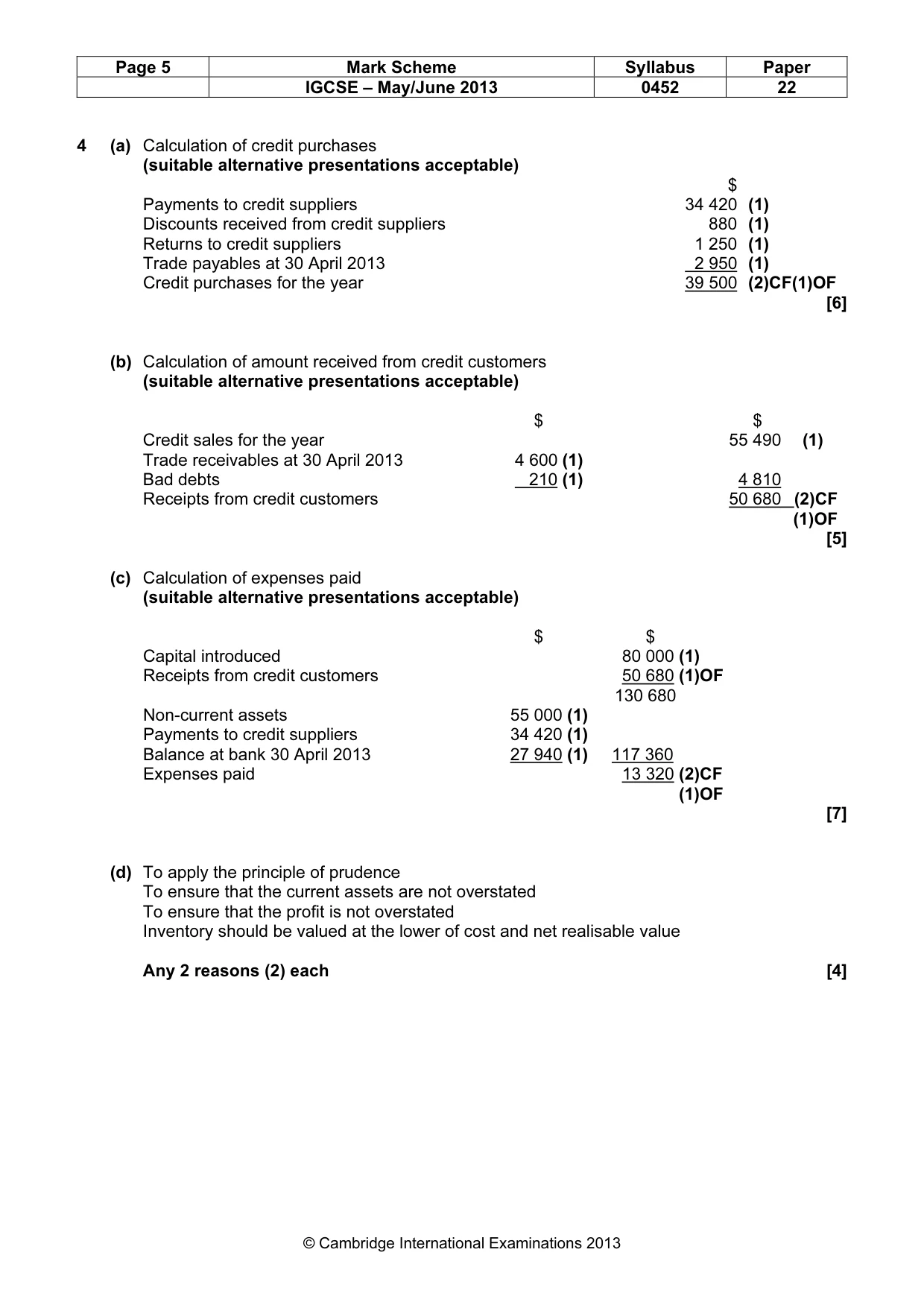
Page 5 Mark Scheme Syllabus Paper IGCSE – May/June 2013 0452 22 © Cambridge International Examinations 2013 4 (a) Calculation of credit purchases (suitable alternative presentations acceptable) $ Payments to credit suppliers 34 420 (1) Discounts received from credit suppliers 880 (1) Returns to credit suppliers 1 250 (1) Trade payables at 30 April 2013 2 950 (1) Credit purchases for the year 39 500 (2)CF(1)OF [6] (b) Calculation of amount received from credit customers (suitable alternative presentations acceptable) $ $ Credit sales for the year 55 490 (1) Trade receivables at 30 April 2013 4 600 (1) Bad debts 210 (1) 4 810 Receipts from credit customers 50 680 (2)CF (1)OF [5] (c) Calculation of expenses paid (suitable alternative presentations acceptable) $ $ Capital introduced 80 000 (1) Receipts from credit customers 50 680 (1)OF 130 680 Non-current assets 55 000 (1) Payments to credit suppliers 34 420 (1) Balance at bank 30 April 2013 27 940 (1) 117 360 Expenses paid 13 320 (2)CF (1)OF [7] (d) To apply the principle of prudence To ensure that the current assets are not overstated To ensure that the profit is not overstated Inventory should be valued at the lower of cost and net realisable value Any 2 reasons (2) each [4]
Mark scheme, page 6
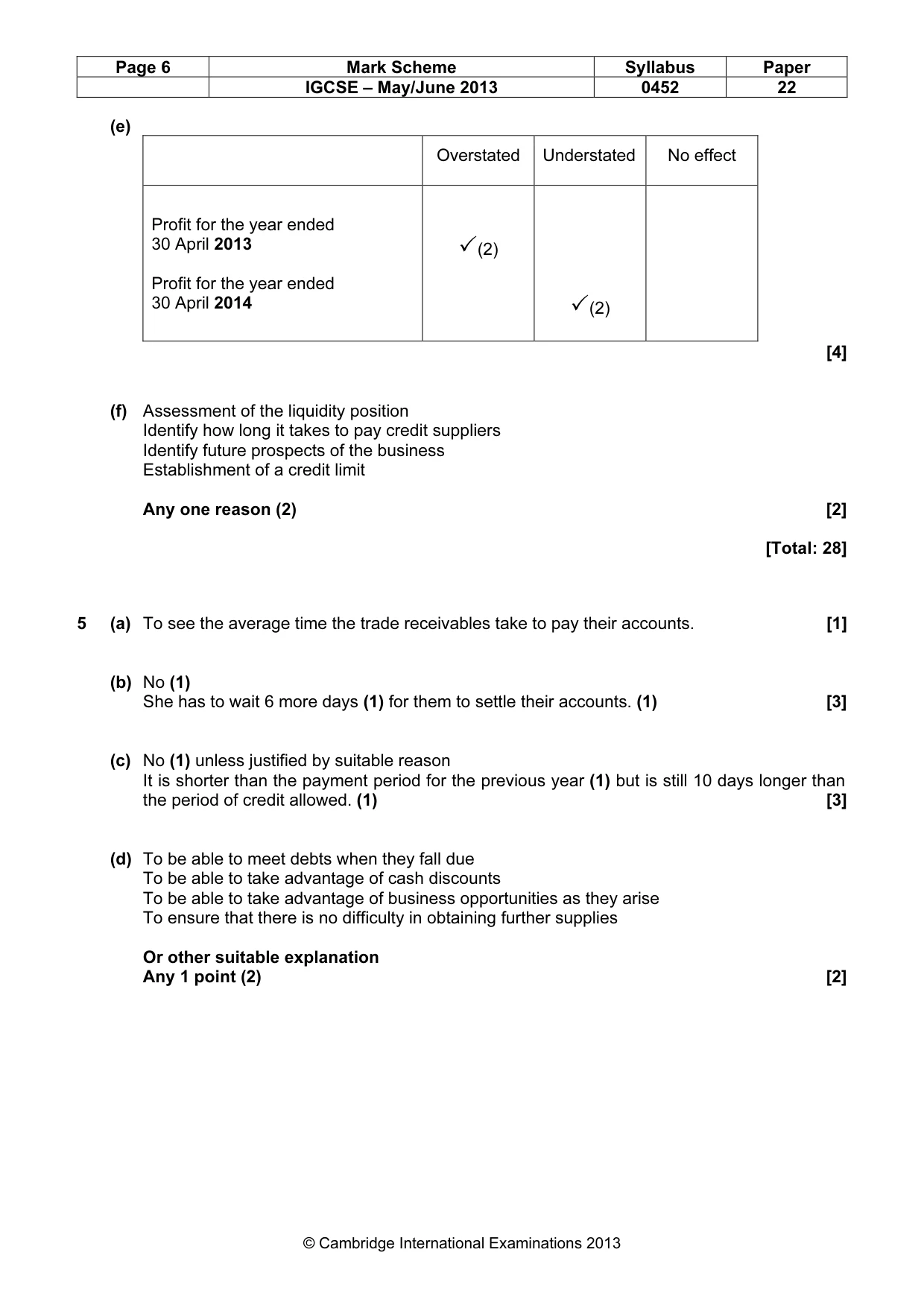
Page 6 Mark Scheme Syllabus Paper IGCSE – May/June 2013 0452 22 © Cambridge International Examinations 2013 (e) Overstated Understated No effect Profit for the year ended 30 April 2013 Profit for the year ended 30 April 2014 ✓(2) ✓(2) [4] (f) Assessment of the liquidity position Identify how long it takes to pay credit suppliers Identify future prospects of the business Establishment of a credit limit Any one reason (2) [2] [Total: 28] 5 (a) To see the average time the trade receivables take to pay their accounts. [1] (b) No (1) She has to wait 6 more days (1) for them to settle their accounts. (1) [3] (c) No (1) unless justified by suitable reason It is shorter than the payment period for the previous year (1) but is still 10 days longer than the period of credit allowed. (1) [3] (d) To be able to meet debts when they fall due To be able to take advantage of cash discounts To be able to take advantage of business opportunities as they arise To ensure that there is no difficulty in obtaining further supplies Or other suitable explanation Any 1 point (2) [2]
Mark scheme, page 7
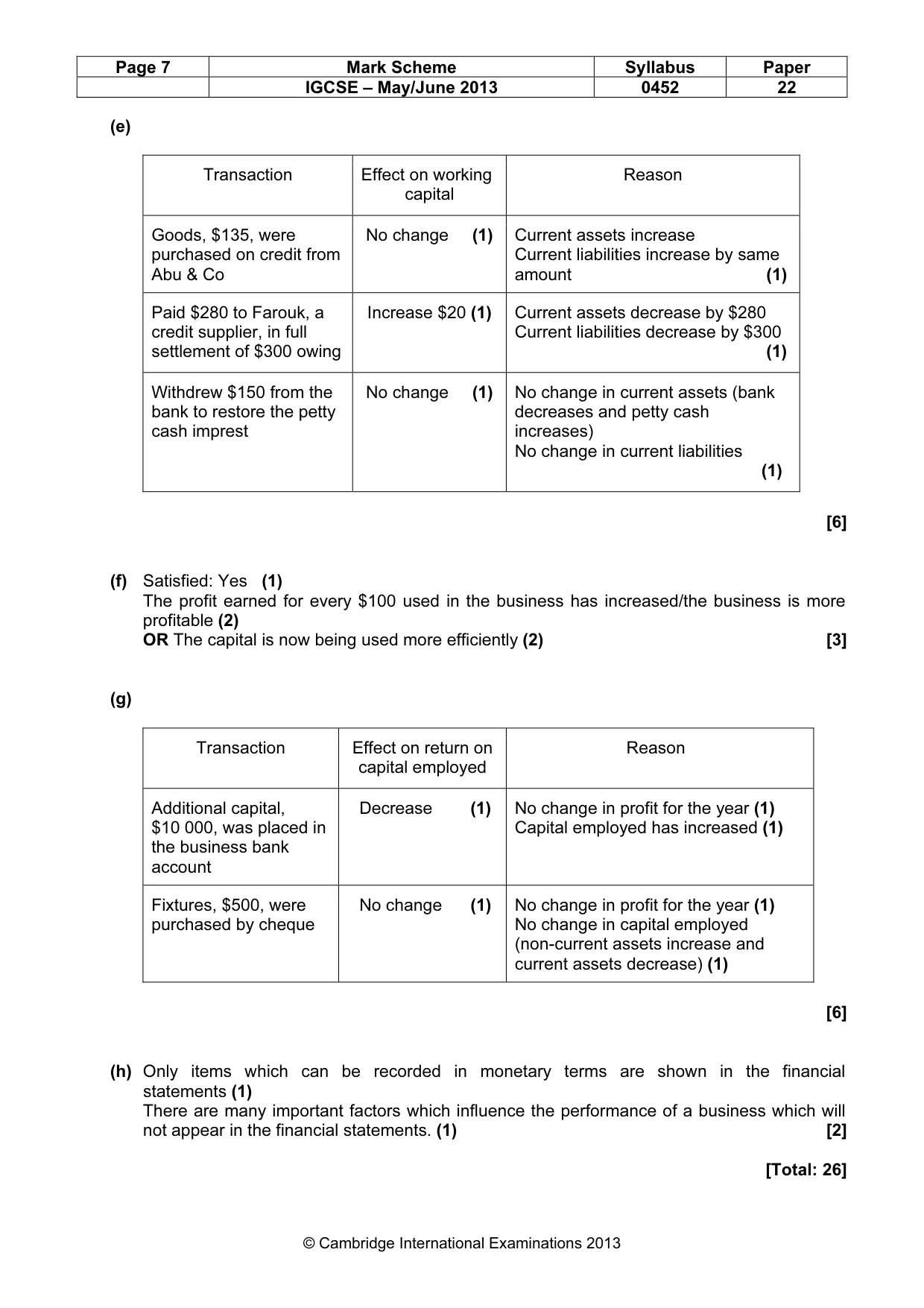
Page 7 Mark Scheme Syllabus Paper IGCSE – May/June 2013 0452 22 © Cambridge International Examinations 2013 (e) Transaction Effect on working capital Reason Goods, $135, were purchased on credit from Abu & Co No change (1) Current assets increase Current liabilities increase by same amount (1) Paid $280 to Farouk, a credit supplier, in full settlement of $300 owing Increase $20 (1) Current assets decrease by $280 Current liabilities decrease by $300 (1) Withdrew $150 from the bank to restore the petty cash imprest No change (1) No change in current assets (bank decreases and petty cash increases) No change in current liabilities (1) [6] (f) Satisfied: Yes (1) The profit earned for every $100 used in the business has increased/the business is more profitable (2) OR The capital is now being used more efficiently (2) [3] (g) Transaction Effect on return on capital employed Reason Additional capital, $10 000, was placed in the business bank account Decrease (1) No change in profit for the year (1) Capital employed has increased (1) Fixtures, $500, were purchased by cheque No change (1) No change in profit for the year (1) No change in capital employed (non-current assets increase and current assets decrease) (1) [6] (h) Only items which can be recorded in monetary terms are shown in the financial statements (1) There are many important factors which influence the performance of a business which will not appear in the financial statements. (1) [2] [Total: 26]
What you needed in this session
Cambridge’s own grade thresholds for 2013 May/June, Paper 2 · Variant 2. A higher threshold means an easier paper — the bar moves with how the cohort did.