Cambridge IGCSE Accounting 0452 — 2012 Oct/Nov Paper 2 · Variant 3
0452/23/O/N/12 · 120 marks · ≈135 min
The question paper and its mark scheme, free to read here and free to download. This is Cambridge’s own paper, exactly as it was sat.
Question paper20 pages
Mark scheme9 pages
Answers below. Sit the paper first if you are practising.
Paper as text
Question paper, page 1
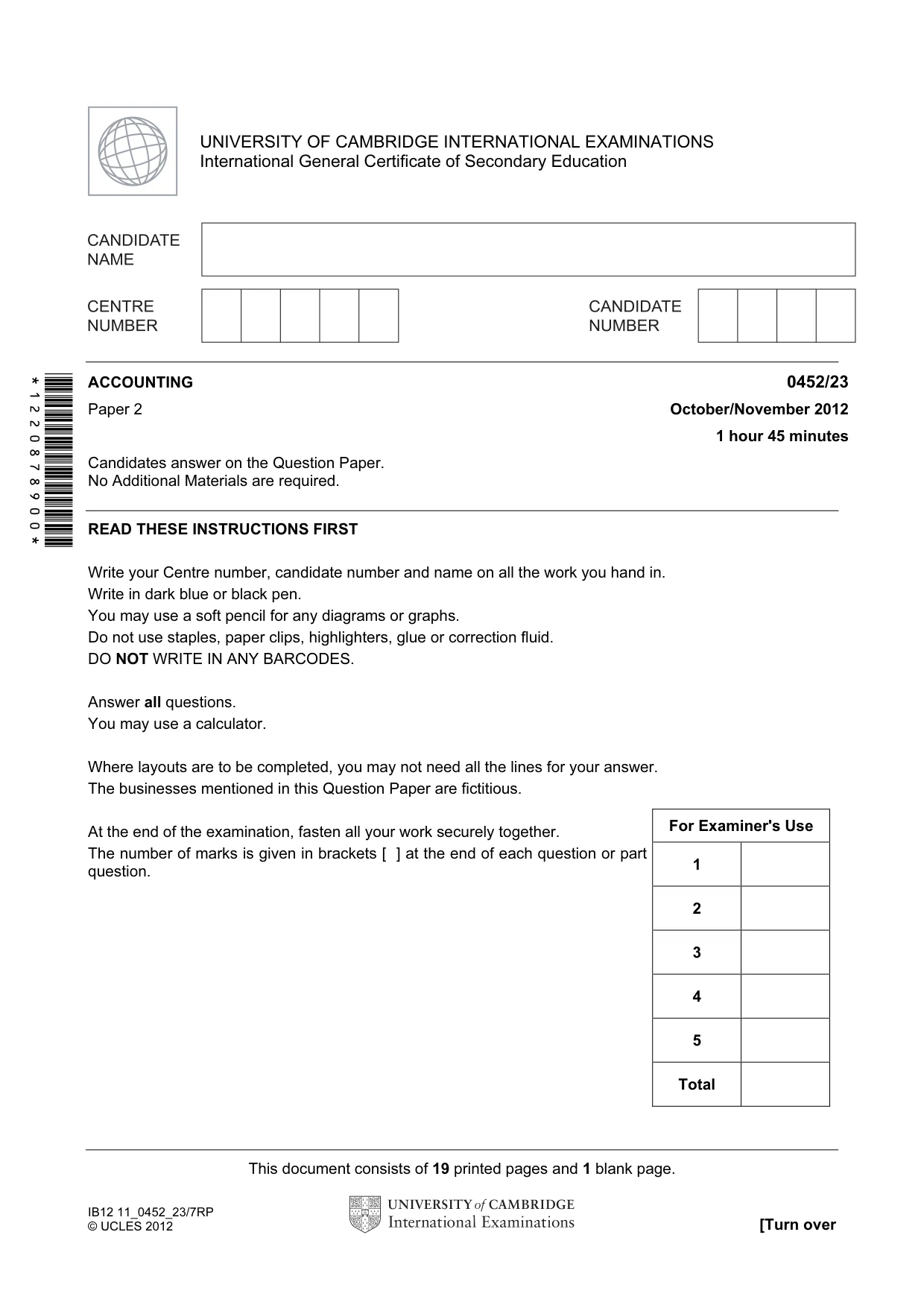
This document consists of 19 printed pages and 1 blank page. IB12 11_0452_23/7RP © UCLES 2012 [Turn over *1220878900* For Examiner's Use 1 2 3 4 5 Total UNIVERSITY OF CAMBRIDGE INTERNATIONAL EXAMINATIONS International General Certificate of Secondary Education ACCOUNTING 0452/23 Paper 2 October/November 2012 1 hour 45 minutes Candidates answer on the Question Paper. No Additional Materials are required. READ THESE INSTRUCTIONS FIRST Write your Centre number, candidate number and name on all the work you hand in. Write in dark blue or black pen. You may use a soft pencil for any diagrams or graphs. Do not use staples, paper clips, highlighters, glue or correction fluid. DO NOT WRITE IN ANY BARCODES. Answer all questions. You may use a calculator. Where layouts are to be completed, you may not need all the lines for your answer. The businesses mentioned in this Question Paper are fictitious. At the end of the examination, fasten all your work securely together. The number of marks is given in brackets [ ] at the end of each question or part question.
Question paper, page 2
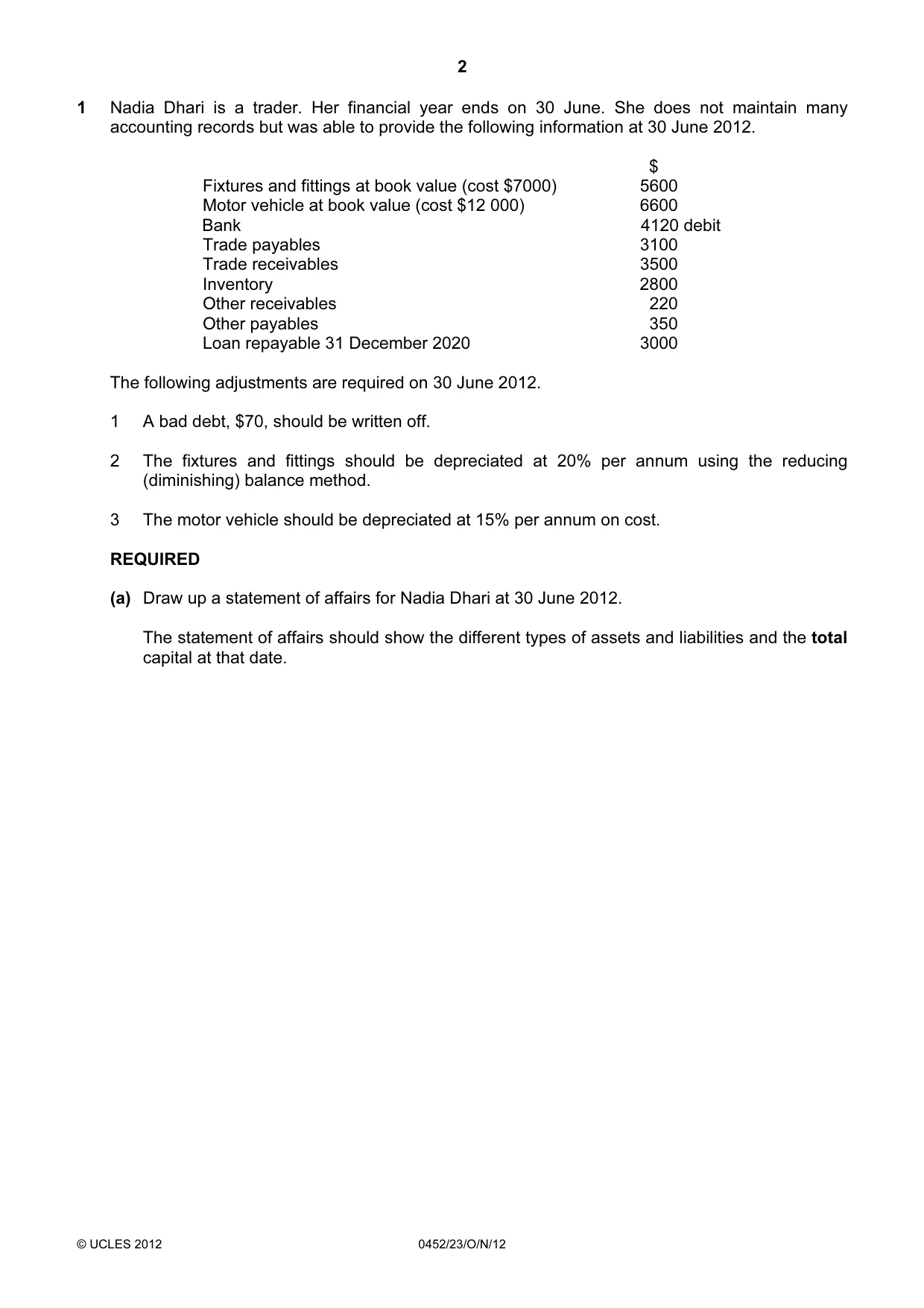
2 © UCLES 2012 0452/23/O/N/12 1 Nadia Dhari is a trader. Her financial year ends on 30 June. She does not maintain many accounting records but was able to provide the following information at 30 June 2012. $ Fixtures and fittings at book value (cost $7000) 5600 Motor vehicle at book value (cost $12 000) 6600 Bank 4120 debit Trade payables 3100 Trade receivables 3500 Inventory 2800 Other receivables 220 Other payables 350 Loan repayable 31 December 2020 3000 The following adjustments are required on 30 June 2012. 1 A bad debt, $70, should be written off. 2 The fixtures and fittings should be depreciated at 20% per annum using the reducing (diminishing) balance method. 3 The motor vehicle should be depreciated at 15% per annum on cost. REQUIRED (a) Draw up a statement of affairs for Nadia Dhari at 30 June 2012. The statement of affairs should show the different types of assets and liabilities and the total capital at that date.
Question paper, page 3
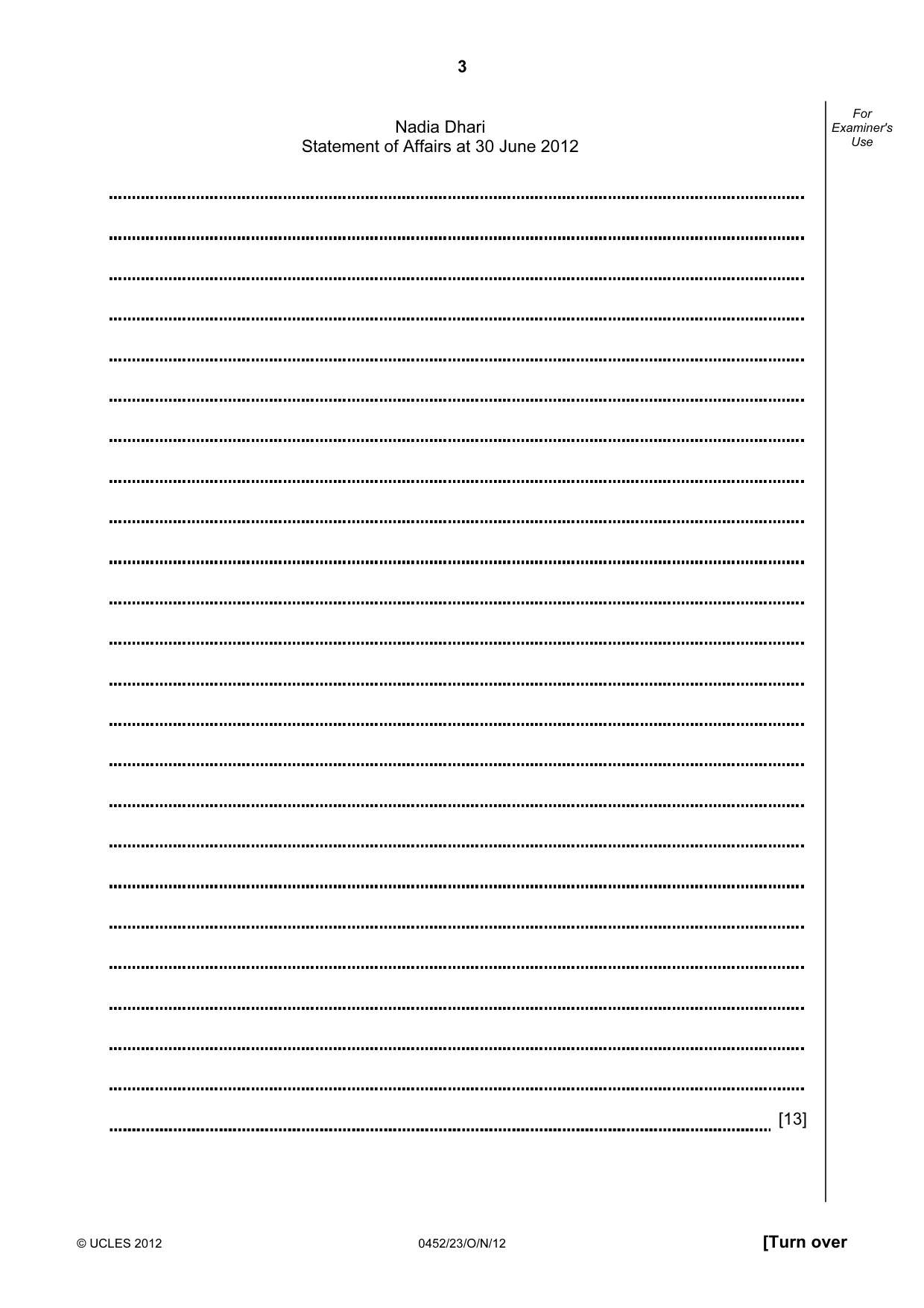
3 © UCLES 2012 0452/23/O/N/12 [Turn over For Examiner's Use Nadia Dhari Statement of Affairs at 30 June 2012 [13]
Question paper, page 4
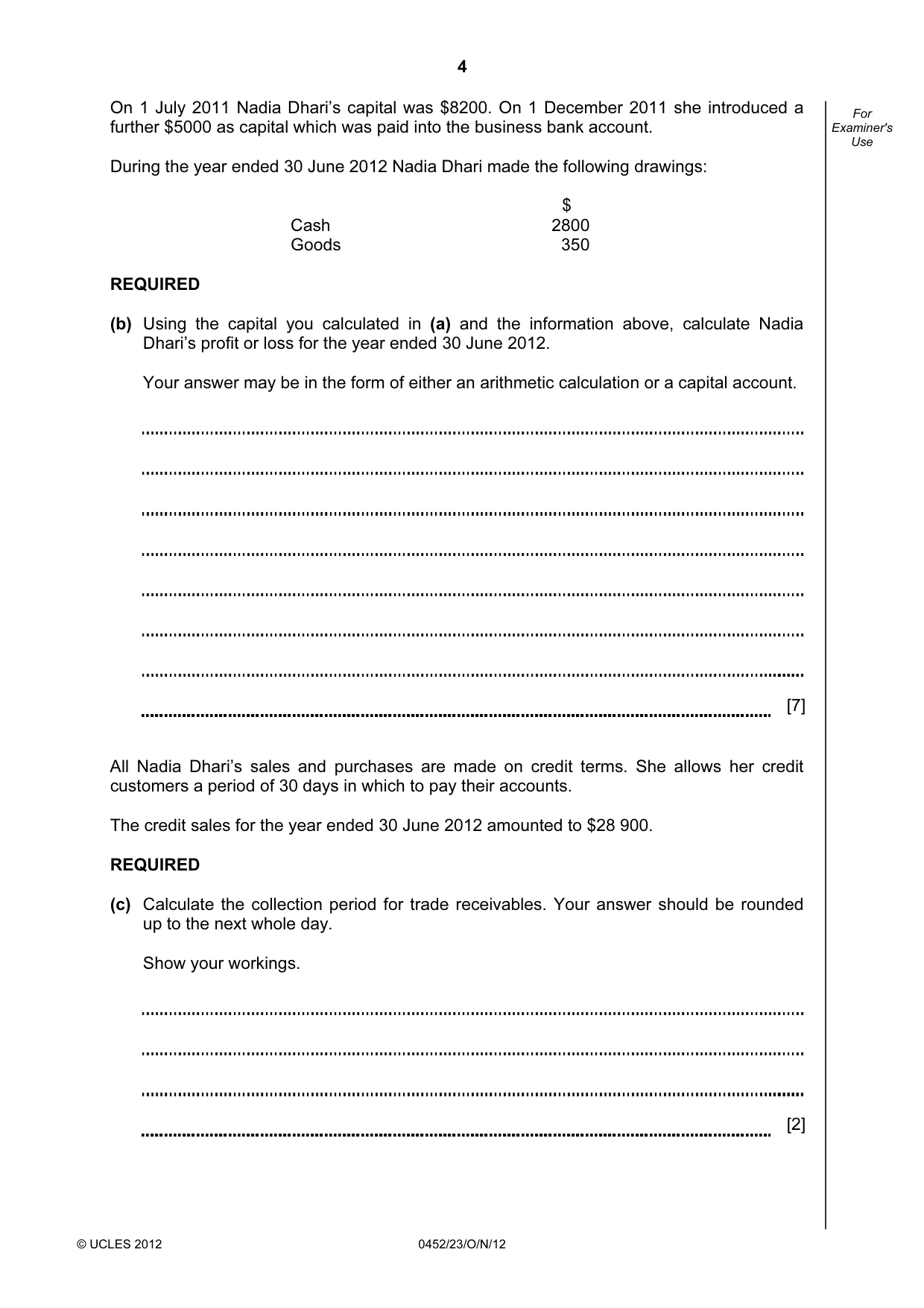
4 © UCLES 2012 0452/23/O/N/12 For Examiner's Use On 1 July 2011 Nadia Dhari’s capital was $8200. On 1 December 2011 she introduced a further $5000 as capital which was paid into the business bank account. During the year ended 30 June 2012 Nadia Dhari made the following drawings: $ Cash 2800 Goods 350 REQUIRED (b) Using the capital you calculated in (a) and the information above, calculate Nadia Dhari’s profit or loss for the year ended 30 June 2012. Your answer may be in the form of either an arithmetic calculation or a capital account. [7] All Nadia Dhari’s sales and purchases are made on credit terms. She allows her credit customers a period of 30 days in which to pay their accounts. The credit sales for the year ended 30 June 2012 amounted to $28 900. REQUIRED (c) Calculate the collection period for trade receivables. Your answer should be rounded up to the next whole day. Show your workings. [2]
Question paper, page 5
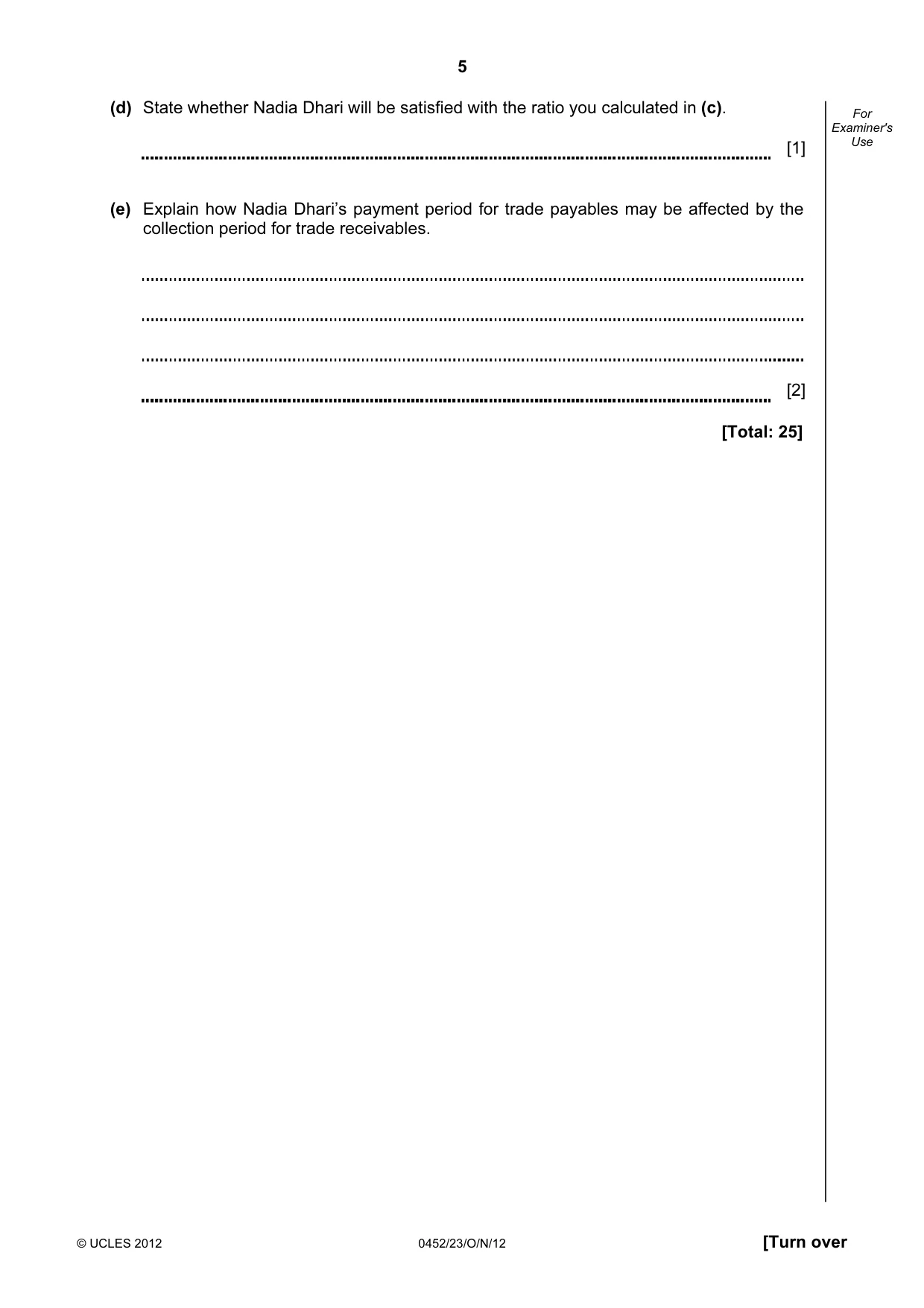
5 © UCLES 2012 0452/23/O/N/12 [Turn over For Examiner's Use (d) State whether Nadia Dhari will be satisfied with the ratio you calculated in (c). [1] (e) Explain how Nadia Dhari’s payment period for trade payables may be affected by the collection period for trade receivables. [2] [Total: 25]
Question paper, page 6
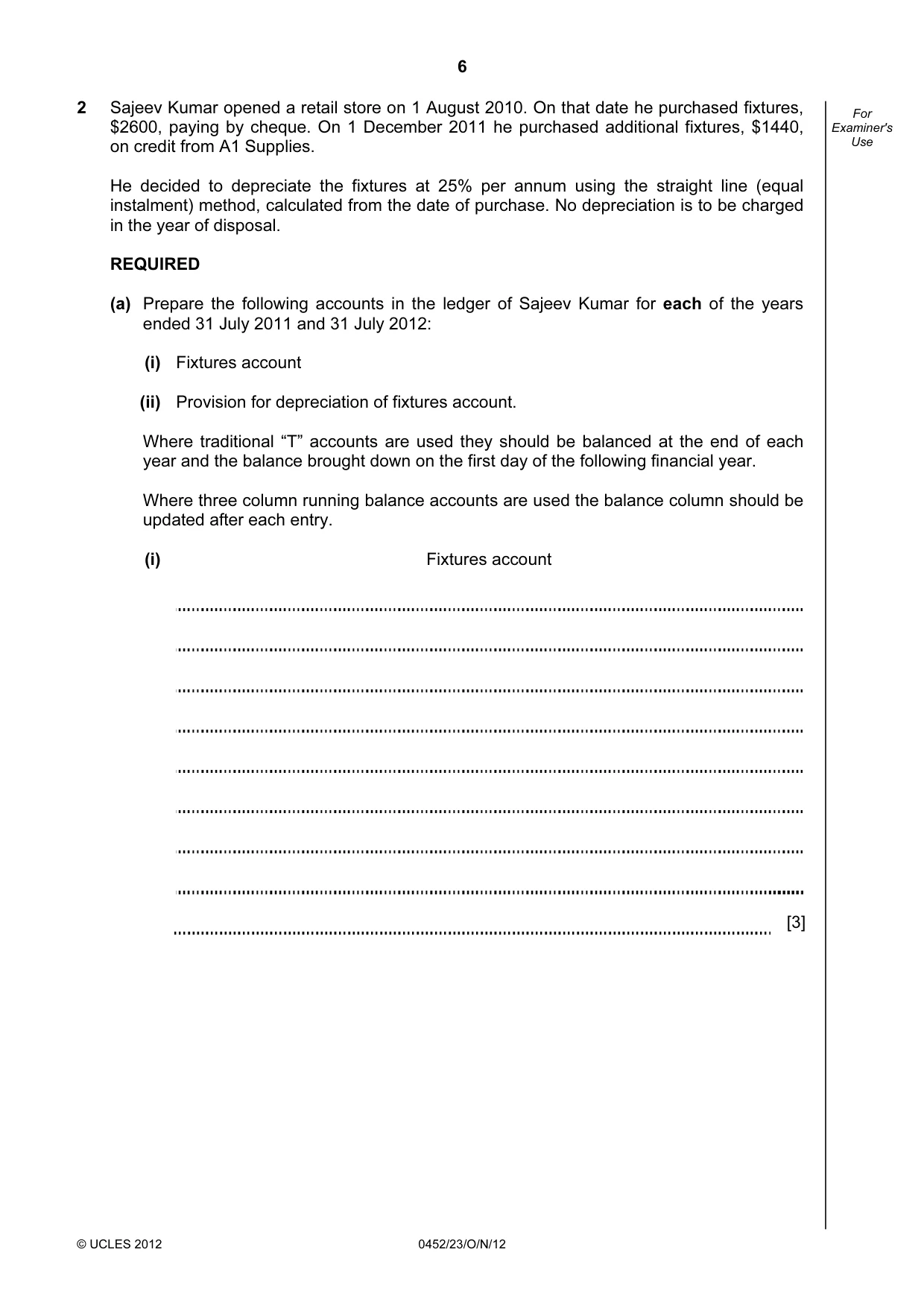
6 © UCLES 2012 0452/23/O/N/12 For Examiner's Use 2 Sajeev Kumar opened a retail store on 1 August 2010. On that date he purchased fixtures, $2600, paying by cheque. On 1 December 2011 he purchased additional fixtures, $1440, on credit from A1 Supplies. He decided to depreciate the fixtures at 25% per annum using the straight line (equal instalment) method, calculated from the date of purchase. No depreciation is to be charged in the year of disposal. REQUIRED (a) Prepare the following accounts in the ledger of Sajeev Kumar for each of the years ended 31 July 2011 and 31 July 2012: (i) Fixtures account (ii) Provision for depreciation of fixtures account. Where traditional “T” accounts are used they should be balanced at the end of each year and the balance brought down on the first day of the following financial year. Where three column running balance accounts are used the balance column should be updated after each entry. (i) Fixtures account [3]
Question paper, page 7
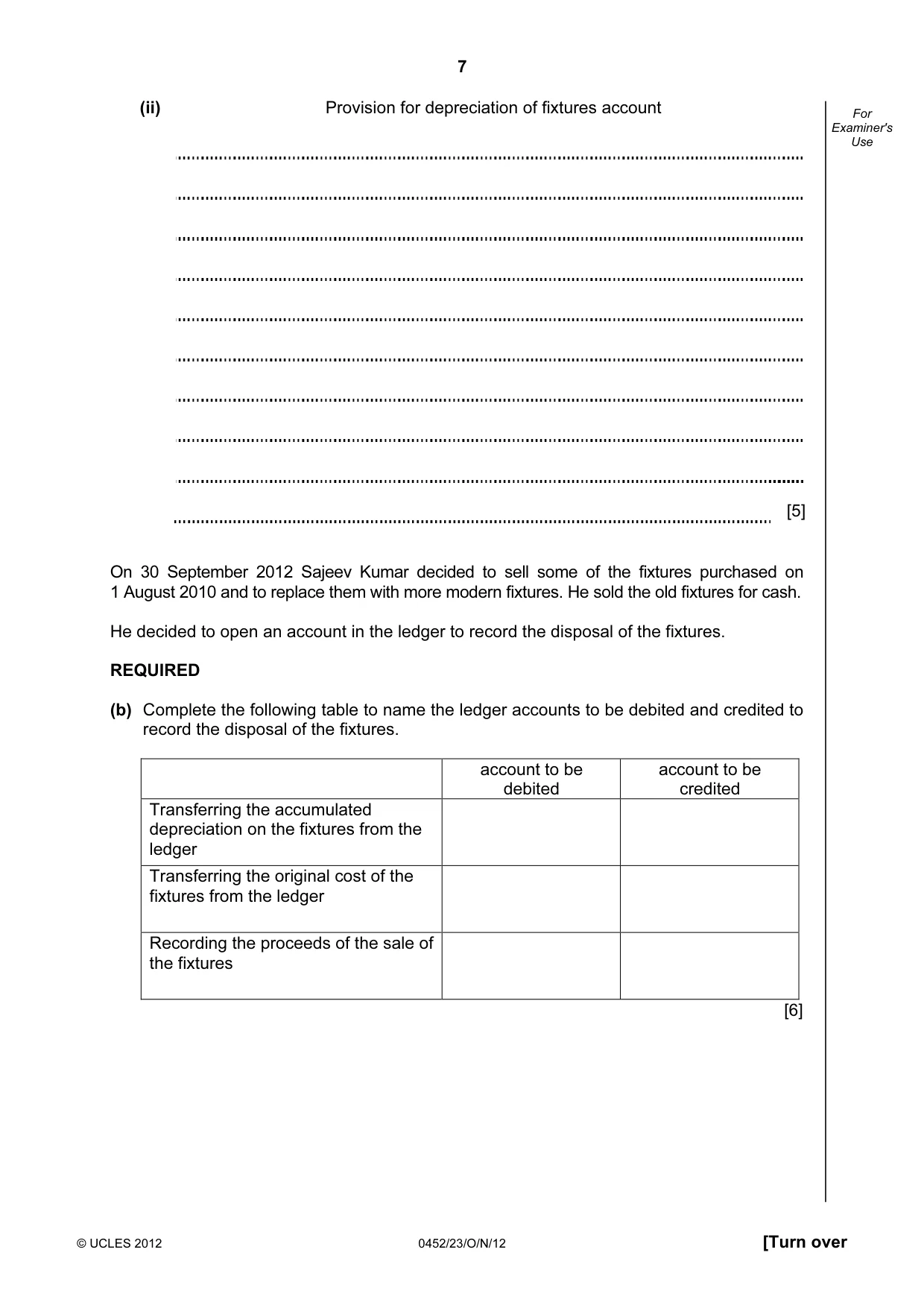
7 © UCLES 2012 0452/23/O/N/12 [Turn over For Examiner's Use (ii) Provision for depreciation of fixtures account [5] On 30 September 2012 Sajeev Kumar decided to sell some of the fixtures purchased on 1 August 2010 and to replace them with more modern fixtures. He sold the old fixtures for cash. He decided to open an account in the ledger to record the disposal of the fixtures. REQUIRED (b) Complete the following table to name the ledger accounts to be debited and credited to record the disposal of the fixtures. account to be debited account to be credited Transferring the accumulated depreciation on the fixtures from the ledger Transferring the original cost of the fixtures from the ledger Recording the proceeds of the sale of the fixtures [6]
Question paper, page 8
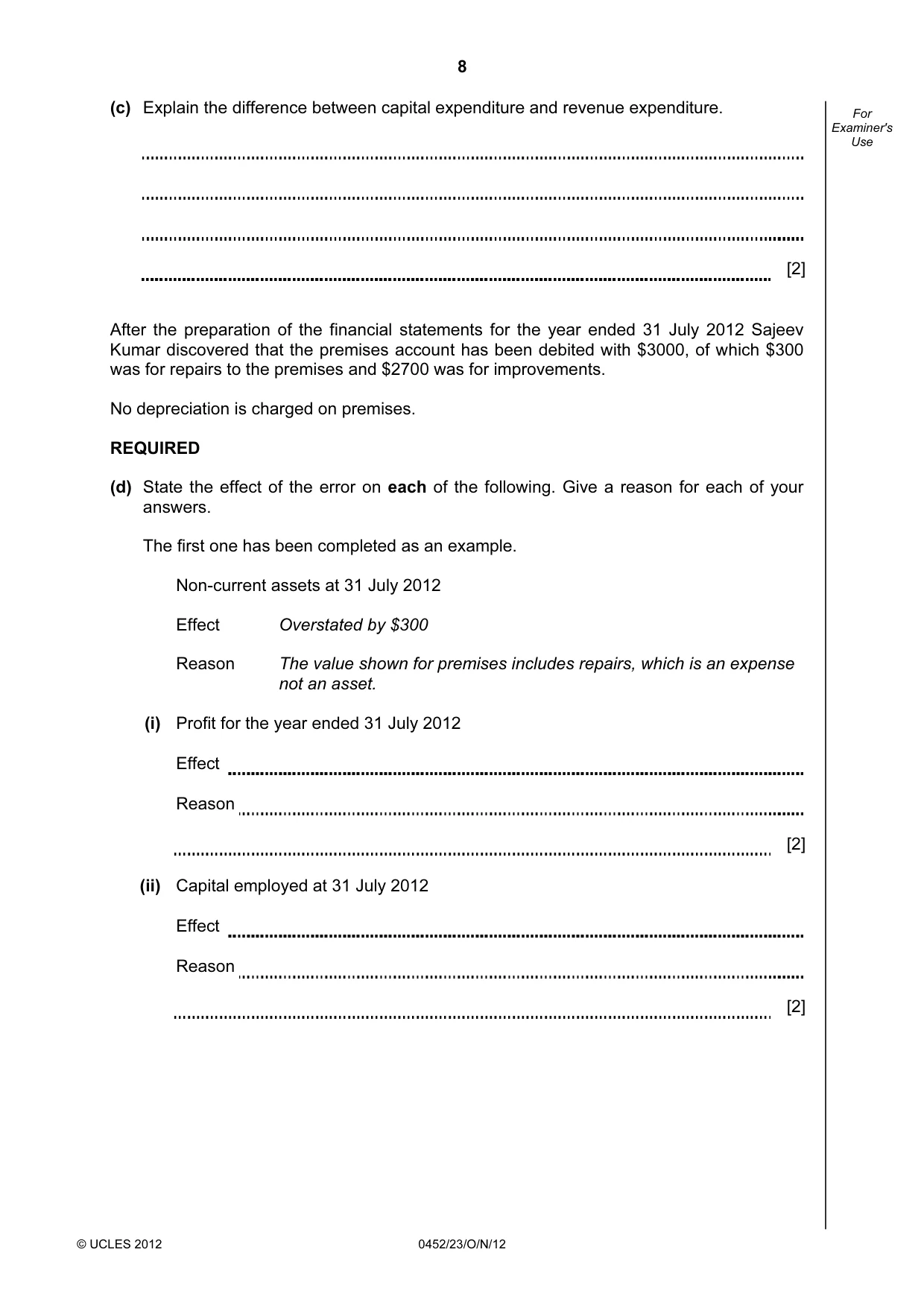
8 © UCLES 2012 0452/23/O/N/12 For Examiner's Use (c) Explain the difference between capital expenditure and revenue expenditure. [2] After the preparation of the financial statements for the year ended 31 July 2012 Sajeev Kumar discovered that the premises account has been debited with $3000, of which $300 was for repairs to the premises and $2700 was for improvements. No depreciation is charged on premises. REQUIRED (d) State the effect of the error on each of the following. Give a reason for each of your answers. The first one has been completed as an example. Non-current assets at 31 July 2012 Effect Overstated by $300 Reason The value shown for premises includes repairs, which is an expense not an asset. (i) Profit for the year ended 31 July 2012 Effect Reason [2] (ii) Capital employed at 31 July 2012 Effect Reason [2]
Question paper, page 9
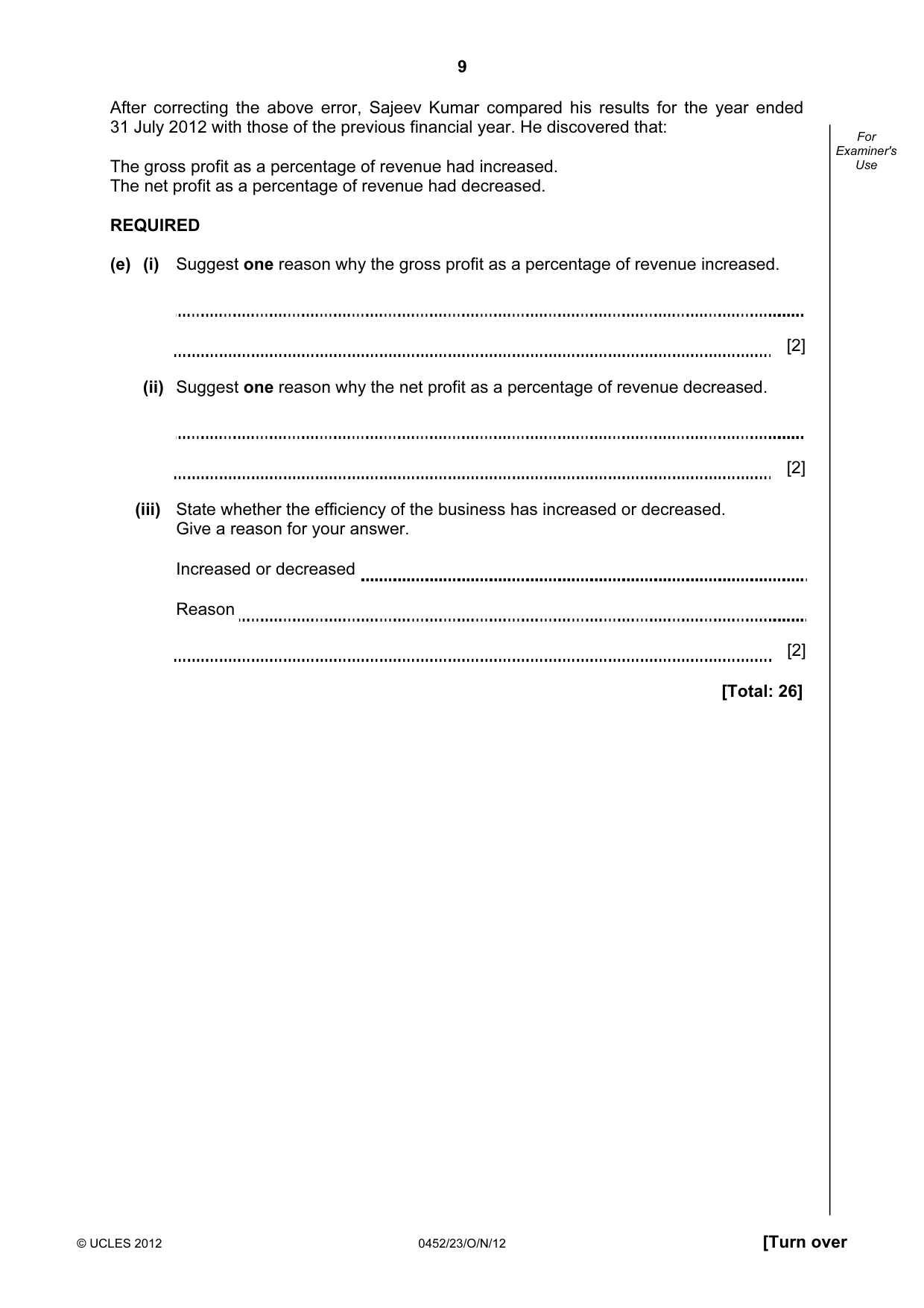
9 © UCLES 2012 0452/23/O/N/12 [Turn over For Examiner's Use After correcting the above error, Sajeev Kumar compared his results for the year ended 31 July 2012 with those of the previous financial year. He discovered that: The gross profit as a percentage of revenue had increased. The net profit as a percentage of revenue had decreased. REQUIRED (e) (i) Suggest one reason why the gross profit as a percentage of revenue increased. [2] (ii) Suggest one reason why the net profit as a percentage of revenue decreased. [2] (iii) State whether the efficiency of the business has increased or decreased. Give a reason for your answer. Increased or decreased Reason [2] [Total: 26]
Question paper, page 10
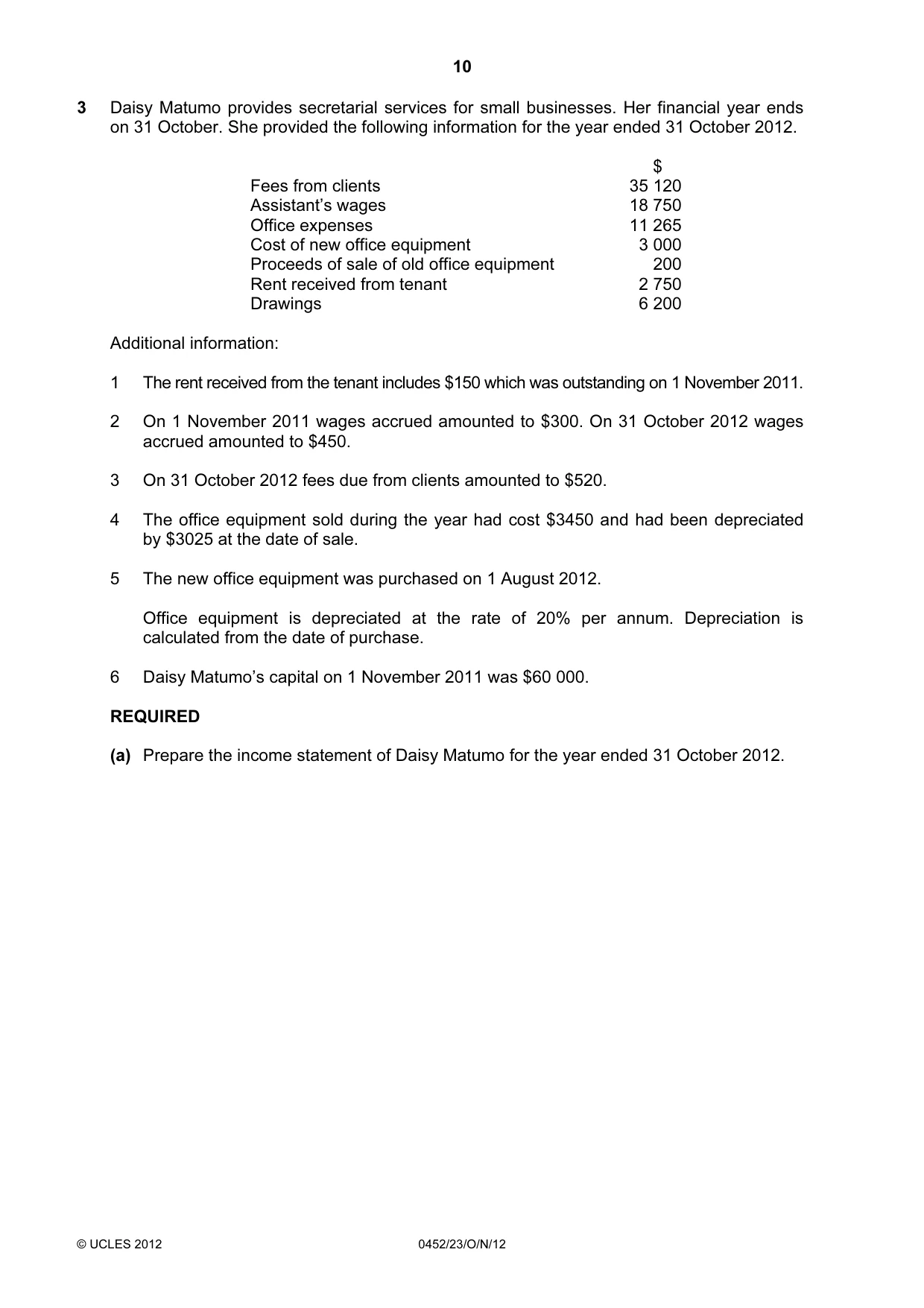
10 © UCLES 2012 0452/23/O/N/12 3 Daisy Matumo provides secretarial services for small businesses. Her financial year ends on 31 October. She provided the following information for the year ended 31 October 2012. $ Fees from clients 35 120 Assistant’s wages 18 750 Office expenses 11 265 Cost of new office equipment 3 000 Proceeds of sale of old office equipment 200 Rent received from tenant 2 750 Drawings 6 200 Additional information: 1 The rent received from the tenant includes $150 which was outstanding on 1 November 2011. 2 On 1 November 2011 wages accrued amounted to $300. On 31 October 2012 wages accrued amounted to $450. 3 On 31 October 2012 fees due from clients amounted to $520. 4 The office equipment sold during the year had cost $3450 and had been depreciated by $3025 at the date of sale. 5 The new office equipment was purchased on 1 August 2012. Office equipment is depreciated at the rate of 20% per annum. Depreciation is calculated from the date of purchase. 6 Daisy Matumo’s capital on 1 November 2011 was $60 000. REQUIRED (a) Prepare the income statement of Daisy Matumo for the year ended 31 October 2012.
Question paper, page 11
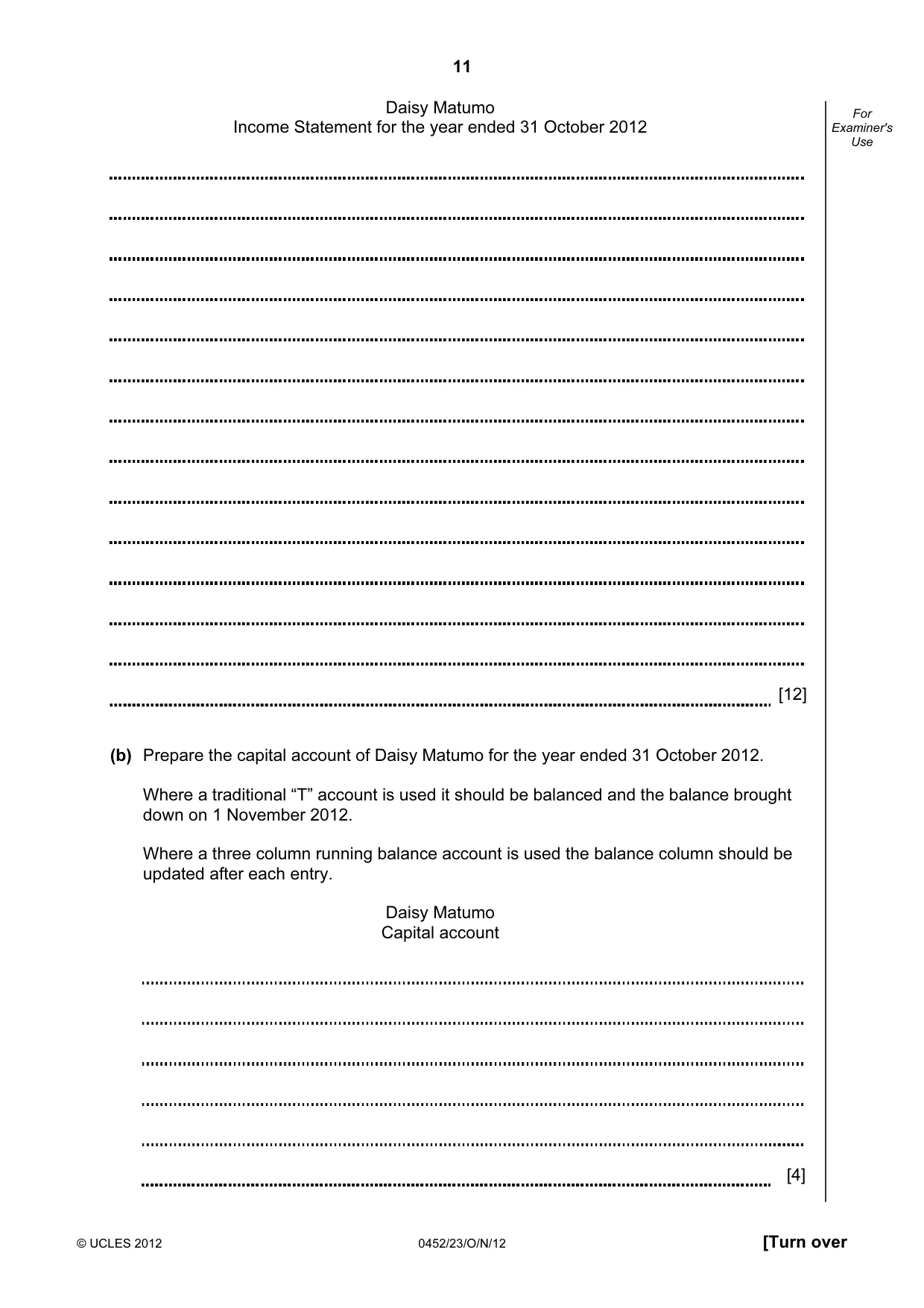
11 © UCLES 2012 0452/23/O/N/12 [Turn over For Examiner's Use Daisy Matumo Income Statement for the year ended 31 October 2012 [12] (b) Prepare the capital account of Daisy Matumo for the year ended 31 October 2012. Where a traditional “T” account is used it should be balanced and the balance brought down on 1 November 2012. Where a three column running balance account is used the balance column should be updated after each entry. Daisy Matumo Capital account [4]
Question paper, page 12
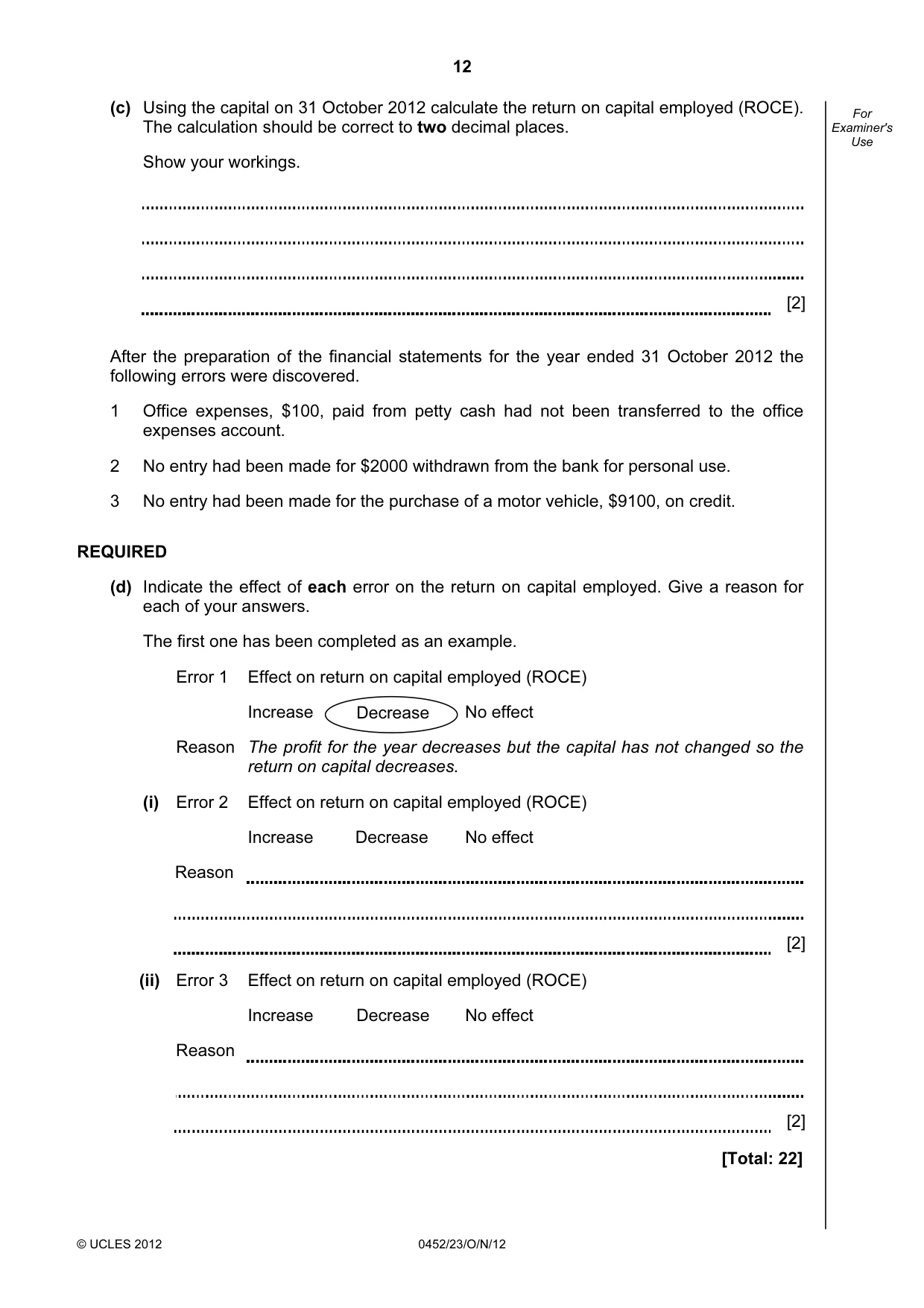
12 © UCLES 2012 0452/23/O/N/12 For Examiner's Use (c) Using the capital on 31 October 2012 calculate the return on capital employed (ROCE). The calculation should be correct to two decimal places. Show your workings. [2] After the preparation of the financial statements for the year ended 31 October 2012 the following errors were discovered. 1 Office expenses, $100, paid from petty cash had not been transferred to the office expenses account. 2 No entry had been made for $2000 withdrawn from the bank for personal use. 3 No entry had been made for the purchase of a motor vehicle, $9100, on credit. REQUIRED (d) Indicate the effect of each error on the return on capital employed. Give a reason for each of your answers. The first one has been completed as an example. Error 1 Effect on return on capital employed (ROCE) Increase No effect Reason The profit for the year decreases but the capital has not changed so the return on capital decreases. (i) Error 2 Effect on return on capital employed (ROCE) Increase Decrease No effect Reason [2] (ii) Error 3 Effect on return on capital employed (ROCE) Increase Decrease No effect Reason [2] [Total: 22] Decrease
Question paper, page 13
13 © UCLES 2012 0452/23/O/N/12 [Turn over Question 4 is on the next page.
Question paper, page 14
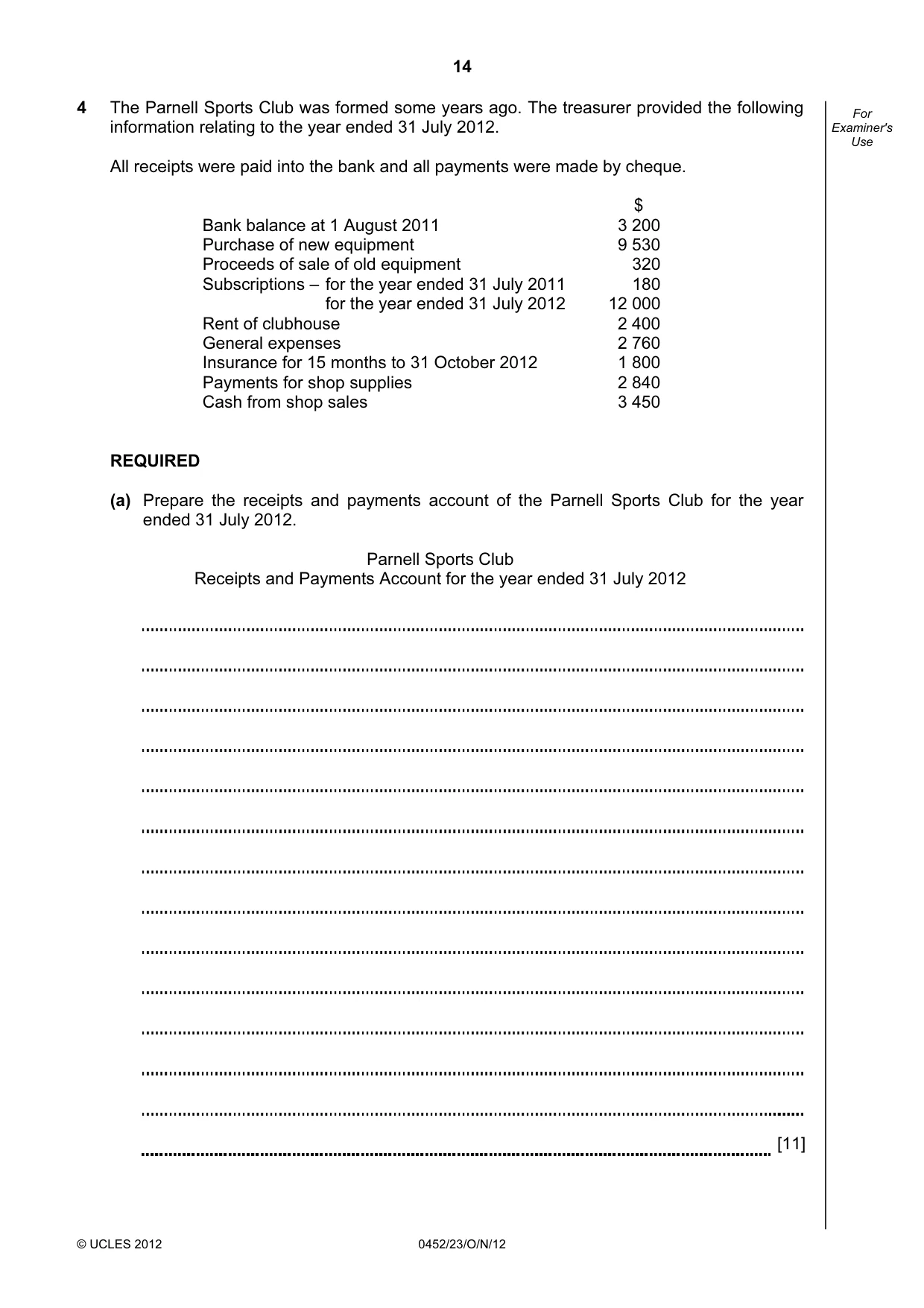
14 © UCLES 2012 0452/23/O/N/12 For Examiner's Use 4 The Parnell Sports Club was formed some years ago. The treasurer provided the following information relating to the year ended 31 July 2012. All receipts were paid into the bank and all payments were made by cheque. $ Bank balance at 1 August 2011 3 200 Purchase of new equipment 9 530 Proceeds of sale of old equipment 320 Subscriptions – for the year ended 31 July 2011 180 for the year ended 31 July 2012 12 000 Rent of clubhouse 2 400 General expenses 2 760 Insurance for 15 months to 31 October 2012 1 800 Payments for shop supplies 2 840 Cash from shop sales 3 450 REQUIRED (a) Prepare the receipts and payments account of the Parnell Sports Club for the year ended 31 July 2012. Parnell Sports Club Receipts and Payments Account for the year ended 31 July 2012 [11]
Question paper, page 15
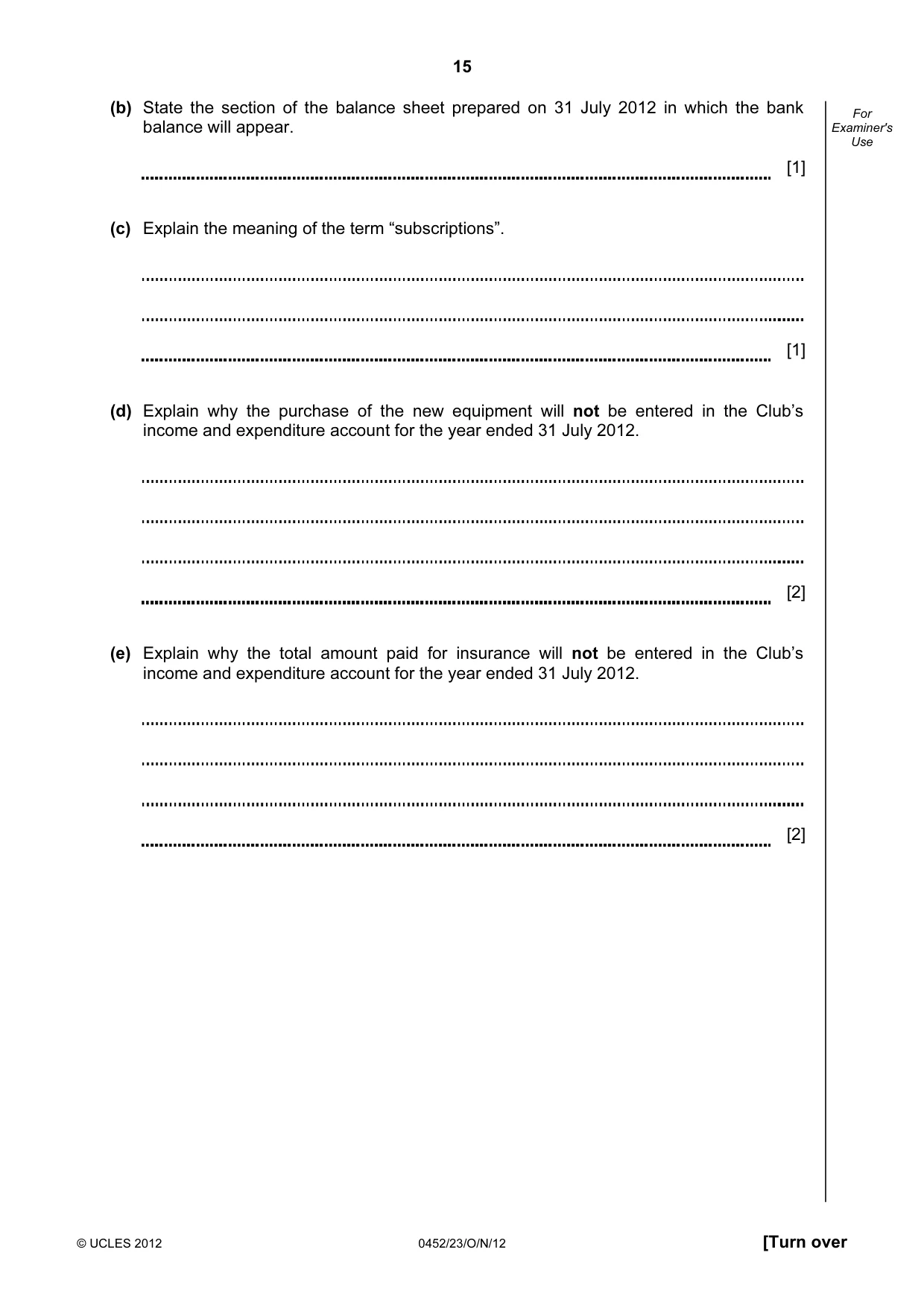
15 © UCLES 2012 0452/23/O/N/12 [Turn over For Examiner's Use (b) State the section of the balance sheet prepared on 31 July 2012 in which the bank balance will appear. [1] (c) Explain the meaning of the term “subscriptions”. [1] (d) Explain why the purchase of the new equipment will not be entered in the Club’s income and expenditure account for the year ended 31 July 2012. [2] (e) Explain why the total amount paid for insurance will not be entered in the Club’s income and expenditure account for the year ended 31 July 2012. [2]
Question paper, page 16
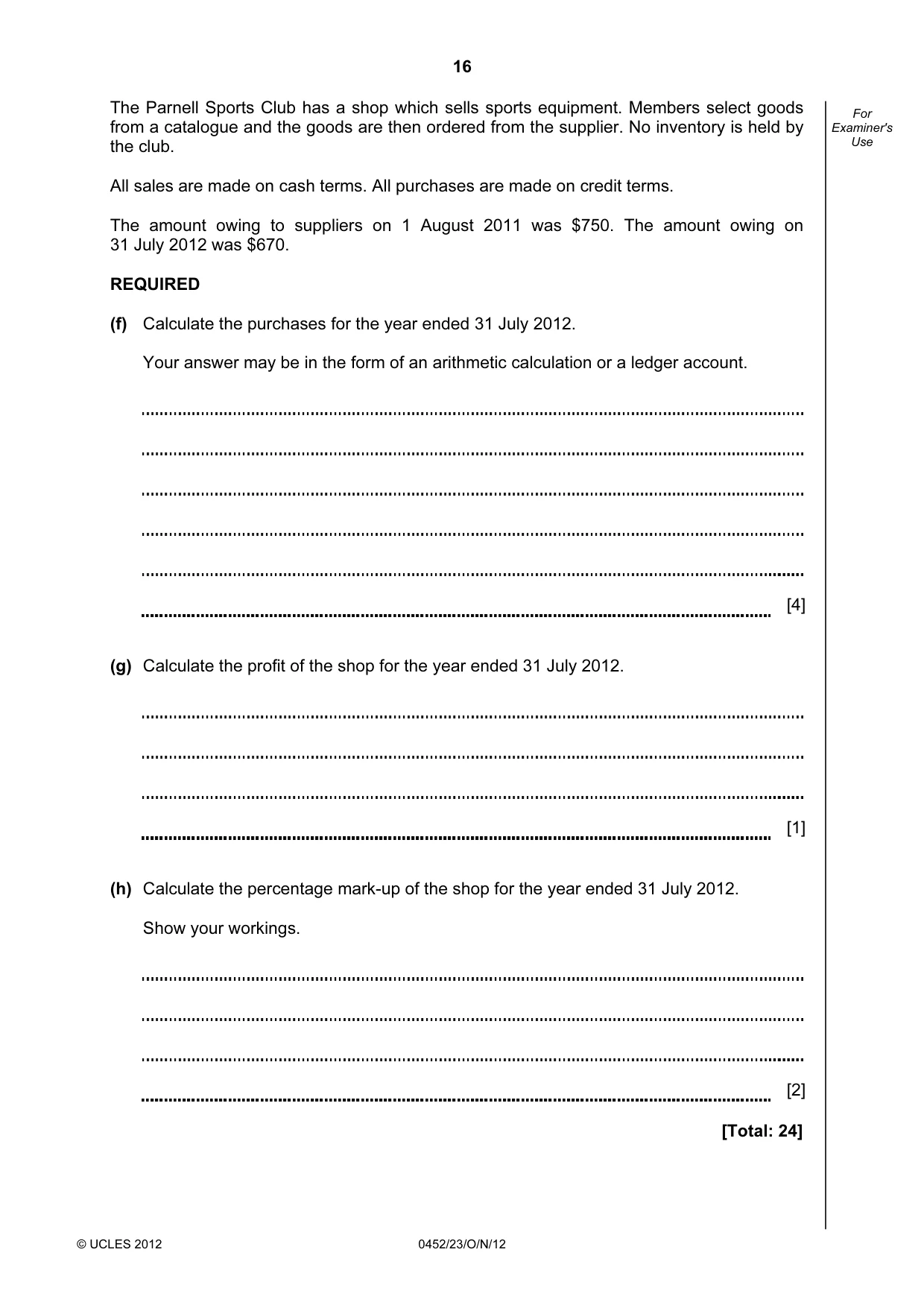
16 © UCLES 2012 0452/23/O/N/12 For Examiner's Use The Parnell Sports Club has a shop which sells sports equipment. Members select goods from a catalogue and the goods are then ordered from the supplier. No inventory is held by the club. All sales are made on cash terms. All purchases are made on credit terms. The amount owing to suppliers on 1 August 2011 was $750. The amount owing on 31 July 2012 was $670. REQUIRED (f) Calculate the purchases for the year ended 31 July 2012. Your answer may be in the form of an arithmetic calculation or a ledger account. [4] (g) Calculate the profit of the shop for the year ended 31 July 2012. [1] (h) Calculate the percentage mark-up of the shop for the year ended 31 July 2012. Show your workings. [2] [Total: 24]
Question paper, page 17
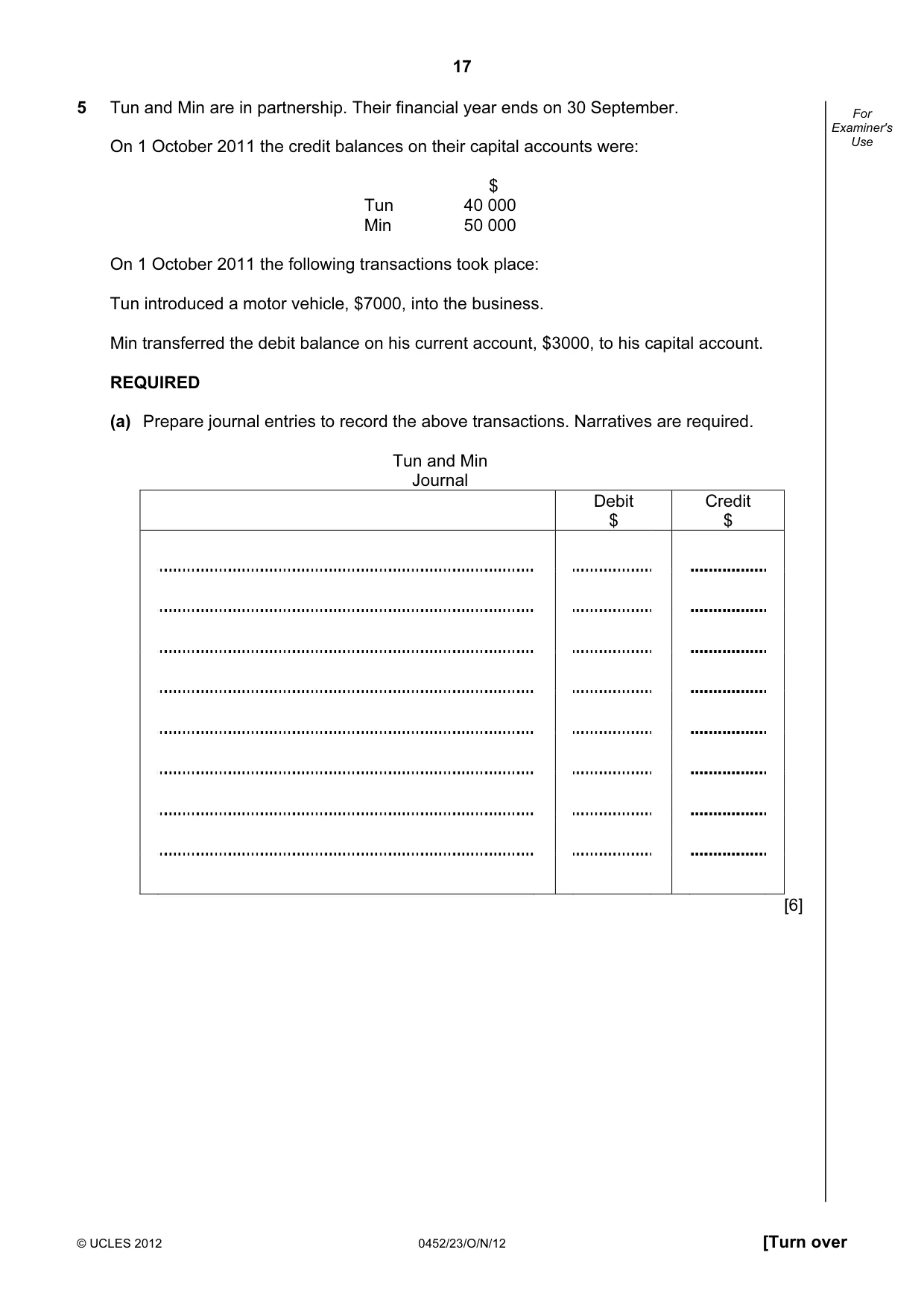
17 © UCLES 2012 0452/23/O/N/12 [Turn over For Examiner's Use 5 Tun and Min are in partnership. Their financial year ends on 30 September. On 1 October 2011 the credit balances on their capital accounts were: $ Tun 40 000 Min 50 000 On 1 October 2011 the following transactions took place: Tun introduced a motor vehicle, $7000, into the business. Min transferred the debit balance on his current account, $3000, to his capital account. REQUIRED (a) Prepare journal entries to record the above transactions. Narratives are required. Tun and Min Journal Debit $ Credit $ [6]
Question paper, page 18
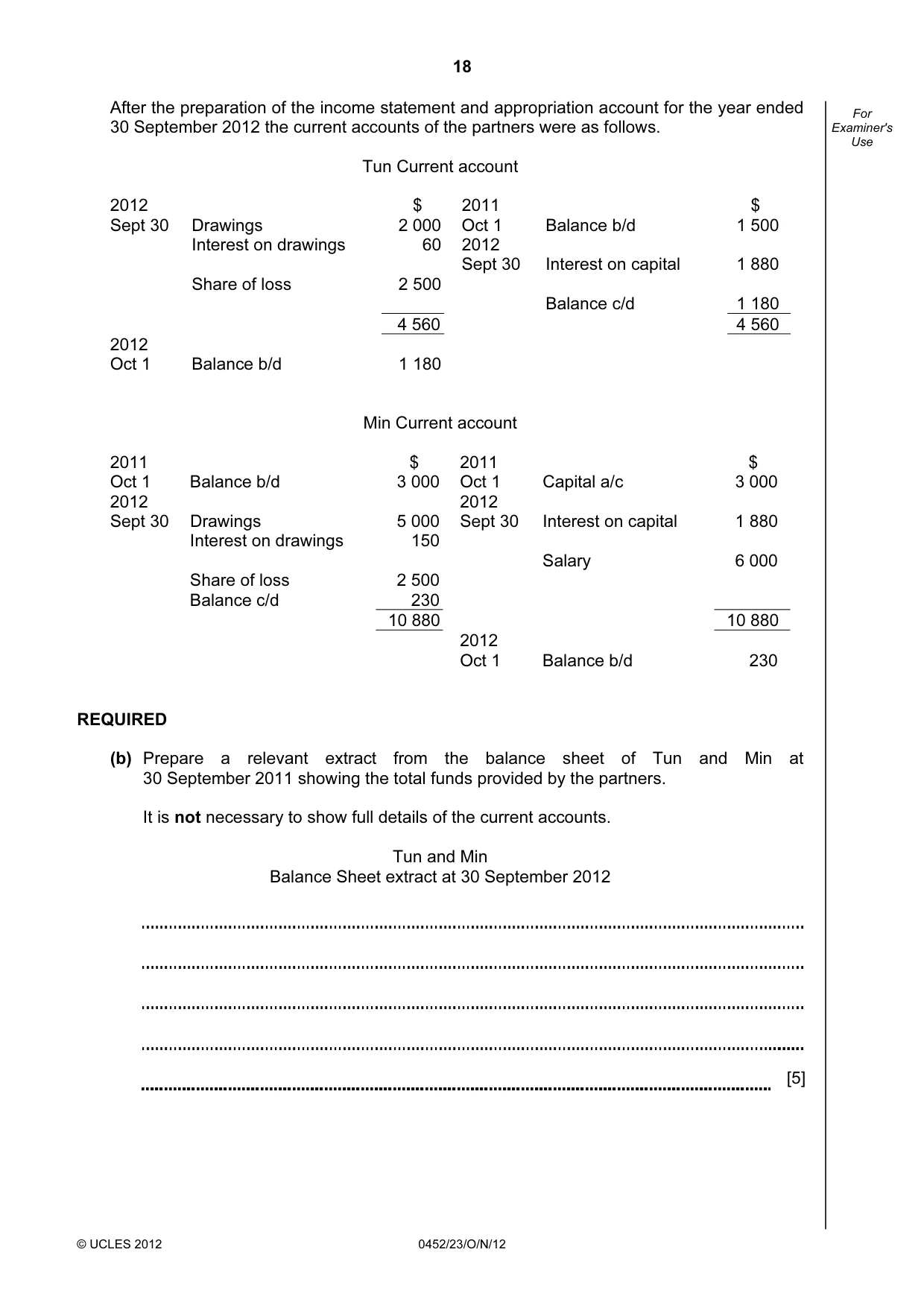
18 © UCLES 2012 0452/23/O/N/12 For Examiner's Use After the preparation of the income statement and appropriation account for the year ended 30 September 2012 the current accounts of the partners were as follows. Tun Current account 2012 $ 2011 $ Sept 30 Drawings 2 000 Oct 1 Balance b/d 1 500 Interest on drawings 60 2012 Sept 30 Interest on capital 1 880 Share of loss 2 500 Balance c/d 1 180 4 560 4 560 2012 Oct 1 Balance b/d 1 180 Min Current account 2011 $ 2011 $ Oct 1 Balance b/d 3 000 Oct 1 Capital a/c 3 000 2012 2012 Sept 30 Drawings 5 000 Sept 30 Interest on capital 1 880 Interest on drawings 150 Salary 6 000 Share of loss 2 500 Balance c/d 230 10 880 10 880 2012 Oct 1 Balance b/d 230 REQUIRED (b) Prepare a relevant extract from the balance sheet of Tun and Min at 30 September 2011 showing the total funds provided by the partners. It is not necessary to show full details of the current accounts. Tun and Min Balance Sheet extract at 30 September 2012 [5]
Question paper, page 19
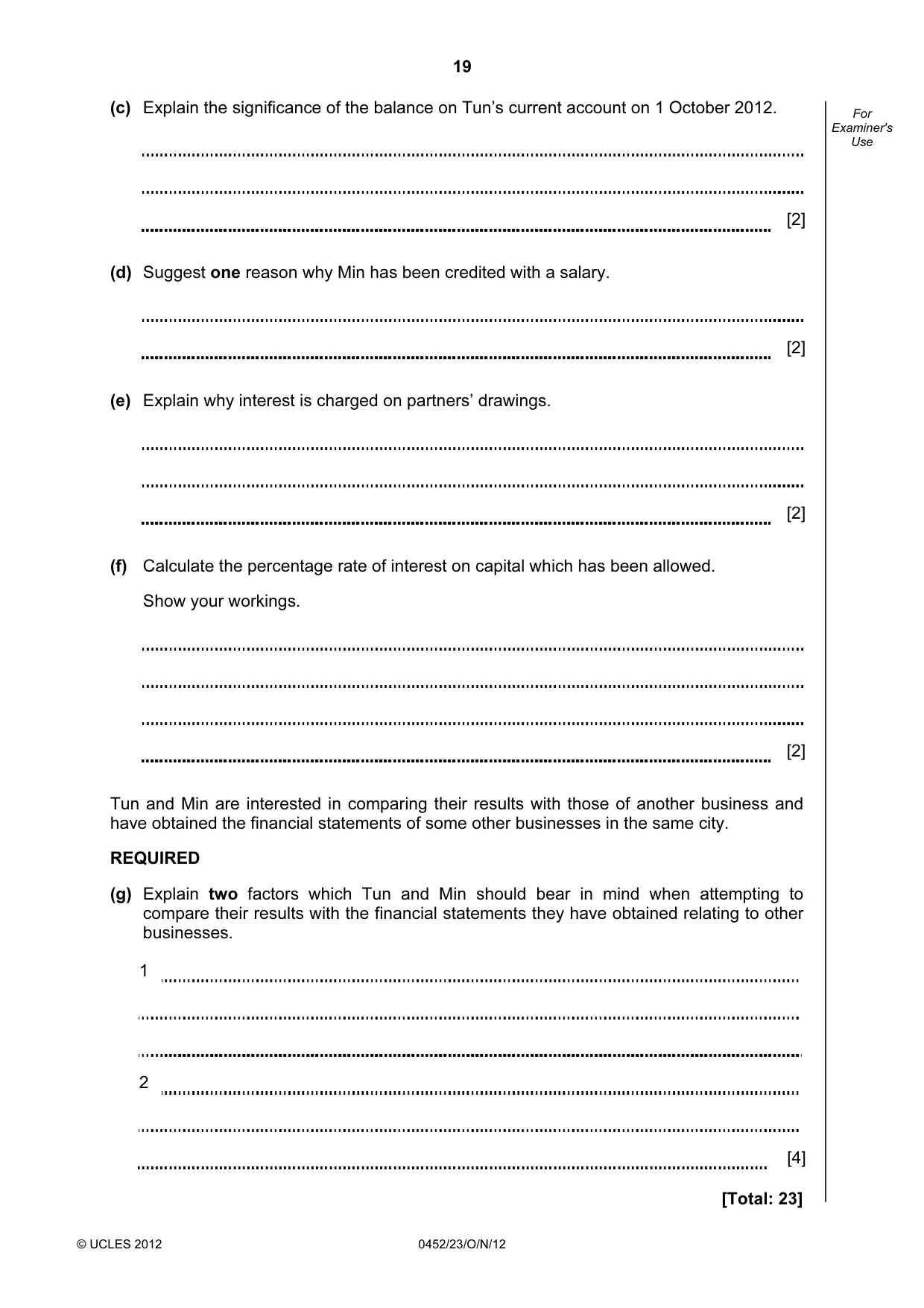
19 © UCLES 2012 0452/23/O/N/12 For Examiner's Use (c) Explain the significance of the balance on Tun’s current account on 1 October 2012. [2] (d) Suggest one reason why Min has been credited with a salary. [2] (e) Explain why interest is charged on partners’ drawings. [2] (f) Calculate the percentage rate of interest on capital which has been allowed. Show your workings. [2] Tun and Min are interested in comparing their results with those of another business and have obtained the financial statements of some other businesses in the same city. REQUIRED (g) Explain two factors which Tun and Min should bear in mind when attempting to compare their results with the financial statements they have obtained relating to other businesses. 1 2 [4] [Total: 23]
Question paper, page 20
20 Permission to reproduce items where third-party owned material protected by copyright is included has been sought and cleared where possible. Every reasonable effort has been made by the publisher (UCLES) to trace copyright holders, but if any items requiring clearance have unwittingly been included, the publisher will be pleased to make amends at the earliest possible opportunity. University of Cambridge International Examinations is part of the Cambridge Assessment Group. Cambridge Assessment is the brand name of University of Cambridge Local Examinations Syndicate (UCLES), which is itself a department of the University of Cambridge. © UCLES 2012 0452/23/O/N/12 BLANK PAGE
Mark scheme, page 1
CAMBRIDGE INTERNATIONAL EXAMINATIONS International General Certificate of Secondary Education MARK SCHEME for the October/November 2012 series 0452 ACCOUNTING 0452/23 Paper 2, maximum raw mark 120 This mark scheme is published as an aid to teachers and candidates, to indicate the requirements of the examination. It shows the basis on which Examiners were instructed to award marks. It does not indicate the details of the discussions that took place at an Examiners’ meeting before marking began, which would have considered the acceptability of alternative answers. Mark schemes should be read in conjunction with the question paper and the Principal Examiner Report for Teachers. Cambridge will not enter into discussions about these mark schemes. Cambridge is publishing the mark schemes for the October/November 2012 series for most IGCSE, GCE Advanced Level and Advanced Subsidiary Level components and some Ordinary Level components.
Mark scheme, page 2
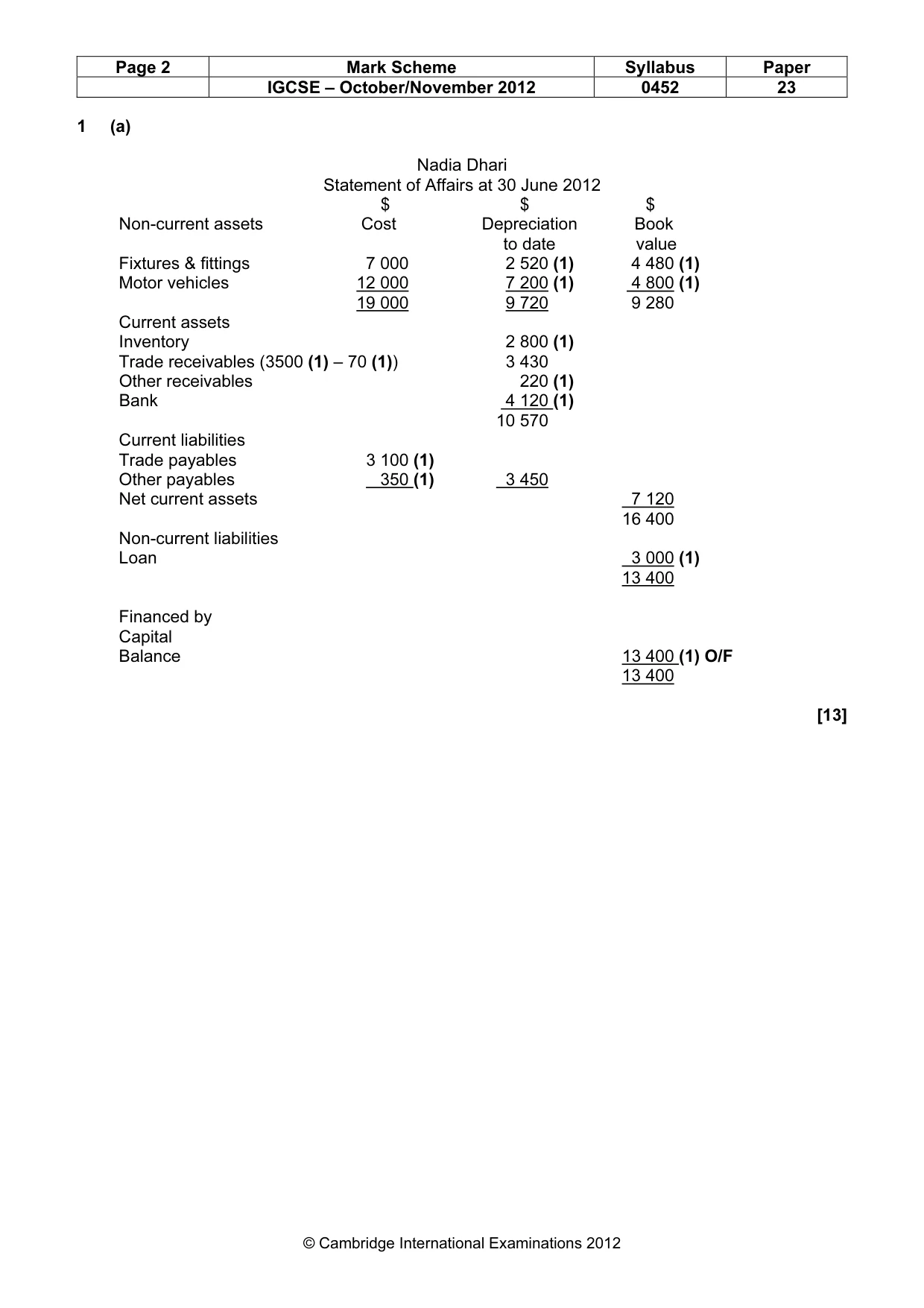
Page 2 Mark Scheme Syllabus Paper IGCSE – October/November 2012 0452 23 © Cambridge International Examinations 2012 1 (a) Nadia Dhari Statement of Affairs at 30 June 2012 $ $ $ Non-current assets Cost Depreciation Book to date value Fixtures & fittings 7 000 2 520 (1) 4 480 (1) Motor vehicles 12 000 7 200 (1) 4 800 (1) 19 000 9 720 9 280 Current assets Inventory 2 800 (1) Trade receivables (3500 (1) – 70 (1)) 3 430 Other receivables 220 (1) Bank 4 120 (1) 10 570 Current liabilities Trade payables 3 100 (1) Other payables 350 (1) 3 450 Net current assets 7 120 16 400 Non-current liabilities Loan 3 000 (1) 13 400 Financed by Capital Balance 13 400 (1) O/F 13 400 [13]
Mark scheme, page 3
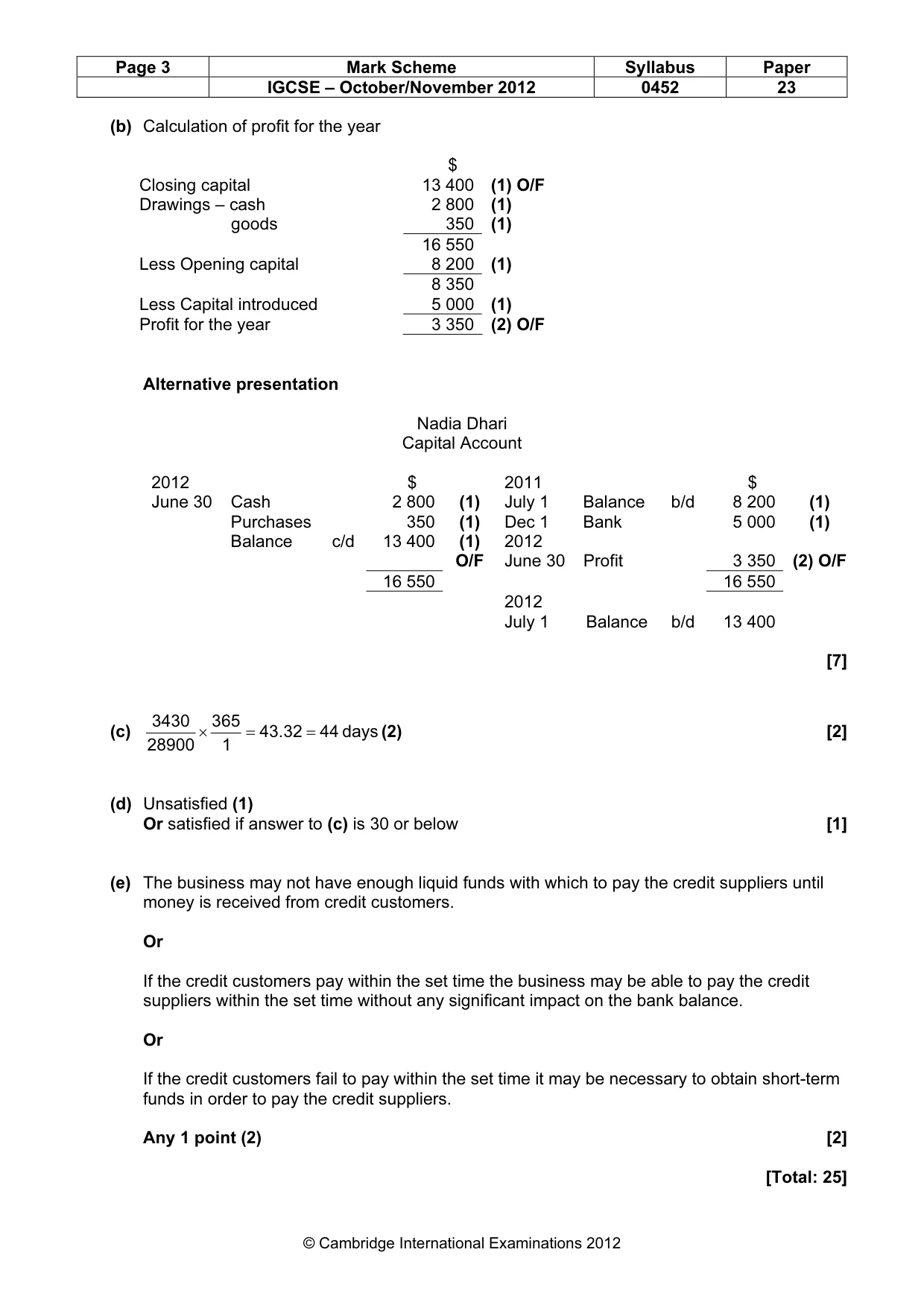
Page 3 Mark Scheme Syllabus Paper IGCSE – October/November 2012 0452 23 © Cambridge International Examinations 2012 (b) Calculation of profit for the year $ Closing capital 13 400 (1) O/F Drawings – cash 2 800 (1) goods 350 (1) 16 550 Less Opening capital 8 200 (1) 8 350 Less Capital introduced 5 000 (1) Profit for the year 3 350 (2) O/F Alternative presentation Nadia Dhari Capital Account 2012 $ 2011 $ June 30 Cash 2 800 (1) July 1 Balance b/d 8 200 (1) Purchases 350 (1) Dec 1 Bank 5 000 (1) Balance c/d 13 400 (1) 2012 O/F June 30 Profit 3 350 (2) O/F 16 550 16 550 2012 July 1 Balance b/d 13 400 [7] (c) days 44 43.32 1 365 28900 3430 = = × (2) [2] (d) Unsatisfied (1) Or satisfied if answer to (c) is 30 or below [1] (e) The business may not have enough liquid funds with which to pay the credit suppliers until money is received from credit customers. Or If the credit customers pay within the set time the business may be able to pay the credit suppliers within the set time without any significant impact on the bank balance. Or If the credit customers fail to pay within the set time it may be necessary to obtain short-term funds in order to pay the credit suppliers. Any 1 point (2) [2] [Total: 25]
Mark scheme, page 4
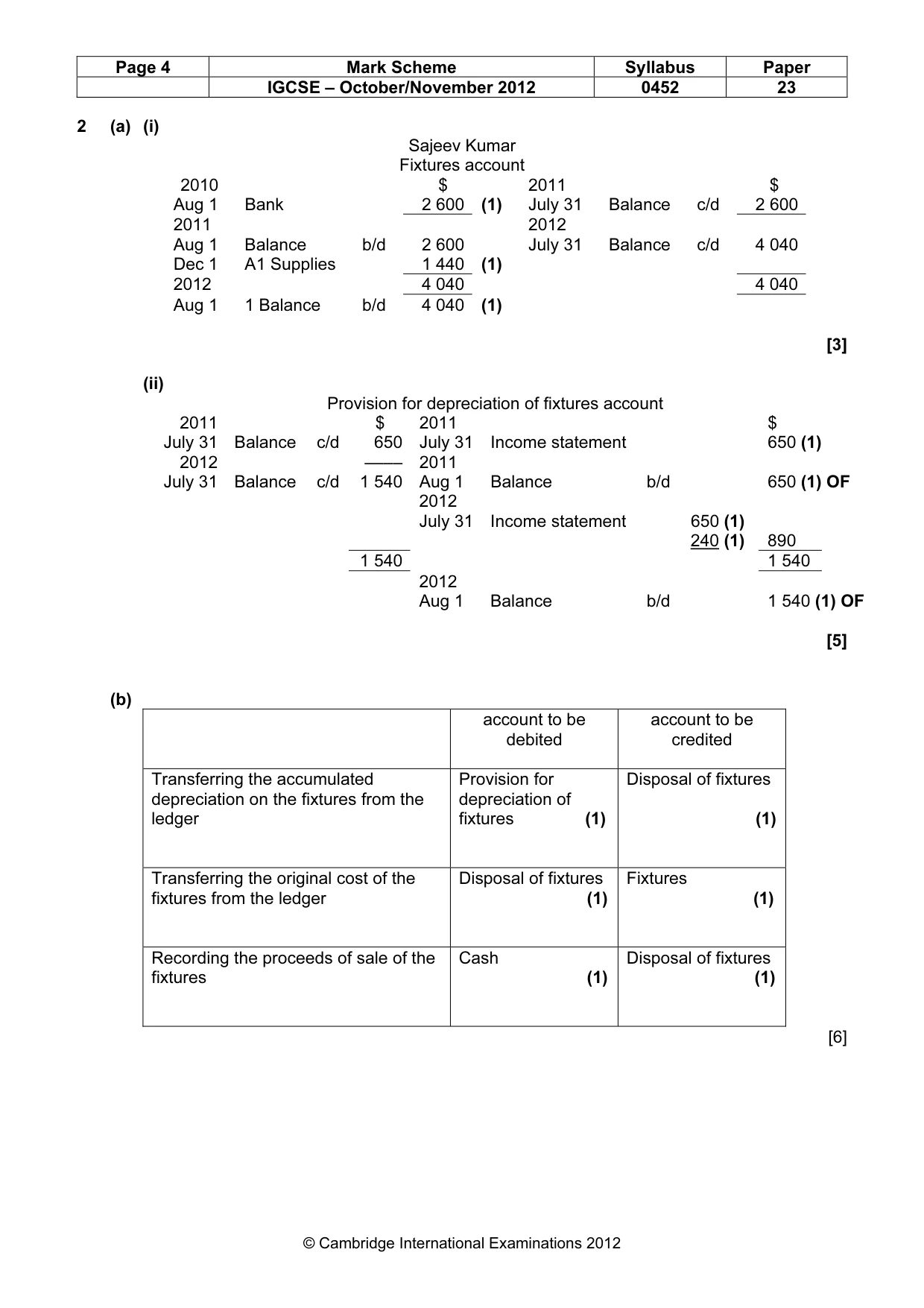
Page 4 Mark Scheme Syllabus Paper IGCSE – October/November 2012 0452 23 © Cambridge International Examinations 2012 2 (a) (i) Sajeev Kumar Fixtures account 2010 $ 2011 $ Aug 1 Bank 2 600 (1) July 31 Balance c/d 2 600 2011 2012 Aug 1 Balance b/d 2 600 July 31 Balance c/d 4 040 Dec 1 A1 Supplies 1 440 (1) 2012 4 040 4 040 Aug 1 1 Balance b/d 4 040 (1) [3] (ii) Provision for depreciation of fixtures account 2011 $ 2011 $ July 31 Balance c/d 650 July 31 Income statement 650 (1) 2012 –––– 2011 July 31 Balance c/d 1 540 Aug 1 Balance b/d 650 (1) OF 2012 July 31 Income statement 650 (1) 240 (1) 890 1 540 1 540 2012 Aug 1 Balance b/d 1 540 (1) OF [5] (b) account to be debited account to be credited Transferring the accumulated depreciation on the fixtures from the ledger Provision for depreciation of fixtures (1) Disposal of fixtures (1) Transferring the original cost of the fixtures from the ledger Disposal of fixtures (1) Fixtures (1) Recording the proceeds of sale of the fixtures Cash (1) Disposal of fixtures (1) [6]
Mark scheme, page 5
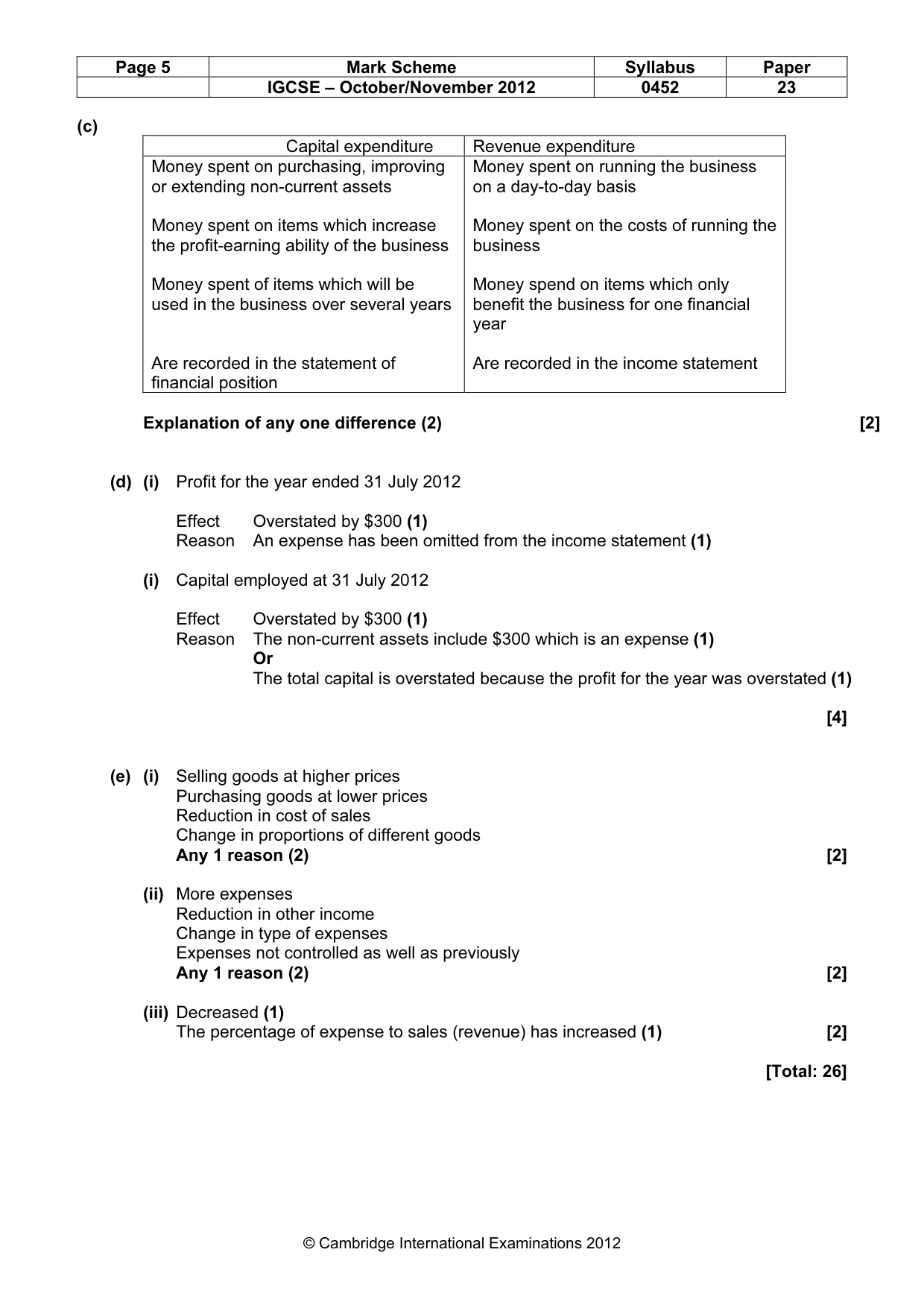
Page 5 Mark Scheme Syllabus Paper IGCSE – October/November 2012 0452 23 © Cambridge International Examinations 2012 (c) Capital expenditure Revenue expenditure Money spent on purchasing, improving or extending non-current assets Money spent on items which increase the profit-earning ability of the business Money spent of items which will be used in the business over several years Are recorded in the statement of financial position Money spent on running the business on a day-to-day basis Money spent on the costs of running the business Money spend on items which only benefit the business for one financial year Are recorded in the income statement Explanation of any one difference (2) [2] (d) (i) Profit for the year ended 31 July 2012 Effect Overstated by $300 (1) Reason An expense has been omitted from the income statement (1) (i) Capital employed at 31 July 2012 Effect Overstated by $300 (1) Reason The non-current assets include $300 which is an expense (1) Or The total capital is overstated because the profit for the year was overstated (1) [4] (e) (i) Selling goods at higher prices Purchasing goods at lower prices Reduction in cost of sales Change in proportions of different goods Any 1 reason (2) [2] (ii) More expenses Reduction in other income Change in type of expenses Expenses not controlled as well as previously Any 1 reason (2) [2] (iii) Decreased (1) The percentage of expense to sales (revenue) has increased (1) [2] [Total: 26]
Mark scheme, page 6
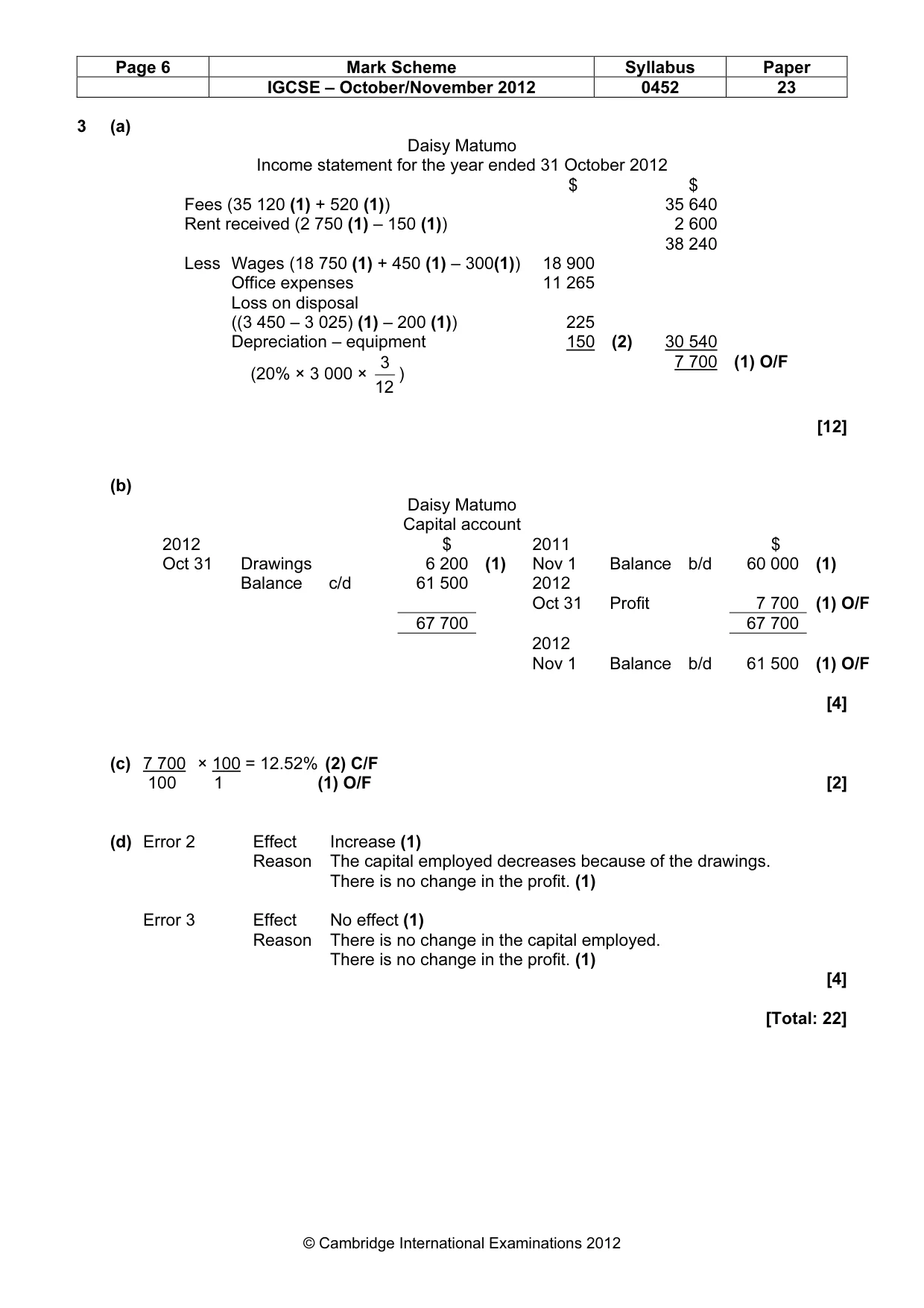
Page 6 Mark Scheme Syllabus Paper IGCSE – October/November 2012 0452 23 © Cambridge International Examinations 2012 3 (a) Daisy Matumo Income statement for the year ended 31 October 2012 $ $ Fees (35 120 (1) + 520 (1)) 35 640 Rent received (2 750 (1) – 150 (1)) 2 600 38 240 Less Wages (18 750 (1) + 450 (1) – 300(1)) 18 900 Office expenses 11 265 Loss on disposal ((3 450 – 3 025) (1) – 200 (1)) 225 Depreciation – equipment 150 (2) 30 540 (20% × 3 000 × 12 3 ) 7 700 (1) O/F [12] (b) Daisy Matumo Capital account 2012 $ 2011 $ Oct 31 Drawings 6 200 (1) Nov 1 Balance b/d 60 000 (1) Balance c/d 61 500 2012 Oct 31 Profit 7 700 (1) O/F 67 700 67 700 2012 Nov 1 Balance b/d 61 500 (1) O/F [4] (c) 7 700 × 100 = 12.52% (2) C/F 100 1 (1) O/F [2] (d) Error 2 Effect Increase (1) Reason The capital employed decreases because of the drawings. There is no change in the profit. (1) Error 3 Effect No effect (1) Reason There is no change in the capital employed. There is no change in the profit. (1) [4] [Total: 22]
Mark scheme, page 7
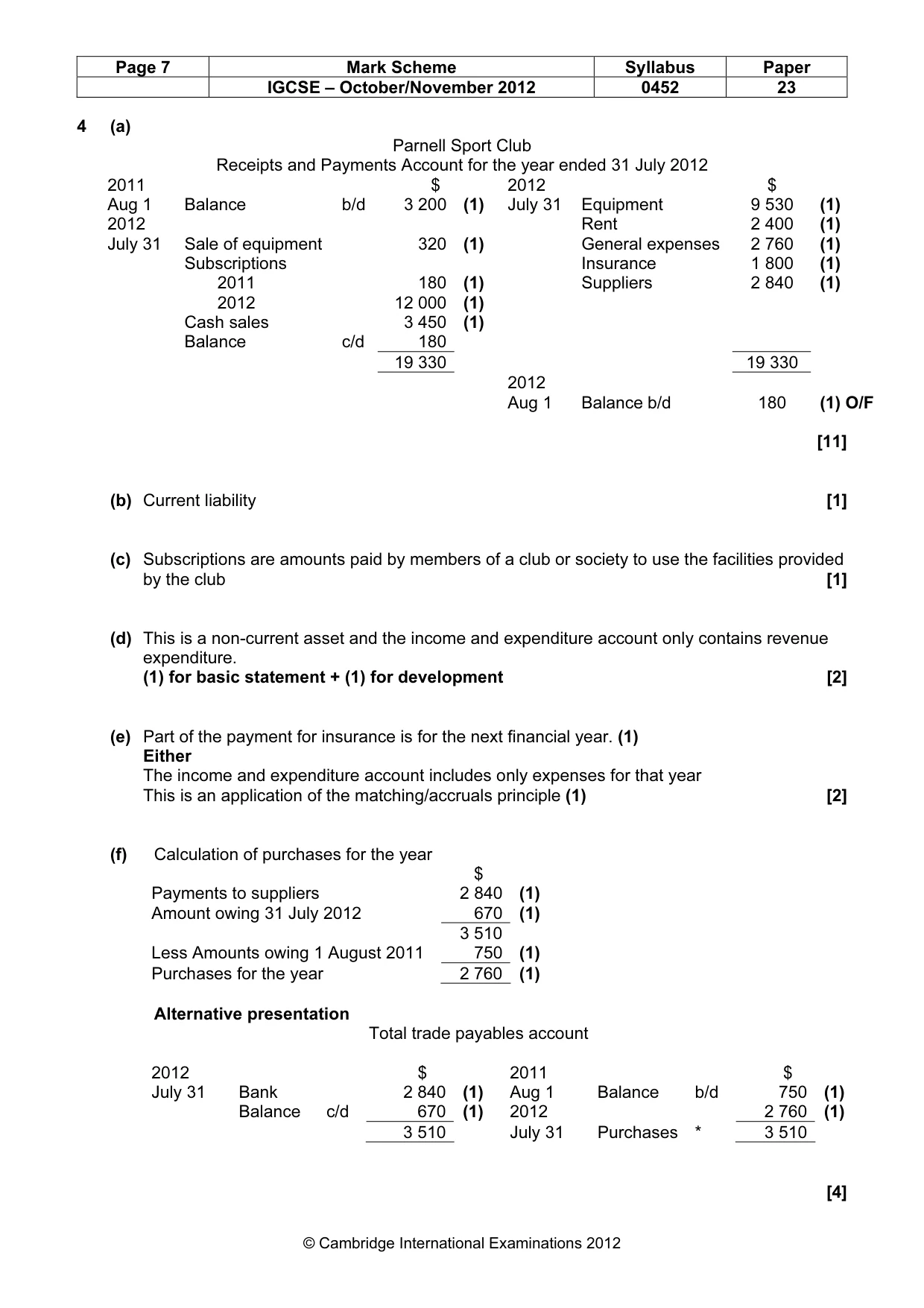
Page 7 Mark Scheme Syllabus Paper IGCSE – October/November 2012 0452 23 © Cambridge International Examinations 2012 4 (a) Parnell Sport Club Receipts and Payments Account for the year ended 31 July 2012 2011 $ 2012 $ Aug 1 Balance b/d 3 200 (1) July 31 Equipment 9 530 (1) 2012 Rent 2 400 (1) July 31 Sale of equipment 320 (1) General expenses 2 760 (1) Subscriptions Insurance 1 800 (1) 2011 180 (1) Suppliers 2 840 (1) 2012 12 000 (1) Cash sales 3 450 (1) Balance c/d 180 19 330 19 330 2012 Aug 1 Balance b/d 180 (1) O/F [11] (b) Current liability [1] (c) Subscriptions are amounts paid by members of a club or society to use the facilities provided by the club [1] (d) This is a non-current asset and the income and expenditure account only contains revenue expenditure. (1) for basic statement + (1) for development [2] (e) Part of the payment for insurance is for the next financial year. (1) Either The income and expenditure account includes only expenses for that year This is an application of the matching/accruals principle (1) [2] (f) Calculation of purchases for the year $ Payments to suppliers 2 840 (1) Amount owing 31 July 2012 670 (1) 3 510 Less Amounts owing 1 August 2011 750 (1) Purchases for the year 2 760 (1) Alternative presentation Total trade payables account 2012 $ 2011 $ July 31 Bank 2 840 (1) Aug 1 Balance b/d 750 (1) Balance c/d 670 (1) 2012 2 760 (1) 3 510 July 31 Purchases * 3 510 [4]
Mark scheme, page 8
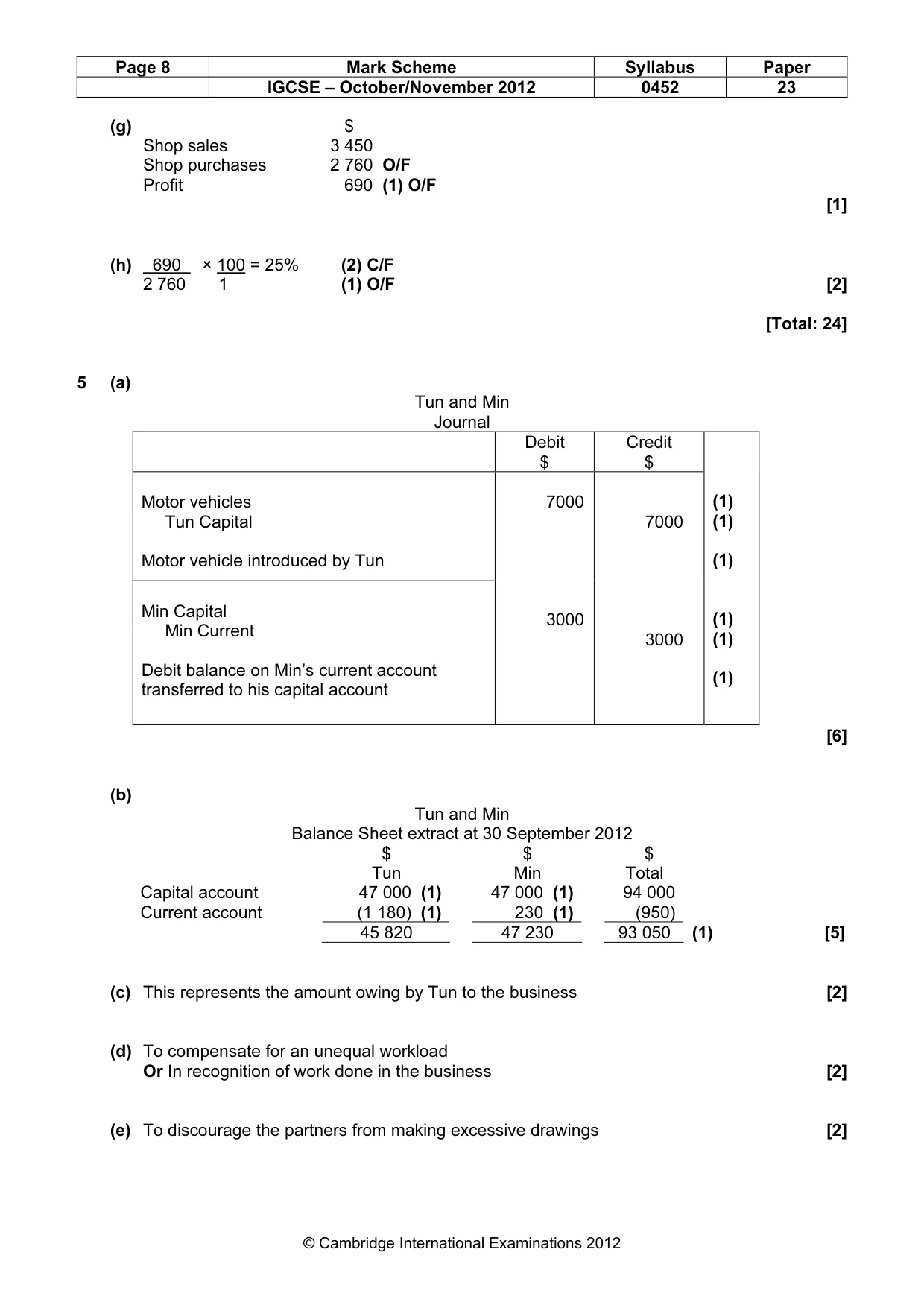
Page 8 Mark Scheme Syllabus Paper IGCSE – October/November 2012 0452 23 © Cambridge International Examinations 2012 (g) $ Shop sales 3 450 Shop purchases 2 760 O/F Profit 690 (1) O/F [1] (h) 690 × 100 = 25% (2) C/F 2 760 1 (1) O/F [2] [Total: 24] 5 (a) Tun and Min Journal Debit $ Credit $ Motor vehicles Tun Capital Motor vehicle introduced by Tun Min Capital Min Current Debit balance on Min’s current account transferred to his capital account 7000 3000 7000 3000 (1) (1) (1) (1) (1) (1) [6] (b) Tun and Min Balance Sheet extract at 30 September 2012 $ $ $ Tun Min Total Capital account 47 000 (1) 47 000 (1) 94 000 Current account (1 180) (1) 230 (1) (950) 45 820 47 230 93 050 (1) [5] (c) This represents the amount owing by Tun to the business [2] (d) To compensate for an unequal workload Or In recognition of work done in the business [2] (e) To discourage the partners from making excessive drawings [2]
Mark scheme, page 9
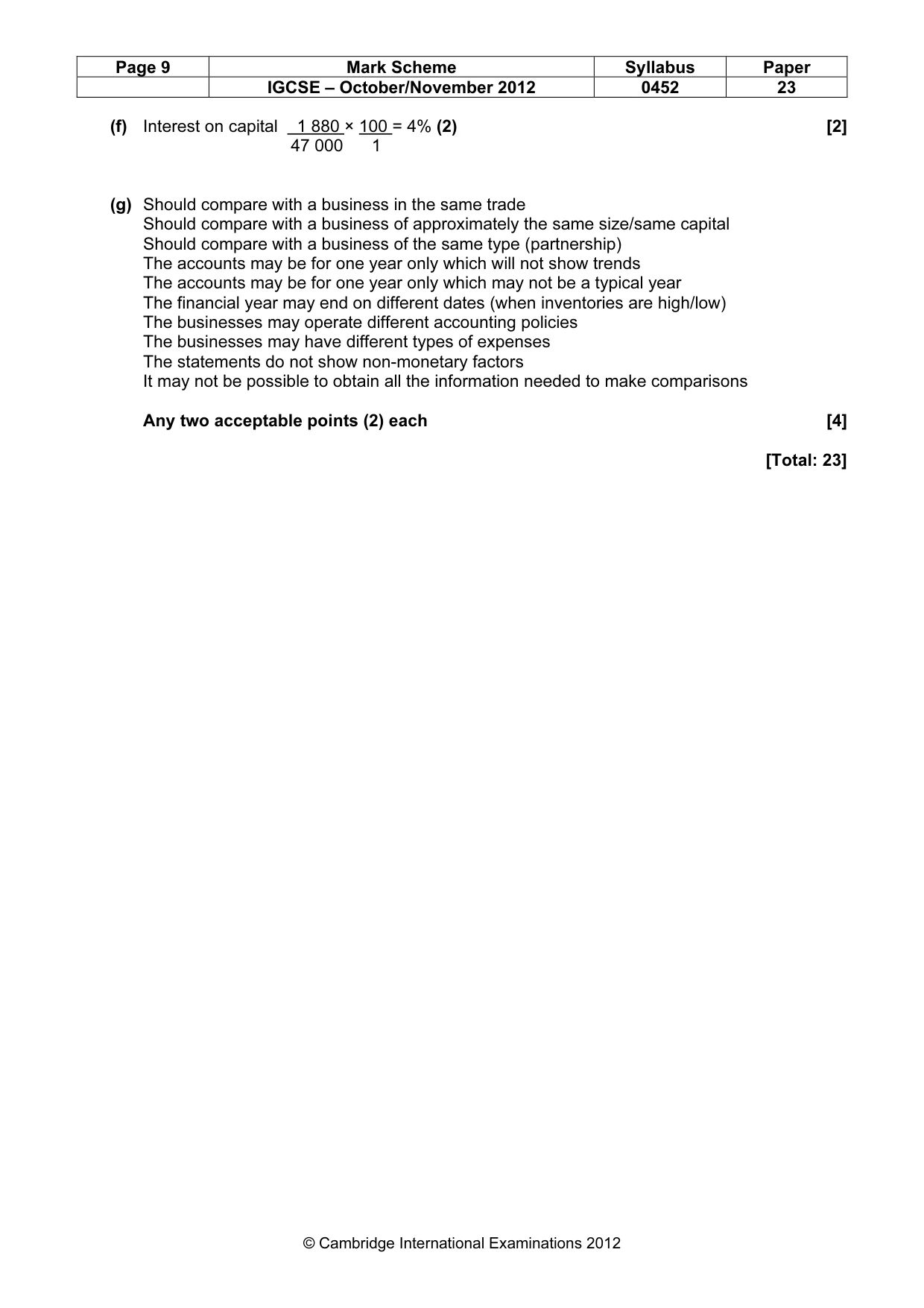
Page 9 Mark Scheme Syllabus Paper IGCSE – October/November 2012 0452 23 © Cambridge International Examinations 2012 (f) Interest on capital 1 880 × 100 = 4% (2) [2] 47 000 1 (g) Should compare with a business in the same trade Should compare with a business of approximately the same size/same capital Should compare with a business of the same type (partnership) The accounts may be for one year only which will not show trends The accounts may be for one year only which may not be a typical year The financial year may end on different dates (when inventories are high/low) The businesses may operate different accounting policies The businesses may have different types of expenses The statements do not show non-monetary factors It may not be possible to obtain all the information needed to make comparisons Any two acceptable points (2) each [4] [Total: 23]
What you needed in this session
Cambridge’s own grade thresholds for 2012 Oct/Nov, Paper 2 · Variant 3. A higher threshold means an easier paper — the bar moves with how the cohort did.