Cambridge IGCSE Accounting 0452 — 2011 Oct/Nov Paper 2 · Variant 3
0452/23/O/N/11 · 120 marks · ≈135 min
The question paper and its mark scheme, free to read here and free to download. This is Cambridge’s own paper, exactly as it was sat.
Question paper20 pages
Mark scheme9 pages
Answers below. Sit the paper first if you are practising.
Paper as text
Question paper, page 1
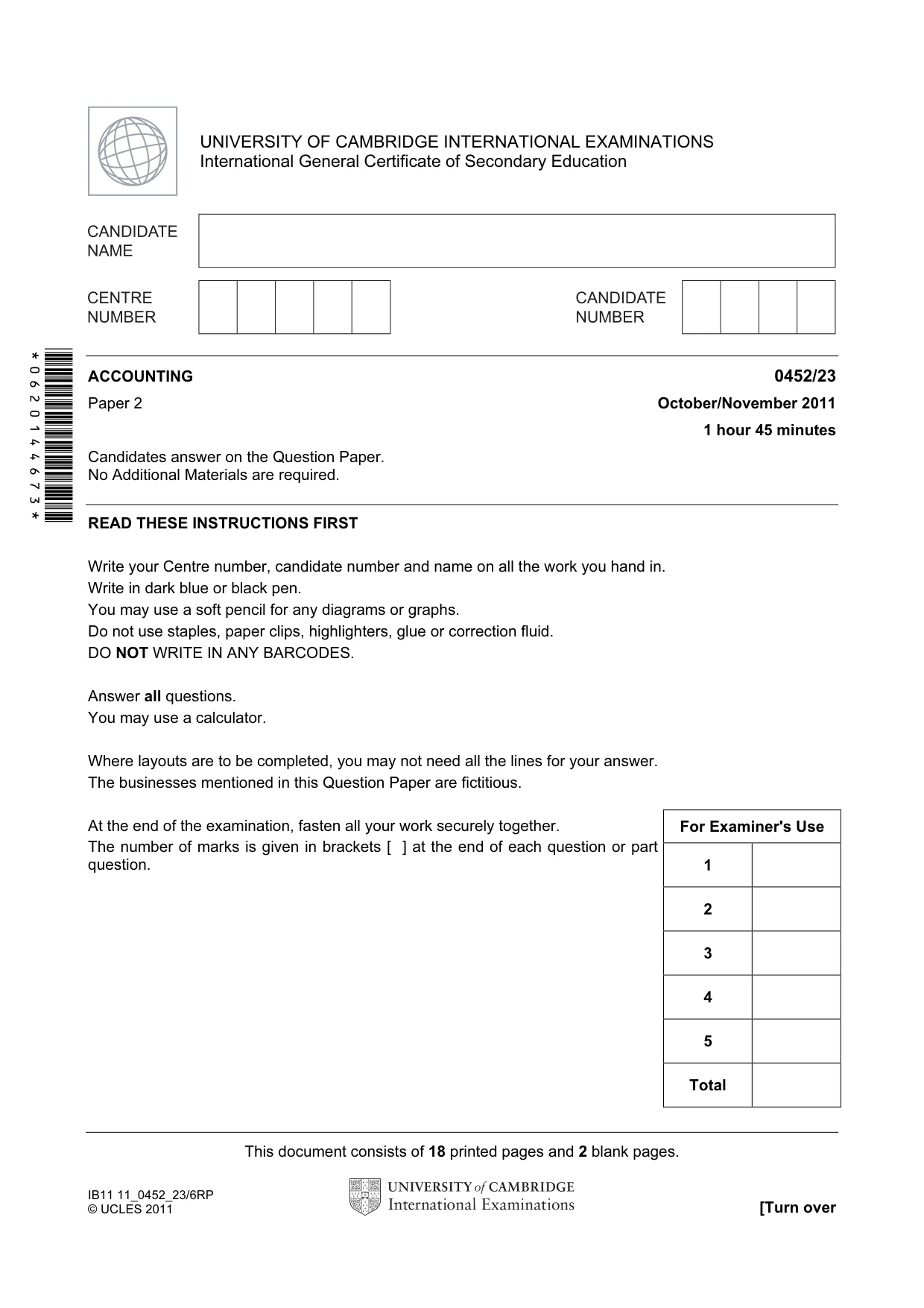
This document consists of 18 printed pages and 2 blank pages. IB11 11_0452_23/6RP © UCLES 2011 [Turn over *0620144673* For Examiner's Use 1 2 3 4 5 Total UNIVERSITY OF CAMBRIDGE INTERNATIONAL EXAMINATIONS International General Certificate of Secondary Education ACCOUNTING 0452/23 Paper 2 October/November 2011 1 hour 45 minutes Candidates answer on the Question Paper. No Additional Materials are required. READ THESE INSTRUCTIONS FIRST Write your Centre number, candidate number and name on all the work you hand in. Write in dark blue or black pen. You may use a soft pencil for any diagrams or graphs. Do not use staples, paper clips, highlighters, glue or correction fluid. DO NOT WRITE IN ANY BARCODES. Answer all questions. You may use a calculator. Where layouts are to be completed, you may not need all the lines for your answer. The businesses mentioned in this Question Paper are fictitious. At the end of the examination, fasten all your work securely together. The number of marks is given in brackets [ ] at the end of each question or part question.
Question paper, page 2
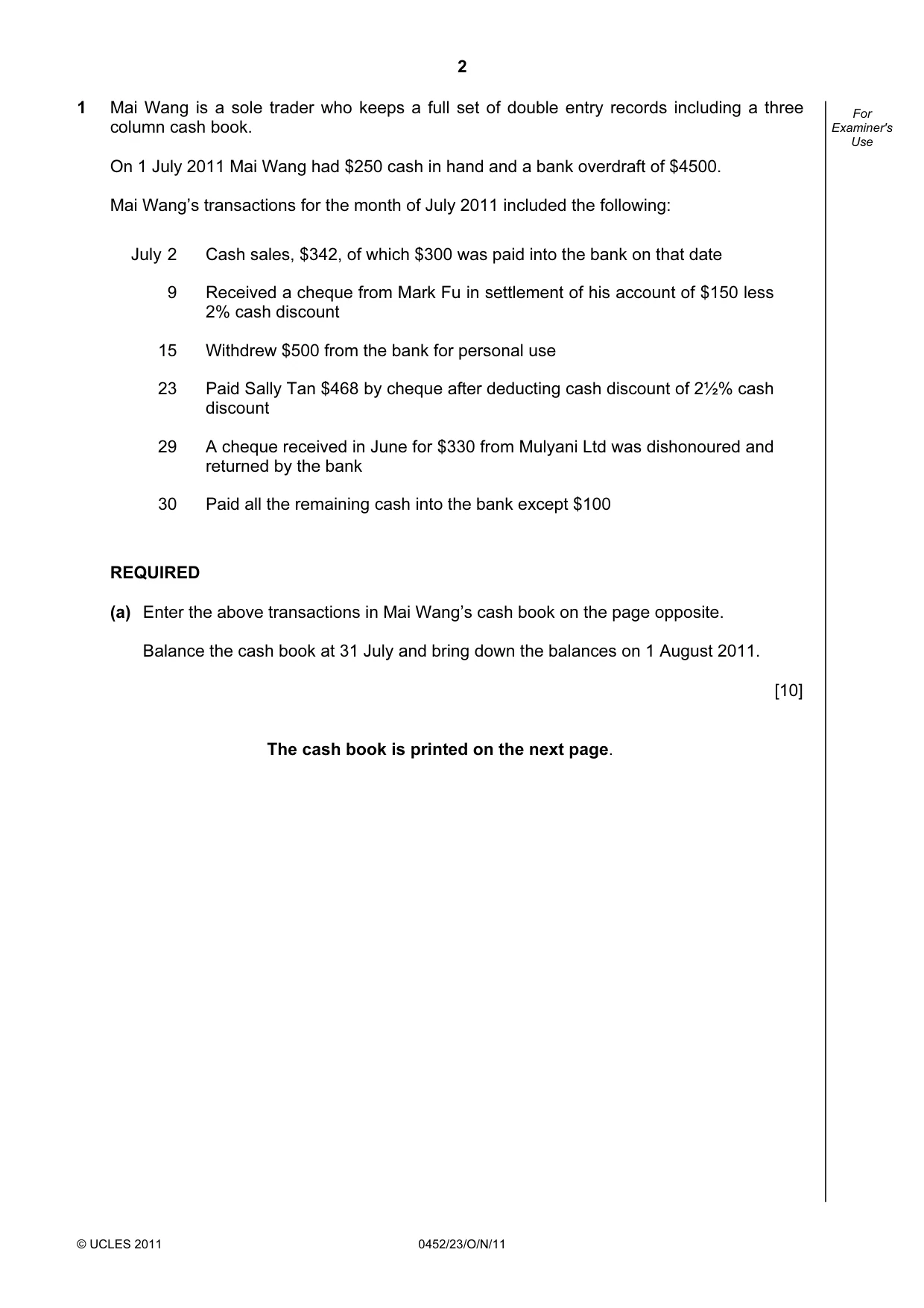
2 © UCLES 2011 0452/23/O/N/11 For Examiner's Use 1 Mai Wang is a sole trader who keeps a full set of double entry records including a three column cash book. On 1 July 2011 Mai Wang had $250 cash in hand and a bank overdraft of $4500. Mai Wang’s transactions for the month of July 2011 included the following: July 2 Cash sales, $342, of which $300 was paid into the bank on that date 9 Received a cheque from Mark Fu in settlement of his account of $150 less 2% cash discount 15 Withdrew $500 from the bank for personal use 23 Paid Sally Tan $468 by cheque after deducting cash discount of 2½% cash discount 29 A cheque received in June for $330 from Mulyani Ltd was dishonoured and returned by the bank 30 Paid all the remaining cash into the bank except $100 REQUIRED (a) Enter the above transactions in Mai Wang’s cash book on the page opposite. Balance the cash book at 31 July and bring down the balances on 1 August 2011. [10] The cash book is printed on the next page.
Question paper, page 3
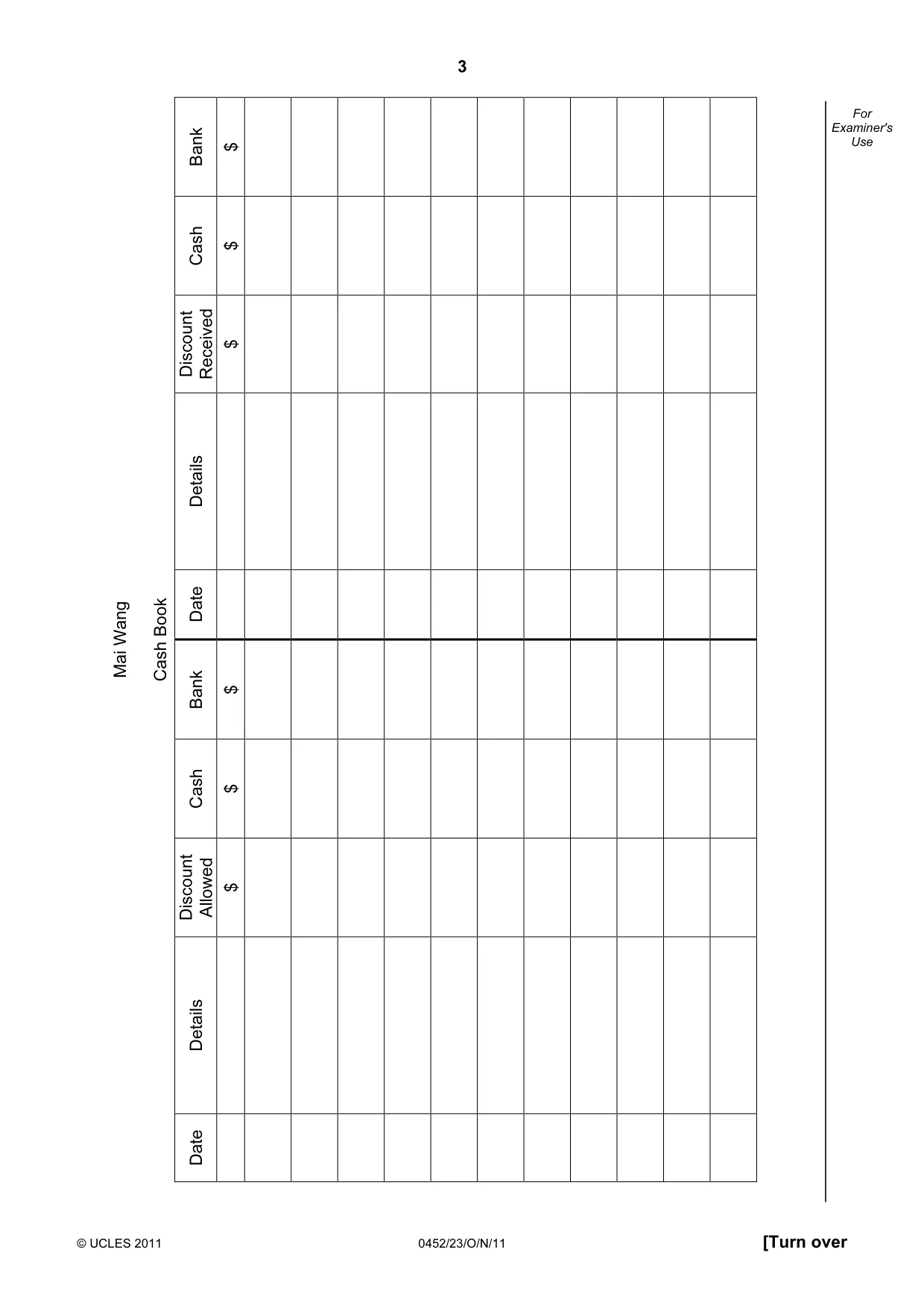
3 © UCLES 2011 0452/23/O/N/11 [Turn over For Examiner's Use Bank $ Cash $ Discount Received $ Details Date Bank $ Cash $ Discount Allowed $ Details Mai Wang Cash Book Date
Question paper, page 4
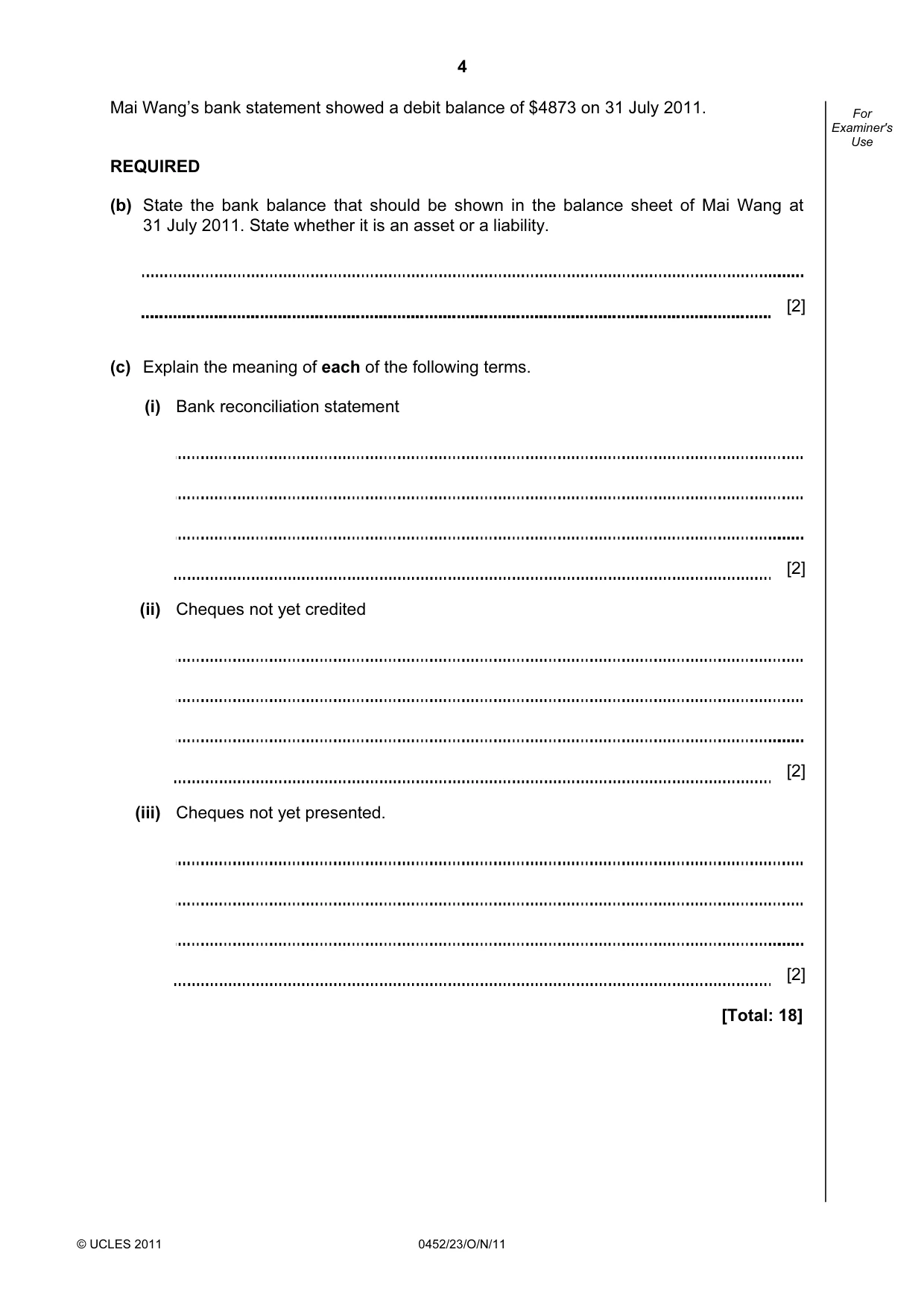
4 © UCLES 2011 0452/23/O/N/11 For Examiner's Use Mai Wang’s bank statement showed a debit balance of $4873 on 31 July 2011. REQUIRED (b) State the bank balance that should be shown in the balance sheet of Mai Wang at 31 July 2011. State whether it is an asset or a liability. [2] (c) Explain the meaning of each of the following terms. (i) Bank reconciliation statement [2] (ii) Cheques not yet credited [2] (iii) Cheques not yet presented. [2] [Total: 18]
Question paper, page 5
5 © UCLES 2011 0452/23/O/N/11 [Turn over For Examiner's Use BLANK PAGE Question 2 is on the next page
Question paper, page 6
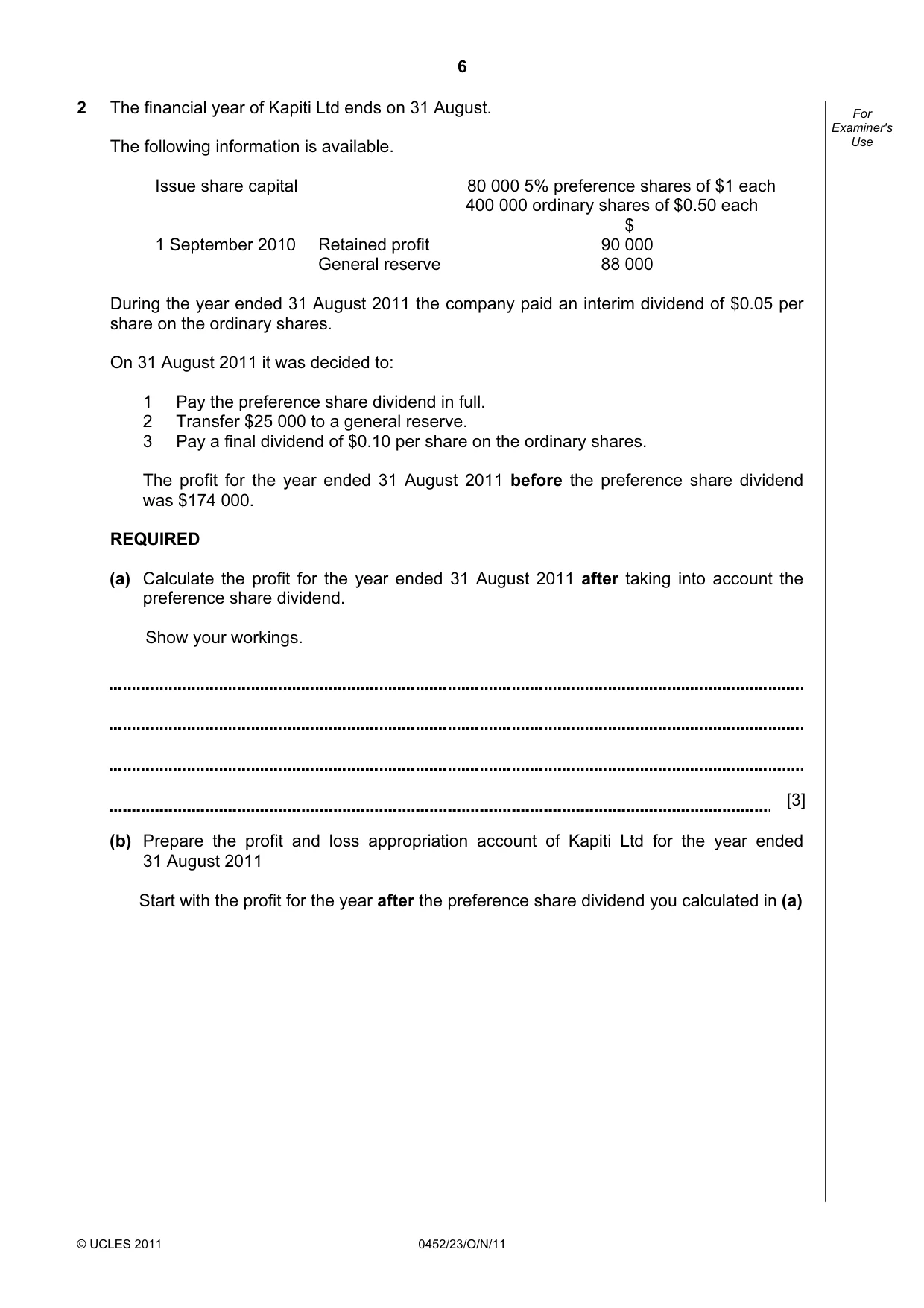
6 © UCLES 2011 0452/23/O/N/11 For Examiner's Use 2 The financial year of Kapiti Ltd ends on 31 August. The following information is available. Issue share capital 80 000 5% preference shares of $1 each 400 000 ordinary shares of $0.50 each $ 1 September 2010 Retained profit 90 000 General reserve 88 000 During the year ended 31 August 2011 the company paid an interim dividend of $0.05 per share on the ordinary shares. On 31 August 2011 it was decided to: 1 Pay the preference share dividend in full. 2 Transfer $25 000 to a general reserve. 3 Pay a final dividend of $0.10 per share on the ordinary shares. The profit for the year ended 31 August 2011 before the preference share dividend was $174 000. REQUIRED (a) Calculate the profit for the year ended 31 August 2011 after taking into account the preference share dividend. Show your workings. [3] (b) Prepare the profit and loss appropriation account of Kapiti Ltd for the year ended 31 August 2011 Start with the profit for the year after the preference share dividend you calculated in (a)
Question paper, page 7
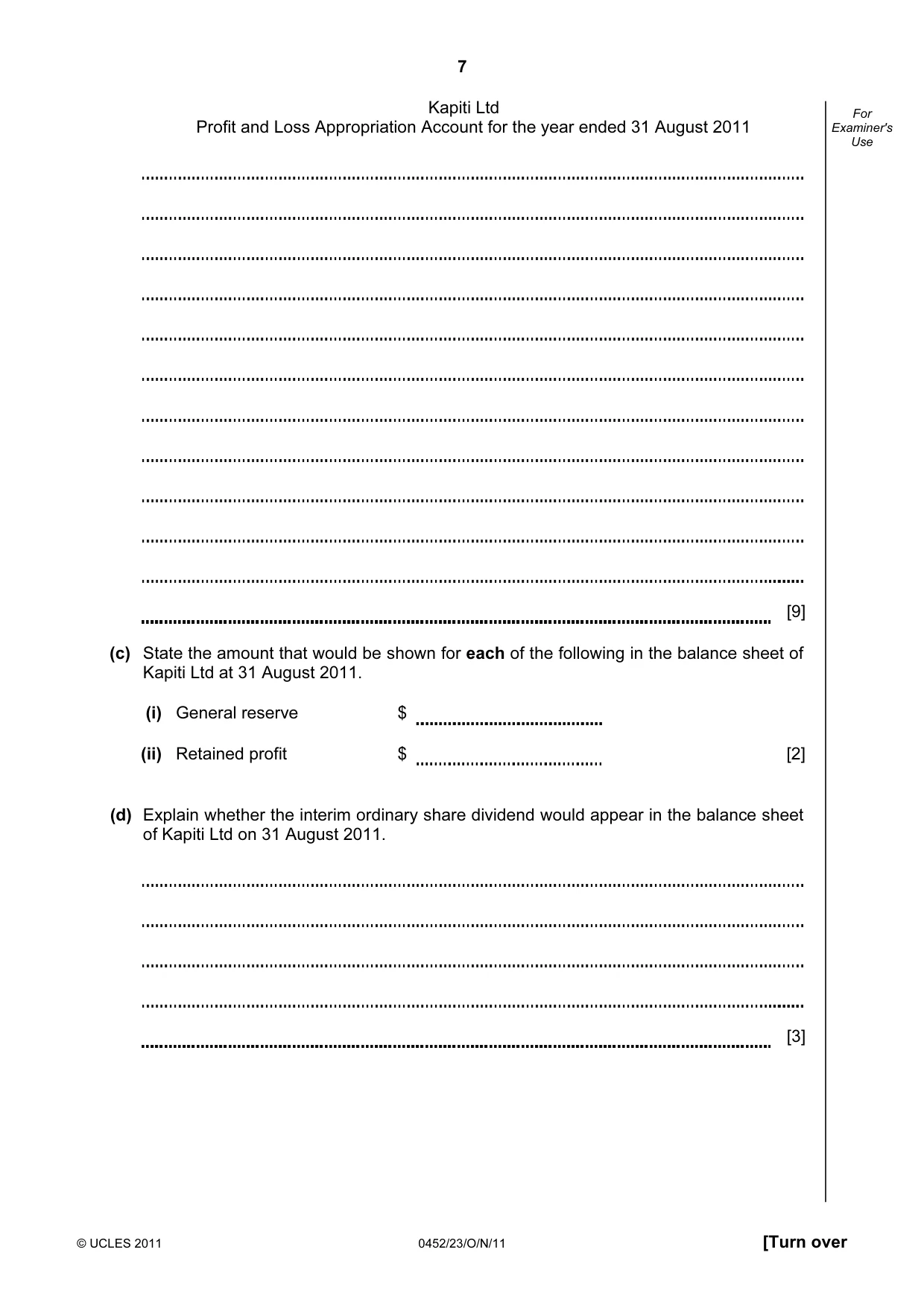
7 © UCLES 2011 0452/23/O/N/11 [Turn over For Examiner's Use Kapiti Ltd Profit and Loss Appropriation Account for the year ended 31 August 2011 [9] (c) State the amount that would be shown for each of the following in the balance sheet of Kapiti Ltd at 31 August 2011. (i) General reserve $ (ii) Retained profit $ [2] (d) Explain whether the interim ordinary share dividend would appear in the balance sheet of Kapiti Ltd on 31 August 2011. [3]
Question paper, page 8
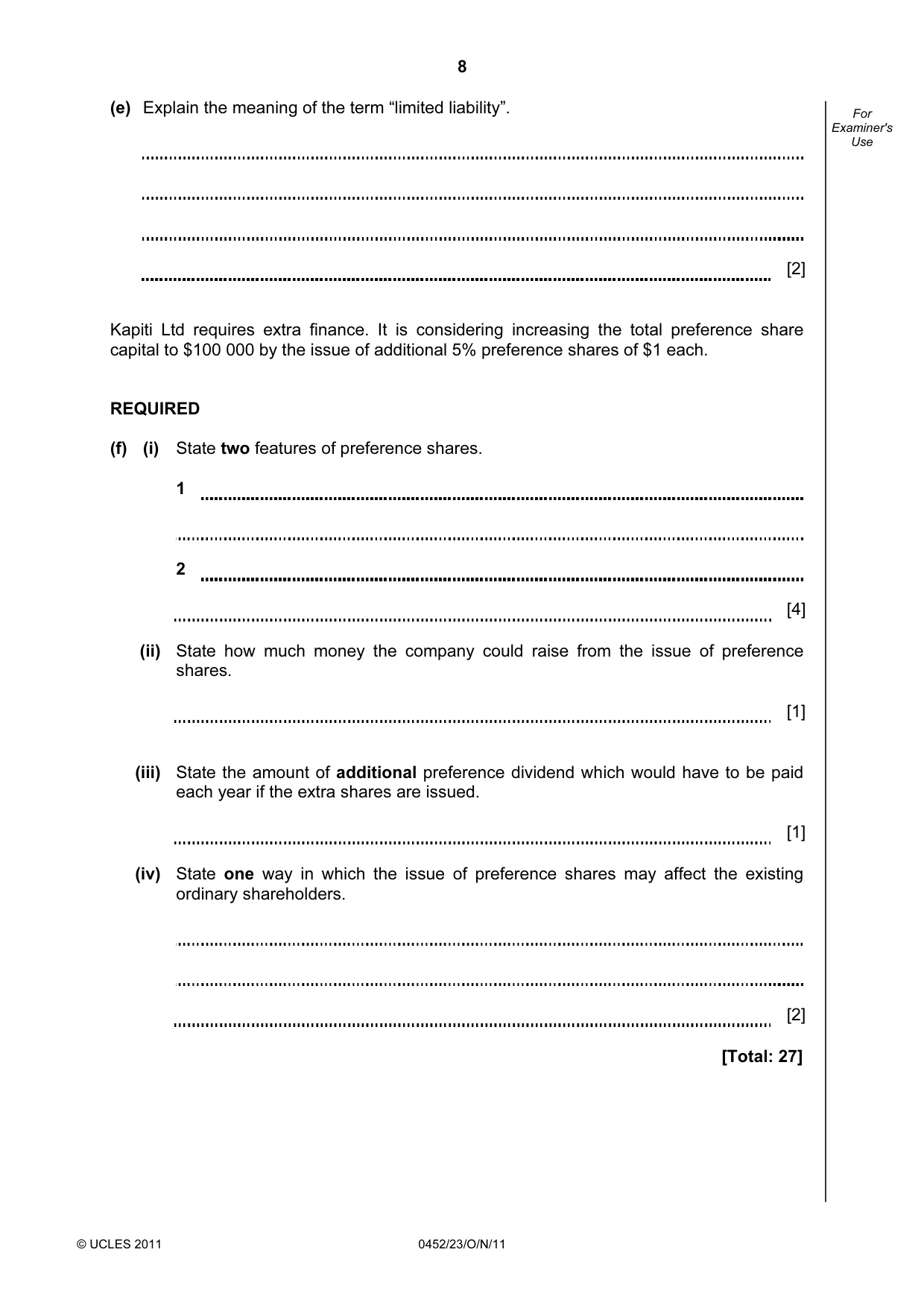
8 © UCLES 2011 0452/23/O/N/11 For Examiner's Use (e) Explain the meaning of the term “limited liability”. [2] Kapiti Ltd requires extra finance. It is considering increasing the total preference share capital to $100 000 by the issue of additional 5% preference shares of $1 each. REQUIRED (f) (i) State two features of preference shares. 1 2 [4] (ii) State how much money the company could raise from the issue of preference shares. [1] (iii) State the amount of additional preference dividend which would have to be paid each year if the extra shares are issued. [1] (iv) State one way in which the issue of preference shares may affect the existing ordinary shareholders. [2] [Total: 27]
Question paper, page 9
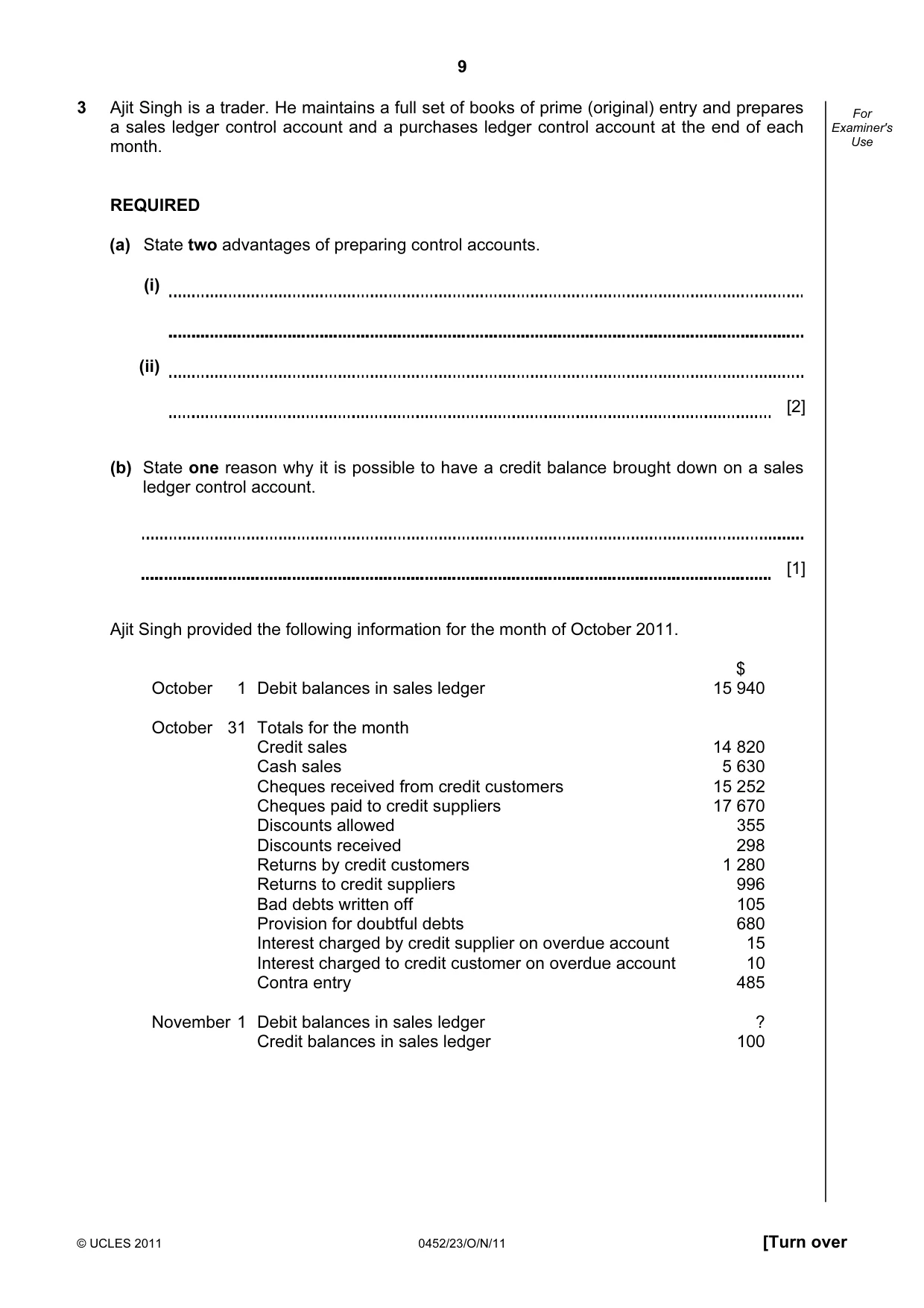
9 © UCLES 2011 0452/23/O/N/11 [Turn over For Examiner's Use 3 Ajit Singh is a trader. He maintains a full set of books of prime (original) entry and prepares a sales ledger control account and a purchases ledger control account at the end of each month. REQUIRED (a) State two advantages of preparing control accounts. (i) (ii) [2] (b) State one reason why it is possible to have a credit balance brought down on a sales ledger control account. [1] Ajit Singh provided the following information for the month of October 2011. $ October 1 Debit balances in sales ledger 15 940 October 31 Totals for the month Credit sales 14 820 Cash sales 5 630 Cheques received from credit customers 15 252 Cheques paid to credit suppliers 17 670 Discounts allowed 355 Discounts received 298 Returns by credit customers 1 280 Returns to credit suppliers 996 Bad debts written off 105 Provision for doubtful debts 680 Interest charged by credit supplier on overdue account 15 Interest charged to credit customer on overdue account 10 Contra entry 485 November 1 Debit balances in sales ledger ? Credit balances in sales ledger 100
Question paper, page 10
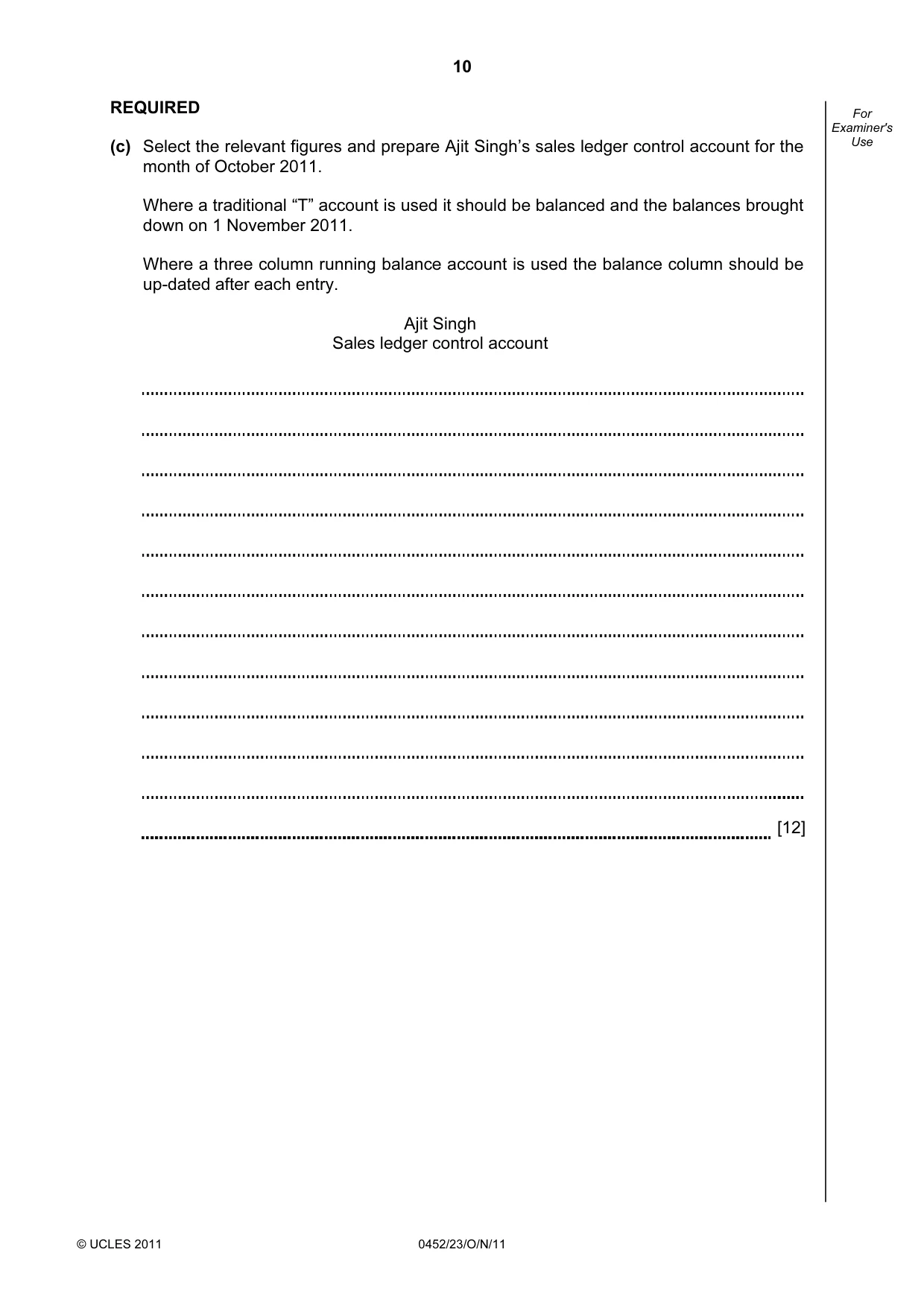
10 © UCLES 2011 0452/23/O/N/11 For Examiner's Use REQUIRED (c) Select the relevant figures and prepare Ajit Singh’s sales ledger control account for the month of October 2011. Where a traditional “T” account is used it should be balanced and the balances brought down on 1 November 2011. Where a three column running balance account is used the balance column should be up-dated after each entry. Ajit Singh Sales ledger control account [12]
Question paper, page 11
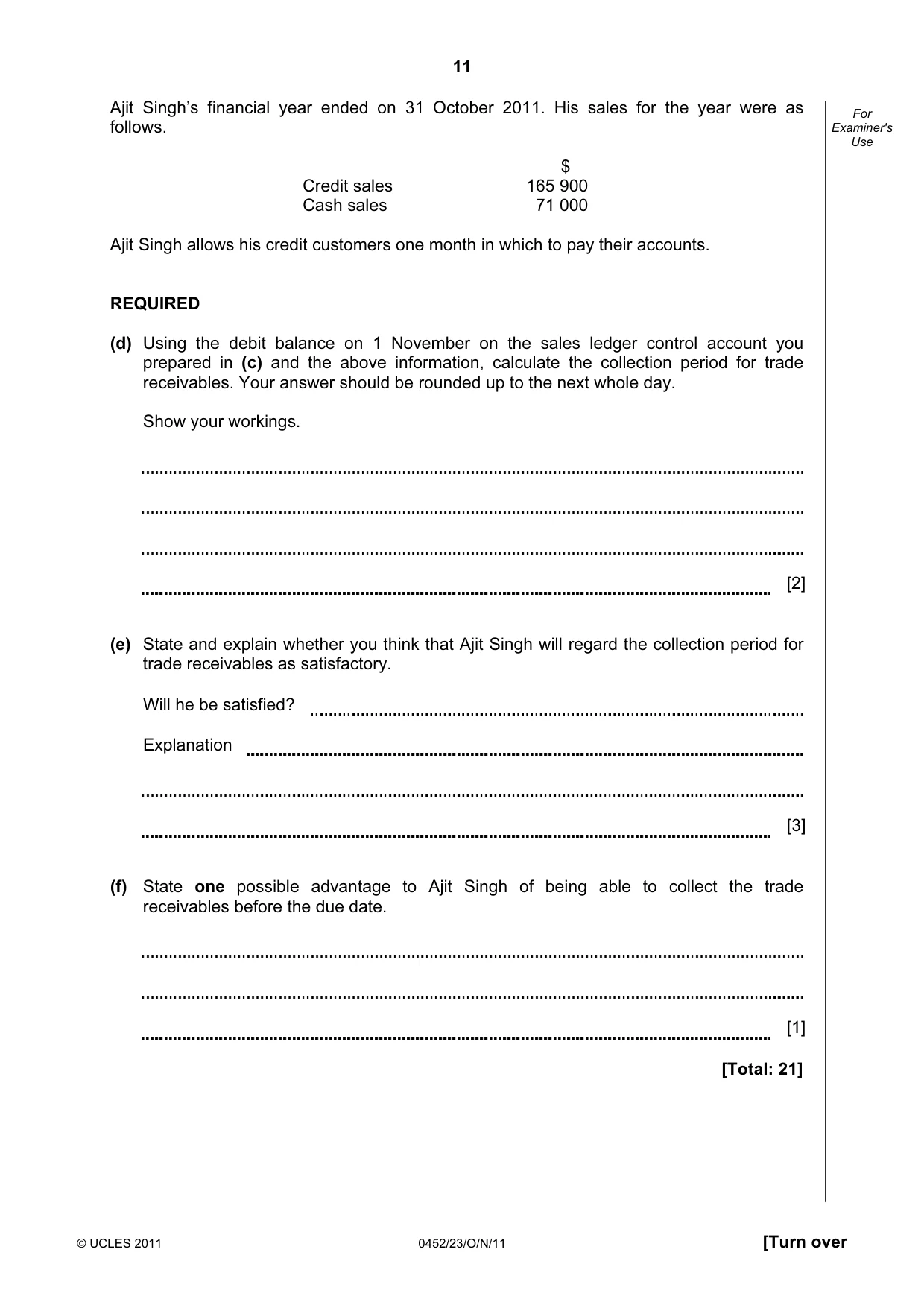
11 © UCLES 2011 0452/23/O/N/11 [Turn over For Examiner's Use Ajit Singh’s financial year ended on 31 October 2011. His sales for the year were as follows. $ Credit sales 165 900 Cash sales 71 000 Ajit Singh allows his credit customers one month in which to pay their accounts. REQUIRED (d) Using the debit balance on 1 November on the sales ledger control account you prepared in (c) and the above information, calculate the collection period for trade receivables. Your answer should be rounded up to the next whole day. Show your workings. [2] (e) State and explain whether you think that Ajit Singh will regard the collection period for trade receivables as satisfactory. Will he be satisfied? Explanation [3] (f) State one possible advantage to Ajit Singh of being able to collect the trade receivables before the due date. [1] [Total: 21]
Question paper, page 12
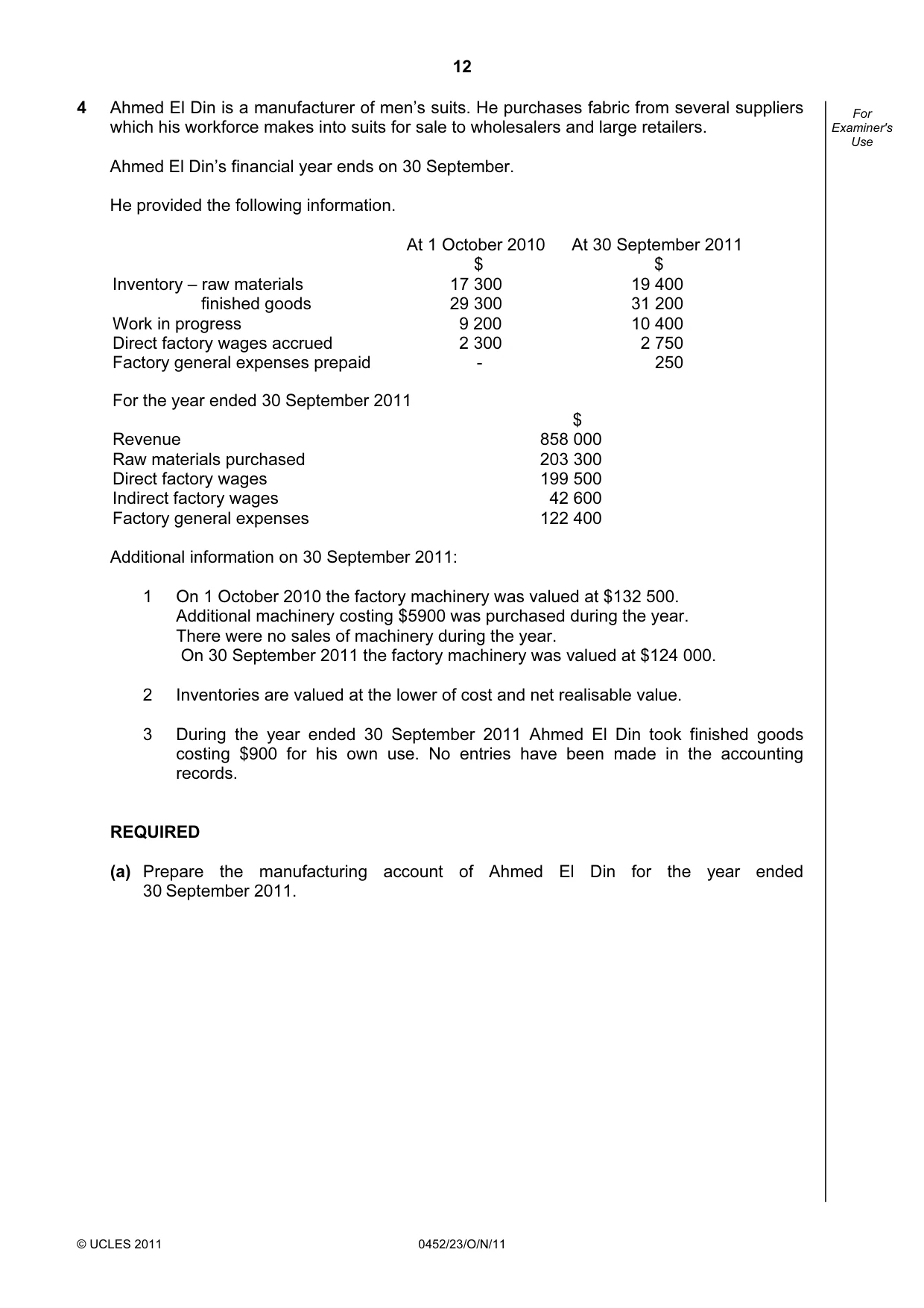
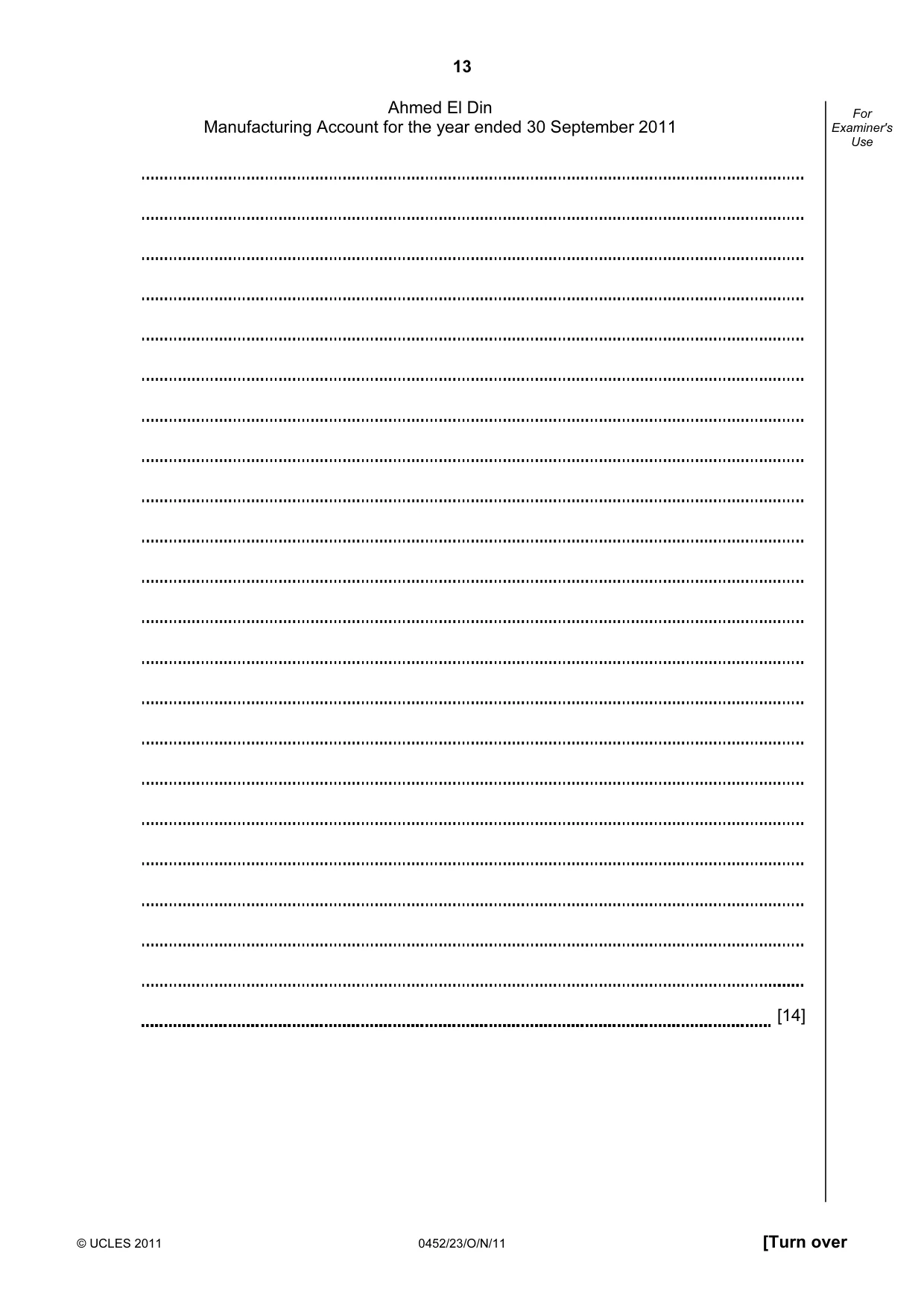
12 © UCLES 2011 0452/23/O/N/11 For Examiner's Use 4 Ahmed El Din is a manufacturer of men’s suits. He purchases fabric from several suppliers which his workforce makes into suits for sale to wholesalers and large retailers. Ahmed El Din’s financial year ends on 30 September. He provided the following information. At 1 October 2010 At 30 September 2011 $ $ Inventory – raw materials 17 300 19 400 finished goods 29 300 31 200 Work in progress 9 200 10 400 Direct factory wages accrued 2 300 2 750 Factory general expenses prepaid - 250 For the year ended 30 September 2011 $ Revenue 858 000 Raw materials purchased 203 300 Direct factory wages 199 500 Indirect factory wages 42 600 Factory general expenses 122 400 Additional information on 30 September 2011: 1 On 1 October 2010 the factory machinery was valued at $132 500. Additional machinery costing $5900 was purchased during the year. There were no sales of machinery during the year. On 30 September 2011 the factory machinery was valued at $124 000. 2 Inventories are valued at the lower of cost and net realisable value. 3 During the year ended 30 September 2011 Ahmed El Din took finished goods costing $900 for his own use. No entries have been made in the accounting records. REQUIRED (a) Prepare the manufacturing account of Ahmed El Din for the year ended 30 September 2011.
Question paper, page 13
13 © UCLES 2011 0452/23/O/N/11 [Turn over For Examiner's Use Ahmed El Din Manufacturing Account for the year ended 30 September 2011 [14]
Question paper, page 14
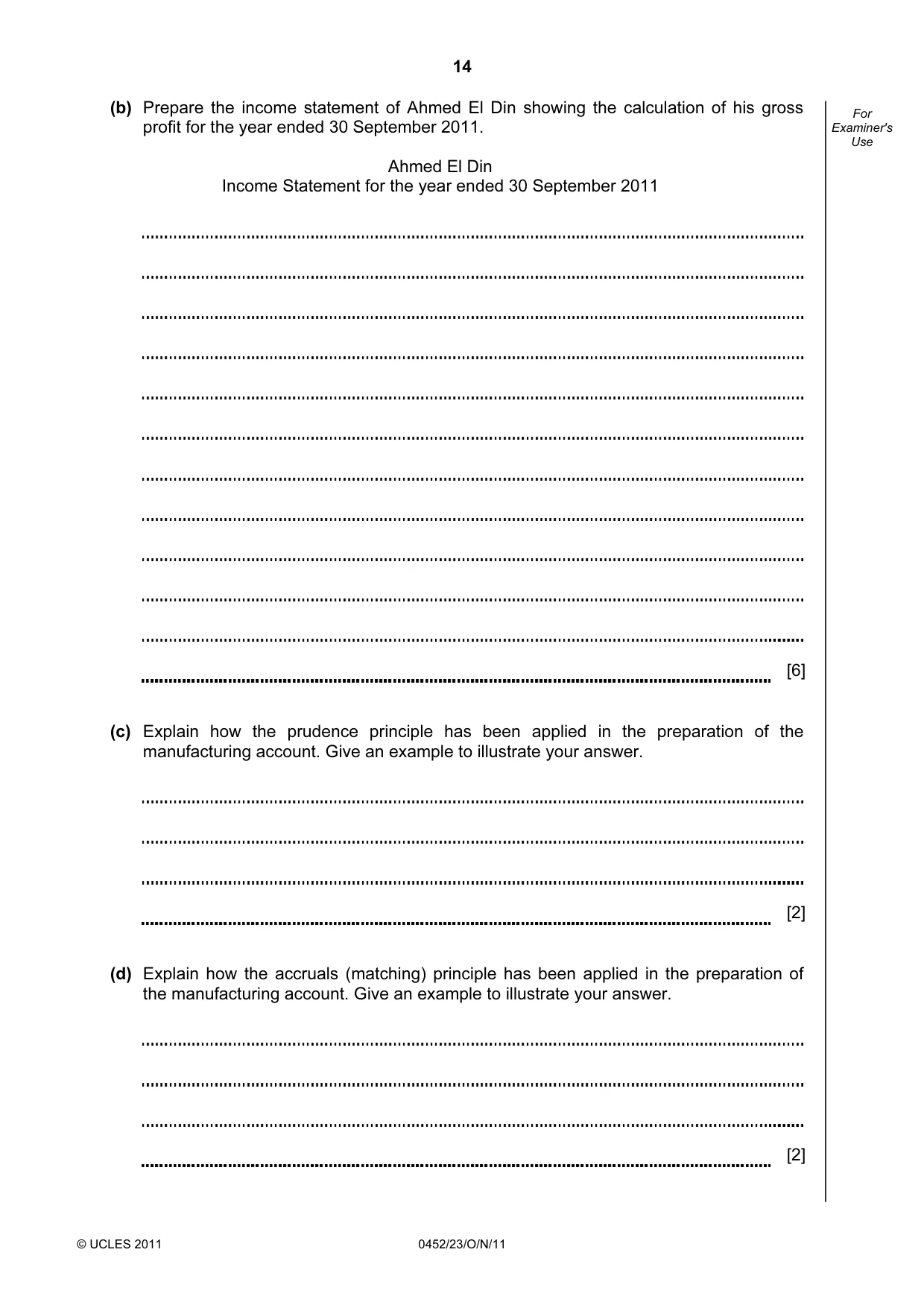
14 © UCLES 2011 0452/23/O/N/11 For Examiner's Use (b) Prepare the income statement of Ahmed El Din showing the calculation of his gross profit for the year ended 30 September 2011. Ahmed El Din Income Statement for the year ended 30 September 2011 [6] (c) Explain how the prudence principle has been applied in the preparation of the manufacturing account. Give an example to illustrate your answer. [2] (d) Explain how the accruals (matching) principle has been applied in the preparation of the manufacturing account. Give an example to illustrate your answer. [2]
Question paper, page 15
15 © UCLES 2011 0452/23/O/N/11 [Turn over For Examiner's Use (e) Explain how the business entity principle has been applied in the preparation of the income statement. Give an example to illustrate your answer. [2] [Total: 26]
Question paper, page 16
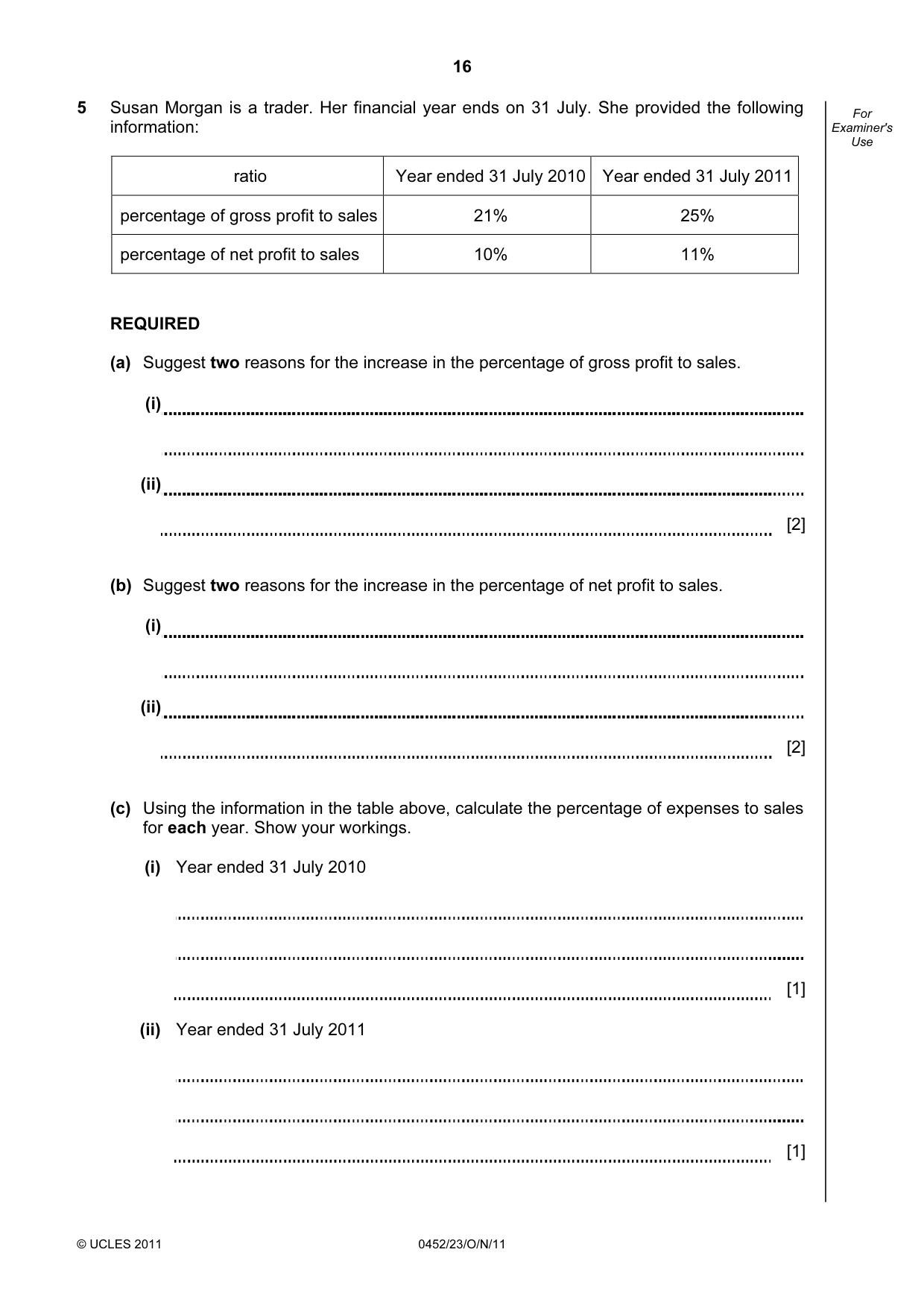
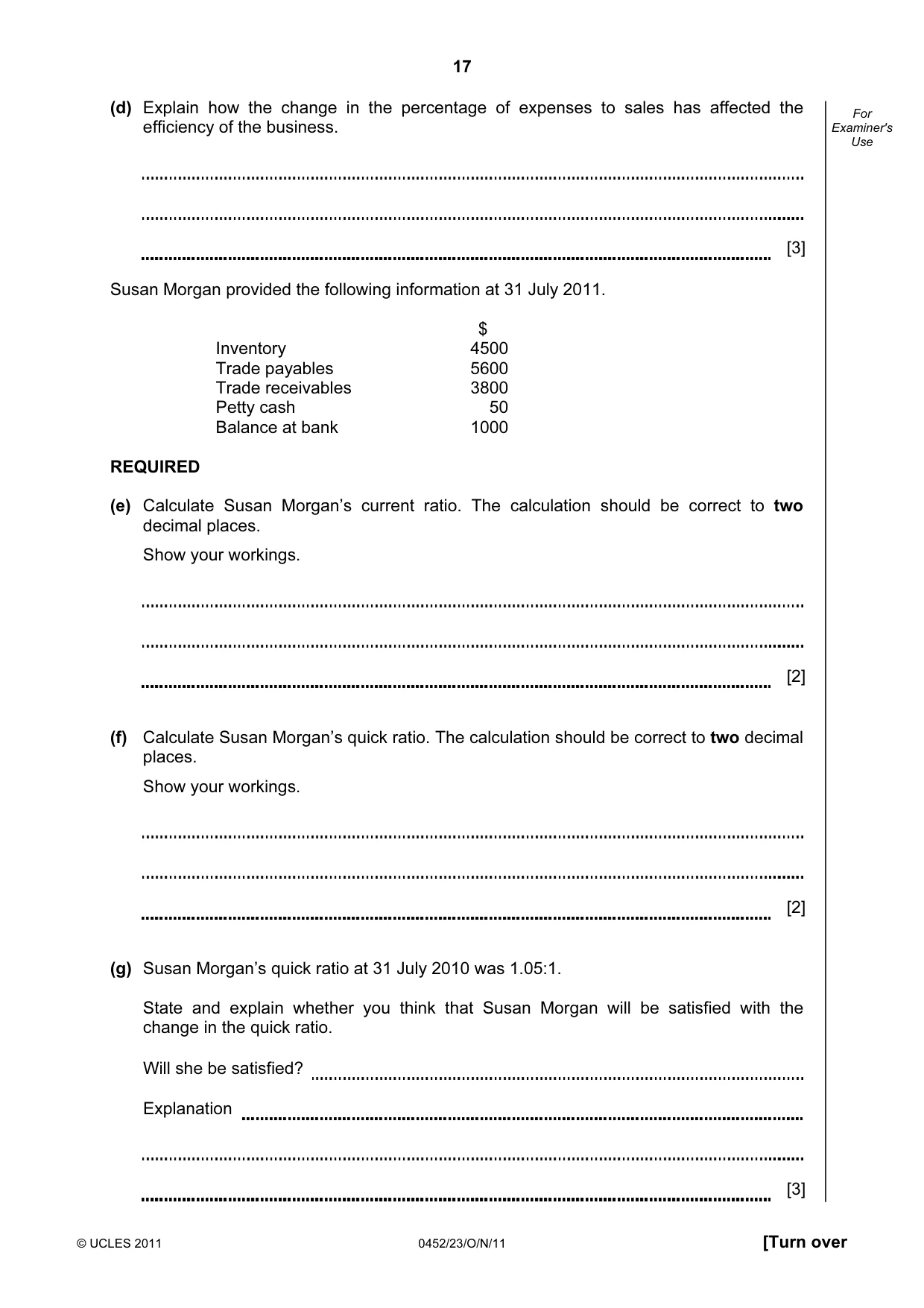
16 © UCLES 2011 0452/23/O/N/11 For Examiner's Use 5 Susan Morgan is a trader. Her financial year ends on 31 July. She provided the following information: ratio Year ended 31 July 2010 Year ended 31 July 2011 percentage of gross profit to sales 21% 25% percentage of net profit to sales 10% 11% REQUIRED (a) Suggest two reasons for the increase in the percentage of gross profit to sales. (i) (ii) [2] (b) Suggest two reasons for the increase in the percentage of net profit to sales. (i) (ii) [2] (c) Using the information in the table above, calculate the percentage of expenses to sales for each year. Show your workings. (i) Year ended 31 July 2010 [1] (ii) Year ended 31 July 2011 [1]
Question paper, page 17
17 © UCLES 2011 0452/23/O/N/11 [Turn over For Examiner's Use (d) Explain how the change in the percentage of expenses to sales has affected the efficiency of the business. [3] Susan Morgan provided the following information at 31 July 2011. $ Inventory 4500 Trade payables 5600 Trade receivables 3800 Petty cash 50 Balance at bank 1000 REQUIRED (e) Calculate Susan Morgan’s current ratio. The calculation should be correct to two decimal places. Show your workings. [2] (f) Calculate Susan Morgan’s quick ratio. The calculation should be correct to two decimal places. Show your workings. [2] (g) Susan Morgan’s quick ratio at 31 July 2010 was 1.05:1. State and explain whether you think that Susan Morgan will be satisfied with the change in the quick ratio. Will she be satisfied? Explanation [3]
Question paper, page 18
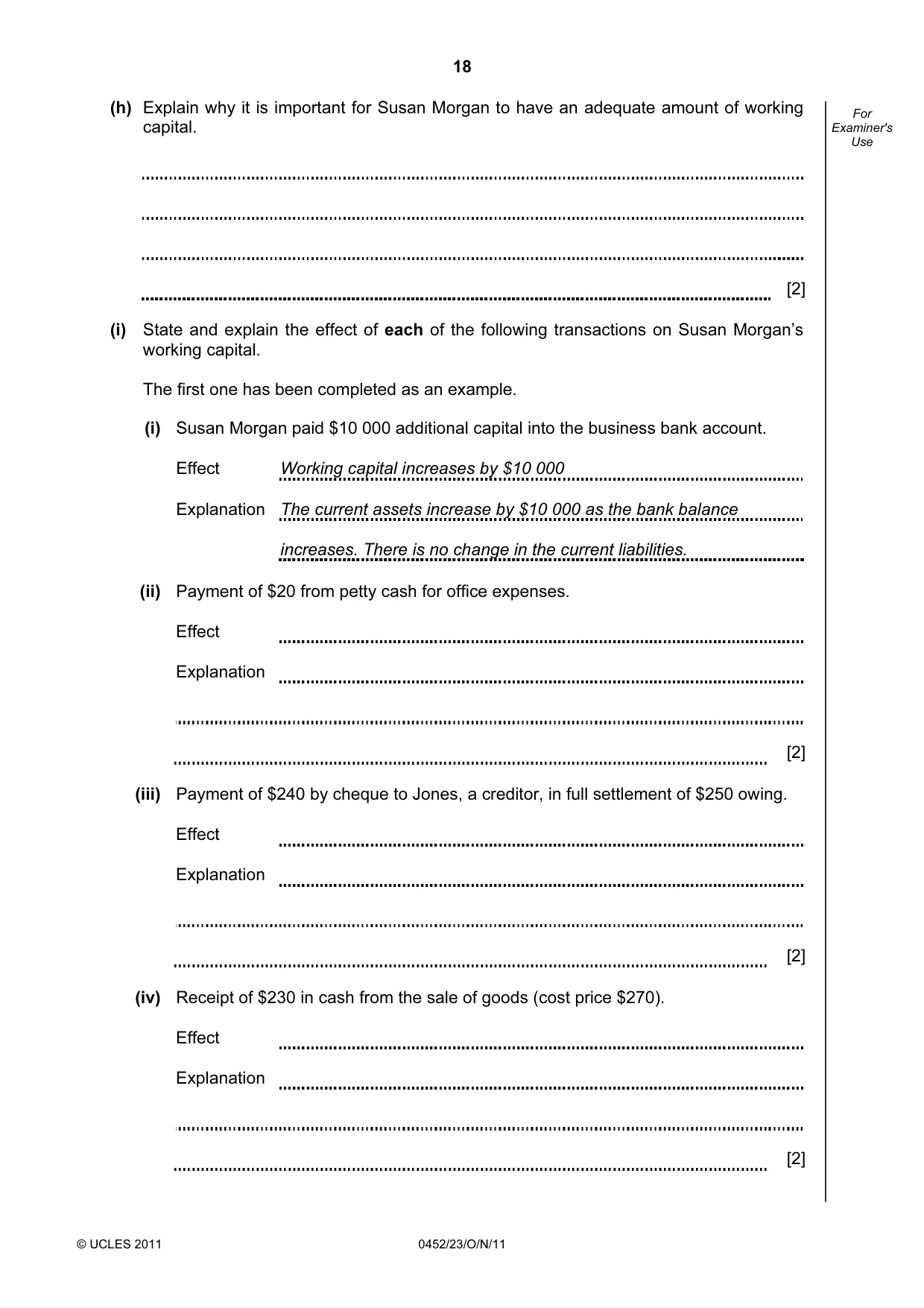
18 © UCLES 2011 0452/23/O/N/11 For Examiner's Use (h) Explain why it is important for Susan Morgan to have an adequate amount of working capital. [2] (i) State and explain the effect of each of the following transactions on Susan Morgan’s working capital. The first one has been completed as an example. (i) Susan Morgan paid $10 000 additional capital into the business bank account. Effect Working capital increases by $10 000 Explanation The current assets increase by $10 000 as the bank balance increases. There is no change in the current liabilities. (ii) Payment of $20 from petty cash for office expenses. Effect Explanation [2] (iii) Payment of $240 by cheque to Jones, a creditor, in full settlement of $250 owing. Effect Explanation [2] (iv) Receipt of $230 in cash from the sale of goods (cost price $270). Effect Explanation [2]
Question paper, page 19
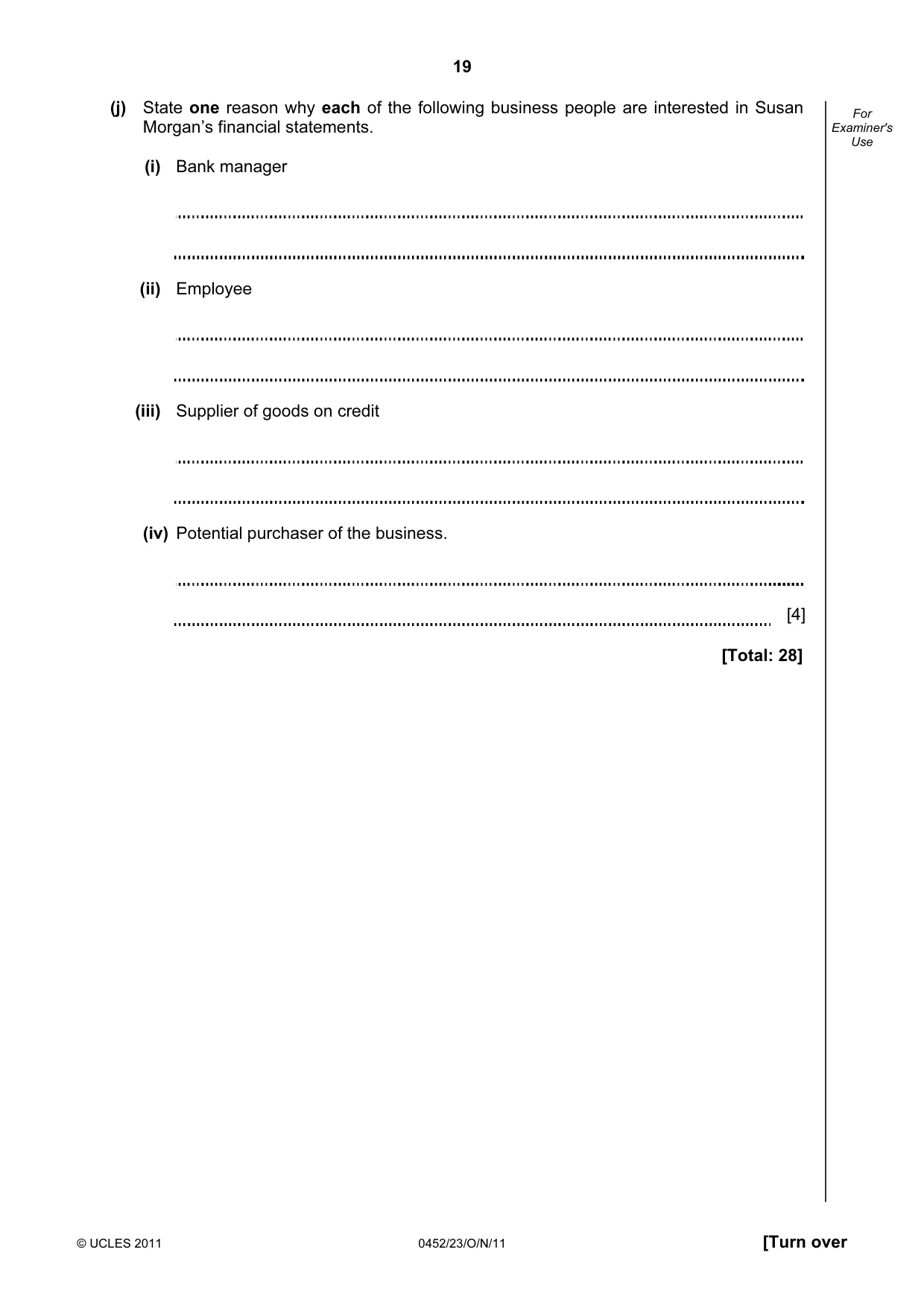
19 © UCLES 2011 0452/23/O/N/11 [Turn over For Examiner's Use (j) State one reason why each of the following business people are interested in Susan Morgan’s financial statements. (i) Bank manager (ii) Employee (iii) Supplier of goods on credit (iv) Potential purchaser of the business. [4] [Total: 28]
Question paper, page 20
20 Permission to reproduce items where third-party owned material protected by copyright is included has been sought and cleared where possible. Every reasonable effort has been made by the publisher (UCLES) to trace copyright holders, but if any items requiring clearance have unwittingly been included, the publisher will be pleased to make amends at the earliest possible opportunity. University of Cambridge International Examinations is part of the Cambridge Assessment Group. Cambridge Assessment is the brand name of University of Cambridge Local Examinations Syndicate (UCLES), which is itself a department of the University of Cambridge. © UCLES 2011 0452/23/O/N/11 BLANK PAGE
Mark scheme, page 1
UNIVERSITY OF CAMBRIDGE INTERNATIONAL EXAMINATIONS International General Certificate of Secondary Education MARK SCHEME for the October/November 2011 question paper for the guidance of teachers 0452 ACCOUNTING 0452/23 Paper 2, maximum raw mark 120 This mark scheme is published as an aid to teachers and candidates, to indicate the requirements of the examination. It shows the basis on which Examiners were instructed to award marks. It does not indicate the details of the discussions that took place at an Examiners’ meeting before marking began, which would have considered the acceptability of alternative answers. Mark schemes must be read in conjunction with the question papers and the report on the examination. • Cambridge will not enter into discussions or correspondence in connection with these mark schemes. Cambridge is publishing the mark schemes for the October/November 2011 question papers for most IGCSE, GCE Advanced Level and Advanced Subsidiary Level syllabuses and some Ordinary Level syllabuses.
Mark scheme, page 2
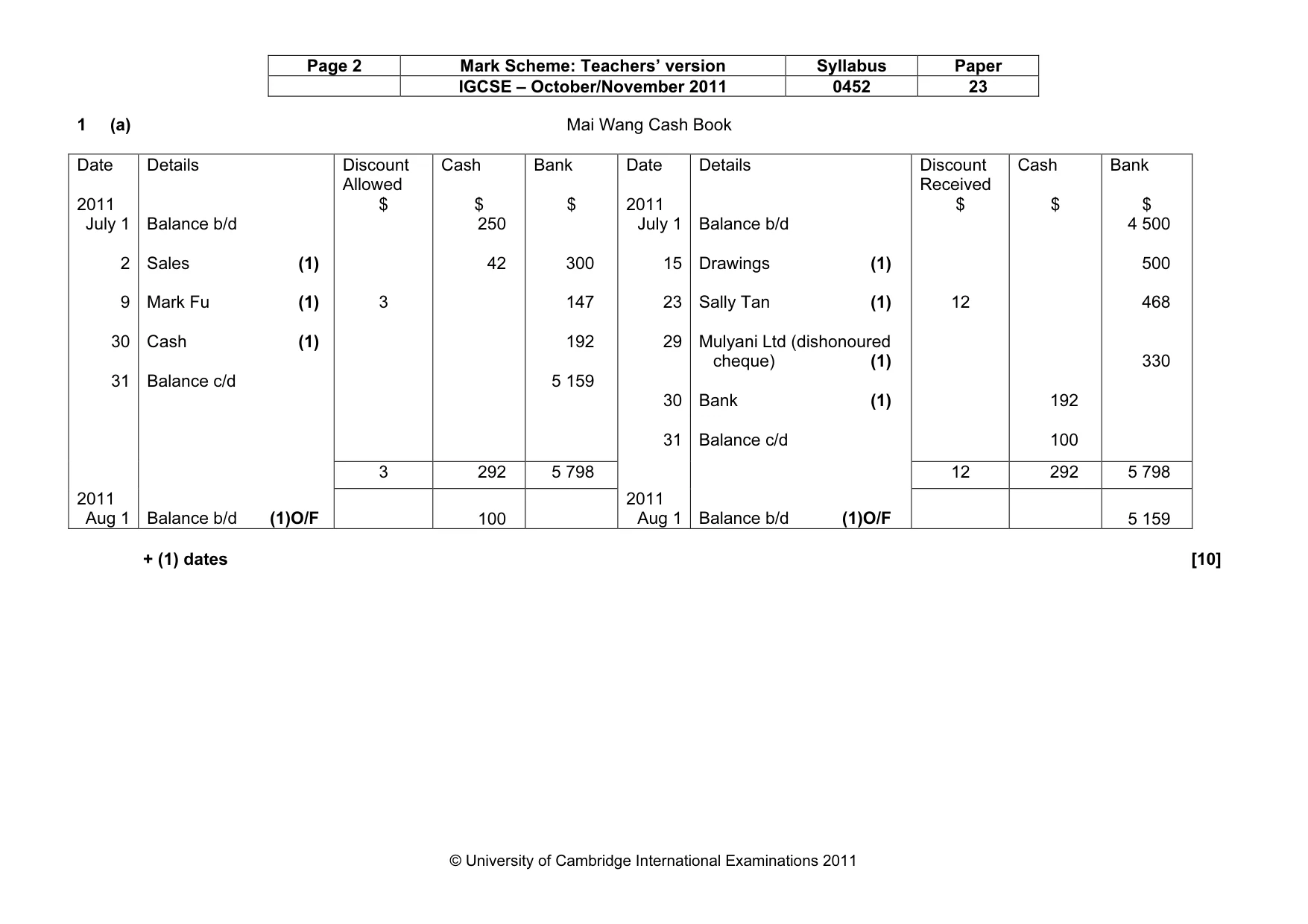
Page 2 Mark Scheme: Teachers’ version Syllabus Paper IGCSE – October/November 2011 0452 23 © University of Cambridge International Examinations 2011 1 (a) Mai Wang Cash Book Discount Allowed $ 3 Cash $ 250 42 Bank $ 300 147 192 5 159 Discount Received $ 12 Cash $ 192 100 Bank $ 4 500 500 468 330 3 292 5 798 12 292 5 798 Date 2011 July 1 2 9 30 31 2011 Aug 1 Details Balance b/d Sales (1) Mark Fu (1) Cash (1) Balance c/d Balance b/d (1)O/F 100 Date 2011 July 1 15 23 29 30 31 2011 Aug 1 Details Balance b/d Drawings (1) Sally Tan (1) Mulyani Ltd (dishonoured cheque) (1) Bank (1) Balance c/d Balance b/d (1)O/F 5 159 + (1) dates [10]
Mark scheme, page 3
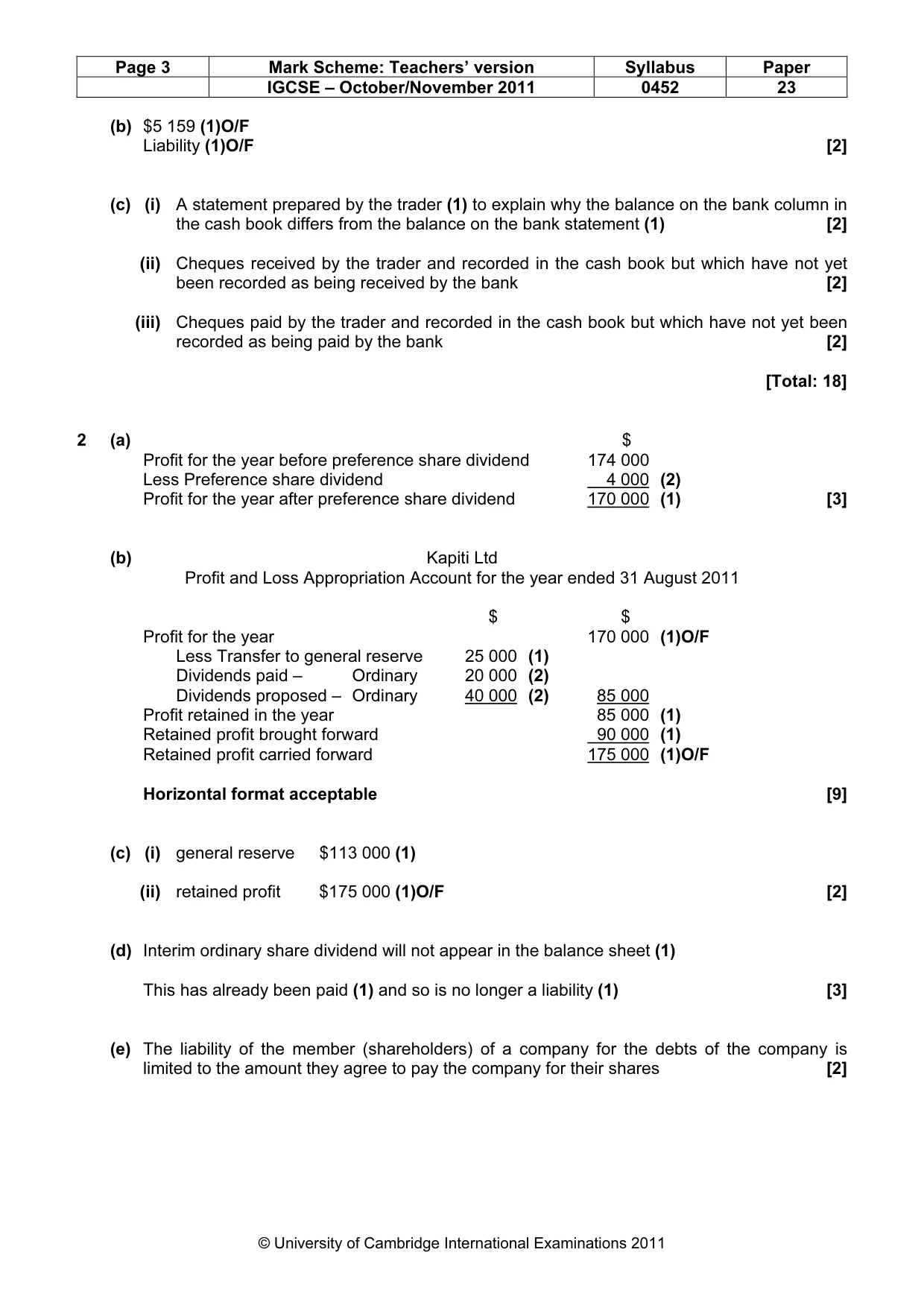
Page 3 Mark Scheme: Teachers’ version Syllabus Paper IGCSE – October/November 2011 0452 23 © University of Cambridge International Examinations 2011 (b) $5 159 (1)O/F Liability (1)O/F [2] (c) (i) A statement prepared by the trader (1) to explain why the balance on the bank column in the cash book differs from the balance on the bank statement (1) [2] (ii) Cheques received by the trader and recorded in the cash book but which have not yet been recorded as being received by the bank [2] (iii) Cheques paid by the trader and recorded in the cash book but which have not yet been recorded as being paid by the bank [2] [Total: 18] 2 (a) $ Profit for the year before preference share dividend 174 000 Less Preference share dividend 4 000 (2) Profit for the year after preference share dividend 170 000 (1) [3] (b) Kapiti Ltd Profit and Loss Appropriation Account for the year ended 31 August 2011 $ $ Profit for the year 170 000 (1)O/F Less Transfer to general reserve 25 000 (1) Dividends paid – Ordinary 20 000 (2) Dividends proposed – Ordinary 40 000 (2) 85 000 Profit retained in the year 85 000 (1) Retained profit brought forward 90 000 (1) Retained profit carried forward 175 000 (1)O/F Horizontal format acceptable [9] (c) (i) general reserve $113 000 (1) (ii) retained profit $175 000 (1)O/F [2] (d) Interim ordinary share dividend will not appear in the balance sheet (1) This has already been paid (1) and so is no longer a liability (1) [3] (e) The liability of the member (shareholders) of a company for the debts of the company is limited to the amount they agree to pay the company for their shares [2]
Mark scheme, page 4
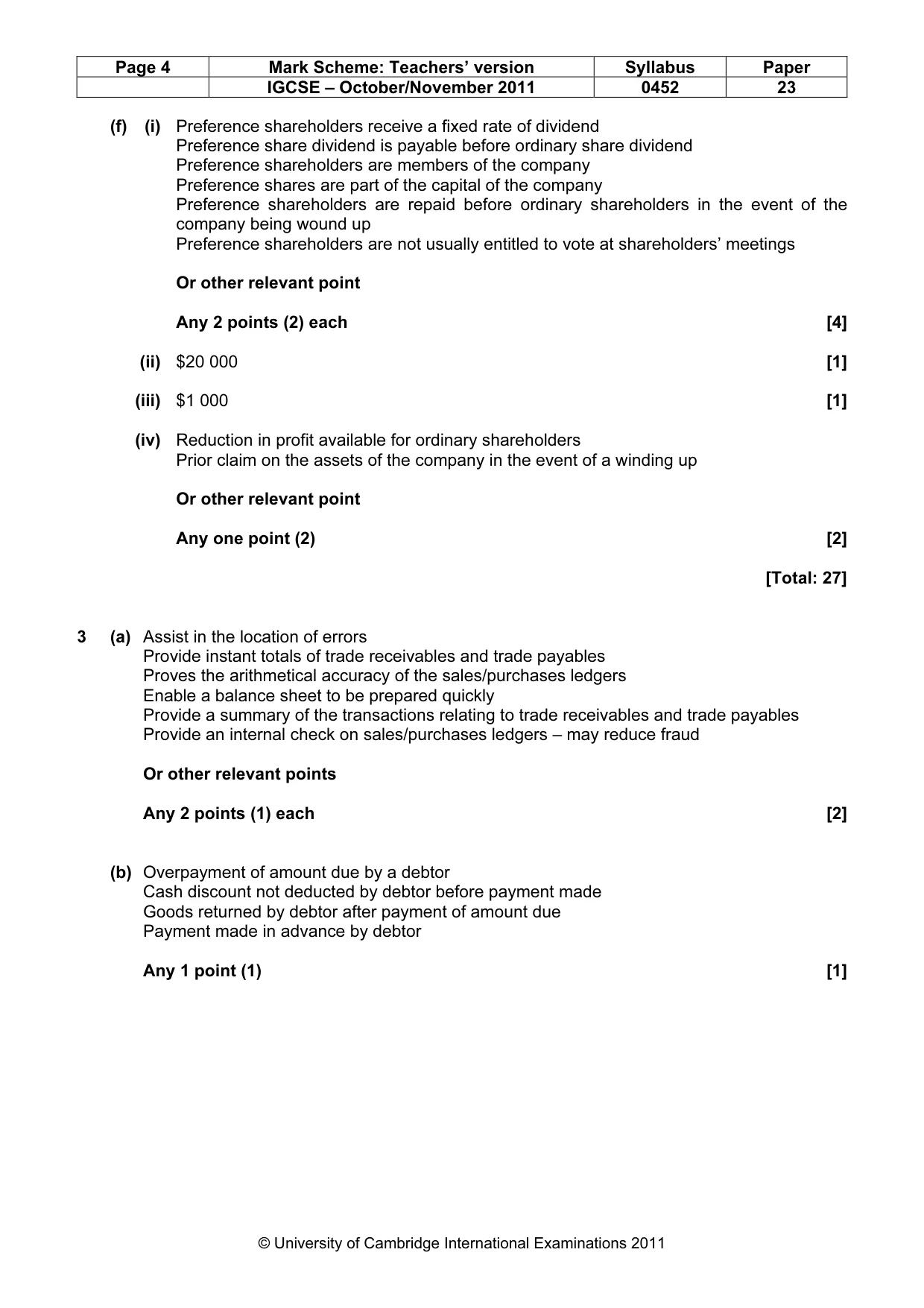
Page 4 Mark Scheme: Teachers’ version Syllabus Paper IGCSE – October/November 2011 0452 23 © University of Cambridge International Examinations 2011 (f) (i) Preference shareholders receive a fixed rate of dividend Preference share dividend is payable before ordinary share dividend Preference shareholders are members of the company Preference shares are part of the capital of the company Preference shareholders are repaid before ordinary shareholders in the event of the company being wound up Preference shareholders are not usually entitled to vote at shareholders’ meetings Or other relevant point Any 2 points (2) each [4] (ii) $20 000 [1] (iii) $1 000 [1] (iv) Reduction in profit available for ordinary shareholders Prior claim on the assets of the company in the event of a winding up Or other relevant point Any one point (2) [2] [Total: 27] 3 (a) Assist in the location of errors Provide instant totals of trade receivables and trade payables Proves the arithmetical accuracy of the sales/purchases ledgers Enable a balance sheet to be prepared quickly Provide a summary of the transactions relating to trade receivables and trade payables Provide an internal check on sales/purchases ledgers – may reduce fraud Or other relevant points Any 2 points (1) each [2] (b) Overpayment of amount due by a debtor Cash discount not deducted by debtor before payment made Goods returned by debtor after payment of amount due Payment made in advance by debtor Any 1 point (1) [1]
Mark scheme, page 5
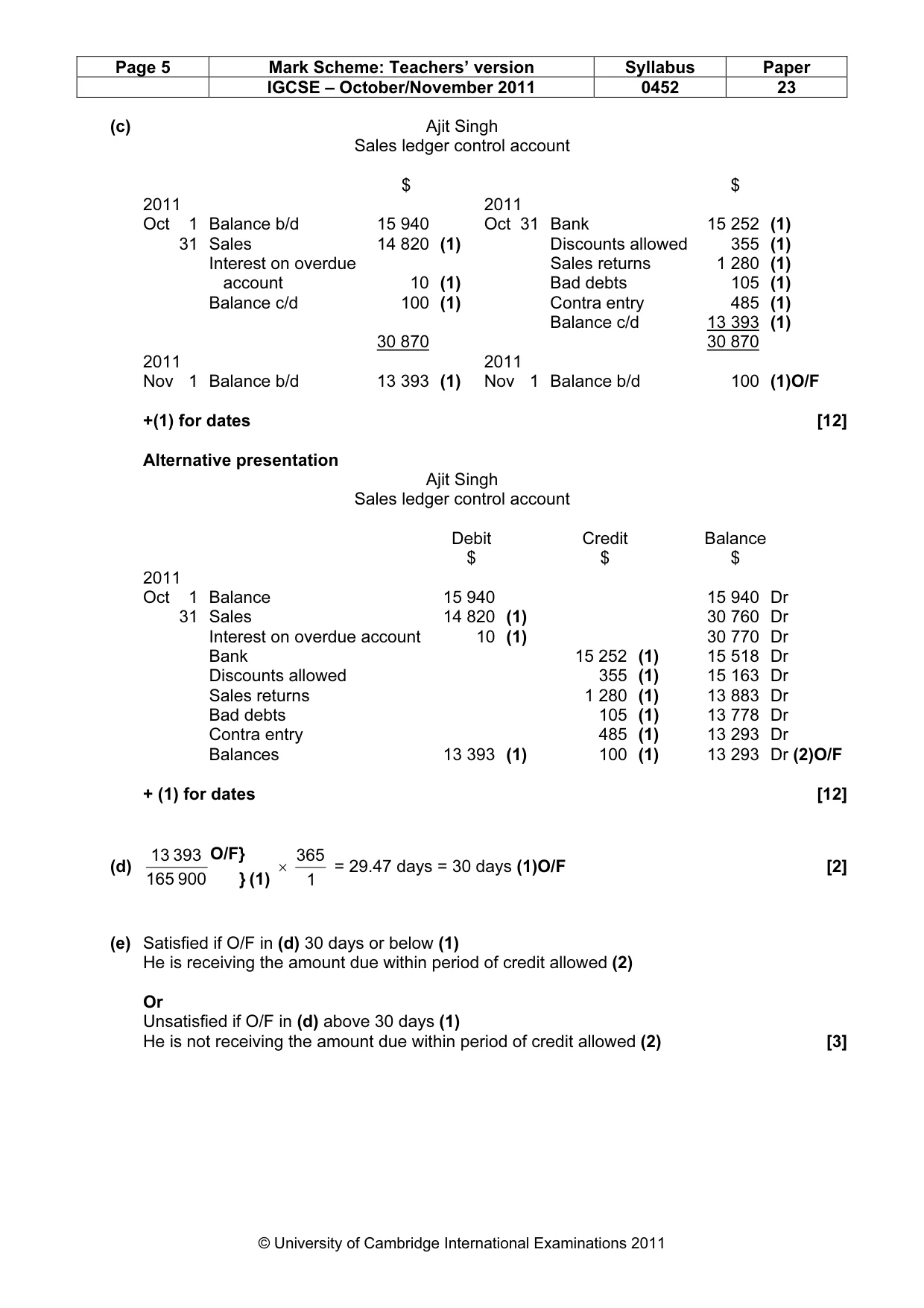
Page 5 Mark Scheme: Teachers’ version Syllabus Paper IGCSE – October/November 2011 0452 23 © University of Cambridge International Examinations 2011 (c) Ajit Singh Sales ledger control account $ $ 2011 2011 Oct 1 Balance b/d 15 940 Oct 31 Bank 15 252 (1) 31 Sales 14 820 (1) Discounts allowed 355 (1) Interest on overdue Sales returns 1 280 (1) account 10 (1) Bad debts 105 (1) Balance c/d 100 (1) Contra entry 485 (1) Balance c/d 13 393 (1) 30 870 30 870 2011 2011 Nov 1 Balance b/d 13 393 (1) Nov 1 Balance b/d 100 (1)O/F +(1) for dates [12] Alternative presentation Ajit Singh Sales ledger control account Debit Credit Balance $ $ $ 2011 Oct 1 Balance 15 940 15 940 Dr 31 Sales 14 820 (1) 30 760 Dr Interest on overdue account 10 (1) 30 770 Dr Bank 15 252 (1) 15 518 Dr Discounts allowed 355 (1) 15 163 Dr Sales returns 1 280 (1) 13 883 Dr Bad debts 105 (1) 13 778 Dr Contra entry 485 (1) 13 293 Dr Balances 13 393 (1) 100 (1) 13 293 Dr (2)O/F + (1) for dates [12] (d) (1) } O/F} 900 165 393 13 × 1 365 = 29.47 days = 30 days (1)O/F [2] (e) Satisfied if O/F in (d) 30 days or below (1) He is receiving the amount due within period of credit allowed (2) Or Unsatisfied if O/F in (d) above 30 days (1) He is not receiving the amount due within period of credit allowed (2) [3]
Mark scheme, page 6
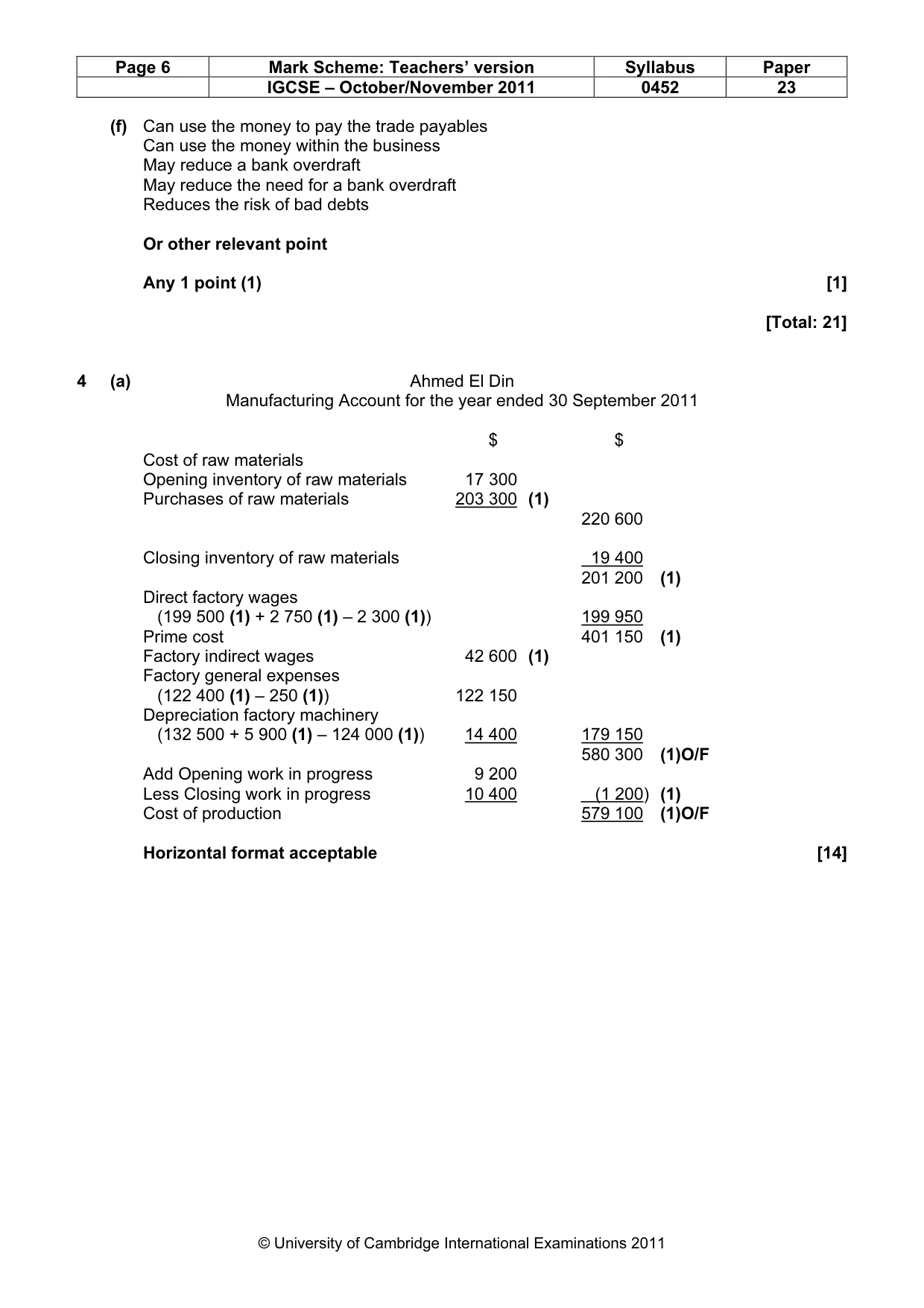
Page 6 Mark Scheme: Teachers’ version Syllabus Paper IGCSE – October/November 2011 0452 23 © University of Cambridge International Examinations 2011 (f) Can use the money to pay the trade payables Can use the money within the business May reduce a bank overdraft May reduce the need for a bank overdraft Reduces the risk of bad debts Or other relevant point Any 1 point (1) [1] [Total: 21] 4 (a) Ahmed El Din Manufacturing Account for the year ended 30 September 2011 $ $ Cost of raw materials Opening inventory of raw materials 17 300 Purchases of raw materials 203 300 (1) 220 600 Closing inventory of raw materials 19 400 201 200 (1) Direct factory wages (199 500 (1) + 2 750 (1) – 2 300 (1)) 199 950 Prime cost 401 150 (1) Factory indirect wages 42 600 (1) Factory general expenses (122 400 (1) – 250 (1)) 122 150 Depreciation factory machinery (132 500 + 5 900 (1) – 124 000 (1)) 14 400 179 150 580 300 (1)O/F Add Opening work in progress 9 200 Less Closing work in progress 10 400 (1 200) (1) Cost of production 579 100 (1)O/F Horizontal format acceptable [14]
Mark scheme, page 7
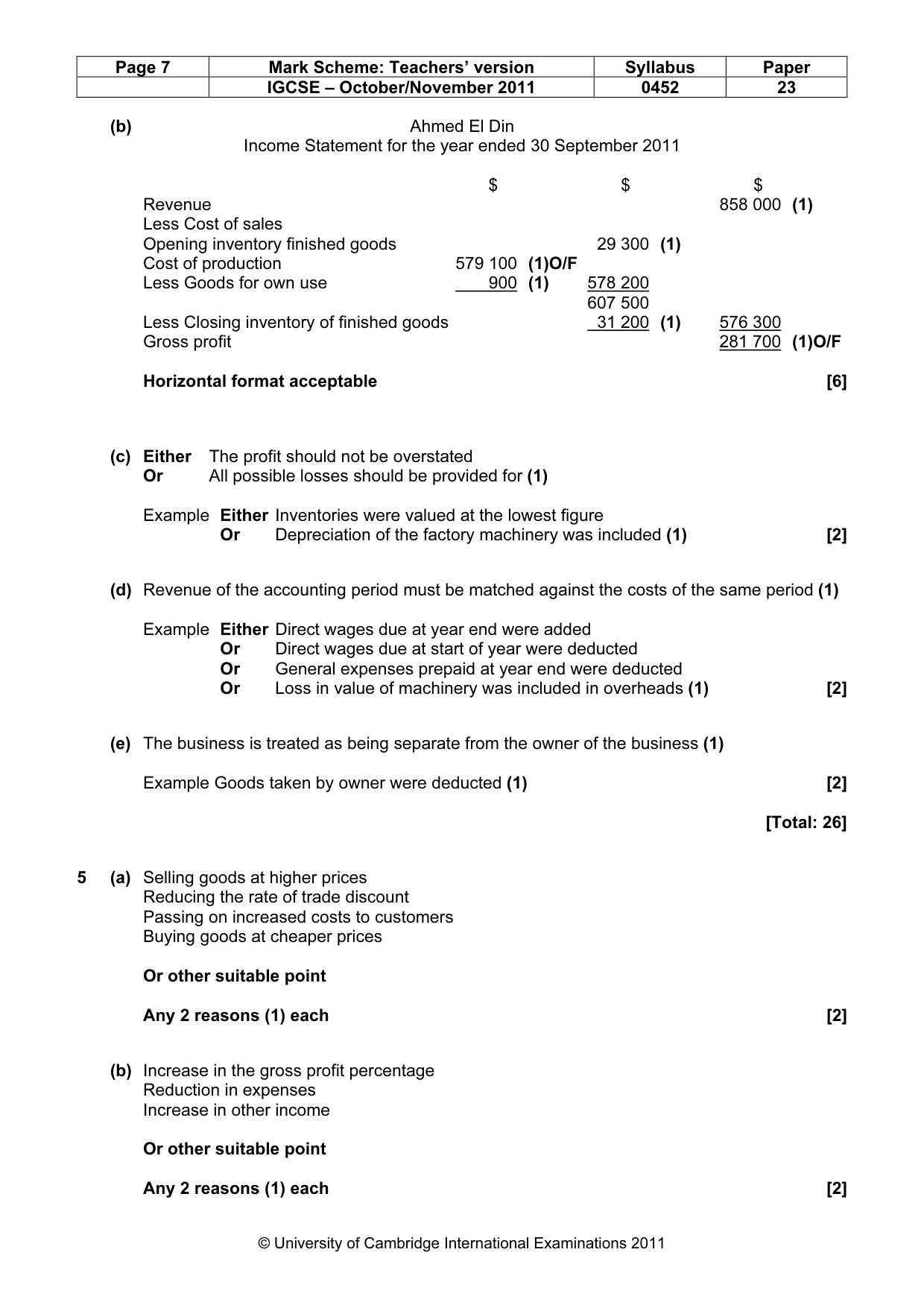
Page 7 Mark Scheme: Teachers’ version Syllabus Paper IGCSE – October/November 2011 0452 23 © University of Cambridge International Examinations 2011 (b) Ahmed El Din Income Statement for the year ended 30 September 2011 $ $ $ Revenue 858 000 (1) Less Cost of sales Opening inventory finished goods 29 300 (1) Cost of production 579 100 (1)O/F Less Goods for own use 900 (1) 578 200 607 500 Less Closing inventory of finished goods 31 200 (1) 576 300 Gross profit 281 700 (1)O/F Horizontal format acceptable [6] (c) Either The profit should not be overstated Or All possible losses should be provided for (1) Example Either Inventories were valued at the lowest figure Or Depreciation of the factory machinery was included (1) [2] (d) Revenue of the accounting period must be matched against the costs of the same period (1) Example Either Direct wages due at year end were added Or Direct wages due at start of year were deducted Or General expenses prepaid at year end were deducted Or Loss in value of machinery was included in overheads (1) [2] (e) The business is treated as being separate from the owner of the business (1) Example Goods taken by owner were deducted (1) [2] [Total: 26] 5 (a) Selling goods at higher prices Reducing the rate of trade discount Passing on increased costs to customers Buying goods at cheaper prices Or other suitable point Any 2 reasons (1) each [2] (b) Increase in the gross profit percentage Reduction in expenses Increase in other income Or other suitable point Any 2 reasons (1) each [2]
Mark scheme, page 8
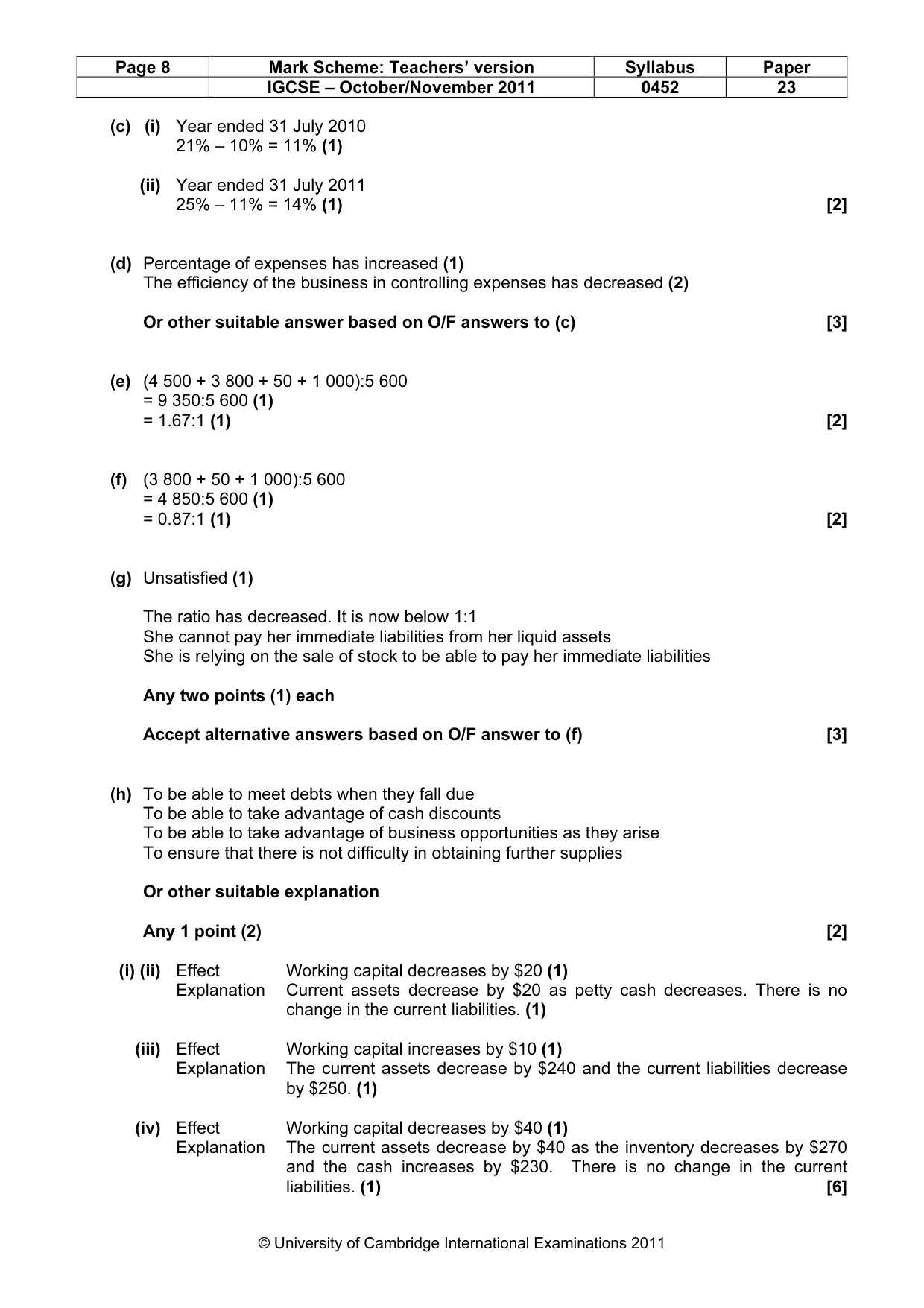
Page 8 Mark Scheme: Teachers’ version Syllabus Paper IGCSE – October/November 2011 0452 23 © University of Cambridge International Examinations 2011 (c) (i) Year ended 31 July 2010 21% – 10% = 11% (1) (ii) Year ended 31 July 2011 25% – 11% = 14% (1) [2] (d) Percentage of expenses has increased (1) The efficiency of the business in controlling expenses has decreased (2) Or other suitable answer based on O/F answers to (c) [3] (e) (4 500 + 3 800 + 50 + 1 000):5 600 = 9 350:5 600 (1) = 1.67:1 (1) [2] (f) (3 800 + 50 + 1 000):5 600 = 4 850:5 600 (1) = 0.87:1 (1) [2] (g) Unsatisfied (1) The ratio has decreased. It is now below 1:1 She cannot pay her immediate liabilities from her liquid assets She is relying on the sale of stock to be able to pay her immediate liabilities Any two points (1) each Accept alternative answers based on O/F answer to (f) [3] (h) To be able to meet debts when they fall due To be able to take advantage of cash discounts To be able to take advantage of business opportunities as they arise To ensure that there is not difficulty in obtaining further supplies Or other suitable explanation Any 1 point (2) [2] (i) (ii) Effect Working capital decreases by $20 (1) Explanation Current assets decrease by $20 as petty cash decreases. There is no change in the current liabilities. (1) (iii) Effect Working capital increases by $10 (1) Explanation The current assets decrease by $240 and the current liabilities decrease by $250. (1) (iv) Effect Working capital decreases by $40 (1) Explanation The current assets decrease by $40 as the inventory decreases by $270 and the cash increases by $230. There is no change in the current liabilities. (1) [6]
Mark scheme, page 9
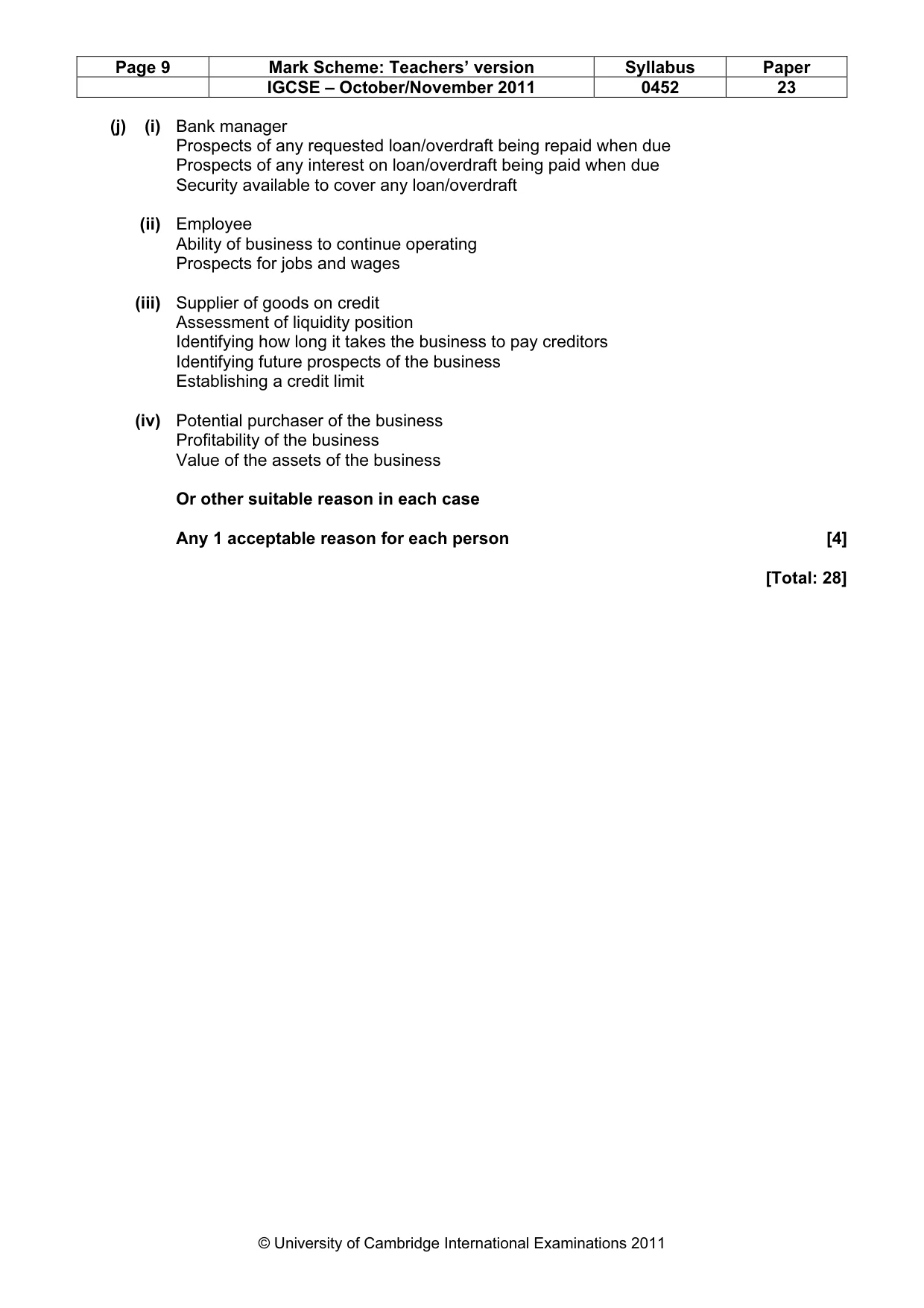
Page 9 Mark Scheme: Teachers’ version Syllabus Paper IGCSE – October/November 2011 0452 23 © University of Cambridge International Examinations 2011 (j) (i) Bank manager Prospects of any requested loan/overdraft being repaid when due Prospects of any interest on loan/overdraft being paid when due Security available to cover any loan/overdraft (ii) Employee Ability of business to continue operating Prospects for jobs and wages (iii) Supplier of goods on credit Assessment of liquidity position Identifying how long it takes the business to pay creditors Identifying future prospects of the business Establishing a credit limit (iv) Potential purchaser of the business Profitability of the business Value of the assets of the business Or other suitable reason in each case Any 1 acceptable reason for each person [4] [Total: 28]
What you needed in this session
Cambridge’s own grade thresholds for 2011 Oct/Nov, Paper 2 · Variant 3. A higher threshold means an easier paper — the bar moves with how the cohort did.