Cambridge IGCSE Accounting 0452 — 2011 May/June Paper 2 · Variant 3
0452/23/M/J/11 · 120 marks · ≈135 min
The question paper and its mark scheme, free to read here and free to download. This is Cambridge’s own paper, exactly as it was sat.
Question paper20 pages
Mark scheme9 pages
Answers below. Sit the paper first if you are practising.
Paper as text
Question paper, page 1
This document consists of 17 printed pages and 3 blank pages. IB11 06_0452_23/FP © UCLES 2011 [Turn over *4745172189* For Examiner's Use 1 2 3 4 5 6 Total UNIVERSITY OF CAMBRIDGE INTERNATIONAL EXAMINATIONS International General Certificate of Secondary Education ACCOUNTING 0452/23 Paper 2 May/June 2011 1 hour 45 minutes Candidates answer on the Question Paper. No Additional Materials are required. READ THESE INSTRUCTIONS FIRST Write your Centre number, candidate number and name on all the work you hand in. Write in dark blue or black pen. You may use a soft pencil for any diagrams or graphs. Do not use staples, paper clips, highlighters, glue or correction fluid. DO NOT WRITE IN ANY BARCODES. Answer all questions. You may use a calculator. Where layouts are to be completed, you may not need all the lines for your answer. The businesses mentioned in this Question Paper are fictitious. At the end of the examination, fasten all your work securely together. The number of marks is given in brackets [ ] at the end of each question or part question.
Question paper, page 2
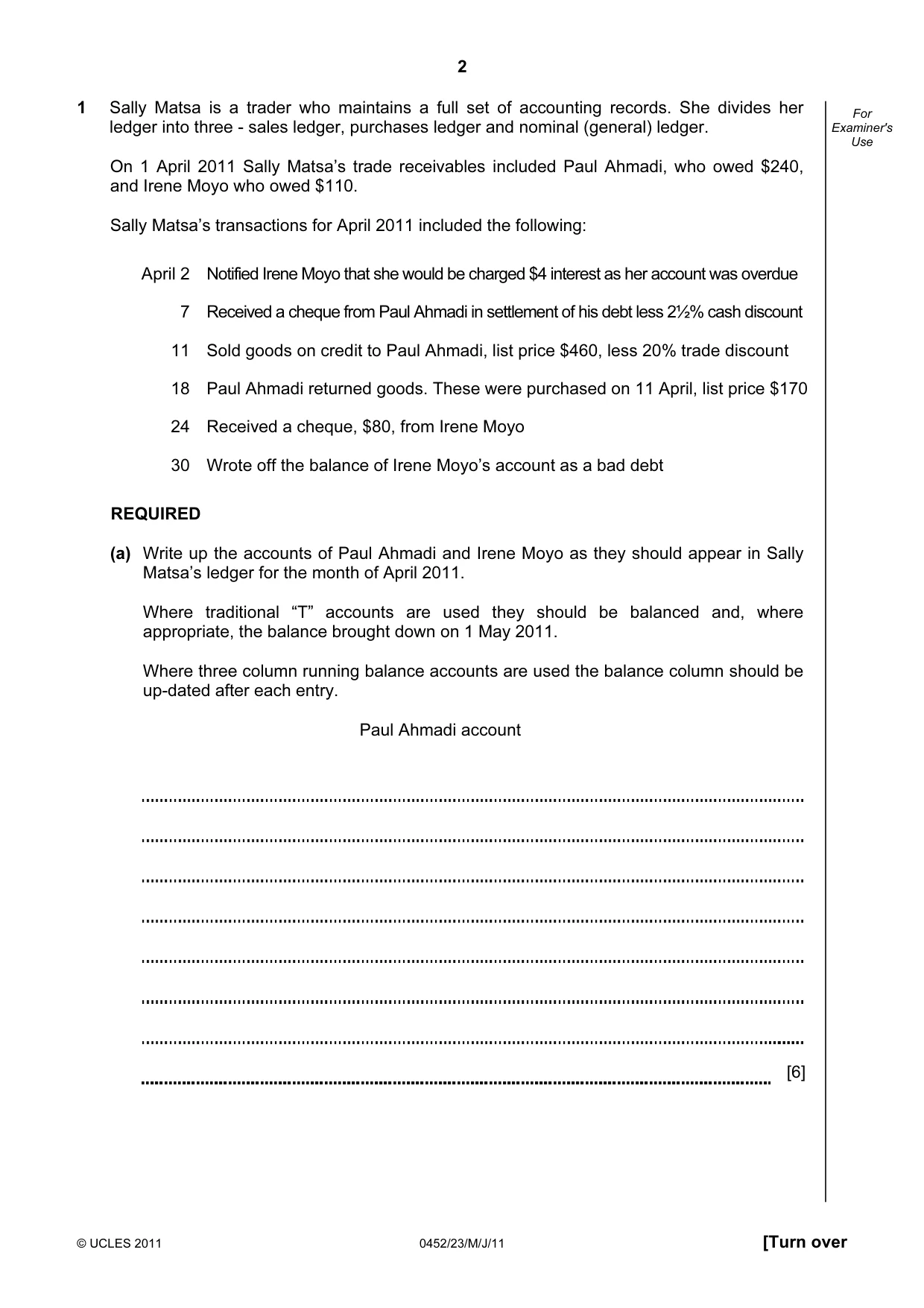
2 © UCLES 2011 0452/23/M/J/11 [Turn over For Examiner's Use 1 Sally Matsa is a trader who maintains a full set of accounting records. She divides her ledger into three - sales ledger, purchases ledger and nominal (general) ledger. On 1 April 2011 Sally Matsa’s trade receivables included Paul Ahmadi, who owed $240, and Irene Moyo who owed $110. Sally Matsa’s transactions for April 2011 included the following: April 2 Notified Irene Moyo that she would be charged $4 interest as her account was overdue 7 Received a cheque from Paul Ahmadi in settlement of his debt less 2½% cash discount 11 Sold goods on credit to Paul Ahmadi, list price $460, less 20% trade discount 18 Paul Ahmadi returned goods. These were purchased on 11 April, list price $170 24 Received a cheque, $80, from Irene Moyo 30 Wrote off the balance of Irene Moyo’s account as a bad debt REQUIRED (a) Write up the accounts of Paul Ahmadi and Irene Moyo as they should appear in Sally Matsa’s ledger for the month of April 2011. Where traditional “T” accounts are used they should be balanced and, where appropriate, the balance brought down on 1 May 2011. Where three column running balance accounts are used the balance column should be up-dated after each entry. Paul Ahmadi account [6]
Question paper, page 3
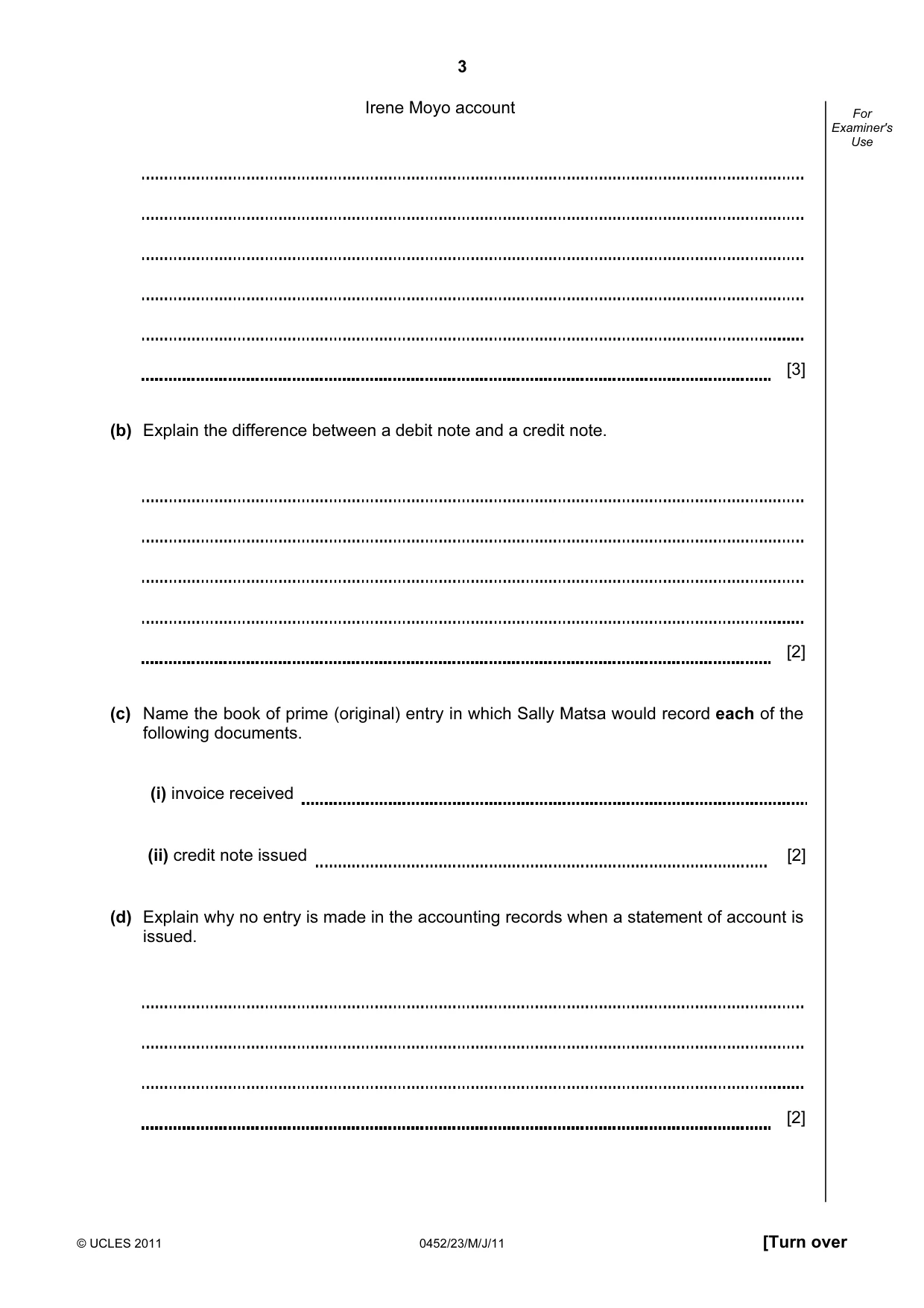
3 © UCLES 2011 0452/23/M/J/11 [Turn over For Examiner's Use Irene Moyo account [3] (b) Explain the difference between a debit note and a credit note. [2] (c) Name the book of prime (original) entry in which Sally Matsa would record each of the following documents. (i) invoice received (ii) credit note issued [2] (d) Explain why no entry is made in the accounting records when a statement of account is issued. [2]
Question paper, page 4
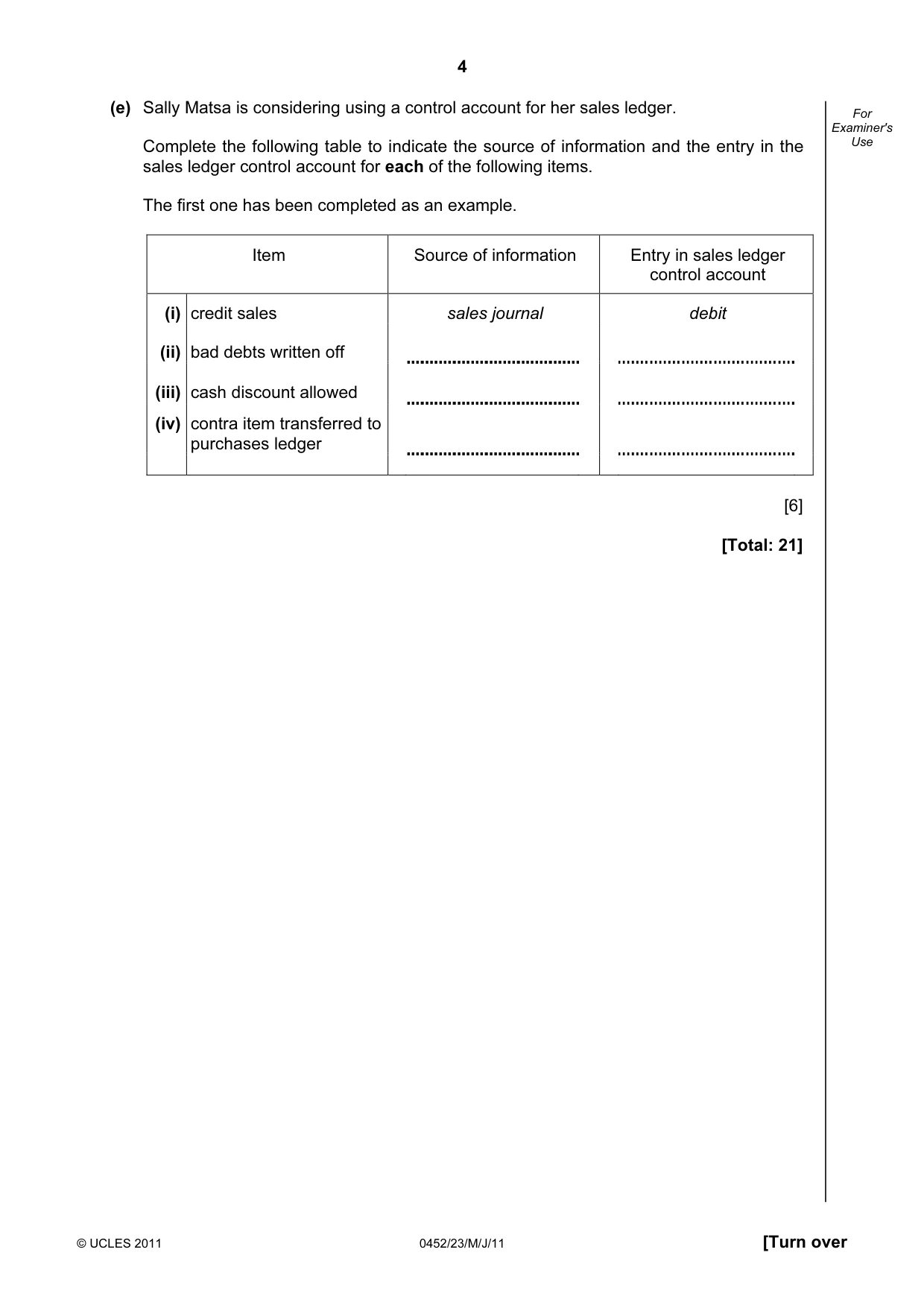
4 © UCLES 2011 0452/23/M/J/11 [Turn over For Examiner's Use (e) Sally Matsa is considering using a control account for her sales ledger. Complete the following table to indicate the source of information and the entry in the sales ledger control account for each of the following items. The first one has been completed as an example. Item Source of information Entry in sales ledger control account (i) credit sales sales journal debit (ii) bad debts written off (iii) cash discount allowed (iv) contra item transferred to purchases ledger [6] [Total: 21]
Question paper, page 5
5 © UCLES 2011 0452/23/M/J/11 [Turn over For Examiner's Use BLANK PAGE Question 2 is on the next page.
Question paper, page 6
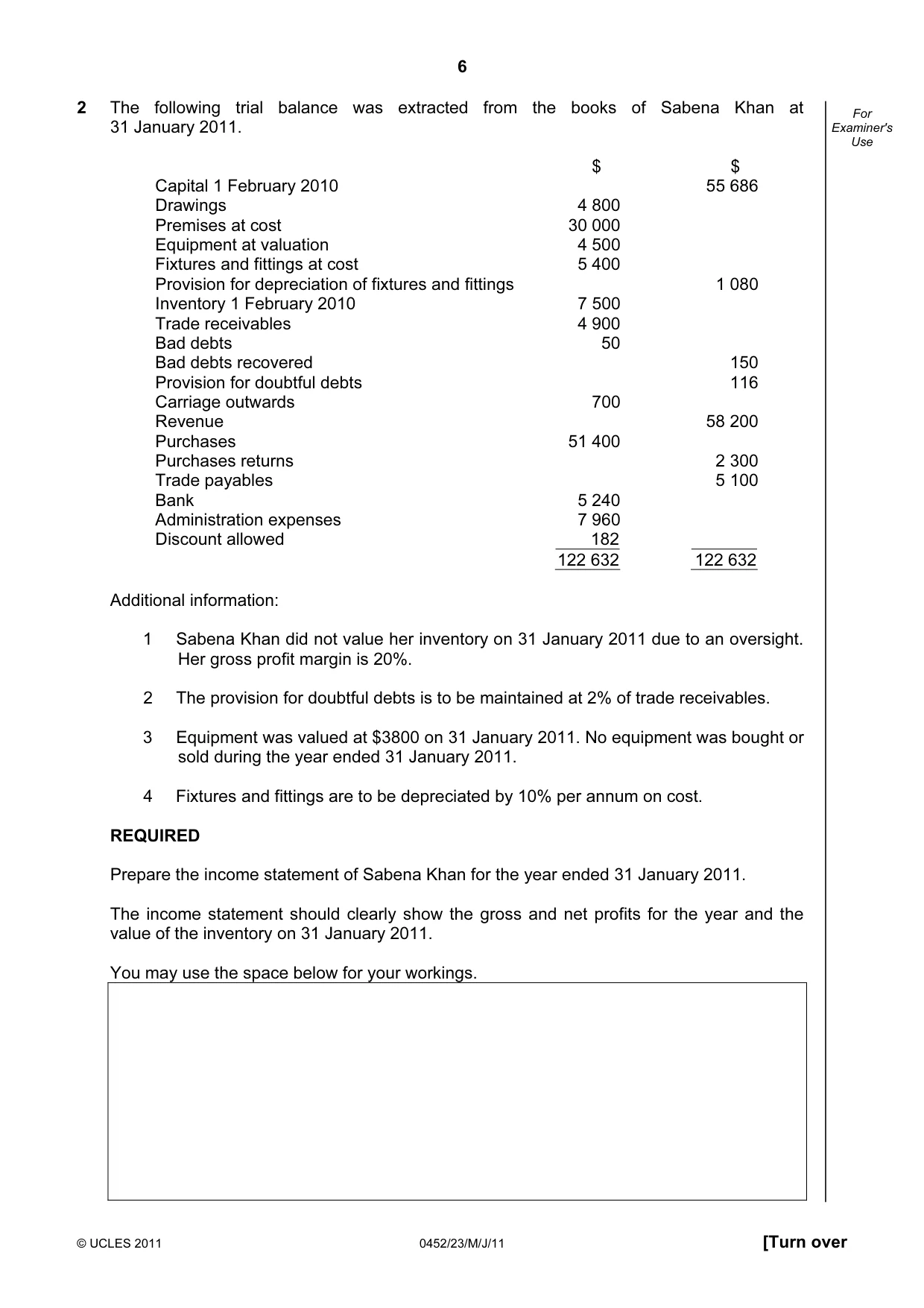
6 © UCLES 2011 0452/23/M/J/11 [Turn over For Examiner's Use 2 The following trial balance was extracted from the books of Sabena Khan at 31 January 2011. $ $ Capital 1 February 2010 55 686 Drawings 4 800 Premises at cost 30 000 Equipment at valuation 4 500 Fixtures and fittings at cost 5 400 Provision for depreciation of fixtures and fittings 1 080 Inventory 1 February 2010 7 500 Trade receivables 4 900 Bad debts 50 Bad debts recovered 150 Provision for doubtful debts 116 Carriage outwards 700 Revenue 58 200 Purchases 51 400 Purchases returns 2 300 Trade payables 5 100 Bank 5 240 Administration expenses 7 960 Discount allowed 182 122 632 122 632 Additional information: 1 Sabena Khan did not value her inventory on 31 January 2011 due to an oversight. Her gross profit margin is 20%. 2 The provision for doubtful debts is to be maintained at 2% of trade receivables. 3 Equipment was valued at $3800 on 31 January 2011. No equipment was bought or sold during the year ended 31 January 2011. 4 Fixtures and fittings are to be depreciated by 10% per annum on cost. REQUIRED Prepare the income statement of Sabena Khan for the year ended 31 January 2011. The income statement should clearly show the gross and net profits for the year and the value of the inventory on 31 January 2011. You may use the space below for your workings.
Question paper, page 7
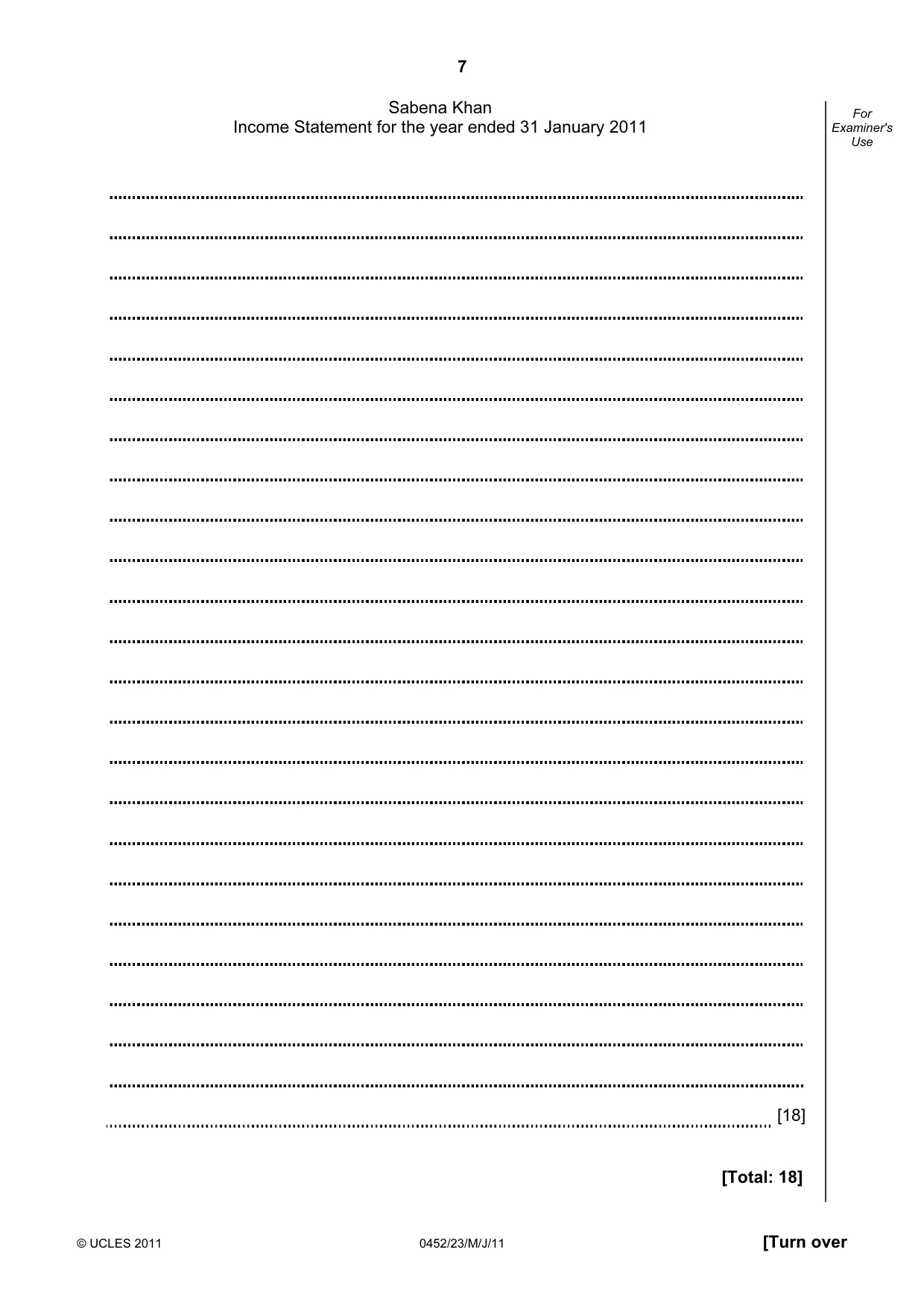
7 © UCLES 2011 0452/23/M/J/11 [Turn over For Examiner's Use Sabena Khan Income Statement for the year ended 31 January 2011 [18] [Total: 18]
Question paper, page 8
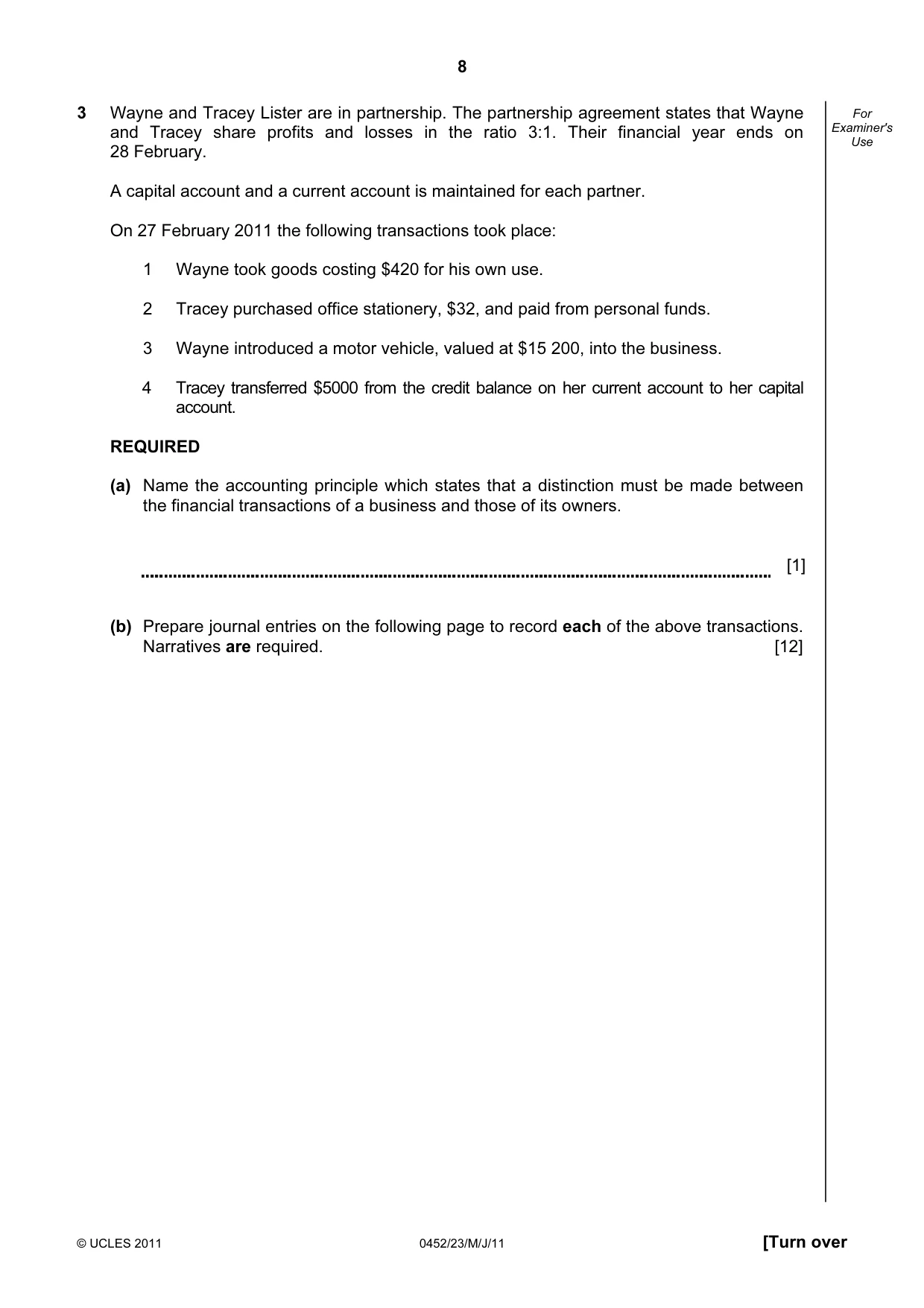
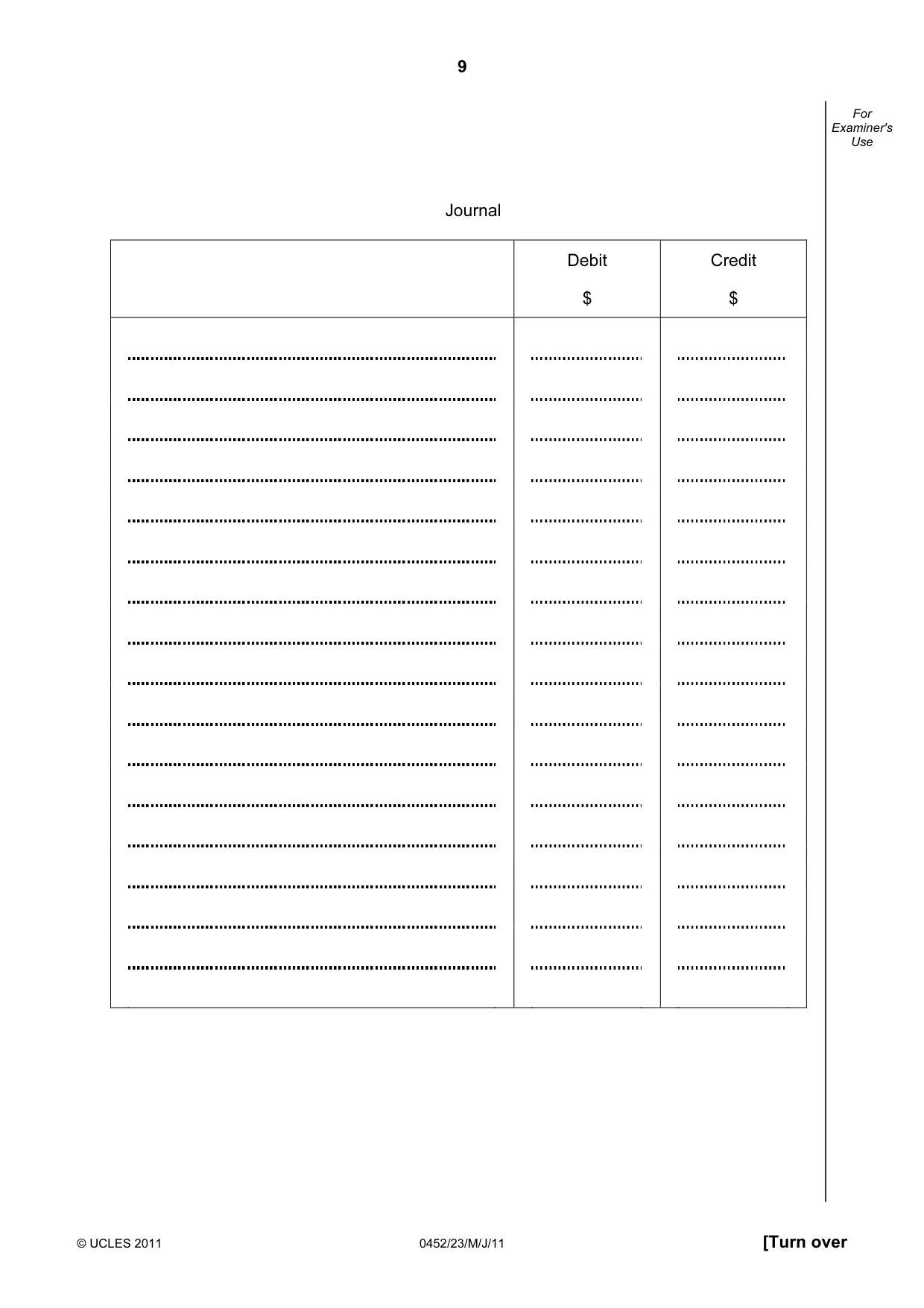
8 © UCLES 2011 0452/23/M/J/11 [Turn over For Examiner's Use 3 Wayne and Tracey Lister are in partnership. The partnership agreement states that Wayne and Tracey share profits and losses in the ratio 3:1. Their financial year ends on 28 February. A capital account and a current account is maintained for each partner. On 27 February 2011 the following transactions took place: 1 Wayne took goods costing $420 for his own use. 2 Tracey purchased office stationery, $32, and paid from personal funds. 3 Wayne introduced a motor vehicle, valued at $15 200, into the business. 4 Tracey transferred $5000 from the credit balance on her current account to her capital account. REQUIRED (a) Name the accounting principle which states that a distinction must be made between the financial transactions of a business and those of its owners. [1] (b) Prepare journal entries on the following page to record each of the above transactions. Narratives are required. [12]
Question paper, page 9
9 © UCLES 2011 0452/23/M/J/11 [Turn over For Examiner's Use Journal Debit $ Credit $
Question paper, page 10
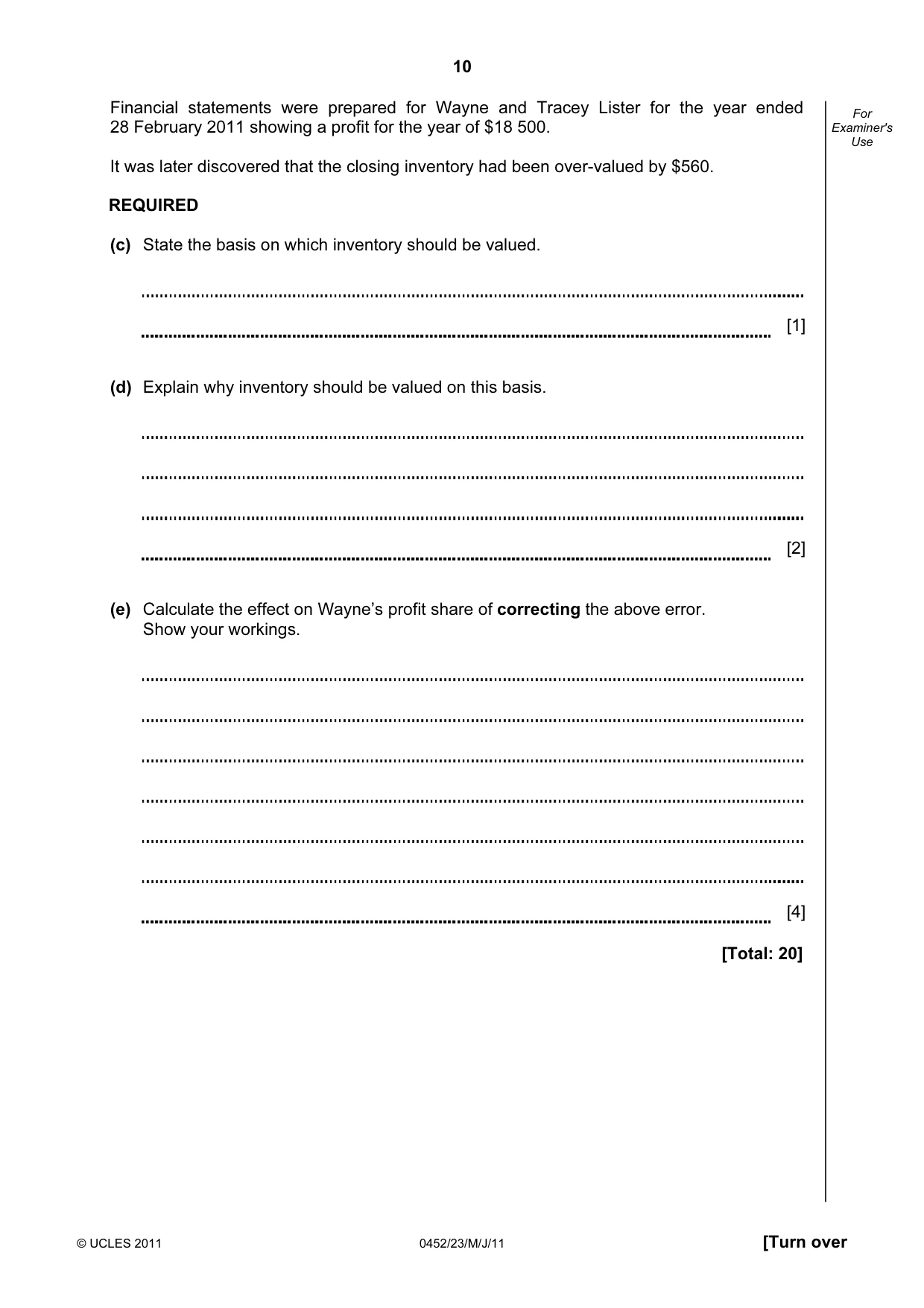
10 © UCLES 2011 0452/23/M/J/11 [Turn over For Examiner's Use Financial statements were prepared for Wayne and Tracey Lister for the year ended 28 February 2011 showing a profit for the year of $18 500. It was later discovered that the closing inventory had been over-valued by $560. REQUIRED (c) State the basis on which inventory should be valued. [1] (d) Explain why inventory should be valued on this basis. [2] (e) Calculate the effect on Wayne’s profit share of correcting the above error. Show your workings. [4] [Total: 20]
Question paper, page 11
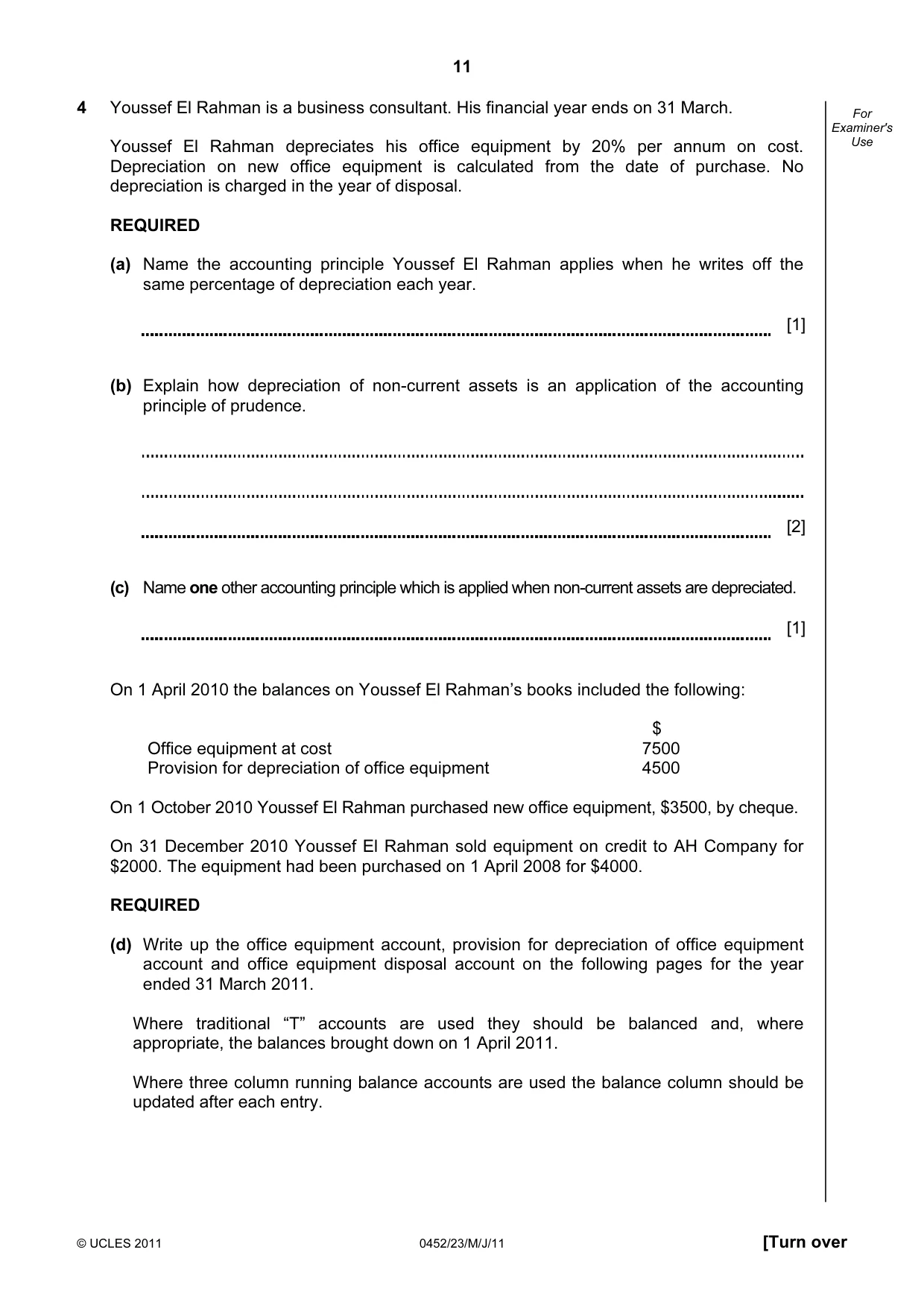
11 © UCLES 2011 0452/23/M/J/11 [Turn over For Examiner's Use 4 Youssef El Rahman is a business consultant. His financial year ends on 31 March. Youssef El Rahman depreciates his office equipment by 20% per annum on cost. Depreciation on new office equipment is calculated from the date of purchase. No depreciation is charged in the year of disposal. REQUIRED (a) Name the accounting principle Youssef El Rahman applies when he writes off the same percentage of depreciation each year. [1] (b) Explain how depreciation of non-current assets is an application of the accounting principle of prudence. [2] (c) Name one other accounting principle which is applied when non-current assets are depreciated. [1] On 1 April 2010 the balances on Youssef El Rahman’s books included the following: $ Office equipment at cost 7500 Provision for depreciation of office equipment 4500 On 1 October 2010 Youssef El Rahman purchased new office equipment, $3500, by cheque. On 31 December 2010 Youssef El Rahman sold equipment on credit to AH Company for $2000. The equipment had been purchased on 1 April 2008 for $4000. REQUIRED (d) Write up the office equipment account, provision for depreciation of office equipment account and office equipment disposal account on the following pages for the year ended 31 March 2011. Where traditional “T” accounts are used they should be balanced and, where appropriate, the balances brought down on 1 April 2011. Where three column running balance accounts are used the balance column should be updated after each entry.
Question paper, page 12
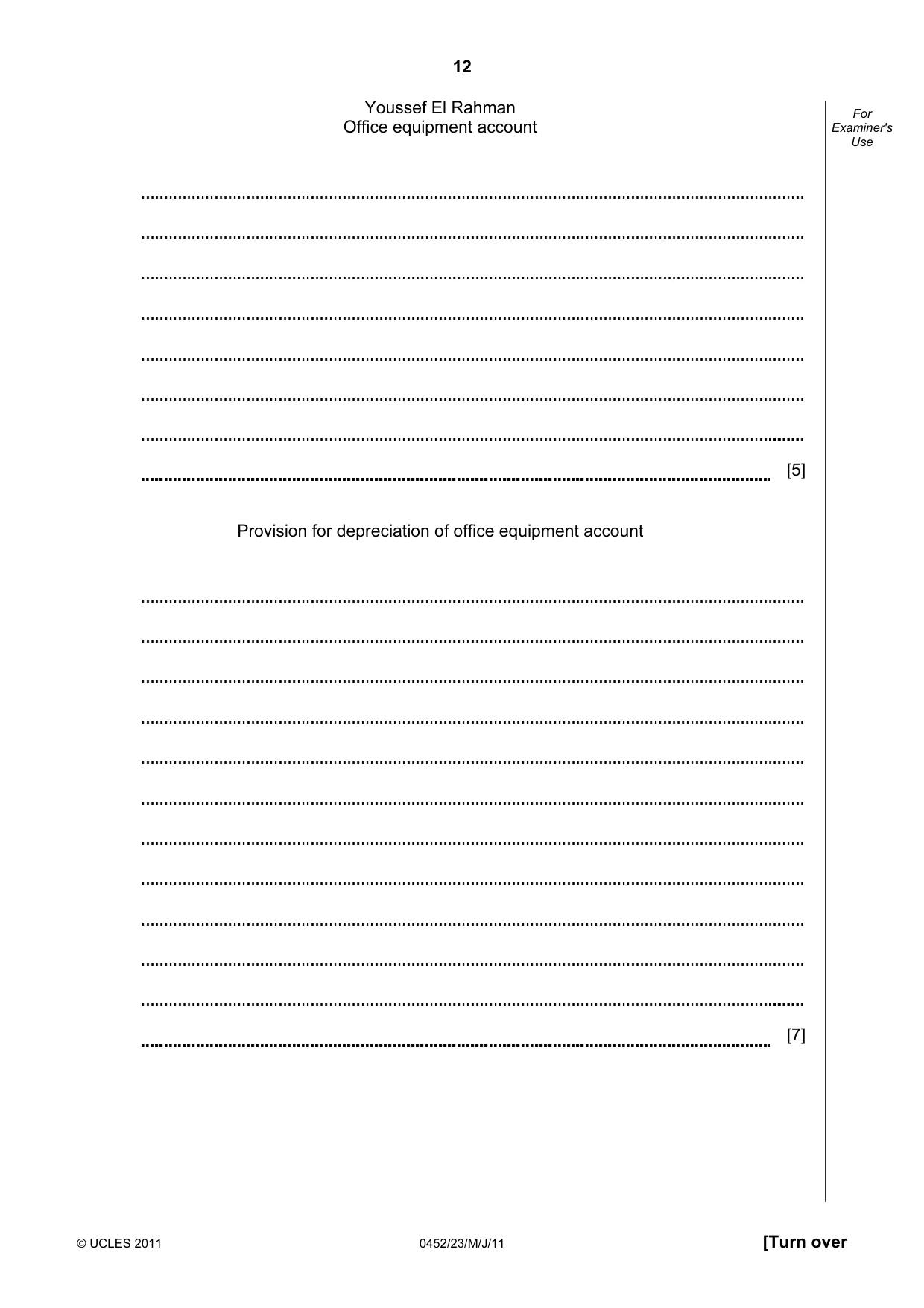
12 © UCLES 2011 0452/23/M/J/11 [Turn over For Examiner's Use Youssef El Rahman Office equipment account [5] Provision for depreciation of office equipment account [7]
Question paper, page 13
13 © UCLES 2011 0452/23/M/J/11 [Turn over For Examiner's Use Office equipment disposal account [4] [Total: 20]
Question paper, page 14
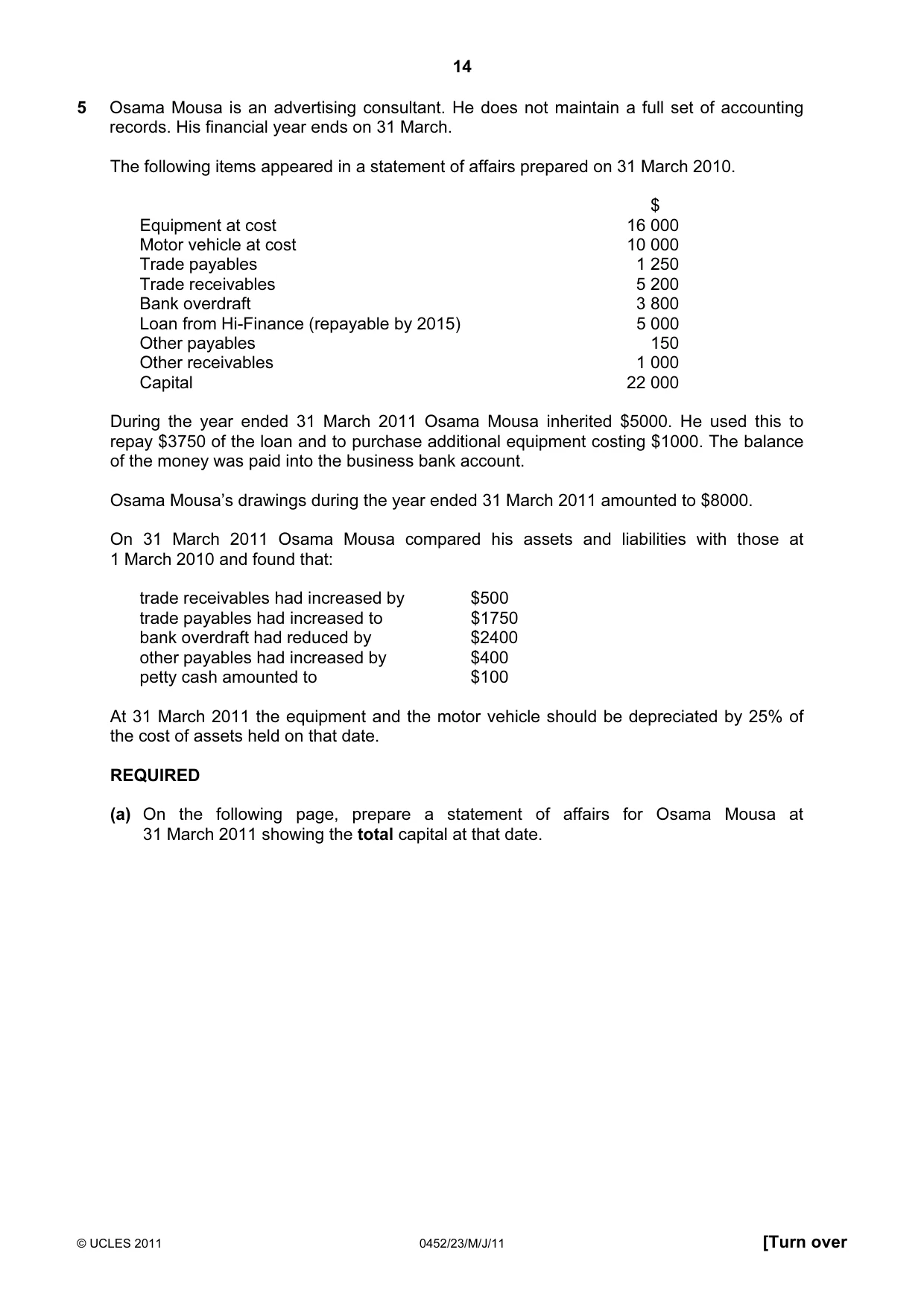
14 © UCLES 2011 0452/23/M/J/11 [Turn over 5 Osama Mousa is an advertising consultant. He does not maintain a full set of accounting records. His financial year ends on 31 March. The following items appeared in a statement of affairs prepared on 31 March 2010. $ Equipment at cost 16 000 Motor vehicle at cost 10 000 Trade payables 1 250 Trade receivables 5 200 Bank overdraft 3 800 Loan from Hi-Finance (repayable by 2015) 5 000 Other payables 150 Other receivables 1 000 Capital 22 000 During the year ended 31 March 2011 Osama Mousa inherited $5000. He used this to repay $3750 of the loan and to purchase additional equipment costing $1000. The balance of the money was paid into the business bank account. Osama Mousa’s drawings during the year ended 31 March 2011 amounted to $8000. On 31 March 2011 Osama Mousa compared his assets and liabilities with those at 1 March 2010 and found that: trade receivables had increased by $500 trade payables had increased to $1750 bank overdraft had reduced by $2400 other payables had increased by $400 petty cash amounted to $100 At 31 March 2011 the equipment and the motor vehicle should be depreciated by 25% of the cost of assets held on that date. REQUIRED (a) On the following page, prepare a statement of affairs for Osama Mousa at 31 March 2011 showing the total capital at that date.
Question paper, page 15
15 © UCLES 2011 0452/23/M/J/11 [Turn over Osama Mousa Statement of Affairs at 31 March 2011 [14]
Question paper, page 16
16 © UCLES 2011 0452/23/M/J/11 [Turn over For Examiner's Use (b) Using the capital you calculated in (a) and the information provided, calculate Osama Mousa’s profit or loss for the year ended 31 March 2011. Your answer may be in the form of a calculation or a ledger account. [6] [Total: 20]
Question paper, page 17
17 © UCLES 2011 0452/23/M/J/11 [Turn over For Examiner's Use BLANK PAGE Question 6 is on the next page.
Question paper, page 18
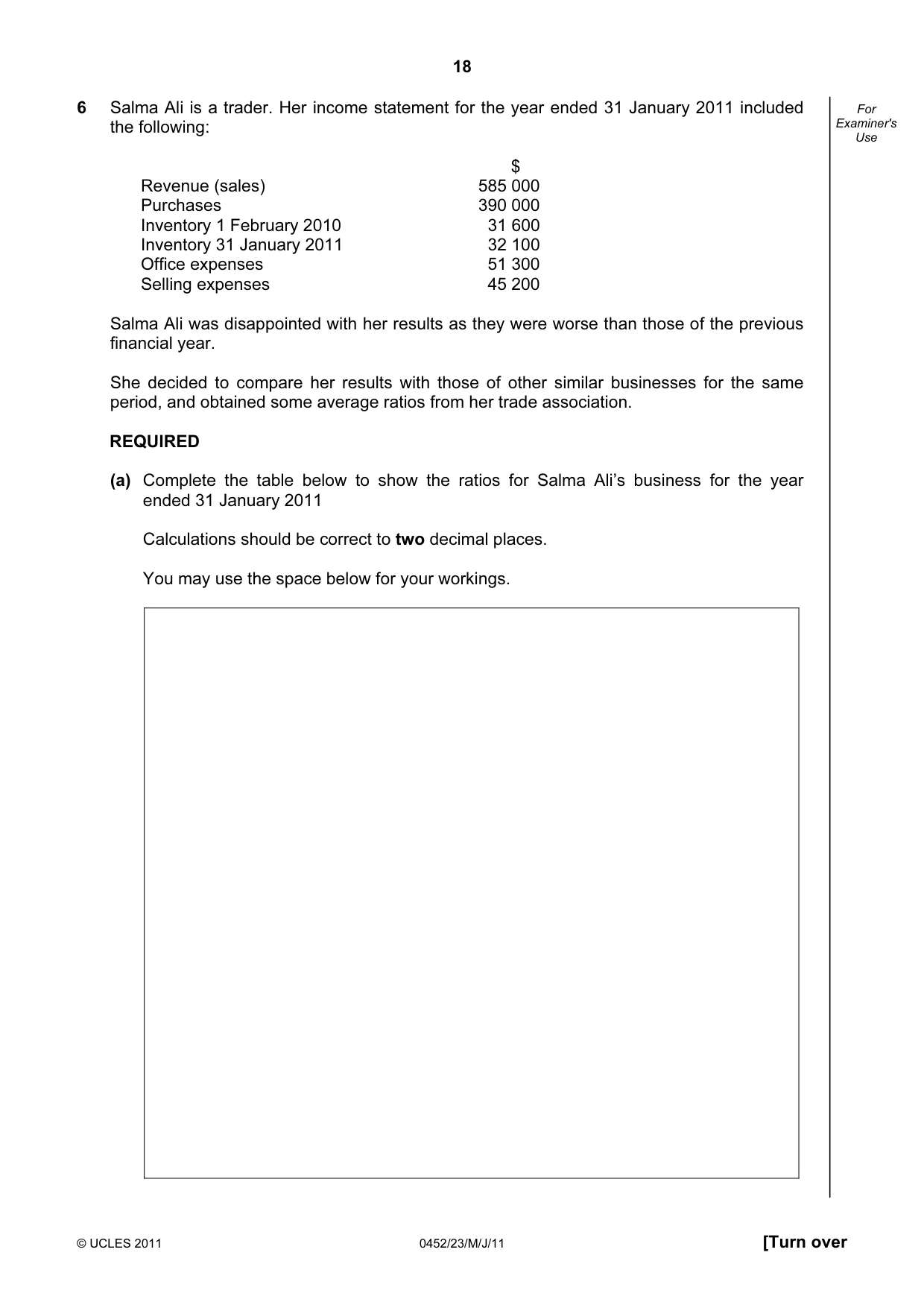
18 © UCLES 2011 0452/23/M/J/11 [Turn over For Examiner's Use 6 Salma Ali is a trader. Her income statement for the year ended 31 January 2011 included the following: $ Revenue (sales) 585 000 Purchases 390 000 Inventory 1 February 2010 31 600 Inventory 31 January 2011 32 100 Office expenses 51 300 Selling expenses 45 200 Salma Ali was disappointed with her results as they were worse than those of the previous financial year. She decided to compare her results with those of other similar businesses for the same period, and obtained some average ratios from her trade association. REQUIRED (a) Complete the table below to show the ratios for Salma Ali’s business for the year ended 31 January 2011 Calculations should be correct to two decimal places. You may use the space below for your workings.
Question paper, page 19
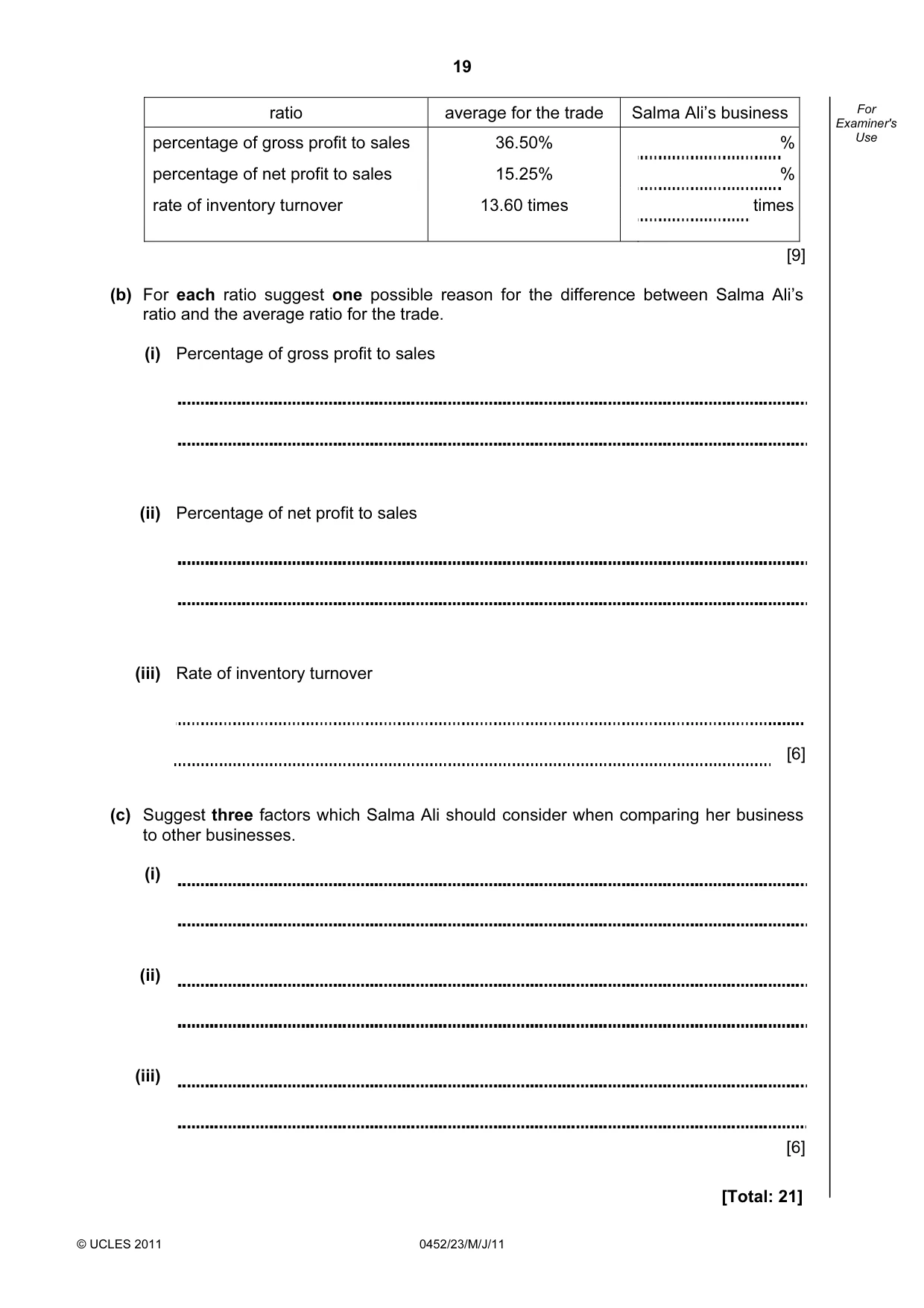
19 © UCLES 2011 0452/23/M/J/11 For Examiner's Use ratio average for the trade Salma Ali’s business percentage of gross profit to sales 36.50% % percentage of net profit to sales 15.25% % rate of inventory turnover 13.60 times times [9] (b) For each ratio suggest one possible reason for the difference between Salma Ali’s ratio and the average ratio for the trade. (i) Percentage of gross profit to sales (ii) Percentage of net profit to sales (iii) Rate of inventory turnover [6] (c) Suggest three factors which Salma Ali should consider when comparing her business to other businesses. (i) (ii) (iii) [6] [Total: 21]
Question paper, page 20
20 © UCLES 2011 0452/23/M/J/11 For Examiner's Use BLANK PAGE
Mark scheme, page 1
UNIVERSITY OF CAMBRIDGE INTERNATIONAL EXAMINATIONS International General Certificate of Secondary Education MARK SCHEME for the May/June 2011 question paper for the guidance of teachers 0452 ACCOUNTING 0452/23 Paper 2, maximum raw mark 120 This mark scheme is published as an aid to teachers and candidates, to indicate the requirements of the examination. It shows the basis on which Examiners were instructed to award marks. It does not indicate the details of the discussions that took place at an Examiners’ meeting before marking began, which would have considered the acceptability of alternative answers. Mark schemes must be read in conjunction with the question papers and the report on the examination. • Cambridge will not enter into discussions or correspondence in connection with these mark schemes. Cambridge is publishing the mark schemes for the May/June 2011 question papers for most IGCSE, GCE Advanced Level and Advanced Subsidiary Level syllabuses and some Ordinary Level syllabuses.
Mark scheme, page 2
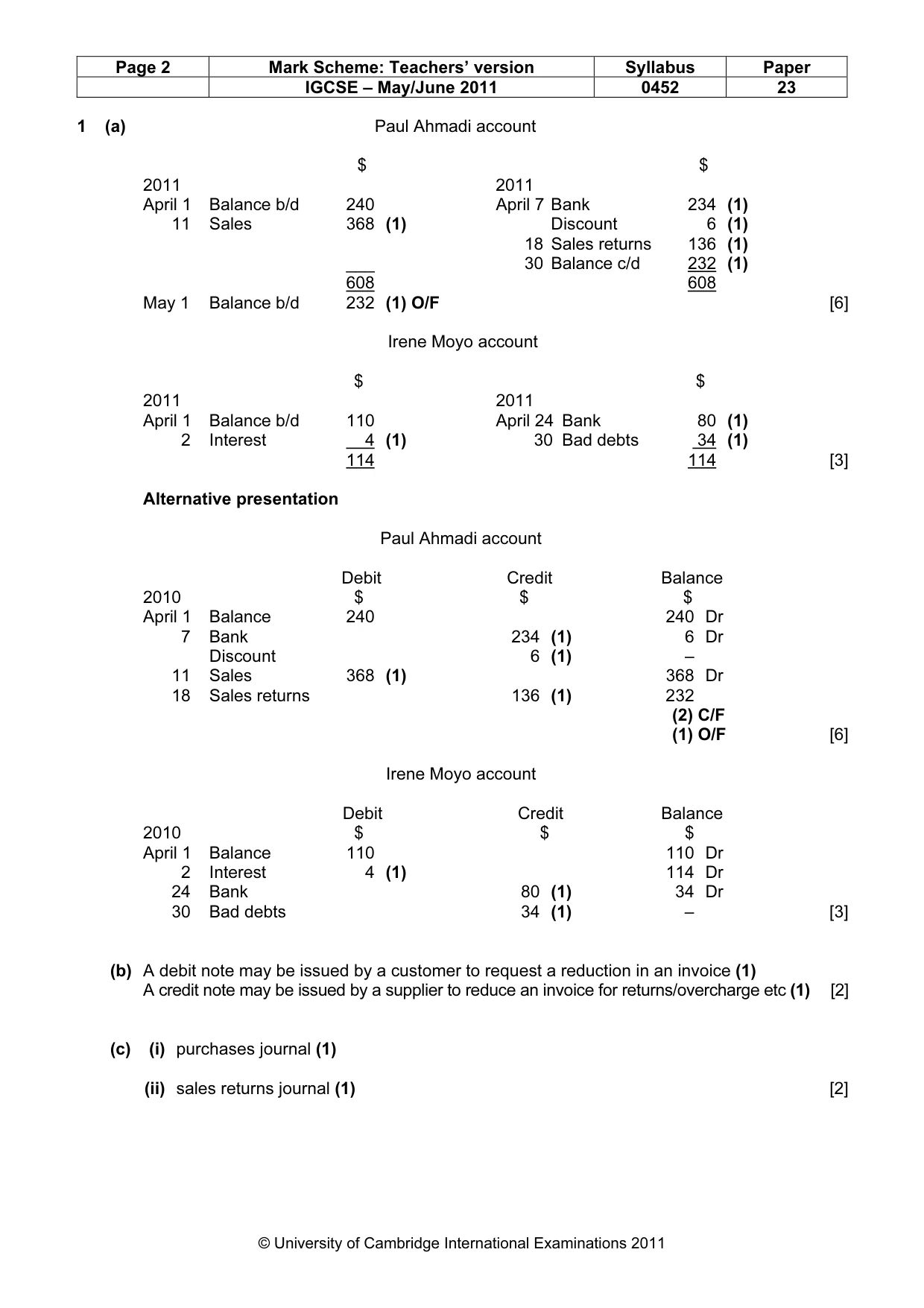
Page 2 Mark Scheme: Teachers’ version Syllabus Paper IGCSE – May/June 2011 0452 23 © University of Cambridge International Examinations 2011 1 (a) Paul Ahmadi account $ $ 2011 2011 April 1 Balance b/d 240 April 7 Bank 234 (1) 11 Sales 368 (1) Discount 6 (1) 18 Sales returns 136 (1) ___ 30 Balance c/d 232 (1) 608 608 May 1 Balance b/d 232 (1) O/F [6] Irene Moyo account $ $ 2011 2011 April 1 Balance b/d 110 April 24 Bank 80 (1) 2 Interest 4 (1) 30 Bad debts 34 (1) 114 114 [3] Alternative presentation Paul Ahmadi account Debit Credit Balance 2010 $ $ $ April 1 Balance 240 240 Dr 7 Bank 234 (1) 6 Dr Discount 6 (1) – 11 Sales 368 (1) 368 Dr 18 Sales returns 136 (1) 232 (2) C/F (1) O/F [6] Irene Moyo account Debit Credit Balance 2010 $ $ $ April 1 Balance 110 110 Dr 2 Interest 4 (1) 114 Dr 24 Bank 80 (1) 34 Dr 30 Bad debts 34 (1) – [3] (b) A debit note may be issued by a customer to request a reduction in an invoice (1) A credit note may be issued by a supplier to reduce an invoice for returns/overcharge etc (1) [2] (c) (i) purchases journal (1) (ii) sales returns journal (1) [2]
Mark scheme, page 3
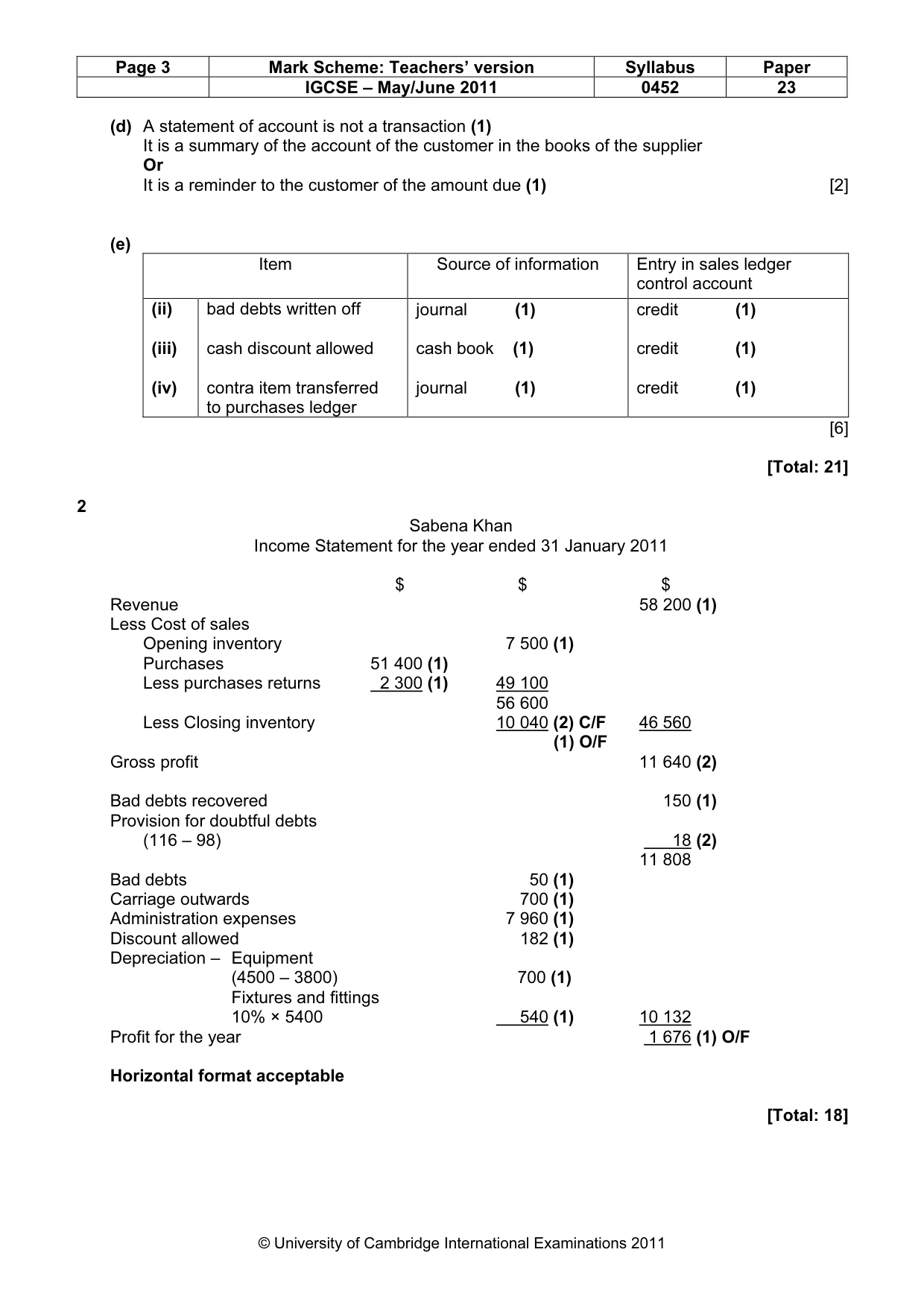
Page 3 Mark Scheme: Teachers’ version Syllabus Paper IGCSE – May/June 2011 0452 23 © University of Cambridge International Examinations 2011 (d) A statement of account is not a transaction (1) It is a summary of the account of the customer in the books of the supplier Or It is a reminder to the customer of the amount due (1) [2] (e) Item Source of information Entry in sales ledger control account (ii) (iii) (iv) bad debts written off cash discount allowed contra item transferred to purchases ledger journal (1) cash book (1) journal (1) credit (1) credit (1) credit (1) [6] [Total: 21] 2 Sabena Khan Income Statement for the year ended 31 January 2011 $ $ $ Revenue 58 200 (1) Less Cost of sales Opening inventory 7 500 (1) Purchases 51 400 (1) Less purchases returns 2 300 (1) 49 100 56 600 Less Closing inventory 10 040 (2) C/F 46 560 (1) O/F Gross profit 11 640 (2) Bad debts recovered 150 (1) Provision for doubtful debts (116 – 98) 18 (2) 11 808 Bad debts 50 (1) Carriage outwards 700 (1) Administration expenses 7 960 (1) Discount allowed 182 (1) Depreciation – Equipment (4500 – 3800) 700 (1) Fixtures and fittings 10% × 5400 540 (1) 10 132 Profit for the year 1 676 (1) O/F Horizontal format acceptable [Total: 18]
Mark scheme, page 4
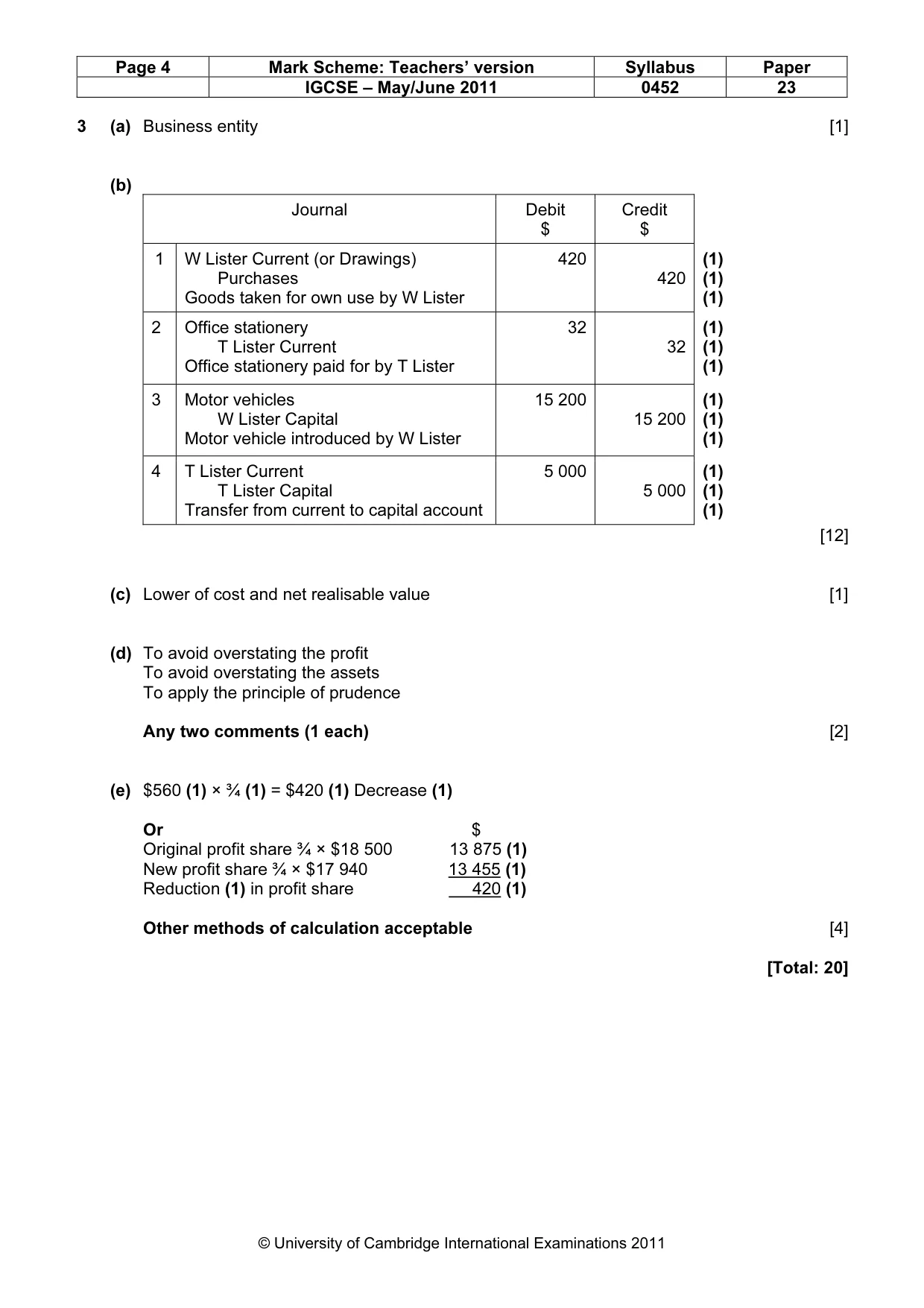
Page 4 Mark Scheme: Teachers’ version Syllabus Paper IGCSE – May/June 2011 0452 23 © University of Cambridge International Examinations 2011 3 (a) Business entity [1] (b) Journal Debit $ Credit $ 1 W Lister Current (or Drawings) Purchases Goods taken for own use by W Lister 420 420 (1) (1) (1) 2 Office stationery T Lister Current Office stationery paid for by T Lister 32 32 (1) (1) (1) 3 Motor vehicles W Lister Capital Motor vehicle introduced by W Lister 15 200 15 200 (1) (1) (1) 4 T Lister Current T Lister Capital Transfer from current to capital account 5 000 5 000 (1) (1) (1) [12] (c) Lower of cost and net realisable value [1] (d) To avoid overstating the profit To avoid overstating the assets To apply the principle of prudence Any two comments (1 each) [2] (e) $560 (1) × ¾ (1) = $420 (1) Decrease (1) Or $ Original profit share ¾ × $18 500 13 875 (1) New profit share ¾ × $17 940 13 455 (1) Reduction (1) in profit share 420 (1) Other methods of calculation acceptable [4] [Total: 20]
Mark scheme, page 5
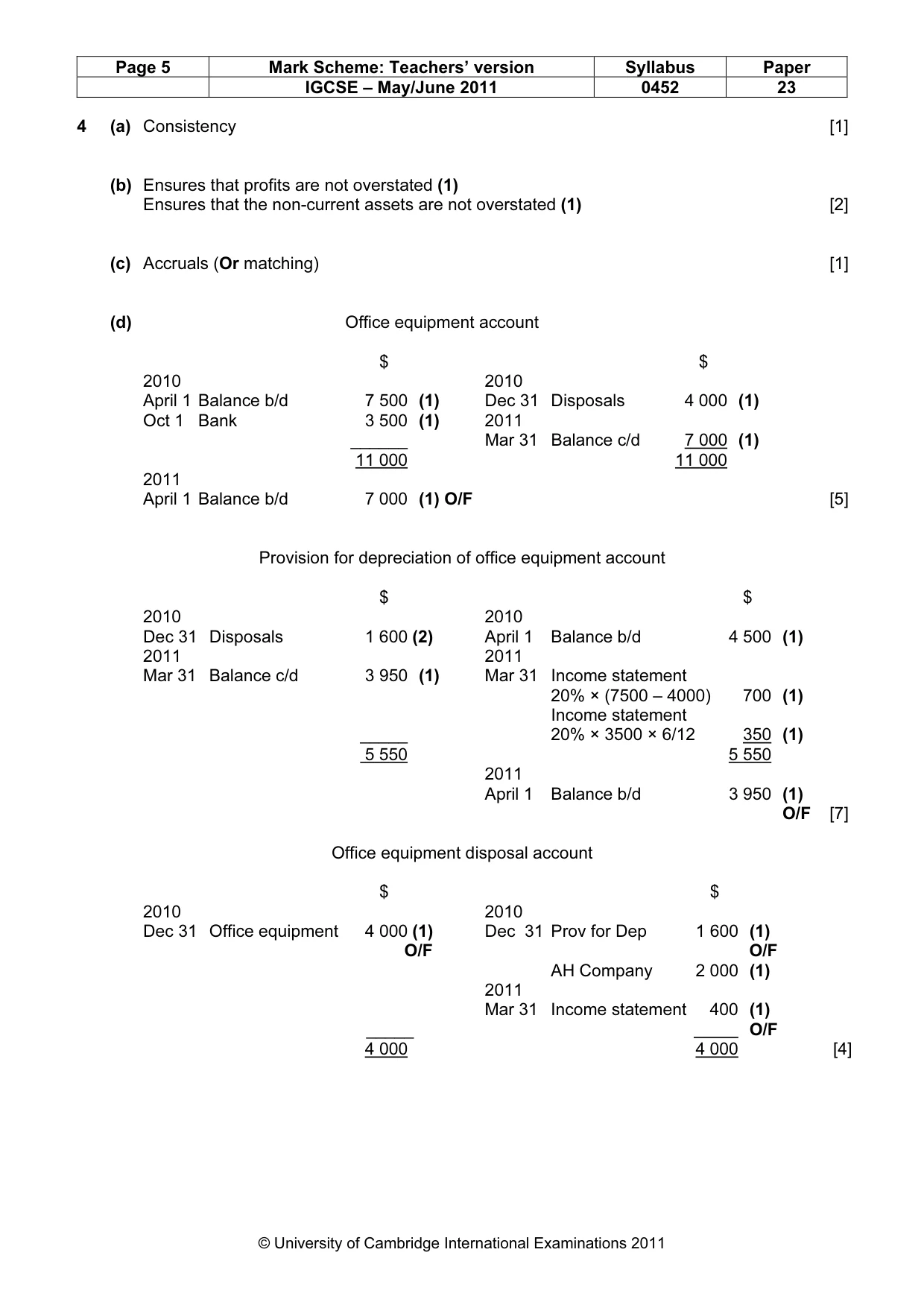
Page 5 Mark Scheme: Teachers’ version Syllabus Paper IGCSE – May/June 2011 0452 23 © University of Cambridge International Examinations 2011 4 (a) Consistency [1] (b) Ensures that profits are not overstated (1) Ensures that the non-current assets are not overstated (1) [2] (c) Accruals (Or matching) [1] (d) Office equipment account $ $ 2010 2010 April 1 Balance b/d 7 500 (1) Dec 31 Disposals 4 000 (1) Oct 1 Bank 3 500 (1) 2011 ______ Mar 31 Balance c/d 7 000 (1) 11 000 11 000 2011 April 1 Balance b/d 7 000 (1) O/F [5] Provision for depreciation of office equipment account $ $ 2010 2010 Dec 31 Disposals 1 600 (2) April 1 Balance b/d 4 500 (1) 2011 2011 Mar 31 Balance c/d 3 950 (1) Mar 31 Income statement 20% × (7500 – 4000) 700 (1) Income statement _____ 20% × 3500 × 6/12 350 (1) 5 550 5 550 2011 April 1 Balance b/d 3 950 (1) O/F [7] Office equipment disposal account $ $ 2010 2010 Dec 31 Office equipment 4 000 (1) Dec 31 Prov for Dep 1 600 (1) O/F O/F AH Company 2 000 (1) 2011 Mar 31 Income statement 400 (1) _____ O/F 4 000 4 000 [4]
Mark scheme, page 6
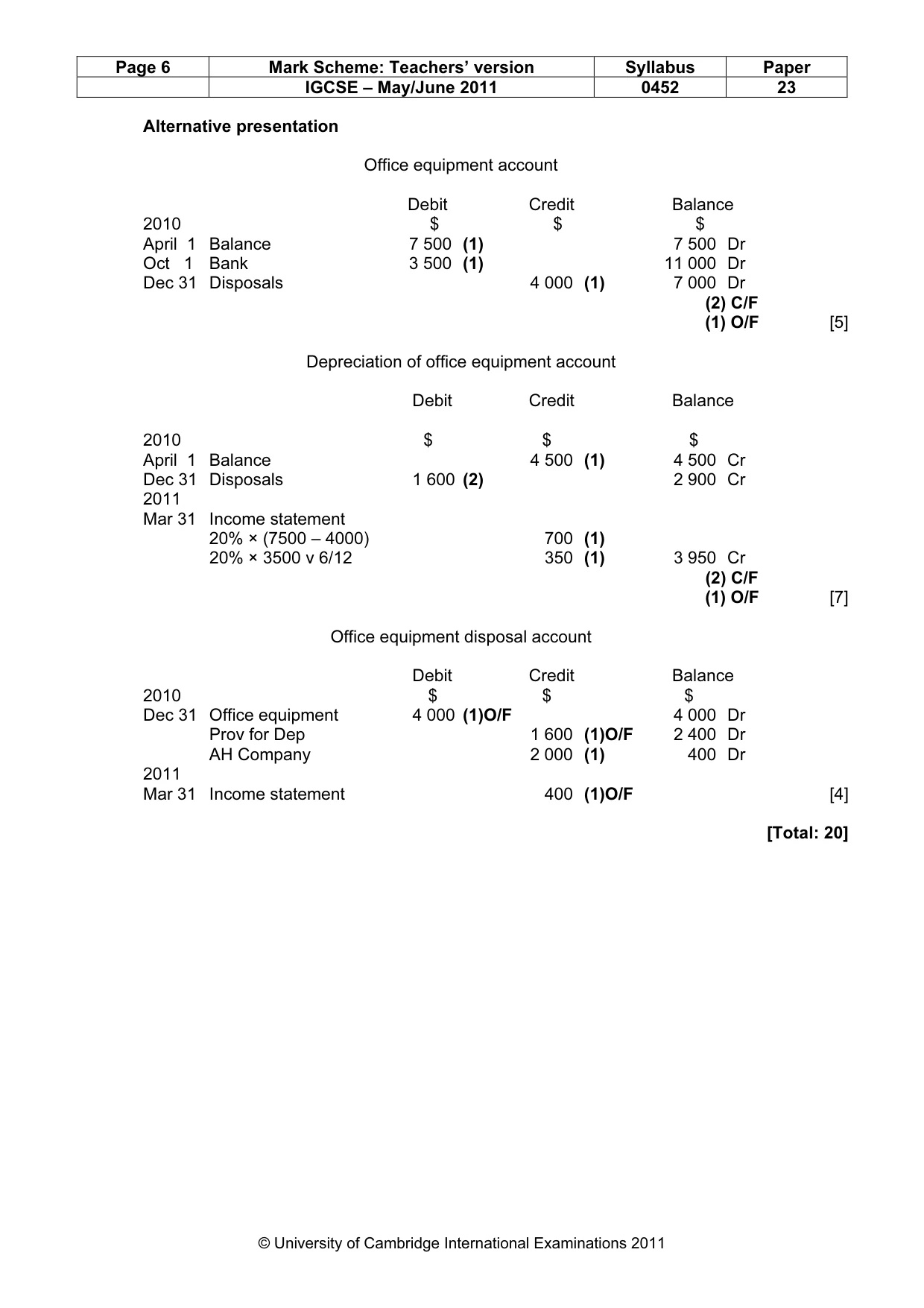
Page 6 Mark Scheme: Teachers’ version Syllabus Paper IGCSE – May/June 2011 0452 23 © University of Cambridge International Examinations 2011 Alternative presentation Office equipment account Debit Credit Balance 2010 $ $ $ April 1 Balance 7 500 (1) 7 500 Dr Oct 1 Bank 3 500 (1) 11 000 Dr Dec 31 Disposals 4 000 (1) 7 000 Dr (2) C/F (1) O/F [5] Depreciation of office equipment account Debit Credit Balance 2010 $ $ $ April 1 Balance 4 500 (1) 4 500 Cr Dec 31 Disposals 1 600 (2) 2 900 Cr 2011 Mar 31 Income statement 20% × (7500 – 4000) 700 (1) 20% × 3500 v 6/12 350 (1) 3 950 Cr (2) C/F (1) O/F [7] Office equipment disposal account Debit Credit Balance 2010 $ $ $ Dec 31 Office equipment 4 000 (1)O/F 4 000 Dr Prov for Dep 1 600 (1)O/F 2 400 Dr AH Company 2 000 (1) 400 Dr 2011 Mar 31 Income statement 400 (1)O/F [4] [Total: 20]
Mark scheme, page 7
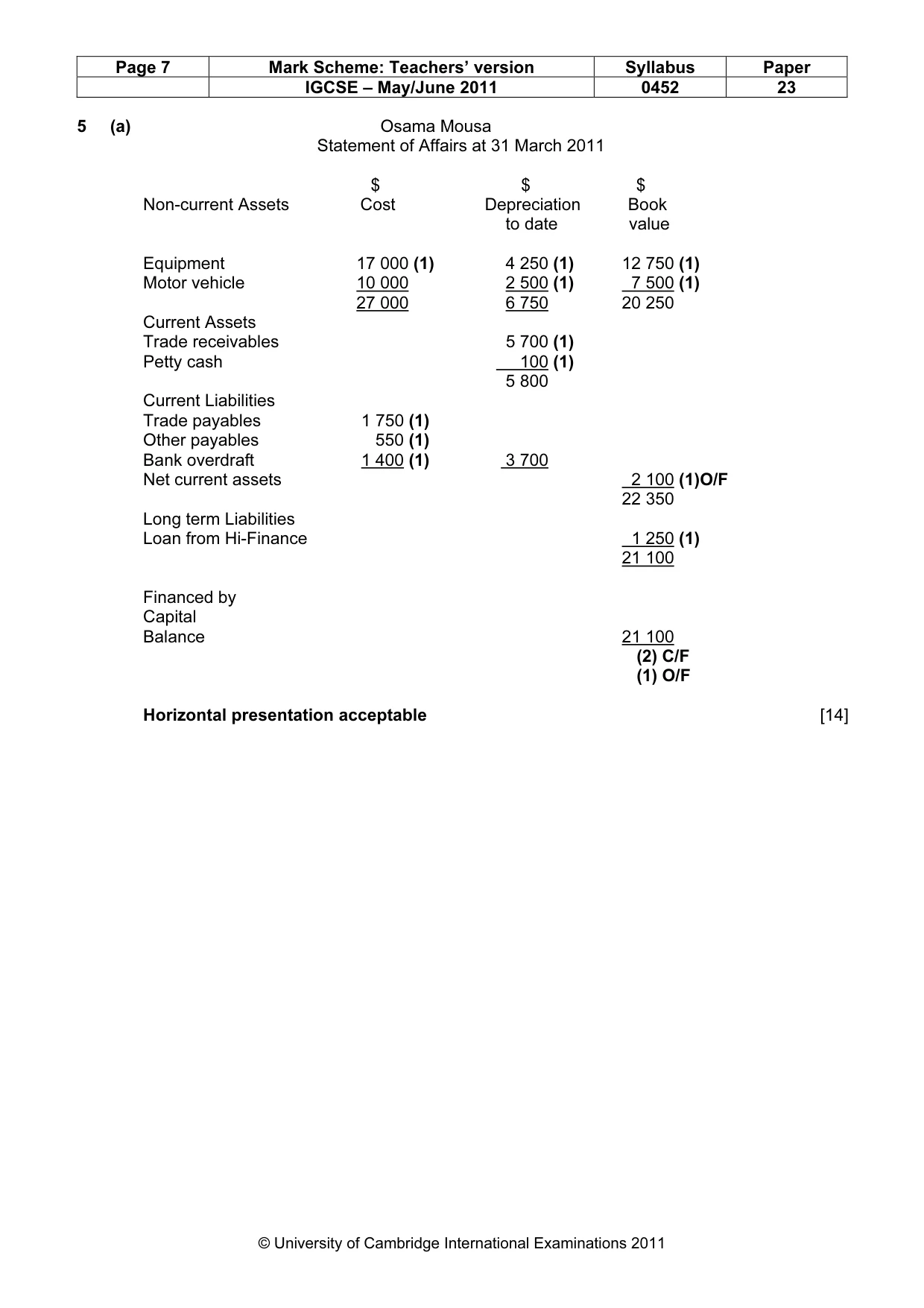
Page 7 Mark Scheme: Teachers’ version Syllabus Paper IGCSE – May/June 2011 0452 23 © University of Cambridge International Examinations 2011 5 (a) Osama Mousa Statement of Affairs at 31 March 2011 $ $ $ Non-current Assets Cost Depreciation Book to date value Equipment 17 000 (1) 4 250 (1) 12 750 (1) Motor vehicle 10 000 2 500 (1) 7 500 (1) 27 000 6 750 20 250 Current Assets Trade receivables 5 700 (1) Petty cash 100 (1) 5 800 Current Liabilities Trade payables 1 750 (1) Other payables 550 (1) Bank overdraft 1 400 (1) 3 700 Net current assets 2 100 (1)O/F 22 350 Long term Liabilities Loan from Hi-Finance 1 250 (1) 21 100 Financed by Capital Balance 21 100 (2) C/F (1) O/F Horizontal presentation acceptable [14]
Mark scheme, page 8
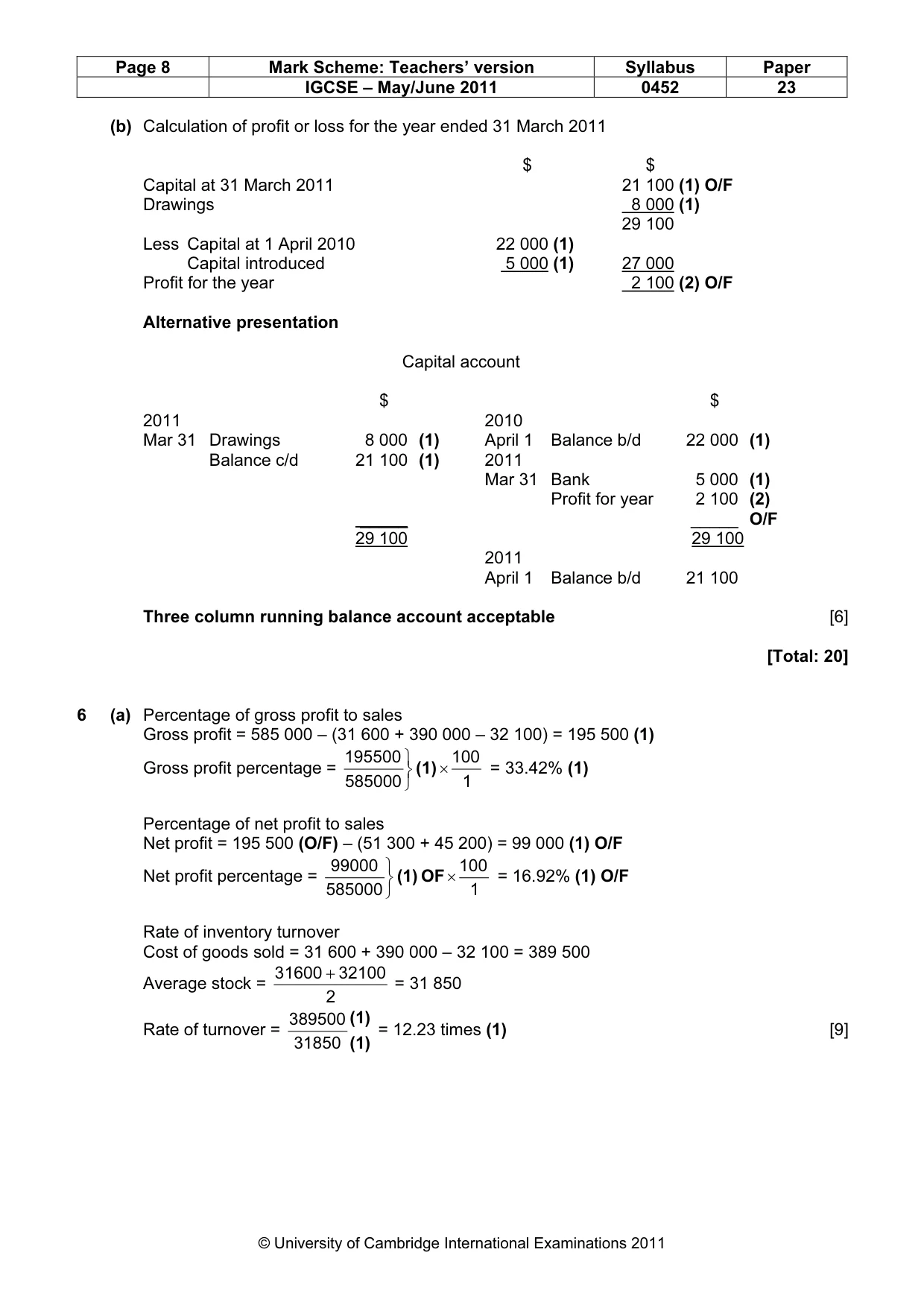
Page 8 Mark Scheme: Teachers’ version Syllabus Paper IGCSE – May/June 2011 0452 23 © University of Cambridge International Examinations 2011 (b) Calculation of profit or loss for the year ended 31 March 2011 $ $ Capital at 31 March 2011 21 100 (1) O/F Drawings 8 000 (1) 29 100 Less Capital at 1 April 2010 22 000 (1) Capital introduced 5 000 (1) 27 000 Profit for the year 2 100 (2) O/F Alternative presentation Capital account $ $ 2011 2010 Mar 31 Drawings 8 000 (1) April 1 Balance b/d 22 000 (1) Balance c/d 21 100 (1) 2011 Mar 31 Bank 5 000 (1) Profit for year 2 100 (2) _____ _____ O/F 29 100 29 100 2011 April 1 Balance b/d 21 100 Three column running balance account acceptable [6] [Total: 20] 6 (a) Percentage of gross profit to sales Gross profit = 585 000 – (31 600 + 390 000 – 32 100) = 195 500 (1) Gross profit percentage = 1 100 585000 195500 × (1) = 33.42% (1) Percentage of net profit to sales Net profit = 195 500 (O/F) – (51 300 + 45 200) = 99 000 (1) O/F Net profit percentage = 1 100 585000 99000 × OF (1) = 16.92% (1) O/F Rate of inventory turnover Cost of goods sold = 31 600 + 390 000 – 32 100 = 389 500 Average stock = 2 32100 31600 + = 31 850 Rate of turnover = (1) (1) 31850 389500 = 12.23 times (1) [9]
Mark scheme, page 9
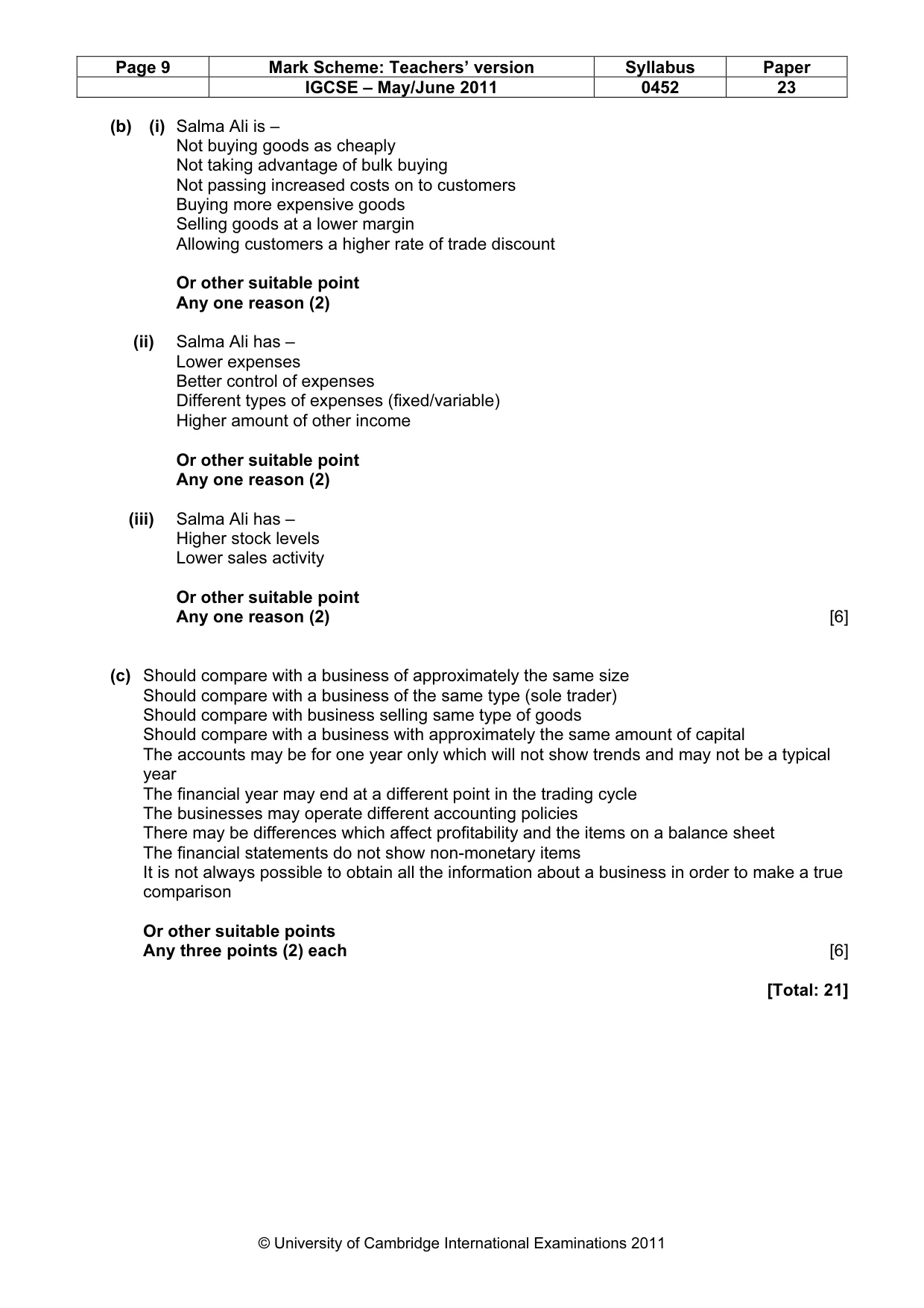
Page 9 Mark Scheme: Teachers’ version Syllabus Paper IGCSE – May/June 2011 0452 23 © University of Cambridge International Examinations 2011 (b) (i) Salma Ali is – Not buying goods as cheaply Not taking advantage of bulk buying Not passing increased costs on to customers Buying more expensive goods Selling goods at a lower margin Allowing customers a higher rate of trade discount Or other suitable point Any one reason (2) (ii) Salma Ali has – Lower expenses Better control of expenses Different types of expenses (fixed/variable) Higher amount of other income Or other suitable point Any one reason (2) (iii) Salma Ali has – Higher stock levels Lower sales activity Or other suitable point Any one reason (2) [6] (c) Should compare with a business of approximately the same size Should compare with a business of the same type (sole trader) Should compare with business selling same type of goods Should compare with a business with approximately the same amount of capital The accounts may be for one year only which will not show trends and may not be a typical year The financial year may end at a different point in the trading cycle The businesses may operate different accounting policies There may be differences which affect profitability and the items on a balance sheet The financial statements do not show non-monetary items It is not always possible to obtain all the information about a business in order to make a true comparison Or other suitable points Any three points (2) each [6] [Total: 21]
What you needed in this session
Cambridge’s own grade thresholds for 2011 May/June, Paper 2 · Variant 3. A higher threshold means an easier paper — the bar moves with how the cohort did.