Cambridge IGCSE Accounting 0452 — 2011 May/June Paper 2 · Variant 1
0452/21/M/J/11 · 120 marks · ≈135 min
The question paper and its mark scheme, free to read here and free to download. This is Cambridge’s own paper, exactly as it was sat.
Question paper24 pages

Mark scheme10 pages
Answers below. Sit the paper first if you are practising.
Paper as text
Question paper, page 1
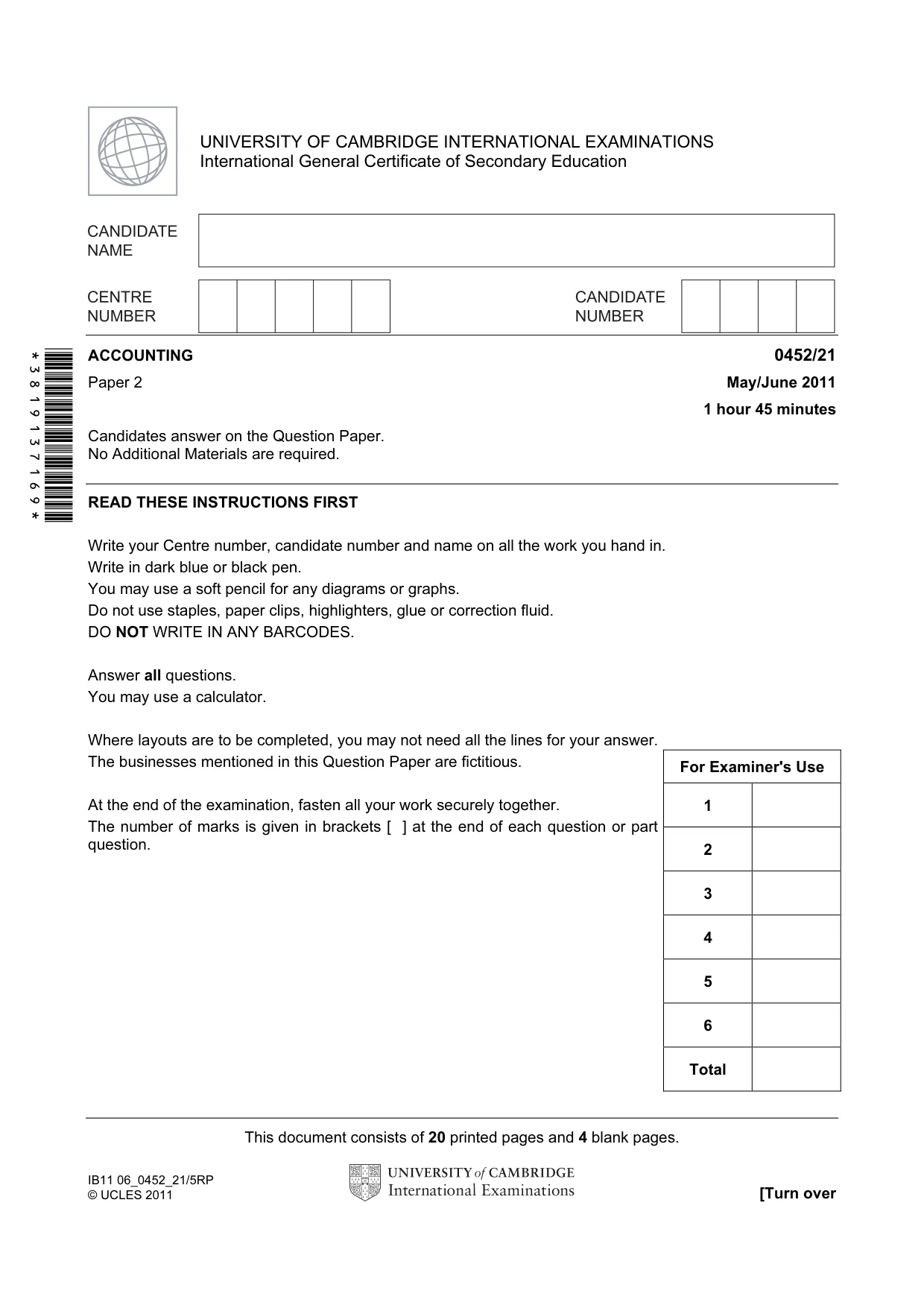
This document consists of 20 printed pages and 4 blank pages. IB11 06_0452_21/5RP © UCLES 2011 [Turn over *3819137169* For Examiner's Use 1 2 3 4 5 6 Total UNIVERSITY OF CAMBRIDGE INTERNATIONAL EXAMINATIONS International General Certificate of Secondary Education ACCOUNTING 0452/21 Paper 2 May/June 2011 1 hour 45 minutes Candidates answer on the Question Paper. No Additional Materials are required. READ THESE INSTRUCTIONS FIRST Write your Centre number, candidate number and name on all the work you hand in. Write in dark blue or black pen. You may use a soft pencil for any diagrams or graphs. Do not use staples, paper clips, highlighters, glue or correction fluid. DO NOT WRITE IN ANY BARCODES. Answer all questions. You may use a calculator. Where layouts are to be completed, you may not need all the lines for your answer. The businesses mentioned in this Question Paper are fictitious. At the end of the examination, fasten all your work securely together. The number of marks is given in brackets [ ] at the end of each question or part question.
Question paper, page 2
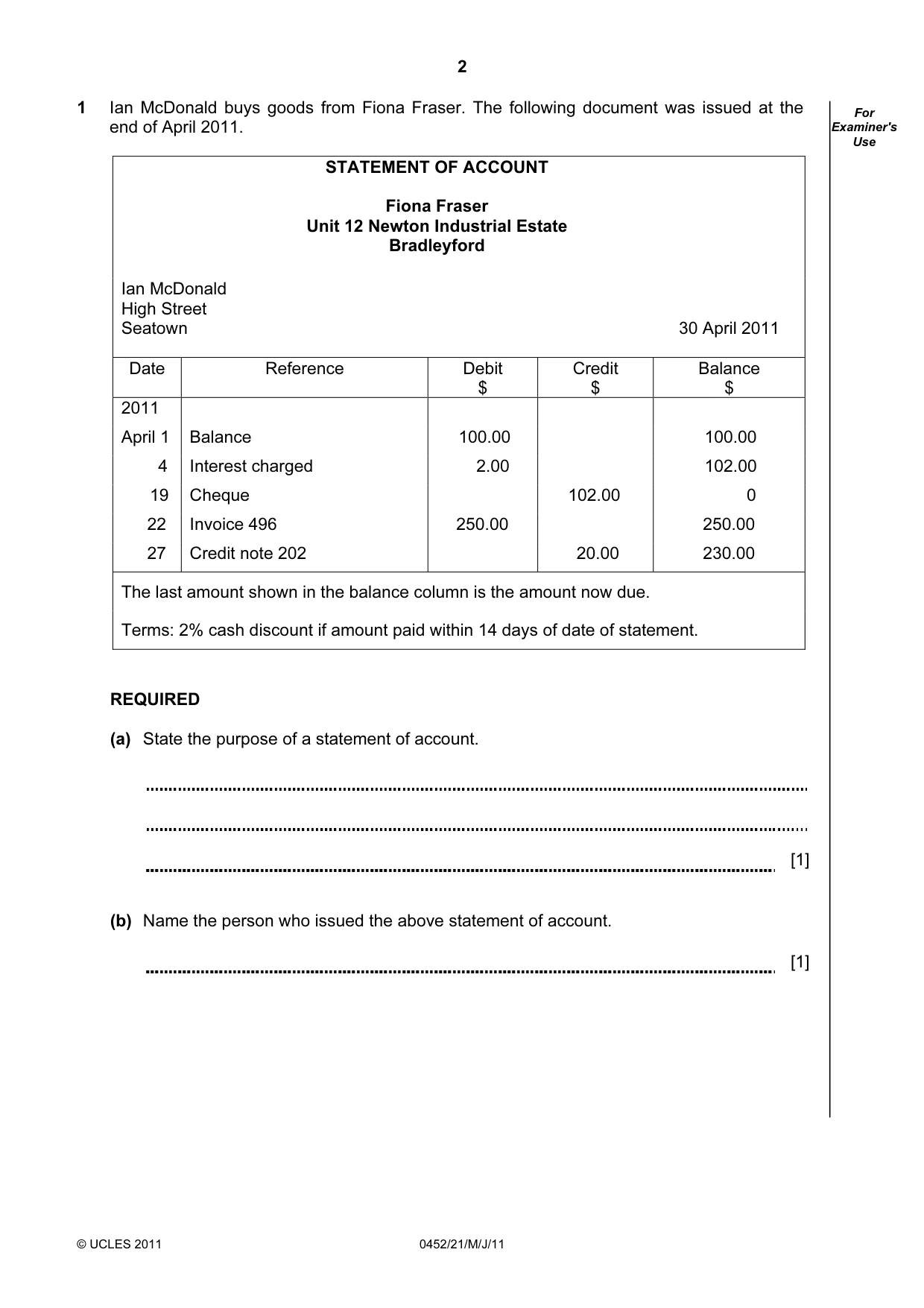
2 © UCLES 2011 0452/21/M/J/11 For Examiner's Use 1 Ian McDonald buys goods from Fiona Fraser. The following document was issued at the end of April 2011. STATEMENT OF ACCOUNT Fiona Fraser Unit 12 Newton Industrial Estate Bradleyford Ian McDonald High Street Seatown 30 April 2011 Date Reference Debit $ Credit $ Balance $ 2011 April 1 Balance 100.00 100.00 4 Interest charged 2.00 102.00 19 Cheque 102.00 0 22 Invoice 496 250.00 250.00 27 Credit note 202 20.00 230.00 The last amount shown in the balance column is the amount now due. Terms: 2% cash discount if amount paid within 14 days of date of statement. REQUIRED (a) State the purpose of a statement of account. [1] (b) Name the person who issued the above statement of account. [1]
Question paper, page 3
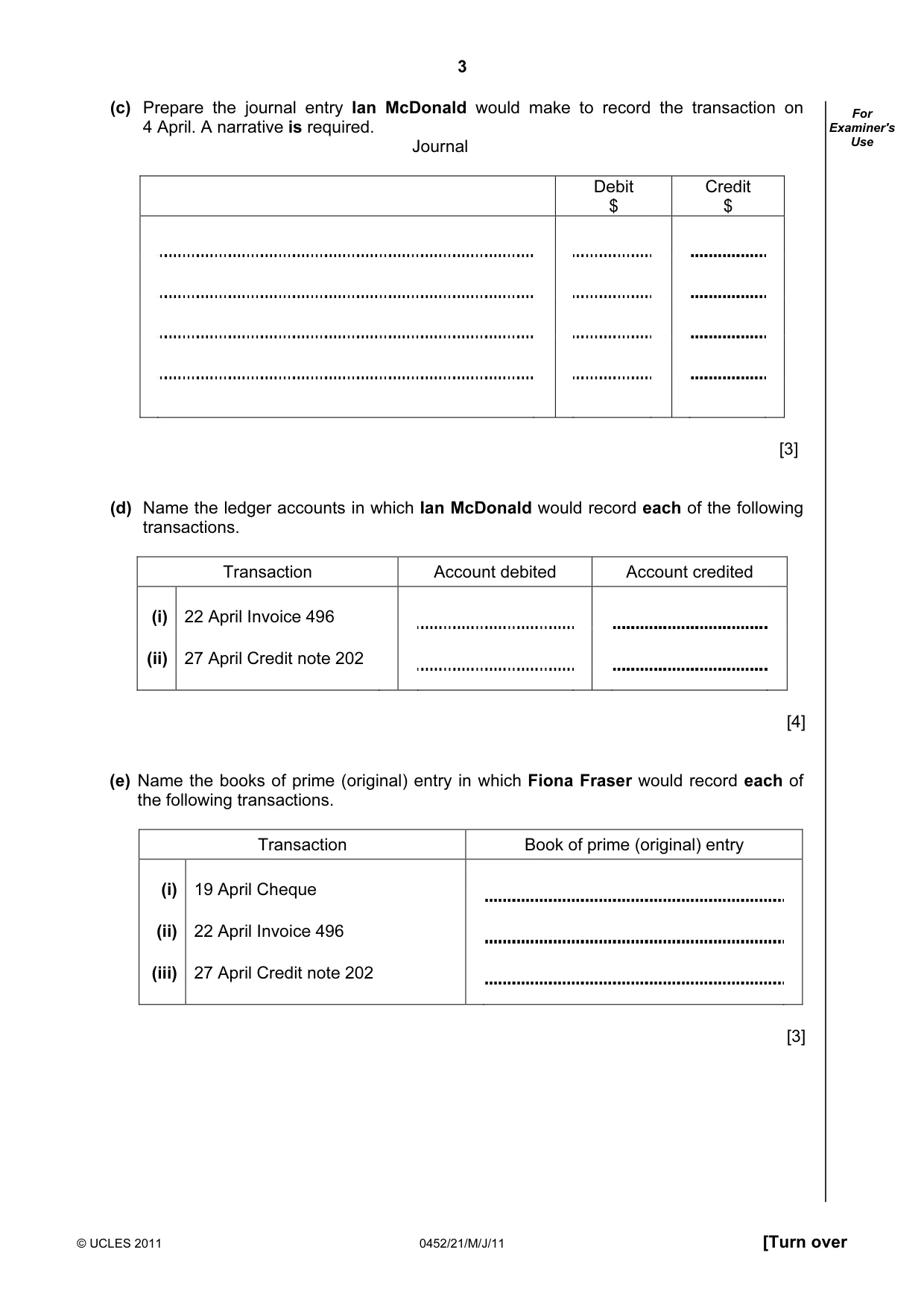
3 © UCLES 2011 0452/21/M/J/11 [Turn over For Examiner's Use (c) Prepare the journal entry Ian McDonald would make to record the transaction on 4 April. A narrative is required. Journal Debit $ Credit $ [3] (d) Name the ledger accounts in which Ian McDonald would record each of the following transactions. Transaction Account debited Account credited (i) 22 April Invoice 496 (ii) 27 April Credit note 202 [4] (e) Name the books of prime (original) entry in which Fiona Fraser would record each of the following transactions. Transaction Book of prime (original) entry (i) 19 April Cheque (ii) 22 April Invoice 496 (iii) 27 April Credit note 202 [3]
Question paper, page 4
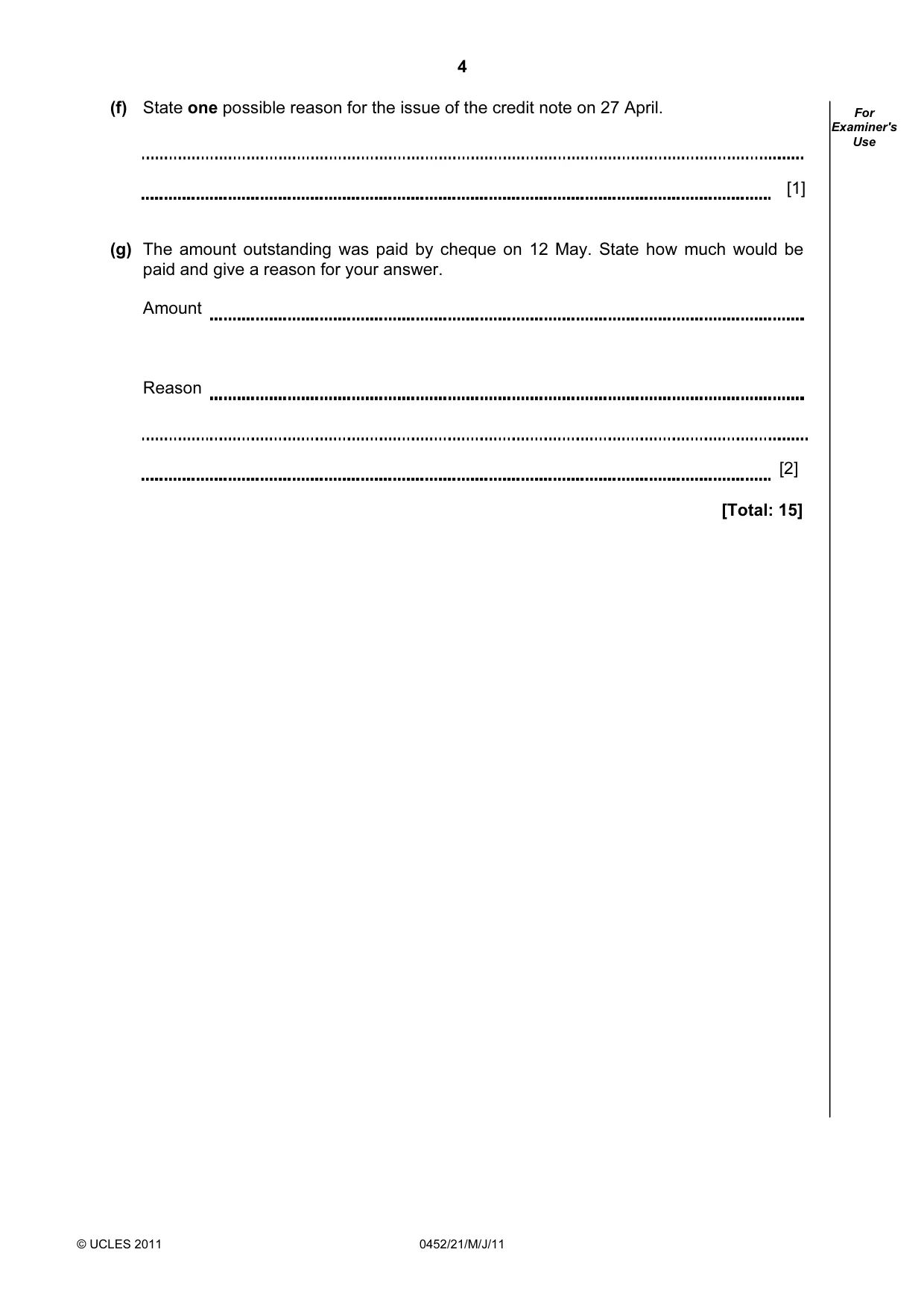
4 © UCLES 2011 0452/21/M/J/11 For Examiner's Use (f) State one possible reason for the issue of the credit note on 27 April. [1] (g) The amount outstanding was paid by cheque on 12 May. State how much would be paid and give a reason for your answer. Amount Reason [2] [Total: 15]
Question paper, page 5
5 © UCLES 2011 0452/21/M/J/11 [Turn over BLANK PAGE Question 2 is on the next page.
Question paper, page 6
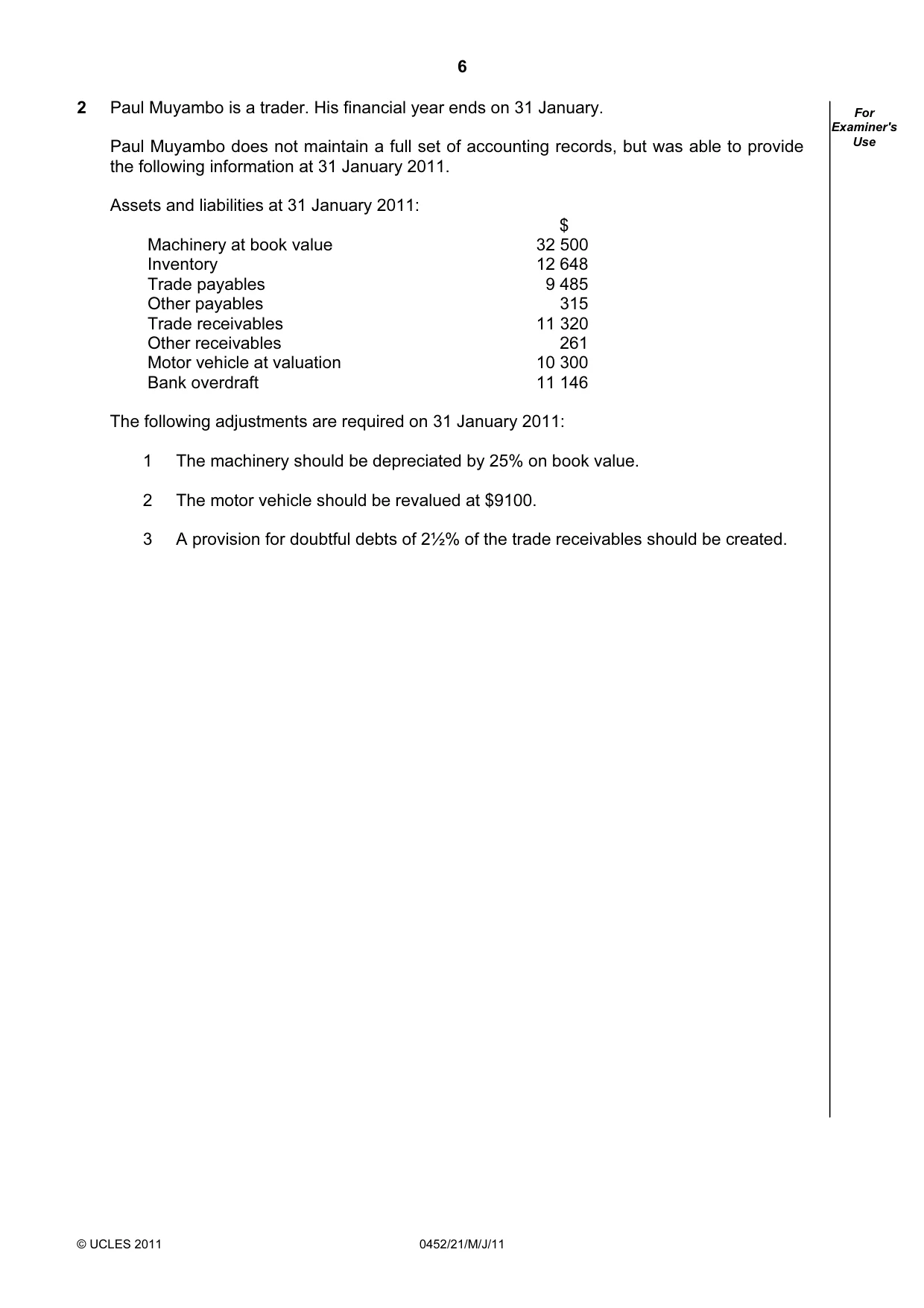
6 © UCLES 2011 0452/21/M/J/11 For Examiner's Use 2 Paul Muyambo is a trader. His financial year ends on 31 January. Paul Muyambo does not maintain a full set of accounting records, but was able to provide the following information at 31 January 2011. Assets and liabilities at 31 January 2011: $ Machinery at book value 32 500 Inventory 12 648 Trade payables 9 485 Other payables 315 Trade receivables 11 320 Other receivables 261 Motor vehicle at valuation 10 300 Bank overdraft 11 146 The following adjustments are required on 31 January 2011: 1 The machinery should be depreciated by 25% on book value. 2 The motor vehicle should be revalued at $9100. 3 A provision for doubtful debts of 2½% of the trade receivables should be created.
Question paper, page 7
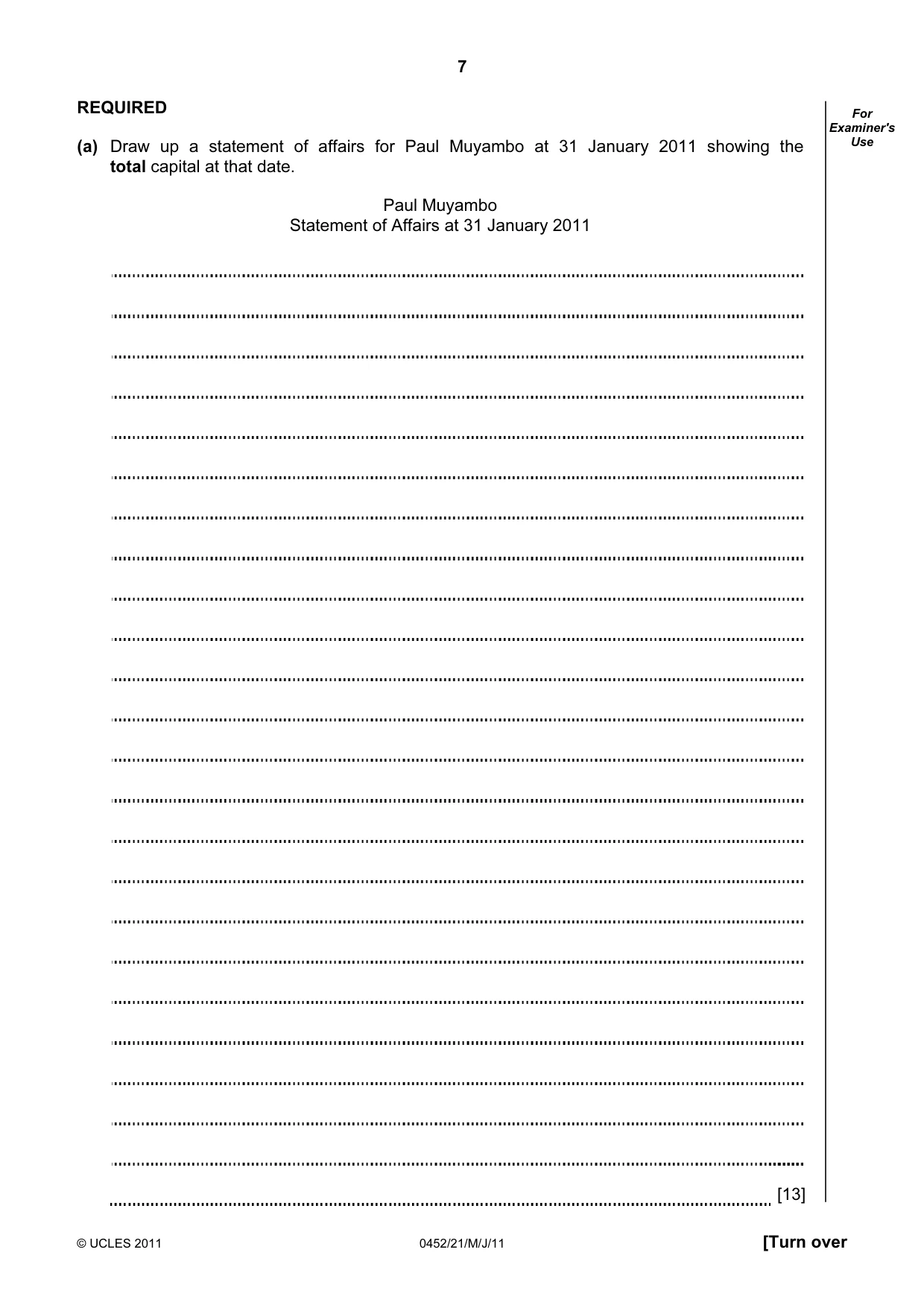
7 © UCLES 2011 0452/21/M/J/11 [Turn over For Examiner's Use REQUIRED (a) Draw up a statement of affairs for Paul Muyambo at 31 January 2011 showing the total capital at that date. Paul Muyambo Statement of Affairs at 31 January 2011 [13]
Question paper, page 8
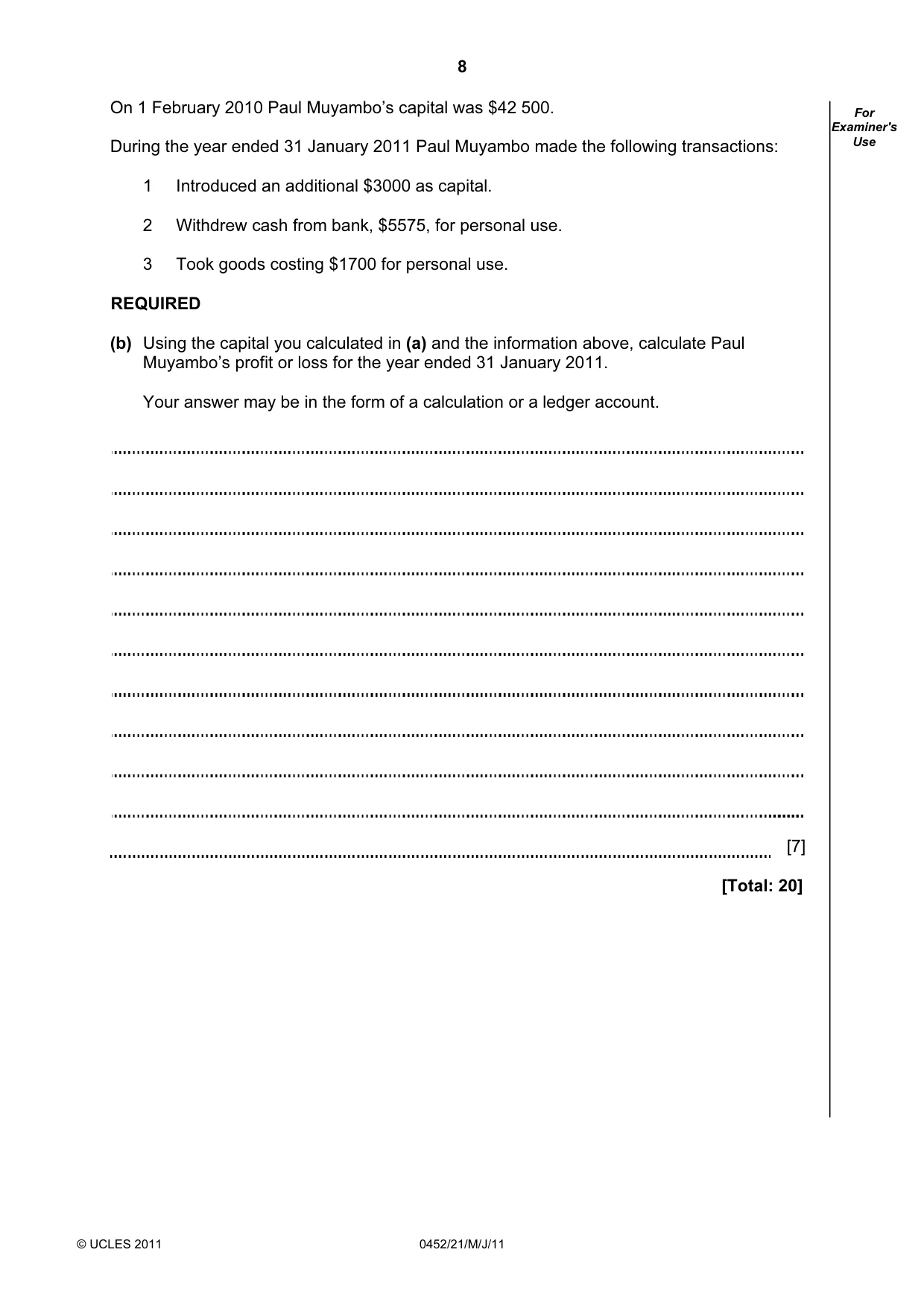
8 © UCLES 2011 0452/21/M/J/11 For Examiner's Use On 1 February 2010 Paul Muyambo’s capital was $42 500. During the year ended 31 January 2011 Paul Muyambo made the following transactions: 1 Introduced an additional $3000 as capital. 2 Withdrew cash from bank, $5575, for personal use. 3 Took goods costing $1700 for personal use. REQUIRED (b) Using the capital you calculated in (a) and the information above, calculate Paul Muyambo’s profit or loss for the year ended 31 January 2011. Your answer may be in the form of a calculation or a ledger account. [7] [Total: 20]
Question paper, page 9
9 © UCLES 2011 0452/21/M/J/11 [Turn over BLANK PAGE Question 3 is on the next page.
Question paper, page 10
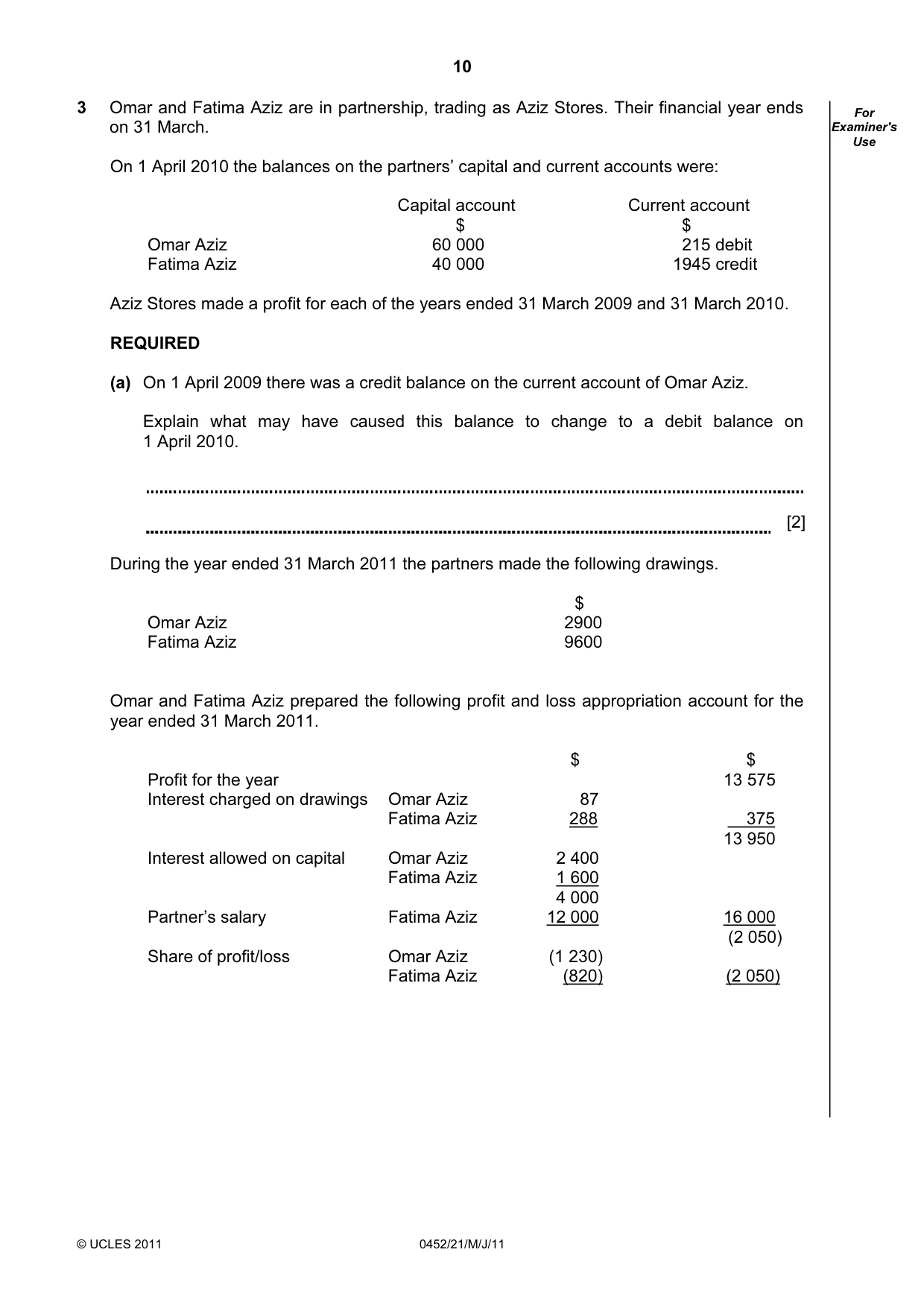
10 © UCLES 2011 0452/21/M/J/11 For Examiner's Use 3 Omar and Fatima Aziz are in partnership, trading as Aziz Stores. Their financial year ends on 31 March. On 1 April 2010 the balances on the partners’ capital and current accounts were: Capital account Current account $ $ Omar Aziz 60 000 215 debit Fatima Aziz 40 000 1945 credit Aziz Stores made a profit for each of the years ended 31 March 2009 and 31 March 2010. REQUIRED (a) On 1 April 2009 there was a credit balance on the current account of Omar Aziz. Explain what may have caused this balance to change to a debit balance on 1 April 2010. [2] During the year ended 31 March 2011 the partners made the following drawings. $ Omar Aziz 2900 Fatima Aziz 9600 Omar and Fatima Aziz prepared the following profit and loss appropriation account for the year ended 31 March 2011. $ $ Profit for the year 13 575 Interest charged on drawings Omar Aziz 87 Fatima Aziz 288 375 13 950 Interest allowed on capital Omar Aziz 2 400 Fatima Aziz 1 600 4 000 Partner’s salary Fatima Aziz 12 000 16 000 (2 050) Share of profit/loss Omar Aziz (1 230) Fatima Aziz (820) (2 050)
Question paper, page 11
11 © UCLES 2011 0452/21/M/J/11 [Turn over For Examiner's Use REQUIRED (b) Prepare the partners’ current accounts as they would appear in the ledger for the year ended 31 March 2011. Where traditional “T” accounts are used they should be balanced and the balances brought down on 1 April 2011. Where three column running balance accounts are used the balance column should be up-dated after each entry. [11]
Question paper, page 12
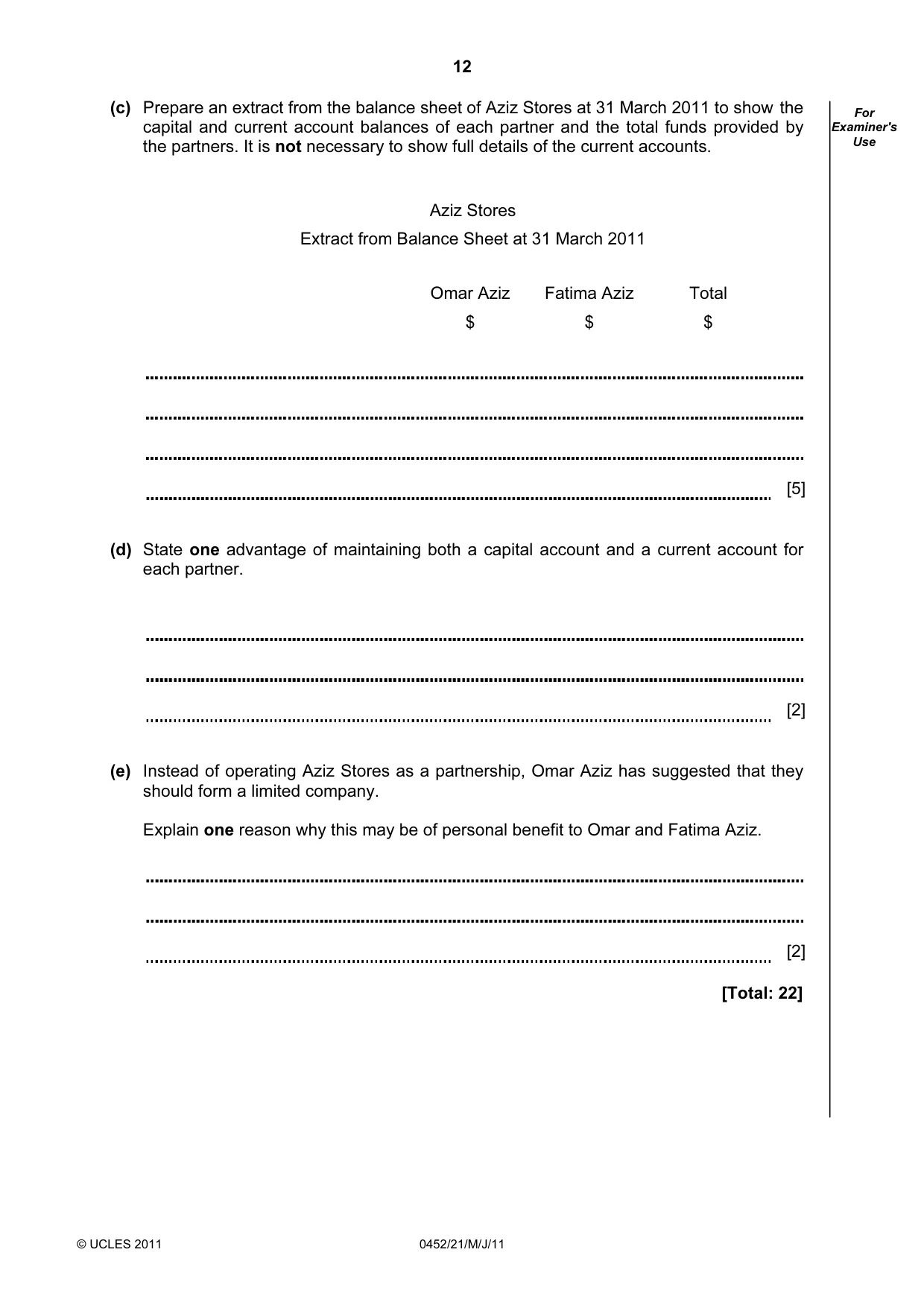
12 © UCLES 2011 0452/21/M/J/11 For Examiner's Use (c) Prepare an extract from the balance sheet of Aziz Stores at 31 March 2011 to show the capital and current account balances of each partner and the total funds provided by the partners. It is not necessary to show full details of the current accounts. Aziz Stores Extract from Balance Sheet at 31 March 2011 Omar Aziz Fatima Aziz Total $ $ $ [5] (d) State one advantage of maintaining both a capital account and a current account for each partner. [2] (e) Instead of operating Aziz Stores as a partnership, Omar Aziz has suggested that they should form a limited company. Explain one reason why this may be of personal benefit to Omar and Fatima Aziz. [2] [Total: 22]
Question paper, page 13
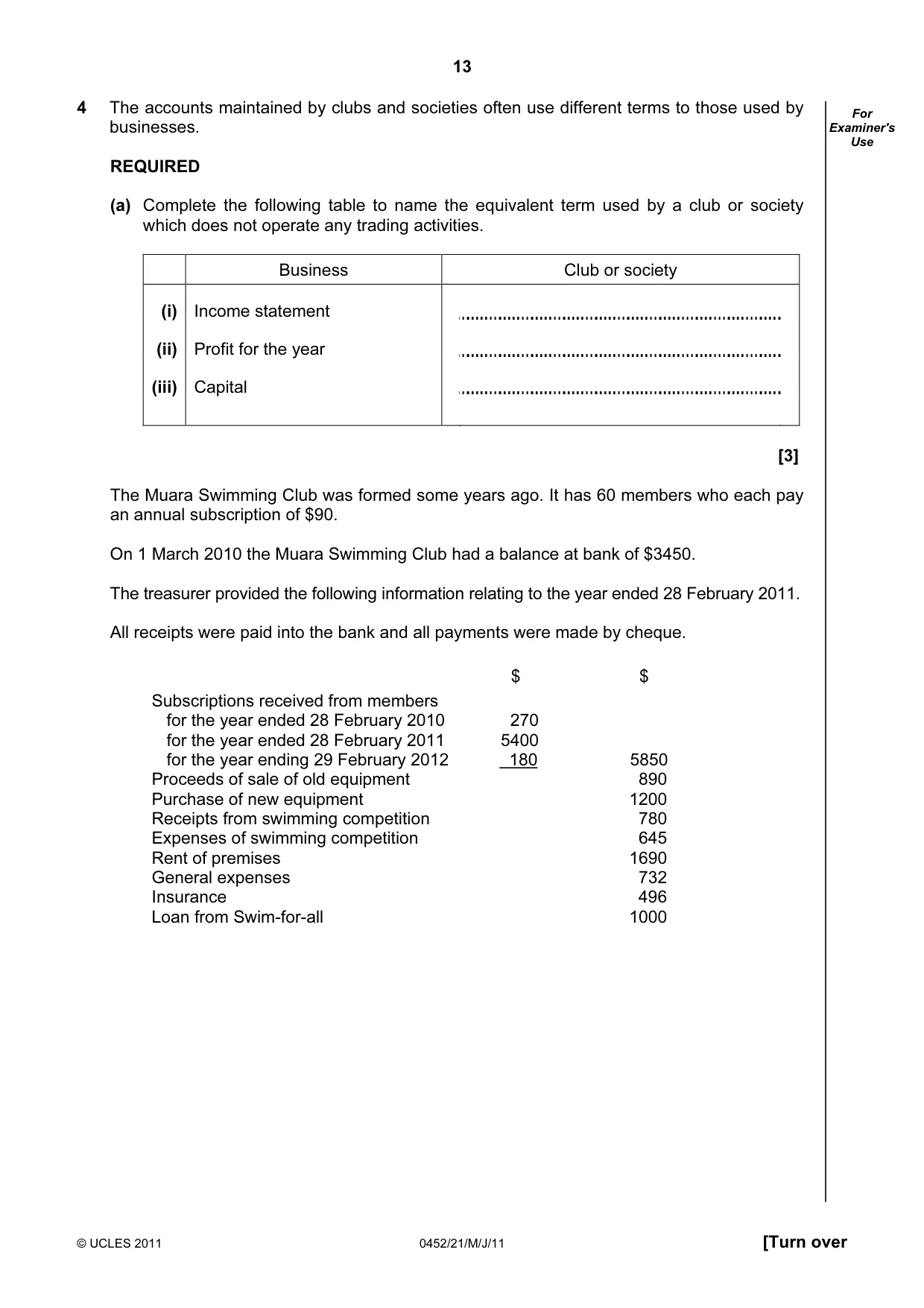
13 © UCLES 2011 0452/21/M/J/11 [Turn over For Examiner's Use 4 The accounts maintained by clubs and societies often use different terms to those used by businesses. REQUIRED (a) Complete the following table to name the equivalent term used by a club or society which does not operate any trading activities. Business Club or society (i) Income statement (ii) Profit for the year (iii) Capital [3] The Muara Swimming Club was formed some years ago. It has 60 members who each pay an annual subscription of $90. On 1 March 2010 the Muara Swimming Club had a balance at bank of $3450. The treasurer provided the following information relating to the year ended 28 February 2011. All receipts were paid into the bank and all payments were made by cheque. $ $ Subscriptions received from members for the year ended 28 February 2010 270 for the year ended 28 February 2011 5400 for the year ending 29 February 2012 180 5850 Proceeds of sale of old equipment 890 Purchase of new equipment 1200 Receipts from swimming competition 780 Expenses of swimming competition 645 Rent of premises 1690 General expenses 732 Insurance 496 Loan from Swim-for-all 1000
Question paper, page 14
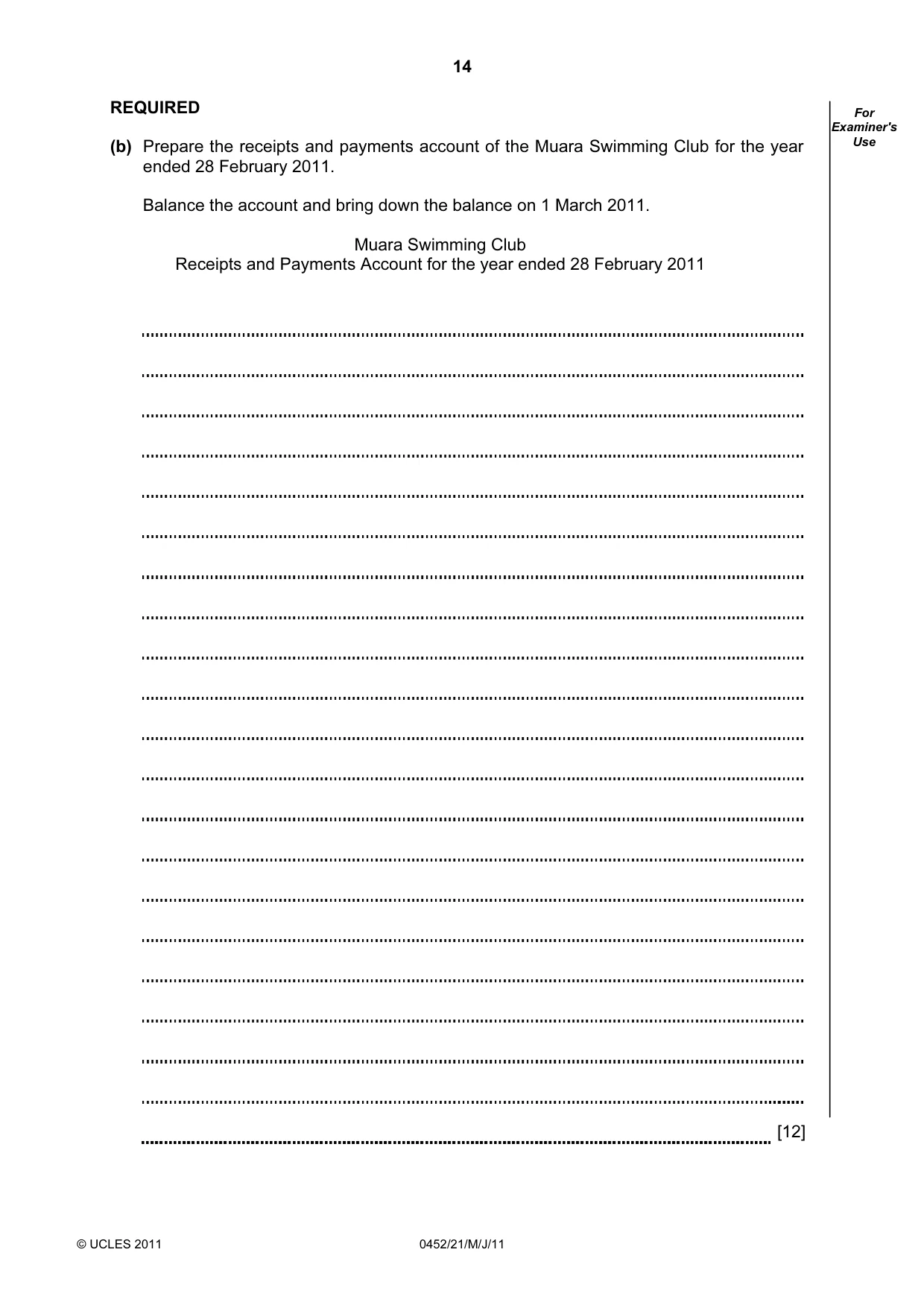
14 © UCLES 2011 0452/21/M/J/11 For Examiner's Use REQUIRED (b) Prepare the receipts and payments account of the Muara Swimming Club for the year ended 28 February 2011. Balance the account and bring down the balance on 1 March 2011. Muara Swimming Club Receipts and Payments Account for the year ended 28 February 2011 [12]
Question paper, page 15
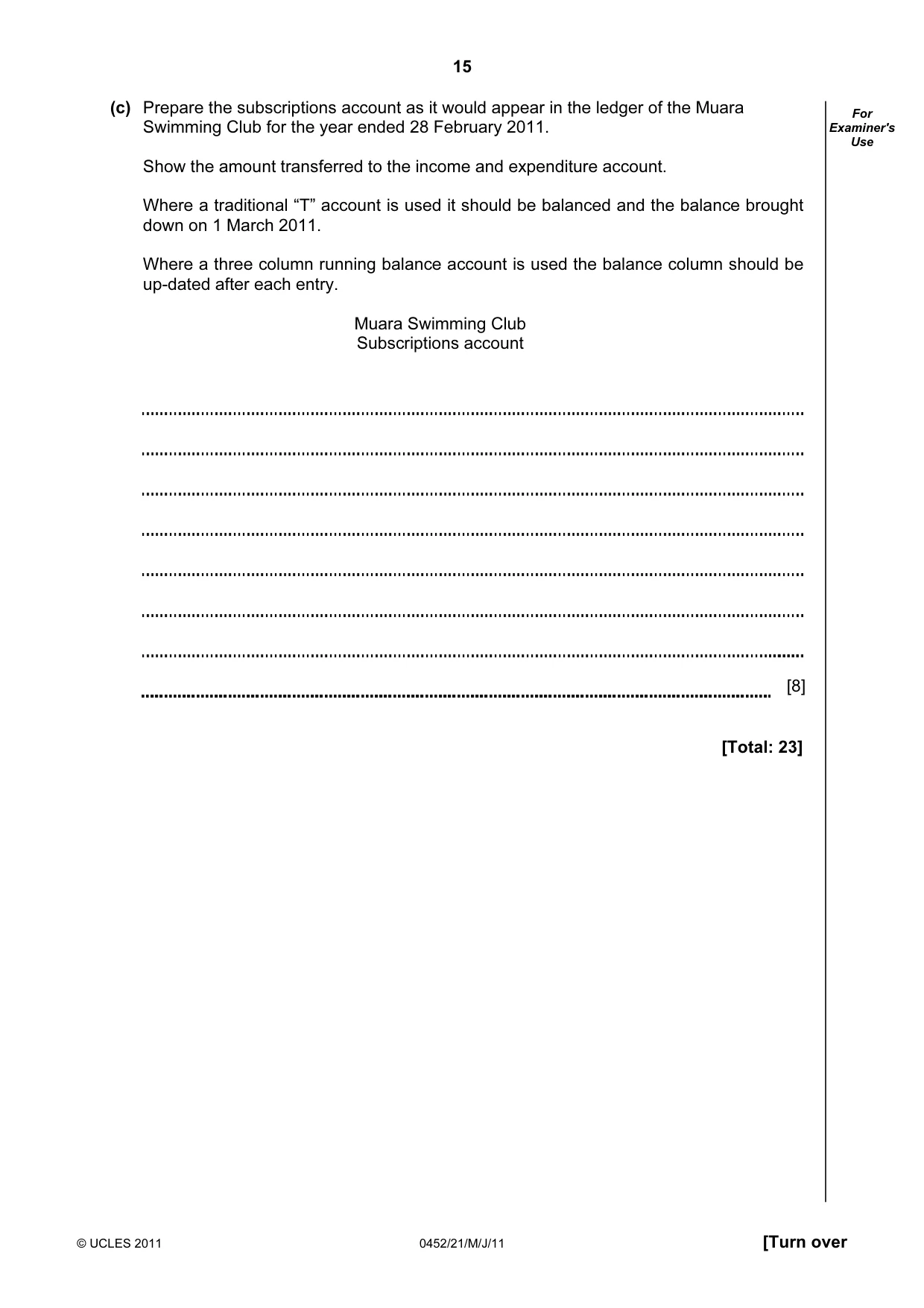
15 © UCLES 2011 0452/21/M/J/11 [Turn over For Examiner's Use (c) Prepare the subscriptions account as it would appear in the ledger of the Muara Swimming Club for the year ended 28 February 2011. Show the amount transferred to the income and expenditure account. Where a traditional “T” account is used it should be balanced and the balance brought down on 1 March 2011. Where a three column running balance account is used the balance column should be up-dated after each entry. Muara Swimming Club Subscriptions account [8] [Total: 23]
Question paper, page 16
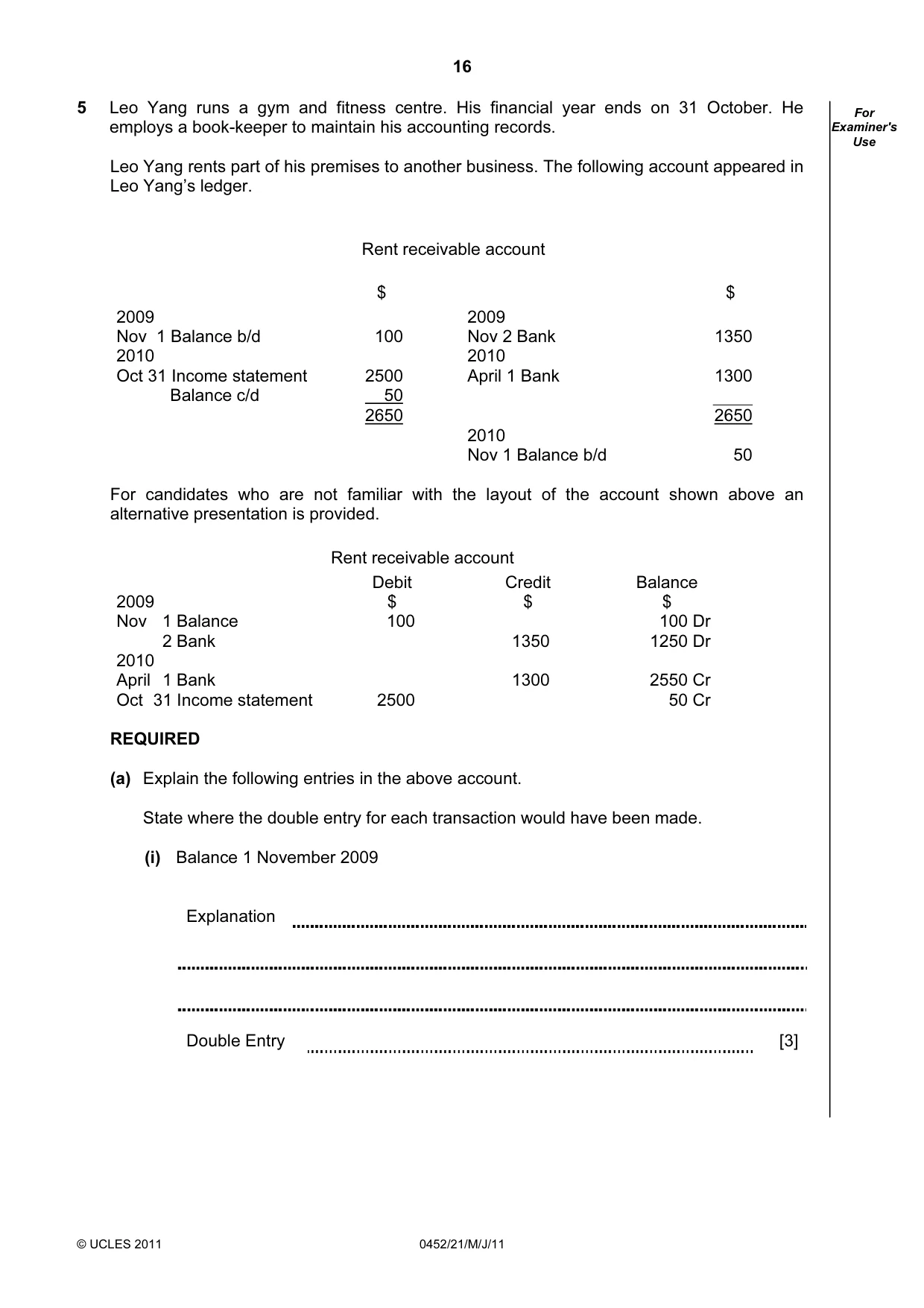
16 © UCLES 2011 0452/21/M/J/11 For Examiner's Use 5 Leo Yang runs a gym and fitness centre. His financial year ends on 31 October. He employs a book-keeper to maintain his accounting records. Leo Yang rents part of his premises to another business. The following account appeared in Leo Yang’s ledger. Rent receivable account $ $ 2009 2009 Nov 1 Balance b/d 100 Nov 2 Bank 1350 2010 2010 Oct 31 Income statement 2500 April 1 Bank 1300 Balance c/d 50 2650 2650 2010 Nov 1 Balance b/d 50 For candidates who are not familiar with the layout of the account shown above an alternative presentation is provided. Rent receivable account Debit Credit Balance 2009 $ $ $ Nov 1 Balance 100 100 Dr 2 Bank 1350 1250 Dr 2010 April 1 Bank 1300 2550 Cr Oct 31 Income statement 2500 50 Cr REQUIRED (a) Explain the following entries in the above account. State where the double entry for each transaction would have been made. (i) Balance 1 November 2009 Explanation Double Entry [3]
Question paper, page 17
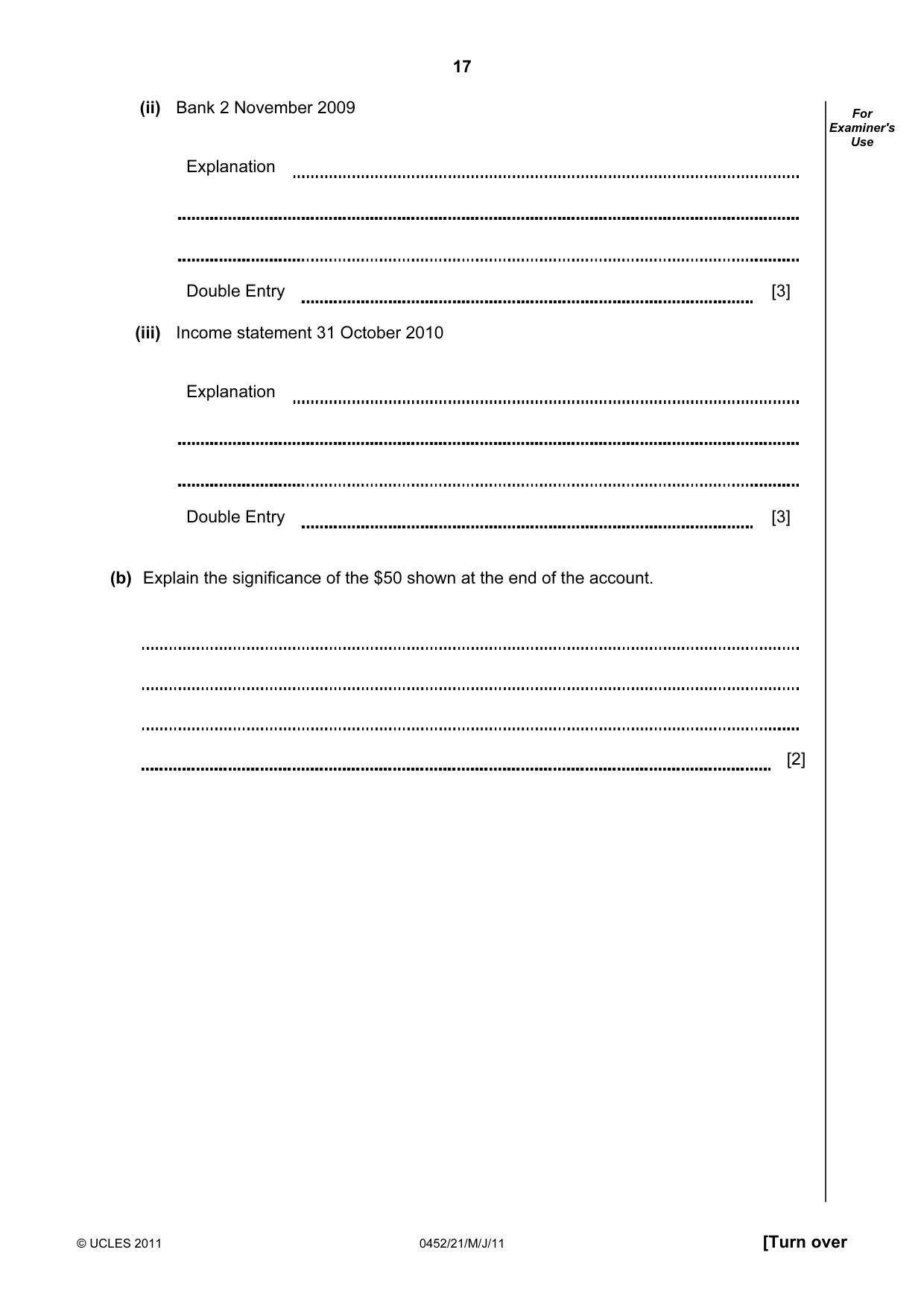
17 © UCLES 2011 0452/21/M/J/11 [Turn over For Examiner's Use (ii) Bank 2 November 2009 Explanation Double Entry [3] (iii) Income statement 31 October 2010 Explanation Double Entry [3] (b) Explain the significance of the $50 shown at the end of the account. [2]
Question paper, page 18
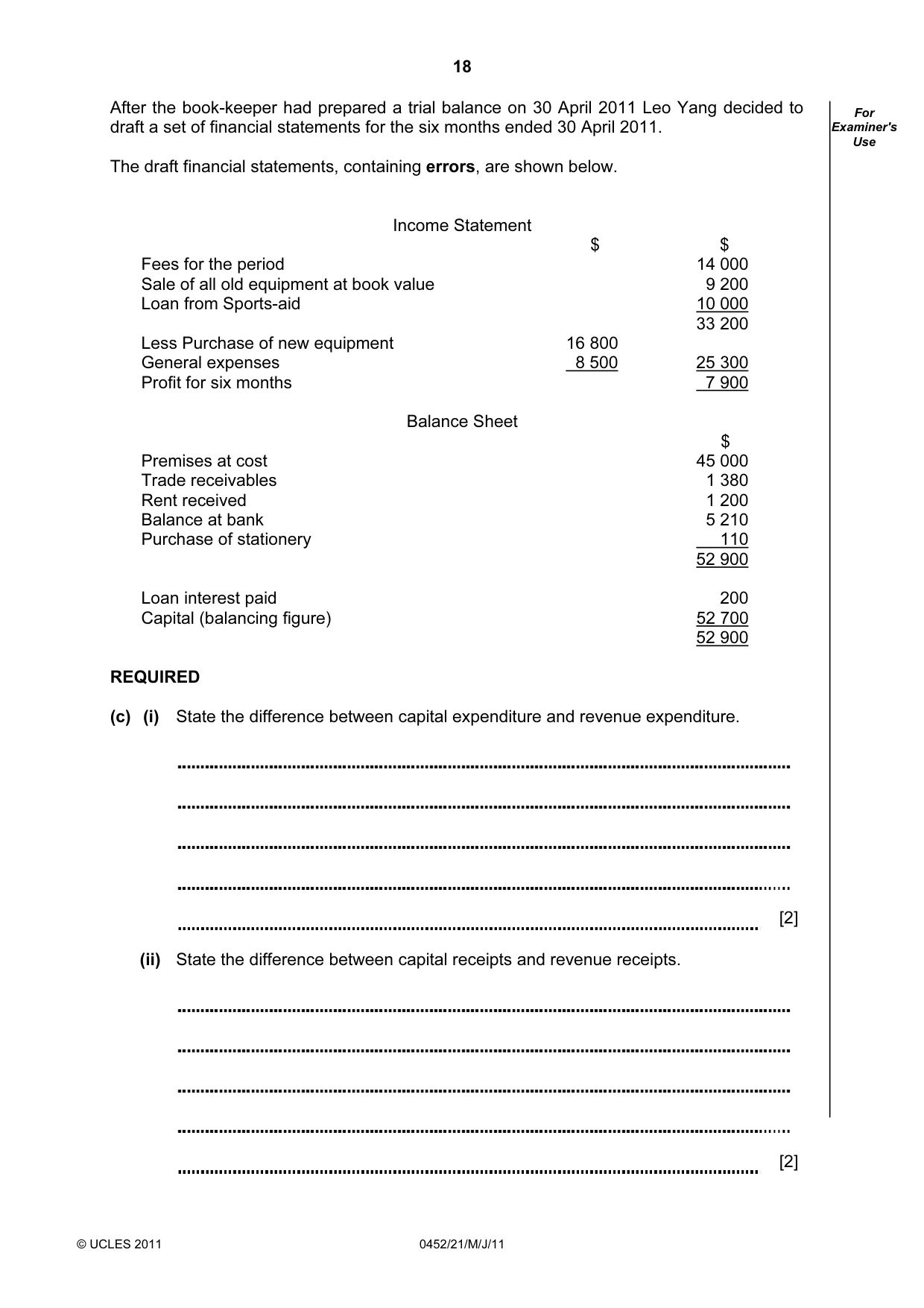
18 © UCLES 2011 0452/21/M/J/11 For Examiner's Use After the book-keeper had prepared a trial balance on 30 April 2011 Leo Yang decided to draft a set of financial statements for the six months ended 30 April 2011. The draft financial statements, containing errors, are shown below. Income Statement $ $ Fees for the period 14 000 Sale of all old equipment at book value 9 200 Loan from Sports-aid 10 000 33 200 Less Purchase of new equipment 16 800 General expenses 8 500 25 300 Profit for six months 7 900 Balance Sheet $ Premises at cost 45 000 Trade receivables 1 380 Rent received 1 200 Balance at bank 5 210 Purchase of stationery 110 52 900 Loan interest paid 200 Capital (balancing figure) 52 700 52 900 REQUIRED (c) (i) State the difference between capital expenditure and revenue expenditure. [2] (ii) State the difference between capital receipts and revenue receipts. [2]
Question paper, page 19
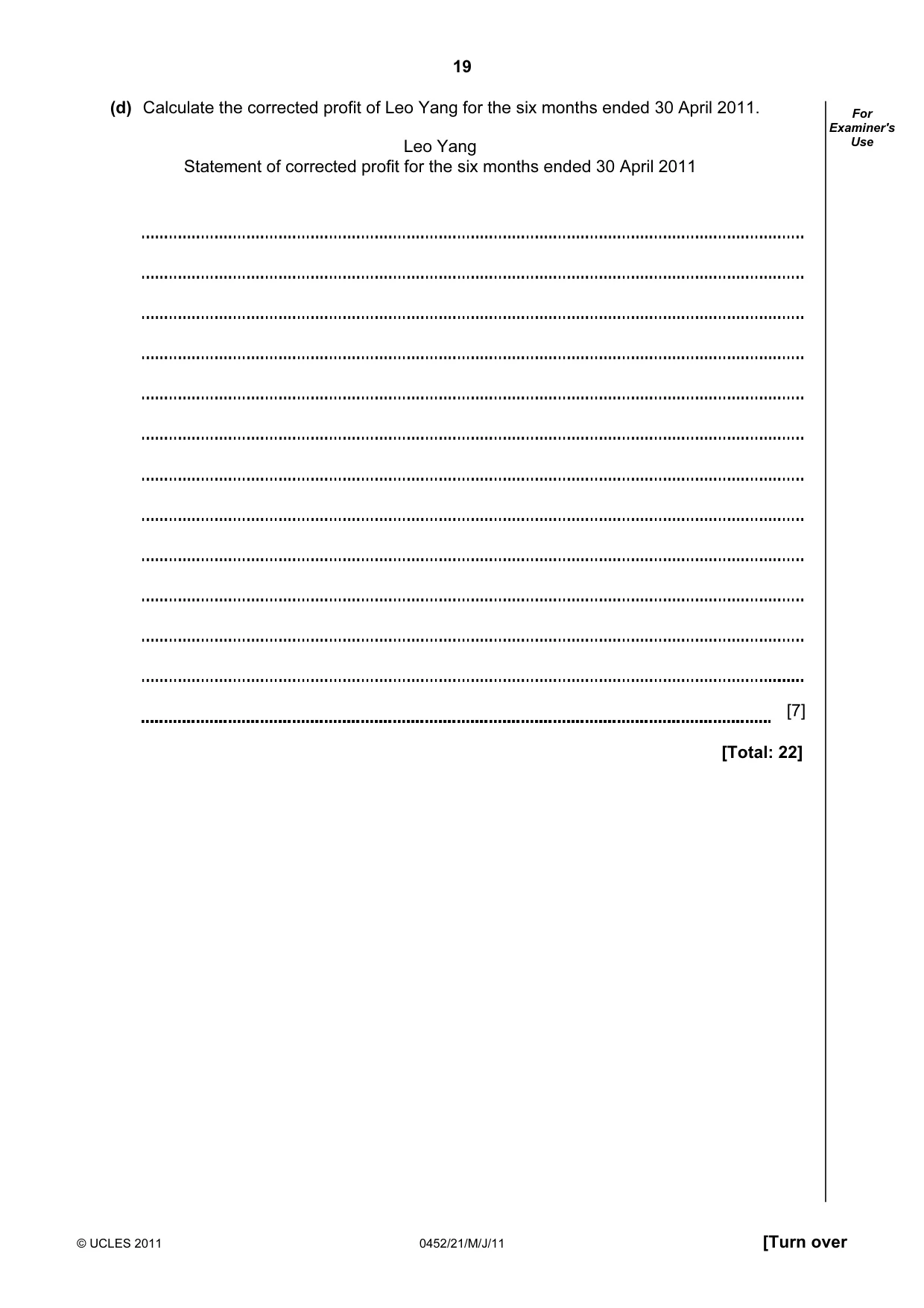
19 © UCLES 2011 0452/21/M/J/11 [Turn over For Examiner's Use (d) Calculate the corrected profit of Leo Yang for the six months ended 30 April 2011. Leo Yang Statement of corrected profit for the six months ended 30 April 2011 [7] [Total: 22]
Question paper, page 20
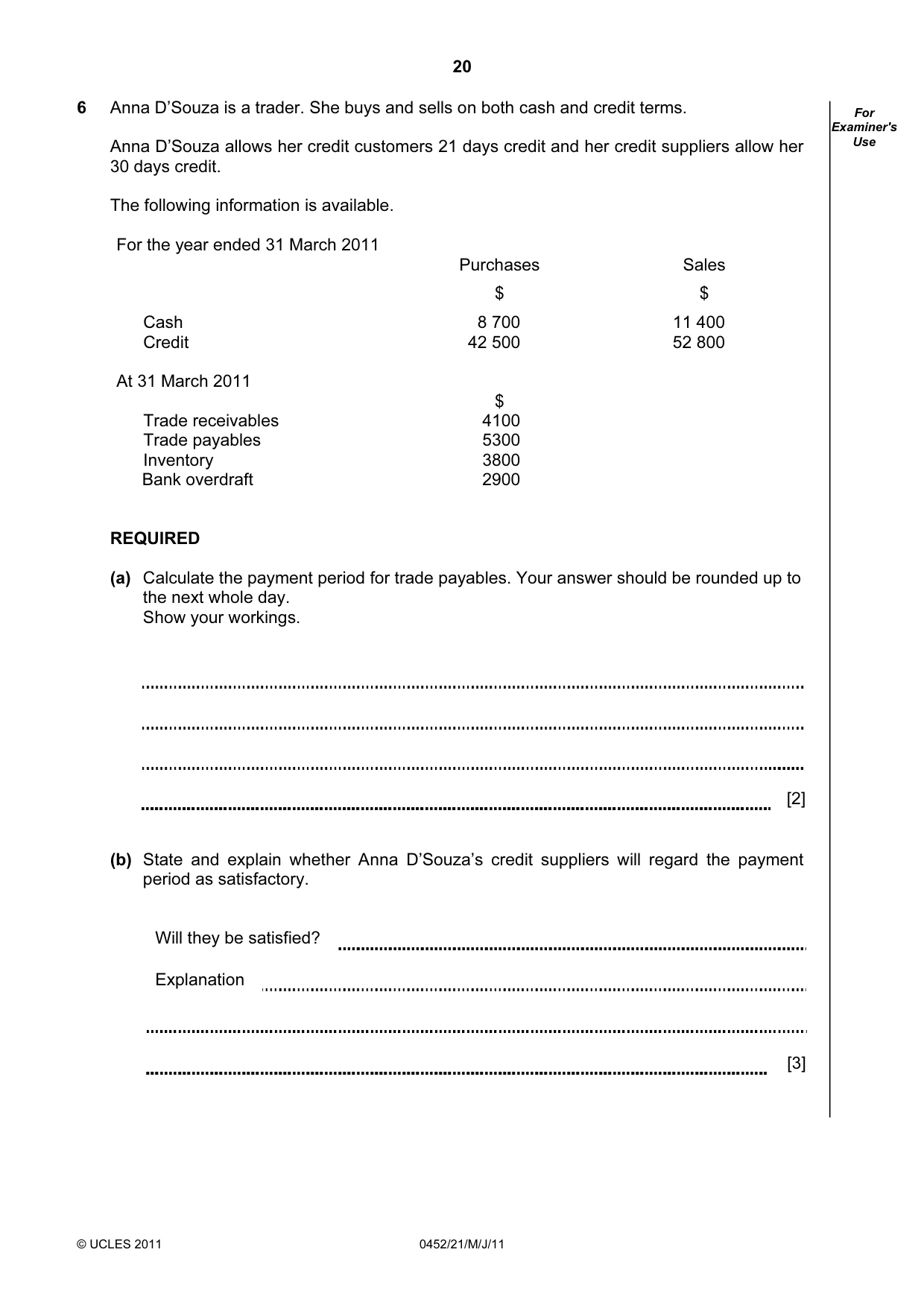
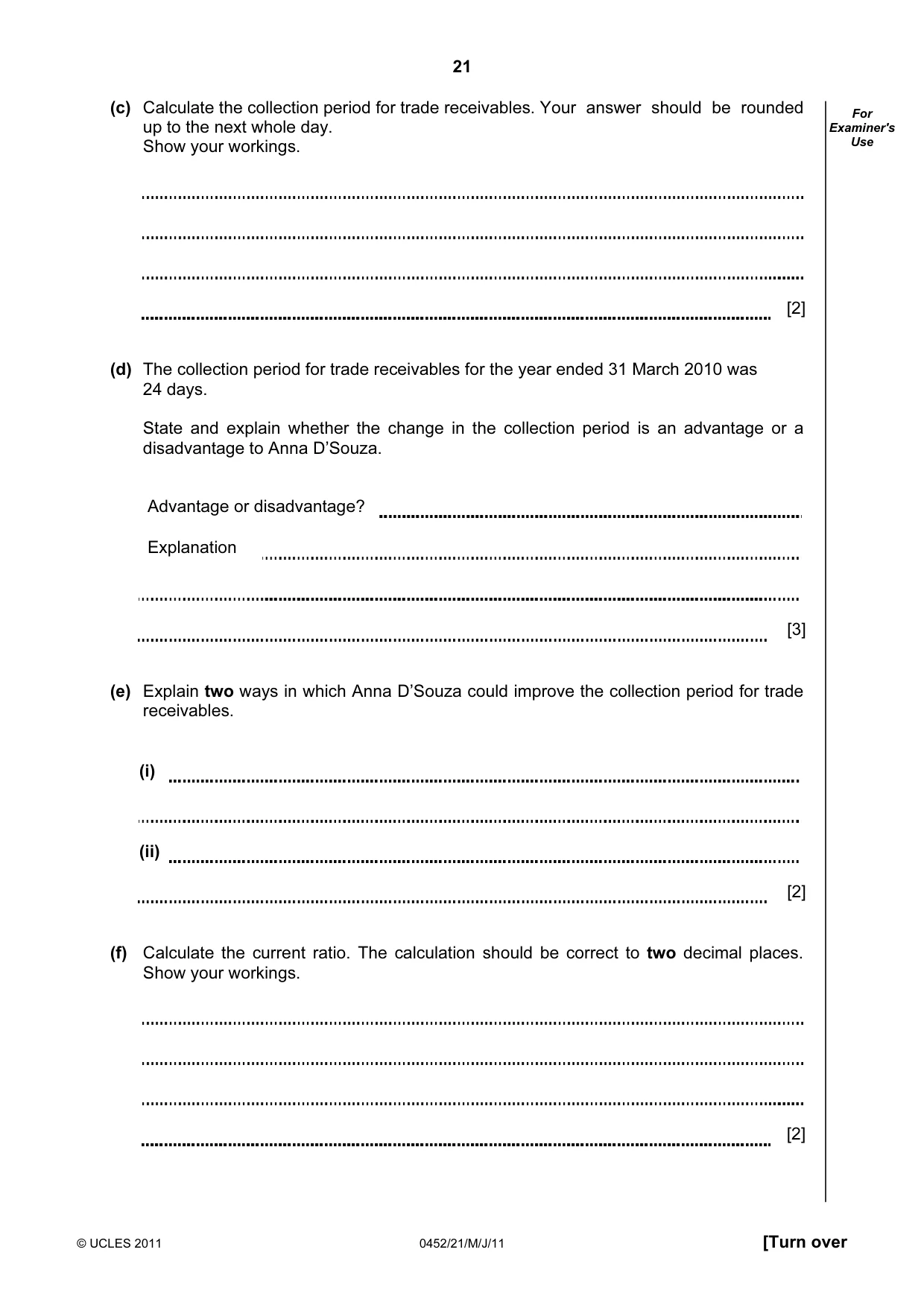
20 © UCLES 2011 0452/21/M/J/11 For Examiner's Use 6 Anna D’Souza is a trader. She buys and sells on both cash and credit terms. Anna D’Souza allows her credit customers 21 days credit and her credit suppliers allow her 30 days credit. The following information is available. REQUIRED (a) Calculate the payment period for trade payables. Your answer should be rounded up to the next whole day. Show your workings. [2] (b) State and explain whether Anna D’Souza’s credit suppliers will regard the payment period as satisfactory. Will they be satisfied? Explanation [3] For the year ended 31 March 2011 Purchases Sales $ $ Cash 8 700 11 400 Credit 42 500 52 800 At 31 March 2011 $ Trade receivables 4100 Trade payables 5300 Inventory 3800 Bank overdraft 2900
Question paper, page 21
21 © UCLES 2011 0452/21/M/J/11 [Turn over For Examiner's Use (c) Calculate the collection period for trade receivables. Your answer should be rounded up to the next whole day. Show your workings. [2] (d) The collection period for trade receivables for the year ended 31 March 2010 was 24 days. State and explain whether the change in the collection period is an advantage or a disadvantage to Anna D’Souza. Advantage or disadvantage? Explanation [3] (e) Explain two ways in which Anna D’Souza could improve the collection period for trade receivables. (i) (ii) [2] (f) Calculate the current ratio. The calculation should be correct to two decimal places. Show your workings. [2]
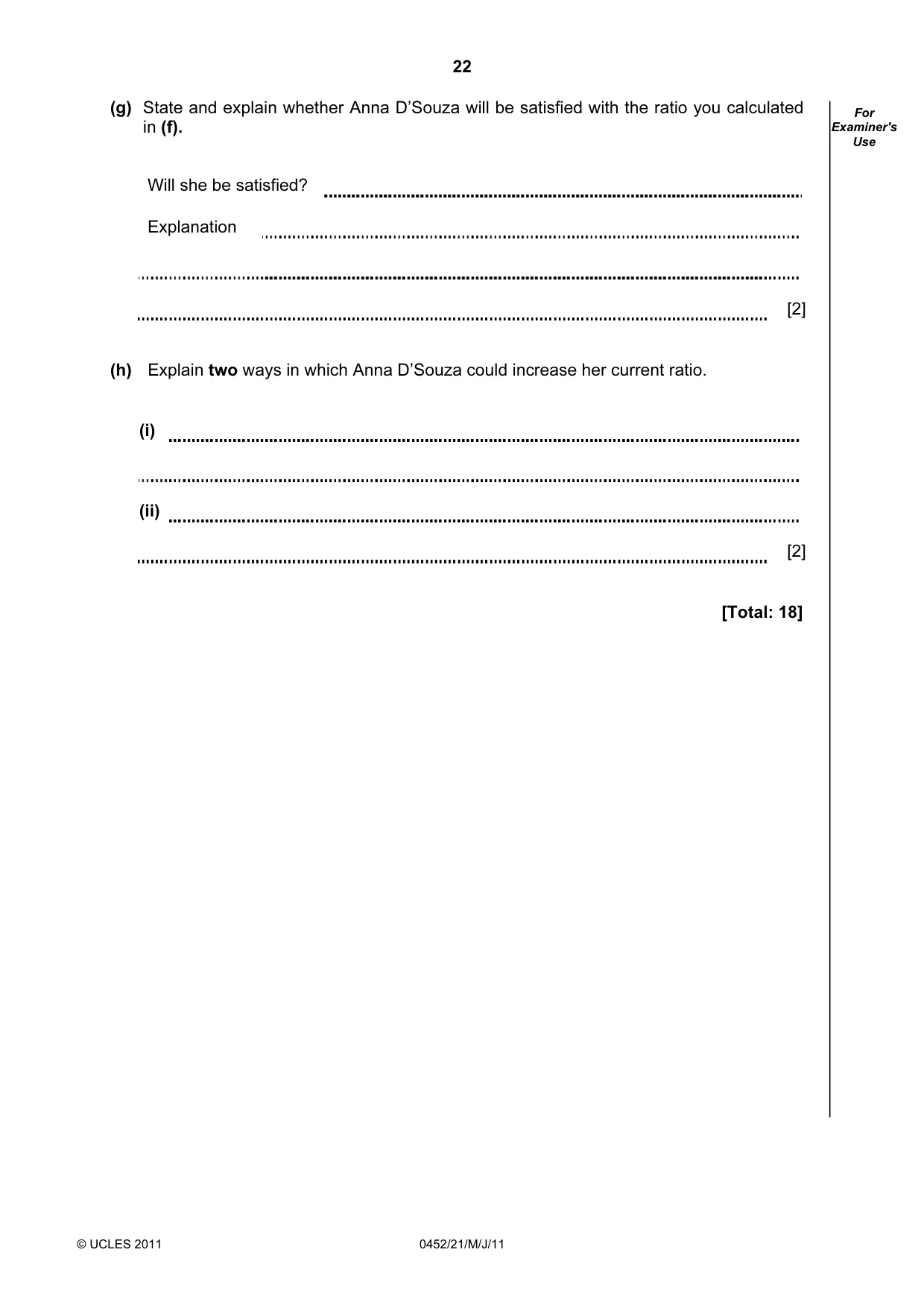
Question paper, page 22
22 © UCLES 2011 0452/21/M/J/11 For Examiner's Use (g) State and explain whether Anna D’Souza will be satisfied with the ratio you calculated in (f). Will she be satisfied? Explanation [2] (h) Explain two ways in which Anna D’Souza could increase her current ratio. (i) (ii) [2] [Total: 18]
Question paper, page 23
23 © UCLES 2011 0452/21/M/J/11 BLANK PAGE
Question paper, page 24
24 Permission to reproduce items where third-party owned material protected by copyright is included has been sought and cleared where possible. Every reasonable effort has been made by the publisher (UCLES) to trace copyright holders, but if any items requiring clearance have unwittingly been included, the publisher will be pleased to make amends at the earliest possible opportunity. University of Cambridge International Examinations is part of the Cambridge Assessment Group. Cambridge Assessment is the brand name of University of Cambridge Local Examinations Syndicate (UCLES), which is itself a department of the University of Cambridge. © UCLES 2011 0452/21/M/J/11 BLANK PAGE
Mark scheme, page 1
UNIVERSITY OF CAMBRIDGE INTERNATIONAL EXAMINATIONS International General Certificate of Secondary Education MARK SCHEME for the May/June 2011 question paper for the guidance of teachers 0452 ACCOUNTING 0452/21 Paper 2, maximum raw mark 120 This mark scheme is published as an aid to teachers and candidates, to indicate the requirements of the examination. It shows the basis on which Examiners were instructed to award marks. It does not indicate the details of the discussions that took place at an Examiners’ meeting before marking began, which would have considered the acceptability of alternative answers. Mark schemes must be read in conjunction with the question papers and the report on the examination. • Cambridge will not enter into discussions or correspondence in connection with these mark schemes. Cambridge is publishing the mark schemes for the May/June 2011 question papers for most IGCSE, GCE Advanced Level and Advanced Subsidiary Level syllabuses and some Ordinary Level syllabuses.
Mark scheme, page 2
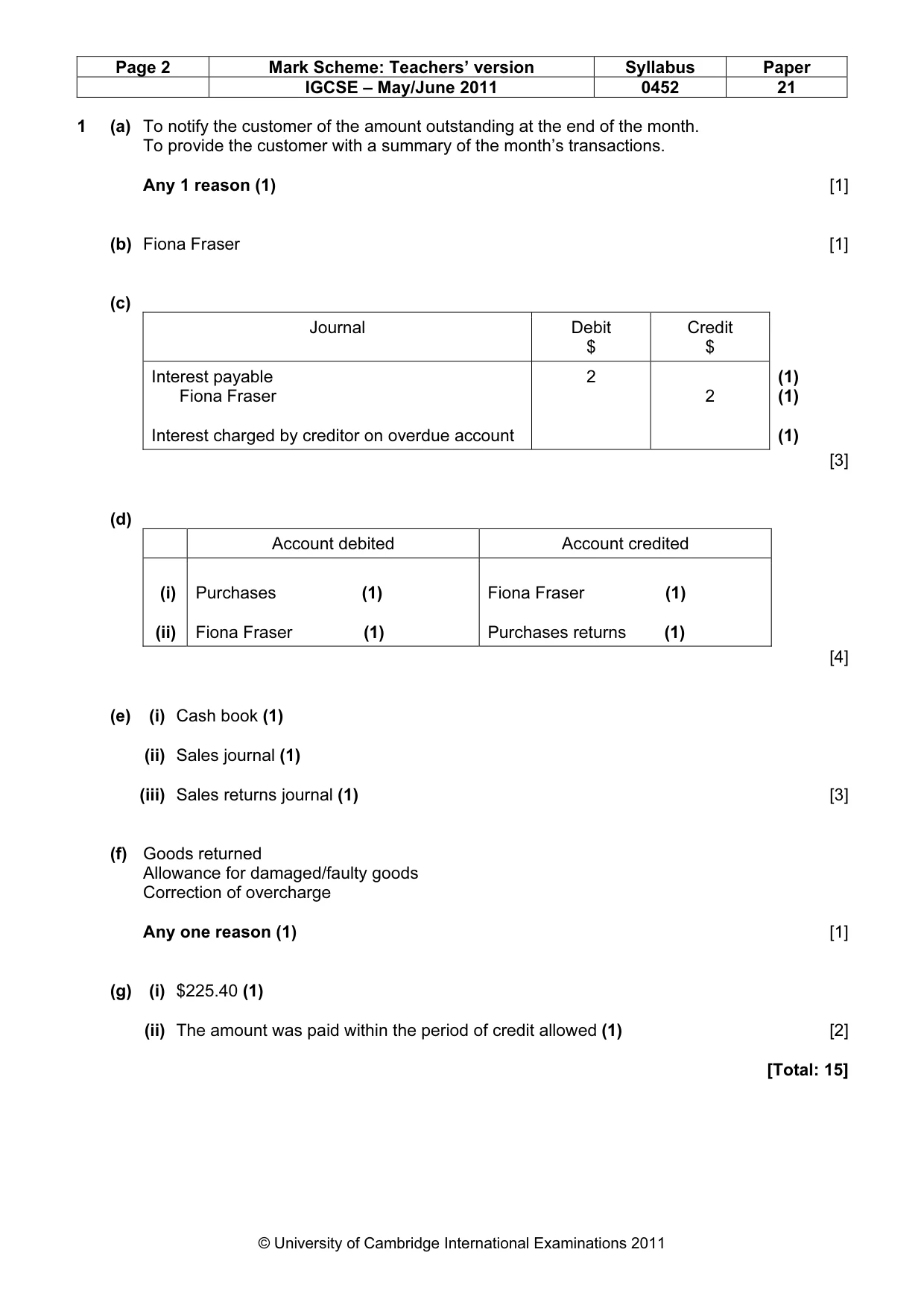
Page 2 Mark Scheme: Teachers’ version Syllabus Paper IGCSE – May/June 2011 0452 21 © University of Cambridge International Examinations 2011 1 (a) To notify the customer of the amount outstanding at the end of the month. To provide the customer with a summary of the month’s transactions. Any 1 reason (1) [1] (b) Fiona Fraser [1] (c) Journal Debit $ Credit $ Interest payable Fiona Fraser Interest charged by creditor on overdue account 2 2 (1) (1) (1) [3] (d) Account debited Account credited (i) (ii) Purchases (1) Fiona Fraser (1) Fiona Fraser (1) Purchases returns (1) [4] (e) (i) Cash book (1) (ii) Sales journal (1) (iii) Sales returns journal (1) [3] (f) Goods returned Allowance for damaged/faulty goods Correction of overcharge Any one reason (1) [1] (g) (i) $225.40 (1) (ii) The amount was paid within the period of credit allowed (1) [2] [Total: 15]
Mark scheme, page 3
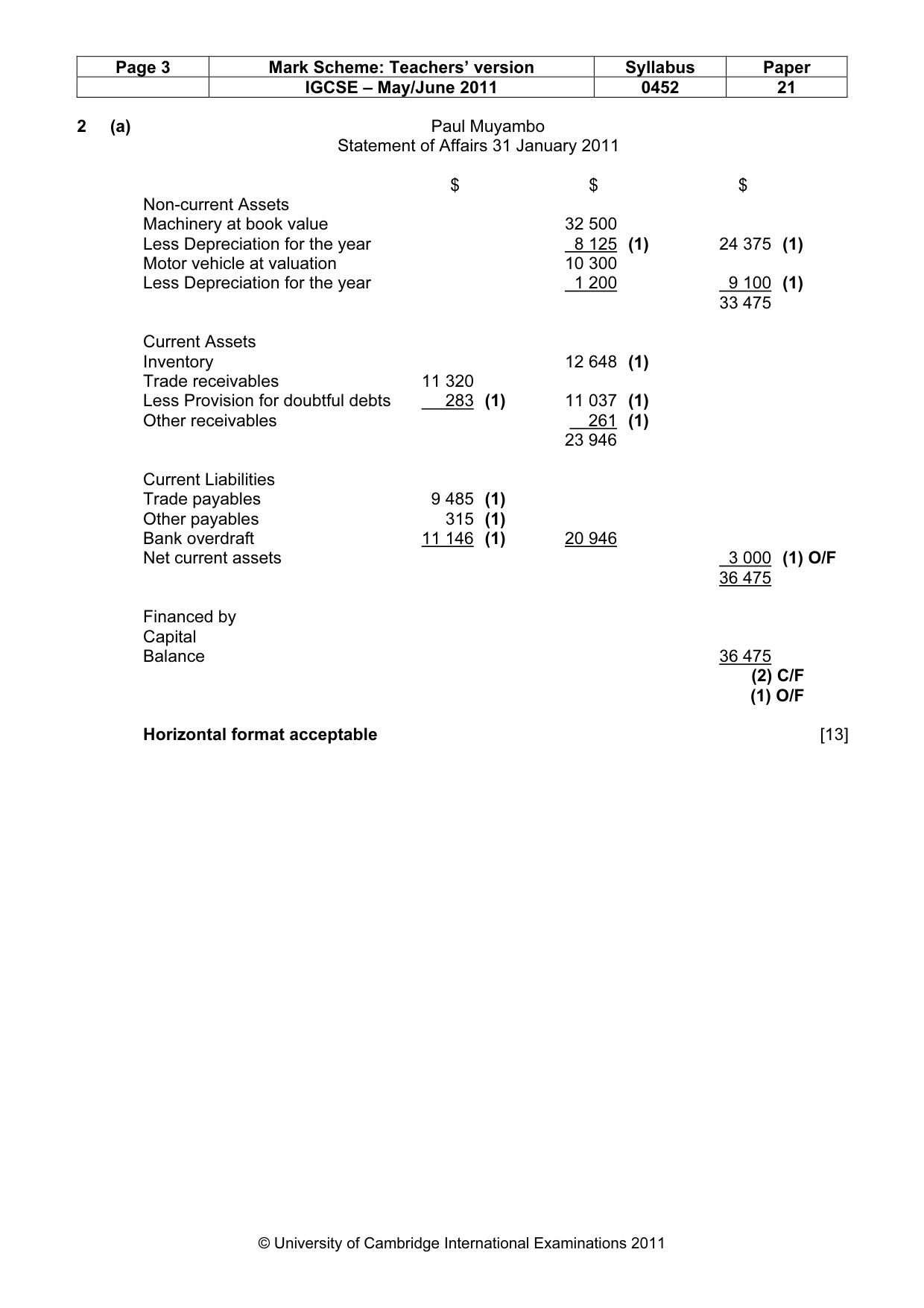
Page 3 Mark Scheme: Teachers’ version Syllabus Paper IGCSE – May/June 2011 0452 21 © University of Cambridge International Examinations 2011 2 (a) Paul Muyambo Statement of Affairs 31 January 2011 $ $ $ Non-current Assets Machinery at book value 32 500 Less Depreciation for the year 8 125 (1) 24 375 (1) Motor vehicle at valuation 10 300 Less Depreciation for the year 1 200 9 100 (1) 33 475 Current Assets Inventory 12 648 (1) Trade receivables 11 320 Less Provision for doubtful debts 283 (1) 11 037 (1) Other receivables 261 (1) 23 946 Current Liabilities Trade payables 9 485 (1) Other payables 315 (1) Bank overdraft 11 146 (1) 20 946 Net current assets 3 000 (1) O/F 36 475 Financed by Capital Balance 36 475 (2) C/F (1) O/F Horizontal format acceptable [13]
Mark scheme, page 4
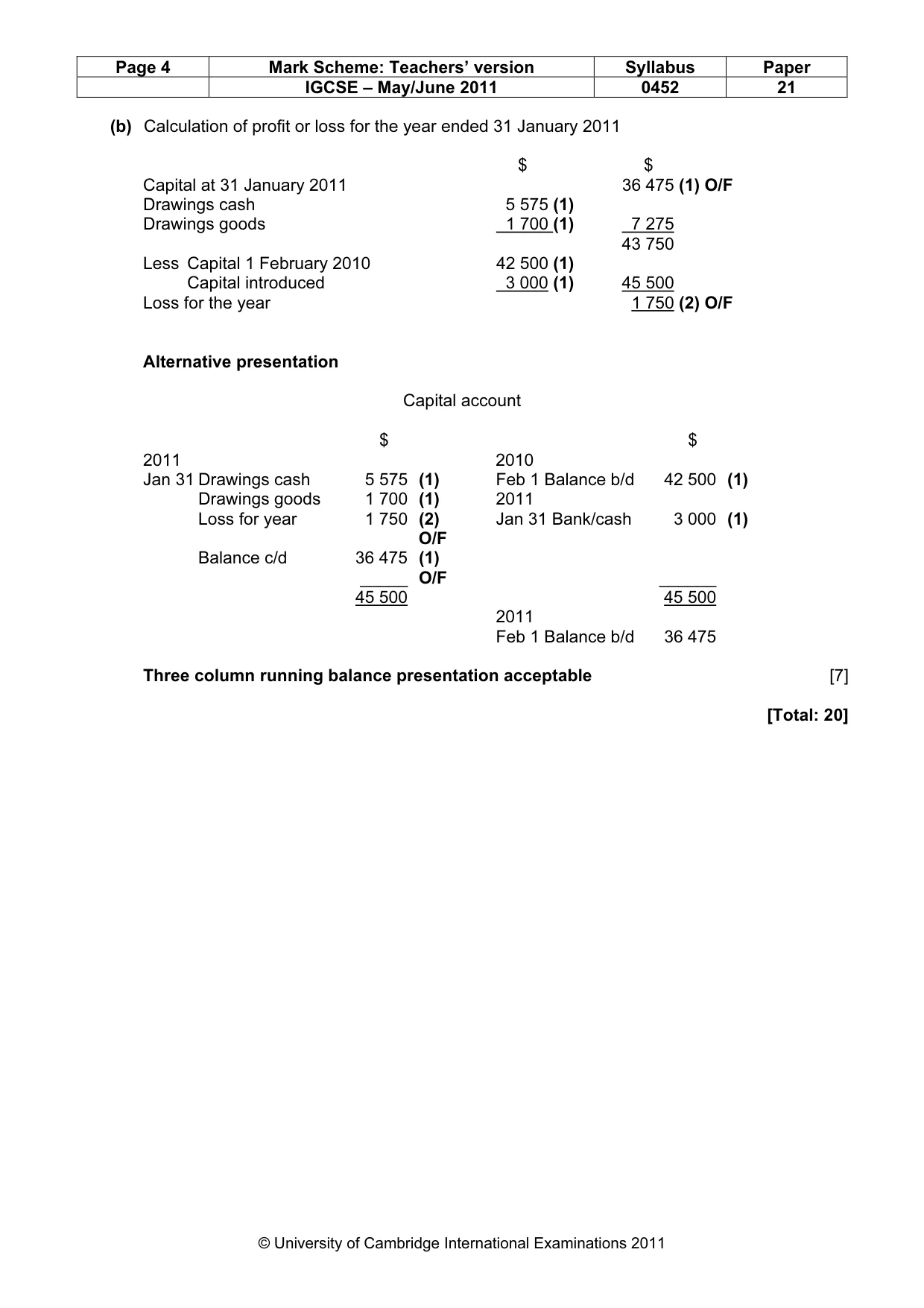
Page 4 Mark Scheme: Teachers’ version Syllabus Paper IGCSE – May/June 2011 0452 21 © University of Cambridge International Examinations 2011 (b) Calculation of profit or loss for the year ended 31 January 2011 $ $ Capital at 31 January 2011 36 475 (1) O/F Drawings cash 5 575 (1) Drawings goods 1 700 (1) 7 275 43 750 Less Capital 1 February 2010 42 500 (1) Capital introduced 3 000 (1) 45 500 Loss for the year 1 750 (2) O/F Alternative presentation Capital account $ $ 2011 2010 Jan 31 Drawings cash 5 575 (1) Feb 1 Balance b/d 42 500 (1) Drawings goods 1 700 (1) 2011 Loss for year 1 750 (2) Jan 31 Bank/cash 3 000 (1) O/F Balance c/d 36 475 (1) _____ O/F ______ 45 500 45 500 2011 Feb 1 Balance b/d 36 475 Three column running balance presentation acceptable [7] [Total: 20]
Mark scheme, page 5
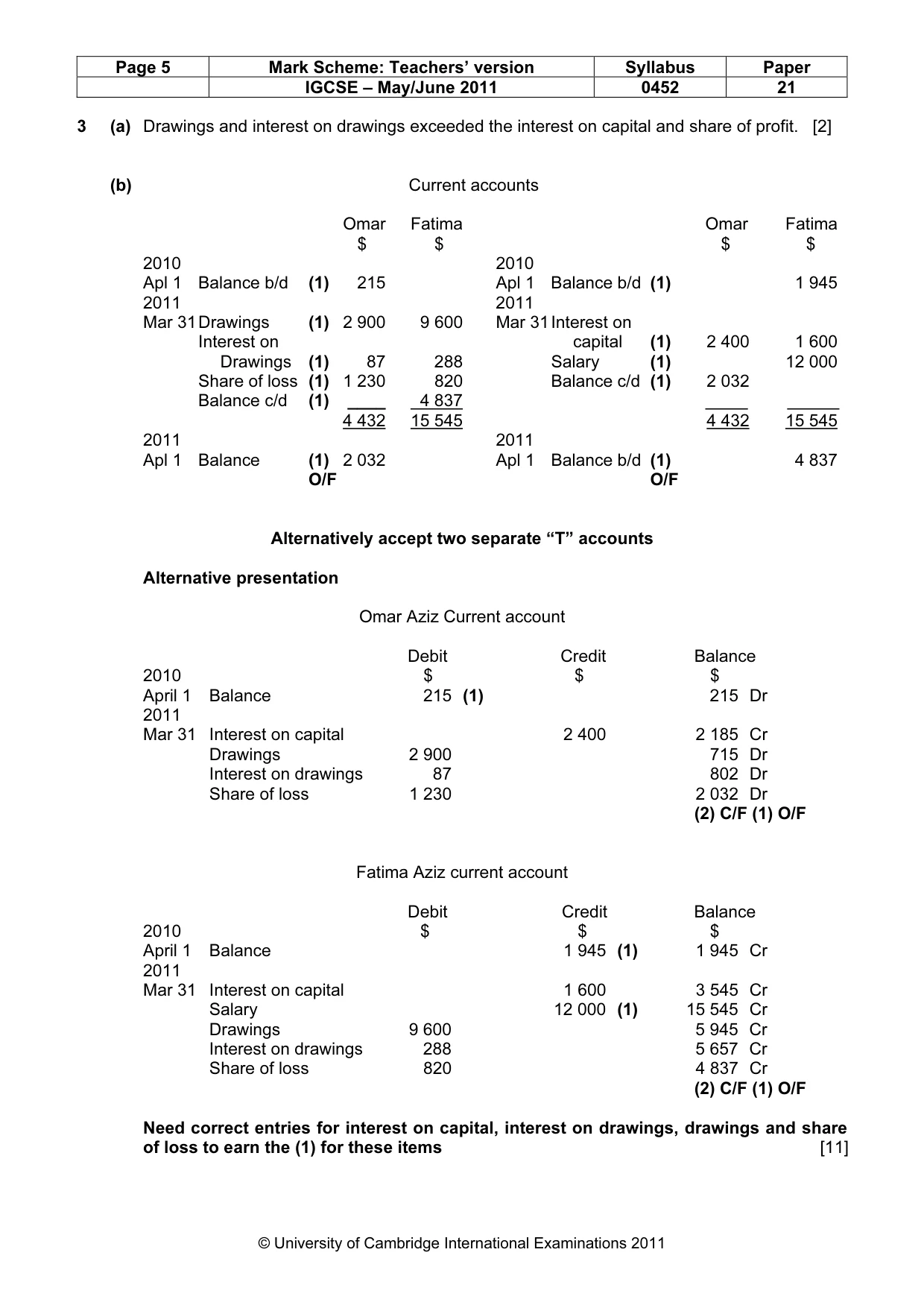
Page 5 Mark Scheme: Teachers’ version Syllabus Paper IGCSE – May/June 2011 0452 21 © University of Cambridge International Examinations 2011 3 (a) Drawings and interest on drawings exceeded the interest on capital and share of profit. [2] (b) Current accounts Omar Fatima Omar Fatima $ $ $ $ 2010 2010 Apl 1 Balance b/d (1) 215 Apl 1 Balance b/d (1) 1 945 2011 2011 Mar 31 Drawings (1) 2 900 9 600 Mar 31 Interest on Interest on capital (1) 2 400 1 600 Drawings (1) 87 288 Salary (1) 12 000 Share of loss (1) 1 230 820 Balance c/d (1) 2 032 Balance c/d (1) ____ 4 837 15 545 4 432 15 545 4 432 15 545 2011 2011 Apl 1 Balance (1) 2 032 Apl 1 Balance b/d (1) 4 837 O/F O/F Alternatively accept two separate “T” accounts Alternative presentation Omar Aziz Current account Debit Credit Balance 2010 $ $ $ April 1 Balance 215 (1) 215 Dr 2011 Mar 31 Interest on capital 2 400 2 185 Cr Drawings 2 900 715 Dr Interest on drawings 87 802 Dr Share of loss 1 230 2 032 Dr (2) C/F (1) O/F Fatima Aziz current account Debit Credit Balance 2010 $ $ $ April 1 Balance 1 945 (1) 1 945 Cr 2011 Mar 31 Interest on capital 1 600 3 545 Cr Salary 12 000 (1) 15 545 Cr Drawings 9 600 5 945 Cr Interest on drawings 288 5 657 Cr Share of loss 820 4 837 Cr (2) C/F (1) O/F Need correct entries for interest on capital, interest on drawings, drawings and share of loss to earn the (1) for these items [11]
Mark scheme, page 6
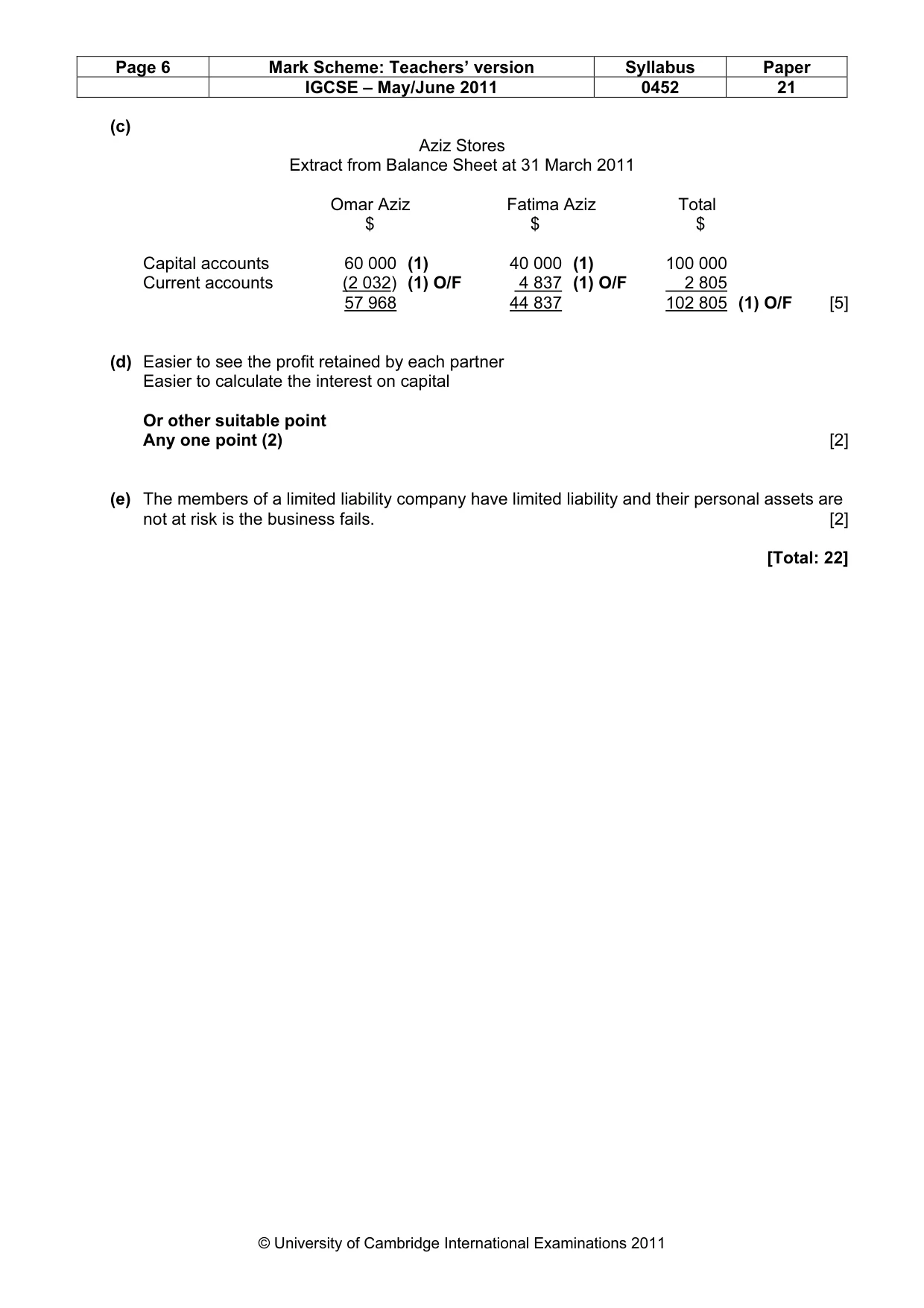
Page 6 Mark Scheme: Teachers’ version Syllabus Paper IGCSE – May/June 2011 0452 21 © University of Cambridge International Examinations 2011 (c) Aziz Stores Extract from Balance Sheet at 31 March 2011 Omar Aziz Fatima Aziz Total $ $ $ Capital accounts 60 000 (1) 40 000 (1) 100 000 Current accounts (2 032) (1) O/F 4 837 (1) O/F 2 805 57 968 44 837 102 805 (1) O/F [5] (d) Easier to see the profit retained by each partner Easier to calculate the interest on capital Or other suitable point Any one point (2) [2] (e) The members of a limited liability company have limited liability and their personal assets are not at risk is the business fails. [2] [Total: 22]
Mark scheme, page 7
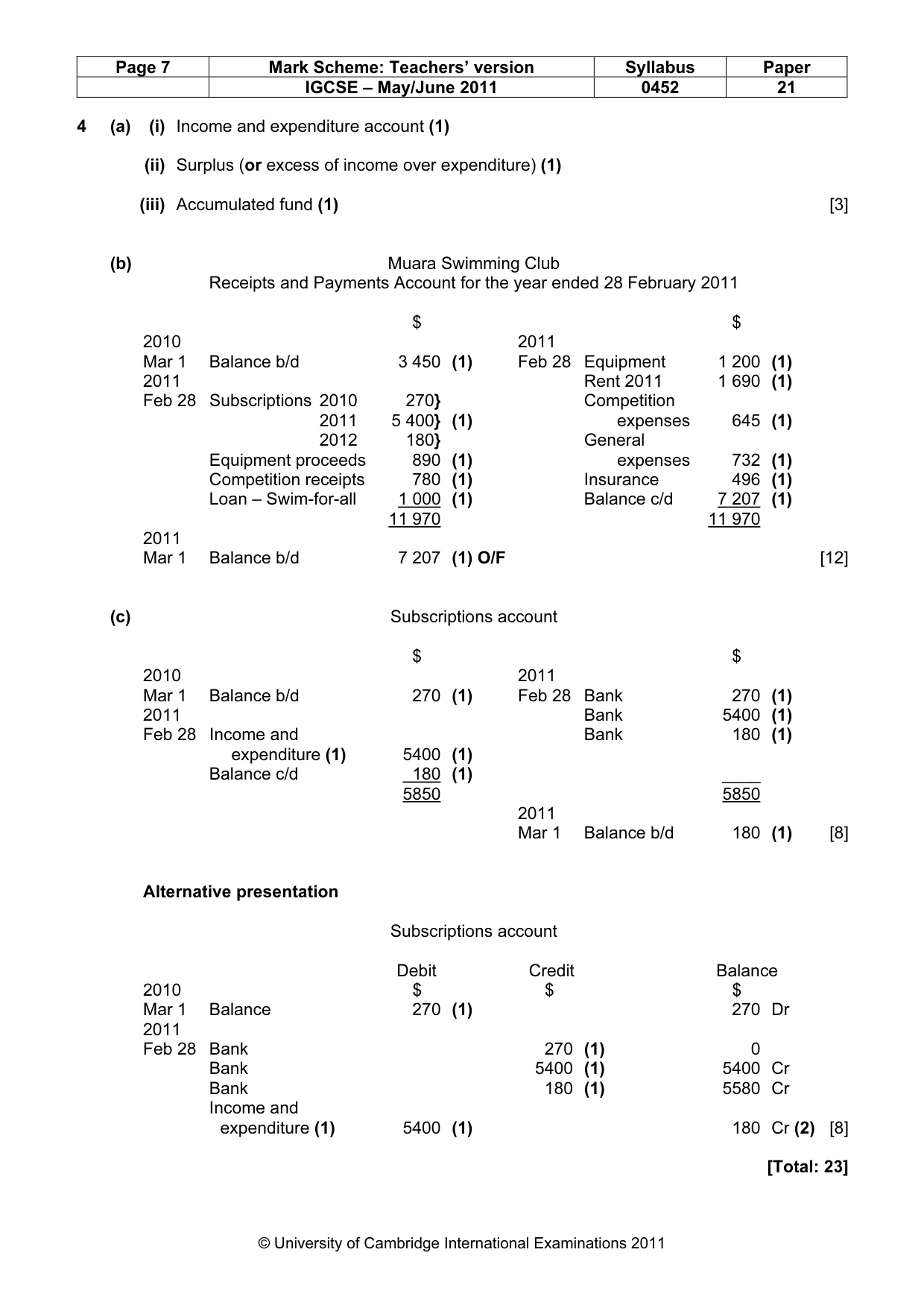
Page 7 Mark Scheme: Teachers’ version Syllabus Paper IGCSE – May/June 2011 0452 21 © University of Cambridge International Examinations 2011 4 (a) (i) Income and expenditure account (1) (ii) Surplus (or excess of income over expenditure) (1) (iii) Accumulated fund (1) [3] (b) Muara Swimming Club Receipts and Payments Account for the year ended 28 February 2011 $ $ 2010 2011 Mar 1 Balance b/d 3 450 (1) Feb 28 Equipment 1 200 (1) 2011 Rent 2011 1 690 (1) Feb 28 Subscriptions 2010 270} Competition 2011 5 400} (1) expenses 645 (1) 2012 180} General Equipment proceeds 890 (1) expenses 732 (1) Competition receipts 780 (1) Insurance 496 (1) Loan – Swim-for-all 1 000 (1) Balance c/d 7 207 (1) 11 970 11 970 2011 Mar 1 Balance b/d 7 207 (1) O/F [12] (c) Subscriptions account $ $ 2010 2011 Mar 1 Balance b/d 270 (1) Feb 28 Bank 270 (1) 2011 Bank 5400 (1) Feb 28 Income and Bank 180 (1) expenditure (1) 5400 (1) Balance c/d 180 (1) ____ 5850 5850 2011 Mar 1 Balance b/d 180 (1) [8] Alternative presentation Subscriptions account Debit Credit Balance 2010 $ $ $ Mar 1 Balance 270 (1) 270 Dr 2011 Feb 28 Bank 270 (1) 0 Bank 5400 (1) 5400 Cr Bank 180 (1) 5580 Cr Income and expenditure (1) 5400 (1) 180 Cr (2) [8] [Total: 23]
Mark scheme, page 8
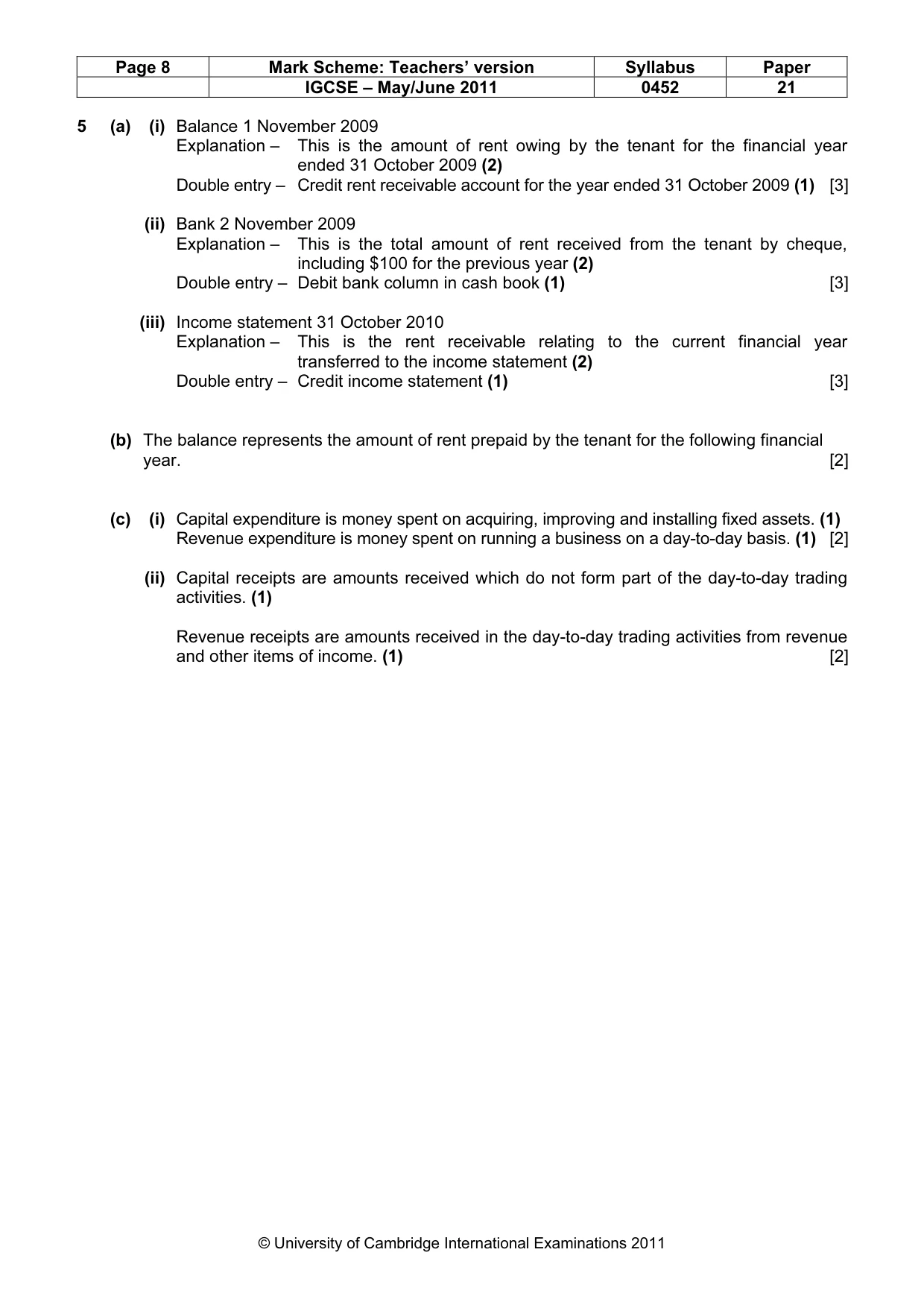
Page 8 Mark Scheme: Teachers’ version Syllabus Paper IGCSE – May/June 2011 0452 21 © University of Cambridge International Examinations 2011 5 (a) (i) Balance 1 November 2009 Explanation – This is the amount of rent owing by the tenant for the financial year ended 31 October 2009 (2) Double entry – Credit rent receivable account for the year ended 31 October 2009 (1) [3] (ii) Bank 2 November 2009 Explanation – This is the total amount of rent received from the tenant by cheque, including $100 for the previous year (2) Double entry – Debit bank column in cash book (1) [3] (iii) Income statement 31 October 2010 Explanation – This is the rent receivable relating to the current financial year transferred to the income statement (2) Double entry – Credit income statement (1) [3] (b) The balance represents the amount of rent prepaid by the tenant for the following financial year. [2] (c) (i) Capital expenditure is money spent on acquiring, improving and installing fixed assets. (1) Revenue expenditure is money spent on running a business on a day-to-day basis. (1) [2] (ii) Capital receipts are amounts received which do not form part of the day-to-day trading activities. (1) Revenue receipts are amounts received in the day-to-day trading activities from revenue and other items of income. (1) [2]
Mark scheme, page 9
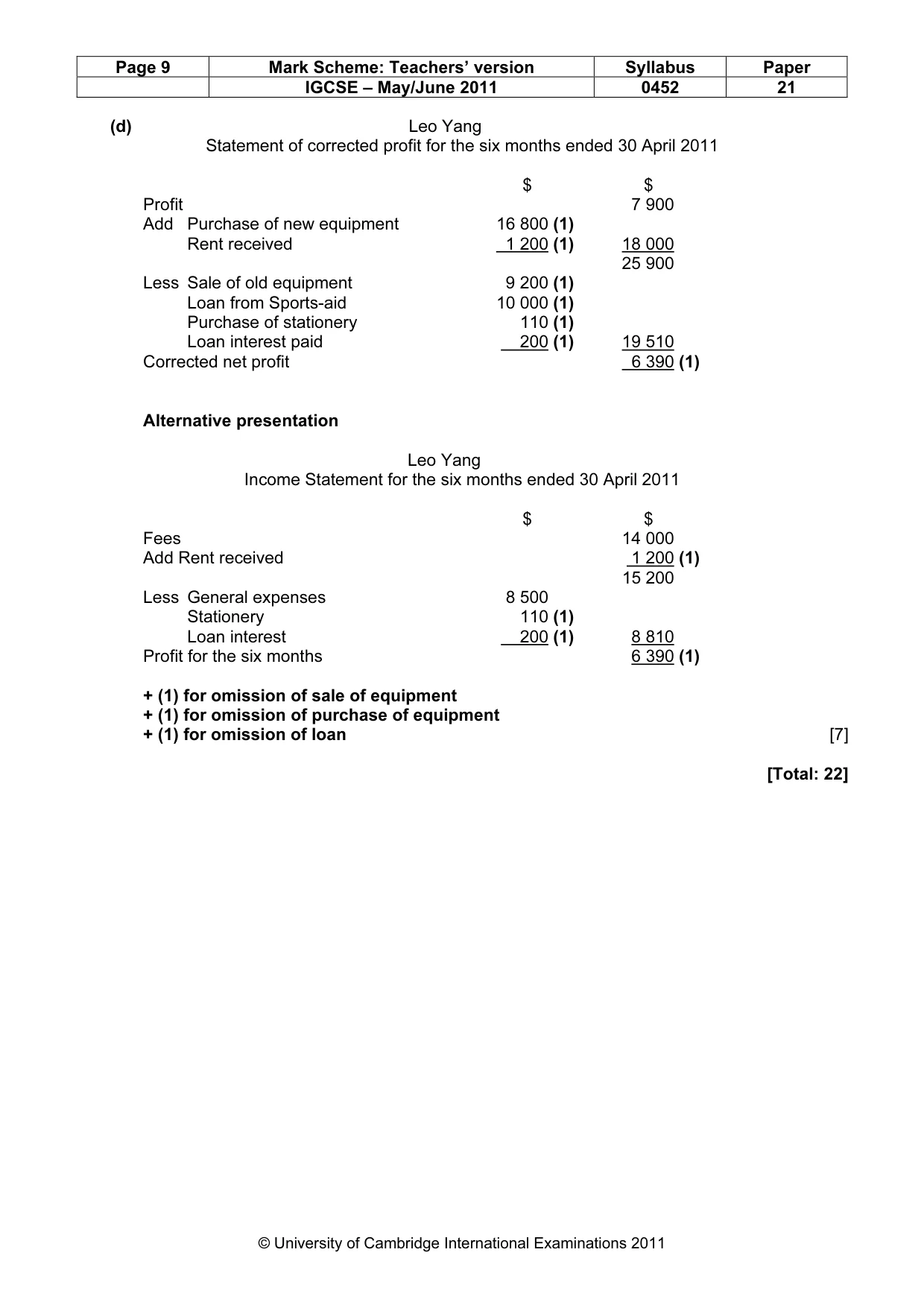
Page 9 Mark Scheme: Teachers’ version Syllabus Paper IGCSE – May/June 2011 0452 21 © University of Cambridge International Examinations 2011 (d) Leo Yang Statement of corrected profit for the six months ended 30 April 2011 $ $ Profit 7 900 Add Purchase of new equipment 16 800 (1) Rent received 1 200 (1) 18 000 25 900 Less Sale of old equipment 9 200 (1) Loan from Sports-aid 10 000 (1) Purchase of stationery 110 (1) Loan interest paid 200 (1) 19 510 Corrected net profit 6 390 (1) Alternative presentation Leo Yang Income Statement for the six months ended 30 April 2011 $ $ Fees 14 000 Add Rent received 1 200 (1) 15 200 Less General expenses 8 500 Stationery 110 (1) Loan interest 200 (1) 8 810 Profit for the six months 6 390 (1) + (1) for omission of sale of equipment + (1) for omission of purchase of equipment + (1) for omission of loan [7] [Total: 22]
Mark scheme, page 10
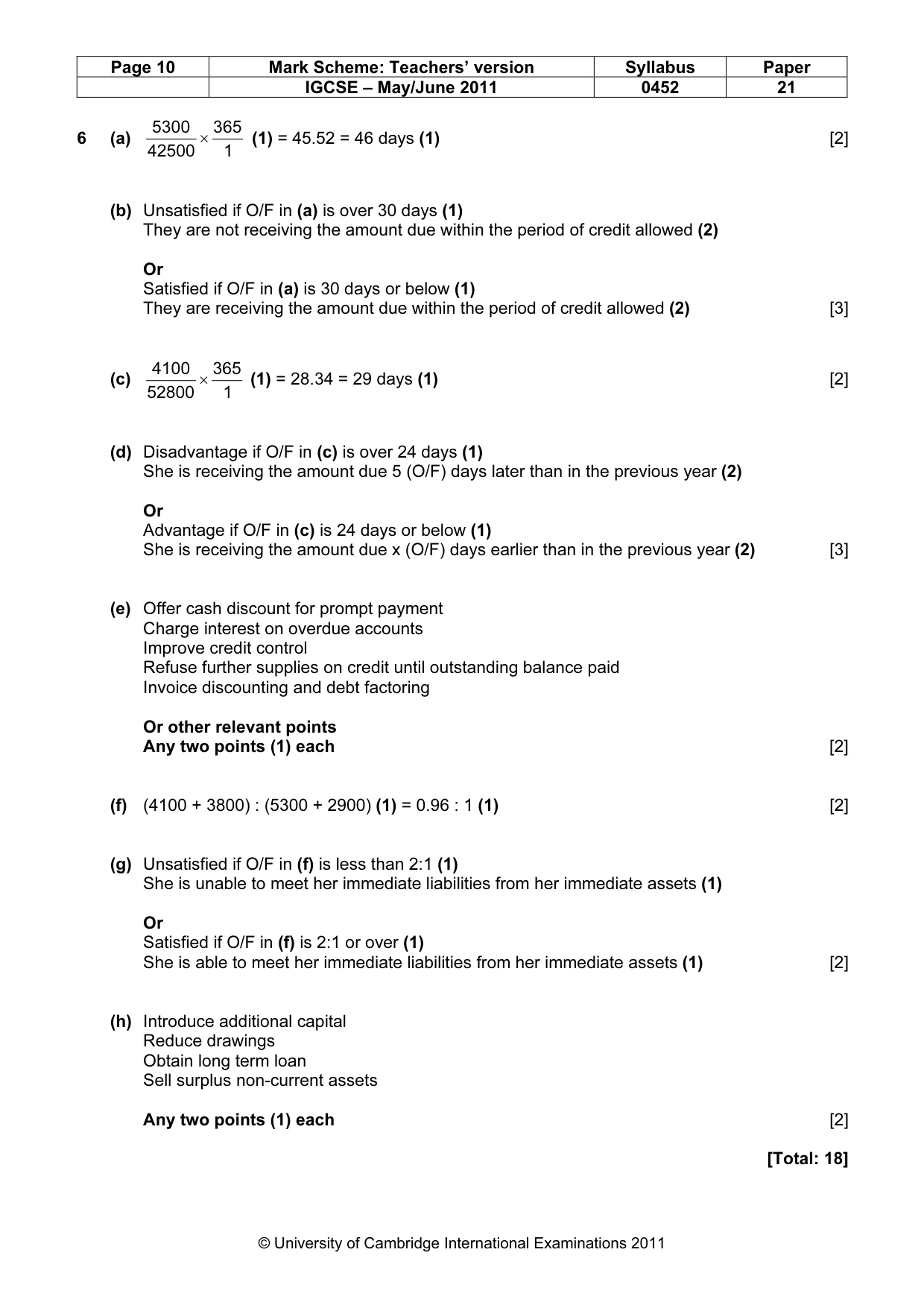
Page 10 Mark Scheme: Teachers’ version Syllabus Paper IGCSE – May/June 2011 0452 21 © University of Cambridge International Examinations 2011 6 (a) 1 365 42500 5300 × (1) = 45.52 = 46 days (1) [2] (b) Unsatisfied if O/F in (a) is over 30 days (1) They are not receiving the amount due within the period of credit allowed (2) Or Satisfied if O/F in (a) is 30 days or below (1) They are receiving the amount due within the period of credit allowed (2) [3] (c) 1 365 52800 4100 × (1) = 28.34 = 29 days (1) [2] (d) Disadvantage if O/F in (c) is over 24 days (1) She is receiving the amount due 5 (O/F) days later than in the previous year (2) Or Advantage if O/F in (c) is 24 days or below (1) She is receiving the amount due x (O/F) days earlier than in the previous year (2) [3] (e) Offer cash discount for prompt payment Charge interest on overdue accounts Improve credit control Refuse further supplies on credit until outstanding balance paid Invoice discounting and debt factoring Or other relevant points Any two points (1) each [2] (f) (4100 + 3800) : (5300 + 2900) (1) = 0.96 : 1 (1) [2] (g) Unsatisfied if O/F in (f) is less than 2:1 (1) She is unable to meet her immediate liabilities from her immediate assets (1) Or Satisfied if O/F in (f) is 2:1 or over (1) She is able to meet her immediate liabilities from her immediate assets (1) [2] (h) Introduce additional capital Reduce drawings Obtain long term loan Sell surplus non-current assets Any two points (1) each [2] [Total: 18]
What you needed in this session
Cambridge’s own grade thresholds for 2011 May/June, Paper 2 · Variant 1. A higher threshold means an easier paper — the bar moves with how the cohort did.