Cambridge IGCSE Accounting 0452 — 2010 Oct/Nov Paper 2 · Variant 3
0452/23/O/N/10 · 120 marks · ≈135 min
The question paper and its mark scheme, free to read here and free to download. This is Cambridge’s own paper, exactly as it was sat.
Question paper20 pages
Mark scheme9 pages
Answers below. Sit the paper first if you are practising.
Paper as text
Question paper, page 1
This document consists of 19 printed pages and 1 blank page. IB10 11_0452_23/4RP © UCLES 2010 [Turn over *4206949933* For Examiner's Use 1 2 3 4 5 Total UNIVERSITY OF CAMBRIDGE INTERNATIONAL EXAMINATIONS International General Certificate of Secondary Education ACCOUNTING 0452/23 Paper 2 October/November 2010 1 hour 45 minutes Candidates answer on the Question Paper. No Additional Materials are required. READ THESE INSTRUCTIONS FIRST Write your Centre number, candidate number and name on all the work you hand in. Write in dark blue or black pen. You may use a soft pencil for any diagrams or graphs. Do not use staples, paper clips, highlighters, glue or correction fluid. DO NOT WRITE IN ANY BARCODES. Answer all questions. You may use a calculator Where layouts are to be completed, you may not need all the lines for your answer. The businesses mentioned in this question paper are fictitious. At the end of the examination, fasten all your work securely together. The number of marks is given in brackets [ ] at the end of each question or part question.
Question paper, page 2
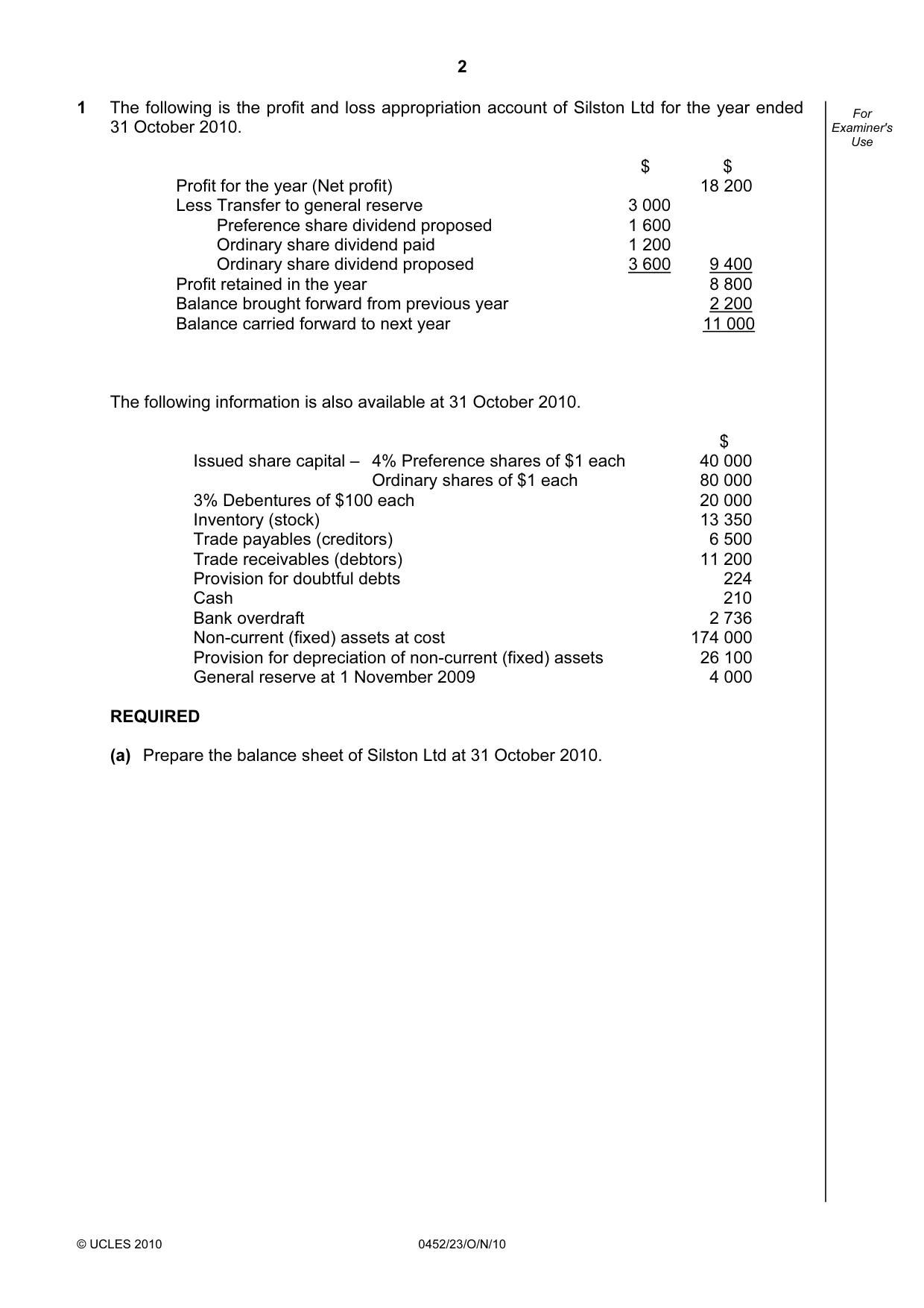
2 © UCLES 2010 0452/23/O/N/10 For Examiner's Use 1 The following is the profit and loss appropriation account of Silston Ltd for the year ended 31 October 2010. $ $ Profit for the year (Net profit) 18 200 Less Transfer to general reserve 3 000 Preference share dividend proposed 1 600 Ordinary share dividend paid 1 200 Ordinary share dividend proposed 3 600 9 400 Profit retained in the year 8 800 Balance brought forward from previous year 2 200 Balance carried forward to next year 11 000 The following information is also available at 31 October 2010. $ Issued share capital – 4% Preference shares of $1 each 40 000 Ordinary shares of $1 each 80 000 3% Debentures of $100 each 20 000 Inventory (stock) 13 350 Trade payables (creditors) 6 500 Trade receivables (debtors) 11 200 Provision for doubtful debts 224 Cash 210 Bank overdraft 2 736 Non-current (fixed) assets at cost 174 000 Provision for depreciation of non-current (fixed) assets 26 100 General reserve at 1 November 2009 4 000 REQUIRED (a) Prepare the balance sheet of Silston Ltd at 31 October 2010.
Question paper, page 3
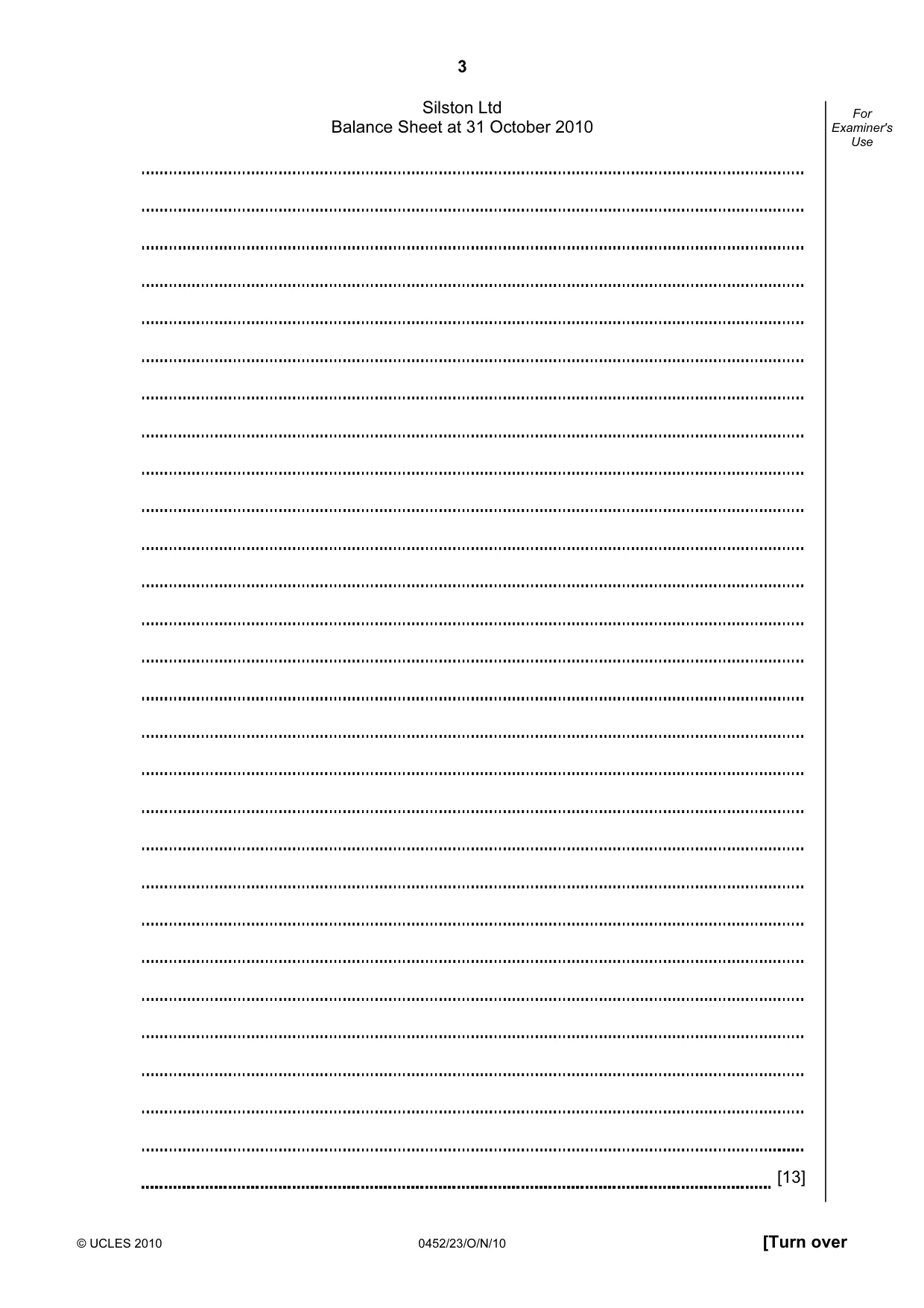
3 © UCLES 2010 0452/23/O/N/10 [Turn over For Examiner's Use Silston Ltd Balance Sheet at 31 October 2010 [13]
Question paper, page 4
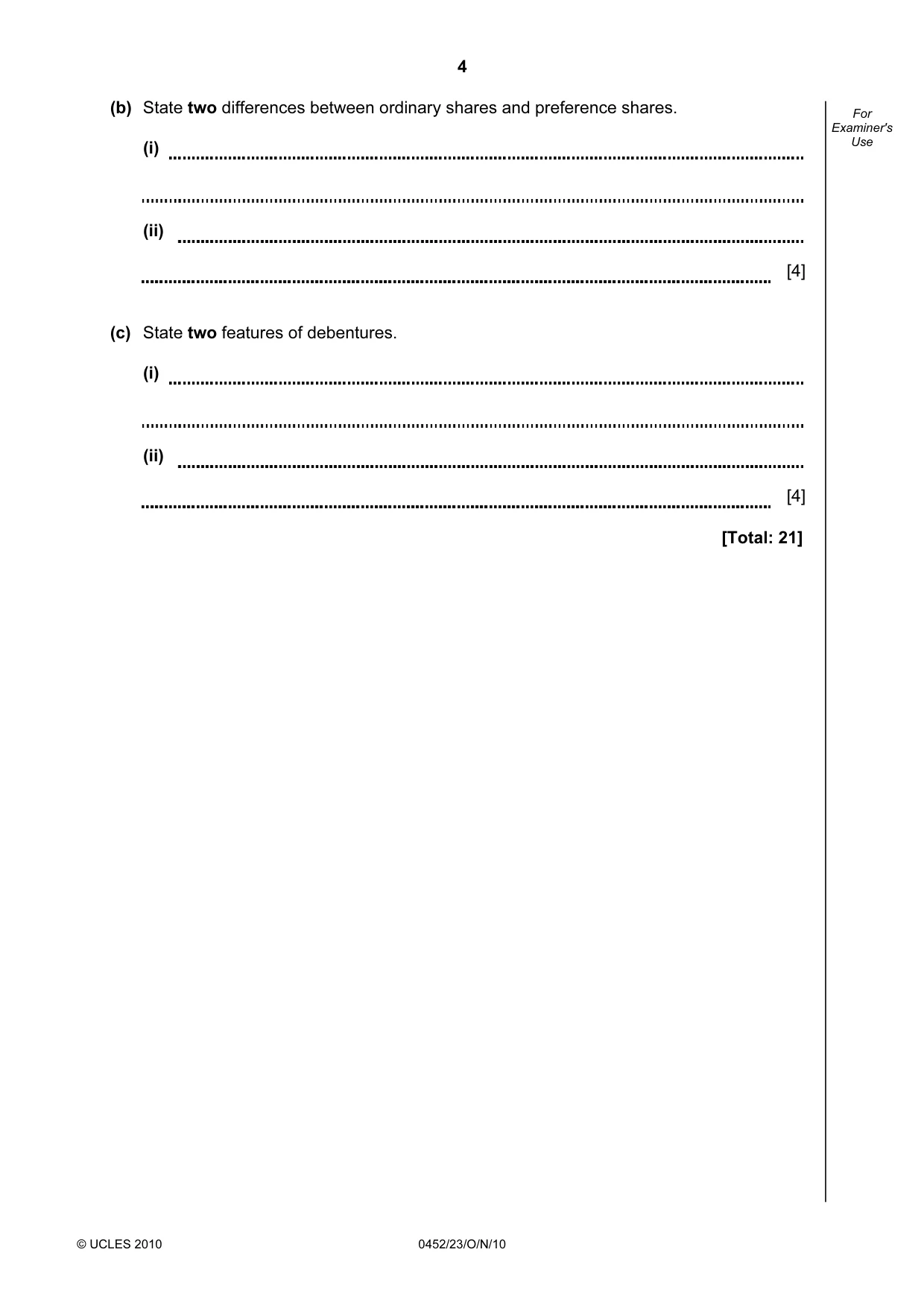
4 © UCLES 2010 0452/23/O/N/10 For Examiner's Use (b) State two differences between ordinary shares and preference shares. (i) (ii) [4] (c) State two features of debentures. (i) (ii) [4] [Total: 21]
Question paper, page 5
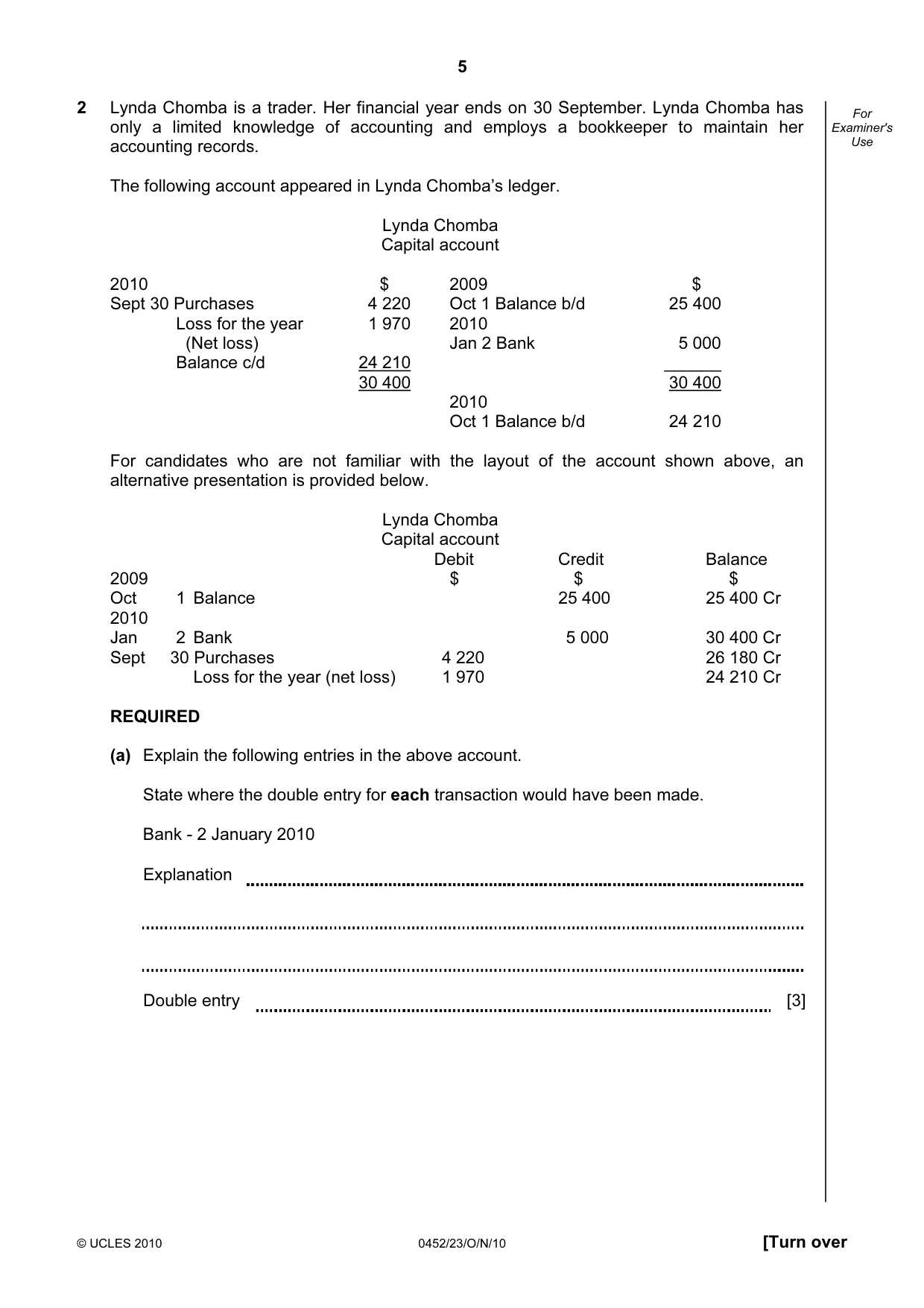
5 © UCLES 2010 0452/23/O/N/10 [Turn over For Examiner's Use 2 Lynda Chomba is a trader. Her financial year ends on 30 September. Lynda Chomba has only a limited knowledge of accounting and employs a bookkeeper to maintain her accounting records. The following account appeared in Lynda Chomba’s ledger. Lynda Chomba Capital account 2010 $ 2009 $ Sept 30 Purchases 4 220 Oct 1 Balance b/d 25 400 Loss for the year 1 970 2010 (Net loss) Jan 2 Bank 5 000 Balance c/d 24 210 ______ 30 400 30 400 2010 Oct 1 Balance b/d 24 210 For candidates who are not familiar with the layout of the account shown above, an alternative presentation is provided below. Lynda Chomba Capital account Debit Credit Balance 2009 $ $ $ Oct 1 Balance 25 400 25 400 Cr 2010 Jan 2 Bank 5 000 30 400 Cr Sept 30 Purchases 4 220 26 180 Cr Loss for the year (net loss) 1 970 24 210 Cr REQUIRED (a) Explain the following entries in the above account. State where the double entry for each transaction would have been made. Bank - 2 January 2010 Explanation Double entry [3]
Question paper, page 6
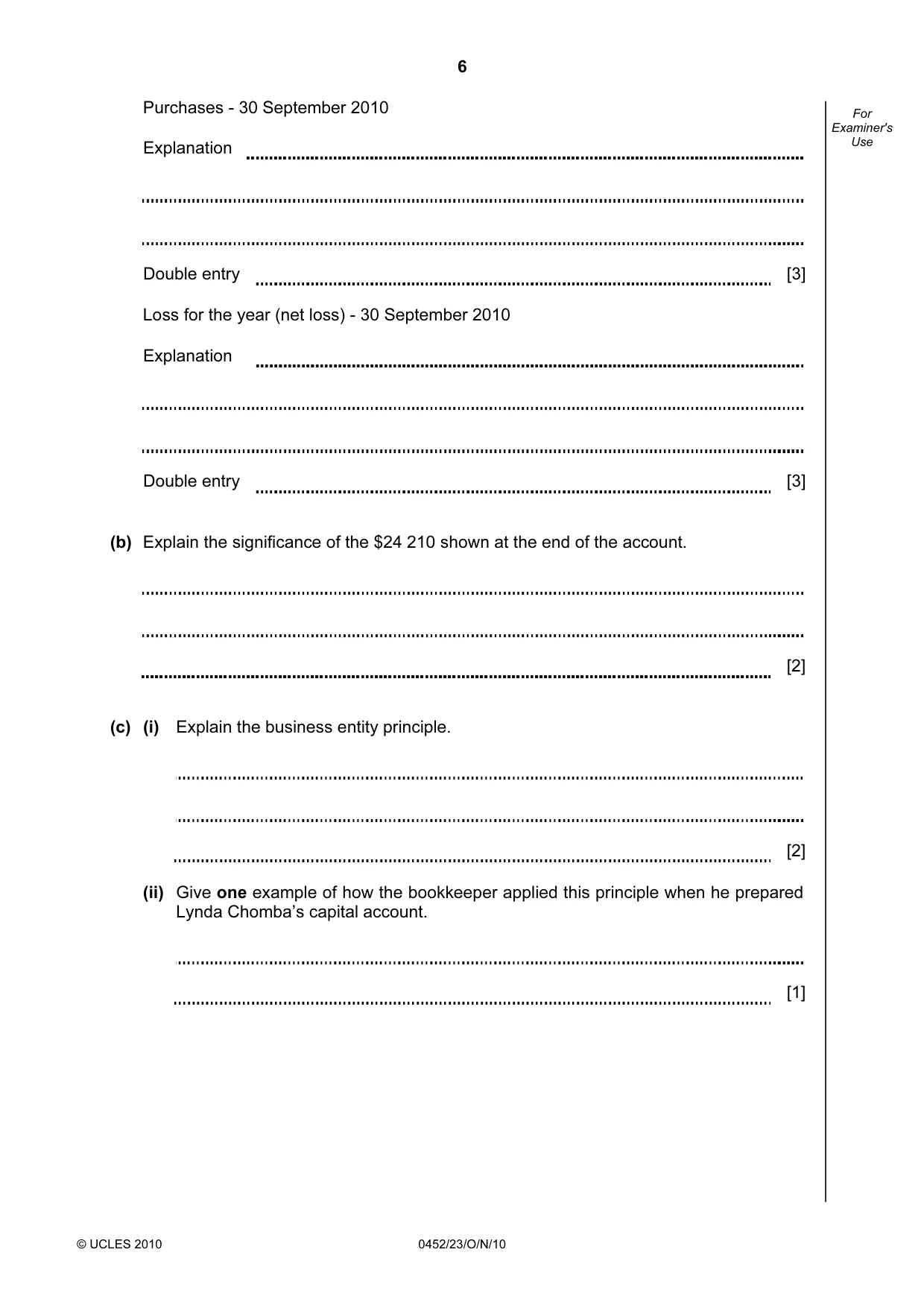
6 © UCLES 2010 0452/23/O/N/10 For Examiner's Use Purchases - 30 September 2010 Explanation Double entry [3] Loss for the year (net loss) - 30 September 2010 Explanation Double entry [3] (b) Explain the significance of the $24 210 shown at the end of the account. [2] (c) (i) Explain the business entity principle. [2] (ii) Give one example of how the bookkeeper applied this principle when he prepared Lynda Chomba’s capital account. [1]
Question paper, page 7
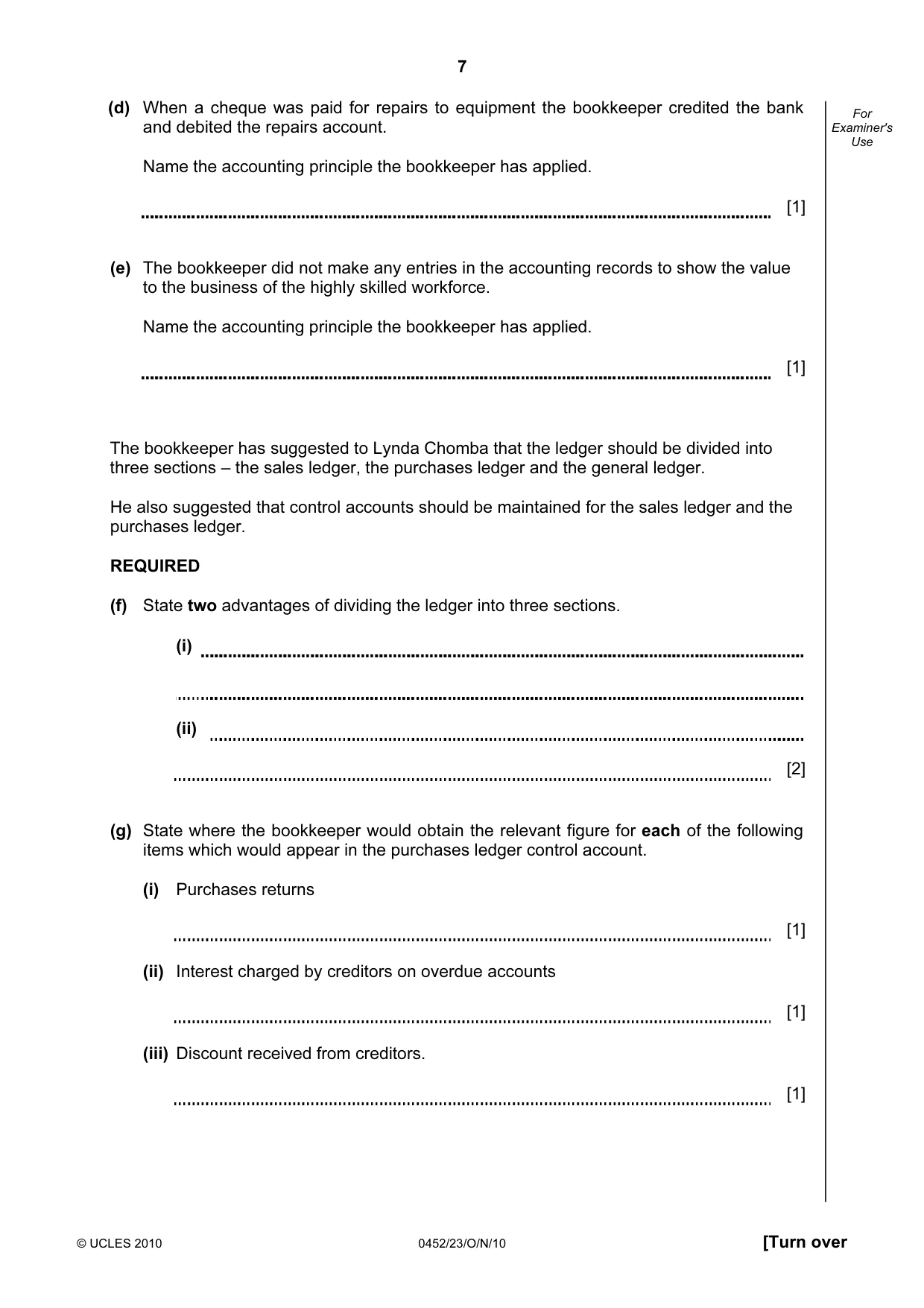
7 © UCLES 2010 0452/23/O/N/10 [Turn over For Examiner's Use (d) When a cheque was paid for repairs to equipment the bookkeeper credited the bank and debited the repairs account. Name the accounting principle the bookkeeper has applied. [1] (e) The bookkeeper did not make any entries in the accounting records to show the value to the business of the highly skilled workforce. Name the accounting principle the bookkeeper has applied. [1] The bookkeeper has suggested to Lynda Chomba that the ledger should be divided into three sections – the sales ledger, the purchases ledger and the general ledger. He also suggested that control accounts should be maintained for the sales ledger and the purchases ledger. REQUIRED (f) State two advantages of dividing the ledger into three sections. (i) (ii) [2] (g) State where the bookkeeper would obtain the relevant figure for each of the following items which would appear in the purchases ledger control account. (i) Purchases returns [1] (ii) Interest charged by creditors on overdue accounts [1] (iii) Discount received from creditors. [1]
Question paper, page 8
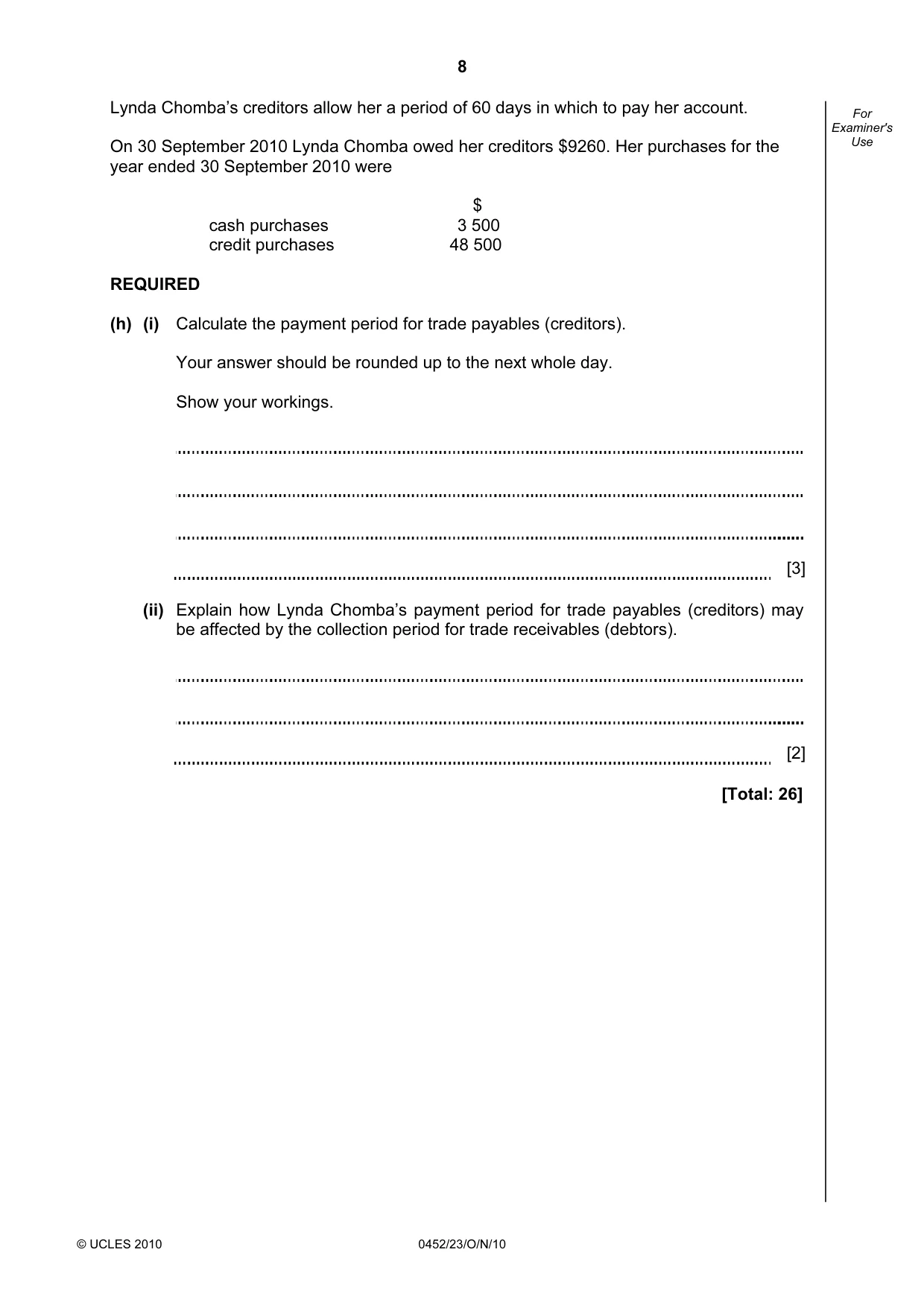
8 © UCLES 2010 0452/23/O/N/10 For Examiner's Use Lynda Chomba’s creditors allow her a period of 60 days in which to pay her account. On 30 September 2010 Lynda Chomba owed her creditors $9260. Her purchases for the year ended 30 September 2010 were $ cash purchases 3 500 credit purchases 48 500 REQUIRED (h) (i) Calculate the payment period for trade payables (creditors). Your answer should be rounded up to the next whole day. Show your workings. [3] (ii) Explain how Lynda Chomba’s payment period for trade payables (creditors) may be affected by the collection period for trade receivables (debtors). [2] [Total: 26]
Question paper, page 9
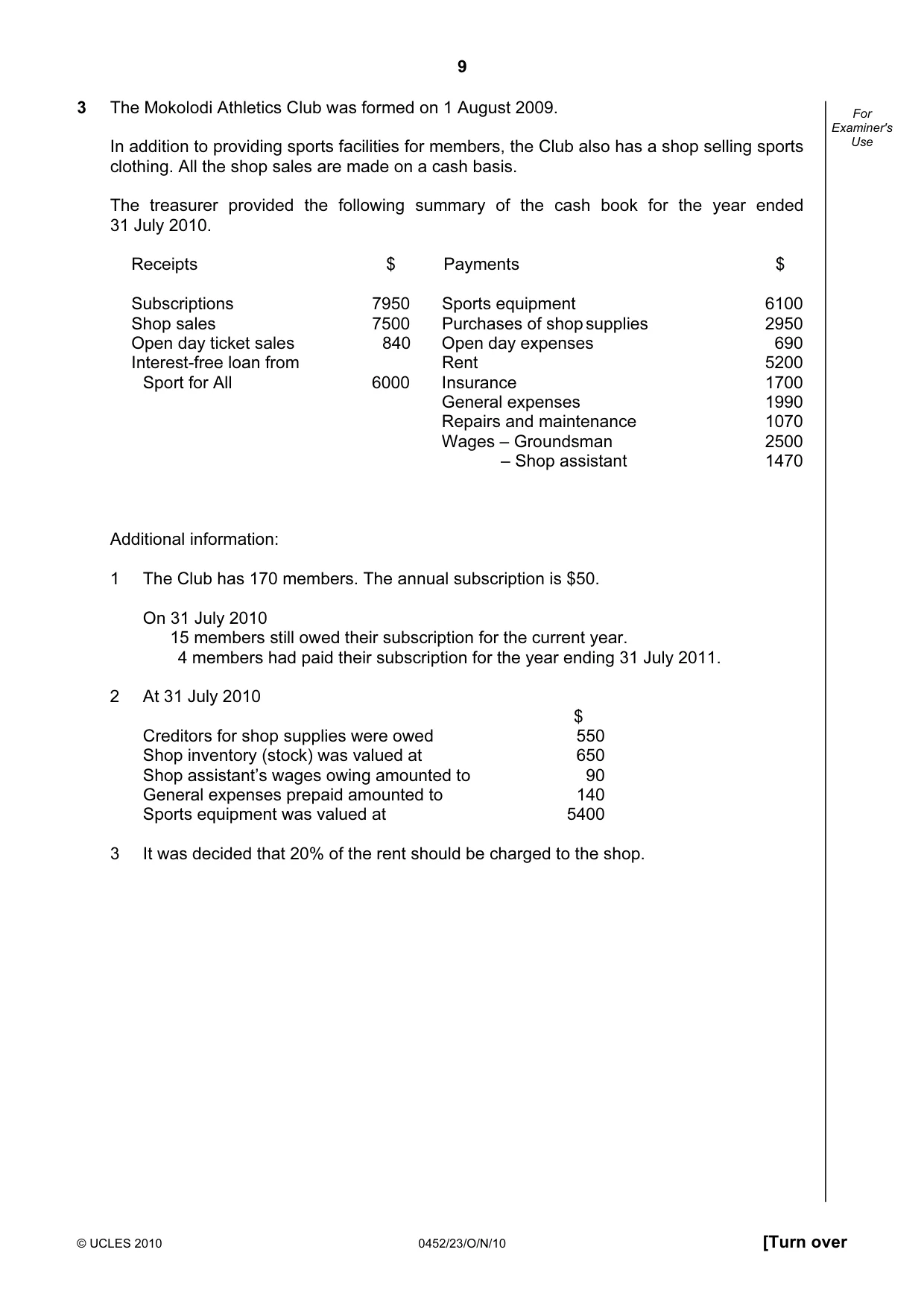
9 © UCLES 2010 0452/23/O/N/10 [Turn over For Examiner's Use 3 The Mokolodi Athletics Club was formed on 1 August 2009. In addition to providing sports facilities for members, the Club also has a shop selling sports clothing. All the shop sales are made on a cash basis. The treasurer provided the following summary of the cash book for the year ended 31 July 2010. Receipts $ Payments $ Subscriptions 7950 Sports equipment 6100 Shop sales 7500 Purchases of shop supplies 2950 Open day ticket sales 840 Open day expenses 690 Interest-free loan from Rent 5200 Sport for All 6000 Insurance 1700 General expenses 1990 Repairs and maintenance 1070 Wages – Groundsman 2500 – Shop assistant 1470 Additional information: 1 The Club has 170 members. The annual subscription is $50. On 31 July 2010 15 members still owed their subscription for the current year. 4 members had paid their subscription for the year ending 31 July 2011. 2 At 31 July 2010 $ Creditors for shop supplies were owed 550 Shop inventory (stock) was valued at 650 Shop assistant’s wages owing amounted to 90 General expenses prepaid amounted to 140 Sports equipment was valued at 5400 3 It was decided that 20% of the rent should be charged to the shop.
Question paper, page 10
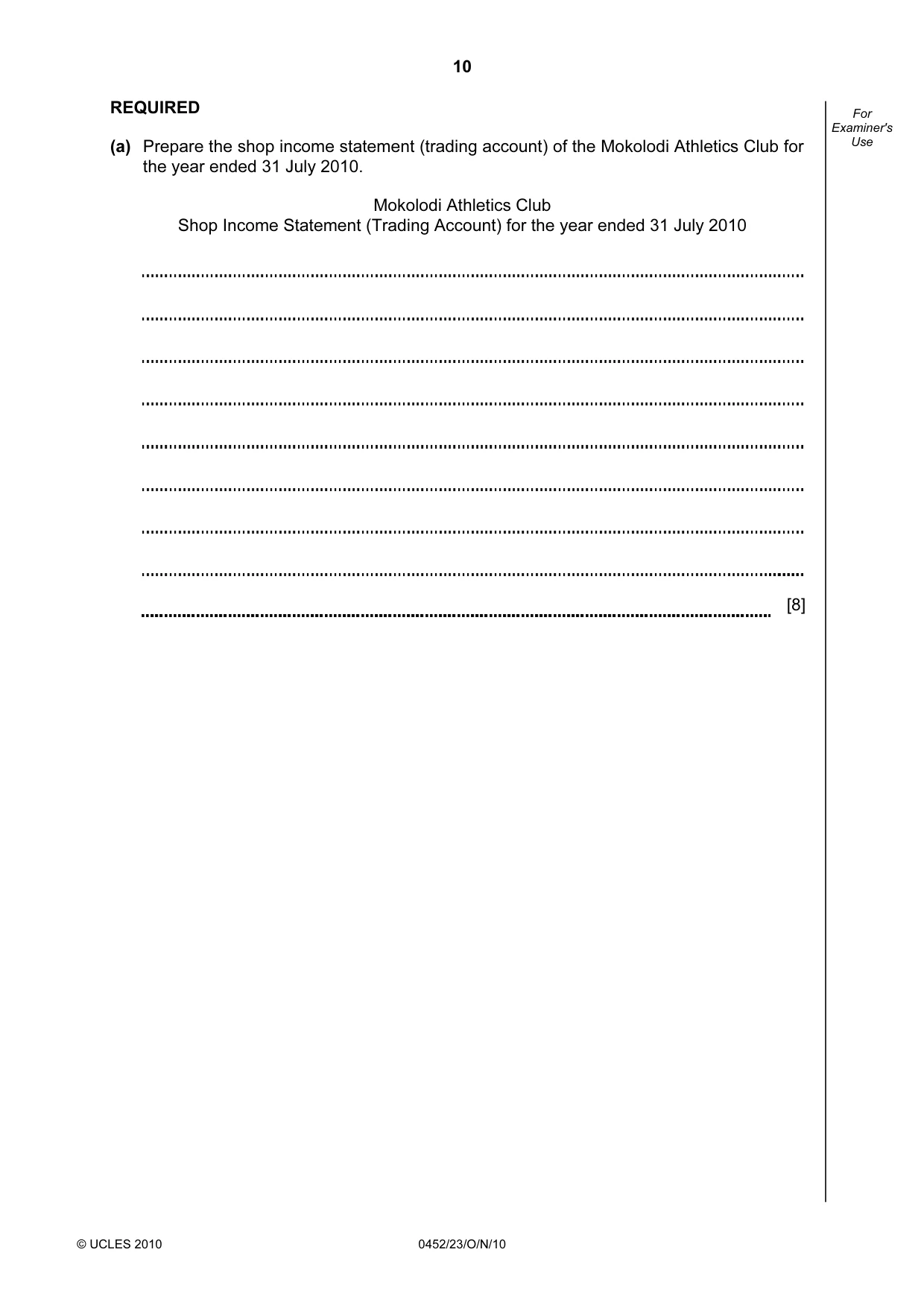
10 © UCLES 2010 0452/23/O/N/10 For Examiner's Use REQUIRED (a) Prepare the shop income statement (trading account) of the Mokolodi Athletics Club for the year ended 31 July 2010. Mokolodi Athletics Club Shop Income Statement (Trading Account) for the year ended 31 July 2010 [8]
Question paper, page 11
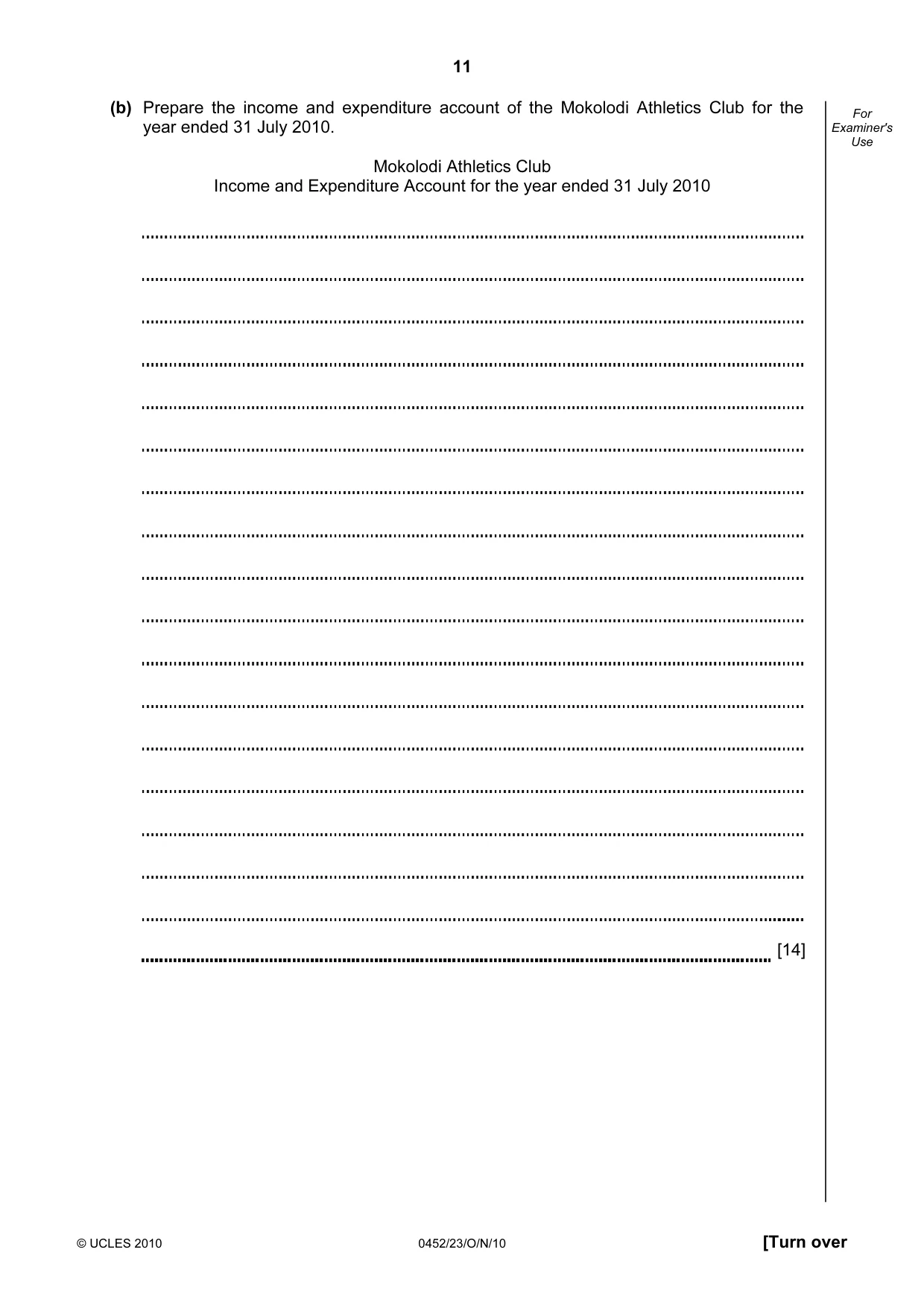
11 © UCLES 2010 0452/23/O/N/10 [Turn over For Examiner's Use (b) Prepare the income and expenditure account of the Mokolodi Athletics Club for the year ended 31 July 2010. Mokolodi Athletics Club Income and Expenditure Account for the year ended 31 July 2010 [14]
Question paper, page 12
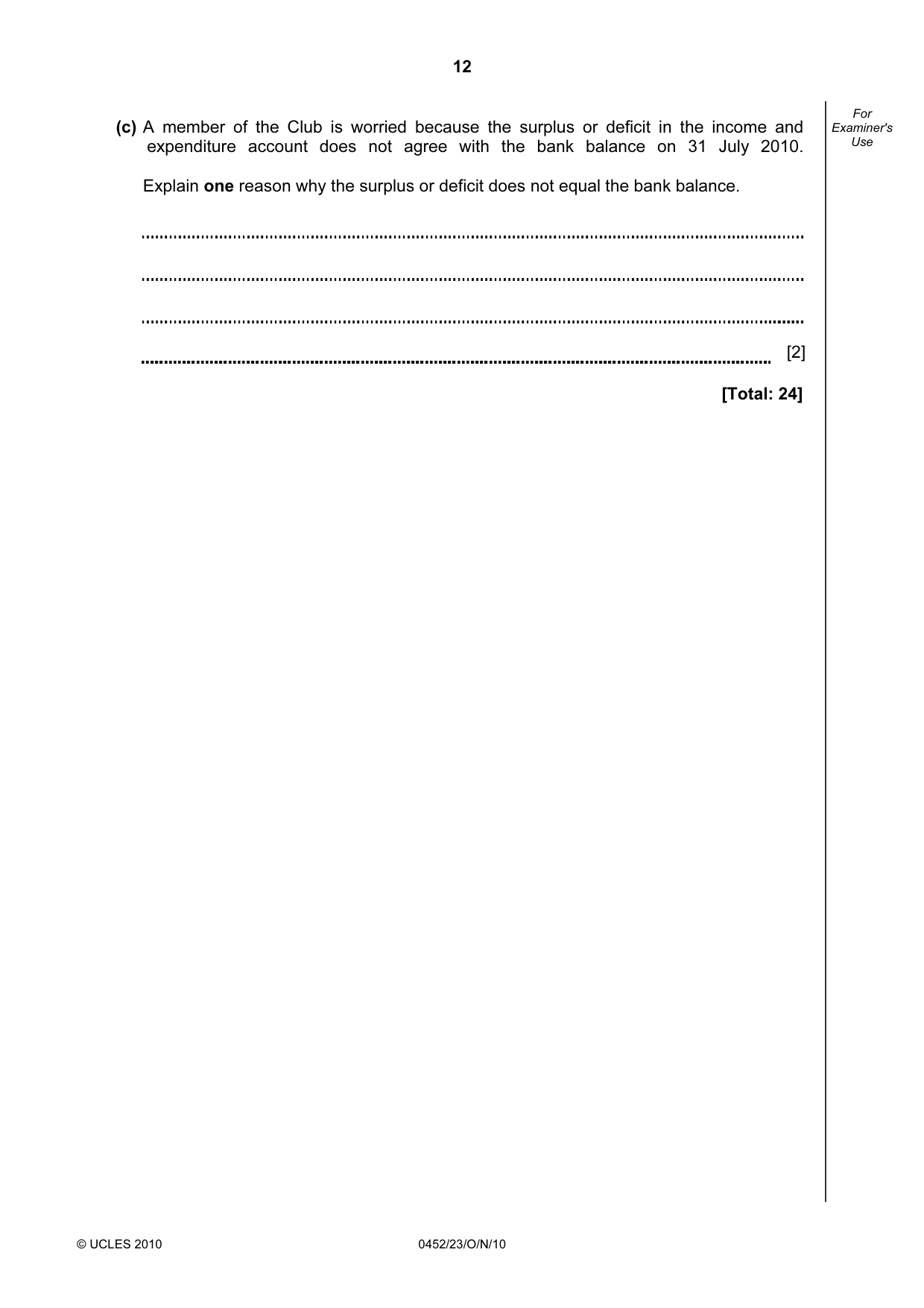
12 © UCLES 2010 0452/23/O/N/10 For Examiner's Use (c) A member of the Club is worried because the surplus or deficit in the income and expenditure account does not agree with the bank balance on 31 July 2010. Explain one reason why the surplus or deficit does not equal the bank balance. [2] [Total: 24]
Question paper, page 13
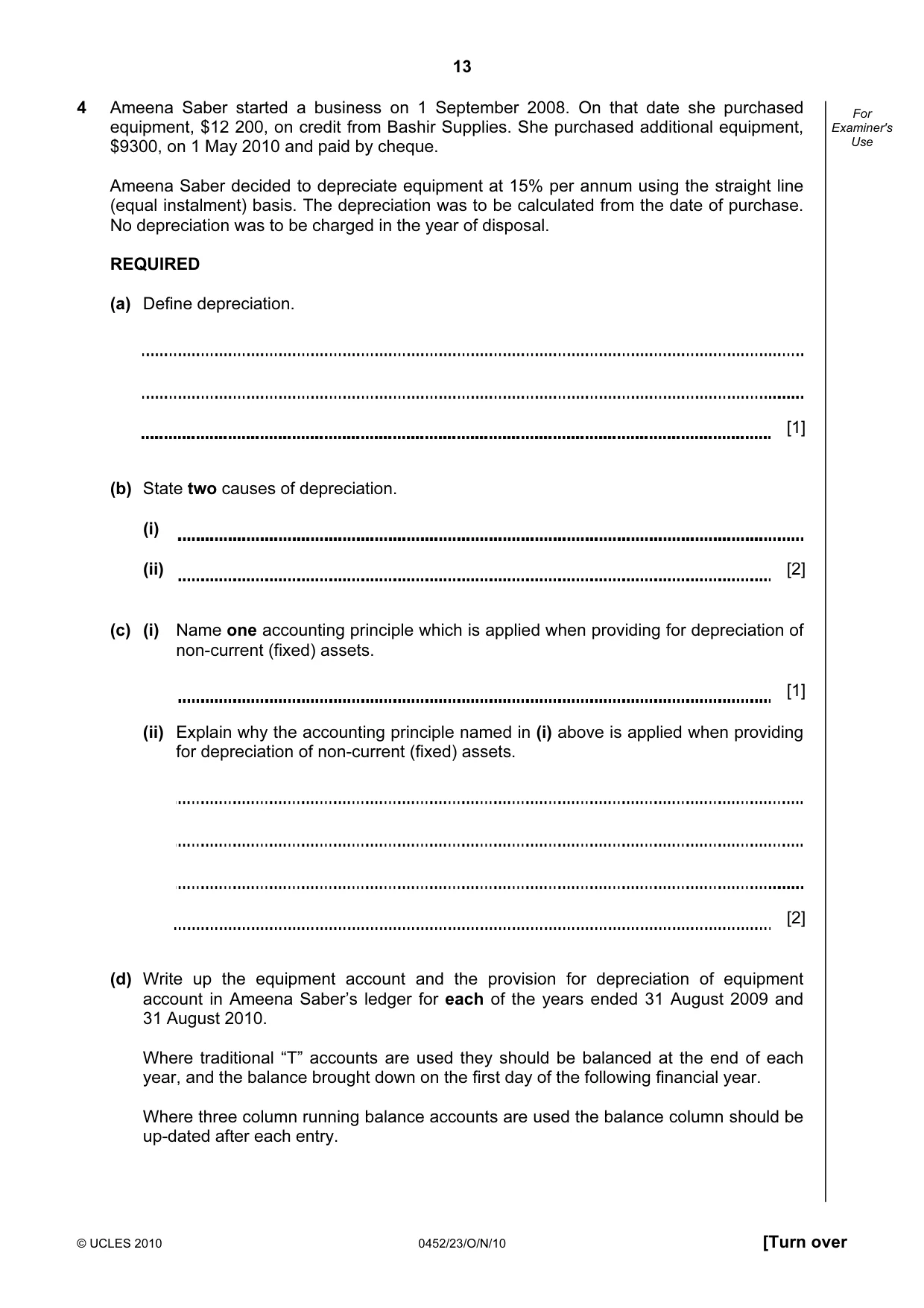
13 © UCLES 2010 0452/23/O/N/10 [Turn over For Examiner's Use 4 Ameena Saber started a business on 1 September 2008. On that date she purchased equipment, $12 200, on credit from Bashir Supplies. She purchased additional equipment, $9300, on 1 May 2010 and paid by cheque. Ameena Saber decided to depreciate equipment at 15% per annum using the straight line (equal instalment) basis. The depreciation was to be calculated from the date of purchase. No depreciation was to be charged in the year of disposal. REQUIRED (a) Define depreciation. [1] (b) State two causes of depreciation. (i) (ii) [2] (c) (i) Name one accounting principle which is applied when providing for depreciation of non-current (fixed) assets. [1] (ii) Explain why the accounting principle named in (i) above is applied when providing for depreciation of non-current (fixed) assets. [2] (d) Write up the equipment account and the provision for depreciation of equipment account in Ameena Saber’s ledger for each of the years ended 31 August 2009 and 31 August 2010. Where traditional “T” accounts are used they should be balanced at the end of each year, and the balance brought down on the first day of the following financial year. Where three column running balance accounts are used the balance column should be up-dated after each entry.
Question paper, page 14
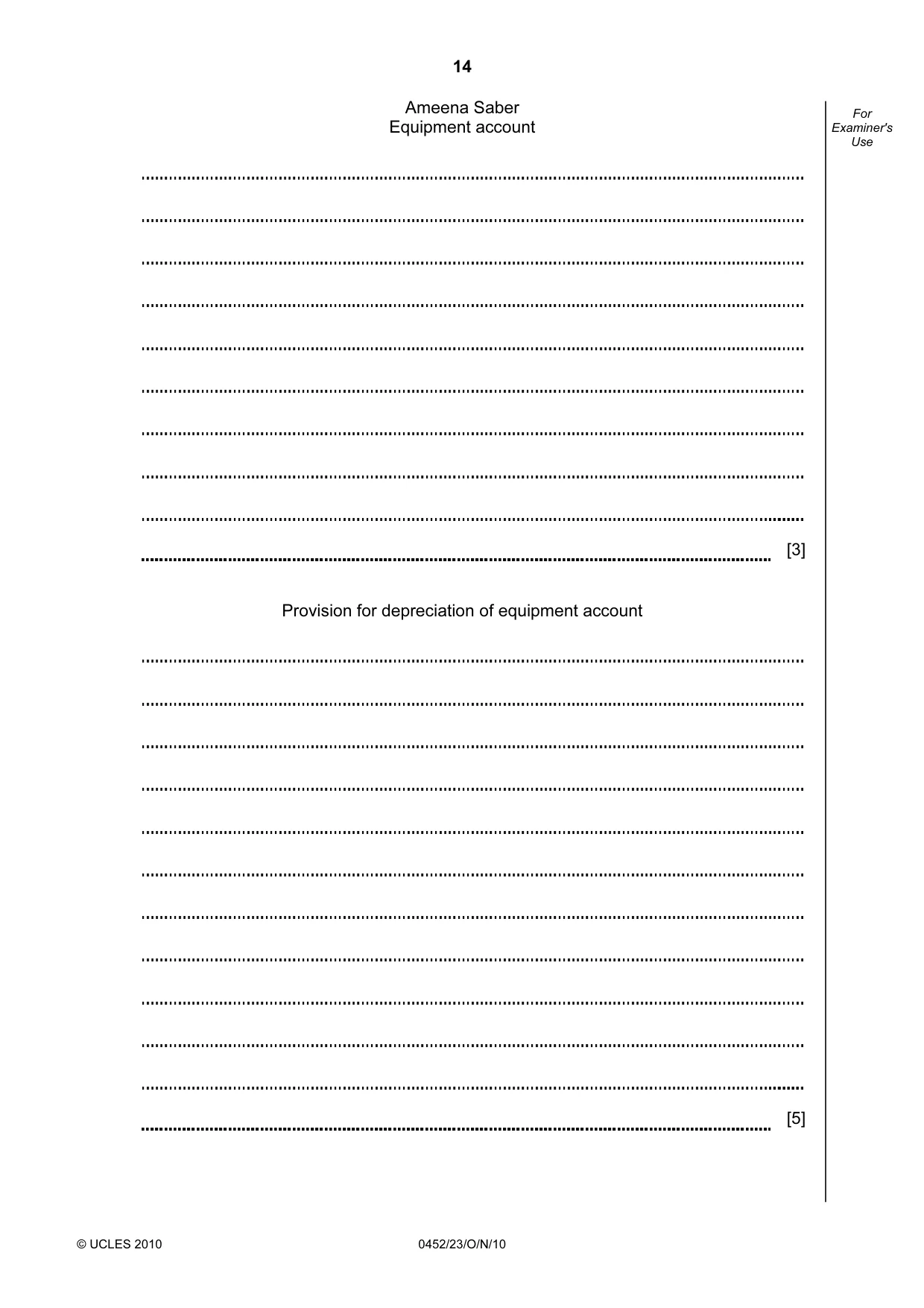
14 © UCLES 2010 0452/23/O/N/10 For Examiner's Use Ameena Saber Equipment account [3] Provision for depreciation of equipment account [5]
Question paper, page 15
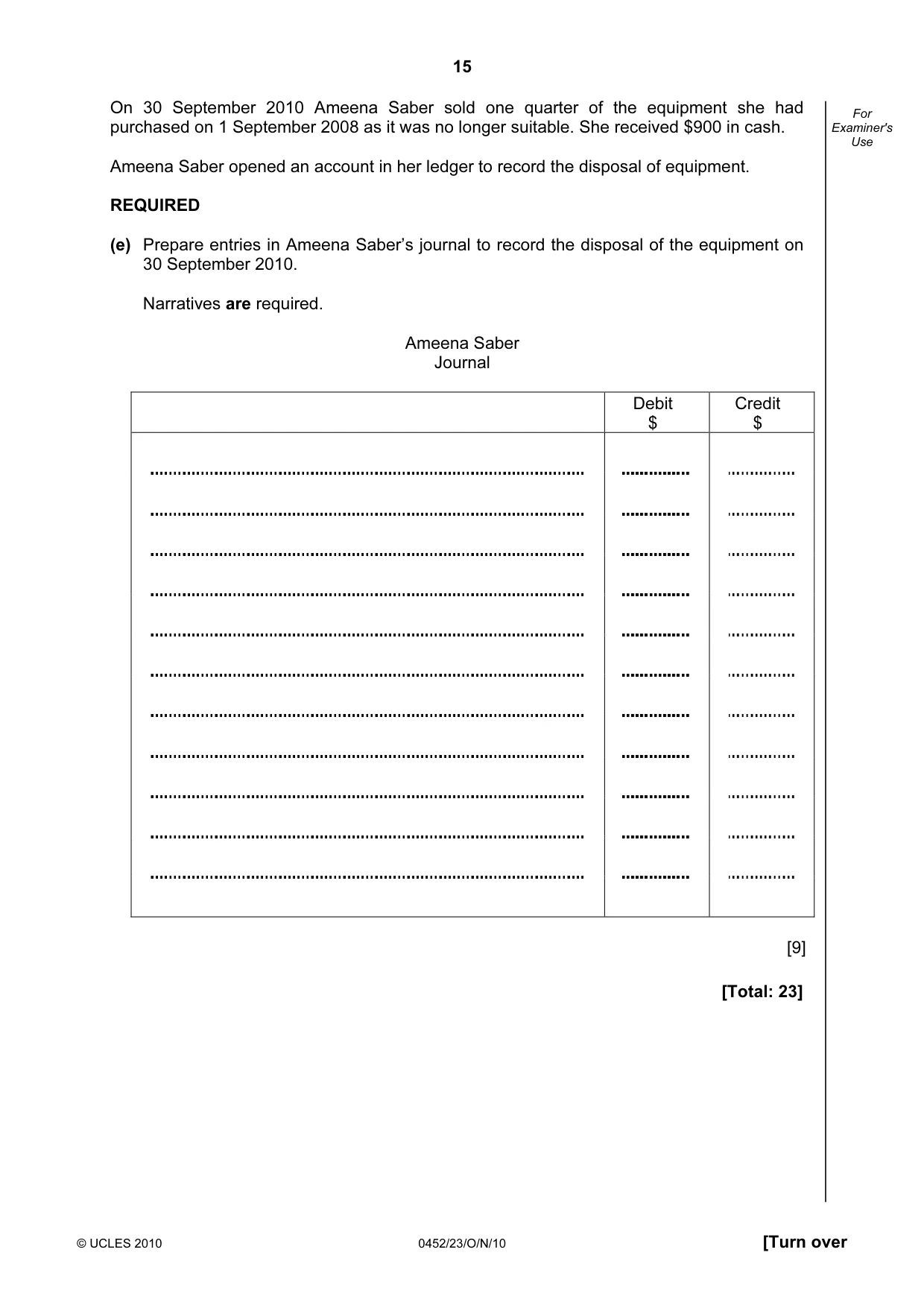
15 © UCLES 2010 0452/23/O/N/10 [Turn over For Examiner's Use On 30 September 2010 Ameena Saber sold one quarter of the equipment she had purchased on 1 September 2008 as it was no longer suitable. She received $900 in cash. Ameena Saber opened an account in her ledger to record the disposal of equipment. REQUIRED (e) Prepare entries in Ameena Saber’s journal to record the disposal of the equipment on 30 September 2010. Narratives are required. Ameena Saber Journal [Total: 23] Debit $ Credit $ [9]
Question paper, page 16
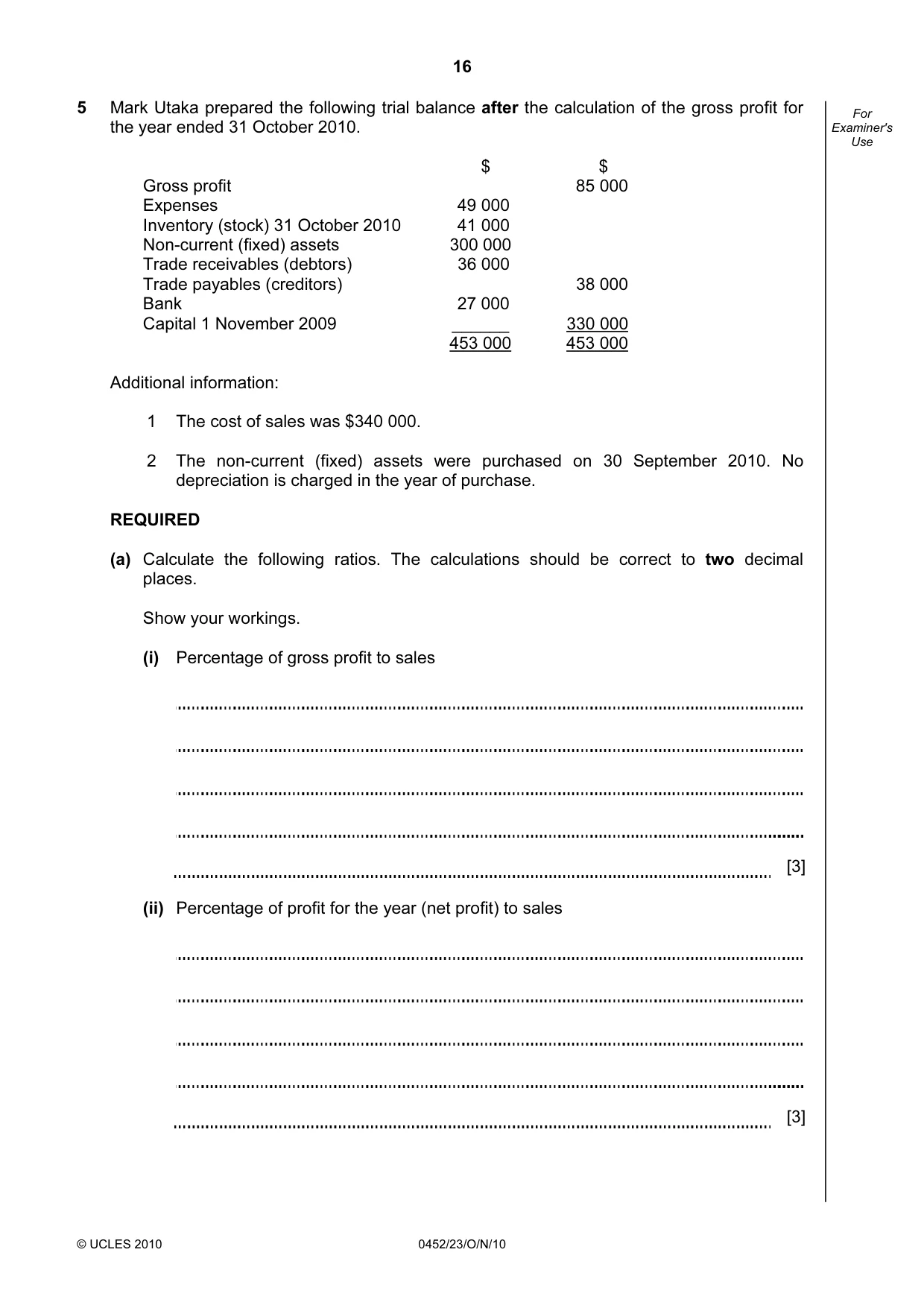
16 © UCLES 2010 0452/23/O/N/10 For Examiner's Use 5 Mark Utaka prepared the following trial balance after the calculation of the gross profit for the year ended 31 October 2010. $ $ Gross profit 85 000 Expenses 49 000 Inventory (stock) 31 October 2010 41 000 Non-current (fixed) assets 300 000 Trade receivables (debtors) 36 000 Trade payables (creditors) 38 000 Bank 27 000 Capital 1 November 2009 ______ 330 000 453 000 453 000 Additional information: 1 The cost of sales was $340 000. 2 The non-current (fixed) assets were purchased on 30 September 2010. No depreciation is charged in the year of purchase. REQUIRED (a) Calculate the following ratios. The calculations should be correct to two decimal places. Show your workings. (i) Percentage of gross profit to sales [3] (ii) Percentage of profit for the year (net profit) to sales [3]
Question paper, page 17
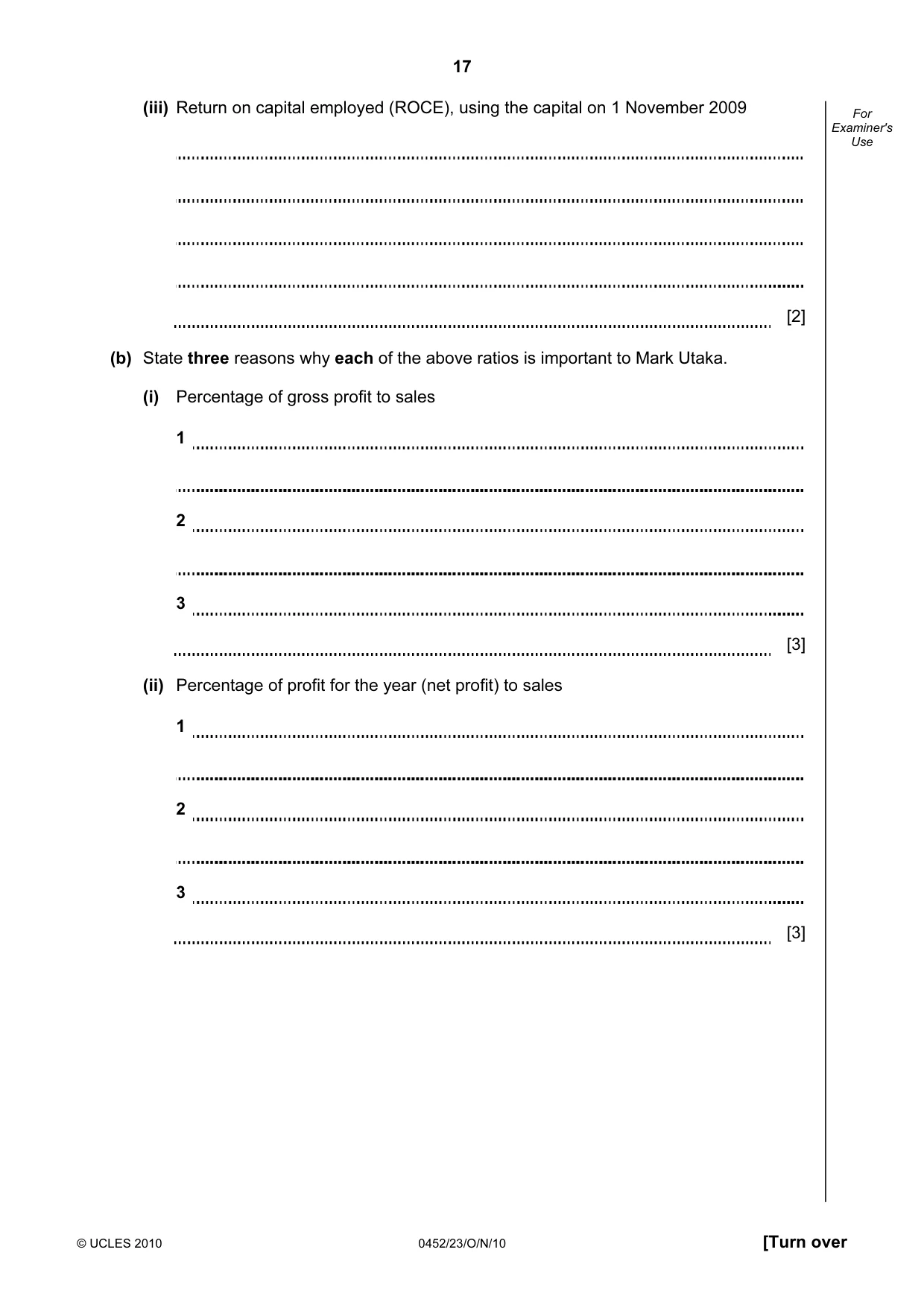
17 © UCLES 2010 0452/23/O/N/10 [Turn over For Examiner's Use (iii) Return on capital employed (ROCE), using the capital on 1 November 2009 [2] (b) State three reasons why each of the above ratios is important to Mark Utaka. (i) Percentage of gross profit to sales 1 2 3 [3] (ii) Percentage of profit for the year (net profit) to sales 1 2 3 [3]
Question paper, page 18
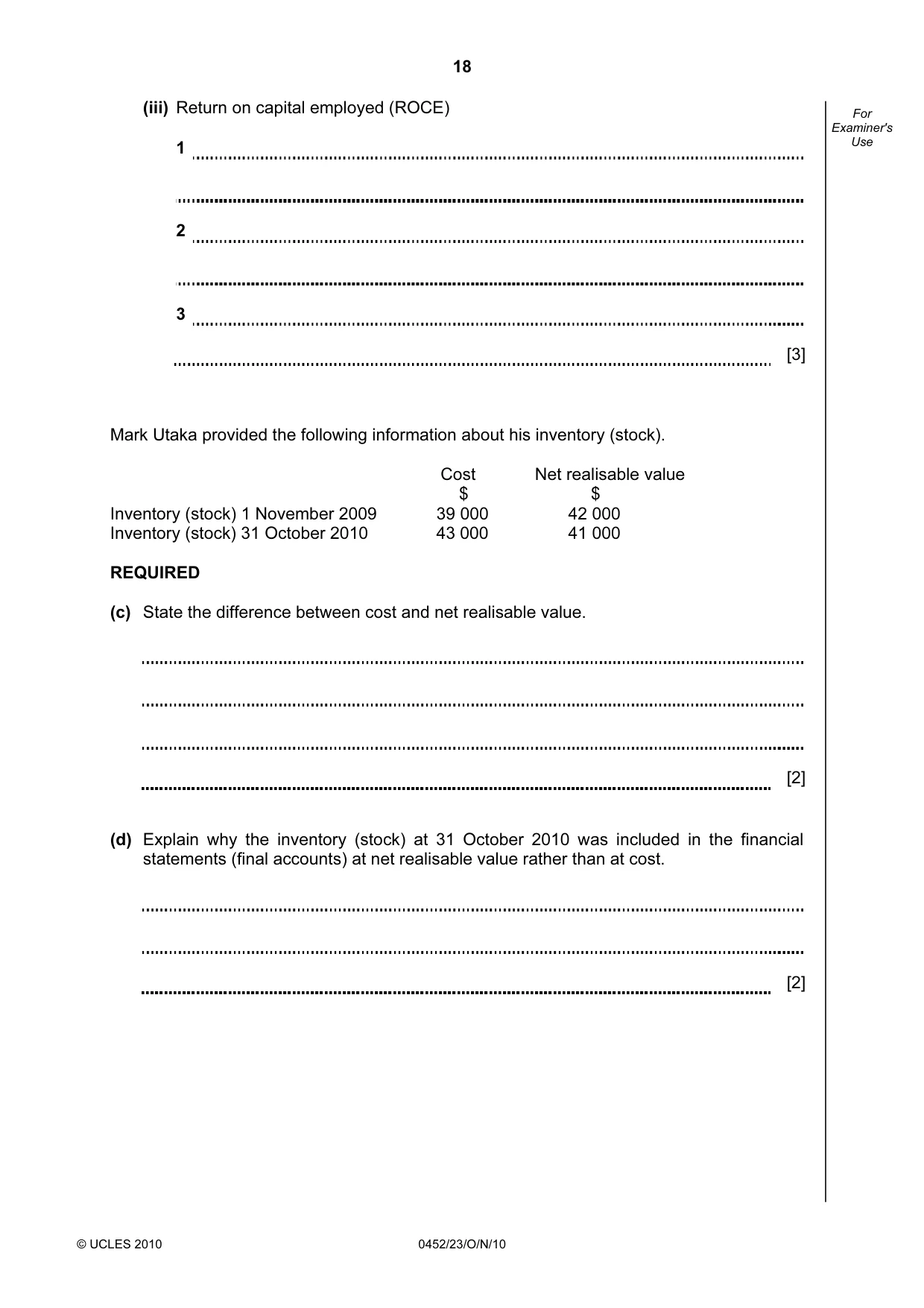
18 © UCLES 2010 0452/23/O/N/10 For Examiner's Use (iii) Return on capital employed (ROCE) 1 2 3 [3] Mark Utaka provided the following information about his inventory (stock). Cost Net realisable value $ $ Inventory (stock) 1 November 2009 39 000 42 000 Inventory (stock) 31 October 2010 43 000 41 000 REQUIRED (c) State the difference between cost and net realisable value. [2] (d) Explain why the inventory (stock) at 31 October 2010 was included in the financial statements (final accounts) at net realisable value rather than at cost. [2]
Question paper, page 19
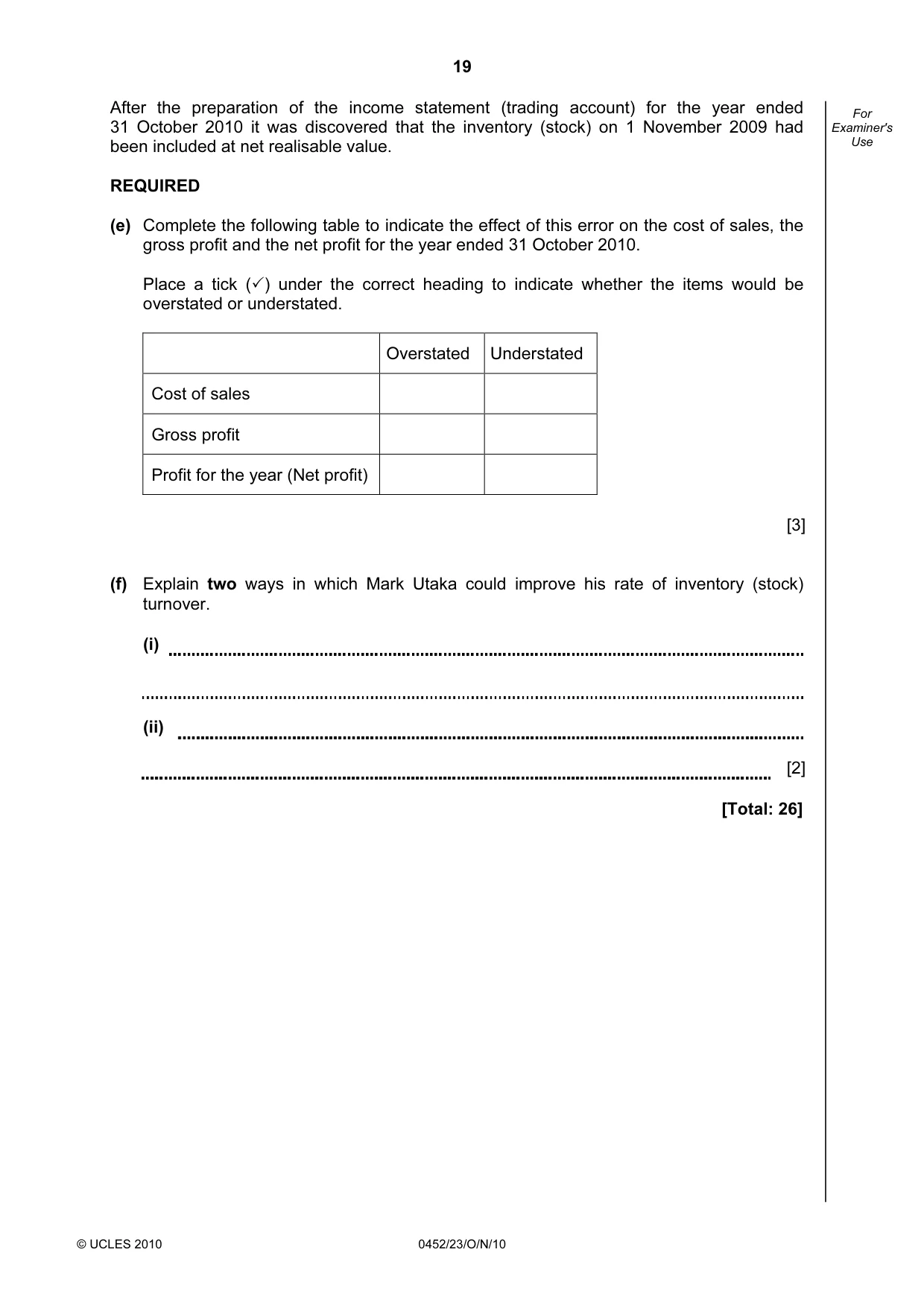
19 © UCLES 2010 0452/23/O/N/10 For Examiner's Use After the preparation of the income statement (trading account) for the year ended 31 October 2010 it was discovered that the inventory (stock) on 1 November 2009 had been included at net realisable value. REQUIRED (e) Complete the following table to indicate the effect of this error on the cost of sales, the gross profit and the net profit for the year ended 31 October 2010. Place a tick (✓) under the correct heading to indicate whether the items would be overstated or understated. Overstated Understated Cost of sales Gross profit Profit for the year (Net profit) [3] (f) Explain two ways in which Mark Utaka could improve his rate of inventory (stock) turnover. (i) (ii) [2] [Total: 26]
Question paper, page 20
20 Permission to reproduce items where third-party owned material protected by copyright is included has been sought and cleared where possible. Every reasonable effort has been made by the publisher (UCLES) to trace copyright holders, but if any items requiring clearance have unwittingly been included, the publisher will be pleased to make amends at the earliest possible opportunity. University of Cambridge International Examinations is part of the Cambridge Assessment Group. Cambridge Assessment is the brand name of University of Cambridge Local Examinations Syndicate (UCLES), which is itself a department of the University of Cambridge. © UCLES 2010 0452/23/O/N/10 BLANK PAGE
Mark scheme, page 1
UNIVERSITY OF CAMBRIDGE INTERNATIONAL EXAMINATIONS International General Certificate of Secondary Education MARK SCHEME for the October/November 2010 question paper for the guidance of teachers 0452 ACCOUNTING 0452/23 Paper 2, maximum raw mark 120 This mark scheme is published as an aid to teachers and candidates, to indicate the requirements of the examination. It shows the basis on which Examiners were instructed to award marks. It does not indicate the details of the discussions that took place at an Examiners’ meeting before marking began, which would have considered the acceptability of alternative answers. Mark schemes must be read in conjunction with the question papers and the report on the examination. • CIE will not enter into discussions or correspondence in connection with these mark schemes. CIE is publishing the mark schemes for the October/November 2010 question papers for most IGCSE, GCE Advanced Level and Advanced Subsidiary Level syllabuses and some Ordinary Level syllabuses.
Mark scheme, page 2
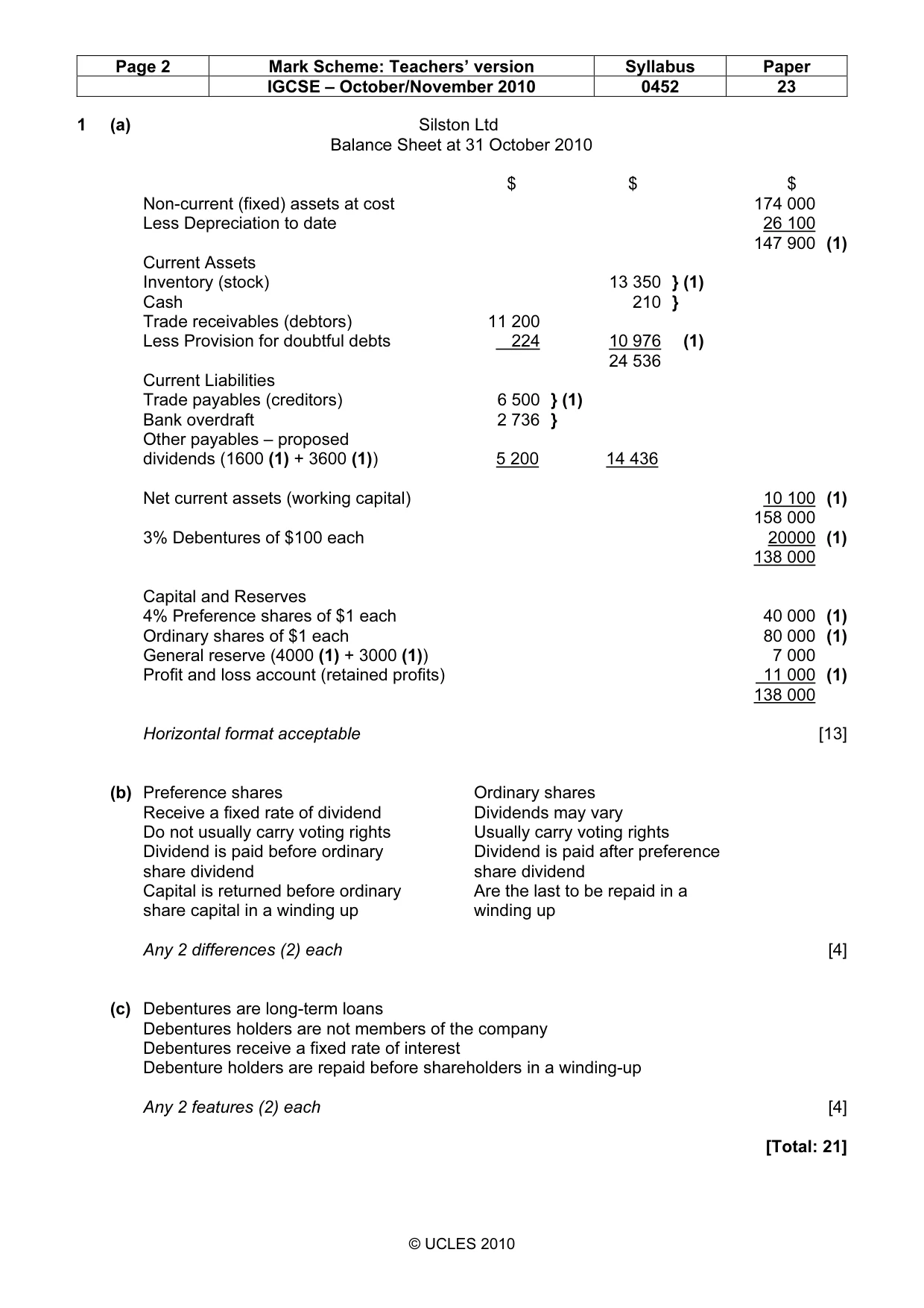
Page 2 Mark Scheme: Teachers’ version Syllabus Paper IGCSE – October/November 2010 0452 23 © UCLES 2010 1 (a) Silston Ltd Balance Sheet at 31 October 2010 $ $ $ Non-current (fixed) assets at cost 174 000 Less Depreciation to date 26 100 147 900 (1) Current Assets Inventory (stock) 13 350 } (1) Cash 210 } Trade receivables (debtors) 11 200 Less Provision for doubtful debts 224 10 976 (1) 24 536 Current Liabilities Trade payables (creditors) 6 500 } (1) Bank overdraft 2 736 } Other payables – proposed dividends (1600 (1) + 3600 (1)) 5 200 14 436 Net current assets (working capital) 10 100 (1) 158 000 3% Debentures of $100 each 20000 (1) 138 000 Capital and Reserves 4% Preference shares of $1 each 40 000 (1) Ordinary shares of $1 each 80 000 (1) General reserve (4000 (1) + 3000 (1)) 7 000 Profit and loss account (retained profits) 11 000 (1) 138 000 Horizontal format acceptable [13] (b) Preference shares Ordinary shares Receive a fixed rate of dividend Dividends may vary Do not usually carry voting rights Usually carry voting rights Dividend is paid before ordinary Dividend is paid after preference share dividend share dividend Capital is returned before ordinary Are the last to be repaid in a share capital in a winding up winding up Any 2 differences (2) each [4] (c) Debentures are long-term loans Debentures holders are not members of the company Debentures receive a fixed rate of interest Debenture holders are repaid before shareholders in a winding-up Any 2 features (2) each [4] [Total: 21]
Mark scheme, page 3
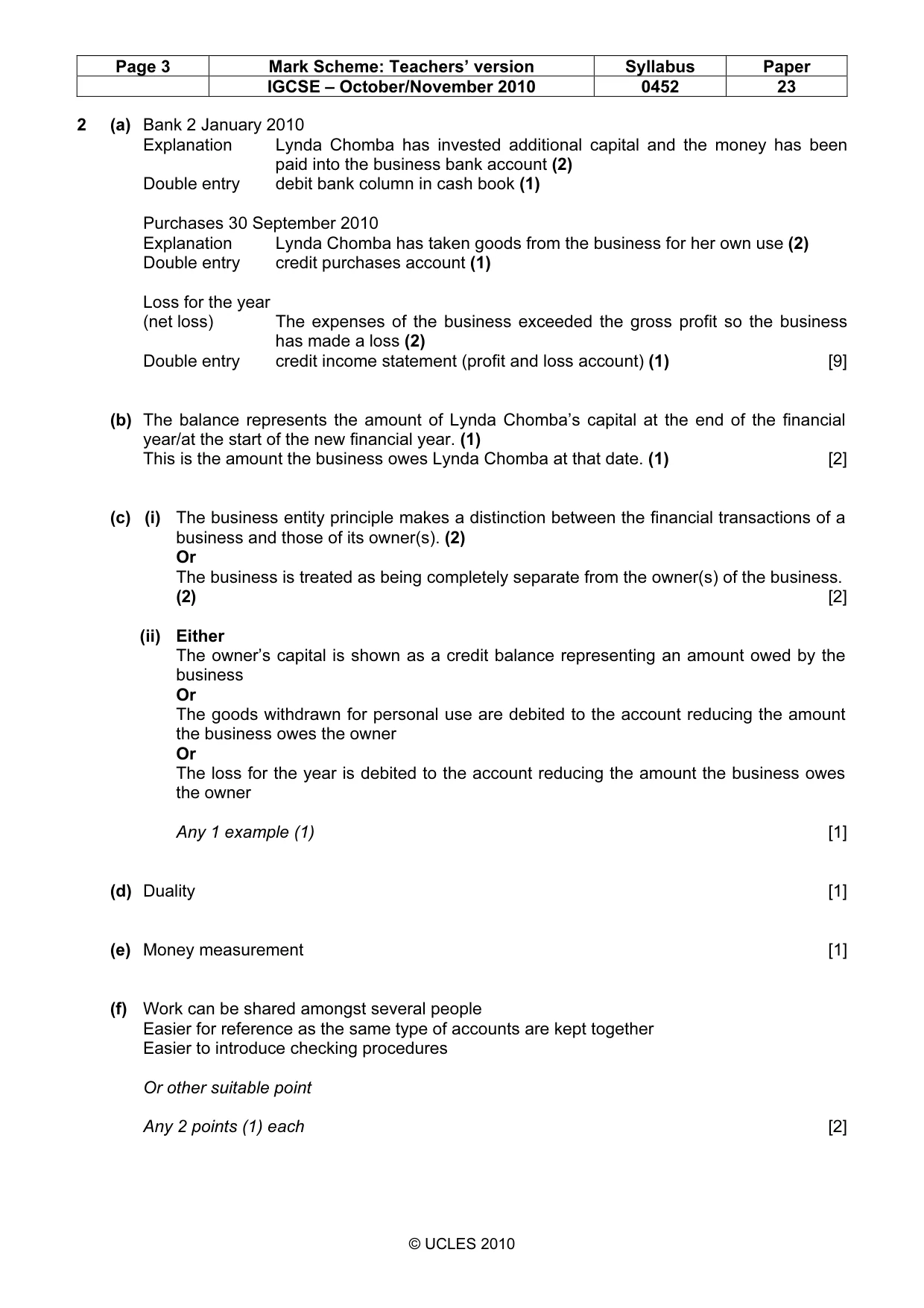
Page 3 Mark Scheme: Teachers’ version Syllabus Paper IGCSE – October/November 2010 0452 23 © UCLES 2010 2 (a) Bank 2 January 2010 Explanation Lynda Chomba has invested additional capital and the money has been paid into the business bank account (2) Double entry debit bank column in cash book (1) Purchases 30 September 2010 Explanation Lynda Chomba has taken goods from the business for her own use (2) Double entry credit purchases account (1) Loss for the year (net loss) The expenses of the business exceeded the gross profit so the business has made a loss (2) Double entry credit income statement (profit and loss account) (1) [9] (b) The balance represents the amount of Lynda Chomba’s capital at the end of the financial year/at the start of the new financial year. (1) This is the amount the business owes Lynda Chomba at that date. (1) [2] (c) (i) The business entity principle makes a distinction between the financial transactions of a business and those of its owner(s). (2) Or The business is treated as being completely separate from the owner(s) of the business. (2) [2] (ii) Either The owner’s capital is shown as a credit balance representing an amount owed by the business Or The goods withdrawn for personal use are debited to the account reducing the amount the business owes the owner Or The loss for the year is debited to the account reducing the amount the business owes the owner Any 1 example (1) [1] (d) Duality [1] (e) Money measurement [1] (f) Work can be shared amongst several people Easier for reference as the same type of accounts are kept together Easier to introduce checking procedures Or other suitable point Any 2 points (1) each [2]
Mark scheme, page 4
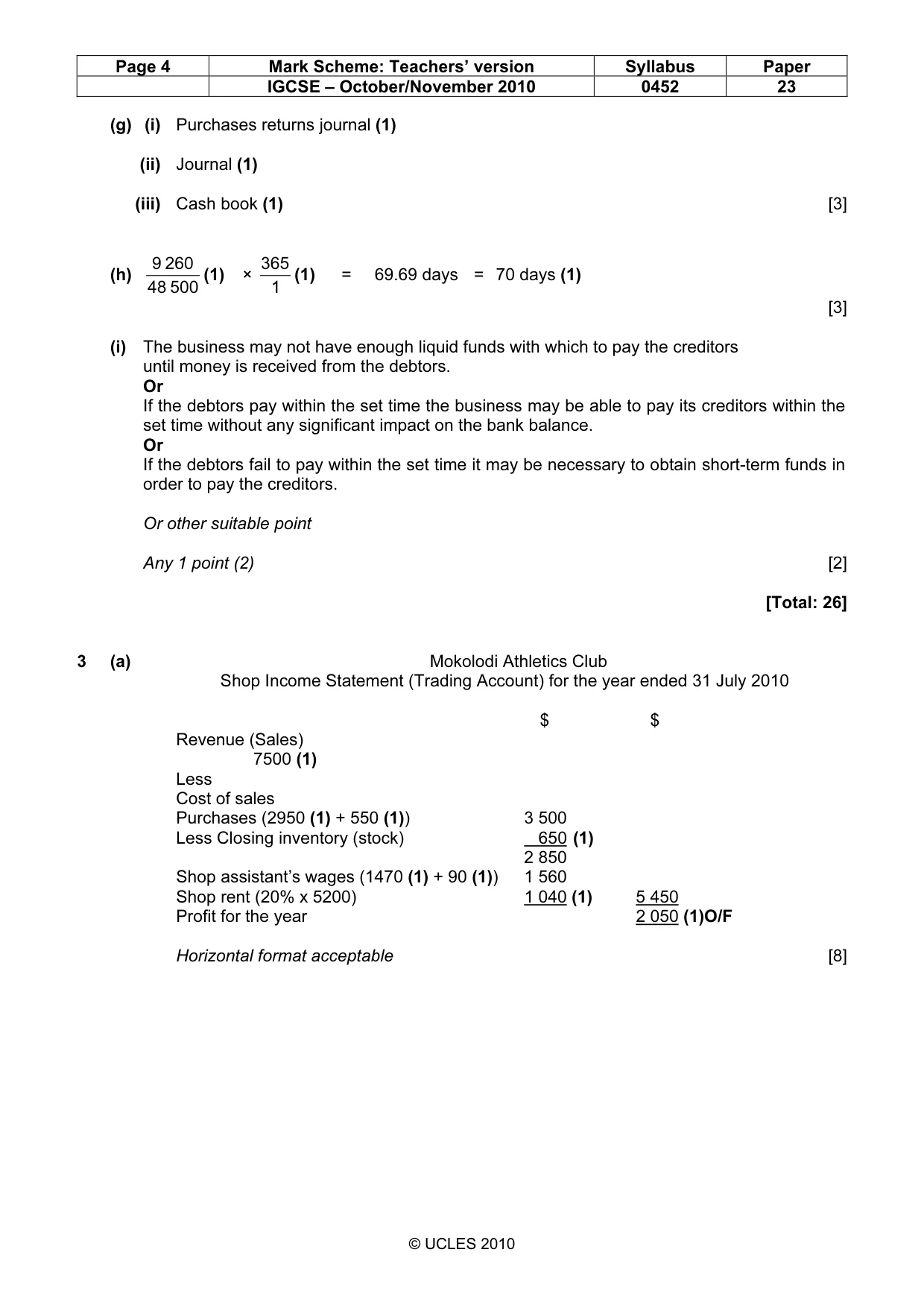
Page 4 Mark Scheme: Teachers’ version Syllabus Paper IGCSE – October/November 2010 0452 23 © UCLES 2010 (g) (i) Purchases returns journal (1) (ii) Journal (1) (iii) Cash book (1) [3] (h) 500 48 260 9 (1) × 1 365 (1) = 69.69 days = 70 days (1) [3] (i) The business may not have enough liquid funds with which to pay the creditors until money is received from the debtors. Or If the debtors pay within the set time the business may be able to pay its creditors within the set time without any significant impact on the bank balance. Or If the debtors fail to pay within the set time it may be necessary to obtain short-term funds in order to pay the creditors. Or other suitable point Any 1 point (2) [2] [Total: 26] 3 (a) Mokolodi Athletics Club Shop Income Statement (Trading Account) for the year ended 31 July 2010 $ $ Revenue (Sales) 7500 (1) Less Cost of sales Purchases (2950 (1) + 550 (1)) 3 500 Less Closing inventory (stock) 650 (1) 2 850 Shop assistant’s wages (1470 (1) + 90 (1)) 1 560 Shop rent (20% x 5200) 1 040 (1) 5 450 Profit for the year 2 050 (1)O/F Horizontal format acceptable [8]
Mark scheme, page 5
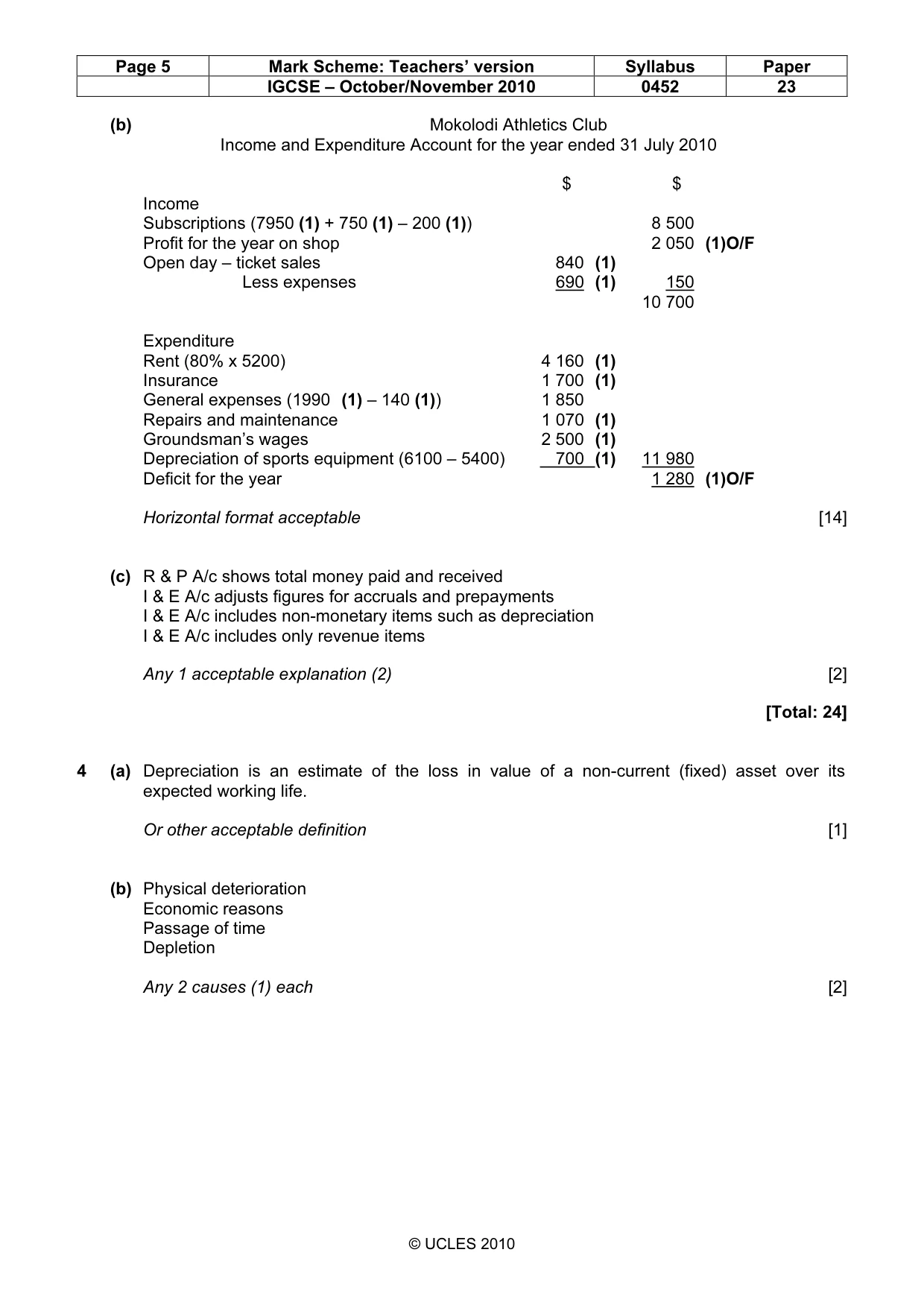
Page 5 Mark Scheme: Teachers’ version Syllabus Paper IGCSE – October/November 2010 0452 23 © UCLES 2010 (b) Mokolodi Athletics Club Income and Expenditure Account for the year ended 31 July 2010 $ $ Income Subscriptions (7950 (1) + 750 (1) – 200 (1)) 8 500 Profit for the year on shop 2 050 (1)O/F Open day – ticket sales 840 (1) Less expenses 690 (1) 150 10 700 Expenditure Rent (80% x 5200) 4 160 (1) Insurance 1 700 (1) General expenses (1990 (1) – 140 (1)) 1 850 Repairs and maintenance 1 070 (1) Groundsman’s wages 2 500 (1) Depreciation of sports equipment (6100 – 5400) 700 (1) 11 980 Deficit for the year 1 280 (1)O/F Horizontal format acceptable [14] (c) R & P A/c shows total money paid and received I & E A/c adjusts figures for accruals and prepayments I & E A/c includes non-monetary items such as depreciation I & E A/c includes only revenue items Any 1 acceptable explanation (2) [2] [Total: 24] 4 (a) Depreciation is an estimate of the loss in value of a non-current (fixed) asset over its expected working life. Or other acceptable definition [1] (b) Physical deterioration Economic reasons Passage of time Depletion Any 2 causes (1) each [2]
Mark scheme, page 6
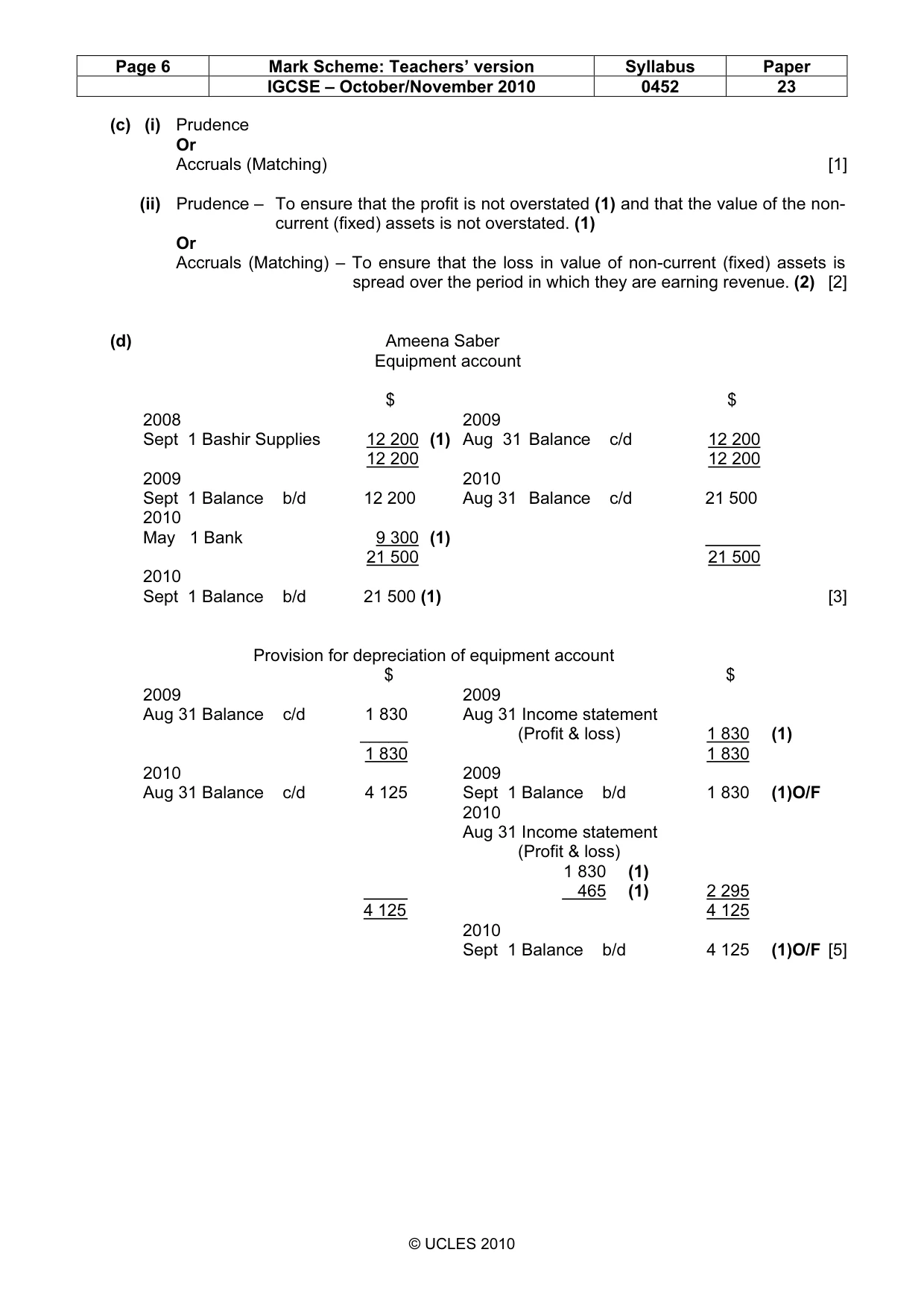
Page 6 Mark Scheme: Teachers’ version Syllabus Paper IGCSE – October/November 2010 0452 23 © UCLES 2010 (c) (i) Prudence Or Accruals (Matching) [1] (ii) Prudence – To ensure that the profit is not overstated (1) and that the value of the non- current (fixed) assets is not overstated. (1) Or Accruals (Matching) – To ensure that the loss in value of non-current (fixed) assets is spread over the period in which they are earning revenue. (2) [2] (d) Ameena Saber Equipment account $ $ 2008 2009 Sept 1 Bashir Supplies 12 200 (1) Aug 31 Balance c/d 12 200 12 200 12 200 2009 2010 Sept 1 Balance b/d 12 200 Aug 31 Balance c/d 21 500 2010 May 1 Bank 9 300 (1) 21 500 21 500 2010 Sept 1 Balance b/d 21 500 (1) [3] Provision for depreciation of equipment account $ $ 2009 2009 Aug 31 Balance c/d 1 830 Aug 31 Income statement _____ (Profit & loss) 1 830 (1) 1 830 1 830 2010 2009 Aug 31 Balance c/d 4 125 Sept 1 Balance b/d 1 830 (1)O/F 2010 Aug 31 Income statement (Profit & loss) 1 830 (1) 465 (1) 2 295 4 125 4 125 2010 Sept 1 Balance b/d 4 125 (1)O/F [5]
Mark scheme, page 7
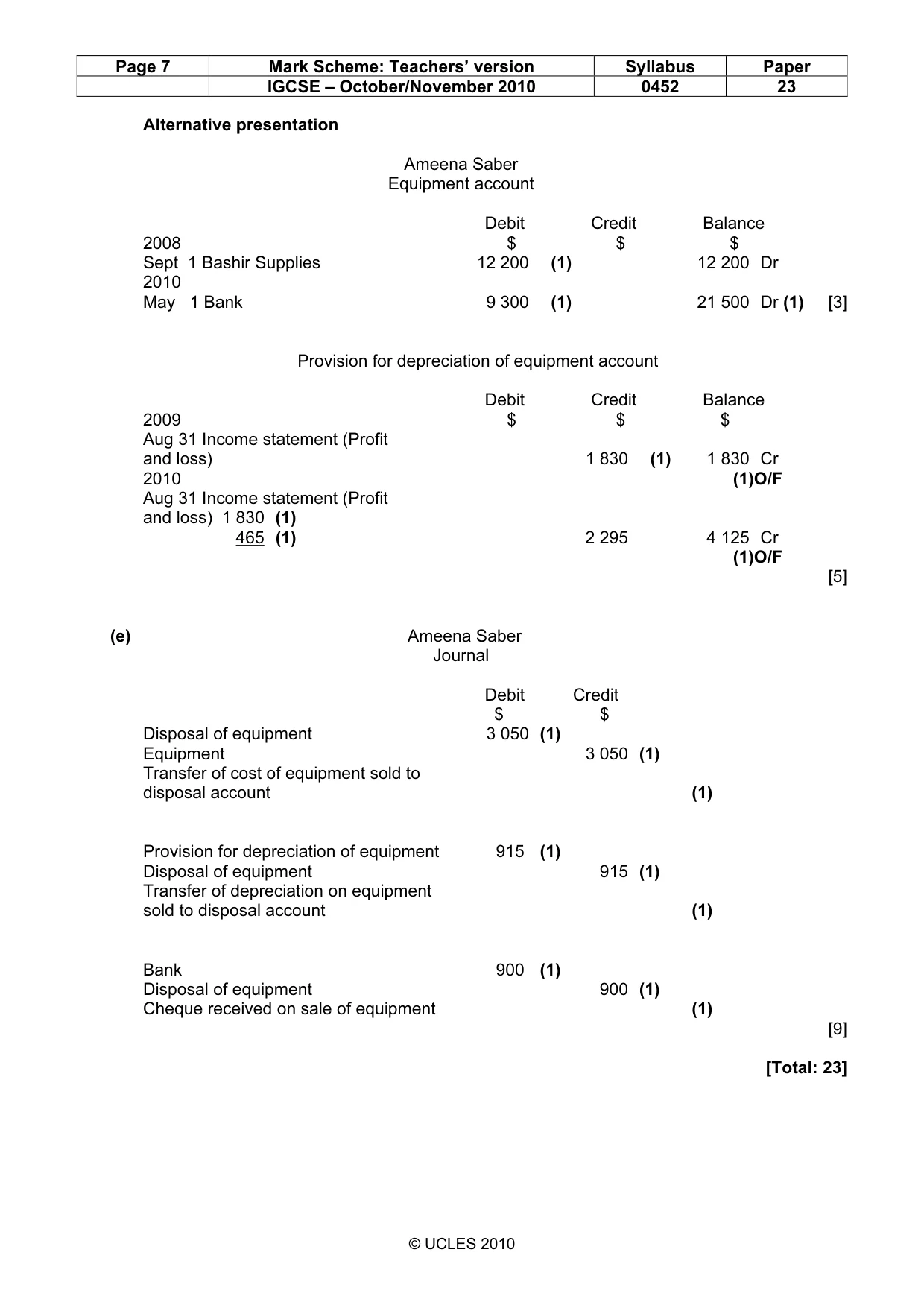
Page 7 Mark Scheme: Teachers’ version Syllabus Paper IGCSE – October/November 2010 0452 23 © UCLES 2010 Alternative presentation Ameena Saber Equipment account Debit Credit Balance 2008 $ $ $ Sept 1 Bashir Supplies 12 200 (1) 12 200 Dr 2010 May 1 Bank 9 300 (1) 21 500 Dr (1) [3] Provision for depreciation of equipment account Debit Credit Balance 2009 $ $ $ Aug 31 Income statement (Profit and loss) 1 830 (1) 1 830 Cr 2010 (1)O/F Aug 31 Income statement (Profit and loss) 1 830 (1) 465 (1) 2 295 4 125 Cr (1)O/F [5] (e) Ameena Saber Journal Debit Credit $ $ Disposal of equipment 3 050 (1) Equipment 3 050 (1) Transfer of cost of equipment sold to disposal account (1) Provision for depreciation of equipment 915 (1) Disposal of equipment 915 (1) Transfer of depreciation on equipment sold to disposal account (1) Bank 900 (1) Disposal of equipment 900 (1) Cheque received on sale of equipment (1) [9] [Total: 23]
Mark scheme, page 8
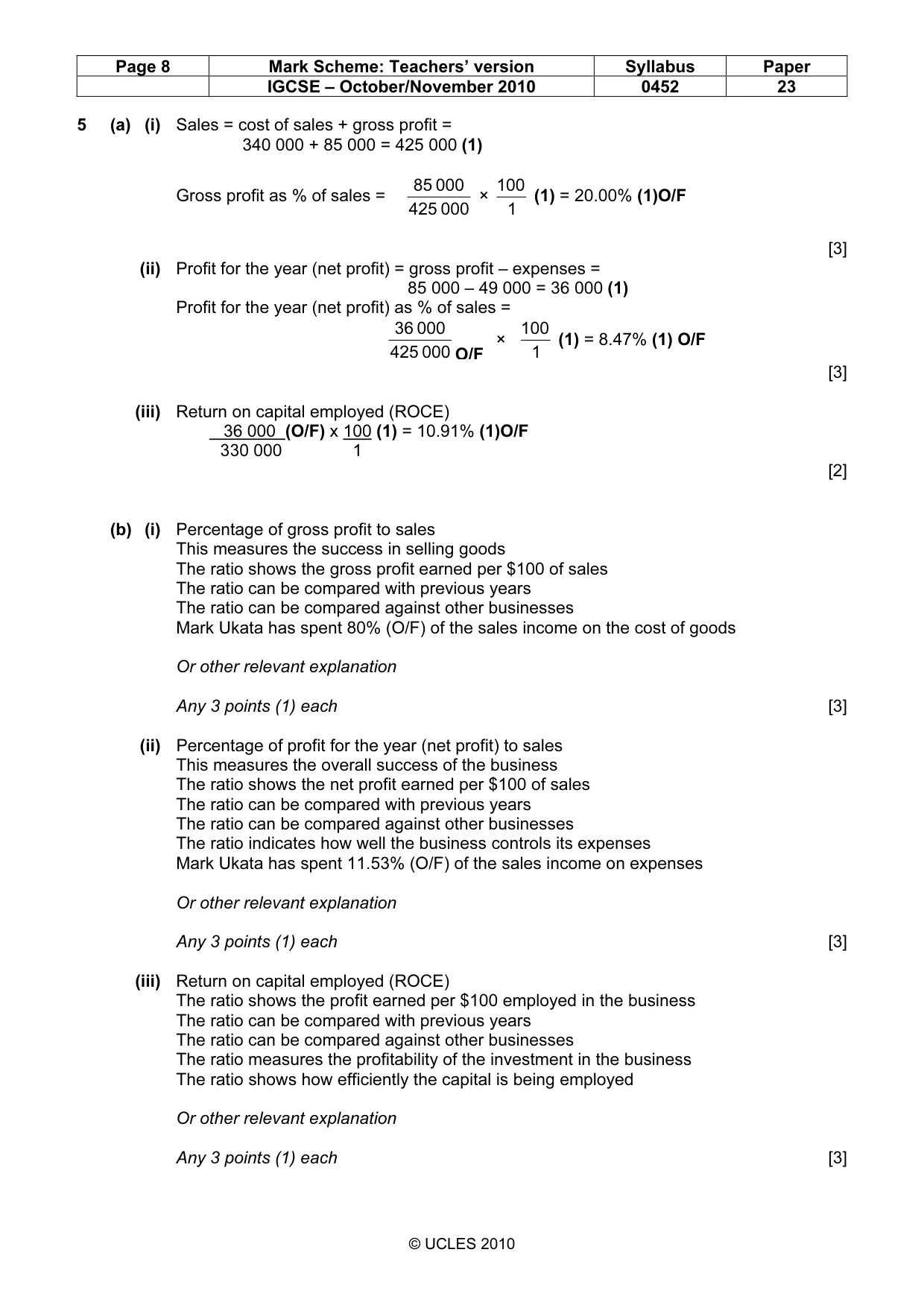
Page 8 Mark Scheme: Teachers’ version Syllabus Paper IGCSE – October/November 2010 0452 23 © UCLES 2010 O/F 5 (a) (i) Sales = cost of sales + gross profit = 340 000 + 85 000 = 425 000 (1) Gross profit as % of sales = 000 425 000 85 × 1 100 (1) = 20.00% (1)O/F [3] (ii) Profit for the year (net profit) = gross profit – expenses = 85 000 – 49 000 = 36 000 (1) Profit for the year (net profit) as % of sales = 000 425 000 36 × 1 100 (1) = 8.47% (1) O/F [3] (iii) Return on capital employed (ROCE) 36 000 (O/F) x 100 (1) = 10.91% (1)O/F 330 000 1 [2] (b) (i) Percentage of gross profit to sales This measures the success in selling goods The ratio shows the gross profit earned per $100 of sales The ratio can be compared with previous years The ratio can be compared against other businesses Mark Ukata has spent 80% (O/F) of the sales income on the cost of goods Or other relevant explanation Any 3 points (1) each [3] (ii) Percentage of profit for the year (net profit) to sales This measures the overall success of the business The ratio shows the net profit earned per $100 of sales The ratio can be compared with previous years The ratio can be compared against other businesses The ratio indicates how well the business controls its expenses Mark Ukata has spent 11.53% (O/F) of the sales income on expenses Or other relevant explanation Any 3 points (1) each [3] (iii) Return on capital employed (ROCE) The ratio shows the profit earned per $100 employed in the business The ratio can be compared with previous years The ratio can be compared against other businesses The ratio measures the profitability of the investment in the business The ratio shows how efficiently the capital is being employed Or other relevant explanation Any 3 points (1) each [3]
Mark scheme, page 9
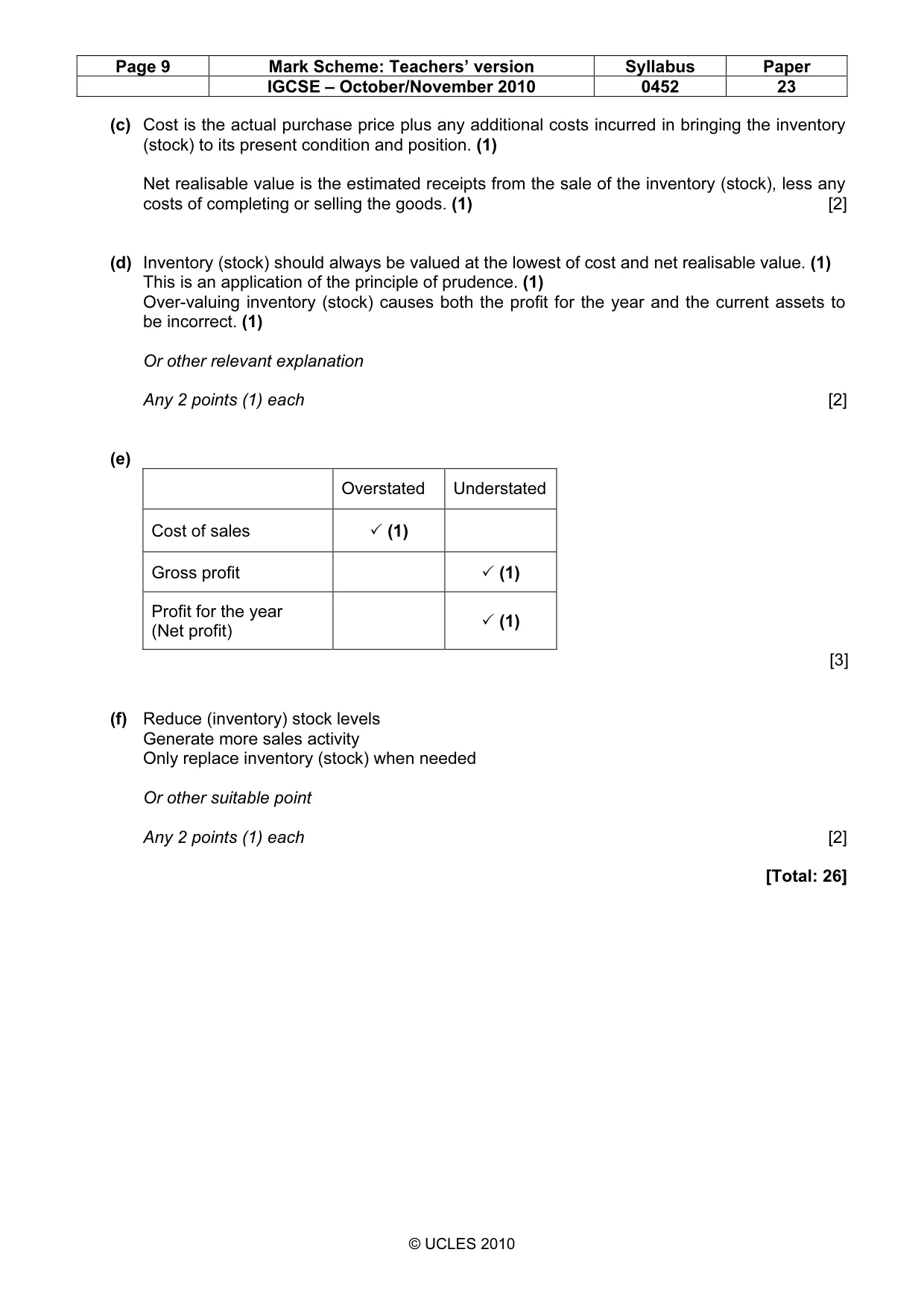
Page 9 Mark Scheme: Teachers’ version Syllabus Paper IGCSE – October/November 2010 0452 23 © UCLES 2010 (c) Cost is the actual purchase price plus any additional costs incurred in bringing the inventory (stock) to its present condition and position. (1) Net realisable value is the estimated receipts from the sale of the inventory (stock), less any costs of completing or selling the goods. (1) [2] (d) Inventory (stock) should always be valued at the lowest of cost and net realisable value. (1) This is an application of the principle of prudence. (1) Over-valuing inventory (stock) causes both the profit for the year and the current assets to be incorrect. (1) Or other relevant explanation Any 2 points (1) each [2] (e) Overstated Understated Cost of sales ✓ (1) Gross profit ✓ (1) Profit for the year (Net profit) ✓ (1) [3] (f) Reduce (inventory) stock levels Generate more sales activity Only replace inventory (stock) when needed Or other suitable point Any 2 points (1) each [2] [Total: 26]
What you needed in this session
Cambridge’s own grade thresholds for 2010 Oct/Nov, Paper 2 · Variant 3. A higher threshold means an easier paper — the bar moves with how the cohort did.