Cambridge IGCSE Accounting 0452 — 2010 Oct/Nov Paper 2 · Variant 2
0452/22/O/N/10 · 120 marks · ≈135 min
The question paper and its mark scheme, free to read here and free to download. This is Cambridge’s own paper, exactly as it was sat.
Question paper20 pages
Mark scheme9 pages
Answers below. Sit the paper first if you are practising.
Paper as text
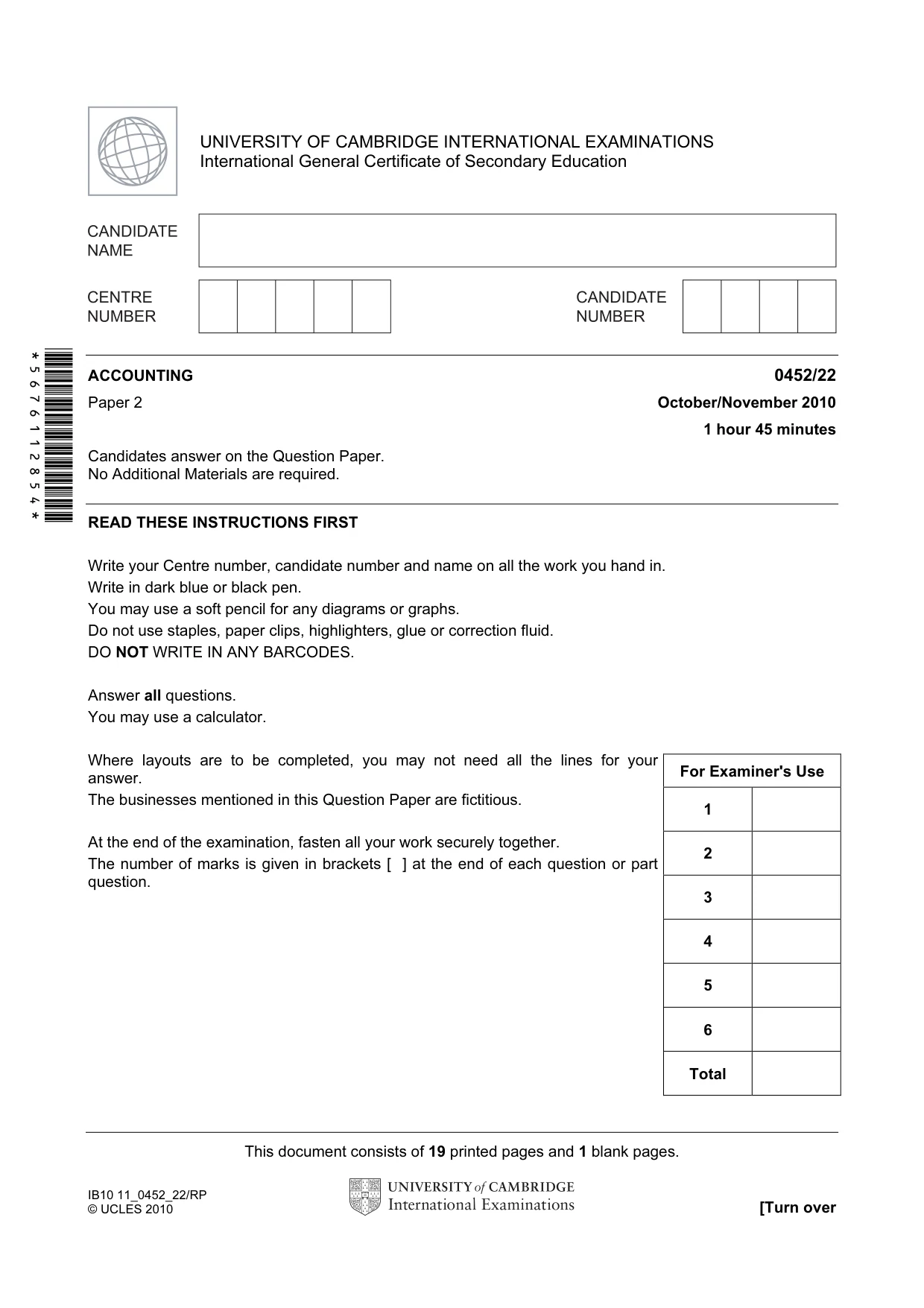
Question paper, page 1
This document consists of 19 printed pages and 1 blank pages. IB10 11_0452_22/RP © UCLES 2010 [Turn over ** *5676112854* For Examiner's Use 1 2 3 4 5 6 Total UNIVERSITY OF CAMBRIDGE INTERNATIONAL EXAMINATIONS International General Certificate of Secondary Education ACCOUNTING 0452/22 Paper 2 October/November 2010 1 hour 45 minutes Candidates answer on the Question Paper. No Additional Materials are required. READ THESE INSTRUCTIONS FIRST Write your Centre number, candidate number and name on all the work you hand in. Write in dark blue or black pen. You may use a soft pencil for any diagrams or graphs. Do not use staples, paper clips, highlighters, glue or correction fluid. DO NOT WRITE IN ANY BARCODES. Answer all questions. You may use a calculator. Where layouts are to be completed, you may not need all the lines for your answer. The businesses mentioned in this Question Paper are fictitious. At the end of the examination, fasten all your work securely together. The number of marks is given in brackets [ ] at the end of each question or part question.
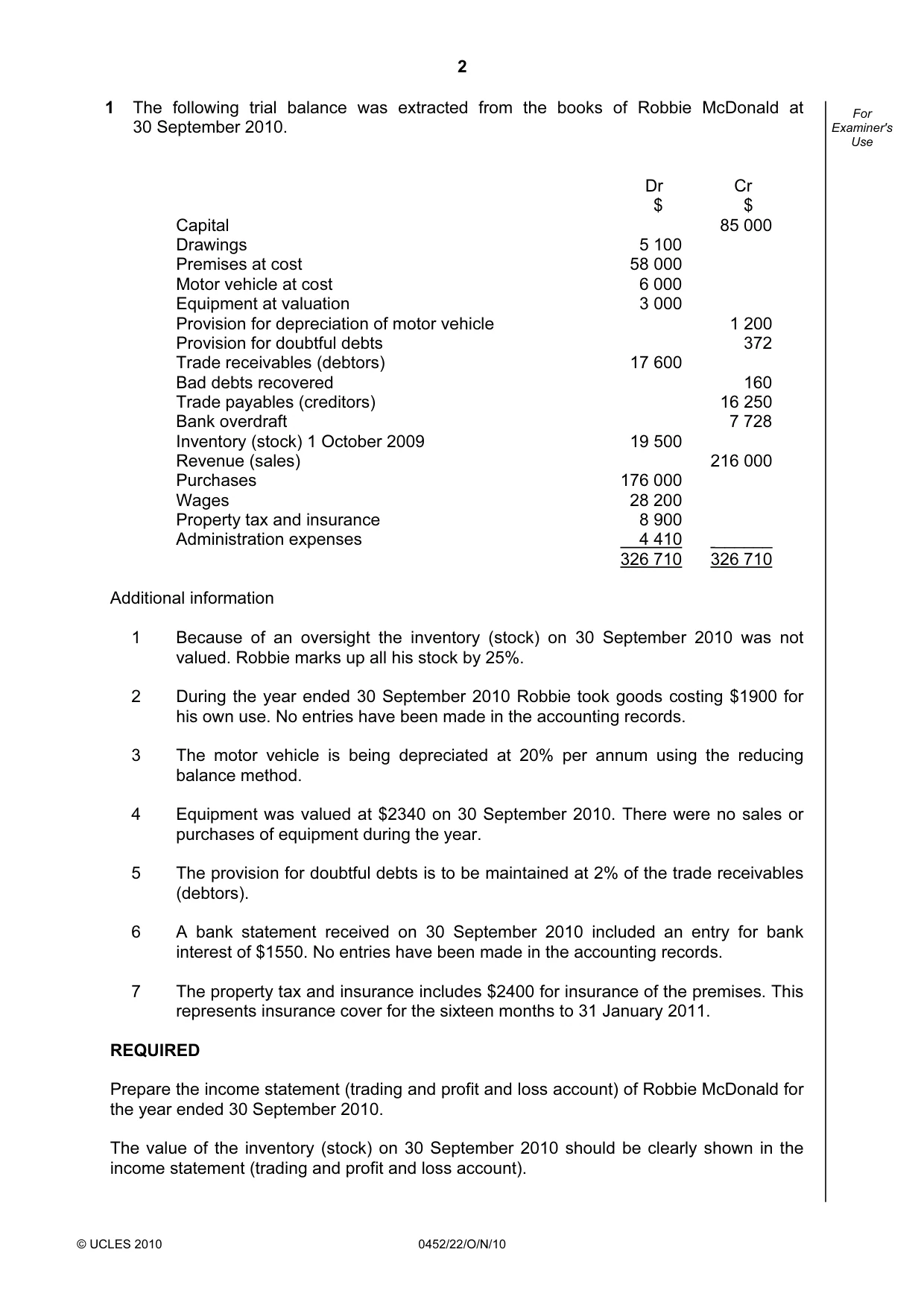
Question paper, page 2
2 © UCLES 2010 0452/22/O/N/10 For Examiner's Use 1 The following trial balance was extracted from the books of Robbie McDonald at 30 September 2010. Dr Cr $ $ Capital 85 000 Drawings 5 100 Premises at cost 58 000 Motor vehicle at cost 6 000 Equipment at valuation 3 000 Provision for depreciation of motor vehicle 1 200 Provision for doubtful debts 372 Trade receivables (debtors) 17 600 Bad debts recovered 160 Trade payables (creditors) 16 250 Bank overdraft 7 728 Inventory (stock) 1 October 2009 19 500 Revenue (sales) 216 000 Purchases 176 000 Wages 28 200 Property tax and insurance 8 900 Administration expenses 4 410 ______ 326 710 326 710 Additional information 1 Because of an oversight the inventory (stock) on 30 September 2010 was not valued. Robbie marks up all his stock by 25%. 2 During the year ended 30 September 2010 Robbie took goods costing $1900 for his own use. No entries have been made in the accounting records. 3 The motor vehicle is being depreciated at 20% per annum using the reducing balance method. 4 Equipment was valued at $2340 on 30 September 2010. There were no sales or purchases of equipment during the year. 5 The provision for doubtful debts is to be maintained at 2% of the trade receivables (debtors). 6 A bank statement received on 30 September 2010 included an entry for bank interest of $1550. No entries have been made in the accounting records. 7 The property tax and insurance includes $2400 for insurance of the premises. This represents insurance cover for the sixteen months to 31 January 2011. REQUIRED Prepare the income statement (trading and profit and loss account) of Robbie McDonald for the year ended 30 September 2010. The value of the inventory (stock) on 30 September 2010 should be clearly shown in the income statement (trading and profit and loss account).
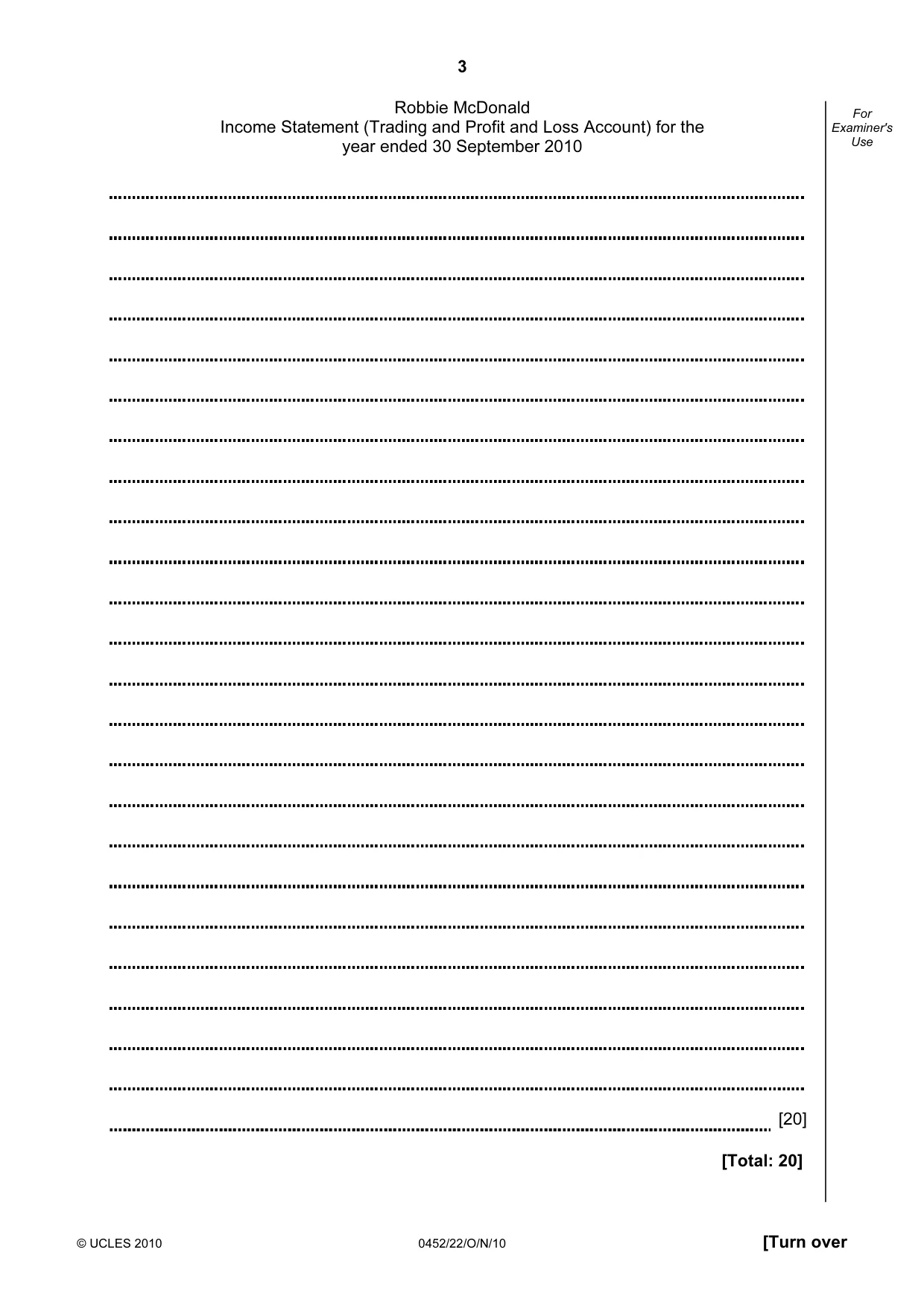
Question paper, page 3
3 © UCLES 2010 0452/22/O/N/10 [Turn over For Examiner's Use Robbie McDonald Income Statement (Trading and Profit and Loss Account) for the year ended 30 September 2010 [20] [Total: 20]
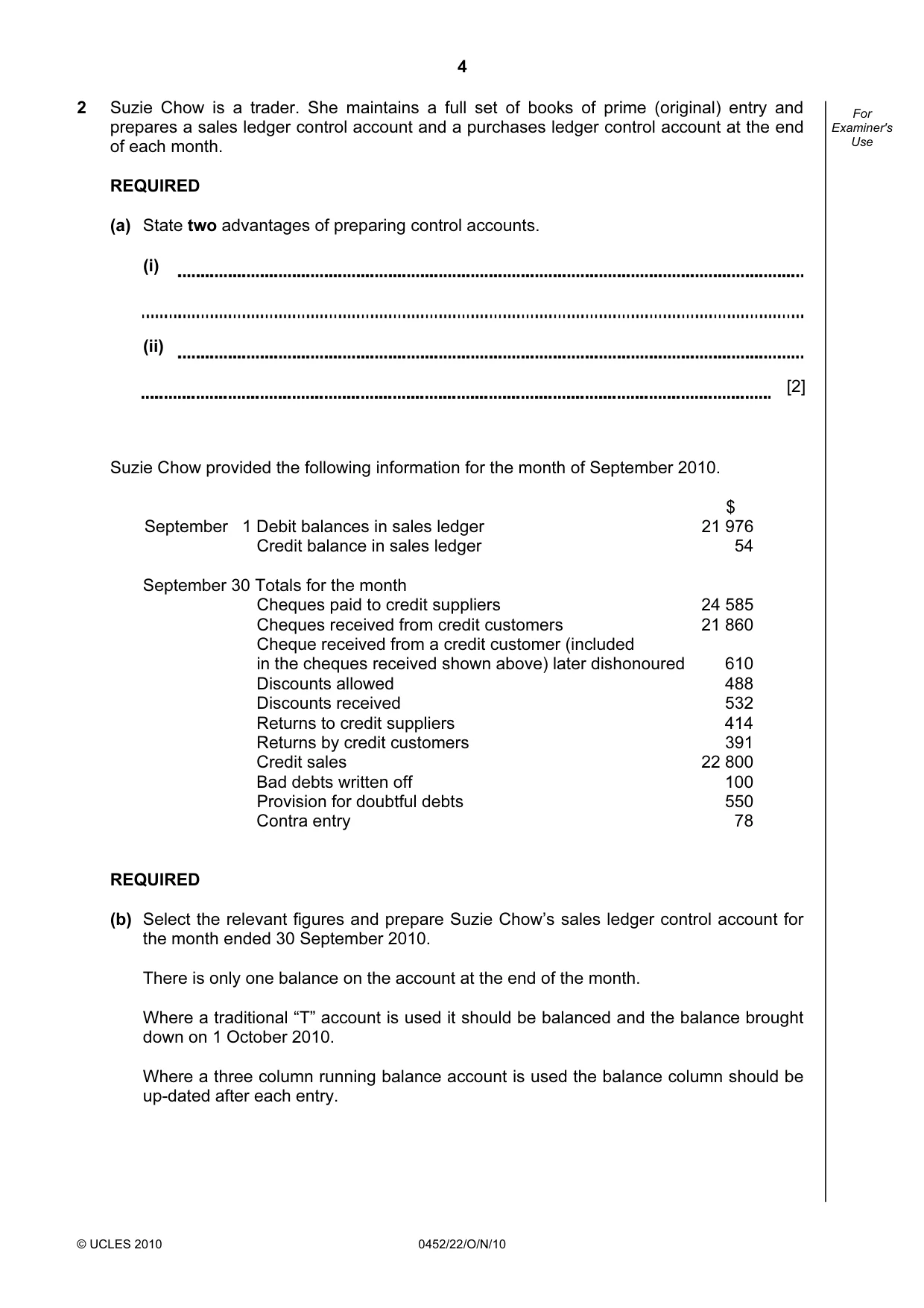
Question paper, page 4
4 © UCLES 2010 0452/22/O/N/10 For Examiner's Use 2 Suzie Chow is a trader. She maintains a full set of books of prime (original) entry and prepares a sales ledger control account and a purchases ledger control account at the end of each month. REQUIRED (a) State two advantages of preparing control accounts. (i) (ii) [2] Suzie Chow provided the following information for the month of September 2010. $ September 1 Debit balances in sales ledger 21 976 Credit balance in sales ledger 54 September 30 Totals for the month Cheques paid to credit suppliers 24 585 Cheques received from credit customers 21 860 Cheque received from a credit customer (included in the cheques received shown above) later dishonoured 610 Discounts allowed 488 Discounts received 532 Returns to credit suppliers 414 Returns by credit customers 391 Credit sales 22 800 Bad debts written off 100 Provision for doubtful debts 550 Contra entry 78 REQUIRED (b) Select the relevant figures and prepare Suzie Chow’s sales ledger control account for the month ended 30 September 2010. There is only one balance on the account at the end of the month. Where a traditional “T” account is used it should be balanced and the balance brought down on 1 October 2010. Where a three column running balance account is used the balance column should be up-dated after each entry.
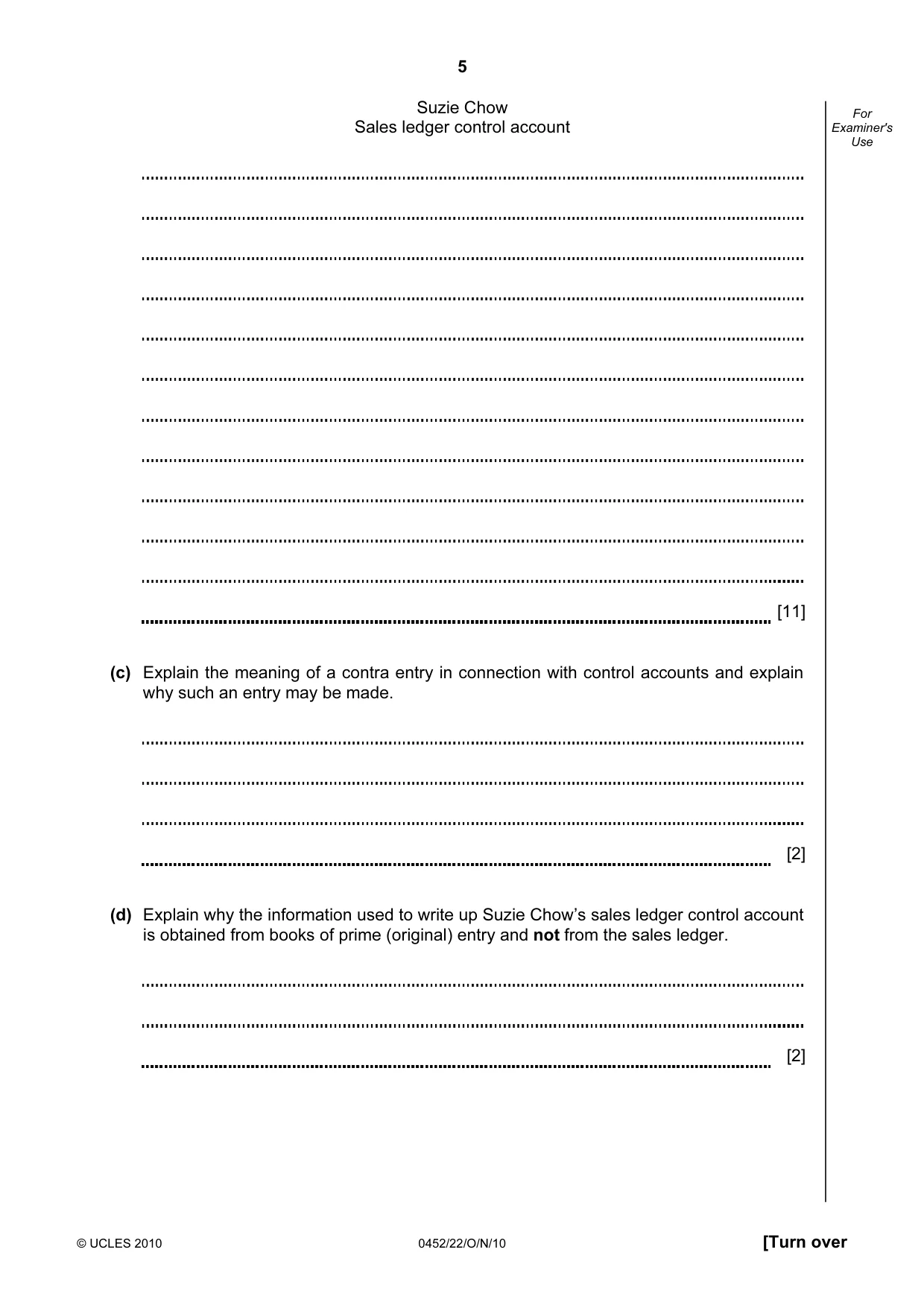
Question paper, page 5
5 © UCLES 2010 0452/22/O/N/10 [Turn over For Examiner's Use Suzie Chow Sales ledger control account [11] (c) Explain the meaning of a contra entry in connection with control accounts and explain why such an entry may be made. [2] (d) Explain why the information used to write up Suzie Chow’s sales ledger control account is obtained from books of prime (original) entry and not from the sales ledger. [2]
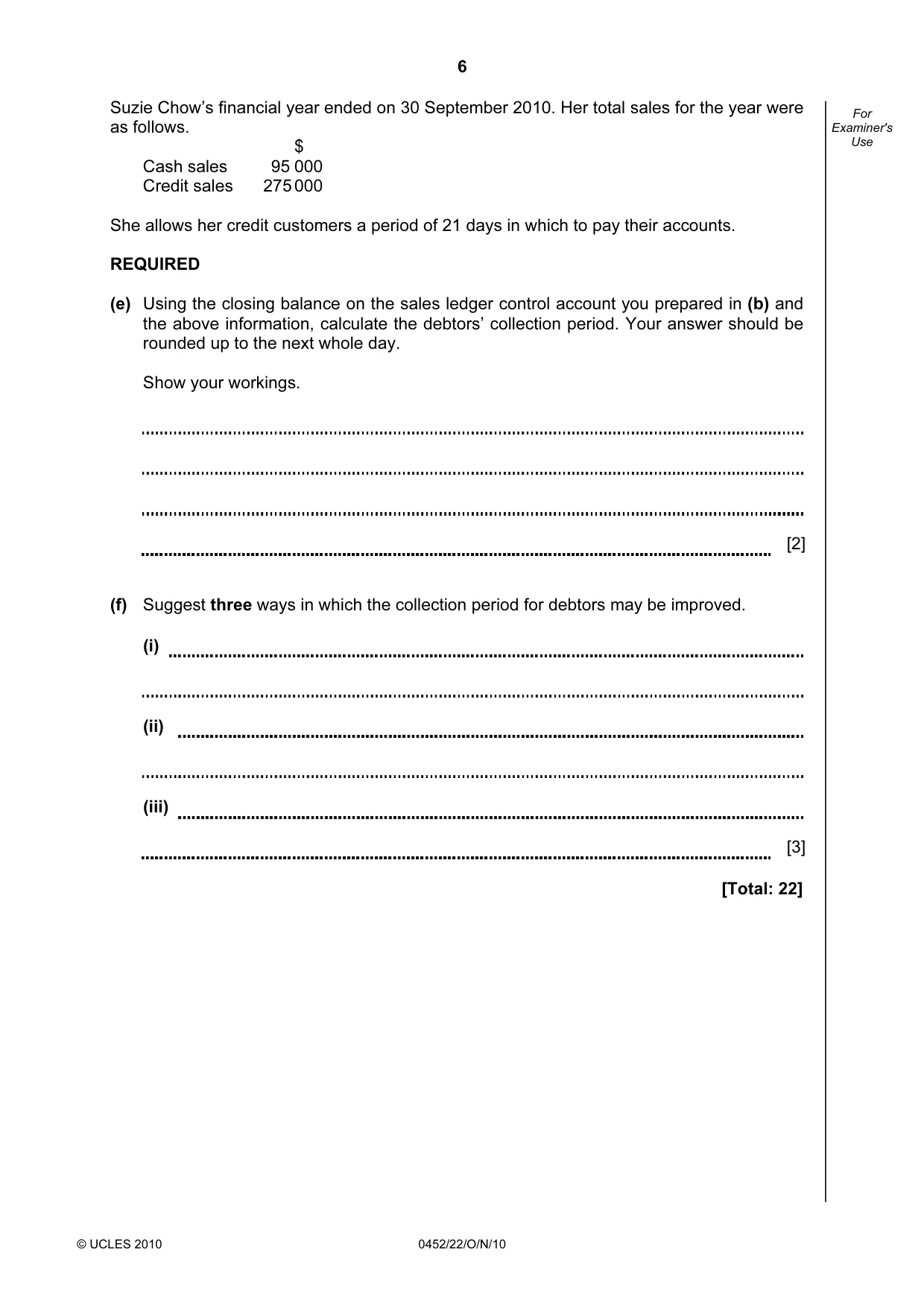
Question paper, page 6
6 © UCLES 2010 0452/22/O/N/10 For Examiner's Use Suzie Chow’s financial year ended on 30 September 2010. Her total sales for the year were as follows. $ Cash sales 95 000 Credit sales 275 000 She allows her credit customers a period of 21 days in which to pay their accounts. REQUIRED (e) Using the closing balance on the sales ledger control account you prepared in (b) and the above information, calculate the debtors’ collection period. Your answer should be rounded up to the next whole day. Show your workings. [2] (f) Suggest three ways in which the collection period for debtors may be improved. (i) (ii) (iii) [3] [Total: 22]
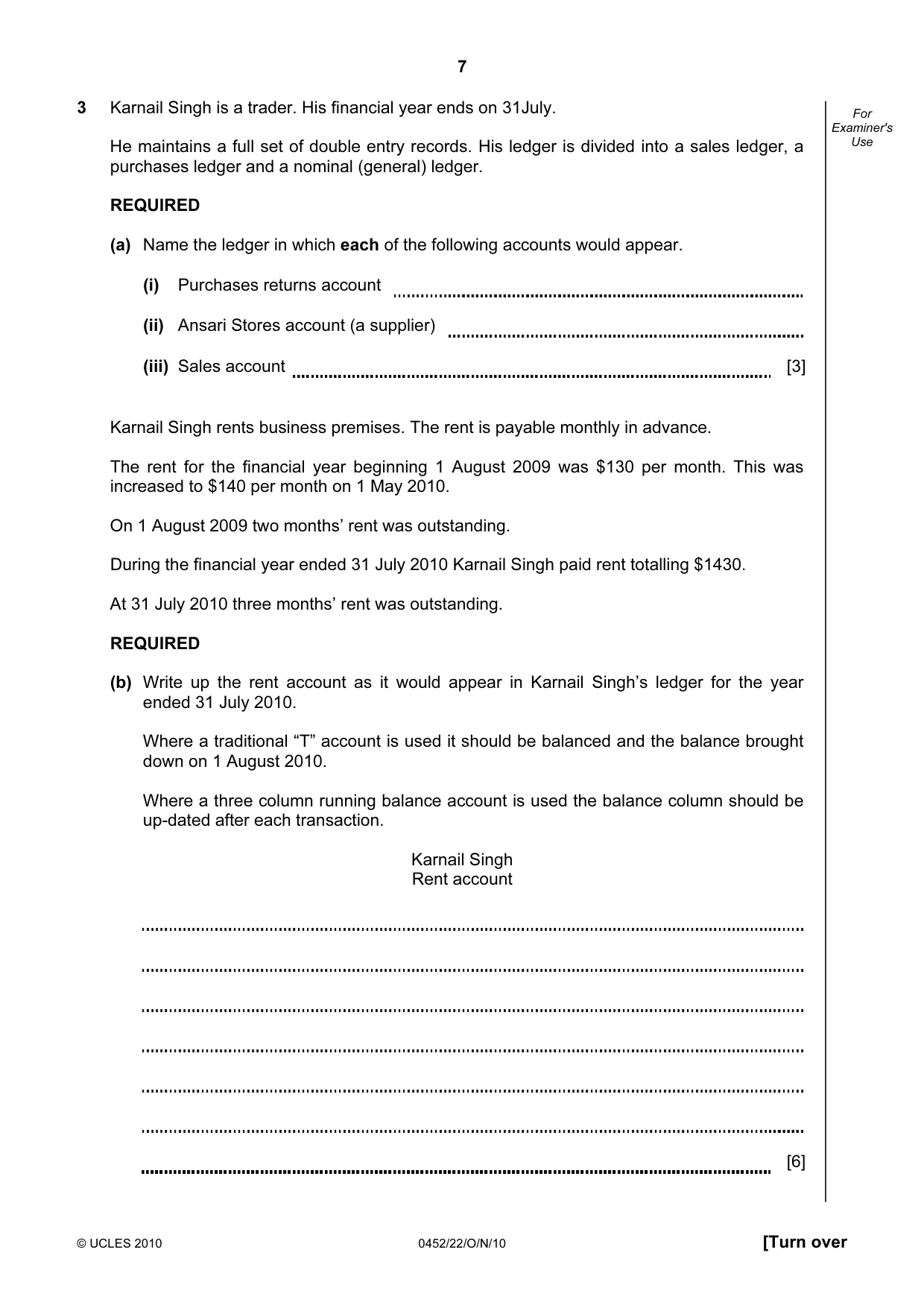
Question paper, page 7
7 © UCLES 2010 0452/22/O/N/10 [Turn over For Examiner's Use 3 Karnail Singh is a trader. His financial year ends on 31July. He maintains a full set of double entry records. His ledger is divided into a sales ledger, a purchases ledger and a nominal (general) ledger. REQUIRED (a) Name the ledger in which each of the following accounts would appear. (i) Purchases returns account (ii) Ansari Stores account (a supplier) (iii) Sales account [3] Karnail Singh rents business premises. The rent is payable monthly in advance. The rent for the financial year beginning 1 August 2009 was $130 per month. This was increased to $140 per month on 1 May 2010. On 1 August 2009 two months’ rent was outstanding. During the financial year ended 31 July 2010 Karnail Singh paid rent totalling $1430. At 31 July 2010 three months’ rent was outstanding. REQUIRED (b) Write up the rent account as it would appear in Karnail Singh’s ledger for the year ended 31 July 2010. Where a traditional “T” account is used it should be balanced and the balance brought down on 1 August 2010. Where a three column running balance account is used the balance column should be up-dated after each transaction. Karnail Singh Rent account [6]
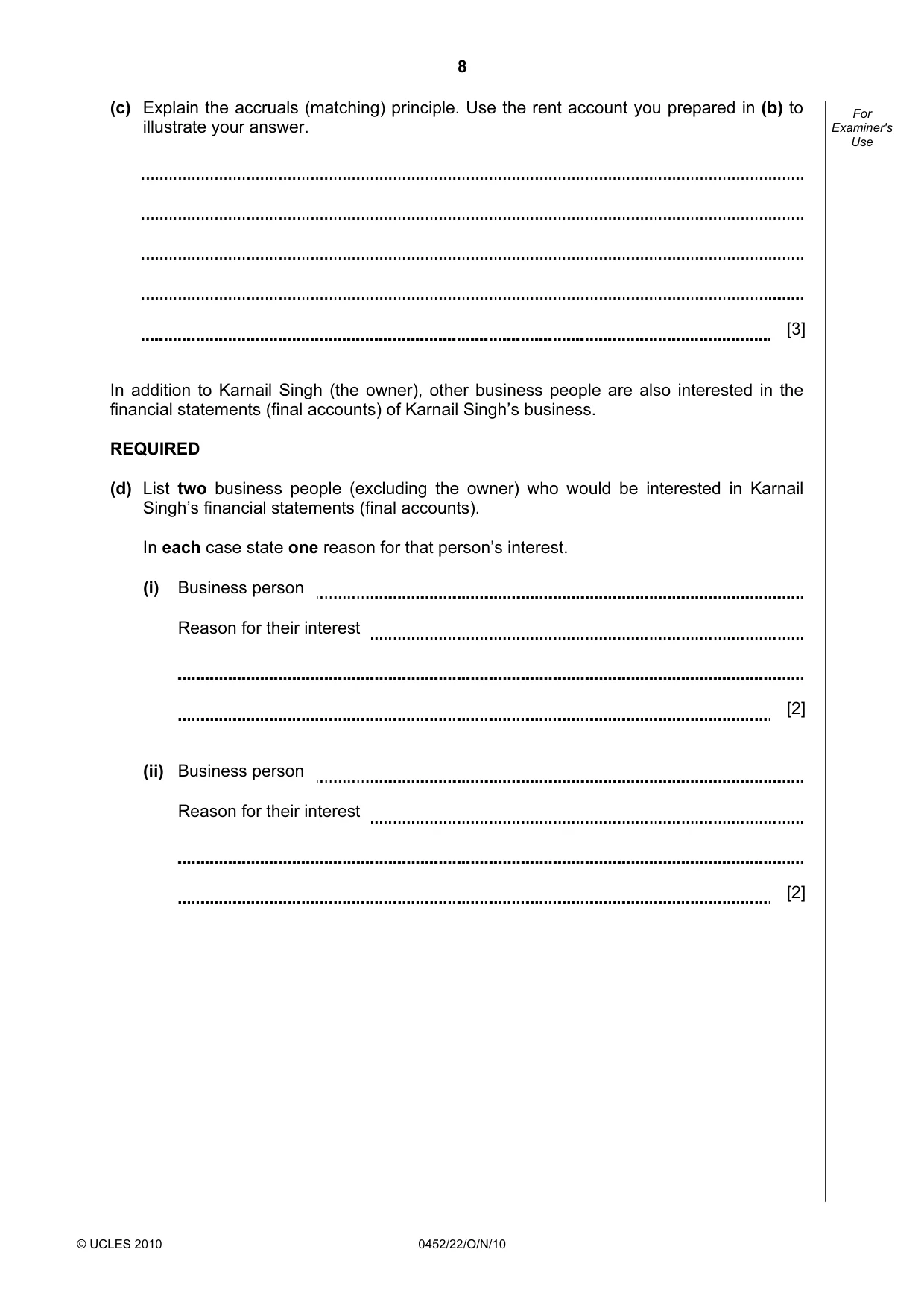
Question paper, page 8
8 © UCLES 2010 0452/22/O/N/10 For Examiner's Use (c) Explain the accruals (matching) principle. Use the rent account you prepared in (b) to illustrate your answer. [3] In addition to Karnail Singh (the owner), other business people are also interested in the financial statements (final accounts) of Karnail Singh’s business. REQUIRED (d) List two business people (excluding the owner) who would be interested in Karnail Singh’s financial statements (final accounts). In each case state one reason for that person’s interest. (i) Business person Reason for their interest [2] (ii) Business person Reason for their interest [2]
Question paper, page 9
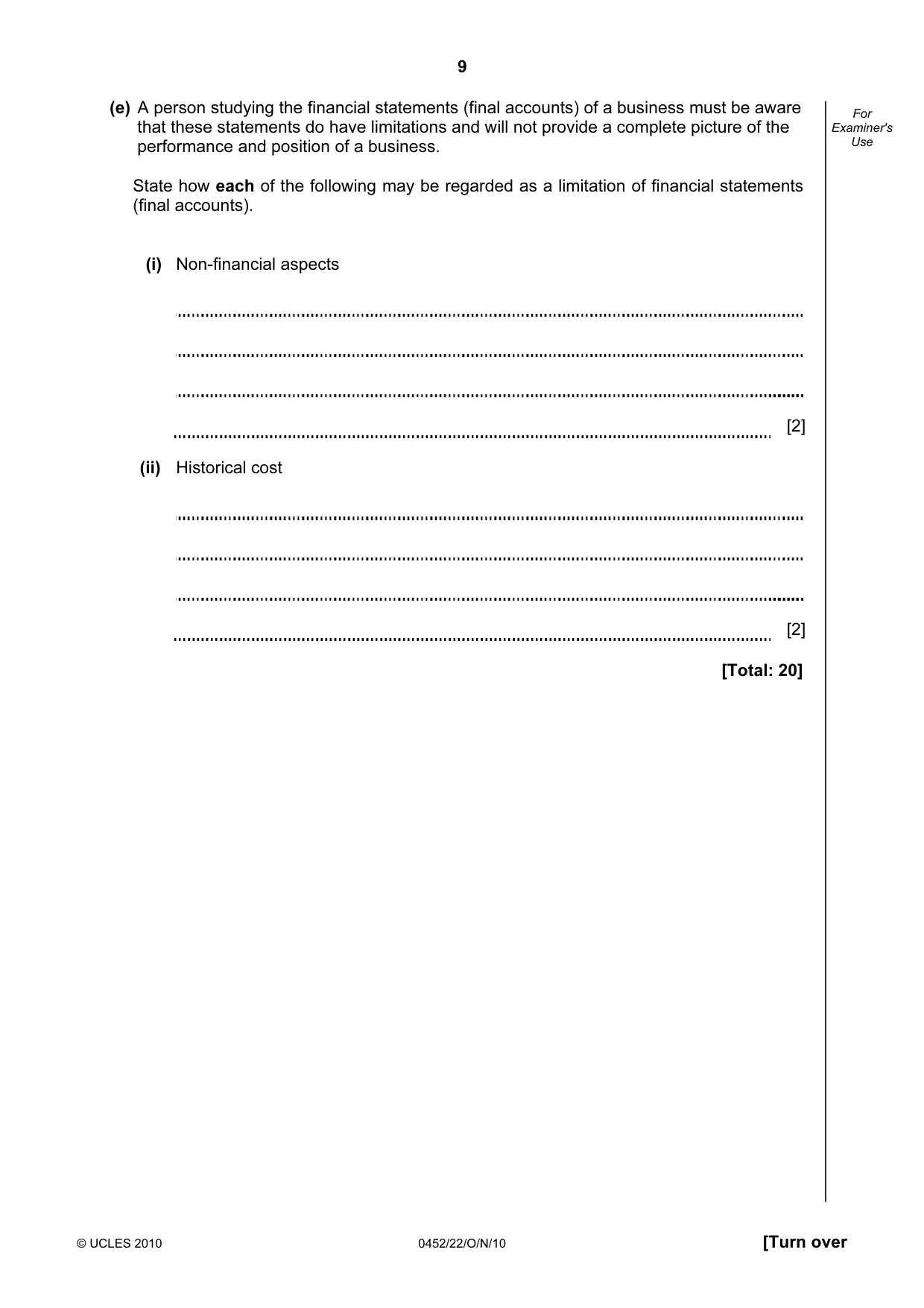
9 © UCLES 2010 0452/22/O/N/10 [Turn over For Examiner's Use (e) A person studying the financial statements (final accounts) of a business must be aware that these statements do have limitations and will not provide a complete picture of the performance and position of a business. State how each of the following may be regarded as a limitation of financial statements (final accounts). (i) Non-financial aspects [2] (ii) Historical cost [2] [Total: 20]
Question paper, page 10
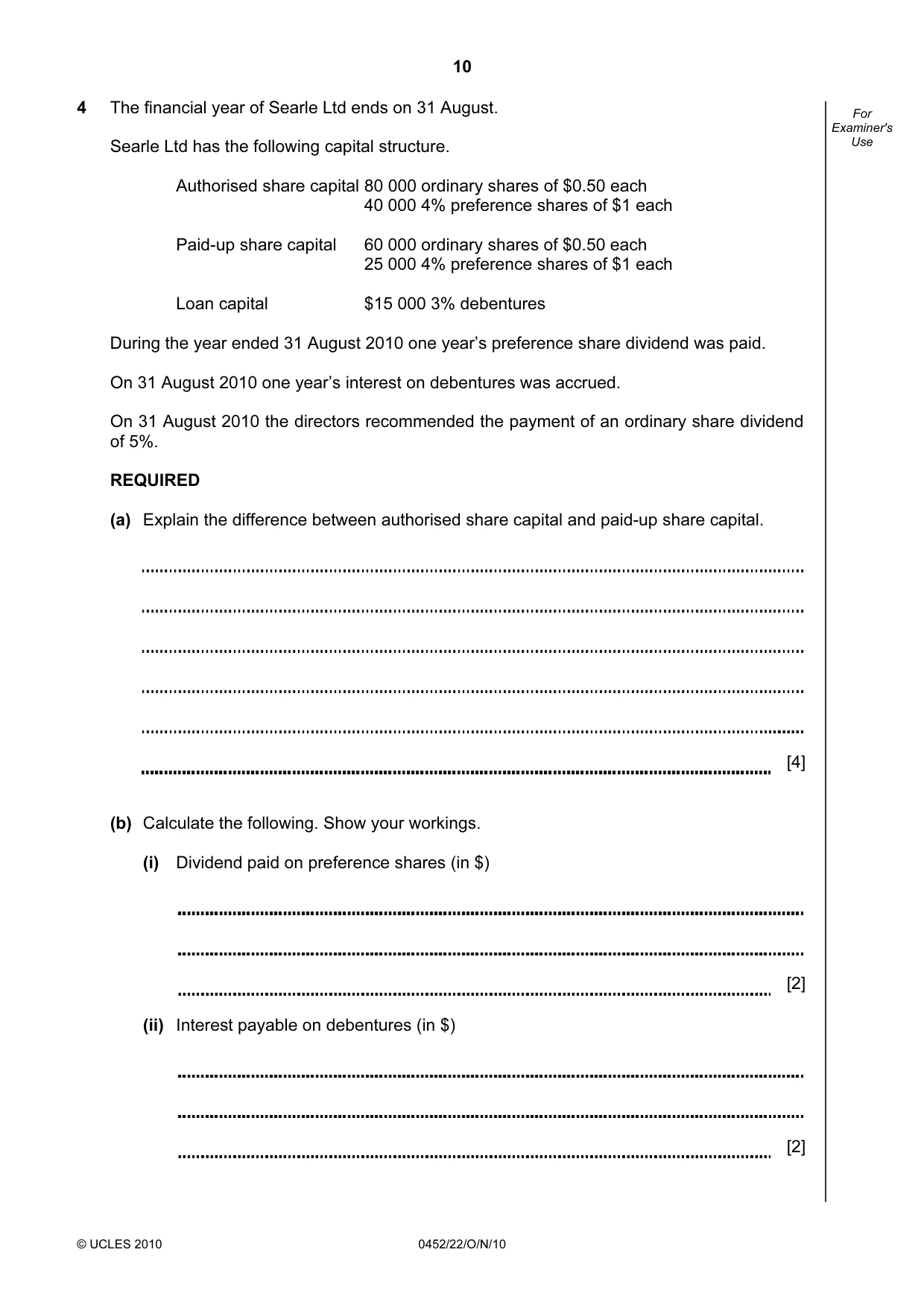
10 © UCLES 2010 0452/22/O/N/10 For Examiner's Use 4 The financial year of Searle Ltd ends on 31 August. Searle Ltd has the following capital structure. Authorised share capital 80 000 ordinary shares of $0.50 each 40 000 4% preference shares of $1 each Paid-up share capital 60 000 ordinary shares of $0.50 each 25 000 4% preference shares of $1 each Loan capital $15 000 3% debentures During the year ended 31 August 2010 one year’s preference share dividend was paid. On 31 August 2010 one year’s interest on debentures was accrued. On 31 August 2010 the directors recommended the payment of an ordinary share dividend of 5%. REQUIRED (a) Explain the difference between authorised share capital and paid-up share capital. [4] (b) Calculate the following. Show your workings. (i) Dividend paid on preference shares (in $) [2] (ii) Interest payable on debentures (in $) [2]
Question paper, page 11
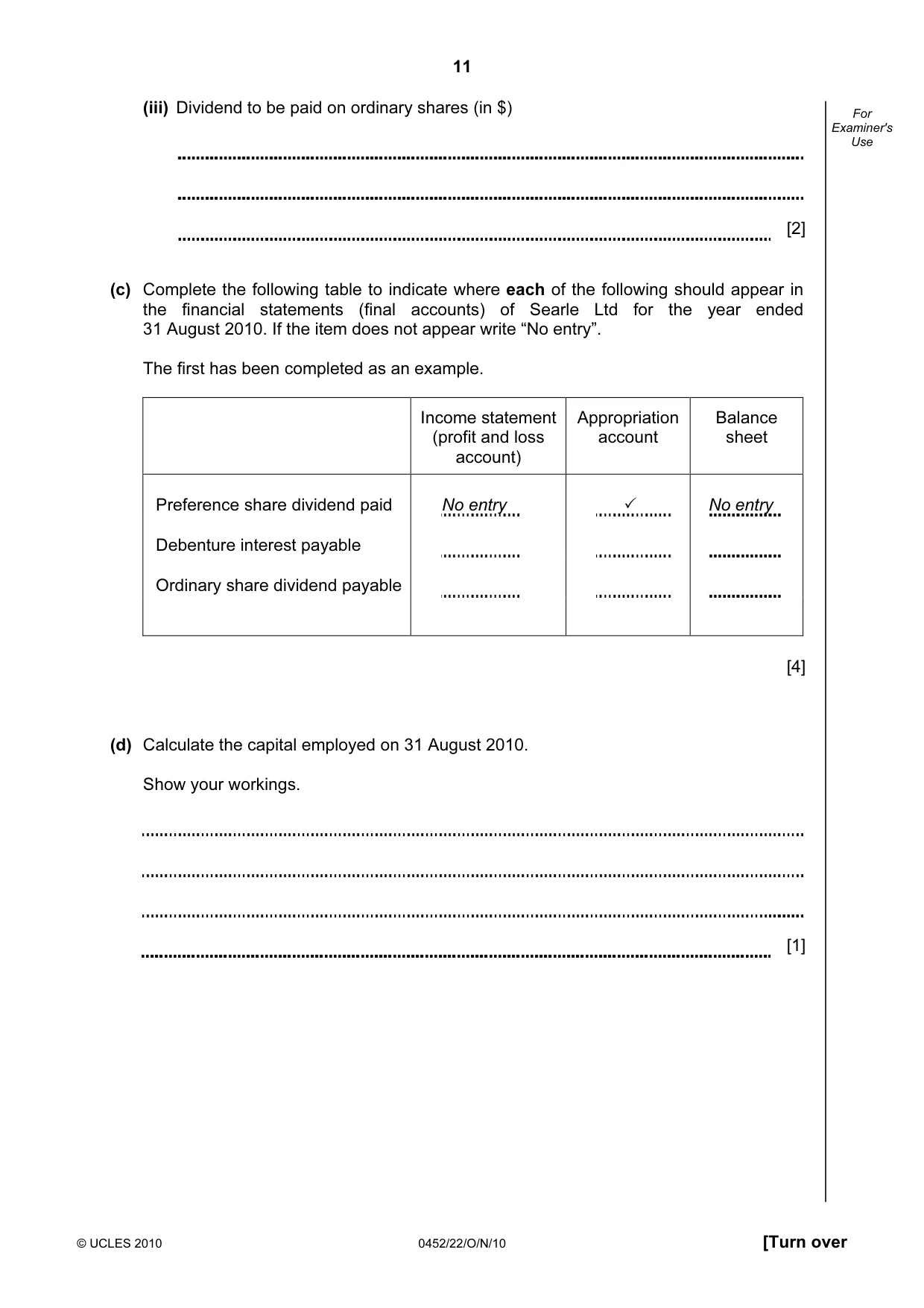
11 © UCLES 2010 0452/22/O/N/10 [Turn over For Examiner's Use (iii) Dividend to be paid on ordinary shares (in $) [2] (c) Complete the following table to indicate where each of the following should appear in the financial statements (final accounts) of Searle Ltd for the year ended 31 August 2010. If the item does not appear write “No entry”. The first has been completed as an example. Income statement (profit and loss account) Appropriation account Balance sheet Preference share dividend paid No entry ✓ No entry Debenture interest payable Ordinary share dividend payable [4] (d) Calculate the capital employed on 31 August 2010. Show your workings. [1]
Question paper, page 12
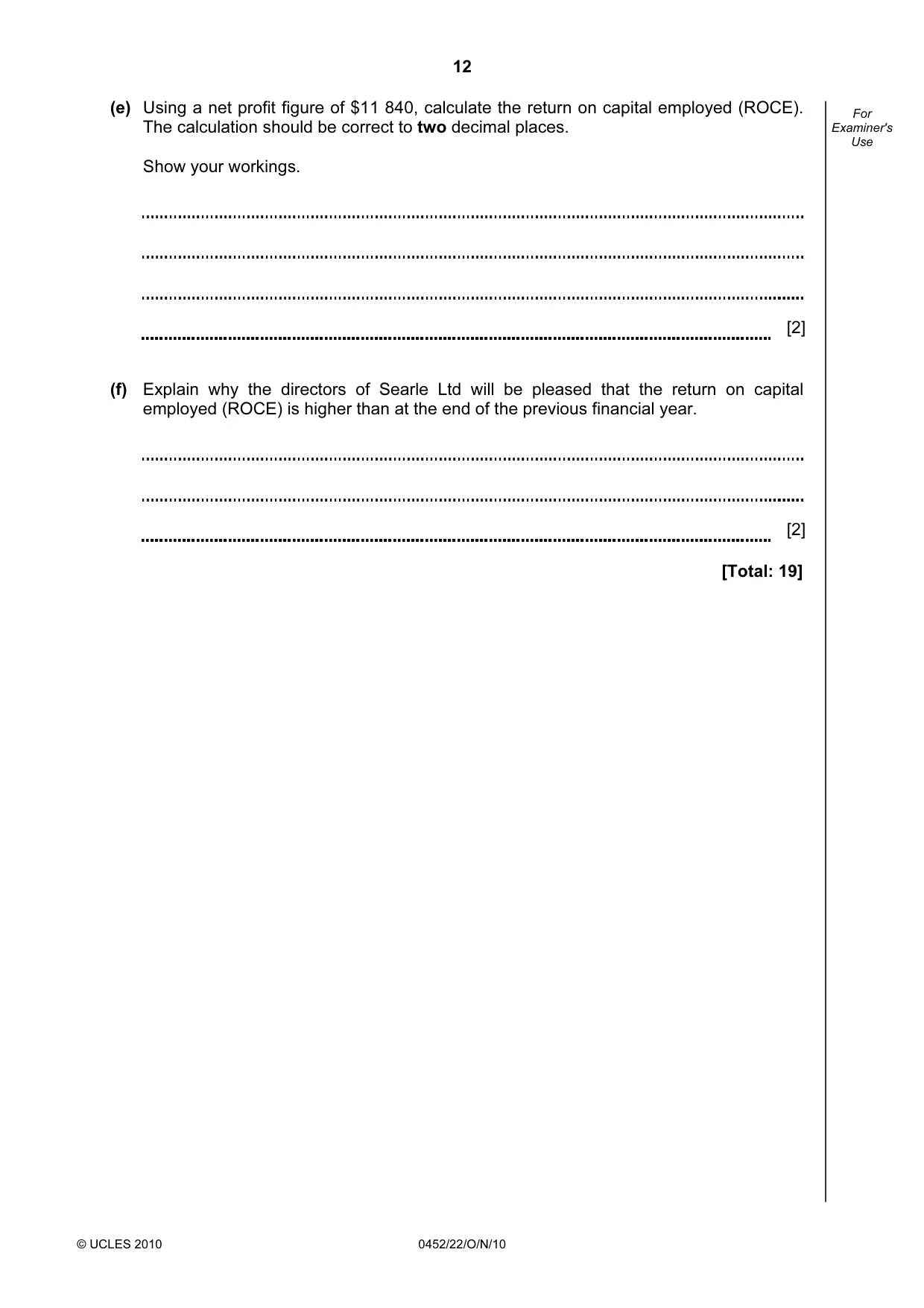
12 © UCLES 2010 0452/22/O/N/10 For Examiner's Use (e) Using a net profit figure of $11 840, calculate the return on capital employed (ROCE). The calculation should be correct to two decimal places. Show your workings. [2] (f) Explain why the directors of Searle Ltd will be pleased that the return on capital employed (ROCE) is higher than at the end of the previous financial year. [2] [Total: 19]
Question paper, page 13
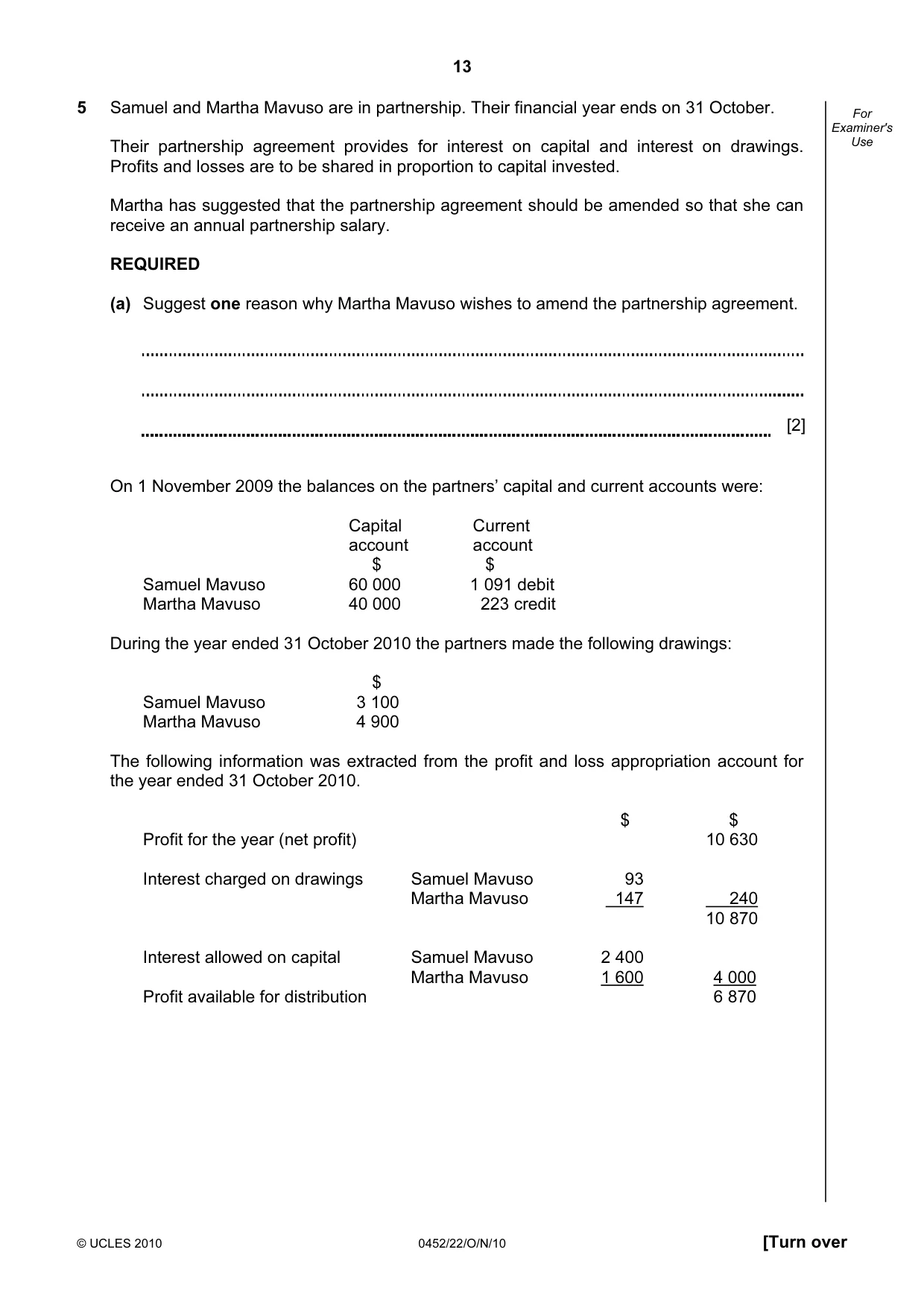
13 © UCLES 2010 0452/22/O/N/10 [Turn over For Examiner's Use 5 Samuel and Martha Mavuso are in partnership. Their financial year ends on 31 October. Their partnership agreement provides for interest on capital and interest on drawings. Profits and losses are to be shared in proportion to capital invested. Martha has suggested that the partnership agreement should be amended so that she can receive an annual partnership salary. REQUIRED (a) Suggest one reason why Martha Mavuso wishes to amend the partnership agreement. [2] On 1 November 2009 the balances on the partners’ capital and current accounts were: Capital Current account account $ $ Samuel Mavuso 60 000 1 091 debit Martha Mavuso 40 000 223 credit During the year ended 31 October 2010 the partners made the following drawings: $ Samuel Mavuso 3 100 Martha Mavuso 4 900 The following information was extracted from the profit and loss appropriation account for the year ended 31 October 2010. $ $ Profit for the year (net profit) 10 630 Interest charged on drawings Samuel Mavuso 93 Martha Mavuso 147 240 10 870 Interest allowed on capital Samuel Mavuso 2 400 Martha Mavuso 1 600 4 000 Profit available for distribution 6 870
Question paper, page 14
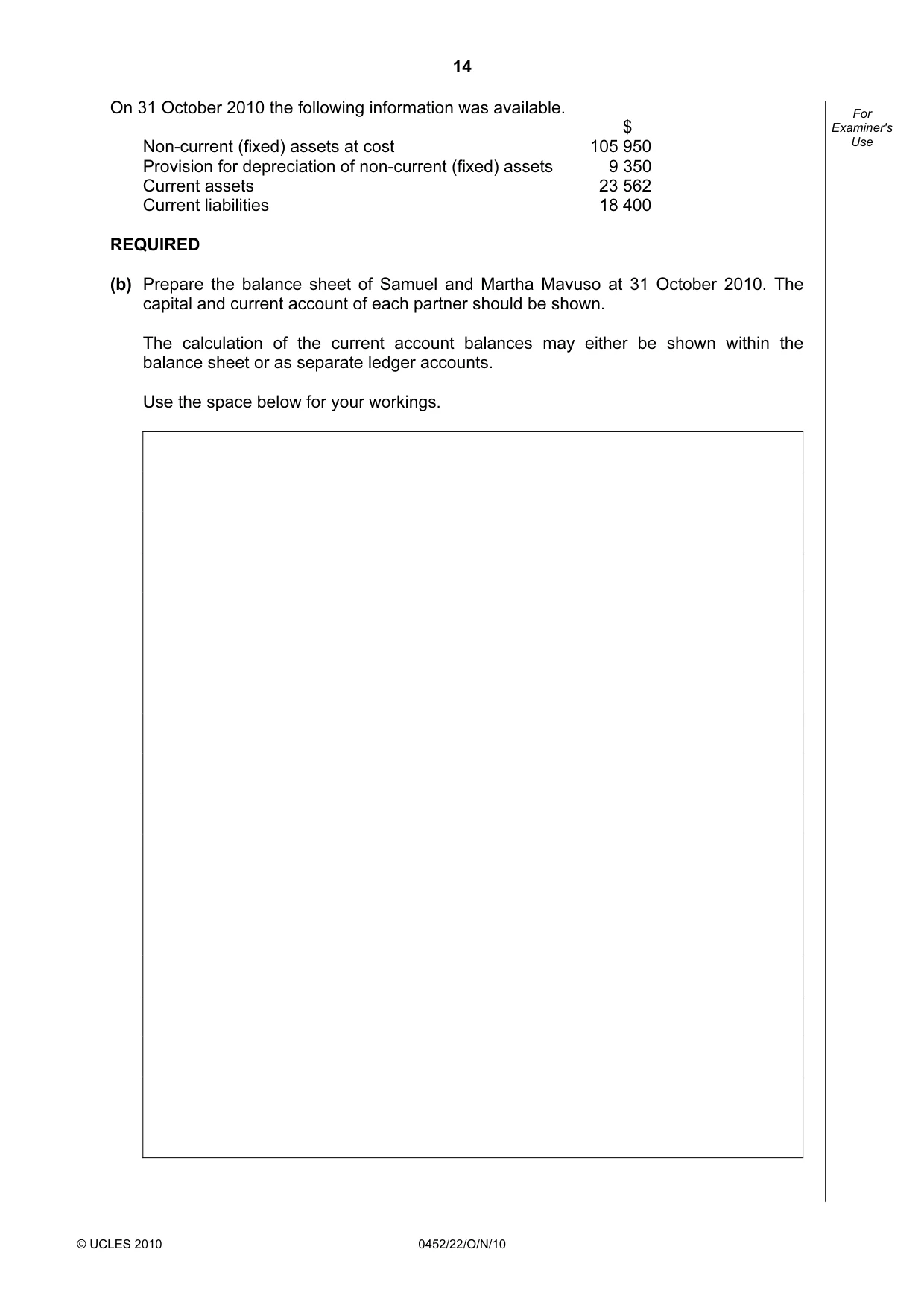
14 © UCLES 2010 0452/22/O/N/10 For Examiner's Use On 31 October 2010 the following information was available. $ Non-current (fixed) assets at cost 105 950 Provision for depreciation of non-current (fixed) assets 9 350 Current assets 23 562 Current liabilities 18 400 REQUIRED (b) Prepare the balance sheet of Samuel and Martha Mavuso at 31 October 2010. The capital and current account of each partner should be shown. The calculation of the current account balances may either be shown within the balance sheet or as separate ledger accounts. Use the space below for your workings.
Question paper, page 15
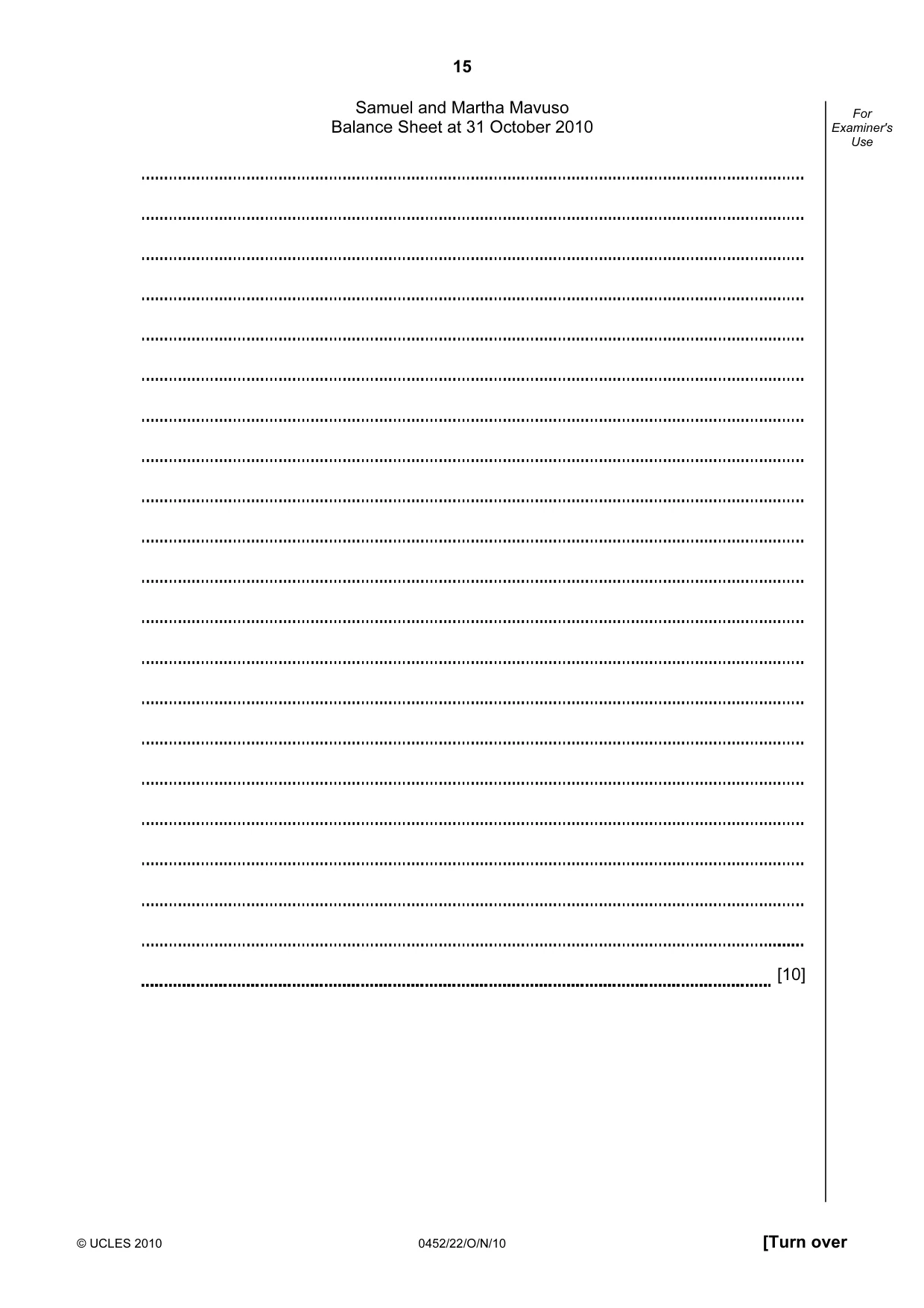
15 © UCLES 2010 0452/22/O/N/10 [Turn over For Examiner's Use Samuel and Martha Mavuso Balance Sheet at 31 October 2010 [10]
Question paper, page 16
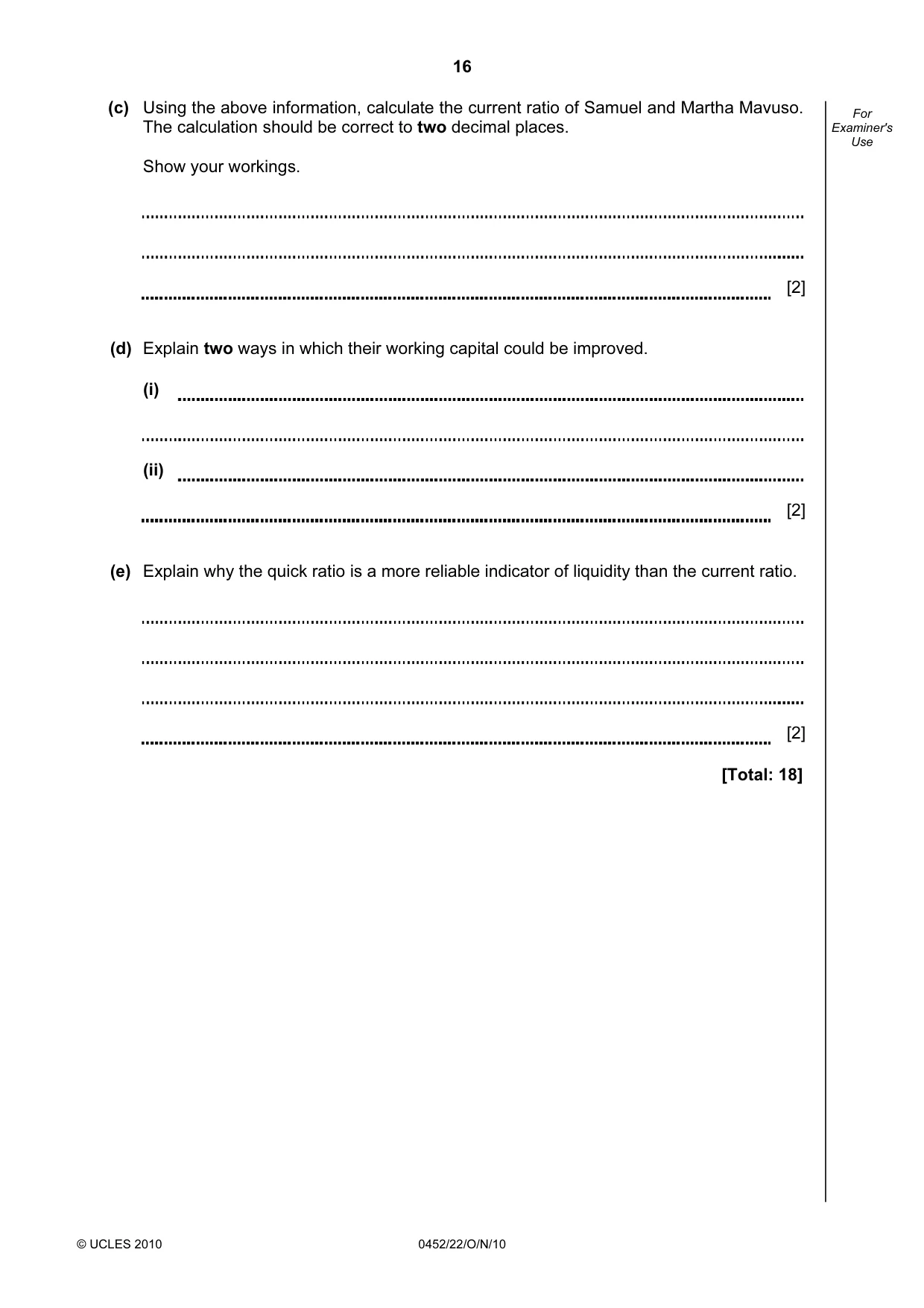
16 © UCLES 2010 0452/22/O/N/10 For Examiner's Use (c) Using the above information, calculate the current ratio of Samuel and Martha Mavuso. The calculation should be correct to two decimal places. Show your workings. [2] (d) Explain two ways in which their working capital could be improved. (i) (ii) [2] (e) Explain why the quick ratio is a more reliable indicator of liquidity than the current ratio. [2] [Total: 18]
Question paper, page 17
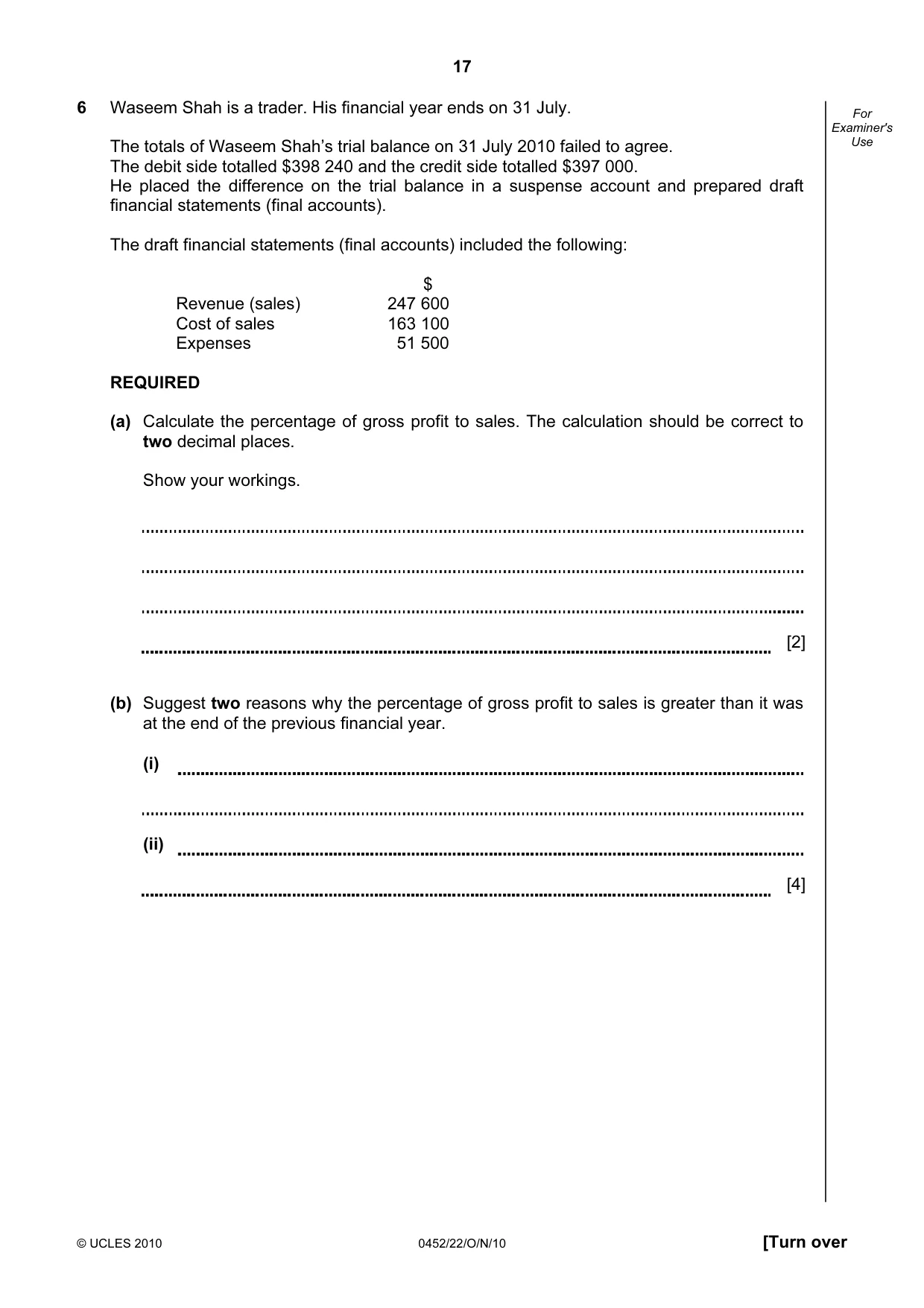
17 © UCLES 2010 0452/22/O/N/10 [Turn over For Examiner's Use 6 Waseem Shah is a trader. His financial year ends on 31 July. The totals of Waseem Shah’s trial balance on 31 July 2010 failed to agree. The debit side totalled $398 240 and the credit side totalled $397 000. He placed the difference on the trial balance in a suspense account and prepared draft financial statements (final accounts). The draft financial statements (final accounts) included the following: $ Revenue (sales) 247 600 Cost of sales 163 100 Expenses 51 500 REQUIRED (a) Calculate the percentage of gross profit to sales. The calculation should be correct to two decimal places. Show your workings. [2] (b) Suggest two reasons why the percentage of gross profit to sales is greater than it was at the end of the previous financial year. (i) (ii) [4]
Question paper, page 18
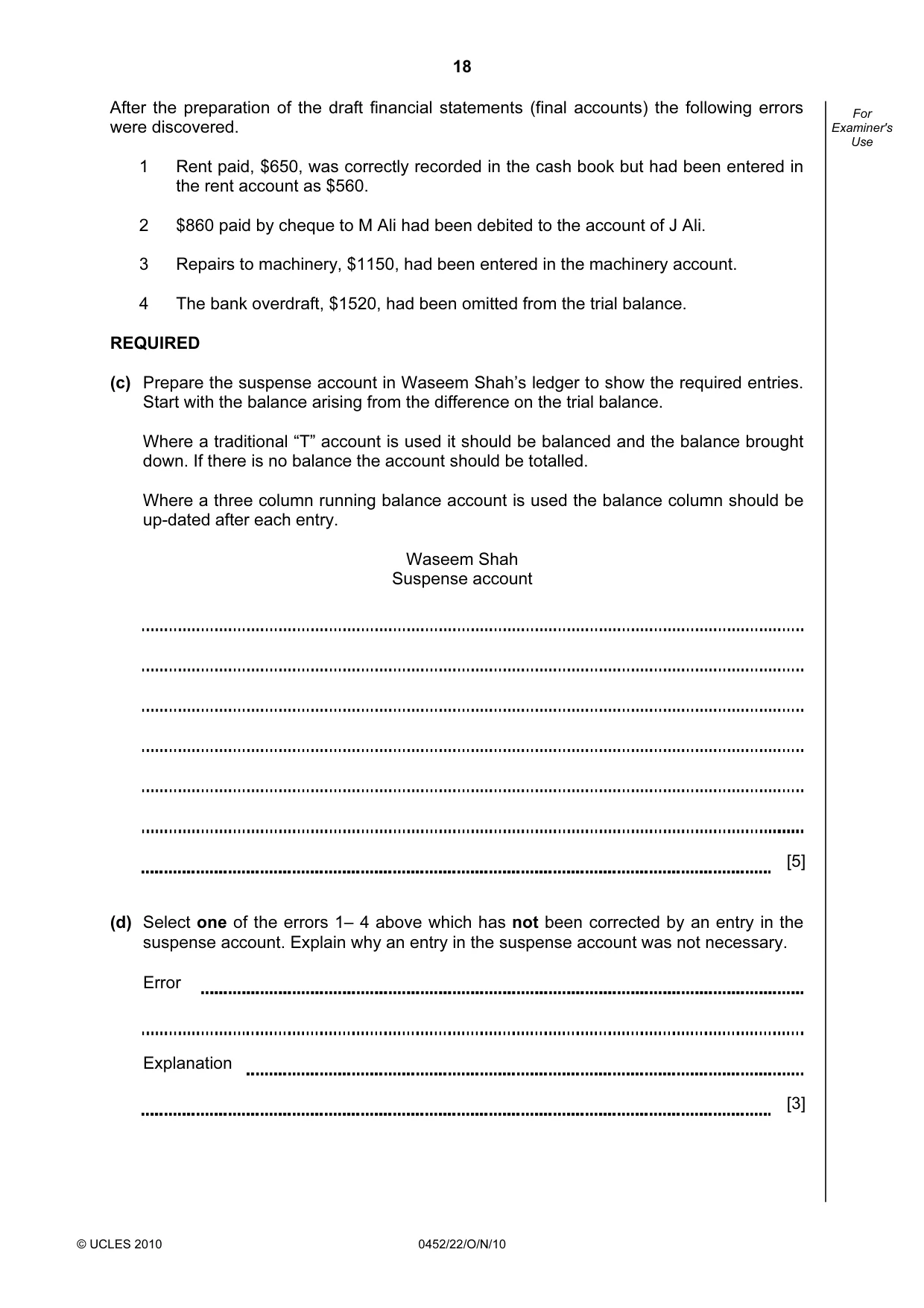
18 © UCLES 2010 0452/22/O/N/10 For Examiner's Use After the preparation of the draft financial statements (final accounts) the following errors were discovered. 1 Rent paid, $650, was correctly recorded in the cash book but had been entered in the rent account as $560. 2 $860 paid by cheque to M Ali had been debited to the account of J Ali. 3 Repairs to machinery, $1150, had been entered in the machinery account. 4 The bank overdraft, $1520, had been omitted from the trial balance. REQUIRED (c) Prepare the suspense account in Waseem Shah’s ledger to show the required entries. Start with the balance arising from the difference on the trial balance. Where a traditional “T” account is used it should be balanced and the balance brought down. If there is no balance the account should be totalled. Where a three column running balance account is used the balance column should be up-dated after each entry. Waseem Shah Suspense account [5] (d) Select one of the errors 1– 4 above which has not been corrected by an entry in the suspense account. Explain why an entry in the suspense account was not necessary. Error Explanation [3]
Question paper, page 19
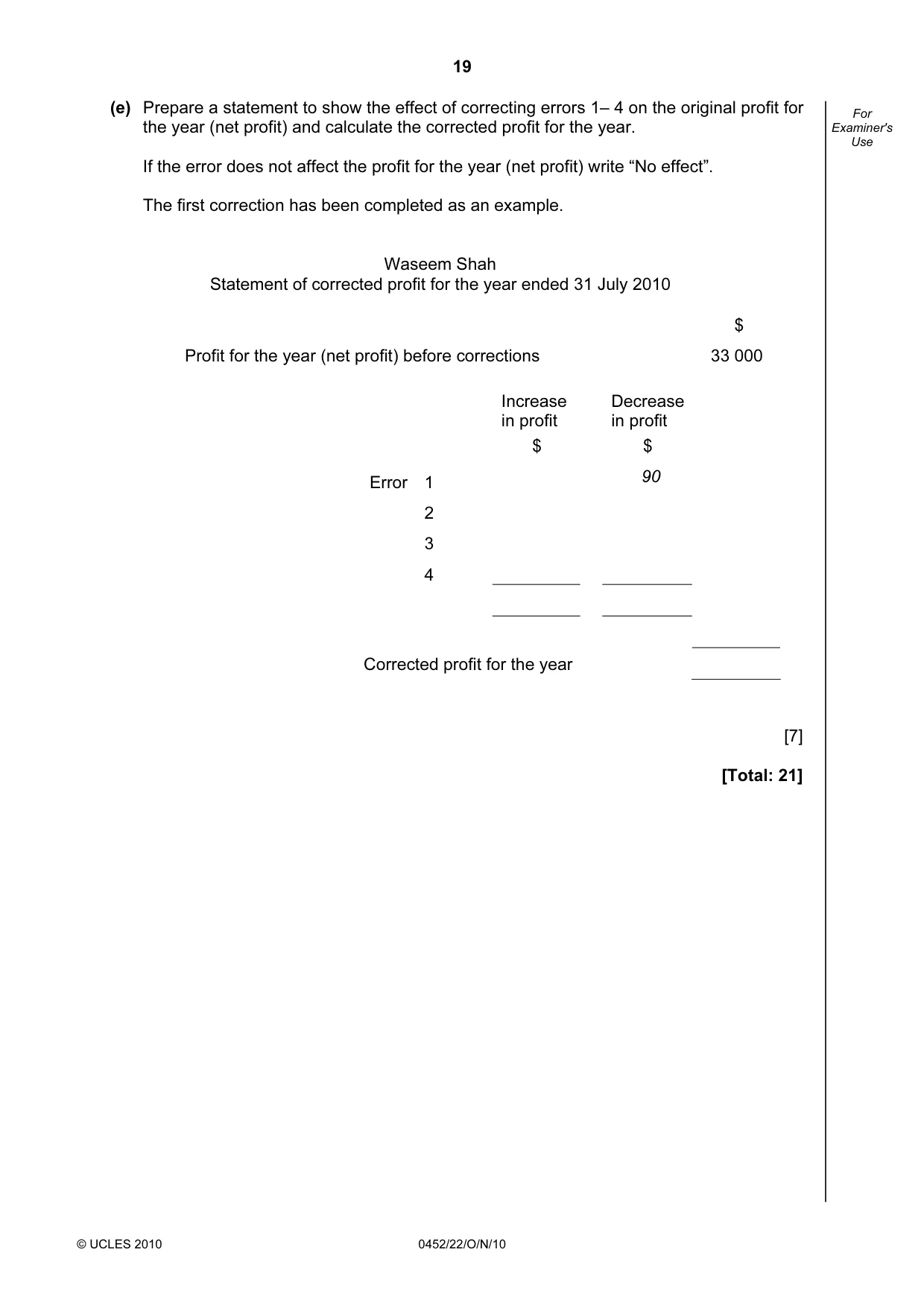
19 © UCLES 2010 0452/22/O/N/10 For Examiner's Use (e) Prepare a statement to show the effect of correcting errors 1– 4 on the original profit for the year (net profit) and calculate the corrected profit for the year. If the error does not affect the profit for the year (net profit) write “No effect”. The first correction has been completed as an example. Waseem Shah Statement of corrected profit for the year ended 31 July 2010 [7] [Total: 21] $ Profit for the year (net profit) before corrections 33 000 Increase in profit Decrease in profit $ $ Error 1 90 2 3 4 Corrected profit for the year
Question paper, page 20
20 Permission to reproduce items where third-party owned material protected by copyright is included has been sought and cleared where possible. Every reasonable effort has been made by the publisher (UCLES) to trace copyright holders, but if any items requiring clearance have unwittingly been included, the publisher will be pleased to make amends at the earliest possible opportunity. University of Cambridge International Examinations is part of the Cambridge Assessment Group. Cambridge Assessment is the brand name of University of Cambridge Local Examinations Syndicate (UCLES), which is itself a department of the University of Cambridge. © UCLES 2010 0452/22/O/N/10 BLANK PAGE
Mark scheme, page 1
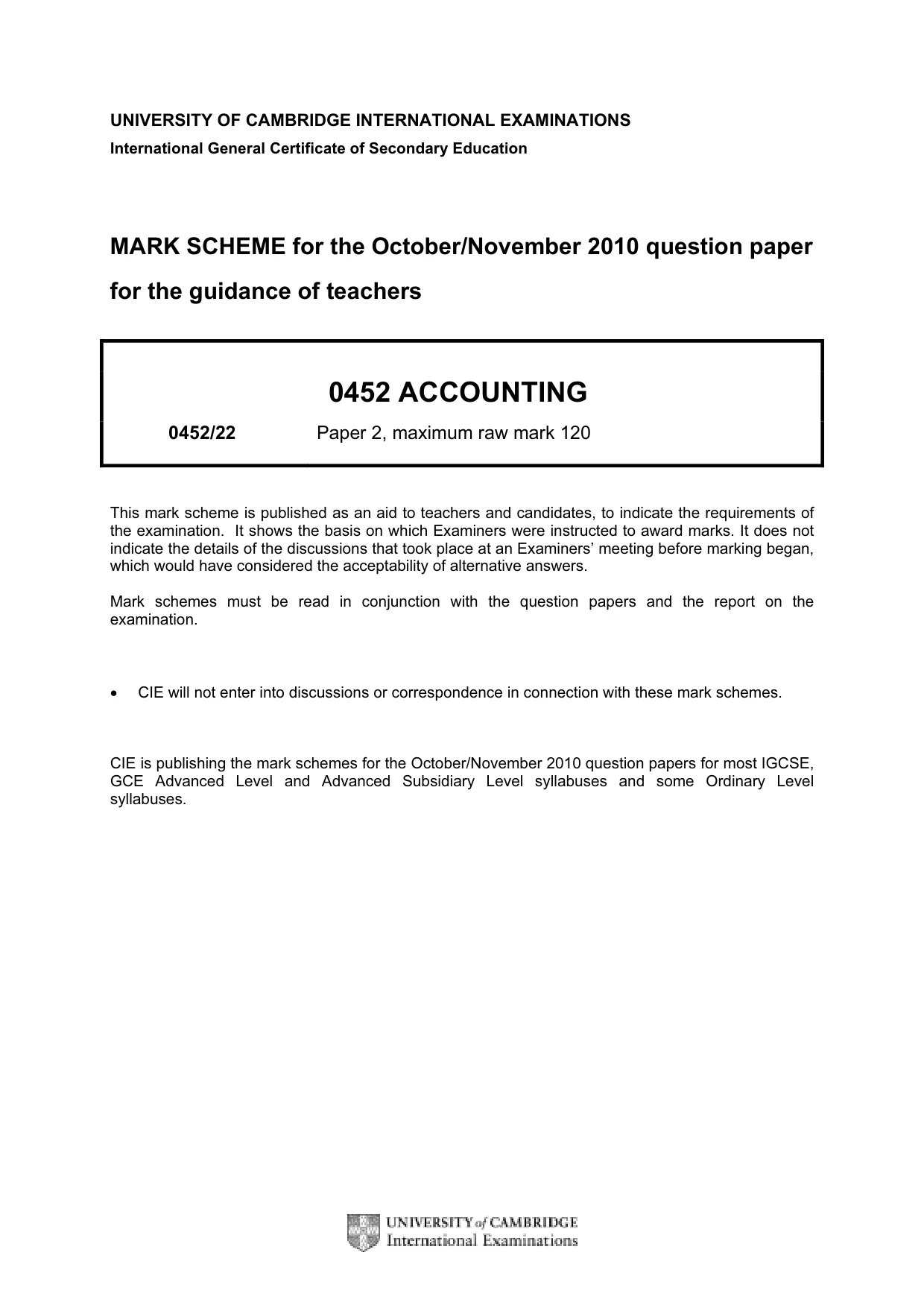
UNIVERSITY OF CAMBRIDGE INTERNATIONAL EXAMINATIONS International General Certificate of Secondary Education MARK SCHEME for the October/November 2010 question paper for the guidance of teachers 0452 ACCOUNTING 0452/22 Paper 2, maximum raw mark 120 This mark scheme is published as an aid to teachers and candidates, to indicate the requirements of the examination. It shows the basis on which Examiners were instructed to award marks. It does not indicate the details of the discussions that took place at an Examiners’ meeting before marking began, which would have considered the acceptability of alternative answers. Mark schemes must be read in conjunction with the question papers and the report on the examination. • CIE will not enter into discussions or correspondence in connection with these mark schemes. CIE is publishing the mark schemes for the October/November 2010 question papers for most IGCSE, GCE Advanced Level and Advanced Subsidiary Level syllabuses and some Ordinary Level syllabuses.
Mark scheme, page 2
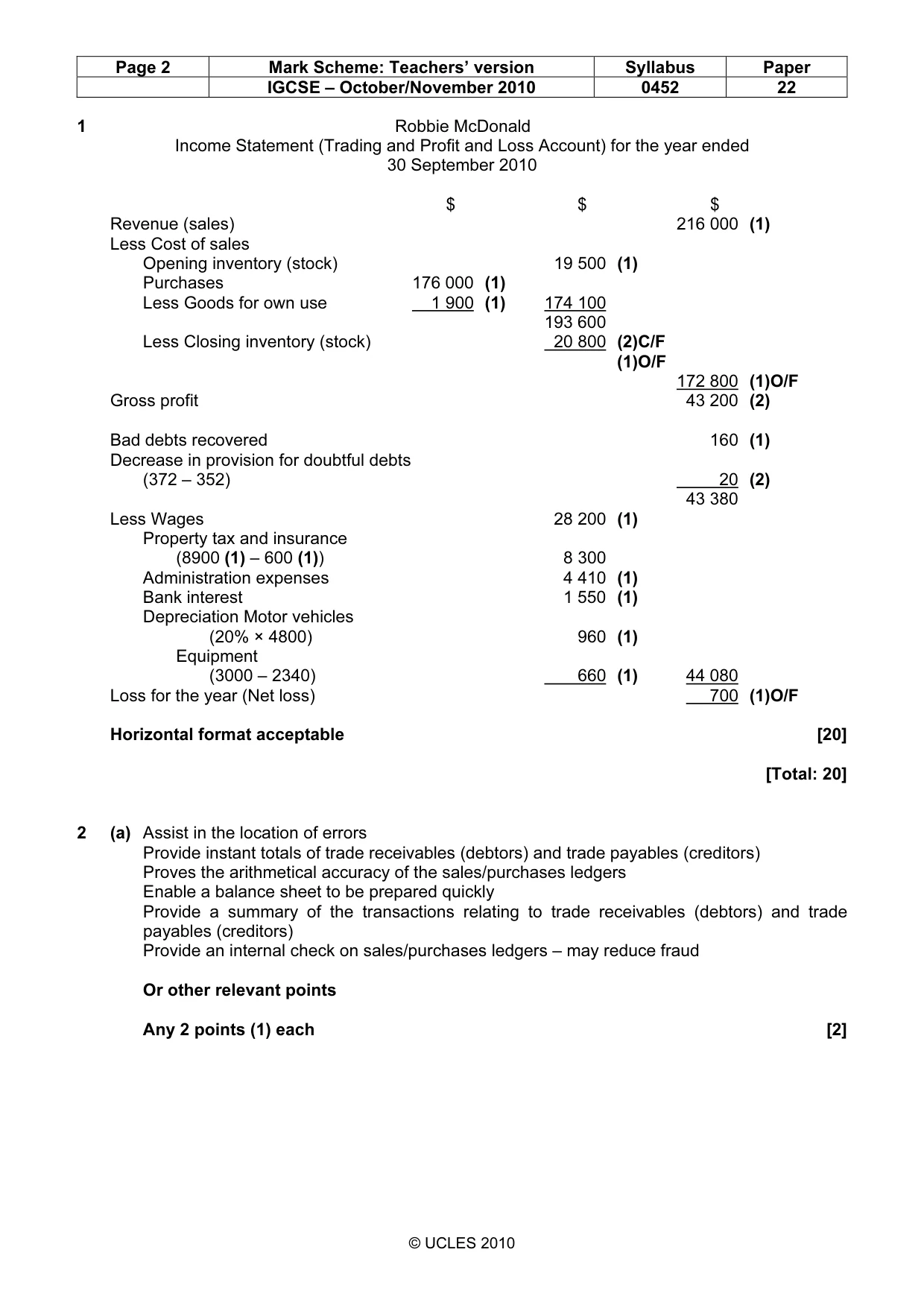
Page 2 Mark Scheme: Teachers’ version Syllabus Paper IGCSE – October/November 2010 0452 22 © UCLES 2010 1 Robbie McDonald Income Statement (Trading and Profit and Loss Account) for the year ended 30 September 2010 $ $ $ Revenue (sales) 216 000 (1) Less Cost of sales Opening inventory (stock) 19 500 (1) Purchases 176 000 (1) Less Goods for own use 1 900 (1) 174 100 193 600 Less Closing inventory (stock) 20 800 (2)C/F (1)O/F 172 800 (1)O/F Gross profit 43 200 (2) Bad debts recovered 160 (1) Decrease in provision for doubtful debts (372 – 352) 20 (2) 43 380 Less Wages 28 200 (1) Property tax and insurance (8900 (1) – 600 (1)) 8 300 Administration expenses 4 410 (1) Bank interest 1 550 (1) Depreciation Motor vehicles (20% × 4800) 960 (1) Equipment (3000 – 2340) 660 (1) 44 080 Loss for the year (Net loss) 700 (1)O/F Horizontal format acceptable [20] [Total: 20] 2 (a) Assist in the location of errors Provide instant totals of trade receivables (debtors) and trade payables (creditors) Proves the arithmetical accuracy of the sales/purchases ledgers Enable a balance sheet to be prepared quickly Provide a summary of the transactions relating to trade receivables (debtors) and trade payables (creditors) Provide an internal check on sales/purchases ledgers – may reduce fraud Or other relevant points Any 2 points (1) each [2]
Mark scheme, page 3
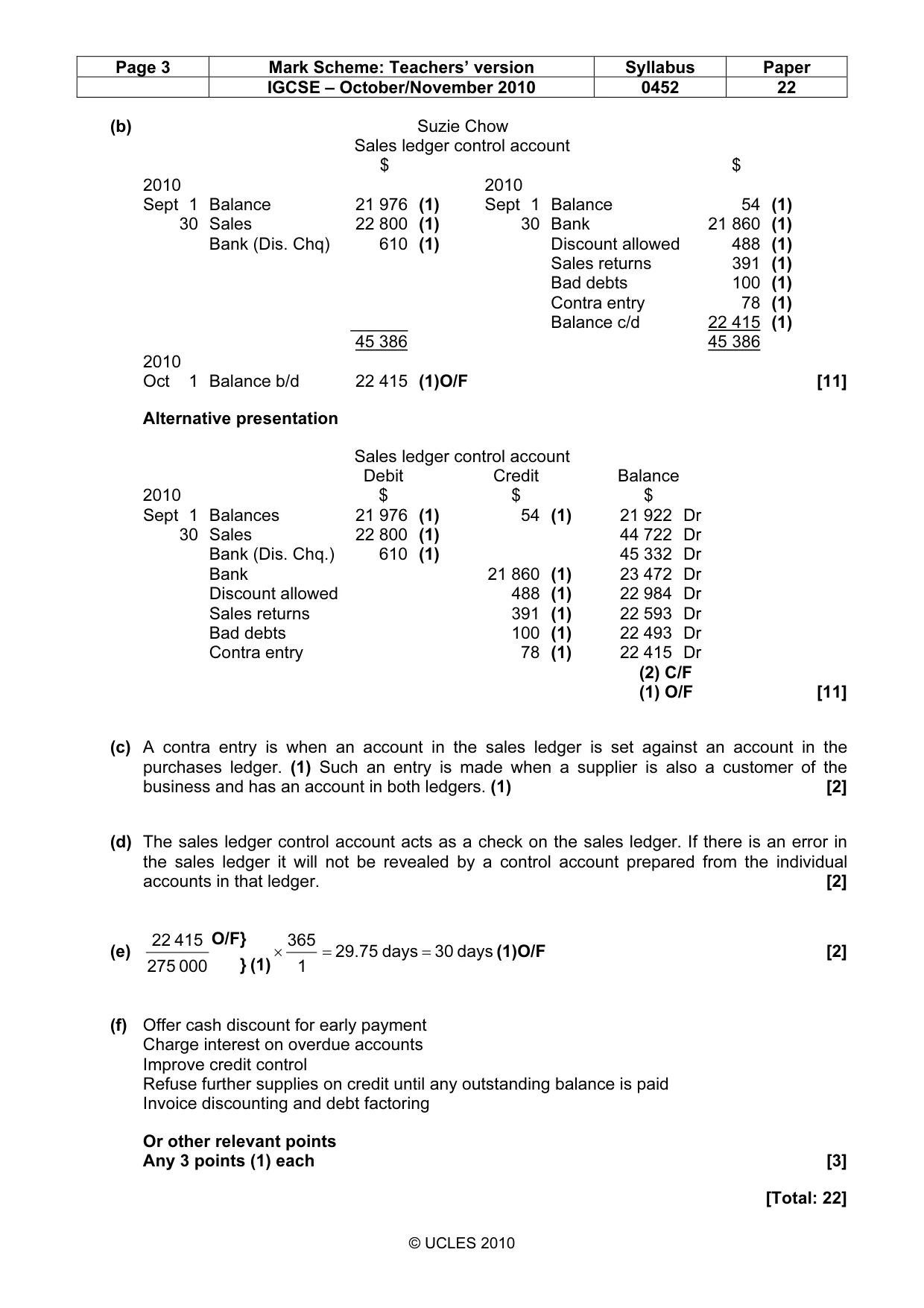
Page 3 Mark Scheme: Teachers’ version Syllabus Paper IGCSE – October/November 2010 0452 22 © UCLES 2010 (b) Suzie Chow Sales ledger control account $ $ 2010 2010 Sept 1 Balance 21 976 (1) Sept 1 Balance 54 (1) 30 Sales 22 800 (1) 30 Bank 21 860 (1) Bank (Dis. Chq) 610 (1) Discount allowed 488 (1) Sales returns 391 (1) Bad debts 100 (1) Contra entry 78 (1) ______ Balance c/d 22 415 (1) 45 386 45 386 2010 Oct 1 Balance b/d 22 415 (1)O/F [11] Alternative presentation Sales ledger control account Debit Credit Balance 2010 $ $ $ Sept 1 Balances 21 976 (1) 54 (1) 21 922 Dr 30 Sales 22 800 (1) 44 722 Dr Bank (Dis. Chq.) 610 (1) 45 332 Dr Bank 21 860 (1) 23 472 Dr Discount allowed 488 (1) 22 984 Dr Sales returns 391 (1) 22 593 Dr Bad debts 100 (1) 22 493 Dr Contra entry 78 (1) 22 415 Dr (2) C/F (1) O/F [11] (c) A contra entry is when an account in the sales ledger is set against an account in the purchases ledger. (1) Such an entry is made when a supplier is also a customer of the business and has an account in both ledgers. (1) [2] (d) The sales ledger control account acts as a check on the sales ledger. If there is an error in the sales ledger it will not be revealed by a control account prepared from the individual accounts in that ledger. [2] (e) (1)O/F (1) } O/F} days 30 days 29.75 1 365 000 275 415 22 = = × [2] (f) Offer cash discount for early payment Charge interest on overdue accounts Improve credit control Refuse further supplies on credit until any outstanding balance is paid Invoice discounting and debt factoring Or other relevant points Any 3 points (1) each [3] [Total: 22]
Mark scheme, page 4
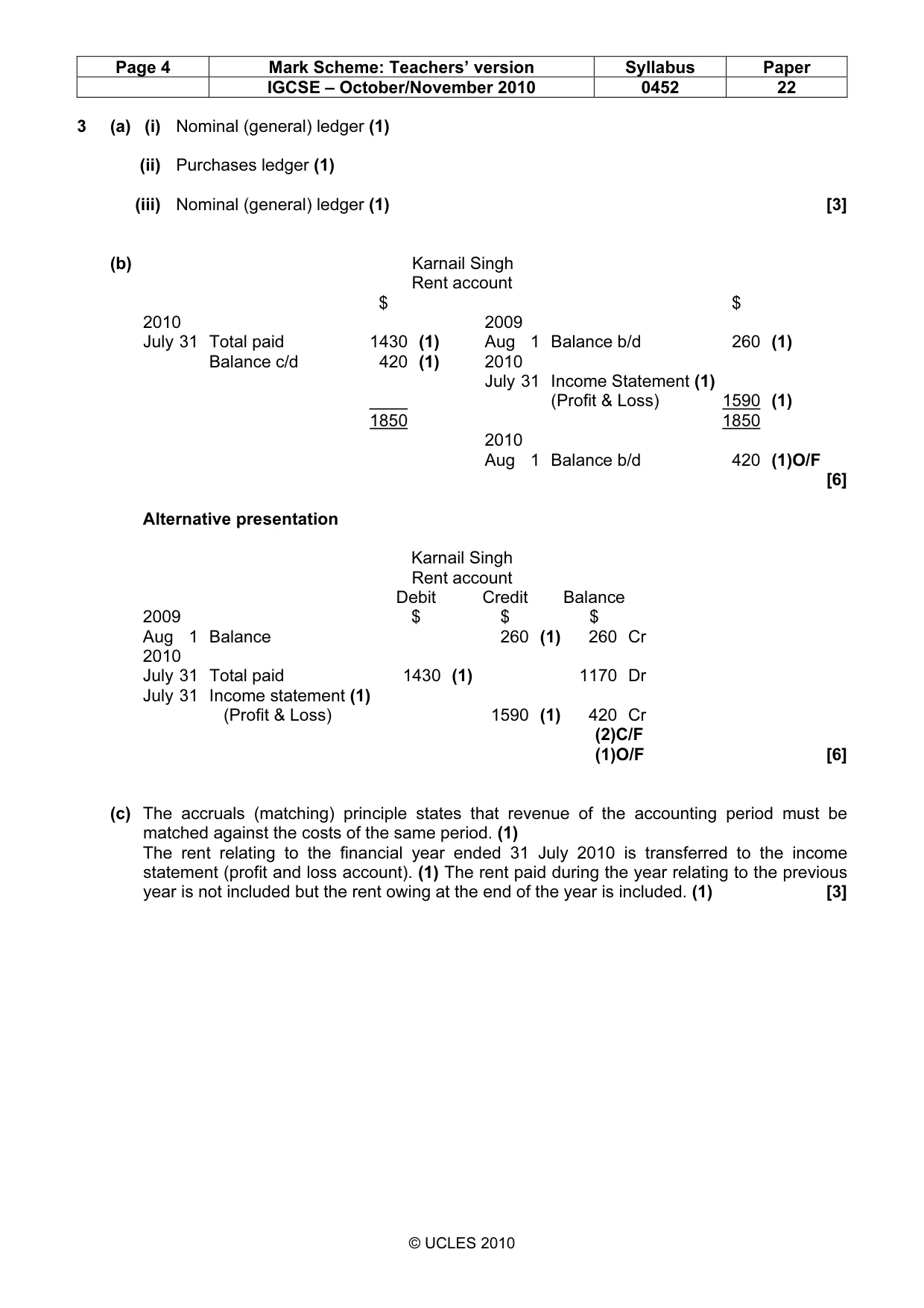
Page 4 Mark Scheme: Teachers’ version Syllabus Paper IGCSE – October/November 2010 0452 22 © UCLES 2010 3 (a) (i) Nominal (general) ledger (1) (ii) Purchases ledger (1) (iii) Nominal (general) ledger (1) [3] (b) Karnail Singh Rent account $ $ 2010 2009 July 31 Total paid 1430 (1) Aug 1 Balance b/d 260 (1) Balance c/d 420 (1) 2010 July 31 Income Statement (1) (Profit & Loss) 1590 (1) 1850 1850 2010 Aug 1 Balance b/d 420 (1)O/F [6] Alternative presentation Karnail Singh Rent account Debit Credit Balance 2009 $ $ $ Aug 1 Balance 260 (1) 260 Cr 2010 July 31 Total paid 1430 (1) 1170 Dr July 31 Income statement (1) (Profit & Loss) 1590 (1) 420 Cr (2)C/F (1)O/F [6] (c) The accruals (matching) principle states that revenue of the accounting period must be matched against the costs of the same period. (1) The rent relating to the financial year ended 31 July 2010 is transferred to the income statement (profit and loss account). (1) The rent paid during the year relating to the previous year is not included but the rent owing at the end of the year is included. (1) [3]
Mark scheme, page 5
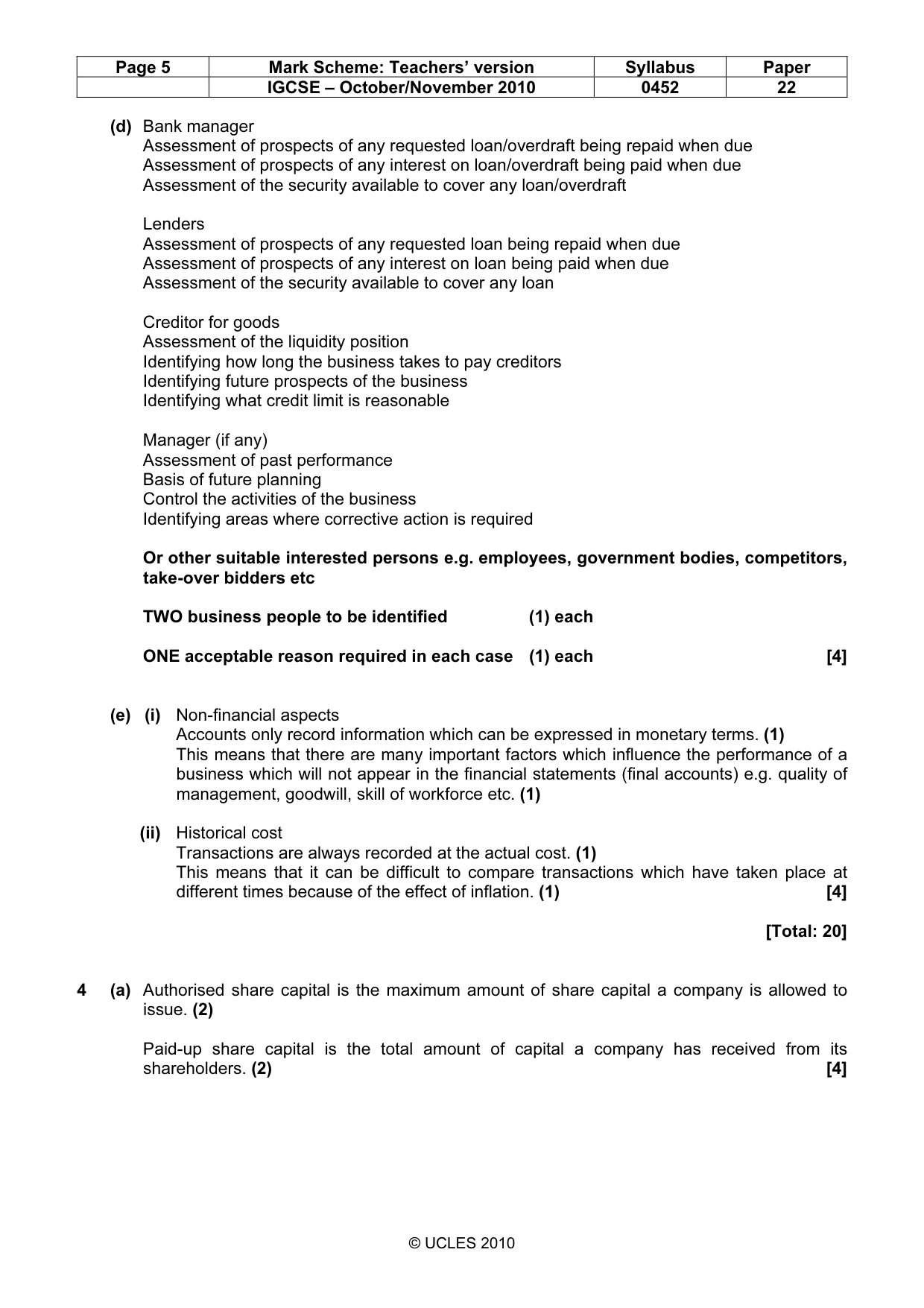
Page 5 Mark Scheme: Teachers’ version Syllabus Paper IGCSE – October/November 2010 0452 22 © UCLES 2010 (d) Bank manager Assessment of prospects of any requested loan/overdraft being repaid when due Assessment of prospects of any interest on loan/overdraft being paid when due Assessment of the security available to cover any loan/overdraft Lenders Assessment of prospects of any requested loan being repaid when due Assessment of prospects of any interest on loan being paid when due Assessment of the security available to cover any loan Creditor for goods Assessment of the liquidity position Identifying how long the business takes to pay creditors Identifying future prospects of the business Identifying what credit limit is reasonable Manager (if any) Assessment of past performance Basis of future planning Control the activities of the business Identifying areas where corrective action is required Or other suitable interested persons e.g. employees, government bodies, competitors, take-over bidders etc TWO business people to be identified (1) each ONE acceptable reason required in each case (1) each [4] (e) (i) Non-financial aspects Accounts only record information which can be expressed in monetary terms. (1) This means that there are many important factors which influence the performance of a business which will not appear in the financial statements (final accounts) e.g. quality of management, goodwill, skill of workforce etc. (1) (ii) Historical cost Transactions are always recorded at the actual cost. (1) This means that it can be difficult to compare transactions which have taken place at different times because of the effect of inflation. (1) [4] [Total: 20] 4 (a) Authorised share capital is the maximum amount of share capital a company is allowed to issue. (2) Paid-up share capital is the total amount of capital a company has received from its shareholders. (2) [4]
Mark scheme, page 6
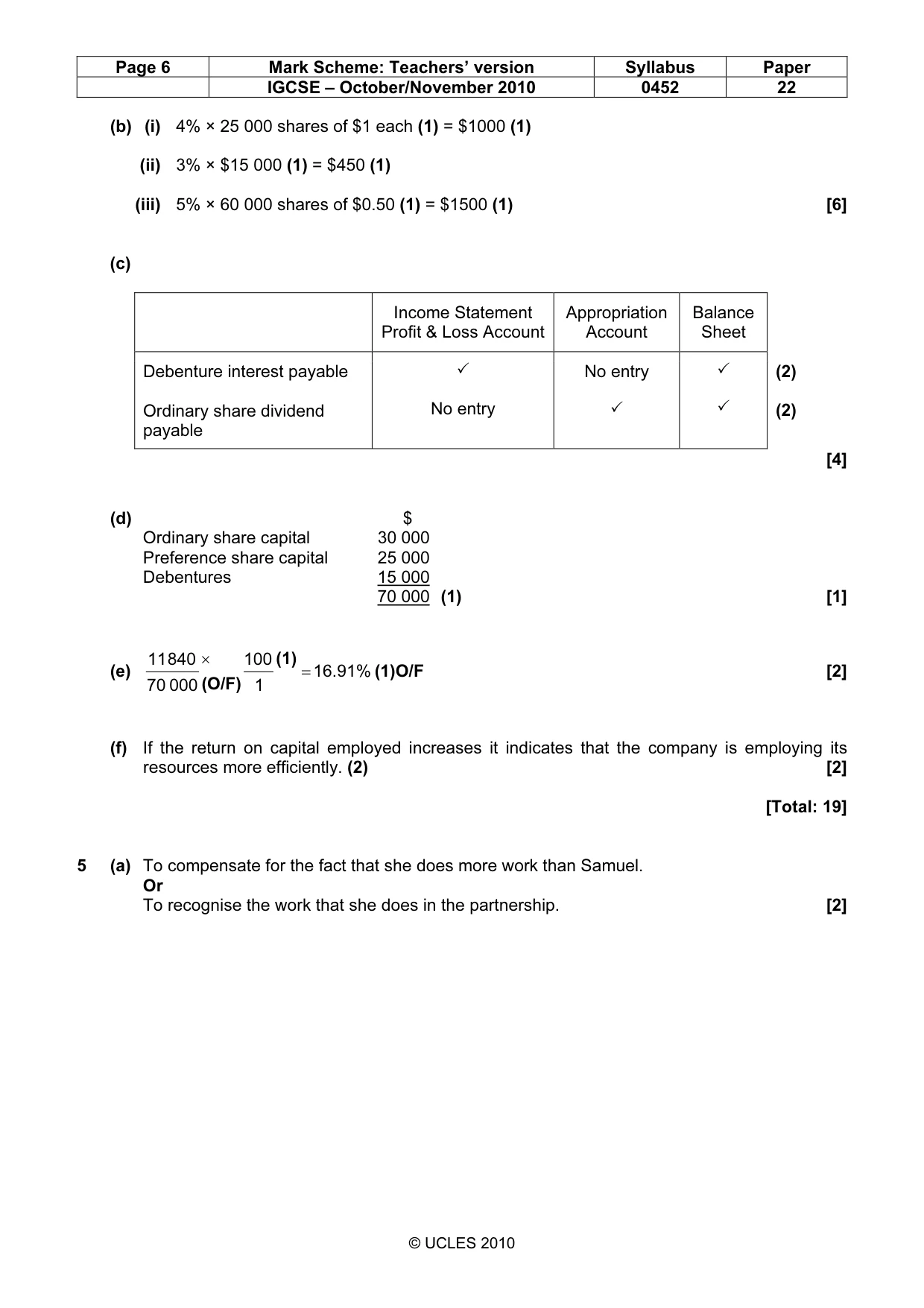
Page 6 Mark Scheme: Teachers’ version Syllabus Paper IGCSE – October/November 2010 0452 22 © UCLES 2010 (b) (i) 4% × 25 000 shares of $1 each (1) = $1000 (1) (ii) 3% × $15 000 (1) = $450 (1) (iii) 5% × 60 000 shares of $0.50 (1) = $1500 (1) [6] (c) Income Statement Profit & Loss Account Appropriation Account Balance Sheet Debenture interest payable Ordinary share dividend payable ✓ No entry No entry ✓ ✓ ✓ (2) (2) [4] (d) $ Ordinary share capital 30 000 Preference share capital 25 000 Debentures 15 000 70 000 (1) [1] (e) (1)O/F (1) (O/F) 16.91% 1 100 000 70 840 11 = × [2] (f) If the return on capital employed increases it indicates that the company is employing its resources more efficiently. (2) [2] [Total: 19] 5 (a) To compensate for the fact that she does more work than Samuel. Or To recognise the work that she does in the partnership. [2]
Mark scheme, page 7
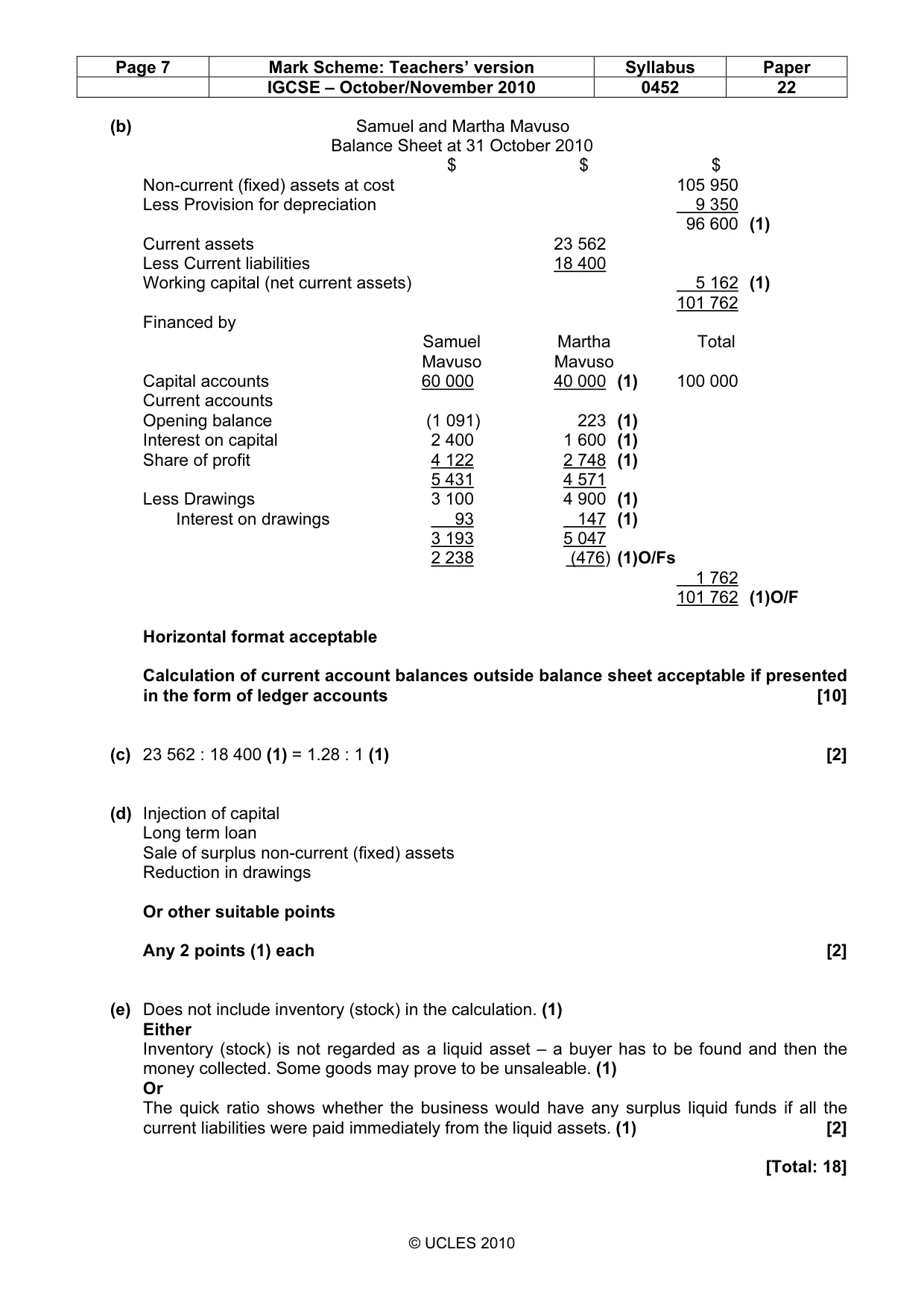
Page 7 Mark Scheme: Teachers’ version Syllabus Paper IGCSE – October/November 2010 0452 22 © UCLES 2010 (b) Samuel and Martha Mavuso Balance Sheet at 31 October 2010 $ $ $ Non-current (fixed) assets at cost 105 950 Less Provision for depreciation 9 350 96 600 (1) Current assets 23 562 Less Current liabilities 18 400 Working capital (net current assets) 5 162 (1) 101 762 Financed by Samuel Martha Total Mavuso Mavuso Capital accounts 60 000 40 000 (1) 100 000 Current accounts Opening balance (1 091) 223 (1) Interest on capital 2 400 1 600 (1) Share of profit 4 122 2 748 (1) 5 431 4 571 Less Drawings 3 100 4 900 (1) Interest on drawings 93 147 (1) 3 193 5 047 2 238 (476) (1)O/Fs 1 762 101 762 (1)O/F Horizontal format acceptable Calculation of current account balances outside balance sheet acceptable if presented in the form of ledger accounts [10] (c) 23 562 : 18 400 (1) = 1.28 : 1 (1) [2] (d) Injection of capital Long term loan Sale of surplus non-current (fixed) assets Reduction in drawings Or other suitable points Any 2 points (1) each [2] (e) Does not include inventory (stock) in the calculation. (1) Either Inventory (stock) is not regarded as a liquid asset – a buyer has to be found and then the money collected. Some goods may prove to be unsaleable. (1) Or The quick ratio shows whether the business would have any surplus liquid funds if all the current liabilities were paid immediately from the liquid assets. (1) [2] [Total: 18]
Mark scheme, page 8
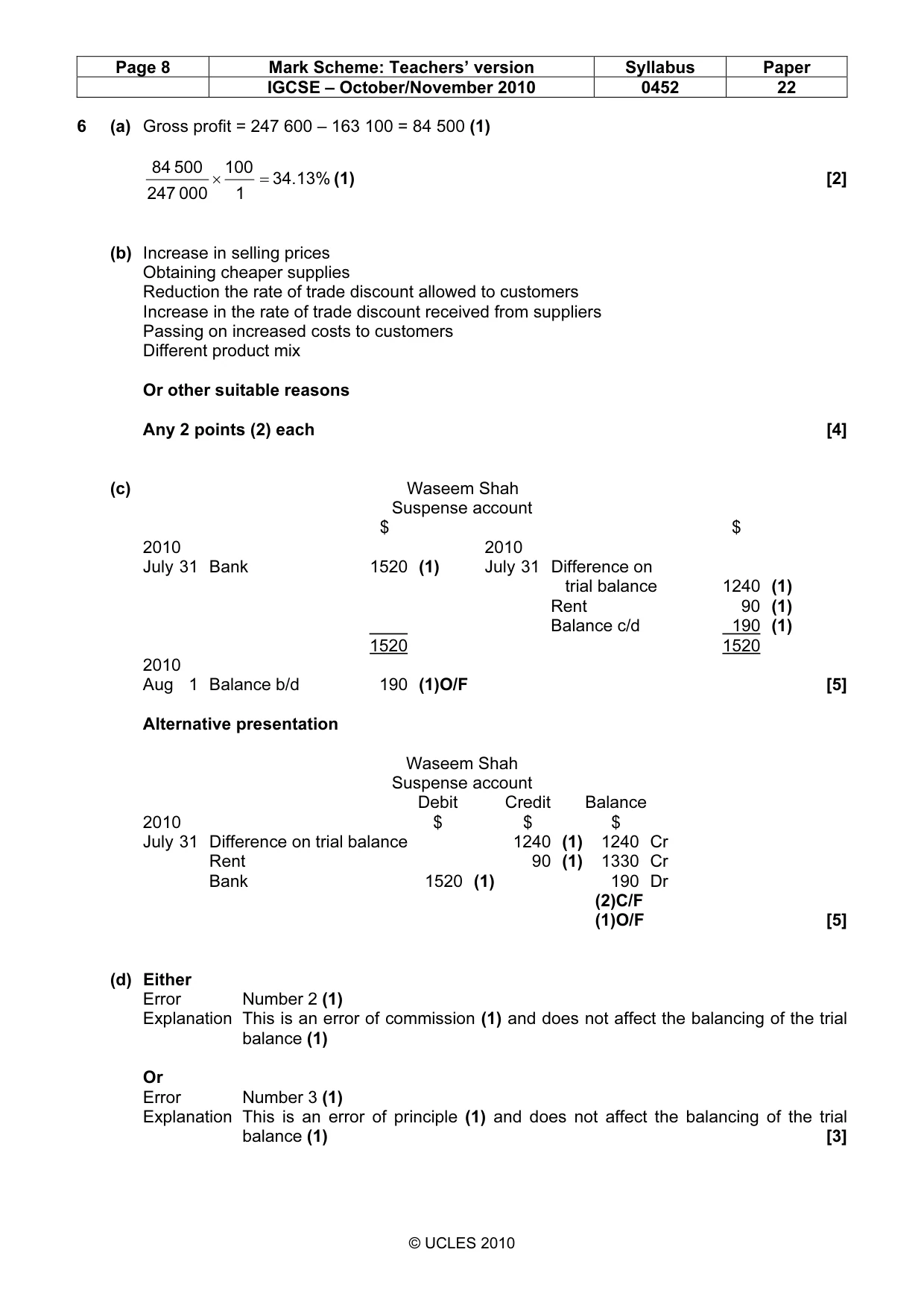
Page 8 Mark Scheme: Teachers’ version Syllabus Paper IGCSE – October/November 2010 0452 22 © UCLES 2010 6 (a) Gross profit = 247 600 – 163 100 = 84 500 (1) (1) 34.13% 1 100 000 247 500 84 = × [2] (b) Increase in selling prices Obtaining cheaper supplies Reduction the rate of trade discount allowed to customers Increase in the rate of trade discount received from suppliers Passing on increased costs to customers Different product mix Or other suitable reasons Any 2 points (2) each [4] (c) Waseem Shah Suspense account $ $ 2010 2010 July 31 Bank 1520 (1) July 31 Difference on trial balance 1240 (1) Rent 90 (1) Balance c/d 190 (1) 1520 1520 2010 Aug 1 Balance b/d 190 (1)O/F [5] Alternative presentation Waseem Shah Suspense account Debit Credit Balance 2010 $ $ $ July 31 Difference on trial balance 1240 (1) 1240 Cr Rent 90 (1) 1330 Cr Bank 1520 (1) 190 Dr (2)C/F (1)O/F [5] (d) Either Error Number 2 (1) Explanation This is an error of commission (1) and does not affect the balancing of the trial balance (1) Or Error Number 3 (1) Explanation This is an error of principle (1) and does not affect the balancing of the trial balance (1) [3]
Mark scheme, page 9
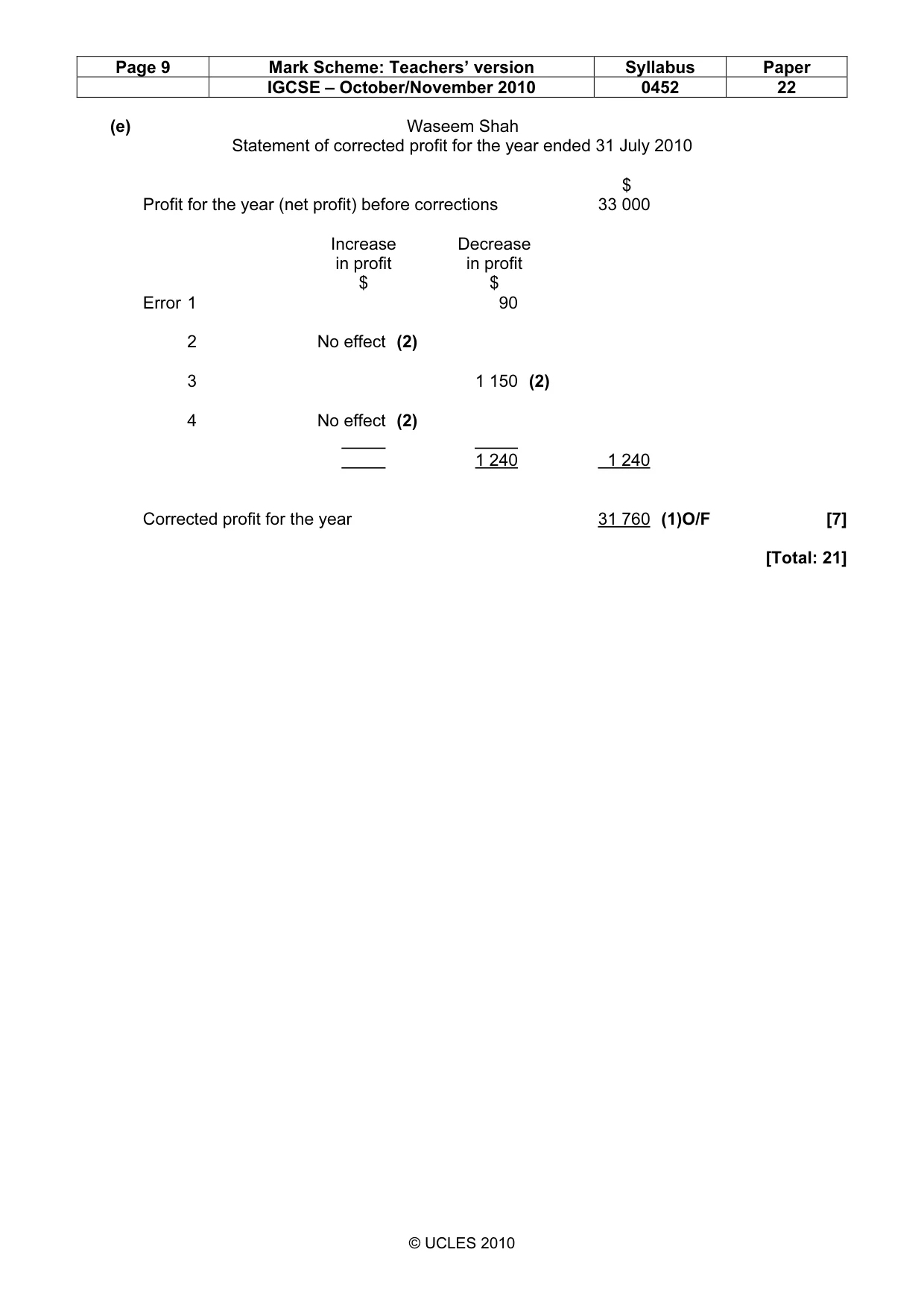
Page 9 Mark Scheme: Teachers’ version Syllabus Paper IGCSE – October/November 2010 0452 22 © UCLES 2010 (e) Waseem Shah Statement of corrected profit for the year ended 31 July 2010 $ Profit for the year (net profit) before corrections 33 000 Increase Decrease in profit in profit $ $ Error 1 90 2 No effect (2) 3 1 150 (2) 4 No effect (2) 1 240 1 240 Corrected profit for the year 31 760 (1)O/F [7] [Total: 21]
What you needed in this session
Cambridge’s own grade thresholds for 2010 Oct/Nov, Paper 2 · Variant 2. A higher threshold means an easier paper — the bar moves with how the cohort did.