Cambridge A Level Urdu (A Level only) 9676 — 2021 Oct/Nov Paper 5 · Variant 0
9676/50/O/N/21 · 40 marks · ≈45 min
The question paper and its mark scheme, free to read here and free to download. This is Cambridge’s own paper, exactly as it was sat.
Question paper4 pages

Mark scheme
No mark scheme is in the library for this paper.
Paper as text
Question paper, page 1
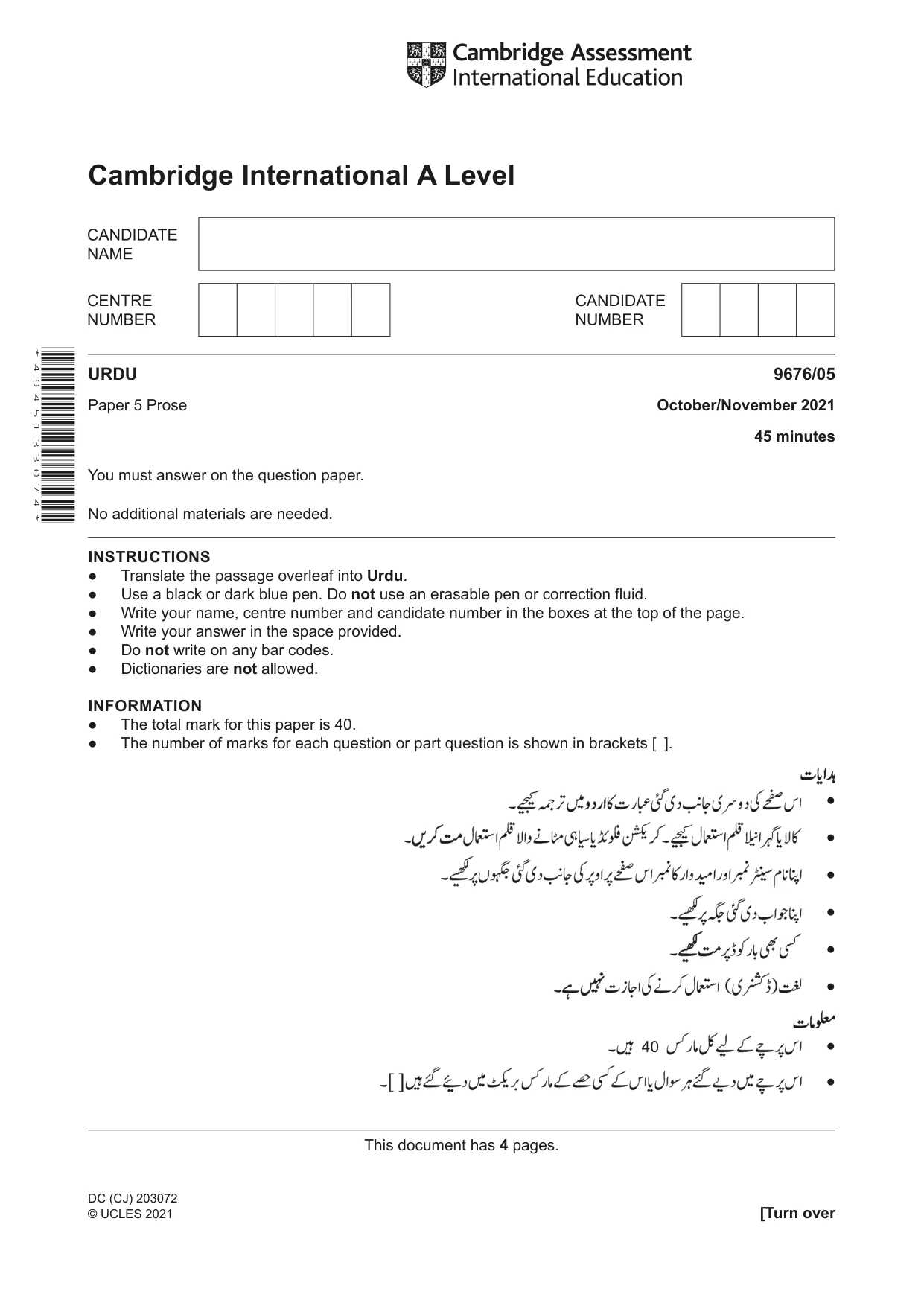
This document has 4 pages. Cambridge International A Level URDU 9676/05 Paper 5 Prose October/November 2021 45 minutes You must answer on the question paper. No additional materials are needed. INSTRUCTIONS ● Translate the passage overleaf into Urdu. ● Use a black or dark blue pen. Do not use an erasable pen or correction fluid. ● Write your name, centre number and candidate number in the boxes at the top of the page. ● Write your answer in the space provided. ● Do not write on any bar codes. ● Dictionaries are not allowed. INFORMATION ● The total mark for this paper is 40. ● The number of marks for each question or part question is shown in brackets [ ]. ● ● ● ● ● ● 40 ● ● * 4 9 4 5 1 3 3 0 7 4 * DC (CJ) 203072 © UCLES 2021 [Turn over
Question paper, page 2
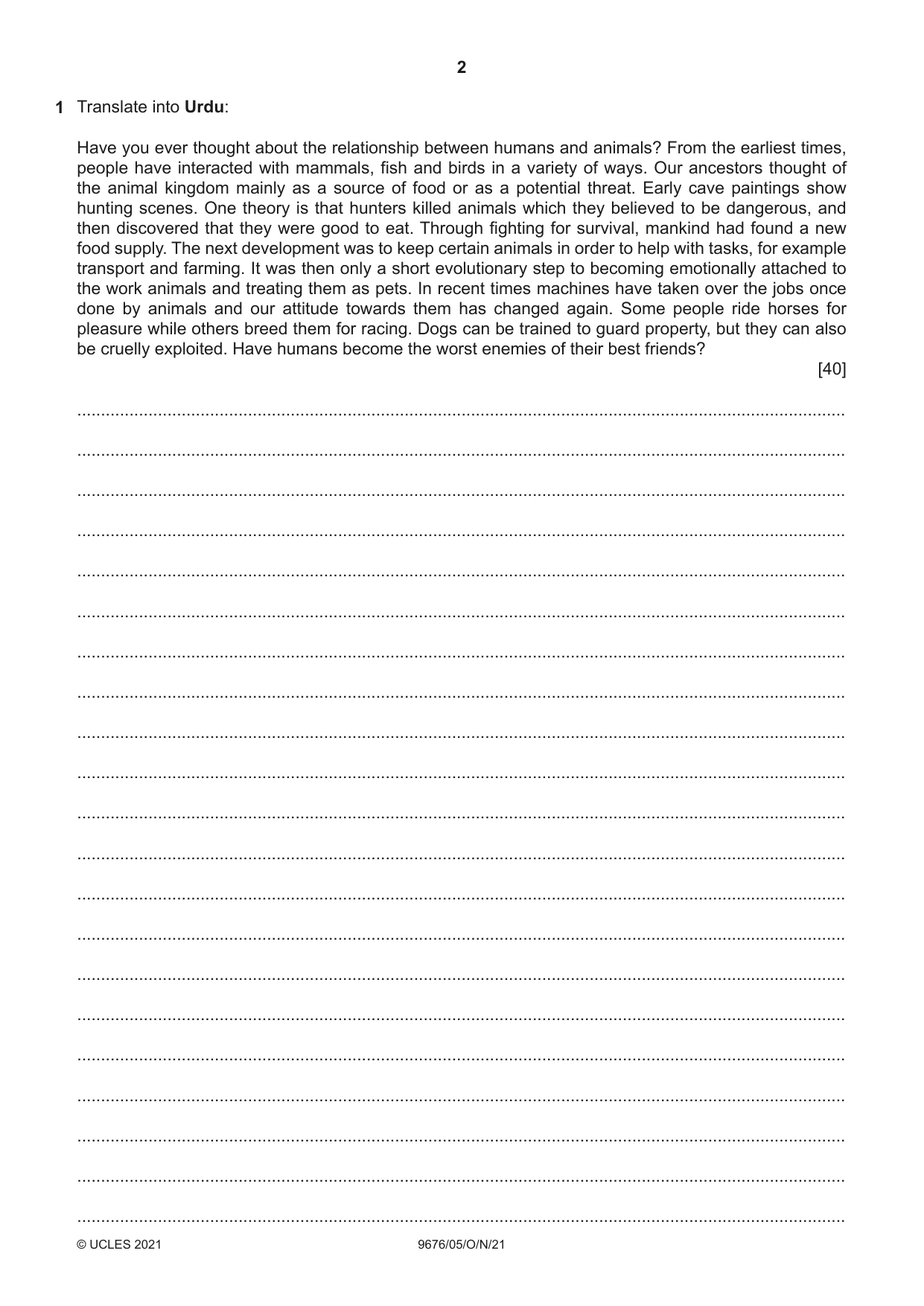
2 9676/05/O/N/21 © UCLES 2021 Translate into Urdu: Have you ever thought about the relationship between humans and animals? From the earliest times, people have interacted with mammals, fish and birds in a variety of ways. Our ancestors thought of the animal kingdom mainly as a source of food or as a potential threat. Early cave paintings show hunting scenes. One theory is that hunters killed animals which they believed to be dangerous, and then discovered that they were good to eat. Through fighting for survival, mankind had found a new food supply. The next development was to keep certain animals in order to help with tasks, for example transport and farming. It was then only a short evolutionary step to becoming emotionally attached to the work animals and treating them as pets. In recent times machines have taken over the jobs once done by animals and our attitude towards them has changed again. Some people ride horses for pleasure while others breed them for racing. Dogs can be trained to guard property, but they can also be cruelly exploited. Have humans become the worst enemies of their best friends? [40] … … … … … … … … … … … … … … … … … … … … … 1
Question paper, page 3
3 9676/05/O/N/21 © UCLES 2021 [Turn over … … … … … … … … … … … … … … … … … … … … … … … … … … … …
Question paper, page 4
4 9676/05/O/N/21 © UCLES 2021 Permission to reproduce items where third-party owned material protected by copyright is included has been sought and cleared where possible. Every reasonable effort has been made by the publisher (UCLES) to trace copyright holders, but if any items requiring clearance have unwittingly been included, the publisher will be pleased to make amends at the earliest possible opportunity. To avoid the issue of disclosure of answer-related information to candidates, all copyright acknowledgements are reproduced online in the Cambridge Assessment International Education Copyright Acknowledgements Booklet. This is produced for each series of examinations and is freely available to download at www.cambridgeinternational.org after the live examination series. Cambridge Assessment International Education is part of the Cambridge Assessment Group. Cambridge Assessment is the brand name of the University of Cambridge Local Examinations Syndicate (UCLES), which itself is a department of the University of Cambridge. … … … … … … … … … … … … … … … … … … … … … … … …
What you needed in this session
Cambridge’s own grade thresholds for 2021 Oct/Nov, Paper 5 · Variant 0. A higher threshold means an easier paper — the bar moves with how the cohort did.