Cambridge A Level Travel and Tourism 9395 — 2014 Oct/Nov Paper 3 · Variant 2
9395/32/O/N/14 · 100 marks · ≈113 min
The question paper and its mark scheme, free to read here and free to download. This is Cambridge’s own paper, exactly as it was sat.
Question paper16 pages



Mark scheme9 pages
Answers below. Sit the paper first if you are practising.
Paper as text
Question paper, page 1
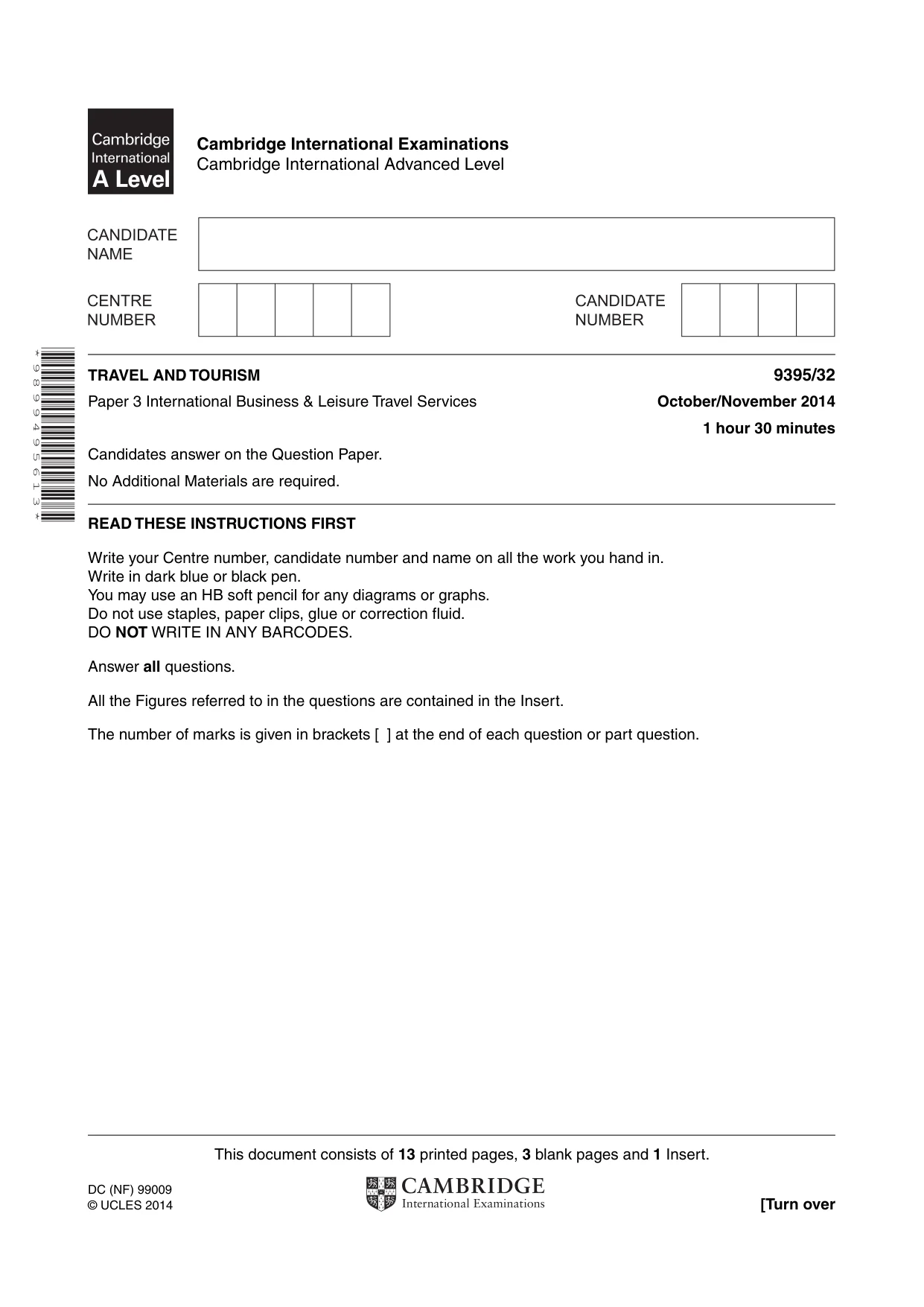
This document consists of 13 printed pages, 3 blank pages and 1 Insert. DC (NF) 99009 © UCLES 2014 [Turn over * 9 8 9 9 4 9 5 6 1 3 * TRAVEL AND TOURISM 9395/32 Paper 3 International Business & Leisure Travel Services October/November 2014 1 hour 30 minutes Candidates answer on the Question Paper. No Additional Materials are required. READ THESE INSTRUCTIONS FIRST Write your Centre number, candidate number and name on all the work you hand in. Write in dark blue or black pen. You may use an HB soft pencil for any diagrams or graphs. Do not use staples, paper clips, glue or correction fluid. DO NOT WRITE IN ANY BARCODES. Answer all questions. All the Figures referred to in the questions are contained in the Insert. The number of marks is given in brackets [ ] at the end of each question or part question. Cambridge International Examinations Cambridge International Advanced Level
Question paper, page 2
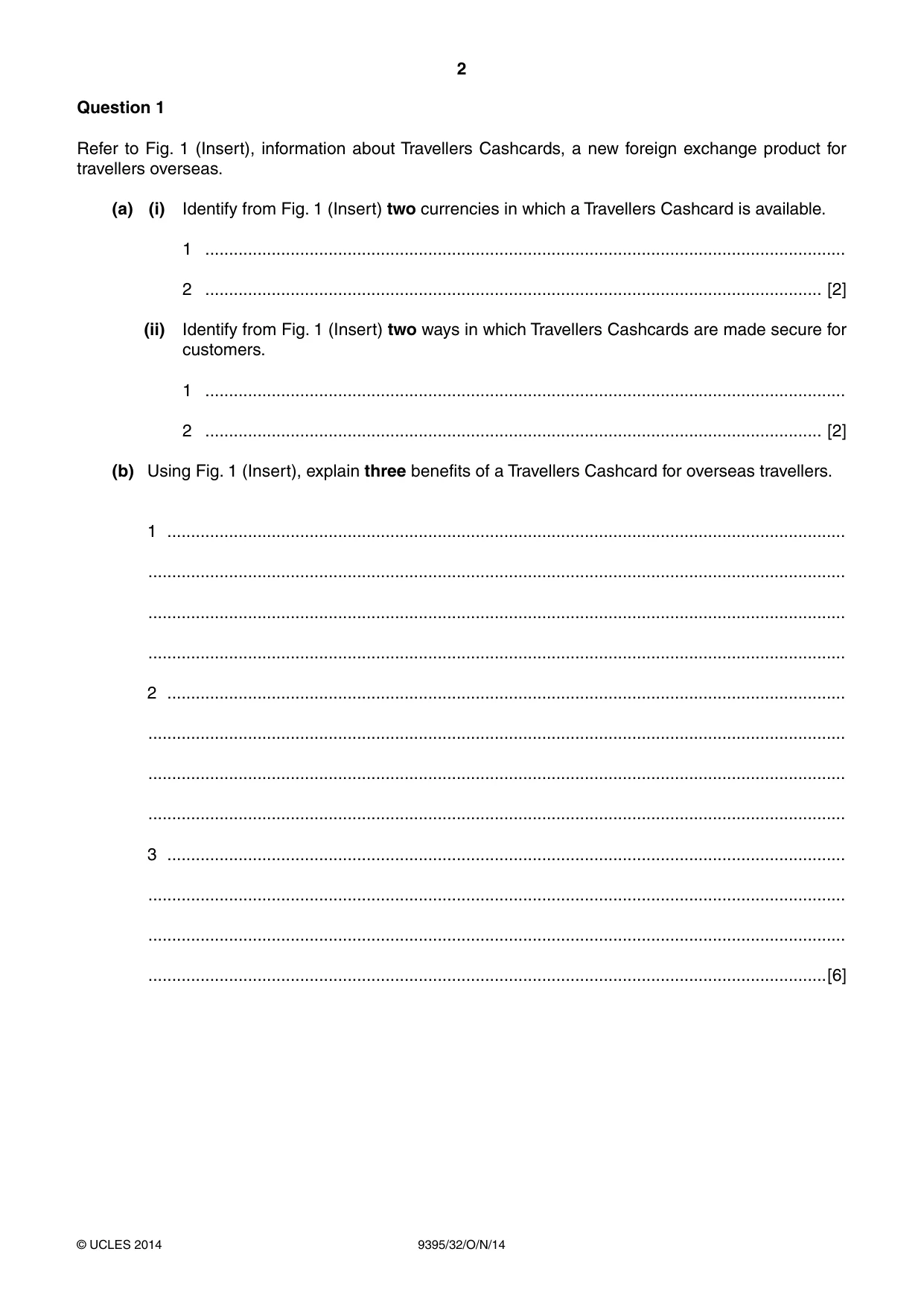
2 9395/32/O/N/14 © UCLES 2014 Question 1 Refer to Fig. 1 (Insert), information about Travellers Cashcards, a new foreign exchange product for travellers overseas. (a) (i) Identify from Fig. 1 (Insert) two currencies in which a Travellers Cashcard is available. 1 … 2 … [2] (ii) Identify from Fig. 1 (Insert) two ways in which Travellers Cashcards are made secure for customers. 1 … 2 … [2] (b) Using Fig. 1 (Insert), explain three benefits of a Travellers Cashcard for overseas travellers. 1 … … … … 2 … … … … 3 … … … …[6]
Question paper, page 3
3 9395/32/O/N/14 © UCLES 2014 [Turn over (c) Explain fully two reasons why travel agents might offer products such as the Travellers Cashcard. 1 … … … … … … 2 … … … … … …[6]
Question paper, page 4
4 9395/32/O/N/14 © UCLES 2014 (d) Recommend ancillary products and services that travel agents should provide to meet the needs of different customer types. Justify each recommendation. … … … … … … … … … … … … … … … … … … … … … … … … … …[9] [Total: 25]
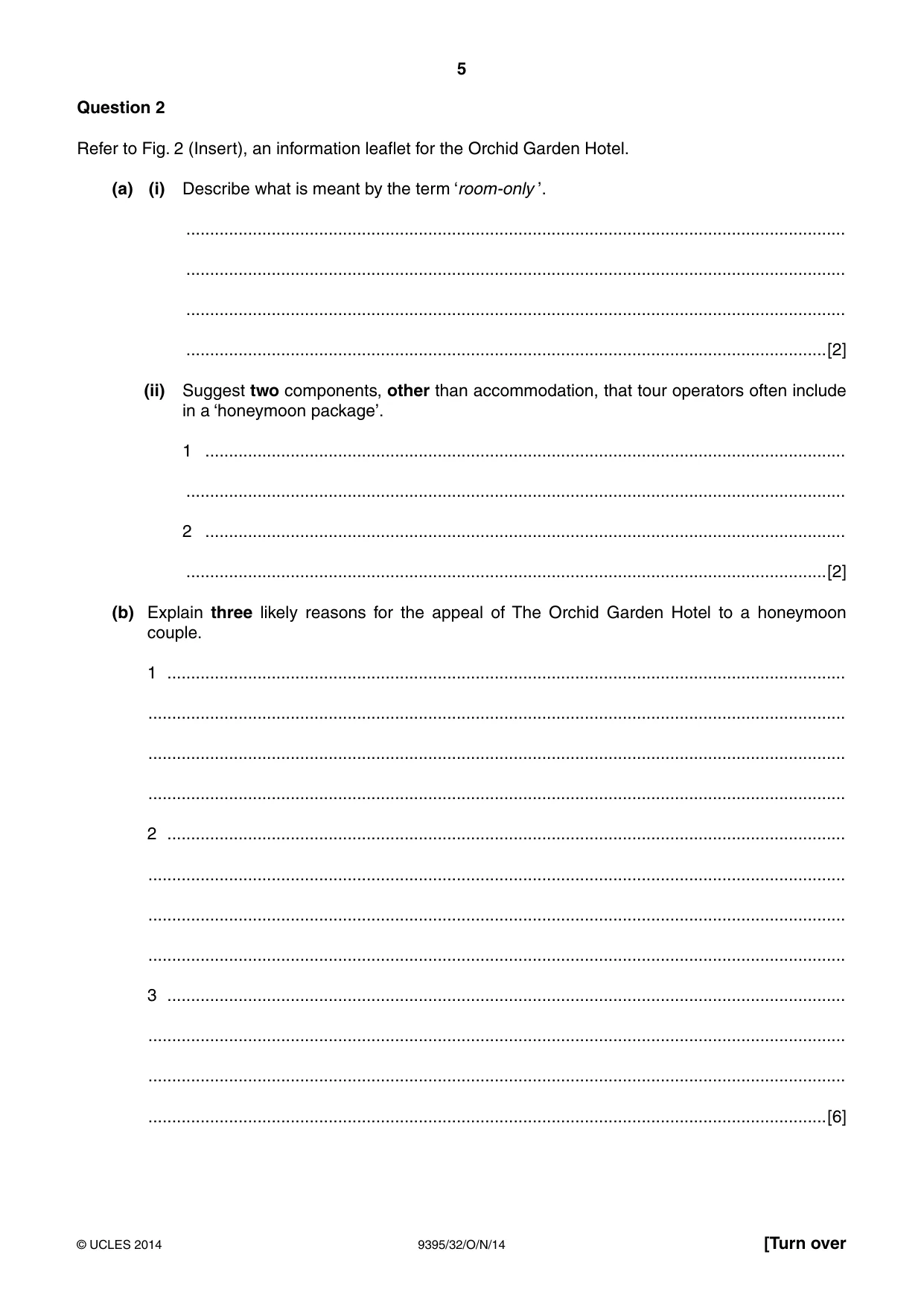
Question paper, page 5
5 9395/32/O/N/14 © UCLES 2014 [Turn over Question 2 Refer to Fig. 2 (Insert), an information leaflet for the Orchid Garden Hotel. (a) (i) Describe what is meant by the term ‘room-only ’. … … … …[2] (ii) Suggest two components, other than accommodation, that tour operators often include in a ‘honeymoon package’. 1 … … 2 … …[2] (b) Explain three likely reasons for the appeal of The Orchid Garden Hotel to a honeymoon couple. 1 … … … … 2 … … … … 3 … … … …[6]
Question paper, page 6
6 9395/32/O/N/14 © UCLES 2014 (c) Explain fully two reasons why hotels offer their guests additional services, such as the shuttle service at The Orchid Garden Hotel. 1 … … … … … … 2 … … … … … …[6]
Question paper, page 7
7 9395/32/O/N/14 © UCLES 2014 [Turn over (d) The Orchid Garden Hotel targets honeymoon couples. Evaluate the products and services provided by the Orchid Garden Hotel and recommend how it could cater for the needs of other customer types. … … … … … … … … … … … … … … … … … … … … … … … … …[9] [Total: 25]
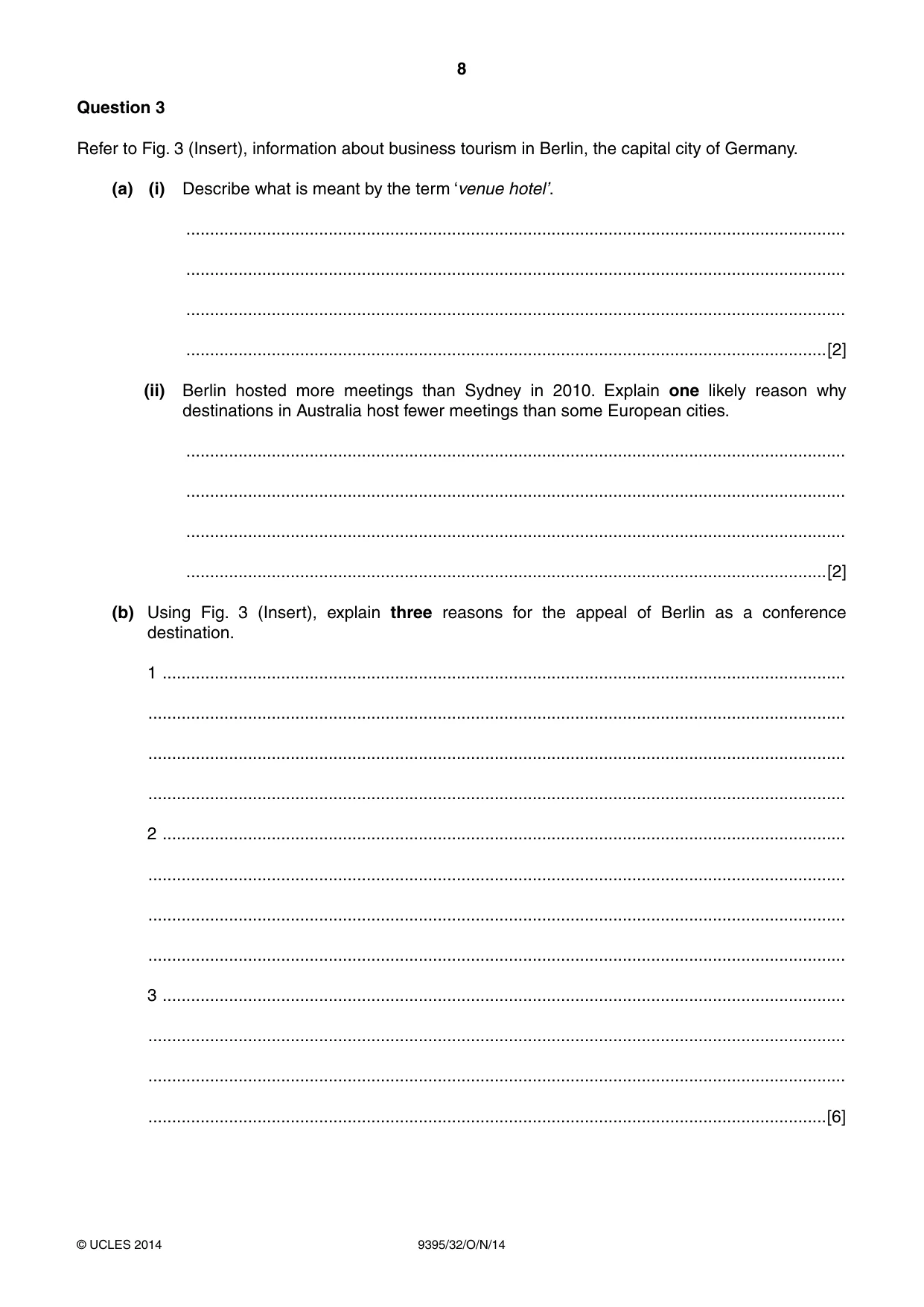
Question paper, page 8
8 9395/32/O/N/14 © UCLES 2014 Question 3 Refer to Fig. 3 (Insert), information about business tourism in Berlin, the capital city of Germany. (a) (i) Describe what is meant by the term ‘venue hotel’. … … … …[2] (ii) Berlin hosted more meetings than Sydney in 2010. Explain one likely reason why destinations in Australia host fewer meetings than some European cities. … … … …[2] (b) Using Fig. 3 (Insert), explain three reasons for the appeal of Berlin as a conference destination. 1 … … … … 2 … … … … 3 … … … …[6]
Question paper, page 9
9 9395/32/O/N/14 © UCLES 2014 [Turn over (c) Using Fig. 3 (Insert), explain fully two functions of the Berlin Convention Office (BCO). 1 … … … … … … 2 … … … … … …[6]
Question paper, page 10
10 9395/32/O/N/14 © UCLES 2014 (d) Analyse the increasing importance of business tourism to Berlin. … … … … … … … … … … … … … … … … … … … … … … … … … …[9] [Total: 25]
Question paper, page 11
11 9395/32/O/N/14 © UCLES 2014 [Turn over Question 4 Refer to Fig. 4 (Insert), information about the Asia Cruise Association (ACA) and its members. (a) (i) Describe what is meant by the term ‘total carrying capacity ’. … … … …[2] (ii) Other than travel agents, identify from Fig. 4 (Insert) two types of stakeholder with membership of the ACA. 1 … 2 …[2] (b) Explain three objectives of the ACA. 1 … … … … 2 … … … … 3 … … … …[6]
Question paper, page 12
12 9395/32/O/N/14 © UCLES 2014 (c) Explain fully two likely benefits to passengers of travel agents, such as Cruise Vacations Ltd, working together with other ACA members. 1 … … … … … … 2 … … … … … …[6]
Question paper, page 13
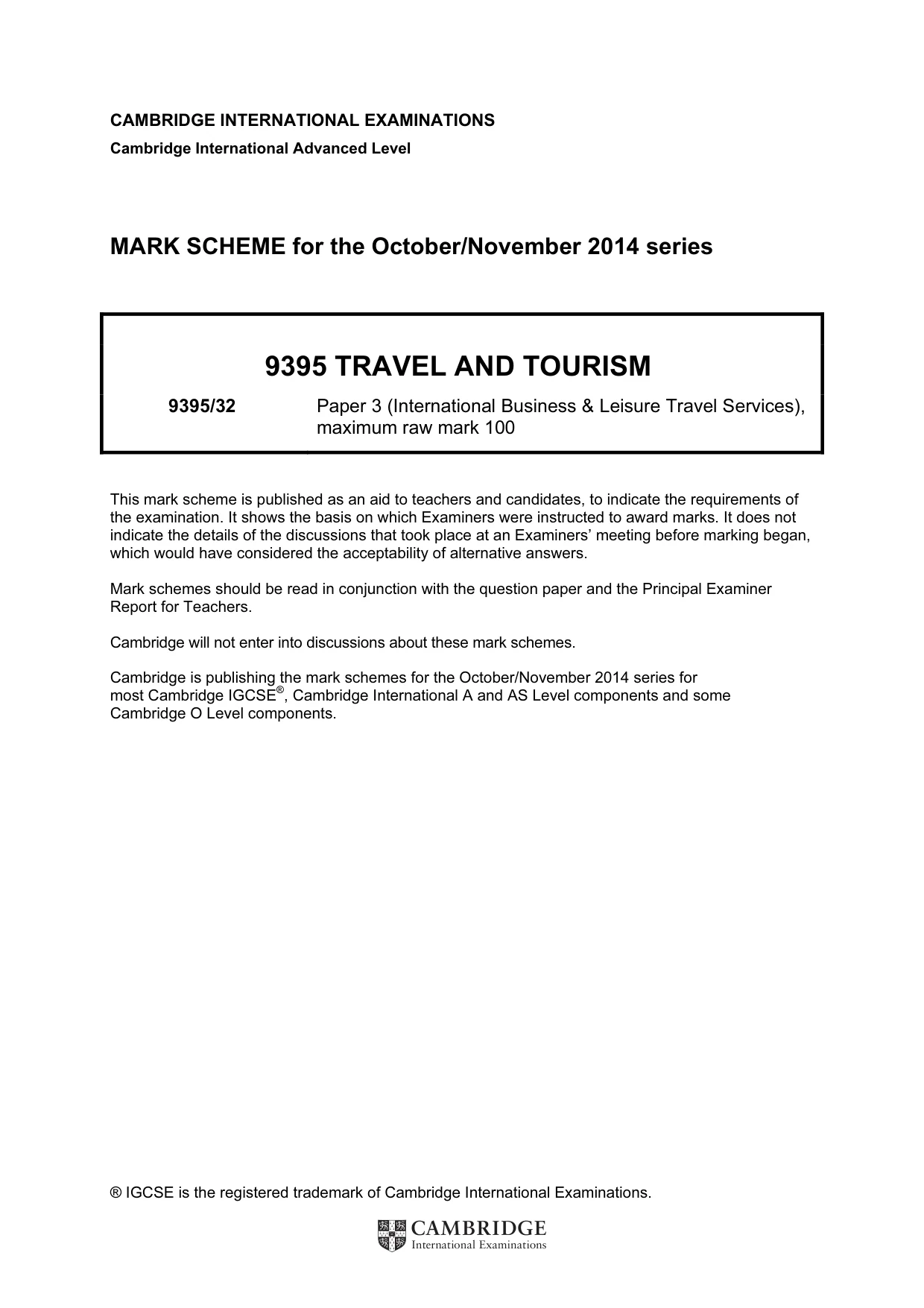
13 9395/32/O/N/14 © UCLES 2014 (d) Evaluate the importance of winning travel industry awards for organisations such as Star Cruises. … … … … … … … … … … … … … … … … … … … … … … … … …[9] [Total: 25]
Question paper, page 14
14 9395/32/O/N/14 © UCLES 2014 BLANK PAGE
Question paper, page 15
15 9395/32/O/N/14 © UCLES 2014 BLANK PAGE
Question paper, page 16
16 9395/32/O/N/14 © UCLES 2014 Permission to reproduce items where third-party owned material protected by copyright is included has been sought and cleared where possible. Every reasonable effort has been made by the publisher (UCLES) to trace copyright holders, but if any items requiring clearance have unwittingly been included, the publisher will be pleased to make amends at the earliest possible opportunity. Cambridge International Examinations is part of the Cambridge Assessment Group. Cambridge Assessment is the brand name of University of Cambridge Local Examinations Syndicate (UCLES), which is itself a department of the University of Cambridge. BLANK PAGE
Mark scheme, page 1
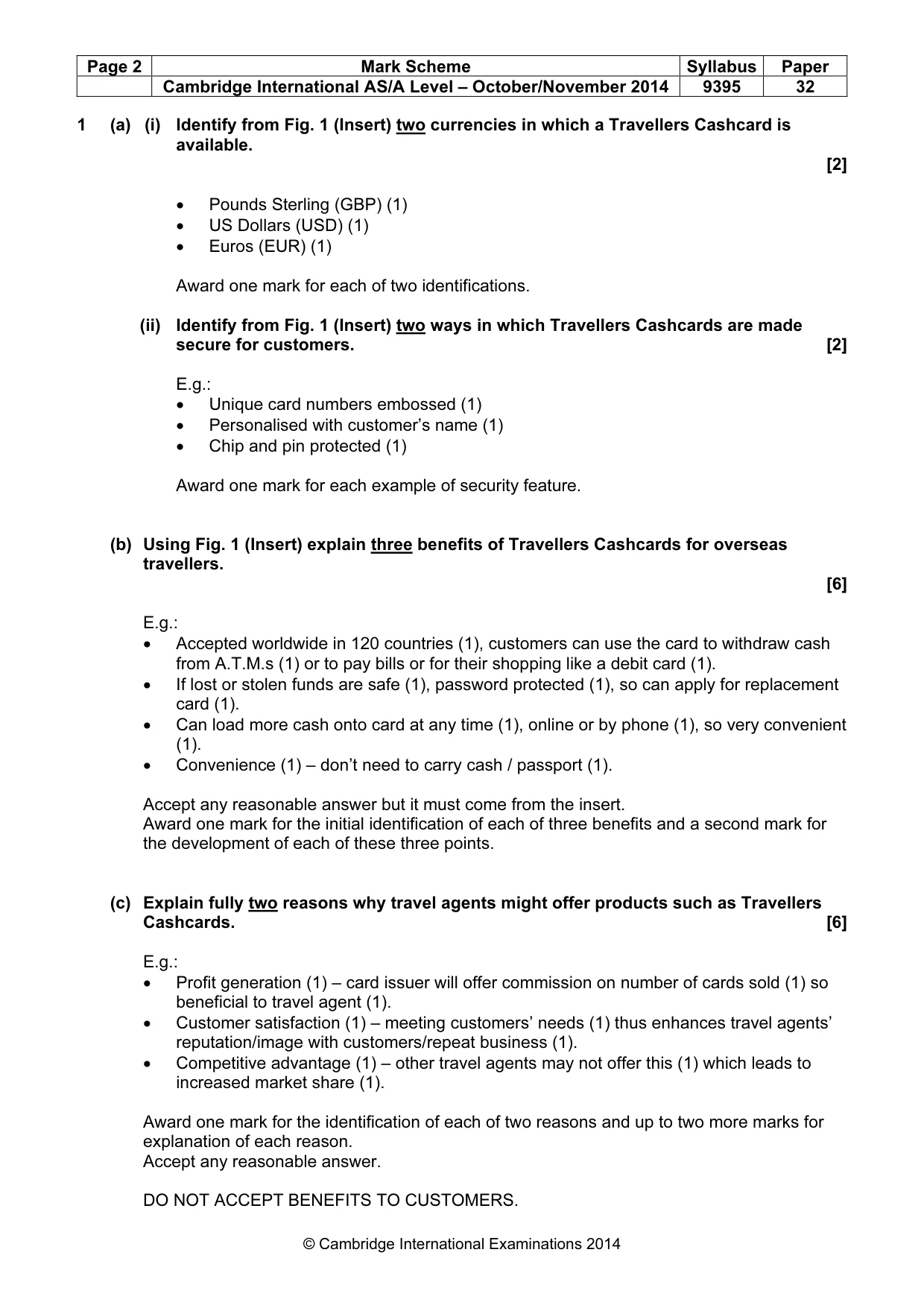
® IGCSE is the registered trademark of Cambridge International Examinations. CAMBRIDGE INTERNATIONAL EXAMINATIONS Cambridge International Advanced Level MARK SCHEME for the October/November 2014 series 9395 TRAVEL AND TOURISM 9395/32 Paper 3 (International Business & Leisure Travel Services), maximum raw mark 100 This mark scheme is published as an aid to teachers and candidates, to indicate the requirements of the examination. It shows the basis on which Examiners were instructed to award marks. It does not indicate the details of the discussions that took place at an Examiners’ meeting before marking began, which would have considered the acceptability of alternative answers. Mark schemes should be read in conjunction with the question paper and the Principal Examiner Report for Teachers. Cambridge will not enter into discussions about these mark schemes. Cambridge is publishing the mark schemes for the October/November 2014 series for most Cambridge IGCSE®, Cambridge International A and AS Level components and some Cambridge O Level components.
Mark scheme, page 2
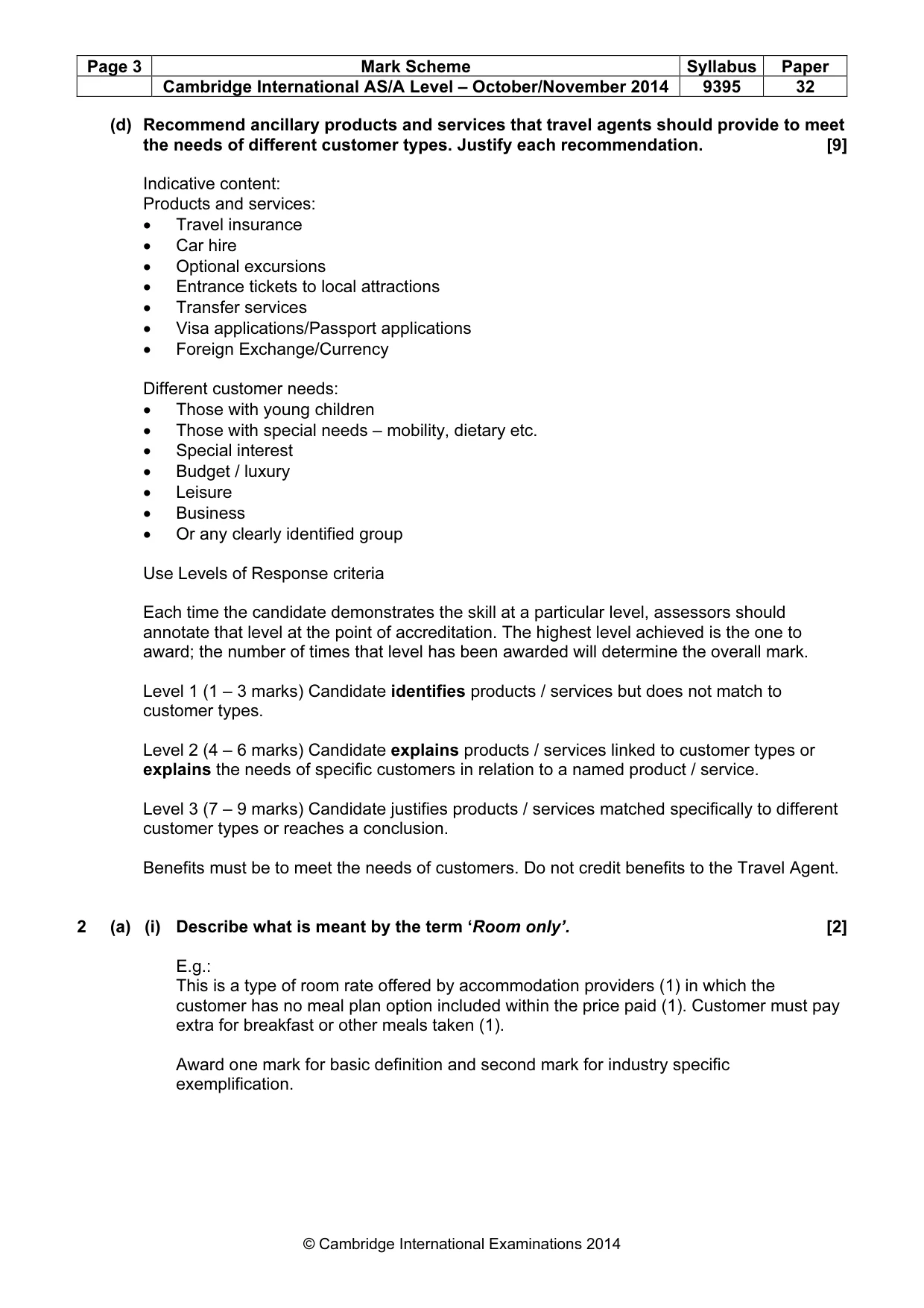
Page 2 Mark Scheme Syllabus Paper Cambridge International AS/A Level – October/November 2014 9395 32 © Cambridge International Examinations 2014 1 (a) (i) Identify from Fig. 1 (Insert) two currencies in which a Travellers Cashcard is available. [2] • Pounds Sterling (GBP) (1) • US Dollars (USD) (1) • Euros (EUR) (1) Award one mark for each of two identifications. (ii) Identify from Fig. 1 (Insert) two ways in which Travellers Cashcards are made secure for customers. [2] E.g.: • Unique card numbers embossed (1) • Personalised with customer’s name (1) • Chip and pin protected (1) Award one mark for each example of security feature. (b) Using Fig. 1 (Insert) explain three benefits of Travellers Cashcards for overseas travellers. [6] E.g.: • Accepted worldwide in 120 countries (1), customers can use the card to withdraw cash from A.T.M.s (1) or to pay bills or for their shopping like a debit card (1). • If lost or stolen funds are safe (1), password protected (1), so can apply for replacement card (1). • Can load more cash onto card at any time (1), online or by phone (1), so very convenient (1). • Convenience (1) – don’t need to carry cash / passport (1). Accept any reasonable answer but it must come from the insert. Award one mark for the initial identification of each of three benefits and a second mark for the development of each of these three points. (c) Explain fully two reasons why travel agents might offer products such as Travellers Cashcards. [6] E.g.: • Profit generation (1) – card issuer will offer commission on number of cards sold (1) so beneficial to travel agent (1). • Customer satisfaction (1) – meeting customers’ needs (1) thus enhances travel agents’ reputation/image with customers/repeat business (1). • Competitive advantage (1) – other travel agents may not offer this (1) which leads to increased market share (1). Award one mark for the identification of each of two reasons and up to two more marks for explanation of each reason. Accept any reasonable answer. DO NOT ACCEPT BENEFITS TO CUSTOMERS.
Mark scheme, page 3
Page 3 Mark Scheme Syllabus Paper Cambridge International AS/A Level – October/November 2014 9395 32 © Cambridge International Examinations 2014 (d) Recommend ancillary products and services that travel agents should provide to meet the needs of different customer types. Justify each recommendation. [9] Indicative content: Products and services: • Travel insurance • Car hire • Optional excursions • Entrance tickets to local attractions • Transfer services • Visa applications/Passport applications • Foreign Exchange/Currency Different customer needs: • Those with young children • Those with special needs – mobility, dietary etc. • Special interest • Budget / luxury • Leisure • Business • Or any clearly identified group Use Levels of Response criteria Each time the candidate demonstrates the skill at a particular level, assessors should annotate that level at the point of accreditation. The highest level achieved is the one to award; the number of times that level has been awarded will determine the overall mark. Level 1 (1 – 3 marks) Candidate identifies products / services but does not match to customer types. Level 2 (4 – 6 marks) Candidate explains products / services linked to customer types or explains the needs of specific customers in relation to a named product / service. Level 3 (7 – 9 marks) Candidate justifies products / services matched specifically to different customer types or reaches a conclusion. Benefits must be to meet the needs of customers. Do not credit benefits to the Travel Agent. 2 (a) (i) Describe what is meant by the term ‘Room only’. [2] E.g.: This is a type of room rate offered by accommodation providers (1) in which the customer has no meal plan option included within the price paid (1). Customer must pay extra for breakfast or other meals taken (1). Award one mark for basic definition and second mark for industry specific exemplification.
Mark scheme, page 4
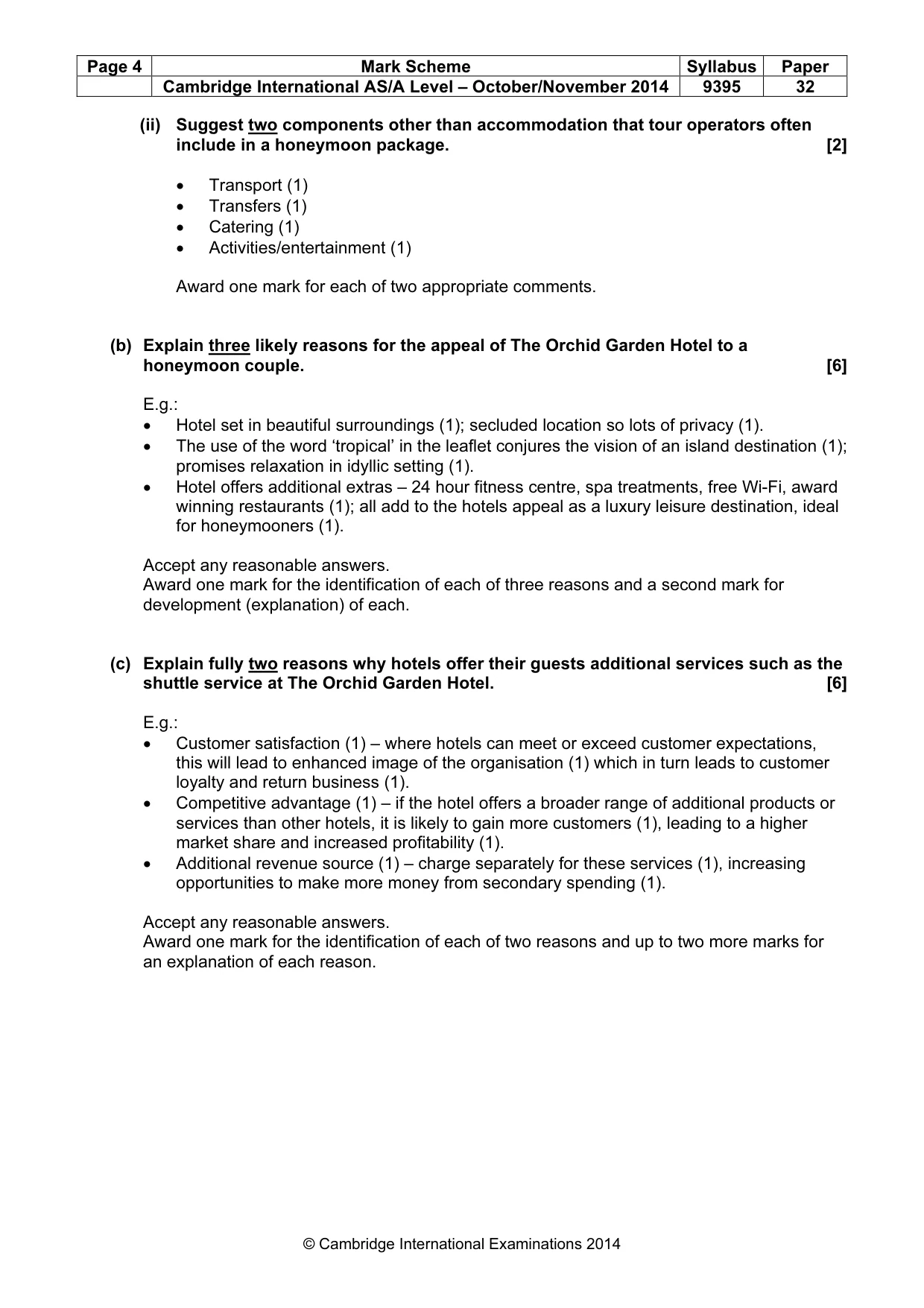
Page 4 Mark Scheme Syllabus Paper Cambridge International AS/A Level – October/November 2014 9395 32 © Cambridge International Examinations 2014 (ii) Suggest two components other than accommodation that tour operators often include in a honeymoon package. [2] • Transport (1) • Transfers (1) • Catering (1) • Activities/entertainment (1) Award one mark for each of two appropriate comments. (b) Explain three likely reasons for the appeal of The Orchid Garden Hotel to a honeymoon couple. [6] E.g.: • Hotel set in beautiful surroundings (1); secluded location so lots of privacy (1). • The use of the word ‘tropical’ in the leaflet conjures the vision of an island destination (1); promises relaxation in idyllic setting (1). • Hotel offers additional extras – 24 hour fitness centre, spa treatments, free Wi-Fi, award winning restaurants (1); all add to the hotels appeal as a luxury leisure destination, ideal for honeymooners (1). Accept any reasonable answers. Award one mark for the identification of each of three reasons and a second mark for development (explanation) of each. (c) Explain fully two reasons why hotels offer their guests additional services such as the shuttle service at The Orchid Garden Hotel. [6] E.g.: • Customer satisfaction (1) – where hotels can meet or exceed customer expectations, this will lead to enhanced image of the organisation (1) which in turn leads to customer loyalty and return business (1). • Competitive advantage (1) – if the hotel offers a broader range of additional products or services than other hotels, it is likely to gain more customers (1), leading to a higher market share and increased profitability (1). • Additional revenue source (1) – charge separately for these services (1), increasing opportunities to make more money from secondary spending (1). Accept any reasonable answers. Award one mark for the identification of each of two reasons and up to two more marks for an explanation of each reason.
Mark scheme, page 5
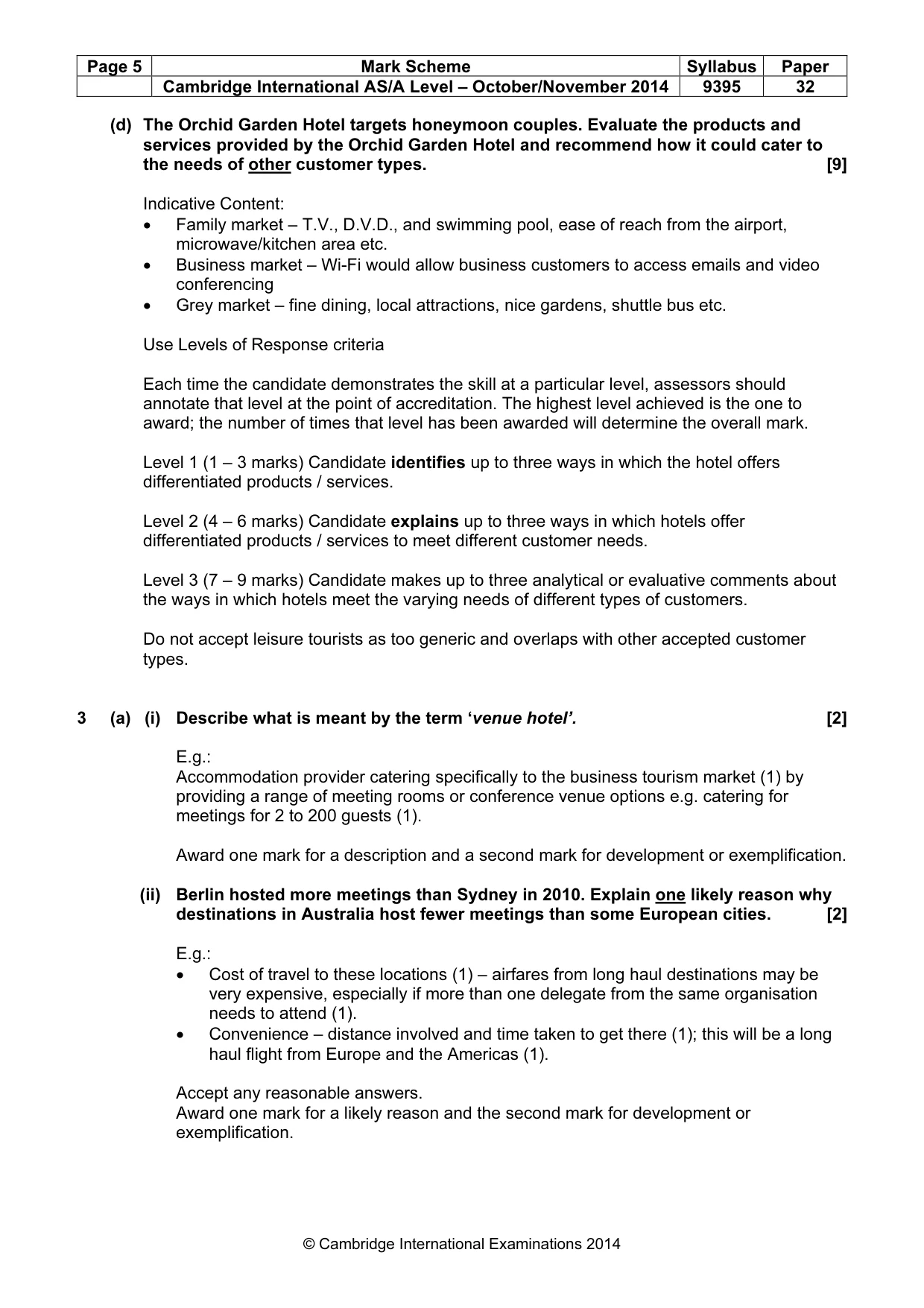
Page 5 Mark Scheme Syllabus Paper Cambridge International AS/A Level – October/November 2014 9395 32 © Cambridge International Examinations 2014 (d) The Orchid Garden Hotel targets honeymoon couples. Evaluate the products and services provided by the Orchid Garden Hotel and recommend how it could cater to the needs of other customer types. [9] Indicative Content: • Family market – T.V., D.V.D., and swimming pool, ease of reach from the airport, microwave/kitchen area etc. • Business market – Wi-Fi would allow business customers to access emails and video conferencing • Grey market – fine dining, local attractions, nice gardens, shuttle bus etc. Use Levels of Response criteria Each time the candidate demonstrates the skill at a particular level, assessors should annotate that level at the point of accreditation. The highest level achieved is the one to award; the number of times that level has been awarded will determine the overall mark. Level 1 (1 – 3 marks) Candidate identifies up to three ways in which the hotel offers differentiated products / services. Level 2 (4 – 6 marks) Candidate explains up to three ways in which hotels offer differentiated products / services to meet different customer needs. Level 3 (7 – 9 marks) Candidate makes up to three analytical or evaluative comments about the ways in which hotels meet the varying needs of different types of customers. Do not accept leisure tourists as too generic and overlaps with other accepted customer types. 3 (a) (i) Describe what is meant by the term ‘venue hotel’. [2] E.g.: Accommodation provider catering specifically to the business tourism market (1) by providing a range of meeting rooms or conference venue options e.g. catering for meetings for 2 to 200 guests (1). Award one mark for a description and a second mark for development or exemplification. (ii) Berlin hosted more meetings than Sydney in 2010. Explain one likely reason why destinations in Australia host fewer meetings than some European cities. [2] E.g.: • Cost of travel to these locations (1) – airfares from long haul destinations may be very expensive, especially if more than one delegate from the same organisation needs to attend (1). • Convenience – distance involved and time taken to get there (1); this will be a long haul flight from Europe and the Americas (1). Accept any reasonable answers. Award one mark for a likely reason and the second mark for development or exemplification.
Mark scheme, page 6
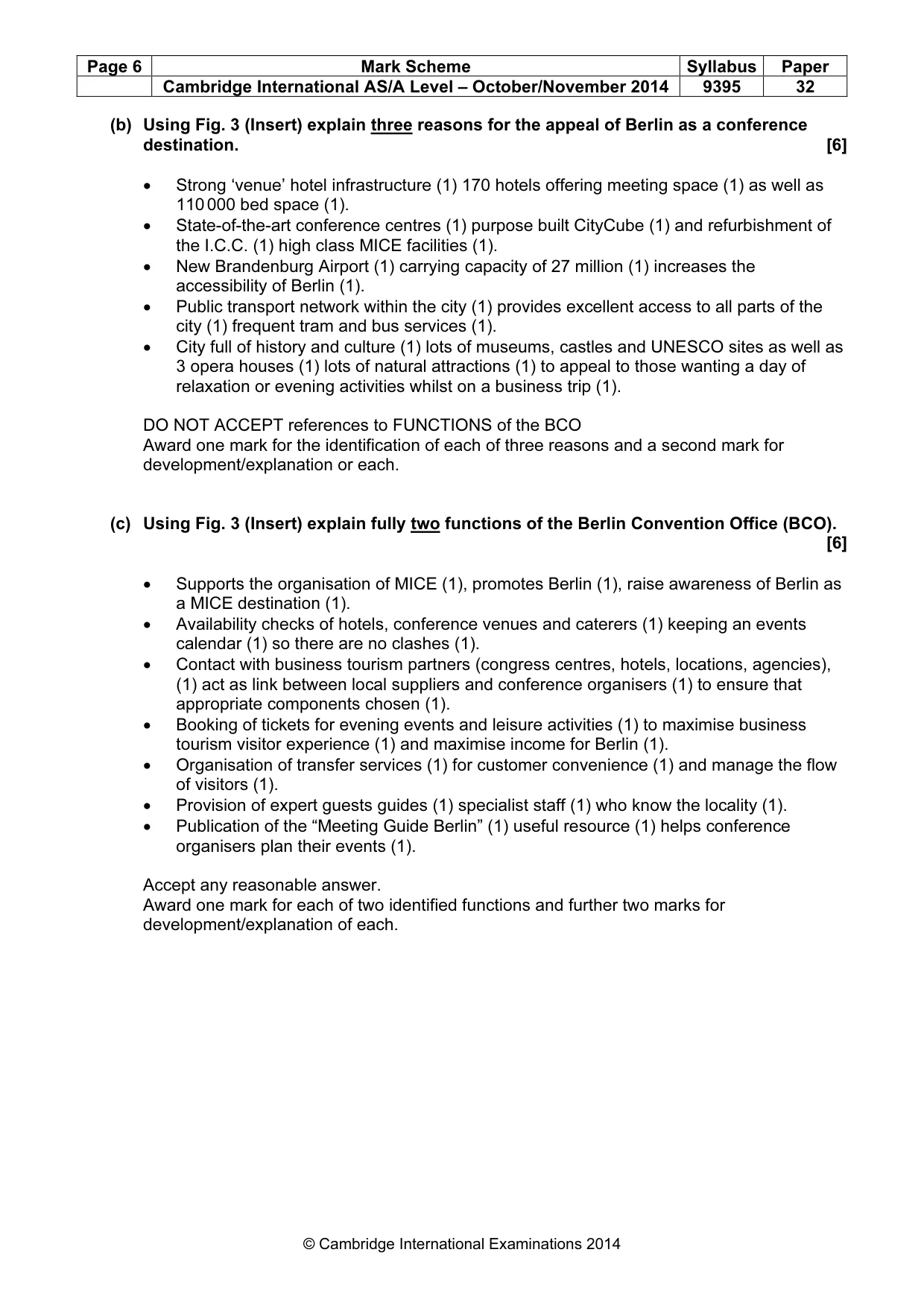
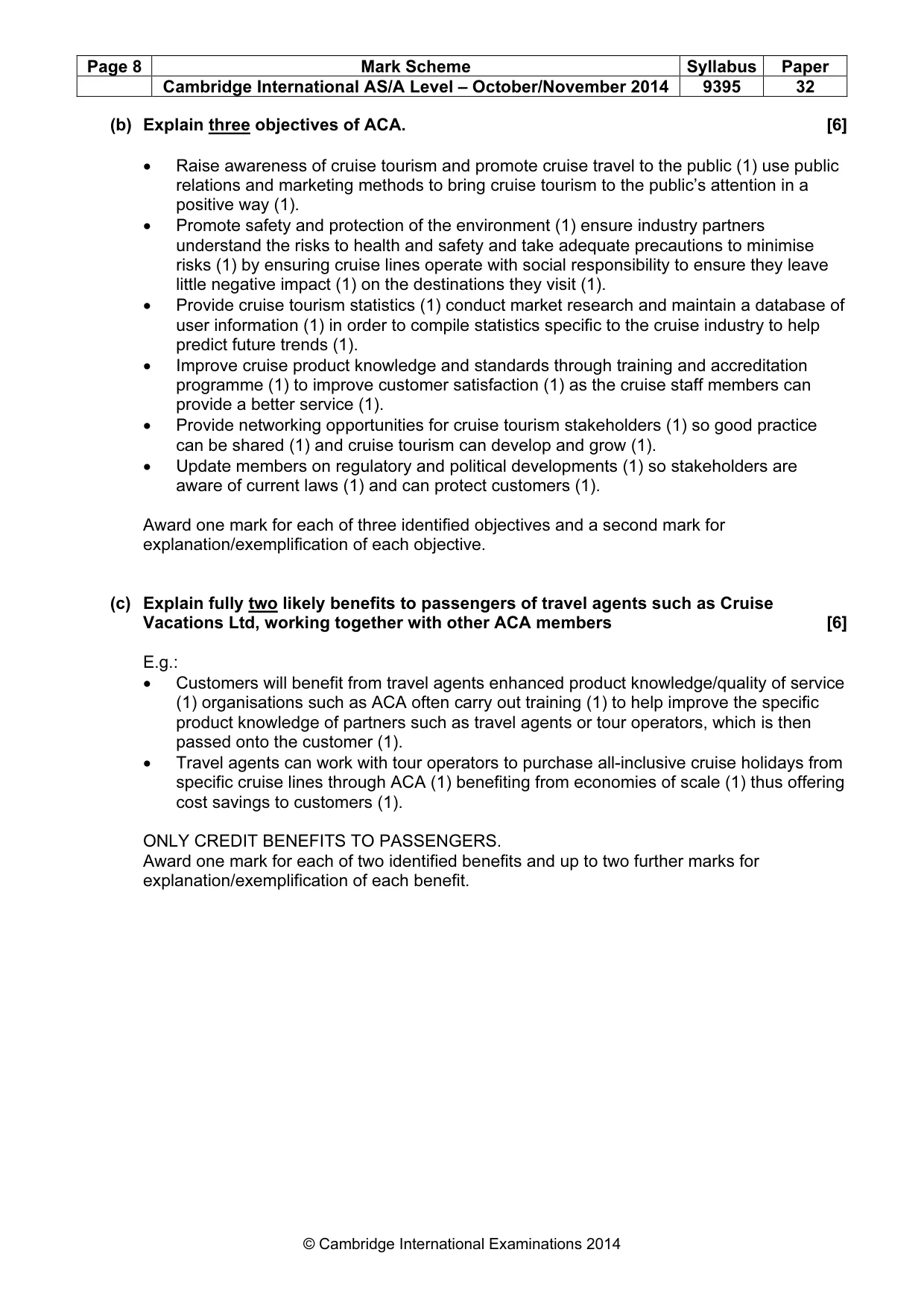
Page 6 Mark Scheme Syllabus Paper Cambridge International AS/A Level – October/November 2014 9395 32 © Cambridge International Examinations 2014 (b) Using Fig. 3 (Insert) explain three reasons for the appeal of Berlin as a conference destination. [6] • Strong ‘venue’ hotel infrastructure (1) 170 hotels offering meeting space (1) as well as 110 000 bed space (1). • State-of-the-art conference centres (1) purpose built CityCube (1) and refurbishment of the I.C.C. (1) high class MICE facilities (1). • New Brandenburg Airport (1) carrying capacity of 27 million (1) increases the accessibility of Berlin (1). • Public transport network within the city (1) provides excellent access to all parts of the city (1) frequent tram and bus services (1). • City full of history and culture (1) lots of museums, castles and UNESCO sites as well as 3 opera houses (1) lots of natural attractions (1) to appeal to those wanting a day of relaxation or evening activities whilst on a business trip (1). DO NOT ACCEPT references to FUNCTIONS of the BCO Award one mark for the identification of each of three reasons and a second mark for development/explanation or each. (c) Using Fig. 3 (Insert) explain fully two functions of the Berlin Convention Office (BCO). [6] • Supports the organisation of MICE (1), promotes Berlin (1), raise awareness of Berlin as a MICE destination (1). • Availability checks of hotels, conference venues and caterers (1) keeping an events calendar (1) so there are no clashes (1). • Contact with business tourism partners (congress centres, hotels, locations, agencies), (1) act as link between local suppliers and conference organisers (1) to ensure that appropriate components chosen (1). • Booking of tickets for evening events and leisure activities (1) to maximise business tourism visitor experience (1) and maximise income for Berlin (1). • Organisation of transfer services (1) for customer convenience (1) and manage the flow of visitors (1). • Provision of expert guests guides (1) specialist staff (1) who know the locality (1). • Publication of the “Meeting Guide Berlin” (1) useful resource (1) helps conference organisers plan their events (1). Accept any reasonable answer. Award one mark for each of two identified functions and further two marks for development/explanation of each.
Mark scheme, page 7
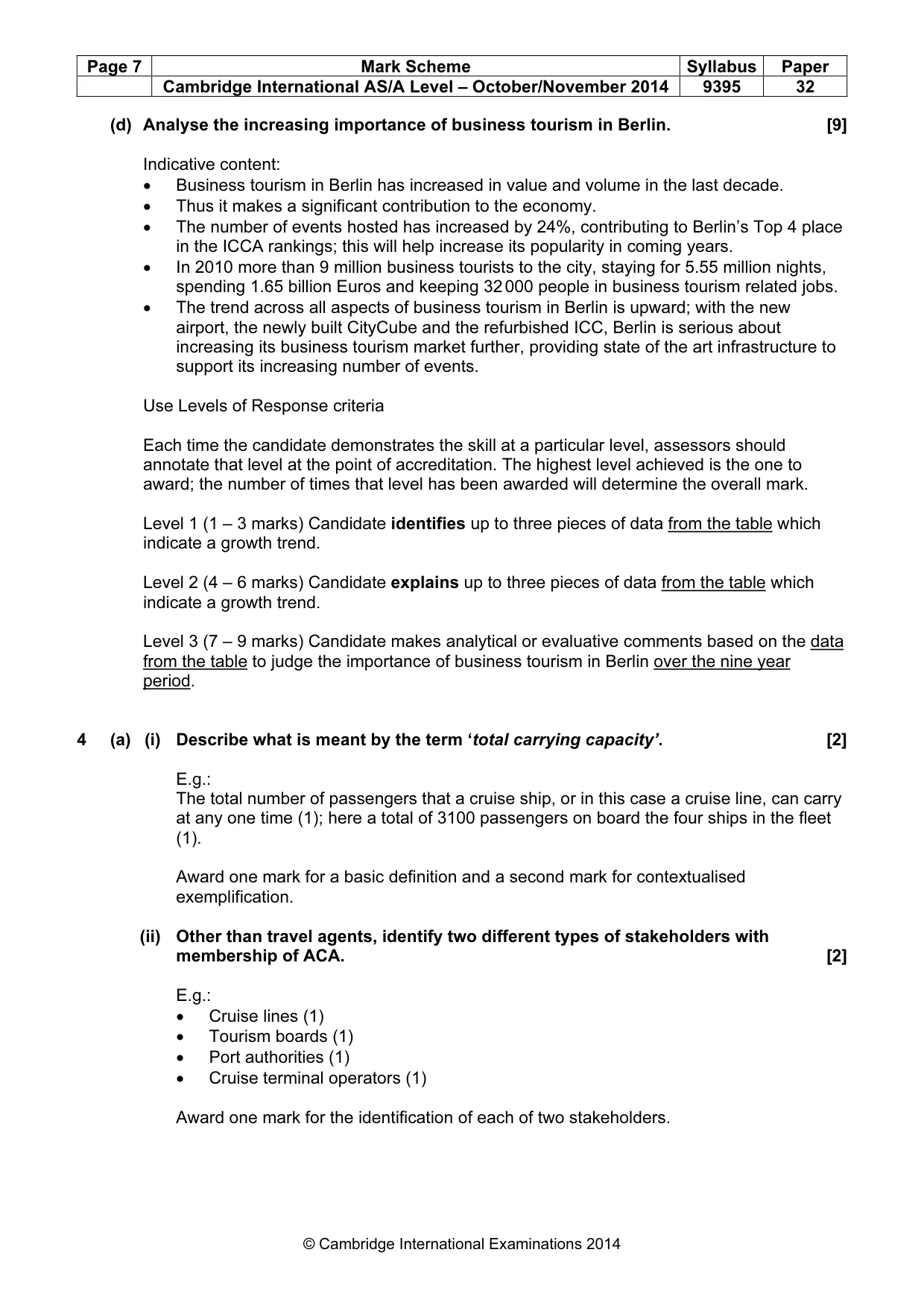
Page 7 Mark Scheme Syllabus Paper Cambridge International AS/A Level – October/November 2014 9395 32 © Cambridge International Examinations 2014 (d) Analyse the increasing importance of business tourism in Berlin. [9] Indicative content: • Business tourism in Berlin has increased in value and volume in the last decade. • Thus it makes a significant contribution to the economy. • The number of events hosted has increased by 24%, contributing to Berlin’s Top 4 place in the ICCA rankings; this will help increase its popularity in coming years. • In 2010 more than 9 million business tourists to the city, staying for 5.55 million nights, spending 1.65 billion Euros and keeping 32 000 people in business tourism related jobs. • The trend across all aspects of business tourism in Berlin is upward; with the new airport, the newly built CityCube and the refurbished ICC, Berlin is serious about increasing its business tourism market further, providing state of the art infrastructure to support its increasing number of events. Use Levels of Response criteria Each time the candidate demonstrates the skill at a particular level, assessors should annotate that level at the point of accreditation. The highest level achieved is the one to award; the number of times that level has been awarded will determine the overall mark. Level 1 (1 – 3 marks) Candidate identifies up to three pieces of data from the table which indicate a growth trend. Level 2 (4 – 6 marks) Candidate explains up to three pieces of data from the table which indicate a growth trend. Level 3 (7 – 9 marks) Candidate makes analytical or evaluative comments based on the data from the table to judge the importance of business tourism in Berlin over the nine year period. 4 (a) (i) Describe what is meant by the term ‘total carrying capacity’. [2] E.g.: The total number of passengers that a cruise ship, or in this case a cruise line, can carry at any one time (1); here a total of 3100 passengers on board the four ships in the fleet (1). Award one mark for a basic definition and a second mark for contextualised exemplification. (ii) Other than travel agents, identify two different types of stakeholders with membership of ACA. [2] E.g.: • Cruise lines (1) • Tourism boards (1) • Port authorities (1) • Cruise terminal operators (1) Award one mark for the identification of each of two stakeholders.
Mark scheme, page 8
Page 8 Mark Scheme Syllabus Paper Cambridge International AS/A Level – October/November 2014 9395 32 © Cambridge International Examinations 2014 (b) Explain three objectives of ACA. [6] • Raise awareness of cruise tourism and promote cruise travel to the public (1) use public relations and marketing methods to bring cruise tourism to the public’s attention in a positive way (1). • Promote safety and protection of the environment (1) ensure industry partners understand the risks to health and safety and take adequate precautions to minimise risks (1) by ensuring cruise lines operate with social responsibility to ensure they leave little negative impact (1) on the destinations they visit (1). • Provide cruise tourism statistics (1) conduct market research and maintain a database of user information (1) in order to compile statistics specific to the cruise industry to help predict future trends (1). • Improve cruise product knowledge and standards through training and accreditation programme (1) to improve customer satisfaction (1) as the cruise staff members can provide a better service (1). • Provide networking opportunities for cruise tourism stakeholders (1) so good practice can be shared (1) and cruise tourism can develop and grow (1). • Update members on regulatory and political developments (1) so stakeholders are aware of current laws (1) and can protect customers (1). Award one mark for each of three identified objectives and a second mark for explanation/exemplification of each objective. (c) Explain fully two likely benefits to passengers of travel agents such as Cruise Vacations Ltd, working together with other ACA members [6] E.g.: • Customers will benefit from travel agents enhanced product knowledge/quality of service (1) organisations such as ACA often carry out training (1) to help improve the specific product knowledge of partners such as travel agents or tour operators, which is then passed onto the customer (1). • Travel agents can work with tour operators to purchase all-inclusive cruise holidays from specific cruise lines through ACA (1) benefiting from economies of scale (1) thus offering cost savings to customers (1). ONLY CREDIT BENEFITS TO PASSENGERS. Award one mark for each of two identified benefits and up to two further marks for explanation/exemplification of each benefit.
Mark scheme, page 9
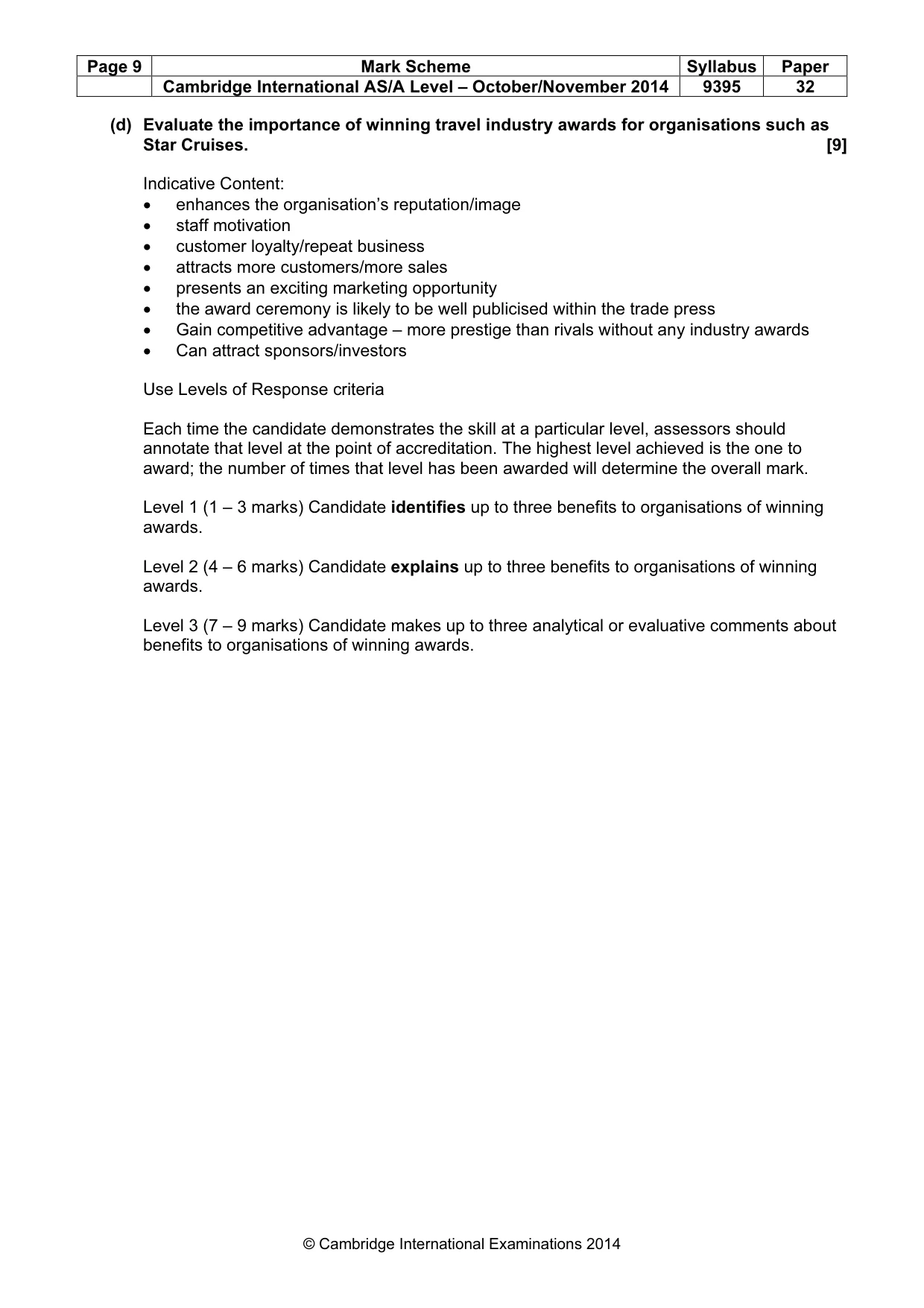
Page 9 Mark Scheme Syllabus Paper Cambridge International AS/A Level – October/November 2014 9395 32 © Cambridge International Examinations 2014 (d) Evaluate the importance of winning travel industry awards for organisations such as Star Cruises. [9] Indicative Content: • enhances the organisation’s reputation/image • staff motivation • customer loyalty/repeat business • attracts more customers/more sales • presents an exciting marketing opportunity • the award ceremony is likely to be well publicised within the trade press • Gain competitive advantage – more prestige than rivals without any industry awards • Can attract sponsors/investors Use Levels of Response criteria Each time the candidate demonstrates the skill at a particular level, assessors should annotate that level at the point of accreditation. The highest level achieved is the one to award; the number of times that level has been awarded will determine the overall mark. Level 1 (1 – 3 marks) Candidate identifies up to three benefits to organisations of winning awards. Level 2 (4 – 6 marks) Candidate explains up to three benefits to organisations of winning awards. Level 3 (7 – 9 marks) Candidate makes up to three analytical or evaluative comments about benefits to organisations of winning awards.
What you needed in this session
Cambridge’s own grade thresholds for 2014 Oct/Nov, Paper 3 · Variant 2. A higher threshold means an easier paper — the bar moves with how the cohort did.