Cambridge A Level Travel and Tourism 9395 — 2014 Oct/Nov Paper 3 · Variant 3
9395/33/O/N/14 · 100 marks · ≈113 min
The question paper and its mark scheme, free to read here and free to download. This is Cambridge’s own paper, exactly as it was sat.
Question paper16 pages



Mark scheme9 pages
Answers below. Sit the paper first if you are practising.
Paper as text
Question paper, page 1
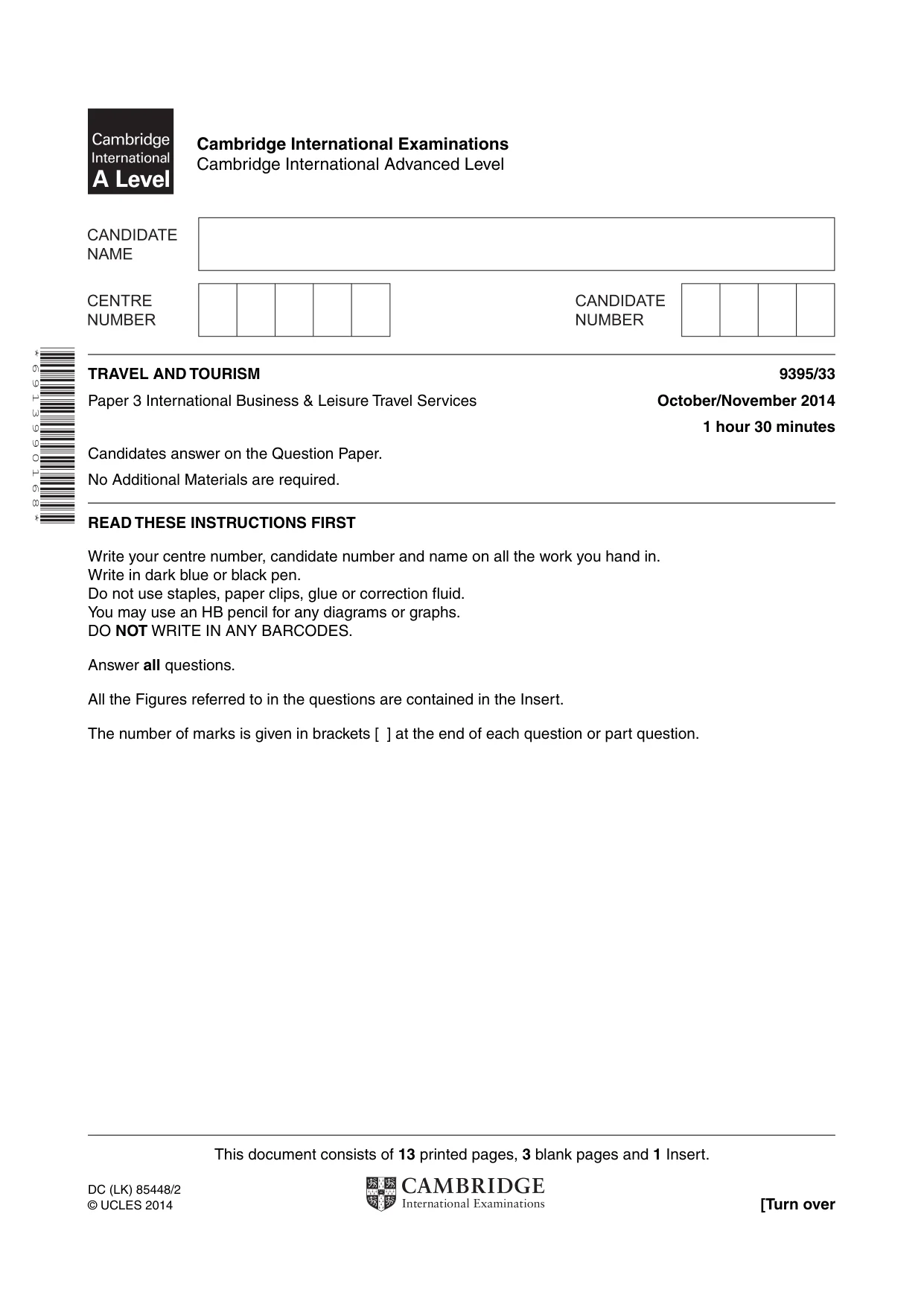
This document consists of 13 printed pages, 3 blank pages and 1 Insert. DC (LK) 85448/2 © UCLES 2014 [Turn over * 6 9 1 3 9 9 0 1 6 8 * TRAVEL AND TOURISM 9395/33 Paper 3 International Business & Leisure Travel Services October/November 2014 1 hour 30 minutes Candidates answer on the Question Paper. No Additional Materials are required. READ THESE INSTRUCTIONS FIRST Write your centre number, candidate number and name on all the work you hand in. Write in dark blue or black pen. Do not use staples, paper clips, glue or correction fluid. You may use an HB pencil for any diagrams or graphs. DO NOT WRITE IN ANY BARCODES. Answer all questions. All the Figures referred to in the questions are contained in the Insert. The number of marks is given in brackets [ ] at the end of each question or part question. Cambridge International Examinations Cambridge International Advanced Level
Question paper, page 2
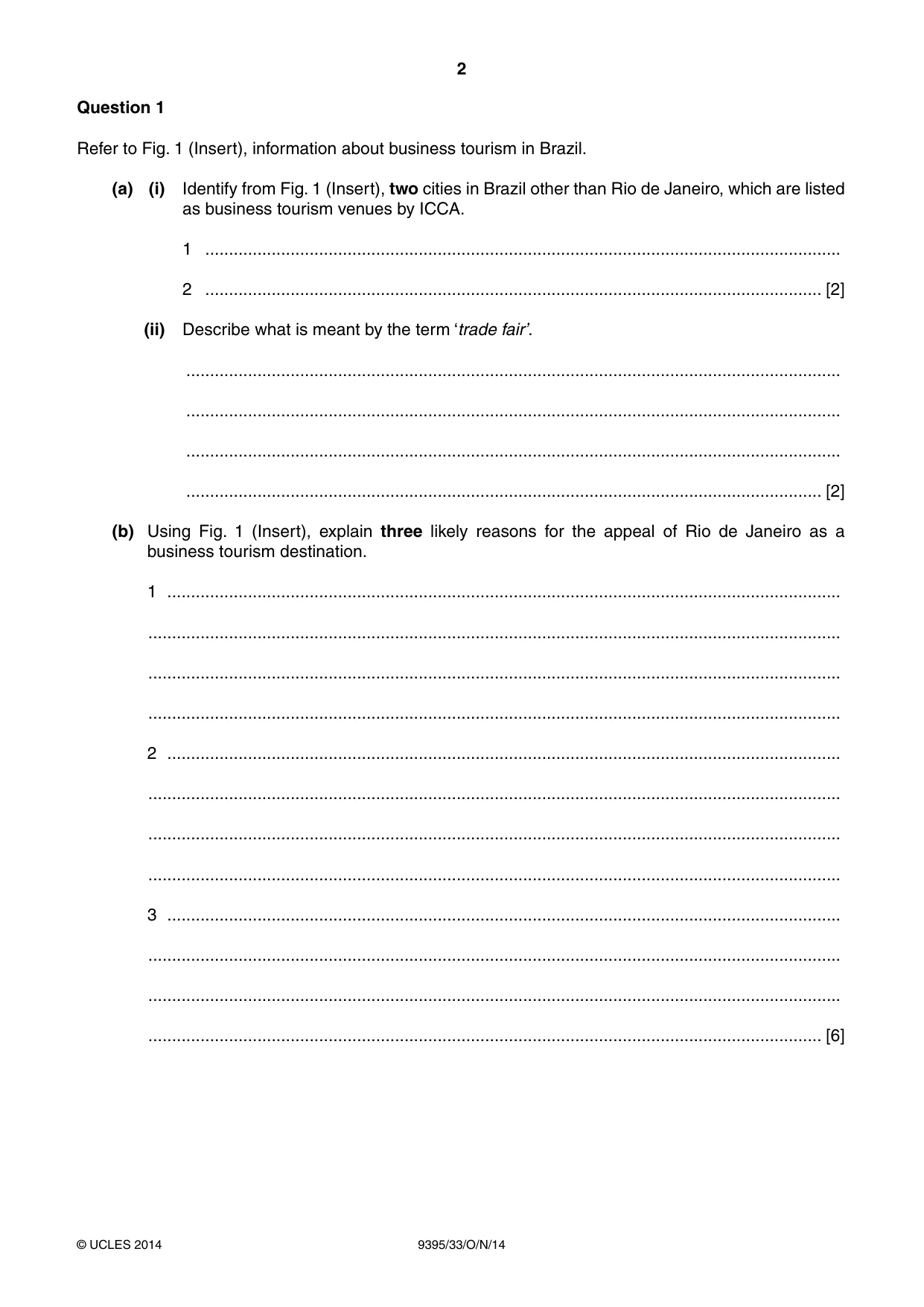
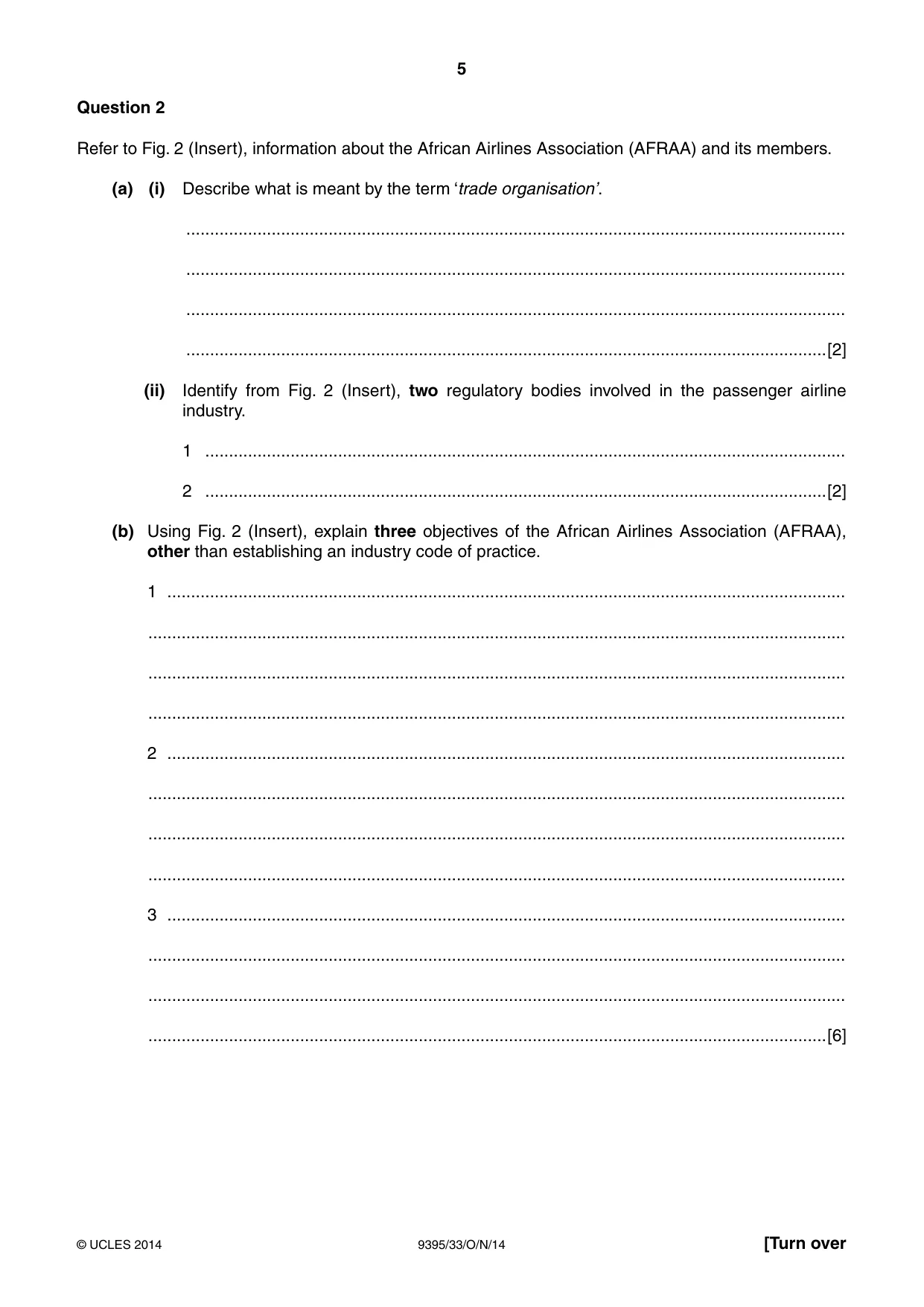
2 9395/33/O/N/14 © UCLES 2014 Question 1 Refer to Fig. 1 (Insert), information about business tourism in Brazil. (a) (i) Identify from Fig. 1 (Insert), two cities in Brazil other than Rio de Janeiro, which are listed as business tourism venues by ICCA. 1 … 2 … [2] (ii) Describe what is meant by the term ‘trade fair’. … … … … [2] (b) Using Fig. 1 (Insert), explain three likely reasons for the appeal of Rio de Janeiro as a business tourism destination. 1 … … … … 2 … … … … 3 … … … … [6]
Question paper, page 3
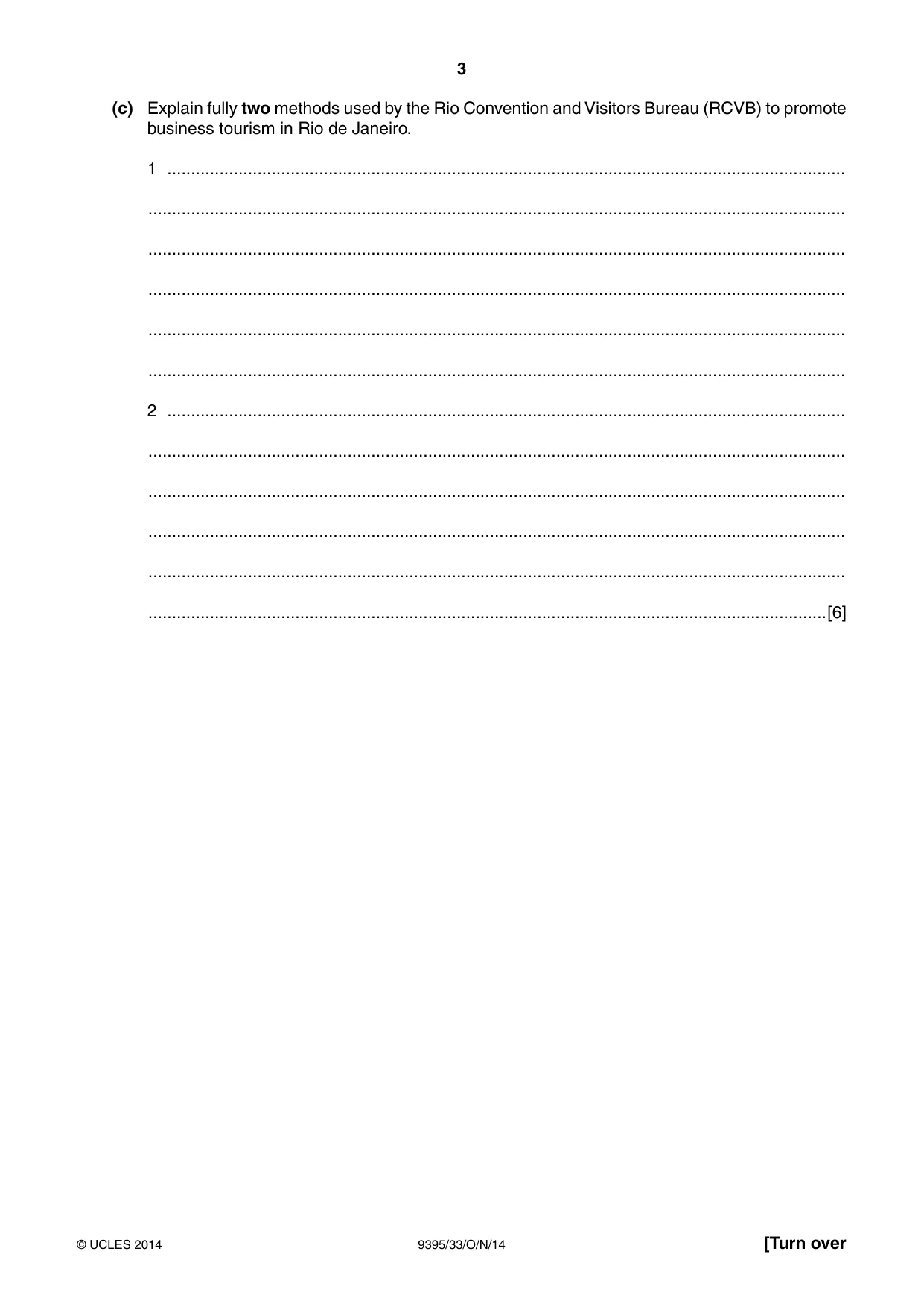
3 9395/33/O/N/14 © UCLES 2014 [Turn over (c) Explain fully two methods used by the Rio Convention and Visitors Bureau (RCVB) to promote business tourism in Rio de Janeiro. 1 … … … … … … 2 … … … … … …[6]
Question paper, page 4
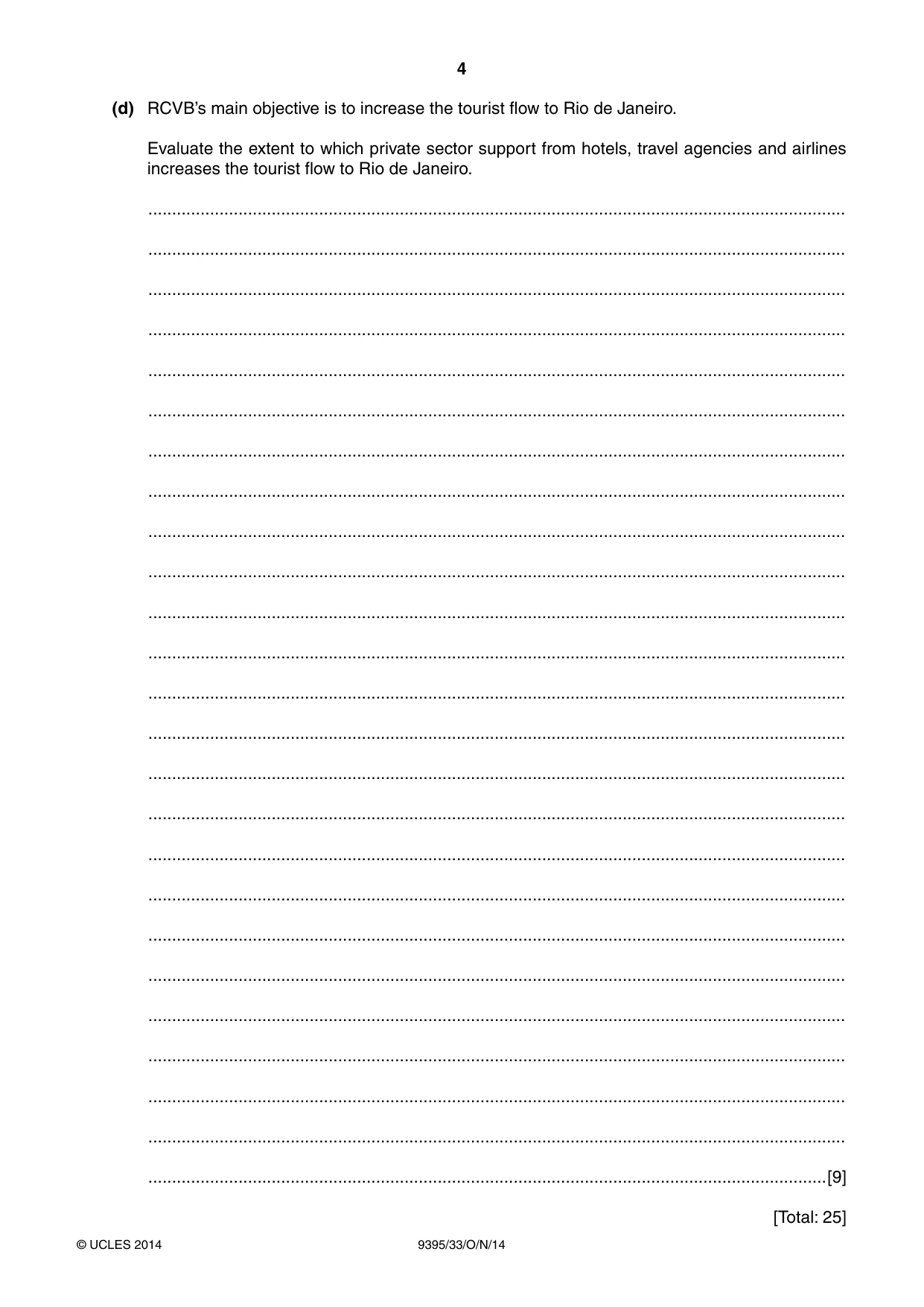
4 9395/33/O/N/14 © UCLES 2014 (d) RCVB’s main objective is to increase the tourist flow to Rio de Janeiro. Evaluate the extent to which private sector support from hotels, travel agencies and airlines increases the tourist flow to Rio de Janeiro. … … … … … … … … … … … … … … … … … … … … … … … … …[9] [Total: 25]
Question paper, page 5
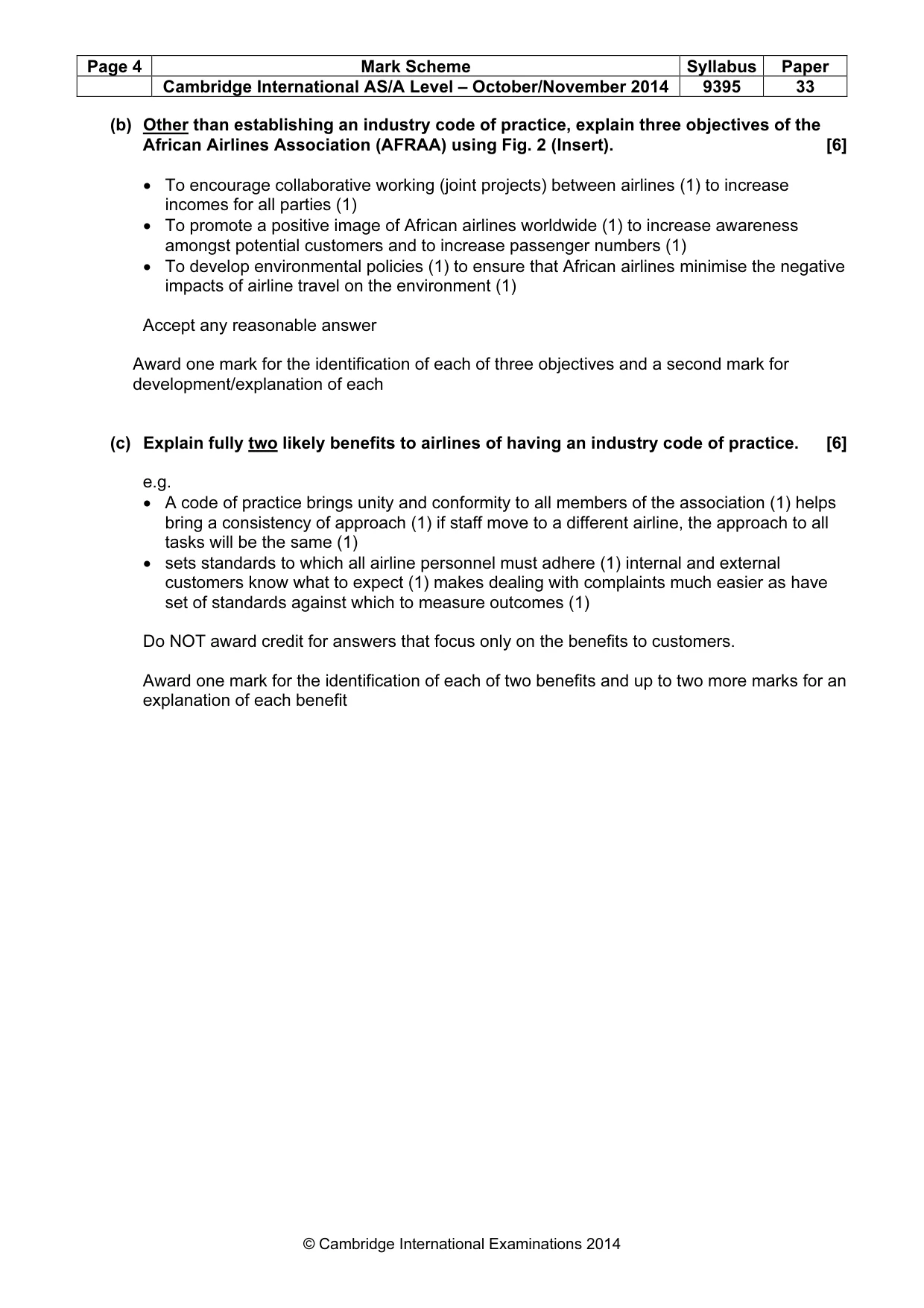
5 9395/33/O/N/14 © UCLES 2014 [Turn over Question 2 Refer to Fig. 2 (Insert), information about the African Airlines Association (AFRAA) and its members. (a) (i) Describe what is meant by the term ‘trade organisation’. … … … …[2] (ii) Identify from Fig. 2 (Insert), two regulatory bodies involved in the passenger airline industry. 1 … 2 …[2] (b) Using Fig. 2 (Insert), explain three objectives of the African Airlines Association (AFRAA), other than establishing an industry code of practice. 1 … … … … 2 … … … … 3 … … … …[6]
Question paper, page 6
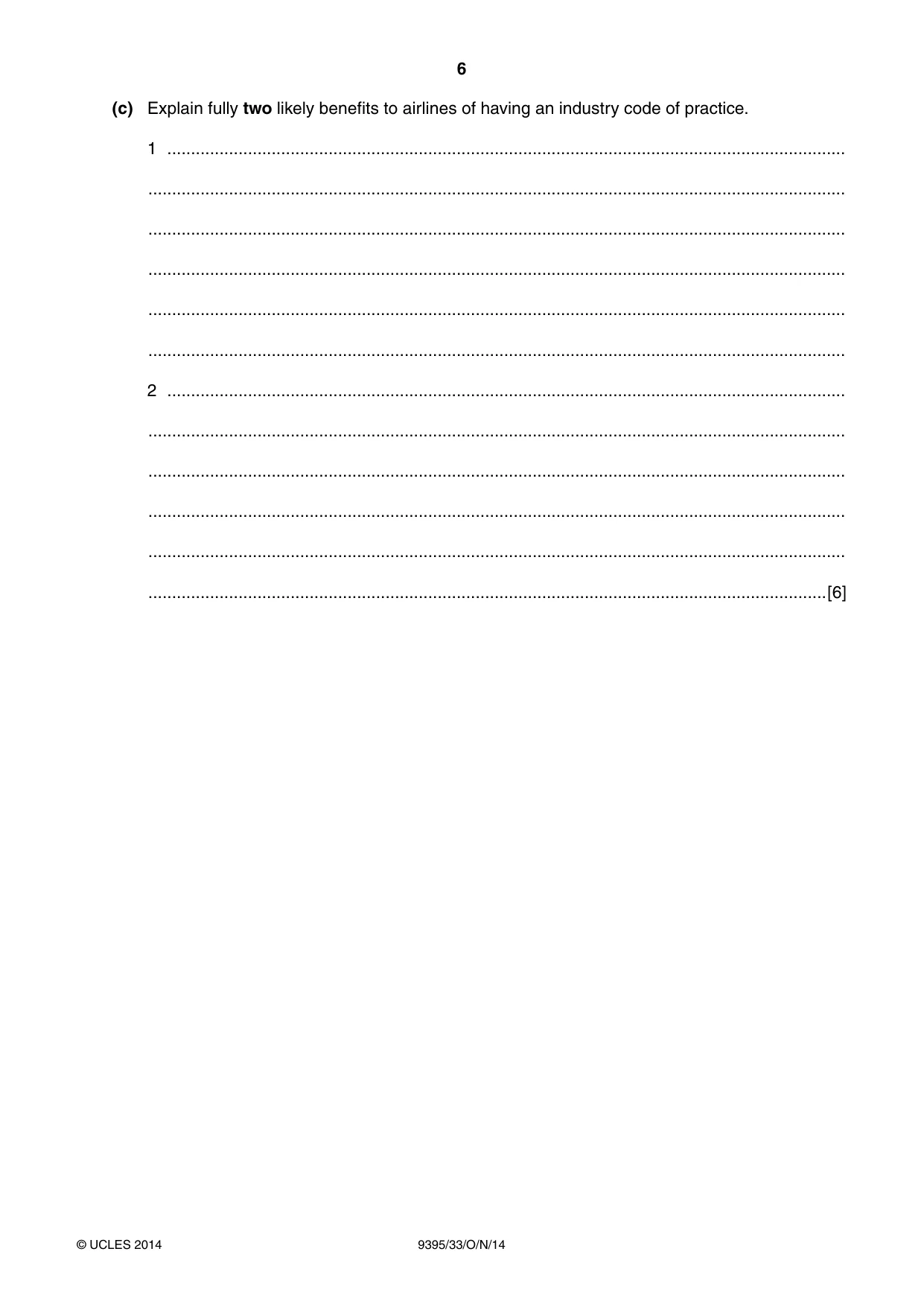
6 9395/33/O/N/14 © UCLES 2014 (c) Explain fully two likely benefits to airlines of having an industry code of practice. 1 … … … … … … 2 … … … … … …[6]
Question paper, page 7
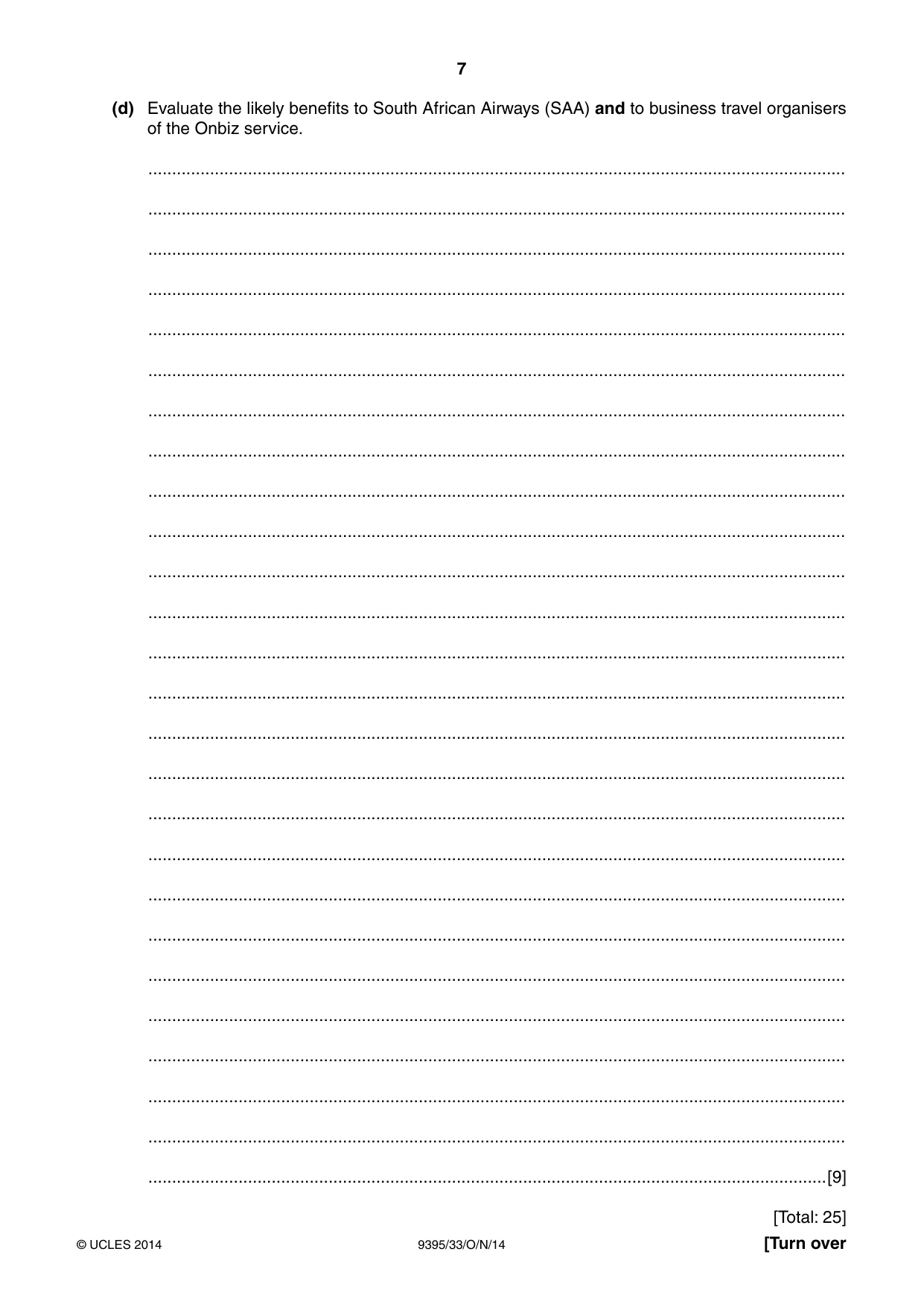
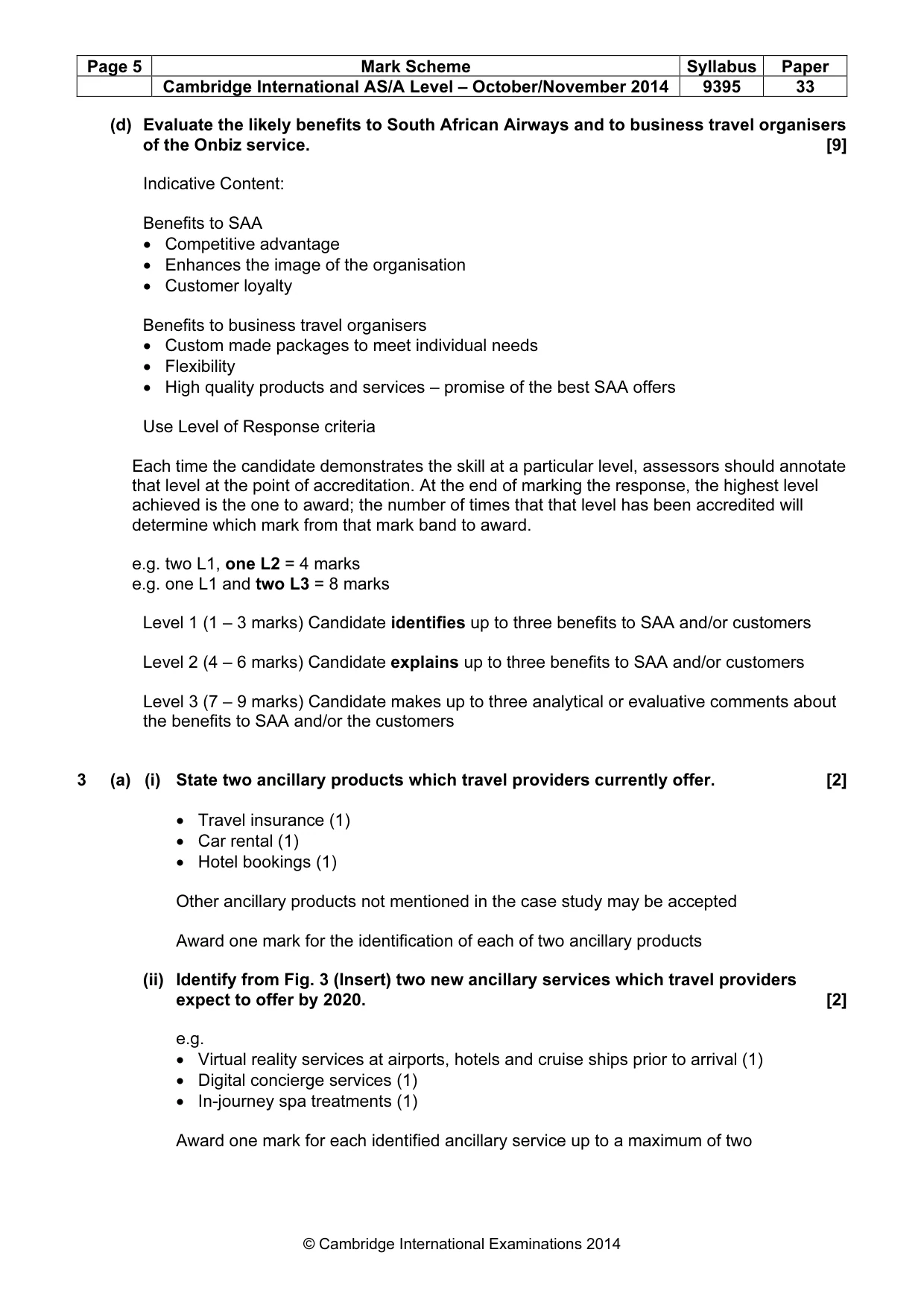
7 9395/33/O/N/14 © UCLES 2014 [Turn over (d) Evaluate the likely benefits to South African Airways (SAA) and to business travel organisers of the Onbiz service. … … … … … … … … … … … … … … … … … … … … … … … … … …[9] [Total: 25]
Question paper, page 8
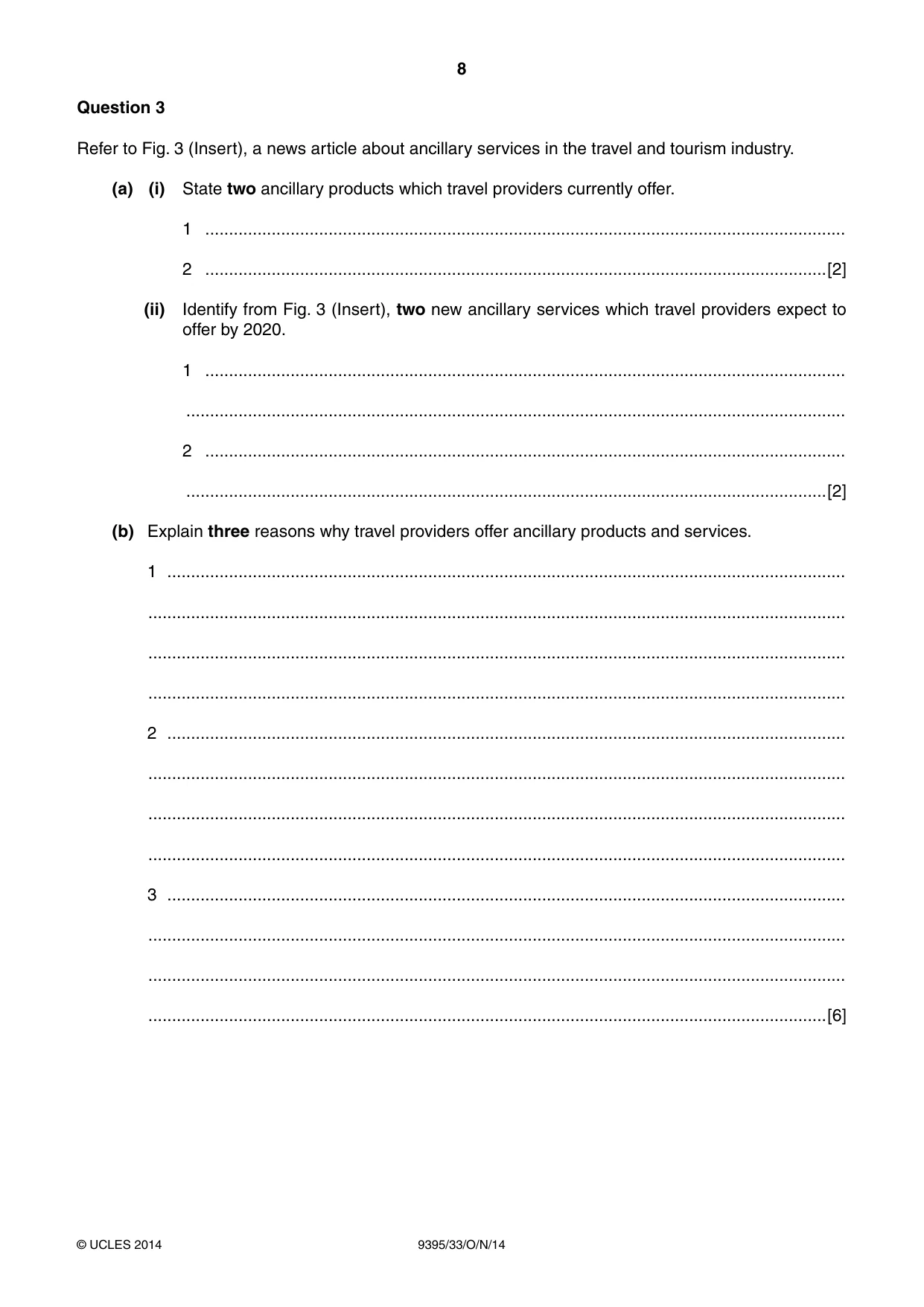
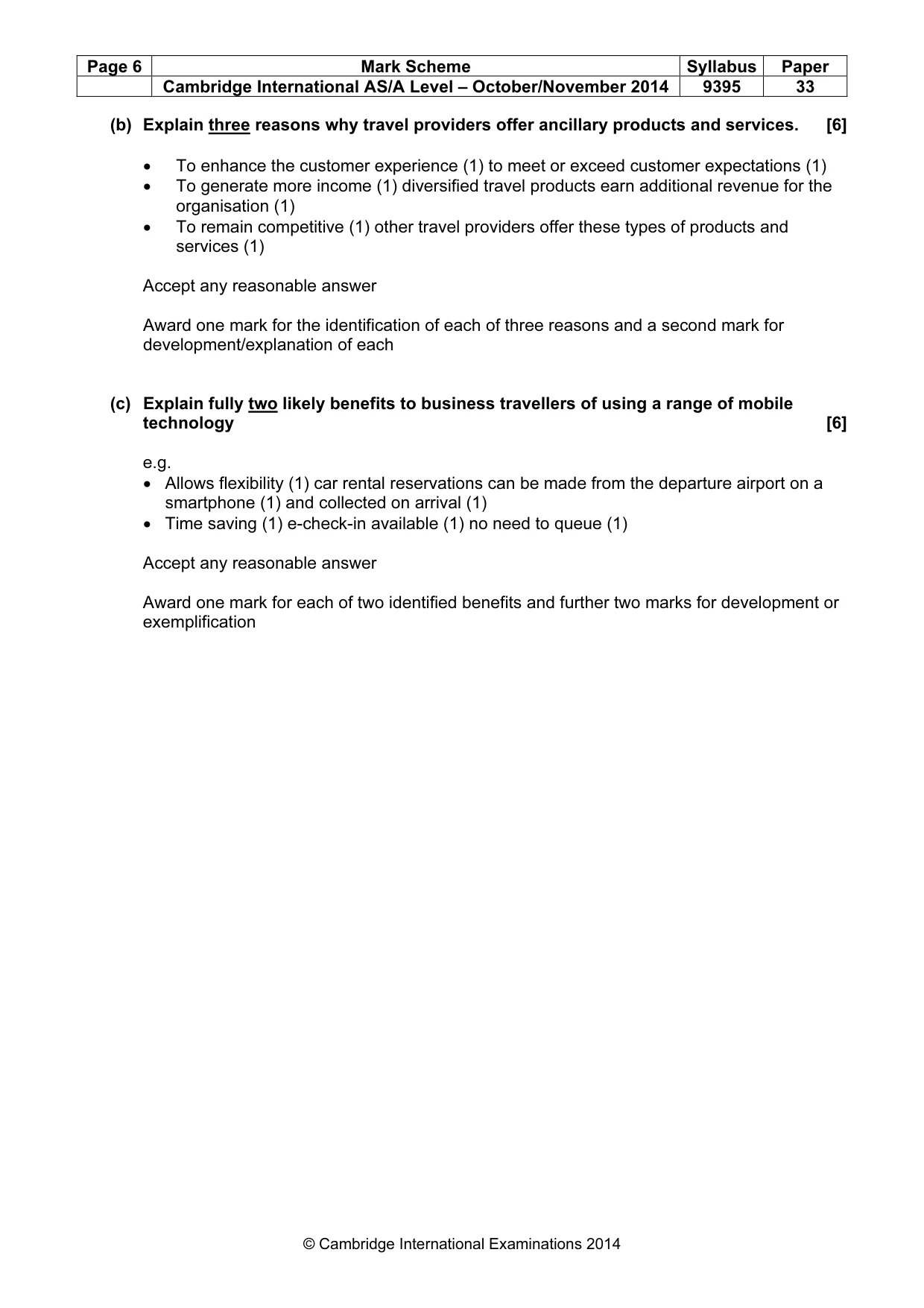
8 9395/33/O/N/14 © UCLES 2014 Question 3 Refer to Fig. 3 (Insert), a news article about ancillary services in the travel and tourism industry. (a) (i) State two ancillary products which travel providers currently offer. 1 … 2 …[2] (ii) Identify from Fig. 3 (Insert), two new ancillary services which travel providers expect to offer by 2020. 1 … … 2 … …[2] (b) Explain three reasons why travel providers offer ancillary products and services. 1 … … … … 2 … … … … 3 … … … …[6]
Question paper, page 9
9 9395/33/O/N/14 © UCLES 2014 [Turn over (c) Explain fully two likely benefits to business travellers of using a range of mobile technology. 1 … … … … … … 2 … … … … … …[6]
Question paper, page 10
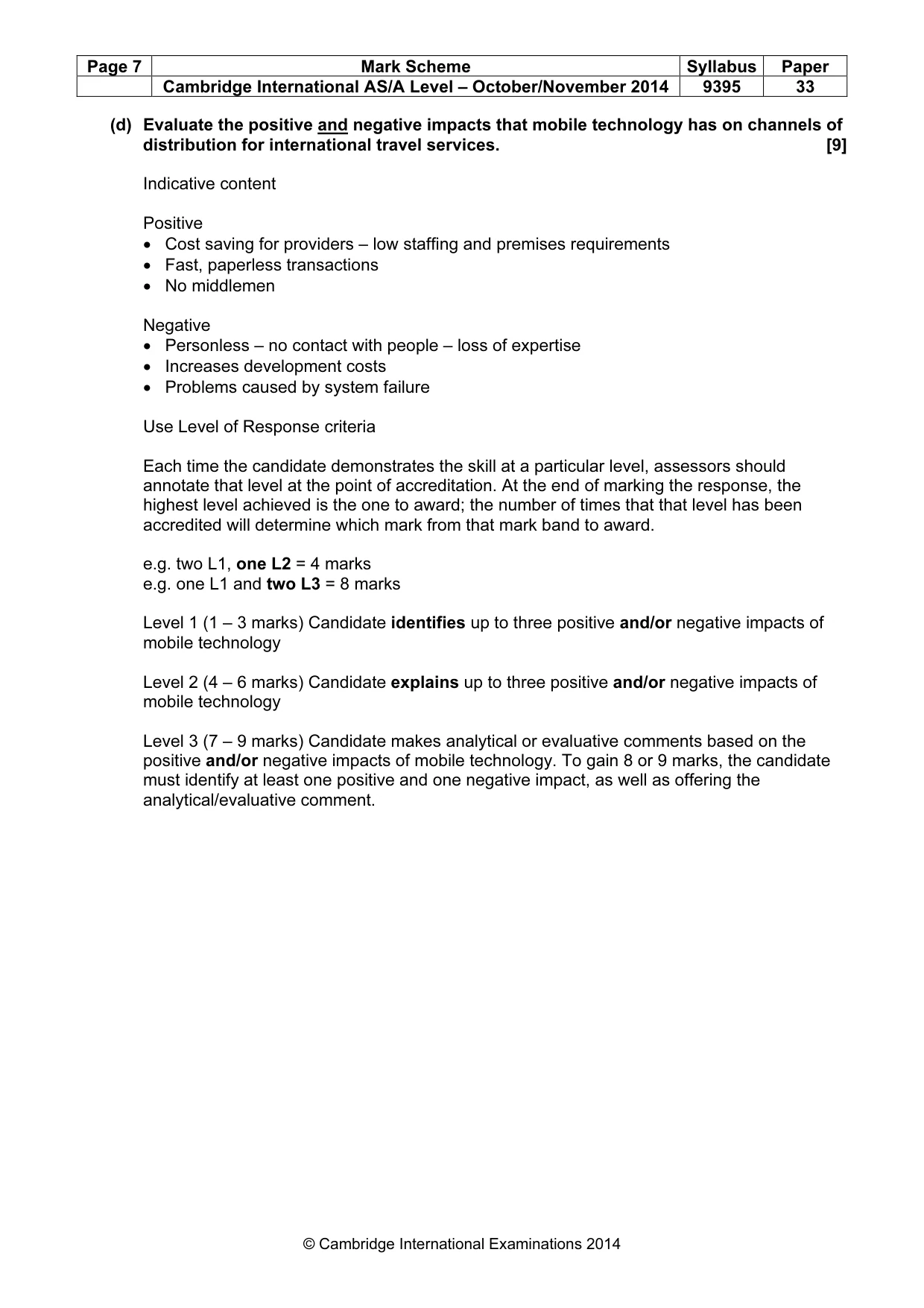
10 9395/33/O/N/14 © UCLES 2014 (d) Evaluate the positive and negative impacts that mobile technology has on channels of distribution for international travel services. … … … … … … … … … … … … … … … … … … … … … … … … … …[9] [Total: 25]
Question paper, page 11
11 9395/33/O/N/14 © UCLES 2014 [Turn over Question 4 Refer to Fig. 4 (Insert), an advertisement for a diving holiday in Dahab, a Red Sea resort in Egypt. (a) (i) Identify from Fig. 4 (Insert), two components of this holiday package. 1 … 2 …[2] (ii) Describe what is meant by the term ‘single supplement’. … … … …[2] (b) Using Fig. 4 (Insert), explain three reasons for the likely appeal of Dahab as a diving destination. 1 … … … … 2 … … … … 3 … … … …[6]
Question paper, page 12
12 9395/33/O/N/14 © UCLES 2014 (c) Explain fully two likely reasons for the popularity of the Bedouin Moon Hotel dive package, other than its location. 1 … … … … … … 2 … … … … … …[6]
Question paper, page 13
13 9395/33/O/N/14 © UCLES 2014 (d) Evaluate the benefits to customers and to tour operators, such as Aqua-Holidays, of offering tailor-made holiday packages. … … … … … … … … … … … … … … … … … … … … … … … … … …[9] [Total: 25]
Question paper, page 14
14 9395/33/O/N/14 © UCLES 2014 BLANK PAGE
Question paper, page 15
15 9395/33/O/N/14 © UCLES 2014 BLANK PAGE
Question paper, page 16
16 9395/33/O/N/14 © UCLES 2014 Permission to reproduce items where third-party owned material protected by copyright is included has been sought and cleared where possible. Every reasonable effort has been made by the publisher (UCLES) to trace copyright holders, but if any items requiring clearance have unwittingly been included, the publisher will be pleased to make amends at the earliest possible opportunity. Cambridge International Examinations is part of the Cambridge Assessment Group. Cambridge Assessment is the brand name of University of Cambridge Local Examinations Syndicate (UCLES), which is itself a department of the University of Cambridge. BLANK PAGE
Mark scheme, page 1
® IGCSE is the registered trademark of Cambridge International Examinations. CAMBRIDGE INTERNATIONAL EXAMINATIONS Cambridge International Advanced Subsidiary and Advanced Level MARK SCHEME for the October/November 2014 series 9395 TRAVEL AND TOURISM 9395/33 Paper 3 (International Business & Leisure Travel Services), maximum raw mark 100 This mark scheme is published as an aid to teachers and candidates, to indicate the requirements of the examination. It shows the basis on which Examiners were instructed to award marks. It does not indicate the details of the discussions that took place at an Examiners’ meeting before marking began, which would have considered the acceptability of alternative answers. Mark schemes should be read in conjunction with the question paper and the Principal Examiner Report for Teachers. Cambridge will not enter into discussions about these mark schemes. Cambridge is publishing the mark schemes for the October/November 2014 series for most Cambridge IGCSE®, Cambridge International A and AS Level components and some Cambridge O Level components.
Mark scheme, page 2
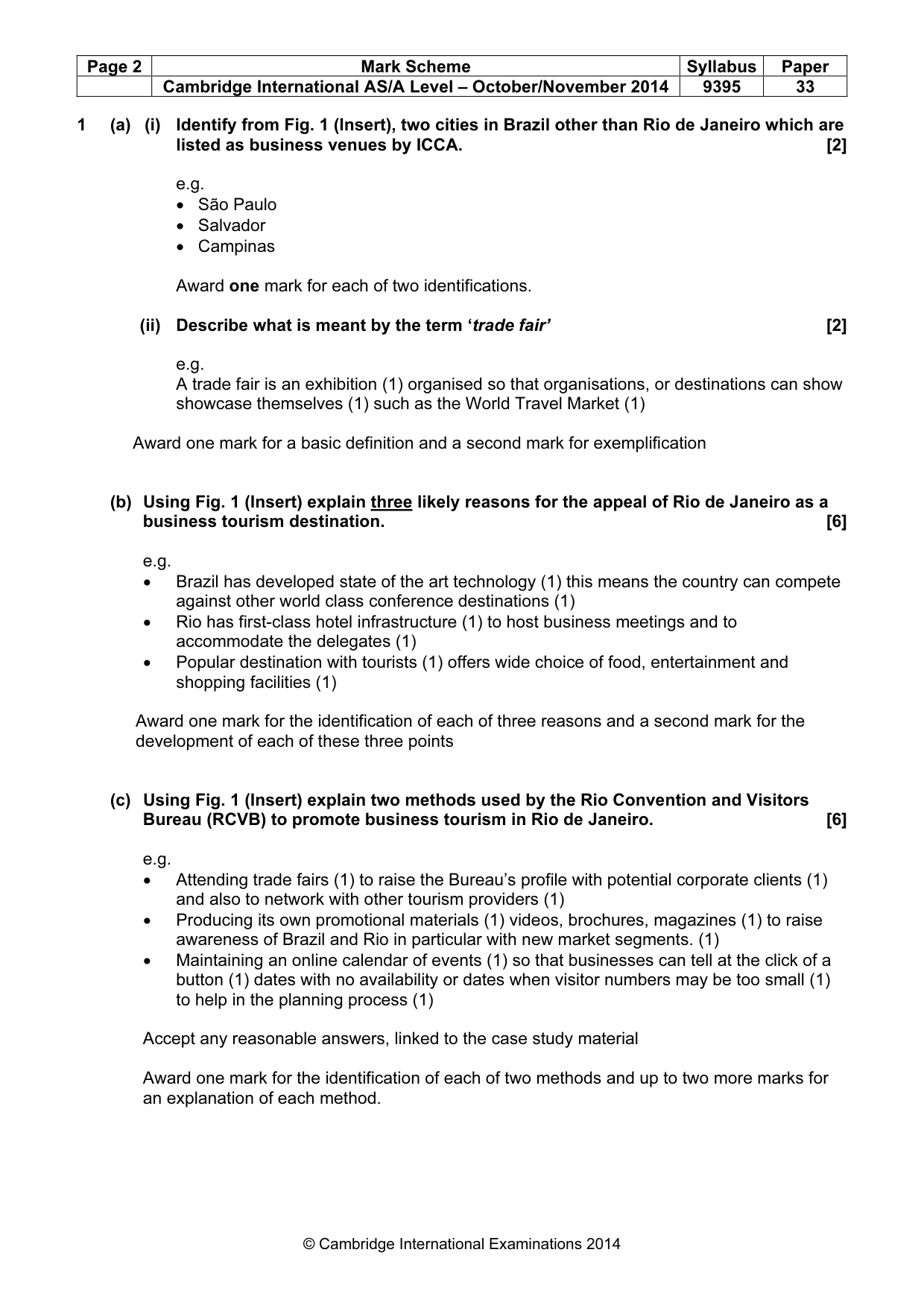
Page 2 Mark Scheme Syllabus Paper Cambridge International AS/A Level – October/November 2014 9395 33 © Cambridge International Examinations 2014 1 (a) (i) Identify from Fig. 1 (Insert), two cities in Brazil other than Rio de Janeiro which are listed as business venues by ICCA. [2] e.g. • São Paulo • Salvador • Campinas Award one mark for each of two identifications. (ii) Describe what is meant by the term ‘trade fair’ [2] e.g. A trade fair is an exhibition (1) organised so that organisations, or destinations can show showcase themselves (1) such as the World Travel Market (1) Award one mark for a basic definition and a second mark for exemplification (b) Using Fig. 1 (Insert) explain three likely reasons for the appeal of Rio de Janeiro as a business tourism destination. [6] e.g. • Brazil has developed state of the art technology (1) this means the country can compete against other world class conference destinations (1) • Rio has first-class hotel infrastructure (1) to host business meetings and to accommodate the delegates (1) • Popular destination with tourists (1) offers wide choice of food, entertainment and shopping facilities (1) Award one mark for the identification of each of three reasons and a second mark for the development of each of these three points (c) Using Fig. 1 (Insert) explain two methods used by the Rio Convention and Visitors Bureau (RCVB) to promote business tourism in Rio de Janeiro. [6] e.g. • Attending trade fairs (1) to raise the Bureau’s profile with potential corporate clients (1) and also to network with other tourism providers (1) • Producing its own promotional materials (1) videos, brochures, magazines (1) to raise awareness of Brazil and Rio in particular with new market segments. (1) • Maintaining an online calendar of events (1) so that businesses can tell at the click of a button (1) dates with no availability or dates when visitor numbers may be too small (1) to help in the planning process (1) Accept any reasonable answers, linked to the case study material Award one mark for the identification of each of two methods and up to two more marks for an explanation of each method.
Mark scheme, page 3
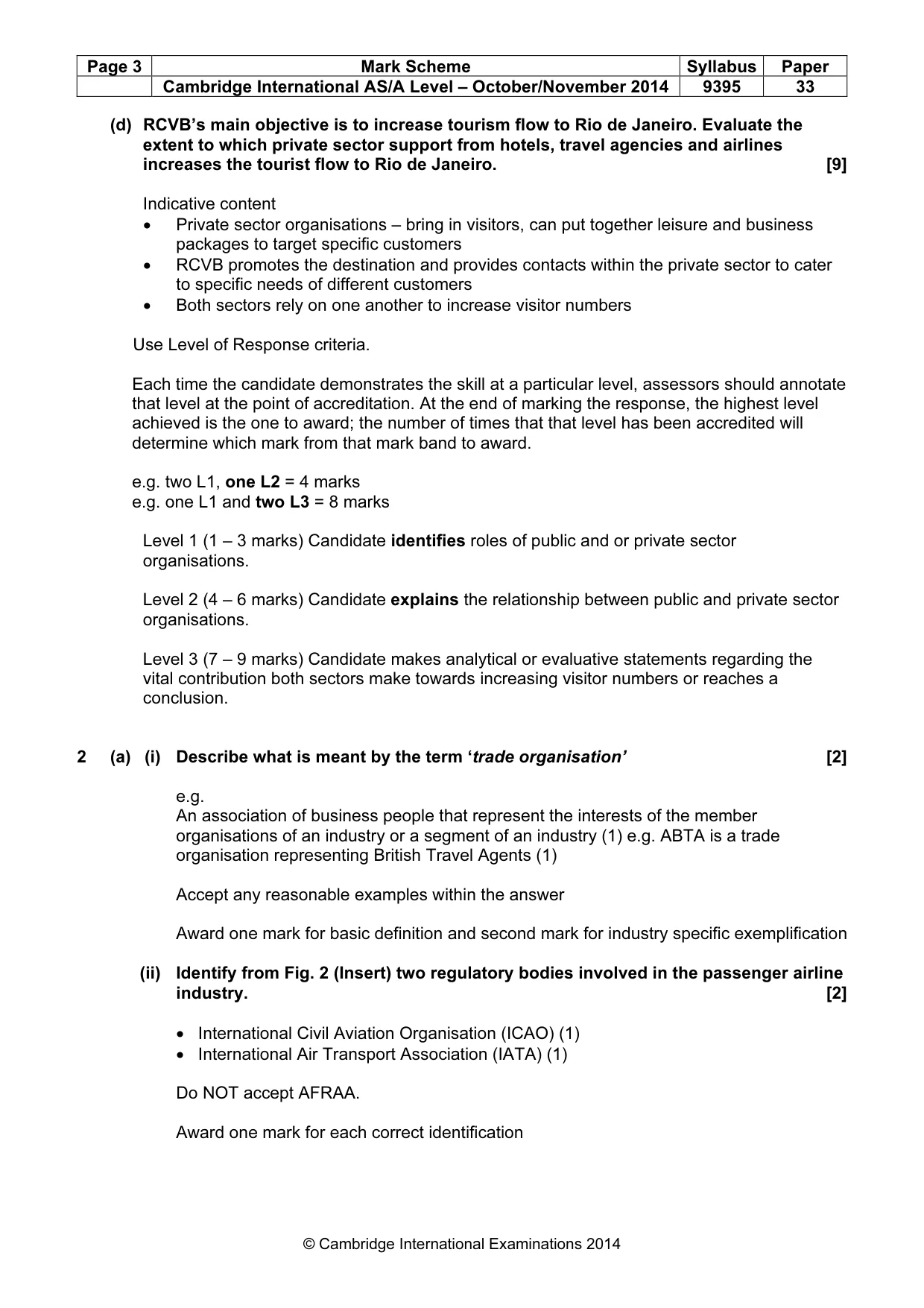
Page 3 Mark Scheme Syllabus Paper Cambridge International AS/A Level – October/November 2014 9395 33 © Cambridge International Examinations 2014 (d) RCVB’s main objective is to increase tourism flow to Rio de Janeiro. Evaluate the extent to which private sector support from hotels, travel agencies and airlines increases the tourist flow to Rio de Janeiro. [9] Indicative content • Private sector organisations – bring in visitors, can put together leisure and business packages to target specific customers • RCVB promotes the destination and provides contacts within the private sector to cater to specific needs of different customers • Both sectors rely on one another to increase visitor numbers Use Level of Response criteria. Each time the candidate demonstrates the skill at a particular level, assessors should annotate that level at the point of accreditation. At the end of marking the response, the highest level achieved is the one to award; the number of times that that level has been accredited will determine which mark from that mark band to award. e.g. two L1, one L2 = 4 marks e.g. one L1 and two L3 = 8 marks Level 1 (1 – 3 marks) Candidate identifies roles of public and or private sector organisations. Level 2 (4 – 6 marks) Candidate explains the relationship between public and private sector organisations. Level 3 (7 – 9 marks) Candidate makes analytical or evaluative statements regarding the vital contribution both sectors make towards increasing visitor numbers or reaches a conclusion. 2 (a) (i) Describe what is meant by the term ‘trade organisation’ [2] e.g. An association of business people that represent the interests of the member organisations of an industry or a segment of an industry (1) e.g. ABTA is a trade organisation representing British Travel Agents (1) Accept any reasonable examples within the answer Award one mark for basic definition and second mark for industry specific exemplification (ii) Identify from Fig. 2 (Insert) two regulatory bodies involved in the passenger airline industry. [2] • International Civil Aviation Organisation (ICAO) (1) • International Air Transport Association (IATA) (1) Do NOT accept AFRAA. Award one mark for each correct identification
Mark scheme, page 4
Page 4 Mark Scheme Syllabus Paper Cambridge International AS/A Level – October/November 2014 9395 33 © Cambridge International Examinations 2014 (b) Other than establishing an industry code of practice, explain three objectives of the African Airlines Association (AFRAA) using Fig. 2 (Insert). [6] • To encourage collaborative working (joint projects) between airlines (1) to increase incomes for all parties (1) • To promote a positive image of African airlines worldwide (1) to increase awareness amongst potential customers and to increase passenger numbers (1) • To develop environmental policies (1) to ensure that African airlines minimise the negative impacts of airline travel on the environment (1) Accept any reasonable answer Award one mark for the identification of each of three objectives and a second mark for development/explanation of each (c) Explain fully two likely benefits to airlines of having an industry code of practice. [6] e.g. • A code of practice brings unity and conformity to all members of the association (1) helps bring a consistency of approach (1) if staff move to a different airline, the approach to all tasks will be the same (1) • sets standards to which all airline personnel must adhere (1) internal and external customers know what to expect (1) makes dealing with complaints much easier as have set of standards against which to measure outcomes (1) Do NOT award credit for answers that focus only on the benefits to customers. Award one mark for the identification of each of two benefits and up to two more marks for an explanation of each benefit
Mark scheme, page 5
Page 5 Mark Scheme Syllabus Paper Cambridge International AS/A Level – October/November 2014 9395 33 © Cambridge International Examinations 2014 (d) Evaluate the likely benefits to South African Airways and to business travel organisers of the Onbiz service. [9] Indicative Content: Benefits to SAA • Competitive advantage • Enhances the image of the organisation • Customer loyalty Benefits to business travel organisers • Custom made packages to meet individual needs • Flexibility • High quality products and services – promise of the best SAA offers Use Level of Response criteria Each time the candidate demonstrates the skill at a particular level, assessors should annotate that level at the point of accreditation. At the end of marking the response, the highest level achieved is the one to award; the number of times that that level has been accredited will determine which mark from that mark band to award. e.g. two L1, one L2 = 4 marks e.g. one L1 and two L3 = 8 marks Level 1 (1 – 3 marks) Candidate identifies up to three benefits to SAA and/or customers Level 2 (4 – 6 marks) Candidate explains up to three benefits to SAA and/or customers Level 3 (7 – 9 marks) Candidate makes up to three analytical or evaluative comments about the benefits to SAA and/or the customers 3 (a) (i) State two ancillary products which travel providers currently offer. [2] • Travel insurance (1) • Car rental (1) • Hotel bookings (1) Other ancillary products not mentioned in the case study may be accepted Award one mark for the identification of each of two ancillary products (ii) Identify from Fig. 3 (Insert) two new ancillary services which travel providers expect to offer by 2020. [2] e.g. • Virtual reality services at airports, hotels and cruise ships prior to arrival (1) • Digital concierge services (1) • In-journey spa treatments (1) Award one mark for each identified ancillary service up to a maximum of two
Mark scheme, page 6
Page 6 Mark Scheme Syllabus Paper Cambridge International AS/A Level – October/November 2014 9395 33 © Cambridge International Examinations 2014 (b) Explain three reasons why travel providers offer ancillary products and services. [6] • To enhance the customer experience (1) to meet or exceed customer expectations (1) • To generate more income (1) diversified travel products earn additional revenue for the organisation (1) • To remain competitive (1) other travel providers offer these types of products and services (1) Accept any reasonable answer Award one mark for the identification of each of three reasons and a second mark for development/explanation of each (c) Explain fully two likely benefits to business travellers of using a range of mobile technology [6] e.g. • Allows flexibility (1) car rental reservations can be made from the departure airport on a smartphone (1) and collected on arrival (1) • Time saving (1) e-check-in available (1) no need to queue (1) Accept any reasonable answer Award one mark for each of two identified benefits and further two marks for development or exemplification
Mark scheme, page 7
Page 7 Mark Scheme Syllabus Paper Cambridge International AS/A Level – October/November 2014 9395 33 © Cambridge International Examinations 2014 (d) Evaluate the positive and negative impacts that mobile technology has on channels of distribution for international travel services. [9] Indicative content Positive • Cost saving for providers – low staffing and premises requirements • Fast, paperless transactions • No middlemen Negative • Personless – no contact with people – loss of expertise • Increases development costs • Problems caused by system failure Use Level of Response criteria Each time the candidate demonstrates the skill at a particular level, assessors should annotate that level at the point of accreditation. At the end of marking the response, the highest level achieved is the one to award; the number of times that that level has been accredited will determine which mark from that mark band to award. e.g. two L1, one L2 = 4 marks e.g. one L1 and two L3 = 8 marks Level 1 (1 – 3 marks) Candidate identifies up to three positive and/or negative impacts of mobile technology Level 2 (4 – 6 marks) Candidate explains up to three positive and/or negative impacts of mobile technology Level 3 (7 – 9 marks) Candidate makes analytical or evaluative comments based on the positive and/or negative impacts of mobile technology. To gain 8 or 9 marks, the candidate must identify at least one positive and one negative impact, as well as offering the analytical/evaluative comment.
Mark scheme, page 8
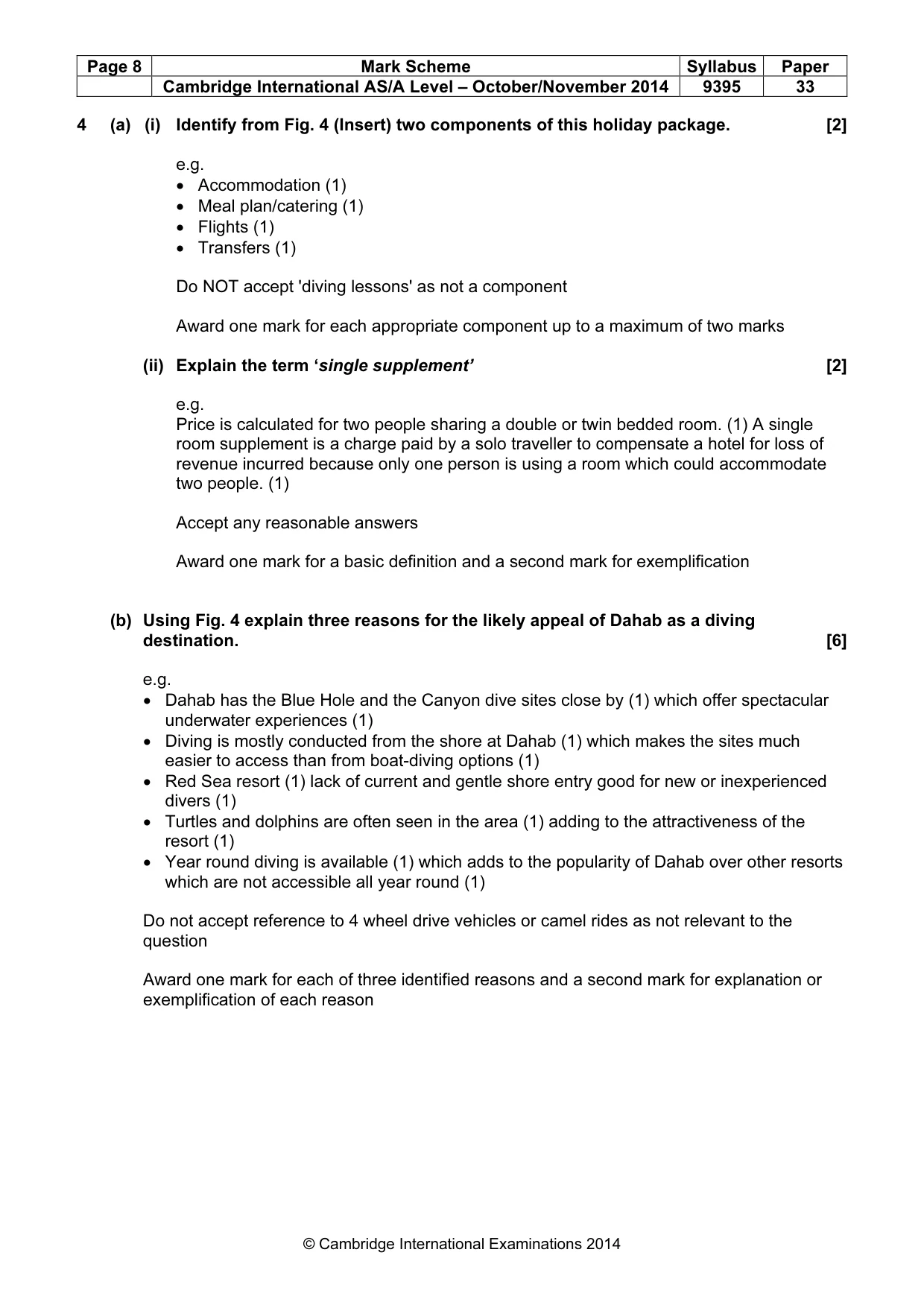
Page 8 Mark Scheme Syllabus Paper Cambridge International AS/A Level – October/November 2014 9395 33 © Cambridge International Examinations 2014 4 (a) (i) Identify from Fig. 4 (Insert) two components of this holiday package. [2] e.g. • Accommodation (1) • Meal plan/catering (1) • Flights (1) • Transfers (1) Do NOT accept 'diving lessons' as not a component Award one mark for each appropriate component up to a maximum of two marks (ii) Explain the term ‘single supplement’ [2] e.g. Price is calculated for two people sharing a double or twin bedded room. (1) A single room supplement is a charge paid by a solo traveller to compensate a hotel for loss of revenue incurred because only one person is using a room which could accommodate two people. (1) Accept any reasonable answers Award one mark for a basic definition and a second mark for exemplification (b) Using Fig. 4 explain three reasons for the likely appeal of Dahab as a diving destination. [6] e.g. • Dahab has the Blue Hole and the Canyon dive sites close by (1) which offer spectacular underwater experiences (1) • Diving is mostly conducted from the shore at Dahab (1) which makes the sites much easier to access than from boat-diving options (1) • Red Sea resort (1) lack of current and gentle shore entry good for new or inexperienced divers (1) • Turtles and dolphins are often seen in the area (1) adding to the attractiveness of the resort (1) • Year round diving is available (1) which adds to the popularity of Dahab over other resorts which are not accessible all year round (1) Do not accept reference to 4 wheel drive vehicles or camel rides as not relevant to the question Award one mark for each of three identified reasons and a second mark for explanation or exemplification of each reason
Mark scheme, page 9
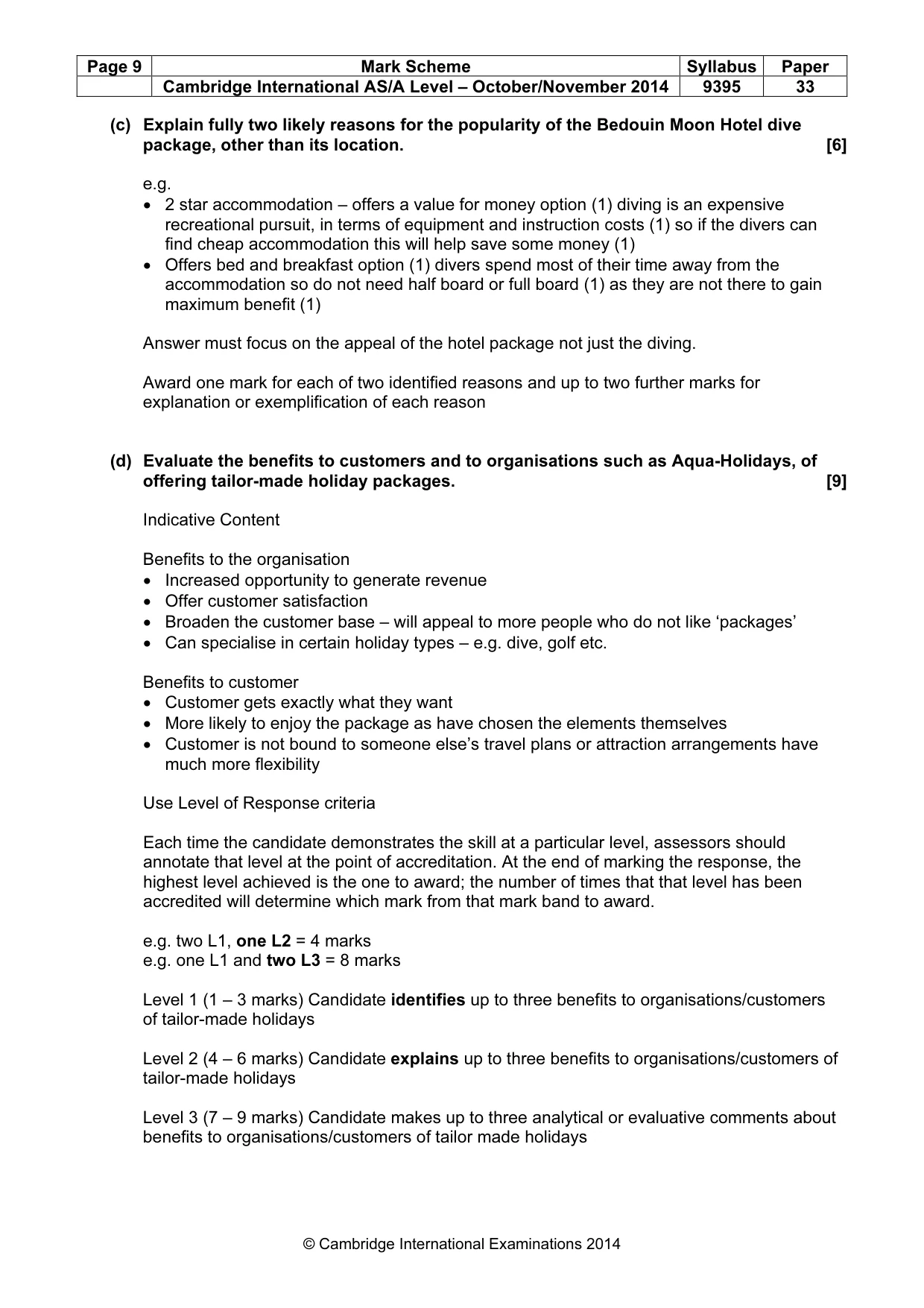
Page 9 Mark Scheme Syllabus Paper Cambridge International AS/A Level – October/November 2014 9395 33 © Cambridge International Examinations 2014 (c) Explain fully two likely reasons for the popularity of the Bedouin Moon Hotel dive package, other than its location. [6] e.g. • 2 star accommodation – offers a value for money option (1) diving is an expensive recreational pursuit, in terms of equipment and instruction costs (1) so if the divers can find cheap accommodation this will help save some money (1) • Offers bed and breakfast option (1) divers spend most of their time away from the accommodation so do not need half board or full board (1) as they are not there to gain maximum benefit (1) Answer must focus on the appeal of the hotel package not just the diving. Award one mark for each of two identified reasons and up to two further marks for explanation or exemplification of each reason (d) Evaluate the benefits to customers and to organisations such as Aqua-Holidays, of offering tailor-made holiday packages. [9] Indicative Content Benefits to the organisation • Increased opportunity to generate revenue • Offer customer satisfaction • Broaden the customer base – will appeal to more people who do not like ‘packages’ • Can specialise in certain holiday types – e.g. dive, golf etc. Benefits to customer • Customer gets exactly what they want • More likely to enjoy the package as have chosen the elements themselves • Customer is not bound to someone else’s travel plans or attraction arrangements have much more flexibility Use Level of Response criteria Each time the candidate demonstrates the skill at a particular level, assessors should annotate that level at the point of accreditation. At the end of marking the response, the highest level achieved is the one to award; the number of times that that level has been accredited will determine which mark from that mark band to award. e.g. two L1, one L2 = 4 marks e.g. one L1 and two L3 = 8 marks Level 1 (1 – 3 marks) Candidate identifies up to three benefits to organisations/customers of tailor-made holidays Level 2 (4 – 6 marks) Candidate explains up to three benefits to organisations/customers of tailor-made holidays Level 3 (7 – 9 marks) Candidate makes up to three analytical or evaluative comments about benefits to organisations/customers of tailor made holidays
What you needed in this session
Cambridge’s own grade thresholds for 2014 Oct/Nov, Paper 3 · Variant 3. A higher threshold means an easier paper — the bar moves with how the cohort did.