Cambridge A Level Travel and Tourism 9395 — 2024 May/June Paper 3 · Variant 2
9395/32/M/J/24 · 50 marks · 90 min
The question paper and its mark scheme, free to read here and free to download. This is Cambridge’s own paper, exactly as it was sat.
Question paper12 pages








Mark scheme19 pages
Answers below. Sit the paper first if you are practising.

Paper as text
Question paper, page 1
This document has 12 pages. Any blank pages are indicated. [Turn over Cambridge International AS & A Level * 1 1 4 7 2 7 3 8 6 6 * DC (DE) 333436/1 © UCLES 2024 TRAVEL & TOURISM 9395/32 Paper 3 Destination Marketing May/June 2024 1 hour 30 minutes You must answer on the question paper. You will need: Insert (enclosed) INSTRUCTIONS ● Answer all questions. ● Use a black or dark blue pen. ● Write your name, centre number and candidate number in the boxes at the top of the page. ● Write your answer to each question in the space provided. ● Do not use an erasable pen or correction fluid. ● Do not write on any bar codes. INFORMATION ● The total mark for this paper is 50. ● The number of marks for each question or part question is shown in brackets [ ]. ● The insert contains all the figures referred to in the questions.
Question paper, page 2
2 9395/32/M/J/24 © UCLES 2024 1 Refer to Fig. 1.1 (Insert), information about the VisitMorocco brand. (a) Explain two ways product positioning can be used to create a positive visitor perception for the VisitMorocco brand. 1 … … … … 2 … … … … [4] (b) Discuss the likely reasons why the ONMT wanted to rebrand Morocco. … … … … … … … … … … … … … … … …
Question paper, page 3
3 9395/32/M/J/24 © UCLES 2024 [Turn over … … … … … … … … … … … … … … … … … … … … … … … … … … … … [9]
Question paper, page 4
4 9395/32/M/J/24 © UCLES 2024 (c) Evaluate the factors a National Tourism Organisation (NTO) will consider before selecting communication methods for its destination marketing. … … … … … … … … … … … … … … … … … … … … … … … … … … …
Question paper, page 5
5 9395/32/M/J/24 © UCLES 2024 [Turn over … … … … … … … … … … … … … … … … … … … … … … … … … … … [12] [Total: 25]
Question paper, page 6
6 9395/32/M/J/24 © UCLES 2024 2 Refer to Fig. 2.1 (Insert), information about Destination Toronto and the ‘Pass TO Savings’ app. (a) Explain two ways Destination Toronto provides a consistent representation of Toronto by all stakeholders. 1 … … … … 2 … … … … [4] (b) Analyse which methods Destination Toronto might find most useful to monitor the effectiveness of its destination brand. … … … … … … … … … … … … … … … …
Question paper, page 7
7 9395/32/M/J/24 © UCLES 2024 [Turn over … … … … … … … … … … … … … … … … … … … … … … … … … … … … [9]
Question paper, page 8
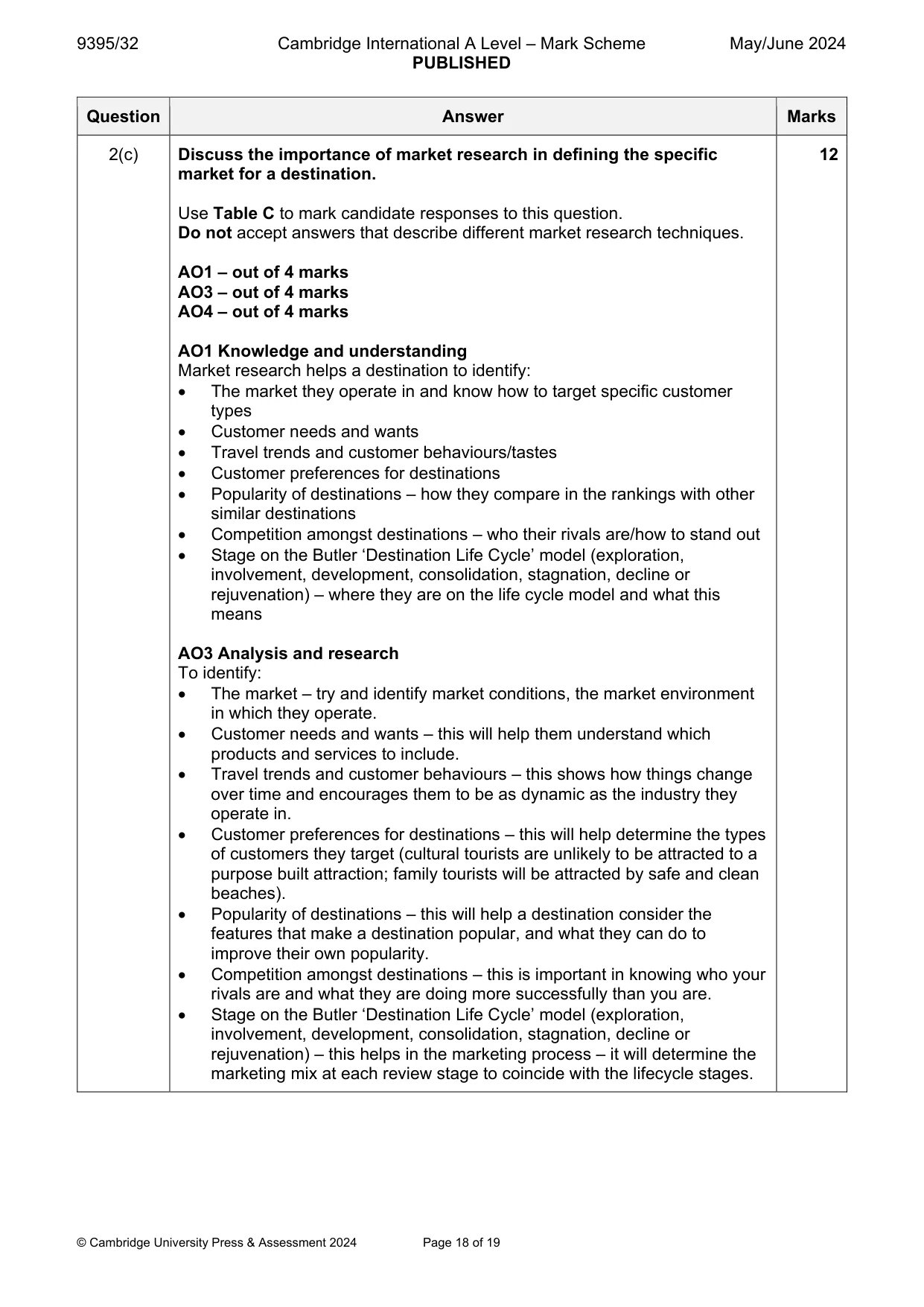
8 9395/32/M/J/24 © UCLES 2024 (c) Discuss the importance of market research in defining the specific market for a destination. … … … … … … … … … … … … … … … … … … … … … … … … … … …
Question paper, page 9
9 9395/32/M/J/24 © UCLES 2024 … … … … … … … … … … … … … … … … … … … … … … … … … … … [12] [Total: 25]
Question paper, page 10
10 9395/32/M/J/24 © UCLES 2024 BLANK PAGE
Question paper, page 11
11 9395/32/M/J/24 © UCLES 2024 BLANK PAGE
Question paper, page 12
12 9395/32/M/J/24 © UCLES 2024 The boundaries and names shown, the designations used and the presentation of material on any maps contained in this question paper/insert do not imply official endorsement or acceptance by Cambridge Assessment International Education concerning the legal status of any country, territory, or area or any of its authorities, or of the delimitation of its frontiers or boundaries. Permission to reproduce items where third-party owned material protected by copyright is included has been sought and cleared where possible. Every reasonable effort has been made by the publisher (UCLES) to trace copyright holders, but if any items requiring clearance have unwittingly been included, the publisher will be pleased to make amends at the earliest possible opportunity. To avoid the issue of disclosure of answer-related information to candidates, all copyright acknowledgements are reproduced online in the Cambridge Assessment International Education Copyright Acknowledgements Booklet. This is produced for each series of examinations and is freely available to download at www.cambridgeinternational.org after the live examination series. Cambridge Assessment International Education is part of Cambridge Assessment. Cambridge Assessment is the brand name of the University of Cambridge Local Examinations Syndicate (UCLES), which is a department of the University of Cambridge. BLANK PAGE
Mark scheme, page 1
This document consists of 19 printed pages. © Cambridge University Press & Assessment 2024 [Turn over Cambridge International A Level TRAVEL & TOURISM 9395/32 Paper 3 Destination Marketing May/June 2024 MARK SCHEME Maximum Mark: 50 Published This mark scheme is published as an aid to teachers and candidates, to indicate the requirements of the examination. It shows the basis on which Examiners were instructed to award marks. It does not indicate the details of the discussions that took place at an Examiners’ meeting before marking began, which would have considered the acceptability of alternative answers. Mark schemes should be read in conjunction with the question paper and the Principal Examiner Report for Teachers. Cambridge International will not enter into discussions about these mark schemes. Cambridge International is publishing the mark schemes for the May/June 2024 series for most Cambridge IGCSE, Cambridge International A and AS Level and Cambridge Pre-U components, and some Cambridge O Level components.
Mark scheme, page 2
9395/32 Cambridge International A Level – Mark Scheme PUBLISHED May/June 2024 © Cambridge University Press & Assessment 2024 Page 2 of 19 Generic Marking Principles These general marking principles must be applied by all examiners when marking candidate answers. They should be applied alongside the specific content of the mark scheme or generic level descriptions for a question. Each question paper and mark scheme will also comply with these marking principles. GENERIC MARKING PRINCIPLE 1: Marks must be awarded in line with: the specific content of the mark scheme or the generic level descriptors for the question the specific skills defined in the mark scheme or in the generic level descriptors for the question the standard of response required by a candidate as exemplified by the standardisation scripts. GENERIC MARKING PRINCIPLE 2: Marks awarded are always whole marks (not half marks, or other fractions). GENERIC MARKING PRINCIPLE 3: Marks must be awarded positively: marks are awarded for correct/valid answers, as defined in the mark scheme. However, credit is given for valid answers which go beyond the scope of the syllabus and mark scheme, referring to your Team Leader as appropriate marks are awarded when candidates clearly demonstrate what they know and can do marks are not deducted for errors marks are not deducted for omissions answers should only be judged on the quality of spelling, punctuation and grammar when these features are specifically assessed by the question as indicated by the mark scheme. The meaning, however, should be unambiguous. GENERIC MARKING PRINCIPLE 4: Rules must be applied consistently, e.g. in situations where candidates have not followed instructions or in the application of generic level descriptors. GENERIC MARKING PRINCIPLE 5: Marks should be awarded using the full range of marks defined in the mark scheme for the question (however; the use of the full mark range may be limited according to the quality of the candidate responses seen). GENERIC MARKING PRINCIPLE 6: Marks awarded are based solely on the requirements as defined in the mark scheme. Marks should not be awarded with grade thresholds or grade descriptors in mind.
Mark scheme, page 3
9395/32 Cambridge International A Level – Mark Scheme PUBLISHED May/June 2024 © Cambridge University Press & Assessment 2024 Page 3 of 19 Social Science-Specific Marking Principles (for point-based marking) 1 Components using point-based marking: Point marking is often used to reward knowledge, understanding and application of skills. We give credit where the candidate’s answer shows relevant knowledge, understanding and application of skills in answering the question. We do not give credit where the answer shows confusion. From this it follows that we: a DO credit answers which are worded differently from the mark scheme if they clearly convey the same meaning (unless the mark scheme requires a specific term) b DO credit alternative answers/examples which are not written in the mark scheme if they are correct c DO credit answers where candidates give more than one correct answer in one prompt/numbered/scaffolded space where extended writing is required rather than list-type answers. For example, questions that require n reasons (e.g. State two reasons …) d DO NOT credit answers simply for using a ‘key term’ unless that is all that is required. (Check for evidence it is understood and not used wrongly.) e DO NOT credit answers which are obviously self-contradicting or trying to cover all possibilities f DO NOT give further credit for what is effectively repetition of a correct point already credited unless the language itself is being tested. This applies equally to ‘mirror statements’ (i.e. polluted/not polluted). g DO NOT require spellings to be correct, unless this is part of the test. However spellings of syllabus terms must allow for clear and unambiguous separation from other syllabus terms with which they may be confused (e.g. Corrasion/Corrosion). 2 Presentation of mark scheme: Slashes (/) or the word ‘or’ separate alternative ways of making the same point Semi colons (;) bullet points (•) or figures in brackets (1) separate different points Content in the answer column in brackets is for examiner information/context to clarify the marking but is not required to earn the mark (except Accounting syllabuses where they indicate negative numbers). 3 Calculation questions: The mark scheme will show the steps in the most likely correct method(s), the mark for each step, the correct answer(s) and the mark for each answer If working/explanation is considered essential for full credit, this will be indicated in the question paper and in the mark scheme. In all other instances, the correct answer to a calculation should be given full credit, even if no supporting working is shown Where the candidate uses a valid method which is not covered by the mark scheme, award equivalent marks for reaching equivalent stages Where an answer makes use of a candidate’s own incorrect figure from previous working, the ‘own figure rule’ applies: full marks will be given if a correct and complete method is used. Further guidance will be included in the mark scheme where necessary and any exceptions to this general principle will be noted.
Mark scheme, page 4
9395/32 Cambridge International A Level – Mark Scheme PUBLISHED May/June 2024 © Cambridge University Press & Assessment 2024 Page 4 of 19 4 Annotation: For point marking, ticks can be used to indicate correct answers and crosses can be used to indicate wrong answers. There is no direct relationship between ticks and marks. Ticks have no defined meaning for levels of response marking For levels of response marking, the level awarded should be annotated on the script Other annotations will be used by examiners as agreed during standardisation, and the meaning will be understood by all examiners who marked that paper.
Mark scheme, page 5
9395/32 Cambridge International A Level – Mark Scheme PUBLISHED May/June 2024 © Cambridge University Press & Assessment 2024 Page 5 of 19 Assessment objectives AO1 Knowledge and understanding Demonstrate knowledge and understanding of facts, terms and concepts of travel and tourism. AO2 Application Apply knowledge and understanding of facts, terms and concepts to familiar and unfamiliar contexts in travel and tourism. AO3 Analysis Analyse travel and tourism issues, showing an understanding of the possible impacts of those issues on travel and tourism, and use appropriate research techniques. AO4 Evaluation Evaluate information to develop arguments, understand implications, draw inferences and make judgements, recommendations and decisions. Tables A–D will be used for specific questions. Please refer to the question for which tables should be used when appropriate.
Mark scheme, page 6
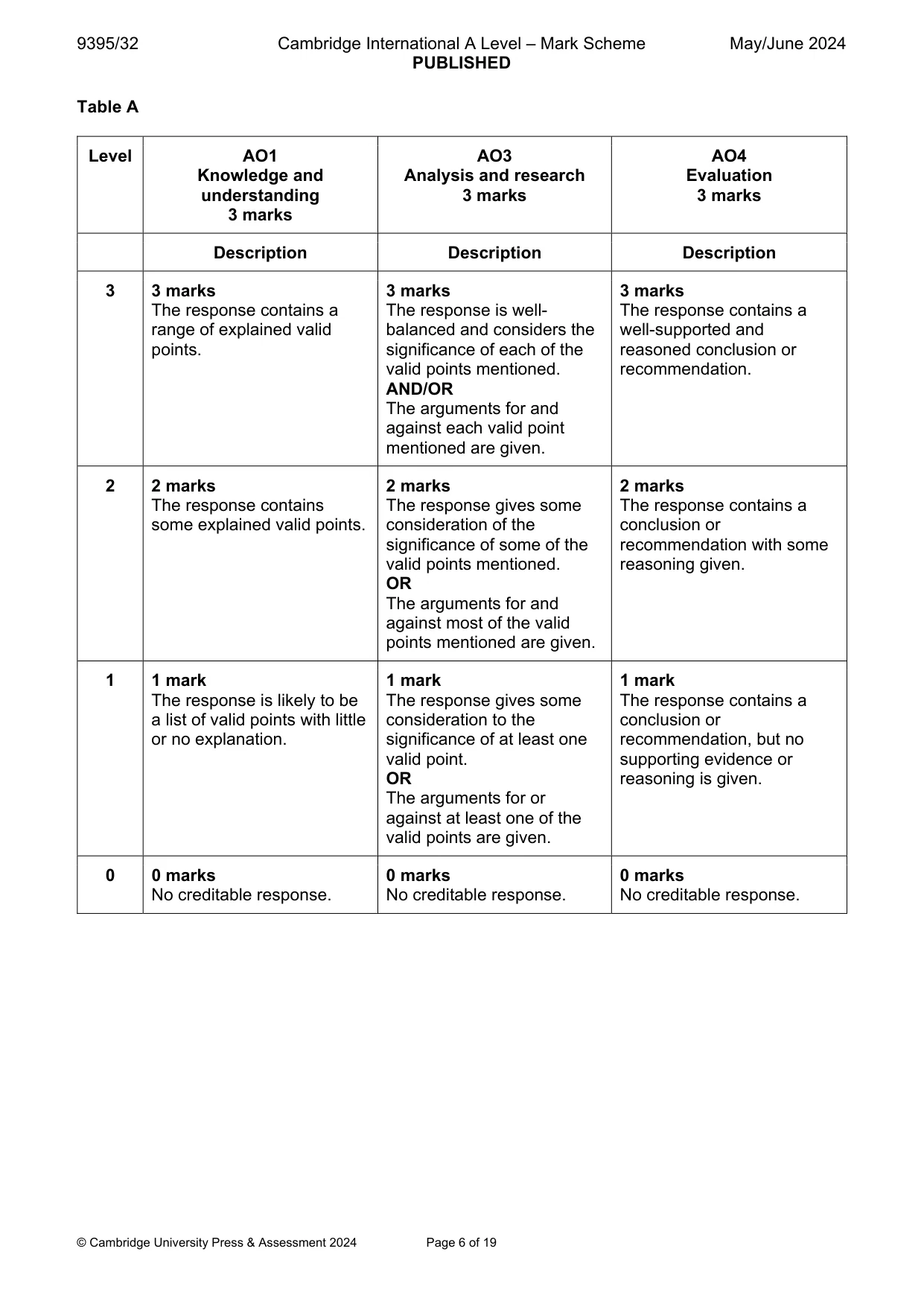
9395/32 Cambridge International A Level – Mark Scheme PUBLISHED May/June 2024 © Cambridge University Press & Assessment 2024 Page 6 of 19 Table A Level AO1 Knowledge and understanding 3 marks AO3 Analysis and research 3 marks AO4 Evaluation 3 marks Description Description Description 3 3 marks The response contains a range of explained valid points. 3 marks The response is well- balanced and considers the significance of each of the valid points mentioned. AND/OR The arguments for and against each valid point mentioned are given. 3 marks The response contains a well-supported and reasoned conclusion or recommendation. 2 2 marks The response contains some explained valid points. 2 marks The response gives some consideration of the significance of some of the valid points mentioned. OR The arguments for and against most of the valid points mentioned are given. 2 marks The response contains a conclusion or recommendation with some reasoning given. 1 1 mark The response is likely to be a list of valid points with little or no explanation. 1 mark The response gives some consideration to the significance of at least one valid point. OR The arguments for or against at least one of the valid points are given. 1 mark The response contains a conclusion or recommendation, but no supporting evidence or reasoning is given. 0 0 marks No creditable response. 0 marks No creditable response. 0 marks No creditable response.
Mark scheme, page 7
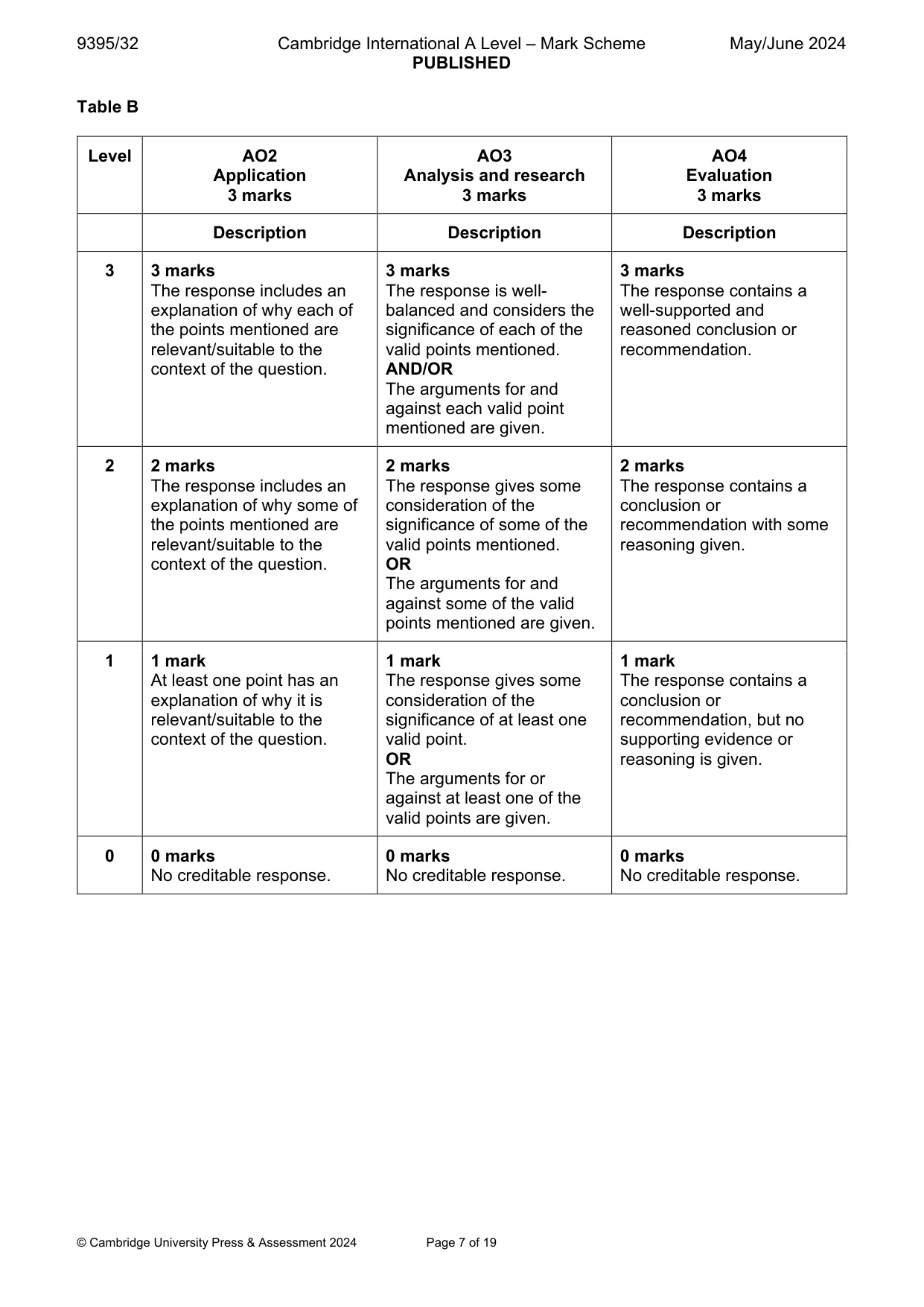
9395/32 Cambridge International A Level – Mark Scheme PUBLISHED May/June 2024 © Cambridge University Press & Assessment 2024 Page 7 of 19 Table B Level AO2 Application 3 marks AO3 Analysis and research 3 marks AO4 Evaluation 3 marks Description Description Description 3 3 marks The response includes an explanation of why each of the points mentioned are relevant/suitable to the context of the question. 3 marks The response is well- balanced and considers the significance of each of the valid points mentioned. AND/OR The arguments for and against each valid point mentioned are given. 3 marks The response contains a well-supported and reasoned conclusion or recommendation. 2 2 marks The response includes an explanation of why some of the points mentioned are relevant/suitable to the context of the question. 2 marks The response gives some consideration of the significance of some of the valid points mentioned. OR The arguments for and against some of the valid points mentioned are given. 2 marks The response contains a conclusion or recommendation with some reasoning given. 1 1 mark At least one point has an explanation of why it is relevant/suitable to the context of the question. 1 mark The response gives some consideration of the significance of at least one valid point. OR The arguments for or against at least one of the valid points are given. 1 mark The response contains a conclusion or recommendation, but no supporting evidence or reasoning is given. 0 0 marks No creditable response. 0 marks No creditable response. 0 marks No creditable response.
Mark scheme, page 8
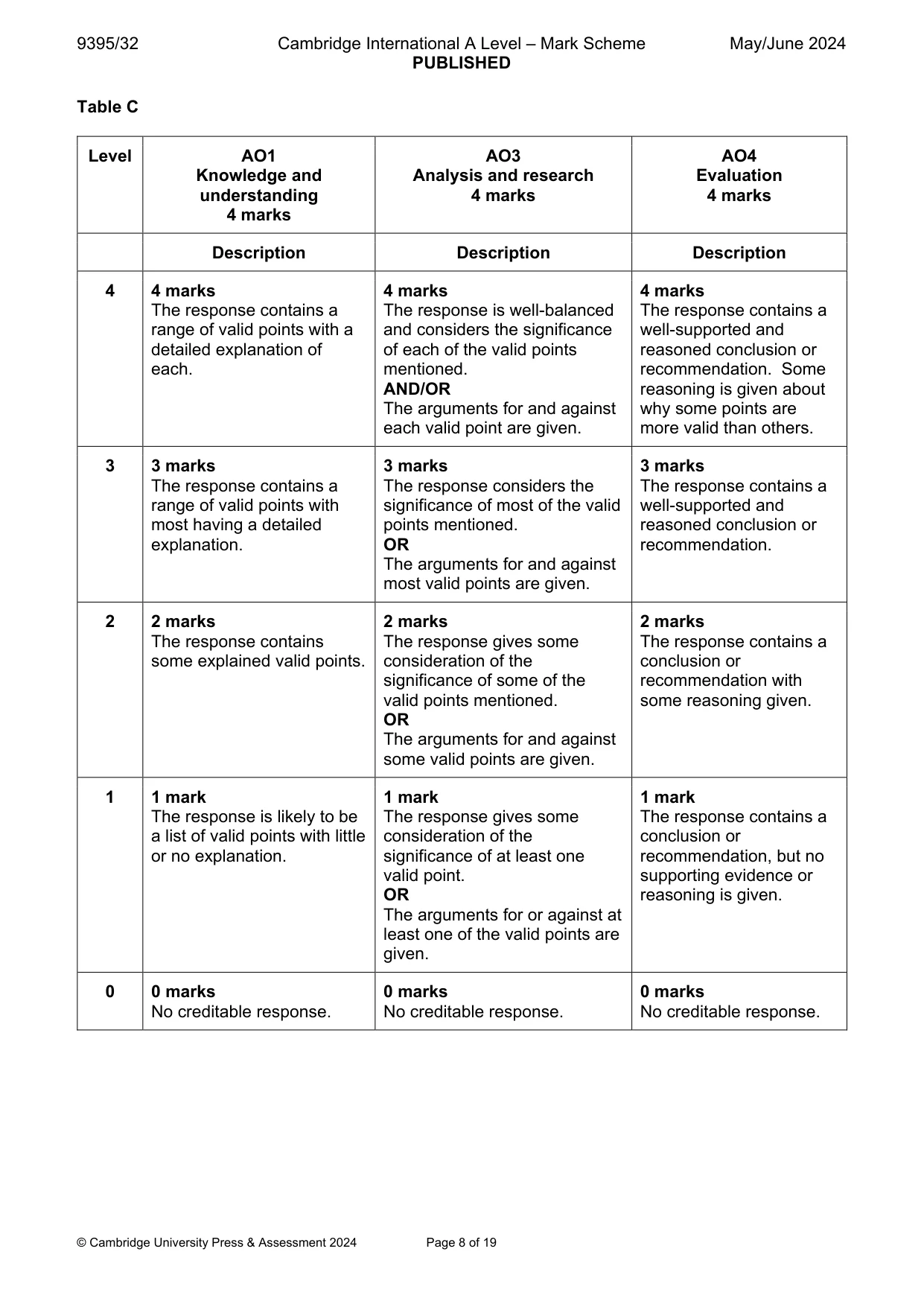
9395/32 Cambridge International A Level – Mark Scheme PUBLISHED May/June 2024 © Cambridge University Press & Assessment 2024 Page 8 of 19 Table C Level AO1 Knowledge and understanding 4 marks AO3 Analysis and research 4 marks AO4 Evaluation 4 marks Description Description Description 4 4 marks The response contains a range of valid points with a detailed explanation of each. 4 marks The response is well-balanced and considers the significance of each of the valid points mentioned. AND/OR The arguments for and against each valid point are given. 4 marks The response contains a well-supported and reasoned conclusion or recommendation. Some reasoning is given about why some points are more valid than others. 3 3 marks The response contains a range of valid points with most having a detailed explanation. 3 marks The response considers the significance of most of the valid points mentioned. OR The arguments for and against most valid points are given. 3 marks The response contains a well-supported and reasoned conclusion or recommendation. 2 2 marks The response contains some explained valid points. 2 marks The response gives some consideration of the significance of some of the valid points mentioned. OR The arguments for and against some valid points are given. 2 marks The response contains a conclusion or recommendation with some reasoning given. 1 1 mark The response is likely to be a list of valid points with little or no explanation. 1 mark The response gives some consideration of the significance of at least one valid point. OR The arguments for or against at least one of the valid points are given. 1 mark The response contains a conclusion or recommendation, but no supporting evidence or reasoning is given. 0 0 marks No creditable response. 0 marks No creditable response. 0 marks No creditable response.
Mark scheme, page 9
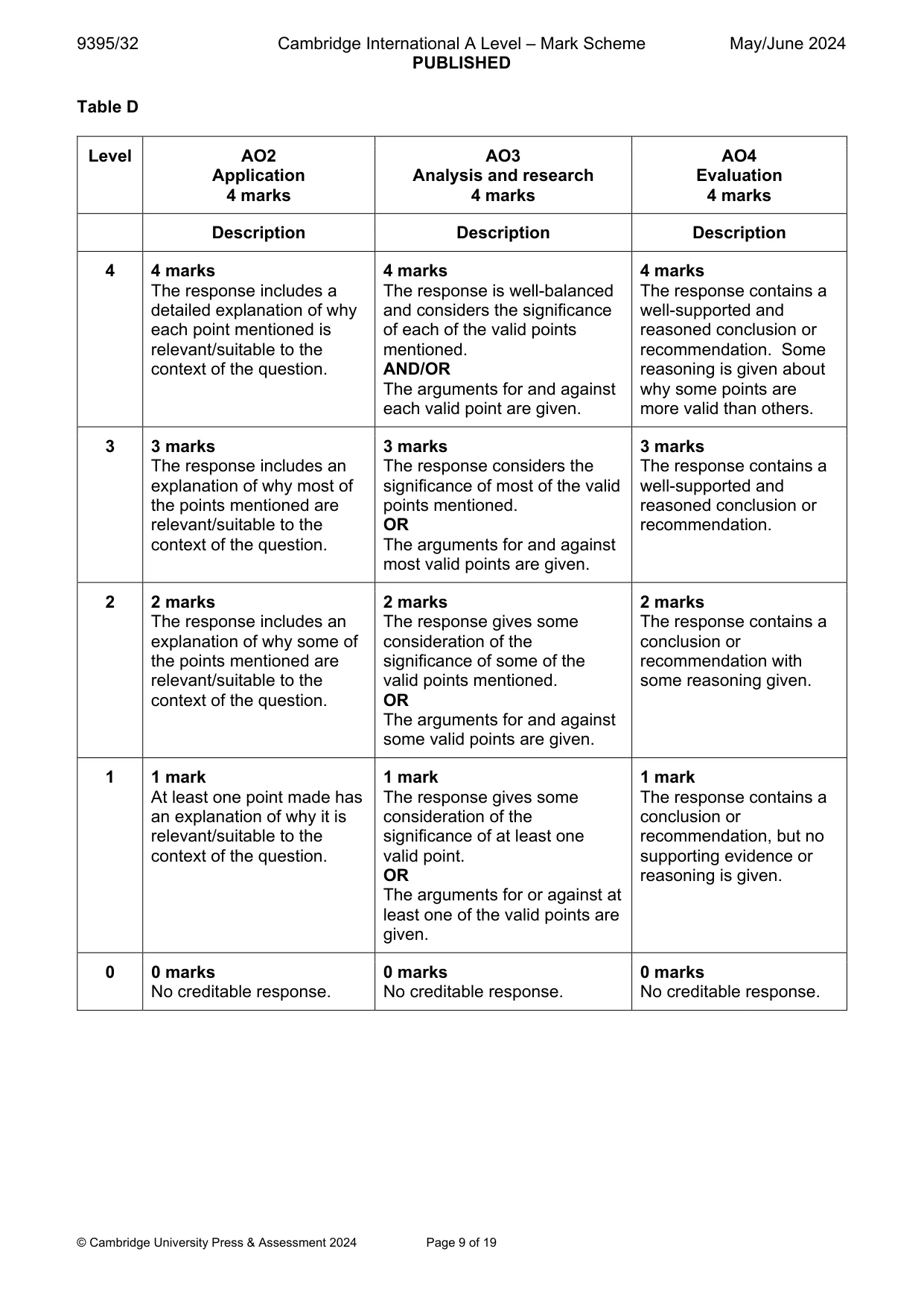
9395/32 Cambridge International A Level – Mark Scheme PUBLISHED May/June 2024 © Cambridge University Press & Assessment 2024 Page 9 of 19 Table D Level AO2 Application 4 marks AO3 Analysis and research 4 marks AO4 Evaluation 4 marks Description Description Description 4 4 marks The response includes a detailed explanation of why each point mentioned is relevant/suitable to the context of the question. 4 marks The response is well-balanced and considers the significance of each of the valid points mentioned. AND/OR The arguments for and against each valid point are given. 4 marks The response contains a well-supported and reasoned conclusion or recommendation. Some reasoning is given about why some points are more valid than others. 3 3 marks The response includes an explanation of why most of the points mentioned are relevant/suitable to the context of the question. 3 marks The response considers the significance of most of the valid points mentioned. OR The arguments for and against most valid points are given. 3 marks The response contains a well-supported and reasoned conclusion or recommendation. 2 2 marks The response includes an explanation of why some of the points mentioned are relevant/suitable to the context of the question. 2 marks The response gives some consideration of the significance of some of the valid points mentioned. OR The arguments for and against some valid points are given. 2 marks The response contains a conclusion or recommendation with some reasoning given. 1 1 mark At least one point made has an explanation of why it is relevant/suitable to the context of the question. 1 mark The response gives some consideration of the significance of at least one valid point. OR The arguments for or against at least one of the valid points are given. 1 mark The response contains a conclusion or recommendation, but no supporting evidence or reasoning is given. 0 0 marks No creditable response. 0 marks No creditable response. 0 marks No creditable response.
Mark scheme, page 10
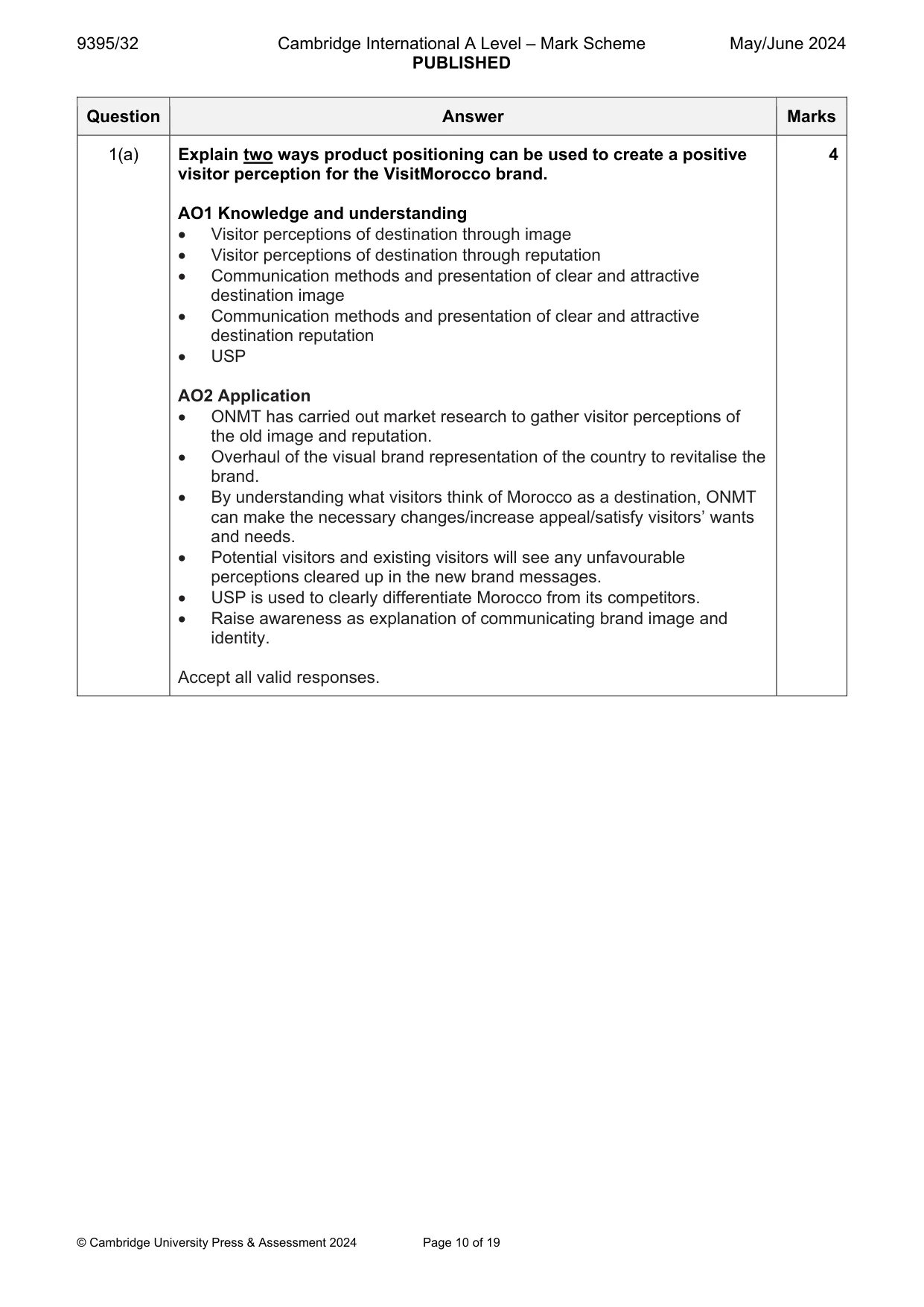
9395/32 Cambridge International A Level – Mark Scheme PUBLISHED May/June 2024 © Cambridge University Press & Assessment 2024 Page 10 of 19 Question Answer Marks 1(a) Explain two ways product positioning can be used to create a positive visitor perception for the VisitMorocco brand. AO1 Knowledge and understanding Visitor perceptions of destination through image Visitor perceptions of destination through reputation Communication methods and presentation of clear and attractive destination image Communication methods and presentation of clear and attractive destination reputation USP AO2 Application ONMT has carried out market research to gather visitor perceptions of the old image and reputation. Overhaul of the visual brand representation of the country to revitalise the brand. By understanding what visitors think of Morocco as a destination, ONMT can make the necessary changes/increase appeal/satisfy visitors’ wants and needs. Potential visitors and existing visitors will see any unfavourable perceptions cleared up in the new brand messages. USP is used to clearly differentiate Morocco from its competitors. Raise awareness as explanation of communicating brand image and identity. Accept all valid responses. 4
Mark scheme, page 11
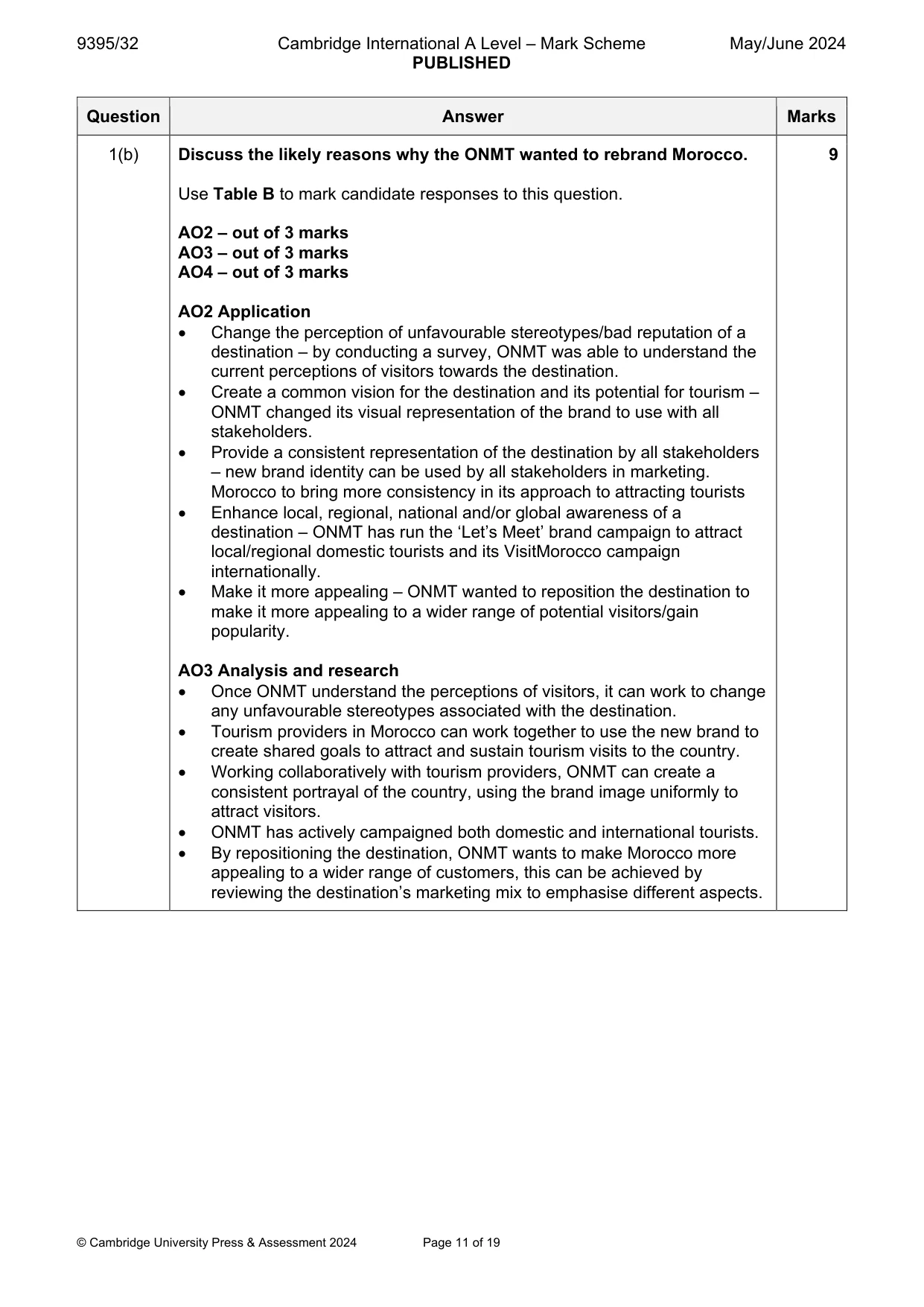
9395/32 Cambridge International A Level – Mark Scheme PUBLISHED May/June 2024 © Cambridge University Press & Assessment 2024 Page 11 of 19 Question Answer Marks 1(b) Discuss the likely reasons why the ONMT wanted to rebrand Morocco. Use Table B to mark candidate responses to this question. AO2 – out of 3 marks AO3 – out of 3 marks AO4 – out of 3 marks AO2 Application Change the perception of unfavourable stereotypes/bad reputation of a destination – by conducting a survey, ONMT was able to understand the current perceptions of visitors towards the destination. Create a common vision for the destination and its potential for tourism – ONMT changed its visual representation of the brand to use with all stakeholders. Provide a consistent representation of the destination by all stakeholders – new brand identity can be used by all stakeholders in marketing. Morocco to bring more consistency in its approach to attracting tourists Enhance local, regional, national and/or global awareness of a destination – ONMT has run the ‘Let’s Meet’ brand campaign to attract local/regional domestic tourists and its VisitMorocco campaign internationally. Make it more appealing – ONMT wanted to reposition the destination to make it more appealing to a wider range of potential visitors/gain popularity. AO3 Analysis and research Once ONMT understand the perceptions of visitors, it can work to change any unfavourable stereotypes associated with the destination. Tourism providers in Morocco can work together to use the new brand to create shared goals to attract and sustain tourism visits to the country. Working collaboratively with tourism providers, ONMT can create a consistent portrayal of the country, using the brand image uniformly to attract visitors. ONMT has actively campaigned both domestic and international tourists. By repositioning the destination, ONMT wants to make Morocco more appealing to a wider range of customers, this can be achieved by reviewing the destination’s marketing mix to emphasise different aspects. 9
Mark scheme, page 12
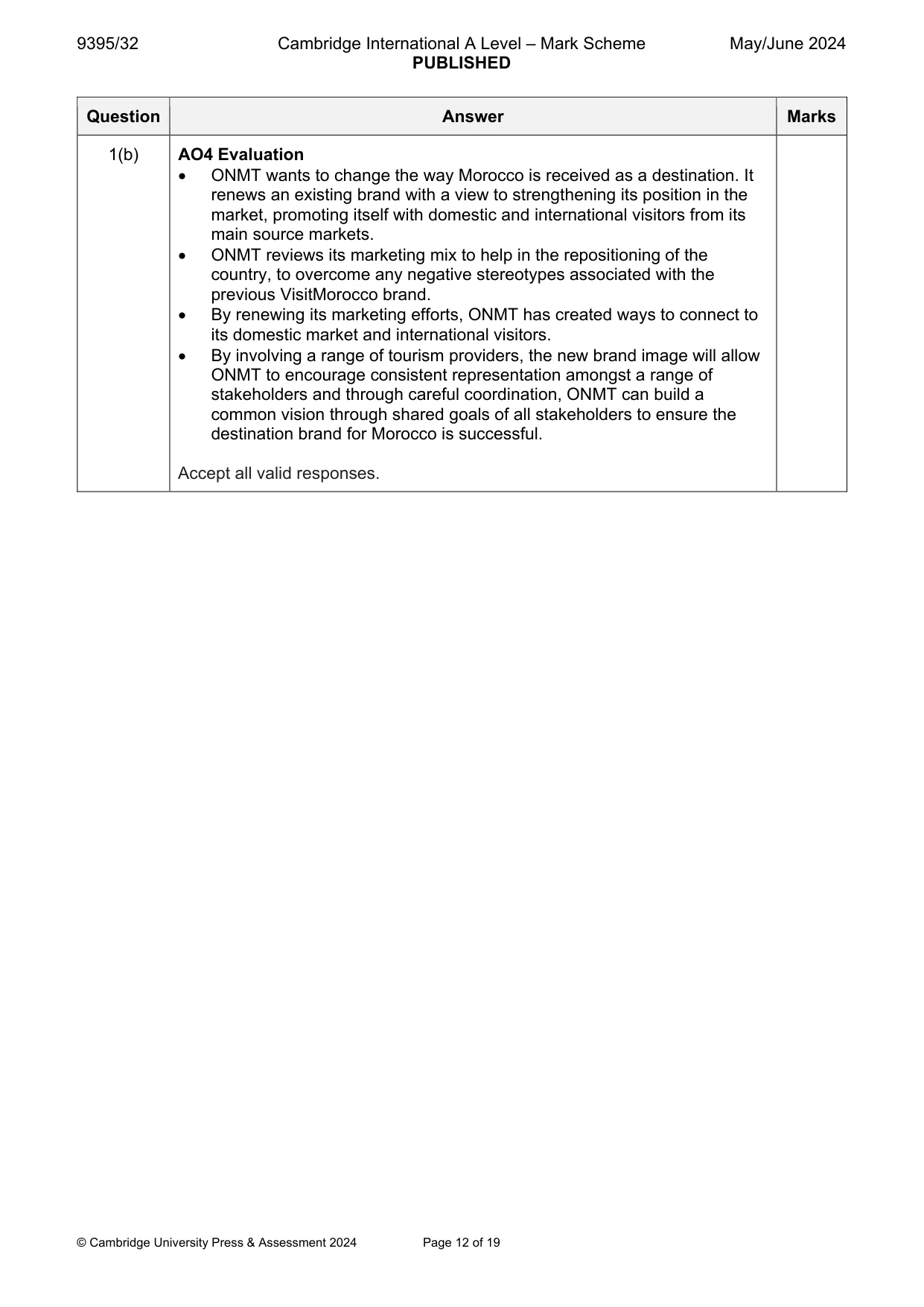
9395/32 Cambridge International A Level – Mark Scheme PUBLISHED May/June 2024 © Cambridge University Press & Assessment 2024 Page 12 of 19 Question Answer Marks 1(b) AO4 Evaluation ONMT wants to change the way Morocco is received as a destination. It renews an existing brand with a view to strengthening its position in the market, promoting itself with domestic and international visitors from its main source markets. ONMT reviews its marketing mix to help in the repositioning of the country, to overcome any negative stereotypes associated with the previous VisitMorocco brand. By renewing its marketing efforts, ONMT has created ways to connect to its domestic market and international visitors. By involving a range of tourism providers, the new brand image will allow ONMT to encourage consistent representation amongst a range of stakeholders and through careful coordination, ONMT can build a common vision through shared goals of all stakeholders to ensure the destination brand for Morocco is successful. Accept all valid responses.
Mark scheme, page 13
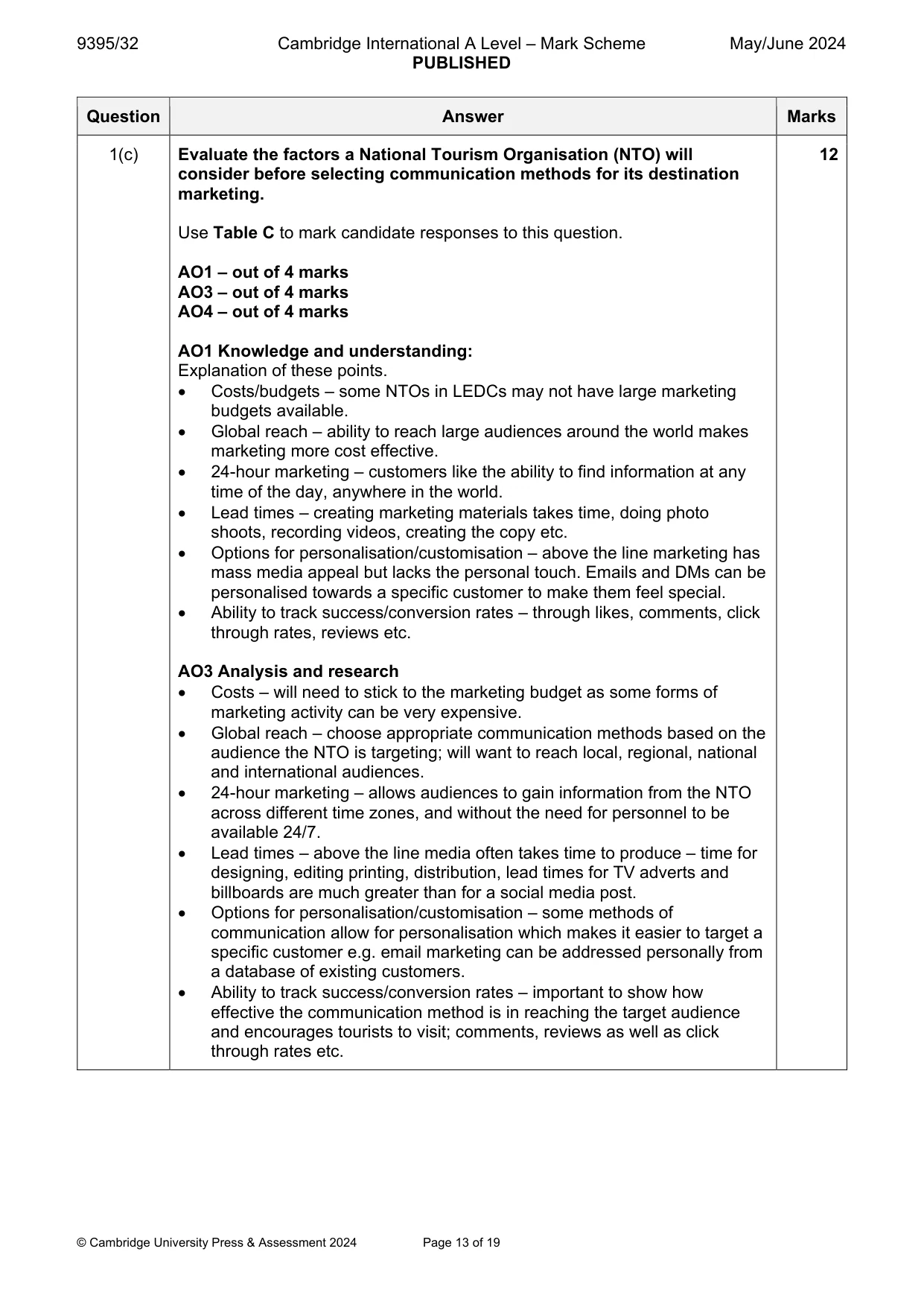
9395/32 Cambridge International A Level – Mark Scheme PUBLISHED May/June 2024 © Cambridge University Press & Assessment 2024 Page 13 of 19 Question Answer Marks 1(c) Evaluate the factors a National Tourism Organisation (NTO) will consider before selecting communication methods for its destination marketing. Use Table C to mark candidate responses to this question. AO1 – out of 4 marks AO3 – out of 4 marks AO4 – out of 4 marks AO1 Knowledge and understanding: Explanation of these points. Costs/budgets – some NTOs in LEDCs may not have large marketing budgets available. Global reach – ability to reach large audiences around the world makes marketing more cost effective. 24-hour marketing – customers like the ability to find information at any time of the day, anywhere in the world. Lead times – creating marketing materials takes time, doing photo shoots, recording videos, creating the copy etc. Options for personalisation/customisation – above the line marketing has mass media appeal but lacks the personal touch. Emails and DMs can be personalised towards a specific customer to make them feel special. Ability to track success/conversion rates – through likes, comments, click through rates, reviews etc. AO3 Analysis and research Costs – will need to stick to the marketing budget as some forms of marketing activity can be very expensive. Global reach – choose appropriate communication methods based on the audience the NTO is targeting; will want to reach local, regional, national and international audiences. 24-hour marketing – allows audiences to gain information from the NTO across different time zones, and without the need for personnel to be available 24/7. Lead times – above the line media often takes time to produce – time for designing, editing printing, distribution, lead times for TV adverts and billboards are much greater than for a social media post. Options for personalisation/customisation – some methods of communication allow for personalisation which makes it easier to target a specific customer e.g. email marketing can be addressed personally from a database of existing customers. Ability to track success/conversion rates – important to show how effective the communication method is in reaching the target audience and encourages tourists to visit; comments, reviews as well as click through rates etc. 12
Mark scheme, page 14
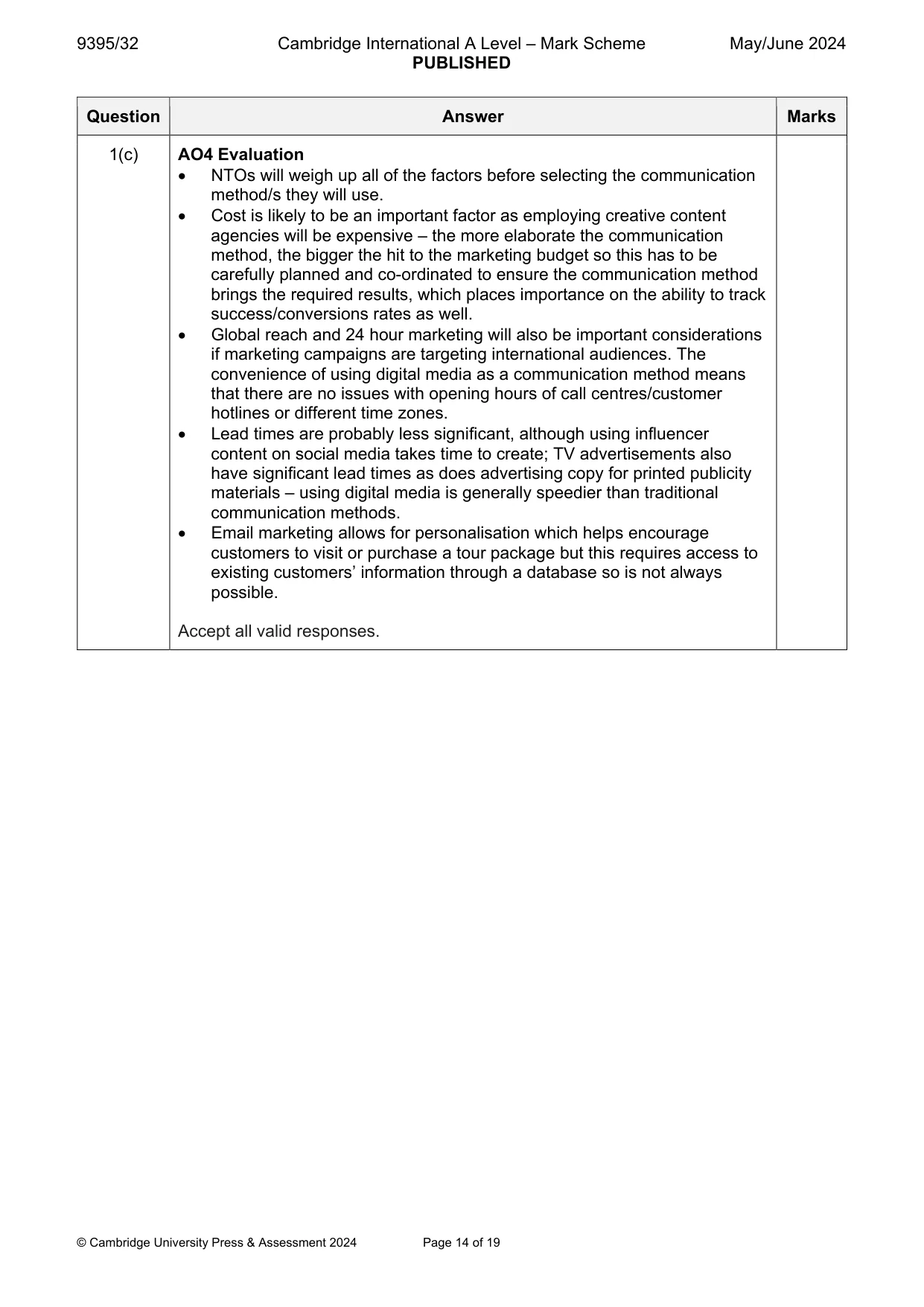
9395/32 Cambridge International A Level – Mark Scheme PUBLISHED May/June 2024 © Cambridge University Press & Assessment 2024 Page 14 of 19 Question Answer Marks 1(c) AO4 Evaluation NTOs will weigh up all of the factors before selecting the communication method/s they will use. Cost is likely to be an important factor as employing creative content agencies will be expensive – the more elaborate the communication method, the bigger the hit to the marketing budget so this has to be carefully planned and co-ordinated to ensure the communication method brings the required results, which places importance on the ability to track success/conversions rates as well. Global reach and 24 hour marketing will also be important considerations if marketing campaigns are targeting international audiences. The convenience of using digital media as a communication method means that there are no issues with opening hours of call centres/customer hotlines or different time zones. Lead times are probably less significant, although using influencer content on social media takes time to create; TV advertisements also have significant lead times as does advertising copy for printed publicity materials – using digital media is generally speedier than traditional communication methods. Email marketing allows for personalisation which helps encourage customers to visit or purchase a tour package but this requires access to existing customers’ information through a database so is not always possible. Accept all valid responses.
Mark scheme, page 15
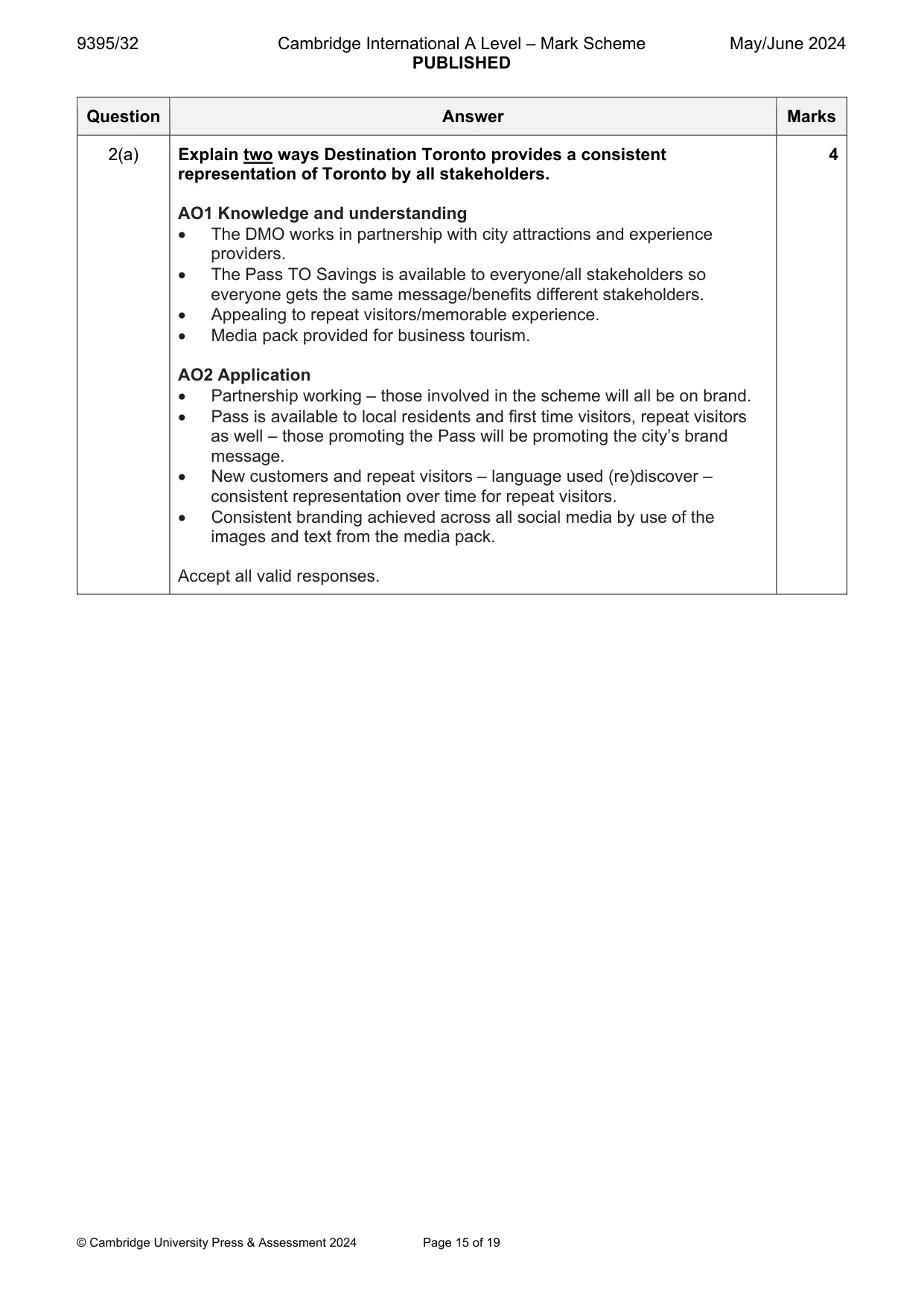
9395/32 Cambridge International A Level – Mark Scheme PUBLISHED May/June 2024 © Cambridge University Press & Assessment 2024 Page 15 of 19 Question Answer Marks 2(a) Explain two ways Destination Toronto provides a consistent representation of Toronto by all stakeholders. AO1 Knowledge and understanding The DMO works in partnership with city attractions and experience providers. The Pass TO Savings is available to everyone/all stakeholders so everyone gets the same message/benefits different stakeholders. Appealing to repeat visitors/memorable experience. Media pack provided for business tourism. AO2 Application Partnership working – those involved in the scheme will all be on brand. Pass is available to local residents and first time visitors, repeat visitors as well – those promoting the Pass will be promoting the city’s brand message. New customers and repeat visitors – language used (re)discover – consistent representation over time for repeat visitors. Consistent branding achieved across all social media by use of the images and text from the media pack. Accept all valid responses. 4
Mark scheme, page 16
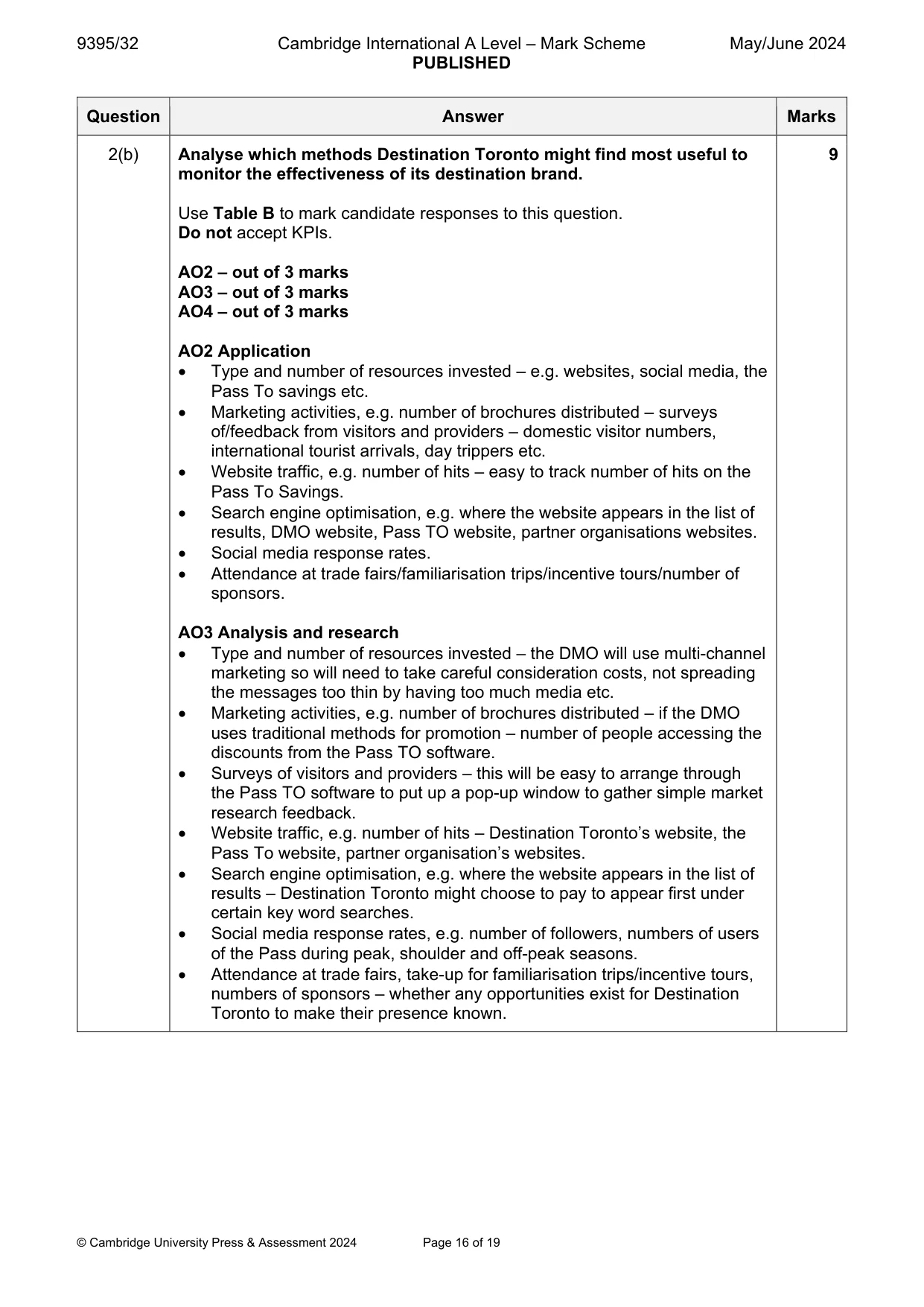
9395/32 Cambridge International A Level – Mark Scheme PUBLISHED May/June 2024 © Cambridge University Press & Assessment 2024 Page 16 of 19 Question Answer Marks 2(b) Analyse which methods Destination Toronto might find most useful to monitor the effectiveness of its destination brand. Use Table B to mark candidate responses to this question. Do not accept KPIs. AO2 – out of 3 marks AO3 – out of 3 marks AO4 – out of 3 marks AO2 Application Type and number of resources invested – e.g. websites, social media, the Pass To savings etc. Marketing activities, e.g. number of brochures distributed – surveys of/feedback from visitors and providers – domestic visitor numbers, international tourist arrivals, day trippers etc. Website traffic, e.g. number of hits – easy to track number of hits on the Pass To Savings. Search engine optimisation, e.g. where the website appears in the list of results, DMO website, Pass TO website, partner organisations websites. Social media response rates. Attendance at trade fairs/familiarisation trips/incentive tours/number of sponsors. AO3 Analysis and research Type and number of resources invested – the DMO will use multi-channel marketing so will need to take careful consideration costs, not spreading the messages too thin by having too much media etc. Marketing activities, e.g. number of brochures distributed – if the DMO uses traditional methods for promotion – number of people accessing the discounts from the Pass TO software. Surveys of visitors and providers – this will be easy to arrange through the Pass TO software to put up a pop-up window to gather simple market research feedback. Website traffic, e.g. number of hits – Destination Toronto’s website, the Pass To website, partner organisation’s websites. Search engine optimisation, e.g. where the website appears in the list of results – Destination Toronto might choose to pay to appear first under certain key word searches. Social media response rates, e.g. number of followers, numbers of users of the Pass during peak, shoulder and off-peak seasons. Attendance at trade fairs, take-up for familiarisation trips/incentive tours, numbers of sponsors – whether any opportunities exist for Destination Toronto to make their presence known. 9
Mark scheme, page 17
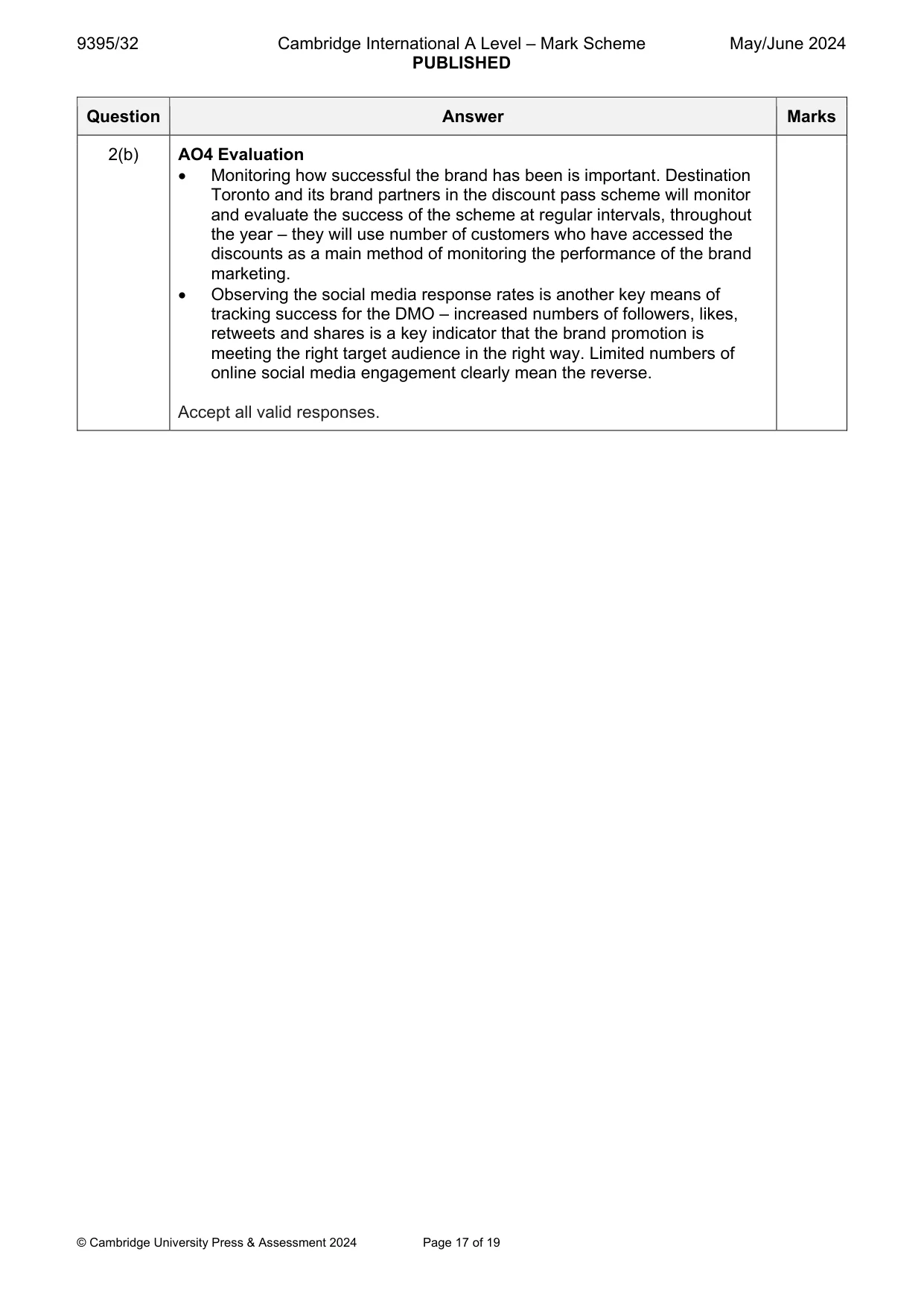
9395/32 Cambridge International A Level – Mark Scheme PUBLISHED May/June 2024 © Cambridge University Press & Assessment 2024 Page 17 of 19 Question Answer Marks 2(b) AO4 Evaluation Monitoring how successful the brand has been is important. Destination Toronto and its brand partners in the discount pass scheme will monitor and evaluate the success of the scheme at regular intervals, throughout the year – they will use number of customers who have accessed the discounts as a main method of monitoring the performance of the brand marketing. Observing the social media response rates is another key means of tracking success for the DMO – increased numbers of followers, likes, retweets and shares is a key indicator that the brand promotion is meeting the right target audience in the right way. Limited numbers of online social media engagement clearly mean the reverse. Accept all valid responses.
Mark scheme, page 18
9395/32 Cambridge International A Level – Mark Scheme PUBLISHED May/June 2024 © Cambridge University Press & Assessment 2024 Page 18 of 19 Question Answer Marks 2(c) Discuss the importance of market research in defining the specific market for a destination. Use Table C to mark candidate responses to this question. Do not accept answers that describe different market research techniques. AO1 – out of 4 marks AO3 – out of 4 marks AO4 – out of 4 marks AO1 Knowledge and understanding Market research helps a destination to identify: The market they operate in and know how to target specific customer types Customer needs and wants Travel trends and customer behaviours/tastes Customer preferences for destinations Popularity of destinations – how they compare in the rankings with other similar destinations Competition amongst destinations – who their rivals are/how to stand out Stage on the Butler ‘Destination Life Cycle’ model (exploration, involvement, development, consolidation, stagnation, decline or rejuvenation) – where they are on the life cycle model and what this means AO3 Analysis and research To identify: The market – try and identify market conditions, the market environment in which they operate. Customer needs and wants – this will help them understand which products and services to include. Travel trends and customer behaviours – this shows how things change over time and encourages them to be as dynamic as the industry they operate in. Customer preferences for destinations – this will help determine the types of customers they target (cultural tourists are unlikely to be attracted to a purpose built attraction; family tourists will be attracted by safe and clean beaches). Popularity of destinations – this will help a destination consider the features that make a destination popular, and what they can do to improve their own popularity. Competition amongst destinations – this is important in knowing who your rivals are and what they are doing more successfully than you are. Stage on the Butler ‘Destination Life Cycle’ model (exploration, involvement, development, consolidation, stagnation, decline or rejuvenation) – this helps in the marketing process – it will determine the marketing mix at each review stage to coincide with the lifecycle stages. 12
Mark scheme, page 19
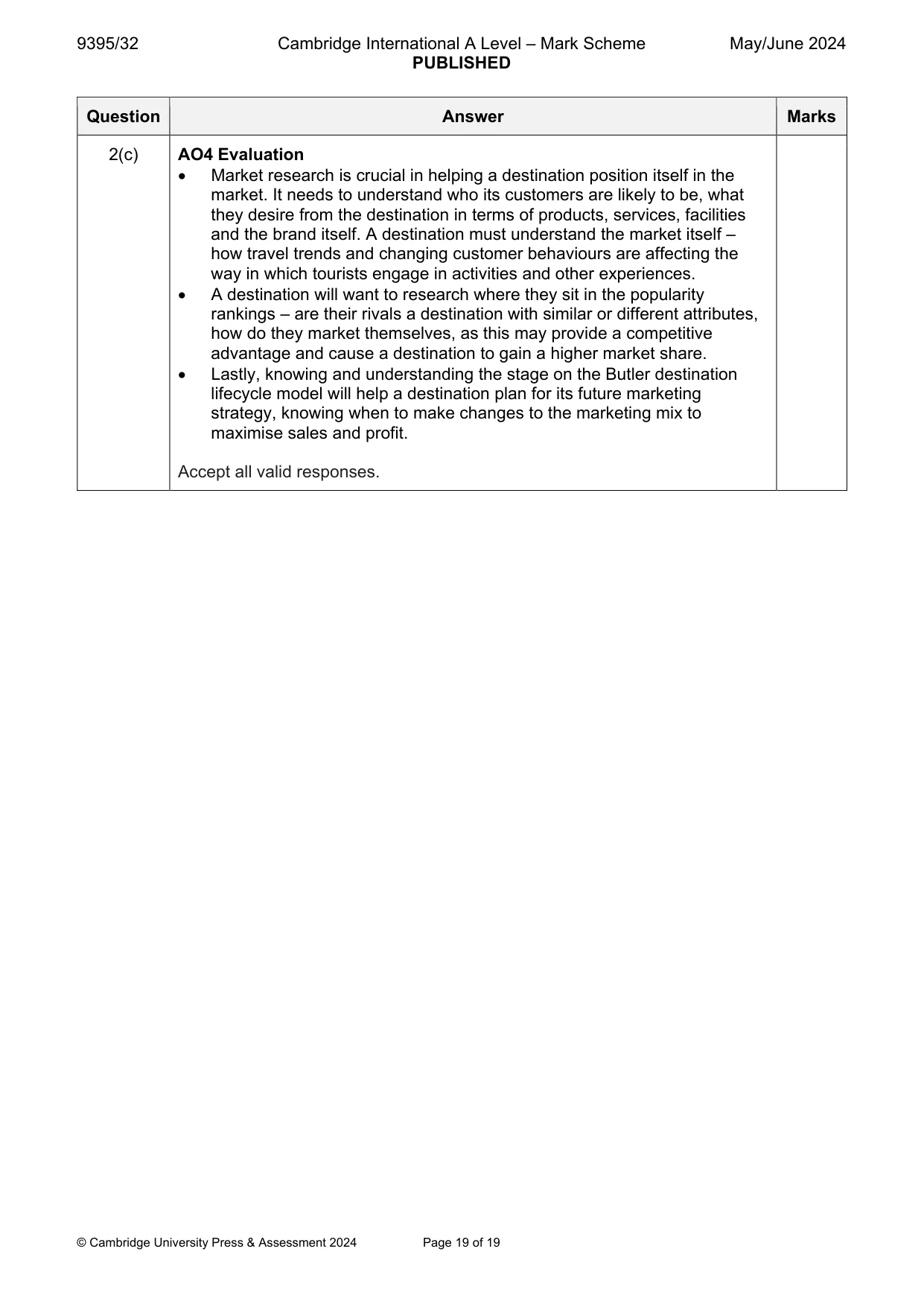
9395/32 Cambridge International A Level – Mark Scheme PUBLISHED May/June 2024 © Cambridge University Press & Assessment 2024 Page 19 of 19 Question Answer Marks 2(c) AO4 Evaluation Market research is crucial in helping a destination position itself in the market. It needs to understand who its customers are likely to be, what they desire from the destination in terms of products, services, facilities and the brand itself. A destination must understand the market itself – how travel trends and changing customer behaviours are affecting the way in which tourists engage in activities and other experiences. A destination will want to research where they sit in the popularity rankings – are their rivals a destination with similar or different attributes, how do they market themselves, as this may provide a competitive advantage and cause a destination to gain a higher market share. Lastly, knowing and understanding the stage on the Butler destination lifecycle model will help a destination plan for its future marketing strategy, knowing when to make changes to the marketing mix to maximise sales and profit. Accept all valid responses.
What you needed in this session
Cambridge’s own grade thresholds for 2024 May/June, Paper 3 · Variant 2. A higher threshold means an easier paper — the bar moves with how the cohort did.