Cambridge A Level Travel and Tourism 9395 — 2023 Oct/Nov Paper 3 · Variant 2
9395/32/O/N/23 · 50 marks · ≈56 min
The question paper and its mark scheme, free to read here and free to download. This is Cambridge’s own paper, exactly as it was sat.
Question paper12 pages







Mark scheme15 pages
Answers below. Sit the paper first if you are practising.
Paper as text
Question paper, page 1
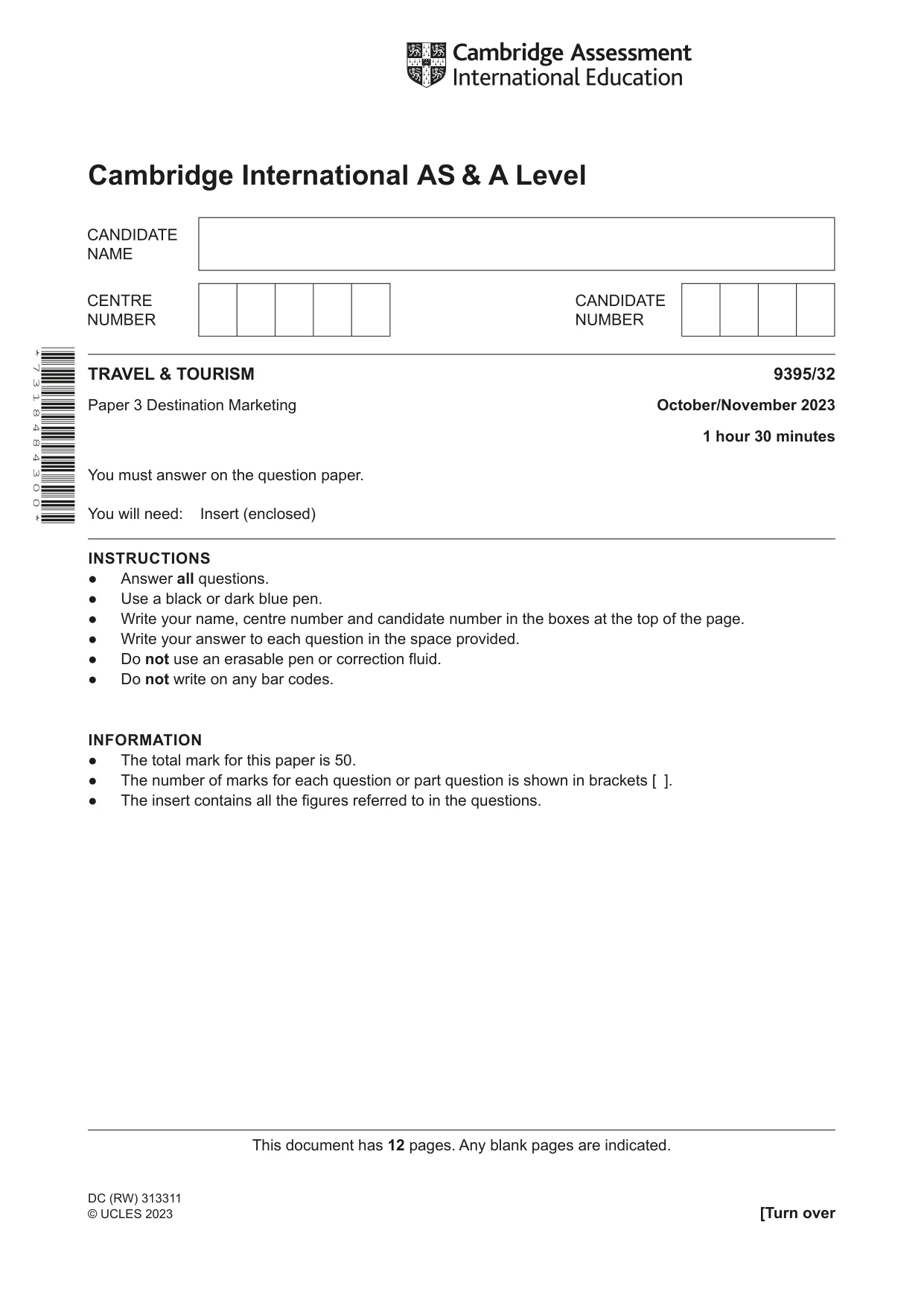
This document has 12 pages. Any blank pages are indicated. [Turn over Cambridge International AS & A Level * 7 3 1 8 4 8 4 3 0 0 * TRAVEL & TOURISM 9395/32 Paper 3 Destination Marketing October/November 2023 1 hour 30 minutes You must answer on the question paper. You will need: Insert (enclosed) INSTRUCTIONS ● Answer all questions. ● Use a black or dark blue pen. ● Write your name, centre number and candidate number in the boxes at the top of the page. ● Write your answer to each question in the space provided. ● Do not use an erasable pen or correction fluid. ● Do not write on any bar codes. INFORMATION ● The total mark for this paper is 50. ● The number of marks for each question or part question is shown in brackets [ ]. ● The insert contains all the figures referred to in the questions. DC (RW) 313311 © UCLES 2023
Question paper, page 2
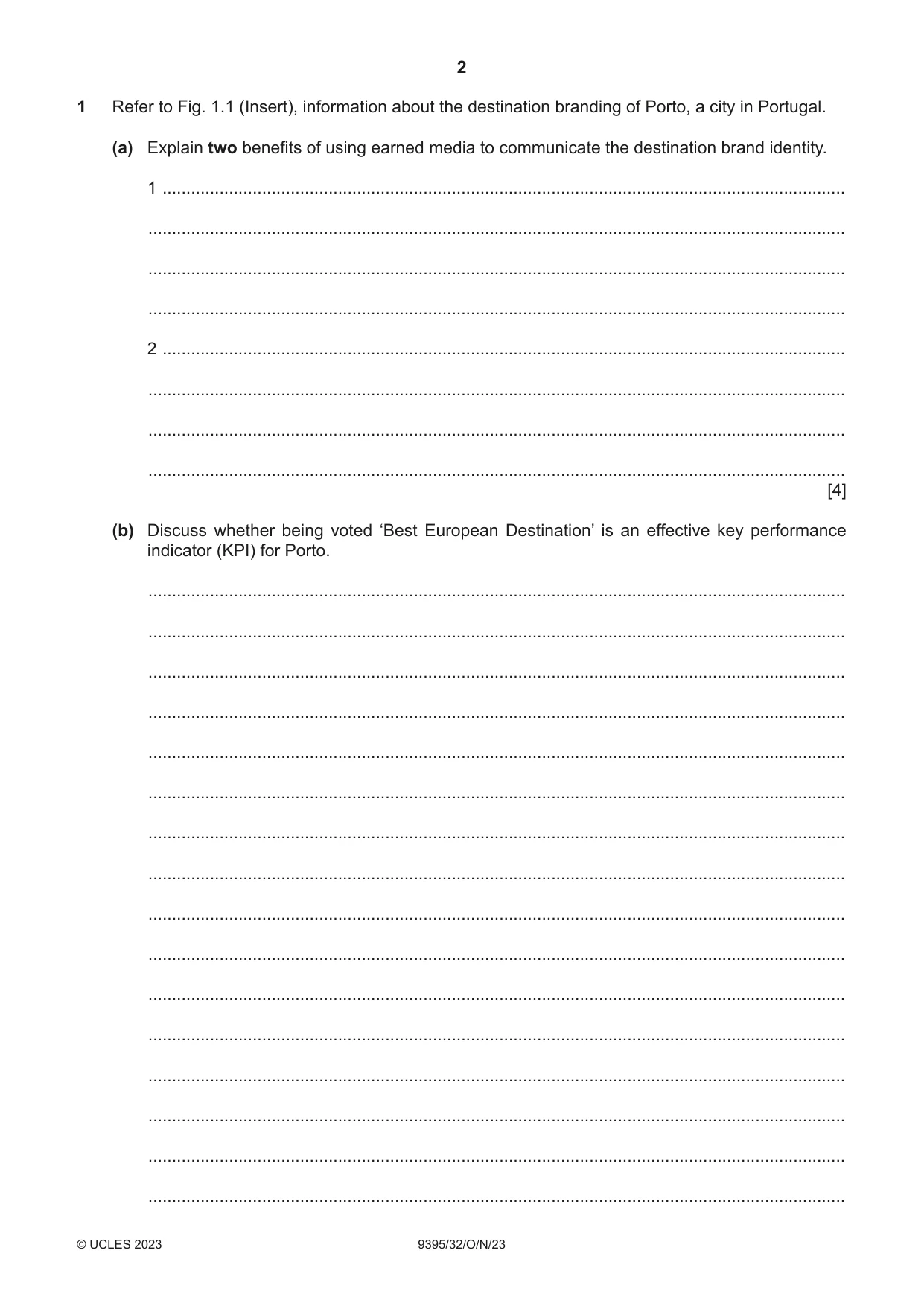
2 9395/32/O/N/23 © UCLES 2023 1 Refer to Fig. 1.1 (Insert), information about the destination branding of Porto, a city in Portugal. (a) Explain two benefits of using earned media to communicate the destination brand identity. 1 … … … … 2 … … … … [4] (b) Discuss whether being voted ‘Best European Destination’ is an effective key performance indicator (KPI) for Porto. … … … … … … … … … … … … … … … …
Question paper, page 3
3 9395/32/O/N/23 © UCLES 2023 [Turn over … … … … … … … … … … … … … … … … … … … … … … … … … … … … [9]
Question paper, page 4
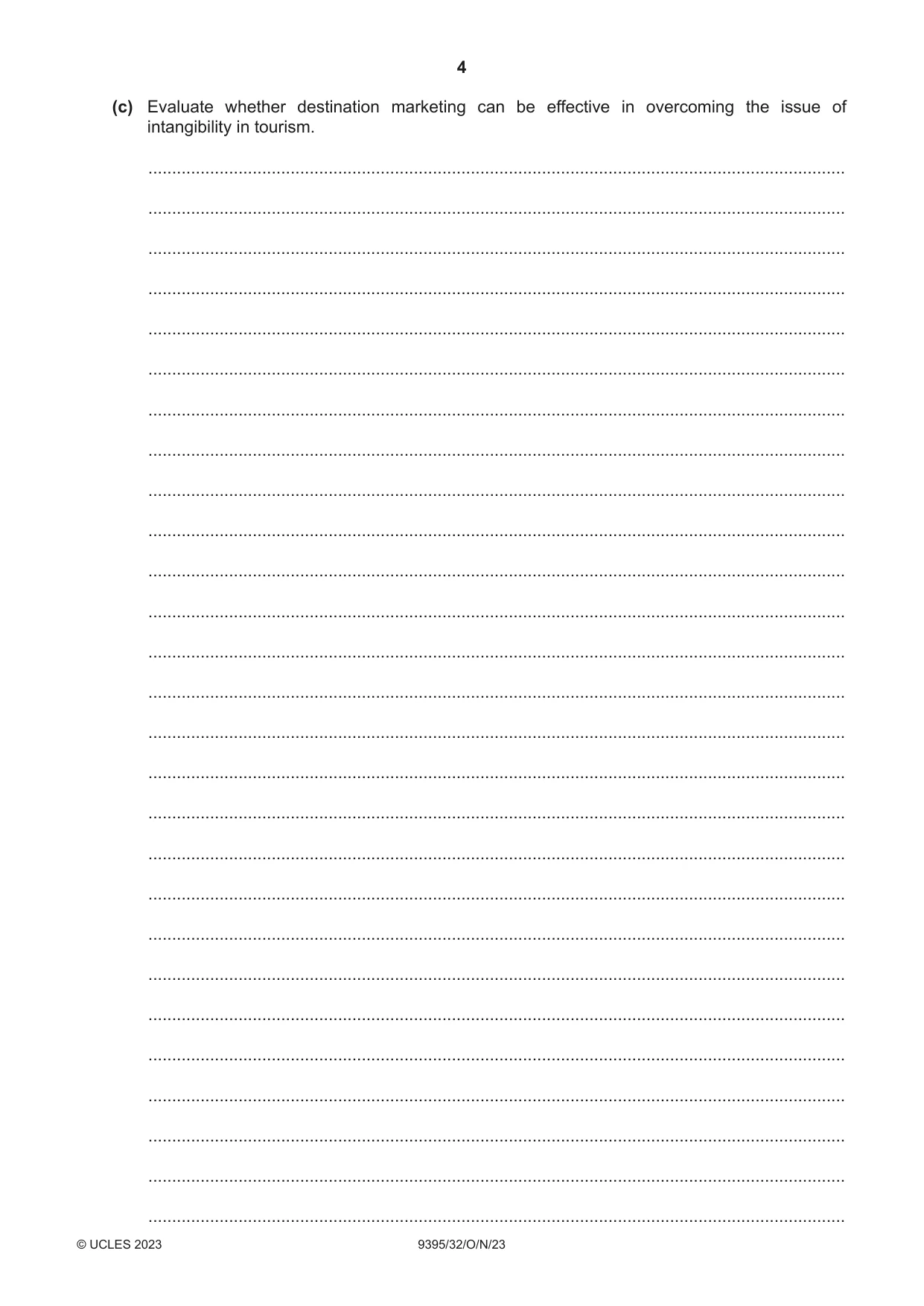
4 9395/32/O/N/23 © UCLES 2023 (c) Evaluate whether destination marketing can be effective in overcoming the issue of intangibility in tourism. … … … … … … … … … … … … … … … … … … … … … … … … … … …
Question paper, page 5
5 9395/32/O/N/23 © UCLES 2023 [Turn over … … … … … … … … … … … … … … … … … … … … … … … … … … … [12] [Total: 25]
Question paper, page 6
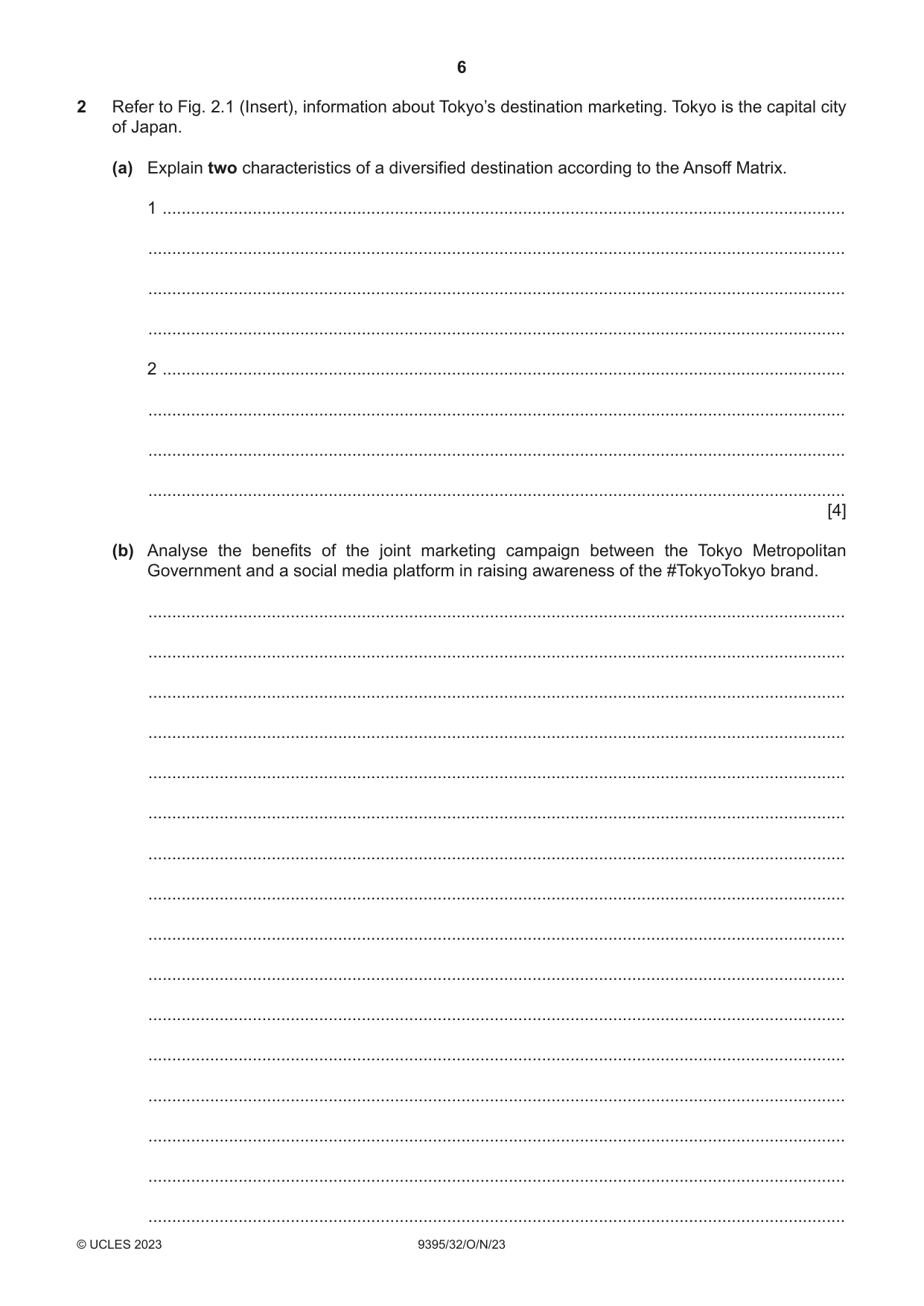
6 9395/32/O/N/23 © UCLES 2023 2 Refer to Fig. 2.1 (Insert), information about Tokyo’s destination marketing. Tokyo is the capital city of Japan. (a) Explain two characteristics of a diversified destination according to the Ansoff Matrix. 1 … … … … 2 … … … … [4] (b) Analyse the benefits of the joint marketing campaign between the Tokyo Metropolitan Government and a social media platform in raising awareness of the #TokyoTokyo brand. … … … … … … … … … … … … … … … …
Question paper, page 7
7 9395/32/O/N/23 © UCLES 2023 [Turn over … … … … … … … … … … … … … … … … … … … … … … … … … … … … [9]
Question paper, page 8
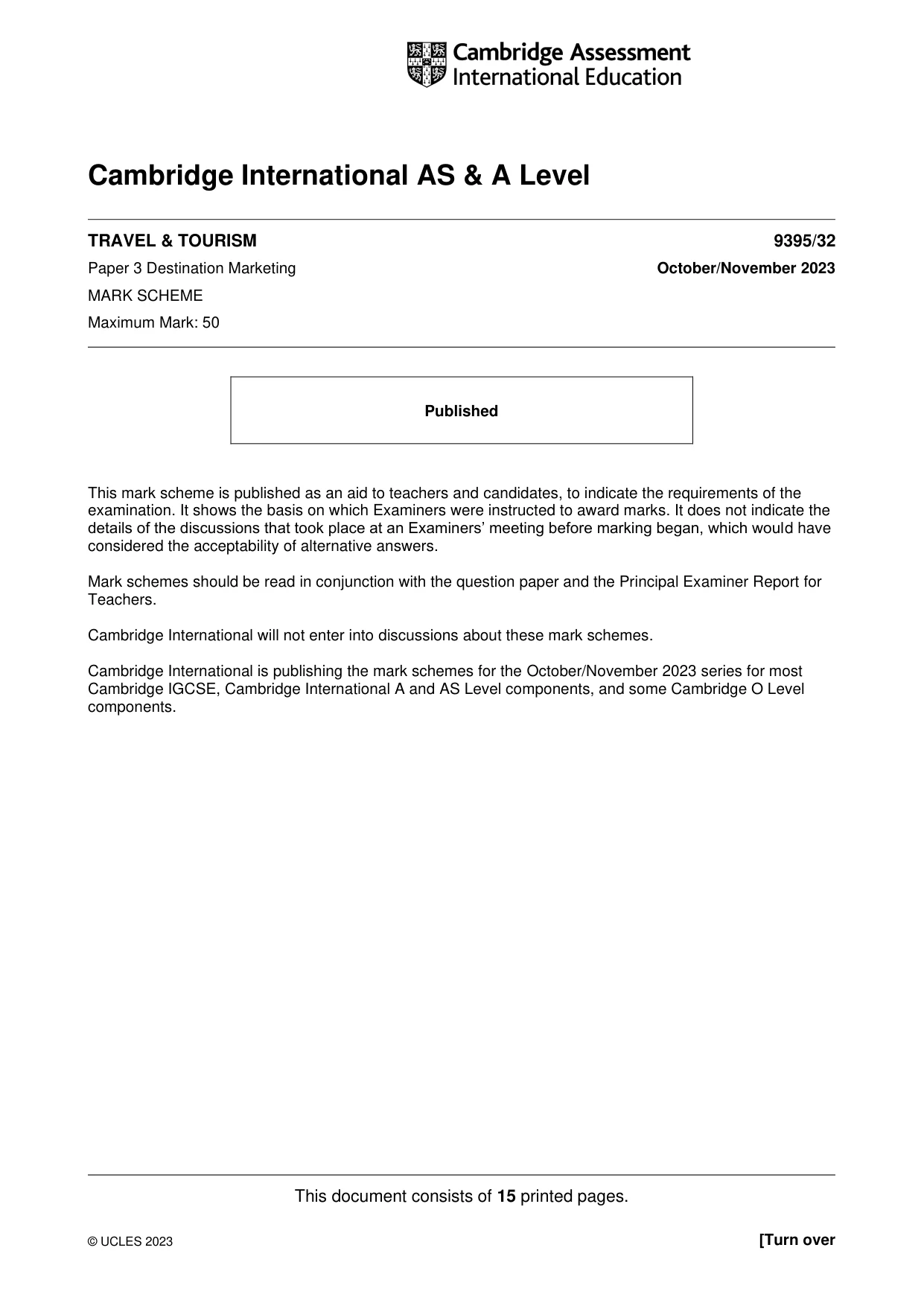
8 9395/32/O/N/23 © UCLES 2023 (c) Discuss the effectiveness of attendance at trade fairs as a marketing activity for Tokyo. … … … … … … … … … … … … … … … … … … … … … … … … … … …
Question paper, page 9
9 9395/32/O/N/23 © UCLES 2023 … … … … … … … … … … … … … … … … … … … … … … … … … … … [12] [Total: 25]
Question paper, page 10
10 9395/32/O/N/23 © UCLES 2023 BLANK PAGE
Question paper, page 11
11 9395/32/O/N/23 © UCLES 2023 BLANK PAGE
Question paper, page 12
12 9395/32/O/N/23 © UCLES 2023 The boundaries and names shown, the designations used and the presentation of material on any maps contained in this question paper/insert do not imply official endorsement or acceptance by Cambridge Assessment International Education concerning the legal status of any country, territory, or area or any of its authorities, or of the delimitation of its frontiers or boundaries. Permission to reproduce items where third-party owned material protected by copyright is included has been sought and cleared where possible. Every reasonable effort has been made by the publisher (UCLES) to trace copyright holders, but if any items requiring clearance have unwittingly been included, the publisher will be pleased to make amends at the earliest possible opportunity. To avoid the issue of disclosure of answer-related information to candidates, all copyright acknowledgements are reproduced online in the Cambridge Assessment International Education Copyright Acknowledgements Booklet. This is produced for each series of examinations and is freely available to download at www.cambridgeinternational.org after the live examination series. Cambridge Assessment International Education is part of Cambridge Assessment. Cambridge Assessment is the brand name of the University of Cambridge Local Examinations Syndicate (UCLES), which is a department of the University of Cambridge. BLANK PAGE
Mark scheme, page 1
This document consists of 15 printed pages. © UCLES 2023 [Turn over Cambridge International AS & A Level TRAVEL & TOURISM 9395/32 Paper 3 Destination Marketing October/November 2023 MARK SCHEME Maximum Mark: 50 Published This mark scheme is published as an aid to teachers and candidates, to indicate the requirements of the examination. It shows the basis on which Examiners were instructed to award marks. It does not indicate the details of the discussions that took place at an Examiners’ meeting before marking began, which would have considered the acceptability of alternative answers. Mark schemes should be read in conjunction with the question paper and the Principal Examiner Report for Teachers. Cambridge International will not enter into discussions about these mark schemes. Cambridge International is publishing the mark schemes for the October/November 2023 series for most Cambridge IGCSE, Cambridge International A and AS Level components, and some Cambridge O Level components.
Mark scheme, page 2
9395/32 Cambridge International AS & A Level – Mark Scheme PUBLISHED October/November 2023 © UCLES 2023 Page 2 of 15 Generic Marking Principles These general marking principles must be applied by all examiners when marking candidate answers. They should be applied alongside the specific content of the mark scheme or generic level descriptors for a question. Each question paper and mark scheme will also comply with these marking principles. GENERIC MARKING PRINCIPLE 1: Marks must be awarded in line with: • the specific content of the mark scheme or the generic level descriptors for the question • the specific skills defined in the mark scheme or in the generic level descriptors for the question • the standard of response required by a candidate as exemplified by the standardisation scripts. GENERIC MARKING PRINCIPLE 2: Marks awarded are always whole marks (not half marks, or other fractions). GENERIC MARKING PRINCIPLE 3: Marks must be awarded positively: • marks are awarded for correct/valid answers, as defined in the mark scheme. However, credit is given for valid answers which go beyond the scope of the syllabus and mark scheme, referring to your Team Leader as appropriate • marks are awarded when candidates clearly demonstrate what they know and can do • marks are not deducted for errors • marks are not deducted for omissions • answers should only be judged on the quality of spelling, punctuation and grammar when these features are specifically assessed by the question as indicated by the mark scheme. The meaning, however, should be unambiguous. GENERIC MARKING PRINCIPLE 4: Rules must be applied consistently, e.g. in situations where candidates have not followed instructions or in the application of generic level descriptors.
Mark scheme, page 3
9395/32 Cambridge International AS & A Level – Mark Scheme PUBLISHED October/November 2023 © UCLES 2023 Page 3 of 15 GENERIC MARKING PRINCIPLE 5: Marks should be awarded using the full range of marks defined in the mark scheme for the question (however; the use of the full mark range may be limited according to the quality of the candidate responses seen). GENERIC MARKING PRINCIPLE 6: Marks awarded are based solely on the requirements as defined in the mark scheme. Marks should not be awarded with grade thresholds or grade descriptors in mind.
Mark scheme, page 4
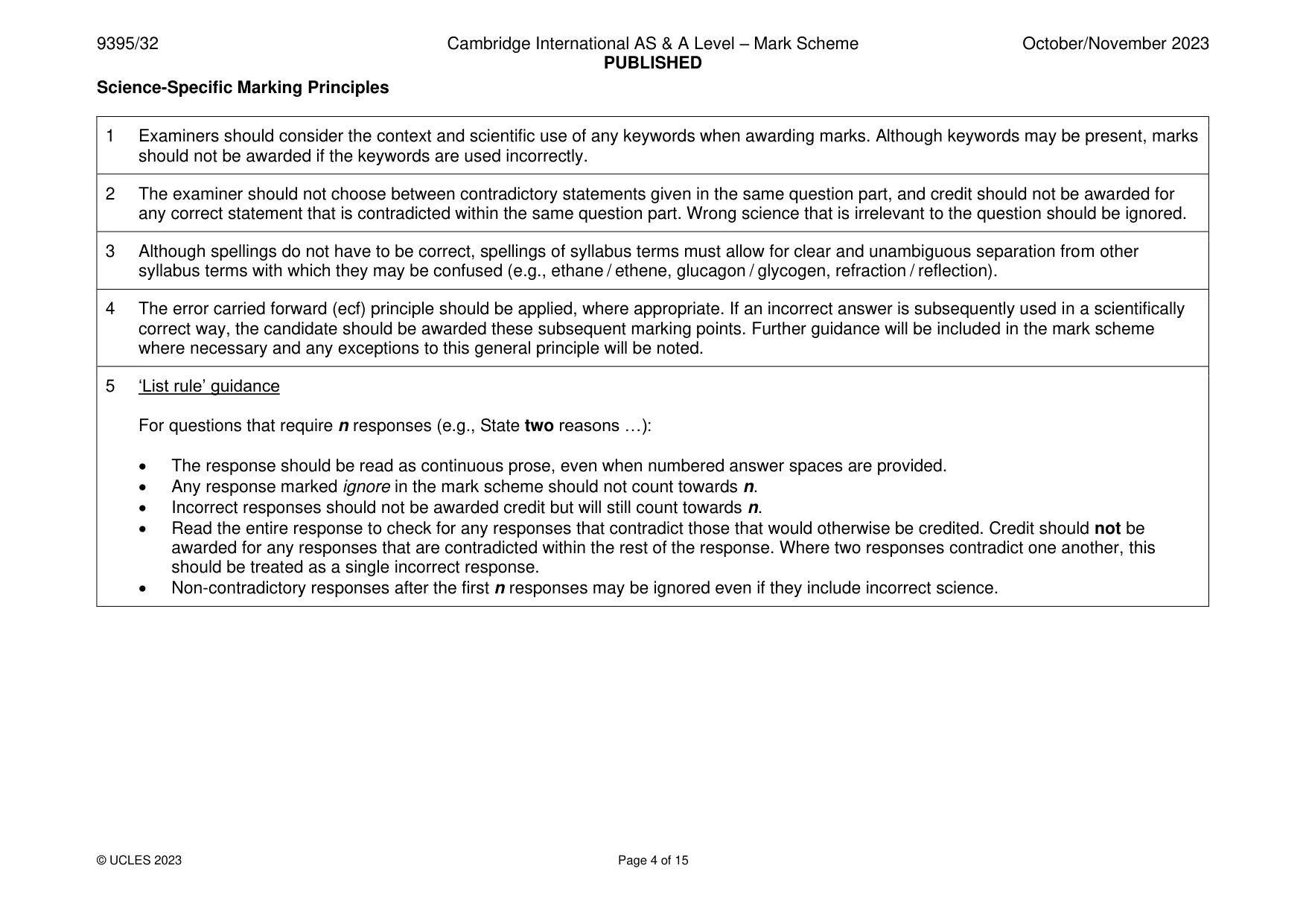
9395/32 Cambridge International AS & A Level – Mark Scheme PUBLISHED October/November 2023 © UCLES 2023 Page 4 of 15 Science-Specific Marking Principles 1 Examiners should consider the context and scientific use of any keywords when awarding marks. Although keywords may be present, marks should not be awarded if the keywords are used incorrectly. 2 The examiner should not choose between contradictory statements given in the same question part, and credit should not be awarded for any correct statement that is contradicted within the same question part. Wrong science that is irrelevant to the question should be ignored. 3 Although spellings do not have to be correct, spellings of syllabus terms must allow for clear and unambiguous separation from other syllabus terms with which they may be confused (e.g., ethane / ethene, glucagon / glycogen, refraction / reflection). 4 The error carried forward (ecf) principle should be applied, where appropriate. If an incorrect answer is subsequently used in a scientifically correct way, the candidate should be awarded these subsequent marking points. Further guidance will be included in the mark scheme where necessary and any exceptions to this general principle will be noted. 5 ‘List rule’ guidance For questions that require n responses (e.g., State two reasons …): • The response should be read as continuous prose, even when numbered answer spaces are provided. • Any response marked ignore in the mark scheme should not count towards n. • Incorrect responses should not be awarded credit but will still count towards n. • Read the entire response to check for any responses that contradict those that would otherwise be credited. Credit should not be awarded for any responses that are contradicted within the rest of the response. Where two responses contradict one another, this should be treated as a single incorrect response. • Non-contradictory responses after the first n responses may be ignored even if they include incorrect science.
Mark scheme, page 5
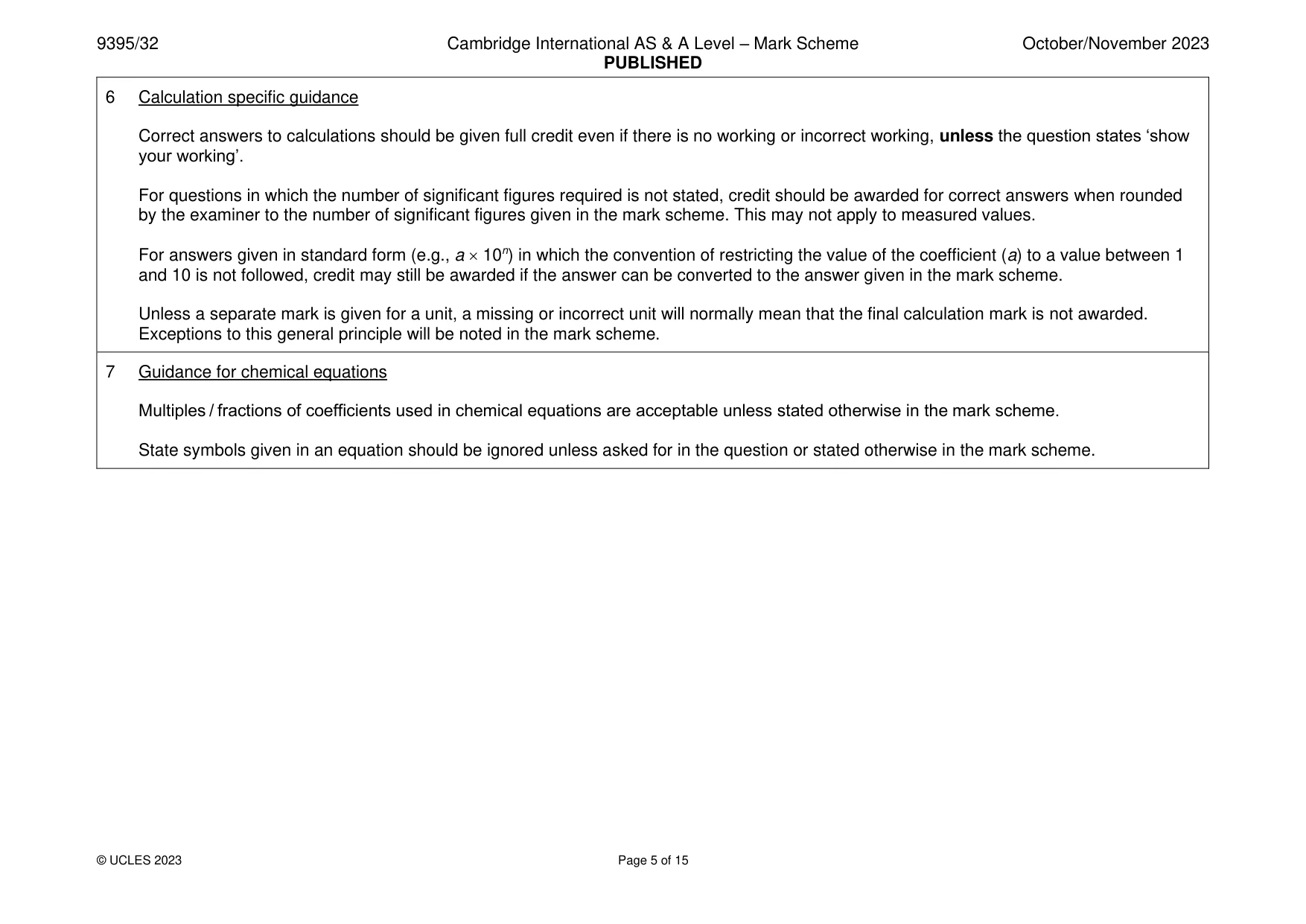
9395/32 Cambridge International AS & A Level – Mark Scheme PUBLISHED October/November 2023 © UCLES 2023 Page 5 of 15 6 Calculation specific guidance Correct answers to calculations should be given full credit even if there is no working or incorrect working, unless the question states ‘show your working’. For questions in which the number of significant figures required is not stated, credit should be awarded for correct answers when rounded by the examiner to the number of significant figures given in the mark scheme. This may not apply to measured values. For answers given in standard form (e.g., a 10n) in which the convention of restricting the value of the coefficient (a) to a value between 1 and 10 is not followed, credit may still be awarded if the answer can be converted to the answer given in the mark scheme. Unless a separate mark is given for a unit, a missing or incorrect unit will normally mean that the final calculation mark is not awarded. Exceptions to this general principle will be noted in the mark scheme. 7 Guidance for chemical equations Multiples / fractions of coefficients used in chemical equations are acceptable unless stated otherwise in the mark scheme. State symbols given in an equation should be ignored unless asked for in the question or stated otherwise in the mark scheme.
Mark scheme, page 6
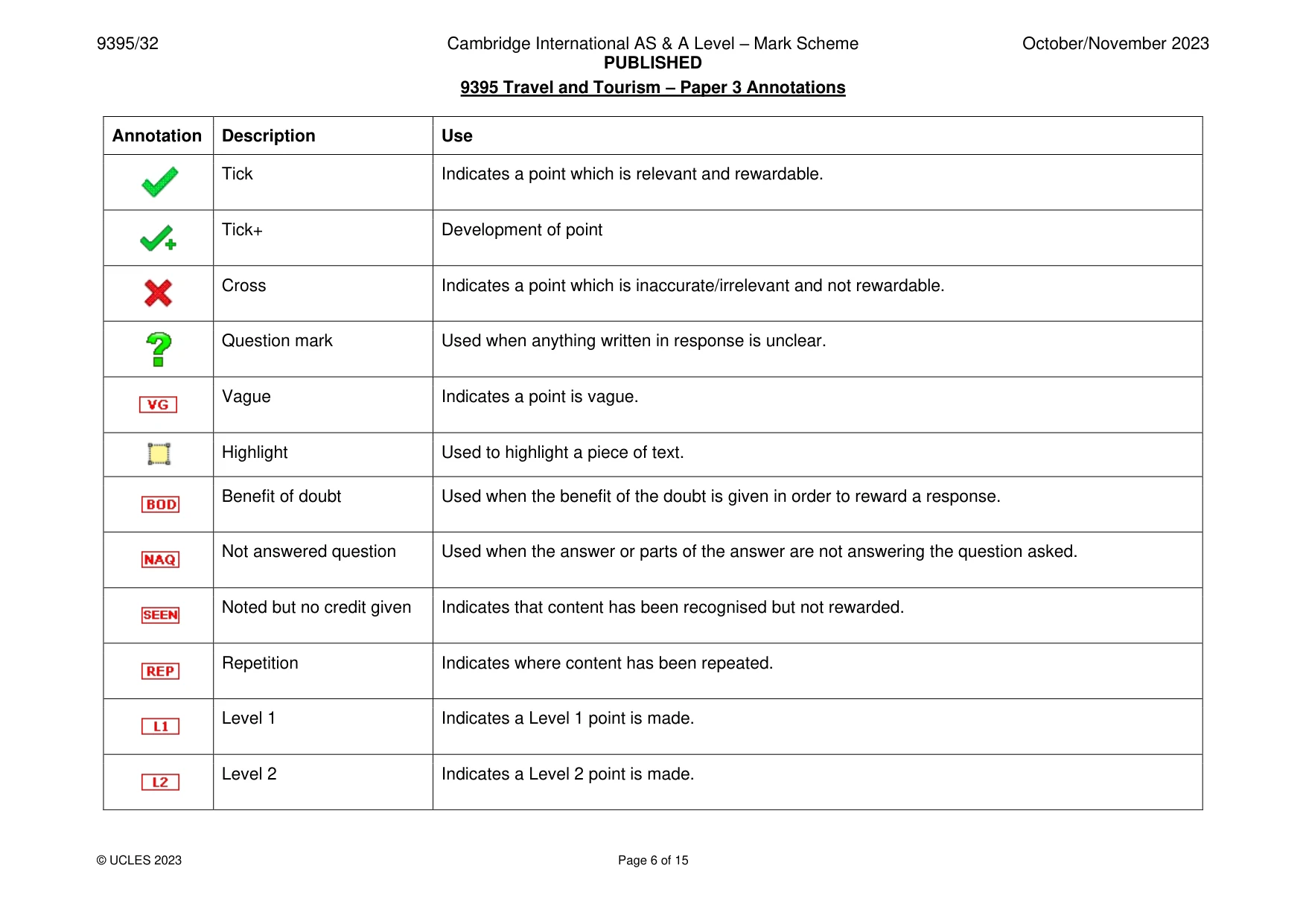
9395/32 Cambridge International AS & A Level – Mark Scheme PUBLISHED October/November 2023 © UCLES 2023 Page 6 of 15 9395 Travel and Tourism – Paper 3 Annotations Annotation Description Use Tick Indicates a point which is relevant and rewardable. Tick+ Development of point Cross Indicates a point which is inaccurate/irrelevant and not rewardable. Question mark Used when anything written in response is unclear. Vague Indicates a point is vague. Highlight Used to highlight a piece of text. Benefit of doubt Used when the benefit of the doubt is given in order to reward a response. Not answered question Used when the answer or parts of the answer are not answering the question asked. Noted but no credit given Indicates that content has been recognised but not rewarded. Repetition Indicates where content has been repeated. Level 1 Indicates a Level 1 point is made. Level 2 Indicates a Level 2 point is made.
Mark scheme, page 7
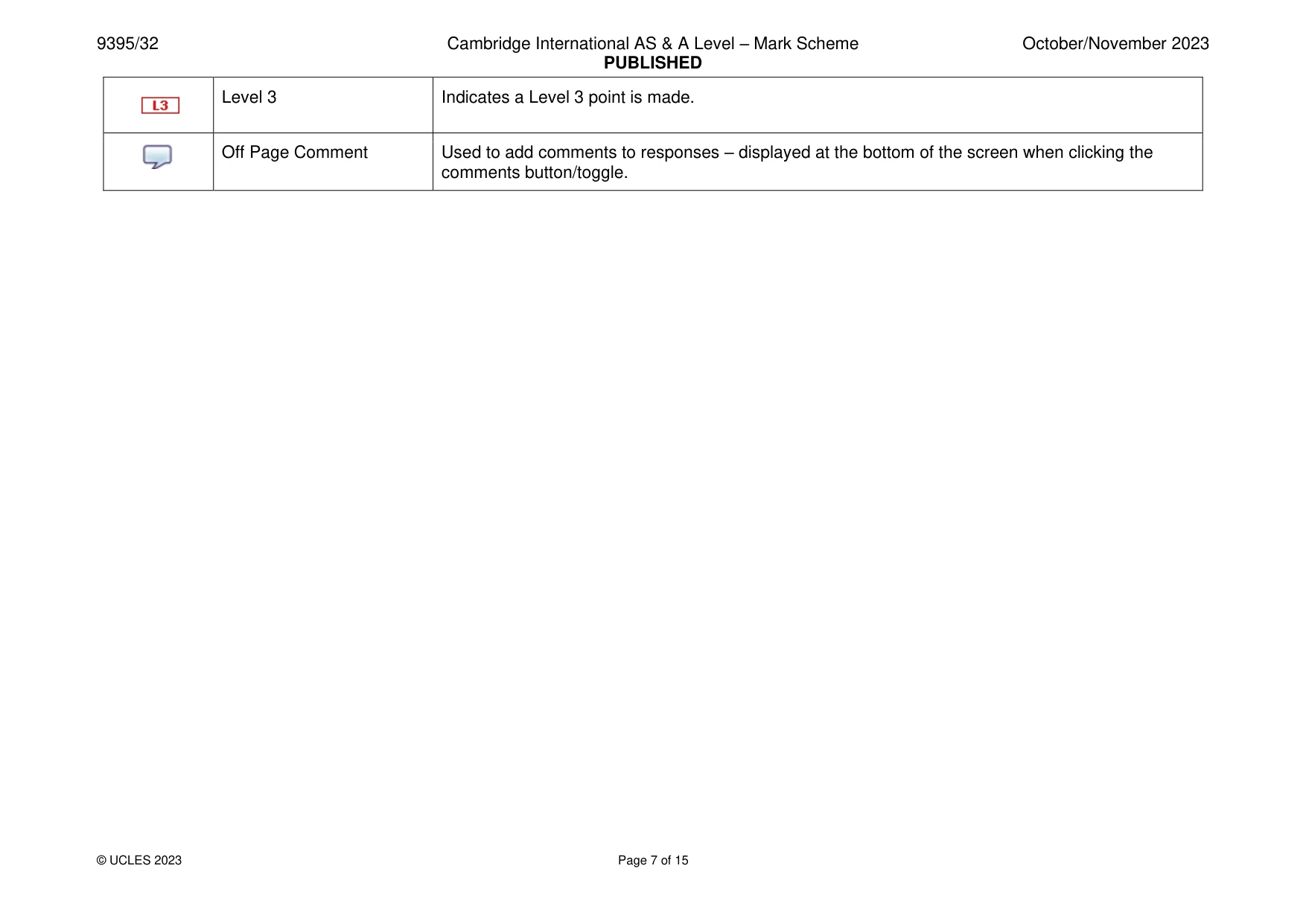
9395/32 Cambridge International AS & A Level – Mark Scheme PUBLISHED October/November 2023 © UCLES 2023 Page 7 of 15 Level 3 Indicates a Level 3 point is made. Off Page Comment Used to add comments to responses – displayed at the bottom of the screen when clicking the comments button/toggle.
Mark scheme, page 8
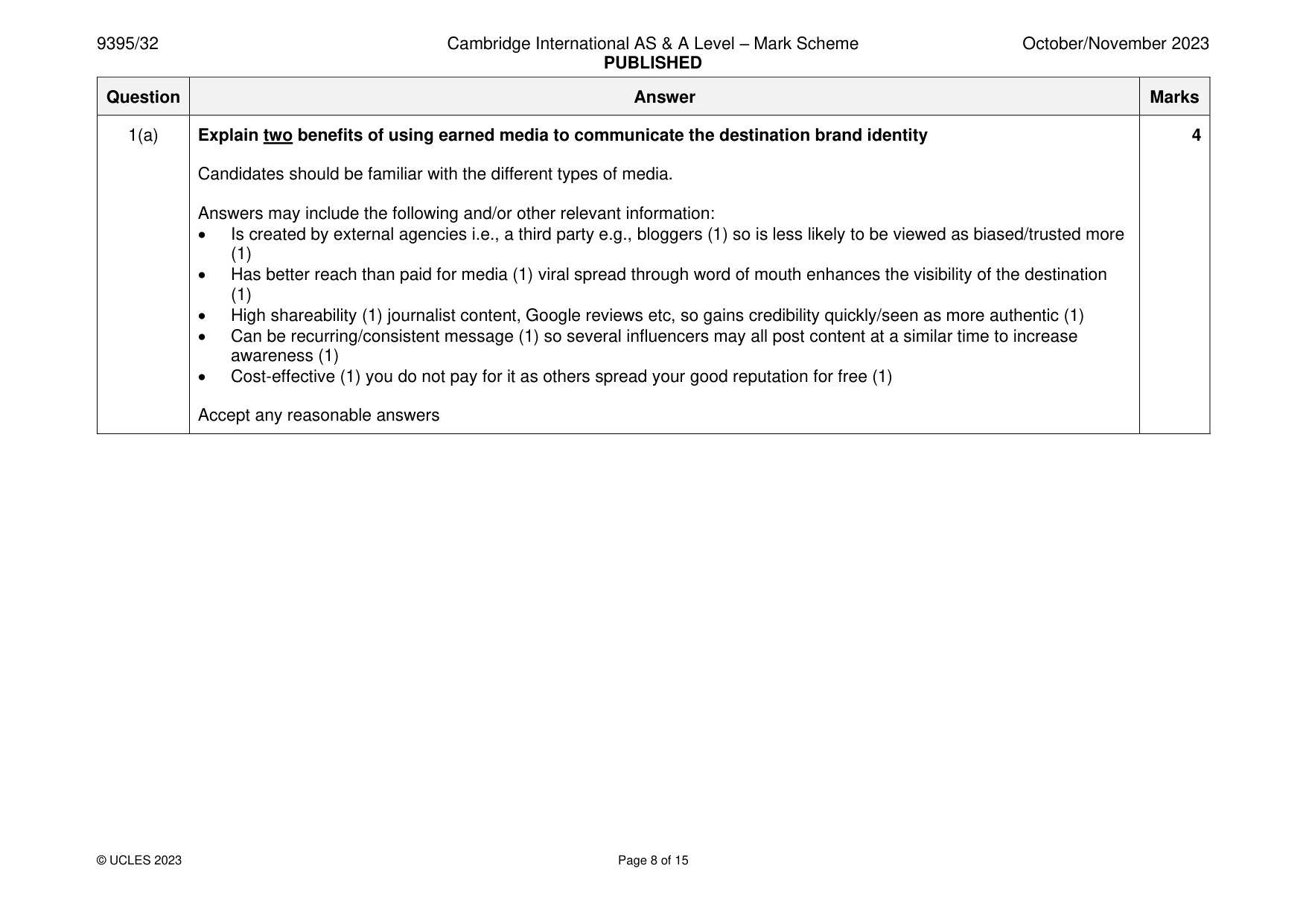
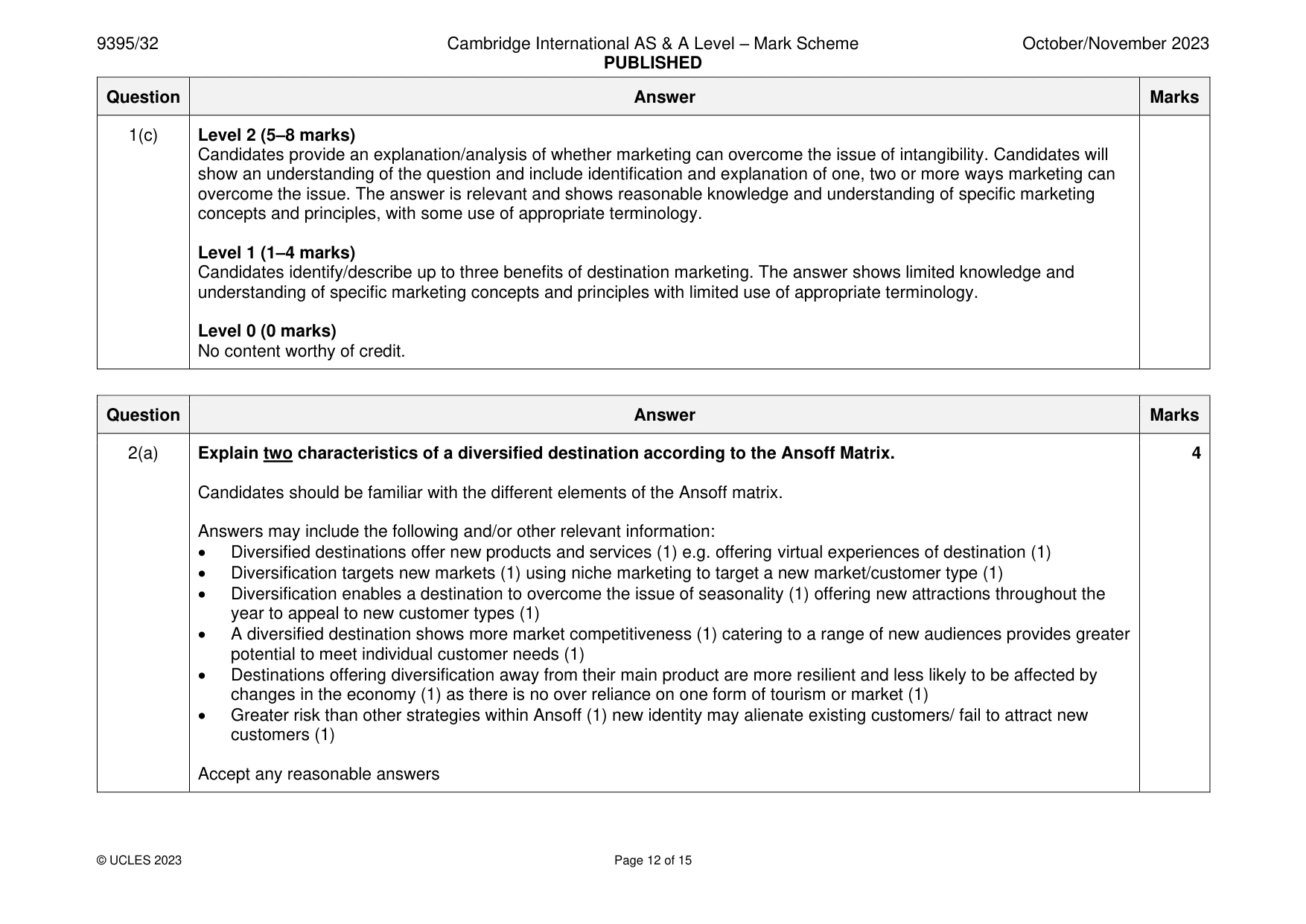
9395/32 Cambridge International AS & A Level – Mark Scheme PUBLISHED October/November 2023 © UCLES 2023 Page 8 of 15 Question Answer Marks 1(a) Explain two benefits of using earned media to communicate the destination brand identity Candidates should be familiar with the different types of media. Answers may include the following and/or other relevant information: • Is created by external agencies i.e., a third party e.g., bloggers (1) so is less likely to be viewed as biased/trusted more (1) • Has better reach than paid for media (1) viral spread through word of mouth enhances the visibility of the destination (1) • High shareability (1) journalist content, Google reviews etc, so gains credibility quickly/seen as more authentic (1) • Can be recurring/consistent message (1) so several influencers may all post content at a similar time to increase awareness (1) • Cost-effective (1) you do not pay for it as others spread your good reputation for free (1) Accept any reasonable answers 4
Mark scheme, page 9
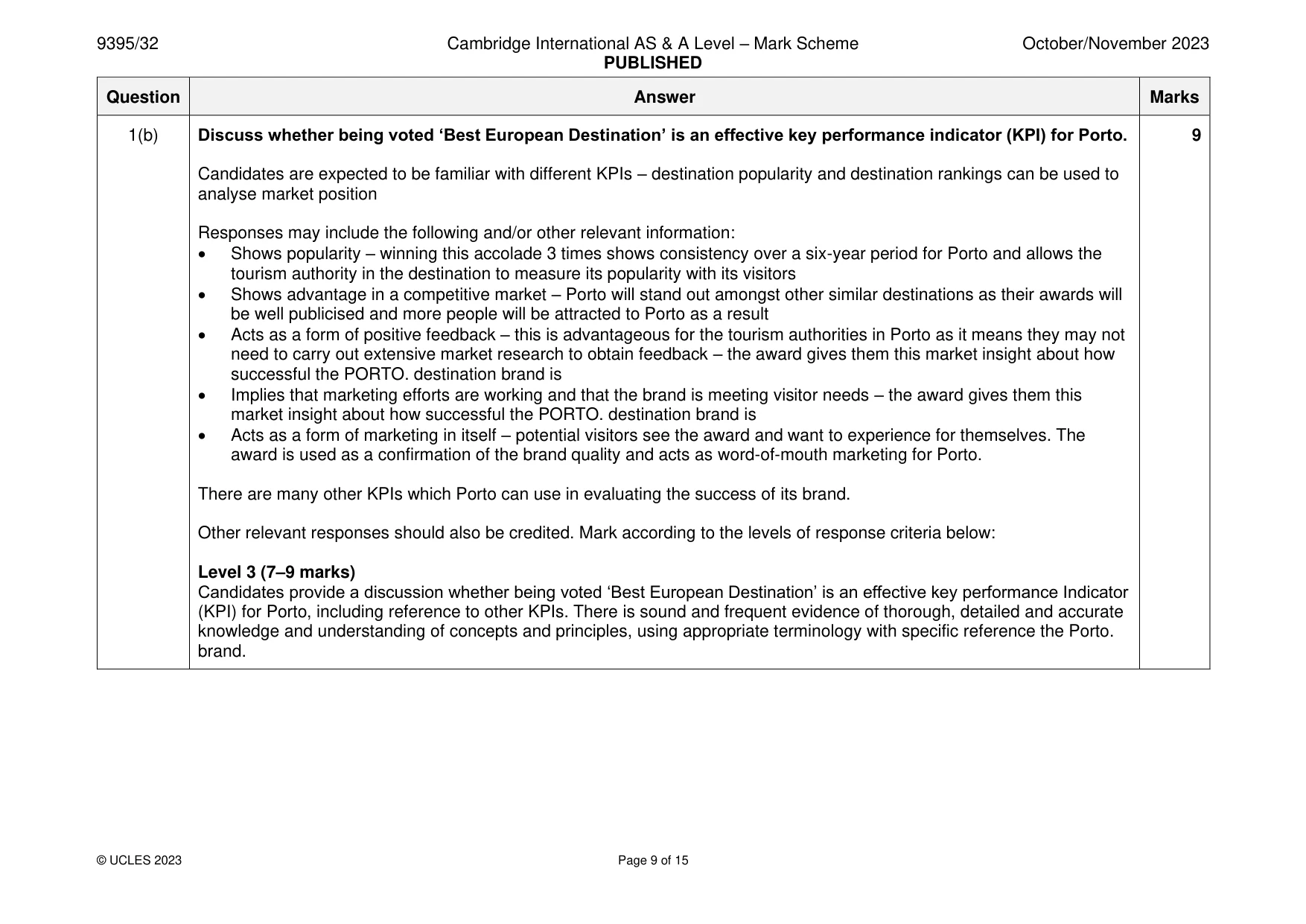
9395/32 Cambridge International AS & A Level – Mark Scheme PUBLISHED October/November 2023 © UCLES 2023 Page 9 of 15 Question Answer Marks 1(b) Discuss whether being voted ‘Best European Destination’ is an effective key performance indicator (KPI) for Porto. Candidates are expected to be familiar with different KPIs – destination popularity and destination rankings can be used to analyse market position Responses may include the following and/or other relevant information: • Shows popularity – winning this accolade 3 times shows consistency over a six-year period for Porto and allows the tourism authority in the destination to measure its popularity with its visitors • Shows advantage in a competitive market – Porto will stand out amongst other similar destinations as their awards will be well publicised and more people will be attracted to Porto as a result • Acts as a form of positive feedback – this is advantageous for the tourism authorities in Porto as it means they may not need to carry out extensive market research to obtain feedback – the award gives them this market insight about how successful the PORTO. destination brand is • Implies that marketing efforts are working and that the brand is meeting visitor needs – the award gives them this market insight about how successful the PORTO. destination brand is • Acts as a form of marketing in itself – potential visitors see the award and want to experience for themselves. The award is used as a confirmation of the brand quality and acts as word-of-mouth marketing for Porto. There are many other KPIs which Porto can use in evaluating the success of its brand. Other relevant responses should also be credited. Mark according to the levels of response criteria below: Level 3 (7–9 marks) Candidates provide a discussion whether being voted ‘Best European Destination’ is an effective key performance Indicator (KPI) for Porto, including reference to other KPIs. There is sound and frequent evidence of thorough, detailed and accurate knowledge and understanding of concepts and principles, using appropriate terminology with specific reference the Porto. brand. 9
Mark scheme, page 10
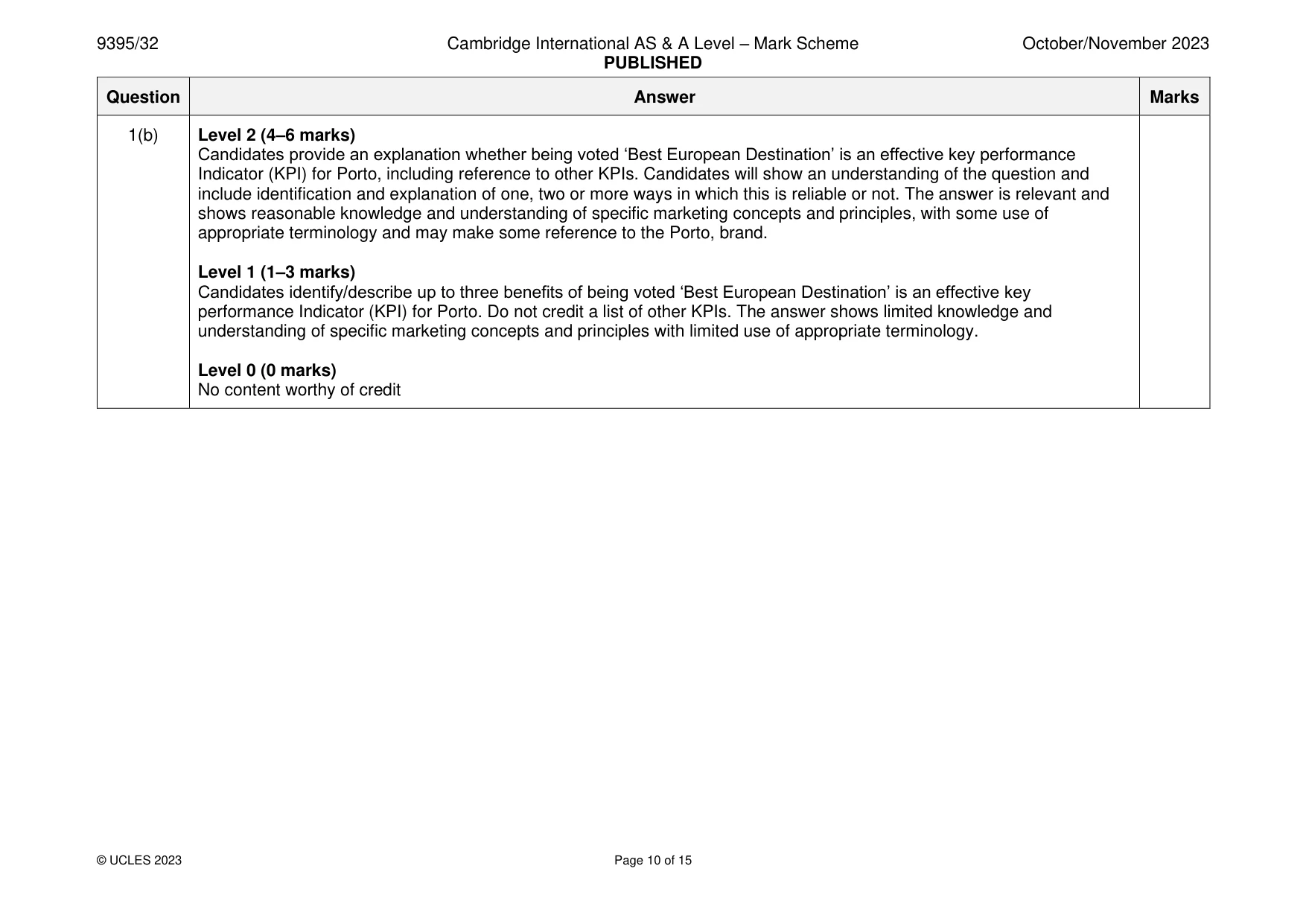
9395/32 Cambridge International AS & A Level – Mark Scheme PUBLISHED October/November 2023 © UCLES 2023 Page 10 of 15 Question Answer Marks 1(b) Level 2 (4–6 marks) Candidates provide an explanation whether being voted ‘Best European Destination’ is an effective key performance Indicator (KPI) for Porto, including reference to other KPIs. Candidates will show an understanding of the question and include identification and explanation of one, two or more ways in which this is reliable or not. The answer is relevant and shows reasonable knowledge and understanding of specific marketing concepts and principles, with some use of appropriate terminology and may make some reference to the Porto, brand. Level 1 (1–3 marks) Candidates identify/describe up to three benefits of being voted ‘Best European Destination’ is an effective key performance Indicator (KPI) for Porto. Do not credit a list of other KPIs. The answer shows limited knowledge and understanding of specific marketing concepts and principles with limited use of appropriate terminology. Level 0 (0 marks) No content worthy of credit
Mark scheme, page 11
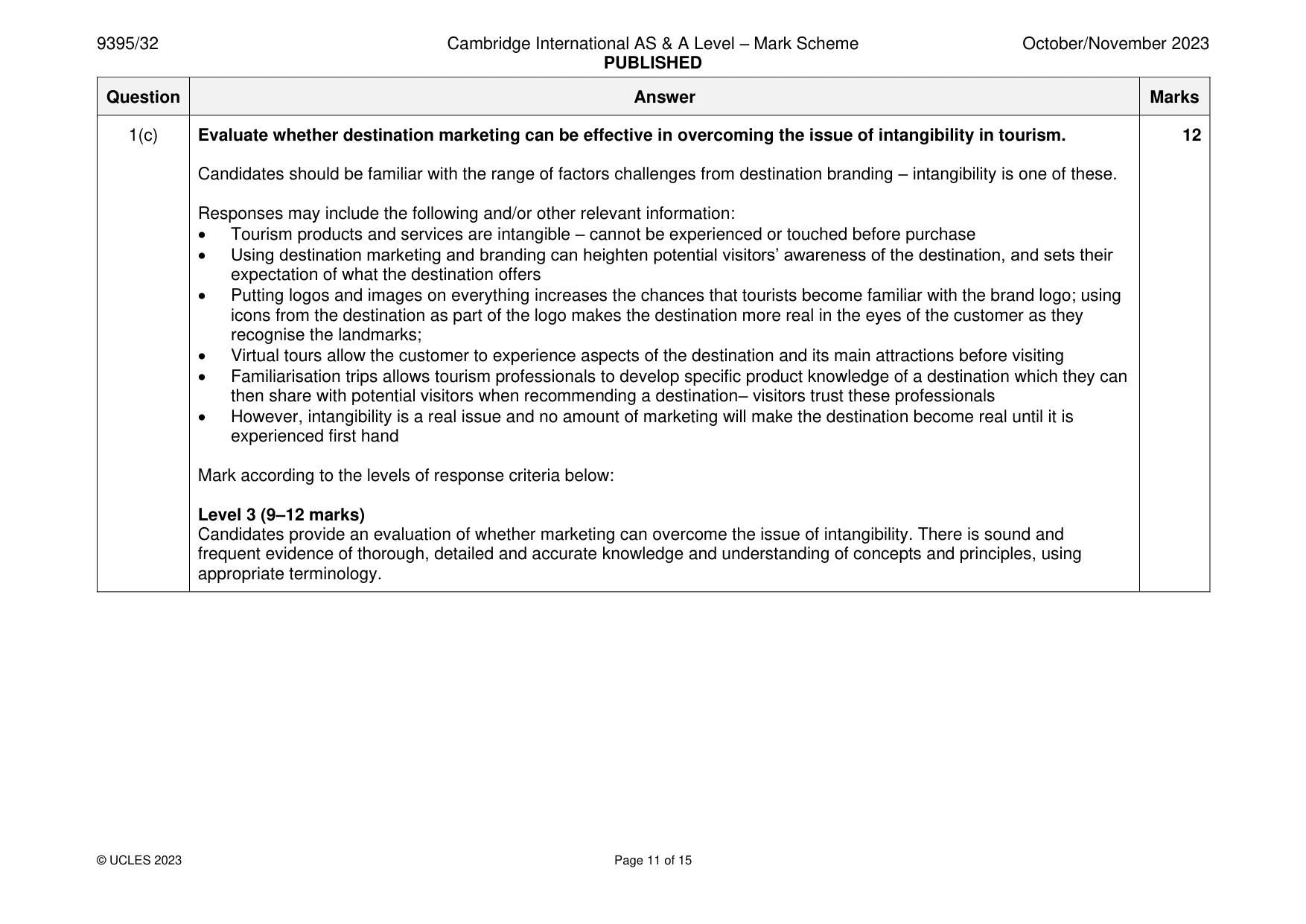
9395/32 Cambridge International AS & A Level – Mark Scheme PUBLISHED October/November 2023 © UCLES 2023 Page 11 of 15 Question Answer Marks 1(c) Evaluate whether destination marketing can be effective in overcoming the issue of intangibility in tourism. Candidates should be familiar with the range of factors challenges from destination branding – intangibility is one of these. Responses may include the following and/or other relevant information: • Tourism products and services are intangible – cannot be experienced or touched before purchase • Using destination marketing and branding can heighten potential visitors’ awareness of the destination, and sets their expectation of what the destination offers • Putting logos and images on everything increases the chances that tourists become familiar with the brand logo; using icons from the destination as part of the logo makes the destination more real in the eyes of the customer as they recognise the landmarks; • Virtual tours allow the customer to experience aspects of the destination and its main attractions before visiting • Familiarisation trips allows tourism professionals to develop specific product knowledge of a destination which they can then share with potential visitors when recommending a destination– visitors trust these professionals • However, intangibility is a real issue and no amount of marketing will make the destination become real until it is experienced first hand Mark according to the levels of response criteria below: Level 3 (9–12 marks) Candidates provide an evaluation of whether marketing can overcome the issue of intangibility. There is sound and frequent evidence of thorough, detailed and accurate knowledge and understanding of concepts and principles, using appropriate terminology. 12
Mark scheme, page 12
9395/32 Cambridge International AS & A Level – Mark Scheme PUBLISHED October/November 2023 © UCLES 2023 Page 12 of 15 Question Answer Marks 1(c) Level 2 (5–8 marks) Candidates provide an explanation/analysis of whether marketing can overcome the issue of intangibility. Candidates will show an understanding of the question and include identification and explanation of one, two or more ways marketing can overcome the issue. The answer is relevant and shows reasonable knowledge and understanding of specific marketing concepts and principles, with some use of appropriate terminology. Level 1 (1–4 marks) Candidates identify/describe up to three benefits of destination marketing. The answer shows limited knowledge and understanding of specific marketing concepts and principles with limited use of appropriate terminology. Level 0 (0 marks) No content worthy of credit. Question Answer Marks 2(a) Explain two characteristics of a diversified destination according to the Ansoff Matrix. Candidates should be familiar with the different elements of the Ansoff matrix. Answers may include the following and/or other relevant information: • Diversified destinations offer new products and services (1) e.g. offering virtual experiences of destination (1) • Diversification targets new markets (1) using niche marketing to target a new market/customer type (1) • Diversification enables a destination to overcome the issue of seasonality (1) offering new attractions throughout the year to appeal to new customer types (1) • A diversified destination shows more market competitiveness (1) catering to a range of new audiences provides greater potential to meet individual customer needs (1) • Destinations offering diversification away from their main product are more resilient and less likely to be affected by changes in the economy (1) as there is no over reliance on one form of tourism or market (1) • Greater risk than other strategies within Ansoff (1) new identity may alienate existing customers/ fail to attract new customers (1) Accept any reasonable answers 4
Mark scheme, page 13
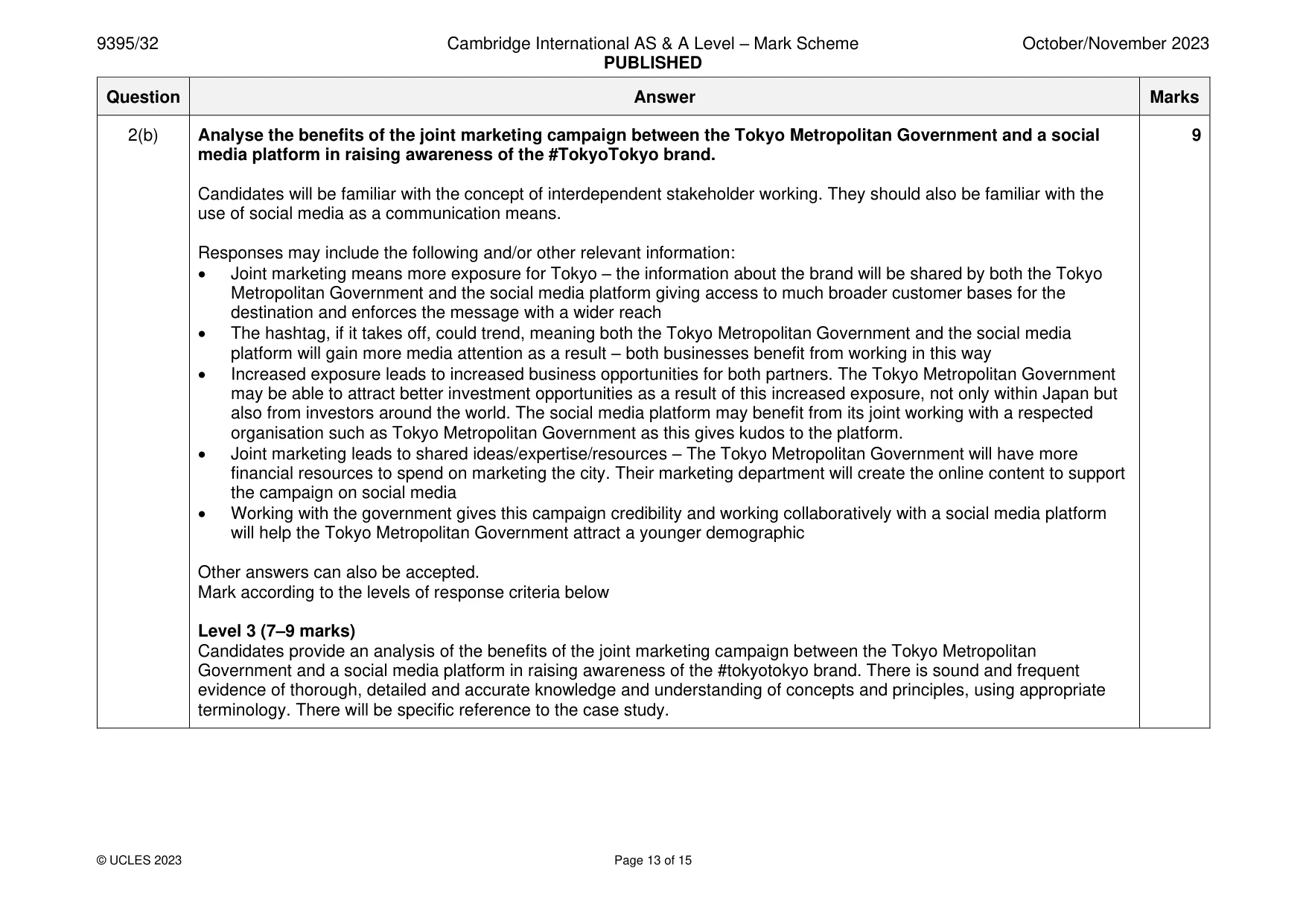
9395/32 Cambridge International AS & A Level – Mark Scheme PUBLISHED October/November 2023 © UCLES 2023 Page 13 of 15 Question Answer Marks 2(b) Analyse the benefits of the joint marketing campaign between the Tokyo Metropolitan Government and a social media platform in raising awareness of the #TokyoTokyo brand. Candidates will be familiar with the concept of interdependent stakeholder working. They should also be familiar with the use of social media as a communication means. Responses may include the following and/or other relevant information: • Joint marketing means more exposure for Tokyo – the information about the brand will be shared by both the Tokyo Metropolitan Government and the social media platform giving access to much broader customer bases for the destination and enforces the message with a wider reach • The hashtag, if it takes off, could trend, meaning both the Tokyo Metropolitan Government and the social media platform will gain more media attention as a result – both businesses benefit from working in this way • Increased exposure leads to increased business opportunities for both partners. The Tokyo Metropolitan Government may be able to attract better investment opportunities as a result of this increased exposure, not only within Japan but also from investors around the world. The social media platform may benefit from its joint working with a respected organisation such as Tokyo Metropolitan Government as this gives kudos to the platform. • Joint marketing leads to shared ideas/expertise/resources – The Tokyo Metropolitan Government will have more financial resources to spend on marketing the city. Their marketing department will create the online content to support the campaign on social media • Working with the government gives this campaign credibility and working collaboratively with a social media platform will help the Tokyo Metropolitan Government attract a younger demographic Other answers can also be accepted. Mark according to the levels of response criteria below Level 3 (7–9 marks) Candidates provide an analysis of the benefits of the joint marketing campaign between the Tokyo Metropolitan Government and a social media platform in raising awareness of the #tokyotokyo brand. There is sound and frequent evidence of thorough, detailed and accurate knowledge and understanding of concepts and principles, using appropriate terminology. There will be specific reference to the case study. 9
Mark scheme, page 14
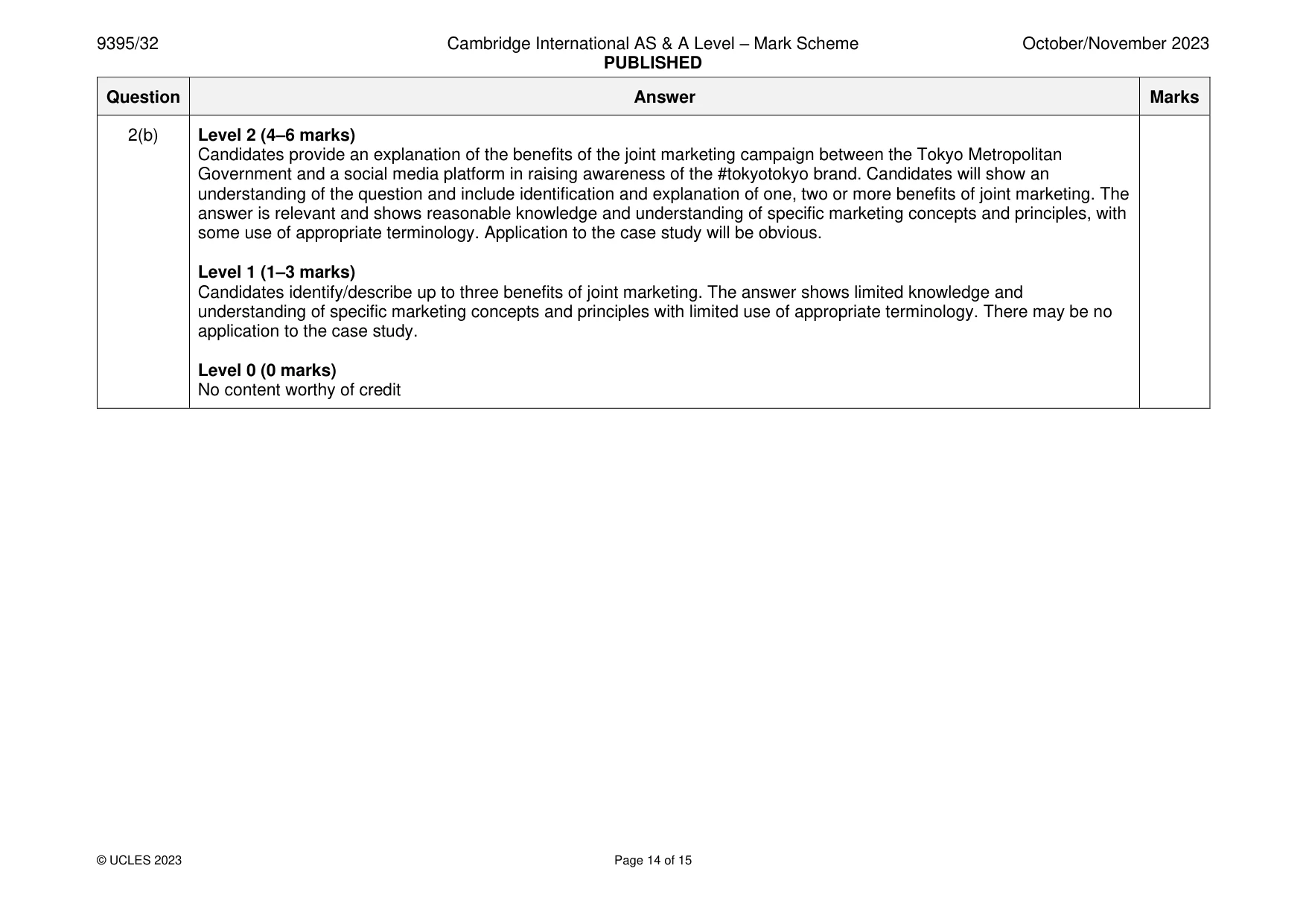
9395/32 Cambridge International AS & A Level – Mark Scheme PUBLISHED October/November 2023 © UCLES 2023 Page 14 of 15 Question Answer Marks 2(b) Level 2 (4–6 marks) Candidates provide an explanation of the benefits of the joint marketing campaign between the Tokyo Metropolitan Government and a social media platform in raising awareness of the #tokyotokyo brand. Candidates will show an understanding of the question and include identification and explanation of one, two or more benefits of joint marketing. The answer is relevant and shows reasonable knowledge and understanding of specific marketing concepts and principles, with some use of appropriate terminology. Application to the case study will be obvious. Level 1 (1–3 marks) Candidates identify/describe up to three benefits of joint marketing. The answer shows limited knowledge and understanding of specific marketing concepts and principles with limited use of appropriate terminology. There may be no application to the case study. Level 0 (0 marks) No content worthy of credit
Mark scheme, page 15
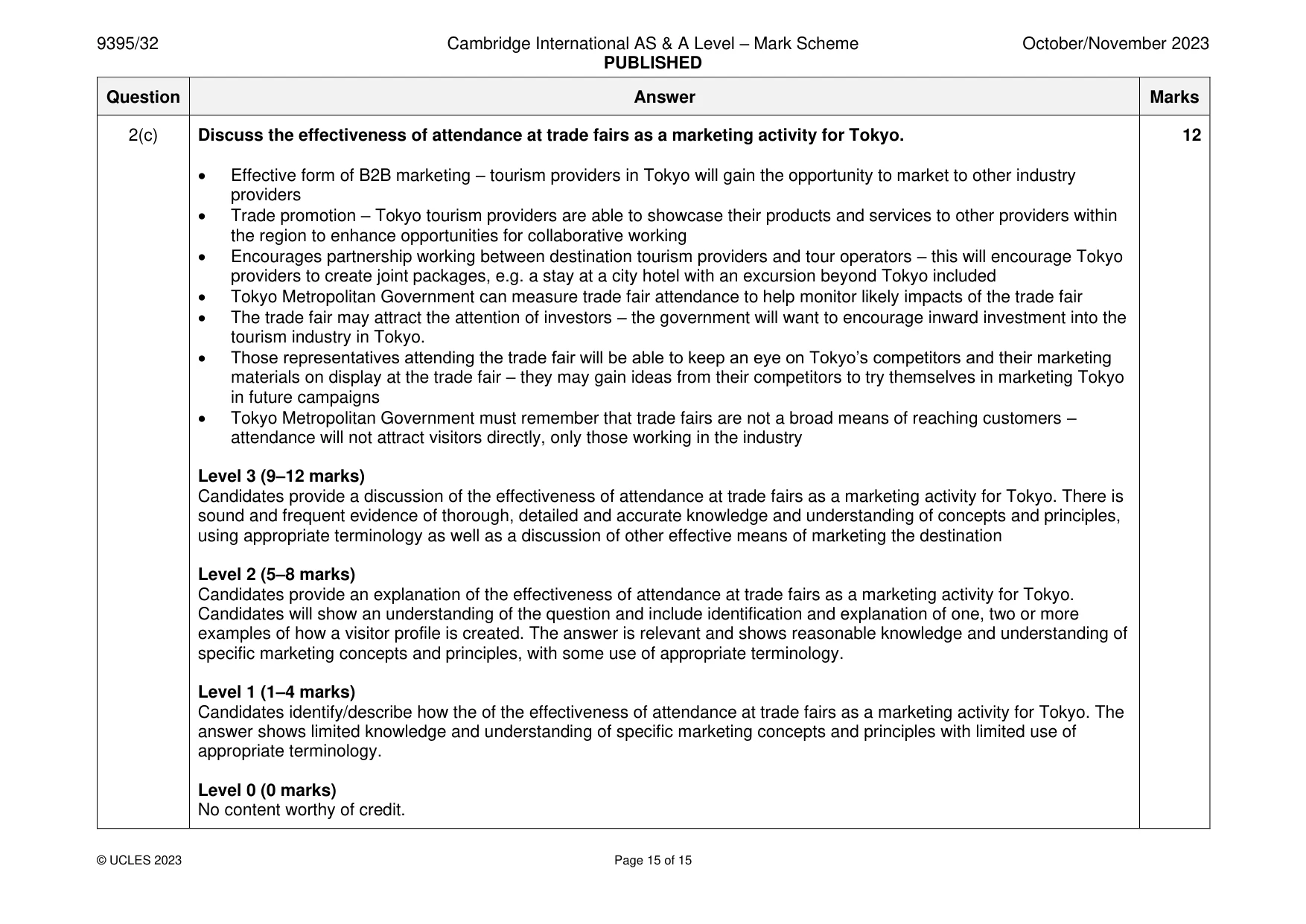
9395/32 Cambridge International AS & A Level – Mark Scheme PUBLISHED October/November 2023 © UCLES 2023 Page 15 of 15 Question Answer Marks 2(c) Discuss the effectiveness of attendance at trade fairs as a marketing activity for Tokyo. • Effective form of B2B marketing – tourism providers in Tokyo will gain the opportunity to market to other industry providers • Trade promotion – Tokyo tourism providers are able to showcase their products and services to other providers within the region to enhance opportunities for collaborative working • Encourages partnership working between destination tourism providers and tour operators – this will encourage Tokyo providers to create joint packages, e.g. a stay at a city hotel with an excursion beyond Tokyo included • Tokyo Metropolitan Government can measure trade fair attendance to help monitor likely impacts of the trade fair • The trade fair may attract the attention of investors – the government will want to encourage inward investment into the tourism industry in Tokyo. • Those representatives attending the trade fair will be able to keep an eye on Tokyo’s competitors and their marketing materials on display at the trade fair – they may gain ideas from their competitors to try themselves in marketing Tokyo in future campaigns • Tokyo Metropolitan Government must remember that trade fairs are not a broad means of reaching customers – attendance will not attract visitors directly, only those working in the industry Level 3 (9–12 marks) Candidates provide a discussion of the effectiveness of attendance at trade fairs as a marketing activity for Tokyo. There is sound and frequent evidence of thorough, detailed and accurate knowledge and understanding of concepts and principles, using appropriate terminology as well as a discussion of other effective means of marketing the destination Level 2 (5–8 marks) Candidates provide an explanation of the effectiveness of attendance at trade fairs as a marketing activity for Tokyo. Candidates will show an understanding of the question and include identification and explanation of one, two or more examples of how a visitor profile is created. The answer is relevant and shows reasonable knowledge and understanding of specific marketing concepts and principles, with some use of appropriate terminology. Level 1 (1–4 marks) Candidates identify/describe how the of the effectiveness of attendance at trade fairs as a marketing activity for Tokyo. The answer shows limited knowledge and understanding of specific marketing concepts and principles with limited use of appropriate terminology. Level 0 (0 marks) No content worthy of credit. 12
What you needed in this session
Cambridge’s own grade thresholds for 2023 Oct/Nov, Paper 3 · Variant 2. A higher threshold means an easier paper — the bar moves with how the cohort did.