Cambridge A Level Thinking Skills 9694 — 2022 Oct/Nov Paper 4 · Variant 1
9694/41/O/N/22 · 50 marks · ≈56 min
The question paper and its mark scheme, free to read here and free to download. This is Cambridge’s own paper, exactly as it was sat.
Question paper8 pages
Mark scheme13 pages
Answers below. Sit the paper first if you are practising.

Paper as text
Question paper, page 1
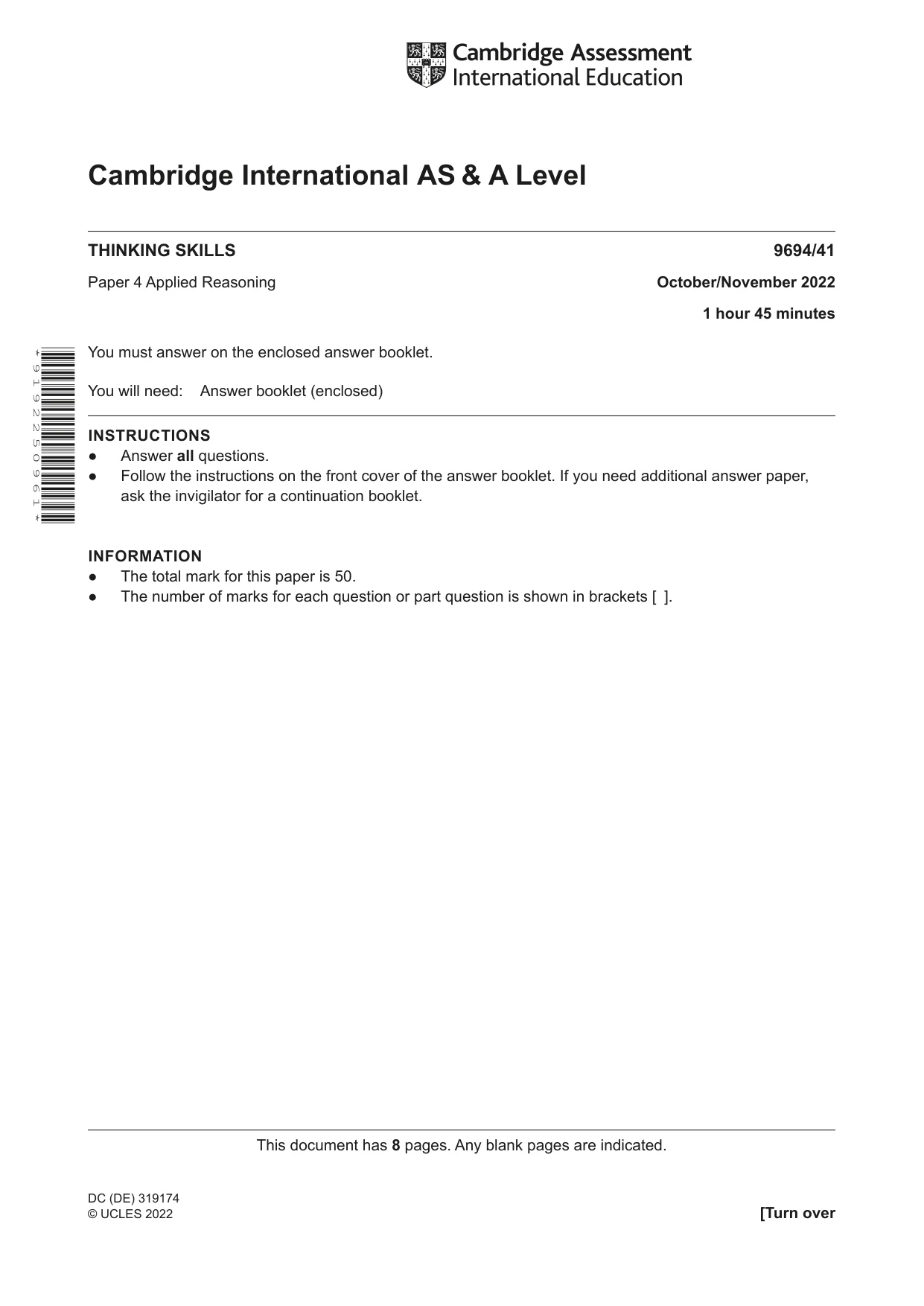
This document has 8 pages. Any blank pages are indicated. [Turn over DC (DE) 319174 © UCLES 2022 * 9 1 9 2 2 5 0 9 6 1 * Cambridge International AS & A Level THINKING SKILLS 9694/41 Paper 4 Applied Reasoning October/November 2022 1 hour 45 minutes You must answer on the enclosed answer booklet. You will need: Answer booklet (enclosed) INSTRUCTIONS ● Answer all questions. ● Follow the instructions on the front cover of the answer booklet. If you need additional answer paper, ask the invigilator for a continuation booklet. INFORMATION ● The total mark for this paper is 50. ● The number of marks for each question or part question is shown in brackets [ ].
Question paper, page 2
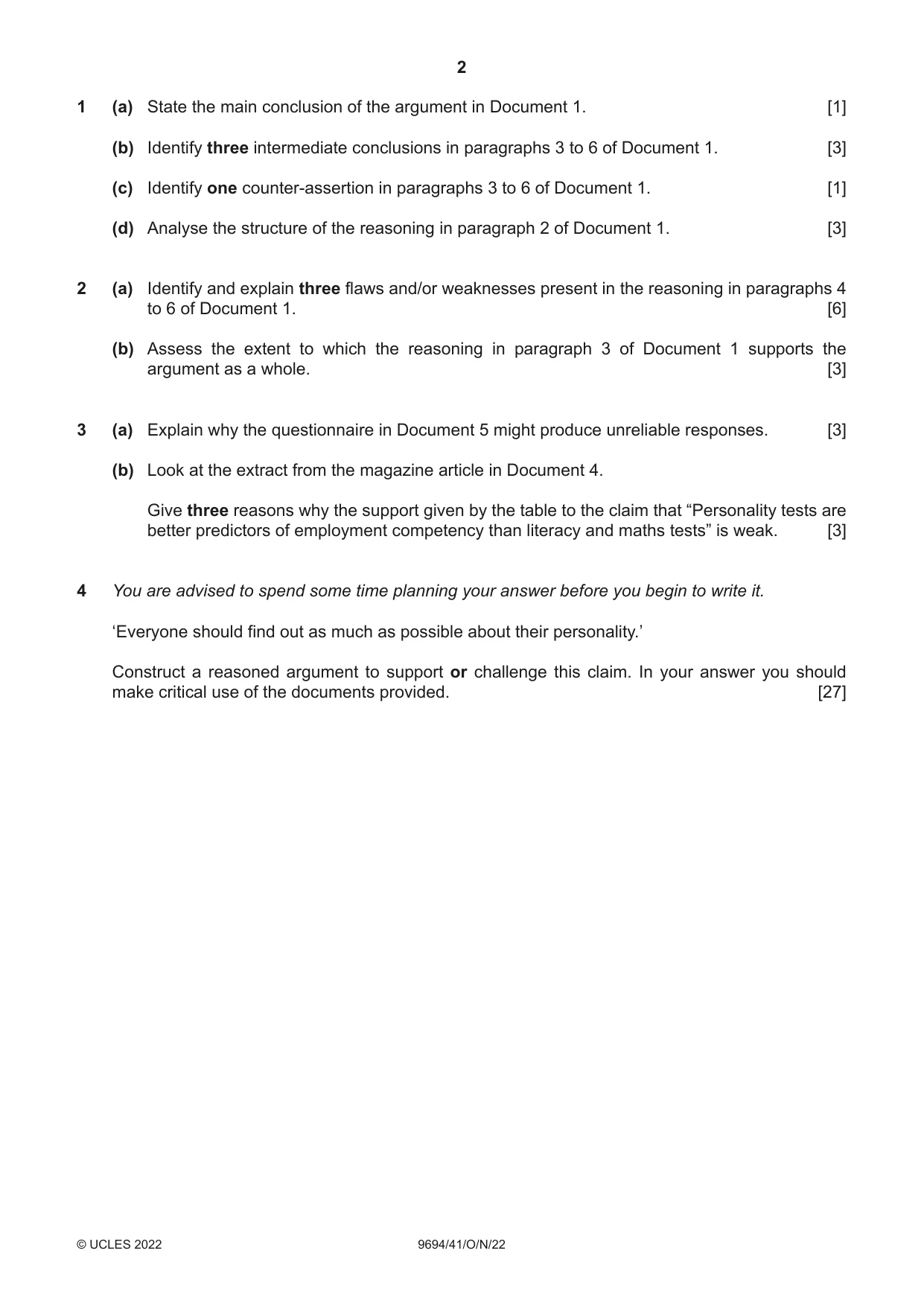
2 9694/41/O/N/22 © UCLES 2022 1 (a) State the main conclusion of the argument in Document 1. [1] (b) Identify three intermediate conclusions in paragraphs 3 to 6 of Document 1. [3] (c) Identify one counter-assertion in paragraphs 3 to 6 of Document 1. [1] (d) Analyse the structure of the reasoning in paragraph 2 of Document 1. [3] 2 (a) Identify and explain three flaws and/or weaknesses present in the reasoning in paragraphs 4 to 6 of Document 1. [6] (b) Assess the extent to which the reasoning in paragraph 3 of Document 1 supports the argument as a whole. [3] 3 (a) Explain why the questionnaire in Document 5 might produce unreliable responses. [3] (b) Look at the extract from the magazine article in Document 4. Give three reasons why the support given by the table to the claim that “Personality tests are better predictors of employment competency than literacy and maths tests” is weak. [3] 4 You are advised to spend some time planning your answer before you begin to write it. ‘Everyone should find out as much as possible about their personality.’ Construct a reasoned argument to support or challenge this claim. In your answer you should make critical use of the documents provided. [27]
Question paper, page 3
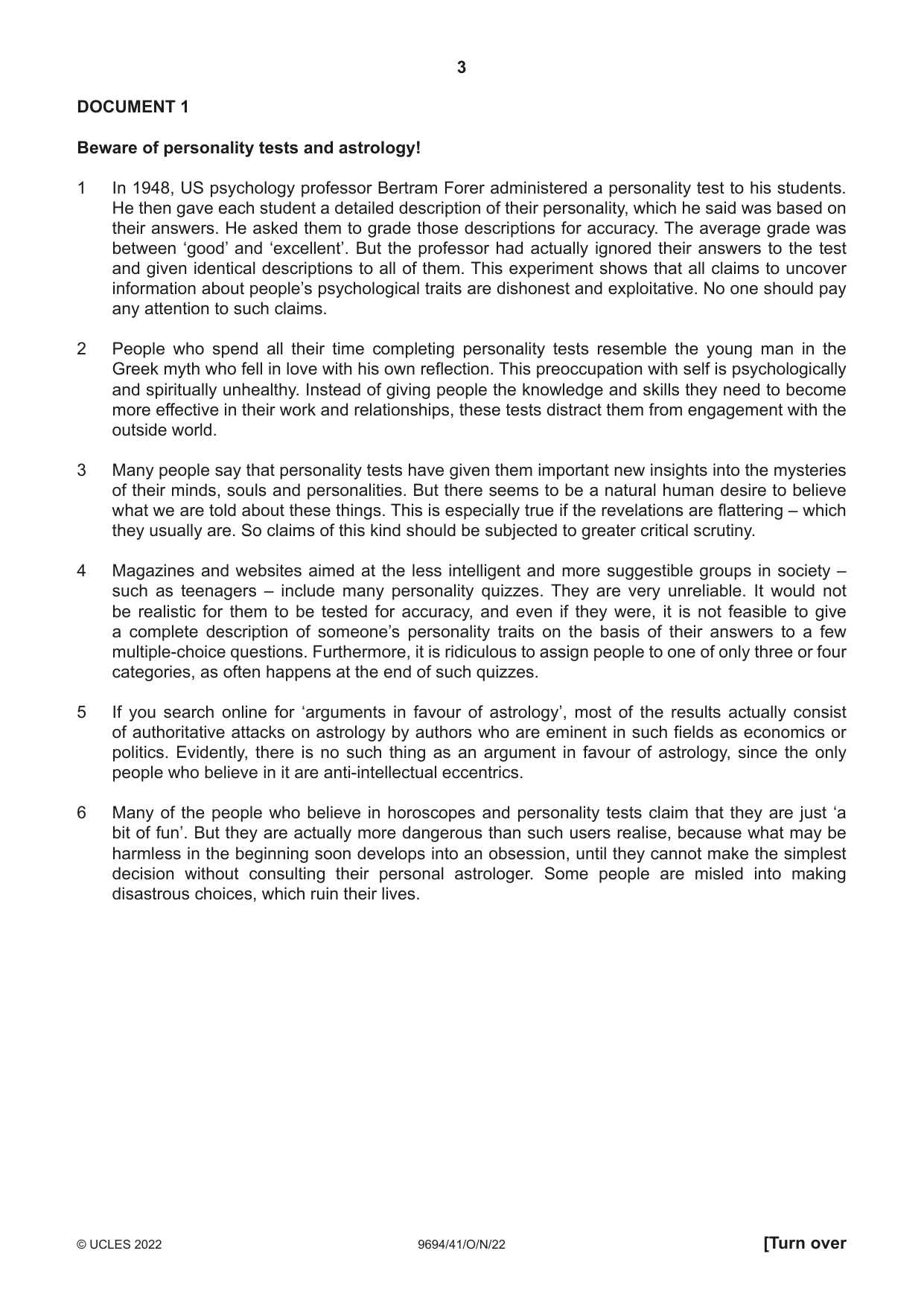
3 9694/41/O/N/22 © UCLES 2022 [Turn over DOCUMENT 1 Beware of personality tests and astrology! 1 In 1948, US psychology professor Bertram Forer administered a personality test to his students. He then gave each student a detailed description of their personality, which he said was based on their answers. He asked them to grade those descriptions for accuracy. The average grade was between ‘good’ and ‘excellent’. But the professor had actually ignored their answers to the test and given identical descriptions to all of them. This experiment shows that all claims to uncover information about people’s psychological traits are dishonest and exploitative. No one should pay any attention to such claims. 2 People who spend all their time completing personality tests resemble the young man in the Greek myth who fell in love with his own reflection. This preoccupation with self is psychologically and spiritually unhealthy. Instead of giving people the knowledge and skills they need to become more effective in their work and relationships, these tests distract them from engagement with the outside world. 3 Many people say that personality tests have given them important new insights into the mysteries of their minds, souls and personalities. But there seems to be a natural human desire to believe what we are told about these things. This is especially true if the revelations are flattering – which they usually are. So claims of this kind should be subjected to greater critical scrutiny. 4 Magazines and websites aimed at the less intelligent and more suggestible groups in society – such as teenagers – include many personality quizzes. They are very unreliable. It would not be realistic for them to be tested for accuracy, and even if they were, it is not feasible to give a complete description of someone’s personality traits on the basis of their answers to a few multiple-choice questions. Furthermore, it is ridiculous to assign people to one of only three or four categories, as often happens at the end of such quizzes. 5 If you search online for ‘arguments in favour of astrology’, most of the results actually consist of authoritative attacks on astrology by authors who are eminent in such fields as economics or politics. Evidently, there is no such thing as an argument in favour of astrology, since the only people who believe in it are anti-intellectual eccentrics. 6 Many of the people who believe in horoscopes and personality tests claim that they are just ‘a bit of fun’. But they are actually more dangerous than such users realise, because what may be harmless in the beginning soon develops into an obsession, until they cannot make the simplest decision without consulting their personal astrologer. Some people are misled into making disastrous choices, which ruin their lives.
Question paper, page 4
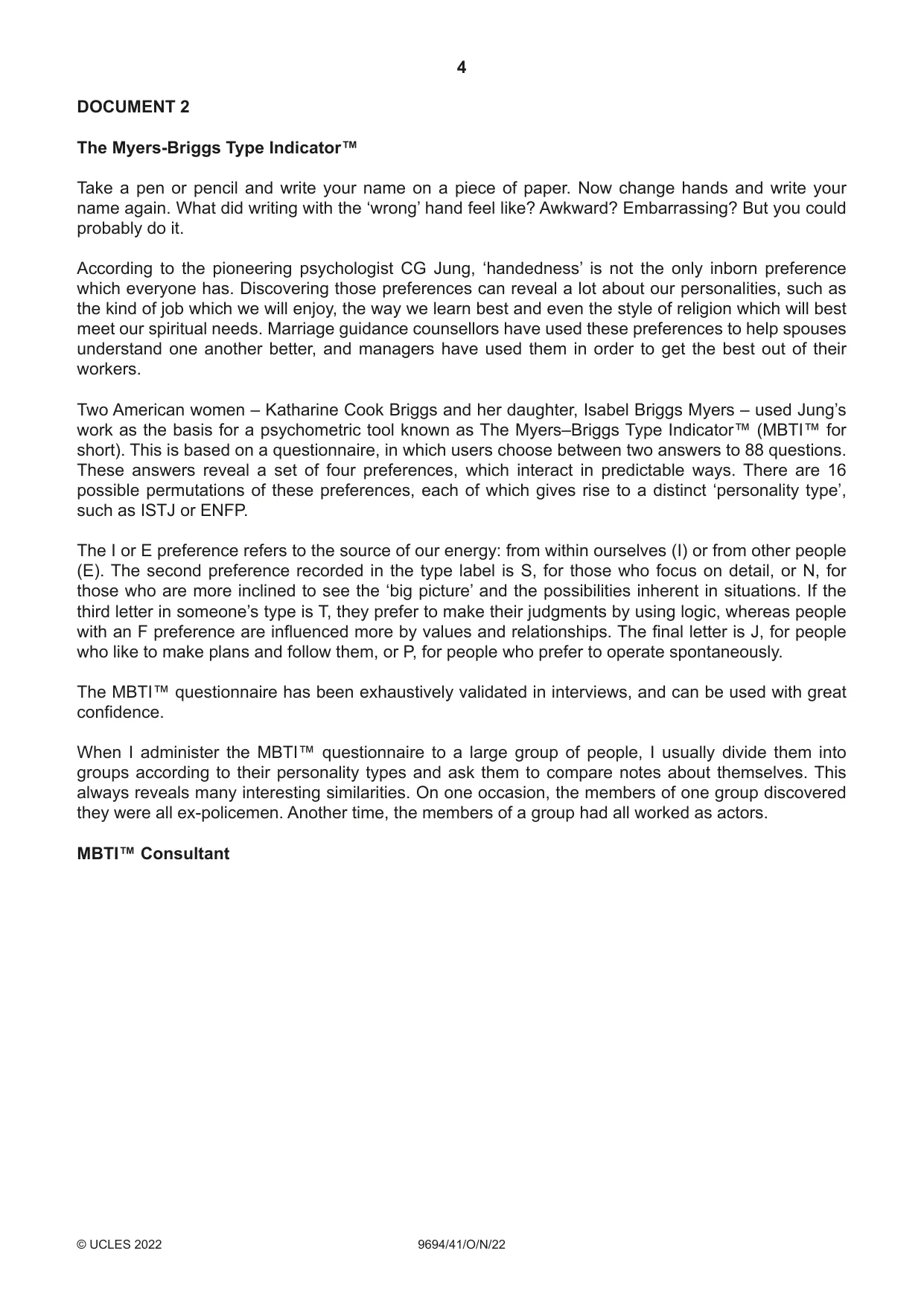
4 9694/41/O/N/22 © UCLES 2022 DOCUMENT 2 The Myers-Briggs Type Indicator™ Take a pen or pencil and write your name on a piece of paper. Now change hands and write your name again. What did writing with the ‘wrong’ hand feel like? Awkward? Embarrassing? But you could probably do it. According to the pioneering psychologist CG Jung, ‘handedness’ is not the only inborn preference which everyone has. Discovering those preferences can reveal a lot about our personalities, such as the kind of job which we will enjoy, the way we learn best and even the style of religion which will best meet our spiritual needs. Marriage guidance counsellors have used these preferences to help spouses understand one another better, and managers have used them in order to get the best out of their workers. Two American women – Katharine Cook Briggs and her daughter, Isabel Briggs Myers – used Jung’s work as the basis for a psychometric tool known as The Myers–Briggs Type Indicator™ (MBTI™ for short). This is based on a questionnaire, in which users choose between two answers to 88 questions. These answers reveal a set of four preferences, which interact in predictable ways. There are 16 possible permutations of these preferences, each of which gives rise to a distinct ‘personality type’, such as ISTJ or ENFP. The I or E preference refers to the source of our energy: from within ourselves (I) or from other people (E). The second preference recorded in the type label is S, for those who focus on detail, or N, for those who are more inclined to see the ‘big picture’ and the possibilities inherent in situations. If the third letter in someone’s type is T, they prefer to make their judgments by using logic, whereas people with an F preference are influenced more by values and relationships. The final letter is J, for people who like to make plans and follow them, or P, for people who prefer to operate spontaneously. The MBTI™ questionnaire has been exhaustively validated in interviews, and can be used with great confidence. When I administer the MBTI™ questionnaire to a large group of people, I usually divide them into groups according to their personality types and ask them to compare notes about themselves. This always reveals many interesting similarities. On one occasion, the members of one group discovered they were all ex-policemen. Another time, the members of a group had all worked as actors. MBTI™ Consultant
Question paper, page 5
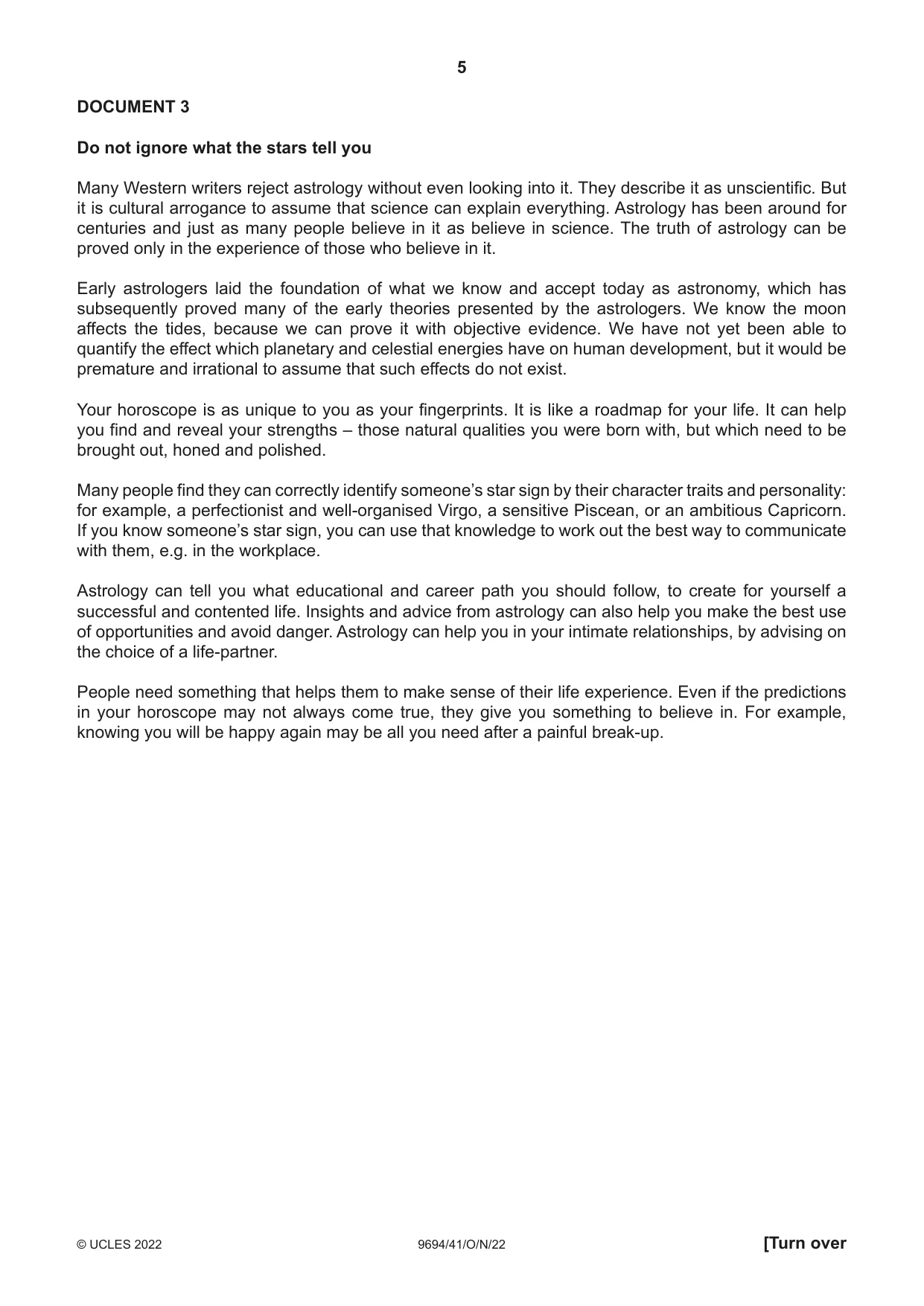
5 9694/41/O/N/22 © UCLES 2022 [Turn over DOCUMENT 3 Do not ignore what the stars tell you Many Western writers reject astrology without even looking into it. They describe it as unscientific. But it is cultural arrogance to assume that science can explain everything. Astrology has been around for centuries and just as many people believe in it as believe in science. The truth of astrology can be proved only in the experience of those who believe in it. Early astrologers laid the foundation of what we know and accept today as astronomy, which has subsequently proved many of the early theories presented by the astrologers. We know the moon affects the tides, because we can prove it with objective evidence. We have not yet been able to quantify the effect which planetary and celestial energies have on human development, but it would be premature and irrational to assume that such effects do not exist. Your horoscope is as unique to you as your fingerprints. It is like a roadmap for your life. It can help you find and reveal your strengths – those natural qualities you were born with, but which need to be brought out, honed and polished. Many people find they can correctly identify someone’s star sign by their character traits and personality: for example, a perfectionist and well-organised Virgo, a sensitive Piscean, or an ambitious Capricorn. If you know someone’s star sign, you can use that knowledge to work out the best way to communicate with them, e.g. in the workplace. Astrology can tell you what educational and career path you should follow, to create for yourself a successful and contented life. Insights and advice from astrology can also help you make the best use of opportunities and avoid danger. Astrology can help you in your intimate relationships, by advising on the choice of a life-partner. People need something that helps them to make sense of their life experience. Even if the predictions in your horoscope may not always come true, they give you something to believe in. For example, knowing you will be happy again may be all you need after a painful break-up.
Question paper, page 6
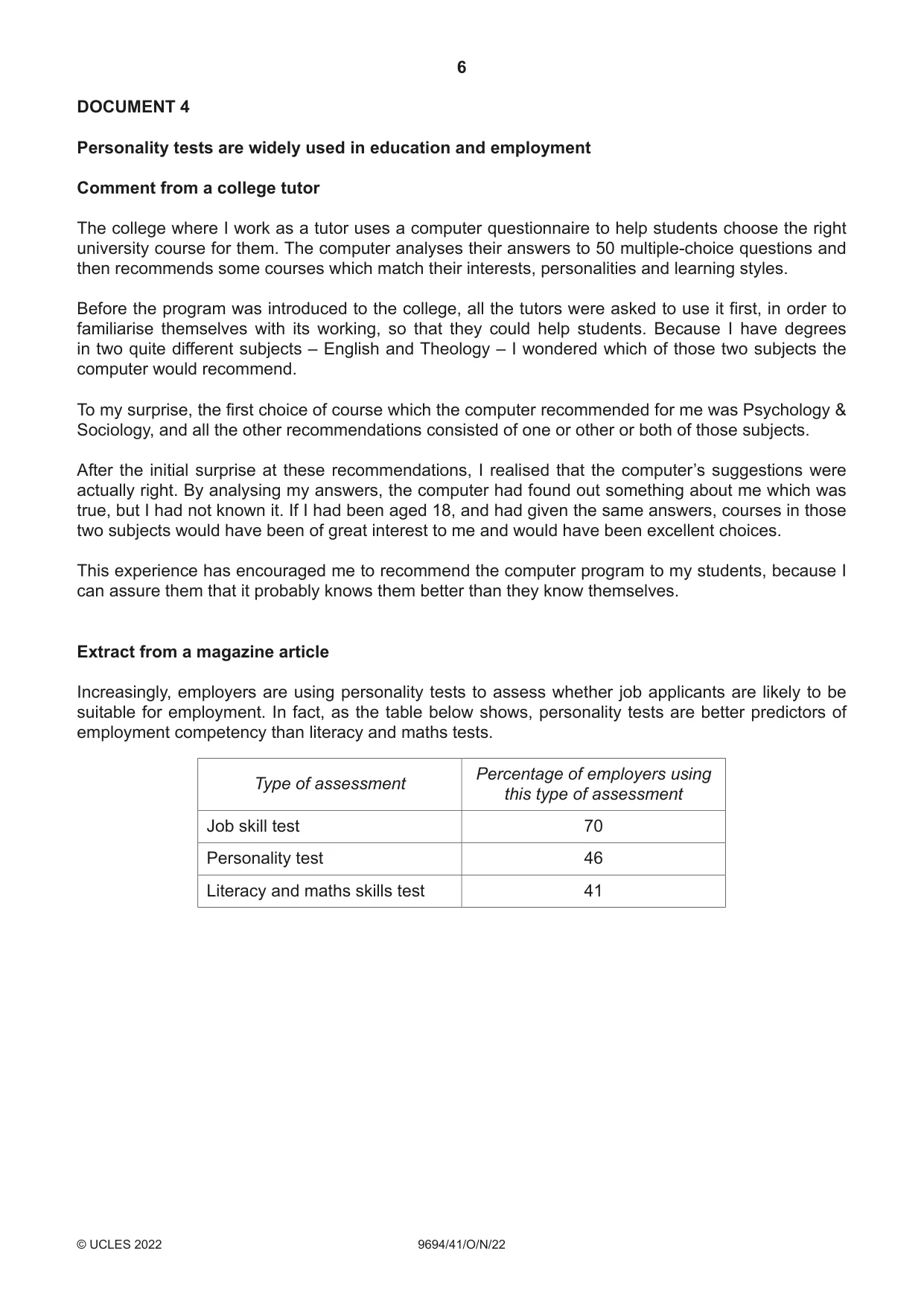
6 9694/41/O/N/22 © UCLES 2022 DOCUMENT 4 Personality tests are widely used in education and employment Comment from a college tutor The college where I work as a tutor uses a computer questionnaire to help students choose the right university course for them. The computer analyses their answers to 50 multiple-choice questions and then recommends some courses which match their interests, personalities and learning styles. Before the program was introduced to the college, all the tutors were asked to use it first, in order to familiarise themselves with its working, so that they could help students. Because I have degrees in two quite different subjects – English and Theology – I wondered which of those two subjects the computer would recommend. To my surprise, the first choice of course which the computer recommended for me was Psychology & Sociology, and all the other recommendations consisted of one or other or both of those subjects. After the initial surprise at these recommendations, I realised that the computer’s suggestions were actually right. By analysing my answers, the computer had found out something about me which was true, but I had not known it. If I had been aged 18, and had given the same answers, courses in those two subjects would have been of great interest to me and would have been excellent choices. This experience has encouraged me to recommend the computer program to my students, because I can assure them that it probably knows them better than they know themselves. Extract from a magazine article Increasingly, employers are using personality tests to assess whether job applicants are likely to be suitable for employment. In fact, as the table below shows, personality tests are better predictors of employment competency than literacy and maths tests. Type of assessment Percentage of employers using this type of assessment Job skill test 70 Personality test 46 Literacy and maths skills test 41
Question paper, page 7
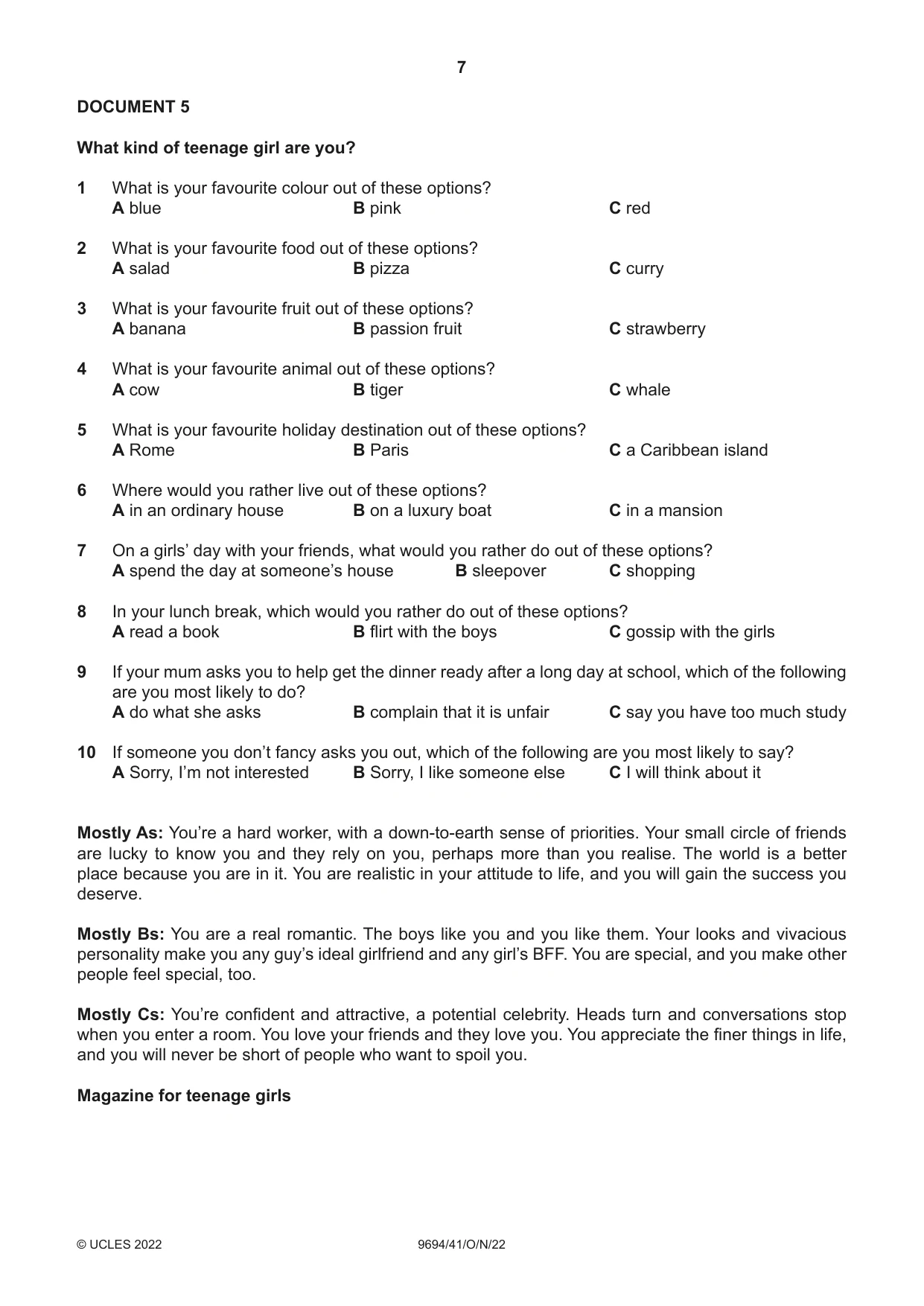
7 9694/41/O/N/22 © UCLES 2022 DOCUMENT 5 What kind of teenage girl are you? 1 What is your favourite colour out of these options? A blue B pink C red 2 What is your favourite food out of these options? A salad B pizza C curry 3 What is your favourite fruit out of these options? A banana B passion fruit C strawberry 4 What is your favourite animal out of these options? A cow B tiger C whale 5 What is your favourite holiday destination out of these options? A Rome B Paris C a Caribbean island 6 Where would you rather live out of these options? A in an ordinary house B on a luxury boat C in a mansion 7 On a girls’ day with your friends, what would you rather do out of these options? A spend the day at someone’s house B sleepover C shopping 8 In your lunch break, which would you rather do out of these options? A read a book B flirt with the boys C gossip with the girls 9 If your mum asks you to help get the dinner ready after a long day at school, which of the following are you most likely to do? A do what she asks B complain that it is unfair C say you have too much study 10 If someone you don’t fancy asks you out, which of the following are you most likely to say? A Sorry, I’m not interested B Sorry, I like someone else C I will think about it Mostly As: You’re a hard worker, with a down-to-earth sense of priorities. Your small circle of friends are lucky to know you and they rely on you, perhaps more than you realise. The world is a better place because you are in it. You are realistic in your attitude to life, and you will gain the success you deserve. Mostly Bs: You are a real romantic. The boys like you and you like them. Your looks and vivacious personality make you any guy’s ideal girlfriend and any girl’s BFF. You are special, and you make other people feel special, too. Mostly Cs: You’re confident and attractive, a potential celebrity. Heads turn and conversations stop when you enter a room. You love your friends and they love you. You appreciate the finer things in life, and you will never be short of people who want to spoil you. Magazine for teenage girls
Question paper, page 8
8 9694/41/O/N/22 © UCLES 2022 Permission to reproduce items where third-party owned material protected by copyright is included has been sought and cleared where possible. Every reasonable effort has been made by the publisher (UCLES) to trace copyright holders, but if any items requiring clearance have unwittingly been included, the publisher will be pleased to make amends at the earliest possible opportunity. To avoid the issue of disclosure of answer-related information to candidates, all copyright acknowledgements are reproduced online in the Cambridge Assessment International Education Copyright Acknowledgements Booklet. This is produced for each series of examinations and is freely available to download at www.cambridgeinternational.org after the live examination series. Cambridge Assessment International Education is part of Cambridge Assessment. Cambridge Assessment is the brand name of the University of Cambridge Local Examinations Syndicate (UCLES), which is a department of the University of Cambridge. BLANK PAGE
Mark scheme, page 1
This document consists of 13 printed pages. © UCLES 2022 [Turn over Cambridge International AS & A Level THINKING SKILLS 9694/41 Paper 4 Applied Reasoning October/November 2022 MARK SCHEME Maximum Mark: 50 Published This mark scheme is published as an aid to teachers and candidates, to indicate the requirements of the examination. It shows the basis on which Examiners were instructed to award marks. It does not indicate the details of the discussions that took place at an Examiners’ meeting before marking began, which would have considered the acceptability of alternative answers. Mark schemes should be read in conjunction with the question paper and the Principal Examiner Report for Teachers. Cambridge International will not enter into discussions about these mark schemes. Cambridge International is publishing the mark schemes for the October/November 2022 series for most Cambridge IGCSE™, Cambridge International A and AS Level components and some Cambridge O Level components.
Mark scheme, page 2
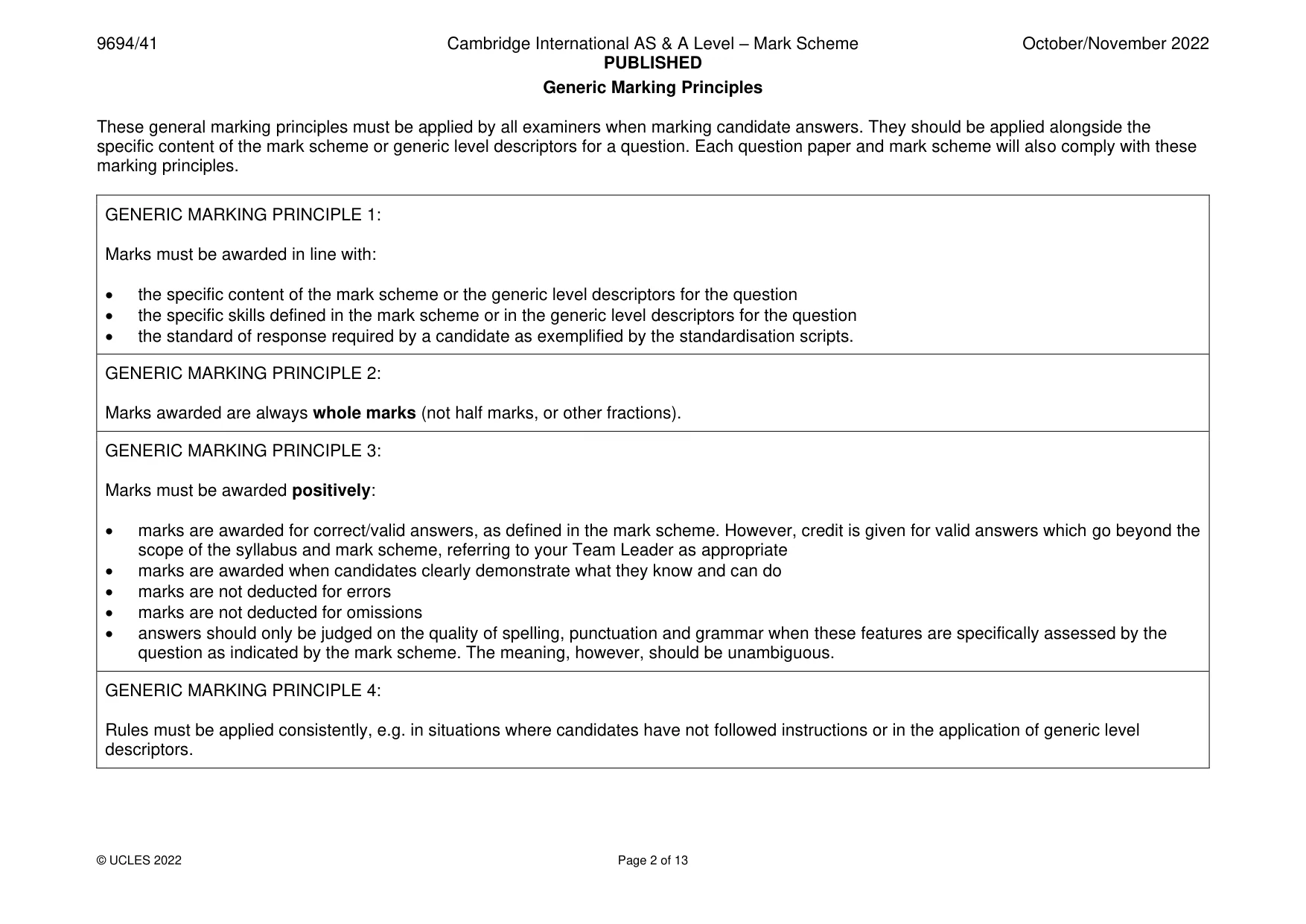
9694/41 Cambridge International AS & A Level – Mark Scheme PUBLISHED October/November 2022 © UCLES 2022 Page 2 of 13 Generic Marking Principles These general marking principles must be applied by all examiners when marking candidate answers. They should be applied alongside the specific content of the mark scheme or generic level descriptors for a question. Each question paper and mark scheme will also comply with these marking principles. GENERIC MARKING PRINCIPLE 1: Marks must be awarded in line with: • the specific content of the mark scheme or the generic level descriptors for the question • the specific skills defined in the mark scheme or in the generic level descriptors for the question • the standard of response required by a candidate as exemplified by the standardisation scripts. GENERIC MARKING PRINCIPLE 2: Marks awarded are always whole marks (not half marks, or other fractions). GENERIC MARKING PRINCIPLE 3: Marks must be awarded positively: • marks are awarded for correct/valid answers, as defined in the mark scheme. However, credit is given for valid answers which go beyond the scope of the syllabus and mark scheme, referring to your Team Leader as appropriate • marks are awarded when candidates clearly demonstrate what they know and can do • marks are not deducted for errors • marks are not deducted for omissions • answers should only be judged on the quality of spelling, punctuation and grammar when these features are specifically assessed by the question as indicated by the mark scheme. The meaning, however, should be unambiguous. GENERIC MARKING PRINCIPLE 4: Rules must be applied consistently, e.g. in situations where candidates have not followed instructions or in the application of generic level descriptors.
Mark scheme, page 3
9694/41 Cambridge International AS & A Level – Mark Scheme PUBLISHED October/November 2022 © UCLES 2022 Page 3 of 13 GENERIC MARKING PRINCIPLE 5: Marks should be awarded using the full range of marks defined in the mark scheme for the question (however; the use of the full mark range may be limited according to the quality of the candidate responses seen). GENERIC MARKING PRINCIPLE 6: Marks awarded are based solely on the requirements as defined in the mark scheme. Marks should not be awarded with grade thresholds or grade descriptors in mind.
Mark scheme, page 4
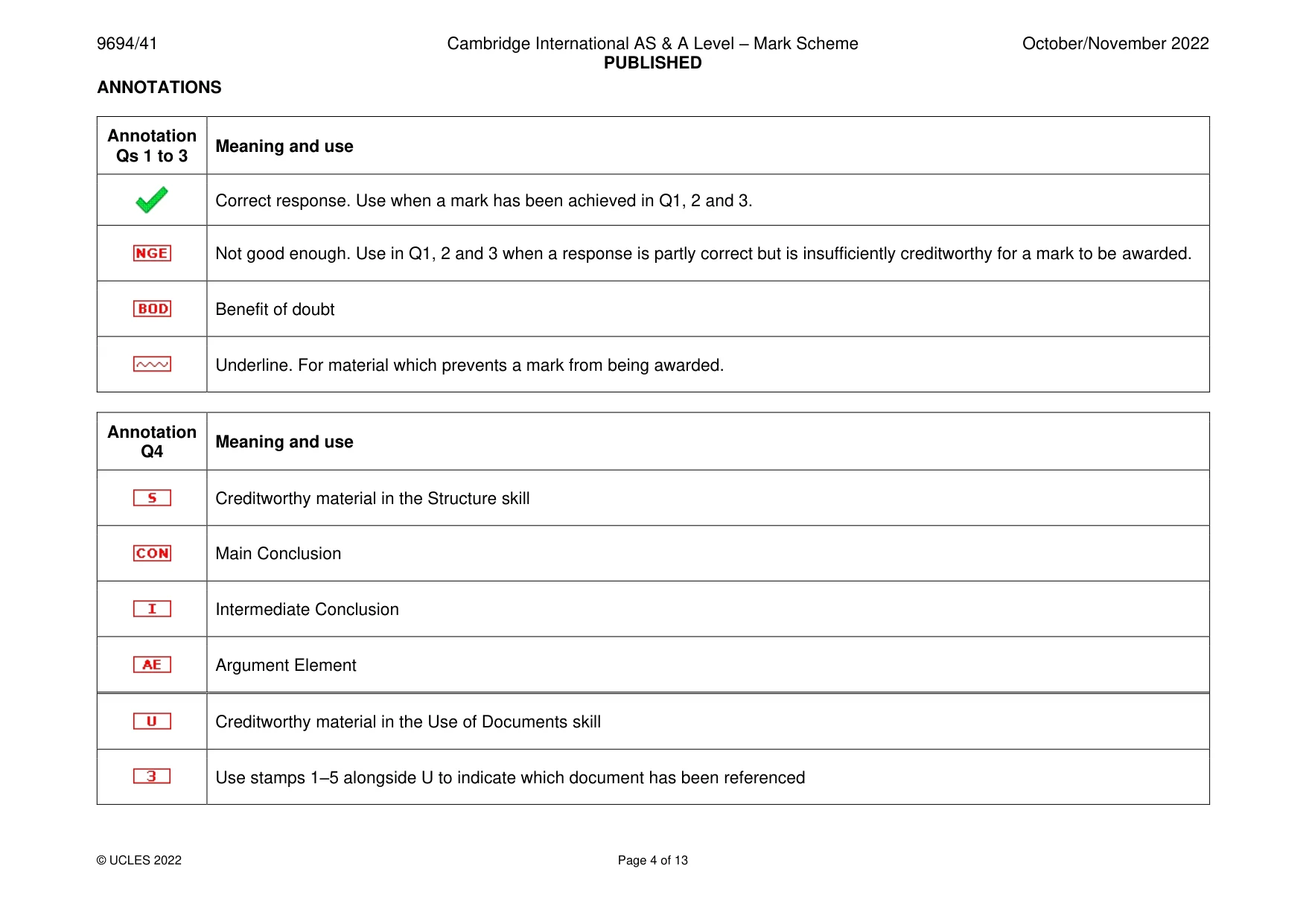
9694/41 Cambridge International AS & A Level – Mark Scheme PUBLISHED October/November 2022 © UCLES 2022 Page 4 of 13 ANNOTATIONS Annotation Qs 1 to 3 Meaning and use Correct response. Use when a mark has been achieved in Q1, 2 and 3. Not good enough. Use in Q1, 2 and 3 when a response is partly correct but is insufficiently creditworthy for a mark to be awarded. Benefit of doubt Underline. For material which prevents a mark from being awarded. Annotation Q4 Meaning and use Creditworthy material in the Structure skill Main Conclusion Intermediate Conclusion Argument Element Creditworthy material in the Use of Documents skill Use stamps 1–5 alongside U to indicate which document has been referenced
Mark scheme, page 5
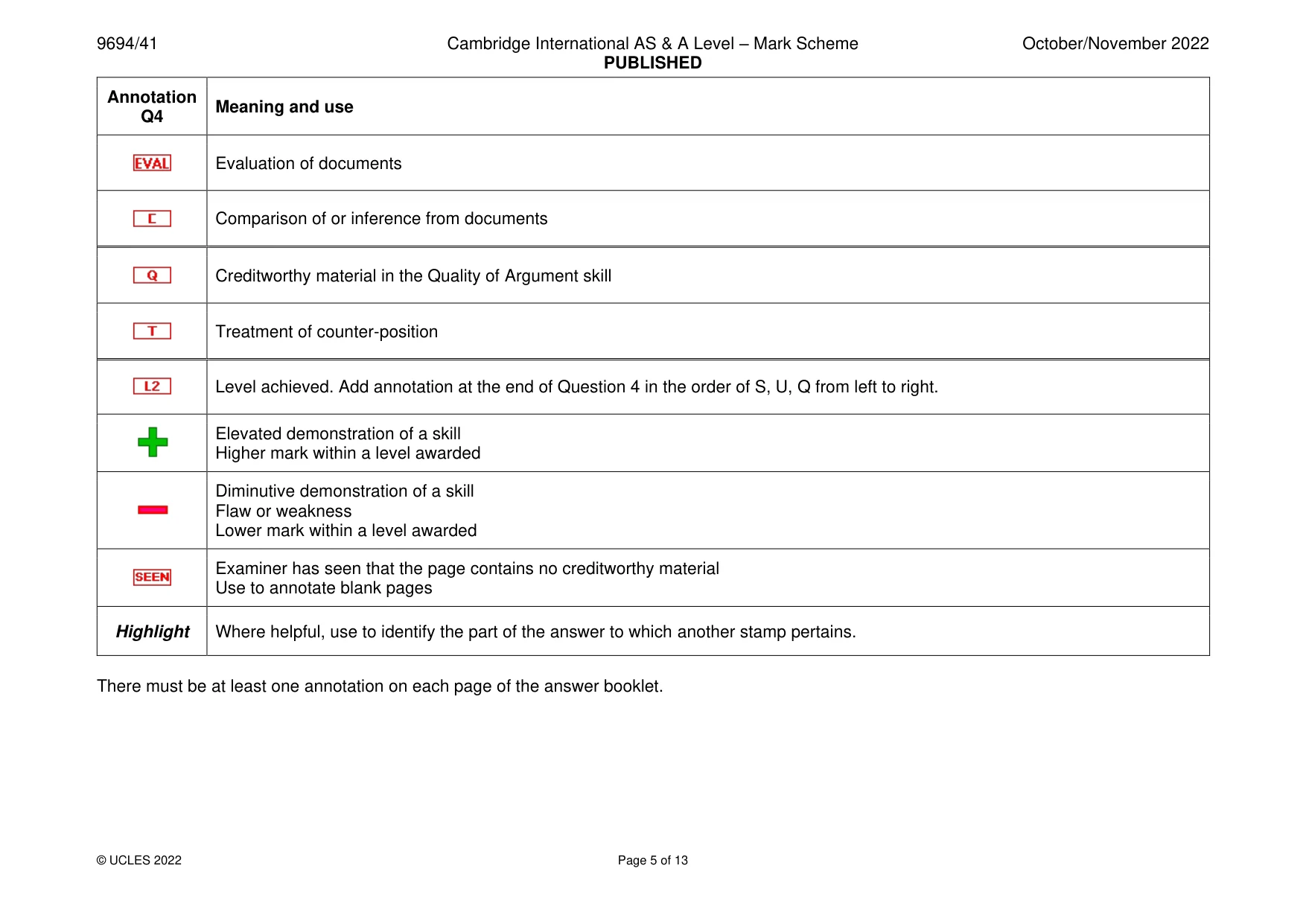
9694/41 Cambridge International AS & A Level – Mark Scheme PUBLISHED October/November 2022 © UCLES 2022 Page 5 of 13 Annotation Q4 Meaning and use Evaluation of documents Comparison of or inference from documents Creditworthy material in the Quality of Argument skill Treatment of counter-position Level achieved. Add annotation at the end of Question 4 in the order of S, U, Q from left to right. Elevated demonstration of a skill Higher mark within a level awarded Diminutive demonstration of a skill Flaw or weakness Lower mark within a level awarded Examiner has seen that the page contains no creditworthy material Use to annotate blank pages Highlight Where helpful, use to identify the part of the answer to which another stamp pertains. There must be at least one annotation on each page of the answer booklet.
Mark scheme, page 6
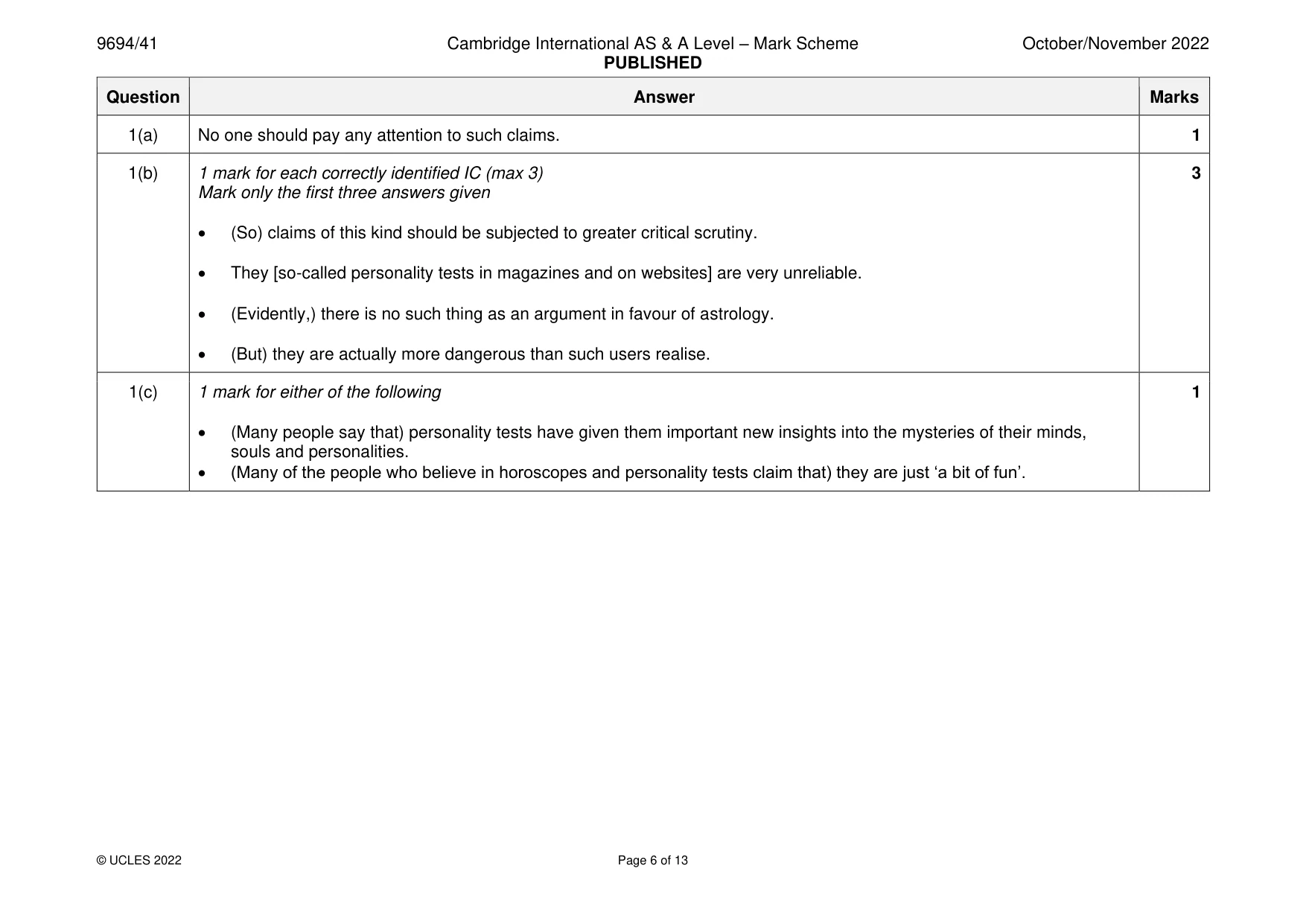
9694/41 Cambridge International AS & A Level – Mark Scheme PUBLISHED October/November 2022 © UCLES 2022 Page 6 of 13 Question Answer Marks 1(a) No one should pay any attention to such claims. 1 1(b) 1 mark for each correctly identified IC (max 3) Mark only the first three answers given • (So) claims of this kind should be subjected to greater critical scrutiny. • They [so-called personality tests in magazines and on websites] are very unreliable. • (Evidently,) there is no such thing as an argument in favour of astrology. • (But) they are actually more dangerous than such users realise. 3 1(c) 1 mark for either of the following • (Many people say that) personality tests have given them important new insights into the mysteries of their minds, souls and personalities. • (Many of the people who believe in horoscopes and personality tests claim that) they are just ‘a bit of fun’. 1
Mark scheme, page 7
9694/41 Cambridge International AS & A Level – Mark Scheme PUBLISHED October/November 2022 © UCLES 2022 Page 7 of 13 Question Answer Marks 1(d) Award one mark for each of the following [max 2]: R1 People who spend all their time completing personality tests resemble the young man in the Greek myth who fell in love with his own reflection. C This preoccupation with self is psychologically and spiritually unhealthy. R2 Instead of giving people the knowledge and skills they need to become more effective in their work and relationships, these tests distract them from engagement with the outside world. A1 Things turned out badly for the young man in the Greek myth. A2 Being distracted from engagement with the outside world is psychologically and spiritually unhealthy. 2 Award one mark for identifying two relationships between elements, e.g. • R1 supports C / is an analogy that illustrates C and/or R2. • R2 supports C. • A1 is needed in order for R1 to support C. • A2 is needed in order for R2 to support C. Reference to start and end of elements must be unambiguous. Sample 3-mark answer Comparison of people completing personality tests to a Greek myth is an analogy used to illustrate the conclusion ‘This preoccupation … unhealthy’ [1]. ‘Instead of giving … outside world.’ is a reason [1] that supports the C. [1] 1
Mark scheme, page 8
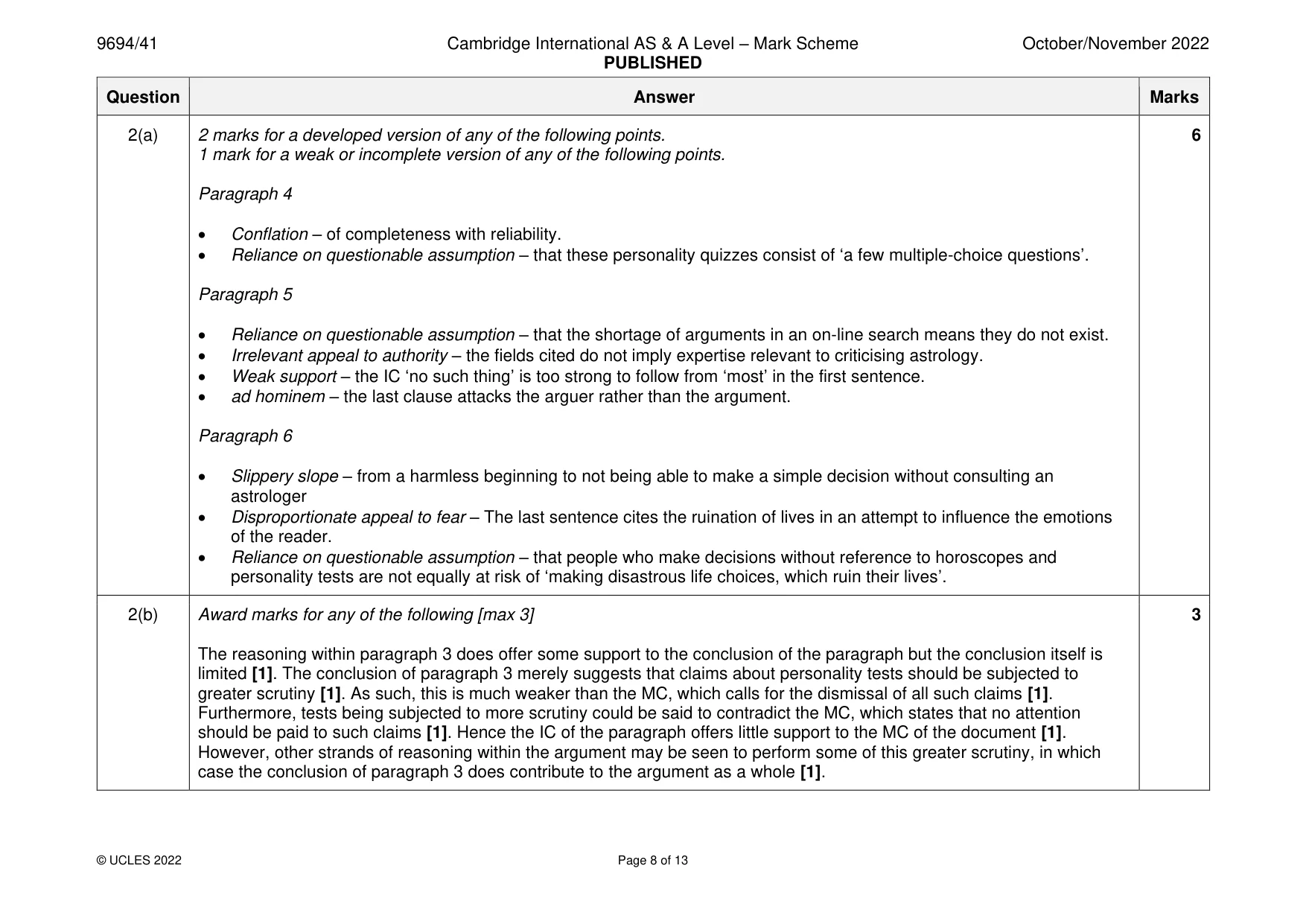
9694/41 Cambridge International AS & A Level – Mark Scheme PUBLISHED October/November 2022 © UCLES 2022 Page 8 of 13 Question Answer Marks 2(a) 2 marks for a developed version of any of the following points. 1 mark for a weak or incomplete version of any of the following points. Paragraph 4 • Conflation – of completeness with reliability. • Reliance on questionable assumption – that these personality quizzes consist of ‘a few multiple-choice questions’. Paragraph 5 • Reliance on questionable assumption – that the shortage of arguments in an on-line search means they do not exist. • Irrelevant appeal to authority – the fields cited do not imply expertise relevant to criticising astrology. • Weak support – the IC ‘no such thing’ is too strong to follow from ‘most’ in the first sentence. • ad hominem – the last clause attacks the arguer rather than the argument. Paragraph 6 • Slippery slope – from a harmless beginning to not being able to make a simple decision without consulting an astrologer • Disproportionate appeal to fear – The last sentence cites the ruination of lives in an attempt to influence the emotions of the reader. • Reliance on questionable assumption – that people who make decisions without reference to horoscopes and personality tests are not equally at risk of ‘making disastrous life choices, which ruin their lives’. 6 2(b) Award marks for any of the following [max 3] The reasoning within paragraph 3 does offer some support to the conclusion of the paragraph but the conclusion itself is limited [1]. The conclusion of paragraph 3 merely suggests that claims about personality tests should be subjected to greater scrutiny [1]. As such, this is much weaker than the MC, which calls for the dismissal of all such claims [1]. Furthermore, tests being subjected to more scrutiny could be said to contradict the MC, which states that no attention should be paid to such claims [1]. Hence the IC of the paragraph offers little support to the MC of the document [1]. However, other strands of reasoning within the argument may be seen to perform some of this greater scrutiny, in which case the conclusion of paragraph 3 does contribute to the argument as a whole [1]. 3
Mark scheme, page 9
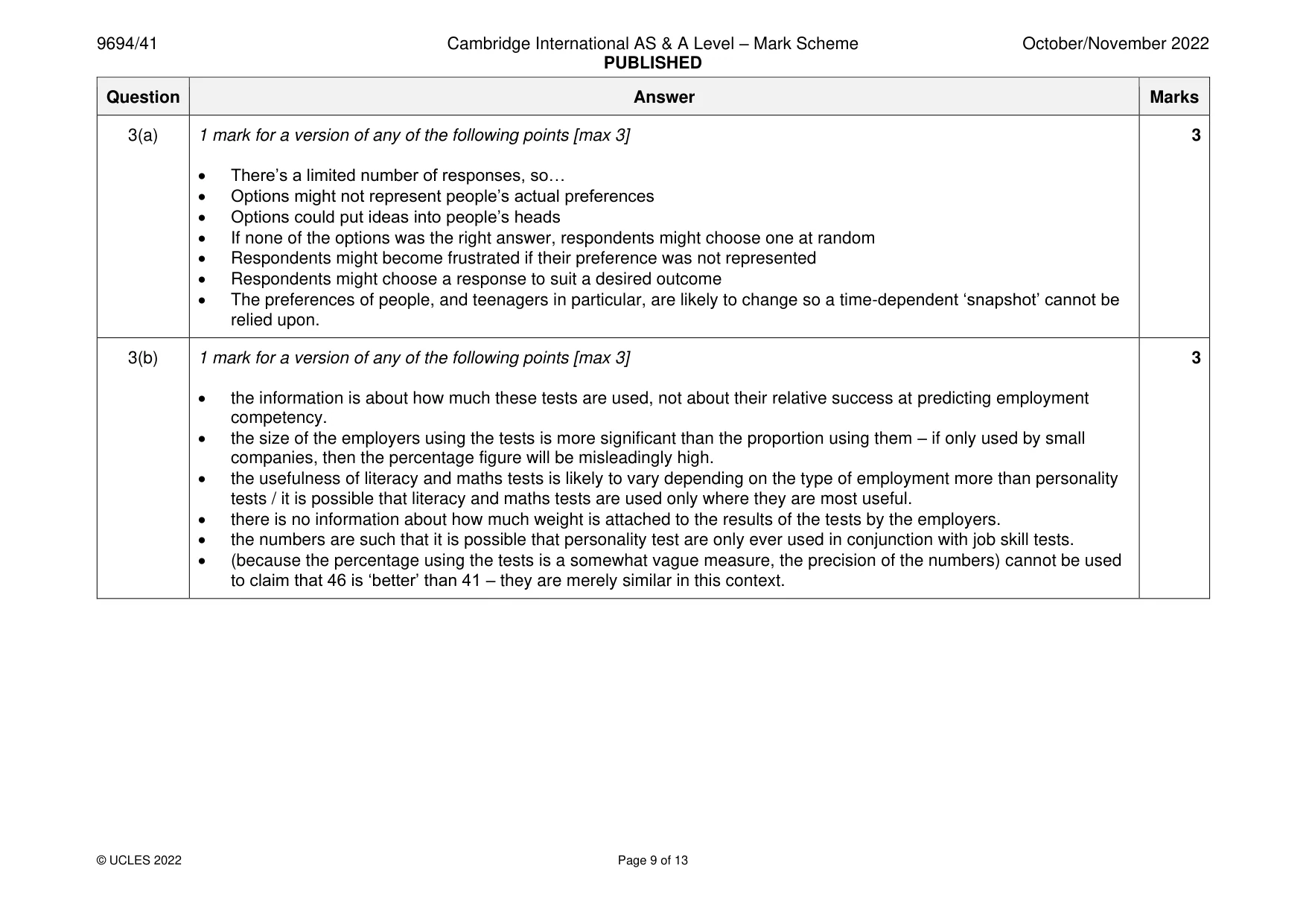
9694/41 Cambridge International AS & A Level – Mark Scheme PUBLISHED October/November 2022 © UCLES 2022 Page 9 of 13 Question Answer Marks 3(a) 1 mark for a version of any of the following points [max 3] • There’s a limited number of responses, so… • Options might not represent people’s actual preferences • Options could put ideas into people’s heads • If none of the options was the right answer, respondents might choose one at random • Respondents might become frustrated if their preference was not represented • Respondents might choose a response to suit a desired outcome • The preferences of people, and teenagers in particular, are likely to change so a time-dependent ‘snapshot’ cannot be relied upon. 3 3(b) 1 mark for a version of any of the following points [max 3] • the information is about how much these tests are used, not about their relative success at predicting employment competency. • the size of the employers using the tests is more significant than the proportion using them – if only used by small companies, then the percentage figure will be misleadingly high. • the usefulness of literacy and maths tests is likely to vary depending on the type of employment more than personality tests / it is possible that literacy and maths tests are used only where they are most useful. • there is no information about how much weight is attached to the results of the tests by the employers. • the numbers are such that it is possible that personality test are only ever used in conjunction with job skill tests. • (because the percentage using the tests is a somewhat vague measure, the precision of the numbers) cannot be used to claim that 46 is ‘better’ than 41 – they are merely similar in this context. 3
Mark scheme, page 10
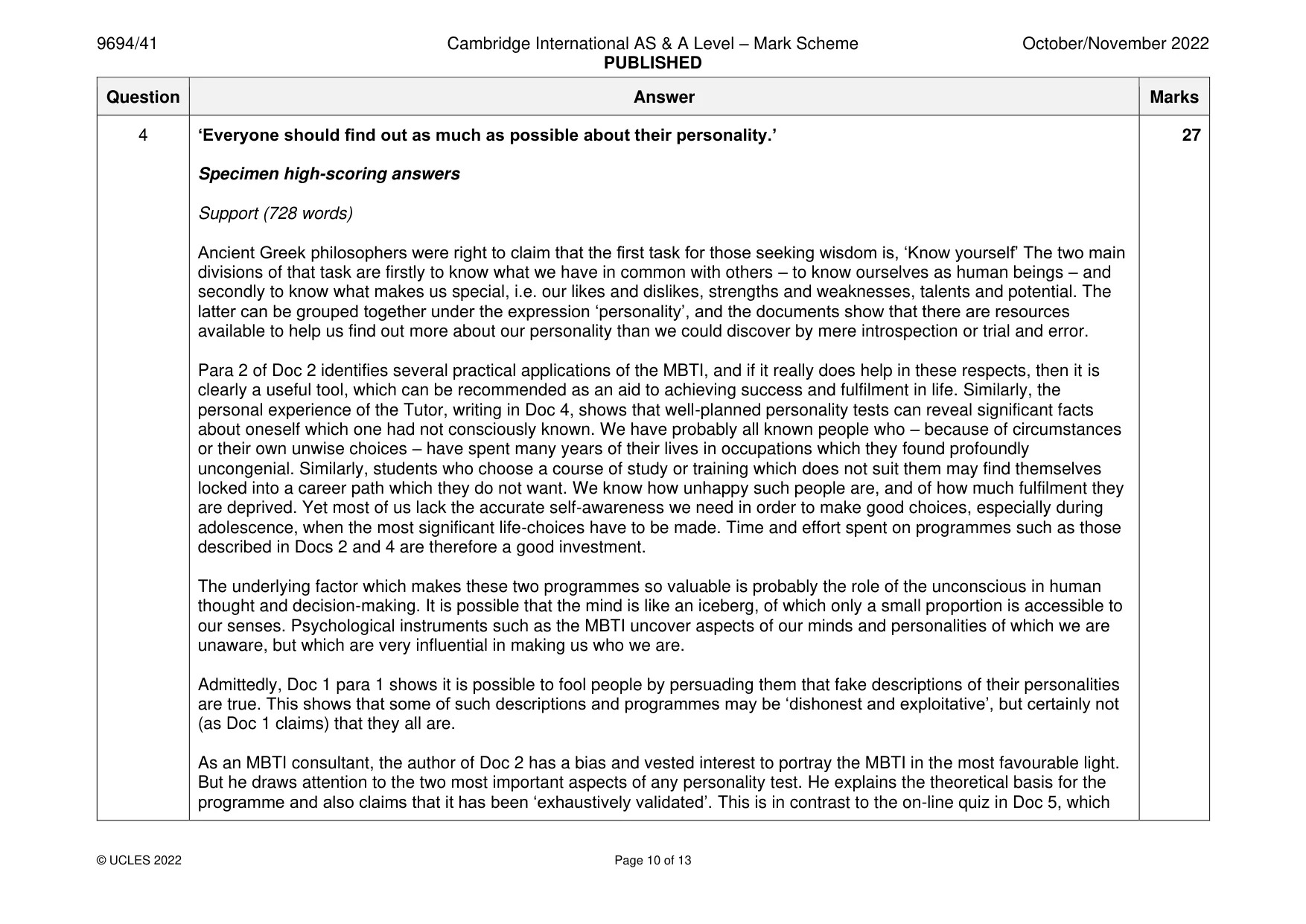
9694/41 Cambridge International AS & A Level – Mark Scheme PUBLISHED October/November 2022 © UCLES 2022 Page 10 of 13 Question Answer Marks 4 ‘Everyone should find out as much as possible about their personality.’ Specimen high-scoring answers Support (728 words) Ancient Greek philosophers were right to claim that the first task for those seeking wisdom is, ‘Know yourself’ The two main divisions of that task are firstly to know what we have in common with others – to know ourselves as human beings – and secondly to know what makes us special, i.e. our likes and dislikes, strengths and weaknesses, talents and potential. The latter can be grouped together under the expression ‘personality’, and the documents show that there are resources available to help us find out more about our personality than we could discover by mere introspection or trial and error. Para 2 of Doc 2 identifies several practical applications of the MBTI, and if it really does help in these respects, then it is clearly a useful tool, which can be recommended as an aid to achieving success and fulfilment in life. Similarly, the personal experience of the Tutor, writing in Doc 4, shows that well-planned personality tests can reveal significant facts about oneself which one had not consciously known. We have probably all known people who – because of circumstances or their own unwise choices – have spent many years of their lives in occupations which they found profoundly uncongenial. Similarly, students who choose a course of study or training which does not suit them may find themselves locked into a career path which they do not want. We know how unhappy such people are, and of how much fulfilment they are deprived. Yet most of us lack the accurate self-awareness we need in order to make good choices, especially during adolescence, when the most significant life-choices have to be made. Time and effort spent on programmes such as those described in Docs 2 and 4 are therefore a good investment. The underlying factor which makes these two programmes so valuable is probably the role of the unconscious in human thought and decision-making. It is possible that the mind is like an iceberg, of which only a small proportion is accessible to our senses. Psychological instruments such as the MBTI uncover aspects of our minds and personalities of which we are unaware, but which are very influential in making us who we are. Admittedly, Doc 1 para 1 shows it is possible to fool people by persuading them that fake descriptions of their personalities are true. This shows that some of such descriptions and programmes may be ‘dishonest and exploitative’, but certainly not (as Doc 1 claims) that they all are. As an MBTI consultant, the author of Doc 2 has a bias and vested interest to portray the MBTI in the most favourable light. But he draws attention to the two most important aspects of any personality test. He explains the theoretical basis for the programme and also claims that it has been ‘exhaustively validated’. This is in contrast to the on-line quiz in Doc 5, which 27
Mark scheme, page 11
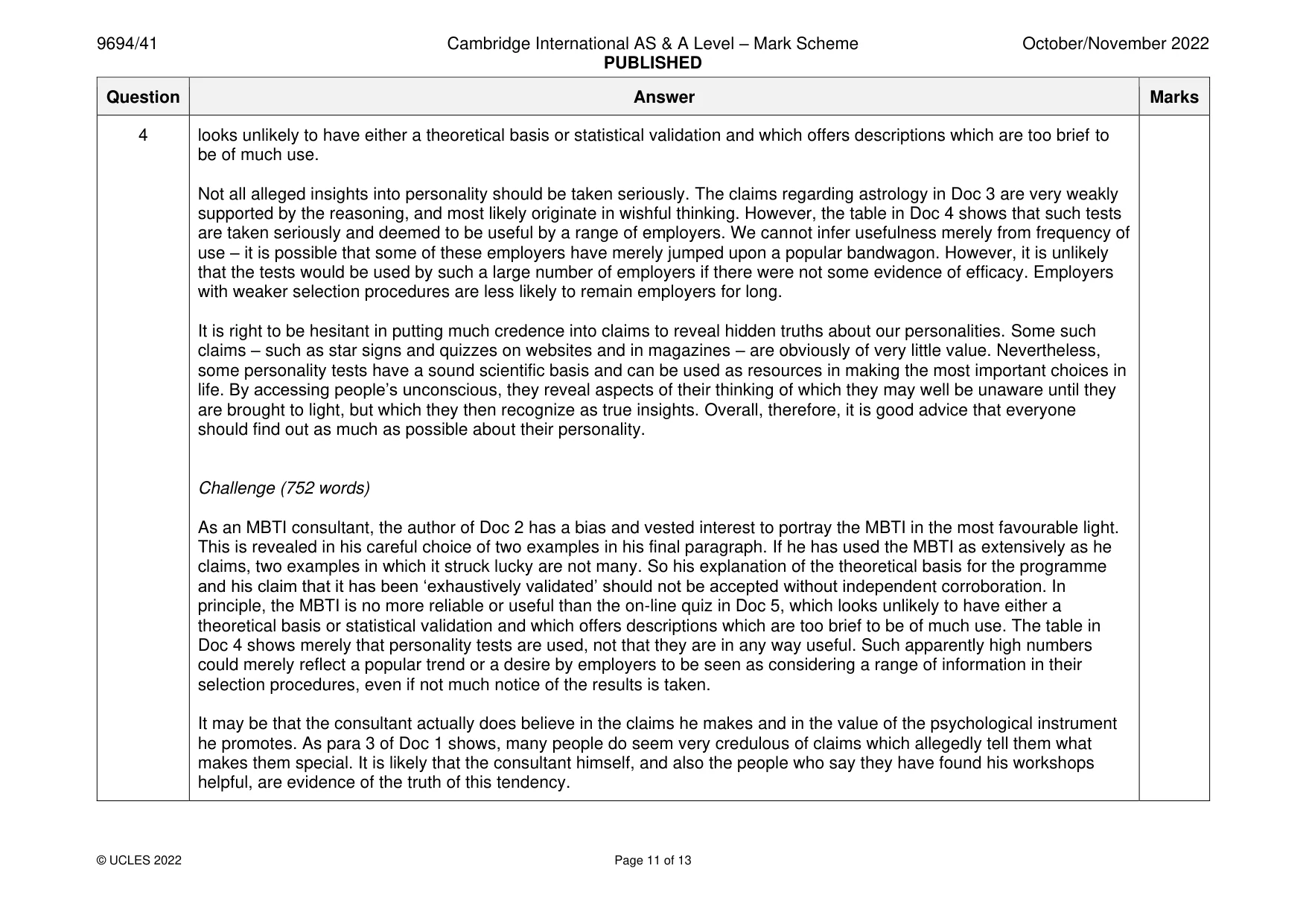
9694/41 Cambridge International AS & A Level – Mark Scheme PUBLISHED October/November 2022 © UCLES 2022 Page 11 of 13 Question Answer Marks 4 looks unlikely to have either a theoretical basis or statistical validation and which offers descriptions which are too brief to be of much use. Not all alleged insights into personality should be taken seriously. The claims regarding astrology in Doc 3 are very weakly supported by the reasoning, and most likely originate in wishful thinking. However, the table in Doc 4 shows that such tests are taken seriously and deemed to be useful by a range of employers. We cannot infer usefulness merely from frequency of use – it is possible that some of these employers have merely jumped upon a popular bandwagon. However, it is unlikely that the tests would be used by such a large number of employers if there were not some evidence of efficacy. Employers with weaker selection procedures are less likely to remain employers for long. It is right to be hesitant in putting much credence into claims to reveal hidden truths about our personalities. Some such claims – such as star signs and quizzes on websites and in magazines – are obviously of very little value. Nevertheless, some personality tests have a sound scientific basis and can be used as resources in making the most important choices in life. By accessing people’s unconscious, they reveal aspects of their thinking of which they may well be unaware until they are brought to light, but which they then recognize as true insights. Overall, therefore, it is good advice that everyone should find out as much as possible about their personality. Challenge (752 words) As an MBTI consultant, the author of Doc 2 has a bias and vested interest to portray the MBTI in the most favourable light. This is revealed in his careful choice of two examples in his final paragraph. If he has used the MBTI as extensively as he claims, two examples in which it struck lucky are not many. So his explanation of the theoretical basis for the programme and his claim that it has been ‘exhaustively validated’ should not be accepted without independent corroboration. In principle, the MBTI is no more reliable or useful than the on-line quiz in Doc 5, which looks unlikely to have either a theoretical basis or statistical validation and which offers descriptions which are too brief to be of much use. The table in Doc 4 shows merely that personality tests are used, not that they are in any way useful. Such apparently high numbers could merely reflect a popular trend or a desire by employers to be seen as considering a range of information in their selection procedures, even if not much notice of the results is taken. It may be that the consultant actually does believe in the claims he makes and in the value of the psychological instrument he promotes. As para 3 of Doc 1 shows, many people do seem very credulous of claims which allegedly tell them what makes them special. It is likely that the consultant himself, and also the people who say they have found his workshops helpful, are evidence of the truth of this tendency.
Mark scheme, page 12
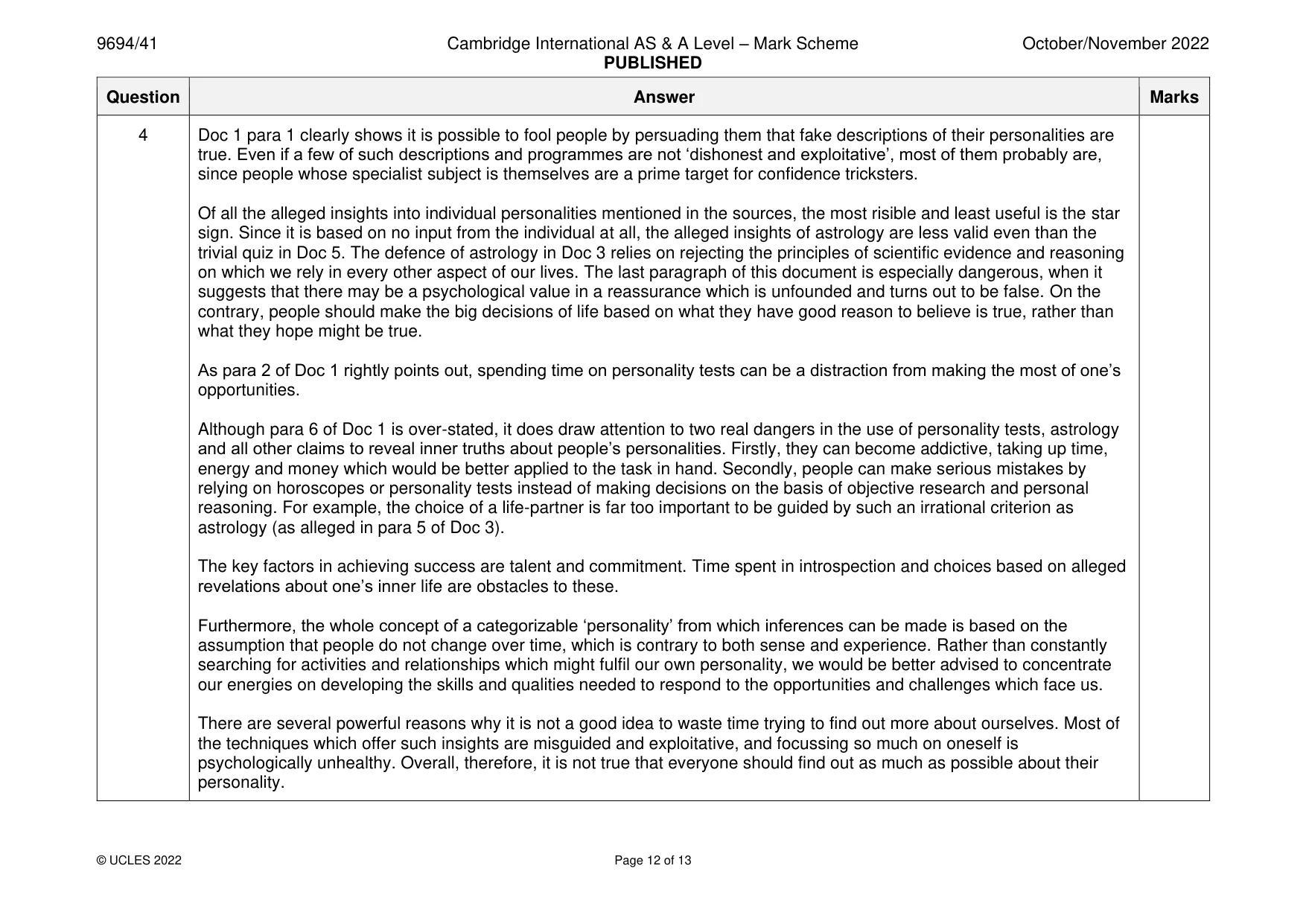
9694/41 Cambridge International AS & A Level – Mark Scheme PUBLISHED October/November 2022 © UCLES 2022 Page 12 of 13 Question Answer Marks 4 Doc 1 para 1 clearly shows it is possible to fool people by persuading them that fake descriptions of their personalities are true. Even if a few of such descriptions and programmes are not ‘dishonest and exploitative’, most of them probably are, since people whose specialist subject is themselves are a prime target for confidence tricksters. Of all the alleged insights into individual personalities mentioned in the sources, the most risible and least useful is the star sign. Since it is based on no input from the individual at all, the alleged insights of astrology are less valid even than the trivial quiz in Doc 5. The defence of astrology in Doc 3 relies on rejecting the principles of scientific evidence and reasoning on which we rely in every other aspect of our lives. The last paragraph of this document is especially dangerous, when it suggests that there may be a psychological value in a reassurance which is unfounded and turns out to be false. On the contrary, people should make the big decisions of life based on what they have good reason to believe is true, rather than what they hope might be true. As para 2 of Doc 1 rightly points out, spending time on personality tests can be a distraction from making the most of one’s opportunities. Although para 6 of Doc 1 is over-stated, it does draw attention to two real dangers in the use of personality tests, astrology and all other claims to reveal inner truths about people’s personalities. Firstly, they can become addictive, taking up time, energy and money which would be better applied to the task in hand. Secondly, people can make serious mistakes by relying on horoscopes or personality tests instead of making decisions on the basis of objective research and personal reasoning. For example, the choice of a life-partner is far too important to be guided by such an irrational criterion as astrology (as alleged in para 5 of Doc 3). The key factors in achieving success are talent and commitment. Time spent in introspection and choices based on alleged revelations about one’s inner life are obstacles to these. Furthermore, the whole concept of a categorizable ‘personality’ from which inferences can be made is based on the assumption that people do not change over time, which is contrary to both sense and experience. Rather than constantly searching for activities and relationships which might fulfil our own personality, we would be better advised to concentrate our energies on developing the skills and qualities needed to respond to the opportunities and challenges which face us. There are several powerful reasons why it is not a good idea to waste time trying to find out more about ourselves. Most of the techniques which offer such insights are misguided and exploitative, and focussing so much on oneself is psychologically unhealthy. Overall, therefore, it is not true that everyone should find out as much as possible about their personality.
Mark scheme, page 13
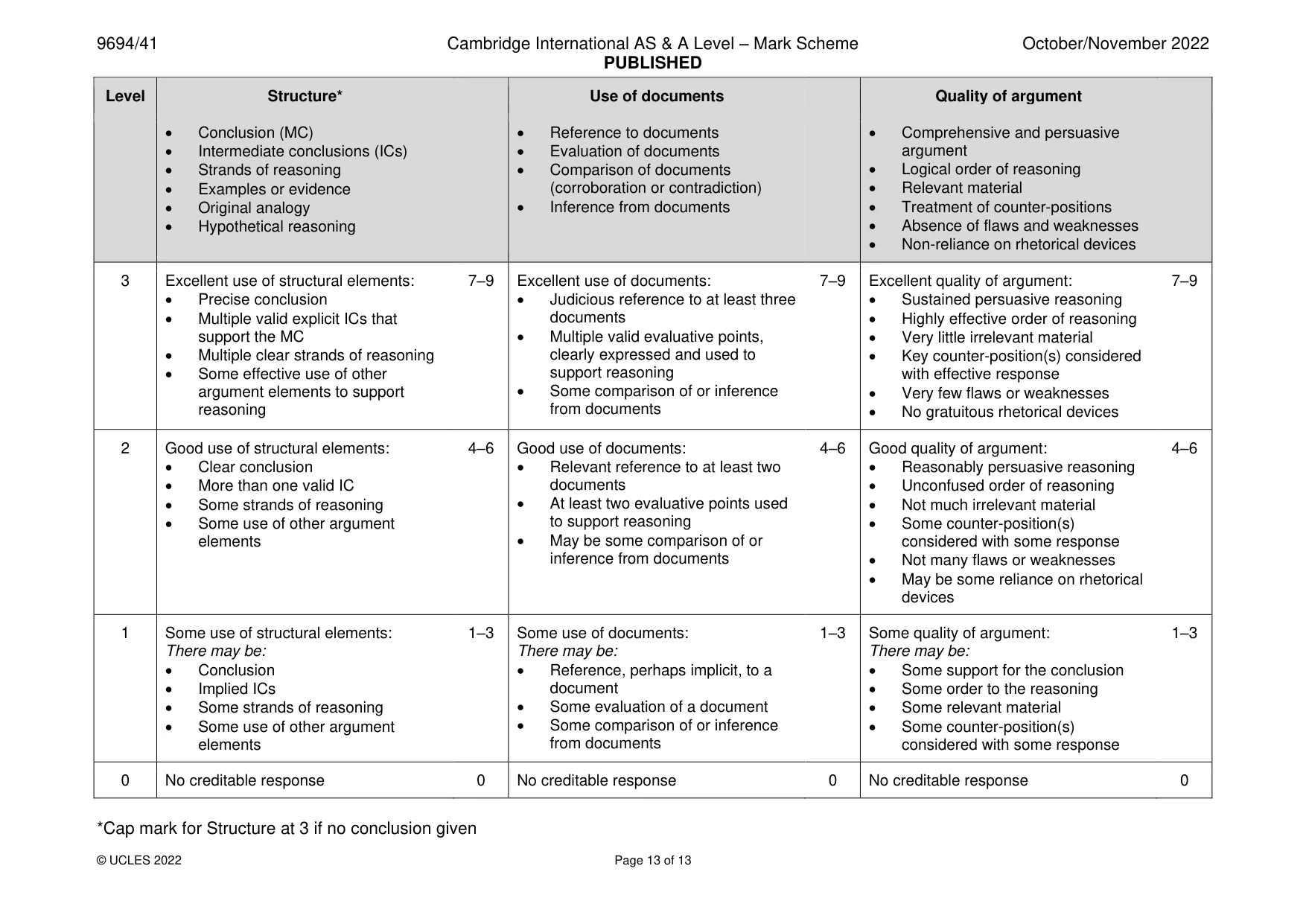
9694/41 Cambridge International AS & A Level – Mark Scheme PUBLISHED October/November 2022 © UCLES 2022 Page 13 of 13 Level Structure* Use of documents Quality of argument • Conclusion (MC) • Intermediate conclusions (ICs) • Strands of reasoning • Examples or evidence • Original analogy • Hypothetical reasoning • Reference to documents • Evaluation of documents • Comparison of documents (corroboration or contradiction) • Inference from documents • Comprehensive and persuasive argument • Logical order of reasoning • Relevant material • Treatment of counter-positions • Absence of flaws and weaknesses • Non-reliance on rhetorical devices 3 Excellent use of structural elements: • Precise conclusion • Multiple valid explicit ICs that support the MC • Multiple clear strands of reasoning • Some effective use of other argument elements to support reasoning 7–9 Excellent use of documents: • Judicious reference to at least three documents • Multiple valid evaluative points, clearly expressed and used to support reasoning • Some comparison of or inference from documents 7–9 Excellent quality of argument: • Sustained persuasive reasoning • Highly effective order of reasoning • Very little irrelevant material • Key counter-position(s) considered with effective response • Very few flaws or weaknesses • No gratuitous rhetorical devices 7–9 2 Good use of structural elements: • Clear conclusion • More than one valid IC • Some strands of reasoning • Some use of other argument elements 4–6 Good use of documents: • Relevant reference to at least two documents • At least two evaluative points used to support reasoning • May be some comparison of or inference from documents 4–6 Good quality of argument: • Reasonably persuasive reasoning • Unconfused order of reasoning • Not much irrelevant material • Some counter-position(s) considered with some response • Not many flaws or weaknesses • May be some reliance on rhetorical devices 4–6 1 Some use of structural elements: There may be: • Conclusion • Implied ICs • Some strands of reasoning • Some use of other argument elements 1–3 Some use of documents: There may be: • Reference, perhaps implicit, to a document • Some evaluation of a document • Some comparison of or inference from documents 1–3 Some quality of argument: There may be: • Some support for the conclusion • Some order to the reasoning • Some relevant material • Some counter-position(s) considered with some response 1–3 0 No creditable response 0 No creditable response 0 No creditable response 0 *Cap mark for Structure at 3 if no conclusion given
What you needed in this session
Cambridge’s own grade thresholds for 2022 Oct/Nov, Paper 4 · Variant 1. A higher threshold means an easier paper — the bar moves with how the cohort did.