Cambridge A Level Thinking Skills 9694 — 2021 Oct/Nov Paper 4 · Variant 3
9694/43/O/N/21 · 50 marks · ≈56 min
The question paper and its mark scheme, free to read here and free to download. This is Cambridge’s own paper, exactly as it was sat.
Question paper8 pages

Mark scheme13 pages
Answers below. Sit the paper first if you are practising.
Paper as text
Question paper, page 1
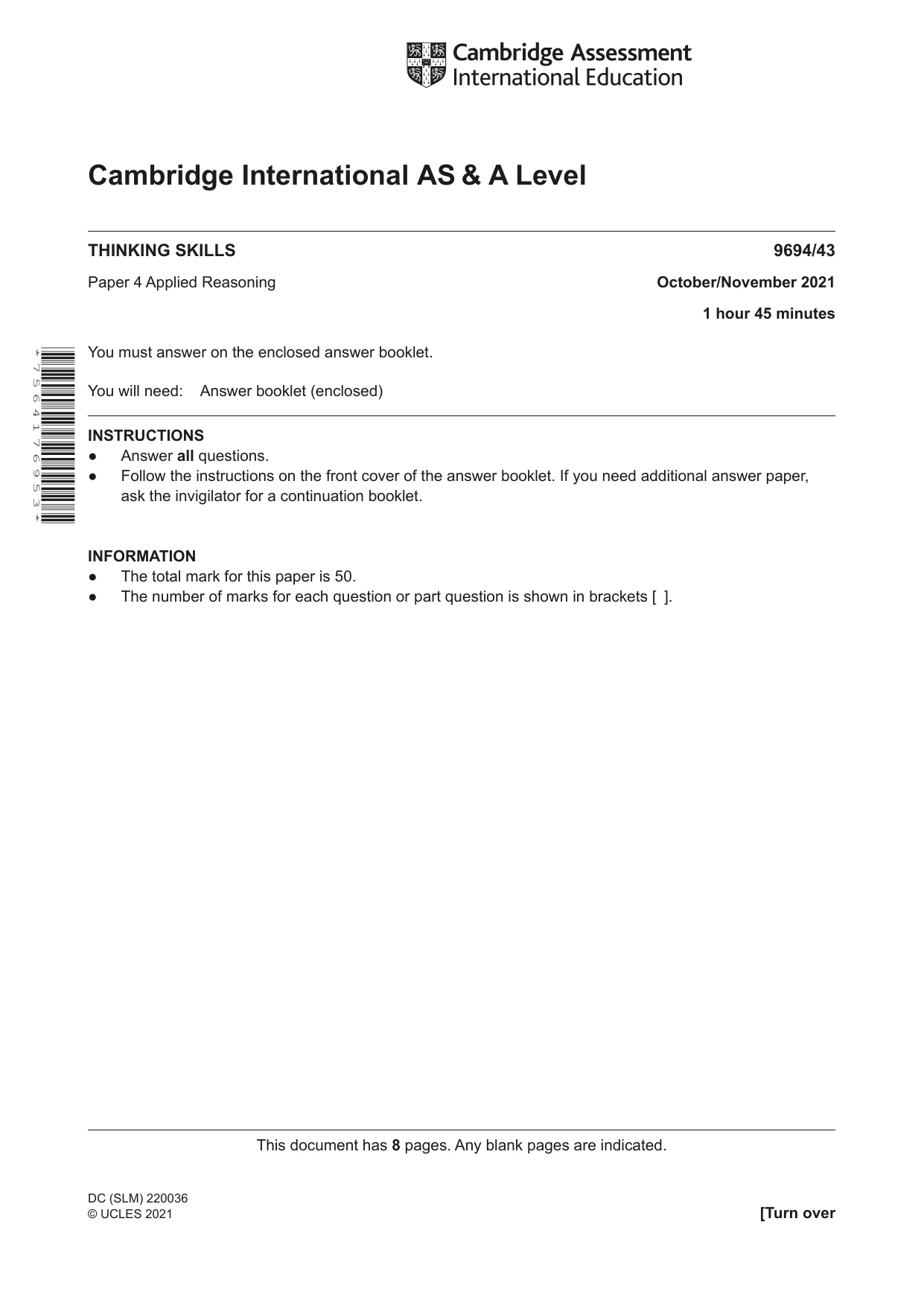
* 7 5 6 4 1 7 6 9 5 3 * DC (SLM) 220036 © UCLES 2021 [Turn over This document has 8 pages. Any blank pages are indicated. Cambridge International AS & A Level THINKING SKILLS 9694/43 Paper 4 Applied Reasoning October/November 2021 1 hour 45 minutes You must answer on the enclosed answer booklet. You will need: Answer booklet (enclosed) INSTRUCTIONS ● Answer all questions. ● Follow the instructions on the front cover of the answer booklet. If you need additional answer paper, ask the invigilator for a continuation booklet. INFORMATION ● The total mark for this paper is 50. ● The number of marks for each question or part question is shown in brackets [ ].
Question paper, page 2
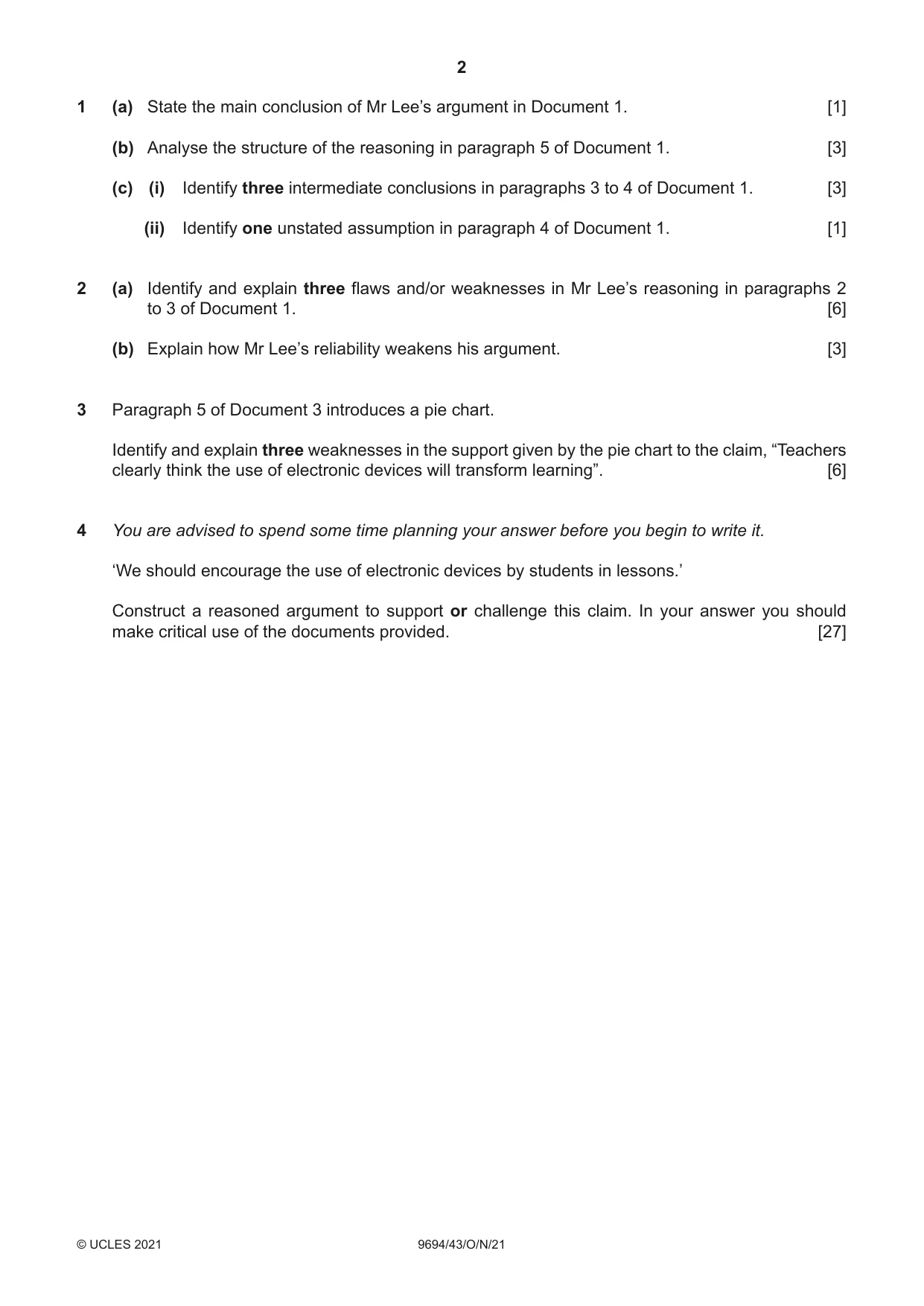
2 9694/43/O/N/21 © UCLES 2021 1 (a) State the main conclusion of Mr Lee’s argument in Document 1. [1] (b) Analyse the structure of the reasoning in paragraph 5 of Document 1. [3] (c) (i) Identify three intermediate conclusions in paragraphs 3 to 4 of Document 1. [3] (ii) Identify one unstated assumption in paragraph 4 of Document 1. [1] 2 (a) Identify and explain three flaws and/or weaknesses in Mr Lee’s reasoning in paragraphs 2 to 3 of Document 1. [6] (b) Explain how Mr Lee’s reliability weakens his argument. [3] 3 Paragraph 5 of Document 3 introduces a pie chart. Identify and explain three weaknesses in the support given by the pie chart to the claim, “Teachers clearly think the use of electronic devices will transform learning”. [6] 4 You are advised to spend some time planning your answer before you begin to write it. ‘We should encourage the use of electronic devices by students in lessons.’ Construct a reasoned argument to support or challenge this claim. In your answer you should make critical use of the documents provided. [27]
Question paper, page 3
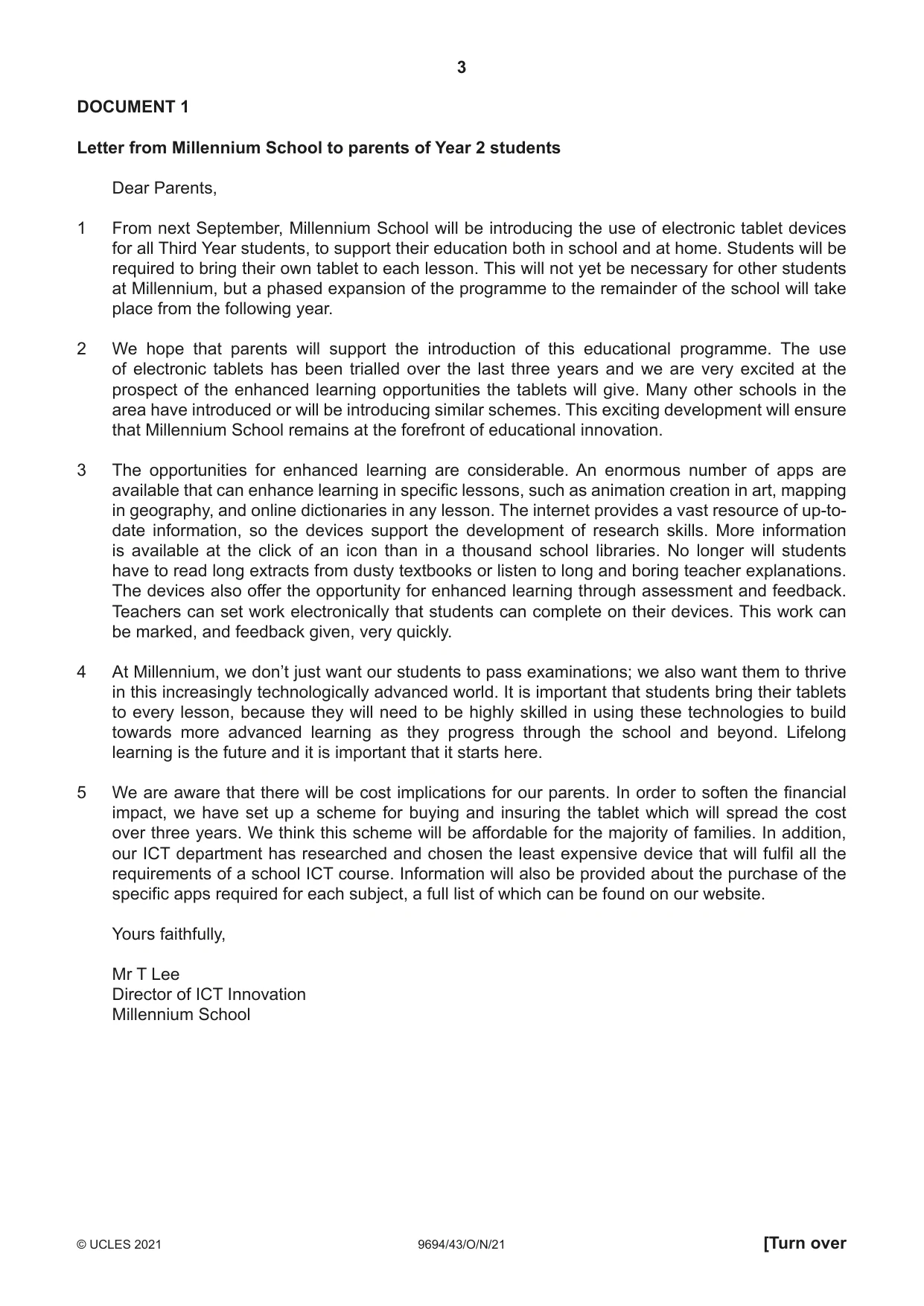
3 9694/43/O/N/21 © UCLES 2021 [Turn over DOCUMENT 1 Letter from Millennium School to parents of Year 2 students Dear Parents, 1 From next September, Millennium School will be introducing the use of electronic tablet devices for all Third Year students, to support their education both in school and at home. Students will be required to bring their own tablet to each lesson. This will not yet be necessary for other students at Millennium, but a phased expansion of the programme to the remainder of the school will take place from the following year. 2 We hope that parents will support the introduction of this educational programme. The use of electronic tablets has been trialled over the last three years and we are very excited at the prospect of the enhanced learning opportunities the tablets will give. Many other schools in the area have introduced or will be introducing similar schemes. This exciting development will ensure that Millennium School remains at the forefront of educational innovation. 3 The opportunities for enhanced learning are considerable. An enormous number of apps are available that can enhance learning in specific lessons, such as animation creation in art, mapping in geography, and online dictionaries in any lesson. The internet provides a vast resource of up-to- date information, so the devices support the development of research skills. More information is available at the click of an icon than in a thousand school libraries. No longer will students have to read long extracts from dusty textbooks or listen to long and boring teacher explanations. The devices also offer the opportunity for enhanced learning through assessment and feedback. Teachers can set work electronically that students can complete on their devices. This work can be marked, and feedback given, very quickly. 4 At Millennium, we don’t just want our students to pass examinations; we also want them to thrive in this increasingly technologically advanced world. It is important that students bring their tablets to every lesson, because they will need to be highly skilled in using these technologies to build towards more advanced learning as they progress through the school and beyond. Lifelong learning is the future and it is important that it starts here. 5 We are aware that there will be cost implications for our parents. In order to soften the financial impact, we have set up a scheme for buying and insuring the tablet which will spread the cost over three years. We think this scheme will be affordable for the majority of families. In addition, our ICT department has researched and chosen the least expensive device that will fulfil all the requirements of a school ICT course. Information will also be provided about the purchase of the specific apps required for each subject, a full list of which can be found on our website. Yours faithfully, Mr T Lee Director of ICT Innovation Millennium School
Question paper, page 4
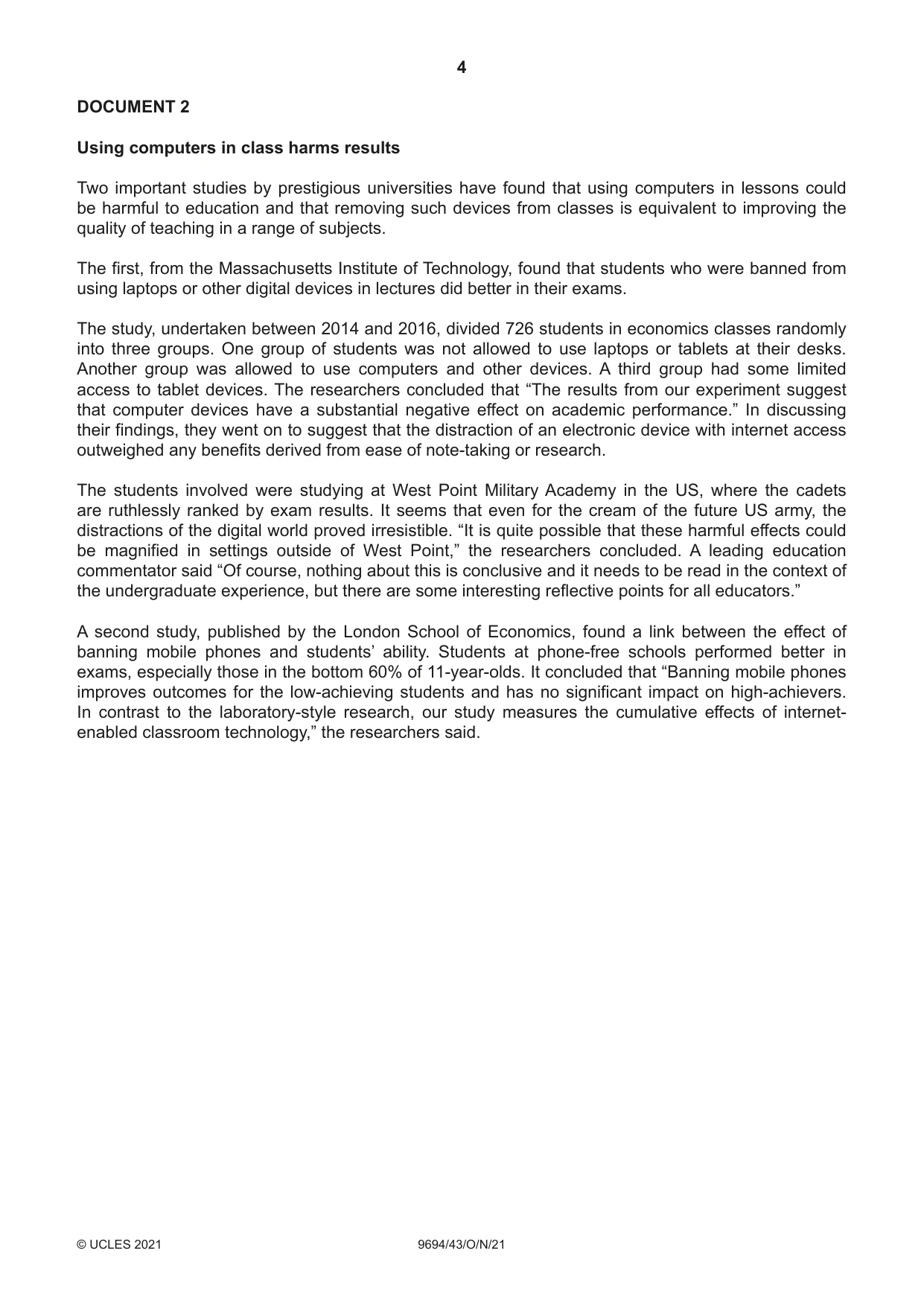
4 9694/43/O/N/21 © UCLES 2021 DOCUMENT 2 Using computers in class harms results Two important studies by prestigious universities have found that using computers in lessons could be harmful to education and that removing such devices from classes is equivalent to improving the quality of teaching in a range of subjects. The first, from the Massachusetts Institute of Technology, found that students who were banned from using laptops or other digital devices in lectures did better in their exams. The study, undertaken between 2014 and 2016, divided 726 students in economics classes randomly into three groups. One group of students was not allowed to use laptops or tablets at their desks. Another group was allowed to use computers and other devices. A third group had some limited access to tablet devices. The researchers concluded that “The results from our experiment suggest that computer devices have a substantial negative effect on academic performance.” In discussing their findings, they went on to suggest that the distraction of an electronic device with internet access outweighed any benefits derived from ease of note-taking or research. The students involved were studying at West Point Military Academy in the US, where the cadets are ruthlessly ranked by exam results. It seems that even for the cream of the future US army, the distractions of the digital world proved irresistible. “It is quite possible that these harmful effects could be magnified in settings outside of West Point,” the researchers concluded. A leading education commentator said “Of course, nothing about this is conclusive and it needs to be read in the context of the undergraduate experience, but there are some interesting reflective points for all educators.” A second study, published by the London School of Economics, found a link between the effect of banning mobile phones and students’ ability. Students at phone-free schools performed better in exams, especially those in the bottom 60% of 11-year-olds. It concluded that “Banning mobile phones improves outcomes for the low-achieving students and has no significant impact on high-achievers. In contrast to the laboratory-style research, our study measures the cumulative effects of internet- enabled classroom technology,” the researchers said.
Question paper, page 5
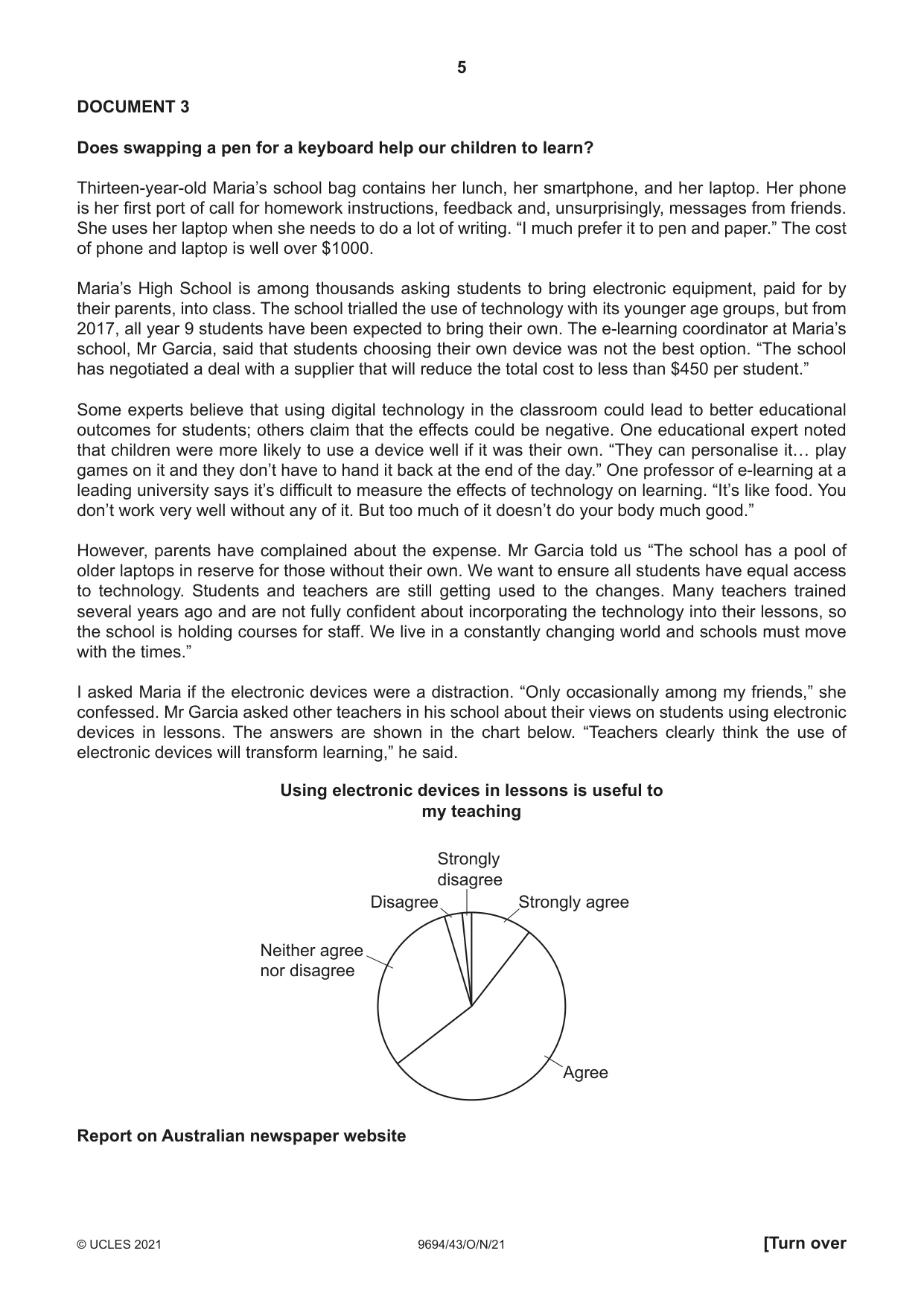
5 9694/43/O/N/21 © UCLES 2021 [Turn over DOCUMENT 3 Does swapping a pen for a keyboard help our children to learn? Thirteen-year-old Maria’s school bag contains her lunch, her smartphone, and her laptop. Her phone is her first port of call for homework instructions, feedback and, unsurprisingly, messages from friends. She uses her laptop when she needs to do a lot of writing. “I much prefer it to pen and paper.” The cost of phone and laptop is well over $1000. Maria’s High School is among thousands asking students to bring electronic equipment, paid for by their parents, into class. The school trialled the use of technology with its younger age groups, but from 2017, all year 9 students have been expected to bring their own. The e-learning coordinator at Maria’s school, Mr Garcia, said that students choosing their own device was not the best option. “The school has negotiated a deal with a supplier that will reduce the total cost to less than $450 per student.” Some experts believe that using digital technology in the classroom could lead to better educational outcomes for students; others claim that the effects could be negative. One educational expert noted that children were more likely to use a device well if it was their own. “They can personalise it… play games on it and they don’t have to hand it back at the end of the day.” One professor of e-learning at a leading university says it’s difficult to measure the effects of technology on learning. “It’s like food. You don’t work very well without any of it. But too much of it doesn’t do your body much good.” However, parents have complained about the expense. Mr Garcia told us “The school has a pool of older laptops in reserve for those without their own. We want to ensure all students have equal access to technology. Students and teachers are still getting used to the changes. Many teachers trained several years ago and are not fully confident about incorporating the technology into their lessons, so the school is holding courses for staff. We live in a constantly changing world and schools must move with the times.” I asked Maria if the electronic devices were a distraction. “Only occasionally among my friends,” she confessed. Mr Garcia asked other teachers in his school about their views on students using electronic devices in lessons. The answers are shown in the chart below. “Teachers clearly think the use of electronic devices will transform learning,” he said. Strongly agree Strongly disagree Agree Neither agree nor disagree Disagree Using electronic devices in lessons is useful to my teaching Report on Australian newspaper website
Question paper, page 6
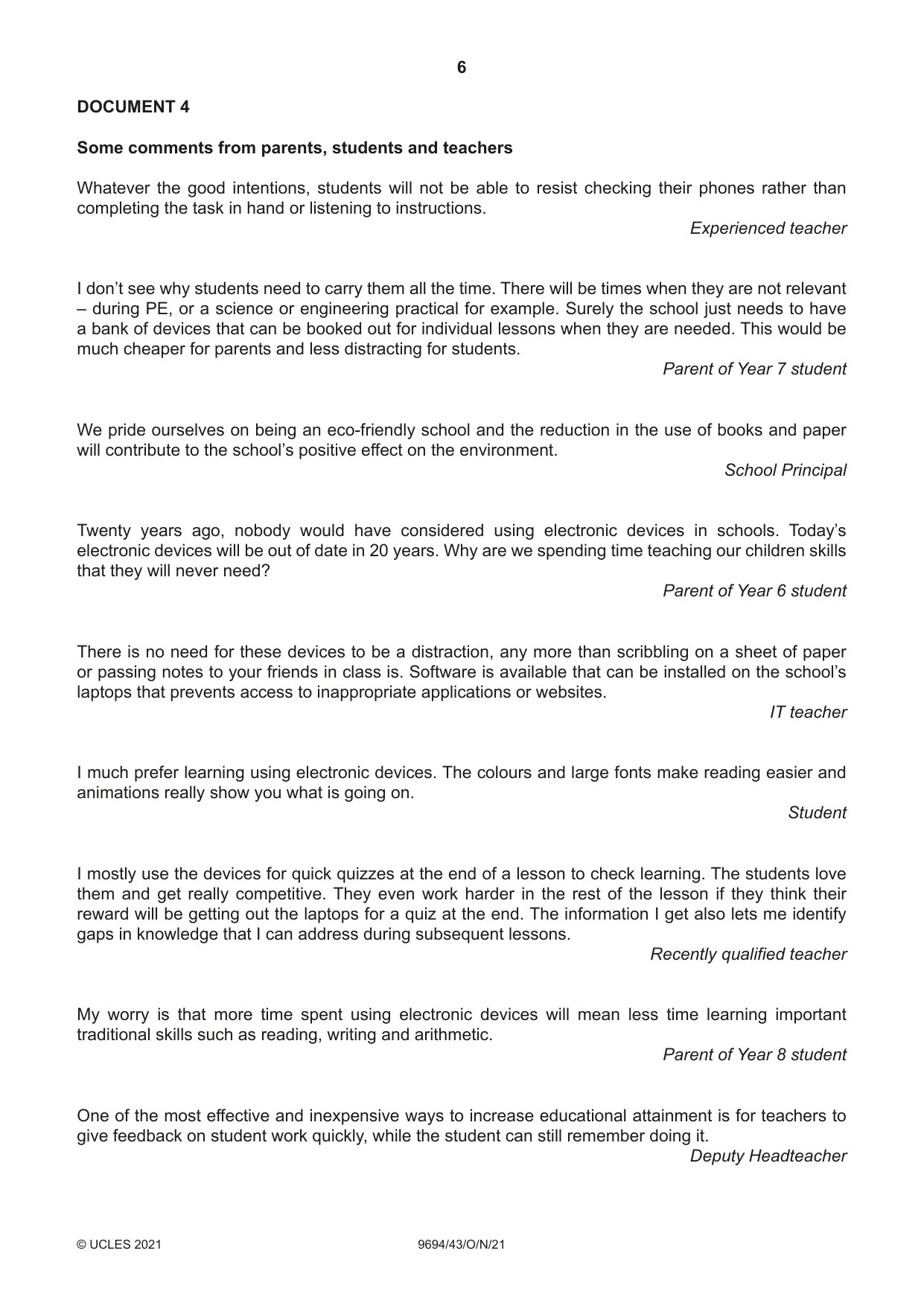
6 9694/43/O/N/21 © UCLES 2021 DOCUMENT 4 Some comments from parents, students and teachers Whatever the good intentions, students will not be able to resist checking their phones rather than completing the task in hand or listening to instructions. Experienced teacher I don’t see why students need to carry them all the time. There will be times when they are not relevant – during PE, or a science or engineering practical for example. Surely the school just needs to have a bank of devices that can be booked out for individual lessons when they are needed. This would be much cheaper for parents and less distracting for students. Parent of Year 7 student We pride ourselves on being an eco-friendly school and the reduction in the use of books and paper will contribute to the school’s positive effect on the environment. School Principal Twenty years ago, nobody would have considered using electronic devices in schools. Today’s electronic devices will be out of date in 20 years. Why are we spending time teaching our children skills that they will never need? Parent of Year 6 student There is no need for these devices to be a distraction, any more than scribbling on a sheet of paper or passing notes to your friends in class is. Software is available that can be installed on the school’s laptops that prevents access to inappropriate applications or websites. IT teacher I much prefer learning using electronic devices. The colours and large fonts make reading easier and animations really show you what is going on. Student I mostly use the devices for quick quizzes at the end of a lesson to check learning. The students love them and get really competitive. They even work harder in the rest of the lesson if they think their reward will be getting out the laptops for a quiz at the end. The information I get also lets me identify gaps in knowledge that I can address during subsequent lessons. Recently qualified teacher My worry is that more time spent using electronic devices will mean less time learning important traditional skills such as reading, writing and arithmetic. Parent of Year 8 student One of the most effective and inexpensive ways to increase educational attainment is for teachers to give feedback on student work quickly, while the student can still remember doing it. Deputy Headteacher
Question paper, page 7
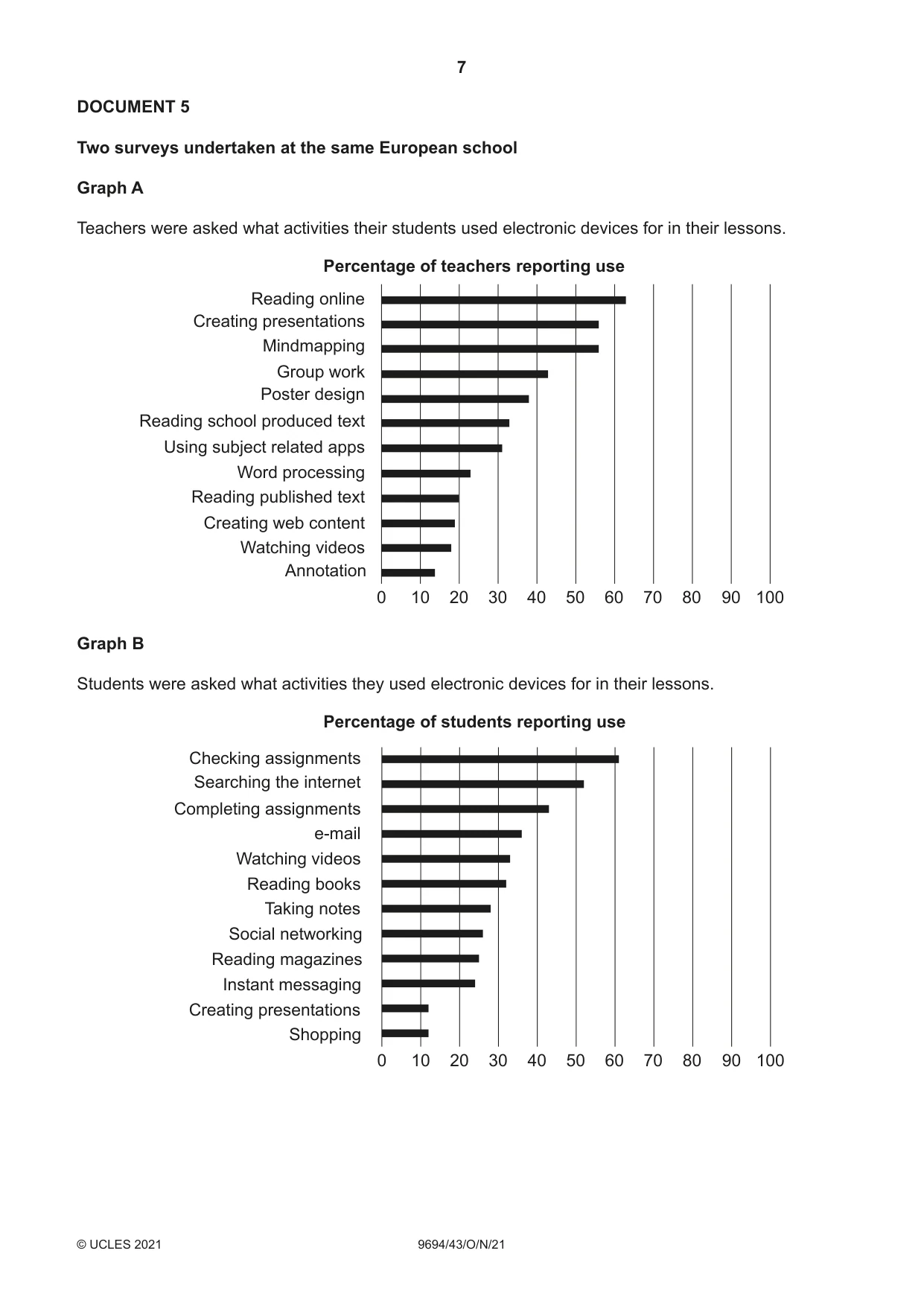
7 9694/43/O/N/21 © UCLES 2021 DOCUMENT 5 Two surveys undertaken at the same European school Graph A Teachers were asked what activities their students used electronic devices for in their lessons. 0 10 20 30 40 50 60 70 80 90 100 Percentage of teachers reporting use Reading school produced text Reading published text Reading online Annotation Watching videos Word processing Poster design Creating presentations Mindmapping Creating web content Group work Using subject related apps Graph B Students were asked what activities they used electronic devices for in their lessons. Shopping Creating presentations Instant messaging Reading magazines Social networking Taking notes Reading books Watching videos e-mail Completing assignments Searching the internet Checking assignments Percentage of students reporting use 0 10 20 30 40 50 60 70 80 90 100
Question paper, page 8
8 9694/43/O/N/21 © UCLES 2021 Permission to reproduce items where third-party owned material protected by copyright is included has been sought and cleared where possible. Every reasonable effort has been made by the publisher (UCLES) to trace copyright holders, but if any items requiring clearance have unwittingly been included, the publisher will be pleased to make amends at the earliest possible opportunity. To avoid the issue of disclosure of answer-related information to candidates, all copyright acknowledgements are reproduced online in the Cambridge Assessment International Education Copyright Acknowledgements Booklet. This is produced for each series of examinations and is freely available to download at www.cambridgeinternational.org after the live examination series. Cambridge Assessment International Education is part of the Cambridge Assessment Group. Cambridge Assessment is the brand name of the University of Cambridge Local Examinations Syndicate (UCLES), which itself is a department of the University of Cambridge. BLANK PAGE
Mark scheme, page 1
This document consists of 13 printed pages. © UCLES 2021 [Turn over Cambridge International AS & A Level THINKING SKILLS 9694/43 Paper 4 Applied Reasoning October/November 2021 MARK SCHEME Maximum Mark: 50 Published This mark scheme is published as an aid to teachers and candidates, to indicate the requirements of the examination. It shows the basis on which Examiners were instructed to award marks. It does not indicate the details of the discussions that took place at an Examiners’ meeting before marking began, which would have considered the acceptability of alternative answers. Mark schemes should be read in conjunction with the question paper and the Principal Examiner Report for Teachers. Cambridge International will not enter into discussions about these mark schemes. Cambridge International is publishing the mark schemes for the October/November 2021 series for most Cambridge IGCSE™, Cambridge International A and AS Level components and some Cambridge O Level components.
Mark scheme, page 2
9694/43 Cambridge International AS & A Level – Mark Scheme PUBLISHED October/November 2021 © UCLES 2021 Page 2 of 13 Generic Marking Principles These general marking principles must be applied by all examiners when marking candidate answers. They should be applied alongside the specific content of the mark scheme or generic level descriptors for a question. Each question paper and mark scheme will also comply with these marking principles. GENERIC MARKING PRINCIPLE 1: Marks must be awarded in line with: • the specific content of the mark scheme or the generic level descriptors for the question • the specific skills defined in the mark scheme or in the generic level descriptors for the question • the standard of response required by a candidate as exemplified by the standardisation scripts. GENERIC MARKING PRINCIPLE 2: Marks awarded are always whole marks (not half marks, or other fractions). GENERIC MARKING PRINCIPLE 3: Marks must be awarded positively: • marks are awarded for correct/valid answers, as defined in the mark scheme. However, credit is given for valid answers which go beyond the scope of the syllabus and mark scheme, referring to your Team Leader as appropriate • marks are awarded when candidates clearly demonstrate what they know and can do • marks are not deducted for errors • marks are not deducted for omissions • answers should only be judged on the quality of spelling, punctuation and grammar when these features are specifically assessed by the question as indicated by the mark scheme. The meaning, however, should be unambiguous. GENERIC MARKING PRINCIPLE 4: Rules must be applied consistently, e.g. in situations where candidates have not followed instructions or in the application of generic level descriptors.
Mark scheme, page 3
9694/43 Cambridge International AS & A Level – Mark Scheme PUBLISHED October/November 2021 © UCLES 2021 Page 3 of 13 GENERIC MARKING PRINCIPLE 5: Marks should be awarded using the full range of marks defined in the mark scheme for the question (however; the use of the full mark range may be limited according to the quality of the candidate responses seen). GENERIC MARKING PRINCIPLE 6: Marks awarded are based solely on the requirements as defined in the mark scheme. Marks should not be awarded with grade thresholds or grade descriptors in mind.
Mark scheme, page 4
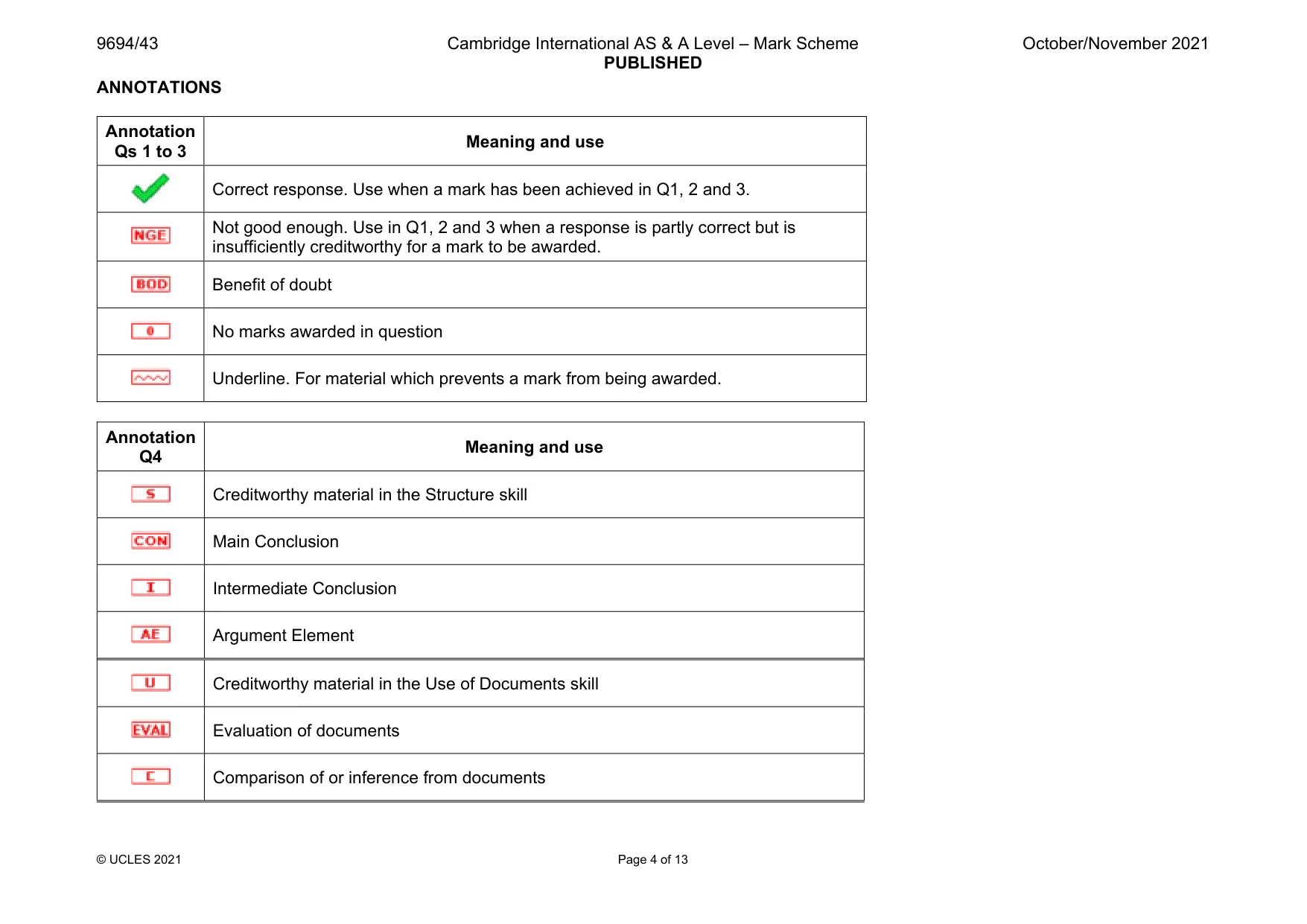
9694/43 Cambridge International AS & A Level – Mark Scheme PUBLISHED October/November 2021 © UCLES 2021 Page 4 of 13 ANNOTATIONS Annotation Qs 1 to 3 Meaning and use Correct response. Use when a mark has been achieved in Q1, 2 and 3. Not good enough. Use in Q1, 2 and 3 when a response is partly correct but is insufficiently creditworthy for a mark to be awarded. Benefit of doubt No marks awarded in question Underline. For material which prevents a mark from being awarded. Annotation Q4 Meaning and use Creditworthy material in the Structure skill Main Conclusion Intermediate Conclusion Argument Element Creditworthy material in the Use of Documents skill Evaluation of documents Comparison of or inference from documents
Mark scheme, page 5
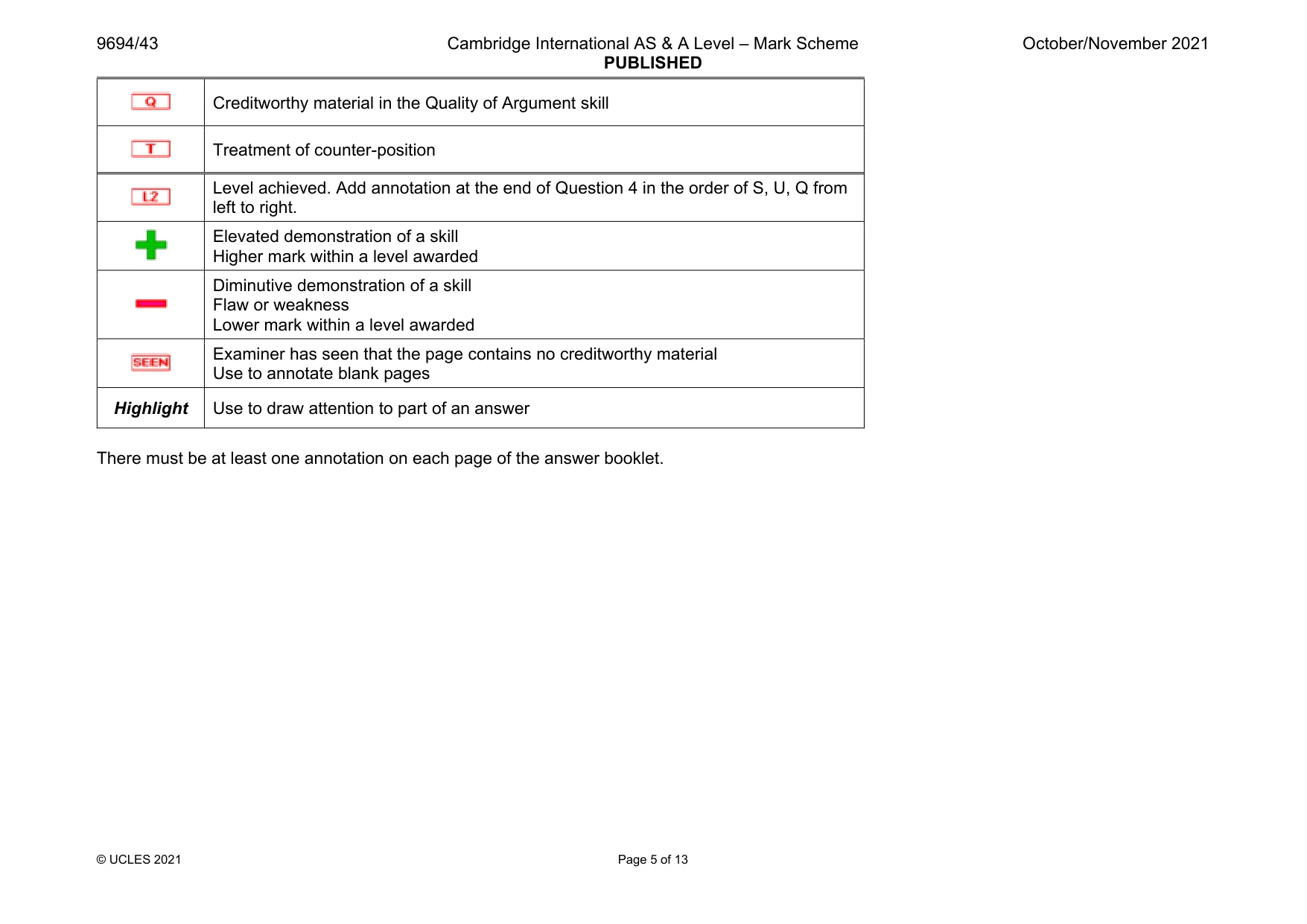
9694/43 Cambridge International AS & A Level – Mark Scheme PUBLISHED October/November 2021 © UCLES 2021 Page 5 of 13 Creditworthy material in the Quality of Argument skill Treatment of counter-position Level achieved. Add annotation at the end of Question 4 in the order of S, U, Q from left to right. Elevated demonstration of a skill Higher mark within a level awarded Diminutive demonstration of a skill Flaw or weakness Lower mark within a level awarded Examiner has seen that the page contains no creditworthy material Use to annotate blank pages Highlight Use to draw attention to part of an answer There must be at least one annotation on each page of the answer booklet.
Mark scheme, page 6
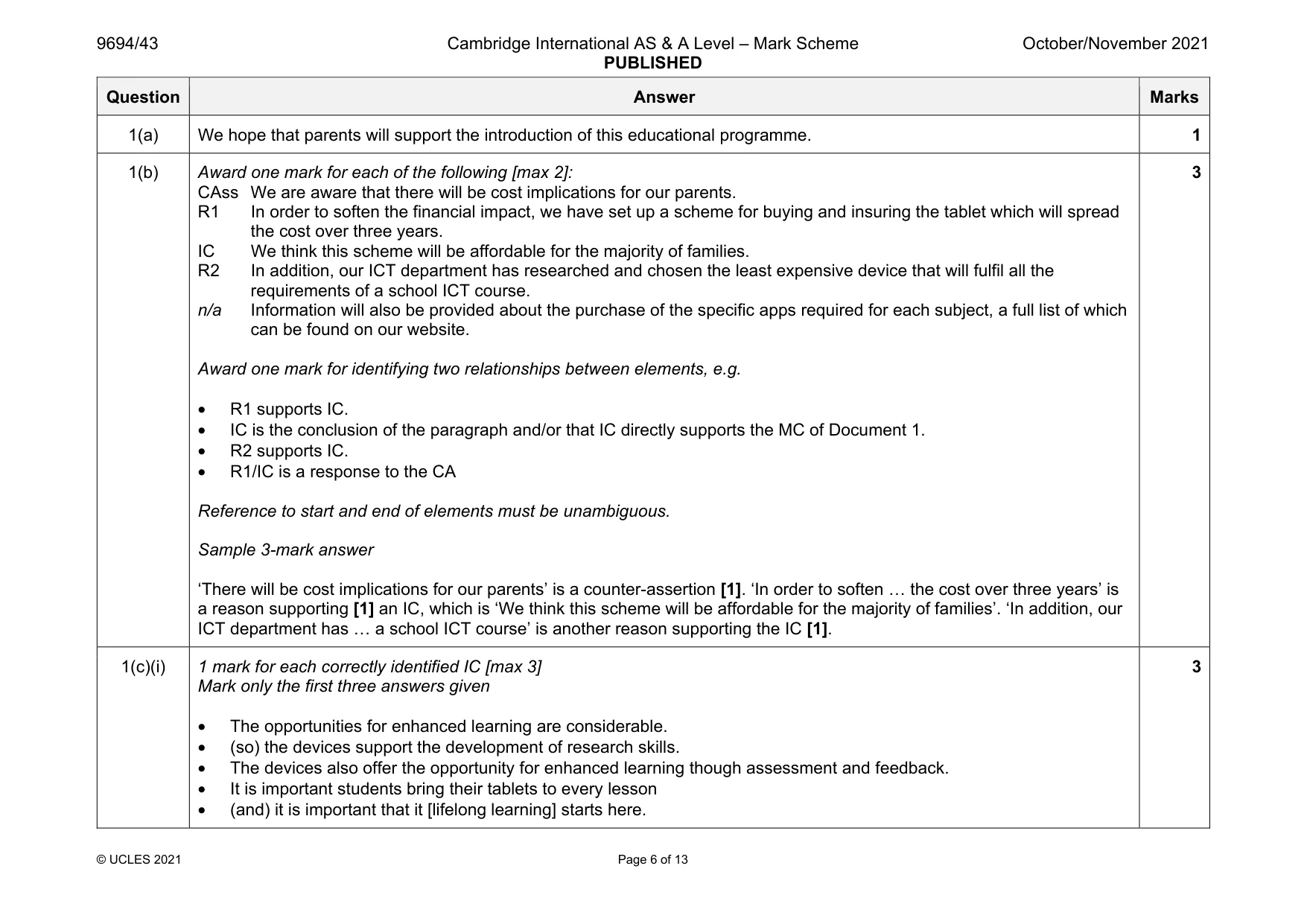
9694/43 Cambridge International AS & A Level – Mark Scheme PUBLISHED October/November 2021 © UCLES 2021 Page 6 of 13 Question Answer Marks 1(a) We hope that parents will support the introduction of this educational programme. 1 1(b) Award one mark for each of the following [max 2]: CAss We are aware that there will be cost implications for our parents. R1 In order to soften the financial impact, we have set up a scheme for buying and insuring the tablet which will spread the cost over three years. IC We think this scheme will be affordable for the majority of families. R2 In addition, our ICT department has researched and chosen the least expensive device that will fulfil all the requirements of a school ICT course. n/a Information will also be provided about the purchase of the specific apps required for each subject, a full list of which can be found on our website. Award one mark for identifying two relationships between elements, e.g. • R1 supports IC. • IC is the conclusion of the paragraph and/or that IC directly supports the MC of Document 1. • R2 supports IC. • R1/IC is a response to the CA Reference to start and end of elements must be unambiguous. Sample 3-mark answer ‘There will be cost implications for our parents’ is a counter-assertion [1]. ‘In order to soften … the cost over three years’ is a reason supporting [1] an IC, which is ‘We think this scheme will be affordable for the majority of families’. ‘In addition, our ICT department has … a school ICT course’ is another reason supporting the IC [1]. 3 1(c)(i) 1 mark for each correctly identified IC [max 3] Mark only the first three answers given • The opportunities for enhanced learning are considerable. • (so) the devices support the development of research skills. • The devices also offer the opportunity for enhanced learning though assessment and feedback. • It is important students bring their tablets to every lesson • (and) it is important that it [lifelong learning] starts here. 3
Mark scheme, page 7
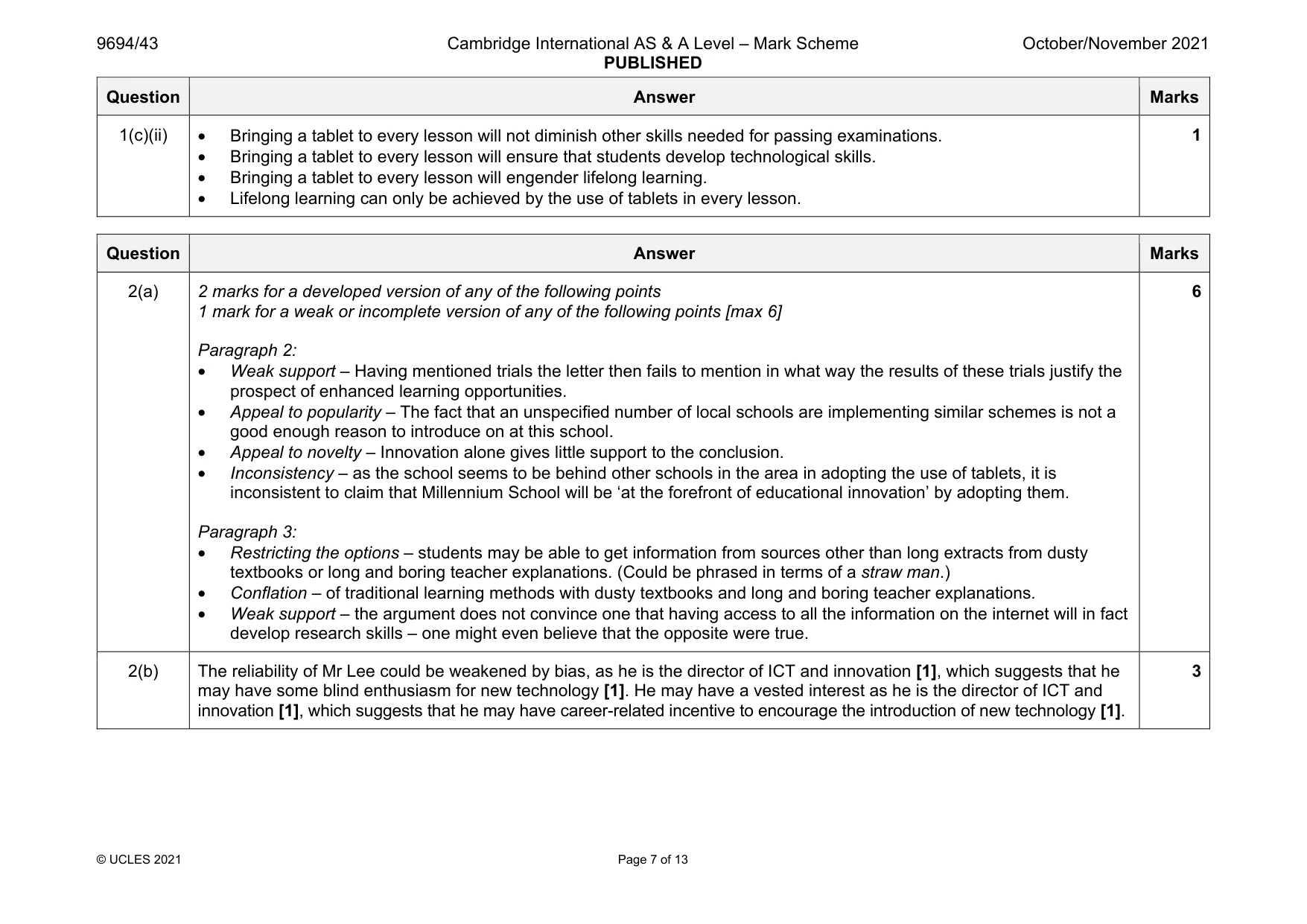
9694/43 Cambridge International AS & A Level – Mark Scheme PUBLISHED October/November 2021 © UCLES 2021 Page 7 of 13 Question Answer Marks 1(c)(ii) • Bringing a tablet to every lesson will not diminish other skills needed for passing examinations. • Bringing a tablet to every lesson will ensure that students develop technological skills. • Bringing a tablet to every lesson will engender lifelong learning. • Lifelong learning can only be achieved by the use of tablets in every lesson. 1 Question Answer Marks 2(a) 2 marks for a developed version of any of the following points 1 mark for a weak or incomplete version of any of the following points [max 6] Paragraph 2: • Weak support – Having mentioned trials the letter then fails to mention in what way the results of these trials justify the prospect of enhanced learning opportunities. • Appeal to popularity – The fact that an unspecified number of local schools are implementing similar schemes is not a good enough reason to introduce on at this school. • Appeal to novelty – Innovation alone gives little support to the conclusion. • Inconsistency – as the school seems to be behind other schools in the area in adopting the use of tablets, it is inconsistent to claim that Millennium School will be ‘at the forefront of educational innovation’ by adopting them. Paragraph 3: • Restricting the options – students may be able to get information from sources other than long extracts from dusty textbooks or long and boring teacher explanations. (Could be phrased in terms of a straw man.) • Conflation – of traditional learning methods with dusty textbooks and long and boring teacher explanations. • Weak support – the argument does not convince one that having access to all the information on the internet will in fact develop research skills – one might even believe that the opposite were true. 6 2(b) The reliability of Mr Lee could be weakened by bias, as he is the director of ICT and innovation [1], which suggests that he may have some blind enthusiasm for new technology [1]. He may have a vested interest as he is the director of ICT and innovation [1], which suggests that he may have career-related incentive to encourage the introduction of new technology [1]. 3
Mark scheme, page 8
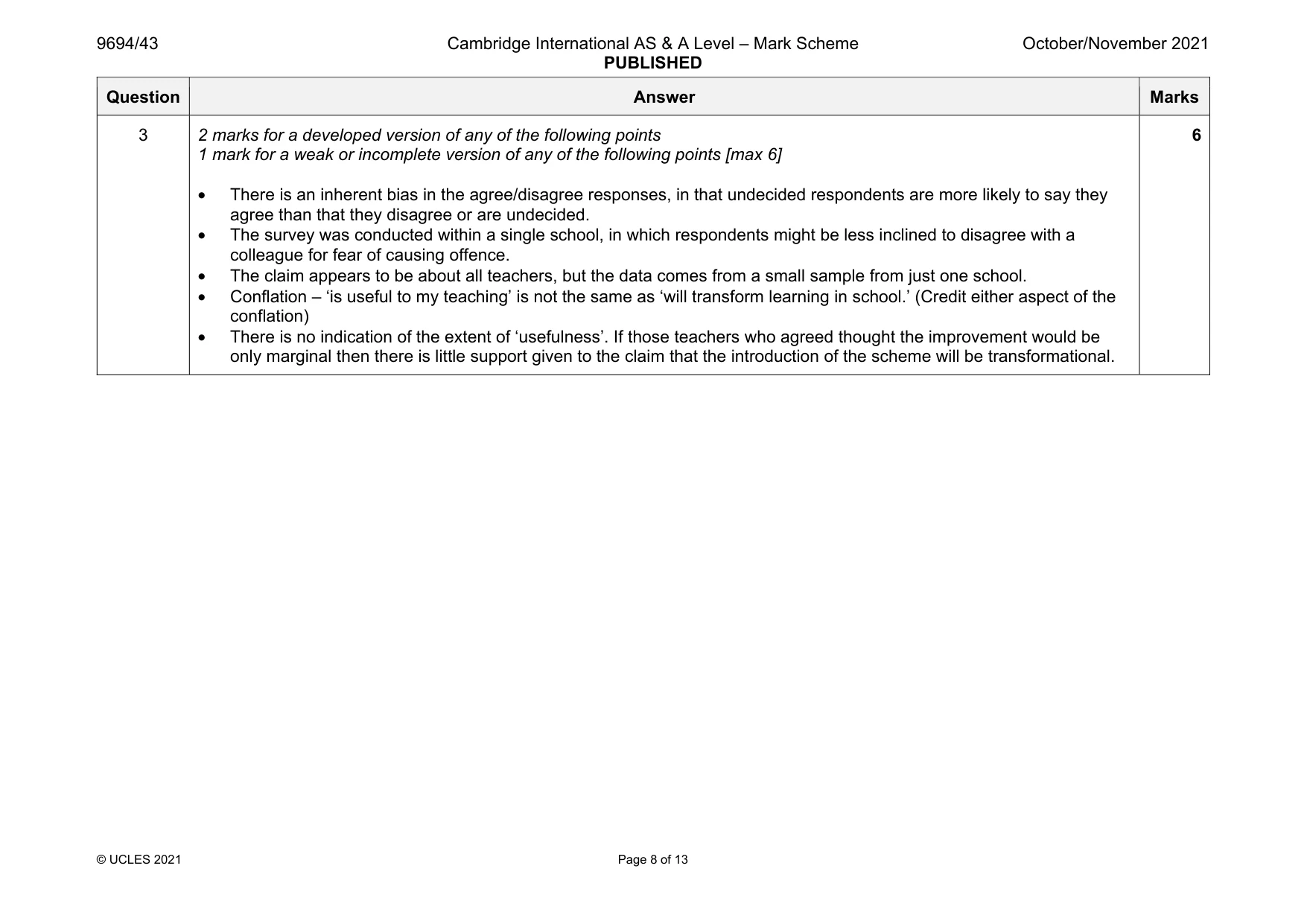
9694/43 Cambridge International AS & A Level – Mark Scheme PUBLISHED October/November 2021 © UCLES 2021 Page 8 of 13 Question Answer Marks 3 2 marks for a developed version of any of the following points 1 mark for a weak or incomplete version of any of the following points [max 6] • There is an inherent bias in the agree/disagree responses, in that undecided respondents are more likely to say they agree than that they disagree or are undecided. • The survey was conducted within a single school, in which respondents might be less inclined to disagree with a colleague for fear of causing offence. • The claim appears to be about all teachers, but the data comes from a small sample from just one school. • Conflation – ‘is useful to my teaching’ is not the same as ‘will transform learning in school.’ (Credit either aspect of the conflation) • There is no indication of the extent of ‘usefulness’. If those teachers who agreed thought the improvement would be only marginal then there is little support given to the claim that the introduction of the scheme will be transformational. 6
Mark scheme, page 9
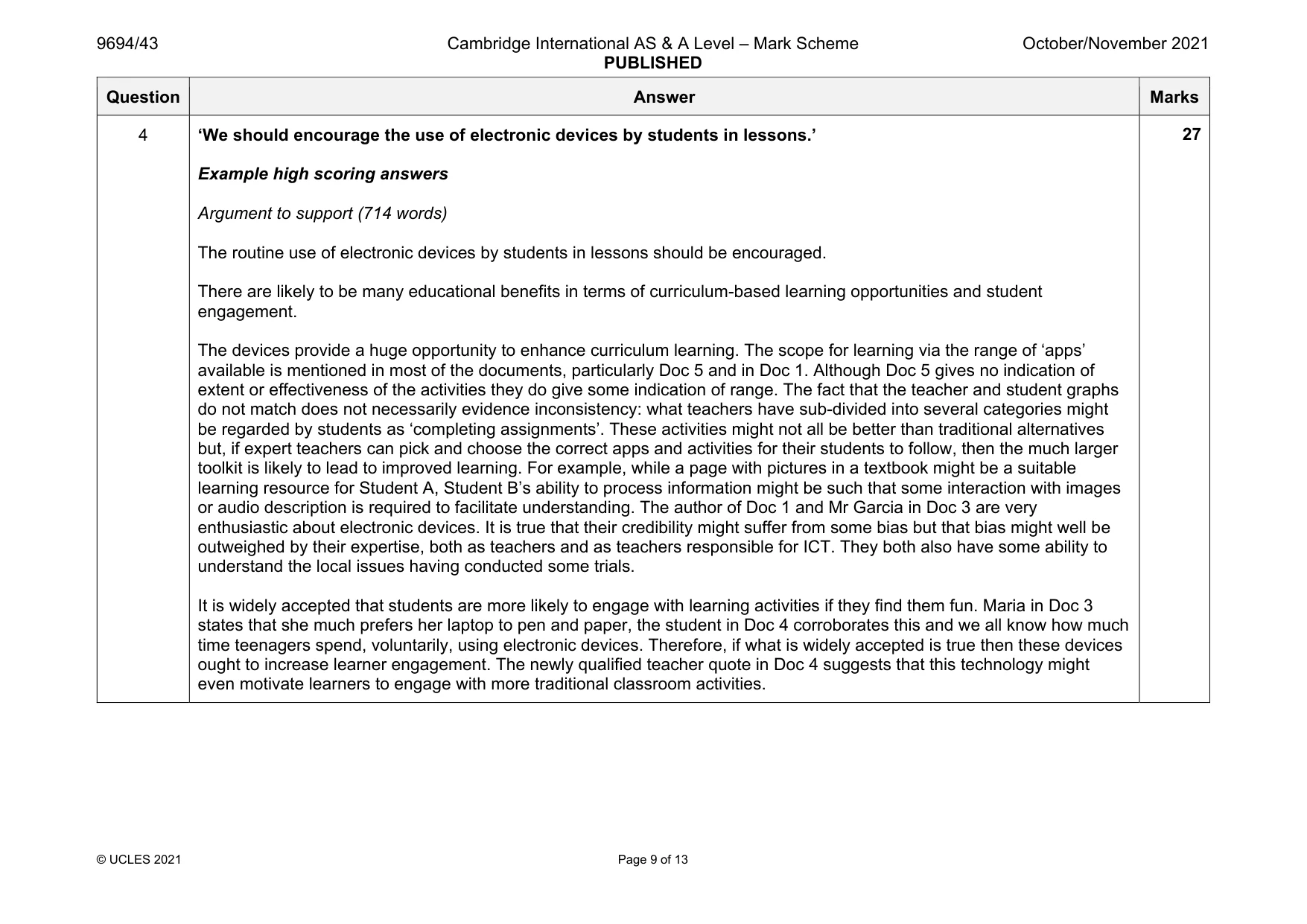
9694/43 Cambridge International AS & A Level – Mark Scheme PUBLISHED October/November 2021 © UCLES 2021 Page 9 of 13 Question Answer Marks 4 ‘We should encourage the use of electronic devices by students in lessons.’ Example high scoring answers Argument to support (714 words) The routine use of electronic devices by students in lessons should be encouraged. There are likely to be many educational benefits in terms of curriculum-based learning opportunities and student engagement. The devices provide a huge opportunity to enhance curriculum learning. The scope for learning via the range of ‘apps’ available is mentioned in most of the documents, particularly Doc 5 and in Doc 1. Although Doc 5 gives no indication of extent or effectiveness of the activities they do give some indication of range. The fact that the teacher and student graphs do not match does not necessarily evidence inconsistency: what teachers have sub-divided into several categories might be regarded by students as ‘completing assignments’. These activities might not all be better than traditional alternatives but, if expert teachers can pick and choose the correct apps and activities for their students to follow, then the much larger toolkit is likely to lead to improved learning. For example, while a page with pictures in a textbook might be a suitable learning resource for Student A, Student B’s ability to process information might be such that some interaction with images or audio description is required to facilitate understanding. The author of Doc 1 and Mr Garcia in Doc 3 are very enthusiastic about electronic devices. It is true that their credibility might suffer from some bias but that bias might well be outweighed by their expertise, both as teachers and as teachers responsible for ICT. They both also have some ability to understand the local issues having conducted some trials. It is widely accepted that students are more likely to engage with learning activities if they find them fun. Maria in Doc 3 states that she much prefers her laptop to pen and paper, the student in Doc 4 corroborates this and we all know how much time teenagers spend, voluntarily, using electronic devices. Therefore, if what is widely accepted is true then these devices ought to increase learner engagement. The newly qualified teacher quote in Doc 4 suggests that this technology might even motivate learners to engage with more traditional classroom activities. 27
Mark scheme, page 10
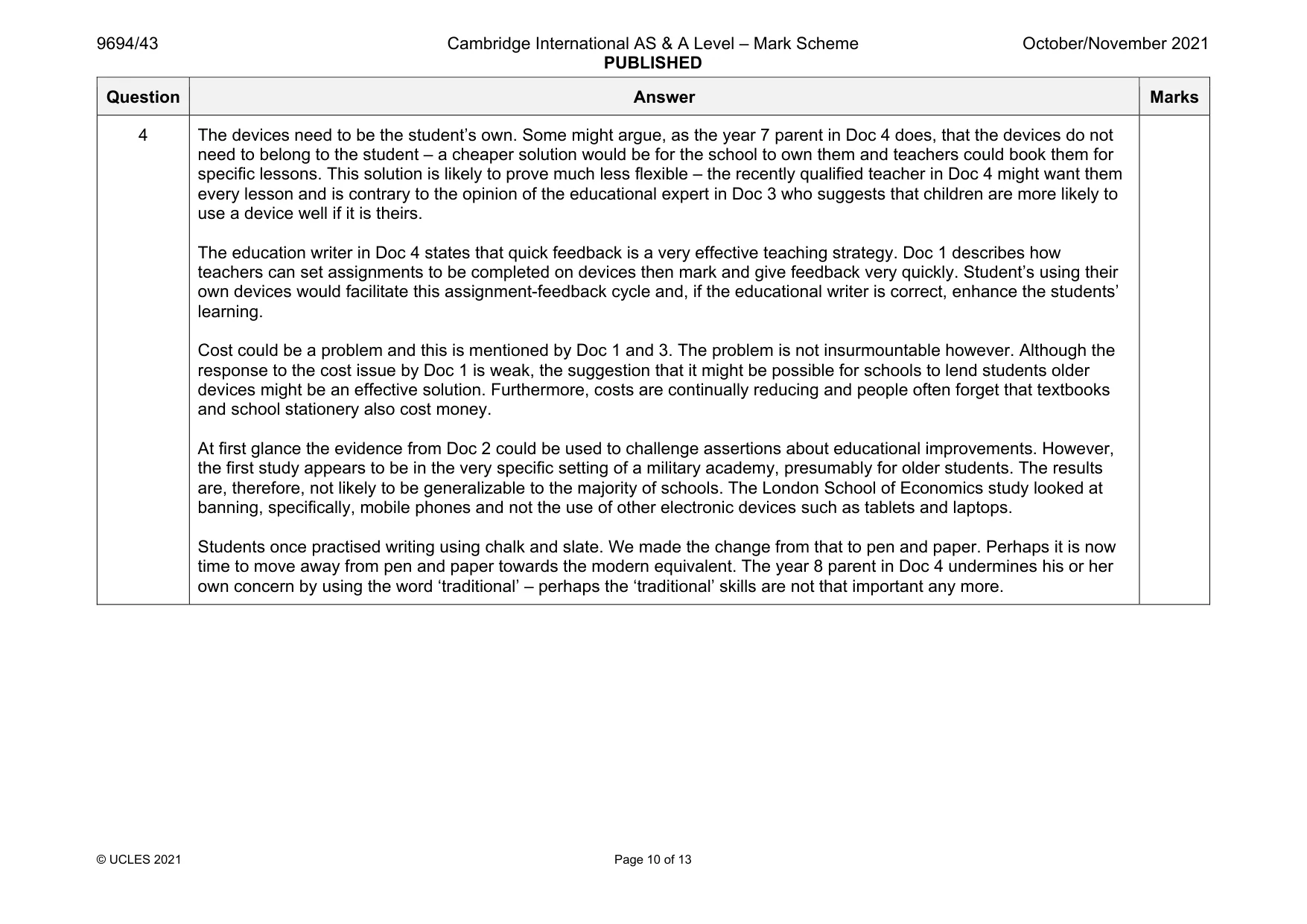
9694/43 Cambridge International AS & A Level – Mark Scheme PUBLISHED October/November 2021 © UCLES 2021 Page 10 of 13 Question Answer Marks 4 The devices need to be the student’s own. Some might argue, as the year 7 parent in Doc 4 does, that the devices do not need to belong to the student – a cheaper solution would be for the school to own them and teachers could book them for specific lessons. This solution is likely to prove much less flexible – the recently qualified teacher in Doc 4 might want them every lesson and is contrary to the opinion of the educational expert in Doc 3 who suggests that children are more likely to use a device well if it is theirs. The education writer in Doc 4 states that quick feedback is a very effective teaching strategy. Doc 1 describes how teachers can set assignments to be completed on devices then mark and give feedback very quickly. Student’s using their own devices would facilitate this assignment-feedback cycle and, if the educational writer is correct, enhance the students’ learning. Cost could be a problem and this is mentioned by Doc 1 and 3. The problem is not insurmountable however. Although the response to the cost issue by Doc 1 is weak, the suggestion that it might be possible for schools to lend students older devices might be an effective solution. Furthermore, costs are continually reducing and people often forget that textbooks and school stationery also cost money. At first glance the evidence from Doc 2 could be used to challenge assertions about educational improvements. However, the first study appears to be in the very specific setting of a military academy, presumably for older students. The results are, therefore, not likely to be generalizable to the majority of schools. The London School of Economics study looked at banning, specifically, mobile phones and not the use of other electronic devices such as tablets and laptops. Students once practised writing using chalk and slate. We made the change from that to pen and paper. Perhaps it is now time to move away from pen and paper towards the modern equivalent. The year 8 parent in Doc 4 undermines his or her own concern by using the word ‘traditional’ – perhaps the ‘traditional’ skills are not that important any more.
Mark scheme, page 11
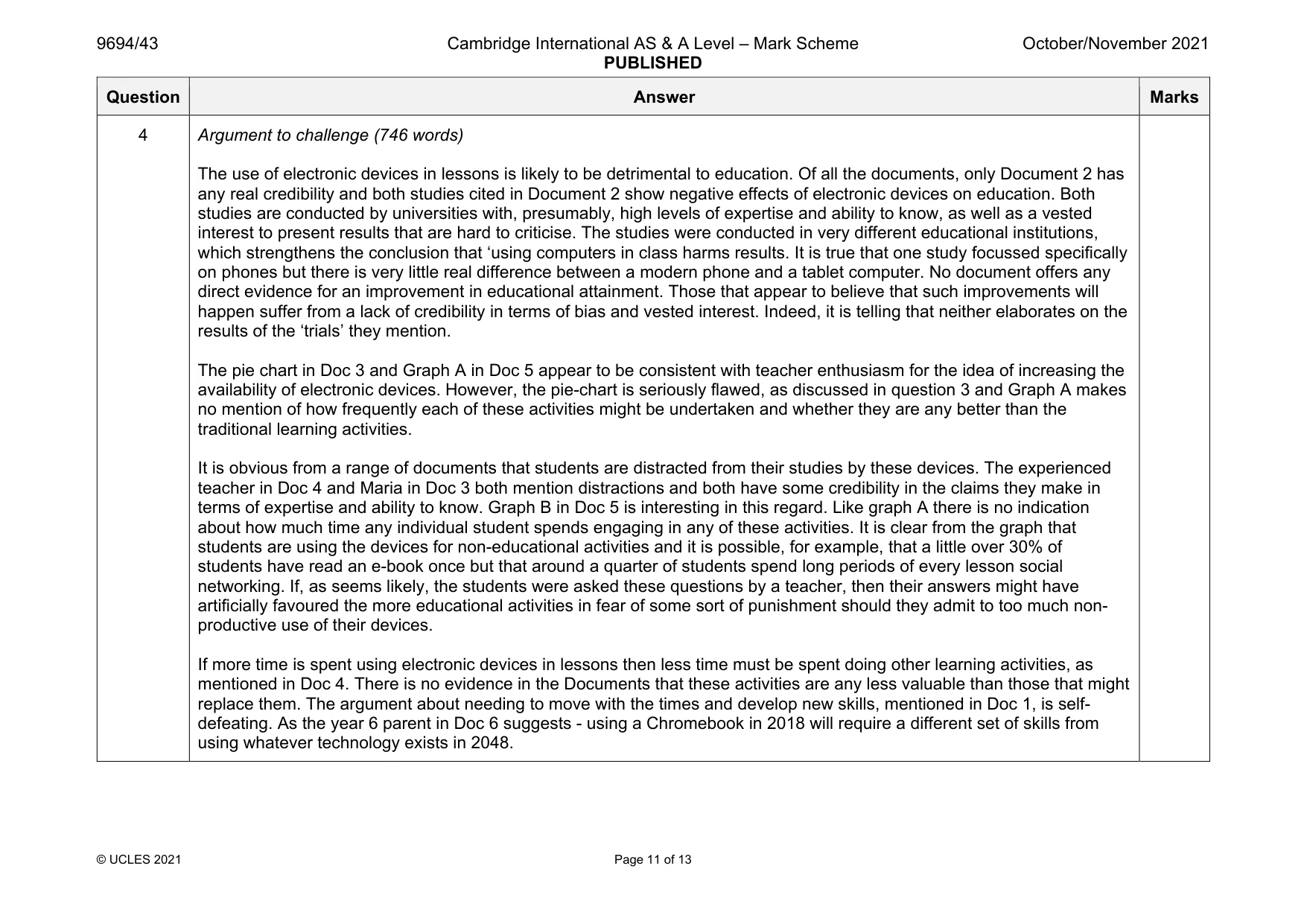
9694/43 Cambridge International AS & A Level – Mark Scheme PUBLISHED October/November 2021 © UCLES 2021 Page 11 of 13 Question Answer Marks 4 Argument to challenge (746 words) The use of electronic devices in lessons is likely to be detrimental to education. Of all the documents, only Document 2 has any real credibility and both studies cited in Document 2 show negative effects of electronic devices on education. Both studies are conducted by universities with, presumably, high levels of expertise and ability to know, as well as a vested interest to present results that are hard to criticise. The studies were conducted in very different educational institutions, which strengthens the conclusion that ‘using computers in class harms results. It is true that one study focussed specifically on phones but there is very little real difference between a modern phone and a tablet computer. No document offers any direct evidence for an improvement in educational attainment. Those that appear to believe that such improvements will happen suffer from a lack of credibility in terms of bias and vested interest. Indeed, it is telling that neither elaborates on the results of the ‘trials’ they mention. The pie chart in Doc 3 and Graph A in Doc 5 appear to be consistent with teacher enthusiasm for the idea of increasing the availability of electronic devices. However, the pie-chart is seriously flawed, as discussed in question 3 and Graph A makes no mention of how frequently each of these activities might be undertaken and whether they are any better than the traditional learning activities. It is obvious from a range of documents that students are distracted from their studies by these devices. The experienced teacher in Doc 4 and Maria in Doc 3 both mention distractions and both have some credibility in the claims they make in terms of expertise and ability to know. Graph B in Doc 5 is interesting in this regard. Like graph A there is no indication about how much time any individual student spends engaging in any of these activities. It is clear from the graph that students are using the devices for non-educational activities and it is possible, for example, that a little over 30% of students have read an e-book once but that around a quarter of students spend long periods of every lesson social networking. If, as seems likely, the students were asked these questions by a teacher, then their answers might have artificially favoured the more educational activities in fear of some sort of punishment should they admit to too much non- productive use of their devices. If more time is spent using electronic devices in lessons then less time must be spent doing other learning activities, as mentioned in Doc 4. There is no evidence in the Documents that these activities are any less valuable than those that might replace them. The argument about needing to move with the times and develop new skills, mentioned in Doc 1, is self- defeating. As the year 6 parent in Doc 6 suggests - using a Chromebook in 2018 will require a different set of skills from using whatever technology exists in 2048.
Mark scheme, page 12
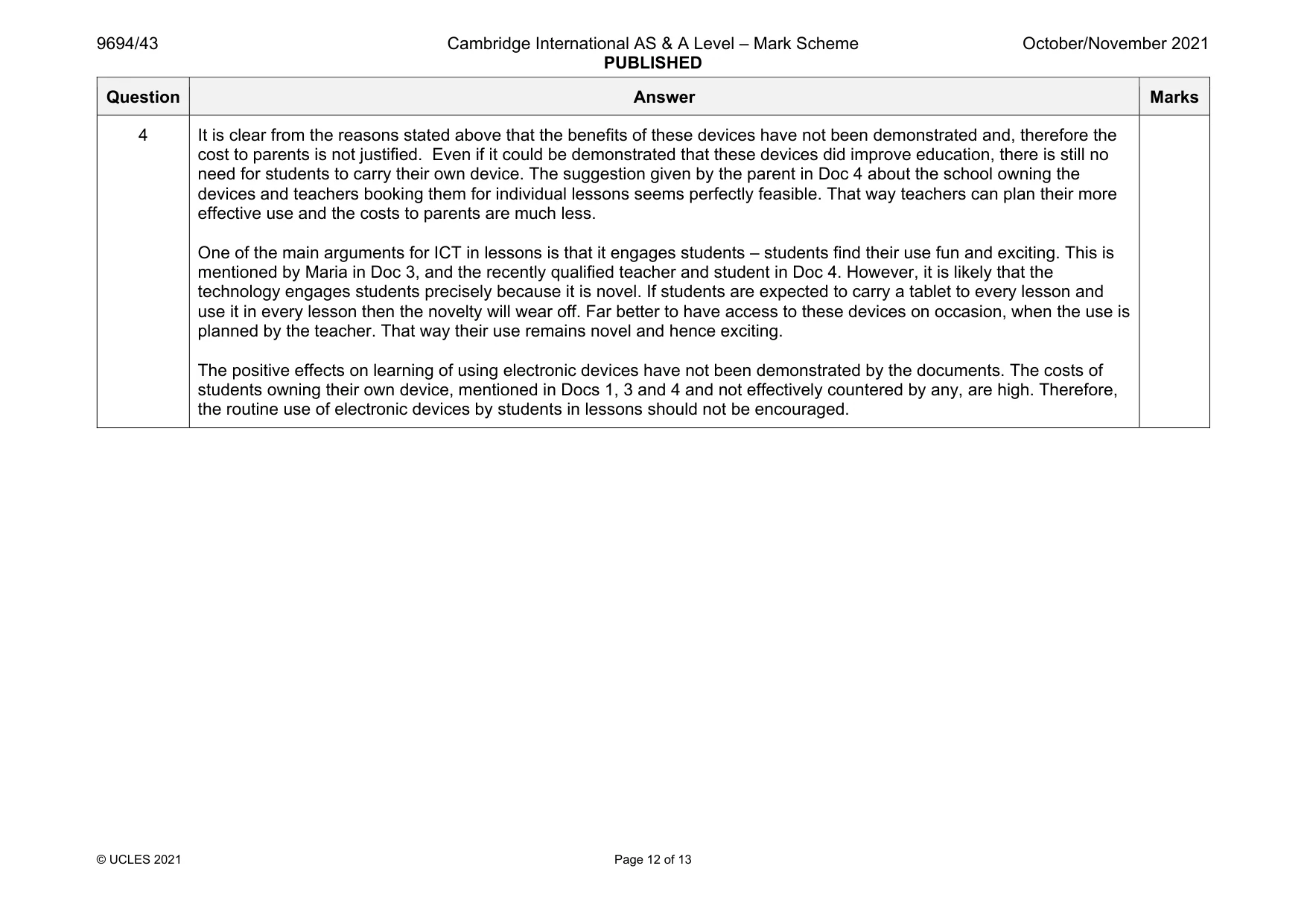
9694/43 Cambridge International AS & A Level – Mark Scheme PUBLISHED October/November 2021 © UCLES 2021 Page 12 of 13 Question Answer Marks 4 It is clear from the reasons stated above that the benefits of these devices have not been demonstrated and, therefore the cost to parents is not justified. Even if it could be demonstrated that these devices did improve education, there is still no need for students to carry their own device. The suggestion given by the parent in Doc 4 about the school owning the devices and teachers booking them for individual lessons seems perfectly feasible. That way teachers can plan their more effective use and the costs to parents are much less. One of the main arguments for ICT in lessons is that it engages students – students find their use fun and exciting. This is mentioned by Maria in Doc 3, and the recently qualified teacher and student in Doc 4. However, it is likely that the technology engages students precisely because it is novel. If students are expected to carry a tablet to every lesson and use it in every lesson then the novelty will wear off. Far better to have access to these devices on occasion, when the use is planned by the teacher. That way their use remains novel and hence exciting. The positive effects on learning of using electronic devices have not been demonstrated by the documents. The costs of students owning their own device, mentioned in Docs 1, 3 and 4 and not effectively countered by any, are high. Therefore, the routine use of electronic devices by students in lessons should not be encouraged.
Mark scheme, page 13
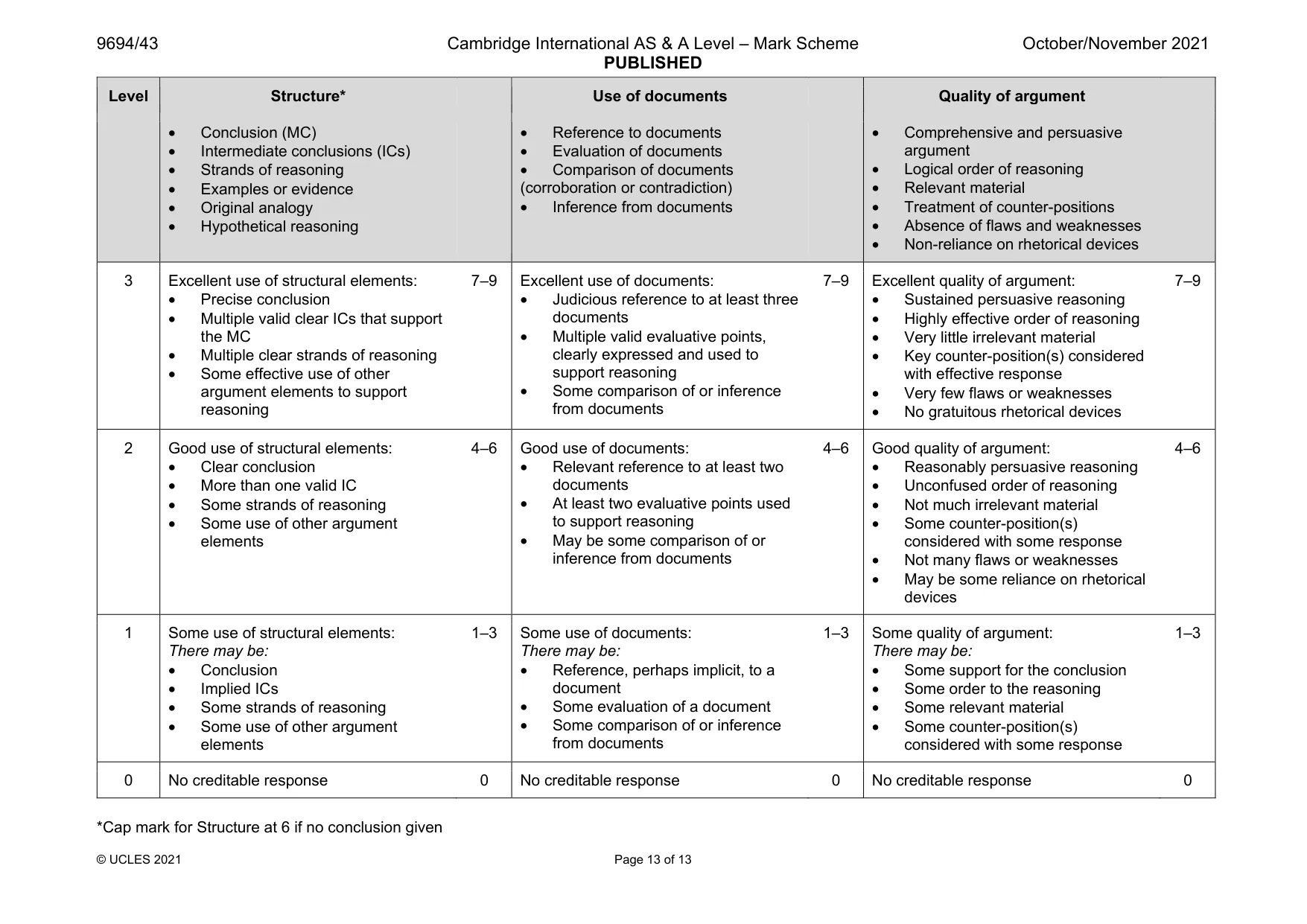
9694/43 Cambridge International AS & A Level – Mark Scheme PUBLISHED October/November 2021 © UCLES 2021 Page 13 of 13 Level Structure* Use of documents Quality of argument • Conclusion (MC) • Intermediate conclusions (ICs) • Strands of reasoning • Examples or evidence • Original analogy • Hypothetical reasoning • Reference to documents • Evaluation of documents • Comparison of documents (corroboration or contradiction) • Inference from documents • Comprehensive and persuasive argument • Logical order of reasoning • Relevant material • Treatment of counter-positions • Absence of flaws and weaknesses • Non-reliance on rhetorical devices 3 Excellent use of structural elements: • Precise conclusion • Multiple valid clear ICs that support the MC • Multiple clear strands of reasoning • Some effective use of other argument elements to support reasoning 7–9 Excellent use of documents: • Judicious reference to at least three documents • Multiple valid evaluative points, clearly expressed and used to support reasoning • Some comparison of or inference from documents 7–9 Excellent quality of argument: • Sustained persuasive reasoning • Highly effective order of reasoning • Very little irrelevant material • Key counter-position(s) considered with effective response • Very few flaws or weaknesses • No gratuitous rhetorical devices 7–9 2 Good use of structural elements: • Clear conclusion • More than one valid IC • Some strands of reasoning • Some use of other argument elements 4–6 Good use of documents: • Relevant reference to at least two documents • At least two evaluative points used to support reasoning • May be some comparison of or inference from documents 4–6 Good quality of argument: • Reasonably persuasive reasoning • Unconfused order of reasoning • Not much irrelevant material • Some counter-position(s) considered with some response • Not many flaws or weaknesses • May be some reliance on rhetorical devices 4–6 1 Some use of structural elements: There may be: • Conclusion • Implied ICs • Some strands of reasoning • Some use of other argument elements 1–3 Some use of documents: There may be: • Reference, perhaps implicit, to a document • Some evaluation of a document • Some comparison of or inference from documents 1–3 Some quality of argument: There may be: • Some support for the conclusion • Some order to the reasoning • Some relevant material • Some counter-position(s) considered with some response 1–3 0 No creditable response 0 No creditable response 0 No creditable response 0 *Cap mark for Structure at 6 if no conclusion given
What you needed in this session
Cambridge’s own grade thresholds for 2021 Oct/Nov, Paper 4 · Variant 3. A higher threshold means an easier paper — the bar moves with how the cohort did.