Cambridge A Level Thinking Skills 9694 — 2020 Oct/Nov Paper 4 · Variant 3
9694/43/O/N/20 · 50 marks · ≈56 min
The question paper and its mark scheme, free to read here and free to download. This is Cambridge’s own paper, exactly as it was sat.
Question paper8 pages

Mark scheme13 pages
Answers below. Sit the paper first if you are practising.
Paper as text
Question paper, page 1
Cambridge International AS & A Level DC (DH) 202388 © UCLES 2020 [Turn over This document has 8 pages. Blank pages are indicated. * 6 8 0 5 1 4 8 0 5 0 * THINKING SKILLS 9694/43 Paper 4 Applied Reasoning October/November 2020 1 hour 45 minutes You must answer on the enclosed answer booklet. You will need: Answer booklet (enclosed) INSTRUCTIONS ● Answer all questions. ● Follow the instructions on the front cover of the answer booklet. If you need additional answer paper, ask the invigilator for a continuation booklet. INFORMATION ● The total mark for this paper is 50. ● The number of marks for each question or part question is shown in brackets [ ].
Question paper, page 2
2 9694/43/O/N/20 © UCLES 2020 1 (a) State the main conclusion of the argument in Document 1. [1] (b) Analyse the structure of the reasoning in paragraph 3 of Document 1. [4] (c) Identify three intermediate conclusions in paragraph 5 of the argument in Document 1. [3] 2 (a) Identify and explain three flaws and/or weaknesses in the reasoning in paragraphs 4 to 6 of Document 1. [6] (b) Assess the extent to which one flaw or weakness in paragraph 3 of Document 1 reduces the strength of the reasoning in the argument as a whole. [3] 3 Document 4 contains two charts. (a) Identify three problems with the way the information in Chart A has been presented. [3] (b) Look at Chart B. Explain why the support for the claim “Public opinion supports the use of full body scanners on all air passengers” is weak. [3] 4 You are advised to spend some time planning your answer before you begin to write it. ‘We should reduce the security checking at airports.’ Construct a reasoned argument to support or challenge this claim. In your answer you should make critical use of the documents provided. [27]
Question paper, page 3
3 9694/43/O/N/20 © UCLES 2020 [Turn over DOCUMENT 1 1 After the attack on the twin towers of the World Trade Center in New York on 11 September, 2001, caring governments have introduced legislation to make air travel safer by requiring airports to increase security checks for passengers boarding flights. Many airports around the world, and particularly in the US, have already introduced ‘full body’ scanners – these are the ones where you spread your legs and hold your hands above your head. All airports around the world ought to introduce these valuable tools to improve our safety. The more difficult you make it for someone to conceal weapons, the fewer terrorist attacks you will have. 2 Currently most air travellers are subjected to a minimal ‘walk-through’ scan that ‘pings’ if it detects a certain level of metal. If there is a ping, this is followed by a physical ‘pat down’ by a security guard, but there are a lot of problems with the current system. 3 Patting-down travellers relies only on feeling the shape of objects through clothing, but this can be difficult if they are wearing thick clothing. Furthermore, there are obvious privacy concerns about a security guard touching certain parts of a person’s body. This offers a potential hiding place. Full-body scans are essential if we want to detect all concealed weapons. 4 Fewer people might object if all passengers were subject to ‘pat-downs’. The suspicion is that people are, in fact, being targeted because of some kind of profiling, rather than selected either at random or on the basis of an initial ‘ping’. Full-body scanners can search everyone without regard to race or religion, thus avoiding accusations of discrimination by airport security staff. 5 The scanners are not an invasion of privacy. Some objectors seem to think that the scan images can be sold to third parties and distributed on the internet, but this is ridiculous. Individuals are not identifiable from these scan images, so who would want to look at them? Also, the systems attached to these scanners can be modified so that any images are removed after a short period of time – say, after the flight has successfully reached its destination. Anyway, protecting life is more important than privacy. Civil liberties moaners who put their privacy above the lives of others should not underestimate the extent to which people would like to stay alive. 6 The vast majority of people, me included, would happily tolerate the minor inconveniences for a guarantee that we will reach our destination safely.
Question paper, page 4
4 9694/43/O/N/20 © UCLES 2020 DOCUMENT 2 Does airport security work? It has been announced that, in order to cope with a ‘raised security threat’, anyone travelling abroad this summer will be subjected to more airport security delays: searching electronic devices to make sure they do not contain bombs, body searches, removing shoes in case they also contain bombs, and even more queueing. This is in response to new intelligence that certain organisations have developed some frightening technology: clever explosives that can be soaked into clothing or concealed in body cavities; plastic explosives that can be made into briefcases. Genuine though these threats may be, will these security checks actually save us from attack? Terrorists do not fear security checks – rather they relish them. What terrorists really fear is intelligence (in both senses of the word). In 2010 a cargo bomb was sent from Yemen to the UK. It passed through airport security that was using sniffer dogs, explosives detectors and X-rays. No bomb was detected. However, security services had reliable intelligence that a bomb had been placed on board; they removed the package, searched it thoroughly and found the bomb. The terrorists are aware of the security procedures at airports and avoid them. The whole elaborate process is intended to reassure the public and to convince them that the current government has their best interests at heart. But terrorists do not get caught at airport check-ins. Everything we have to endure at airport security is for show. America has not detected a single bomb at an American airport since 9/11. People never seem to point out that the 9/11 atrocity did not involve bombs and would not have been stopped by any of the raft of security measures introduced since 9/11 – such as not being able to travel with more than 100 ml of toothpaste! Intelligence catches terrorists long before they reach the airport. All these ritual checks distract resources from this effective intelligence work. The problem grows worse over time. The security checks, described by some as ‘security theatre’, increase with every government announcement. Once procedures are in place, they become politically very difficult for any government to dismantle. It is never in a politician’s interest to argue for a relaxation of safety rules amid cries of a callous disregard for public safety from politicians from other parties. Queues at airports annoy people, but they don’t lose you elections.
Question paper, page 5
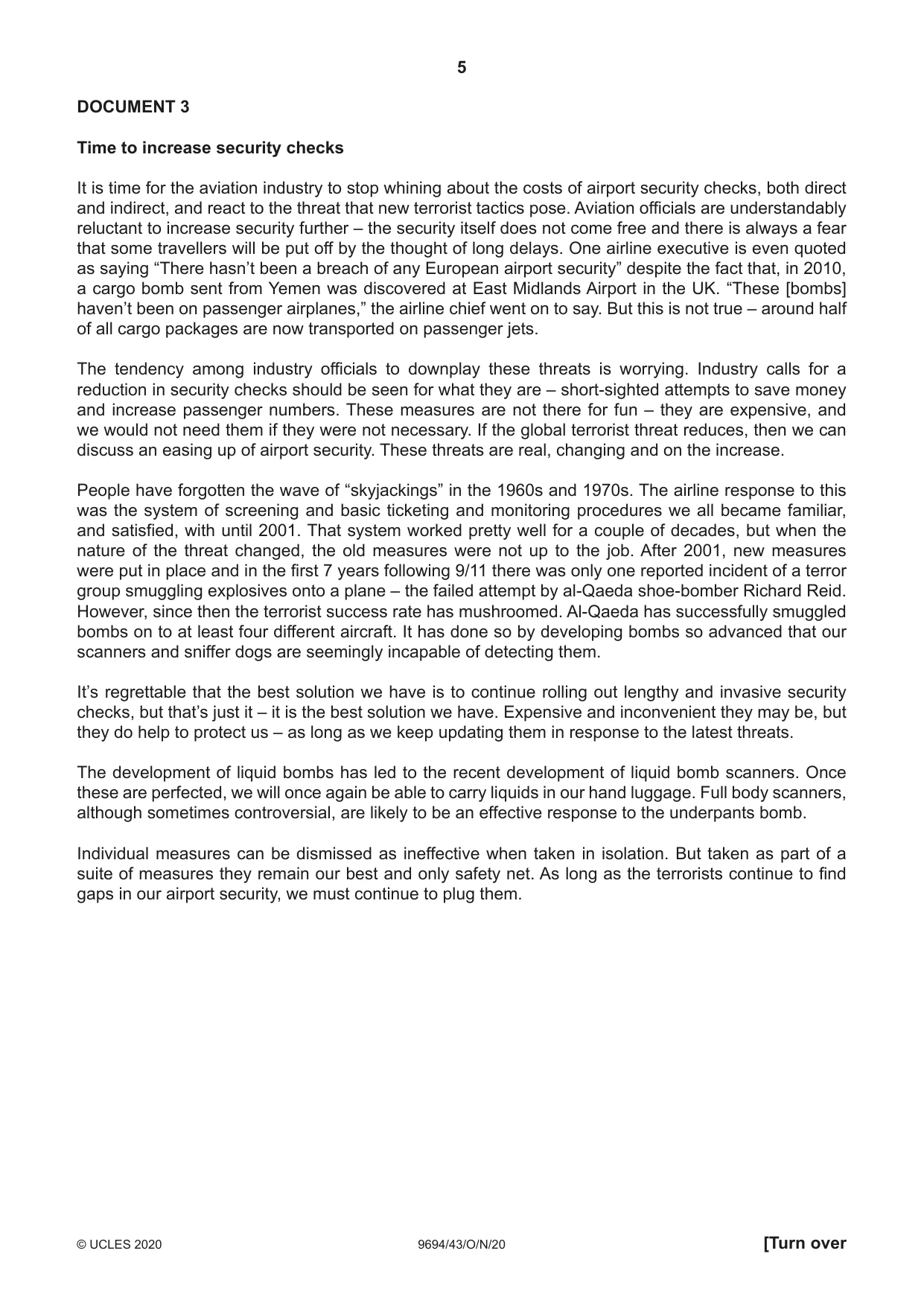
5 9694/43/O/N/20 © UCLES 2020 [Turn over DOCUMENT 3 Time to increase security checks It is time for the aviation industry to stop whining about the costs of airport security checks, both direct and indirect, and react to the threat that new terrorist tactics pose. Aviation officials are understandably reluctant to increase security further – the security itself does not come free and there is always a fear that some travellers will be put off by the thought of long delays. One airline executive is even quoted as saying “There hasn’t been a breach of any European airport security” despite the fact that, in 2010, a cargo bomb sent from Yemen was discovered at East Midlands Airport in the UK. “These [bombs] haven’t been on passenger airplanes,” the airline chief went on to say. But this is not true – around half of all cargo packages are now transported on passenger jets. The tendency among industry officials to downplay these threats is worrying. Industry calls for a reduction in security checks should be seen for what they are – short-sighted attempts to save money and increase passenger numbers. These measures are not there for fun – they are expensive, and we would not need them if they were not necessary. If the global terrorist threat reduces, then we can discuss an easing up of airport security. These threats are real, changing and on the increase. People have forgotten the wave of “skyjackings” in the 1960s and 1970s. The airline response to this was the system of screening and basic ticketing and monitoring procedures we all became familiar, and satisfied, with until 2001. That system worked pretty well for a couple of decades, but when the nature of the threat changed, the old measures were not up to the job. After 2001, new measures were put in place and in the first 7 years following 9/11 there was only one reported incident of a terror group smuggling explosives onto a plane – the failed attempt by al-Qaeda shoe-bomber Richard Reid. However, since then the terrorist success rate has mushroomed. Al-Qaeda has successfully smuggled bombs on to at least four different aircraft. It has done so by developing bombs so advanced that our scanners and sniffer dogs are seemingly incapable of detecting them. It’s regrettable that the best solution we have is to continue rolling out lengthy and invasive security checks, but that’s just it – it is the best solution we have. Expensive and inconvenient they may be, but they do help to protect us – as long as we keep updating them in response to the latest threats. The development of liquid bombs has led to the recent development of liquid bomb scanners. Once these are perfected, we will once again be able to carry liquids in our hand luggage. Full body scanners, although sometimes controversial, are likely to be an effective response to the underpants bomb. Individual measures can be dismissed as ineffective when taken in isolation. But taken as part of a suite of measures they remain our best and only safety net. As long as the terrorists continue to find gaps in our airport security, we must continue to plug them.
Question paper, page 6
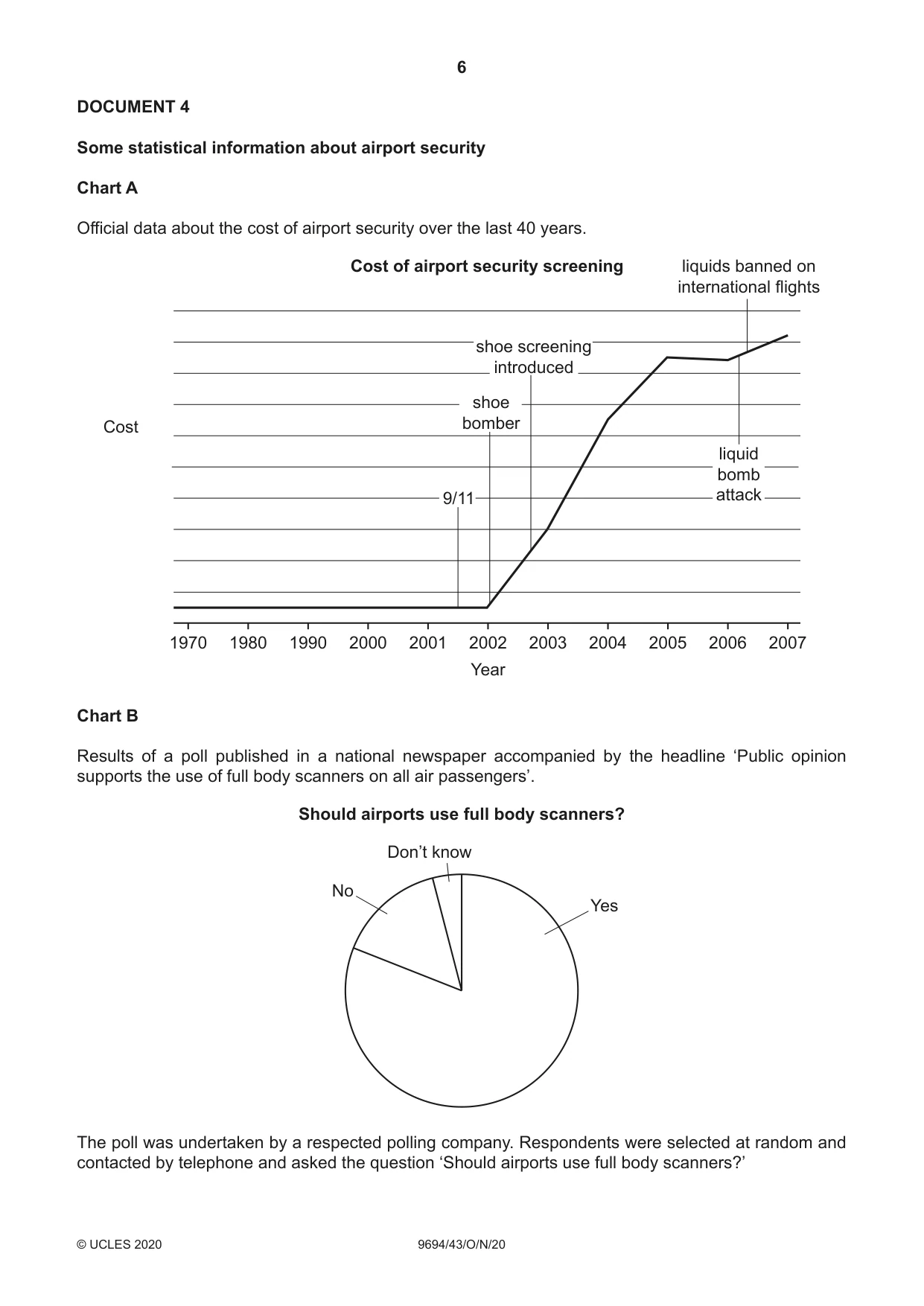
6 9694/43/O/N/20 © UCLES 2020 DOCUMENT 4 Some statistical information about airport security Chart A Official data about the cost of airport security over the last 40 years. 1970 1980 1990 2000 2001 2002 2003 2004 2005 2006 2007 9/11 shoe bomber liquid bomb attack shoe screening introduced liquids banned on international flights Cost Cost of airport security screening Year Chart B Results of a poll published in a national newspaper accompanied by the headline ‘Public opinion supports the use of full body scanners on all air passengers’. Should airports use full body scanners? Yes Don’t know No The poll was undertaken by a respected polling company. Respondents were selected at random and contacted by telephone and asked the question ‘Should airports use full body scanners?’
Question paper, page 7
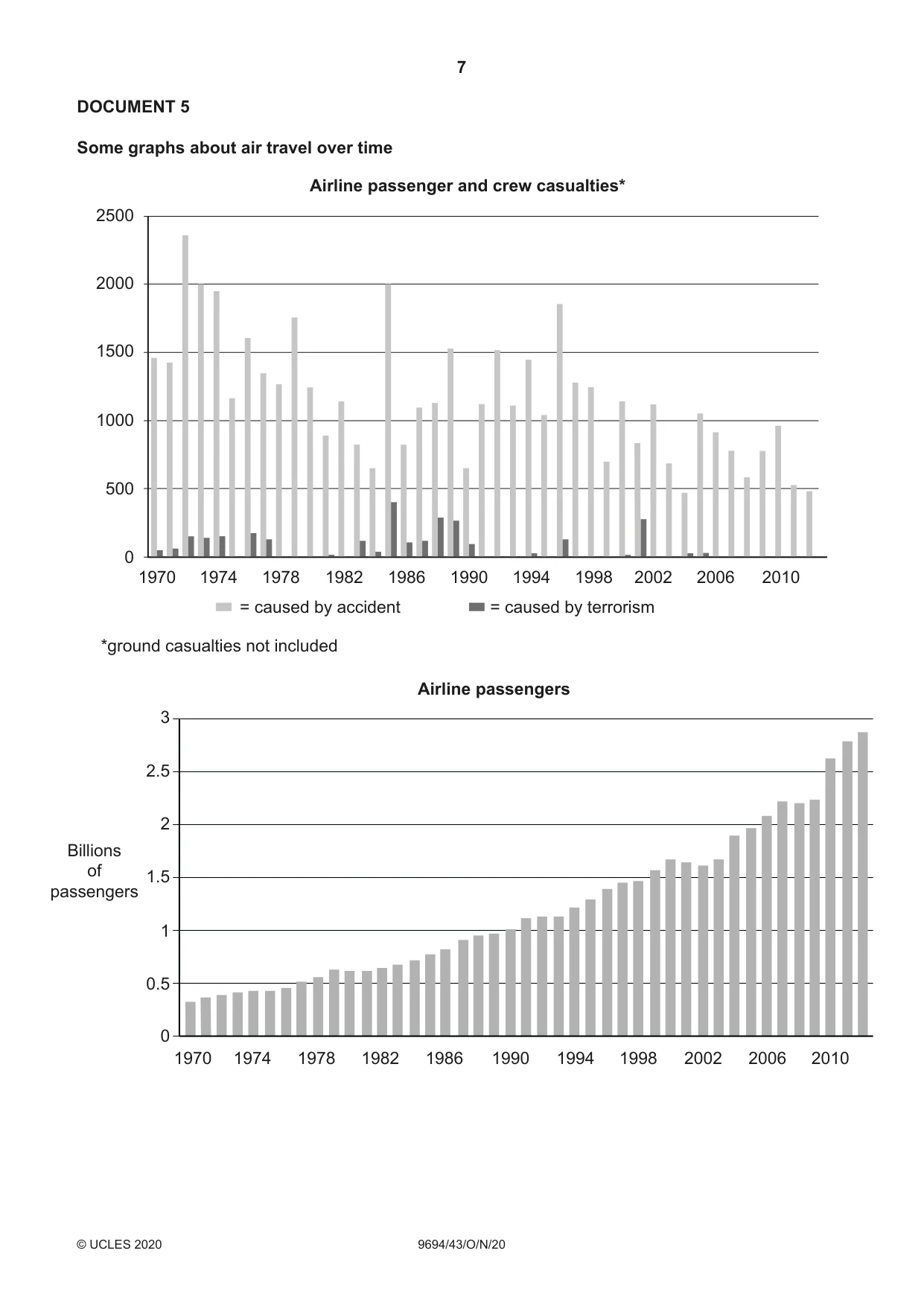
7 9694/43/O/N/20 © UCLES 2020 DOCUMENT 5 Some graphs about air travel over time 1970 0 500 1000 1500 2000 2500 1974 1978 1982 1986 1990 1994 1998 2002 2006 2010 = caused by accident = caused by terrorism *ground casualties not included Airline passenger and crew casualties* 3 2.5 2 1.5 1 0.5 0 1970 1974 1978 1982 Billions of passengers 1986 1990 1994 1998 2002 2006 2010 Airline passengers
Question paper, page 8
8 9694/43/O/N/20 © UCLES 2020 Permission to reproduce items where third-party owned material protected by copyright is included has been sought and cleared where possible. Every reasonable effort has been made by the publisher (UCLES) to trace copyright holders, but if any items requiring clearance have unwittingly been included, the publisher will be pleased to make amends at the earliest possible opportunity. To avoid the issue of disclosure of answer-related information to candidates, all copyright acknowledgements are reproduced online in the Cambridge Assessment International Education Copyright Acknowledgements Booklet. This is produced for each series of examinations and is freely available to download at www.cambridgeinternational.org after the live examination series. Cambridge Assessment International Education is part of the Cambridge Assessment Group. Cambridge Assessment is the brand name of the University of Cambridge Local Examinations Syndicate (UCLES), which itself is a department of the University of Cambridge. BLANK PAGE
Mark scheme, page 1
This document consists of 13 printed pages. © UCLES 2020 [Turn over Cambridge International AS & A Level THINKING SKILLS 9694/43 Paper 4 Applied Reasoning October/November 2020 MARK SCHEME Maximum Mark: 50 Published This mark scheme is published as an aid to teachers and candidates, to indicate the requirements of the examination. It shows the basis on which Examiners were instructed to award marks. It does not indicate the details of the discussions that took place at an Examiners’ meeting before marking began, which would have considered the acceptability of alternative answers. Mark schemes should be read in conjunction with the question paper and the Principal Examiner Report for Teachers. Cambridge International will not enter into discussions about these mark schemes. Cambridge International is publishing the mark schemes for the October/November 2020 series for most Cambridge IGCSE™, Cambridge International A and AS Level and Cambridge Pre-U components, and some Cambridge O Level components.
Mark scheme, page 2
9694/43 Cambridge International AS & A Level – Mark Scheme PUBLISHED October/November 2020 © UCLES 2020 Page 2 of 13 Generic Marking Principles These general marking principles must be applied by all examiners when marking candidate answers. They should be applied alongside the specific content of the mark scheme or generic level descriptors for a question. Each question paper and mark scheme will also comply with these marking principles. GENERIC MARKING PRINCIPLE 1: Marks must be awarded in line with: • the specific content of the mark scheme or the generic level descriptors for the question • the specific skills defined in the mark scheme or in the generic level descriptors for the question • the standard of response required by a candidate as exemplified by the standardisation scripts. GENERIC MARKING PRINCIPLE 2: Marks awarded are always whole marks (not half marks, or other fractions). GENERIC MARKING PRINCIPLE 3: Marks must be awarded positively: • marks are awarded for correct/valid answers, as defined in the mark scheme. However, credit is given for valid answers which go beyond the scope of the syllabus and mark scheme, referring to your Team Leader as appropriate • marks are awarded when candidates clearly demonstrate what they know and can do • marks are not deducted for errors • marks are not deducted for omissions • answers should only be judged on the quality of spelling, punctuation and grammar when these features are specifically assessed by the question as indicated by the mark scheme. The meaning, however, should be unambiguous. GENERIC MARKING PRINCIPLE 4: Rules must be applied consistently, e.g. in situations where candidates have not followed instructions or in the application of generic level descriptors.
Mark scheme, page 3
9694/43 Cambridge International AS & A Level – Mark Scheme PUBLISHED October/November 2020 © UCLES 2020 Page 3 of 13 GENERIC MARKING PRINCIPLE 5: Marks should be awarded using the full range of marks defined in the mark scheme for the question (however; the use of the full mark range may be limited according to the quality of the candidate responses seen). GENERIC MARKING PRINCIPLE 6: Marks awarded are based solely on the requirements as defined in the mark scheme. Marks should not be awarded with grade thresholds or grade descriptors in mind.
Mark scheme, page 4
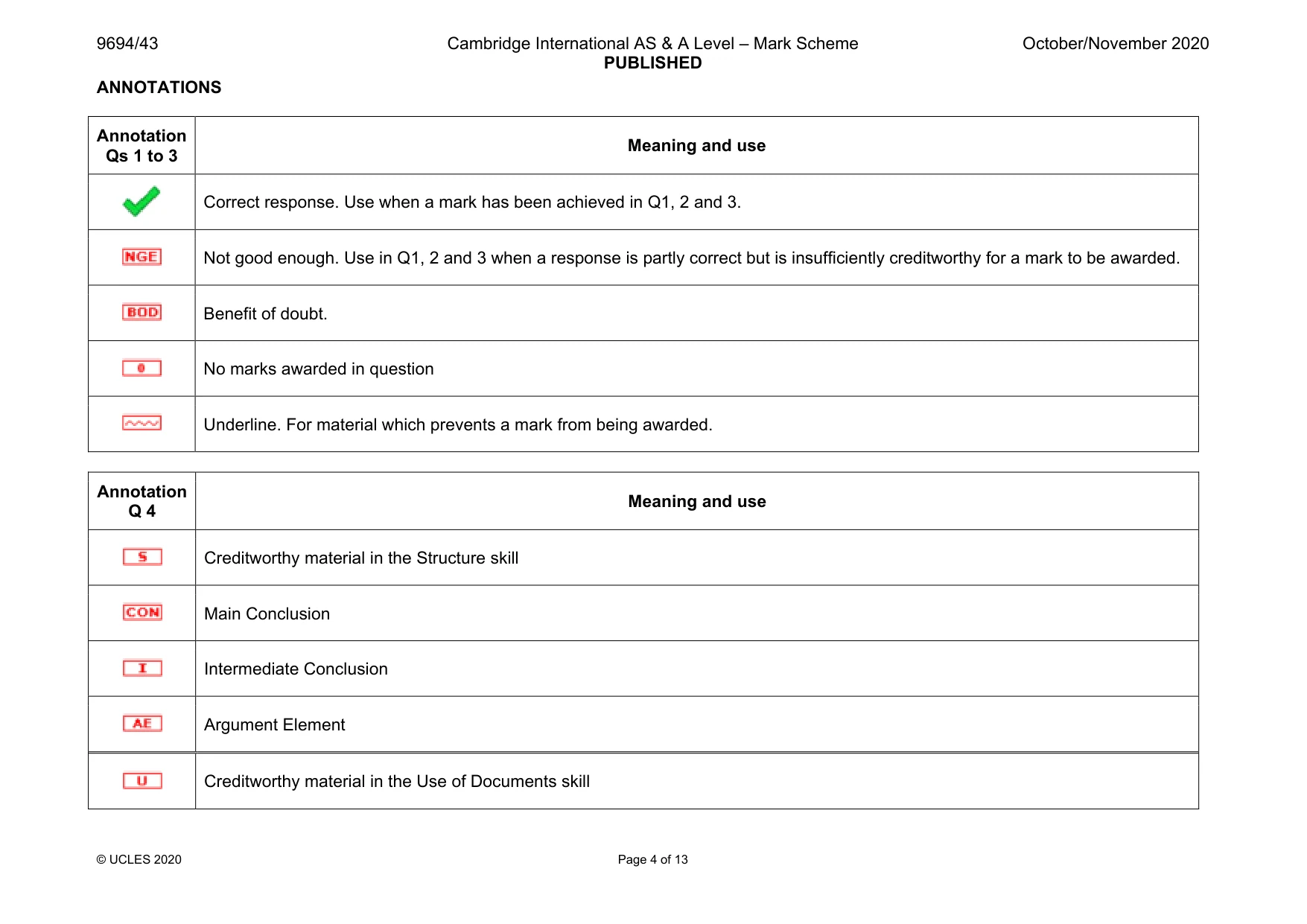
9694/43 Cambridge International AS & A Level – Mark Scheme PUBLISHED October/November 2020 © UCLES 2020 Page 4 of 13 ANNOTATIONS Annotation Qs 1 to 3 Meaning and use Correct response. Use when a mark has been achieved in Q1, 2 and 3. Not good enough. Use in Q1, 2 and 3 when a response is partly correct but is insufficiently creditworthy for a mark to be awarded. Benefit of doubt. No marks awarded in question Underline. For material which prevents a mark from being awarded. Annotation Q 4 Meaning and use Creditworthy material in the Structure skill Main Conclusion Intermediate Conclusion Argument Element Creditworthy material in the Use of Documents skill
Mark scheme, page 5
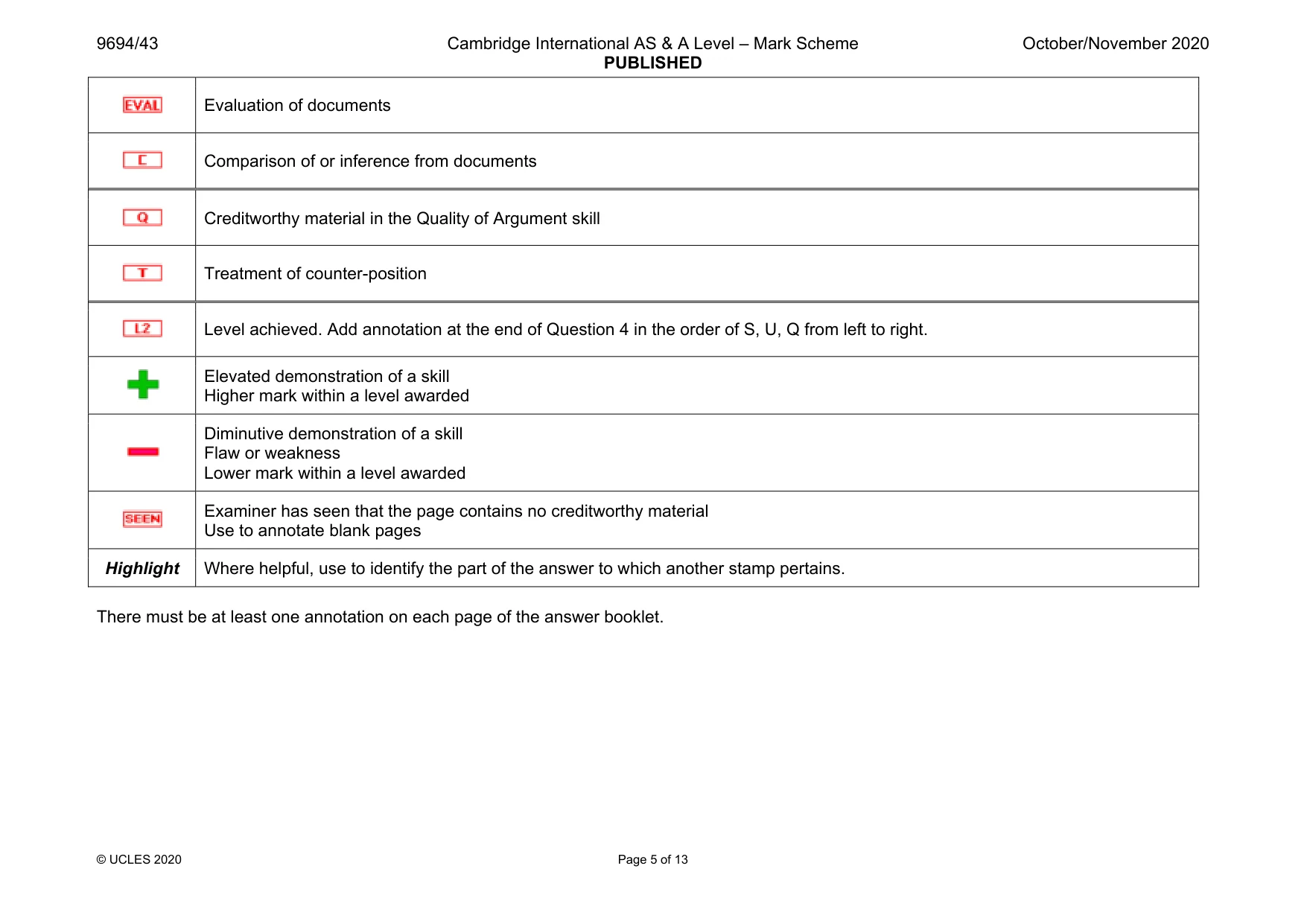
9694/43 Cambridge International AS & A Level – Mark Scheme PUBLISHED October/November 2020 © UCLES 2020 Page 5 of 13 Evaluation of documents Comparison of or inference from documents Creditworthy material in the Quality of Argument skill Treatment of counter-position Level achieved. Add annotation at the end of Question 4 in the order of S, U, Q from left to right. Elevated demonstration of a skill Higher mark within a level awarded Diminutive demonstration of a skill Flaw or weakness Lower mark within a level awarded Examiner has seen that the page contains no creditworthy material Use to annotate blank pages Highlight Where helpful, use to identify the part of the answer to which another stamp pertains. There must be at least one annotation on each page of the answer booklet.
Mark scheme, page 6
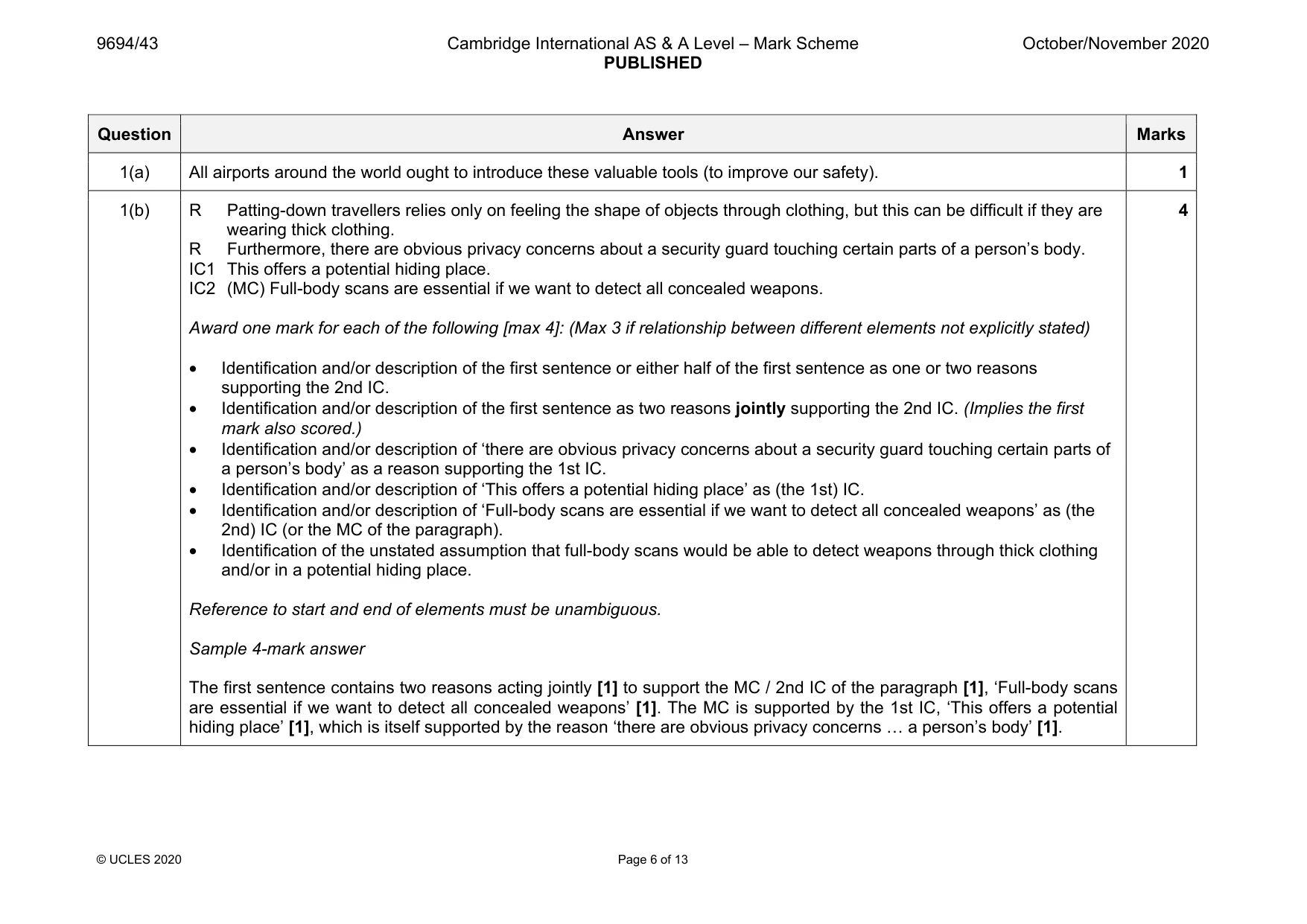
9694/43 Cambridge International AS & A Level – Mark Scheme PUBLISHED October/November 2020 © UCLES 2020 Page 6 of 13 Question Answer Marks 1(a) All airports around the world ought to introduce these valuable tools (to improve our safety). 1 1(b) R Patting-down travellers relies only on feeling the shape of objects through clothing, but this can be difficult if they are wearing thick clothing. R Furthermore, there are obvious privacy concerns about a security guard touching certain parts of a person’s body. IC1 This offers a potential hiding place. IC2 (MC) Full-body scans are essential if we want to detect all concealed weapons. Award one mark for each of the following [max 4]: (Max 3 if relationship between different elements not explicitly stated) • Identification and/or description of the first sentence or either half of the first sentence as one or two reasons supporting the 2nd IC. • Identification and/or description of the first sentence as two reasons jointly supporting the 2nd IC. (Implies the first mark also scored.) • Identification and/or description of ‘there are obvious privacy concerns about a security guard touching certain parts of a person’s body’ as a reason supporting the 1st IC. • Identification and/or description of ‘This offers a potential hiding place’ as (the 1st) IC. • Identification and/or description of ‘Full-body scans are essential if we want to detect all concealed weapons’ as (the 2nd) IC (or the MC of the paragraph). • Identification of the unstated assumption that full-body scans would be able to detect weapons through thick clothing and/or in a potential hiding place. Reference to start and end of elements must be unambiguous. Sample 4-mark answer The first sentence contains two reasons acting jointly [1] to support the MC / 2nd IC of the paragraph [1], ‘Full-body scans are essential if we want to detect all concealed weapons’ [1]. The MC is supported by the 1st IC, ‘This offers a potential hiding place’ [1], which is itself supported by the reason ‘there are obvious privacy concerns … a person’s body’ [1]. 4
Mark scheme, page 7
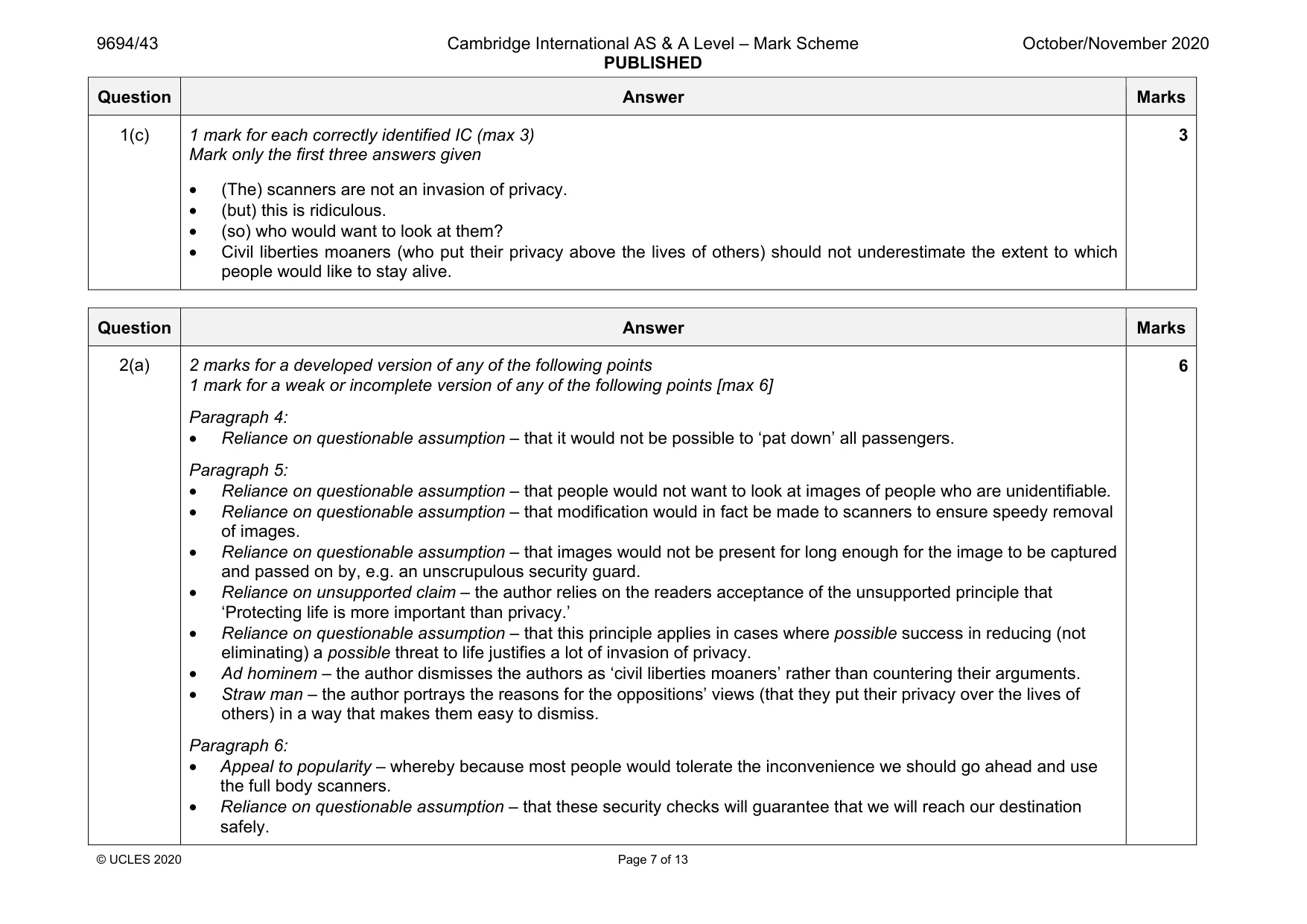
9694/43 Cambridge International AS & A Level – Mark Scheme PUBLISHED October/November 2020 © UCLES 2020 Page 7 of 13 Question Answer Marks 1(c) 1 mark for each correctly identified IC (max 3) Mark only the first three answers given • (The) scanners are not an invasion of privacy. • (but) this is ridiculous. • (so) who would want to look at them? • Civil liberties moaners (who put their privacy above the lives of others) should not underestimate the extent to which people would like to stay alive. 3 Question Answer Marks 2(a) 2 marks for a developed version of any of the following points 1 mark for a weak or incomplete version of any of the following points [max 6] Paragraph 4: • Reliance on questionable assumption – that it would not be possible to ‘pat down’ all passengers. Paragraph 5: • Reliance on questionable assumption – that people would not want to look at images of people who are unidentifiable. • Reliance on questionable assumption – that modification would in fact be made to scanners to ensure speedy removal of images. • Reliance on questionable assumption – that images would not be present for long enough for the image to be captured and passed on by, e.g. an unscrupulous security guard. • Reliance on unsupported claim – the author relies on the readers acceptance of the unsupported principle that ‘Protecting life is more important than privacy.’ • Reliance on questionable assumption – that this principle applies in cases where possible success in reducing (not eliminating) a possible threat to life justifies a lot of invasion of privacy. • Ad hominem – the author dismisses the authors as ‘civil liberties moaners’ rather than countering their arguments. • Straw man – the author portrays the reasons for the oppositions’ views (that they put their privacy over the lives of others) in a way that makes them easy to dismiss. Paragraph 6: • Appeal to popularity – whereby because most people would tolerate the inconvenience we should go ahead and use the full body scanners. • Reliance on questionable assumption – that these security checks will guarantee that we will reach our destination safely. 6
Mark scheme, page 8
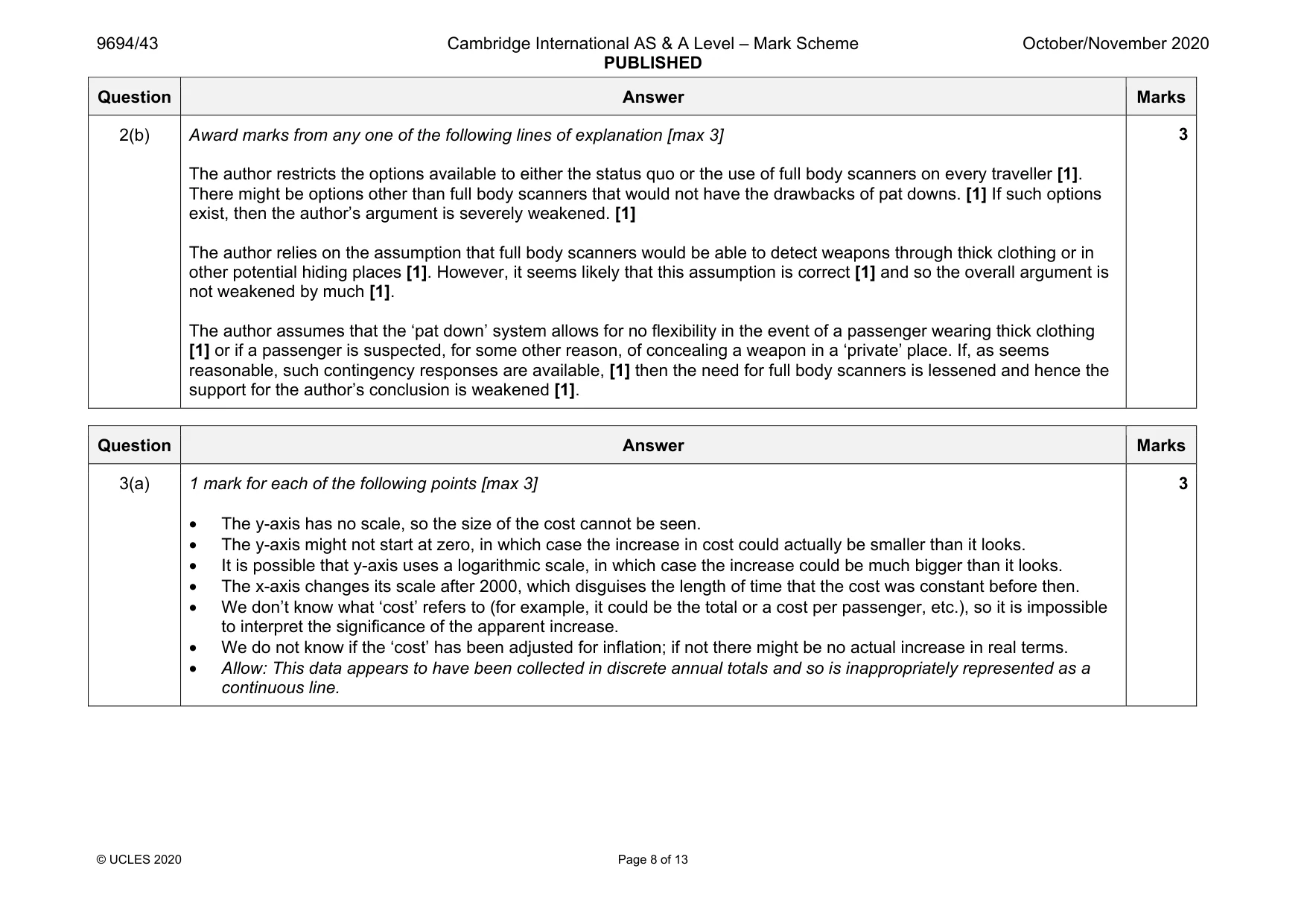
9694/43 Cambridge International AS & A Level – Mark Scheme PUBLISHED October/November 2020 © UCLES 2020 Page 8 of 13 Question Answer Marks 2(b) Award marks from any one of the following lines of explanation [max 3] The author restricts the options available to either the status quo or the use of full body scanners on every traveller [1]. There might be options other than full body scanners that would not have the drawbacks of pat downs. [1] If such options exist, then the author’s argument is severely weakened. [1] The author relies on the assumption that full body scanners would be able to detect weapons through thick clothing or in other potential hiding places [1]. However, it seems likely that this assumption is correct [1] and so the overall argument is not weakened by much [1]. The author assumes that the ‘pat down’ system allows for no flexibility in the event of a passenger wearing thick clothing [1] or if a passenger is suspected, for some other reason, of concealing a weapon in a ‘private’ place. If, as seems reasonable, such contingency responses are available, [1] then the need for full body scanners is lessened and hence the support for the author’s conclusion is weakened [1]. 3 Question Answer Marks 3(a) 1 mark for each of the following points [max 3] • The y-axis has no scale, so the size of the cost cannot be seen. • The y-axis might not start at zero, in which case the increase in cost could actually be smaller than it looks. • It is possible that y-axis uses a logarithmic scale, in which case the increase could be much bigger than it looks. • The x-axis changes its scale after 2000, which disguises the length of time that the cost was constant before then. • We don’t know what ‘cost’ refers to (for example, it could be the total or a cost per passenger, etc.), so it is impossible to interpret the significance of the apparent increase. • We do not know if the ‘cost’ has been adjusted for inflation; if not there might be no actual increase in real terms. • Allow: This data appears to have been collected in discrete annual totals and so is inappropriately represented as a continuous line. 3
Mark scheme, page 9
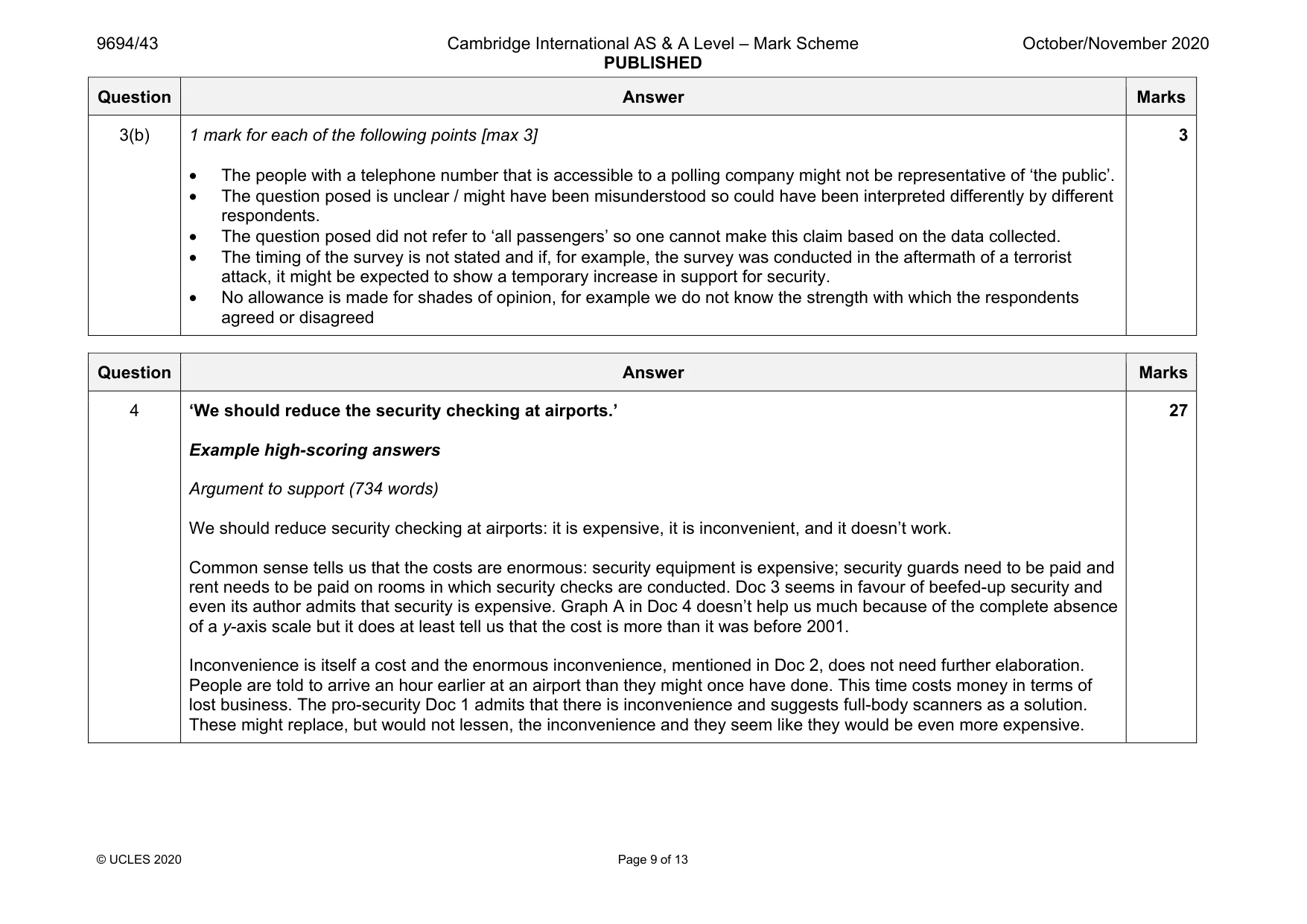
9694/43 Cambridge International AS & A Level – Mark Scheme PUBLISHED October/November 2020 © UCLES 2020 Page 9 of 13 Question Answer Marks 3(b) 1 mark for each of the following points [max 3] • The people with a telephone number that is accessible to a polling company might not be representative of ‘the public’. • The question posed is unclear / might have been misunderstood so could have been interpreted differently by different respondents. • The question posed did not refer to ‘all passengers’ so one cannot make this claim based on the data collected. • The timing of the survey is not stated and if, for example, the survey was conducted in the aftermath of a terrorist attack, it might be expected to show a temporary increase in support for security. • No allowance is made for shades of opinion, for example we do not know the strength with which the respondents agreed or disagreed 3 Question Answer Marks 4 ‘We should reduce the security checking at airports.’ Example high-scoring answers Argument to support (734 words) We should reduce security checking at airports: it is expensive, it is inconvenient, and it doesn’t work. Common sense tells us that the costs are enormous: security equipment is expensive; security guards need to be paid and rent needs to be paid on rooms in which security checks are conducted. Doc 3 seems in favour of beefed-up security and even its author admits that security is expensive. Graph A in Doc 4 doesn’t help us much because of the complete absence of a y-axis scale but it does at least tell us that the cost is more than it was before 2001. Inconvenience is itself a cost and the enormous inconvenience, mentioned in Doc 2, does not need further elaboration. People are told to arrive an hour earlier at an airport than they might once have done. This time costs money in terms of lost business. The pro-security Doc 1 admits that there is inconvenience and suggests full-body scanners as a solution. These might replace, but would not lessen, the inconvenience and they seem like they would be even more expensive. 27
Mark scheme, page 10
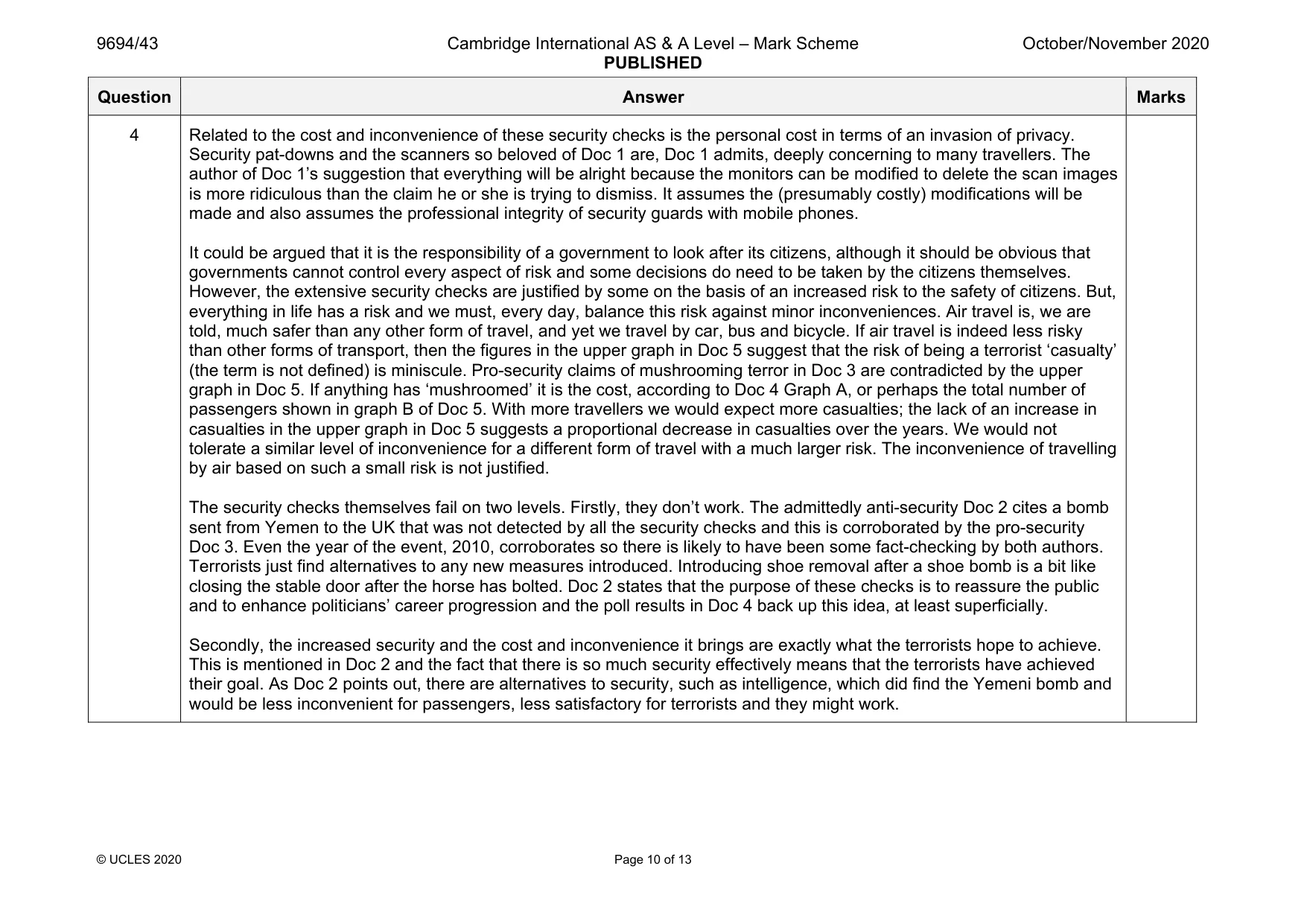
9694/43 Cambridge International AS & A Level – Mark Scheme PUBLISHED October/November 2020 © UCLES 2020 Page 10 of 13 Question Answer Marks 4 Related to the cost and inconvenience of these security checks is the personal cost in terms of an invasion of privacy. Security pat-downs and the scanners so beloved of Doc 1 are, Doc 1 admits, deeply concerning to many travellers. The author of Doc 1’s suggestion that everything will be alright because the monitors can be modified to delete the scan images is more ridiculous than the claim he or she is trying to dismiss. It assumes the (presumably costly) modifications will be made and also assumes the professional integrity of security guards with mobile phones. It could be argued that it is the responsibility of a government to look after its citizens, although it should be obvious that governments cannot control every aspect of risk and some decisions do need to be taken by the citizens themselves. However, the extensive security checks are justified by some on the basis of an increased risk to the safety of citizens. But, everything in life has a risk and we must, every day, balance this risk against minor inconveniences. Air travel is, we are told, much safer than any other form of travel, and yet we travel by car, bus and bicycle. If air travel is indeed less risky than other forms of transport, then the figures in the upper graph in Doc 5 suggest that the risk of being a terrorist ‘casualty’ (the term is not defined) is miniscule. Pro-security claims of mushrooming terror in Doc 3 are contradicted by the upper graph in Doc 5. If anything has ‘mushroomed’ it is the cost, according to Doc 4 Graph A, or perhaps the total number of passengers shown in graph B of Doc 5. With more travellers we would expect more casualties; the lack of an increase in casualties in the upper graph in Doc 5 suggests a proportional decrease in casualties over the years. We would not tolerate a similar level of inconvenience for a different form of travel with a much larger risk. The inconvenience of travelling by air based on such a small risk is not justified. The security checks themselves fail on two levels. Firstly, they don’t work. The admittedly anti-security Doc 2 cites a bomb sent from Yemen to the UK that was not detected by all the security checks and this is corroborated by the pro-security Doc 3. Even the year of the event, 2010, corroborates so there is likely to have been some fact-checking by both authors. Terrorists just find alternatives to any new measures introduced. Introducing shoe removal after a shoe bomb is a bit like closing the stable door after the horse has bolted. Doc 2 states that the purpose of these checks is to reassure the public and to enhance politicians’ career progression and the poll results in Doc 4 back up this idea, at least superficially. Secondly, the increased security and the cost and inconvenience it brings are exactly what the terrorists hope to achieve. This is mentioned in Doc 2 and the fact that there is so much security effectively means that the terrorists have achieved their goal. As Doc 2 points out, there are alternatives to security, such as intelligence, which did find the Yemeni bomb and would be less inconvenient for passengers, less satisfactory for terrorists and they might work.
Mark scheme, page 11
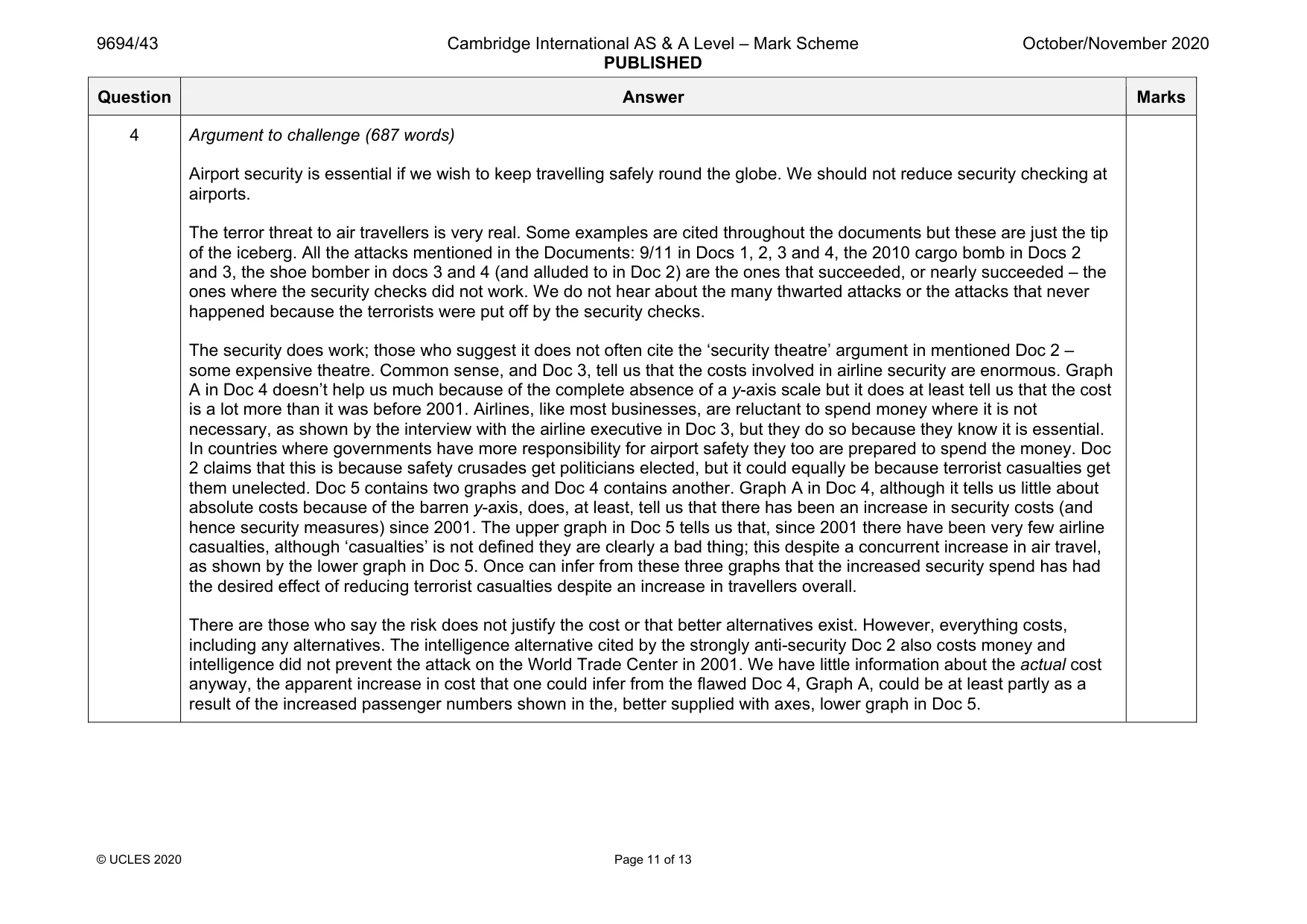
9694/43 Cambridge International AS & A Level – Mark Scheme PUBLISHED October/November 2020 © UCLES 2020 Page 11 of 13 Question Answer Marks 4 Argument to challenge (687 words) Airport security is essential if we wish to keep travelling safely round the globe. We should not reduce security checking at airports. The terror threat to air travellers is very real. Some examples are cited throughout the documents but these are just the tip of the iceberg. All the attacks mentioned in the Documents: 9/11 in Docs 1, 2, 3 and 4, the 2010 cargo bomb in Docs 2 and 3, the shoe bomber in docs 3 and 4 (and alluded to in Doc 2) are the ones that succeeded, or nearly succeeded – the ones where the security checks did not work. We do not hear about the many thwarted attacks or the attacks that never happened because the terrorists were put off by the security checks. The security does work; those who suggest it does not often cite the ‘security theatre’ argument in mentioned Doc 2 – some expensive theatre. Common sense, and Doc 3, tell us that the costs involved in airline security are enormous. Graph A in Doc 4 doesn’t help us much because of the complete absence of a y-axis scale but it does at least tell us that the cost is a lot more than it was before 2001. Airlines, like most businesses, are reluctant to spend money where it is not necessary, as shown by the interview with the airline executive in Doc 3, but they do so because they know it is essential. In countries where governments have more responsibility for airport safety they too are prepared to spend the money. Doc 2 claims that this is because safety crusades get politicians elected, but it could equally be because terrorist casualties get them unelected. Doc 5 contains two graphs and Doc 4 contains another. Graph A in Doc 4, although it tells us little about absolute costs because of the barren y-axis, does, at least, tell us that there has been an increase in security costs (and hence security measures) since 2001. The upper graph in Doc 5 tells us that, since 2001 there have been very few airline casualties, although ‘casualties’ is not defined they are clearly a bad thing; this despite a concurrent increase in air travel, as shown by the lower graph in Doc 5. Once can infer from these three graphs that the increased security spend has had the desired effect of reducing terrorist casualties despite an increase in travellers overall. There are those who say the risk does not justify the cost or that better alternatives exist. However, everything costs, including any alternatives. The intelligence alternative cited by the strongly anti-security Doc 2 also costs money and intelligence did not prevent the attack on the World Trade Center in 2001. We have little information about the actual cost anyway, the apparent increase in cost that one could infer from the flawed Doc 4, Graph A, could be at least partly as a result of the increased passenger numbers shown in the, better supplied with axes, lower graph in Doc 5.
Mark scheme, page 12
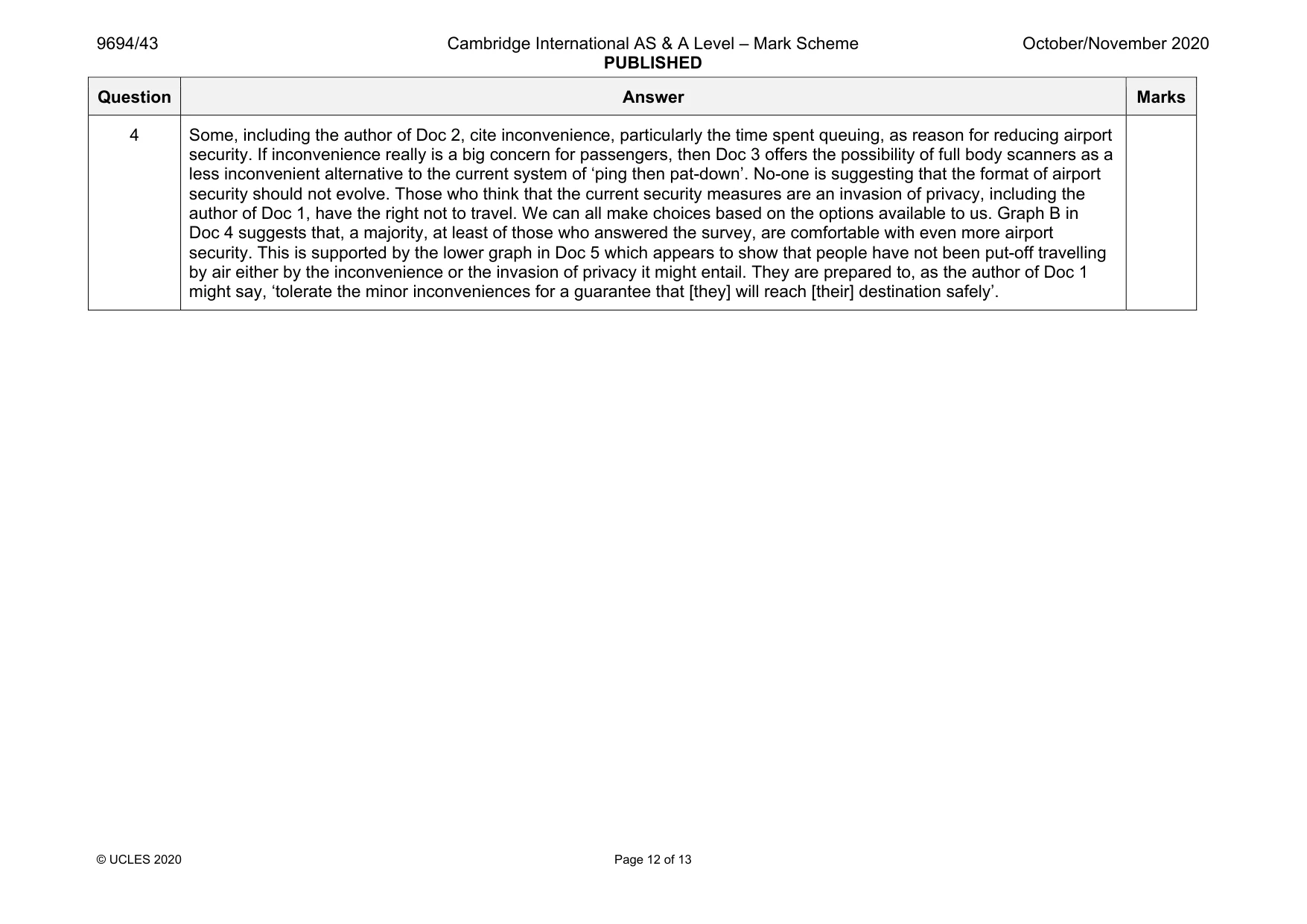
9694/43 Cambridge International AS & A Level – Mark Scheme PUBLISHED October/November 2020 © UCLES 2020 Page 12 of 13 Question Answer Marks 4 Some, including the author of Doc 2, cite inconvenience, particularly the time spent queuing, as reason for reducing airport security. If inconvenience really is a big concern for passengers, then Doc 3 offers the possibility of full body scanners as a less inconvenient alternative to the current system of ‘ping then pat-down’. No-one is suggesting that the format of airport security should not evolve. Those who think that the current security measures are an invasion of privacy, including the author of Doc 1, have the right not to travel. We can all make choices based on the options available to us. Graph B in Doc 4 suggests that, a majority, at least of those who answered the survey, are comfortable with even more airport security. This is supported by the lower graph in Doc 5 which appears to show that people have not been put-off travelling by air either by the inconvenience or the invasion of privacy it might entail. They are prepared to, as the author of Doc 1 might say, ‘tolerate the minor inconveniences for a guarantee that [they] will reach [their] destination safely’.
Mark scheme, page 13
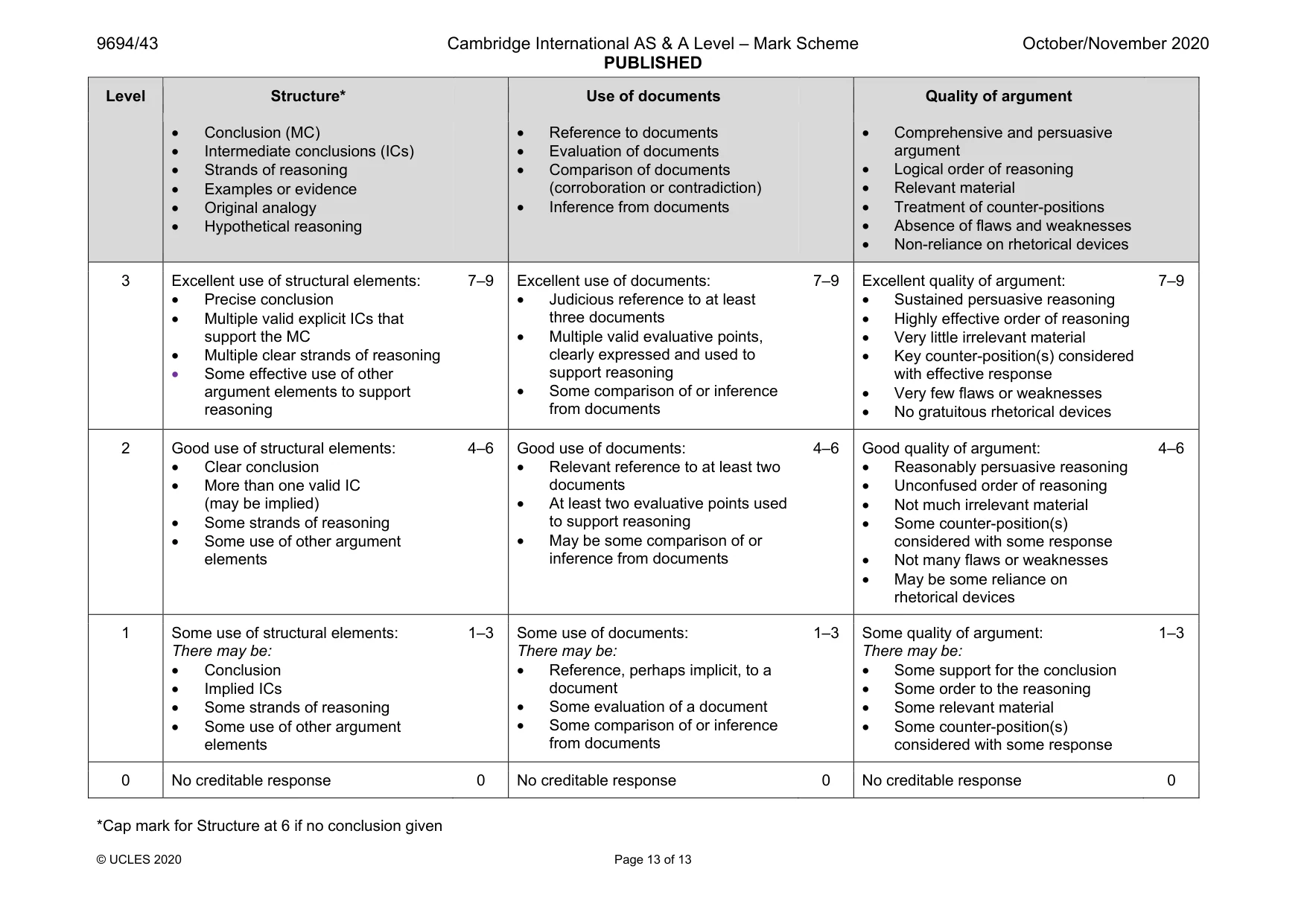
9694/43 Cambridge International AS & A Level – Mark Scheme PUBLISHED October/November 2020 © UCLES 2020 Page 13 of 13 Level Structure* Use of documents Quality of argument • Conclusion (MC) • Intermediate conclusions (ICs) • Strands of reasoning • Examples or evidence • Original analogy • Hypothetical reasoning • Reference to documents • Evaluation of documents • Comparison of documents (corroboration or contradiction) • Inference from documents • Comprehensive and persuasive argument • Logical order of reasoning • Relevant material • Treatment of counter-positions • Absence of flaws and weaknesses • Non-reliance on rhetorical devices 3 Excellent use of structural elements: • Precise conclusion • Multiple valid explicit ICs that support the MC • Multiple clear strands of reasoning • Some effective use of other argument elements to support reasoning 7–9 Excellent use of documents: • Judicious reference to at least three documents • Multiple valid evaluative points, clearly expressed and used to support reasoning • Some comparison of or inference from documents 7–9 Excellent quality of argument: • Sustained persuasive reasoning • Highly effective order of reasoning • Very little irrelevant material • Key counter-position(s) considered with effective response • Very few flaws or weaknesses • No gratuitous rhetorical devices 7–9 2 Good use of structural elements: • Clear conclusion • More than one valid IC (may be implied) • Some strands of reasoning • Some use of other argument elements 4–6 Good use of documents: • Relevant reference to at least two documents • At least two evaluative points used to support reasoning • May be some comparison of or inference from documents 4–6 Good quality of argument: • Reasonably persuasive reasoning • Unconfused order of reasoning • Not much irrelevant material • Some counter-position(s) considered with some response • Not many flaws or weaknesses • May be some reliance on rhetorical devices 4–6 1 Some use of structural elements: There may be: • Conclusion • Implied ICs • Some strands of reasoning • Some use of other argument elements 1–3 Some use of documents: There may be: • Reference, perhaps implicit, to a document • Some evaluation of a document • Some comparison of or inference from documents 1–3 Some quality of argument: There may be: • Some support for the conclusion • Some order to the reasoning • Some relevant material • Some counter-position(s) considered with some response 1–3 0 No creditable response 0 No creditable response 0 No creditable response 0 *Cap mark for Structure at 6 if no conclusion given
What you needed in this session
Cambridge’s own grade thresholds for 2020 Oct/Nov, Paper 4 · Variant 3. A higher threshold means an easier paper — the bar moves with how the cohort did.