Cambridge A Level Thinking Skills 9694 — 2020 Oct/Nov Paper 1 · Variant 1
9694/11/O/N/20 · 50 marks · ≈56 min
The question paper and its mark scheme, free to read here and free to download. This is Cambridge’s own paper, exactly as it was sat.
Question paper16 pages


Mark scheme8 pages
Answers below. Sit the paper first if you are practising.
Paper as text
Question paper, page 1
Cambridge International AS & A Level This document has 16 pages. Blank pages are indicated. THINKING SKILLS 9694/11 Paper 1 Problem Solving October/November 2020 1 hour 30 minutes You must answer on the question paper. No additional materials are needed. INSTRUCTIONS ● Answer all questions. ● Use a black or dark blue pen. ● Write your name, centre number and candidate number in the boxes at the top of the page. ● Write your answer to each question in the space provided. ● Do not use an erasable pen or correction fluid. ● Do not write on any bar codes. ● You may use a calculator. ● Show your working. Where a final answer is incorrect or missing, you may still be awarded marks for correct steps towards a solution. In most questions, full marks will be awarded for a correct answer without any working. In some questions, however, you will not be awarded full marks if working needed to support an answer is not shown. INFORMATION ● The total mark for this paper is 50. ● The number of marks for each question or part question is shown in brackets [ ]. * 1 4 4 3 0 3 5 5 1 0 * DC (CJ/SG) 188503/1 © UCLES 2020 [Turn over
Question paper, page 2
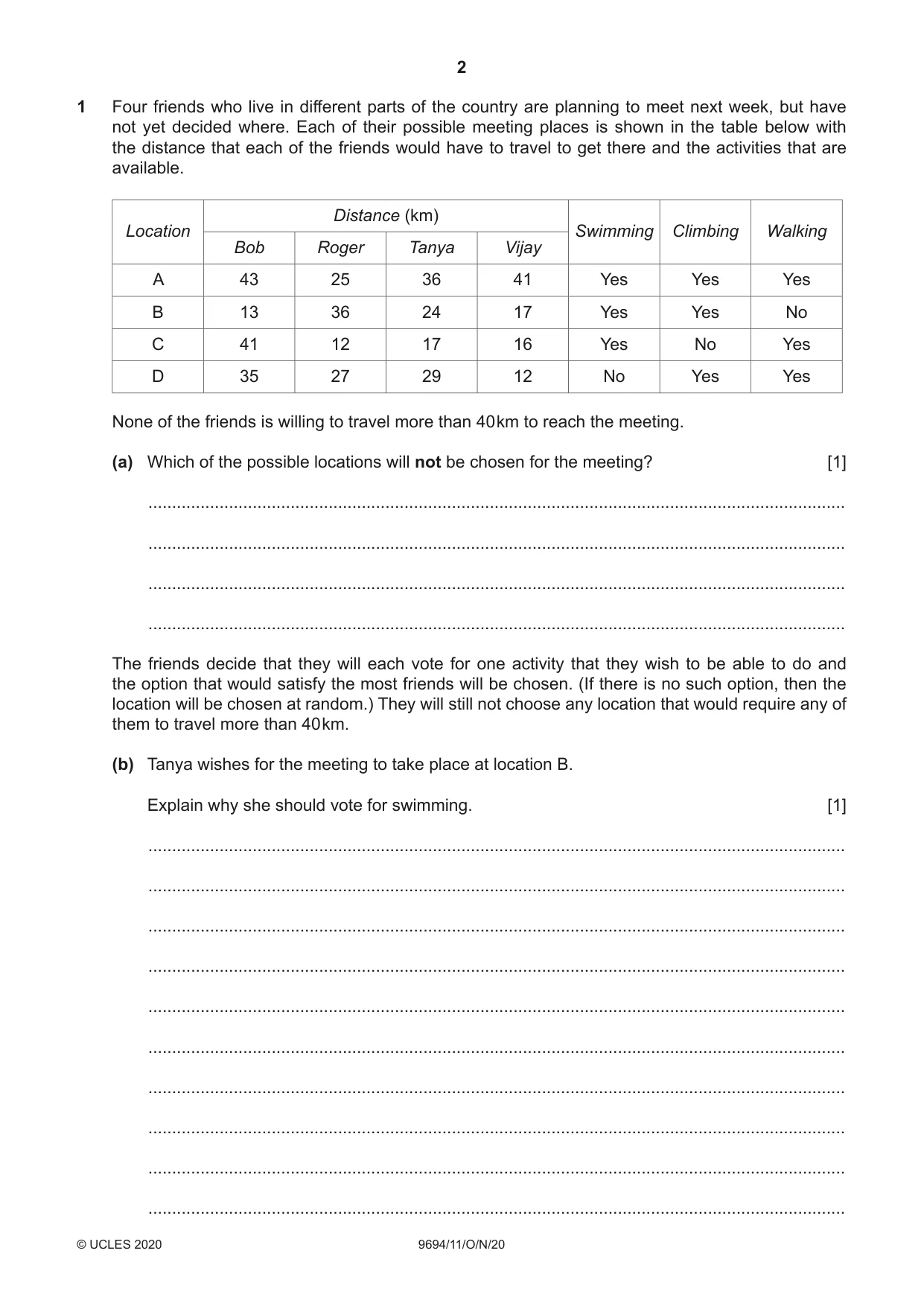
2 9694/11/O/N/20 © UCLES 2020 1 Four friends who live in different parts of the country are planning to meet next week, but have not yet decided where. Each of their possible meeting places is shown in the table below with the distance that each of the friends would have to travel to get there and the activities that are available. Location Distance (km) Swimming Climbing Walking Bob Roger Tanya Vijay A 43 25 36 41 Yes Yes Yes B 13 36 24 17 Yes Yes No C 41 12 17 16 Yes No Yes D 35 27 29 12 No Yes Yes None of the friends is willing to travel more than 40 km to reach the meeting. (a) Which of the possible locations will not be chosen for the meeting? [1] … … … … The friends decide that they will each vote for one activity that they wish to be able to do and the option that would satisfy the most friends will be chosen. (If there is no such option, then the location will be chosen at random.) They will still not choose any location that would require any of them to travel more than 40 km. (b) Tanya wishes for the meeting to take place at location B. Explain why she should vote for swimming. [1] … … … … … … … … … …
Question paper, page 3
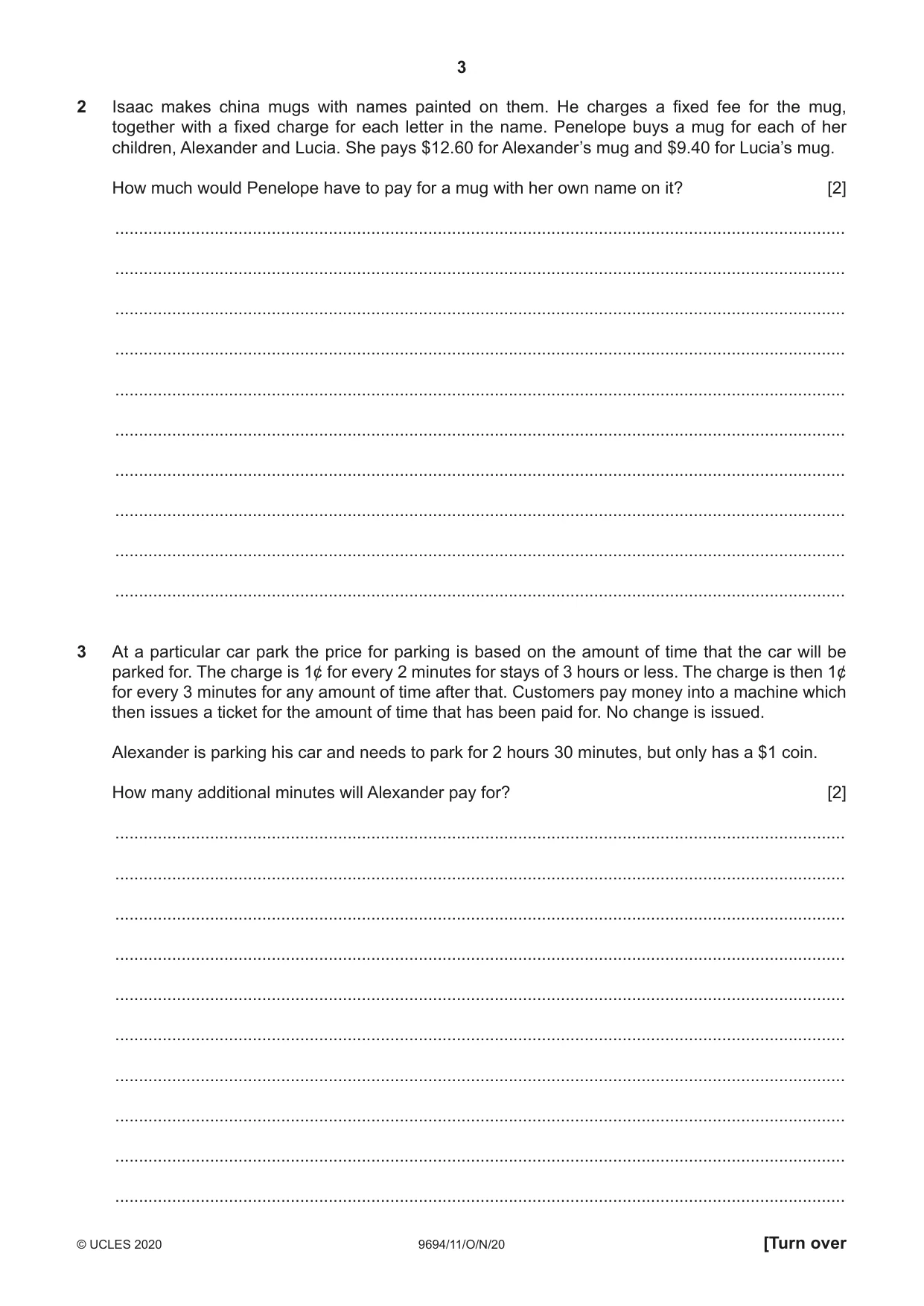
3 9694/11/O/N/20 © UCLES 2020 [Turn over 2 Isaac makes china mugs with names painted on them. He charges a fixed fee for the mug, together with a fixed charge for each letter in the name. Penelope buys a mug for each of her children, Alexander and Lucia. She pays $12.60 for Alexander’s mug and $9.40 for Lucia’s mug. How much would Penelope have to pay for a mug with her own name on it? [2] … … … … … … … … … … 3 At a particular car park the price for parking is based on the amount of time that the car will be parked for. The charge is 1¢ for every 2 minutes for stays of 3 hours or less. The charge is then 1¢ for every 3 minutes for any amount of time after that. Customers pay money into a machine which then issues a ticket for the amount of time that has been paid for. No change is issued. Alexander is parking his car and needs to park for 2 hours 30 minutes, but only has a $1 coin. How many additional minutes will Alexander pay for? [2] … … … … … … … … … …
Question paper, page 4
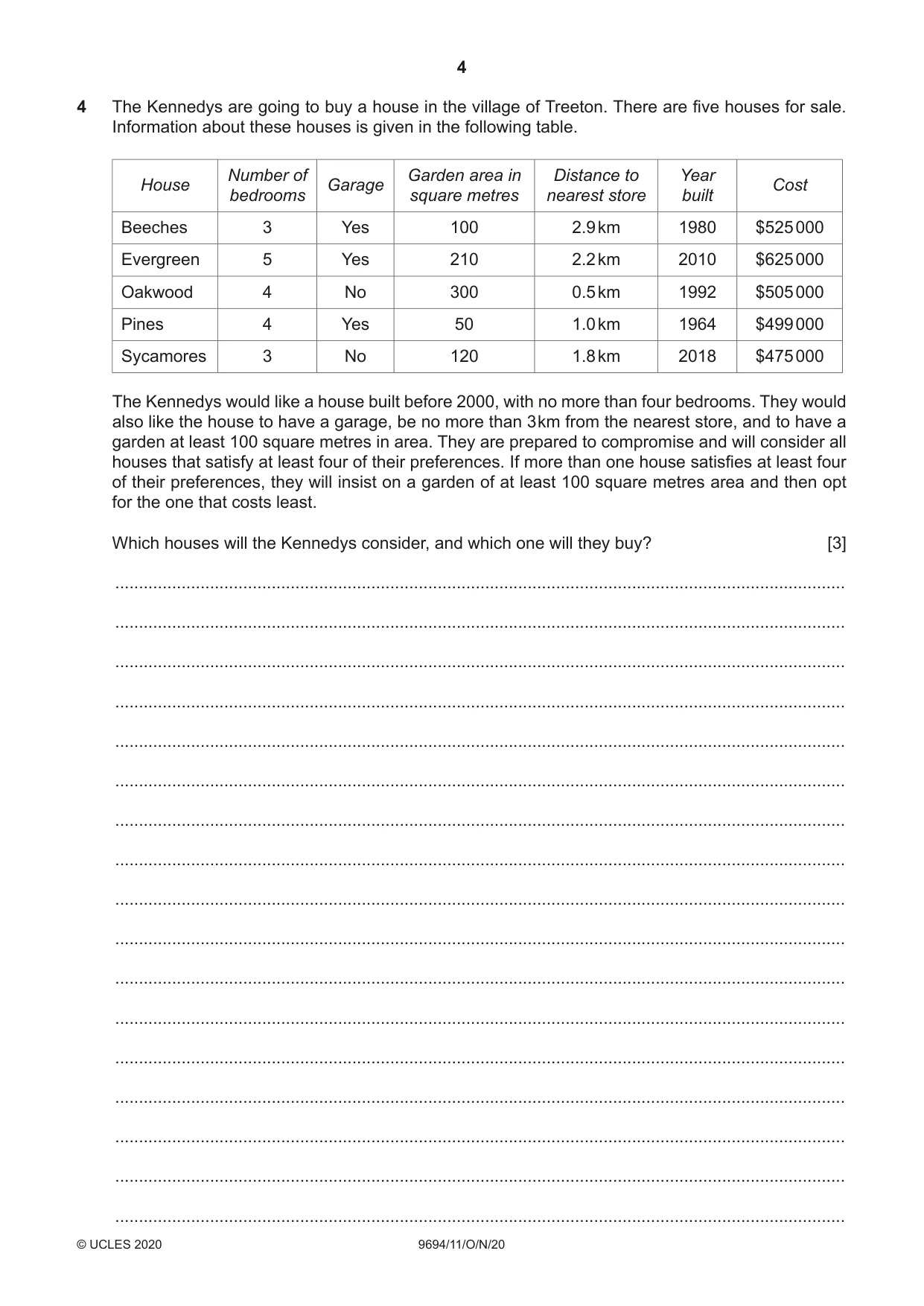
4 9694/11/O/N/20 © UCLES 2020 4 The Kennedys are going to buy a house in the village of Treeton. There are five houses for sale. Information about these houses is given in the following table. House Number of bedrooms Garage Garden area in square metres Distance to nearest store Year built Cost Beeches 3 Yes 100 2.9 km 1980 $525 000 Evergreen 5 Yes 210 2.2 km 2010 $625 000 Oakwood 4 No 300 0.5 km 1992 $505 000 Pines 4 Yes 50 1.0 km 1964 $499 000 Sycamores 3 No 120 1.8 km 2018 $475 000 The Kennedys would like a house built before 2000, with no more than four bedrooms. They would also like the house to have a garage, be no more than 3 km from the nearest store, and to have a garden at least 100 square metres in area. They are prepared to compromise and will consider all houses that satisfy at least four of their preferences. If more than one house satisfies at least four of their preferences, they will insist on a garden of at least 100 square metres area and then opt for the one that costs least. Which houses will the Kennedys consider, and which one will they buy? [3] … … … … … … … … … … … … … … … … …
Question paper, page 5
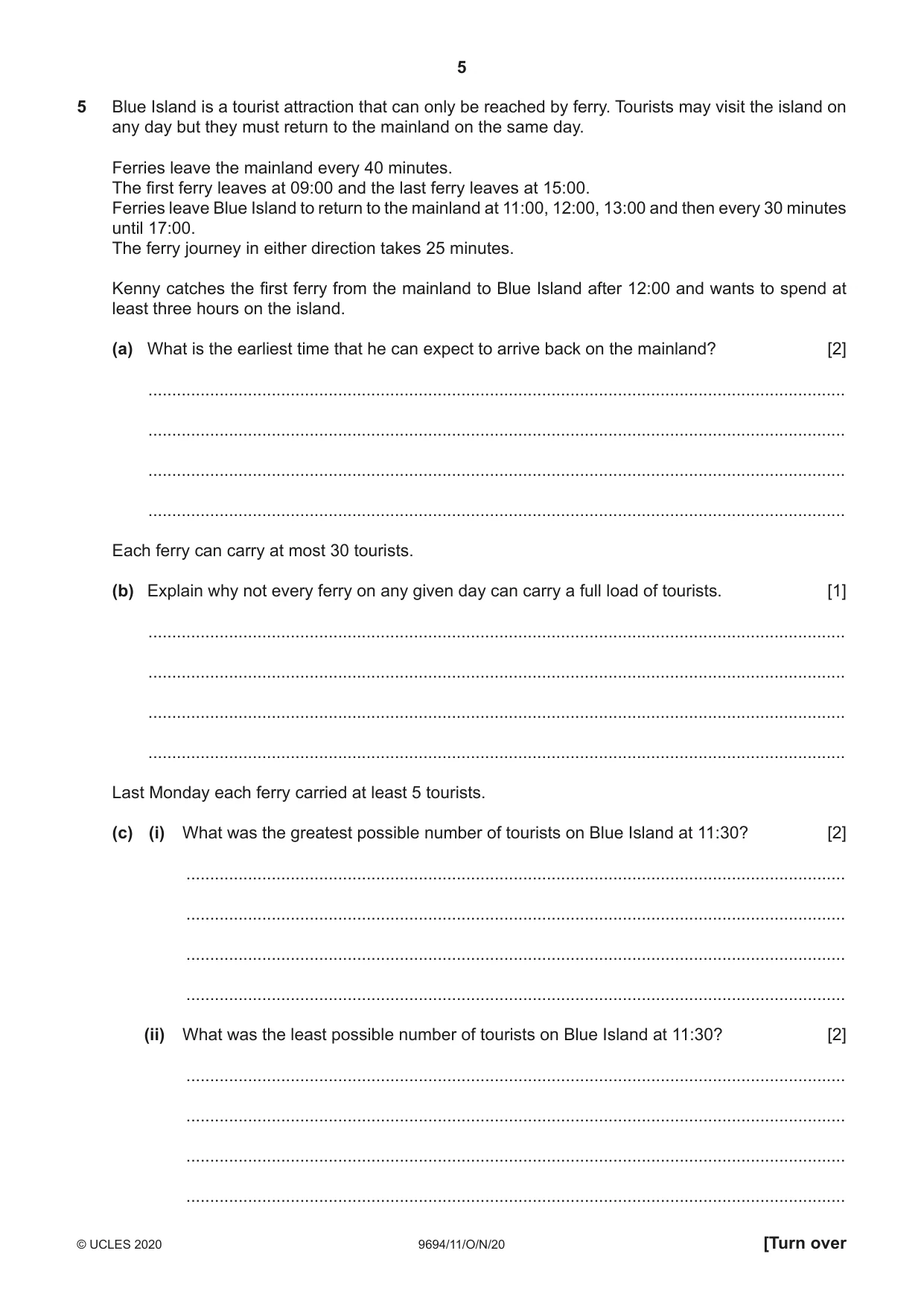
5 9694/11/O/N/20 © UCLES 2020 [Turn over 5 Blue Island is a tourist attraction that can only be reached by ferry. Tourists may visit the island on any day but they must return to the mainland on the same day. Ferries leave the mainland every 40 minutes. The first ferry leaves at 09:00 and the last ferry leaves at 15:00. Ferries leave Blue Island to return to the mainland at 11:00, 12:00, 13:00 and then every 30 minutes until 17:00. The ferry journey in either direction takes 25 minutes. Kenny catches the first ferry from the mainland to Blue Island after 12:00 and wants to spend at least three hours on the island. (a) What is the earliest time that he can expect to arrive back on the mainland? [2] … … … … Each ferry can carry at most 30 tourists. (b) Explain why not every ferry on any given day can carry a full load of tourists. [1] … … … … Last Monday each ferry carried at least 5 tourists. (c) (i) What was the greatest possible number of tourists on Blue Island at 11:30? [2] … … … … (ii) What was the least possible number of tourists on Blue Island at 11:30? [2] … … … …
Question paper, page 6
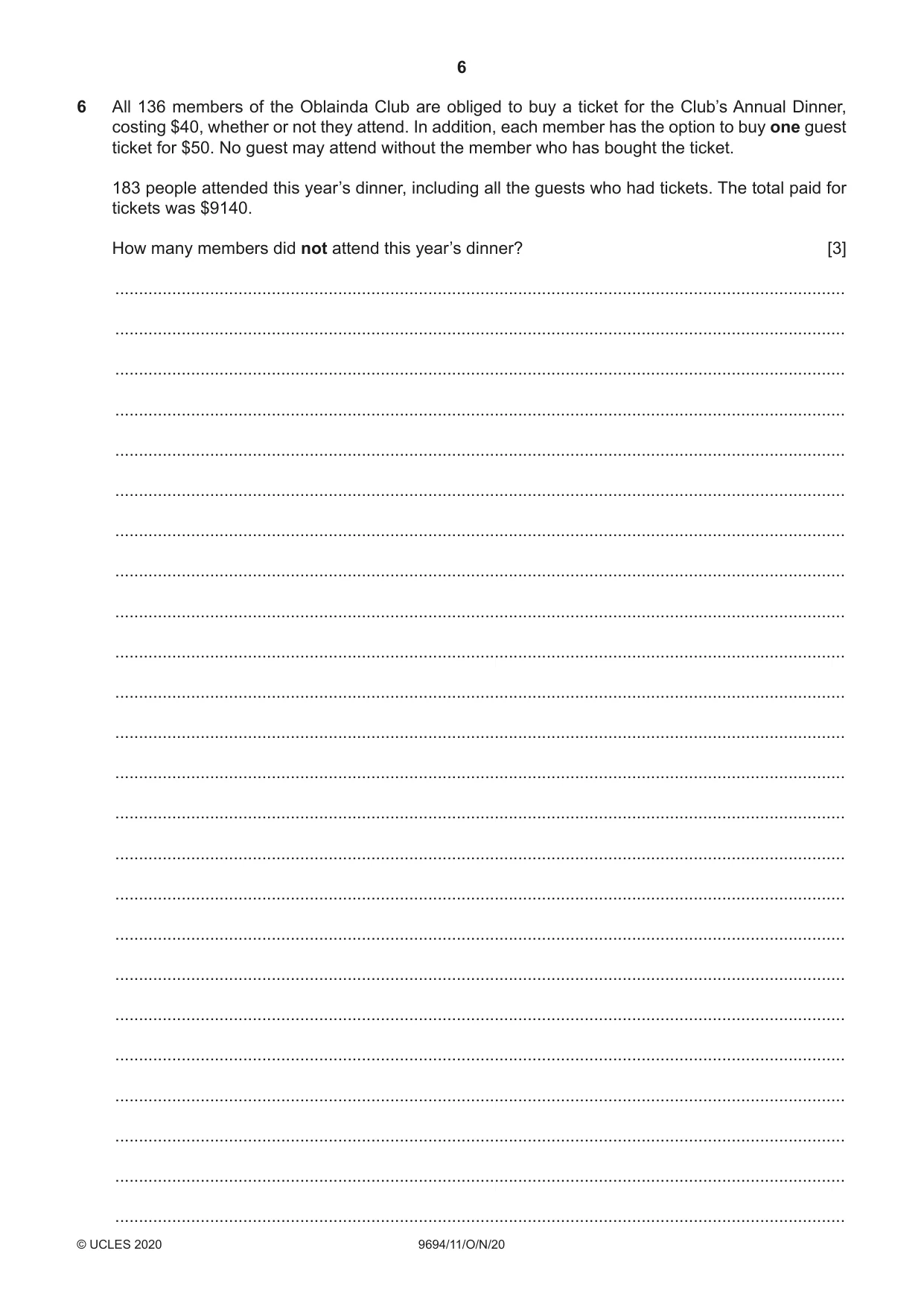
6 9694/11/O/N/20 © UCLES 2020 6 All 136 members of the Oblainda Club are obliged to buy a ticket for the Club’s Annual Dinner, costing $40, whether or not they attend. In addition, each member has the option to buy one guest ticket for $50. No guest may attend without the member who has bought the ticket. 183 people attended this year’s dinner, including all the guests who had tickets. The total paid for tickets was $9140. How many members did not attend this year’s dinner? [3] … … … … … … … … … … … … … … … … … … … … … … … …
Question paper, page 7
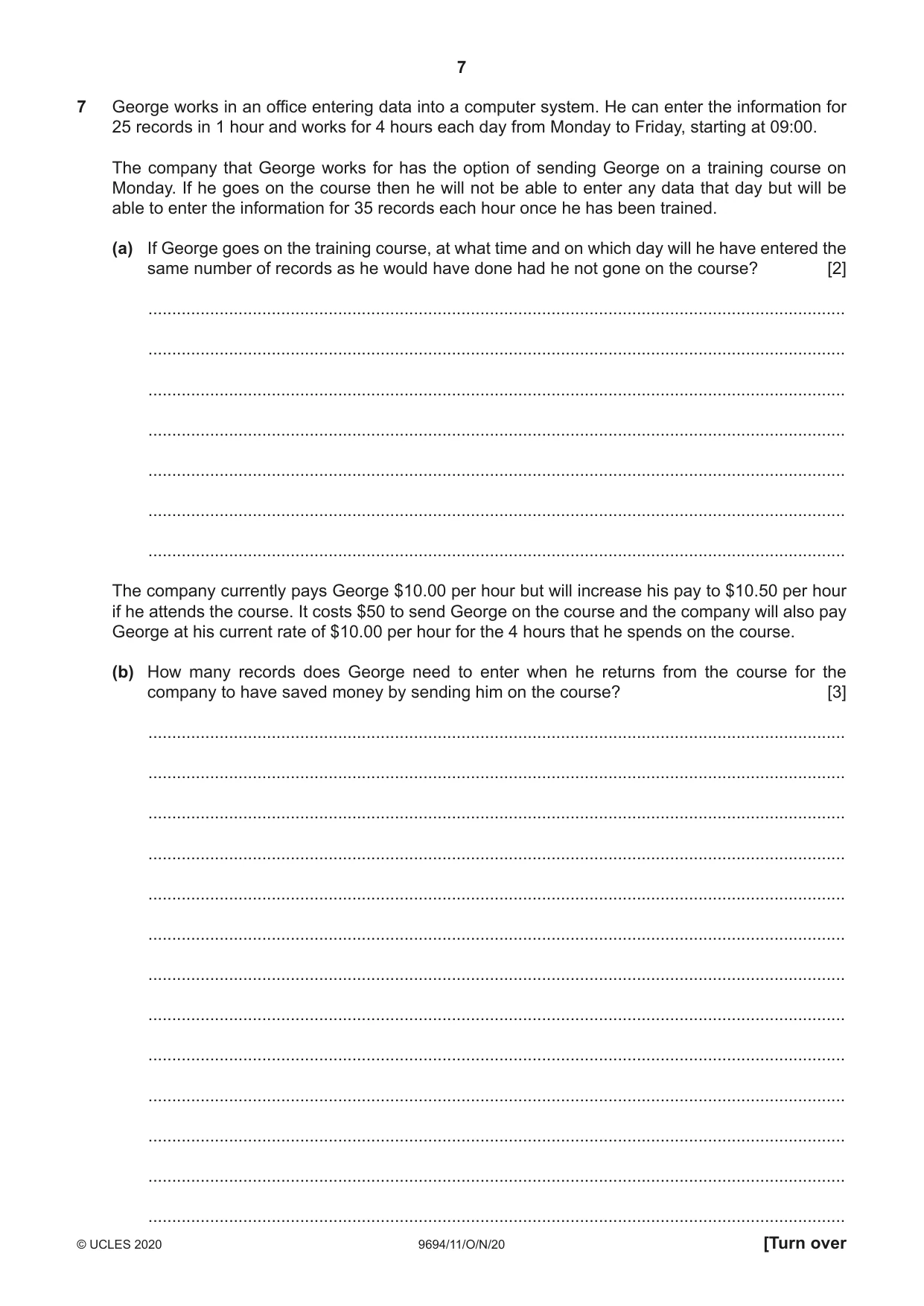
7 9694/11/O/N/20 © UCLES 2020 [Turn over 7 George works in an office entering data into a computer system. He can enter the information for 25 records in 1 hour and works for 4 hours each day from Monday to Friday, starting at 09:00. The company that George works for has the option of sending George on a training course on Monday. If he goes on the course then he will not be able to enter any data that day but will be able to enter the information for 35 records each hour once he has been trained. (a) If George goes on the training course, at what time and on which day will he have entered the same number of records as he would have done had he not gone on the course? [2] … … … … … … … The company currently pays George $10.00 per hour but will increase his pay to $10.50 per hour if he attends the course. It costs $50 to send George on the course and the company will also pay George at his current rate of $10.00 per hour for the 4 hours that he spends on the course. (b) How many records does George need to enter when he returns from the course for the company to have saved money by sending him on the course? [3] … … … … … … … … … … … … …
Question paper, page 8
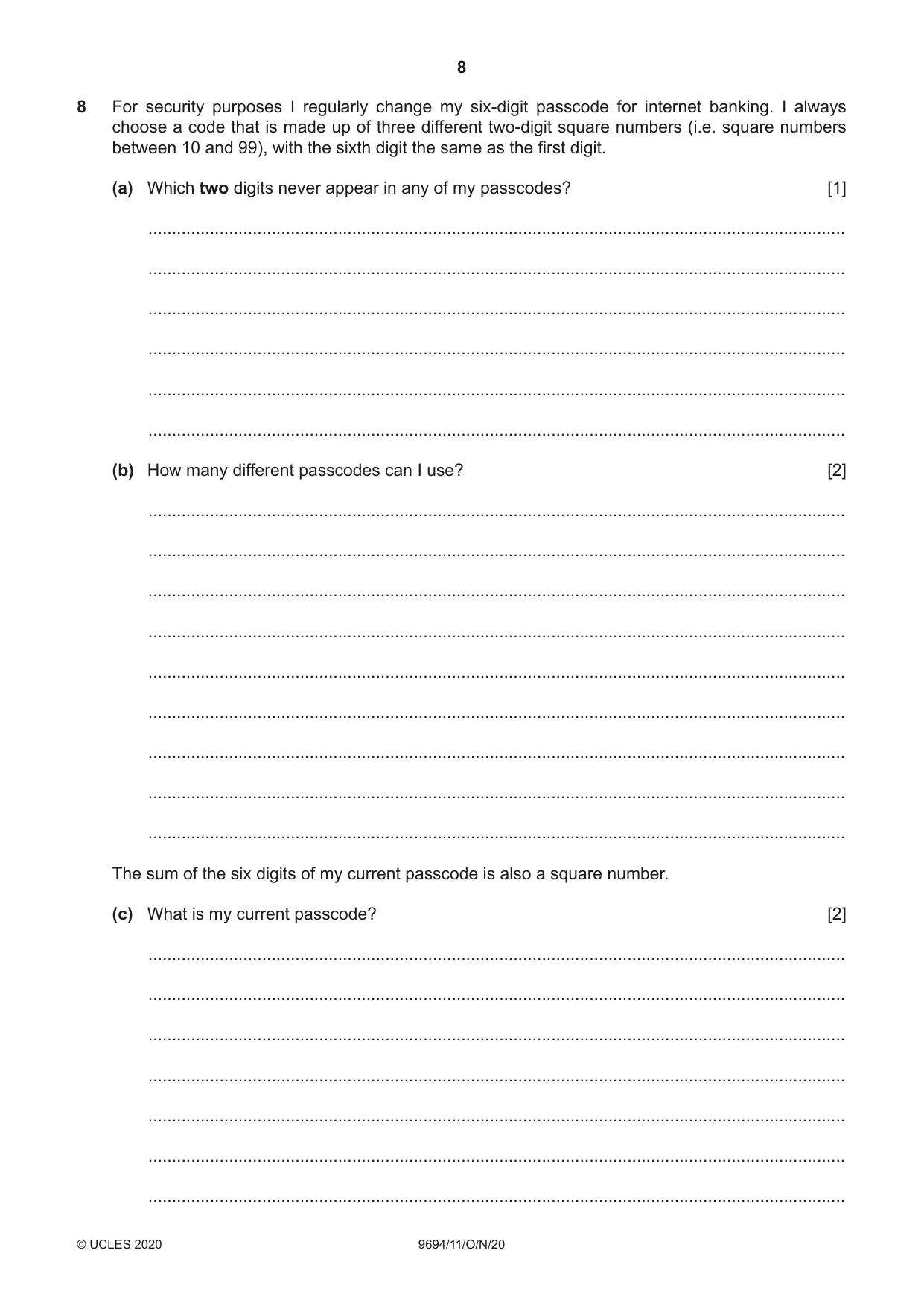
8 9694/11/O/N/20 © UCLES 2020 8 For security purposes I regularly change my six-digit passcode for internet banking. I always choose a code that is made up of three different two-digit square numbers (i.e. square numbers between 10 and 99), with the sixth digit the same as the first digit. (a) Which two digits never appear in any of my passcodes? [1] … … … … … … (b) How many different passcodes can I use? [2] … … … … … … … … … The sum of the six digits of my current passcode is also a square number. (c) What is my current passcode? [2] … … … … … … …
Question paper, page 9
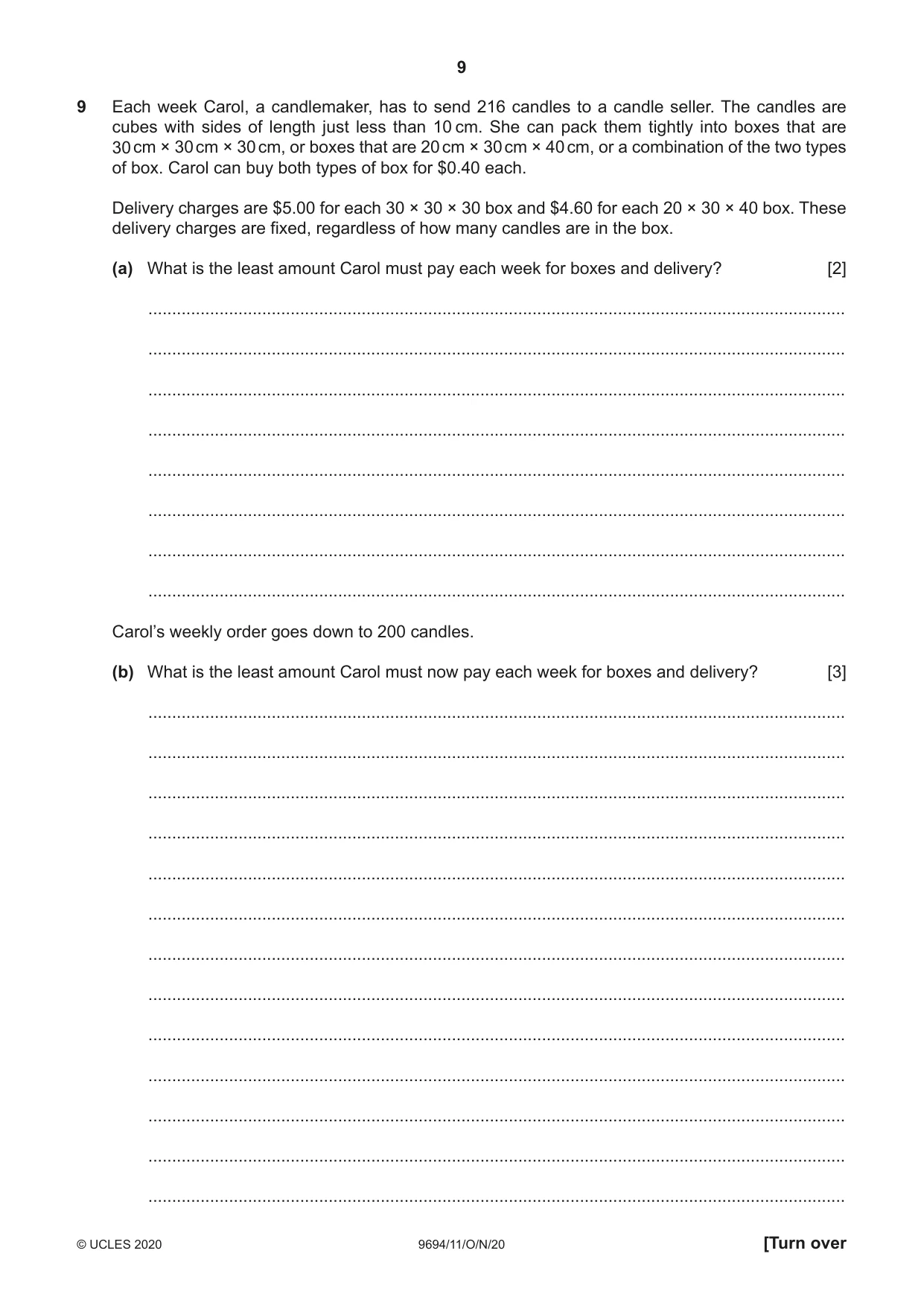
9 9694/11/O/N/20 © UCLES 2020 [Turn over 9 Each week Carol, a candlemaker, has to send 216 candles to a candle seller. The candles are cubes with sides of length just less than 10 cm. She can pack them tightly into boxes that are 30 cm × 30 cm × 30 cm, or boxes that are 20 cm × 30 cm × 40 cm, or a combination of the two types of box. Carol can buy both types of box for $0.40 each. Delivery charges are $5.00 for each 30 × 30 × 30 box and $4.60 for each 20 × 30 × 40 box. These delivery charges are fixed, regardless of how many candles are in the box. (a) What is the least amount Carol must pay each week for boxes and delivery? [2] … … … … … … … … Carol’s weekly order goes down to 200 candles. (b) What is the least amount Carol must now pay each week for boxes and delivery? [3] … … … … … … … … … … … … …
Question paper, page 10
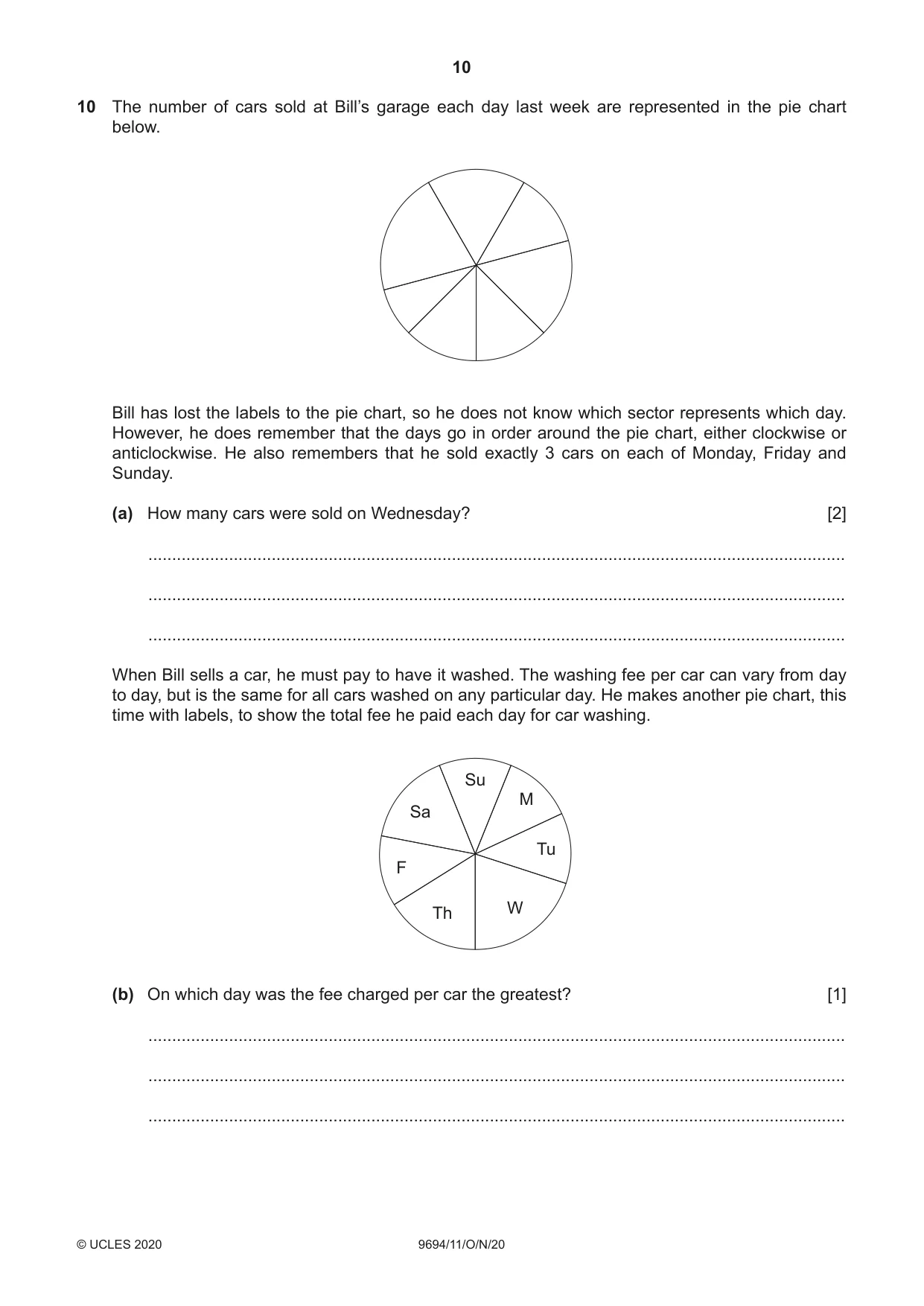
10 9694/11/O/N/20 © UCLES 2020 10 The number of cars sold at Bill’s garage each day last week are represented in the pie chart below. Bill has lost the labels to the pie chart, so he does not know which sector represents which day. However, he does remember that the days go in order around the pie chart, either clockwise or anticlockwise. He also remembers that he sold exactly 3 cars on each of Monday, Friday and Sunday. (a) How many cars were sold on Wednesday? [2] … … … When Bill sells a car, he must pay to have it washed. The washing fee per car can vary from day to day, but is the same for all cars washed on any particular day. He makes another pie chart, this time with labels, to show the total fee he paid each day for car washing. Th F Sa Su M Tu W (b) On which day was the fee charged per car the greatest? [1] … … …
Question paper, page 11
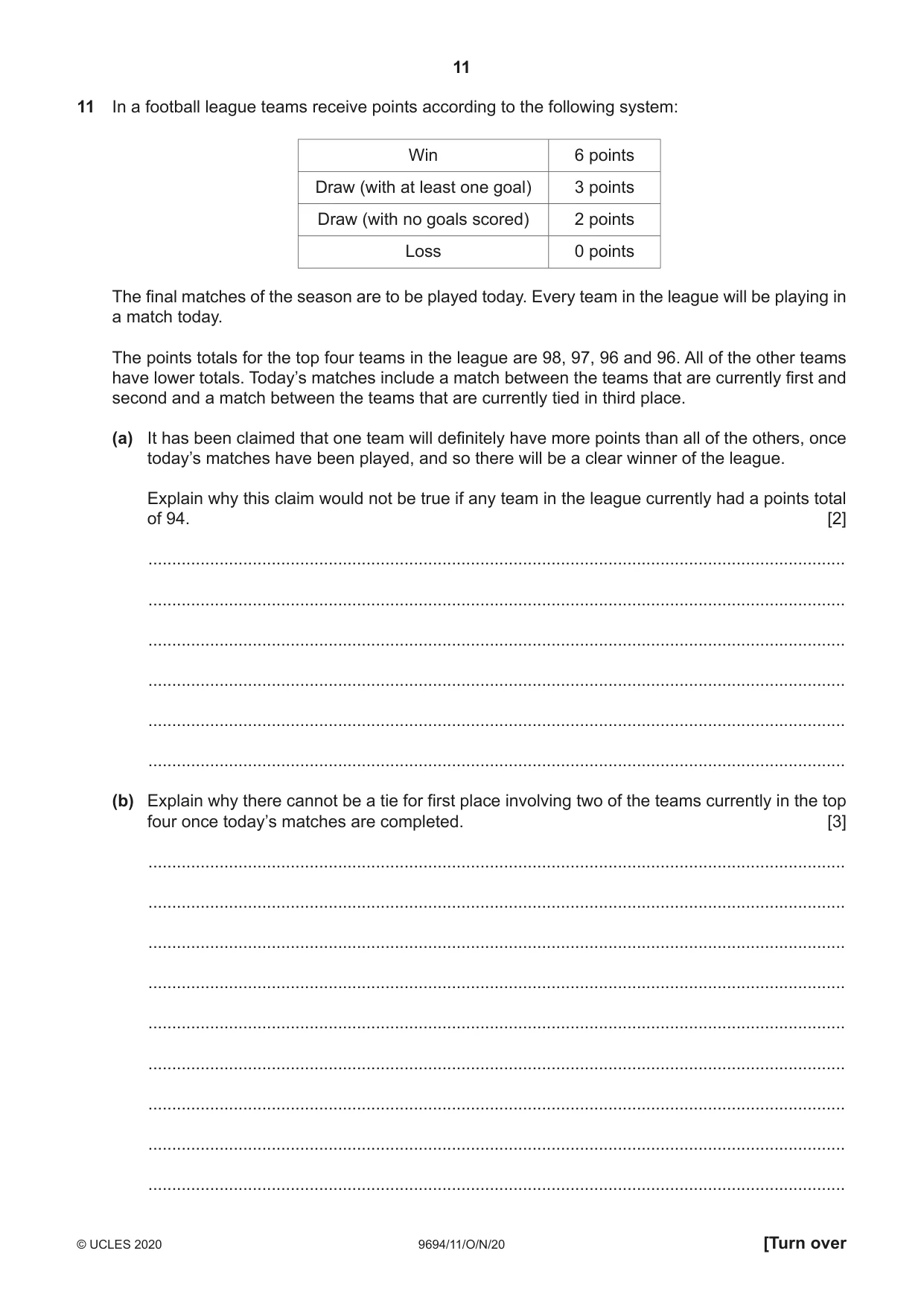
11 9694/11/O/N/20 © UCLES 2020 [Turn over 11 In a football league teams receive points according to the following system: Win 6 points Draw (with at least one goal) 3 points Draw (with no goals scored) 2 points Loss 0 points The final matches of the season are to be played today. Every team in the league will be playing in a match today. The points totals for the top four teams in the league are 98, 97, 96 and 96. All of the other teams have lower totals. Today’s matches include a match between the teams that are currently first and second and a match between the teams that are currently tied in third place. (a) It has been claimed that one team will definitely have more points than all of the others, once today’s matches have been played, and so there will be a clear winner of the league. Explain why this claim would not be true if any team in the league currently had a points total of 94. [2] … … … … … … (b) Explain why there cannot be a tie for first place involving two of the teams currently in the top four once today’s matches are completed. [3] … … … … … … … … …
Question paper, page 12
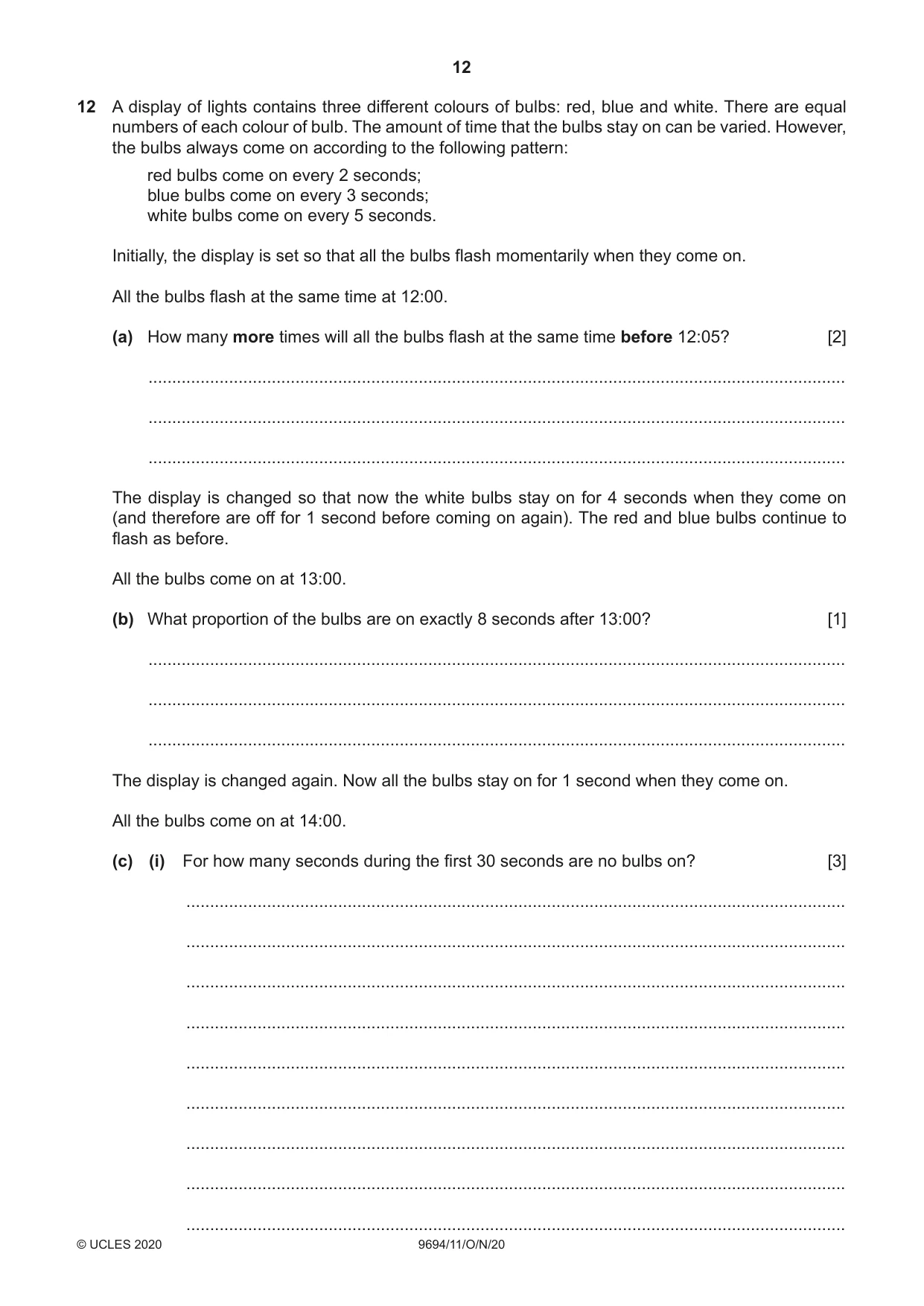
12 9694/11/O/N/20 © UCLES 2020 12 A display of lights contains three different colours of bulbs: red, blue and white. There are equal numbers of each colour of bulb. The amount of time that the bulbs stay on can be varied. However, the bulbs always come on according to the following pattern: red bulbs come on every 2 seconds; blue bulbs come on every 3 seconds; white bulbs come on every 5 seconds. Initially, the display is set so that all the bulbs flash momentarily when they come on. All the bulbs flash at the same time at 12:00. (a) How many more times will all the bulbs flash at the same time before 12:05? [2] … … … The display is changed so that now the white bulbs stay on for 4 seconds when they come on (and therefore are off for 1 second before coming on again). The red and blue bulbs continue to flash as before. All the bulbs come on at 13:00. (b) What proportion of the bulbs are on exactly 8 seconds after 13:00? [1] … … … The display is changed again. Now all the bulbs stay on for 1 second when they come on. All the bulbs come on at 14:00. (c) (i) For how many seconds during the first 30 seconds are no bulbs on? [3] … … … … … … … … …
Question paper, page 13
13 9694/11/O/N/20 © UCLES 2020 (ii) For how many seconds during the first 30 seconds are exactly two bulbs on? [2] … … … … … … … … … …
Question paper, page 14
14 9694/11/O/N/20 © UCLES 2020 BLANK PAGE
Question paper, page 15
15 9694/11/O/N/20 © UCLES 2020 BLANK PAGE
Question paper, page 16
16 9694/11/O/N/20 © UCLES 2020 Permission to reproduce items where third-party owned material protected by copyright is included has been sought and cleared where possible. Every reasonable effort has been made by the publisher (UCLES) to trace copyright holders, but if any items requiring clearance have unwittingly been included, the publisher will be pleased to make amends at the earliest possible opportunity. To avoid the issue of disclosure of answer-related information to candidates, all copyright acknowledgements are reproduced online in the Cambridge Assessment International Education Copyright Acknowledgements Booklet. This is produced for each series of examinations and is freely available to download at www.cambridgeinternational.org after the live examination series. Cambridge Assessment International Education is part of the Cambridge Assessment Group. Cambridge Assessment is the brand name of the University of Cambridge Local Examinations Syndicate (UCLES), which itself is a department of the University of Cambridge. BLANK PAGE
Mark scheme, page 1
This document consists of 8 printed pages. © UCLES 2020 [Turn over Cambridge International AS & A Level THINKING SKILLS 9694/11 Paper 1 Problem Solving October/November 2020 MARK SCHEME Maximum Mark: 50 Published This mark scheme is published as an aid to teachers and candidates, to indicate the requirements of the examination. It shows the basis on which Examiners were instructed to award marks. It does not indicate the details of the discussions that took place at an Examiners’ meeting before marking began, which would have considered the acceptability of alternative answers. Mark schemes should be read in conjunction with the question paper and the Principal Examiner Report for Teachers. Cambridge International will not enter into discussions about these mark schemes. Cambridge International is publishing the mark schemes for the October/November 2020 series for most Cambridge IGCSE™, Cambridge International A and AS Level and Cambridge Pre-U components, and some Cambridge O Level components.
Mark scheme, page 2
9694/11 Cambridge International AS & A Level – Mark Scheme PUBLISHED October/November 2020 © UCLES 2020 Page 2 of 8 Generic Marking Principles These general marking principles must be applied by all examiners when marking candidate answers. They should be applied alongside the specific content of the mark scheme or generic level descriptors for a question. Each question paper and mark scheme will also comply with these marking principles. GENERIC MARKING PRINCIPLE 1: Marks must be awarded in line with: • the specific content of the mark scheme or the generic level descriptors for the question • the specific skills defined in the mark scheme or in the generic level descriptors for the question • the standard of response required by a candidate as exemplified by the standardisation scripts. GENERIC MARKING PRINCIPLE 2: Marks awarded are always whole marks (not half marks, or other fractions). GENERIC MARKING PRINCIPLE 3: Marks must be awarded positively: • marks are awarded for correct/valid answers, as defined in the mark scheme. However, credit is given for valid answers which go beyond the scope of the syllabus and mark scheme, referring to your Team Leader as appropriate • marks are awarded when candidates clearly demonstrate what they know and can do • marks are not deducted for errors • marks are not deducted for omissions • answers should only be judged on the quality of spelling, punctuation and grammar when these features are specifically assessed by the question as indicated by the mark scheme. The meaning, however, should be unambiguous. GENERIC MARKING PRINCIPLE 4: Rules must be applied consistently, e.g. in situations where candidates have not followed instructions or in the application of generic level descriptors. GENERIC MARKING PRINCIPLE 5: Marks should be awarded using the full range of marks defined in the mark scheme for the question (however; the use of the full mark range may be limited according to the quality of the candidate responses seen). GENERIC MARKING PRINCIPLE 6: Marks awarded are based solely on the requirements as defined in the mark scheme. Marks should not be awarded with grade thresholds or grade descriptors in mind.
Mark scheme, page 3
9694/11 Cambridge International AS & A Level – Mark Scheme PUBLISHED October/November 2020 © UCLES 2020 Page 3 of 8 NOTES FOR MARKERS Working Where a final answer is underlined in the mark scheme, full marks are awarded for a correct answer, regardless of whether there is any supporting working, unless an exception is noted in the mark scheme. For partial credit, the evidence needed to award the mark will usually be shown on its own line in the mark scheme, or else will be defined in italic text. For explanations and verbal justifications, apply the principle of ‘words to that effect’. No response If there is any attempt at a solution award 0 marks not NR. “-” or “?” constitute no attempt at a solution. Abbreviations The following abbreviations may be used in a mark scheme: AG answer given (on question paper) awrt answer which rounds to ft follow through (from earlier error) oe or equivalent SC special case soi seen or implied
Mark scheme, page 4
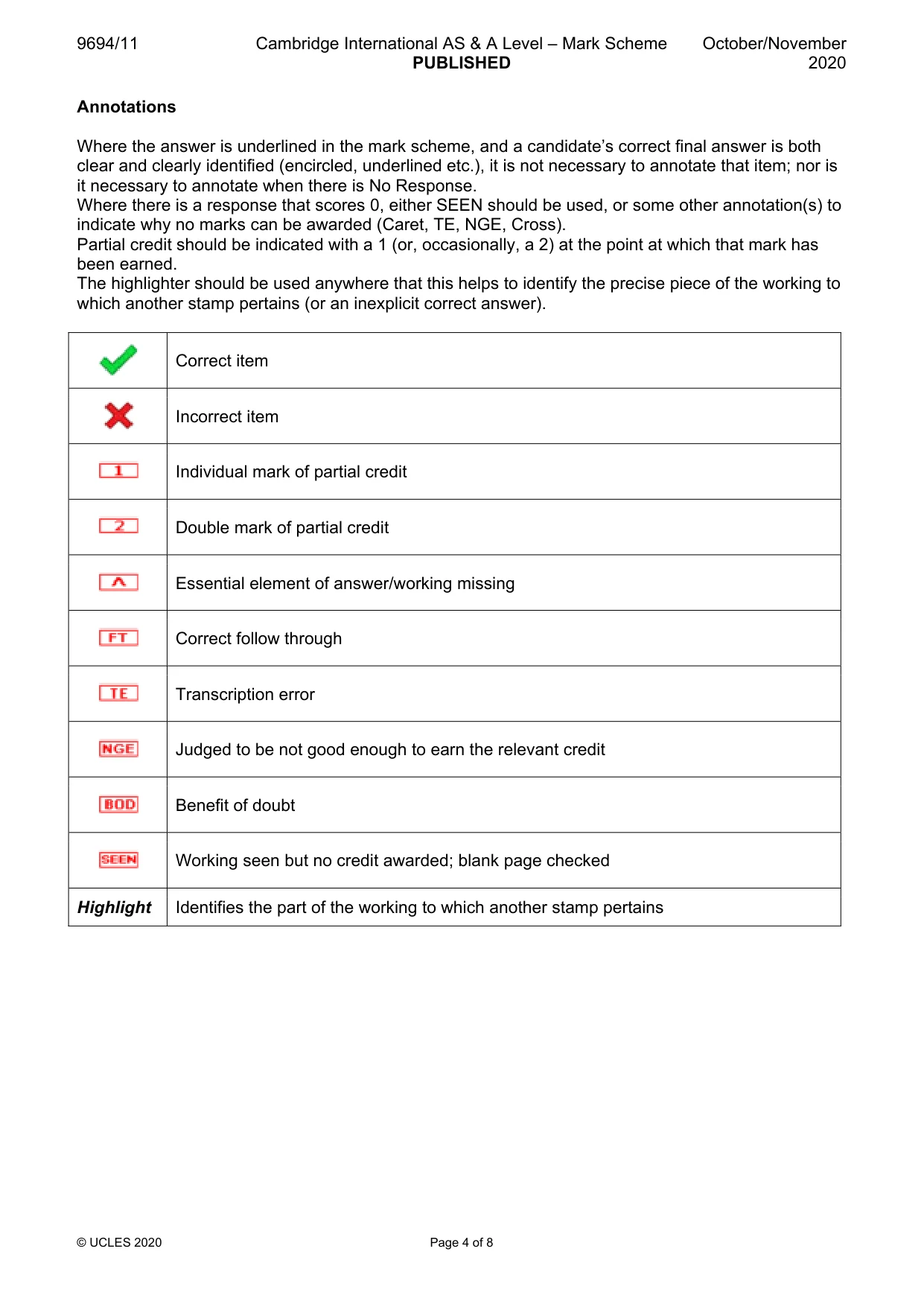
9694/11 Cambridge International AS & A Level – Mark Scheme PUBLISHED October/November 2020 © UCLES 2020 Page 4 of 8 Annotations Where the answer is underlined in the mark scheme, and a candidate’s correct final answer is both clear and clearly identified (encircled, underlined etc.), it is not necessary to annotate that item; nor is it necessary to annotate when there is No Response. Where there is a response that scores 0, either SEEN should be used, or some other annotation(s) to indicate why no marks can be awarded (Caret, TE, NGE, Cross). Partial credit should be indicated with a 1 (or, occasionally, a 2) at the point at which that mark has been earned. The highlighter should be used anywhere that this helps to identify the precise piece of the working to which another stamp pertains (or an inexplicit correct answer). Correct item Incorrect item Individual mark of partial credit Double mark of partial credit Essential element of answer/working missing Correct follow through Transcription error Judged to be not good enough to earn the relevant credit Benefit of doubt Working seen but no credit awarded; blank page checked Highlight Identifies the part of the working to which another stamp pertains
Mark scheme, page 5
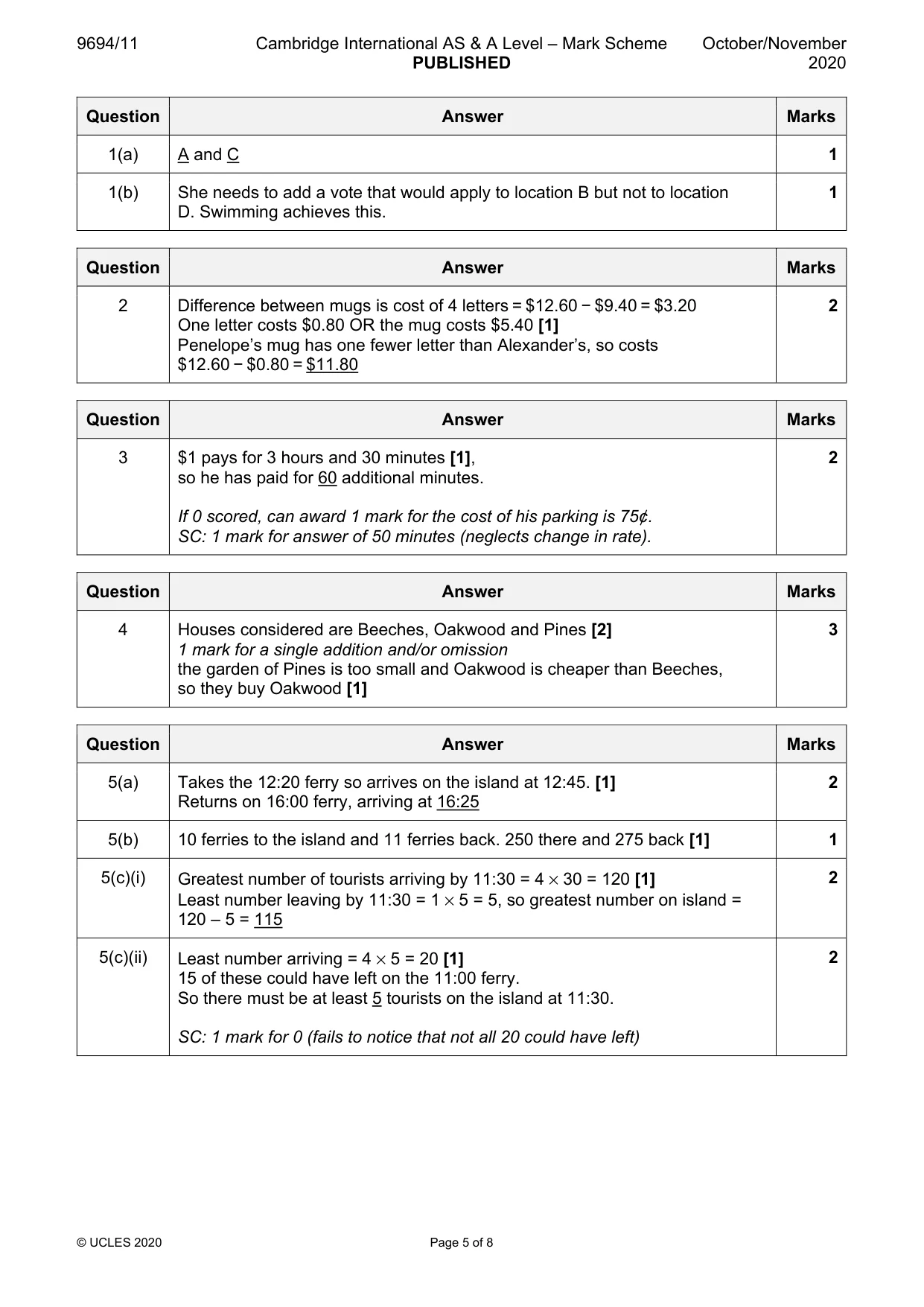
9694/11 Cambridge International AS & A Level – Mark Scheme PUBLISHED October/November 2020 © UCLES 2020 Page 5 of 8 Question Answer Marks 1(a) A and C 1 1(b) She needs to add a vote that would apply to location B but not to location D. Swimming achieves this. 1 Question Answer Marks 2 Difference between mugs is cost of 4 letters = $12.60 − $9.40 = $3.20 One letter costs $0.80 OR the mug costs $5.40 [1] Penelope’s mug has one fewer letter than Alexander’s, so costs $12.60 −$0.80 = $11.80 2 Question Answer Marks 3 $1 pays for 3 hours and 30 minutes [1], so he has paid for 60 additional minutes. If 0 scored, can award 1 mark for the cost of his parking is 75¢. SC: 1 mark for answer of 50 minutes (neglects change in rate). 2 Question Answer Marks 4 Houses considered are Beeches, Oakwood and Pines [2] 1 mark for a single addition and/or omission the garden of Pines is too small and Oakwood is cheaper than Beeches, so they buy Oakwood [1] 3 Question Answer Marks 5(a) Takes the 12:20 ferry so arrives on the island at 12:45. [1] Returns on 16:00 ferry, arriving at 16:25 2 5(b) 10 ferries to the island and 11 ferries back. 250 there and 275 back [1] 1 5(c)(i) Greatest number of tourists arriving by 11:30 = 4 × 30 = 120 [1] Least number leaving by 11:30 = 1 × 5 = 5, so greatest number on island = 120 – 5 = 115 2 5(c)(ii) Least number arriving = 4 × 5 = 20 [1] 15 of these could have left on the 11:00 ferry. So there must be at least 5 tourists on the island at 11:30. SC: 1 mark for 0 (fails to notice that not all 20 could have left) 2
Mark scheme, page 6
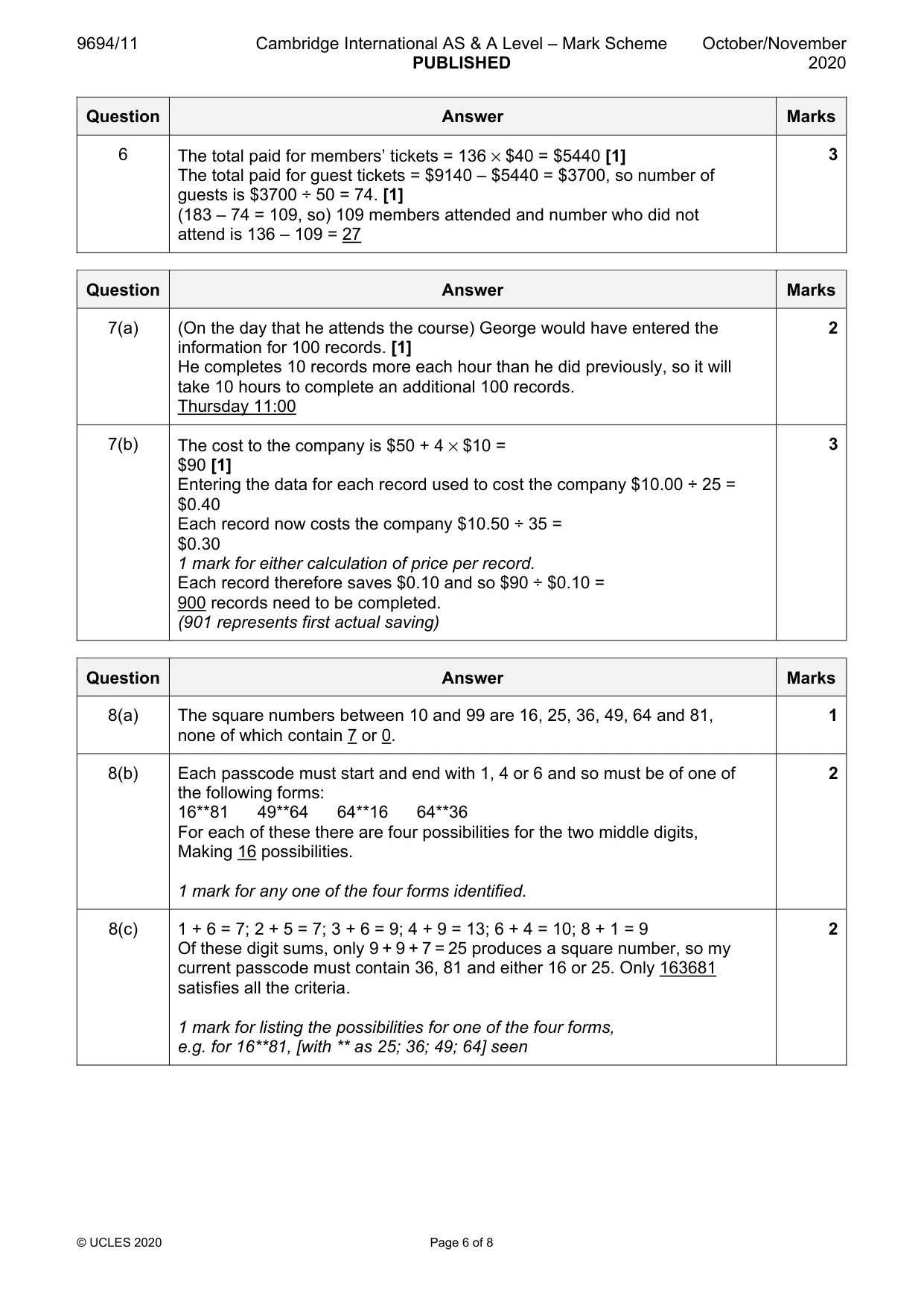
9694/11 Cambridge International AS & A Level – Mark Scheme PUBLISHED October/November 2020 © UCLES 2020 Page 6 of 8 Question Answer Marks 6 The total paid for members’ tickets = 136 × $40 = $5440 [1] The total paid for guest tickets = $9140 – $5440 = $3700, so number of guests is $3700 ÷ 50 = 74. [1] (183 – 74 = 109, so) 109 members attended and number who did not attend is 136 – 109 = 27 3 Question Answer Marks 7(a) (On the day that he attends the course) George would have entered the information for 100 records. [1] He completes 10 records more each hour than he did previously, so it will take 10 hours to complete an additional 100 records. Thursday 11:00 2 7(b) The cost to the company is $50 + 4 × $10 = $90 [1] Entering the data for each record used to cost the company $10.00 ÷ 25 = $0.40 Each record now costs the company $10.50 ÷ 35 = $0.30 1 mark for either calculation of price per record. Each record therefore saves $0.10 and so $90 ÷ $0.10 = 900 records need to be completed. (901 represents first actual saving) 3 Question Answer Marks 8(a) The square numbers between 10 and 99 are 16, 25, 36, 49, 64 and 81, none of which contain 7 or 0. 1 8(b) Each passcode must start and end with 1, 4 or 6 and so must be of one of the following forms: 16**81 49**64 64**16 64**36 For each of these there are four possibilities for the two middle digits, Making 16 possibilities. 1 mark for any one of the four forms identified. 2 8(c) 1 + 6 = 7; 2 + 5 = 7; 3 + 6 = 9; 4 + 9 = 13; 6 + 4 = 10; 8 + 1 = 9 Of these digit sums, only 9 + 9 + 7 = 25 produces a square number, so my current passcode must contain 36, 81 and either 16 or 25. Only 163681 satisfies all the criteria. 1 mark for listing the possibilities for one of the four forms, e.g. for 16**81, [with ** as 25; 36; 49; 64] seen 2
Mark scheme, page 7
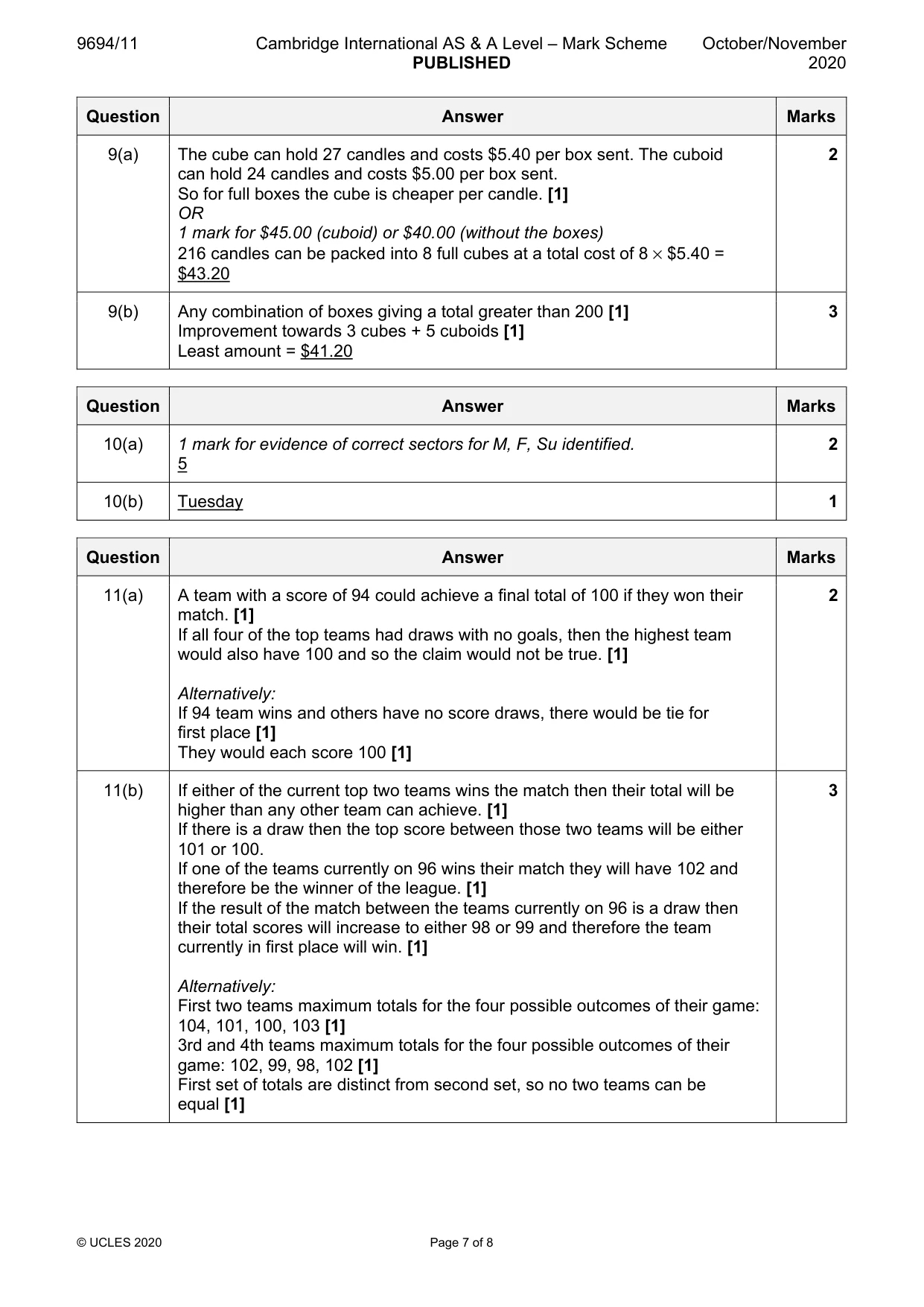
9694/11 Cambridge International AS & A Level – Mark Scheme PUBLISHED October/November 2020 © UCLES 2020 Page 7 of 8 Question Answer Marks 9(a) The cube can hold 27 candles and costs $5.40 per box sent. The cuboid can hold 24 candles and costs $5.00 per box sent. So for full boxes the cube is cheaper per candle. [1] OR 1 mark for $45.00 (cuboid) or $40.00 (without the boxes) 216 candles can be packed into 8 full cubes at a total cost of 8 × $5.40 = $43.20 2 9(b) Any combination of boxes giving a total greater than 200 [1] Improvement towards 3 cubes + 5 cuboids [1] Least amount = $41.20 3 Question Answer Marks 10(a) 1 mark for evidence of correct sectors for M, F, Su identified. 5 2 10(b) Tuesday 1 Question Answer Marks 11(a) A team with a score of 94 could achieve a final total of 100 if they won their match. [1] If all four of the top teams had draws with no goals, then the highest team would also have 100 and so the claim would not be true. [1] Alternatively: If 94 team wins and others have no score draws, there would be tie for first place [1] They would each score 100 [1] 2 11(b) If either of the current top two teams wins the match then their total will be higher than any other team can achieve. [1] If there is a draw then the top score between those two teams will be either 101 or 100. If one of the teams currently on 96 wins their match they will have 102 and therefore be the winner of the league. [1] If the result of the match between the teams currently on 96 is a draw then their total scores will increase to either 98 or 99 and therefore the team currently in first place will win. [1] Alternatively: First two teams maximum totals for the four possible outcomes of their game: 104, 101, 100, 103 [1] 3rd and 4th teams maximum totals for the four possible outcomes of their game: 102, 99, 98, 102 [1] First set of totals are distinct from second set, so no two teams can be equal [1] 3
Mark scheme, page 8
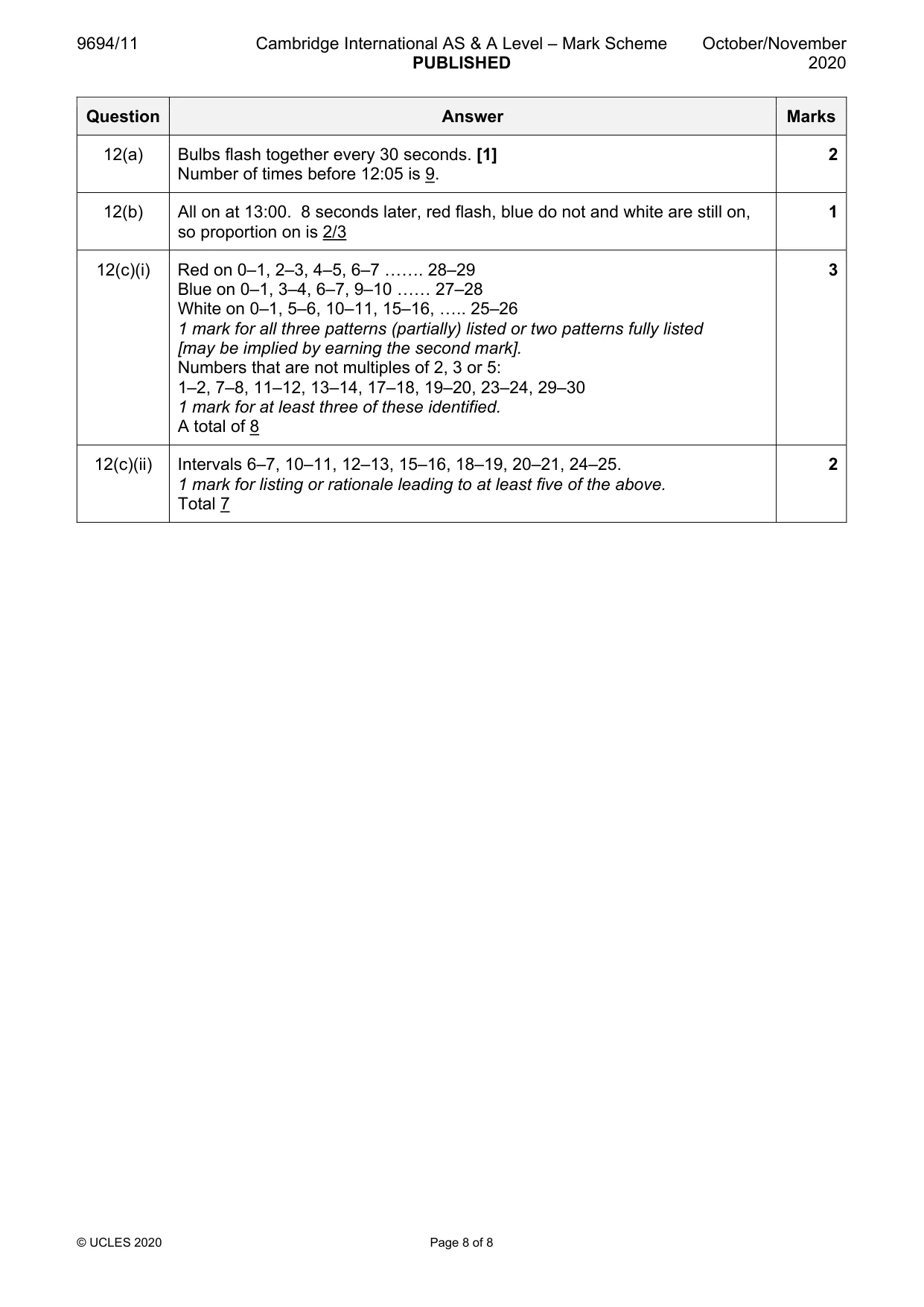
9694/11 Cambridge International AS & A Level – Mark Scheme PUBLISHED October/November 2020 © UCLES 2020 Page 8 of 8 Question Answer Marks 12(a) Bulbs flash together every 30 seconds. [1] Number of times before 12:05 is 9. 2 12(b) All on at 13:00. 8 seconds later, red flash, blue do not and white are still on, so proportion on is 2/3 1 12(c)(i) Red on 0–1, 2–3, 4–5, 6–7 ……. 28–29 Blue on 0–1, 3–4, 6–7, 9–10 …… 27–28 White on 0–1, 5–6, 10–11, 15–16, ….. 25–26 1 mark for all three patterns (partially) listed or two patterns fully listed [may be implied by earning the second mark]. Numbers that are not multiples of 2, 3 or 5: 1–2, 7–8, 11–12, 13–14, 17–18, 19–20, 23–24, 29–30 1 mark for at least three of these identified. A total of 8 3 12(c)(ii) Intervals 6–7, 10–11, 12–13, 15–16, 18–19, 20–21, 24–25. 1 mark for listing or rationale leading to at least five of the above. Total 7 2
What you needed in this session
Cambridge’s own grade thresholds for 2020 Oct/Nov, Paper 1 · Variant 1. A higher threshold means an easier paper — the bar moves with how the cohort did.