Cambridge A Level Thinking Skills 9694 — 2024 May/June Paper 1 · Variant 1
9694/11/M/J/24 · 50 marks · ≈56 min
The question paper and its mark scheme, free to read here and free to download. This is Cambridge’s own paper, exactly as it was sat.
Question paper16 pages
Mark scheme9 pages
Answers below. Sit the paper first if you are practising.
Paper as text
Question paper, page 1
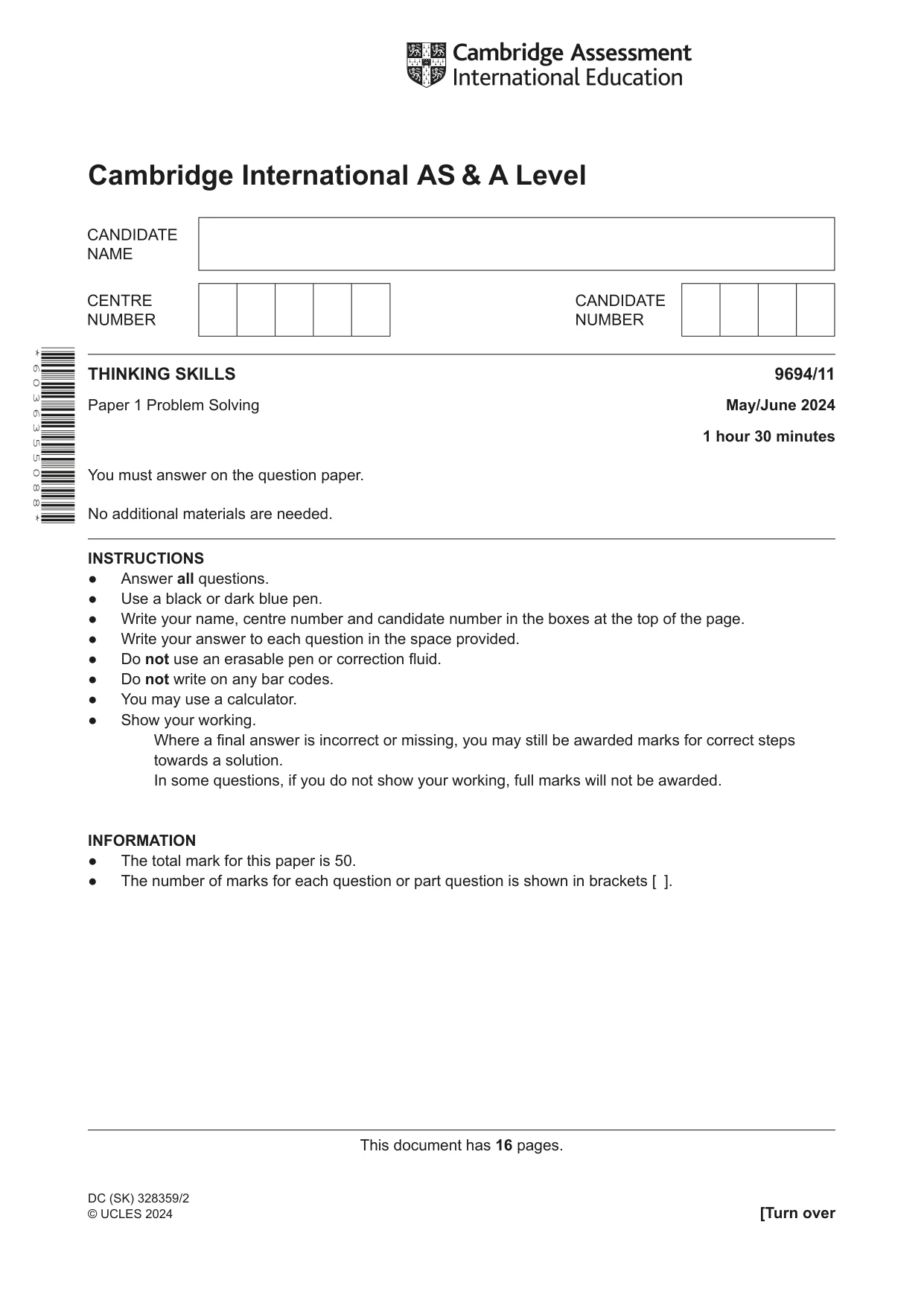
This document has 16 pages. [Turn over Cambridge International AS & A Level DC (SK) 328359/2 © UCLES 2024 * 6 0 3 6 3 5 5 0 8 8 * THINKING SKILLS 9694/11 Paper 1 Problem Solving May/June 2024 1 hour 30 minutes You must answer on the question paper. No additional materials are needed. INSTRUCTIONS ● Answer all questions. ● Use a black or dark blue pen. ● Write your name, centre number and candidate number in the boxes at the top of the page. ● Write your answer to each question in the space provided. ● Do not use an erasable pen or correction fluid. ● Do not write on any bar codes. ● You may use a calculator. ● Show your working. Where a final answer is incorrect or missing, you may still be awarded marks for correct steps towards a solution. In some questions, if you do not show your working, full marks will not be awarded. INFORMATION ● The total mark for this paper is 50. ● The number of marks for each question or part question is shown in brackets [ ].
Question paper, page 2
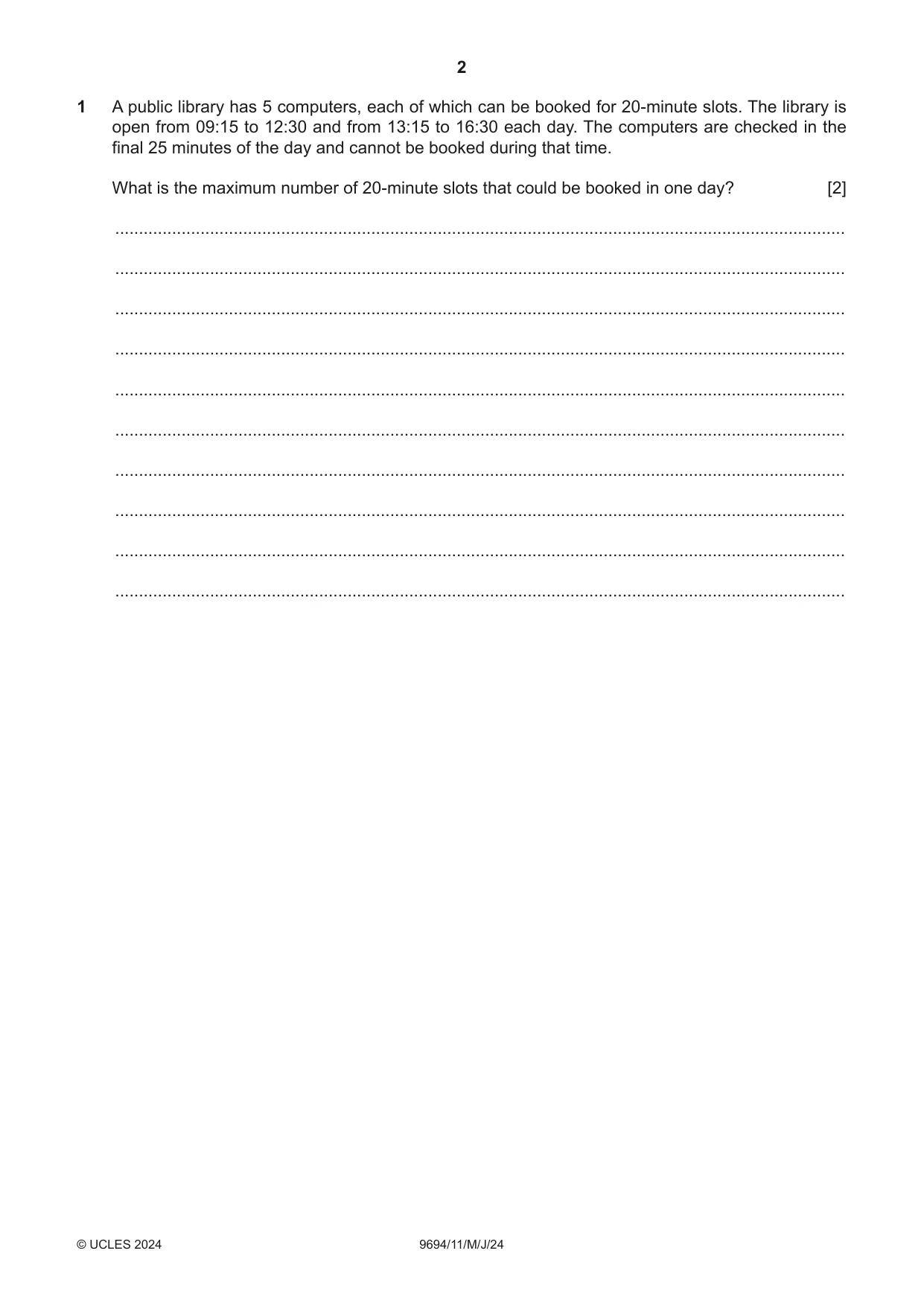
2 9694/11/M/J/24 © UCLES 2024 1 A public library has 5 computers, each of which can be booked for 20-minute slots. The library is open from 09:15 to 12:30 and from 13:15 to 16:30 each day. The computers are checked in the final 25 minutes of the day and cannot be booked during that time. What is the maximum number of 20-minute slots that could be booked in one day? [2] … … … … … … … … … …
Question paper, page 3
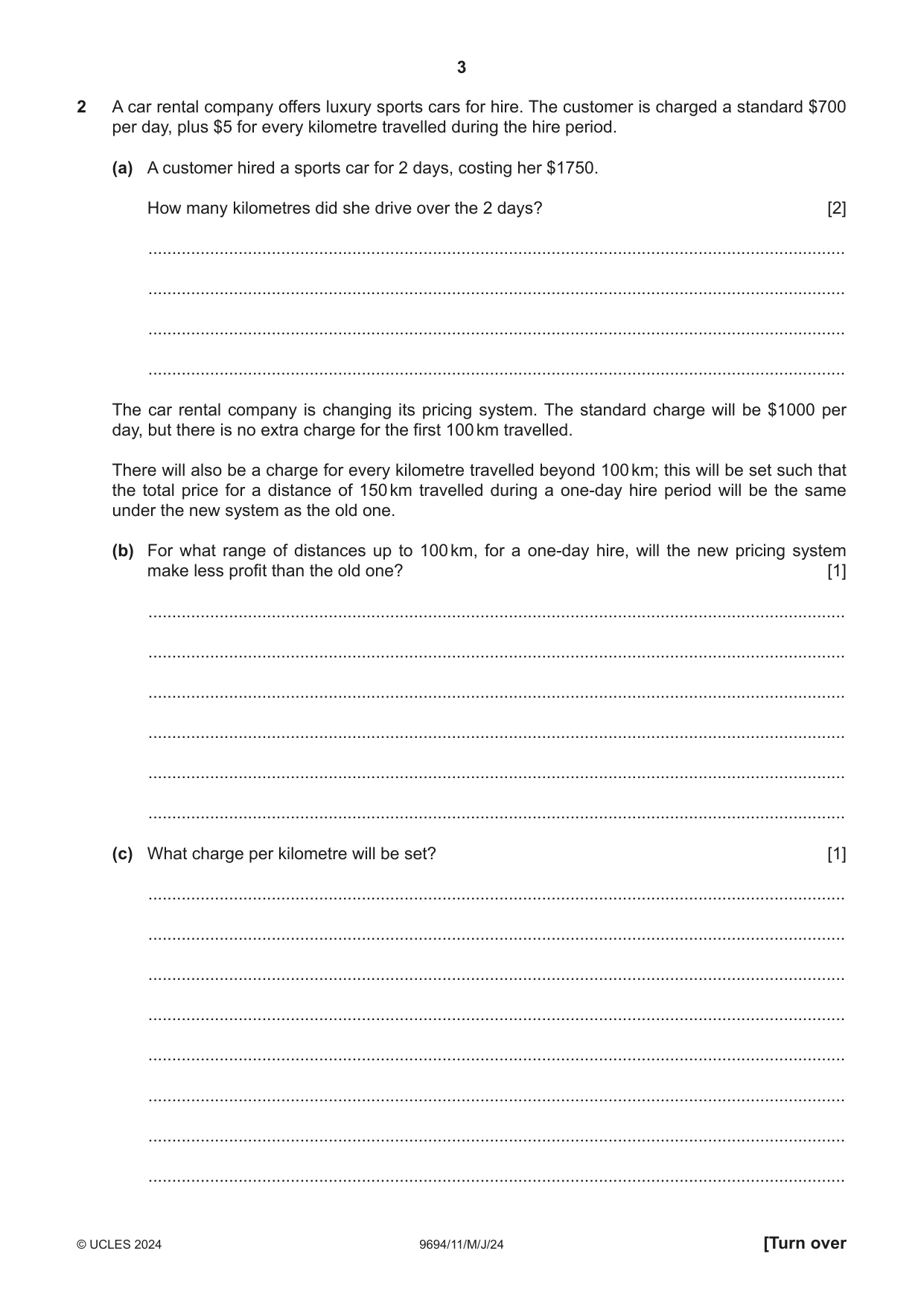
3 9694/11/M/J/24 © UCLES 2024 [Turn over 2 A car rental company offers luxury sports cars for hire. The customer is charged a standard $700 per day, plus $5 for every kilometre travelled during the hire period. (a) A customer hired a sports car for 2 days, costing her $1750. How many kilometres did she drive over the 2 days? [2] … … … … The car rental company is changing its pricing system. The standard charge will be $1000 per day, but there is no extra charge for the first 100 km travelled. There will also be a charge for every kilometre travelled beyond 100 km; this will be set such that the total price for a distance of 150 km travelled during a one-day hire period will be the same under the new system as the old one. (b) For what range of distances up to 100 km, for a one-day hire, will the new pricing system make less profit than the old one? [1] … … … … … … (c) What charge per kilometre will be set? [1] … … … … … … … …
Question paper, page 4
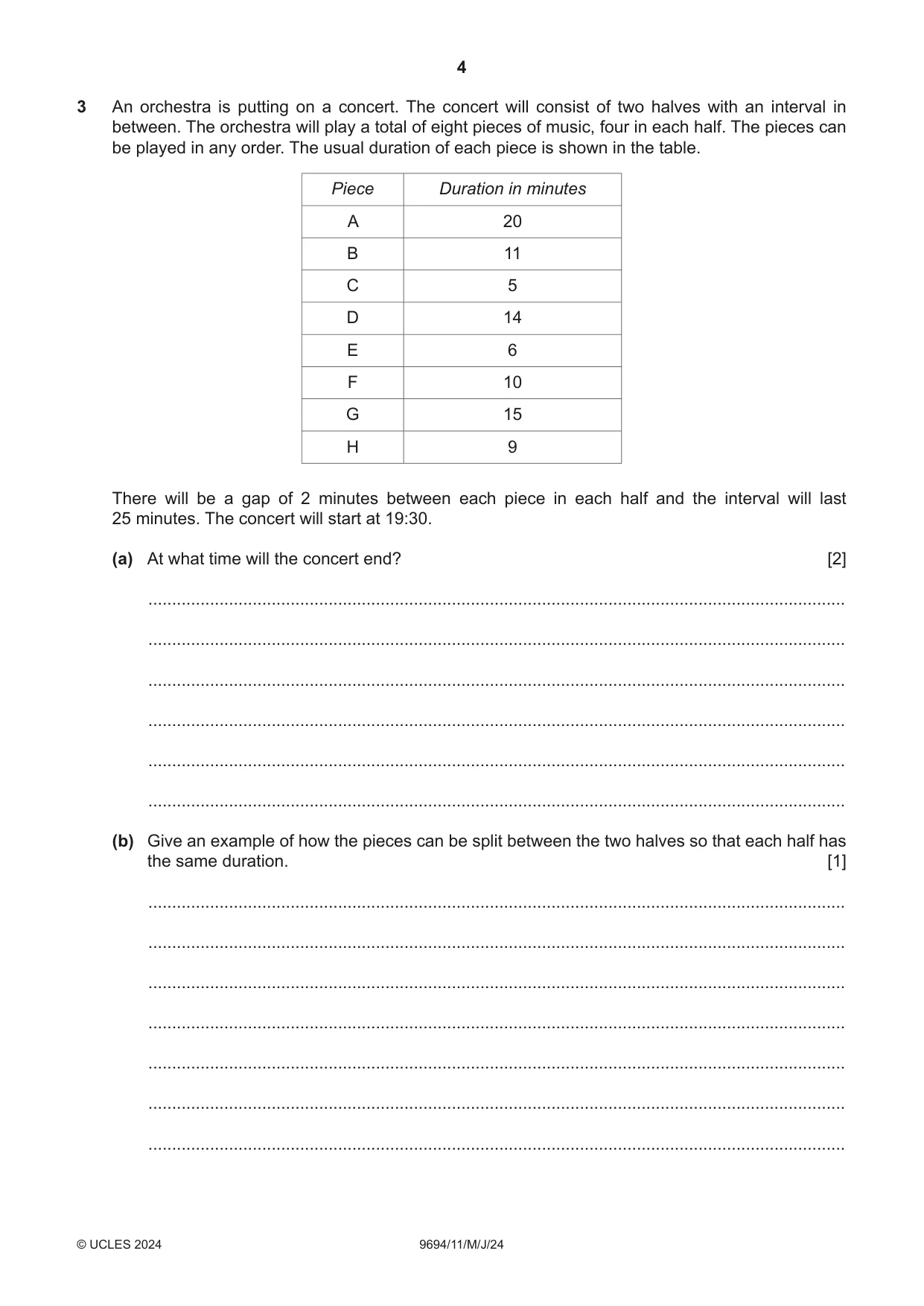
4 9694/11/M/J/24 © UCLES 2024 3 An orchestra is putting on a concert. The concert will consist of two halves with an interval in between. The orchestra will play a total of eight pieces of music, four in each half. The pieces can be played in any order. The usual duration of each piece is shown in the table. Piece Duration in minutes A 20 B 11 C 5 D 14 E 6 F 10 G 15 H 9 There will be a gap of 2 minutes between each piece in each half and the interval will last 25 minutes. The concert will start at 19:30. (a) At what time will the concert end? [2] … … … … … … (b) Give an example of how the pieces can be split between the two halves so that each half has the same duration. [1] … … … … … … …
Question paper, page 5
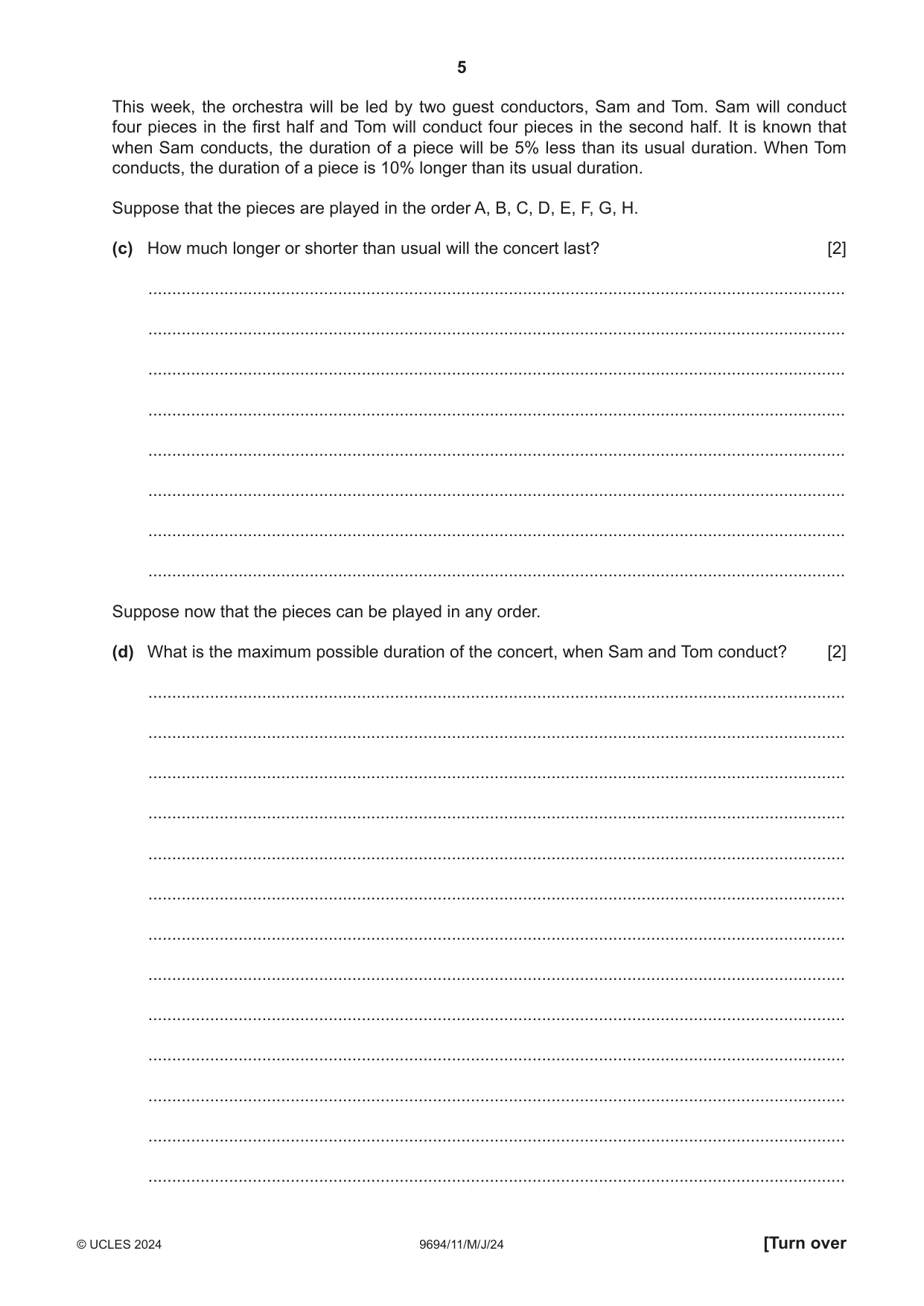
5 9694/11/M/J/24 © UCLES 2024 [Turn over This week, the orchestra will be led by two guest conductors, Sam and Tom. Sam will conduct four pieces in the first half and Tom will conduct four pieces in the second half. It is known that when Sam conducts, the duration of a piece will be 5% less than its usual duration. When Tom conducts, the duration of a piece is 10% longer than its usual duration. Suppose that the pieces are played in the order A, B, C, D, E, F, G, H. (c) How much longer or shorter than usual will the concert last? [2] … … … … … … … … Suppose now that the pieces can be played in any order. (d) What is the maximum possible duration of the concert, when Sam and Tom conduct? [2] … … … … … … … … … … … … …
Question paper, page 6
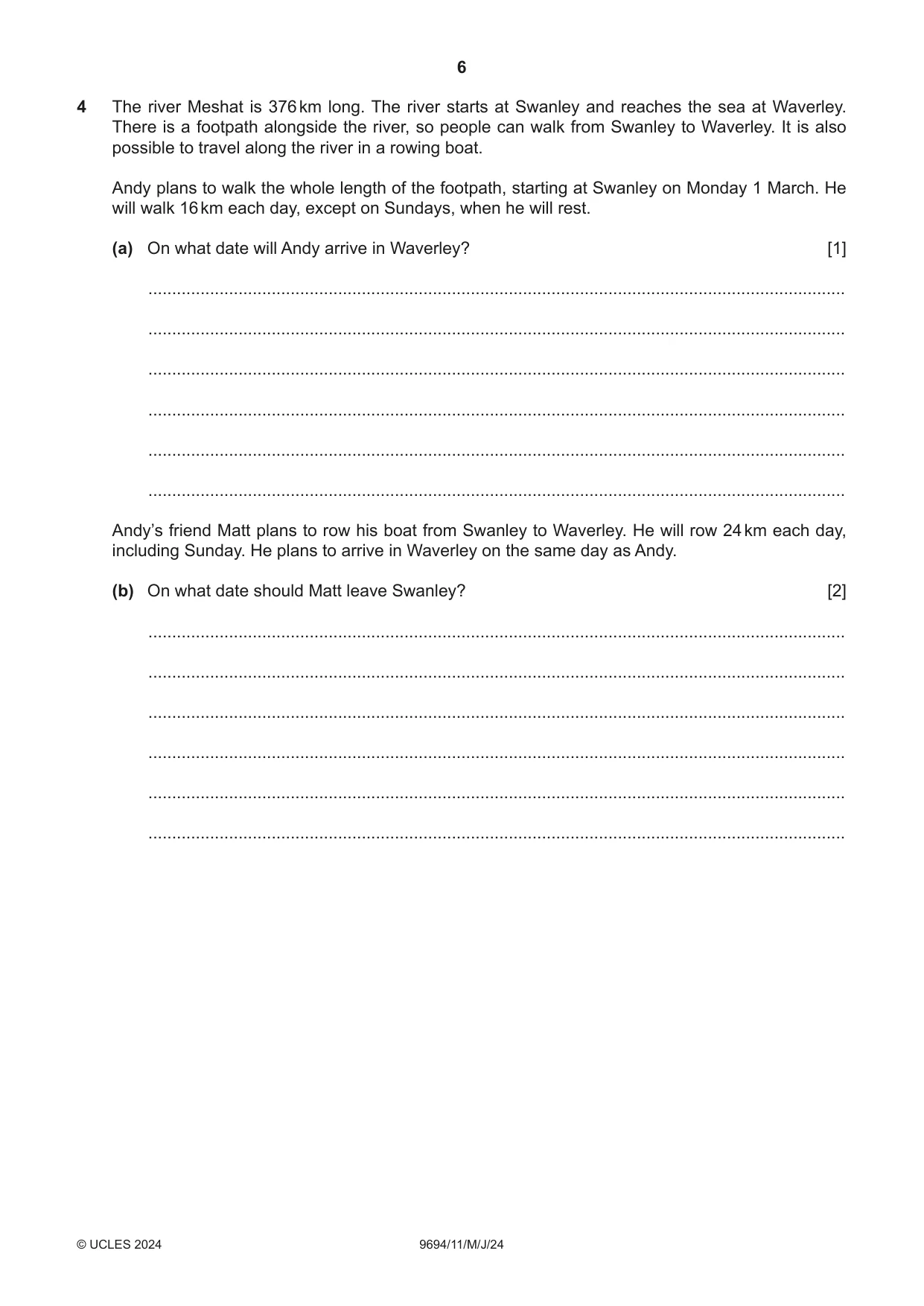
6 9694/11/M/J/24 © UCLES 2024 4 The river Meshat is 376 km long. The river starts at Swanley and reaches the sea at Waverley. There is a footpath alongside the river, so people can walk from Swanley to Waverley. It is also possible to travel along the river in a rowing boat. Andy plans to walk the whole length of the footpath, starting at Swanley on Monday 1 March. He will walk 16 km each day, except on Sundays, when he will rest. (a) On what date will Andy arrive in Waverley? [1] … … … … … … Andy’s friend Matt plans to row his boat from Swanley to Waverley. He will row 24 km each day, including Sunday. He plans to arrive in Waverley on the same day as Andy. (b) On what date should Matt leave Swanley? [2] … … … … … …
Question paper, page 7
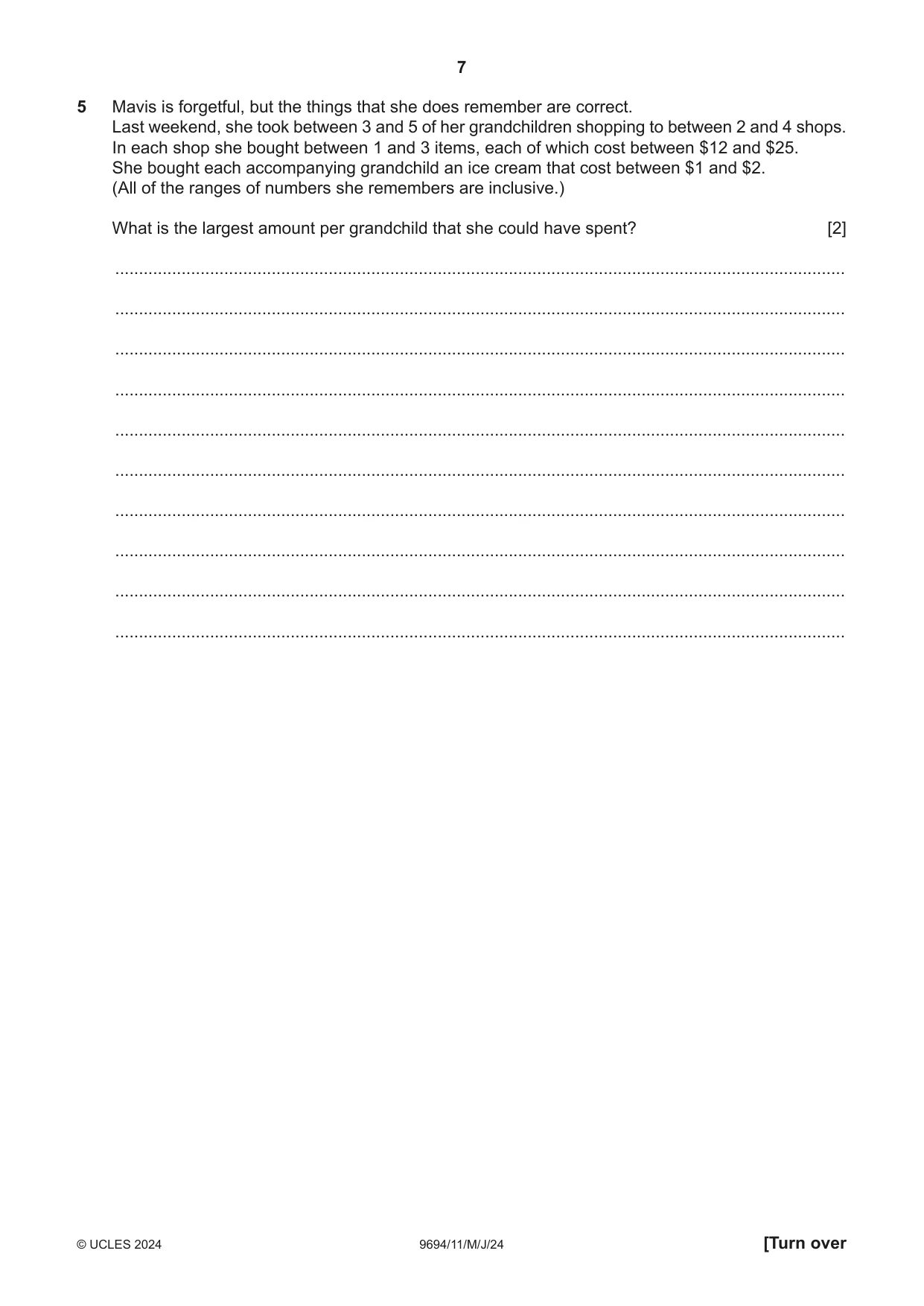
7 9694/11/M/J/24 © UCLES 2024 [Turn over 5 Mavis is forgetful, but the things that she does remember are correct. Last weekend, she took between 3 and 5 of her grandchildren shopping to between 2 and 4 shops. In each shop she bought between 1 and 3 items, each of which cost between $12 and $25. She bought each accompanying grandchild an ice cream that cost between $1 and $2. (All of the ranges of numbers she remembers are inclusive.) What is the largest amount per grandchild that she could have spent? [2] … … … … … … … … … …
Question paper, page 8
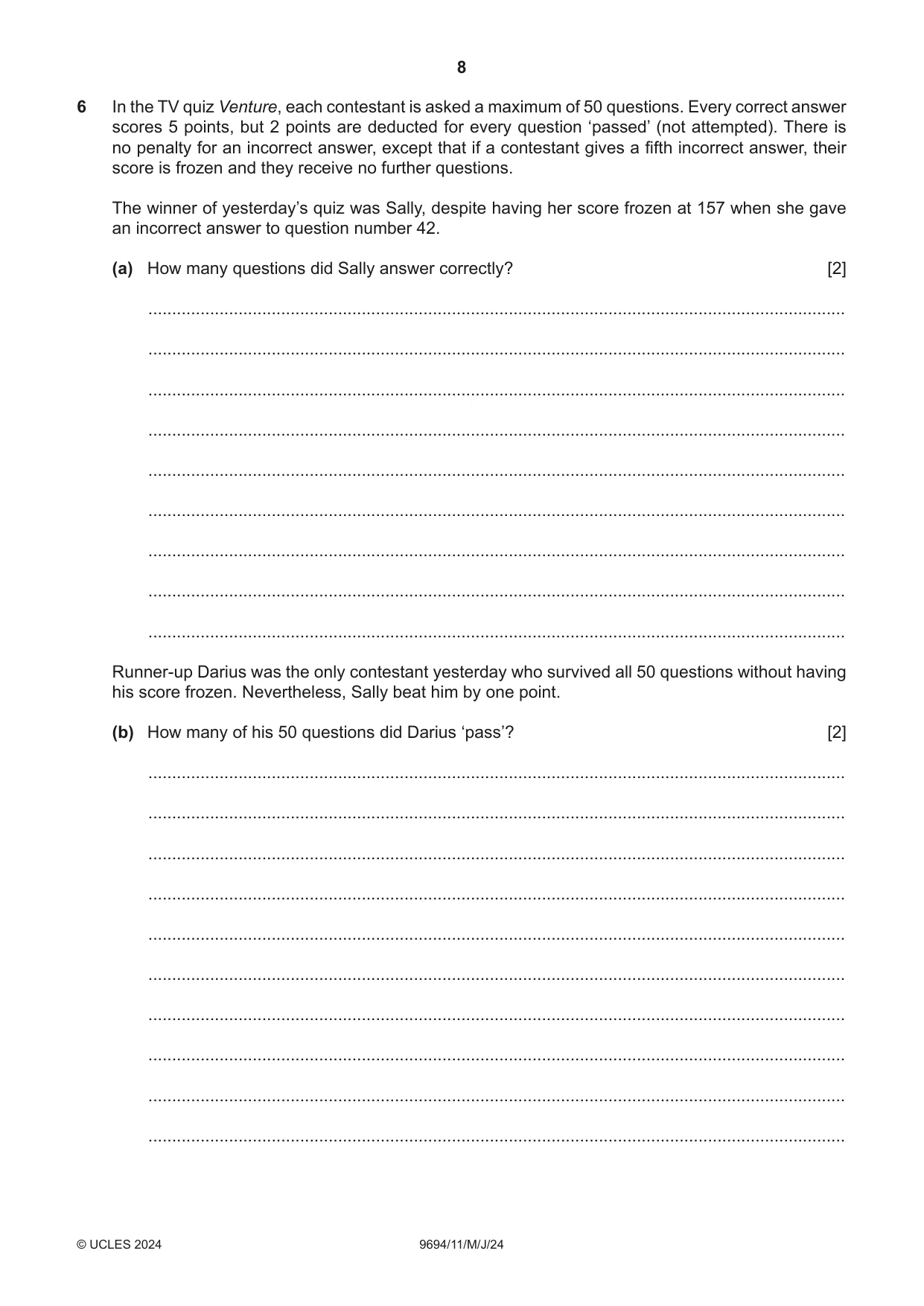
8 9694/11/M/J/24 © UCLES 2024 6 In the TV quiz Venture, each contestant is asked a maximum of 50 questions. Every correct answer scores 5 points, but 2 points are deducted for every question ‘passed’ (not attempted). There is no penalty for an incorrect answer, except that if a contestant gives a fifth incorrect answer, their score is frozen and they receive no further questions. The winner of yesterday’s quiz was Sally, despite having her score frozen at 157 when she gave an incorrect answer to question number 42. (a) How many questions did Sally answer correctly? [2] … … … … … … … … … Runner-up Darius was the only contestant yesterday who survived all 50 questions without having his score frozen. Nevertheless, Sally beat him by one point. (b) How many of his 50 questions did Darius ‘pass’? [2] … … … … … … … … … …
Question paper, page 9
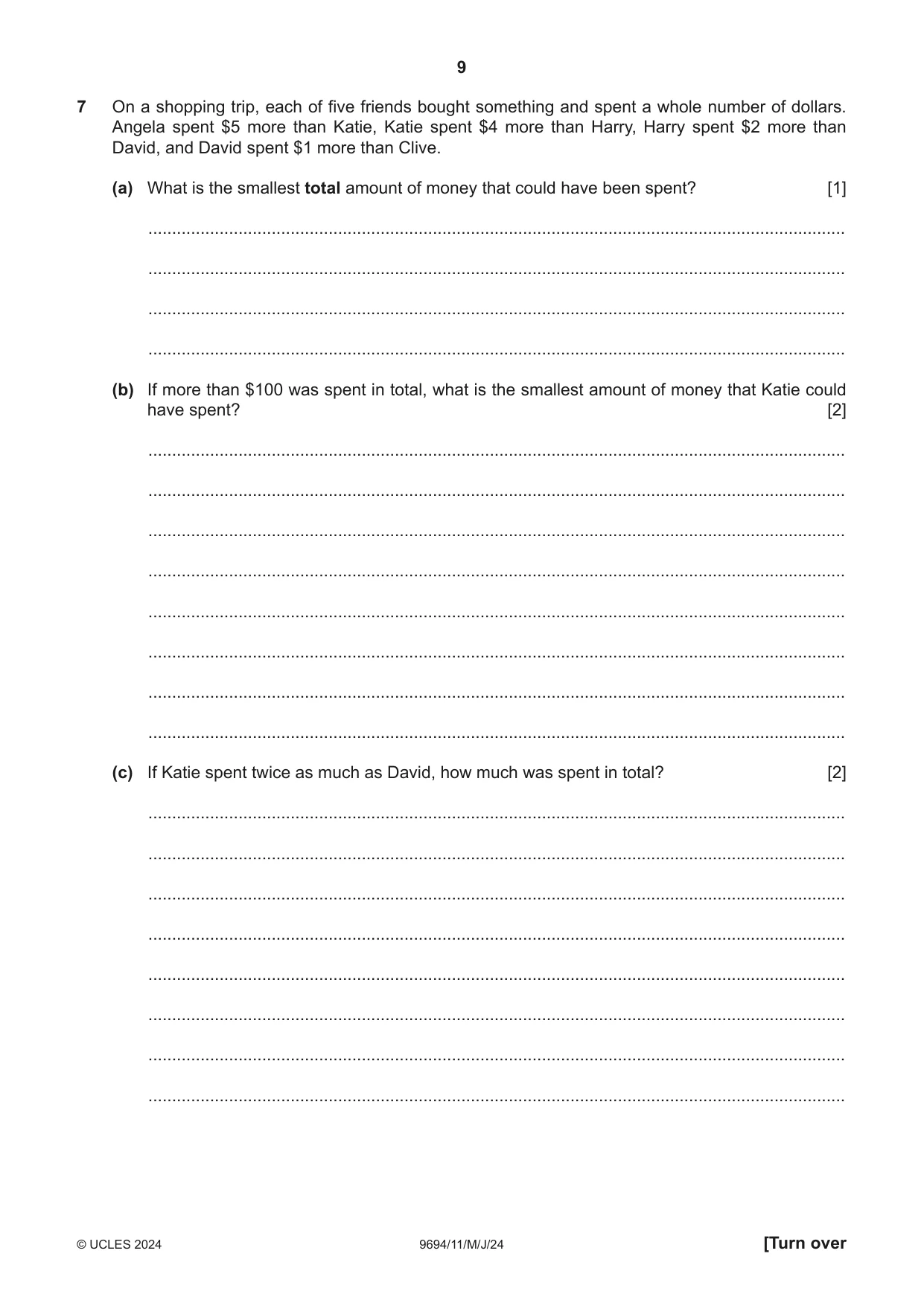
9 9694/11/M/J/24 © UCLES 2024 [Turn over 7 On a shopping trip, each of five friends bought something and spent a whole number of dollars. Angela spent $5 more than Katie, Katie spent $4 more than Harry, Harry spent $2 more than David, and David spent $1 more than Clive. (a) What is the smallest total amount of money that could have been spent? [1] … … … … (b) If more than $100 was spent in total, what is the smallest amount of money that Katie could have spent? [2] … … … … … … … … (c) If Katie spent twice as much as David, how much was spent in total? [2] … … … … … … … …
Question paper, page 10
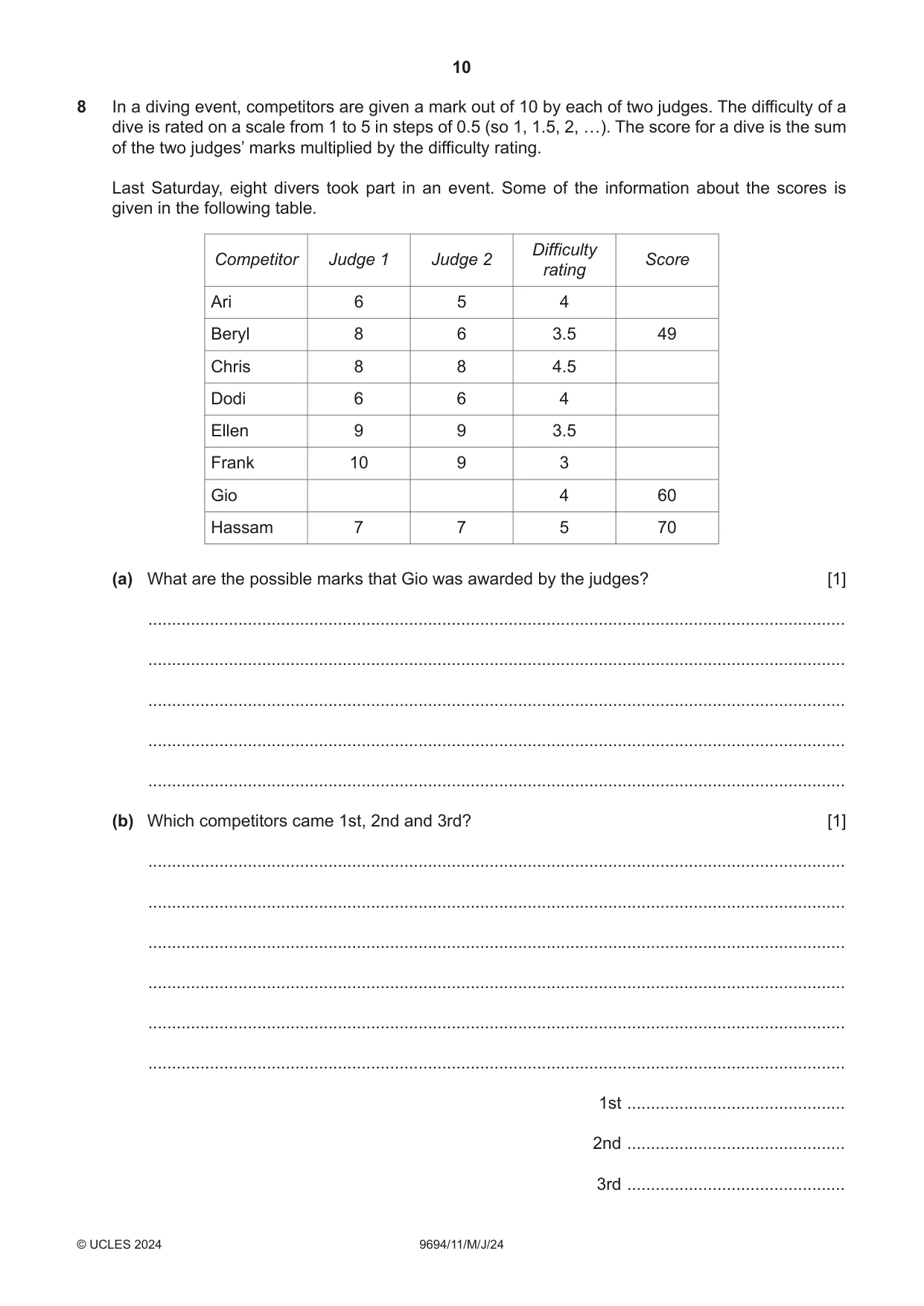
10 9694/11/M/J/24 © UCLES 2024 8 In a diving event, competitors are given a mark out of 10 by each of two judges. The difficulty of a dive is rated on a scale from 1 to 5 in steps of 0.5 (so 1, 1.5, 2, …). The score for a dive is the sum of the two judges’ marks multiplied by the difficulty rating. Last Saturday, eight divers took part in an event. Some of the information about the scores is given in the following table. Competitor Judge 1 Judge 2 Difficulty rating Score Ari 6 5 4 Beryl 8 6 3.5 49 Chris 8 8 4.5 Dodi 6 6 4 Ellen 9 9 3.5 Frank 10 9 3 Gio 4 60 Hassam 7 7 5 70 (a) What are the possible marks that Gio was awarded by the judges? [1] … … … … … (b) Which competitors came 1st, 2nd and 3rd? [1] … … … … … … 1st … 2nd … 3rd …
Question paper, page 11
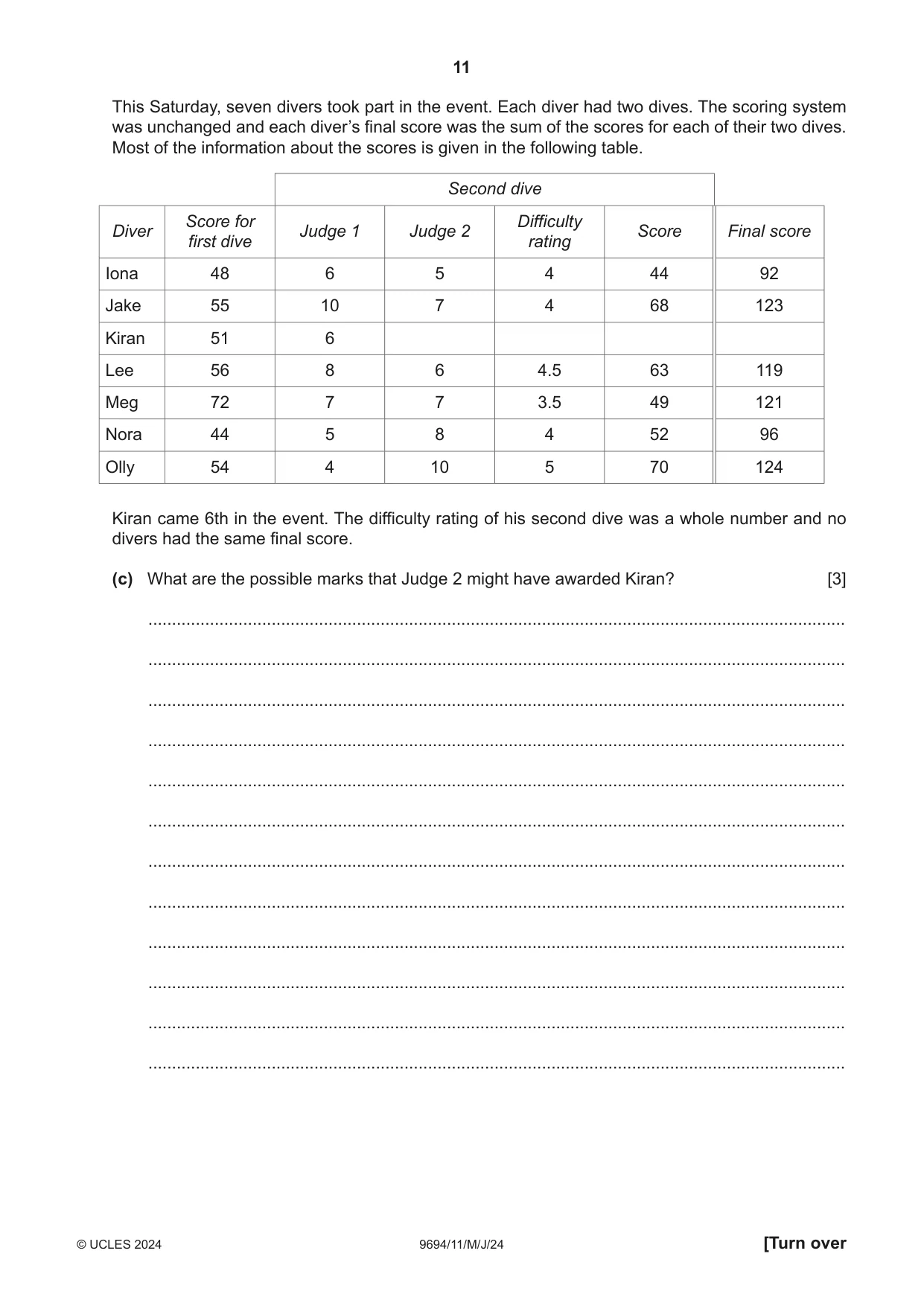
11 9694/11/M/J/24 © UCLES 2024 [Turn over This Saturday, seven divers took part in the event. Each diver had two dives. The scoring system was unchanged and each diver’s final score was the sum of the scores for each of their two dives. Most of the information about the scores is given in the following table. Second dive Diver Score for first dive Judge 1 Judge 2 Difficulty rating Score Final score Iona 48 6 5 4 44 92 Jake 55 10 7 4 68 123 Kiran 51 6 Lee 56 8 6 4.5 63 119 Meg 72 7 7 3.5 49 121 Nora 44 5 8 4 52 96 Olly 54 4 10 5 70 124 Kiran came 6th in the event. The difficulty rating of his second dive was a whole number and no divers had the same final score. (c) What are the possible marks that Judge 2 might have awarded Kiran? [3] … … … … … … … … … … … …
Question paper, page 12
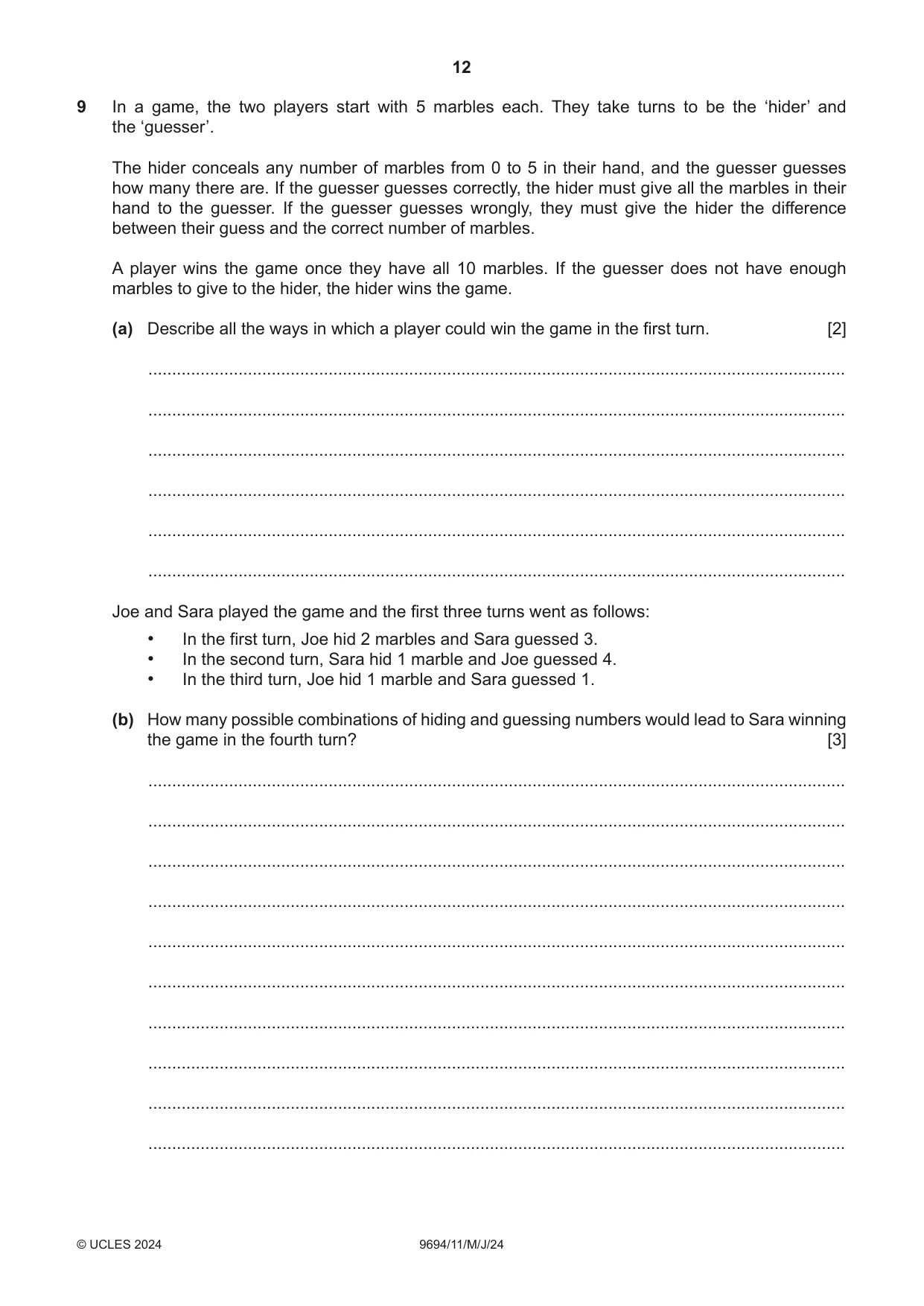
12 9694/11/M/J/24 © UCLES 2024 9 In a game, the two players start with 5 marbles each. They take turns to be the ‘hider’ and the ‘guesser’. The hider conceals any number of marbles from 0 to 5 in their hand, and the guesser guesses how many there are. If the guesser guesses correctly, the hider must give all the marbles in their hand to the guesser. If the guesser guesses wrongly, they must give the hider the difference between their guess and the correct number of marbles. A player wins the game once they have all 10 marbles. If the guesser does not have enough marbles to give to the hider, the hider wins the game. (a) Describe all the ways in which a player could win the game in the first turn. [2] … … … … … … Joe and Sara played the game and the first three turns went as follows: • In the first turn, Joe hid 2 marbles and Sara guessed 3. • In the second turn, Sara hid 1 marble and Joe guessed 4. • In the third turn, Joe hid 1 marble and Sara guessed 1. (b) How many possible combinations of hiding and guessing numbers would lead to Sara winning the game in the fourth turn? [3] … … … … … … … … … …
Question paper, page 13
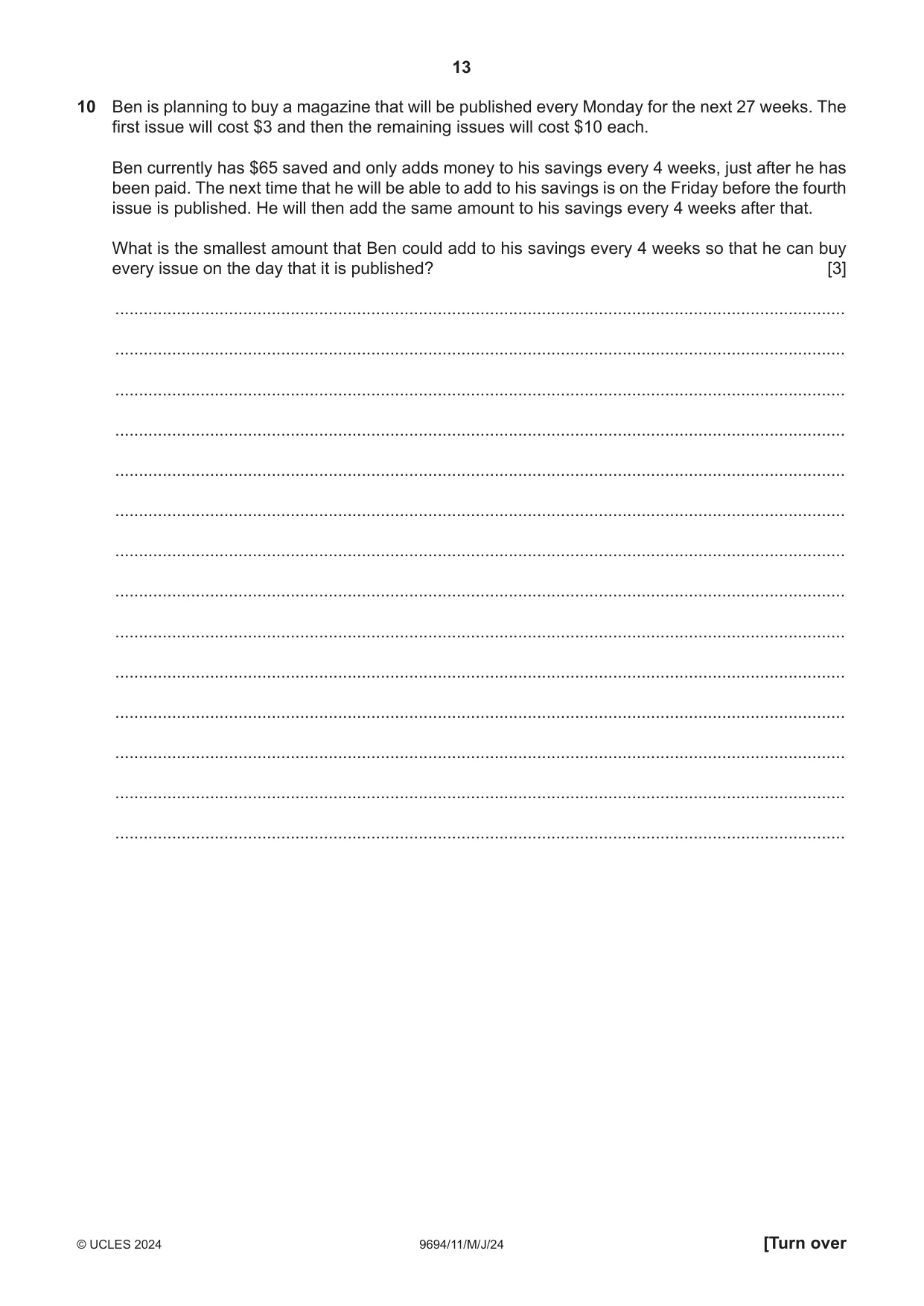
13 9694/11/M/J/24 © UCLES 2024 [Turn over 10 Ben is planning to buy a magazine that will be published every Monday for the next 27 weeks. The first issue will cost $3 and then the remaining issues will cost $10 each. Ben currently has $65 saved and only adds money to his savings every 4 weeks, just after he has been paid. The next time that he will be able to add to his savings is on the Friday before the fourth issue is published. He will then add the same amount to his savings every 4 weeks after that. What is the smallest amount that Ben could add to his savings every 4 weeks so that he can buy every issue on the day that it is published? [3] … … … … … … … … … … … … … …
Question paper, page 14
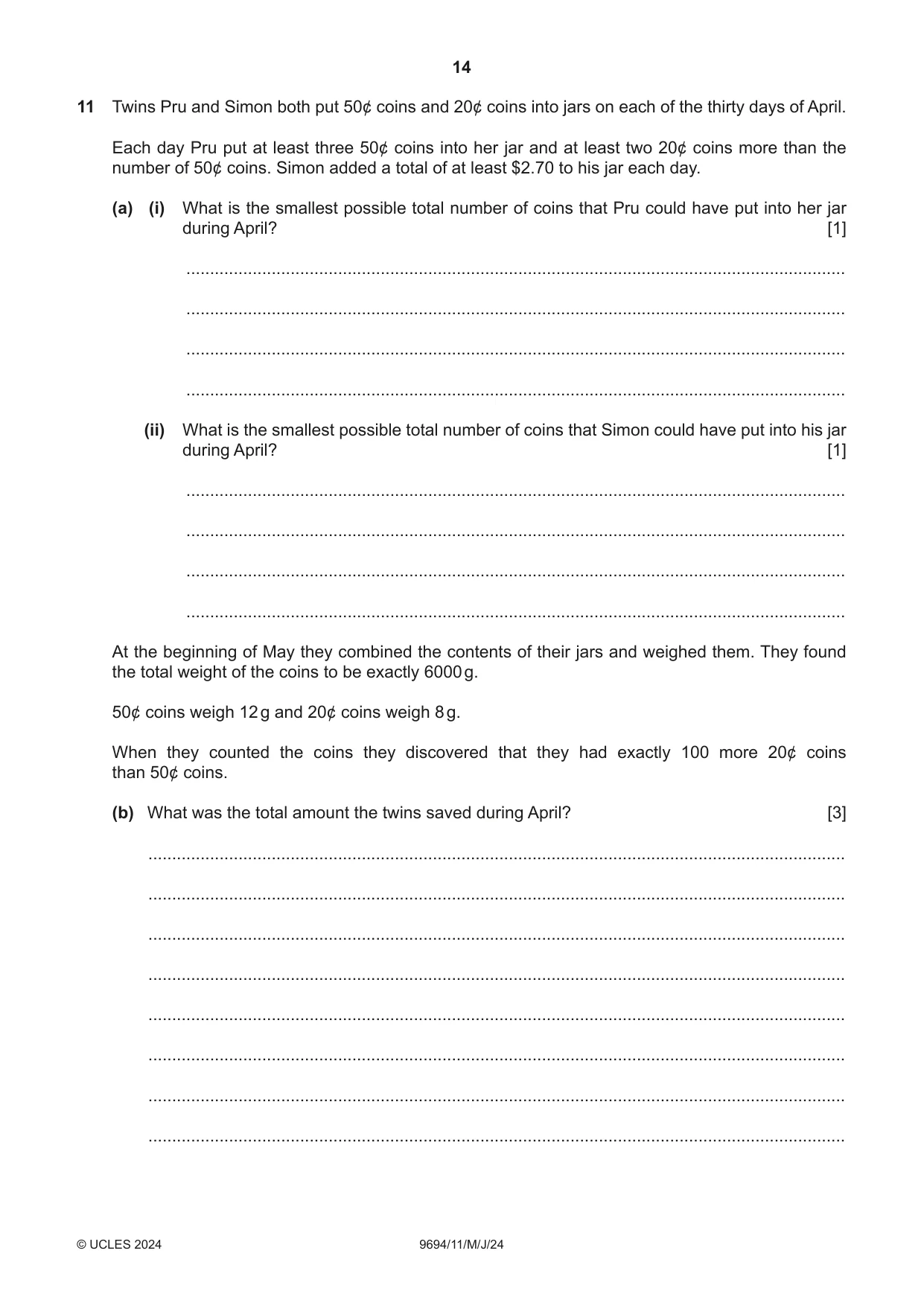
14 9694/11/M/J/24 © UCLES 2024 11 Twins Pru and Simon both put 50¢ coins and 20¢ coins into jars on each of the thirty days of April. Each day Pru put at least three 50¢ coins into her jar and at least two 20¢ coins more than the number of 50¢ coins. Simon added a total of at least $2.70 to his jar each day. (a) (i) What is the smallest possible total number of coins that Pru could have put into her jar during April? [1] … … … … (ii) What is the smallest possible total number of coins that Simon could have put into his jar during April? [1] … … … … At the beginning of May they combined the contents of their jars and weighed them. They found the total weight of the coins to be exactly 6000 g. 50¢ coins weigh 12 g and 20¢ coins weigh 8 g. When they counted the coins they discovered that they had exactly 100 more 20¢ coins than 50¢ coins. (b) What was the total amount the twins saved during April? [3] … … … … … … … …
Question paper, page 15
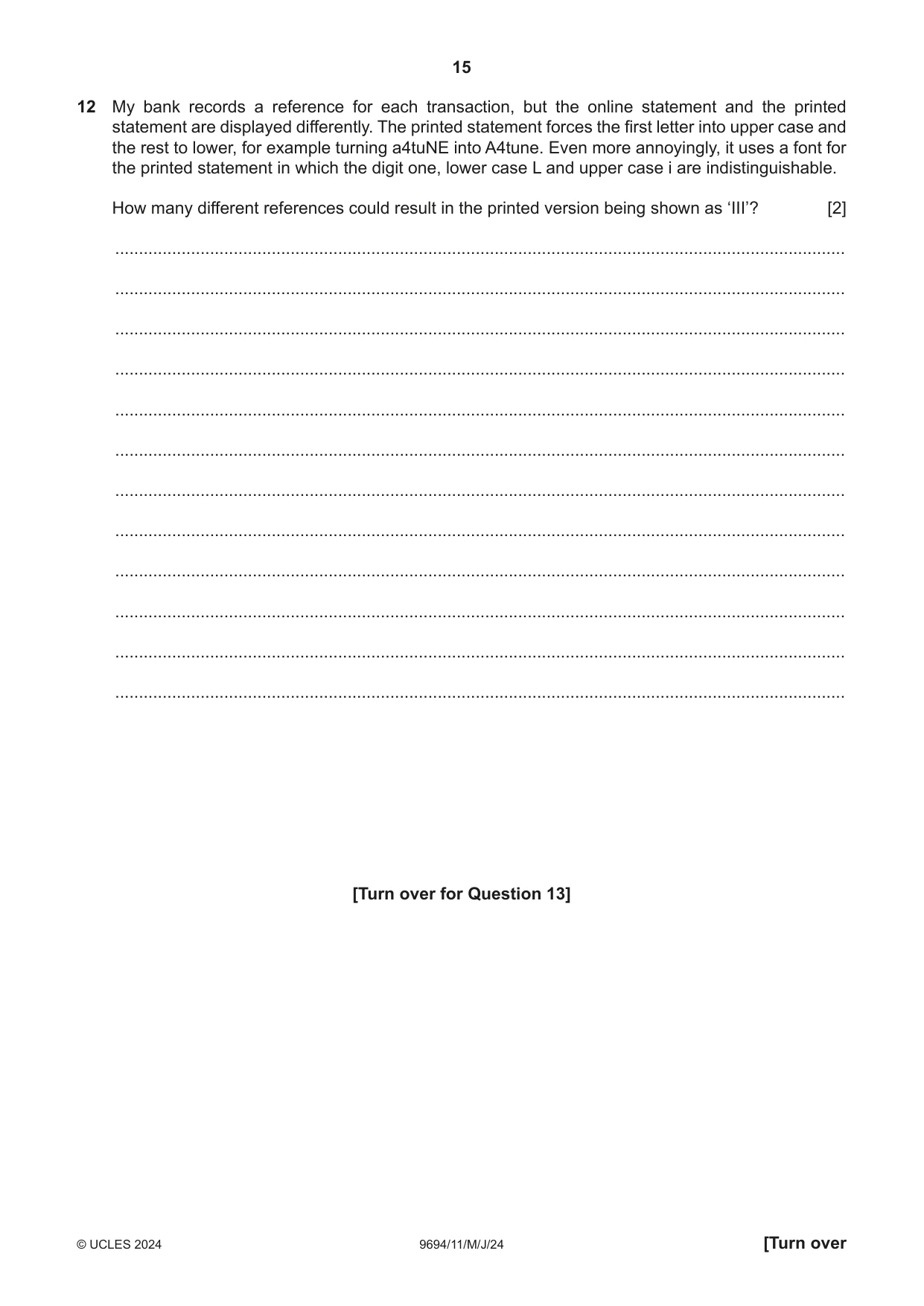
15 9694/11/M/J/24 © UCLES 2024 [Turn over 12 My bank records a reference for each transaction, but the online statement and the printed statement are displayed differently. The printed statement forces the first letter into upper case and the rest to lower, for example turning a4tuNE into A4tune. Even more annoyingly, it uses a font for the printed statement in which the digit one, lower case L and upper case i are indistinguishable. How many different references could result in the printed version being shown as ‘III’? [2] … … … … … … … … … … … … [Turn over for Question 13]
Question paper, page 16
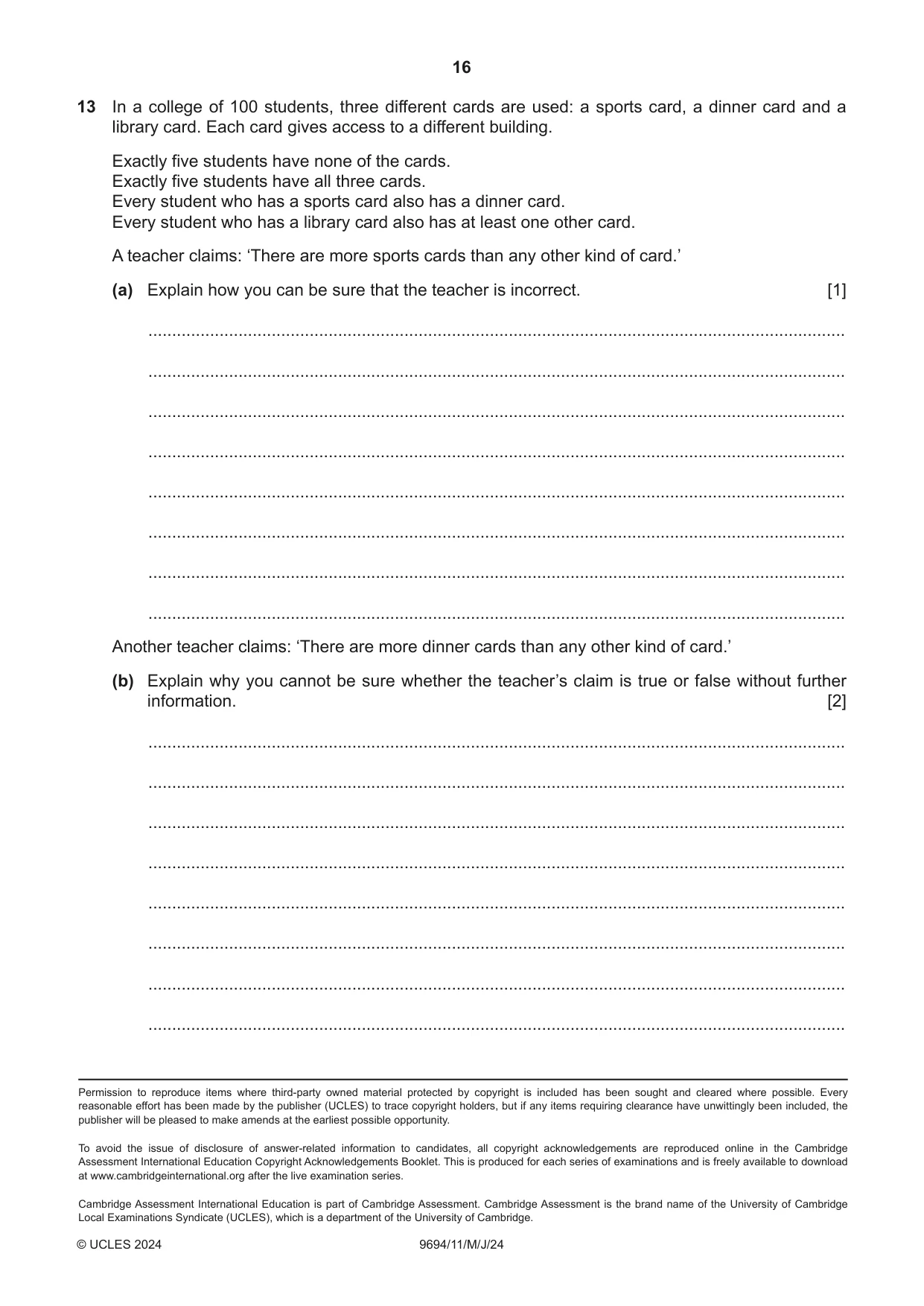
16 9694/11/M/J/24 © UCLES 2024 13 In a college of 100 students, three different cards are used: a sports card, a dinner card and a library card. Each card gives access to a different building. Exactly five students have none of the cards. Exactly five students have all three cards. Every student who has a sports card also has a dinner card. Every student who has a library card also has at least one other card. A teacher claims: ‘There are more sports cards than any other kind of card.’ (a) Explain how you can be sure that the teacher is incorrect. [1] … … … … … … … … Another teacher claims: ‘There are more dinner cards than any other kind of card.’ (b) Explain why you cannot be sure whether the teacher’s claim is true or false without further information. [2] … … … … … … … … Permission to reproduce items where third-party owned material protected by copyright is included has been sought and cleared where possible. Every reasonable effort has been made by the publisher (UCLES) to trace copyright holders, but if any items requiring clearance have unwittingly been included, the publisher will be pleased to make amends at the earliest possible opportunity. To avoid the issue of disclosure of answer-related information to candidates, all copyright acknowledgements are reproduced online in the Cambridge Assessment International Education Copyright Acknowledgements Booklet. This is produced for each series of examinations and is freely available to download at www.cambridgeinternational.org after the live examination series. Cambridge Assessment International Education is part of Cambridge Assessment. Cambridge Assessment is the brand name of the University of Cambridge Local Examinations Syndicate (UCLES), which is a department of the University of Cambridge.
Mark scheme, page 1
This document consists of 9 printed pages. © Cambridge University Press & Assessment 2024 [Turn over Cambridge International AS & A Level THINKING SKILLS 9694/11 Paper 1 Problem Solving May/June 2024 MARK SCHEME Maximum Mark: 50 Published This mark scheme is published as an aid to teachers and candidates, to indicate the requirements of the examination. It shows the basis on which Examiners were instructed to award marks. It does not indicate the details of the discussions that took place at an Examiners’ meeting before marking began, which would have considered the acceptability of alternative answers. Mark schemes should be read in conjunction with the question paper and the Principal Examiner Report for Teachers. Cambridge International will not enter into discussions about these mark schemes. Cambridge International is publishing the mark schemes for the May/June 2024 series for most Cambridge IGCSE, Cambridge International A and AS Level and Cambridge Pre-U components, and some Cambridge O Level components.
Mark scheme, page 2
9694/11 Cambridge International AS & A Level – Mark Scheme PUBLISHED May/June 2024 © Cambridge University Press & Assessment 2024 Page 2 of 9 Generic Marking Principles These general marking principles must be applied by all examiners when marking candidate answers. They should be applied alongside the specific content of the mark scheme or generic level descriptions for a question. Each question paper and mark scheme will also comply with these marking principles. GENERIC MARKING PRINCIPLE 1: Marks must be awarded in line with: the specific content of the mark scheme or the generic level descriptors for the question the specific skills defined in the mark scheme or in the generic level descriptors for the question the standard of response required by a candidate as exemplified by the standardisation scripts. GENERIC MARKING PRINCIPLE 2: Marks awarded are always whole marks (not half marks, or other fractions). GENERIC MARKING PRINCIPLE 3: Marks must be awarded positively: marks are awarded for correct/valid answers, as defined in the mark scheme. However, credit is given for valid answers which go beyond the scope of the syllabus and mark scheme, referring to your Team Leader as appropriate marks are awarded when candidates clearly demonstrate what they know and can do marks are not deducted for errors marks are not deducted for omissions answers should only be judged on the quality of spelling, punctuation and grammar when these features are specifically assessed by the question as indicated by the mark scheme. The meaning, however, should be unambiguous. GENERIC MARKING PRINCIPLE 4: Rules must be applied consistently, e.g. in situations where candidates have not followed instructions or in the application of generic level descriptors. GENERIC MARKING PRINCIPLE 5: Marks should be awarded using the full range of marks defined in the mark scheme for the question (however; the use of the full mark range may be limited according to the quality of the candidate responses seen). GENERIC MARKING PRINCIPLE 6: Marks awarded are based solely on the requirements as defined in the mark scheme. Marks should not be awarded with grade thresholds or grade descriptors in mind.
Mark scheme, page 3
9694/11 Cambridge International AS & A Level – Mark Scheme PUBLISHED May/June 2024 © Cambridge University Press & Assessment 2024 Page 3 of 9 NOTES FOR MARKERS Working Where a final answer is underlined in the mark scheme, full marks are awarded for a correct answer, regardless of whether there is any supporting working, unless an exception is noted in the mark scheme. For partial credit, the evidence needed to award the mark will usually be shown on its own line in the mark scheme, or else will be defined in italic text. For explanations and verbal justifications, apply the principle of ‘words to that effect’. Units Unless required by the question or mark scheme, units such as $ do not need to be seen to award the marks. No response If there is any attempt at a solution award 0 marks not NR. ‘–’ or ‘?’ constitute no attempt at a solution. Abbreviations The following abbreviations may be used in a mark scheme: AG answer given (on question paper) awrt answer which rounds to dep mark depends on earlier, asterisked (*), mark ft follow through (from earlier error) oe or equivalent SC special case soi seen or implied
Mark scheme, page 4
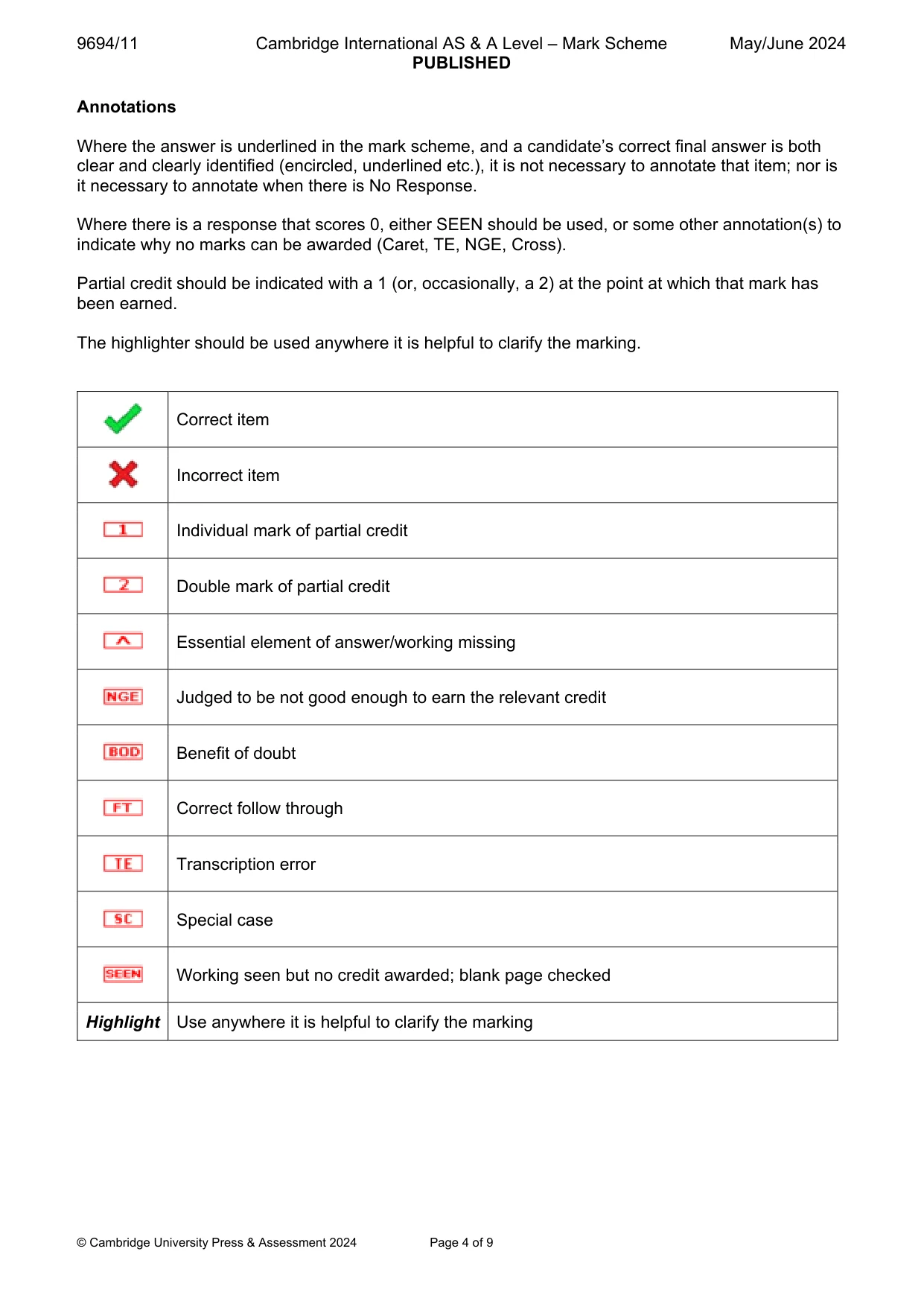
9694/11 Cambridge International AS & A Level – Mark Scheme PUBLISHED May/June 2024 © Cambridge University Press & Assessment 2024 Page 4 of 9 Annotations Where the answer is underlined in the mark scheme, and a candidate’s correct final answer is both clear and clearly identified (encircled, underlined etc.), it is not necessary to annotate that item; nor is it necessary to annotate when there is No Response. Where there is a response that scores 0, either SEEN should be used, or some other annotation(s) to indicate why no marks can be awarded (Caret, TE, NGE, Cross). Partial credit should be indicated with a 1 (or, occasionally, a 2) at the point at which that mark has been earned. The highlighter should be used anywhere it is helpful to clarify the marking. Correct item Incorrect item Individual mark of partial credit Double mark of partial credit Essential element of answer/working missing Judged to be not good enough to earn the relevant credit Benefit of doubt Correct follow through Transcription error Special case Working seen but no credit awarded; blank page checked Highlight Use anywhere it is helpful to clarify the marking
Mark scheme, page 5
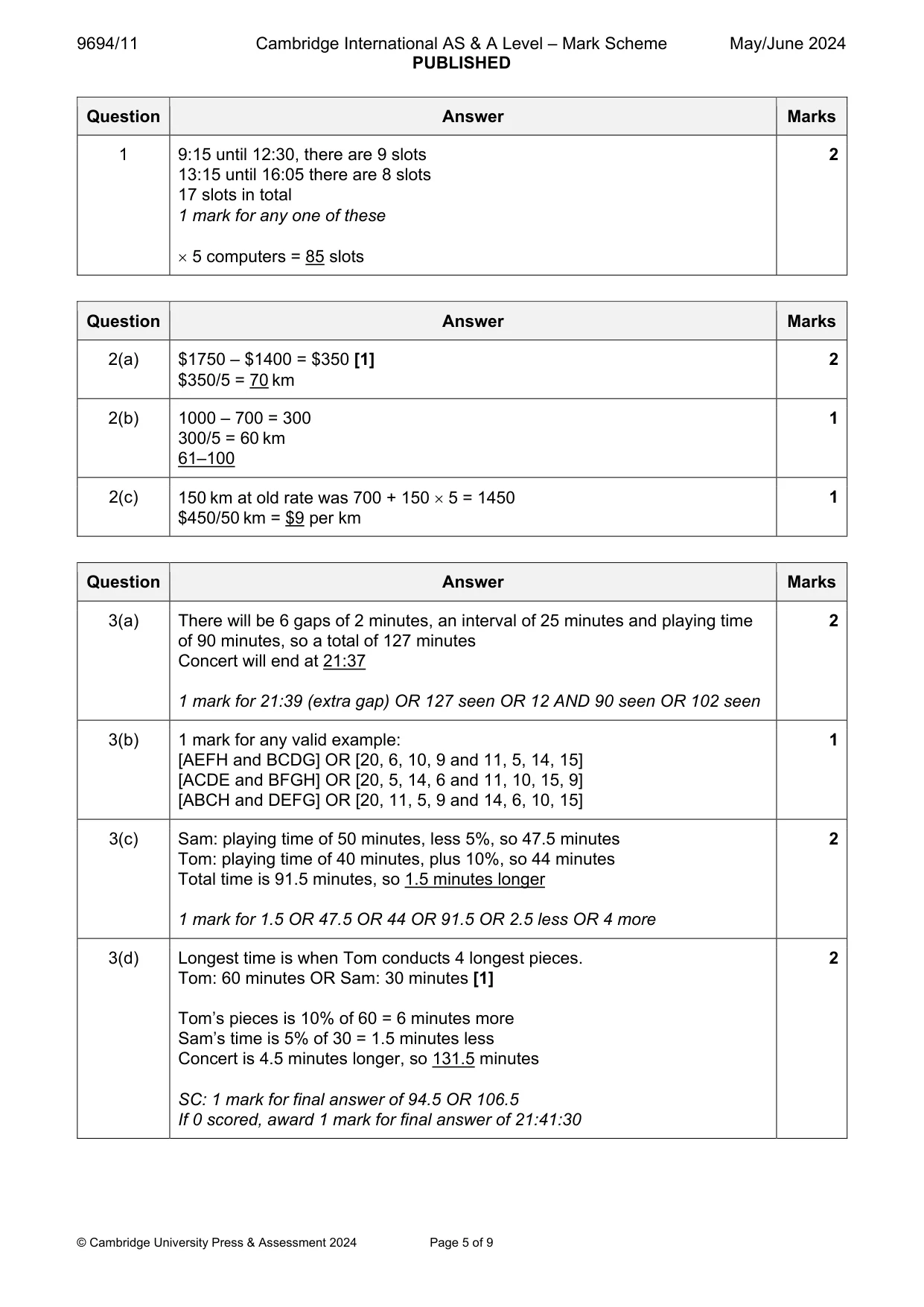
9694/11 Cambridge International AS & A Level – Mark Scheme PUBLISHED May/June 2024 © Cambridge University Press & Assessment 2024 Page 5 of 9 Question Answer Marks 1 9:15 until 12:30, there are 9 slots 13:15 until 16:05 there are 8 slots 17 slots in total 1 mark for any one of these 5 computers = 85 slots 2 Question Answer Marks 2(a) $1750 – $1400 = $350 [1] $350/5 = 70 km 2 2(b) 1000 – 700 = 300 300/5 = 60 km 61–100 1 2(c) 150 km at old rate was 700 + 150 5 = 1450 $450/50 km = $9 per km 1 Question Answer Marks 3(a) There will be 6 gaps of 2 minutes, an interval of 25 minutes and playing time of 90 minutes, so a total of 127 minutes Concert will end at 21:37 1 mark for 21:39 (extra gap) OR 127 seen OR 12 AND 90 seen OR 102 seen 2 3(b) 1 mark for any valid example: [AEFH and BCDG] OR [20, 6, 10, 9 and 11, 5, 14, 15] [ACDE and BFGH] OR [20, 5, 14, 6 and 11, 10, 15, 9] [ABCH and DEFG] OR [20, 11, 5, 9 and 14, 6, 10, 15] 1 3(c) Sam: playing time of 50 minutes, less 5%, so 47.5 minutes Tom: playing time of 40 minutes, plus 10%, so 44 minutes Total time is 91.5 minutes, so 1.5 minutes longer 1 mark for 1.5 OR 47.5 OR 44 OR 91.5 OR 2.5 less OR 4 more 2 3(d) Longest time is when Tom conducts 4 longest pieces. Tom: 60 minutes OR Sam: 30 minutes [1] Tom’s pieces is 10% of 60 = 6 minutes more Sam’s time is 5% of 30 = 1.5 minutes less Concert is 4.5 minutes longer, so 131.5 minutes SC: 1 mark for final answer of 94.5 OR 106.5 If 0 scored, award 1 mark for final answer of 21:41:30 2
Mark scheme, page 6
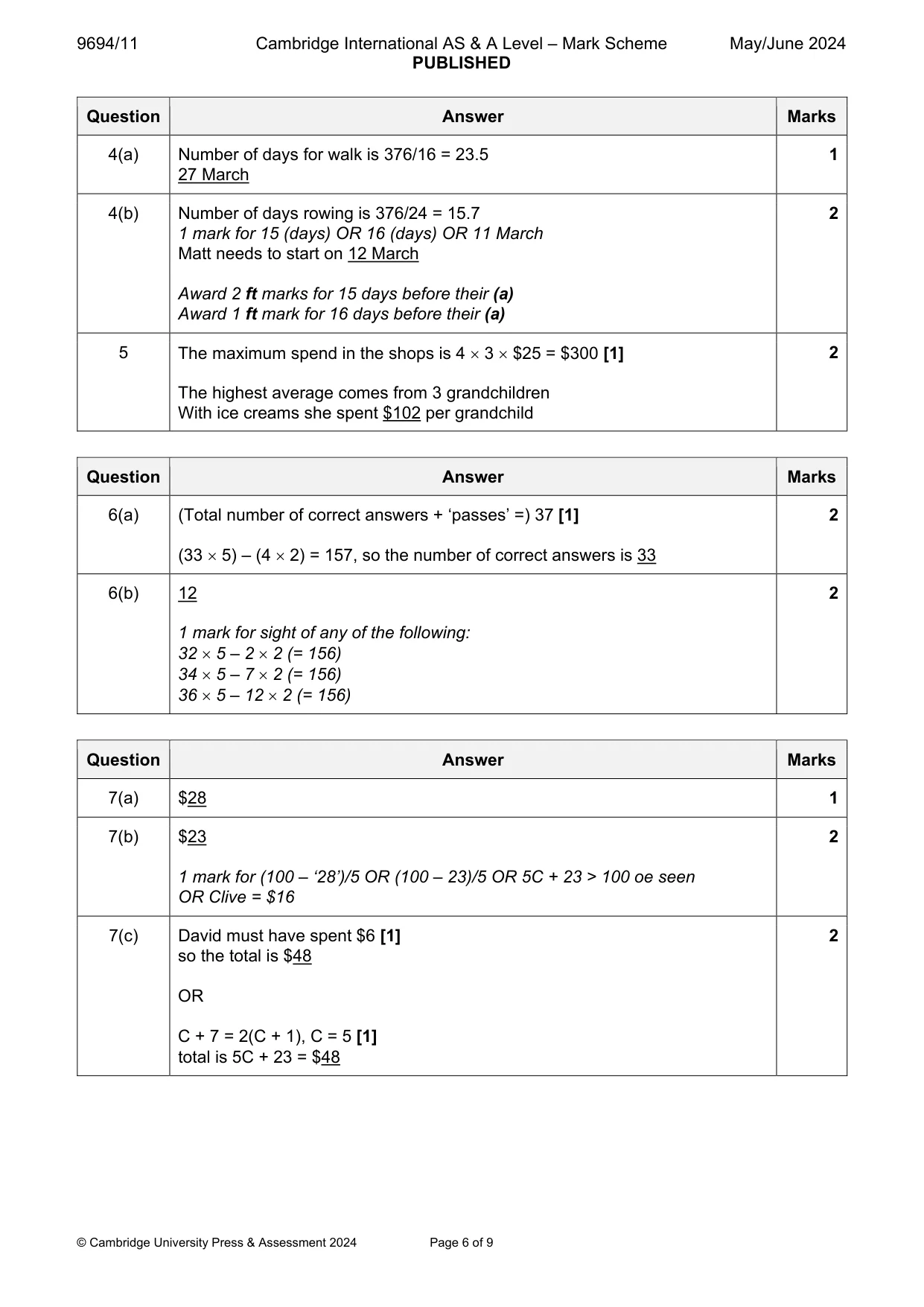
9694/11 Cambridge International AS & A Level – Mark Scheme PUBLISHED May/June 2024 © Cambridge University Press & Assessment 2024 Page 6 of 9 Question Answer Marks 4(a) Number of days for walk is 376/16 = 23.5 27 March 1 4(b) Number of days rowing is 376/24 = 15.7 1 mark for 15 (days) OR 16 (days) OR 11 March Matt needs to start on 12 March Award 2 ft marks for 15 days before their (a) Award 1 ft mark for 16 days before their (a) 2 5 The maximum spend in the shops is 4 3 $25 = $300 [1] The highest average comes from 3 grandchildren With ice creams she spent $102 per grandchild 2 Question Answer Marks 6(a) (Total number of correct answers + ‘passes’ =) 37 [1] (33 5) – (4 2) = 157, so the number of correct answers is 33 2 6(b) 12 1 mark for sight of any of the following: 32 5 – 2 2 (= 156) 34 5 – 7 2 (= 156) 36 5 – 12 2 (= 156) 2 Question Answer Marks 7(a) $28 1 7(b) $23 1 mark for (100 – ‘28’)/5 OR (100 – 23)/5 OR 5C + 23 > 100 oe seen OR Clive = $16 2 7(c) David must have spent $6 [1] so the total is $48 OR C + 7 = 2(C + 1), C = 5 [1] total is 5C + 23 = $48 2
Mark scheme, page 7
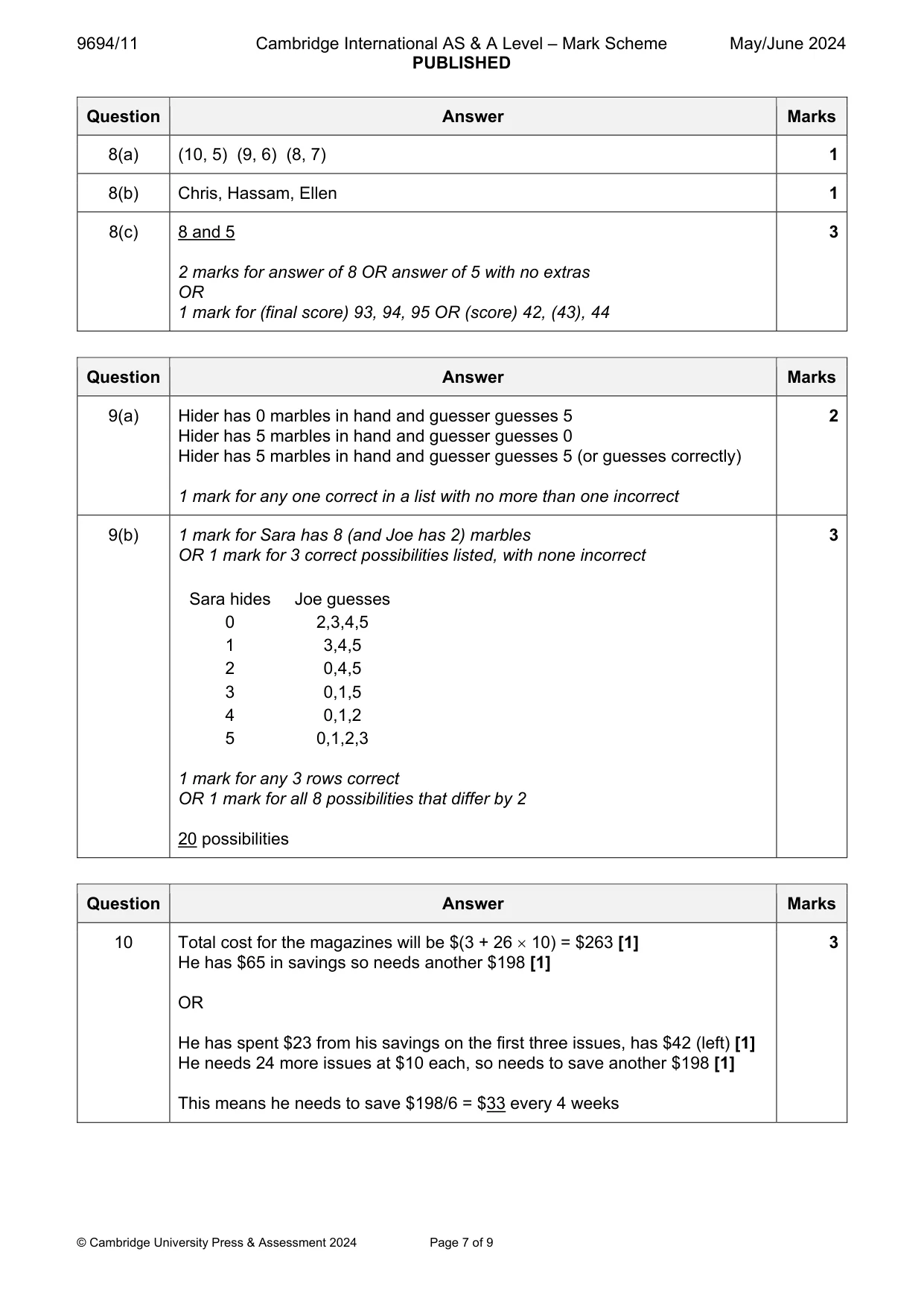
9694/11 Cambridge International AS & A Level – Mark Scheme PUBLISHED May/June 2024 © Cambridge University Press & Assessment 2024 Page 7 of 9 Question Answer Marks 8(a) (10, 5) (9, 6) (8, 7) 1 8(b) Chris, Hassam, Ellen 1 8(c) 8 and 5 2 marks for answer of 8 OR answer of 5 with no extras OR 1 mark for (final score) 93, 94, 95 OR (score) 42, (43), 44 3 Question Answer Marks 9(a) Hider has 0 marbles in hand and guesser guesses 5 Hider has 5 marbles in hand and guesser guesses 0 Hider has 5 marbles in hand and guesser guesses 5 (or guesses correctly) 1 mark for any one correct in a list with no more than one incorrect 2 9(b) 1 mark for Sara has 8 (and Joe has 2) marbles OR 1 mark for 3 correct possibilities listed, with none incorrect Sara hides Joe guesses 0 2,3,4,5 1 3,4,5 2 0,4,5 3 0,1,5 4 0,1,2 5 0,1,2,3 1 mark for any 3 rows correct OR 1 mark for all 8 possibilities that differ by 2 20 possibilities 3 Question Answer Marks 10 Total cost for the magazines will be $(3 + 26 10) = $263 [1] He has $65 in savings so needs another $198 [1] OR He has spent $23 from his savings on the first three issues, has $42 (left) [1] He needs 24 more issues at $10 each, so needs to save another $198 [1] This means he needs to save $198/6 = $33 every 4 weeks 3
Mark scheme, page 8
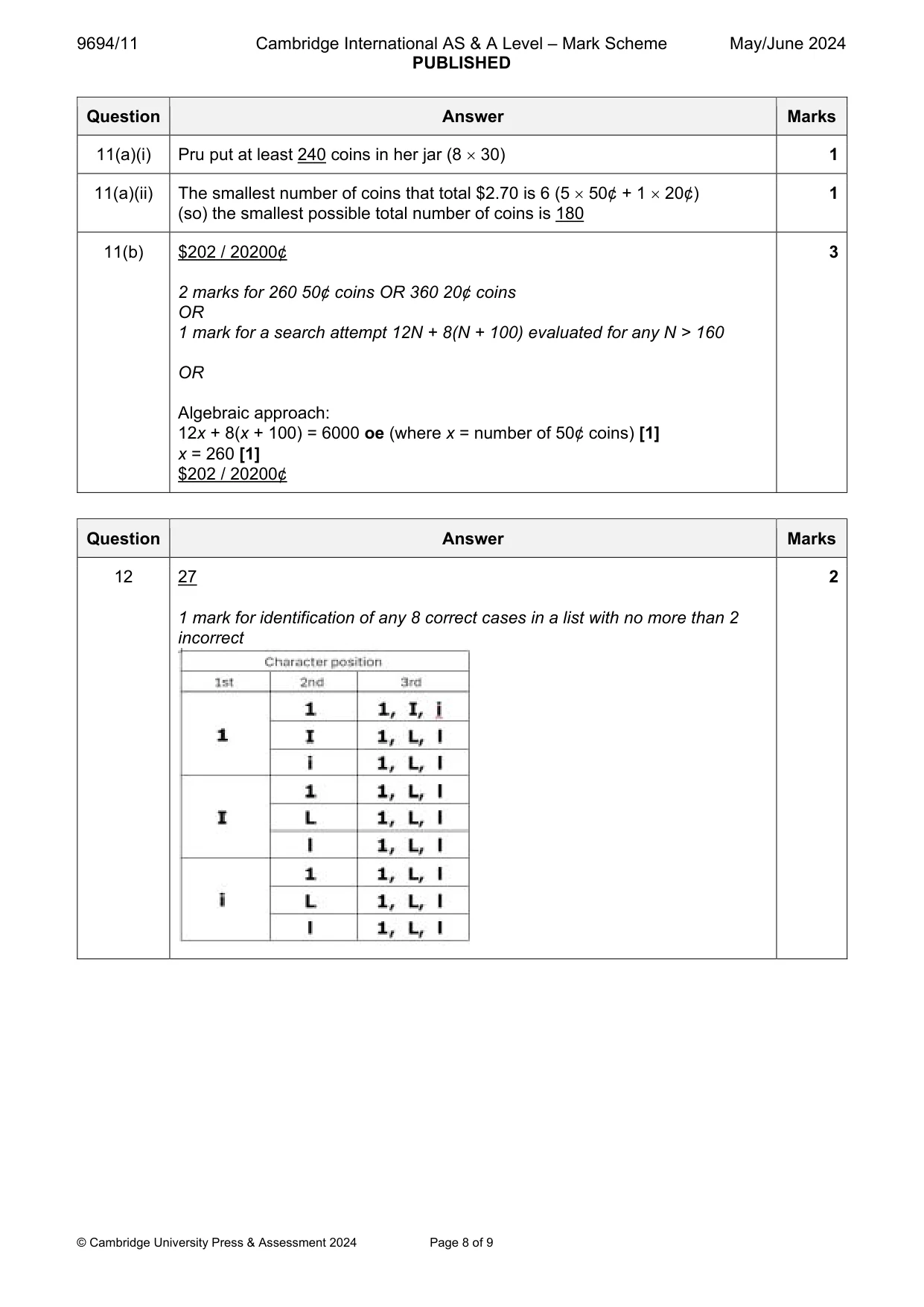
9694/11 Cambridge International AS & A Level – Mark Scheme PUBLISHED May/June 2024 © Cambridge University Press & Assessment 2024 Page 8 of 9 Question Answer Marks 11(a)(i) Pru put at least 240 coins in her jar (8 30) 1 11(a)(ii) The smallest number of coins that total $2.70 is 6 (5 50¢ + 1 20¢) (so) the smallest possible total number of coins is 180 1 11(b) $202 / 20200¢ 2 marks for 260 50¢ coins OR 360 20¢ coins OR 1 mark for a search attempt 12N + 8(N + 100) evaluated for any N > 160 OR Algebraic approach: 12x + 8(x + 100) = 6000 oe (where x = number of 50¢ coins) [1] x = 260 [1] $202 / 20200¢ 3 Question Answer Marks 12 27 1 mark for identification of any 8 correct cases in a list with no more than 2 incorrect 2
Mark scheme, page 9
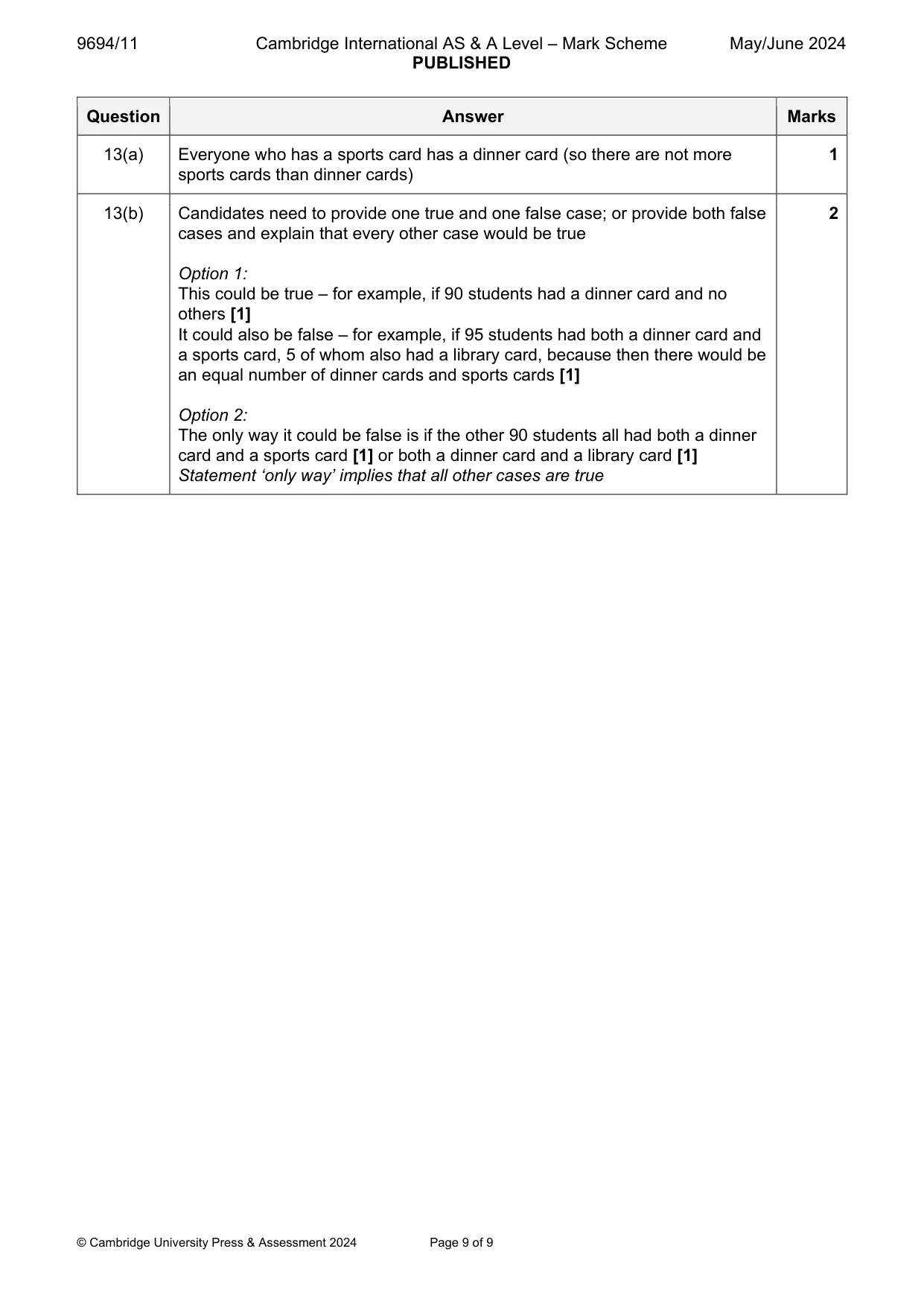
9694/11 Cambridge International AS & A Level – Mark Scheme PUBLISHED May/June 2024 © Cambridge University Press & Assessment 2024 Page 9 of 9 Question Answer Marks 13(a) Everyone who has a sports card has a dinner card (so there are not more sports cards than dinner cards) 1 13(b) Candidates need to provide one true and one false case; or provide both false cases and explain that every other case would be true Option 1: This could be true – for example, if 90 students had a dinner card and no others [1] It could also be false – for example, if 95 students had both a dinner card and a sports card, 5 of whom also had a library card, because then there would be an equal number of dinner cards and sports cards [1] Option 2: The only way it could be false is if the other 90 students all had both a dinner card and a sports card [1] or both a dinner card and a library card [1] Statement ‘only way’ implies that all other cases are true 2
What you needed in this session
Cambridge’s own grade thresholds for 2024 May/June, Paper 1 · Variant 1. A higher threshold means an easier paper — the bar moves with how the cohort did.