Cambridge A Level Thinking Skills 9694 — 2020 Oct/Nov Paper 1 · Variant 3
9694/13/O/N/20 · 50 marks · ≈56 min
The question paper and its mark scheme, free to read here and free to download. This is Cambridge’s own paper, exactly as it was sat.
Question paper16 pages


Mark scheme8 pages
Answers below. Sit the paper first if you are practising.
Paper as text
Question paper, page 1
Cambridge International AS & A Level DC (JC/CT) 188479/1 © UCLES 2020 [Turn over This document has 16 pages. Blank pages are indicated. * 4 7 6 0 1 0 7 0 7 3 * THINKING SKILLS 9694/13 Paper 1 Problem Solving October/November 2020 1 hour 30 minutes You must answer on the question paper. No additional materials are needed. INSTRUCTIONS ● Answer all questions. ● Use a black or dark blue pen. ● Write your name, centre number and candidate number in the boxes at the top of the page. ● Write your answer to each question in the space provided. ● Do not use an erasable pen or correction fluid. ● Do not write on any bar codes. ● You may use a calculator. ● Show your working. Where a final answer is incorrect or missing, you may still be awarded marks for correct steps towards a solution. In most questions, full marks will be awarded for a correct answer without any working. In some questions, however, you will not be awarded full marks if working needed to support an answer is not shown. INFORMATION ● The total mark for this paper is 50. ● The number of marks for each question or part question is shown in brackets [ ].
Question paper, page 2
2 9694/13/O/N/20 © UCLES 2020 1 A local medical centre always reserves a number of appointments on each day for urgent cases. These can only be booked by calling the centre that morning. Each day, one of the doctors who is working all day will have all of their appointments reserved for urgent cases. The other doctors who are working on that day will have one quarter of their appointments reserved for urgent cases. A full day for a doctor has 32 slots for appointments; a half day has 16 slots. On Friday this week 3 doctors will each be working for a full day and 2 doctors will each work for a half day. How many of the appointment slots on Friday will be reserved for urgent cases? [2] … … … … … … … … … … … … … … … … … … … … …
Question paper, page 3
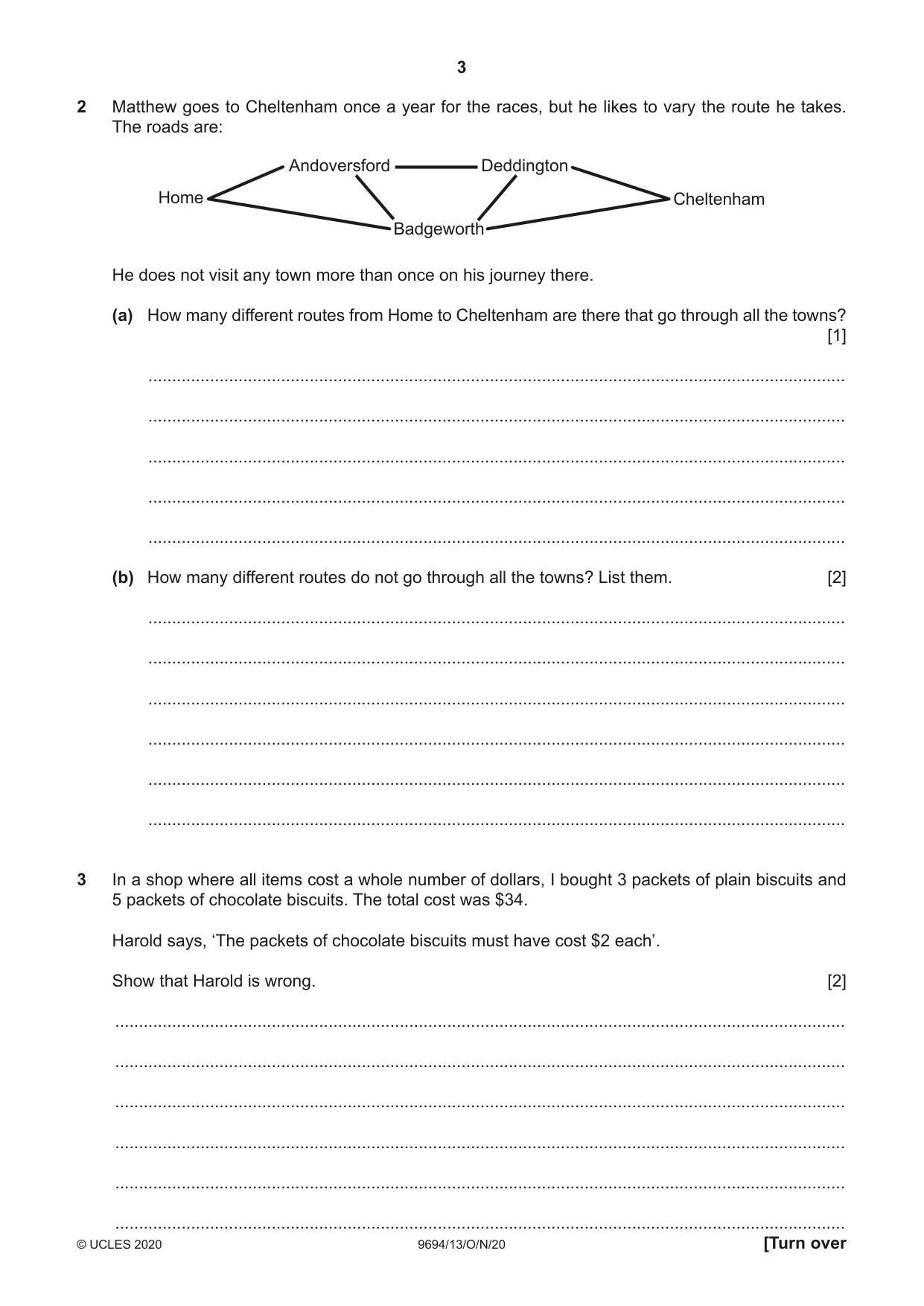
3 9694/13/O/N/20 © UCLES 2020 [Turn over 2 Matthew goes to Cheltenham once a year for the races, but he likes to vary the route he takes. The roads are: Andoversford Badgeworth Deddington Cheltenham Home He does not visit any town more than once on his journey there. (a) How many different routes from Home to Cheltenham are there that go through all the towns? [1] … … … … … (b) How many different routes do not go through all the towns? List them. [2] … … … … … … 3 In a shop where all items cost a whole number of dollars, I bought 3 packets of plain biscuits and 5 packets of chocolate biscuits. The total cost was $34. Harold says, ‘The packets of chocolate biscuits must have cost $2 each’. Show that Harold is wrong. [2] … … … … … …
Question paper, page 4
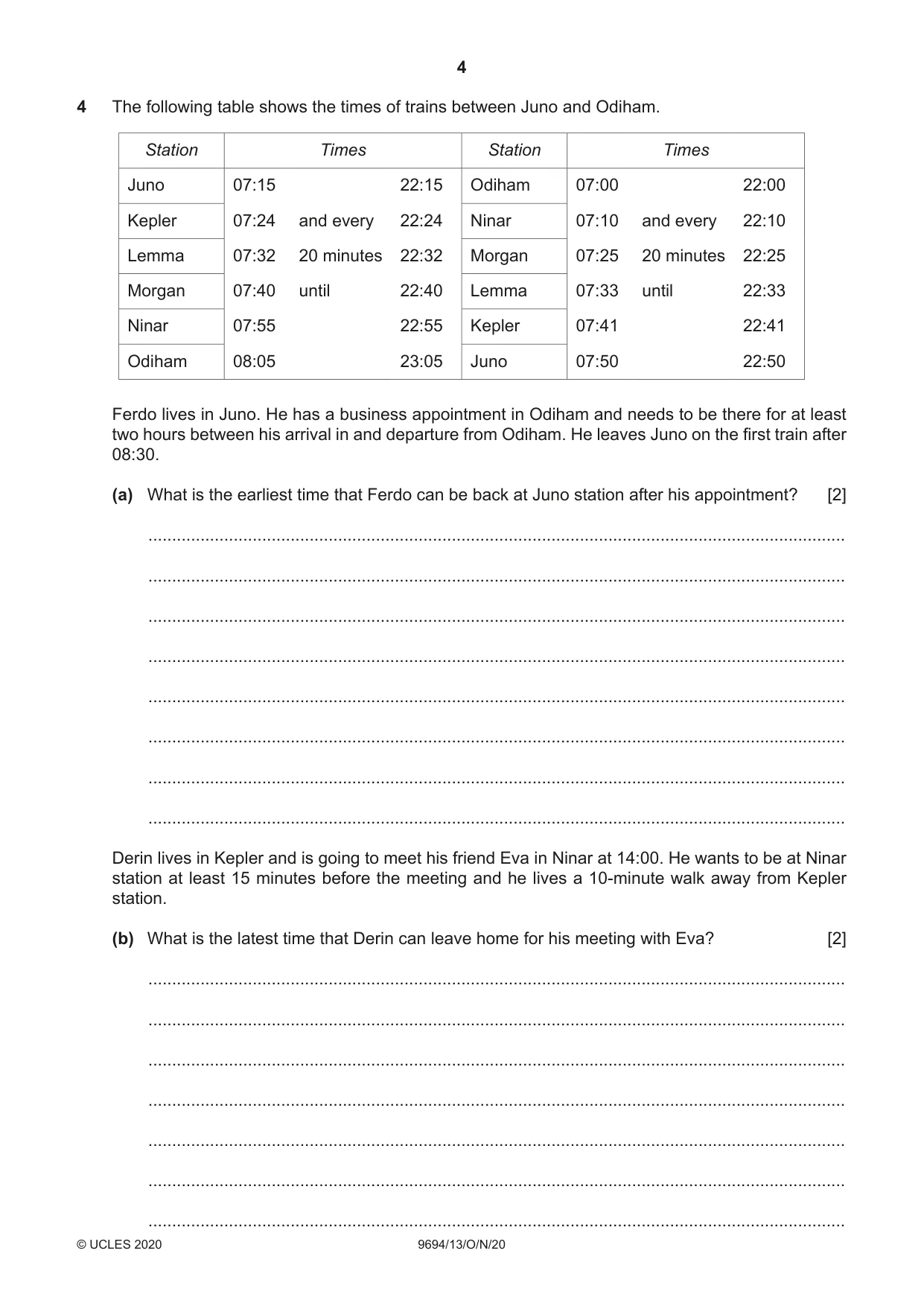
4 9694/13/O/N/20 © UCLES 2020 4 The following table shows the times of trains between Juno and Odiham. Station Times Station Times Juno 07:15 22:15 Odiham 07:00 22:00 Kepler 07:24 and every 22:24 Ninar 07:10 and every 22:10 Lemma 07:32 20 minutes 22:32 Morgan 07:25 20 minutes 22:25 Morgan 07:40 until 22:40 Lemma 07:33 until 22:33 Ninar 07:55 22:55 Kepler 07:41 22:41 Odiham 08:05 23:05 Juno 07:50 22:50 Ferdo lives in Juno. He has a business appointment in Odiham and needs to be there for at least two hours between his arrival in and departure from Odiham. He leaves Juno on the first train after 08:30. (a) What is the earliest time that Ferdo can be back at Juno station after his appointment? [2] … … … … … … … … Derin lives in Kepler and is going to meet his friend Eva in Ninar at 14:00. He wants to be at Ninar station at least 15 minutes before the meeting and he lives a 10-minute walk away from Kepler station. (b) What is the latest time that Derin can leave home for his meeting with Eva? [2] … … … … … … …
Question paper, page 5
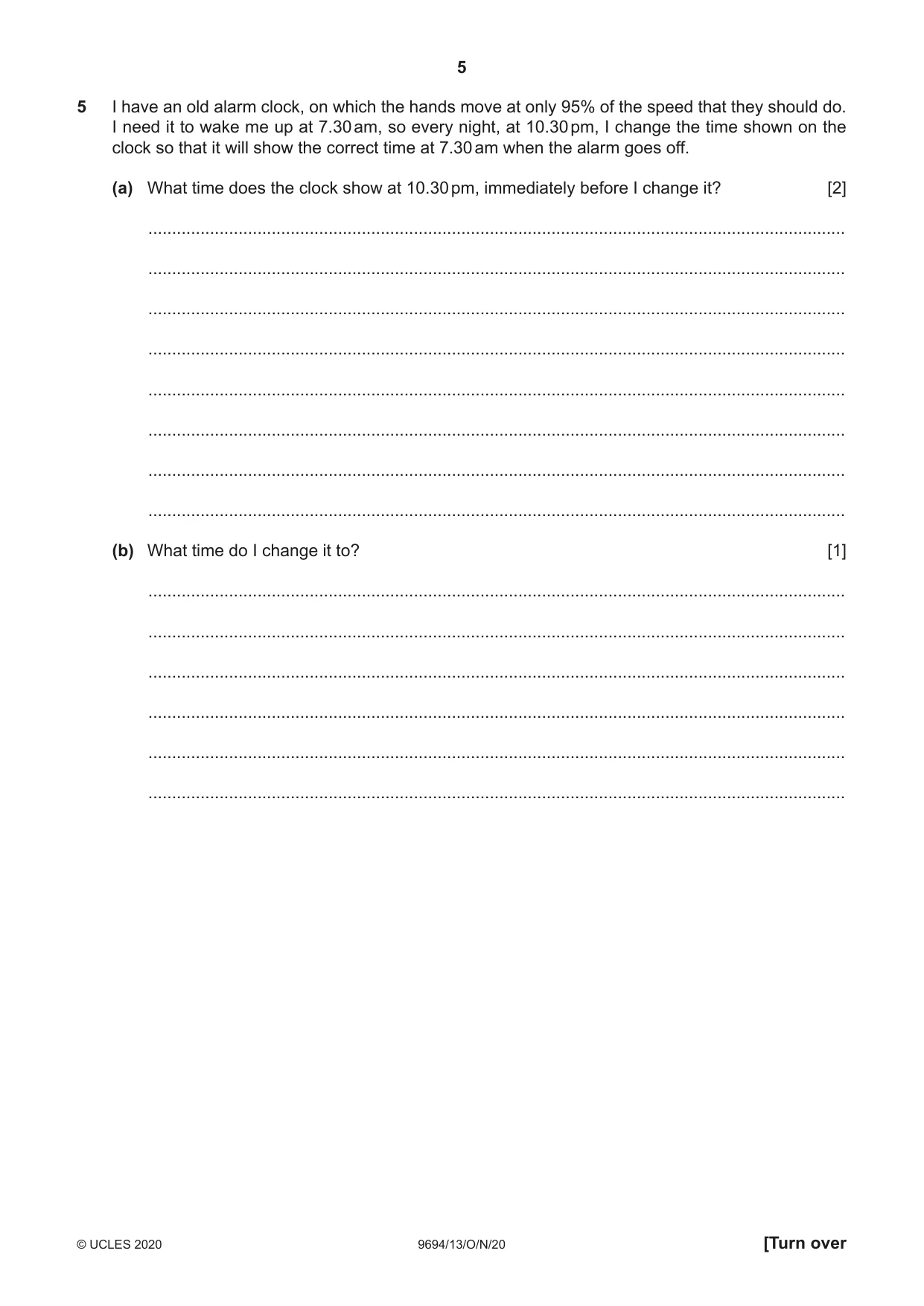
5 9694/13/O/N/20 © UCLES 2020 [Turn over 5 I have an old alarm clock, on which the hands move at only 95% of the speed that they should do. I need it to wake me up at 7.30 am, so every night, at 10.30 pm, I change the time shown on the clock so that it will show the correct time at 7.30 am when the alarm goes off. (a) What time does the clock show at 10.30 pm, immediately before I change it? [2] … … … … … … … … (b) What time do I change it to? [1] … … … … … …
Question paper, page 6
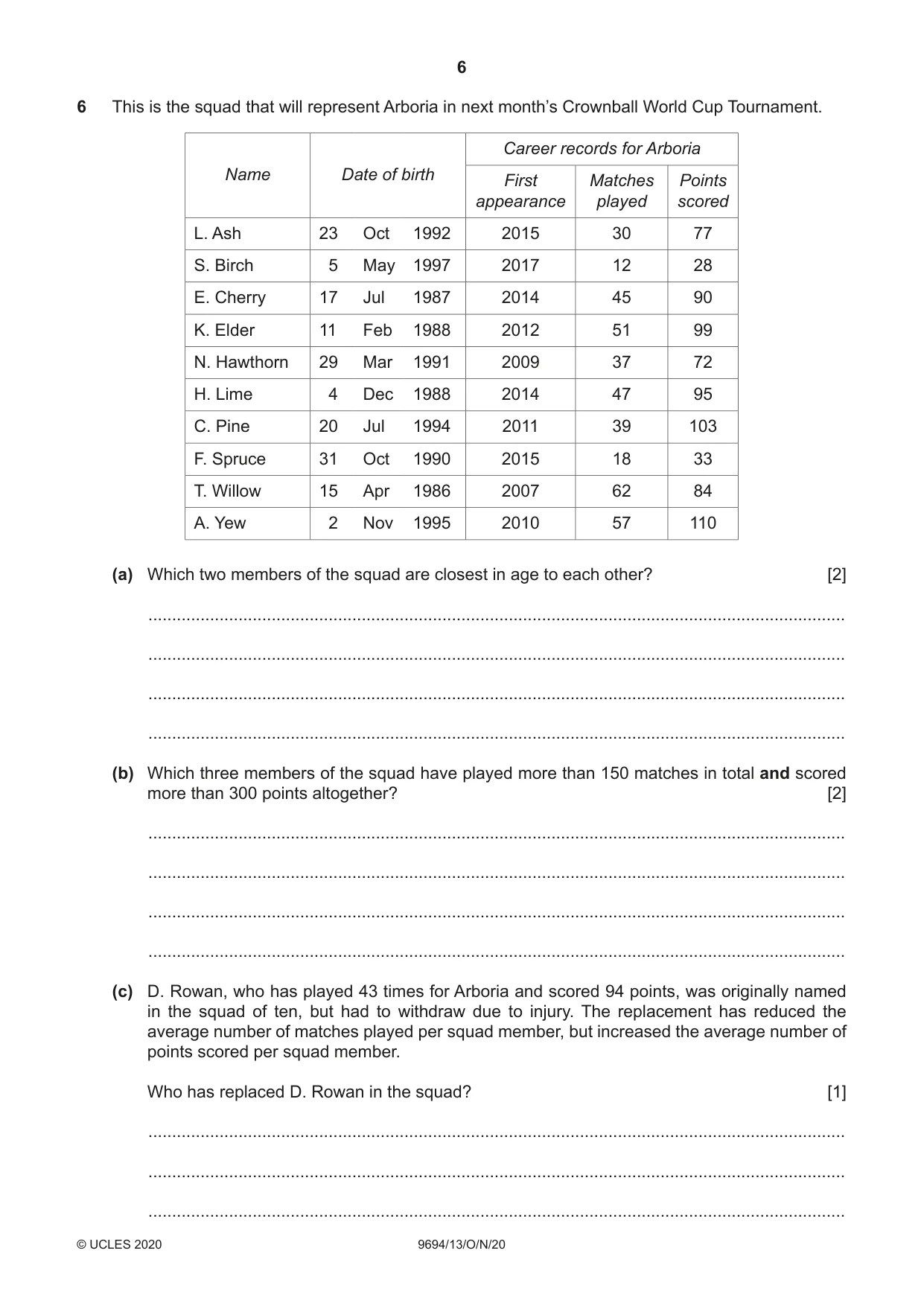
6 9694/13/O/N/20 © UCLES 2020 6 This is the squad that will represent Arboria in next month’s Crownball World Cup Tournament. Name Date of birth Career records for Arboria First appearance Matches played Points scored L. Ash 23 Oct 1992 2015 30 77 S. Birch 5 May 1997 2017 12 28 E. Cherry 17 Jul 1987 2014 45 90 K. Elder 11 Feb 1988 2012 51 99 N. Hawthorn 29 Mar 1991 2009 37 72 H. Lime 4 Dec 1988 2014 47 95 C. Pine 20 Jul 1994 2011 39 103 F. Spruce 31 Oct 1990 2015 18 33 T. Willow 15 Apr 1986 2007 62 84 A. Yew 2 Nov 1995 2010 57 110 (a) Which two members of the squad are closest in age to each other? [2] … … … … (b) Which three members of the squad have played more than 150 matches in total and scored more than 300 points altogether? [2] … … … … (c) D. Rowan, who has played 43 times for Arboria and scored 94 points, was originally named in the squad of ten, but had to withdraw due to injury. The replacement has reduced the average number of matches played per squad member, but increased the average number of points scored per squad member. Who has replaced D. Rowan in the squad? [1] … … …
Question paper, page 7
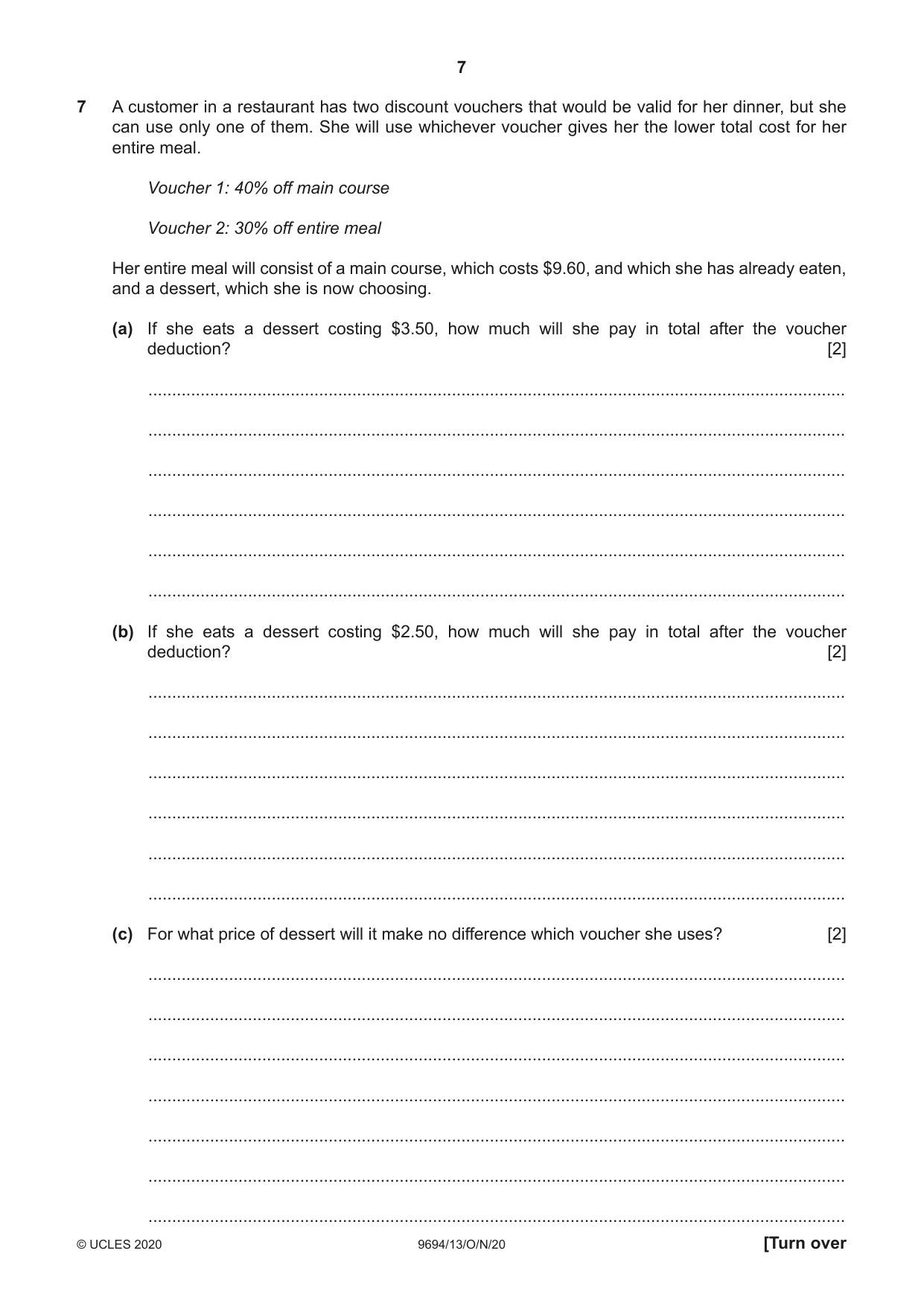
7 9694/13/O/N/20 © UCLES 2020 [Turn over 7 A customer in a restaurant has two discount vouchers that would be valid for her dinner, but she can use only one of them. She will use whichever voucher gives her the lower total cost for her entire meal. Voucher 1: 40% off main course Voucher 2: 30% off entire meal Her entire meal will consist of a main course, which costs $9.60, and which she has already eaten, and a dessert, which she is now choosing. (a) If she eats a dessert costing $3.50, how much will she pay in total after the voucher deduction? [2] … … … … … … (b) If she eats a dessert costing $2.50, how much will she pay in total after the voucher deduction? [2] … … … … … … (c) For what price of dessert will it make no difference which voucher she uses? [2] … … … … … … …
Question paper, page 8
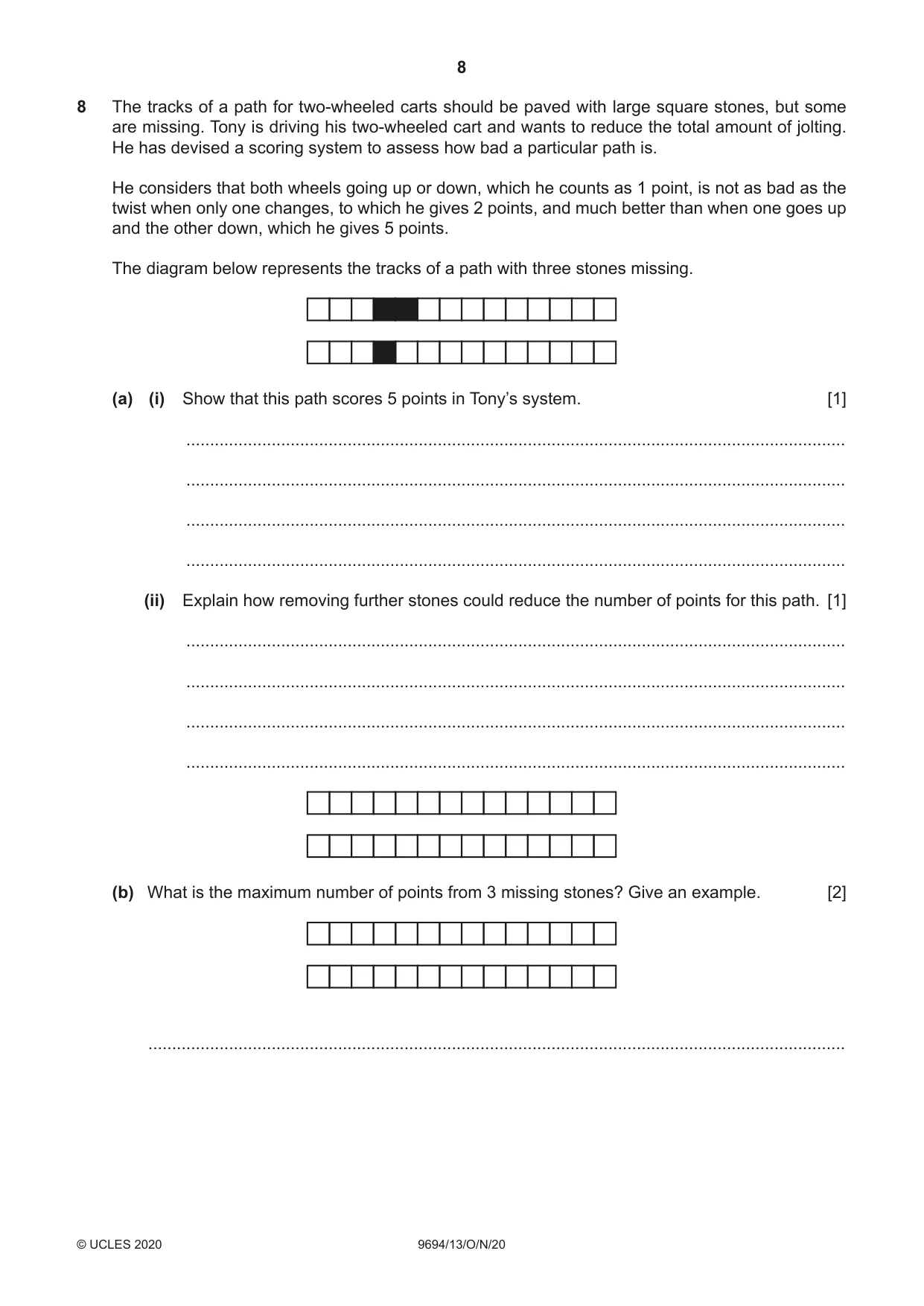
8 9694/13/O/N/20 © UCLES 2020 8 The tracks of a path for two-wheeled carts should be paved with large square stones, but some are missing. Tony is driving his two-wheeled cart and wants to reduce the total amount of jolting. He has devised a scoring system to assess how bad a particular path is. He considers that both wheels going up or down, which he counts as 1 point, is not as bad as the twist when only one changes, to which he gives 2 points, and much better than when one goes up and the other down, which he gives 5 points. The diagram below represents the tracks of a path with three stones missing. (a) (i) Show that this path scores 5 points in Tony’s system. [1] … … … … (ii) Explain how removing further stones could reduce the number of points for this path. [1] … … … … (b) What is the maximum number of points from 3 missing stones? Give an example. [2] …
Question paper, page 9
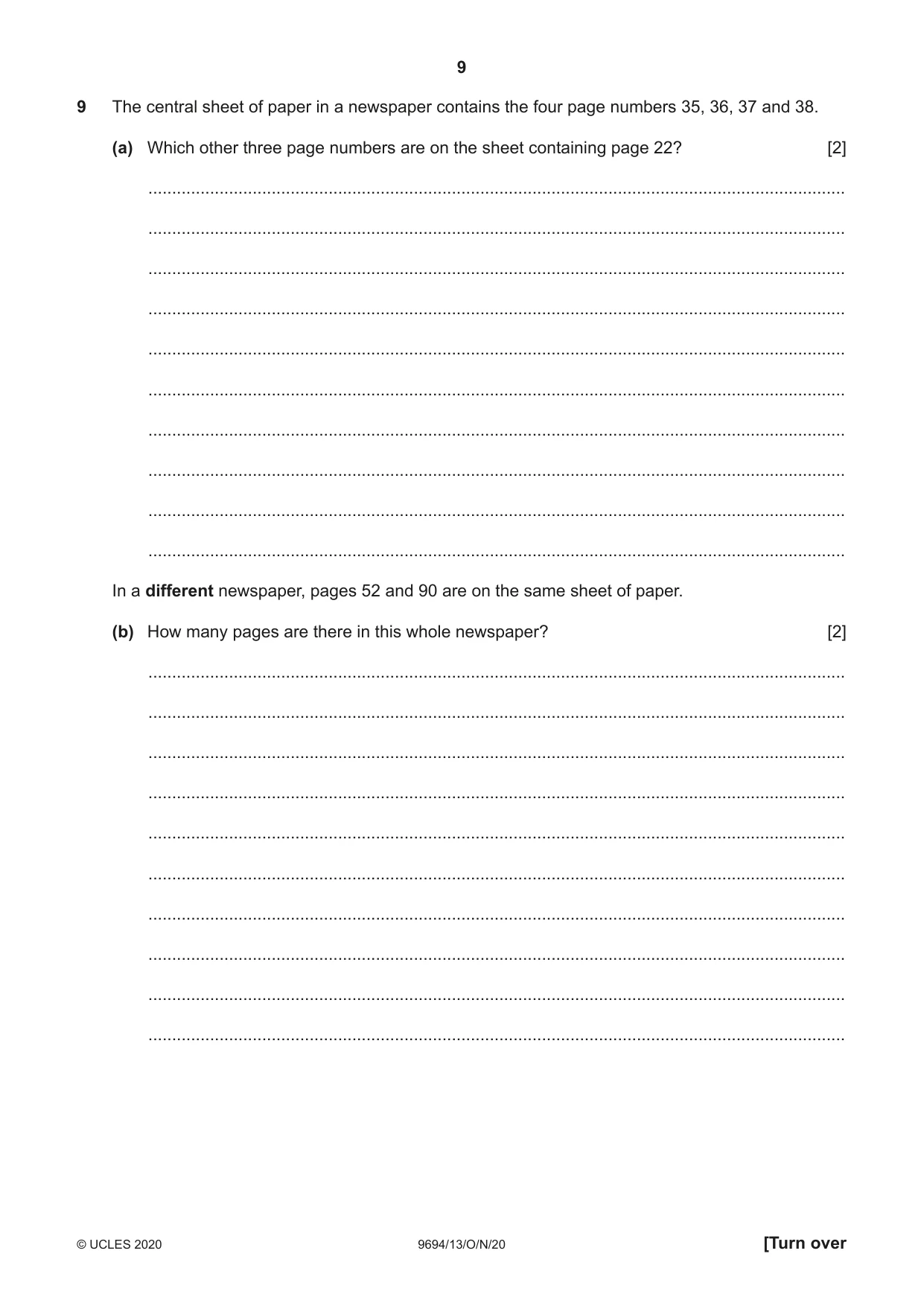
9 9694/13/O/N/20 © UCLES 2020 [Turn over 9 The central sheet of paper in a newspaper contains the four page numbers 35, 36, 37 and 38. (a) Which other three page numbers are on the sheet containing page 22? [2] … … … … … … … … … … In a different newspaper, pages 52 and 90 are on the same sheet of paper. (b) How many pages are there in this whole newspaper? [2] … … … … … … … … … …
Question paper, page 10
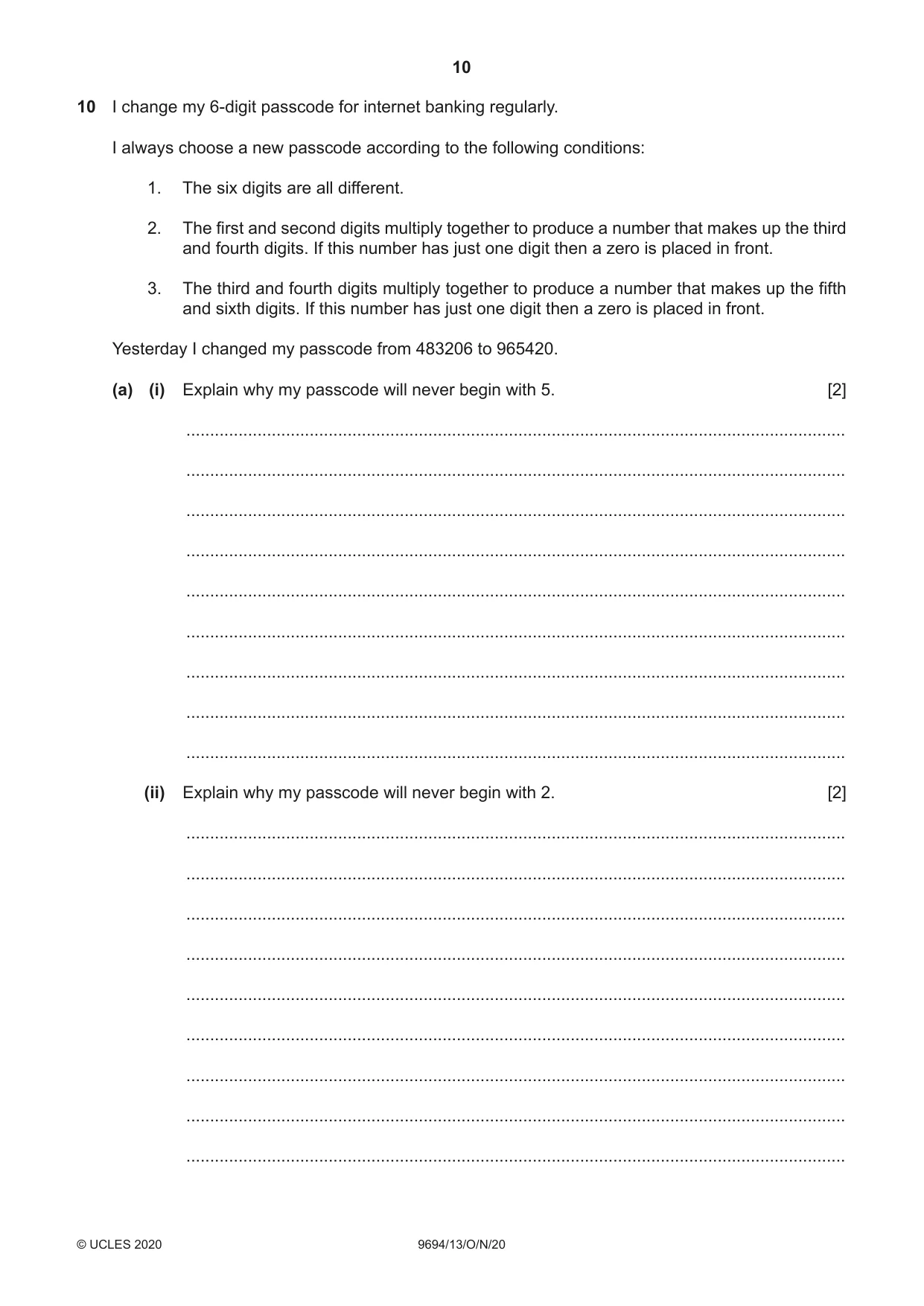
10 9694/13/O/N/20 © UCLES 2020 10 I change my 6-digit passcode for internet banking regularly. I always choose a new passcode according to the following conditions: 1. The six digits are all different. 2. The first and second digits multiply together to produce a number that makes up the third and fourth digits. If this number has just one digit then a zero is placed in front. 3. The third and fourth digits multiply together to produce a number that makes up the fifth and sixth digits. If this number has just one digit then a zero is placed in front. Yesterday I changed my passcode from 483206 to 965420. (a) (i) Explain why my passcode will never begin with 5. [2] … … … … … … … … … (ii) Explain why my passcode will never begin with 2. [2] … … … … … … … … …
Question paper, page 11
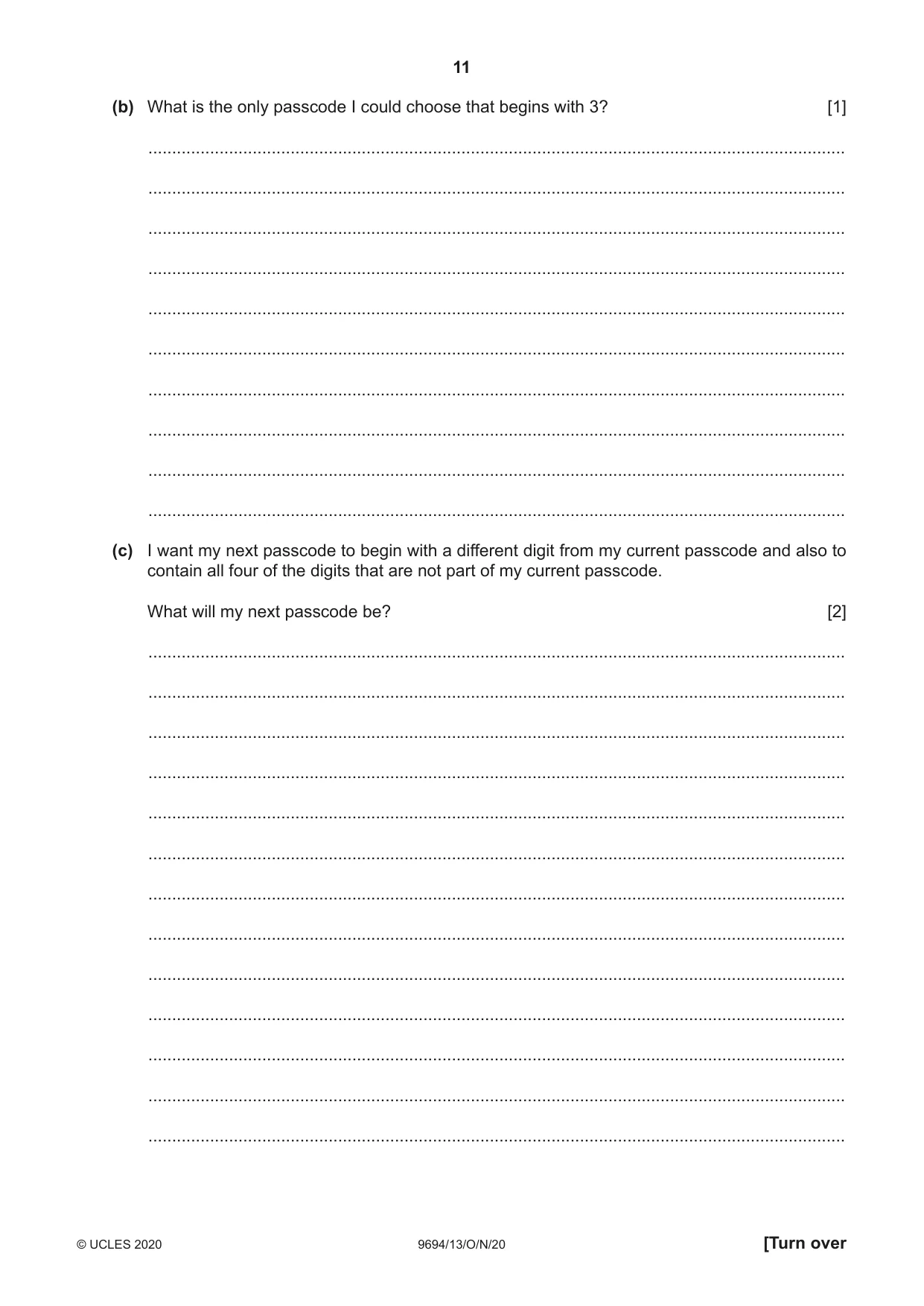
11 9694/13/O/N/20 © UCLES 2020 [Turn over (b) What is the only passcode I could choose that begins with 3? [1] … … … … … … … … … … (c) I want my next passcode to begin with a different digit from my current passcode and also to contain all four of the digits that are not part of my current passcode. What will my next passcode be? [2] … … … … … … … … … … … … …
Question paper, page 12
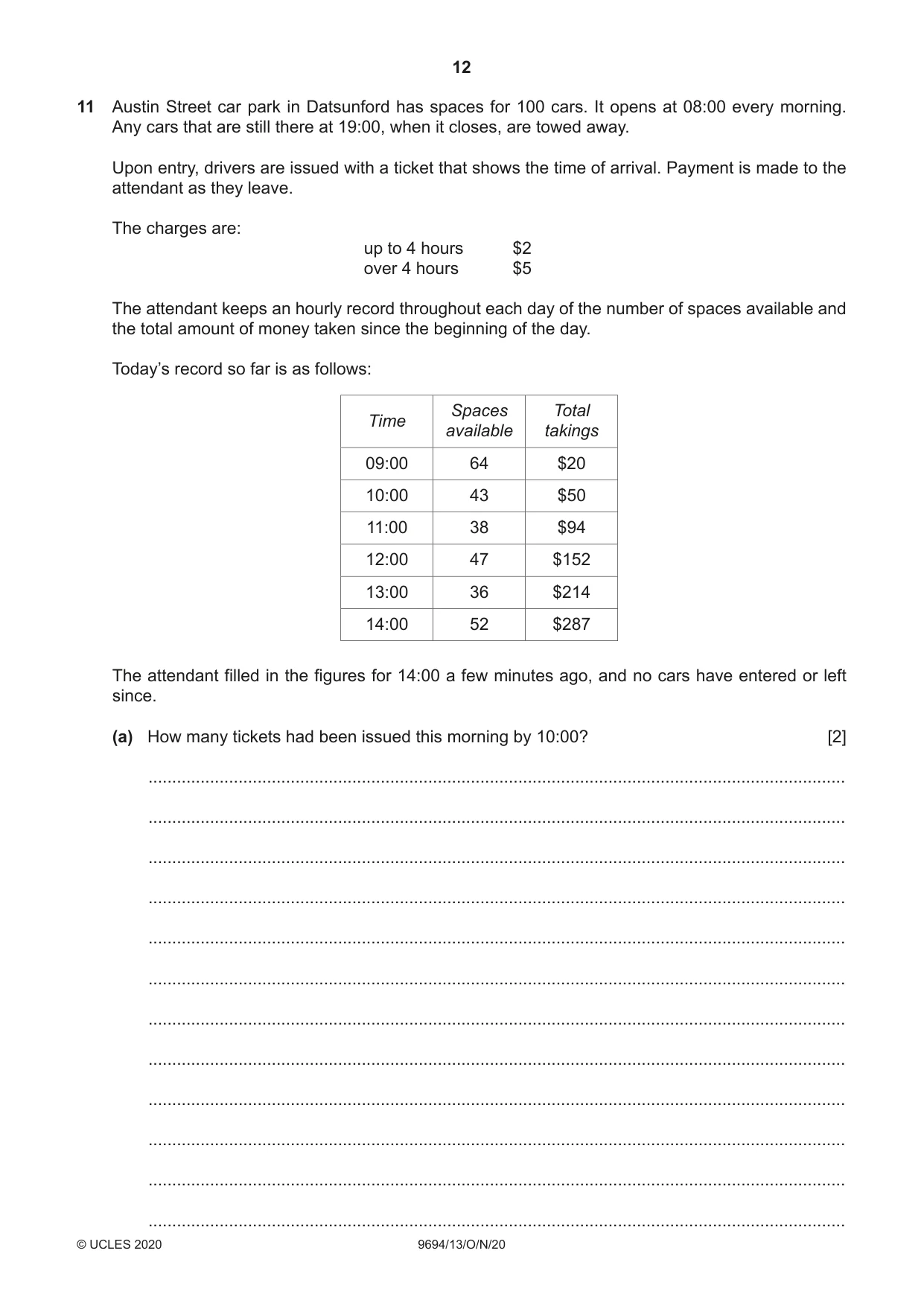
12 9694/13/O/N/20 © UCLES 2020 11 Austin Street car park in Datsunford has spaces for 100 cars. It opens at 08:00 every morning. Any cars that are still there at 19:00, when it closes, are towed away. Upon entry, drivers are issued with a ticket that shows the time of arrival. Payment is made to the attendant as they leave. The charges are: up to 4 hours $2 over 4 hours $5 The attendant keeps an hourly record throughout each day of the number of spaces available and the total amount of money taken since the beginning of the day. Today’s record so far is as follows: Time Spaces available Total takings 09:00 64 $20 10:00 43 $50 11:00 38 $94 12:00 47 $152 13:00 36 $214 14:00 52 $287 The attendant filled in the figures for 14:00 a few minutes ago, and no cars have entered or left since. (a) How many tickets had been issued this morning by 10:00? [2] … … … … … … … … … … … …
Question paper, page 13
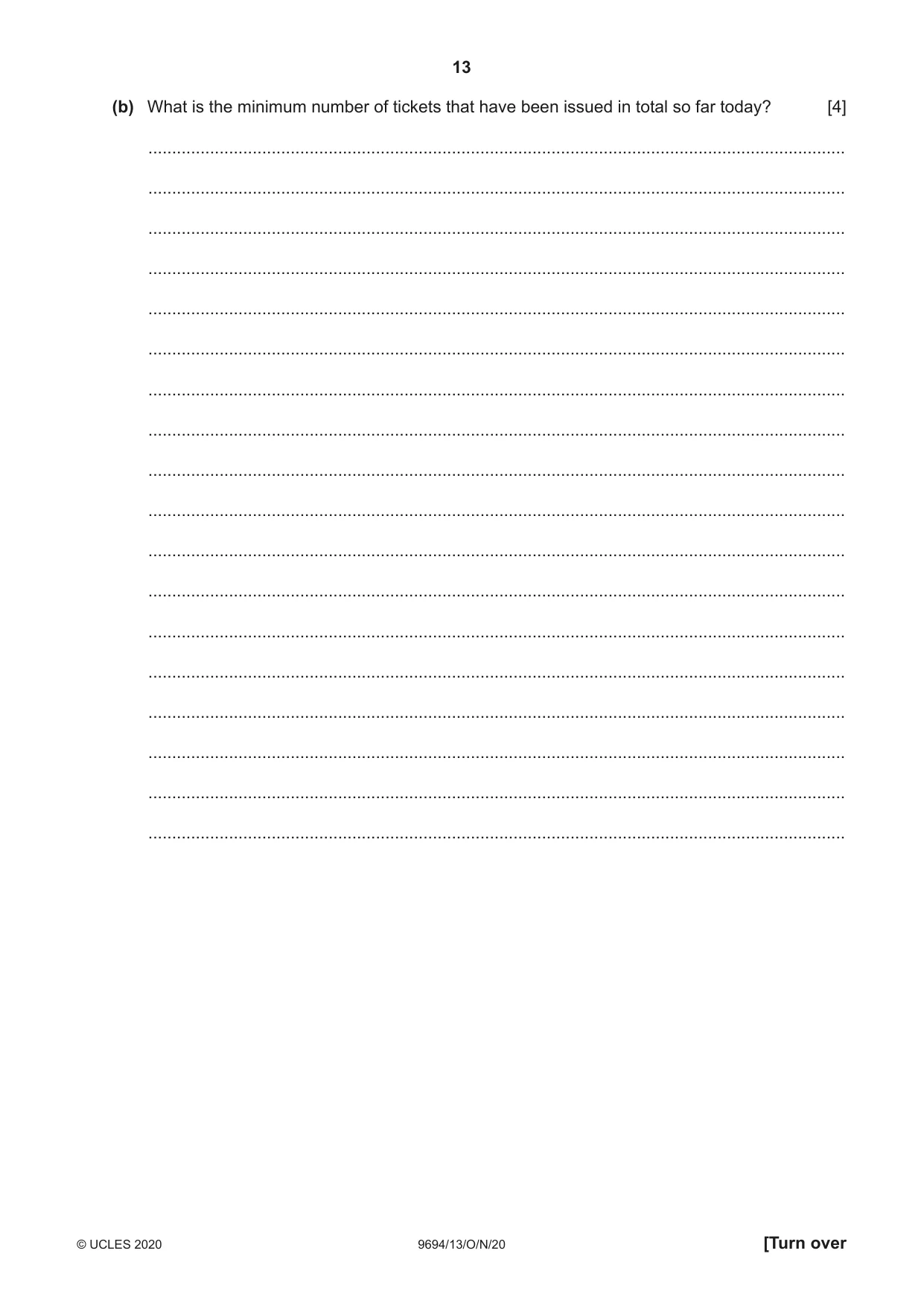
13 9694/13/O/N/20 © UCLES 2020 [Turn over (b) What is the minimum number of tickets that have been issued in total so far today? [4] … … … … … … … … … … … … … … … … … …
Question paper, page 14
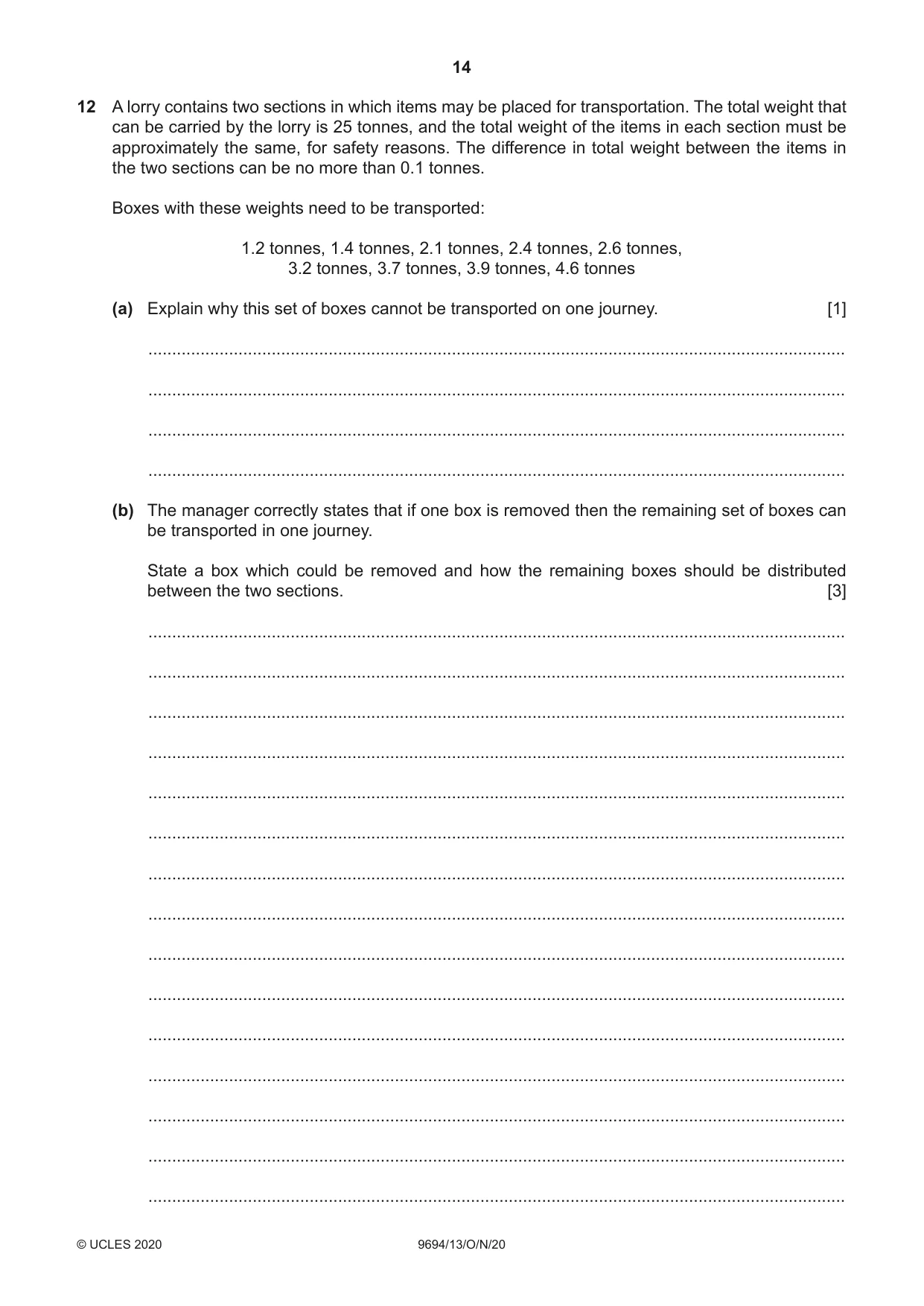
14 9694/13/O/N/20 © UCLES 2020 12 A lorry contains two sections in which items may be placed for transportation. The total weight that can be carried by the lorry is 25 tonnes, and the total weight of the items in each section must be approximately the same, for safety reasons. The difference in total weight between the items in the two sections can be no more than 0.1 tonnes. Boxes with these weights need to be transported: 1.2 tonnes, 1.4 tonnes, 2.1 tonnes, 2.4 tonnes, 2.6 tonnes, 3.2 tonnes, 3.7 tonnes, 3.9 tonnes, 4.6 tonnes (a) Explain why this set of boxes cannot be transported on one journey. [1] … … … … (b) The manager correctly states that if one box is removed then the remaining set of boxes can be transported in one journey. State a box which could be removed and how the remaining boxes should be distributed between the two sections. [3] … … … … … … … … … … … … … … …
Question paper, page 15
15 9694/13/O/N/20 © UCLES 2020 BLANK PAGE
Question paper, page 16
16 9694/13/O/N/20 © UCLES 2020 Permission to reproduce items where third-party owned material protected by copyright is included has been sought and cleared where possible. Every reasonable effort has been made by the publisher (UCLES) to trace copyright holders, but if any items requiring clearance have unwittingly been included, the publisher will be pleased to make amends at the earliest possible opportunity. To avoid the issue of disclosure of answer-related information to candidates, all copyright acknowledgements are reproduced online in the Cambridge Assessment International Education Copyright Acknowledgements Booklet. This is produced for each series of examinations and is freely available to download at www.cambridgeinternational.org after the live examination series. Cambridge Assessment International Education is part of the Cambridge Assessment Group. Cambridge Assessment is the brand name of the University of Cambridge Local Examinations Syndicate (UCLES), which itself is a department of the University of Cambridge. BLANK PAGE
Mark scheme, page 1
This document consists of 8 printed pages. © UCLES 2020 [Turn over Cambridge International AS & A Level THINKING SKILLS 9694/13 Paper 1 Problem Solving October/November 2020 MARK SCHEME Maximum Mark: 50 Published This mark scheme is published as an aid to teachers and candidates, to indicate the requirements of the examination. It shows the basis on which Examiners were instructed to award marks. It does not indicate the details of the discussions that took place at an Examiners’ meeting before marking began, which would have considered the acceptability of alternative answers. Mark schemes should be read in conjunction with the question paper and the Principal Examiner Report for Teachers. Cambridge International will not enter into discussions about these mark schemes. Cambridge International is publishing the mark schemes for the October/November 2020 series for most Cambridge IGCSE™, Cambridge International A and AS Level and Cambridge Pre-U components, and some Cambridge O Level components.
Mark scheme, page 2
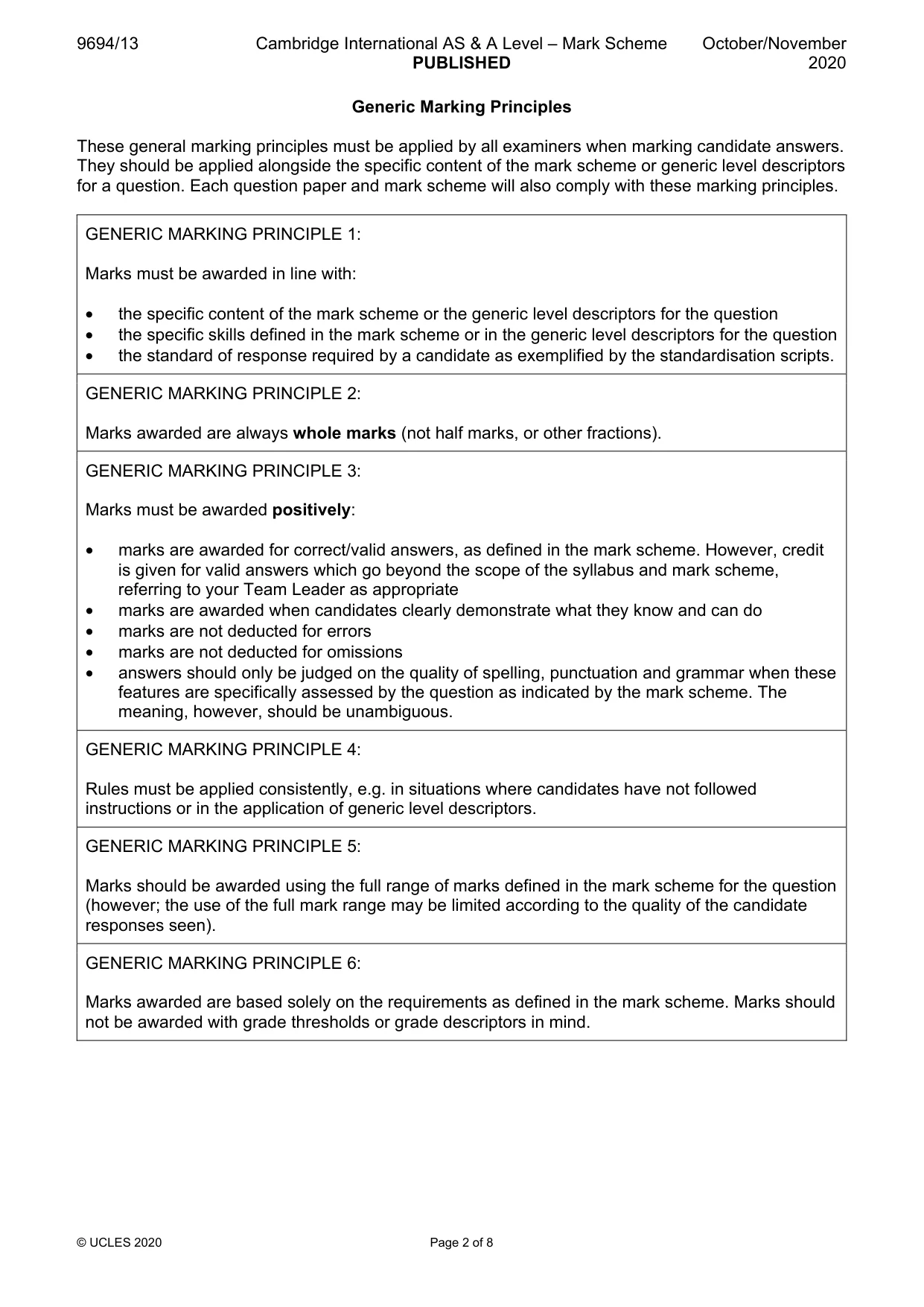
9694/13 Cambridge International AS & A Level – Mark Scheme PUBLISHED October/November 2020 © UCLES 2020 Page 2 of 8 Generic Marking Principles These general marking principles must be applied by all examiners when marking candidate answers. They should be applied alongside the specific content of the mark scheme or generic level descriptors for a question. Each question paper and mark scheme will also comply with these marking principles. GENERIC MARKING PRINCIPLE 1: Marks must be awarded in line with: • the specific content of the mark scheme or the generic level descriptors for the question • the specific skills defined in the mark scheme or in the generic level descriptors for the question • the standard of response required by a candidate as exemplified by the standardisation scripts. GENERIC MARKING PRINCIPLE 2: Marks awarded are always whole marks (not half marks, or other fractions). GENERIC MARKING PRINCIPLE 3: Marks must be awarded positively: • marks are awarded for correct/valid answers, as defined in the mark scheme. However, credit is given for valid answers which go beyond the scope of the syllabus and mark scheme, referring to your Team Leader as appropriate • marks are awarded when candidates clearly demonstrate what they know and can do • marks are not deducted for errors • marks are not deducted for omissions • answers should only be judged on the quality of spelling, punctuation and grammar when these features are specifically assessed by the question as indicated by the mark scheme. The meaning, however, should be unambiguous. GENERIC MARKING PRINCIPLE 4: Rules must be applied consistently, e.g. in situations where candidates have not followed instructions or in the application of generic level descriptors. GENERIC MARKING PRINCIPLE 5: Marks should be awarded using the full range of marks defined in the mark scheme for the question (however; the use of the full mark range may be limited according to the quality of the candidate responses seen). GENERIC MARKING PRINCIPLE 6: Marks awarded are based solely on the requirements as defined in the mark scheme. Marks should not be awarded with grade thresholds or grade descriptors in mind.
Mark scheme, page 3
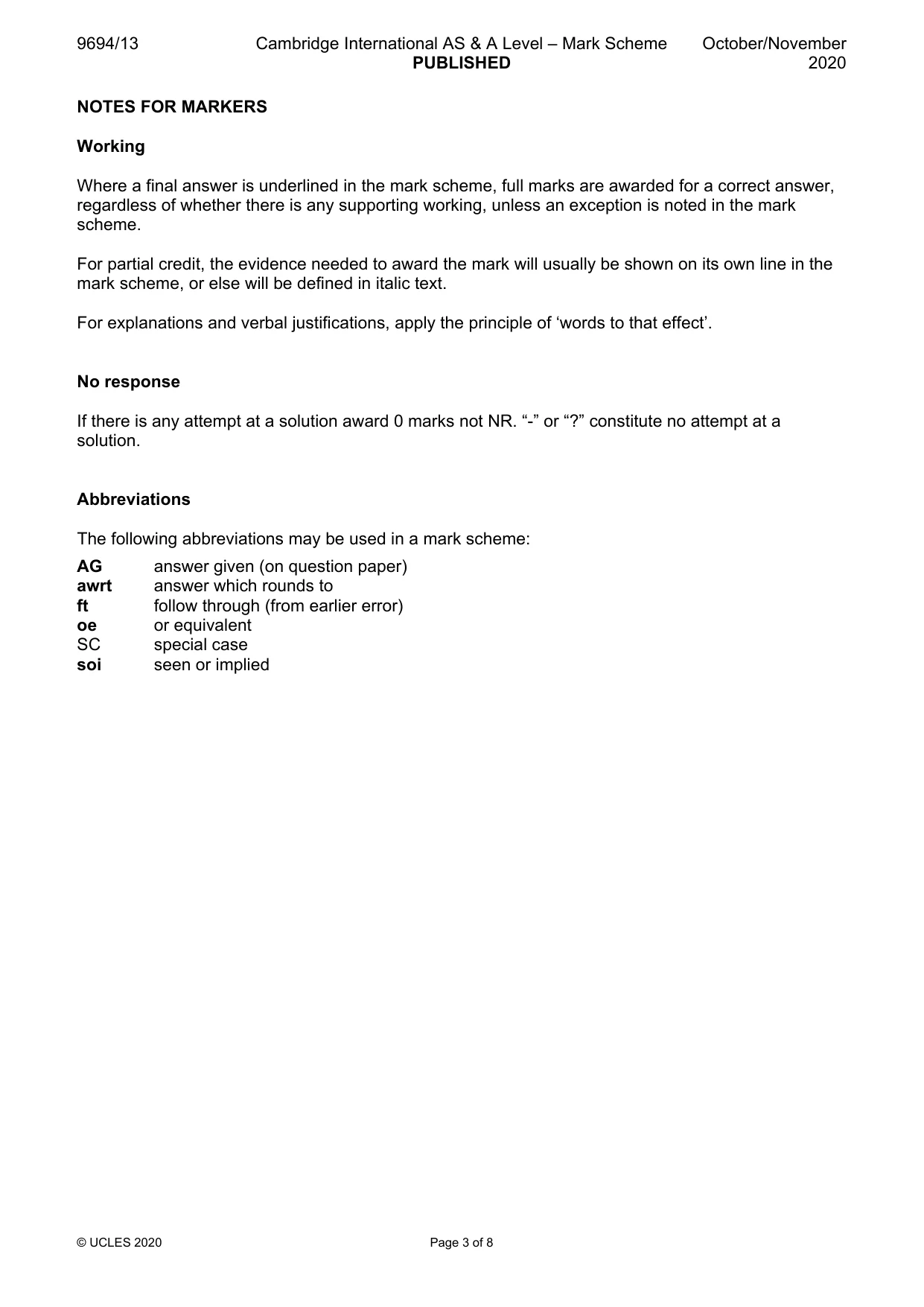
9694/13 Cambridge International AS & A Level – Mark Scheme PUBLISHED October/November 2020 © UCLES 2020 Page 3 of 8 NOTES FOR MARKERS Working Where a final answer is underlined in the mark scheme, full marks are awarded for a correct answer, regardless of whether there is any supporting working, unless an exception is noted in the mark scheme. For partial credit, the evidence needed to award the mark will usually be shown on its own line in the mark scheme, or else will be defined in italic text. For explanations and verbal justifications, apply the principle of ‘words to that effect’. No response If there is any attempt at a solution award 0 marks not NR. “-” or “?” constitute no attempt at a solution. Abbreviations The following abbreviations may be used in a mark scheme: AG answer given (on question paper) awrt answer which rounds to ft follow through (from earlier error) oe or equivalent SC special case soi seen or implied
Mark scheme, page 4
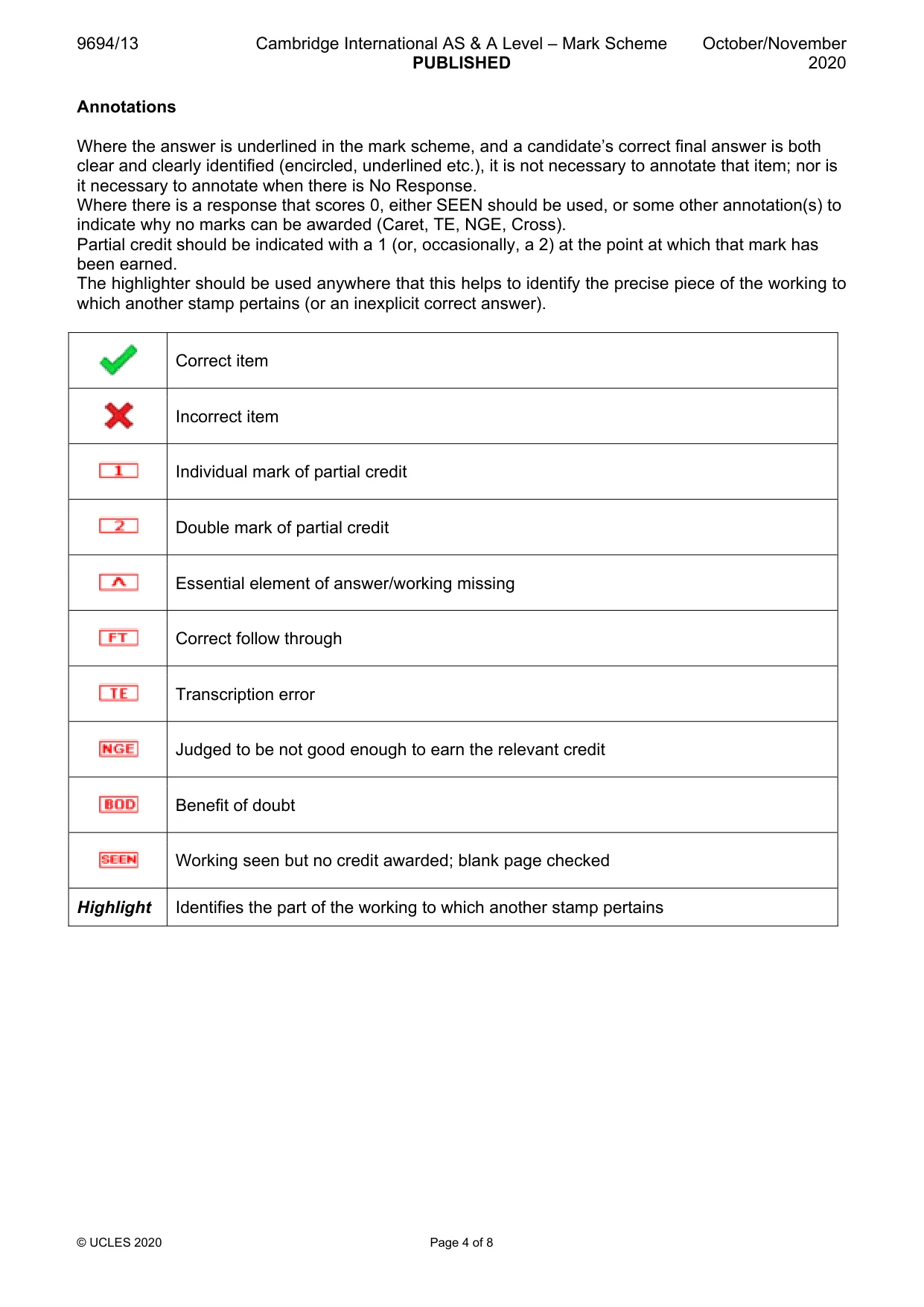
9694/13 Cambridge International AS & A Level – Mark Scheme PUBLISHED October/November 2020 © UCLES 2020 Page 4 of 8 Annotations Where the answer is underlined in the mark scheme, and a candidate’s correct final answer is both clear and clearly identified (encircled, underlined etc.), it is not necessary to annotate that item; nor is it necessary to annotate when there is No Response. Where there is a response that scores 0, either SEEN should be used, or some other annotation(s) to indicate why no marks can be awarded (Caret, TE, NGE, Cross). Partial credit should be indicated with a 1 (or, occasionally, a 2) at the point at which that mark has been earned. The highlighter should be used anywhere that this helps to identify the precise piece of the working to which another stamp pertains (or an inexplicit correct answer). Correct item Incorrect item Individual mark of partial credit Double mark of partial credit Essential element of answer/working missing Correct follow through Transcription error Judged to be not good enough to earn the relevant credit Benefit of doubt Working seen but no credit awarded; blank page checked Highlight Identifies the part of the working to which another stamp pertains
Mark scheme, page 5
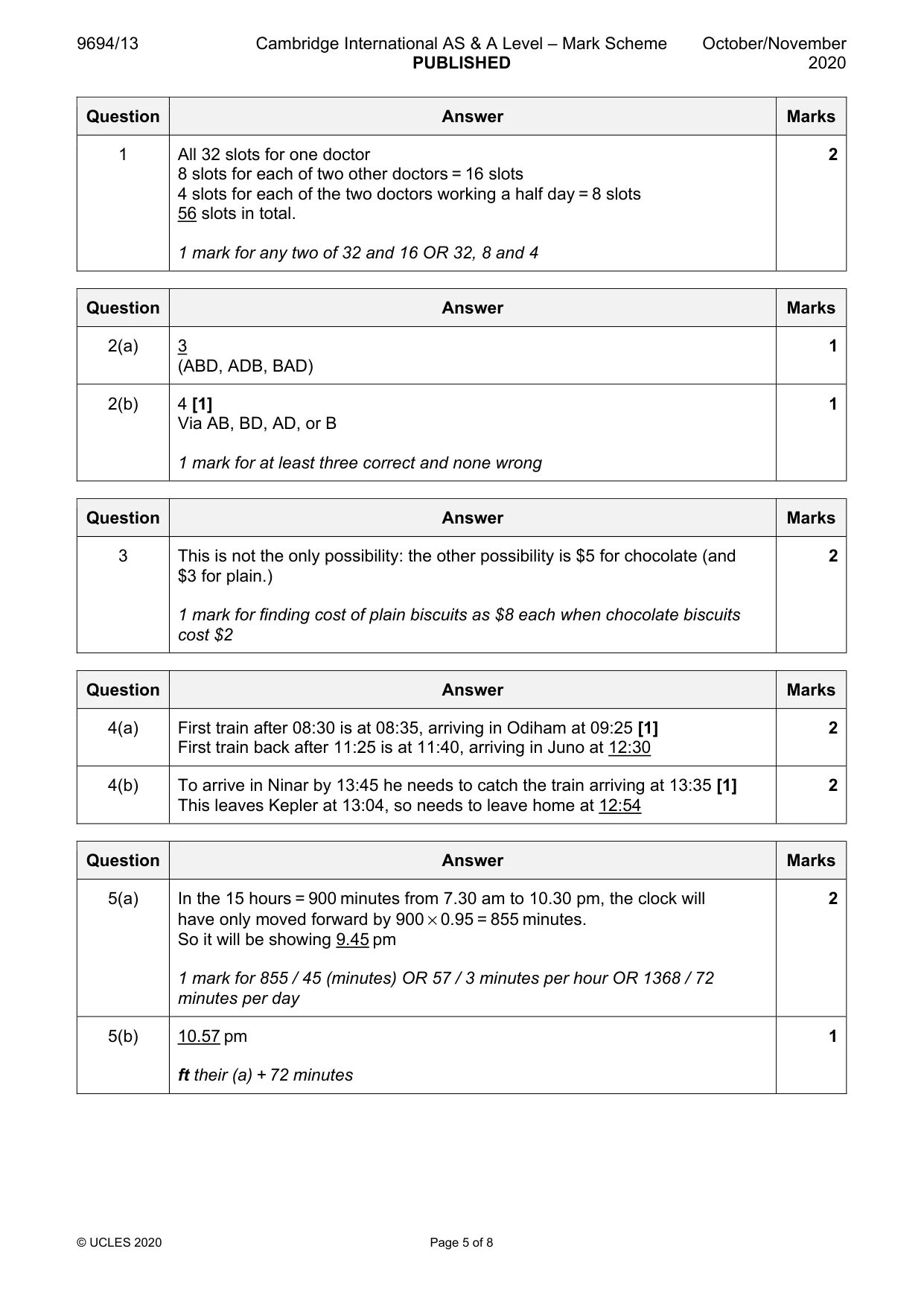
9694/13 Cambridge International AS & A Level – Mark Scheme PUBLISHED October/November 2020 © UCLES 2020 Page 5 of 8 Question Answer Marks 1 All 32 slots for one doctor 8 slots for each of two other doctors = 16 slots 4 slots for each of the two doctors working a half day = 8 slots 56 slots in total. 1 mark for any two of 32 and 16 OR 32, 8 and 4 2 Question Answer Marks 2(a) 3 (ABD, ADB, BAD) 1 2(b) 4 [1] Via AB, BD, AD, or B 1 mark for at least three correct and none wrong 1 Question Answer Marks 3 This is not the only possibility: the other possibility is $5 for chocolate (and $3 for plain.) 1 mark for finding cost of plain biscuits as $8 each when chocolate biscuits cost $2 2 Question Answer Marks 4(a) First train after 08:30 is at 08:35, arriving in Odiham at 09:25 [1] First train back after 11:25 is at 11:40, arriving in Juno at 12:30 2 4(b) To arrive in Ninar by 13:45 he needs to catch the train arriving at 13:35 [1] This leaves Kepler at 13:04, so needs to leave home at 12:54 2 Question Answer Marks 5(a) In the 15 hours = 900 minutes from 7.30 am to 10.30 pm, the clock will have only moved forward by 900 × 0.95 = 855 minutes. So it will be showing 9.45 pm 1 mark for 855 / 45 (minutes) OR 57 / 3 minutes per hour OR 1368 / 72 minutes per day 2 5(b) 10.57 pm ft their (a) + 72 minutes 1
Mark scheme, page 6
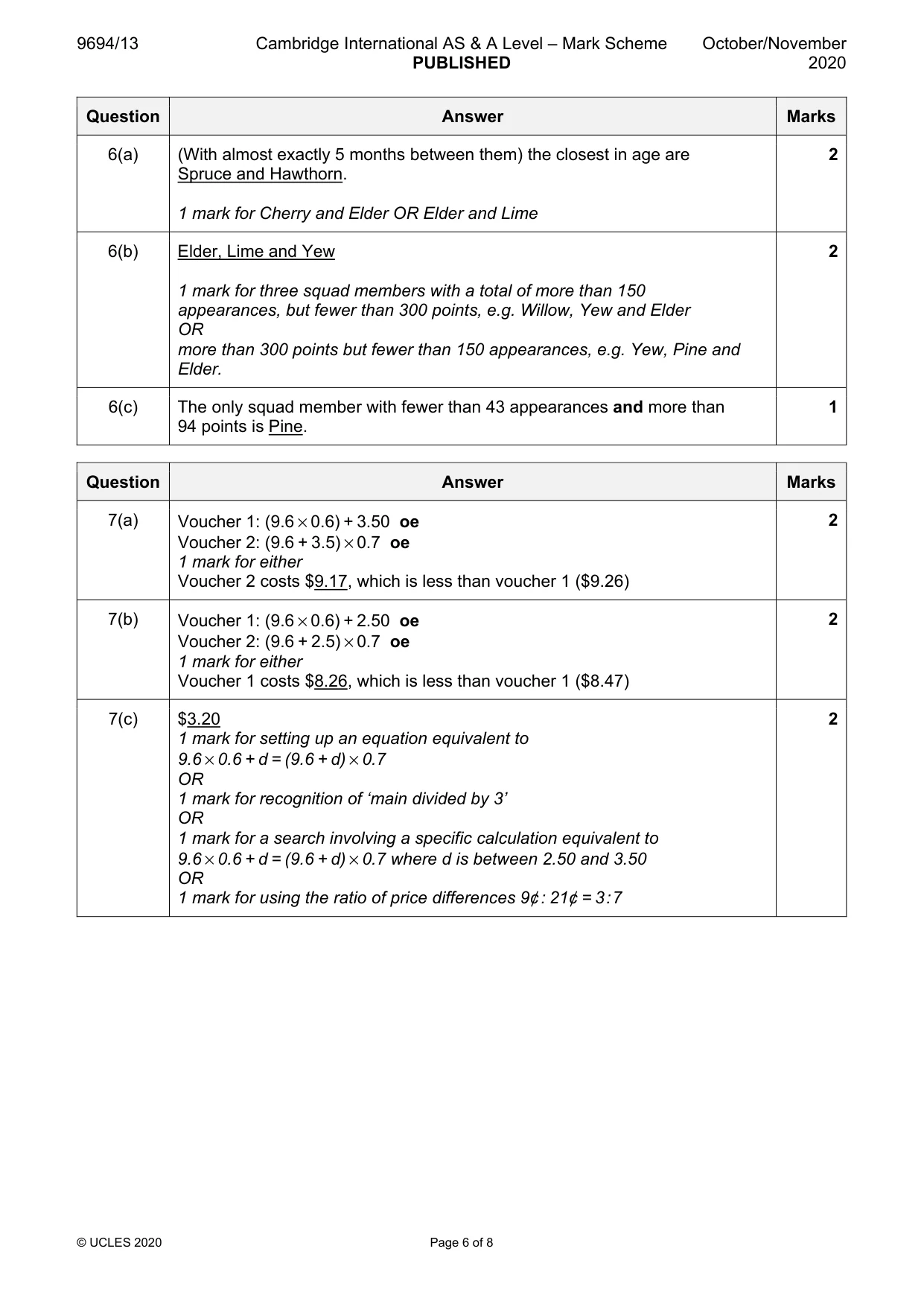
9694/13 Cambridge International AS & A Level – Mark Scheme PUBLISHED October/November 2020 © UCLES 2020 Page 6 of 8 Question Answer Marks 6(a) (With almost exactly 5 months between them) the closest in age are Spruce and Hawthorn. 1 mark for Cherry and Elder OR Elder and Lime 2 6(b) Elder, Lime and Yew 1 mark for three squad members with a total of more than 150 appearances, but fewer than 300 points, e.g. Willow, Yew and Elder OR more than 300 points but fewer than 150 appearances, e.g. Yew, Pine and Elder. 2 6(c) The only squad member with fewer than 43 appearances and more than 94 points is Pine. 1 Question Answer Marks 7(a) Voucher 1: (9.6 × 0.6) + 3.50 oe Voucher 2: (9.6 + 3.5) × 0.7 oe 1 mark for either Voucher 2 costs $9.17, which is less than voucher 1 ($9.26) 2 7(b) Voucher 1: (9.6 × 0.6) + 2.50 oe Voucher 2: (9.6 + 2.5) × 0.7 oe 1 mark for either Voucher 1 costs $8.26, which is less than voucher 1 ($8.47) 2 7(c) $3.20 1 mark for setting up an equation equivalent to 9.6 × 0.6 + d = (9.6 + d) × 0.7 OR 1 mark for recognition of ‘main divided by 3’ OR 1 mark for a search involving a specific calculation equivalent to 9.6 × 0.6 + d = (9.6 + d) × 0.7 where d is between 2.50 and 3.50 OR 1 mark for using the ratio of price differences 9¢ : 21¢ = 3 : 7 2
Mark scheme, page 7
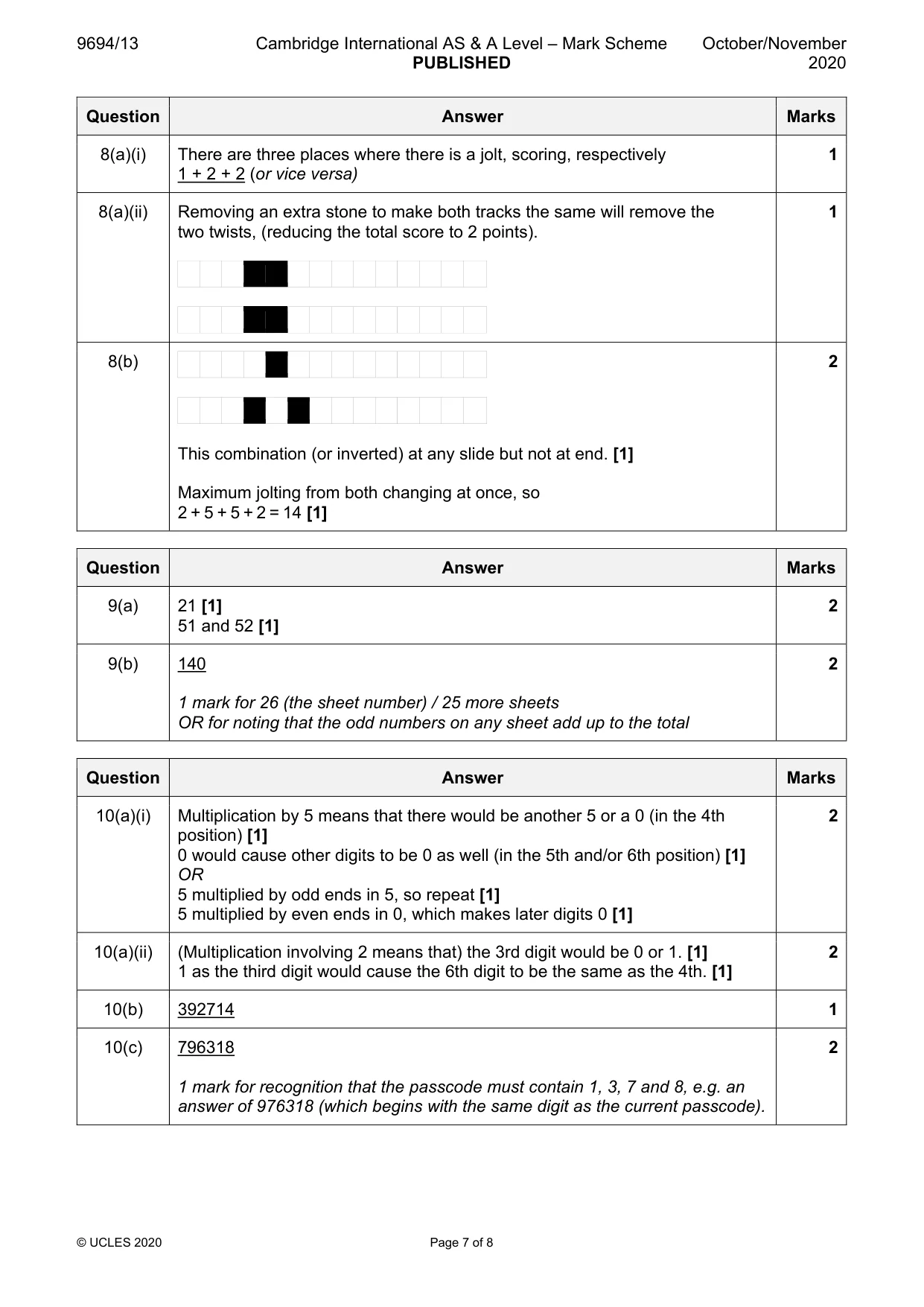
9694/13 Cambridge International AS & A Level – Mark Scheme PUBLISHED October/November 2020 © UCLES 2020 Page 7 of 8 Question Answer Marks 8(a)(i) There are three places where there is a jolt, scoring, respectively 1 + 2 + 2 (or vice versa) 1 8(a)(ii) Removing an extra stone to make both tracks the same will remove the two twists, (reducing the total score to 2 points). 1 8(b) This combination (or inverted) at any slide but not at end. [1] Maximum jolting from both changing at once, so 2 + 5 + 5 + 2 = 14 [1] 2 Question Answer Marks 9(a) 21 [1] 51 and 52 [1] 2 9(b) 140 1 mark for 26 (the sheet number) / 25 more sheets OR for noting that the odd numbers on any sheet add up to the total 2 Question Answer Marks 10(a)(i) Multiplication by 5 means that there would be another 5 or a 0 (in the 4th position) [1] 0 would cause other digits to be 0 as well (in the 5th and/or 6th position) [1] OR 5 multiplied by odd ends in 5, so repeat [1] 5 multiplied by even ends in 0, which makes later digits 0 [1] 2 10(a)(ii) (Multiplication involving 2 means that) the 3rd digit would be 0 or 1. [1] 1 as the third digit would cause the 6th digit to be the same as the 4th. [1] 2 10(b) 392714 1 10(c) 796318 1 mark for recognition that the passcode must contain 1, 3, 7 and 8, e.g. an answer of 976318 (which begins with the same digit as the current passcode). 2
Mark scheme, page 8
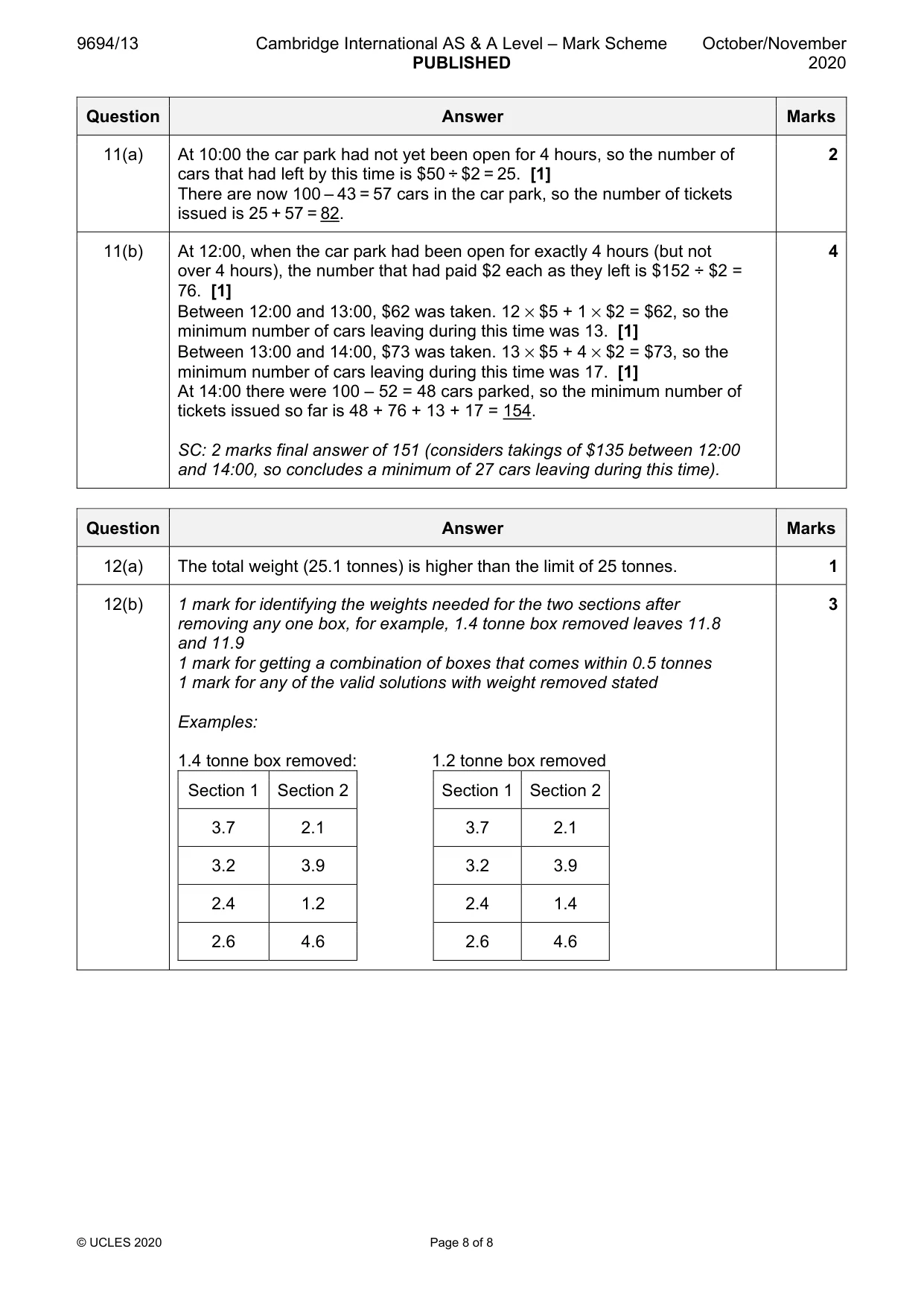
9694/13 Cambridge International AS & A Level – Mark Scheme PUBLISHED October/November 2020 © UCLES 2020 Page 8 of 8 Question Answer Marks 11(a) At 10:00 the car park had not yet been open for 4 hours, so the number of cars that had left by this time is $50 ÷ $2 = 25. [1] There are now 100 – 43 = 57 cars in the car park, so the number of tickets issued is 25 + 57 = 82. 2 11(b) At 12:00, when the car park had been open for exactly 4 hours (but not over 4 hours), the number that had paid $2 each as they left is $152 ÷ $2 = 76. [1] Between 12:00 and 13:00, $62 was taken. 12 × $5 + 1 × $2 = $62, so the minimum number of cars leaving during this time was 13. [1] Between 13:00 and 14:00, $73 was taken. 13 × $5 + 4 × $2 = $73, so the minimum number of cars leaving during this time was 17. [1] At 14:00 there were 100 – 52 = 48 cars parked, so the minimum number of tickets issued so far is 48 + 76 + 13 + 17 = 154. SC: 2 marks final answer of 151 (considers takings of $135 between 12:00 and 14:00, so concludes a minimum of 27 cars leaving during this time). 4 Question Answer Marks 12(a) The total weight (25.1 tonnes) is higher than the limit of 25 tonnes. 1 12(b) 1 mark for identifying the weights needed for the two sections after removing any one box, for example, 1.4 tonne box removed leaves 11.8 and 11.9 1 mark for getting a combination of boxes that comes within 0.5 tonnes 1 mark for any of the valid solutions with weight removed stated Examples: 1.4 tonne box removed: 1.2 tonne box removed Section 1 Section 2 Section 1 Section 2 3.7 2.1 3.7 2.1 3.2 3.9 3.2 3.9 2.4 1.2 2.4 1.4 2.6 4.6 2.6 4.6 3
What you needed in this session
Cambridge’s own grade thresholds for 2020 Oct/Nov, Paper 1 · Variant 3. A higher threshold means an easier paper — the bar moves with how the cohort did.