Cambridge A Level Thinking Skills 9694 — 2023 Oct/Nov Paper 1 · Variant 1
9694/11/O/N/23 · 50 marks · ≈56 min
The question paper and its mark scheme, free to read here and free to download. This is Cambridge’s own paper, exactly as it was sat.
Question paper16 pages
Mark scheme9 pages
Answers below. Sit the paper first if you are practising.
Paper as text
Question paper, page 1
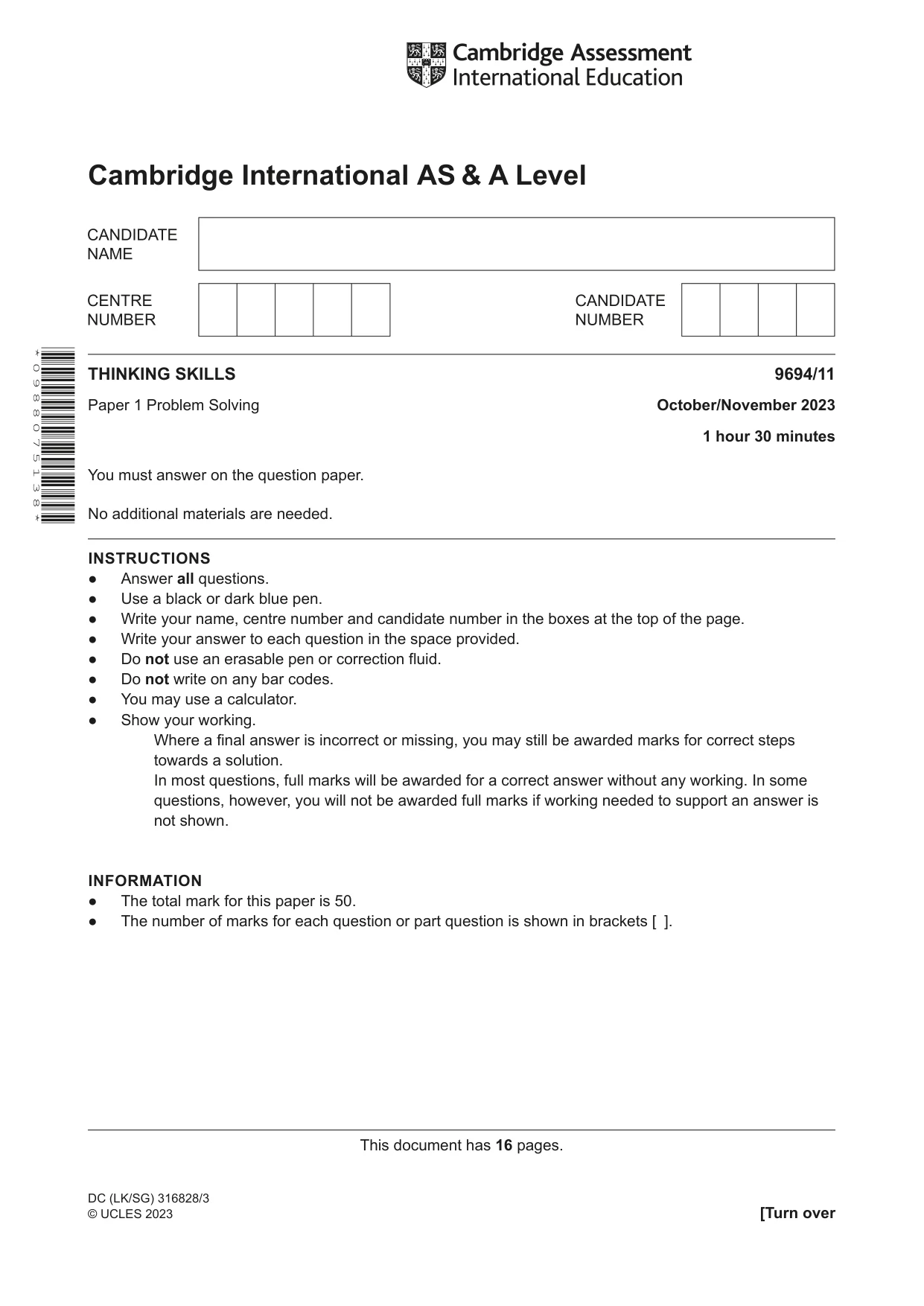
This document has 16 pages. [Turn over Cambridge International AS & A Level * 0 9 8 8 0 7 5 1 3 8 * THINKING SKILLS 9694/11 Paper 1 Problem Solving October/November 2023 1 hour 30 minutes You must answer on the question paper. No additional materials are needed. INSTRUCTIONS ● Answer all questions. ● Use a black or dark blue pen. ● Write your name, centre number and candidate number in the boxes at the top of the page. ● Write your answer to each question in the space provided. ● Do not use an erasable pen or correction fluid. ● Do not write on any bar codes. ● You may use a calculator. ● Show your working. Where a final answer is incorrect or missing, you may still be awarded marks for correct steps towards a solution. In most questions, full marks will be awarded for a correct answer without any working. In some questions, however, you will not be awarded full marks if working needed to support an answer is not shown. INFORMATION ● The total mark for this paper is 50. ● The number of marks for each question or part question is shown in brackets [ ]. DC (LK/SG) 316828/3 © UCLES 2023
Question paper, page 2
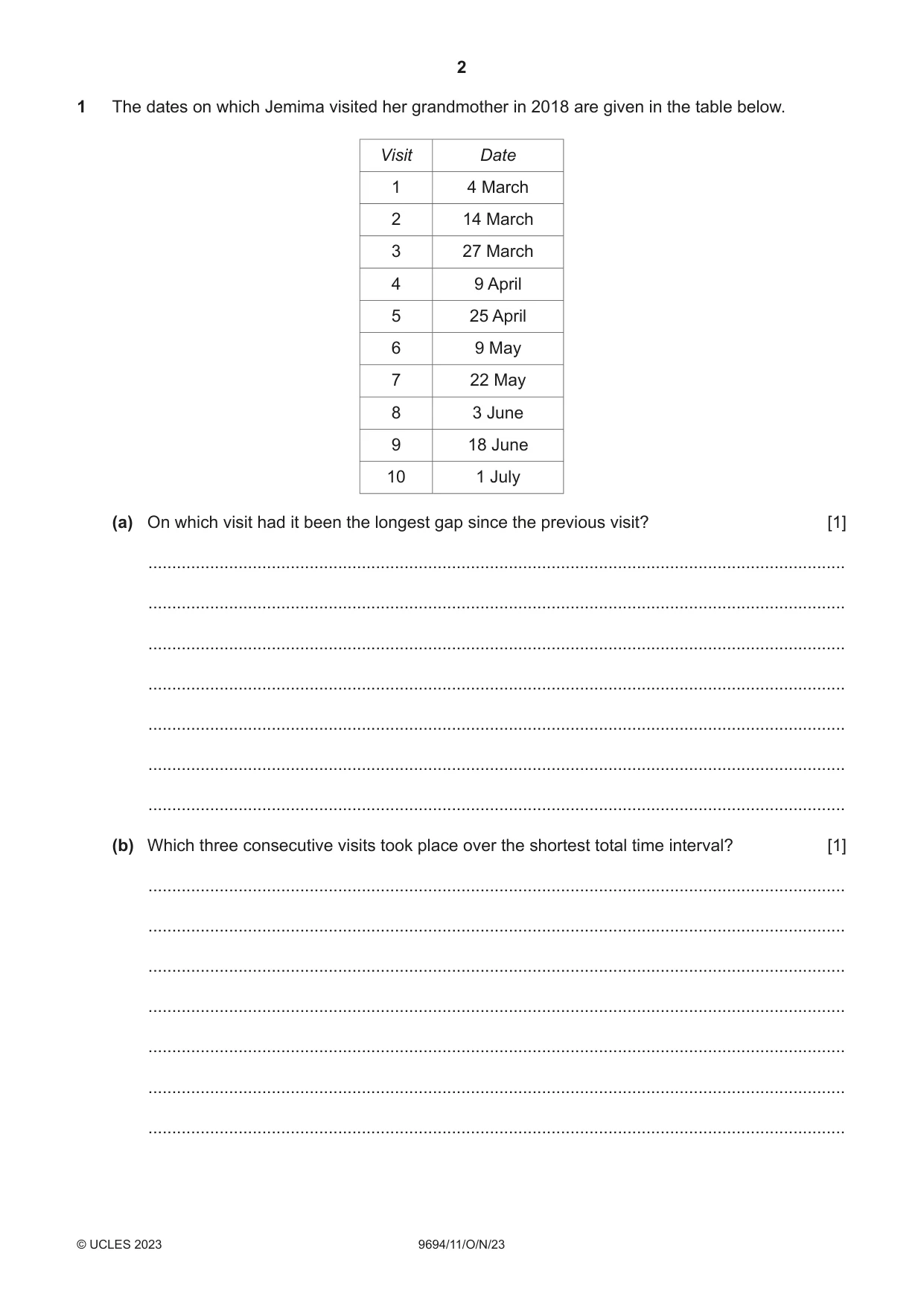
2 9694/11/O/N/23 © UCLES 2023 1 The dates on which Jemima visited her grandmother in 2018 are given in the table below. Visit Date 1 4 March 2 14 March 3 27 March 4 9 April 5 25 April 6 9 May 7 22 May 8 3 June 9 18 June 10 1 July (a) On which visit had it been the longest gap since the previous visit? [1] … … … … … … … (b) Which three consecutive visits took place over the shortest total time interval? [1] … … … … … … …
Question paper, page 3
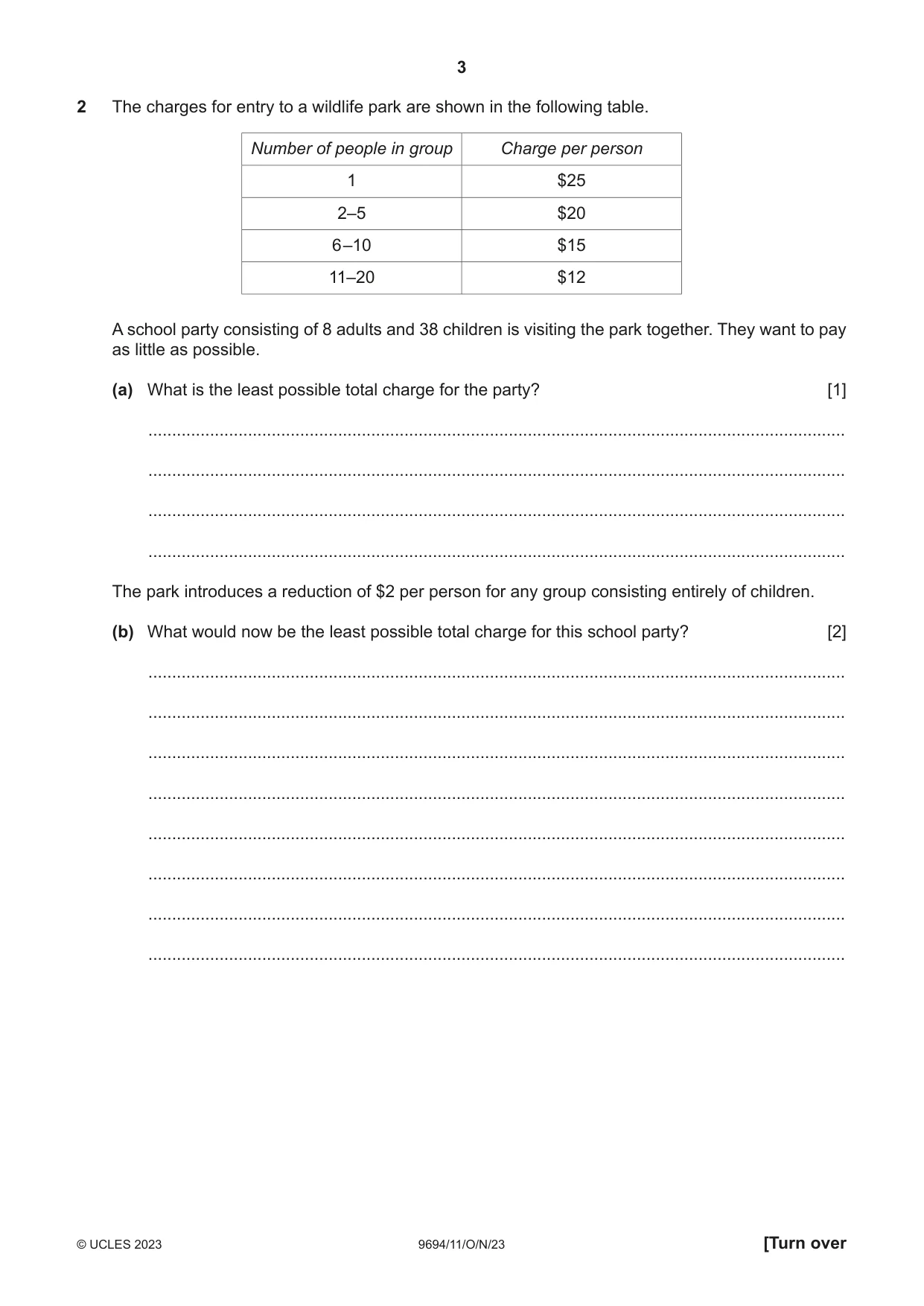
3 9694/11/O/N/23 © UCLES 2023 [Turn over 2 The charges for entry to a wildlife park are shown in the following table. Number of people in group Charge per person 1 $25 2–5 $20 6 –10 $15 11–20 $12 A school party consisting of 8 adults and 38 children is visiting the park together. They want to pay as little as possible. (a) What is the least possible total charge for the party? [1] … … … … The park introduces a reduction of $2 per person for any group consisting entirely of children. (b) What would now be the least possible total charge for this school party? [2] … … … … … … … …
Question paper, page 4
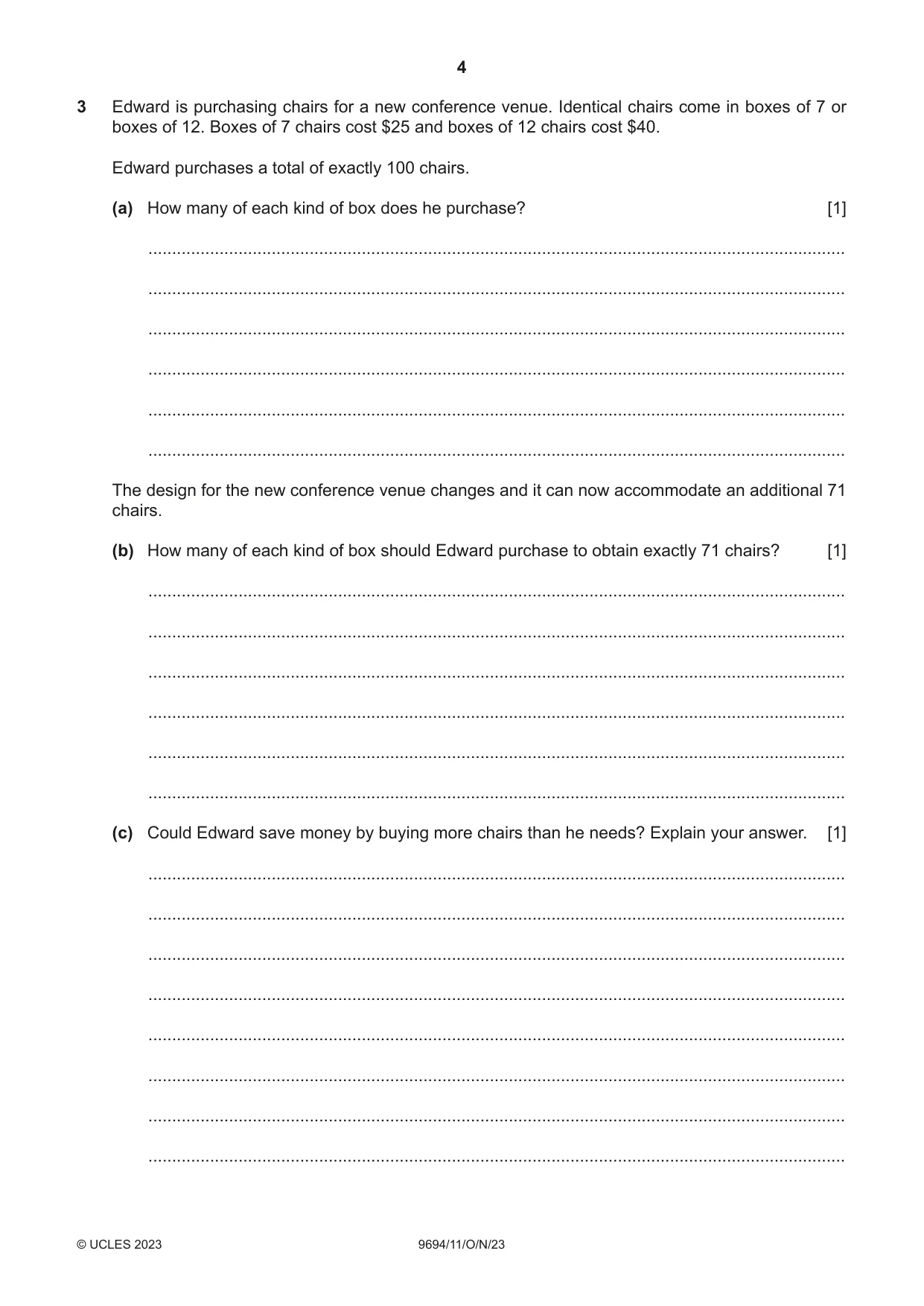
4 9694/11/O/N/23 © UCLES 2023 3 Edward is purchasing chairs for a new conference venue. Identical chairs come in boxes of 7 or boxes of 12. Boxes of 7 chairs cost $25 and boxes of 12 chairs cost $40. Edward purchases a total of exactly 100 chairs. (a) How many of each kind of box does he purchase? [1] … … … … … … The design for the new conference venue changes and it can now accommodate an additional 71 chairs. (b) How many of each kind of box should Edward purchase to obtain exactly 71 chairs? [1] … … … … … … (c) Could Edward save money by buying more chairs than he needs? Explain your answer. [1] … … … … … … … …
Question paper, page 5
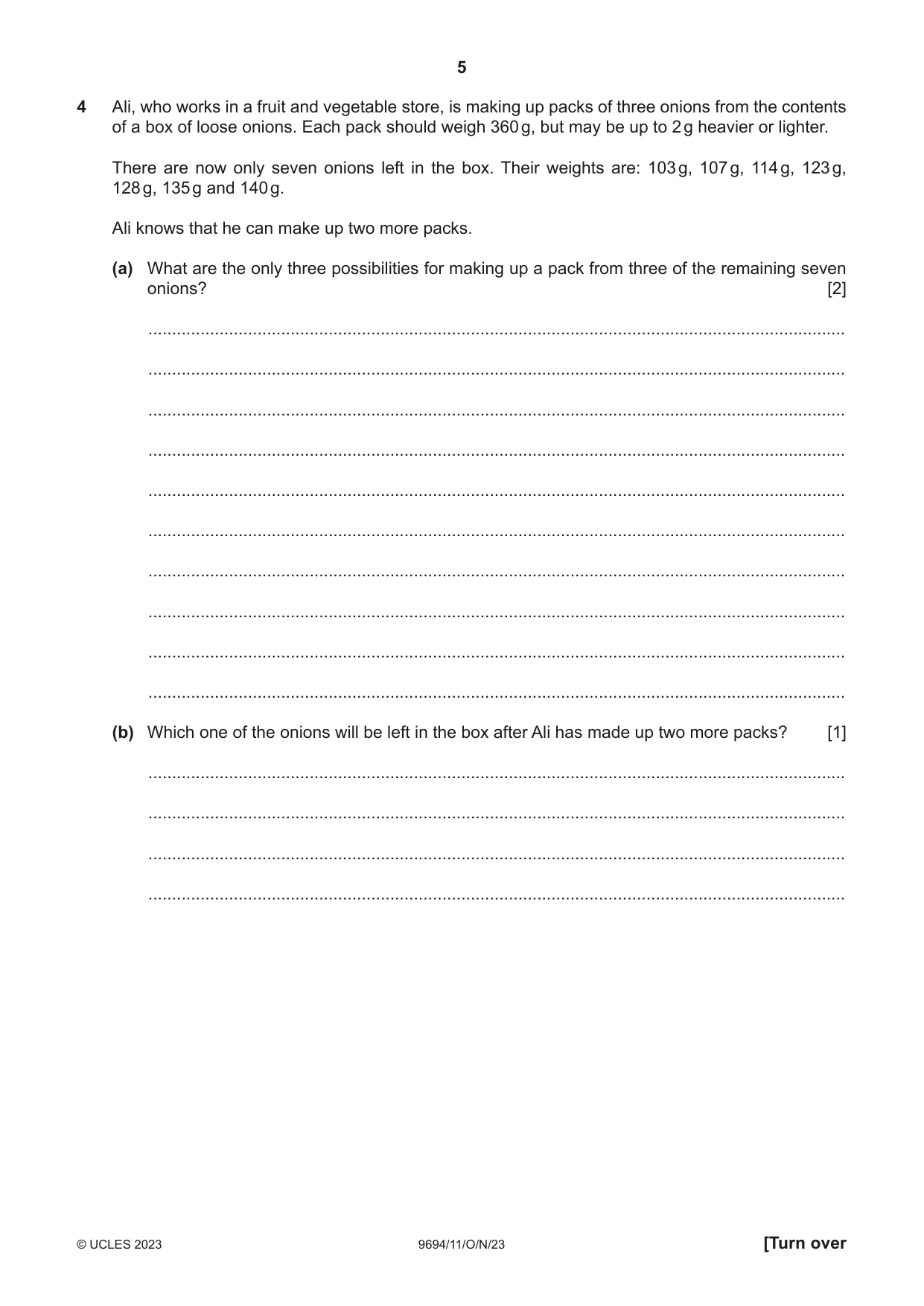
5 9694/11/O/N/23 © UCLES 2023 [Turn over 4 Ali, who works in a fruit and vegetable store, is making up packs of three onions from the contents of a box of loose onions. Each pack should weigh 360 g, but may be up to 2 g heavier or lighter. There are now only seven onions left in the box. Their weights are: 103 g, 107 g, 114 g, 123 g, 128 g, 135 g and 140 g. Ali knows that he can make up two more packs. (a) What are the only three possibilities for making up a pack from three of the remaining seven onions? [2] … … … … … … … … … … (b) Which one of the onions will be left in the box after Ali has made up two more packs? [1] … … … …
Question paper, page 6
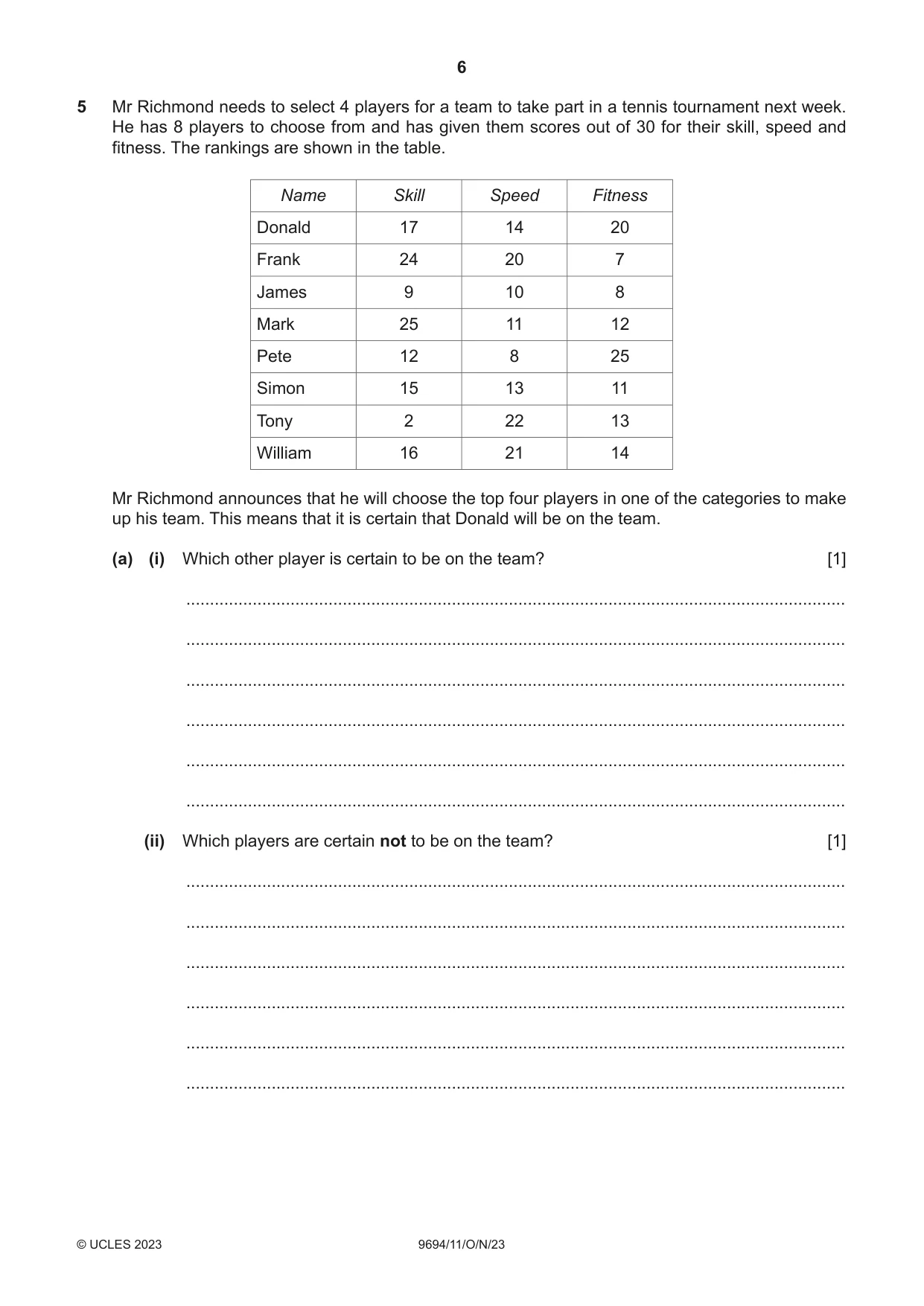
6 9694/11/O/N/23 © UCLES 2023 5 Mr Richmond needs to select 4 players for a team to take part in a tennis tournament next week. He has 8 players to choose from and has given them scores out of 30 for their skill, speed and fitness. The rankings are shown in the table. Name Skill Speed Fitness Donald 17 14 20 Frank 24 20 7 James 9 10 8 Mark 25 11 12 Pete 12 8 25 Simon 15 13 11 Tony 2 22 13 William 16 21 14 Mr Richmond announces that he will choose the top four players in one of the categories to make up his team. This means that it is certain that Donald will be on the team. (a) (i) Which other player is certain to be on the team? [1] … … … … … … (ii) Which players are certain not to be on the team? [1] … … … … … …
Question paper, page 7
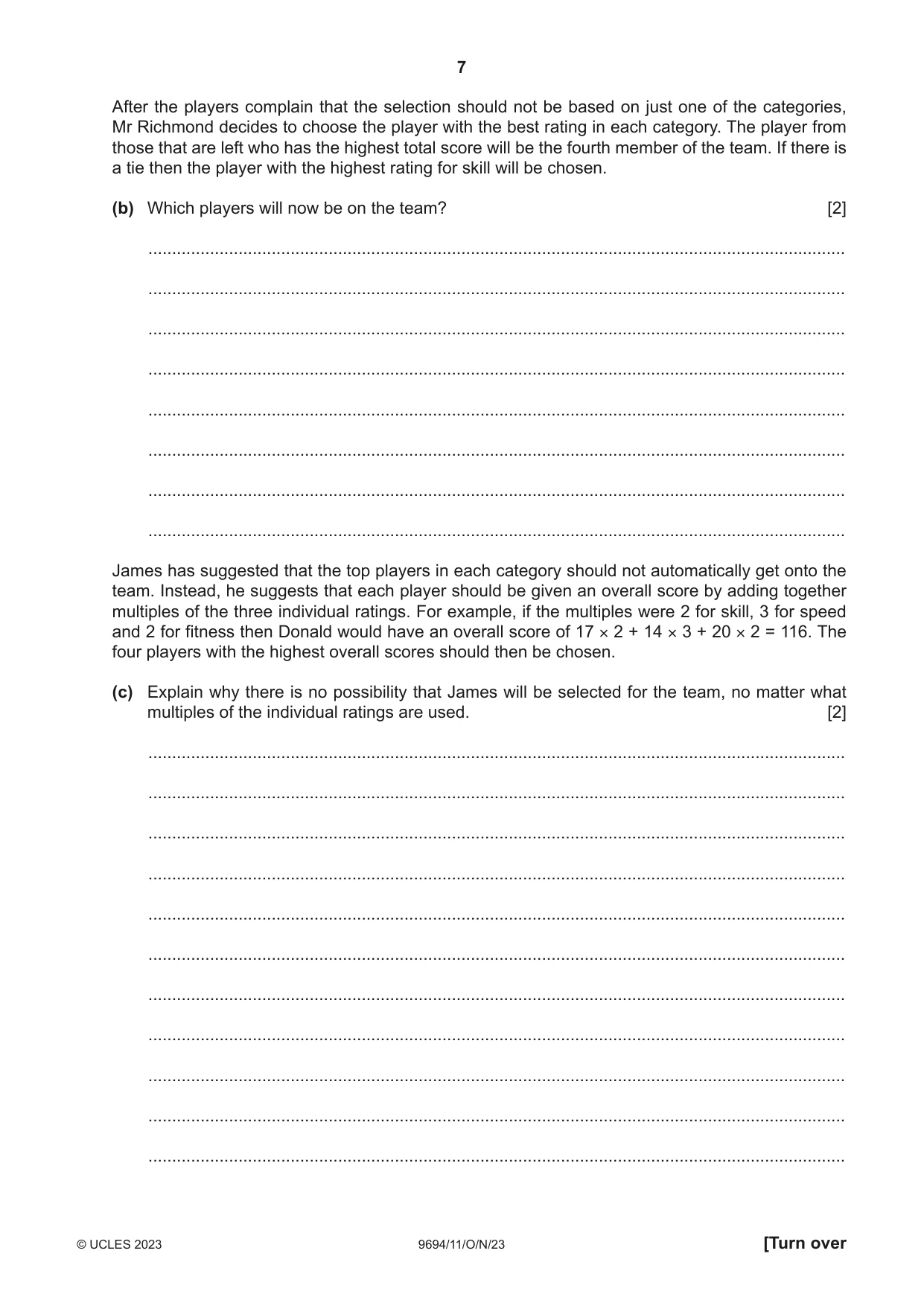
7 9694/11/O/N/23 © UCLES 2023 [Turn over After the players complain that the selection should not be based on just one of the categories, Mr Richmond decides to choose the player with the best rating in each category. The player from those that are left who has the highest total score will be the fourth member of the team. If there is a tie then the player with the highest rating for skill will be chosen. (b) Which players will now be on the team? [2] … … … … … … … … James has suggested that the top players in each category should not automatically get onto the team. Instead, he suggests that each player should be given an overall score by adding together multiples of the three individual ratings. For example, if the multiples were 2 for skill, 3 for speed and 2 for fitness then Donald would have an overall score of 17 × 2 + 14 × 3 + 20 × 2 = 116. The four players with the highest overall scores should then be chosen. (c) Explain why there is no possibility that James will be selected for the team, no matter what multiples of the individual ratings are used. [2] … … … … … … … … … … …
Question paper, page 8
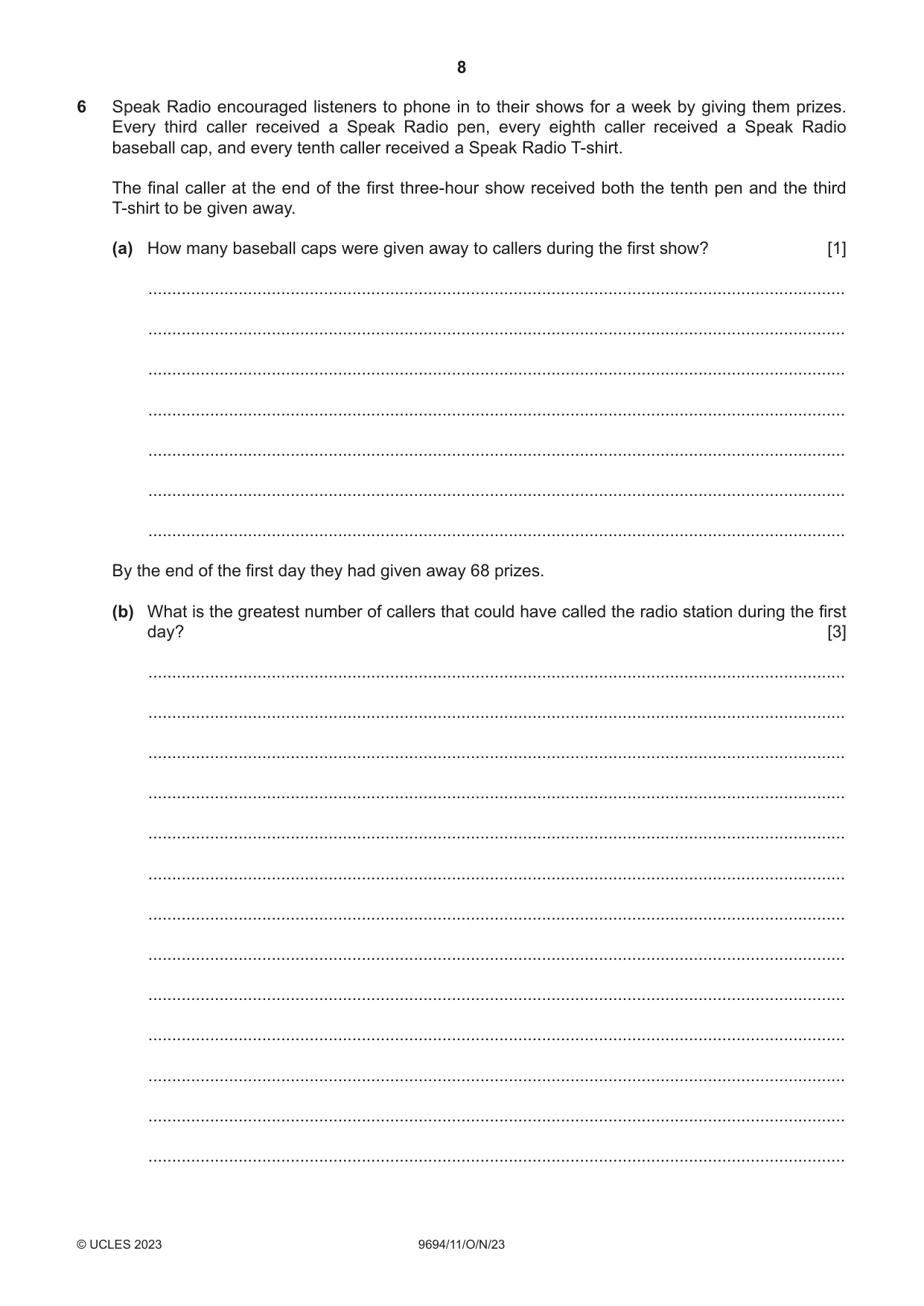
8 9694/11/O/N/23 © UCLES 2023 6 Speak Radio encouraged listeners to phone in to their shows for a week by giving them prizes. Every third caller received a Speak Radio pen, every eighth caller received a Speak Radio baseball cap, and every tenth caller received a Speak Radio T-shirt. The final caller at the end of the first three-hour show received both the tenth pen and the third T-shirt to be given away. (a) How many baseball caps were given away to callers during the first show? [1] … … … … … … … By the end of the first day they had given away 68 prizes. (b) What is the greatest number of callers that could have called the radio station during the first day? [3] … … … … … … … … … … … … …
Question paper, page 9
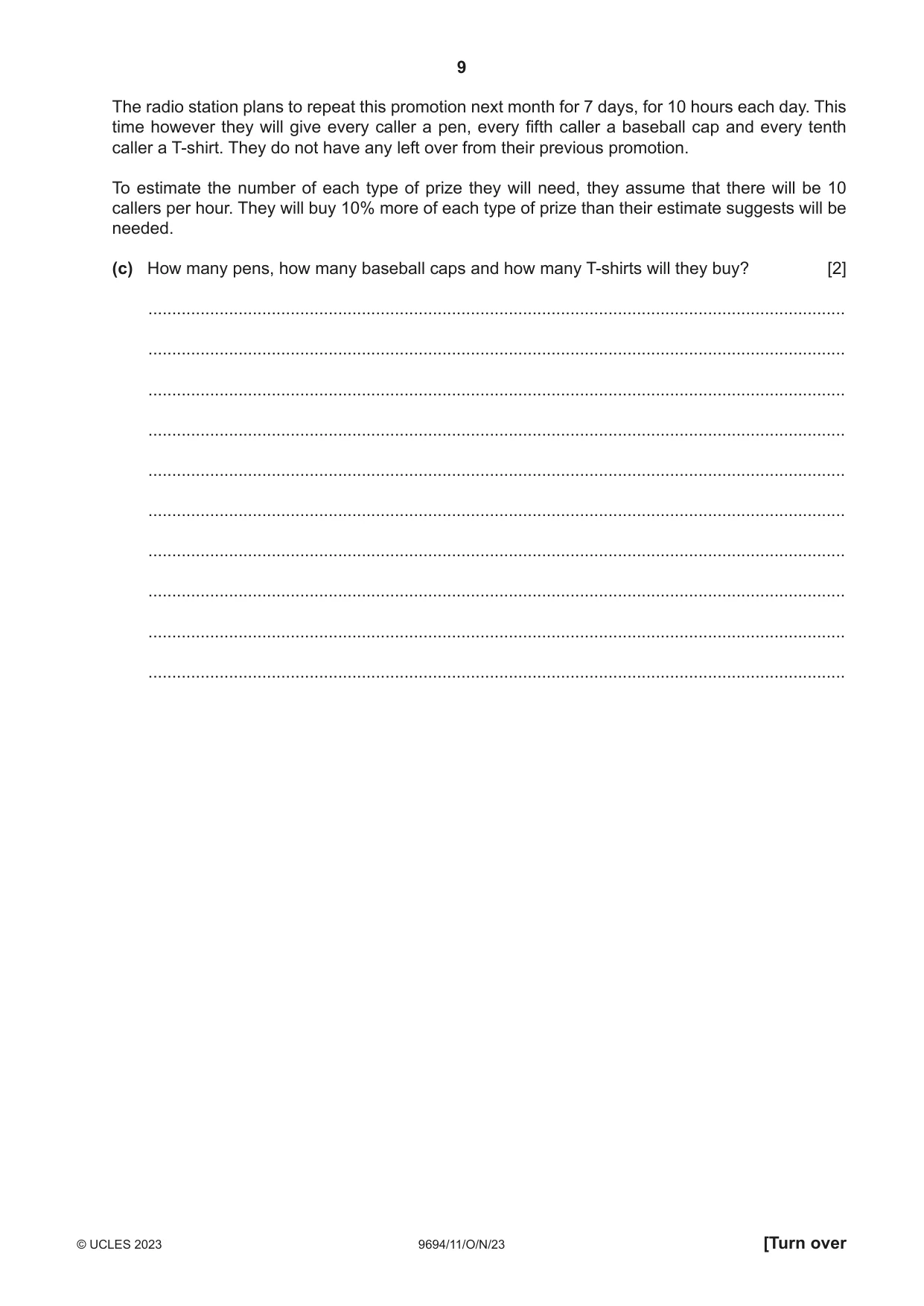
9 9694/11/O/N/23 © UCLES 2023 [Turn over The radio station plans to repeat this promotion next month for 7 days, for 10 hours each day. This time however they will give every caller a pen, every fifth caller a baseball cap and every tenth caller a T-shirt. They do not have any left over from their previous promotion. To estimate the number of each type of prize they will need, they assume that there will be 10 callers per hour. They will buy 10% more of each type of prize than their estimate suggests will be needed. (c) How many pens, how many baseball caps and how many T-shirts will they buy? [2] … … … … … … … … … …
Question paper, page 10
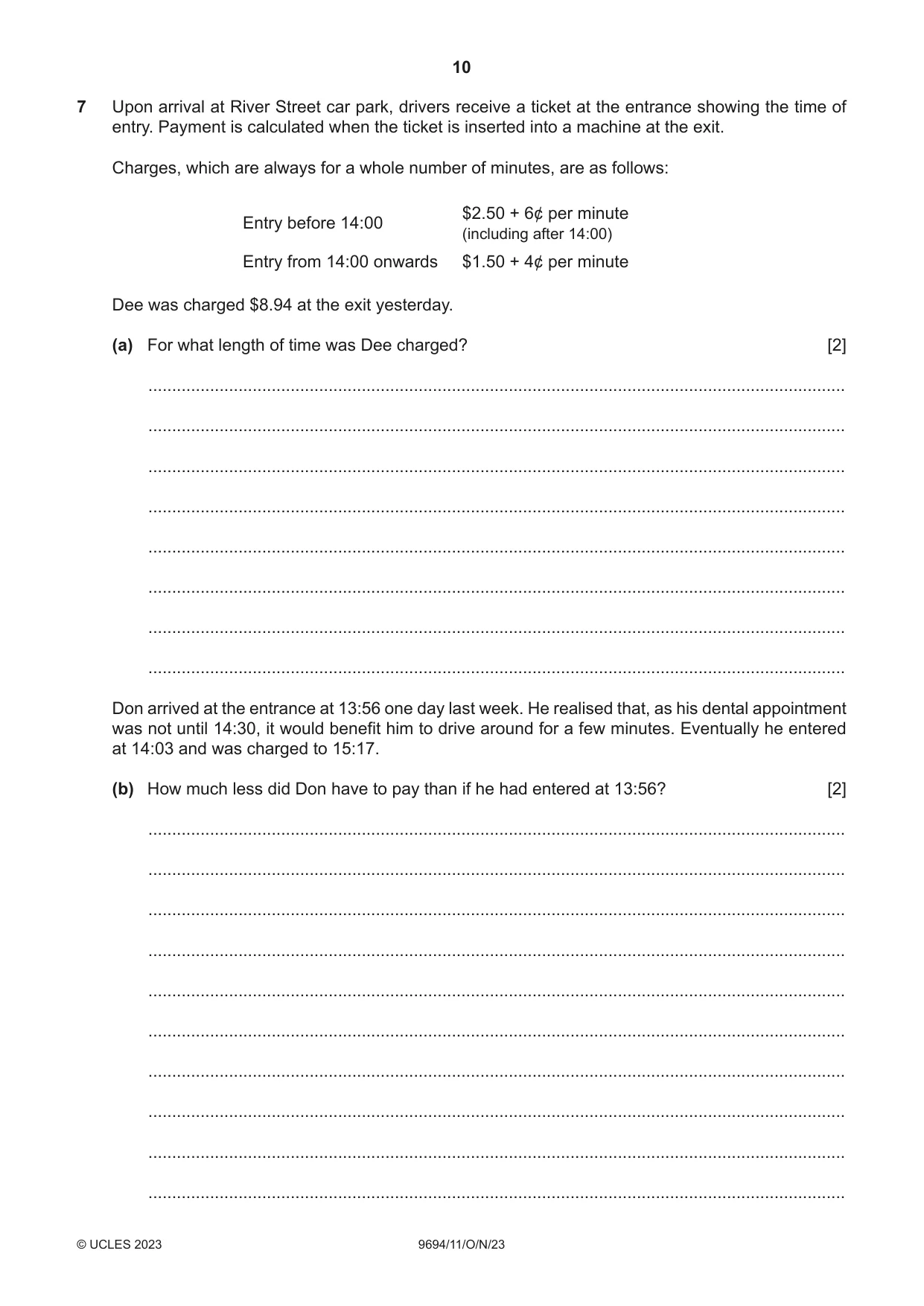
10 9694/11/O/N/23 © UCLES 2023 7 Upon arrival at River Street car park, drivers receive a ticket at the entrance showing the time of entry. Payment is calculated when the ticket is inserted into a machine at the exit. Charges, which are always for a whole number of minutes, are as follows: Entry before 14:00 $2.50 + 6¢ per minute (including after 14:00) Entry from 14:00 onwards $1.50 + 4¢ per minute Dee was charged $8.94 at the exit yesterday. (a) For what length of time was Dee charged? [2] … … … … … … … … Don arrived at the entrance at 13:56 one day last week. He realised that, as his dental appointment was not until 14:30, it would benefit him to drive around for a few minutes. Eventually he entered at 14:03 and was charged to 15:17. (b) How much less did Don have to pay than if he had entered at 13:56? [2] … … … … … … … … … …
Question paper, page 11
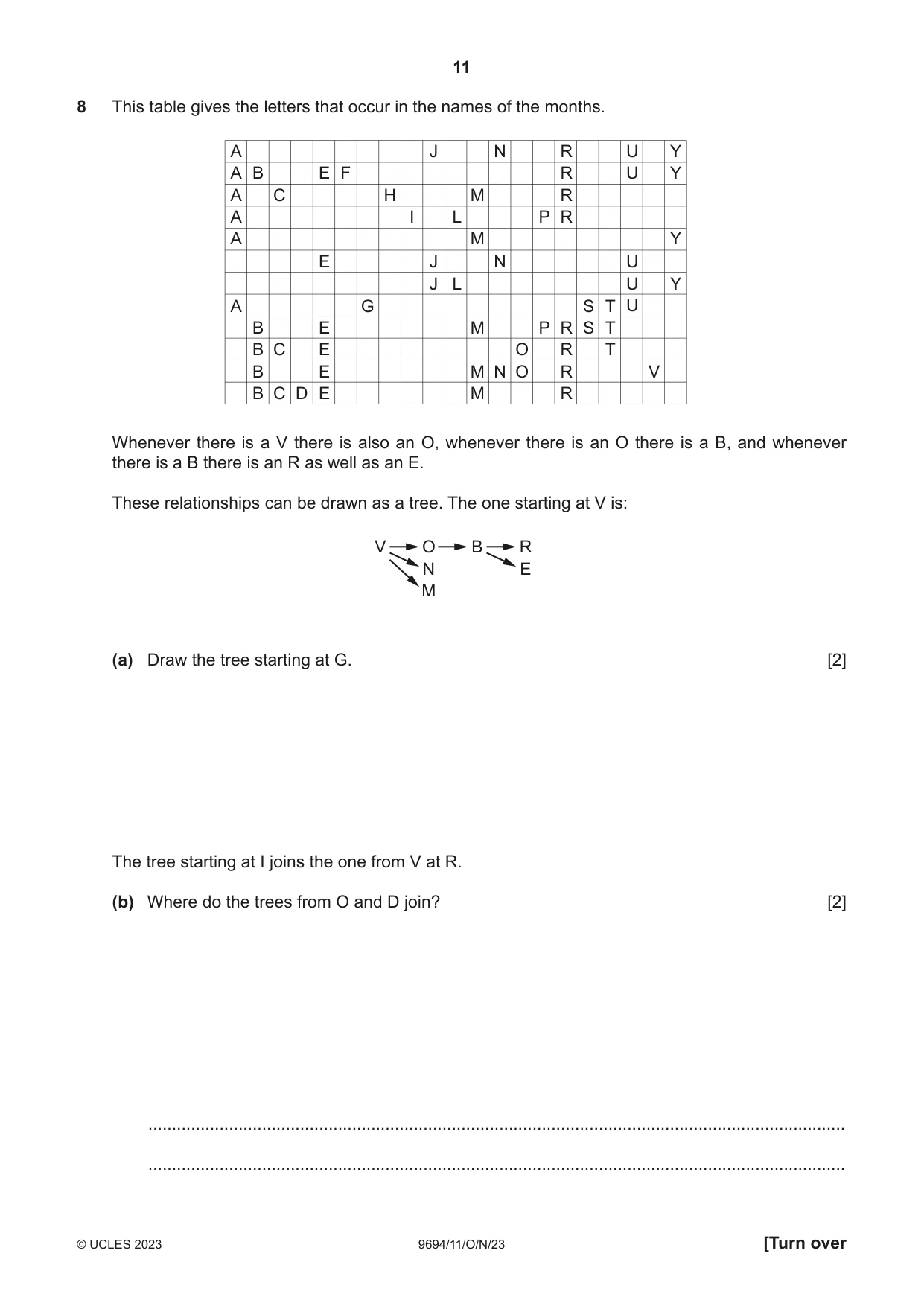
11 9694/11/O/N/23 © UCLES 2023 [Turn over 8 This table gives the letters that occur in the names of the months. A J J J A B A C H M M M P P M N O O N N R U Y Y Y Y U U U U R R R R S T T T S R R V R M C C D E E E E E E F A I L L A A G B B B B Whenever there is a V there is also an O, whenever there is an O there is a B, and whenever there is a B there is an R as well as an E. These relationships can be drawn as a tree. The one starting at V is: V O N E M B R (a) Draw the tree starting at G. [2] The tree starting at I joins the one from V at R. (b) Where do the trees from O and D join? [2] … …
Question paper, page 12
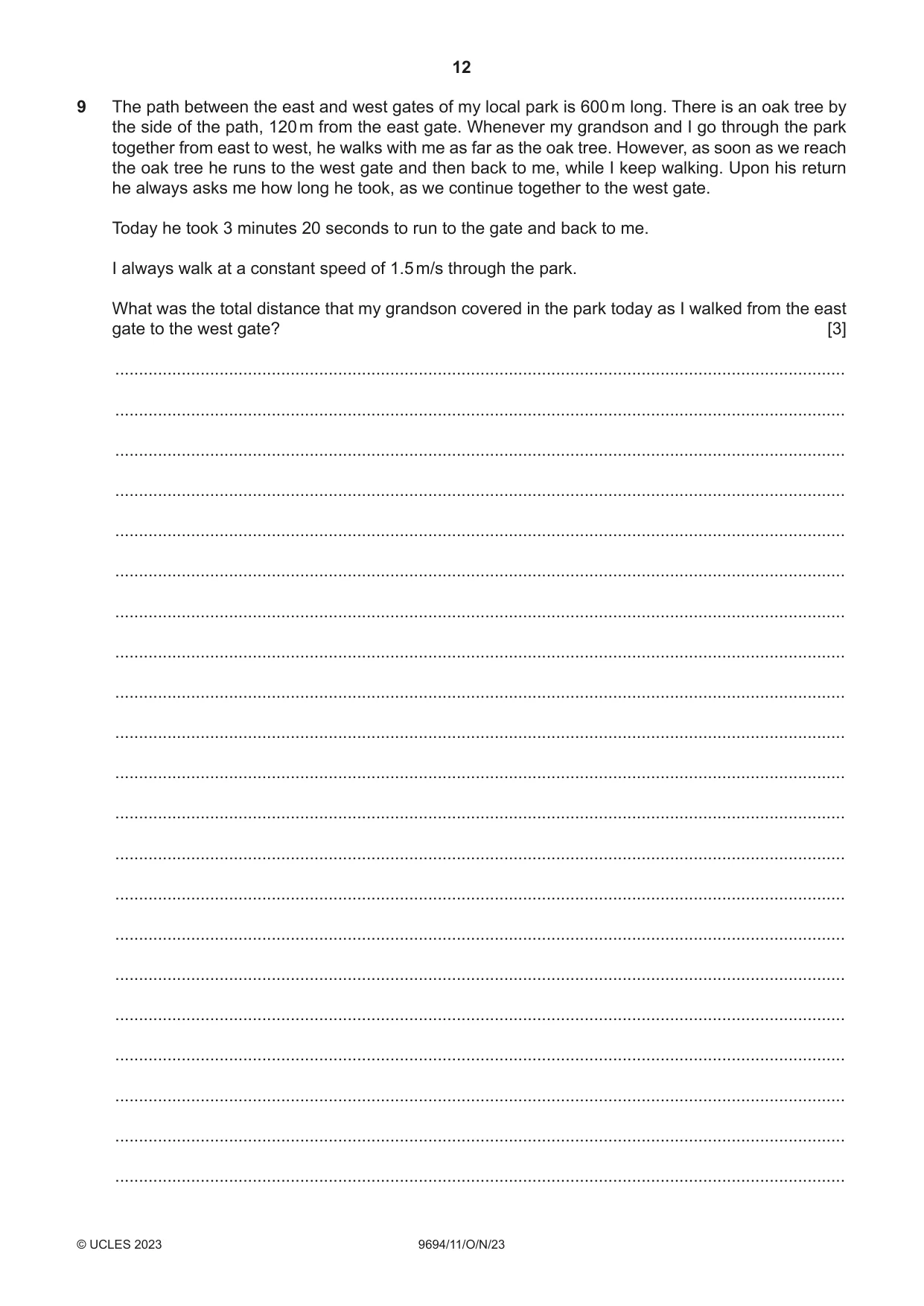
12 9694/11/O/N/23 © UCLES 2023 9 The path between the east and west gates of my local park is 600 m long. There is an oak tree by the side of the path, 120 m from the east gate. Whenever my grandson and I go through the park together from east to west, he walks with me as far as the oak tree. However, as soon as we reach the oak tree he runs to the west gate and then back to me, while I keep walking. Upon his return he always asks me how long he took, as we continue together to the west gate. Today he took 3 minutes 20 seconds to run to the gate and back to me. I always walk at a constant speed of 1.5 m/s through the park. What was the total distance that my grandson covered in the park today as I walked from the east gate to the west gate? [3] … … … … … … … … … … … … … … … … … … … … …
Question paper, page 13
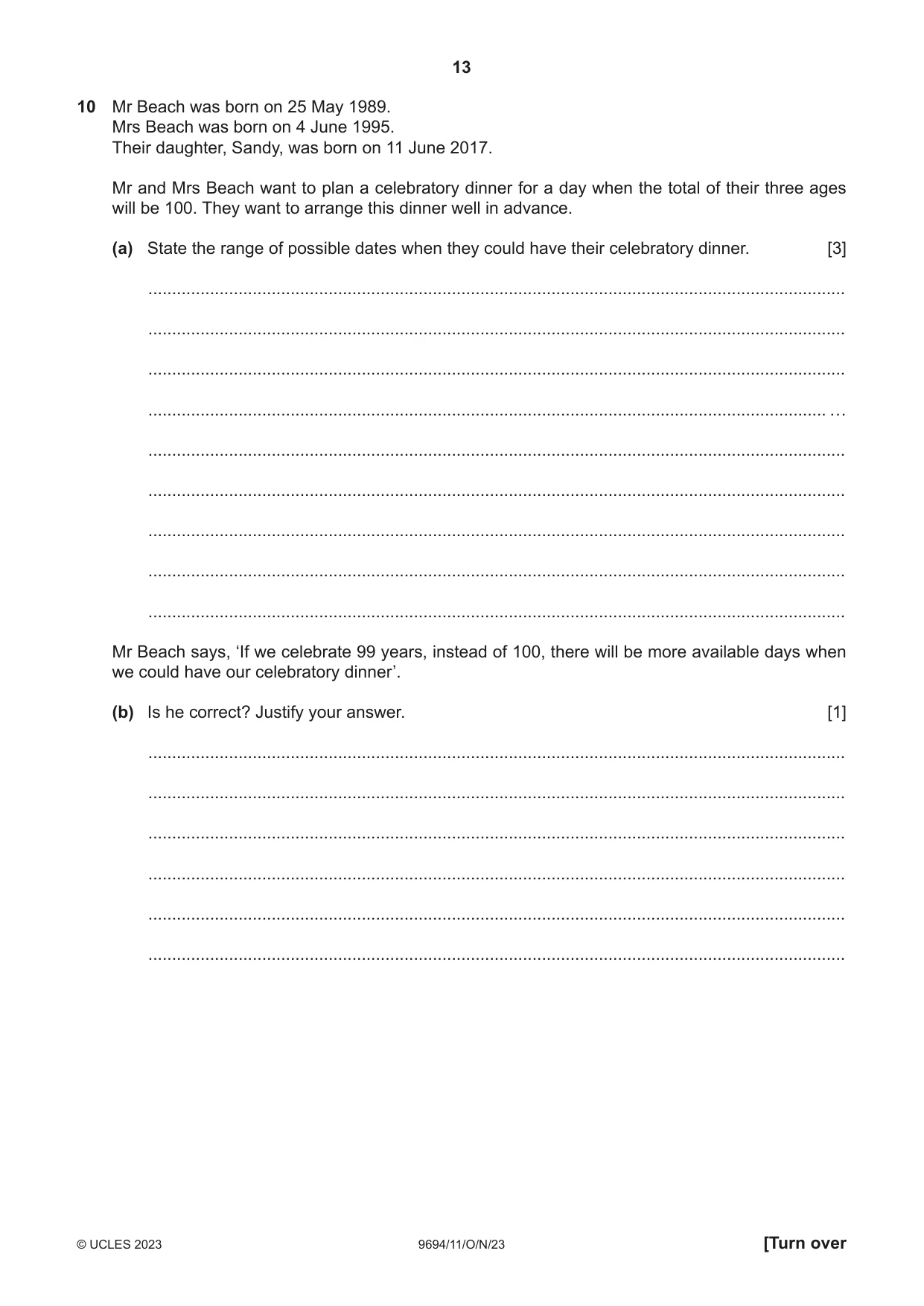
13 9694/11/O/N/23 © UCLES 2023 [Turn over 10 Mr Beach was born on 25 May 1989. Mrs Beach was born on 4 June 1995. Their daughter, Sandy, was born on 11 June 2017. Mr and Mrs Beach want to plan a celebratory dinner for a day when the total of their three ages will be 100. They want to arrange this dinner well in advance. (a) State the range of possible dates when they could have their celebratory dinner. [3] … … … … … … … … … … Mr Beach says, ‘If we celebrate 99 years, instead of 100, there will be more available days when we could have our celebratory dinner’. (b) Is he correct? Justify your answer. [1] … … … … … …
Question paper, page 14
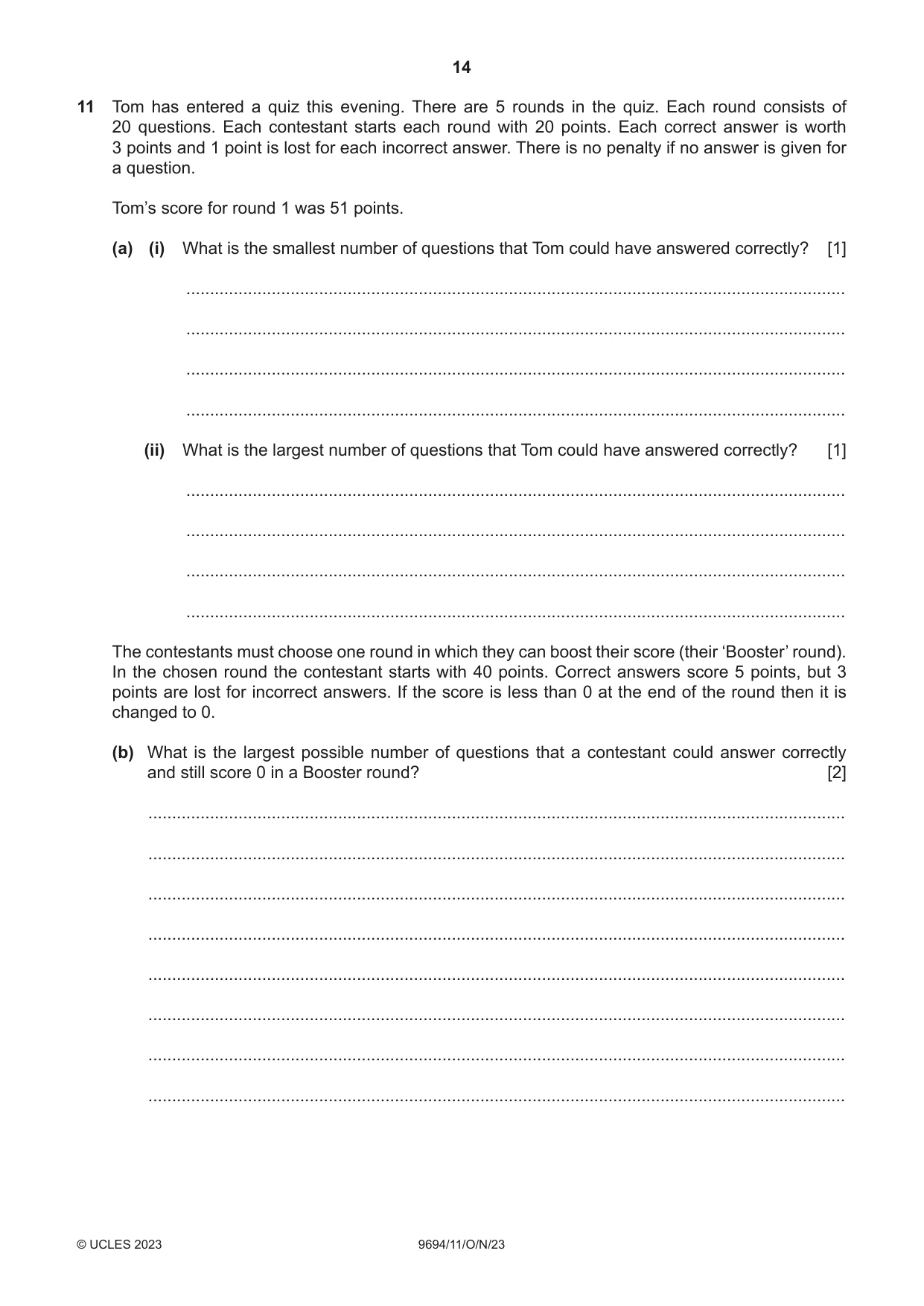
14 9694/11/O/N/23 © UCLES 2023 11 Tom has entered a quiz this evening. There are 5 rounds in the quiz. Each round consists of 20 questions. Each contestant starts each round with 20 points. Each correct answer is worth 3 points and 1 point is lost for each incorrect answer. There is no penalty if no answer is given for a question. Tom’s score for round 1 was 51 points. (a) (i) What is the smallest number of questions that Tom could have answered correctly? [1] … … … … (ii) What is the largest number of questions that Tom could have answered correctly? [1] … … … … The contestants must choose one round in which they can boost their score (their ‘Booster’ round). In the chosen round the contestant starts with 40 points. Correct answers score 5 points, but 3 points are lost for incorrect answers. If the score is less than 0 at the end of the round then it is changed to 0. (b) What is the largest possible number of questions that a contestant could answer correctly and still score 0 in a Booster round? [2] … … … … … … … …
Question paper, page 15
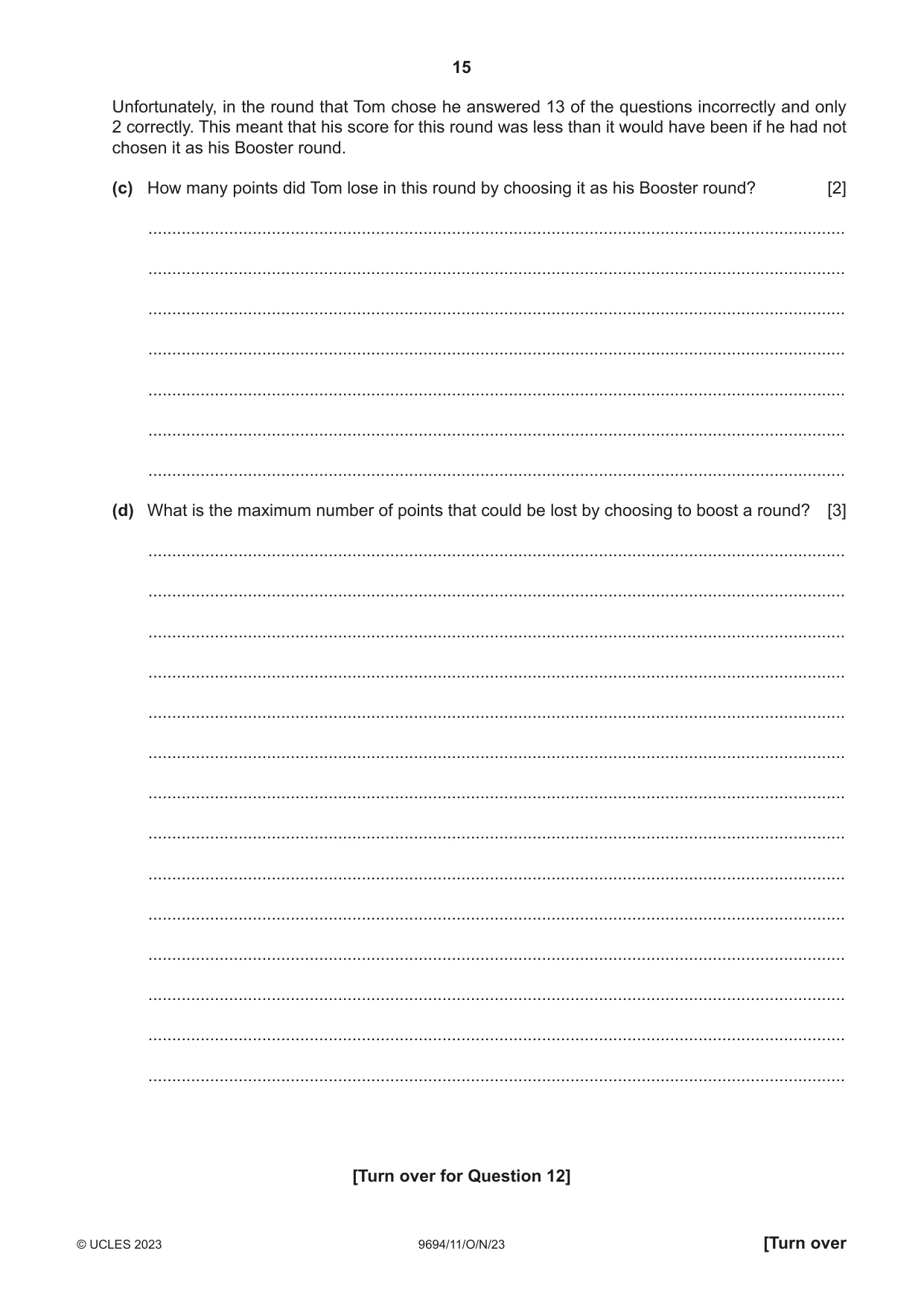
15 9694/11/O/N/23 © UCLES 2023 [Turn over Unfortunately, in the round that Tom chose he answered 13 of the questions incorrectly and only 2 correctly. This meant that his score for this round was less than it would have been if he had not chosen it as his Booster round. (c) How many points did Tom lose in this round by choosing it as his Booster round? [2] … … … … … … … (d) What is the maximum number of points that could be lost by choosing to boost a round? [3] … … … … … … … … … … … … … … [Turn over for Question 12]
Question paper, page 16
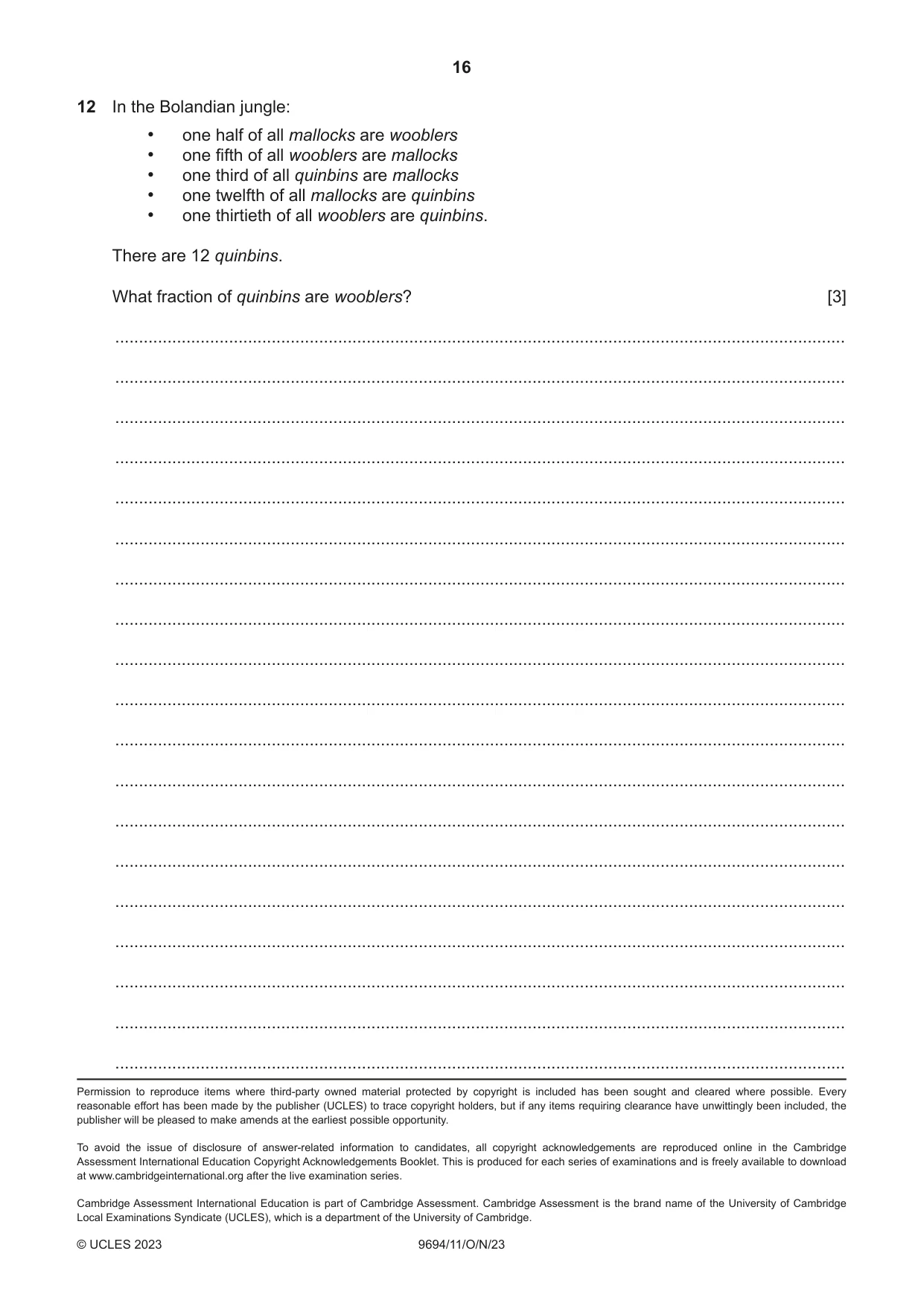
16 9694/11/O/N/23 © UCLES 2023 Permission to reproduce items where third-party owned material protected by copyright is included has been sought and cleared where possible. Every reasonable effort has been made by the publisher (UCLES) to trace copyright holders, but if any items requiring clearance have unwittingly been included, the publisher will be pleased to make amends at the earliest possible opportunity. To avoid the issue of disclosure of answer-related information to candidates, all copyright acknowledgements are reproduced online in the Cambridge Assessment International Education Copyright Acknowledgements Booklet. This is produced for each series of examinations and is freely available to download at www.cambridgeinternational.org after the live examination series. Cambridge Assessment International Education is part of Cambridge Assessment. Cambridge Assessment is the brand name of the University of Cambridge Local Examinations Syndicate (UCLES), which is a department of the University of Cambridge. 12 In the Bolandian jungle: • one half of all mallocks are wooblers • one fifth of all wooblers are mallocks • one third of all quinbins are mallocks • one twelfth of all mallocks are quinbins • one thirtieth of all wooblers are quinbins. There are 12 quinbins. What fraction of quinbins are wooblers? [3] … … … … … … … … … … … … … … … … … … …
Mark scheme, page 1
This document consists of 9 printed pages. © UCLES 2023 [Turn over Cambridge International AS & A Level THINKING SKILLS 9694/11 Paper 1 Problem Solving October/November 2023 MARK SCHEME Maximum Mark: 50 Published This mark scheme is published as an aid to teachers and candidates, to indicate the requirements of the examination. It shows the basis on which Examiners were instructed to award marks. It does not indicate the details of the discussions that took place at an Examiners’ meeting before marking began, which would have considered the acceptability of alternative answers. Mark schemes should be read in conjunction with the question paper and the Principal Examiner Report for Teachers. Cambridge International will not enter into discussions about these mark schemes. Cambridge International is publishing the mark schemes for the October/November 2023 series for most Cambridge IGCSE, Cambridge International A and AS Level components, and some Cambridge O Level components.
Mark scheme, page 2
9694/11 Cambridge International AS & A Level – Mark Scheme PUBLISHED October/November 2023 © UCLES 2023 Page 2 of 9 Generic Marking Principles These general marking principles must be applied by all examiners when marking candidate answers. They should be applied alongside the specific content of the mark scheme or generic level descriptors for a question. Each question paper and mark scheme will also comply with these marking principles. GENERIC MARKING PRINCIPLE 1: Marks must be awarded in line with: • the specific content of the mark scheme or the generic level descriptors for the question • the specific skills defined in the mark scheme or in the generic level descriptors for the question • the standard of response required by a candidate as exemplified by the standardisation scripts. GENERIC MARKING PRINCIPLE 2: Marks awarded are always whole marks (not half marks, or other fractions). GENERIC MARKING PRINCIPLE 3: Marks must be awarded positively: • marks are awarded for correct/valid answers, as defined in the mark scheme. However, credit is given for valid answers which go beyond the scope of the syllabus and mark scheme, referring to your Team Leader as appropriate • marks are awarded when candidates clearly demonstrate what they know and can do • marks are not deducted for errors • marks are not deducted for omissions • answers should only be judged on the quality of spelling, punctuation and grammar when these features are specifically assessed by the question as indicated by the mark scheme. The meaning, however, should be unambiguous. GENERIC MARKING PRINCIPLE 4: Rules must be applied consistently, e.g. in situations where candidates have not followed instructions or in the application of generic level descriptors. GENERIC MARKING PRINCIPLE 5: Marks should be awarded using the full range of marks defined in the mark scheme for the question (however; the use of the full mark range may be limited according to the quality of the candidate responses seen). GENERIC MARKING PRINCIPLE 6: Marks awarded are based solely on the requirements as defined in the mark scheme. Marks should not be awarded with grade thresholds or grade descriptors in mind.
Mark scheme, page 3
9694/11 Cambridge International AS & A Level – Mark Scheme PUBLISHED October/November 2023 © UCLES 2023 Page 3 of 9 NOTES FOR MARKERS Working Where a final answer is underlined in the mark scheme, full marks are awarded for a correct answer, regardless of whether there is any supporting working, unless an exception is noted in the mark scheme. For partial credit, the evidence needed to award the mark will usually be shown on its own line in the mark scheme, or else will be defined in italic text. For explanations and verbal justifications, apply the principle of ‘words to that effect’. No response If there is any attempt at a solution award 0 marks not NR. ‘–’ or ‘?’ constitute no attempt at a solution. Abbreviations The following abbreviations may be used in a mark scheme: AG answer given (on question paper) awrt answer which rounds to dep mark depends on earlier, asterisked (*), mark ft follow through (from earlier error) oe or equivalent SC special case soi seen or implied
Mark scheme, page 4
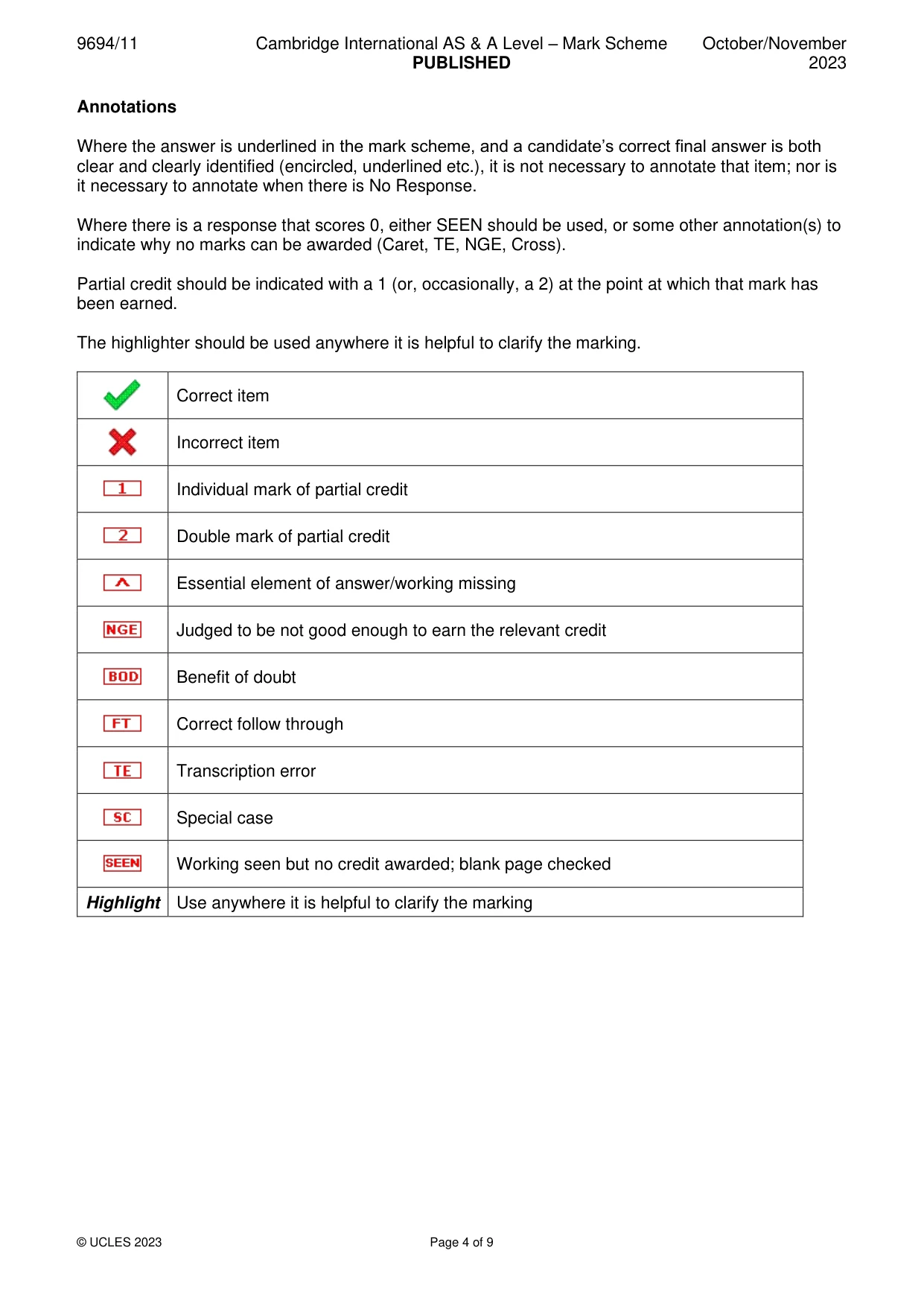
9694/11 Cambridge International AS & A Level – Mark Scheme PUBLISHED October/November 2023 © UCLES 2023 Page 4 of 9 Annotations Where the answer is underlined in the mark scheme, and a candidate’s correct final answer is both clear and clearly identified (encircled, underlined etc.), it is not necessary to annotate that item; nor is it necessary to annotate when there is No Response. Where there is a response that scores 0, either SEEN should be used, or some other annotation(s) to indicate why no marks can be awarded (Caret, TE, NGE, Cross). Partial credit should be indicated with a 1 (or, occasionally, a 2) at the point at which that mark has been earned. The highlighter should be used anywhere it is helpful to clarify the marking. Correct item Incorrect item Individual mark of partial credit Double mark of partial credit Essential element of answer/working missing Judged to be not good enough to earn the relevant credit Benefit of doubt Correct follow through Transcription error Special case Working seen but no credit awarded; blank page checked Highlight Use anywhere it is helpful to clarify the marking
Mark scheme, page 5
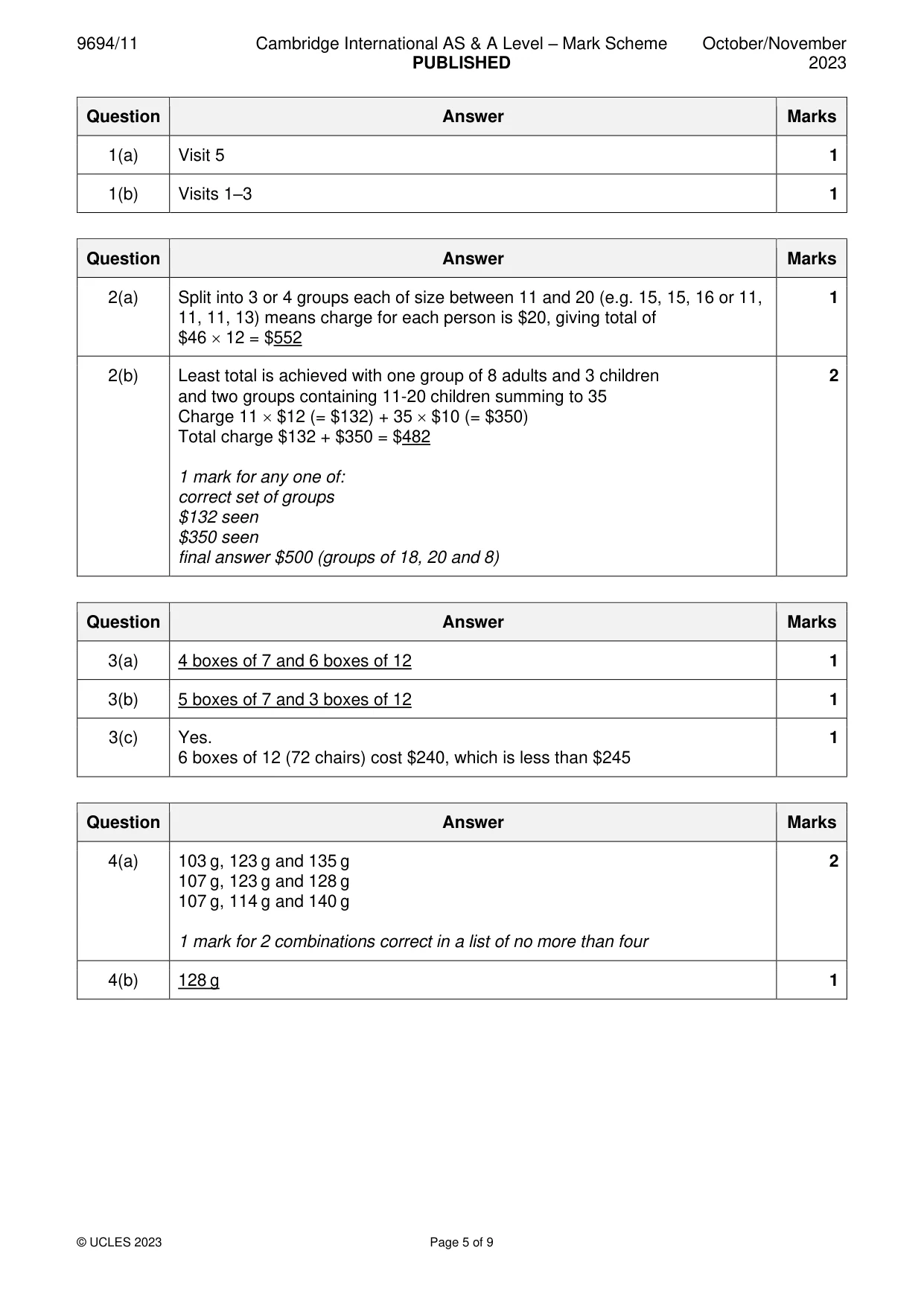
9694/11 Cambridge International AS & A Level – Mark Scheme PUBLISHED October/November 2023 © UCLES 2023 Page 5 of 9 Question Answer Marks 1(a) Visit 5 1 1(b) Visits 1–3 1 Question Answer Marks 2(a) Split into 3 or 4 groups each of size between 11 and 20 (e.g. 15, 15, 16 or 11, 11, 11, 13) means charge for each person is $20, giving total of $46 12 = $552 1 2(b) Least total is achieved with one group of 8 adults and 3 children and two groups containing 11-20 children summing to 35 Charge 11 $12 (= $132) + 35 $10 (= $350) Total charge $132 + $350 = $482 1 mark for any one of: correct set of groups $132 seen $350 seen final answer $500 (groups of 18, 20 and 8) 2 Question Answer Marks 3(a) 4 boxes of 7 and 6 boxes of 12 1 3(b) 5 boxes of 7 and 3 boxes of 12 1 3(c) Yes. 6 boxes of 12 (72 chairs) cost $240, which is less than $245 1 Question Answer Marks 4(a) 103 g, 123 g and 135 g 107 g, 123 g and 128 g 107 g, 114 g and 140 g 1 mark for 2 combinations correct in a list of no more than four 2 4(b) 128 g 1
Mark scheme, page 6
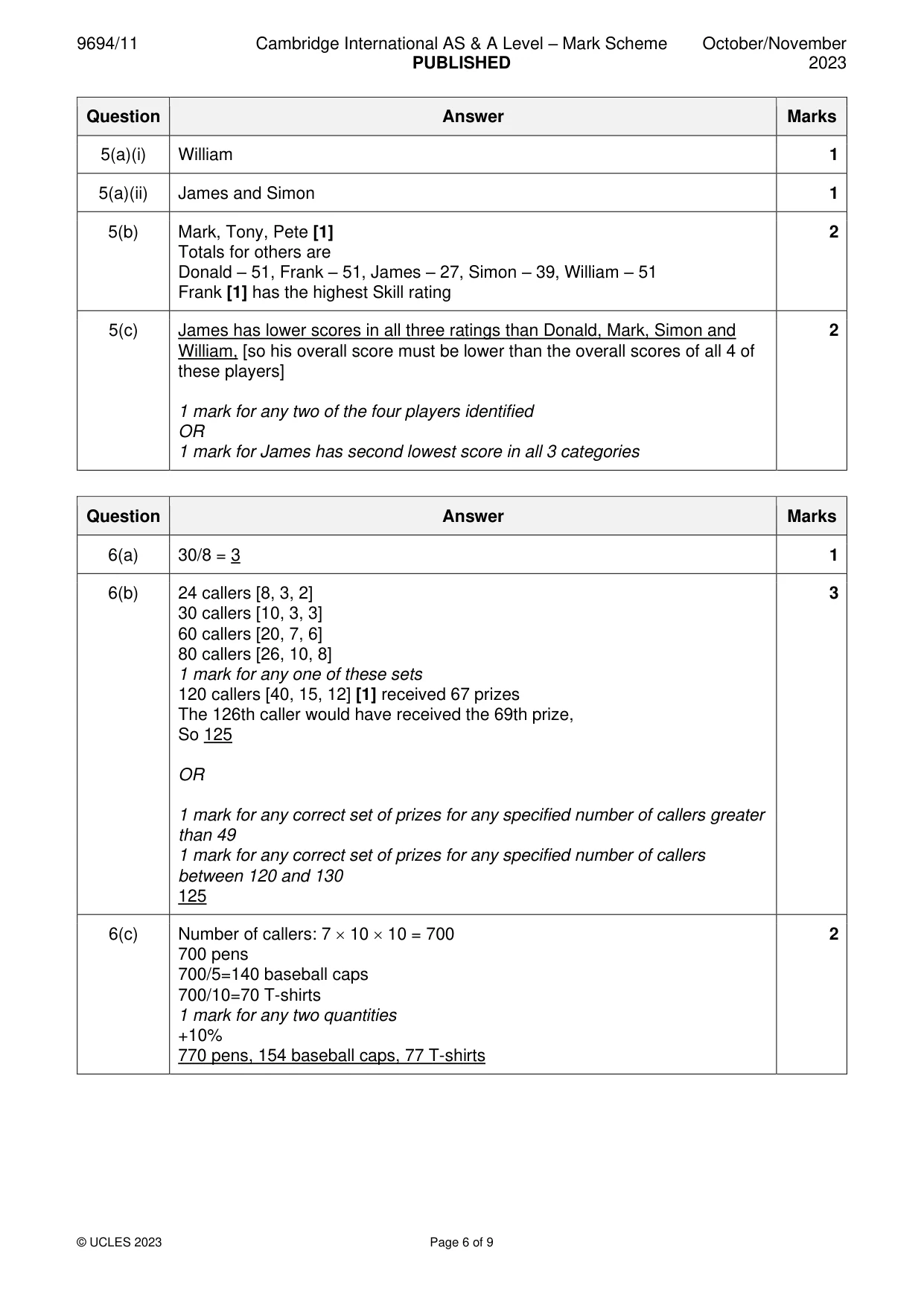
9694/11 Cambridge International AS & A Level – Mark Scheme PUBLISHED October/November 2023 © UCLES 2023 Page 6 of 9 Question Answer Marks 5(a)(i) William 1 5(a)(ii) James and Simon 1 5(b) Mark, Tony, Pete [1] Totals for others are Donald – 51, Frank – 51, James – 27, Simon – 39, William – 51 Frank [1] has the highest Skill rating 2 5(c) James has lower scores in all three ratings than Donald, Mark, Simon and William, [so his overall score must be lower than the overall scores of all 4 of these players] 1 mark for any two of the four players identified OR 1 mark for James has second lowest score in all 3 categories 2 Question Answer Marks 6(a) 30/8 = 3 1 6(b) 24 callers [8, 3, 2] 30 callers [10, 3, 3] 60 callers [20, 7, 6] 80 callers [26, 10, 8] 1 mark for any one of these sets 120 callers [40, 15, 12] [1] received 67 prizes The 126th caller would have received the 69th prize, So 125 OR 1 mark for any correct set of prizes for any specified number of callers greater than 49 1 mark for any correct set of prizes for any specified number of callers between 120 and 130 125 3 6(c) Number of callers: 7 10 10 = 700 700 pens 700/5=140 baseball caps 700/10=70 T-shirts 1 mark for any two quantities +10% 770 pens, 154 baseball caps, 77 T-shirts 2
Mark scheme, page 7
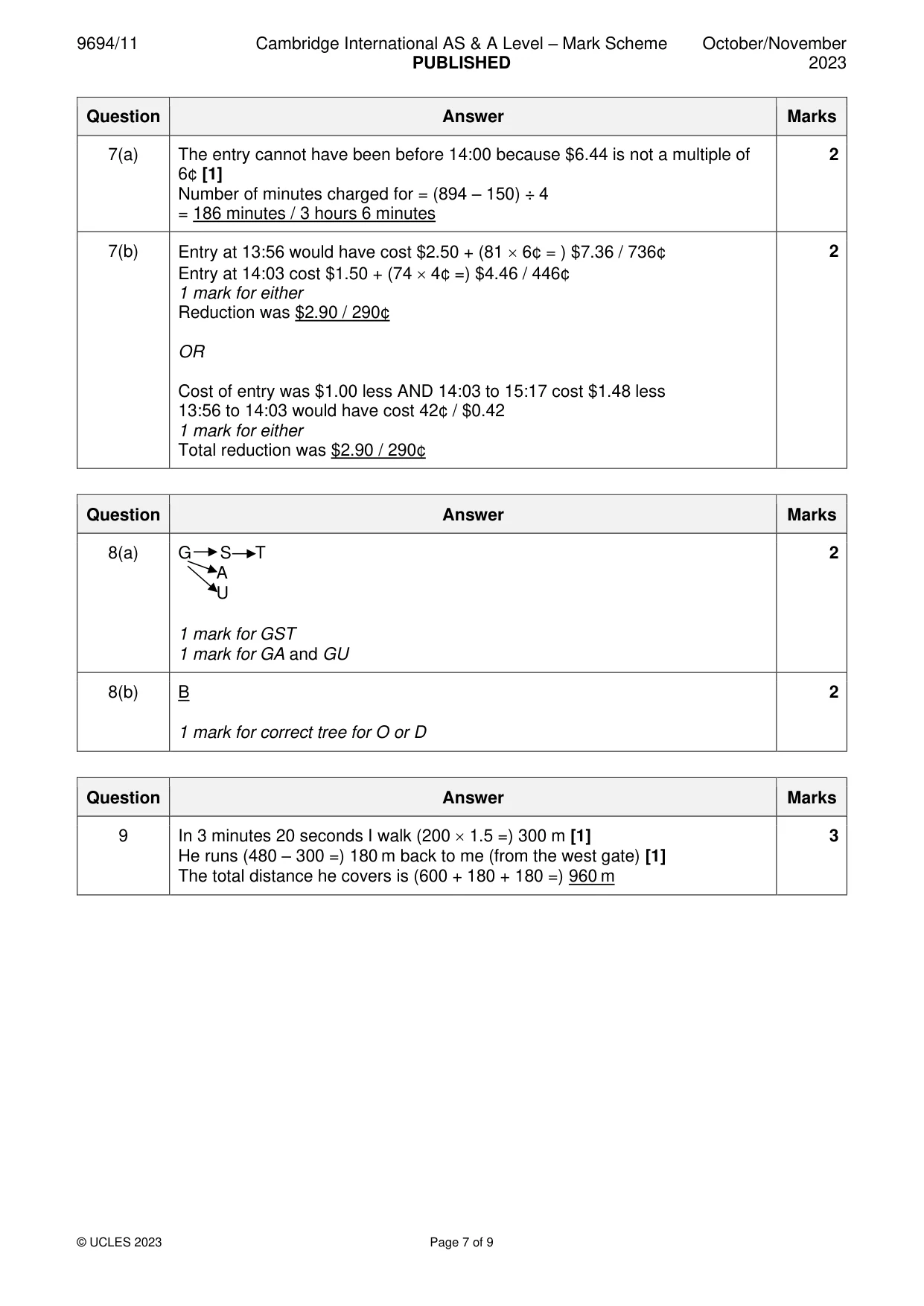
9694/11 Cambridge International AS & A Level – Mark Scheme PUBLISHED October/November 2023 © UCLES 2023 Page 7 of 9 Question Answer Marks 7(a) The entry cannot have been before 14:00 because $6.44 is not a multiple of 6¢ [1] Number of minutes charged for = (894 – 150) ÷ 4 = 186 minutes / 3 hours 6 minutes 2 7(b) Entry at 13:56 would have cost $2.50 + (81 6¢ = ) $7.36 / 736¢ Entry at 14:03 cost $1.50 + (74 4¢ =) $4.46 / 446¢ 1 mark for either Reduction was $2.90 / 290¢ OR Cost of entry was $1.00 less AND 14:03 to 15:17 cost $1.48 less 13:56 to 14:03 would have cost 42¢ / $0.42 1 mark for either Total reduction was $2.90 / 290¢ 2 Question Answer Marks 8(a) G S T A U 1 mark for GST 1 mark for GA and GU 2 8(b) B 1 mark for correct tree for O or D 2 Question Answer Marks 9 In 3 minutes 20 seconds I walk (200 1.5 =) 300 m [1] He runs (480 – 300 =) 180 m back to me (from the west gate) [1] The total distance he covers is (600 + 180 + 180 =) 960 m 3
Mark scheme, page 8
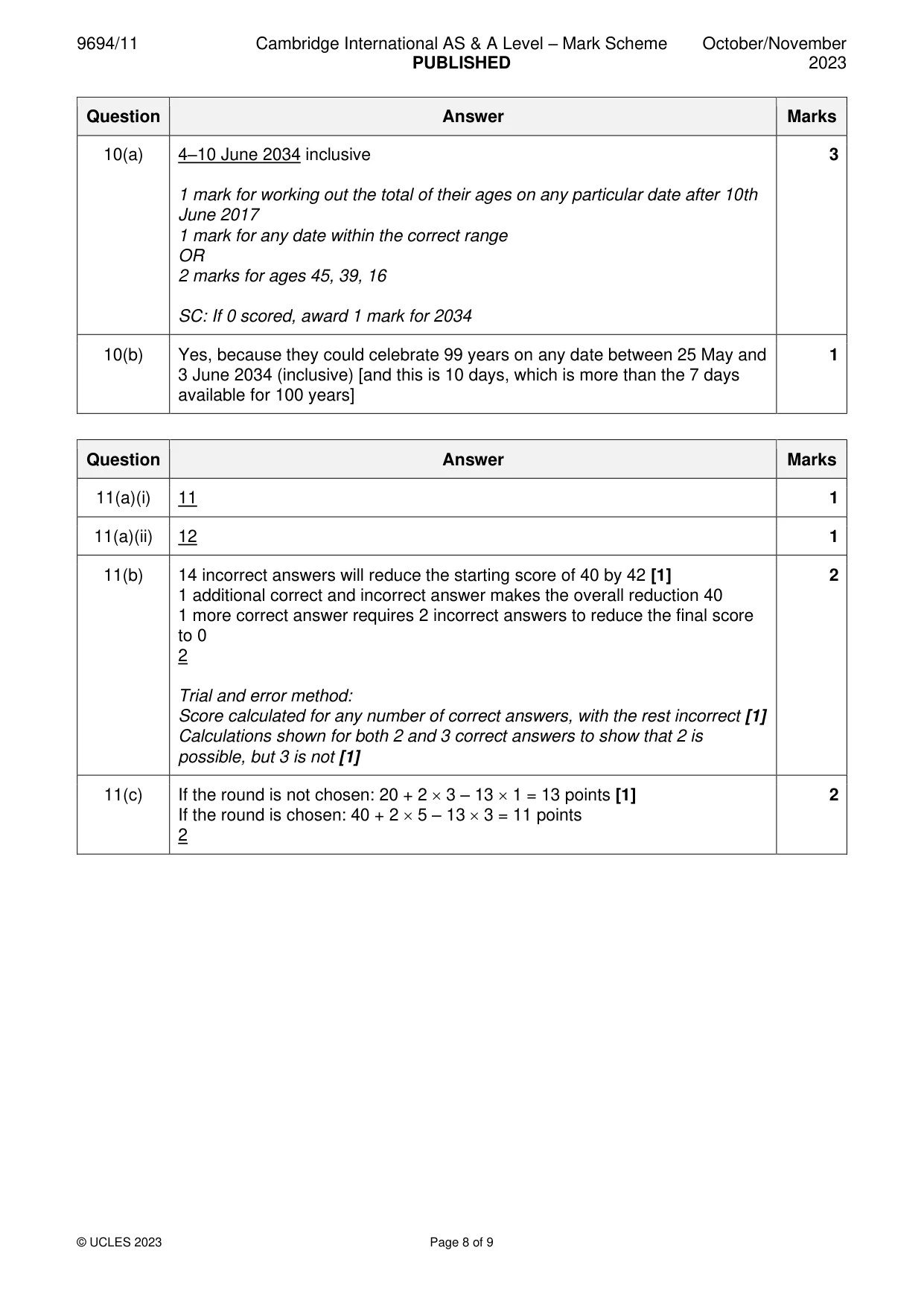
9694/11 Cambridge International AS & A Level – Mark Scheme PUBLISHED October/November 2023 © UCLES 2023 Page 8 of 9 Question Answer Marks 10(a) 4–10 June 2034 inclusive 1 mark for working out the total of their ages on any particular date after 10th June 2017 1 mark for any date within the correct range OR 2 marks for ages 45, 39, 16 SC: If 0 scored, award 1 mark for 2034 3 10(b) Yes, because they could celebrate 99 years on any date between 25 May and 3 June 2034 (inclusive) [and this is 10 days, which is more than the 7 days available for 100 years] 1 Question Answer Marks 11(a)(i) 11 1 11(a)(ii) 12 1 11(b) 14 incorrect answers will reduce the starting score of 40 by 42 [1] 1 additional correct and incorrect answer makes the overall reduction 40 1 more correct answer requires 2 incorrect answers to reduce the final score to 0 2 Trial and error method: Score calculated for any number of correct answers, with the rest incorrect [1] Calculations shown for both 2 and 3 correct answers to show that 2 is possible, but 3 is not [1] 2 11(c) If the round is not chosen: 20 + 2 3 – 13 1 = 13 points [1] If the round is chosen: 40 + 2 5 – 13 3 = 11 points 2 2
Mark scheme, page 9
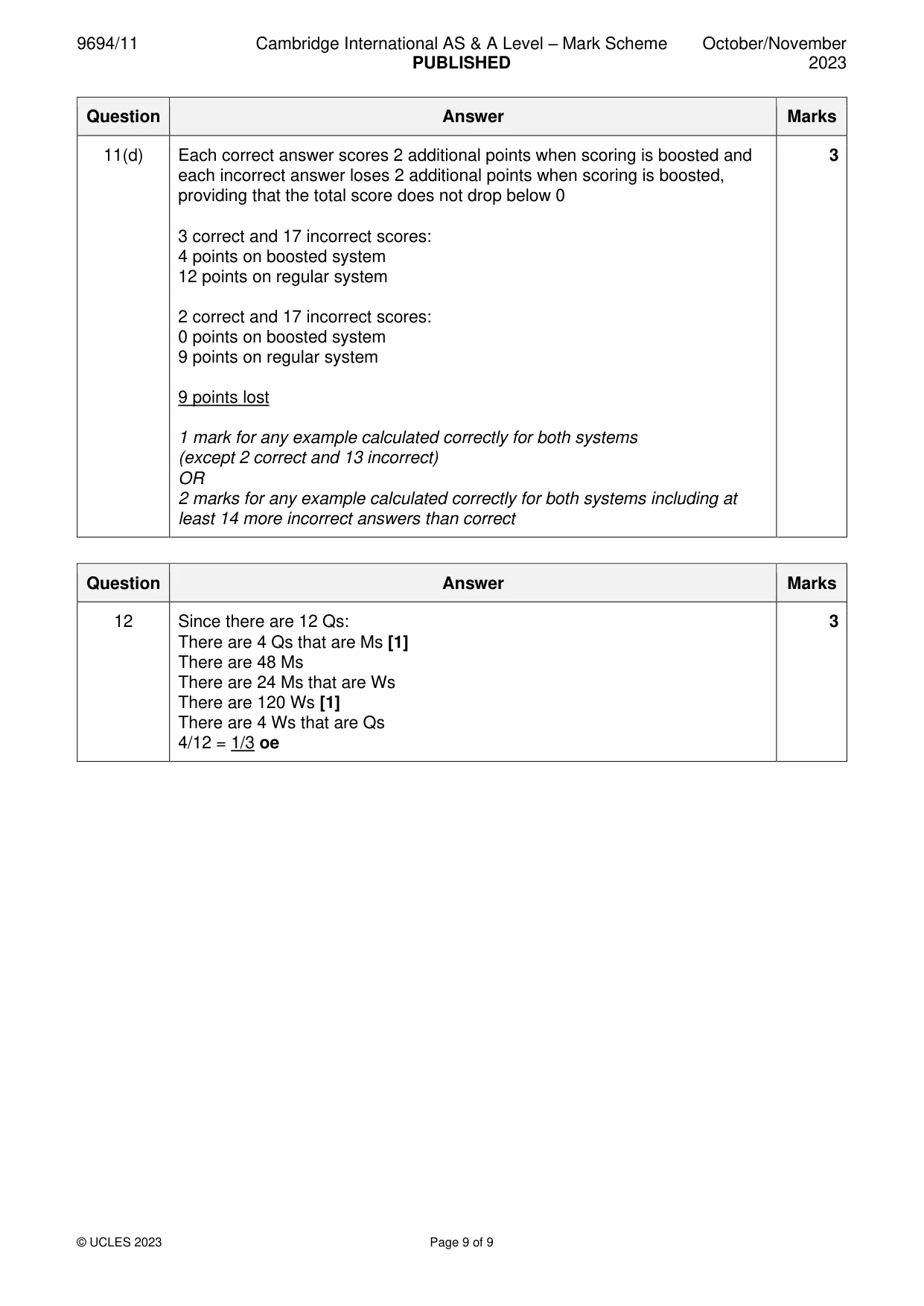
9694/11 Cambridge International AS & A Level – Mark Scheme PUBLISHED October/November 2023 © UCLES 2023 Page 9 of 9 Question Answer Marks 11(d) Each correct answer scores 2 additional points when scoring is boosted and each incorrect answer loses 2 additional points when scoring is boosted, providing that the total score does not drop below 0 3 correct and 17 incorrect scores: 4 points on boosted system 12 points on regular system 2 correct and 17 incorrect scores: 0 points on boosted system 9 points on regular system 9 points lost 1 mark for any example calculated correctly for both systems (except 2 correct and 13 incorrect) OR 2 marks for any example calculated correctly for both systems including at least 14 more incorrect answers than correct 3 Question Answer Marks 12 Since there are 12 Qs: There are 4 Qs that are Ms [1] There are 48 Ms There are 24 Ms that are Ws There are 120 Ws [1] There are 4 Ws that are Qs 4/12 = 1/3 oe 3
What you needed in this session
Cambridge’s own grade thresholds for 2023 Oct/Nov, Paper 1 · Variant 1. A higher threshold means an easier paper — the bar moves with how the cohort did.