Cambridge A Level Thinking Skills 9694 — 2019 Oct/Nov Paper 4 · Variant 1
9694/41/O/N/19 · 50 marks · ≈56 min
The question paper and its mark scheme, free to read here and free to download. This is Cambridge’s own paper, exactly as it was sat.
Question paper8 pages
Mark scheme12 pages
Answers below. Sit the paper first if you are practising.
Paper as text
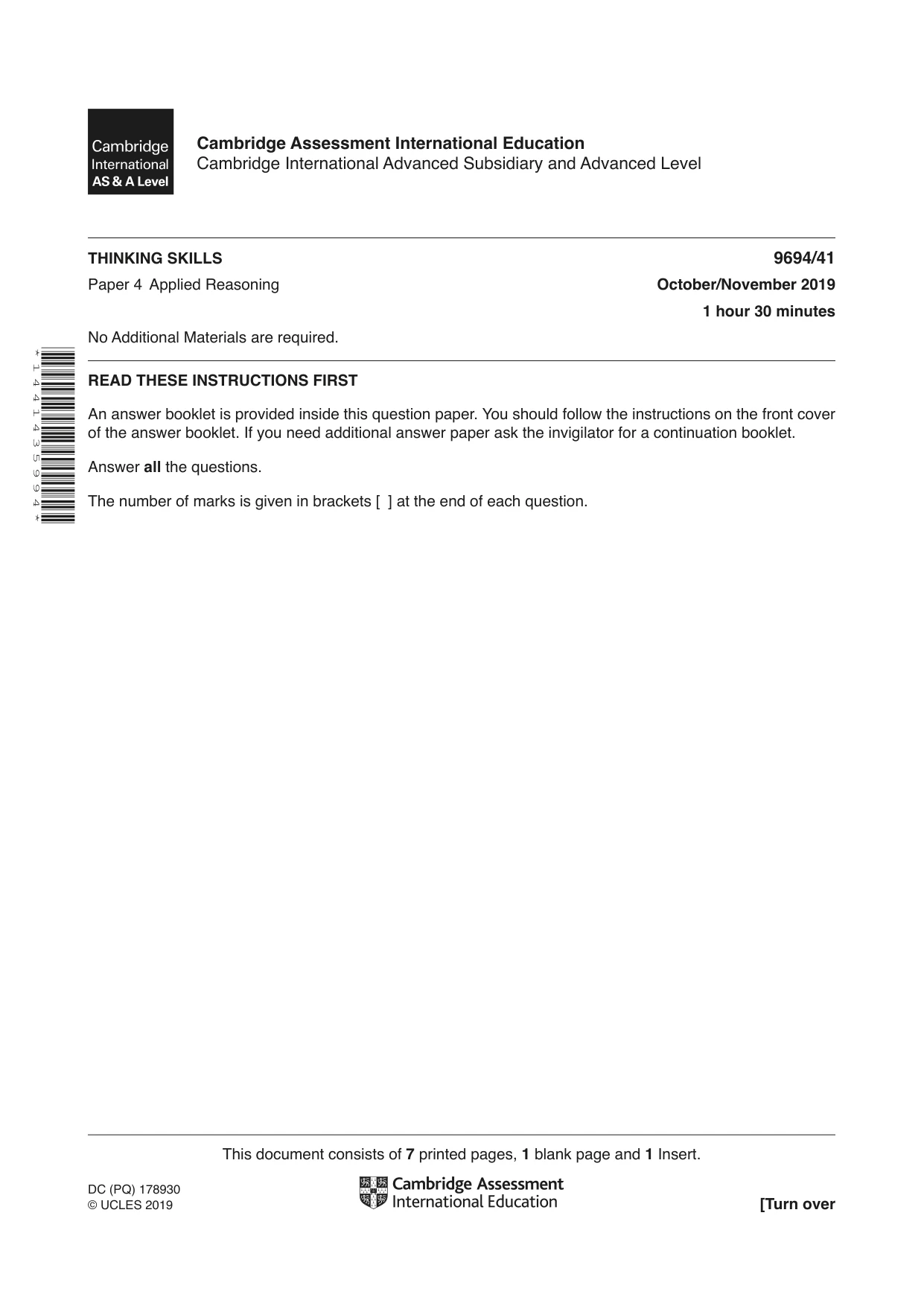
Question paper, page 1
This document consists of 7 printed pages, 1 blank page and 1 Insert. DC (PQ) 178930 © UCLES 2019 [Turn over Cambridge Assessment International Education Cambridge International Advanced Subsidiary and Advanced Level * 1 4 4 1 4 3 5 9 9 4 * THINKING SKILLS 9694/41 Paper 4 Applied Reasoning October/November 2019 1 hour 30 minutes No Additional Materials are required. READ THESE INSTRUCTIONS FIRST An answer booklet is provided inside this question paper. You should follow the instructions on the front cover of the answer booklet. If you need additional answer paper ask the invigilator for a continuation booklet. Answer all the questions. The number of marks is given in brackets [ ] at the end of each question.
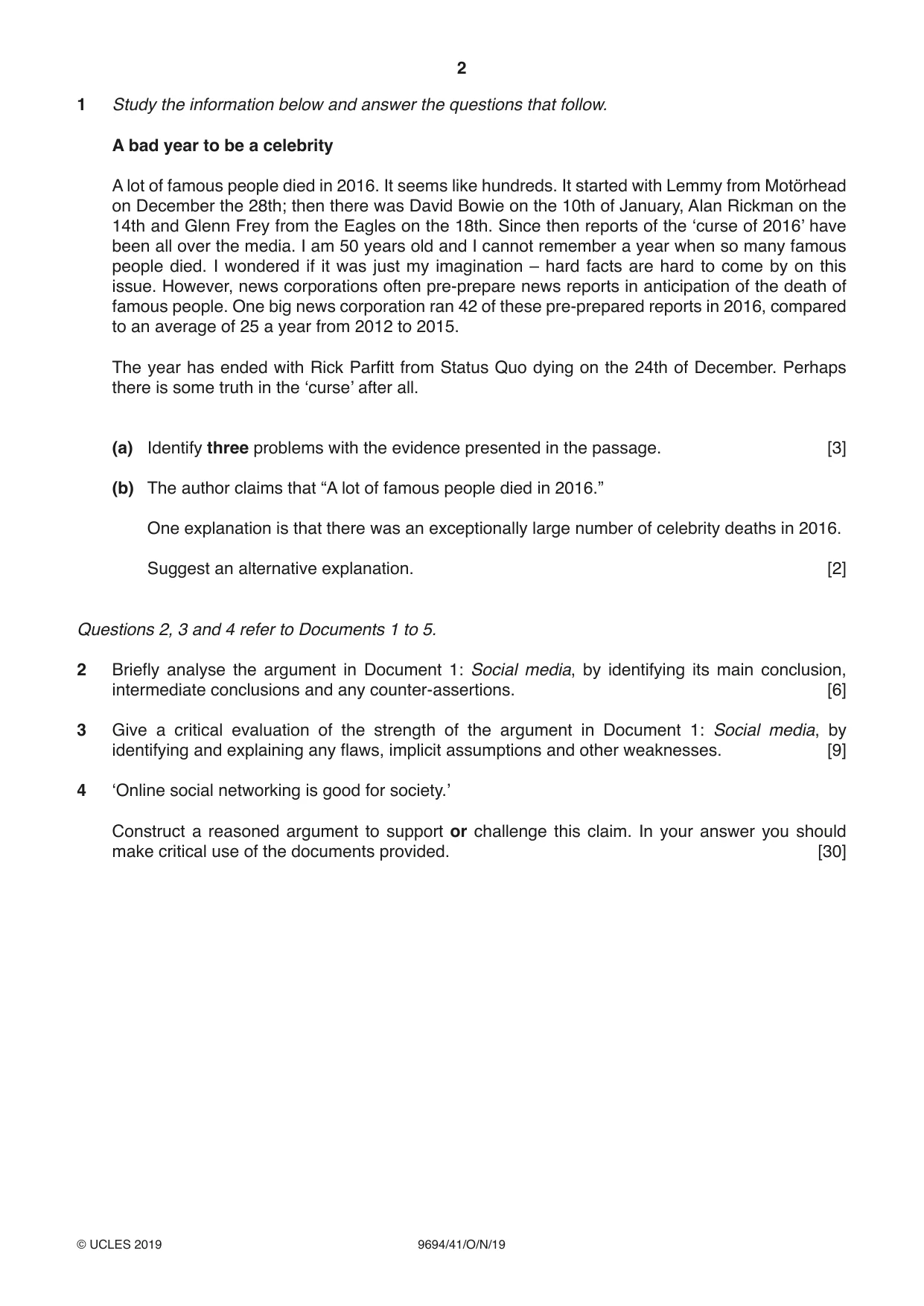
Question paper, page 2
2 9694/41/O/N/19 © UCLES 2019 1 Study the information below and answer the questions that follow. A bad year to be a celebrity A lot of famous people died in 2016. It seems like hundreds. It started with Lemmy from Motörhead on December the 28th; then there was David Bowie on the 10th of January, Alan Rickman on the 14th and Glenn Frey from the Eagles on the 18th. Since then reports of the ‘curse of 2016’ have been all over the media. I am 50 years old and I cannot remember a year when so many famous people died. I wondered if it was just my imagination – hard facts are hard to come by on this issue. However, news corporations often pre-prepare news reports in anticipation of the death of famous people. One big news corporation ran 42 of these pre-prepared reports in 2016, compared to an average of 25 a year from 2012 to 2015. The year has ended with Rick Parfitt from Status Quo dying on the 24th of December. Perhaps there is some truth in the ‘curse’ after all. (a) Identify three problems with the evidence presented in the passage. [3] (b) The author claims that “A lot of famous people died in 2016.” One explanation is that there was an exceptionally large number of celebrity deaths in 2016. Suggest an alternative explanation. [2] Questions 2, 3 and 4 refer to Documents 1 to 5. 2 Briefly analyse the argument in Document 1: Social media, by identifying its main conclusion, intermediate conclusions and any counter-assertions. [6] 3 Give a critical evaluation of the strength of the argument in Document 1: Social media, by identifying and explaining any flaws, implicit assumptions and other weaknesses. [9] 4 ‘Online social networking is good for society.’ Construct a reasoned argument to support or challenge this claim. In your answer you should make critical use of the documents provided. [30]
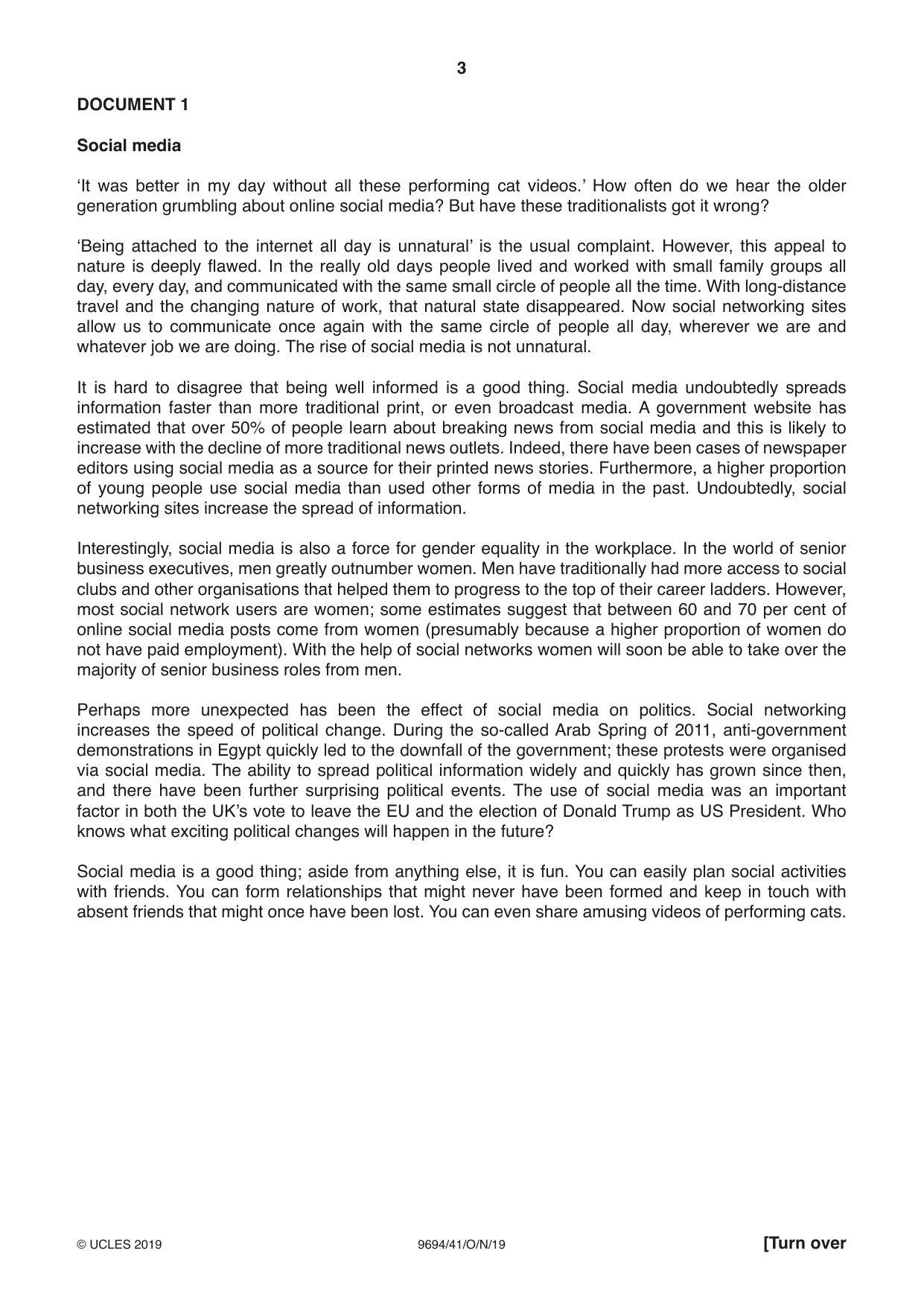
Question paper, page 3
3 9694/41/O/N/19 © UCLES 2019 [Turn over DOCUMENT 1 Social media ‘It was better in my day without all these performing cat videos.’ How often do we hear the older generation grumbling about online social media? But have these traditionalists got it wrong? ‘Being attached to the internet all day is unnatural’ is the usual complaint. However, this appeal to nature is deeply flawed. In the really old days people lived and worked with small family groups all day, every day, and communicated with the same small circle of people all the time. With long-distance travel and the changing nature of work, that natural state disappeared. Now social networking sites allow us to communicate once again with the same circle of people all day, wherever we are and whatever job we are doing. The rise of social media is not unnatural. It is hard to disagree that being well informed is a good thing. Social media undoubtedly spreads information faster than more traditional print, or even broadcast media. A government website has estimated that over 50% of people learn about breaking news from social media and this is likely to increase with the decline of more traditional news outlets. Indeed, there have been cases of newspaper editors using social media as a source for their printed news stories. Furthermore, a higher proportion of young people use social media than used other forms of media in the past. Undoubtedly, social networking sites increase the spread of information. Interestingly, social media is also a force for gender equality in the workplace. In the world of senior business executives, men greatly outnumber women. Men have traditionally had more access to social clubs and other organisations that helped them to progress to the top of their career ladders. However, most social network users are women; some estimates suggest that between 60 and 70 per cent of online social media posts come from women (presumably because a higher proportion of women do not have paid employment). With the help of social networks women will soon be able to take over the majority of senior business roles from men. Perhaps more unexpected has been the effect of social media on politics. Social networking increases the speed of political change. During the so-called Arab Spring of 2011, anti-government demonstrations in Egypt quickly led to the downfall of the government; these protests were organised via social media. The ability to spread political information widely and quickly has grown since then, and there have been further surprising political events. The use of social media was an important factor in both the UK’s vote to leave the EU and the election of Donald Trump as US President. Who knows what exciting political changes will happen in the future? Social media is a good thing; aside from anything else, it is fun. You can easily plan social activities with friends. You can form relationships that might never have been formed and keep in touch with absent friends that might once have been lost. You can even share amusing videos of performing cats.
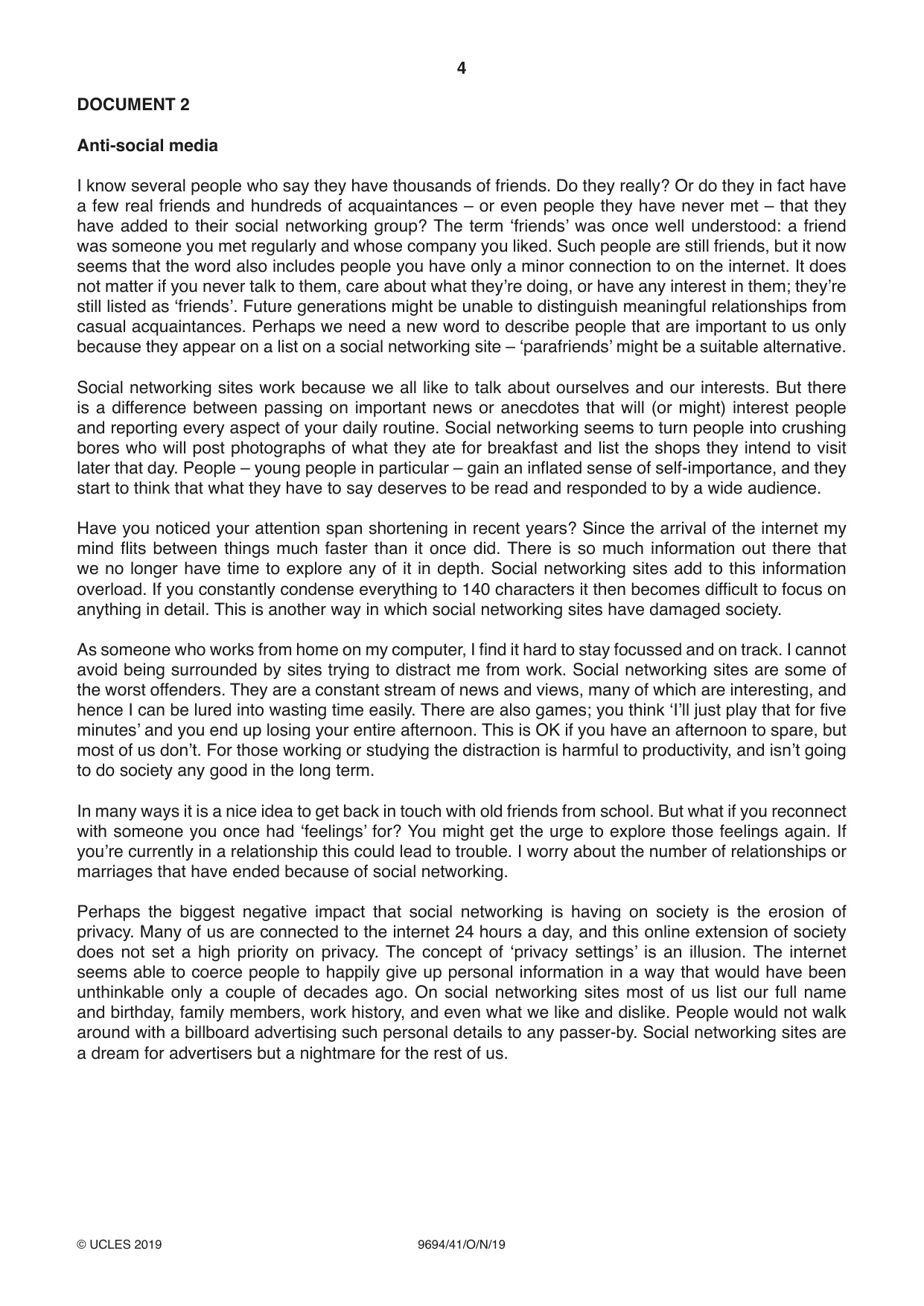
Question paper, page 4
4 9694/41/O/N/19 © UCLES 2019 DOCUMENT 2 Anti-social media I know several people who say they have thousands of friends. Do they really? Or do they in fact have a few real friends and hundreds of acquaintances – or even people they have never met – that they have added to their social networking group? The term ‘friends’ was once well understood: a friend was someone you met regularly and whose company you liked. Such people are still friends, but it now seems that the word also includes people you have only a minor connection to on the internet. It does not matter if you never talk to them, care about what they’re doing, or have any interest in them; they’re still listed as ‘friends’. Future generations might be unable to distinguish meaningful relationships from casual acquaintances. Perhaps we need a new word to describe people that are important to us only because they appear on a list on a social networking site – ‘parafriends’ might be a suitable alternative. Social networking sites work because we all like to talk about ourselves and our interests. But there is a difference between passing on important news or anecdotes that will (or might) interest people and reporting every aspect of your daily routine. Social networking seems to turn people into crushing bores who will post photographs of what they ate for breakfast and list the shops they intend to visit later that day. People – young people in particular – gain an inflated sense of self-importance, and they start to think that what they have to say deserves to be read and responded to by a wide audience. Have you noticed your attention span shortening in recent years? Since the arrival of the internet my mind flits between things much faster than it once did. There is so much information out there that we no longer have time to explore any of it in depth. Social networking sites add to this information overload. If you constantly condense everything to 140 characters it then becomes difficult to focus on anything in detail. This is another way in which social networking sites have damaged society. As someone who works from home on my computer, I find it hard to stay focussed and on track. I cannot avoid being surrounded by sites trying to distract me from work. Social networking sites are some of the worst offenders. They are a constant stream of news and views, many of which are interesting, and hence I can be lured into wasting time easily. There are also games; you think ‘I’ll just play that for five minutes’ and you end up losing your entire afternoon. This is OK if you have an afternoon to spare, but most of us don’t. For those working or studying the distraction is harmful to productivity, and isn’t going to do society any good in the long term. In many ways it is a nice idea to get back in touch with old friends from school. But what if you reconnect with someone you once had ‘feelings’ for? You might get the urge to explore those feelings again. If you’re currently in a relationship this could lead to trouble. I worry about the number of relationships or marriages that have ended because of social networking. Perhaps the biggest negative impact that social networking is having on society is the erosion of privacy. Many of us are connected to the internet 24 hours a day, and this online extension of society does not set a high priority on privacy. The concept of ‘privacy settings’ is an illusion. The internet seems able to coerce people to happily give up personal information in a way that would have been unthinkable only a couple of decades ago. On social networking sites most of us list our full name and birthday, family members, work history, and even what we like and dislike. People would not walk around with a billboard advertising such personal details to any passer-by. Social networking sites are a dream for advertisers but a nightmare for the rest of us.
Question paper, page 5
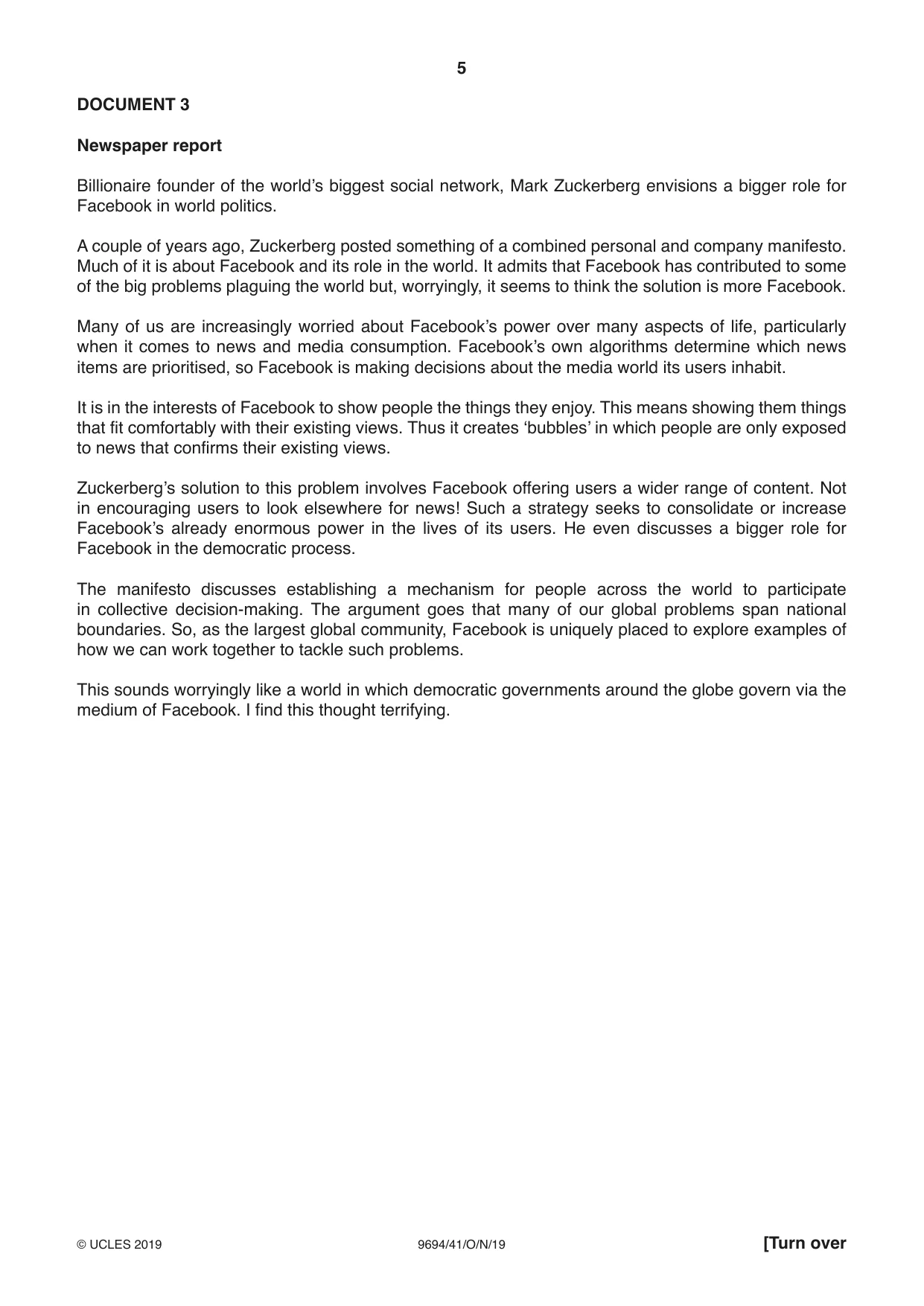
5 9694/41/O/N/19 © UCLES 2019 [Turn over DOCUMENT 3 Newspaper report Billionaire founder of the world’s biggest social network, Mark Zuckerberg envisions a bigger role for Facebook in world politics. A couple of years ago, Zuckerberg posted something of a combined personal and company manifesto. Much of it is about Facebook and its role in the world. It admits that Facebook has contributed to some of the big problems plaguing the world but, worryingly, it seems to think the solution is more Facebook. Many of us are increasingly worried about Facebook’s power over many aspects of life, particularly when it comes to news and media consumption. Facebook’s own algorithms determine which news items are prioritised, so Facebook is making decisions about the media world its users inhabit. It is in the interests of Facebook to show people the things they enjoy. This means showing them things that fit comfortably with their existing views. Thus it creates ‘bubbles’ in which people are only exposed to news that confirms their existing views. Zuckerberg’s solution to this problem involves Facebook offering users a wider range of content. Not in encouraging users to look elsewhere for news! Such a strategy seeks to consolidate or increase Facebook’s already enormous power in the lives of its users. He even discusses a bigger role for Facebook in the democratic process. The manifesto discusses establishing a mechanism for people across the world to participate in collective decision-making. The argument goes that many of our global problems span national boundaries. So, as the largest global community, Facebook is uniquely placed to explore examples of how we can work together to tackle such problems. This sounds worryingly like a world in which democratic governments around the globe govern via the medium of Facebook. I find this thought terrifying.
Question paper, page 6
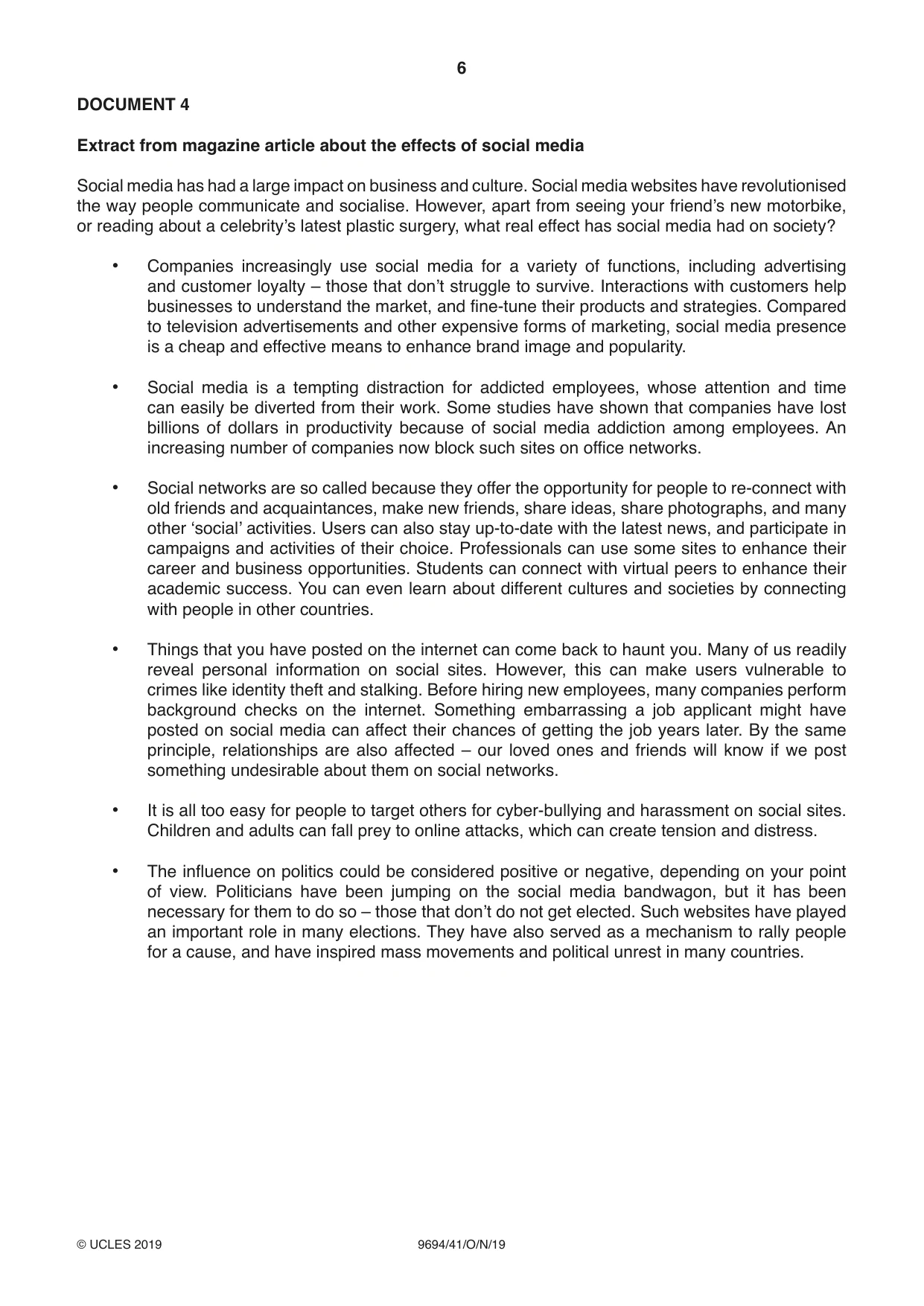
6 9694/41/O/N/19 © UCLES 2019 DOCUMENT 4 Extract from magazine article about the effects of social media Social media has had a large impact on business and culture. Social media websites have revolutionised the way people communicate and socialise. However, apart from seeing your friend’s new motorbike, or reading about a celebrity’s latest plastic surgery, what real effect has social media had on society? • Companies increasingly use social media for a variety of functions, including advertising and customer loyalty – those that don’t struggle to survive. Interactions with customers help businesses to understand the market, and fine-tune their products and strategies. Compared to television advertisements and other expensive forms of marketing, social media presence is a cheap and effective means to enhance brand image and popularity. • Social media is a tempting distraction for addicted employees, whose attention and time can easily be diverted from their work. Some studies have shown that companies have lost billions of dollars in productivity because of social media addiction among employees. An increasing number of companies now block such sites on office networks. • Social networks are so called because they offer the opportunity for people to re-connect with old friends and acquaintances, make new friends, share ideas, share photographs, and many other ‘social’ activities. Users can also stay up-to-date with the latest news, and participate in campaigns and activities of their choice. Professionals can use some sites to enhance their career and business opportunities. Students can connect with virtual peers to enhance their academic success. You can even learn about different cultures and societies by connecting with people in other countries. • Things that you have posted on the internet can come back to haunt you. Many of us readily reveal personal information on social sites. However, this can make users vulnerable to crimes like identity theft and stalking. Before hiring new employees, many companies perform background checks on the internet. Something embarrassing a job applicant might have posted on social media can affect their chances of getting the job years later. By the same principle, relationships are also affected – our loved ones and friends will know if we post something undesirable about them on social networks. • It is all too easy for people to target others for cyber-bullying and harassment on social sites. Children and adults can fall prey to online attacks, which can create tension and distress. • The influence on politics could be considered positive or negative, depending on your point of view. Politicians have been jumping on the social media bandwagon, but it has been necessary for them to do so – those that don’t do not get elected. Such websites have played an important role in many elections. They have also served as a mechanism to rally people for a cause, and have inspired mass movements and political unrest in many countries.
Question paper, page 7
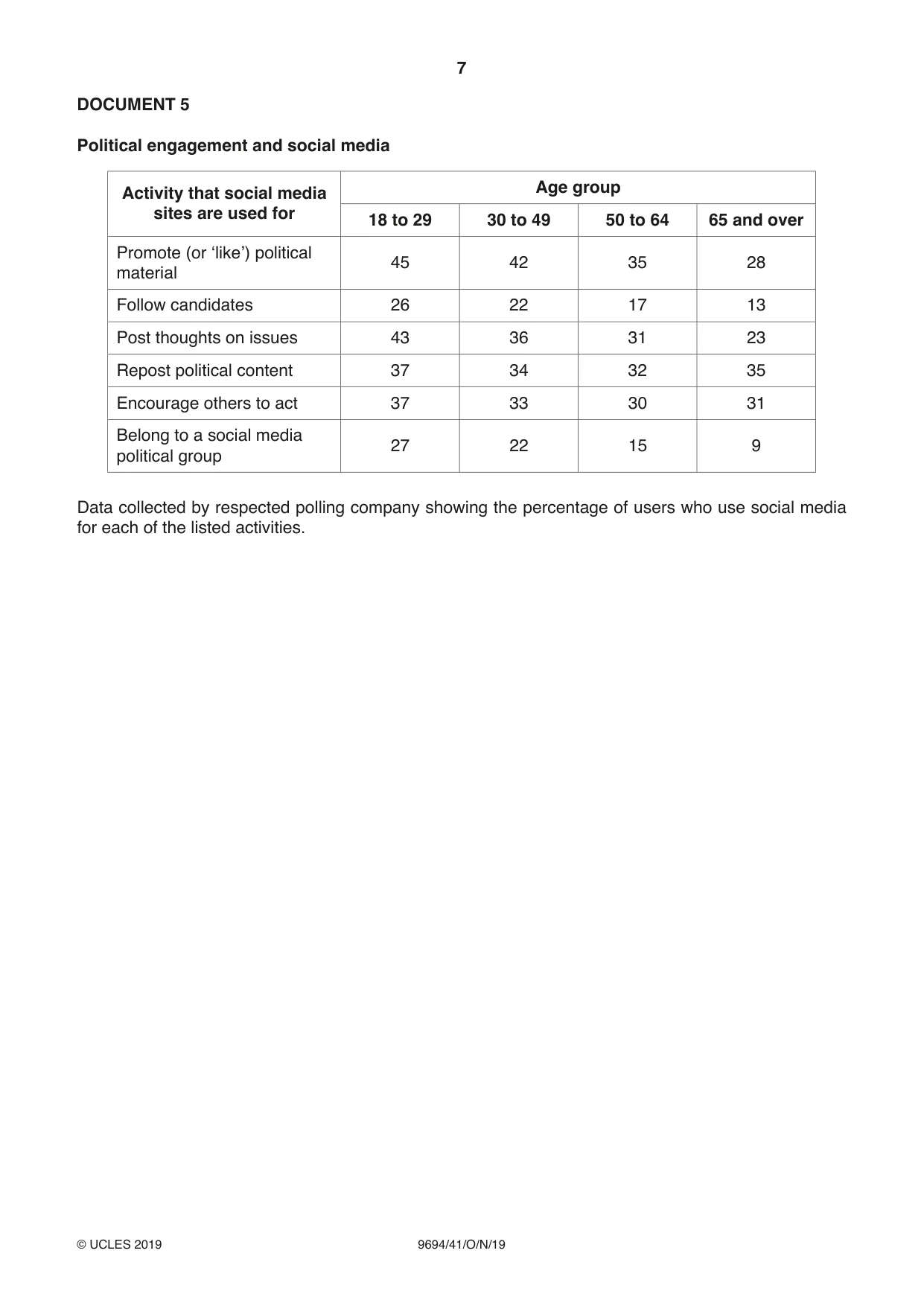
7 9694/41/O/N/19 © UCLES 2019 DOCUMENT 5 Political engagement and social media Activity that social media sites are used for Age group 18 to 29 30 to 49 50 to 64 65 and over Promote (or ‘like’) political material 45 42 35 28 Follow candidates 26 22 17 13 Post thoughts on issues 43 36 31 23 Repost political content 37 34 32 35 Encourage others to act 37 33 30 31 Belong to a social media political group 27 22 15 9 Data collected by respected polling company showing the percentage of users who use social media for each of the listed activities.
Question paper, page 8
8 9694/41/O/N/19 © UCLES 2019 Permission to reproduce items where third-party owned material protected by copyright is included has been sought and cleared where possible. Every reasonable effort has been made by the publisher (UCLES) to trace copyright holders, but if any items requiring clearance have unwittingly been included, the publisher will be pleased to make amends at the earliest possible opportunity. To avoid the issue of disclosure of answer-related information to candidates, all copyright acknowledgements are reproduced online in the Cambridge Assessment International Education Copyright Acknowledgements Booklet. This is produced for each series of examinations and is freely available to download at www.cambridgeinternational.org after the live examination series. Cambridge Assessment International Education is part of the Cambridge Assessment Group. Cambridge Assessment is the brand name of the University of Cambridge Local Examinations Syndicate (UCLES), which itself is a department of the University of Cambridge. BLANK PAGE
Mark scheme, page 1
This document consists of 12 printed pages. © UCLES 2019 [Turn over Cambridge Assessment International Education Cambridge International Advanced Subsidiary and Advanced Level THINKING SKILLS 9694/41 Paper 4 Applied Reasoning October/November 2019 MARK SCHEME Maximum Mark: 50 Published This mark scheme is published as an aid to teachers and candidates, to indicate the requirements of the examination. It shows the basis on which Examiners were instructed to award marks. It does not indicate the details of the discussions that took place at an Examiners’ meeting before marking began, which would have considered the acceptability of alternative answers. Mark schemes should be read in conjunction with the question paper and the Principal Examiner Report for Teachers. Cambridge International will not enter into discussions about these mark schemes. Cambridge International is publishing the mark schemes for the October/November 2019 series for most Cambridge IGCSE™, Cambridge International A and AS Level components and some Cambridge O Level components.
Mark scheme, page 2
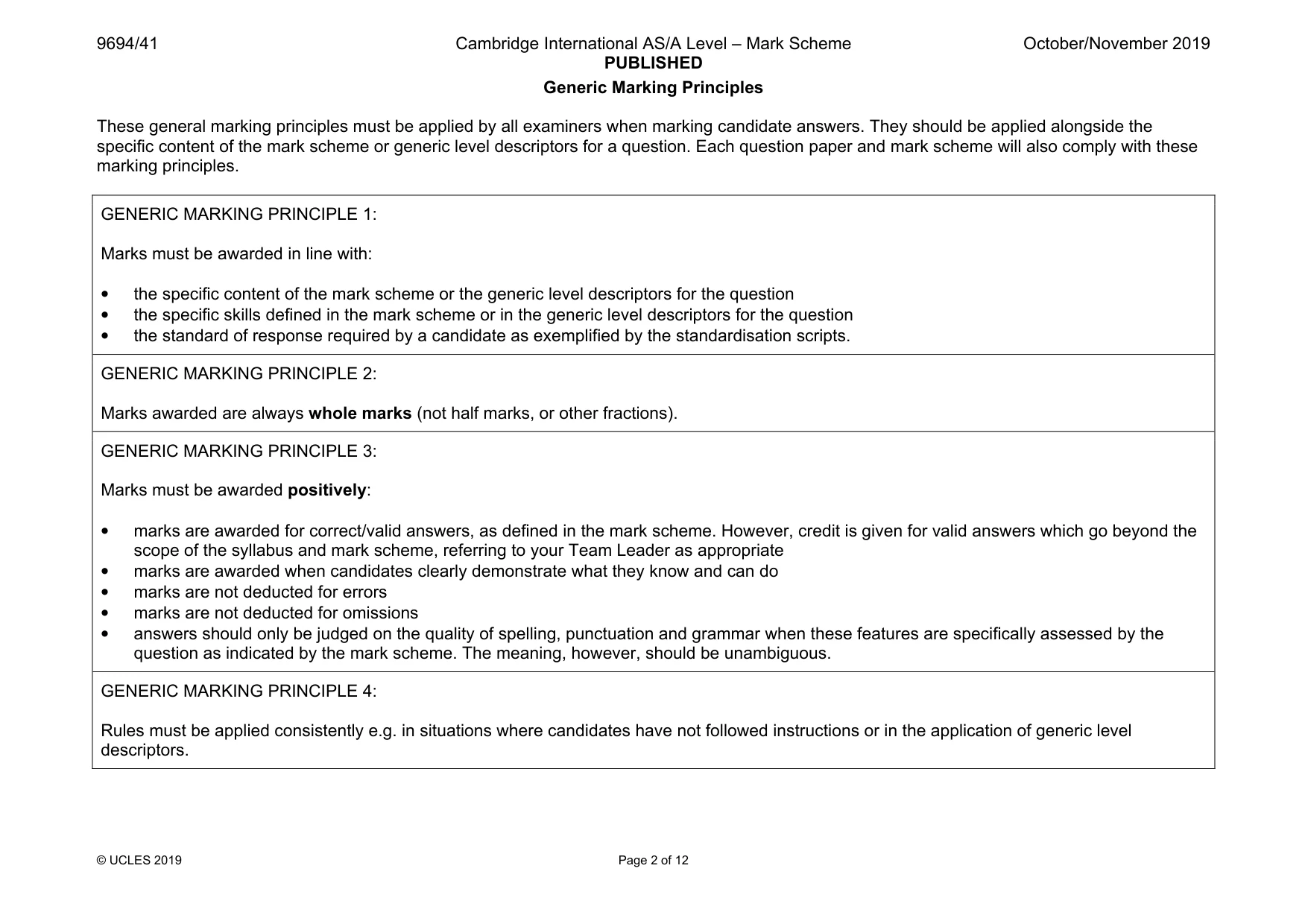
9694/41 Cambridge International AS/A Level – Mark Scheme PUBLISHED October/November 2019 © UCLES 2019 Page 2 of 12 Generic Marking Principles These general marking principles must be applied by all examiners when marking candidate answers. They should be applied alongside the specific content of the mark scheme or generic level descriptors for a question. Each question paper and mark scheme will also comply with these marking principles. GENERIC MARKING PRINCIPLE 1: Marks must be awarded in line with: • the specific content of the mark scheme or the generic level descriptors for the question • the specific skills defined in the mark scheme or in the generic level descriptors for the question • the standard of response required by a candidate as exemplified by the standardisation scripts. GENERIC MARKING PRINCIPLE 2: Marks awarded are always whole marks (not half marks, or other fractions). GENERIC MARKING PRINCIPLE 3: Marks must be awarded positively: • marks are awarded for correct/valid answers, as defined in the mark scheme. However, credit is given for valid answers which go beyond the scope of the syllabus and mark scheme, referring to your Team Leader as appropriate • marks are awarded when candidates clearly demonstrate what they know and can do • marks are not deducted for errors • marks are not deducted for omissions • answers should only be judged on the quality of spelling, punctuation and grammar when these features are specifically assessed by the question as indicated by the mark scheme. The meaning, however, should be unambiguous. GENERIC MARKING PRINCIPLE 4: Rules must be applied consistently e.g. in situations where candidates have not followed instructions or in the application of generic level descriptors.
Mark scheme, page 3
9694/41 Cambridge International AS/A Level – Mark Scheme PUBLISHED October/November 2019 © UCLES 2019 Page 3 of 12 GENERIC MARKING PRINCIPLE 5: Marks should be awarded using the full range of marks defined in the mark scheme for the question (however; the use of the full mark range may be limited according to the quality of the candidate responses seen). GENERIC MARKING PRINCIPLE 6: Marks awarded are based solely on the requirements as defined in the mark scheme. Marks should not be awarded with grade thresholds or grade descriptors in mind.
Mark scheme, page 4
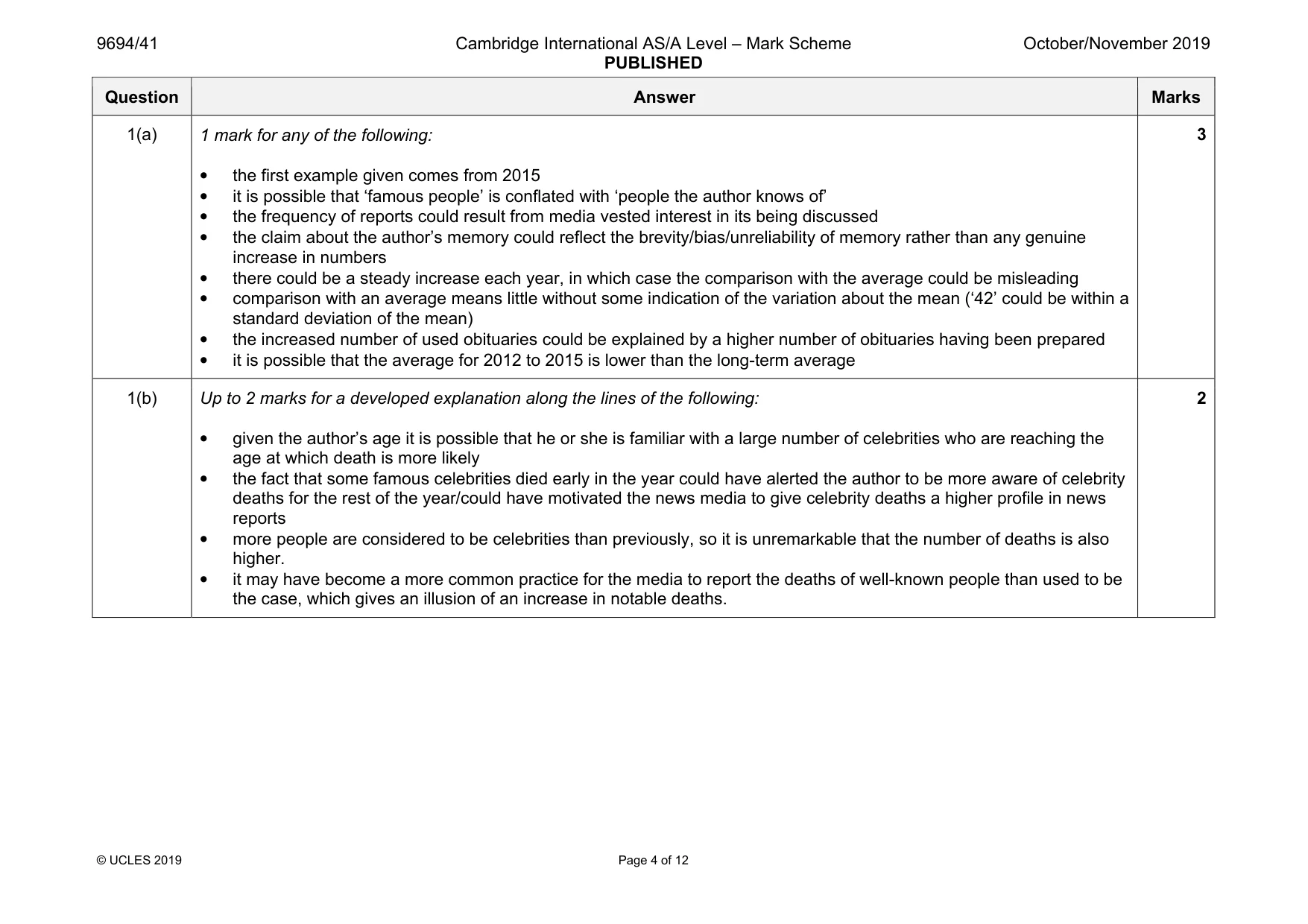
9694/41 Cambridge International AS/A Level – Mark Scheme PUBLISHED October/November 2019 © UCLES 2019 Page 4 of 12 Question Answer Marks 1(a) 1 mark for any of the following: • the first example given comes from 2015 • it is possible that ‘famous people’ is conflated with ‘people the author knows of’ • the frequency of reports could result from media vested interest in its being discussed • the claim about the author’s memory could reflect the brevity/bias/unreliability of memory rather than any genuine increase in numbers • there could be a steady increase each year, in which case the comparison with the average could be misleading • comparison with an average means little without some indication of the variation about the mean (‘42’ could be within a standard deviation of the mean) • the increased number of used obituaries could be explained by a higher number of obituaries having been prepared • it is possible that the average for 2012 to 2015 is lower than the long-term average 3 1(b) Up to 2 marks for a developed explanation along the lines of the following: • given the author’s age it is possible that he or she is familiar with a large number of celebrities who are reaching the age at which death is more likely • the fact that some famous celebrities died early in the year could have alerted the author to be more aware of celebrity deaths for the rest of the year/could have motivated the news media to give celebrity deaths a higher profile in news reports • more people are considered to be celebrities than previously, so it is unremarkable that the number of deaths is also higher. • it may have become a more common practice for the media to report the deaths of well-known people than used to be the case, which gives an illusion of an increase in notable deaths. 2
Mark scheme, page 5
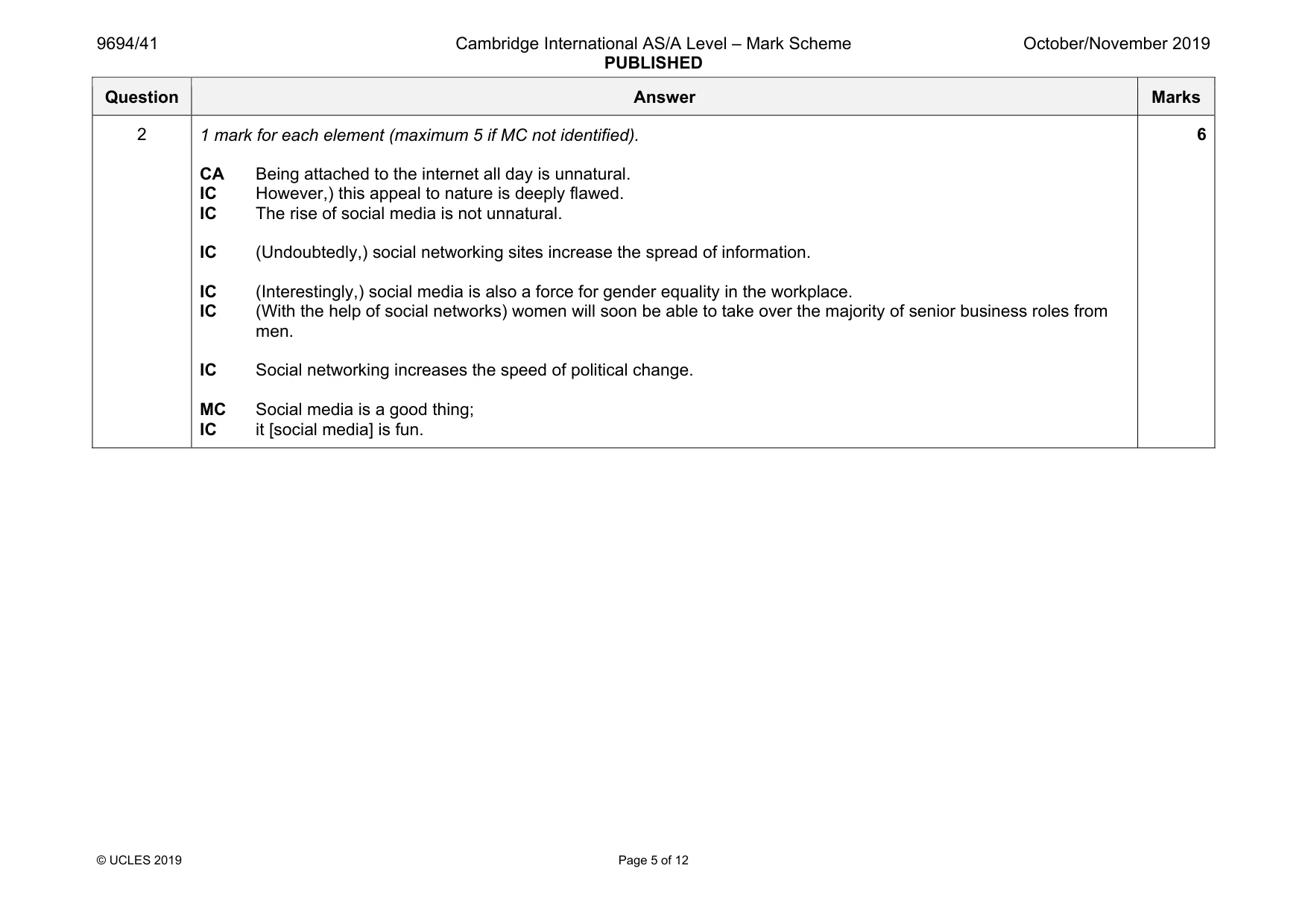
9694/41 Cambridge International AS/A Level – Mark Scheme PUBLISHED October/November 2019 © UCLES 2019 Page 5 of 12 Question Answer Marks 2 1 mark for each element (maximum 5 if MC not identified). CA Being attached to the internet all day is unnatural. IC However,) this appeal to nature is deeply flawed. IC The rise of social media is not unnatural. IC (Undoubtedly,) social networking sites increase the spread of information. IC (Interestingly,) social media is also a force for gender equality in the workplace. IC (With the help of social networks) women will soon be able to take over the majority of senior business roles from men. IC Social networking increases the speed of political change. MC Social media is a good thing; IC it [social media] is fun. 6
Mark scheme, page 6
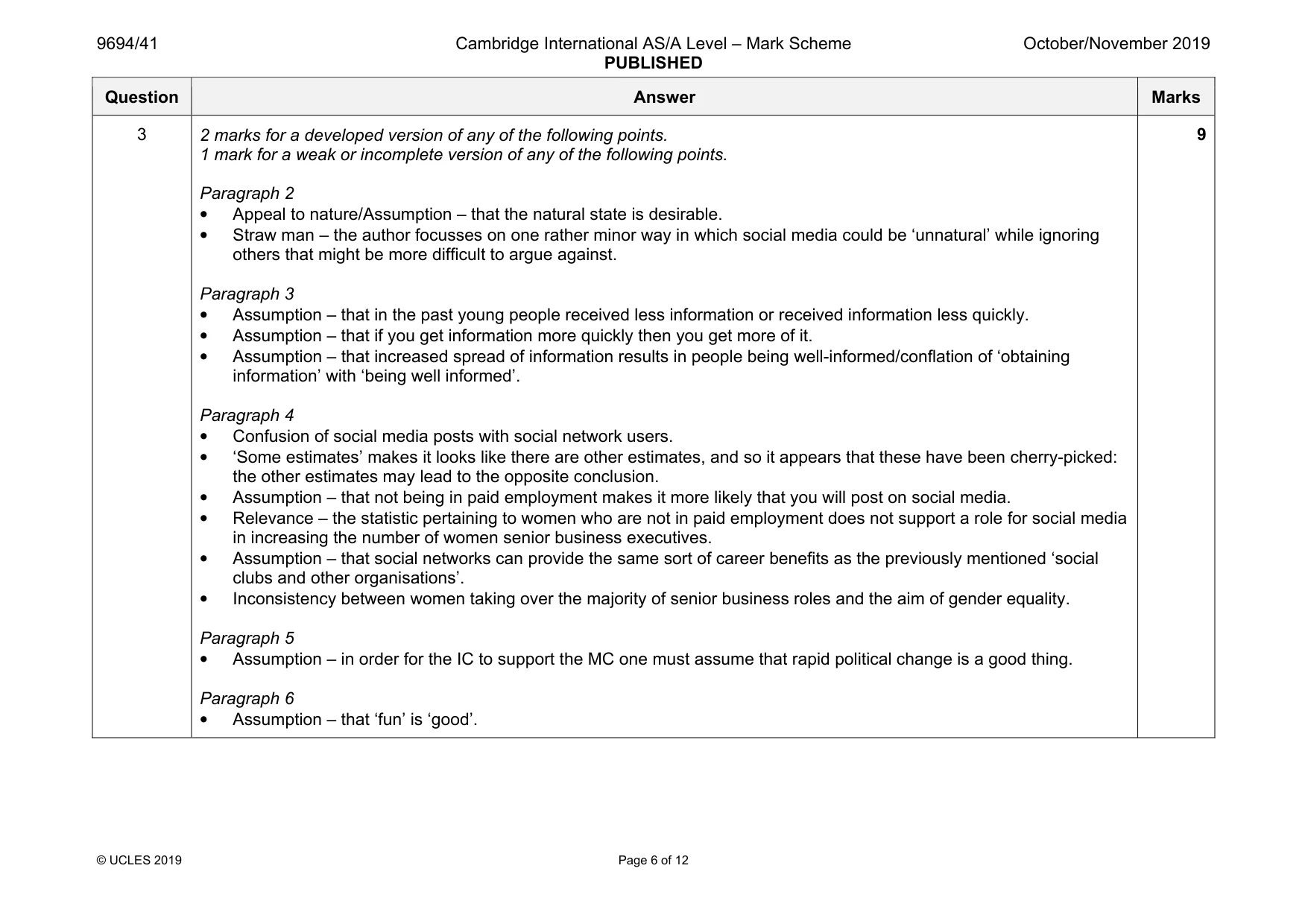
9694/41 Cambridge International AS/A Level – Mark Scheme PUBLISHED October/November 2019 © UCLES 2019 Page 6 of 12 Question Answer Marks 3 2 marks for a developed version of any of the following points. 1 mark for a weak or incomplete version of any of the following points. Paragraph 2 • Appeal to nature/Assumption – that the natural state is desirable. • Straw man – the author focusses on one rather minor way in which social media could be ‘unnatural’ while ignoring others that might be more difficult to argue against. Paragraph 3 • Assumption – that in the past young people received less information or received information less quickly. • Assumption – that if you get information more quickly then you get more of it. • Assumption – that increased spread of information results in people being well-informed/conflation of ‘obtaining information’ with ‘being well informed’. Paragraph 4 • Confusion of social media posts with social network users. • ‘Some estimates’ makes it looks like there are other estimates, and so it appears that these have been cherry-picked: the other estimates may lead to the opposite conclusion. • Assumption – that not being in paid employment makes it more likely that you will post on social media. • Relevance – the statistic pertaining to women who are not in paid employment does not support a role for social media in increasing the number of women senior business executives. • Assumption – that social networks can provide the same sort of career benefits as the previously mentioned ‘social clubs and other organisations’. • Inconsistency between women taking over the majority of senior business roles and the aim of gender equality. Paragraph 5 • Assumption – in order for the IC to support the MC one must assume that rapid political change is a good thing. Paragraph 6 • Assumption – that ‘fun’ is ‘good’. 9
Mark scheme, page 7
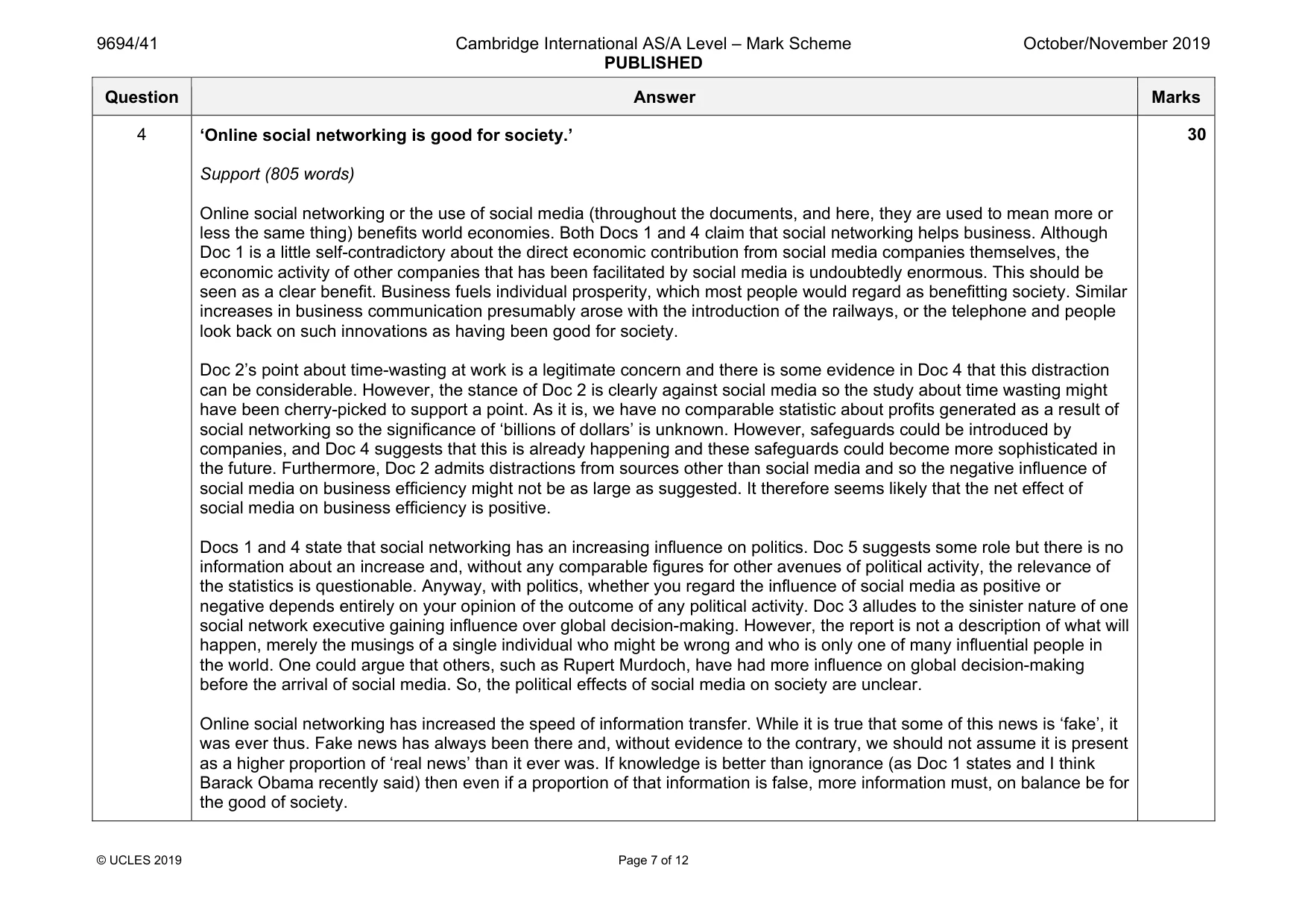
9694/41 Cambridge International AS/A Level – Mark Scheme PUBLISHED October/November 2019 © UCLES 2019 Page 7 of 12 Question Answer Marks 4 ‘Online social networking is good for society.’ Support (805 words) Online social networking or the use of social media (throughout the documents, and here, they are used to mean more or less the same thing) benefits world economies. Both Docs 1 and 4 claim that social networking helps business. Although Doc 1 is a little self-contradictory about the direct economic contribution from social media companies themselves, the economic activity of other companies that has been facilitated by social media is undoubtedly enormous. This should be seen as a clear benefit. Business fuels individual prosperity, which most people would regard as benefitting society. Similar increases in business communication presumably arose with the introduction of the railways, or the telephone and people look back on such innovations as having been good for society. Doc 2’s point about time-wasting at work is a legitimate concern and there is some evidence in Doc 4 that this distraction can be considerable. However, the stance of Doc 2 is clearly against social media so the study about time wasting might have been cherry-picked to support a point. As it is, we have no comparable statistic about profits generated as a result of social networking so the significance of ‘billions of dollars’ is unknown. However, safeguards could be introduced by companies, and Doc 4 suggests that this is already happening and these safeguards could become more sophisticated in the future. Furthermore, Doc 2 admits distractions from sources other than social media and so the negative influence of social media on business efficiency might not be as large as suggested. It therefore seems likely that the net effect of social media on business efficiency is positive. Docs 1 and 4 state that social networking has an increasing influence on politics. Doc 5 suggests some role but there is no information about an increase and, without any comparable figures for other avenues of political activity, the relevance of the statistics is questionable. Anyway, with politics, whether you regard the influence of social media as positive or negative depends entirely on your opinion of the outcome of any political activity. Doc 3 alludes to the sinister nature of one social network executive gaining influence over global decision-making. However, the report is not a description of what will happen, merely the musings of a single individual who might be wrong and who is only one of many influential people in the world. One could argue that others, such as Rupert Murdoch, have had more influence on global decision-making before the arrival of social media. So, the political effects of social media on society are unclear. Online social networking has increased the speed of information transfer. While it is true that some of this news is ‘fake’, it was ever thus. Fake news has always been there and, without evidence to the contrary, we should not assume it is present as a higher proportion of ‘real news’ than it ever was. If knowledge is better than ignorance (as Doc 1 states and I think Barack Obama recently said) then even if a proportion of that information is false, more information must, on balance be for the good of society. 30
Mark scheme, page 8
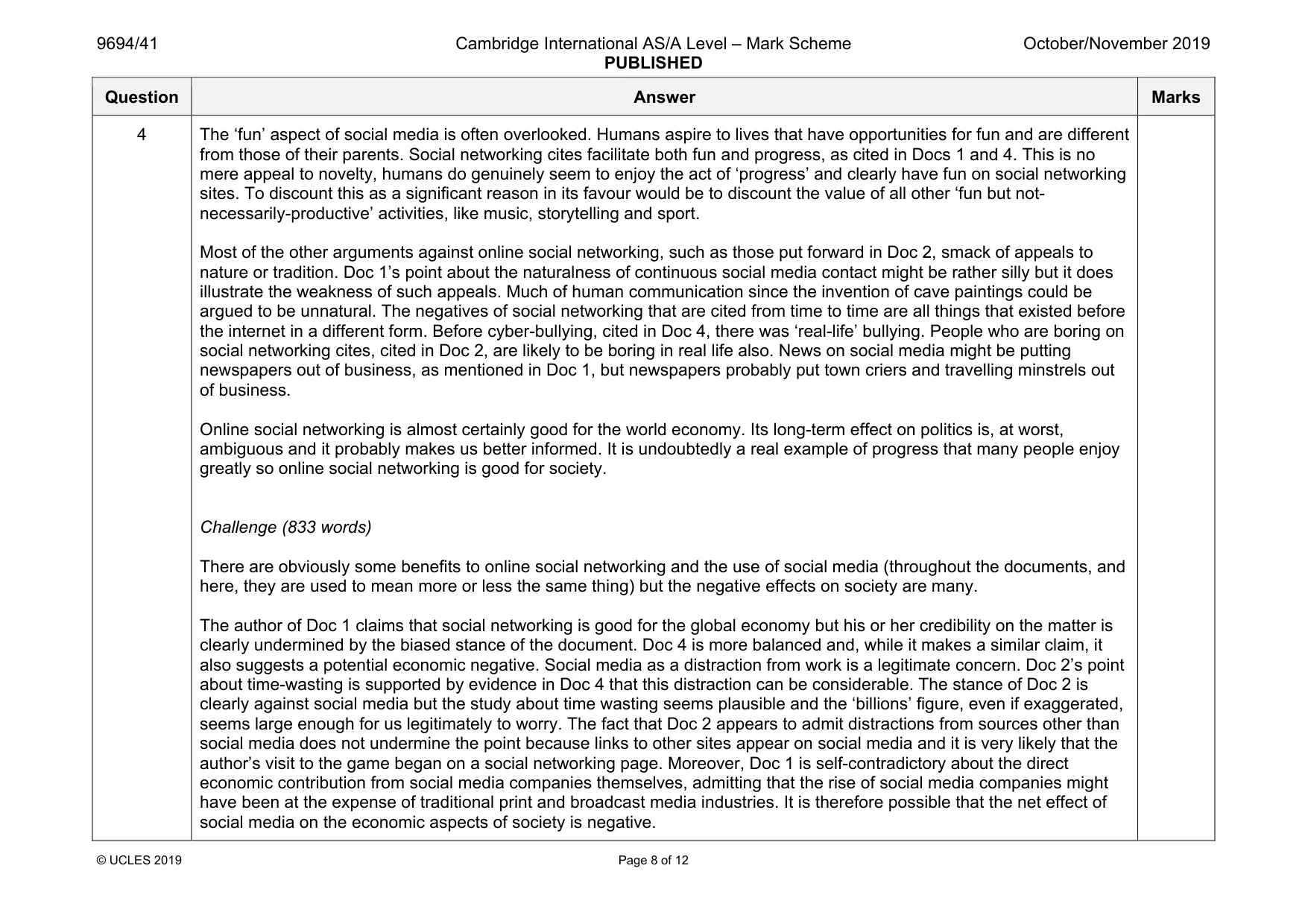
9694/41 Cambridge International AS/A Level – Mark Scheme PUBLISHED October/November 2019 © UCLES 2019 Page 8 of 12 Question Answer Marks 4 The ‘fun’ aspect of social media is often overlooked. Humans aspire to lives that have opportunities for fun and are different from those of their parents. Social networking cites facilitate both fun and progress, as cited in Docs 1 and 4. This is no mere appeal to novelty, humans do genuinely seem to enjoy the act of ‘progress’ and clearly have fun on social networking sites. To discount this as a significant reason in its favour would be to discount the value of all other ‘fun but not- necessarily-productive’ activities, like music, storytelling and sport. Most of the other arguments against online social networking, such as those put forward in Doc 2, smack of appeals to nature or tradition. Doc 1’s point about the naturalness of continuous social media contact might be rather silly but it does illustrate the weakness of such appeals. Much of human communication since the invention of cave paintings could be argued to be unnatural. The negatives of social networking that are cited from time to time are all things that existed before the internet in a different form. Before cyber-bullying, cited in Doc 4, there was ‘real-life’ bullying. People who are boring on social networking cites, cited in Doc 2, are likely to be boring in real life also. News on social media might be putting newspapers out of business, as mentioned in Doc 1, but newspapers probably put town criers and travelling minstrels out of business. Online social networking is almost certainly good for the world economy. Its long-term effect on politics is, at worst, ambiguous and it probably makes us better informed. It is undoubtedly a real example of progress that many people enjoy greatly so online social networking is good for society. Challenge (833 words) There are obviously some benefits to online social networking and the use of social media (throughout the documents, and here, they are used to mean more or less the same thing) but the negative effects on society are many. The author of Doc 1 claims that social networking is good for the global economy but his or her credibility on the matter is clearly undermined by the biased stance of the document. Doc 4 is more balanced and, while it makes a similar claim, it also suggests a potential economic negative. Social media as a distraction from work is a legitimate concern. Doc 2’s point about time-wasting is supported by evidence in Doc 4 that this distraction can be considerable. The stance of Doc 2 is clearly against social media but the study about time wasting seems plausible and the ‘billions’ figure, even if exaggerated, seems large enough for us legitimately to worry. The fact that Doc 2 appears to admit distractions from sources other than social media does not undermine the point because links to other sites appear on social media and it is very likely that the author’s visit to the game began on a social networking page. Moreover, Doc 1 is self-contradictory about the direct economic contribution from social media companies themselves, admitting that the rise of social media companies might have been at the expense of traditional print and broadcast media industries. It is therefore possible that the net effect of social media on the economic aspects of society is negative.
Mark scheme, page 9
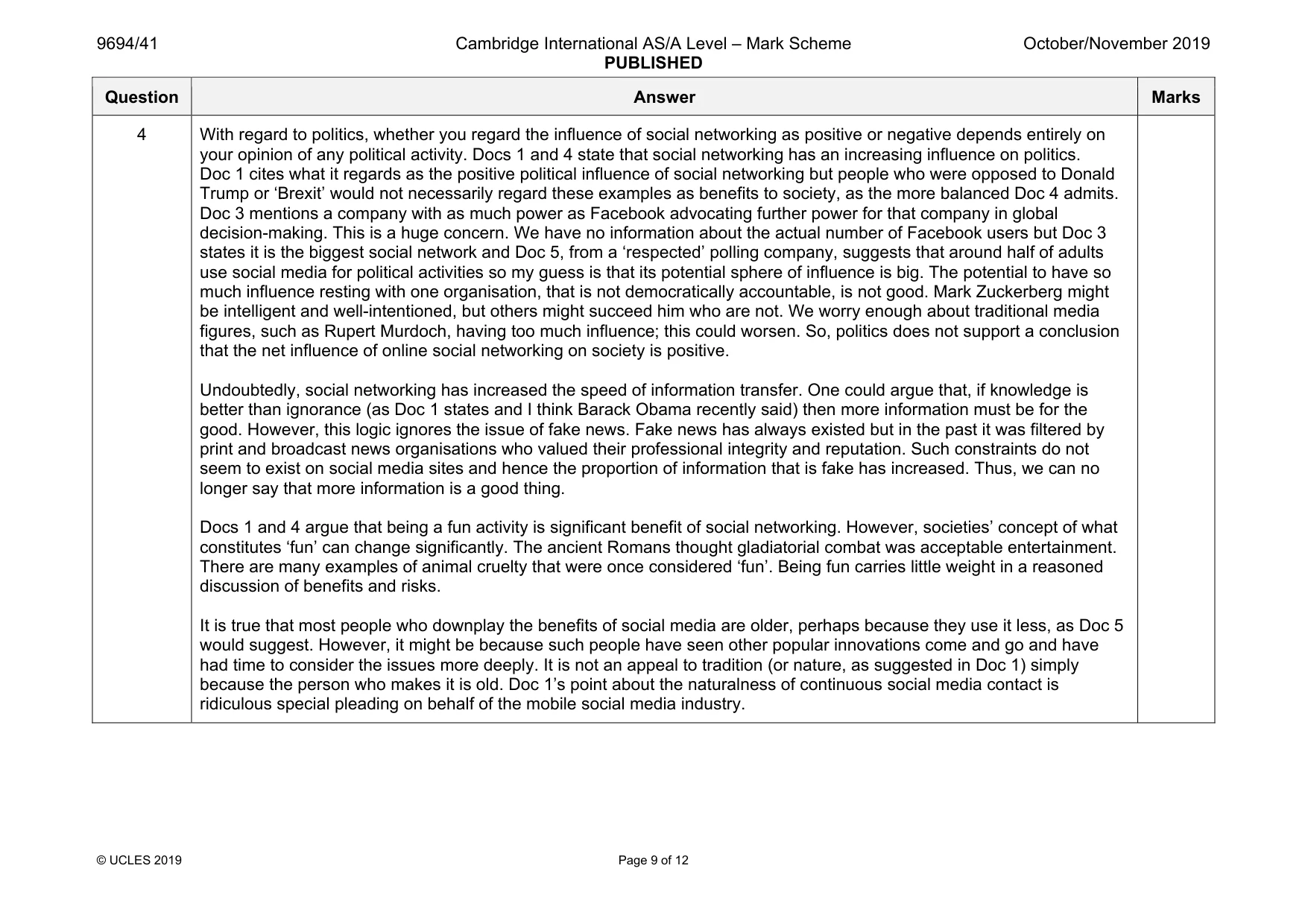
9694/41 Cambridge International AS/A Level – Mark Scheme PUBLISHED October/November 2019 © UCLES 2019 Page 9 of 12 Question Answer Marks 4 With regard to politics, whether you regard the influence of social networking as positive or negative depends entirely on your opinion of any political activity. Docs 1 and 4 state that social networking has an increasing influence on politics. Doc 1 cites what it regards as the positive political influence of social networking but people who were opposed to Donald Trump or ‘Brexit’ would not necessarily regard these examples as benefits to society, as the more balanced Doc 4 admits. Doc 3 mentions a company with as much power as Facebook advocating further power for that company in global decision-making. This is a huge concern. We have no information about the actual number of Facebook users but Doc 3 states it is the biggest social network and Doc 5, from a ‘respected’ polling company, suggests that around half of adults use social media for political activities so my guess is that its potential sphere of influence is big. The potential to have so much influence resting with one organisation, that is not democratically accountable, is not good. Mark Zuckerberg might be intelligent and well-intentioned, but others might succeed him who are not. We worry enough about traditional media figures, such as Rupert Murdoch, having too much influence; this could worsen. So, politics does not support a conclusion that the net influence of online social networking on society is positive. Undoubtedly, social networking has increased the speed of information transfer. One could argue that, if knowledge is better than ignorance (as Doc 1 states and I think Barack Obama recently said) then more information must be for the good. However, this logic ignores the issue of fake news. Fake news has always existed but in the past it was filtered by print and broadcast news organisations who valued their professional integrity and reputation. Such constraints do not seem to exist on social media sites and hence the proportion of information that is fake has increased. Thus, we can no longer say that more information is a good thing. Docs 1 and 4 argue that being a fun activity is significant benefit of social networking. However, societies’ concept of what constitutes ‘fun’ can change significantly. The ancient Romans thought gladiatorial combat was acceptable entertainment. There are many examples of animal cruelty that were once considered ‘fun’. Being fun carries little weight in a reasoned discussion of benefits and risks. It is true that most people who downplay the benefits of social media are older, perhaps because they use it less, as Doc 5 would suggest. However, it might be because such people have seen other popular innovations come and go and have had time to consider the issues more deeply. It is not an appeal to tradition (or nature, as suggested in Doc 1) simply because the person who makes it is old. Doc 1’s point about the naturalness of continuous social media contact is ridiculous special pleading on behalf of the mobile social media industry.
Mark scheme, page 10
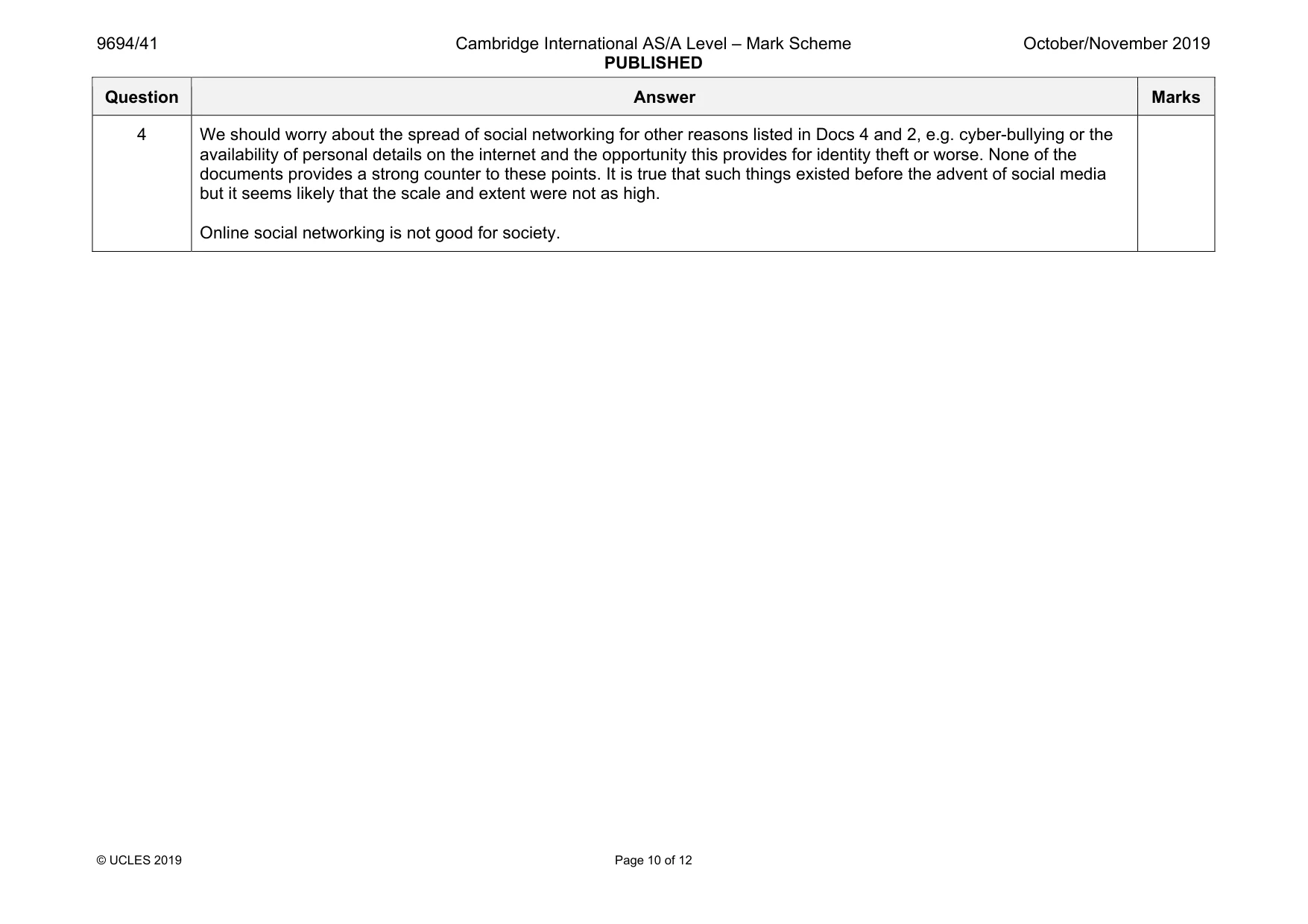
9694/41 Cambridge International AS/A Level – Mark Scheme PUBLISHED October/November 2019 © UCLES 2019 Page 10 of 12 Question Answer Marks 4 We should worry about the spread of social networking for other reasons listed in Docs 4 and 2, e.g. cyber-bullying or the availability of personal details on the internet and the opportunity this provides for identity theft or worse. None of the documents provides a strong counter to these points. It is true that such things existed before the advent of social media but it seems likely that the scale and extent were not as high. Online social networking is not good for society.
Mark scheme, page 11
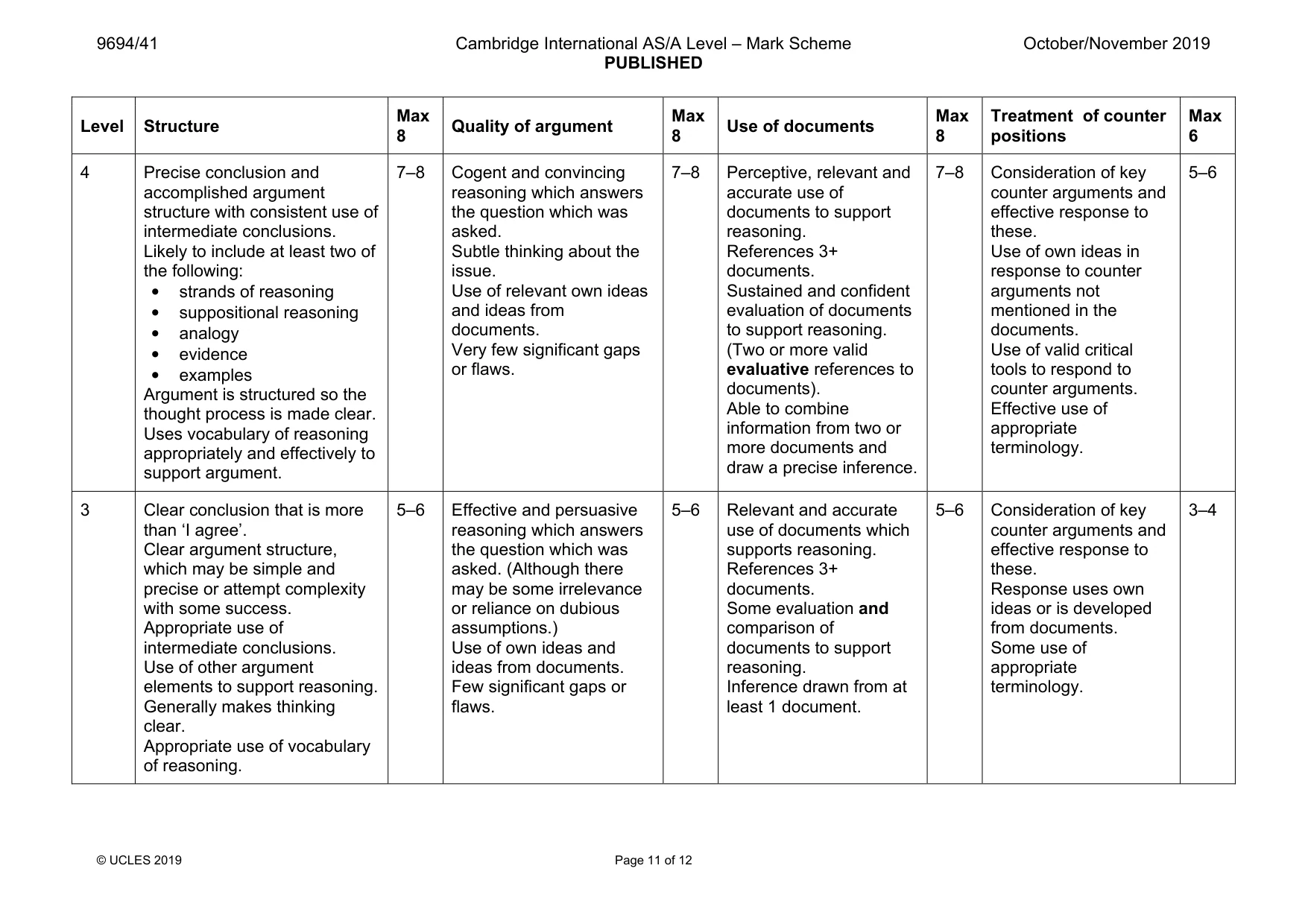
9694/41 Cambridge International AS/A Level – Mark Scheme PUBLISHED October/November 2019 © UCLES 2019 Page 11 of 12 Level Structure Max 8 Quality of argument Max 8 Use of documents Max 8 Treatment of counter positions Max 6 4 Precise conclusion and accomplished argument structure with consistent use of intermediate conclusions. Likely to include at least two of the following: • strands of reasoning • suppositional reasoning • analogy • evidence • examples Argument is structured so the thought process is made clear. Uses vocabulary of reasoning appropriately and effectively to support argument. 7–8 Cogent and convincing reasoning which answers the question which was asked. Subtle thinking about the issue. Use of relevant own ideas and ideas from documents. Very few significant gaps or flaws. 7–8 Perceptive, relevant and accurate use of documents to support reasoning. References 3+ documents. Sustained and confident evaluation of documents to support reasoning. (Two or more valid evaluative references to documents). Able to combine information from two or more documents and draw a precise inference. 7–8 Consideration of key counter arguments and effective response to these. Use of own ideas in response to counter arguments not mentioned in the documents. Use of valid critical tools to respond to counter arguments. Effective use of appropriate terminology. 5–6 3 Clear conclusion that is more than ‘I agree’. Clear argument structure, which may be simple and precise or attempt complexity with some success. Appropriate use of intermediate conclusions. Use of other argument elements to support reasoning. Generally makes thinking clear. Appropriate use of vocabulary of reasoning. 5–6 Effective and persuasive reasoning which answers the question which was asked. (Although there may be some irrelevance or reliance on dubious assumptions.) Use of own ideas and ideas from documents. Few significant gaps or flaws. 5–6 Relevant and accurate use of documents which supports reasoning. References 3+ documents. Some evaluation and comparison of documents to support reasoning. Inference drawn from at least 1 document. 5–6 Consideration of key counter arguments and effective response to these. Response uses own ideas or is developed from documents. Some use of appropriate terminology. 3–4
Mark scheme, page 12
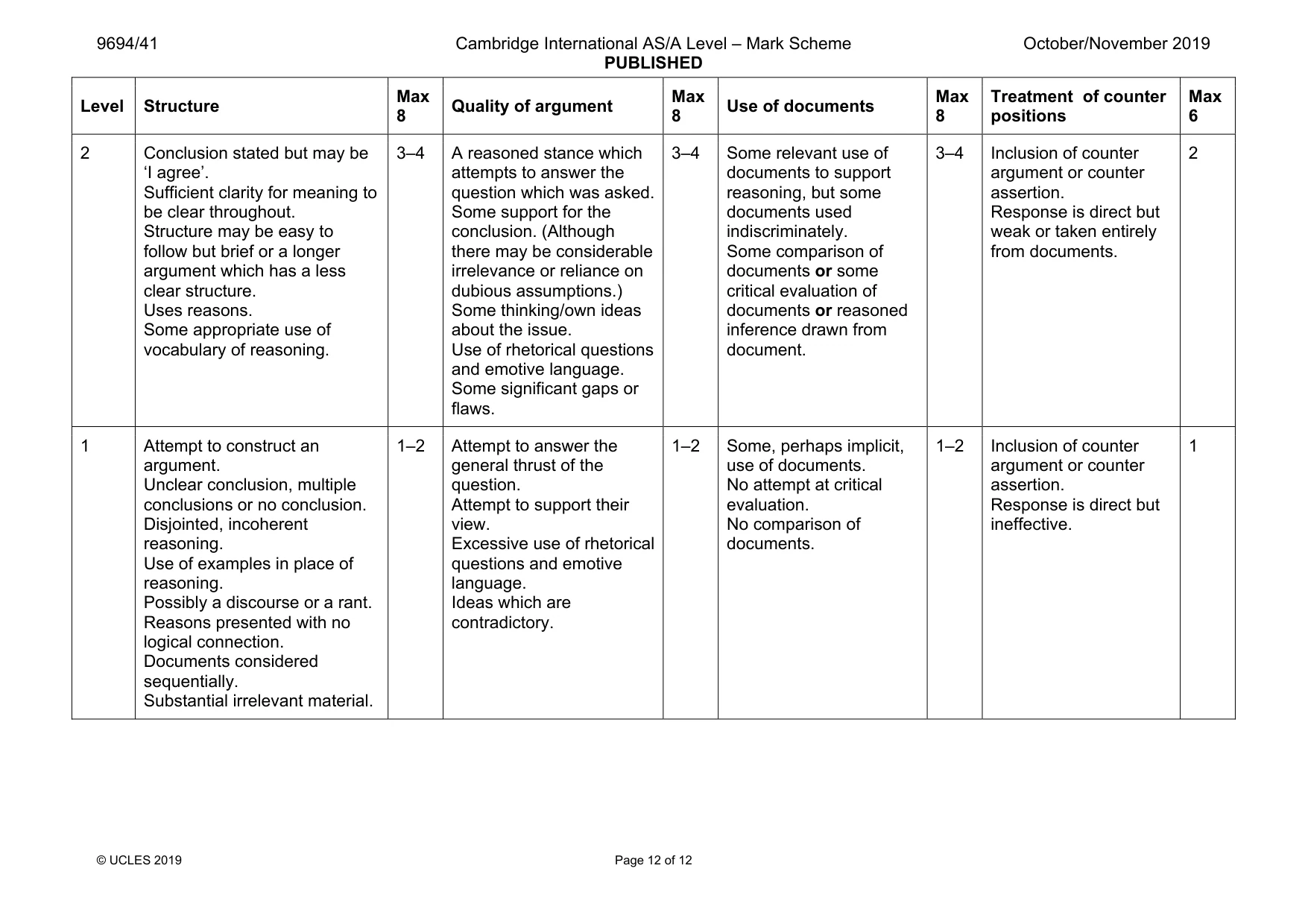
9694/41 Cambridge International AS/A Level – Mark Scheme PUBLISHED October/November 2019 © UCLES 2019 Page 12 of 12 Level Structure Max 8 Quality of argument Max 8 Use of documents Max 8 Treatment of counter positions Max 6 2 Conclusion stated but may be ‘I agree’. Sufficient clarity for meaning to be clear throughout. Structure may be easy to follow but brief or a longer argument which has a less clear structure. Uses reasons. Some appropriate use of vocabulary of reasoning. 3–4 A reasoned stance which attempts to answer the question which was asked. Some support for the conclusion. (Although there may be considerable irrelevance or reliance on dubious assumptions.) Some thinking/own ideas about the issue. Use of rhetorical questions and emotive language. Some significant gaps or flaws. 3–4 Some relevant use of documents to support reasoning, but some documents used indiscriminately. Some comparison of documents or some critical evaluation of documents or reasoned inference drawn from document. 3–4 Inclusion of counter argument or counter assertion. Response is direct but weak or taken entirely from documents. 2 1 Attempt to construct an argument. Unclear conclusion, multiple conclusions or no conclusion. Disjointed, incoherent reasoning. Use of examples in place of reasoning. Possibly a discourse or a rant. Reasons presented with no logical connection. Documents considered sequentially. Substantial irrelevant material. 1–2 Attempt to answer the general thrust of the question. Attempt to support their view. Excessive use of rhetorical questions and emotive language. Ideas which are contradictory. 1–2 Some, perhaps implicit, use of documents. No attempt at critical evaluation. No comparison of documents. 1–2 Inclusion of counter argument or counter assertion. Response is direct but ineffective. 1
What you needed in this session
Cambridge’s own grade thresholds for 2019 Oct/Nov, Paper 4 · Variant 1. A higher threshold means an easier paper — the bar moves with how the cohort did.