Cambridge A Level Thinking Skills 9694 — 2014 May/June Paper 4 · Variant 3
9694/43/M/J/14 · 50 marks · ≈56 min
The question paper and its mark scheme, free to read here and free to download. This is Cambridge’s own paper, exactly as it was sat.
Question paper8 pages
Mark scheme7 pages
Answers below. Sit the paper first if you are practising.
Paper as text
Question paper, page 1
This document consists of 7 printed pages, 1 blank page and 1 insert. IB14 06_9694_43/FP © UCLES 2014 [Turn over *7322931361* Cambridge International Examinations Cambridge International Advanced Level THINKING SKILLS 9694/43 Paper 4 Applied Reasoning May/June 2014 1 hour 30 minutes No Additional Materials are required. READ THESE INSTRUCTIONS FIRST An answer booklet is provided inside this question paper. You should follow the instructions on the front cover of the answer booklet. If you need additional answer paper ask the invigilator for a continuation booklet. Answer all the questions. The number of marks is given in brackets [ ] at the end of each question.
Question paper, page 2
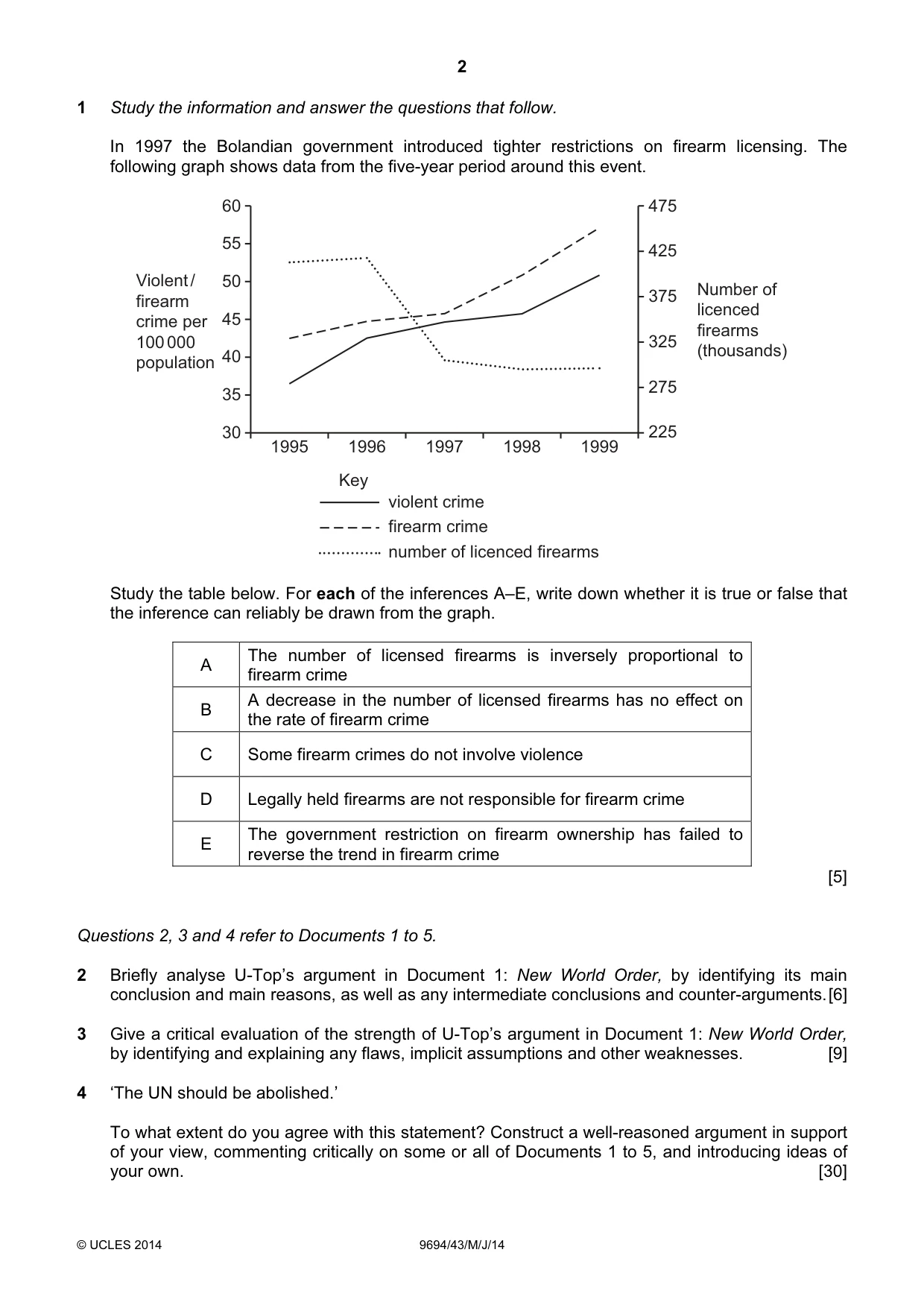
2 © UCLES 2014 9694/43/M/J/14 1 Study the information and answer the questions that follow. In 1997 the Bolandian government introduced tighter restrictions on firearm licensing. The following graph shows data from the five-year period around this event. 60 55 50 45 40 35 30 475 425 375 325 275 225 1995 1996 1997 1998 1999 Violent / firearm crime per 100 000 population Number of licenced firearms (thousands) violent crime firearm crime number of licenced firearms Key Study the table below. For each of the inferences A–E, write down whether it is true or false that the inference can reliably be drawn from the graph. A The number of licensed firearms is inversely proportional to firearm crime B A decrease in the number of licensed firearms has no effect on the rate of firearm crime C Some firearm crimes do not involve violence D Legally held firearms are not responsible for firearm crime E The government restriction on firearm ownership has failed to reverse the trend in firearm crime [5] Questions 2, 3 and 4 refer to Documents 1 to 5. 2 Briefly analyse U-Top’s argument in Document 1: New World Order, by identifying its main conclusion and main reasons, as well as any intermediate conclusions and counter-arguments. [6] 3 Give a critical evaluation of the strength of U-Top’s argument in Document 1: New World Order, by identifying and explaining any flaws, implicit assumptions and other weaknesses. [9] 4 ‘The UN should be abolished.’ To what extent do you agree with this statement? Construct a well-reasoned argument in support of your view, commenting critically on some or all of Documents 1 to 5, and introducing ideas of your own. [30]
Question paper, page 3
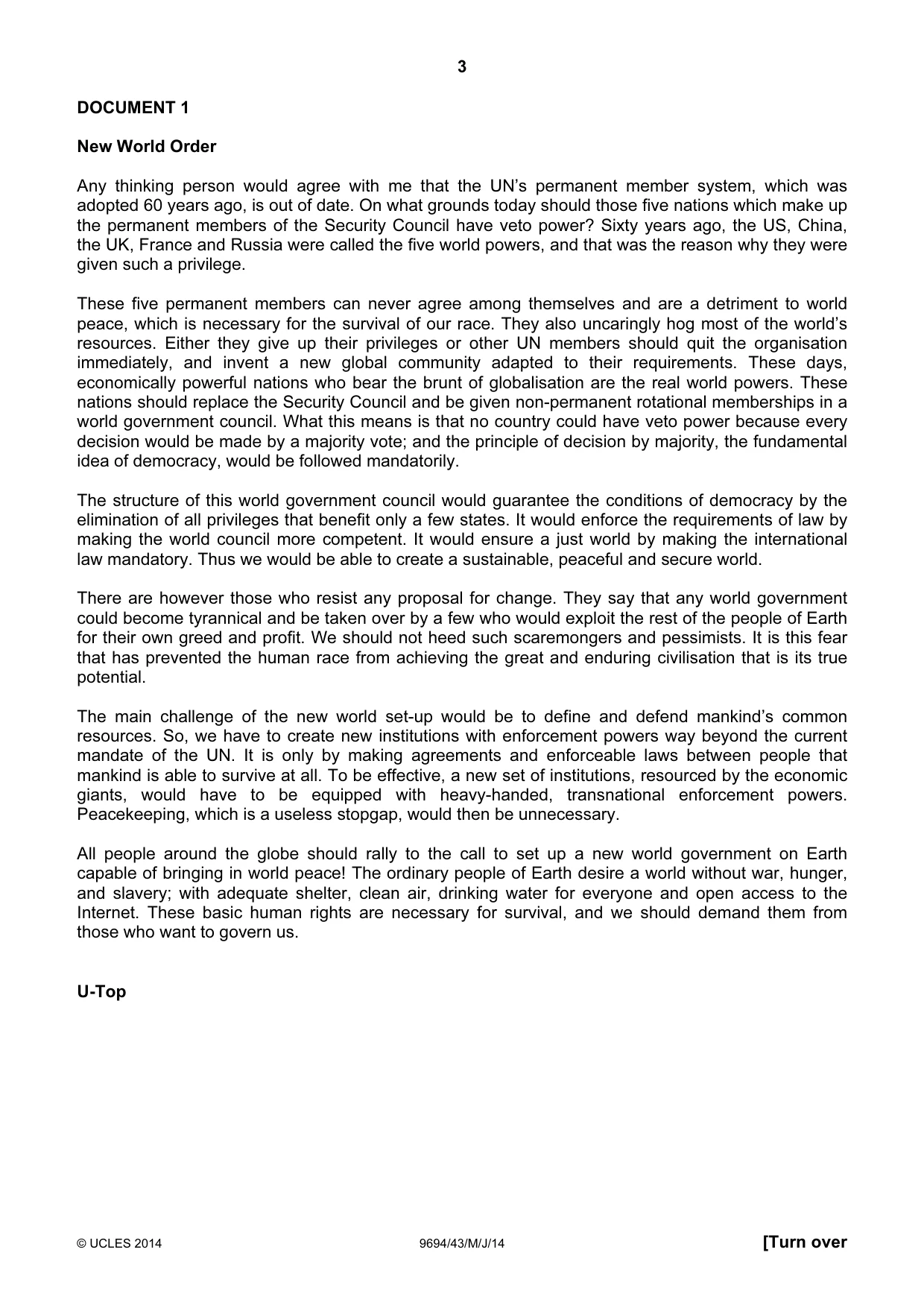
3 © UCLES 2014 9694/43/M/J/14 [Turn over DOCUMENT 1 New World Order Any thinking person would agree with me that the UN’s permanent member system, which was adopted 60 years ago, is out of date. On what grounds today should those five nations which make up the permanent members of the Security Council have veto power? Sixty years ago, the US, China, the UK, France and Russia were called the five world powers, and that was the reason why they were given such a privilege. These five permanent members can never agree among themselves and are a detriment to world peace, which is necessary for the survival of our race. They also uncaringly hog most of the world’s resources. Either they give up their privileges or other UN members should quit the organisation immediately, and invent a new global community adapted to their requirements. These days, economically powerful nations who bear the brunt of globalisation are the real world powers. These nations should replace the Security Council and be given non-permanent rotational memberships in a world government council. What this means is that no country could have veto power because every decision would be made by a majority vote; and the principle of decision by majority, the fundamental idea of democracy, would be followed mandatorily. The structure of this world government council would guarantee the conditions of democracy by the elimination of all privileges that benefit only a few states. It would enforce the requirements of law by making the world council more competent. It would ensure a just world by making the international law mandatory. Thus we would be able to create a sustainable, peaceful and secure world. There are however those who resist any proposal for change. They say that any world government could become tyrannical and be taken over by a few who would exploit the rest of the people of Earth for their own greed and profit. We should not heed such scaremongers and pessimists. It is this fear that has prevented the human race from achieving the great and enduring civilisation that is its true potential. The main challenge of the new world set-up would be to define and defend mankind’s common resources. So, we have to create new institutions with enforcement powers way beyond the current mandate of the UN. It is only by making agreements and enforceable laws between people that mankind is able to survive at all. To be effective, a new set of institutions, resourced by the economic giants, would have to be equipped with heavy-handed, transnational enforcement powers. Peacekeeping, which is a useless stopgap, would then be unnecessary. All people around the globe should rally to the call to set up a new world government on Earth capable of bringing in world peace! The ordinary people of Earth desire a world without war, hunger, and slavery; with adequate shelter, clean air, drinking water for everyone and open access to the Internet. These basic human rights are necessary for survival, and we should demand them from those who want to govern us. U-Top
Question paper, page 4
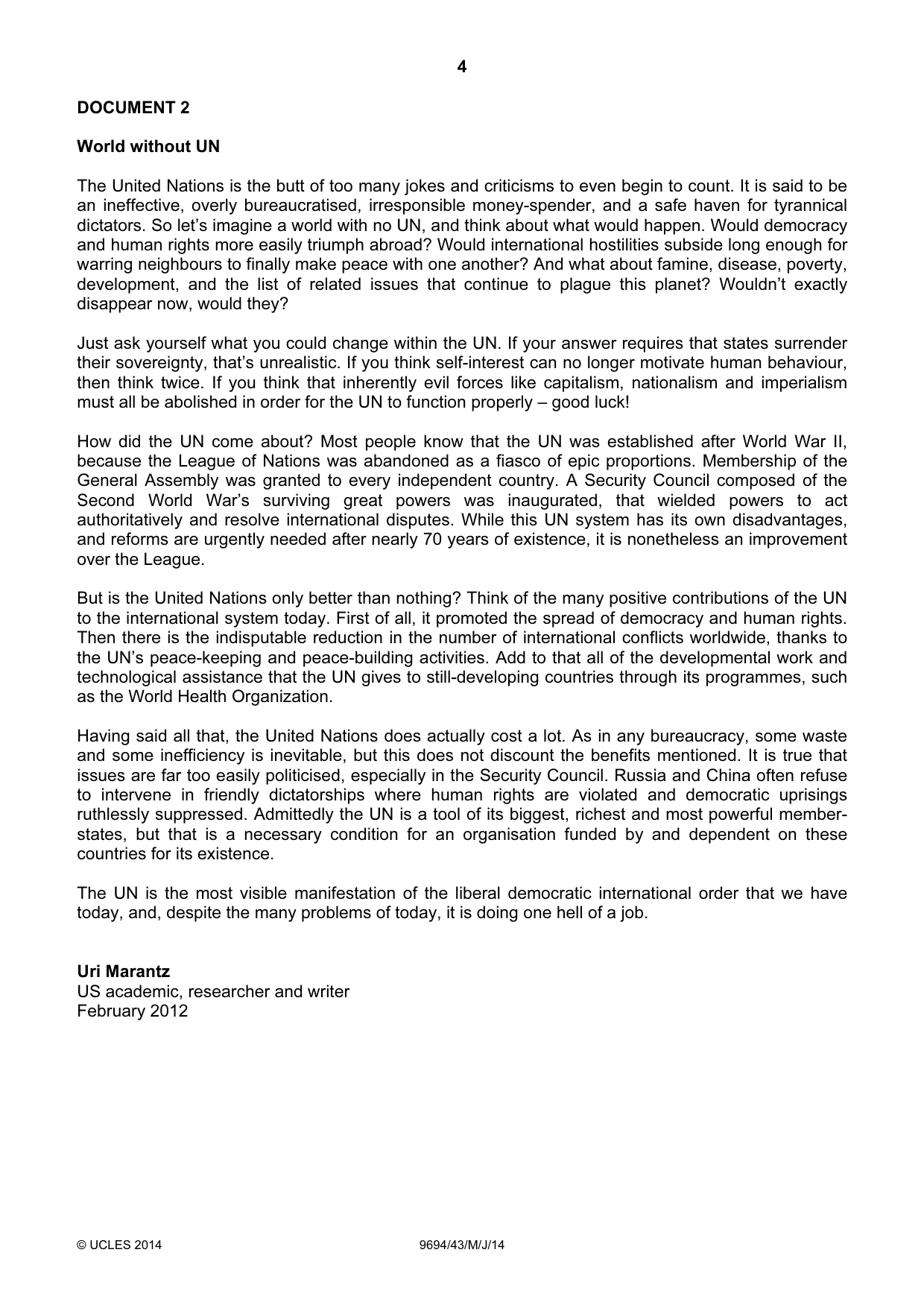
4 © UCLES 2014 9694/43/M/J/14 DOCUMENT 2 World without UN The United Nations is the butt of too many jokes and criticisms to even begin to count. It is said to be an ineffective, overly bureaucratised, irresponsible money-spender, and a safe haven for tyrannical dictators. So let’s imagine a world with no UN, and think about what would happen. Would democracy and human rights more easily triumph abroad? Would international hostilities subside long enough for warring neighbours to finally make peace with one another? And what about famine, disease, poverty, development, and the list of related issues that continue to plague this planet? Wouldn’t exactly disappear now, would they? Just ask yourself what you could change within the UN. If your answer requires that states surrender their sovereignty, that’s unrealistic. If you think self-interest can no longer motivate human behaviour, then think twice. If you think that inherently evil forces like capitalism, nationalism and imperialism must all be abolished in order for the UN to function properly – good luck! How did the UN come about? Most people know that the UN was established after World War II, because the League of Nations was abandoned as a fiasco of epic proportions. Membership of the General Assembly was granted to every independent country. A Security Council composed of the Second World War’s surviving great powers was inaugurated, that wielded powers to act authoritatively and resolve international disputes. While this UN system has its own disadvantages, and reforms are urgently needed after nearly 70 years of existence, it is nonetheless an improvement over the League. But is the United Nations only better than nothing? Think of the many positive contributions of the UN to the international system today. First of all, it promoted the spread of democracy and human rights. Then there is the indisputable reduction in the number of international conflicts worldwide, thanks to the UN’s peace-keeping and peace-building activities. Add to that all of the developmental work and technological assistance that the UN gives to still-developing countries through its programmes, such as the World Health Organization. Having said all that, the United Nations does actually cost a lot. As in any bureaucracy, some waste and some inefficiency is inevitable, but this does not discount the benefits mentioned. It is true that issues are far too easily politicised, especially in the Security Council. Russia and China often refuse to intervene in friendly dictatorships where human rights are violated and democratic uprisings ruthlessly suppressed. Admittedly the UN is a tool of its biggest, richest and most powerful member- states, but that is a necessary condition for an organisation funded by and dependent on these countries for its existence. The UN is the most visible manifestation of the liberal democratic international order that we have today, and, despite the many problems of today, it is doing one hell of a job. Uri Marantz US academic, researcher and writer February 2012
Question paper, page 5
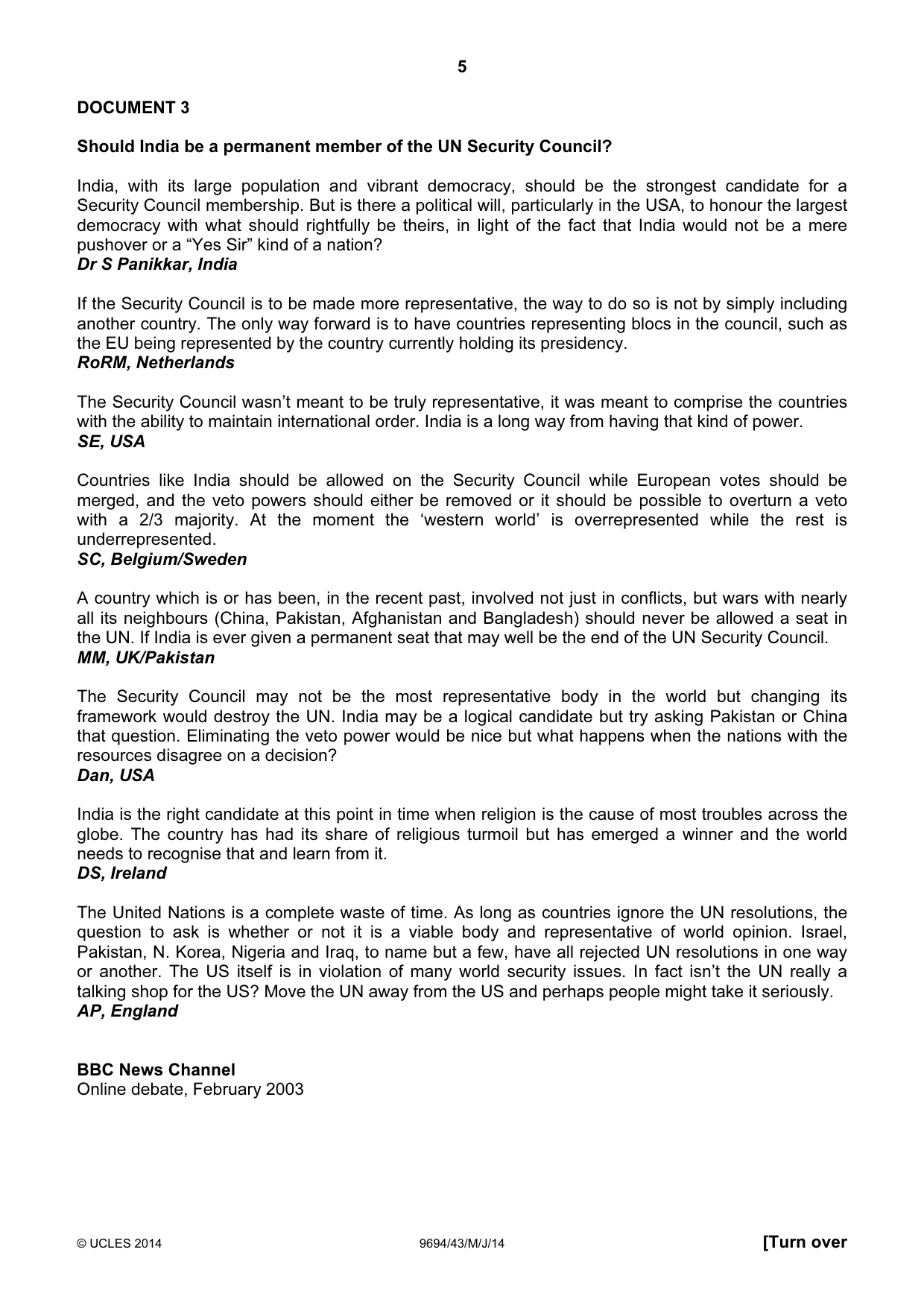
5 © UCLES 2014 9694/43/M/J/14 [Turn over DOCUMENT 3 Should India be a permanent member of the UN Security Council? India, with its large population and vibrant democracy, should be the strongest candidate for a Security Council membership. But is there a political will, particularly in the USA, to honour the largest democracy with what should rightfully be theirs, in light of the fact that India would not be a mere pushover or a “Yes Sir” kind of a nation? Dr S Panikkar, India If the Security Council is to be made more representative, the way to do so is not by simply including another country. The only way forward is to have countries representing blocs in the council, such as the EU being represented by the country currently holding its presidency. RoRM, Netherlands The Security Council wasn’t meant to be truly representative, it was meant to comprise the countries with the ability to maintain international order. India is a long way from having that kind of power. SE, USA Countries like India should be allowed on the Security Council while European votes should be merged, and the veto powers should either be removed or it should be possible to overturn a veto with a 2/3 majority. At the moment the ‘western world’ is overrepresented while the rest is underrepresented. SC, Belgium/Sweden A country which is or has been, in the recent past, involved not just in conflicts, but wars with nearly all its neighbours (China, Pakistan, Afghanistan and Bangladesh) should never be allowed a seat in the UN. If India is ever given a permanent seat that may well be the end of the UN Security Council. MM, UK/Pakistan The Security Council may not be the most representative body in the world but changing its framework would destroy the UN. India may be a logical candidate but try asking Pakistan or China that question. Eliminating the veto power would be nice but what happens when the nations with the resources disagree on a decision? Dan, USA India is the right candidate at this point in time when religion is the cause of most troubles across the globe. The country has had its share of religious turmoil but has emerged a winner and the world needs to recognise that and learn from it. DS, Ireland The United Nations is a complete waste of time. As long as countries ignore the UN resolutions, the question to ask is whether or not it is a viable body and representative of world opinion. Israel, Pakistan, N. Korea, Nigeria and Iraq, to name but a few, have all rejected UN resolutions in one way or another. The US itself is in violation of many world security issues. In fact isn’t the UN really a talking shop for the US? Move the UN away from the US and perhaps people might take it seriously. AP, England BBC News Channel Online debate, February 2003
Question paper, page 6
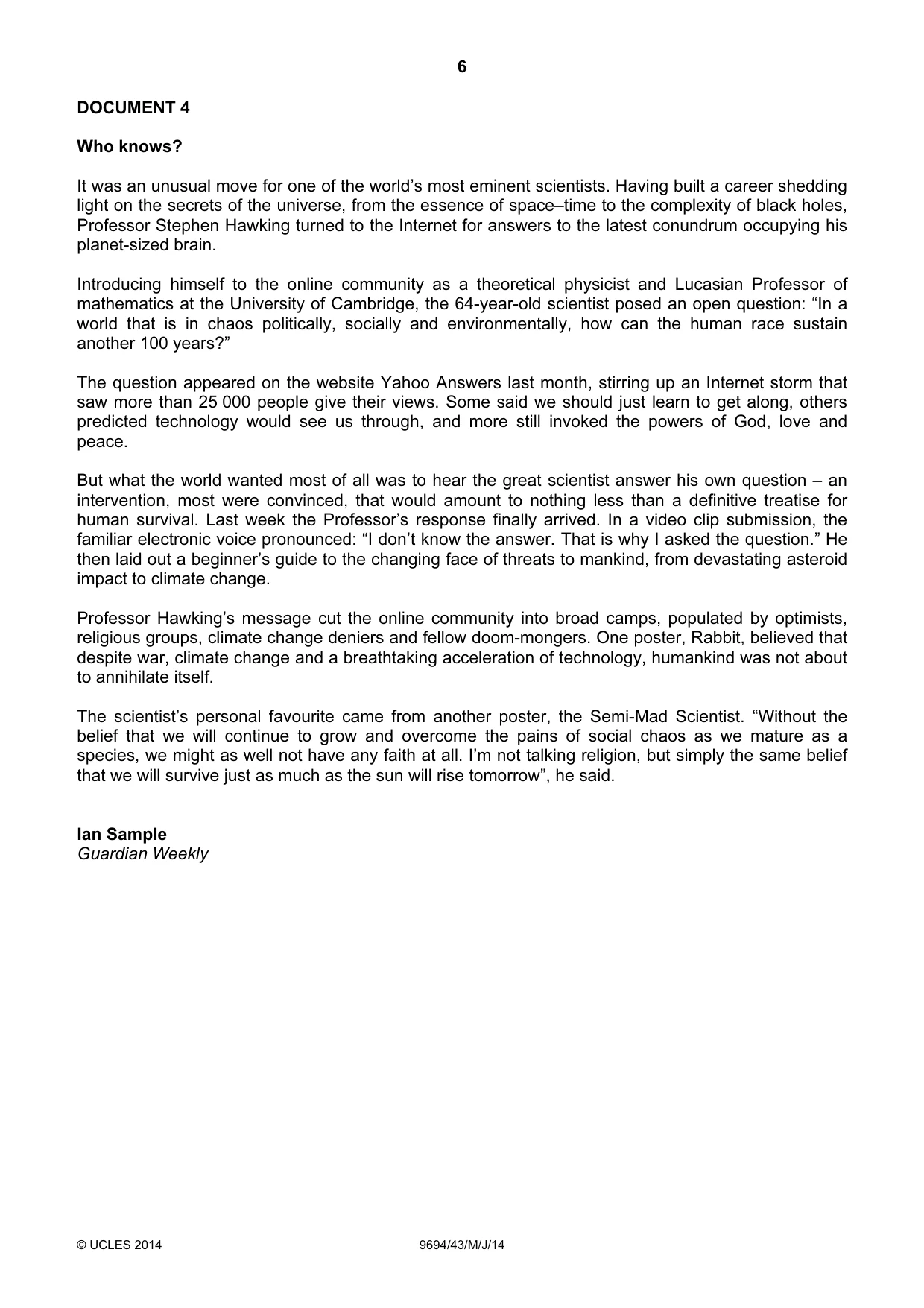
6 © UCLES 2014 9694/43/M/J/14 DOCUMENT 4 Who knows? It was an unusual move for one of the world’s most eminent scientists. Having built a career shedding light on the secrets of the universe, from the essence of space–time to the complexity of black holes, Professor Stephen Hawking turned to the Internet for answers to the latest conundrum occupying his planet-sized brain. Introducing himself to the online community as a theoretical physicist and Lucasian Professor of mathematics at the University of Cambridge, the 64-year-old scientist posed an open question: “In a world that is in chaos politically, socially and environmentally, how can the human race sustain another 100 years?” The question appeared on the website Yahoo Answers last month, stirring up an Internet storm that saw more than 25 000 people give their views. Some said we should just learn to get along, others predicted technology would see us through, and more still invoked the powers of God, love and peace. But what the world wanted most of all was to hear the great scientist answer his own question – an intervention, most were convinced, that would amount to nothing less than a definitive treatise for human survival. Last week the Professor’s response finally arrived. In a video clip submission, the familiar electronic voice pronounced: “I don’t know the answer. That is why I asked the question.” He then laid out a beginner’s guide to the changing face of threats to mankind, from devastating asteroid impact to climate change. Professor Hawking’s message cut the online community into broad camps, populated by optimists, religious groups, climate change deniers and fellow doom-mongers. One poster, Rabbit, believed that despite war, climate change and a breathtaking acceleration of technology, humankind was not about to annihilate itself. The scientist’s personal favourite came from another poster, the Semi-Mad Scientist. “Without the belief that we will continue to grow and overcome the pains of social chaos as we mature as a species, we might as well not have any faith at all. I’m not talking religion, but simply the same belief that we will survive just as much as the sun will rise tomorrow”, he said. Ian Sample Guardian Weekly
Question paper, page 7
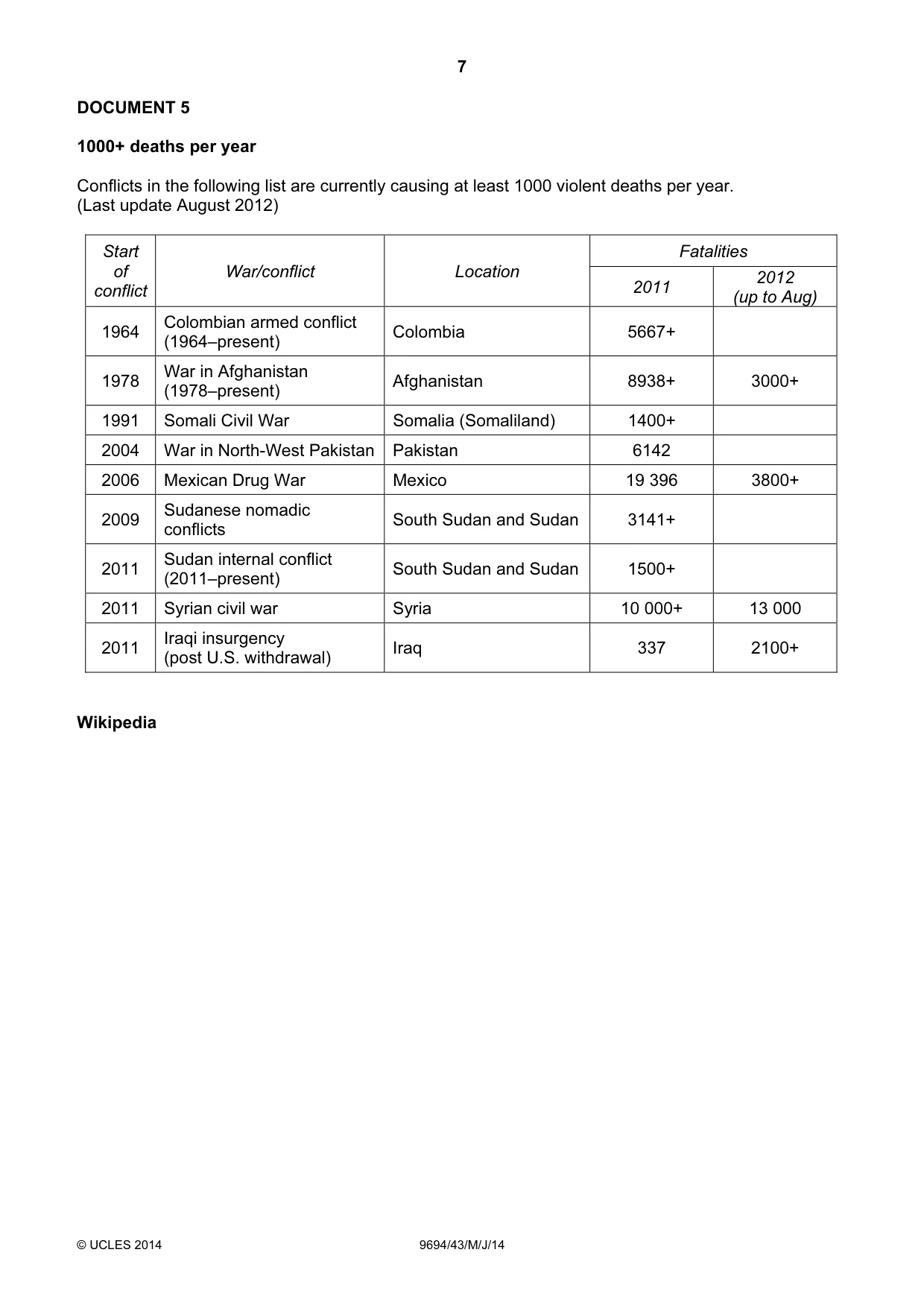
7 © UCLES 2014 9694/43/M/J/14 DOCUMENT 5 1000+ deaths per year Conflicts in the following list are currently causing at least 1000 violent deaths per year. (Last update August 2012) Start of conflict War/conflict Location Fatalities 2011 2012 (up to Aug) 1964 Colombian armed conflict (1964–present) Colombia 5667+ 1978 War in Afghanistan (1978–present) Afghanistan 8938+ 3000+ 1991 Somali Civil War Somalia (Somaliland) 1400+ 2004 War in North-West Pakistan Pakistan 6142 2006 Mexican Drug War Mexico 19 396 3800+ 2009 Sudanese nomadic conflicts South Sudan and Sudan 3141+ 2011 Sudan internal conflict (2011–present) South Sudan and Sudan 1500+ 2011 Syrian civil war Syria 10 000+ 13 000 2011 Iraqi insurgency (post U.S. withdrawal) Iraq 337 2100+ Wikipedia
Question paper, page 8
8 Copyright Acknowledgements: Document 2 Document 3 Document 4 Document 5 © Uri Marantz; http://www.freedomwriters.ca/category/international-affairs/; 6 February 2012. © http://news.bbc.co.uk/1/hi/talking_point/2788763.stm; February 2001. © Ian Sample; Guardian Weekly Science and Technology; http://www.guardian.co.uk/guardianweekly/story/0,,1840576,00.html. © http://en.wikipedia.org/wiki/List_of_ongoing_military_conflicts. Permission to reproduce items where third-party owned material protected by copyright is included has been sought and cleared where possible. Every reasonable effort has been made by the publisher (UCLES) to trace copyright holders, but if any items requiring clearance have unwittingly been included, the publisher will be pleased to make amends at the earliest possible opportunity. Cambridge International Examinations is part of the Cambridge Assessment Group. Cambridge Assessment is the brand name of University of Cambridge Local Examinations Syndicate (UCLES), which is itself a department of the University of Cambridge. © UCLES 2014 9694/43/M/J/14 BLANK PAGE
Mark scheme, page 1
CAMBRIDGE INTERNATIONAL EXAMINATIONS GCE Advanced Level MARK SCHEME for the May/June 2014 series 9694 THINKING SKILLS 9694/43 Paper 4 (Applied Reasoning), maximum raw mark 50 This mark scheme is published as an aid to teachers and candidates, to indicate the requirements of the examination. It shows the basis on which Examiners were instructed to award marks. It does not indicate the details of the discussions that took place at an Examiners’ meeting before marking began, which would have considered the acceptability of alternative answers. Mark schemes should be read in conjunction with the question paper and the Principal Examiner Report for Teachers. Cambridge will not enter into discussions about these mark schemes. Cambridge is publishing the mark schemes for the May/June 2014 series for most IGCSE, GCE Advanced Level and Advanced Subsidiary Level components and some Ordinary Level components.
Mark scheme, page 2
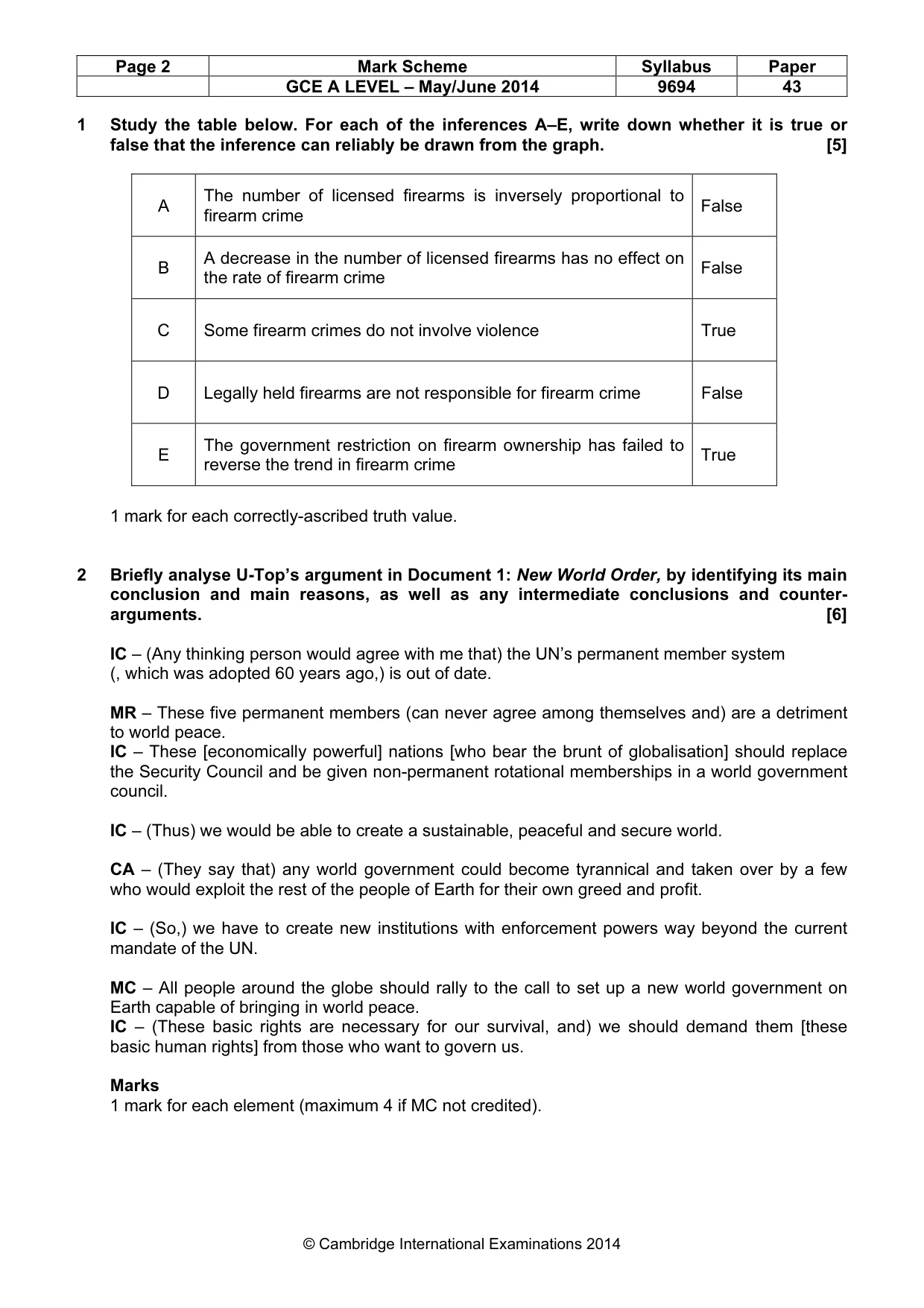
Page 2 Mark Scheme Syllabus Paper GCE A LEVEL – May/June 2014 9694 43 © Cambridge International Examinations 2014 1 Study the table below. For each of the inferences A–E, write down whether it is true or false that the inference can reliably be drawn from the graph. [5] A The number of licensed firearms is inversely proportional to firearm crime False B A decrease in the number of licensed firearms has no effect on the rate of firearm crime False C Some firearm crimes do not involve violence True D Legally held firearms are not responsible for firearm crime False E The government restriction on firearm ownership has failed to reverse the trend in firearm crime True 1 mark for each correctly-ascribed truth value. 2 Briefly analyse U-Top’s argument in Document 1: New World Order, by identifying its main conclusion and main reasons, as well as any intermediate conclusions and counter- arguments. [6] IC – (Any thinking person would agree with me that) the UN’s permanent member system (, which was adopted 60 years ago,) is out of date. MR – These five permanent members (can never agree among themselves and) are a detriment to world peace. IC – These [economically powerful] nations [who bear the brunt of globalisation] should replace the Security Council and be given non-permanent rotational memberships in a world government council. IC – (Thus) we would be able to create a sustainable, peaceful and secure world. CA – (They say that) any world government could become tyrannical and taken over by a few who would exploit the rest of the people of Earth for their own greed and profit. IC – (So,) we have to create new institutions with enforcement powers way beyond the current mandate of the UN. MC – All people around the globe should rally to the call to set up a new world government on Earth capable of bringing in world peace. IC – (These basic rights are necessary for our survival, and) we should demand them [these basic human rights] from those who want to govern us. Marks 1 mark for each element (maximum 4 if MC not credited).
Mark scheme, page 3
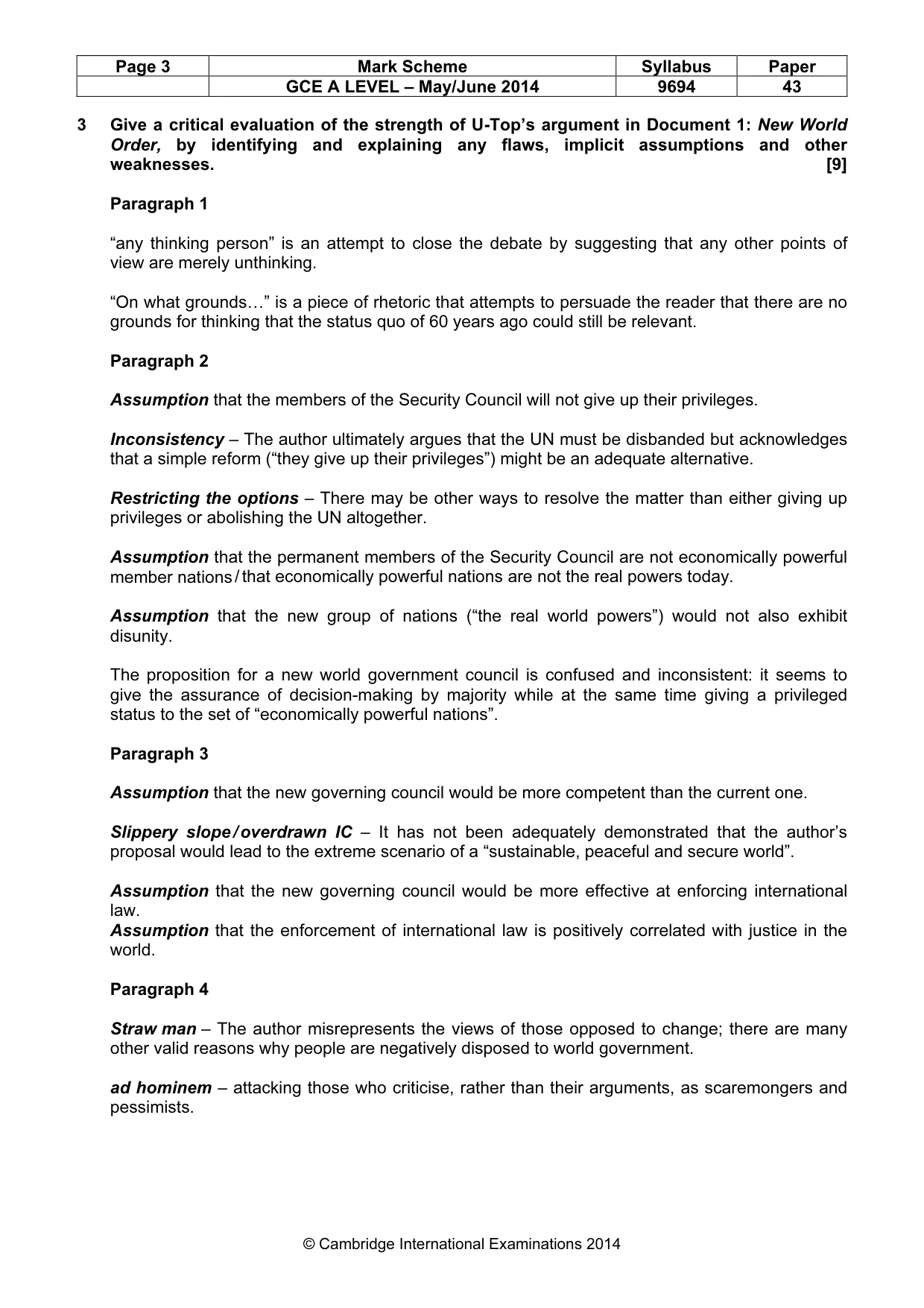
Page 3 Mark Scheme Syllabus Paper GCE A LEVEL – May/June 2014 9694 43 © Cambridge International Examinations 2014 3 Give a critical evaluation of the strength of U-Top’s argument in Document 1: New World Order, by identifying and explaining any flaws, implicit assumptions and other weaknesses. [9] Paragraph 1 “any thinking person” is an attempt to close the debate by suggesting that any other points of view are merely unthinking. “On what grounds…” is a piece of rhetoric that attempts to persuade the reader that there are no grounds for thinking that the status quo of 60 years ago could still be relevant. Paragraph 2 Assumption that the members of the Security Council will not give up their privileges. Inconsistency – The author ultimately argues that the UN must be disbanded but acknowledges that a simple reform (“they give up their privileges”) might be an adequate alternative. Restricting the options – There may be other ways to resolve the matter than either giving up privileges or abolishing the UN altogether. Assumption that the permanent members of the Security Council are not economically powerful member nations / that economically powerful nations are not the real powers today. Assumption that the new group of nations (“the real world powers”) would not also exhibit disunity. The proposition for a new world government council is confused and inconsistent: it seems to give the assurance of decision-making by majority while at the same time giving a privileged status to the set of “economically powerful nations”. Paragraph 3 Assumption that the new governing council would be more competent than the current one. Slippery slope / overdrawn IC – It has not been adequately demonstrated that the author’s proposal would lead to the extreme scenario of a “sustainable, peaceful and secure world”. Assumption that the new governing council would be more effective at enforcing international law. Assumption that the enforcement of international law is positively correlated with justice in the world. Paragraph 4 Straw man – The author misrepresents the views of those opposed to change; there are many other valid reasons why people are negatively disposed to world government. ad hominem – attacking those who criticise, rather than their arguments, as scaremongers and pessimists.
Mark scheme, page 4
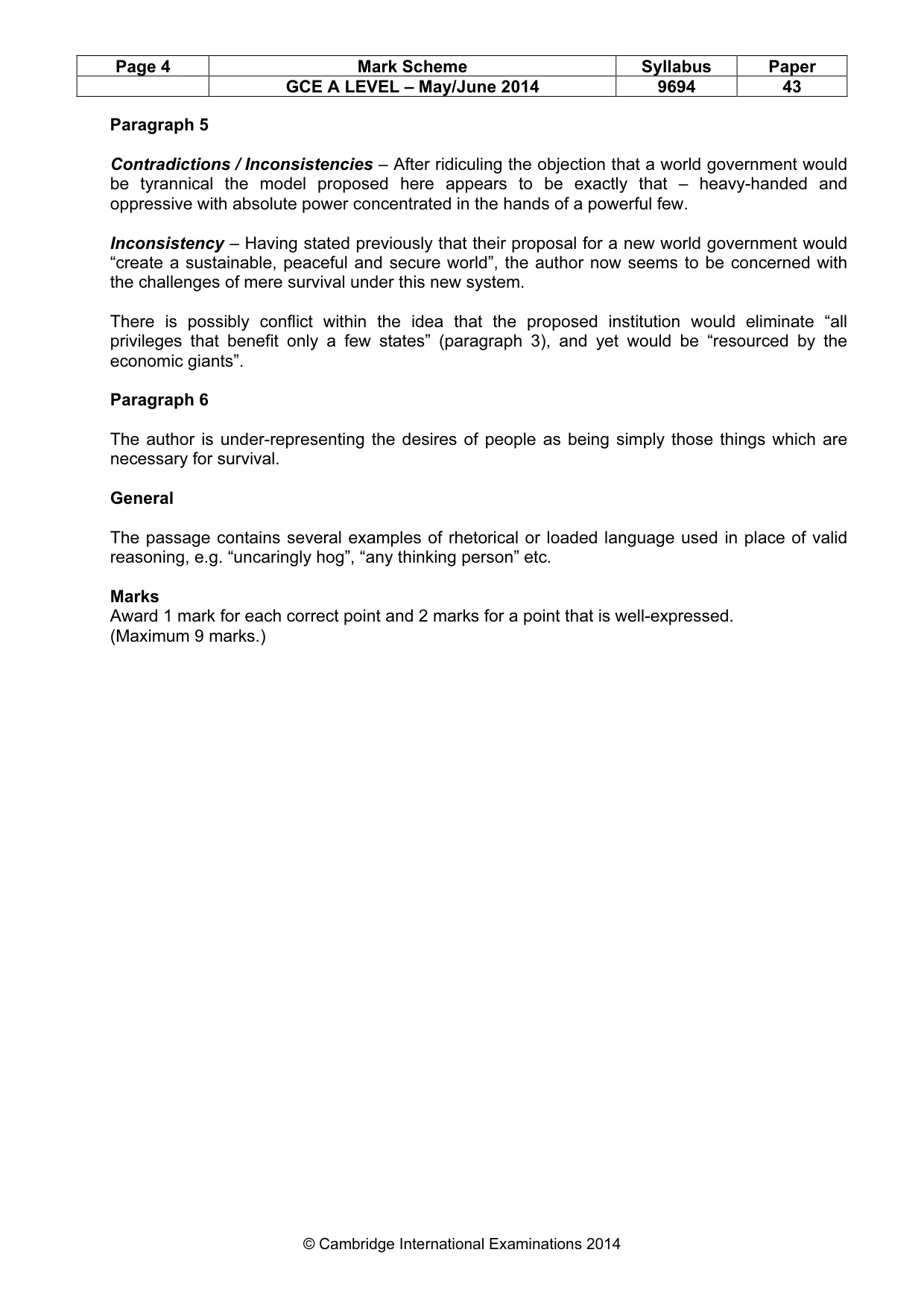
Page 4 Mark Scheme Syllabus Paper GCE A LEVEL – May/June 2014 9694 43 © Cambridge International Examinations 2014 Paragraph 5 Contradictions / Inconsistencies – After ridiculing the objection that a world government would be tyrannical the model proposed here appears to be exactly that – heavy-handed and oppressive with absolute power concentrated in the hands of a powerful few. Inconsistency – Having stated previously that their proposal for a new world government would “create a sustainable, peaceful and secure world”, the author now seems to be concerned with the challenges of mere survival under this new system. There is possibly conflict within the idea that the proposed institution would eliminate “all privileges that benefit only a few states” (paragraph 3), and yet would be “resourced by the economic giants”. Paragraph 6 The author is under-representing the desires of people as being simply those things which are necessary for survival. General The passage contains several examples of rhetorical or loaded language used in place of valid reasoning, e.g. “uncaringly hog”, “any thinking person” etc. Marks Award 1 mark for each correct point and 2 marks for a point that is well-expressed. (Maximum 9 marks.)
Mark scheme, page 5
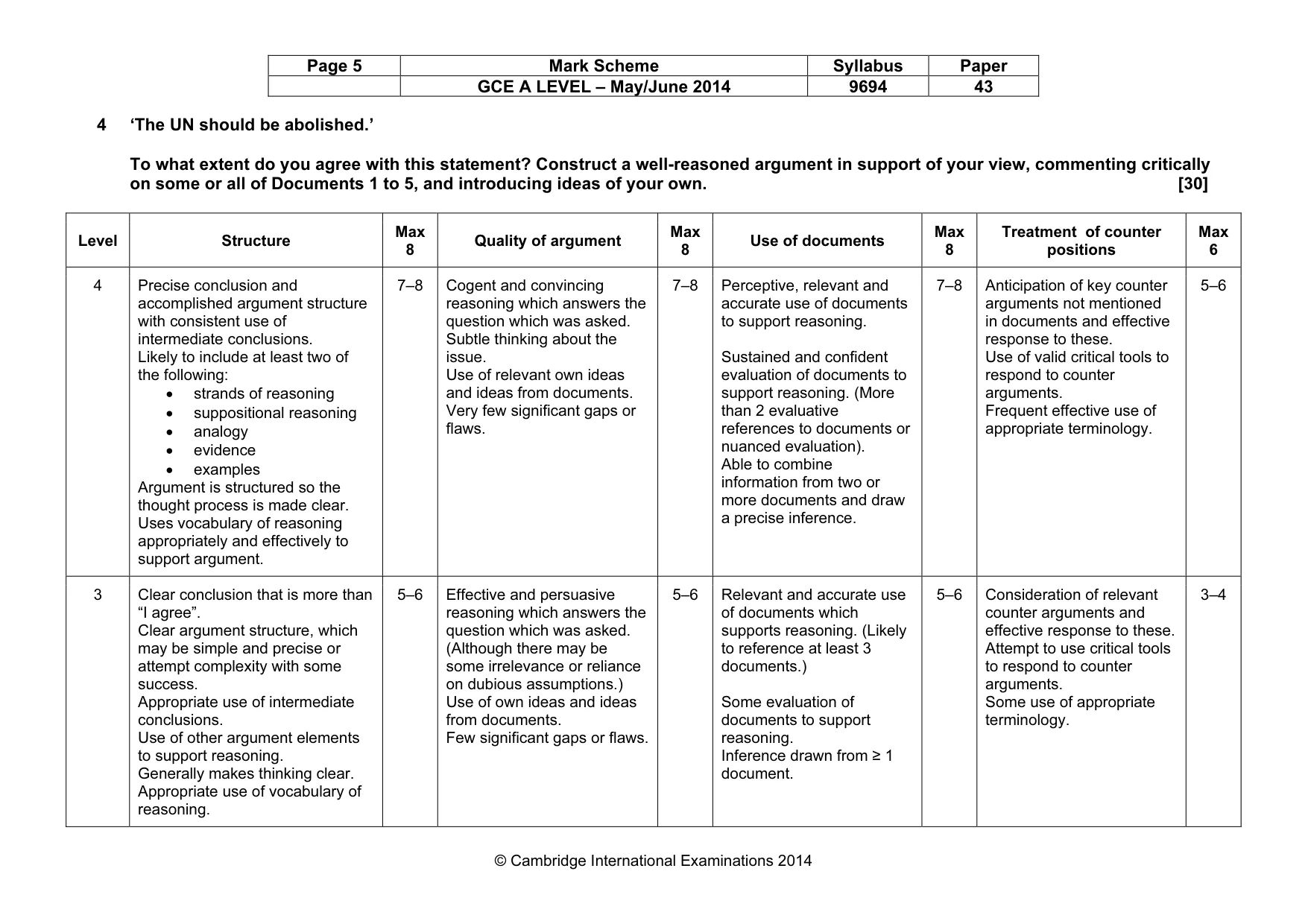
Page 5 Mark Scheme Syllabus Paper GCE A LEVEL – May/June 2014 9694 43 © Cambridge International Examinations 2014 4 ‘The UN should be abolished.’ To what extent do you agree with this statement? Construct a well-reasoned argument in support of your view, commenting critically on some or all of Documents 1 to 5, and introducing ideas of your own. [30] Level Structure Max 8 Quality of argument Max 8 Use of documents Max 8 Treatment of counter positions Max 6 4 Precise conclusion and accomplished argument structure with consistent use of intermediate conclusions. Likely to include at least two of the following: • strands of reasoning • suppositional reasoning • analogy • evidence • examples Argument is structured so the thought process is made clear. Uses vocabulary of reasoning appropriately and effectively to support argument. 7–8 Cogent and convincing reasoning which answers the question which was asked. Subtle thinking about the issue. Use of relevant own ideas and ideas from documents. Very few significant gaps or flaws. 7–8 Perceptive, relevant and accurate use of documents to support reasoning. Sustained and confident evaluation of documents to support reasoning. (More than 2 evaluative references to documents or nuanced evaluation). Able to combine information from two or more documents and draw a precise inference. 7–8 Anticipation of key counter arguments not mentioned in documents and effective response to these. Use of valid critical tools to respond to counter arguments. Frequent effective use of appropriate terminology. 5–6 3 Clear conclusion that is more than “I agree”. Clear argument structure, which may be simple and precise or attempt complexity with some success. Appropriate use of intermediate conclusions. Use of other argument elements to support reasoning. Generally makes thinking clear. Appropriate use of vocabulary of reasoning. 5–6 Effective and persuasive reasoning which answers the question which was asked. (Although there may be some irrelevance or reliance on dubious assumptions.) Use of own ideas and ideas from documents. Few significant gaps or flaws. 5–6 Relevant and accurate use of documents which supports reasoning. (Likely to reference at least 3 documents.) Some evaluation of documents to support reasoning. Inference drawn from ≥ 1 document. 5–6 Consideration of relevant counter arguments and effective response to these. Attempt to use critical tools to respond to counter arguments. Some use of appropriate terminology. 3–4
Mark scheme, page 6
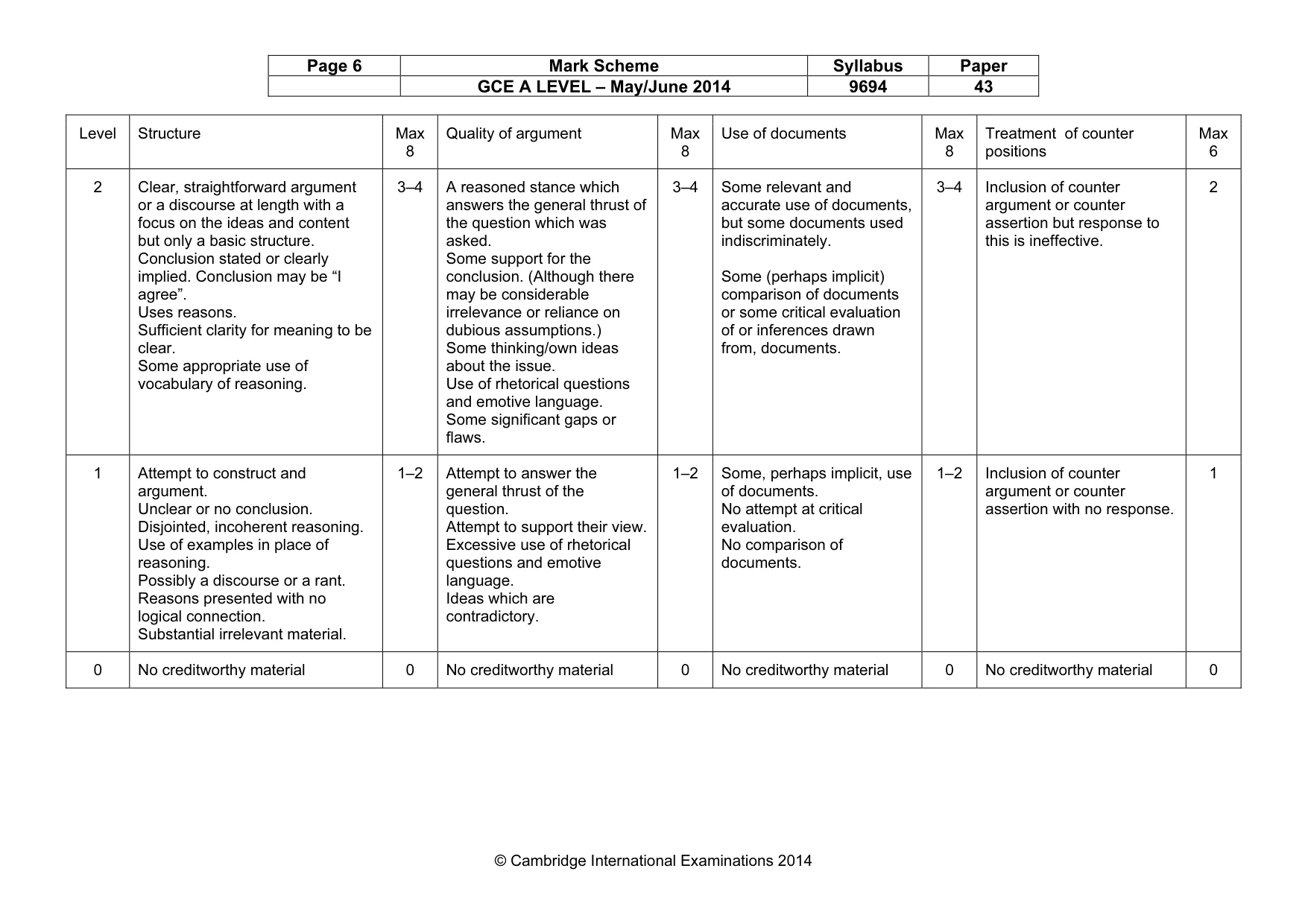
Page 6 Mark Scheme Syllabus Paper GCE A LEVEL – May/June 2014 9694 43 © Cambridge International Examinations 2014 Level Structure Max 8 Quality of argument Max 8 Use of documents Max 8 Treatment of counter positions Max 6 2 Clear, straightforward argument or a discourse at length with a focus on the ideas and content but only a basic structure. Conclusion stated or clearly implied. Conclusion may be “I agree”. Uses reasons. Sufficient clarity for meaning to be clear. Some appropriate use of vocabulary of reasoning. 3–4 A reasoned stance which answers the general thrust of the question which was asked. Some support for the conclusion. (Although there may be considerable irrelevance or reliance on dubious assumptions.) Some thinking/own ideas about the issue. Use of rhetorical questions and emotive language. Some significant gaps or flaws. 3–4 Some relevant and accurate use of documents, but some documents used indiscriminately. Some (perhaps implicit) comparison of documents or some critical evaluation of or inferences drawn from, documents. 3–4 Inclusion of counter argument or counter assertion but response to this is ineffective. 2 1 Attempt to construct and argument. Unclear or no conclusion. Disjointed, incoherent reasoning. Use of examples in place of reasoning. Possibly a discourse or a rant. Reasons presented with no logical connection. Substantial irrelevant material. 1–2 Attempt to answer the general thrust of the question. Attempt to support their view. Excessive use of rhetorical questions and emotive language. Ideas which are contradictory. 1–2 Some, perhaps implicit, use of documents. No attempt at critical evaluation. No comparison of documents. 1–2 Inclusion of counter argument or counter assertion with no response. 1 0 No creditworthy material 0 No creditworthy material 0 No creditworthy material 0 No creditworthy material 0
Mark scheme, page 7
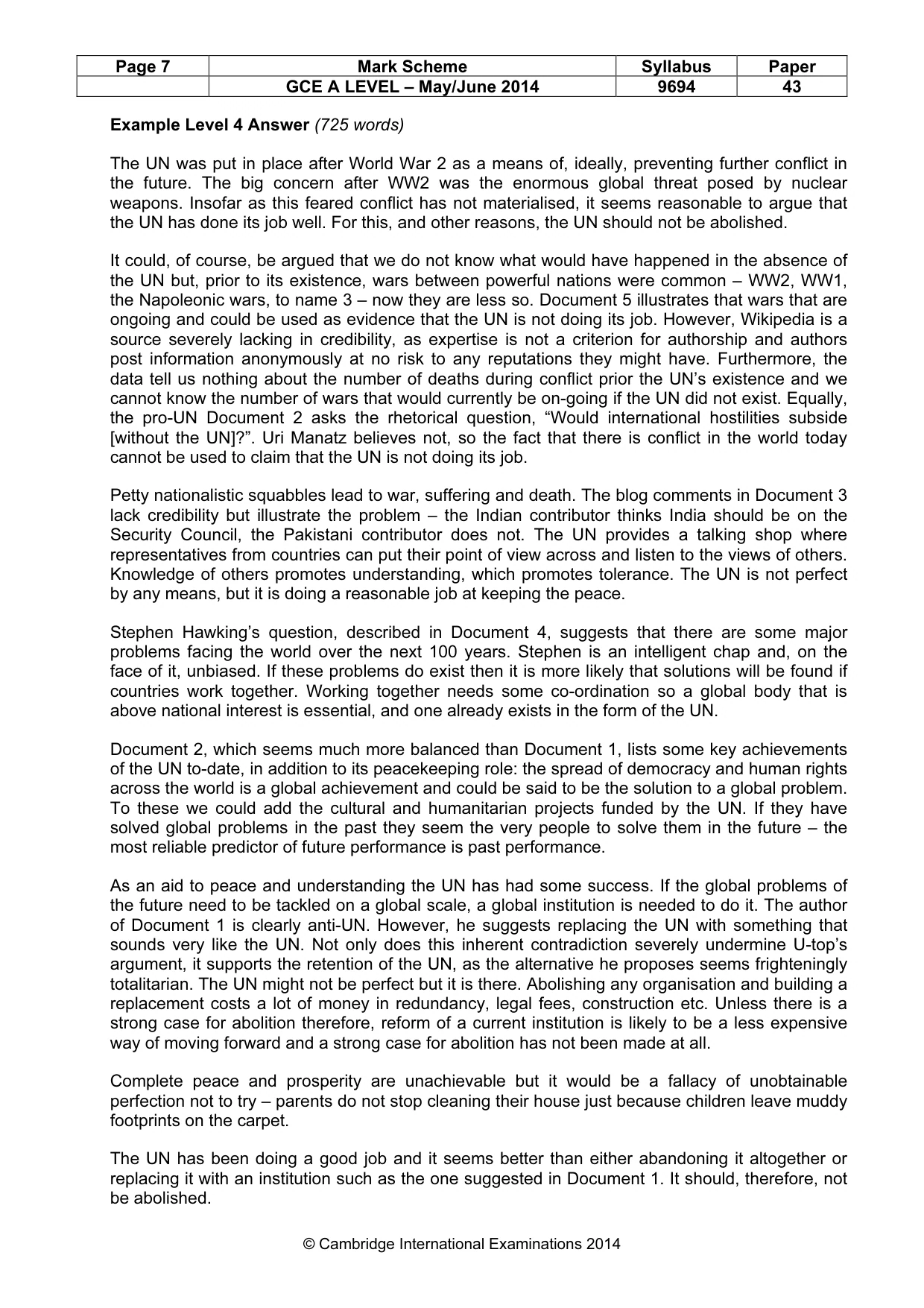
Page 7 Mark Scheme Syllabus Paper GCE A LEVEL – May/June 2014 9694 43 © Cambridge International Examinations 2014 Example Level 4 Answer (725 words) The UN was put in place after World War 2 as a means of, ideally, preventing further conflict in the future. The big concern after WW2 was the enormous global threat posed by nuclear weapons. Insofar as this feared conflict has not materialised, it seems reasonable to argue that the UN has done its job well. For this, and other reasons, the UN should not be abolished. It could, of course, be argued that we do not know what would have happened in the absence of the UN but, prior to its existence, wars between powerful nations were common – WW2, WW1, the Napoleonic wars, to name 3 – now they are less so. Document 5 illustrates that wars that are ongoing and could be used as evidence that the UN is not doing its job. However, Wikipedia is a source severely lacking in credibility, as expertise is not a criterion for authorship and authors post information anonymously at no risk to any reputations they might have. Furthermore, the data tell us nothing about the number of deaths during conflict prior the UN’s existence and we cannot know the number of wars that would currently be on-going if the UN did not exist. Equally, the pro-UN Document 2 asks the rhetorical question, “Would international hostilities subside [without the UN]?”. Uri Manatz believes not, so the fact that there is conflict in the world today cannot be used to claim that the UN is not doing its job. Petty nationalistic squabbles lead to war, suffering and death. The blog comments in Document 3 lack credibility but illustrate the problem – the Indian contributor thinks India should be on the Security Council, the Pakistani contributor does not. The UN provides a talking shop where representatives from countries can put their point of view across and listen to the views of others. Knowledge of others promotes understanding, which promotes tolerance. The UN is not perfect by any means, but it is doing a reasonable job at keeping the peace. Stephen Hawking’s question, described in Document 4, suggests that there are some major problems facing the world over the next 100 years. Stephen is an intelligent chap and, on the face of it, unbiased. If these problems do exist then it is more likely that solutions will be found if countries work together. Working together needs some co-ordination so a global body that is above national interest is essential, and one already exists in the form of the UN. Document 2, which seems much more balanced than Document 1, lists some key achievements of the UN to-date, in addition to its peacekeeping role: the spread of democracy and human rights across the world is a global achievement and could be said to be the solution to a global problem. To these we could add the cultural and humanitarian projects funded by the UN. If they have solved global problems in the past they seem the very people to solve them in the future – the most reliable predictor of future performance is past performance. As an aid to peace and understanding the UN has had some success. If the global problems of the future need to be tackled on a global scale, a global institution is needed to do it. The author of Document 1 is clearly anti-UN. However, he suggests replacing the UN with something that sounds very like the UN. Not only does this inherent contradiction severely undermine U-top’s argument, it supports the retention of the UN, as the alternative he proposes seems frighteningly totalitarian. The UN might not be perfect but it is there. Abolishing any organisation and building a replacement costs a lot of money in redundancy, legal fees, construction etc. Unless there is a strong case for abolition therefore, reform of a current institution is likely to be a less expensive way of moving forward and a strong case for abolition has not been made at all. Complete peace and prosperity are unachievable but it would be a fallacy of unobtainable perfection not to try – parents do not stop cleaning their house just because children leave muddy footprints on the carpet. The UN has been doing a good job and it seems better than either abandoning it altogether or replacing it with an institution such as the one suggested in Document 1. It should, therefore, not be abolished.
What you needed in this session
Cambridge’s own grade thresholds for 2014 May/June, Paper 4 · Variant 3. A higher threshold means an easier paper — the bar moves with how the cohort did.