Cambridge A Level Thinking Skills 9694 — 2012 Oct/Nov Paper 4 · Variant 1
9694/41/O/N/12 · 50 marks · ≈56 min
The question paper and its mark scheme, free to read here and free to download. This is Cambridge’s own paper, exactly as it was sat.
Question paper8 pages
Mark scheme6 pages
Answers below. Sit the paper first if you are practising.
Paper as text
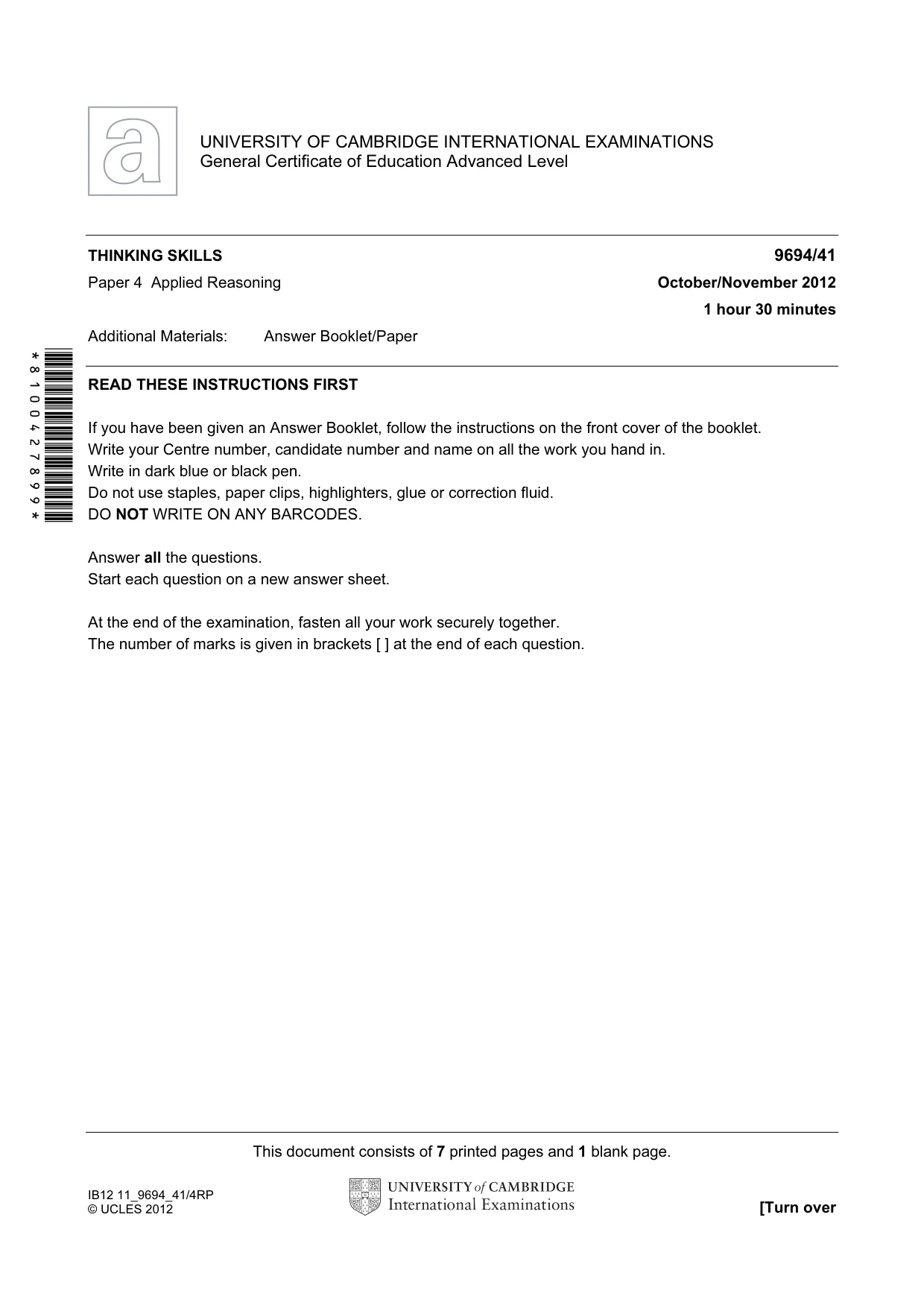
Question paper, page 1
This document consists of 7 printed pages and 1 blank page. IB12 11_9694_41/4RP © UCLES 2012 [Turn over *8100427899* UNIVERSITY OF CAMBRIDGE INTERNATIONAL EXAMINATIONS General Certificate of Education Advanced Level THINKING SKILLS 9694/41 Paper 4 Applied Reasoning October/November 2012 1 hour 30 minutes Additional Materials: Answer Booklet/Paper READ THESE INSTRUCTIONS FIRST If you have been given an Answer Booklet, follow the instructions on the front cover of the booklet. Write your Centre number, candidate number and name on all the work you hand in. Write in dark blue or black pen. Do not use staples, paper clips, highlighters, glue or correction fluid. DO NOT WRITE ON ANY BARCODES. Answer all the questions. Start each question on a new answer sheet. At the end of the examination, fasten all your work securely together. The number of marks is given in brackets [ ] at the end of each question.
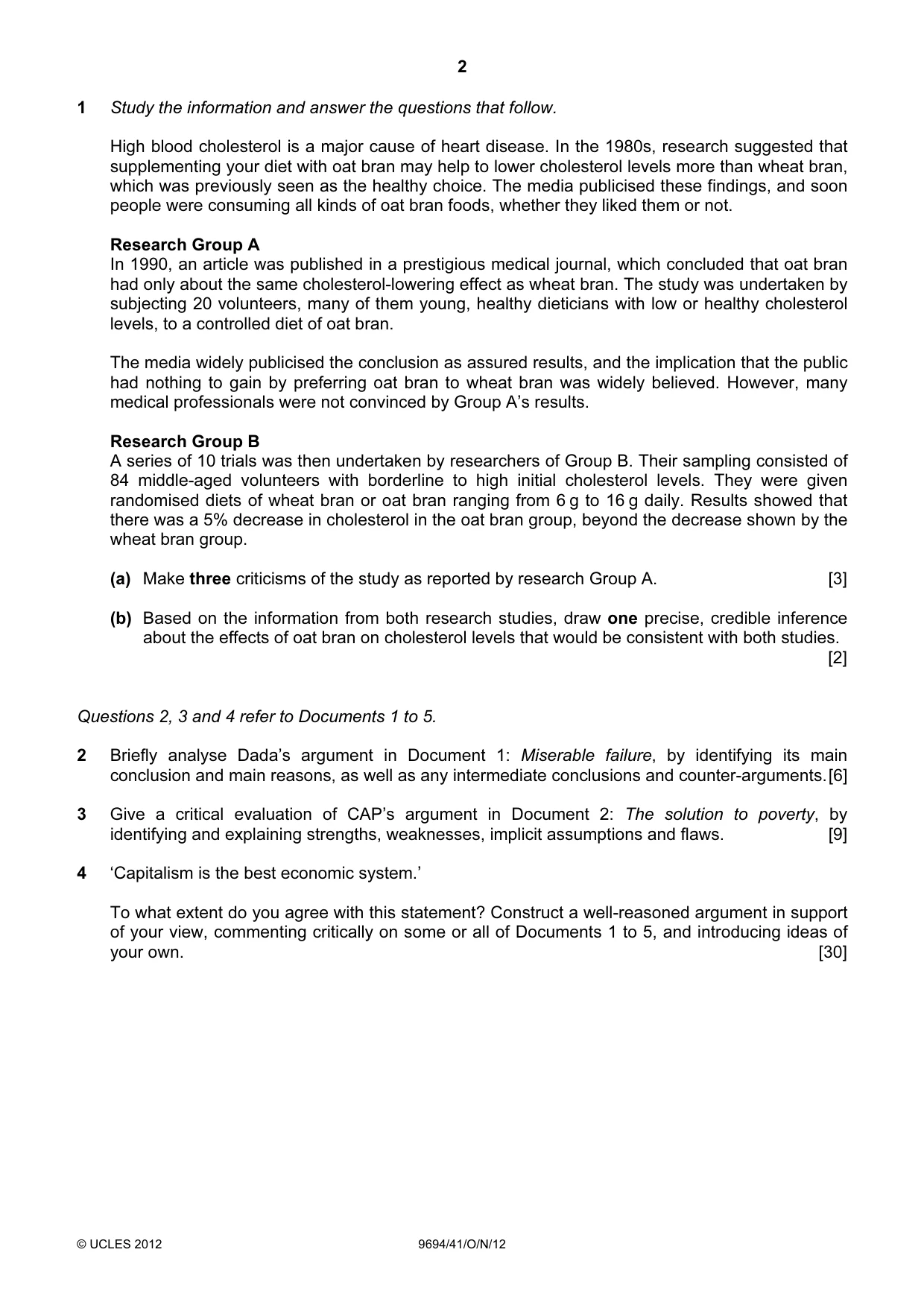
Question paper, page 2
2 © UCLES 2012 9694/41/O/N/12 1 Study the information and answer the questions that follow. High blood cholesterol is a major cause of heart disease. In the 1980s, research suggested that supplementing your diet with oat bran may help to lower cholesterol levels more than wheat bran, which was previously seen as the healthy choice. The media publicised these findings, and soon people were consuming all kinds of oat bran foods, whether they liked them or not. Research Group A In 1990, an article was published in a prestigious medical journal, which concluded that oat bran had only about the same cholesterol-lowering effect as wheat bran. The study was undertaken by subjecting 20 volunteers, many of them young, healthy dieticians with low or healthy cholesterol levels, to a controlled diet of oat bran. The media widely publicised the conclusion as assured results, and the implication that the public had nothing to gain by preferring oat bran to wheat bran was widely believed. However, many medical professionals were not convinced by Group A’s results. Research Group B A series of 10 trials was then undertaken by researchers of Group B. Their sampling consisted of 84 middle-aged volunteers with borderline to high initial cholesterol levels. They were given randomised diets of wheat bran or oat bran ranging from 6 g to 16 g daily. Results showed that there was a 5% decrease in cholesterol in the oat bran group, beyond the decrease shown by the wheat bran group. (a) Make three criticisms of the study as reported by research Group A. [3] (b) Based on the information from both research studies, draw one precise, credible inference about the effects of oat bran on cholesterol levels that would be consistent with both studies. [2] Questions 2, 3 and 4 refer to Documents 1 to 5. 2 Briefly analyse Dada’s argument in Document 1: Miserable failure, by identifying its main conclusion and main reasons, as well as any intermediate conclusions and counter-arguments. [6] 3 Give a critical evaluation of CAP’s argument in Document 2: The solution to poverty, by identifying and explaining strengths, weaknesses, implicit assumptions and flaws. [9] 4 ‘Capitalism is the best economic system.’ To what extent do you agree with this statement? Construct a well-reasoned argument in support of your view, commenting critically on some or all of Documents 1 to 5, and introducing ideas of your own. [30]
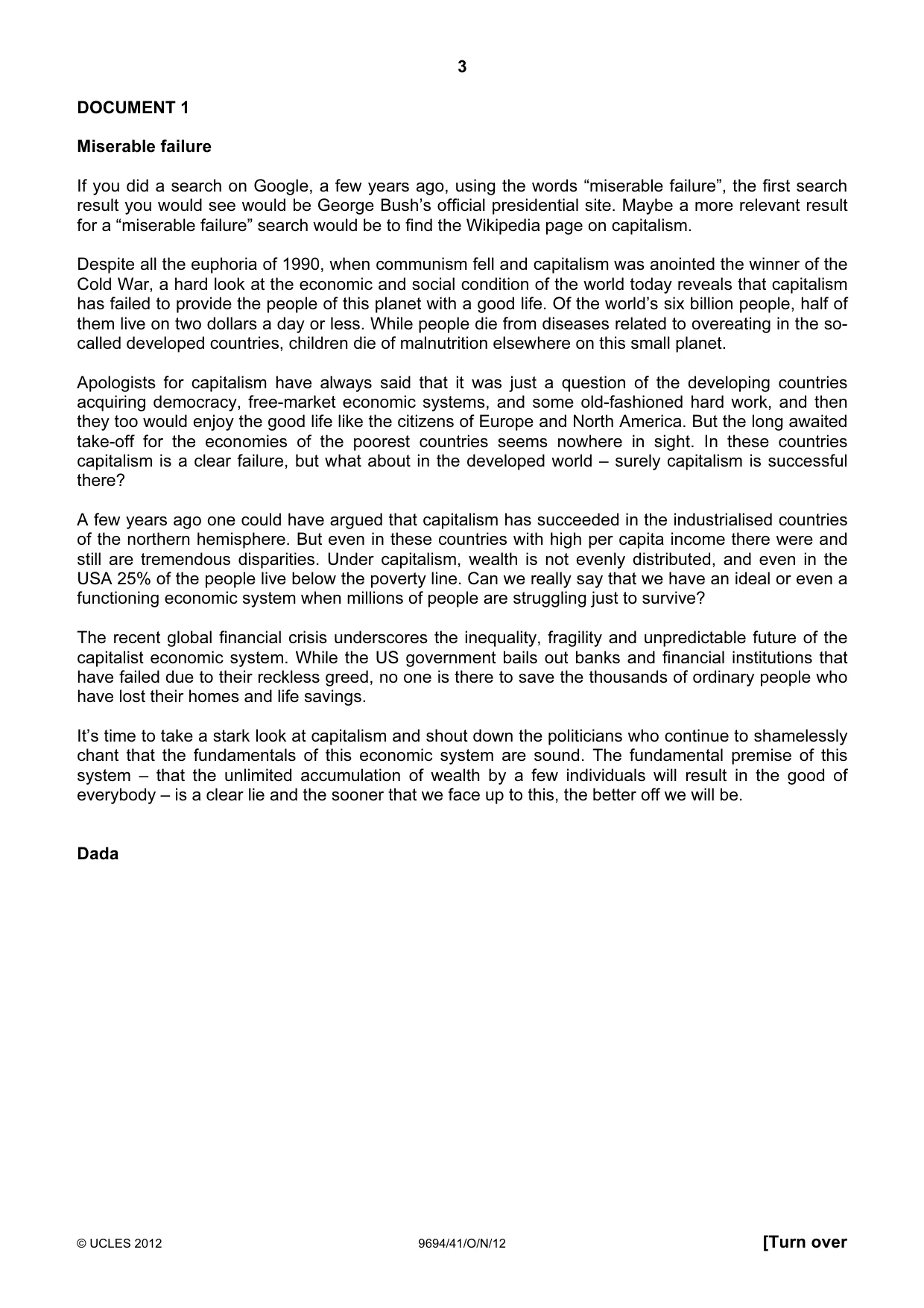
Question paper, page 3
3 © UCLES 2012 9694/41/O/N/12 [Turn over DOCUMENT 1 Miserable failure If you did a search on Google, a few years ago, using the words “miserable failure”, the first search result you would see would be George Bush’s official presidential site. Maybe a more relevant result for a “miserable failure” search would be to find the Wikipedia page on capitalism. Despite all the euphoria of 1990, when communism fell and capitalism was anointed the winner of the Cold War, a hard look at the economic and social condition of the world today reveals that capitalism has failed to provide the people of this planet with a good life. Of the world’s six billion people, half of them live on two dollars a day or less. While people die from diseases related to overeating in the so- called developed countries, children die of malnutrition elsewhere on this small planet. Apologists for capitalism have always said that it was just a question of the developing countries acquiring democracy, free-market economic systems, and some old-fashioned hard work, and then they too would enjoy the good life like the citizens of Europe and North America. But the long awaited take-off for the economies of the poorest countries seems nowhere in sight. In these countries capitalism is a clear failure, but what about in the developed world – surely capitalism is successful there? A few years ago one could have argued that capitalism has succeeded in the industrialised countries of the northern hemisphere. But even in these countries with high per capita income there were and still are tremendous disparities. Under capitalism, wealth is not evenly distributed, and even in the USA 25% of the people live below the poverty line. Can we really say that we have an ideal or even a functioning economic system when millions of people are struggling just to survive? The recent global financial crisis underscores the inequality, fragility and unpredictable future of the capitalist economic system. While the US government bails out banks and financial institutions that have failed due to their reckless greed, no one is there to save the thousands of ordinary people who have lost their homes and life savings. It’s time to take a stark look at capitalism and shout down the politicians who continue to shamelessly chant that the fundamentals of this economic system are sound. The fundamental premise of this system – that the unlimited accumulation of wealth by a few individuals will result in the good of everybody – is a clear lie and the sooner that we face up to this, the better off we will be. Dada
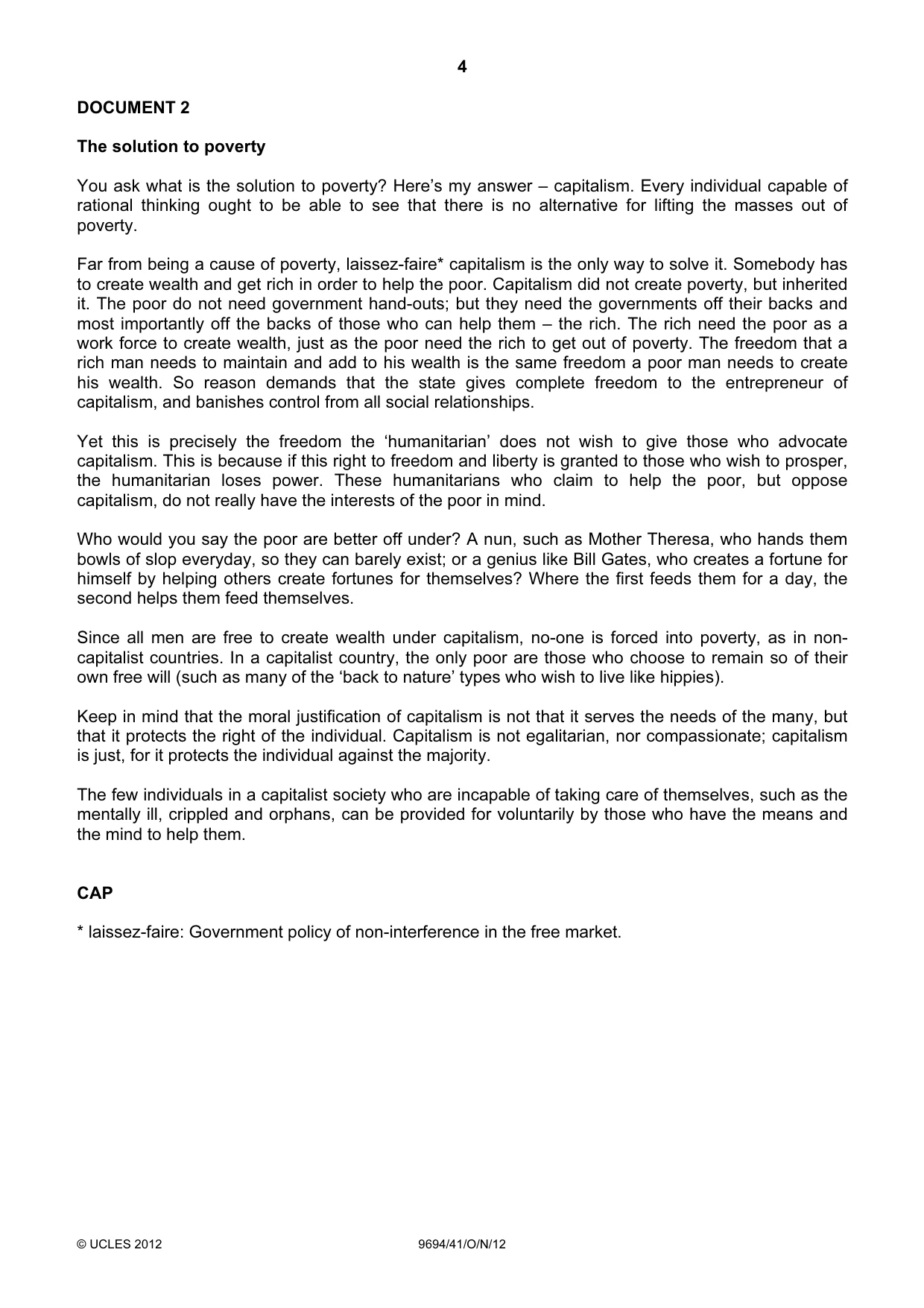
Question paper, page 4
4 © UCLES 2012 9694/41/O/N/12 DOCUMENT 2 The solution to poverty You ask what is the solution to poverty? Here’s my answer – capitalism. Every individual capable of rational thinking ought to be able to see that there is no alternative for lifting the masses out of poverty. Far from being a cause of poverty, laissez-faire* capitalism is the only way to solve it. Somebody has to create wealth and get rich in order to help the poor. Capitalism did not create poverty, but inherited it. The poor do not need government hand-outs; but they need the governments off their backs and most importantly off the backs of those who can help them – the rich. The rich need the poor as a work force to create wealth, just as the poor need the rich to get out of poverty. The freedom that a rich man needs to maintain and add to his wealth is the same freedom a poor man needs to create his wealth. So reason demands that the state gives complete freedom to the entrepreneur of capitalism, and banishes control from all social relationships. Yet this is precisely the freedom the ‘humanitarian’ does not wish to give those who advocate capitalism. This is because if this right to freedom and liberty is granted to those who wish to prosper, the humanitarian loses power. These humanitarians who claim to help the poor, but oppose capitalism, do not really have the interests of the poor in mind. Who would you say the poor are better off under? A nun, such as Mother Theresa, who hands them bowls of slop everyday, so they can barely exist; or a genius like Bill Gates, who creates a fortune for himself by helping others create fortunes for themselves? Where the first feeds them for a day, the second helps them feed themselves. Since all men are free to create wealth under capitalism, no-one is forced into poverty, as in non- capitalist countries. In a capitalist country, the only poor are those who choose to remain so of their own free will (such as many of the ‘back to nature’ types who wish to live like hippies). Keep in mind that the moral justification of capitalism is not that it serves the needs of the many, but that it protects the right of the individual. Capitalism is not egalitarian, nor compassionate; capitalism is just, for it protects the individual against the majority. The few individuals in a capitalist society who are incapable of taking care of themselves, such as the mentally ill, crippled and orphans, can be provided for voluntarily by those who have the means and the mind to help them. CAP * laissez-faire: Government policy of non-interference in the free market.
Question paper, page 5
5 © UCLES 2012 9694/41/O/N/12 [Turn over DOCUMENT 3 The Chinese model – in 2006 Abridged from Prospect Magazine (UK), January 2007 It is predicted that China will be the world’s largest economy by the middle of this century if not before. As China is not a democracy, if it takes its place at the top table the global order will bow to despotism, and the international system of governance based on rule of law will be set back. But for this to be true we have to suppose that China’s growth rate will continue and the country will remain communist. However, I doubt if either of these propositions is true. China cannot sustain its current model very much longer. China occupies a half-way house between socialism and capitalism. The communist party has permitted free movement of prices, and encourages profit-seeking and thrusts into the free market. China’s economic growth is based on the State channelling vast underpriced savings into huge investment projects driven by cheap labour. Besides, every year China acquires $200 billion of foreign exchange reserves, mainly dollars, in order to rig its currency to keep its exports competitive. It is absurd for a poor country like China to be lending to a rich one like the US; in fact, it is unsustainable and financial markets seem to agree. Everything in China is subject to the Party. Chinese consumers need to save less and spend more, but China does not have the tools of Enlightenment infrastructure to transform itself into a democracy in order to sustain capitalism. We need not frighten ourselves about China’s rise. We need to be confident about Western values and processes and strengthen them at home and abroad. We should be confident that China will only be able to truly compete with the West if it becomes more like us. Will Hutton (Author, and Principal of Hertford College, Oxford) The Chinese model – in 2009 Abridged from Foreign Affairs magazine (US), July 2009 It is now clear that the global economic crisis will be deep and prolonged and will have far-reaching geopolitical consequences. The era of the Anglo-Saxon model of free-market capitalism is coming to an end. The long-standing wisdom that everyone wins in a single world market has been undermined. Globalisation is in retreat, both in concept and practice. Much of the world now sees it as harmful. The one clear winner is China, whose unique political-economic model has come through unscathed. And measured by its estimated $2.3 trillion in financial reserves it is the world’s wealthiest country. This has allowed China to direct a recent surge in lending for stimulus purposes. Beijing’s unique capitalist-communist model appears to be helping China through this crisis effectively. All of this is enhancing China’s geopolitical standing. The West is experiencing a severe economic crisis, seen as of its own making, whereas China is not. China’s astute leadership has recently been making offshore investments in natural resources of a kind that others no longer can make – such as securing future oil supplies from Russia and Venezuela. All this makes it increasingly clear that a US-China relationship is going to be the most important in the world. Roger C. Altman (Former US Deputy Treasury Secretary)
Question paper, page 6
6 © UCLES 2012 9694/41/O/N/12 DOCUMENT 4 Save capitalism There is a clear implication today in the US that socialism is an alien and unworkable philosophy that, if unchecked, will destroy America’s free market system, which has been responsible for our historic prosperity. One reason for the confusion is that many Americans do not understand the key differences between capitalism, communism and socialism. Socialism, as practiced by most nations of the developed world, is a hybrid economic system that combines some features of communism and capitalism. Private enterprise and personal incentives co-exist with government regulation, subsidies and a humane ‘safety net’ for the disadvantaged. In the late 19th century, the so-called robber barons, including Carnegie, Rockefeller, Vanderbilt and Morgan, had developed monopolistic strangleholds over the steel, oil, railroad and banking industries respectively. They made a mockery of democracy by using their wealth to gain control of most state governments and the federal government. Historically, in the late 19th and early 20th centuries, Americans turned to neo-socialism to rescue some measures of economic and political freedom. The Federal Trade Commission, established in 1913, was used as recently as the 1970s to break up a telecoms giant. Ironically, the socialistic concept of government regulation can be used to preserve competition, a key component of capitalism. The 2008 bank bailout was but the latest chapter in government intervention in banking. The Roosevelt New Deal of the 1930s, the National Labor Relations Act, legalising labour unions, and the Fair Labor Standards Act, establishing the minimum wage, were deliberate attempts to redistribute income. Ironically, these socialistic measures increased purchasing power, thus benefiting privately owned businesses. Since the creation of Medicare and Medicaid in 1965, elderly and low-income Americans have had health care programs funded and administered by the government. The Children’s Health Insurance Program has existed for decades. Since 1935, Social Security has provided retirement income. The Federal Housing Administration and the Department of Housing and Urban Development have long provided subsidised housing for low-income Americans. These government programs are only some of many classic examples of a socialist safety net. Thus America has had a neo-socialistic economy for more than a century. Now, in the midst of another major depression, Americans should not be deluded into believing that the illusory free market is a panacea for solving future economic problems. Neo-socialism may be the only way to preserve the remaining features of capitalism. Robert J. Fisher (Adjunct Professor of American History at Northampton Community College and Desales University) August 2009
Question paper, page 7
7 © UCLES 2012 9694/41/O/N/12 DOCUMENT 5 Causes of hunger are related to poverty • Over 9 million people die worldwide each year because of hunger and malnutrition. 5 million are children. • Approximately 1.2 billion people suffer from hunger (deficiency of calories and protein). • Some 2–3.5 billion people have deficiency of vitamins and minerals, yet some 1.2 billion suffer from obesity. • In the United Kingdom, a shocking 30–40% of all food is never eaten. • Overall, $38 billion worth of food is thrown away every year. • In the US 40–50% of all food ready for harvest never gets eaten. • The impact of this waste is not just financial; it leads to more rotting food, creating more methane, one of the most harmful greenhouse gases that contributes to climate change. • The direct medical cost of hunger and malnutrition is estimated at $30 billion each year. Global Issues Updated July 2008
Question paper, page 8
8 Copyright Acknowledgements: Question 1 Document 1 Document 2 Document 3 Document 3 Document 4 Document 5 © ADAPTED: www.improvingmedicalstatistics.com. © ADAPTED: Dada Vedaprajinananda; Miserable failure; New Renaissance Magazine; September 2009; http://www.ru.org/economics/capitalism-a-miserable-failure.html. © ADAPTED: http://capitalism.org/category/poverty/. © ADAPTED: Will Hutton; The Chinese model – in 2006; Prospect Magazine (UK); January 2007. © ADAPTED: Roger C. Altman; The Chinese model – in 2009; Foreign Affairs Magazine (US); July 2009. © ADAPTED: Robert J Fisher; ‘Neo-socialism’ may be only way to save capitalism; http://articles.mcall.com/2009-08- 30/news/4432603_1_socialism-capitalism-robber-barons/2. © ADAPTED: Anup Shah; http://www.globalissues.org/article/7/causes-of-hunger-are-related-to-poverty; July 2008. Permission to reproduce items where third-party owned material protected by copyright is included has been sought and cleared where possible. Every reasonable effort has been made by the publisher (UCLES) to trace copyright holders, but if any items requiring clearance have unwittingly been included, the publisher will be pleased to make amends at the earliest possible opportunity. University of Cambridge International Examinations is part of the Cambridge Assessment Group. Cambridge Assessment is the brand name of University of Cambridge Local Examinations Syndicate (UCLES), which is itself a department of the University of Cambridge. © UCLES 2012 9694/41/O/N/12 BLANK PAGE
Mark scheme, page 1
CAMBRIDGE INTERNATIONAL EXAMINATIONS GCE Advanced Level MARK SCHEME for the October/November 2012 series 9694 THINKING SKILLS 9694/41 Paper 4 (Applied Reasoning), maximum raw mark 50 This mark scheme is published as an aid to teachers and candidates, to indicate the requirements of the examination. It shows the basis on which Examiners were instructed to award marks. It does not indicate the details of the discussions that took place at an Examiners’ meeting before marking began, which would have considered the acceptability of alternative answers. Mark schemes should be read in conjunction with the question paper and the Principal Examiner Report for Teachers. Cambridge will not enter into discussions about these mark schemes. Cambridge is publishing the mark schemes for the October/November 2012 series for most IGCSE, GCE Advanced Level and Advanced Subsidiary Level components and some Ordinary Level components.
Mark scheme, page 2
Page 2 Mark Scheme Syllabus Paper GCE A LEVEL – October/November 2012 9694 41 © Cambridge International Examinations 2012 1 (a) Make three criticisms of the study as reported by research Group A. [3] Examples include: • Small sample size. • Non-representative group (age, health, profession). • Volunteers in group B already had low or healthy cholesterol levels • No reference to the number of trials / only one trial done. • No figures given about relevant reduction in cholesterol. • No details provided about the dose of bran. • No comparative trial done with wheat bran (b) Based on the information from both research studies, draw one precise, credible inference about the effects of oat bran on cholesterol levels that would be consistent with both studies. [2] For example: • Oat bran reduces cholesterol in middle-aged people (more than in young people). • Oat bran reduces borderline to high cholesterol (more than low cholesterol). • Oat bran does not lower cholesterol levels in those with already low or healthy cholesterol. Candidates who link the reduction of cholesterol to age or initial cholesterol level but are not so precise – 1 mark. 2 Briefly analyse Dada’s argument in Document 1: Miserable failure, by identifying its main conclusion and main reasons, as well as any intermediate conclusions and counter- arguments. [6] IC – capitalism has failed to provide the people of this planet with a good life. R – half of them live on two dollars a day or less. R – While people die from diseases related to overeating in the so-called developed countries, children die of malnutrition elsewhere on this small planet. CA – Apologists for capitalism have always said that it was just a question of the developing countries acquiring democracy, free-market economic systems, and some old-fashioned hard work, and then they too would enjoy the good life like the citizens of Europe and North America. R – the long awaited take-off for the economies of the poorest countries seems nowhere in sight. IC – In these countries capitalism is a clear failure. CA – A few years ago one could have argued that capitalism has succeeded in the industrialised countries of the northern hemisphere. MR – even in these countries with high per capita income there were and still are tremendous disparities. MR – The recent global financial crisis underscores the inequality, fragility and unpredictable future of the capitalist economic system. MC – It’s time to take a stark look at capitalism and shout down the politicians who continue to shamelessly chant that the fundamentals of this economic system are sound. MR – The fundamental premise of this system is a clear lie. IC – the sooner that we face up to this, the better off we will be. (NB if these two written in one sentence only credit 1)
Mark scheme, page 3
Page 3 Mark Scheme Syllabus Paper GCE A LEVEL – October/November 2012 9694 41 © Cambridge International Examinations 2012 MARKS 1 mark for each emboldened element (maximum 4 if MC not identified). Max 2 available for identification of CAs. 3 Give a critical evaluation of CAP’s argument in Document 2: The solution to poverty, by identifying and explaining strengths, weaknesses, implicit assumptions and flaws. [9] Strength: The rationale that somebody has to create capital to initiate capital flow is a strong line of reasoning. Weaknesses Para 2 Argues from the particular (laissez-faire capitalism) to the general (capitalism). Assumption that helping the poor requires wealth (rather than e.g. education). Assumption that the rich have a genuine care / concern for the poor Weak analogy: The rich need the poor… just as the poor need the rich. Equivocation of the term freedom: the ‘freedom from’ that is necessary to the rich is different from the ‘freedom to’ that is necessary to the poor. Assumption that the only way the government helps the poor is issuing hand-outs and obstructing entrepreneurs. Para 3 Straw man representation of the humanitarian’s position. ad hominem (c.f. para 1): Implies that the humanitarian is irrational i.e. attacking the arguer rather than the argument. Para 4 Assumption that the properties of Mother Theresa and Bill Gates could not co-exist under the same economic system. Irrelevance: The motive of neither Mother Theresa (alleviate suffering) nor Bill Gates (unclear) is to lift the masses out of poverty.
Mark scheme, page 4
Page 4 Mark Scheme Syllabus Paper GCE A LEVEL – October/November 2012 9694 41 © Cambridge International Examinations 2012 Para 5 Conflation of being ‘poor’ (i.e. not having wealth) and ‘in poverty’ (i.e. in an inescapable state of deprivation). Para 6 Assumption that the concept of justice or being ‘just’ is not a correlate of equality and/or compassion. Assumption that the majority of people are against capitalism. Contradiction with paragraph 1: whereas in paragraph 1 capitalism is presented as the saviour of the poor, here capitalism is presented as a cold uncaring system or as a hated system in need of protection from the poor or the less well-off majority. This paragraph appears to contradict the overall gist of the argument that capitalism is the best way to benefit the many. Para 7 Assumption that those who are incapable of taking care of themselves are a fixed, small group (e.g. effects of natural disasters can create mass deprivation and human misery). Assumption that the mentally ill, crippled and orphans are all poor or without means to afford their own care. Contradiction: Given that the author has stated in paragraph 6 that capitalism is not compassionate, it is unlikely that capitalists would be inclined to help those incapable of taking care of themselves or indeed the poor in general. Use of rhetoric/persuasive language (Maximum 1 mark, example required – e.g. “bowls of slop”). Overall Evaluation The main conclusion is that there is no alternative to capitalism for lifting the masses out of poverty. The argument is overall quite weak, with a vastly overdrawn/unsound conclusion. Firstly, the author argues categorically that capitalism can alleviate poverty but fails to demonstrate that it is the only one. Secondly, much of his argument centres around the capacity of capitalism to amass capital, but fails specifically to show that thereby poverty would be alleviated. (Explaining either of these points can access the two marks for overall evaluation.) Marks For each sound evaluative point 1 mark and 2 marks for a developed point, to a maximum of 8 marks. Up to 2 marks for an overall judgment on the argument. (Maximum 9 marks.)
Mark scheme, page 5
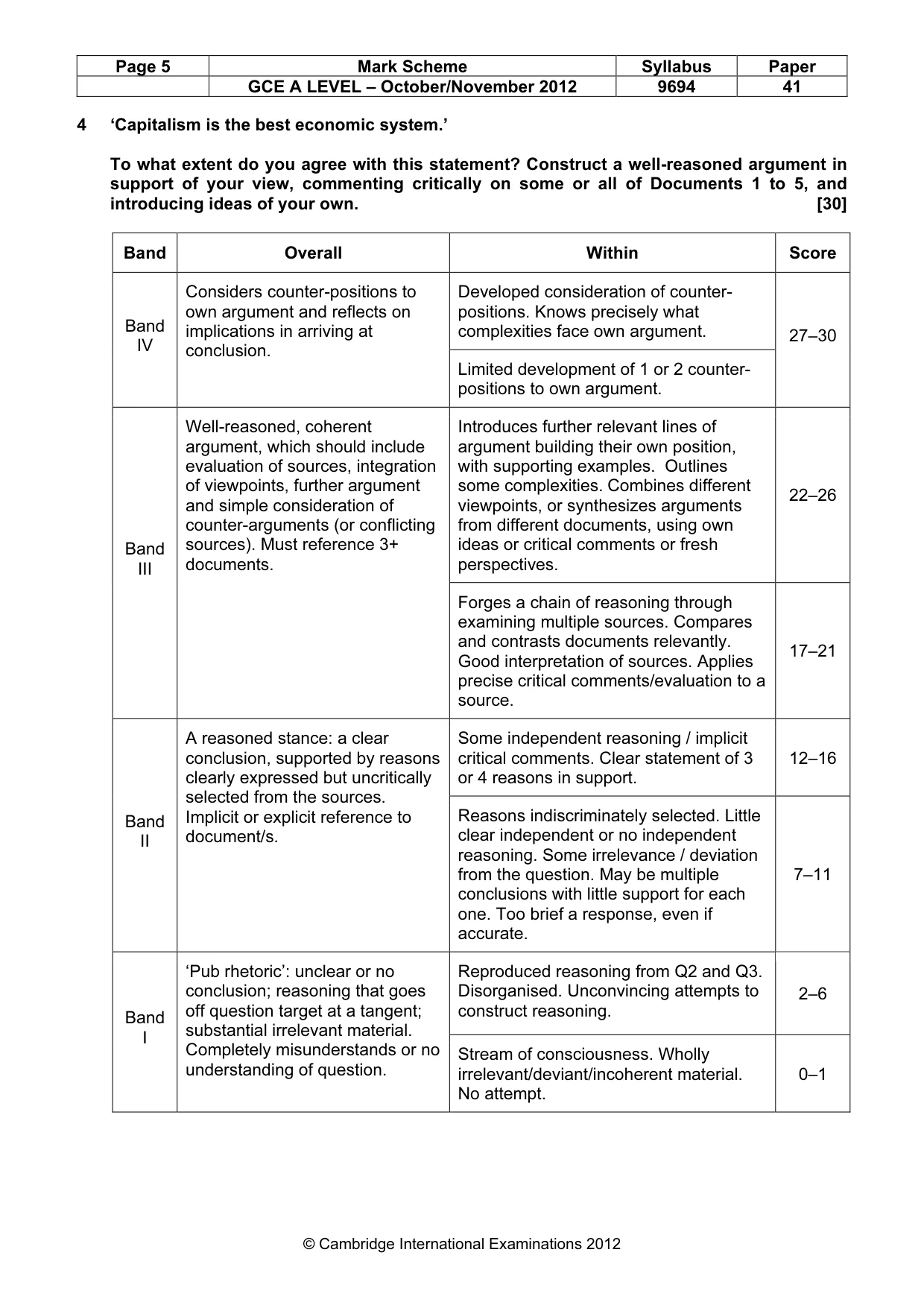
Page 5 Mark Scheme Syllabus Paper GCE A LEVEL – October/November 2012 9694 41 © Cambridge International Examinations 2012 4 ‘Capitalism is the best economic system.’ To what extent do you agree with this statement? Construct a well-reasoned argument in support of your view, commenting critically on some or all of Documents 1 to 5, and introducing ideas of your own. [30] Band Overall Within Score Developed consideration of counter- positions. Knows precisely what complexities face own argument. Band IV Considers counter-positions to own argument and reflects on implications in arriving at conclusion. Limited development of 1 or 2 counter- positions to own argument. 27–30 Introduces further relevant lines of argument building their own position, with supporting examples. Outlines some complexities. Combines different viewpoints, or synthesizes arguments from different documents, using own ideas or critical comments or fresh perspectives. 22–26 Band III Well-reasoned, coherent argument, which should include evaluation of sources, integration of viewpoints, further argument and simple consideration of counter-arguments (or conflicting sources). Must reference 3+ documents. Forges a chain of reasoning through examining multiple sources. Compares and contrasts documents relevantly. Good interpretation of sources. Applies precise critical comments/evaluation to a source. 17–21 Some independent reasoning / implicit critical comments. Clear statement of 3 or 4 reasons in support. 12–16 Band II A reasoned stance: a clear conclusion, supported by reasons clearly expressed but uncritically selected from the sources. Implicit or explicit reference to document/s. Reasons indiscriminately selected. Little clear independent or no independent reasoning. Some irrelevance / deviation from the question. May be multiple conclusions with little support for each one. Too brief a response, even if accurate. 7–11 Reproduced reasoning from Q2 and Q3. Disorganised. Unconvincing attempts to construct reasoning. 2–6 Band I ‘Pub rhetoric’: unclear or no conclusion; reasoning that goes off question target at a tangent; substantial irrelevant material. Completely misunderstands or no understanding of question. Stream of consciousness. Wholly irrelevant/deviant/incoherent material. No attempt. 0–1
Mark scheme, page 6
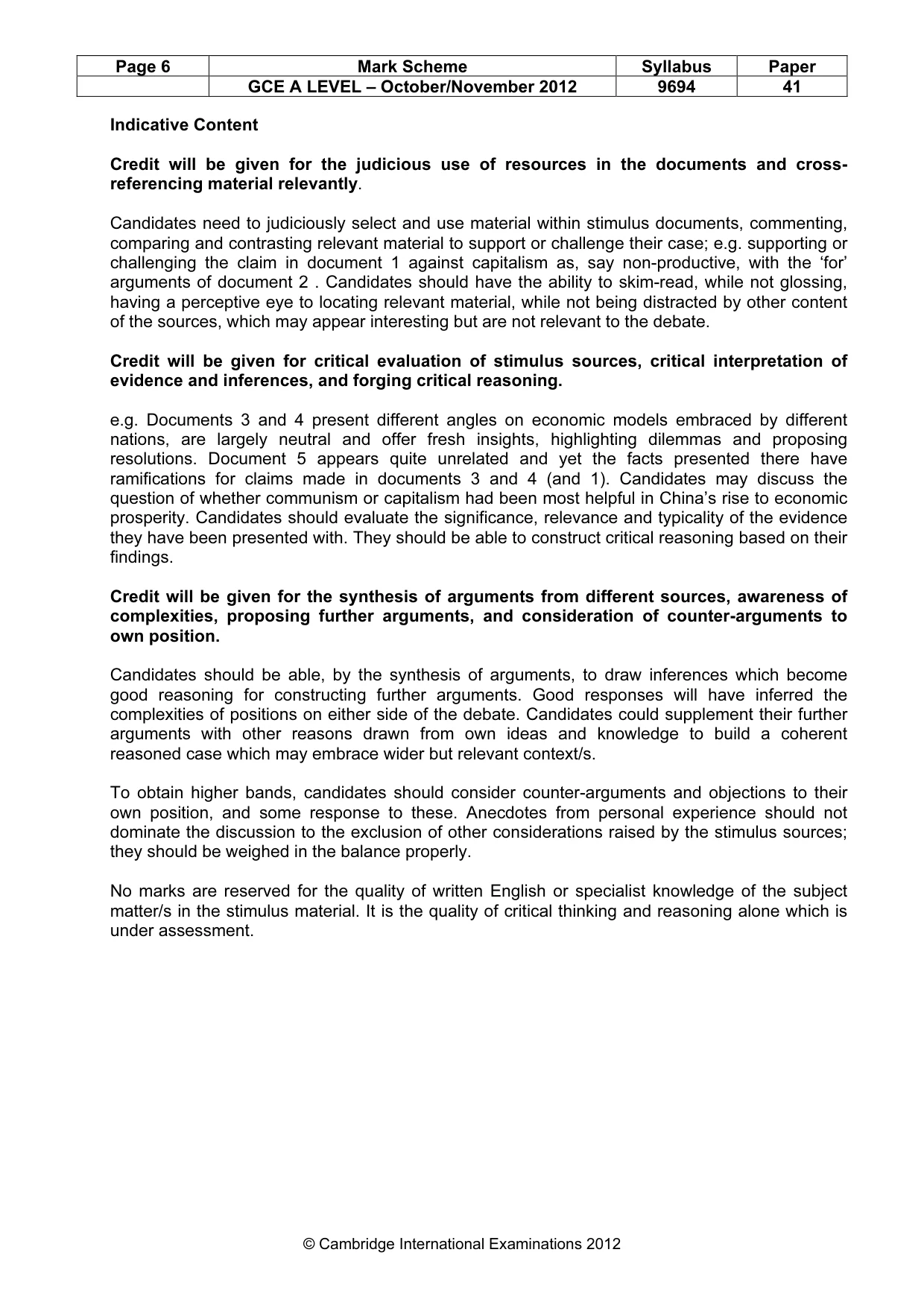
Page 6 Mark Scheme Syllabus Paper GCE A LEVEL – October/November 2012 9694 41 © Cambridge International Examinations 2012 Indicative Content Credit will be given for the judicious use of resources in the documents and cross- referencing material relevantly. Candidates need to judiciously select and use material within stimulus documents, commenting, comparing and contrasting relevant material to support or challenge their case; e.g. supporting or challenging the claim in document 1 against capitalism as, say non-productive, with the ‘for’ arguments of document 2 . Candidates should have the ability to skim-read, while not glossing, having a perceptive eye to locating relevant material, while not being distracted by other content of the sources, which may appear interesting but are not relevant to the debate. Credit will be given for critical evaluation of stimulus sources, critical interpretation of evidence and inferences, and forging critical reasoning. e.g. Documents 3 and 4 present different angles on economic models embraced by different nations, are largely neutral and offer fresh insights, highlighting dilemmas and proposing resolutions. Document 5 appears quite unrelated and yet the facts presented there have ramifications for claims made in documents 3 and 4 (and 1). Candidates may discuss the question of whether communism or capitalism had been most helpful in China’s rise to economic prosperity. Candidates should evaluate the significance, relevance and typicality of the evidence they have been presented with. They should be able to construct critical reasoning based on their findings. Credit will be given for the synthesis of arguments from different sources, awareness of complexities, proposing further arguments, and consideration of counter-arguments to own position. Candidates should be able, by the synthesis of arguments, to draw inferences which become good reasoning for constructing further arguments. Good responses will have inferred the complexities of positions on either side of the debate. Candidates could supplement their further arguments with other reasons drawn from own ideas and knowledge to build a coherent reasoned case which may embrace wider but relevant context/s. To obtain higher bands, candidates should consider counter-arguments and objections to their own position, and some response to these. Anecdotes from personal experience should not dominate the discussion to the exclusion of other considerations raised by the stimulus sources; they should be weighed in the balance properly. No marks are reserved for the quality of written English or specialist knowledge of the subject matter/s in the stimulus material. It is the quality of critical thinking and reasoning alone which is under assessment.
What you needed in this session
Cambridge’s own grade thresholds for 2012 Oct/Nov, Paper 4 · Variant 1. A higher threshold means an easier paper — the bar moves with how the cohort did.