Cambridge A Level Thinking Skills 9694 — 2011 Oct/Nov Paper 4 · Variant 3
9694/43/O/N/11 · 50 marks · ≈56 min
The question paper and its mark scheme, free to read here and free to download. This is Cambridge’s own paper, exactly as it was sat.
Question paper8 pages

Mark scheme7 pages
Answers below. Sit the paper first if you are practising.
Paper as text
Question paper, page 1
This document consists of 7 printed pages and 1 blank page. IB11 11_9694_43/FP © UCLES 2011 [Turn over *1209810840* UNIVERSITY OF CAMBRIDGE INTERNATIONAL EXAMINATIONS General Certificate of Education Advanced Level THINKING SKILLS 9694/43 Paper 4 Applied Reasoning October/November 2011 1 hour and 30 minutes Additional Materials: Answer Booklet/Paper READ THESE INSTRUCTIONS FIRST If you have been given an Answer Booklet, follow the instructions on the front cover of the booklet. Write your Centre number, candidate number and name on all the work you hand in. Write in dark blue or black pen. Do not use staples, paper clips, highlighters, glue or correction fluid. DO NOT WRITE ON ANY BARCODES Answer all the questions. Start each question on a new answer sheet. At the end of the examination, fasten all your work securely together. The number of marks is given in brackets [ ] at the end of each question.
Question paper, page 2
2 © UCLES 2011 9694/43/O/N/11 1 Study the passage and answer the questions that follow. Between the years 1970 and 2000, there was a 60% increase in students in the US who opted to study medicine, but since then the numbers have been on the decline, falling by 30% from 2000. This is because of the spread of the net and information technology. Since 2000 there has been an increase in uptake of students for places in software, IT, and media studies by 30%. Clearly the medical profession is a less appealing career option for many than the world of enterprise and entrepreneurism. Furthermore, practising doctors are steadily withdrawing from the profession in countries such as the United States, UK, Canada and even India. In a survey conducted by the Physicians’ Foundation in the US, almost half of practising doctors plan to cut back or quit medicine. A press release from the survey said 50% – or more than 150 000 – of practising doctors say they plan to reduce the number of patients they see or stop practising entirely over the next 4 years. These doctors too may be drawn into other careers and occupations. The survey sent out 27 000 questionnaires and about 12 000 were completed and returned. We are on a slope of very worrying decline in human resources where medicine is concerned. We need to find ways of re-motivating our young people to take up traditionally acclaimed disciplines such as medicine. (a) Identify three points that weaken the credibility of the statistics in the passage. [3] (b) “We are on a slope of very worrying decline in human resources where medicine is concerned.” Do you think the evidence in the second paragraph is sufficient for this inference to be drawn? Briefly justify your answer. [2] Questions 2, 3 and 4 refer to Documents 1 to 5. 2 Briefly analyse HGA’s argument in Document 1: Equality in Science and Technology, by identifying its main conclusion and reasons, as well as any intermediate conclusions and counter- arguments. [6] 3 Give a critical evaluation of HGA’s argument in Document 1, by identifying and explaining strengths, weaknesses, implicit assumptions and flaws. [9] 4 ‘Gender equality in science and technology does not matter.’ To what extent do you agree with this statement? Construct a well-reasoned argument in support of your view, commenting critically on some or all of Documents 1 to 5, and introducing ideas of your own. [30]
Question paper, page 3
3 © UCLES 2011 9694/43/O/N/11 [Turn over DOCUMENT 1 Equality in Science and Technology Gender equality in science and technology should be about men and women having equal respect for each other and not about equal rights. It is not ‘equal rights’ to think that because science and technology is getting impoverished, owing to decreasing numbers of scientists and engineers, the solution is to draw more women into these professions. This is tantamount to forcing women into areas they by natural choice would not opt for (you use force only on the weaker) – that is not equal rights. If men cannot be bothered to opt for careers in science and technology, why look to women? If men are naturally better at (or more interested in) science and technology, we should not force women to be what they are not supposed to be. Researchers say that women are naturally better at verbal skills than men, but you don’t therefore see men getting all uptight about it and pushing young boys to pursue a social service career, which needs verbal skills. Besides, if we were to give these girls ‘extra training’ in science and technology, are the young boys going to have the opportunity for this training? It would be more sensible to let each sex do what they are good at. Instead of trying to compete, boys should be given the extra training in science and girls given extra training in social skills. If you find something one of the sexes is good at, why not encourage them to really excel in that field, rather than set the opposite sex up against them? Are we so caught up in ‘equal rights’ to the point where we are nurturing young girls to think that they have to fight the boys and overcome them? If you give Lego to a girl and a doll to a boy, I am sure you will not be at all surprised if your daughter creatively builds a doll’s house from the Lego and your son enjoys dismembering the doll by running his toy bulldozer over it. Gender equality activists who challenge natural perceptions of men and women and ask them to think differently are biased and insecure people with grudges against the opposite sex. Human beings of both sexes are always seeking equality because they want respect and recognition for their abilities. True equality between men and women is realised when they respect each other and that includes respecting each other’s differences. Therefore we can assert two facts: that women are different from men, but they are equal to men. It also explains why, historically, men have made the most contributions in scientific discoveries and technological inventions. Women do not, on the whole, have the same brainpower as men – they cannot problem-solve as well as men can (even if they are more perceptive and can identify problems more quickly). However, women have the unique capability to bring up healthy, stable families where the fathers can be the great scientists and innovators, and children can grow up in their fathers’ footsteps. Men need the respect of women to encourage, motivate and bring out the best in them. We read in many autobiographies that the source of inspiration for some of the greatest men in the history books was their women. Most women would prefer to be acclaimed and respected as the inspirational force behind the movers and shakers of the world than be made to do the moving and the shaking themselves. If the sexes can stop thinking that they have to fight each other for equal rights, and respect each other for who they are, science and technology will benefit. HGA
Question paper, page 4
4 © UCLES 2011 9694/43/O/N/11 DOCUMENT 2 The Problem of Gender Inequality Over the past few years I have been privileged to be associated with two major United Nations initiatives on gender in relation to science and technology. There are widely differing reasons for gender inequality in science and technology. Different situations exist in different countries and regions of the world. They include cultural differences which in some countries serve to discourage girls from studying science in schools or universities, and from pursuing scientific careers. Other reasons frequently have to do with discrimination, career interruptions due to childbirth and family responsibilities, gender stereotyping of science and technology, and the relative lack of women in policy- and decision-making positions. I have come to believe that the attainment of gender equality in science and technology is one of the most important tasks facing all countries in the twenty-first century. These are my reasons. Human rights and social justice. All individuals should have equality of opportunity to a science education and to a scientific career. Women and men should benefit equally from advances in science and technology. Scientific and economic reasons. If women are not given equal opportunity to become scientists and engineers then a country denies itself its full complement of scientifically creative minds. This can be a serious handicap both to the development of science and to the generation of wealth in an increasingly competitive world. Social reasons. Women frequently perform different roles and tasks both within and outside the home from those performed by men. It is important that both men and women are able to bring a scientific and technical education to bear on the performance of these roles and tasks. Reasons of insight. Some women, it has been suggested, bring different insights, values, motivations and methods of work to their scientific jobs than do most men and other women. The inclusion of more women in science will enrich the total pool of talents, insights and motivations, and increase the probability that science will serve the needs of all humanity. In a small number of countries in the world there appear to be few major obstacles to women pursuing rewarding careers in science and technology. In most of the world, however, there are major problems. Geoffrey Oldham Conference on Gender, Science and Technology, 26 October 2000
Question paper, page 5
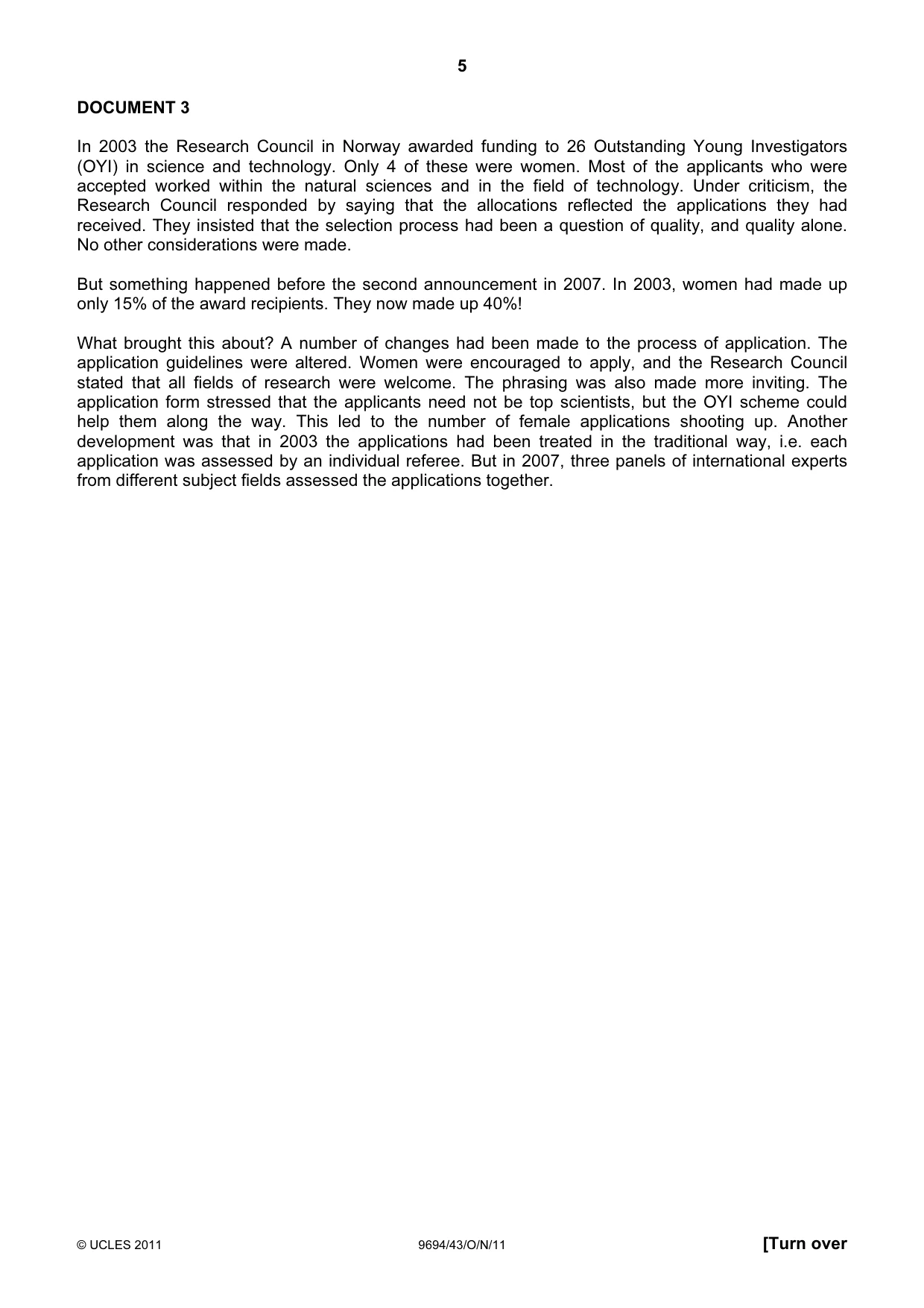
5 © UCLES 2011 9694/43/O/N/11 [Turn over DOCUMENT 3 In 2003 the Research Council in Norway awarded funding to 26 Outstanding Young Investigators (OYI) in science and technology. Only 4 of these were women. Most of the applicants who were accepted worked within the natural sciences and in the field of technology. Under criticism, the Research Council responded by saying that the allocations reflected the applications they had received. They insisted that the selection process had been a question of quality, and quality alone. No other considerations were made. But something happened before the second announcement in 2007. In 2003, women had made up only 15% of the award recipients. They now made up 40%! What brought this about? A number of changes had been made to the process of application. The application guidelines were altered. Women were encouraged to apply, and the Research Council stated that all fields of research were welcome. The phrasing was also made more inviting. The application form stressed that the applicants need not be top scientists, but the OYI scheme could help them along the way. This led to the number of female applications shooting up. Another development was that in 2003 the applications had been treated in the traditional way, i.e. each application was assessed by an individual referee. But in 2007, three panels of international experts from different subject fields assessed the applications together.
Question paper, page 6
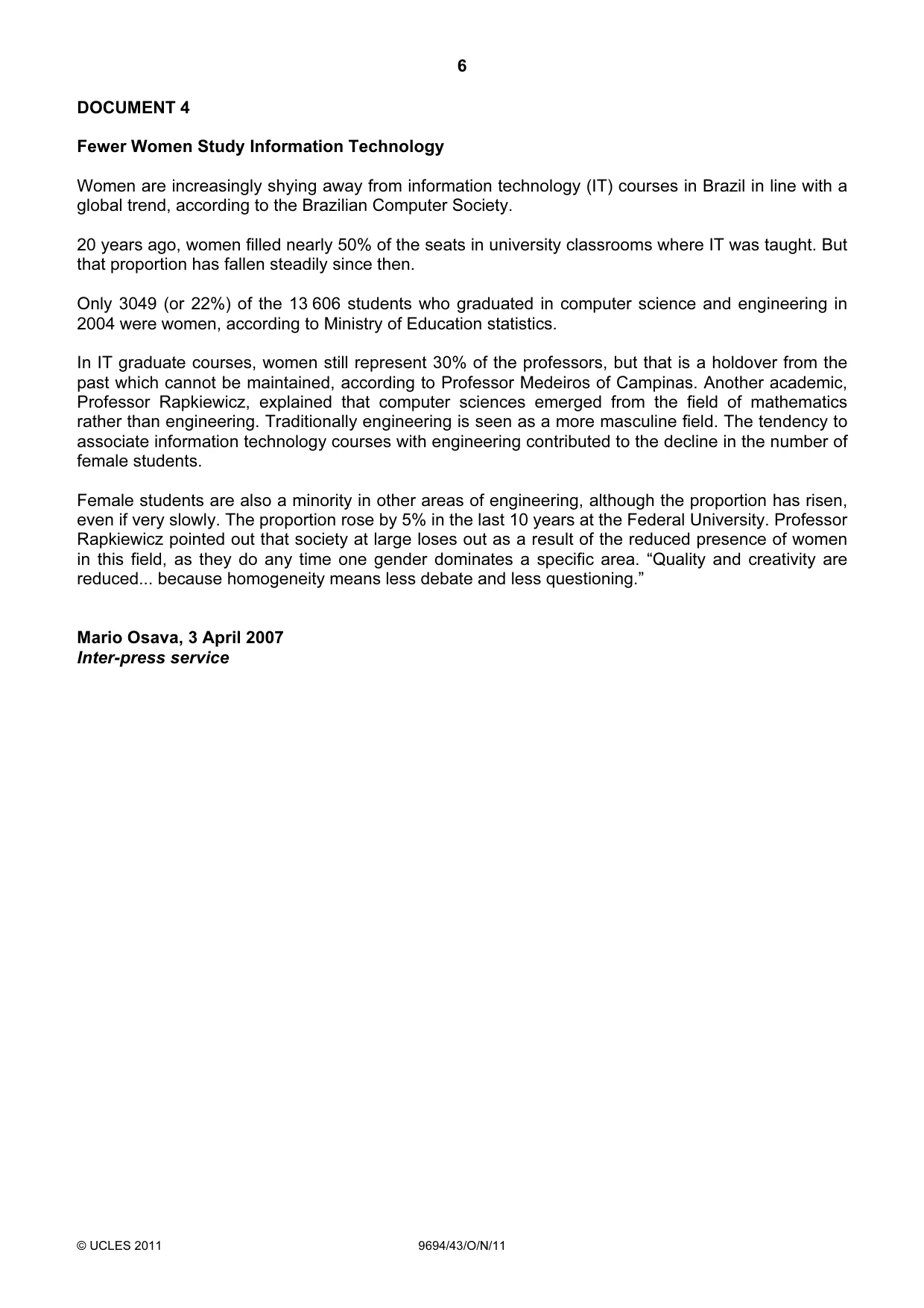
6 © UCLES 2011 9694/43/O/N/11 DOCUMENT 4 Fewer Women Study Information Technology Women are increasingly shying away from information technology (IT) courses in Brazil in line with a global trend, according to the Brazilian Computer Society. 20 years ago, women filled nearly 50% of the seats in university classrooms where IT was taught. But that proportion has fallen steadily since then. Only 3049 (or 22%) of the 13 606 students who graduated in computer science and engineering in 2004 were women, according to Ministry of Education statistics. In IT graduate courses, women still represent 30% of the professors, but that is a holdover from the past which cannot be maintained, according to Professor Medeiros of Campinas. Another academic, Professor Rapkiewicz, explained that computer sciences emerged from the field of mathematics rather than engineering. Traditionally engineering is seen as a more masculine field. The tendency to associate information technology courses with engineering contributed to the decline in the number of female students. Female students are also a minority in other areas of engineering, although the proportion has risen, even if very slowly. The proportion rose by 5% in the last 10 years at the Federal University. Professor Rapkiewicz pointed out that society at large loses out as a result of the reduced presence of women in this field, as they do any time one gender dominates a specific area. “Quality and creativity are reduced... because homogeneity means less debate and less questioning.” Mario Osava, 3 April 2007 Inter-press service
Question paper, page 7
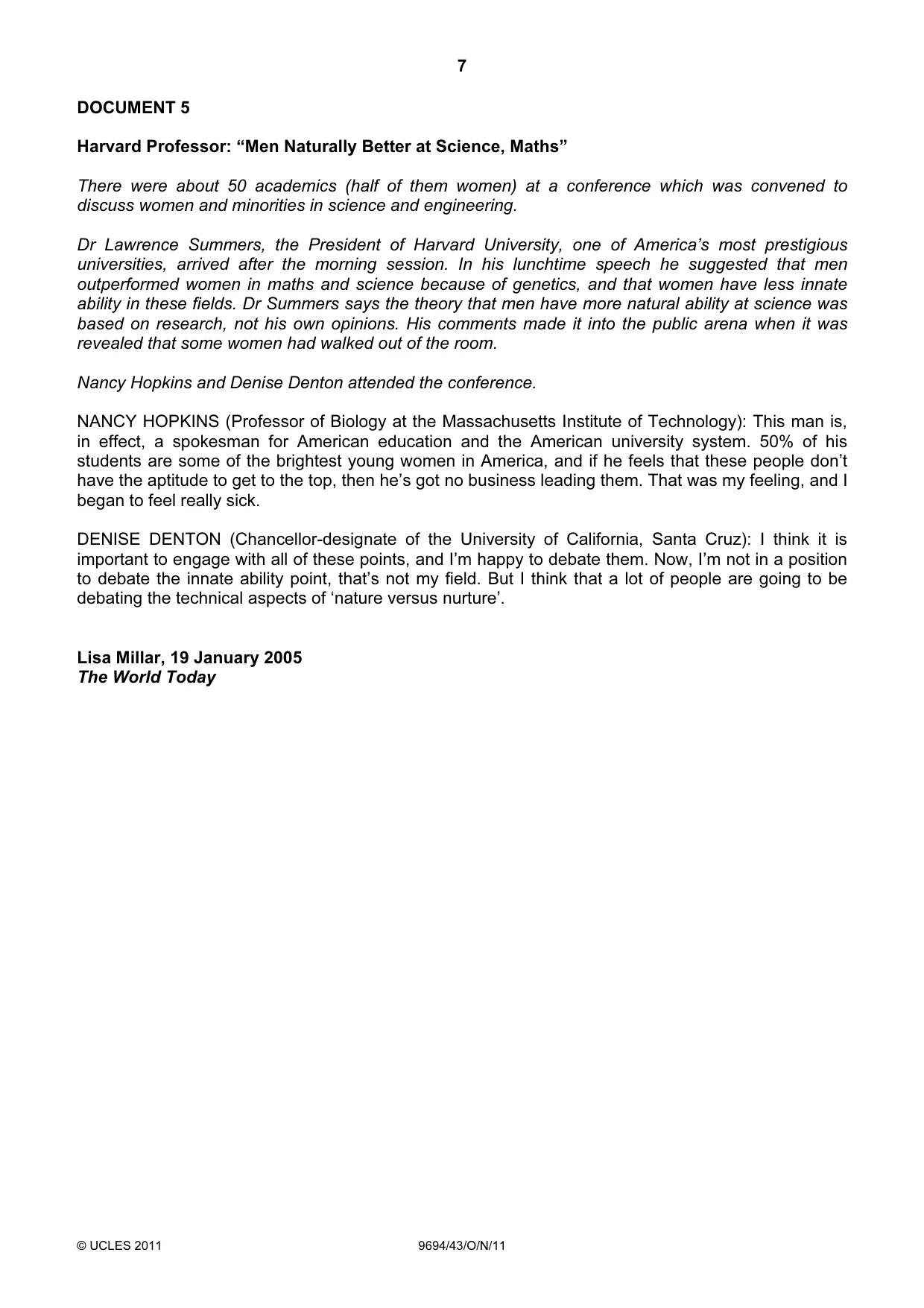
7 © UCLES 2011 9694/43/O/N/11 DOCUMENT 5 Harvard Professor: “Men Naturally Better at Science, Maths” There were about 50 academics (half of them women) at a conference which was convened to discuss women and minorities in science and engineering. Dr Lawrence Summers, the President of Harvard University, one of America’s most prestigious universities, arrived after the morning session. In his lunchtime speech he suggested that men outperformed women in maths and science because of genetics, and that women have less innate ability in these fields. Dr Summers says the theory that men have more natural ability at science was based on research, not his own opinions. His comments made it into the public arena when it was revealed that some women had walked out of the room. Nancy Hopkins and Denise Denton attended the conference. NANCY HOPKINS (Professor of Biology at the Massachusetts Institute of Technology): This man is, in effect, a spokesman for American education and the American university system. 50% of his students are some of the brightest young women in America, and if he feels that these people don’t have the aptitude to get to the top, then he’s got no business leading them. That was my feeling, and I began to feel really sick. DENISE DENTON (Chancellor-designate of the University of California, Santa Cruz): I think it is important to engage with all of these points, and I’m happy to debate them. Now, I’m not in a position to debate the innate ability point, that’s not my field. But I think that a lot of people are going to be debating the technical aspects of ‘nature versus nurture’. Lisa Millar, 19 January 2005 The World Today
Question paper, page 8
8 Copyright Acknowledgements: Document 2 Document 3 Document 4 Document 5 © Geoffrey Oldham; Keynote Presentation, Conference on Gender, Science and Technology, Montevideo, Uruguay; 26 October 2000; The problem of gender inequality; United Nations Commission on Science and Technology for Development; http://gab.wigsat.org/oldham.html. © http://eng.kvinneriforskning.no/c62967/nyhet/vis.html?tid=62516. © Mario Osava; Fewer Women Study Information Technology; Inter Press Service; 3 April 2007. © Lisa Millar; Men naturally better at Science, Maths: Harvard Professor; abridged from, The World Today, http://www.abc.net.au/worldtoday/content/2005/s1284885.htm. Permission to reproduce items where third-party owned material protected by copyright is included has been sought and cleared where possible. Every reasonable effort has been made by the publisher (UCLES) to trace copyright holders, but if any items requiring clearance have unwittingly been included, the publisher will be pleased to make amends at the earliest possible opportunity. University of Cambridge International Examinations is part of the Cambridge Assessment Group. Cambridge Assessment is the brand name of University of Cambridge Local Examinations Syndicate (UCLES), which is itself a department of the University of Cambridge. © UCLES 2011 9694/43/O/N/11 BLANK PAGE
Mark scheme, page 1
UNIVERSITY OF CAMBRIDGE INTERNATIONAL EXAMINATIONS GCE Advanced Level MARK SCHEME for the October/November 2011 question paper for the guidance of teachers 9694 THINKING SKILLS 9694/43 Paper 4 (Applied Reasoning), maximum raw mark 50 This mark scheme is published as an aid to teachers and candidates, to indicate the requirements of the examination. It shows the basis on which Examiners were instructed to award marks. It does not indicate the details of the discussions that took place at an Examiners’ meeting before marking began, which would have considered the acceptability of alternative answers. Mark schemes must be read in conjunction with the question papers and the report on the examination. • Cambridge will not enter into discussions or correspondence in connection with these mark schemes. Cambridge is publishing the mark schemes for the October/November 2011 question papers for most IGCSE, GCE Advanced Level and Advanced Subsidiary Level syllabuses and some Ordinary Level syllabuses.
Mark scheme, page 2
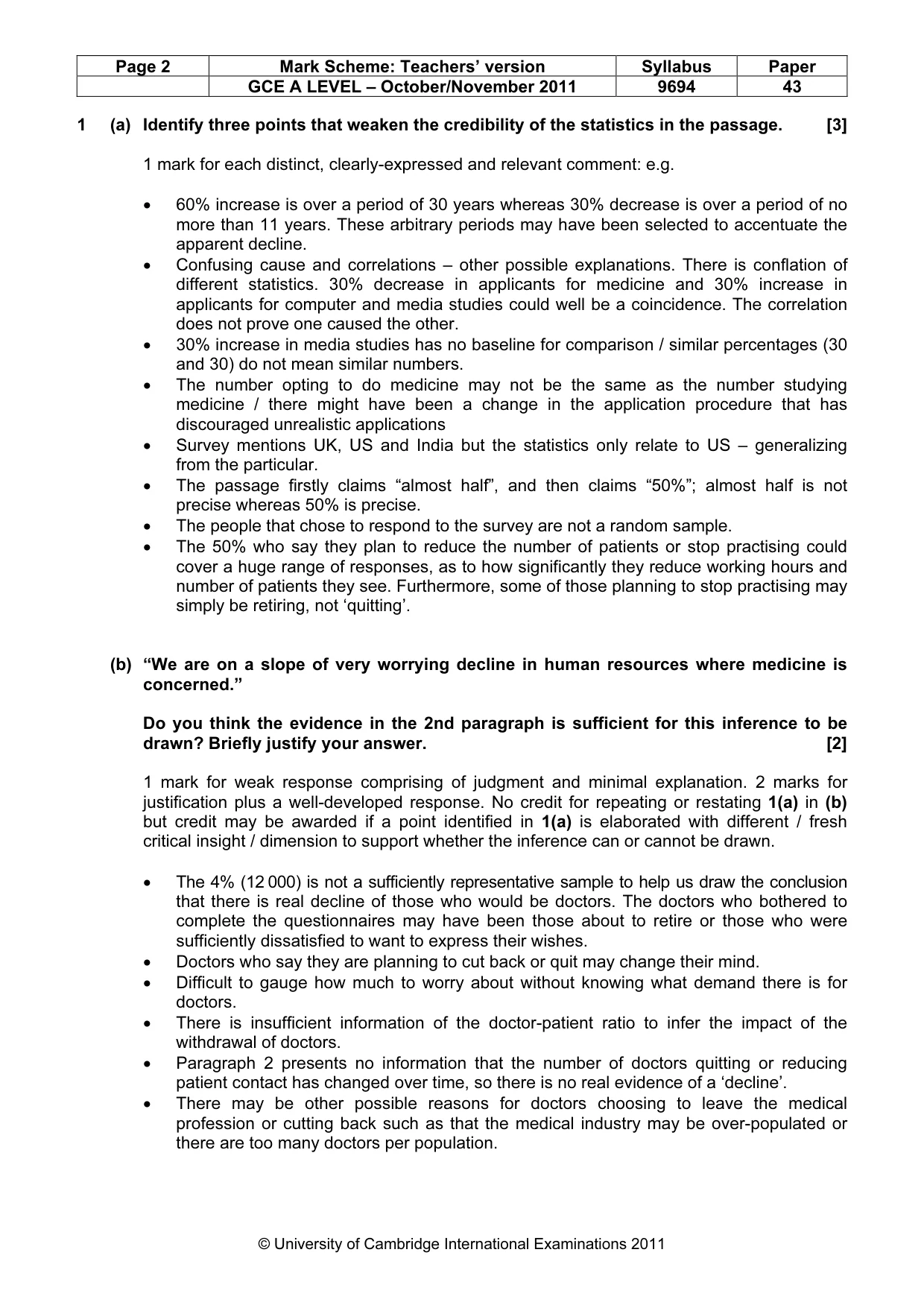
Page 2 Mark Scheme: Teachers’ version Syllabus Paper GCE A LEVEL – October/November 2011 9694 43 © University of Cambridge International Examinations 2011 1 (a) Identify three points that weaken the credibility of the statistics in the passage. [3] 1 mark for each distinct, clearly-expressed and relevant comment: e.g. • 60% increase is over a period of 30 years whereas 30% decrease is over a period of no more than 11 years. These arbitrary periods may have been selected to accentuate the apparent decline. • Confusing cause and correlations – other possible explanations. There is conflation of different statistics. 30% decrease in applicants for medicine and 30% increase in applicants for computer and media studies could well be a coincidence. The correlation does not prove one caused the other. • 30% increase in media studies has no baseline for comparison / similar percentages (30 and 30) do not mean similar numbers. • The number opting to do medicine may not be the same as the number studying medicine / there might have been a change in the application procedure that has discouraged unrealistic applications • Survey mentions UK, US and India but the statistics only relate to US – generalizing from the particular. • The passage firstly claims “almost half”, and then claims “50%”; almost half is not precise whereas 50% is precise. • The people that chose to respond to the survey are not a random sample. • The 50% who say they plan to reduce the number of patients or stop practising could cover a huge range of responses, as to how significantly they reduce working hours and number of patients they see. Furthermore, some of those planning to stop practising may simply be retiring, not ‘quitting’. (b) “We are on a slope of very worrying decline in human resources where medicine is concerned.” Do you think the evidence in the 2nd paragraph is sufficient for this inference to be drawn? Briefly justify your answer. [2] 1 mark for weak response comprising of judgment and minimal explanation. 2 marks for justification plus a well-developed response. No credit for repeating or restating 1(a) in (b) but credit may be awarded if a point identified in 1(a) is elaborated with different / fresh critical insight / dimension to support whether the inference can or cannot be drawn. • The 4% (12 000) is not a sufficiently representative sample to help us draw the conclusion that there is real decline of those who would be doctors. The doctors who bothered to complete the questionnaires may have been those about to retire or those who were sufficiently dissatisfied to want to express their wishes. • Doctors who say they are planning to cut back or quit may change their mind. • Difficult to gauge how much to worry about without knowing what demand there is for doctors. • There is insufficient information of the doctor-patient ratio to infer the impact of the withdrawal of doctors. • Paragraph 2 presents no information that the number of doctors quitting or reducing patient contact has changed over time, so there is no real evidence of a ‘decline’. • There may be other possible reasons for doctors choosing to leave the medical profession or cutting back such as that the medical industry may be over-populated or there are too many doctors per population.
Mark scheme, page 3
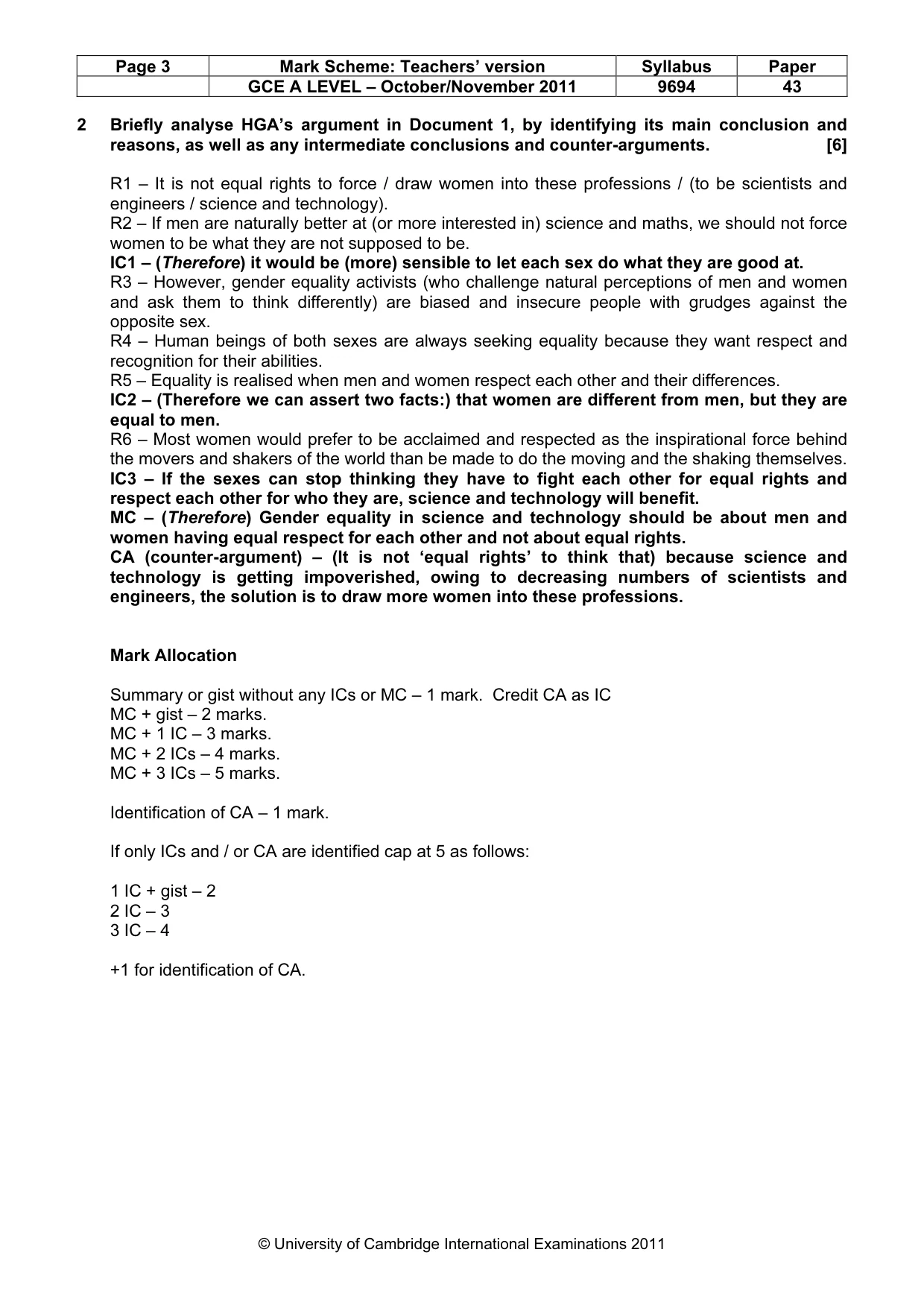
Page 3 Mark Scheme: Teachers’ version Syllabus Paper GCE A LEVEL – October/November 2011 9694 43 © University of Cambridge International Examinations 2011 2 Briefly analyse HGA’s argument in Document 1, by identifying its main conclusion and reasons, as well as any intermediate conclusions and counter-arguments. [6] R1 – It is not equal rights to force / draw women into these professions / (to be scientists and engineers / science and technology). R2 – If men are naturally better at (or more interested in) science and maths, we should not force women to be what they are not supposed to be. IC1 – (Therefore) it would be (more) sensible to let each sex do what they are good at. R3 – However, gender equality activists (who challenge natural perceptions of men and women and ask them to think differently) are biased and insecure people with grudges against the opposite sex. R4 – Human beings of both sexes are always seeking equality because they want respect and recognition for their abilities. R5 – Equality is realised when men and women respect each other and their differences. IC2 – (Therefore we can assert two facts:) that women are different from men, but they are equal to men. R6 – Most women would prefer to be acclaimed and respected as the inspirational force behind the movers and shakers of the world than be made to do the moving and the shaking themselves. IC3 – If the sexes can stop thinking they have to fight each other for equal rights and respect each other for who they are, science and technology will benefit. MC – (Therefore) Gender equality in science and technology should be about men and women having equal respect for each other and not about equal rights. CA (counter-argument) – (It is not ‘equal rights’ to think that) because science and technology is getting impoverished, owing to decreasing numbers of scientists and engineers, the solution is to draw more women into these professions. Mark Allocation Summary or gist without any ICs or MC – 1 mark. Credit CA as IC MC + gist – 2 marks. MC + 1 IC – 3 marks. MC + 2 ICs – 4 marks. MC + 3 ICs – 5 marks. Identification of CA – 1 mark. If only ICs and / or CA are identified cap at 5 as follows: 1 IC + gist – 2 2 IC – 3 3 IC – 4 +1 for identification of CA.
Mark scheme, page 4
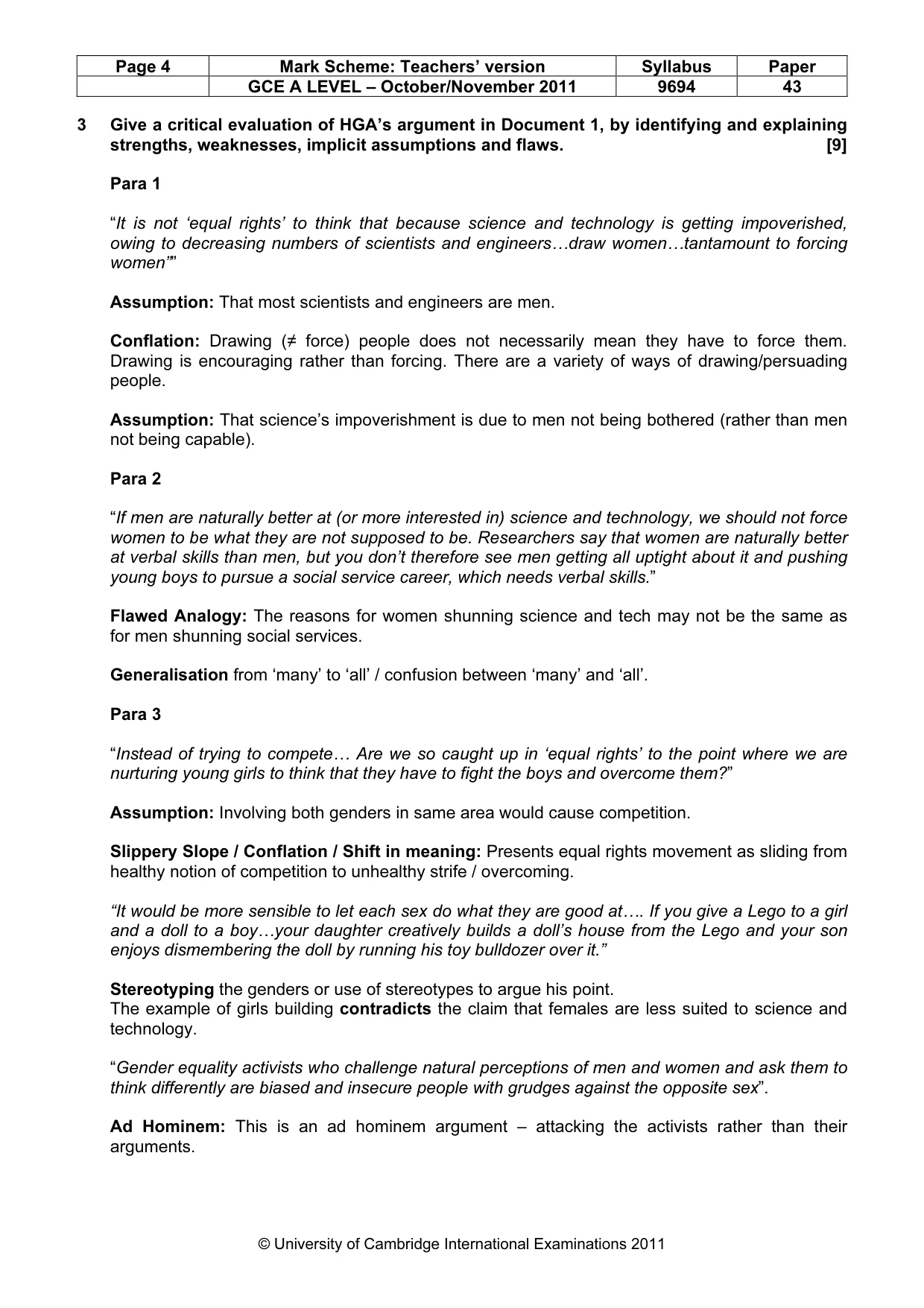
Page 4 Mark Scheme: Teachers’ version Syllabus Paper GCE A LEVEL – October/November 2011 9694 43 © University of Cambridge International Examinations 2011 3 Give a critical evaluation of HGA’s argument in Document 1, by identifying and explaining strengths, weaknesses, implicit assumptions and flaws. [9] Para 1 “It is not ‘equal rights’ to think that because science and technology is getting impoverished, owing to decreasing numbers of scientists and engineers…draw women…tantamount to forcing women”” Assumption: That most scientists and engineers are men. Conflation: Drawing (≠ force) people does not necessarily mean they have to force them. Drawing is encouraging rather than forcing. There are a variety of ways of drawing/persuading people. Assumption: That science’s impoverishment is due to men not being bothered (rather than men not being capable). Para 2 “If men are naturally better at (or more interested in) science and technology, we should not force women to be what they are not supposed to be. Researchers say that women are naturally better at verbal skills than men, but you don’t therefore see men getting all uptight about it and pushing young boys to pursue a social service career, which needs verbal skills.” Flawed Analogy: The reasons for women shunning science and tech may not be the same as for men shunning social services. Generalisation from ‘many’ to ‘all’ / confusion between ‘many’ and ‘all’. Para 3 “Instead of trying to compete… Are we so caught up in ‘equal rights’ to the point where we are nurturing young girls to think that they have to fight the boys and overcome them?” Assumption: Involving both genders in same area would cause competition. Slippery Slope / Conflation / Shift in meaning: Presents equal rights movement as sliding from healthy notion of competition to unhealthy strife / overcoming. “It would be more sensible to let each sex do what they are good at…. If you give a Lego to a girl and a doll to a boy…your daughter creatively builds a doll’s house from the Lego and your son enjoys dismembering the doll by running his toy bulldozer over it.” Stereotyping the genders or use of stereotypes to argue his point. The example of girls building contradicts the claim that females are less suited to science and technology. “Gender equality activists who challenge natural perceptions of men and women and ask them to think differently are biased and insecure people with grudges against the opposite sex”. Ad Hominem: This is an ad hominem argument – attacking the activists rather than their arguments.
Mark scheme, page 5
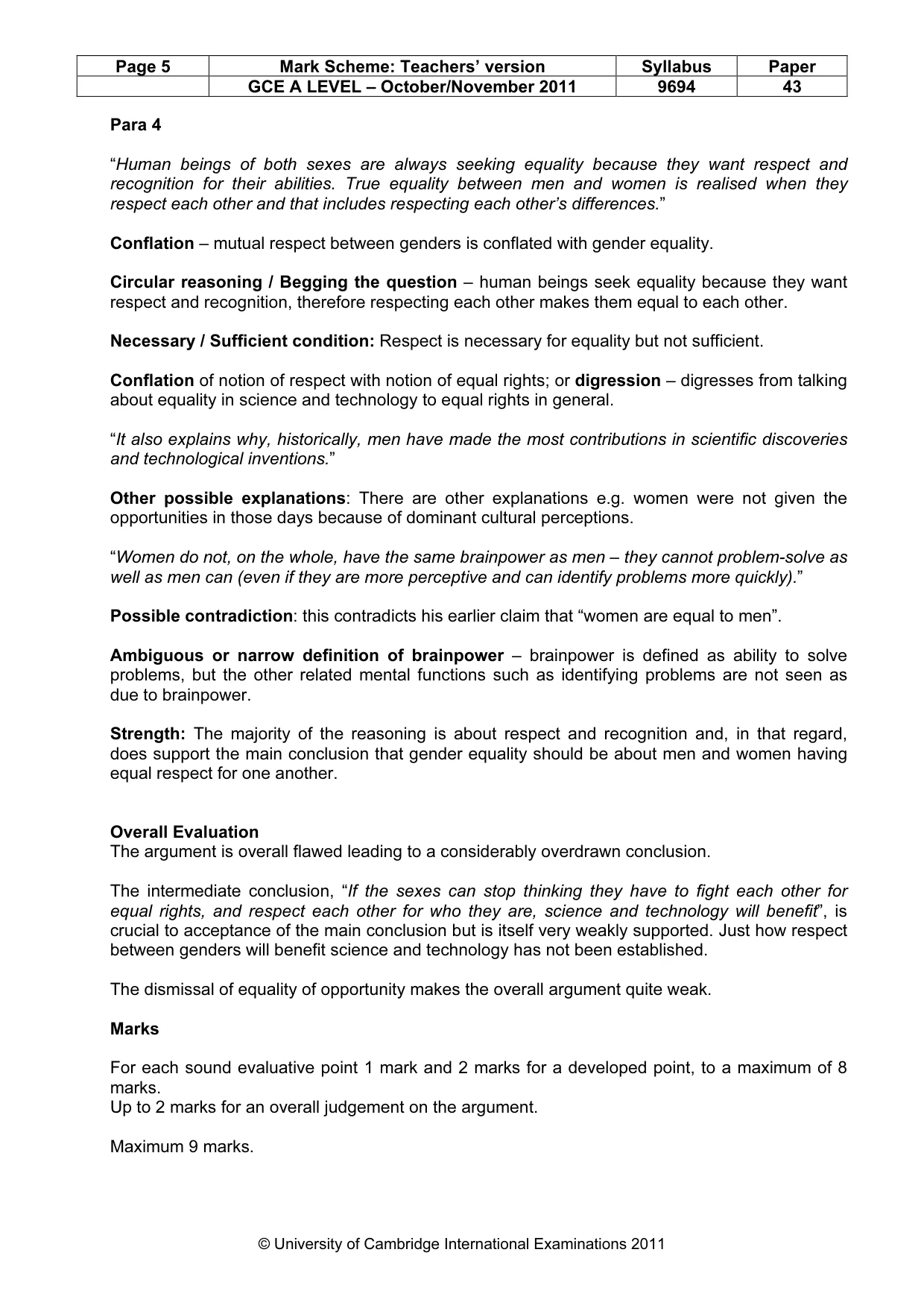
Page 5 Mark Scheme: Teachers’ version Syllabus Paper GCE A LEVEL – October/November 2011 9694 43 © University of Cambridge International Examinations 2011 Para 4 “Human beings of both sexes are always seeking equality because they want respect and recognition for their abilities. True equality between men and women is realised when they respect each other and that includes respecting each other’s differences.” Conflation – mutual respect between genders is conflated with gender equality. Circular reasoning / Begging the question – human beings seek equality because they want respect and recognition, therefore respecting each other makes them equal to each other. Necessary / Sufficient condition: Respect is necessary for equality but not sufficient. Conflation of notion of respect with notion of equal rights; or digression – digresses from talking about equality in science and technology to equal rights in general. “It also explains why, historically, men have made the most contributions in scientific discoveries and technological inventions.” Other possible explanations: There are other explanations e.g. women were not given the opportunities in those days because of dominant cultural perceptions. “Women do not, on the whole, have the same brainpower as men – they cannot problem-solve as well as men can (even if they are more perceptive and can identify problems more quickly).” Possible contradiction: this contradicts his earlier claim that “women are equal to men”. Ambiguous or narrow definition of brainpower – brainpower is defined as ability to solve problems, but the other related mental functions such as identifying problems are not seen as due to brainpower. Strength: The majority of the reasoning is about respect and recognition and, in that regard, does support the main conclusion that gender equality should be about men and women having equal respect for one another. Overall Evaluation The argument is overall flawed leading to a considerably overdrawn conclusion. The intermediate conclusion, “If the sexes can stop thinking they have to fight each other for equal rights, and respect each other for who they are, science and technology will benefit”, is crucial to acceptance of the main conclusion but is itself very weakly supported. Just how respect between genders will benefit science and technology has not been established. The dismissal of equality of opportunity makes the overall argument quite weak. Marks For each sound evaluative point 1 mark and 2 marks for a developed point, to a maximum of 8 marks. Up to 2 marks for an overall judgement on the argument. Maximum 9 marks.
Mark scheme, page 6
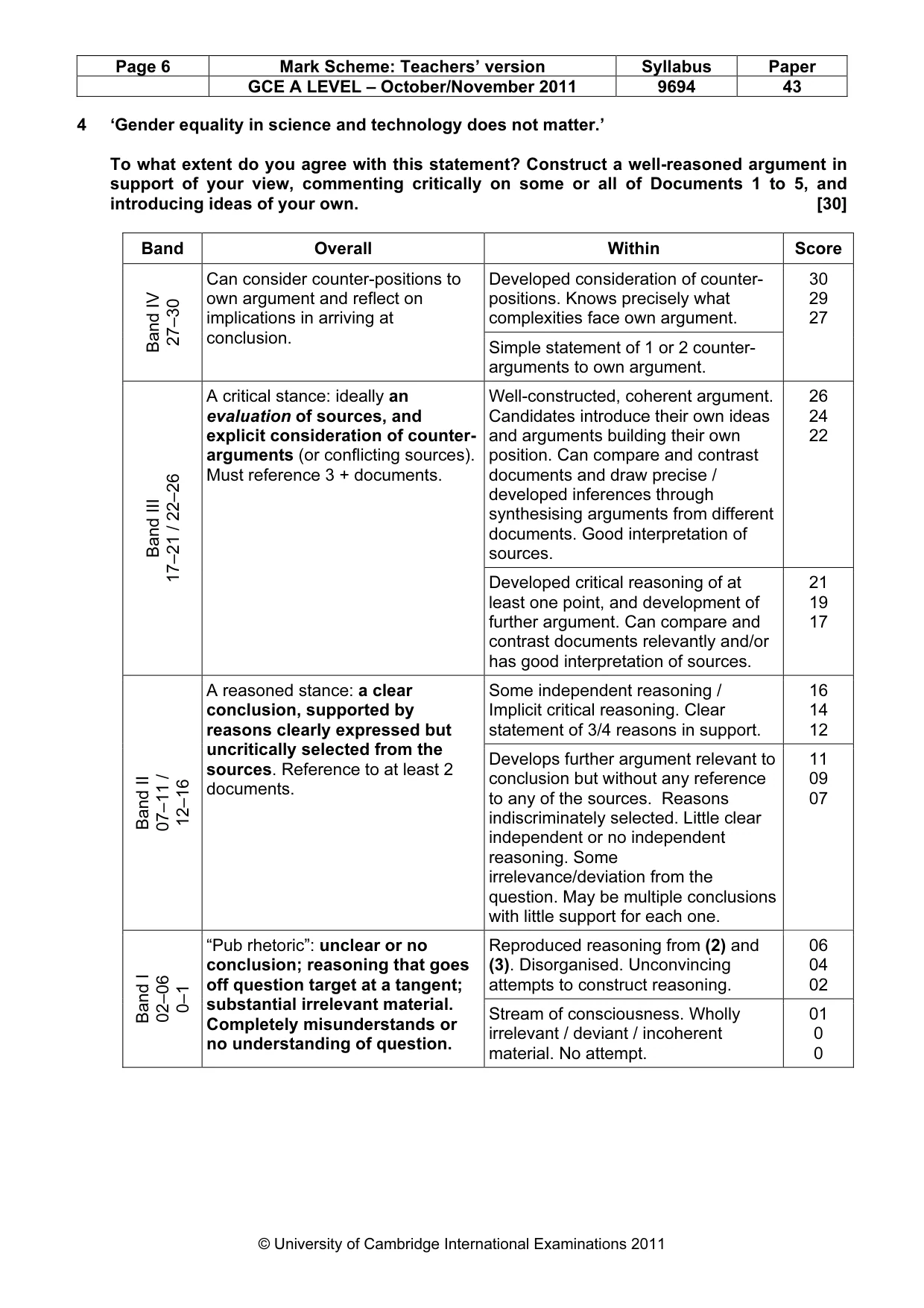
Page 6 Mark Scheme: Teachers’ version Syllabus Paper GCE A LEVEL – October/November 2011 9694 43 © University of Cambridge International Examinations 2011 4 ‘Gender equality in science and technology does not matter.’ To what extent do you agree with this statement? Construct a well-reasoned argument in support of your view, commenting critically on some or all of Documents 1 to 5, and introducing ideas of your own. [30] Band Overall Within Score Developed consideration of counter- positions. Knows precisely what complexities face own argument. Band IV 27–30 Can consider counter-positions to own argument and reflect on implications in arriving at conclusion. Simple statement of 1 or 2 counter- arguments to own argument. 30 29 27 Well-constructed, coherent argument. Candidates introduce their own ideas and arguments building their own position. Can compare and contrast documents and draw precise / developed inferences through synthesising arguments from different documents. Good interpretation of sources. 26 24 22 Band III 17–21 / 22–26 A critical stance: ideally an evaluation of sources, and explicit consideration of counter- arguments (or conflicting sources). Must reference 3 + documents. Developed critical reasoning of at least one point, and development of further argument. Can compare and contrast documents relevantly and/or has good interpretation of sources. 21 19 17 Some independent reasoning / Implicit critical reasoning. Clear statement of 3/4 reasons in support. 16 14 12 Band II 07–11 / 12–16 A reasoned stance: a clear conclusion, supported by reasons clearly expressed but uncritically selected from the sources. Reference to at least 2 documents. Develops further argument relevant to conclusion but without any reference to any of the sources. Reasons indiscriminately selected. Little clear independent or no independent reasoning. Some irrelevance/deviation from the question. May be multiple conclusions with little support for each one. 11 09 07 Reproduced reasoning from (2) and (3). Disorganised. Unconvincing attempts to construct reasoning. 06 04 02 Band I 02–06 0–1 “Pub rhetoric”: unclear or no conclusion; reasoning that goes off question target at a tangent; substantial irrelevant material. Completely misunderstands or no understanding of question. Stream of consciousness. Wholly irrelevant / deviant / incoherent material. No attempt. 01 0 0
Mark scheme, page 7
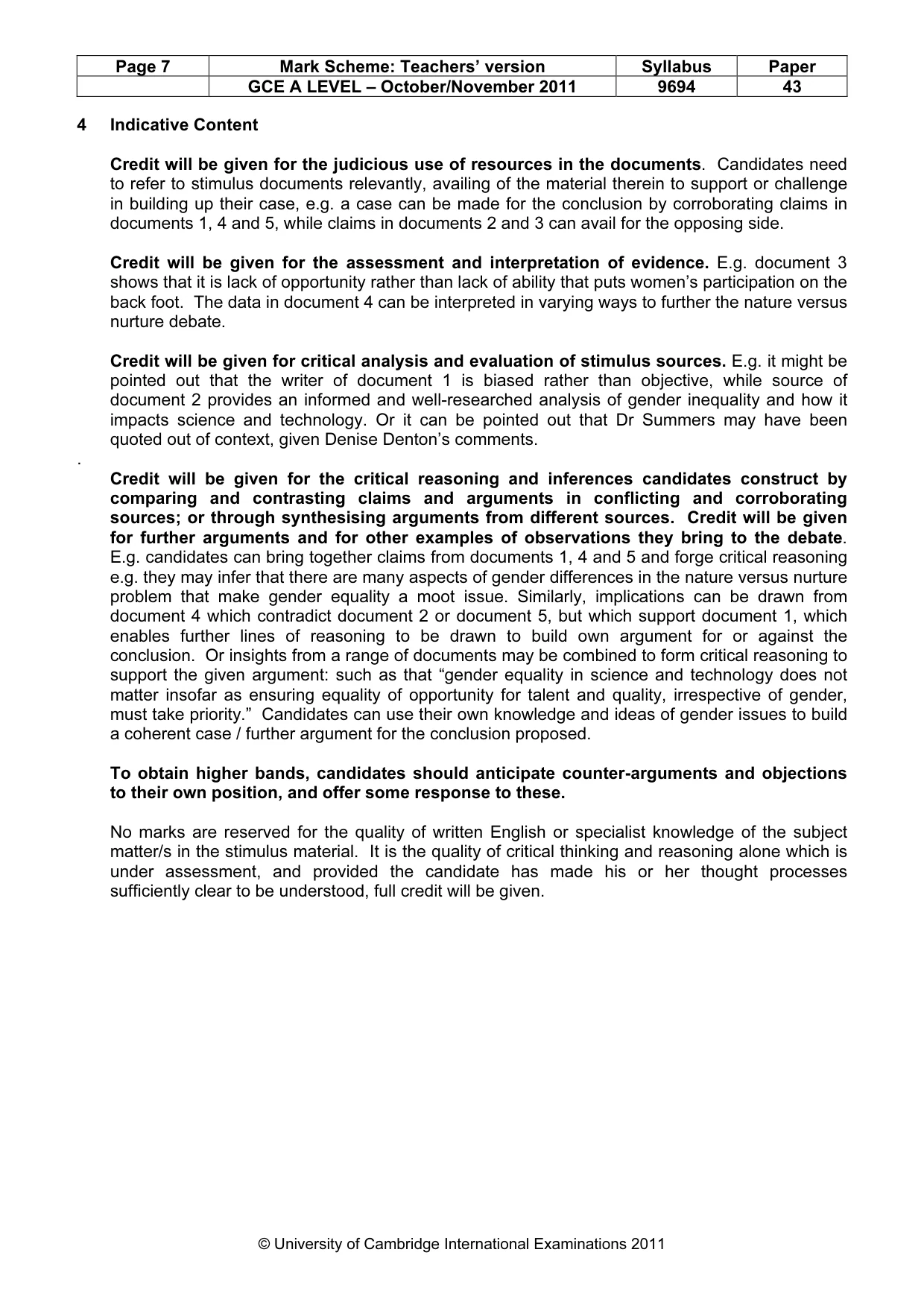
Page 7 Mark Scheme: Teachers’ version Syllabus Paper GCE A LEVEL – October/November 2011 9694 43 © University of Cambridge International Examinations 2011 4 Indicative Content Credit will be given for the judicious use of resources in the documents. Candidates need to refer to stimulus documents relevantly, availing of the material therein to support or challenge in building up their case, e.g. a case can be made for the conclusion by corroborating claims in documents 1, 4 and 5, while claims in documents 2 and 3 can avail for the opposing side. Credit will be given for the assessment and interpretation of evidence. E.g. document 3 shows that it is lack of opportunity rather than lack of ability that puts women’s participation on the back foot. The data in document 4 can be interpreted in varying ways to further the nature versus nurture debate. Credit will be given for critical analysis and evaluation of stimulus sources. E.g. it might be pointed out that the writer of document 1 is biased rather than objective, while source of document 2 provides an informed and well-researched analysis of gender inequality and how it impacts science and technology. Or it can be pointed out that Dr Summers may have been quoted out of context, given Denise Denton’s comments. . Credit will be given for the critical reasoning and inferences candidates construct by comparing and contrasting claims and arguments in conflicting and corroborating sources; or through synthesising arguments from different sources. Credit will be given for further arguments and for other examples of observations they bring to the debate. E.g. candidates can bring together claims from documents 1, 4 and 5 and forge critical reasoning e.g. they may infer that there are many aspects of gender differences in the nature versus nurture problem that make gender equality a moot issue. Similarly, implications can be drawn from document 4 which contradict document 2 or document 5, but which support document 1, which enables further lines of reasoning to be drawn to build own argument for or against the conclusion. Or insights from a range of documents may be combined to form critical reasoning to support the given argument: such as that “gender equality in science and technology does not matter insofar as ensuring equality of opportunity for talent and quality, irrespective of gender, must take priority.” Candidates can use their own knowledge and ideas of gender issues to build a coherent case / further argument for the conclusion proposed. To obtain higher bands, candidates should anticipate counter-arguments and objections to their own position, and offer some response to these. No marks are reserved for the quality of written English or specialist knowledge of the subject matter/s in the stimulus material. It is the quality of critical thinking and reasoning alone which is under assessment, and provided the candidate has made his or her thought processes sufficiently clear to be understood, full credit will be given.
What you needed in this session
Cambridge’s own grade thresholds for 2011 Oct/Nov, Paper 4 · Variant 3. A higher threshold means an easier paper — the bar moves with how the cohort did.