Cambridge A Level Thinking Skills 9694 — 2011 May/June Paper 4 · Variant 1
9694/41/M/J/11 · 50 marks · ≈56 min
The question paper and its mark scheme, free to read here and free to download. This is Cambridge’s own paper, exactly as it was sat.
Question paper8 pages
Mark scheme6 pages
Answers below. Sit the paper first if you are practising.
Paper as text
Question paper, page 1
This document consists of 7 printed pages and 1 blank page. IB11 06_9694_41/4RP © UCLES 2011 [Turn over *8450448336* UNIVERSITY OF CAMBRIDGE INTERNATIONAL EXAMINATIONS General Certificate of Education Advanced Level THINKING SKILLS 9694/41 Paper 4 Applied Reasoning May/June 2011 1 hour and 30 minutes Additional Materials: Answer Booklet/Paper READ THESE INSTRUCTIONS FIRST If you have been given an Answer Booklet, follow the instructions on the front cover of the booklet. Write your Centre number, candidate number and name on all the work you hand in. Write in dark blue or black pen. Do not use staples, paper clips, highlighters, glue or correction fluid. DO NOT WRITE ON ANY BARCODES Answer all the questions. Start each question on a new answer sheet. At the end of the examination, fasten all your work securely together. The number of marks is given in brackets [ ] at the end of each question.
Question paper, page 2
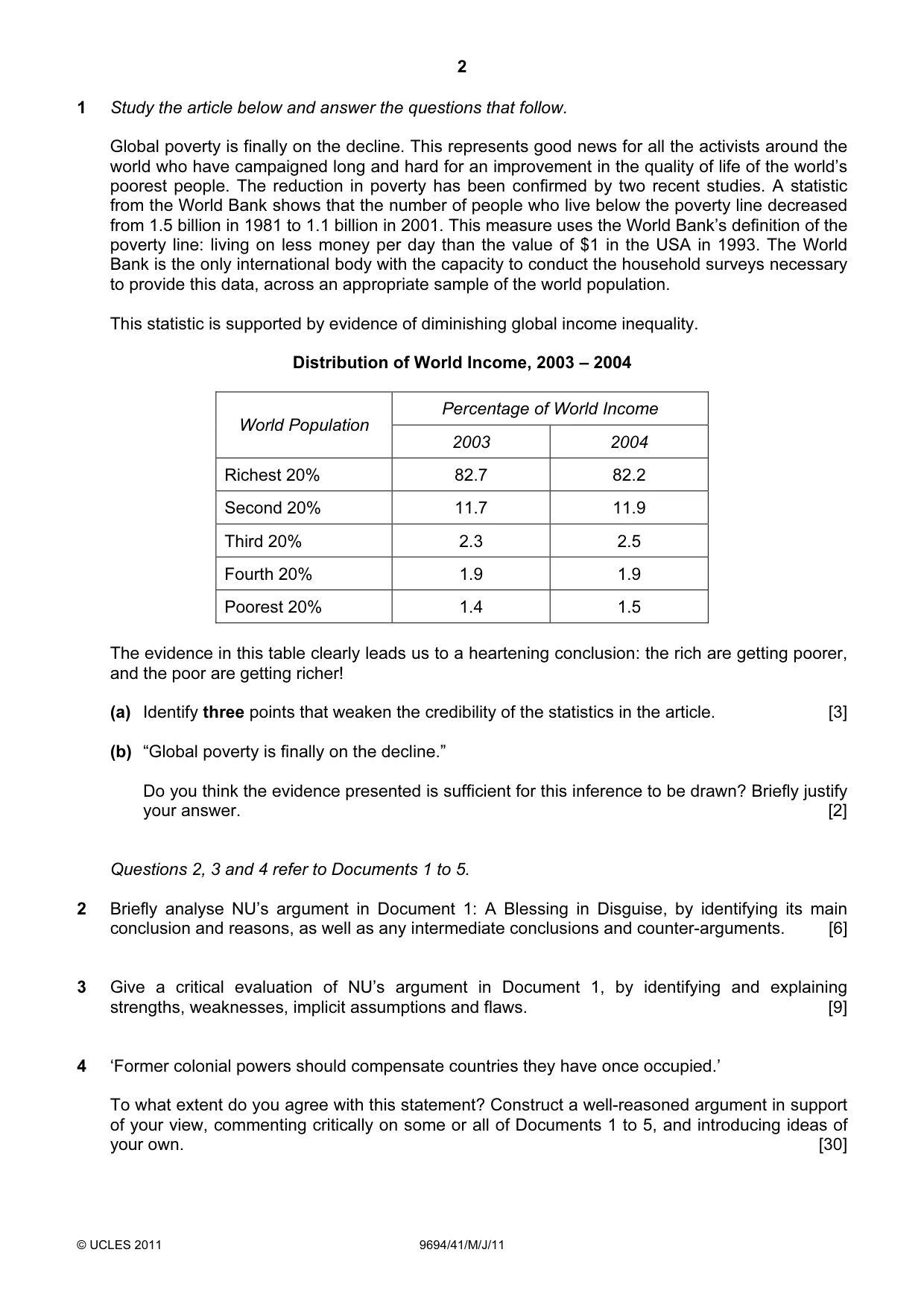
2 © UCLES 2011 9694/41/M/J/11 1 Study the article below and answer the questions that follow. Global poverty is finally on the decline. This represents good news for all the activists around the world who have campaigned long and hard for an improvement in the quality of life of the world’s poorest people. The reduction in poverty has been confirmed by two recent studies. A statistic from the World Bank shows that the number of people who live below the poverty line decreased from 1.5 billion in 1981 to 1.1 billion in 2001. This measure uses the World Bank’s definition of the poverty line: living on less money per day than the value of $1 in the USA in 1993. The World Bank is the only international body with the capacity to conduct the household surveys necessary to provide this data, across an appropriate sample of the world population. This statistic is supported by evidence of diminishing global income inequality. Distribution of World Income, 2003 – 2004 Percentage of World Income World Population 2003 2004 Richest 20% 82.7 82.2 Second 20% 11.7 11.9 Third 20% 2.3 2.5 Fourth 20% 1.9 1.9 Poorest 20% 1.4 1.5 The evidence in this table clearly leads us to a heartening conclusion: the rich are getting poorer, and the poor are getting richer! (a) Identify three points that weaken the credibility of the statistics in the article. [3] (b) “Global poverty is finally on the decline.” Do you think the evidence presented is sufficient for this inference to be drawn? Briefly justify your answer. [2] Questions 2, 3 and 4 refer to Documents 1 to 5. 2 Briefly analyse NU’s argument in Document 1: A Blessing in Disguise, by identifying its main conclusion and reasons, as well as any intermediate conclusions and counter-arguments. [6] 3 Give a critical evaluation of NU’s argument in Document 1, by identifying and explaining strengths, weaknesses, implicit assumptions and flaws. [9] 4 ‘Former colonial powers should compensate countries they have once occupied.’ To what extent do you agree with this statement? Construct a well-reasoned argument in support of your view, commenting critically on some or all of Documents 1 to 5, and introducing ideas of your own. [30]
Question paper, page 3
3 © UCLES 2011 9694/41/M/J/11 [Turn over DOCUMENT 1 A Blessing in Disguise Most people would agree that the invasion and occupation of another country should be condemned. Why? There is this idea of ‘self-determination’ – that the people living in a country should decide their own future and govern themselves. In general, we do not like bullies in our private lives and this feeling carries across to public life too; indeed, our private life gets directly (and negatively) affected by what is happening in our country during an invasion. It is difficult to carry on with your grocery shopping when there is a tank from an enemy driving down the street. The difficulty with this argument is that the long-term benefits of occupation are overlooked because of the short-term injustices of being invaded. In actual fact, invasion may not be such a bad thing if it leads to an enrichment of culture in the subject countries. Most countries have been invaded several times and this has led to the culture and values of the invading nations being superimposed on the subject nations. The process by which the British occupation of India influenced its culture is a classic example. Some of the greatest Indian thinkers ensured that India took something from its invaders. The Brahmo Samaj was founded by Raja Rammohun Roy (1774 – 1833), whom some see as the founder of modern India. This was a movement of modernisation for societies that had not industrialised in the way that the West had done. Raja Rammohun Roy directed his pupils to read the great Western philosopher Voltaire (1694 – 1778), but he also drew on much earlier Islamic and Persian influences as well as the ancient Greek philosopher Aristotle. So we can see that true leaders and intellectuals do not resist the culture of invaders; instead, they think and reflect, so that they can find opportunities to use the incoming culture to enrich the lives and traditions of their own people. This could explain why the so-called British Raj (1858 – 1947) had such a tremendous influence on the India of today. Knowledge and know-how from the West have greatly contributed to shaping modern India. There would be no Bollywood without Hollywood. Indeed, India would have no film industry if the West had not invented cinema photography. The British Empire passed on to India its own vast industrial and technological acquisitions. In effect, the current industrialisation of India could not have happened without the Industrial Revolution that took place in Britain in the eighteenth and nineteenth centuries. Software development has become one of the greatest business success stories of India in recent years, yet even this would not have happened if the modern computer had not been first invented and then widely adopted by companies in the USA. Of course, these innovations and advances do not come without problems, but that is another matter. What I can assert confidently is that countries which have frequently been invaded should be grateful to their leaders who have recognised and taken advantage of the ideas and inventions of the invaders. NU
Question paper, page 4
4 © UCLES 2011 9694/41/M/J/11 DOCUMENT 2 Is it wrong to say that colonialism was good for the world? Charlie_52: Most of the people state that it has negatively impacted the world, but I take the opposite position and state that because of colonialism, so many people in the West (such as those in Europe and America) have advanced so much in terms of technology and resources that they have improved the lives of people like us everyday. If it weren’t for colonialism, Europe and America would not be the strong political powers they are today and Americans like me would not be able to enjoy our privileged lives. I don’t see how you can say colonialism is completely terrible since the sacrifices of a few slaves have greatly improved my life. If I had the chance, I wouldn’t go back and prevent colonialism from happening since, if I did, I wouldn’t have this great life I enjoy now. xx_kt_xx: For the most part - bad. Be serious. What countries came out good as former colonies and why? The US because it colonised other countries. South Korea and Taiwan because of massive aid during the cold war. Singapore because of its geopolitical position. You could also make a case for a few others but the majority of former colonies and ‘imperialised’ nations are doing really badly. Look up any country in Africa, most of Latin America, a big chunk of Asia, even Eastern Europe! All of these countries were screwed up because of imperialism. Bloggers
Question paper, page 5
5 © UCLES 2011 9694/41/M/J/11 [Turn over DOCUMENT 3 Joys and woes of Empire British rule became associated with a number of benefits. One was that, in general, rule of law and the attempt to record land ownership provided a basis upon which native people might one day create their own systems of self-government. At least lip service was paid to ideals like ‘democracy’, ‘freedom of speech’, and ‘rights of the individual’. Another benefit was the rapid development of the infrastructure in colonies that were deemed ripe for investment and growth. Above all, and despite their many failings and brutalities, the British tended to approach the enormous task of imperial rule with a relatively human pragmatism. Of course, the fact of Empire had a number of impacts upon the United Kingdom too, both positive and negative. British politicians of all parties were quick to discern in the Empire a means of uniting the people in a common cause, as a way of inspiring a sense of international mission. A great and messy amount of personal and national rubbish could be dumped elsewhere – principally upon ‘inferior’ black and brown people throughout the imperial system. They thus became repositories of much that was unwanted and disowned at home. It also provided manifold opportunities for making profitable careers, and for personal, financial and sexual exploitation. It introduced strange and exotic foods, flora and fauna, useful words, outlandish philosophies, different sports, other cultures and a whole host of unfamiliar experiences into the British way of life. It can be argued, on the one hand, that the Empire marked out Britain as an island race with connections across the globe matched by no other state. Others argue that the Empire was a matter of indifference to most British people, who hardly noticed the passing of Empire, and were increasingly happy to exchange the imperial mission for the joys of becoming a consumer society. Denis Judd, Professor of History, London Metropolitan University
Question paper, page 6
6 © UCLES 2011 9694/41/M/J/11 DOCUMENT 4 What happened to Africa Colonialism caused the loss of sovereignty, which is the loss of the right of a state to control its own destiny, to participate in its own development, to conduct its own diplomacy and international relations and to decide which outside nations to associate with or to emulate. Above all, it took away the right of the state to manage or even mismanage its own affairs, take pride and pleasure in its success, and derive lessons, frustration and experience from its failures. Many African nationalists and critics of colonialism see the independence gained from the withdrawing colonial powers as only partial liberation. Some call it ‘false independence’. Full or real freedom, they believe, will come with economic independence. Colonialism bred political crisis. In disrupting pre-colonial political systems that worked for Africans, and by imposing alien models, colonialism laid the seeds of political crisis, say its critics. By the redrawing of the map of Africa, throwing diverse people together without consideration for established borders, ethnic conflicts were created that are destabilising the continent. The new nation-states were artificial and many were too small to be viable. Less than a third of the countries in Africa have populations of more than 10 million. Western multi-party democracy imposed by colonial powers polarised African societies. “It was the introduction of party politics by colonial administration that set off the fire of ethnic conflicts in Nigeria,” wrote Itodo Ojobo in the New Nigerian newspaper in 1986. Scribd (social publishing and reading website)
Question paper, page 7
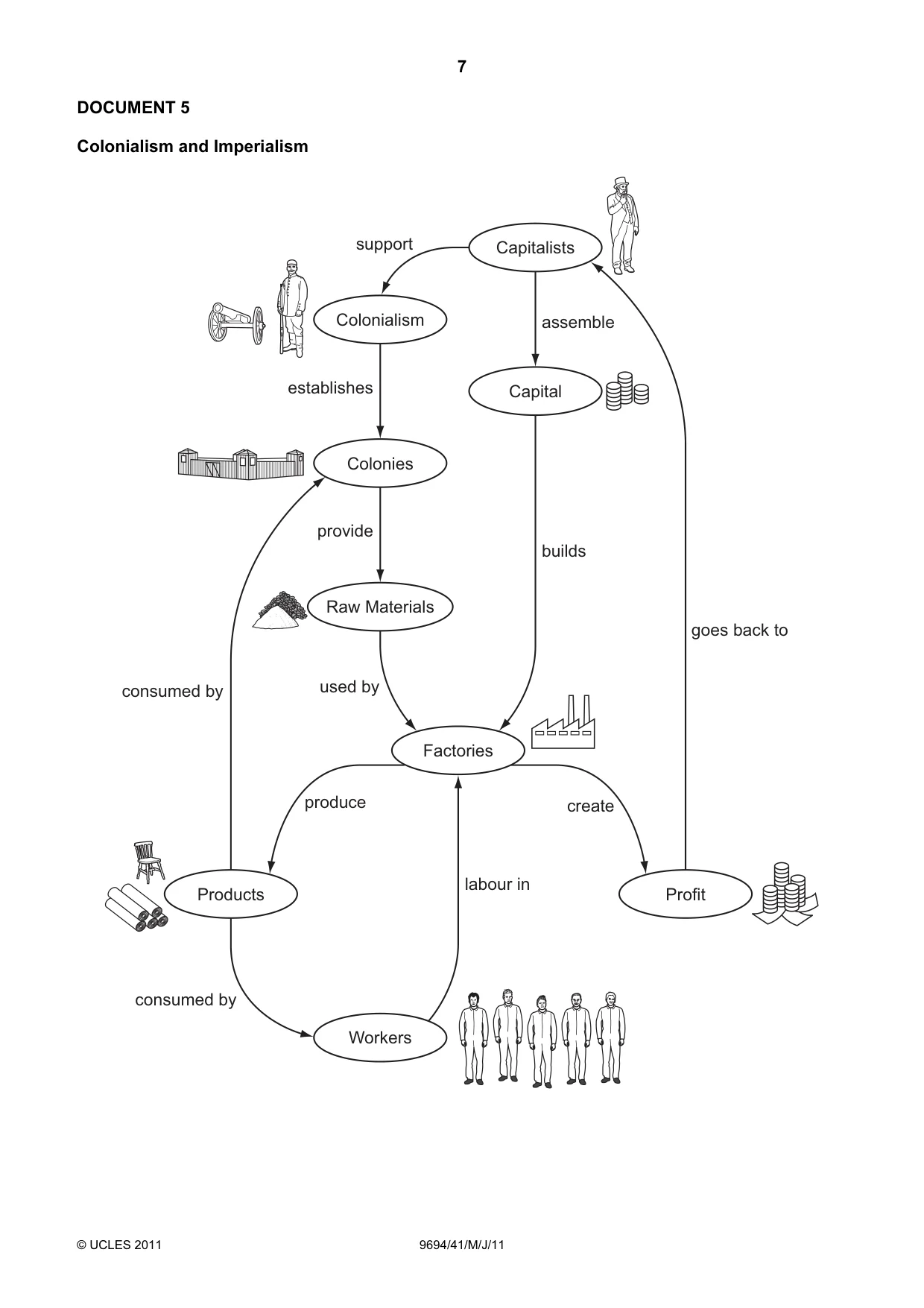
7 © UCLES 2011 9694/41/M/J/11 DOCUMENT 5 Colonialism and Imperialism Capitalists Colonialism Capital Colonies Workers Profit Products Raw Materials Factories assemble establishes provide used by builds goes back to support create produce labour in consumed by consumed by
Question paper, page 8
8 Copyright Acknowledgements: Document 2 Document 3 Document 4 © http://answers.yahoo.com/question/index?qid=20080601090910AAGJ3YP. © Denis Judd; The Impact of Imperialism; BBC History Magazine; Vol.9 No.1; January 2008. © http://www.scribd.com/doc/26505961/What-Are-the-Effects-of-Colonialism. Permission to reproduce items where third-party owned material protected by copyright is included has been sought and cleared where possible. Every reasonable effort has been made by the publisher (UCLES) to trace copyright holders, but if any items requiring clearance have unwittingly been included, the publisher will be pleased to make amends at the earliest possible opportunity. University of Cambridge International Examinations is part of the Cambridge Assessment Group. Cambridge Assessment is the brand name of University of Cambridge Local Examinations Syndicate (UCLES), which is itself a department of the University of Cambridge. © UCLES 2011 9694/41/M/J/11 BLANK PAGE
Mark scheme, page 1
UNIVERSITY OF CAMBRIDGE INTERNATIONAL EXAMINATIONS GCE Advanced Level MARK SCHEME for the May/June 2011 question paper for the guidance of teachers 9694 THINKING SKILLS 9694/41 Paper 4 (Applied Reasoning), maximum raw mark 50 This mark scheme is published as an aid to teachers and candidates, to indicate the requirements of the examination. It shows the basis on which Examiners were instructed to award marks. It does not indicate the details of the discussions that took place at an Examiners’ meeting before marking began, which would have considered the acceptability of alternative answers. Mark schemes must be read in conjunction with the question papers and the report on the examination. • Cambridge will not enter into discussions or correspondence in connection with these mark schemes. Cambridge is publishing the mark schemes for the May/June 2011 question papers for most IGCSE, GCE Advanced Level and Advanced Subsidiary Level syllabuses and some Ordinary Level syllabuses.
Mark scheme, page 2
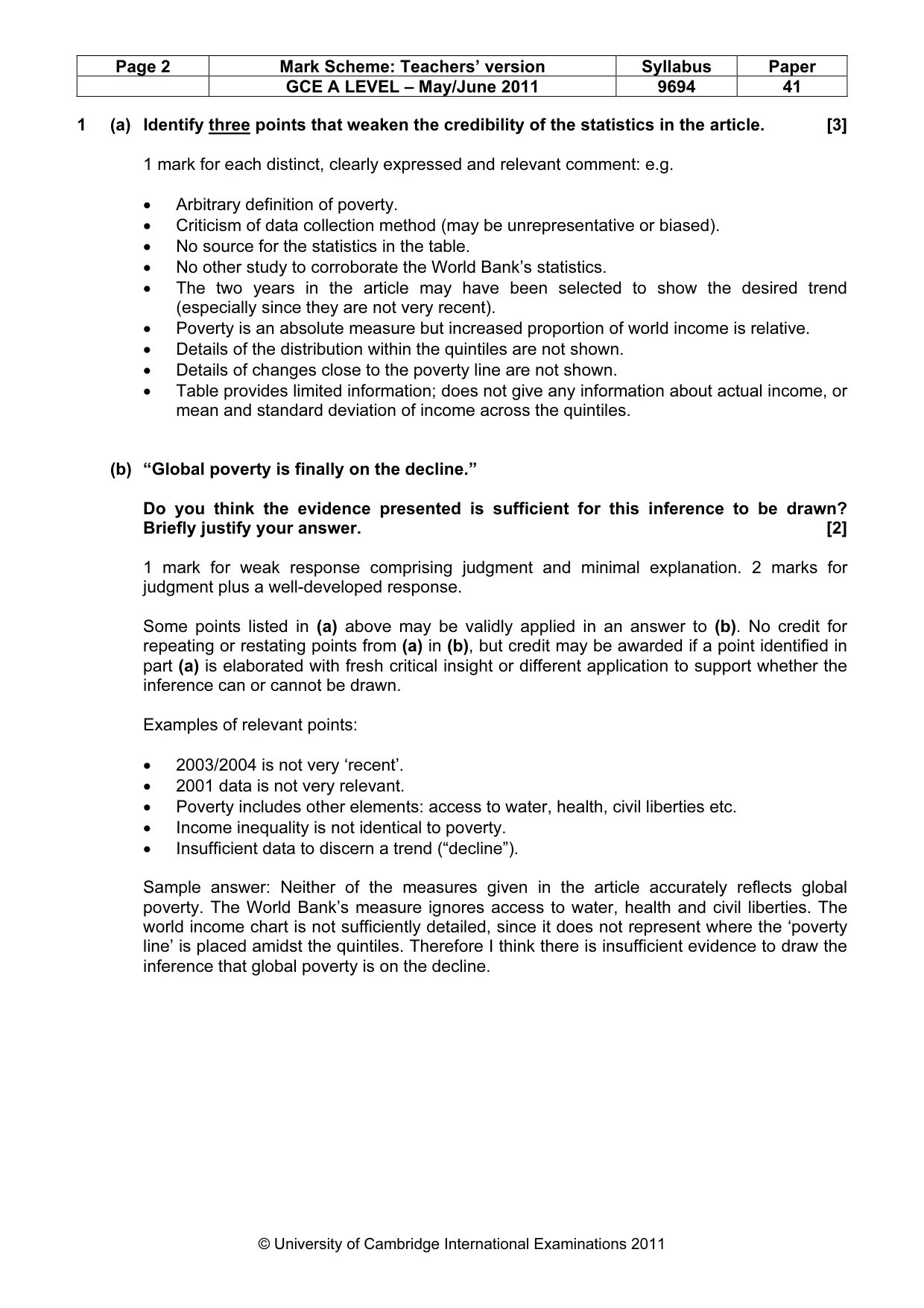
Page 2 Mark Scheme: Teachers’ version Syllabus Paper GCE A LEVEL – May/June 2011 9694 41 © University of Cambridge International Examinations 2011 1 (a) Identify three points that weaken the credibility of the statistics in the article. [3] 1 mark for each distinct, clearly expressed and relevant comment: e.g. • Arbitrary definition of poverty. • Criticism of data collection method (may be unrepresentative or biased). • No source for the statistics in the table. • No other study to corroborate the World Bank’s statistics. • The two years in the article may have been selected to show the desired trend (especially since they are not very recent). • Poverty is an absolute measure but increased proportion of world income is relative. • Details of the distribution within the quintiles are not shown. • Details of changes close to the poverty line are not shown. • Table provides limited information; does not give any information about actual income, or mean and standard deviation of income across the quintiles. (b) “Global poverty is finally on the decline.” Do you think the evidence presented is sufficient for this inference to be drawn? Briefly justify your answer. [2] 1 mark for weak response comprising judgment and minimal explanation. 2 marks for judgment plus a well-developed response. Some points listed in (a) above may be validly applied in an answer to (b). No credit for repeating or restating points from (a) in (b), but credit may be awarded if a point identified in part (a) is elaborated with fresh critical insight or different application to support whether the inference can or cannot be drawn. Examples of relevant points: • 2003/2004 is not very ‘recent’. • 2001 data is not very relevant. • Poverty includes other elements: access to water, health, civil liberties etc. • Income inequality is not identical to poverty. • Insufficient data to discern a trend (“decline”). Sample answer: Neither of the measures given in the article accurately reflects global poverty. The World Bank’s measure ignores access to water, health and civil liberties. The world income chart is not sufficiently detailed, since it does not represent where the ‘poverty line’ is placed amidst the quintiles. Therefore I think there is insufficient evidence to draw the inference that global poverty is on the decline.
Mark scheme, page 3
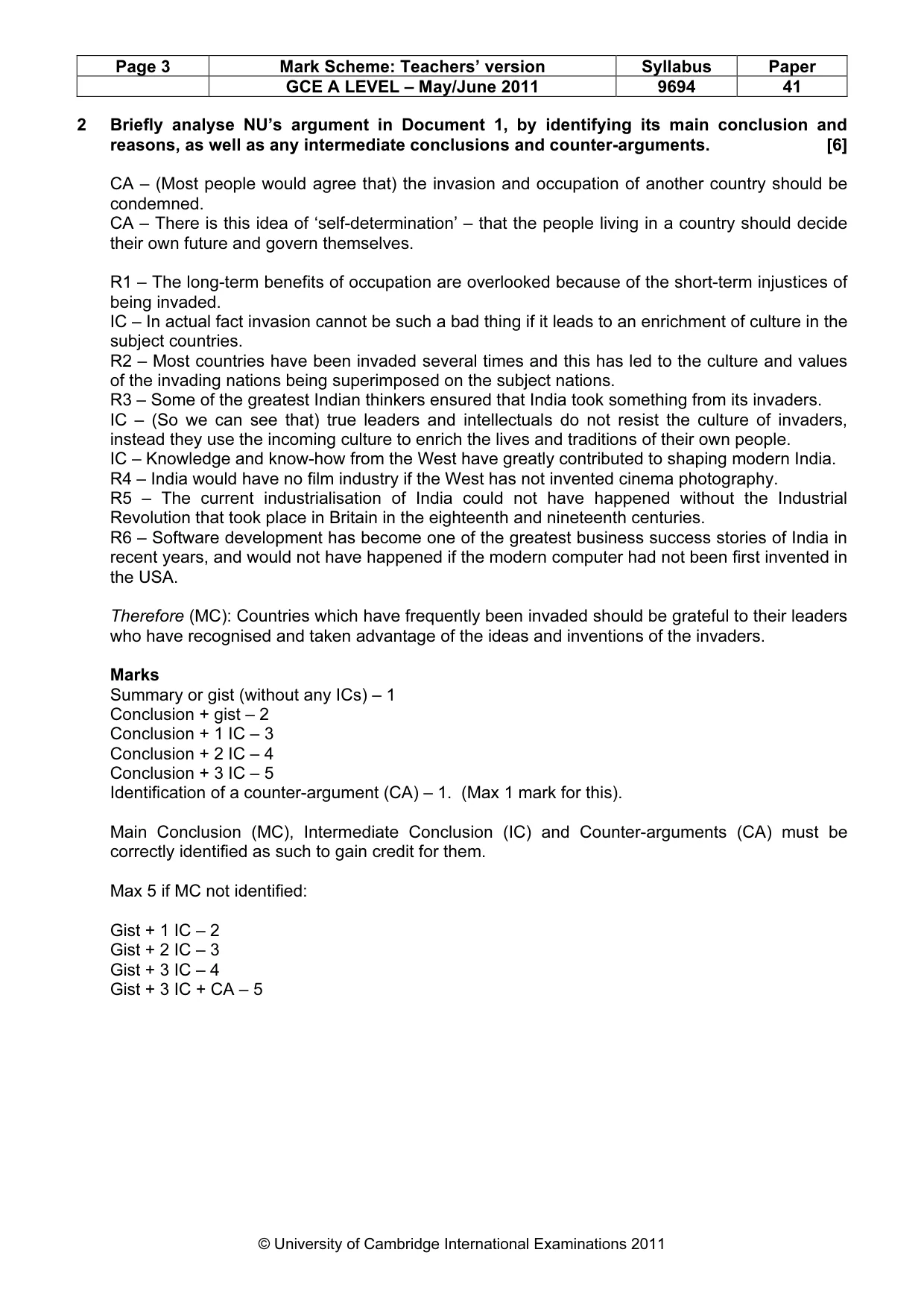
Page 3 Mark Scheme: Teachers’ version Syllabus Paper GCE A LEVEL – May/June 2011 9694 41 © University of Cambridge International Examinations 2011 2 Briefly analyse NU’s argument in Document 1, by identifying its main conclusion and reasons, as well as any intermediate conclusions and counter-arguments. [6] CA – (Most people would agree that) the invasion and occupation of another country should be condemned. CA – There is this idea of ‘self-determination’ – that the people living in a country should decide their own future and govern themselves. R1 – The long-term benefits of occupation are overlooked because of the short-term injustices of being invaded. IC – In actual fact invasion cannot be such a bad thing if it leads to an enrichment of culture in the subject countries. R2 – Most countries have been invaded several times and this has led to the culture and values of the invading nations being superimposed on the subject nations. R3 – Some of the greatest Indian thinkers ensured that India took something from its invaders. IC – (So we can see that) true leaders and intellectuals do not resist the culture of invaders, instead they use the incoming culture to enrich the lives and traditions of their own people. IC – Knowledge and know-how from the West have greatly contributed to shaping modern India. R4 – India would have no film industry if the West has not invented cinema photography. R5 – The current industrialisation of India could not have happened without the Industrial Revolution that took place in Britain in the eighteenth and nineteenth centuries. R6 – Software development has become one of the greatest business success stories of India in recent years, and would not have happened if the modern computer had not been first invented in the USA. Therefore (MC): Countries which have frequently been invaded should be grateful to their leaders who have recognised and taken advantage of the ideas and inventions of the invaders. Marks Summary or gist (without any ICs) – 1 Conclusion + gist – 2 Conclusion + 1 IC – 3 Conclusion + 2 IC – 4 Conclusion + 3 IC – 5 Identification of a counter-argument (CA) – 1. (Max 1 mark for this). Main Conclusion (MC), Intermediate Conclusion (IC) and Counter-arguments (CA) must be correctly identified as such to gain credit for them. Max 5 if MC not identified: Gist + 1 IC – 2 Gist + 2 IC – 3 Gist + 3 IC – 4 Gist + 3 IC + CA – 5
Mark scheme, page 4
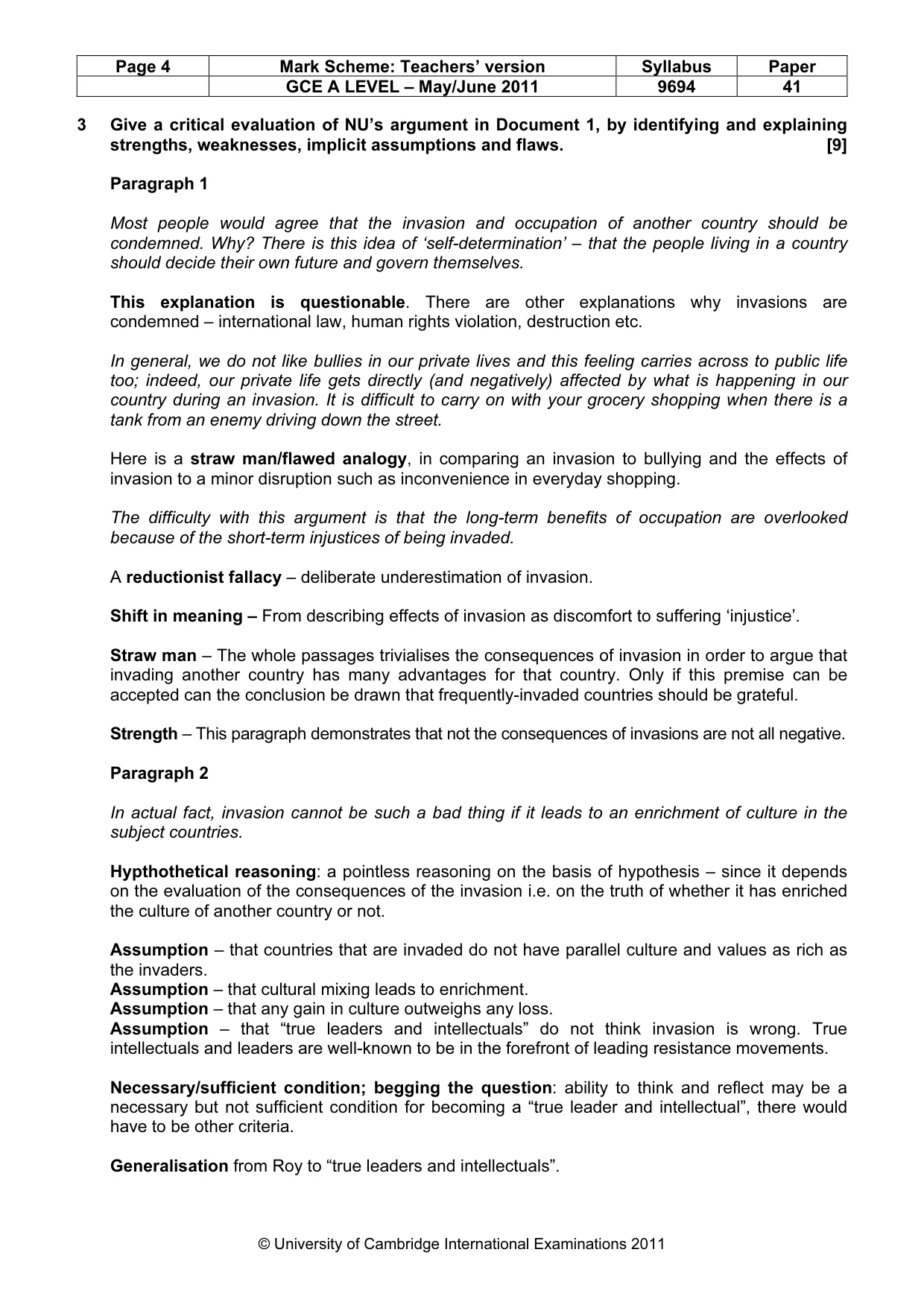
Page 4 Mark Scheme: Teachers’ version Syllabus Paper GCE A LEVEL – May/June 2011 9694 41 © University of Cambridge International Examinations 2011 3 Give a critical evaluation of NU’s argument in Document 1, by identifying and explaining strengths, weaknesses, implicit assumptions and flaws. [9] Paragraph 1 Most people would agree that the invasion and occupation of another country should be condemned. Why? There is this idea of ‘self-determination’ – that the people living in a country should decide their own future and govern themselves. This explanation is questionable. There are other explanations why invasions are condemned – international law, human rights violation, destruction etc. In general, we do not like bullies in our private lives and this feeling carries across to public life too; indeed, our private life gets directly (and negatively) affected by what is happening in our country during an invasion. It is difficult to carry on with your grocery shopping when there is a tank from an enemy driving down the street. Here is a straw man/flawed analogy, in comparing an invasion to bullying and the effects of invasion to a minor disruption such as inconvenience in everyday shopping. The difficulty with this argument is that the long-term benefits of occupation are overlooked because of the short-term injustices of being invaded. A reductionist fallacy – deliberate underestimation of invasion. Shift in meaning – From describing effects of invasion as discomfort to suffering ‘injustice’. Straw man – The whole passages trivialises the consequences of invasion in order to argue that invading another country has many advantages for that country. Only if this premise can be accepted can the conclusion be drawn that frequently-invaded countries should be grateful. Strength – This paragraph demonstrates that not the consequences of invasions are not all negative. Paragraph 2 In actual fact, invasion cannot be such a bad thing if it leads to an enrichment of culture in the subject countries. Hypthothetical reasoning: a pointless reasoning on the basis of hypothesis – since it depends on the evaluation of the consequences of the invasion i.e. on the truth of whether it has enriched the culture of another country or not. Assumption – that countries that are invaded do not have parallel culture and values as rich as the invaders. Assumption – that cultural mixing leads to enrichment. Assumption – that any gain in culture outweighs any loss. Assumption – that “true leaders and intellectuals” do not think invasion is wrong. True intellectuals and leaders are well-known to be in the forefront of leading resistance movements. Necessary/sufficient condition; begging the question: ability to think and reflect may be a necessary but not sufficient condition for becoming a “true leader and intellectual”, there would have to be other criteria. Generalisation from Roy to “true leaders and intellectuals”.
Mark scheme, page 5
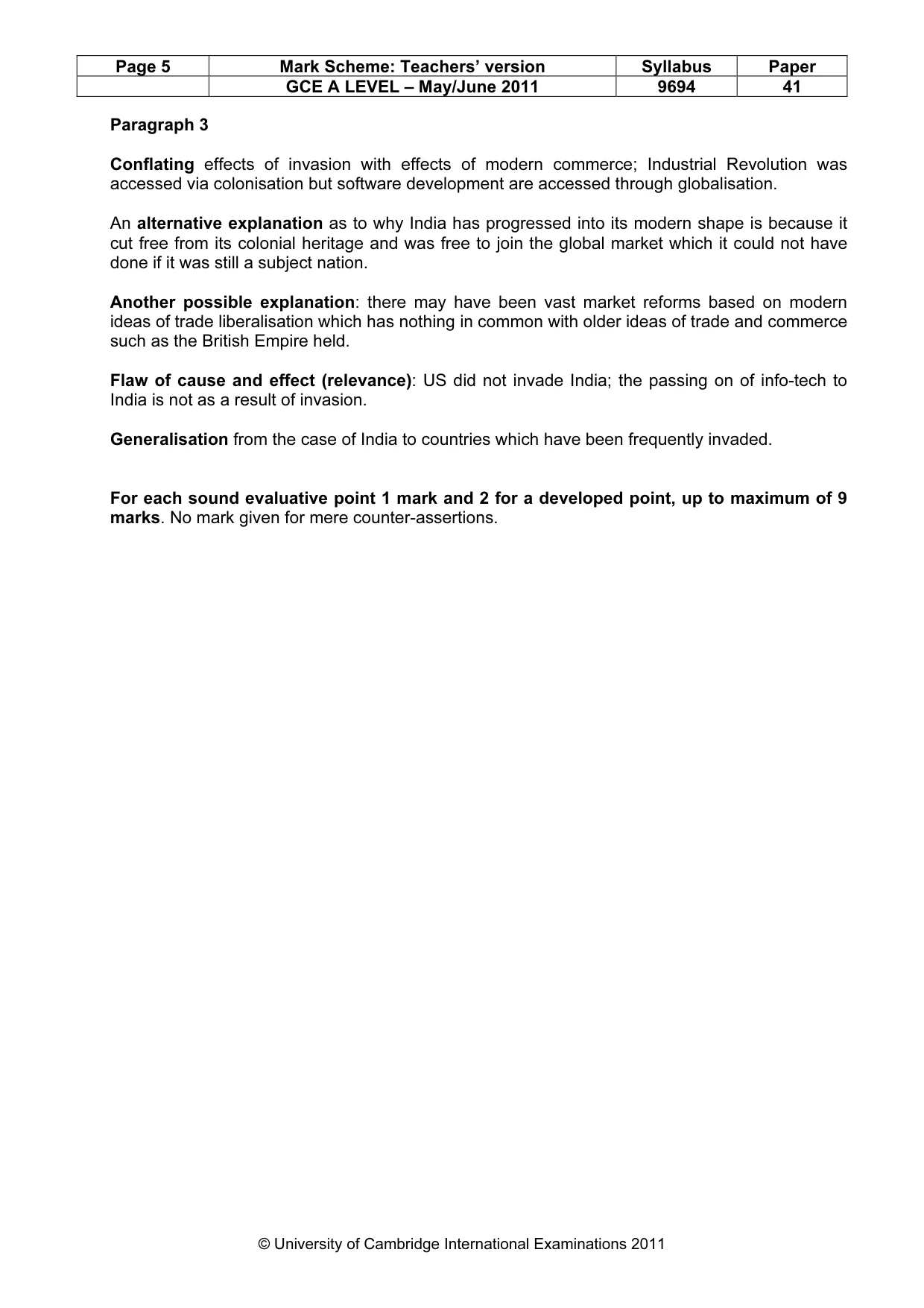
Page 5 Mark Scheme: Teachers’ version Syllabus Paper GCE A LEVEL – May/June 2011 9694 41 © University of Cambridge International Examinations 2011 Paragraph 3 Conflating effects of invasion with effects of modern commerce; Industrial Revolution was accessed via colonisation but software development are accessed through globalisation. An alternative explanation as to why India has progressed into its modern shape is because it cut free from its colonial heritage and was free to join the global market which it could not have done if it was still a subject nation. Another possible explanation: there may have been vast market reforms based on modern ideas of trade liberalisation which has nothing in common with older ideas of trade and commerce such as the British Empire held. Flaw of cause and effect (relevance): US did not invade India; the passing on of info-tech to India is not as a result of invasion. Generalisation from the case of India to countries which have been frequently invaded. For each sound evaluative point 1 mark and 2 for a developed point, up to maximum of 9 marks. No mark given for mere counter-assertions.
Mark scheme, page 6
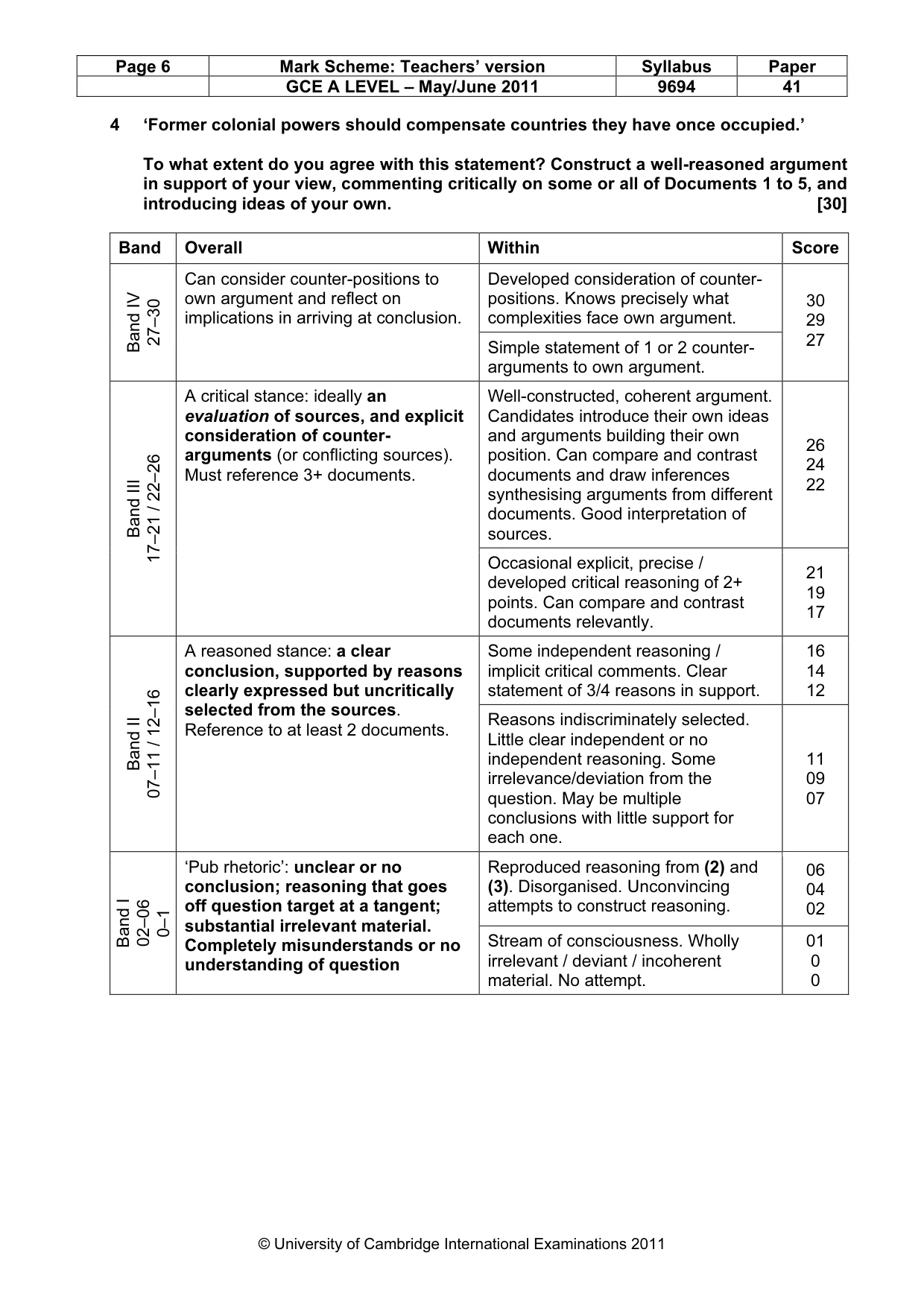
Page 6 Mark Scheme: Teachers’ version Syllabus Paper GCE A LEVEL – May/June 2011 9694 41 © University of Cambridge International Examinations 2011 4 ‘Former colonial powers should compensate countries they have once occupied.’ To what extent do you agree with this statement? Construct a well-reasoned argument in support of your view, commenting critically on some or all of Documents 1 to 5, and introducing ideas of your own. [30] Band Overall Within Score Developed consideration of counter- positions. Knows precisely what complexities face own argument. Band IV 27–30 Can consider counter-positions to own argument and reflect on implications in arriving at conclusion. Simple statement of 1 or 2 counter- arguments to own argument. 30 29 27 Well-constructed, coherent argument. Candidates introduce their own ideas and arguments building their own position. Can compare and contrast documents and draw inferences synthesising arguments from different documents. Good interpretation of sources. 26 24 22 Band III 17–21 / 22–26 A critical stance: ideally an evaluation of sources, and explicit consideration of counter- arguments (or conflicting sources). Must reference 3+ documents. Occasional explicit, precise / developed critical reasoning of 2+ points. Can compare and contrast documents relevantly. 21 19 17 Some independent reasoning / implicit critical comments. Clear statement of 3/4 reasons in support. 16 14 12 Band II 07–11 / 12–16 A reasoned stance: a clear conclusion, supported by reasons clearly expressed but uncritically selected from the sources. Reference to at least 2 documents. Reasons indiscriminately selected. Little clear independent or no independent reasoning. Some irrelevance/deviation from the question. May be multiple conclusions with little support for each one. 11 09 07 Reproduced reasoning from (2) and (3). Disorganised. Unconvincing attempts to construct reasoning. 06 04 02 Band I 02–06 0–1 ‘Pub rhetoric’: unclear or no conclusion; reasoning that goes off question target at a tangent; substantial irrelevant material. Completely misunderstands or no understanding of question Stream of consciousness. Wholly irrelevant / deviant / incoherent material. No attempt. 01 0 0
What you needed in this session
Cambridge’s own grade thresholds for 2011 May/June, Paper 4 · Variant 1. A higher threshold means an easier paper — the bar moves with how the cohort did.