Cambridge A Level Thinking Skills 9694 — 2010 Oct/Nov Paper 4 · Variant 3
9694/43/O/N/10 · 50 marks · ≈56 min
The question paper and its mark scheme, free to read here and free to download. This is Cambridge’s own paper, exactly as it was sat.
Question paper12 pages


Mark scheme10 pages
Answers below. Sit the paper first if you are practising.
Paper as text
Question paper, page 1
This document consists of 10 printed pages and 2 blank pages. IB10 11_9694_43/FP © UCLES 2010 [Turn over *3345430742* UNIVERSITY OF CAMBRIDGE INTERNATIONAL EXAMINATIONS General Certificate of Education Advanced Level THINKING SKILLS 9694/43 Paper 4 Applied Reasoning October/November 2010 1 hour and 30 minutes Additional Materials: Answer Booklet/Paper READ THESE INSTRUCTIONS FIRST If you have been given an Answer Booklet, follow the instructions on the front cover of the booklet. Write your Centre number, candidate number and name on all the work you hand in. Write in dark blue or black pen. Do not use staples, paper clips, highlighters, glue or correction fluid. DO NOT WRITE ON ANY BARCODES Electronic calculators should be used. Answer all the questions. Start each question on a new answer sheet. At the end of the examination, fasten all your work securely together. The number of marks is given in brackets [ ] at the end of each question.
Question paper, page 2
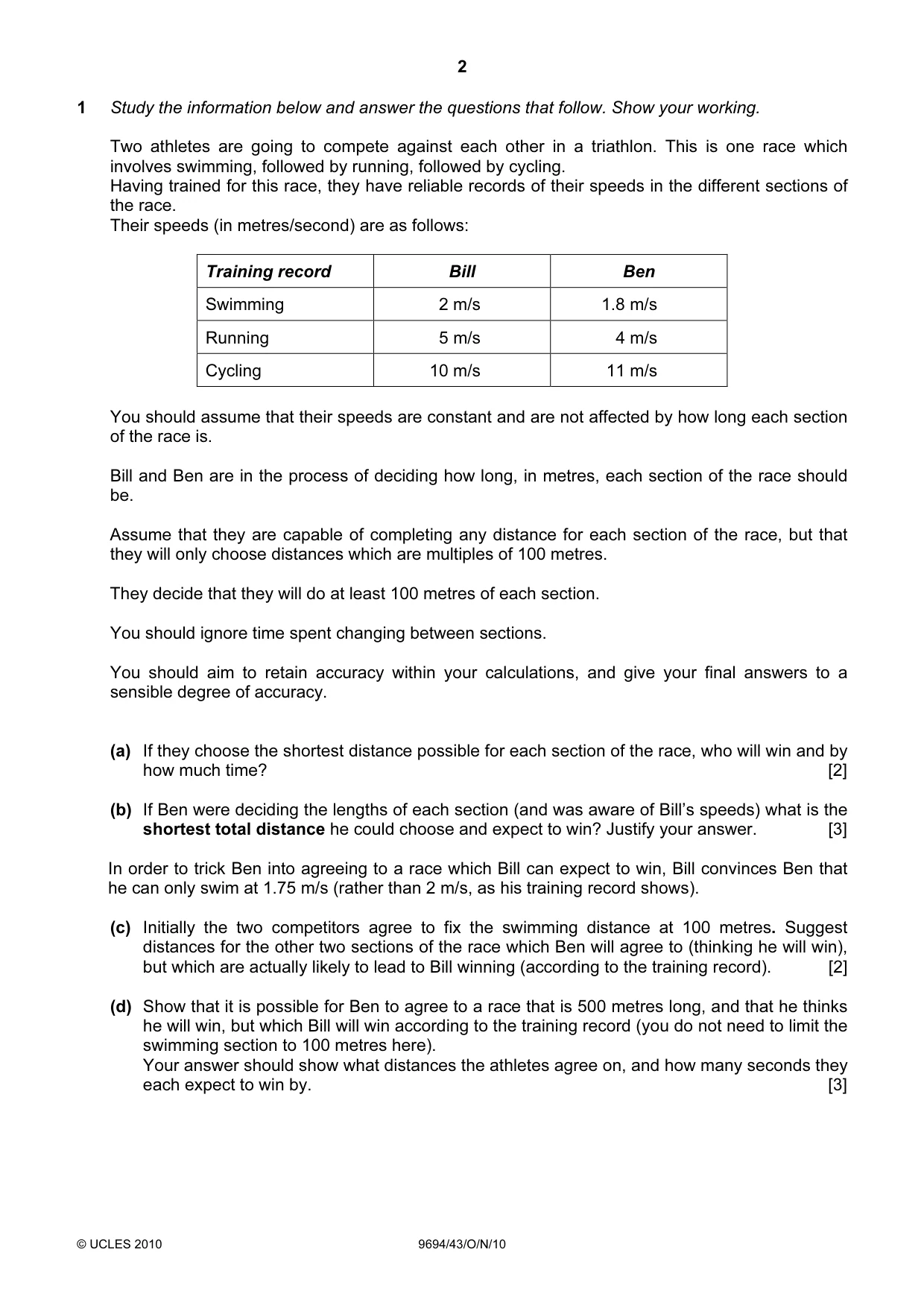
2 © UCLES 2010 9694/43/O/N/10 1 Study the information below and answer the questions that follow. Show your working. Two athletes are going to compete against each other in a triathlon. This is one race which involves swimming, followed by running, followed by cycling. Having trained for this race, they have reliable records of their speeds in the different sections of the race. Their speeds (in metres/second) are as follows: Training record Bill Ben Swimming 2 m/s 1.8 m/s Running 5 m/s 4 m/s Cycling 10 m/s 11 m/s You should assume that their speeds are constant and are not affected by how long each section of the race is. Bill and Ben are in the process of deciding how long, in metres, each section of the race should be. Assume that they are capable of completing any distance for each section of the race, but that they will only choose distances which are multiples of 100 metres. They decide that they will do at least 100 metres of each section. You should ignore time spent changing between sections. You should aim to retain accuracy within your calculations, and give your final answers to a sensible degree of accuracy. (a) If they choose the shortest distance possible for each section of the race, who will win and by how much time? [2] (b) If Ben were deciding the lengths of each section (and was aware of Bill’s speeds) what is the shortest total distance he could choose and expect to win? Justify your answer. [3] In order to trick Ben into agreeing to a race which Bill can expect to win, Bill convinces Ben that he can only swim at 1.75 m/s (rather than 2 m/s, as his training record shows). (c) Initially the two competitors agree to fix the swimming distance at 100 metres. Suggest distances for the other two sections of the race which Ben will agree to (thinking he will win), but which are actually likely to lead to Bill winning (according to the training record). [2] (d) Show that it is possible for Ben to agree to a race that is 500 metres long, and that he thinks he will win, but which Bill will win according to the training record (you do not need to limit the swimming section to 100 metres here). Your answer should show what distances the athletes agree on, and how many seconds they each expect to win by. [3]
Question paper, page 3
3 © UCLES 2010 9694/43/O/N/10 [Turn over BLANK PAGE [Question 2 is printed on the next page]
Question paper, page 4
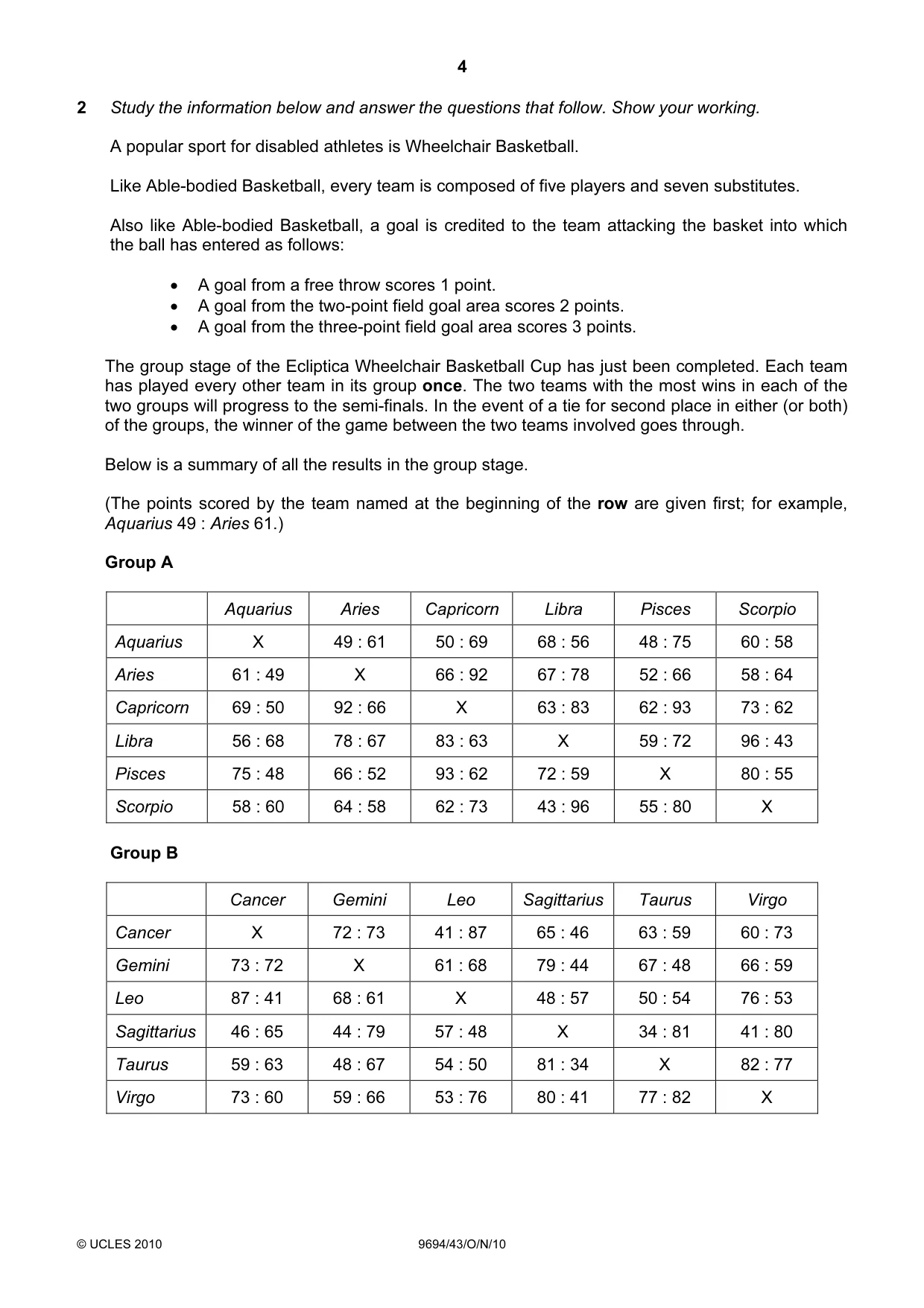
4 © UCLES 2010 9694/43/O/N/10 2 Study the information below and answer the questions that follow. Show your working. A popular sport for disabled athletes is Wheelchair Basketball. Like Able-bodied Basketball, every team is composed of five players and seven substitutes. Also like Able-bodied Basketball, a goal is credited to the team attacking the basket into which the ball has entered as follows: • A goal from a free throw scores 1 point. • A goal from the two-point field goal area scores 2 points. • A goal from the three-point field goal area scores 3 points. The group stage of the Ecliptica Wheelchair Basketball Cup has just been completed. Each team has played every other team in its group once. The two teams with the most wins in each of the two groups will progress to the semi-finals. In the event of a tie for second place in either (or both) of the groups, the winner of the game between the two teams involved goes through. Below is a summary of all the results in the group stage. (The points scored by the team named at the beginning of the row are given first; for example, Aquarius 49 : Aries 61.) Group A Aquarius Aries Capricorn Libra Pisces Scorpio Aquarius X 49 : 61 50 : 69 68 : 56 48 : 75 60 : 58 Aries 61 : 49 X 66 : 92 67 : 78 52 : 66 58 : 64 Capricorn 69 : 50 92 : 66 X 63 : 83 62 : 93 73 : 62 Libra 56 : 68 78 : 67 83 : 63 X 59 : 72 96 : 43 Pisces 75 : 48 66 : 52 93 : 62 72 : 59 X 80 : 55 Scorpio 58 : 60 64 : 58 62 : 73 43 : 96 55 : 80 X Group B Cancer Gemini Leo Sagittarius Taurus Virgo Cancer X 72 : 73 41 : 87 65 : 46 63 : 59 60 : 73 Gemini 73 : 72 X 61 : 68 79 : 44 67 : 48 66 : 59 Leo 87 : 41 68 : 61 X 48 : 57 50 : 54 76 : 53 Sagittarius 46 : 65 44 : 79 57 : 48 X 34 : 81 41 : 80 Taurus 59 : 63 48 : 67 54 : 50 81 : 34 X 82 : 77 Virgo 73 : 60 59 : 66 53 : 76 80 : 41 77 : 82 X
Question paper, page 5
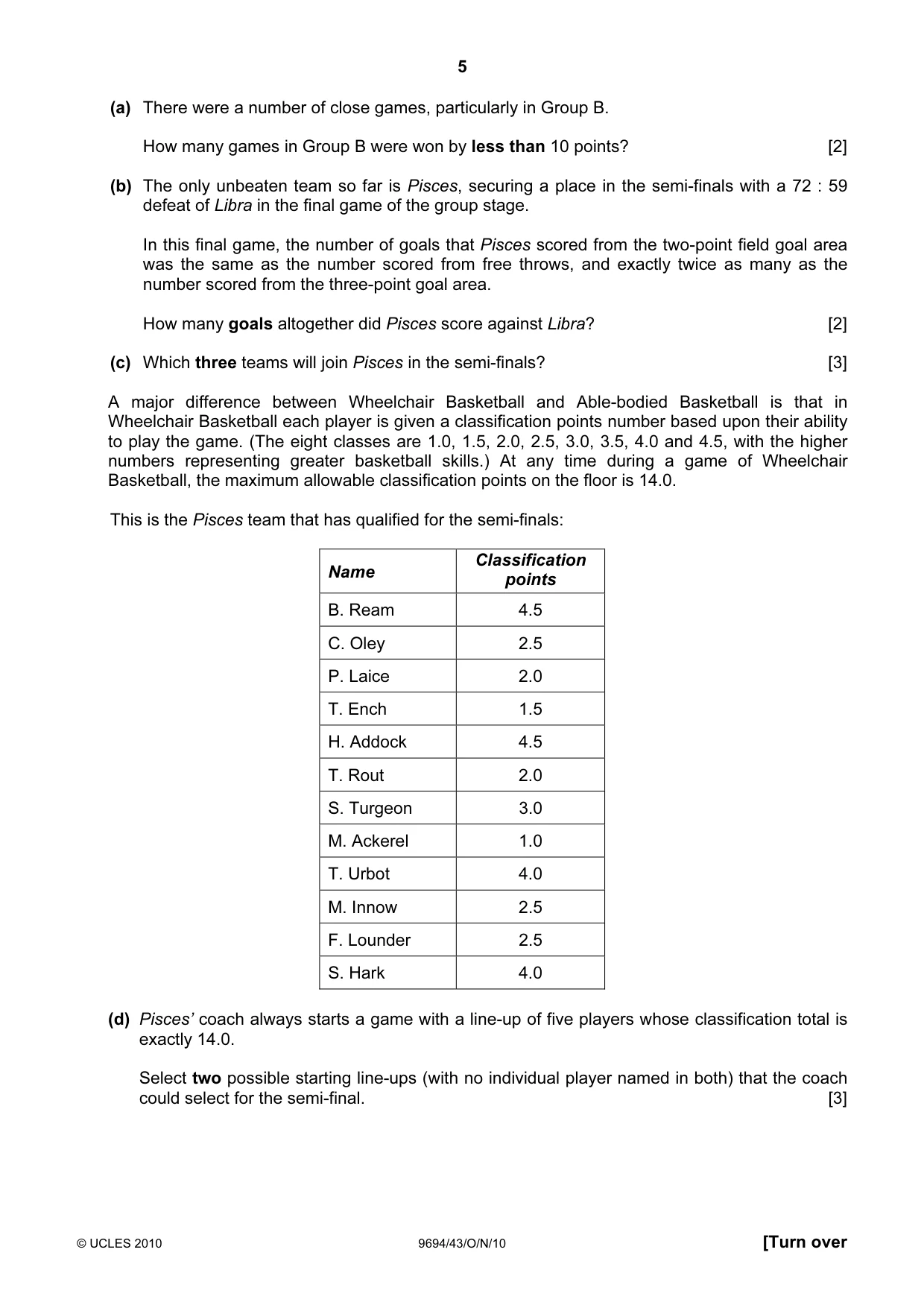
5 © UCLES 2010 9694/43/O/N/10 [Turn over (a) There were a number of close games, particularly in Group B. How many games in Group B were won by less than 10 points? [2] (b) The only unbeaten team so far is Pisces, securing a place in the semi-finals with a 72 : 59 defeat of Libra in the final game of the group stage. In this final game, the number of goals that Pisces scored from the two-point field goal area was the same as the number scored from free throws, and exactly twice as many as the number scored from the three-point goal area. How many goals altogether did Pisces score against Libra? [2] (c) Which three teams will join Pisces in the semi-finals? [3] A major difference between Wheelchair Basketball and Able-bodied Basketball is that in Wheelchair Basketball each player is given a classification points number based upon their ability to play the game. (The eight classes are 1.0, 1.5, 2.0, 2.5, 3.0, 3.5, 4.0 and 4.5, with the higher numbers representing greater basketball skills.) At any time during a game of Wheelchair Basketball, the maximum allowable classification points on the floor is 14.0. This is the Pisces team that has qualified for the semi-finals: Name Classification points B. Ream 4.5 C. Oley 2.5 P. Laice 2.0 T. Ench 1.5 H. Addock 4.5 T. Rout 2.0 S. Turgeon 3.0 M. Ackerel 1.0 T. Urbot 4.0 M. Innow 2.5 F. Lounder 2.5 S. Hark 4.0 (d) Pisces’ coach always starts a game with a line-up of five players whose classification total is exactly 14.0. Select two possible starting line-ups (with no individual player named in both) that the coach could select for the semi-final. [3]
Question paper, page 6
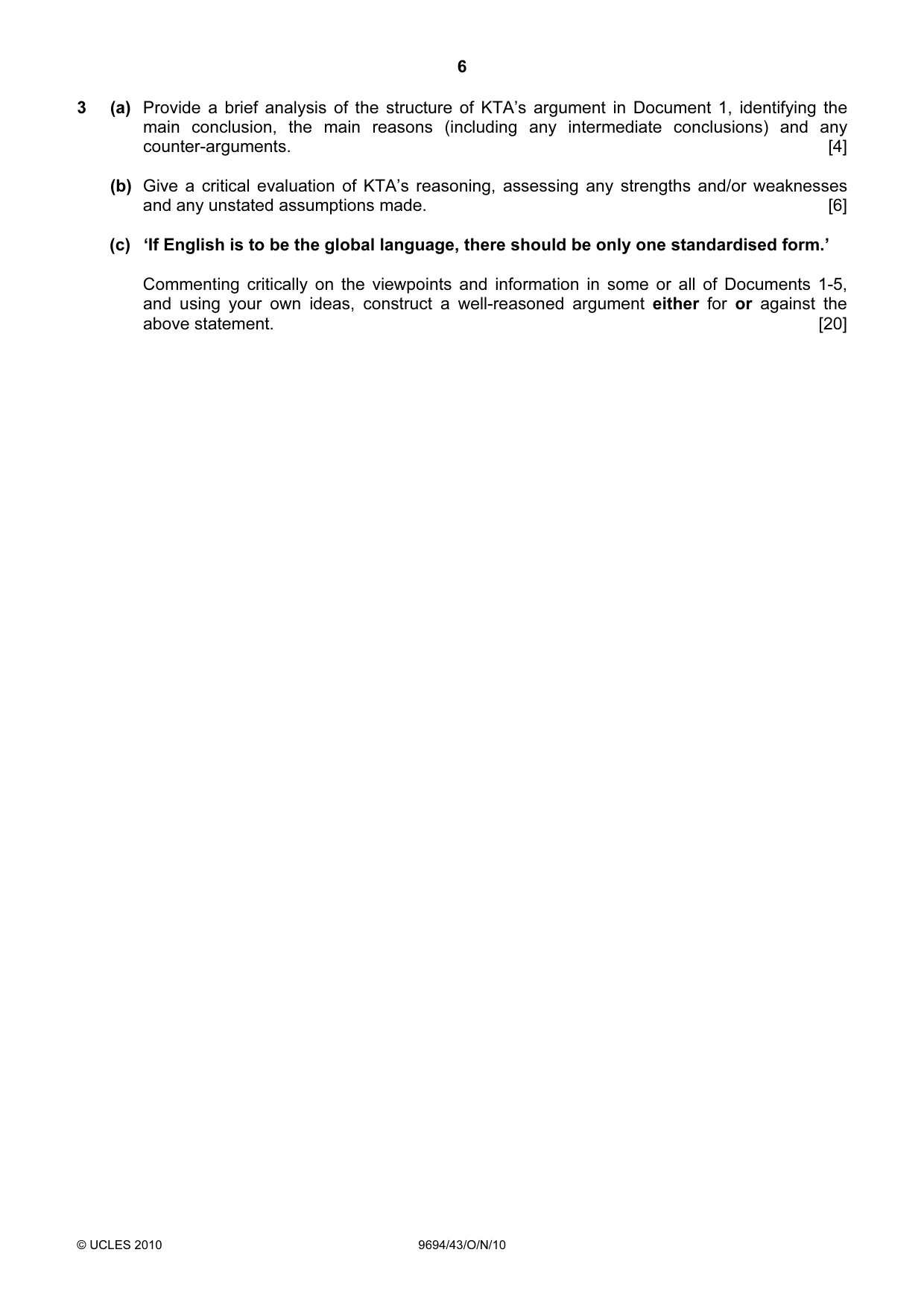
6 © UCLES 2010 9694/43/O/N/10 3 (a) Provide a brief analysis of the structure of KTA’s argument in Document 1, identifying the main conclusion, the main reasons (including any intermediate conclusions) and any counter-arguments. [4] (b) Give a critical evaluation of KTA’s reasoning, assessing any strengths and/or weaknesses and any unstated assumptions made. [6] (c) ‘If English is to be the global language, there should be only one standardised form.’ Commenting critically on the viewpoints and information in some or all of Documents 1-5, and using your own ideas, construct a well-reasoned argument either for or against the above statement. [20]
Question paper, page 7
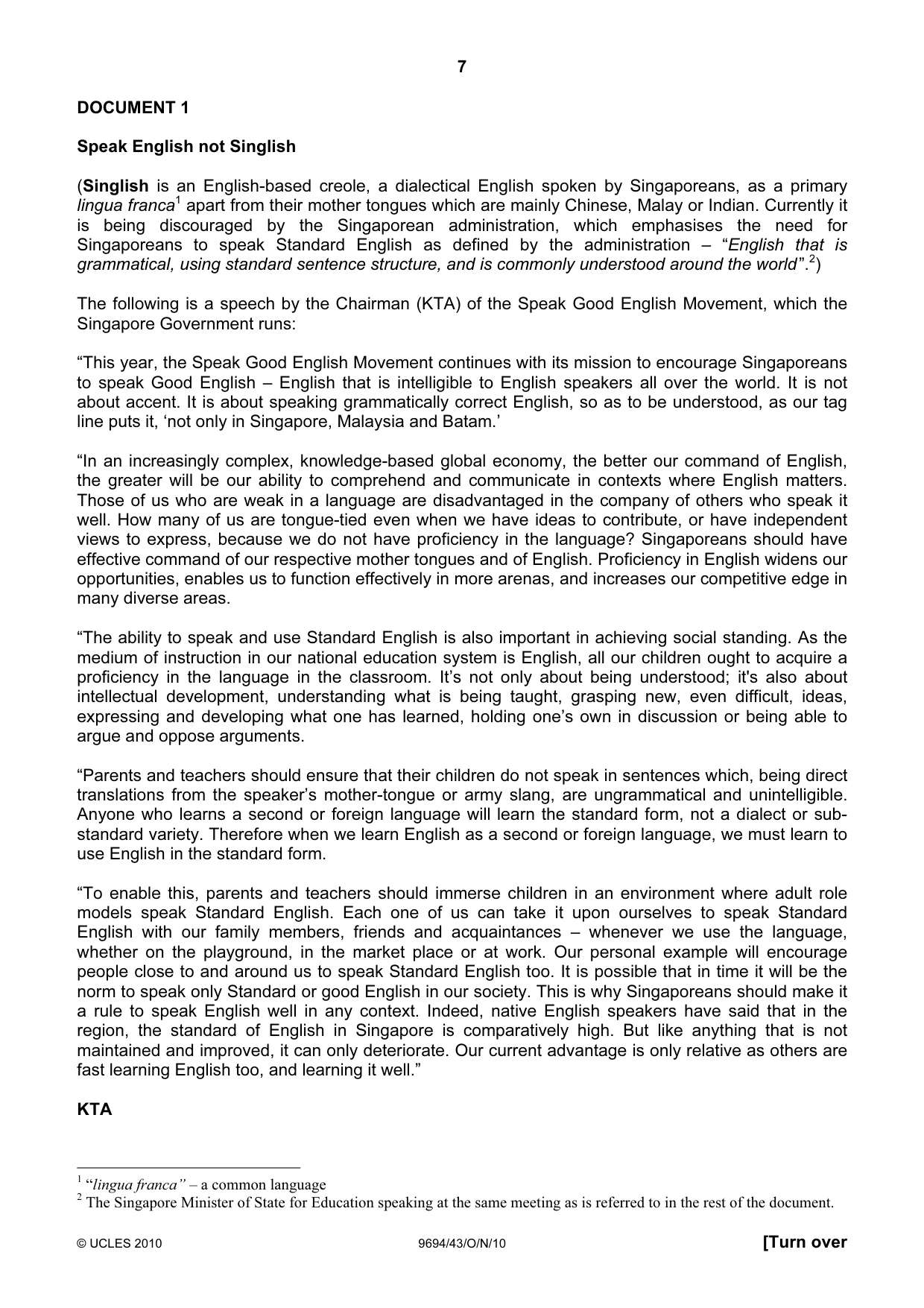
7 © UCLES 2010 9694/43/O/N/10 [Turn over DOCUMENT 1 Speak English not Singlish (Singlish is an English-based creole, a dialectical English spoken by Singaporeans, as a primary lingua franca1 apart from their mother tongues which are mainly Chinese, Malay or Indian. Currently it is being discouraged by the Singaporean administration, which emphasises the need for Singaporeans to speak Standard English as defined by the administration – “English that is grammatical, using standard sentence structure, and is commonly understood around the world ”.2) The following is a speech by the Chairman (KTA) of the Speak Good English Movement, which the Singapore Government runs: “This year, the Speak Good English Movement continues with its mission to encourage Singaporeans to speak Good English – English that is intelligible to English speakers all over the world. It is not about accent. It is about speaking grammatically correct English, so as to be understood, as our tag line puts it, ‘not only in Singapore, Malaysia and Batam.’ “In an increasingly complex, knowledge-based global economy, the better our command of English, the greater will be our ability to comprehend and communicate in contexts where English matters. Those of us who are weak in a language are disadvantaged in the company of others who speak it well. How many of us are tongue-tied even when we have ideas to contribute, or have independent views to express, because we do not have proficiency in the language? Singaporeans should have effective command of our respective mother tongues and of English. Proficiency in English widens our opportunities, enables us to function effectively in more arenas, and increases our competitive edge in many diverse areas. “The ability to speak and use Standard English is also important in achieving social standing. As the medium of instruction in our national education system is English, all our children ought to acquire a proficiency in the language in the classroom. It’s not only about being understood; it's also about intellectual development, understanding what is being taught, grasping new, even difficult, ideas, expressing and developing what one has learned, holding one’s own in discussion or being able to argue and oppose arguments. “Parents and teachers should ensure that their children do not speak in sentences which, being direct translations from the speaker’s mother-tongue or army slang, are ungrammatical and unintelligible. Anyone who learns a second or foreign language will learn the standard form, not a dialect or sub- standard variety. Therefore when we learn English as a second or foreign language, we must learn to use English in the standard form. “To enable this, parents and teachers should immerse children in an environment where adult role models speak Standard English. Each one of us can take it upon ourselves to speak Standard English with our family members, friends and acquaintances – whenever we use the language, whether on the playground, in the market place or at work. Our personal example will encourage people close to and around us to speak Standard English too. It is possible that in time it will be the norm to speak only Standard or good English in our society. This is why Singaporeans should make it a rule to speak English well in any context. Indeed, native English speakers have said that in the region, the standard of English in Singapore is comparatively high. But like anything that is not maintained and improved, it can only deteriorate. Our current advantage is only relative as others are fast learning English too, and learning it well.” KTA 1 “lingua franca” – a common language 2 The Singapore Minister of State for Education speaking at the same meeting as is referred to in the rest of the document.
Question paper, page 8
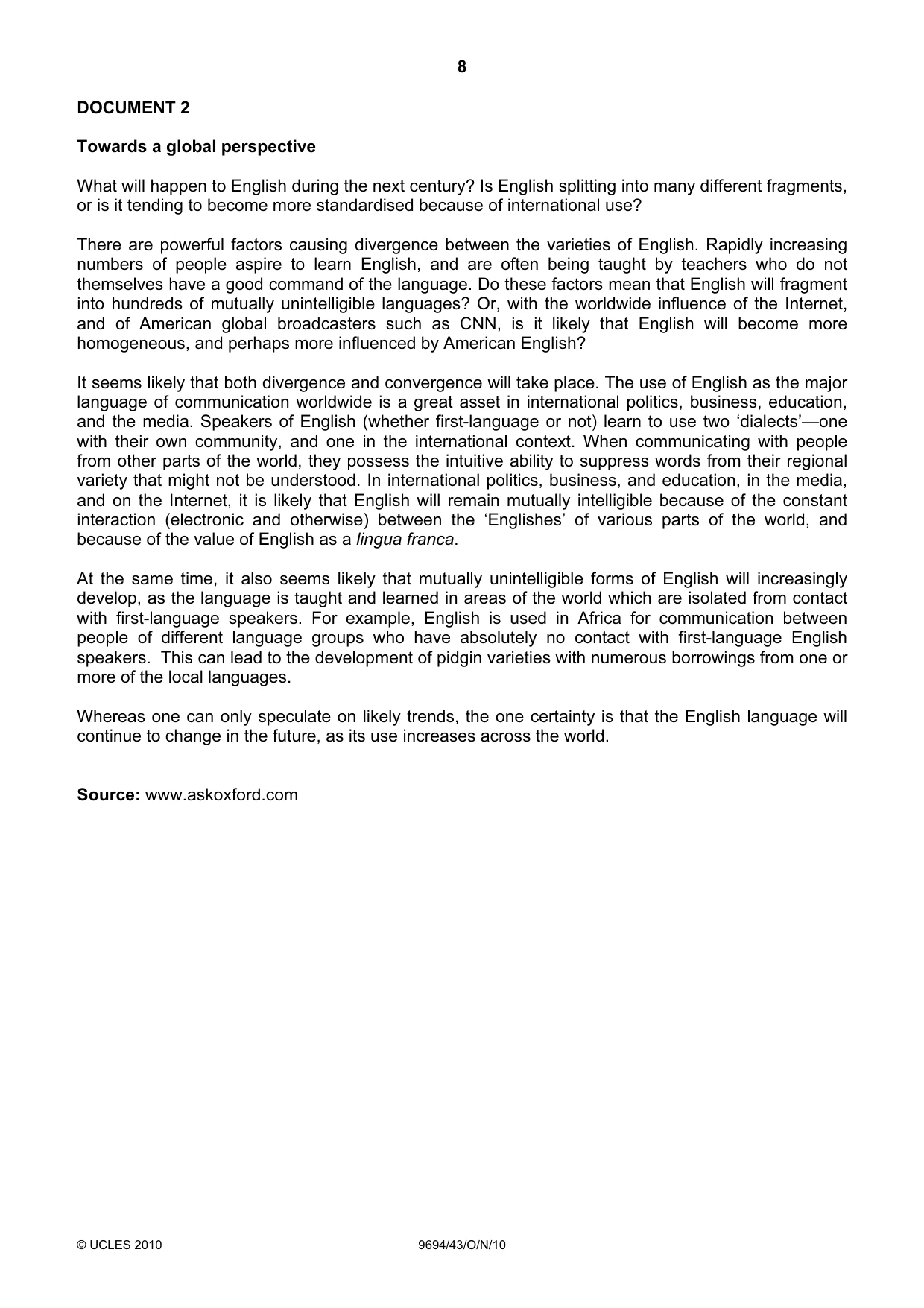
8 © UCLES 2010 9694/43/O/N/10 DOCUMENT 2 Towards a global perspective What will happen to English during the next century? Is English splitting into many different fragments, or is it tending to become more standardised because of international use? There are powerful factors causing divergence between the varieties of English. Rapidly increasing numbers of people aspire to learn English, and are often being taught by teachers who do not themselves have a good command of the language. Do these factors mean that English will fragment into hundreds of mutually unintelligible languages? Or, with the worldwide influence of the Internet, and of American global broadcasters such as CNN, is it likely that English will become more homogeneous, and perhaps more influenced by American English? It seems likely that both divergence and convergence will take place. The use of English as the major language of communication worldwide is a great asset in international politics, business, education, and the media. Speakers of English (whether first-language or not) learn to use two ‘dialects’—one with their own community, and one in the international context. When communicating with people from other parts of the world, they possess the intuitive ability to suppress words from their regional variety that might not be understood. In international politics, business, and education, in the media, and on the Internet, it is likely that English will remain mutually intelligible because of the constant interaction (electronic and otherwise) between the ‘Englishes’ of various parts of the world, and because of the value of English as a lingua franca. At the same time, it also seems likely that mutually unintelligible forms of English will increasingly develop, as the language is taught and learned in areas of the world which are isolated from contact with first-language speakers. For example, English is used in Africa for communication between people of different language groups who have absolutely no contact with first-language English speakers. This can lead to the development of pidgin varieties with numerous borrowings from one or more of the local languages. Whereas one can only speculate on likely trends, the one certainty is that the English language will continue to change in the future, as its use increases across the world. Source: www.askoxford.com
Question paper, page 9
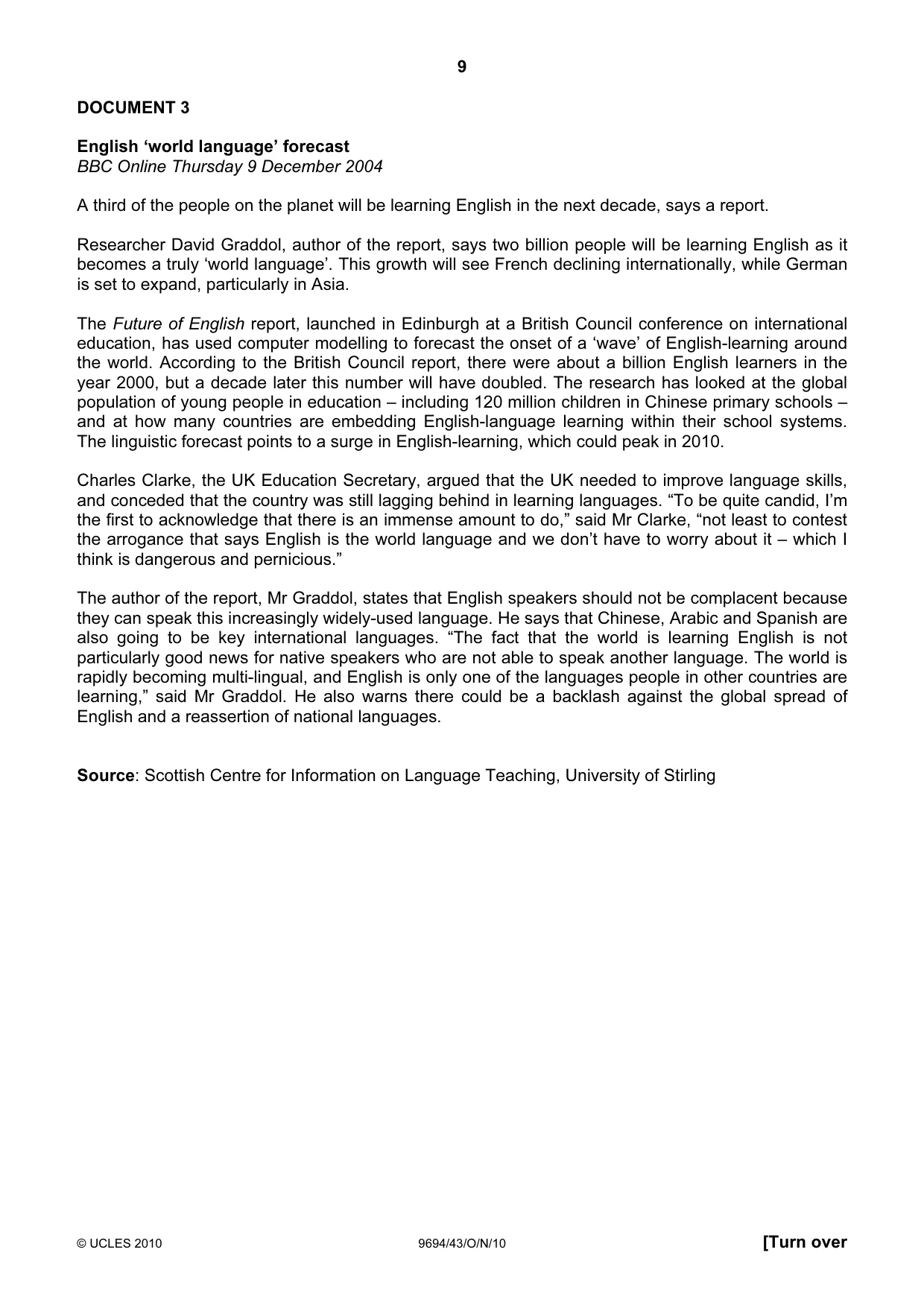
9 © UCLES 2010 9694/43/O/N/10 [Turn over DOCUMENT 3 English ‘world language’ forecast BBC Online Thursday 9 December 2004 A third of the people on the planet will be learning English in the next decade, says a report. Researcher David Graddol, author of the report, says two billion people will be learning English as it becomes a truly ‘world language’. This growth will see French declining internationally, while German is set to expand, particularly in Asia. The Future of English report, launched in Edinburgh at a British Council conference on international education, has used computer modelling to forecast the onset of a ‘wave’ of English-learning around the world. According to the British Council report, there were about a billion English learners in the year 2000, but a decade later this number will have doubled. The research has looked at the global population of young people in education – including 120 million children in Chinese primary schools – and at how many countries are embedding English-language learning within their school systems. The linguistic forecast points to a surge in English-learning, which could peak in 2010. Charles Clarke, the UK Education Secretary, argued that the UK needed to improve language skills, and conceded that the country was still lagging behind in learning languages. “To be quite candid, I’m the first to acknowledge that there is an immense amount to do,” said Mr Clarke, “not least to contest the arrogance that says English is the world language and we don’t have to worry about it – which I think is dangerous and pernicious.” The author of the report, Mr Graddol, states that English speakers should not be complacent because they can speak this increasingly widely-used language. He says that Chinese, Arabic and Spanish are also going to be key international languages. “The fact that the world is learning English is not particularly good news for native speakers who are not able to speak another language. The world is rapidly becoming multi-lingual, and English is only one of the languages people in other countries are learning,” said Mr Graddol. He also warns there could be a backlash against the global spread of English and a reassertion of national languages. Source: Scottish Centre for Information on Language Teaching, University of Stirling
Question paper, page 10
10 © UCLES 2010 9694/43/O/N/10 DOCUMENT 4 Mother tongue “Cor lumme, wotcha no? A fowzan’ years af’er ’em blimmin’ Normans came an’ skroodup good ol’ Anglersaxern wiv ’em fancy froggy wurds an’ wotnot, peep’l are still get’n ’ot un’er the coller ’bow how we spee’ the muvver tung. Yeah, I’m tork’n ’bow nunuvavan the Queen’s Inglish innit. An’ yer know hoos in the fierin’ line now? Only ’Er Majerstee ’erself, gorblessa1.” (Translated: “God love me, what do you know? A thousand years after those blooming Normans came and screwed up good old Anglo-Saxon with those fancy French words and what not, people are still getting hot under the collar about how we speak the mother tongue. Yes, I’m talking about none other than the Queen’s English, isn’t it? And you know who is in the firing line now? Only Her Majesty herself, God bless her.”) It’s true. A professor of phonetics at the University of Munich has done a survey of all the Queen’s Christmas broadcasts. And guess what? He’s found that she has changed with the times. “Good grief,” some commentators are fuming, “what are we coming to? Is even the Queen’s English changing? Is this the end of civilisation as we know it?” And there’s worse. According to another professor of phonetics, UK teenagers today urgently need elocution lessons, because they speak so badly that employers can’t tell what they are saying. What’s really peculiar, though, is that radio and TV were supposed to make us all speak the same. That was Lord Reith’s aim when he started the BBC in 1922. He told his announcers to solve “the problem of spoken English” by devising “a common denominator of educated speech” that he expected everyone in Britain to adopt. That never happened, thank goodness. The sort of English that children speak is shaped much more by them listening to their peers and role models, rather than to perceived authority figures such as parents and newsreaders. Their refusal to speak as their mums and dads would wish is a way of asserting their own individuality. However, busybodies continue to make a moral issue over the ‘declining standards’ of spoken English. “If we can’t speak it right, we soon won’t be able to spell it, and then where will the language be?” the moaning minnies whinge. Well, when was English written as it was said? Spoken English has never been fixed and never will be. Some experts say that so-called ‘received pronunciation’ was probably never used by more than 3 percent of the population, even in the ‘good old days’. Old fogeys may complain about ‘innit’2. But in 50 years time I expect that ‘innit’ will be as OK as, well, ‘OK’. Nor should spoken English be fixed. Only dead languages are spoken in the same way decade after decade, like Latin and Ancient Greek. We should be overjoyed that English is fed with new words, dialects and accents from all over the world every day. It is nature’s way of keeping the old verbals3 fresh. Source: The Times (newspaper) 1 An example of common non-standard speech amongst Londoners known as ‘Cockney’. 2 A colloquial pronunciation of “isn’t it?” in the UK, especially in some inner cities. 3 “old verbals”: the way and form in which words are spoken.
Question paper, page 11
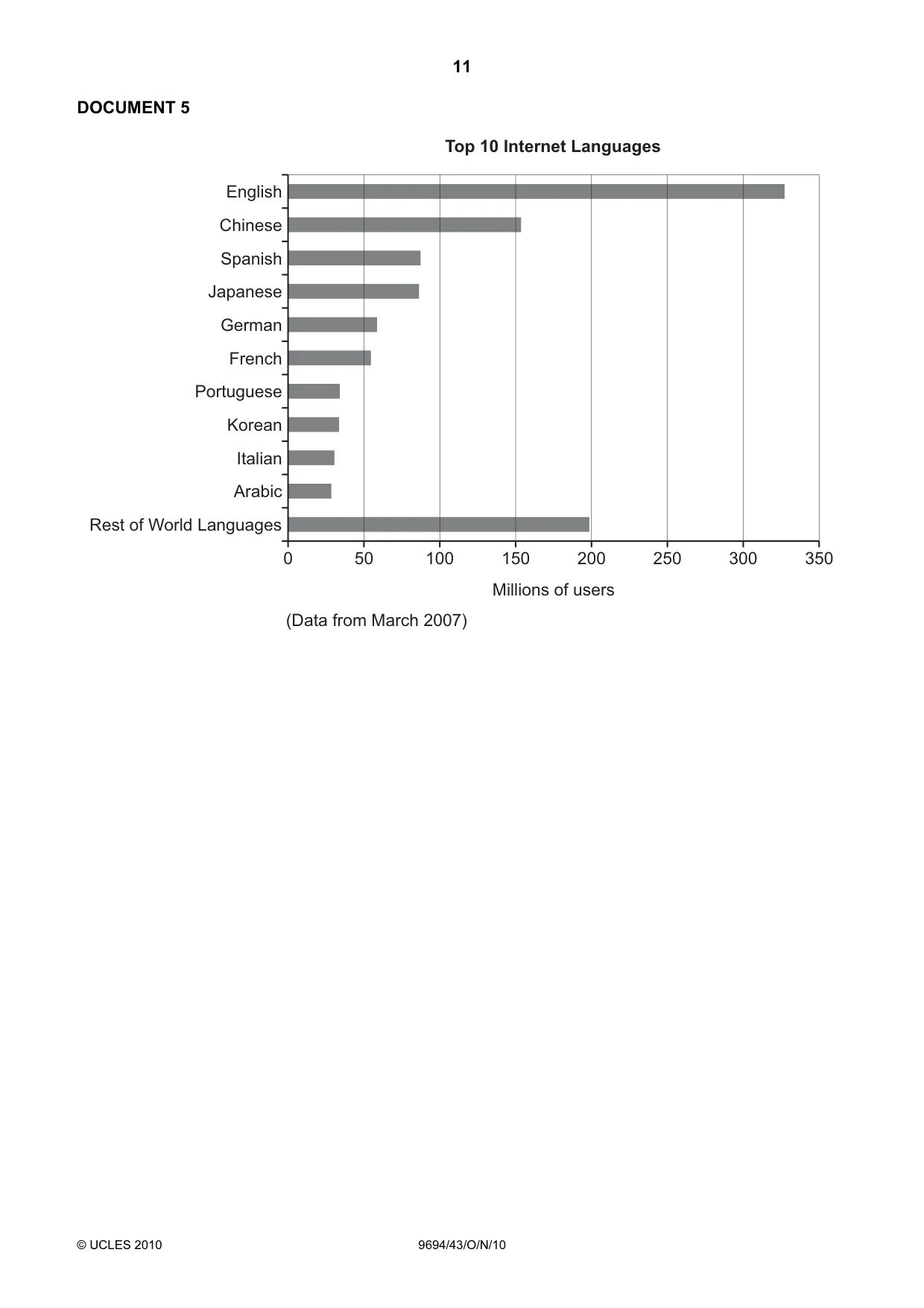
11 © UCLES 2010 9694/43/O/N/10 DOCUMENT 5 0 50 100 150 Millions of users Top 10 Internet Languages 200 250 300 350 English Chinese Spanish Japanese German French Portuguese Korean Italian Arabic Rest of World Languages (Data from March 2007)
Question paper, page 12
12 Copyright Acknowledgements: Document 1 Document 2 Document 3 Document 4 Document 5 © www.goodenglish.org.sg/site/press-room/incl; Singapore Good English Movement. © http://www.askoxford.com/globalenglish/?oceu=uk. © http://news.bbc.co.uk/1/hi/education/4080401.stm. © http://www.timesonline.co.uk/tol/comment/columnists/richard_morrison/article1089534.ece; 19 December 2006. © www.internetworldstats.com; 19 March 2007. Permission to reproduce items where third-party owned material protected by copyright is included has been sought and cleared where possible. Every reasonable effort has been made by the publisher (UCLES) to trace copyright holders, but if any items requiring clearance have unwittingly been included, the publisher will be pleased to make amends at the earliest possible opportunity. University of Cambridge International Examinations is part of the Cambridge Assessment Group. Cambridge Assessment is the brand name of University of Cambridge Local Examinations Syndicate (UCLES), which is itself a department of the University of Cambridge. © UCLES 2010 9694/43/O/N/10 BLANK PAGE
Mark scheme, page 1
UNIVERSITY OF CAMBRIDGE INTERNATIONAL EXAMINATIONS GCE Advanced Subsidiary Level and GCE Advanced Level MARK SCHEME for the October/November 2010 question paper for the guidance of teachers 9694 THINKING SKILLS 9694/43 Paper 4 (Applied Reasoning), maximum raw mark 50 This mark scheme is published as an aid to teachers and candidates, to indicate the requirements of the examination. It shows the basis on which Examiners were instructed to award marks. It does not indicate the details of the discussions that took place at an Examiners’ meeting before marking began, which would have considered the acceptability of alternative answers. Mark schemes must be read in conjunction with the question papers and the report on the examination. • CIE will not enter into discussions or correspondence in connection with these mark schemes. CIE is publishing the mark schemes for the October/November 2010 question papers for most IGCSE, GCE Advanced Level and Advanced Subsidiary Level syllabuses and some Ordinary Level syllabuses.
Mark scheme, page 2
Page 2 Mark Scheme: Teachers’ version Syllabus Paper GCE A/AS LEVEL – October/November 2010 9694 43 © UCLES 2010 1 (a) If they choose the shortest distance possible for each section of the race, who will win and by how much time? [2] Bill by 9.6 seconds [2]. Allow 9.64 recurring, or 9.65 seconds Working: Bill will take 80 seconds. Ben will take 89.6 seconds. So Bill will win by 9.6 seconds. 1 mark if they calculate the competitors’ times but not the appropriate difference, or 1 mark for an incorrect answer between 9 and 10 seconds (and the name given) with, e.g. Bill by 9.7 seconds. 1 mark for a correct answer but no name given. (b) If Ben were deciding the lengths of each section (and was aware of Bill’s speeds) what is the shortest total distance he could choose and expect to win? Justify your answer. [3] 1400 metres. Working: Ben minimising the sections he is worst at will run and swim 100 m. The minimum distance Ben must cycle to beat Bill overall is 1200 metres. Justification [one of the following]: I. If he cycles 1100 metres, their times are 180 seconds (for Bill) and 180.6 seconds (for Ben). If he cycles 1200 metres, their times are 190 seconds (for Bill) and 189.6 seconds (for Ben). II. Algebraically: if c is the length of cycling time, 50 + 20 + c/10 > 55.5… + 25 + c/11 c/10 – c/11 > 80.5… – 70 c/110 > 10.5… c > 1161.1…metres since c must be a multiple of 100, the minimum c = 1200 m. III. 10.55 seconds down after the running and swimming: he needs to make this up by cycling. He gains 0.91 seconds per 100 metres of cycling. 3 marks for the correct total distance + justification [either calculations for 1100 metres and 1200 metres shown, or an algebraic justification]. 2 marks for an unjustified, but correct answer. Deduct 1 mark if candidates give an answer of 1200 m [instead of 1400 m] 1 mark for a solution proposing 100 metres apiece for swimming and running, and a multiple of 100 m for cycling (e.g. 100 m swimming, 100 m running & 300 m cycling).
Mark scheme, page 3
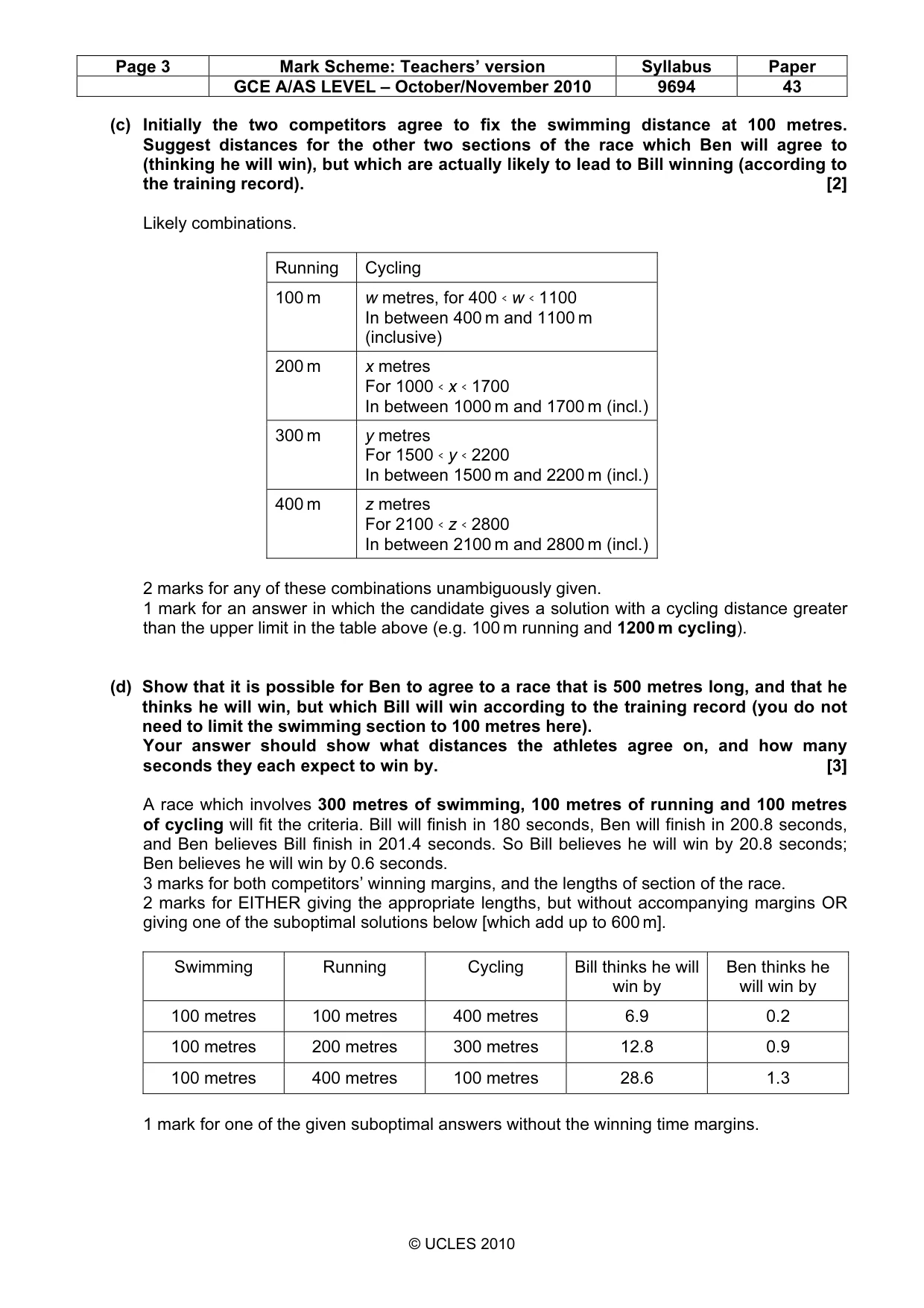
Page 3 Mark Scheme: Teachers’ version Syllabus Paper GCE A/AS LEVEL – October/November 2010 9694 43 © UCLES 2010 (c) Initially the two competitors agree to fix the swimming distance at 100 metres. Suggest distances for the other two sections of the race which Ben will agree to (thinking he will win), but which are actually likely to lead to Bill winning (according to the training record). [2] Likely combinations. Running Cycling 100 m w metres, for 400 < w < 1100 In between 400 m and 1100 m (inclusive) 200 m x metres For 1000 < x < 1700 In between 1000 m and 1700 m (incl.) 300 m y metres For 1500 < y < 2200 In between 1500 m and 2200 m (incl.) 400 m z metres For 2100 < z < 2800 In between 2100 m and 2800 m (incl.) 2 marks for any of these combinations unambiguously given. 1 mark for an answer in which the candidate gives a solution with a cycling distance greater than the upper limit in the table above (e.g. 100 m running and 1200 m cycling). (d) Show that it is possible for Ben to agree to a race that is 500 metres long, and that he thinks he will win, but which Bill will win according to the training record (you do not need to limit the swimming section to 100 metres here). Your answer should show what distances the athletes agree on, and how many seconds they each expect to win by. [3] A race which involves 300 metres of swimming, 100 metres of running and 100 metres of cycling will fit the criteria. Bill will finish in 180 seconds, Ben will finish in 200.8 seconds, and Ben believes Bill finish in 201.4 seconds. So Bill believes he will win by 20.8 seconds; Ben believes he will win by 0.6 seconds. 3 marks for both competitors’ winning margins, and the lengths of section of the race. 2 marks for EITHER giving the appropriate lengths, but without accompanying margins OR giving one of the suboptimal solutions below [which add up to 600 m]. Swimming Running Cycling Bill thinks he will win by Ben thinks he will win by 100 metres 100 metres 400 metres 6.9 0.2 100 metres 200 metres 300 metres 12.8 0.9 100 metres 400 metres 100 metres 28.6 1.3 1 mark for one of the given suboptimal answers without the winning time margins.
Mark scheme, page 4
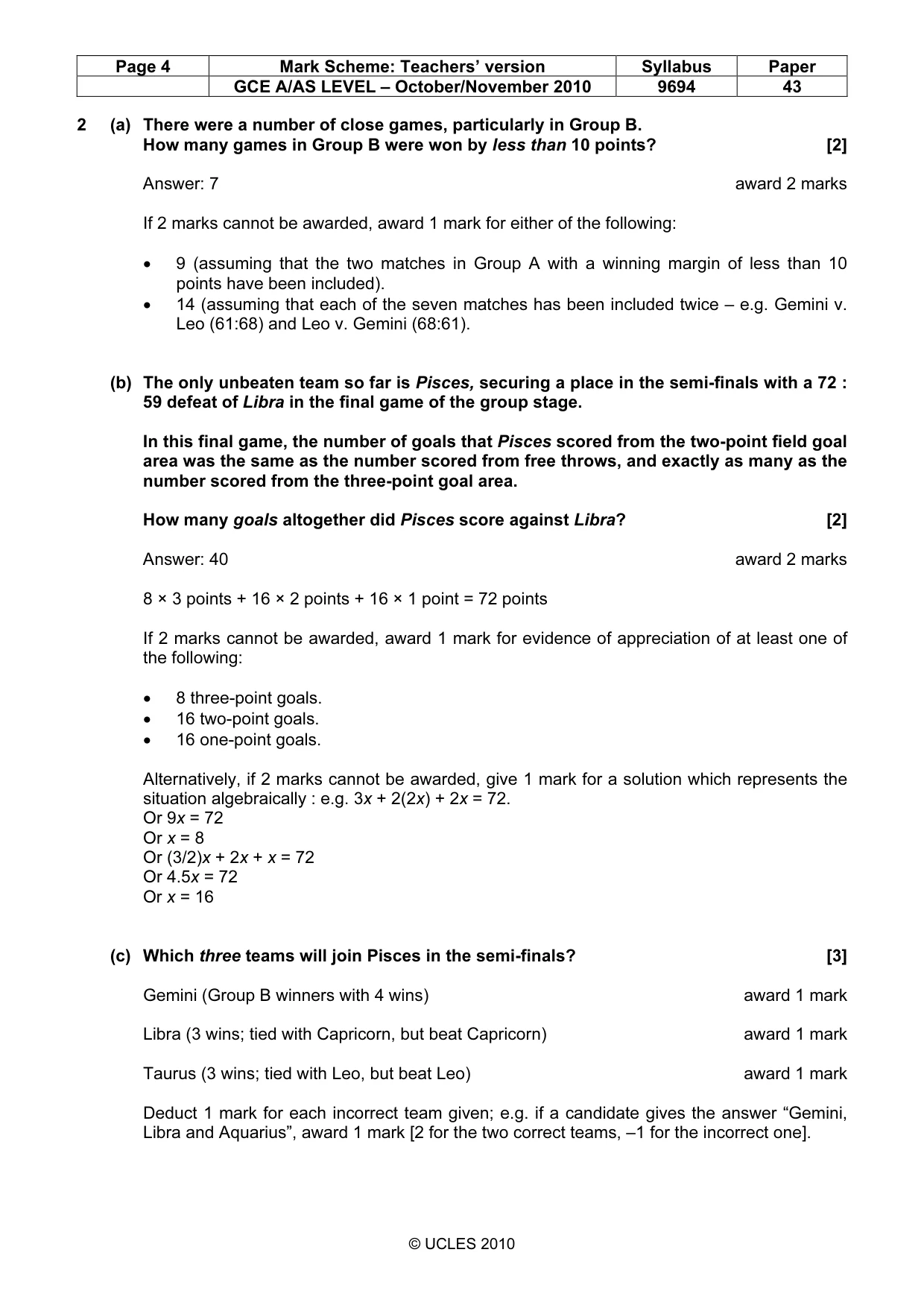
Page 4 Mark Scheme: Teachers’ version Syllabus Paper GCE A/AS LEVEL – October/November 2010 9694 43 © UCLES 2010 2 (a) There were a number of close games, particularly in Group B. How many games in Group B were won by less than 10 points? [2] Answer: 7 award 2 marks If 2 marks cannot be awarded, award 1 mark for either of the following: • 9 (assuming that the two matches in Group A with a winning margin of less than 10 points have been included). • 14 (assuming that each of the seven matches has been included twice – e.g. Gemini v. Leo (61:68) and Leo v. Gemini (68:61). (b) The only unbeaten team so far is Pisces, securing a place in the semi-finals with a 72 : 59 defeat of Libra in the final game of the group stage. In this final game, the number of goals that Pisces scored from the two-point field goal area was the same as the number scored from free throws, and exactly as many as the number scored from the three-point goal area. How many goals altogether did Pisces score against Libra? [2] Answer: 40 award 2 marks 8 × 3 points + 16 × 2 points + 16 × 1 point = 72 points If 2 marks cannot be awarded, award 1 mark for evidence of appreciation of at least one of the following: • 8 three-point goals. • 16 two-point goals. • 16 one-point goals. Alternatively, if 2 marks cannot be awarded, give 1 mark for a solution which represents the situation algebraically : e.g. 3x + 2(2x) + 2x = 72. Or 9x = 72 Or x = 8 Or (3/2)x + 2x + x = 72 Or 4.5x = 72 Or x = 16 (c) Which three teams will join Pisces in the semi-finals? [3] Gemini (Group B winners with 4 wins) award 1 mark Libra (3 wins; tied with Capricorn, but beat Capricorn) award 1 mark Taurus (3 wins; tied with Leo, but beat Leo) award 1 mark Deduct 1 mark for each incorrect team given; e.g. if a candidate gives the answer “Gemini, Libra and Aquarius”, award 1 mark [2 for the two correct teams, –1 for the incorrect one].
Mark scheme, page 5
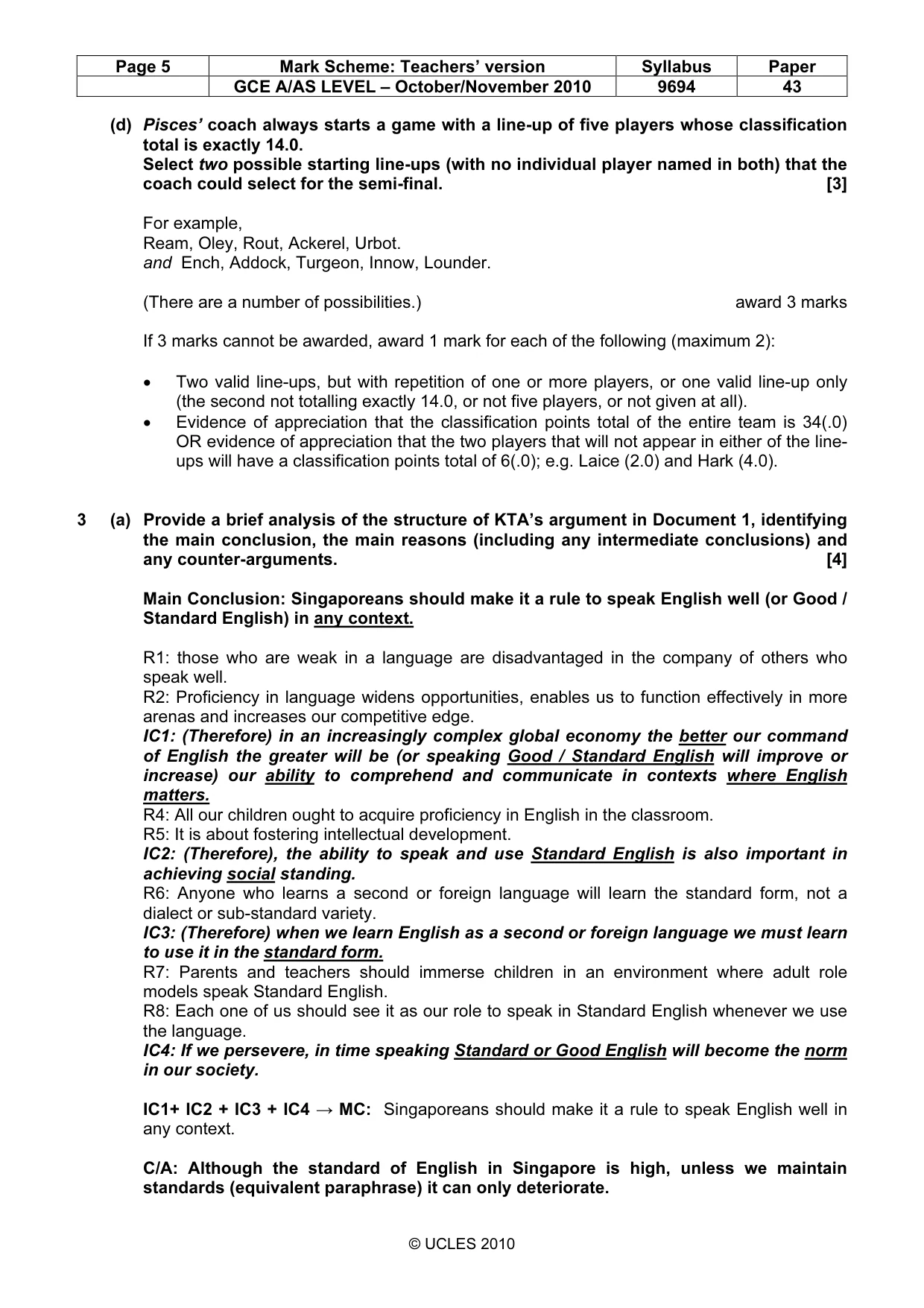
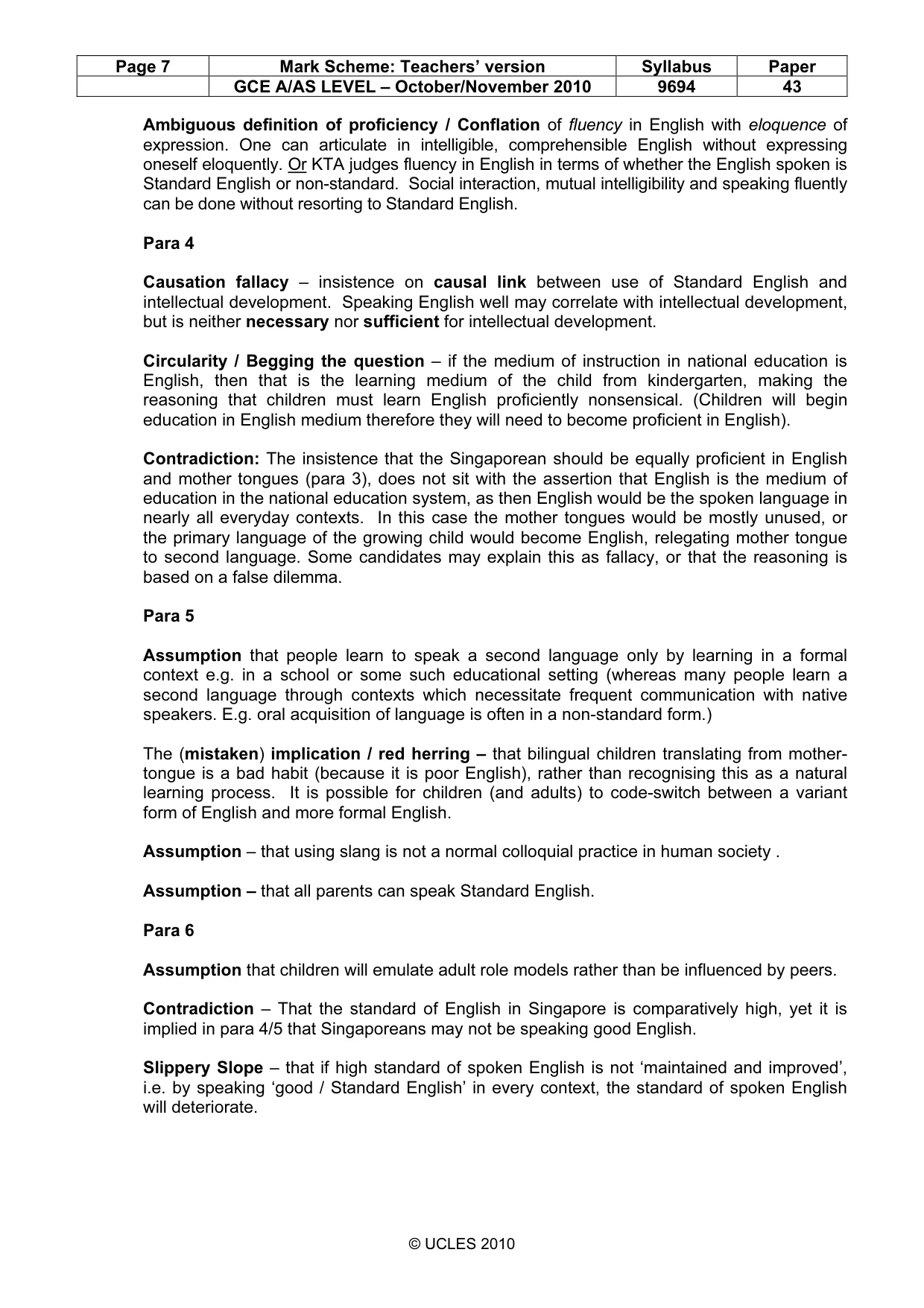
Page 5 Mark Scheme: Teachers’ version Syllabus Paper GCE A/AS LEVEL – October/November 2010 9694 43 © UCLES 2010 (d) Pisces’ coach always starts a game with a line-up of five players whose classification total is exactly 14.0. Select two possible starting line-ups (with no individual player named in both) that the coach could select for the semi-final. [3] For example, Ream, Oley, Rout, Ackerel, Urbot. and Ench, Addock, Turgeon, Innow, Lounder. (There are a number of possibilities.) award 3 marks If 3 marks cannot be awarded, award 1 mark for each of the following (maximum 2): • Two valid line-ups, but with repetition of one or more players, or one valid line-up only (the second not totalling exactly 14.0, or not five players, or not given at all). • Evidence of appreciation that the classification points total of the entire team is 34(.0) OR evidence of appreciation that the two players that will not appear in either of the line- ups will have a classification points total of 6(.0); e.g. Laice (2.0) and Hark (4.0). 3 (a) Provide a brief analysis of the structure of KTA’s argument in Document 1, identifying the main conclusion, the main reasons (including any intermediate conclusions) and any counter-arguments. [4] Main Conclusion: Singaporeans should make it a rule to speak English well (or Good / Standard English) in any context. R1: those who are weak in a language are disadvantaged in the company of others who speak well. R2: Proficiency in language widens opportunities, enables us to function effectively in more arenas and increases our competitive edge. IC1: (Therefore) in an increasingly complex global economy the better our command of English the greater will be (or speaking Good / Standard English will improve or increase) our ability to comprehend and communicate in contexts where English matters. R4: All our children ought to acquire proficiency in English in the classroom. R5: It is about fostering intellectual development. IC2: (Therefore), the ability to speak and use Standard English is also important in achieving social standing. R6: Anyone who learns a second or foreign language will learn the standard form, not a dialect or sub-standard variety. IC3: (Therefore) when we learn English as a second or foreign language we must learn to use it in the standard form. R7: Parents and teachers should immerse children in an environment where adult role models speak Standard English. R8: Each one of us should see it as our role to speak in Standard English whenever we use the language. IC4: If we persevere, in time speaking Standard or Good English will become the norm in our society. IC1+ IC2 + IC3 + IC4 → MC: Singaporeans should make it a rule to speak English well in any context. C/A: Although the standard of English in Singapore is high, unless we maintain standards (equivalent paraphrase) it can only deteriorate.
Mark scheme, page 6
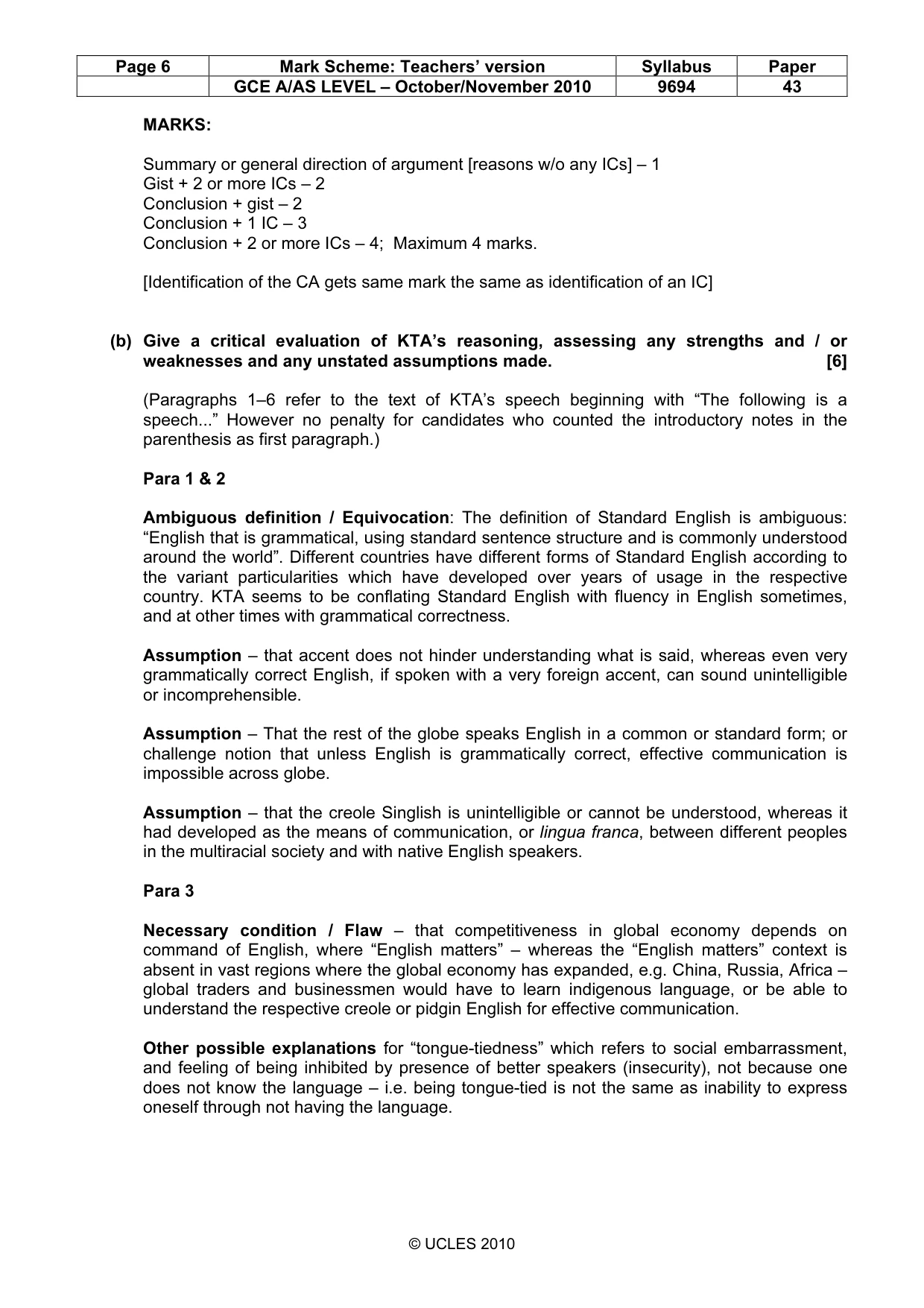
Page 6 Mark Scheme: Teachers’ version Syllabus Paper GCE A/AS LEVEL – October/November 2010 9694 43 © UCLES 2010 MARKS: Summary or general direction of argument [reasons w/o any ICs] – 1 Gist + 2 or more ICs – 2 Conclusion + gist – 2 Conclusion + 1 IC – 3 Conclusion + 2 or more ICs – 4; Maximum 4 marks. [Identification of the CA gets same mark the same as identification of an IC] (b) Give a critical evaluation of KTA’s reasoning, assessing any strengths and / or weaknesses and any unstated assumptions made. [6] (Paragraphs 1–6 refer to the text of KTA’s speech beginning with “The following is a speech...” However no penalty for candidates who counted the introductory notes in the parenthesis as first paragraph.) Para 1 & 2 Ambiguous definition / Equivocation: The definition of Standard English is ambiguous: “English that is grammatical, using standard sentence structure and is commonly understood around the world”. Different countries have different forms of Standard English according to the variant particularities which have developed over years of usage in the respective country. KTA seems to be conflating Standard English with fluency in English sometimes, and at other times with grammatical correctness. Assumption – that accent does not hinder understanding what is said, whereas even very grammatically correct English, if spoken with a very foreign accent, can sound unintelligible or incomprehensible. Assumption – That the rest of the globe speaks English in a common or standard form; or challenge notion that unless English is grammatically correct, effective communication is impossible across globe. Assumption – that the creole Singlish is unintelligible or cannot be understood, whereas it had developed as the means of communication, or lingua franca, between different peoples in the multiracial society and with native English speakers. Para 3 Necessary condition / Flaw – that competitiveness in global economy depends on command of English, where “English matters” – whereas the “English matters” context is absent in vast regions where the global economy has expanded, e.g. China, Russia, Africa – global traders and businessmen would have to learn indigenous language, or be able to understand the respective creole or pidgin English for effective communication. Other possible explanations for “tongue-tiedness” which refers to social embarrassment, and feeling of being inhibited by presence of better speakers (insecurity), not because one does not know the language – i.e. being tongue-tied is not the same as inability to express oneself through not having the language.
Mark scheme, page 7
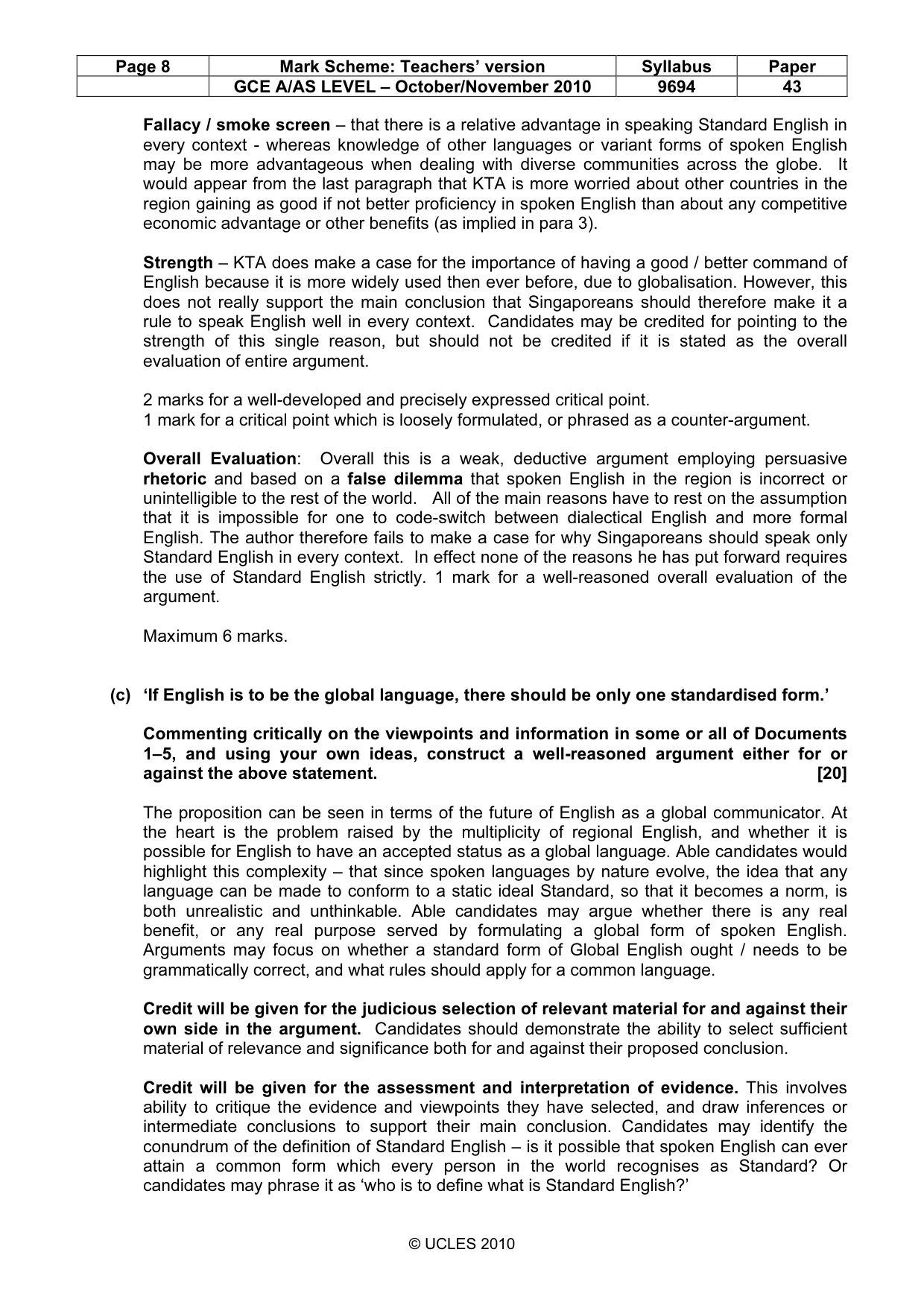
Page 7 Mark Scheme: Teachers’ version Syllabus Paper GCE A/AS LEVEL – October/November 2010 9694 43 © UCLES 2010 Ambiguous definition of proficiency / Conflation of fluency in English with eloquence of expression. One can articulate in intelligible, comprehensible English without expressing oneself eloquently. Or KTA judges fluency in English in terms of whether the English spoken is Standard English or non-standard. Social interaction, mutual intelligibility and speaking fluently can be done without resorting to Standard English. Para 4 Causation fallacy – insistence on causal link between use of Standard English and intellectual development. Speaking English well may correlate with intellectual development, but is neither necessary nor sufficient for intellectual development. Circularity / Begging the question – if the medium of instruction in national education is English, then that is the learning medium of the child from kindergarten, making the reasoning that children must learn English proficiently nonsensical. (Children will begin education in English medium therefore they will need to become proficient in English). Contradiction: The insistence that the Singaporean should be equally proficient in English and mother tongues (para 3), does not sit with the assertion that English is the medium of education in the national education system, as then English would be the spoken language in nearly all everyday contexts. In this case the mother tongues would be mostly unused, or the primary language of the growing child would become English, relegating mother tongue to second language. Some candidates may explain this as fallacy, or that the reasoning is based on a false dilemma. Para 5 Assumption that people learn to speak a second language only by learning in a formal context e.g. in a school or some such educational setting (whereas many people learn a second language through contexts which necessitate frequent communication with native speakers. E.g. oral acquisition of language is often in a non-standard form.) The (mistaken) implication / red herring – that bilingual children translating from mother- tongue is a bad habit (because it is poor English), rather than recognising this as a natural learning process. It is possible for children (and adults) to code-switch between a variant form of English and more formal English. Assumption – that using slang is not a normal colloquial practice in human society . Assumption – that all parents can speak Standard English. Para 6 Assumption that children will emulate adult role models rather than be influenced by peers. Contradiction – That the standard of English in Singapore is comparatively high, yet it is implied in para 4/5 that Singaporeans may not be speaking good English. Slippery Slope – that if high standard of spoken English is not ‘maintained and improved’, i.e. by speaking ‘good / Standard English’ in every context, the standard of spoken English will deteriorate.
Mark scheme, page 8
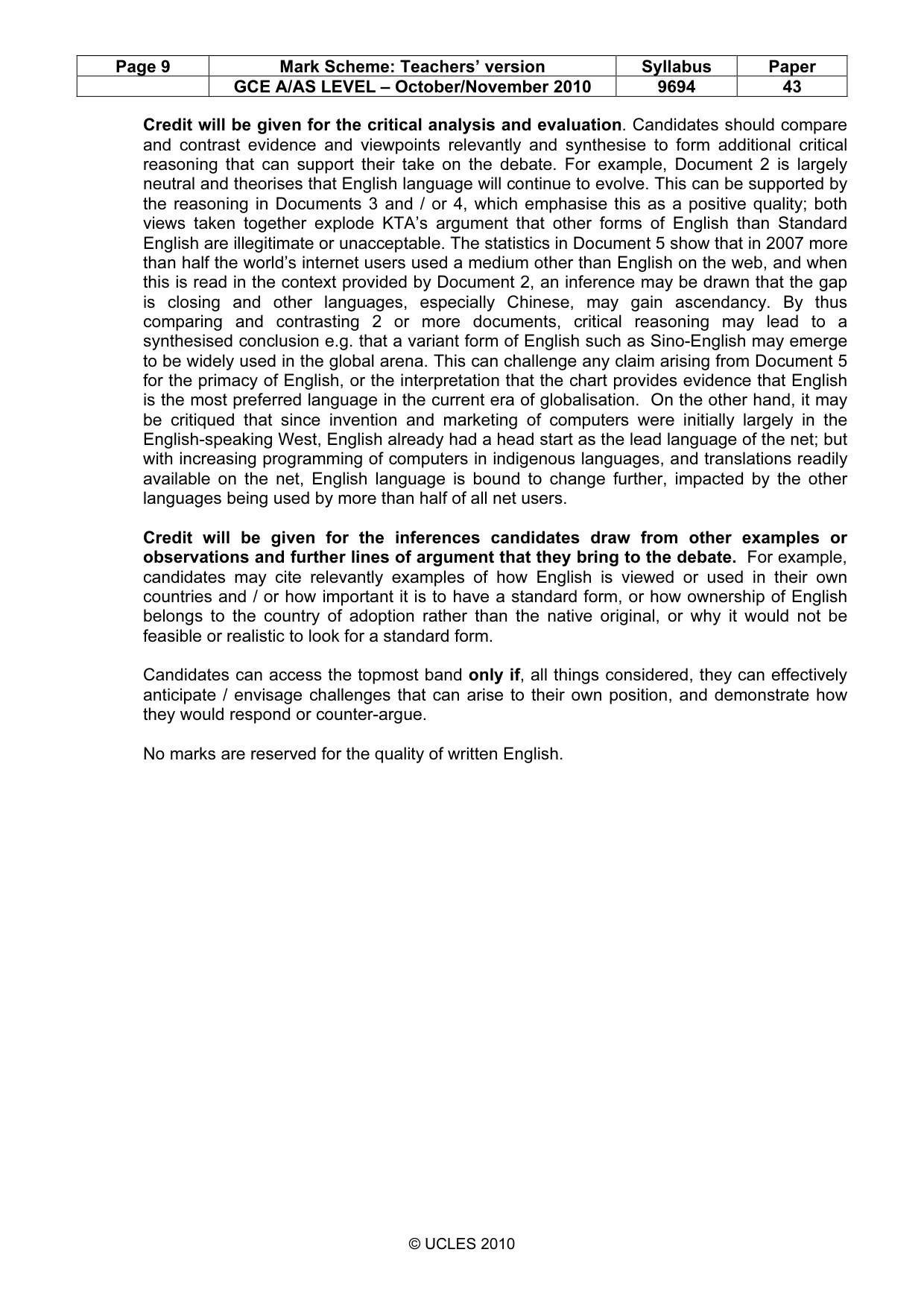
Page 8 Mark Scheme: Teachers’ version Syllabus Paper GCE A/AS LEVEL – October/November 2010 9694 43 © UCLES 2010 Fallacy / smoke screen – that there is a relative advantage in speaking Standard English in every context - whereas knowledge of other languages or variant forms of spoken English may be more advantageous when dealing with diverse communities across the globe. It would appear from the last paragraph that KTA is more worried about other countries in the region gaining as good if not better proficiency in spoken English than about any competitive economic advantage or other benefits (as implied in para 3). Strength – KTA does make a case for the importance of having a good / better command of English because it is more widely used then ever before, due to globalisation. However, this does not really support the main conclusion that Singaporeans should therefore make it a rule to speak English well in every context. Candidates may be credited for pointing to the strength of this single reason, but should not be credited if it is stated as the overall evaluation of entire argument. 2 marks for a well-developed and precisely expressed critical point. 1 mark for a critical point which is loosely formulated, or phrased as a counter-argument. Overall Evaluation: Overall this is a weak, deductive argument employing persuasive rhetoric and based on a false dilemma that spoken English in the region is incorrect or unintelligible to the rest of the world. All of the main reasons have to rest on the assumption that it is impossible for one to code-switch between dialectical English and more formal English. The author therefore fails to make a case for why Singaporeans should speak only Standard English in every context. In effect none of the reasons he has put forward requires the use of Standard English strictly. 1 mark for a well-reasoned overall evaluation of the argument. Max imum 6 marks. (c) ‘If English is to be the global language, there should be only one standardised form.’ Commenting critically on the viewpoints and information in some or all of Documents 1–5, and using your own ideas, construct a well-reasoned argument either for or against the above statement. [20] The proposition can be seen in terms of the future of English as a global communicator. At the heart is the problem raised by the multiplicity of regional English, and whether it is possible for English to have an accepted status as a global language. Able candidates would highlight this complexity – that since spoken languages by nature evolve, the idea that any language can be made to conform to a static ideal Standard, so that it becomes a norm, is both unrealistic and unthinkable. Able candidates may argue whether there is any real benefit, or any real purpose served by formulating a global form of spoken English. Arguments may focus on whether a standard form of Global English ought / needs to be grammatically correct, and what rules should apply for a common language. Credit will be given for the judicious selection of relevant material for and against their own side in the argument. Candidates should demonstrate the ability to select sufficient material of relevance and significance both for and against their proposed conclusion. Credit will be given for the assessment and interpretation of evidence. This involves ability to critique the evidence and viewpoints they have selected, and draw inferences or intermediate conclusions to support their main conclusion. Candidates may identify the conundrum of the definition of Standard English – is it possible that spoken English can ever attain a common form which every person in the world recognises as Standard? Or candidates may phrase it as ‘who is to define what is Standard English?’
Mark scheme, page 9
Page 9 Mark Scheme: Teachers’ version Syllabus Paper GCE A/AS LEVEL – October/November 2010 9694 43 © UCLES 2010 Credit will be given for the critical analysis and evaluation. Candidates should compare and contrast evidence and viewpoints relevantly and synthesise to form additional critical reasoning that can support their take on the debate. For example, Document 2 is largely neutral and theorises that English language will continue to evolve. This can be supported by the reasoning in Documents 3 and / or 4, which emphasise this as a positive quality; both views taken together explode KTA’s argument that other forms of English than Standard English are illegitimate or unacceptable. The statistics in Document 5 show that in 2007 more than half the world’s internet users used a medium other than English on the web, and when this is read in the context provided by Document 2, an inference may be drawn that the gap is closing and other languages, especially Chinese, may gain ascendancy. By thus comparing and contrasting 2 or more documents, critical reasoning may lead to a synthesised conclusion e.g. that a variant form of English such as Sino-English may emerge to be widely used in the global arena. This can challenge any claim arising from Document 5 for the primacy of English, or the interpretation that the chart provides evidence that English is the most preferred language in the current era of globalisation. On the other hand, it may be critiqued that since invention and marketing of computers were initially largely in the English-speaking West, English already had a head start as the lead language of the net; but with increasing programming of computers in indigenous languages, and translations readily available on the net, English language is bound to change further, impacted by the other languages being used by more than half of all net users. Credit will be given for the inferences candidates draw from other examples or observations and further lines of argument that they bring to the debate. For example, candidates may cite relevantly examples of how English is viewed or used in their own countries and / or how important it is to have a standard form, or how ownership of English belongs to the country of adoption rather than the native original, or why it would not be feasible or realistic to look for a standard form. Candidates can access the topmost band only if, all things considered, they can effectively anticipate / envisage challenges that can arise to their own position, and demonstrate how they would respond or counter-argue. No marks are reserved for the quality of written English.
Mark scheme, page 10
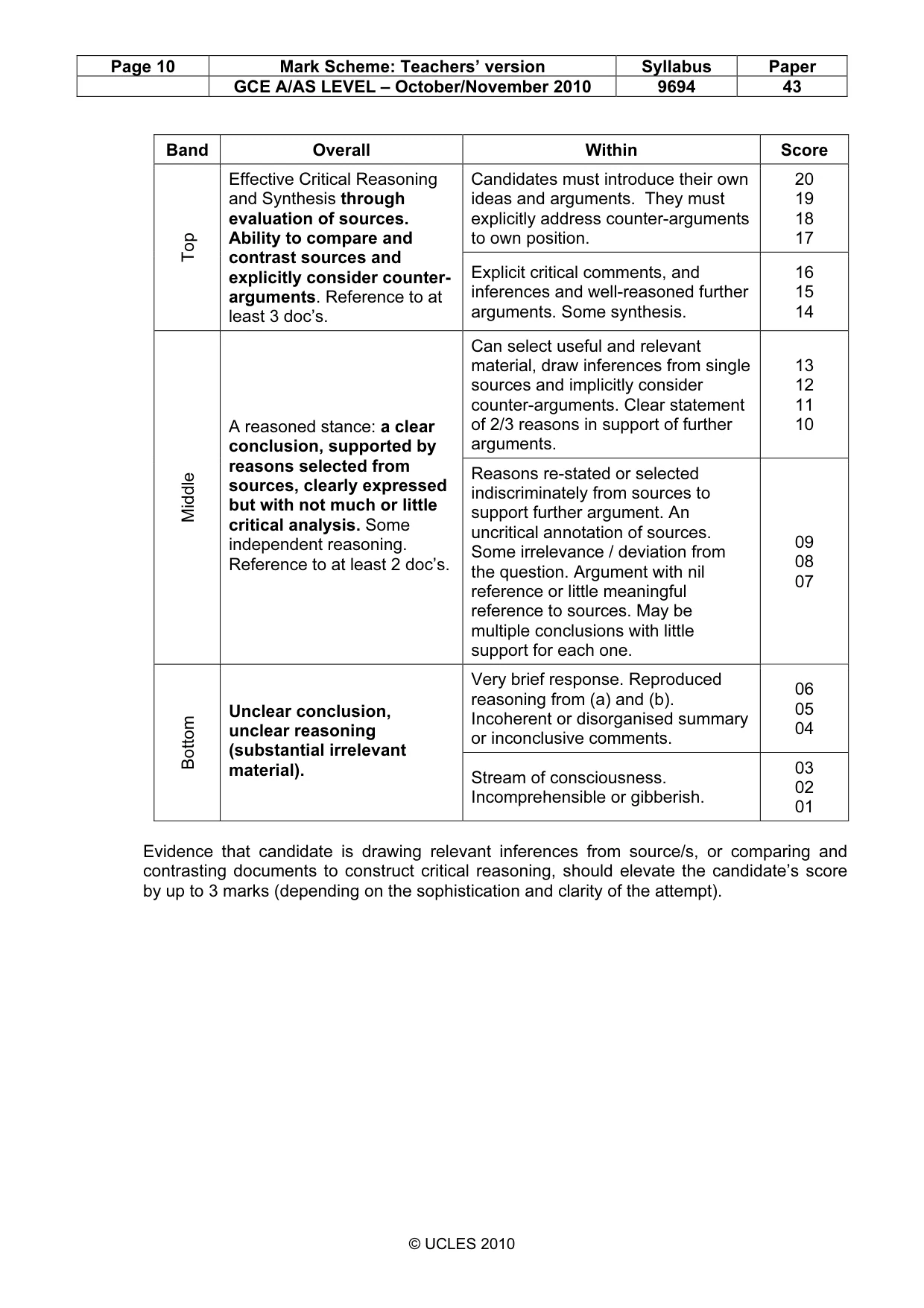
Page 10 Mark Scheme: Teachers’ version Syllabus Paper GCE A/AS LEVEL – October/November 2010 9694 43 © UCLES 2010 Band Overall Within Score Candidates must introduce their own ideas and arguments. They must explicitly address counter-arguments to own position. 20 19 18 17 Top Effective Critical Reasoning and Synthesis through evaluation of sources. Ability to compare and contrast sources and explicitly consider counter- arguments. Reference to at least 3 doc’s. Explicit critical comments, and inferences and well-reasoned further arguments. Some synthesis. 16 15 14 Can select useful and relevant material, draw inferences from single sources and implicitly consider counter-arguments. Clear statement of 2/3 reasons in support of further arguments. 13 12 11 10 Middle A reasoned stance: a clear conclusion, supported by reasons selected from sources, clearly expressed but with not much or little critical analysis. Some independent reasoning. Reference to at least 2 doc’s. Reasons re-stated or selected indiscriminately from sources to support further argument. An uncritical annotation of sources. Some irrelevance / deviation from the question. Argument with nil reference or little meaningful reference to sources. May be multiple conclusions with little support for each one. 09 08 07 Very brief response. Reproduced reasoning from (a) and (b). Incoherent or disorganised summary or inconclusive comments. 06 05 04 Bottom Unclear conclusion, unclear reasoning (substantial irrelevant material). Stream of consciousness. Incomprehensible or gibberish. 03 02 01 Evidence that candidate is drawing relevant inferences from source/s, or comparing and contrasting documents to construct critical reasoning, should elevate the candidate’s score by up to 3 marks (depending on the sophistication and clarity of the attempt).
What you needed in this session
Cambridge’s own grade thresholds for 2010 Oct/Nov, Paper 4 · Variant 3. A higher threshold means an easier paper — the bar moves with how the cohort did.