Cambridge A Level Thinking Skills 9694 — 2010 May/June Paper 4 · Variant 1
9694/41/M/J/10 · 50 marks · ≈56 min
The question paper and its mark scheme, free to read here and free to download. This is Cambridge’s own paper, exactly as it was sat.
Question paper12 pages
Mark scheme8 pages
Answers below. Sit the paper first if you are practising.
Paper as text
Question paper, page 1
This document consists of 10 printed pages and 2 blank pages. IB10 06_9694_41/2RP © UCLES 2010 [Turn over *3192428880* UNIVERSITY OF CAMBRIDGE INTERNATIONAL EXAMINATIONS General Certificate of Education Advanced Level THINKING SKILLS 9694/41 Paper 4 Applied Reasoning May/June 2010 1 hour and 30 minutes Additional Materials: Answer Booklet/Paper READ THESE INSTRUCTIONS FIRST If you have been given an Answer Booklet, follow the instructions on the front cover of the booklet. Write your Centre number, candidate number and name on all the work you hand in. Write in dark blue or black pen. Do not use staples, paper clips, highlighters, glue or correction fluid. DO NOT WRITE ON ANY BARCODES Electronic calculators should be used. Answer all the questions. Start each question on a new answer sheet. At the end of the examination, fasten all your work securely together. The number of marks is given in brackets [ ] at the end of each question.
Question paper, page 2
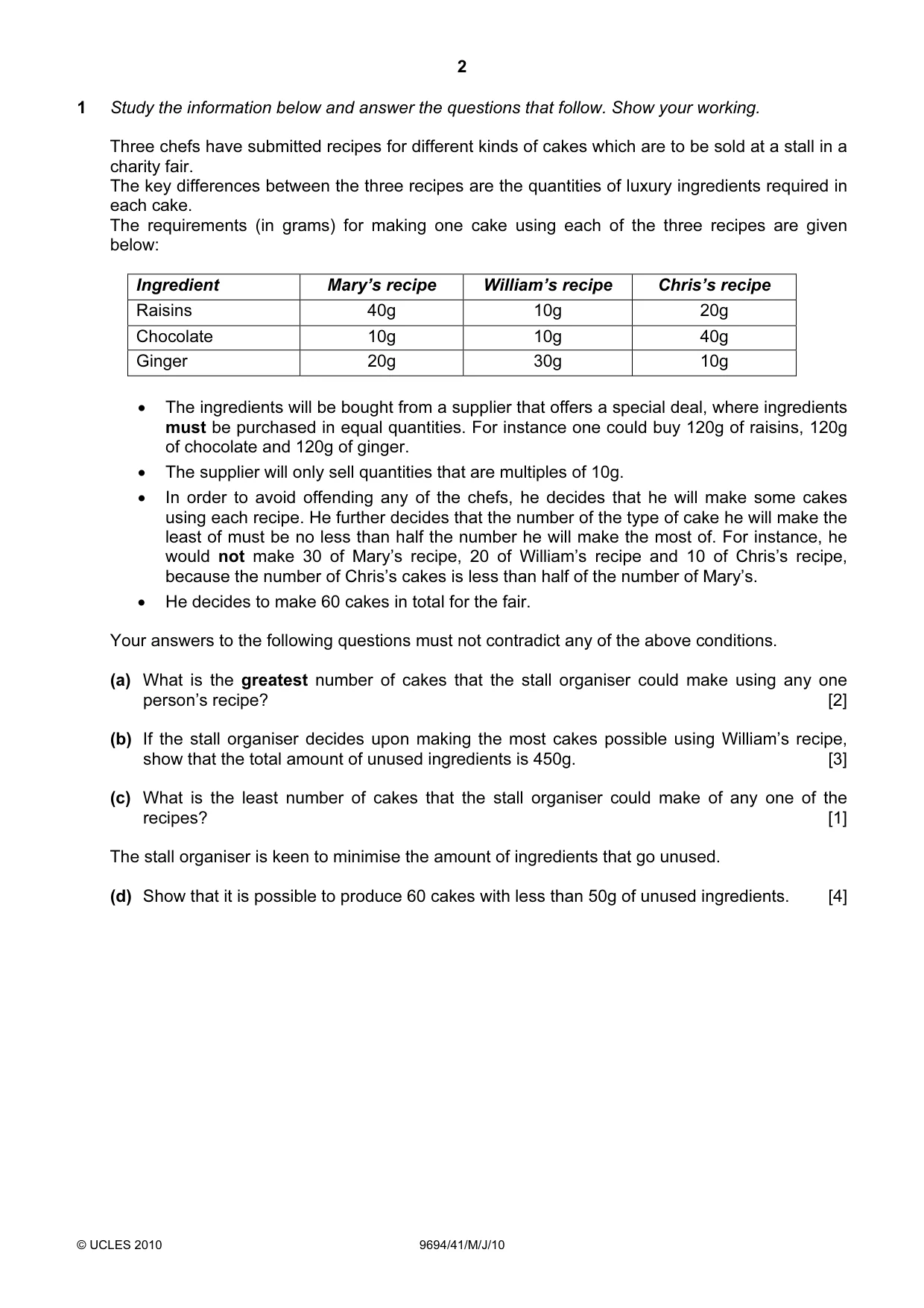
2 © UCLES 2010 9694/41/M/J/10 1 Study the information below and answer the questions that follow. Show your working. Three chefs have submitted recipes for different kinds of cakes which are to be sold at a stall in a charity fair. The key differences between the three recipes are the quantities of luxury ingredients required in each cake. The requirements (in grams) for making one cake using each of the three recipes are given below: Ingredient Mary’s recipe William’s recipe Chris’s recipe Raisins 40g 10g 20g Chocolate 10g 10g 40g Ginger 20g 30g 10g • The ingredients will be bought from a supplier that offers a special deal, where ingredients must be purchased in equal quantities. For instance one could buy 120g of raisins, 120g of chocolate and 120g of ginger. • The supplier will only sell quantities that are multiples of 10g. • In order to avoid offending any of the chefs, he decides that he will make some cakes using each recipe. He further decides that the number of the type of cake he will make the least of must be no less than half the number he will make the most of. For instance, he would not make 30 of Mary’s recipe, 20 of William’s recipe and 10 of Chris’s recipe, because the number of Chris’s cakes is less than half of the number of Mary’s. • He decides to make 60 cakes in total for the fair. Your answers to the following questions must not contradict any of the above conditions. (a) What is the greatest number of cakes that the stall organiser could make using any one person’s recipe? [2] (b) If the stall organiser decides upon making the most cakes possible using William’s recipe, show that the total amount of unused ingredients is 450g. [3] (c) What is the least number of cakes that the stall organiser could make of any one of the recipes? [1] The stall organiser is keen to minimise the amount of ingredients that go unused. (d) Show that it is possible to produce 60 cakes with less than 50g of unused ingredients. [4]
Question paper, page 3
3 © UCLES 2010 9694/41/M/J/10 [Turn over [Question 2 is printed on the next page]
Question paper, page 4
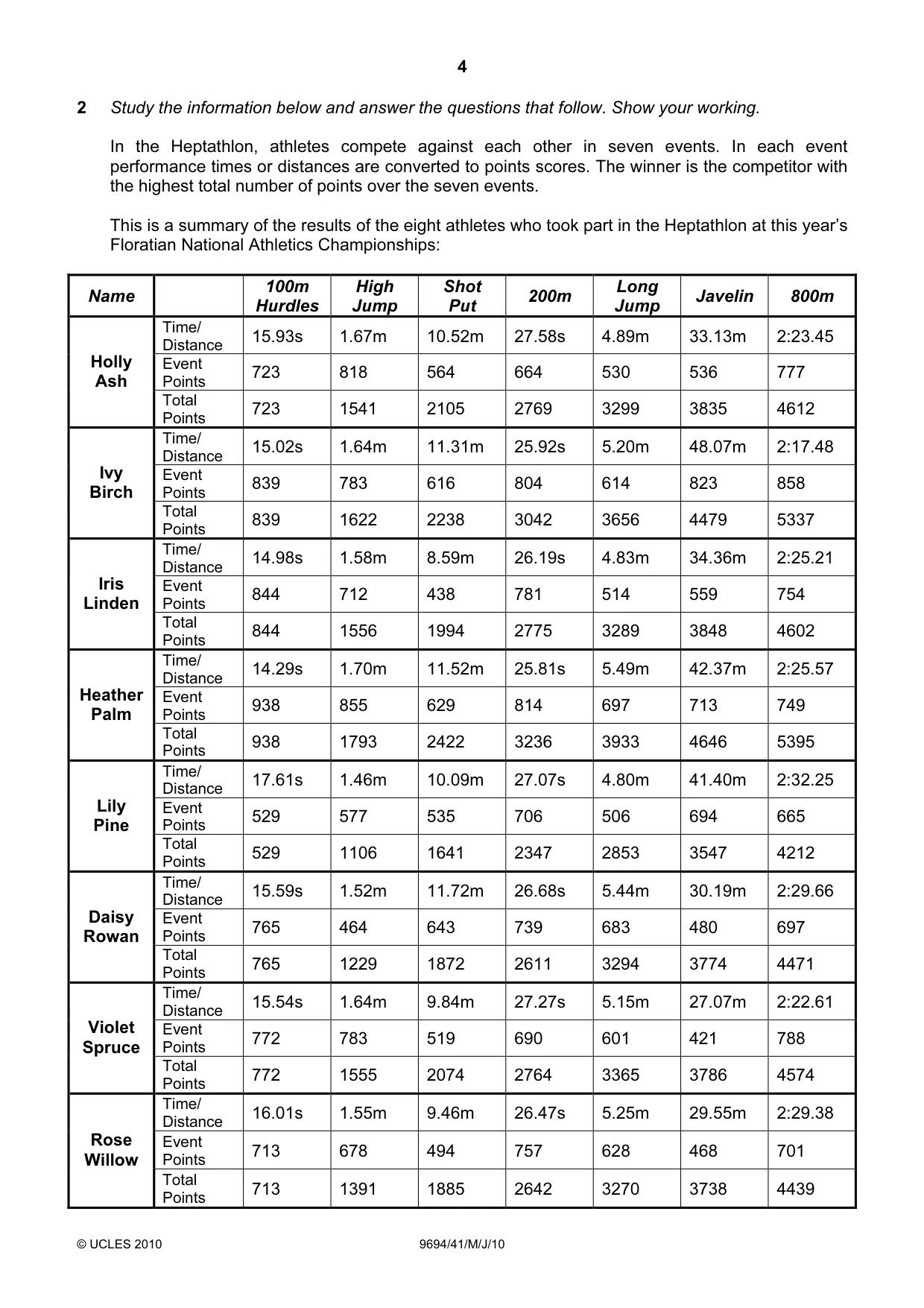
4 © UCLES 2010 9694/41/M/J/10 2 Study the information below and answer the questions that follow. Show your working. In the Heptathlon, athletes compete against each other in seven events. In each event performance times or distances are converted to points scores. The winner is the competitor with the highest total number of points over the seven events. This is a summary of the results of the eight athletes who took part in the Heptathlon at this year’s Floratian National Athletics Championships: Name 100m Hurdles High Jump Shot Put 200m Long Jump Javelin 800m Time/ Distance 15.93s 1.67m 10.52m 27.58s 4.89m 33.13m 2:23.45 Event Points 723 818 564 664 530 536 777 Holly Ash Total Points 723 1541 2105 2769 3299 3835 4612 Time/ Distance 15.02s 1.64m 11.31m 25.92s 5.20m 48.07m 2:17.48 Event Points 839 783 616 804 614 823 858 Ivy Birch Total Points 839 1622 2238 3042 3656 4479 5337 Time/ Distance 14.98s 1.58m 8.59m 26.19s 4.83m 34.36m 2:25.21 Event Points 844 712 438 781 514 559 754 Iris Linden Total Points 844 1556 1994 2775 3289 3848 4602 Time/ Distance 14.29s 1.70m 11.52m 25.81s 5.49m 42.37m 2:25.57 Event Points 938 855 629 814 697 713 749 Heather Palm Total Points 938 1793 2422 3236 3933 4646 5395 Time/ Distance 17.61s 1.46m 10.09m 27.07s 4.80m 41.40m 2:32.25 Event Points 529 577 535 706 506 694 665 Lily Pine Total Points 529 1106 1641 2347 2853 3547 4212 Time/ Distance 15.59s 1.52m 11.72m 26.68s 5.44m 30.19m 2:29.66 Event Points 765 464 643 739 683 480 697 Daisy Rowan Total Points 765 1229 1872 2611 3294 3774 4471 Time/ Distance 15.54s 1.64m 9.84m 27.27s 5.15m 27.07m 2:22.61 Event Points 772 783 519 690 601 421 788 Violet Spruce Total Points 772 1555 2074 2764 3365 3786 4574 Time/ Distance 16.01s 1.55m 9.46m 26.47s 5.25m 29.55m 2:29.38 Event Points 713 678 494 757 628 468 701 Rose Willow Total Points 713 1391 1885 2642 3270 3738 4439
Question paper, page 5
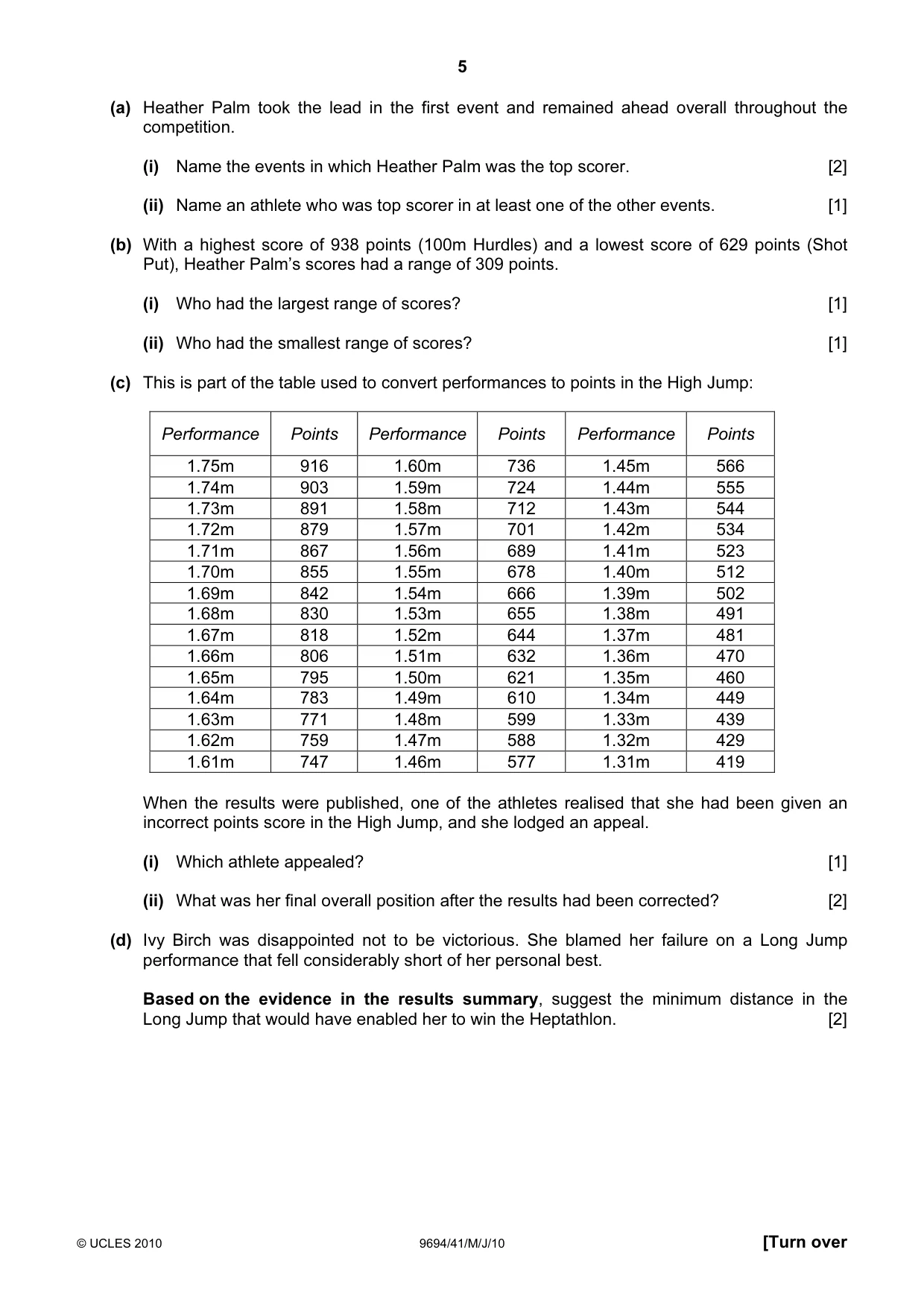
5 © UCLES 2010 9694/41/M/J/10 [Turn over (a) Heather Palm took the lead in the first event and remained ahead overall throughout the competition. (i) Name the events in which Heather Palm was the top scorer. [2] (ii) Name an athlete who was top scorer in at least one of the other events. [1] (b) With a highest score of 938 points (100m Hurdles) and a lowest score of 629 points (Shot Put), Heather Palm’s scores had a range of 309 points. (i) Who had the largest range of scores? [1] (ii) Who had the smallest range of scores? [1] (c) This is part of the table used to convert performances to points in the High Jump: Performance Points Performance Points Performance Points 1.75m 916 1.60m 736 1.45m 566 1.74m 903 1.59m 724 1.44m 555 1.73m 891 1.58m 712 1.43m 544 1.72m 879 1.57m 701 1.42m 534 1.71m 867 1.56m 689 1.41m 523 1.70m 855 1.55m 678 1.40m 512 1.69m 842 1.54m 666 1.39m 502 1.68m 830 1.53m 655 1.38m 491 1.67m 818 1.52m 644 1.37m 481 1.66m 806 1.51m 632 1.36m 470 1.65m 795 1.50m 621 1.35m 460 1.64m 783 1.49m 610 1.34m 449 1.63m 771 1.48m 599 1.33m 439 1.62m 759 1.47m 588 1.32m 429 1.61m 747 1.46m 577 1.31m 419 When the results were published, one of the athletes realised that she had been given an incorrect points score in the High Jump, and she lodged an appeal. (i) Which athlete appealed? [1] (ii) What was her final overall position after the results had been corrected? [2] (d) Ivy Birch was disappointed not to be victorious. She blamed her failure on a Long Jump performance that fell considerably short of her personal best. Based on the evidence in the results summary, suggest the minimum distance in the Long Jump that would have enabled her to win the Heptathlon. [2]
Question paper, page 6
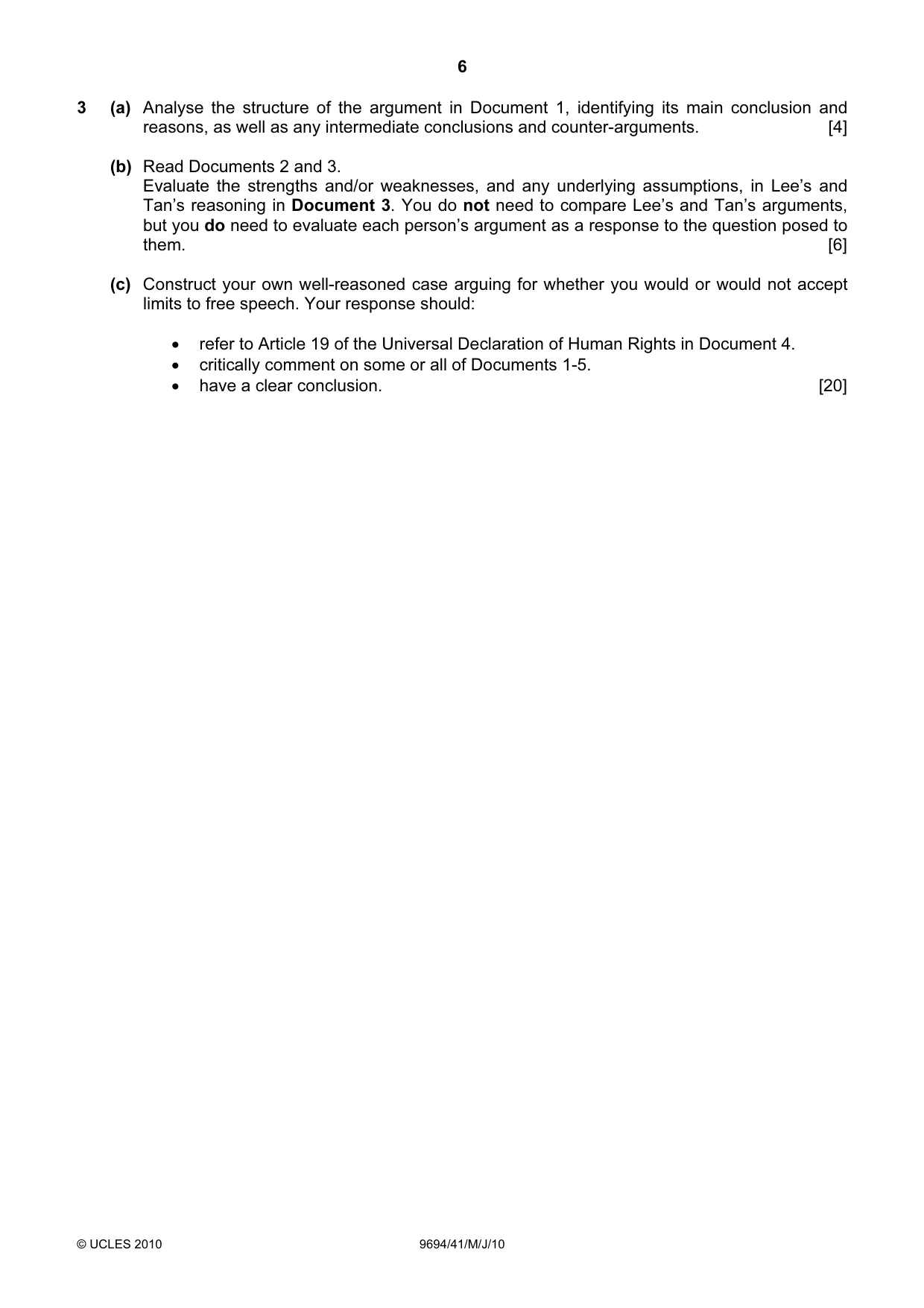
6 © UCLES 2010 9694/41/M/J/10 3 (a) Analyse the structure of the argument in Document 1, identifying its main conclusion and reasons, as well as any intermediate conclusions and counter-arguments. [4] (b) Read Documents 2 and 3. Evaluate the strengths and/or weaknesses, and any underlying assumptions, in Lee’s and Tan’s reasoning in Document 3. You do not need to compare Lee’s and Tan’s arguments, but you do need to evaluate each person’s argument as a response to the question posed to them. [6] (c) Construct your own well-reasoned case arguing for whether you would or would not accept limits to free speech. Your response should: • refer to Article 19 of the Universal Declaration of Human Rights in Document 4. • critically comment on some or all of Documents 1-5. • have a clear conclusion. [20]
Question paper, page 7
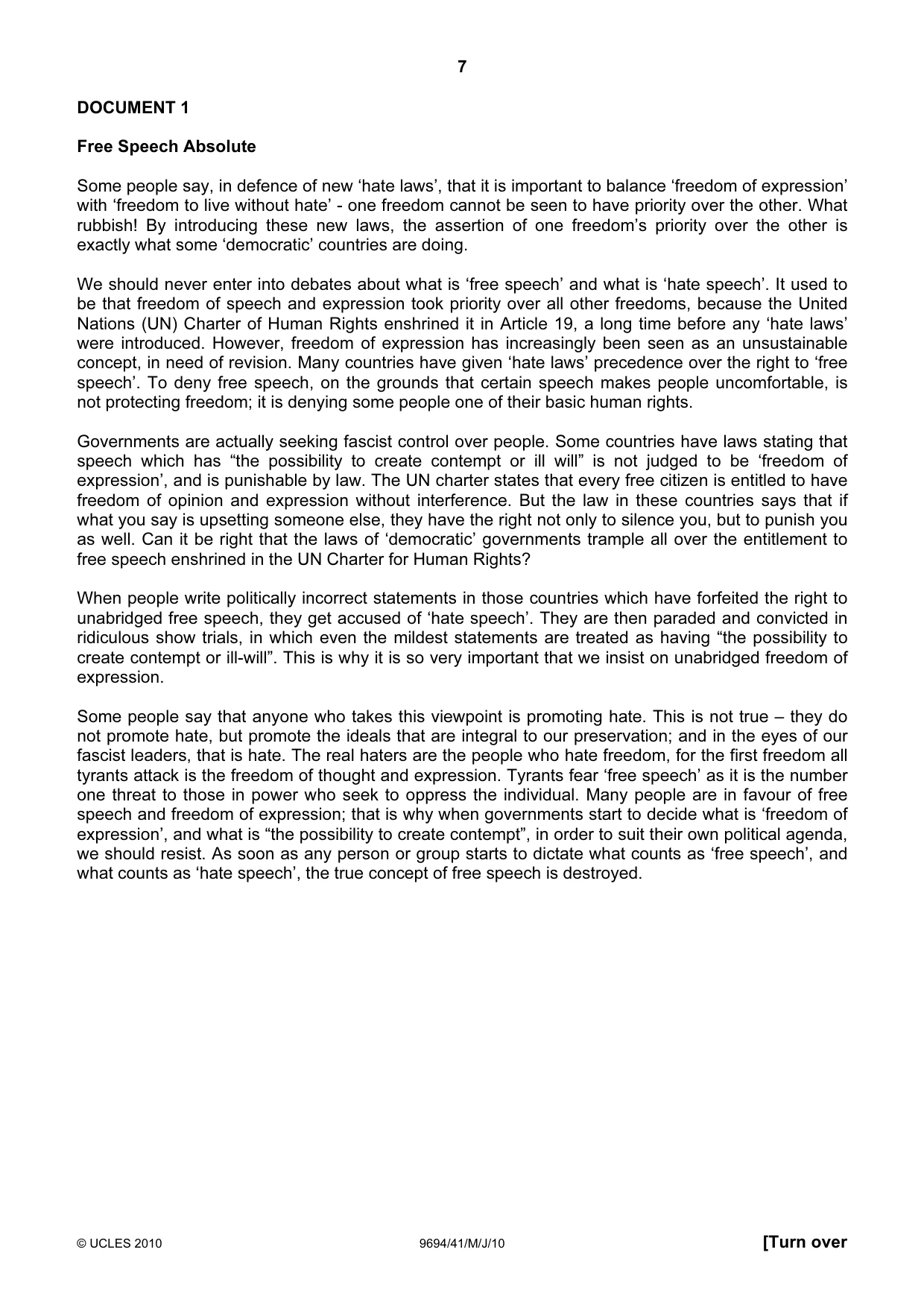
7 © UCLES 2010 9694/41/M/J/10 [Turn over DOCUMENT 1 Free Speech Absolute Some people say, in defence of new ‘hate laws’, that it is important to balance ‘freedom of expression’ with ‘freedom to live without hate’ - one freedom cannot be seen to have priority over the other. What rubbish! By introducing these new laws, the assertion of one freedom’s priority over the other is exactly what some ‘democratic’ countries are doing. We should never enter into debates about what is ‘free speech’ and what is ‘hate speech’. It used to be that freedom of speech and expression took priority over all other freedoms, because the United Nations (UN) Charter of Human Rights enshrined it in Article 19, a long time before any ‘hate laws’ were introduced. However, freedom of expression has increasingly been seen as an unsustainable concept, in need of revision. Many countries have given ‘hate laws’ precedence over the right to ‘free speech’. To deny free speech, on the grounds that certain speech makes people uncomfortable, is not protecting freedom; it is denying some people one of their basic human rights. Governments are actually seeking fascist control over people. Some countries have laws stating that speech which has “the possibility to create contempt or ill will” is not judged to be ‘freedom of expression’, and is punishable by law. The UN charter states that every free citizen is entitled to have freedom of opinion and expression without interference. But the law in these countries says that if what you say is upsetting someone else, they have the right not only to silence you, but to punish you as well. Can it be right that the laws of ‘democratic’ governments trample all over the entitlement to free speech enshrined in the UN Charter for Human Rights? When people write politically incorrect statements in those countries which have forfeited the right to unabridged free speech, they get accused of ‘hate speech’. They are then paraded and convicted in ridiculous show trials, in which even the mildest statements are treated as having “the possibility to create contempt or ill-will”. This is why it is so very important that we insist on unabridged freedom of expression. Some people say that anyone who takes this viewpoint is promoting hate. This is not true – they do not promote hate, but promote the ideals that are integral to our preservation; and in the eyes of our fascist leaders, that is hate. The real haters are the people who hate freedom, for the first freedom all tyrants attack is the freedom of thought and expression. Tyrants fear ‘free speech’ as it is the number one threat to those in power who seek to oppress the individual. Many people are in favour of free speech and freedom of expression; that is why when governments start to decide what is ‘freedom of expression’, and what is “the possibility to create contempt”, in order to suit their own political agenda, we should resist. As soon as any person or group starts to dictate what counts as ‘free speech’, and what counts as ‘hate speech’, the true concept of free speech is destroyed.
Question paper, page 8
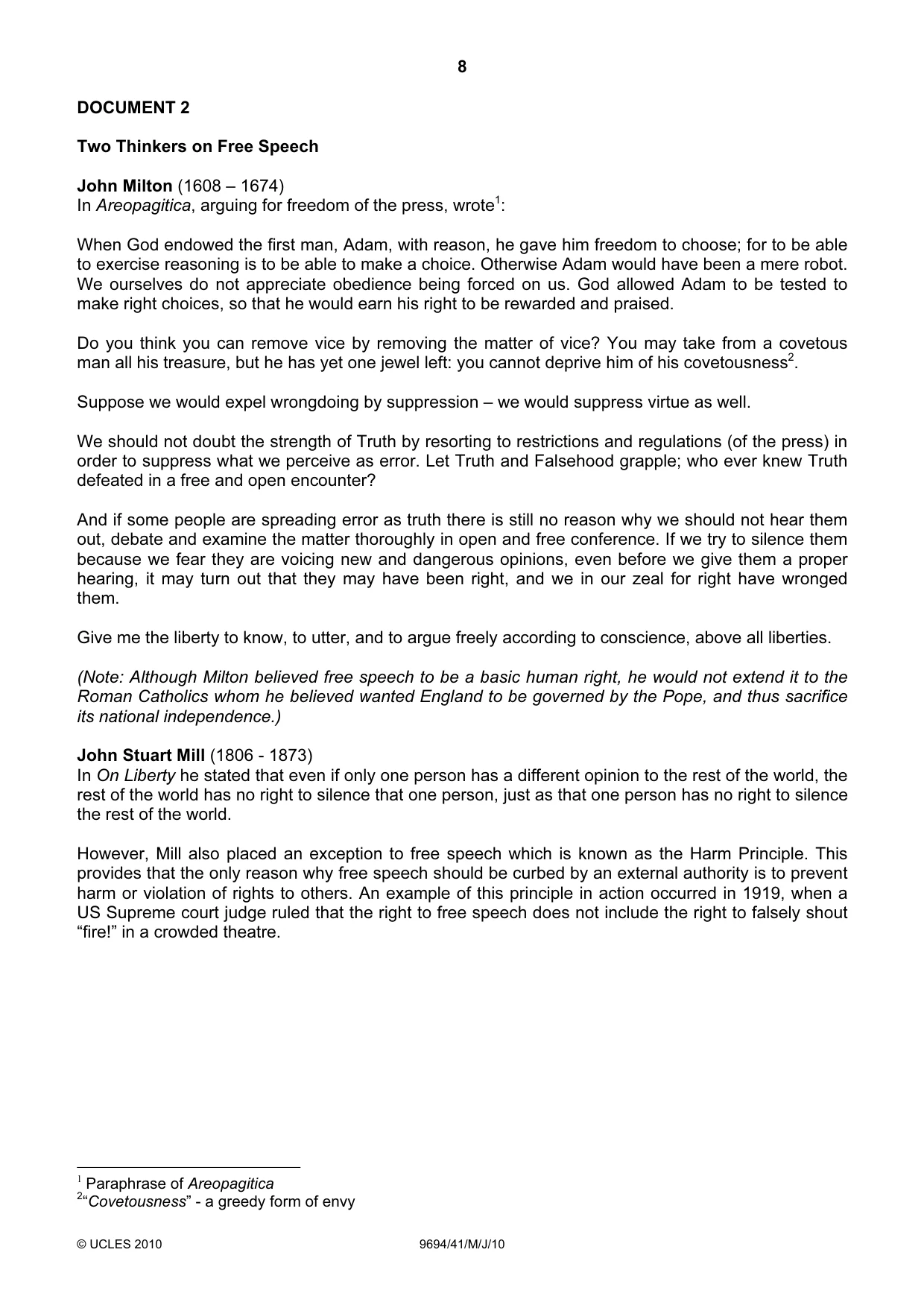
8 © UCLES 2010 9694/41/M/J/10 DOCUMENT 2 Two Thinkers on Free Speech John Milton (1608 – 1674) In Areopagitica, arguing for freedom of the press, wrote1: When God endowed the first man, Adam, with reason, he gave him freedom to choose; for to be able to exercise reasoning is to be able to make a choice. Otherwise Adam would have been a mere robot. We ourselves do not appreciate obedience being forced on us. God allowed Adam to be tested to make right choices, so that he would earn his right to be rewarded and praised. Do you think you can remove vice by removing the matter of vice? You may take from a covetous man all his treasure, but he has yet one jewel left: you cannot deprive him of his covetousness2. Suppose we would expel wrongdoing by suppression – we would suppress virtue as well. We should not doubt the strength of Truth by resorting to restrictions and regulations (of the press) in order to suppress what we perceive as error. Let Truth and Falsehood grapple; who ever knew Truth defeated in a free and open encounter? And if some people are spreading error as truth there is still no reason why we should not hear them out, debate and examine the matter thoroughly in open and free conference. If we try to silence them because we fear they are voicing new and dangerous opinions, even before we give them a proper hearing, it may turn out that they may have been right, and we in our zeal for right have wronged them. Give me the liberty to know, to utter, and to argue freely according to conscience, above all liberties. (Note: Although Milton believed free speech to be a basic human right, he would not extend it to the Roman Catholics whom he believed wanted England to be governed by the Pope, and thus sacrifice its national independence.) John Stuart Mill (1806 - 1873) In On Liberty he stated that even if only one person has a different opinion to the rest of the world, the rest of the world has no right to silence that one person, just as that one person has no right to silence the rest of the world. However, Mill also placed an exception to free speech which is known as the Harm Principle. This provides that the only reason why free speech should be curbed by an external authority is to prevent harm or violation of rights to others. An example of this principle in action occurred in 1919, when a US Supreme court judge ruled that the right to free speech does not include the right to falsely shout “fire!” in a crowded theatre. 1 Paraphrase of Areopagitica 2“Covetousness” - a greedy form of envy
Question paper, page 9
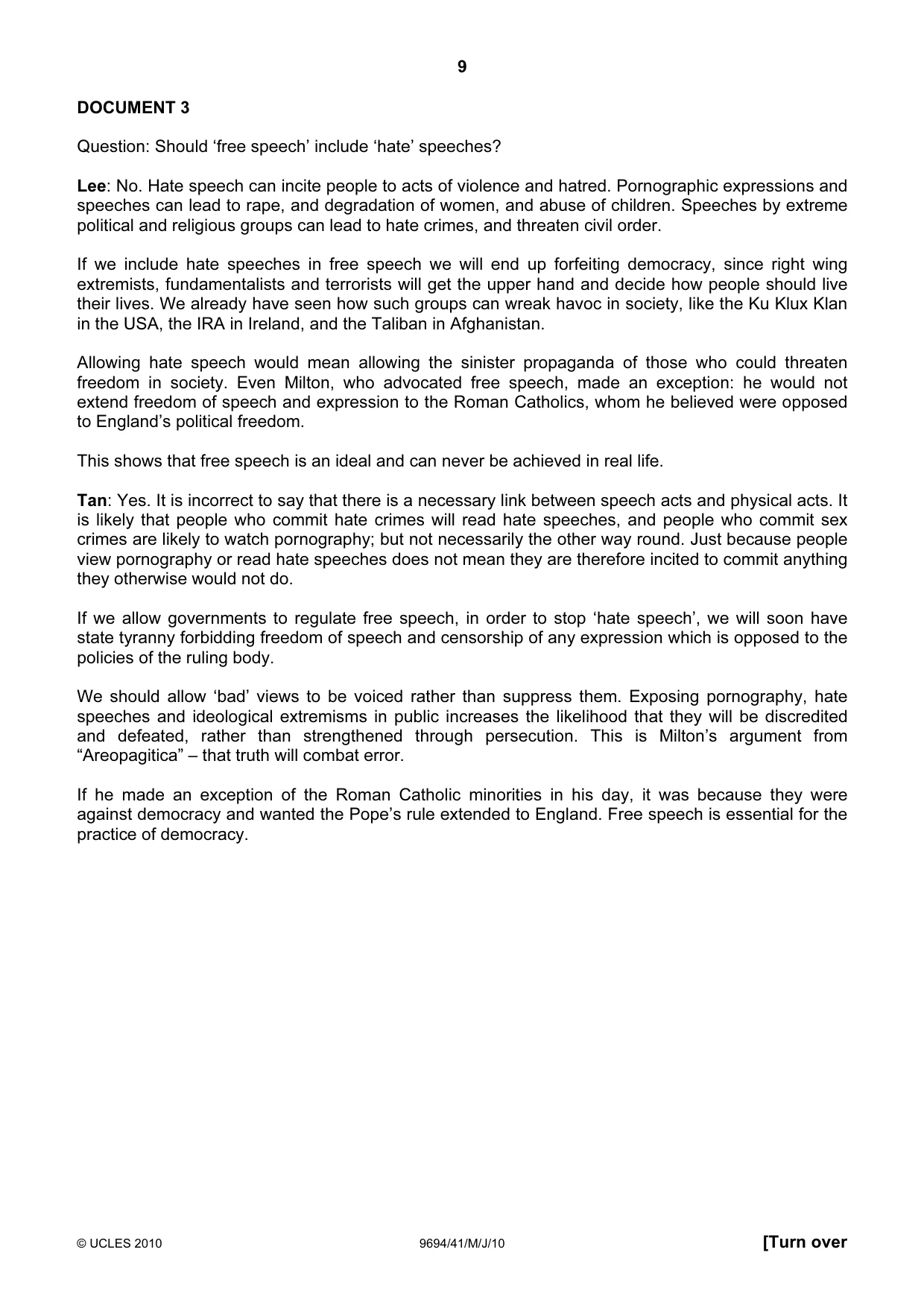
9 © UCLES 2010 9694/41/M/J/10 [Turn over DOCUMENT 3 Question: Should ‘free speech’ include ‘hate’ speeches? Lee: No. Hate speech can incite people to acts of violence and hatred. Pornographic expressions and speeches can lead to rape, and degradation of women, and abuse of children. Speeches by extreme political and religious groups can lead to hate crimes, and threaten civil order. If we include hate speeches in free speech we will end up forfeiting democracy, since right wing extremists, fundamentalists and terrorists will get the upper hand and decide how people should live their lives. We already have seen how such groups can wreak havoc in society, like the Ku Klux Klan in the USA, the IRA in Ireland, and the Taliban in Afghanistan. Allowing hate speech would mean allowing the sinister propaganda of those who could threaten freedom in society. Even Milton, who advocated free speech, made an exception: he would not extend freedom of speech and expression to the Roman Catholics, whom he believed were opposed to England’s political freedom. This shows that free speech is an ideal and can never be achieved in real life. Tan: Yes. It is incorrect to say that there is a necessary link between speech acts and physical acts. It is likely that people who commit hate crimes will read hate speeches, and people who commit sex crimes are likely to watch pornography; but not necessarily the other way round. Just because people view pornography or read hate speeches does not mean they are therefore incited to commit anything they otherwise would not do. If we allow governments to regulate free speech, in order to stop ‘hate speech’, we will soon have state tyranny forbidding freedom of speech and censorship of any expression which is opposed to the policies of the ruling body. We should allow ‘bad’ views to be voiced rather than suppress them. Exposing pornography, hate speeches and ideological extremisms in public increases the likelihood that they will be discredited and defeated, rather than strengthened through persecution. This is Milton’s argument from “Areopagitica” – that truth will combat error. If he made an exception of the Roman Catholic minorities in his day, it was because they were against democracy and wanted the Pope’s rule extended to England. Free speech is essential for the practice of democracy.
Question paper, page 10
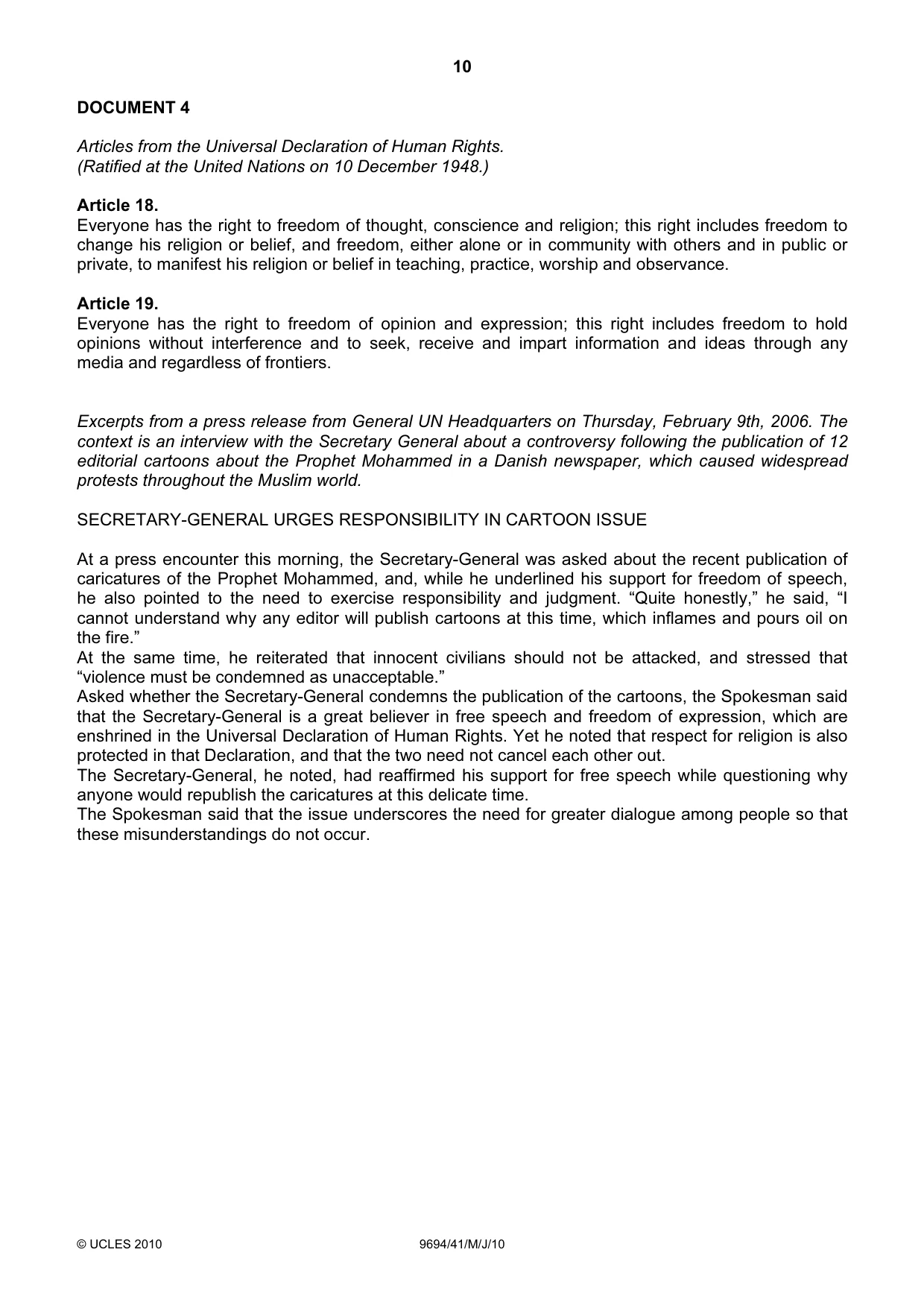
10 © UCLES 2010 9694/41/M/J/10 DOCUMENT 4 Articles from the Universal Declaration of Human Rights. (Ratified at the United Nations on 10 December 1948.) Article 18. Everyone has the right to freedom of thought, conscience and religion; this right includes freedom to change his religion or belief, and freedom, either alone or in community with others and in public or private, to manifest his religion or belief in teaching, practice, worship and observance. Article 19. Everyone has the right to freedom of opinion and expression; this right includes freedom to hold opinions without interference and to seek, receive and impart information and ideas through any media and regardless of frontiers. Excerpts from a press release from General UN Headquarters on Thursday, February 9th, 2006. The context is an interview with the Secretary General about a controversy following the publication of 12 editorial cartoons about the Prophet Mohammed in a Danish newspaper, which caused widespread protests throughout the Muslim world. SECRETARY-GENERAL URGES RESPONSIBILITY IN CARTOON ISSUE At a press encounter this morning, the Secretary-General was asked about the recent publication of caricatures of the Prophet Mohammed, and, while he underlined his support for freedom of speech, he also pointed to the need to exercise responsibility and judgment. “Quite honestly,” he said, “I cannot understand why any editor will publish cartoons at this time, which inflames and pours oil on the fire.” At the same time, he reiterated that innocent civilians should not be attacked, and stressed that “violence must be condemned as unacceptable.” Asked whether the Secretary-General condemns the publication of the cartoons, the Spokesman said that the Secretary-General is a great believer in free speech and freedom of expression, which are enshrined in the Universal Declaration of Human Rights. Yet he noted that respect for religion is also protected in that Declaration, and that the two need not cancel each other out. The Secretary-General, he noted, had reaffirmed his support for free speech while questioning why anyone would republish the caricatures at this delicate time. The Spokesman said that the issue underscores the need for greater dialogue among people so that these misunderstandings do not occur.
Question paper, page 11
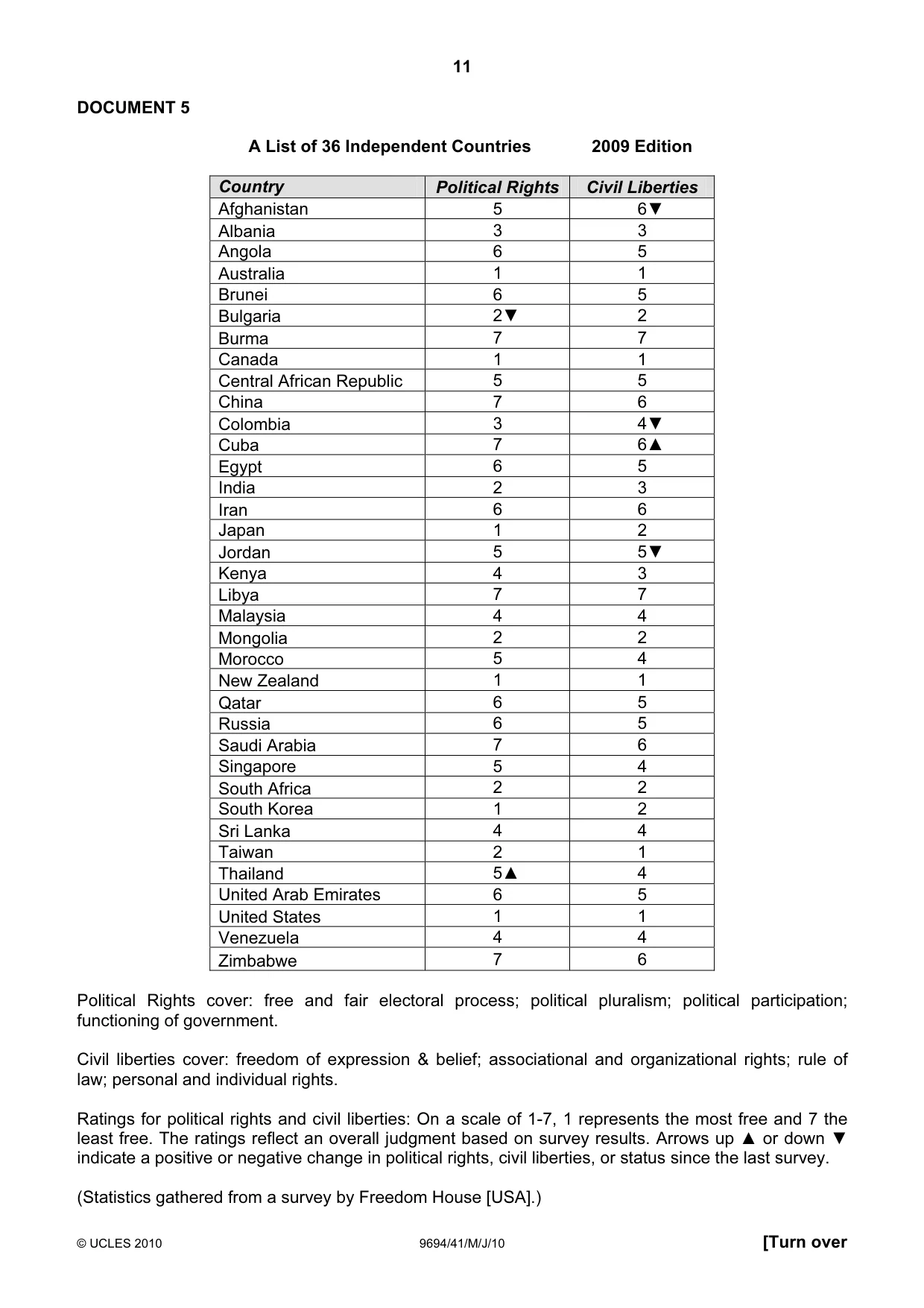
11 © UCLES 2010 9694/41/M/J/10 [Turn over DOCUMENT 5 A List of 36 Independent Countries 2009 Edition Country Political Rights Civil Liberties Afghanistan 5 6▼ Albania 3 3 Angola 6 5 Australia 1 1 Brunei 6 5 Bulgaria 2▼ 2 Burma 7 7 Canada 1 1 Central African Republic 5 5 China 7 6 Colombia 3 4▼ Cuba 7 6▲ Egypt 6 5 India 2 3 Iran 6 6 Japan 1 2 Jordan 5 5▼ Kenya 4 3 Libya 7 7 Malaysia 4 4 Mongolia 2 2 Morocco 5 4 New Zealand 1 1 Qatar 6 5 Russia 6 5 Saudi Arabia 7 6 Singapore 5 4 South Africa 2 2 South Korea 1 2 Sri Lanka 4 4 Taiwan 2 1 Thailand 5▲ 4 United Arab Emirates 6 5 United States 1 1 Venezuela 4 4 Zimbabwe 7 6 Political Rights cover: free and fair electoral process; political pluralism; political participation; functioning of government. Civil liberties cover: freedom of expression & belief; associational and organizational rights; rule of law; personal and individual rights. Ratings for political rights and civil liberties: On a scale of 1-7, 1 represents the most free and 7 the least free. The ratings reflect an overall judgment based on survey results. Arrows up ▲ or down ▼ indicate a positive or negative change in political rights, civil liberties, or status since the last survey. (Statistics gathered from a survey by Freedom House [USA].)
Question paper, page 12
12 Copyright Acknowledgements: Document 4 Document 5 © www.un.org/News/ossg/hitites/hitites_arch_ciew.asp?HighID=496. © www.freedomhouse.org. Permission to reproduce items where third-party owned material protected by copyright is included has been sought and cleared where possible. Every reasonable effort has been made by the publisher (UCLES) to trace copyright holders, but if any items requiring clearance have unwittingly been included, the publisher will be pleased to make amends at the earliest possible opportunity. University of Cambridge International Examinations is part of the Cambridge Assessment Group. Cambridge Assessment is the brand name of University of Cambridge Local Examinations Syndicate (UCLES), which is itself a department of the University of Cambridge. © UCLES 2010 9694/41/M/J/10 BLANK PAGE
Mark scheme, page 1
UNIVERSITY OF CAMBRIDGE INTERNATIONAL EXAMINATIONS GCE Advanced Subsidiary Level and GCE Advanced Level MARK SCHEME for the May/June 2010 question paper for the guidance of teachers 9694 THINKING SKILLS 9694/41 Paper 41 (Applied Reasoning), maximum raw mark 50 This mark scheme is published as an aid to teachers and candidates, to indicate the requirements of the examination. It shows the basis on which Examiners were instructed to award marks. It does not indicate the details of the discussions that took place at an Examiners’ meeting before marking began, which would have considered the acceptability of alternative answers. Mark schemes must be read in conjunction with the question papers and the report on the examination. • CIE will not enter into discussions or correspondence in connection with these mark schemes. CIE is publishing the mark schemes for the May/June 2010 question papers for most IGCSE, GCE Advanced Level and Advanced Subsidiary Level syllabuses and some Ordinary Level syllabuses.
Mark scheme, page 2
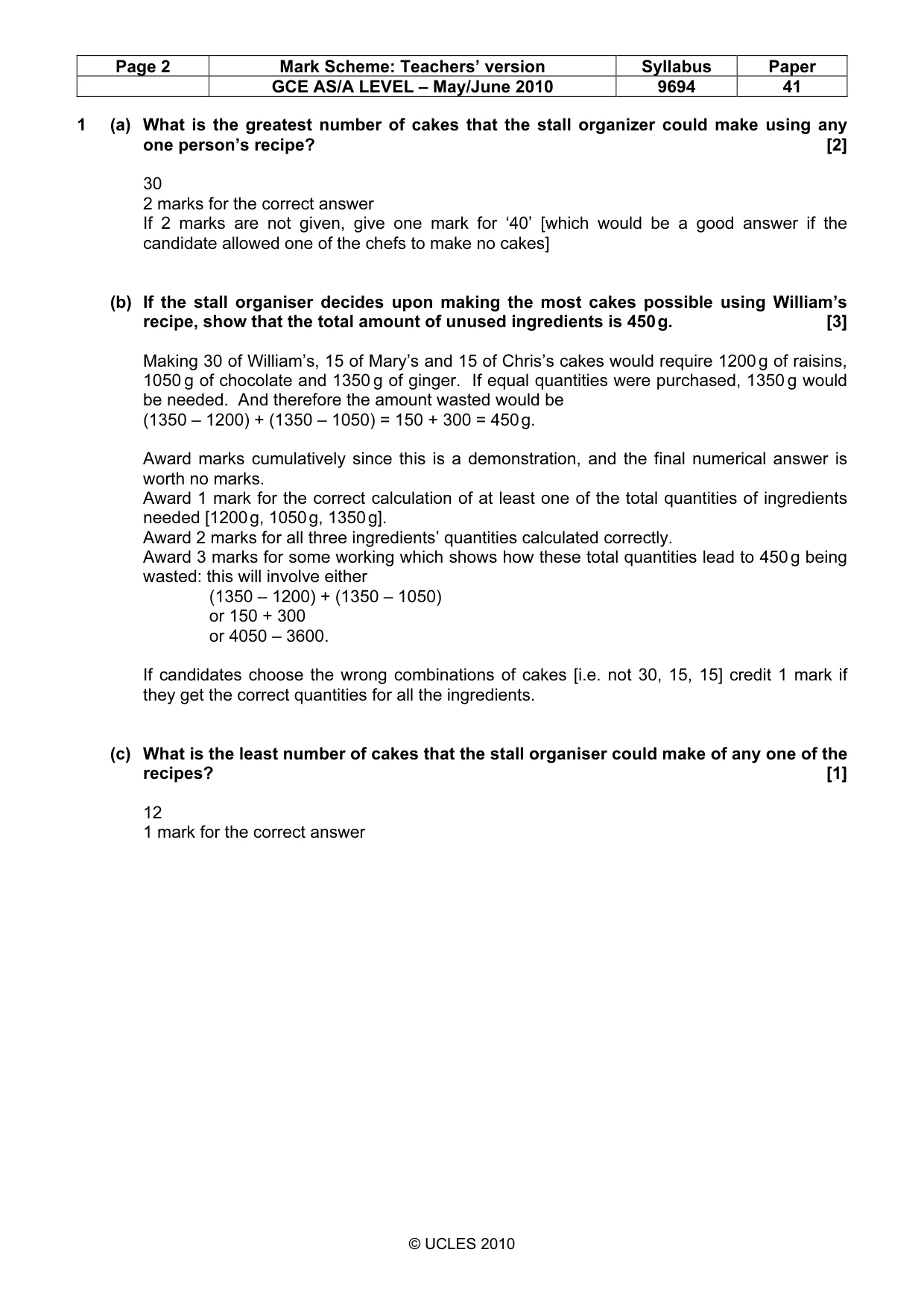
Page 2 Mark Scheme: Teachers’ version Syllabus Paper GCE AS/A LEVEL – May/June 2010 9694 41 © UCLES 2010 1 (a) What is the greatest number of cakes that the stall organizer could make using any one person’s recipe? [2] 30 2 marks for the correct answer If 2 marks are not given, give one mark for ‘40’ [which would be a good answer if the candidate allowed one of the chefs to make no cakes] (b) If the stall organiser decides upon making the most cakes possible using William’s recipe, show that the total amount of unused ingredients is 450 g. [3] Making 30 of William’s, 15 of Mary’s and 15 of Chris’s cakes would require 1200 g of raisins, 1050 g of chocolate and 1350 g of ginger. If equal quantities were purchased, 1350 g would be needed. And therefore the amount wasted would be (1350 – 1200) + (1350 – 1050) = 150 + 300 = 450 g. Award marks cumulatively since this is a demonstration, and the final numerical answer is worth no marks. Award 1 mark for the correct calculation of at least one of the total quantities of ingredients needed [1200 g, 1050 g, 1350 g]. Award 2 marks for all three ingredients’ quantities calculated correctly. Award 3 marks for some working which shows how these total quantities lead to 450 g being wasted: this will involve either (1350 – 1200) + (1350 – 1050) or 150 + 300 or 4050 – 3600. If candidates choose the wrong combinations of cakes [i.e. not 30, 15, 15] credit 1 mark if they get the correct quantities for all the ingredients. (c) What is the least number of cakes that the stall organiser could make of any one of the recipes? [1] 12 1 mark for the correct answer
Mark scheme, page 3
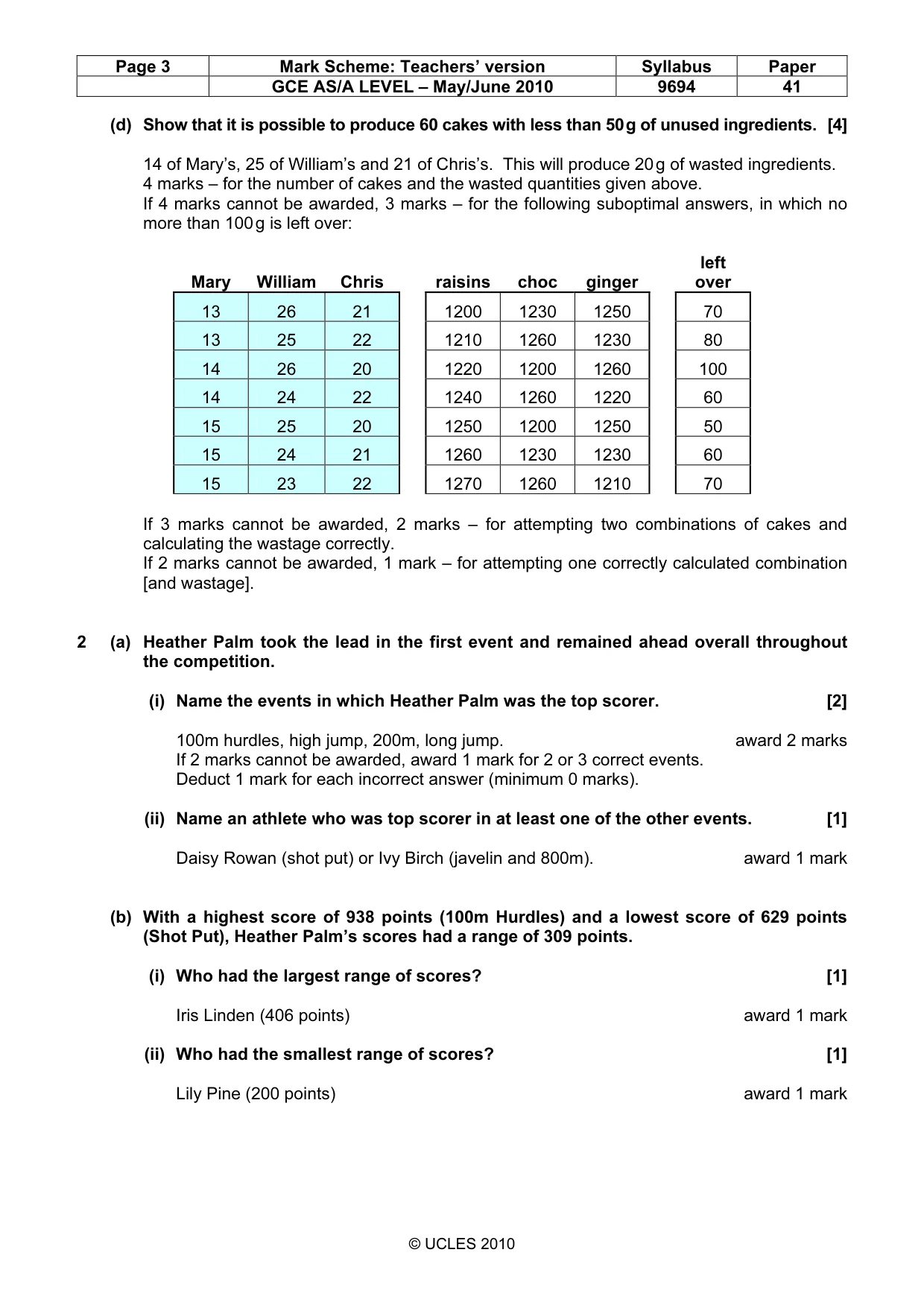
Page 3 Mark Scheme: Teachers’ version Syllabus Paper GCE AS/A LEVEL – May/June 2010 9694 41 © UCLES 2010 (d) Show that it is possible to produce 60 cakes with less than 50 g of unused ingredients. [4] 14 of Mary’s, 25 of William’s and 21 of Chris’s. This will produce 20 g of wasted ingredients. 4 marks – for the number of cakes and the wasted quantities given above. If 4 marks cannot be awarded, 3 marks – for the following suboptimal answers, in which no more than 100 g is left over: Mary William Chris raisins choc ginger left over 13 26 21 1200 1230 1250 70 13 25 22 1210 1260 1230 80 14 26 20 1220 1200 1260 100 14 24 22 1240 1260 1220 60 15 25 20 1250 1200 1250 50 15 24 21 1260 1230 1230 60 15 23 22 1270 1260 1210 70 If 3 marks cannot be awarded, 2 marks – for attempting two combinations of cakes and calculating the wastage correctly. If 2 marks cannot be awarded, 1 mark – for attempting one correctly calculated combination [and wastage]. 2 (a) Heather Palm took the lead in the first event and remained ahead overall throughout the competition. (i) Name the events in which Heather Palm was the top scorer. [2] 100m hurdles, high jump, 200m, long jump. award 2 marks If 2 marks cannot be awarded, award 1 mark for 2 or 3 correct events. Deduct 1 mark for each incorrect answer (minimum 0 marks). (ii) Name an athlete who was top scorer in at least one of the other events. [1] Daisy Rowan (shot put) or Ivy Birch (javelin and 800m). award 1 mark (b) With a highest score of 938 points (100m Hurdles) and a lowest score of 629 points (Shot Put), Heather Palm’s scores had a range of 309 points. (i) Who had the largest range of scores? [1] Iris Linden (406 points) award 1 mark (ii) Who had the smallest range of scores? [1] Lily Pine (200 points) award 1 mark
Mark scheme, page 4
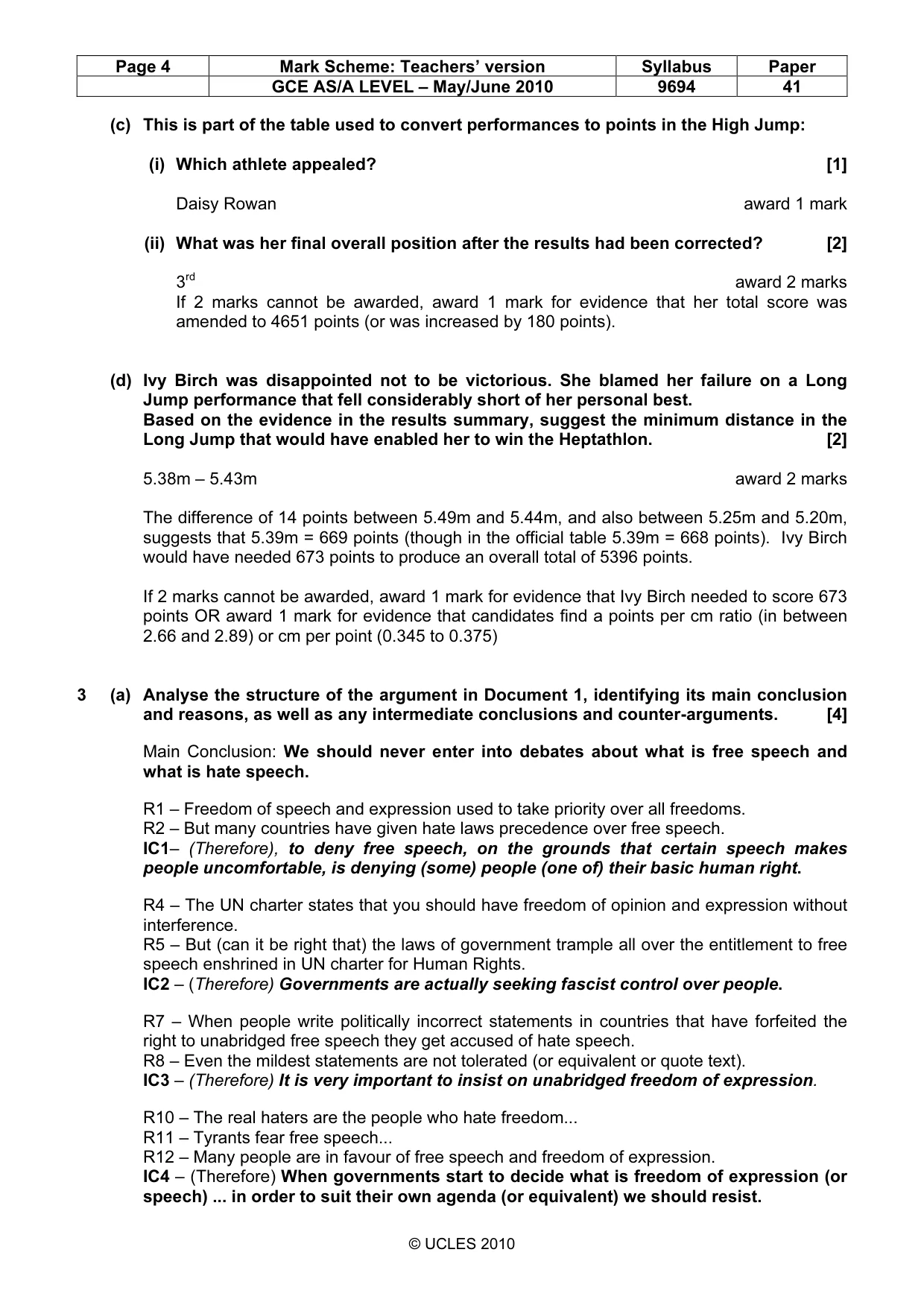
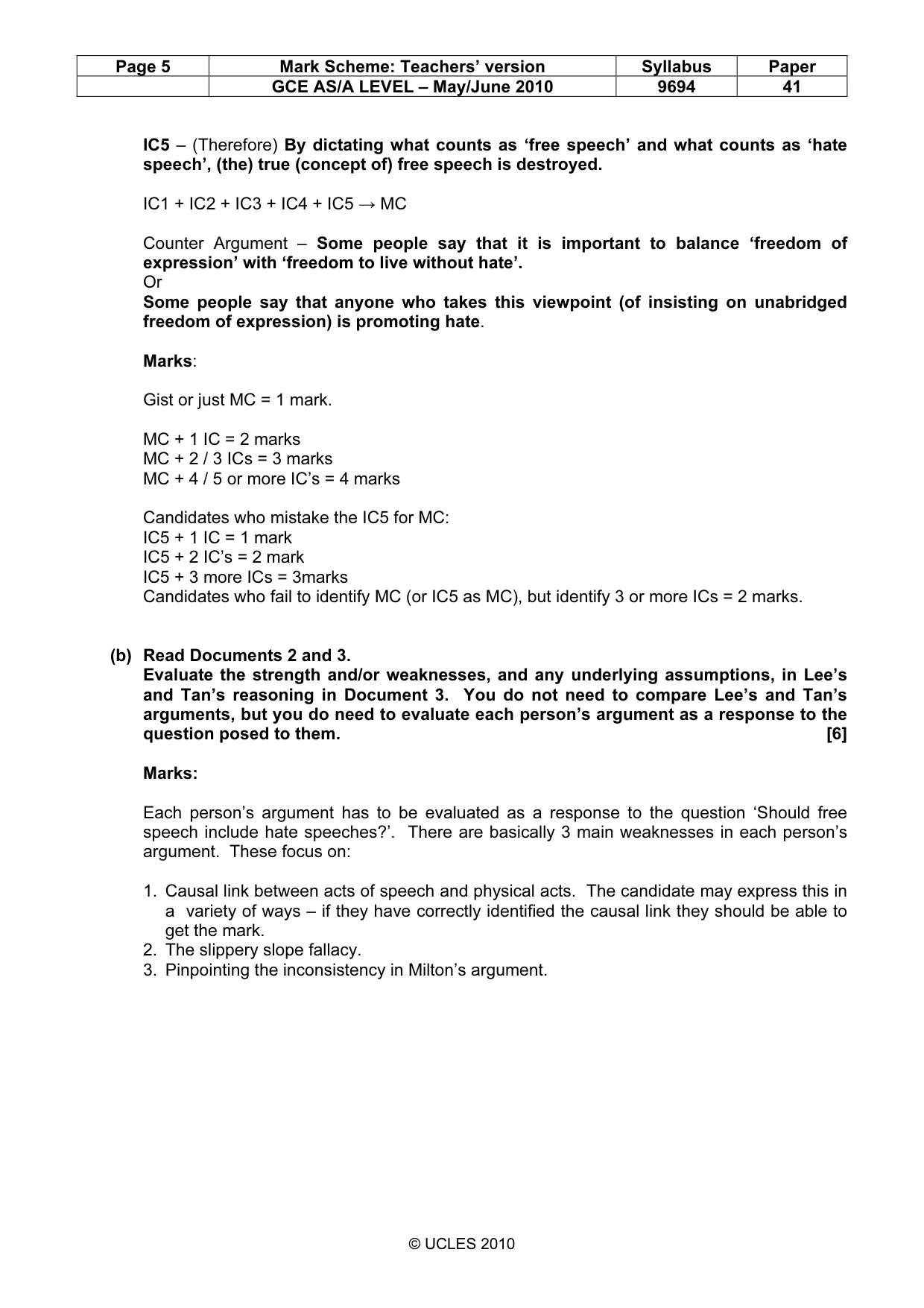
Page 4 Mark Scheme: Teachers’ version Syllabus Paper GCE AS/A LEVEL – May/June 2010 9694 41 © UCLES 2010 (c) This is part of the table used to convert performances to points in the High Jump: (i) Which athlete appealed? [1] Daisy Rowan award 1 mark (ii) What was her final overall position after the results had been corrected? [2] 3rd award 2 marks If 2 marks cannot be awarded, award 1 mark for evidence that her total score was amended to 4651 points (or was increased by 180 points). (d) Ivy Birch was disappointed not to be victorious. She blamed her failure on a Long Jump performance that fell considerably short of her personal best. Based on the evidence in the results summary, suggest the minimum distance in the Long Jump that would have enabled her to win the Heptathlon. [2] 5.38m – 5.43m award 2 marks The difference of 14 points between 5.49m and 5.44m, and also between 5.25m and 5.20m, suggests that 5.39m = 669 points (though in the official table 5.39m = 668 points). Ivy Birch would have needed 673 points to produce an overall total of 5396 points. If 2 marks cannot be awarded, award 1 mark for evidence that Ivy Birch needed to score 673 points OR award 1 mark for evidence that candidates find a points per cm ratio (in between 2.66 and 2.89) or cm per point (0.345 to 0.375) 3 (a) Analyse the structure of the argument in Document 1, identifying its main conclusion and reasons, as well as any intermediate conclusions and counter-arguments. [4] Main Conclusion: We should never enter into debates about what is free speech and what is hate speech. R1 – Freedom of speech and expression used to take priority over all freedoms. R2 – But many countries have given hate laws precedence over free speech. IC1– (Therefore), to deny free speech, on the grounds that certain speech makes people uncomfortable, is denying (some) people (one of) their basic human right. R4 – The UN charter states that you should have freedom of opinion and expression without interference. R5 – But (can it be right that) the laws of government trample all over the entitlement to free speech enshrined in UN charter for Human Rights. IC2 – (Therefore) Governments are actually seeking fascist control over people. R7 – When people write politically incorrect statements in countries that have forfeited the right to unabridged free speech they get accused of hate speech. R8 – Even the mildest statements are not tolerated (or equivalent or quote text). IC3 – (Therefore) It is very important to insist on unabridged freedom of expression. R10 – The real haters are the people who hate freedom... R11 – Tyrants fear free speech... R12 – Many people are in favour of free speech and freedom of expression. IC4 – (Therefore) When governments start to decide what is freedom of expression (or speech) ... in order to suit their own agenda (or equivalent) we should resist.
Mark scheme, page 5
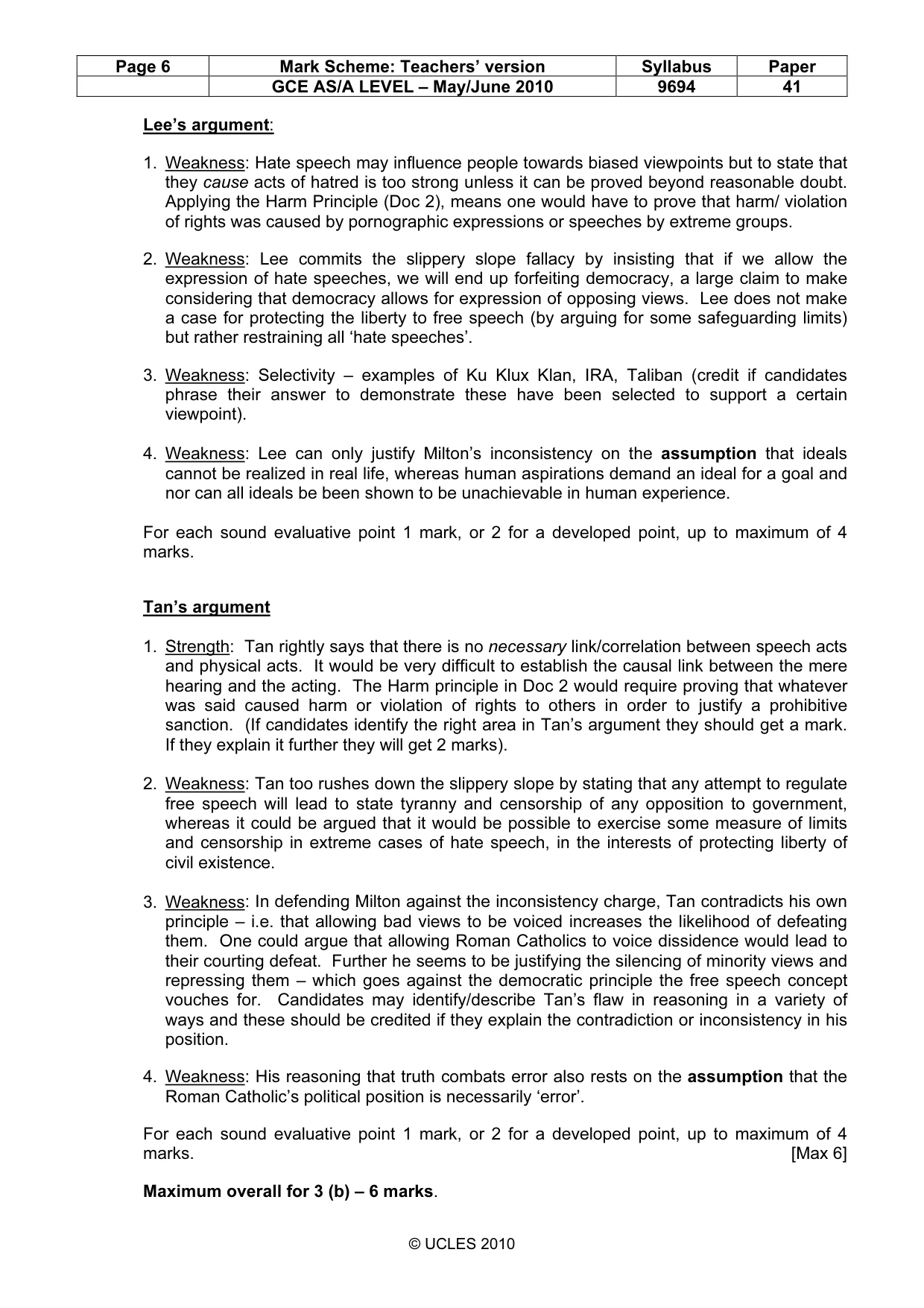
Page 5 Mark Scheme: Teachers’ version Syllabus Paper GCE AS/A LEVEL – May/June 2010 9694 41 © UCLES 2010 IC5 – (Therefore) By dictating what counts as ‘free speech’ and what counts as ‘hate speech’, (the) true (concept of) free speech is destroyed. IC1 + IC2 + IC3 + IC4 + IC5 → MC Counter Argument – Some people say that it is important to balance ‘freedom of expression’ with ‘freedom to live without hate’. Or Some people say that anyone who takes this viewpoint (of insisting on unabridged freedom of expression) is promoting hate. Marks: Gist or just MC = 1 mark. MC + 1 IC = 2 marks MC + 2 / 3 ICs = 3 marks MC + 4 / 5 or more IC’s = 4 marks Candidates who mistake the IC5 for MC: IC5 + 1 IC = 1 mark IC5 + 2 IC’s = 2 mark IC5 + 3 more ICs = 3marks Candidates who fail to identify MC (or IC5 as MC), but identify 3 or more ICs = 2 marks. (b) Read Documents 2 and 3. Evaluate the strength and/or weaknesses, and any underlying assumptions, in Lee’s and Tan’s reasoning in Document 3. You do not need to compare Lee’s and Tan’s arguments, but you do need to evaluate each person’s argument as a response to the question posed to them. [6] Marks: Each person’s argument has to be evaluated as a response to the question ‘Should free speech include hate speeches?’. There are basically 3 main weaknesses in each person’s argument. These focus on: 1. Causal link between acts of speech and physical acts. The candidate may express this in a variety of ways – if they have correctly identified the causal link they should be able to get the mark. 2. The slippery slope fallacy. 3. Pinpointing the inconsistency in Milton’s argument.
Mark scheme, page 6
Page 6 Mark Scheme: Teachers’ version Syllabus Paper GCE AS/A LEVEL – May/June 2010 9694 41 © UCLES 2010 Lee’s argument: 1. Weakness: Hate speech may influence people towards biased viewpoints but to state that they cause acts of hatred is too strong unless it can be proved beyond reasonable doubt. Applying the Harm Principle (Doc 2), means one would have to prove that harm/ violation of rights was caused by pornographic expressions or speeches by extreme groups. 2. Weakness: Lee commits the slippery slope fallacy by insisting that if we allow the expression of hate speeches, we will end up forfeiting democracy, a large claim to make considering that democracy allows for expression of opposing views. Lee does not make a case for protecting the liberty to free speech (by arguing for some safeguarding limits) but rather restraining all ‘hate speeches’. 3. Weakness: Selectivity – examples of Ku Klux Klan, IRA, Taliban (credit if candidates phrase their answer to demonstrate these have been selected to support a certain viewpoint). 4. Weakness: Lee can only justify Milton’s inconsistency on the assumption that ideals cannot be realized in real life, whereas human aspirations demand an ideal for a goal and nor can all ideals be been shown to be unachievable in human experience. For each sound evaluative point 1 mark, or 2 for a developed point, up to maximum of 4 marks. Tan’s argument 1. Strength: Tan rightly says that there is no necessary link/correlation between speech acts and physical acts. It would be very difficult to establish the causal link between the mere hearing and the acting. The Harm principle in Doc 2 would require proving that whatever was said caused harm or violation of rights to others in order to justify a prohibitive sanction. (If candidates identify the right area in Tan’s argument they should get a mark. If they explain it further they will get 2 marks). 2. Weakness: Tan too rushes down the slippery slope by stating that any attempt to regulate free speech will lead to state tyranny and censorship of any opposition to government, whereas it could be argued that it would be possible to exercise some measure of limits and censorship in extreme cases of hate speech, in the interests of protecting liberty of civil existence. 3. Weakness: In defending Milton against the inconsistency charge, Tan contradicts his own principle – i.e. that allowing bad views to be voiced increases the likelihood of defeating them. One could argue that allowing Roman Catholics to voice dissidence would lead to their courting defeat. Further he seems to be justifying the silencing of minority views and repressing them – which goes against the democratic principle the free speech concept vouches for. Candidates may identify/describe Tan’s flaw in reasoning in a variety of ways and these should be credited if they explain the contradiction or inconsistency in his position. 4. Weakness: His reasoning that truth combats error also rests on the assumption that the Roman Catholic’s political position is necessarily ‘error’. For each sound evaluative point 1 mark, or 2 for a developed point, up to maximum of 4 marks. [Max 6] Maximum overall for 3 (b) – 6 marks.
Mark scheme, page 7
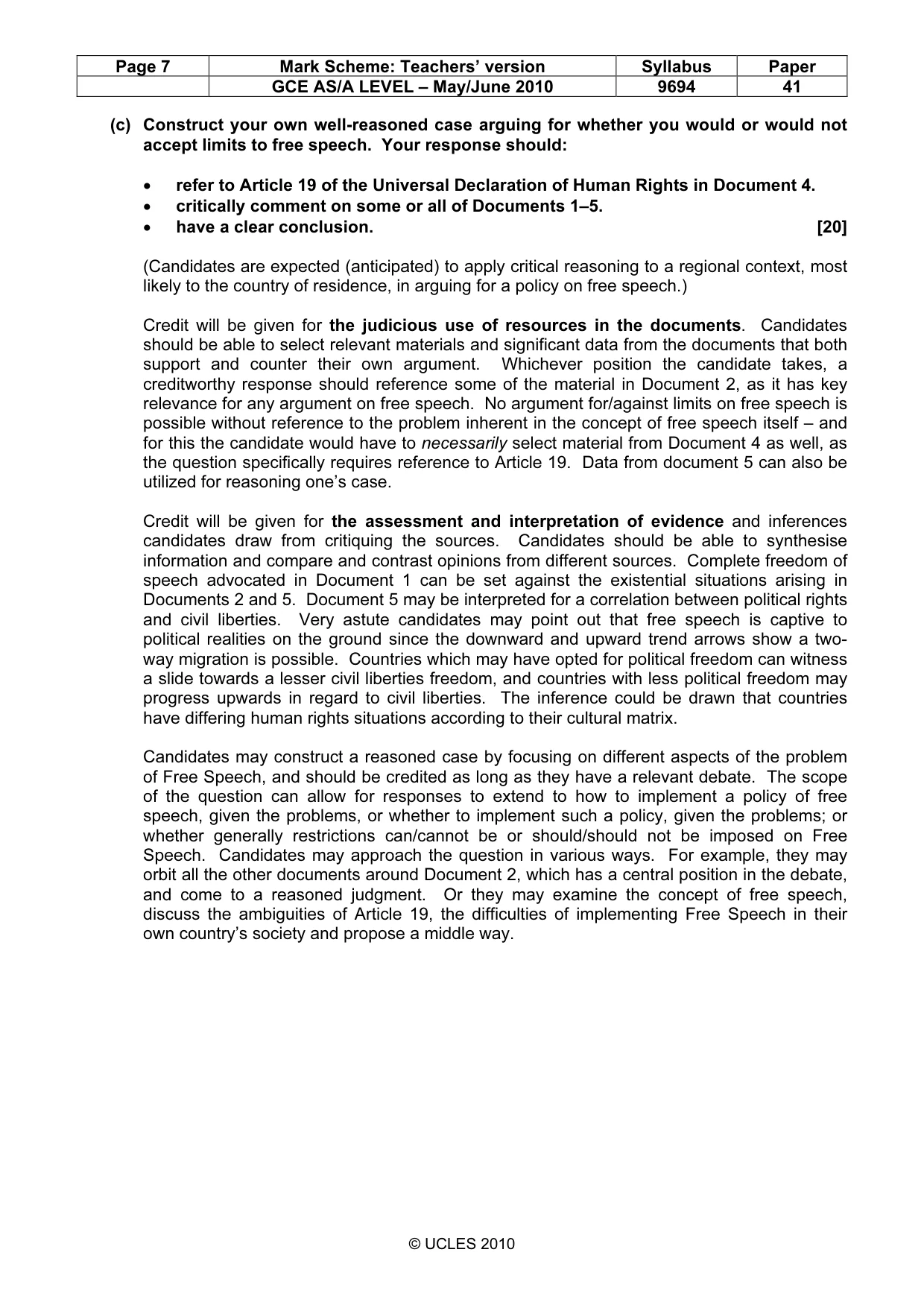
Page 7 Mark Scheme: Teachers’ version Syllabus Paper GCE AS/A LEVEL – May/June 2010 9694 41 © UCLES 2010 (c) Construct your own well-reasoned case arguing for whether you would or would not accept limits to free speech. Your response should: • refer to Article 19 of the Universal Declaration of Human Rights in Document 4. • critically comment on some or all of Documents 1–5. • have a clear conclusion. [20] (Candidates are expected (anticipated) to apply critical reasoning to a regional context, most likely to the country of residence, in arguing for a policy on free speech.) Credit will be given for the judicious use of resources in the documents. Candidates should be able to select relevant materials and significant data from the documents that both support and counter their own argument. Whichever position the candidate takes, a creditworthy response should reference some of the material in Document 2, as it has key relevance for any argument on free speech. No argument for/against limits on free speech is possible without reference to the problem inherent in the concept of free speech itself – and for this the candidate would have to necessarily select material from Document 4 as well, as the question specifically requires reference to Article 19. Data from document 5 can also be utilized for reasoning one’s case. Credit will be given for the assessment and interpretation of evidence and inferences candidates draw from critiquing the sources. Candidates should be able to synthesise information and compare and contrast opinions from different sources. Complete freedom of speech advocated in Document 1 can be set against the existential situations arising in Documents 2 and 5. Document 5 may be interpreted for a correlation between political rights and civil liberties. Very astute candidates may point out that free speech is captive to political realities on the ground since the downward and upward trend arrows show a two- way migration is possible. Countries which may have opted for political freedom can witness a slide towards a lesser civil liberties freedom, and countries with less political freedom may progress upwards in regard to civil liberties. The inference could be drawn that countries have differing human rights situations according to their cultural matrix. Candidates may construct a reasoned case by focusing on different aspects of the problem of Free Speech, and should be credited as long as they have a relevant debate. The scope of the question can allow for responses to extend to how to implement a policy of free speech, given the problems, or whether to implement such a policy, given the problems; or whether generally restrictions can/cannot be or should/should not be imposed on Free Speech. Candidates may approach the question in various ways. For example, they may orbit all the other documents around Document 2, which has a central position in the debate, and come to a reasoned judgment. Or they may examine the concept of free speech, discuss the ambiguities of Article 19, the difficulties of implementing Free Speech in their own country’s society and propose a middle way.
Mark scheme, page 8
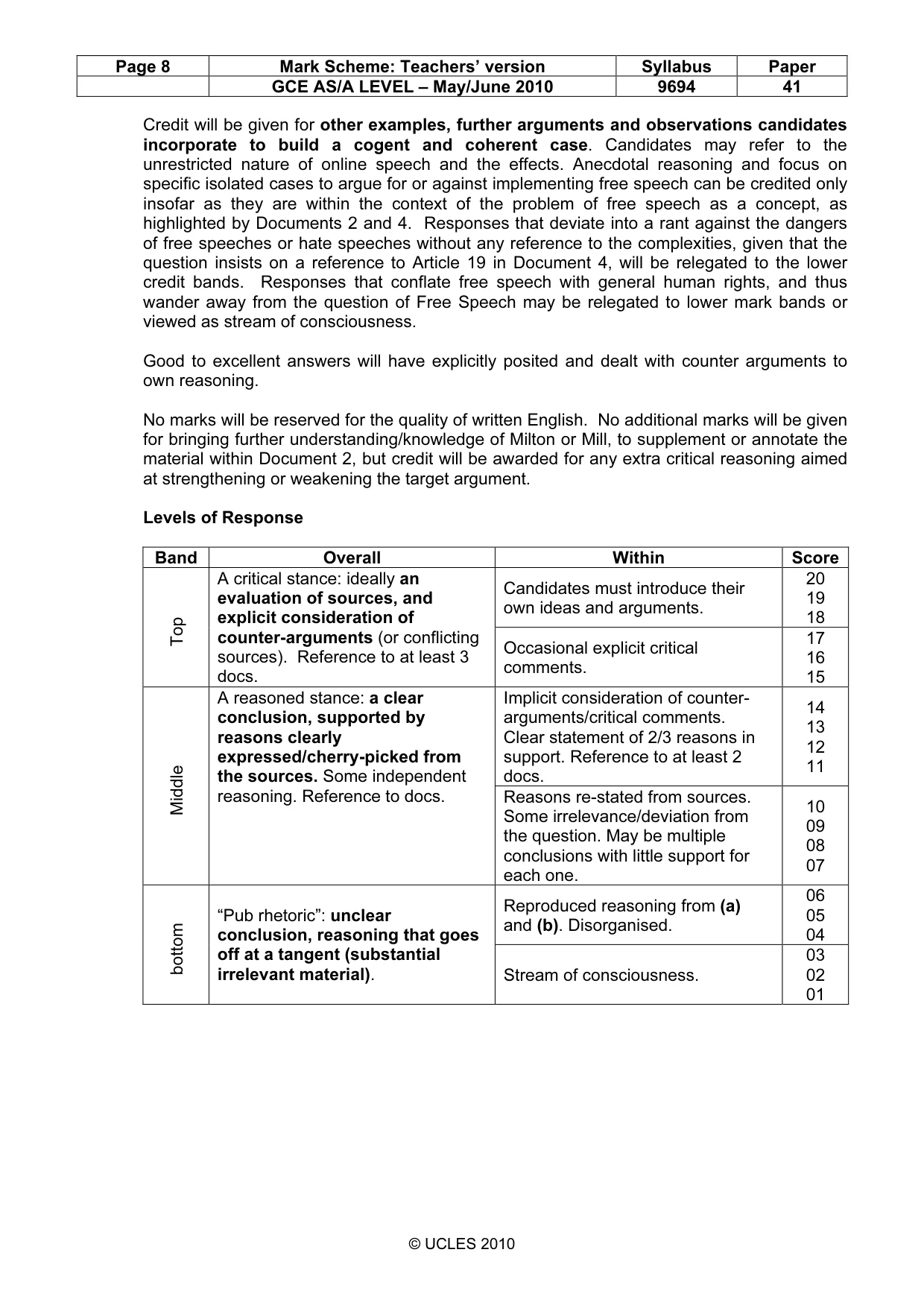
Page 8 Mark Scheme: Teachers’ version Syllabus Paper GCE AS/A LEVEL – May/June 2010 9694 41 © UCLES 2010 Credit will be given for other examples, further arguments and observations candidates incorporate to build a cogent and coherent case. Candidates may refer to the unrestricted nature of online speech and the effects. Anecdotal reasoning and focus on specific isolated cases to argue for or against implementing free speech can be credited only insofar as they are within the context of the problem of free speech as a concept, as highlighted by Documents 2 and 4. Responses that deviate into a rant against the dangers of free speeches or hate speeches without any reference to the complexities, given that the question insists on a reference to Article 19 in Document 4, will be relegated to the lower credit bands. Responses that conflate free speech with general human rights, and thus wander away from the question of Free Speech may be relegated to lower mark bands or viewed as stream of consciousness. Good to excellent answers will have explicitly posited and dealt with counter arguments to own reasoning. No marks will be reserved for the quality of written English. No additional marks will be given for bringing further understanding/knowledge of Milton or Mill, to supplement or annotate the material within Document 2, but credit will be awarded for any extra critical reasoning aimed at strengthening or weakening the target argument. Levels of Response Band Overall Within Score Candidates must introduce their own ideas and arguments. 20 19 18 Top A critical stance: ideally an evaluation of sources, and explicit consideration of counter-arguments (or conflicting sources). Reference to at least 3 docs. Occasional explicit critical comments. 17 16 15 Implicit consideration of counter- arguments/critical comments. Clear statement of 2/3 reasons in support. Reference to at least 2 docs. 14 13 12 11 Middle A reasoned stance: a clear conclusion, supported by reasons clearly expressed/cherry-picked from the sources. Some independent reasoning. Reference to docs. Reasons re-stated from sources. Some irrelevance/deviation from the question. May be multiple conclusions with little support for each one. 10 09 08 07 Reproduced reasoning from (a) and (b). Disorganised. 06 05 04 bottom “Pub rhetoric”: unclear conclusion, reasoning that goes off at a tangent (substantial irrelevant material). Stream of consciousness. 03 02 01
What you needed in this session
Cambridge’s own grade thresholds for 2010 May/June, Paper 4 · Variant 1. A higher threshold means an easier paper — the bar moves with how the cohort did.