Cambridge A Level Psychology (from 2018) 9990 — 2018 May/June Paper 1 · Variant 3
9990/13/M/J/18 · 60 marks · ≈68 min
The question paper and its mark scheme, free to read here and free to download. This is Cambridge’s own paper, exactly as it was sat.
Question paper8 pages
Mark scheme9 pages
Answers below. Sit the paper first if you are practising.
Paper as text
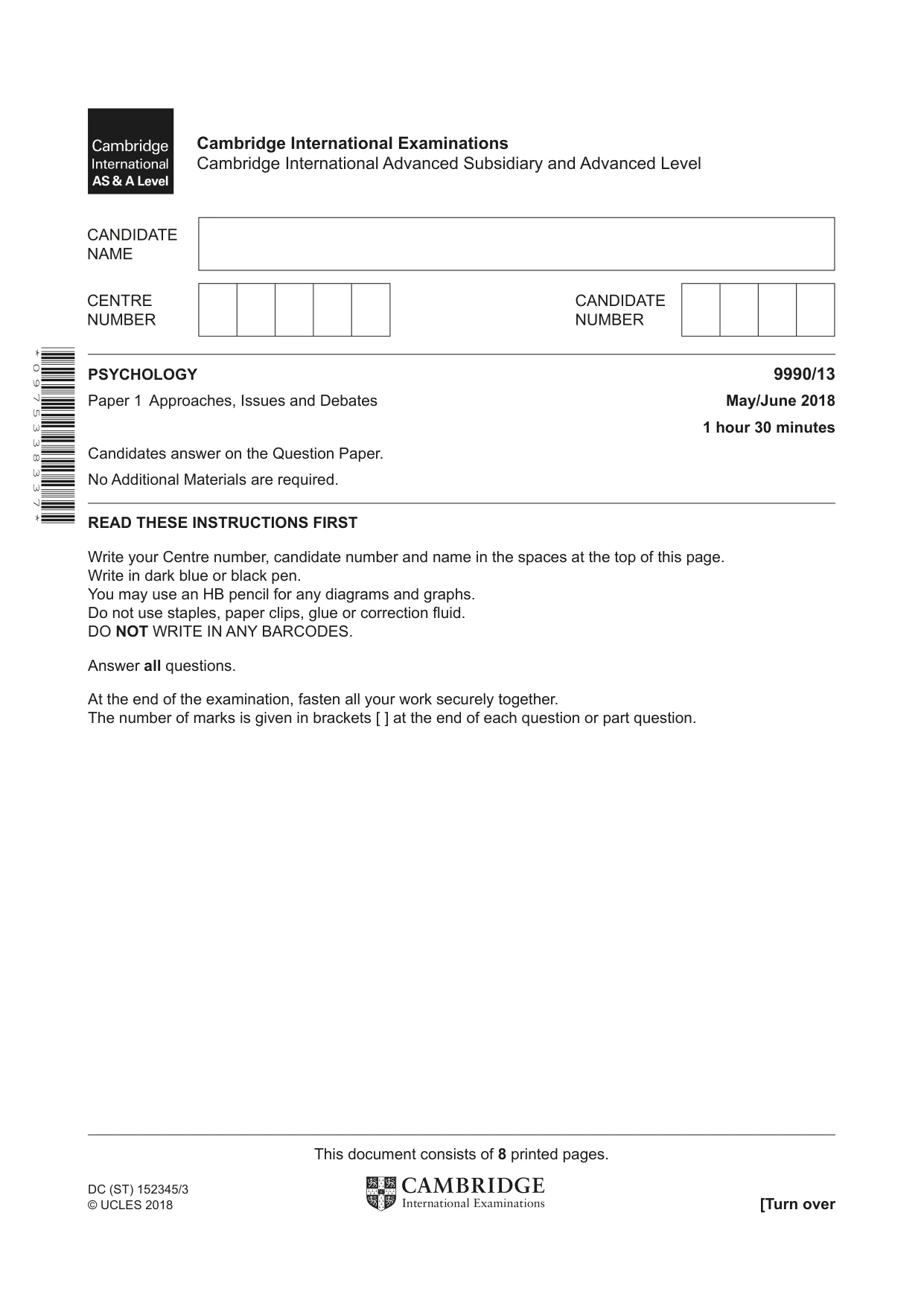
Question paper, page 1
* 0 9 7 5 3 3 8 3 3 7 * Cambridge International Examinations Cambridge International Advanced Subsidiary and Advanced Level PSYCHOLOGY 9990/13 Paper 1 Approaches, Issues and Debates May/June 2018 1 hour 30 minutes Candidates answer on the Question Paper. No Additional Materials are required. READ THESE INSTRUCTIONS FIRST Write your Centre number, candidate number and name in the spaces at the top of this page. Write in dark blue or black pen. You may use an HB pencil for any diagrams and graphs. Do not use staples, paper clips, glue or correction fluid. DO NOT WRITE IN ANY BARCODES. Answer all questions. At the end of the examination, fasten all your work securely together. The number of marks is given in brackets [ ] at the end of each question or part question. This document consists of 8 printed pages. DC (ST) 152345/3 © UCLES 2018 [Turn over
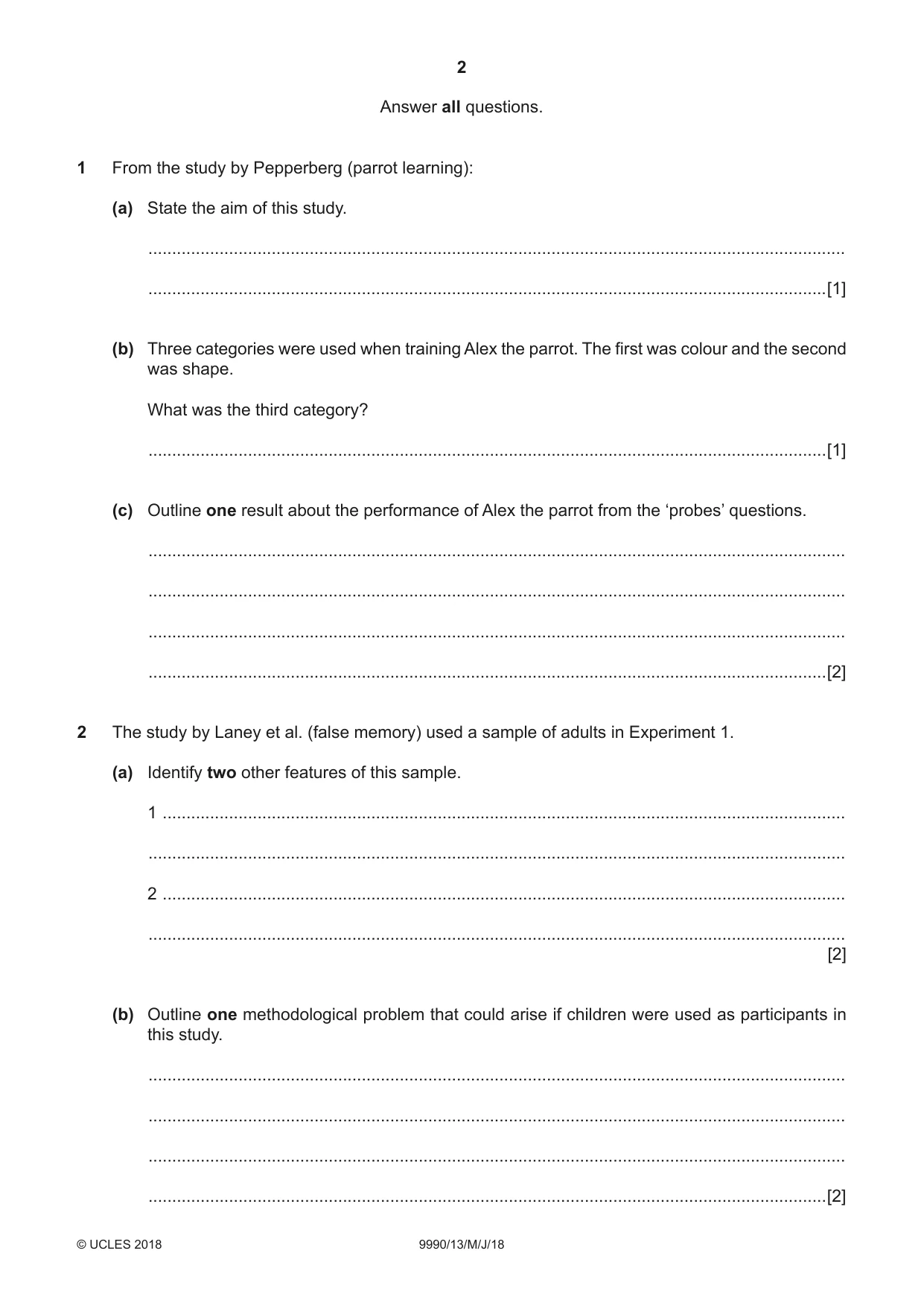
Question paper, page 2
2 9990/13/M/J/18 © UCLES 2018 Answer all questions. 1 From the study by Pepperberg (parrot learning): (a) State the aim of this study. … …[1] (b) Three categories were used when training Alex the parrot. The first was colour and the second was shape. What was the third category? …[1] (c) Outline one result about the performance of Alex the parrot from the ‘probes’ questions. … … … …[2] 2 The study by Laney et al. (false memory) used a sample of adults in Experiment 1. (a) Identify two other features of this sample. 1 … … 2 … … [2] (b) Outline one methodological problem that could arise if children were used as participants in this study. … … … …[2]
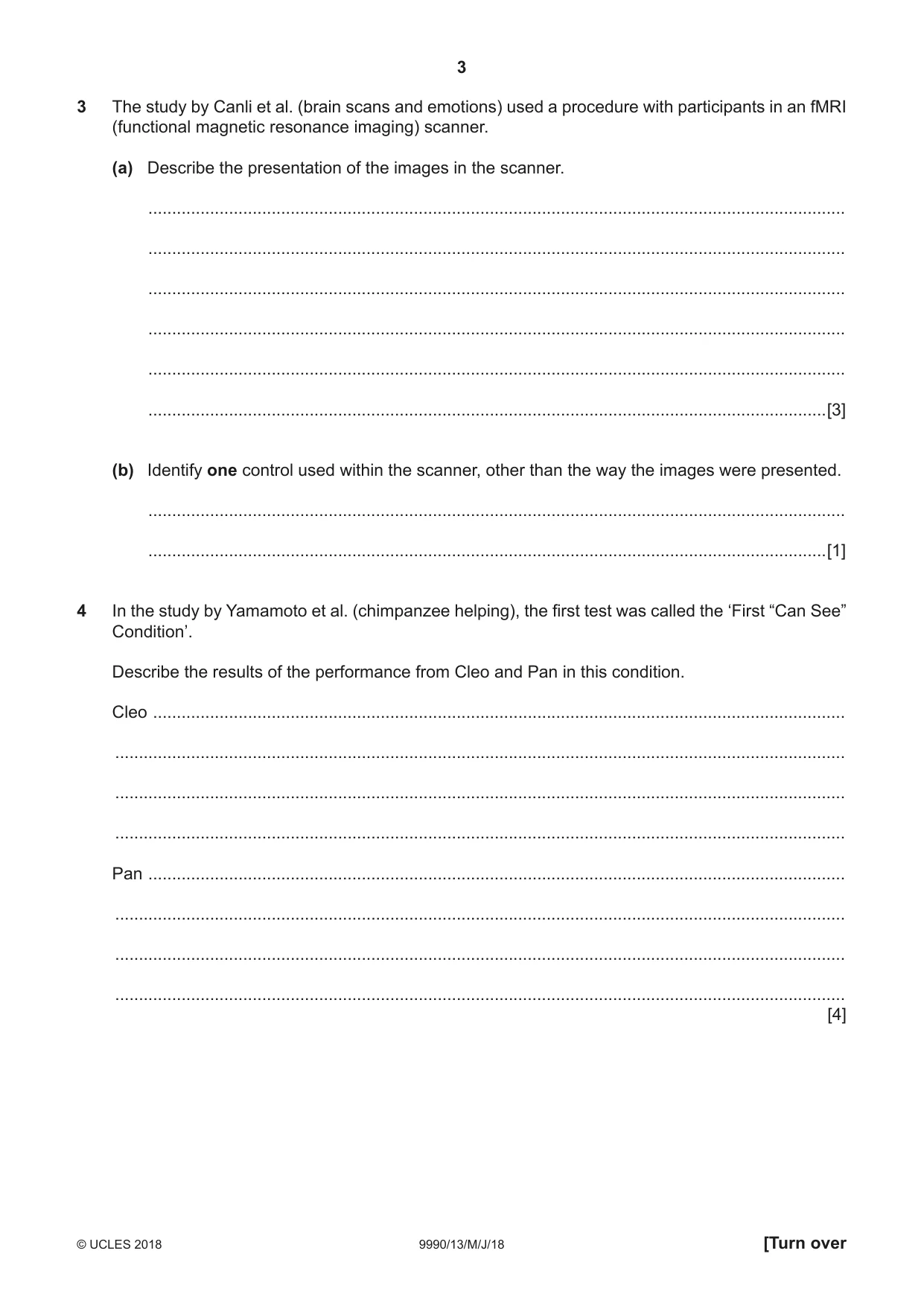
Question paper, page 3
3 9990/13/M/J/18 © UCLES 2018 [Turn over 3 The study by Canli et al. (brain scans and emotions) used a procedure with participants in an fMRI (functional magnetic resonance imaging) scanner. (a) Describe the presentation of the images in the scanner. … … … … … …[3] (b) Identify one control used within the scanner, other than the way the images were presented. … …[1] 4 In the study by Yamamoto et al. (chimpanzee helping), the first test was called the ‘First “Can See” Condition’. Describe the results of the performance from Cleo and Pan in this condition. Cleo … … … … Pan … … … … [4]
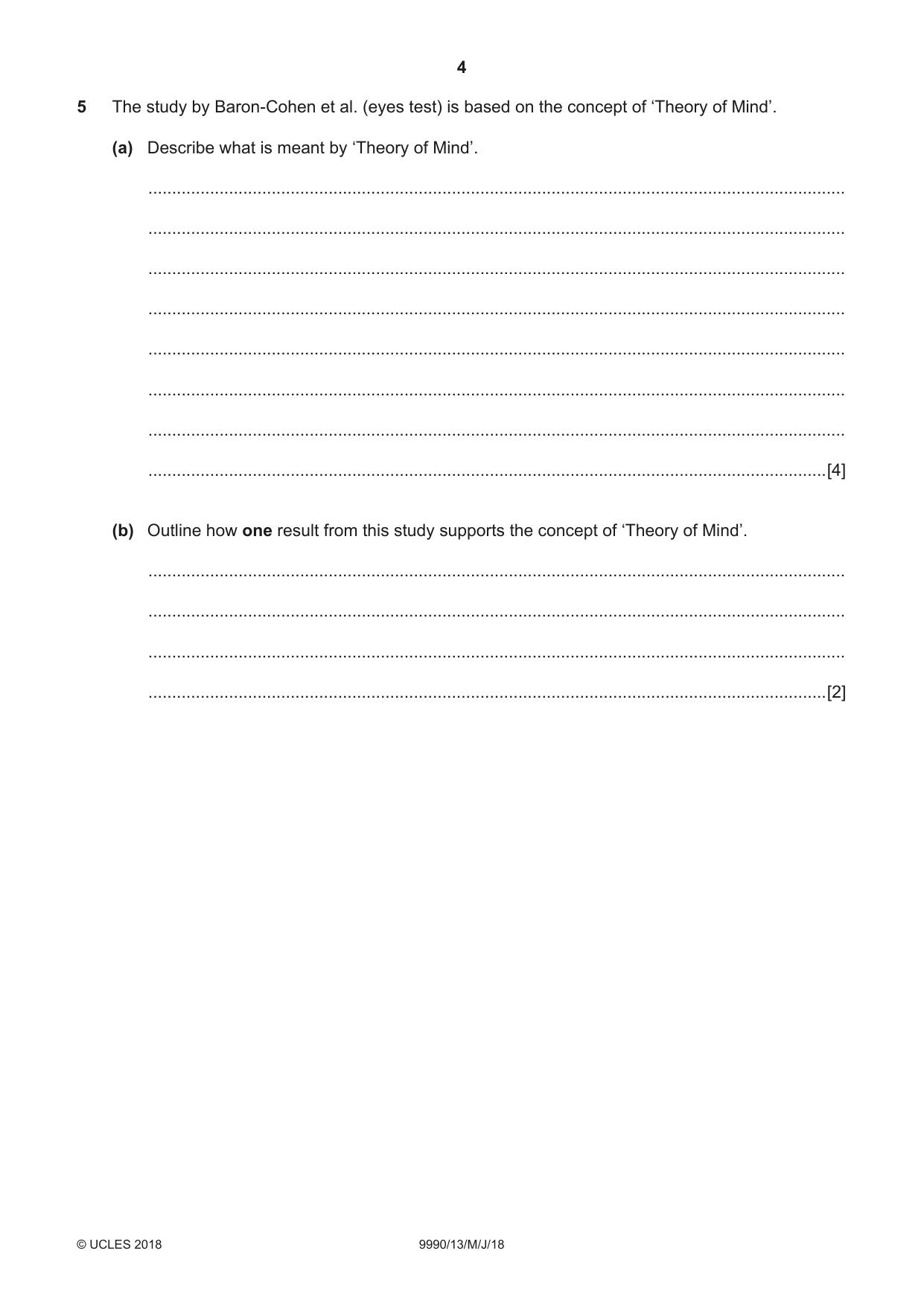
Question paper, page 4
4 9990/13/M/J/18 © UCLES 2018 5 The study by Baron-Cohen et al. (eyes test) is based on the concept of ‘Theory of Mind’. (a) Describe what is meant by ‘Theory of Mind’. … … … … … … … …[4] (b) Outline how one result from this study supports the concept of ‘Theory of Mind’. … … … …[2]
Question paper, page 5
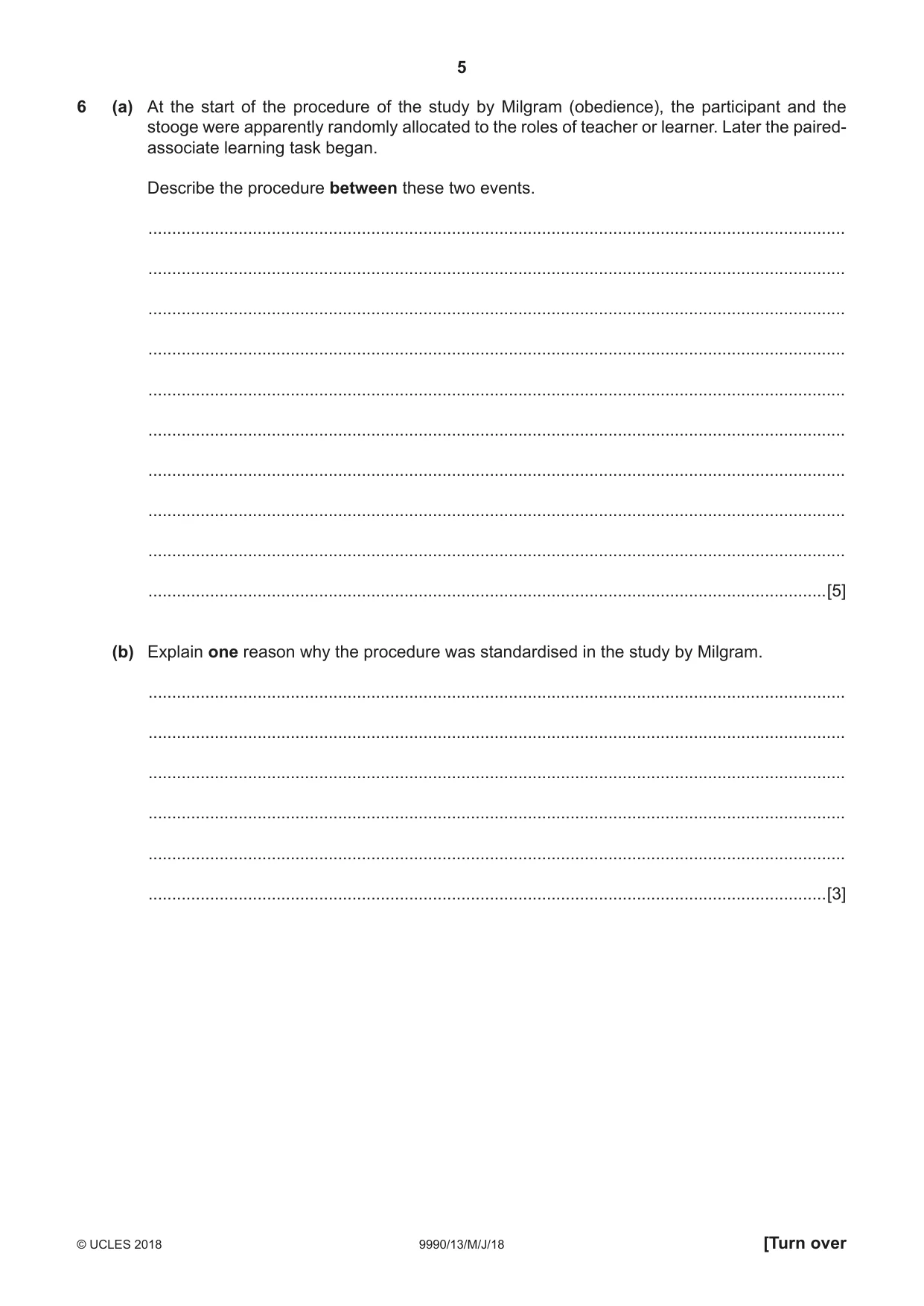
5 9990/13/M/J/18 © UCLES 2018 [Turn over 6 (a) At the start of the procedure of the study by Milgram (obedience), the participant and the stooge were apparently randomly allocated to the roles of teacher or learner. Later the paired- associate learning task began. Describe the procedure between these two events. … … … … … … … … … …[5] (b) Explain one reason why the procedure was standardised in the study by Milgram. … … … … … …[3]
Question paper, page 6
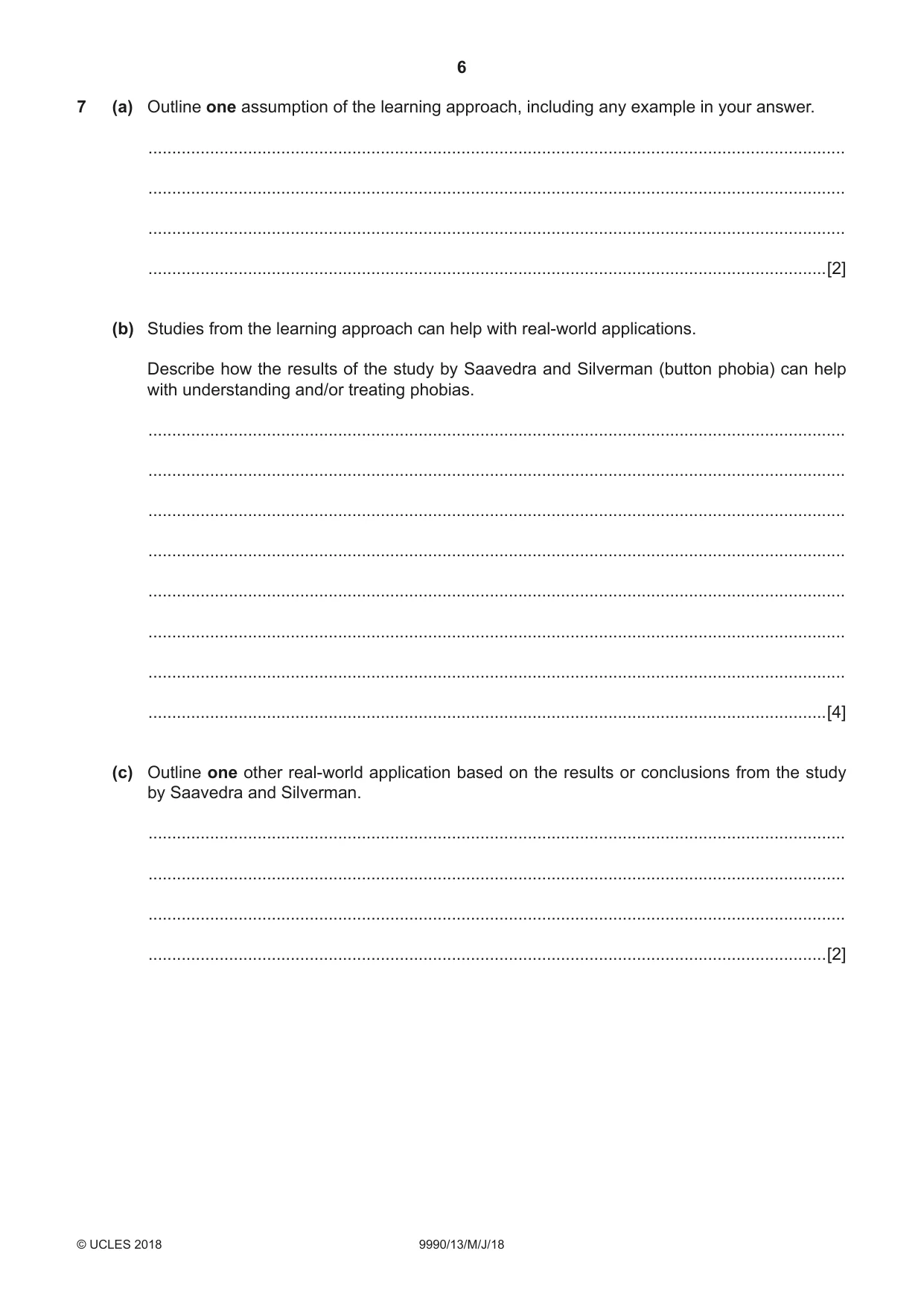
6 9990/13/M/J/18 © UCLES 2018 7 (a) Outline one assumption of the learning approach, including any example in your answer. … … … …[2] (b) Studies from the learning approach can help with real-world applications. Describe how the results of the study by Saavedra and Silverman (button phobia) can help with understanding and/or treating phobias. … … … … … … … …[4] (c) Outline one other real-world application based on the results or conclusions from the study by Saavedra and Silverman. … … … …[2]
Question paper, page 7
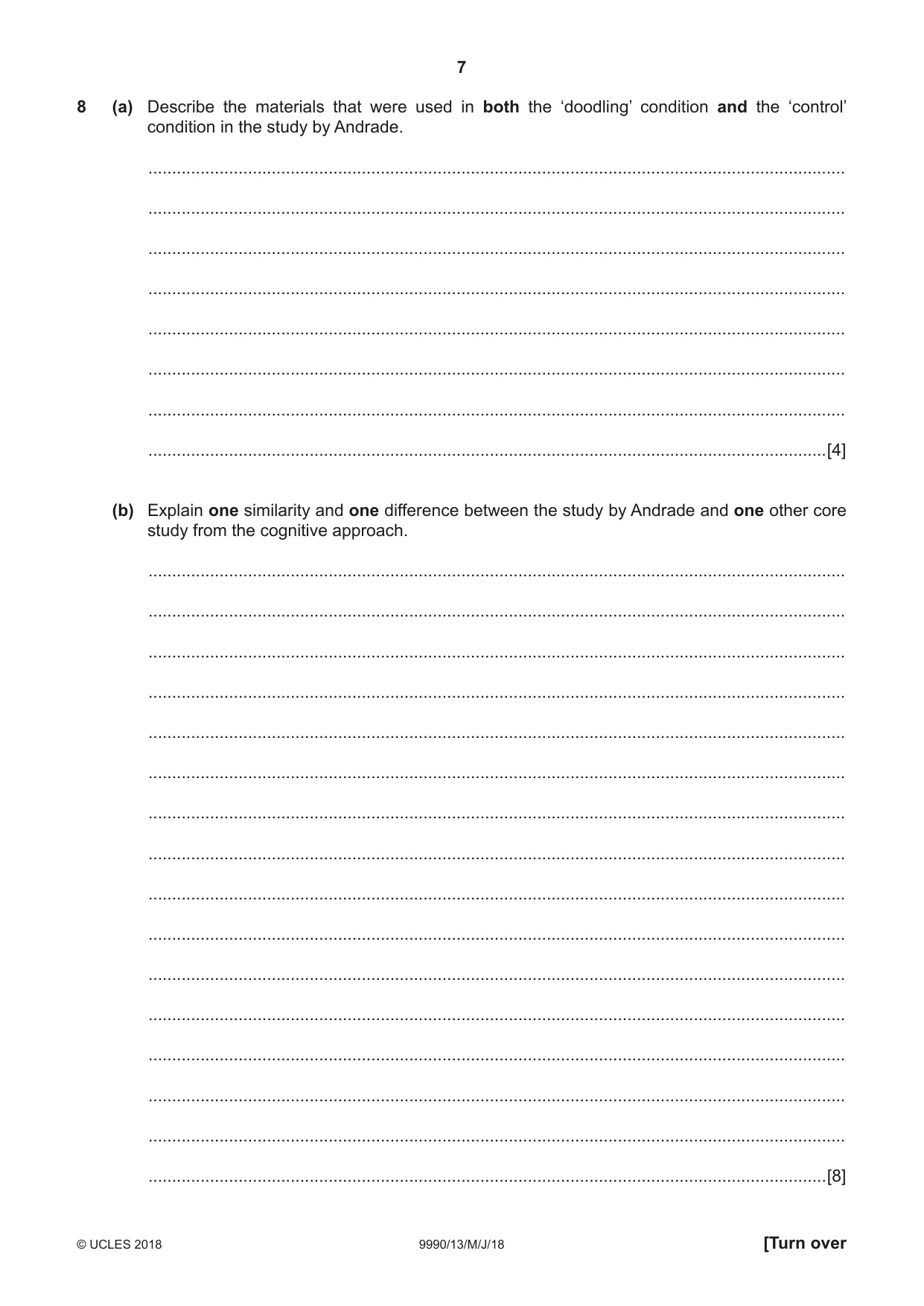
7 9990/13/M/J/18 © UCLES 2018 [Turn over 8 (a) Describe the materials that were used in both the ‘doodling’ condition and the ‘control’ condition in the study by Andrade. … … … … … … … …[4] (b) Explain one similarity and one difference between the study by Andrade and one other core study from the cognitive approach. … … … … … … … … … … … … … … … …[8]
Question paper, page 8
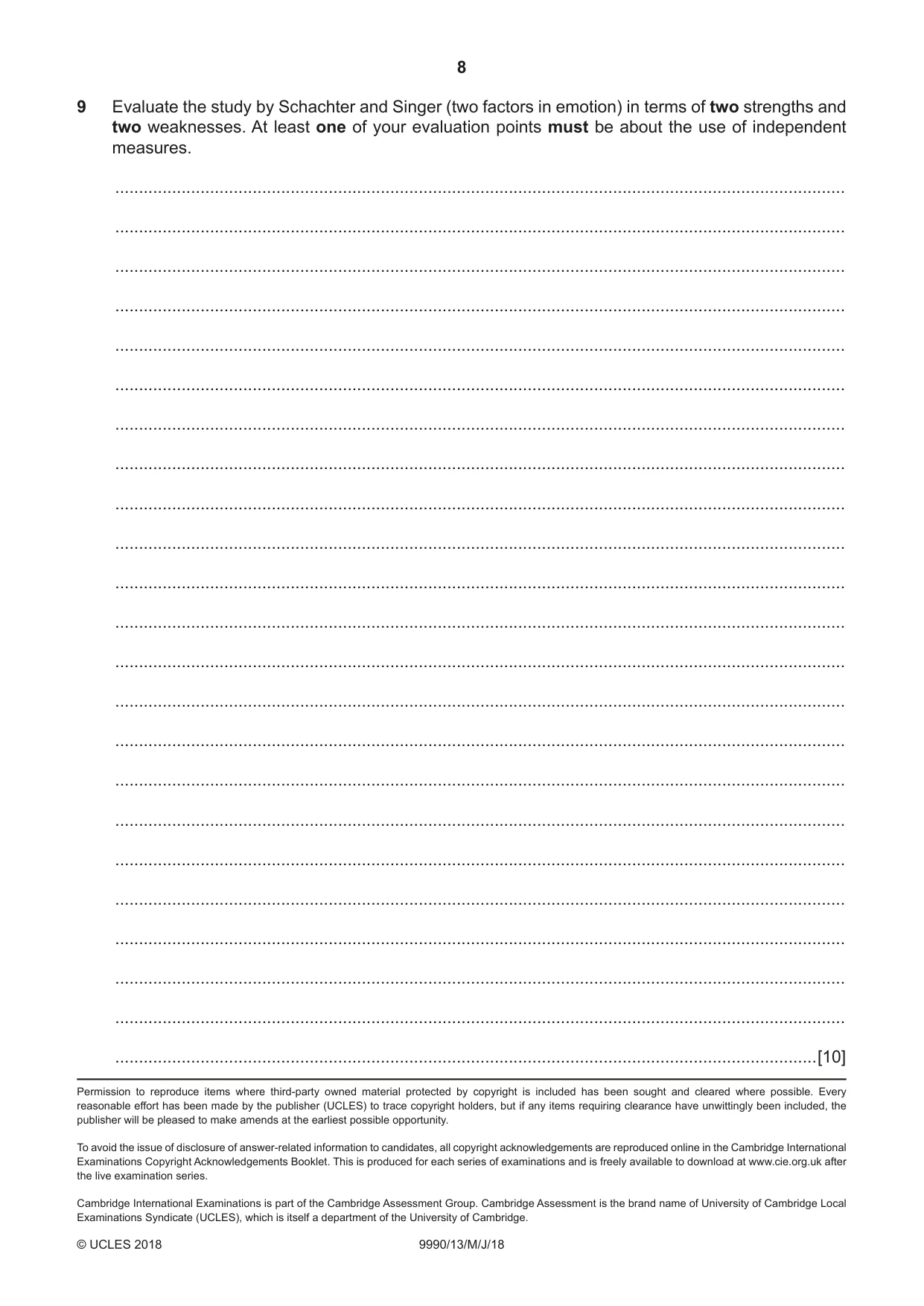
8 9990/13/M/J/18 © UCLES 2018 Permission to reproduce items where third-party owned material protected by copyright is included has been sought and cleared where possible. Every reasonable effort has been made by the publisher (UCLES) to trace copyright holders, but if any items requiring clearance have unwittingly been included, the publisher will be pleased to make amends at the earliest possible opportunity. To avoid the issue of disclosure of answer-related information to candidates, all copyright acknowledgements are reproduced online in the Cambridge International Examinations Copyright Acknowledgements Booklet. This is produced for each series of examinations and is freely available to download at www.cie.org.uk after the live examination series. Cambridge International Examinations is part of the Cambridge Assessment Group. Cambridge Assessment is the brand name of University of Cambridge Local Examinations Syndicate (UCLES), which is itself a department of the University of Cambridge. 9 Evaluate the study by Schachter and Singer (two factors in emotion) in terms of two strengths and two weaknesses. At least one of your evaluation points must be about the use of independent measures. … … … … … … … … … … … … … … … … … … … … … … …[10]
Mark scheme, page 1
IGCSE™ is a registered trademark. This document consists of 9 printed pages. © UCLES 2018 [Turn over Cambridge Assessment International Education Cambridge International Advanced Subsidiary and Advanced Level PSYCHOLOGY 9990/13 Paper 1 Approaches, issues and debates May/June 2018 MARK SCHEME Maximum Mark: 60 Published This mark scheme is published as an aid to teachers and candidates, to indicate the requirements of the examination. It shows the basis on which Examiners were instructed to award marks. It does not indicate the details of the discussions that took place at an Examiners’ meeting before marking began, which would have considered the acceptability of alternative answers. Mark schemes should be read in conjunction with the question paper and the Principal Examiner Report for Teachers. Cambridge International will not enter into discussions about these mark schemes. Cambridge International is publishing the mark schemes for the May/June 2018 series for most Cambridge IGCSE™, Cambridge International A and AS Level and Cambridge Pre-U components, and some Cambridge O Level components.
Mark scheme, page 2
9990/13 Cambridge International AS/A Level – Mark Scheme PUBLISHED May/June 2018 © UCLES 2018 Page 2 of 9 Generic Marking Principles These general marking principles must be applied by all examiners when marking candidate answers. They should be applied alongside the specific content of the mark scheme or generic level descriptors for a question. Each question paper and mark scheme will also comply with these marking principles. GENERIC MARKING PRINCIPLE 1: Marks must be awarded in line with: • the specific content of the mark scheme or the generic level descriptors for the question • the specific skills defined in the mark scheme or in the generic level descriptors for the question • the standard of response required by a candidate as exemplified by the standardisation scripts. GENERIC MARKING PRINCIPLE 2: Marks awarded are always whole marks (not half marks, or other fractions). GENERIC MARKING PRINCIPLE 3: Marks must be awarded positively: • marks are awarded for correct/valid answers, as defined in the mark scheme. However, credit is given for valid answers which go beyond the scope of the syllabus and mark scheme, referring to your Team Leader as appropriate • marks are awarded when candidates clearly demonstrate what they know and can do • marks are not deducted for errors • marks are not deducted for omissions • answers should only be judged on the quality of spelling, punctuation and grammar when these features are specifically assessed by the question as indicated by the mark scheme. The meaning, however, should be unambiguous. GENERIC MARKING PRINCIPLE 4: Rules must be applied consistently e.g. in situations where candidates have not followed instructions or in the application of generic level descriptors. GENERIC MARKING PRINCIPLE 5: Marks should be awarded using the full range of marks defined in the mark scheme for the question (however; the use of the full mark range may be limited according to the quality of the candidate responses seen). GENERIC MARKING PRINCIPLE 6: Marks awarded are based solely on the requirements as defined in the mark scheme. Marks should not be awarded with grade thresholds or grade descriptors in mind.
Mark scheme, page 3
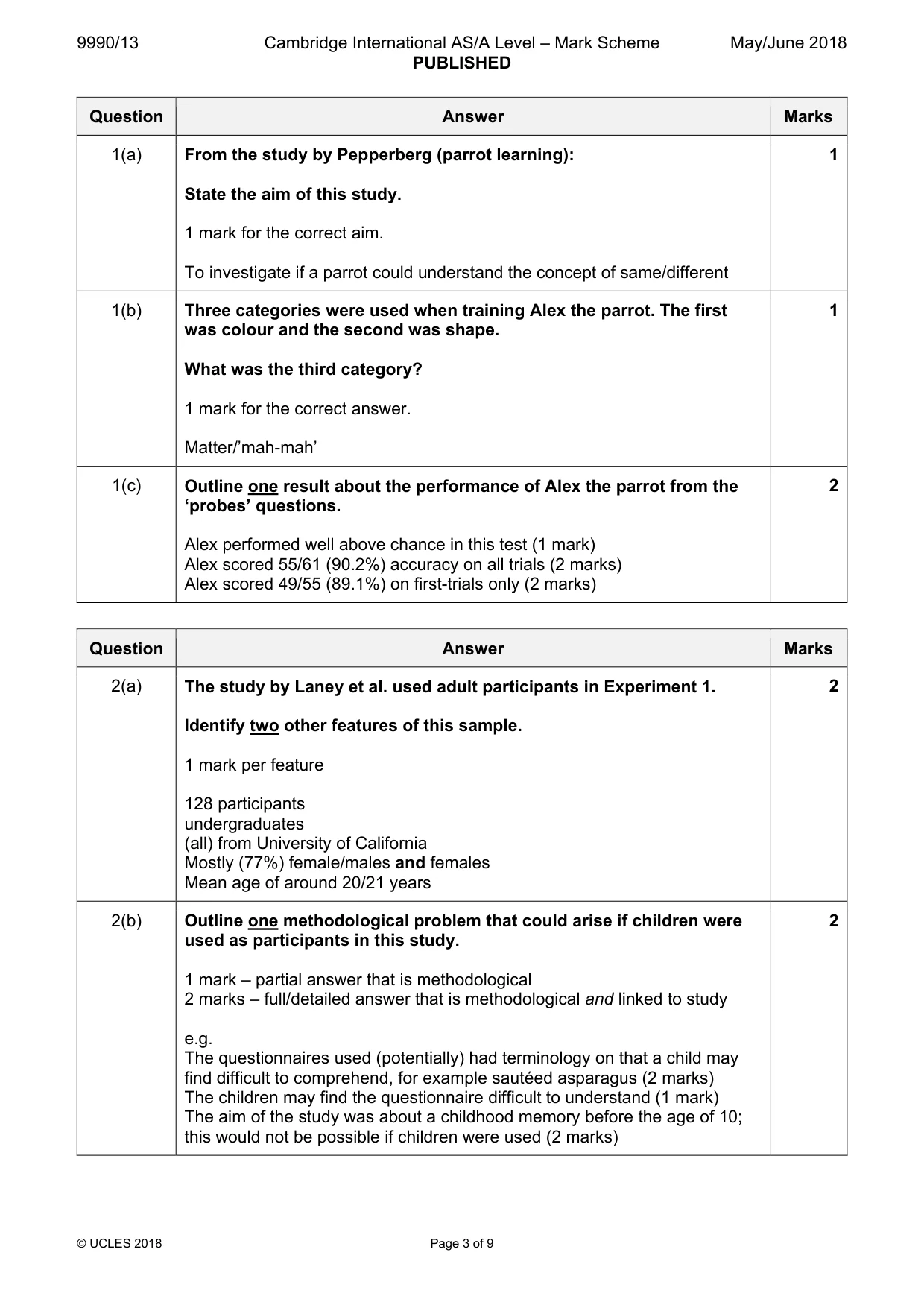
9990/13 Cambridge International AS/A Level – Mark Scheme PUBLISHED May/June 2018 © UCLES 2018 Page 3 of 9 Question Answer Marks 1(a) From the study by Pepperberg (parrot learning): State the aim of this study. 1 mark for the correct aim. To investigate if a parrot could understand the concept of same/different 1 1(b) Three categories were used when training Alex the parrot. The first was colour and the second was shape. What was the third category? 1 mark for the correct answer. Matter/’mah-mah’ 1 1(c) Outline one result about the performance of Alex the parrot from the ‘probes’ questions. Alex performed well above chance in this test (1 mark) Alex scored 55/61 (90.2%) accuracy on all trials (2 marks) Alex scored 49/55 (89.1%) on first-trials only (2 marks) 2 Question Answer Marks 2(a) The study by Laney et al. used adult participants in Experiment 1. Identify two other features of this sample. 1 mark per feature 128 participants undergraduates (all) from University of California Mostly (77%) female/males and females Mean age of around 20/21 years 2 2(b) Outline one methodological problem that could arise if children were used as participants in this study. 1 mark – partial answer that is methodological 2 marks – full/detailed answer that is methodological and linked to study e.g. The questionnaires used (potentially) had terminology on that a child may find difficult to comprehend, for example sautéed asparagus (2 marks) The children may find the questionnaire difficult to understand (1 mark) The aim of the study was about a childhood memory before the age of 10; this would not be possible if children were used (2 marks) 2
Mark scheme, page 4
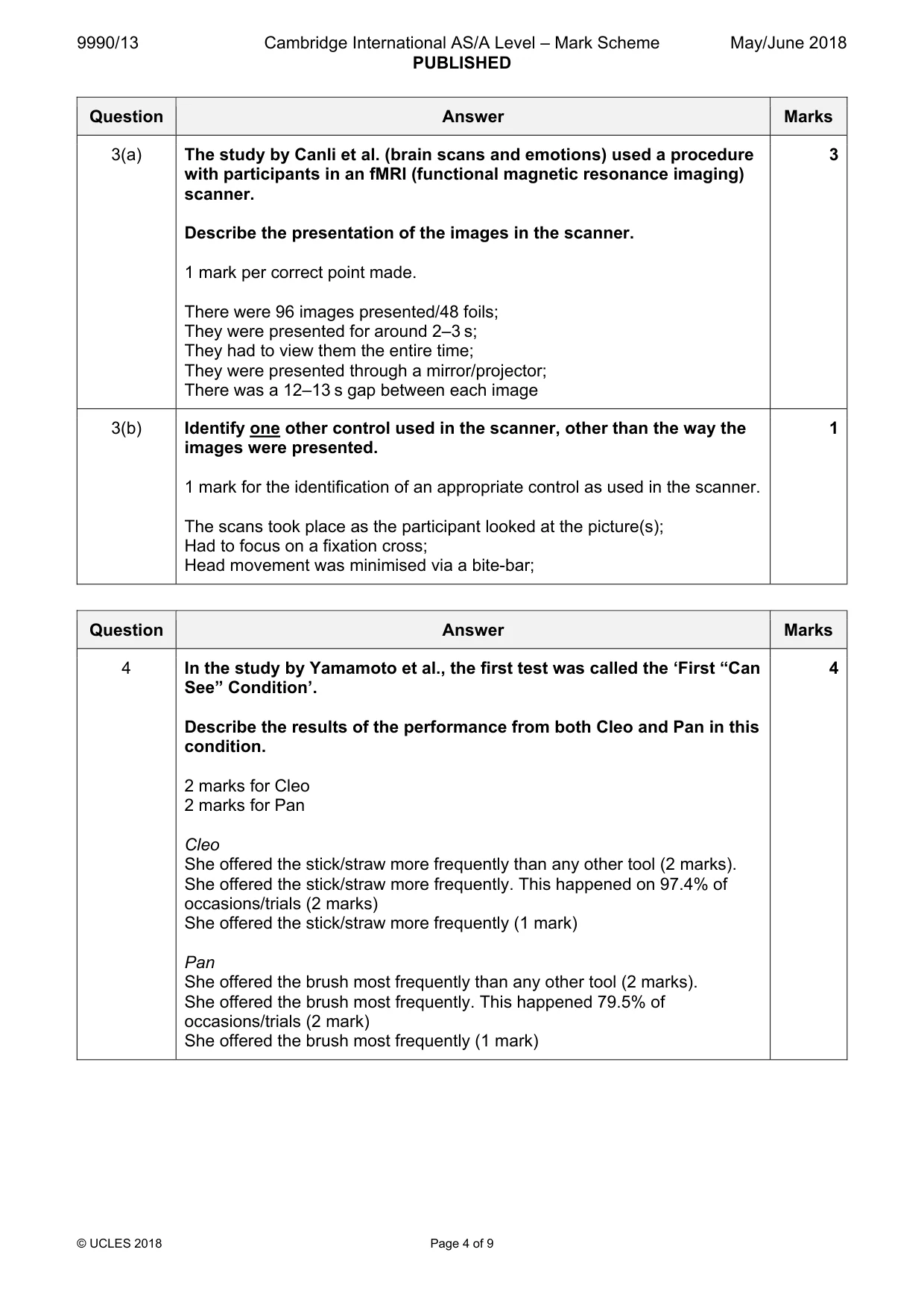
9990/13 Cambridge International AS/A Level – Mark Scheme PUBLISHED May/June 2018 © UCLES 2018 Page 4 of 9 Question Answer Marks 3(a) The study by Canli et al. (brain scans and emotions) used a procedure with participants in an fMRI (functional magnetic resonance imaging) scanner. Describe the presentation of the images in the scanner. 1 mark per correct point made. There were 96 images presented/48 foils; They were presented for around 2–3 s; They had to view them the entire time; They were presented through a mirror/projector; There was a 12–13 s gap between each image 3 3(b) Identify one other control used in the scanner, other than the way the images were presented. 1 mark for the identification of an appropriate control as used in the scanner. The scans took place as the participant looked at the picture(s); Had to focus on a fixation cross; Head movement was minimised via a bite-bar; 1 Question Answer Marks 4 In the study by Yamamoto et al., the first test was called the ‘First “Can See” Condition’. Describe the results of the performance from both Cleo and Pan in this condition. 2 marks for Cleo 2 marks for Pan Cleo She offered the stick/straw more frequently than any other tool (2 marks). She offered the stick/straw more frequently. This happened on 97.4% of occasions/trials (2 marks) She offered the stick/straw more frequently (1 mark) Pan She offered the brush most frequently than any other tool (2 marks). She offered the brush most frequently. This happened 79.5% of occasions/trials (2 mark) She offered the brush most frequently (1 mark) 4
Mark scheme, page 5
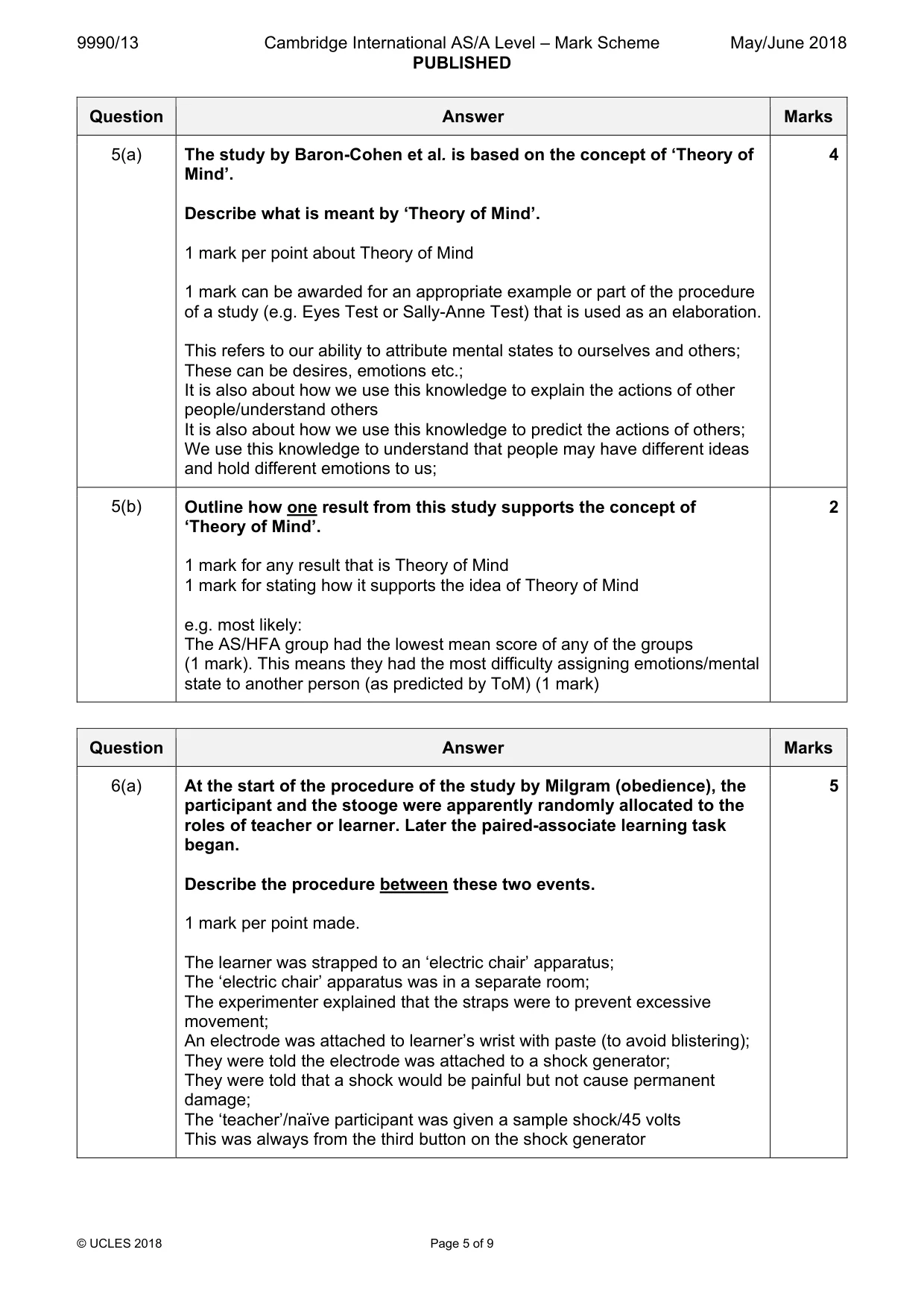
9990/13 Cambridge International AS/A Level – Mark Scheme PUBLISHED May/June 2018 © UCLES 2018 Page 5 of 9 Question Answer Marks 5(a) The study by Baron-Cohen et al. is based on the concept of ‘Theory of Mind’. Describe what is meant by ‘Theory of Mind’. 1 mark per point about Theory of Mind 1 mark can be awarded for an appropriate example or part of the procedure of a study (e.g. Eyes Test or Sally-Anne Test) that is used as an elaboration. This refers to our ability to attribute mental states to ourselves and others; These can be desires, emotions etc.; It is also about how we use this knowledge to explain the actions of other people/understand others It is also about how we use this knowledge to predict the actions of others; We use this knowledge to understand that people may have different ideas and hold different emotions to us; 4 5(b) Outline how one result from this study supports the concept of ‘Theory of Mind’. 1 mark for any result that is Theory of Mind 1 mark for stating how it supports the idea of Theory of Mind e.g. most likely: The AS/HFA group had the lowest mean score of any of the groups (1 mark). This means they had the most difficulty assigning emotions/mental state to another person (as predicted by ToM) (1 mark) 2 Question Answer Marks 6(a) At the start of the procedure of the study by Milgram (obedience), the participant and the stooge were apparently randomly allocated to the roles of teacher or learner. Later the paired-associate learning task began. Describe the procedure between these two events. 1 mark per point made. The learner was strapped to an ‘electric chair’ apparatus; The ‘electric chair’ apparatus was in a separate room; The experimenter explained that the straps were to prevent excessive movement; An electrode was attached to learner’s wrist with paste (to avoid blistering); They were told the electrode was attached to a shock generator; They were told that a shock would be painful but not cause permanent damage; The ‘teacher’/naïve participant was given a sample shock/45 volts This was always from the third button on the shock generator 5
Mark scheme, page 6
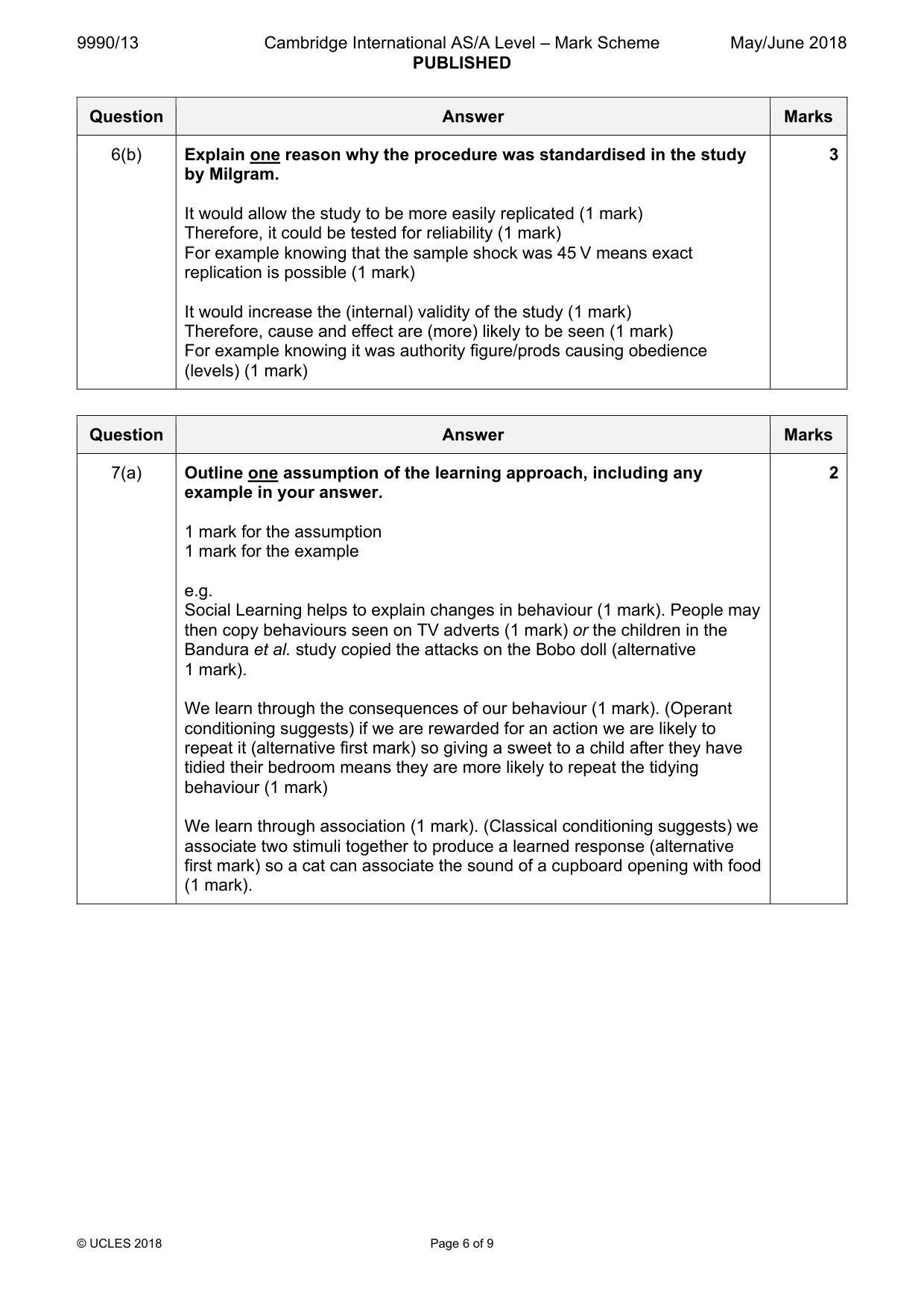
9990/13 Cambridge International AS/A Level – Mark Scheme PUBLISHED May/June 2018 © UCLES 2018 Page 6 of 9 Question Answer Marks 6(b) Explain one reason why the procedure was standardised in the study by Milgram. It would allow the study to be more easily replicated (1 mark) Therefore, it could be tested for reliability (1 mark) For example knowing that the sample shock was 45 V means exact replication is possible (1 mark) It would increase the (internal) validity of the study (1 mark) Therefore, cause and effect are (more) likely to be seen (1 mark) For example knowing it was authority figure/prods causing obedience (levels) (1 mark) 3 Question Answer Marks 7(a) Outline one assumption of the learning approach, including any example in your answer. 1 mark for the assumption 1 mark for the example e.g. Social Learning helps to explain changes in behaviour (1 mark). People may then copy behaviours seen on TV adverts (1 mark) or the children in the Bandura et al. study copied the attacks on the Bobo doll (alternative 1 mark). We learn through the consequences of our behaviour (1 mark). (Operant conditioning suggests) if we are rewarded for an action we are likely to repeat it (alternative first mark) so giving a sweet to a child after they have tidied their bedroom means they are more likely to repeat the tidying behaviour (1 mark) We learn through association (1 mark). (Classical conditioning suggests) we associate two stimuli together to produce a learned response (alternative first mark) so a cat can associate the sound of a cupboard opening with food (1 mark). 2
Mark scheme, page 7
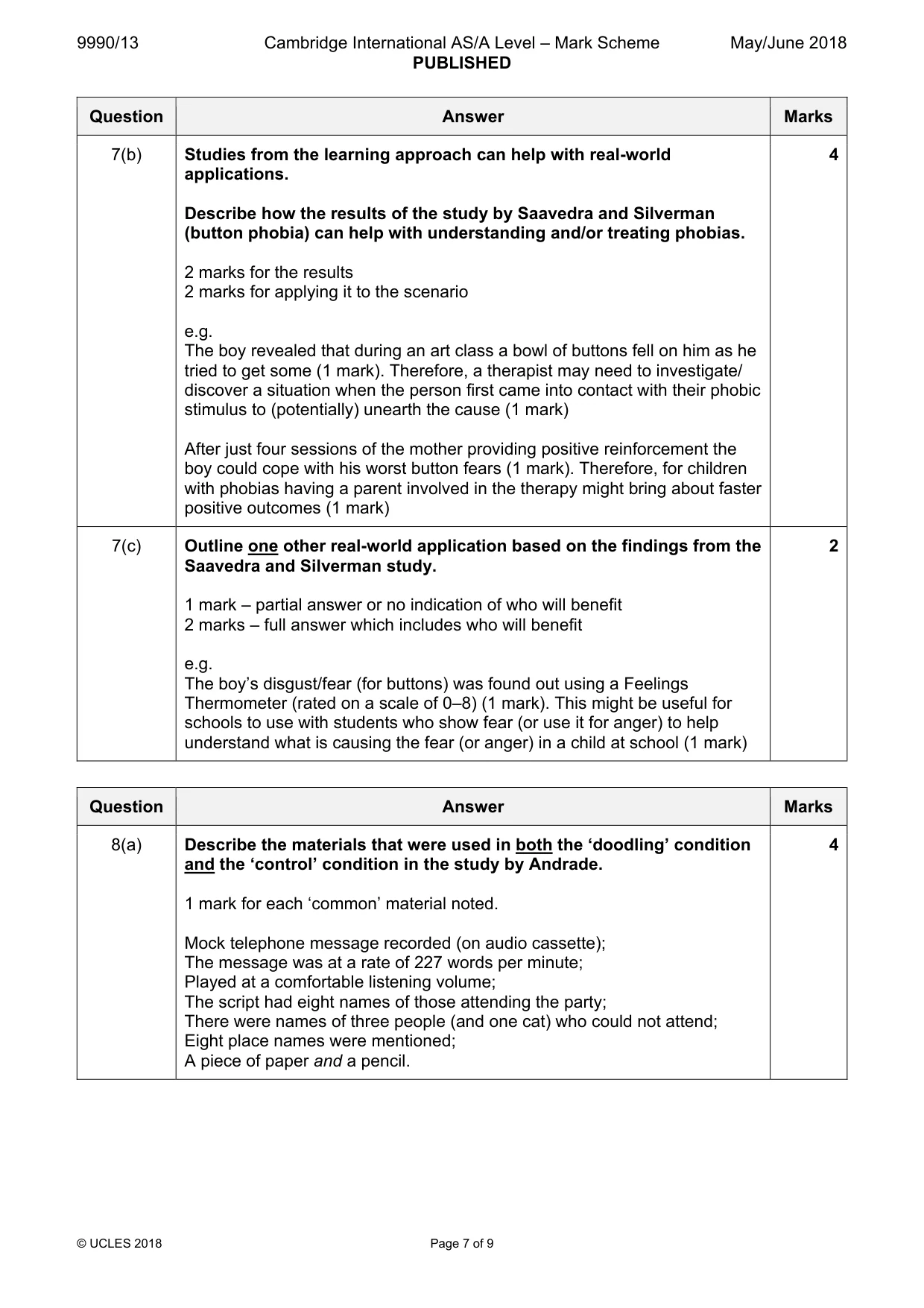
9990/13 Cambridge International AS/A Level – Mark Scheme PUBLISHED May/June 2018 © UCLES 2018 Page 7 of 9 Question Answer Marks 7(b) Studies from the learning approach can help with real-world applications. Describe how the results of the study by Saavedra and Silverman (button phobia) can help with understanding and/or treating phobias. 2 marks for the results 2 marks for applying it to the scenario e.g. The boy revealed that during an art class a bowl of buttons fell on him as he tried to get some (1 mark). Therefore, a therapist may need to investigate/ discover a situation when the person first came into contact with their phobic stimulus to (potentially) unearth the cause (1 mark) After just four sessions of the mother providing positive reinforcement the boy could cope with his worst button fears (1 mark). Therefore, for children with phobias having a parent involved in the therapy might bring about faster positive outcomes (1 mark) 4 7(c) Outline one other real-world application based on the findings from the Saavedra and Silverman study. 1 mark – partial answer or no indication of who will benefit 2 marks – full answer which includes who will benefit e.g. The boy’s disgust/fear (for buttons) was found out using a Feelings Thermometer (rated on a scale of 0–8) (1 mark). This might be useful for schools to use with students who show fear (or use it for anger) to help understand what is causing the fear (or anger) in a child at school (1 mark) 2 Question Answer Marks 8(a) Describe the materials that were used in both the ‘doodling’ condition and the ‘control’ condition in the study by Andrade. 1 mark for each ‘common’ material noted. Mock telephone message recorded (on audio cassette); The message was at a rate of 227 words per minute; Played at a comfortable listening volume; The script had eight names of those attending the party; There were names of three people (and one cat) who could not attend; Eight place names were mentioned; A piece of paper and a pencil. 4
Mark scheme, page 8
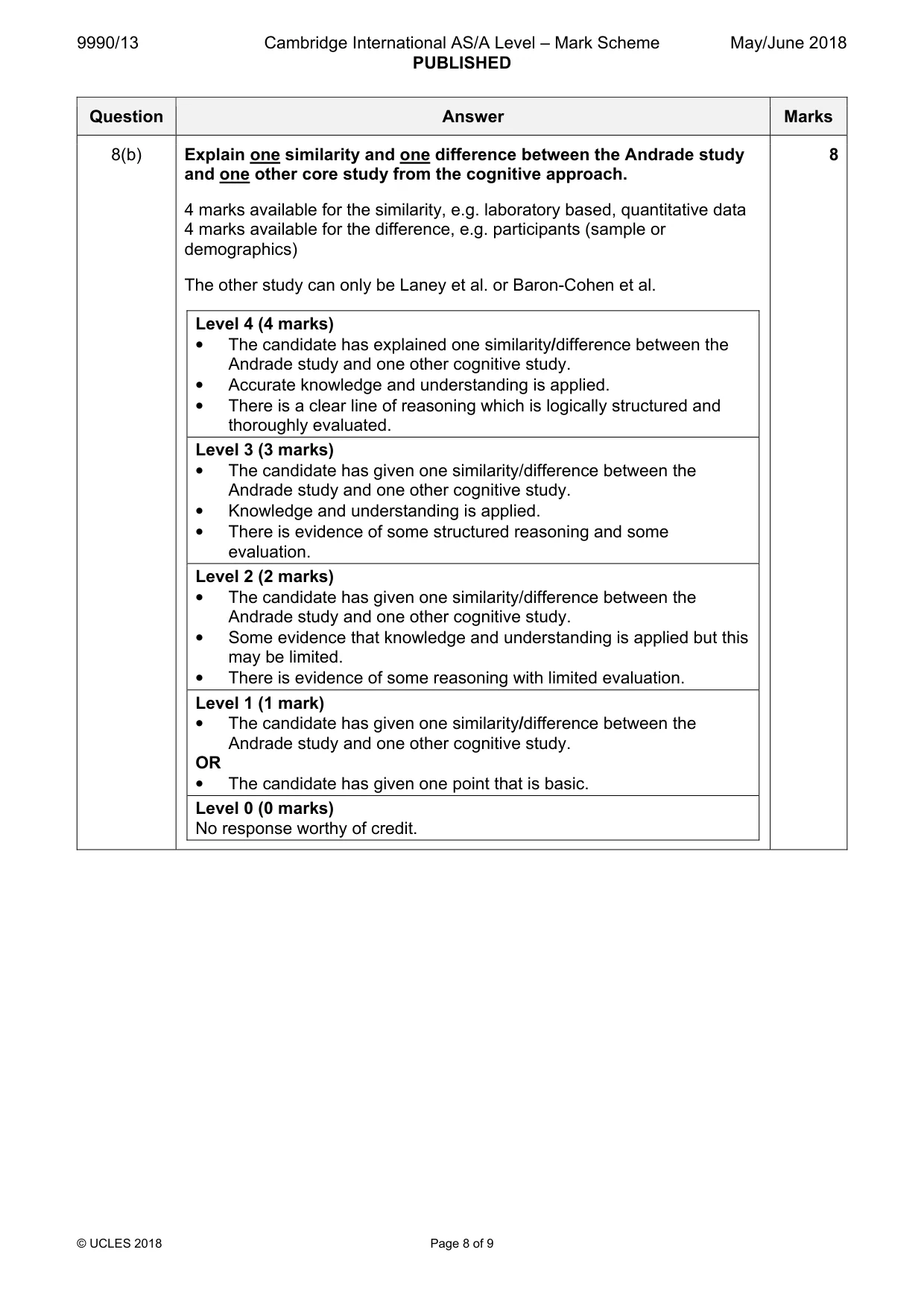
9990/13 Cambridge International AS/A Level – Mark Scheme PUBLISHED May/June 2018 © UCLES 2018 Page 8 of 9 Question Answer Marks 8(b) Explain one similarity and one difference between the Andrade study and one other core study from the cognitive approach. 4 marks available for the similarity, e.g. laboratory based, quantitative data 4 marks available for the difference, e.g. participants (sample or demographics) The other study can only be Laney et al. or Baron-Cohen et al. Level 4 (4 marks) • The candidate has explained one similarity/difference between the Andrade study and one other cognitive study. • Accurate knowledge and understanding is applied. • There is a clear line of reasoning which is logically structured and thoroughly evaluated. Level 3 (3 marks) • The candidate has given one similarity/difference between the Andrade study and one other cognitive study. • Knowledge and understanding is applied. • There is evidence of some structured reasoning and some evaluation. Level 2 (2 marks) • The candidate has given one similarity/difference between the Andrade study and one other cognitive study. • Some evidence that knowledge and understanding is applied but this may be limited. • There is evidence of some reasoning with limited evaluation. Level 1 (1 mark) • The candidate has given one similarity/difference between the Andrade study and one other cognitive study. OR • The candidate has given one point that is basic. Level 0 (0 marks) No response worthy of credit. 8
Mark scheme, page 9
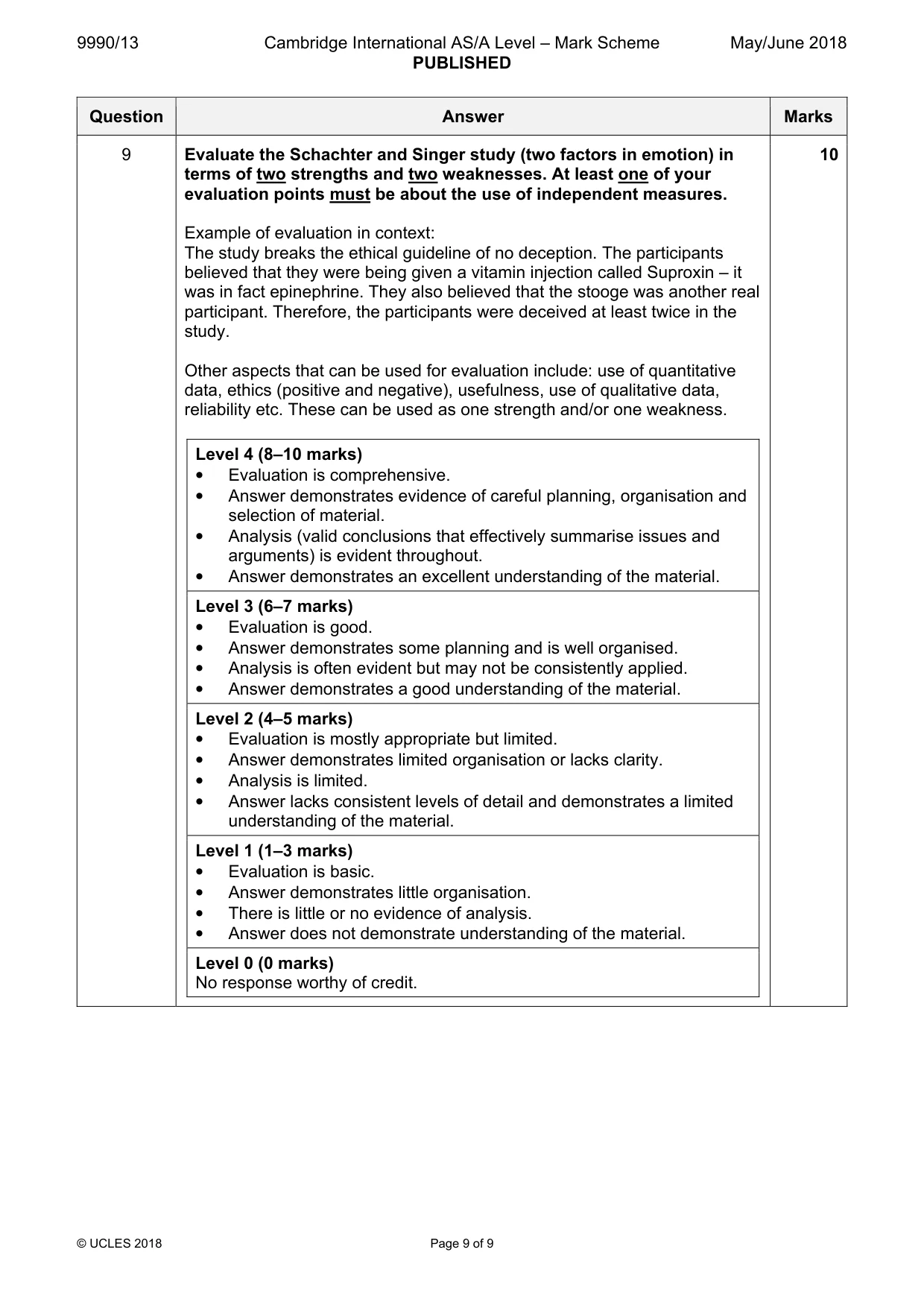
9990/13 Cambridge International AS/A Level – Mark Scheme PUBLISHED May/June 2018 © UCLES 2018 Page 9 of 9 Question Answer Marks 9 Evaluate the Schachter and Singer study (two factors in emotion) in terms of two strengths and two weaknesses. At least one of your evaluation points must be about the use of independent measures. Example of evaluation in context: The study breaks the ethical guideline of no deception. The participants believed that they were being given a vitamin injection called Suproxin – it was in fact epinephrine. They also believed that the stooge was another real participant. Therefore, the participants were deceived at least twice in the study. Other aspects that can be used for evaluation include: use of quantitative data, ethics (positive and negative), usefulness, use of qualitative data, reliability etc. These can be used as one strength and/or one weakness. Level 4 (8–10 marks) • Evaluation is comprehensive. • Answer demonstrates evidence of careful planning, organisation and selection of material. • Analysis (valid conclusions that effectively summarise issues and arguments) is evident throughout. • Answer demonstrates an excellent understanding of the material. Level 3 (6–7 marks) • Evaluation is good. • Answer demonstrates some planning and is well organised. • Analysis is often evident but may not be consistently applied. • Answer demonstrates a good understanding of the material. Level 2 (4–5 marks) • Evaluation is mostly appropriate but limited. • Answer demonstrates limited organisation or lacks clarity. • Analysis is limited. • Answer lacks consistent levels of detail and demonstrates a limited understanding of the material. Level 1 (1–3 marks) • Evaluation is basic. • Answer demonstrates little organisation. • There is little or no evidence of analysis. • Answer does not demonstrate understanding of the material. Level 0 (0 marks) No response worthy of credit. 10
What you needed in this session
Cambridge’s own grade thresholds for 2018 May/June, Paper 1 · Variant 3. A higher threshold means an easier paper — the bar moves with how the cohort did.