Cambridge A Level Psychology (from 2018) 9990 — 2018 May/June Paper 1 · Variant 2
9990/12/M/J/18 · 60 marks · ≈68 min
The question paper and its mark scheme, free to read here and free to download. This is Cambridge’s own paper, exactly as it was sat.
Question paper8 pages

Mark scheme11 pages
Answers below. Sit the paper first if you are practising.
Paper as text
Question paper, page 1
* 4 7 9 4 9 9 0 2 4 1 * Cambridge International Examinations Cambridge International Advanced Subsidiary and Advanced Level PSYCHOLOGY 9990/12 Paper 1 Approaches, Issues and Debates May/June 2018 1 hour 30 minutes Candidates answer on the Question Paper. No Additional Materials are required. READ THESE INSTRUCTIONS FIRST Write your Centre number, candidate number and name in the spaces at the top of this page. Write in dark blue or black pen. You may use an HB pencil for any diagrams and graphs. Do not use staples, paper clips, glue or correction fluid. DO NOT WRITE IN ANY BARCODES. Answer all questions. At the end of the examination, fasten all your work securely together. The number of marks is given in brackets [ ] at the end of each question or part question. This document consists of 8 printed pages. DC (ST) 152344/2 © UCLES 2018 [Turn over
Question paper, page 2
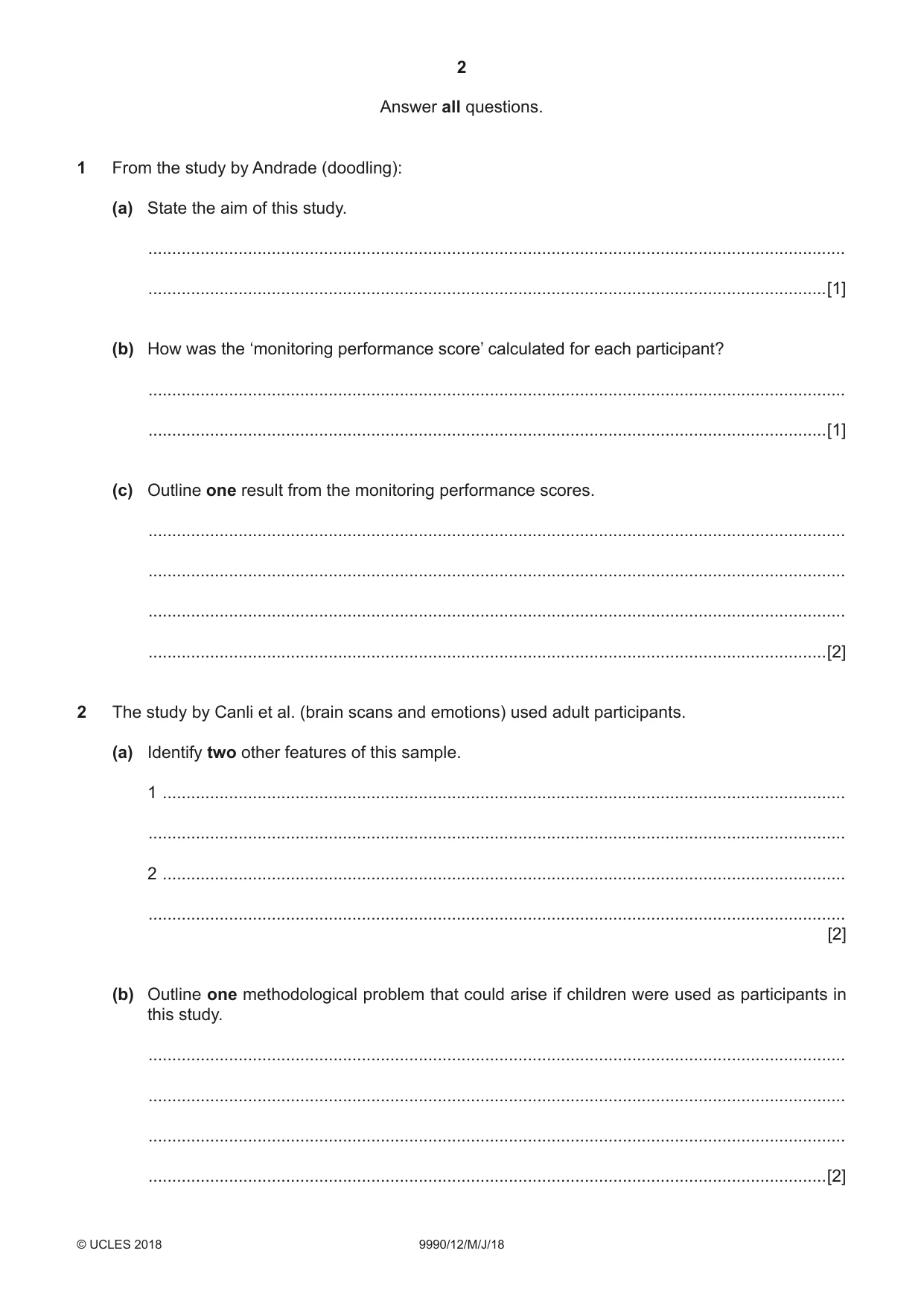
2 9990/12/M/J/18 © UCLES 2018 Answer all questions. 1 From the study by Andrade (doodling): (a) State the aim of this study. … …[1] (b) How was the ‘monitoring performance score’ calculated for each participant? … …[1] (c) Outline one result from the monitoring performance scores. … … … …[2] 2 The study by Canli et al. (brain scans and emotions) used adult participants. (a) Identify two other features of this sample. 1 … … 2 … … [2] (b) Outline one methodological problem that could arise if children were used as participants in this study. … … … …[2]
Question paper, page 3
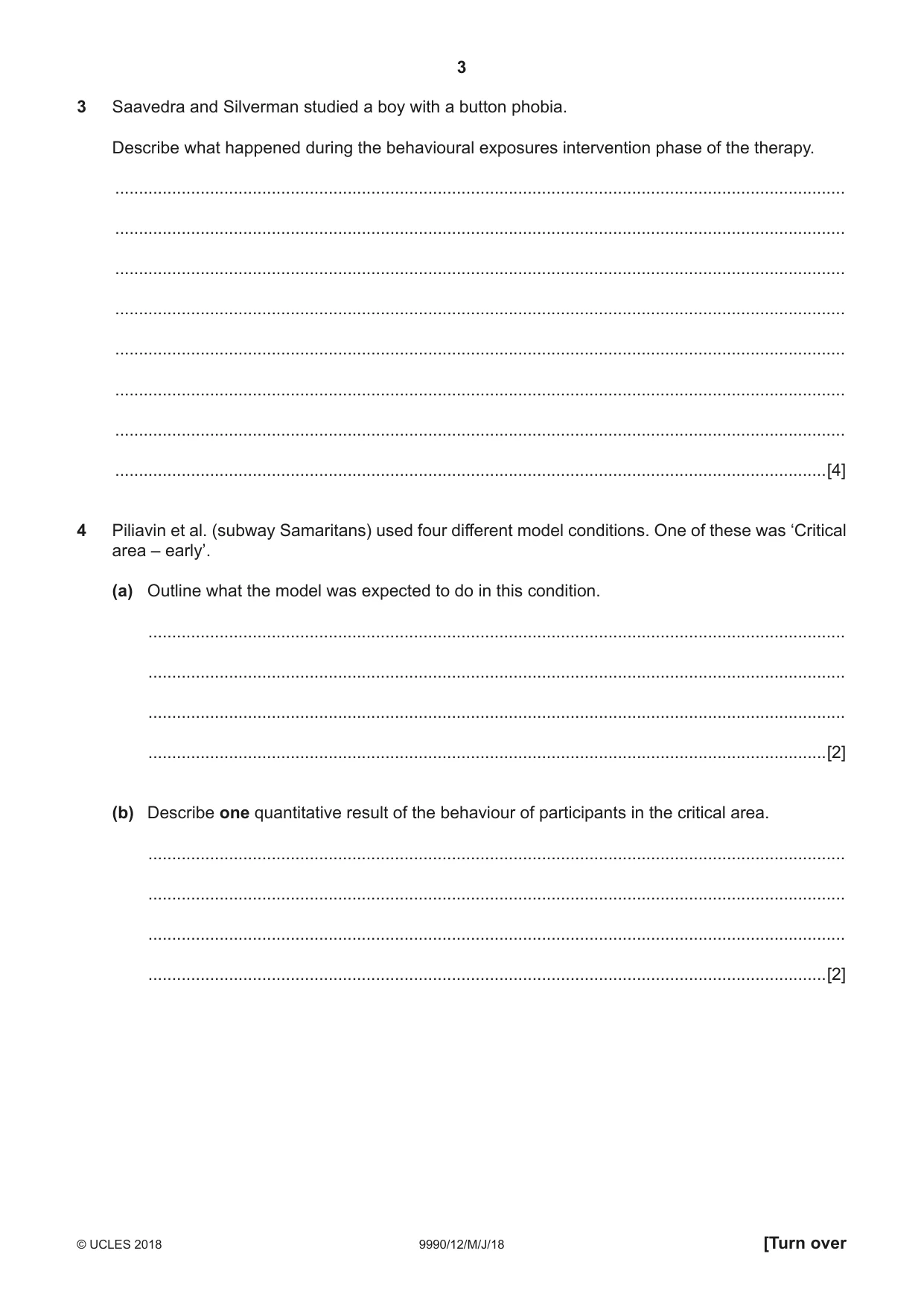
3 9990/12/M/J/18 © UCLES 2018 [Turn over 3 Saavedra and Silverman studied a boy with a button phobia. Describe what happened during the behavioural exposures intervention phase of the therapy. … … … … … … … …[4] 4 Piliavin et al. (subway Samaritans) used four different model conditions. One of these was ‘Critical area – early’. (a) Outline what the model was expected to do in this condition. … … … …[2] (b) Describe one quantitative result of the behaviour of participants in the critical area. … … … …[2]
Question paper, page 4
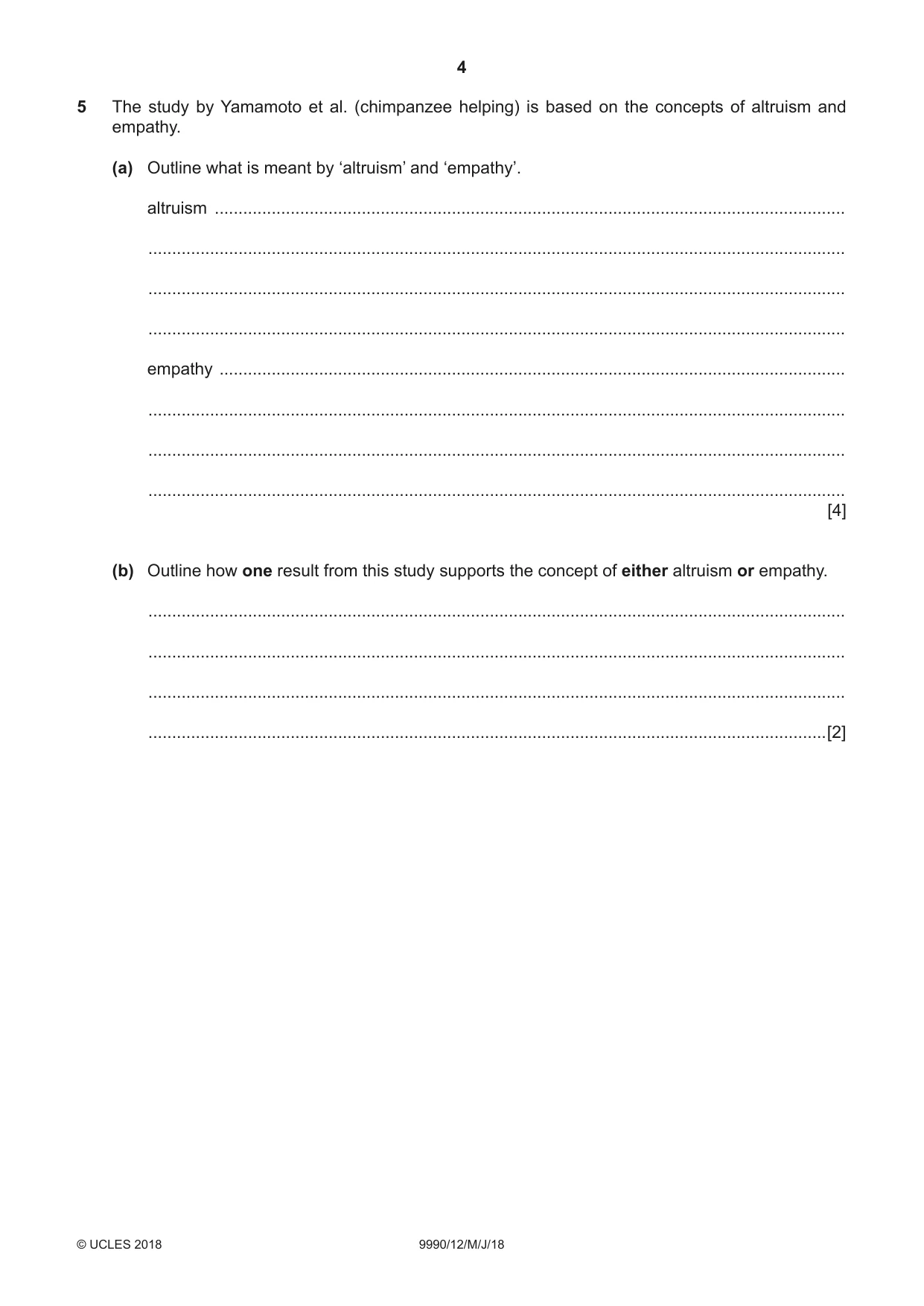
4 9990/12/M/J/18 © UCLES 2018 5 The study by Yamamoto et al. (chimpanzee helping) is based on the concepts of altruism and empathy. (a) Outline what is meant by ‘altruism’ and ‘empathy’. altruism … … … … empathy … … … … [4] (b) Outline how one result from this study supports the concept of either altruism or empathy. … … … …[2]
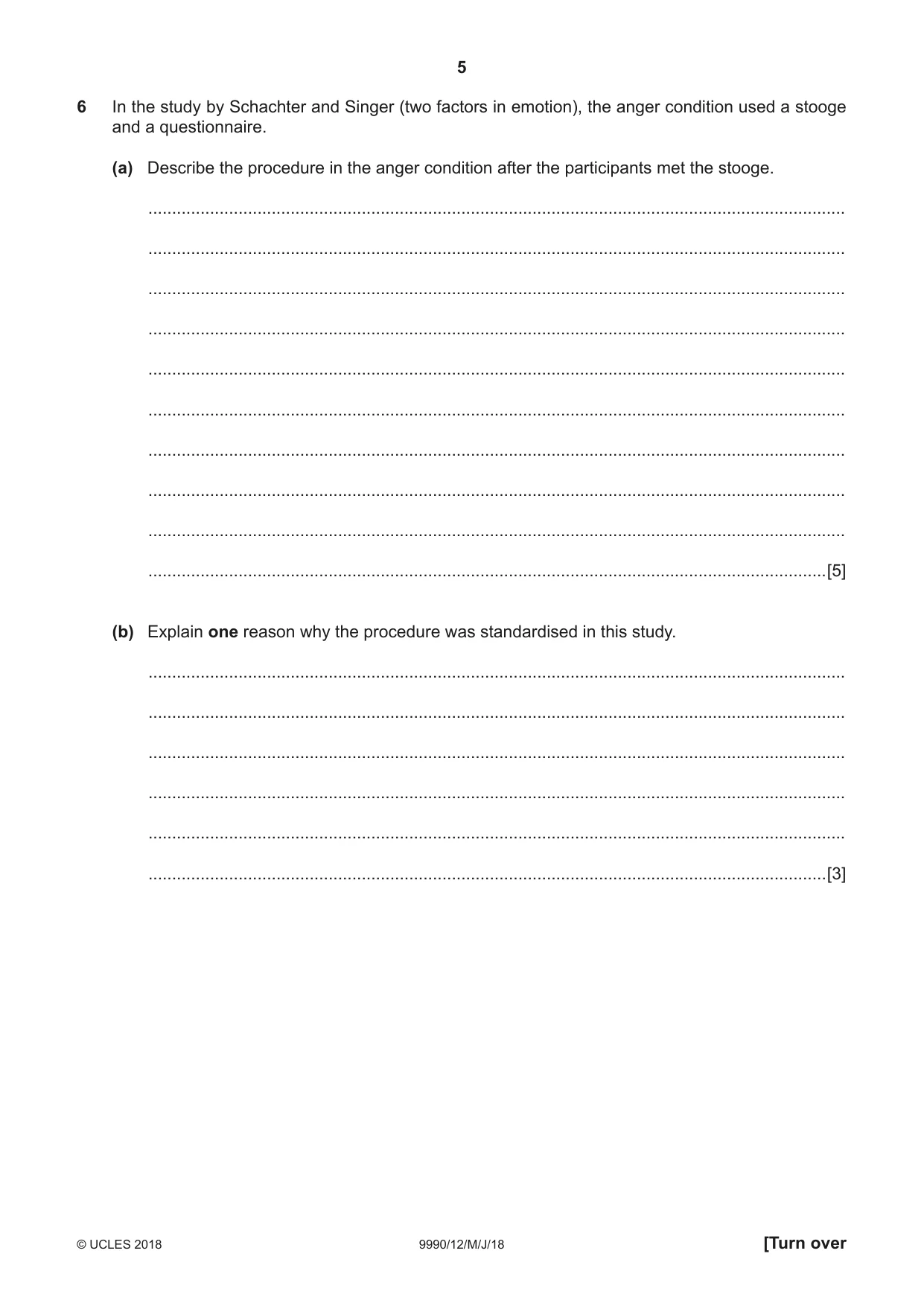
Question paper, page 5
5 9990/12/M/J/18 © UCLES 2018 [Turn over 6 In the study by Schachter and Singer (two factors in emotion), the anger condition used a stooge and a questionnaire. (a) Describe the procedure in the anger condition after the participants met the stooge. … … … … … … … … … …[5] (b) Explain one reason why the procedure was standardised in this study. … … … … … …[3]
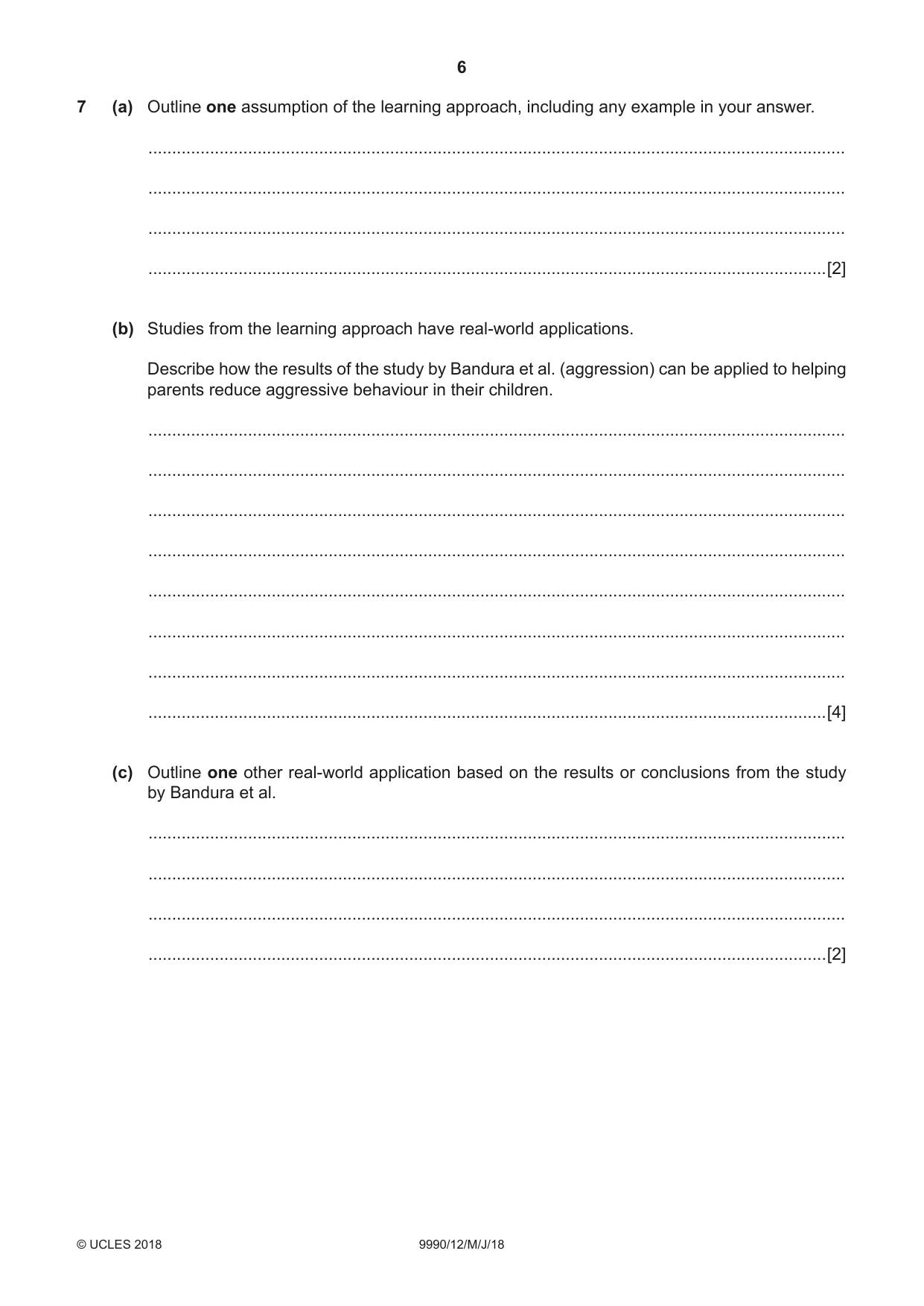
Question paper, page 6
6 9990/12/M/J/18 © UCLES 2018 7 (a) Outline one assumption of the learning approach, including any example in your answer. … … … …[2] (b) Studies from the learning approach have real-world applications. Describe how the results of the study by Bandura et al. (aggression) can be applied to helping parents reduce aggressive behaviour in their children. … … … … … … … …[4] (c) Outline one other real-world application based on the results or conclusions from the study by Bandura et al. … … … …[2]
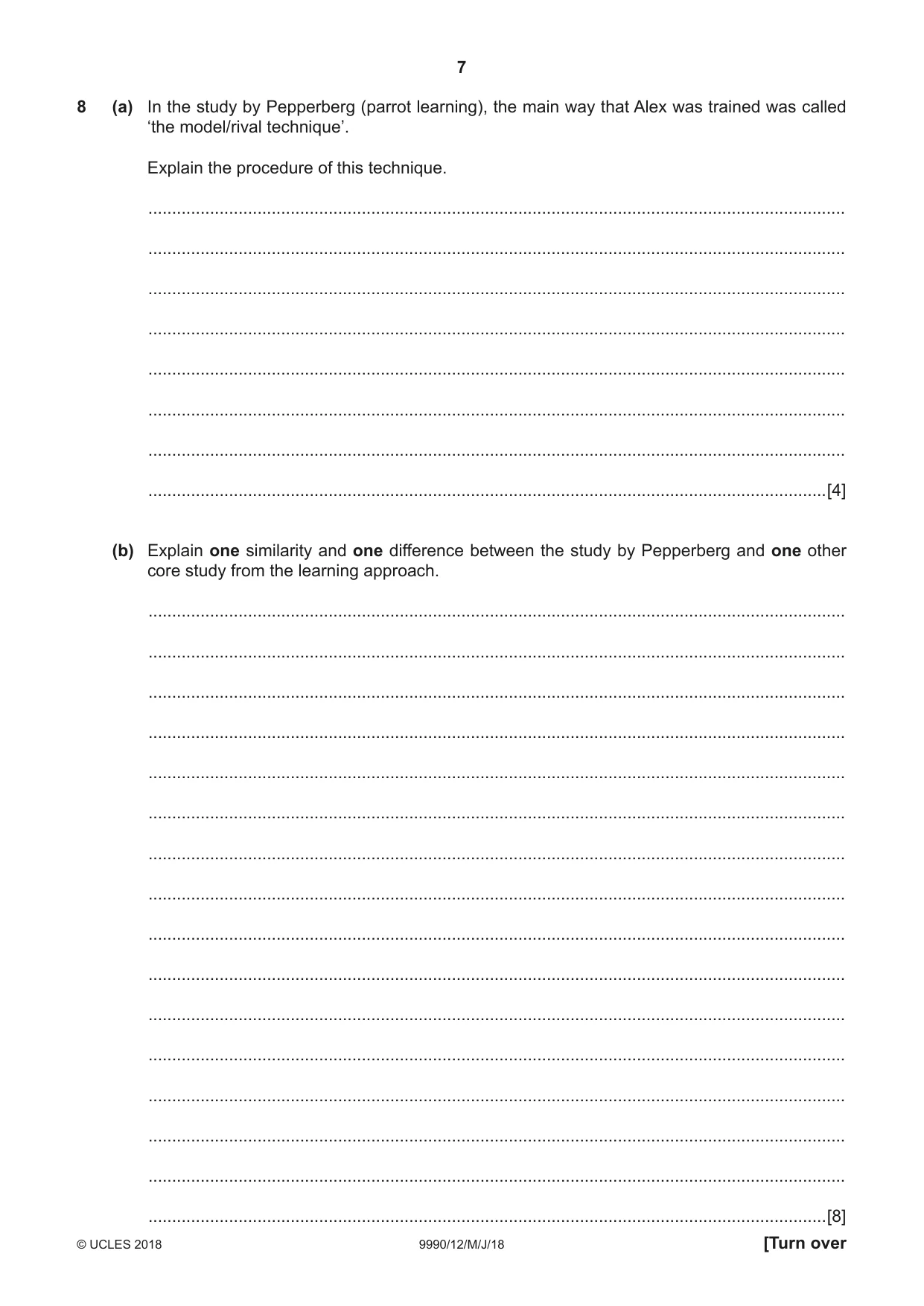
Question paper, page 7
7 9990/12/M/J/18 © UCLES 2018 [Turn over 8 (a) In the study by Pepperberg (parrot learning), the main way that Alex was trained was called ‘the model/rival technique’. Explain the procedure of this technique. … … … … … … … …[4] (b) Explain one similarity and one difference between the study by Pepperberg and one other core study from the learning approach. … … … … … … … … … … … … … … … …[8]
Question paper, page 8
8 9990/12/M/J/18 © UCLES 2018 Permission to reproduce items where third-party owned material protected by copyright is included has been sought and cleared where possible. Every reasonable effort has been made by the publisher (UCLES) to trace copyright holders, but if any items requiring clearance have unwittingly been included, the publisher will be pleased to make amends at the earliest possible opportunity. To avoid the issue of disclosure of answer-related information to candidates, all copyright acknowledgements are reproduced online in the Cambridge International Examinations Copyright Acknowledgements Booklet. This is produced for each series of examinations and is freely available to download at www.cie.org.uk after the live examination series. Cambridge International Examinations is part of the Cambridge Assessment Group. Cambridge Assessment is the brand name of University of Cambridge Local Examinations Syndicate (UCLES), which is itself a department of the University of Cambridge. 9 Evaluate the study by Baron-Cohen et al. (eyes test) in terms of two strengths and two weaknesses. At least one of your evaluation points must be about the use of self-reports. … … … … … … … … … … … … … … … … … … … … … … …[10]
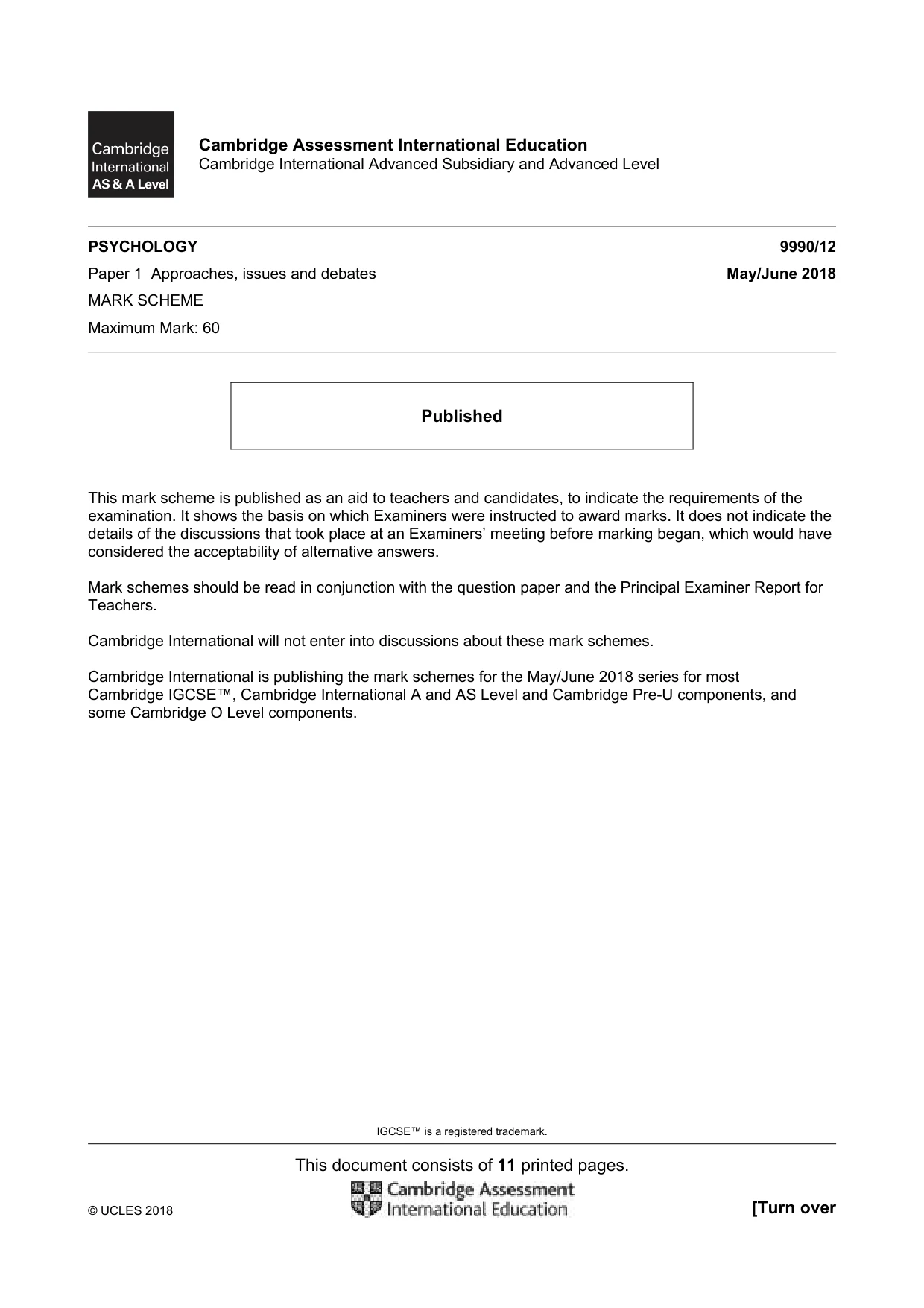
Mark scheme, page 1
IGCSE™ is a registered trademark. This document consists of 11 printed pages. © UCLES 2018 [Turn over Cambridge Assessment International Education Cambridge International Advanced Subsidiary and Advanced Level PSYCHOLOGY 9990/12 Paper 1 Approaches, issues and debates May/June 2018 MARK SCHEME Maximum Mark: 60 Published This mark scheme is published as an aid to teachers and candidates, to indicate the requirements of the examination. It shows the basis on which Examiners were instructed to award marks. It does not indicate the details of the discussions that took place at an Examiners’ meeting before marking began, which would have considered the acceptability of alternative answers. Mark schemes should be read in conjunction with the question paper and the Principal Examiner Report for Teachers. Cambridge International will not enter into discussions about these mark schemes. Cambridge International is publishing the mark schemes for the May/June 2018 series for most Cambridge IGCSE™, Cambridge International A and AS Level and Cambridge Pre-U components, and some Cambridge O Level components.
Mark scheme, page 2
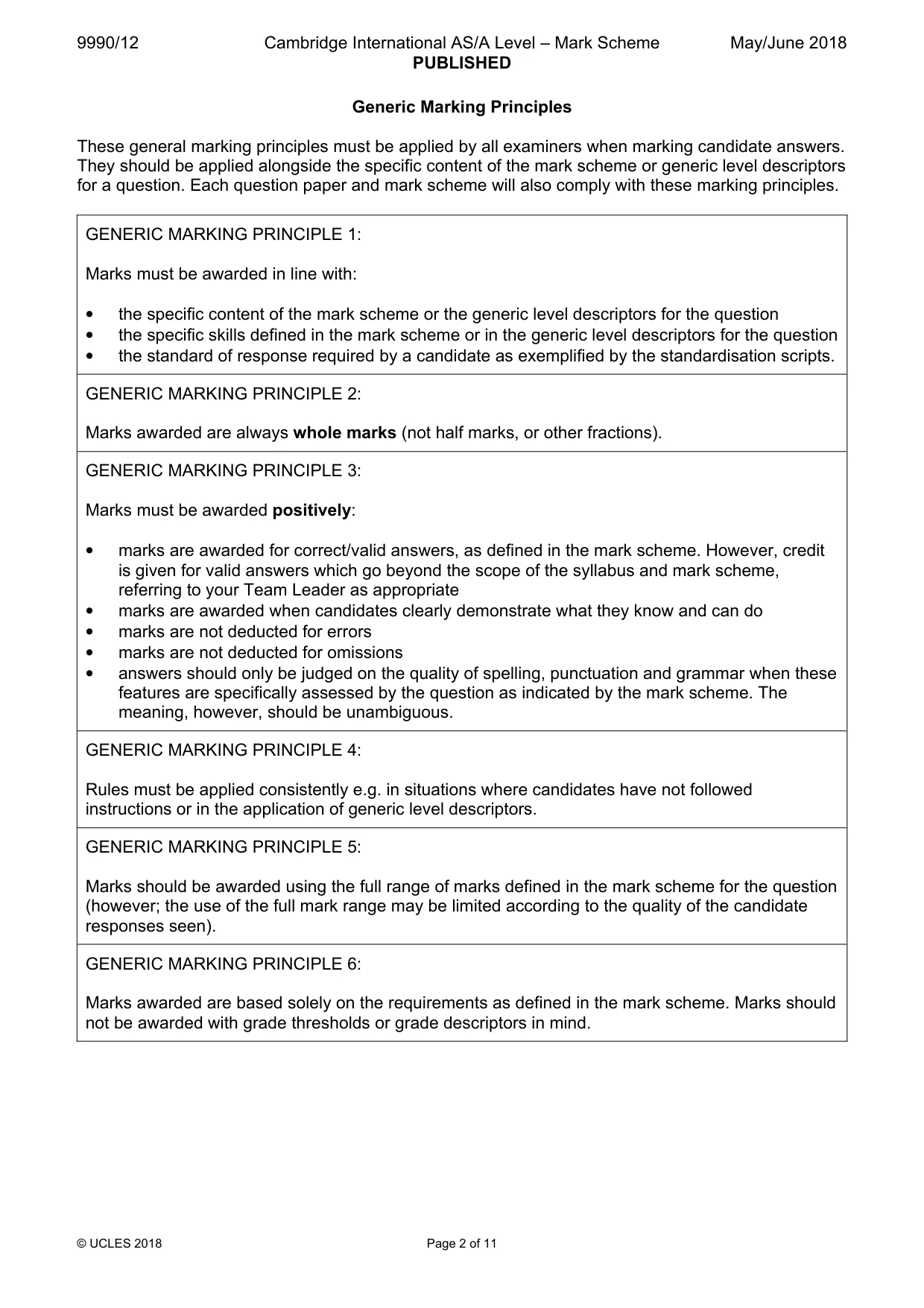
9990/12 Cambridge International AS/A Level – Mark Scheme PUBLISHED May/June 2018 © UCLES 2018 Page 2 of 11 Generic Marking Principles These general marking principles must be applied by all examiners when marking candidate answers. They should be applied alongside the specific content of the mark scheme or generic level descriptors for a question. Each question paper and mark scheme will also comply with these marking principles. GENERIC MARKING PRINCIPLE 1: Marks must be awarded in line with: • the specific content of the mark scheme or the generic level descriptors for the question • the specific skills defined in the mark scheme or in the generic level descriptors for the question • the standard of response required by a candidate as exemplified by the standardisation scripts. GENERIC MARKING PRINCIPLE 2: Marks awarded are always whole marks (not half marks, or other fractions). GENERIC MARKING PRINCIPLE 3: Marks must be awarded positively: • marks are awarded for correct/valid answers, as defined in the mark scheme. However, credit is given for valid answers which go beyond the scope of the syllabus and mark scheme, referring to your Team Leader as appropriate • marks are awarded when candidates clearly demonstrate what they know and can do • marks are not deducted for errors • marks are not deducted for omissions • answers should only be judged on the quality of spelling, punctuation and grammar when these features are specifically assessed by the question as indicated by the mark scheme. The meaning, however, should be unambiguous. GENERIC MARKING PRINCIPLE 4: Rules must be applied consistently e.g. in situations where candidates have not followed instructions or in the application of generic level descriptors. GENERIC MARKING PRINCIPLE 5: Marks should be awarded using the full range of marks defined in the mark scheme for the question (however; the use of the full mark range may be limited according to the quality of the candidate responses seen). GENERIC MARKING PRINCIPLE 6: Marks awarded are based solely on the requirements as defined in the mark scheme. Marks should not be awarded with grade thresholds or grade descriptors in mind.
Mark scheme, page 3
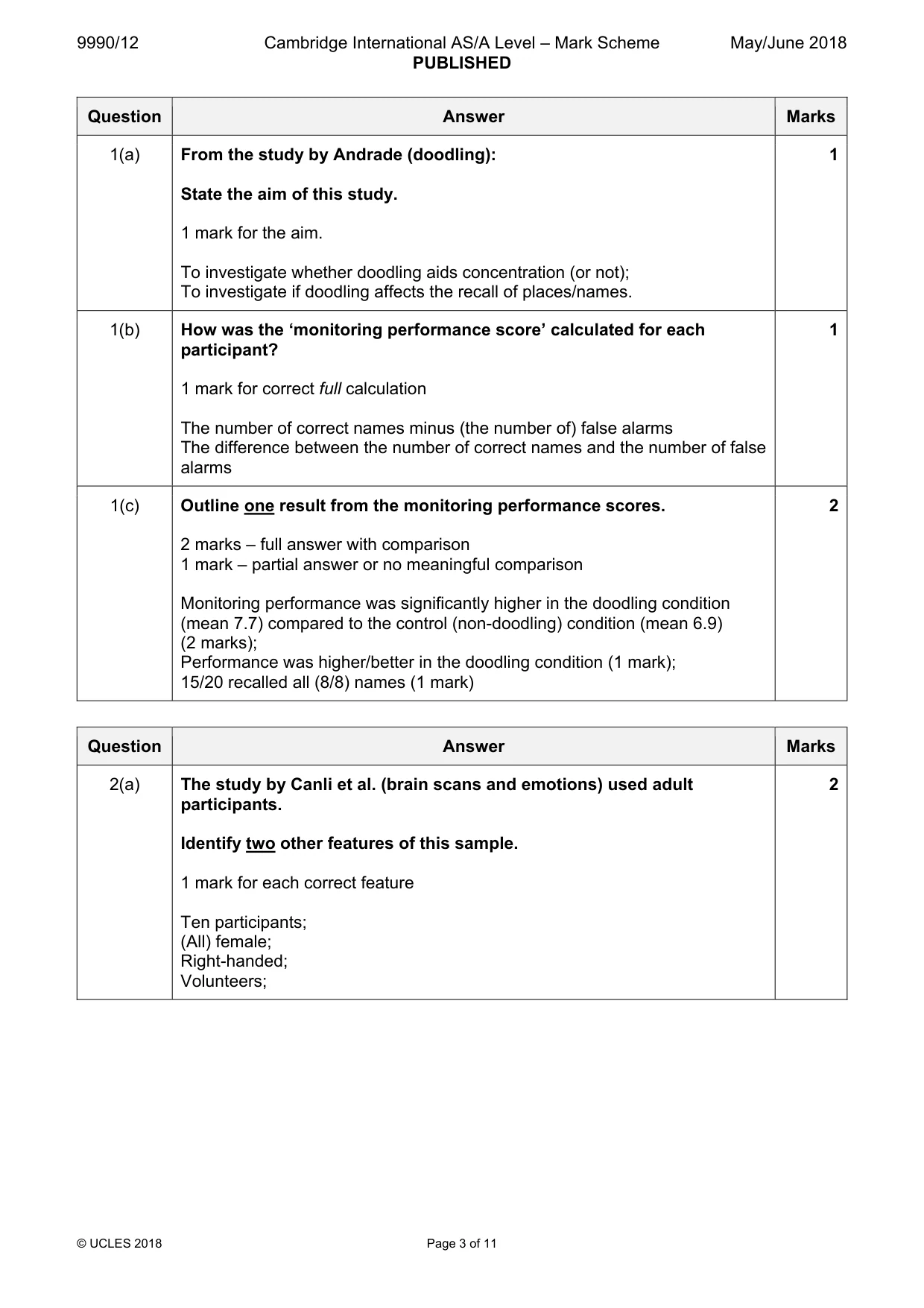
9990/12 Cambridge International AS/A Level – Mark Scheme PUBLISHED May/June 2018 © UCLES 2018 Page 3 of 11 Question Answer Marks 1(a) From the study by Andrade (doodling): State the aim of this study. 1 mark for the aim. To investigate whether doodling aids concentration (or not); To investigate if doodling affects the recall of places/names. 1 1(b) How was the ‘monitoring performance score’ calculated for each participant? 1 mark for correct full calculation The number of correct names minus (the number of) false alarms The difference between the number of correct names and the number of false alarms 1 1(c) Outline one result from the monitoring performance scores. 2 marks – full answer with comparison 1 mark – partial answer or no meaningful comparison Monitoring performance was significantly higher in the doodling condition (mean 7.7) compared to the control (non-doodling) condition (mean 6.9) (2 marks); Performance was higher/better in the doodling condition (1 mark); 15/20 recalled all (8/8) names (1 mark) 2 Question Answer Marks 2(a) The study by Canli et al. (brain scans and emotions) used adult participants. Identify two other features of this sample. 1 mark for each correct feature Ten participants; (All) female; Right-handed; Volunteers; 2
Mark scheme, page 4
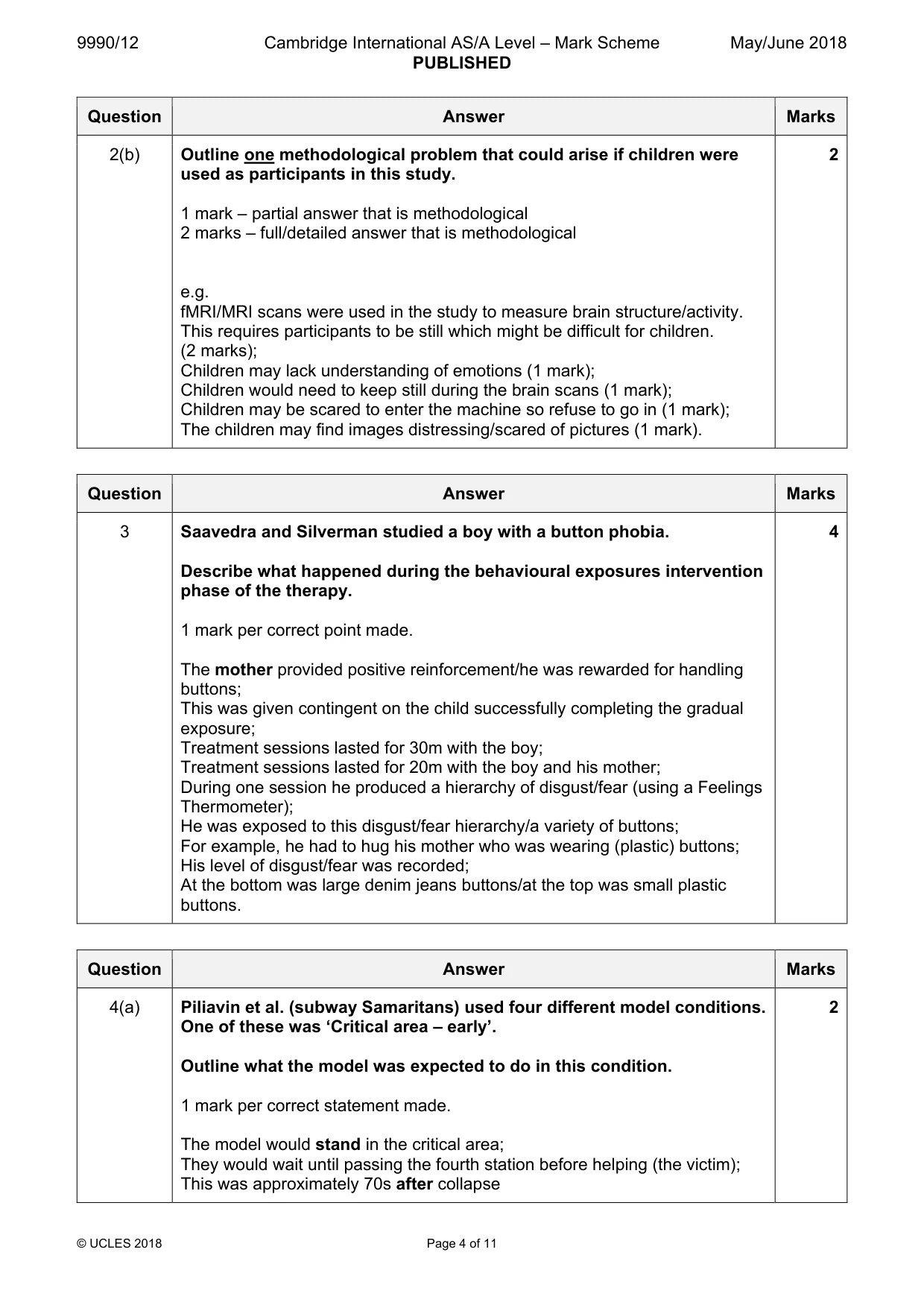
9990/12 Cambridge International AS/A Level – Mark Scheme PUBLISHED May/June 2018 © UCLES 2018 Page 4 of 11 Question Answer Marks 2(b) Outline one methodological problem that could arise if children were used as participants in this study. 1 mark – partial answer that is methodological 2 marks – full/detailed answer that is methodological e.g. fMRI/MRI scans were used in the study to measure brain structure/activity. This requires participants to be still which might be difficult for children. (2 marks); Children may lack understanding of emotions (1 mark); Children would need to keep still during the brain scans (1 mark); Children may be scared to enter the machine so refuse to go in (1 mark); The children may find images distressing/scared of pictures (1 mark). 2 Question Answer Marks 3 Saavedra and Silverman studied a boy with a button phobia. Describe what happened during the behavioural exposures intervention phase of the therapy. 1 mark per correct point made. The mother provided positive reinforcement/he was rewarded for handling buttons; This was given contingent on the child successfully completing the gradual exposure; Treatment sessions lasted for 30m with the boy; Treatment sessions lasted for 20m with the boy and his mother; During one session he produced a hierarchy of disgust/fear (using a Feelings Thermometer); He was exposed to this disgust/fear hierarchy/a variety of buttons; For example, he had to hug his mother who was wearing (plastic) buttons; His level of disgust/fear was recorded; At the bottom was large denim jeans buttons/at the top was small plastic buttons. 4 Question Answer Marks 4(a) Piliavin et al. (subway Samaritans) used four different model conditions. One of these was ‘Critical area – early’. Outline what the model was expected to do in this condition. 1 mark per correct statement made. The model would stand in the critical area; They would wait until passing the fourth station before helping (the victim); This was approximately 70s after collapse 2
Mark scheme, page 5
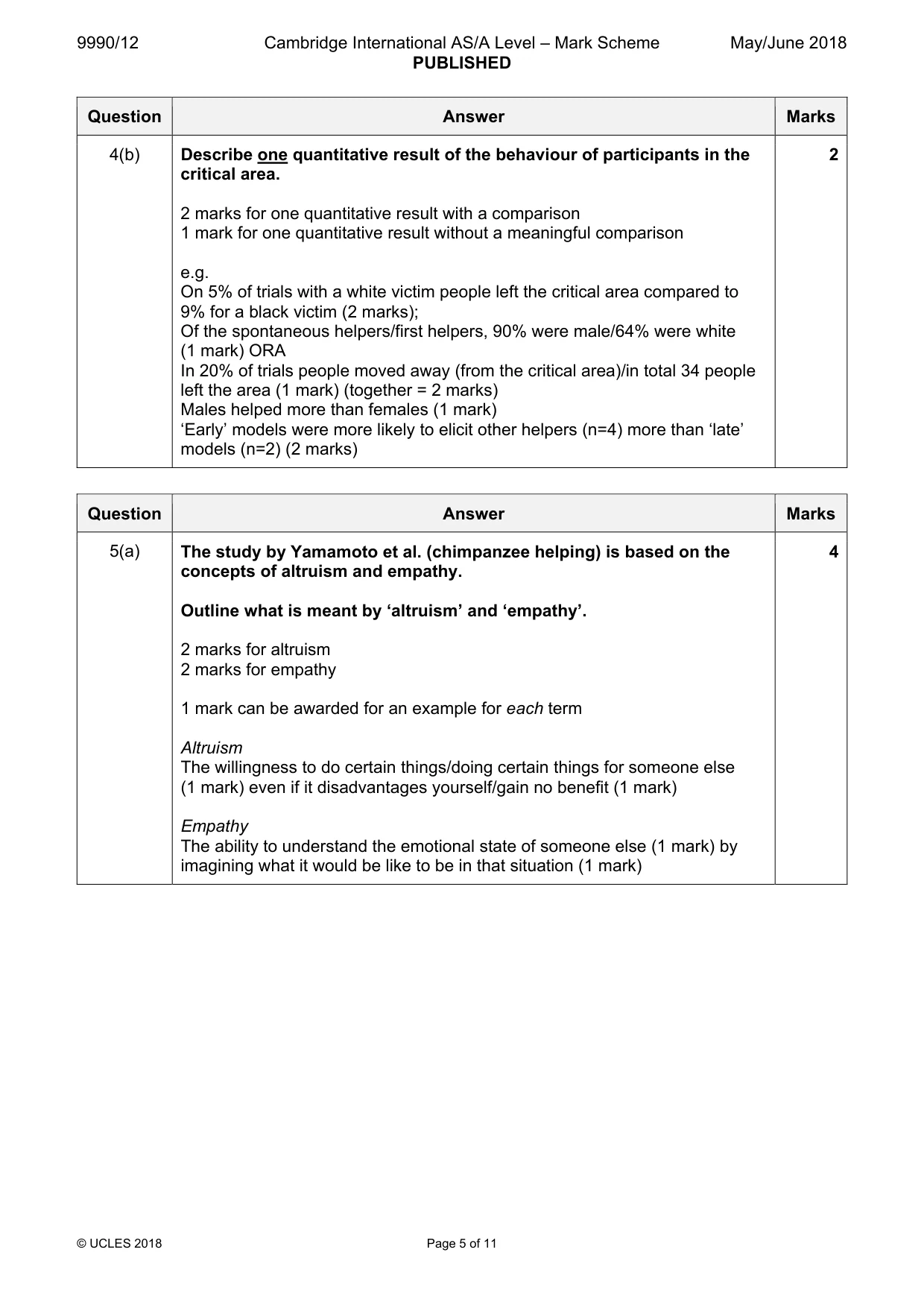
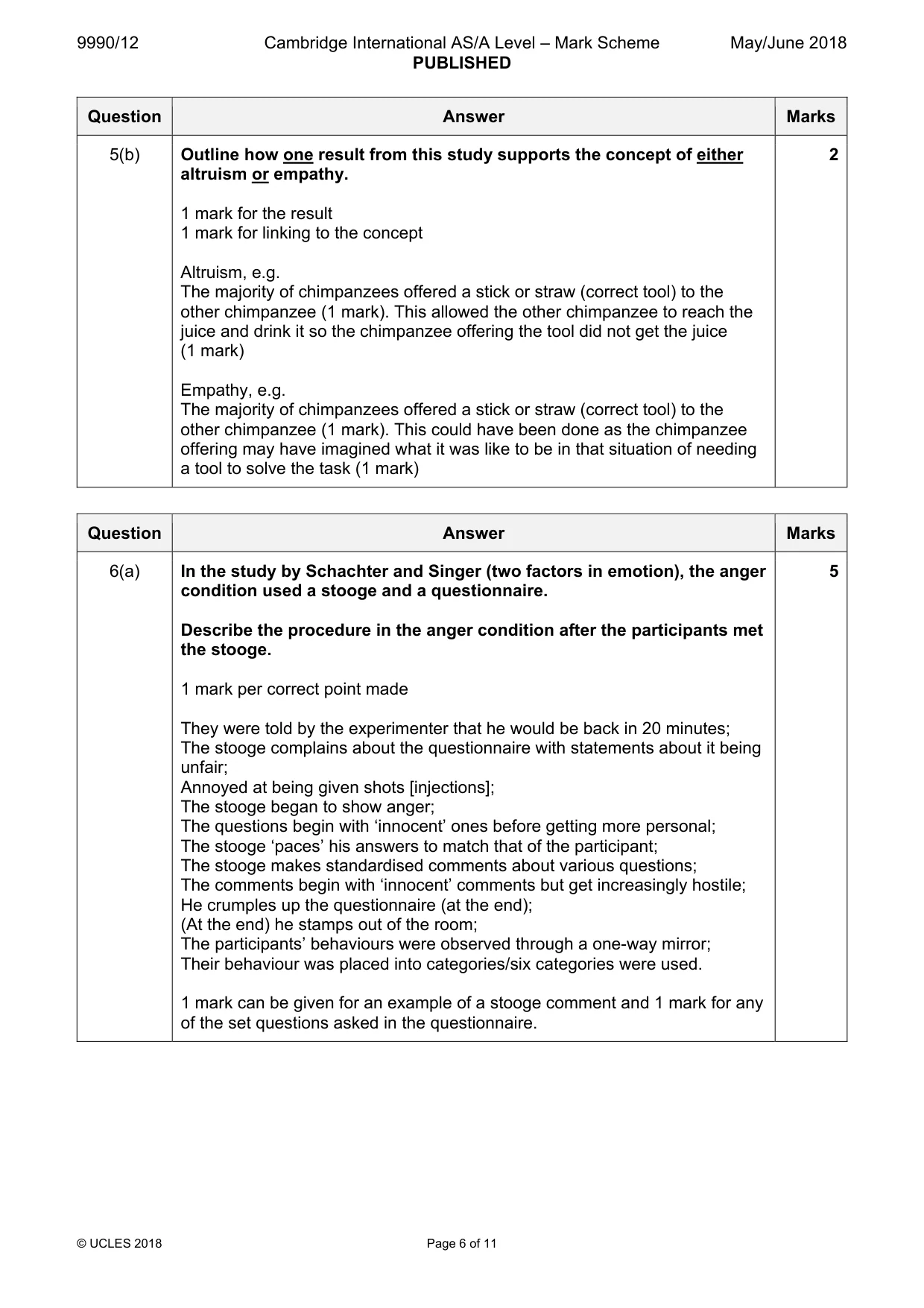
9990/12 Cambridge International AS/A Level – Mark Scheme PUBLISHED May/June 2018 © UCLES 2018 Page 5 of 11 Question Answer Marks 4(b) Describe one quantitative result of the behaviour of participants in the critical area. 2 marks for one quantitative result with a comparison 1 mark for one quantitative result without a meaningful comparison e.g. On 5% of trials with a white victim people left the critical area compared to 9% for a black victim (2 marks); Of the spontaneous helpers/first helpers, 90% were male/64% were white (1 mark) ORA In 20% of trials people moved away (from the critical area)/in total 34 people left the area (1 mark) (together = 2 marks) Males helped more than females (1 mark) ‘Early’ models were more likely to elicit other helpers (n=4) more than ‘late’ models (n=2) (2 marks) 2 Question Answer Marks 5(a) The study by Yamamoto et al. (chimpanzee helping) is based on the concepts of altruism and empathy. Outline what is meant by ‘altruism’ and ‘empathy’. 2 marks for altruism 2 marks for empathy 1 mark can be awarded for an example for each term Altruism The willingness to do certain things/doing certain things for someone else (1 mark) even if it disadvantages yourself/gain no benefit (1 mark) Empathy The ability to understand the emotional state of someone else (1 mark) by imagining what it would be like to be in that situation (1 mark) 4
Mark scheme, page 6
9990/12 Cambridge International AS/A Level – Mark Scheme PUBLISHED May/June 2018 © UCLES 2018 Page 6 of 11 Question Answer Marks 5(b) Outline how one result from this study supports the concept of either altruism or empathy. 1 mark for the result 1 mark for linking to the concept Altruism, e.g. The majority of chimpanzees offered a stick or straw (correct tool) to the other chimpanzee (1 mark). This allowed the other chimpanzee to reach the juice and drink it so the chimpanzee offering the tool did not get the juice (1 mark) Empathy, e.g. The majority of chimpanzees offered a stick or straw (correct tool) to the other chimpanzee (1 mark). This could have been done as the chimpanzee offering may have imagined what it was like to be in that situation of needing a tool to solve the task (1 mark) 2 Question Answer Marks 6(a) In the study by Schachter and Singer (two factors in emotion), the anger condition used a stooge and a questionnaire. Describe the procedure in the anger condition after the participants met the stooge. 1 mark per correct point made They were told by the experimenter that he would be back in 20 minutes; The stooge complains about the questionnaire with statements about it being unfair; Annoyed at being given shots [injections]; The stooge began to show anger; The questions begin with ‘innocent’ ones before getting more personal; The stooge ‘paces’ his answers to match that of the participant; The stooge makes standardised comments about various questions; The comments begin with ‘innocent’ comments but get increasingly hostile; He crumples up the questionnaire (at the end); (At the end) he stamps out of the room; The participants’ behaviours were observed through a one-way mirror; Their behaviour was placed into categories/six categories were used. 1 mark can be given for an example of a stooge comment and 1 mark for any of the set questions asked in the questionnaire. 5
Mark scheme, page 7
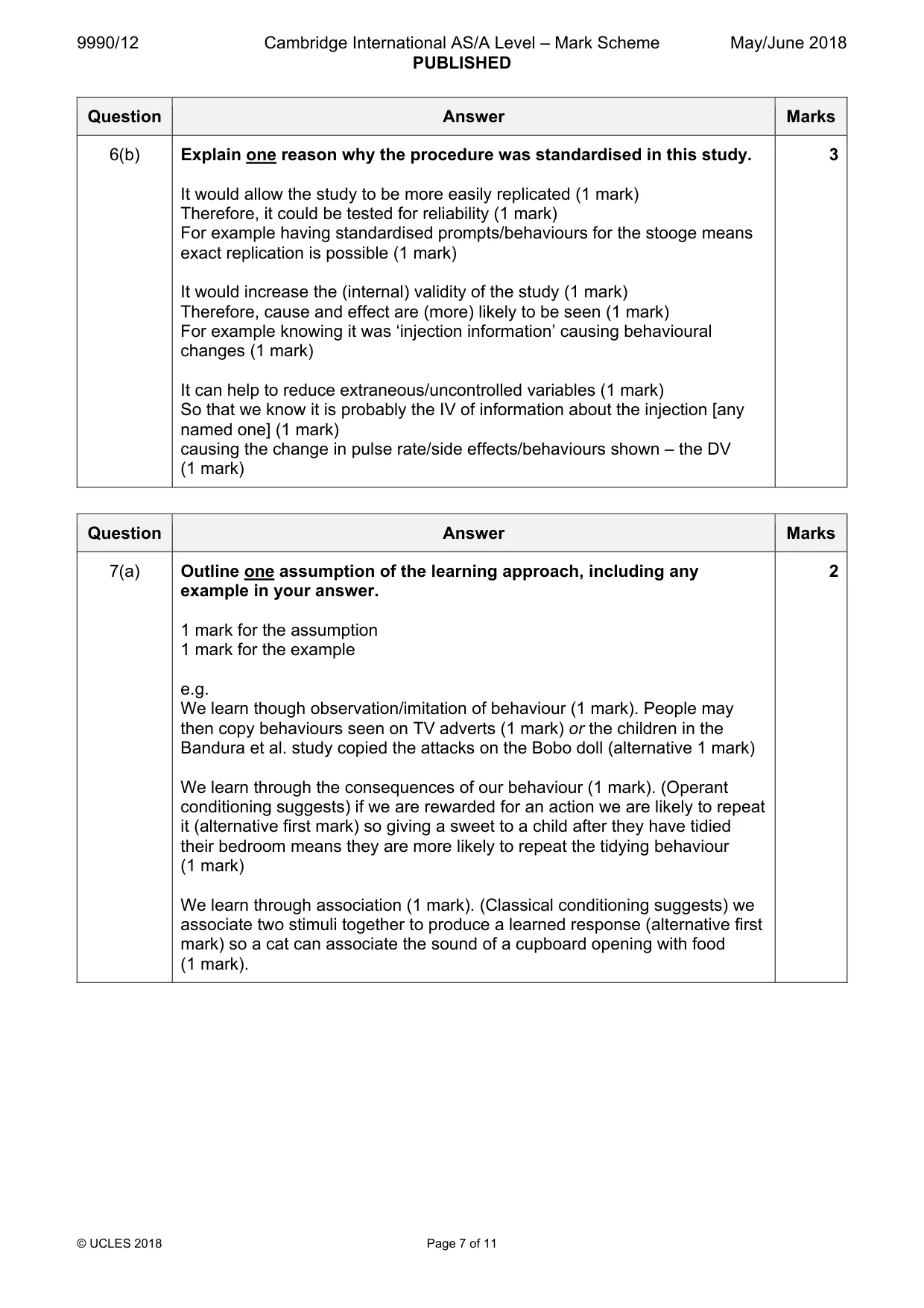
9990/12 Cambridge International AS/A Level – Mark Scheme PUBLISHED May/June 2018 © UCLES 2018 Page 7 of 11 Question Answer Marks 6(b) Explain one reason why the procedure was standardised in this study. It would allow the study to be more easily replicated (1 mark) Therefore, it could be tested for reliability (1 mark) For example having standardised prompts/behaviours for the stooge means exact replication is possible (1 mark) It would increase the (internal) validity of the study (1 mark) Therefore, cause and effect are (more) likely to be seen (1 mark) For example knowing it was ‘injection information’ causing behavioural changes (1 mark) It can help to reduce extraneous/uncontrolled variables (1 mark) So that we know it is probably the IV of information about the injection [any named one] (1 mark) causing the change in pulse rate/side effects/behaviours shown – the DV (1 mark) 3 Question Answer Marks 7(a) Outline one assumption of the learning approach, including any example in your answer. 1 mark for the assumption 1 mark for the example e.g. We learn though observation/imitation of behaviour (1 mark). People may then copy behaviours seen on TV adverts (1 mark) or the children in the Bandura et al. study copied the attacks on the Bobo doll (alternative 1 mark) We learn through the consequences of our behaviour (1 mark). (Operant conditioning suggests) if we are rewarded for an action we are likely to repeat it (alternative first mark) so giving a sweet to a child after they have tidied their bedroom means they are more likely to repeat the tidying behaviour (1 mark) We learn through association (1 mark). (Classical conditioning suggests) we associate two stimuli together to produce a learned response (alternative first mark) so a cat can associate the sound of a cupboard opening with food (1 mark). 2
Mark scheme, page 8
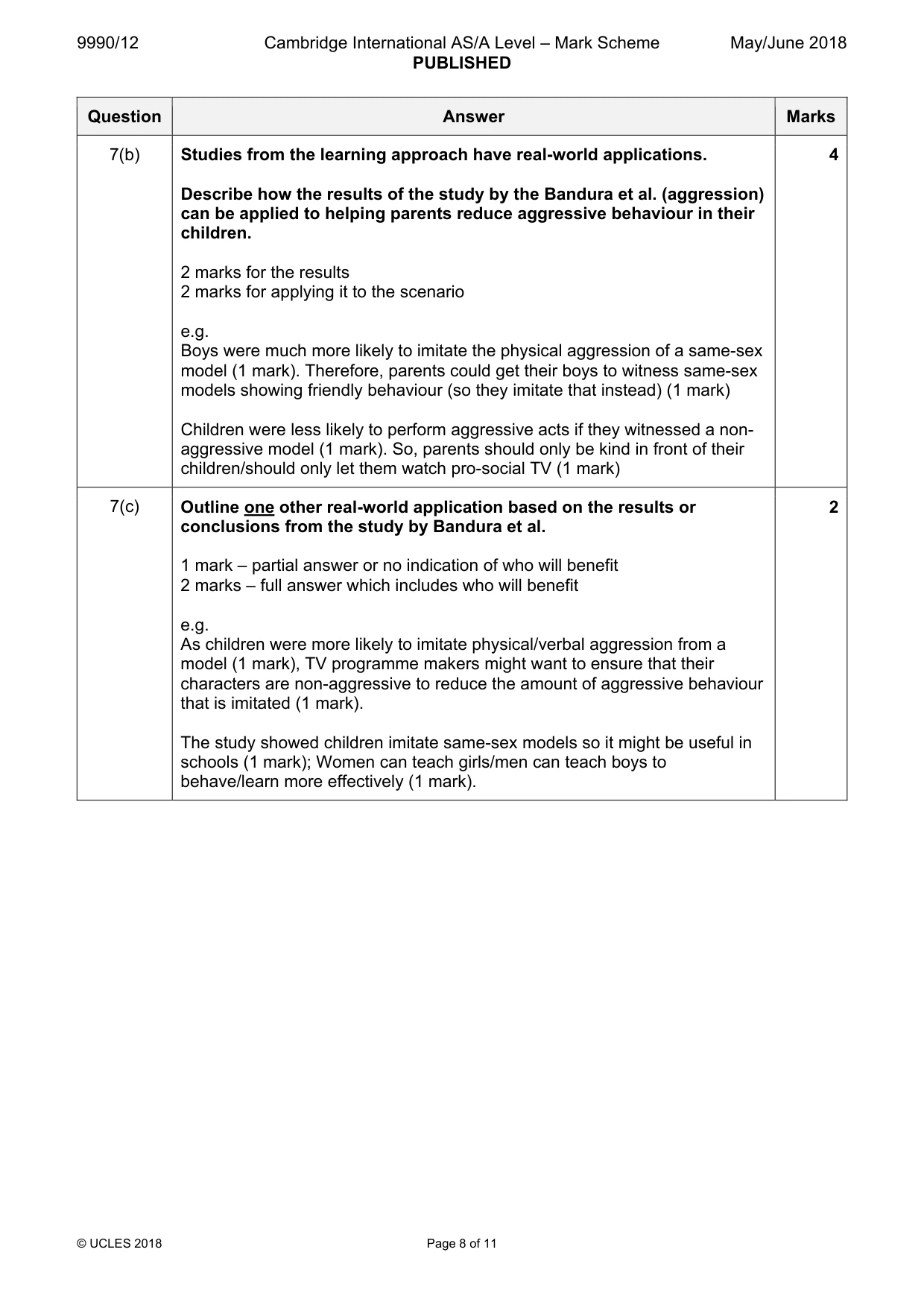
9990/12 Cambridge International AS/A Level – Mark Scheme PUBLISHED May/June 2018 © UCLES 2018 Page 8 of 11 Question Answer Marks 7(b) Studies from the learning approach have real-world applications. Describe how the results of the study by the Bandura et al. (aggression) can be applied to helping parents reduce aggressive behaviour in their children. 2 marks for the results 2 marks for applying it to the scenario e.g. Boys were much more likely to imitate the physical aggression of a same-sex model (1 mark). Therefore, parents could get their boys to witness same-sex models showing friendly behaviour (so they imitate that instead) (1 mark) Children were less likely to perform aggressive acts if they witnessed a non- aggressive model (1 mark). So, parents should only be kind in front of their children/should only let them watch pro-social TV (1 mark) 4 7(c) Outline one other real-world application based on the results or conclusions from the study by Bandura et al. 1 mark – partial answer or no indication of who will benefit 2 marks – full answer which includes who will benefit e.g. As children were more likely to imitate physical/verbal aggression from a model (1 mark), TV programme makers might want to ensure that their characters are non-aggressive to reduce the amount of aggressive behaviour that is imitated (1 mark). The study showed children imitate same-sex models so it might be useful in schools (1 mark); Women can teach girls/men can teach boys to behave/learn more effectively (1 mark). 2
Mark scheme, page 9
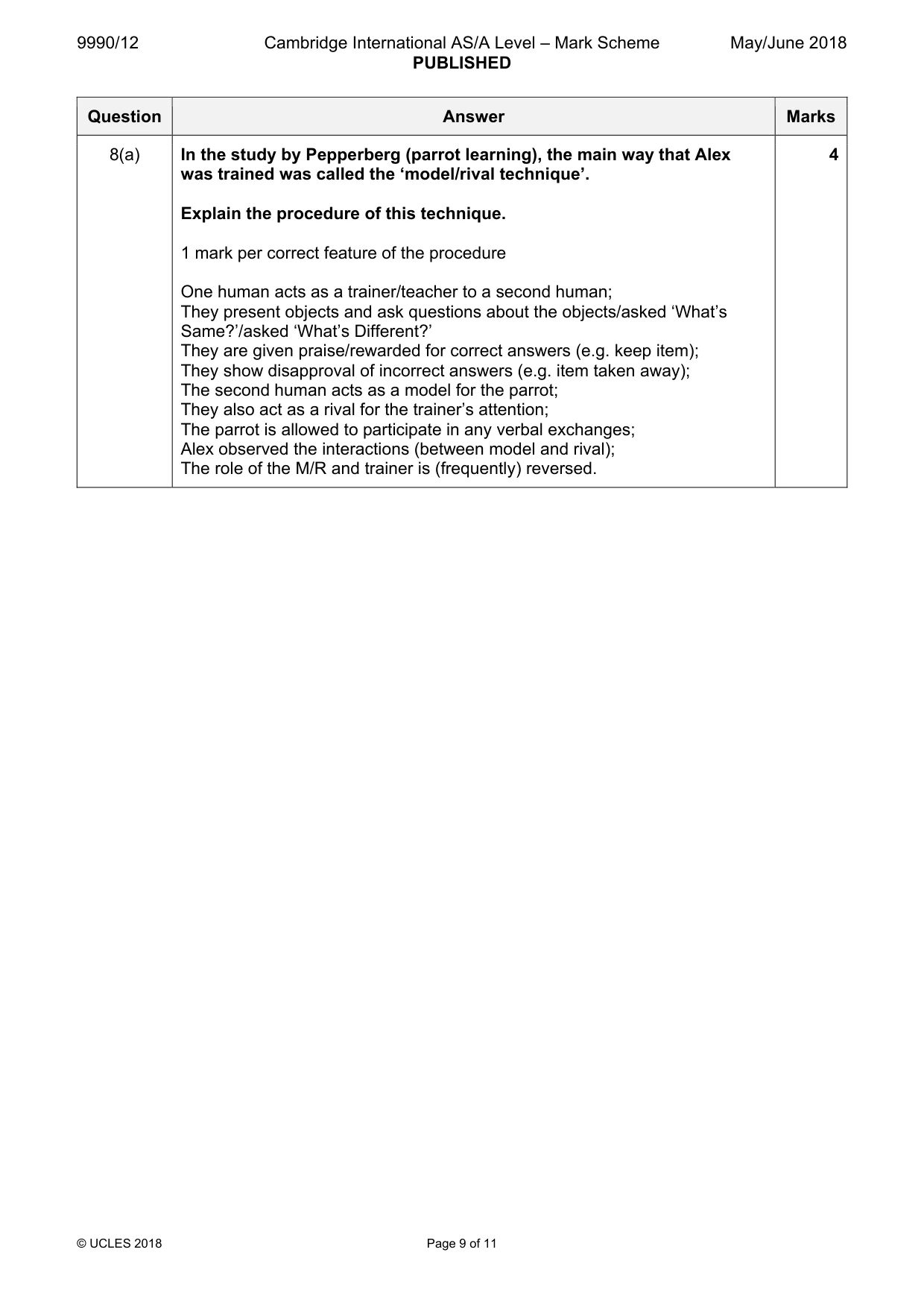
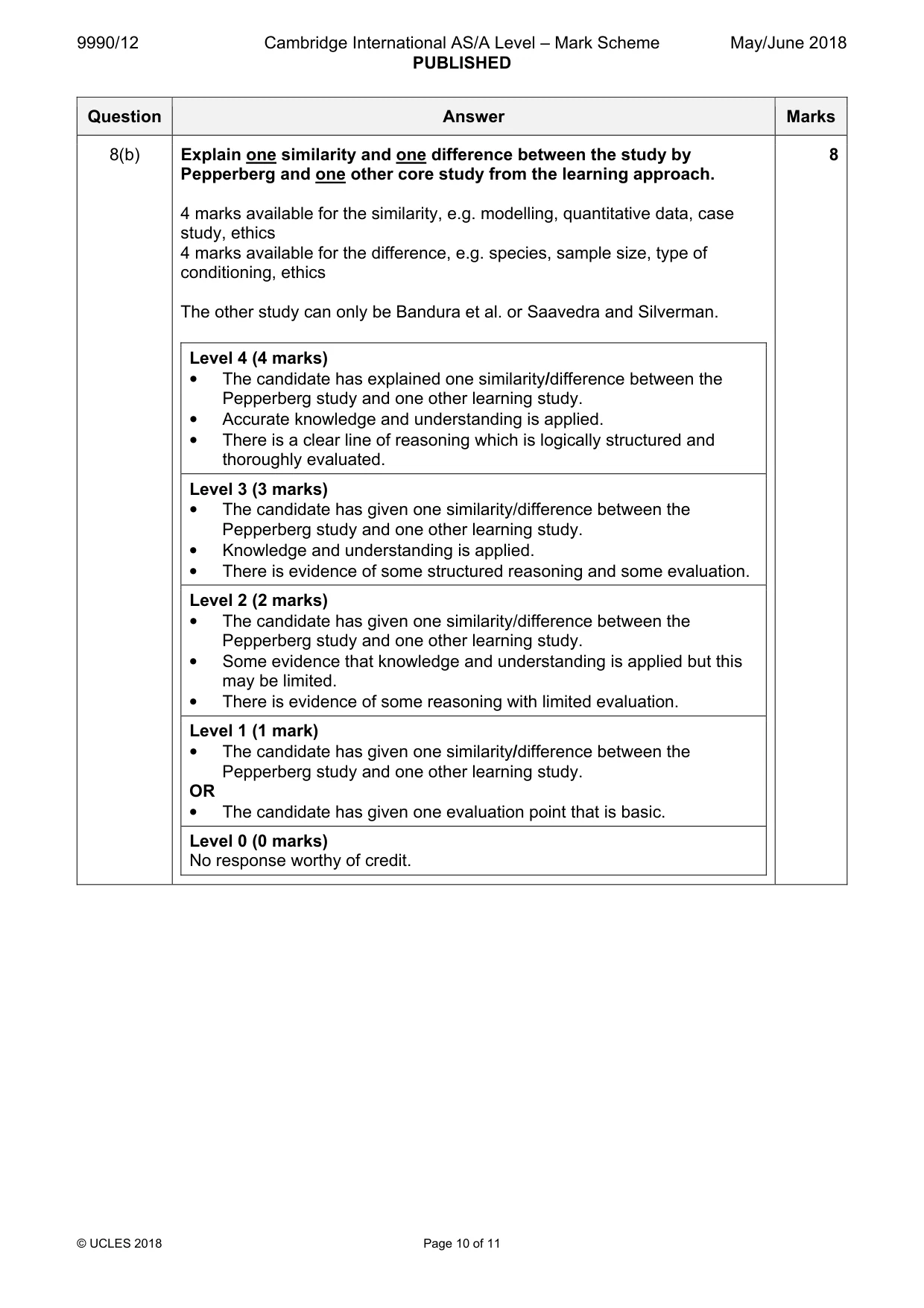
9990/12 Cambridge International AS/A Level – Mark Scheme PUBLISHED May/June 2018 © UCLES 2018 Page 9 of 11 Question Answer Marks 8(a) In the study by Pepperberg (parrot learning), the main way that Alex was trained was called the ‘model/rival technique’. Explain the procedure of this technique. 1 mark per correct feature of the procedure One human acts as a trainer/teacher to a second human; They present objects and ask questions about the objects/asked ‘What’s Same?’/asked ‘What’s Different?’ They are given praise/rewarded for correct answers (e.g. keep item); They show disapproval of incorrect answers (e.g. item taken away); The second human acts as a model for the parrot; They also act as a rival for the trainer’s attention; The parrot is allowed to participate in any verbal exchanges; Alex observed the interactions (between model and rival); The role of the M/R and trainer is (frequently) reversed. 4
Mark scheme, page 10
9990/12 Cambridge International AS/A Level – Mark Scheme PUBLISHED May/June 2018 © UCLES 2018 Page 10 of 11 Question Answer Marks 8(b) Explain one similarity and one difference between the study by Pepperberg and one other core study from the learning approach. 4 marks available for the similarity, e.g. modelling, quantitative data, case study, ethics 4 marks available for the difference, e.g. species, sample size, type of conditioning, ethics The other study can only be Bandura et al. or Saavedra and Silverman. Level 4 (4 marks) • The candidate has explained one similarity/difference between the Pepperberg study and one other learning study. • Accurate knowledge and understanding is applied. • There is a clear line of reasoning which is logically structured and thoroughly evaluated. Level 3 (3 marks) • The candidate has given one similarity/difference between the Pepperberg study and one other learning study. • Knowledge and understanding is applied. • There is evidence of some structured reasoning and some evaluation. Level 2 (2 marks) • The candidate has given one similarity/difference between the Pepperberg study and one other learning study. • Some evidence that knowledge and understanding is applied but this may be limited. • There is evidence of some reasoning with limited evaluation. Level 1 (1 mark) • The candidate has given one similarity/difference between the Pepperberg study and one other learning study. OR • The candidate has given one evaluation point that is basic. Level 0 (0 marks) No response worthy of credit. 8
Mark scheme, page 11
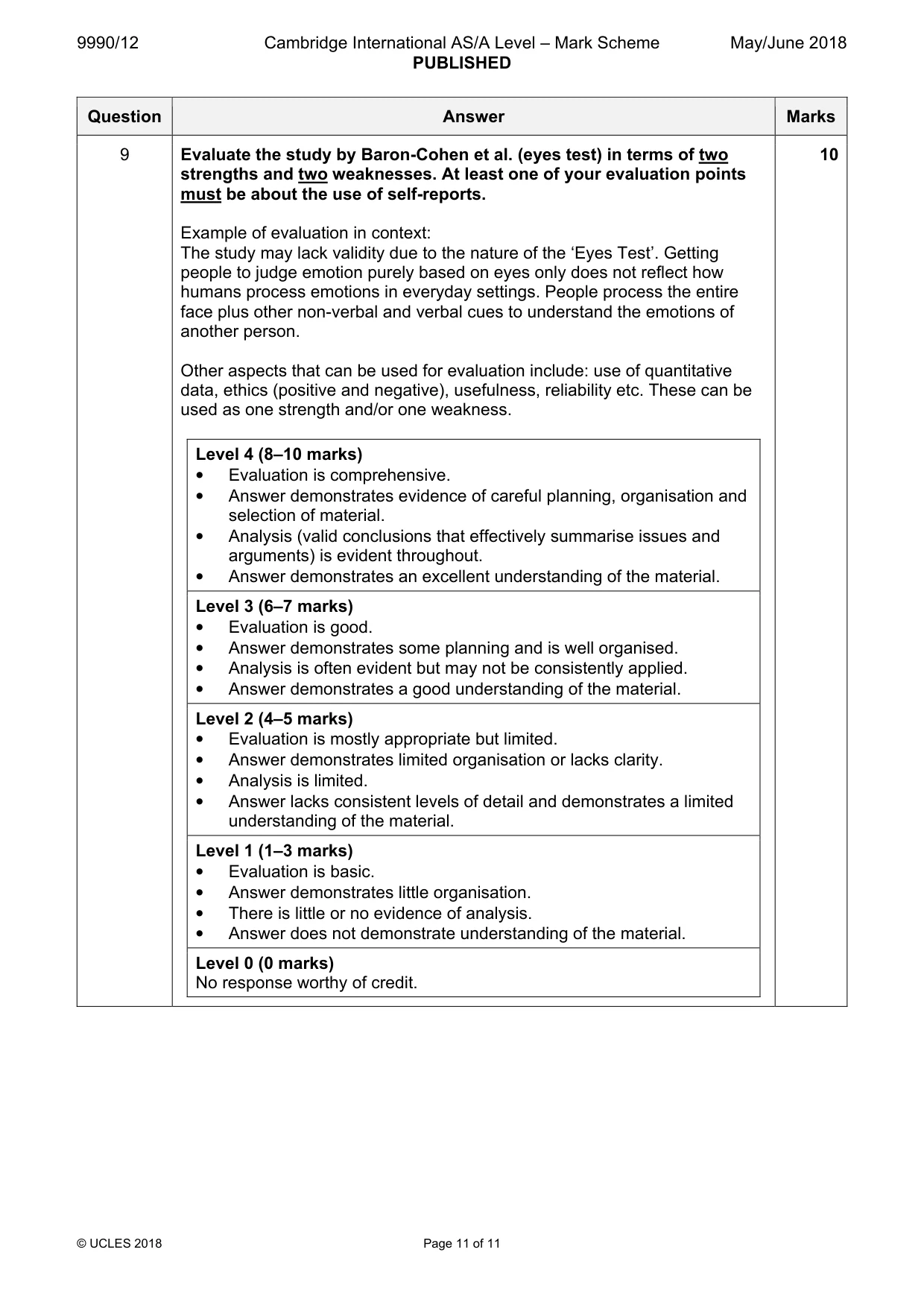
9990/12 Cambridge International AS/A Level – Mark Scheme PUBLISHED May/June 2018 © UCLES 2018 Page 11 of 11 Question Answer Marks 9 Evaluate the study by Baron-Cohen et al. (eyes test) in terms of two strengths and two weaknesses. At least one of your evaluation points must be about the use of self-reports. Example of evaluation in context: The study may lack validity due to the nature of the ‘Eyes Test’. Getting people to judge emotion purely based on eyes only does not reflect how humans process emotions in everyday settings. People process the entire face plus other non-verbal and verbal cues to understand the emotions of another person. Other aspects that can be used for evaluation include: use of quantitative data, ethics (positive and negative), usefulness, reliability etc. These can be used as one strength and/or one weakness. Level 4 (8–10 marks) • Evaluation is comprehensive. • Answer demonstrates evidence of careful planning, organisation and selection of material. • Analysis (valid conclusions that effectively summarise issues and arguments) is evident throughout. • Answer demonstrates an excellent understanding of the material. Level 3 (6–7 marks) • Evaluation is good. • Answer demonstrates some planning and is well organised. • Analysis is often evident but may not be consistently applied. • Answer demonstrates a good understanding of the material. Level 2 (4–5 marks) • Evaluation is mostly appropriate but limited. • Answer demonstrates limited organisation or lacks clarity. • Analysis is limited. • Answer lacks consistent levels of detail and demonstrates a limited understanding of the material. Level 1 (1–3 marks) • Evaluation is basic. • Answer demonstrates little organisation. • There is little or no evidence of analysis. • Answer does not demonstrate understanding of the material. Level 0 (0 marks) No response worthy of credit. 10
What you needed in this session
Cambridge’s own grade thresholds for 2018 May/June, Paper 1 · Variant 2. A higher threshold means an easier paper — the bar moves with how the cohort did.