Cambridge A Level Psychology (from 2018) 9990 — 2018 May/June Paper 1 · Variant 1
9990/11/M/J/18 · 60 marks · ≈68 min
The question paper and its mark scheme, free to read here and free to download. This is Cambridge’s own paper, exactly as it was sat.
Question paper8 pages
Mark scheme11 pages
Answers below. Sit the paper first if you are practising.
Paper as text
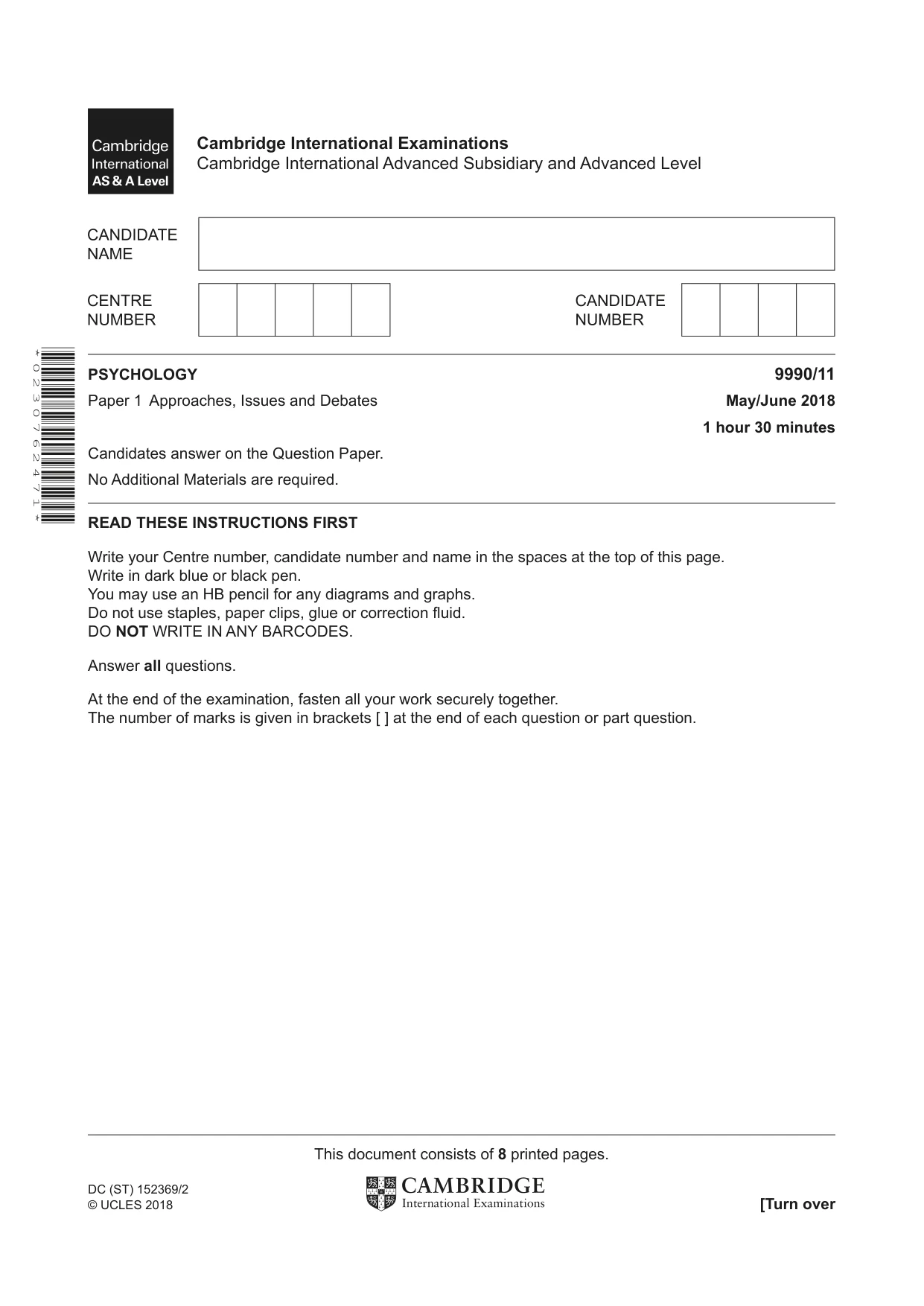
Question paper, page 1
This document consists of 8 printed pages. DC (ST) 152369/2 © UCLES 2018 [Turn over Cambridge International Examinations Cambridge International Advanced Subsidiary and Advanced Level * 0 2 3 0 7 6 2 4 7 1 * PSYCHOLOGY 9990/11 Paper 1 Approaches, Issues and Debates May/June 2018 1 hour 30 minutes Candidates answer on the Question Paper. No Additional Materials are required. READ THESE INSTRUCTIONS FIRST Write your Centre number, candidate number and name in the spaces at the top of this page. Write in dark blue or black pen. You may use an HB pencil for any diagrams and graphs. Do not use staples, paper clips, glue or correction fluid. DO NOT WRITE IN ANY BARCODES. Answer all questions. At the end of the examination, fasten all your work securely together. The number of marks is given in brackets [ ] at the end of each question or part question.
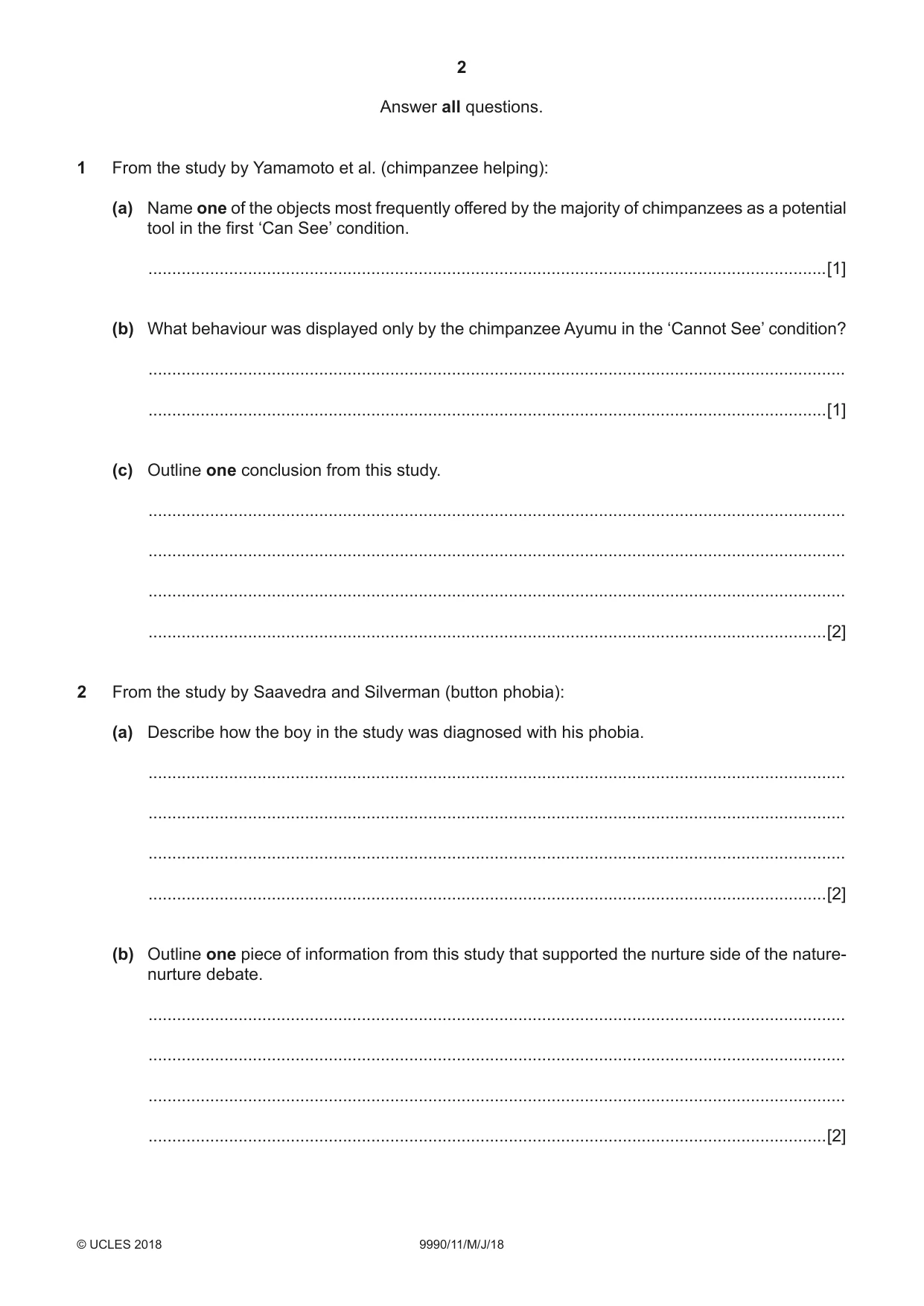
Question paper, page 2
2 9990/11/M/J/18 © UCLES 2018 Answer all questions. 1 From the study by Yamamoto et al. (chimpanzee helping): (a) Name one of the objects most frequently offered by the majority of chimpanzees as a potential tool in the first ‘Can See’ condition. …[1] (b) What behaviour was displayed only by the chimpanzee Ayumu in the ‘Cannot See’ condition? … …[1] (c) Outline one conclusion from this study. … … … …[2] 2 From the study by Saavedra and Silverman (button phobia): (a) Describe how the boy in the study was diagnosed with his phobia. … … … …[2] (b) Outline one piece of information from this study that supported the nurture side of the nature- nurture debate. … … … …[2]
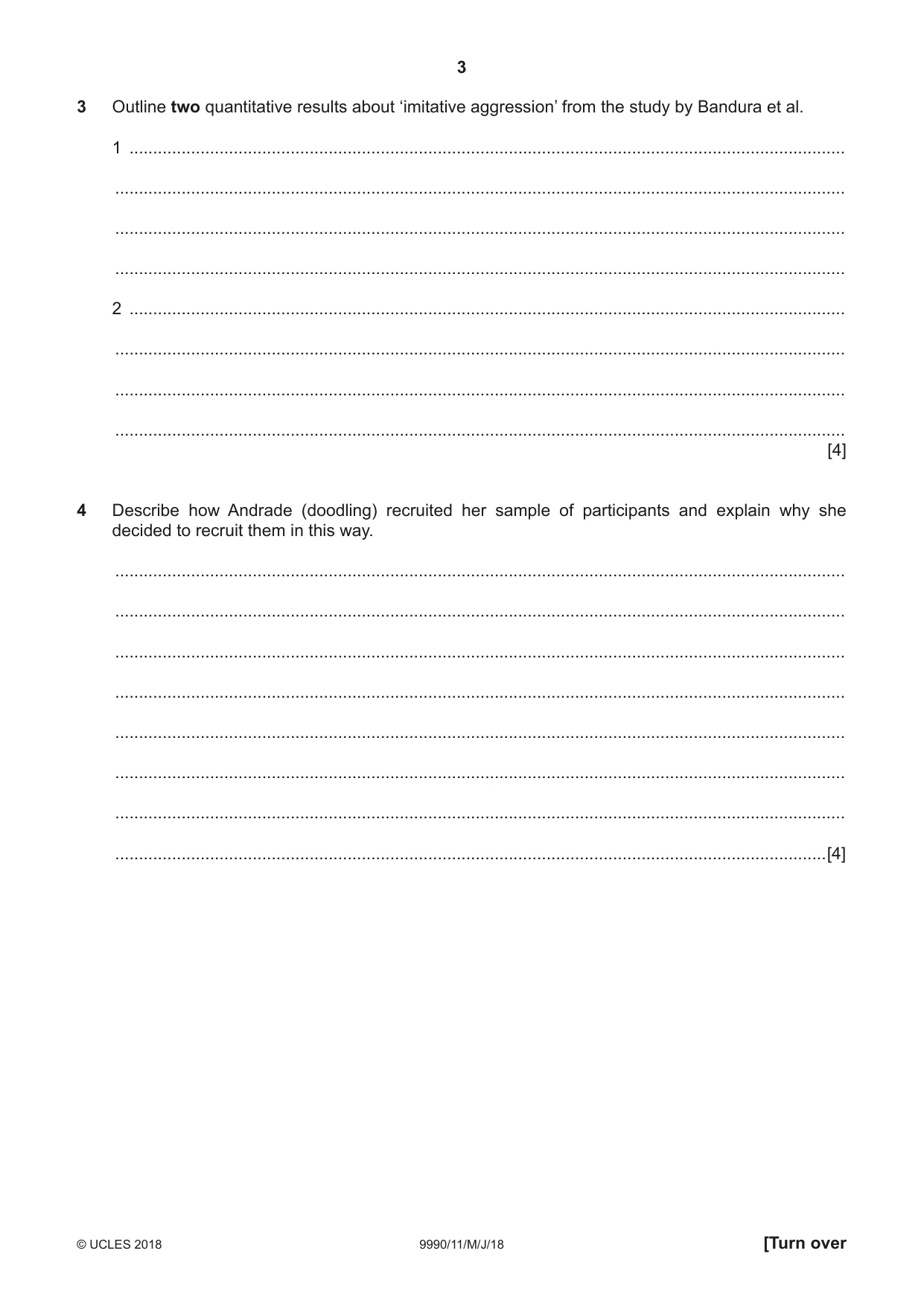
Question paper, page 3
3 9990/11/M/J/18 © UCLES 2018 [Turn over 3 Outline two quantitative results about ‘imitative aggression’ from the study by Bandura et al. 1 … … … … 2 … … … … [4] 4 Describe how Andrade (doodling) recruited her sample of participants and explain why she decided to recruit them in this way. … … … … … … … …[4]
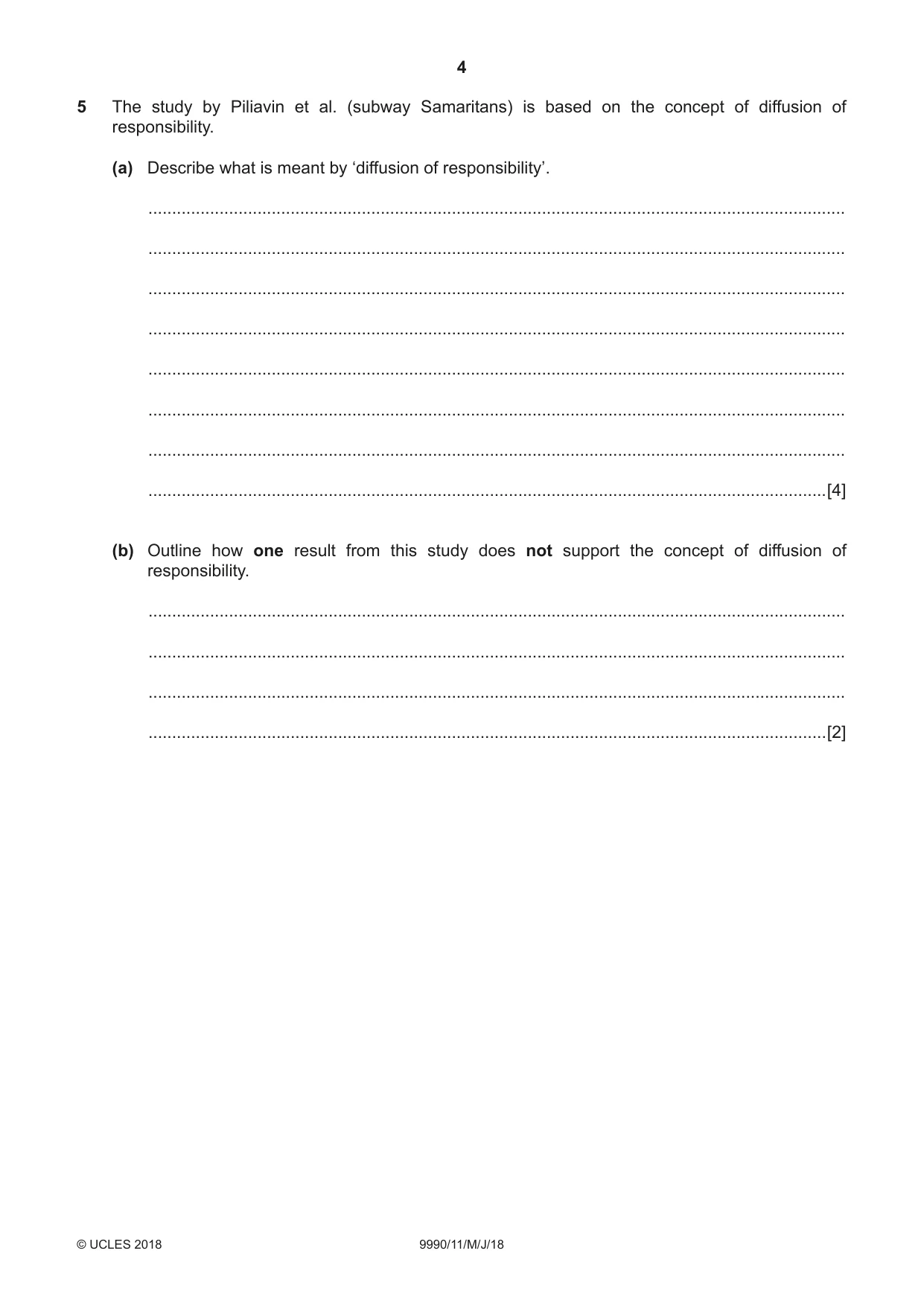
Question paper, page 4
4 9990/11/M/J/18 © UCLES 2018 5 The study by Piliavin et al. (subway Samaritans) is based on the concept of diffusion of responsibility. (a) Describe what is meant by ‘diffusion of responsibility’. … … … … … … … …[4] (b) Outline how one result from this study does not support the concept of diffusion of responsibility. … … … …[2]
Question paper, page 5
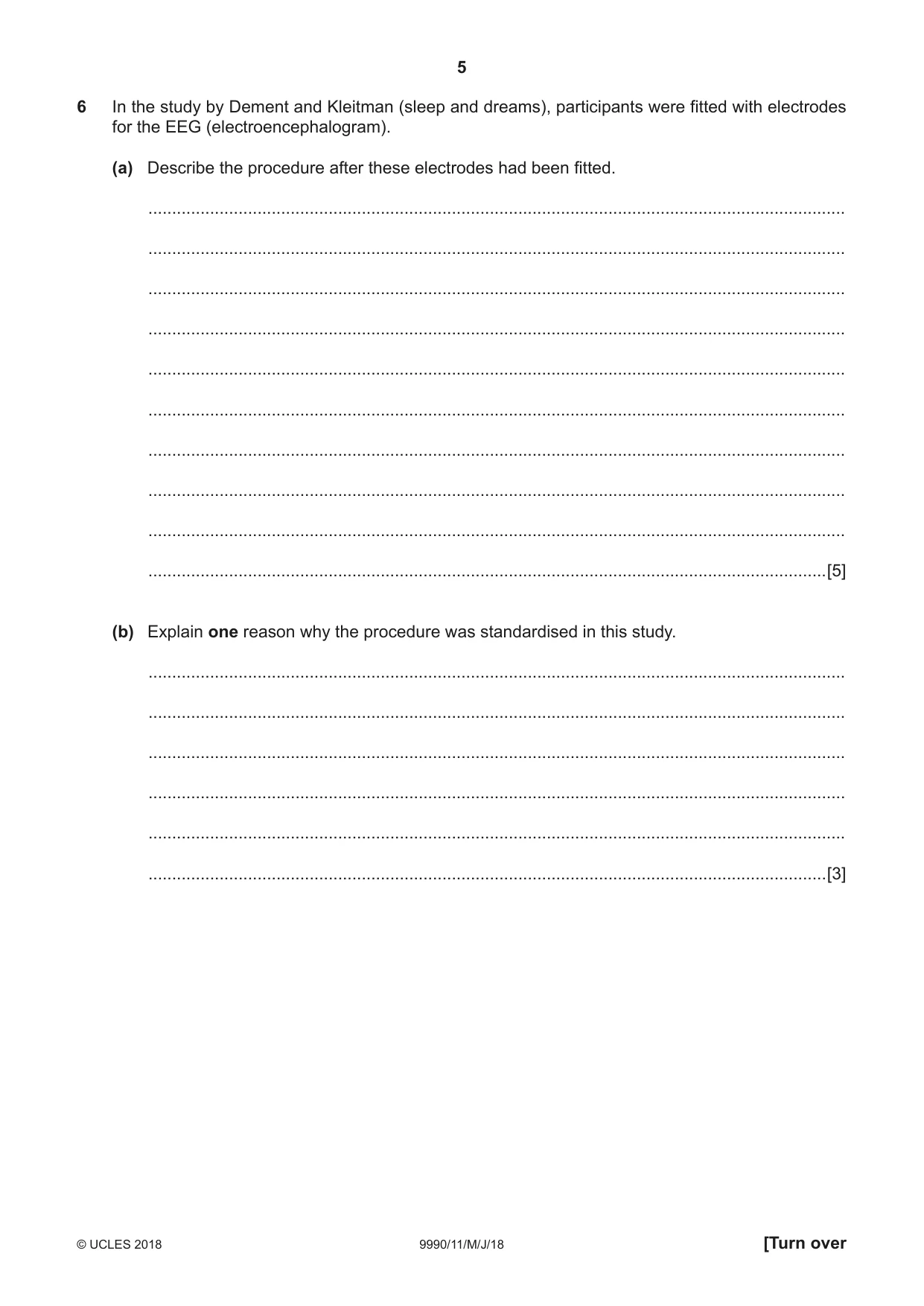
5 9990/11/M/J/18 © UCLES 2018 [Turn over 6 In the study by Dement and Kleitman (sleep and dreams), participants were fitted with electrodes for the EEG (electroencephalogram). (a) Describe the procedure after these electrodes had been fitted. … … … … … … … … … …[5] (b) Explain one reason why the procedure was standardised in this study. … … … … … …[3]
Question paper, page 6
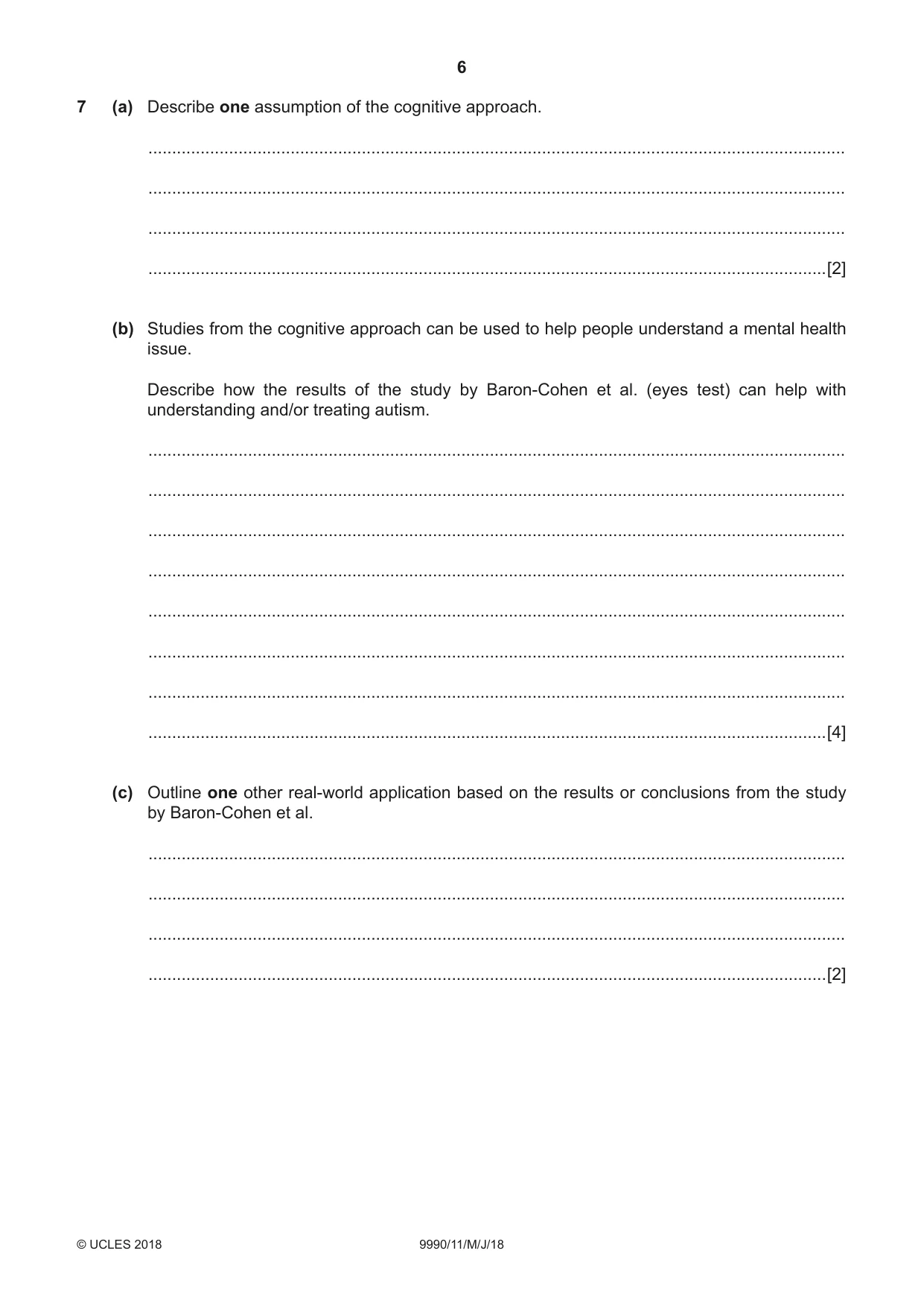
6 9990/11/M/J/18 © UCLES 2018 7 (a) Describe one assumption of the cognitive approach. … … … …[2] (b) Studies from the cognitive approach can be used to help people understand a mental health issue. Describe how the results of the study by Baron-Cohen et al. (eyes test) can help with understanding and/or treating autism. … … … … … … … …[4] (c) Outline one other real-world application based on the results or conclusions from the study by Baron-Cohen et al. … … … …[2]
Question paper, page 7
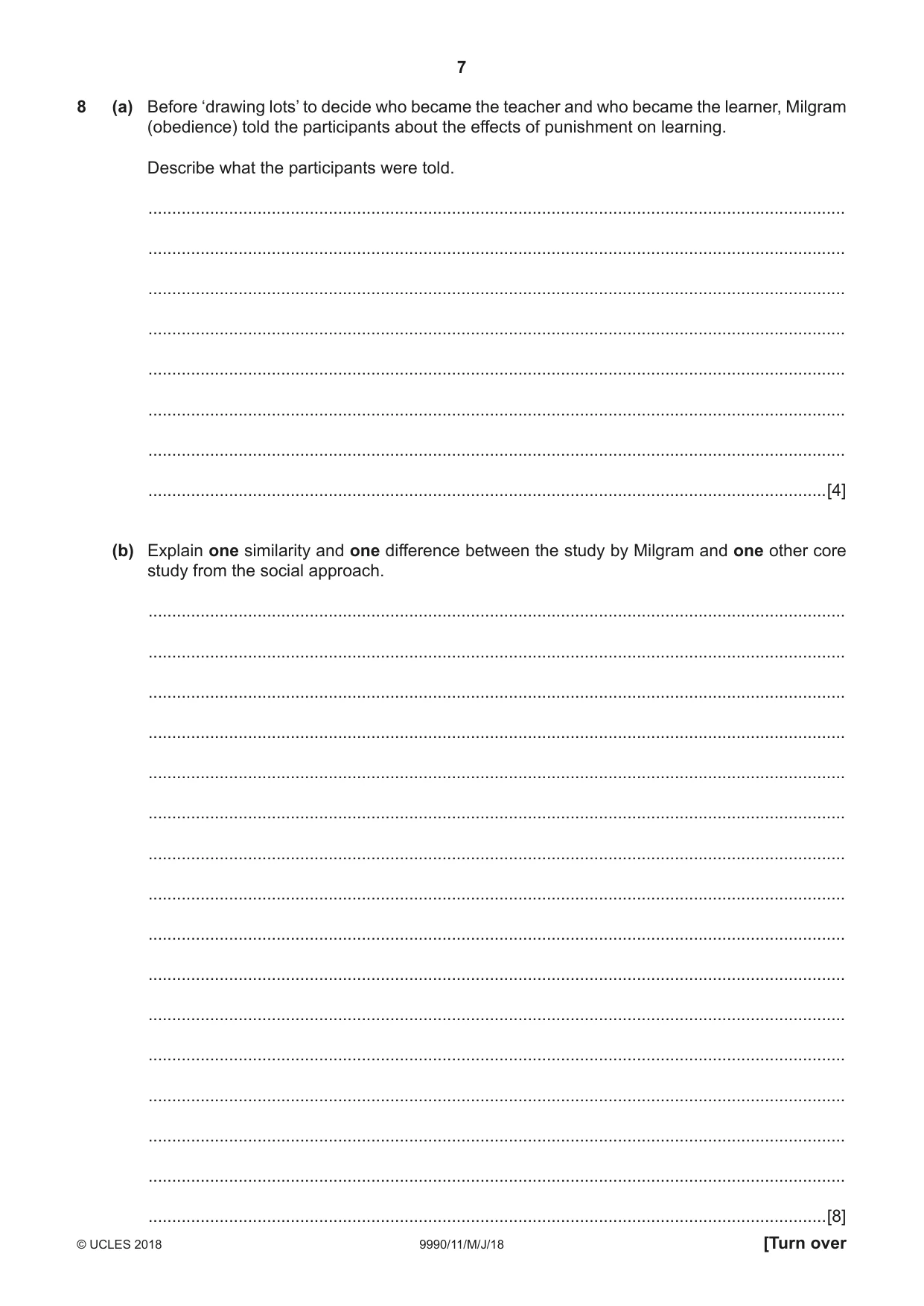
7 9990/11/M/J/18 © UCLES 2018 [Turn over 8 (a) Before ‘drawing lots’ to decide who became the teacher and who became the learner, Milgram (obedience) told the participants about the effects of punishment on learning. Describe what the participants were told. … … … … … … … …[4] (b) Explain one similarity and one difference between the study by Milgram and one other core study from the social approach. … … … … … … … … … … … … … … … …[8]
Question paper, page 8
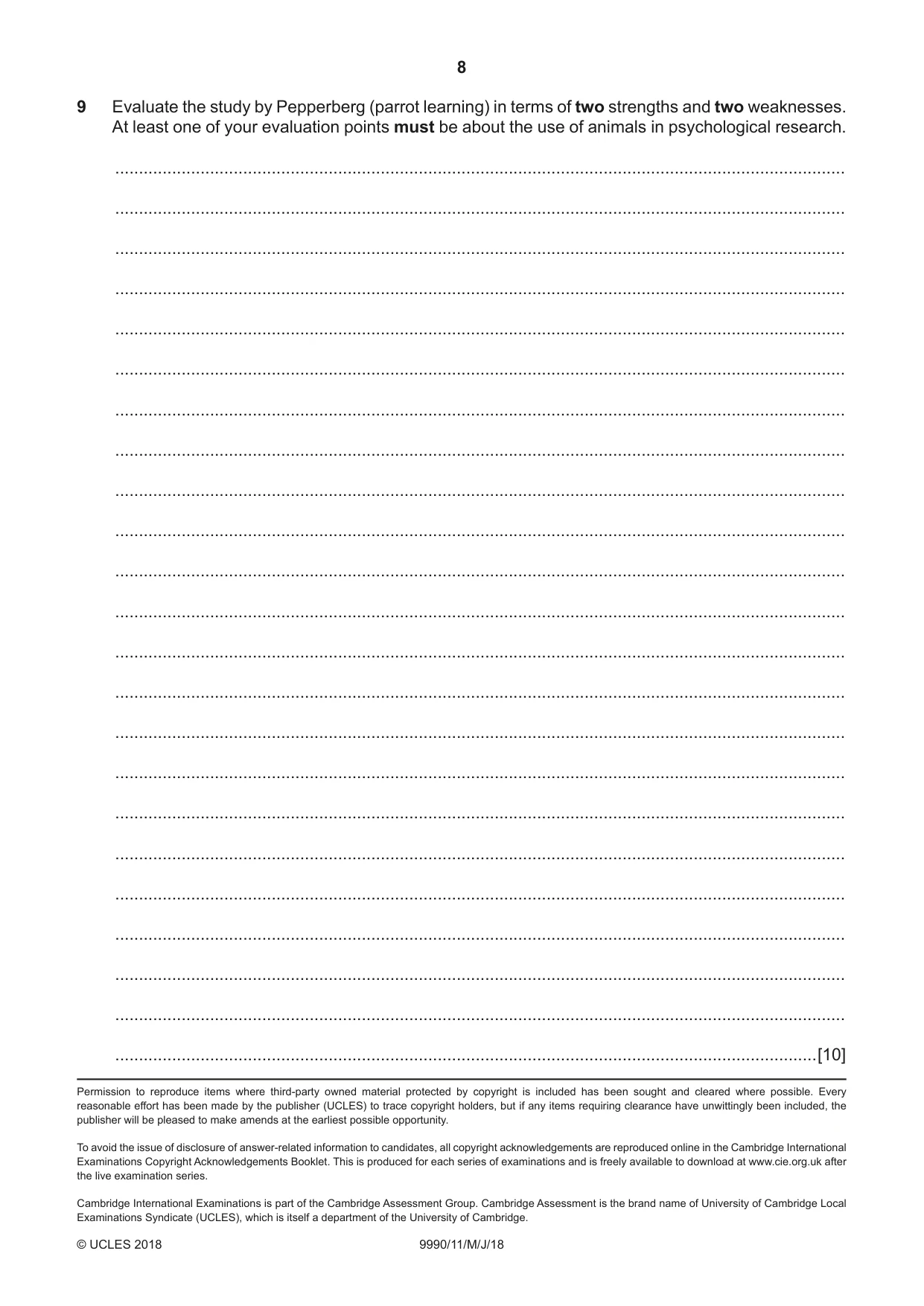
8 9990/11/M/J/18 © UCLES 2018 Permission to reproduce items where third-party owned material protected by copyright is included has been sought and cleared where possible. Every reasonable effort has been made by the publisher (UCLES) to trace copyright holders, but if any items requiring clearance have unwittingly been included, the publisher will be pleased to make amends at the earliest possible opportunity. To avoid the issue of disclosure of answer-related information to candidates, all copyright acknowledgements are reproduced online in the Cambridge International Examinations Copyright Acknowledgements Booklet. This is produced for each series of examinations and is freely available to download at www.cie.org.uk after the live examination series. Cambridge International Examinations is part of the Cambridge Assessment Group. Cambridge Assessment is the brand name of University of Cambridge Local Examinations Syndicate (UCLES), which is itself a department of the University of Cambridge. 9 Evaluate the study by Pepperberg (parrot learning) in terms of two strengths and two weaknesses. At least one of your evaluation points must be about the use of animals in psychological research. … … … … … … … … … … … … … … … … … … … … … … …[10]
Mark scheme, page 1
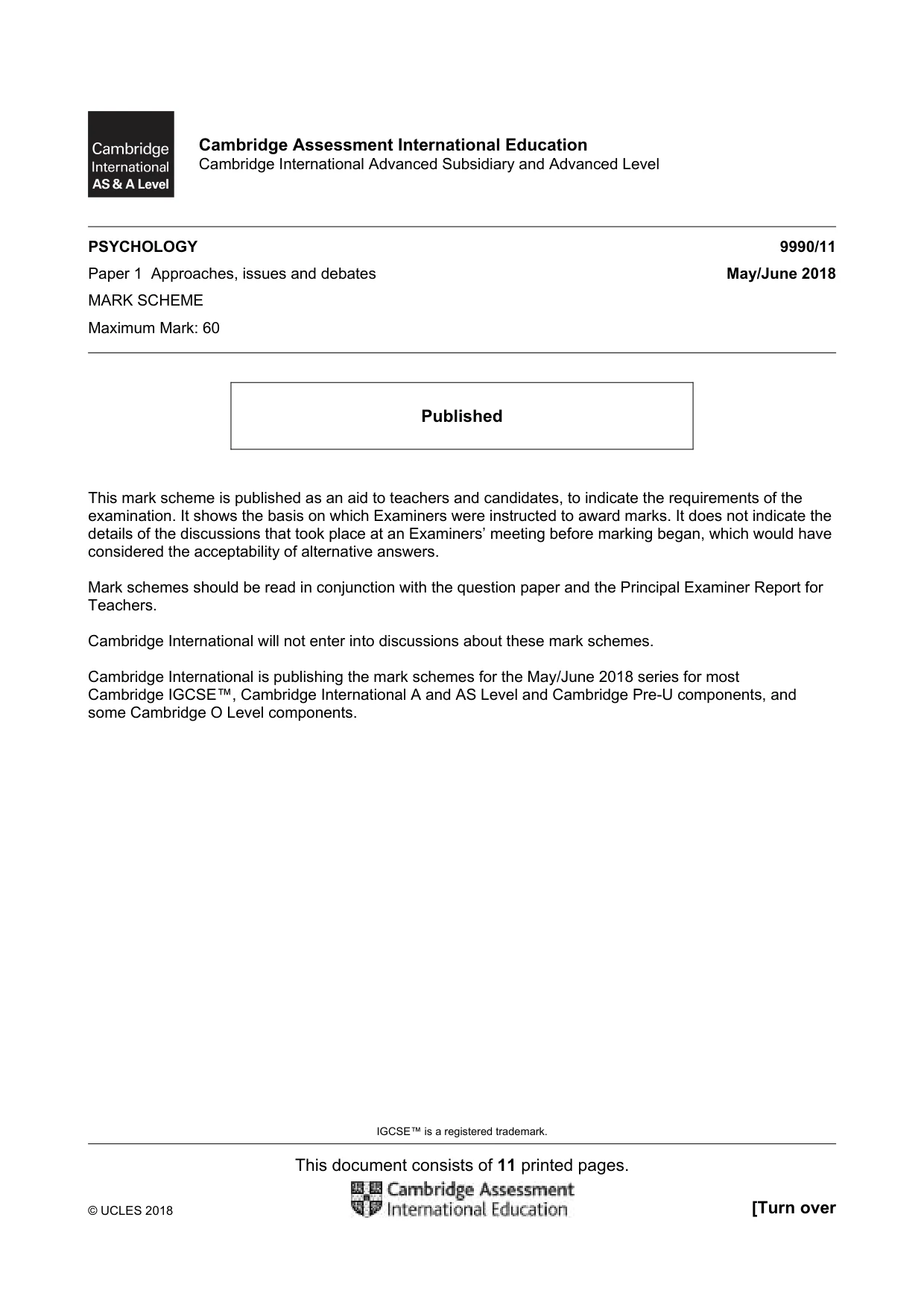
IGCSE™ is a registered trademark. This document consists of 11 printed pages. © UCLES 2018 [Turn over Cambridge Assessment International Education Cambridge International Advanced Subsidiary and Advanced Level PSYCHOLOGY 9990/11 Paper 1 Approaches, issues and debates May/June 2018 MARK SCHEME Maximum Mark: 60 Published This mark scheme is published as an aid to teachers and candidates, to indicate the requirements of the examination. It shows the basis on which Examiners were instructed to award marks. It does not indicate the details of the discussions that took place at an Examiners’ meeting before marking began, which would have considered the acceptability of alternative answers. Mark schemes should be read in conjunction with the question paper and the Principal Examiner Report for Teachers. Cambridge International will not enter into discussions about these mark schemes. Cambridge International is publishing the mark schemes for the May/June 2018 series for most Cambridge IGCSE™, Cambridge International A and AS Level and Cambridge Pre-U components, and some Cambridge O Level components.
Mark scheme, page 2
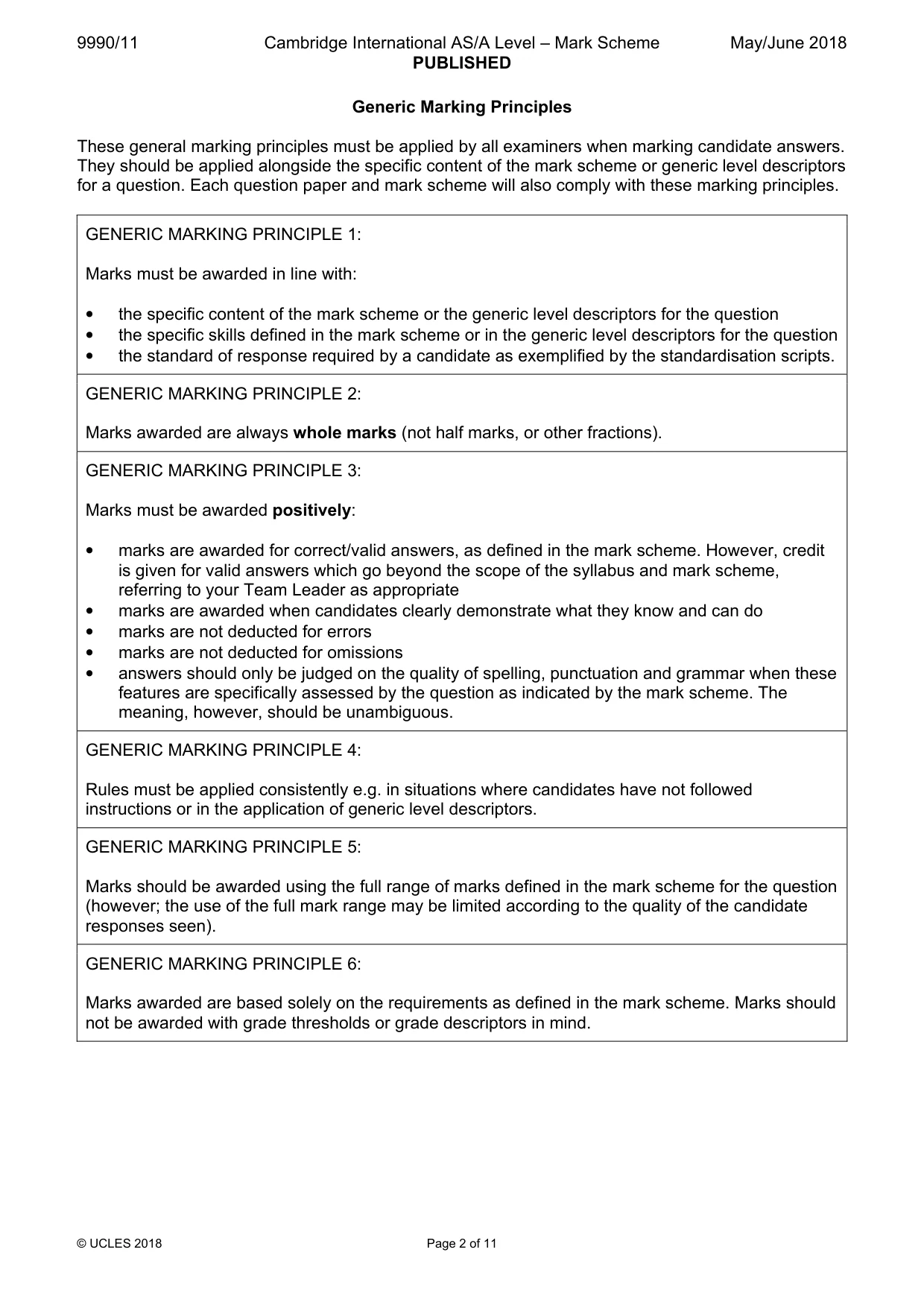
9990/11 Cambridge International AS/A Level – Mark Scheme PUBLISHED May/June 2018 © UCLES 2018 Page 2 of 11 Generic Marking Principles These general marking principles must be applied by all examiners when marking candidate answers. They should be applied alongside the specific content of the mark scheme or generic level descriptors for a question. Each question paper and mark scheme will also comply with these marking principles. GENERIC MARKING PRINCIPLE 1: Marks must be awarded in line with: • the specific content of the mark scheme or the generic level descriptors for the question • the specific skills defined in the mark scheme or in the generic level descriptors for the question • the standard of response required by a candidate as exemplified by the standardisation scripts. GENERIC MARKING PRINCIPLE 2: Marks awarded are always whole marks (not half marks, or other fractions). GENERIC MARKING PRINCIPLE 3: Marks must be awarded positively: • marks are awarded for correct/valid answers, as defined in the mark scheme. However, credit is given for valid answers which go beyond the scope of the syllabus and mark scheme, referring to your Team Leader as appropriate • marks are awarded when candidates clearly demonstrate what they know and can do • marks are not deducted for errors • marks are not deducted for omissions • answers should only be judged on the quality of spelling, punctuation and grammar when these features are specifically assessed by the question as indicated by the mark scheme. The meaning, however, should be unambiguous. GENERIC MARKING PRINCIPLE 4: Rules must be applied consistently e.g. in situations where candidates have not followed instructions or in the application of generic level descriptors. GENERIC MARKING PRINCIPLE 5: Marks should be awarded using the full range of marks defined in the mark scheme for the question (however; the use of the full mark range may be limited according to the quality of the candidate responses seen). GENERIC MARKING PRINCIPLE 6: Marks awarded are based solely on the requirements as defined in the mark scheme. Marks should not be awarded with grade thresholds or grade descriptors in mind.
Mark scheme, page 3
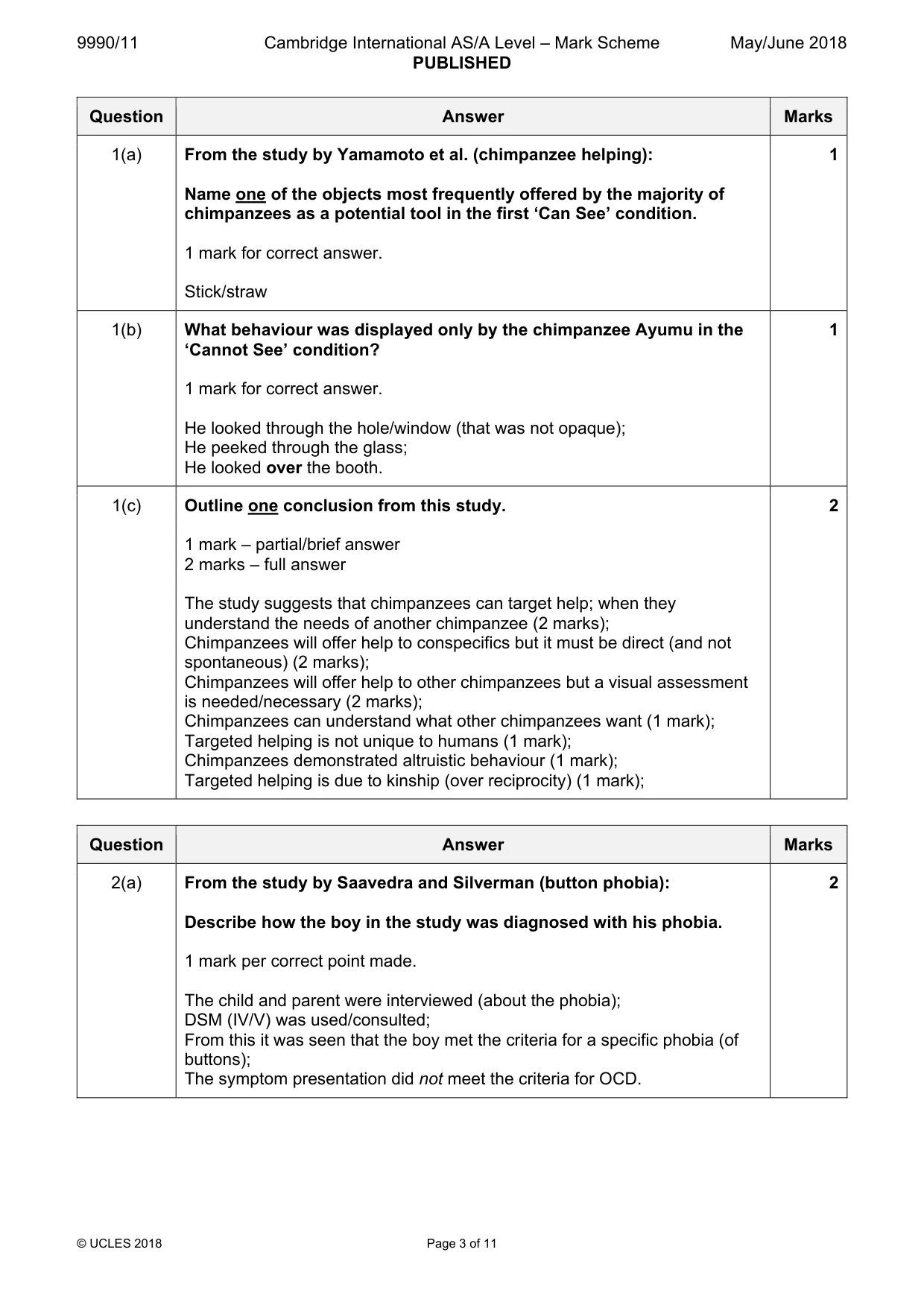
9990/11 Cambridge International AS/A Level – Mark Scheme PUBLISHED May/June 2018 © UCLES 2018 Page 3 of 11 Question Answer Marks 1(a) From the study by Yamamoto et al. (chimpanzee helping): Name one of the objects most frequently offered by the majority of chimpanzees as a potential tool in the first ‘Can See’ condition. 1 mark for correct answer. Stick/straw 1 1(b) What behaviour was displayed only by the chimpanzee Ayumu in the ‘Cannot See’ condition? 1 mark for correct answer. He looked through the hole/window (that was not opaque); He peeked through the glass; He looked over the booth. 1 1(c) Outline one conclusion from this study. 1 mark – partial/brief answer 2 marks – full answer The study suggests that chimpanzees can target help; when they understand the needs of another chimpanzee (2 marks); Chimpanzees will offer help to conspecifics but it must be direct (and not spontaneous) (2 marks); Chimpanzees will offer help to other chimpanzees but a visual assessment is needed/necessary (2 marks); Chimpanzees can understand what other chimpanzees want (1 mark); Targeted helping is not unique to humans (1 mark); Chimpanzees demonstrated altruistic behaviour (1 mark); Targeted helping is due to kinship (over reciprocity) (1 mark); 2 Question Answer Marks 2(a) From the study by Saavedra and Silverman (button phobia): Describe how the boy in the study was diagnosed with his phobia. 1 mark per correct point made. The child and parent were interviewed (about the phobia); DSM (IV/V) was used/consulted; From this it was seen that the boy met the criteria for a specific phobia (of buttons); The symptom presentation did not meet the criteria for OCD. 2
Mark scheme, page 4
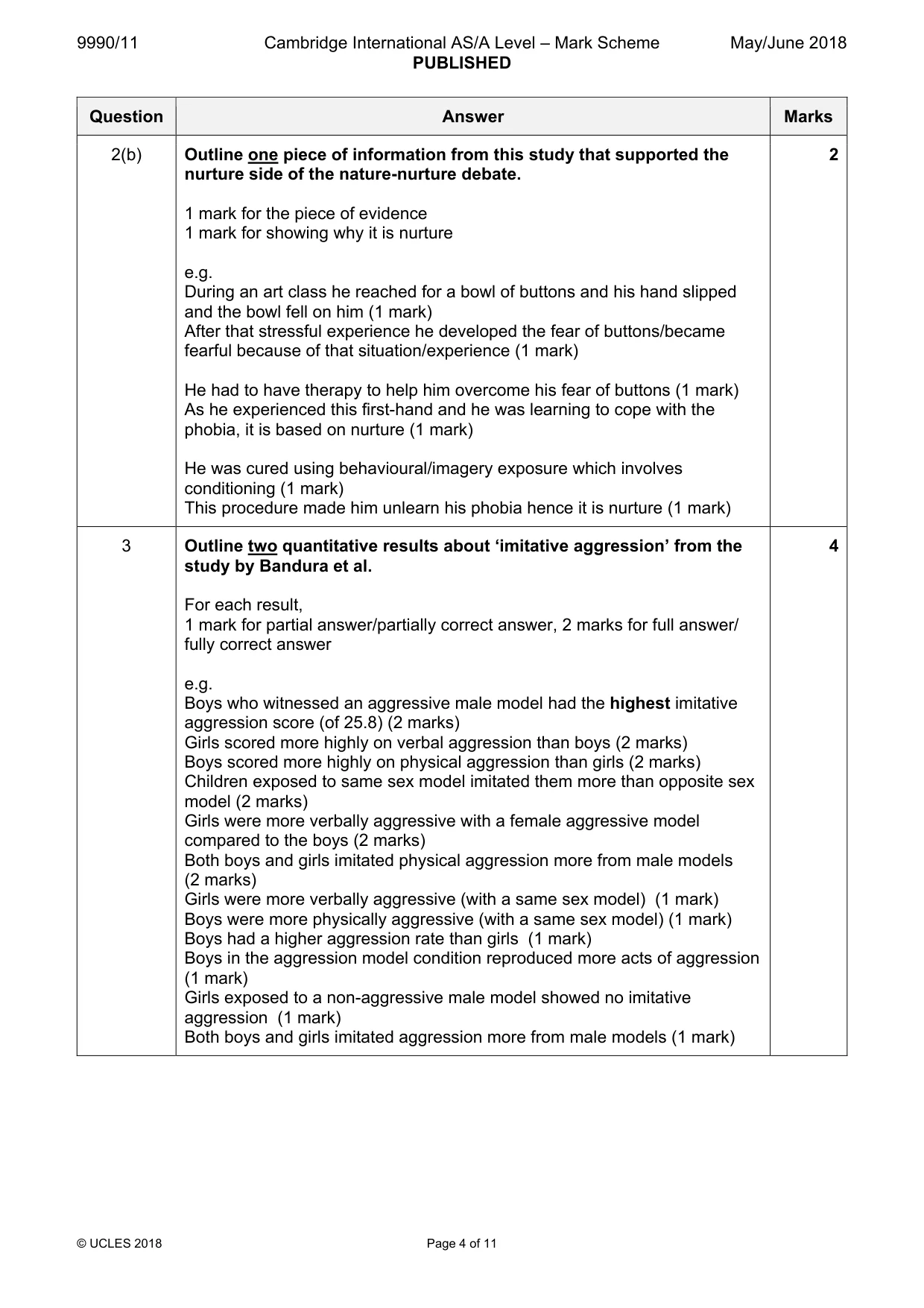
9990/11 Cambridge International AS/A Level – Mark Scheme PUBLISHED May/June 2018 © UCLES 2018 Page 4 of 11 Question Answer Marks 2(b) Outline one piece of information from this study that supported the nurture side of the nature-nurture debate. 1 mark for the piece of evidence 1 mark for showing why it is nurture e.g. During an art class he reached for a bowl of buttons and his hand slipped and the bowl fell on him (1 mark) After that stressful experience he developed the fear of buttons/became fearful because of that situation/experience (1 mark) He had to have therapy to help him overcome his fear of buttons (1 mark) As he experienced this first-hand and he was learning to cope with the phobia, it is based on nurture (1 mark) He was cured using behavioural/imagery exposure which involves conditioning (1 mark) This procedure made him unlearn his phobia hence it is nurture (1 mark) 2 3 Outline two quantitative results about ‘imitative aggression’ from the study by Bandura et al. For each result, 1 mark for partial answer/partially correct answer, 2 marks for full answer/ fully correct answer e.g. Boys who witnessed an aggressive male model had the highest imitative aggression score (of 25.8) (2 marks) Girls scored more highly on verbal aggression than boys (2 marks) Boys scored more highly on physical aggression than girls (2 marks) Children exposed to same sex model imitated them more than opposite sex model (2 marks) Girls were more verbally aggressive with a female aggressive model compared to the boys (2 marks) Both boys and girls imitated physical aggression more from male models (2 marks) Girls were more verbally aggressive (with a same sex model) (1 mark) Boys were more physically aggressive (with a same sex model) (1 mark) Boys had a higher aggression rate than girls (1 mark) Boys in the aggression model condition reproduced more acts of aggression (1 mark) Girls exposed to a non-aggressive male model showed no imitative aggression (1 mark) Both boys and girls imitated aggression more from male models (1 mark) 4
Mark scheme, page 5
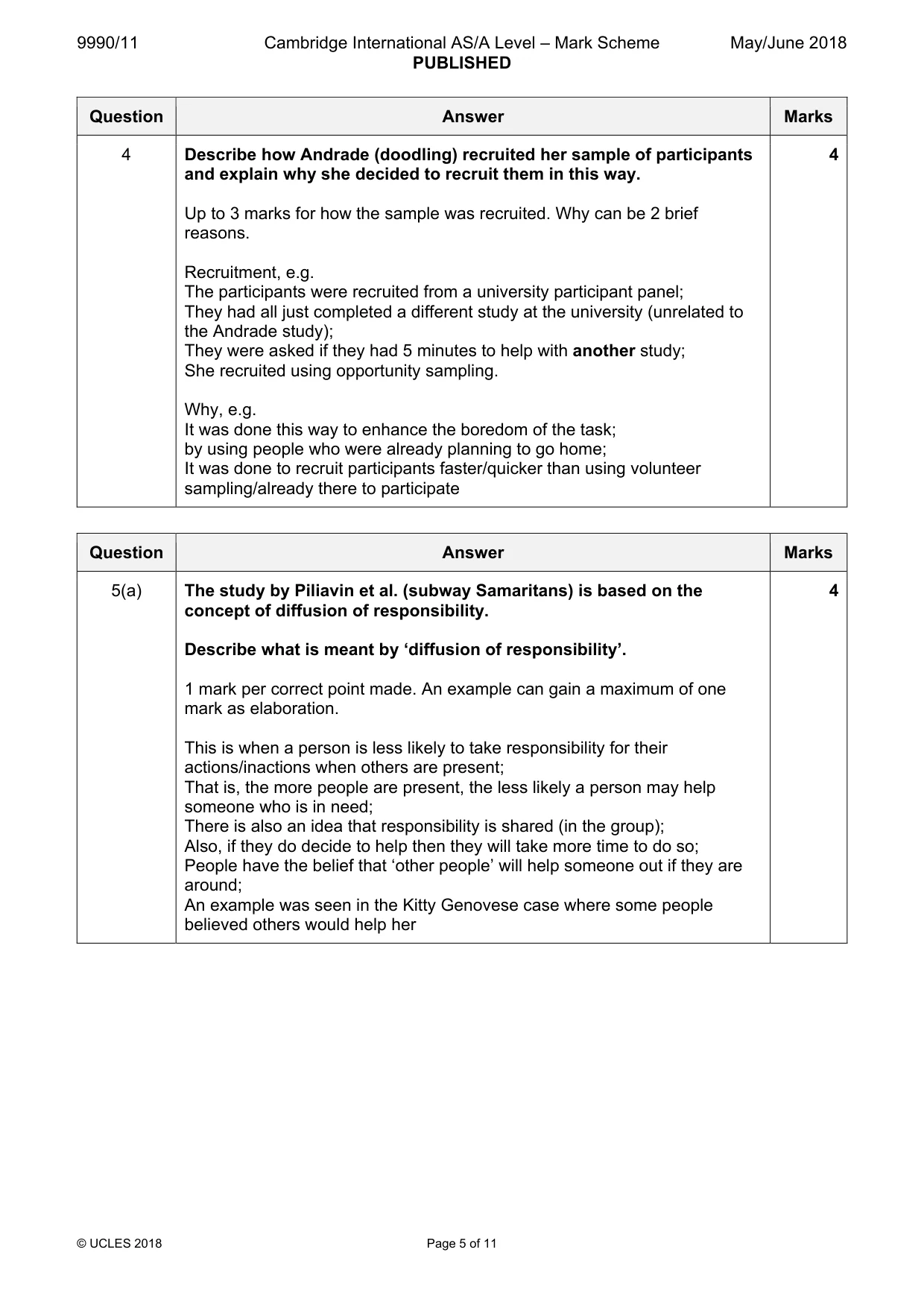
9990/11 Cambridge International AS/A Level – Mark Scheme PUBLISHED May/June 2018 © UCLES 2018 Page 5 of 11 Question Answer Marks 4 Describe how Andrade (doodling) recruited her sample of participants and explain why she decided to recruit them in this way. Up to 3 marks for how the sample was recruited. Why can be 2 brief reasons. Recruitment, e.g. The participants were recruited from a university participant panel; They had all just completed a different study at the university (unrelated to the Andrade study); They were asked if they had 5 minutes to help with another study; She recruited using opportunity sampling. Why, e.g. It was done this way to enhance the boredom of the task; by using people who were already planning to go home; It was done to recruit participants faster/quicker than using volunteer sampling/already there to participate 4 Question Answer Marks 5(a) The study by Piliavin et al. (subway Samaritans) is based on the concept of diffusion of responsibility. Describe what is meant by ‘diffusion of responsibility’. 1 mark per correct point made. An example can gain a maximum of one mark as elaboration. This is when a person is less likely to take responsibility for their actions/inactions when others are present; That is, the more people are present, the less likely a person may help someone who is in need; There is also an idea that responsibility is shared (in the group); Also, if they do decide to help then they will take more time to do so; People have the belief that ‘other people’ will help someone out if they are around; An example was seen in the Kitty Genovese case where some people believed others would help her 4
Mark scheme, page 6
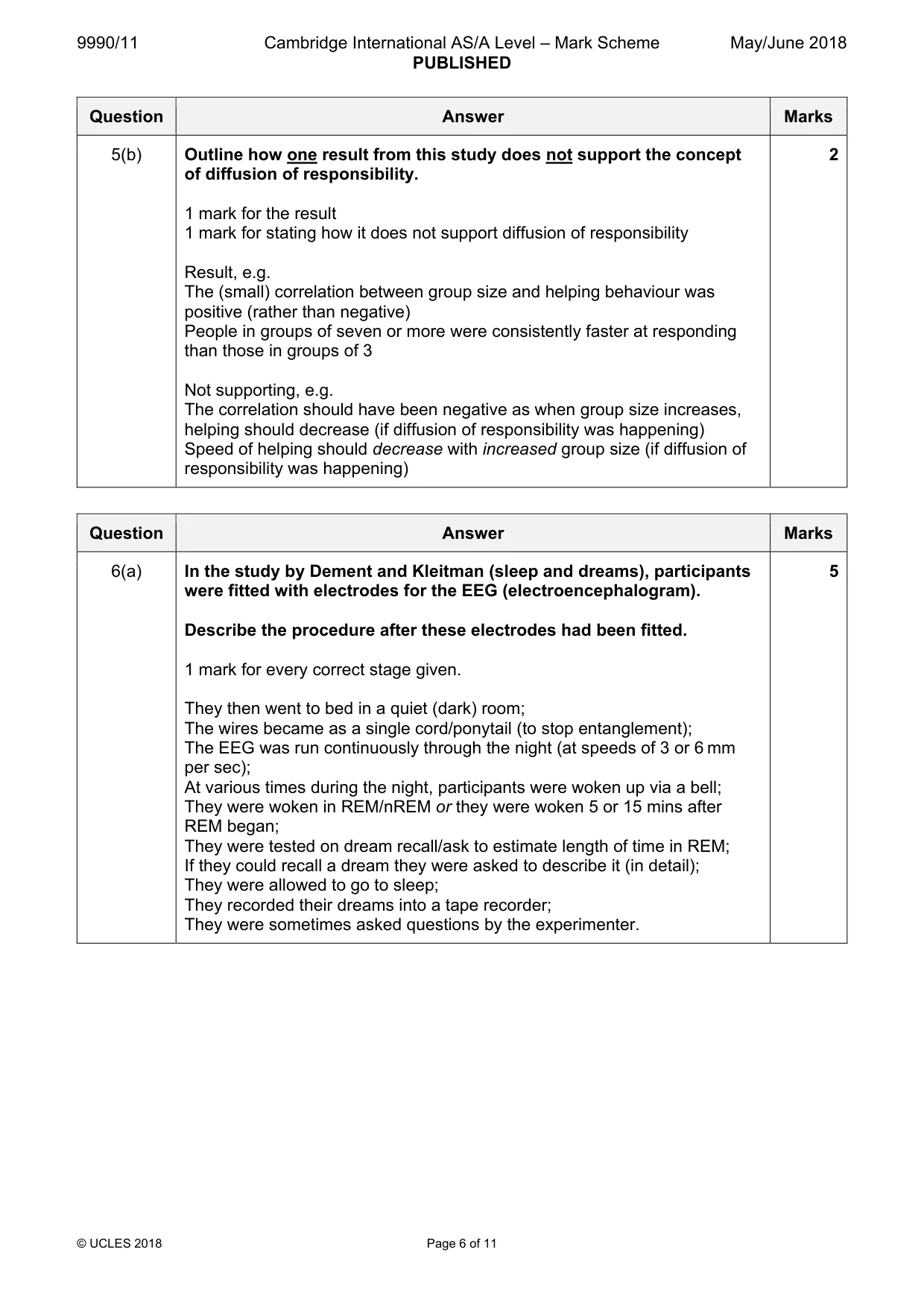
9990/11 Cambridge International AS/A Level – Mark Scheme PUBLISHED May/June 2018 © UCLES 2018 Page 6 of 11 Question Answer Marks 5(b) Outline how one result from this study does not support the concept of diffusion of responsibility. 1 mark for the result 1 mark for stating how it does not support diffusion of responsibility Result, e.g. The (small) correlation between group size and helping behaviour was positive (rather than negative) People in groups of seven or more were consistently faster at responding than those in groups of 3 Not supporting, e.g. The correlation should have been negative as when group size increases, helping should decrease (if diffusion of responsibility was happening) Speed of helping should decrease with increased group size (if diffusion of responsibility was happening) 2 Question Answer Marks 6(a) In the study by Dement and Kleitman (sleep and dreams), participants were fitted with electrodes for the EEG (electroencephalogram). Describe the procedure after these electrodes had been fitted. 1 mark for every correct stage given. They then went to bed in a quiet (dark) room; The wires became as a single cord/ponytail (to stop entanglement); The EEG was run continuously through the night (at speeds of 3 or 6 mm per sec); At various times during the night, participants were woken up via a bell; They were woken in REM/nREM or they were woken 5 or 15 mins after REM began; They were tested on dream recall/ask to estimate length of time in REM; If they could recall a dream they were asked to describe it (in detail); They were allowed to go to sleep; They recorded their dreams into a tape recorder; They were sometimes asked questions by the experimenter. 5
Mark scheme, page 7
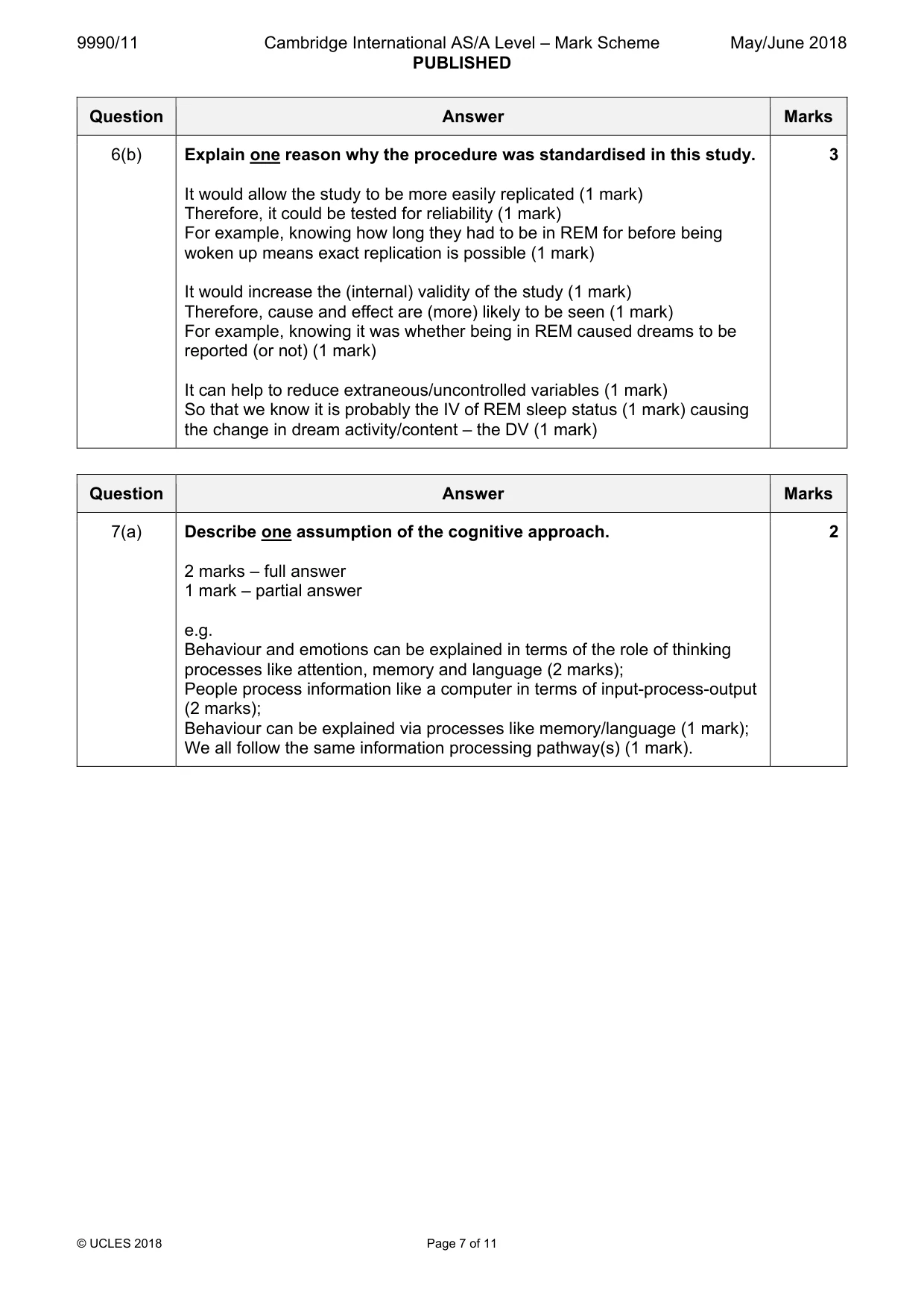
9990/11 Cambridge International AS/A Level – Mark Scheme PUBLISHED May/June 2018 © UCLES 2018 Page 7 of 11 Question Answer Marks 6(b) Explain one reason why the procedure was standardised in this study. It would allow the study to be more easily replicated (1 mark) Therefore, it could be tested for reliability (1 mark) For example, knowing how long they had to be in REM for before being woken up means exact replication is possible (1 mark) It would increase the (internal) validity of the study (1 mark) Therefore, cause and effect are (more) likely to be seen (1 mark) For example, knowing it was whether being in REM caused dreams to be reported (or not) (1 mark) It can help to reduce extraneous/uncontrolled variables (1 mark) So that we know it is probably the IV of REM sleep status (1 mark) causing the change in dream activity/content – the DV (1 mark) 3 Question Answer Marks 7(a) Describe one assumption of the cognitive approach. 2 marks – full answer 1 mark – partial answer e.g. Behaviour and emotions can be explained in terms of the role of thinking processes like attention, memory and language (2 marks); People process information like a computer in terms of input-process-output (2 marks); Behaviour can be explained via processes like memory/language (1 mark); We all follow the same information processing pathway(s) (1 mark). 2
Mark scheme, page 8
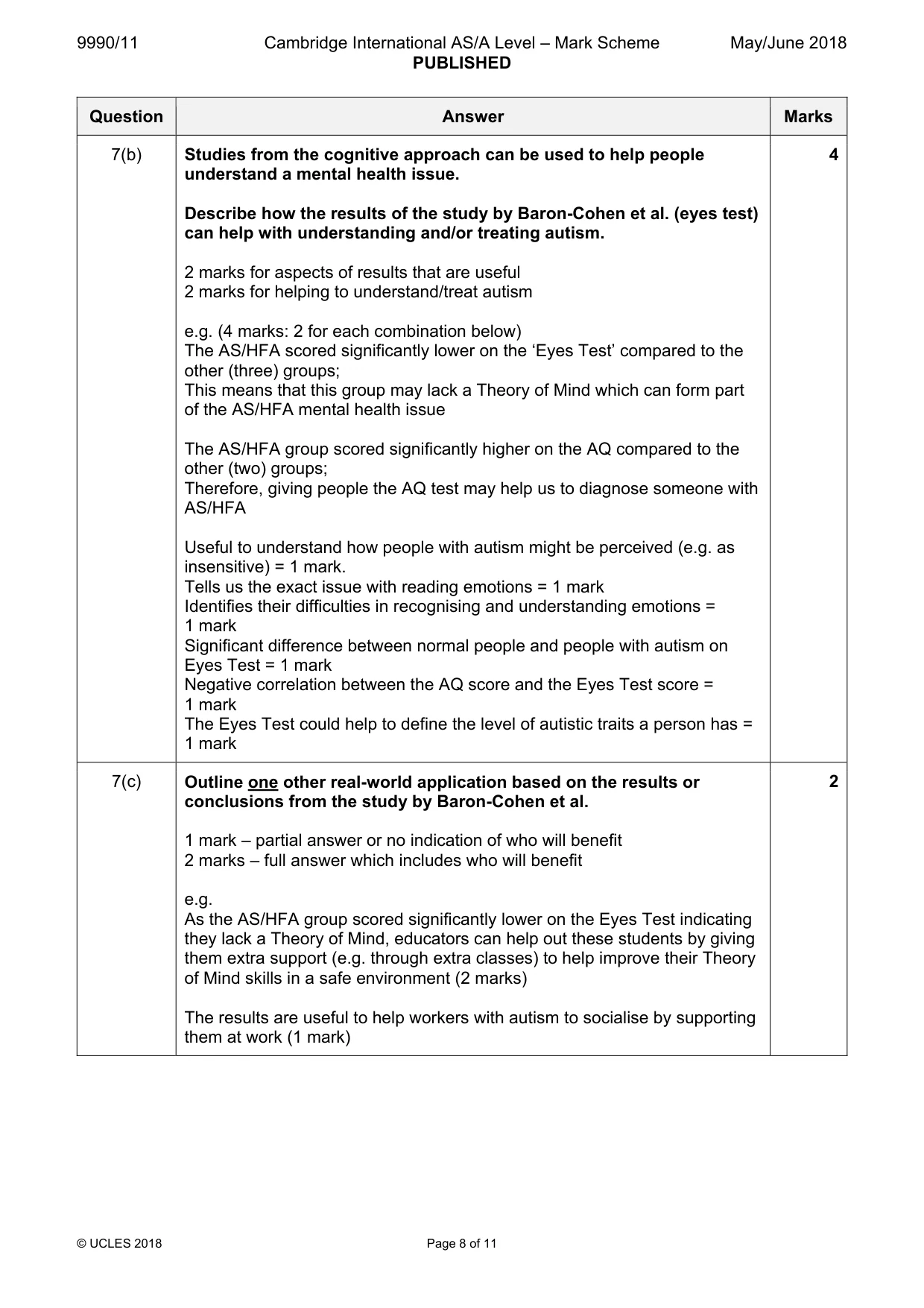
9990/11 Cambridge International AS/A Level – Mark Scheme PUBLISHED May/June 2018 © UCLES 2018 Page 8 of 11 Question Answer Marks 7(b) Studies from the cognitive approach can be used to help people understand a mental health issue. Describe how the results of the study by Baron-Cohen et al. (eyes test) can help with understanding and/or treating autism. 2 marks for aspects of results that are useful 2 marks for helping to understand/treat autism e.g. (4 marks: 2 for each combination below) The AS/HFA scored significantly lower on the ‘Eyes Test’ compared to the other (three) groups; This means that this group may lack a Theory of Mind which can form part of the AS/HFA mental health issue The AS/HFA group scored significantly higher on the AQ compared to the other (two) groups; Therefore, giving people the AQ test may help us to diagnose someone with AS/HFA Useful to understand how people with autism might be perceived (e.g. as insensitive) = 1 mark. Tells us the exact issue with reading emotions = 1 mark Identifies their difficulties in recognising and understanding emotions = 1 mark Significant difference between normal people and people with autism on Eyes Test = 1 mark Negative correlation between the AQ score and the Eyes Test score = 1 mark The Eyes Test could help to define the level of autistic traits a person has = 1 mark 4 7(c) Outline one other real-world application based on the results or conclusions from the study by Baron-Cohen et al. 1 mark – partial answer or no indication of who will benefit 2 marks – full answer which includes who will benefit e.g. As the AS/HFA group scored significantly lower on the Eyes Test indicating they lack a Theory of Mind, educators can help out these students by giving them extra support (e.g. through extra classes) to help improve their Theory of Mind skills in a safe environment (2 marks) The results are useful to help workers with autism to socialise by supporting them at work (1 mark) 2
Mark scheme, page 9
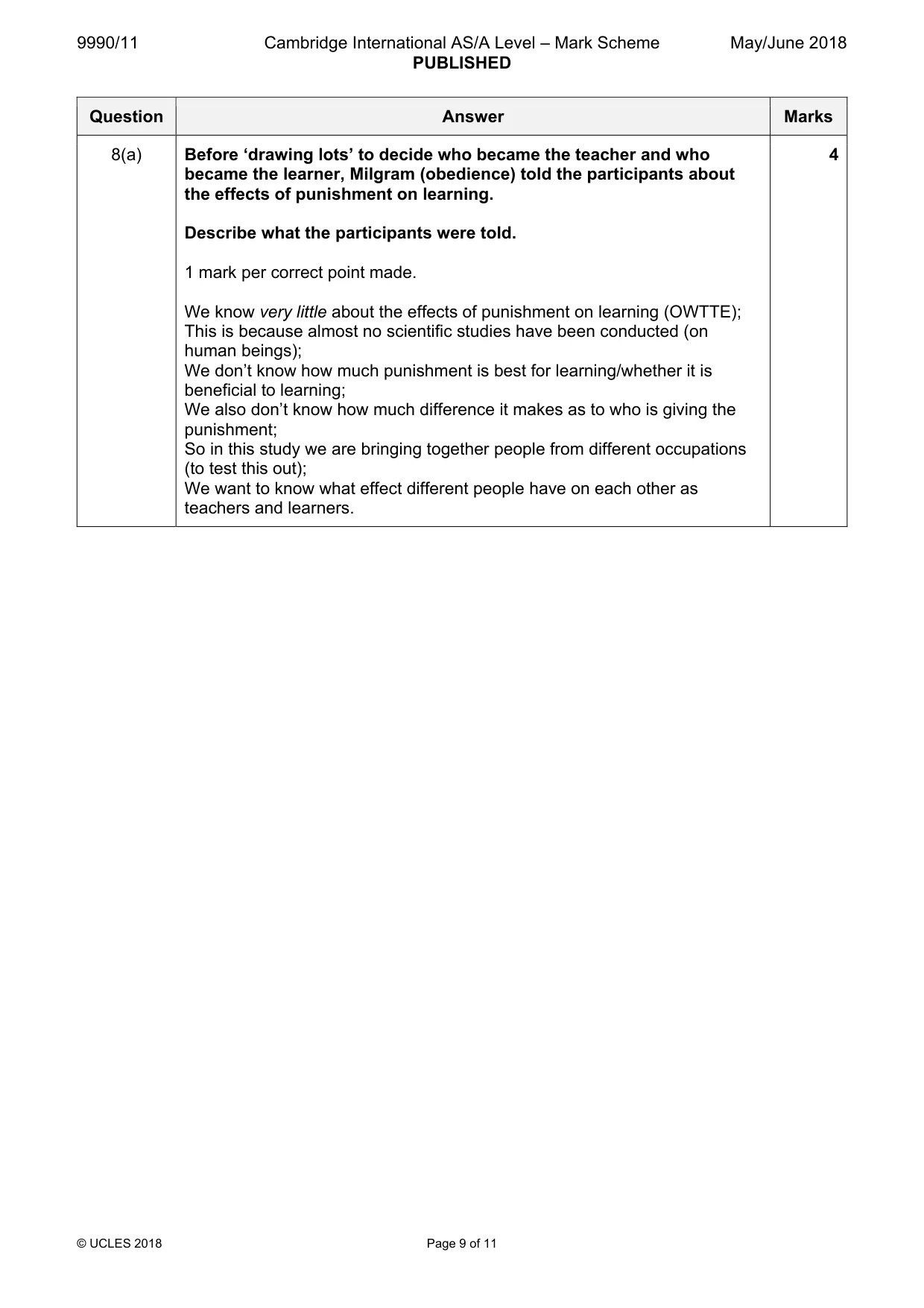
9990/11 Cambridge International AS/A Level – Mark Scheme PUBLISHED May/June 2018 © UCLES 2018 Page 9 of 11 Question Answer Marks 8(a) Before ‘drawing lots’ to decide who became the teacher and who became the learner, Milgram (obedience) told the participants about the effects of punishment on learning. Describe what the participants were told. 1 mark per correct point made. We know very little about the effects of punishment on learning (OWTTE); This is because almost no scientific studies have been conducted (on human beings); We don’t know how much punishment is best for learning/whether it is beneficial to learning; We also don’t know how much difference it makes as to who is giving the punishment; So in this study we are bringing together people from different occupations (to test this out); We want to know what effect different people have on each other as teachers and learners. 4
Mark scheme, page 10
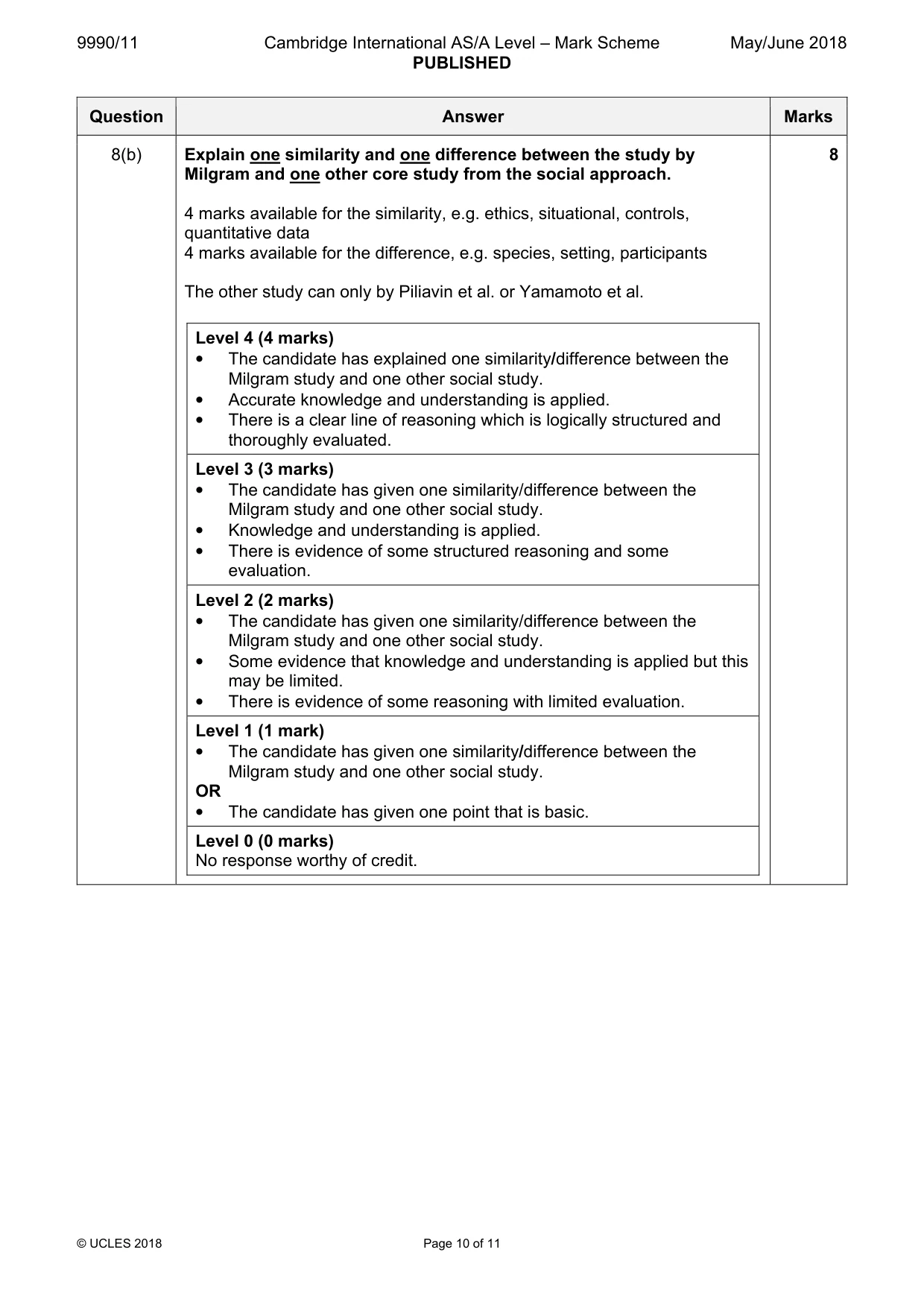
9990/11 Cambridge International AS/A Level – Mark Scheme PUBLISHED May/June 2018 © UCLES 2018 Page 10 of 11 Question Answer Marks 8(b) Explain one similarity and one difference between the study by Milgram and one other core study from the social approach. 4 marks available for the similarity, e.g. ethics, situational, controls, quantitative data 4 marks available for the difference, e.g. species, setting, participants The other study can only by Piliavin et al. or Yamamoto et al. Level 4 (4 marks) • The candidate has explained one similarity/difference between the Milgram study and one other social study. • Accurate knowledge and understanding is applied. • There is a clear line of reasoning which is logically structured and thoroughly evaluated. Level 3 (3 marks) • The candidate has given one similarity/difference between the Milgram study and one other social study. • Knowledge and understanding is applied. • There is evidence of some structured reasoning and some evaluation. Level 2 (2 marks) • The candidate has given one similarity/difference between the Milgram study and one other social study. • Some evidence that knowledge and understanding is applied but this may be limited. • There is evidence of some reasoning with limited evaluation. Level 1 (1 mark) • The candidate has given one similarity/difference between the Milgram study and one other social study. OR • The candidate has given one point that is basic. Level 0 (0 marks) No response worthy of credit. 8
Mark scheme, page 11
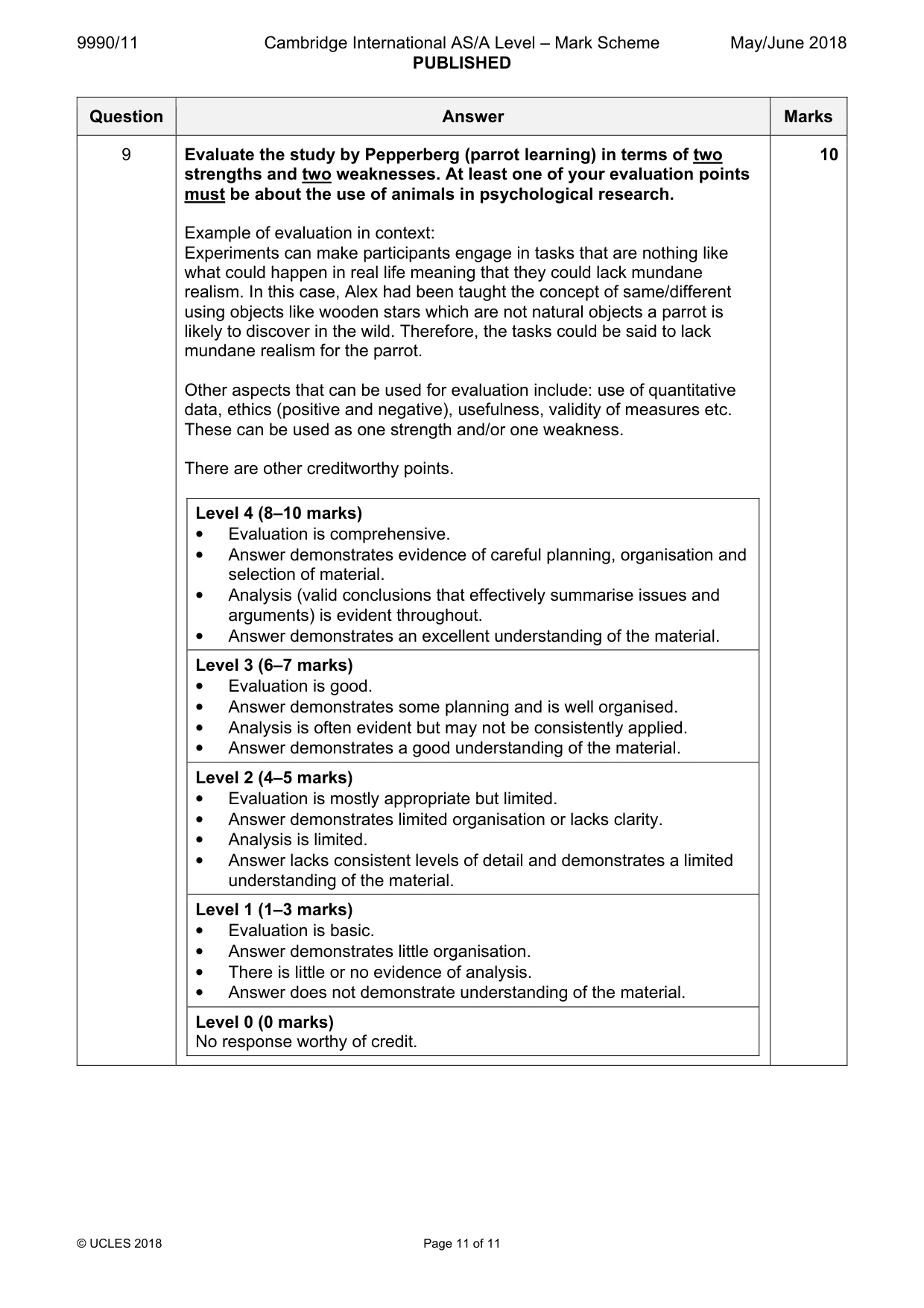
9990/11 Cambridge International AS/A Level – Mark Scheme PUBLISHED May/June 2018 © UCLES 2018 Page 11 of 11 Question Answer Marks 9 Evaluate the study by Pepperberg (parrot learning) in terms of two strengths and two weaknesses. At least one of your evaluation points must be about the use of animals in psychological research. Example of evaluation in context: Experiments can make participants engage in tasks that are nothing like what could happen in real life meaning that they could lack mundane realism. In this case, Alex had been taught the concept of same/different using objects like wooden stars which are not natural objects a parrot is likely to discover in the wild. Therefore, the tasks could be said to lack mundane realism for the parrot. Other aspects that can be used for evaluation include: use of quantitative data, ethics (positive and negative), usefulness, validity of measures etc. These can be used as one strength and/or one weakness. There are other creditworthy points. Level 4 (8–10 marks) • Evaluation is comprehensive. • Answer demonstrates evidence of careful planning, organisation and selection of material. • Analysis (valid conclusions that effectively summarise issues and arguments) is evident throughout. • Answer demonstrates an excellent understanding of the material. Level 3 (6–7 marks) • Evaluation is good. • Answer demonstrates some planning and is well organised. • Analysis is often evident but may not be consistently applied. • Answer demonstrates a good understanding of the material. Level 2 (4–5 marks) • Evaluation is mostly appropriate but limited. • Answer demonstrates limited organisation or lacks clarity. • Analysis is limited. • Answer lacks consistent levels of detail and demonstrates a limited understanding of the material. Level 1 (1–3 marks) • Evaluation is basic. • Answer demonstrates little organisation. • There is little or no evidence of analysis. • Answer does not demonstrate understanding of the material. Level 0 (0 marks) No response worthy of credit. 10
What you needed in this session
Cambridge’s own grade thresholds for 2018 May/June, Paper 1 · Variant 1. A higher threshold means an easier paper — the bar moves with how the cohort did.