Cambridge A Level Psychology (from 2018) 9990 — 2024 May/June Paper 1 · Variant 3
9990/13/M/J/24 · 60 marks · 90 min
The question paper and its mark scheme, free to read here and free to download. This is Cambridge’s own paper, exactly as it was sat.
Question paper12 pages




Mark scheme20 pages
Answers below. Sit the paper first if you are practising.
Paper as text
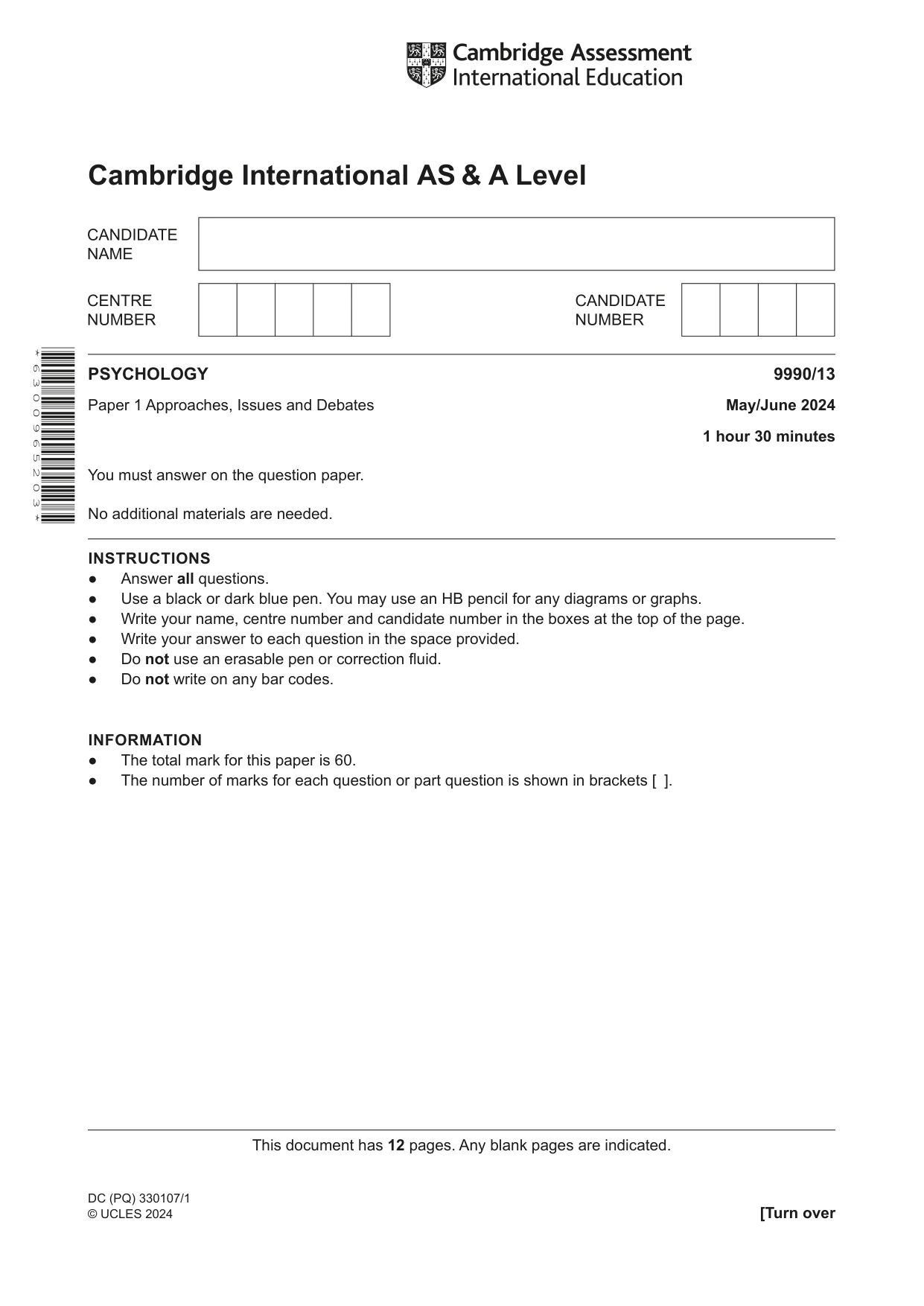
Question paper, page 1
This document has 12 pages. Any blank pages are indicated. [Turn over Cambridge International AS & A Level PSYCHOLOGY 9990/13 Paper 1 Approaches, Issues and Debates May/June 2024 1 hour 30 minutes You must answer on the question paper. No additional materials are needed. INSTRUCTIONS ● Answer all questions. ● Use a black or dark blue pen. You may use an HB pencil for any diagrams or graphs. ● Write your name, centre number and candidate number in the boxes at the top of the page. ● Write your answer to each question in the space provided. ● Do not use an erasable pen or correction fluid. ● Do not write on any bar codes. INFORMATION ● The total mark for this paper is 60. ● The number of marks for each question or part question is shown in brackets [ ]. * 6 3 0 0 9 6 5 2 0 3 * DC (PQ) 330107/1 © UCLES 2024
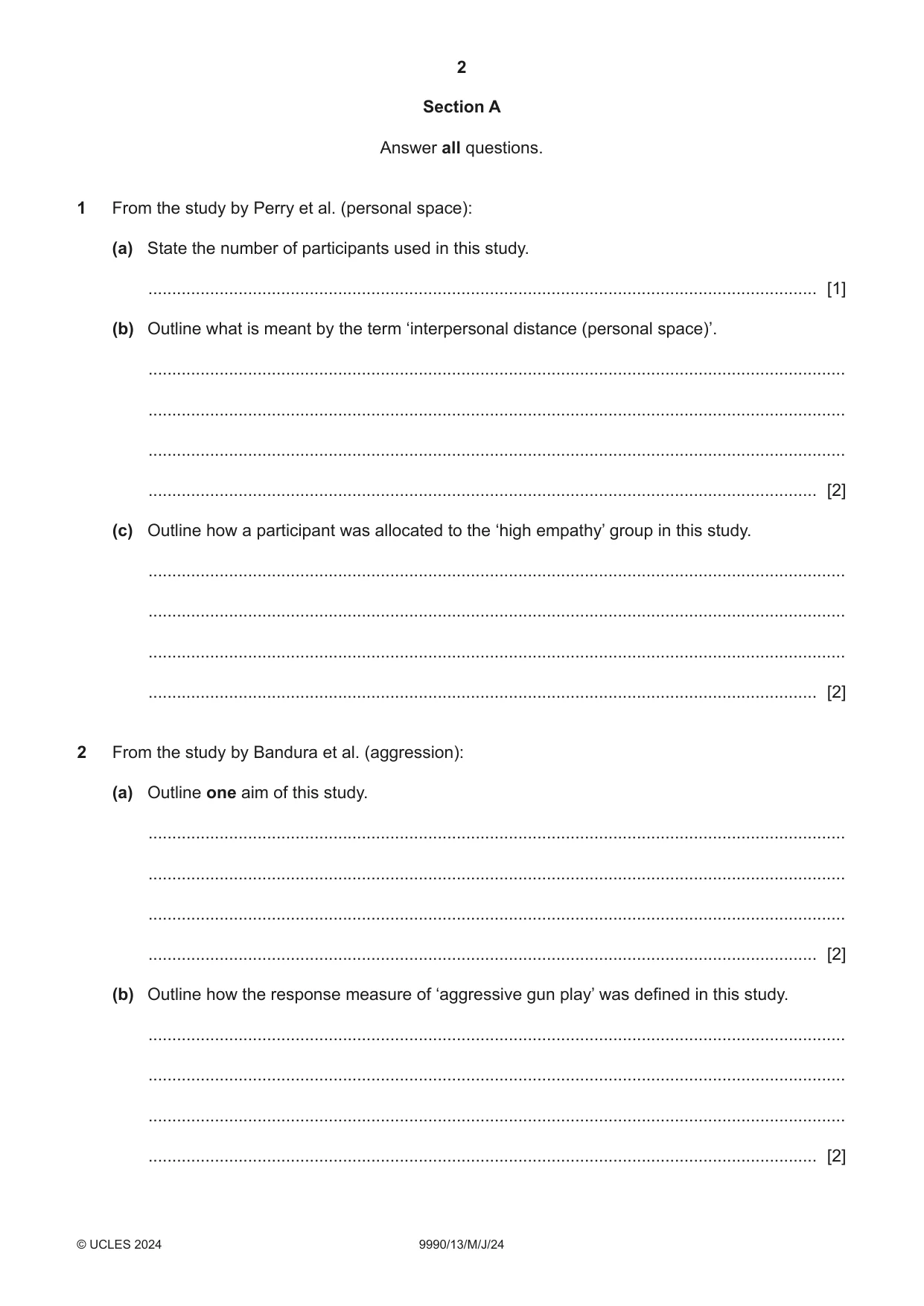
Question paper, page 2
2 9990/13/M/J/24 © UCLES 2024 Section A Answer all questions. 1 From the study by Perry et al. (personal space): (a) State the number of participants used in this study. … [1] (b) Outline what is meant by the term ‘interpersonal distance (personal space)’. … … … … [2] (c) Outline how a participant was allocated to the ‘high empathy’ group in this study. … … … … [2] 2 From the study by Bandura et al. (aggression): (a) Outline one aim of this study. … … … … [2] (b) Outline how the response measure of ‘aggressive gun play’ was defined in this study. … … … … [2]
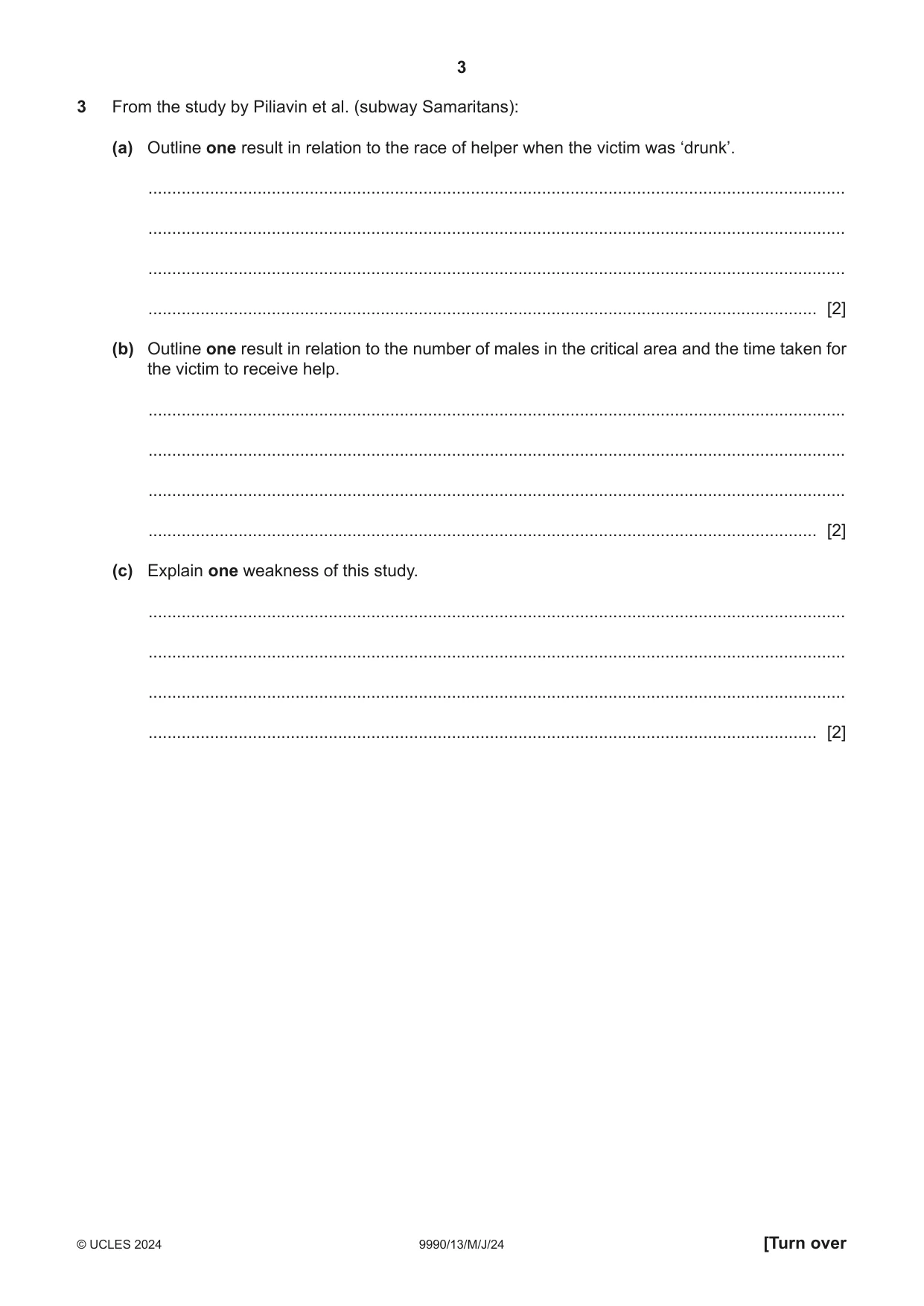
Question paper, page 3
3 9990/13/M/J/24 © UCLES 2024 [Turn over 3 From the study by Piliavin et al. (subway Samaritans): (a) Outline one result in relation to the race of helper when the victim was ‘drunk’. … … … … [2] (b) Outline one result in relation to the number of males in the critical area and the time taken for the victim to receive help. … … … … [2] (c) Explain one weakness of this study. … … … … [2]
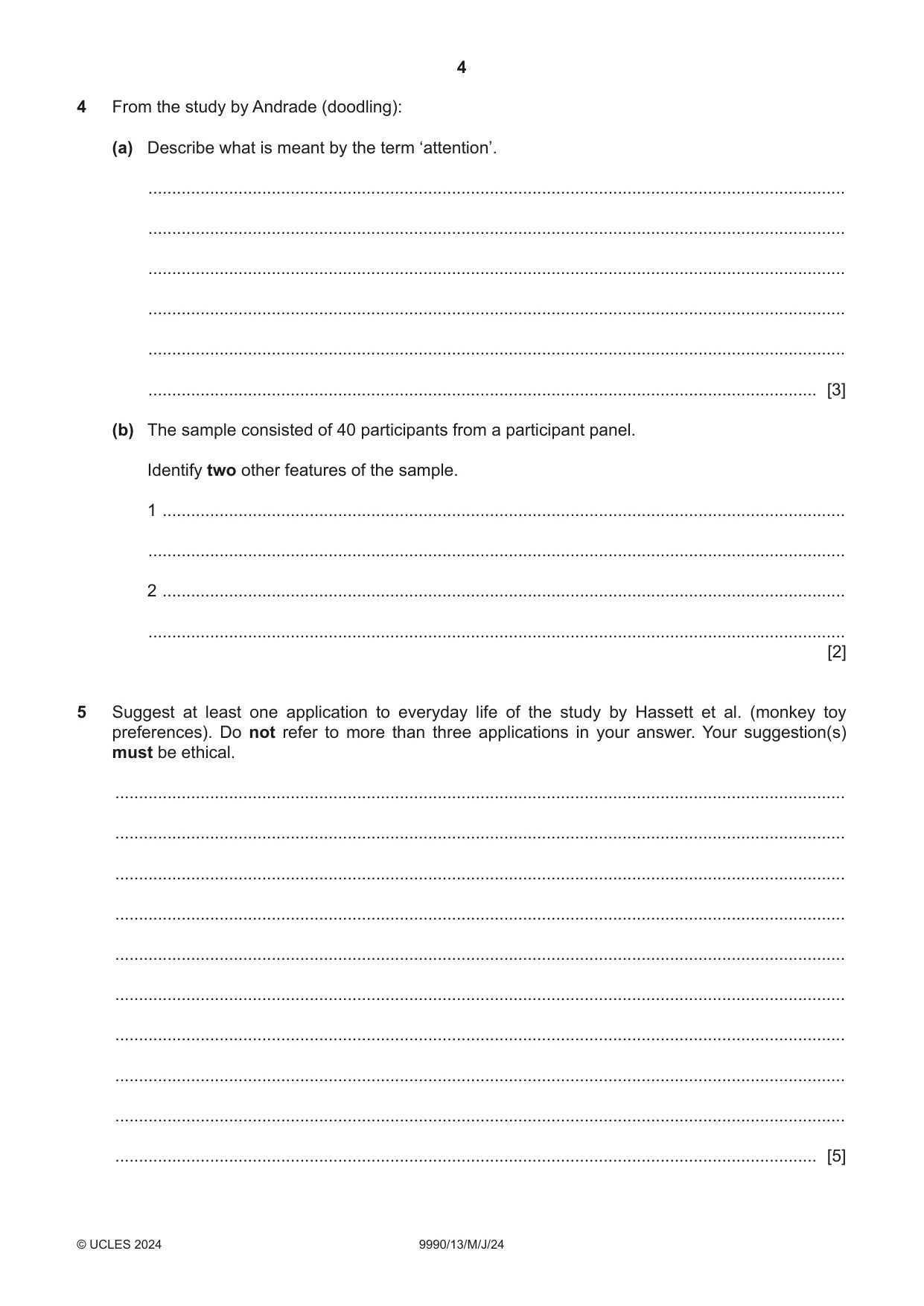
Question paper, page 4
4 9990/13/M/J/24 © UCLES 2024 4 From the study by Andrade (doodling): (a) Describe what is meant by the term ‘attention’. … … … … … … [3] (b) The sample consisted of 40 participants from a participant panel. Identify two other features of the sample. 1 … … 2 … … [2] 5 Suggest at least one application to everyday life of the study by Hassett et al. (monkey toy preferences). Do not refer to more than three applications in your answer. Your suggestion(s) must be ethical. … … … … … … … … … … [5]
Question paper, page 5
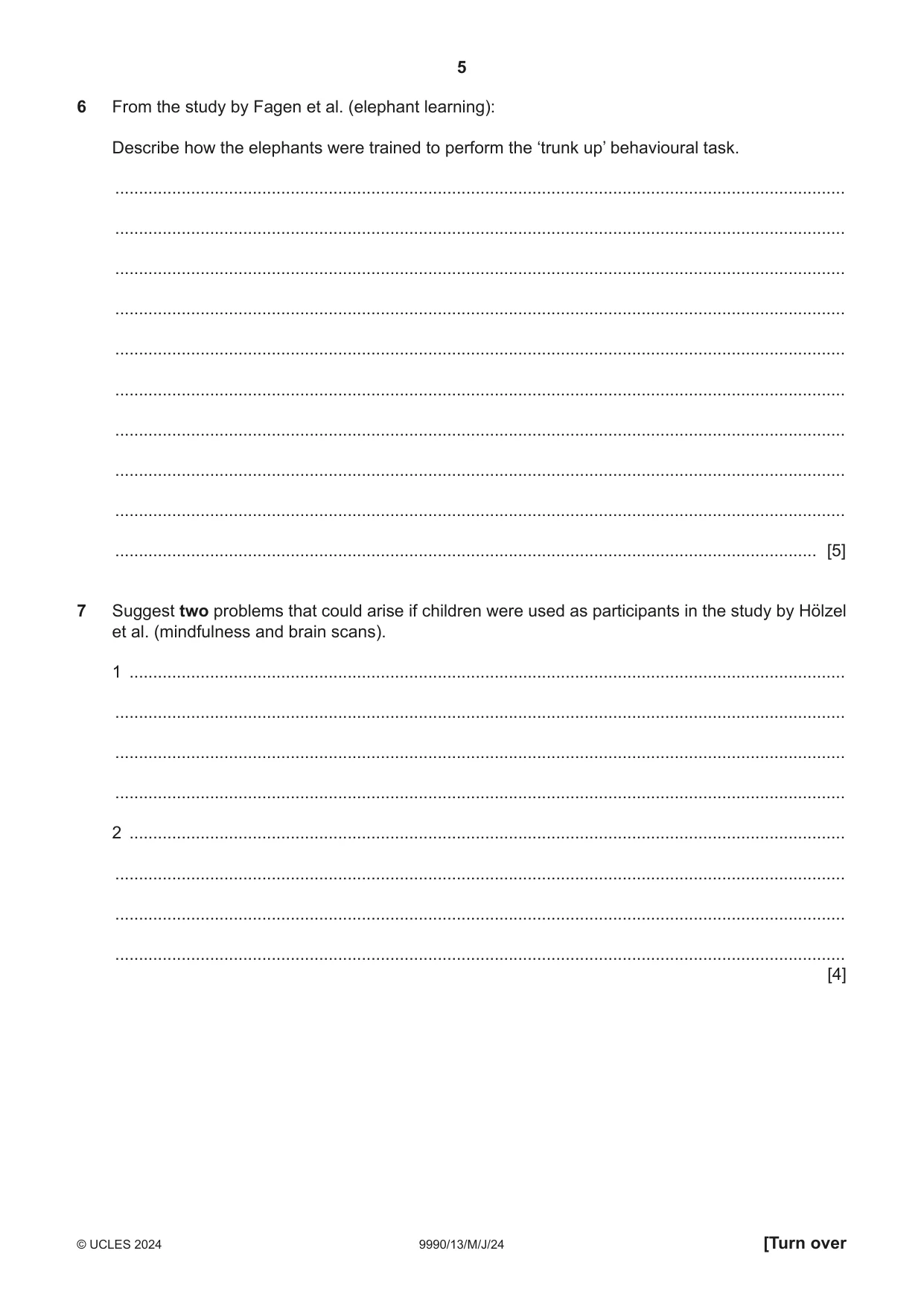
5 9990/13/M/J/24 © UCLES 2024 [Turn over 6 From the study by Fagen et al. (elephant learning): Describe how the elephants were trained to perform the ‘trunk up’ behavioural task. … … … … … … … … … … [5] 7 Suggest two problems that could arise if children were used as participants in the study by Hölzel et al. (mindfulness and brain scans). 1 … … … … 2 … … … … [4]
Question paper, page 6
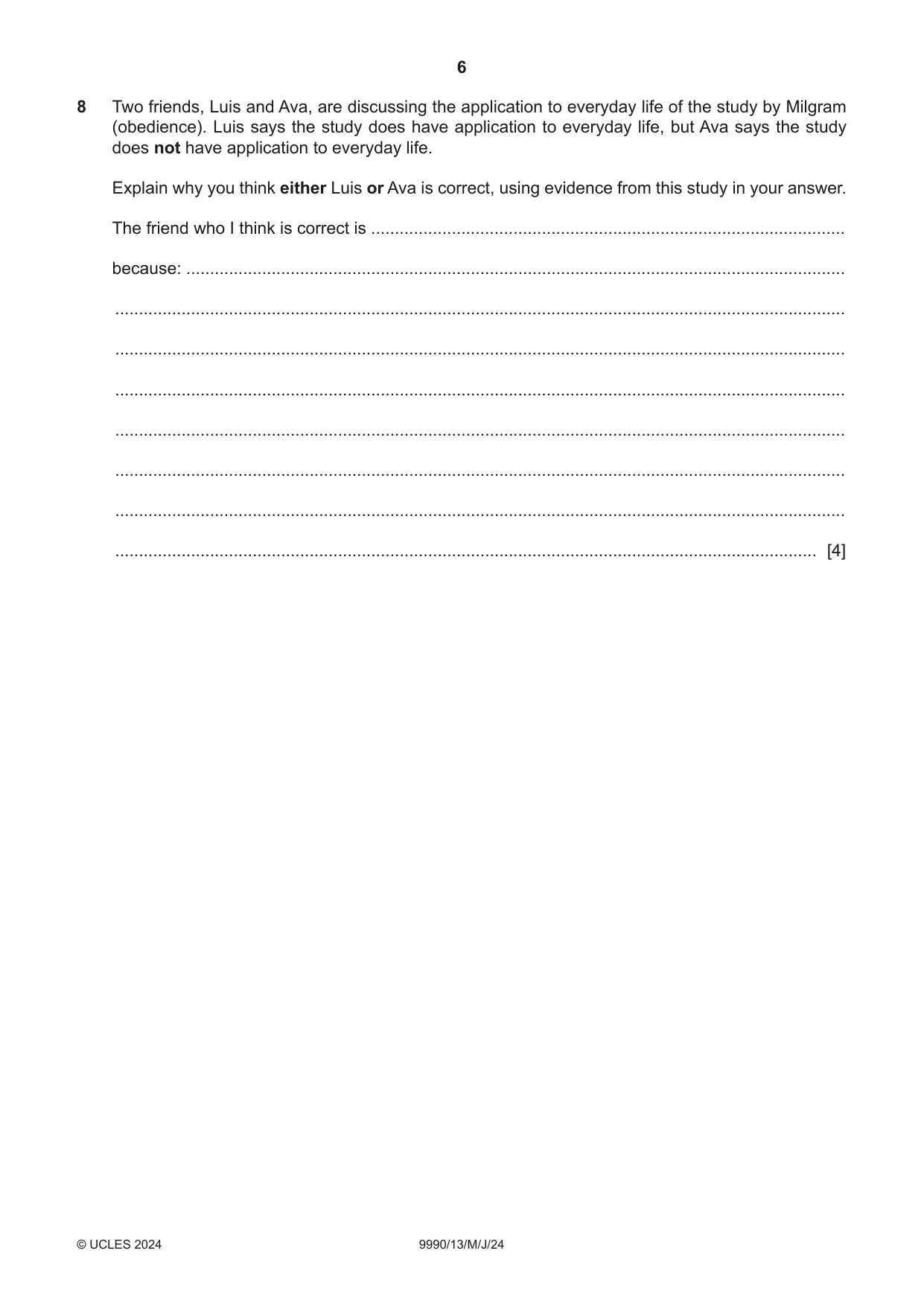
6 9990/13/M/J/24 © UCLES 2024 8 Two friends, Luis and Ava, are discussing the application to everyday life of the study by Milgram (obedience). Luis says the study does have application to everyday life, but Ava says the study does not have application to everyday life. Explain why you think either Luis or Ava is correct, using evidence from this study in your answer. The friend who I think is correct is … because: … … … … … … … … [4]
Question paper, page 7
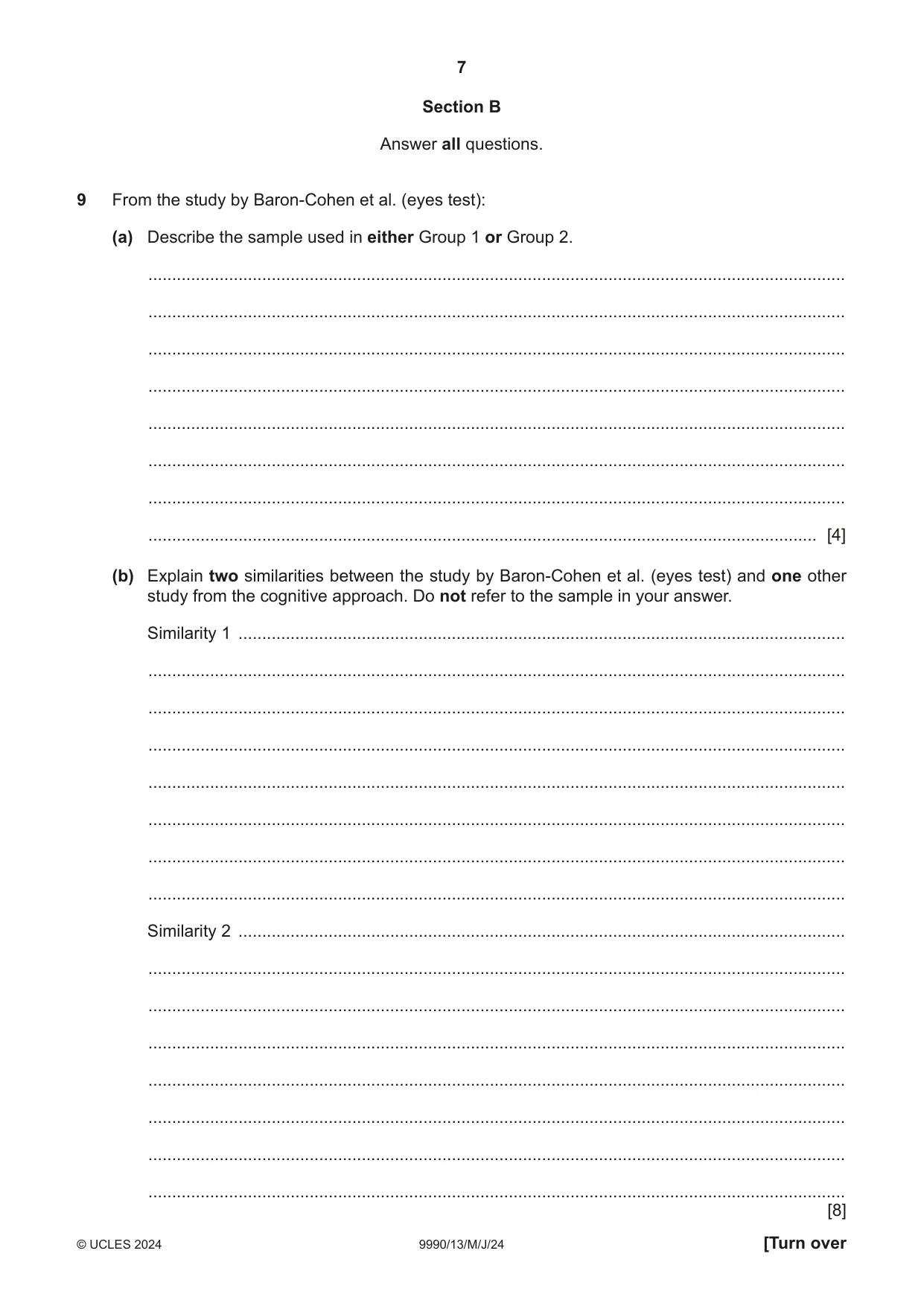
7 9990/13/M/J/24 © UCLES 2024 [Turn over Section B Answer all questions. 9 From the study by Baron-Cohen et al. (eyes test): (a) Describe the sample used in either Group 1 or Group 2. … … … … … … … … [4] (b) Explain two similarities between the study by Baron-Cohen et al. (eyes test) and one other study from the cognitive approach. Do not refer to the sample in your answer. Similarity 1 … … … … … … … … Similarity 2 … … … … … … … … [8]
Question paper, page 8
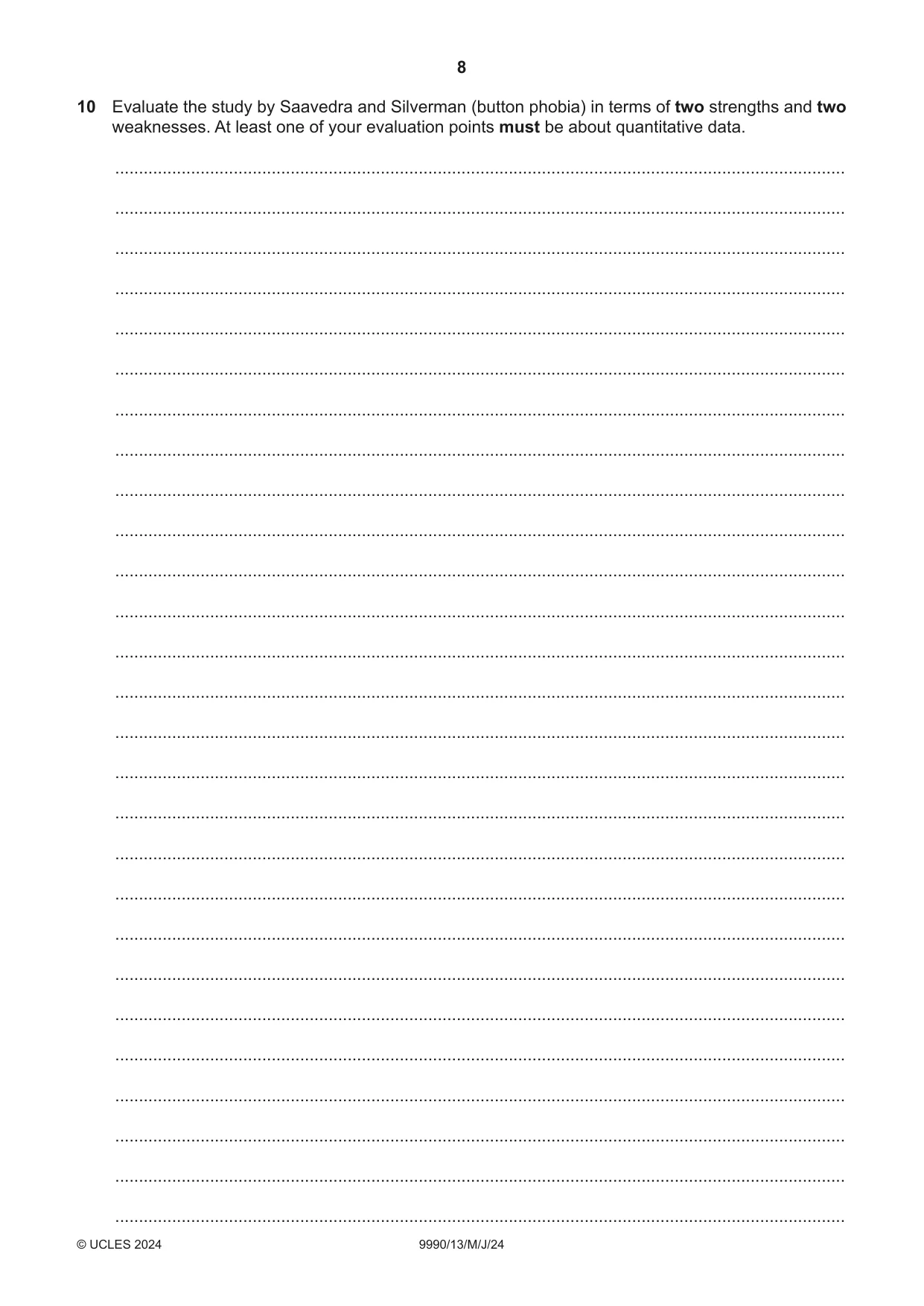
8 9990/13/M/J/24 © UCLES 2024 10 Evaluate the study by Saavedra and Silverman (button phobia) in terms of two strengths and two weaknesses. At least one of your evaluation points must be about quantitative data. … … … … … … … … … … … … … … … … … … … … … … … … … … …
Question paper, page 9
9 9990/13/M/J/24 © UCLES 2024 … … … … … … … … … … … … … … [10]
Question paper, page 10
10 9990/13/M/J/24 © UCLES 2024 BLANK PAGE
Question paper, page 11
11 9990/13/M/J/24 © UCLES 2024 BLANK PAGE
Question paper, page 12
12 9990/13/M/J/24 © UCLES 2024 Permission to reproduce items where third-party owned material protected by copyright is included has been sought and cleared where possible. Every reasonable effort has been made by the publisher (UCLES) to trace copyright holders, but if any items requiring clearance have unwittingly been included, the publisher will be pleased to make amends at the earliest possible opportunity. To avoid the issue of disclosure of answer-related information to candidates, all copyright acknowledgements are reproduced online in the Cambridge Assessment International Education Copyright Acknowledgements Booklet. This is produced for each series of examinations and is freely available to download at www.cambridgeinternational.org after the live examination series. Cambridge Assessment International Education is part of Cambridge Assessment. Cambridge Assessment is the brand name of the University of Cambridge Local Examinations Syndicate (UCLES), which is a department of the University of Cambridge. BLANK PAGE
Mark scheme, page 1
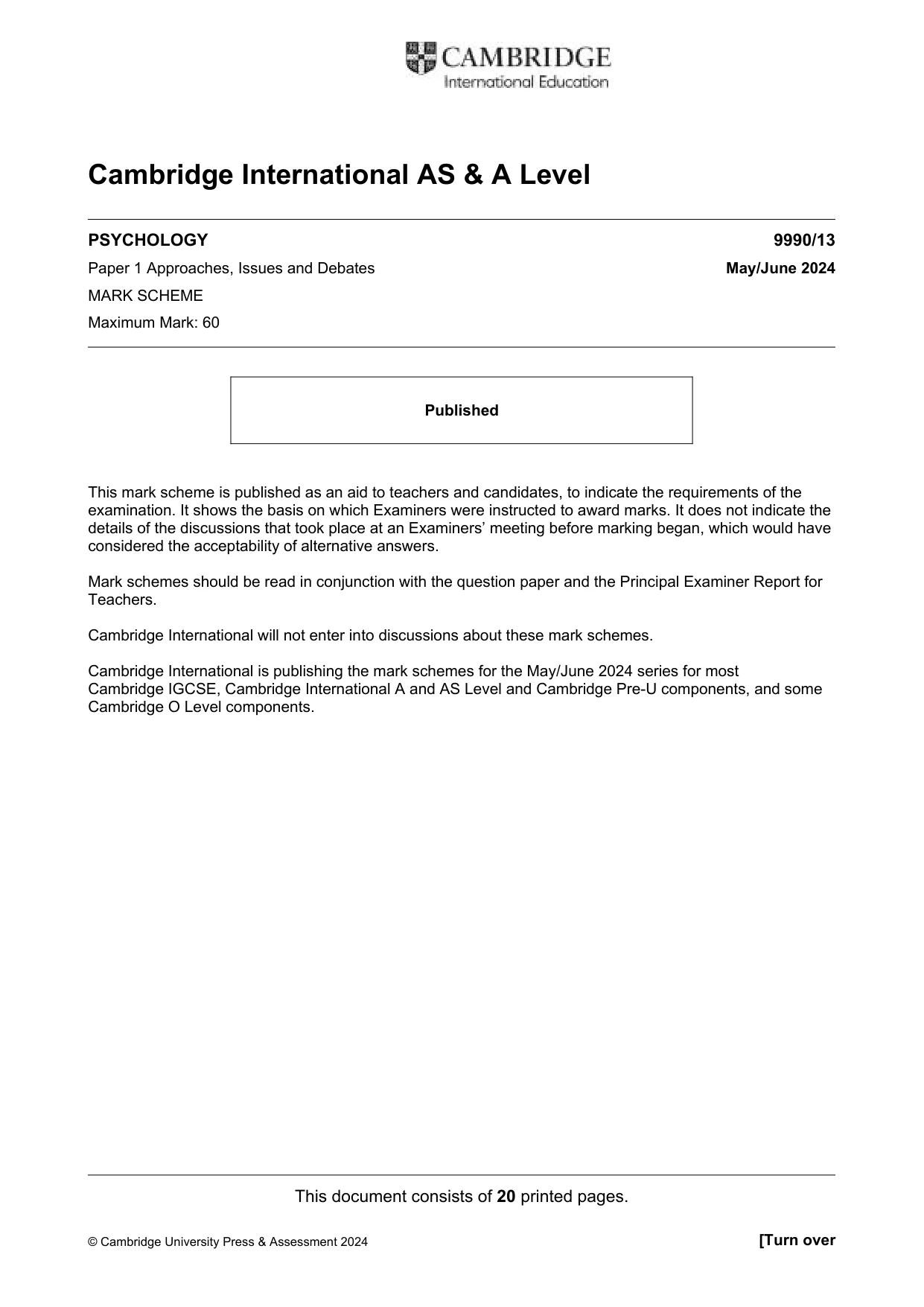
This document consists of 20 printed pages. © Cambridge University Press & Assessment 2024 [Turn over Cambridge International AS & A Level PSYCHOLOGY 9990/13 Paper 1 Approaches, Issues and Debates May/June 2024 MARK SCHEME Maximum Mark: 60 Published This mark scheme is published as an aid to teachers and candidates, to indicate the requirements of the examination. It shows the basis on which Examiners were instructed to award marks. It does not indicate the details of the discussions that took place at an Examiners’ meeting before marking began, which would have considered the acceptability of alternative answers. Mark schemes should be read in conjunction with the question paper and the Principal Examiner Report for Teachers. Cambridge International will not enter into discussions about these mark schemes. Cambridge International is publishing the mark schemes for the May/June 2024 series for most Cambridge IGCSE, Cambridge International A and AS Level and Cambridge Pre-U components, and some Cambridge O Level components.
Mark scheme, page 2
9990/13 Cambridge International AS & A Level – Mark Scheme PUBLISHED May/June 2024 © Cambridge University Press & Assessment 2024 Page 2 of 20 Generic Marking Principles These general marking principles must be applied by all examiners when marking candidate answers. They should be applied alongside the specific content of the mark scheme or generic level descriptions for a question. Each question paper and mark scheme will also comply with these marking principles. GENERIC MARKING PRINCIPLE 1: Marks must be awarded in line with: the specific content of the mark scheme or the generic level descriptors for the question the specific skills defined in the mark scheme or in the generic level descriptors for the question the standard of response required by a candidate as exemplified by the standardisation scripts. GENERIC MARKING PRINCIPLE 2: Marks awarded are always whole marks (not half marks, or other fractions). GENERIC MARKING PRINCIPLE 3: Marks must be awarded positively: marks are awarded for correct/valid answers, as defined in the mark scheme. However, credit is given for valid answers which go beyond the scope of the syllabus and mark scheme, referring to your Team Leader as appropriate marks are awarded when candidates clearly demonstrate what they know and can do marks are not deducted for errors marks are not deducted for omissions answers should only be judged on the quality of spelling, punctuation and grammar when these features are specifically assessed by the question as indicated by the mark scheme. The meaning, however, should be unambiguous. GENERIC MARKING PRINCIPLE 4: Rules must be applied consistently, e.g. in situations where candidates have not followed instructions or in the application of generic level descriptors.
Mark scheme, page 3
9990/13 Cambridge International AS & A Level – Mark Scheme PUBLISHED May/June 2024 © Cambridge University Press & Assessment 2024 Page 3 of 20 GENERIC MARKING PRINCIPLE 5: Marks should be awarded using the full range of marks defined in the mark scheme for the question (however; the use of the full mark range may be limited according to the quality of the candidate responses seen). GENERIC MARKING PRINCIPLE 6: Marks awarded are based solely on the requirements as defined in the mark scheme. Marks should not be awarded with grade thresholds or grade descriptors in mind.
Mark scheme, page 4
9990/13 Cambridge International AS & A Level – Mark Scheme PUBLISHED May/June 2024 © Cambridge University Press & Assessment 2024 Page 4 of 20 Social Science-Specific Marking Principles (for point-based marking) 1 Components using point-based marking: Point marking is often used to reward knowledge, understanding and application of skills. We give credit where the candidate’s answer shows relevant knowledge, understanding and application of skills in answering the question. We do not give credit where the answer shows confusion. From this it follows that we: a DO credit answers which are worded differently from the mark scheme if they clearly convey the same meaning (unless the mark scheme requires a specific term) b DO credit alternative answers/examples which are not written in the mark scheme if they are correct c DO credit answers where candidates give more than one correct answer in one prompt/numbered/scaffolded space where extended writing is required rather than list-type answers. For example, questions that require n reasons (e.g. State two reasons …). d DO NOT credit answers simply for using a ‘key term’ unless that is all that is required. (Check for evidence it is understood and not used wrongly.) e DO NOT credit answers which are obviously self-contradicting or trying to cover all possibilities f DO NOT give further credit for what is effectively repetition of a correct point already credited unless the language itself is being tested. This applies equally to ‘mirror statements’ (i.e. polluted/not polluted). g DO NOT require spellings to be correct, unless this is part of the test. However, spellings of syllabus terms must allow for clear and unambiguous separation from other syllabus terms with which they may be confused (e.g. Corrasion/Corrosion) 2 Presentation of mark scheme: Slashes (/) or the word ‘or’ separate alternative ways of making the same point. Semi colons (;) bullet points (•) or figures in brackets (1) separate different points. Content in the answer column in brackets is for examiner information/context to clarify the marking but is not required to earn the mark (except Accounting syllabuses where they indicate negative numbers). 3 Annotation: For point marking, ticks can be used to indicate correct answers and crosses can be used to indicate wrong answers. There is no direct relationship between ticks and marks. Ticks have no defined meaning for levels of response marking. For levels of response marking, the level awarded should be annotated on the script. Other annotations will be used by examiners as agreed during standardisation, and the meaning will be understood by all examiners who marked that paper.
Mark scheme, page 5
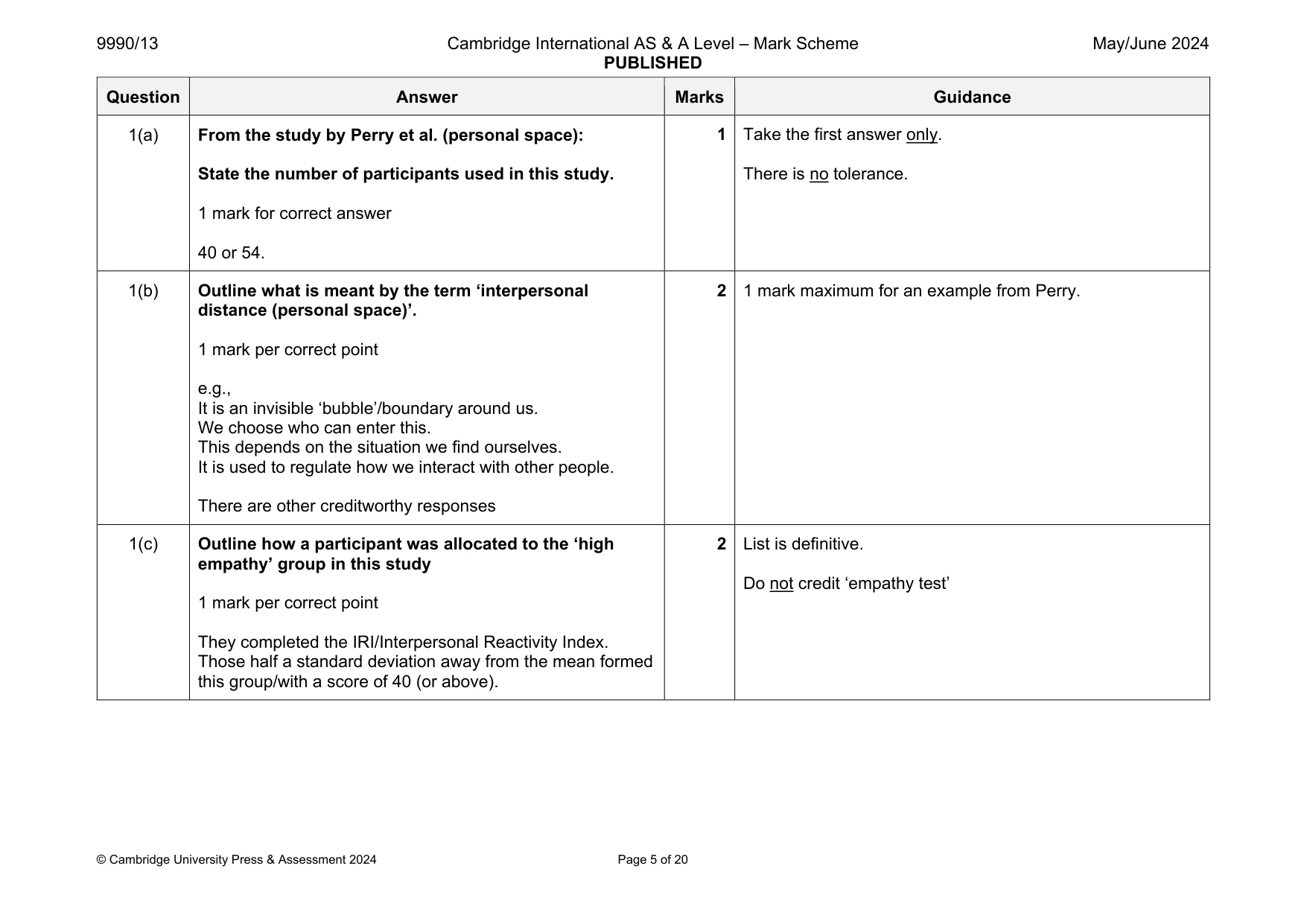
9990/13 Cambridge International AS & A Level – Mark Scheme PUBLISHED May/June 2024 © Cambridge University Press & Assessment 2024 Page 5 of 20 Question Answer Marks Guidance 1(a) From the study by Perry et al. (personal space): State the number of participants used in this study. 1 mark for correct answer 40 or 54. 1 Take the first answer only. There is no tolerance. 1(b) Outline what is meant by the term ‘interpersonal distance (personal space)’. 1 mark per correct point e.g., It is an invisible ‘bubble’/boundary around us. We choose who can enter this. This depends on the situation we find ourselves. It is used to regulate how we interact with other people. There are other creditworthy responses 2 1 mark maximum for an example from Perry. 1(c) Outline how a participant was allocated to the ‘high empathy’ group in this study 1 mark per correct point They completed the IRI/Interpersonal Reactivity Index. Those half a standard deviation away from the mean formed this group/with a score of 40 (or above). 2 List is definitive. Do not credit ‘empathy test’
Mark scheme, page 6
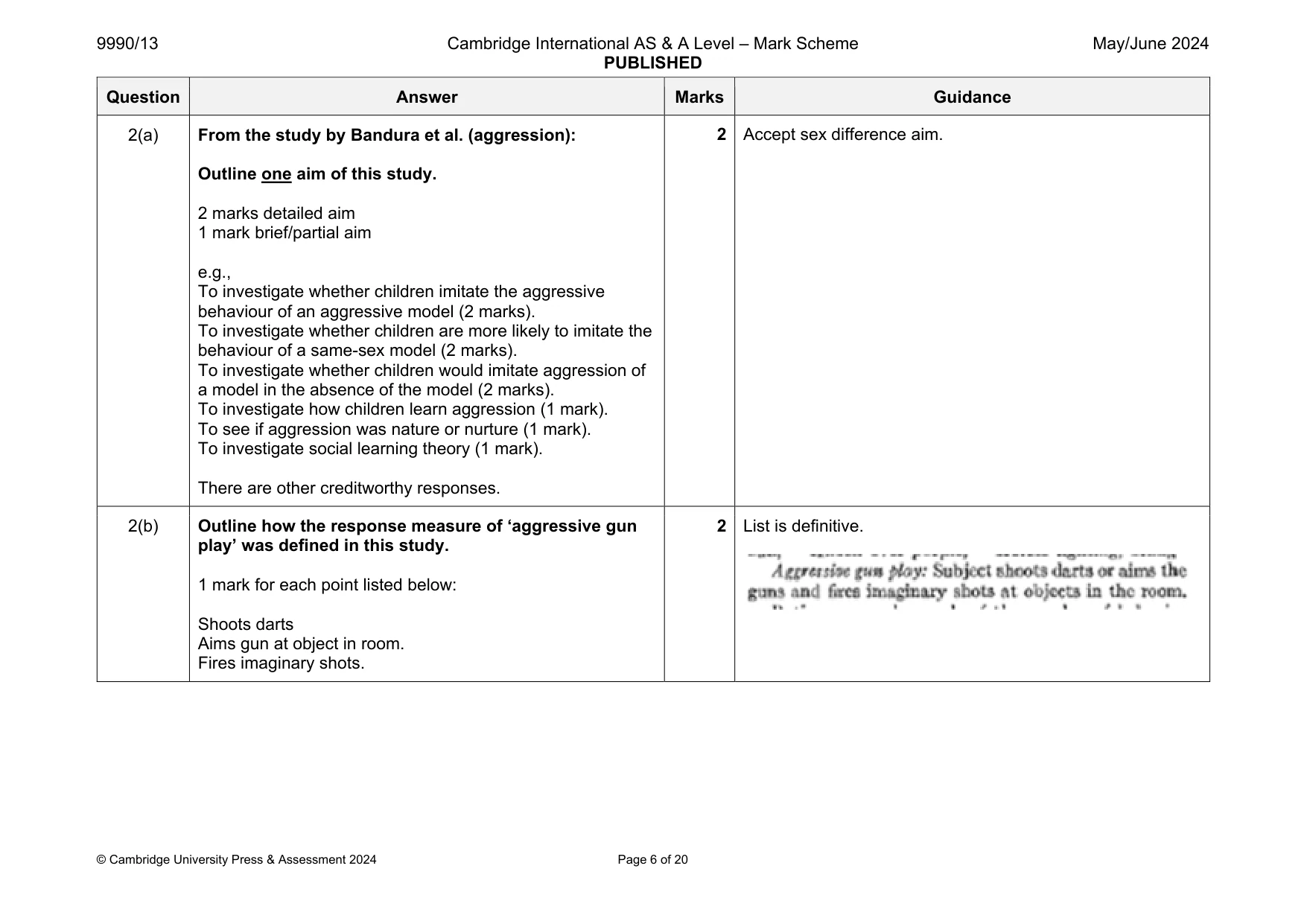
9990/13 Cambridge International AS & A Level – Mark Scheme PUBLISHED May/June 2024 © Cambridge University Press & Assessment 2024 Page 6 of 20 Question Answer Marks Guidance 2(a) From the study by Bandura et al. (aggression): Outline one aim of this study. 2 marks detailed aim 1 mark brief/partial aim e.g., To investigate whether children imitate the aggressive behaviour of an aggressive model (2 marks). To investigate whether children are more likely to imitate the behaviour of a same-sex model (2 marks). To investigate whether children would imitate aggression of a model in the absence of the model (2 marks). To investigate how children learn aggression (1 mark). To see if aggression was nature or nurture (1 mark). To investigate social learning theory (1 mark). There are other creditworthy responses. 2 Accept sex difference aim. 2(b) Outline how the response measure of ‘aggressive gun play’ was defined in this study. 1 mark for each point listed below: Shoots darts Aims gun at object in room. Fires imaginary shots. 2 List is definitive.
Mark scheme, page 7
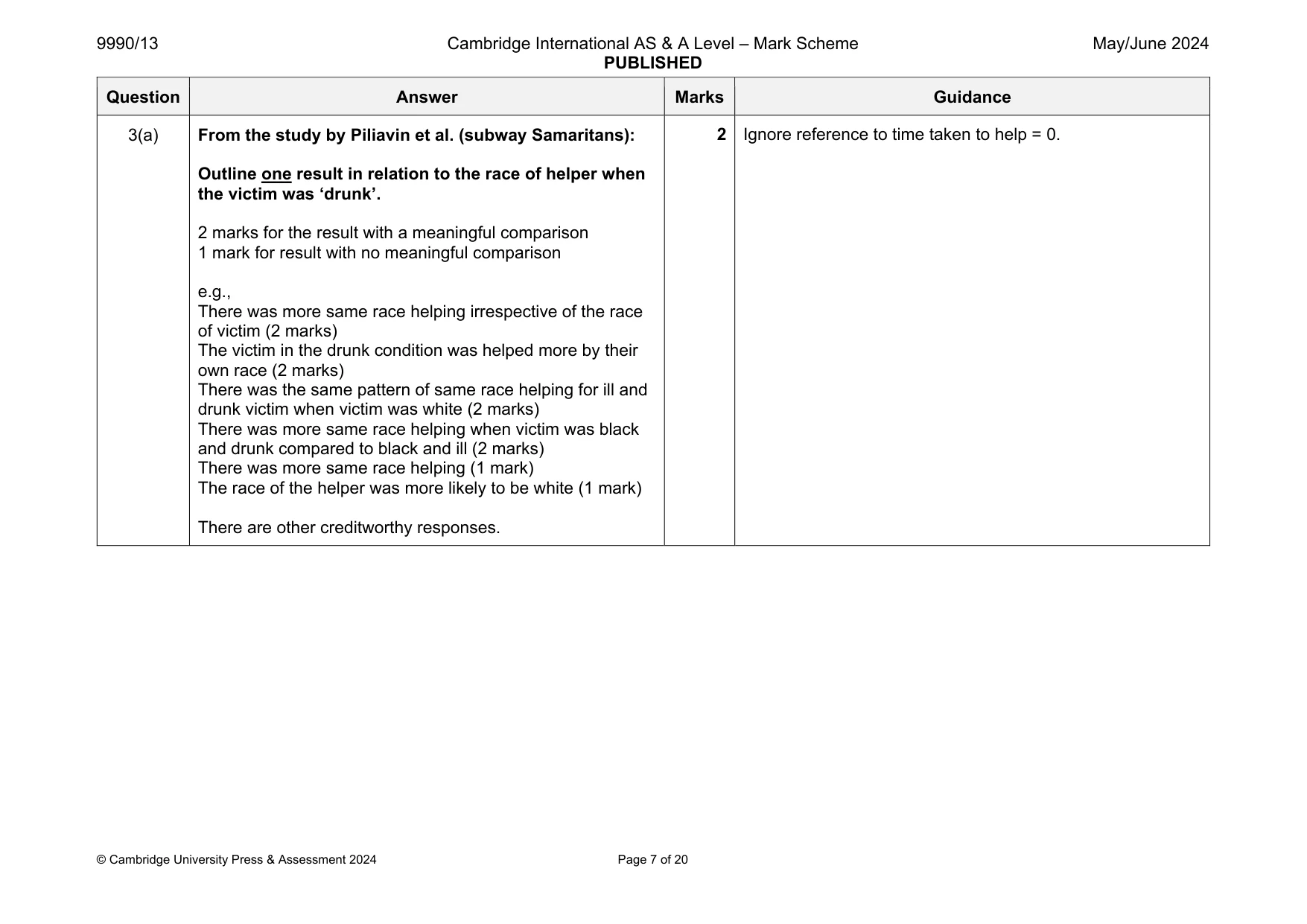
9990/13 Cambridge International AS & A Level – Mark Scheme PUBLISHED May/June 2024 © Cambridge University Press & Assessment 2024 Page 7 of 20 Question Answer Marks Guidance 3(a) From the study by Piliavin et al. (subway Samaritans): Outline one result in relation to the race of helper when the victim was ‘drunk’. 2 marks for the result with a meaningful comparison 1 mark for result with no meaningful comparison e.g., There was more same race helping irrespective of the race of victim (2 marks) The victim in the drunk condition was helped more by their own race (2 marks) There was the same pattern of same race helping for ill and drunk victim when victim was white (2 marks) There was more same race helping when victim was black and drunk compared to black and ill (2 marks) There was more same race helping (1 mark) The race of the helper was more likely to be white (1 mark) There are other creditworthy responses. 2 Ignore reference to time taken to help = 0.
Mark scheme, page 8
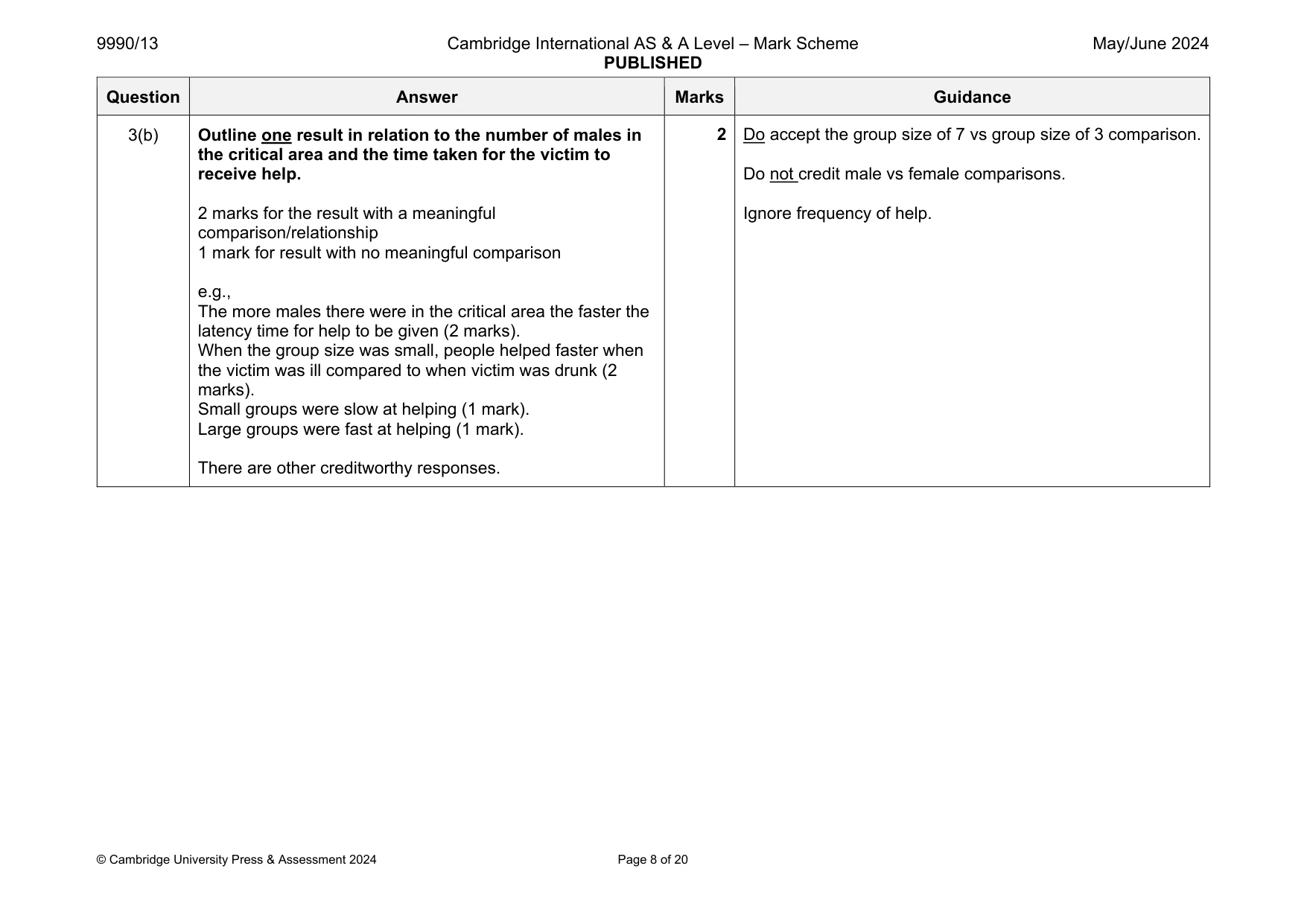
9990/13 Cambridge International AS & A Level – Mark Scheme PUBLISHED May/June 2024 © Cambridge University Press & Assessment 2024 Page 8 of 20 Question Answer Marks Guidance 3(b) Outline one result in relation to the number of males in the critical area and the time taken for the victim to receive help. 2 marks for the result with a meaningful comparison/relationship 1 mark for result with no meaningful comparison e.g., The more males there were in the critical area the faster the latency time for help to be given (2 marks). When the group size was small, people helped faster when the victim was ill compared to when victim was drunk (2 marks). Small groups were slow at helping (1 mark). Large groups were fast at helping (1 mark). There are other creditworthy responses. 2 Do accept the group size of 7 vs group size of 3 comparison. Do not credit male vs female comparisons. Ignore frequency of help.
Mark scheme, page 9
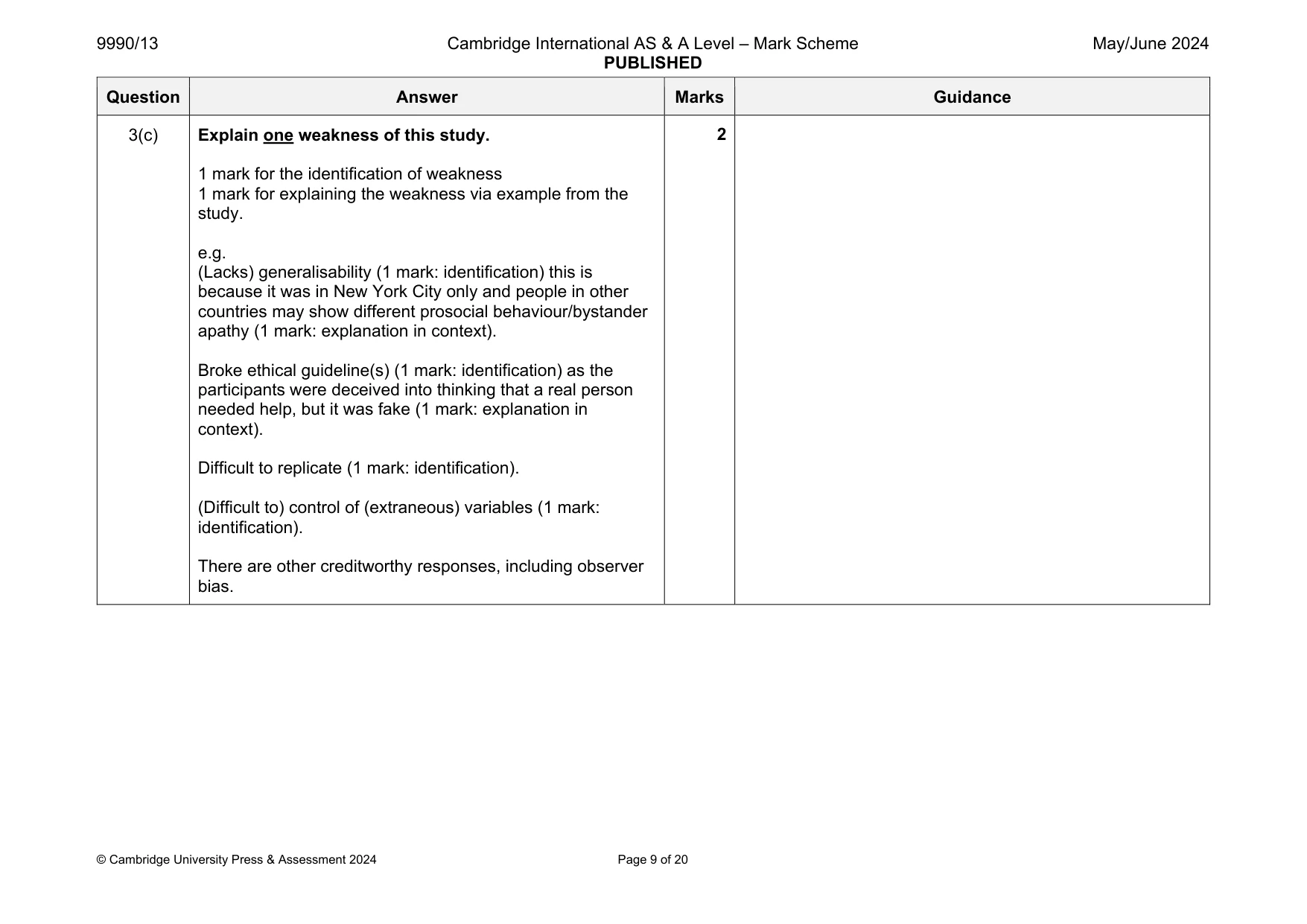
9990/13 Cambridge International AS & A Level – Mark Scheme PUBLISHED May/June 2024 © Cambridge University Press & Assessment 2024 Page 9 of 20 Question Answer Marks Guidance 3(c) Explain one weakness of this study. 1 mark for the identification of weakness 1 mark for explaining the weakness via example from the study. e.g. (Lacks) generalisability (1 mark: identification) this is because it was in New York City only and people in other countries may show different prosocial behaviour/bystander apathy (1 mark: explanation in context). Broke ethical guideline(s) (1 mark: identification) as the participants were deceived into thinking that a real person needed help, but it was fake (1 mark: explanation in context). Difficult to replicate (1 mark: identification). (Difficult to) control of (extraneous) variables (1 mark: identification). There are other creditworthy responses, including observer bias. 2
Mark scheme, page 10
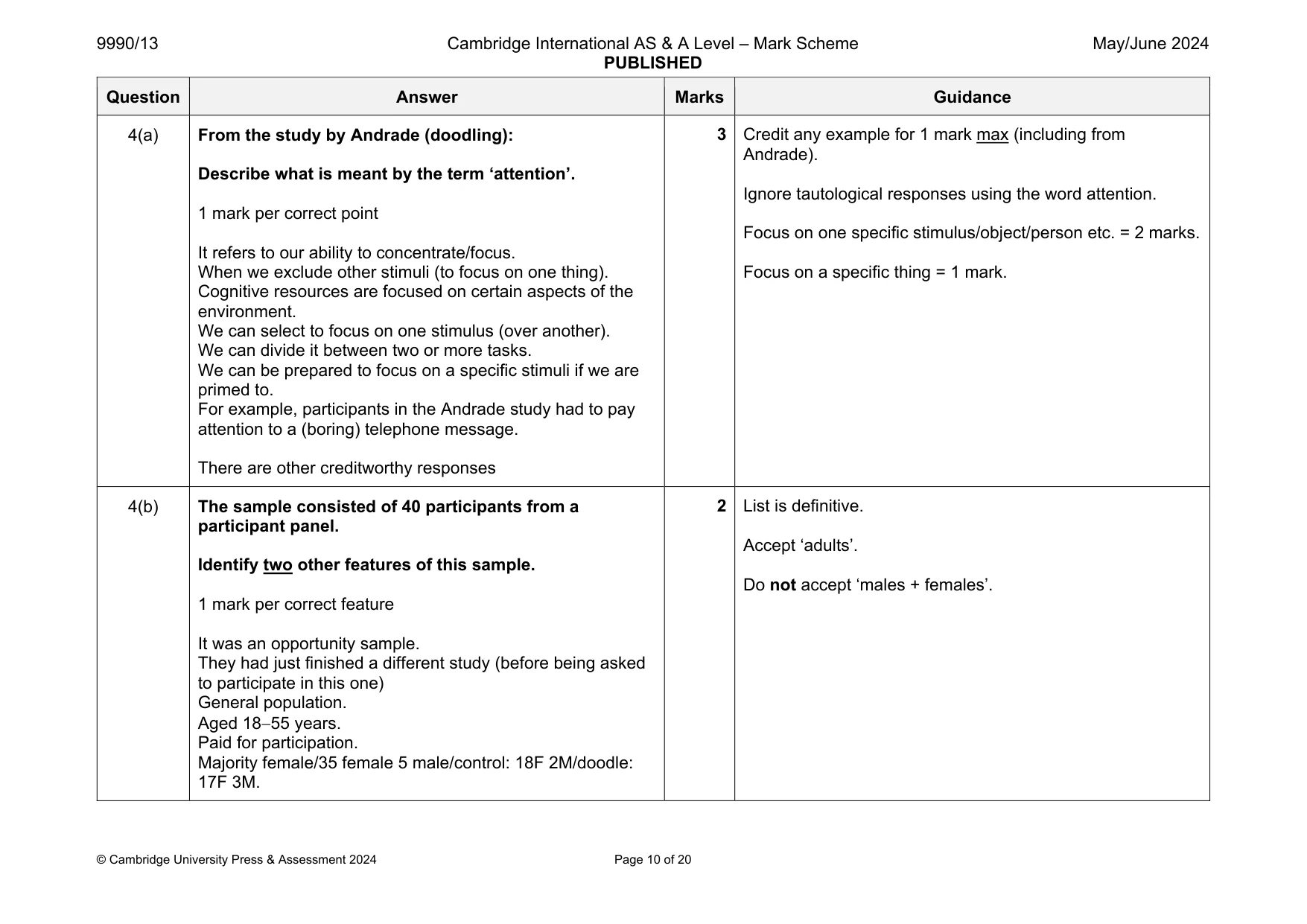
9990/13 Cambridge International AS & A Level – Mark Scheme PUBLISHED May/June 2024 © Cambridge University Press & Assessment 2024 Page 10 of 20 Question Answer Marks Guidance 4(a) From the study by Andrade (doodling): Describe what is meant by the term ‘attention’. 1 mark per correct point It refers to our ability to concentrate/focus. When we exclude other stimuli (to focus on one thing). Cognitive resources are focused on certain aspects of the environment. We can select to focus on one stimulus (over another). We can divide it between two or more tasks. We can be prepared to focus on a specific stimuli if we are primed to. For example, participants in the Andrade study had to pay attention to a (boring) telephone message. There are other creditworthy responses 3 Credit any example for 1 mark max (including from Andrade). Ignore tautological responses using the word attention. Focus on one specific stimulus/object/person etc. = 2 marks. Focus on a specific thing = 1 mark. 4(b) The sample consisted of 40 participants from a participant panel. Identify two other features of this sample. 1 mark per correct feature It was an opportunity sample. They had just finished a different study (before being asked to participate in this one) General population. Aged 1855 years. Paid for participation. Majority female/35 female 5 male/control: 18F 2M/doodle: 17F 3M. 2 List is definitive. Accept ‘adults’. Do not accept ‘males + females’.
Mark scheme, page 11
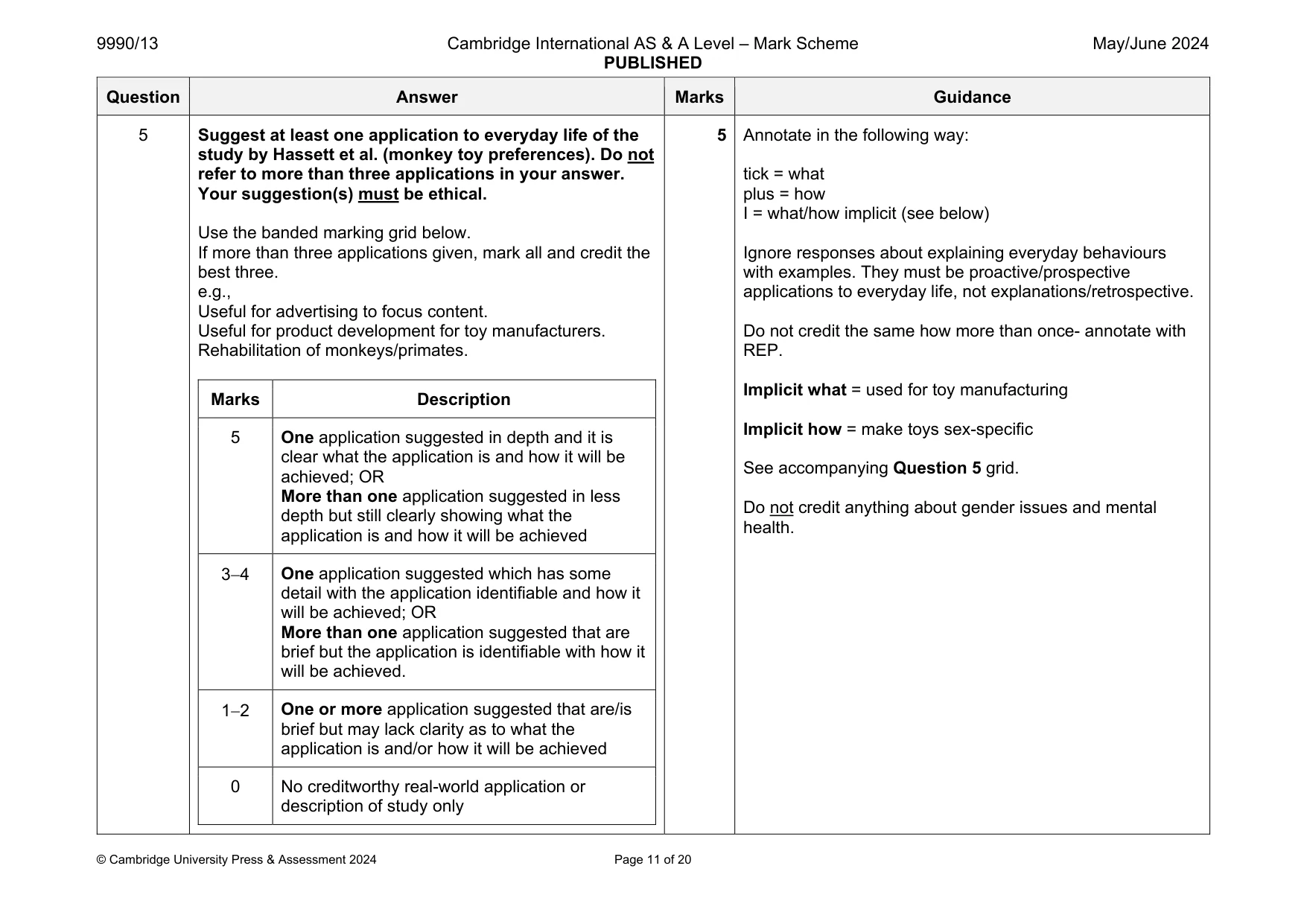
9990/13 Cambridge International AS & A Level – Mark Scheme PUBLISHED May/June 2024 © Cambridge University Press & Assessment 2024 Page 11 of 20 Question Answer Marks Guidance 5 Suggest at least one application to everyday life of the study by Hassett et al. (monkey toy preferences). Do not refer to more than three applications in your answer. Your suggestion(s) must be ethical. Use the banded marking grid below. If more than three applications given, mark all and credit the best three. e.g., Useful for advertising to focus content. Useful for product development for toy manufacturers. Rehabilitation of monkeys/primates. Marks Description 5 One application suggested in depth and it is clear what the application is and how it will be achieved; OR More than one application suggested in less depth but still clearly showing what the application is and how it will be achieved 34 One application suggested which has some detail with the application identifiable and how it will be achieved; OR More than one application suggested that are brief but the application is identifiable with how it will be achieved. 12 One or more application suggested that are/is brief but may lack clarity as to what the application is and/or how it will be achieved 0 No creditworthy real-world application or description of study only 5 Annotate in the following way: tick = what plus = how I = what/how implicit (see below) Ignore responses about explaining everyday behaviours with examples. They must be proactive/prospective applications to everyday life, not explanations/retrospective. Do not credit the same how more than once- annotate with REP. Implicit what = used for toy manufacturing Implicit how = make toys sex-specific See accompanying Question 5 grid. Do not credit anything about gender issues and mental health.
Mark scheme, page 12
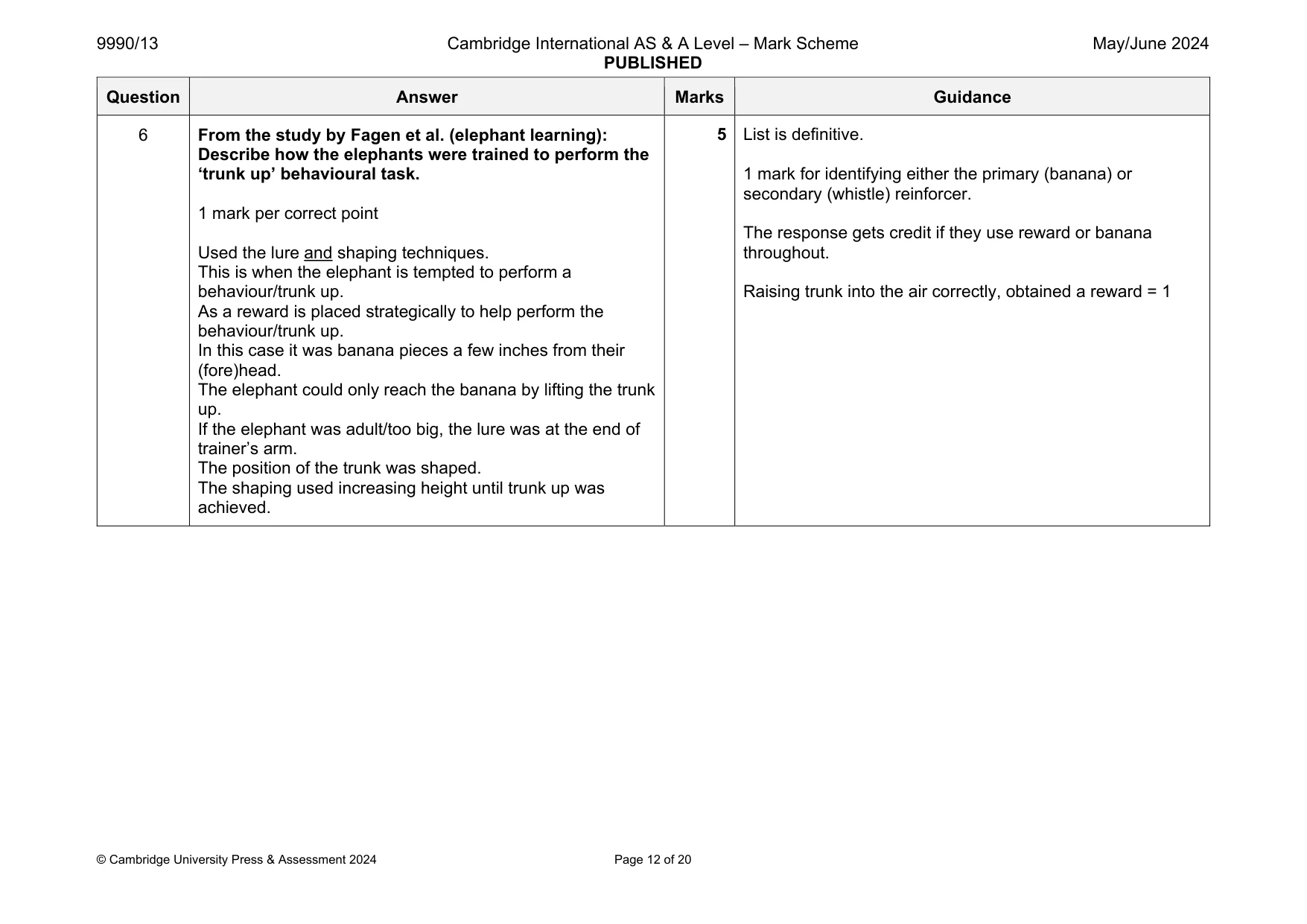
9990/13 Cambridge International AS & A Level – Mark Scheme PUBLISHED May/June 2024 © Cambridge University Press & Assessment 2024 Page 12 of 20 Question Answer Marks Guidance 6 From the study by Fagen et al. (elephant learning): Describe how the elephants were trained to perform the ‘trunk up’ behavioural task. 1 mark per correct point Used the lure and shaping techniques. This is when the elephant is tempted to perform a behaviour/trunk up. As a reward is placed strategically to help perform the behaviour/trunk up. In this case it was banana pieces a few inches from their (fore)head. The elephant could only reach the banana by lifting the trunk up. If the elephant was adult/too big, the lure was at the end of trainer’s arm. The position of the trunk was shaped. The shaping used increasing height until trunk up was achieved. 5 List is definitive. 1 mark for identifying either the primary (banana) or secondary (whistle) reinforcer. The response gets credit if they use reward or banana throughout. Raising trunk into the air correctly, obtained a reward = 1
Mark scheme, page 13
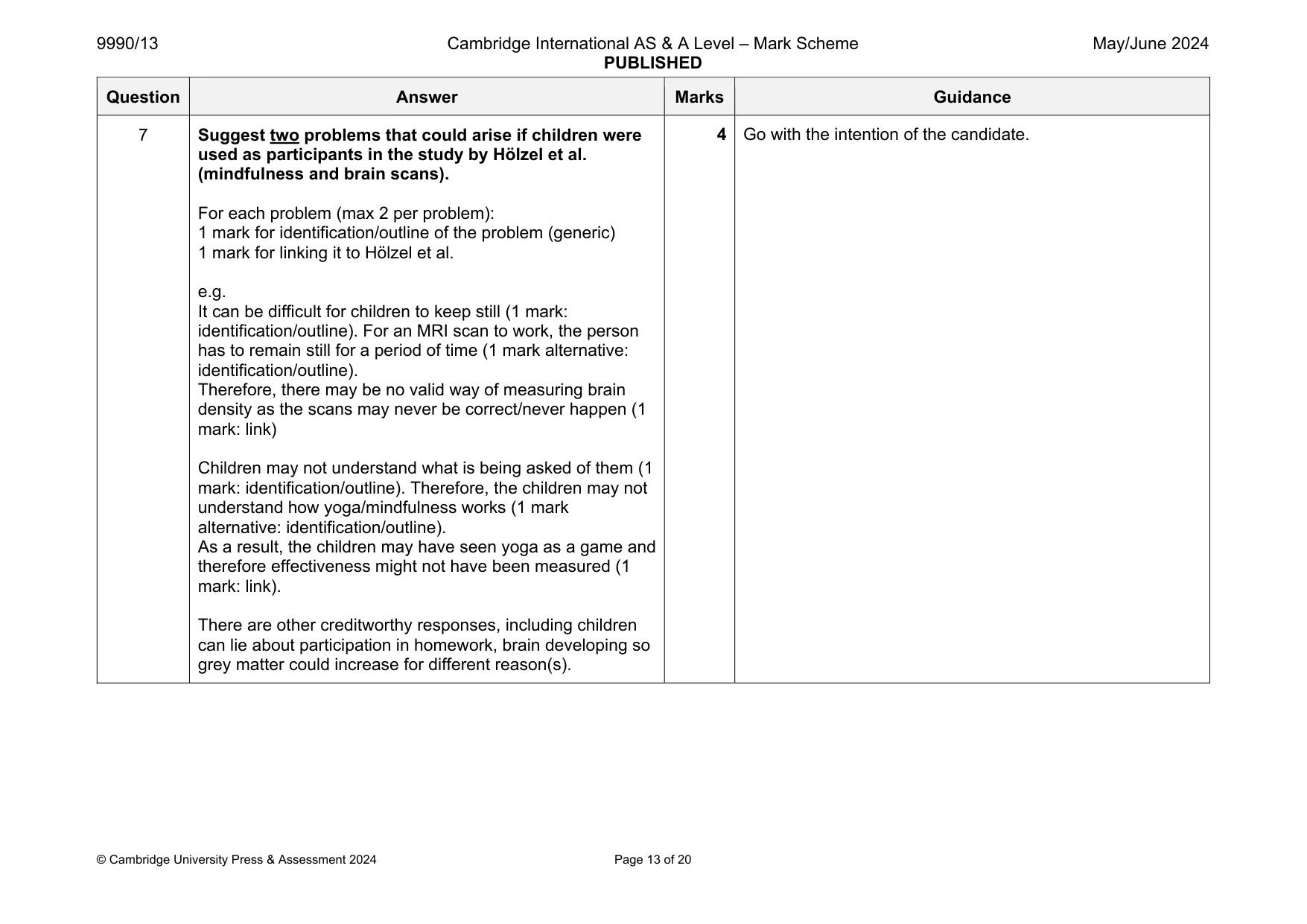
9990/13 Cambridge International AS & A Level – Mark Scheme PUBLISHED May/June 2024 © Cambridge University Press & Assessment 2024 Page 13 of 20 Question Answer Marks Guidance 7 Suggest two problems that could arise if children were used as participants in the study by Hölzel et al. (mindfulness and brain scans). For each problem (max 2 per problem): 1 mark for identification/outline of the problem (generic) 1 mark for linking it to Hölzel et al. e.g. It can be difficult for children to keep still (1 mark: identification/outline). For an MRI scan to work, the person has to remain still for a period of time (1 mark alternative: identification/outline). Therefore, there may be no valid way of measuring brain density as the scans may never be correct/never happen (1 mark: link) Children may not understand what is being asked of them (1 mark: identification/outline). Therefore, the children may not understand how yoga/mindfulness works (1 mark alternative: identification/outline). As a result, the children may have seen yoga as a game and therefore effectiveness might not have been measured (1 mark: link). There are other creditworthy responses, including children can lie about participation in homework, brain developing so grey matter could increase for different reason(s). 4 Go with the intention of the candidate.
Mark scheme, page 14
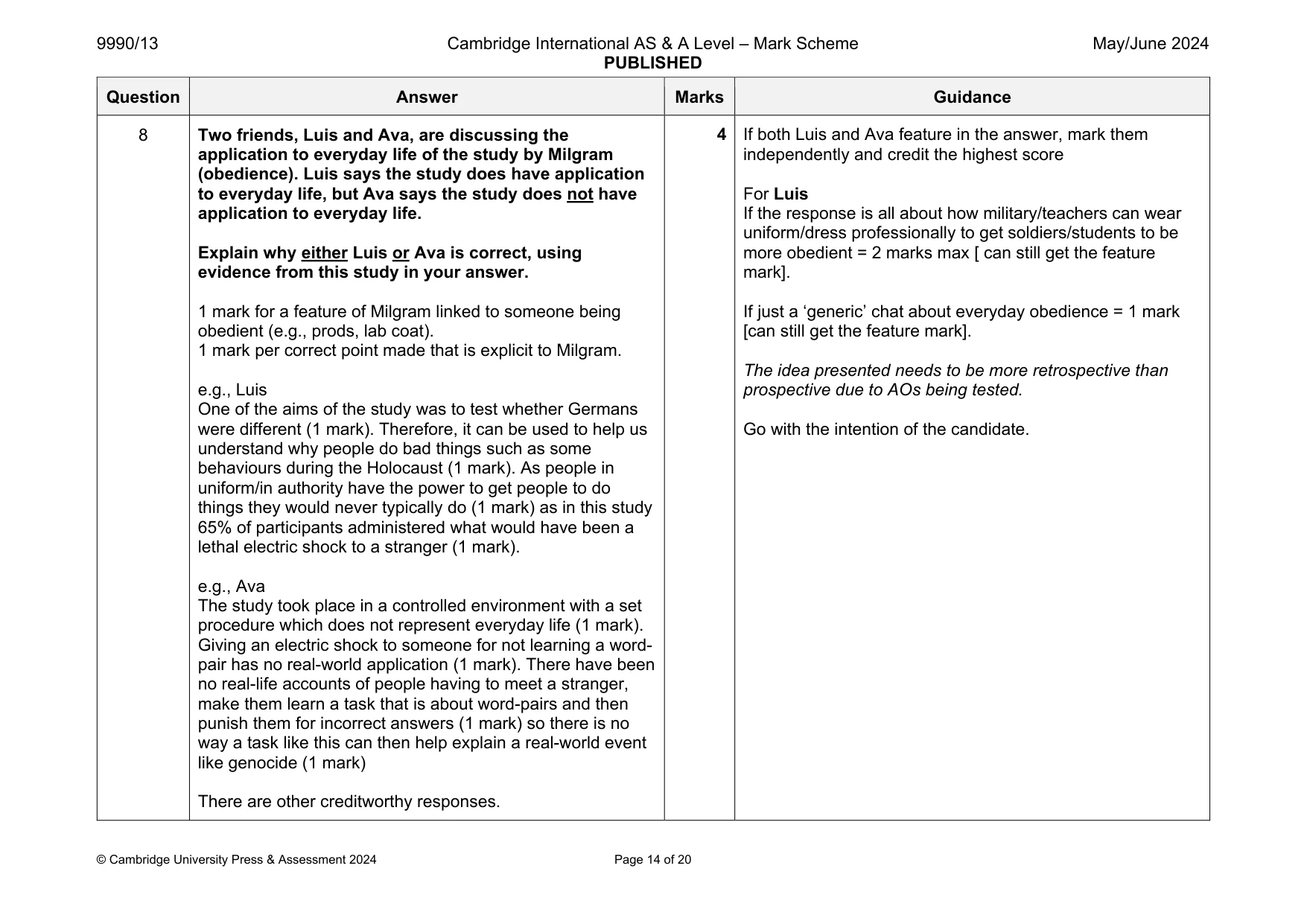
9990/13 Cambridge International AS & A Level – Mark Scheme PUBLISHED May/June 2024 © Cambridge University Press & Assessment 2024 Page 14 of 20 Question Answer Marks Guidance 8 Two friends, Luis and Ava, are discussing the application to everyday life of the study by Milgram (obedience). Luis says the study does have application to everyday life, but Ava says the study does not have application to everyday life. Explain why either Luis or Ava is correct, using evidence from this study in your answer. 1 mark for a feature of Milgram linked to someone being obedient (e.g., prods, lab coat). 1 mark per correct point made that is explicit to Milgram. e.g., Luis One of the aims of the study was to test whether Germans were different (1 mark). Therefore, it can be used to help us understand why people do bad things such as some behaviours during the Holocaust (1 mark). As people in uniform/in authority have the power to get people to do things they would never typically do (1 mark) as in this study 65% of participants administered what would have been a lethal electric shock to a stranger (1 mark). e.g., Ava The study took place in a controlled environment with a set procedure which does not represent everyday life (1 mark). Giving an electric shock to someone for not learning a word- pair has no real-world application (1 mark). There have been no real-life accounts of people having to meet a stranger, make them learn a task that is about word-pairs and then punish them for incorrect answers (1 mark) so there is no way a task like this can then help explain a real-world event like genocide (1 mark) There are other creditworthy responses. 4 If both Luis and Ava feature in the answer, mark them independently and credit the highest score For Luis If the response is all about how military/teachers can wear uniform/dress professionally to get soldiers/students to be more obedient = 2 marks max [ can still get the feature mark]. If just a ‘generic’ chat about everyday obedience = 1 mark [can still get the feature mark]. The idea presented needs to be more retrospective than prospective due to AOs being tested. Go with the intention of the candidate.
Mark scheme, page 15
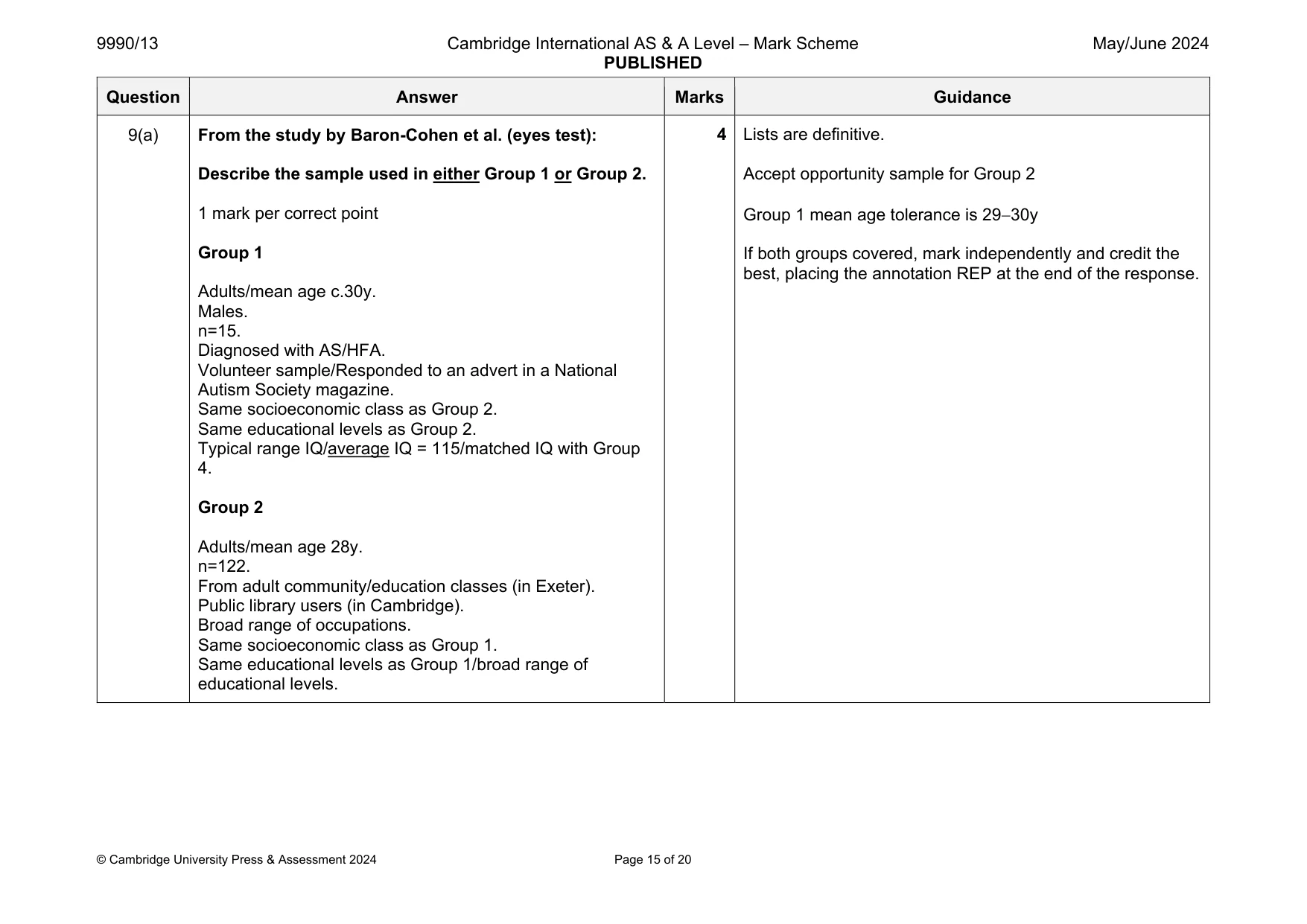
9990/13 Cambridge International AS & A Level – Mark Scheme PUBLISHED May/June 2024 © Cambridge University Press & Assessment 2024 Page 15 of 20 Question Answer Marks Guidance 9(a) From the study by Baron-Cohen et al. (eyes test): Describe the sample used in either Group 1 or Group 2. 1 mark per correct point Group 1 Adults/mean age c.30y. Males. n=15. Diagnosed with AS/HFA. Volunteer sample/Responded to an advert in a National Autism Society magazine. Same socioeconomic class as Group 2. Same educational levels as Group 2. Typical range IQ/average IQ = 115/matched IQ with Group 4. Group 2 Adults/mean age 28y. n=122. From adult community/education classes (in Exeter). Public library users (in Cambridge). Broad range of occupations. Same socioeconomic class as Group 1. Same educational levels as Group 1/broad range of educational levels. 4 Lists are definitive. Accept opportunity sample for Group 2 Group 1 mean age tolerance is 2930y If both groups covered, mark independently and credit the best, placing the annotation REP at the end of the response.
Mark scheme, page 16
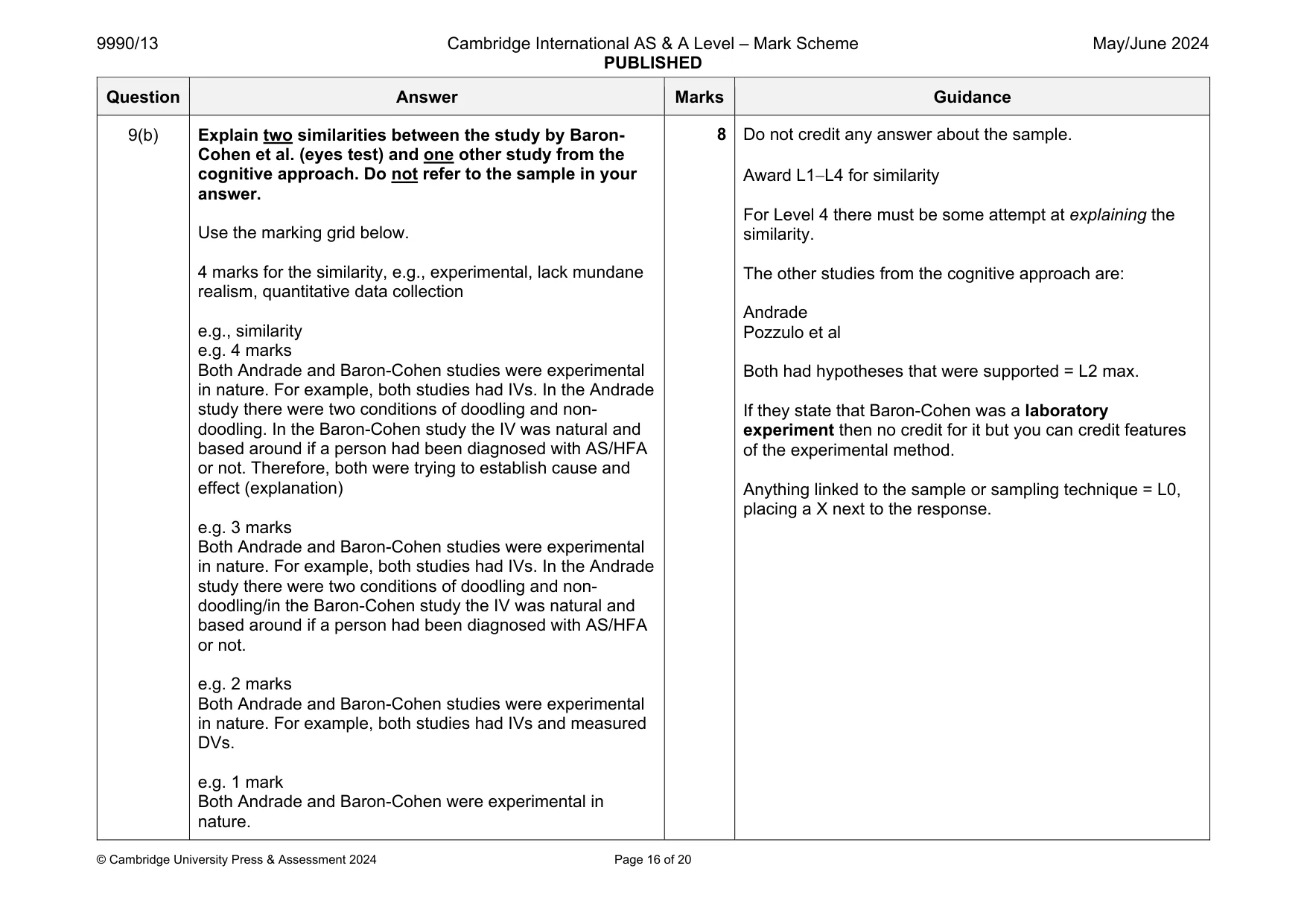
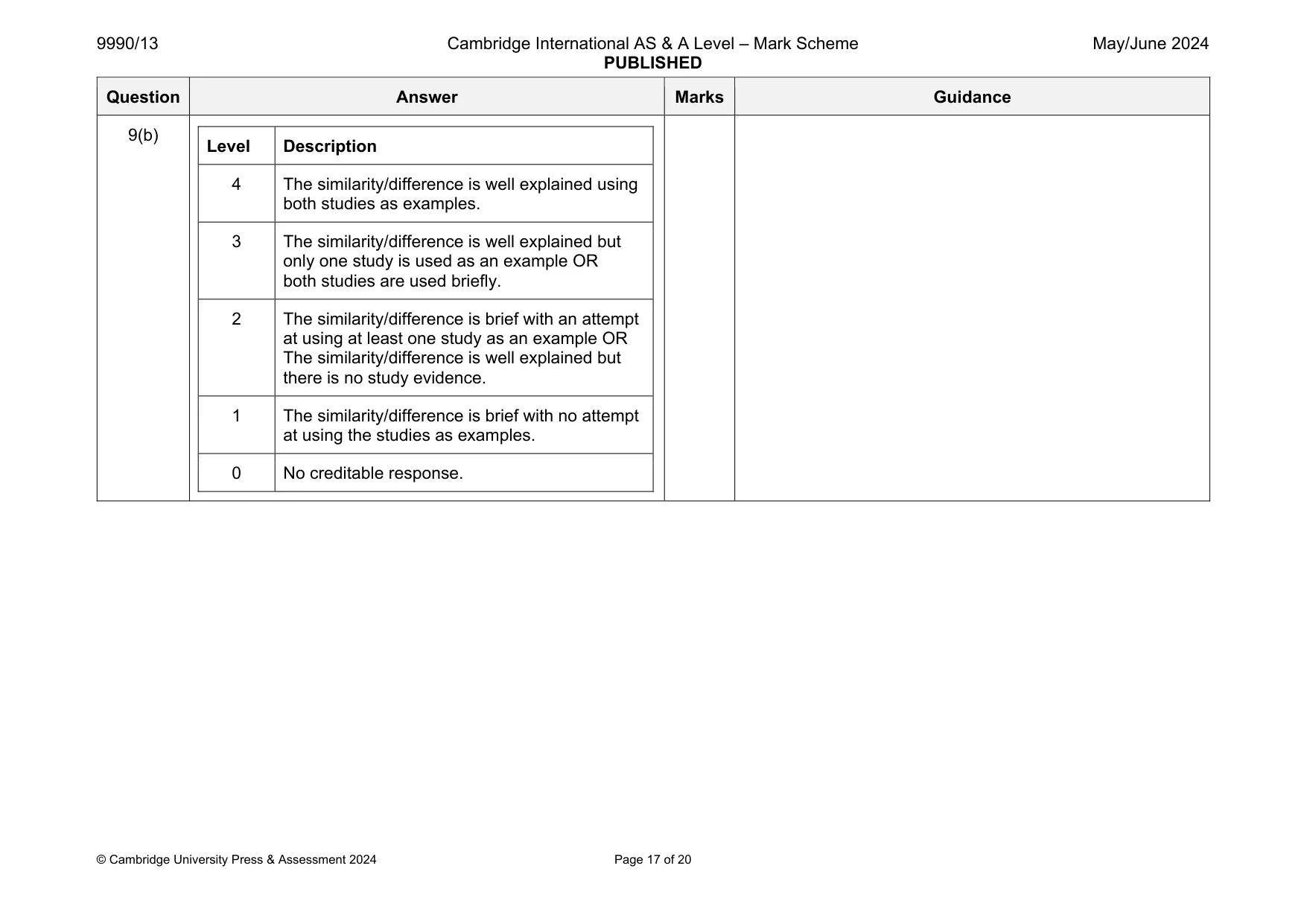
9990/13 Cambridge International AS & A Level – Mark Scheme PUBLISHED May/June 2024 © Cambridge University Press & Assessment 2024 Page 16 of 20 Question Answer Marks Guidance 9(b) Explain two similarities between the study by Baron- Cohen et al. (eyes test) and one other study from the cognitive approach. Do not refer to the sample in your answer. Use the marking grid below. 4 marks for the similarity, e.g., experimental, lack mundane realism, quantitative data collection e.g., similarity e.g. 4 marks Both Andrade and Baron-Cohen studies were experimental in nature. For example, both studies had IVs. In the Andrade study there were two conditions of doodling and non- doodling. In the Baron-Cohen study the IV was natural and based around if a person had been diagnosed with AS/HFA or not. Therefore, both were trying to establish cause and effect (explanation) e.g. 3 marks Both Andrade and Baron-Cohen studies were experimental in nature. For example, both studies had IVs. In the Andrade study there were two conditions of doodling and non- doodling/in the Baron-Cohen study the IV was natural and based around if a person had been diagnosed with AS/HFA or not. e.g. 2 marks Both Andrade and Baron-Cohen studies were experimental in nature. For example, both studies had IVs and measured DVs. e.g. 1 mark Both Andrade and Baron-Cohen were experimental in nature. 8 Do not credit any answer about the sample. Award L1L4 for similarity For Level 4 there must be some attempt at explaining the similarity. The other studies from the cognitive approach are: Andrade Pozzulo et al Both had hypotheses that were supported = L2 max. If they state that Baron-Cohen was a laboratory experiment then no credit for it but you can credit features of the experimental method. Anything linked to the sample or sampling technique = L0, placing a X next to the response.
Mark scheme, page 17
9990/13 Cambridge International AS & A Level – Mark Scheme PUBLISHED May/June 2024 © Cambridge University Press & Assessment 2024 Page 17 of 20 Question Answer Marks Guidance 9(b) Level Description 4 The similarity/difference is well explained using both studies as examples. 3 The similarity/difference is well explained but only one study is used as an example OR both studies are used briefly. 2 The similarity/difference is brief with an attempt at using at least one study as an example OR The similarity/difference is well explained but there is no study evidence. 1 The similarity/difference is brief with no attempt at using the studies as examples. 0 No creditable response.
Mark scheme, page 18
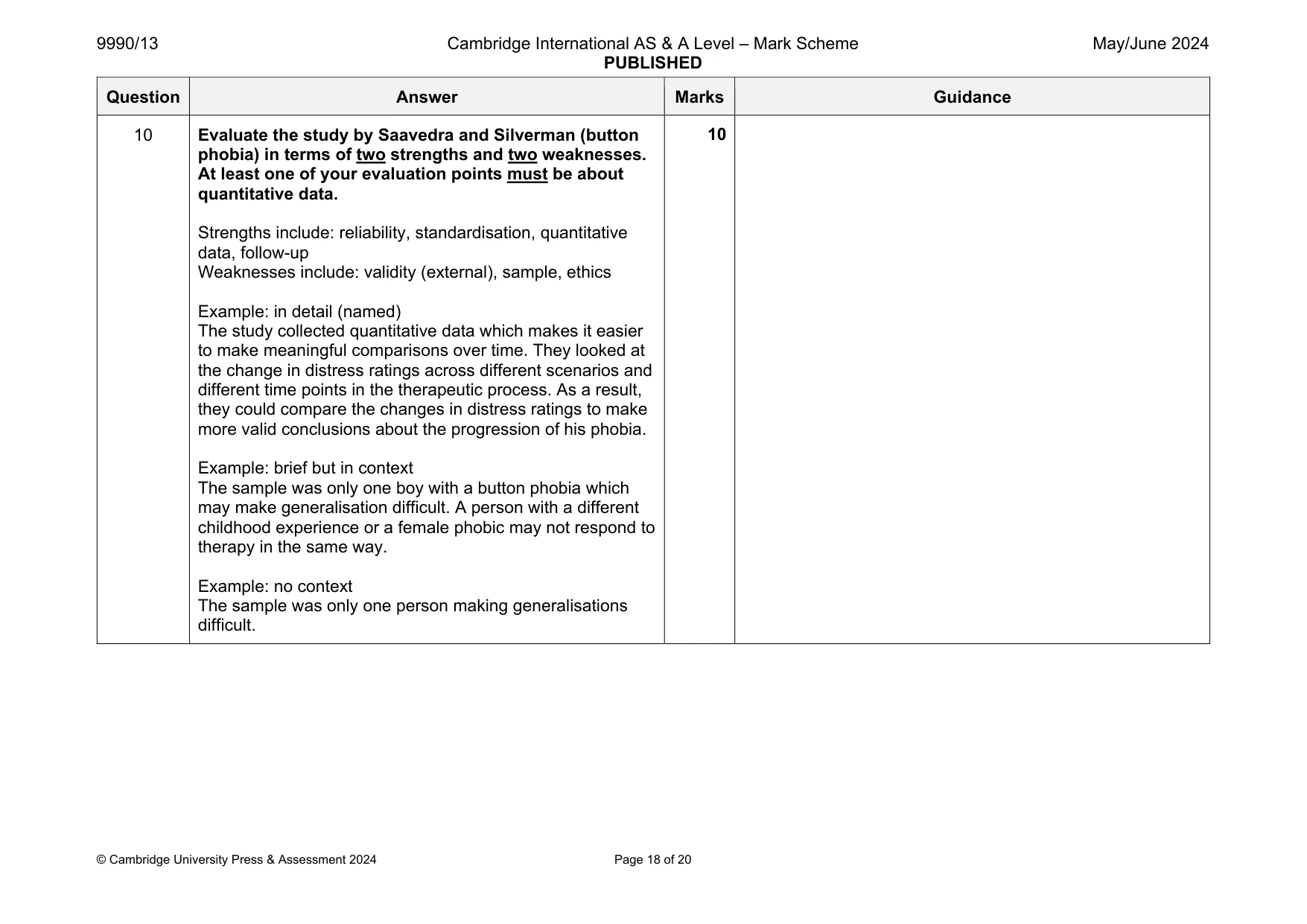
9990/13 Cambridge International AS & A Level – Mark Scheme PUBLISHED May/June 2024 © Cambridge University Press & Assessment 2024 Page 18 of 20 Question Answer Marks Guidance 10 Evaluate the study by Saavedra and Silverman (button phobia) in terms of two strengths and two weaknesses. At least one of your evaluation points must be about quantitative data. Strengths include: reliability, standardisation, quantitative data, follow-up Weaknesses include: validity (external), sample, ethics Example: in detail (named) The study collected quantitative data which makes it easier to make meaningful comparisons over time. They looked at the change in distress ratings across different scenarios and different time points in the therapeutic process. As a result, they could compare the changes in distress ratings to make more valid conclusions about the progression of his phobia. Example: brief but in context The sample was only one boy with a button phobia which may make generalisation difficult. A person with a different childhood experience or a female phobic may not respond to therapy in the same way. Example: no context The sample was only one person making generalisations difficult. 10
Mark scheme, page 19
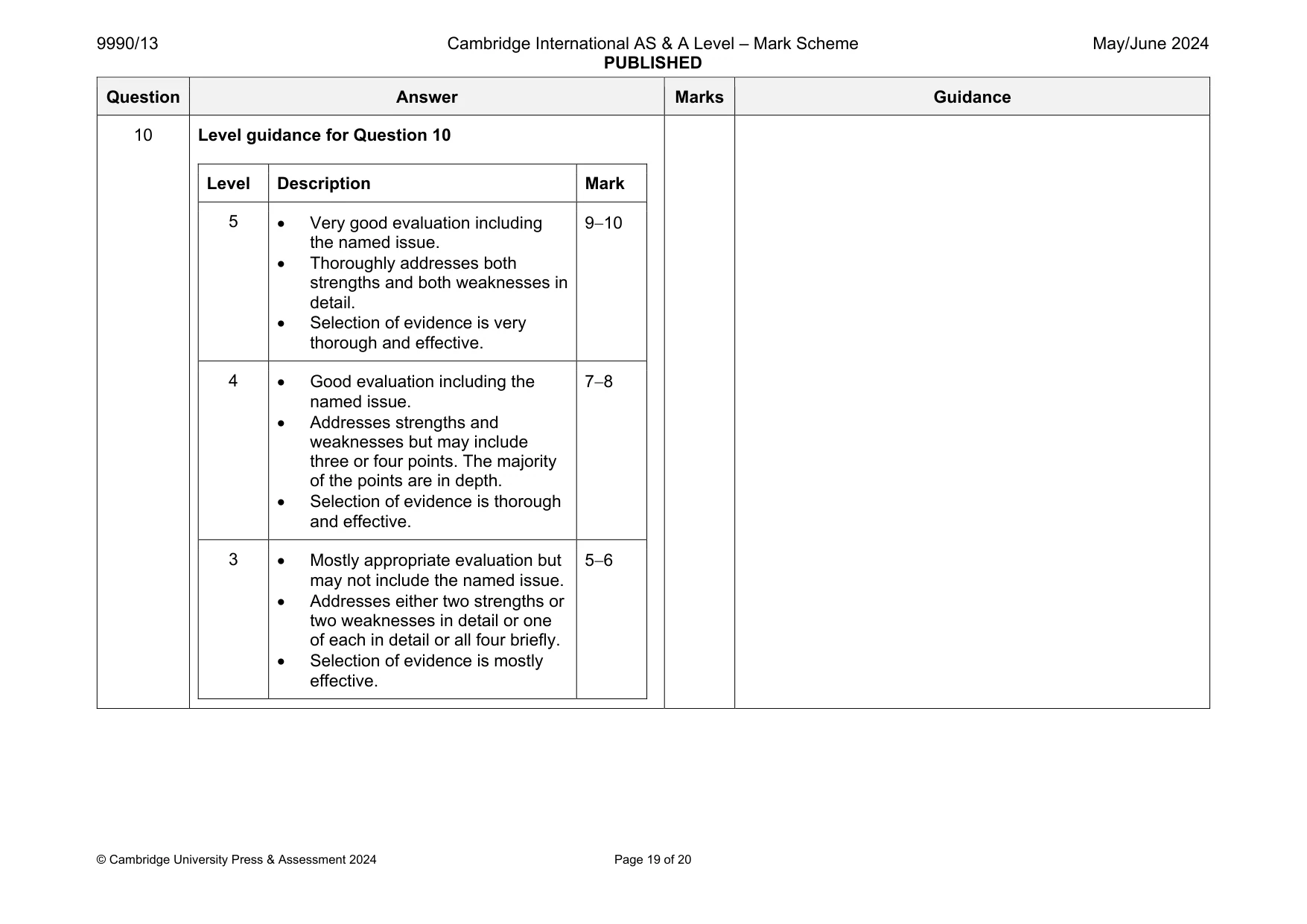
9990/13 Cambridge International AS & A Level – Mark Scheme PUBLISHED May/June 2024 © Cambridge University Press & Assessment 2024 Page 19 of 20 Question Answer Marks Guidance 10 Level guidance for Question 10 Level Description Mark 5 Very good evaluation including the named issue. Thoroughly addresses both strengths and both weaknesses in detail. Selection of evidence is very thorough and effective. 910 4 Good evaluation including the named issue. Addresses strengths and weaknesses but may include three or four points. The majority of the points are in depth. Selection of evidence is thorough and effective. 78 3 Mostly appropriate evaluation but may not include the named issue. Addresses either two strengths or two weaknesses in detail or one of each in detail or all four briefly. Selection of evidence is mostly effective. 56
Mark scheme, page 20
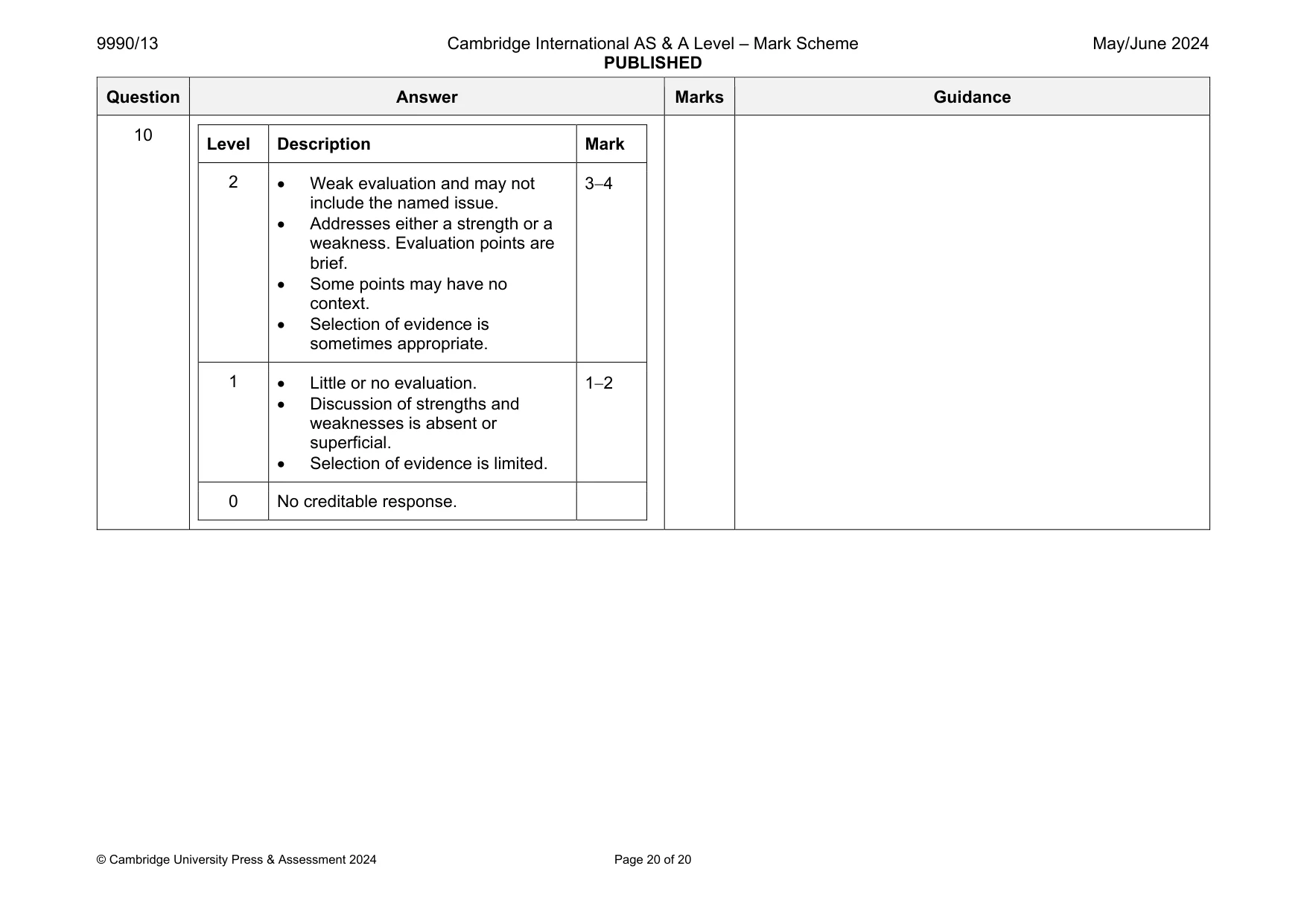
9990/13 Cambridge International AS & A Level – Mark Scheme PUBLISHED May/June 2024 © Cambridge University Press & Assessment 2024 Page 20 of 20 Question Answer Marks Guidance 10 Level Description Mark 2 Weak evaluation and may not include the named issue. Addresses either a strength or a weakness. Evaluation points are brief. Some points may have no context. Selection of evidence is sometimes appropriate. 34 1 Little or no evaluation. Discussion of strengths and weaknesses is absent or superficial. Selection of evidence is limited. 12 0 No creditable response.
What you needed in this session
Cambridge’s own grade thresholds for 2024 May/June, Paper 1 · Variant 3. A higher threshold means an easier paper — the bar moves with how the cohort did.