Cambridge A Level Psychology 9698 — 2016 Oct/Nov Paper 3 · Variant 3
9698/33/O/N/16 · 80 marks · ≈90 min
The question paper and its mark scheme, free to read here and free to download. This is Cambridge’s own paper, exactly as it was sat.
Question paper8 pages


Mark scheme20 pages
Answers below. Sit the paper first if you are practising.
Paper as text
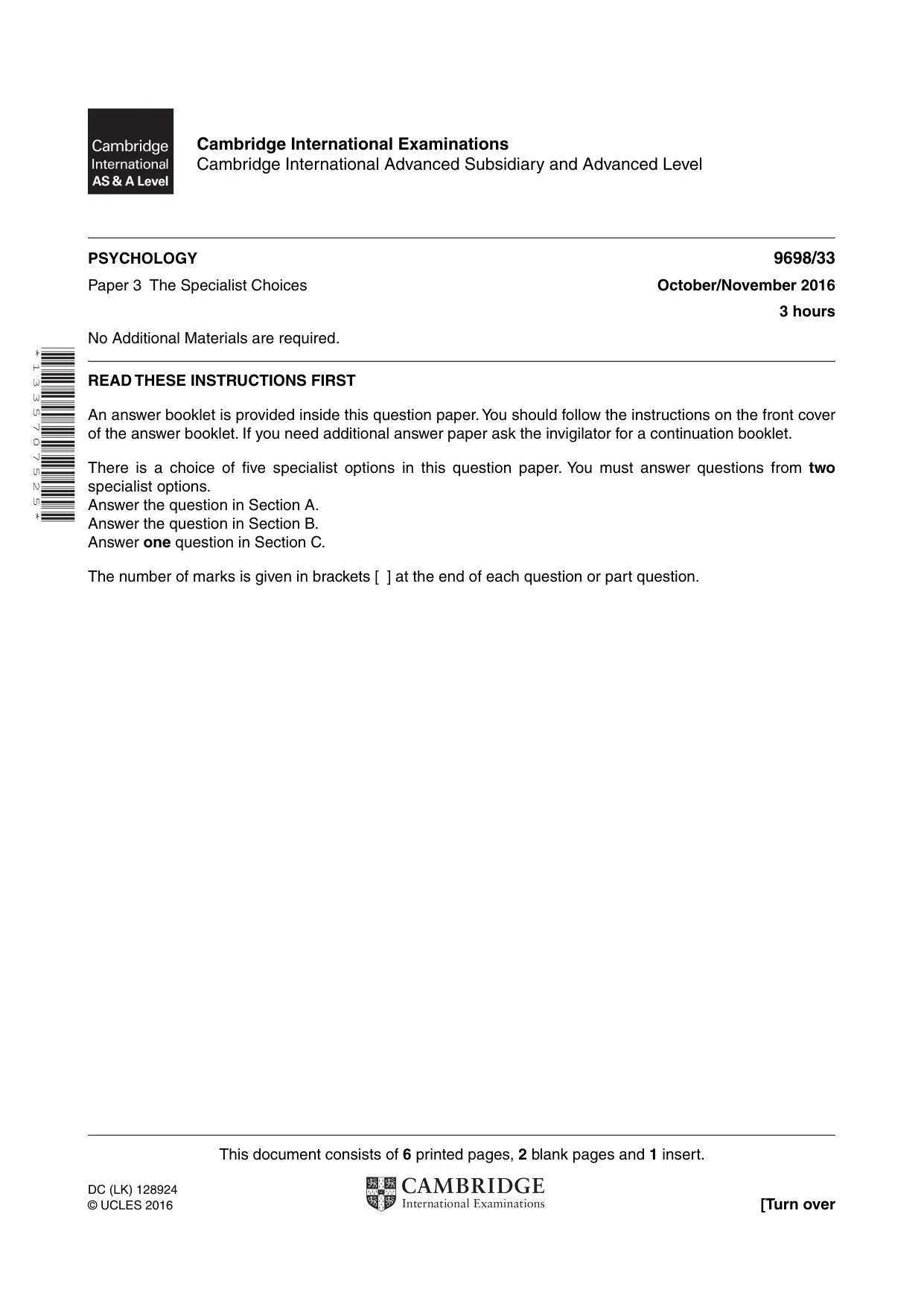
Question paper, page 1
This document consists of 6 printed pages, 2 blank pages and 1 insert. DC (LK) 128924 © UCLES 2016 [Turn over Cambridge International Examinations Cambridge International Advanced Subsidiary and Advanced Level * 1 3 3 5 7 0 7 5 2 5 * PSYCHOLOGY 9698/33 Paper 3 The Specialist Choices October/November 2016 3 hours No Additional Materials are required. READ THESE INSTRUCTIONS FIRST An answer booklet is provided inside this question paper. You should follow the instructions on the front cover of the answer booklet. If you need additional answer paper ask the invigilator for a continuation booklet. There is a choice of five specialist options in this question paper. You must answer questions from two specialist options. Answer the question in Section A. Answer the question in Section B. Answer one question in Section C. The number of marks is given in brackets [ ] at the end of each question or part question.
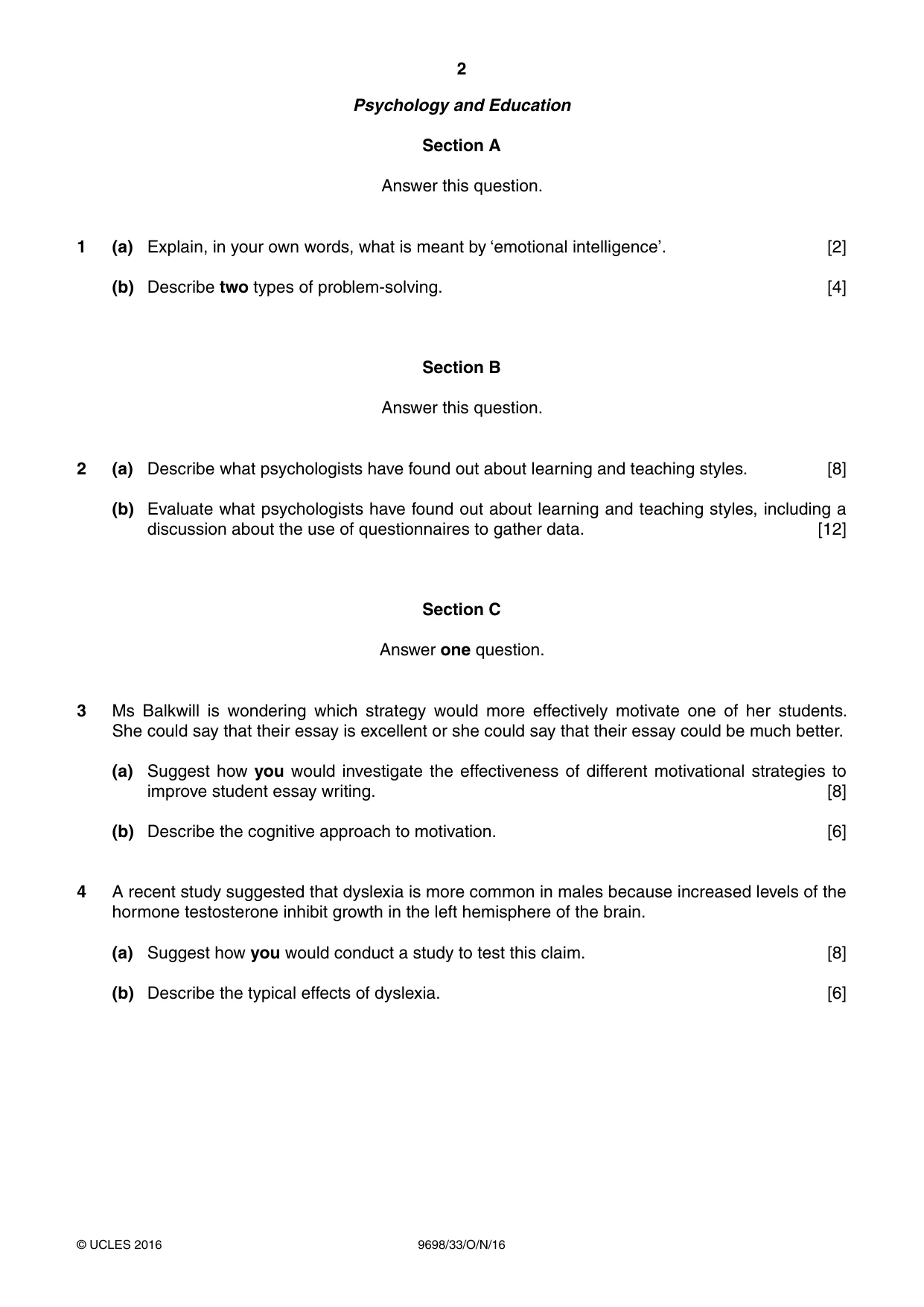
Question paper, page 2
2 9698/33/O/N/16 © UCLES 2016 Psychology and Education Section A Answer this question. 1 (a) Explain, in your own words, what is meant by ‘emotional intelligence’. [2] (b) Describe two types of problem-solving. [4] Section B Answer this question. 2 (a) Describe what psychologists have found out about learning and teaching styles. [8] (b) Evaluate what psychologists have found out about learning and teaching styles, including a discussion about the use of questionnaires to gather data. [12] Section C Answer one question. 3 Ms Balkwill is wondering which strategy would more effectively motivate one of her students. She could say that their essay is excellent or she could say that their essay could be much better. (a) Suggest how you would investigate the effectiveness of different motivational strategies to improve student essay writing. [8] (b) Describe the cognitive approach to motivation. [6] 4 A recent study suggested that dyslexia is more common in males because increased levels of the hormone testosterone inhibit growth in the left hemisphere of the brain. (a) Suggest how you would conduct a study to test this claim. [8] (b) Describe the typical effects of dyslexia. [6]
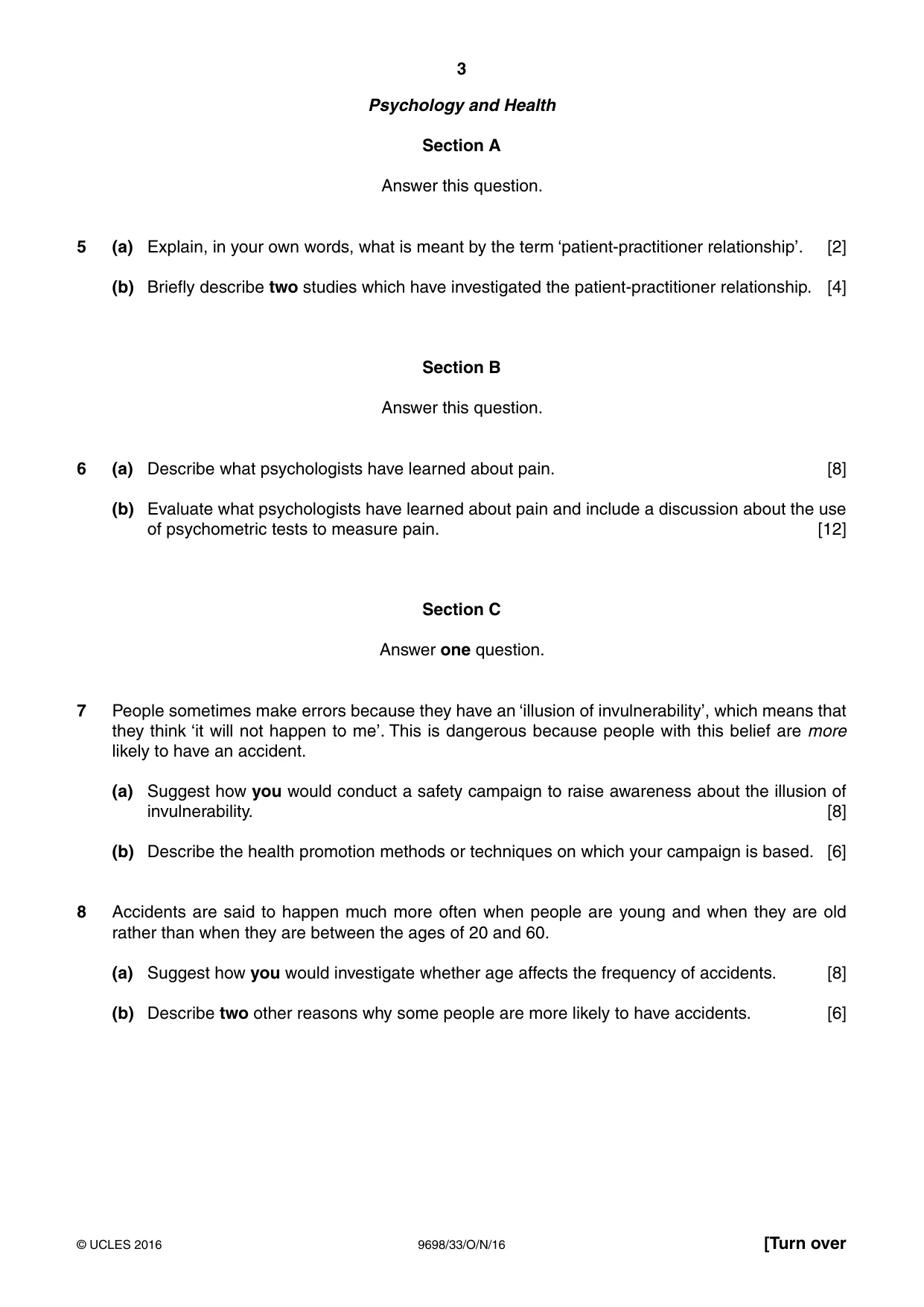
Question paper, page 3
3 9698/33/O/N/16 © UCLES 2016 [Turn over Psychology and Health Section A Answer this question. 5 (a) Explain, in your own words, what is meant by the term ‘patient-practitioner relationship’. [2] (b) Briefly describe two studies which have investigated the patient-practitioner relationship. [4] Section B Answer this question. 6 (a) Describe what psychologists have learned about pain. [8] (b) Evaluate what psychologists have learned about pain and include a discussion about the use of psychometric tests to measure pain. [12] Section C Answer one question. 7 People sometimes make errors because they have an ‘illusion of invulnerability’, which means that they think ‘it will not happen to me’. This is dangerous because people with this belief are more likely to have an accident. (a) Suggest how you would conduct a safety campaign to raise awareness about the illusion of invulnerability. [8] (b) Describe the health promotion methods or techniques on which your campaign is based. [6] 8 Accidents are said to happen much more often when people are young and when they are old rather than when they are between the ages of 20 and 60. (a) Suggest how you would investigate whether age affects the frequency of accidents. [8] (b) Describe two other reasons why some people are more likely to have accidents. [6]
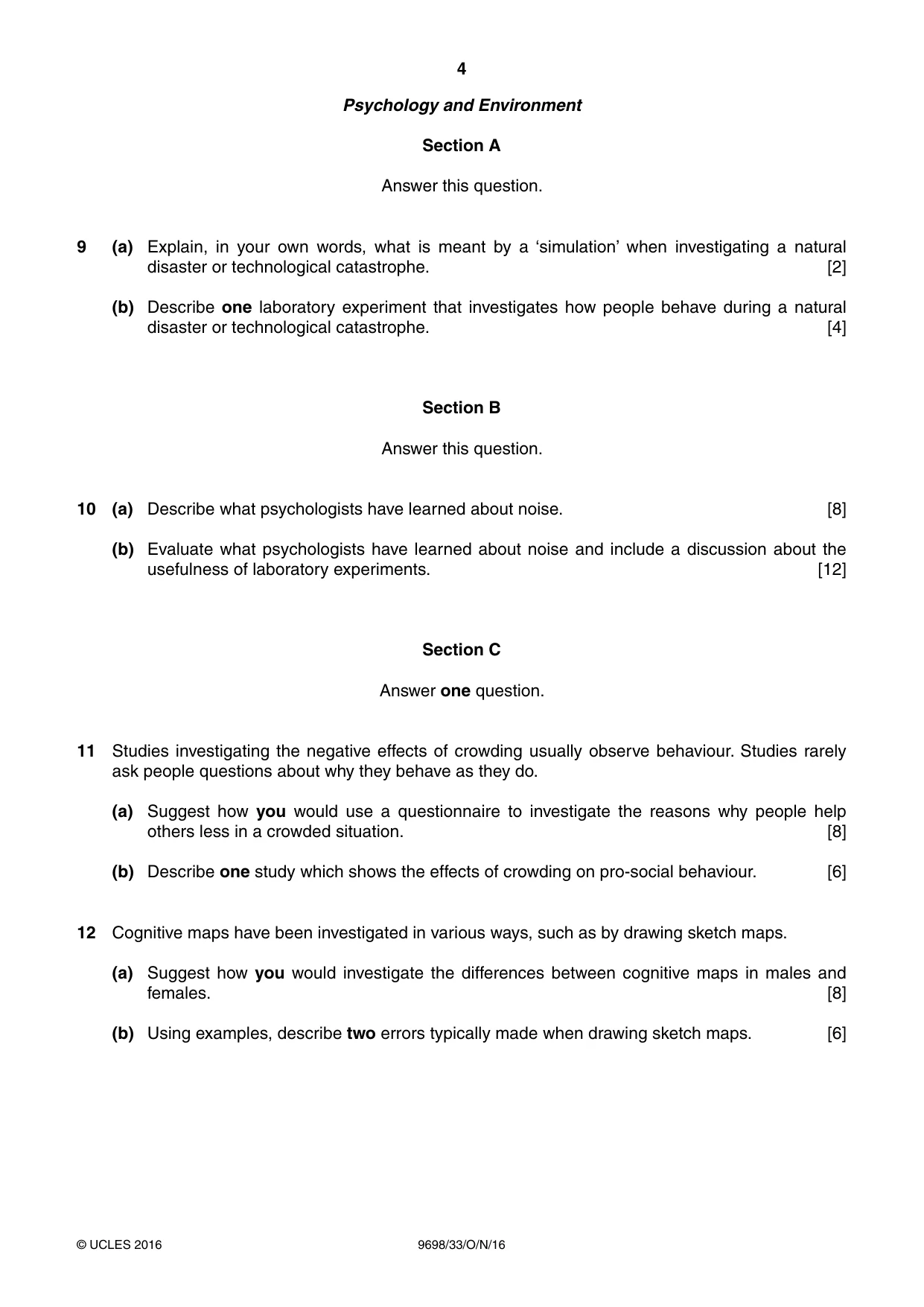
Question paper, page 4
4 9698/33/O/N/16 © UCLES 2016 Psychology and Environment Section A Answer this question. 9 (a) Explain, in your own words, what is meant by a ‘simulation’ when investigating a natural disaster or technological catastrophe. [2] (b) Describe one laboratory experiment that investigates how people behave during a natural disaster or technological catastrophe. [4] Section B Answer this question. 10 (a) Describe what psychologists have learned about noise. [8] (b) Evaluate what psychologists have learned about noise and include a discussion about the usefulness of laboratory experiments. [12] Section C Answer one question. 11 Studies investigating the negative effects of crowding usually observe behaviour. Studies rarely ask people questions about why they behave as they do. (a) Suggest how you would use a questionnaire to investigate the reasons why people help others less in a crowded situation. [8] (b) Describe one study which shows the effects of crowding on pro-social behaviour. [6] 12 Cognitive maps have been investigated in various ways, such as by drawing sketch maps. (a) Suggest how you would investigate the differences between cognitive maps in males and females. [8] (b) Using examples, describe two errors typically made when drawing sketch maps. [6]
Question paper, page 5
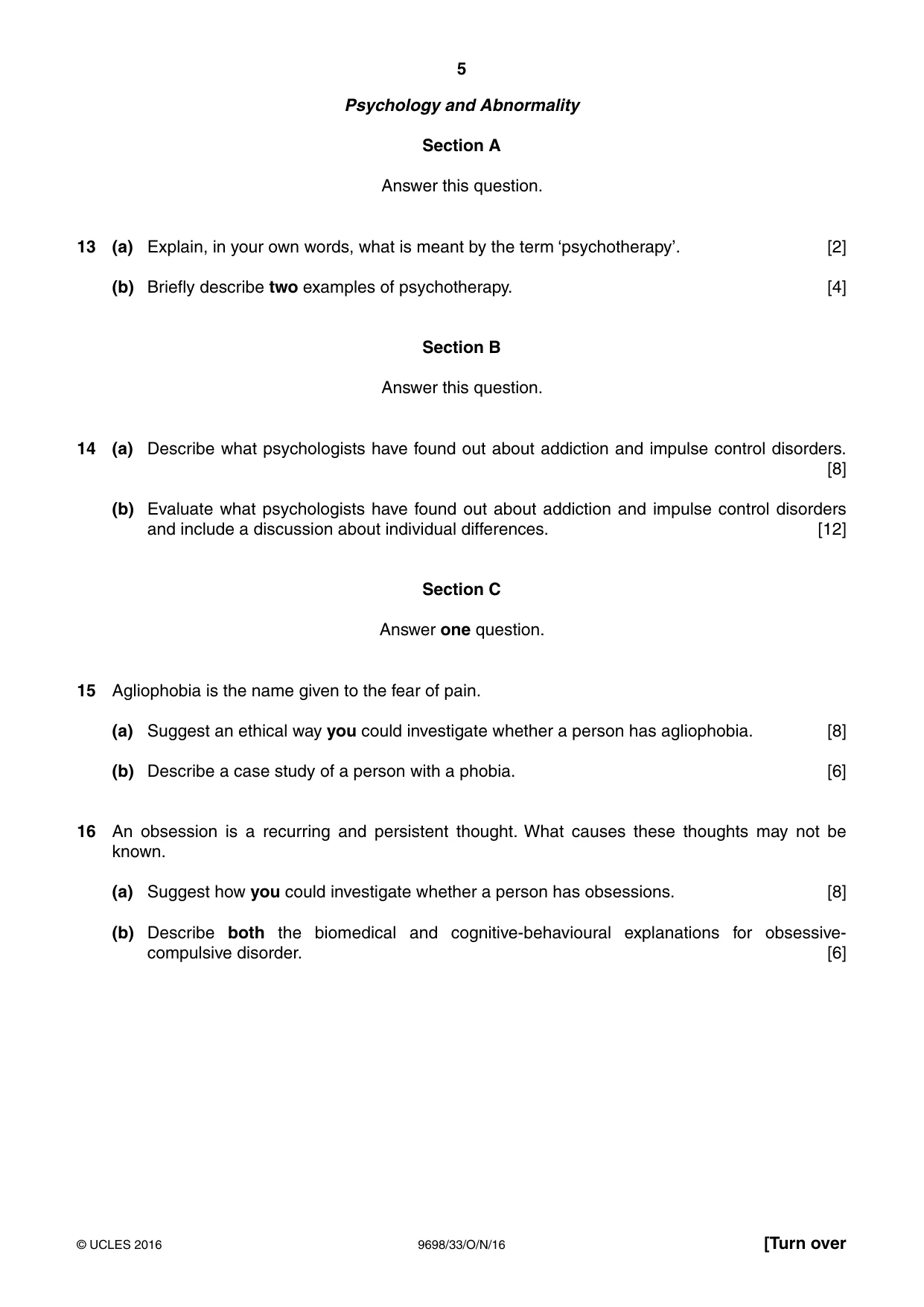
5 9698/33/O/N/16 © UCLES 2016 [Turn over Psychology and Abnormality Section A Answer this question. 13 (a) Explain, in your own words, what is meant by the term ‘psychotherapy’. [2] (b) Briefly describe two examples of psychotherapy. [4] Section B Answer this question. 14 (a) Describe what psychologists have found out about addiction and impulse control disorders. [8] (b) Evaluate what psychologists have found out about addiction and impulse control disorders and include a discussion about individual differences. [12] Section C Answer one question. 15 Agliophobia is the name given to the fear of pain. (a) Suggest an ethical way you could investigate whether a person has agliophobia. [8] (b) Describe a case study of a person with a phobia. [6] 16 An obsession is a recurring and persistent thought. What causes these thoughts may not be known. (a) Suggest how you could investigate whether a person has obsessions. [8] (b) Describe both the biomedical and cognitive-behavioural explanations for obsessive- compulsive disorder. [6]
Question paper, page 6
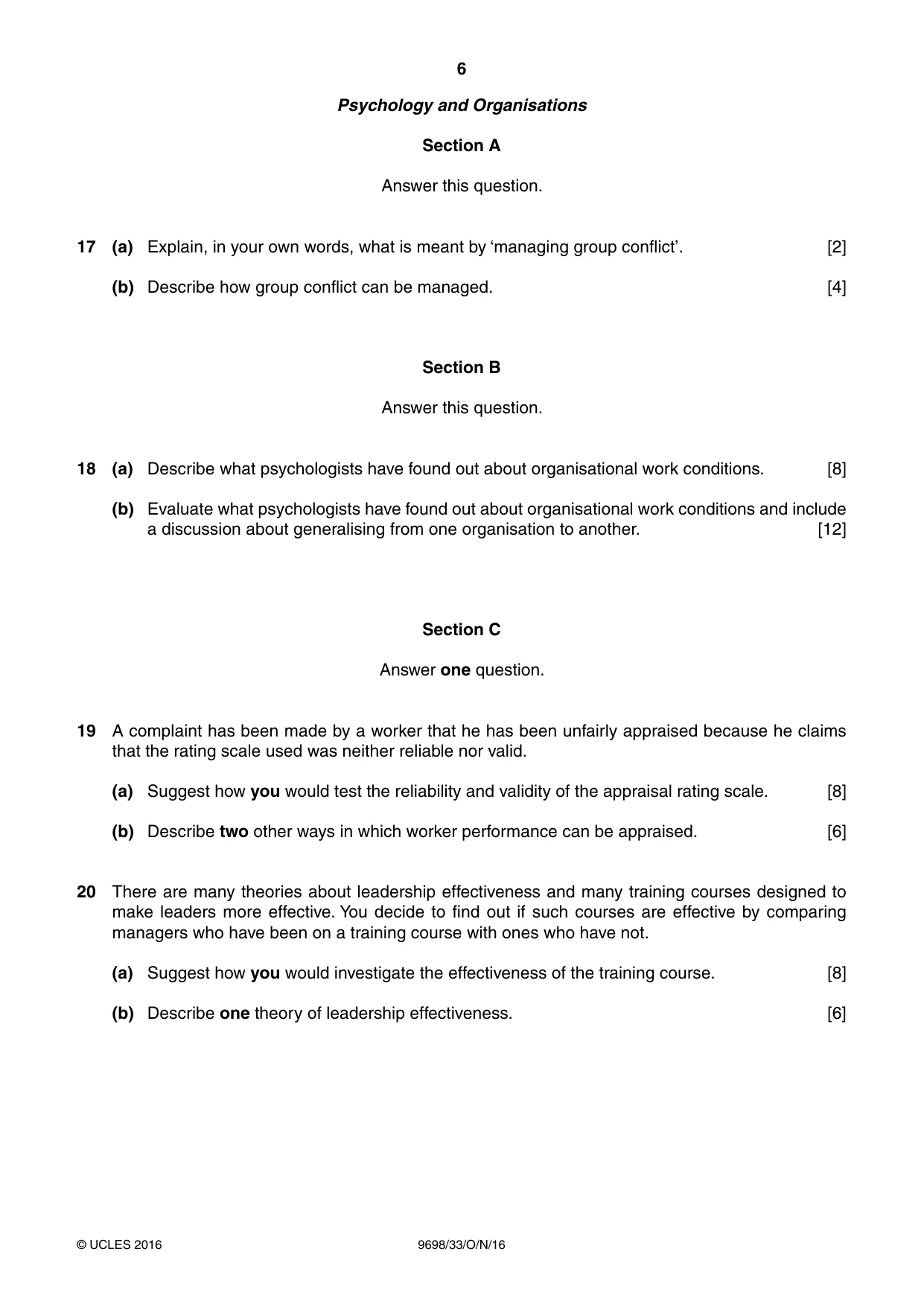
6 9698/33/O/N/16 © UCLES 2016 Psychology and Organisations Section A Answer this question. 17 (a) Explain, in your own words, what is meant by ‘managing group conflict’. [2] (b) Describe how group conflict can be managed. [4] Section B Answer this question. 18 (a) Describe what psychologists have found out about organisational work conditions. [8] (b) Evaluate what psychologists have found out about organisational work conditions and include a discussion about generalising from one organisation to another. [12] Section C Answer one question. 19 A complaint has been made by a worker that he has been unfairly appraised because he claims that the rating scale used was neither reliable nor valid. (a) Suggest how you would test the reliability and validity of the appraisal rating scale. [8] (b) Describe two other ways in which worker performance can be appraised. [6] 20 There are many theories about leadership effectiveness and many training courses designed to make leaders more effective. You decide to find out if such courses are effective by comparing managers who have been on a training course with ones who have not. (a) Suggest how you would investigate the effectiveness of the training course. [8] (b) Describe one theory of leadership effectiveness. [6]
Question paper, page 7
7 9698/33/O/N/16 © UCLES 2016 BLANK PAGE
Question paper, page 8
8 9698/33/O/N/16 © UCLES 2016 BLANK PAGE Permission to reproduce items where third-party owned material protected by copyright is included has been sought and cleared where possible. Every reasonable effort has been made by the publisher (UCLES) to trace copyright holders, but if any items requiring clearance have unwittingly been included, the publisher will be pleased to make amends at the earliest possible opportunity. To avoid the issue of disclosure of answer-related information to candidates, all copyright acknowledgements are reproduced online in the Cambridge International Examinations Copyright Acknowledgements Booklet. This is produced for each series of examinations and is freely available to download at www.cie.org.uk after the live examination series. Cambridge International Examinations is part of the Cambridge Assessment Group. Cambridge Assessment is the brand name of University of Cambridge Local Examinations Syndicate (UCLES), which is itself a department of the University of Cambridge.
Mark scheme, page 1
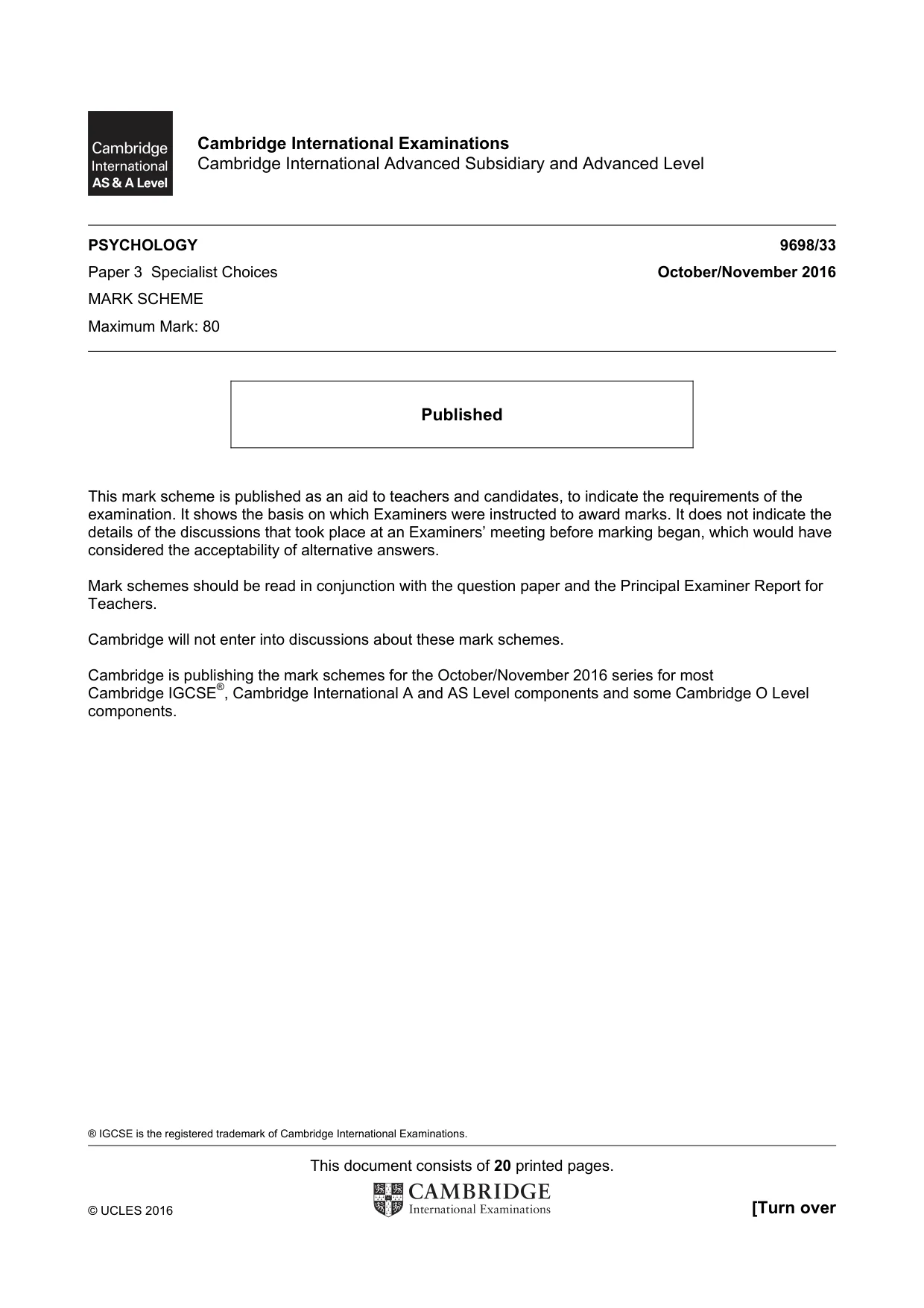
® IGCSE is the registered trademark of Cambridge International Examinations. This document consists of 20 printed pages. © UCLES 2016 [Turn over Cambridge International Examinations Cambridge International Advanced Subsidiary and Advanced Level PSYCHOLOGY 9698/33 Paper 3 Specialist Choices October/November 2016 MARK SCHEME Maximum Mark: 80 Published This mark scheme is published as an aid to teachers and candidates, to indicate the requirements of the examination. It shows the basis on which Examiners were instructed to award marks. It does not indicate the details of the discussions that took place at an Examiners’ meeting before marking began, which would have considered the acceptability of alternative answers. Mark schemes should be read in conjunction with the question paper and the Principal Examiner Report for Teachers. Cambridge will not enter into discussions about these mark schemes. Cambridge is publishing the mark schemes for the October/November 2016 series for most Cambridge IGCSE®, Cambridge International A and AS Level components and some Cambridge O Level components.
Mark scheme, page 2
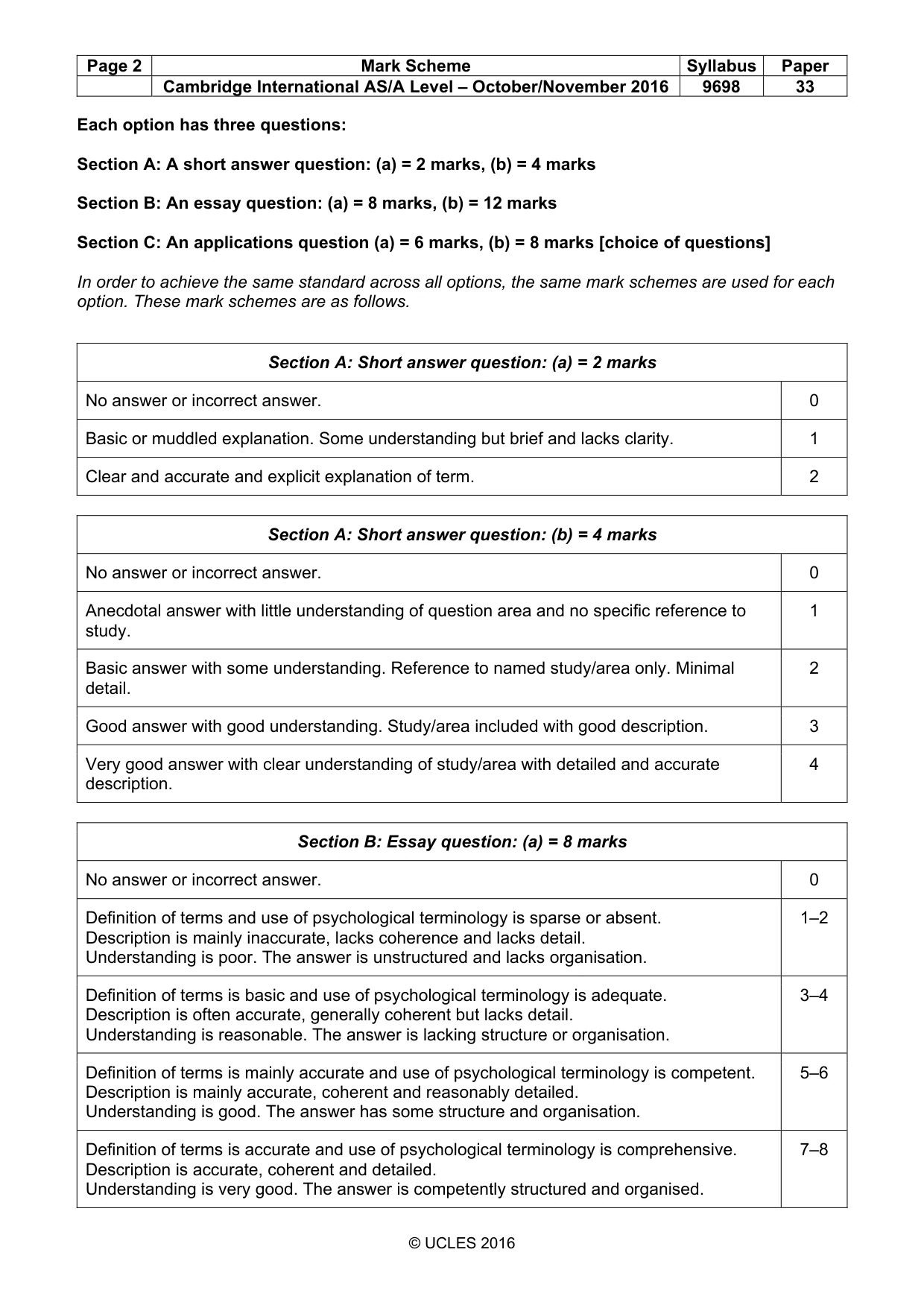
Page 2 Mark Scheme Syllabus Paper Cambridge International AS/A Level – October/November 2016 9698 33 © UCLES 2016 Each option has three questions: Section A: A short answer question: (a) = 2 marks, (b) = 4 marks Section B: An essay question: (a) = 8 marks, (b) = 12 marks Section C: An applications question (a) = 6 marks, (b) = 8 marks [choice of questions] In order to achieve the same standard across all options, the same mark schemes are used for each option. These mark schemes are as follows. Section A: Short answer question: (a) = 2 marks No answer or incorrect answer. 0 Basic or muddled explanation. Some understanding but brief and lacks clarity. 1 Clear and accurate and explicit explanation of term. 2 Section A: Short answer question: (b) = 4 marks No answer or incorrect answer. 0 Anecdotal answer with little understanding of question area and no specific reference to study. 1 Basic answer with some understanding. Reference to named study/area only. Minimal detail. 2 Good answer with good understanding. Study/area included with good description. 3 Very good answer with clear understanding of study/area with detailed and accurate description. 4 Section B: Essay question: (a) = 8 marks No answer or incorrect answer. 0 Definition of terms and use of psychological terminology is sparse or absent. Description is mainly inaccurate, lacks coherence and lacks detail. Understanding is poor. The answer is unstructured and lacks organisation. 1–2 Definition of terms is basic and use of psychological terminology is adequate. Description is often accurate, generally coherent but lacks detail. Understanding is reasonable. The answer is lacking structure or organisation. 3–4 Definition of terms is mainly accurate and use of psychological terminology is competent. Description is mainly accurate, coherent and reasonably detailed. Understanding is good. The answer has some structure and organisation. 5–6 Definition of terms is accurate and use of psychological terminology is comprehensive. Description is accurate, coherent and detailed. Understanding is very good. The answer is competently structured and organised. 7–8
Mark scheme, page 3
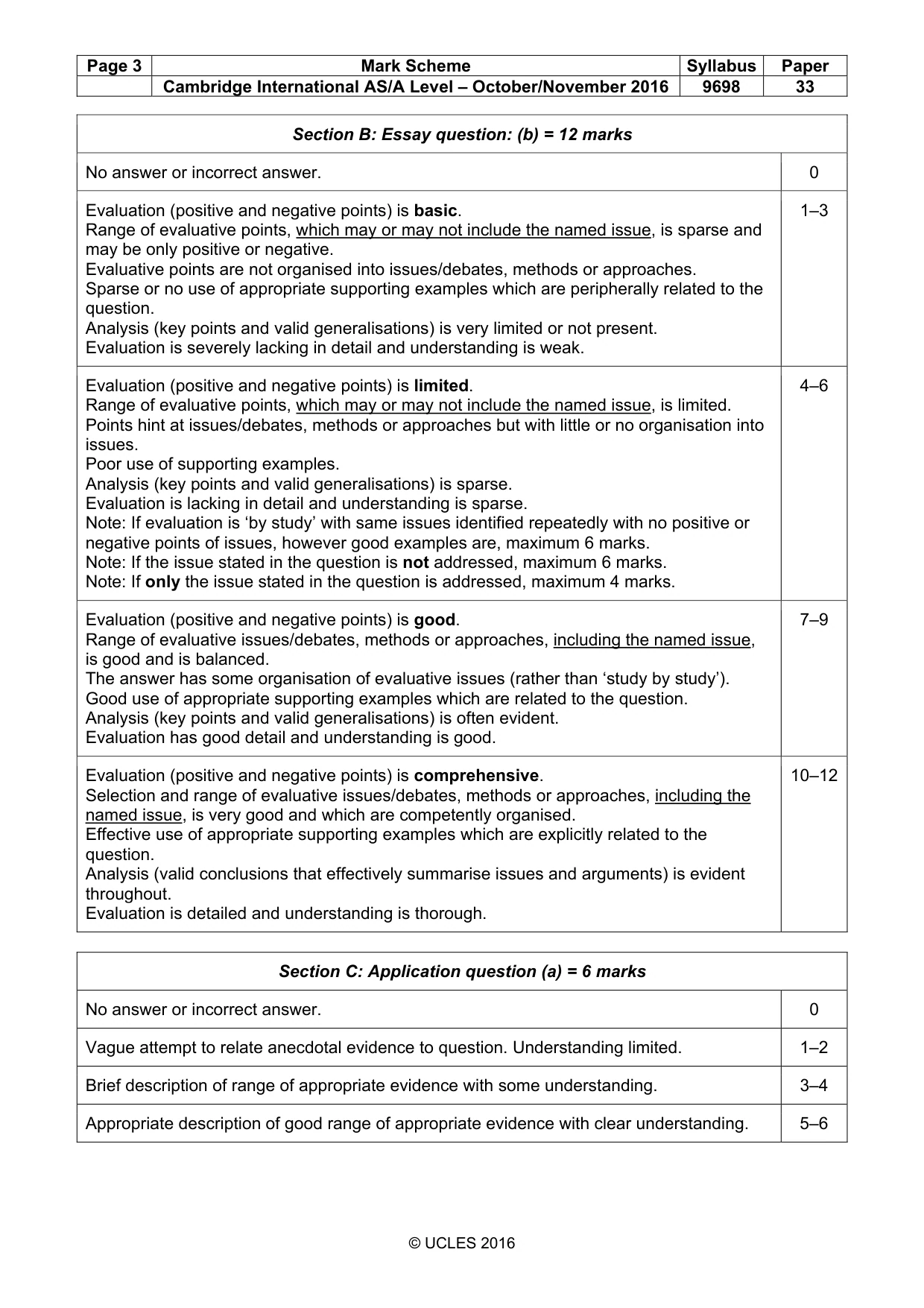
Page 3 Mark Scheme Syllabus Paper Cambridge International AS/A Level – October/November 2016 9698 33 © UCLES 2016 Section B: Essay question: (b) = 12 marks No answer or incorrect answer. 0 Evaluation (positive and negative points) is basic. Range of evaluative points, which may or may not include the named issue, is sparse and may be only positive or negative. Evaluative points are not organised into issues/debates, methods or approaches. Sparse or no use of appropriate supporting examples which are peripherally related to the question. Analysis (key points and valid generalisations) is very limited or not present. Evaluation is severely lacking in detail and understanding is weak. 1–3 Evaluation (positive and negative points) is limited. Range of evaluative points, which may or may not include the named issue, is limited. Points hint at issues/debates, methods or approaches but with little or no organisation into issues. Poor use of supporting examples. Analysis (key points and valid generalisations) is sparse. Evaluation is lacking in detail and understanding is sparse. Note: If evaluation is ‘by study’ with same issues identified repeatedly with no positive or negative points of issues, however good examples are, maximum 6 marks. Note: If the issue stated in the question is not addressed, maximum 6 marks. Note: If only the issue stated in the question is addressed, maximum 4 marks. 4–6 Evaluation (positive and negative points) is good. Range of evaluative issues/debates, methods or approaches, including the named issue, is good and is balanced. The answer has some organisation of evaluative issues (rather than ‘study by study’). Good use of appropriate supporting examples which are related to the question. Analysis (key points and valid generalisations) is often evident. Evaluation has good detail and understanding is good. 7–9 Evaluation (positive and negative points) is comprehensive. Selection and range of evaluative issues/debates, methods or approaches, including the named issue, is very good and which are competently organised. Effective use of appropriate supporting examples which are explicitly related to the question. Analysis (valid conclusions that effectively summarise issues and arguments) is evident throughout. Evaluation is detailed and understanding is thorough. 10–12 Section C: Application question (a) = 6 marks No answer or incorrect answer. 0 Vague attempt to relate anecdotal evidence to question. Understanding limited. 1–2 Brief description of range of appropriate evidence with some understanding. 3–4 Appropriate description of good range of appropriate evidence with clear understanding. 5–6
Mark scheme, page 4
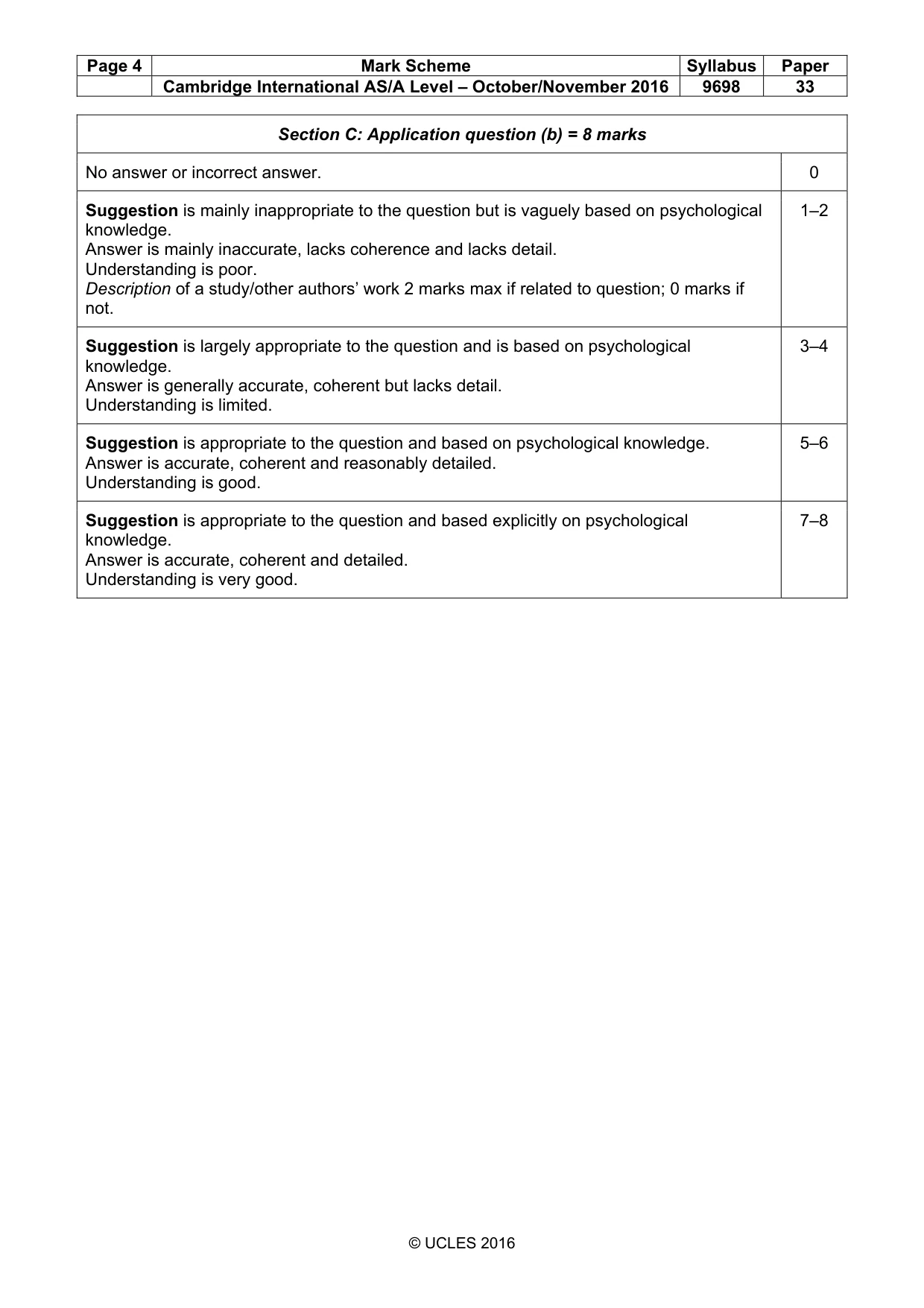
Page 4 Mark Scheme Syllabus Paper Cambridge International AS/A Level – October/November 2016 9698 33 © UCLES 2016 Section C: Application question (b) = 8 marks No answer or incorrect answer. 0 Suggestion is mainly inappropriate to the question but is vaguely based on psychological knowledge. Answer is mainly inaccurate, lacks coherence and lacks detail. Understanding is poor. Description of a study/other authors’ work 2 marks max if related to question; 0 marks if not. 1–2 Suggestion is largely appropriate to the question and is based on psychological knowledge. Answer is generally accurate, coherent but lacks detail. Understanding is limited. 3–4 Suggestion is appropriate to the question and based on psychological knowledge. Answer is accurate, coherent and reasonably detailed. Understanding is good. 5–6 Suggestion is appropriate to the question and based explicitly on psychological knowledge. Answer is accurate, coherent and detailed. Understanding is very good. 7–8
Mark scheme, page 5
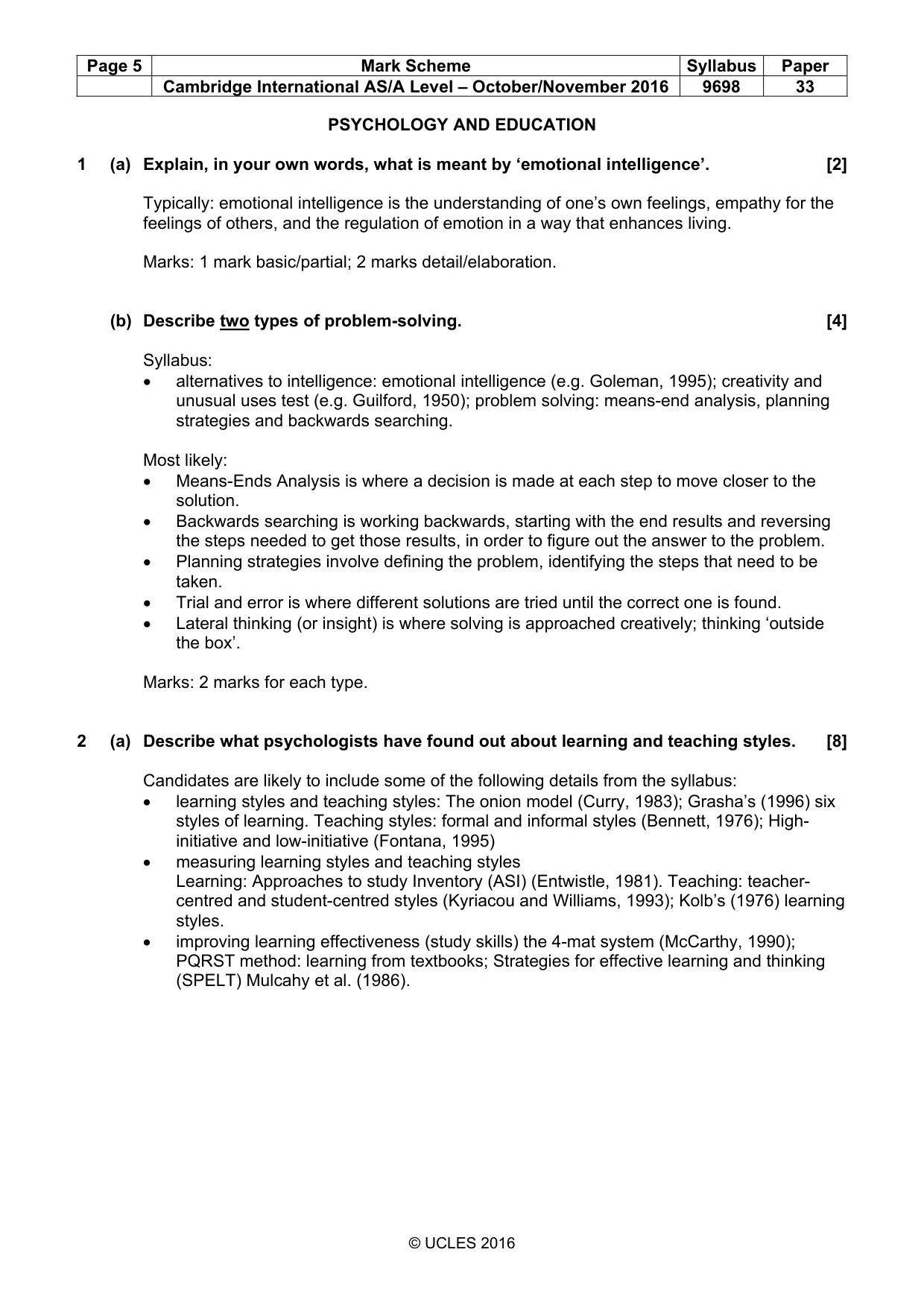
Page 5 Mark Scheme Syllabus Paper Cambridge International AS/A Level – October/November 2016 9698 33 © UCLES 2016 PSYCHOLOGY AND EDUCATION 1 (a) Explain, in your own words, what is meant by ‘emotional intelligence’. [2] Typically: emotional intelligence is the understanding of one’s own feelings, empathy for the feelings of others, and the regulation of emotion in a way that enhances living. Marks: 1 mark basic/partial; 2 marks detail/elaboration. (b) Describe two types of problem-solving. [4] Syllabus: • alternatives to intelligence: emotional intelligence (e.g. Goleman, 1995); creativity and unusual uses test (e.g. Guilford, 1950); problem solving: means-end analysis, planning strategies and backwards searching. Most likely: • Means-Ends Analysis is where a decision is made at each step to move closer to the solution. • Backwards searching is working backwards, starting with the end results and reversing the steps needed to get those results, in order to figure out the answer to the problem. • Planning strategies involve defining the problem, identifying the steps that need to be taken. • Trial and error is where different solutions are tried until the correct one is found. • Lateral thinking (or insight) is where solving is approached creatively; thinking ‘outside the box’. Marks: 2 marks for each type. 2 (a) Describe what psychologists have found out about learning and teaching styles. [8] Candidates are likely to include some of the following details from the syllabus: • learning styles and teaching styles: The onion model (Curry, 1983); Grasha’s (1996) six styles of learning. Teaching styles: formal and informal styles (Bennett, 1976); High- initiative and low-initiative (Fontana, 1995) • measuring learning styles and teaching styles Learning: Approaches to study Inventory (ASI) (Entwistle, 1981). Teaching: teacher- centred and student-centred styles (Kyriacou and Williams, 1993); Kolb’s (1976) learning styles. • improving learning effectiveness (study skills) the 4-mat system (McCarthy, 1990); PQRST method: learning from textbooks; Strategies for effective learning and thinking (SPELT) Mulcahy et al. (1986).
Mark scheme, page 6
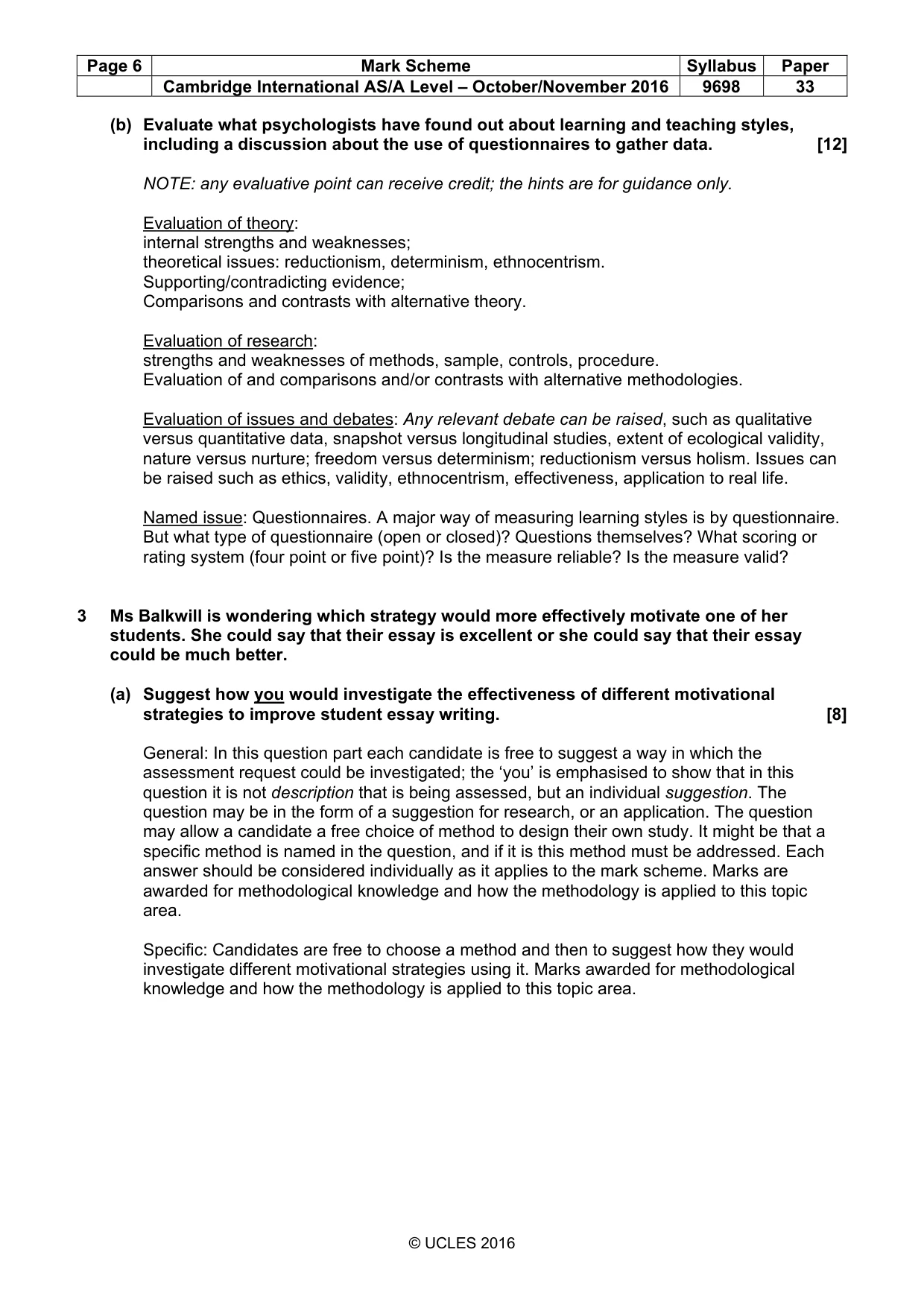
Page 6 Mark Scheme Syllabus Paper Cambridge International AS/A Level – October/November 2016 9698 33 © UCLES 2016 (b) Evaluate what psychologists have found out about learning and teaching styles, including a discussion about the use of questionnaires to gather data. [12] NOTE: any evaluative point can receive credit; the hints are for guidance only. Evaluation of theory: internal strengths and weaknesses; theoretical issues: reductionism, determinism, ethnocentrism. Supporting/contradicting evidence; Comparisons and contrasts with alternative theory. Evaluation of research: strengths and weaknesses of methods, sample, controls, procedure. Evaluation of and comparisons and/or contrasts with alternative methodologies. Evaluation of issues and debates: Any relevant debate can be raised, such as qualitative versus quantitative data, snapshot versus longitudinal studies, extent of ecological validity, nature versus nurture; freedom versus determinism; reductionism versus holism. Issues can be raised such as ethics, validity, ethnocentrism, effectiveness, application to real life. Named issue: Questionnaires. A major way of measuring learning styles is by questionnaire. But what type of questionnaire (open or closed)? Questions themselves? What scoring or rating system (four point or five point)? Is the measure reliable? Is the measure valid? 3 Ms Balkwill is wondering which strategy would more effectively motivate one of her students. She could say that their essay is excellent or she could say that their essay could be much better. (a) Suggest how you would investigate the effectiveness of different motivational strategies to improve student essay writing. [8] General: In this question part each candidate is free to suggest a way in which the assessment request could be investigated; the ‘you’ is emphasised to show that in this question it is not description that is being assessed, but an individual suggestion. The question may be in the form of a suggestion for research, or an application. The question may allow a candidate a free choice of method to design their own study. It might be that a specific method is named in the question, and if it is this method must be addressed. Each answer should be considered individually as it applies to the mark scheme. Marks are awarded for methodological knowledge and how the methodology is applied to this topic area. Specific: Candidates are free to choose a method and then to suggest how they would investigate different motivational strategies using it. Marks awarded for methodological knowledge and how the methodology is applied to this topic area.
Mark scheme, page 7
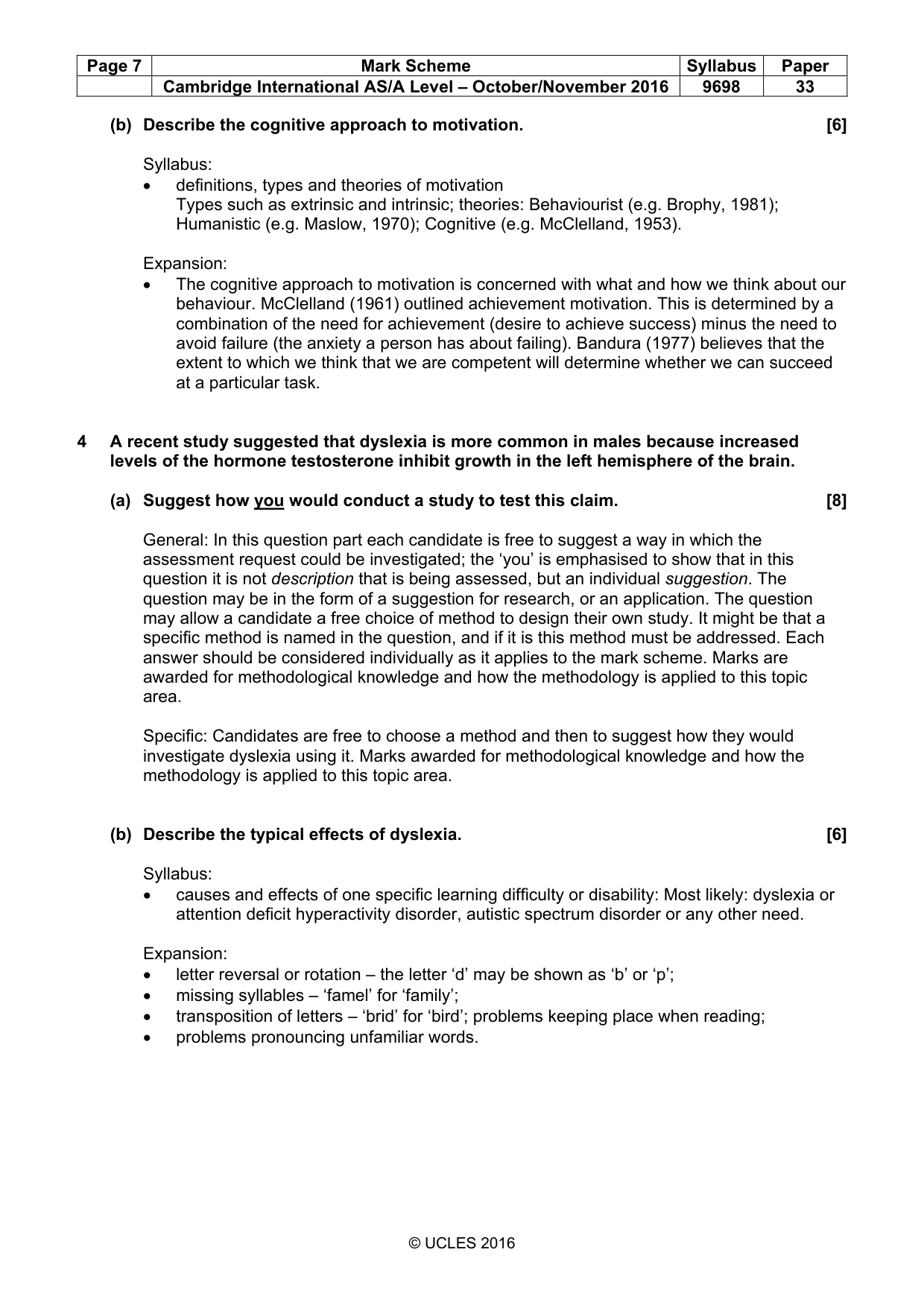
Page 7 Mark Scheme Syllabus Paper Cambridge International AS/A Level – October/November 2016 9698 33 © UCLES 2016 (b) Describe the cognitive approach to motivation. [6] Syllabus: • definitions, types and theories of motivation Types such as extrinsic and intrinsic; theories: Behaviourist (e.g. Brophy, 1981); Humanistic (e.g. Maslow, 1970); Cognitive (e.g. McClelland, 1953). Expansion: • The cognitive approach to motivation is concerned with what and how we think about our behaviour. McClelland (1961) outlined achievement motivation. This is determined by a combination of the need for achievement (desire to achieve success) minus the need to avoid failure (the anxiety a person has about failing). Bandura (1977) believes that the extent to which we think that we are competent will determine whether we can succeed at a particular task. 4 A recent study suggested that dyslexia is more common in males because increased levels of the hormone testosterone inhibit growth in the left hemisphere of the brain. (a) Suggest how you would conduct a study to test this claim. [8] General: In this question part each candidate is free to suggest a way in which the assessment request could be investigated; the ‘you’ is emphasised to show that in this question it is not description that is being assessed, but an individual suggestion. The question may be in the form of a suggestion for research, or an application. The question may allow a candidate a free choice of method to design their own study. It might be that a specific method is named in the question, and if it is this method must be addressed. Each answer should be considered individually as it applies to the mark scheme. Marks are awarded for methodological knowledge and how the methodology is applied to this topic area. Specific: Candidates are free to choose a method and then to suggest how they would investigate dyslexia using it. Marks awarded for methodological knowledge and how the methodology is applied to this topic area. (b) Describe the typical effects of dyslexia. [6] Syllabus: • causes and effects of one specific learning difficulty or disability: Most likely: dyslexia or attention deficit hyperactivity disorder, autistic spectrum disorder or any other need. Expansion: • letter reversal or rotation – the letter ‘d’ may be shown as ‘b’ or ‘p’; • missing syllables – ‘famel’ for ‘family’; • transposition of letters – ‘brid’ for ‘bird’; problems keeping place when reading; • problems pronouncing unfamiliar words.
Mark scheme, page 8
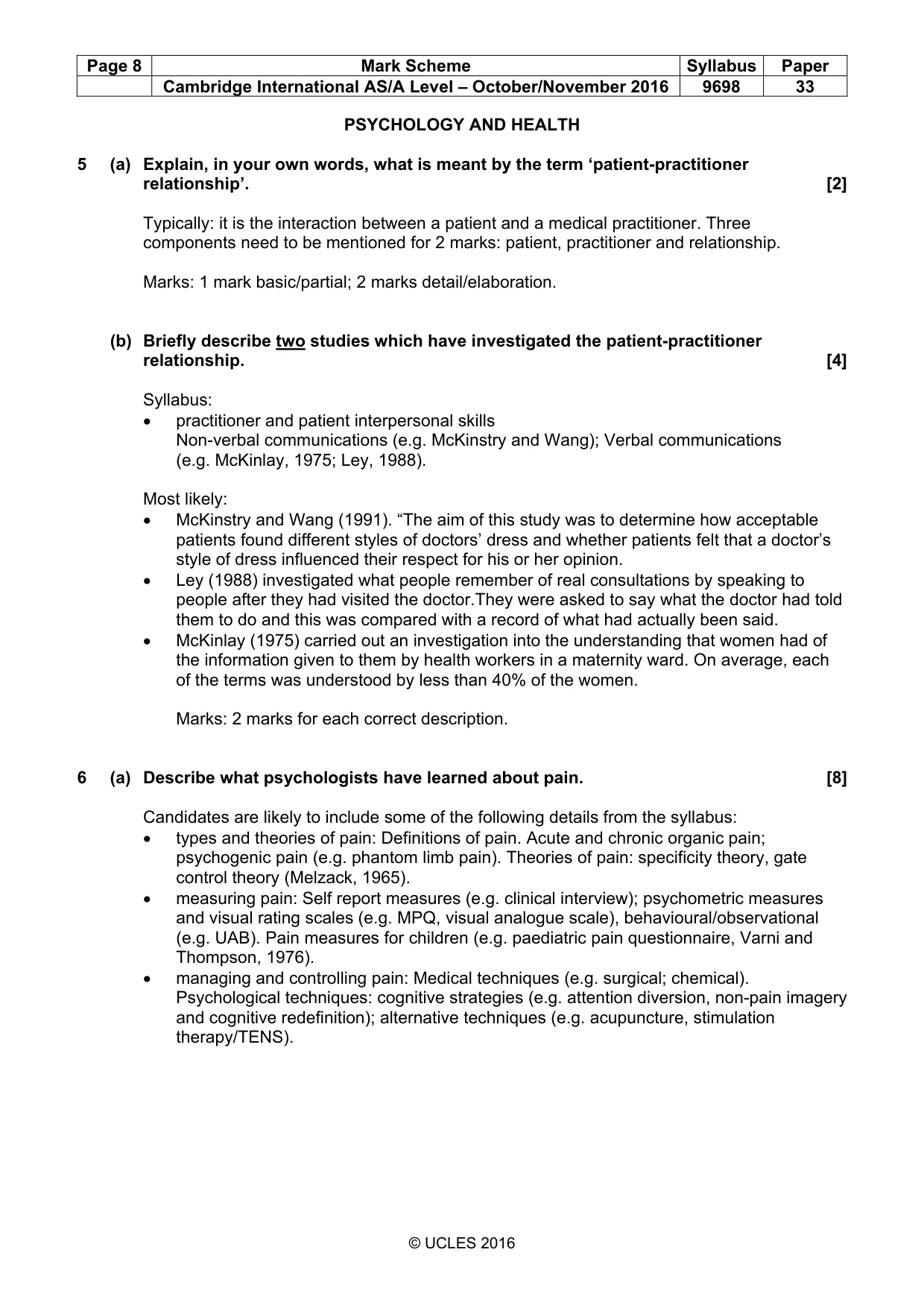
Page 8 Mark Scheme Syllabus Paper Cambridge International AS/A Level – October/November 2016 9698 33 © UCLES 2016 PSYCHOLOGY AND HEALTH 5 (a) Explain, in your own words, what is meant by the term ‘patient-practitioner relationship’. [2] Typically: it is the interaction between a patient and a medical practitioner. Three components need to be mentioned for 2 marks: patient, practitioner and relationship. Marks: 1 mark basic/partial; 2 marks detail/elaboration. (b) Briefly describe two studies which have investigated the patient-practitioner relationship. [4] Syllabus: • practitioner and patient interpersonal skills Non-verbal communications (e.g. McKinstry and Wang); Verbal communications (e.g. McKinlay, 1975; Ley, 1988). Most likely: • McKinstry and Wang (1991). “The aim of this study was to determine how acceptable patients found different styles of doctors’ dress and whether patients felt that a doctor’s style of dress influenced their respect for his or her opinion. • Ley (1988) investigated what people remember of real consultations by speaking to people after they had visited the doctor.They were asked to say what the doctor had told them to do and this was compared with a record of what had actually been said. • McKinlay (1975) carried out an investigation into the understanding that women had of the information given to them by health workers in a maternity ward. On average, each of the terms was understood by less than 40% of the women. Marks: 2 marks for each correct description. 6 (a) Describe what psychologists have learned about pain. [8] Candidates are likely to include some of the following details from the syllabus: • types and theories of pain: Definitions of pain. Acute and chronic organic pain; psychogenic pain (e.g. phantom limb pain). Theories of pain: specificity theory, gate control theory (Melzack, 1965). • measuring pain: Self report measures (e.g. clinical interview); psychometric measures and visual rating scales (e.g. MPQ, visual analogue scale), behavioural/observational (e.g. UAB). Pain measures for children (e.g. paediatric pain questionnaire, Varni and Thompson, 1976). • managing and controlling pain: Medical techniques (e.g. surgical; chemical). Psychological techniques: cognitive strategies (e.g. attention diversion, non-pain imagery and cognitive redefinition); alternative techniques (e.g. acupuncture, stimulation therapy/TENS).
Mark scheme, page 9
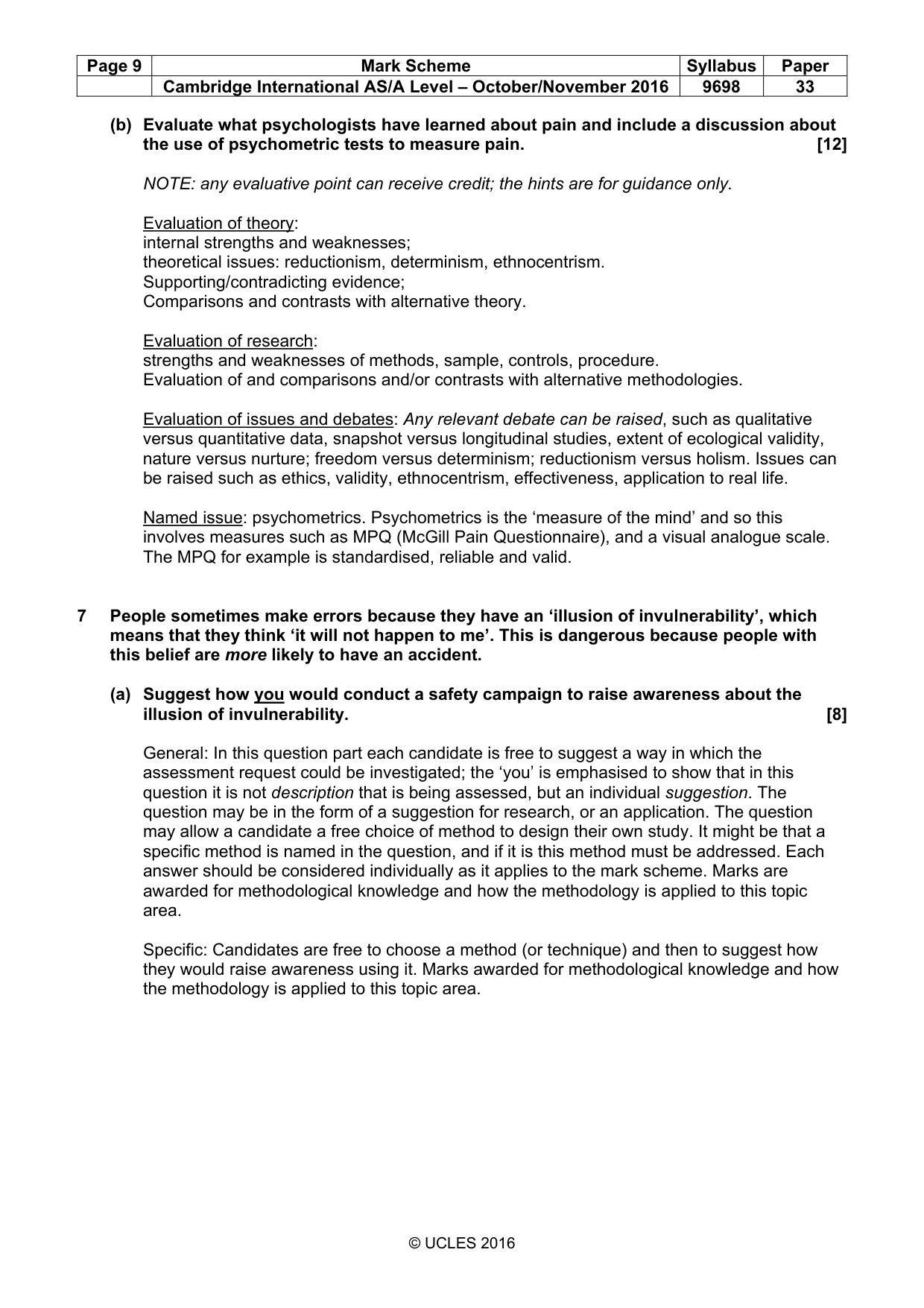
Page 9 Mark Scheme Syllabus Paper Cambridge International AS/A Level – October/November 2016 9698 33 © UCLES 2016 (b) Evaluate what psychologists have learned about pain and include a discussion about the use of psychometric tests to measure pain. [12] NOTE: any evaluative point can receive credit; the hints are for guidance only. Evaluation of theory: internal strengths and weaknesses; theoretical issues: reductionism, determinism, ethnocentrism. Supporting/contradicting evidence; Comparisons and contrasts with alternative theory. Evaluation of research: strengths and weaknesses of methods, sample, controls, procedure. Evaluation of and comparisons and/or contrasts with alternative methodologies. Evaluation of issues and debates: Any relevant debate can be raised, such as qualitative versus quantitative data, snapshot versus longitudinal studies, extent of ecological validity, nature versus nurture; freedom versus determinism; reductionism versus holism. Issues can be raised such as ethics, validity, ethnocentrism, effectiveness, application to real life. Named issue: psychometrics. Psychometrics is the ‘measure of the mind’ and so this involves measures such as MPQ (McGill Pain Questionnaire), and a visual analogue scale. The MPQ for example is standardised, reliable and valid. 7 People sometimes make errors because they have an ‘illusion of invulnerability’, which means that they think ‘it will not happen to me’. This is dangerous because people with this belief are more likely to have an accident. (a) Suggest how you would conduct a safety campaign to raise awareness about the illusion of invulnerability. [8] General: In this question part each candidate is free to suggest a way in which the assessment request could be investigated; the ‘you’ is emphasised to show that in this question it is not description that is being assessed, but an individual suggestion. The question may be in the form of a suggestion for research, or an application. The question may allow a candidate a free choice of method to design their own study. It might be that a specific method is named in the question, and if it is this method must be addressed. Each answer should be considered individually as it applies to the mark scheme. Marks are awarded for methodological knowledge and how the methodology is applied to this topic area. Specific: Candidates are free to choose a method (or technique) and then to suggest how they would raise awareness using it. Marks awarded for methodological knowledge and how the methodology is applied to this topic area.
Mark scheme, page 10
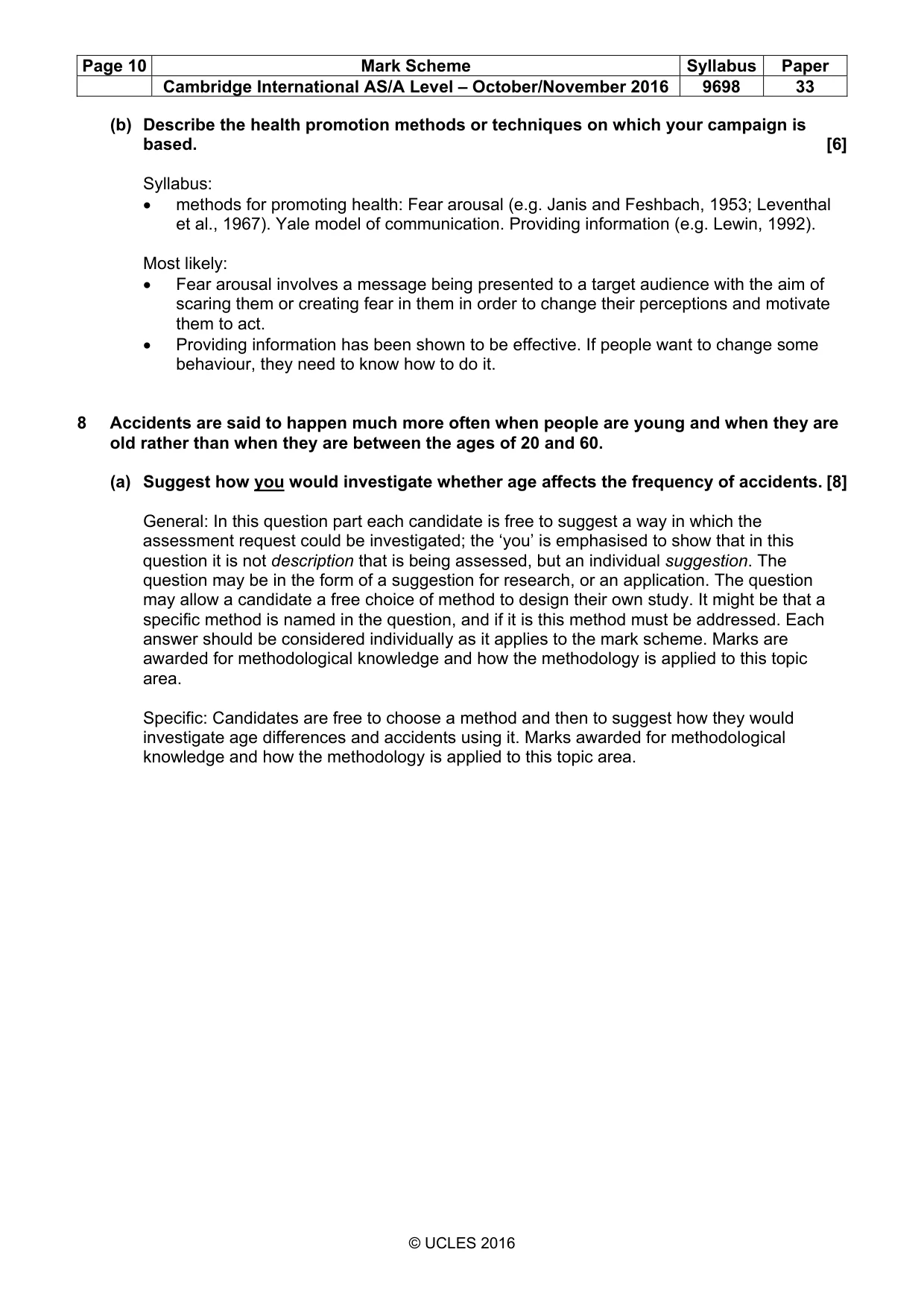
Page 10 Mark Scheme Syllabus Paper Cambridge International AS/A Level – October/November 2016 9698 33 © UCLES 2016 (b) Describe the health promotion methods or techniques on which your campaign is based. [6] Syllabus: • methods for promoting health: Fear arousal (e.g. Janis and Feshbach, 1953; Leventhal et al., 1967). Yale model of communication. Providing information (e.g. Lewin, 1992). Most likely: • Fear arousal involves a message being presented to a target audience with the aim of scaring them or creating fear in them in order to change their perceptions and motivate them to act. • Providing information has been shown to be effective. If people want to change some behaviour, they need to know how to do it. 8 Accidents are said to happen much more often when people are young and when they are old rather than when they are between the ages of 20 and 60. (a) Suggest how you would investigate whether age affects the frequency of accidents. [8] General: In this question part each candidate is free to suggest a way in which the assessment request could be investigated; the ‘you’ is emphasised to show that in this question it is not description that is being assessed, but an individual suggestion. The question may be in the form of a suggestion for research, or an application. The question may allow a candidate a free choice of method to design their own study. It might be that a specific method is named in the question, and if it is this method must be addressed. Each answer should be considered individually as it applies to the mark scheme. Marks are awarded for methodological knowledge and how the methodology is applied to this topic area. Specific: Candidates are free to choose a method and then to suggest how they would investigate age differences and accidents using it. Marks awarded for methodological knowledge and how the methodology is applied to this topic area.
Mark scheme, page 11
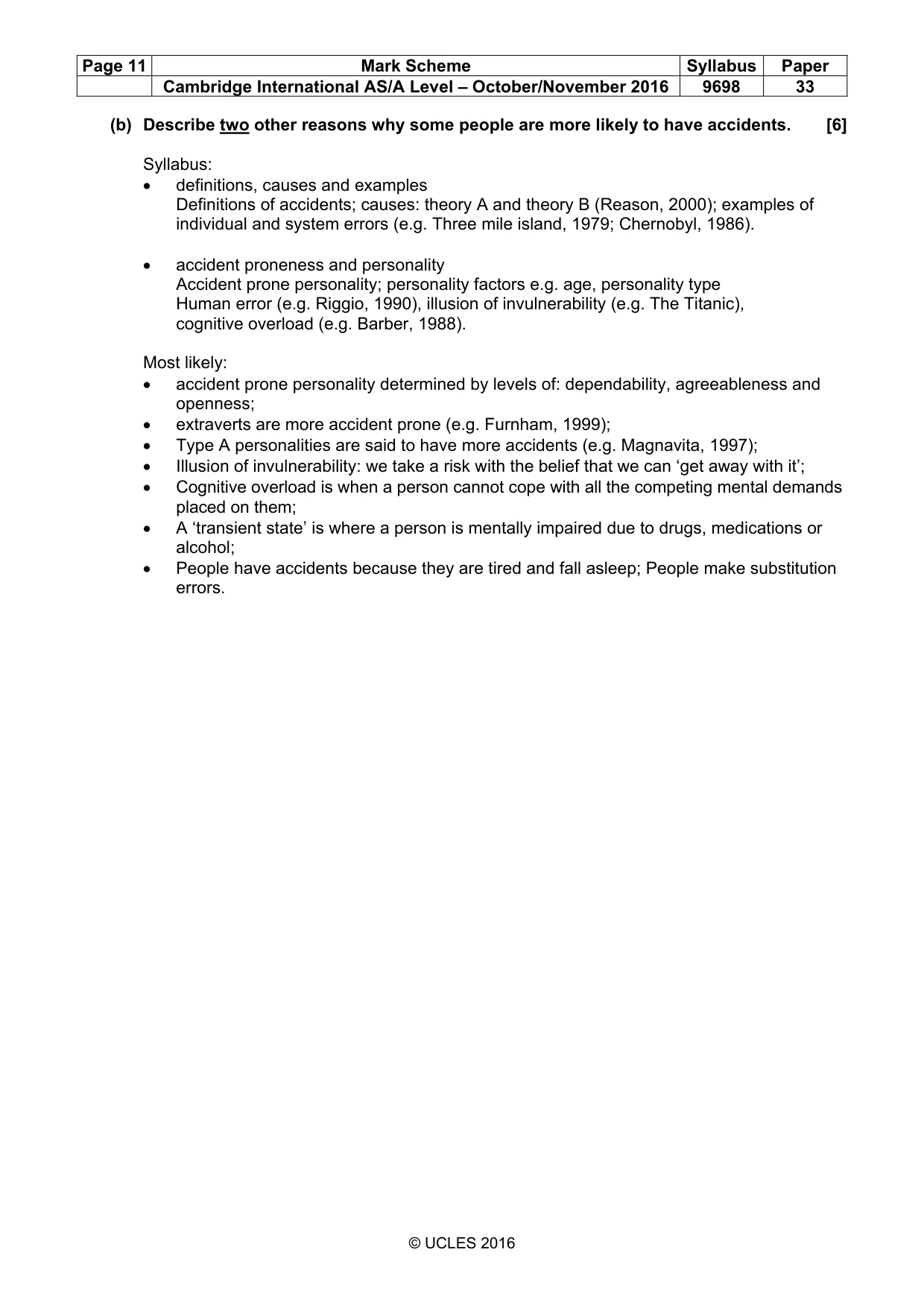
Page 11 Mark Scheme Syllabus Paper Cambridge International AS/A Level – October/November 2016 9698 33 © UCLES 2016 (b) Describe two other reasons why some people are more likely to have accidents. [6] Syllabus: • definitions, causes and examples Definitions of accidents; causes: theory A and theory B (Reason, 2000); examples of individual and system errors (e.g. Three mile island, 1979; Chernobyl, 1986). • accident proneness and personality Accident prone personality; personality factors e.g. age, personality type Human error (e.g. Riggio, 1990), illusion of invulnerability (e.g. The Titanic), cognitive overload (e.g. Barber, 1988). Most likely: • accident prone personality determined by levels of: dependability, agreeableness and openness; • extraverts are more accident prone (e.g. Furnham, 1999); • Type A personalities are said to have more accidents (e.g. Magnavita, 1997); • Illusion of invulnerability: we take a risk with the belief that we can ‘get away with it’; • Cognitive overload is when a person cannot cope with all the competing mental demands placed on them; • A ‘transient state’ is where a person is mentally impaired due to drugs, medications or alcohol; • People have accidents because they are tired and fall asleep; People make substitution errors.
Mark scheme, page 12
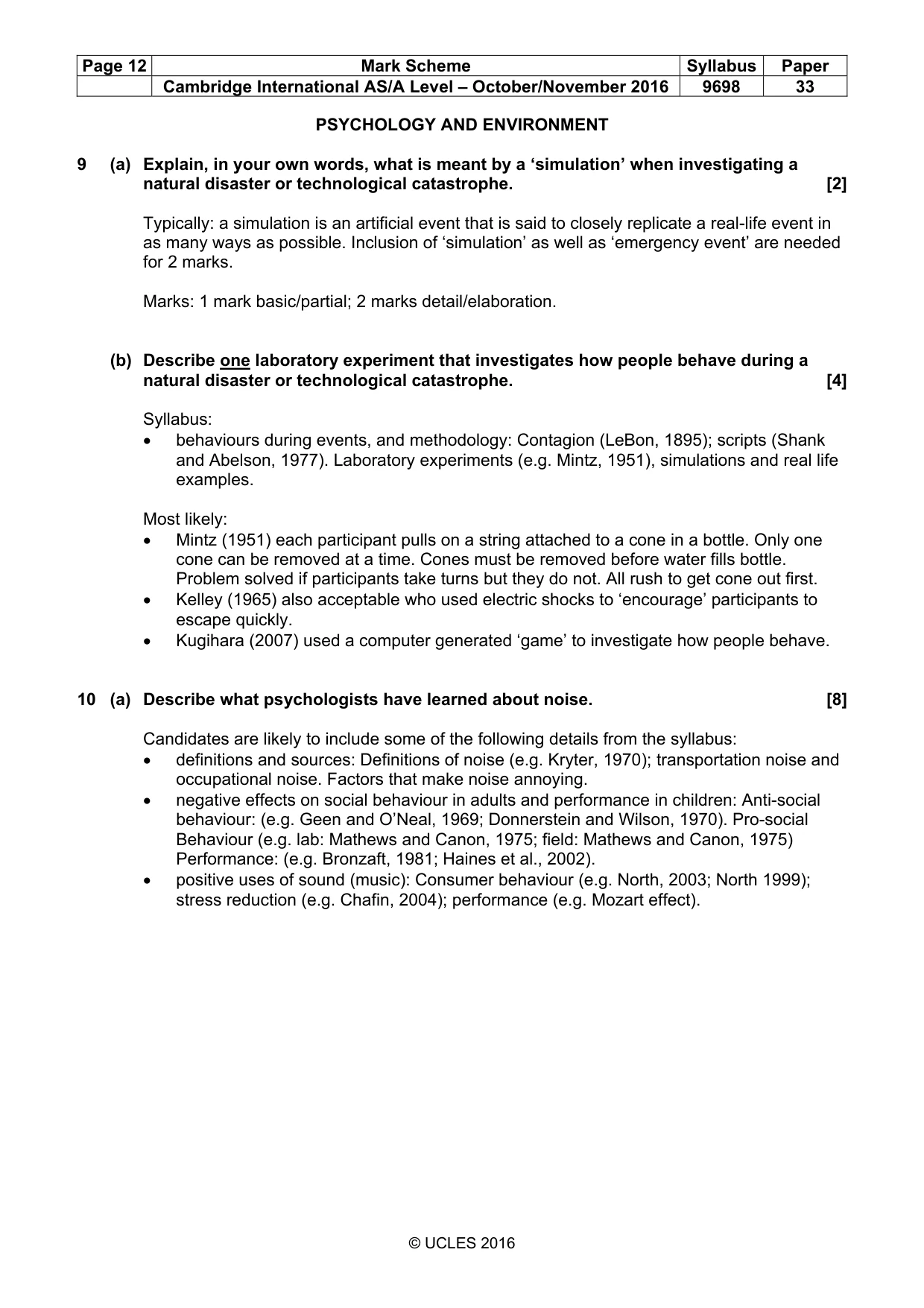
Page 12 Mark Scheme Syllabus Paper Cambridge International AS/A Level – October/November 2016 9698 33 © UCLES 2016 PSYCHOLOGY AND ENVIRONMENT 9 (a) Explain, in your own words, what is meant by a ‘simulation’ when investigating a natural disaster or technological catastrophe. [2] Typically: a simulation is an artificial event that is said to closely replicate a real-life event in as many ways as possible. Inclusion of ‘simulation’ as well as ‘emergency event’ are needed for 2 marks. Marks: 1 mark basic/partial; 2 marks detail/elaboration. (b) Describe one laboratory experiment that investigates how people behave during a natural disaster or technological catastrophe. [4] Syllabus: • behaviours during events, and methodology: Contagion (LeBon, 1895); scripts (Shank and Abelson, 1977). Laboratory experiments (e.g. Mintz, 1951), simulations and real life examples. Most likely: • Mintz (1951) each participant pulls on a string attached to a cone in a bottle. Only one cone can be removed at a time. Cones must be removed before water fills bottle. Problem solved if participants take turns but they do not. All rush to get cone out first. • Kelley (1965) also acceptable who used electric shocks to ‘encourage’ participants to escape quickly. • Kugihara (2007) used a computer generated ‘game’ to investigate how people behave. 10 (a) Describe what psychologists have learned about noise. [8] Candidates are likely to include some of the following details from the syllabus: • definitions and sources: Definitions of noise (e.g. Kryter, 1970); transportation noise and occupational noise. Factors that make noise annoying. • negative effects on social behaviour in adults and performance in children: Anti-social behaviour: (e.g. Geen and O’Neal, 1969; Donnerstein and Wilson, 1970). Pro-social Behaviour (e.g. lab: Mathews and Canon, 1975; field: Mathews and Canon, 1975) Performance: (e.g. Bronzaft, 1981; Haines et al., 2002). • positive uses of sound (music): Consumer behaviour (e.g. North, 2003; North 1999); stress reduction (e.g. Chafin, 2004); performance (e.g. Mozart effect).
Mark scheme, page 13
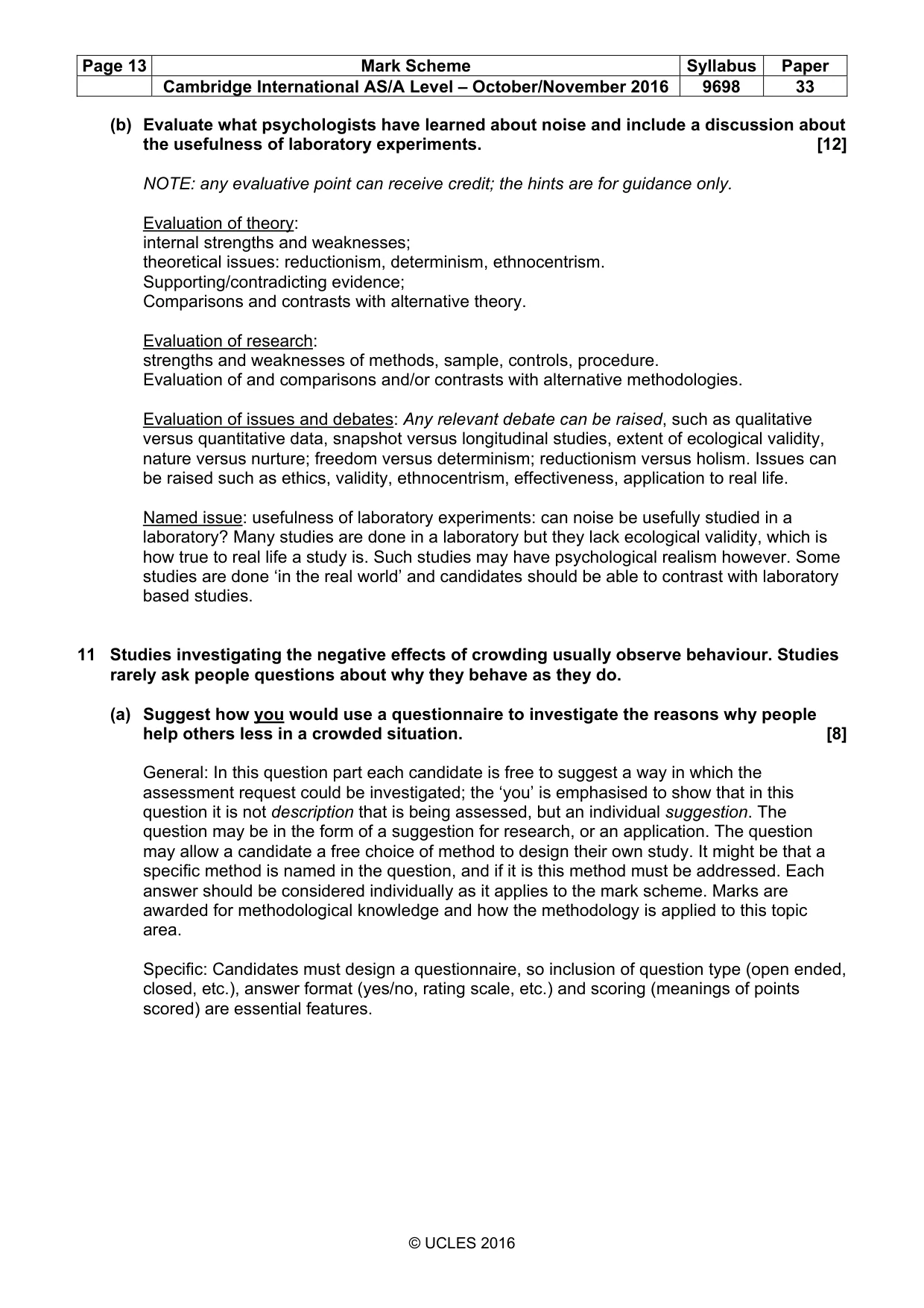
Page 13 Mark Scheme Syllabus Paper Cambridge International AS/A Level – October/November 2016 9698 33 © UCLES 2016 (b) Evaluate what psychologists have learned about noise and include a discussion about the usefulness of laboratory experiments. [12] NOTE: any evaluative point can receive credit; the hints are for guidance only. Evaluation of theory: internal strengths and weaknesses; theoretical issues: reductionism, determinism, ethnocentrism. Supporting/contradicting evidence; Comparisons and contrasts with alternative theory. Evaluation of research: strengths and weaknesses of methods, sample, controls, procedure. Evaluation of and comparisons and/or contrasts with alternative methodologies. Evaluation of issues and debates: Any relevant debate can be raised, such as qualitative versus quantitative data, snapshot versus longitudinal studies, extent of ecological validity, nature versus nurture; freedom versus determinism; reductionism versus holism. Issues can be raised such as ethics, validity, ethnocentrism, effectiveness, application to real life. Named issue: usefulness of laboratory experiments: can noise be usefully studied in a laboratory? Many studies are done in a laboratory but they lack ecological validity, which is how true to real life a study is. Such studies may have psychological realism however. Some studies are done ‘in the real world’ and candidates should be able to contrast with laboratory based studies. 11 Studies investigating the negative effects of crowding usually observe behaviour. Studies rarely ask people questions about why they behave as they do. (a) Suggest how you would use a questionnaire to investigate the reasons why people help others less in a crowded situation. [8] General: In this question part each candidate is free to suggest a way in which the assessment request could be investigated; the ‘you’ is emphasised to show that in this question it is not description that is being assessed, but an individual suggestion. The question may be in the form of a suggestion for research, or an application. The question may allow a candidate a free choice of method to design their own study. It might be that a specific method is named in the question, and if it is this method must be addressed. Each answer should be considered individually as it applies to the mark scheme. Marks are awarded for methodological knowledge and how the methodology is applied to this topic area. Specific: Candidates must design a questionnaire, so inclusion of question type (open ended, closed, etc.), answer format (yes/no, rating scale, etc.) and scoring (meanings of points scored) are essential features.
Mark scheme, page 14
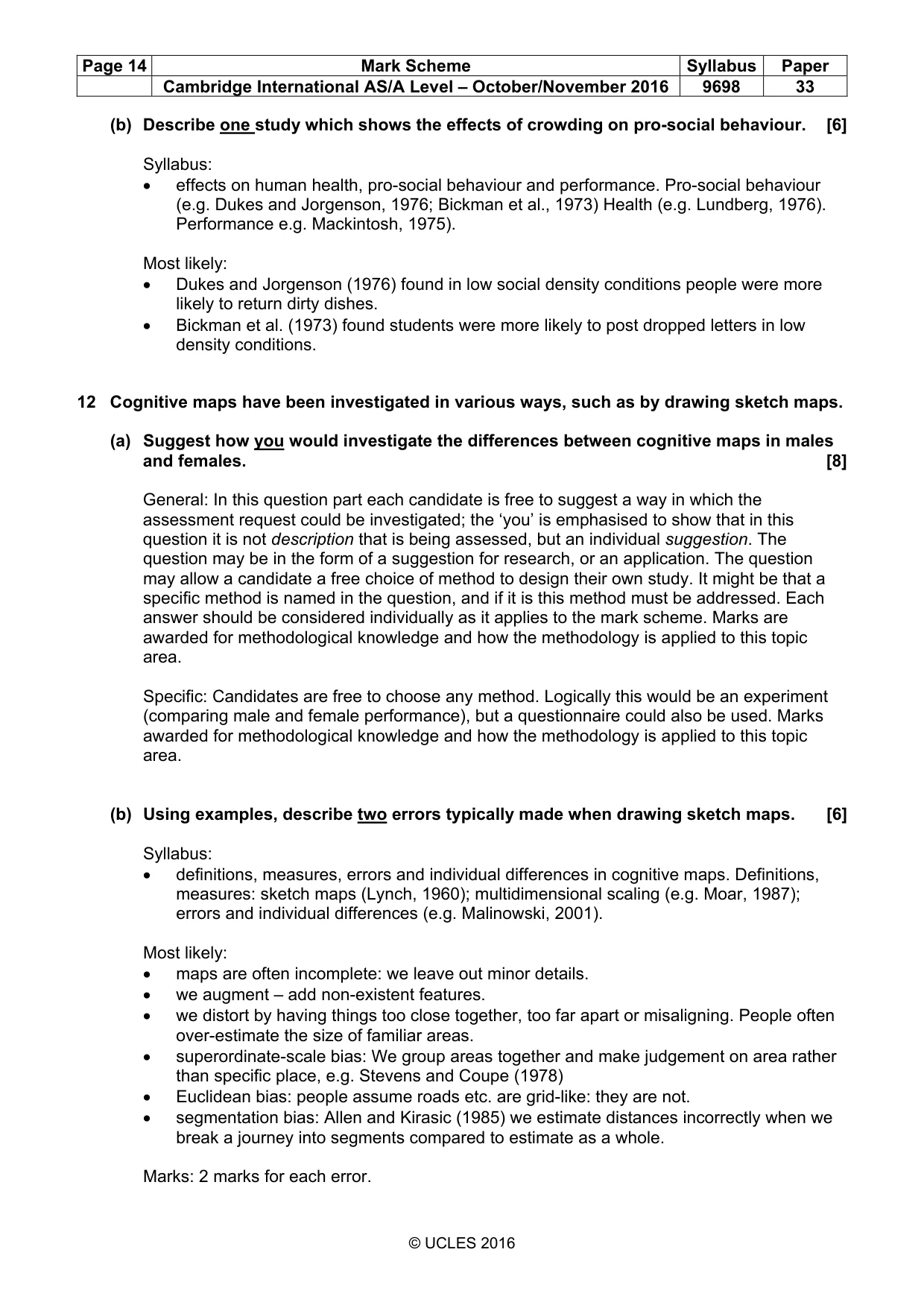
Page 14 Mark Scheme Syllabus Paper Cambridge International AS/A Level – October/November 2016 9698 33 © UCLES 2016 (b) Describe one study which shows the effects of crowding on pro-social behaviour. [6] Syllabus: • effects on human health, pro-social behaviour and performance. Pro-social behaviour (e.g. Dukes and Jorgenson, 1976; Bickman et al., 1973) Health (e.g. Lundberg, 1976). Performance e.g. Mackintosh, 1975). Most likely: • Dukes and Jorgenson (1976) found in low social density conditions people were more likely to return dirty dishes. • Bickman et al. (1973) found students were more likely to post dropped letters in low density conditions. 12 Cognitive maps have been investigated in various ways, such as by drawing sketch maps. (a) Suggest how you would investigate the differences between cognitive maps in males and females. [8] General: In this question part each candidate is free to suggest a way in which the assessment request could be investigated; the ‘you’ is emphasised to show that in this question it is not description that is being assessed, but an individual suggestion. The question may be in the form of a suggestion for research, or an application. The question may allow a candidate a free choice of method to design their own study. It might be that a specific method is named in the question, and if it is this method must be addressed. Each answer should be considered individually as it applies to the mark scheme. Marks are awarded for methodological knowledge and how the methodology is applied to this topic area. Specific: Candidates are free to choose any method. Logically this would be an experiment (comparing male and female performance), but a questionnaire could also be used. Marks awarded for methodological knowledge and how the methodology is applied to this topic area. (b) Using examples, describe two errors typically made when drawing sketch maps. [6] Syllabus: • definitions, measures, errors and individual differences in cognitive maps. Definitions, measures: sketch maps (Lynch, 1960); multidimensional scaling (e.g. Moar, 1987); errors and individual differences (e.g. Malinowski, 2001). Most likely: • maps are often incomplete: we leave out minor details. • we augment – add non-existent features. • we distort by having things too close together, too far apart or misaligning. People often over-estimate the size of familiar areas. • superordinate-scale bias: We group areas together and make judgement on area rather than specific place, e.g. Stevens and Coupe (1978) • Euclidean bias: people assume roads etc. are grid-like: they are not. • segmentation bias: Allen and Kirasic (1985) we estimate distances incorrectly when we break a journey into segments compared to estimate as a whole. Marks: 2 marks for each error.
Mark scheme, page 15
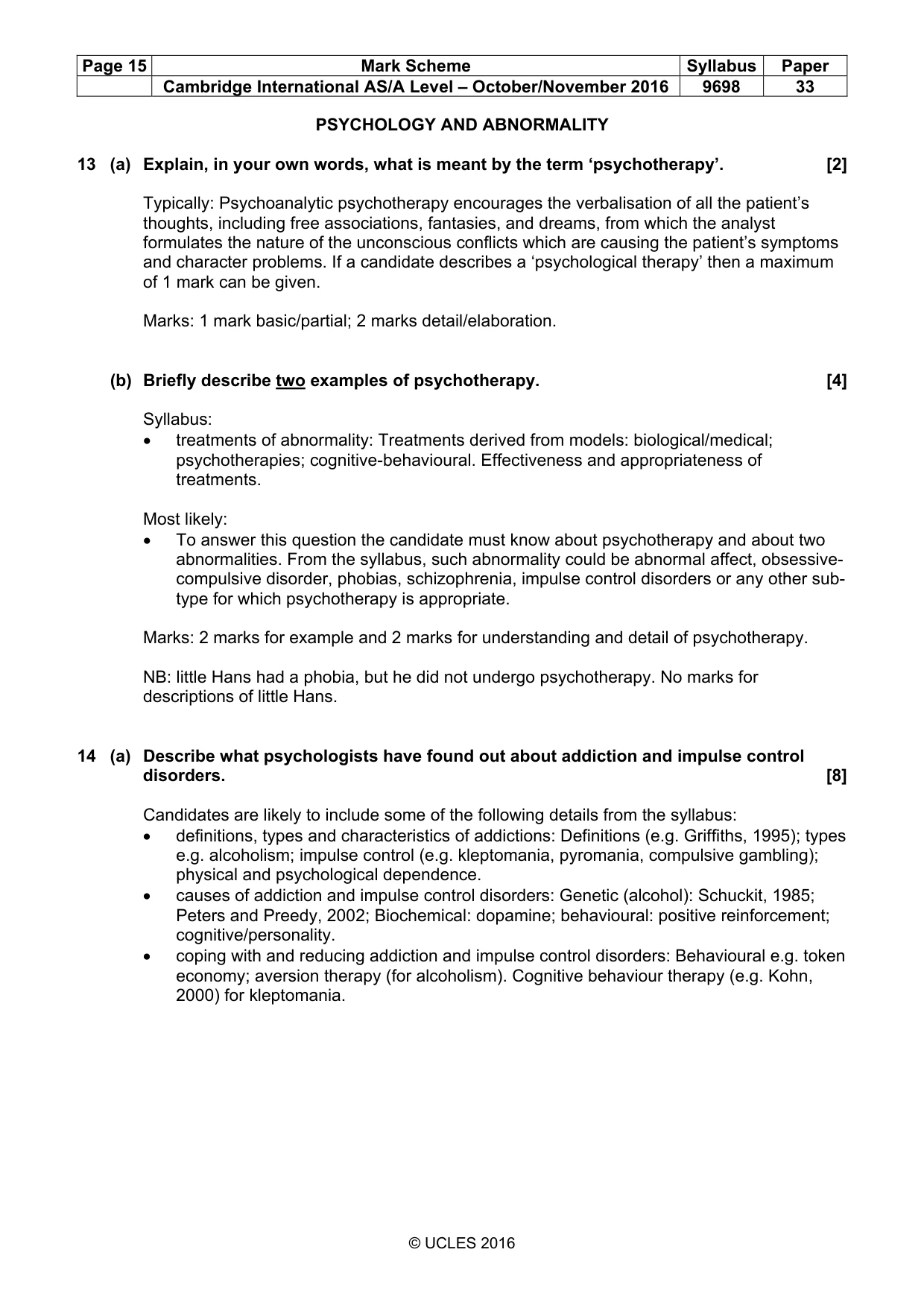
Page 15 Mark Scheme Syllabus Paper Cambridge International AS/A Level – October/November 2016 9698 33 © UCLES 2016 PSYCHOLOGY AND ABNORMALITY 13 (a) Explain, in your own words, what is meant by the term ‘psychotherapy’. [2] Typically: Psychoanalytic psychotherapy encourages the verbalisation of all the patient’s thoughts, including free associations, fantasies, and dreams, from which the analyst formulates the nature of the unconscious conflicts which are causing the patient’s symptoms and character problems. If a candidate describes a ‘psychological therapy’ then a maximum of 1 mark can be given. Marks: 1 mark basic/partial; 2 marks detail/elaboration. (b) Briefly describe two examples of psychotherapy. [4] Syllabus: • treatments of abnormality: Treatments derived from models: biological/medical; psychotherapies; cognitive-behavioural. Effectiveness and appropriateness of treatments. Most likely: • To answer this question the candidate must know about psychotherapy and about two abnormalities. From the syllabus, such abnormality could be abnormal affect, obsessive- compulsive disorder, phobias, schizophrenia, impulse control disorders or any other sub- type for which psychotherapy is appropriate. Marks: 2 marks for example and 2 marks for understanding and detail of psychotherapy. NB: little Hans had a phobia, but he did not undergo psychotherapy. No marks for descriptions of little Hans. 14 (a) Describe what psychologists have found out about addiction and impulse control disorders. [8] Candidates are likely to include some of the following details from the syllabus: • definitions, types and characteristics of addictions: Definitions (e.g. Griffiths, 1995); types e.g. alcoholism; impulse control (e.g. kleptomania, pyromania, compulsive gambling); physical and psychological dependence. • causes of addiction and impulse control disorders: Genetic (alcohol): Schuckit, 1985; Peters and Preedy, 2002; Biochemical: dopamine; behavioural: positive reinforcement; cognitive/personality. • coping with and reducing addiction and impulse control disorders: Behavioural e.g. token economy; aversion therapy (for alcoholism). Cognitive behaviour therapy (e.g. Kohn, 2000) for kleptomania.
Mark scheme, page 16
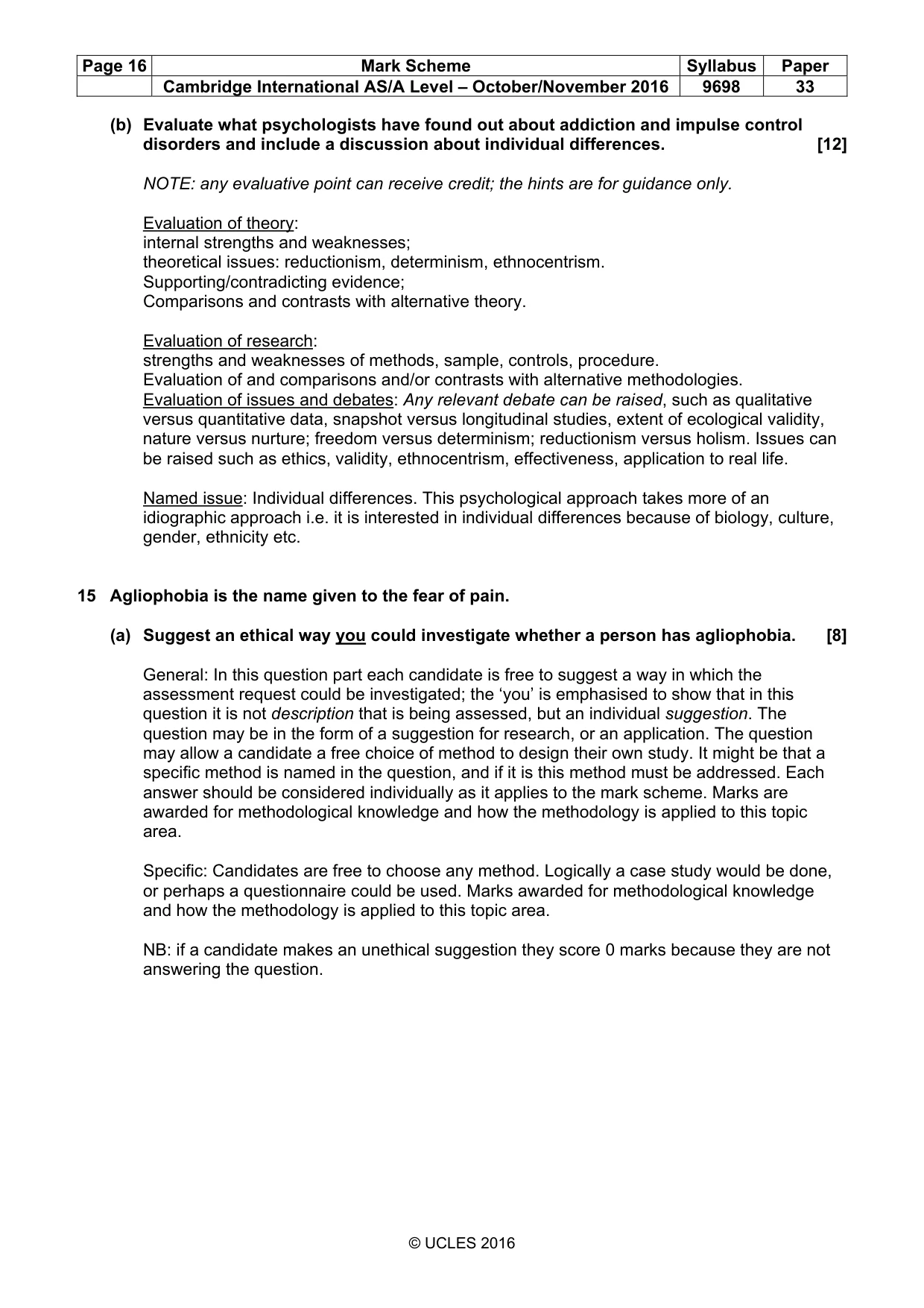
Page 16 Mark Scheme Syllabus Paper Cambridge International AS/A Level – October/November 2016 9698 33 © UCLES 2016 (b) Evaluate what psychologists have found out about addiction and impulse control disorders and include a discussion about individual differences. [12] NOTE: any evaluative point can receive credit; the hints are for guidance only. Evaluation of theory: internal strengths and weaknesses; theoretical issues: reductionism, determinism, ethnocentrism. Supporting/contradicting evidence; Comparisons and contrasts with alternative theory. Evaluation of research: strengths and weaknesses of methods, sample, controls, procedure. Evaluation of and comparisons and/or contrasts with alternative methodologies. Evaluation of issues and debates: Any relevant debate can be raised, such as qualitative versus quantitative data, snapshot versus longitudinal studies, extent of ecological validity, nature versus nurture; freedom versus determinism; reductionism versus holism. Issues can be raised such as ethics, validity, ethnocentrism, effectiveness, application to real life. Named issue: Individual differences. This psychological approach takes more of an idiographic approach i.e. it is interested in individual differences because of biology, culture, gender, ethnicity etc. 15 Agliophobia is the name given to the fear of pain. (a) Suggest an ethical way you could investigate whether a person has agliophobia. [8] General: In this question part each candidate is free to suggest a way in which the assessment request could be investigated; the ‘you’ is emphasised to show that in this question it is not description that is being assessed, but an individual suggestion. The question may be in the form of a suggestion for research, or an application. The question may allow a candidate a free choice of method to design their own study. It might be that a specific method is named in the question, and if it is this method must be addressed. Each answer should be considered individually as it applies to the mark scheme. Marks are awarded for methodological knowledge and how the methodology is applied to this topic area. Specific: Candidates are free to choose any method. Logically a case study would be done, or perhaps a questionnaire could be used. Marks awarded for methodological knowledge and how the methodology is applied to this topic area. NB: if a candidate makes an unethical suggestion they score 0 marks because they are not answering the question.
Mark scheme, page 17
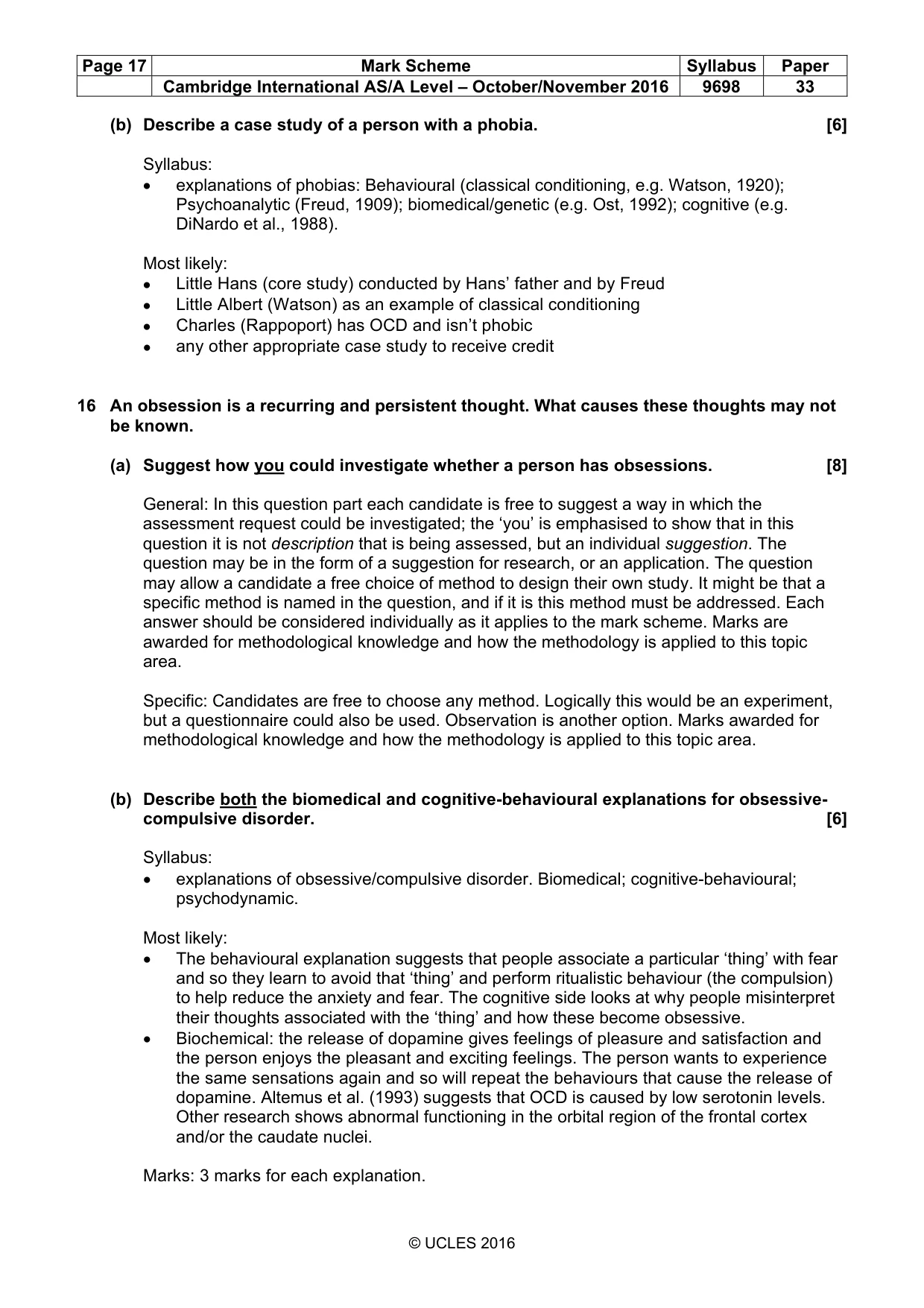
Page 17 Mark Scheme Syllabus Paper Cambridge International AS/A Level – October/November 2016 9698 33 © UCLES 2016 (b) Describe a case study of a person with a phobia. [6] Syllabus: • explanations of phobias: Behavioural (classical conditioning, e.g. Watson, 1920); Psychoanalytic (Freud, 1909); biomedical/genetic (e.g. Ost, 1992); cognitive (e.g. DiNardo et al., 1988). Most likely: • Little Hans (core study) conducted by Hans’ father and by Freud • Little Albert (Watson) as an example of classical conditioning • Charles (Rappoport) has OCD and isn’t phobic • any other appropriate case study to receive credit 16 An obsession is a recurring and persistent thought. What causes these thoughts may not be known. (a) Suggest how you could investigate whether a person has obsessions. [8] General: In this question part each candidate is free to suggest a way in which the assessment request could be investigated; the ‘you’ is emphasised to show that in this question it is not description that is being assessed, but an individual suggestion. The question may be in the form of a suggestion for research, or an application. The question may allow a candidate a free choice of method to design their own study. It might be that a specific method is named in the question, and if it is this method must be addressed. Each answer should be considered individually as it applies to the mark scheme. Marks are awarded for methodological knowledge and how the methodology is applied to this topic area. Specific: Candidates are free to choose any method. Logically this would be an experiment, but a questionnaire could also be used. Observation is another option. Marks awarded for methodological knowledge and how the methodology is applied to this topic area. (b) Describe both the biomedical and cognitive-behavioural explanations for obsessive- compulsive disorder. [6] Syllabus: • explanations of obsessive/compulsive disorder. Biomedical; cognitive-behavioural; psychodynamic. Most likely: • The behavioural explanation suggests that people associate a particular ‘thing’ with fear and so they learn to avoid that ‘thing’ and perform ritualistic behaviour (the compulsion) to help reduce the anxiety and fear. The cognitive side looks at why people misinterpret their thoughts associated with the ‘thing’ and how these become obsessive. • Biochemical: the release of dopamine gives feelings of pleasure and satisfaction and the person enjoys the pleasant and exciting feelings. The person wants to experience the same sensations again and so will repeat the behaviours that cause the release of dopamine. Altemus et al. (1993) suggests that OCD is caused by low serotonin levels. Other research shows abnormal functioning in the orbital region of the frontal cortex and/or the caudate nuclei. Marks: 3 marks for each explanation.
Mark scheme, page 18
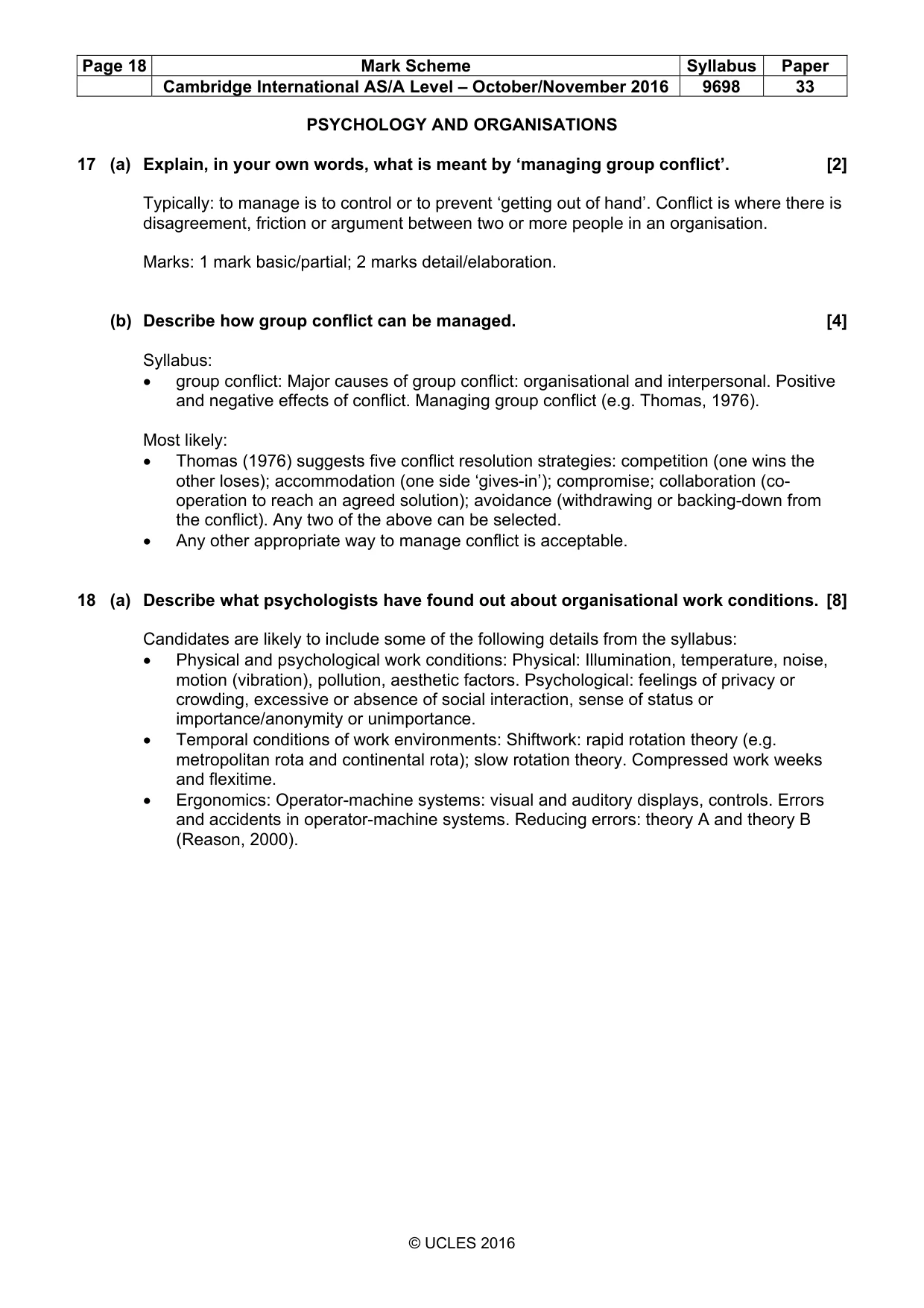
Page 18 Mark Scheme Syllabus Paper Cambridge International AS/A Level – October/November 2016 9698 33 © UCLES 2016 PSYCHOLOGY AND ORGANISATIONS 17 (a) Explain, in your own words, what is meant by ‘managing group conflict’. [2] Typically: to manage is to control or to prevent ‘getting out of hand’. Conflict is where there is disagreement, friction or argument between two or more people in an organisation. Marks: 1 mark basic/partial; 2 marks detail/elaboration. (b) Describe how group conflict can be managed. [4] Syllabus: • group conflict: Major causes of group conflict: organisational and interpersonal. Positive and negative effects of conflict. Managing group conflict (e.g. Thomas, 1976). Most likely: • Thomas (1976) suggests five conflict resolution strategies: competition (one wins the other loses); accommodation (one side ‘gives-in’); compromise; collaboration (co- operation to reach an agreed solution); avoidance (withdrawing or backing-down from the conflict). Any two of the above can be selected. • Any other appropriate way to manage conflict is acceptable. 18 (a) Describe what psychologists have found out about organisational work conditions. [8] Candidates are likely to include some of the following details from the syllabus: • Physical and psychological work conditions: Physical: Illumination, temperature, noise, motion (vibration), pollution, aesthetic factors. Psychological: feelings of privacy or crowding, excessive or absence of social interaction, sense of status or importance/anonymity or unimportance. • Temporal conditions of work environments: Shiftwork: rapid rotation theory (e.g. metropolitan rota and continental rota); slow rotation theory. Compressed work weeks and flexitime. • Ergonomics: Operator-machine systems: visual and auditory displays, controls. Errors and accidents in operator-machine systems. Reducing errors: theory A and theory B (Reason, 2000).
Mark scheme, page 19
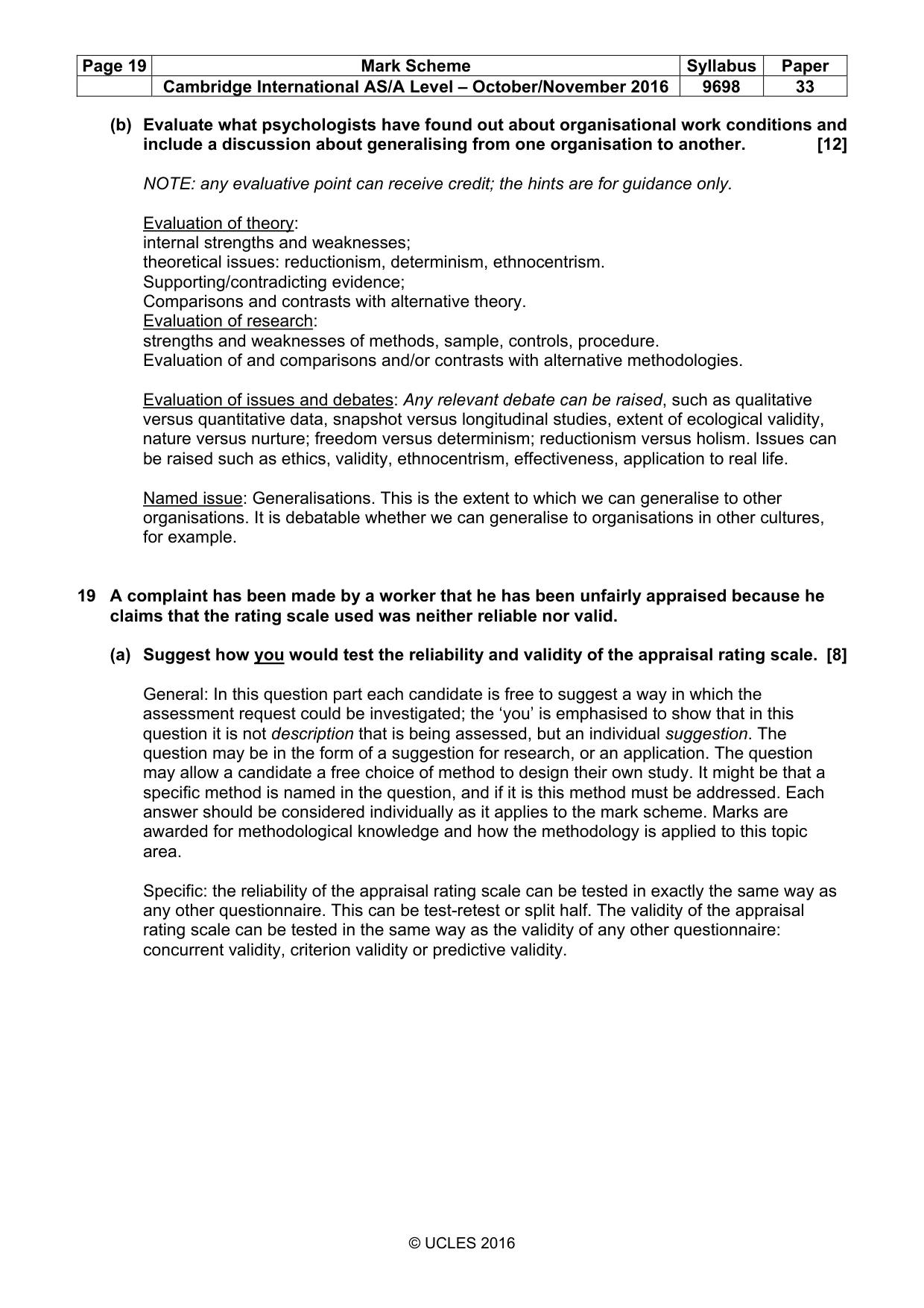
Page 19 Mark Scheme Syllabus Paper Cambridge International AS/A Level – October/November 2016 9698 33 © UCLES 2016 (b) Evaluate what psychologists have found out about organisational work conditions and include a discussion about generalising from one organisation to another. [12] NOTE: any evaluative point can receive credit; the hints are for guidance only. Evaluation of theory: internal strengths and weaknesses; theoretical issues: reductionism, determinism, ethnocentrism. Supporting/contradicting evidence; Comparisons and contrasts with alternative theory. Evaluation of research: strengths and weaknesses of methods, sample, controls, procedure. Evaluation of and comparisons and/or contrasts with alternative methodologies. Evaluation of issues and debates: Any relevant debate can be raised, such as qualitative versus quantitative data, snapshot versus longitudinal studies, extent of ecological validity, nature versus nurture; freedom versus determinism; reductionism versus holism. Issues can be raised such as ethics, validity, ethnocentrism, effectiveness, application to real life. Named issue: Generalisations. This is the extent to which we can generalise to other organisations. It is debatable whether we can generalise to organisations in other cultures, for example. 19 A complaint has been made by a worker that he has been unfairly appraised because he claims that the rating scale used was neither reliable nor valid. (a) Suggest how you would test the reliability and validity of the appraisal rating scale. [8] General: In this question part each candidate is free to suggest a way in which the assessment request could be investigated; the ‘you’ is emphasised to show that in this question it is not description that is being assessed, but an individual suggestion. The question may be in the form of a suggestion for research, or an application. The question may allow a candidate a free choice of method to design their own study. It might be that a specific method is named in the question, and if it is this method must be addressed. Each answer should be considered individually as it applies to the mark scheme. Marks are awarded for methodological knowledge and how the methodology is applied to this topic area. Specific: the reliability of the appraisal rating scale can be tested in exactly the same way as any other questionnaire. This can be test-retest or split half. The validity of the appraisal rating scale can be tested in the same way as the validity of any other questionnaire: concurrent validity, criterion validity or predictive validity.
Mark scheme, page 20
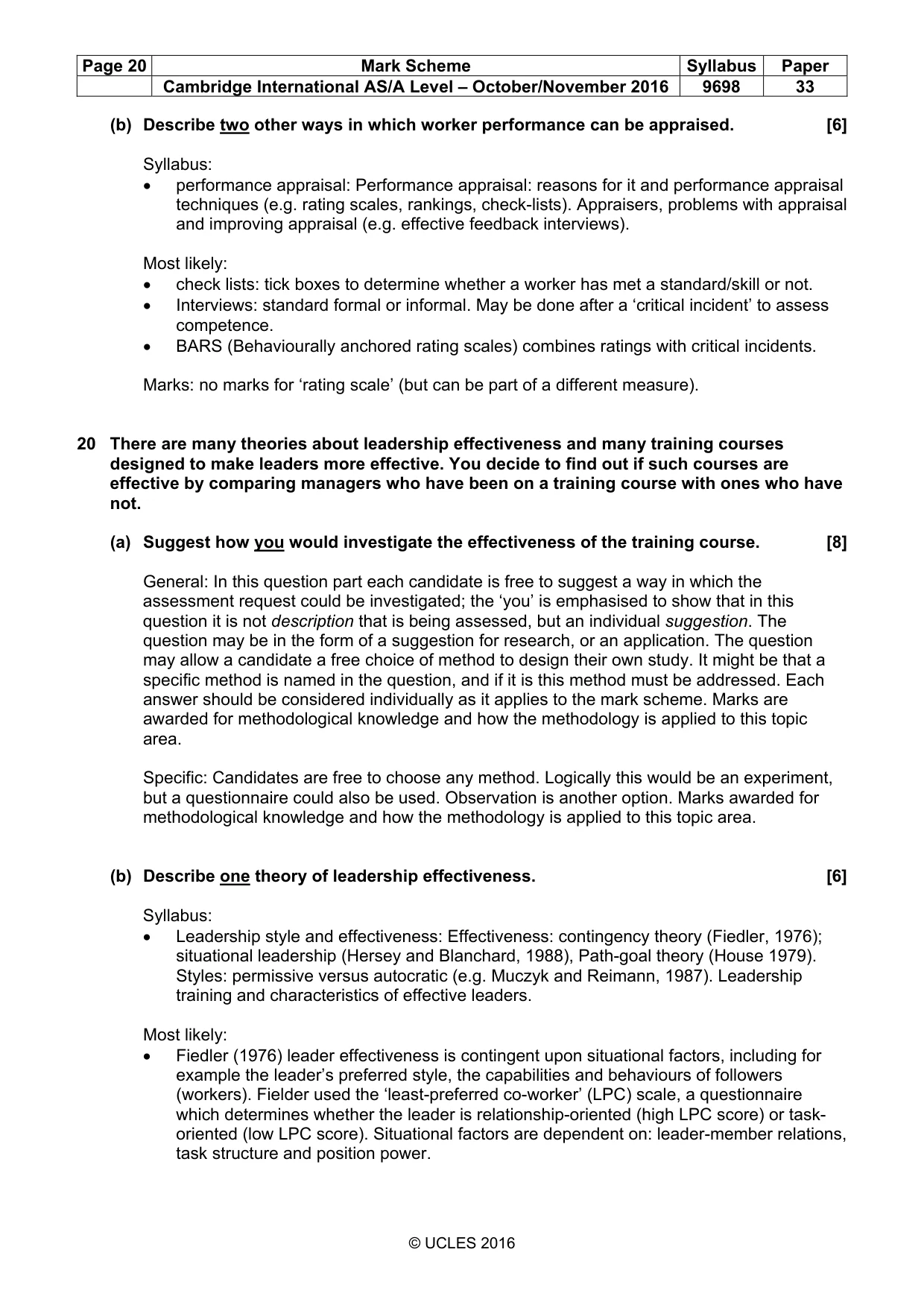
Page 20 Mark Scheme Syllabus Paper Cambridge International AS/A Level – October/November 2016 9698 33 © UCLES 2016 (b) Describe two other ways in which worker performance can be appraised. [6] Syllabus: • performance appraisal: Performance appraisal: reasons for it and performance appraisal techniques (e.g. rating scales, rankings, check-lists). Appraisers, problems with appraisal and improving appraisal (e.g. effective feedback interviews). Most likely: • check lists: tick boxes to determine whether a worker has met a standard/skill or not. • Interviews: standard formal or informal. May be done after a ‘critical incident’ to assess competence. • BARS (Behaviourally anchored rating scales) combines ratings with critical incidents. Marks: no marks for ‘rating scale’ (but can be part of a different measure). 20 There are many theories about leadership effectiveness and many training courses designed to make leaders more effective. You decide to find out if such courses are effective by comparing managers who have been on a training course with ones who have not. (a) Suggest how you would investigate the effectiveness of the training course. [8] General: In this question part each candidate is free to suggest a way in which the assessment request could be investigated; the ‘you’ is emphasised to show that in this question it is not description that is being assessed, but an individual suggestion. The question may be in the form of a suggestion for research, or an application. The question may allow a candidate a free choice of method to design their own study. It might be that a specific method is named in the question, and if it is this method must be addressed. Each answer should be considered individually as it applies to the mark scheme. Marks are awarded for methodological knowledge and how the methodology is applied to this topic area. Specific: Candidates are free to choose any method. Logically this would be an experiment, but a questionnaire could also be used. Observation is another option. Marks awarded for methodological knowledge and how the methodology is applied to this topic area. (b) Describe one theory of leadership effectiveness. [6] Syllabus: • Leadership style and effectiveness: Effectiveness: contingency theory (Fiedler, 1976); situational leadership (Hersey and Blanchard, 1988), Path-goal theory (House 1979). Styles: permissive versus autocratic (e.g. Muczyk and Reimann, 1987). Leadership training and characteristics of effective leaders. Most likely: • Fiedler (1976) leader effectiveness is contingent upon situational factors, including for example the leader’s preferred style, the capabilities and behaviours of followers (workers). Fielder used the ‘least-preferred co-worker’ (LPC) scale, a questionnaire which determines whether the leader is relationship-oriented (high LPC score) or task- oriented (low LPC score). Situational factors are dependent on: leader-member relations, task structure and position power.
What you needed in this session
Cambridge’s own grade thresholds for 2016 Oct/Nov, Paper 3 · Variant 3. A higher threshold means an easier paper — the bar moves with how the cohort did.