Cambridge A Level Psychology 9698 — 2015 Oct/Nov Paper 2 · Variant 2
9698/22/O/N/15 · 70 marks · ≈79 min
The question paper and its mark scheme, free to read here and free to download. This is Cambridge’s own paper, exactly as it was sat.
Question paper4 pages

Mark scheme10 pages
Answers below. Sit the paper first if you are practising.
Paper as text
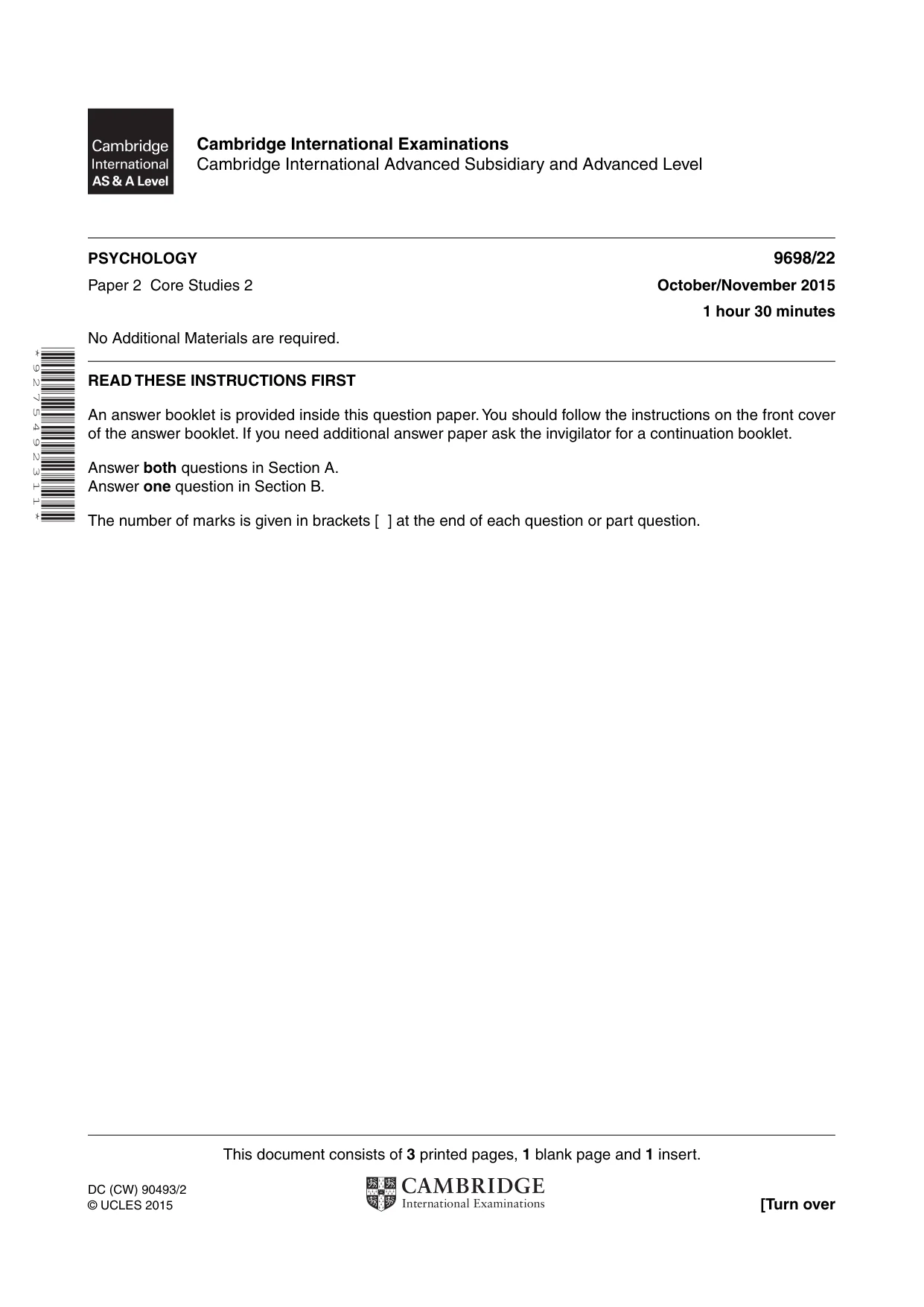
Question paper, page 1
This document consists of 3 printed pages, 1 blank page and 1 insert. DC (CW) 90493/2 © UCLES 2015 [Turn over Cambridge International Examinations Cambridge International Advanced Subsidiary and Advanced Level * 9 2 7 5 4 9 2 3 1 1 * PSYCHOLOGY 9698/22 Paper 2 Core Studies 2 October/November 2015 1 hour 30 minutes No Additional Materials are required. READ THESE INSTRUCTIONS FIRST An answer booklet is provided inside this question paper. You should follow the instructions on the front cover of the answer booklet. If you need additional answer paper ask the invigilator for a continuation booklet. Answer both questions in Section A. Answer one question in Section B. The number of marks is given in brackets [ ] at the end of each question or part question.
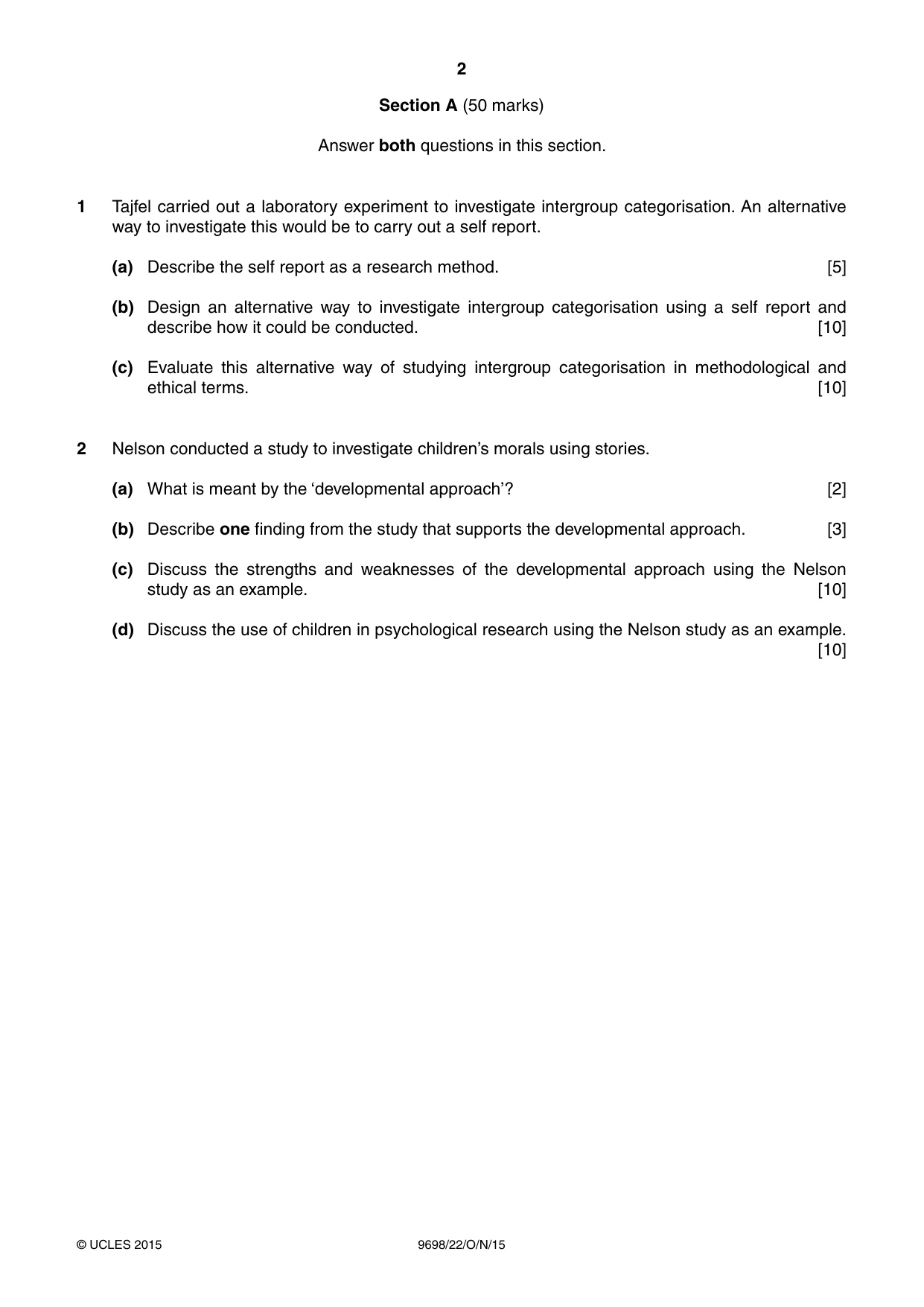
Question paper, page 2
2 9698/22/O/N/15 © UCLES 2015 Section A (50 marks) Answer both questions in this section. 1 Tajfel carried out a laboratory experiment to investigate intergroup categorisation. An alternative way to investigate this would be to carry out a self report. (a) Describe the self report as a research method. [5] (b) Design an alternative way to investigate intergroup categorisation using a self report and describe how it could be conducted. [10] (c) Evaluate this alternative way of studying intergroup categorisation in methodological and ethical terms. [10] 2 Nelson conducted a study to investigate children’s morals using stories. (a) What is meant by the ‘developmental approach’? [2] (b) Describe one finding from the study that supports the developmental approach. [3] (c) Discuss the strengths and weaknesses of the developmental approach using the Nelson study as an example. [10] (d) Discuss the use of children in psychological research using the Nelson study as an example. [10]
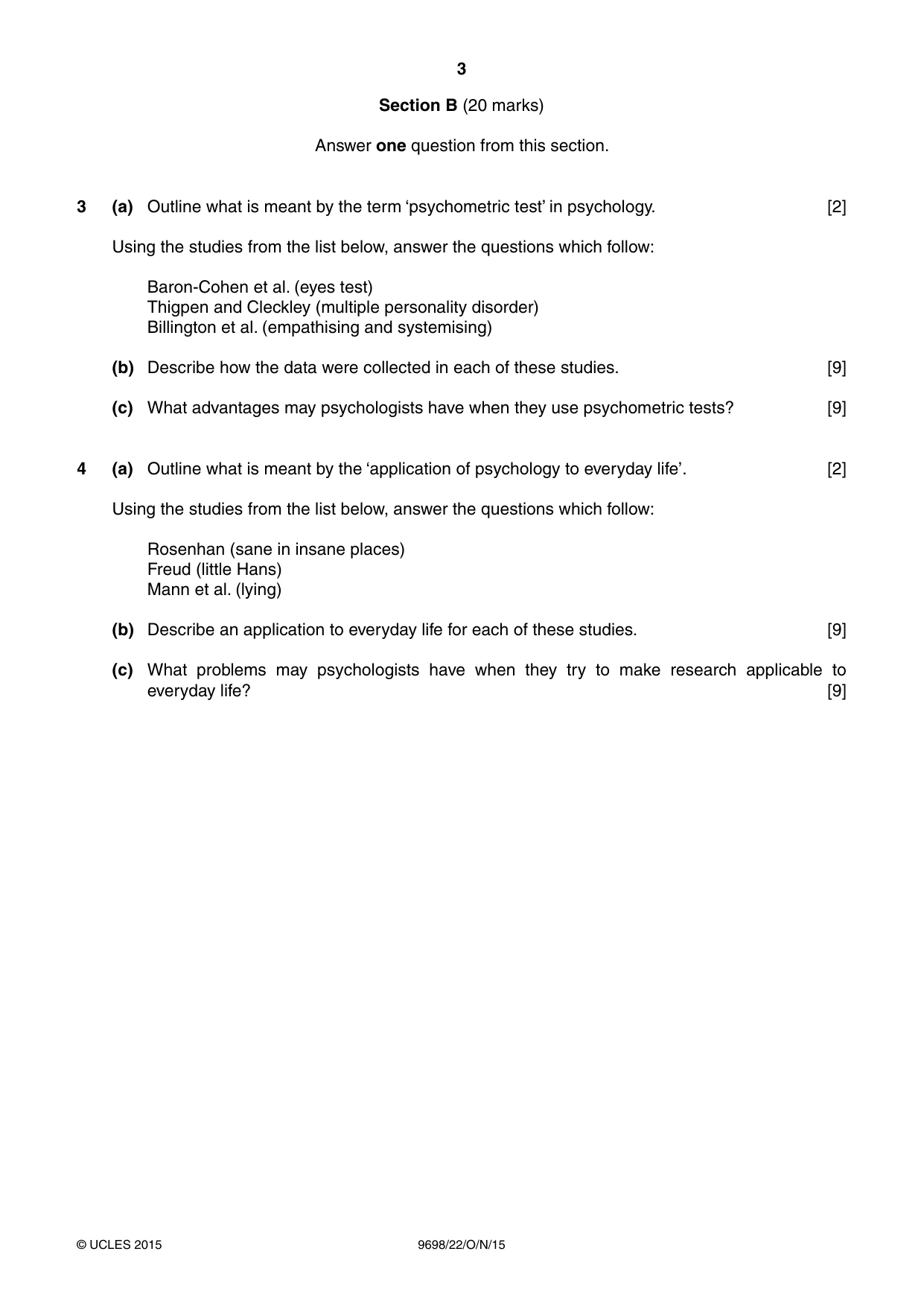
Question paper, page 3
3 9698/22/O/N/15 © UCLES 2015 Section B (20 marks) Answer one question from this section. 3 (a) Outline what is meant by the term ‘psychometric test’ in psychology. [2] Using the studies from the list below, answer the questions which follow: Baron-Cohen et al. (eyes test) Thigpen and Cleckley (multiple personality disorder) Billington et al. (empathising and systemising) (b) Describe how the data were collected in each of these studies. [9] (c) What advantages may psychologists have when they use psychometric tests? [9] 4 (a) Outline what is meant by the ‘application of psychology to everyday life’. [2] Using the studies from the list below, answer the questions which follow: Rosenhan (sane in insane places) Freud (little Hans) Mann et al. (lying) (b) Describe an application to everyday life for each of these studies. [9] (c) What problems may psychologists have when they try to make research applicable to everyday life? [9]
Question paper, page 4
4 9698/22/O/N/15 © UCLES 2015 BLANK PAGE Permission to reproduce items where third-party owned material protected by copyright is included has been sought and cleared where possible. Every reasonable effort has been made by the publisher (UCLES) to trace copyright holders, but if any items requiring clearance have unwittingly been included, the publisher will be pleased to make amends at the earliest possible opportunity. To avoid the issue of disclosure of answer-related information to candidates, all copyright acknowledgements are reproduced online in the Cambridge International Examinations Copyright Acknowledgements Booklet. This is produced for each series of examinations and is freely available to download at www.cie.org.uk after the live examination series. Cambridge International Examinations is part of the Cambridge Assessment Group. Cambridge Assessment is the brand name of University of Cambridge Local Examinations Syndicate (UCLES), which is itself a department of the University of Cambridge.
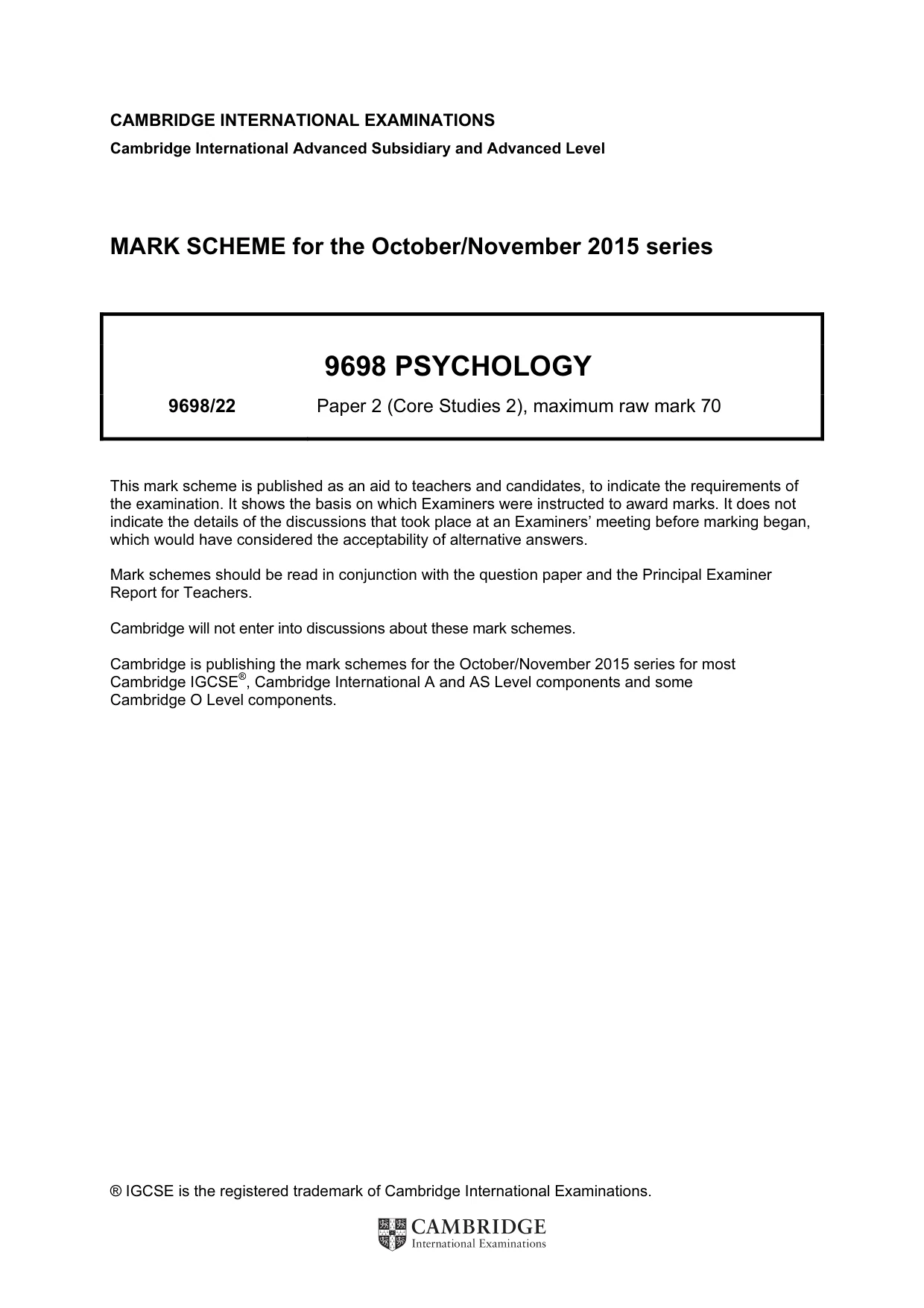
Mark scheme, page 1
® IGCSE is the registered trademark of Cambridge International Examinations. CAMBRIDGE INTERNATIONAL EXAMINATIONS Cambridge International Advanced Subsidiary and Advanced Level MARK SCHEME for the October/November 2015 series 9698 PSYCHOLOGY 9698/22 Paper 2 (Core Studies 2), maximum raw mark 70 This mark scheme is published as an aid to teachers and candidates, to indicate the requirements of the examination. It shows the basis on which Examiners were instructed to award marks. It does not indicate the details of the discussions that took place at an Examiners’ meeting before marking began, which would have considered the acceptability of alternative answers. Mark schemes should be read in conjunction with the question paper and the Principal Examiner Report for Teachers. Cambridge will not enter into discussions about these mark schemes. Cambridge is publishing the mark schemes for the October/November 2015 series for most Cambridge IGCSE®, Cambridge International A and AS Level components and some Cambridge O Level components.
Mark scheme, page 2
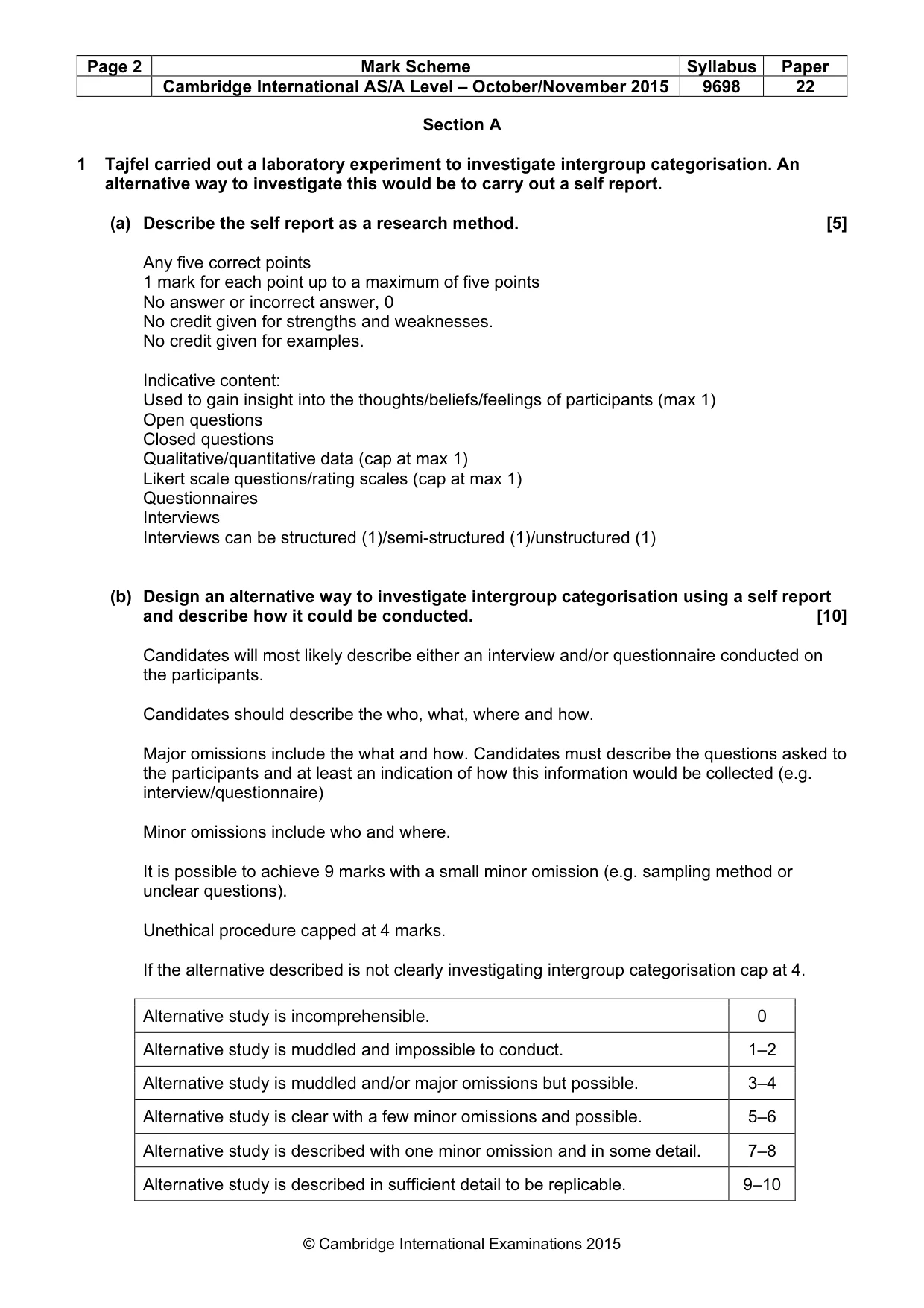
Page 2 Mark Scheme Syllabus Paper Cambridge International AS/A Level – October/November 2015 9698 22 © Cambridge International Examinations 2015 Section A 1 Tajfel carried out a laboratory experiment to investigate intergroup categorisation. An alternative way to investigate this would be to carry out a self report. (a) Describe the self report as a research method. [5] Any five correct points 1 mark for each point up to a maximum of five points No answer or incorrect answer, 0 No credit given for strengths and weaknesses. No credit given for examples. Indicative content: Used to gain insight into the thoughts/beliefs/feelings of participants (max 1) Open questions Closed questions Qualitative/quantitative data (cap at max 1) Likert scale questions/rating scales (cap at max 1) Questionnaires Interviews Interviews can be structured (1)/semi-structured (1)/unstructured (1) (b) Design an alternative way to investigate intergroup categorisation using a self report and describe how it could be conducted. [10] Candidates will most likely describe either an interview and/or questionnaire conducted on the participants. Candidates should describe the who, what, where and how. Major omissions include the what and how. Candidates must describe the questions asked to the participants and at least an indication of how this information would be collected (e.g. interview/questionnaire) Minor omissions include who and where. It is possible to achieve 9 marks with a small minor omission (e.g. sampling method or unclear questions). Unethical procedure capped at 4 marks. If the alternative described is not clearly investigating intergroup categorisation cap at 4. Alternative study is incomprehensible. 0 Alternative study is muddled and impossible to conduct. 1–2 Alternative study is muddled and/or major omissions but possible. 3–4 Alternative study is clear with a few minor omissions and possible. 5–6 Alternative study is described with one minor omission and in some detail. 7–8 Alternative study is described in sufficient detail to be replicable. 9–10
Mark scheme, page 3
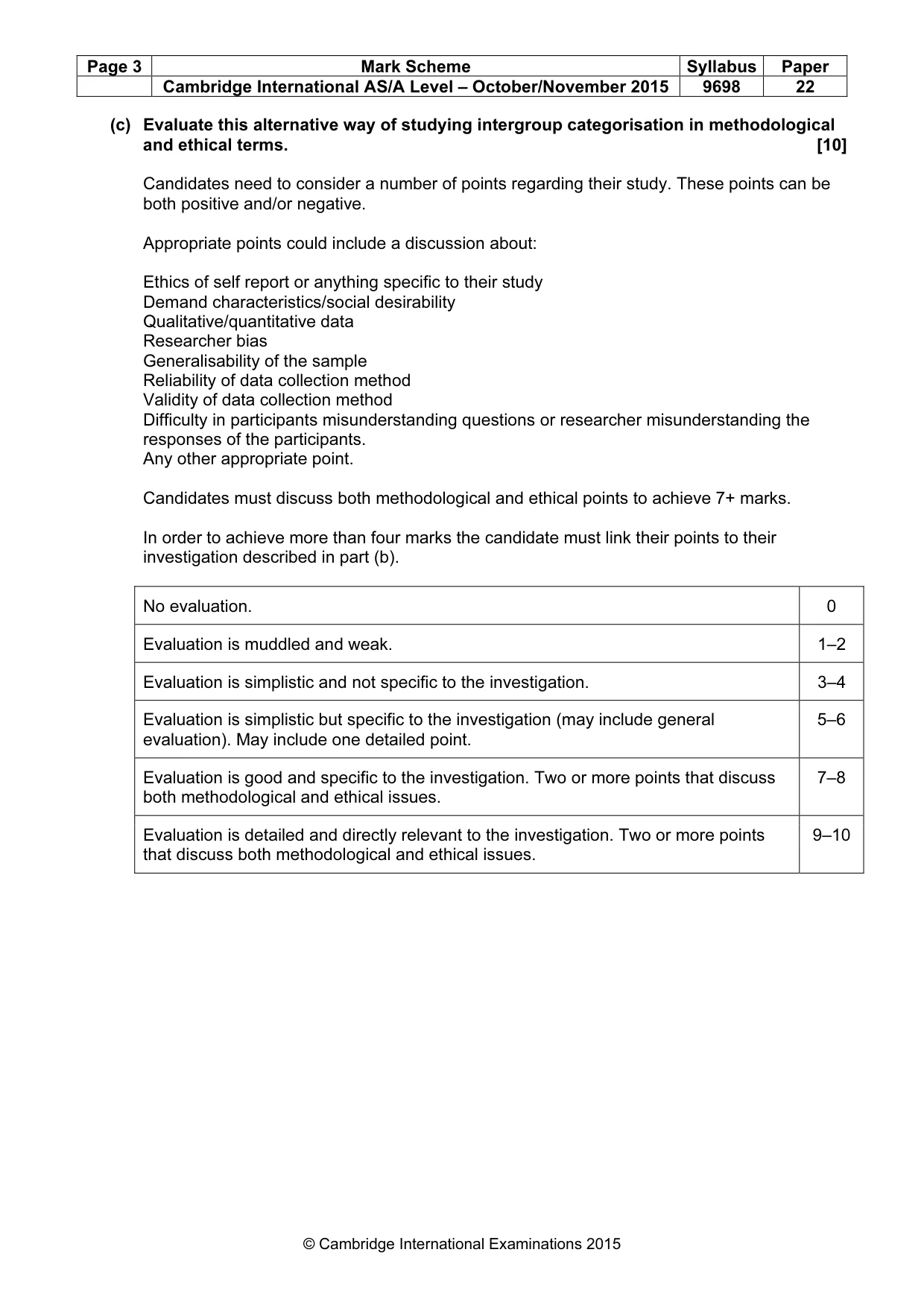
Page 3 Mark Scheme Syllabus Paper Cambridge International AS/A Level – October/November 2015 9698 22 © Cambridge International Examinations 2015 (c) Evaluate this alternative way of studying intergroup categorisation in methodological and ethical terms. [10] Candidates need to consider a number of points regarding their study. These points can be both positive and/or negative. Appropriate points could include a discussion about: Ethics of self report or anything specific to their study Demand characteristics/social desirability Qualitative/quantitative data Researcher bias Generalisability of the sample Reliability of data collection method Validity of data collection method Difficulty in participants misunderstanding questions or researcher misunderstanding the responses of the participants. Any other appropriate point. Candidates must discuss both methodological and ethical points to achieve 7+ marks. In order to achieve more than four marks the candidate must link their points to their investigation described in part (b). No evaluation. 0 Evaluation is muddled and weak. 1–2 Evaluation is simplistic and not specific to the investigation. 3–4 Evaluation is simplistic but specific to the investigation (may include general evaluation). May include one detailed point. 5–6 Evaluation is good and specific to the investigation. Two or more points that discuss both methodological and ethical issues. 7–8 Evaluation is detailed and directly relevant to the investigation. Two or more points that discuss both methodological and ethical issues. 9–10
Mark scheme, page 4
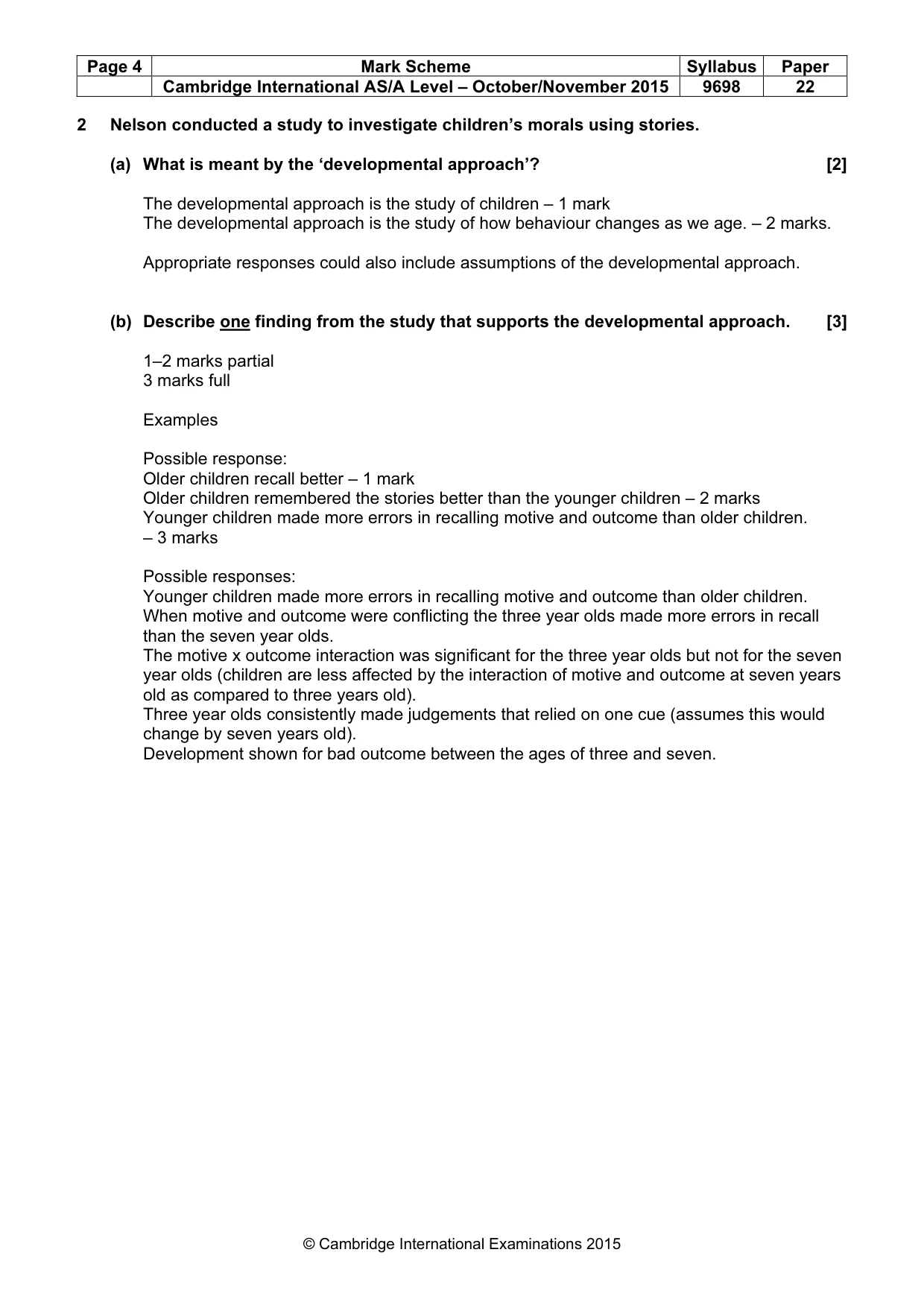
Page 4 Mark Scheme Syllabus Paper Cambridge International AS/A Level – October/November 2015 9698 22 © Cambridge International Examinations 2015 2 Nelson conducted a study to investigate children’s morals using stories. (a) What is meant by the ‘developmental approach’? [2] The developmental approach is the study of children – 1 mark The developmental approach is the study of how behaviour changes as we age. – 2 marks. Appropriate responses could also include assumptions of the developmental approach. (b) Describe one finding from the study that supports the developmental approach. [3] 1–2 marks partial 3 marks full Examples Possible response: Older children recall better – 1 mark Older children remembered the stories better than the younger children – 2 marks Younger children made more errors in recalling motive and outcome than older children. – 3 marks Possible responses: Younger children made more errors in recalling motive and outcome than older children. When motive and outcome were conflicting the three year olds made more errors in recall than the seven year olds. The motive x outcome interaction was significant for the three year olds but not for the seven year olds (children are less affected by the interaction of motive and outcome at seven years old as compared to three years old). Three year olds consistently made judgements that relied on one cue (assumes this would change by seven years old). Development shown for bad outcome between the ages of three and seven.
Mark scheme, page 5
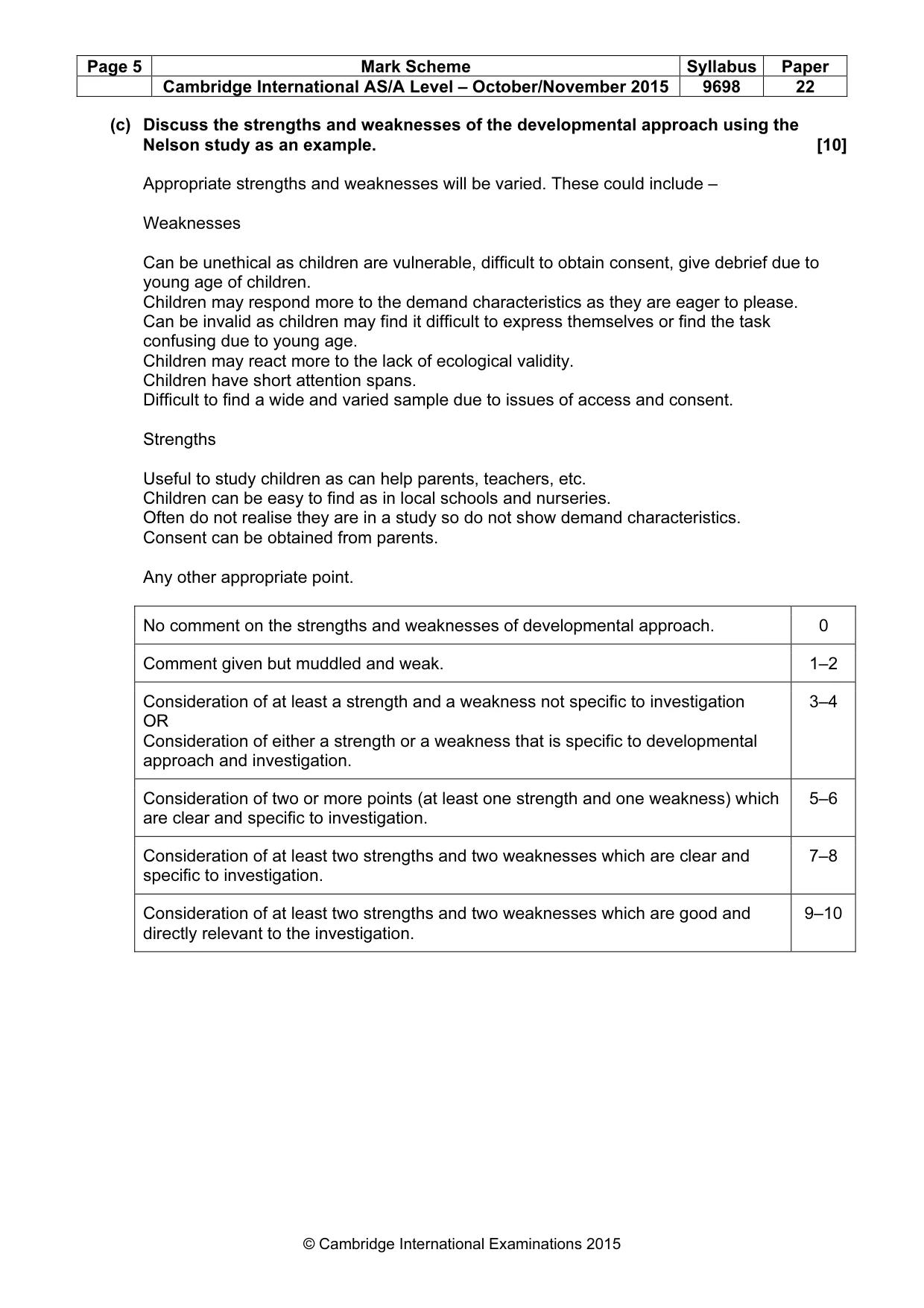
Page 5 Mark Scheme Syllabus Paper Cambridge International AS/A Level – October/November 2015 9698 22 © Cambridge International Examinations 2015 (c) Discuss the strengths and weaknesses of the developmental approach using the Nelson study as an example. [10] Appropriate strengths and weaknesses will be varied. These could include – Weaknesses Can be unethical as children are vulnerable, difficult to obtain consent, give debrief due to young age of children. Children may respond more to the demand characteristics as they are eager to please. Can be invalid as children may find it difficult to express themselves or find the task confusing due to young age. Children may react more to the lack of ecological validity. Children have short attention spans. Difficult to find a wide and varied sample due to issues of access and consent. Strengths Useful to study children as can help parents, teachers, etc. Children can be easy to find as in local schools and nurseries. Often do not realise they are in a study so do not show demand characteristics. Consent can be obtained from parents. Any other appropriate point. No comment on the strengths and weaknesses of developmental approach. 0 Comment given but muddled and weak. 1–2 Consideration of at least a strength and a weakness not specific to investigation OR Consideration of either a strength or a weakness that is specific to developmental approach and investigation. 3–4 Consideration of two or more points (at least one strength and one weakness) which are clear and specific to investigation. 5–6 Consideration of at least two strengths and two weaknesses which are clear and specific to investigation. 7–8 Consideration of at least two strengths and two weaknesses which are good and directly relevant to the investigation. 9–10
Mark scheme, page 6
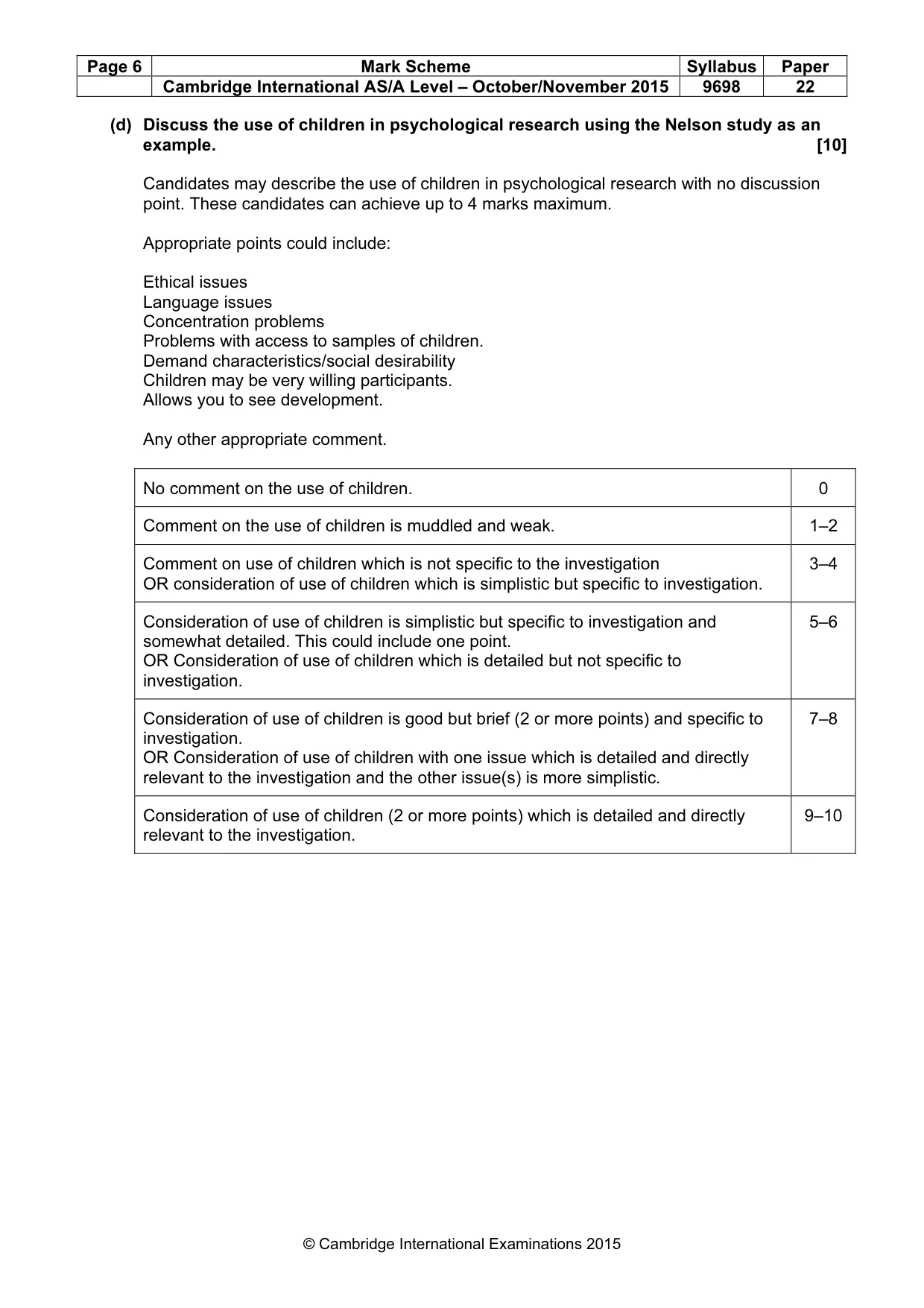
Page 6 Mark Scheme Syllabus Paper Cambridge International AS/A Level – October/November 2015 9698 22 © Cambridge International Examinations 2015 (d) Discuss the use of children in psychological research using the Nelson study as an example. [10] Candidates may describe the use of children in psychological research with no discussion point. These candidates can achieve up to 4 marks maximum. Appropriate points could include: Ethical issues Language issues Concentration problems Problems with access to samples of children. Demand characteristics/social desirability Children may be very willing participants. Allows you to see development. Any other appropriate comment. No comment on the use of children. 0 Comment on the use of children is muddled and weak. 1–2 Comment on use of children which is not specific to the investigation OR consideration of use of children which is simplistic but specific to investigation. 3–4 Consideration of use of children is simplistic but specific to investigation and somewhat detailed. This could include one point. OR Consideration of use of children which is detailed but not specific to investigation. 5–6 Consideration of use of children is good but brief (2 or more points) and specific to investigation. OR Consideration of use of children with one issue which is detailed and directly relevant to the investigation and the other issue(s) is more simplistic. 7–8 Consideration of use of children (2 or more points) which is detailed and directly relevant to the investigation. 9–10
Mark scheme, page 7
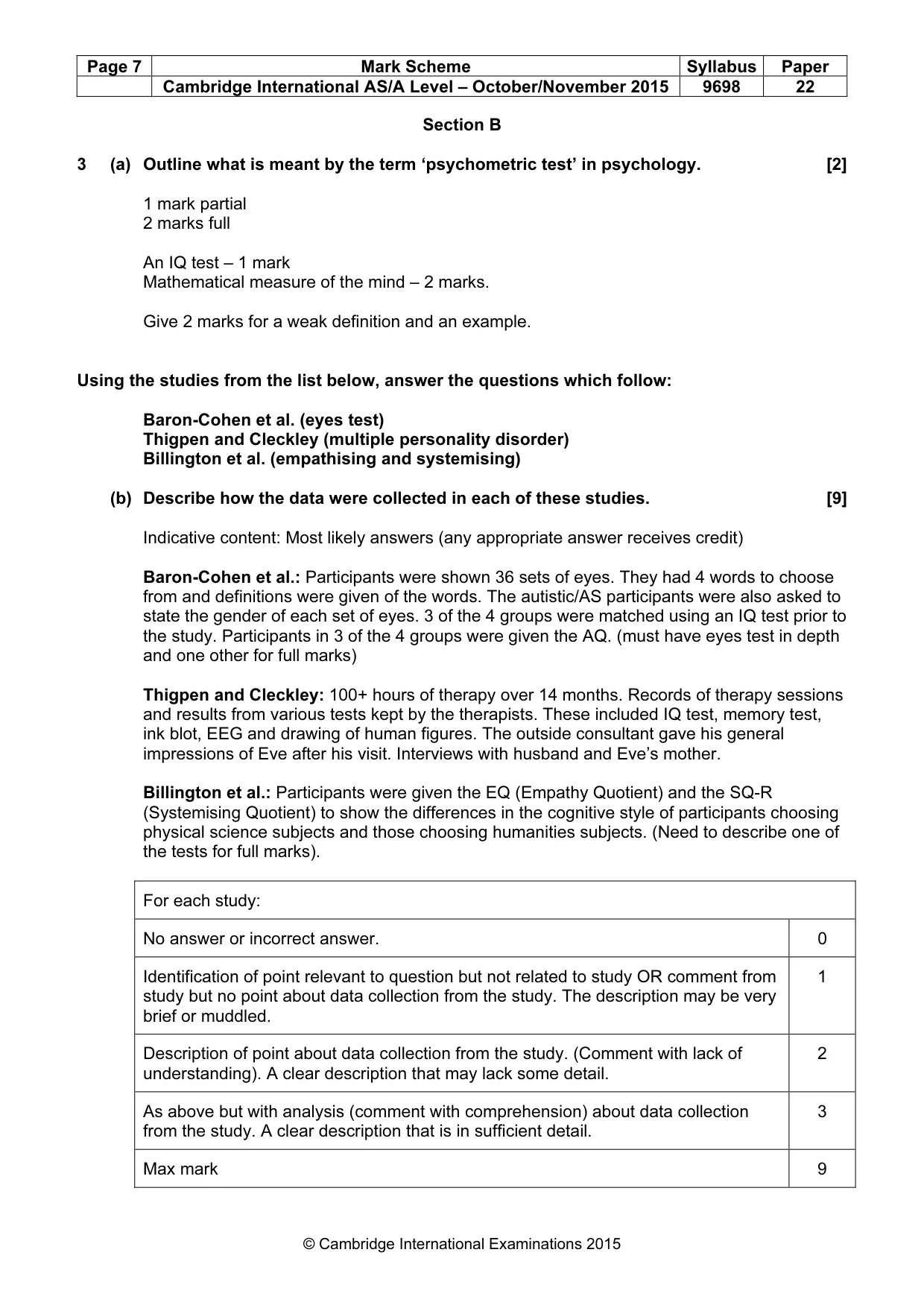
Page 7 Mark Scheme Syllabus Paper Cambridge International AS/A Level – October/November 2015 9698 22 © Cambridge International Examinations 2015 Section B 3 (a) Outline what is meant by the term ‘psychometric test’ in psychology. [2] 1 mark partial 2 marks full An IQ test – 1 mark Mathematical measure of the mind – 2 marks. Give 2 marks for a weak definition and an example. Using the studies from the list below, answer the questions which follow: Baron-Cohen et al. (eyes test) Thigpen and Cleckley (multiple personality disorder) Billington et al. (empathising and systemising) (b) Describe how the data were collected in each of these studies. [9] Indicative content: Most likely answers (any appropriate answer receives credit) Baron-Cohen et al.: Participants were shown 36 sets of eyes. They had 4 words to choose from and definitions were given of the words. The autistic/AS participants were also asked to state the gender of each set of eyes. 3 of the 4 groups were matched using an IQ test prior to the study. Participants in 3 of the 4 groups were given the AQ. (must have eyes test in depth and one other for full marks) Thigpen and Cleckley: 100+ hours of therapy over 14 months. Records of therapy sessions and results from various tests kept by the therapists. These included IQ test, memory test, ink blot, EEG and drawing of human figures. The outside consultant gave his general impressions of Eve after his visit. Interviews with husband and Eve’s mother. Billington et al.: Participants were given the EQ (Empathy Quotient) and the SQ-R (Systemising Quotient) to show the differences in the cognitive style of participants choosing physical science subjects and those choosing humanities subjects. (Need to describe one of the tests for full marks). For each study: No answer or incorrect answer. 0 Identification of point relevant to question but not related to study OR comment from study but no point about data collection from the study. The description may be very brief or muddled. 1 Description of point about data collection from the study. (Comment with lack of understanding). A clear description that may lack some detail. 2 As above but with analysis (comment with comprehension) about data collection from the study. A clear description that is in sufficient detail. 3 Max mark 9
Mark scheme, page 8
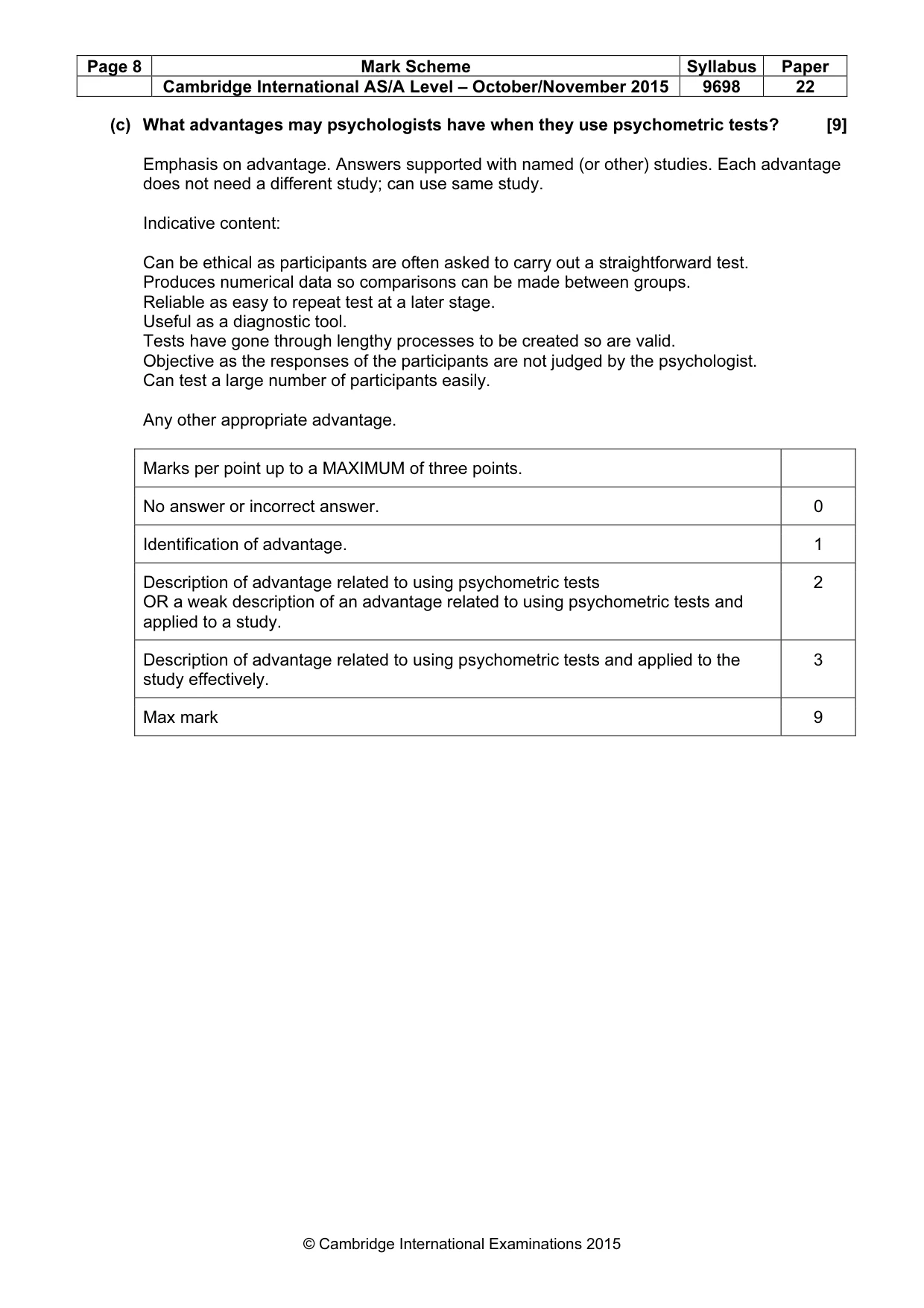
Page 8 Mark Scheme Syllabus Paper Cambridge International AS/A Level – October/November 2015 9698 22 © Cambridge International Examinations 2015 (c) What advantages may psychologists have when they use psychometric tests? [9] Emphasis on advantage. Answers supported with named (or other) studies. Each advantage does not need a different study; can use same study. Indicative content: Can be ethical as participants are often asked to carry out a straightforward test. Produces numerical data so comparisons can be made between groups. Reliable as easy to repeat test at a later stage. Useful as a diagnostic tool. Tests have gone through lengthy processes to be created so are valid. Objective as the responses of the participants are not judged by the psychologist. Can test a large number of participants easily. Any other appropriate advantage. Marks per point up to a MAXIMUM of three points. No answer or incorrect answer. 0 Identification of advantage. 1 Description of advantage related to using psychometric tests OR a weak description of an advantage related to using psychometric tests and applied to a study. 2 Description of advantage related to using psychometric tests and applied to the study effectively. 3 Max mark 9
Mark scheme, page 9
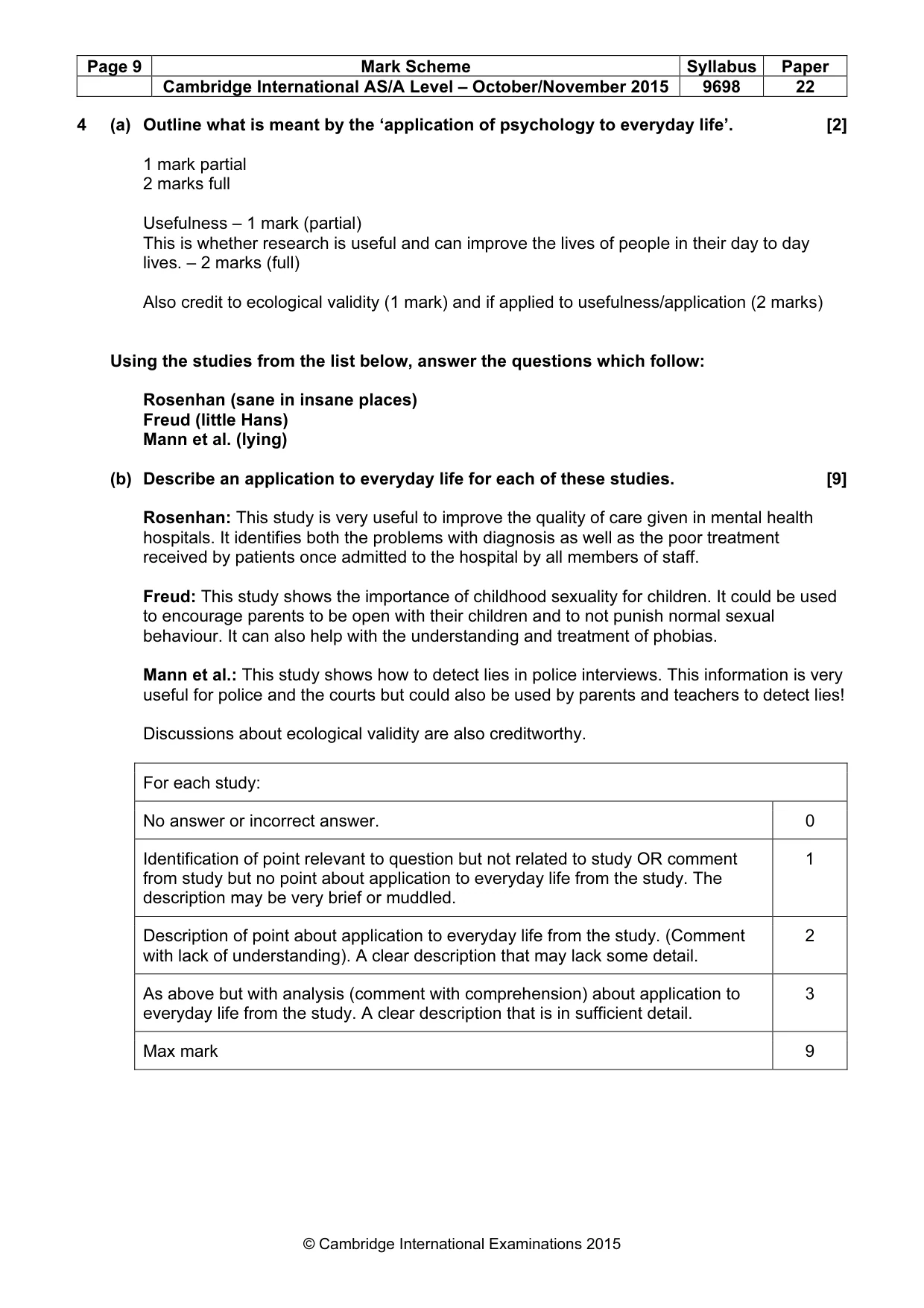
Page 9 Mark Scheme Syllabus Paper Cambridge International AS/A Level – October/November 2015 9698 22 © Cambridge International Examinations 2015 4 (a) Outline what is meant by the ‘application of psychology to everyday life’. [2] 1 mark partial 2 marks full Usefulness – 1 mark (partial) This is whether research is useful and can improve the lives of people in their day to day lives. – 2 marks (full) Also credit to ecological validity (1 mark) and if applied to usefulness/application (2 marks) Using the studies from the list below, answer the questions which follow: Rosenhan (sane in insane places) Freud (little Hans) Mann et al. (lying) (b) Describe an application to everyday life for each of these studies. [9] Rosenhan: This study is very useful to improve the quality of care given in mental health hospitals. It identifies both the problems with diagnosis as well as the poor treatment received by patients once admitted to the hospital by all members of staff. Freud: This study shows the importance of childhood sexuality for children. It could be used to encourage parents to be open with their children and to not punish normal sexual behaviour. It can also help with the understanding and treatment of phobias. Mann et al.: This study shows how to detect lies in police interviews. This information is very useful for police and the courts but could also be used by parents and teachers to detect lies! Discussions about ecological validity are also creditworthy. For each study: No answer or incorrect answer. 0 Identification of point relevant to question but not related to study OR comment from study but no point about application to everyday life from the study. The description may be very brief or muddled. 1 Description of point about application to everyday life from the study. (Comment with lack of understanding). A clear description that may lack some detail. 2 As above but with analysis (comment with comprehension) about application to everyday life from the study. A clear description that is in sufficient detail. 3 Max mark 9
Mark scheme, page 10
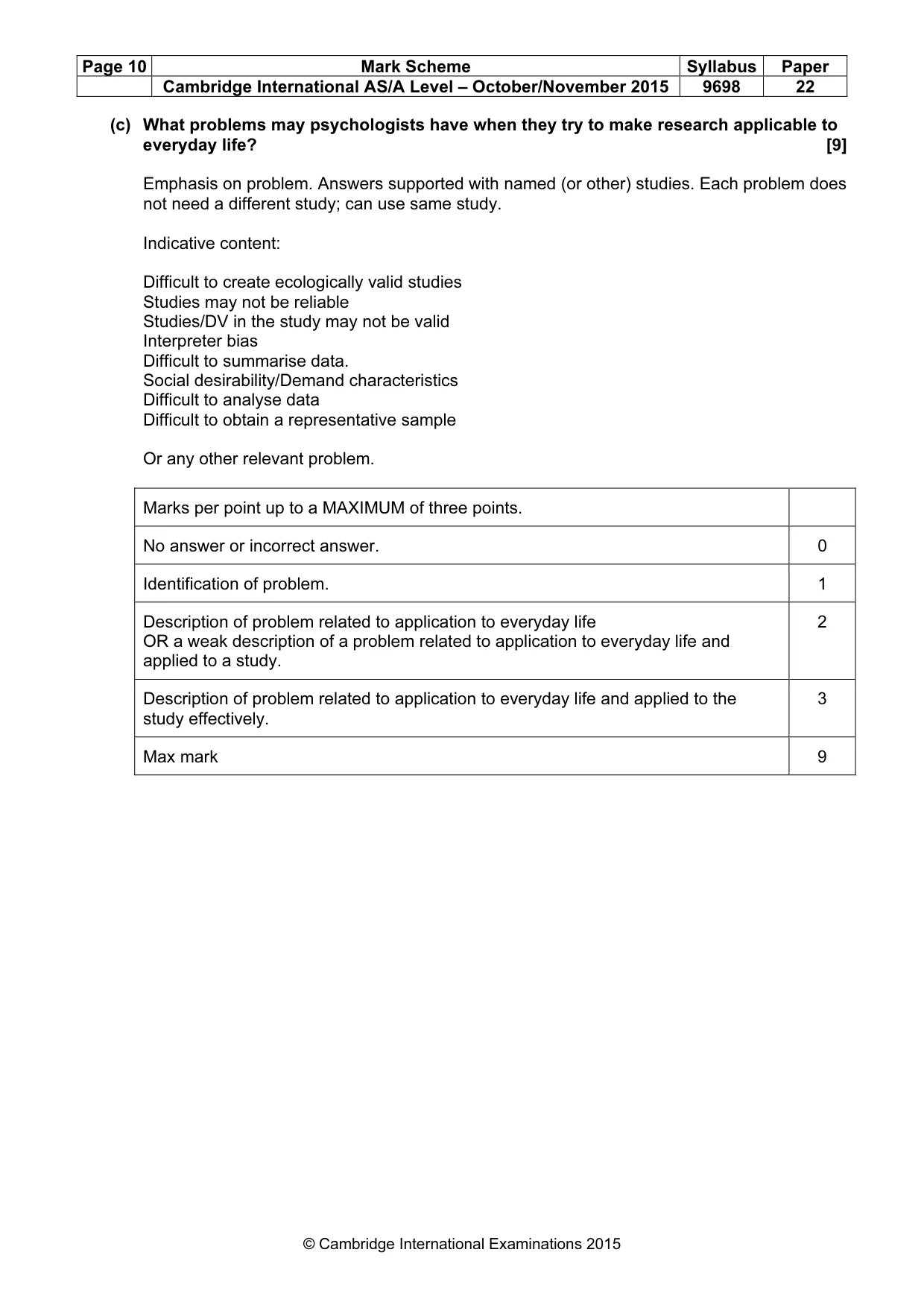
Page 10 Mark Scheme Syllabus Paper Cambridge International AS/A Level – October/November 2015 9698 22 © Cambridge International Examinations 2015 (c) What problems may psychologists have when they try to make research applicable to everyday life? [9] Emphasis on problem. Answers supported with named (or other) studies. Each problem does not need a different study; can use same study. Indicative content: Difficult to create ecologically valid studies Studies may not be reliable Studies/DV in the study may not be valid Interpreter bias Difficult to summarise data. Social desirability/Demand characteristics Difficult to analyse data Difficult to obtain a representative sample Or any other relevant problem. Marks per point up to a MAXIMUM of three points. No answer or incorrect answer. 0 Identification of problem. 1 Description of problem related to application to everyday life OR a weak description of a problem related to application to everyday life and applied to a study. 2 Description of problem related to application to everyday life and applied to the study effectively. 3 Max mark 9
What you needed in this session
Cambridge’s own grade thresholds for 2015 Oct/Nov, Paper 2 · Variant 2. A higher threshold means an easier paper — the bar moves with how the cohort did.