Cambridge A Level Psychology 9698 — 2014 Oct/Nov Paper 2 · Variant 2
9698/22/O/N/14 · 70 marks · ≈79 min
The question paper and its mark scheme, free to read here and free to download. This is Cambridge’s own paper, exactly as it was sat.
Question paper4 pages

Mark scheme10 pages
Answers below. Sit the paper first if you are practising.
Paper as text
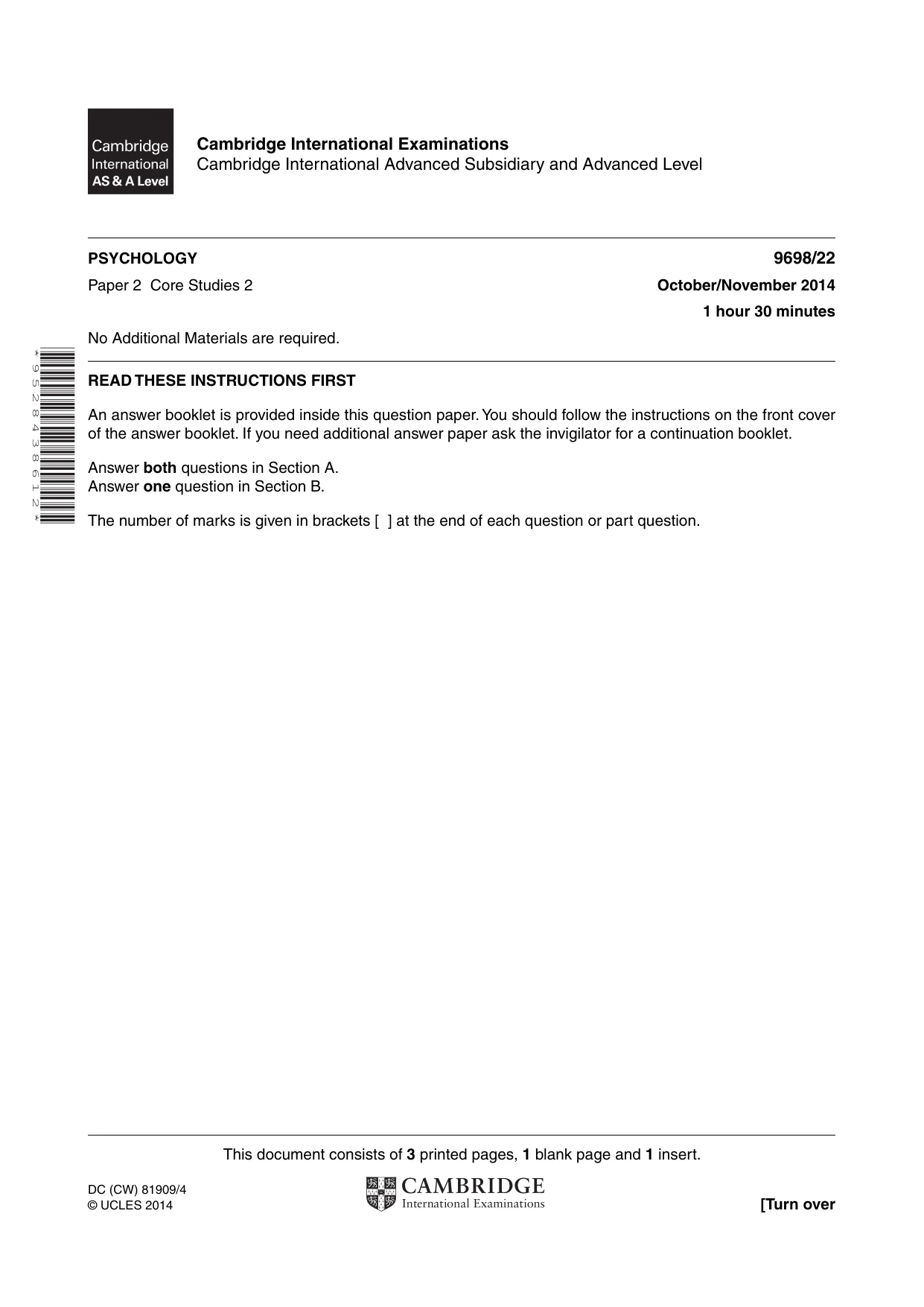
Question paper, page 1
This document consists of 3 printed pages, 1 blank page and 1 insert. DC (CW) 81909/4 © UCLES 2014 [Turn over Cambridge International Examinations Cambridge International Advanced Subsidiary and Advanced Level * 9 5 2 8 4 3 8 6 1 2 * PSYCHOLOGY 9698/22 Paper 2 Core Studies 2 October/November 2014 1 hour 30 minutes No Additional Materials are required. READ THESE INSTRUCTIONS FIRST An answer booklet is provided inside this question paper. You should follow the instructions on the front cover of the answer booklet. If you need additional answer paper ask the invigilator for a continuation booklet. Answer both questions in Section A. Answer one question in Section B. The number of marks is given in brackets [ ] at the end of each question or part question.
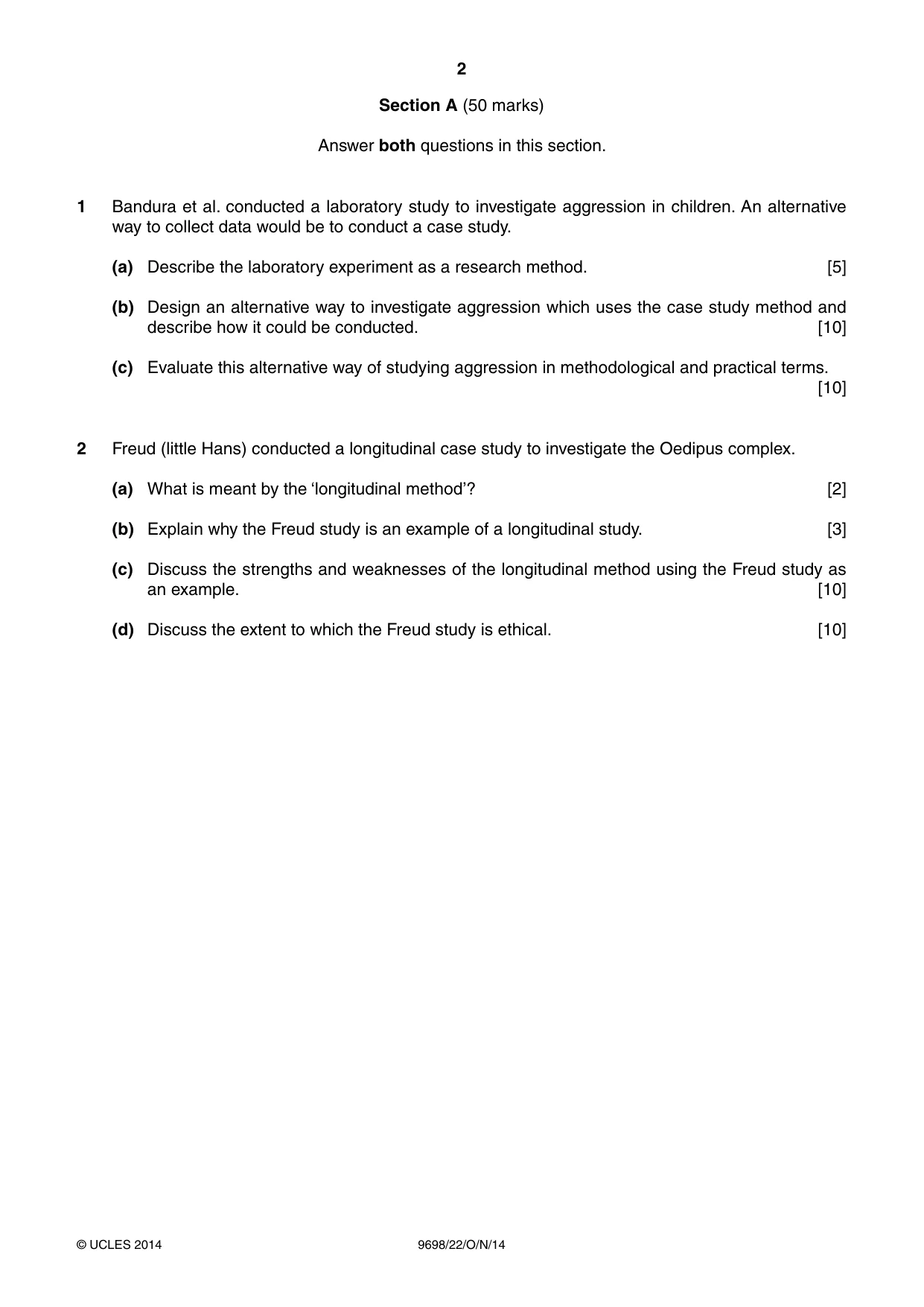
Question paper, page 2
2 9698/22/O/N/14 © UCLES 2014 Section A (50 marks) Answer both questions in this section. 1 Bandura et al. conducted a laboratory study to investigate aggression in children. An alternative way to collect data would be to conduct a case study. (a) Describe the laboratory experiment as a research method. [5] (b) Design an alternative way to investigate aggression which uses the case study method and describe how it could be conducted. [10] (c) Evaluate this alternative way of studying aggression in methodological and practical terms. [10] 2 Freud (little Hans) conducted a longitudinal case study to investigate the Oedipus complex. (a) What is meant by the ‘longitudinal method’? [2] (b) Explain why the Freud study is an example of a longitudinal study. [3] (c) Discuss the strengths and weaknesses of the longitudinal method using the Freud study as an example. [10] (d) Discuss the extent to which the Freud study is ethical. [10]
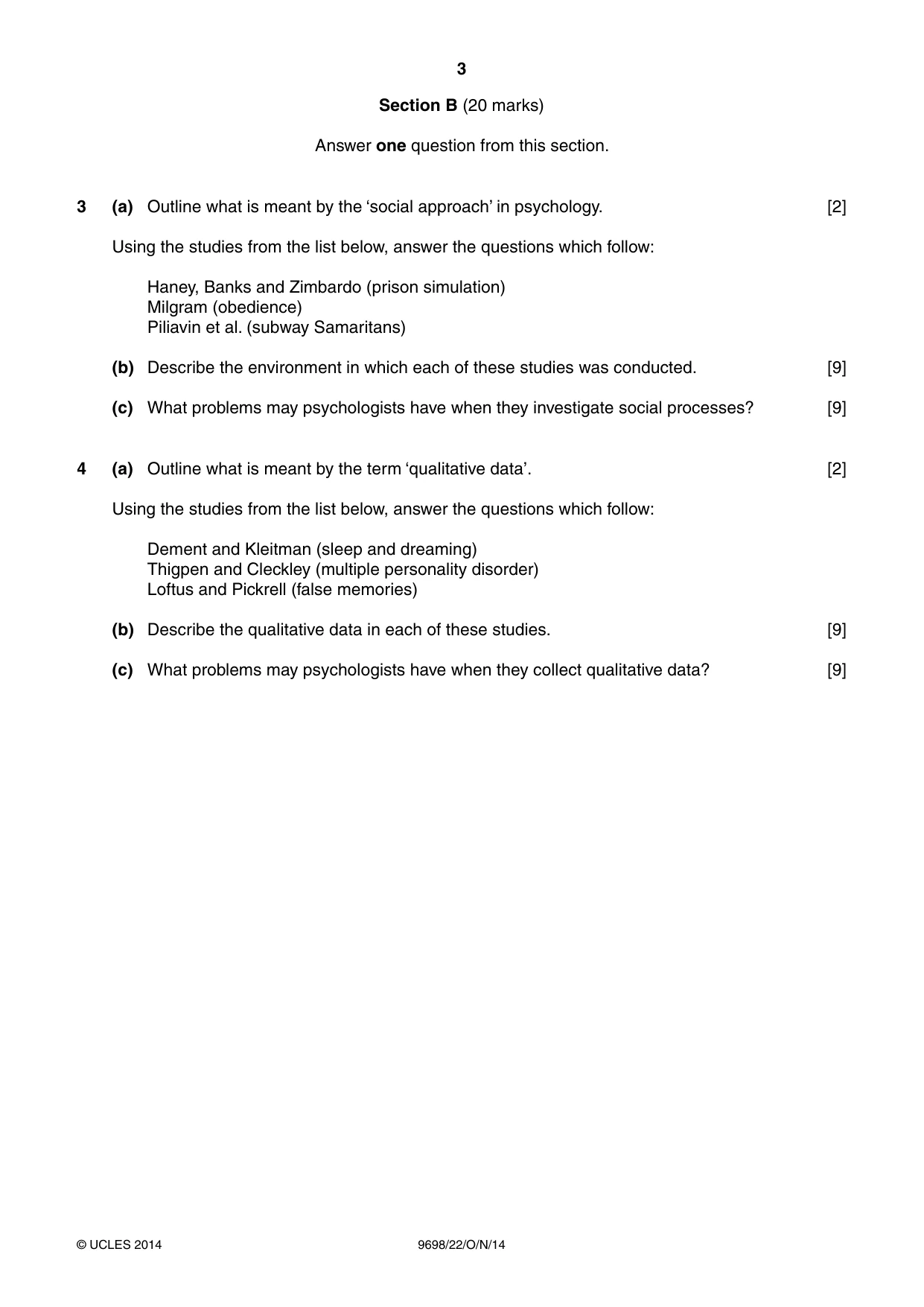
Question paper, page 3
3 9698/22/O/N/14 © UCLES 2014 Section B (20 marks) Answer one question from this section. 3 (a) Outline what is meant by the ‘social approach’ in psychology. [2] Using the studies from the list below, answer the questions which follow: Haney, Banks and Zimbardo (prison simulation) Milgram (obedience) Piliavin et al. (subway Samaritans) (b) Describe the environment in which each of these studies was conducted. [9] (c) What problems may psychologists have when they investigate social processes? [9] 4 (a) Outline what is meant by the term ‘qualitative data’. [2] Using the studies from the list below, answer the questions which follow: Dement and Kleitman (sleep and dreaming) Thigpen and Cleckley (multiple personality disorder) Loftus and Pickrell (false memories) (b) Describe the qualitative data in each of these studies. [9] (c) What problems may psychologists have when they collect qualitative data? [9]
Question paper, page 4
4 9698/22/O/N/14 © UCLES 2014 BLANK PAGE Permission to reproduce items where third-party owned material protected by copyright is included has been sought and cleared where possible. Every reasonable effort has been made by the publisher (UCLES) to trace copyright holders, but if any items requiring clearance have unwittingly been included, the publisher will be pleased to make amends at the earliest possible opportunity. Cambridge International Examinations is part of the Cambridge Assessment Group. Cambridge Assessment is the brand name of University of Cambridge Local Examinations Syndicate (UCLES), which is itself a department of the University of Cambridge.
Mark scheme, page 1
® IGCSE is the registered trademark of Cambridge International Examinations. CAMBRIDGE INTERNATIONAL EXAMINATIONS Cambridge International Advanced Subsidiary and Advanced Level MARK SCHEME for the October/November 2014 series 9698 PSYCHOLOGY 9698/22 Paper 2 (Core Studies 2), maximum raw mark 70 This mark scheme is published as an aid to teachers and candidates, to indicate the requirements of the examination. It shows the basis on which Examiners were instructed to award marks. It does not indicate the details of the discussions that took place at an Examiners’ meeting before marking began, which would have considered the acceptability of alternative answers. Mark schemes should be read in conjunction with the question paper and the Principal Examiner Report for Teachers. Cambridge will not enter into discussions about these mark schemes. Cambridge is publishing the mark schemes for the October/November 2014 series for most Cambridge IGCSE®, Cambridge International A and AS Level components and some Cambridge O Level components.
Mark scheme, page 2
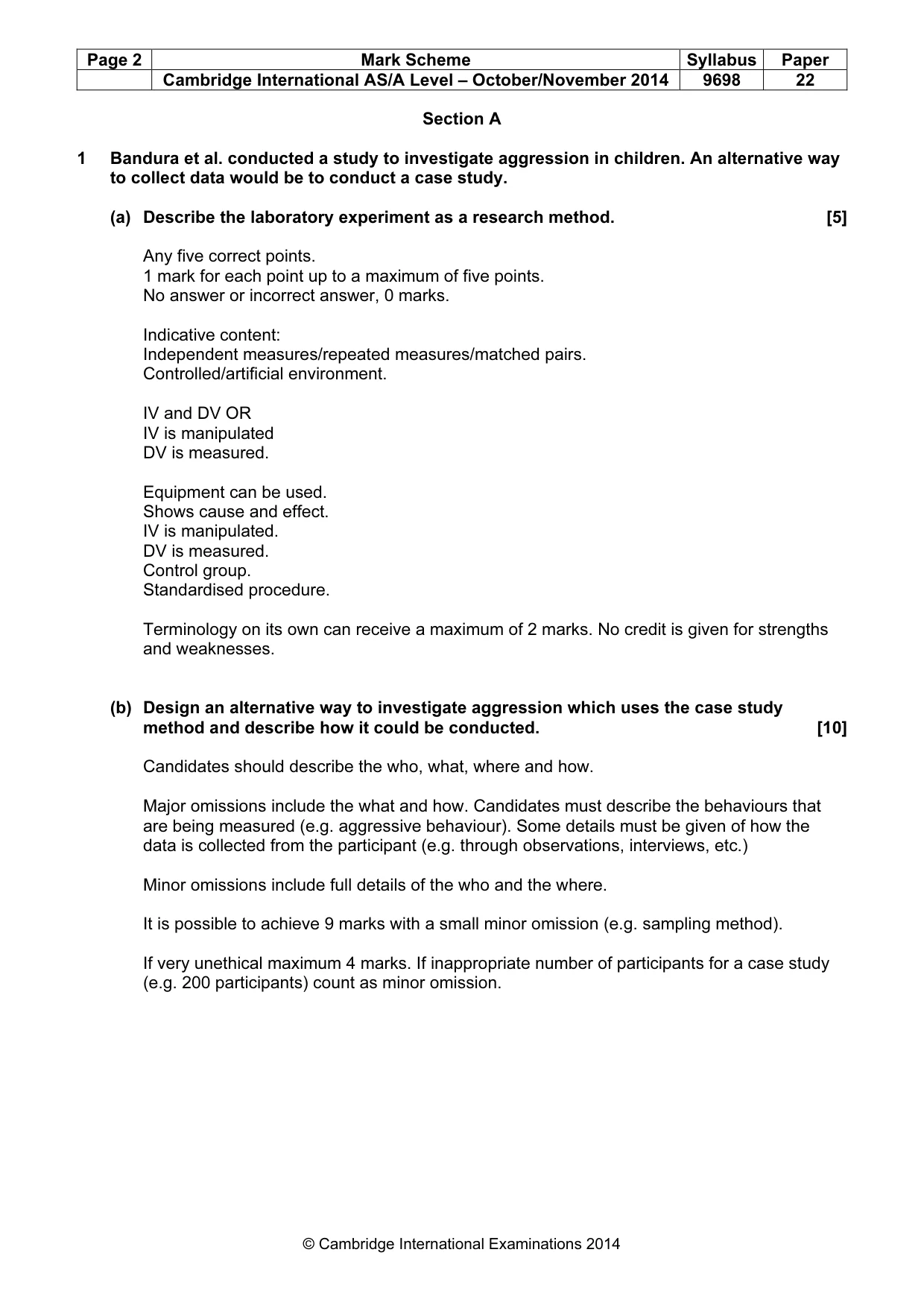
Page 2 Mark Scheme Syllabus Paper Cambridge International AS/A Level – October/November 2014 9698 22 © Cambridge International Examinations 2014 Section A 1 Bandura et al. conducted a study to investigate aggression in children. An alternative way to collect data would be to conduct a case study. (a) Describe the laboratory experiment as a research method. [5] Any five correct points. 1 mark for each point up to a maximum of five points. No answer or incorrect answer, 0 marks. Indicative content: Independent measures/repeated measures/matched pairs. Controlled/artificial environment. IV and DV OR IV is manipulated DV is measured. Equipment can be used. Shows cause and effect. IV is manipulated. DV is measured. Control group. Standardised procedure. Terminology on its own can receive a maximum of 2 marks. No credit is given for strengths and weaknesses. (b) Design an alternative way to investigate aggression which uses the case study method and describe how it could be conducted. [10] Candidates should describe the who, what, where and how. Major omissions include the what and how. Candidates must describe the behaviours that are being measured (e.g. aggressive behaviour). Some details must be given of how the data is collected from the participant (e.g. through observations, interviews, etc.) Minor omissions include full details of the who and the where. It is possible to achieve 9 marks with a small minor omission (e.g. sampling method). If very unethical maximum 4 marks. If inappropriate number of participants for a case study (e.g. 200 participants) count as minor omission.
Mark scheme, page 3
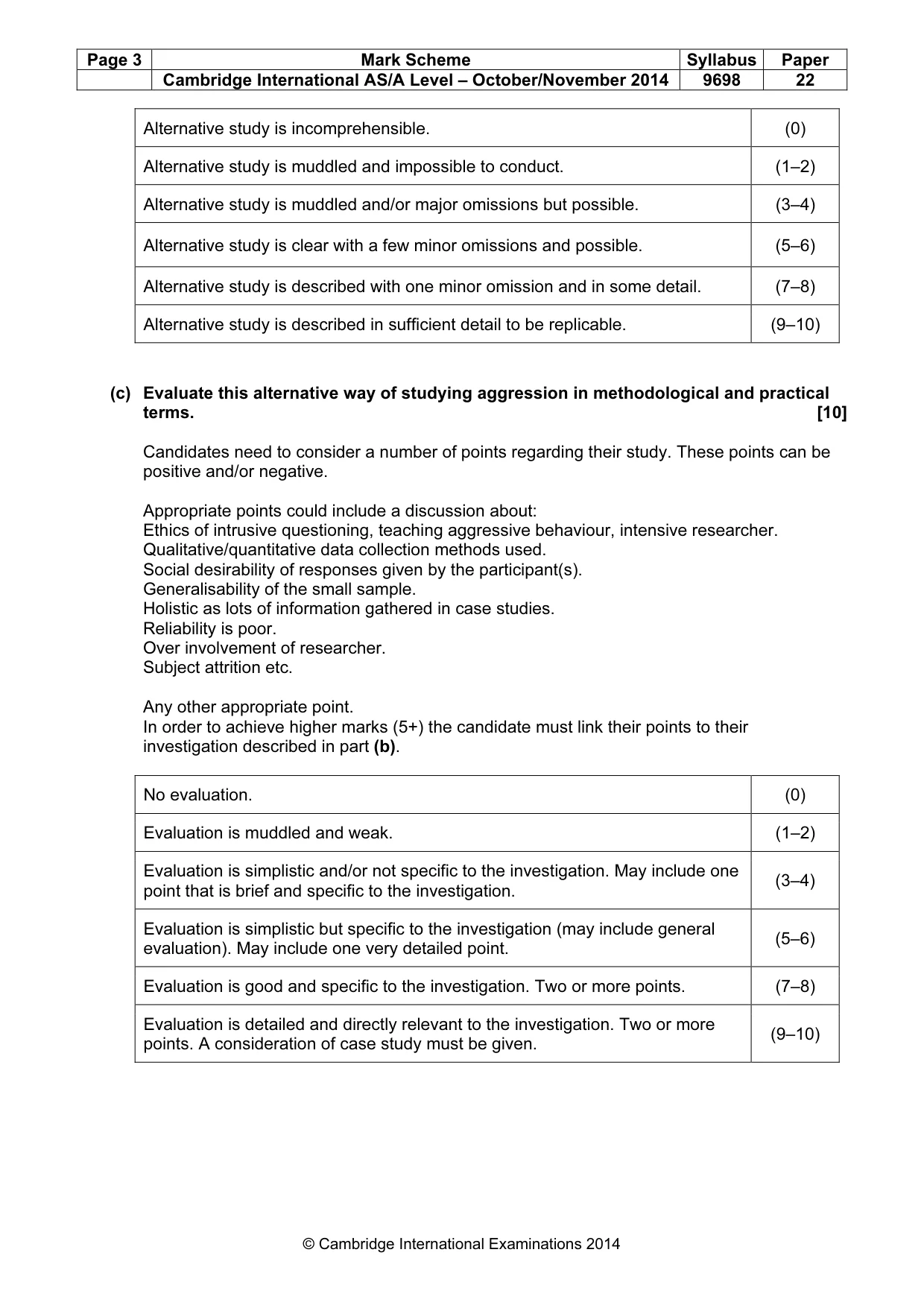
Page 3 Mark Scheme Syllabus Paper Cambridge International AS/A Level – October/November 2014 9698 22 © Cambridge International Examinations 2014 Alternative study is incomprehensible. (0) Alternative study is muddled and impossible to conduct. (1–2) Alternative study is muddled and/or major omissions but possible. (3–4) Alternative study is clear with a few minor omissions and possible. (5–6) Alternative study is described with one minor omission and in some detail. (7–8) Alternative study is described in sufficient detail to be replicable. (9–10) (c) Evaluate this alternative way of studying aggression in methodological and practical terms. [10] Candidates need to consider a number of points regarding their study. These points can be positive and/or negative. Appropriate points could include a discussion about: Ethics of intrusive questioning, teaching aggressive behaviour, intensive researcher. Qualitative/quantitative data collection methods used. Social desirability of responses given by the participant(s). Generalisability of the small sample. Holistic as lots of information gathered in case studies. Reliability is poor. Over involvement of researcher. Subject attrition etc. Any other appropriate point. In order to achieve higher marks (5+) the candidate must link their points to their investigation described in part (b). No evaluation. (0) Evaluation is muddled and weak. (1–2) Evaluation is simplistic and/or not specific to the investigation. May include one point that is brief and specific to the investigation. (3–4) Evaluation is simplistic but specific to the investigation (may include general evaluation). May include one very detailed point. (5–6) Evaluation is good and specific to the investigation. Two or more points. (7–8) Evaluation is detailed and directly relevant to the investigation. Two or more points. A consideration of case study must be given. (9–10)
Mark scheme, page 4
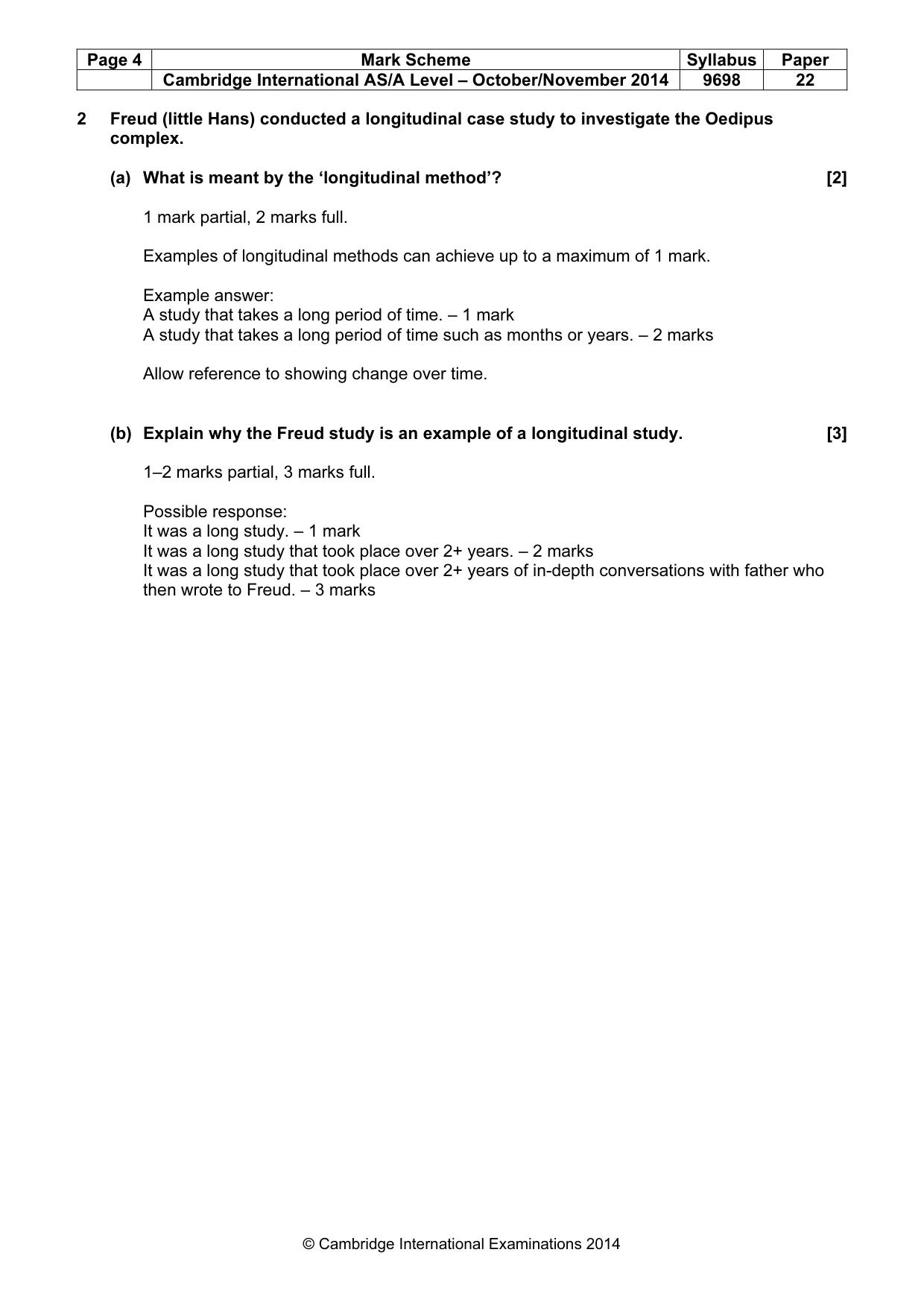
Page 4 Mark Scheme Syllabus Paper Cambridge International AS/A Level – October/November 2014 9698 22 © Cambridge International Examinations 2014 2 Freud (little Hans) conducted a longitudinal case study to investigate the Oedipus complex. (a) What is meant by the ‘longitudinal method’? [2] 1 mark partial, 2 marks full. Examples of longitudinal methods can achieve up to a maximum of 1 mark. Example answer: A study that takes a long period of time. – 1 mark A study that takes a long period of time such as months or years. – 2 marks Allow reference to showing change over time. (b) Explain why the Freud study is an example of a longitudinal study. [3] 1–2 marks partial, 3 marks full. Possible response: It was a long study. – 1 mark It was a long study that took place over 2+ years. – 2 marks It was a long study that took place over 2+ years of in-depth conversations with father who then wrote to Freud. – 3 marks
Mark scheme, page 5
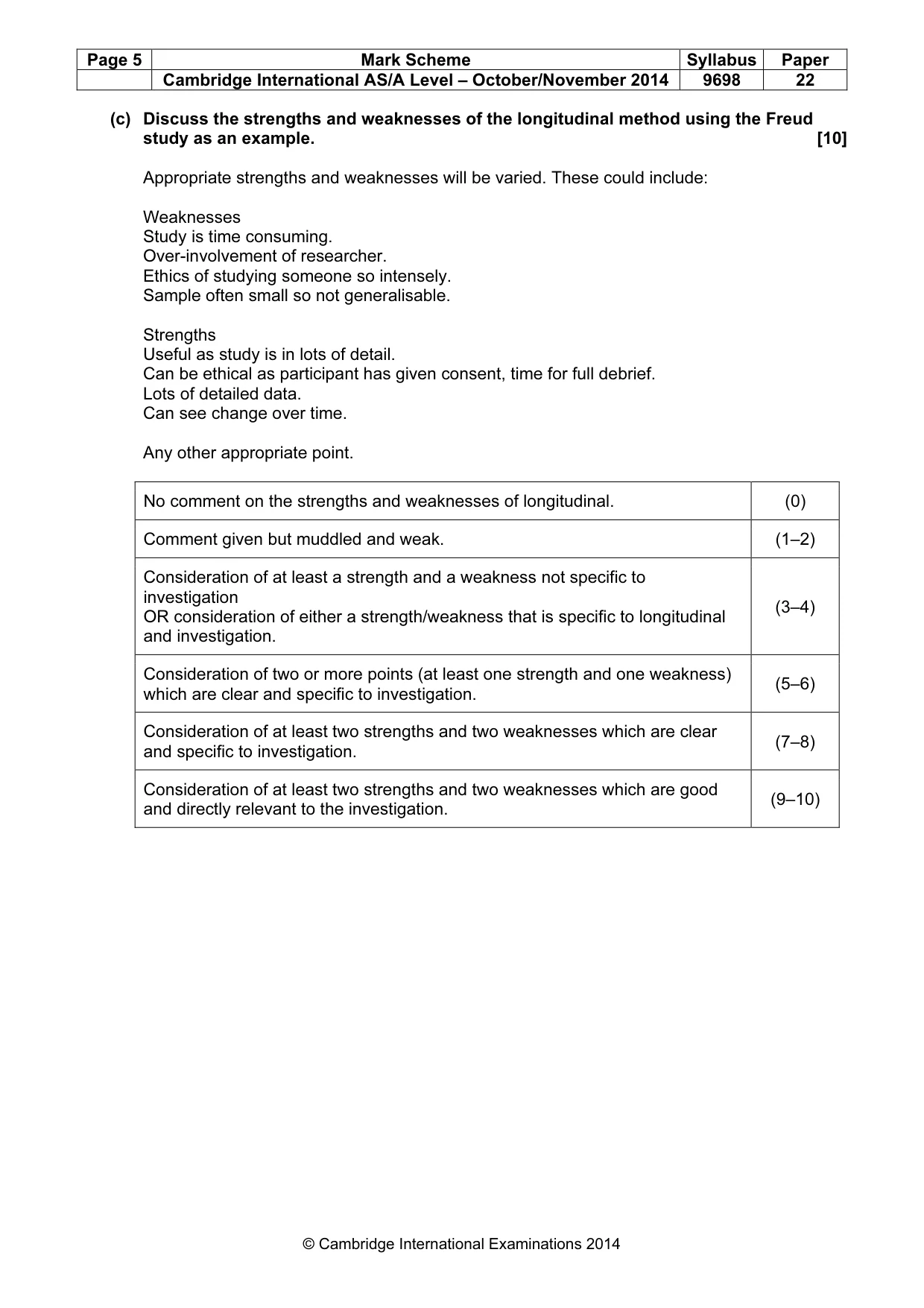
Page 5 Mark Scheme Syllabus Paper Cambridge International AS/A Level – October/November 2014 9698 22 © Cambridge International Examinations 2014 (c) Discuss the strengths and weaknesses of the longitudinal method using the Freud study as an example. [10] Appropriate strengths and weaknesses will be varied. These could include: Weaknesses Study is time consuming. Over-involvement of researcher. Ethics of studying someone so intensely. Sample often small so not generalisable. Strengths Useful as study is in lots of detail. Can be ethical as participant has given consent, time for full debrief. Lots of detailed data. Can see change over time. Any other appropriate point. No comment on the strengths and weaknesses of longitudinal. (0) Comment given but muddled and weak. (1–2) Consideration of at least a strength and a weakness not specific to investigation OR consideration of either a strength/weakness that is specific to longitudinal and investigation. (3–4) Consideration of two or more points (at least one strength and one weakness) which are clear and specific to investigation. (5–6) Consideration of at least two strengths and two weaknesses which are clear and specific to investigation. (7–8) Consideration of at least two strengths and two weaknesses which are good and directly relevant to the investigation. (9–10)
Mark scheme, page 6
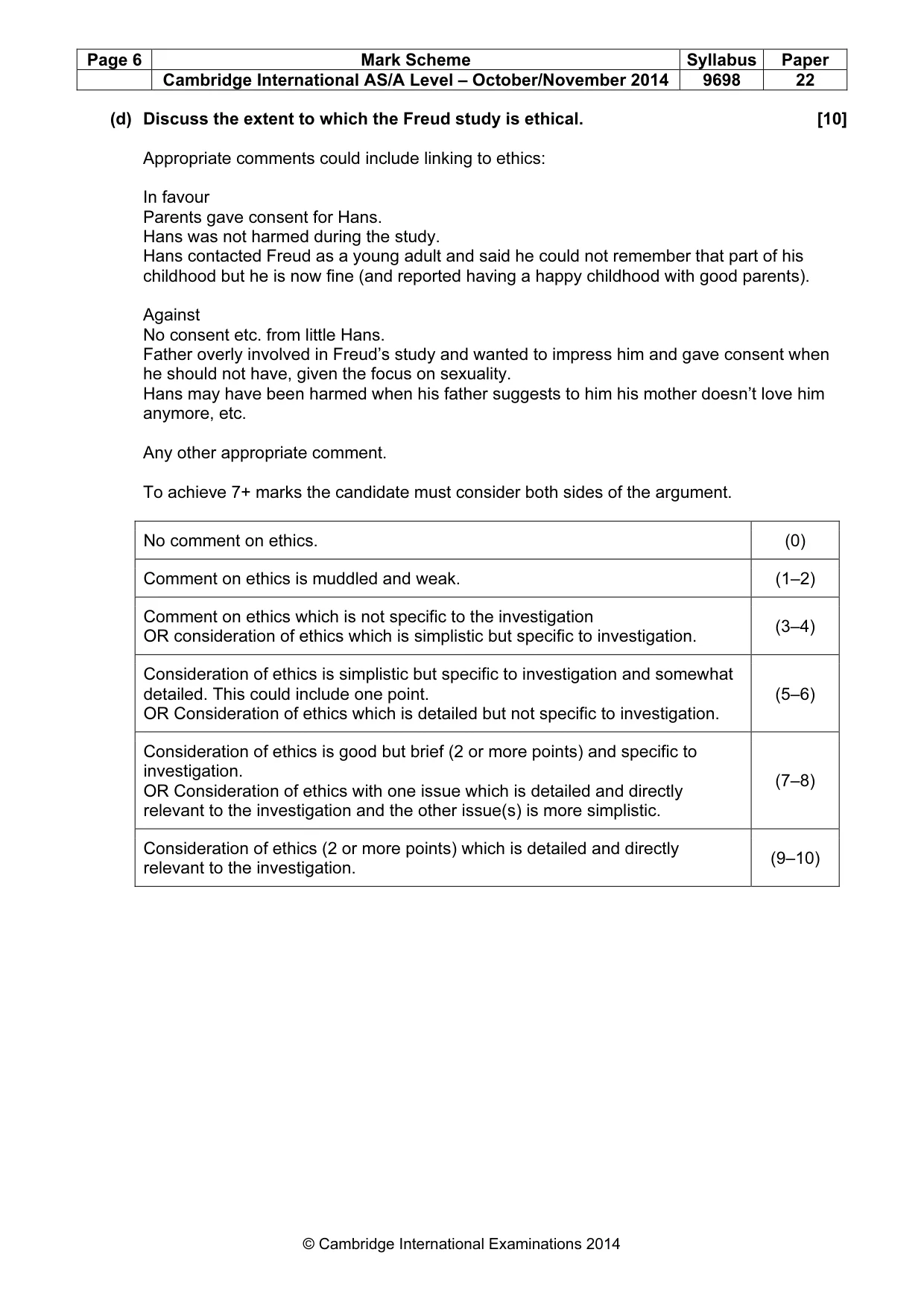
Page 6 Mark Scheme Syllabus Paper Cambridge International AS/A Level – October/November 2014 9698 22 © Cambridge International Examinations 2014 (d) Discuss the extent to which the Freud study is ethical. [10] Appropriate comments could include linking to ethics: In favour Parents gave consent for Hans. Hans was not harmed during the study. Hans contacted Freud as a young adult and said he could not remember that part of his childhood but he is now fine (and reported having a happy childhood with good parents). Against No consent etc. from little Hans. Father overly involved in Freud’s study and wanted to impress him and gave consent when he should not have, given the focus on sexuality. Hans may have been harmed when his father suggests to him his mother doesn’t love him anymore, etc. Any other appropriate comment. To achieve 7+ marks the candidate must consider both sides of the argument. No comment on ethics. (0) Comment on ethics is muddled and weak. (1–2) Comment on ethics which is not specific to the investigation OR consideration of ethics which is simplistic but specific to investigation. (3–4) Consideration of ethics is simplistic but specific to investigation and somewhat detailed. This could include one point. OR Consideration of ethics which is detailed but not specific to investigation. (5–6) Consideration of ethics is good but brief (2 or more points) and specific to investigation. OR Consideration of ethics with one issue which is detailed and directly relevant to the investigation and the other issue(s) is more simplistic. (7–8) Consideration of ethics (2 or more points) which is detailed and directly relevant to the investigation. (9–10)
Mark scheme, page 7
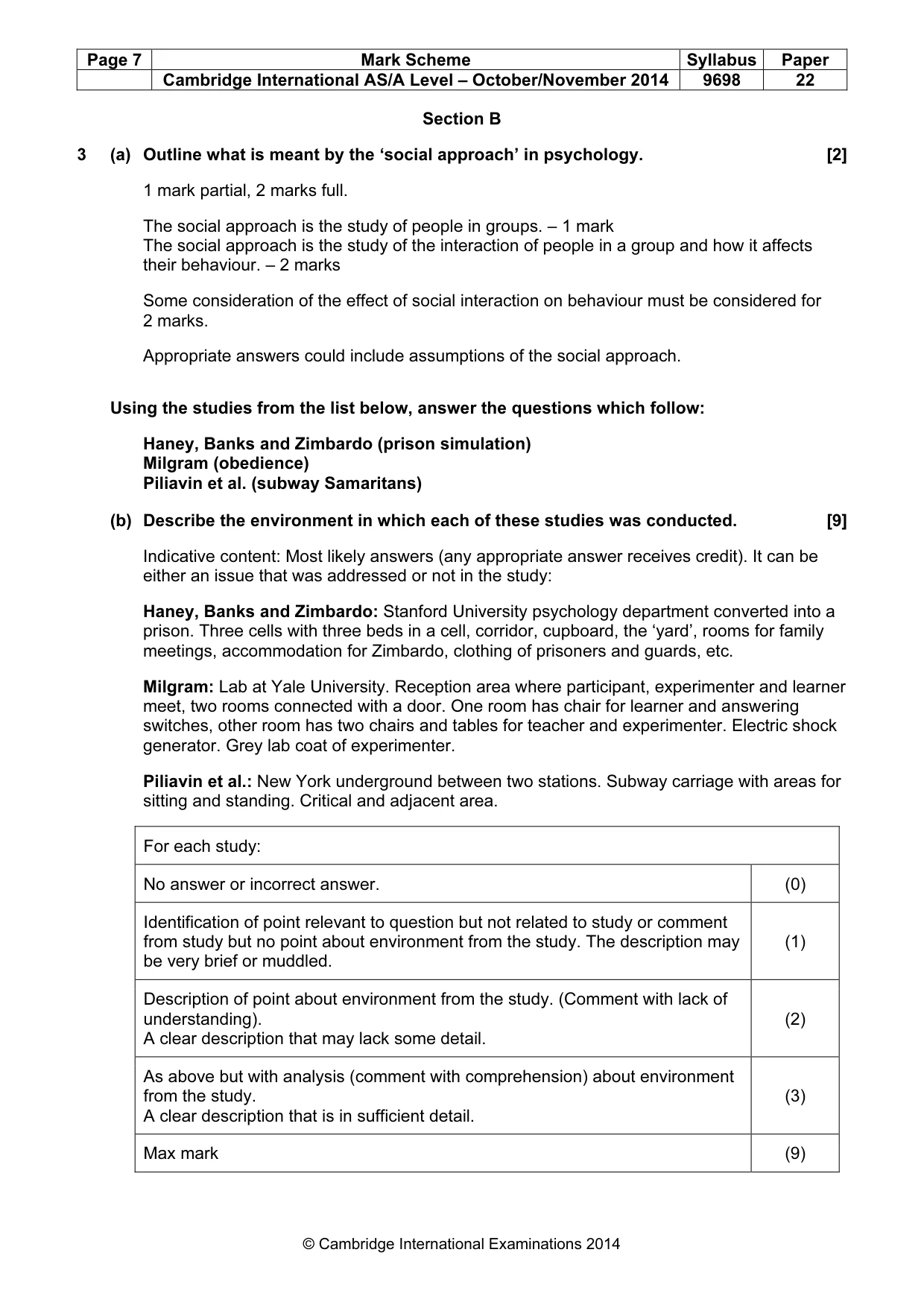
Page 7 Mark Scheme Syllabus Paper Cambridge International AS/A Level – October/November 2014 9698 22 © Cambridge International Examinations 2014 Section B 3 (a) Outline what is meant by the ‘social approach’ in psychology. [2] 1 mark partial, 2 marks full. The social approach is the study of people in groups. – 1 mark The social approach is the study of the interaction of people in a group and how it affects their behaviour. – 2 marks Some consideration of the effect of social interaction on behaviour must be considered for 2 marks. Appropriate answers could include assumptions of the social approach. Using the studies from the list below, answer the questions which follow: Haney, Banks and Zimbardo (prison simulation) Milgram (obedience) Piliavin et al. (subway Samaritans) (b) Describe the environment in which each of these studies was conducted. [9] Indicative content: Most likely answers (any appropriate answer receives credit). It can be either an issue that was addressed or not in the study: Haney, Banks and Zimbardo: Stanford University psychology department converted into a prison. Three cells with three beds in a cell, corridor, cupboard, the ‘yard’, rooms for family meetings, accommodation for Zimbardo, clothing of prisoners and guards, etc. Milgram: Lab at Yale University. Reception area where participant, experimenter and learner meet, two rooms connected with a door. One room has chair for learner and answering switches, other room has two chairs and tables for teacher and experimenter. Electric shock generator. Grey lab coat of experimenter. Piliavin et al.: New York underground between two stations. Subway carriage with areas for sitting and standing. Critical and adjacent area. For each study: No answer or incorrect answer. (0) Identification of point relevant to question but not related to study or comment from study but no point about environment from the study. The description may be very brief or muddled. (1) Description of point about environment from the study. (Comment with lack of understanding). A clear description that may lack some detail. (2) As above but with analysis (comment with comprehension) about environment from the study. A clear description that is in sufficient detail. (3) Max mark (9)
Mark scheme, page 8
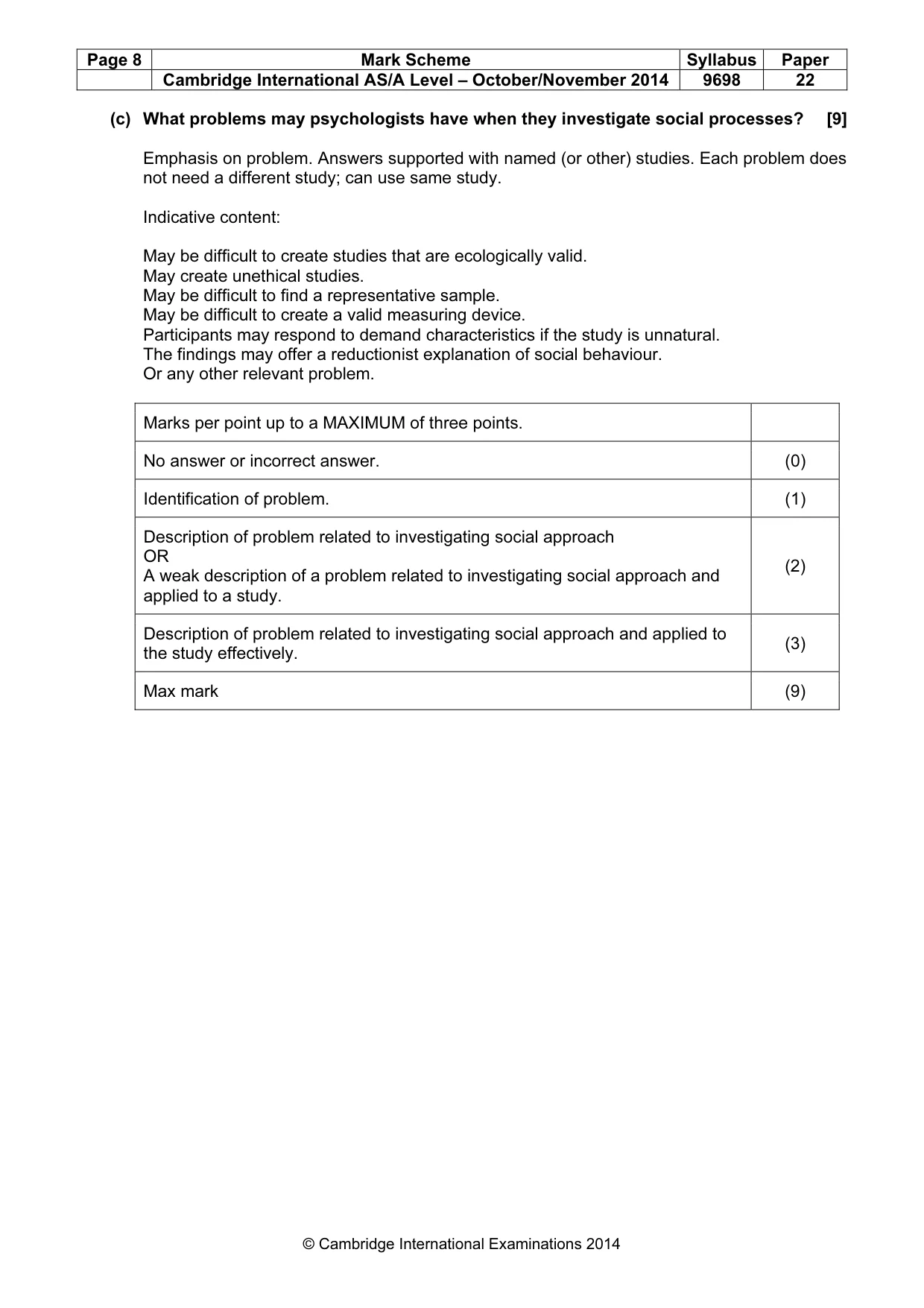
Page 8 Mark Scheme Syllabus Paper Cambridge International AS/A Level – October/November 2014 9698 22 © Cambridge International Examinations 2014 (c) What problems may psychologists have when they investigate social processes? [9] Emphasis on problem. Answers supported with named (or other) studies. Each problem does not need a different study; can use same study. Indicative content: May be difficult to create studies that are ecologically valid. May create unethical studies. May be difficult to find a representative sample. May be difficult to create a valid measuring device. Participants may respond to demand characteristics if the study is unnatural. The findings may offer a reductionist explanation of social behaviour. Or any other relevant problem. Marks per point up to a MAXIMUM of three points. No answer or incorrect answer. (0) Identification of problem. (1) Description of problem related to investigating social approach OR A weak description of a problem related to investigating social approach and applied to a study. (2) Description of problem related to investigating social approach and applied to the study effectively. (3) Max mark (9)
Mark scheme, page 9
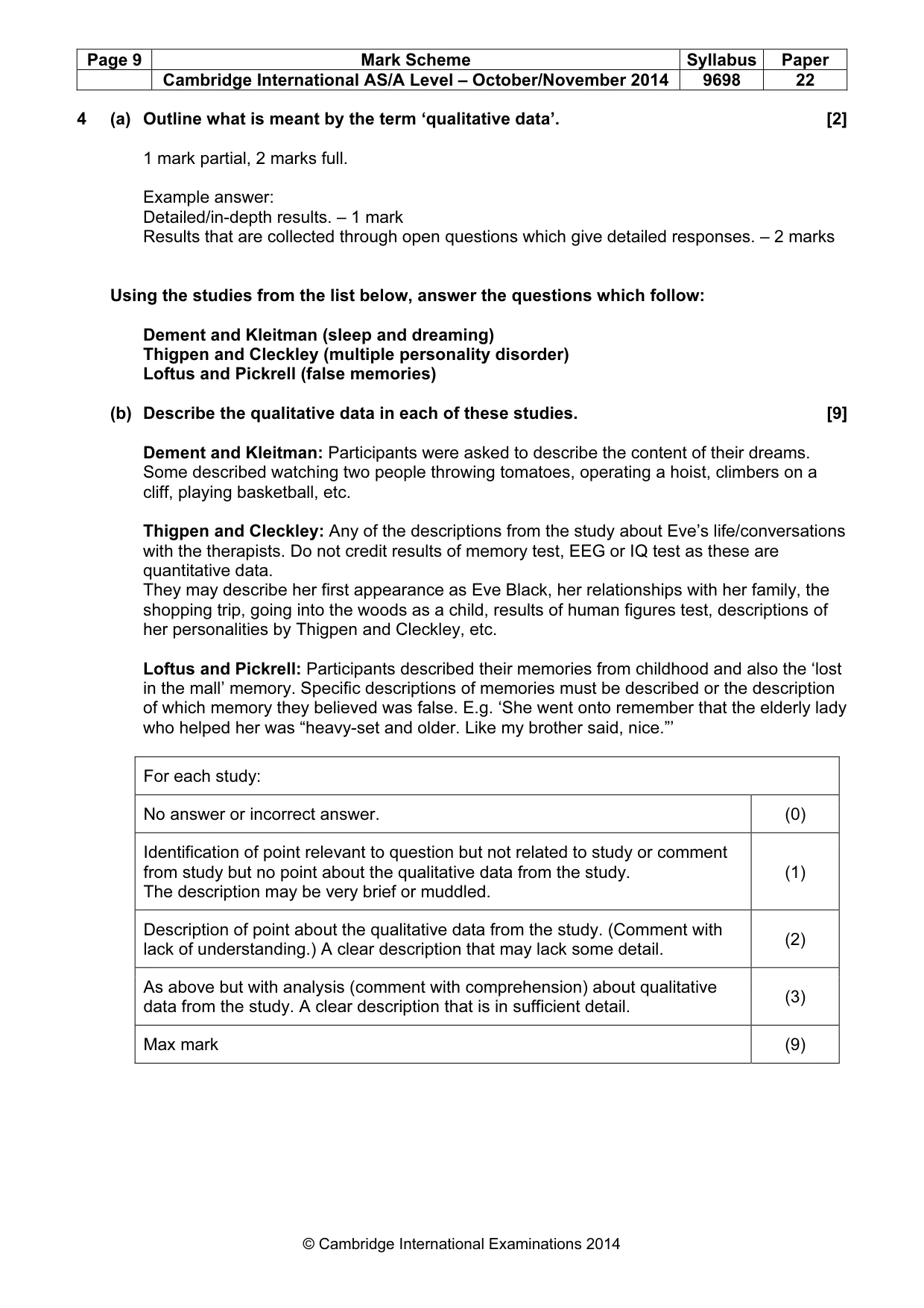
Page 9 Mark Scheme Syllabus Paper Cambridge International AS/A Level – October/November 2014 9698 22 © Cambridge International Examinations 2014 4 (a) Outline what is meant by the term ‘qualitative data’. [2] 1 mark partial, 2 marks full. Example answer: Detailed/in-depth results. – 1 mark Results that are collected through open questions which give detailed responses. – 2 marks Using the studies from the list below, answer the questions which follow: Dement and Kleitman (sleep and dreaming) Thigpen and Cleckley (multiple personality disorder) Loftus and Pickrell (false memories) (b) Describe the qualitative data in each of these studies. [9] Dement and Kleitman: Participants were asked to describe the content of their dreams. Some described watching two people throwing tomatoes, operating a hoist, climbers on a cliff, playing basketball, etc. Thigpen and Cleckley: Any of the descriptions from the study about Eve’s life/conversations with the therapists. Do not credit results of memory test, EEG or IQ test as these are quantitative data. They may describe her first appearance as Eve Black, her relationships with her family, the shopping trip, going into the woods as a child, results of human figures test, descriptions of her personalities by Thigpen and Cleckley, etc. Loftus and Pickrell: Participants described their memories from childhood and also the ‘lost in the mall’ memory. Specific descriptions of memories must be described or the description of which memory they believed was false. E.g. ‘She went onto remember that the elderly lady who helped her was “heavy-set and older. Like my brother said, nice.”’ For each study: No answer or incorrect answer. (0) Identification of point relevant to question but not related to study or comment from study but no point about the qualitative data from the study. The description may be very brief or muddled. (1) Description of point about the qualitative data from the study. (Comment with lack of understanding.) A clear description that may lack some detail. (2) As above but with analysis (comment with comprehension) about qualitative data from the study. A clear description that is in sufficient detail. (3) Max mark (9)
Mark scheme, page 10
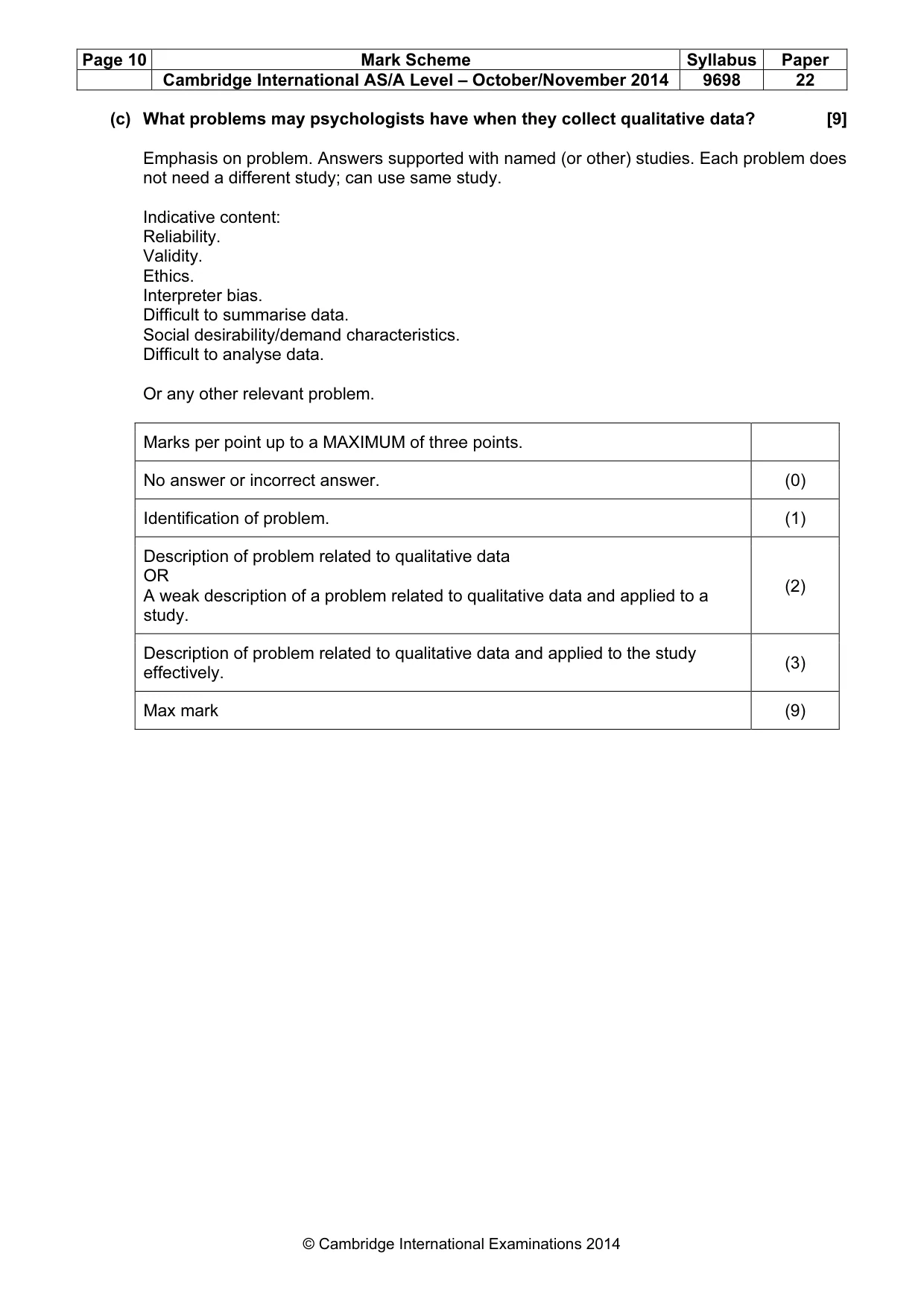
Page 10 Mark Scheme Syllabus Paper Cambridge International AS/A Level – October/November 2014 9698 22 © Cambridge International Examinations 2014 (c) What problems may psychologists have when they collect qualitative data? [9] Emphasis on problem. Answers supported with named (or other) studies. Each problem does not need a different study; can use same study. Indicative content: Reliability. Validity. Ethics. Interpreter bias. Difficult to summarise data. Social desirability/demand characteristics. Difficult to analyse data. Or any other relevant problem. Marks per point up to a MAXIMUM of three points. No answer or incorrect answer. (0) Identification of problem. (1) Description of problem related to qualitative data OR A weak description of a problem related to qualitative data and applied to a study. (2) Description of problem related to qualitative data and applied to the study effectively. (3) Max mark (9)
What you needed in this session
Cambridge’s own grade thresholds for 2014 Oct/Nov, Paper 2 · Variant 2. A higher threshold means an easier paper — the bar moves with how the cohort did.