Questions as text
Q1 · State what is meant by the Avogadro constant NA 9702/41 May/June 2011
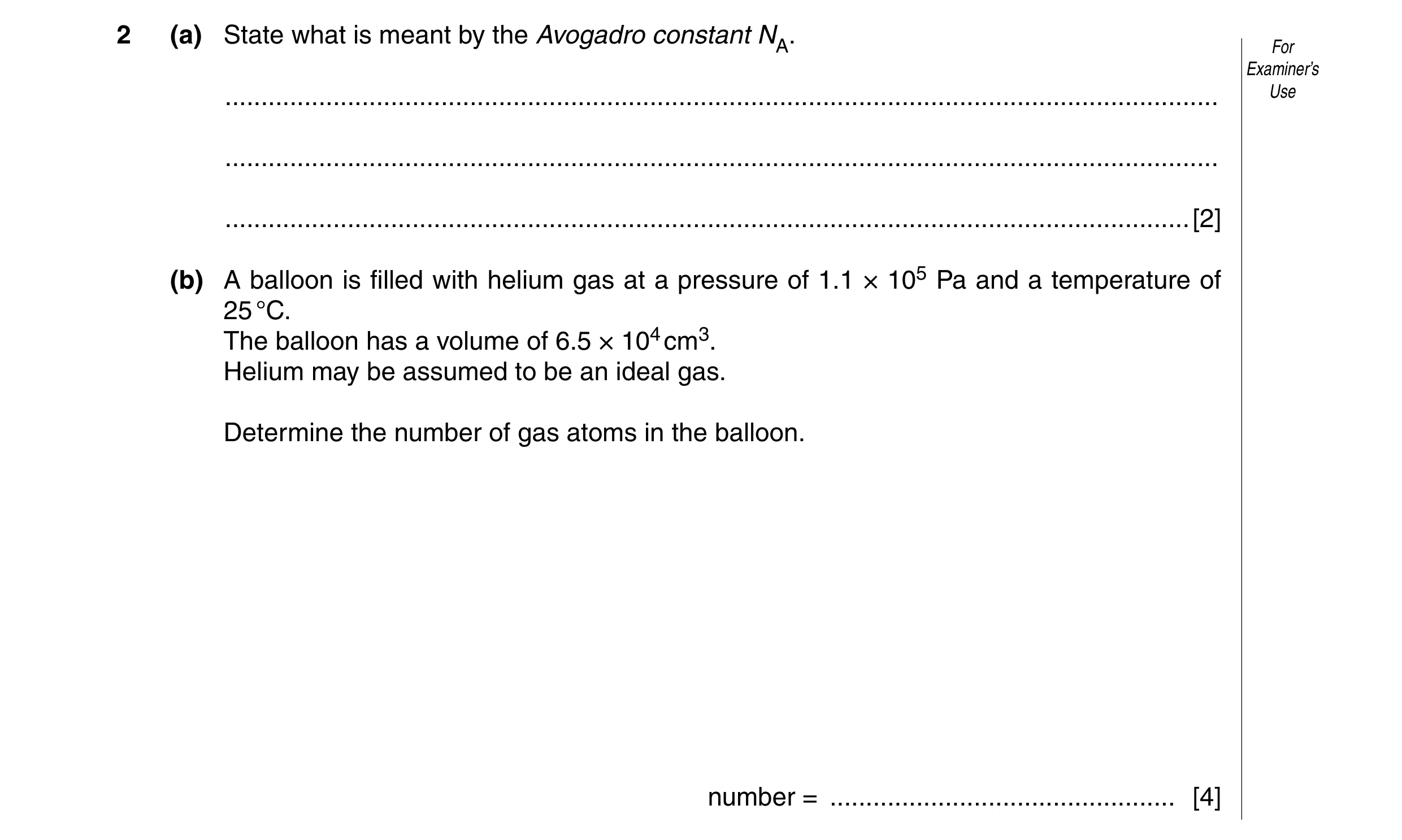
2 (a) State what is meant by the Avogadro constant NA. For Examiner’s … Use … … [2] (b) A balloon is filled with helium gas at a pressure of 1.1 × 10⁵ Pa and a temperature of 25 °C. The balloon has a volume of 6.5 × 104 cm3. Helium may be assumed to be an ideal gas. Determine the number of gas atoms in the balloon. number = … [4]
6 marks
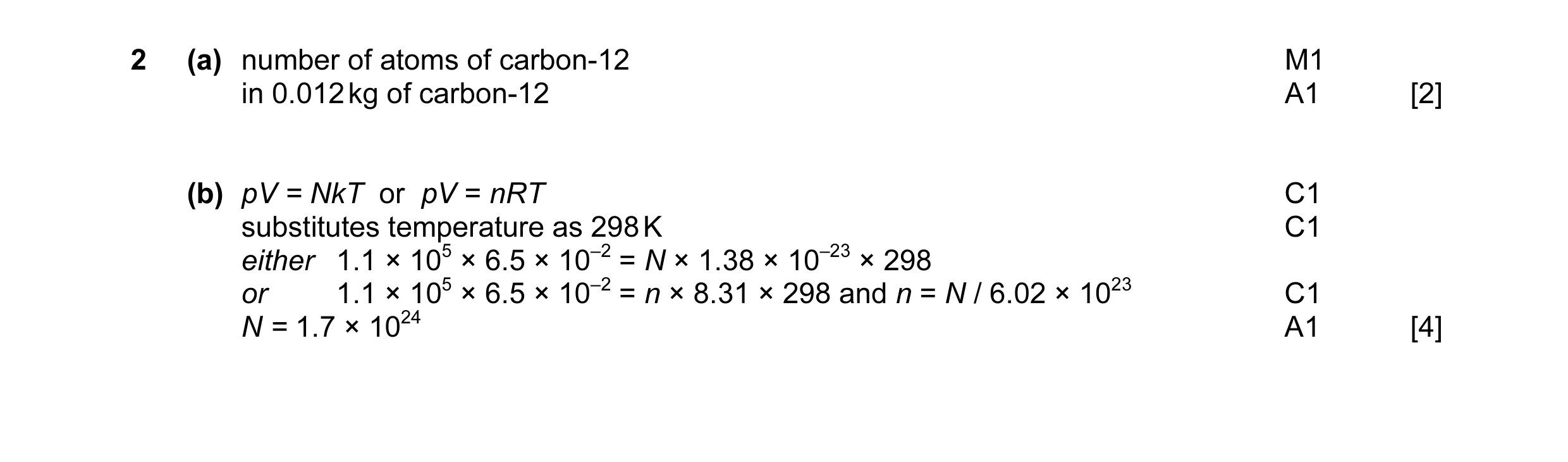
Mark scheme: 2 (a) number of atoms of carbon-12 M1 in 0.012 kg of carbon-12 A1 [2] (b) pV = NkT or pV = nRT C1 substitutes temperature as 298 K C1 either 1.1 × 105 × 6.5 × 10–2 = N × 1.38 × 10–23 × 298 or 1.1 × 105 × 6.5 × 10–2 = n × 8.31 × 298 and n = N / 6.02 × 10²³ C1 N = 1.7 × 1024 A1 [4]
This question in 9702/41 May/June 2011
Q2 · State what is meant by a mole 9702/42 May/June 2011
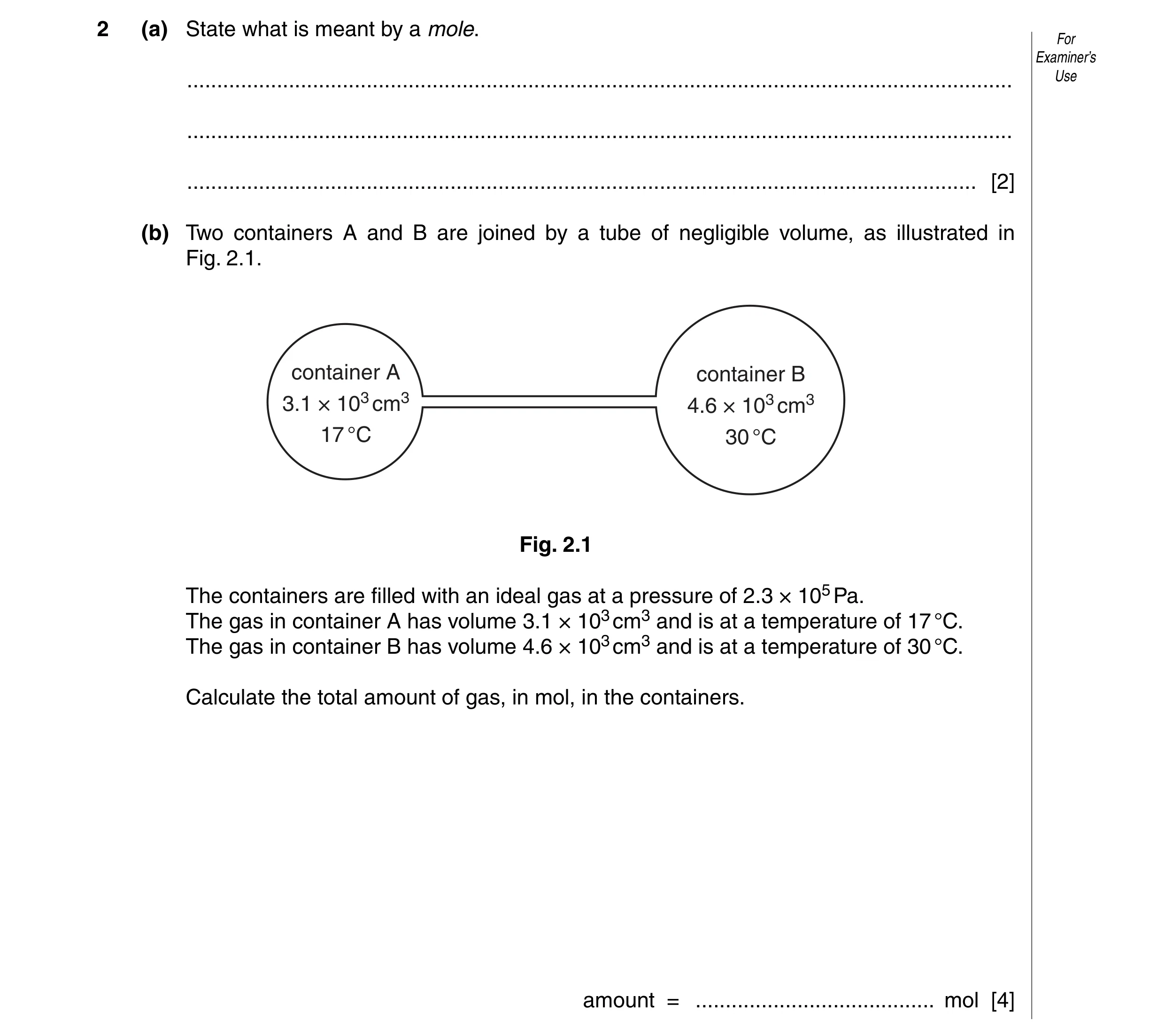
2 (a) State what is meant by a mole. For Examiner’s … Use … … [2] (b) Two containers A and B are joined by a tube of negligible volume, as illustrated in Fig. 2.1. container A container B 3.1 × 103 cm3 4.6 × 103 cm3 17 °C 30 °C Fig. 2.1 The containers are filled with an ideal gas at a pressure of 2.3 × 10⁵ Pa. The gas in container A has volume 3.1 × 103 cm3 and is at a temperature of 17 °C. The gas in container B has volume 4.6 × 103 cm3 and is at a temperature of 30 °C. Calculate the total amount of gas, in mol, in the containers. amount = … mol [4]
6 marks
Mark scheme: 2 (a) amount of substance M1 containing same number of particles as in 0.012 kg of carbon-12 A1 [2] (b) pV = nRT C1 amount = (2.3 × 105 × 3.1 × 10–3) / (8.31 × 290) + (2.3 × 105 × 4.6 × 10–3) / (8.31 × 303) C1 = 0.296 + 0.420 C1 = 0.716 mol A1 [4] (give full credit for starting equation pV = NkT and N = nNA)
This question in 9702/42 May/June 2011
Q3 · State what is meant by a mole 9702/43 May/June 2011
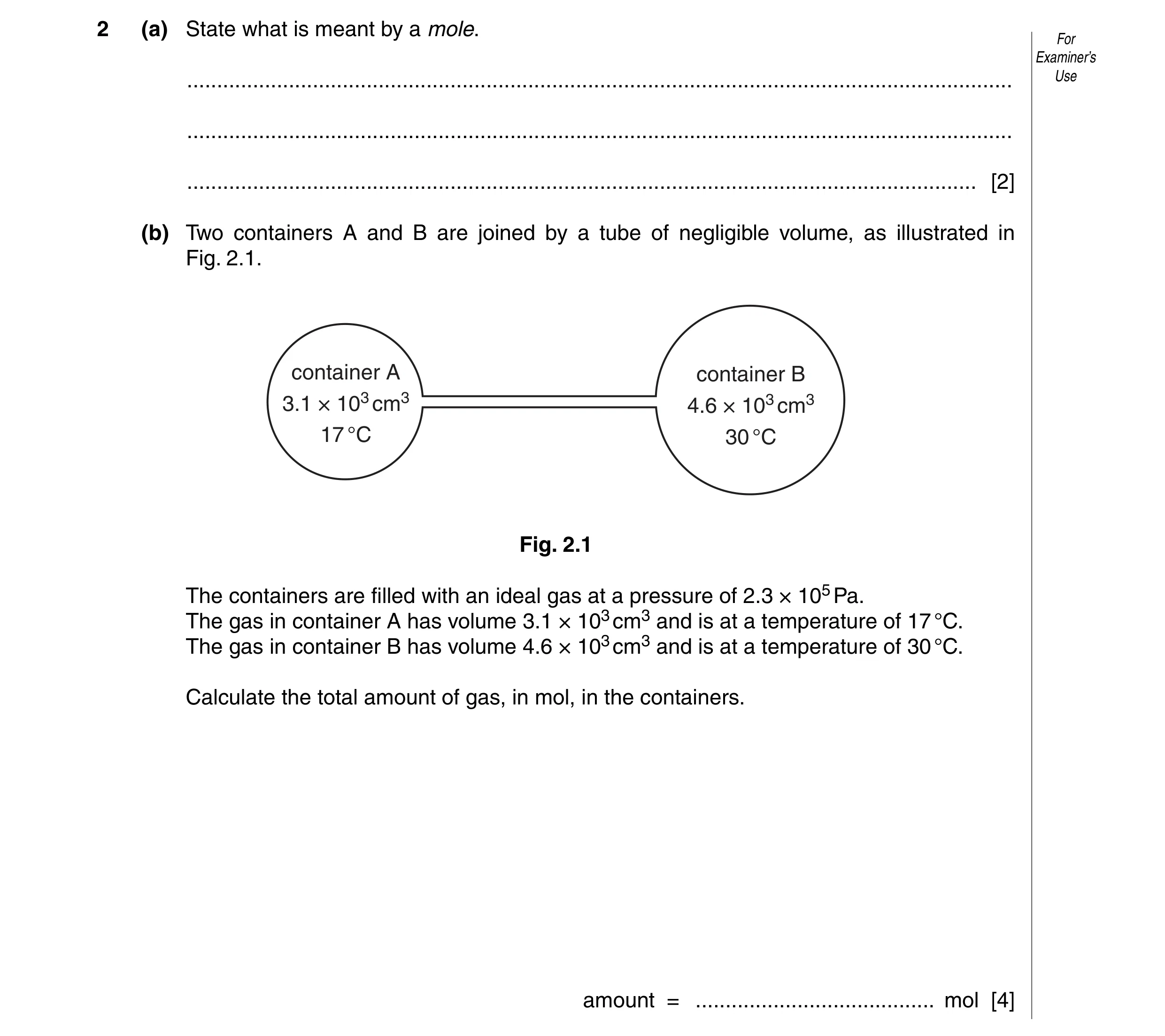
2 (a) State what is meant by a mole. For Examiner’s … Use … … [2] (b) Two containers A and B are joined by a tube of negligible volume, as illustrated in Fig. 2.1. container A container B 3.1 × 103 cm3 4.6 × 103 cm3 17 °C 30 °C Fig. 2.1 The containers are filled with an ideal gas at a pressure of 2.3 × 10⁵ Pa. The gas in container A has volume 3.1 × 103 cm3 and is at a temperature of 17 °C. The gas in container B has volume 4.6 × 103 cm3 and is at a temperature of 30 °C. Calculate the total amount of gas, in mol, in the containers. amount = … mol [4]
6 marks
Mark scheme: 2 (a) amount of substance M1 containing same number of particles as in 0.012 kg of carbon-12 A1 [2] (b) pV = nRT C1 amount = (2.3 × 105 × 3.1 × 10–3) / (8.31 × 290) + (2.3 × 105 × 4.6 × 10–3) / (8.31 × 303) C1 = 0.296 + 0.420 C1 = 0.716 mol A1 [4] (give full credit for starting equation pV = NkT and N = nNA)
This question in 9702/43 May/June 2011
Q4 · State what is meant by an ideal gas 9702/41 May/June 2013
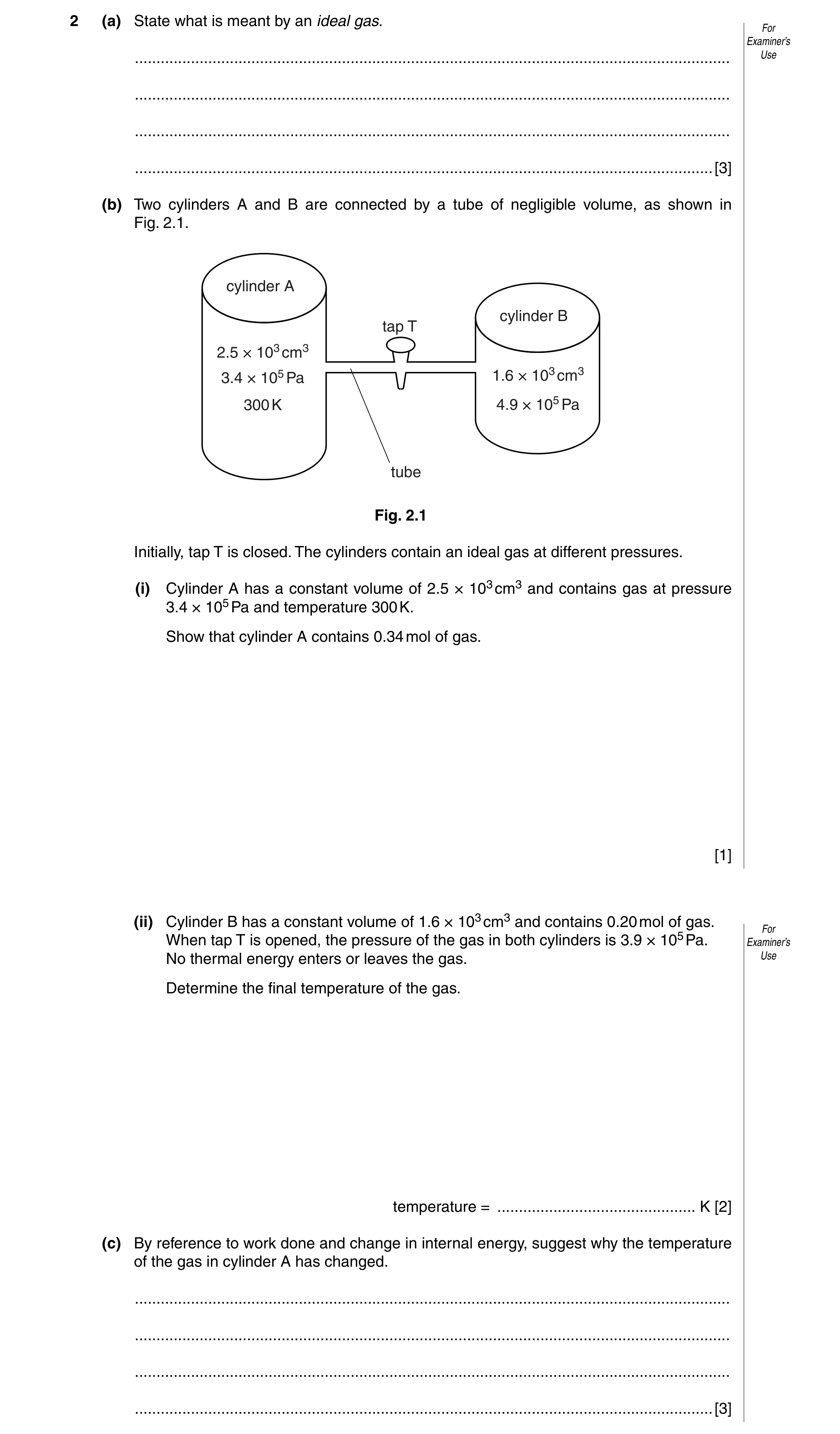
2 (a) State what is meant by an ideal gas. For Examiner’s … Use … … … [3] (b) Two cylinders A and B are connected by a tube of negligible volume, as shown in Fig. 2.1. cylinder A cylinder B tap T 2.5 × 103 cm3 3.4 × 10⁵ Pa 1.6 × 103 cm3 300 K 4.9 × 10⁵ Pa tube Fig. 2.1 Initially, tap T is closed. The cylinders contain an ideal gas at different pressures. (i) Cylinder A has a constant volume of 2.5 × 103 cm3 and contains gas at pressure 3.4 × 10⁵ Pa and temperature 300 K. Show that cylinder A contains 0.34 mol of gas. [1] (ii) Cylinder B has a constant volume of 1.6 × 103 cm3 and contains 0.20 mol of gas. For When tap T is opened, the pressure of the gas in both cylinders is 3.9 × 10⁵ Pa. Examiner’s No thermal energy enters or leaves the gas. Use Determine the final temperature of the gas. temperature = … K [2] (c) By reference to work done and change in internal energy, suggest why the temperature of the gas in cylinder A has changed. … … … … [3]
9 marks
Mark scheme: 2 (a) obeys the equation pV = constant × T or pV = nRT M1 p, V and T explained A1 at all values of p, V and T/fixed mass/n is constant A1 [3] (b) (i) 3.4 × 105 × 2.5 × 103 × 10–6 = n × 8.31 × 300 M1 n = 0.34 mol A0 [1] (ii) for total mass/amount of gas 3.9 × 105 × (2.5 + 1.6) × 103 × 10–6 = (0.34 + 0.20) × 8.31 × T C1 T = 360 K A1 [2] (c) when tap opened gas passed (from cylinder B) to cylinder A B1 work done on gas in cylinder A (and no heating) M1 so internal energy and hence temperature increase A1 [3] GCE AS/A LEVEL – May/June 2013 9702 41
This question in 9702/41 May/June 2013
Q5 · State what is meant by an ideal gas 9702/43 May/June 2013
2 (a) State what is meant by an ideal gas. For Examiner’s … Use … … … [3] (b) Two cylinders A and B are connected by a tube of negligible volume, as shown in Fig. 2.1. cylinder A cylinder B tap T 2.5 × 103 cm3 3.4 × 10⁵ Pa 1.6 × 103 cm3 300 K 4.9 × 10⁵ Pa tube Fig. 2.1 Initially, tap T is closed. The cylinders contain an ideal gas at different pressures. (i) Cylinder A has a constant volume of 2.5 × 103 cm3 and contains gas at pressure 3.4 × 10⁵ Pa and temperature 300 K. Show that cylinder A contains 0.34 mol of gas. [1] (ii) Cylinder B has a constant volume of 1.6 × 103 cm3 and contains 0.20 mol of gas. For When tap T is opened, the pressure of the gas in both cylinders is 3.9 × 10⁵ Pa. Examiner’s No thermal energy enters or leaves the gas. Use Determine the final temperature of the gas. temperature = … K [2] (c) By reference to work done and change in internal energy, suggest why the temperature of the gas in cylinder A has changed. … … … … [3]
9 marks
Mark scheme: 2 (a) obeys the equation pV = constant × T or pV = nRT M1 p, V and T explained A1 at all values of p, V and T/fixed mass/n is constant A1 [3] (b) (i) 3.4 × 105 × 2.5 × 103 × 10–6 = n × 8.31 × 300 M1 n = 0.34 mol A0 [1] (ii) for total mass/amount of gas 3.9 × 105 × (2.5 + 1.6) × 103 × 10–6 = (0.34 + 0.20) × 8.31 × T C1 T = 360 K A1 [2] (c) when tap opened gas passed (from cylinder B) to cylinder A B1 work done on gas in cylinder A (and no heating) M1 so internal energy and hence temperature increase A1 [3] GCE AS/A LEVEL – May/June 2013 9702 43
This question in 9702/43 May/June 2013
Q6 · Explain what is meant by the Avogadro constant 9702/41 May/June 2014
2 (a) Explain what is meant by the Avogadro constant. … … … [2] (b) Argon-40 (4018Ar) may be assumed to be an ideal gas. A mass of 3.2 g of argon-40 has a volume of 210 cm3 at a temperature of 37 °C. Determine, for this mass of argon-40 gas, (i) the amount, in mol, amount = … mol [1] (ii) the pressure, pressure = … Pa [2] (iii) the root-mean-square (r.m.s.) speed of an argon atom. r.m.s. speed = … m s−1 [3]
8 marks
Mark scheme: 2 (a) the number of atoms M1 in 12 g of carbon-12 A1 [2] (b) (i) amount = 3.2/40 = 0.080 mol A1 [1] (ii) pV = nRT p × 210 × 10–6 = 0.080 × 8.31 × 310 C1 p = 9.8 × 10⁵ Pa A1 [2] (do not credit if T in °C not K) (iii) either pV = 1/3 × Nm <c2> N = 0.080 × 6.02 × 1023 (= 4.82 × 10²²) and m = 40 × 1.66 × 10–27 (= 6.64 × 10⁻²⁶) C1 9.8 × 105 × 210 × 10–6 = 1/3 × 4.82 × 1022 × 6.64 × 10–26 × <c2> C1 <c2> = 1.93 × 10⁵ cRMS = 440 m s–1 A1 [3] or Nm = 3.2 × 10⁻³ (C1) 9.8 × 105 × 210 × 10–6 = 1/3 × 3.2 × 10–3 × <c2> (C1) <c2> = 1.93 × 10⁵ cRMS = 440 m s–1 (A1) or 1/2 m<c2> = 3/2 kT (C1) 1/2 × 40 × 1.66 × 10–27 <c2> = 3/2 × 1.38 × 10–23 × 310 (C1) <c2> = 1.93 × 10⁵ cRMS = 440 m s–1 (A1) (if T in °C not K award max 1/3, unless already penalised in (b)(ii)) GCE AS/A LEVEL – May/June 2014 9702 41 3
This question in 9702/41 May/June 2014
Q7 · Explain what is meant by the Avogadro constant 9702/43 May/June 2014
2 (a) Explain what is meant by the Avogadro constant. … … … [2] (b) Argon-40 (4018Ar) may be assumed to be an ideal gas. A mass of 3.2 g of argon-40 has a volume of 210 cm3 at a temperature of 37 °C. Determine, for this mass of argon-40 gas, (i) the amount, in mol, amount = … mol [1] (ii) the pressure, pressure = … Pa [2] (iii) the root-mean-square (r.m.s.) speed of an argon atom. r.m.s. speed = … m s−1 [3]
8 marks
Mark scheme: 2 (a) the number of atoms M1 in 12 g of carbon-12 A1 [2] (b) (i) amount = 3.2/40 = 0.080 mol A1 [1] (ii) pV = nRT p × 210 × 10–6 = 0.080 × 8.31 × 310 C1 p = 9.8 × 10⁵ Pa A1 [2] (do not credit if T in °C not K) (iii) either pV = 1/3 × Nm <c2> N = 0.080 × 6.02 × 1023 (= 4.82 × 10²²) and m = 40 × 1.66 × 10–27 (= 6.64 × 10⁻²⁶) C1 9.8 × 105 × 210 × 10–6 = 1/3 × 4.82 × 1022 × 6.64 × 10–26 × <c2> C1 <c2> = 1.93 × 10⁵ cRMS = 440 m s–1 A1 [3] or Nm = 3.2 × 10⁻³ (C1) 9.8 × 105 × 210 × 10–6 = 1/3 × 3.2 × 10–3 × <c2> (C1) <c2> = 1.93 × 10⁵ cRMS = 440 m s–1 (A1) or 1/2 m<c2> = 3/2 kT (C1) 1/2 × 40 × 1.66 × 10–27 <c2> = 3/2 × 1.38 × 10–23 × 310 (C1) <c2> = 1.93 × 10⁵ cRMS = 440 m s–1 (A1) (if T in °C not K award max 1/3, unless already penalised in (b)(ii)) GCE AS/A LEVEL – May/June 2014 9702 43 3
This question in 9702/43 May/June 2014
Q8 · State what is meant by (i) the Avogadro constant NA, … … [1] (ii) the mole 9702/42 May/June 2016
2 (a) State what is meant by (i) the Avogadro constant NA, … … [1] (ii) the mole. … … [2] (b) A container has a volume of 1.8 × 104 cm3. The ideal gas in the container has a pressure of 2.0 × 10⁷ Pa at a temperature of 17 °C. Show that the amount of gas in the cylinder is 150 mol. [1] (c) Gas molecules leak from the container in (b) at a constant rate of 1.5 × 10¹⁹ s−1. The temperature remains at 17 °C. In a time t, the amount of gas in the container is found to be reduced by 5.0%. Calculate (i) the pressure of the gas after the time t, pressure = … Pa [2] (ii) the time t. t = … s [3] [Total: 9]
9 marks
Mark scheme: 2 (a) (i) number of atoms/nuclei in 12 g of carbon-12 B1 [1] (ii) amount of substance M1 containing NA (or 6.02 × 10²³) particles/molecules/atoms or which contains the same number of particles/atoms/molecules as there are atoms in 12 g of carbon-12 A1 [2] (b) pV = nRT 2.0 × 107 × 1.8 × 104 × 10–6 = n × 8.31 × 290, so n = 149 mol or 150 mol A1 [1] (c) (i) V and T constant and so pressure reduced by 5.0% pressure = 0.95 × 2.0 × 107 C1 or calculation of new n (= 142.5 mol) and correct substitution into pV = nRT (C1) pressure = 1.9 × 10⁷ Pa A1 [2] (ii) loss is 5 / 100 × 150 mol = 7.5 mol or ∆N = 4.52 × 1024 C1 t = (7.5 × 6.02 × 1023) / 1.5 × 10¹⁹ or t = 4.52 × 1024 / 1.5 × 10¹⁹ C1 = 3.0 × 10⁵ s A1 [3]
This question in 9702/42 May/June 2016
Q9 · An ideal gas is assumed to consist of atoms or molecules that behave as hard, identical… 9702/43 May/June 2016
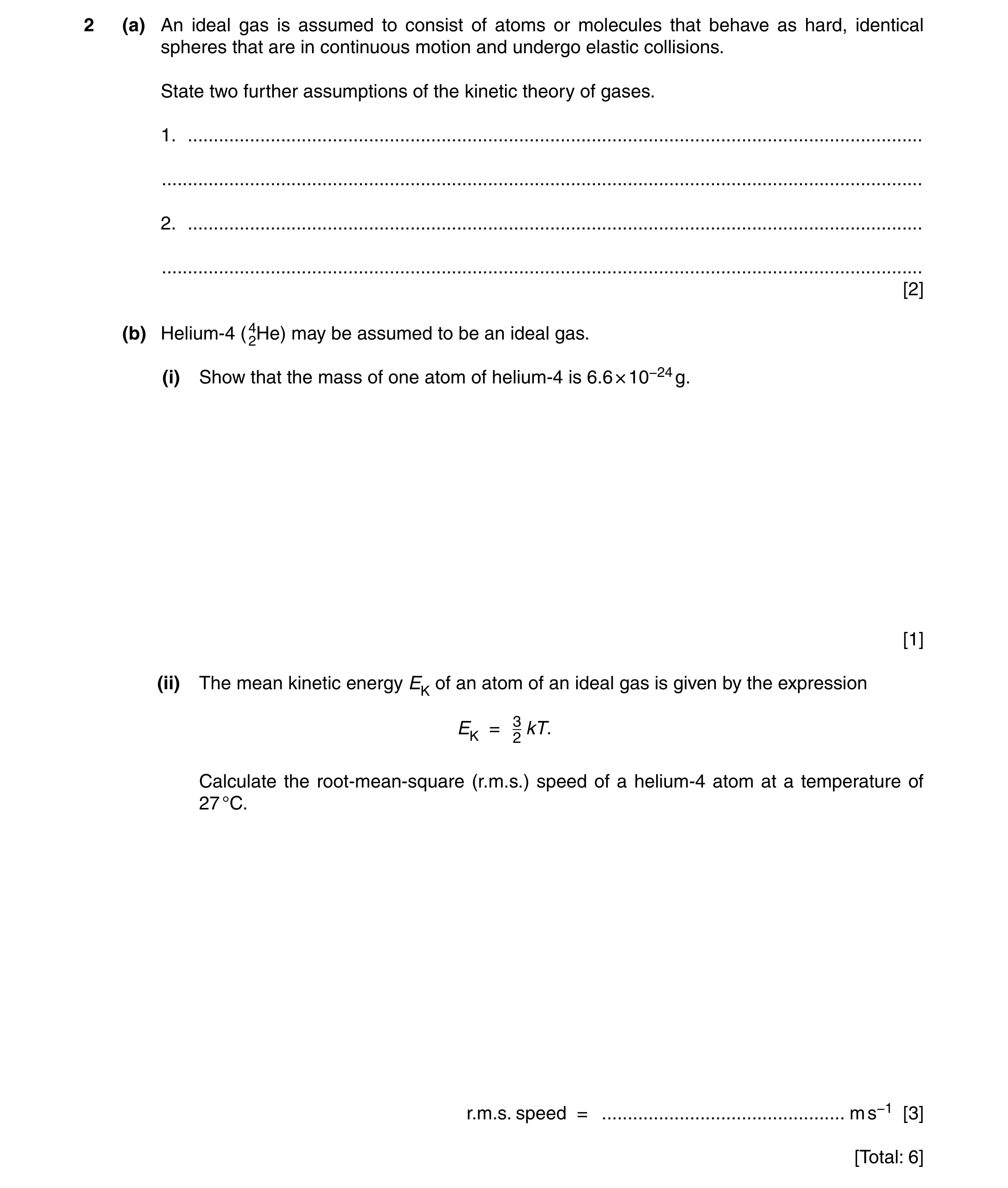
2 (a) An ideal gas is assumed to consist of atoms or molecules that behave as hard, identical spheres that are in continuous motion and undergo elastic collisions. State two further assumptions of the kinetic theory of gases. 1. … … 2. … … [2] (b) Helium-4 (42He) may be assumed to be an ideal gas. (i) Show that the mass of one atom of helium-4 is 6.6 × 10⁻²⁴ g. [1] (ii) The mean kinetic energy EK of an atom of an ideal gas is given by the expression EK = 32 kT. Calculate the root-mean-square (r.m.s.) speed of a helium-4 atom at a temperature of 27 °C. r.m.s. speed = … m s−1 [3] [Total: 6]
6 marks
Mark scheme: 2 (a) e.g. time of collisions negligible compared to time between collisions no intermolecular forces (except during collisions) random motion (of molecules) large numbers of molecules (total) volume of molecules negligible compared to volume of containing vessel or average/mean separation large compared with size of molecules any two B2 [2] 2 (b) (i) mass = 4.0 / (6.02 × 10 23) = 6.6 × 10⁻²⁴ g or mass = 4.0 × 1.66 × 10–27 × 103 = 6.6 × 10⁻²⁴ g B1 [1] 3 1 (ii) kT = m <c 2> C1 2 2 3 1 × 1.38 × 10–23 × 300 = × 6.6 × 10⁻²⁷ × <c 2> 2 2 <c 2> = 1.88 × 10⁶ (m2 s–2) C1 r.m.s. speed = 1.4 × 10³ m s–1 A1 [3]
This question in 9702/43 May/June 2016
Q10 · The equation of state for an ideal gas of volume V at pressure p is pV = nRT where R is… 9702/42 Oct/Nov 2016
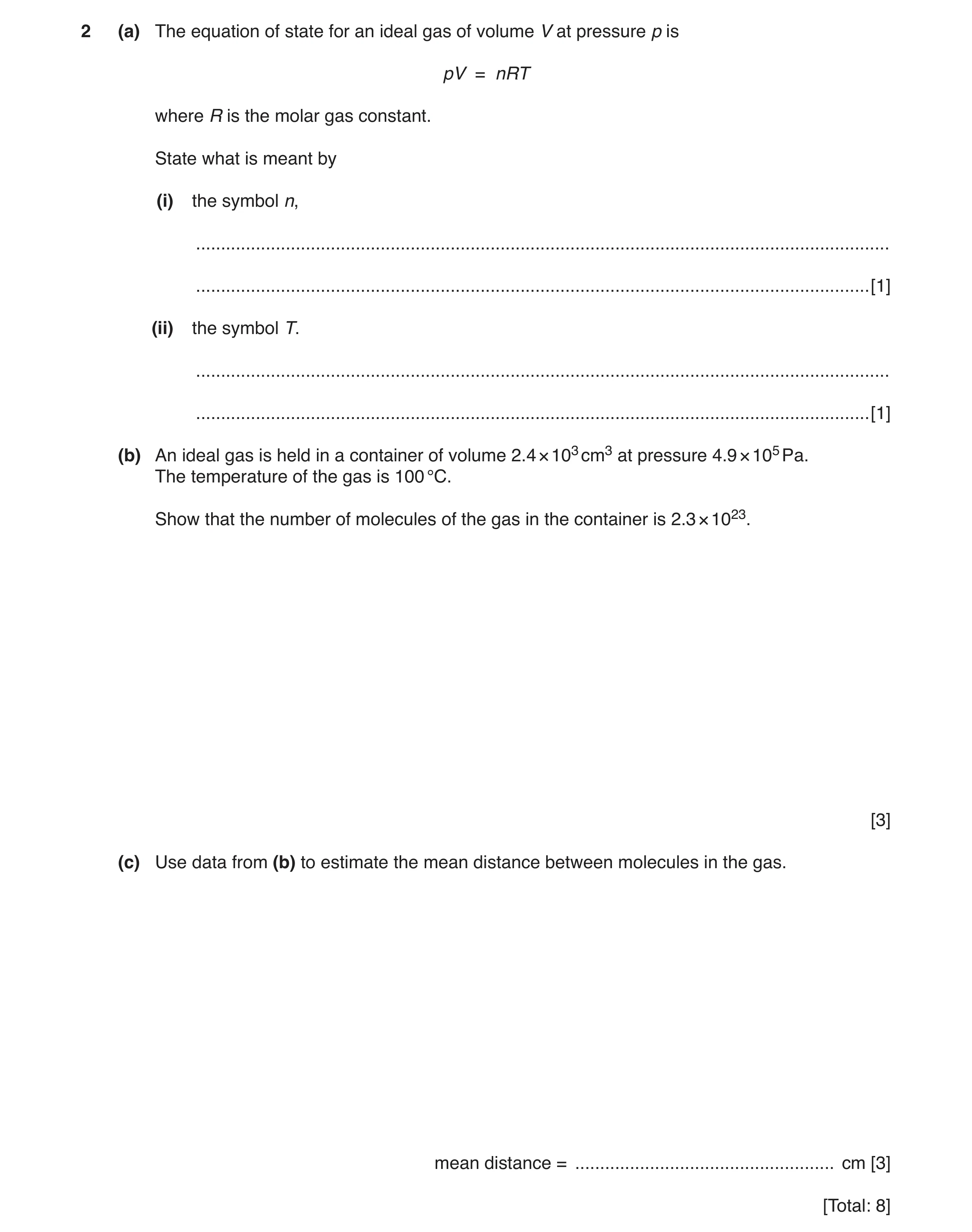
2 (a) The equation of state for an ideal gas of volume V at pressure p is pV = nRT where R is the molar gas constant. State what is meant by (i) the symbol n, … … [1] (ii) the symbol T. … … [1] (b) An ideal gas is held in a container of volume 2.4 × 103 cm3 at pressure 4.9 × 10⁵ Pa. The temperature of the gas is 100 °C. Show that the number of molecules of the gas in the container is 2.3 × 10²³. [3] (c) Use data from (b) to estimate the mean distance between molecules in the gas. mean distance = … cm [3] [Total: 8]
8 marks
Mark scheme: 2 (a) (i) number of moles/amount of substance B1 [1] (ii) kelvin temperature/absolute temperature/thermodynamic temperature B1 [1] (b) pV = nRT 4.9 × 105 × 2.4 × 103 × 10–6 = n × 8.31 × 373 B1 n = 0.38 (mol) C1 number of molecules or N = 0.38 × 6.02 × 1023 = 2.3 × 10²³ A1 [3] or pV = NkT (C1) 4.9 × 105 × 2.4 × 103 × 10–6 = N × 1.38 × 10–23 × 373 (M1) number of molecules or N = 2.3 × 10²³ (A1) (c) volume occupied by one molecule = (2.4 × 10³) / (2.3 × 10²³) C1 = 1.04 × 10⁻²⁰ cm3 mean spacing = (1.04 × 10⁻²⁰)1/3 C1 = 2.2 × 10⁻⁷ cm (allow 1 s.f.) A1 [3] (allow other dimensionally correct methods e.g. V = (4/3)πr3)
This question in 9702/42 Oct/Nov 2016
Q11 · State what is meant by the Avogadro constant 9702/41 Oct/Nov 2024
3 (a) (i) State what is meant by the Avogadro constant. … … … [1] (ii) State the relationship between the Avogadro constant NA, the molar gas constant R and the Boltzmann constant k. [1] (b) Two samples X and Y of ideal gases are both at thermodynamic temperature T. Sample X has volume V and consists of N molecules, each of mass m. Sample Y has volume 2V and consists of 2N molecules, each of mass 2m. (i) Complete Table 3.1 by giving expressions, in terms of some or all of N, m, T, V and the constants in (a)(ii), for the quantities indicated. Table 3.1 sample X sample Y pressure amount of substance mean-square speed of molecules internal energy [4] (ii) The temperature of sample X is now varied. On Fig. 3.1, sketch the variation with thermodynamic temperature of the root-mean- square (r.m.s.) speed of the molecules of the gas. r.m.s. speed 0 0 thermodynamic temperature Fig. 3.1 [2] [Total: 8]
8 marks
Mark scheme: 3(a)(i) number of particles per unit amount of substance B1 3(a)(ii) NA = R / k B1 3(b)(i) X pressure and Y pressure both = NkT / V B1 X amount = N / NA and Y amount = 2N / NA B1 X mean-square speed = 3kT / m and Y mean-square speed = 3kT / 2m B1 X internal energy = 3NkT / 2 and Y internal energy = 3NkT B1 3(b)(ii) line passing through the origin and not returning to either axis B1 curve with positive decreasing gradient B1
This question in 9702/41 Oct/Nov 2024
Q12 · State what is meant by the Avogadro constant 9702/43 Oct/Nov 2024
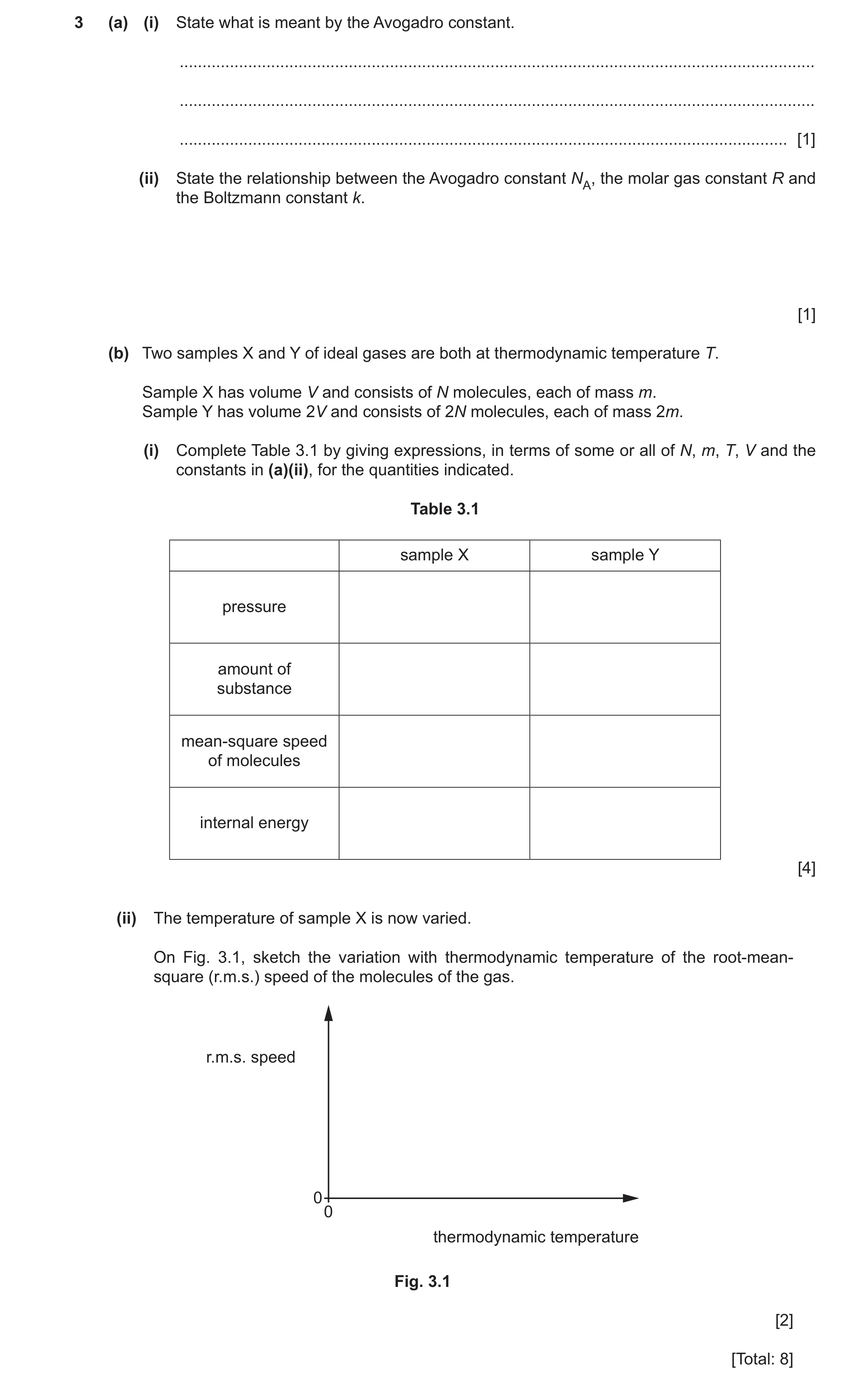
3 (a) (i) State what is meant by the Avogadro constant. … … … [1] (ii) State the relationship between the Avogadro constant NA, the molar gas constant R and the Boltzmann constant k. [1] (b) Two samples X and Y of ideal gases are both at thermodynamic temperature T. Sample X has volume V and consists of N molecules, each of mass m. Sample Y has volume 2V and consists of 2N molecules, each of mass 2m. (i) Complete Table 3.1 by giving expressions, in terms of some or all of N, m, T, V and the constants in (a)(ii), for the quantities indicated. Table 3.1 sample X sample Y pressure amount of substance mean-square speed of molecules internal energy [4] (ii) The temperature of sample X is now varied. On Fig. 3.1, sketch the variation with thermodynamic temperature of the root-mean- square (r.m.s.) speed of the molecules of the gas. r.m.s. speed 0 0 thermodynamic temperature Fig. 3.1 [2] [Total: 8]
8 marks
Mark scheme: 3(a)(i) number of particles per unit amount of substance B1 3(a)(ii) NA = R / k B1 3(b)(i) X pressure and Y pressure both = NkT / V B1 X amount = N / NA and Y amount = 2N / NA B1 X mean-square speed = 3kT / m and Y mean-square speed = 3kT / 2m B1 X internal energy = 3NkT / 2 and Y internal energy = 3NkT B1 3(b)(ii) line passing through the origin and not returning to either axis B1 curve with positive decreasing gradient B1
This question in 9702/43 Oct/Nov 2024
 1 / 15
 2 / 15
 3 / 15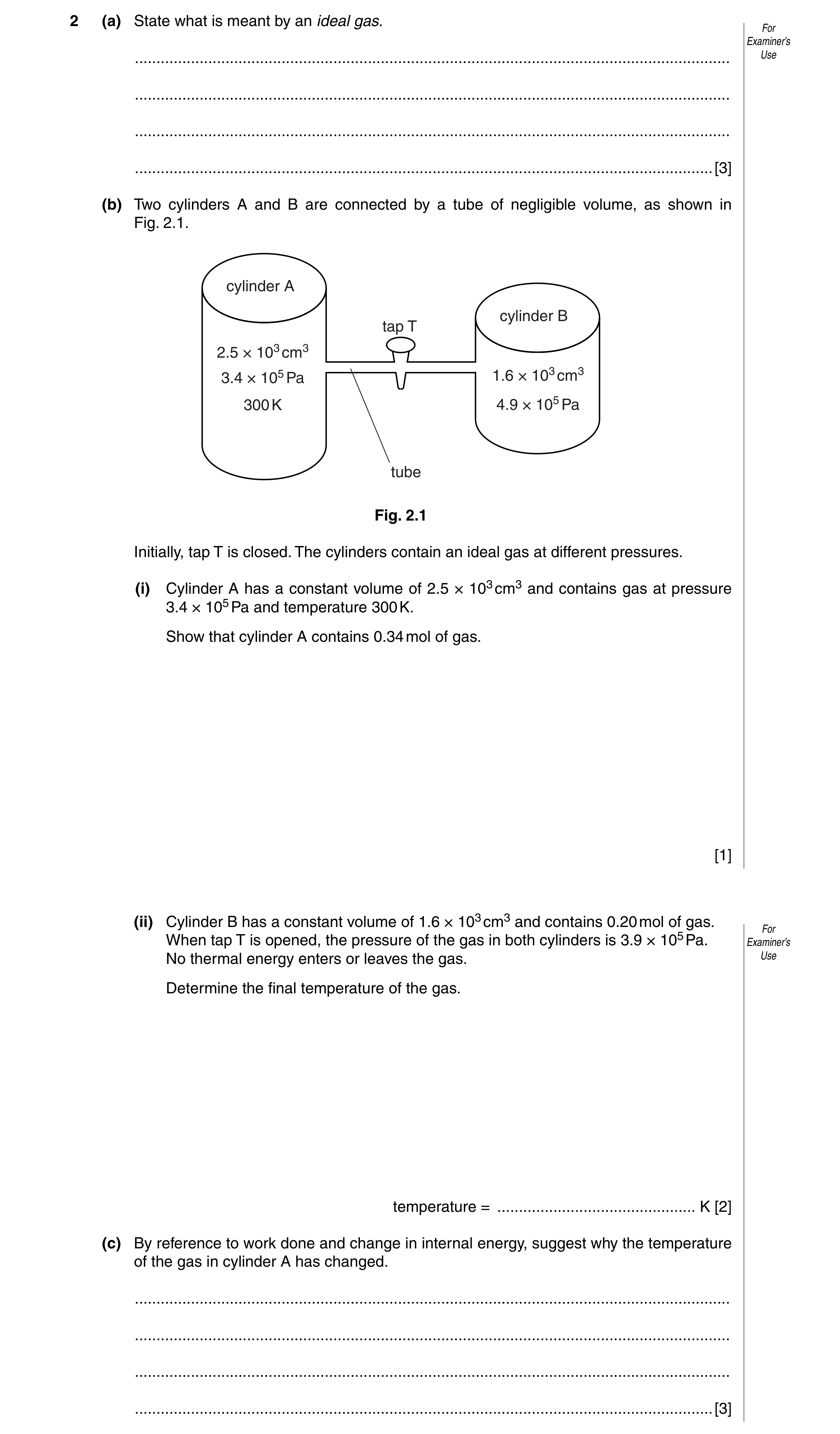
 8 / 15
 9 / 15
 10 / 15
 11 / 15
 12 / 15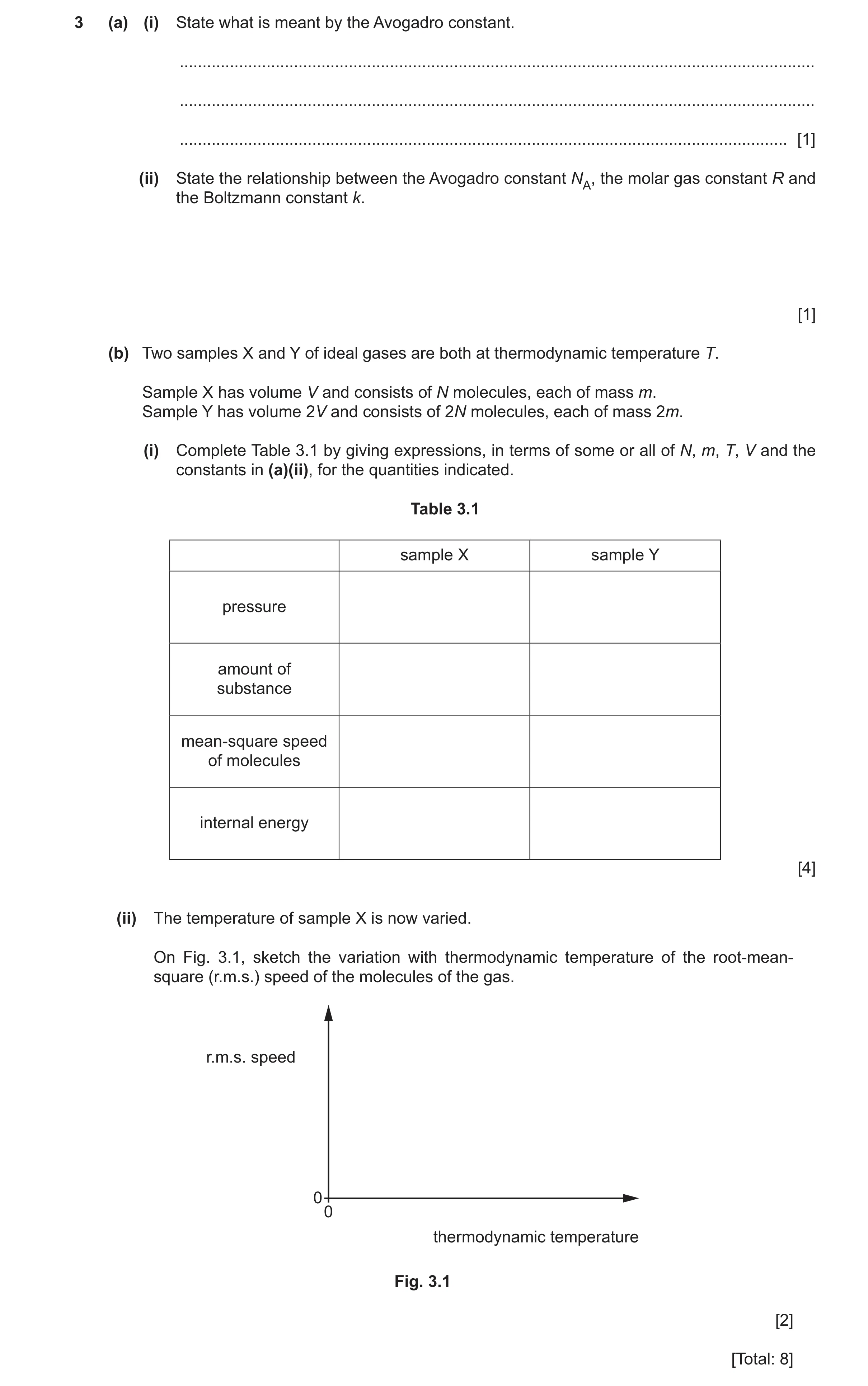
 6
6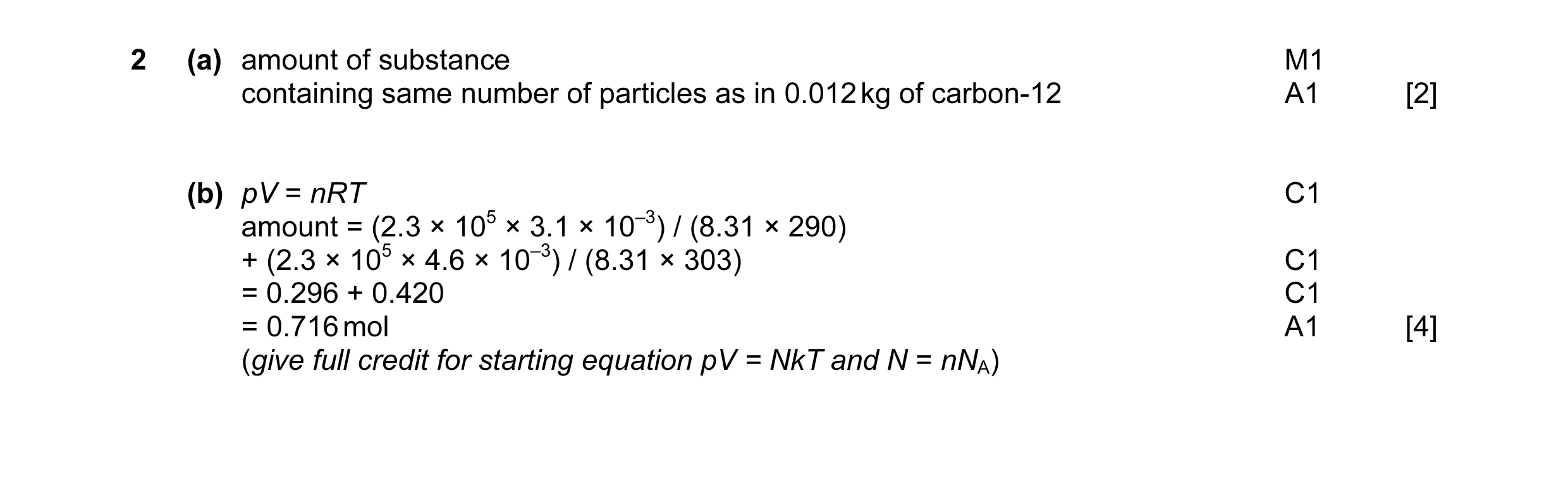 6
6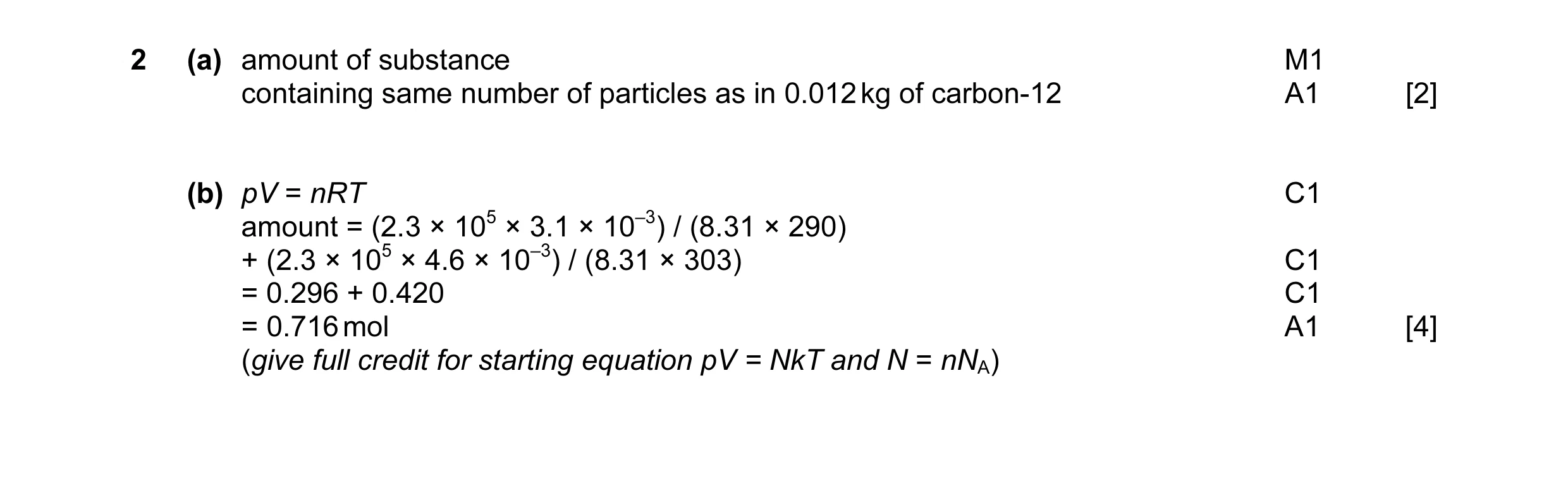 6
6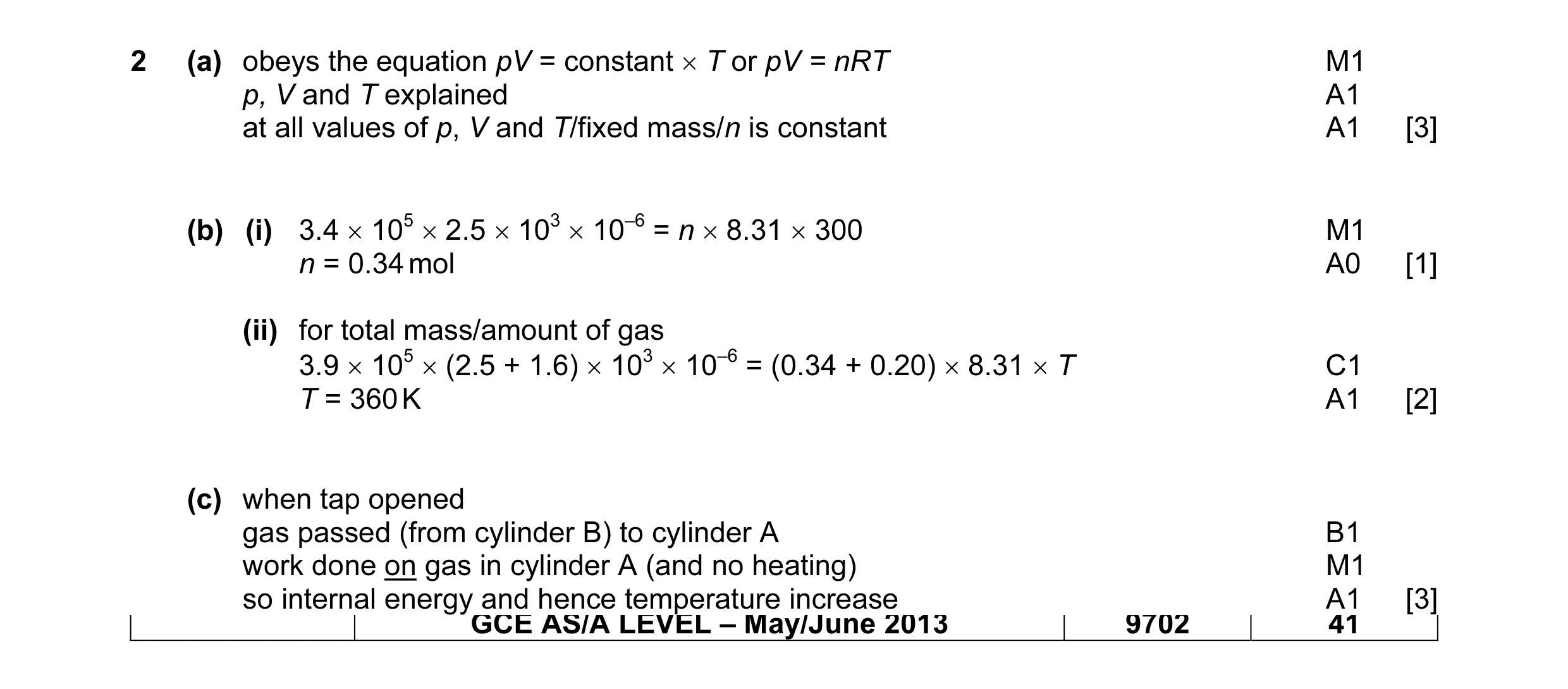 9
9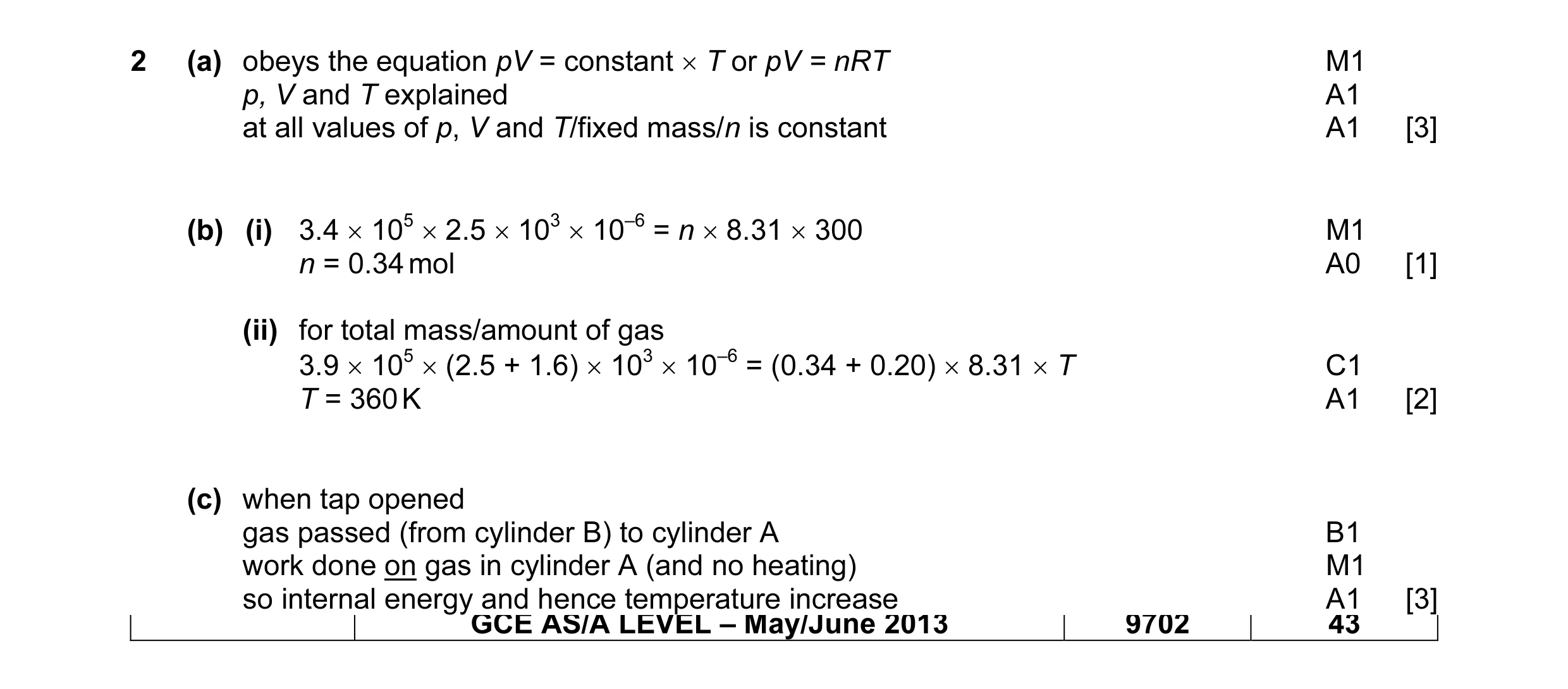 9
9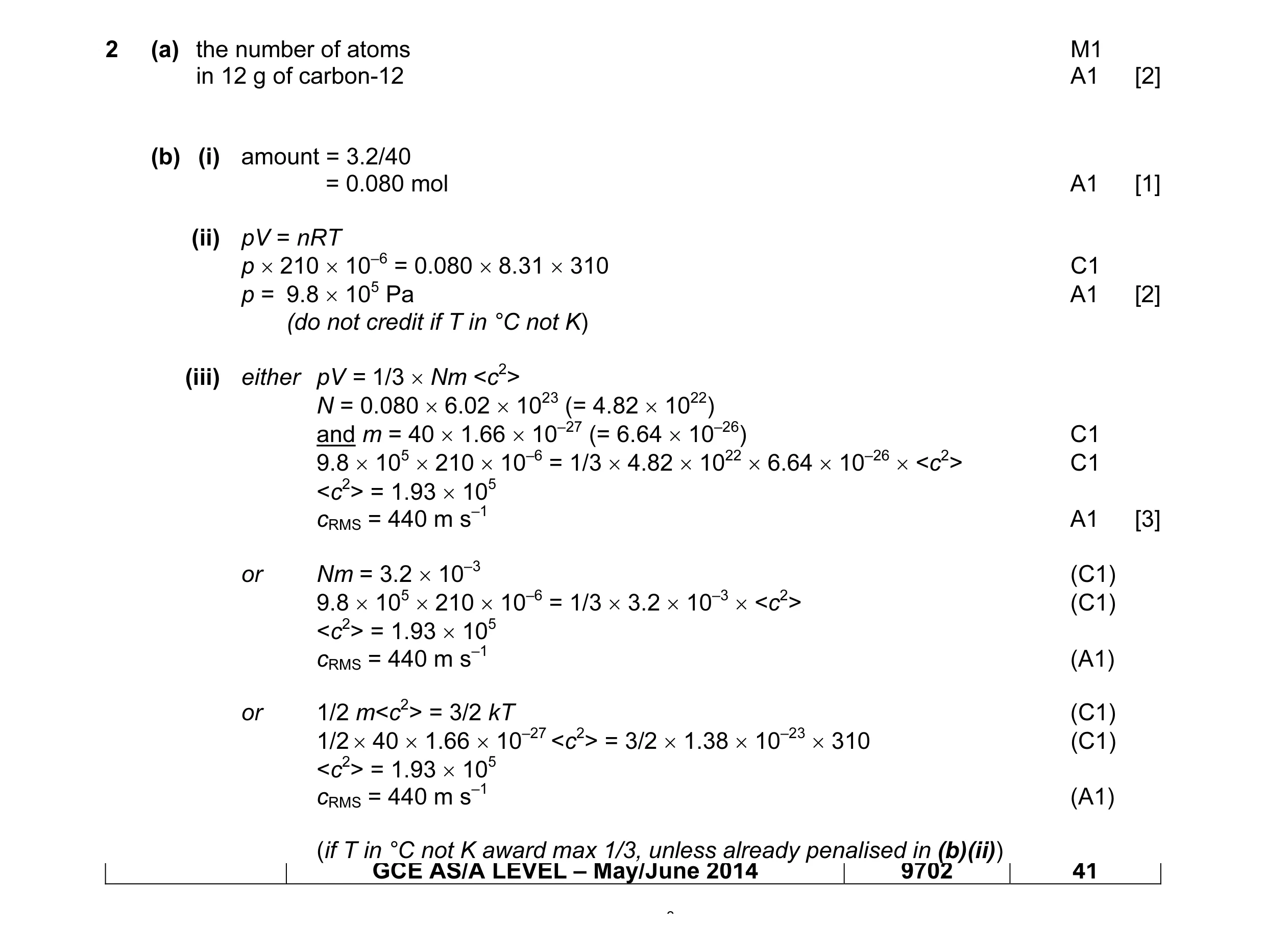 8
8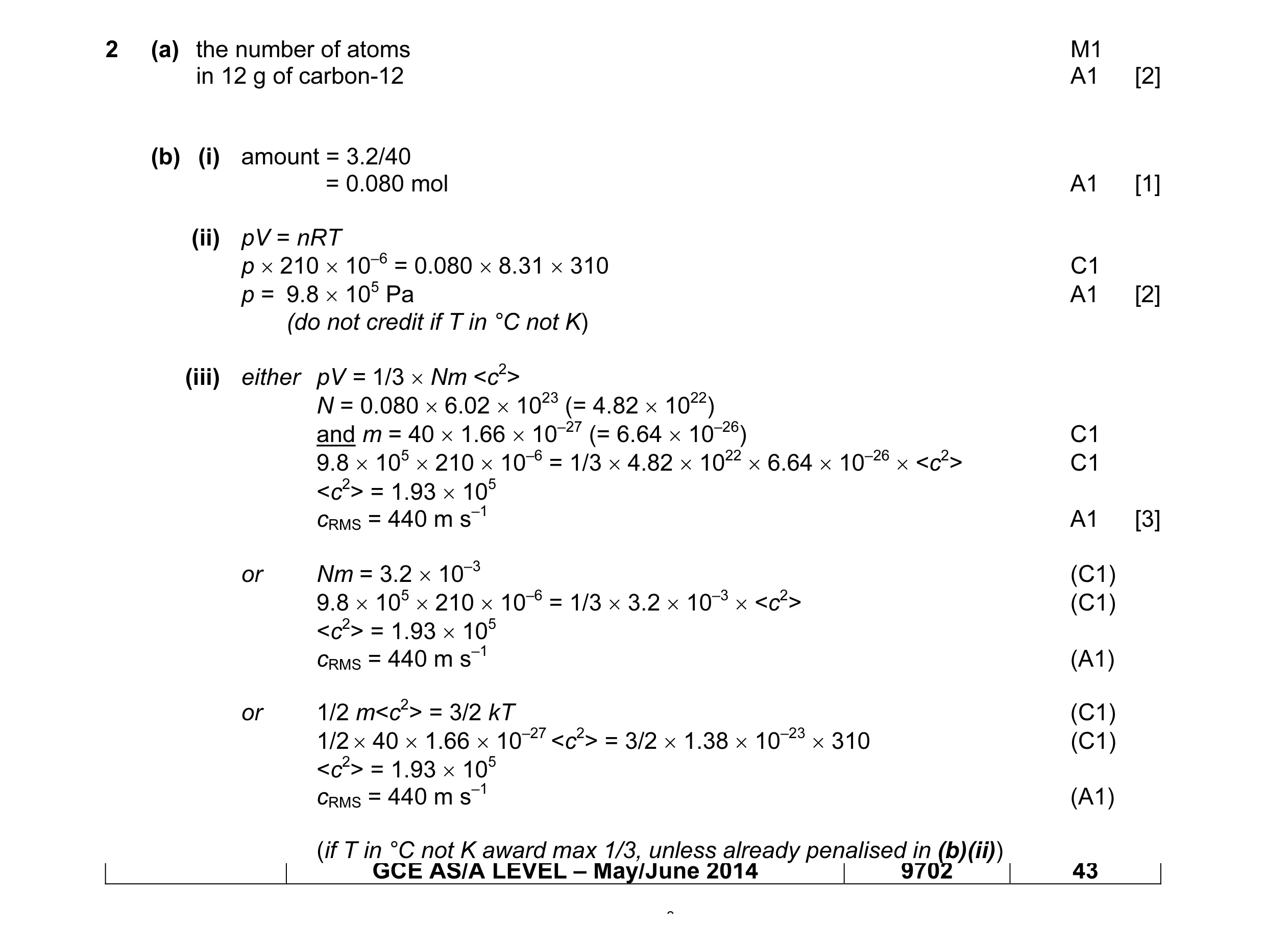 8
8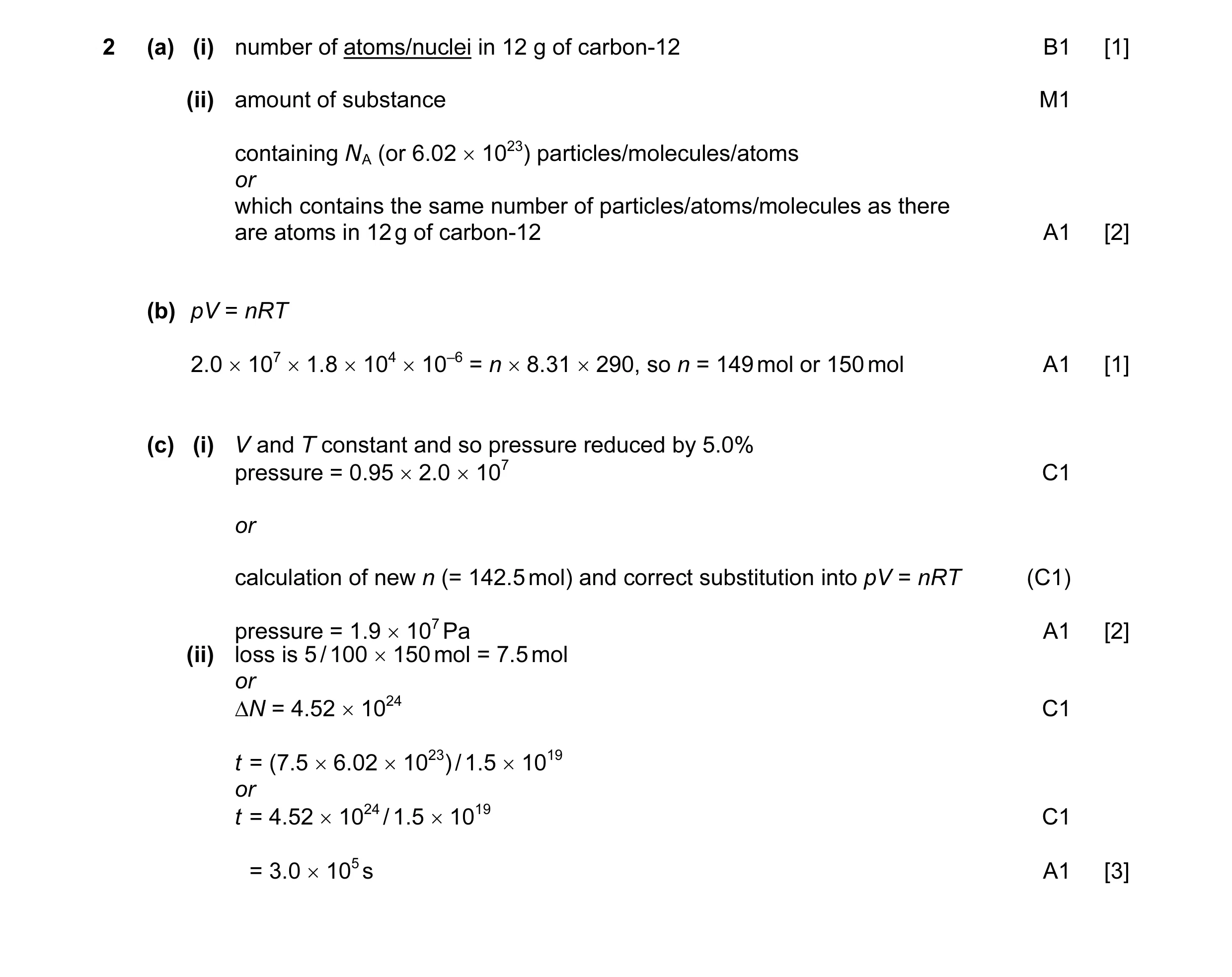 9
9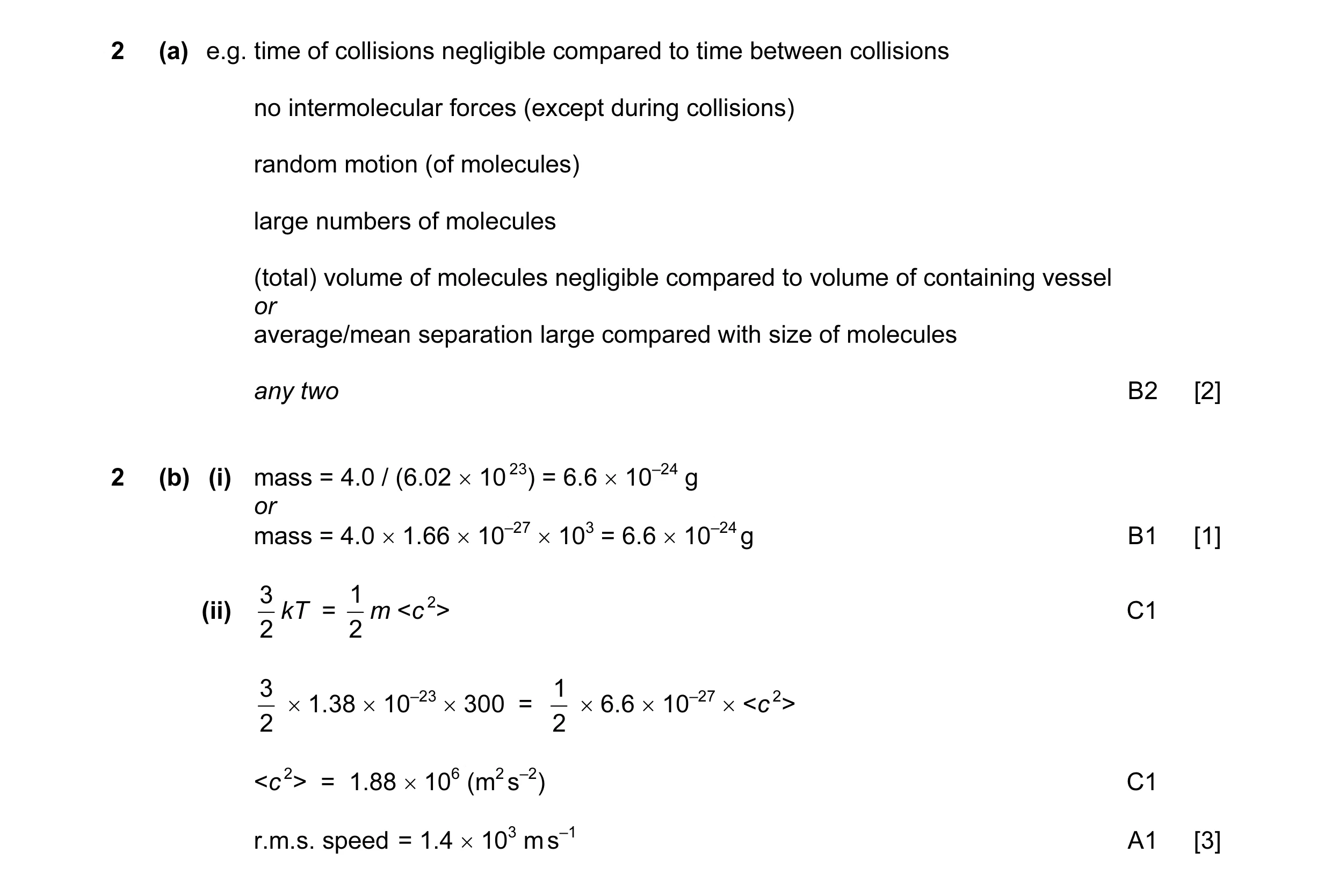 6
6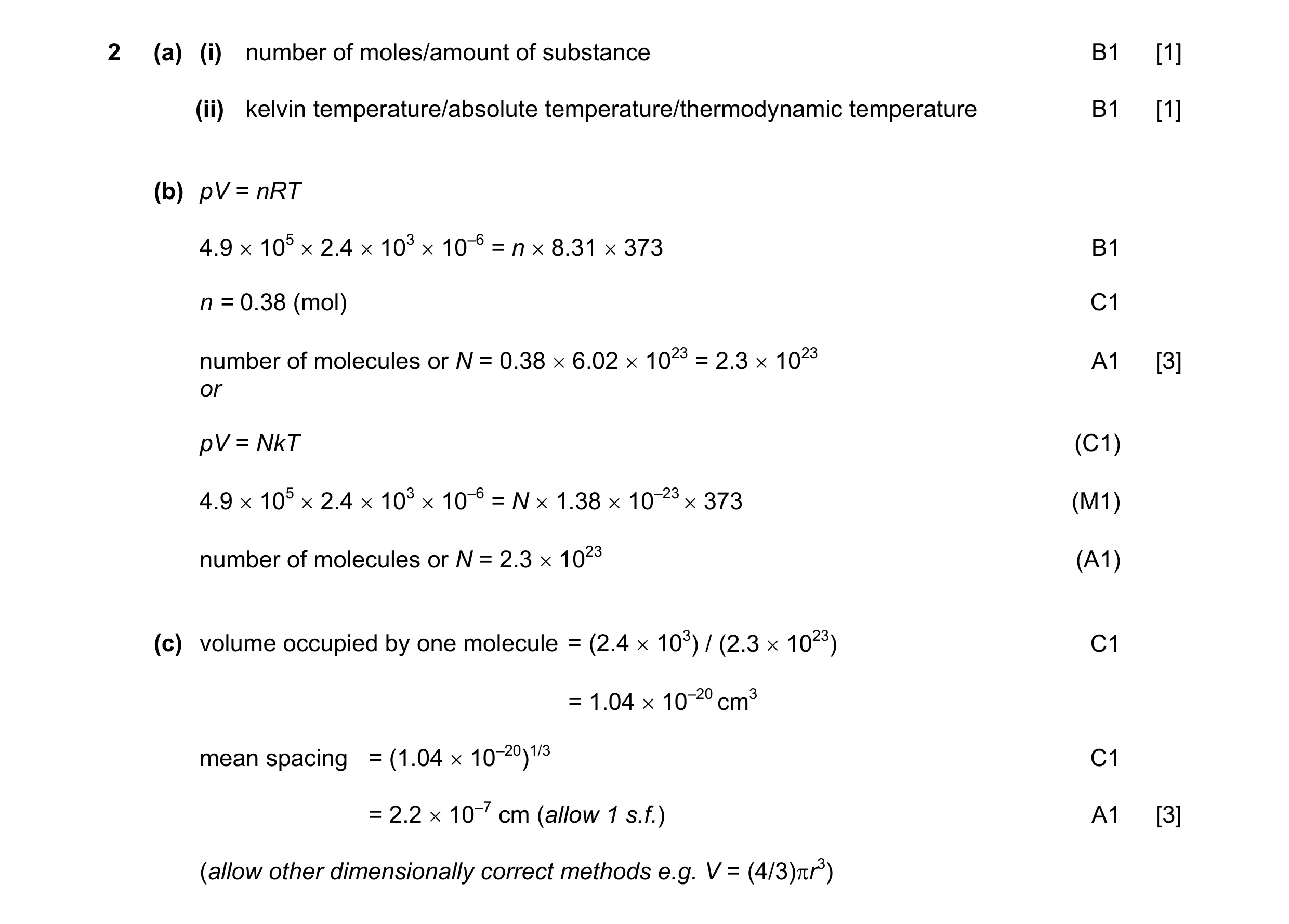 8
8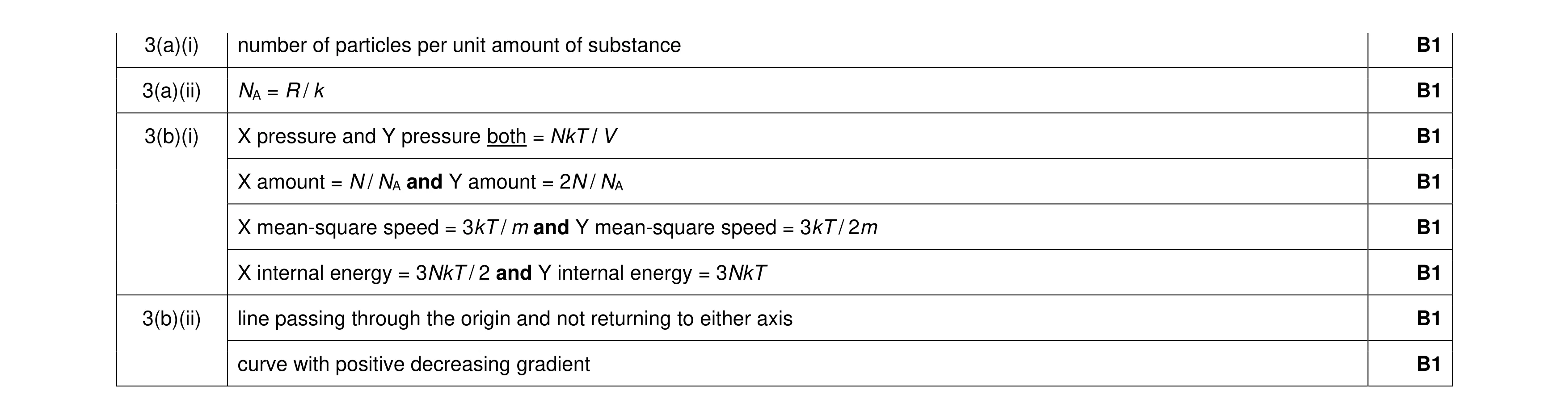 8
8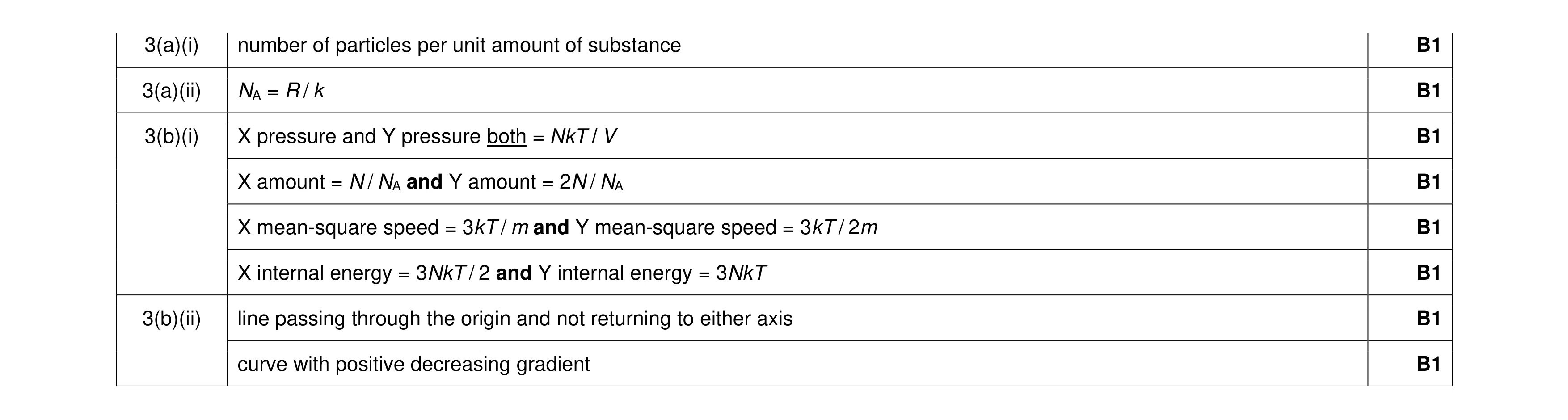 8
8