Cambridge A Level Physics 9702 — 2011 May/June Paper 2 · Variant 3
9702/23/M/J/11 · 7 questions · 60 marks · ≈68 min
The question paper and its mark scheme, free to read here and free to download. This is Cambridge’s own paper, exactly as it was sat.
Question paper16 pages
Mark scheme4 pages
Answers below. Sit the paper first if you are practising.
Questions as text
Q1 · For each of the following, tick [✓] one box to indicate whether the experimental…
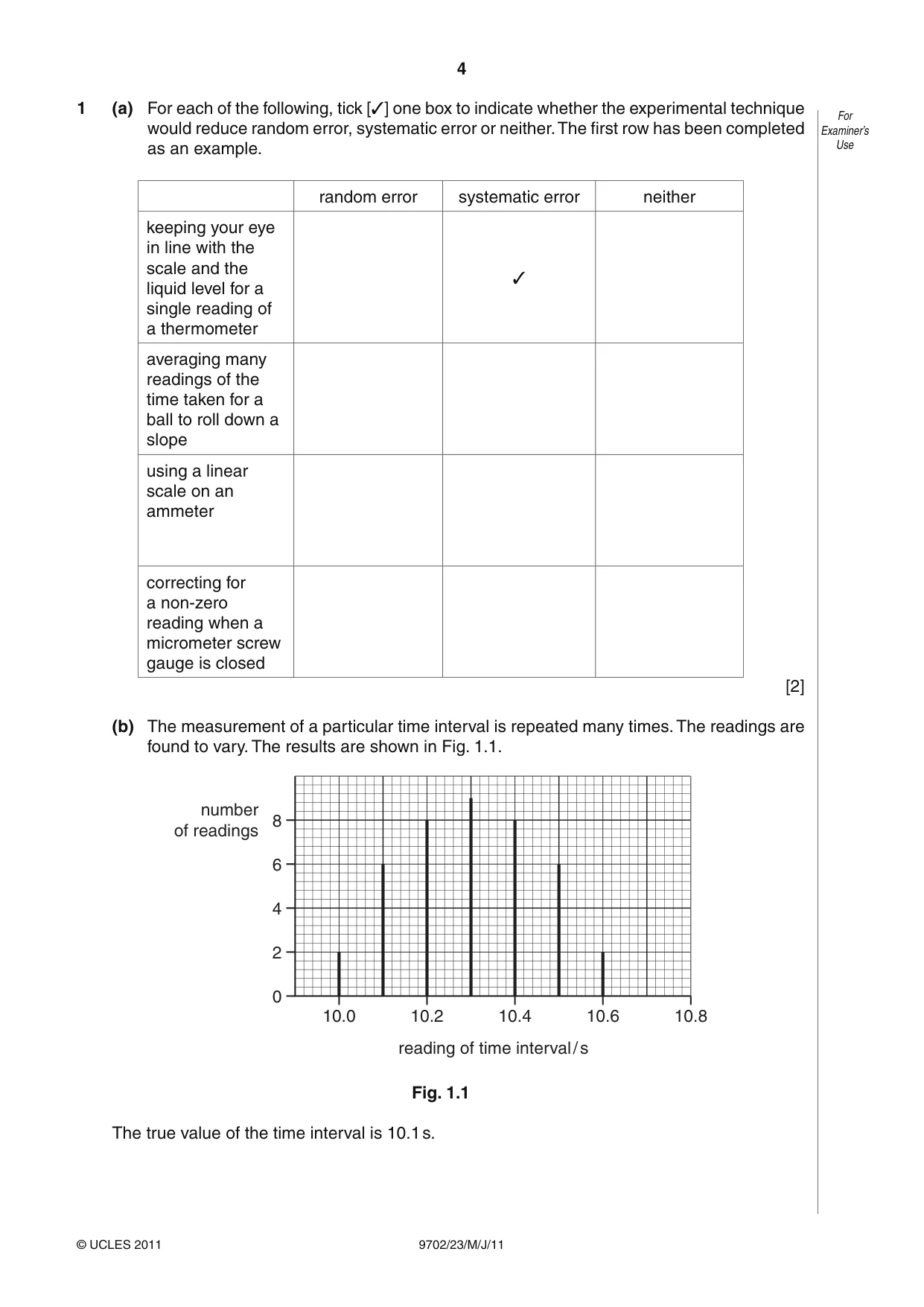
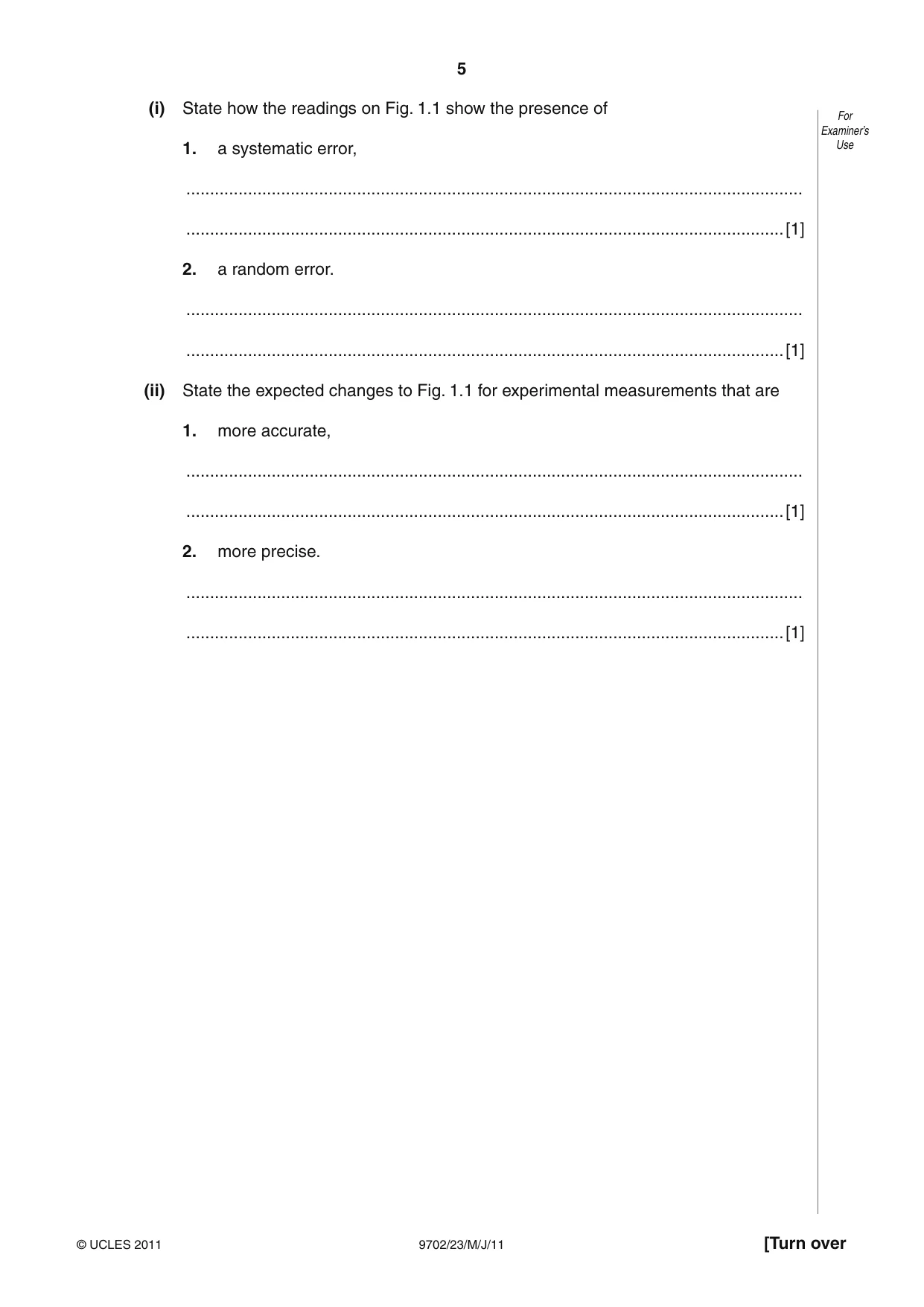
1 (a) For each of the following, tick [✓] one box to indicate whether the experimental technique For would reduce random error, systematic error or neither. The first row has been completed Examiner’s as an example. Use random error systematic error neither keeping your eye in line with the scale and the ✓ liquid level for a single reading of a thermometer averaging many readings of the time taken for a ball to roll down a slope using a linear scale on an ammeter correcting for a non-zero reading when a micrometer screw gauge is closed [2] (b) The measurement of a particular time interval is repeated many times. The readings are found to vary. The results are shown in Fig. 1.1. number 8 of readings 6 4 2 0 10.0 10.2 10.4 10.6 10.8 reading of time interval / s Fig. 1.1 The true value of the time interval is 10.1 s. (i) State how the readings on Fig. 1.1 show the presence of For Examiner’s 1. a systematic error, Use .................................................................................................................................. ..............................................................................................................................[1] 2. a random error. .................................................................................................................................. ..............................................................................................................................[1] (ii) State the expected changes to Fig. 1.1 for experimental measurements that are 1. more accurate, .................................................................................................................................. ..............................................................................................................................[1] 2. more precise. .................................................................................................................................. ..............................................................................................................................[1]
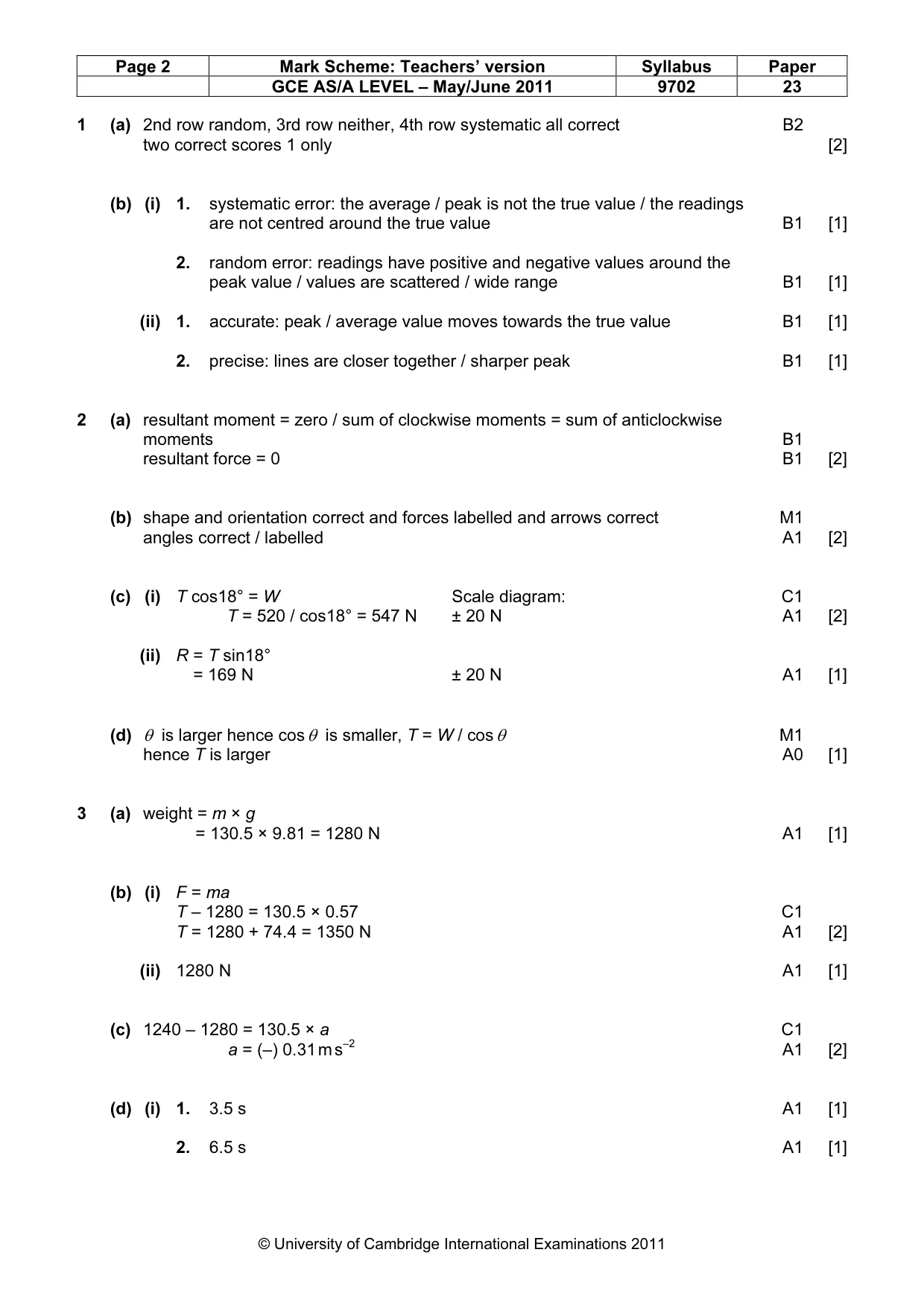
Mark scheme: 1 (a) 2nd row random, 3rd row neither, 4th row systematic all correct B2 two correct scores 1 only [2] (b) (i) 1. systematic error: the average / peak is not the true value / the readings are not centred around the true value B1 [1] 2. random error: readings have positive and negative values around the peak value / values are scattered / wide range B1 [1] (ii) 1. accurate: peak / average value moves towards the true value B1 [1] 2. precise: lines are closer together / sharper peak B1 [1]
Q2 · A climber is supported by a rope on a vertical wall, as shown in Fig
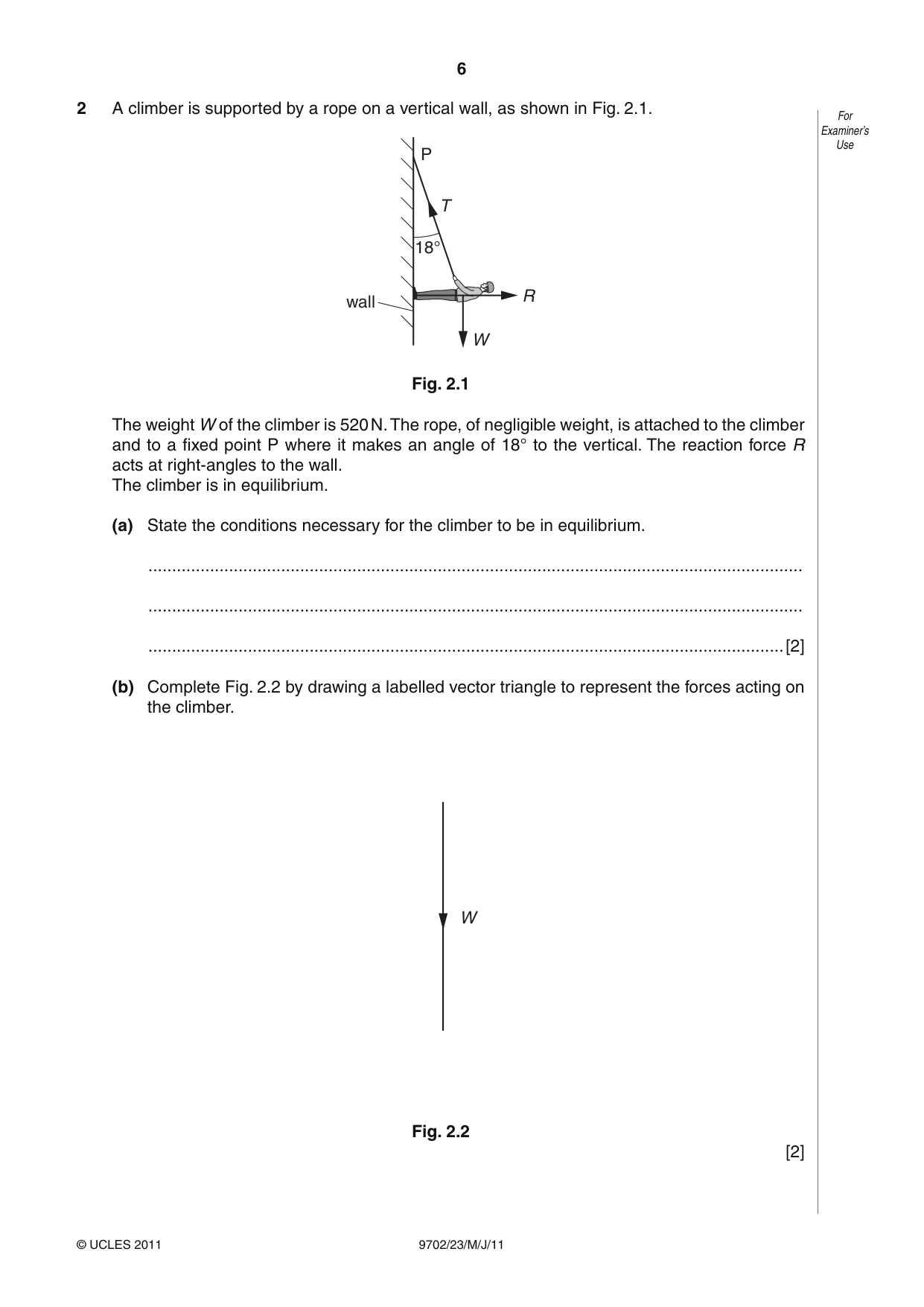
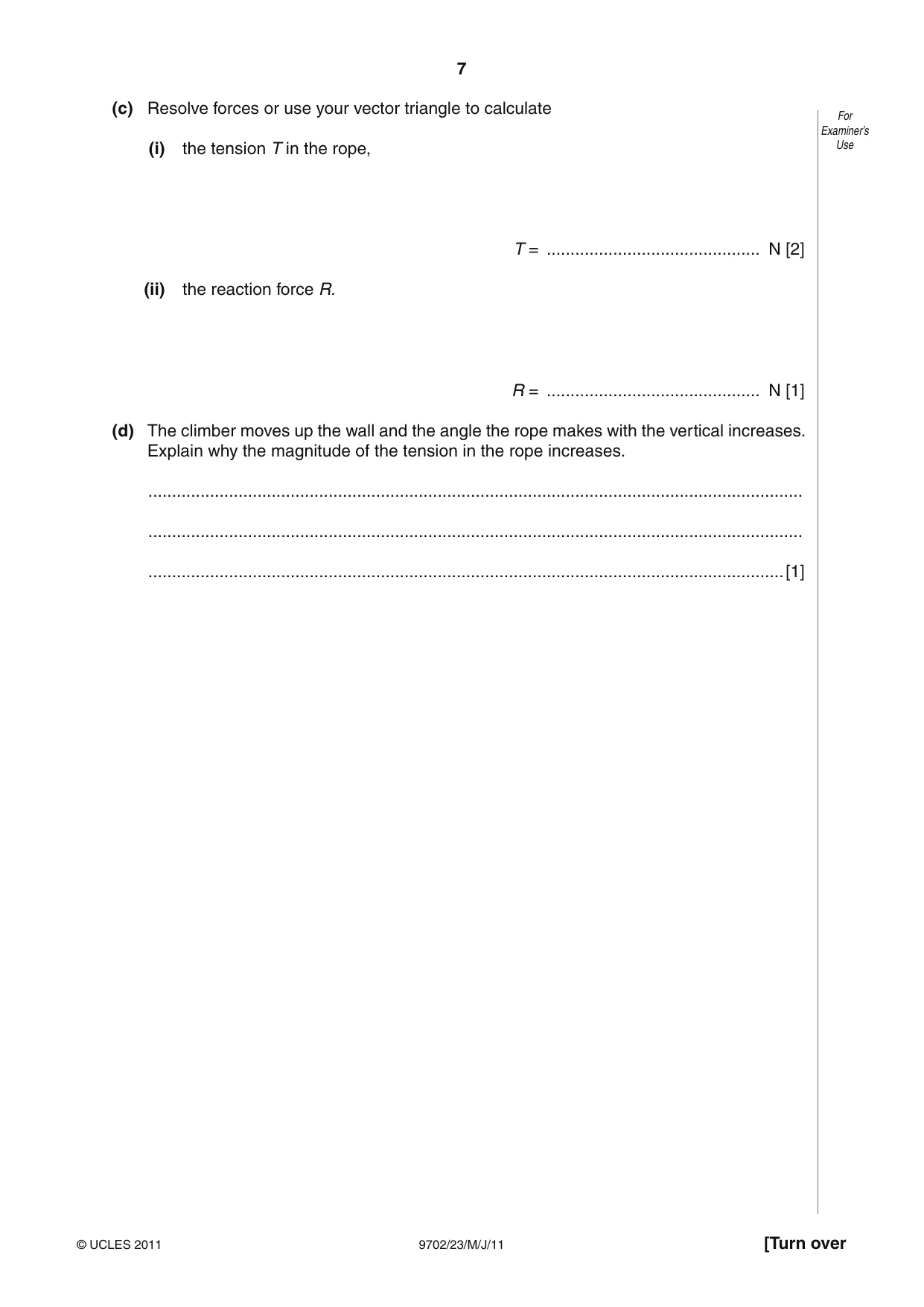
2 A climber is supported by a rope on a vertical wall, as shown in Fig. 2.1. For Examiner’s Use P T 18° R wall W Fig. 2.1 The weight W of the climber is 520 N. The rope, of negligible weight, is attached to the climber and to a fixed point P where it makes an angle of 18° to the vertical. The reaction force R acts at right-angles to the wall. The climber is in equilibrium. (a) State the conditions necessary for the climber to be in equilibrium. .......................................................................................................................................... .......................................................................................................................................... ......................................................................................................................................[2] (b) Complete Fig. 2.2 by drawing a labelled vector triangle to represent the forces acting on the climber. W Fig. 2.2 [2] (c) Resolve forces or use your vector triangle to calculate For Examiner’s (i) the tension T in the rope, Use T = ............................................. N [2] (ii) the reaction force R. R = ............................................. N [1] (d) The climber moves up the wall and the angle the rope makes with the vertical increases. Explain why the magnitude of the tension in the rope increases. .......................................................................................................................................... .......................................................................................................................................... ......................................................................................................................................[1]
Mark scheme: 2 (a) resultant moment = zero / sum of clockwise moments = sum of anticlockwise moments B1 resultant force = 0 B1 [2] (b) shape and orientation correct and forces labelled and arrows correct M1 angles correct / labelled A1 [2] (c) (i) T cos18° = W Scale diagram: C1 T = 520 / cos18° = 547 N ± 20 N A1 [2] (ii) R = T sin18° = 169 N ± 20 N A1 [1] (d) θ is larger hence cos θ is smaller, T = W / cos θ M1 hence T is larger A0 [1]
Q3 · A helicopter has a cable hanging from it towards the sea below, as shown in Fig
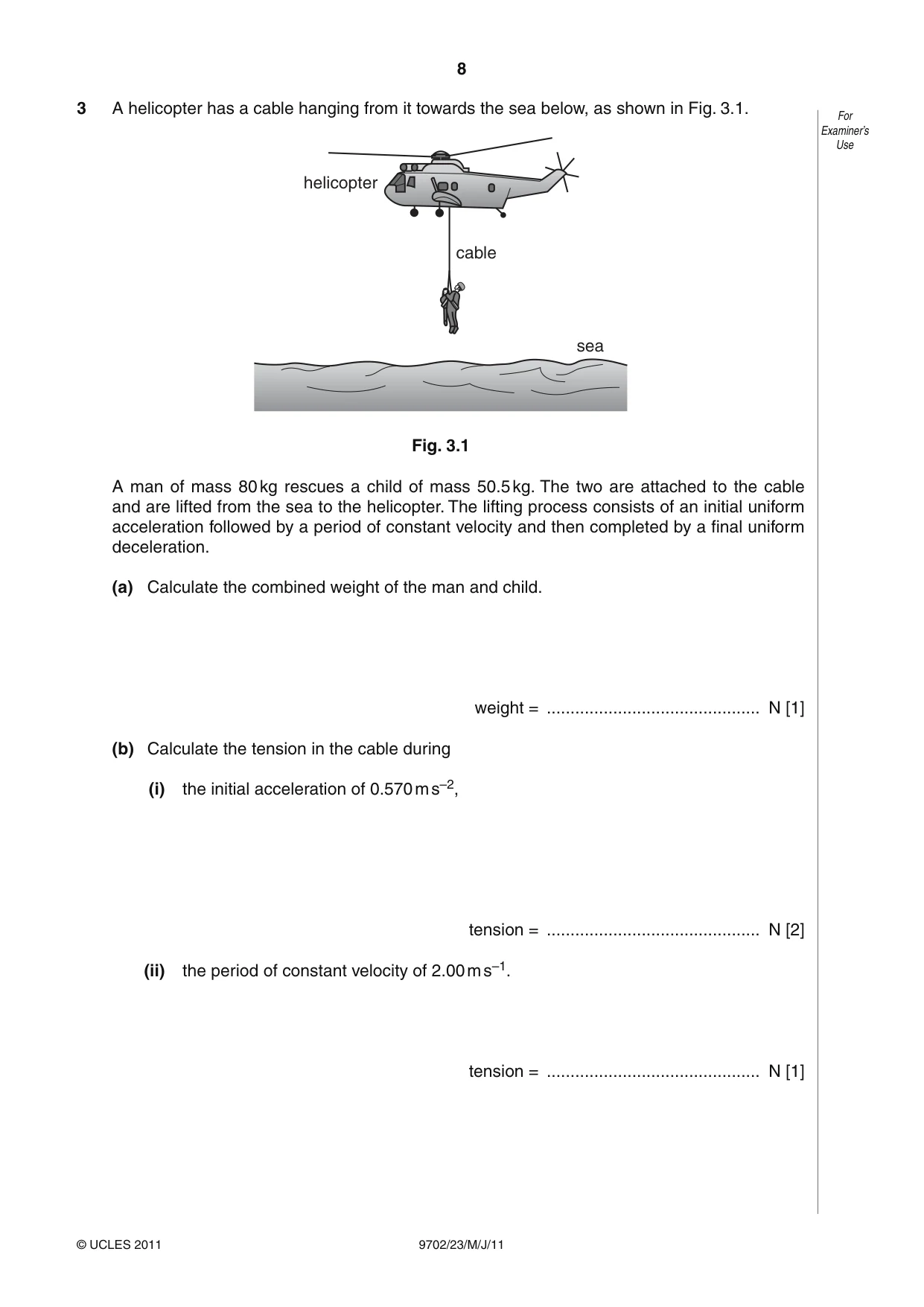
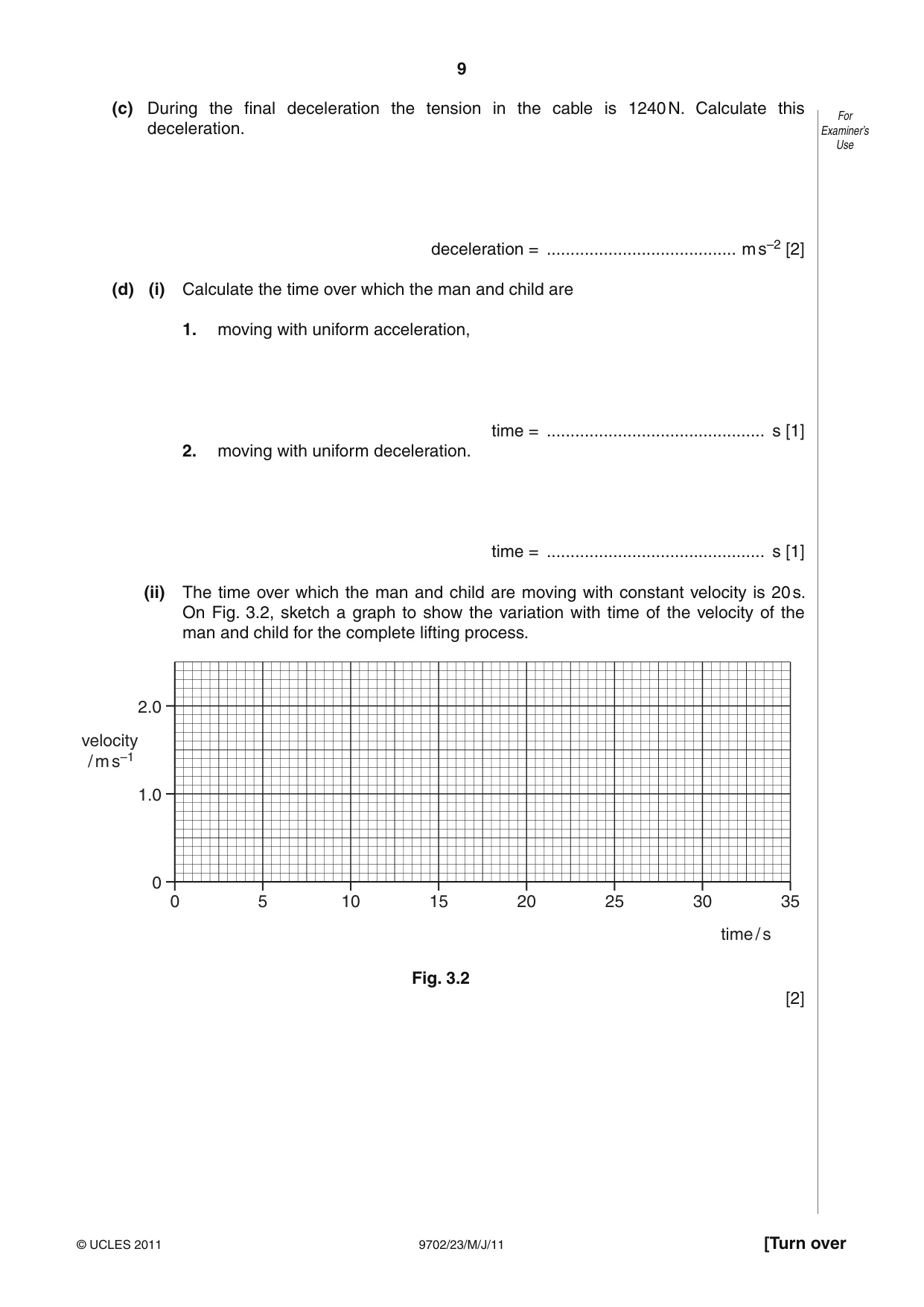
3 A helicopter has a cable hanging from it towards the sea below, as shown in Fig. 3.1. For Examiner’s Use helicopter cable sea Fig. 3.1 A man of mass 80 kg rescues a child of mass 50.5 kg. The two are attached to the cable and are lifted from the sea to the helicopter. The lifting process consists of an initial uniform acceleration followed by a period of constant velocity and then completed by a final uniform deceleration. (a) Calculate the combined weight of the man and child. weight = ............................................. N [1] (b) Calculate the tension in the cable during (i) the initial acceleration of 0.570 m s–2, tension = ............................................. N [2] (ii) the period of constant velocity of 2.00 m s–1. tension = ............................................. N [1] (c) During the final deceleration the tension in the cable is 1240 N. Calculate this For deceleration. Examiner’s Use deceleration = ........................................ m s–2 [2] (d) (i) Calculate the time over which the man and child are 1. moving with uniform acceleration, time = .............................................. s [1] 2. moving with uniform deceleration. time = .............................................. s [1] (ii) The time over which the man and child are moving with constant velocity is 20 s. On Fig. 3.2, sketch a graph to show the variation with time of the velocity of the man and child for the complete lifting process. 2.0 velocity / m s–1 1.0 0 0 5 10 15 20 25 30 35 time / s Fig. 3.2 [2]
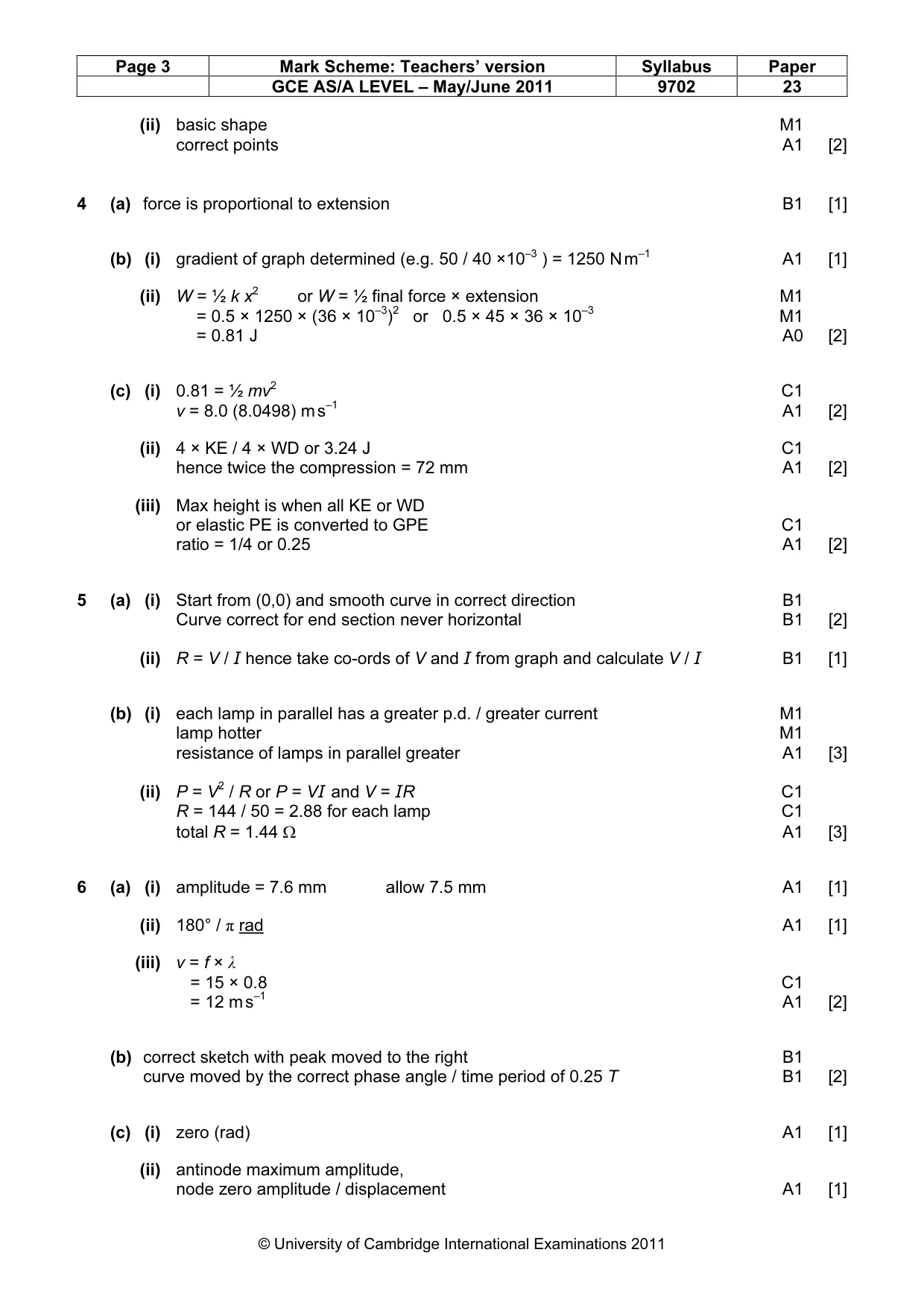
Mark scheme: 3 (a) weight = m × g = 130.5 × 9.81 = 1280 N A1 [1] (b) (i) F = ma T – 1280 = 130.5 × 0.57 C1 T = 1280 + 74.4 = 1350 N A1 [2] (ii) 1280 N A1 [1] (c) 1240 – 1280 = 130.5 × a C1 a = (–) 0.31 m s–2 A1 [2] (d) (i) 1. 3.5 s A1 [1] 2. 6.5 s A1 [1] GCE AS/A LEVEL – May/June 2011 9702 23 (ii) basic shape M1 correct points A1 [2]
Question 4
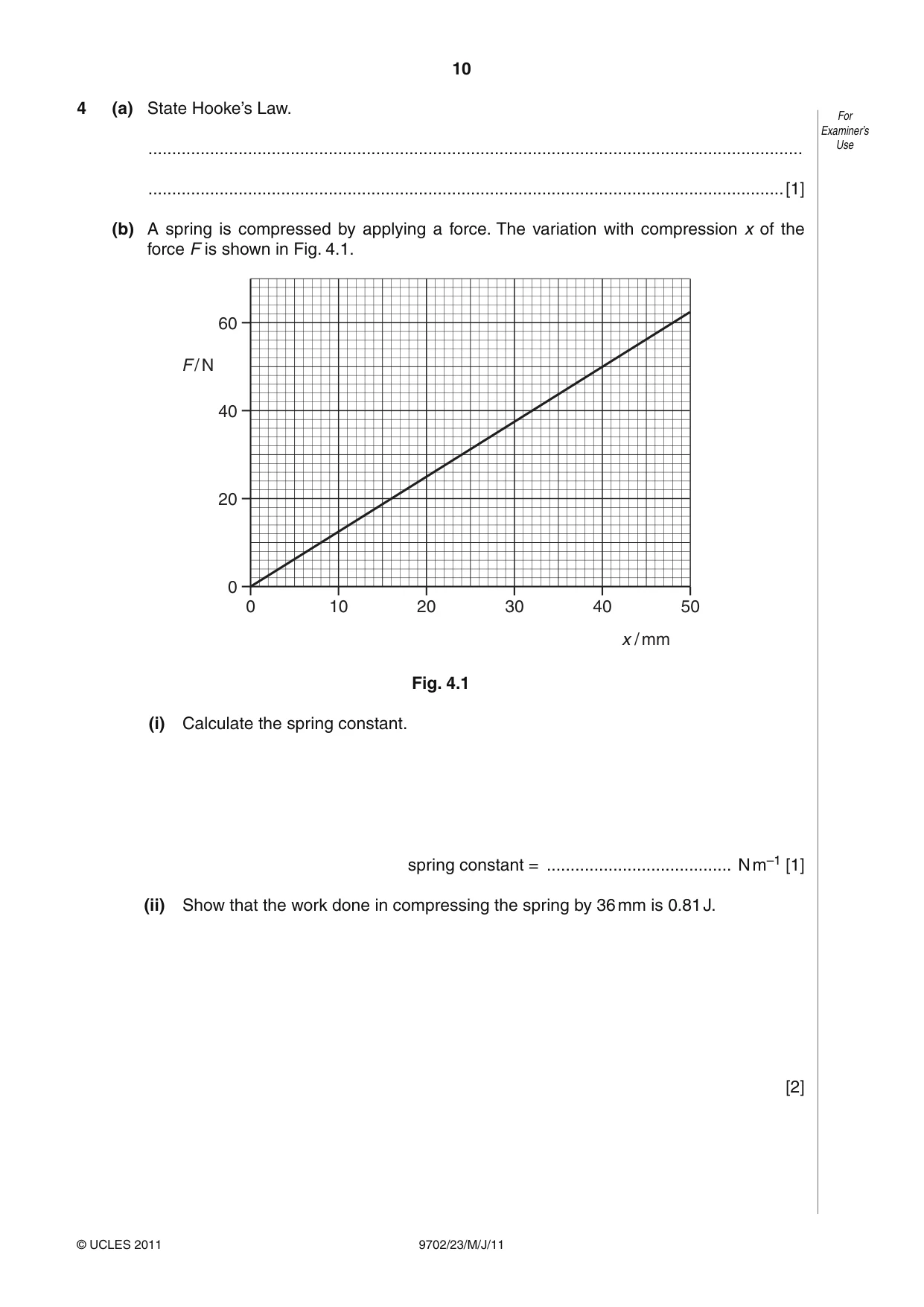
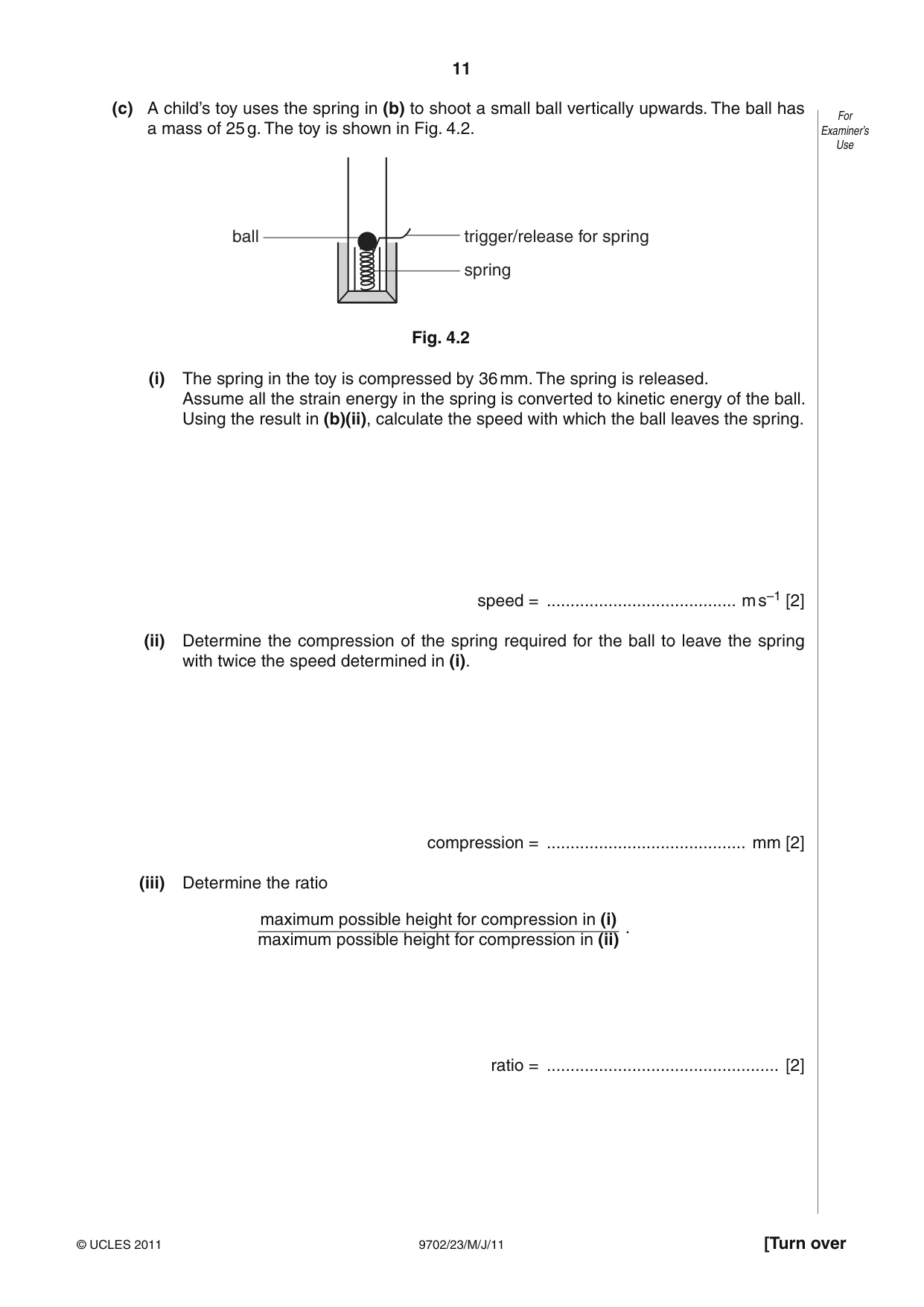
4 (a) State Hooke’s Law. For Examiner’s .......................................................................................................................................... Use ......................................................................................................................................[1] (b) A spring is compressed by applying a force. The variation with compression x of the force F is shown in Fig. 4.1. 60 F / N 40 20 0 0 10 20 30 40 50 x / mm Fig. 4.1 (i) Calculate the spring constant. spring constant = ....................................... N m–1 [1] (ii) Show that the work done in compressing the spring by 36 mm is 0.81 J. [2] (c) A child’s toy uses the spring in (b) to shoot a small ball vertically upwards. The ball has For a mass of 25 g. The toy is shown in Fig. 4.2. Examiner’s Use ball trigger/release for spring spring Fig. 4.2 (i) The spring in the toy is compressed by 36 mm. The spring is released. Assume all the strain energy in the spring is converted to kinetic energy of the ball. Using the result in (b)(ii), calculate the speed with which the ball leaves the spring. speed = ........................................ m s–1 [2] (ii) Determine the compression of the spring required for the ball to leave the spring with twice the speed determined in (i). compression = .......................................... mm [2] (iii) Determine the ratio maximum possible height for compression in (i) . maximum possible height for compression in (ii) ratio = ................................................. [2]
Mark scheme: 4 (a) force is proportional to extension B1 [1] (b) (i) gradient of graph determined (e.g. 50 / 40 ×10–3 ) = 1250 N m–1 A1 [1] (ii) W = ½ k x2 or W = ½ final force × extension M1 = 0.5 × 1250 × (36 × 10–3)2 or 0.5 × 45 × 36 × 10–3 M1 = 0.81 J A0 [2] (c) (i) 0.81 = ½ mv2 C1 v = 8.0 (8.0498) m s–1 A1 [2] (ii) 4 × KE / 4 × WD or 3.24 J C1 hence twice the compression = 72 mm A1 [2] (iii) Max height is when all KE or WD or elastic PE is converted to GPE C1 ratio = 1/4 or 0.25 A1 [2]
Question 5
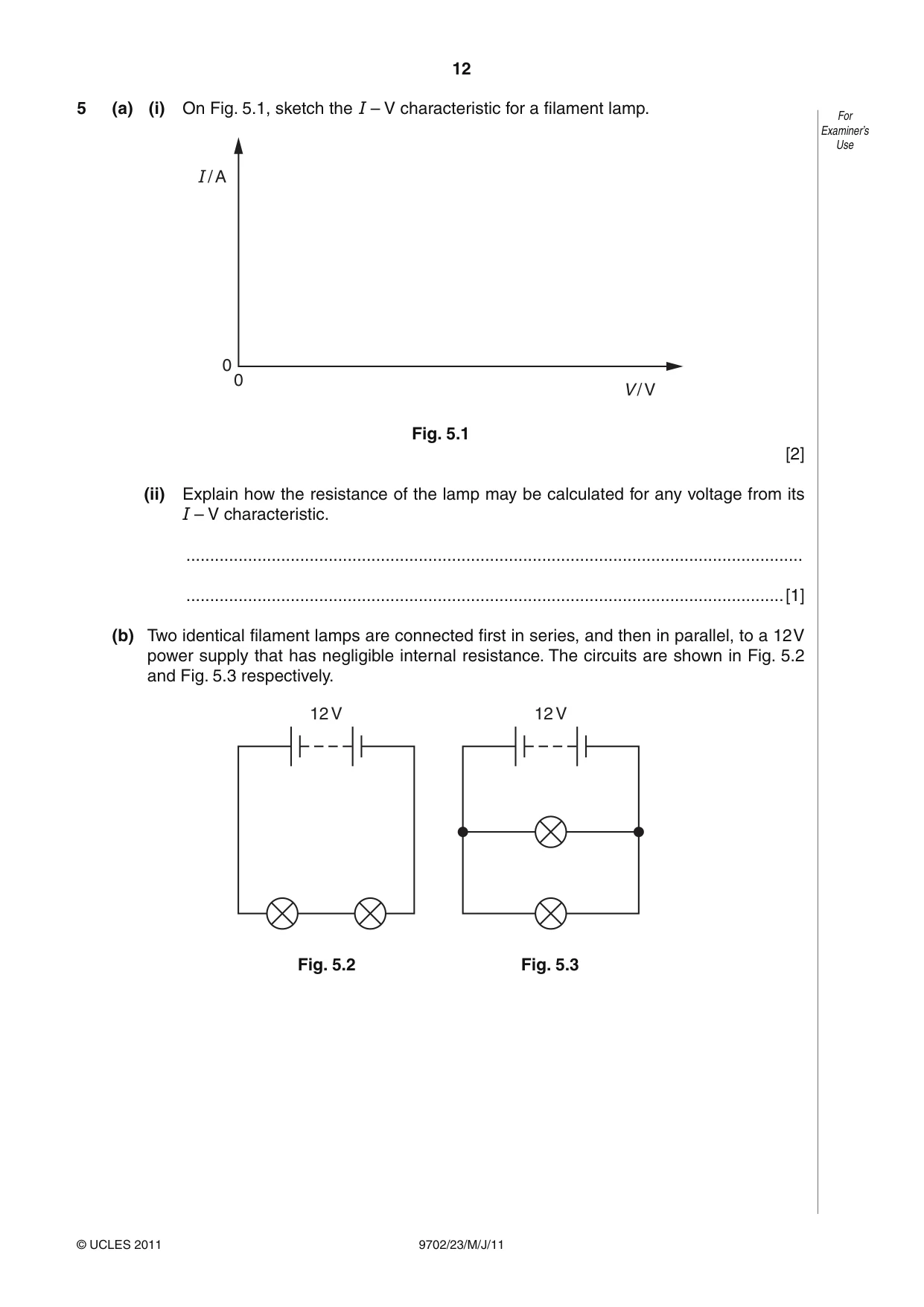
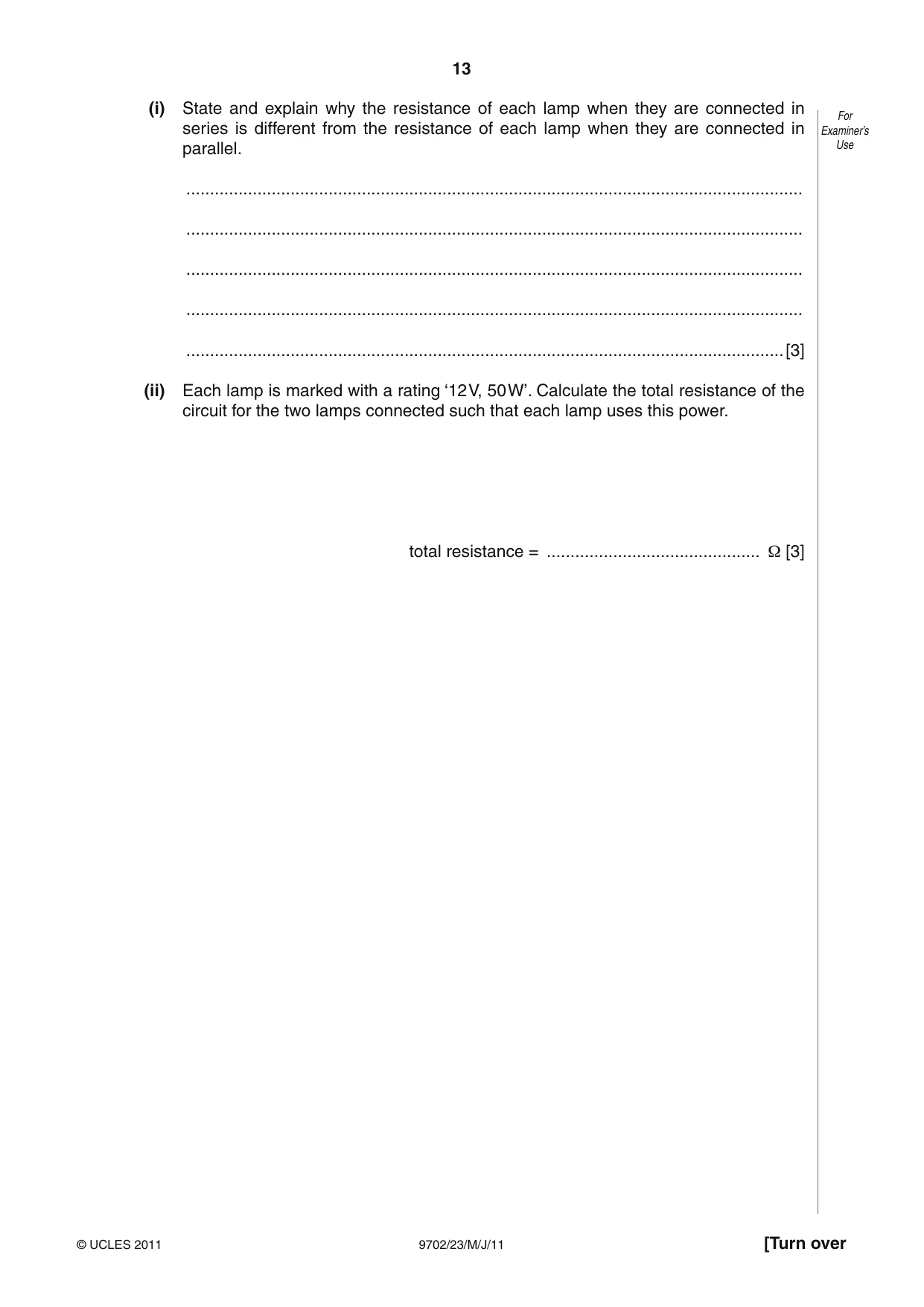
5 (a) (i) On Fig. 5.1, sketch the I – V characteristic for a filament lamp. For Examiner’s Use I / A 0 0 V / V Fig. 5.1 [2] (ii) Explain how the resistance of the lamp may be calculated for any voltage from its I – V characteristic. .................................................................................................................................. ..............................................................................................................................[1] (b) Two identical filament lamps are connected first in series, and then in parallel, to a 12 V power supply that has negligible internal resistance. The circuits are shown in Fig. 5.2 and Fig. 5.3 respectively. 12 V 12 V Fig. 5.2 Fig. 5.3 (i) State and explain why the resistance of each lamp when they are connected in For series is different from the resistance of each lamp when they are connected in Examiner’s parallel. Use .................................................................................................................................. .................................................................................................................................. .................................................................................................................................. .................................................................................................................................. ..............................................................................................................................[3] (ii) Each lamp is marked with a rating ‘12 V, 50 W’. Calculate the total resistance of the circuit for the two lamps connected such that each lamp uses this power. total resistance = ............................................. Ω [3]
Mark scheme: 5 (a) (i) Start from (0,0) and smooth curve in correct direction B1 Curve correct for end section never horizontal B1 [2] (ii) R = V / I hence take co-ords of V and I from graph and calculate V / I B1 [1] (b) (i) each lamp in parallel has a greater p.d. / greater current M1 lamp hotter M1 resistance of lamps in parallel greater A1 [3] (ii) P = V2 / R or P = VI and V = IR C1 R = 144 / 50 = 2.88 for each lamp C1 total R = 1.44 Ω A1 [3]
Q6 · A transverse progressive wave travels along a stretched string from left to right
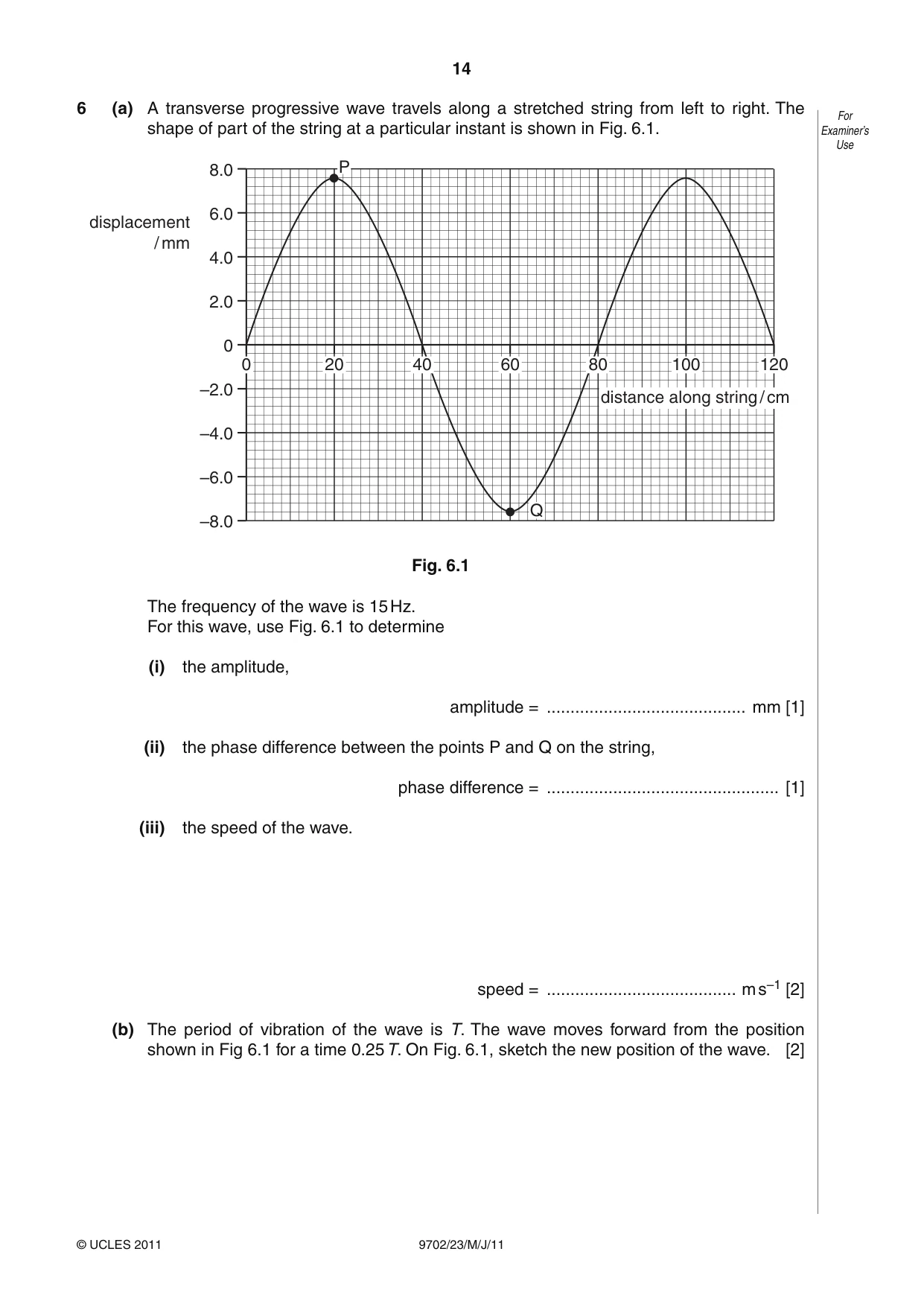
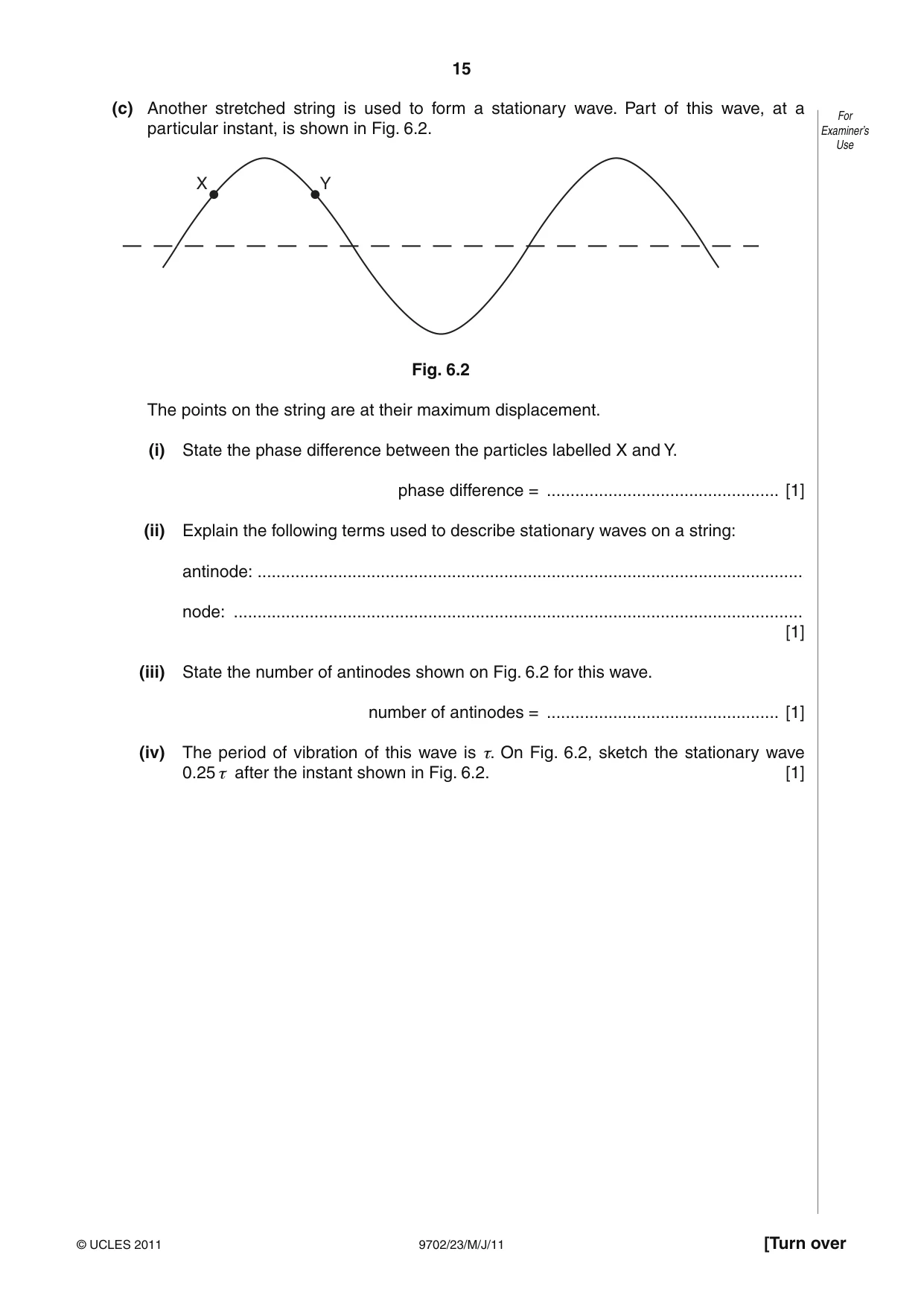
6 (a) A transverse progressive wave travels along a stretched string from left to right. The For shape of part of the string at a particular instant is shown in Fig. 6.1. Examiner’s Use 8.0 P 6.0 displacement / mm 4.0 2.0 0 0 20 40 60 80 100 120 –2.0 distance along string / cm –4.0 –6.0 Q –8.0 Fig. 6.1 The frequency of the wave is 15 Hz. For this wave, use Fig. 6.1 to determine (i) the amplitude, amplitude = .......................................... mm [1] (ii) the phase difference between the points P and Q on the string, phase difference = ................................................. [1] (iii) the speed of the wave. speed = ........................................ m s–1 [2] (b) The period of vibration of the wave is T. The wave moves forward from the position shown in Fig 6.1 for a time 0.25 T. On Fig. 6.1, sketch the new position of the wave. [2] (c) Another stretched string is used to form a stationary wave. Part of this wave, at a For particular instant, is shown in Fig. 6.2. Examiner’s Use X Y Fig. 6.2 The points on the string are at their maximum displacement. (i) State the phase difference between the particles labelled X and Y. phase difference = ................................................. [1] (ii) Explain the following terms used to describe stationary waves on a string: antinode: ................................................................................................................... node: ........................................................................................................................ [1] (iii) State the number of antinodes shown on Fig. 6.2 for this wave. number of antinodes = ................................................. [1] (iv) The period of vibration of this wave is τ. On Fig. 6.2, sketch the stationary wave 0.25 τ after the instant shown in Fig. 6.2. [1]
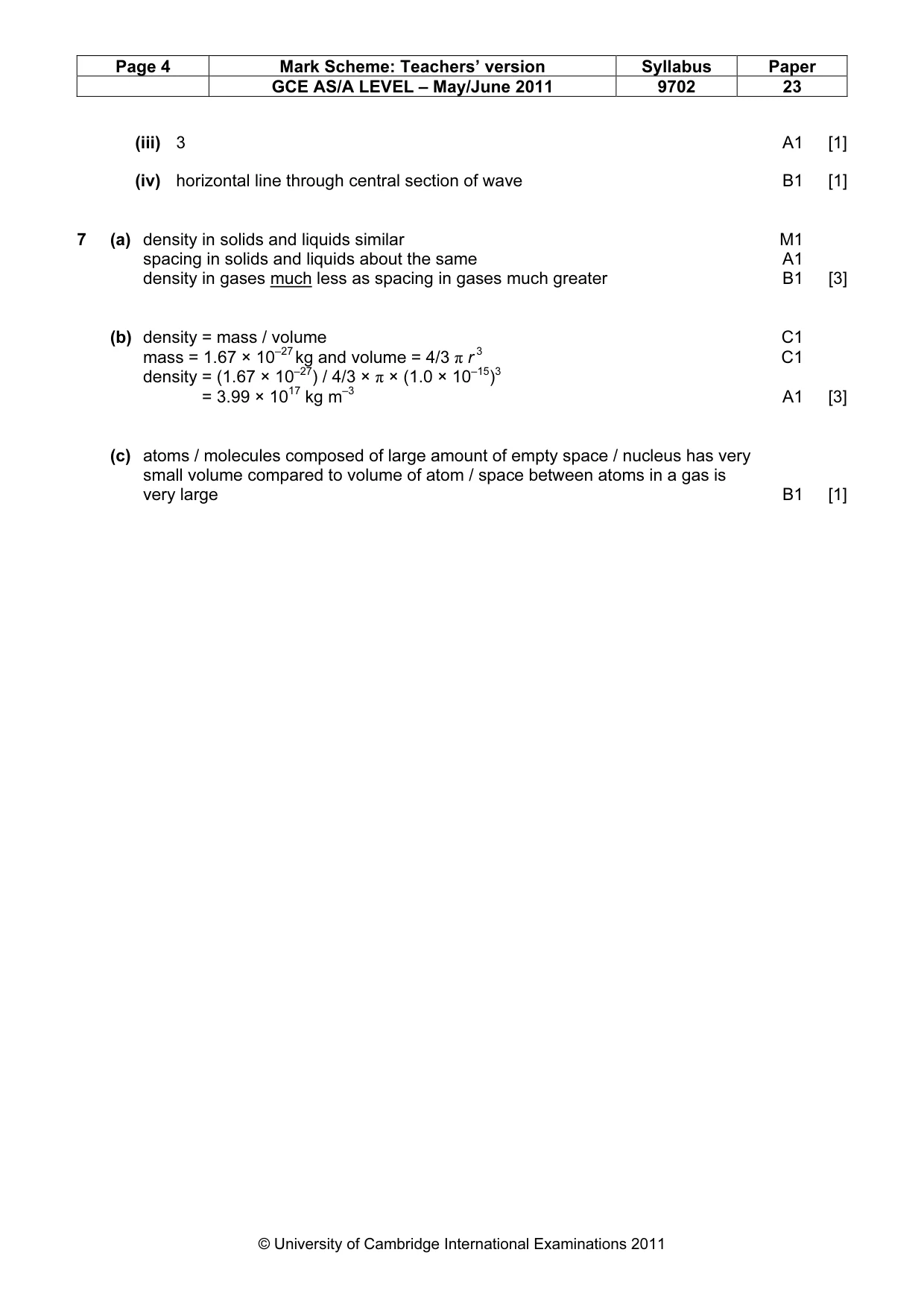
Mark scheme: 6 (a) (i) amplitude = 7.6 mm allow 7.5 mm A1 [1] (ii) 180° / π rad A1 [1] (iii) v = f × λ = 15 × 0.8 C1 = 12 m s–1 A1 [2] (b) correct sketch with peak moved to the right B1 curve moved by the correct phase angle / time period of 0.25 T B1 [2] (c) (i) zero (rad) A1 [1] (ii) antinode maximum amplitude, node zero amplitude / displacement A1 [1] GCE AS/A LEVEL – May/June 2011 9702 23 (iii) 3 A1 [1] (iv) horizontal line through central section of wave B1 [1]
Q7 · Explain the difference in densities in solids, liquids and gases using ideas of the…
7 (a) Explain the difference in densities in solids, liquids and gases using ideas of the spacing For between molecules. Examiner’s Use .......................................................................................................................................... .......................................................................................................................................... .......................................................................................................................................... .......................................................................................................................................... .......................................................................................................................................... .......................................................................................................................................... ......................................................................................................................................[3] (b) A hydrogen nucleus (proton) may be assumed to be a sphere of radius 1 × 10–15 m. Calculate the density of a hydrogen nucleus. density = ...................................... kg m–3 [3] (c) The density of hydrogen gas in a pressurised cylinder is 4 kg m–3. Suggest a reason why this density is much less than your answer in (b). .......................................................................................................................................... .......................................................................................................................................... ......................................................................................................................................[1]
Mark scheme: 7 (a) density in solids and liquids similar M1 spacing in solids and liquids about the same A1 density in gases much less as spacing in gases much greater B1 [3] (b) density = mass / volume C1 mass = 1.67 × 10⁻²⁷ kg and volume = 4/3 π r 3 C1 density = (1.67 × 10⁻²⁷) / 4/3 × π × (1.0 × 10⁻¹⁵)3 = 3.99 × 10¹⁷ kg m–3 A1 [3] (c) atoms / molecules composed of large amount of empty space / nucleus has very small volume compared to volume of atom / space between atoms in a gas is very large B1 [1]
What was in this paper
The subtopics covered by these 7 questions, and how many questions each got. Open one in a new tab to see every Cambridge question on it.
What you needed in this session
Cambridge’s own grade thresholds for 2011 May/June, Paper 2 · Variant 3. A higher threshold means an easier paper — the bar moves with how the cohort did.