Cambridge A Level Physical Science 8780 — 2017 Oct/Nov Paper 1 · Variant 1
8780/11/O/N/17 · 30 marks · ≈34 min
The question paper and its mark scheme, free to read here and free to download. This is Cambridge’s own paper, exactly as it was sat.
Question paper16 pages
Mark scheme3 pages
Answers below. Sit the paper first if you are practising.
Paper as text
Question paper, page 1
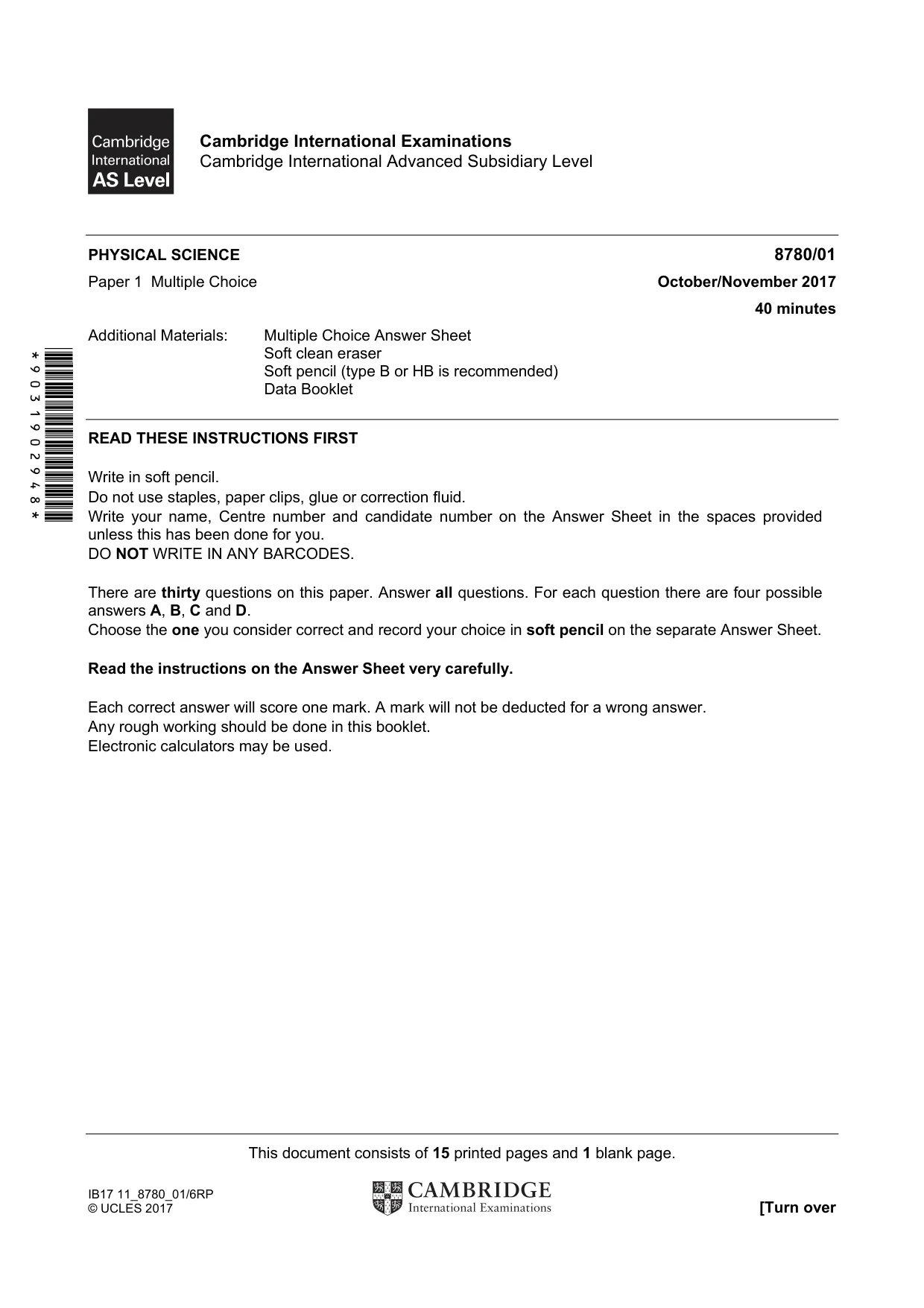
This document consists of 15 printed pages and 1 blank page. IB17 11_8780_01/6RP © UCLES 2017 [Turn over *9031902948* Cambridge International Examinations Cambridge International Advanced Subsidiary Level PHYSICAL SCIENCE 8780/01 Paper 1 Multiple Choice October/November 2017 40 minutes Additional Materials: Multiple Choice Answer Sheet Soft clean eraser Soft pencil (type B or HB is recommended) Data Booklet READ THESE INSTRUCTIONS FIRST Write in soft pencil. Do not use staples, paper clips, glue or correction fluid. Write your name, Centre number and candidate number on the Answer Sheet in the spaces provided unless this has been done for you. DO NOT WRITE IN ANY BARCODES. There are thirty questions on this paper. Answer all questions. For each question there are four possible answers A, B, C and D. Choose the one you consider correct and record your choice in soft pencil on the separate Answer Sheet. Read the instructions on the Answer Sheet very carefully. Each correct answer will score one mark. A mark will not be deducted for a wrong answer. Any rough working should be done in this booklet. Electronic calculators may be used.
Question paper, page 2
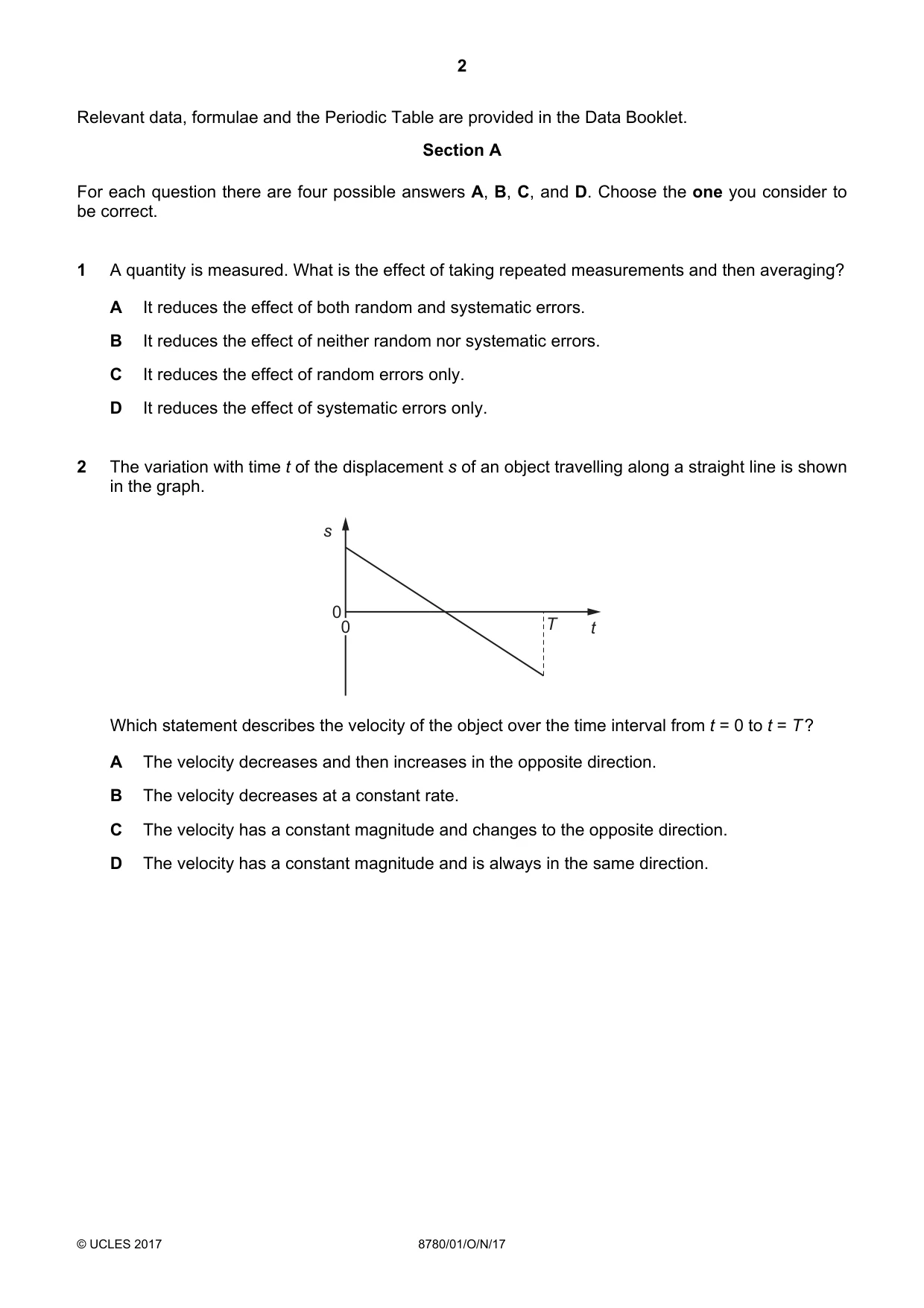
2 © UCLES 2017 8780/01/O/N/17 Relevant data, formulae and the Periodic Table are provided in the Data Booklet. Section A For each question there are four possible answers A, B, C, and D. Choose the one you consider to be correct. 1 A quantity is measured. What is the effect of taking repeated measurements and then averaging? A It reduces the effect of both random and systematic errors. B It reduces the effect of neither random nor systematic errors. C It reduces the effect of random errors only. D It reduces the effect of systematic errors only. 2 The variation with time t of the displacement s of an object travelling along a straight line is shown in the graph. s t T 0 0 Which statement describes the velocity of the object over the time interval from t = 0 to t = T ? A The velocity decreases and then increases in the opposite direction. B The velocity decreases at a constant rate. C The velocity has a constant magnitude and changes to the opposite direction. D The velocity has a constant magnitude and is always in the same direction.
Question paper, page 3
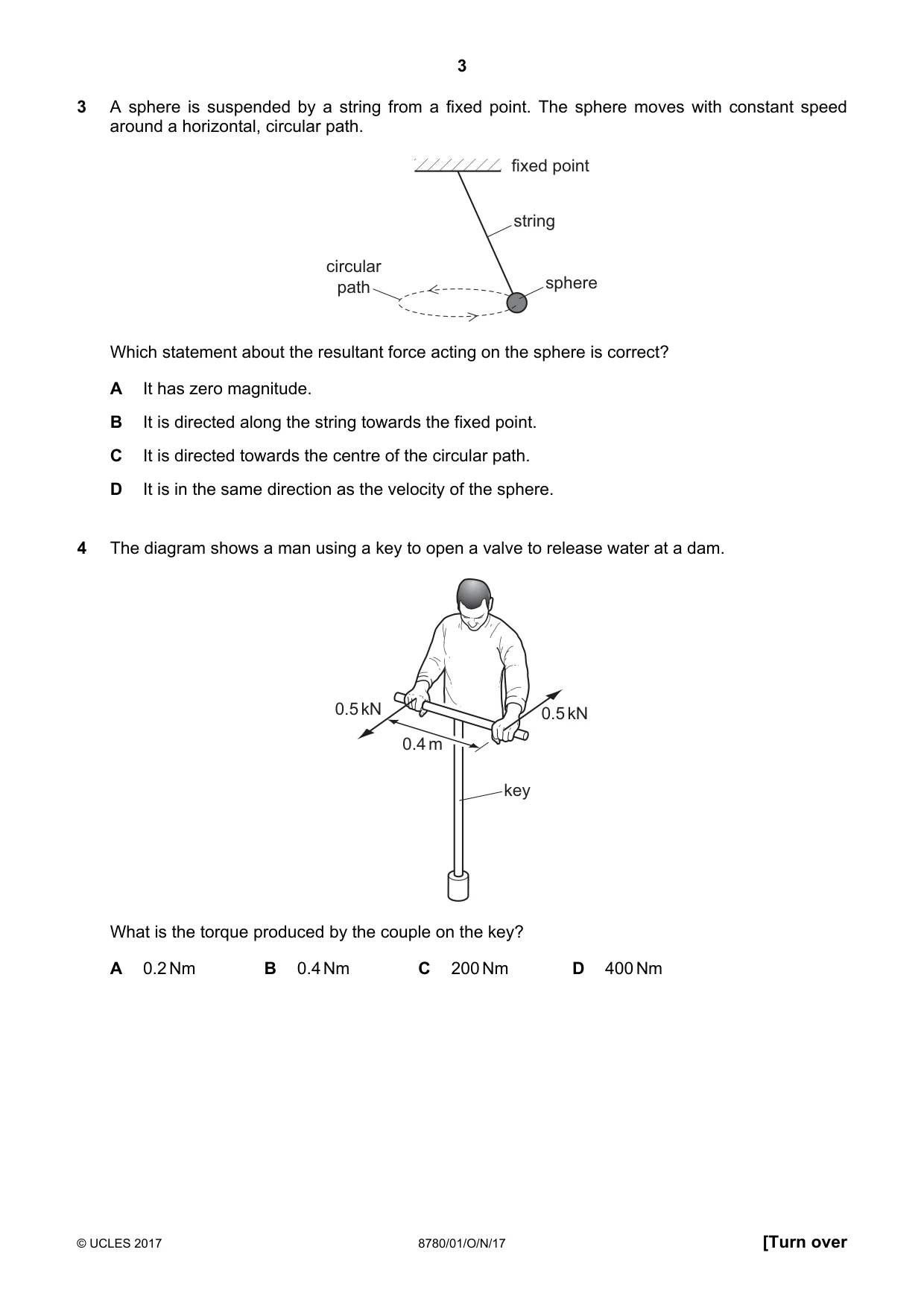
3 © UCLES 2017 8780/01/O/N/17 [Turn over 3 A sphere is suspended by a string from a fixed point. The sphere moves with constant speed around a horizontal, circular path. fixed point string sphere circular path Which statement about the resultant force acting on the sphere is correct? A It has zero magnitude. B It is directed along the string towards the fixed point. C It is directed towards the centre of the circular path. D It is in the same direction as the velocity of the sphere. 4 The diagram shows a man using a key to open a valve to release water at a dam. 0.4 m 0.5 kN 0.5 kN key What is the torque produced by the couple on the key? A 0.2 Nm B 0.4 Nm C 200 Nm D 400 Nm
Question paper, page 4
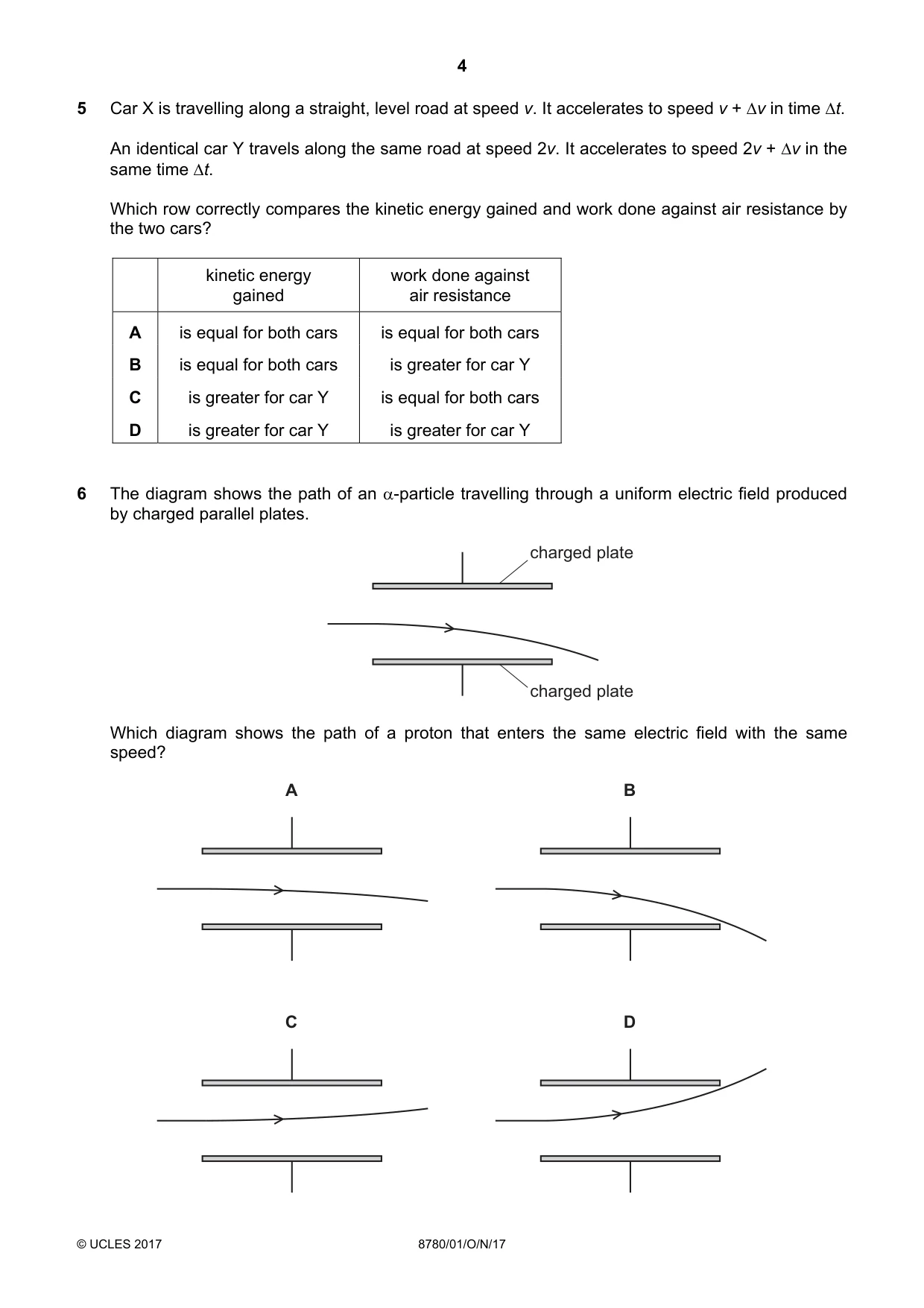
4 © UCLES 2017 8780/01/O/N/17 5 Car X is travelling along a straight, level road at speed v. It accelerates to speed v + ∆v in time ∆t. An identical car Y travels along the same road at speed 2v. It accelerates to speed 2v + ∆v in the same time ∆t. Which row correctly compares the kinetic energy gained and work done against air resistance by the two cars? kinetic energy gained work done against air resistance A is equal for both cars is equal for both cars B is equal for both cars is greater for car Y C is greater for car Y is equal for both cars D is greater for car Y is greater for car Y 6 The diagram shows the path of an α-particle travelling through a uniform electric field produced by charged parallel plates. charged plate charged plate Which diagram shows the path of a proton that enters the same electric field with the same speed? A B C D
Question paper, page 5
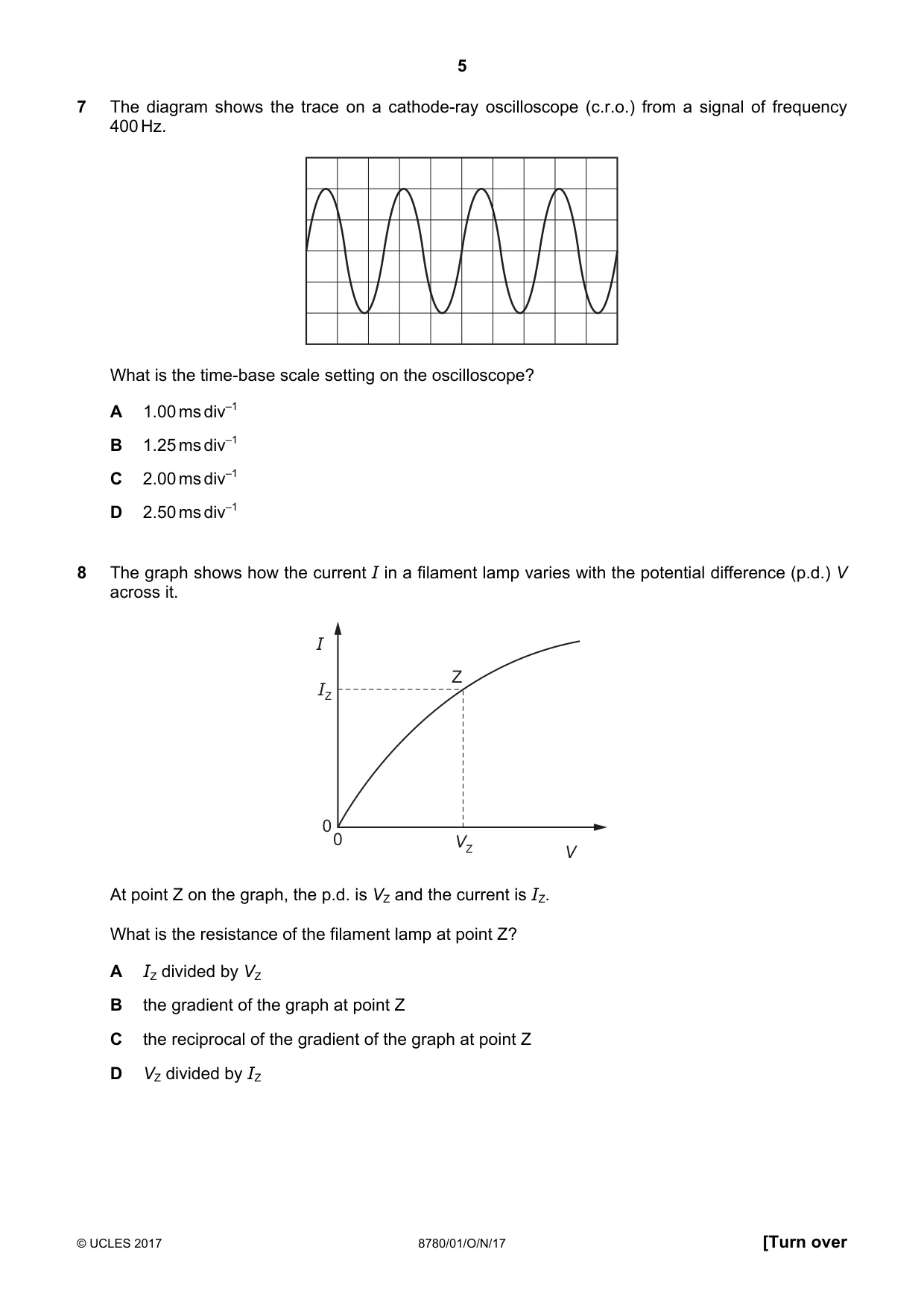
5 © UCLES 2017 8780/01/O/N/17 [Turn over 7 The diagram shows the trace on a cathode-ray oscilloscope (c.r.o.) from a signal of frequency 400 Hz. What is the time-base scale setting on the oscilloscope? A 1.00 ms div–1 B 1.25 ms div–1 C 2.00 ms div–1 D 2.50 ms div–1 8 The graph shows how the current I in a filament lamp varies with the potential difference (p.d.) V across it. I IZ VZ 0 0 V Z At point Z on the graph, the p.d. is VZ and the current is IZ. What is the resistance of the filament lamp at point Z? A IZ divided by VZ B the gradient of the graph at point Z C the reciprocal of the gradient of the graph at point Z D VZ divided by IZ
Question paper, page 6
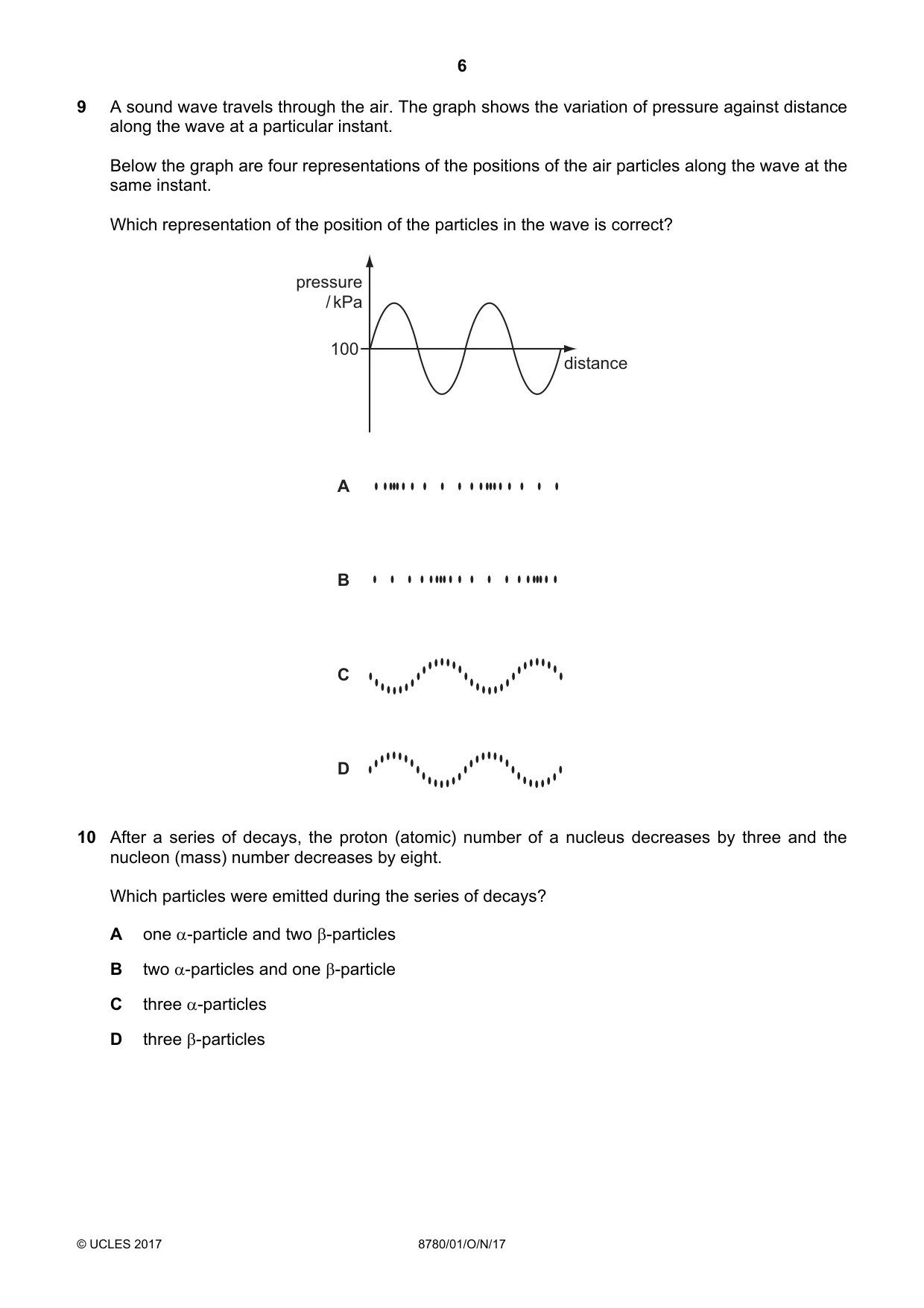
6 © UCLES 2017 8780/01/O/N/17 9 A sound wave travels through the air. The graph shows the variation of pressure against distance along the wave at a particular instant. Below the graph are four representations of the positions of the air particles along the wave at the same instant. Which representation of the position of the particles in the wave is correct? pressure / kPa distance 100 D C B A 10 After a series of decays, the proton (atomic) number of a nucleus decreases by three and the nucleon (mass) number decreases by eight. Which particles were emitted during the series of decays? A one α-particle and two β-particles B two α-particles and one β-particle C three α-particles D three β-particles
Question paper, page 7
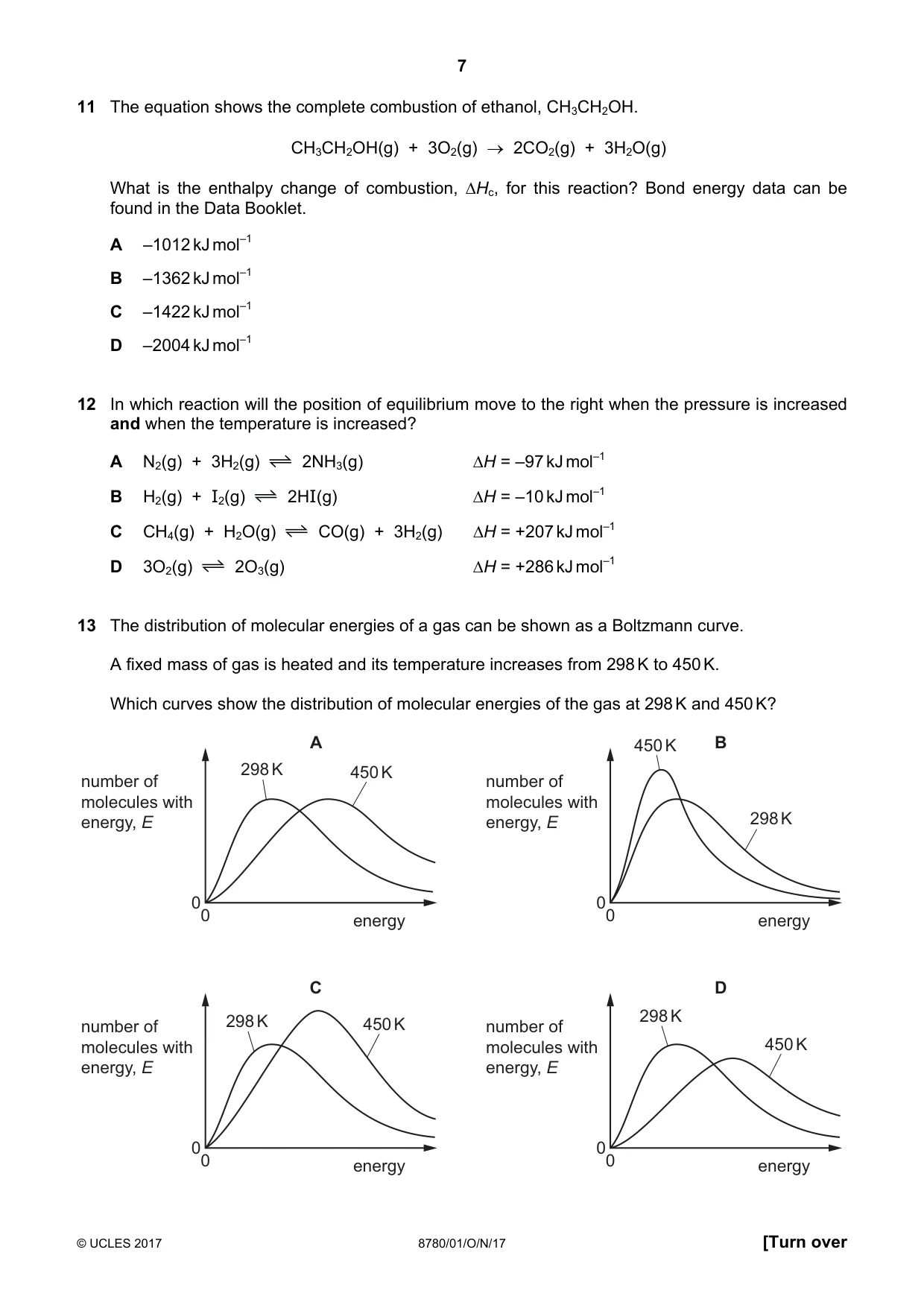
7 © UCLES 2017 8780/01/O/N/17 [Turn over 11 The equation shows the complete combustion of ethanol, CH3CH2OH. CH3CH2OH(g) + 3O2(g) → 2CO2(g) + 3H2O(g) What is the enthalpy change of combustion, ∆Hc, for this reaction? Bond energy data can be found in the Data Booklet. A –1012 kJ mol–1 B –1362 kJ mol–1 C –1422 kJ mol–1 D –2004 kJ mol–1 12 In which reaction will the position of equilibrium move to the right when the pressure is increased and when the temperature is increased? A N2(g) + 3H2(g) 2NH3(g) ∆H = –97 kJ mol–1 B H2(g) + I2(g) 2HI(g) ∆H = –10 kJ mol–1 C CH4(g) + H2O(g) CO(g) + 3H2(g) ∆H = +207 kJ mol–1 D 3O2(g) 2O3(g) ∆H = +286 kJ mol–1 13 The distribution of molecular energies of a gas can be shown as a Boltzmann curve. A fixed mass of gas is heated and its temperature increases from 298 K to 450 K. Which curves show the distribution of molecular energies of the gas at 298 K and 450 K? A energy number of molecules with energy, E B energy number of molecules with energy, E C energy number of molecules with energy, E D energy number of molecules with energy, E 0 0 0 0 0 0 0 0 298 K 298 K 450 K 450 K 298 K 298 K 450 K 450 K
Question paper, page 8
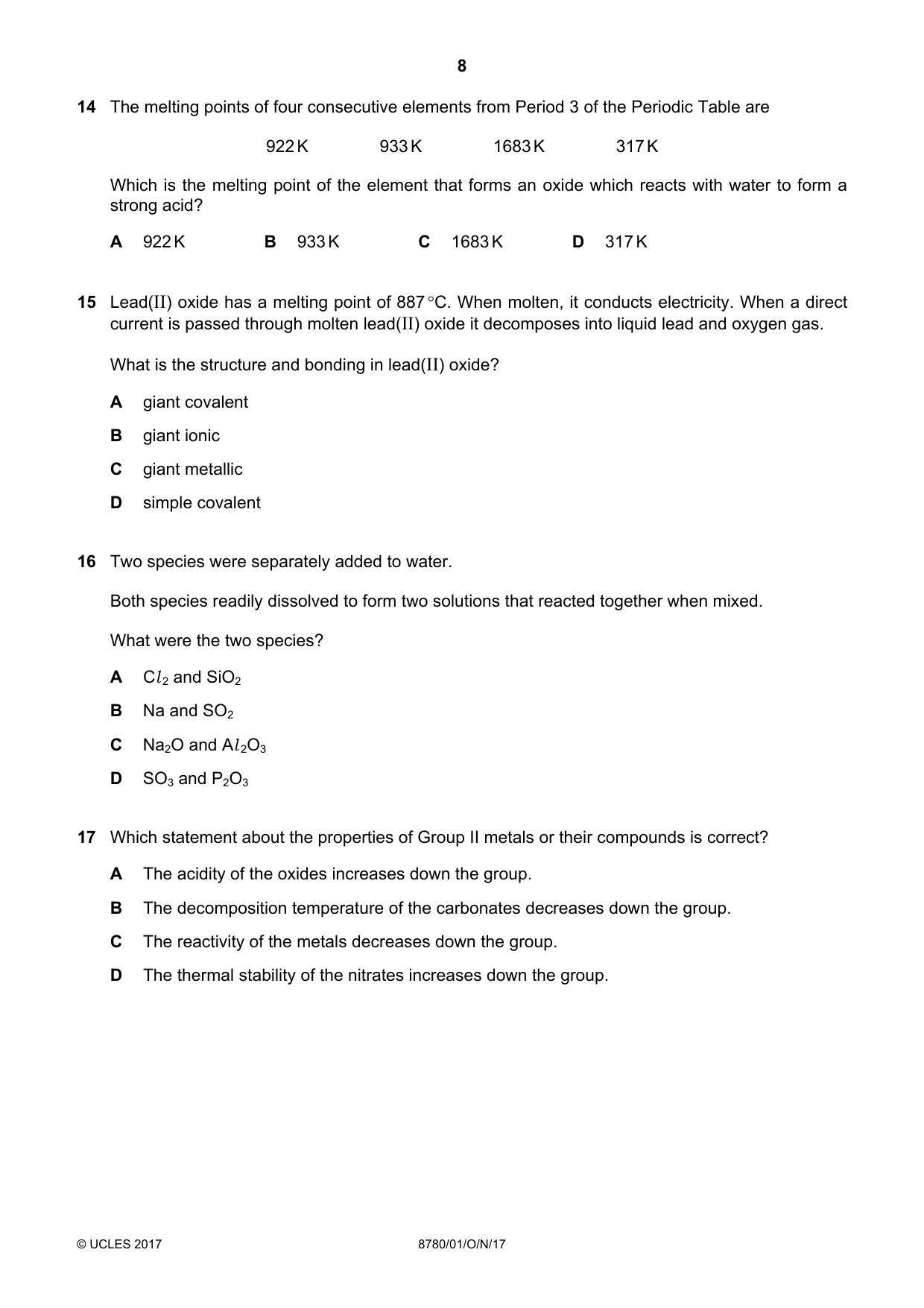
8 © UCLES 2017 8780/01/O/N/17 14 The melting points of four consecutive elements from Period 3 of the Periodic Table are 922 K 933 K 1683 K 317 K Which is the melting point of the element that forms an oxide which reacts with water to form a strong acid? A 922 K B 933 K C 1683 K D 317 K 15 Lead(II) oxide has a melting point of 887 °C. When molten, it conducts electricity. When a direct current is passed through molten lead(II) oxide it decomposes into liquid lead and oxygen gas. What is the structure and bonding in lead(II) oxide? A giant covalent B giant ionic C giant metallic D simple covalent 16 Two species were separately added to water. Both species readily dissolved to form two solutions that reacted together when mixed. What were the two species? A Cl 2 and SiO2 B Na and SO2 C Na2O and Al 2O3 D SO3 and P2O3 17 Which statement about the properties of Group II metals or their compounds is correct? A The acidity of the oxides increases down the group. B The decomposition temperature of the carbonates decreases down the group. C The reactivity of the metals decreases down the group. D The thermal stability of the nitrates increases down the group.
Question paper, page 9
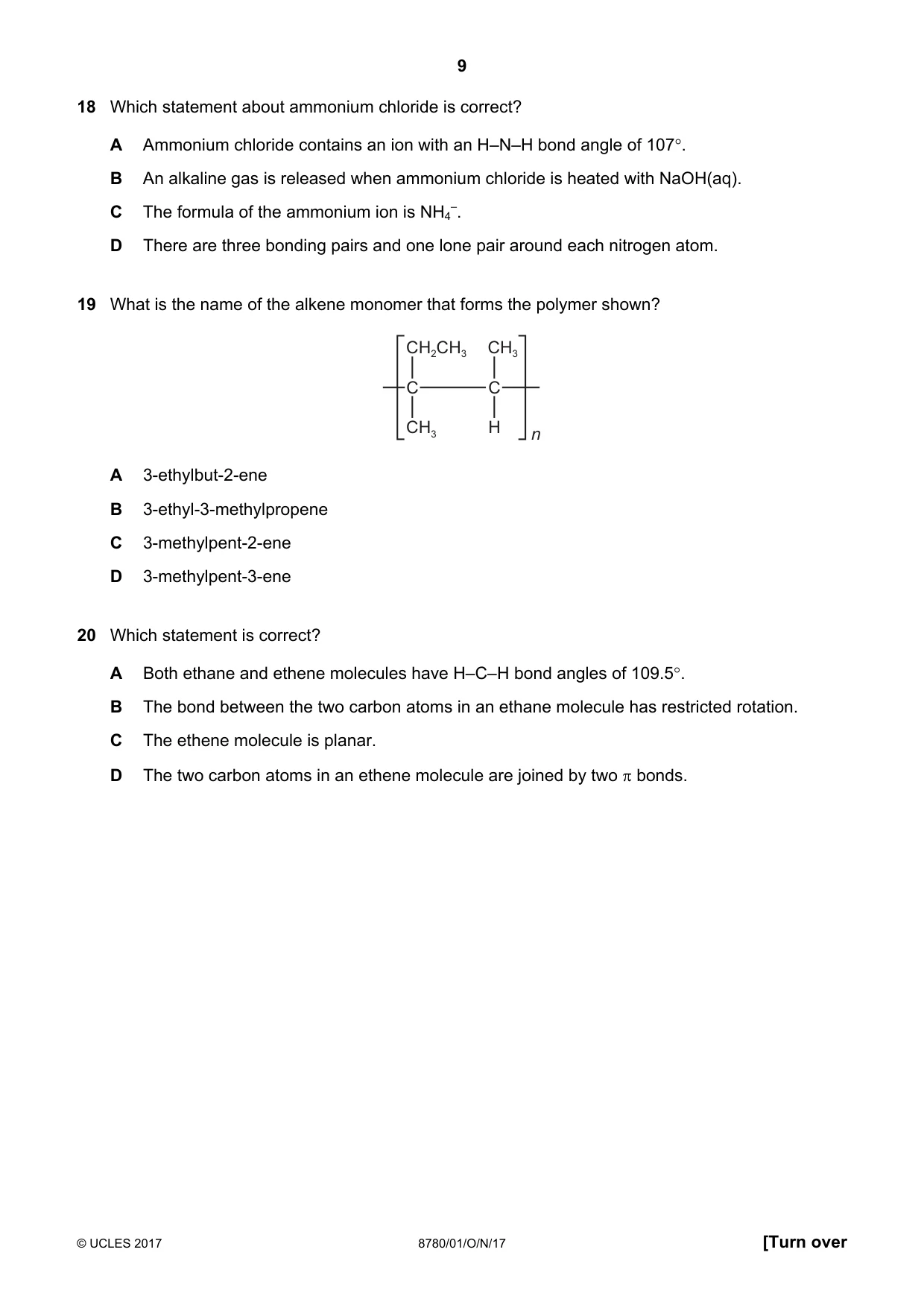
9 © UCLES 2017 8780/01/O/N/17 [Turn over 18 Which statement about ammonium chloride is correct? A Ammonium chloride contains an ion with an H–N–H bond angle of 107°. B An alkaline gas is released when ammonium chloride is heated with NaOH(aq). C The formula of the ammonium ion is NH4 –. D There are three bonding pairs and one lone pair around each nitrogen atom. 19 What is the name of the alkene monomer that forms the polymer shown? n C CH3 CH2CH3 C H CH3 A 3-ethylbut-2-ene B 3-ethyl-3-methylpropene C 3-methylpent-2-ene D 3-methylpent-3-ene 20 Which statement is correct? A Both ethane and ethene molecules have H–C–H bond angles of 109.5°. B The bond between the two carbon atoms in an ethane molecule has restricted rotation. C The ethene molecule is planar. D The two carbon atoms in an ethene molecule are joined by two π bonds.
Question paper, page 10
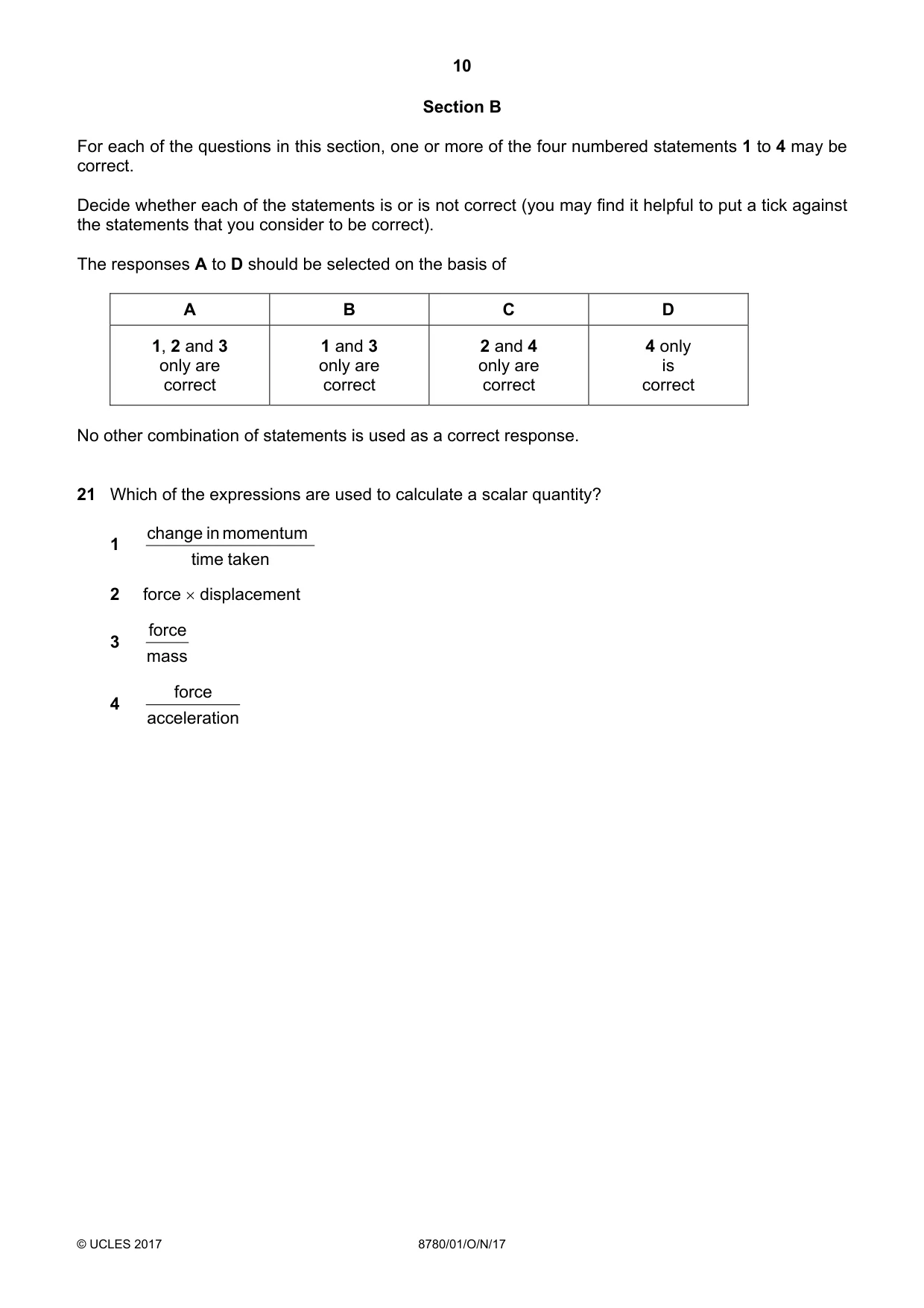
10 © UCLES 2017 8780/01/O/N/17 Section B For each of the questions in this section, one or more of the four numbered statements 1 to 4 may be correct. Decide whether each of the statements is or is not correct (you may find it helpful to put a tick against the statements that you consider to be correct). The responses A to D should be selected on the basis of A B C D 1, 2 and 3 only are correct 1 and 3 only are correct 2 and 4 only are correct 4 only is correct No other combination of statements is used as a correct response. 21 Which of the expressions are used to calculate a scalar quantity? 1 taken time momentum in change 2 force × displacement 3 mass force 4 on accelerati force
Question paper, page 11
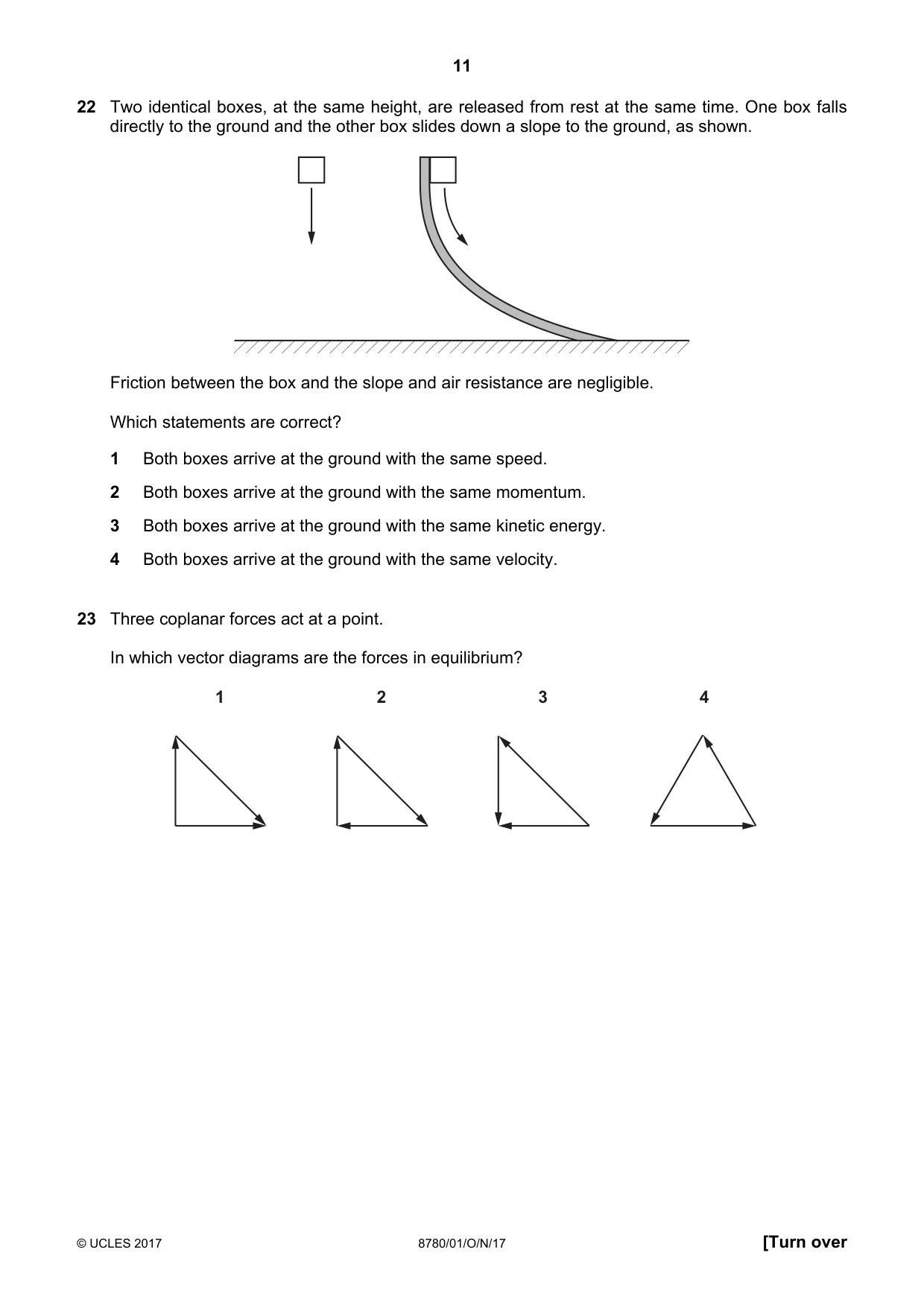
11 © UCLES 2017 8780/01/O/N/17 [Turn over 22 Two identical boxes, at the same height, are released from rest at the same time. One box falls directly to the ground and the other box slides down a slope to the ground, as shown. Friction between the box and the slope and air resistance are negligible. Which statements are correct? 1 Both boxes arrive at the ground with the same speed. 2 Both boxes arrive at the ground with the same momentum. 3 Both boxes arrive at the ground with the same kinetic energy. 4 Both boxes arrive at the ground with the same velocity. 23 Three coplanar forces act at a point. In which vector diagrams are the forces in equilibrium? 1 2 3 4
Question paper, page 12
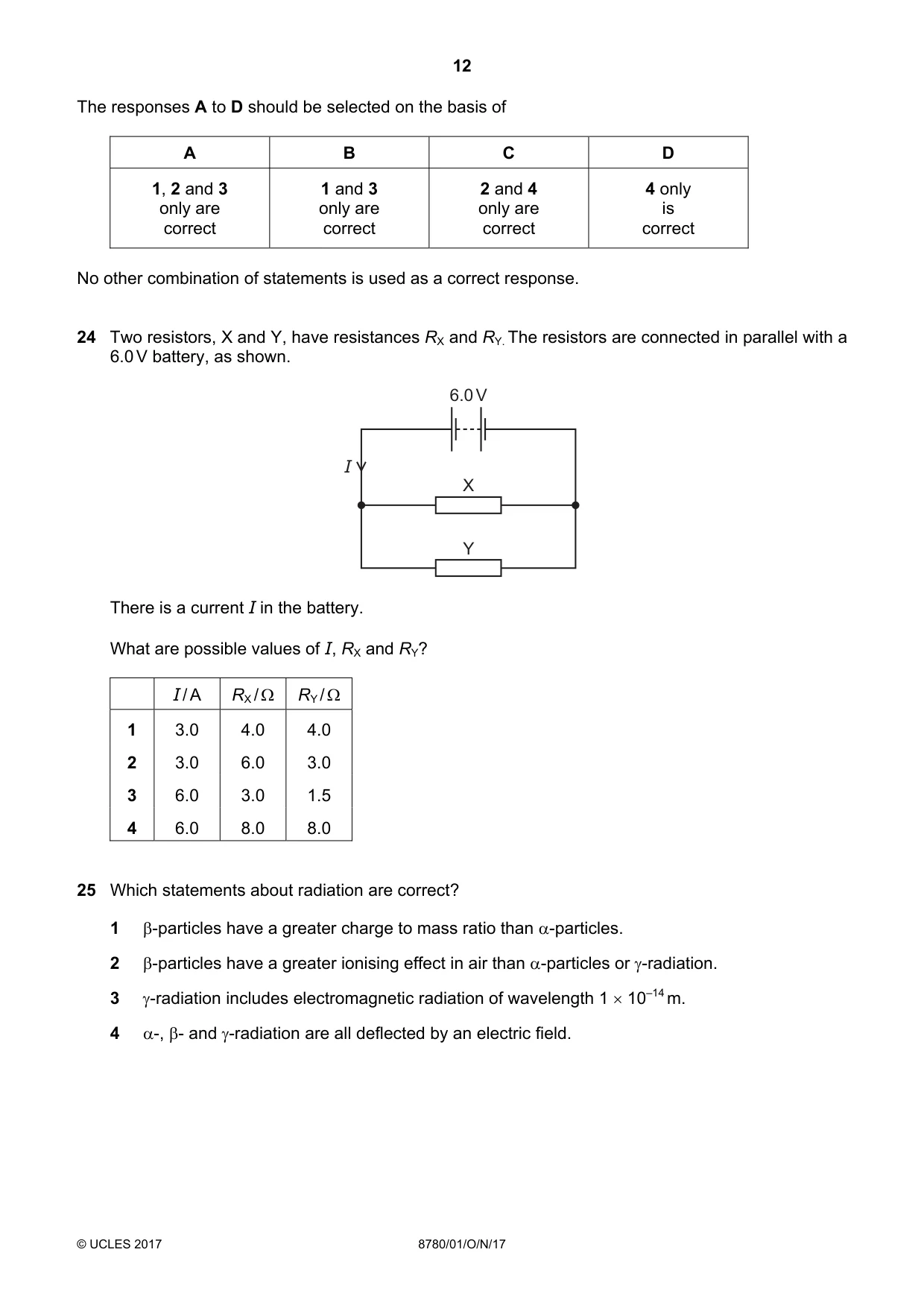
12 © UCLES 2017 8780/01/O/N/17 The responses A to D should be selected on the basis of A B C D 1, 2 and 3 only are correct 1 and 3 only are correct 2 and 4 only are correct 4 only is correct No other combination of statements is used as a correct response. 24 Two resistors, X and Y, have resistances RX and RY. The resistors are connected in parallel with a 6.0 V battery, as shown. X 6.0 V Y I There is a current I in the battery. What are possible values of I, RX and RY? I / A RX / Ω RY / Ω 1 3.0 4.0 4.0 2 3.0 6.0 3.0 3 6.0 3.0 1.5 4 6.0 8.0 8.0 25 Which statements about radiation are correct? 1 β-particles have a greater charge to mass ratio than α-particles. 2 β-particles have a greater ionising effect in air than α-particles or γ-radiation. 3 γ-radiation includes electromagnetic radiation of wavelength 1 × 10–14 m. 4 α-, β- and γ-radiation are all deflected by an electric field.
Question paper, page 13
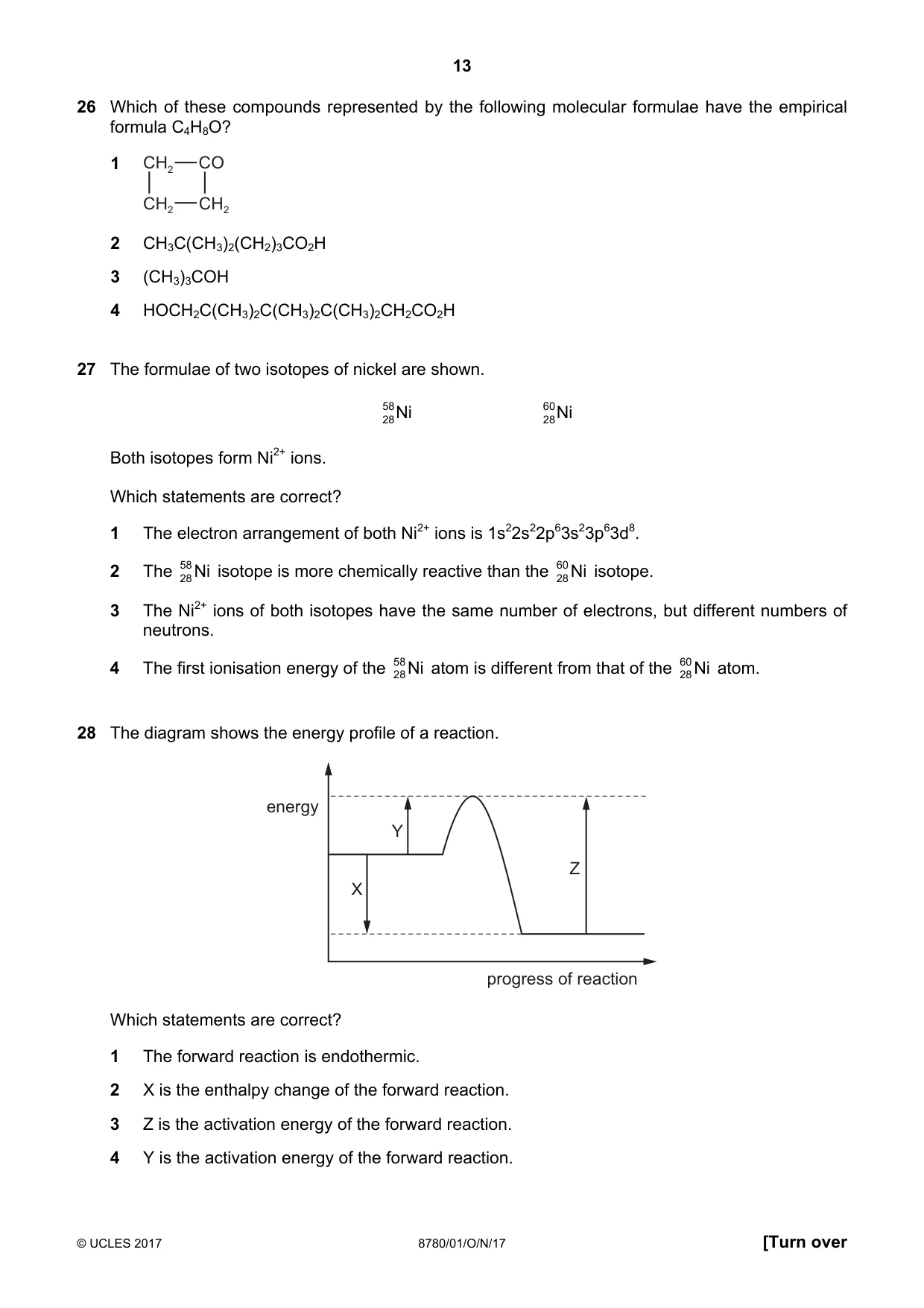
13 © UCLES 2017 8780/01/O/N/17 [Turn over 26 Which of these compounds represented by the following molecular formulae have the empirical formula C4H8O? 1 CH2 CO CH2 CH2 2 CH3C(CH3)2(CH2)3CO2H 3 (CH3)3COH 4 HOCH2C(CH3)2C(CH3)2C(CH3)2CH2CO2H 27 The formulae of two isotopes of nickel are shown. Ni 58 28 Ni 60 28 Both isotopes form Ni2+ ions. Which statements are correct? 1 The electron arrangement of both Ni2+ ions is 1s22s22p63s23p63d8. 2 The Ni 58 28 isotope is more chemically reactive than the Ni 60 28 isotope. 3 The Ni2+ ions of both isotopes have the same number of electrons, but different numbers of neutrons. 4 The first ionisation energy of the Ni 58 28 atom is different from that of the Ni 60 28 atom. 28 The diagram shows the energy profile of a reaction. energy progress of reaction X Y Z Which statements are correct? 1 The forward reaction is endothermic. 2 X is the enthalpy change of the forward reaction. 3 Z is the activation energy of the forward reaction. 4 Y is the activation energy of the forward reaction.
Question paper, page 14
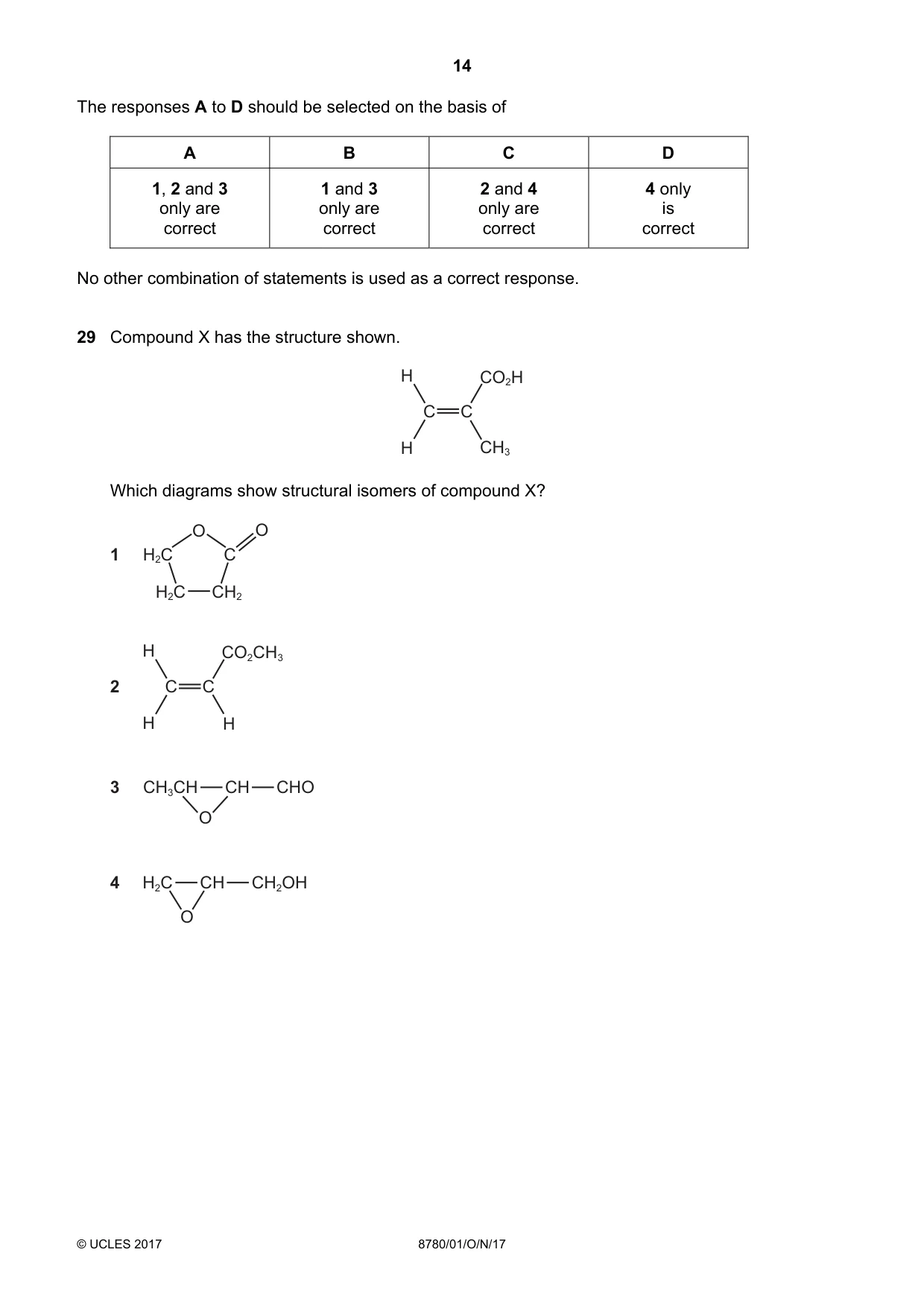
14 © UCLES 2017 8780/01/O/N/17 The responses A to D should be selected on the basis of A B C D 1, 2 and 3 only are correct 1 and 3 only are correct 2 and 4 only are correct 4 only is correct No other combination of statements is used as a correct response. 29 Compound X has the structure shown. C C CO2H CH3 H H Which diagrams show structural isomers of compound X? C C CO2CH3 H H H H2C H2C CH2 C O O CH3CH CH CHO O CH2OH CH H2C O 2 3 4 1
Question paper, page 15
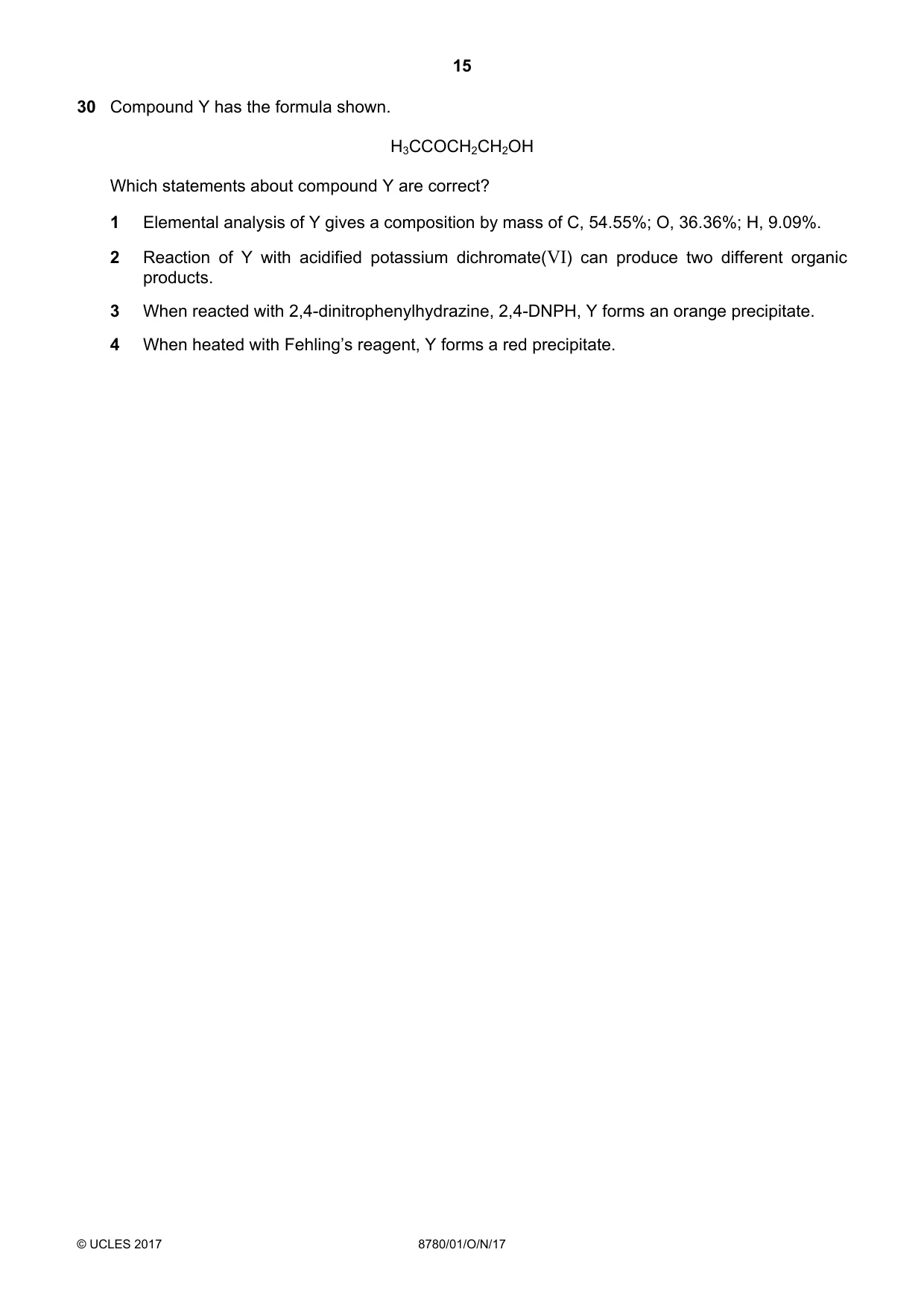
15 © UCLES 2017 8780/01/O/N/17 30 Compound Y has the formula shown. H3CCOCH2CH2OH Which statements about compound Y are correct? 1 Elemental analysis of Y gives a composition by mass of C, 54.55%; O, 36.36%; H, 9.09%. 2 Reaction of Y with acidified potassium dichromate(VI) can produce two different organic products. 3 When reacted with 2,4-dinitrophenylhydrazine, 2,4-DNPH, Y forms an orange precipitate. 4 When heated with Fehling’s reagent, Y forms a red precipitate.
Question paper, page 16
16 BLANK PAGE Permission to reproduce items where third-party owned material protected by copyright is included has been sought and cleared where possible. Every reasonable effort has been made by the publisher (UCLES) to trace copyright holders, but if any items requiring clearance have unwittingly been included, the publisher will be pleased to make amends at the earliest possible opportunity. To avoid the issue of disclosure of answer-related information to candidates, all copyright acknowledgements are reproduced online in the Cambridge International Examinations Copyright Acknowledgements Booklet. This is produced for each series of examinations and is freely available to download at www.cie.org.uk after the live examination series. Cambridge International Examinations is part of the Cambridge Assessment Group. Cambridge Assessment is the brand name of University of Cambridge Local Examinations Syndicate (UCLES), which is itself a department of the University of Cambridge. © UCLES 2017 8780/01/O/N/17
Mark scheme, page 1
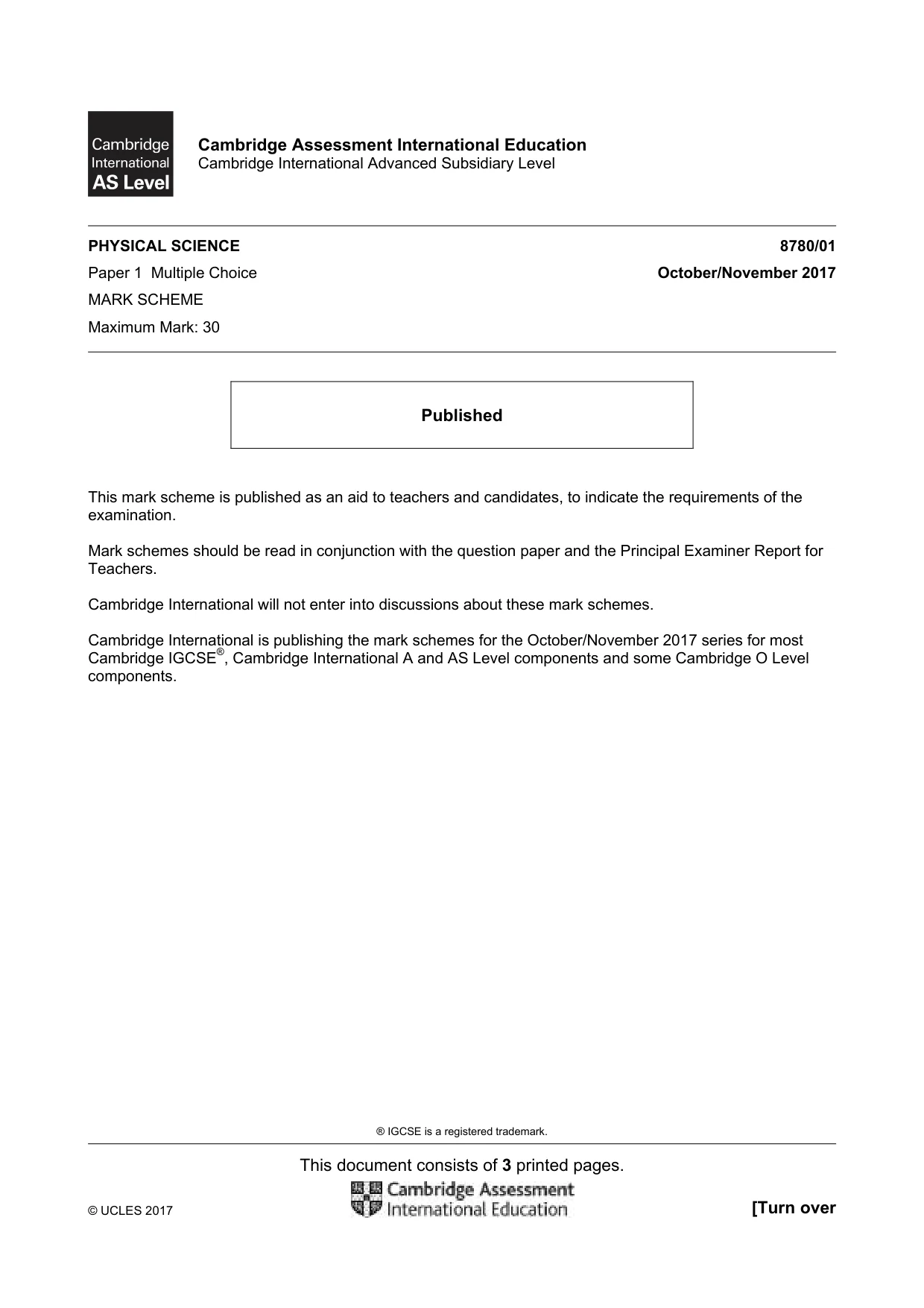
® IGCSE is a registered trademark. This document consists of 3 printed pages. © UCLES 2017 [Turn over Cambridge Assessment International Education Cambridge International Advanced Subsidiary Level PHYSICAL SCIENCE 8780/01 Paper 1 Multiple Choice October/November 2017 MARK SCHEME Maximum Mark: 30 Published This mark scheme is published as an aid to teachers and candidates, to indicate the requirements of the examination. Mark schemes should be read in conjunction with the question paper and the Principal Examiner Report for Teachers. Cambridge International will not enter into discussions about these mark schemes. Cambridge International is publishing the mark schemes for the October/November 2017 series for most Cambridge IGCSE®, Cambridge International A and AS Level components and some Cambridge O Level components.
Mark scheme, page 2
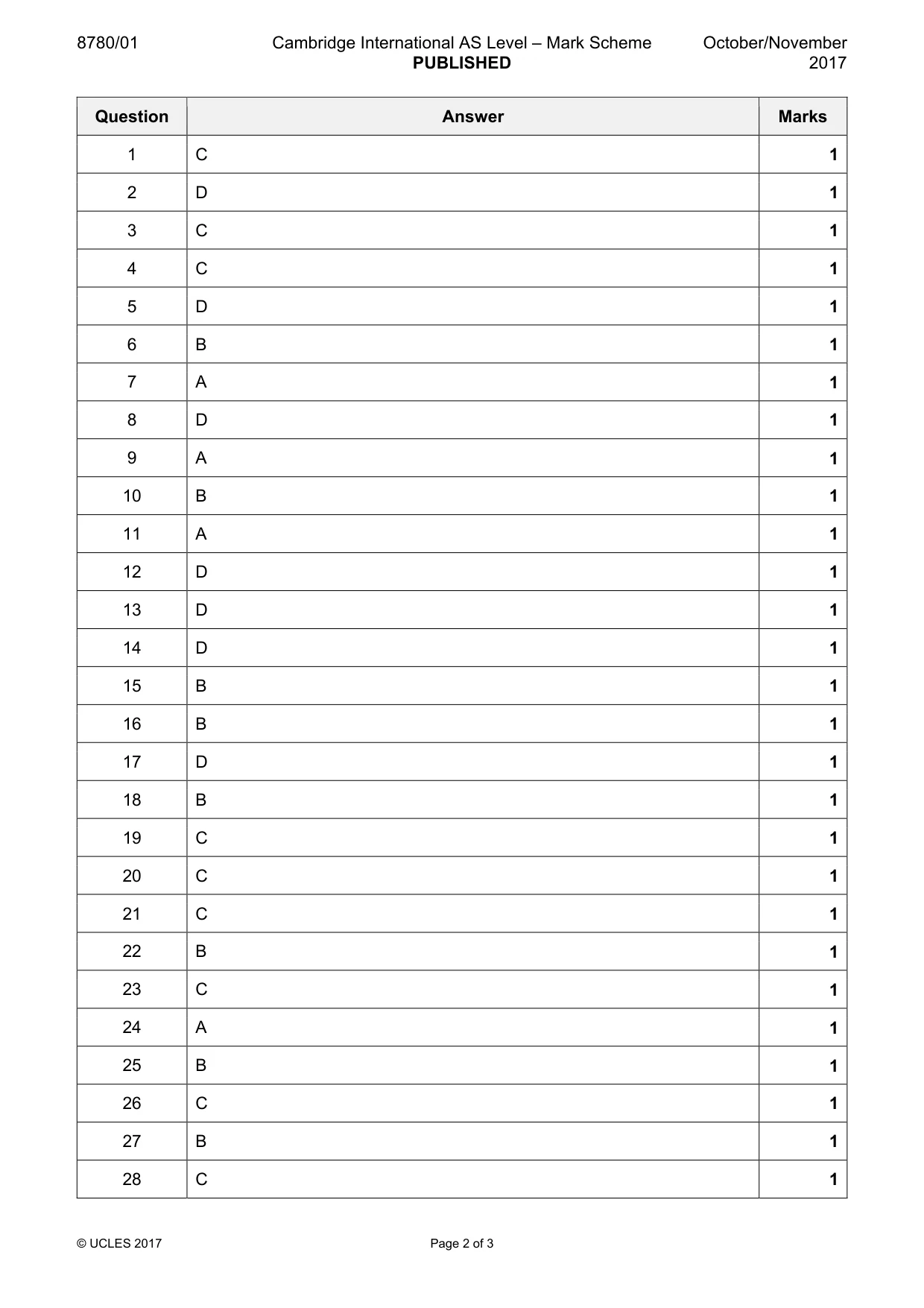
8780/01 Cambridge International AS Level – Mark Scheme PUBLISHED October/November 2017 © UCLES 2017 Page 2 of 3 Question Answer Marks 1 C 1 2 D 1 3 C 1 4 C 1 5 D 1 6 B 1 7 A 1 8 D 1 9 A 1 10 B 1 11 A 1 12 D 1 13 D 1 14 D 1 15 B 1 16 B 1 17 D 1 18 B 1 19 C 1 20 C 1 21 C 1 22 B 1 23 C 1 24 A 1 25 B 1 26 C 1 27 B 1 28 C 1
Mark scheme, page 3
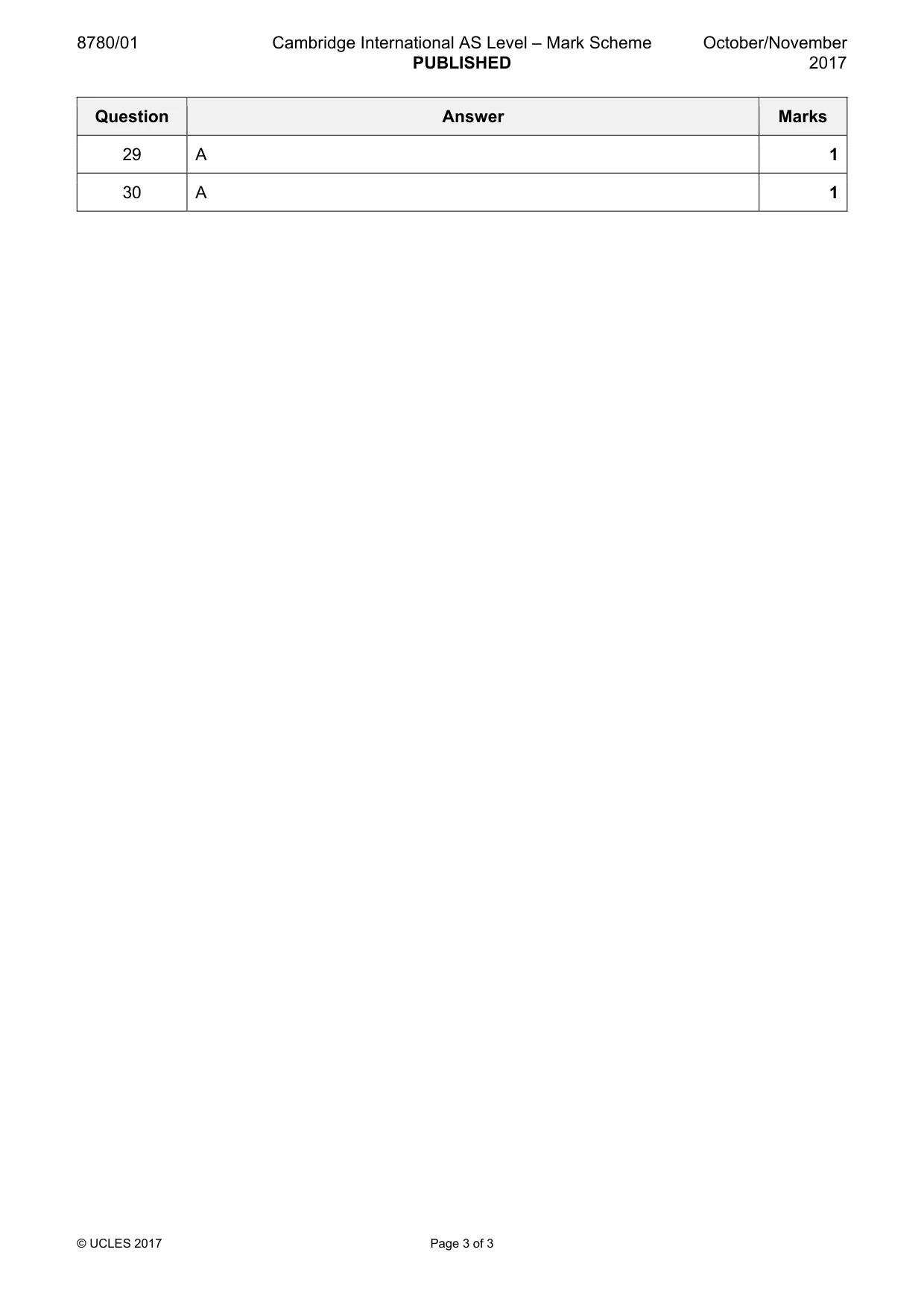
8780/01 Cambridge International AS Level – Mark Scheme PUBLISHED October/November 2017 © UCLES 2017 Page 3 of 3 Question Answer Marks 29 A 1 30 A 1
What you needed in this session
Cambridge’s own grade thresholds for 2017 Oct/Nov, Paper 1 · Variant 1. A higher threshold means an easier paper — the bar moves with how the cohort did.