Cambridge A Level Physical Science 8780 — 2012 Oct/Nov Paper 1 · Variant 1
8780/11/O/N/12 · 30 marks · ≈34 min
The question paper and its mark scheme, free to read here and free to download. This is Cambridge’s own paper, exactly as it was sat.
Question paper16 pages


Mark scheme2 pages
Answers below. Sit the paper first if you are practising.
Paper as text
Question paper, page 1
This document consists of 13 printed pages and 3 blank pages. IB12 11_8780_01/4RP © UCLES 2012 [Turn over *5150088825* UNIVERSITY OF CAMBRIDGE INTERNATIONAL EXAMINATIONS General Certificate of Education Advanced Subsidiary Level PHYSICAL SCIENCE 8780/01 Paper 1 Multiple Choice October/November 2012 40 minutes Additional Materials: Multiple Choice Answer Sheet Soft clean eraser Soft pencil (type B or HB is recommended) Data Booklet READ THESE INSTRUCTIONS FIRST Write in soft pencil. Do not use staples, paper clips, highlighters, glue or correction fluid. Write your name, Centre number and candidate number on the Answer Sheet in the spaces provided unless this has been done for you. There are thirty questions on this paper. Answer all questions. For each question there are four possible answers A, B, C and D. Choose the one you consider correct and record your choice in soft pencil on the separate Answer Sheet. Read the instructions on the Answer Sheet very carefully. Each correct answer will score one mark. A mark will not be deducted for a wrong answer. Any working should be done in this booklet.
Question paper, page 2
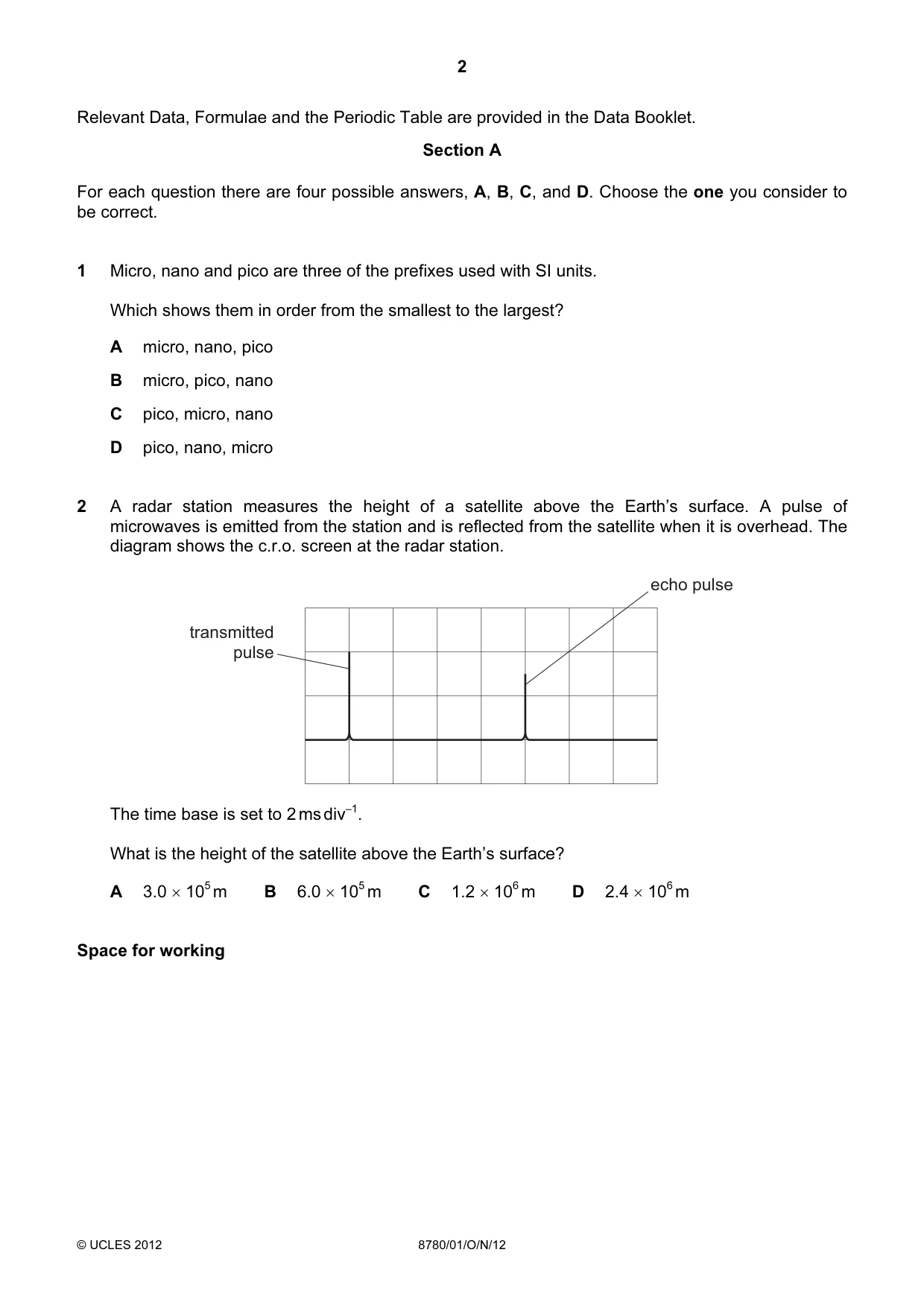
2 © UCLES 2012 8780/01/O/N/12 Relevant Data, Formulae and the Periodic Table are provided in the Data Booklet. Section A For each question there are four possible answers, A, B, C, and D. Choose the one you consider to be correct. 1 Micro, nano and pico are three of the prefixes used with SI units. Which shows them in order from the smallest to the largest? A micro, nano, pico B micro, pico, nano C pico, micro, nano D pico, nano, micro 2 A radar station measures the height of a satellite above the Earth’s surface. A pulse of microwaves is emitted from the station and is reflected from the satellite when it is overhead. The diagram shows the c.r.o. screen at the radar station. transmitted pulse echo pulse The time base is set to 2 ms div–1. What is the height of the satellite above the Earth’s surface? A 3.0 × 10⁵ m B 6.0 × 10⁵ m C 1.2 × 10⁶ m D 2.4 × 10⁶ m Space for working
Question paper, page 3
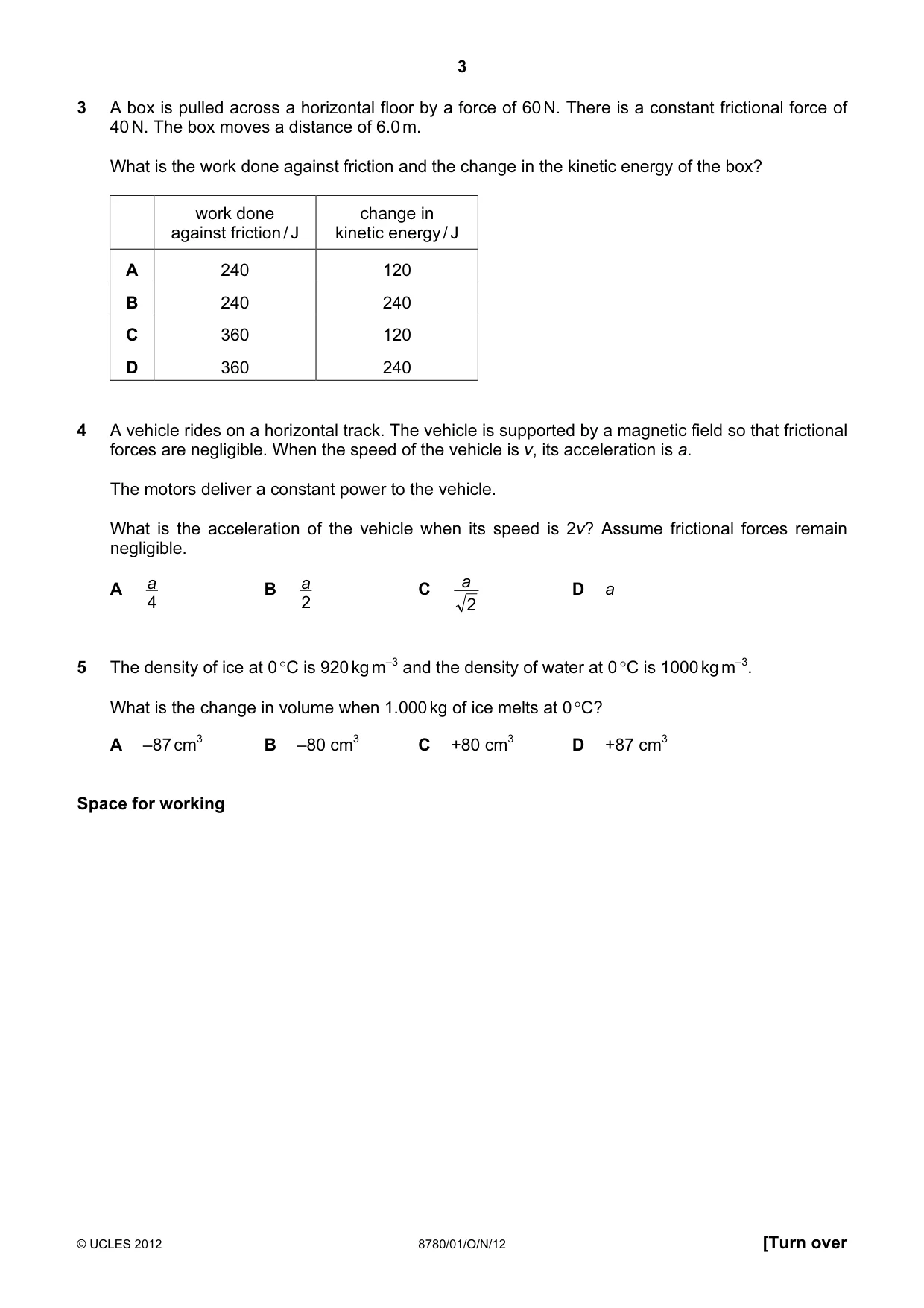
3 © UCLES 2012 8780/01/O/N/12 [Turn over 3 A box is pulled across a horizontal floor by a force of 60 N. There is a constant frictional force of 40 N. The box moves a distance of 6.0 m. What is the work done against friction and the change in the kinetic energy of the box? work done against friction / J change in kinetic energy / J A 240 120 B 240 240 C 360 120 D 360 240 4 A vehicle rides on a horizontal track. The vehicle is supported by a magnetic field so that frictional forces are negligible. When the speed of the vehicle is v, its acceleration is a. The motors deliver a constant power to the vehicle. What is the acceleration of the vehicle when its speed is 2v? Assume frictional forces remain negligible. A 4 a B 2 a C 2 a D a 5 The density of ice at 0 °C is 920 kg m–3 and the density of water at 0 °C is 1000 kg m–3. What is the change in volume when 1.000 kg of ice melts at 0 °C? A –87 cm3 B –80 cm3 C +80 cm3 D +87 cm3 Space for working
Question paper, page 4
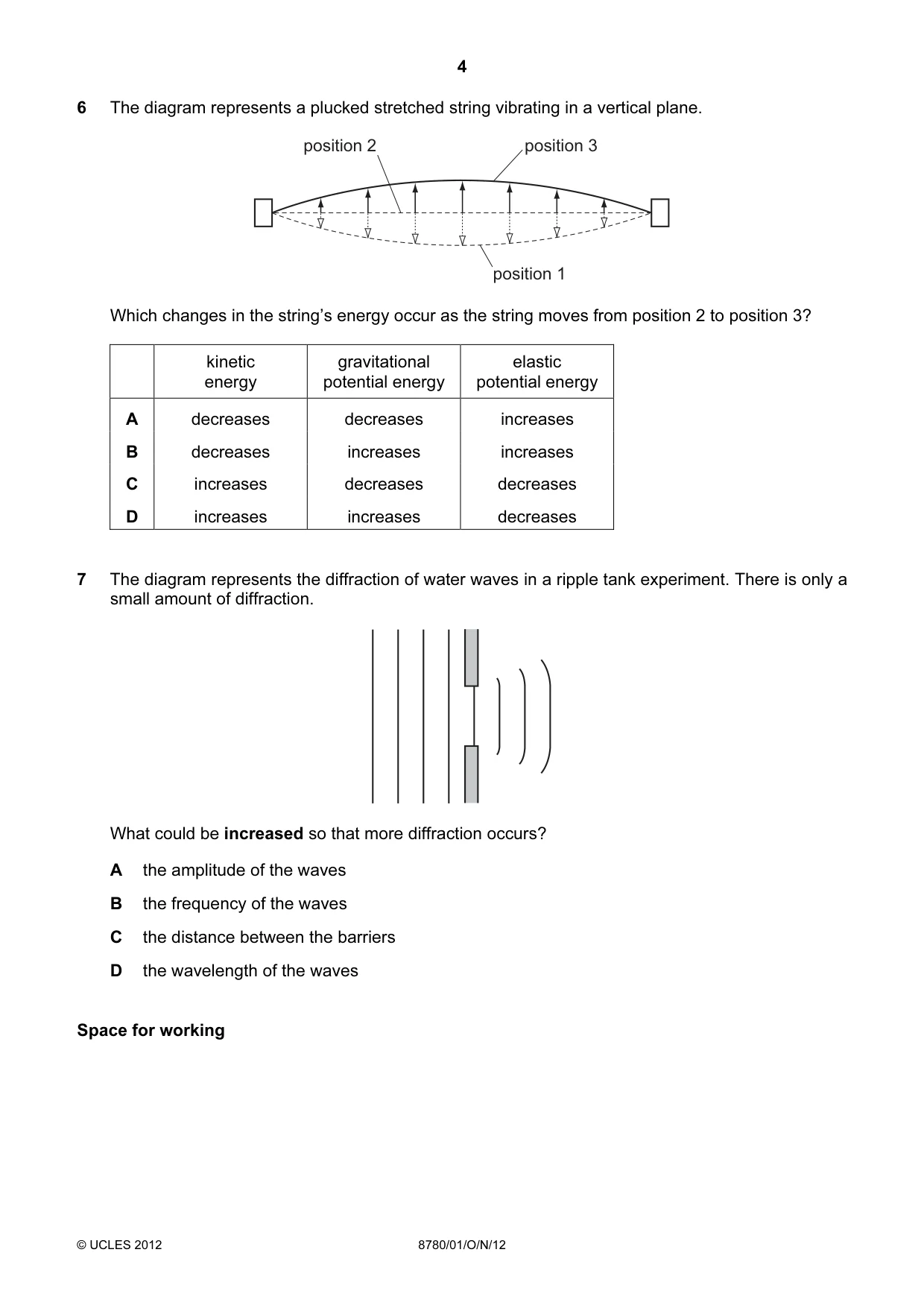
4 © UCLES 2012 8780/01/O/N/12 6 The diagram represents a plucked stretched string vibrating in a vertical plane. position 1 position 3 position 2 Which changes in the string’s energy occur as the string moves from position 2 to position 3? kinetic energy gravitational potential energy elastic potential energy A decreases decreases increases B decreases increases increases C increases decreases decreases D increases increases decreases 7 The diagram represents the diffraction of water waves in a ripple tank experiment. There is only a small amount of diffraction. What could be increased so that more diffraction occurs? A the amplitude of the waves B the frequency of the waves C the distance between the barriers D the wavelength of the waves Space for working
Question paper, page 5
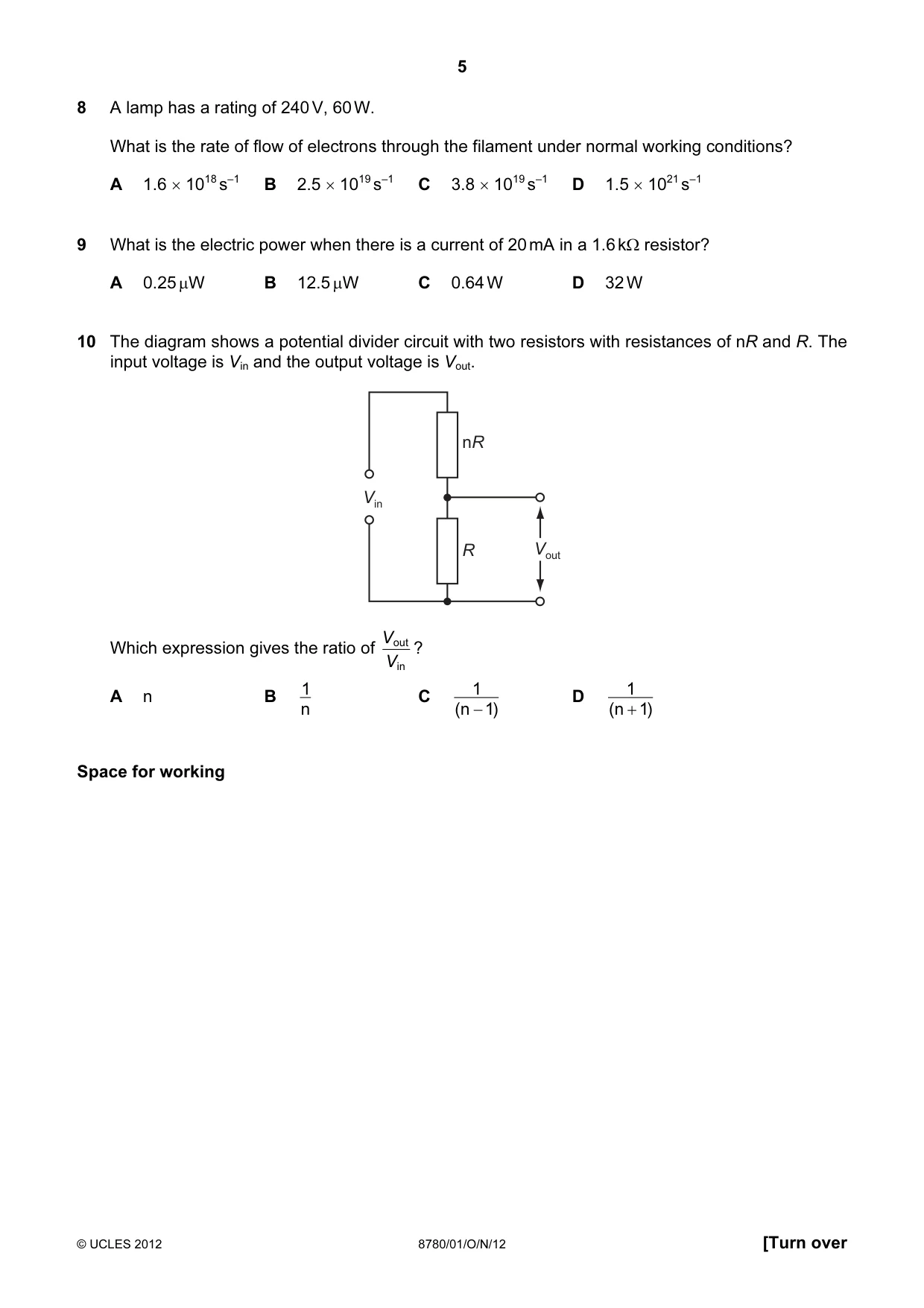
5 © UCLES 2012 8780/01/O/N/12 [Turn over 8 A lamp has a rating of 240 V, 60 W. What is the rate of flow of electrons through the filament under normal working conditions? A 1.6 × 10¹⁸ s–1 B 2.5 × 10¹⁹ s–1 C 3.8 × 10¹⁹ s–1 D 1.5 × 10²¹ s–1 9 What is the electric power when there is a current of 20 mA in a 1.6 kΩ resistor? A 0.25 µW B 12.5 µW C 0.64 W D 32 W 10 The diagram shows a potential divider circuit with two resistors with resistances of nR and R. The input voltage is Vin and the output voltage is Vout. R nR Vin Vout Which expression gives the ratio of in out V V ? A n B n 1 C )1 n ( 1 − D )1 n ( 1 + Space for working
Question paper, page 6
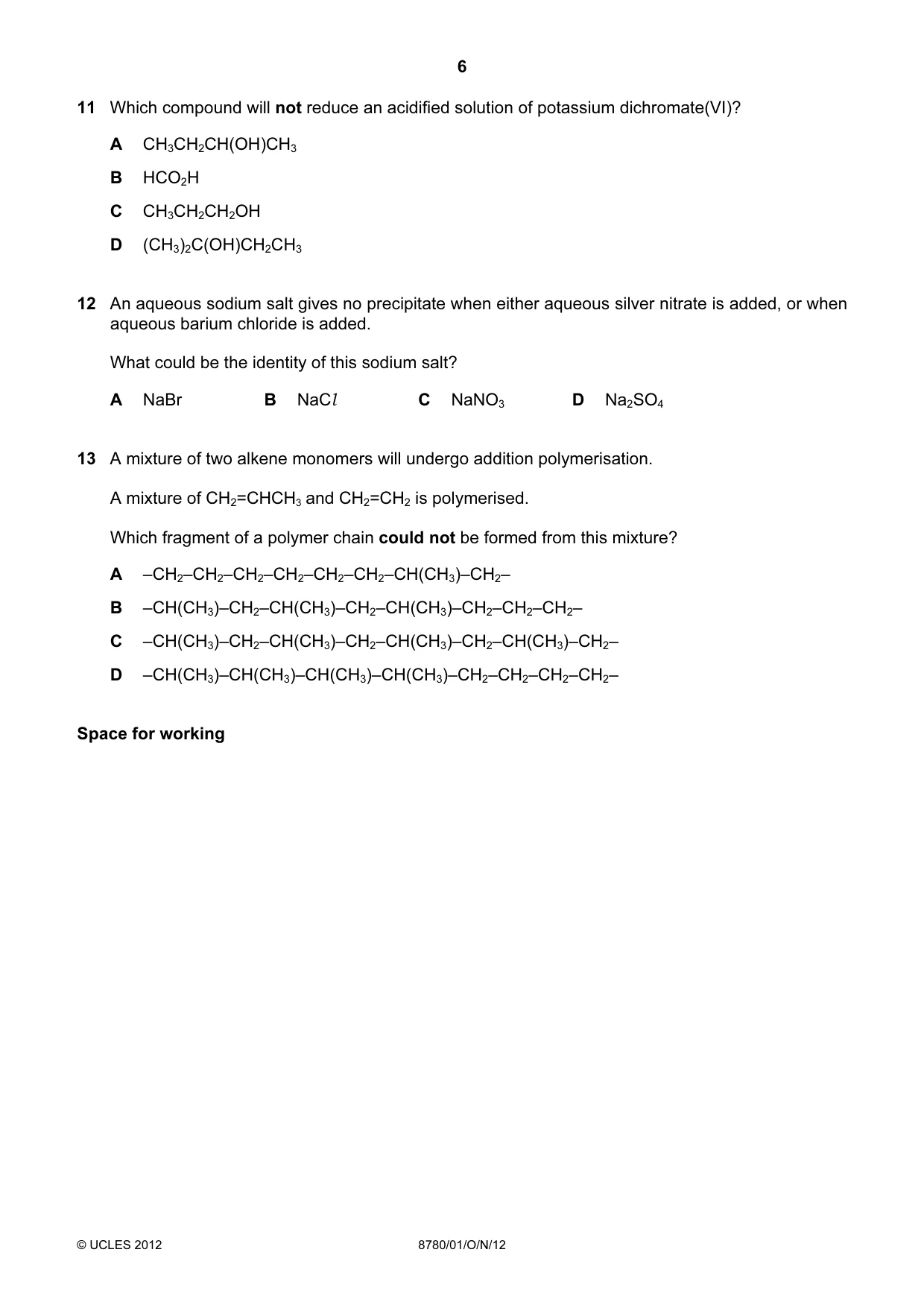
6 © UCLES 2012 8780/01/O/N/12 11 Which compound will not reduce an acidified solution of potassium dichromate(VI)? A CH3CH2CH(OH)CH3 B HCO2H C CH3CH2CH2OH D (CH3)2C(OH)CH2CH3 12 An aqueous sodium salt gives no precipitate when either aqueous silver nitrate is added, or when aqueous barium chloride is added. What could be the identity of this sodium salt? A NaBr B NaCl C NaNO3 D Na2SO4 13 A mixture of two alkene monomers will undergo addition polymerisation. A mixture of CH2=CHCH3 and CH2=CH2 is polymerised. Which fragment of a polymer chain could not be formed from this mixture? A –CH2–CH2–CH2–CH2–CH2–CH2–CH(CH3)–CH2– B –CH(CH3)–CH2–CH(CH3)–CH2–CH(CH3)–CH2–CH2–CH2– C –CH(CH3)–CH2–CH(CH3)–CH2–CH(CH3)–CH2–CH(CH3)–CH2– D –CH(CH3)–CH(CH3)–CH(CH3)–CH(CH3)–CH2–CH2–CH2–CH2– Space for working
Question paper, page 7
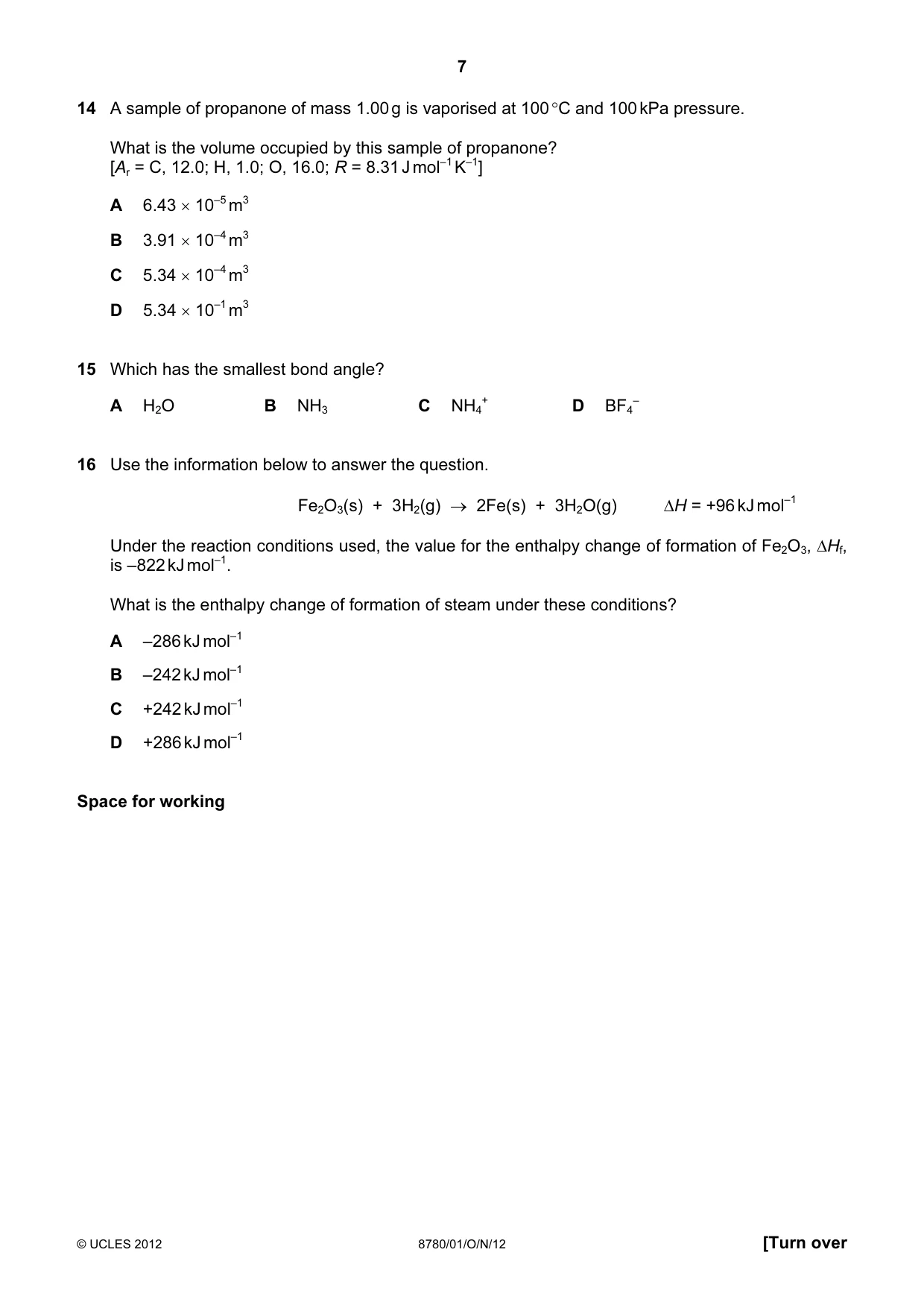
7 © UCLES 2012 8780/01/O/N/12 [Turn over 14 A sample of propanone of mass 1.00 g is vaporised at 100 °C and 100 kPa pressure. What is the volume occupied by this sample of propanone? [Ar = C, 12.0; H, 1.0; O, 16.0; R = 8.31 J mol–1 K–1] A 6.43 × 10⁻⁵ m3 B 3.91 × 10⁻⁴ m3 C 5.34 × 10⁻⁴ m3 D 5.34 × 10⁻¹ m3 15 Which has the smallest bond angle? A H2O B NH3 C NH4 + D BF4 – 16 Use the information below to answer the question. Fe2O3(s) + 3H2(g) → 2Fe(s) + 3H2O(g) ∆H = +96 kJ mol–1 Under the reaction conditions used, the value for the enthalpy change of formation of Fe2O3, ∆Hf, is –822 kJ mol–1. What is the enthalpy change of formation of steam under these conditions? A –286 kJ mol–1 B –242 kJ mol–1 C +242 kJ mol–1 D +286 kJ mol–1 Space for working
Question paper, page 8
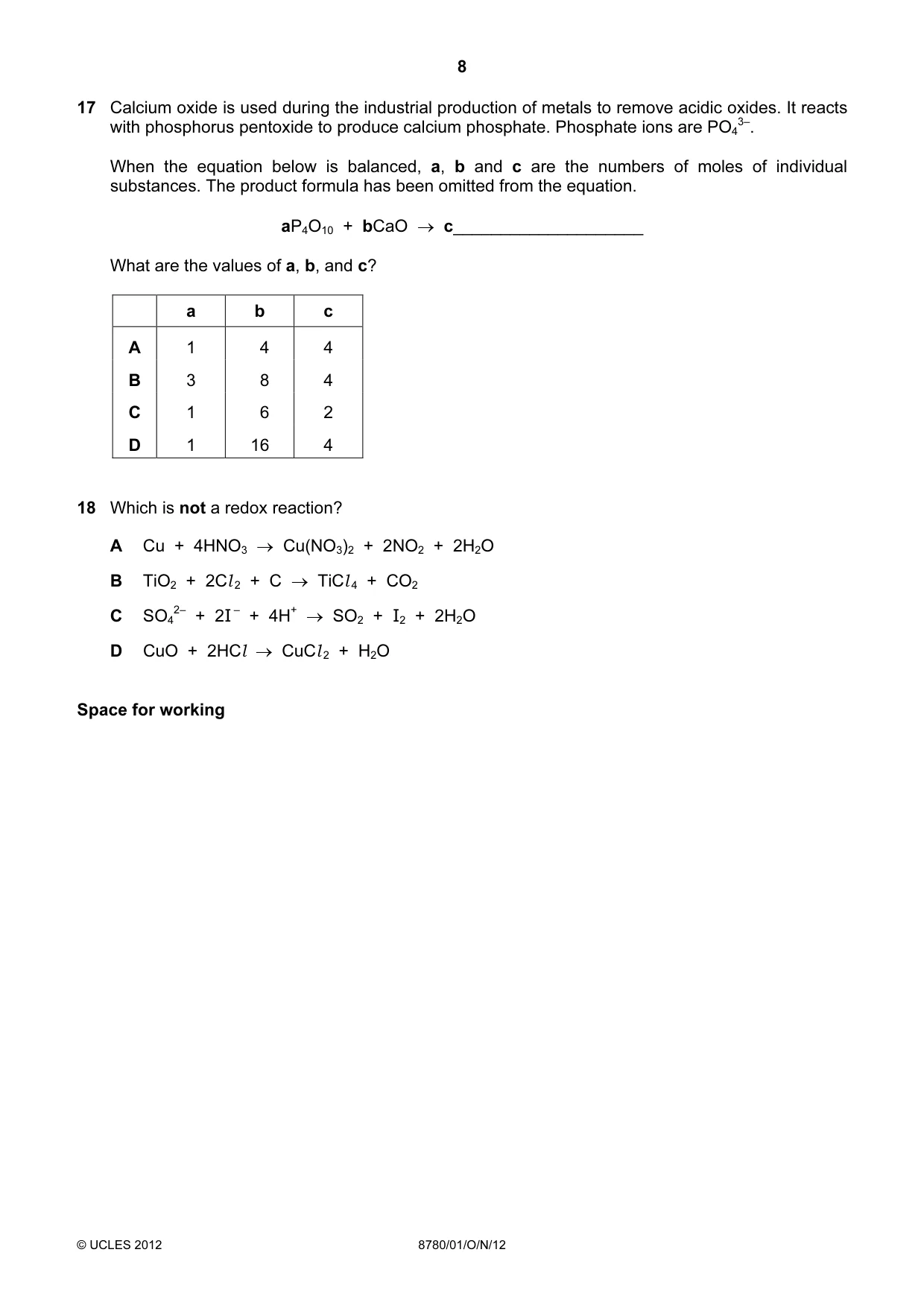
8 © UCLES 2012 8780/01/O/N/12 17 Calcium oxide is used during the industrial production of metals to remove acidic oxides. It reacts with phosphorus pentoxide to produce calcium phosphate. Phosphate ions are PO4 3–. When the equation below is balanced, a, b and c are the numbers of moles of individual substances. The product formula has been omitted from the equation. aP4O10 + bCaO → c____________________ What are the values of a, b, and c? a b c A 1 4 4 B 3 8 4 C 1 6 2 D 1 16 4 18 Which is not a redox reaction? A Cu + 4HNO3 → Cu(NO3)2 + 2NO2 + 2H2O B TiO2 + 2Cl 2 + C → TiCl 4 + CO2 C SO4 2– + 2I – + 4H+ → SO2 + I2 + 2H2O D CuO + 2HCl → CuCl 2 + H2O Space for working
Question paper, page 9
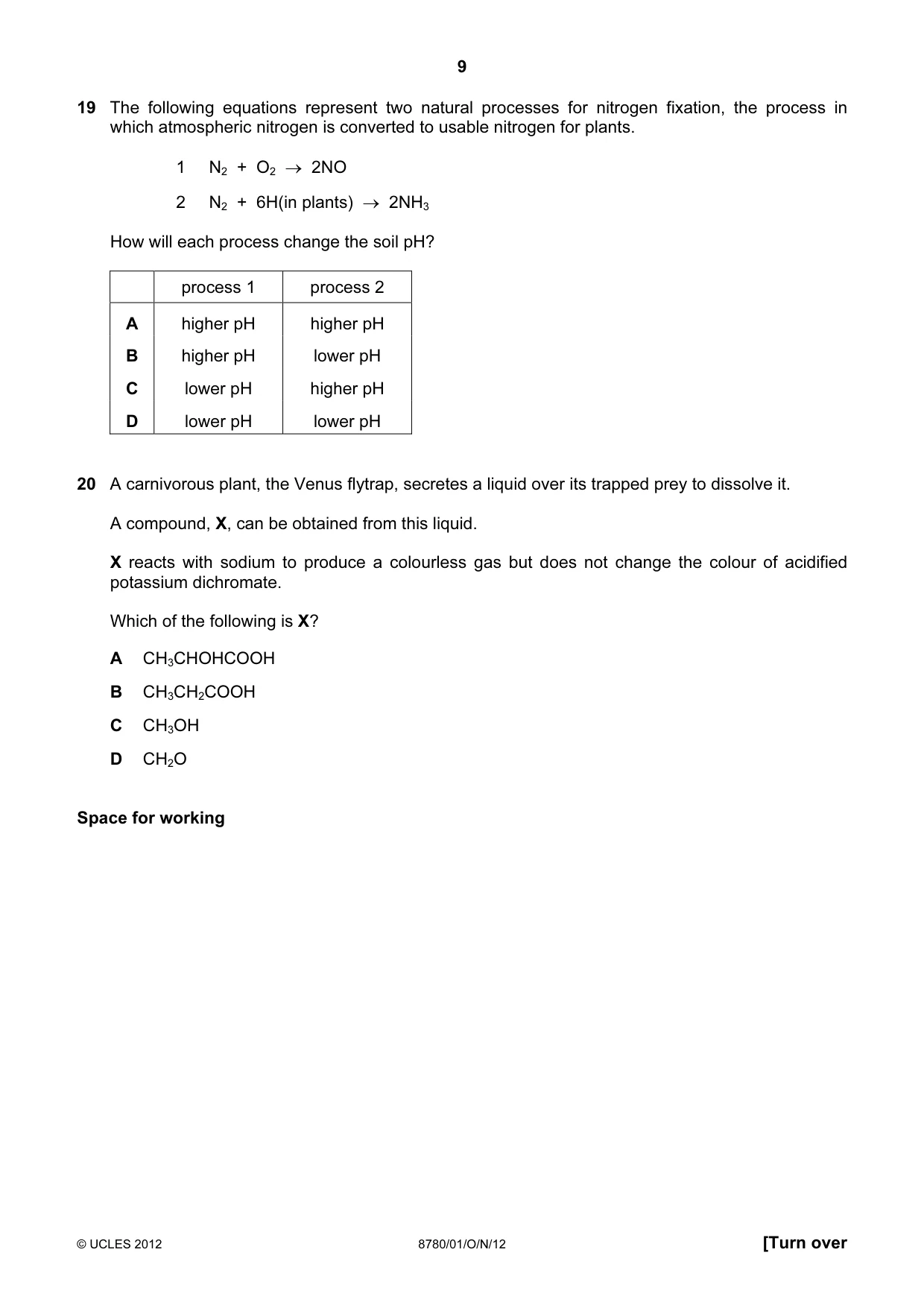
9 © UCLES 2012 8780/01/O/N/12 [Turn over 19 The following equations represent two natural processes for nitrogen fixation, the process in which atmospheric nitrogen is converted to usable nitrogen for plants. 1 N2 + O2 → 2NO 2 N2 + 6H(in plants) → 2NH3 How will each process change the soil pH? process 1 process 2 A higher pH higher pH B higher pH lower pH C lower pH higher pH D lower pH lower pH 20 A carnivorous plant, the Venus flytrap, secretes a liquid over its trapped prey to dissolve it. A compound, X, can be obtained from this liquid. X reacts with sodium to produce a colourless gas but does not change the colour of acidified potassium dichromate. Which of the following is X? A CH3CHOHCOOH B CH3CH2COOH C CH3OH D CH2O Space for working
Question paper, page 10
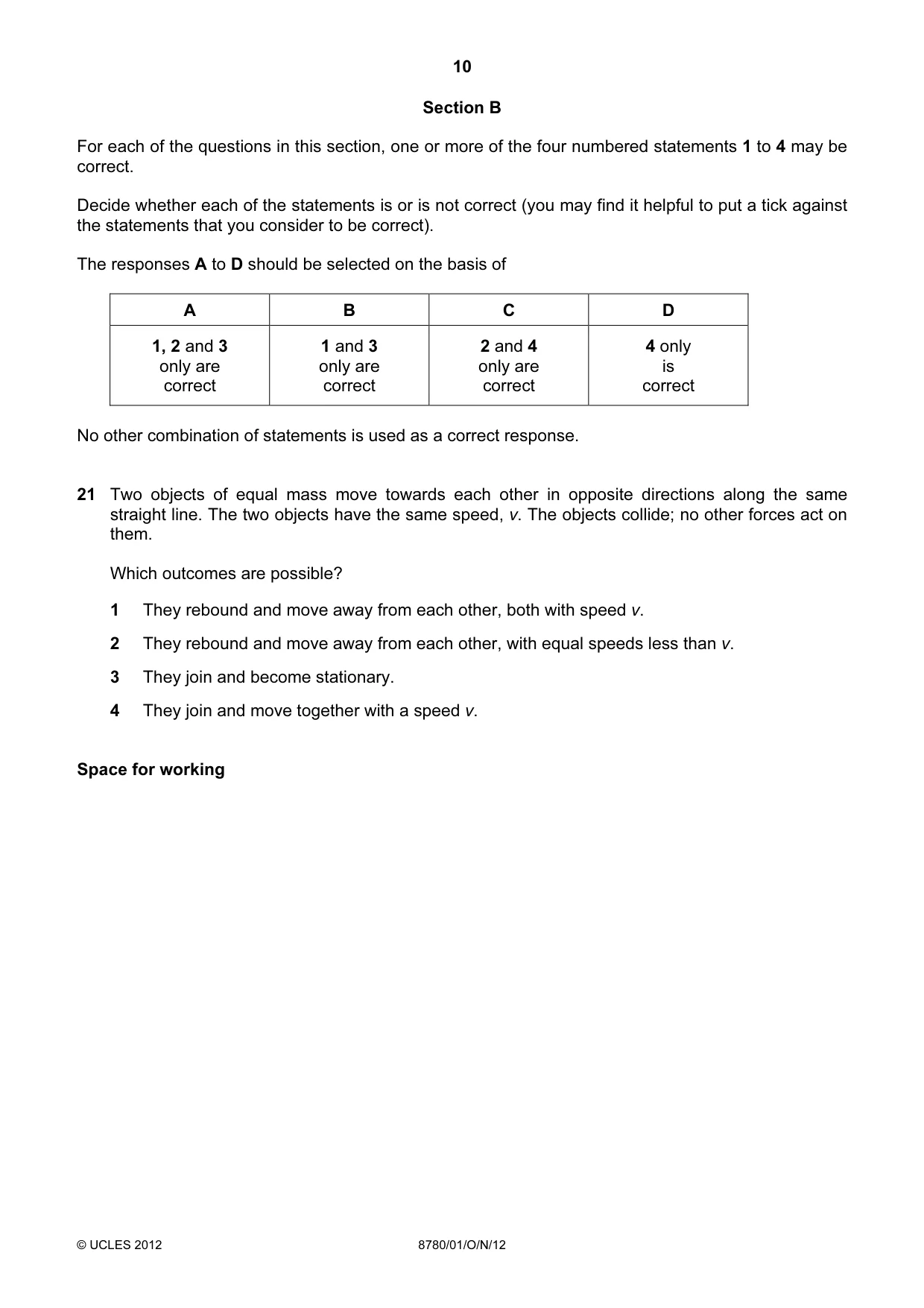
10 © UCLES 2012 8780/01/O/N/12 Section B For each of the questions in this section, one or more of the four numbered statements 1 to 4 may be correct. Decide whether each of the statements is or is not correct (you may find it helpful to put a tick against the statements that you consider to be correct). The responses A to D should be selected on the basis of A B C D 1, 2 and 3 only are correct 1 and 3 only are correct 2 and 4 only are correct 4 only is correct No other combination of statements is used as a correct response. 21 Two objects of equal mass move towards each other in opposite directions along the same straight line. The two objects have the same speed, v. The objects collide; no other forces act on them. Which outcomes are possible? 1 They rebound and move away from each other, both with speed v. 2 They rebound and move away from each other, with equal speeds less than v. 3 They join and become stationary. 4 They join and move together with a speed v. Space for working
Question paper, page 11
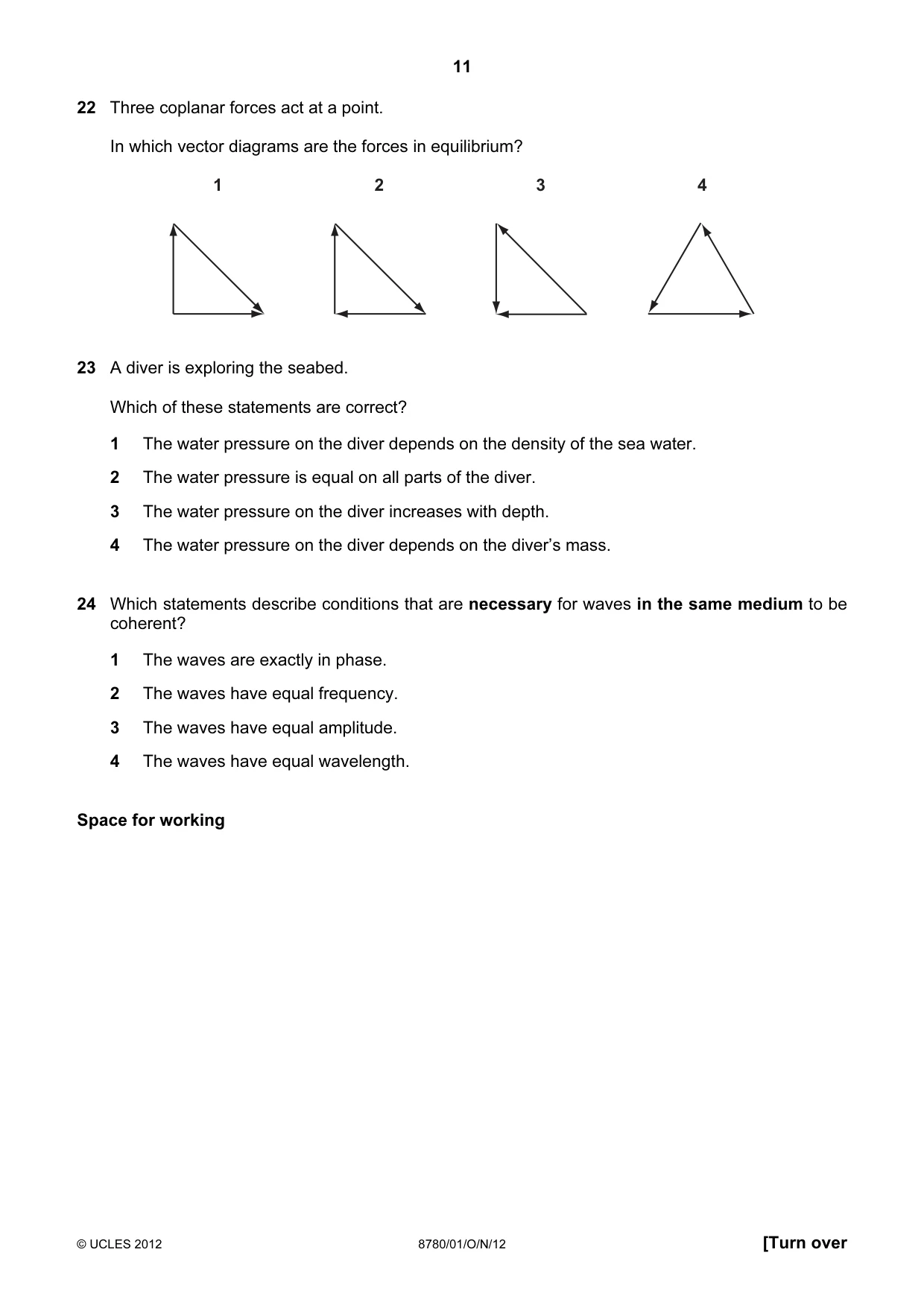
11 © UCLES 2012 8780/01/O/N/12 [Turn over 22 Three coplanar forces act at a point. In which vector diagrams are the forces in equilibrium? 1 2 3 4 23 A diver is exploring the seabed. Which of these statements are correct? 1 The water pressure on the diver depends on the density of the sea water. 2 The water pressure is equal on all parts of the diver. 3 The water pressure on the diver increases with depth. 4 The water pressure on the diver depends on the diver’s mass. 24 Which statements describe conditions that are necessary for waves in the same medium to be coherent? 1 The waves are exactly in phase. 2 The waves have equal frequency. 3 The waves have equal amplitude. 4 The waves have equal wavelength. Space for working
Question paper, page 12
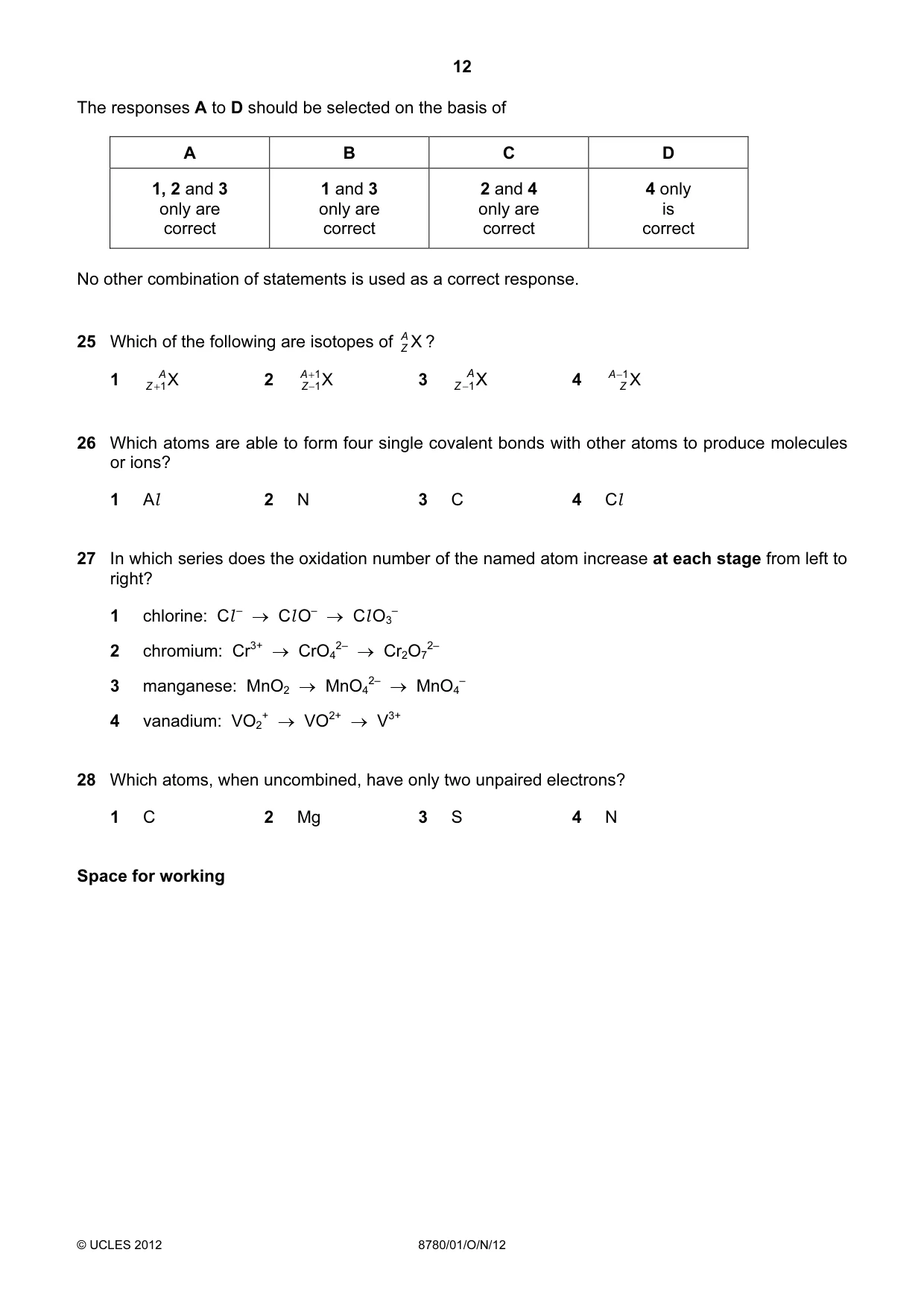
12 © UCLES 2012 8780/01/O/N/12 The responses A to D should be selected on the basis of A B C D 1, 2 and 3 only are correct 1 and 3 only are correct 2 and 4 only are correct 4 only is correct No other combination of statements is used as a correct response. 25 Which of the following are isotopes of X A Z ? 1 X 1 A Z + 2 X 1 1 + − A Z 3 X 1 A Z− 4 X 1 − A Z 26 Which atoms are able to form four single covalent bonds with other atoms to produce molecules or ions? 1 Al 2 N 3 C 4 Cl 27 In which series does the oxidation number of the named atom increase at each stage from left to right? 1 chlorine: Cl – → Cl O– → Cl O3 – 2 chromium: Cr3+ → CrO4 2– → Cr2O7 2– 3 manganese: MnO2 → MnO4 2– → MnO4 – 4 vanadium: VO2 + → VO2+ → V3+ 28 Which atoms, when uncombined, have only two unpaired electrons? 1 C 2 Mg 3 S 4 N Space for working
Question paper, page 13
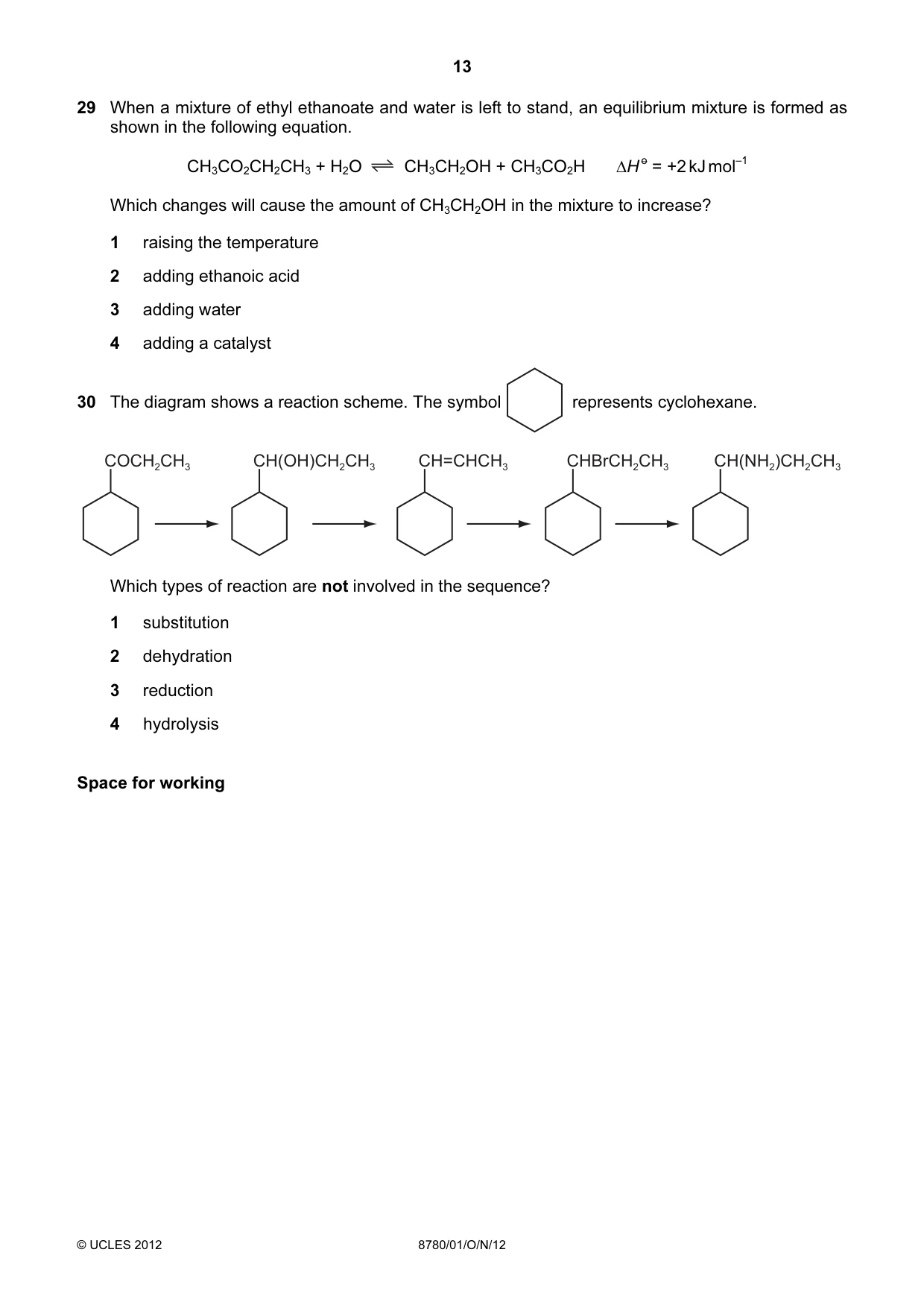
13 © UCLES 2012 8780/01/O/N/12 29 When a mixture of ethyl ethanoate and water is left to stand, an equilibrium mixture is formed as shown in the following equation. CH3CO2CH2CH3 + H2O CH3CH2OH + CH3CO2H ∆H o = +2 kJ mol–1 Which changes will cause the amount of CH3CH2OH in the mixture to increase? 1 raising the temperature 2 adding ethanoic acid 3 adding water 4 adding a catalyst 30 The diagram shows a reaction scheme. The symbol represents cyclohexane. COCH2CH3 CH(OH)CH2CH3 CH=CHCH3 CHBrCH2CH3 CH(NH2)CH2CH3 Which types of reaction are not involved in the sequence? 1 substitution 2 dehydration 3 reduction 4 hydrolysis Space for working
Question paper, page 14
14 © UCLES 2012 8780/01/O/N/12 BLANK PAGE
Question paper, page 15
15 © UCLES 2012 8780/01/O/N/12 BLANK PAGE
Question paper, page 16
16 Permission to reproduce items where third-party owned material protected by copyright is included has been sought and cleared where possible. Every reasonable effort has been made by the publisher (UCLES) to trace copyright holders, but if any items requiring clearance have unwittingly been included, the publisher will be pleased to make amends at the earliest possible opportunity. University of Cambridge International Examinations is part of the Cambridge Assessment Group. Cambridge Assessment is the brand name of University of Cambridge Local Examinations Syndicate (UCLES), which is itself a department of the University of Cambridge. © UCLES 2012 8780/01/O/N/12 BLANK PAGE
Mark scheme, page 1
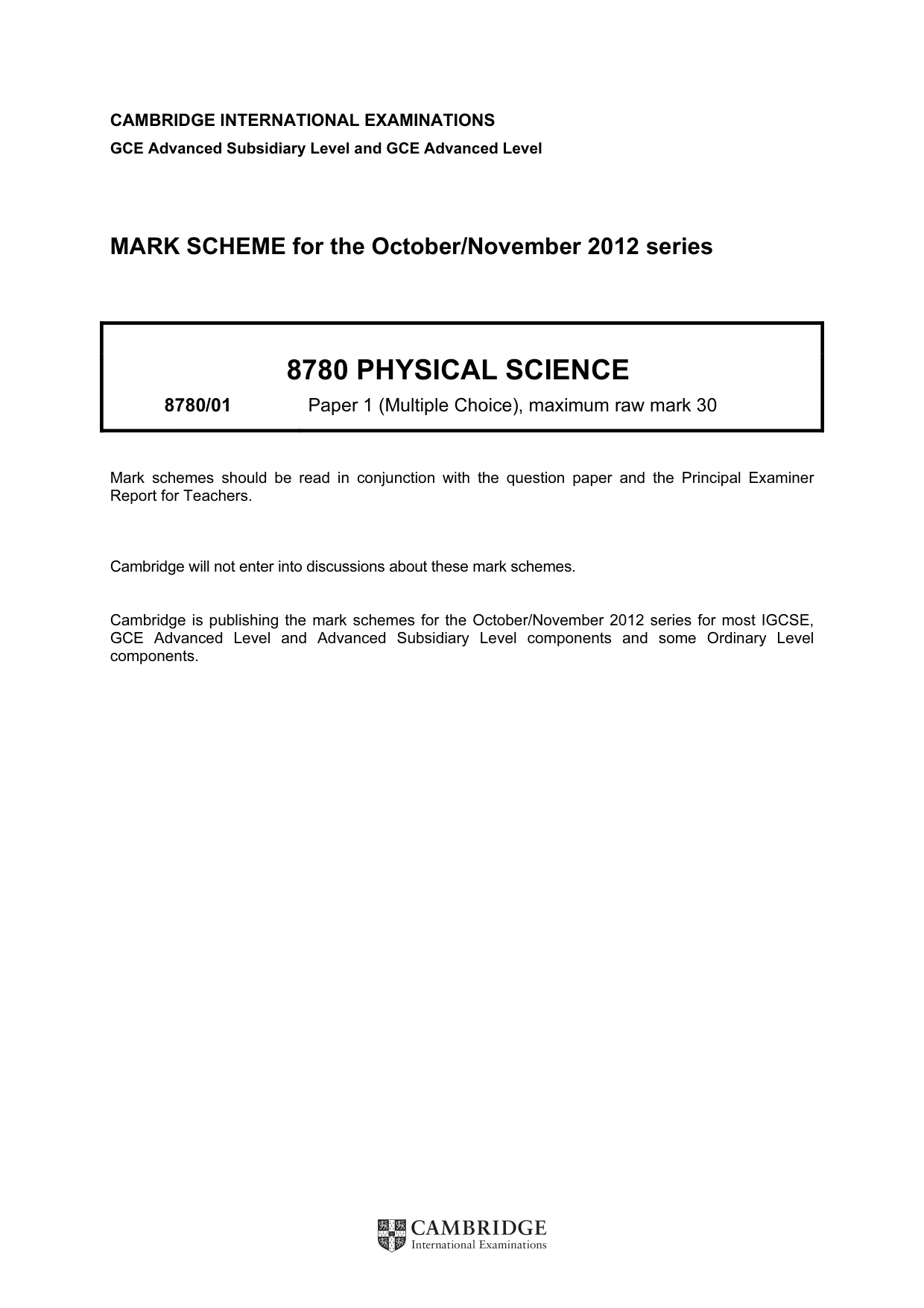
CAMBRIDGE INTERNATIONAL EXAMINATIONS GCE Advanced Subsidiary Level and GCE Advanced Level MARK SCHEME for the October/November 2012 series 8780 PHYSICAL SCIENCE 8780/01 Paper 1 (Multiple Choice), maximum raw mark 30 Mark schemes should be read in conjunction with the question paper and the Principal Examiner Report for Teachers. Cambridge will not enter into discussions about these mark schemes. Cambridge is publishing the mark schemes for the October/November 2012 series for most IGCSE, GCE Advanced Level and Advanced Subsidiary Level components and some Ordinary Level components.
Mark scheme, page 2
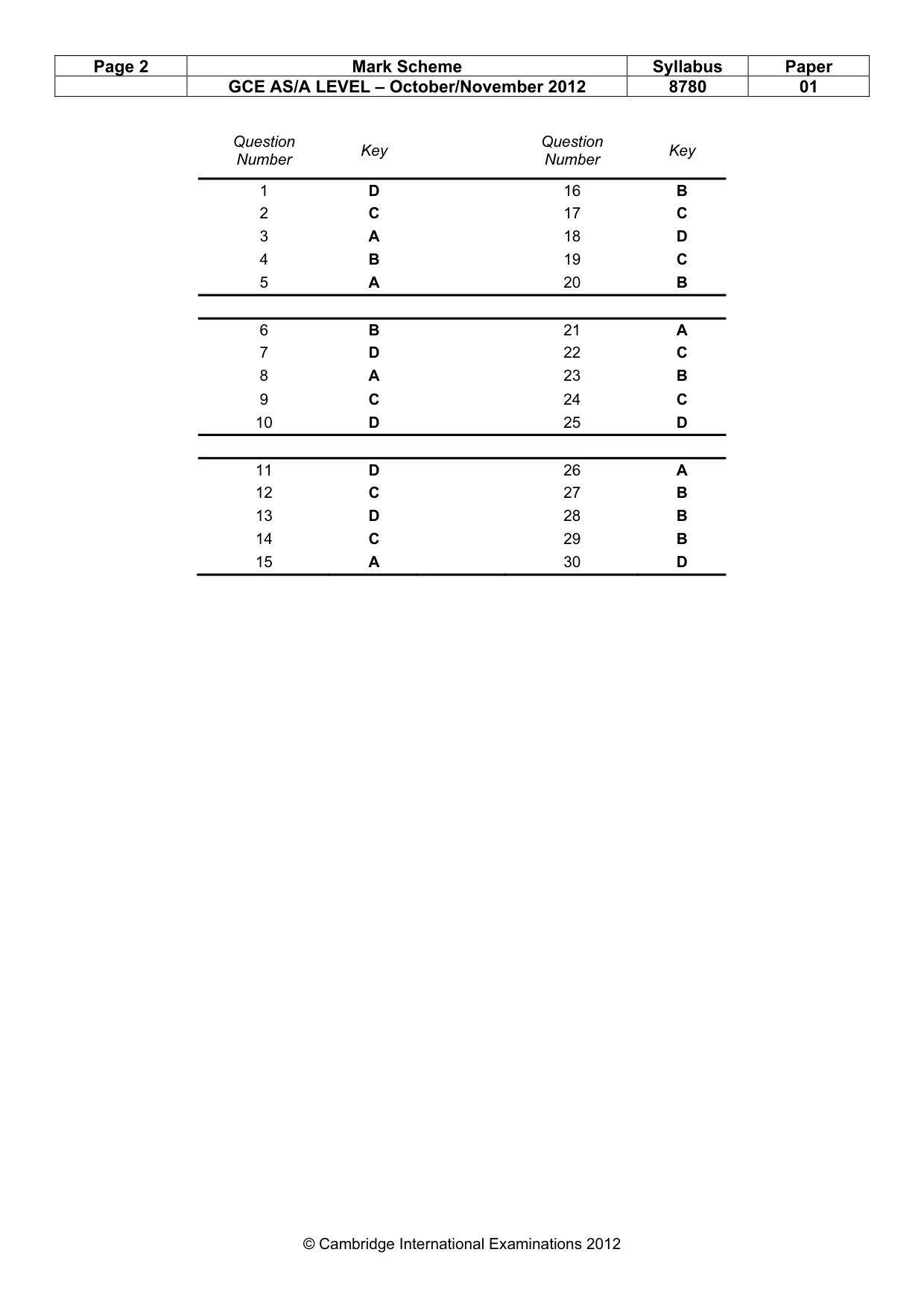
Page 2 Mark Scheme Syllabus Paper GCE AS/A LEVEL – October/November 2012 8780 01 © Cambridge International Examinations 2012 Question Number Key Question Number Key 1 D 16 B 2 C 17 C 3 A 18 D 4 B 19 C 5 A 20 B 6 B 21 A 7 D 22 C 8 A 23 B 9 C 24 C 10 D 25 D 11 D 26 A 12 C 27 B 13 D 28 B 14 C 29 B 15 A 30 D
What you needed in this session
Cambridge’s own grade thresholds for 2012 Oct/Nov, Paper 1 · Variant 1. A higher threshold means an easier paper — the bar moves with how the cohort did.