Cambridge A Level Physical Science 8780 — 2014 Oct/Nov Paper 1 · Variant 1
8780/11/O/N/14 · 30 marks · ≈34 min
The question paper and its mark scheme, free to read here and free to download. This is Cambridge’s own paper, exactly as it was sat.
Question paper16 pages

Mark scheme2 pages
Answers below. Sit the paper first if you are practising.
Paper as text
Question paper, page 1
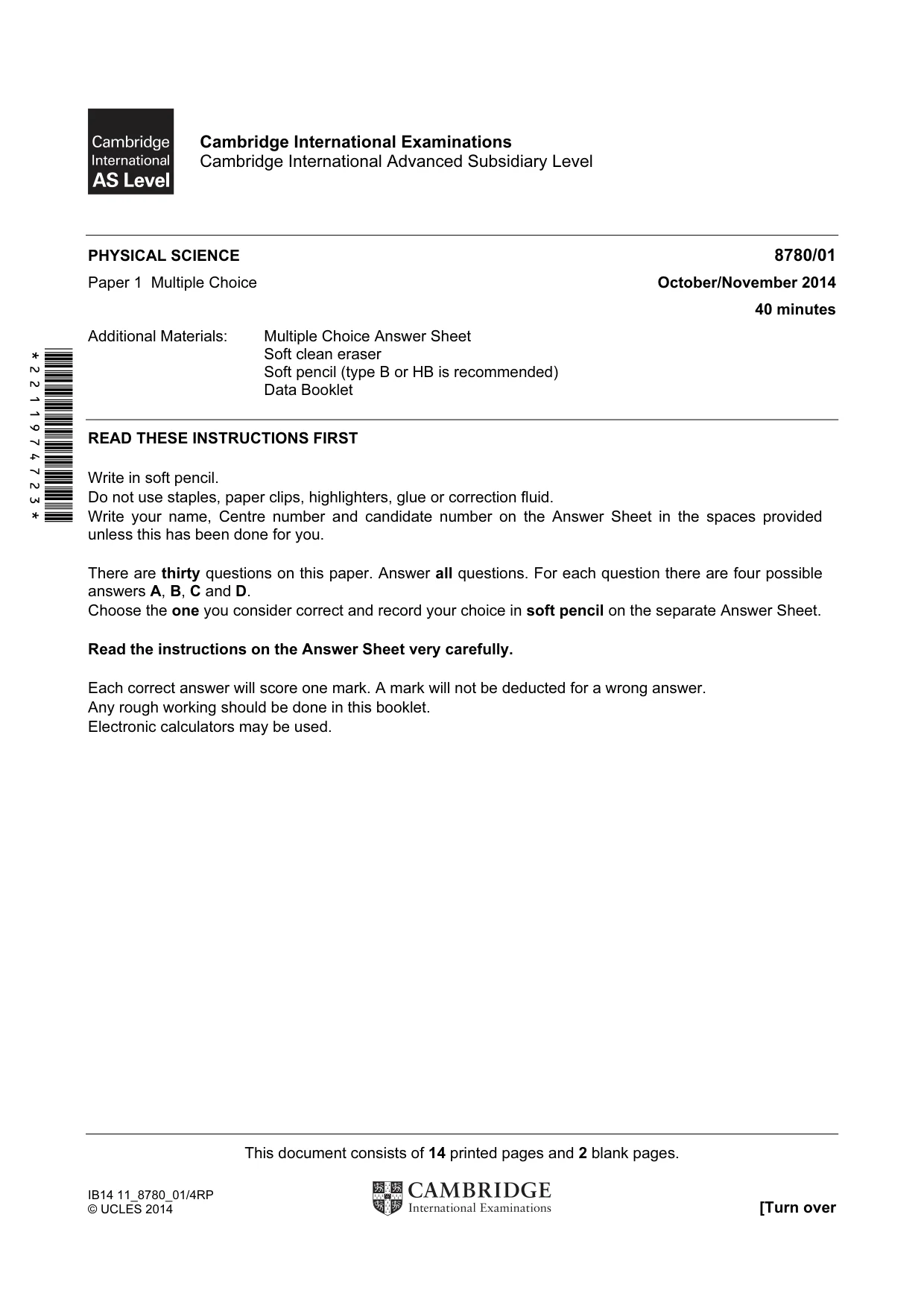
This document consists of 14 printed pages and 2 blank pages. IB14 11_8780_01/4RP © UCLES 2014 [Turn over *2211974723* Cambridge International Examinations Cambridge International Advanced Subsidiary Level PHYSICAL SCIENCE 8780/01 Paper 1 Multiple Choice October/November 2014 40 minutes Additional Materials: Multiple Choice Answer Sheet Soft clean eraser Soft pencil (type B or HB is recommended) Data Booklet READ THESE INSTRUCTIONS FIRST Write in soft pencil. Do not use staples, paper clips, highlighters, glue or correction fluid. Write your name, Centre number and candidate number on the Answer Sheet in the spaces provided unless this has been done for you. There are thirty questions on this paper. Answer all questions. For each question there are four possible answers A, B, C and D. Choose the one you consider correct and record your choice in soft pencil on the separate Answer Sheet. Read the instructions on the Answer Sheet very carefully. Each correct answer will score one mark. A mark will not be deducted for a wrong answer. Any rough working should be done in this booklet. Electronic calculators may be used.
Question paper, page 2
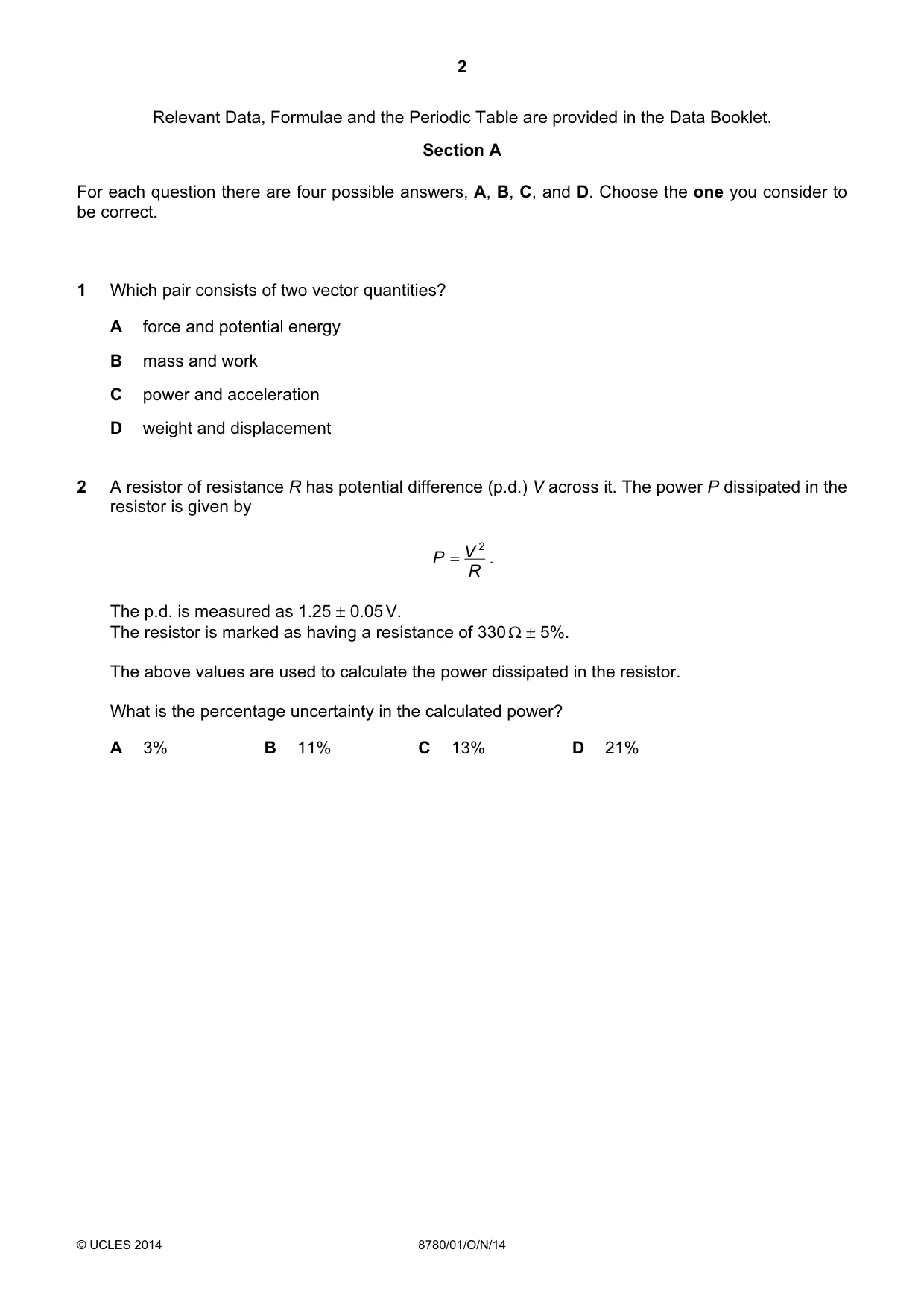
2 © UCLES 2014 8780/01/O/N/14 Relevant Data, Formulae and the Periodic Table are provided in the Data Booklet. Section A For each question there are four possible answers, A, B, C, and D. Choose the one you consider to be correct. 1 Which pair consists of two vector quantities? A force and potential energy B mass and work C power and acceleration D weight and displacement 2 A resistor of resistance R has potential difference (p.d.) V across it. The power P dissipated in the resistor is given by R V P 2 = . The p.d. is measured as 1.25 ± 0.05 V. The resistor is marked as having a resistance of 330 Ω ± 5%. The above values are used to calculate the power dissipated in the resistor. What is the percentage uncertainty in the calculated power? A 3% B 11% C 13% D 21%
Question paper, page 3
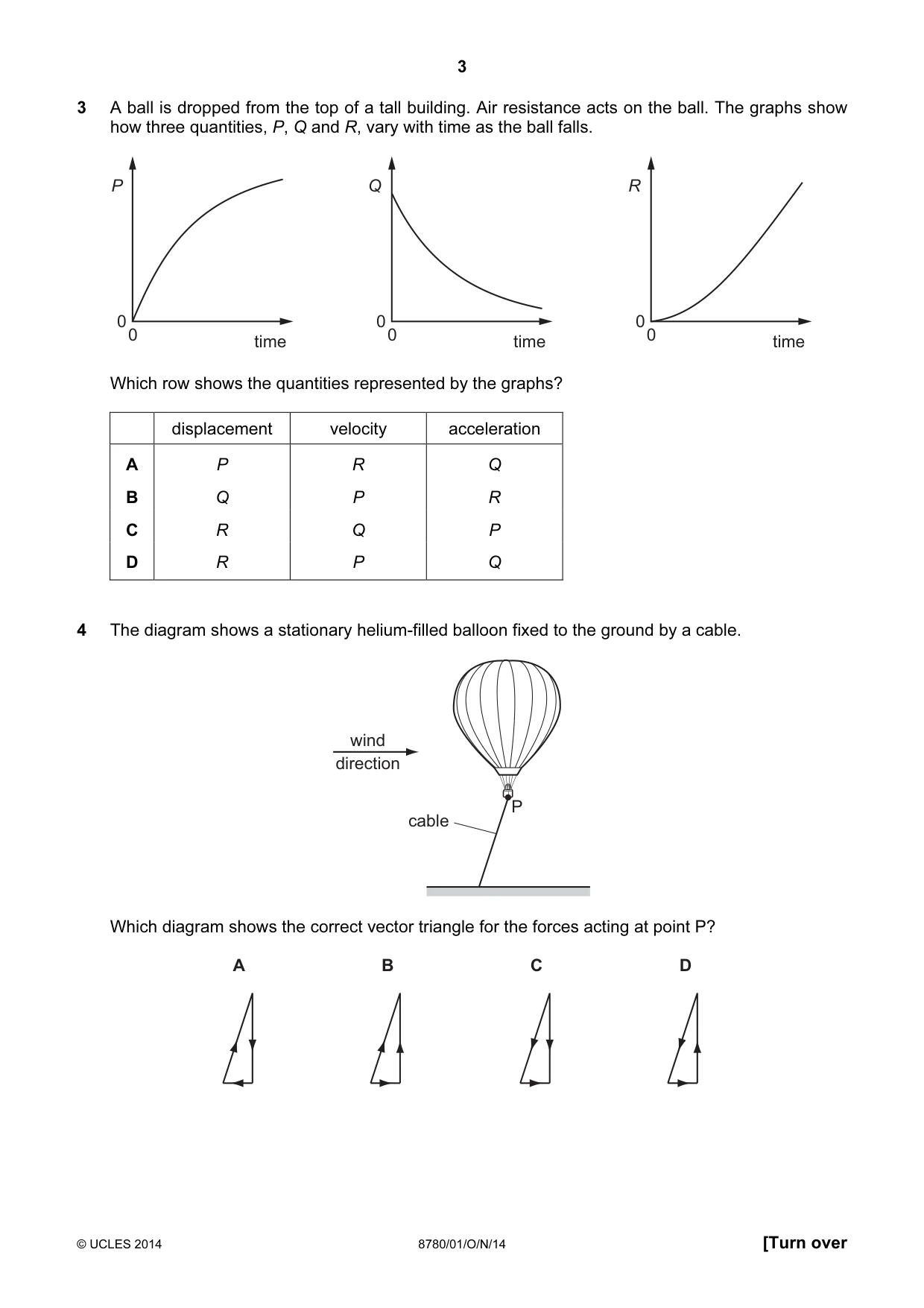
3 © UCLES 2014 8780/01/O/N/14 [Turn over 3 A ball is dropped from the top of a tall building. Air resistance acts on the ball. The graphs show how three quantities, P, Q and R, vary with time as the ball falls. P time 0 0 Q time 0 0 R time 0 0 Which row shows the quantities represented by the graphs? displacement velocity acceleration A P R Q B Q P R C R Q P D R P Q 4 The diagram shows a stationary helium-filled balloon fixed to the ground by a cable. P cable wind direction Which diagram shows the correct vector triangle for the forces acting at point P? A B C D
Question paper, page 4
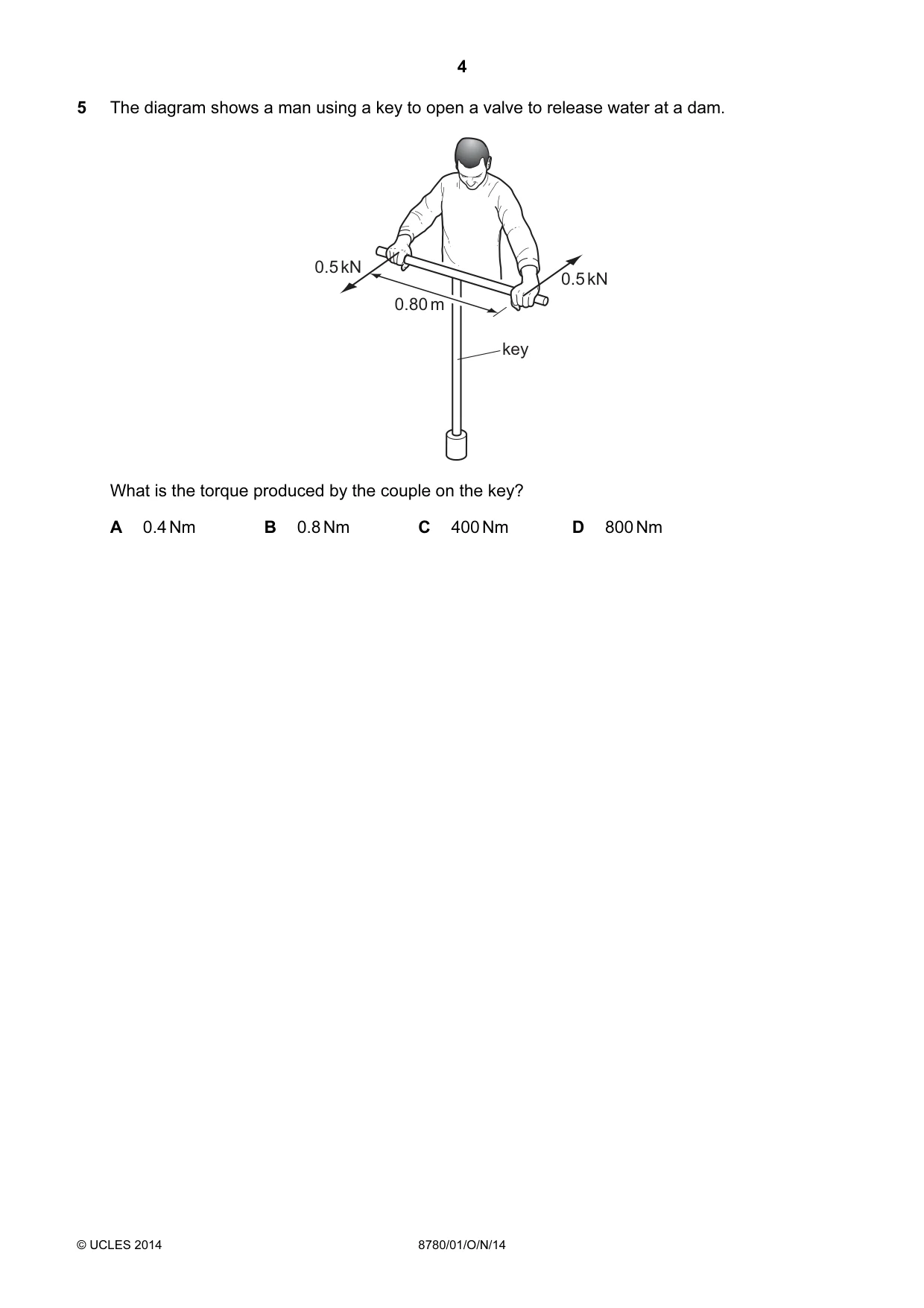
4 © UCLES 2014 8780/01/O/N/14 5 The diagram shows a man using a key to open a valve to release water at a dam. 0.80 m 0.5 kN 0.5 kN key What is the torque produced by the couple on the key? A 0.4 Nm B 0.8 Nm C 400 Nm D 800 Nm
Question paper, page 5
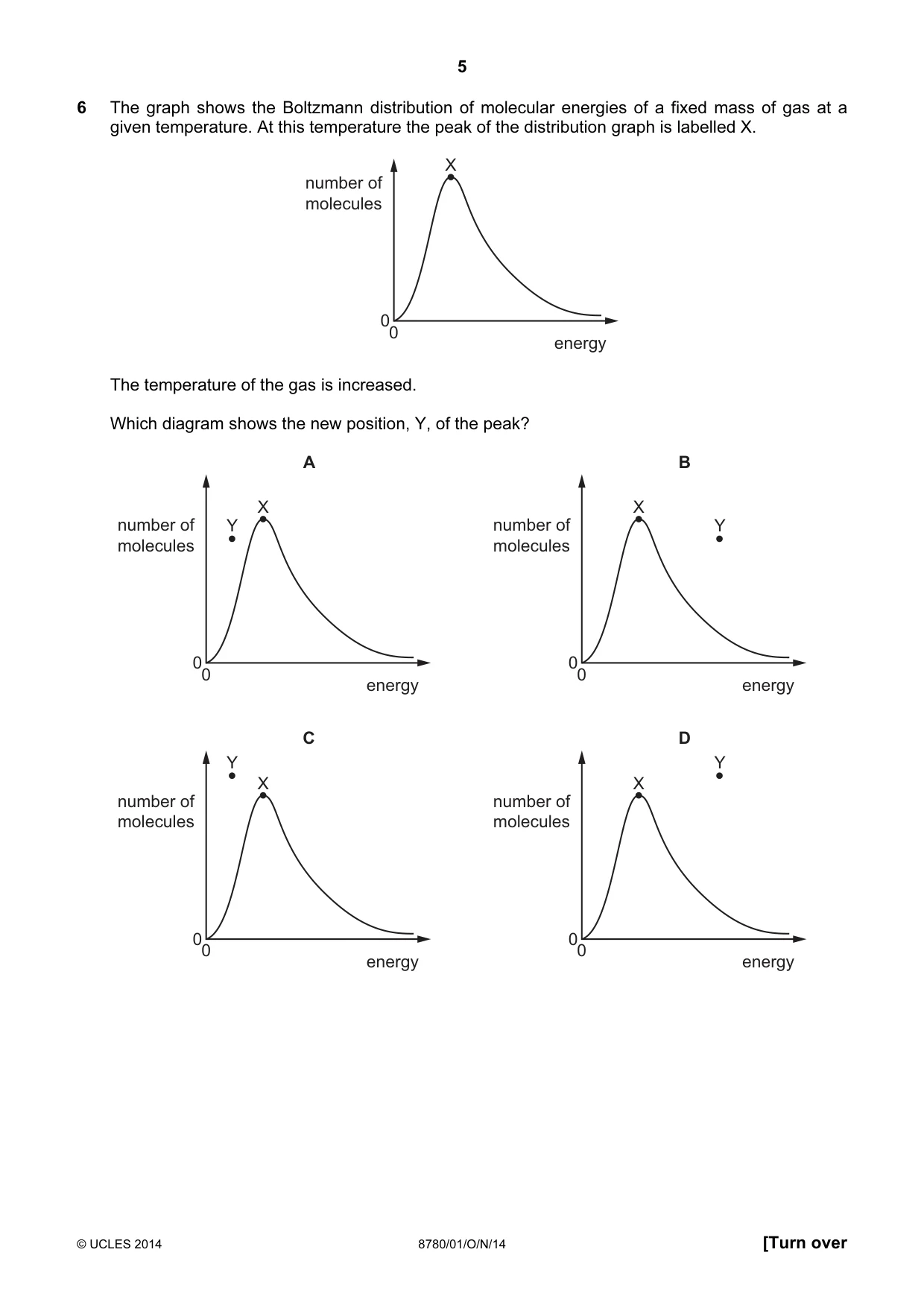
5 © UCLES 2014 8780/01/O/N/14 [Turn over 6 The graph shows the Boltzmann distribution of molecular energies of a fixed mass of gas at a given temperature. At this temperature the peak of the distribution graph is labelled X. number of molecules energy 00 X The temperature of the gas is increased. Which diagram shows the new position, Y, of the peak? number of molecules energy 00 Y A number of molecules energy 00 Y B number of molecules energy 00 Y C number of molecules energy 00 Y D X X X X
Question paper, page 6
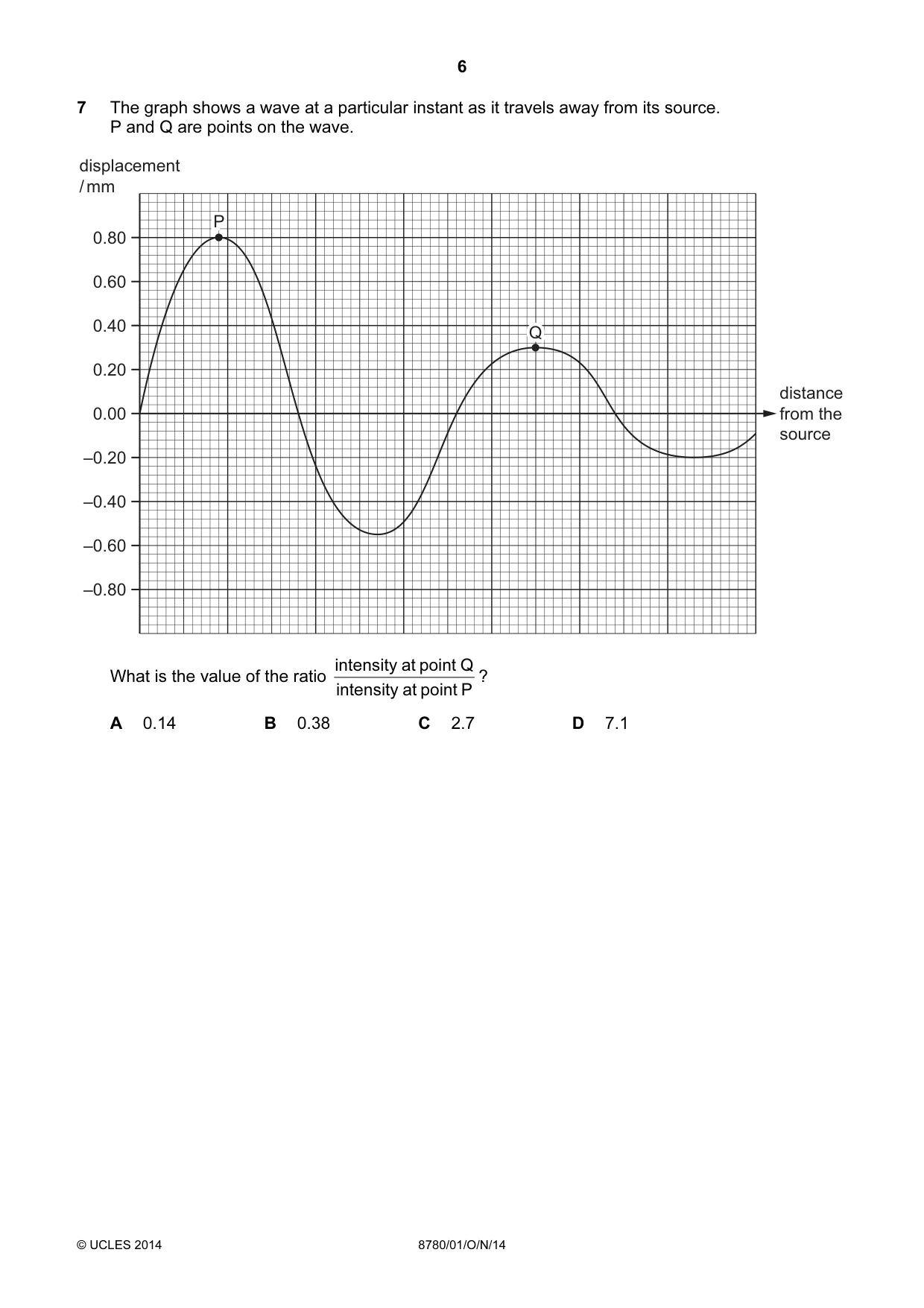
6 © UCLES 2014 8780/01/O/N/14 7 The graph shows a wave at a particular instant as it travels away from its source. P and Q are points on the wave. 0.80 0.60 0.40 0.20 0.00 –0.20 –0.40 –0.60 –0.80 displacement / mm P Q P Q distance from the source What is the value of the ratio P point at intensity Q point at intensity ? A 0.14 B 0.38 C 2.7 D 7.1
Question paper, page 7
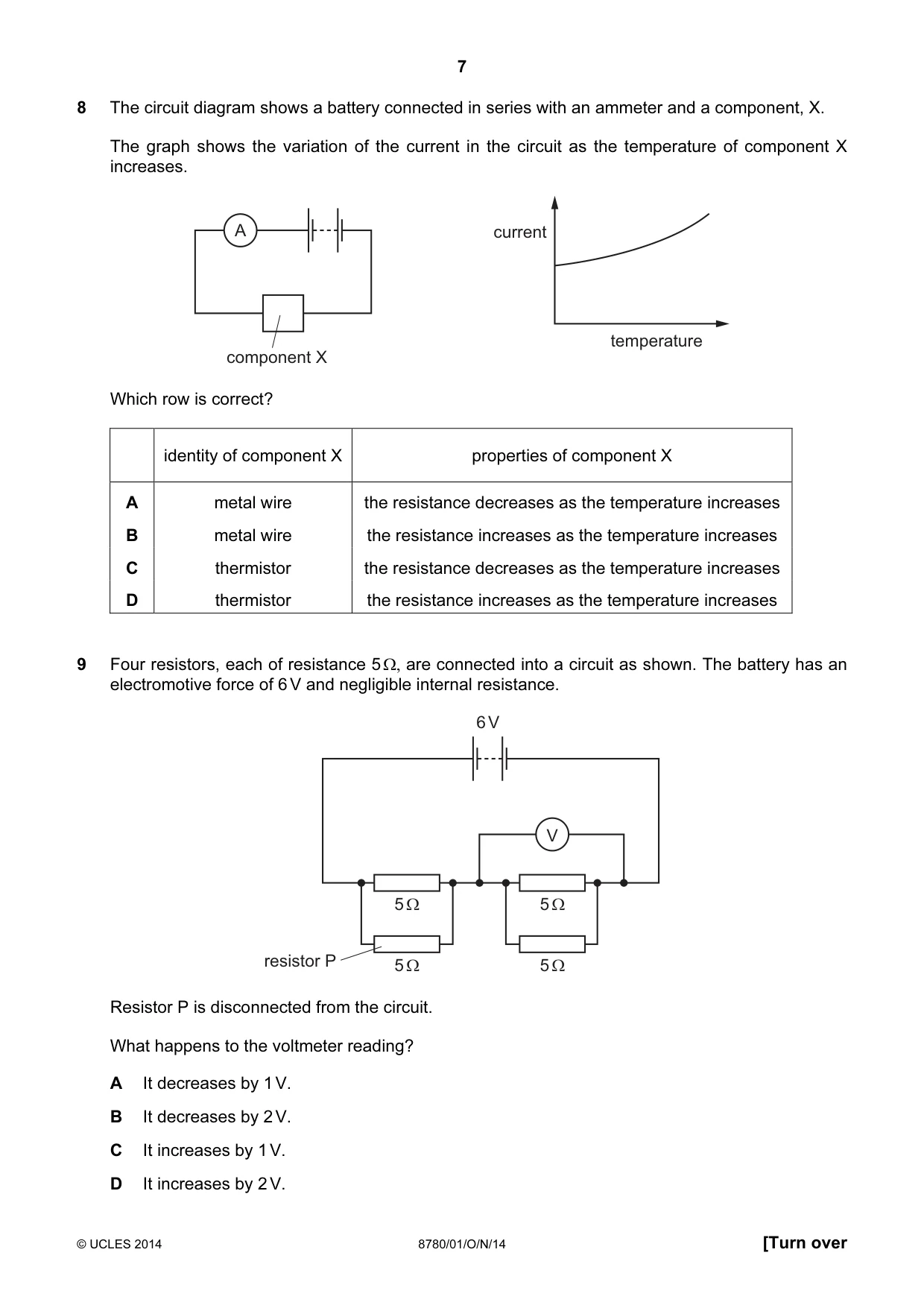
7 © UCLES 2014 8780/01/O/N/14 [Turn over 8 The circuit diagram shows a battery connected in series with an ammeter and a component, X. The graph shows the variation of the current in the circuit as the temperature of component X increases. A current temperature component X Which row is correct? identity of component X properties of component X A metal wire the resistance decreases as the temperature increases B metal wire the resistance increases as the temperature increases C thermistor the resistance decreases as the temperature increases D thermistor the resistance increases as the temperature increases 9 Four resistors, each of resistance 5 Ω, are connected into a circuit as shown. The battery has an electromotive force of 6 V and negligible internal resistance. V 5 Ω 5 Ω 5 Ω 6 V resistor P 5 Ω Resistor P is disconnected from the circuit. What happens to the voltmeter reading? A It decreases by 1 V. B It decreases by 2 V. C It increases by 1 V. D It increases by 2 V.
Question paper, page 8
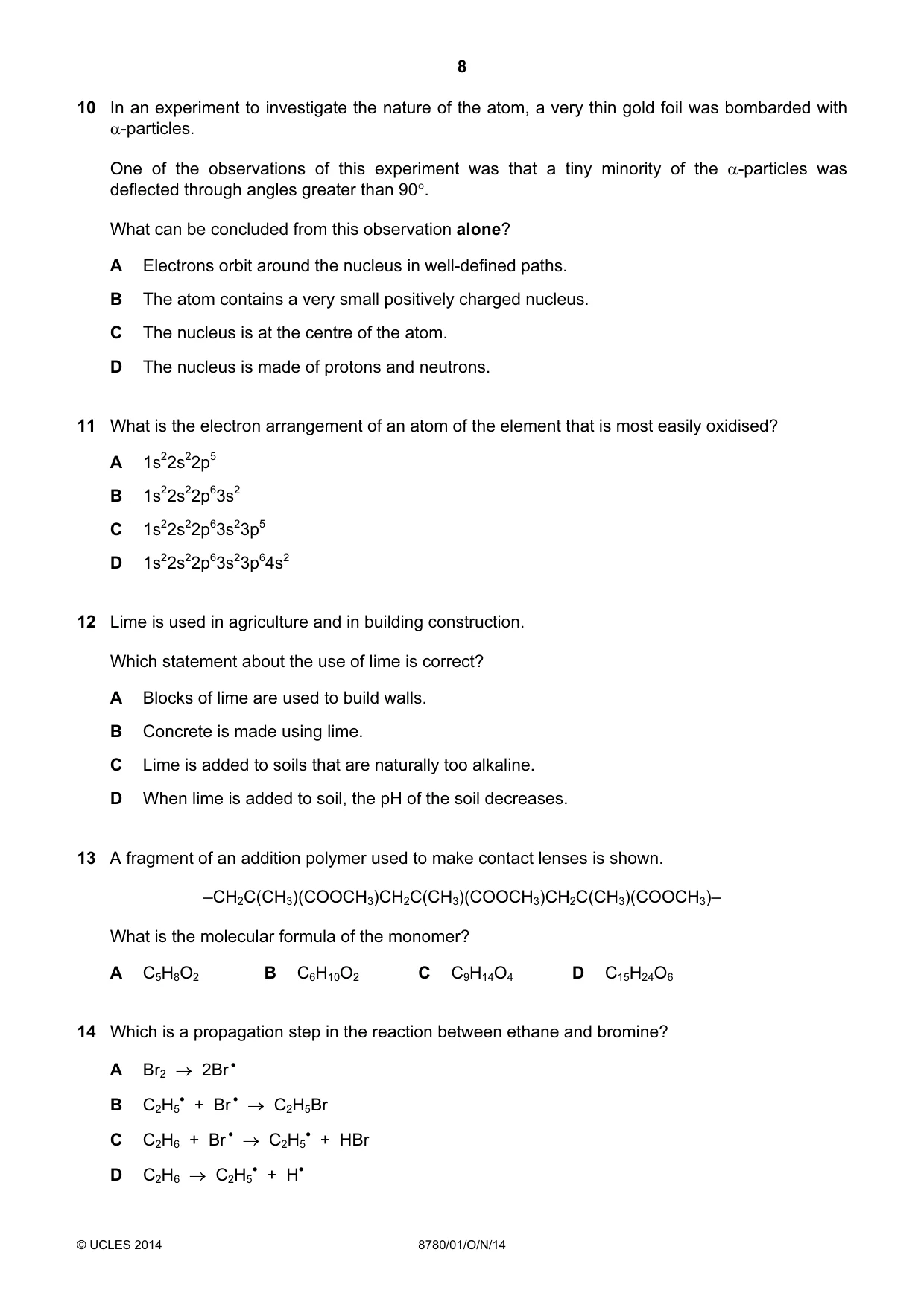
8 © UCLES 2014 8780/01/O/N/14 10 In an experiment to investigate the nature of the atom, a very thin gold foil was bombarded with α-particles. One of the observations of this experiment was that a tiny minority of the α-particles was deflected through angles greater than 90°. What can be concluded from this observation alone? A Electrons orbit around the nucleus in well-defined paths. B The atom contains a very small positively charged nucleus. C The nucleus is at the centre of the atom. D The nucleus is made of protons and neutrons. 11 What is the electron arrangement of an atom of the element that is most easily oxidised? A 1s22s22p5 B 1s22s22p63s2 C 1s22s22p63s23p5 D 1s22s22p63s23p64s2 12 Lime is used in agriculture and in building construction. Which statement about the use of lime is correct? A Blocks of lime are used to build walls. B Concrete is made using lime. C Lime is added to soils that are naturally too alkaline. D When lime is added to soil, the pH of the soil decreases. 13 A fragment of an addition polymer used to make contact lenses is shown. –CH2C(CH3)(COOCH3)CH2C(CH3)(COOCH3)CH2C(CH3)(COOCH3)– What is the molecular formula of the monomer? A C5H8O2 B C6H10O2 C C9H14O4 D C15H24O6 14 Which is a propagation step in the reaction between ethane and bromine? A Br2 → 2Br • B C2H5 • + Br • → C2H5Br C C2H6 + Br • → C2H5 • + HBr D C2H6 → C2H5 • + H•
Question paper, page 9
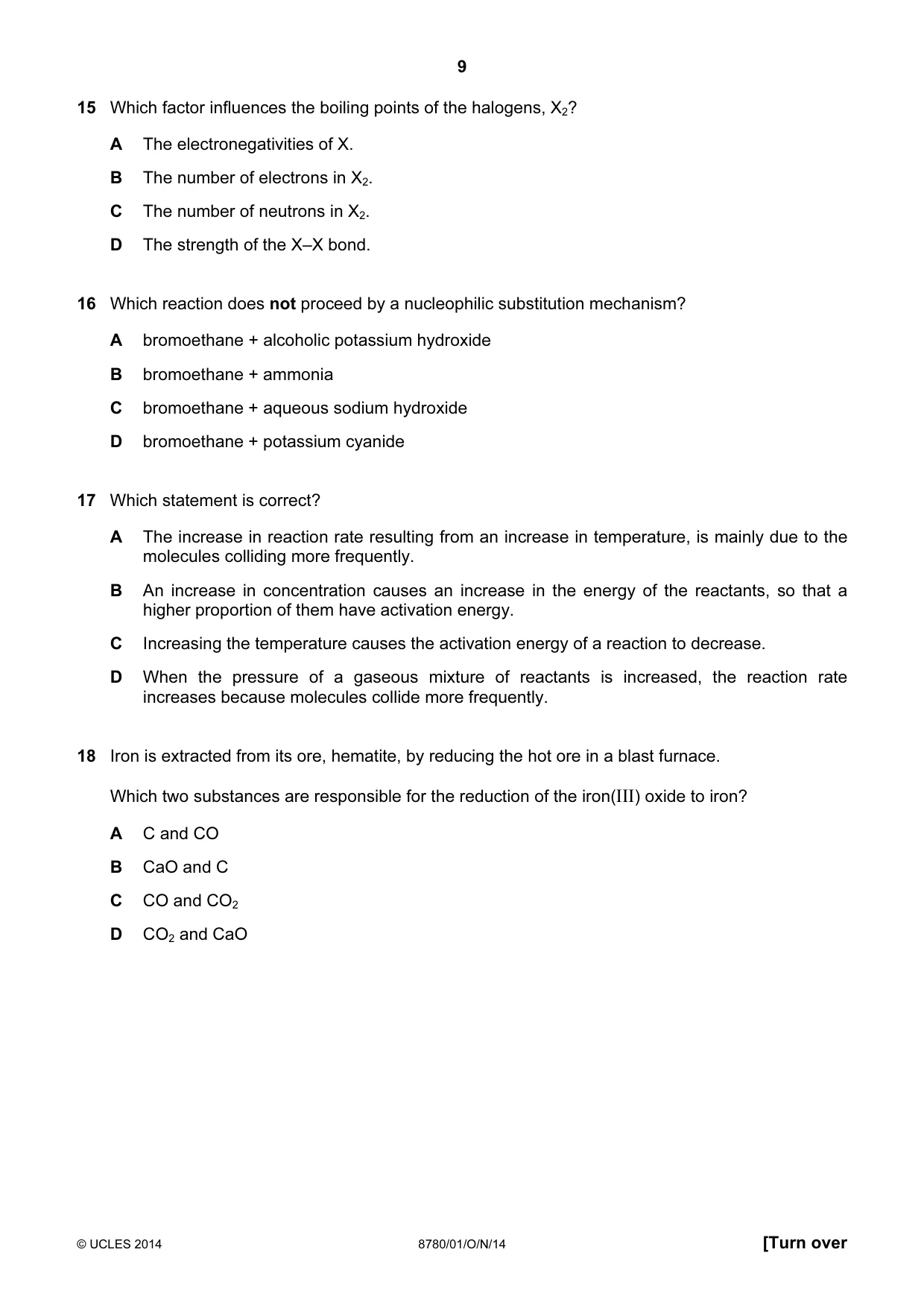
9 © UCLES 2014 8780/01/O/N/14 [Turn over 15 Which factor influences the boiling points of the halogens, X2? A The electronegativities of X. B The number of electrons in X2. C The number of neutrons in X2. D The strength of the X–X bond. 16 Which reaction does not proceed by a nucleophilic substitution mechanism? A bromoethane + alcoholic potassium hydroxide B bromoethane + ammonia C bromoethane + aqueous sodium hydroxide D bromoethane + potassium cyanide 17 Which statement is correct? A The increase in reaction rate resulting from an increase in temperature, is mainly due to the molecules colliding more frequently. B An increase in concentration causes an increase in the energy of the reactants, so that a higher proportion of them have activation energy. C Increasing the temperature causes the activation energy of a reaction to decrease. D When the pressure of a gaseous mixture of reactants is increased, the reaction rate increases because molecules collide more frequently. 18 Iron is extracted from its ore, hematite, by reducing the hot ore in a blast furnace. Which two substances are responsible for the reduction of the iron(III) oxide to iron? A C and CO B CaO and C C CO and CO2 D CO2 and CaO
Question paper, page 10
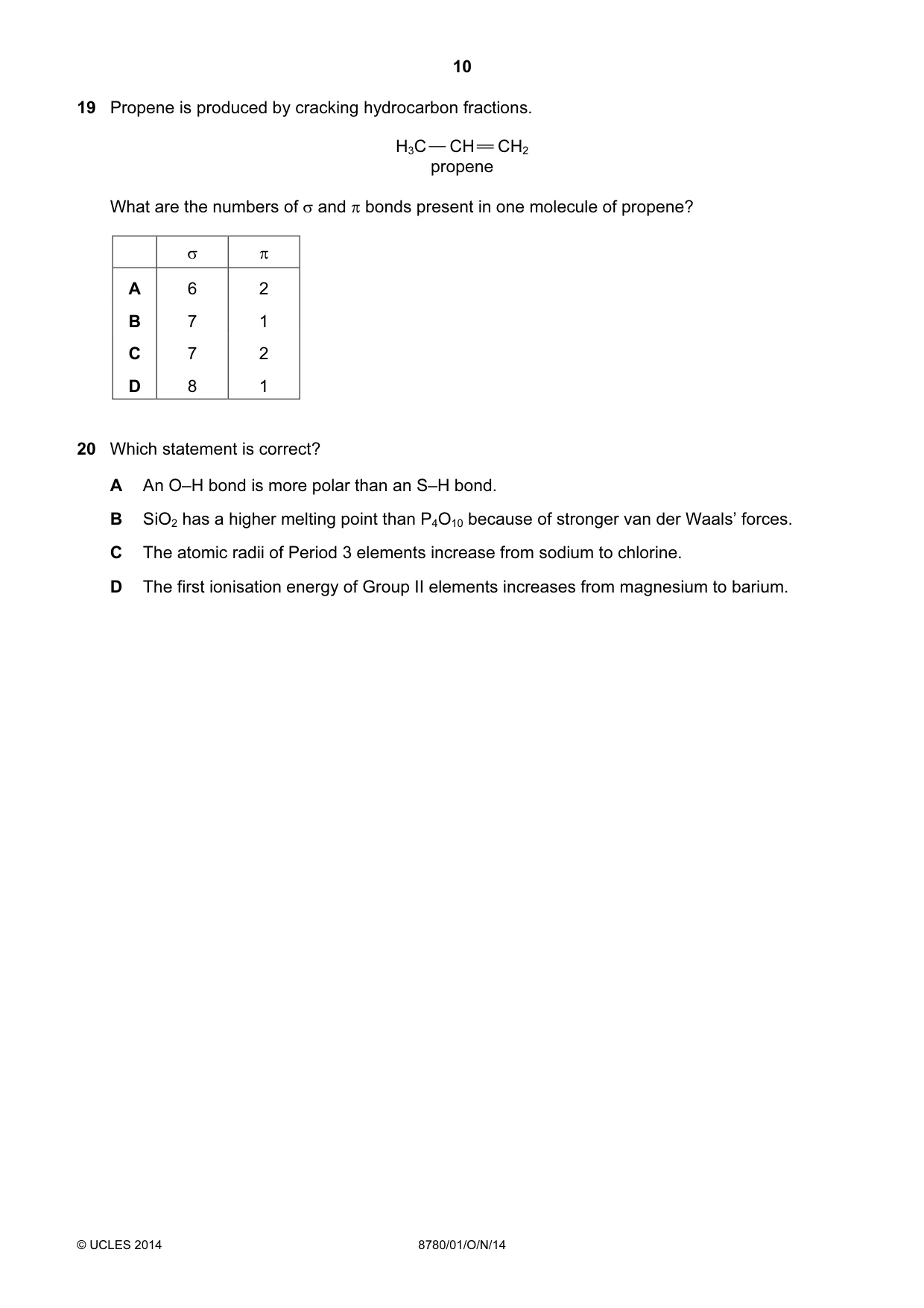
10 © UCLES 2014 8780/01/O/N/14 19 Propene is produced by cracking hydrocarbon fractions. H3C CH CH2 propene What are the numbers of σ and π bonds present in one molecule of propene? σ π A 6 2 B 7 1 C 7 2 D 8 1 20 Which statement is correct? A An O–H bond is more polar than an S–H bond. B SiO2 has a higher melting point than P4O10 because of stronger van der Waals’ forces. C The atomic radii of Period 3 elements increase from sodium to chlorine. D The first ionisation energy of Group II elements increases from magnesium to barium.
Question paper, page 11
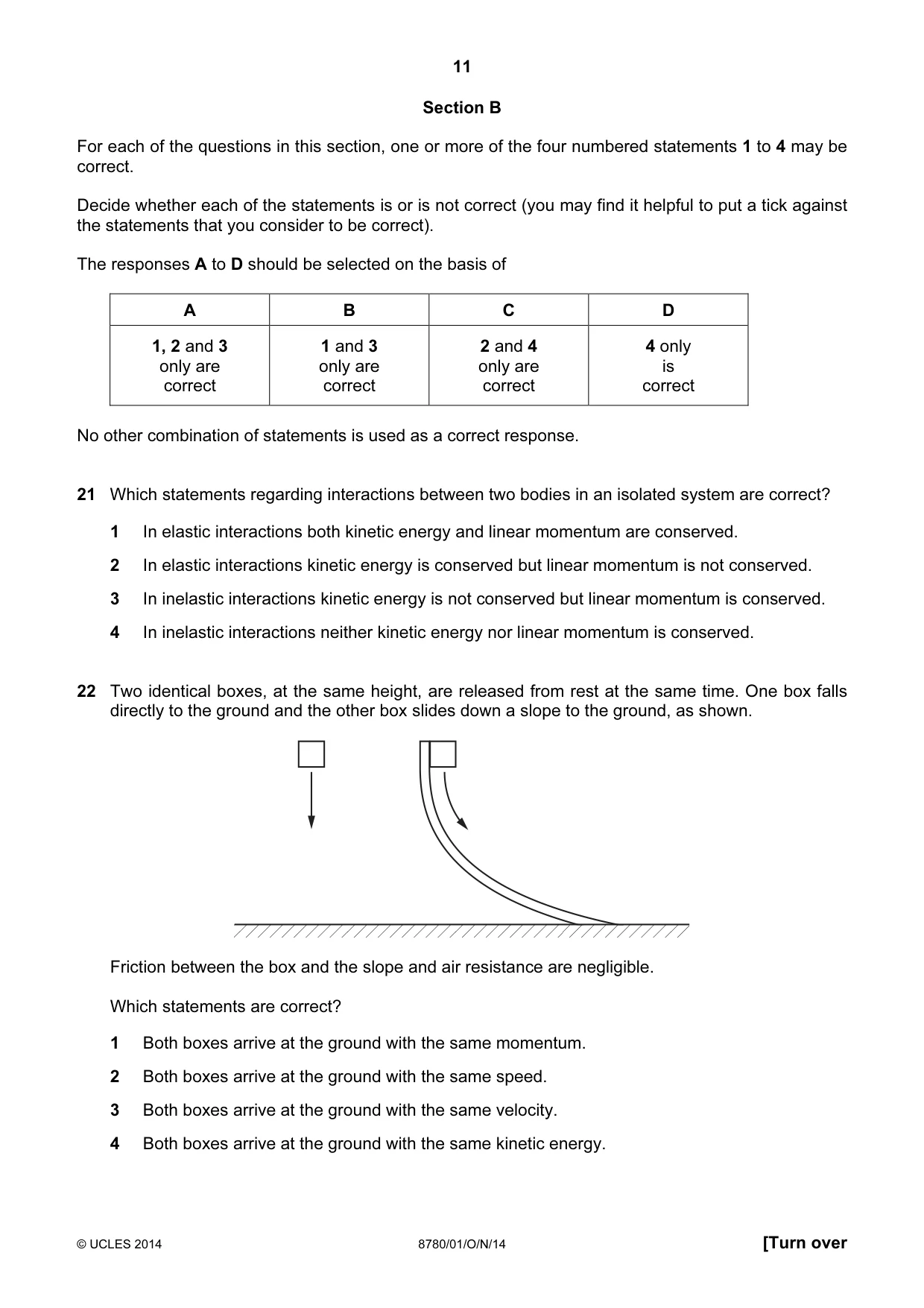
11 © UCLES 2014 8780/01/O/N/14 [Turn over Section B For each of the questions in this section, one or more of the four numbered statements 1 to 4 may be correct. Decide whether each of the statements is or is not correct (you may find it helpful to put a tick against the statements that you consider to be correct). The responses A to D should be selected on the basis of A B C D 1, 2 and 3 only are correct 1 and 3 only are correct 2 and 4 only are correct 4 only is correct No other combination of statements is used as a correct response. 21 Which statements regarding interactions between two bodies in an isolated system are correct? 1 In elastic interactions both kinetic energy and linear momentum are conserved. 2 In elastic interactions kinetic energy is conserved but linear momentum is not conserved. 3 In inelastic interactions kinetic energy is not conserved but linear momentum is conserved. 4 In inelastic interactions neither kinetic energy nor linear momentum is conserved. 22 Two identical boxes, at the same height, are released from rest at the same time. One box falls directly to the ground and the other box slides down a slope to the ground, as shown. Friction between the box and the slope and air resistance are negligible. Which statements are correct? 1 Both boxes arrive at the ground with the same momentum. 2 Both boxes arrive at the ground with the same speed. 3 Both boxes arrive at the ground with the same velocity. 4 Both boxes arrive at the ground with the same kinetic energy.
Question paper, page 12
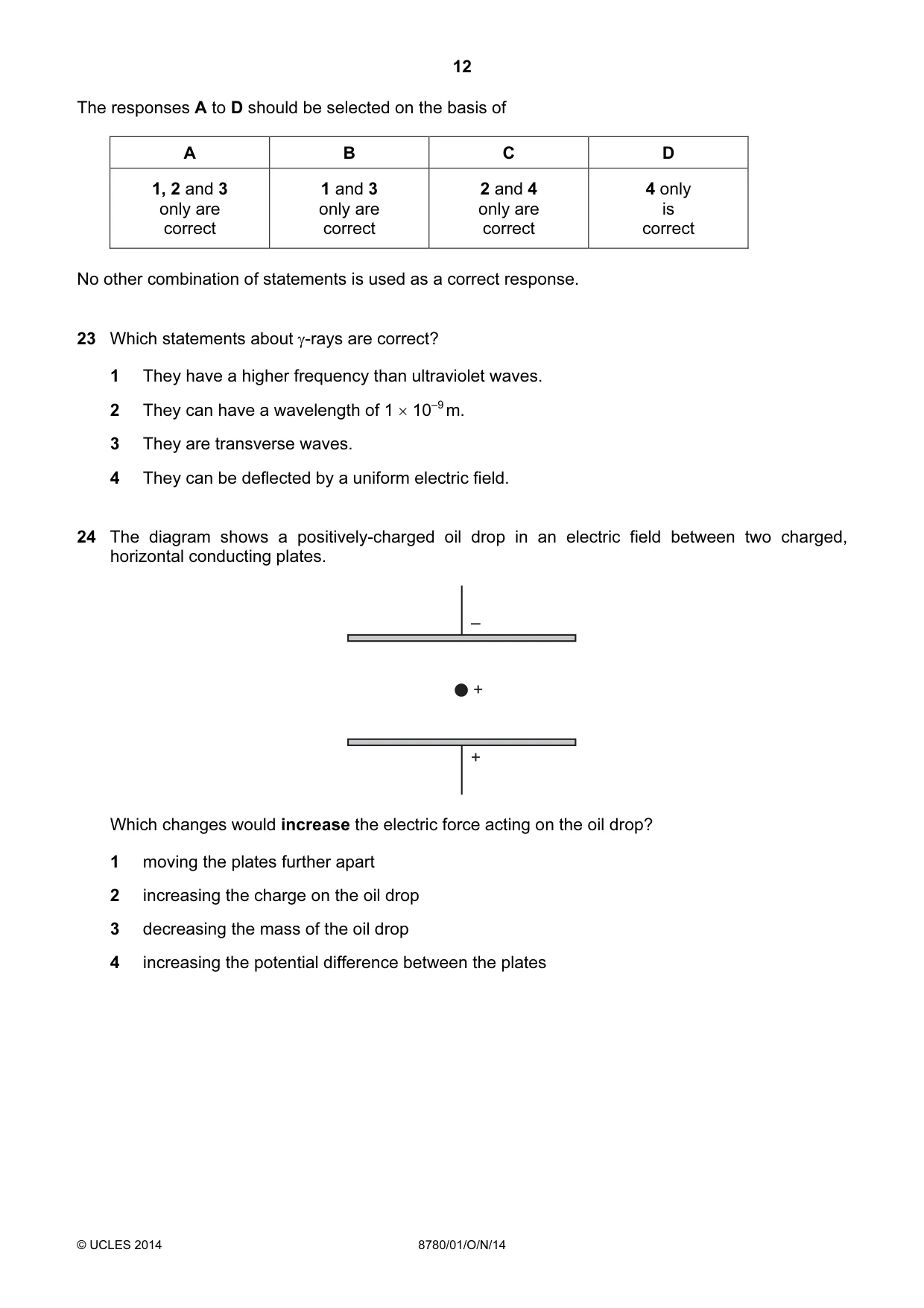
12 © UCLES 2014 8780/01/O/N/14 The responses A to D should be selected on the basis of A B C D 1, 2 and 3 only are correct 1 and 3 only are correct 2 and 4 only are correct 4 only is correct No other combination of statements is used as a correct response. 23 Which statements about γ-rays are correct? 1 They have a higher frequency than ultraviolet waves. 2 They can have a wavelength of 1 × 10⁻⁹ m. 3 They are transverse waves. 4 They can be deflected by a uniform electric field. 24 The diagram shows a positively-charged oil drop in an electric field between two charged, horizontal conducting plates. + + – Which changes would increase the electric force acting on the oil drop? 1 moving the plates further apart 2 increasing the charge on the oil drop 3 decreasing the mass of the oil drop 4 increasing the potential difference between the plates
Question paper, page 13
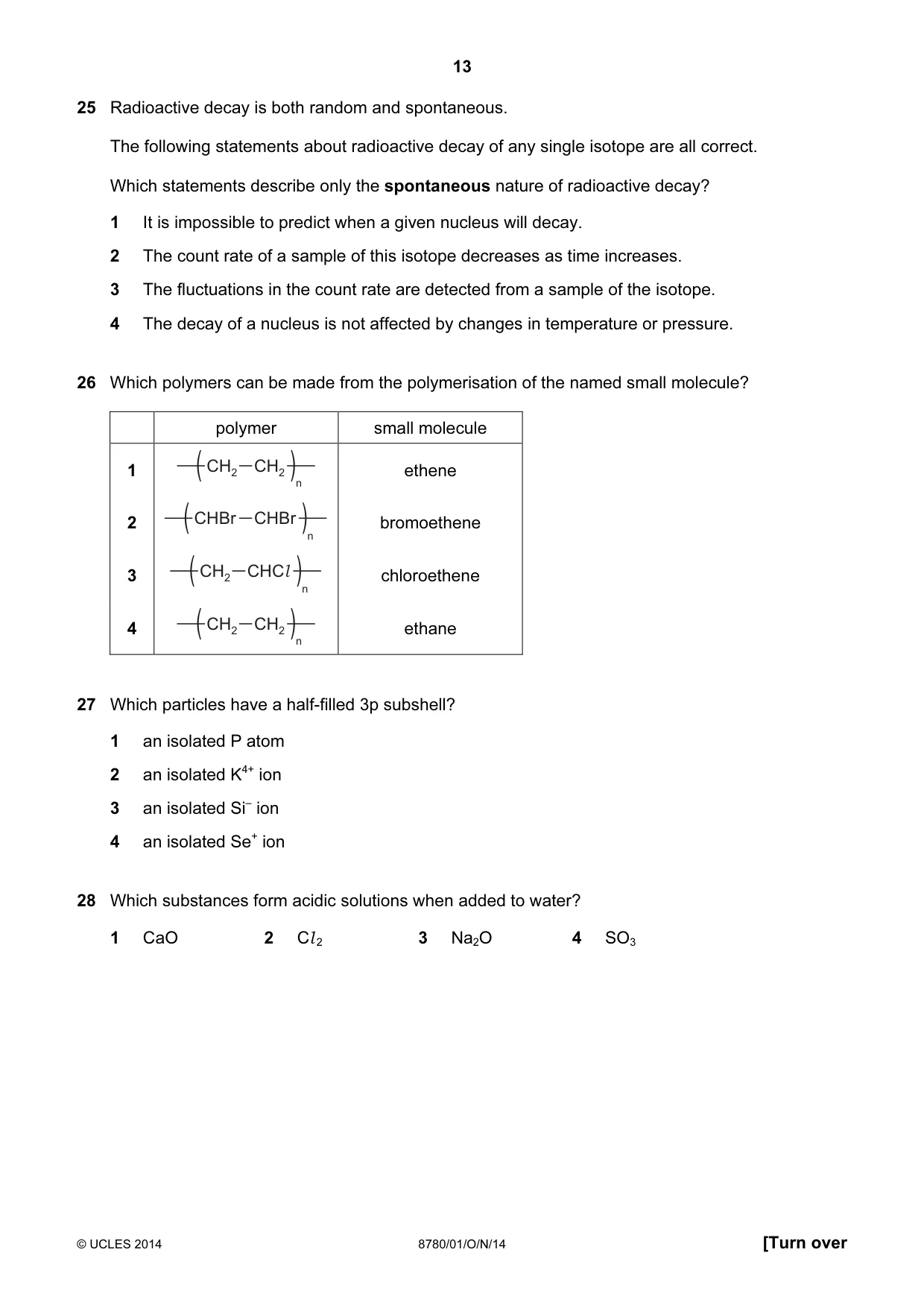
13 © UCLES 2014 8780/01/O/N/14 [Turn over 25 Radioactive decay is both random and spontaneous. The following statements about radioactive decay of any single isotope are all correct. Which statements describe only the spontaneous nature of radioactive decay? 1 It is impossible to predict when a given nucleus will decay. 2 The count rate of a sample of this isotope decreases as time increases. 3 The fluctuations in the count rate are detected from a sample of the isotope. 4 The decay of a nucleus is not affected by changes in temperature or pressure. 26 Which polymers can be made from the polymerisation of the named small molecule? polymer small molecule 1 CH2 CH2 n ethene 2 CHBr CHBr n bromoethene 3 CH2 CHCl n chloroethene 4 CH2 CH2 n ethane 27 Which particles have a half-filled 3p subshell? 1 an isolated P atom 2 an isolated K4+ ion 3 an isolated Si– ion 4 an isolated Se+ ion 28 Which substances form acidic solutions when added to water? 1 CaO 2 Cl 2 3 Na2O 4 SO3
Question paper, page 14
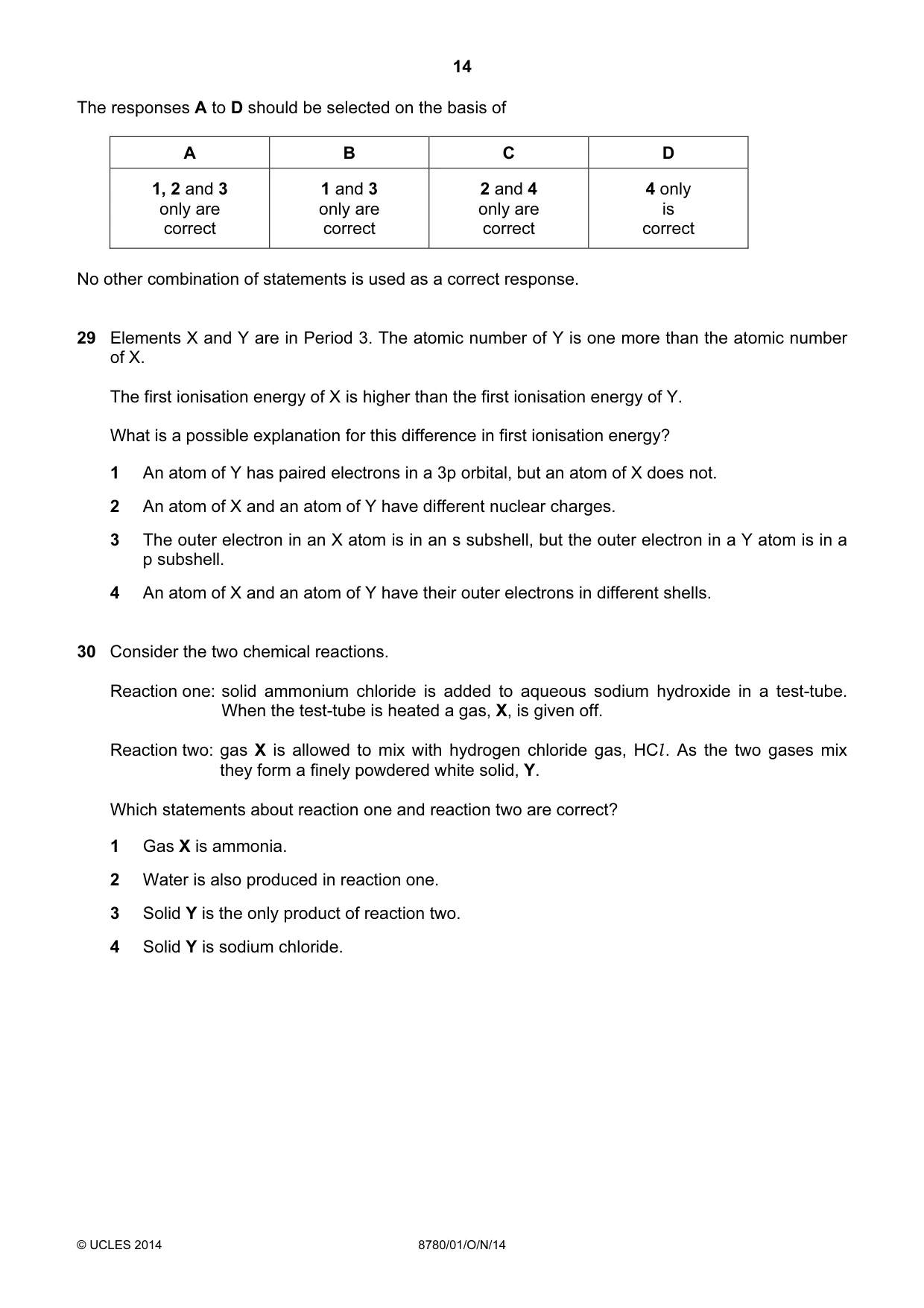
14 © UCLES 2014 8780/01/O/N/14 The responses A to D should be selected on the basis of A B C D 1, 2 and 3 only are correct 1 and 3 only are correct 2 and 4 only are correct 4 only is correct No other combination of statements is used as a correct response. 29 Elements X and Y are in Period 3. The atomic number of Y is one more than the atomic number of X. The first ionisation energy of X is higher than the first ionisation energy of Y. What is a possible explanation for this difference in first ionisation energy? 1 An atom of Y has paired electrons in a 3p orbital, but an atom of X does not. 2 An atom of X and an atom of Y have different nuclear charges. 3 The outer electron in an X atom is in an s subshell, but the outer electron in a Y atom is in a p subshell. 4 An atom of X and an atom of Y have their outer electrons in different shells. 30 Consider the two chemical reactions. Reaction one: solid ammonium chloride is added to aqueous sodium hydroxide in a test-tube. When the test-tube is heated a gas, X, is given off. Reaction two: gas X is allowed to mix with hydrogen chloride gas, HCl . As the two gases mix they form a finely powdered white solid, Y. Which statements about reaction one and reaction two are correct? 1 Gas X is ammonia. 2 Water is also produced in reaction one. 3 Solid Y is the only product of reaction two. 4 Solid Y is sodium chloride.
Question paper, page 15
15 © UCLES 2014 8780/01/O/N/14 BLANK PAGE
Question paper, page 16
16 Permission to reproduce items where third-party owned material protected by copyright is included has been sought and cleared where possible. Every reasonable effort has been made by the publisher (UCLES) to trace copyright holders, but if any items requiring clearance have unwittingly been included, the publisher will be pleased to make amends at the earliest possible opportunity. Cambridge International Examinations is part of the Cambridge Assessment Group. Cambridge Assessment is the brand name of University of Cambridge Local Examinations Syndicate (UCLES), which is itself a department of the University of Cambridge. © UCLES 2014 8780/01/O/N/14 BLANK PAGE
Mark scheme, page 1
® IGCSE is the registered trademark of Cambridge International Examinations. CAMBRIDGE INTERNATIONAL EXAMINATIONS Cambridge International Advanced Subsidiary Level MARK SCHEME for the October/November 2014 series 8780 PHYSICAL SCIENCE 8780/01 Paper 1 (Multiple Choice), maximum raw mark 30 Mark schemes should be read in conjunction with the question paper and the Principal Examiner Report for Teachers. Cambridge will not enter into discussions about these mark schemes. Cambridge is publishing the mark schemes for the October/November 2014 series for most Cambridge IGCSE®, Cambridge International A and AS Level components and some Cambridge O Level components.
Mark scheme, page 2
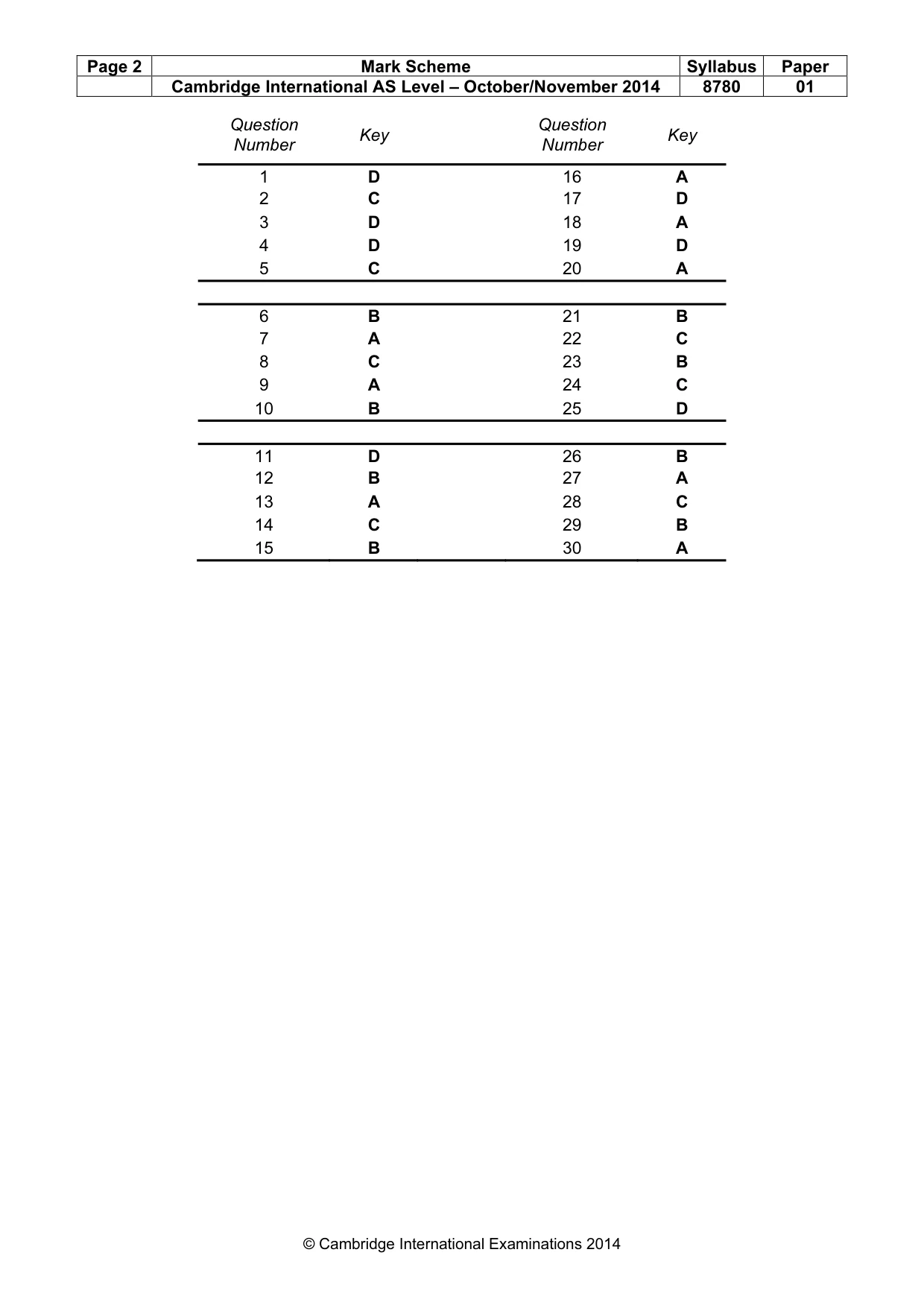
Page 2 Mark Scheme Syllabus Paper Cambridge International AS Level – October/November 2014 8780 01 © Cambridge International Examinations 2014 Question Number Key Question Number Key 1 D 16 A 2 C 17 D 3 D 18 A 4 D 19 D 5 C 20 A 6 B 21 B 7 A 22 C 8 C 23 B 9 A 24 C 10 B 25 D 11 D 26 B 12 B 27 A 13 A 28 C 14 C 29 B 15 B 30 A
What you needed in this session
Cambridge’s own grade thresholds for 2014 Oct/Nov, Paper 1 · Variant 1. A higher threshold means an easier paper — the bar moves with how the cohort did.