Cambridge A Level Physical Science 8780 — 2015 Oct/Nov Paper 1 · Variant 1
8780/11/O/N/15
The question paper and its mark scheme, free to read here and free to download. This is Cambridge’s own paper, exactly as it was sat.
Question paper12 pages
Mark scheme2 pages
Answers below. Sit the paper first if you are practising.
Paper as text
Question paper, page 1
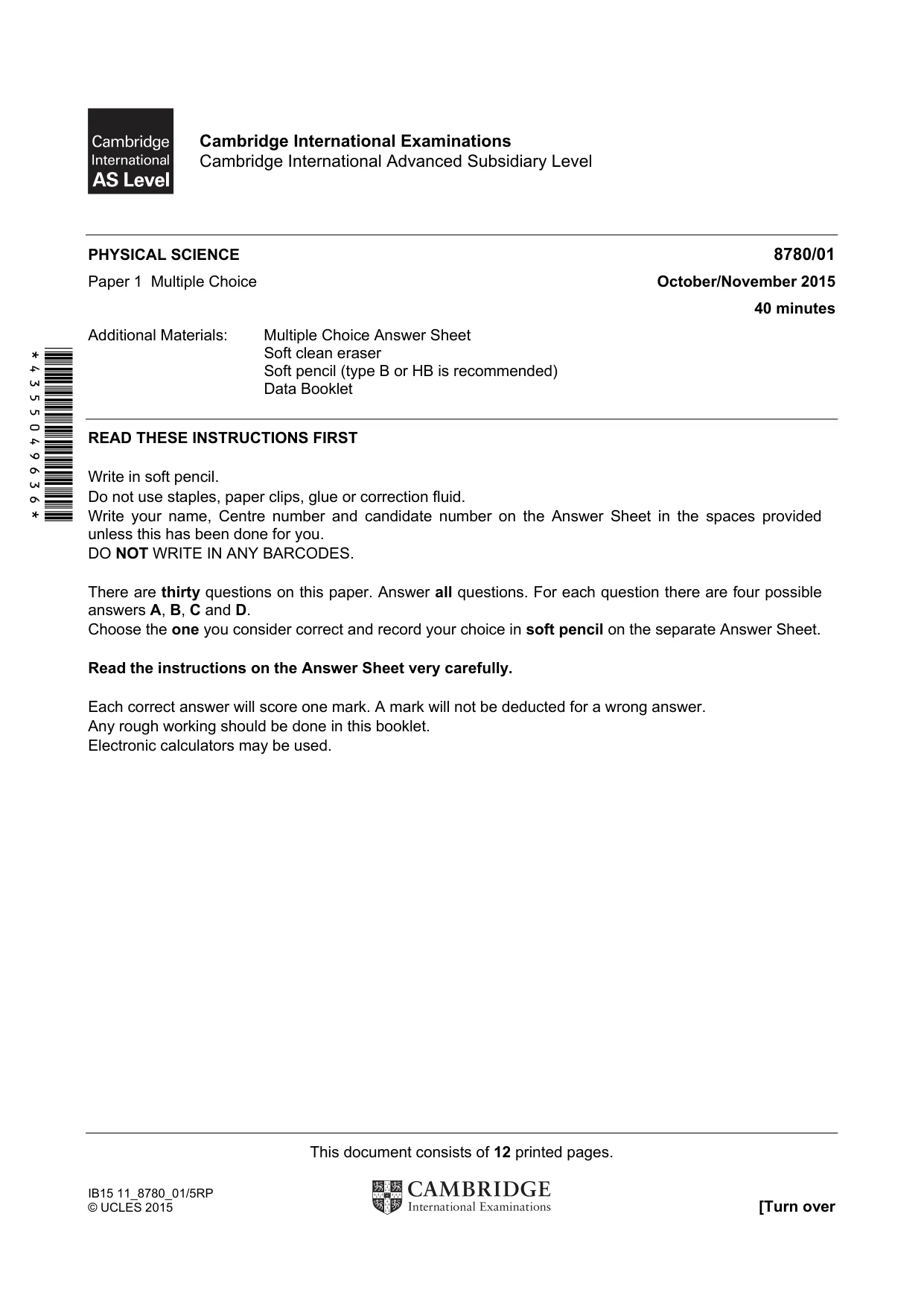
This document consists of 12 printed pages. IB15 11_8780_01/5RP © UCLES 2015 [Turn over *4355049636* Cambridge International Examinations Cambridge International Advanced Subsidiary Level PHYSICAL SCIENCE 8780/01 Paper 1 Multiple Choice October/November 2015 40 minutes Additional Materials: Multiple Choice Answer Sheet Soft clean eraser Soft pencil (type B or HB is recommended) Data Booklet READ THESE INSTRUCTIONS FIRST Write in soft pencil. Do not use staples, paper clips, glue or correction fluid. Write your name, Centre number and candidate number on the Answer Sheet in the spaces provided unless this has been done for you. DO NOT WRITE IN ANY BARCODES. There are thirty questions on this paper. Answer all questions. For each question there are four possible answers A, B, C and D. Choose the one you consider correct and record your choice in soft pencil on the separate Answer Sheet. Read the instructions on the Answer Sheet very carefully. Each correct answer will score one mark. A mark will not be deducted for a wrong answer. Any rough working should be done in this booklet. Electronic calculators may be used.
Question paper, page 2
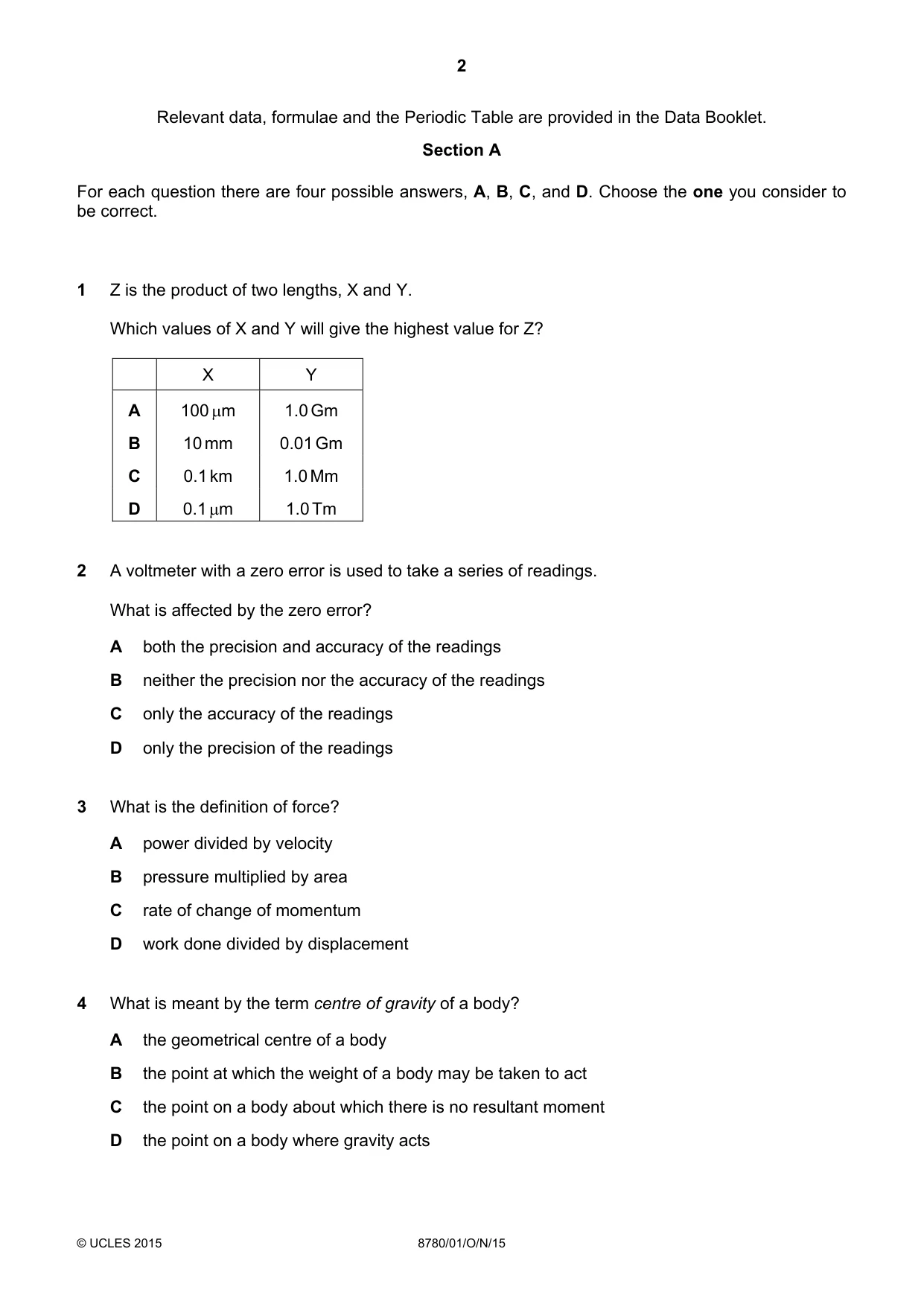
2 © UCLES 2015 8780/01/O/N/15 Relevant data, formulae and the Periodic Table are provided in the Data Booklet. Section A For each question there are four possible answers, A, B, C, and D. Choose the one you consider to be correct. 1 Z is the product of two lengths, X and Y. Which values of X and Y will give the highest value for Z? X Y A 100 μm 1.0 Gm B 10 mm 0.01 Gm C 0.1 km 1.0 Mm D 0.1 μm 1.0 Tm 2 A voltmeter with a zero error is used to take a series of readings. What is affected by the zero error? A both the precision and accuracy of the readings B neither the precision nor the accuracy of the readings C only the accuracy of the readings D only the precision of the readings 3 What is the definition of force? A power divided by velocity B pressure multiplied by area C rate of change of momentum D work done divided by displacement 4 What is meant by the term centre of gravity of a body? A the geometrical centre of a body B the point at which the weight of a body may be taken to act C the point on a body about which there is no resultant moment D the point on a body where gravity acts
Question paper, page 3
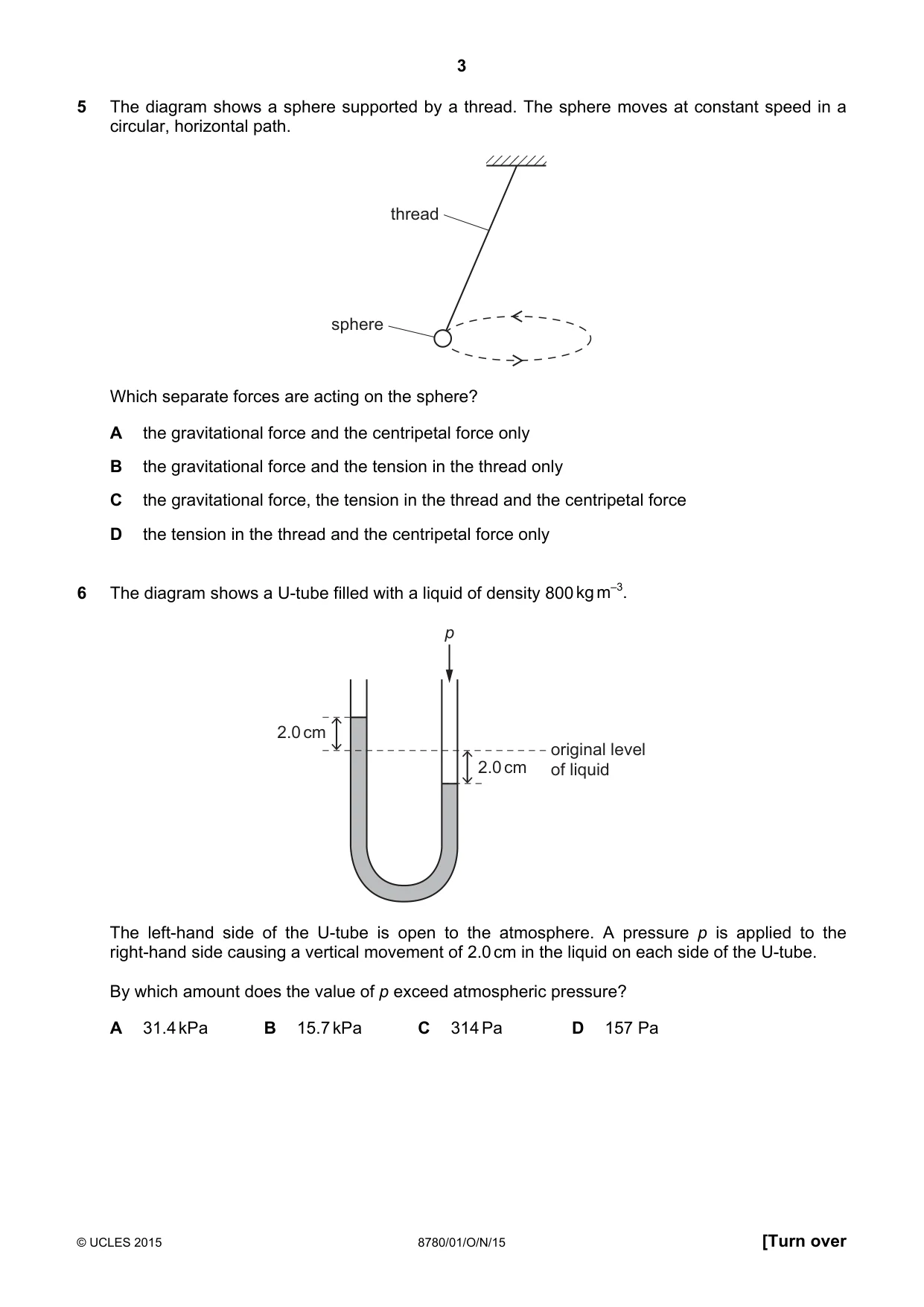
3 © UCLES 2015 8780/01/O/N/15 [Turn over 5 The diagram shows a sphere supported by a thread. The sphere moves at constant speed in a circular, horizontal path. thread sphere Which separate forces are acting on the sphere? A the gravitational force and the centripetal force only B the gravitational force and the tension in the thread only C the gravitational force, the tension in the thread and the centripetal force D the tension in the thread and the centripetal force only 6 The diagram shows a U-tube filled with a liquid of density 800 kg m–3. 2.0 cm 2.0 cm p original level of liquid The left-hand side of the U-tube is open to the atmosphere. A pressure p is applied to the right-hand side causing a vertical movement of 2.0 cm in the liquid on each side of the U-tube. By which amount does the value of p exceed atmospheric pressure? A 31.4 kPa B 15.7 kPa C 314 Pa D 157 Pa
Question paper, page 4
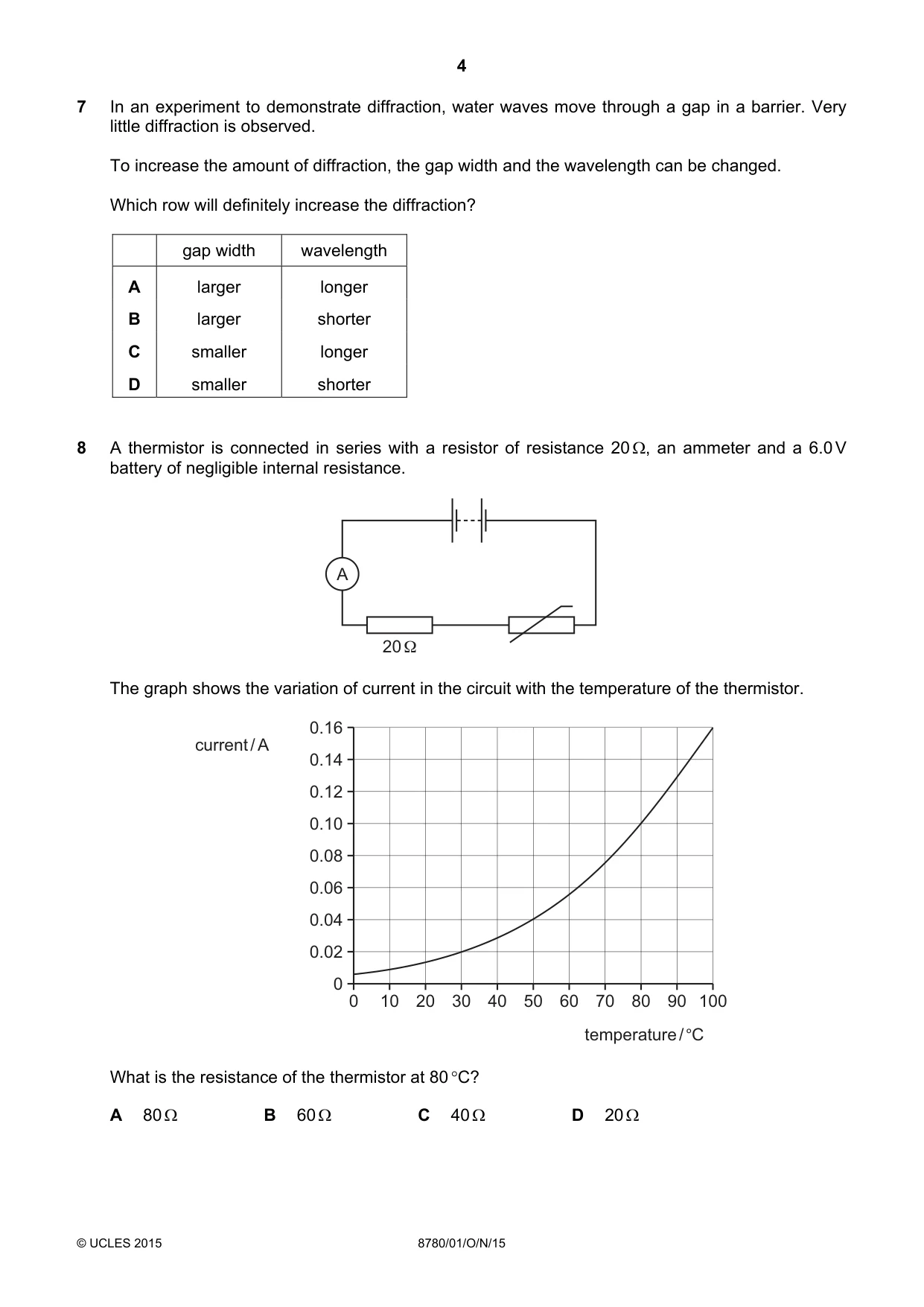
4 © UCLES 2015 8780/01/O/N/15 7 In an experiment to demonstrate diffraction, water waves move through a gap in a barrier. Very little diffraction is observed. To increase the amount of diffraction, the gap width and the wavelength can be changed. Which row will definitely increase the diffraction? gap width wavelength A larger longer B larger shorter C smaller longer D smaller shorter 8 A thermistor is connected in series with a resistor of resistance 20 Ω, an ammeter and a 6.0 V battery of negligible internal resistance. A 20 Ω The graph shows the variation of current in the circuit with the temperature of the thermistor. 0.16 0.14 0.12 0.10 0.08 0.06 0.04 0.02 0 0 10 20 30 40 50 60 70 80 90 100 temperature / °C current / A What is the resistance of the thermistor at 80 °C? A 80 Ω B 60 Ω C 40 Ω D 20 Ω
Question paper, page 5
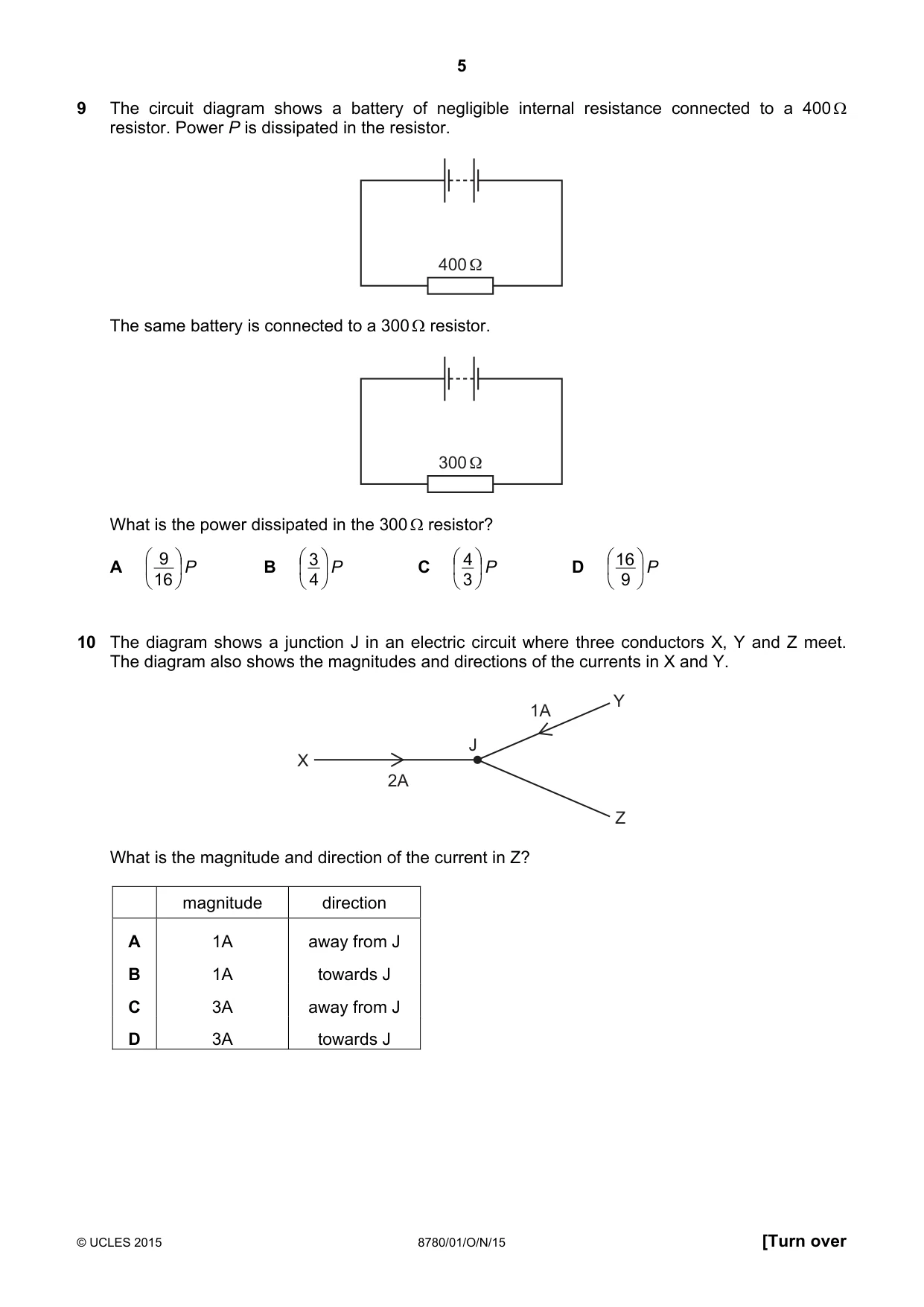
5 © UCLES 2015 8780/01/O/N/15 [Turn over 9 The circuit diagram shows a battery of negligible internal resistance connected to a 400 Ω resistor. Power P is dissipated in the resistor. 400 Ω The same battery is connected to a 300 Ω resistor. 300 Ω What is the power dissipated in the 300 Ω resistor? A ⎟ ⎠ ⎞ ⎜ ⎝ ⎛ 16 9 P B ⎟ ⎠ ⎞ ⎜ ⎝ ⎛ 4 3 P C ⎟ ⎠ ⎞ ⎜ ⎝ ⎛ 3 4 P D ⎟ ⎠ ⎞ ⎜ ⎝ ⎛ 9 16 P 10 The diagram shows a junction J in an electric circuit where three conductors X, Y and Z meet. The diagram also shows the magnitudes and directions of the currents in X and Y. J X Y Z 2A 1A What is the magnitude and direction of the current in Z? magnitude direction A 1A away from J B 1A towards J C 3A away from J D 3A towards J
Question paper, page 6
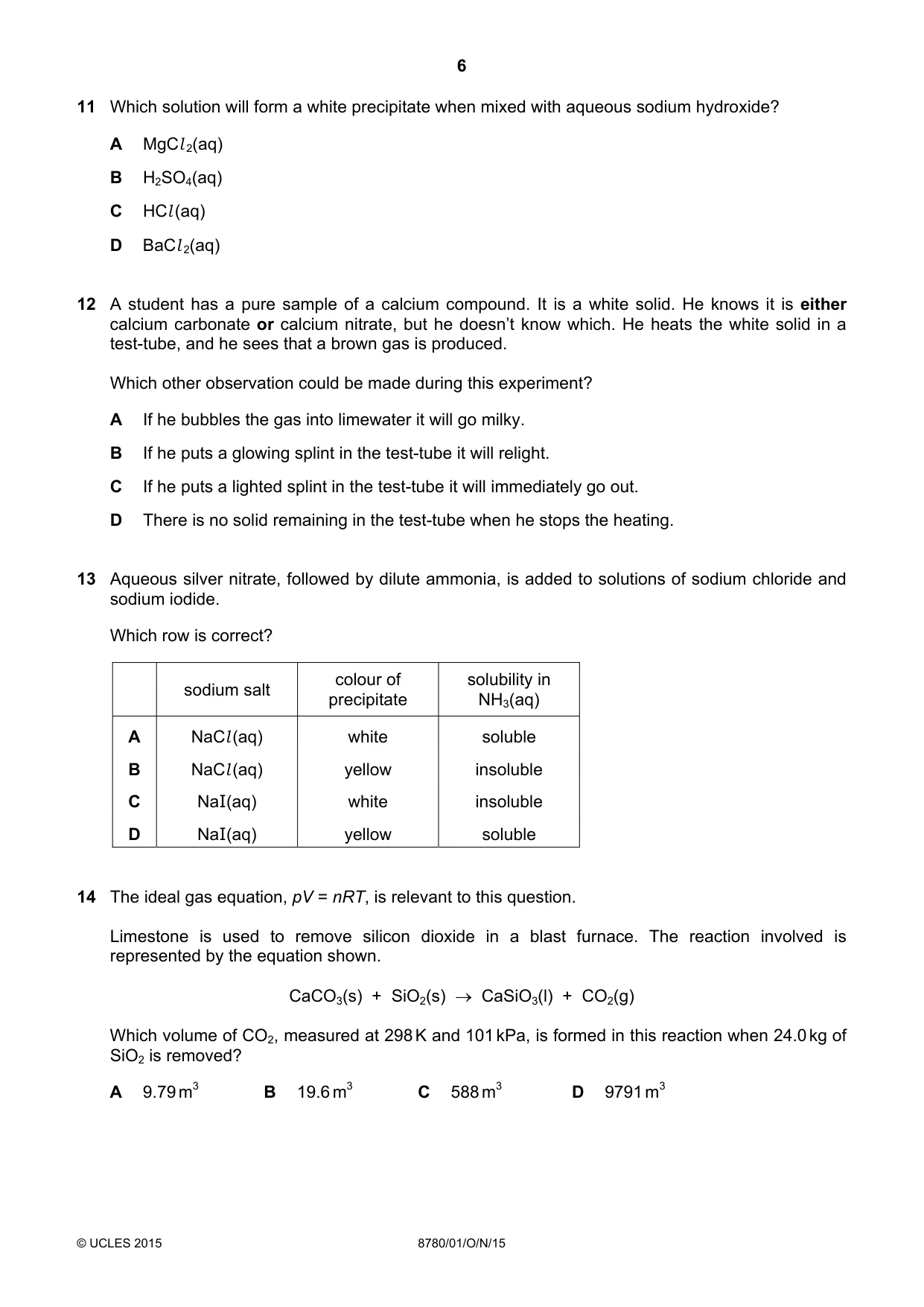
6 © UCLES 2015 8780/01/O/N/15 11 Which solution will form a white precipitate when mixed with aqueous sodium hydroxide? A MgCl 2(aq) B H2SO4(aq) C HCl (aq) D BaCl 2(aq) 12 A student has a pure sample of a calcium compound. It is a white solid. He knows it is either calcium carbonate or calcium nitrate, but he doesn’t know which. He heats the white solid in a test-tube, and he sees that a brown gas is produced. Which other observation could be made during this experiment? A If he bubbles the gas into limewater it will go milky. B If he puts a glowing splint in the test-tube it will relight. C If he puts a lighted splint in the test-tube it will immediately go out. D There is no solid remaining in the test-tube when he stops the heating. 13 Aqueous silver nitrate, followed by dilute ammonia, is added to solutions of sodium chloride and sodium iodide. Which row is correct? sodium salt colour of precipitate solubility in NH3(aq) A NaCl (aq) white soluble B NaCl (aq) yellow insoluble C NaI(aq) white insoluble D NaI(aq) yellow soluble 14 The ideal gas equation, pV = nRT, is relevant to this question. Limestone is used to remove silicon dioxide in a blast furnace. The reaction involved is represented by the equation shown. CaCO3(s) + SiO2(s) → CaSiO3(l) + CO2(g) Which volume of CO2, measured at 298 K and 101 kPa, is formed in this reaction when 24.0 kg of SiO2 is removed? A 9.79 m3 B 19.6 m3 C 588 m3 D 9791 m3
Question paper, page 7
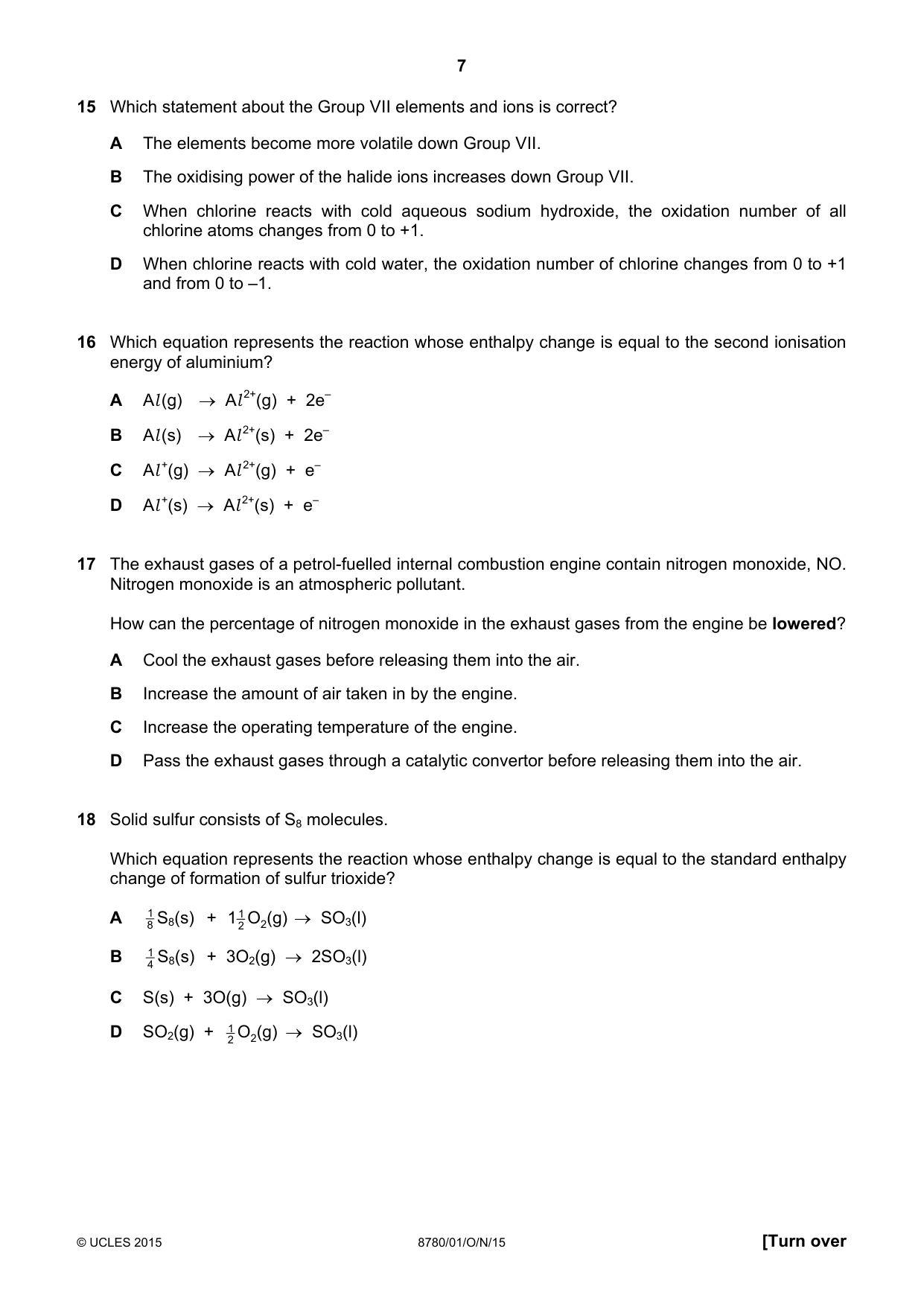
7 © UCLES 2015 8780/01/O/N/15 [Turn over 15 Which statement about the Group VII elements and ions is correct? A The elements become more volatile down Group VII. B The oxidising power of the halide ions increases down Group VII. C When chlorine reacts with cold aqueous sodium hydroxide, the oxidation number of all chlorine atoms changes from 0 to +1. D When chlorine reacts with cold water, the oxidation number of chlorine changes from 0 to +1 and from 0 to –1. 16 Which equation represents the reaction whose enthalpy change is equal to the second ionisation energy of aluminium? A Al (g) → Al 2+(g) + 2e– B Al (s) → Al 2+(s) + 2e– C Al +(g) → Al 2+(g) + e– D Al +(s) → Al 2+(s) + e– 17 The exhaust gases of a petrol-fuelled internal combustion engine contain nitrogen monoxide, NO. Nitrogen monoxide is an atmospheric pollutant. How can the percentage of nitrogen monoxide in the exhaust gases from the engine be lowered? A Cool the exhaust gases before releasing them into the air. B Increase the amount of air taken in by the engine. C Increase the operating temperature of the engine. D Pass the exhaust gases through a catalytic convertor before releasing them into the air. 18 Solid sulfur consists of S8 molecules. Which equation represents the reaction whose enthalpy change is equal to the standard enthalpy change of formation of sulfur trioxide? A (s) S8 8 1 + (g) O 1 2 2 1 → SO3(l) B (s) S8 4 1 + 3O2(g) → 2SO3(l) C S(s) + 3O(g) → SO3(l) D SO2(g) + (g) O2 2 1 → SO3(l)
Question paper, page 8
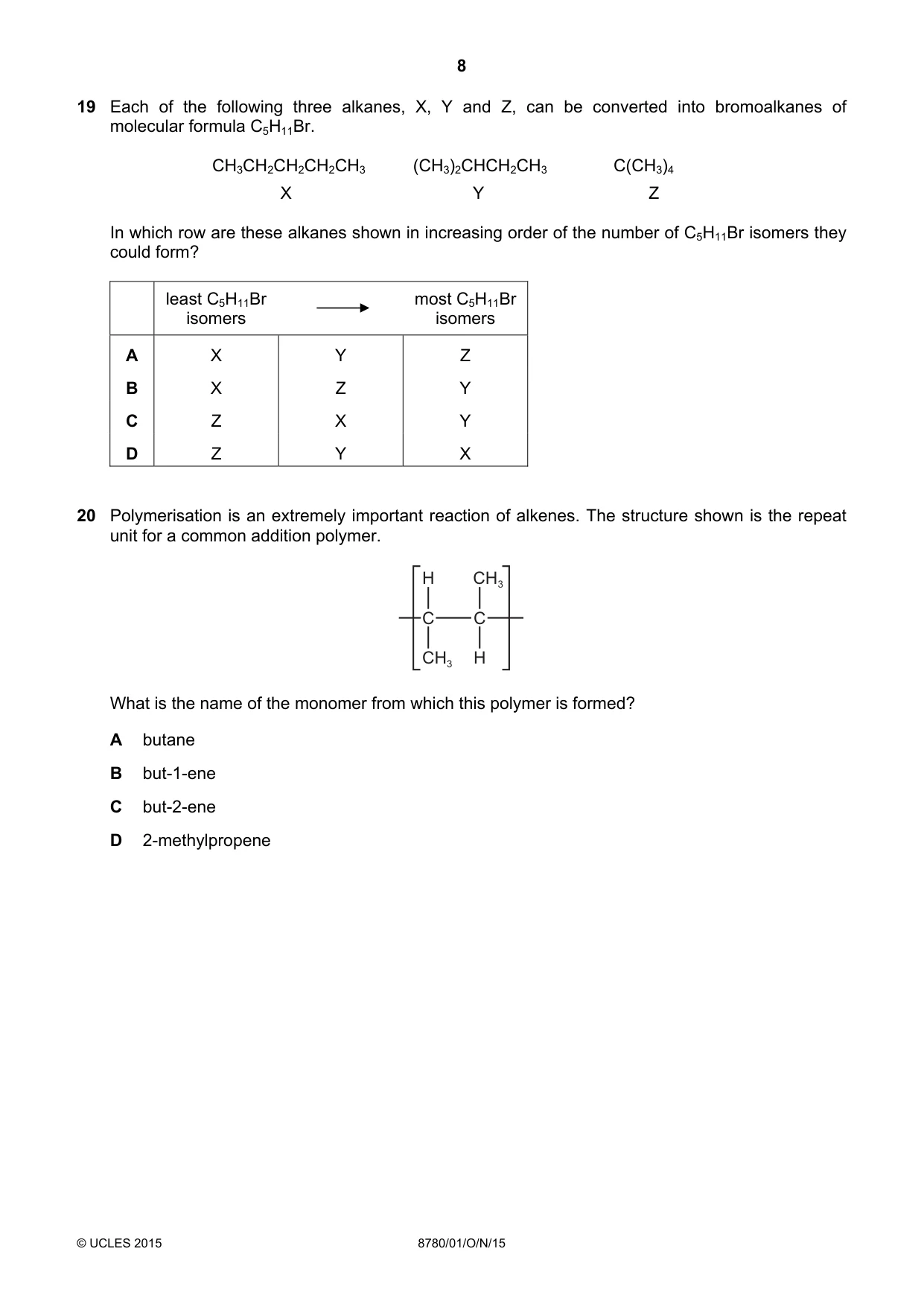
8 © UCLES 2015 8780/01/O/N/15 19 Each of the following three alkanes, X, Y and Z, can be converted into bromoalkanes of molecular formula C5H11Br. CH3CH2CH2CH2CH3 (CH3)2CHCH2CH3 C(CH3)4 X Y Z In which row are these alkanes shown in increasing order of the number of C5H11Br isomers they could form? least C5H11Br isomers most C5H11Br isomers A X Y Z B X Z Y C Z X Y D Z Y X 20 Polymerisation is an extremely important reaction of alkenes. The structure shown is the repeat unit for a common addition polymer. C CH3 H C H CH3 What is the name of the monomer from which this polymer is formed? A butane B but-1-ene C but-2-ene D 2-methylpropene
Question paper, page 9
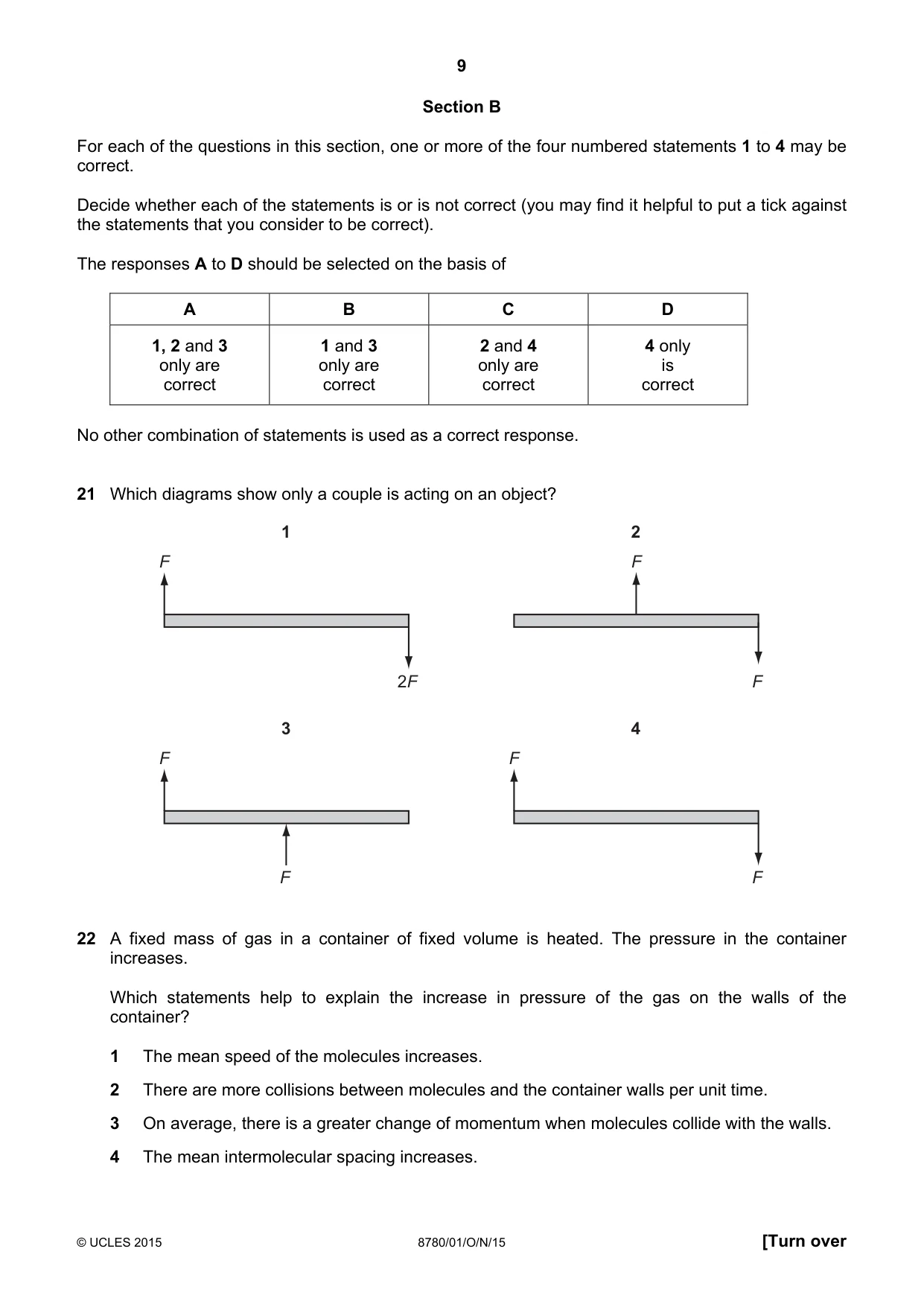
9 © UCLES 2015 8780/01/O/N/15 [Turn over Section B For each of the questions in this section, one or more of the four numbered statements 1 to 4 may be correct. Decide whether each of the statements is or is not correct (you may find it helpful to put a tick against the statements that you consider to be correct). The responses A to D should be selected on the basis of A B C D 1, 2 and 3 only are correct 1 and 3 only are correct 2 and 4 only are correct 4 only is correct No other combination of statements is used as a correct response. 21 Which diagrams show only a couple is acting on an object? 1 F 2F 2 F F 3 F F 4 F F 22 A fixed mass of gas in a container of fixed volume is heated. The pressure in the container increases. Which statements help to explain the increase in pressure of the gas on the walls of the container? 1 The mean speed of the molecules increases. 2 There are more collisions between molecules and the container walls per unit time. 3 On average, there is a greater change of momentum when molecules collide with the walls. 4 The mean intermolecular spacing increases.
Question paper, page 10
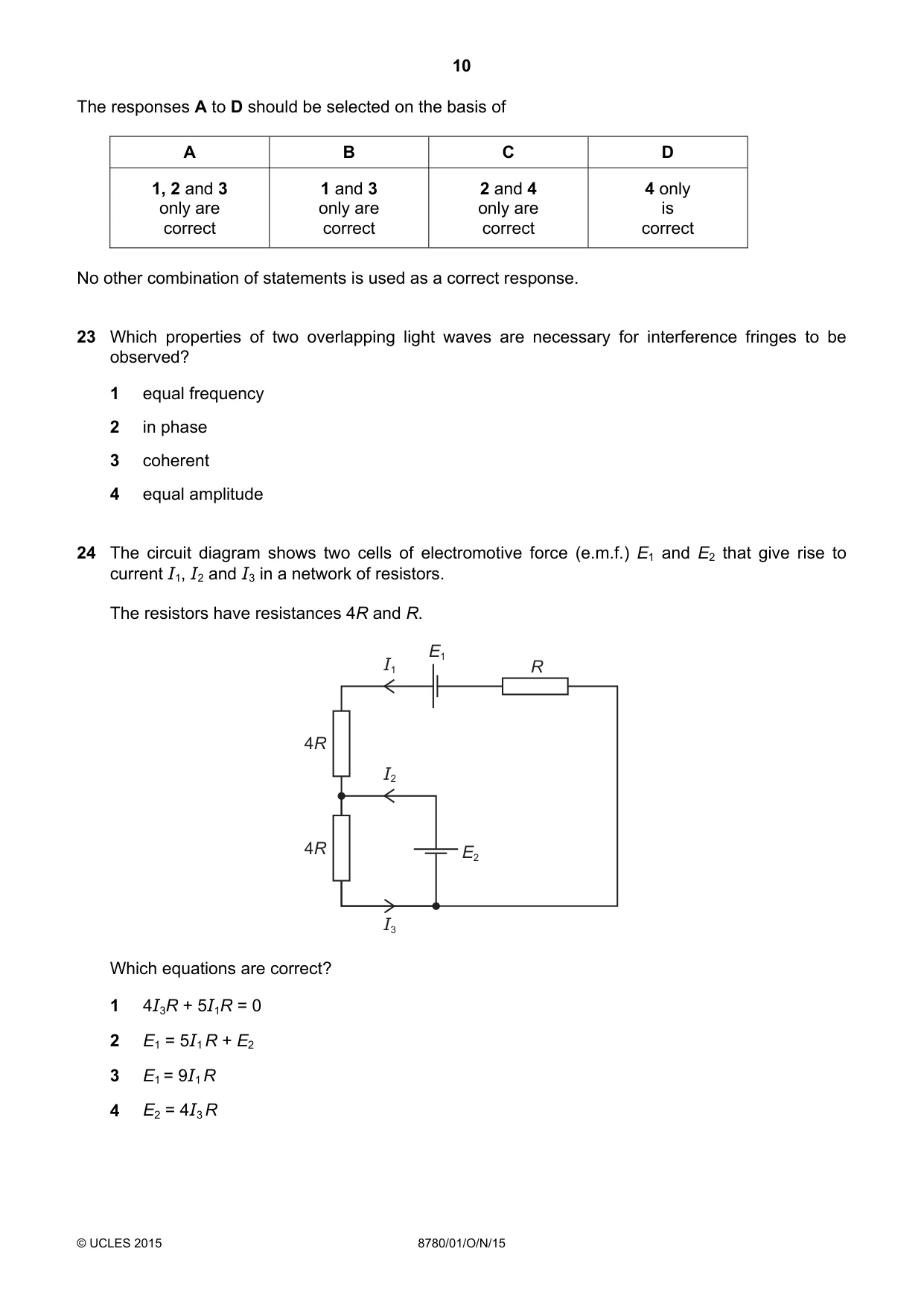
10 © UCLES 2015 8780/01/O/N/15 The responses A to D should be selected on the basis of A B C D 1, 2 and 3 only are correct 1 and 3 only are correct 2 and 4 only are correct 4 only is correct No other combination of statements is used as a correct response. 23 Which properties of two overlapping light waves are necessary for interference fringes to be observed? 1 equal frequency 2 in phase 3 coherent 4 equal amplitude 24 The circuit diagram shows two cells of electromotive force (e.m.f.) E1 and E2 that give rise to current I1, I2 and I3 in a network of resistors. The resistors have resistances 4R and R. 4R 4R R I2 I3 I1 E1 E2 Which equations are correct? 1 4I3R + 5I1R = 0 2 E1 = 5I1 R + E2 3 E1 = 9I1 R 4 E2 = 4I3 R
Question paper, page 11
11 © UCLES 2015 8780/01/O/N/15 [Turn over 25 A sample of radon gas undergoes radioactive decay. Which statements give evidence for the random nature of the decay? 1 The count rate decreases with time. 2 The count rate is not affected by a change in pressure of the sample. 3 The count rate is not affected by a change in temperature of the sample. 4 The count rate fluctuates. 26 Aluminium is extracted from aluminium oxide by electrolysis. Impure copper is purified by electrolysis. Which statements apply to both these industrial processes? 1 The anode is made of a non-metal. 2 The electrolyte is an aqueous solution. 3 The anode remains unchanged throughout the process. 4 Metal ions are reduced at the cathode. 27 A beaker is half-filled with 0.50 mol dm–3 hydrochloric acid. Four large marble chips are added to the beaker and they react with the acid at a steady rate. Marble contains calcium carbonate. The reaction involved is represented by the equation shown. 2H+(aq) + CO3 2–(s) → H2O(l) + CO2(g) The experiment is repeated under identical conditions, except that water is added to the acid at the same time as the four marble chips. The water is at the same temperature as the acid. The rate of reaction is slower than it was in the first experiment. Why is the rate of the reaction slower in the second experiment? 1 The H+ ions in the acid are further apart. 2 Collisions between reacting species are less frequent. 3 There are fewer H+ ions per cm3 of solution. 4 Fewer H+ ions possess the activation energy. 28 Which reactions would give propanoic acid as one of the products? 1 adding Tollens’ reagent to propanone and warming 2 heating propan-2-ol under reflux with acidified potassium dichromate solution 3 adding aqueous NaBH4 to propanal 4 boiling propanenitrile with dilute sulfuric acid
Question paper, page 12
12 Permission to reproduce items where third-party owned material protected by copyright is included has been sought and cleared where possible. Every reasonable effort has been made by the publisher (UCLES) to trace copyright holders, but if any items requiring clearance have unwittingly been included, the publisher will be pleased to make amends at the earliest possible opportunity. To avoid the issue of disclosure of answer-related information to candidates, all copyright acknowledgements are reproduced online in the Cambridge International Examinations Copyright Acknowledgements Booklet. This is produced for each series of examinations and is freely available to download at www.cie.org.uk after the live examination series. Cambridge International Examinations is part of the Cambridge Assessment Group. Cambridge Assessment is the brand name of University of Cambridge Local Examinations Syndicate (UCLES), which is itself a department of the University of Cambridge. © UCLES 2015 8780/01/O/N/15 The responses A to D should be selected on the basis of A B C D 1, 2 and 3 only are correct 1 and 3 only are correct 2 and 4 only are correct 4 only is correct No other combination of statements is used as a correct response. 29 2-bromopropane reacts with sodium hydroxide dissolved in ethanol. Which statements about this reaction are correct? 1 An elimination reaction takes place. 2 Nucleophilic substitution is the only reaction that takes place. 3 The main organic product of the reaction is propene. 4 The main organic product of the reaction is propan-2-ol. 30 Methyl lithium, LiCH3, is a reagent used in organic synthesis. It is thought to react by generating CH3 – ions, which can act as nucleophiles. Which compounds will be attacked by CH3 – ions? 1 ethane 2 bromoethane 3 ethene 4 1-bromo-2-chloroethane
Mark scheme, page 1
® IGCSE is the registered trademark of Cambridge International Examinations. CAMBRIDGE INTERNATIONAL EXAMINATIONS Cambridge International Advanced Subsidiary Level MARK SCHEME for the October/November 2015 series 8780 PHYSICAL SCIENCE 8780/01 Paper 1 (Multiple Choice), maximum raw mark 30 Mark schemes should be read in conjunction with the question paper and the Principal Examiner Report for Teachers. Cambridge will not enter into discussions about these mark schemes. Cambridge is publishing the mark schemes for the October/November 2015 series for most Cambridge IGCSE®, Cambridge International A and AS Level components and some Cambridge O Level components.
Mark scheme, page 2
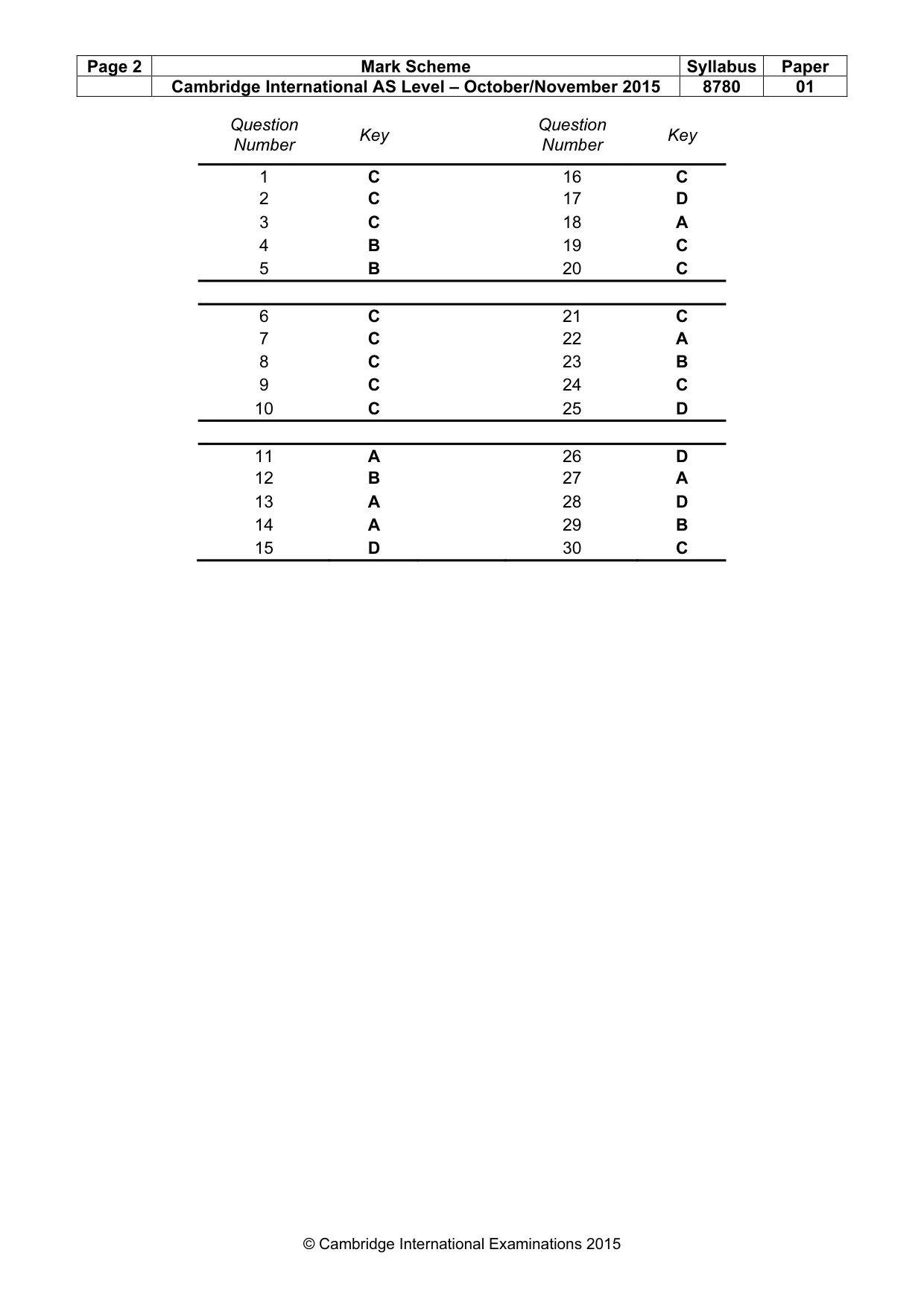
Page 2 Mark Scheme Syllabus Paper Cambridge International AS Level – October/November 2015 8780 01 © Cambridge International Examinations 2015 Question Number Key Question Number Key 1 C 16 C 2 C 17 D 3 C 18 A 4 B 19 C 5 B 20 C 6 C 21 C 7 C 22 A 8 C 23 B 9 C 24 C 10 C 25 D 11 A 26 D 12 B 27 A 13 A 28 D 14 A 29 B 15 D 30 C