Cambridge A Level Physical Education 9396 — 2023 May/June Paper 1 · Variant 1
9396/11/M/J/23 · 90 marks · ≈101 min
The question paper and its mark scheme, free to read here and free to download. This is Cambridge’s own paper, exactly as it was sat.
Question paper8 pages


Mark scheme15 pages
Answers below. Sit the paper first if you are practising.
Paper as text
Question paper, page 1
This document has 8 pages. Any blank pages are indicated. [Turn over Cambridge International AS & A Level * 5 4 7 9 4 2 5 6 7 6 * DC (LE/CT) 312506/2 © UCLES 2023 PHYSICAL EDUCATION 9396/11 Paper 1 May/June 2023 2 hours 30 minutes You must answer on the enclosed answer booklet. You will need: Answer booklet (enclosed) INSTRUCTIONS ● Answer all questions. ● Follow the instructions on the front cover of the answer booklet. If you need additional answer paper, ask the invigilator for a continuation booklet. ● You may use a calculator. ● You should show all your working and use appropriate units. INFORMATION ● The total mark for this paper is 90. ● The number of marks for each question or part question is shown in brackets [ ].
Question paper, page 2
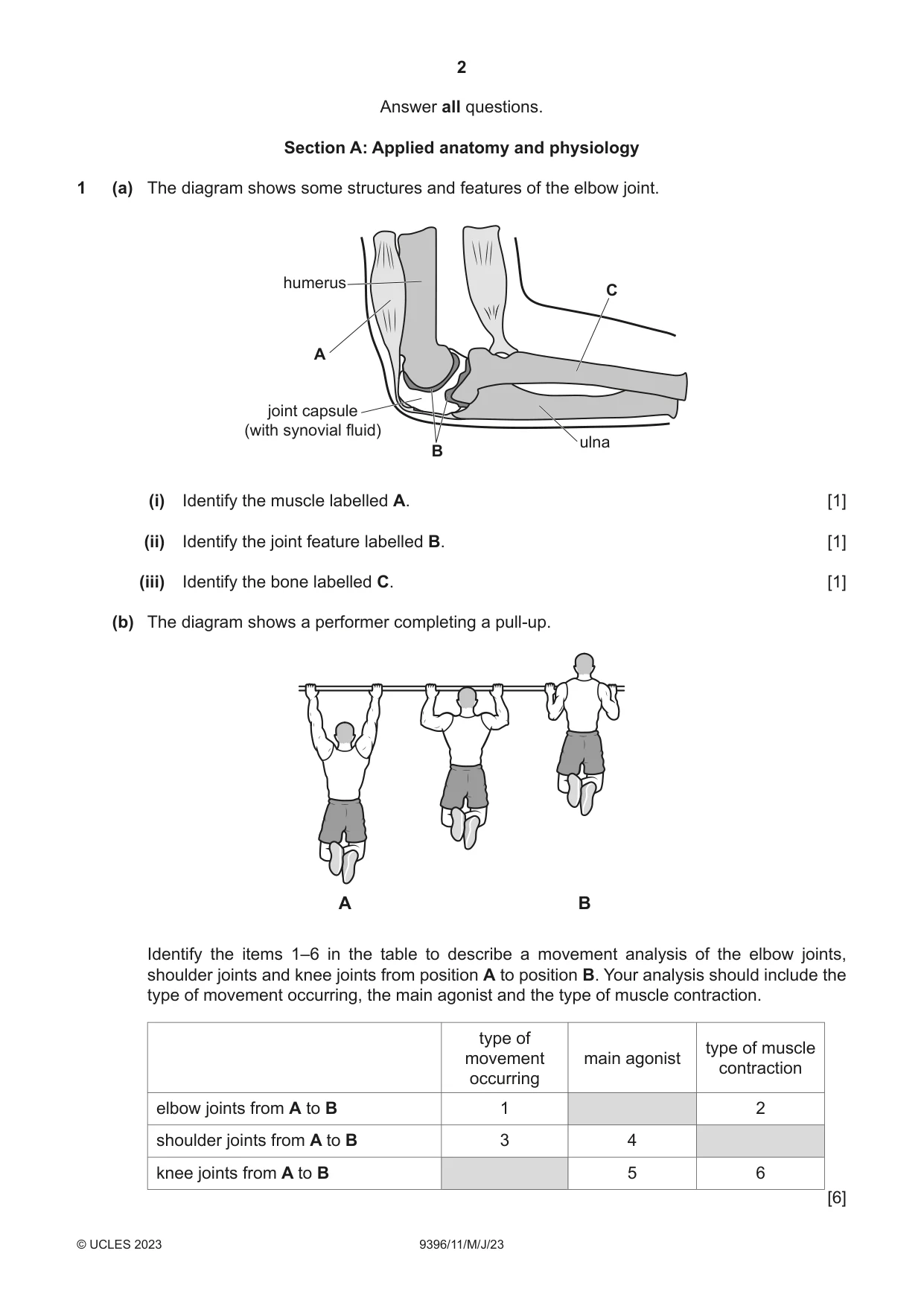
2 9396/11/M/J/23 © UCLES 2023 Answer all questions. Section A: Applied anatomy and physiology 1 (a) The diagram shows some structures and features of the elbow joint. C A humerus joint capsule (with synovial fluid) B ulna (i) Identify the muscle labelled A. [1] (ii) Identify the joint feature labelled B. [1] (iii) Identify the bone labelled C. [1] (b) The diagram shows a performer completing a pull-up. B A Identify the items 1–6 in the table to describe a movement analysis of the elbow joints, shoulder joints and knee joints from position A to position B. Your analysis should include the type of movement occurring, the main agonist and the type of muscle contraction. type of movement occurring main agonist type of muscle contraction elbow joints from A to B 1 2 shoulder joints from A to B 3 4 knee joints from A to B 5 6 [6]
Question paper, page 3
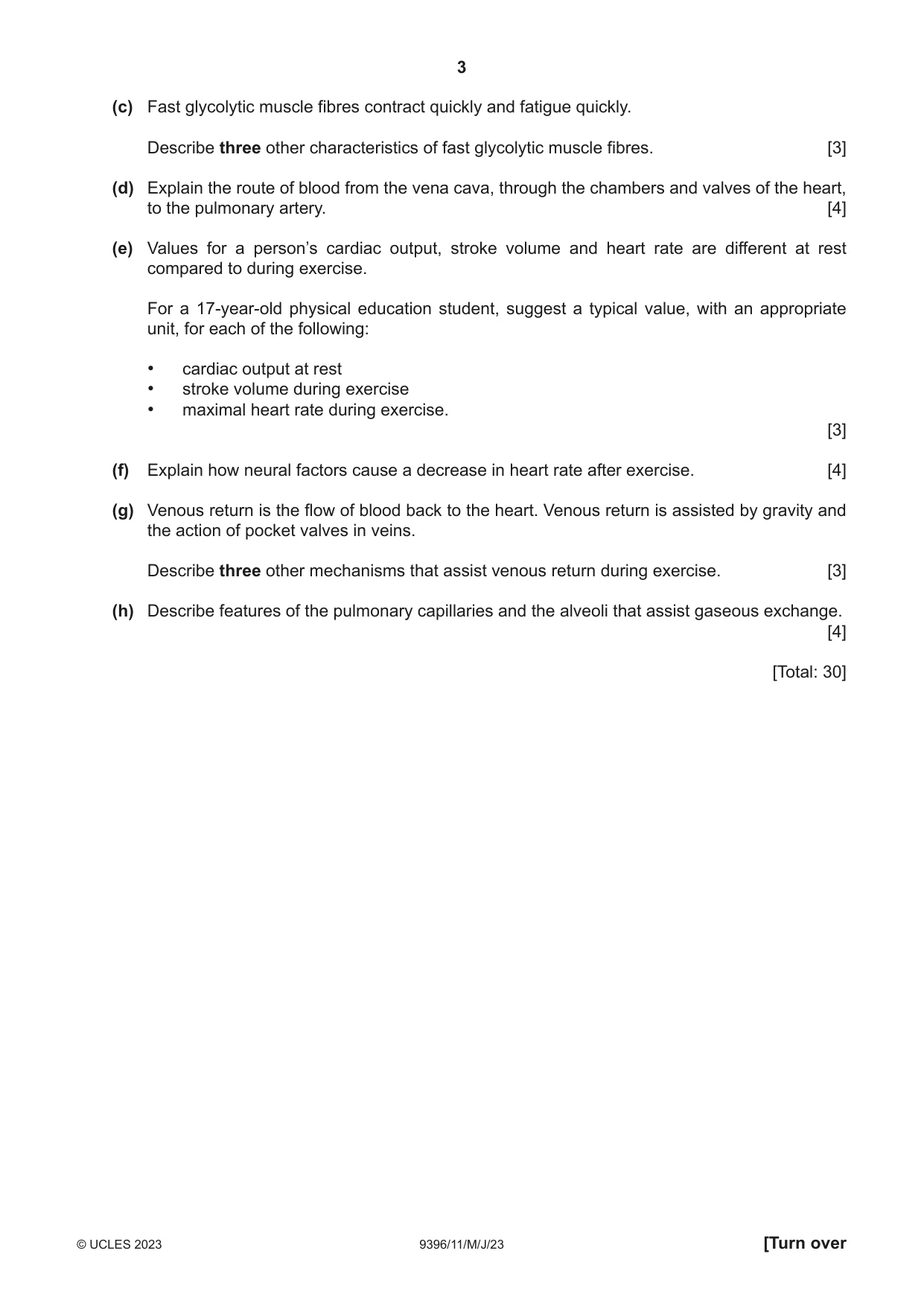
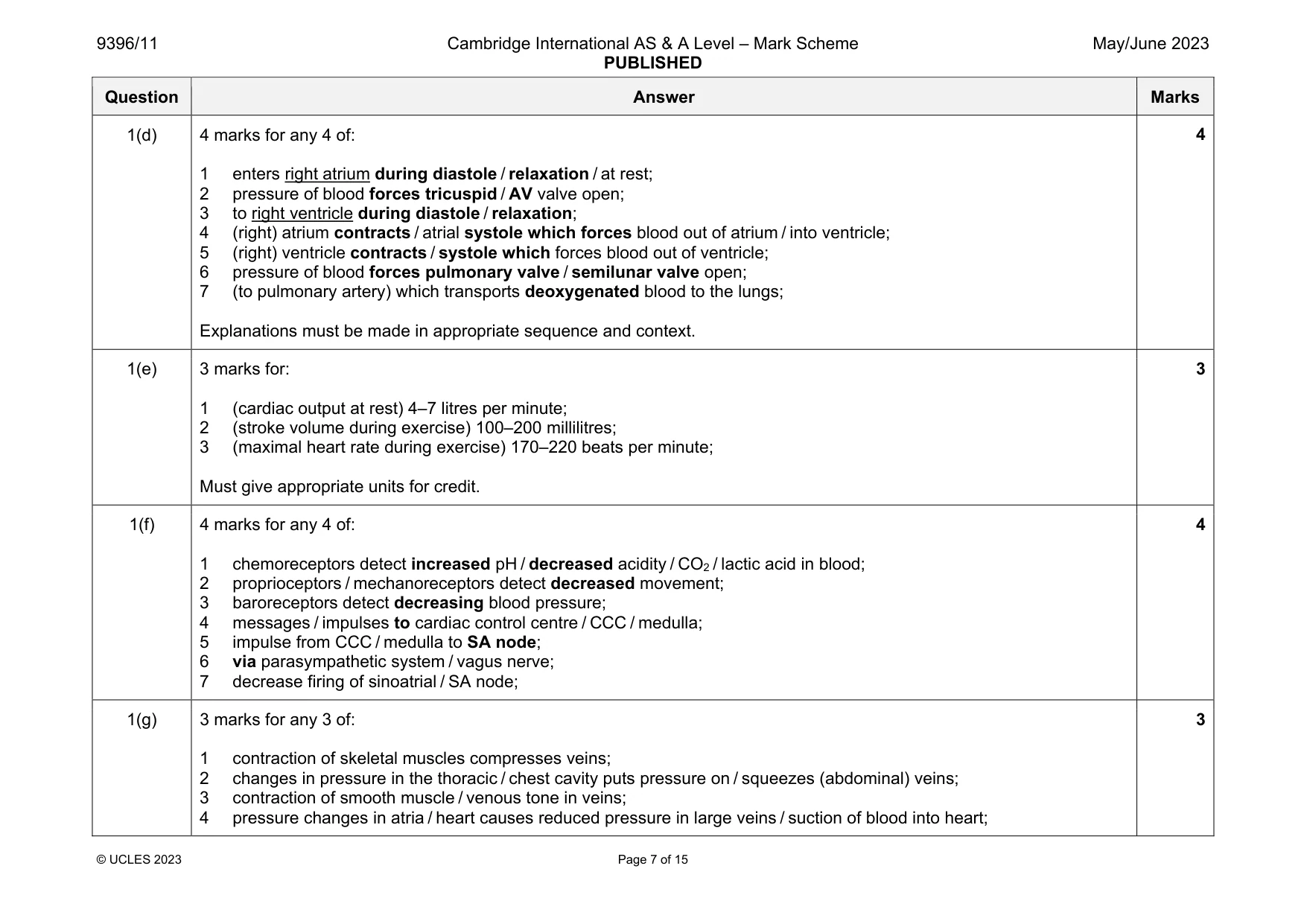
3 9396/11/M/J/23 © UCLES 2023 [Turn over (c) Fast glycolytic muscle fibres contract quickly and fatigue quickly. Describe three other characteristics of fast glycolytic muscle fibres. [3] (d) Explain the route of blood from the vena cava, through the chambers and valves of the heart, to the pulmonary artery. [4] (e) Values for a person’s cardiac output, stroke volume and heart rate are different at rest compared to during exercise. For a 17-year-old physical education student, suggest a typical value, with an appropriate unit, for each of the following: • cardiac output at rest • stroke volume during exercise • maximal heart rate during exercise. [3] (f) Explain how neural factors cause a decrease in heart rate after exercise. [4] (g) Venous return is the flow of blood back to the heart. Venous return is assisted by gravity and the action of pocket valves in veins. Describe three other mechanisms that assist venous return during exercise. [3] (h) Describe features of the pulmonary capillaries and the alveoli that assist gaseous exchange. [4] [Total: 30]
Question paper, page 4
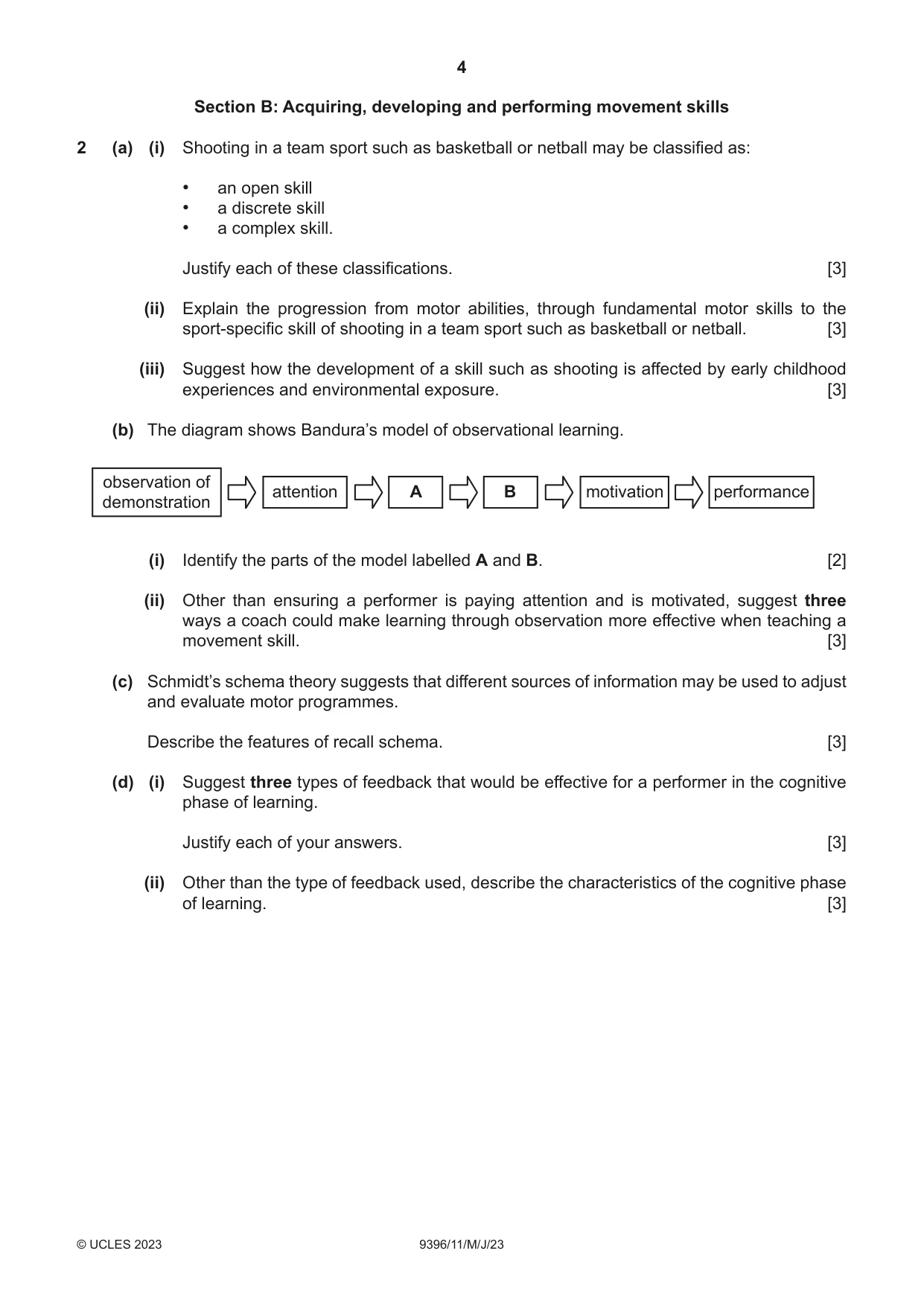
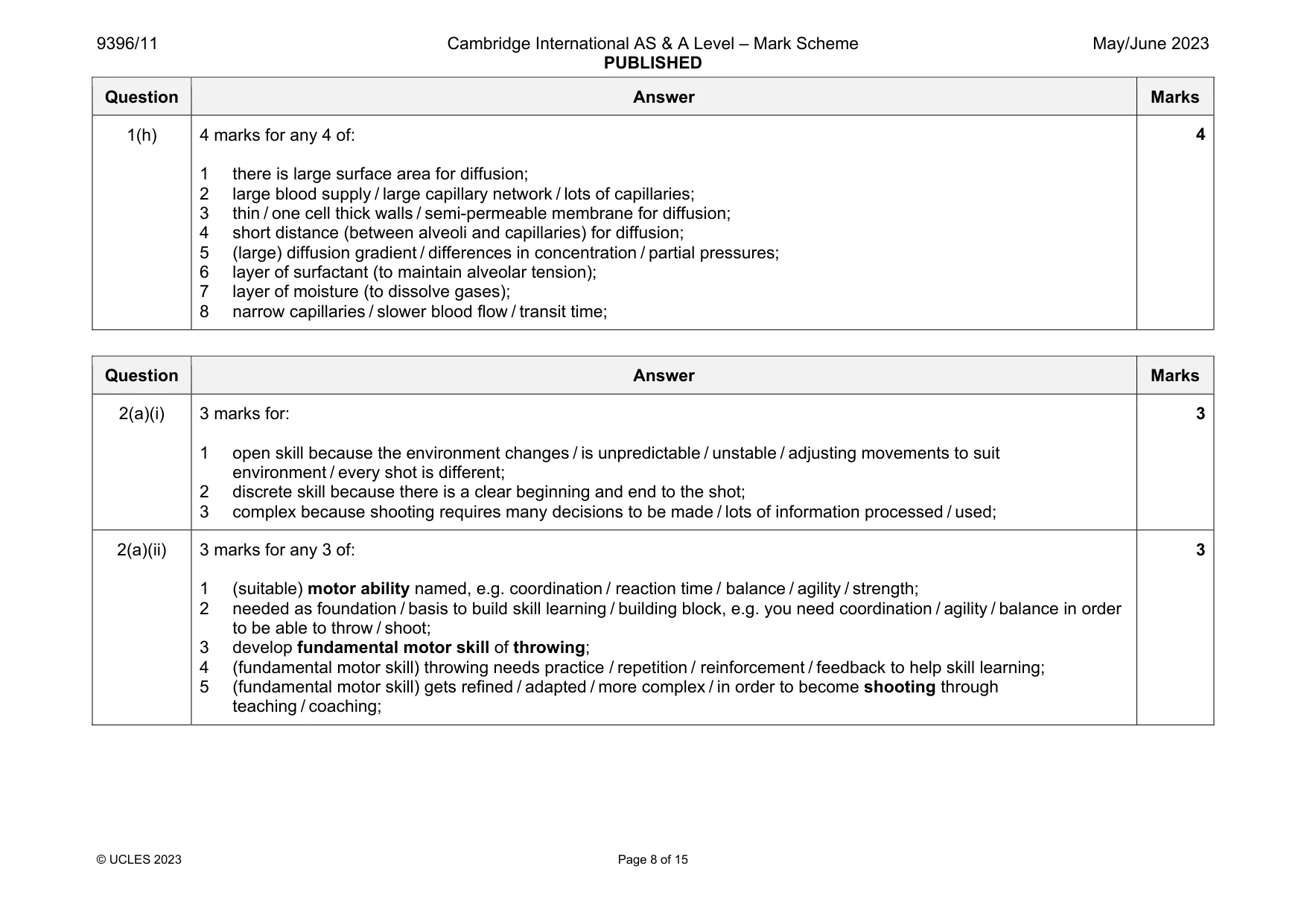
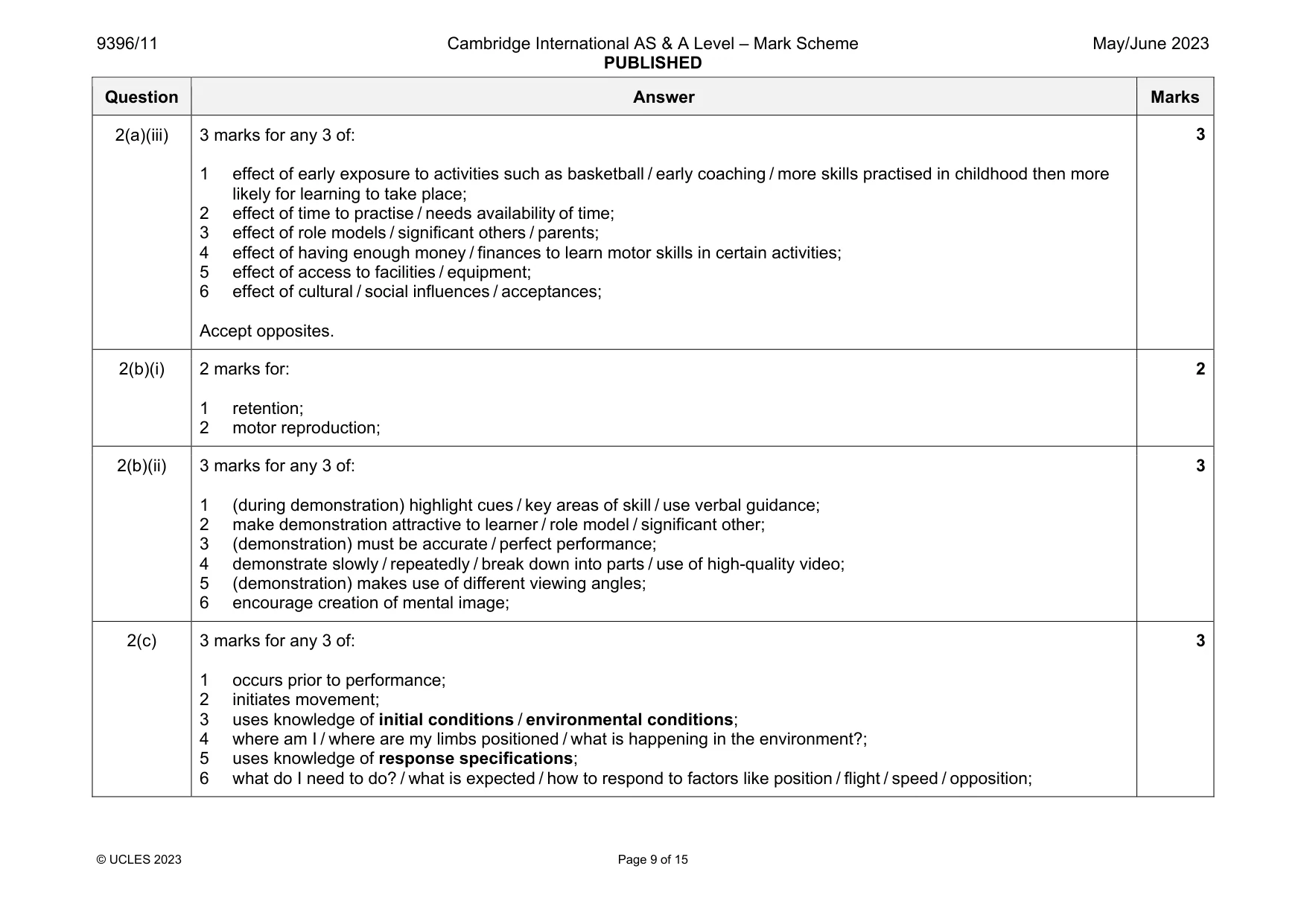
4 9396/11/M/J/23 © UCLES 2023 Section B: Acquiring, developing and performing movement skills 2 (a) (i) Shooting in a team sport such as basketball or netball may be classified as: • an open skill • a discrete skill • a complex skill. Justify each of these classifications. [3] (ii) Explain the progression from motor abilities, through fundamental motor skills to the sport-specific skill of shooting in a team sport such as basketball or netball. [3] (iii) Suggest how the development of a skill such as shooting is affected by early childhood experiences and environmental exposure. [3] (b) The diagram shows Bandura’s model of observational learning. observation of demonstration attention motivation performance A B (i) Identify the parts of the model labelled A and B. [2] (ii) Other than ensuring a performer is paying attention and is motivated, suggest three ways a coach could make learning through observation more effective when teaching a movement skill. [3] (c) Schmidt’s schema theory suggests that different sources of information may be used to adjust and evaluate motor programmes. Describe the features of recall schema. [3] (d) (i) Suggest three types of feedback that would be effective for a performer in the cognitive phase of learning. Justify each of your answers. [3] (ii) Other than the type of feedback used, describe the characteristics of the cognitive phase of learning. [3]
Question paper, page 5
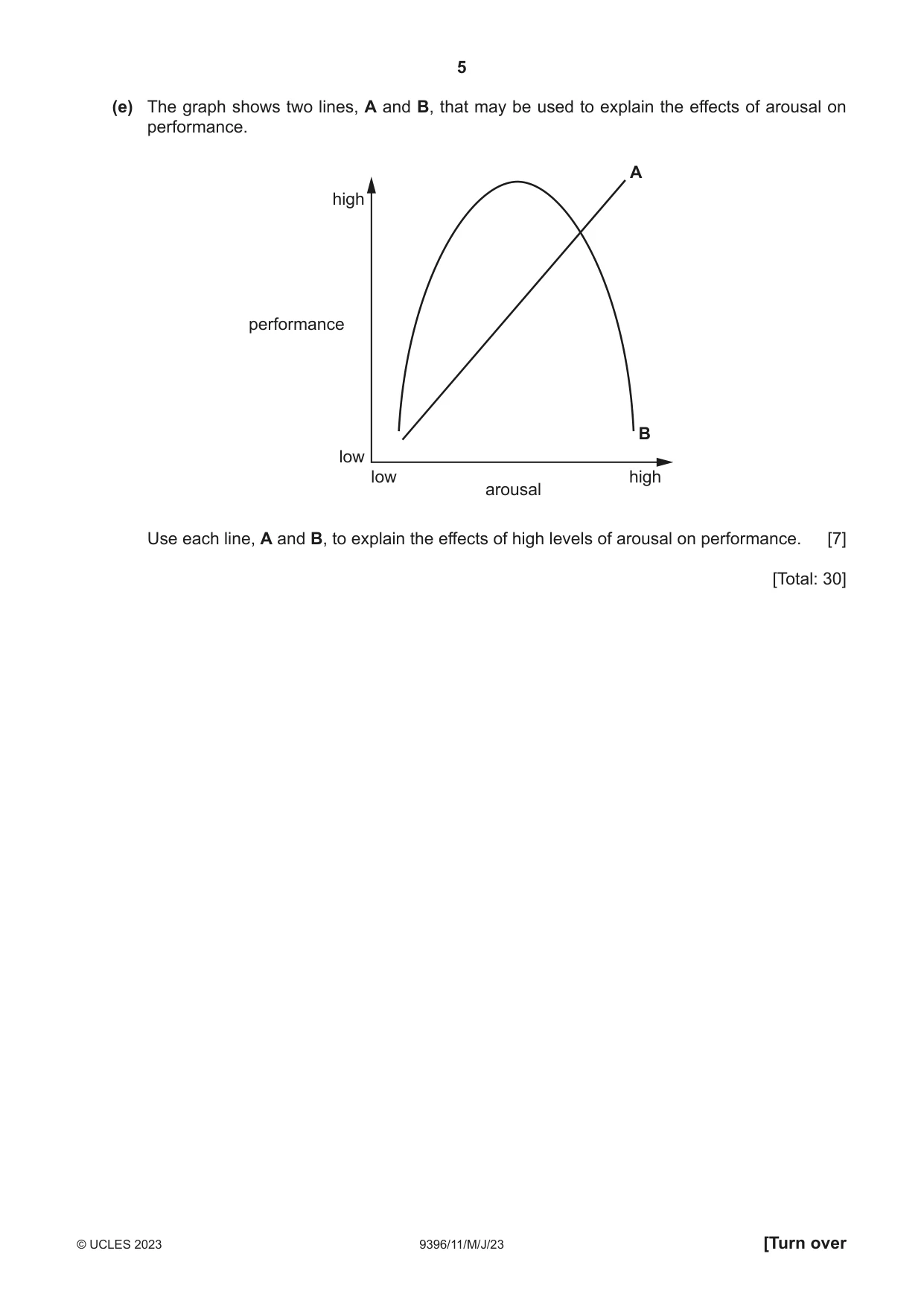
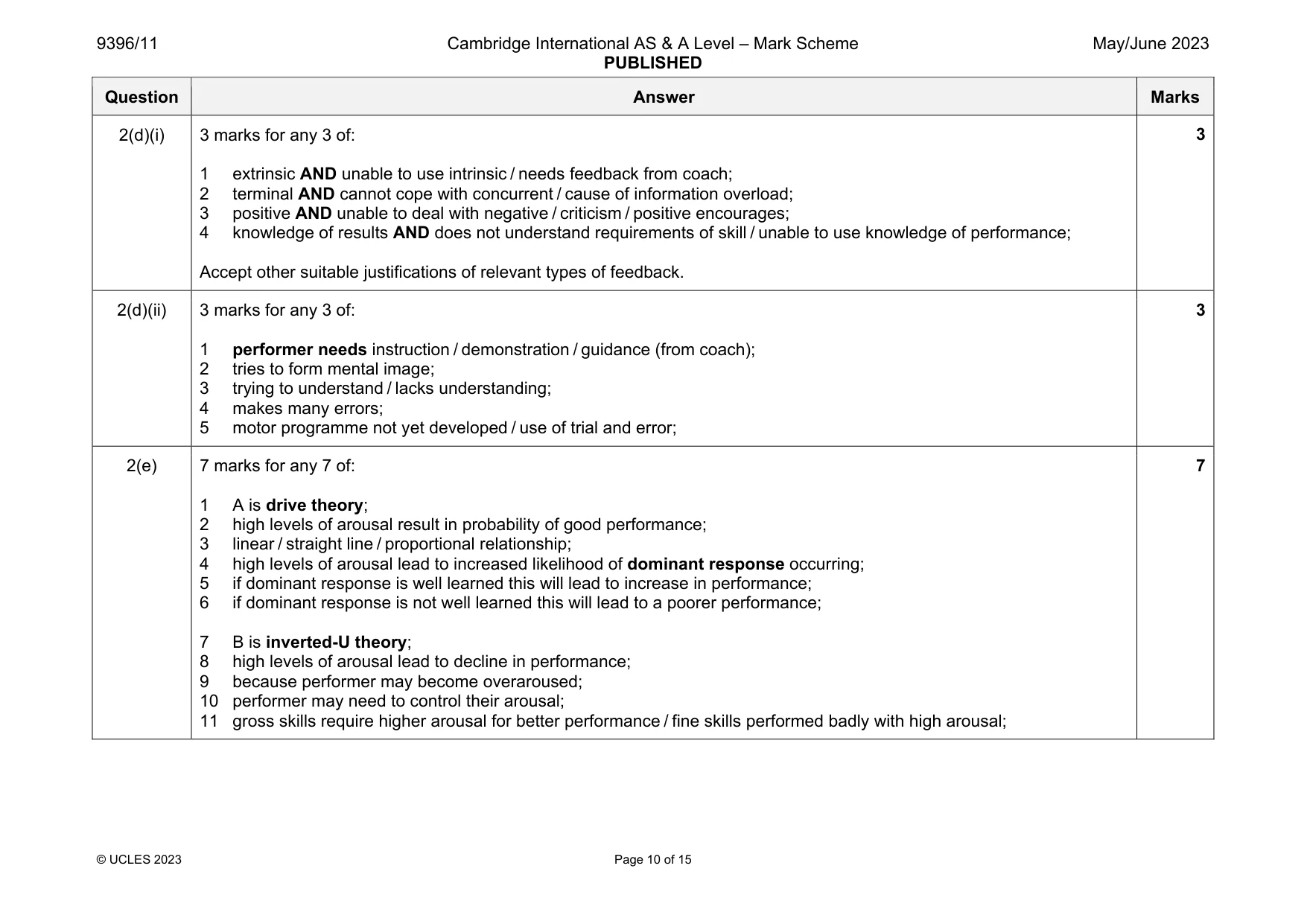
5 9396/11/M/J/23 © UCLES 2023 [Turn over (e) The graph shows two lines, A and B, that may be used to explain the effects of arousal on performance. B A low low high high performance arousal Use each line, A and B, to explain the effects of high levels of arousal on performance. [7] [Total: 30]
Question paper, page 6
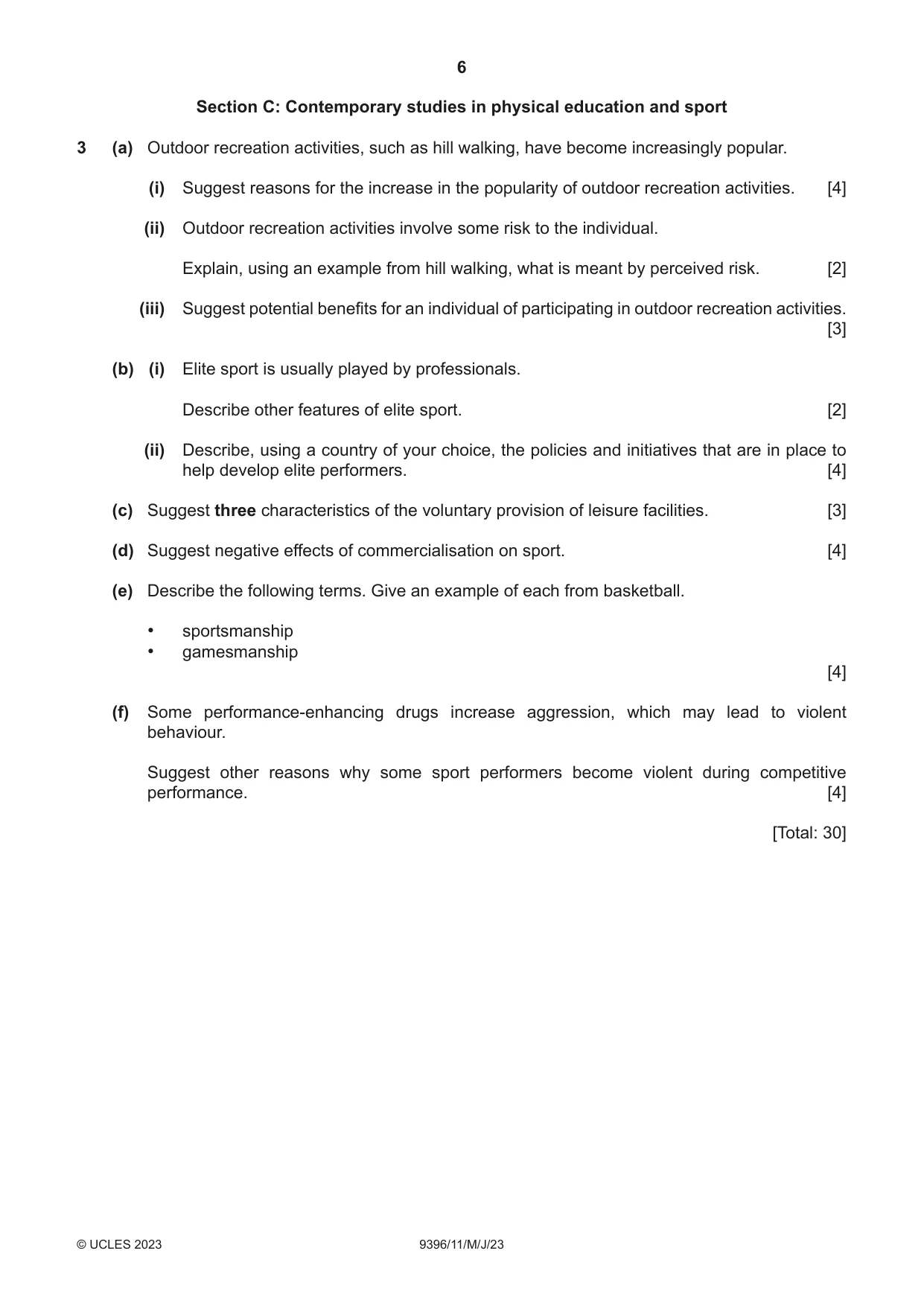
6 9396/11/M/J/23 © UCLES 2023 Section C: Contemporary studies in physical education and sport 3 (a) Outdoor recreation activities, such as hill walking, have become increasingly popular. (i) Suggest reasons for the increase in the popularity of outdoor recreation activities. [4] (ii) Outdoor recreation activities involve some risk to the individual. Explain, using an example from hill walking, what is meant by perceived risk. [2] (iii) Suggest potential benefits for an individual of participating in outdoor recreation activities. [3] (b) (i) Elite sport is usually played by professionals. Describe other features of elite sport. [2] (ii) Describe, using a country of your choice, the policies and initiatives that are in place to help develop elite performers. [4] (c) Suggest three characteristics of the voluntary provision of leisure facilities. [3] (d) Suggest negative effects of commercialisation on sport. [4] (e) Describe the following terms. Give an example of each from basketball. • sportsmanship • gamesmanship [4] (f) Some performance-enhancing drugs increase aggression, which may lead to violent behaviour. Suggest other reasons why some sport performers become violent during competitive performance. [4] [Total: 30]
Question paper, page 7
7 9396/11/M/J/23 © UCLES 2023 BLANK PAGE
Question paper, page 8
8 9396/11/M/J/23 © UCLES 2023 Permission to reproduce items where third-party owned material protected by copyright is included has been sought and cleared where possible. Every reasonable effort has been made by the publisher (UCLES) to trace copyright holders, but if any items requiring clearance have unwittingly been included, the publisher will be pleased to make amends at the earliest possible opportunity. To avoid the issue of disclosure of answer-related information to candidates, all copyright acknowledgements are reproduced online in the Cambridge Assessment International Education Copyright Acknowledgements Booklet. This is produced for each series of examinations and is freely available to download at www.cambridgeinternational.org after the live examination series. Cambridge Assessment International Education is part of Cambridge Assessment. Cambridge Assessment is the brand name of the University of Cambridge Local Examinations Syndicate (UCLES), which is a department of the University of Cambridge. BLANK PAGE
Mark scheme, page 1
This document consists of 15 printed pages. © UCLES 2023 [Turn over Cambridge International AS & A Level PHYSICAL EDUCATION 9396/11 Paper 1 May/June 2023 MARK SCHEME Maximum Mark: 90 Published This mark scheme is published as an aid to teachers and candidates, to indicate the requirements of the examination. It shows the basis on which Examiners were instructed to award marks. It does not indicate the details of the discussions that took place at an Examiners’ meeting before marking began, which would have considered the acceptability of alternative answers. Mark schemes should be read in conjunction with the question paper and the Principal Examiner Report for Teachers. Cambridge International will not enter into discussions about these mark schemes. Cambridge International is publishing the mark schemes for the May/June 2023 series for most Cambridge IGCSE, Cambridge International A and AS Level and Cambridge Pre-U components, and some Cambridge O Level components.
Mark scheme, page 2
9396/11 Cambridge International AS & A Level – Mark Scheme PUBLISHED May/June 2023 © UCLES 2023 Page 2 of 15 Generic Marking Principles These general marking principles must be applied by all examiners when marking candidate answers. They should be applied alongside the specific content of the mark scheme or generic level descriptors for a question. Each question paper and mark scheme will also comply with these marking principles. GENERIC MARKING PRINCIPLE 1: Marks must be awarded in line with: the specific content of the mark scheme or the generic level descriptors for the question the specific skills defined in the mark scheme or in the generic level descriptors for the question the standard of response required by a candidate as exemplified by the standardisation scripts. GENERIC MARKING PRINCIPLE 2: Marks awarded are always whole marks (not half marks, or other fractions). GENERIC MARKING PRINCIPLE 3: Marks must be awarded positively: marks are awarded for correct/valid answers, as defined in the mark scheme. However, credit is given for valid answers which go beyond the scope of the syllabus and mark scheme, referring to your Team Leader as appropriate marks are awarded when candidates clearly demonstrate what they know and can do marks are not deducted for errors marks are not deducted for omissions answers should only be judged on the quality of spelling, punctuation and grammar when these features are specifically assessed by the question as indicated by the mark scheme. The meaning, however, should be unambiguous. GENERIC MARKING PRINCIPLE 4: Rules must be applied consistently, e.g. in situations where candidates have not followed instructions or in the application of generic level descriptors.
Mark scheme, page 3
9396/11 Cambridge International AS & A Level – Mark Scheme PUBLISHED May/June 2023 © UCLES 2023 Page 3 of 15 GENERIC MARKING PRINCIPLE 5: Marks should be awarded using the full range of marks defined in the mark scheme for the question (however; the use of the full mark range may be limited according to the quality of the candidate responses seen). GENERIC MARKING PRINCIPLE 6: Marks awarded are based solely on the requirements as defined in the mark scheme. Marks should not be awarded with grade thresholds or grade descriptors in mind.
Mark scheme, page 4
9396/11 Cambridge International AS & A Level – Mark Scheme PUBLISHED May/June 2023 © UCLES 2023 Page 4 of 15 Science-Specific Marking Principles 1 Examiners should consider the context and scientific use of any keywords when awarding marks. Although keywords may be present, marks should not be awarded if the keywords are used incorrectly. 2 The examiner should not choose between contradictory statements given in the same question part, and credit should not be awarded for any correct statement that is contradicted within the same question part. Wrong science that is irrelevant to the question should be ignored. 3 Although spellings do not have to be correct, spellings of syllabus terms must allow for clear and unambiguous separation from other syllabus terms with which they may be confused (e.g. ethane / ethene, glucagon / glycogen, refraction / reflection). 4 The error carried forward (ecf) principle should be applied, where appropriate. If an incorrect answer is subsequently used in a scientifically correct way, the candidate should be awarded these subsequent marking points. Further guidance will be included in the mark scheme where necessary and any exceptions to this general principle will be noted. 5 ‘List rule’ guidance For questions that require n responses (e.g. State two reasons …): The response should be read as continuous prose, even when numbered answer spaces are provided. Any response marked ignore in the mark scheme should not count towards n. Incorrect responses should not be awarded credit but will still count towards n. Read the entire response to check for any responses that contradict those that would otherwise be credited. Credit should not be awarded for any responses that are contradicted within the rest of the response. Where two responses contradict one another, this should be treated as a single incorrect response. Non-contradictory responses after the first n responses may be ignored even if they include incorrect science.
Mark scheme, page 5
9396/11 Cambridge International AS & A Level – Mark Scheme PUBLISHED May/June 2023 © UCLES 2023 Page 5 of 15 6 Calculation specific guidance Correct answers to calculations should be given full credit even if there is no working or incorrect working, unless the question states ‘show your working’. For questions in which the number of significant figures required is not stated, credit should be awarded for correct answers when rounded by the examiner to the number of significant figures given in the mark scheme. This may not apply to measured values. For answers given in standard form (e.g. a 10n) in which the convention of restricting the value of the coefficient (a) to a value between 1 and 10 is not followed, credit may still be awarded if the answer can be converted to the answer given in the mark scheme. Unless a separate mark is given for a unit, a missing or incorrect unit will normally mean that the final calculation mark is not awarded. Exceptions to this general principle will be noted in the mark scheme. 7 Guidance for chemical equations Multiples / fractions of coefficients used in chemical equations are acceptable unless stated otherwise in the mark scheme. State symbols given in an equation should be ignored unless asked for in the question or stated otherwise in the mark scheme.
Mark scheme, page 6
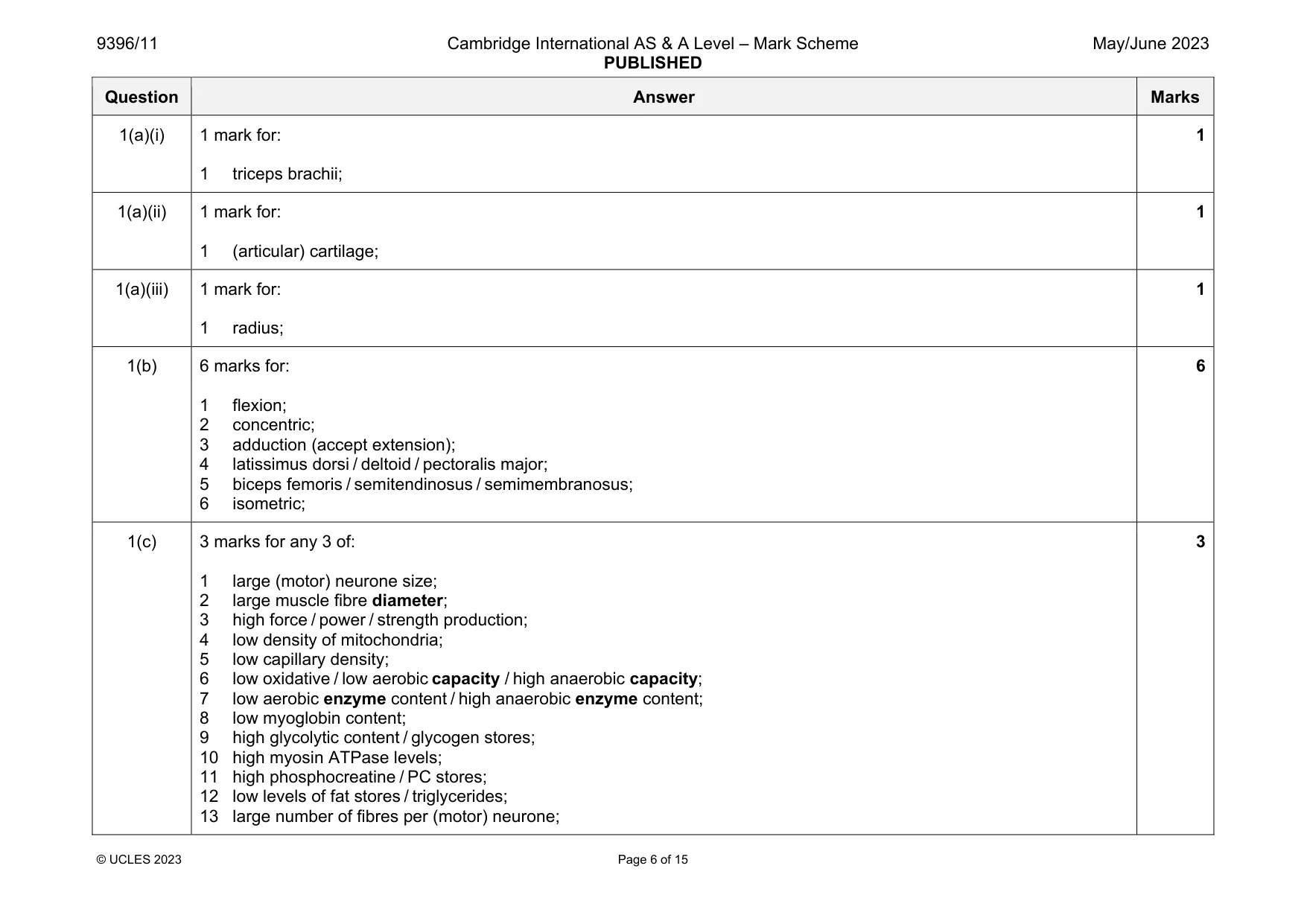
9396/11 Cambridge International AS & A Level – Mark Scheme PUBLISHED May/June 2023 © UCLES 2023 Page 6 of 15 Question Answer Marks 1(a)(i) 1 mark for: 1 triceps brachii; 1 1(a)(ii) 1 mark for: 1 (articular) cartilage; 1 1(a)(iii) 1 mark for: 1 radius; 1 1(b) 6 marks for: 1 flexion; 2 concentric; 3 adduction (accept extension); 4 latissimus dorsi / deltoid / pectoralis major; 5 biceps femoris / semitendinosus / semimembranosus; 6 isometric; 6 1(c) 3 marks for any 3 of: 1 large (motor) neurone size; 2 large muscle fibre diameter; 3 high force / power / strength production; 4 low density of mitochondria; 5 low capillary density; 6 low oxidative / low aerobic capacity / high anaerobic capacity; 7 low aerobic enzyme content / high anaerobic enzyme content; 8 low myoglobin content; 9 high glycolytic content / glycogen stores; 10 high myosin ATPase levels; 11 high phosphocreatine / PC stores; 12 low levels of fat stores / triglycerides; 13 large number of fibres per (motor) neurone; 3
Mark scheme, page 7
9396/11 Cambridge International AS & A Level – Mark Scheme PUBLISHED May/June 2023 © UCLES 2023 Page 7 of 15 Question Answer Marks 1(d) 4 marks for any 4 of: 1 enters right atrium during diastole / relaxation / at rest; 2 pressure of blood forces tricuspid / AV valve open; 3 to right ventricle during diastole / relaxation; 4 (right) atrium contracts / atrial systole which forces blood out of atrium / into ventricle; 5 (right) ventricle contracts / systole which forces blood out of ventricle; 6 pressure of blood forces pulmonary valve / semilunar valve open; 7 (to pulmonary artery) which transports deoxygenated blood to the lungs; Explanations must be made in appropriate sequence and context. 4 1(e) 3 marks for: 1 (cardiac output at rest) 4–7 litres per minute; 2 (stroke volume during exercise) 100–200 millilitres; 3 (maximal heart rate during exercise) 170–220 beats per minute; Must give appropriate units for credit. 3 1(f) 4 marks for any 4 of: 1 chemoreceptors detect increased pH / decreased acidity / CO2 / lactic acid in blood; 2 proprioceptors / mechanoreceptors detect decreased movement; 3 baroreceptors detect decreasing blood pressure; 4 messages / impulses to cardiac control centre / CCC / medulla; 5 impulse from CCC / medulla to SA node; 6 via parasympathetic system / vagus nerve; 7 decrease firing of sinoatrial / SA node; 4 1(g) 3 marks for any 3 of: 1 contraction of skeletal muscles compresses veins; 2 changes in pressure in the thoracic / chest cavity puts pressure on / squeezes (abdominal) veins; 3 contraction of smooth muscle / venous tone in veins; 4 pressure changes in atria / heart causes reduced pressure in large veins / suction of blood into heart; 3
Mark scheme, page 8
9396/11 Cambridge International AS & A Level – Mark Scheme PUBLISHED May/June 2023 © UCLES 2023 Page 8 of 15 Question Answer Marks 1(h) 4 marks for any 4 of: 1 there is large surface area for diffusion; 2 large blood supply / large capillary network / lots of capillaries; 3 thin / one cell thick walls / semi-permeable membrane for diffusion; 4 short distance (between alveoli and capillaries) for diffusion; 5 (large) diffusion gradient / differences in concentration / partial pressures; 6 layer of surfactant (to maintain alveolar tension); 7 layer of moisture (to dissolve gases); 8 narrow capillaries / slower blood flow / transit time; 4 Question Answer Marks 2(a)(i) 3 marks for: 1 open skill because the environment changes / is unpredictable / unstable / adjusting movements to suit environment / every shot is different; 2 discrete skill because there is a clear beginning and end to the shot; 3 complex because shooting requires many decisions to be made / lots of information processed / used; 3 2(a)(ii) 3 marks for any 3 of: 1 (suitable) motor ability named, e.g. coordination / reaction time / balance / agility / strength; 2 needed as foundation / basis to build skill learning / building block, e.g. you need coordination / agility / balance in order to be able to throw / shoot; 3 develop fundamental motor skill of throwing; 4 (fundamental motor skill) throwing needs practice / repetition / reinforcement / feedback to help skill learning; 5 (fundamental motor skill) gets refined / adapted / more complex / in order to become shooting through teaching / coaching; 3
Mark scheme, page 9
9396/11 Cambridge International AS & A Level – Mark Scheme PUBLISHED May/June 2023 © UCLES 2023 Page 9 of 15 Question Answer Marks 2(a)(iii) 3 marks for any 3 of: 1 effect of early exposure to activities such as basketball / early coaching / more skills practised in childhood then more likely for learning to take place; 2 effect of time to practise / needs availability of time; 3 effect of role models / significant others / parents; 4 effect of having enough money / finances to learn motor skills in certain activities; 5 effect of access to facilities / equipment; 6 effect of cultural / social influences / acceptances; Accept opposites. 3 2(b)(i) 2 marks for: 1 retention; 2 motor reproduction; 2 2(b)(ii) 3 marks for any 3 of: 1 (during demonstration) highlight cues / key areas of skill / use verbal guidance; 2 make demonstration attractive to learner / role model / significant other; 3 (demonstration) must be accurate / perfect performance; 4 demonstrate slowly / repeatedly / break down into parts / use of high-quality video; 5 (demonstration) makes use of different viewing angles; 6 encourage creation of mental image; 3 2(c) 3 marks for any 3 of: 1 occurs prior to performance; 2 initiates movement; 3 uses knowledge of initial conditions / environmental conditions; 4 where am I / where are my limbs positioned / what is happening in the environment?; 5 uses knowledge of response specifications; 6 what do I need to do? / what is expected / how to respond to factors like position / flight / speed / opposition; 3
Mark scheme, page 10
9396/11 Cambridge International AS & A Level – Mark Scheme PUBLISHED May/June 2023 © UCLES 2023 Page 10 of 15 Question Answer Marks 2(d)(i) 3 marks for any 3 of: 1 extrinsic AND unable to use intrinsic / needs feedback from coach; 2 terminal AND cannot cope with concurrent / cause of information overload; 3 positive AND unable to deal with negative / criticism / positive encourages; 4 knowledge of results AND does not understand requirements of skill / unable to use knowledge of performance; Accept other suitable justifications of relevant types of feedback. 3 2(d)(ii) 3 marks for any 3 of: 1 performer needs instruction / demonstration / guidance (from coach); 2 tries to form mental image; 3 trying to understand / lacks understanding; 4 makes many errors; 5 motor programme not yet developed / use of trial and error; 3 2(e) 7 marks for any 7 of: 1 A is drive theory; 2 high levels of arousal result in probability of good performance; 3 linear / straight line / proportional relationship; 4 high levels of arousal lead to increased likelihood of dominant response occurring; 5 if dominant response is well learned this will lead to increase in performance; 6 if dominant response is not well learned this will lead to a poorer performance; 7 B is inverted-U theory; 8 high levels of arousal lead to decline in performance; 9 because performer may become overaroused; 10 performer may need to control their arousal; 11 gross skills require higher arousal for better performance / fine skills performed badly with high arousal; 7
Mark scheme, page 11
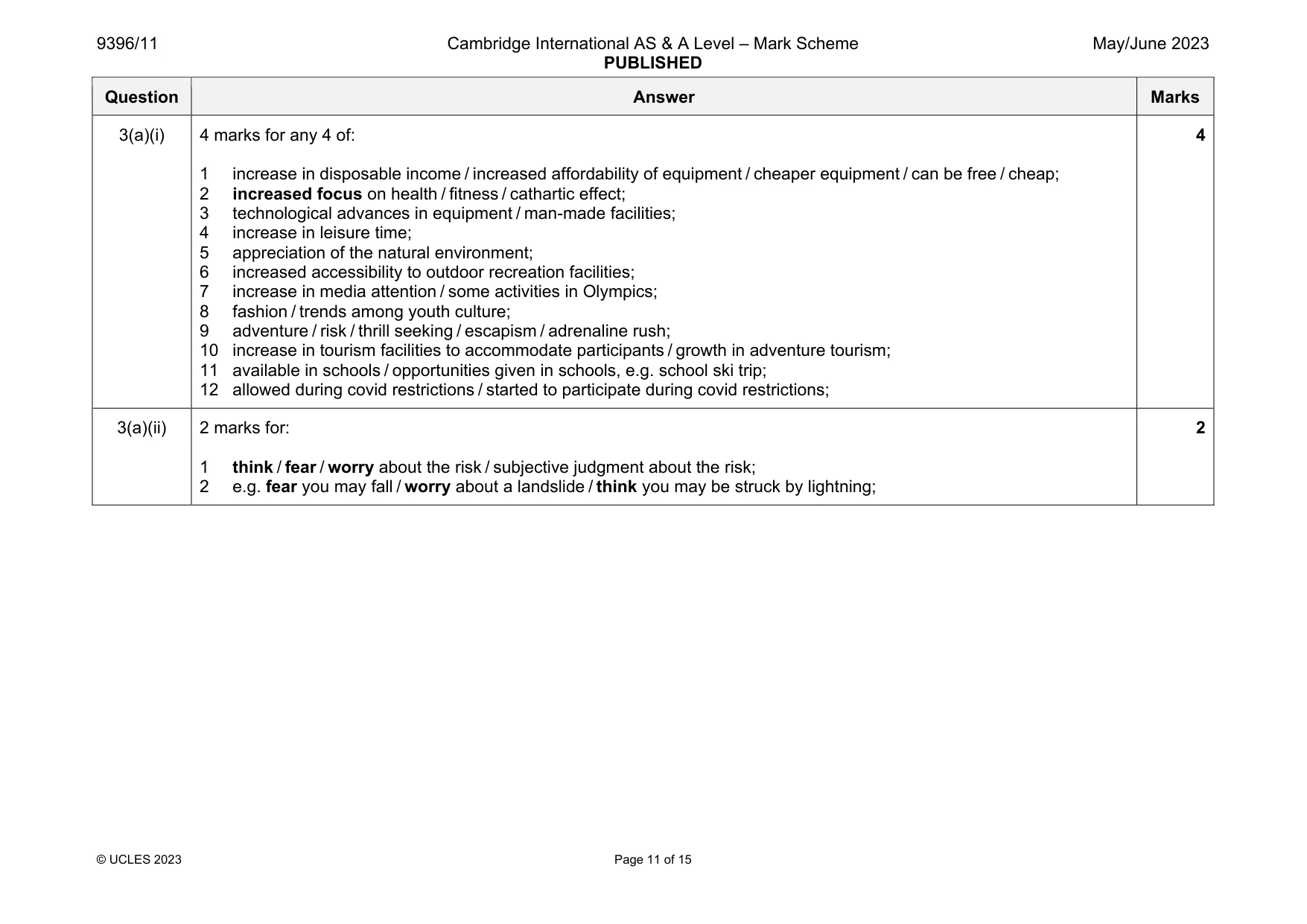
9396/11 Cambridge International AS & A Level – Mark Scheme PUBLISHED May/June 2023 © UCLES 2023 Page 11 of 15 Question Answer Marks 3(a)(i) 4 marks for any 4 of: 1 increase in disposable income / increased affordability of equipment / cheaper equipment / can be free / cheap; 2 increased focus on health / fitness / cathartic effect; 3 technological advances in equipment / man-made facilities; 4 increase in leisure time; 5 appreciation of the natural environment; 6 increased accessibility to outdoor recreation facilities; 7 increase in media attention / some activities in Olympics; 8 fashion / trends among youth culture; 9 adventure / risk / thrill seeking / escapism / adrenaline rush; 10 increase in tourism facilities to accommodate participants / growth in adventure tourism; 11 available in schools / opportunities given in schools, e.g. school ski trip; 12 allowed during covid restrictions / started to participate during covid restrictions; 4 3(a)(ii) 2 marks for: 1 think / fear / worry about the risk / subjective judgment about the risk; 2 e.g. fear you may fall / worry about a landslide / think you may be struck by lightning; 2
Mark scheme, page 12
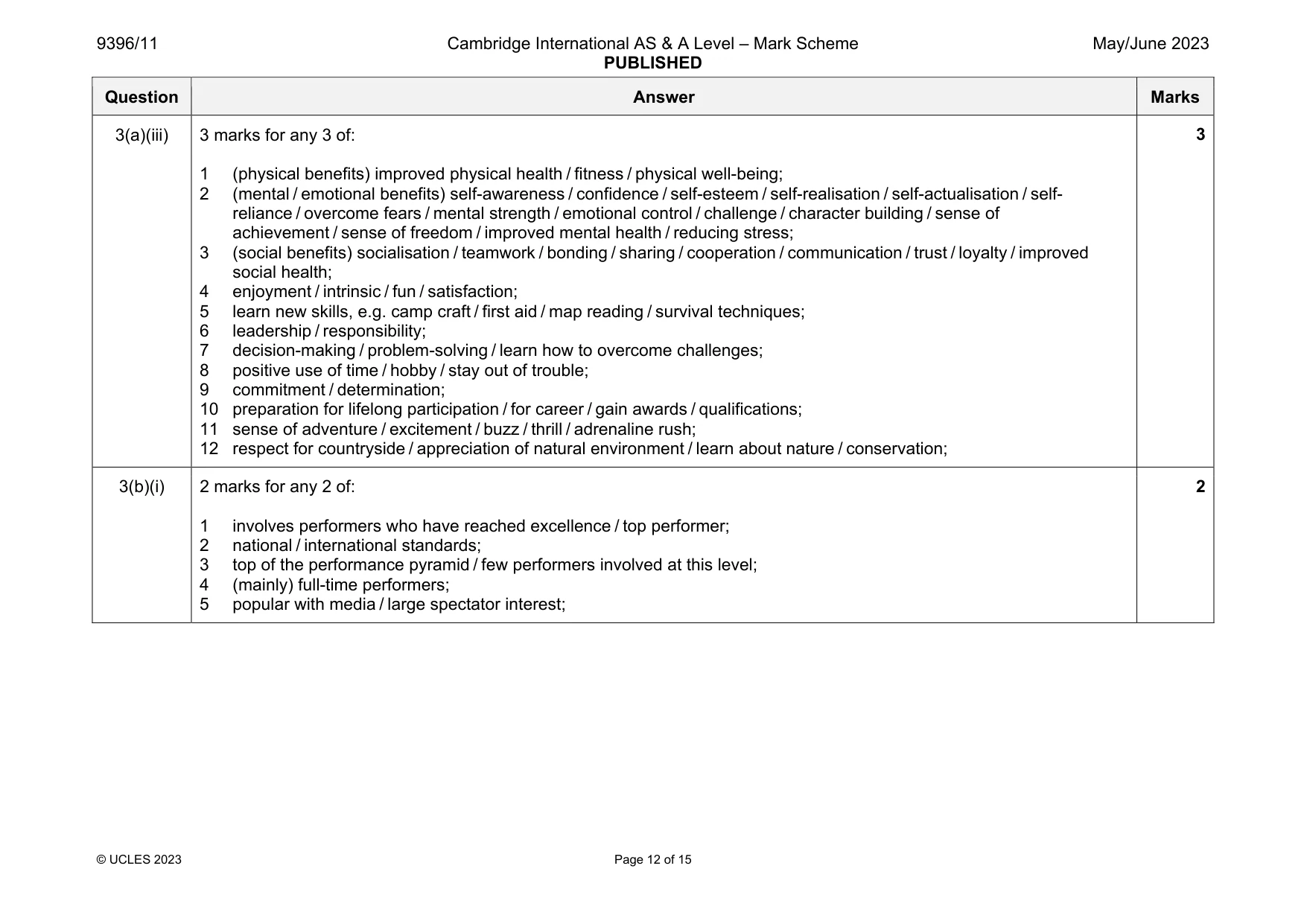
9396/11 Cambridge International AS & A Level – Mark Scheme PUBLISHED May/June 2023 © UCLES 2023 Page 12 of 15 Question Answer Marks 3(a)(iii) 3 marks for any 3 of: 1 (physical benefits) improved physical health / fitness / physical well-being; 2 (mental / emotional benefits) self-awareness / confidence / self-esteem / self-realisation / self-actualisation / self- reliance / overcome fears / mental strength / emotional control / challenge / character building / sense of achievement / sense of freedom / improved mental health / reducing stress; 3 (social benefits) socialisation / teamwork / bonding / sharing / cooperation / communication / trust / loyalty / improved social health; 4 enjoyment / intrinsic / fun / satisfaction; 5 learn new skills, e.g. camp craft / first aid / map reading / survival techniques; 6 leadership / responsibility; 7 decision-making / problem-solving / learn how to overcome challenges; 8 positive use of time / hobby / stay out of trouble; 9 commitment / determination; 10 preparation for lifelong participation / for career / gain awards / qualifications; 11 sense of adventure / excitement / buzz / thrill / adrenaline rush; 12 respect for countryside / appreciation of natural environment / learn about nature / conservation; 3 3(b)(i) 2 marks for any 2 of: 1 involves performers who have reached excellence / top performer; 2 national / international standards; 3 top of the performance pyramid / few performers involved at this level; 4 (mainly) full-time performers; 5 popular with media / large spectator interest; 2
Mark scheme, page 13
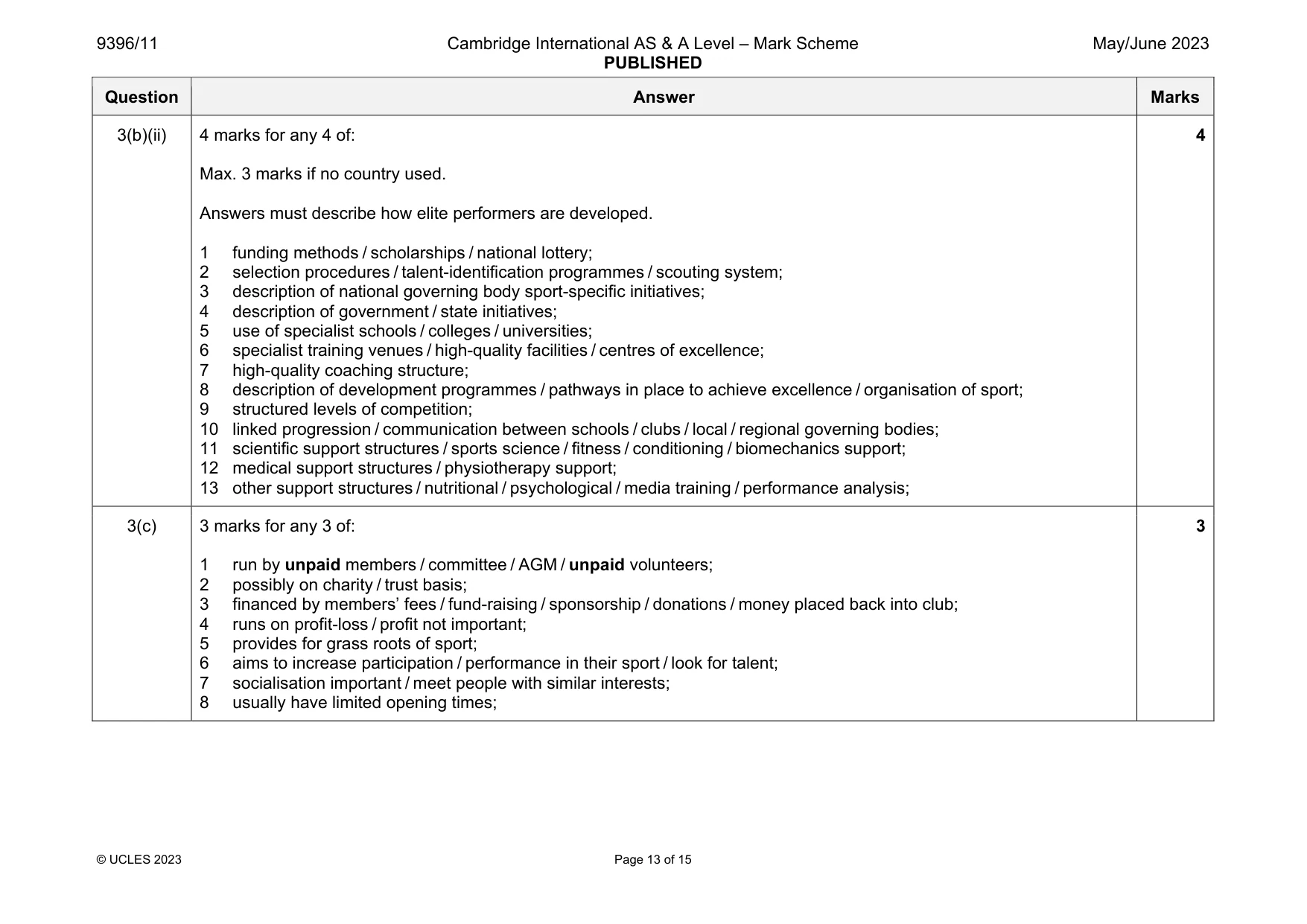
9396/11 Cambridge International AS & A Level – Mark Scheme PUBLISHED May/June 2023 © UCLES 2023 Page 13 of 15 Question Answer Marks 3(b)(ii) 4 marks for any 4 of: Max. 3 marks if no country used. Answers must describe how elite performers are developed. 1 funding methods / scholarships / national lottery; 2 selection procedures / talent-identification programmes / scouting system; 3 description of national governing body sport-specific initiatives; 4 description of government / state initiatives; 5 use of specialist schools / colleges / universities; 6 specialist training venues / high-quality facilities / centres of excellence; 7 high-quality coaching structure; 8 description of development programmes / pathways in place to achieve excellence / organisation of sport; 9 structured levels of competition; 10 linked progression / communication between schools / clubs / local / regional governing bodies; 11 scientific support structures / sports science / fitness / conditioning / biomechanics support; 12 medical support structures / physiotherapy support; 13 other support structures / nutritional / psychological / media training / performance analysis; 4 3(c) 3 marks for any 3 of: 1 run by unpaid members / committee / AGM / unpaid volunteers; 2 possibly on charity / trust basis; 3 financed by members’ fees / fund-raising / sponsorship / donations / money placed back into club; 4 runs on profit-loss / profit not important; 5 provides for grass roots of sport; 6 aims to increase participation / performance in their sport / look for talent; 7 socialisation important / meet people with similar interests; 8 usually have limited opening times; 3
Mark scheme, page 14
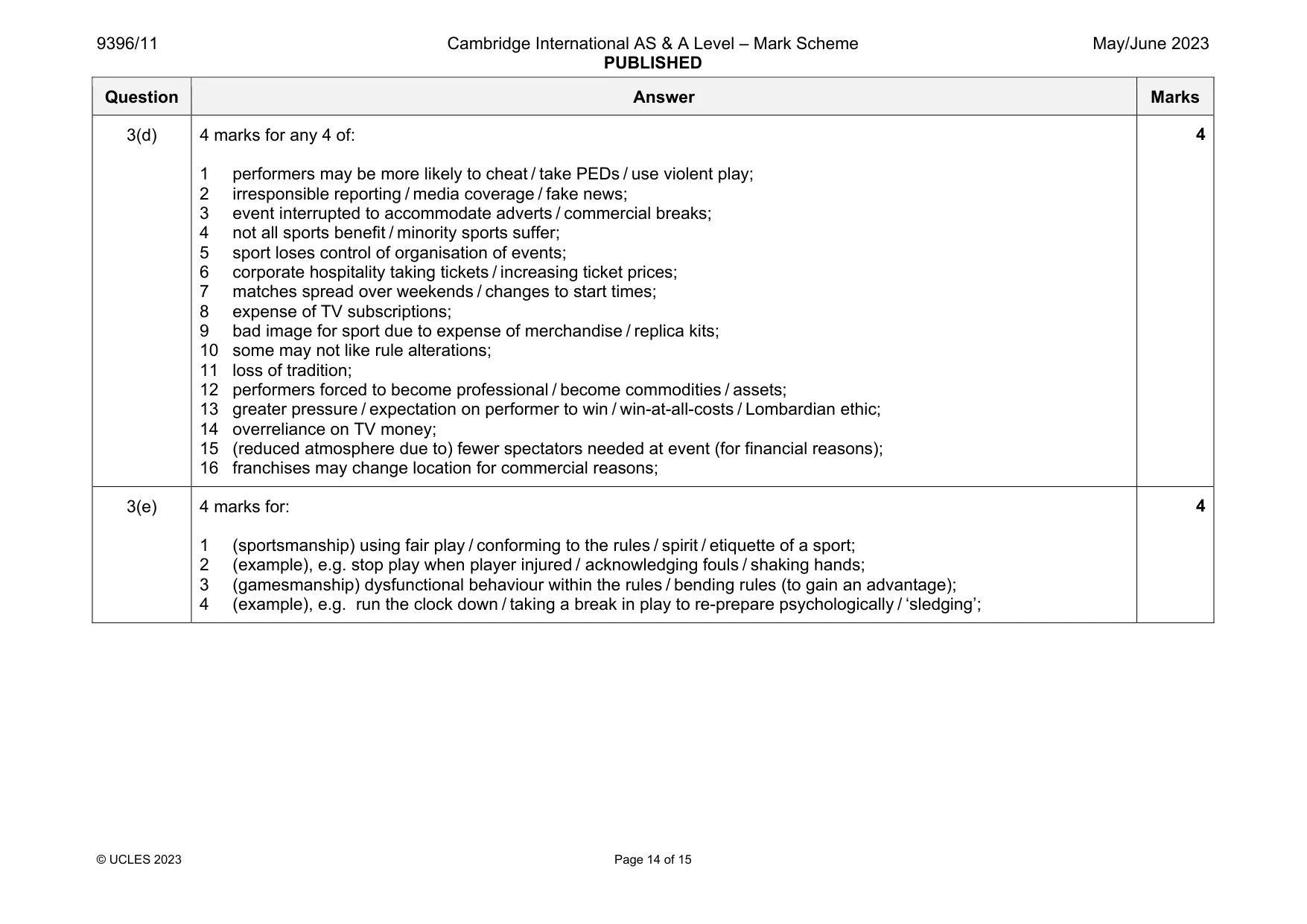
9396/11 Cambridge International AS & A Level – Mark Scheme PUBLISHED May/June 2023 © UCLES 2023 Page 14 of 15 Question Answer Marks 3(d) 4 marks for any 4 of: 1 performers may be more likely to cheat / take PEDs / use violent play; 2 irresponsible reporting / media coverage / fake news; 3 event interrupted to accommodate adverts / commercial breaks; 4 not all sports benefit / minority sports suffer; 5 sport loses control of organisation of events; 6 corporate hospitality taking tickets / increasing ticket prices; 7 matches spread over weekends / changes to start times; 8 expense of TV subscriptions; 9 bad image for sport due to expense of merchandise / replica kits; 10 some may not like rule alterations; 11 loss of tradition; 12 performers forced to become professional / become commodities / assets; 13 greater pressure / expectation on performer to win / win-at-all-costs / Lombardian ethic; 14 overreliance on TV money; 15 (reduced atmosphere due to) fewer spectators needed at event (for financial reasons); 16 franchises may change location for commercial reasons; 4 3(e) 4 marks for: 1 (sportsmanship) using fair play / conforming to the rules / spirit / etiquette of a sport; 2 (example), e.g. stop play when player injured / acknowledging fouls / shaking hands; 3 (gamesmanship) dysfunctional behaviour within the rules / bending rules (to gain an advantage); 4 (example), e.g. run the clock down / taking a break in play to re-prepare psychologically / ‘sledging’; 4
Mark scheme, page 15
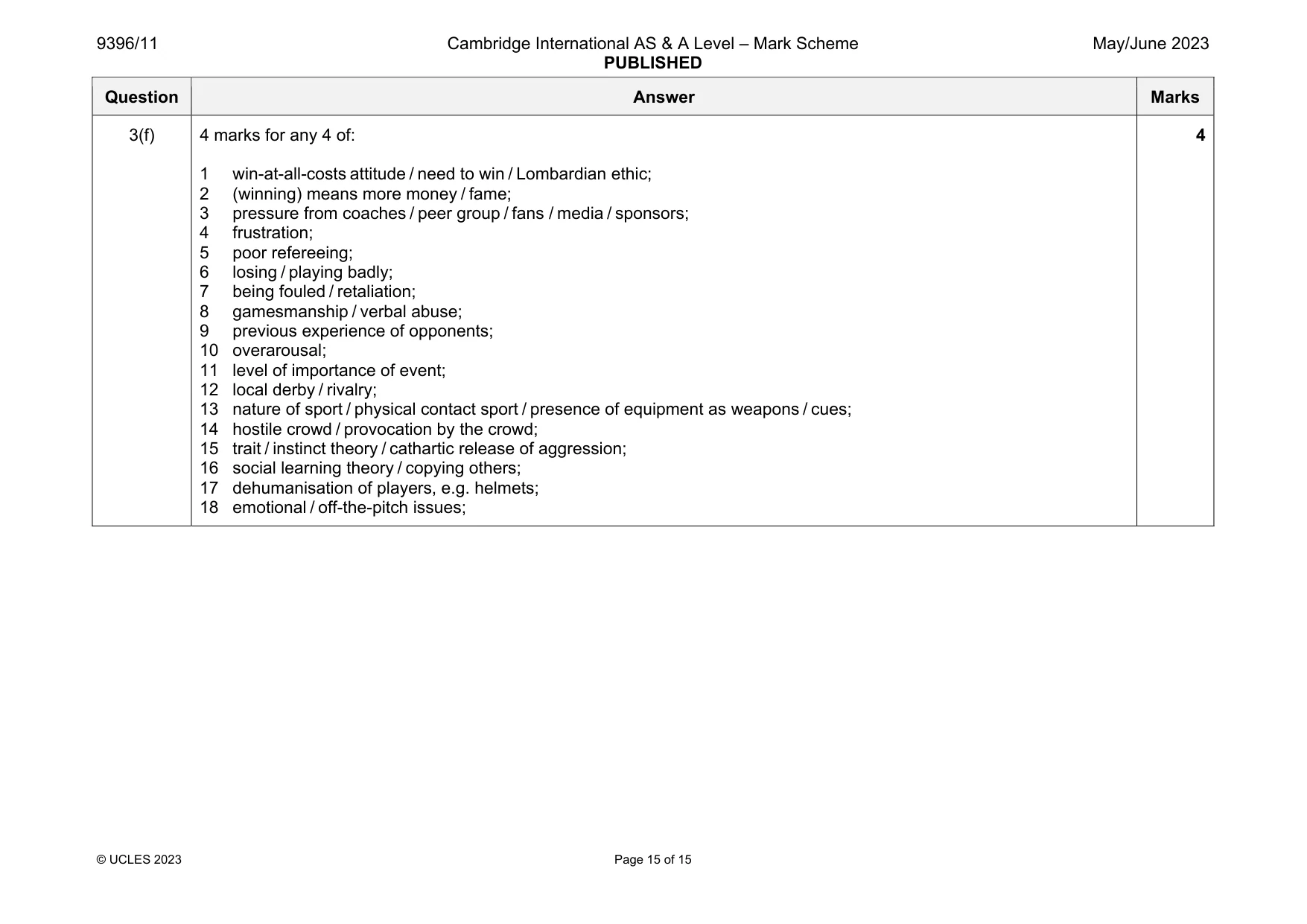
9396/11 Cambridge International AS & A Level – Mark Scheme PUBLISHED May/June 2023 © UCLES 2023 Page 15 of 15 Question Answer Marks 3(f) 4 marks for any 4 of: 1 win-at-all-costs attitude / need to win / Lombardian ethic; 2 (winning) means more money / fame; 3 pressure from coaches / peer group / fans / media / sponsors; 4 frustration; 5 poor refereeing; 6 losing / playing badly; 7 being fouled / retaliation; 8 gamesmanship / verbal abuse; 9 previous experience of opponents; 10 overarousal; 11 level of importance of event; 12 local derby / rivalry; 13 nature of sport / physical contact sport / presence of equipment as weapons / cues; 14 hostile crowd / provocation by the crowd; 15 trait / instinct theory / cathartic release of aggression; 16 social learning theory / copying others; 17 dehumanisation of players, e.g. helmets; 18 emotional / off-the-pitch issues; 4
What you needed in this session
Cambridge’s own grade thresholds for 2023 May/June, Paper 1 · Variant 1. A higher threshold means an easier paper — the bar moves with how the cohort did.