Cambridge A Level Physical Education 9396 — 2022 Oct/Nov Paper 1 · Variant 3
9396/13/O/N/22 · 90 marks · ≈101 min
The question paper and its mark scheme, free to read here and free to download. This is Cambridge’s own paper, exactly as it was sat.
Question paper8 pages


Mark scheme15 pages
Answers below. Sit the paper first if you are practising.
Paper as text
Question paper, page 1
[Turn over DC (NF/SG) 214321/1 © UCLES 2022 This document has 8 pages. Any blank pages are indicated. * 6 1 8 2 6 2 7 1 4 9 * PHYSICAL EDUCATION 9396/13 Paper 1 October/November 2022 2 hours 30 minutes You must answer on the enclosed answer booklet. You will need: Answer booklet (enclosed) INSTRUCTIONS ● Answer all questions. ● Follow the instructions on the front cover of the answer booklet. If you need additional answer paper, ask the invigilator for a continuation booklet. ● You may use a calculator. ● You should show all your working and use appropriate units. INFORMATION ● The total mark for this paper is 90. ● The number of marks for each question or part question is shown in brackets [ ]. Cambridge International AS & A Level
Question paper, page 2
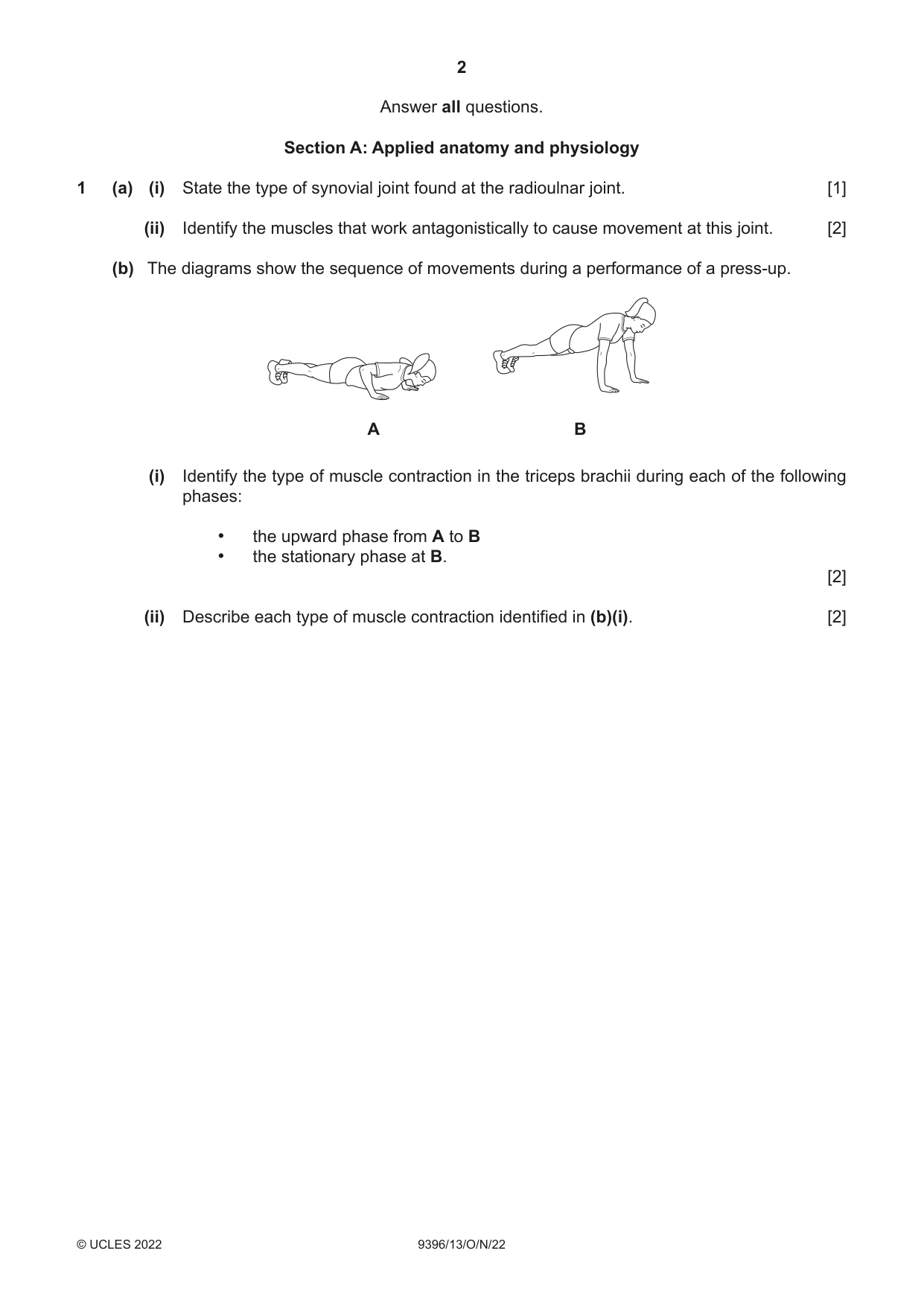
2 9396/13/O/N/22 © UCLES 2022 Answer all questions. Section A: Applied anatomy and physiology 1 (a) (i) State the type of synovial joint found at the radioulnar joint. [1] (ii) Identify the muscles that work antagonistically to cause movement at this joint. [2] (b) The diagrams show the sequence of movements during a performance of a press-up. A B (i) Identify the type of muscle contraction in the triceps brachii during each of the following phases: • the upward phase from A to B • the stationary phase at B. [2] (ii) Describe each type of muscle contraction identified in (b)(i). [2]
Question paper, page 3
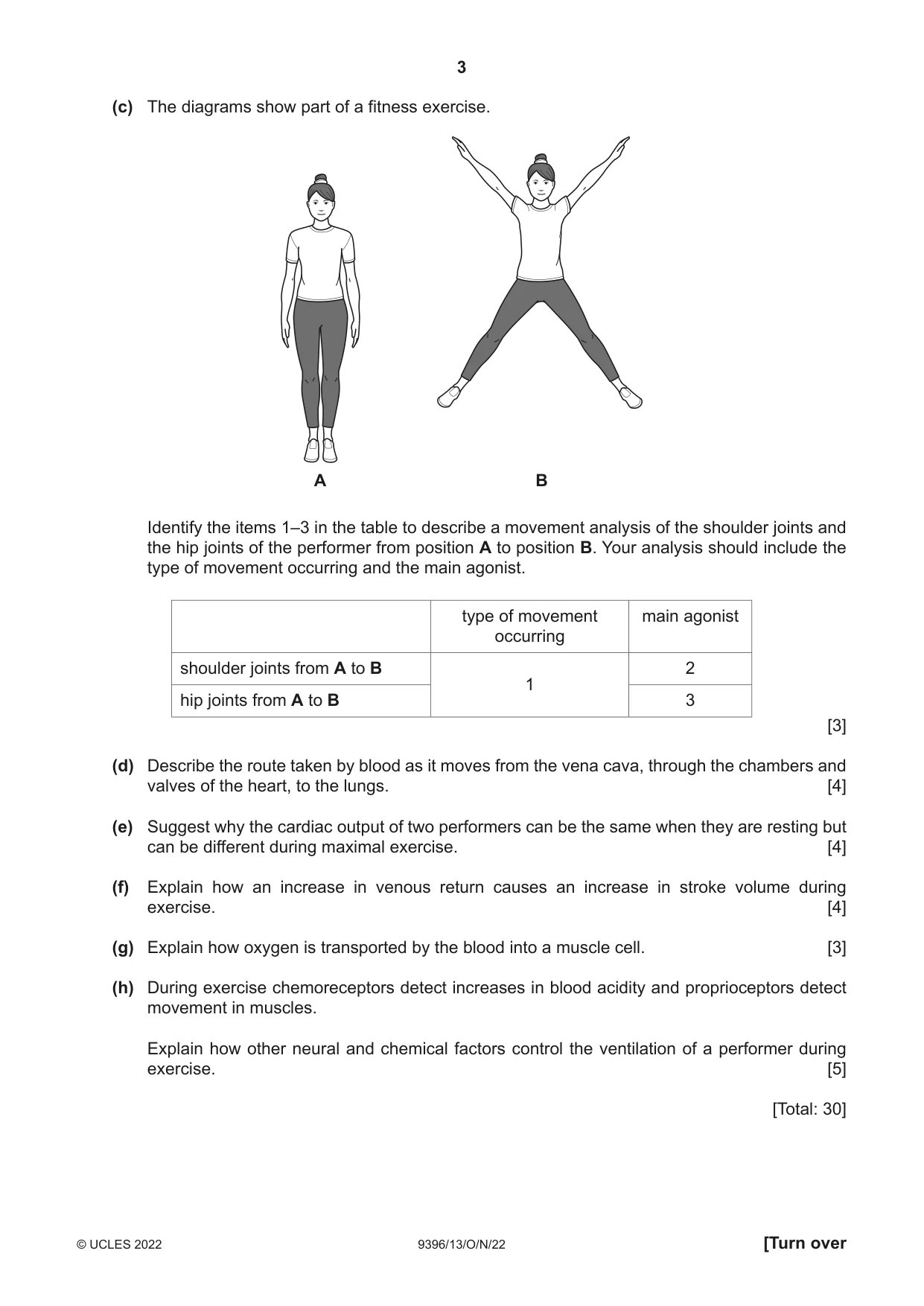
3 9396/13/O/N/22 © UCLES 2022 [Turn over (c) The diagrams show part of a fitness exercise. A B Identify the items 1–3 in the table to describe a movement analysis of the shoulder joints and the hip joints of the performer from position A to position B. Your analysis should include the type of movement occurring and the main agonist. type of movement occurring main agonist shoulder joints from A to B 1 2 hip joints from A to B 3 [3] (d) Describe the route taken by blood as it moves from the vena cava, through the chambers and valves of the heart, to the lungs. [4] (e) Suggest why the cardiac output of two performers can be the same when they are resting but can be different during maximal exercise. [4] (f) Explain how an increase in venous return causes an increase in stroke volume during exercise. [4] (g) Explain how oxygen is transported by the blood into a muscle cell. [3] (h) During exercise chemoreceptors detect increases in blood acidity and proprioceptors detect movement in muscles. Explain how other neural and chemical factors control the ventilation of a performer during exercise. [5] [Total: 30]
Question paper, page 4
4 9396/13/O/N/22 © UCLES 2022 Section B: Acquiring, developing and performing movement skills 2 (a) (i) Skilful performances are learned, efficient and fluent. Identify three other characteristics of skilful performances. [3] (ii) The skill of a goalkeeper saving a shot in a team game can be classified using various continua. Justify a classification of this skill using each of the following continua: • open or closed • discrete or serial or continuous • simple or complex. [3] (b) Explain how motor skill development is affected by early childhood experiences and environmental exposure. [3] (c) Outline the principles of the cognitive theory of learning. [3] (d) Explain why closed-loop control of motor programmes is not applicable to all skills. [3]
Question paper, page 5
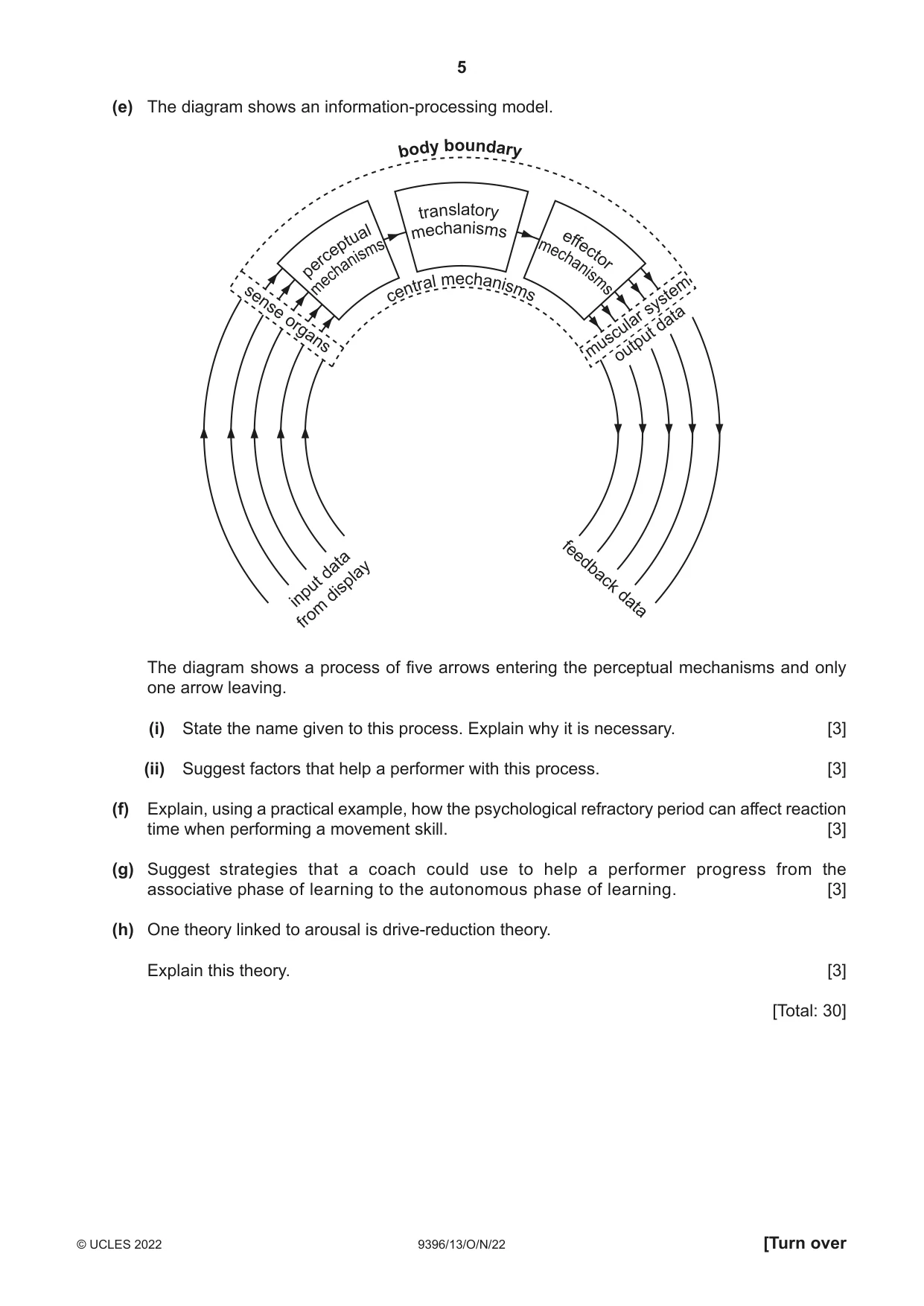
5 9396/13/O/N/22 © UCLES 2022 [Turn over (e) The diagram shows an information-processing model. c e n tr al m e c h a ni s m s bo dy b ou nd ar y m ec ha ni s m s pe rc ep tu al m ec h a ni s m s tr an sl at or y m ec ha ni s m s ef fe ct or input data from display feedback data sense organs muscular system output data The diagram shows a process of five arrows entering the perceptual mechanisms and only one arrow leaving. (i) State the name given to this process. Explain why it is necessary. [3] (ii) Suggest factors that help a performer with this process. [3] (f) Explain, using a practical example, how the psychological refractory period can affect reaction time when performing a movement skill. [3] (g) Suggest strategies that a coach could use to help a performer progress from the associative phase of learning to the autonomous phase of learning. [3] (h) One theory linked to arousal is drive-reduction theory. Explain this theory. [3] [Total: 30]
Question paper, page 6
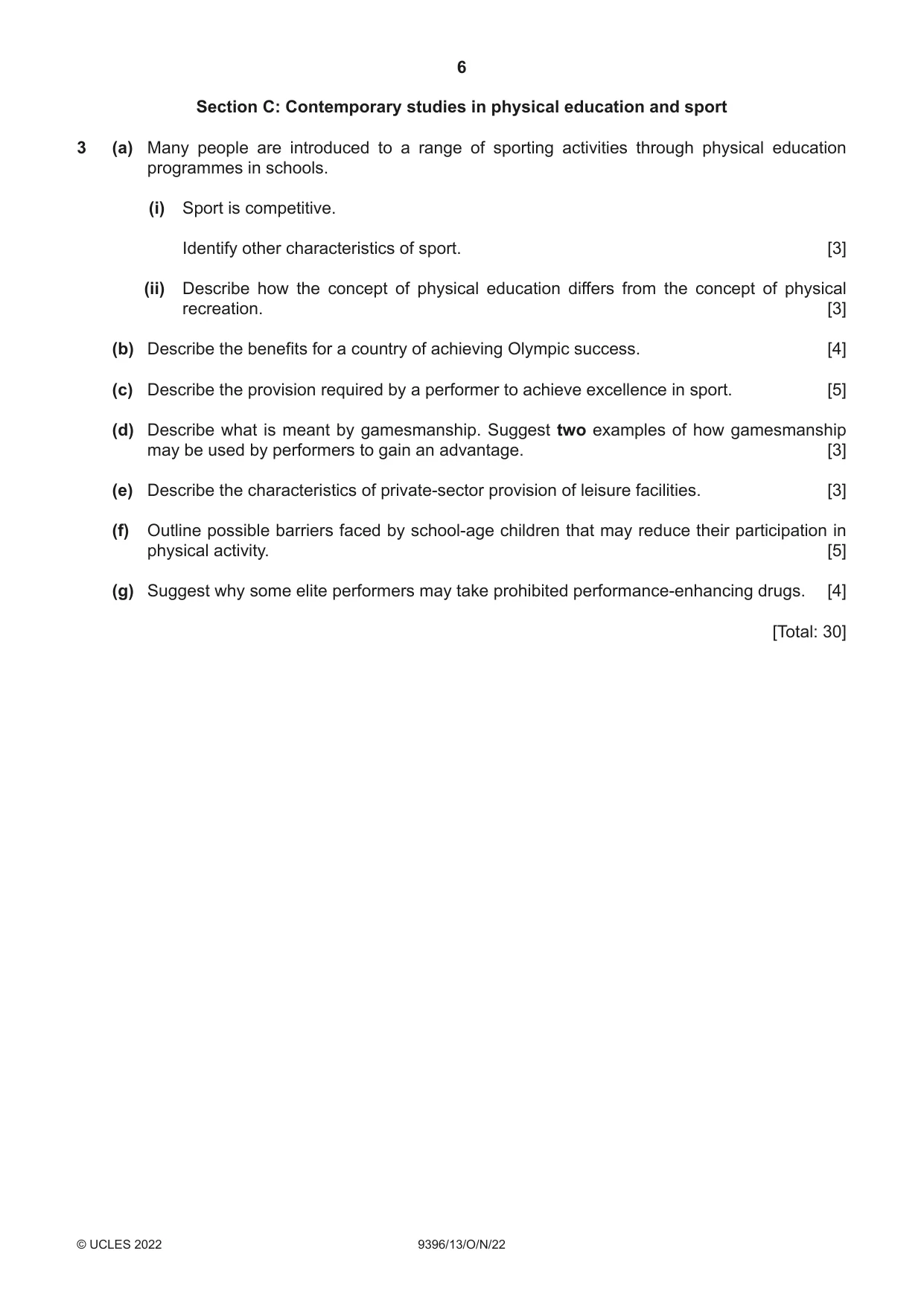
6 9396/13/O/N/22 © UCLES 2022 Section C: Contemporary studies in physical education and sport 3 (a) Many people are introduced to a range of sporting activities through physical education programmes in schools. (i) Sport is competitive. Identify other characteristics of sport. [3] (ii) Describe how the concept of physical education differs from the concept of physical recreation. [3] (b) Describe the benefits for a country of achieving Olympic success. [4] (c) Describe the provision required by a performer to achieve excellence in sport. [5] (d) Describe what is meant by gamesmanship. Suggest two examples of how gamesmanship may be used by performers to gain an advantage. [3] (e) Describe the characteristics of private-sector provision of leisure facilities. [3] (f) Outline possible barriers faced by school-age children that may reduce their participation in physical activity. [5] (g) Suggest why some elite performers may take prohibited performance-enhancing drugs. [4] [Total: 30]
Question paper, page 7
7 9396/13/O/N/22 © UCLES 2022 BLANK PAGE
Question paper, page 8
8 9396/13/O/N/22 © UCLES 2022 Permission to reproduce items where third-party owned material protected by copyright is included has been sought and cleared where possible. Every reasonable effort has been made by the publisher (UCLES) to trace copyright holders, but if any items requiring clearance have unwittingly been included, the publisher will be pleased to make amends at the earliest possible opportunity. To avoid the issue of disclosure of answer-related information to candidates, all copyright acknowledgements are reproduced online in the Cambridge Assessment International Education Copyright Acknowledgements Booklet. This is produced for each series of examinations and is freely available to download at www.cambridgeinternational.org after the live examination series. Cambridge Assessment International Education is part of Cambridge Assessment. Cambridge Assessment is the brand name of the University of Cambridge Local Examinations Syndicate (UCLES), which is a department of the University of Cambridge. BLANK PAGE
Mark scheme, page 1
This document consists of 15 printed pages. © UCLES 2022 [Turn over Cambridge International AS & A Level PHYSICAL EDUCATION 9396/13 Paper 1 October/November 2022 MARK SCHEME Maximum Mark: 90 Published This mark scheme is published as an aid to teachers and candidates, to indicate the requirements of the examination. It shows the basis on which Examiners were instructed to award marks. It does not indicate the details of the discussions that took place at an Examiners’ meeting before marking began, which would have considered the acceptability of alternative answers. Mark schemes should be read in conjunction with the question paper and the Principal Examiner Report for Teachers. Cambridge International will not enter into discussions about these mark schemes. Cambridge International is publishing the mark schemes for the October/November 2022 series for most Cambridge IGCSE™, Cambridge International A and AS Level components and some Cambridge O Level components.
Mark scheme, page 2
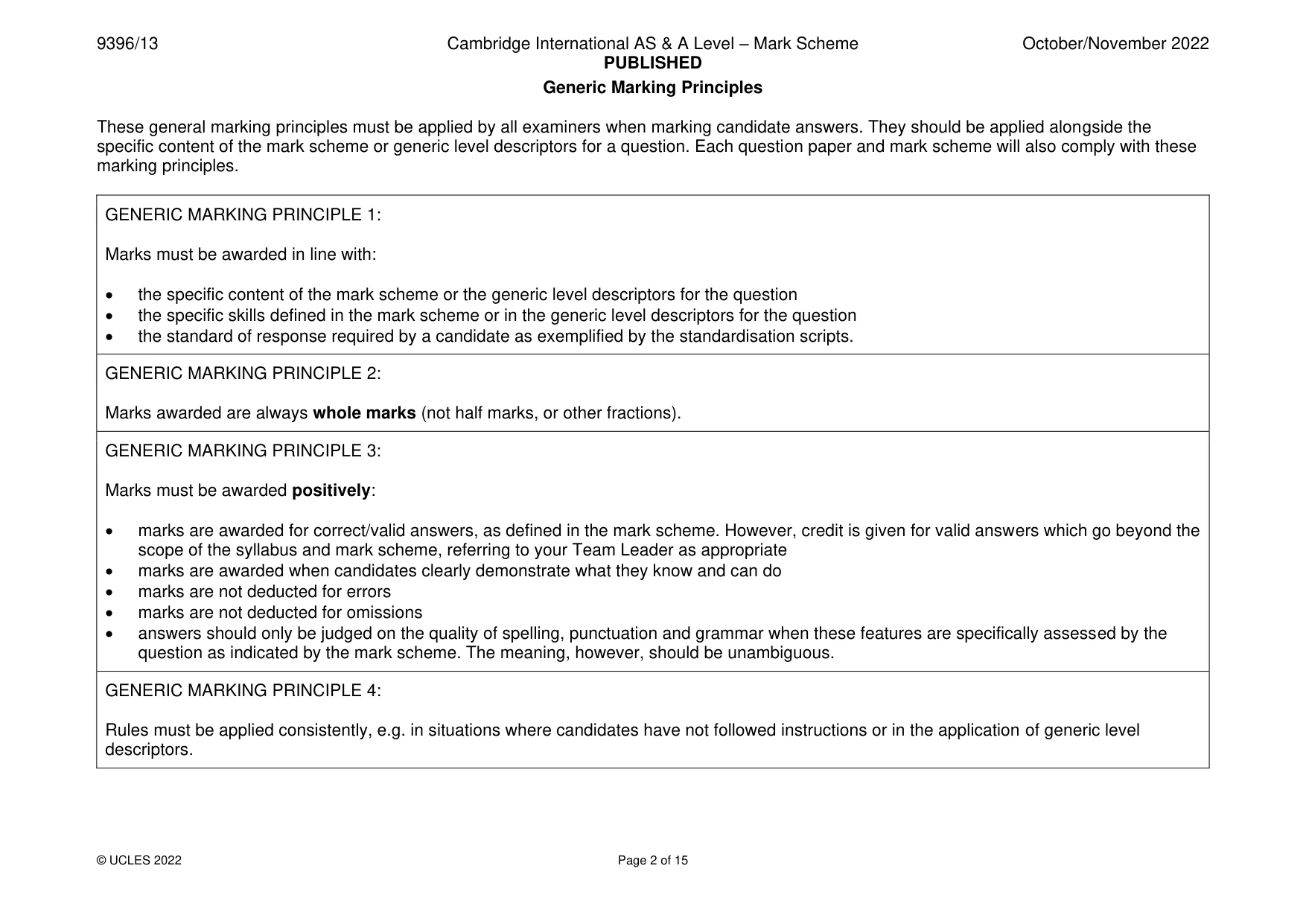
9396/13 Cambridge International AS & A Level – Mark Scheme PUBLISHED October/November 2022 © UCLES 2022 Page 2 of 15 Generic Marking Principles These general marking principles must be applied by all examiners when marking candidate answers. They should be applied alongside the specific content of the mark scheme or generic level descriptors for a question. Each question paper and mark scheme will also comply with these marking principles. GENERIC MARKING PRINCIPLE 1: Marks must be awarded in line with: • the specific content of the mark scheme or the generic level descriptors for the question • the specific skills defined in the mark scheme or in the generic level descriptors for the question • the standard of response required by a candidate as exemplified by the standardisation scripts. GENERIC MARKING PRINCIPLE 2: Marks awarded are always whole marks (not half marks, or other fractions). GENERIC MARKING PRINCIPLE 3: Marks must be awarded positively: • marks are awarded for correct/valid answers, as defined in the mark scheme. However, credit is given for valid answers which go beyond the scope of the syllabus and mark scheme, referring to your Team Leader as appropriate • marks are awarded when candidates clearly demonstrate what they know and can do • marks are not deducted for errors • marks are not deducted for omissions • answers should only be judged on the quality of spelling, punctuation and grammar when these features are specifically assessed by the question as indicated by the mark scheme. The meaning, however, should be unambiguous. GENERIC MARKING PRINCIPLE 4: Rules must be applied consistently, e.g. in situations where candidates have not followed instructions or in the application of generic level descriptors.
Mark scheme, page 3
9396/13 Cambridge International AS & A Level – Mark Scheme PUBLISHED October/November 2022 © UCLES 2022 Page 3 of 15 GENERIC MARKING PRINCIPLE 5: Marks should be awarded using the full range of marks defined in the mark scheme for the question (however; the use of the full mark range may be limited according to the quality of the candidate responses seen). GENERIC MARKING PRINCIPLE 6: Marks awarded are based solely on the requirements as defined in the mark scheme. Marks should not be awarded with grade thresholds or grade descriptors in mind. Science-Specific Marking Principles 1 Examiners should consider the context and scientific use of any keywords when awarding marks. Although keywords may be present, marks should not be awarded if the keywords are used incorrectly. 2 The examiner should not choose between contradictory statements given in the same question part, and credit should not be awarded for any correct statement that is contradicted within the same question part. Wrong science that is irrelevant to the question should be ignored. 3 Although spellings do not have to be correct, spellings of syllabus terms must allow for clear and unambiguous separation from other syllabus terms with which they may be confused (e.g. ethane / ethene, glucagon / glycogen, refraction / reflection). 4 The error carried forward (ecf) principle should be applied, where appropriate. If an incorrect answer is subsequently used in a scientifically correct way, the candidate should be awarded these subsequent marking points. Further guidance will be included in the mark scheme where necessary and any exceptions to this general principle will be noted. 5 ‘List rule’ guidance For questions that require n responses (e.g. State two reasons …): • The response should be read as continuous prose, even when numbered answer spaces are provided. • Any response marked ignore in the mark scheme should not count towards n. • Incorrect responses should not be awarded credit but will still count towards n. • Read the entire response to check for any responses that contradict those that would otherwise be credited. Credit should not be awarded for any responses that are contradicted within the rest of the response. Where two responses contradict one another, this should be treated as a single incorrect response. • Non-contradictory responses after the first n responses may be ignored even if they include incorrect science.
Mark scheme, page 4
9396/13 Cambridge International AS & A Level – Mark Scheme PUBLISHED October/November 2022 © UCLES 2022 Page 4 of 15 6 Calculation specific guidance Correct answers to calculations should be given full credit even if there is no working or incorrect working, unless the question states ‘show your working’. For questions in which the number of significant figures required is not stated, credit should be awarded for correct answers when rounded by the examiner to the number of significant figures given in the mark scheme. This may not apply to measured values. For answers given in standard form (e.g. a 10n) in which the convention of restricting the value of the coefficient (a) to a value between 1 and 10 is not followed, credit may still be awarded if the answer can be converted to the answer given in the mark scheme. Unless a separate mark is given for a unit, a missing or incorrect unit will normally mean that the final calculation mark is not awarded. Exceptions to this general principle will be noted in the mark scheme. 7 Guidance for chemical equations Multiples / fractions of coefficients used in chemical equations are acceptable unless stated otherwise in the mark scheme. State symbols given in an equation should be ignored unless asked for in the question or stated otherwise in the mark scheme.
Mark scheme, page 5
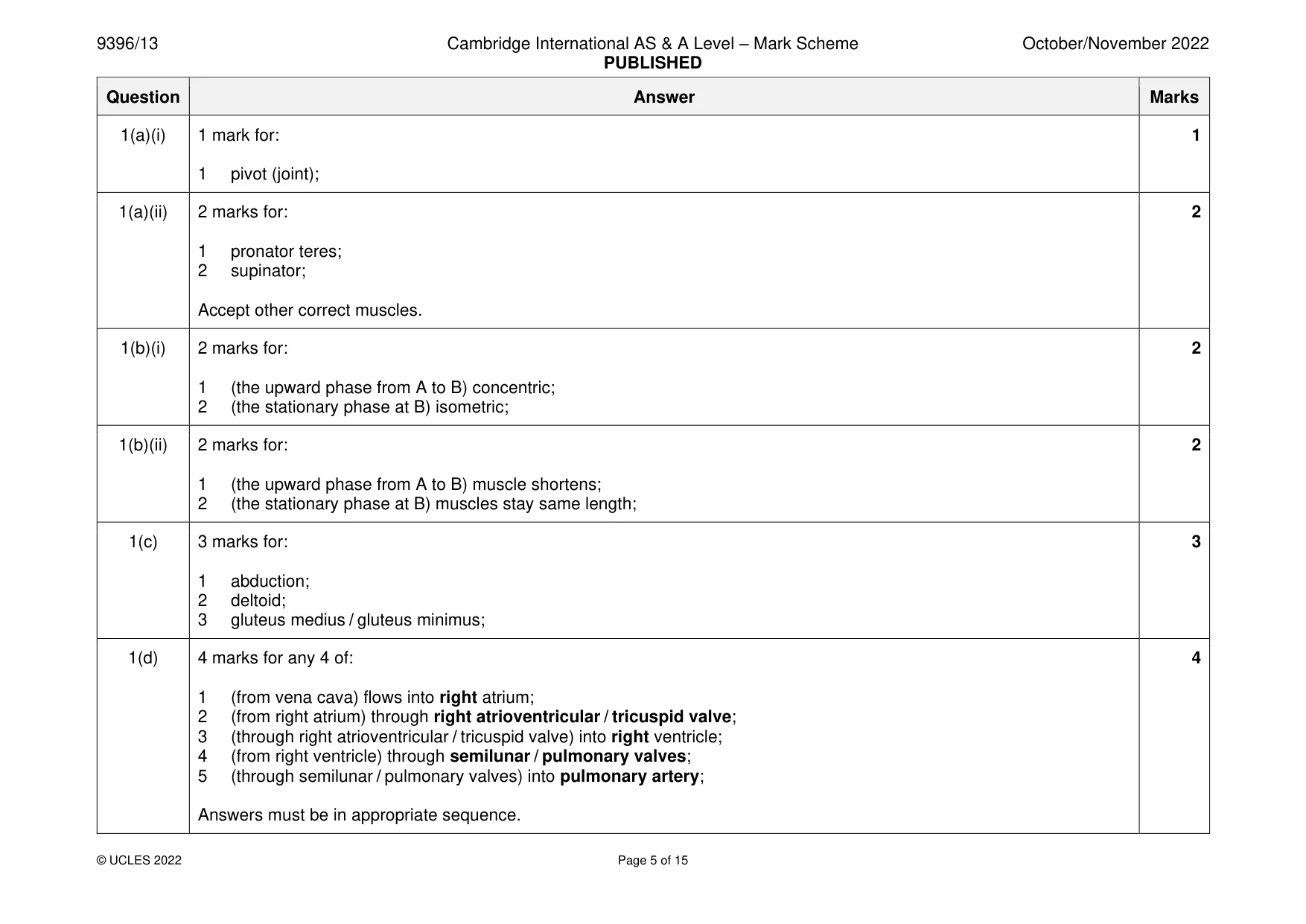
9396/13 Cambridge International AS & A Level – Mark Scheme PUBLISHED October/November 2022 © UCLES 2022 Page 5 of 15 Question Answer Marks 1(a)(i) 1 mark for: 1 pivot (joint); 1 1(a)(ii) 2 marks for: 1 pronator teres; 2 supinator; Accept other correct muscles. 2 1(b)(i) 2 marks for: 1 (the upward phase from A to B) concentric; 2 (the stationary phase at B) isometric; 2 1(b)(ii) 2 marks for: 1 (the upward phase from A to B) muscle shortens; 2 (the stationary phase at B) muscles stay same length; 2 1(c) 3 marks for: 1 abduction; 2 deltoid; 3 gluteus medius / gluteus minimus; 3 1(d) 4 marks for any 4 of: 1 (from vena cava) flows into right atrium; 2 (from right atrium) through right atrioventricular / tricuspid valve; 3 (through right atrioventricular / tricuspid valve) into right ventricle; 4 (from right ventricle) through semilunar / pulmonary valves; 5 (through semilunar / pulmonary valves) into pulmonary artery; Answers must be in appropriate sequence. 4
Mark scheme, page 6
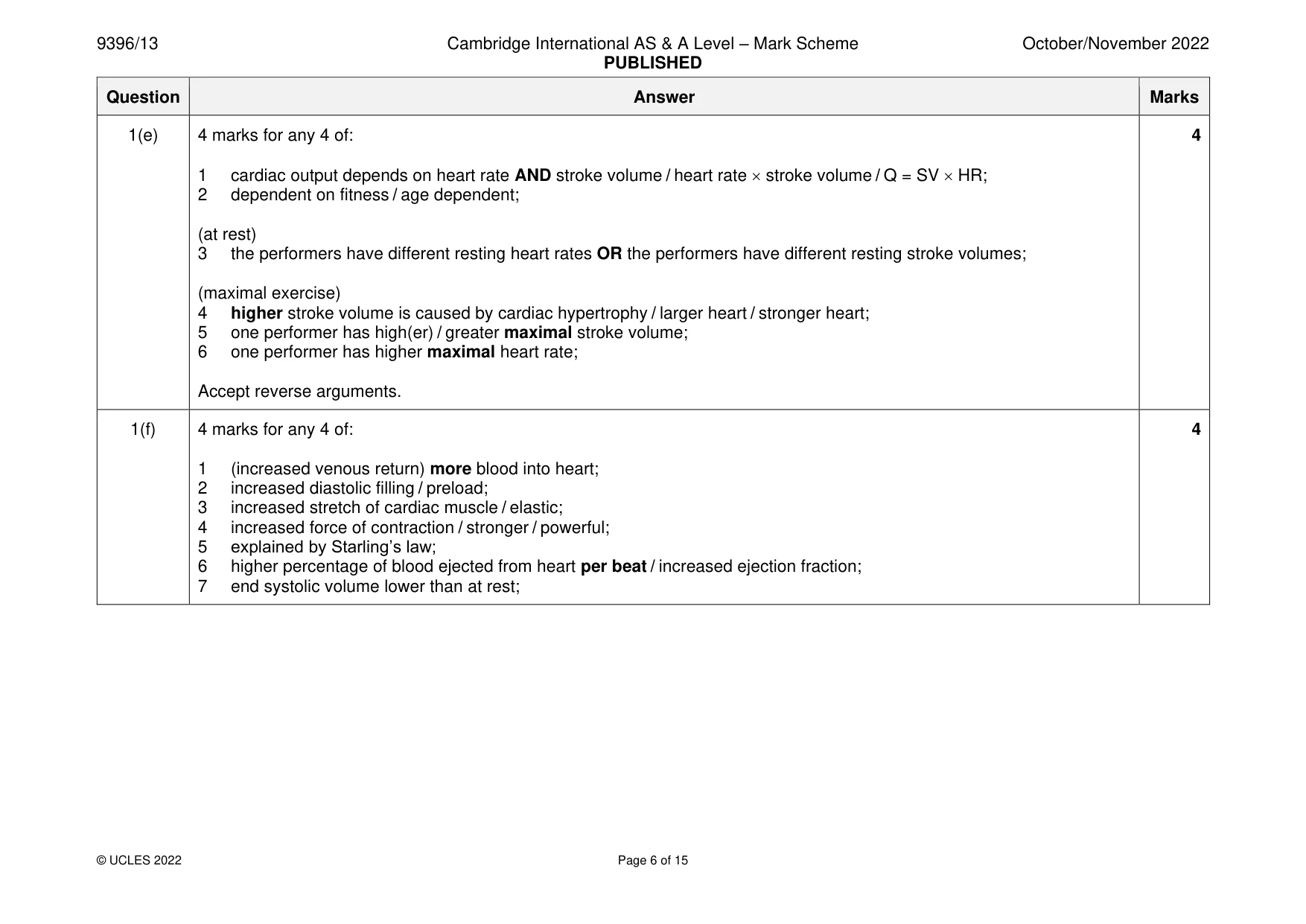
9396/13 Cambridge International AS & A Level – Mark Scheme PUBLISHED October/November 2022 © UCLES 2022 Page 6 of 15 Question Answer Marks 1(e) 4 marks for any 4 of: 1 cardiac output depends on heart rate AND stroke volume / heart rate stroke volume / Q = SV HR; 2 dependent on fitness / age dependent; (at rest) 3 the performers have different resting heart rates OR the performers have different resting stroke volumes; (maximal exercise) 4 higher stroke volume is caused by cardiac hypertrophy / larger heart / stronger heart; 5 one performer has high(er) / greater maximal stroke volume; 6 one performer has higher maximal heart rate; Accept reverse arguments. 4 1(f) 4 marks for any 4 of: 1 (increased venous return) more blood into heart; 2 increased diastolic filling / preload; 3 increased stretch of cardiac muscle / elastic; 4 increased force of contraction / stronger / powerful; 5 explained by Starling’s law; 6 higher percentage of blood ejected from heart per beat / increased ejection fraction; 7 end systolic volume lower than at rest; 4
Mark scheme, page 7
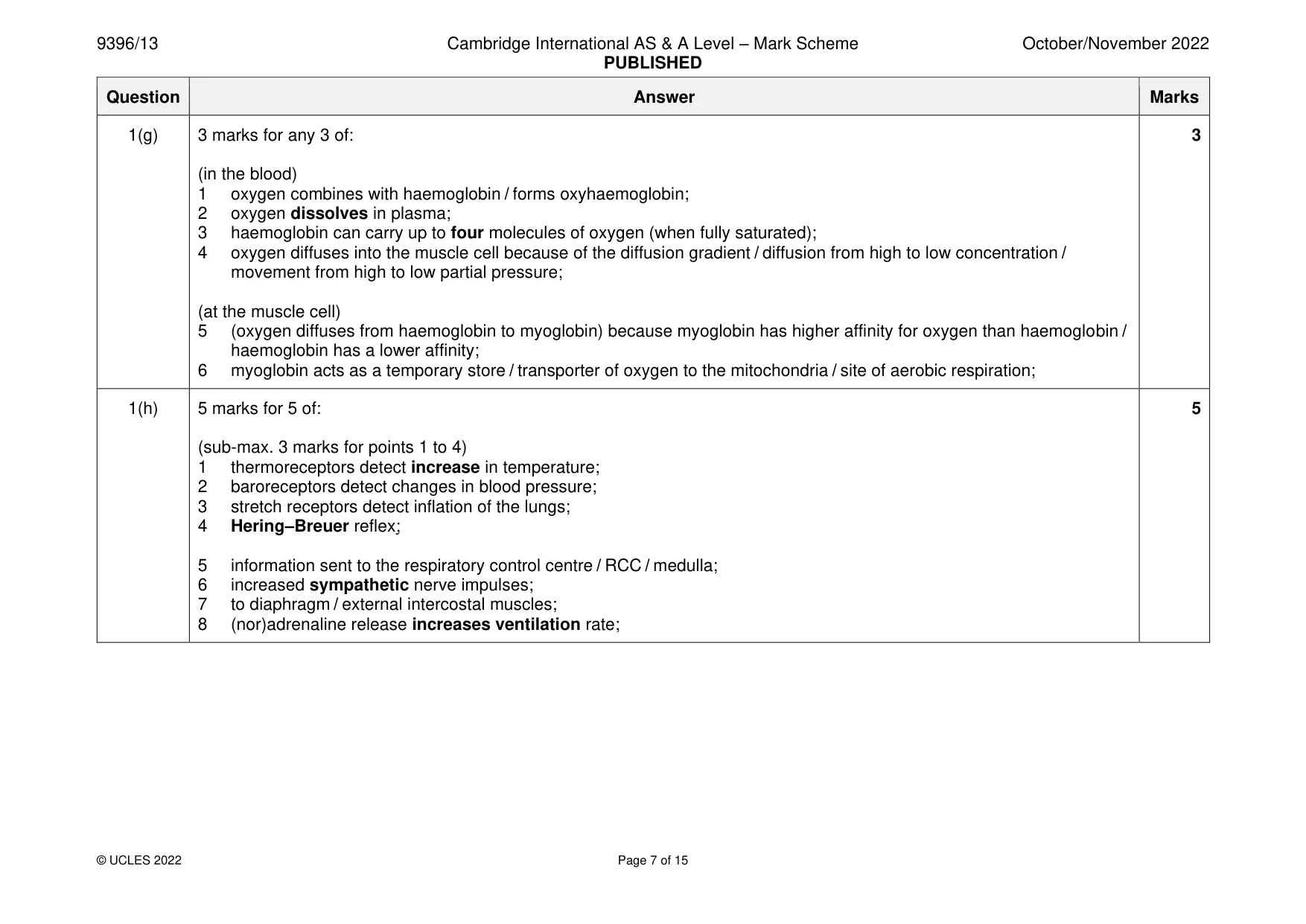
9396/13 Cambridge International AS & A Level – Mark Scheme PUBLISHED October/November 2022 © UCLES 2022 Page 7 of 15 Question Answer Marks 1(g) 3 marks for any 3 of: (in the blood) 1 oxygen combines with haemoglobin / forms oxyhaemoglobin; 2 oxygen dissolves in plasma; 3 haemoglobin can carry up to four molecules of oxygen (when fully saturated); 4 oxygen diffuses into the muscle cell because of the diffusion gradient / diffusion from high to low concentration / movement from high to low partial pressure; (at the muscle cell) 5 (oxygen diffuses from haemoglobin to myoglobin) because myoglobin has higher affinity for oxygen than haemoglobin / haemoglobin has a lower affinity; 6 myoglobin acts as a temporary store / transporter of oxygen to the mitochondria / site of aerobic respiration; 3 1(h) 5 marks for 5 of: (sub-max. 3 marks for points 1 to 4) 1 thermoreceptors detect increase in temperature; 2 baroreceptors detect changes in blood pressure; 3 stretch receptors detect inflation of the lungs; 4 Hering–Breuer reflex; 5 information sent to the respiratory control centre / RCC / medulla; 6 increased sympathetic nerve impulses; 7 to diaphragm / external intercostal muscles; 8 (nor)adrenaline release increases ventilation rate; 5
Mark scheme, page 8
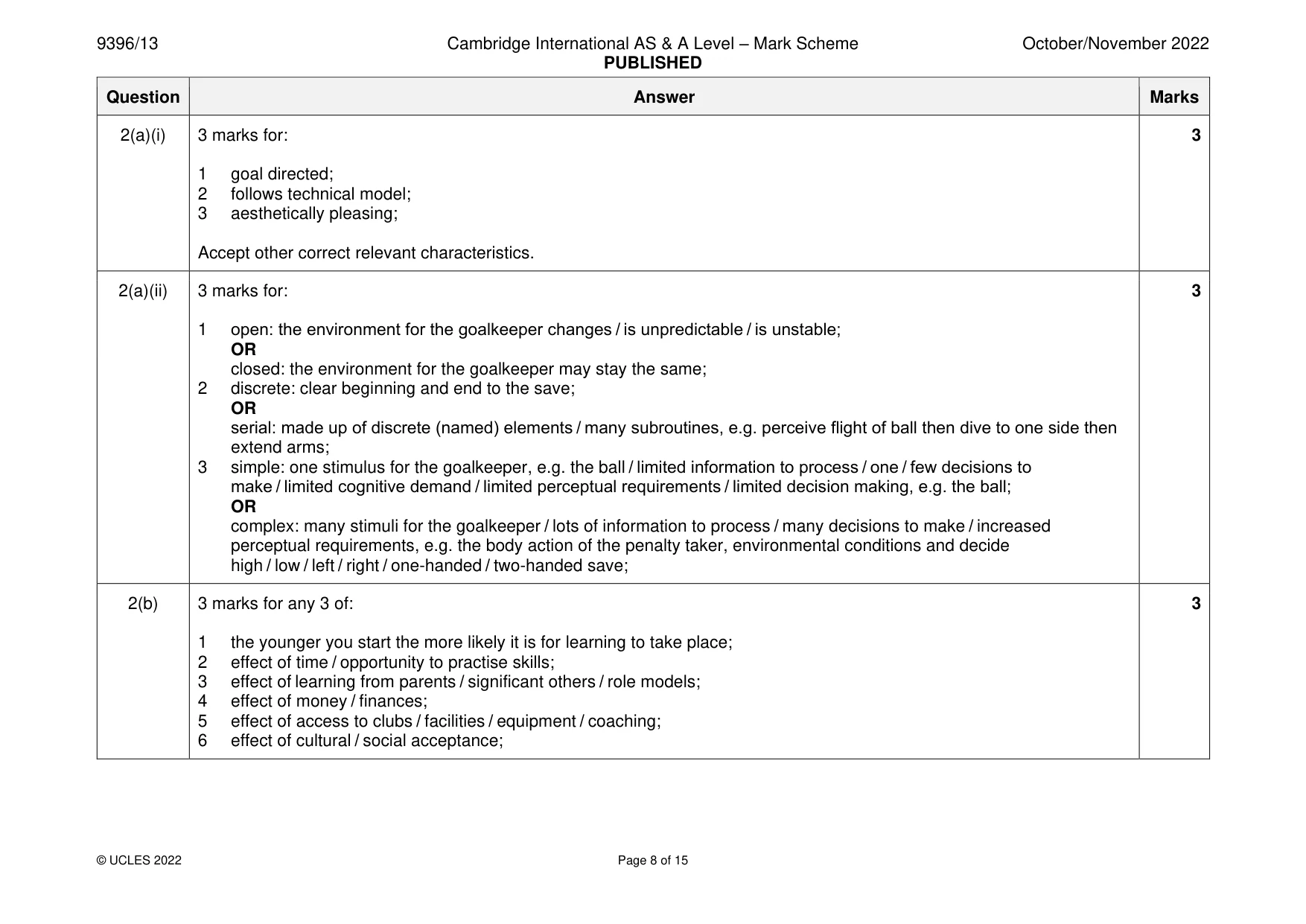
9396/13 Cambridge International AS & A Level – Mark Scheme PUBLISHED October/November 2022 © UCLES 2022 Page 8 of 15 Question Answer Marks 2(a)(i) 3 marks for: 1 goal directed; 2 follows technical model; 3 aesthetically pleasing; Accept other correct relevant characteristics. 3 2(a)(ii) 3 marks for: 1 open: the environment for the goalkeeper changes / is unpredictable / is unstable; OR closed: the environment for the goalkeeper may stay the same; 2 discrete: clear beginning and end to the save; OR serial: made up of discrete (named) elements / many subroutines, e.g. perceive flight of ball then dive to one side then extend arms; 3 simple: one stimulus for the goalkeeper, e.g. the ball / limited information to process / one / few decisions to make / limited cognitive demand / limited perceptual requirements / limited decision making, e.g. the ball; OR complex: many stimuli for the goalkeeper / lots of information to process / many decisions to make / increased perceptual requirements, e.g. the body action of the penalty taker, environmental conditions and decide high / low / left / right / one-handed / two-handed save; 3 2(b) 3 marks for any 3 of: 1 the younger you start the more likely it is for learning to take place; 2 effect of time / opportunity to practise skills; 3 effect of learning from parents / significant others / role models; 4 effect of money / finances; 5 effect of access to clubs / facilities / equipment / coaching; 6 effect of cultural / social acceptance; 3
Mark scheme, page 9
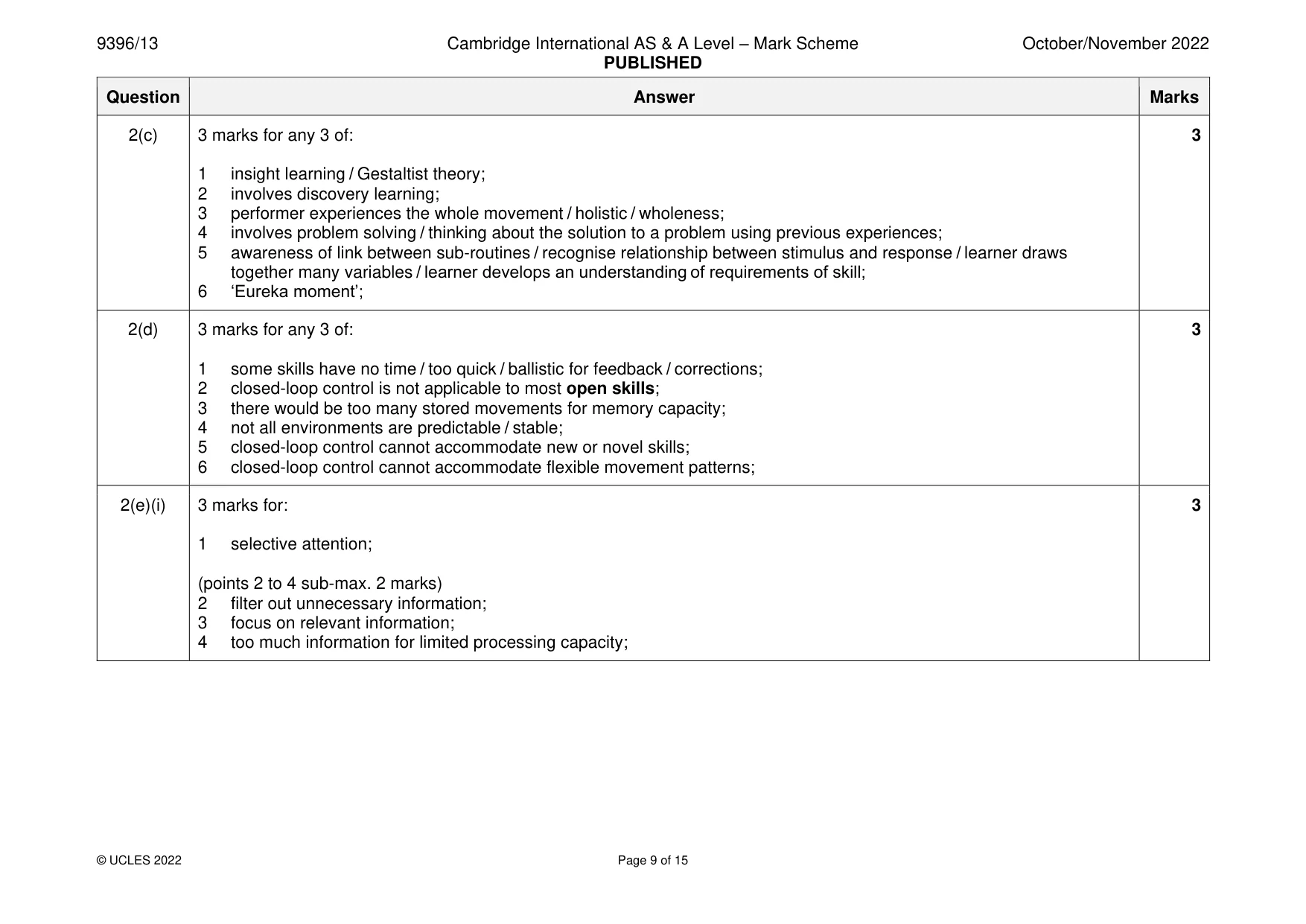
9396/13 Cambridge International AS & A Level – Mark Scheme PUBLISHED October/November 2022 © UCLES 2022 Page 9 of 15 Question Answer Marks 2(c) 3 marks for any 3 of: 1 insight learning / Gestaltist theory; 2 involves discovery learning; 3 performer experiences the whole movement / holistic / wholeness; 4 involves problem solving / thinking about the solution to a problem using previous experiences; 5 awareness of link between sub-routines / recognise relationship between stimulus and response / learner draws together many variables / learner develops an understanding of requirements of skill; 6 ‘Eureka moment’; 3 2(d) 3 marks for any 3 of: 1 some skills have no time / too quick / ballistic for feedback / corrections; 2 closed-loop control is not applicable to most open skills; 3 there would be too many stored movements for memory capacity; 4 not all environments are predictable / stable; 5 closed-loop control cannot accommodate new or novel skills; 6 closed-loop control cannot accommodate flexible movement patterns; 3 2(e)(i) 3 marks for: 1 selective attention; (points 2 to 4 sub-max. 2 marks) 2 filter out unnecessary information; 3 focus on relevant information; 4 too much information for limited processing capacity; 3
Mark scheme, page 10
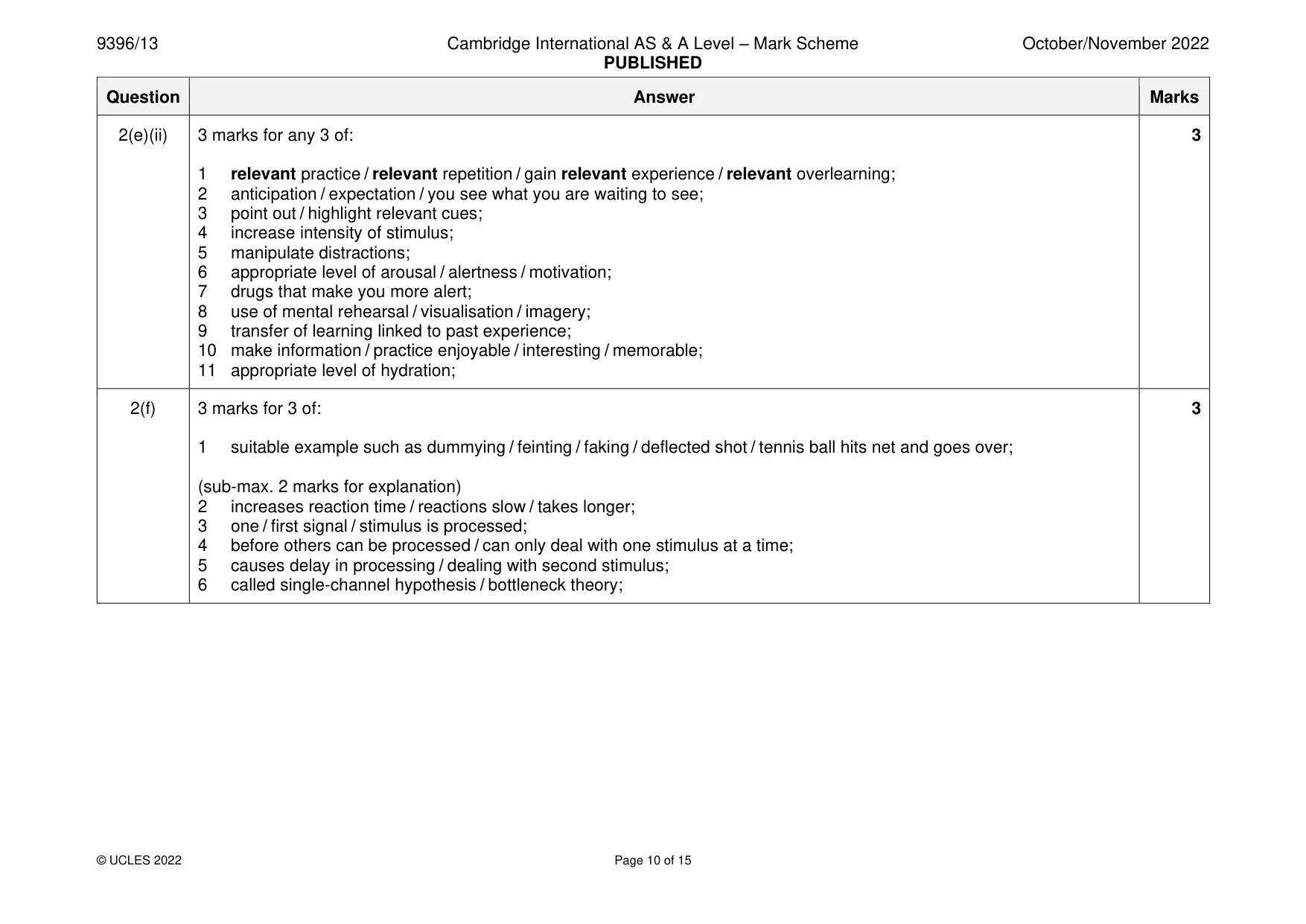
9396/13 Cambridge International AS & A Level – Mark Scheme PUBLISHED October/November 2022 © UCLES 2022 Page 10 of 15 Question Answer Marks 2(e)(ii) 3 marks for any 3 of: 1 relevant practice / relevant repetition / gain relevant experience / relevant overlearning; 2 anticipation / expectation / you see what you are waiting to see; 3 point out / highlight relevant cues; 4 increase intensity of stimulus; 5 manipulate distractions; 6 appropriate level of arousal / alertness / motivation; 7 drugs that make you more alert; 8 use of mental rehearsal / visualisation / imagery; 9 transfer of learning linked to past experience; 10 make information / practice enjoyable / interesting / memorable; 11 appropriate level of hydration; 3 2(f) 3 marks for 3 of: 1 suitable example such as dummying / feinting / faking / deflected shot / tennis ball hits net and goes over; (sub-max. 2 marks for explanation) 2 increases reaction time / reactions slow / takes longer; 3 one / first signal / stimulus is processed; 4 before others can be processed / can only deal with one stimulus at a time; 5 causes delay in processing / dealing with second stimulus; 6 called single-channel hypothesis / bottleneck theory; 3
Mark scheme, page 11
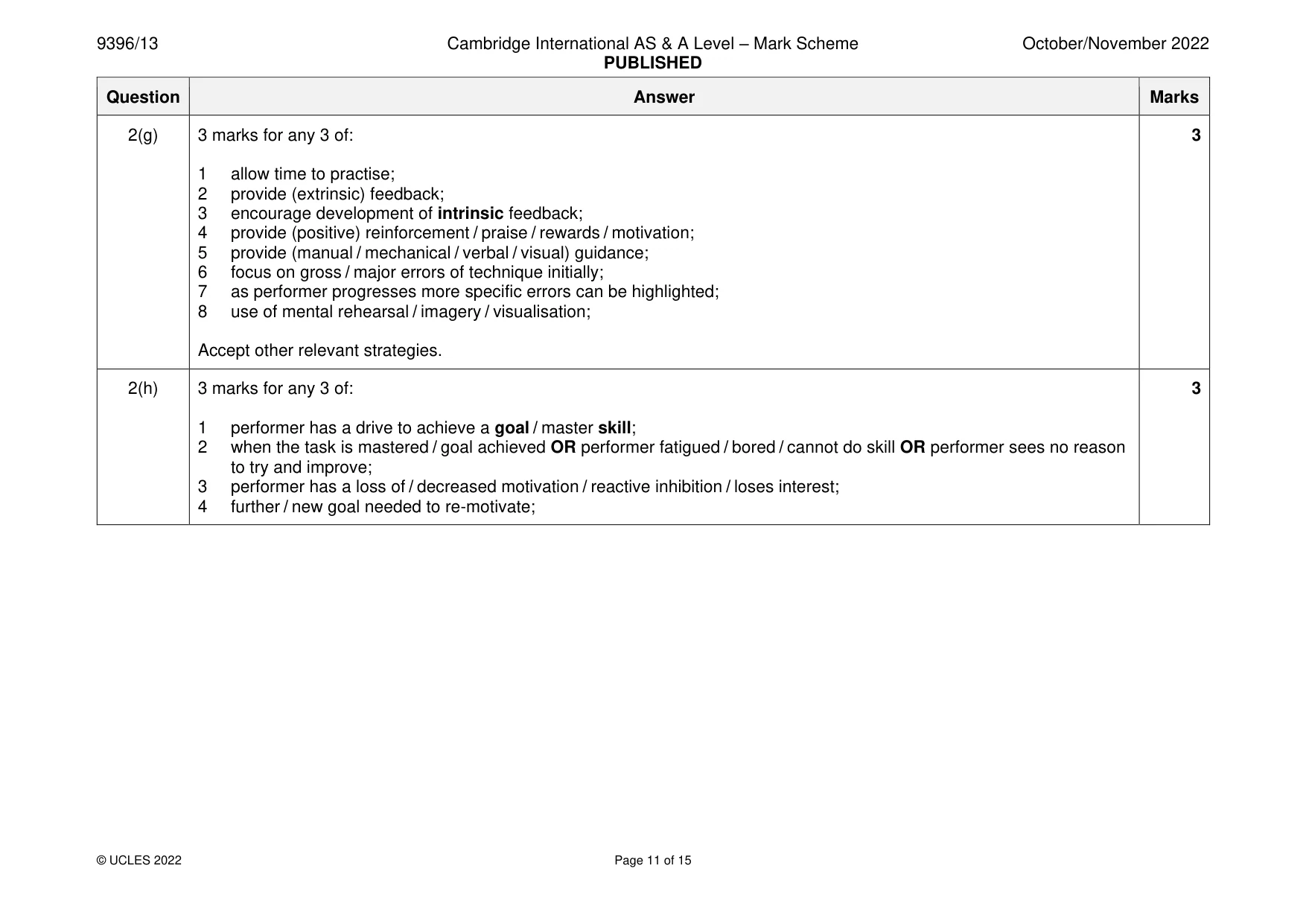
9396/13 Cambridge International AS & A Level – Mark Scheme PUBLISHED October/November 2022 © UCLES 2022 Page 11 of 15 Question Answer Marks 2(g) 3 marks for any 3 of: 1 allow time to practise; 2 provide (extrinsic) feedback; 3 encourage development of intrinsic feedback; 4 provide (positive) reinforcement / praise / rewards / motivation; 5 provide (manual / mechanical / verbal / visual) guidance; 6 focus on gross / major errors of technique initially; 7 as performer progresses more specific errors can be highlighted; 8 use of mental rehearsal / imagery / visualisation; Accept other relevant strategies. 3 2(h) 3 marks for any 3 of: 1 performer has a drive to achieve a goal / master skill; 2 when the task is mastered / goal achieved OR performer fatigued / bored / cannot do skill OR performer sees no reason to try and improve; 3 performer has a loss of / decreased motivation / reactive inhibition / loses interest; 4 further / new goal needed to re-motivate; 3
Mark scheme, page 12
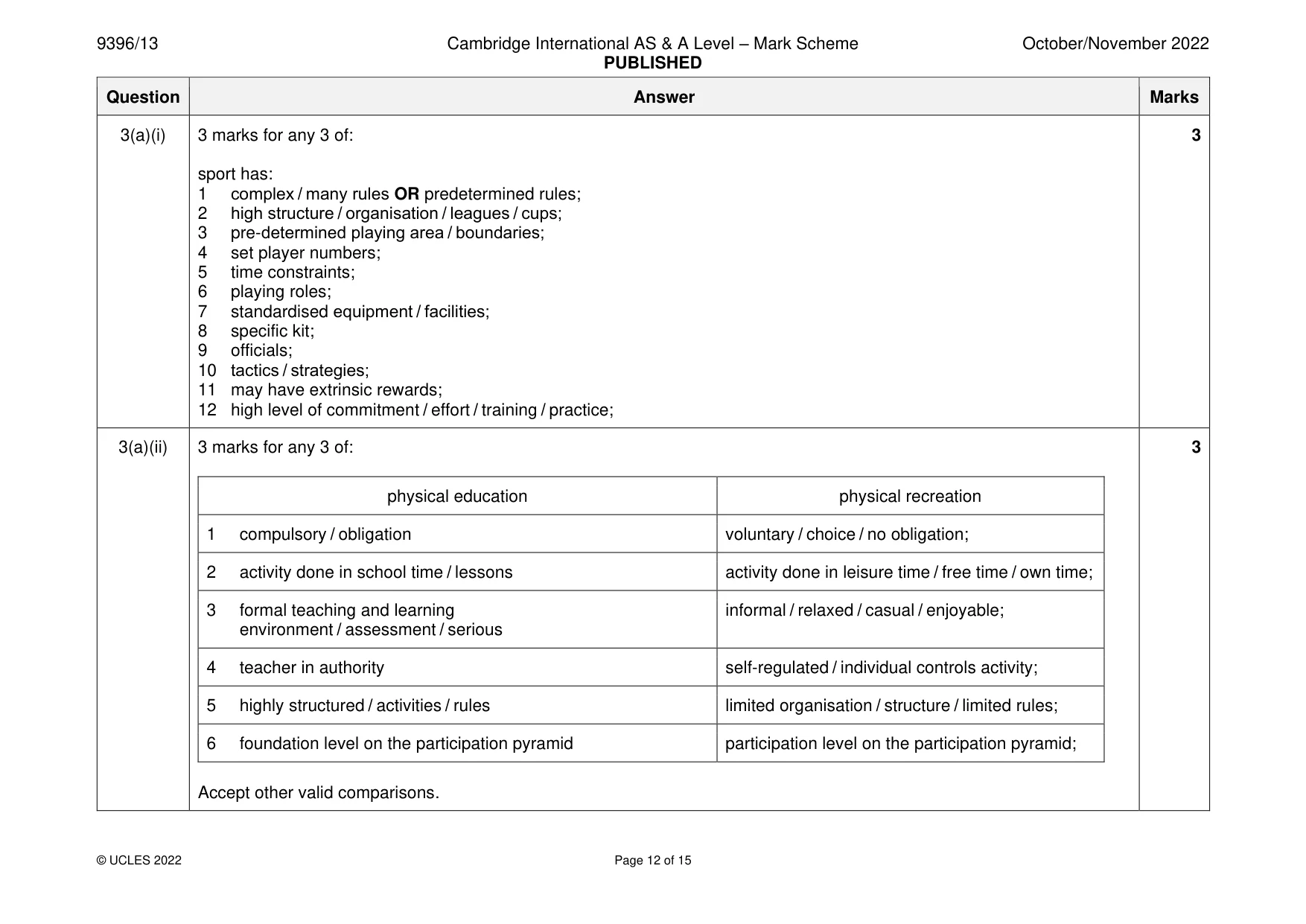
9396/13 Cambridge International AS & A Level – Mark Scheme PUBLISHED October/November 2022 © UCLES 2022 Page 12 of 15 Question Answer Marks 3(a)(i) 3 marks for any 3 of: sport has: 1 complex / many rules OR predetermined rules; 2 high structure / organisation / leagues / cups; 3 pre-determined playing area / boundaries; 4 set player numbers; 5 time constraints; 6 playing roles; 7 standardised equipment / facilities; 8 specific kit; 9 officials; 10 tactics / strategies; 11 may have extrinsic rewards; 12 high level of commitment / effort / training / practice; 3 3(a)(ii) 3 marks for any 3 of: physical education physical recreation 1 compulsory / obligation voluntary / choice / no obligation; 2 activity done in school time / lessons activity done in leisure time / free time / own time; 3 formal teaching and learning environment / assessment / serious informal / relaxed / casual / enjoyable; 4 teacher in authority self-regulated / individual controls activity; 5 highly structured / activities / rules limited organisation / structure / limited rules; 6 foundation level on the participation pyramid participation level on the participation pyramid; Accept other valid comparisons. 3
Mark scheme, page 13
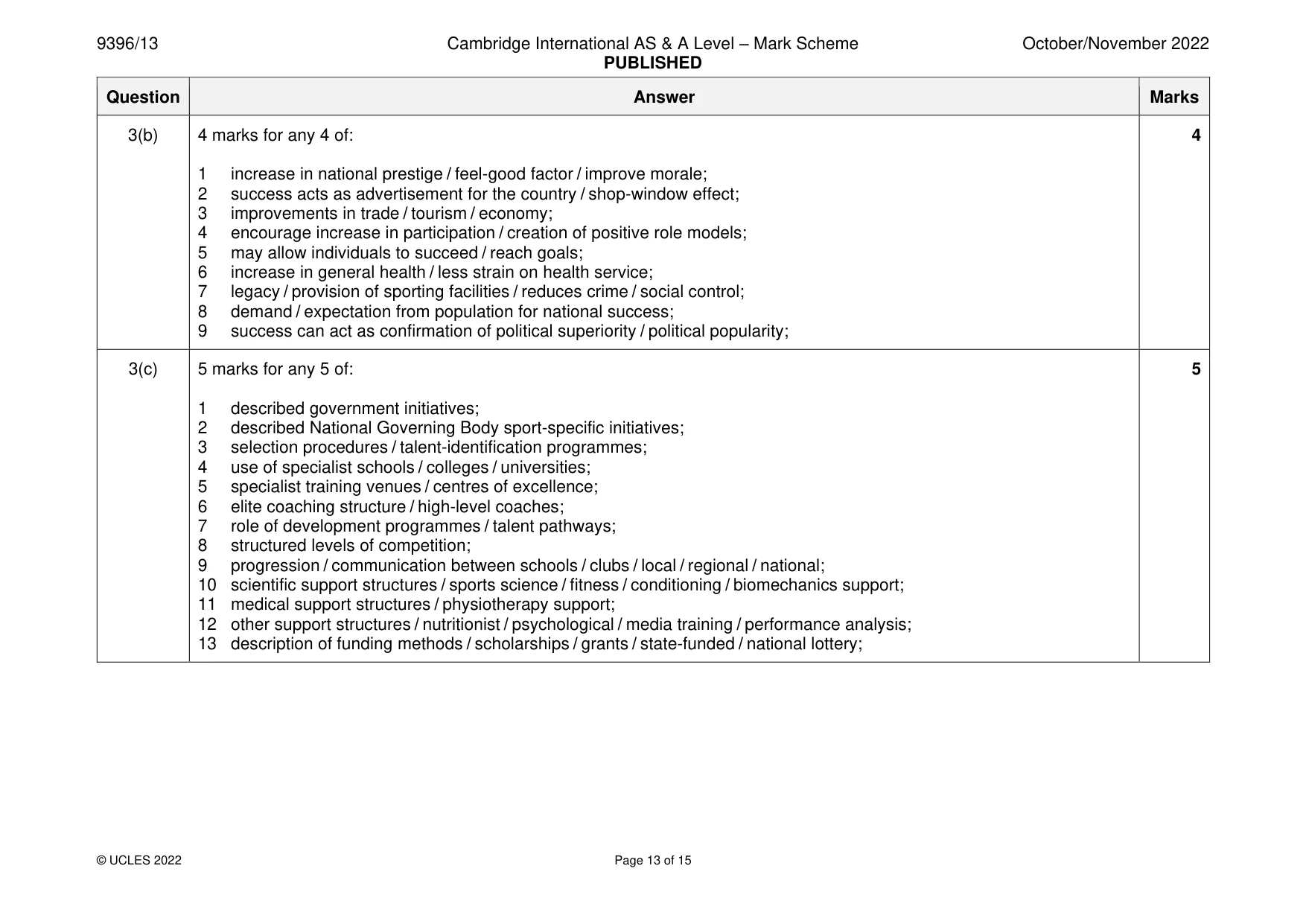
9396/13 Cambridge International AS & A Level – Mark Scheme PUBLISHED October/November 2022 © UCLES 2022 Page 13 of 15 Question Answer Marks 3(b) 4 marks for any 4 of: 1 increase in national prestige / feel-good factor / improve morale; 2 success acts as advertisement for the country / shop-window effect; 3 improvements in trade / tourism / economy; 4 encourage increase in participation / creation of positive role models; 5 may allow individuals to succeed / reach goals; 6 increase in general health / less strain on health service; 7 legacy / provision of sporting facilities / reduces crime / social control; 8 demand / expectation from population for national success; 9 success can act as confirmation of political superiority / political popularity; 4 3(c) 5 marks for any 5 of: 1 described government initiatives; 2 described National Governing Body sport-specific initiatives; 3 selection procedures / talent-identification programmes; 4 use of specialist schools / colleges / universities; 5 specialist training venues / centres of excellence; 6 elite coaching structure / high-level coaches; 7 role of development programmes / talent pathways; 8 structured levels of competition; 9 progression / communication between schools / clubs / local / regional / national; 10 scientific support structures / sports science / fitness / conditioning / biomechanics support; 11 medical support structures / physiotherapy support; 12 other support structures / nutritionist / psychological / media training / performance analysis; 13 description of funding methods / scholarships / grants / state-funded / national lottery; 5
Mark scheme, page 14
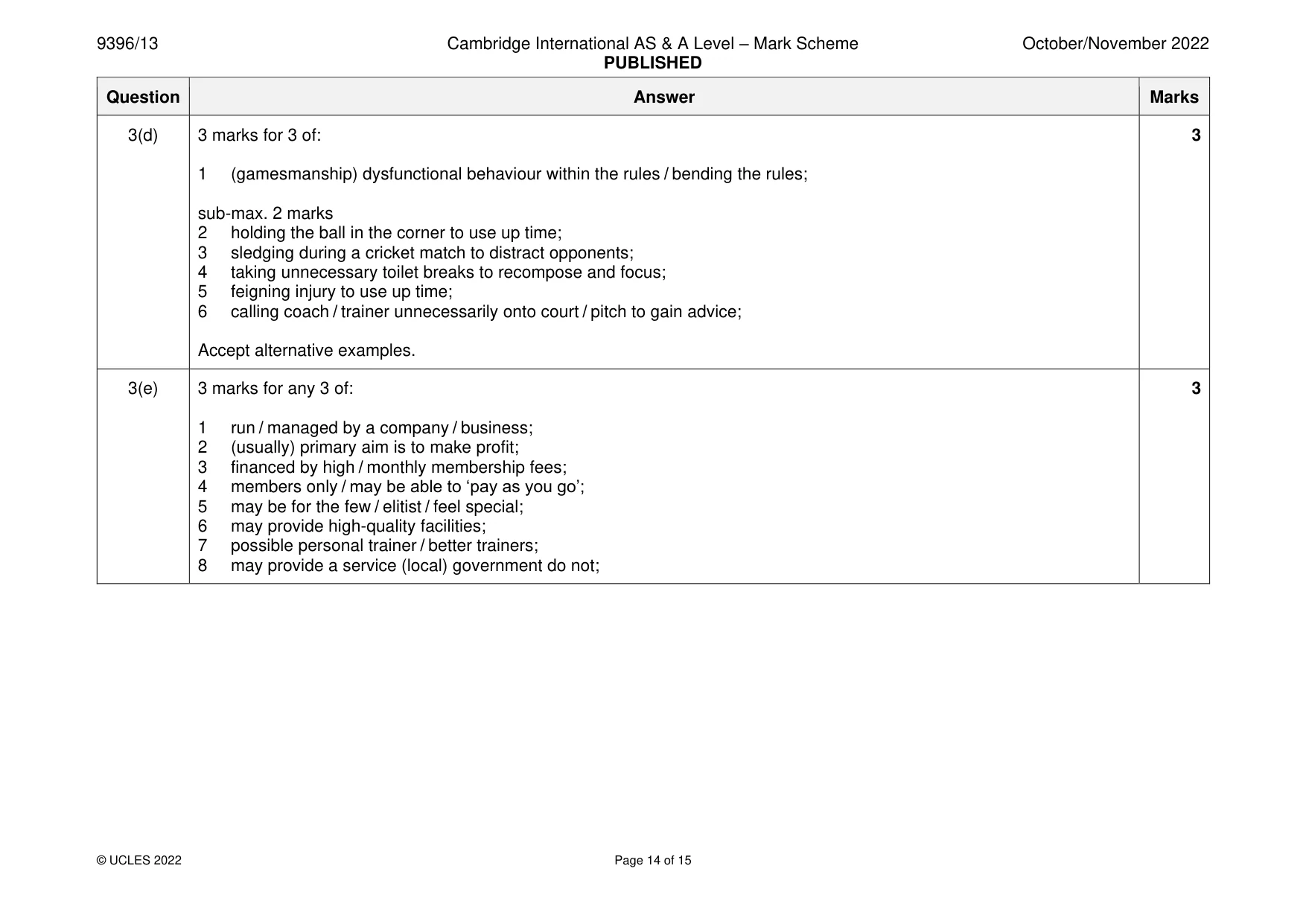
9396/13 Cambridge International AS & A Level – Mark Scheme PUBLISHED October/November 2022 © UCLES 2022 Page 14 of 15 Question Answer Marks 3(d) 3 marks for 3 of: 1 (gamesmanship) dysfunctional behaviour within the rules / bending the rules; sub-max. 2 marks 2 holding the ball in the corner to use up time; 3 sledging during a cricket match to distract opponents; 4 taking unnecessary toilet breaks to recompose and focus; 5 feigning injury to use up time; 6 calling coach / trainer unnecessarily onto court / pitch to gain advice; Accept alternative examples. 3 3(e) 3 marks for any 3 of: 1 run / managed by a company / business; 2 (usually) primary aim is to make profit; 3 financed by high / monthly membership fees; 4 members only / may be able to ‘pay as you go’; 5 may be for the few / elitist / feel special; 6 may provide high-quality facilities; 7 possible personal trainer / better trainers; 8 may provide a service (local) government do not; 3
Mark scheme, page 15
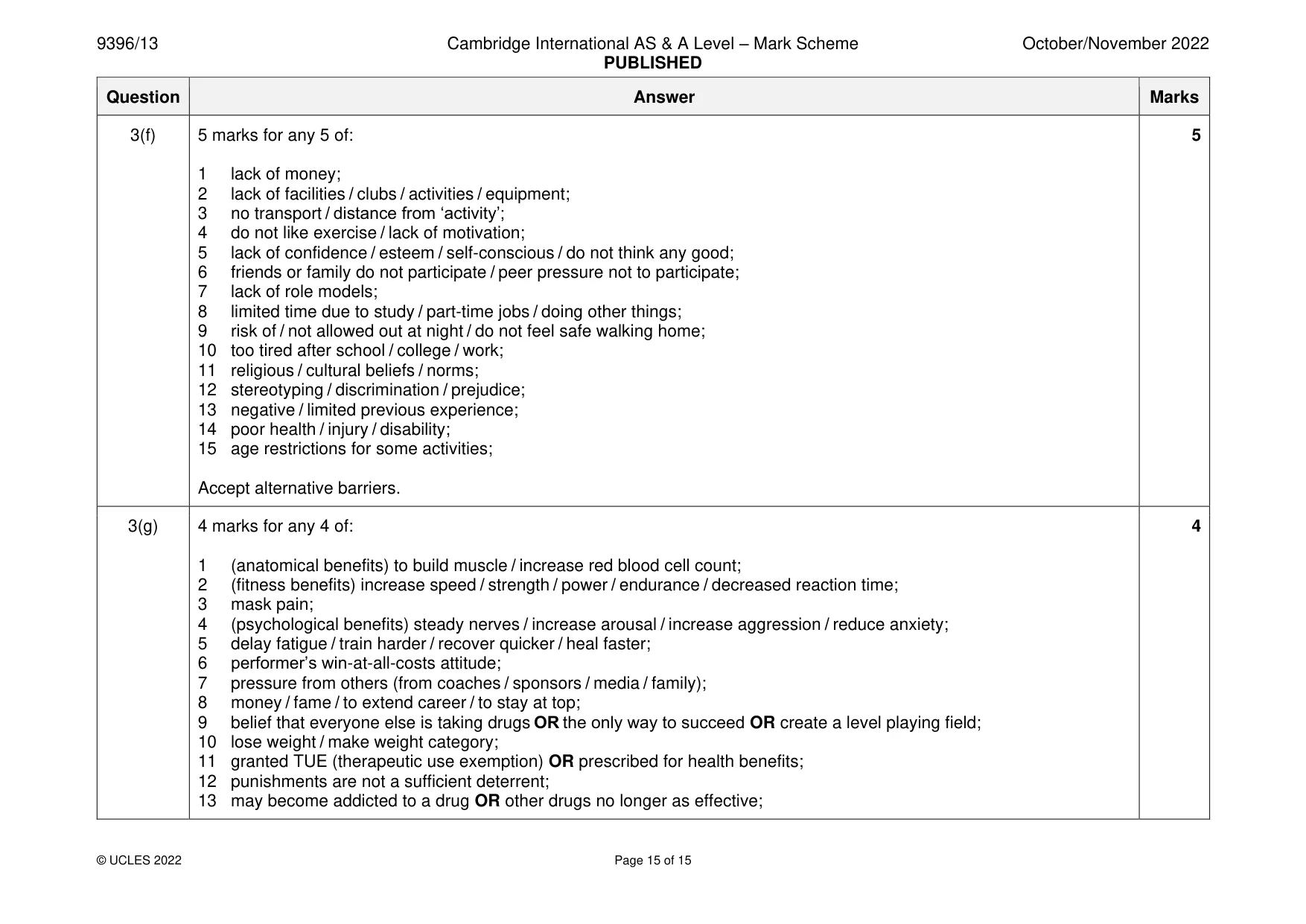
9396/13 Cambridge International AS & A Level – Mark Scheme PUBLISHED October/November 2022 © UCLES 2022 Page 15 of 15 Question Answer Marks 3(f) 5 marks for any 5 of: 1 lack of money; 2 lack of facilities / clubs / activities / equipment; 3 no transport / distance from ‘activity’; 4 do not like exercise / lack of motivation; 5 lack of confidence / esteem / self-conscious / do not think any good; 6 friends or family do not participate / peer pressure not to participate; 7 lack of role models; 8 limited time due to study / part-time jobs / doing other things; 9 risk of / not allowed out at night / do not feel safe walking home; 10 too tired after school / college / work; 11 religious / cultural beliefs / norms; 12 stereotyping / discrimination / prejudice; 13 negative / limited previous experience; 14 poor health / injury / disability; 15 age restrictions for some activities; Accept alternative barriers. 5 3(g) 4 marks for any 4 of: 1 (anatomical benefits) to build muscle / increase red blood cell count; 2 (fitness benefits) increase speed / strength / power / endurance / decreased reaction time; 3 mask pain; 4 (psychological benefits) steady nerves / increase arousal / increase aggression / reduce anxiety; 5 delay fatigue / train harder / recover quicker / heal faster; 6 performer’s win-at-all-costs attitude; 7 pressure from others (from coaches / sponsors / media / family); 8 money / fame / to extend career / to stay at top; 9 belief that everyone else is taking drugs OR the only way to succeed OR create a level playing field; 10 lose weight / make weight category; 11 granted TUE (therapeutic use exemption) OR prescribed for health benefits; 12 punishments are not a sufficient deterrent; 13 may become addicted to a drug OR other drugs no longer as effective; 4
What you needed in this session
Cambridge’s own grade thresholds for 2022 Oct/Nov, Paper 1 · Variant 3. A higher threshold means an easier paper — the bar moves with how the cohort did.