Cambridge A Level Physical Education 9396 — 2019 Oct/Nov Paper 1 · Variant 2
9396/12/O/N/19 · 90 marks · ≈101 min
The question paper and its mark scheme, free to read here and free to download. This is Cambridge’s own paper, exactly as it was sat.
Question paper4 pages
Mark scheme10 pages
Answers below. Sit the paper first if you are practising.
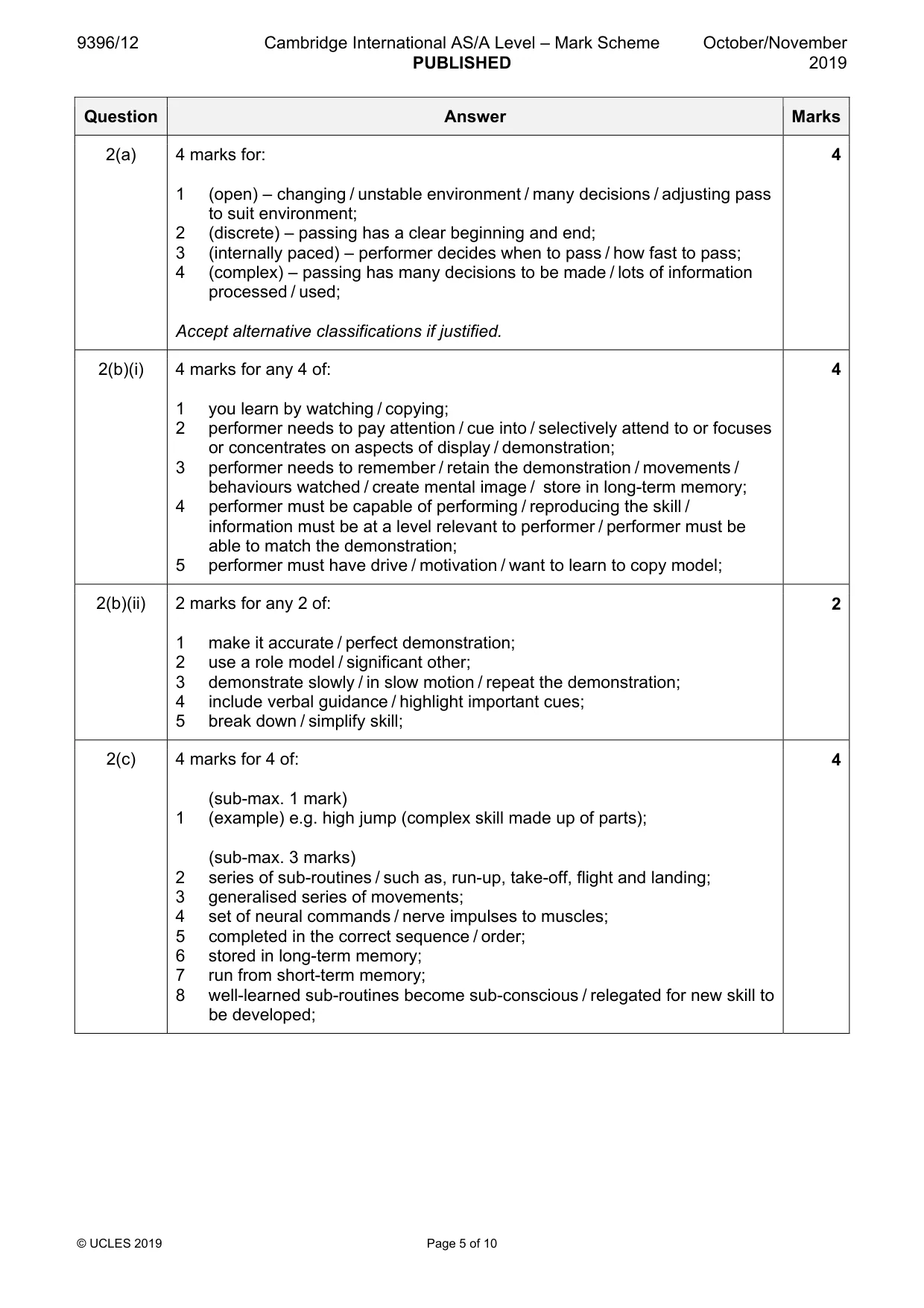
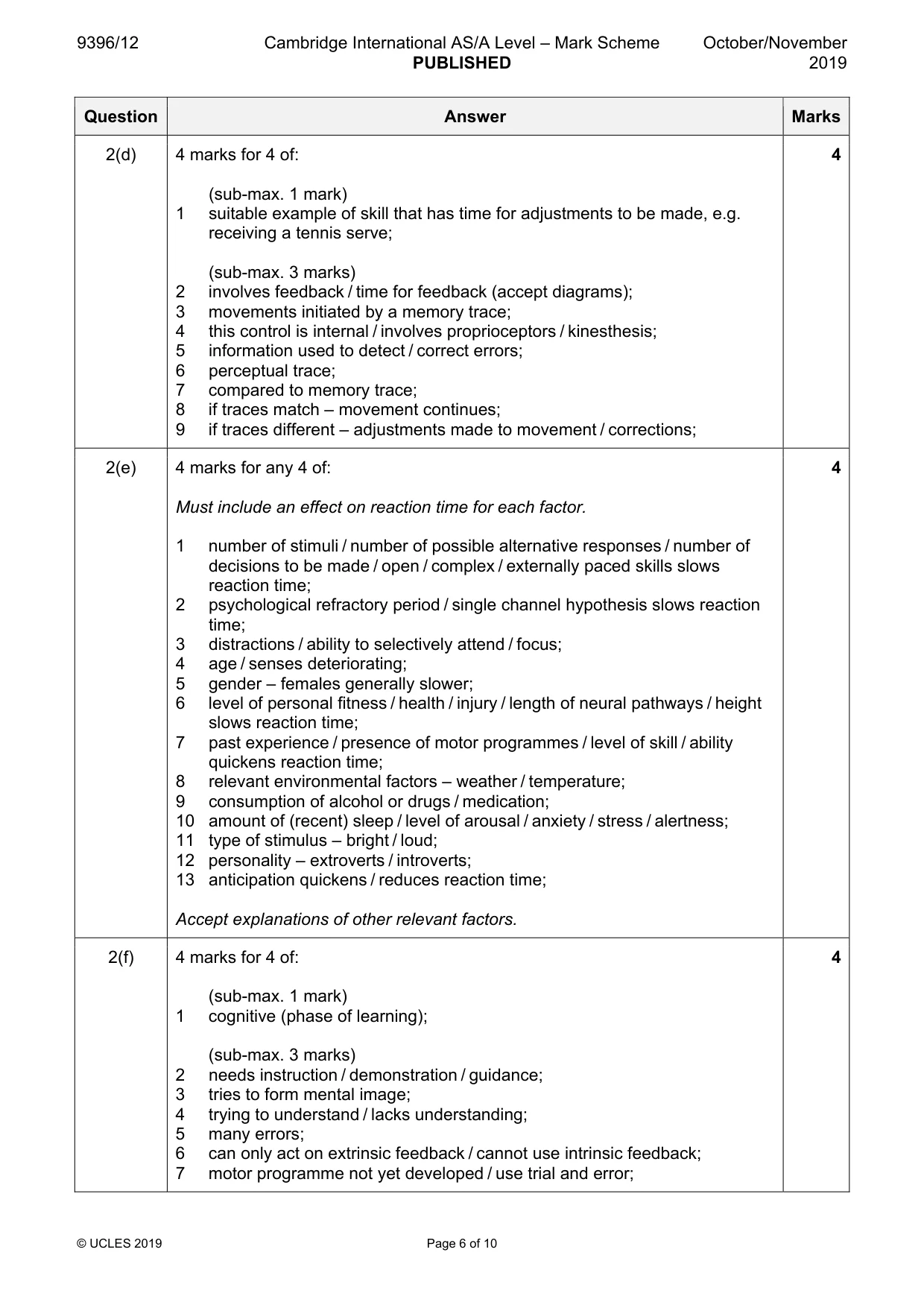

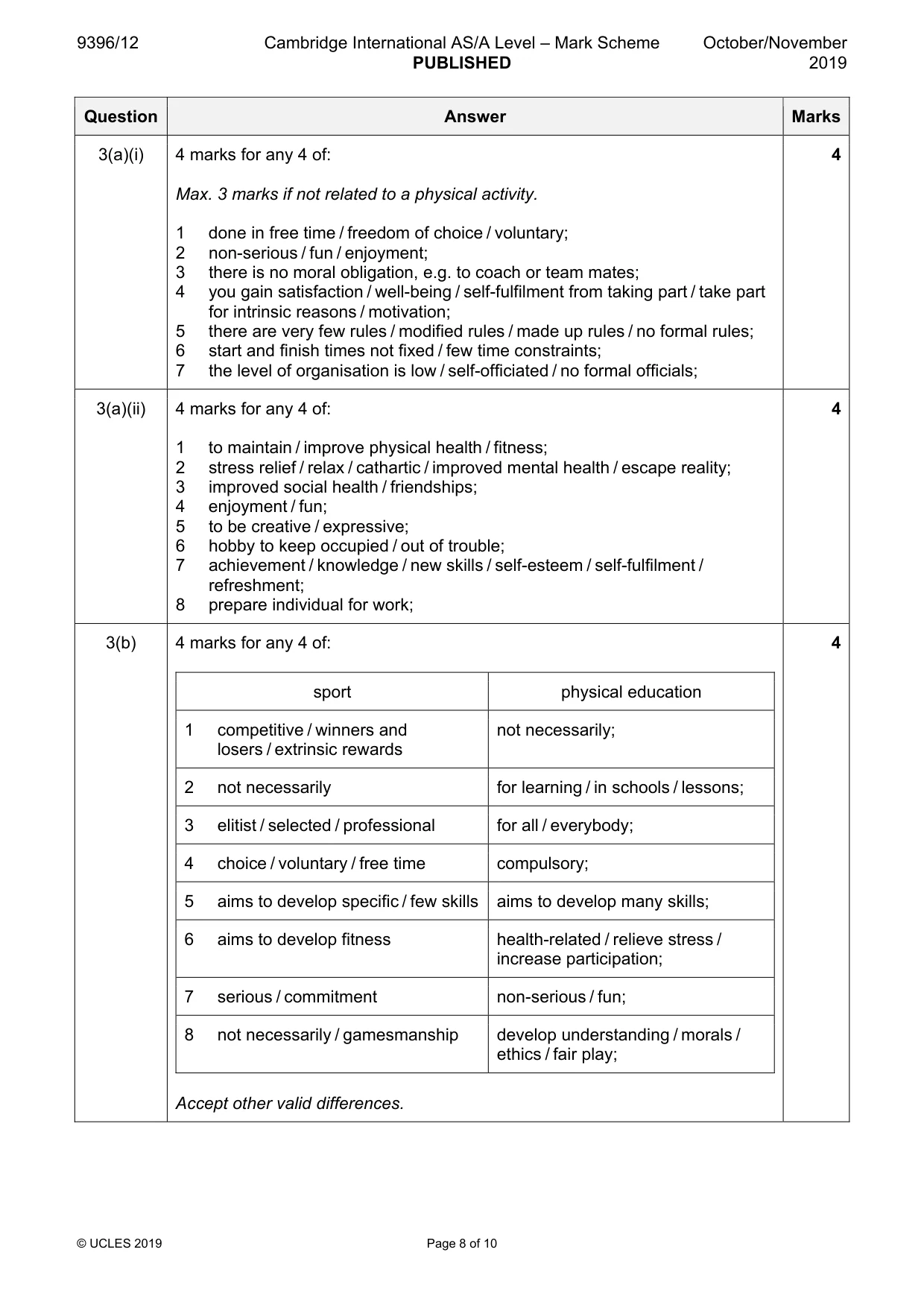
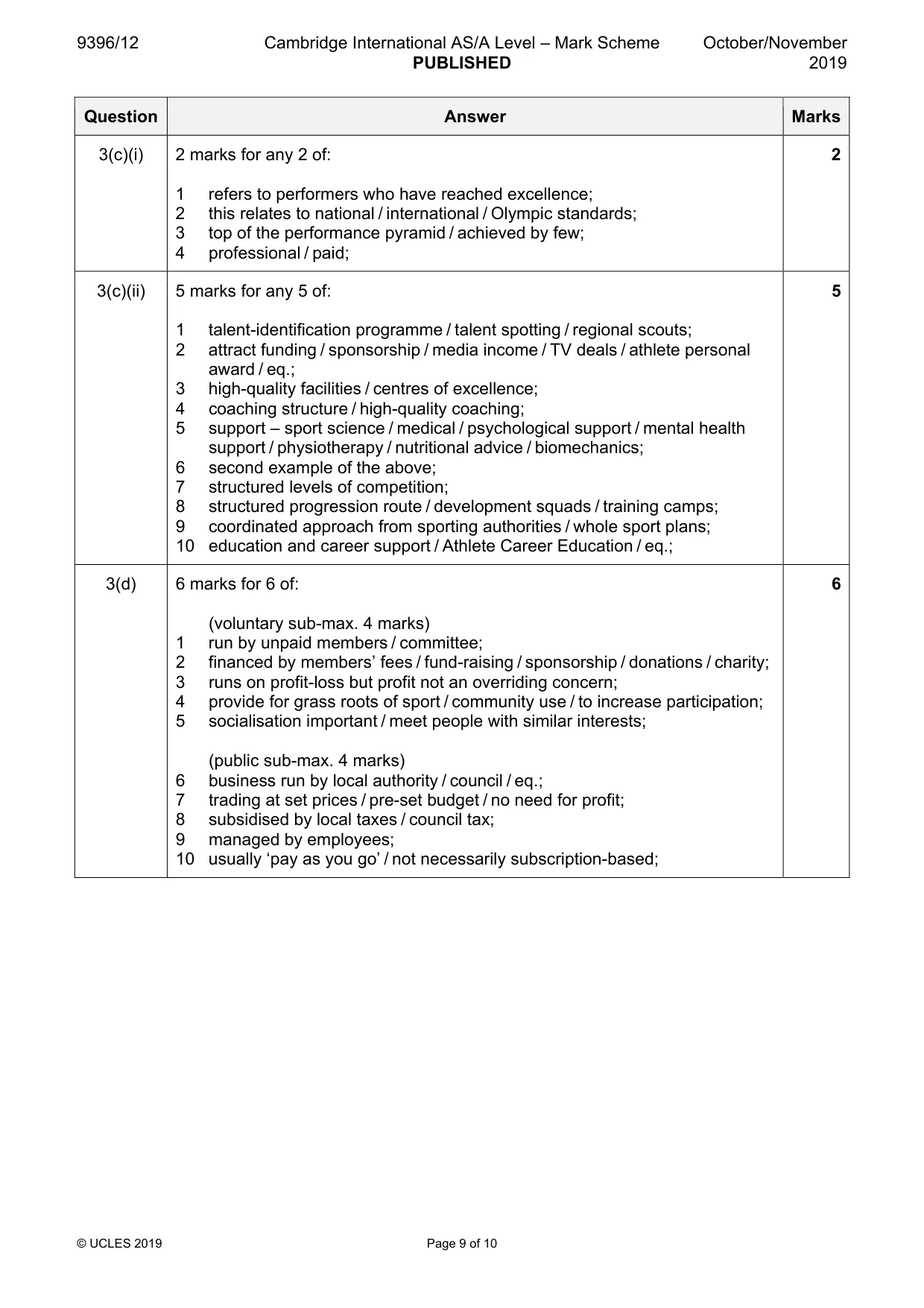
Paper as text
Question paper, page 1
This document consists of 4 printed pages and 1 Insert. DC (KS/CB) 162128/2 © UCLES 2019 [Turn over Cambridge Assessment International Education Cambridge International Advanced Subsidiary and Advanced Level * 7 0 9 7 8 4 8 6 0 3 * PHYSICAL EDUCATION 9396/12 Paper 1 October/November 2019 2 hours 30 minutes No Additional Materials are required. READ THESE INSTRUCTIONS FIRST An answer booklet is provided inside this question paper. You should follow the instructions on the front cover of the answer booklet. If you need additional answer paper ask the invigilator for a continuation booklet. Answer all questions. Electronic calculators may be used. You may lose marks if you do not show your working or if you do not use appropriate units. The number of marks is given in brackets [ ] at the end of each question or part question.
Question paper, page 2
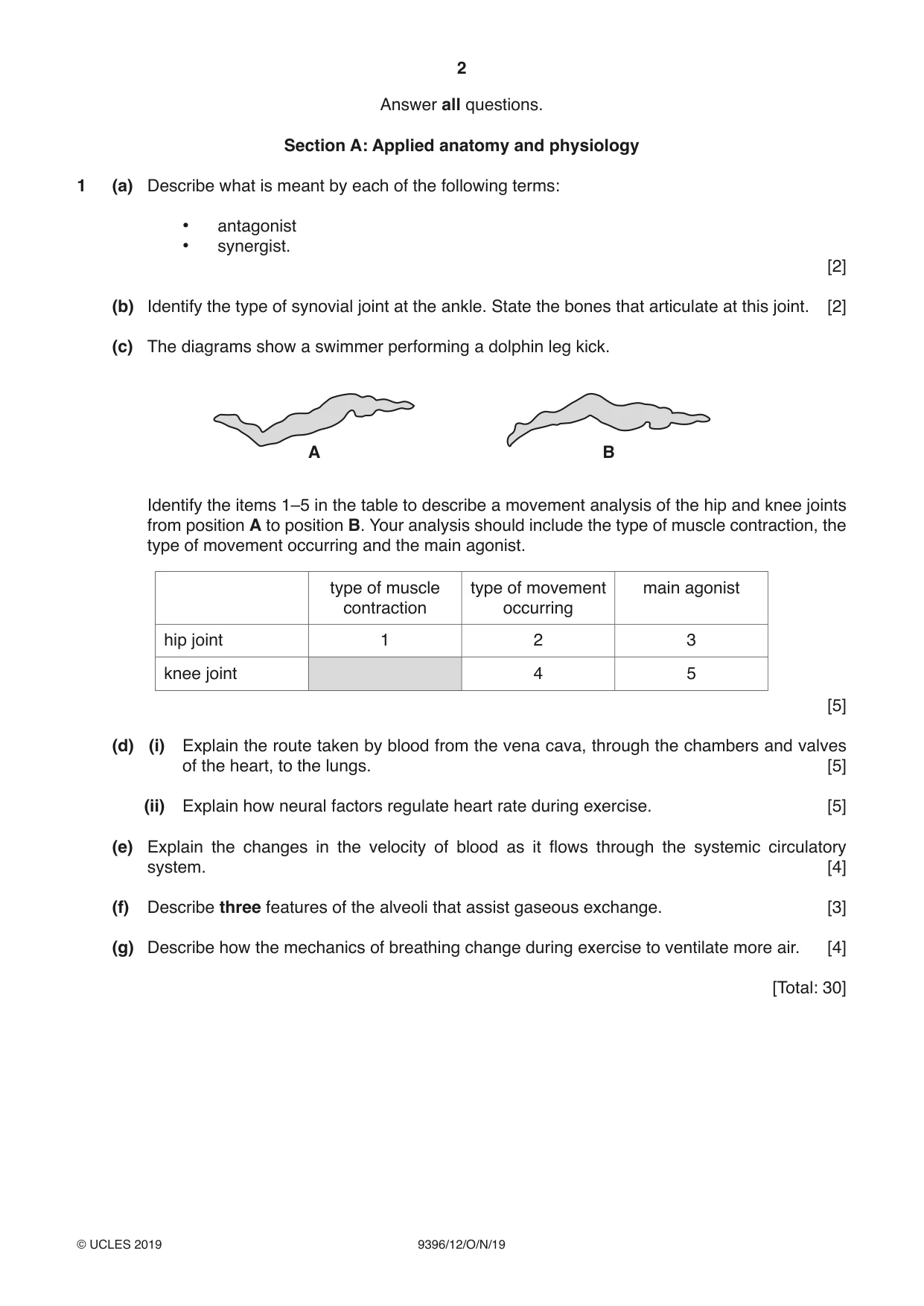
2 9396/12/O/N/19 © UCLES 2019 Answer all questions. Section A: Applied anatomy and physiology 1 (a) Describe what is meant by each of the following terms: • antagonist • synergist. [2] (b) Identify the type of synovial joint at the ankle. State the bones that articulate at this joint. [2] (c) The diagrams show a swimmer performing a dolphin leg kick. A B Identify the items 1–5 in the table to describe a movement analysis of the hip and knee joints from position A to position B. Your analysis should include the type of muscle contraction, the type of movement occurring and the main agonist. type of muscle contraction type of movement occurring main agonist hip joint 1 2 3 knee joint 4 5 [5] (d) (i) Explain the route taken by blood from the vena cava, through the chambers and valves of the heart, to the lungs. [5] (ii) Explain how neural factors regulate heart rate during exercise. [5] (e) Explain the changes in the velocity of blood as it flows through the systemic circulatory system. [4] (f) Describe three features of the alveoli that assist gaseous exchange. [3] (g) Describe how the mechanics of breathing change during exercise to ventilate more air. [4] [Total: 30]
Question paper, page 3
3 9396/12/O/N/19 © UCLES 2019 [Turn over Section B: Acquiring, developing and performing movement skills 2 (a) Classify passing a ball in a team game using each of the following four continua. Justify your answer for each classification. • open and closed • discrete, serial and continuous • externally and internally paced • simple and complex [4] (b) (i) Describe Bandura’s observational learning theory. [4] (ii) Suggest two ways a coach could make a demonstration more effective when teaching a movement skill. [2] (c) Explain, using a practical example, the term motor programme. [4] (d) Explain, using an example from a sport-specific skill, what is meant by closed-loop control. [4] (e) Explain how four different factors could affect the reaction time of a performer. [4] (f) During the development of skills a performer will progress through various phases of learning. Name the first phase of learning and describe the characteristics of this phase. [4] (g) Explain drive-reduction theory. [4] [Total: 30]
Question paper, page 4
4 9396/12/O/N/19 © UCLES 2019 Section C: Contemporary studies in physical education and sport 3 (a) Recreation, play and leisure are all concepts of physical activity. (i) Describe, using a physical activity of your choice, four similarities between recreation and play. [4] (ii) Suggest benefits of active leisure for an individual. [4] (b) Outline the differences between sport and physical education. [4] (c) (i) Explain what is meant by the term elite performer. [2] (ii) Describe the provision required by an elite performer in order to achieve high levels of performance. [5] (d) Describe each of the following: • provision of facilities by voluntary bodies • provision of facilities by public bodies. [6] (e) Outline how sporting organisations have attempted to reduce the potential for spectator violence. [5] [Total: 30] Permission to reproduce items where third-party owned material protected by copyright is included has been sought and cleared where possible. Every reasonable effort has been made by the publisher (UCLES) to trace copyright holders, but if any items requiring clearance have unwittingly been included, the publisher will be pleased to make amends at the earliest possible opportunity. To avoid the issue of disclosure of answer-related information to candidates, all copyright acknowledgements are reproduced online in the Cambridge Assessment International Education Copyright Acknowledgements Booklet. This is produced for each series of examinations and is freely available to download at www.cambridgeinternational.org after the live examination series. Cambridge Assessment International Education is part of the Cambridge Assessment Group. Cambridge Assessment is the brand name of the University of Cambridge Local Examinations Syndicate (UCLES), which itself is a department of the University of Cambridge.
Mark scheme, page 1
This document consists of 10 printed pages. © UCLES 2019 [Turn over Cambridge Assessment International Education Cambridge International Advanced Subsidiary and Advanced Level PHYSICAL EDUCATION 9396/12 Paper 1 October/November 2019 MARK SCHEME Maximum Mark: 90 Published This mark scheme is published as an aid to teachers and candidates, to indicate the requirements of the examination. It shows the basis on which Examiners were instructed to award marks. It does not indicate the details of the discussions that took place at an Examiners’ meeting before marking began, which would have considered the acceptability of alternative answers. Mark schemes should be read in conjunction with the question paper and the Principal Examiner Report for Teachers. Cambridge International will not enter into discussions about these mark schemes. Cambridge International is publishing the mark schemes for the October/November 2019 series for most Cambridge IGCSE™, Cambridge International A and AS Level components and some Cambridge O Level components.
Mark scheme, page 2
9396/12 Cambridge International AS/A Level – Mark Scheme PUBLISHED October/November 2019 © UCLES 2019 Page 2 of 10 Generic Marking Principles These general marking principles must be applied by all examiners when marking candidate answers. They should be applied alongside the specific content of the mark scheme or generic level descriptors for a question. Each question paper and mark scheme will also comply with these marking principles. GENERIC MARKING PRINCIPLE 1: Marks must be awarded in line with: • the specific content of the mark scheme or the generic level descriptors for the question • the specific skills defined in the mark scheme or in the generic level descriptors for the question • the standard of response required by a candidate as exemplified by the standardisation scripts. GENERIC MARKING PRINCIPLE 2: Marks awarded are always whole marks (not half marks, or other fractions). GENERIC MARKING PRINCIPLE 3: Marks must be awarded positively: • marks are awarded for correct/valid answers, as defined in the mark scheme. However, credit is given for valid answers which go beyond the scope of the syllabus and mark scheme, referring to your Team Leader as appropriate • marks are awarded when candidates clearly demonstrate what they know and can do • marks are not deducted for errors • marks are not deducted for omissions • answers should only be judged on the quality of spelling, punctuation and grammar when these features are specifically assessed by the question as indicated by the mark scheme. The meaning, however, should be unambiguous. GENERIC MARKING PRINCIPLE 4: Rules must be applied consistently e.g. in situations where candidates have not followed instructions or in the application of generic level descriptors. GENERIC MARKING PRINCIPLE 5: Marks should be awarded using the full range of marks defined in the mark scheme for the question (however; the use of the full mark range may be limited according to the quality of the candidate responses seen). GENERIC MARKING PRINCIPLE 6: Marks awarded are based solely on the requirements as defined in the mark scheme. Marks should not be awarded with grade thresholds or grade descriptors in mind.
Mark scheme, page 3
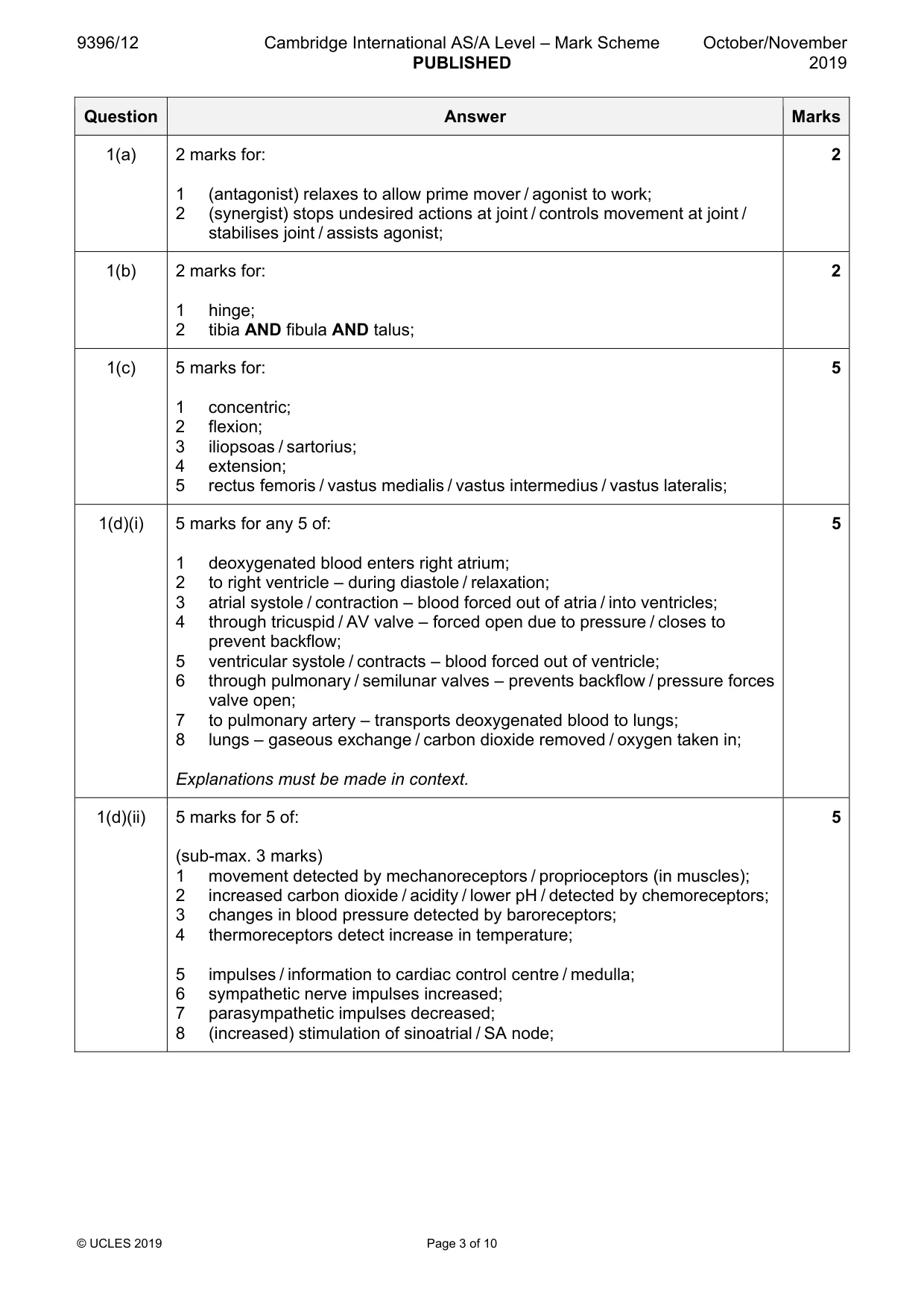
9396/12 Cambridge International AS/A Level – Mark Scheme PUBLISHED October/November 2019 © UCLES 2019 Page 3 of 10 Question Answer Marks 1(a) 2 marks for: 1 (antagonist) relaxes to allow prime mover / agonist to work; 2 (synergist) stops undesired actions at joint / controls movement at joint / stabilises joint / assists agonist; 2 1(b) 2 marks for: 1 hinge; 2 tibia AND fibula AND talus; 2 1(c) 5 marks for: 1 concentric; 2 flexion; 3 iliopsoas / sartorius; 4 extension; 5 rectus femoris / vastus medialis / vastus intermedius / vastus lateralis; 5 1(d)(i) 5 marks for any 5 of: 1 deoxygenated blood enters right atrium; 2 to right ventricle – during diastole / relaxation; 3 atrial systole / contraction – blood forced out of atria / into ventricles; 4 through tricuspid / AV valve – forced open due to pressure / closes to prevent backflow; 5 ventricular systole / contracts – blood forced out of ventricle; 6 through pulmonary / semilunar valves – prevents backflow / pressure forces valve open; 7 to pulmonary artery – transports deoxygenated blood to lungs; 8 lungs – gaseous exchange / carbon dioxide removed / oxygen taken in; Explanations must be made in context. 5 1(d)(ii) 5 marks for 5 of: (sub-max. 3 marks) 1 movement detected by mechanoreceptors / proprioceptors (in muscles); 2 increased carbon dioxide / acidity / lower pH / detected by chemoreceptors; 3 changes in blood pressure detected by baroreceptors; 4 thermoreceptors detect increase in temperature; 5 impulses / information to cardiac control centre / medulla; 6 sympathetic nerve impulses increased; 7 parasympathetic impulses decreased; 8 (increased) stimulation of sinoatrial / SA node; 5
Mark scheme, page 4
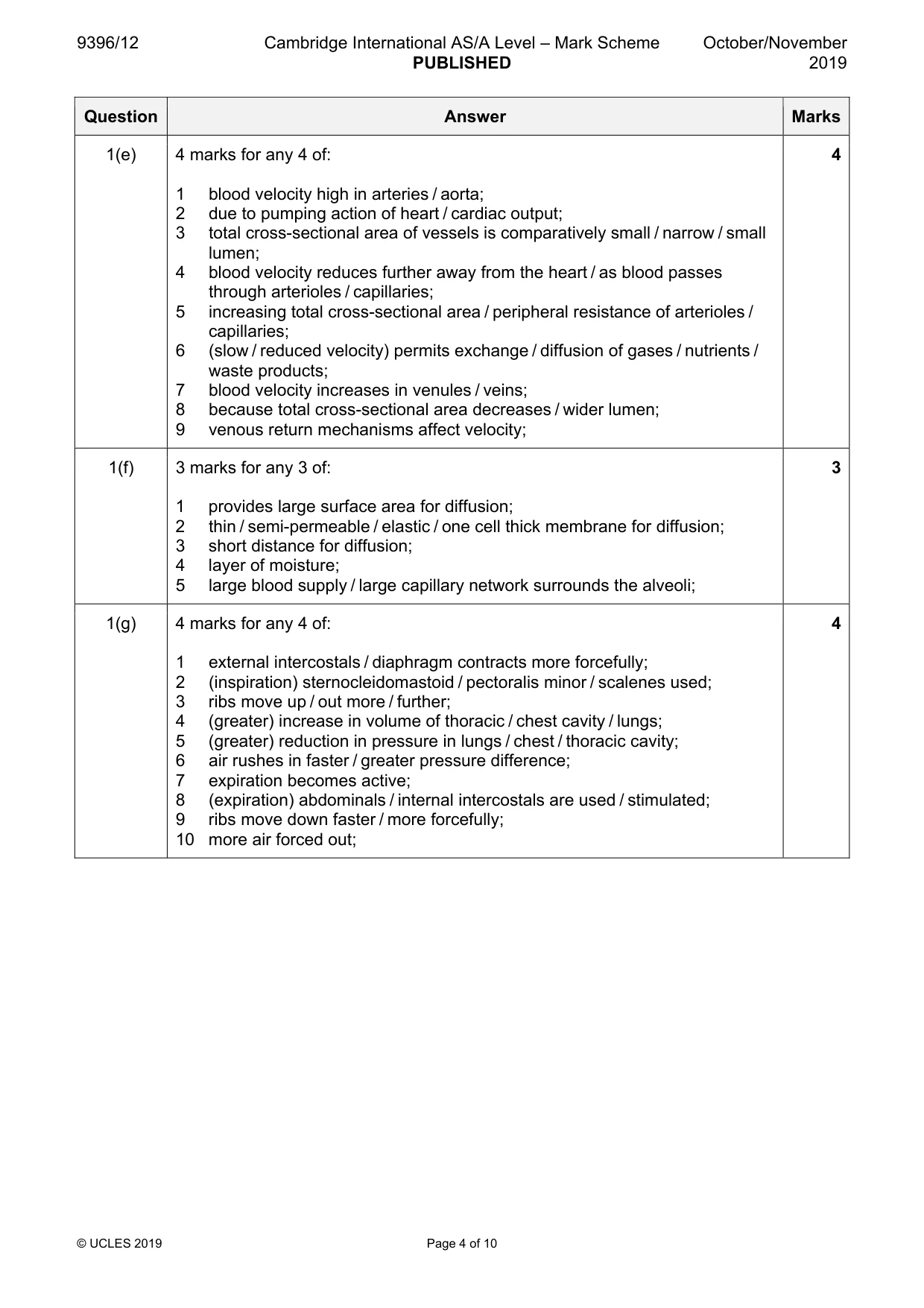
9396/12 Cambridge International AS/A Level – Mark Scheme PUBLISHED October/November 2019 © UCLES 2019 Page 4 of 10 Question Answer Marks 1(e) 4 marks for any 4 of: 1 blood velocity high in arteries / aorta; 2 due to pumping action of heart / cardiac output; 3 total cross-sectional area of vessels is comparatively small / narrow / small lumen; 4 blood velocity reduces further away from the heart / as blood passes through arterioles / capillaries; 5 increasing total cross-sectional area / peripheral resistance of arterioles / capillaries; 6 (slow / reduced velocity) permits exchange / diffusion of gases / nutrients / waste products; 7 blood velocity increases in venules / veins; 8 because total cross-sectional area decreases / wider lumen; 9 venous return mechanisms affect velocity; 4 1(f) 3 marks for any 3 of: 1 provides large surface area for diffusion; 2 thin / semi-permeable / elastic / one cell thick membrane for diffusion; 3 short distance for diffusion; 4 layer of moisture; 5 large blood supply / large capillary network surrounds the alveoli; 3 1(g) 4 marks for any 4 of: 1 external intercostals / diaphragm contracts more forcefully; 2 (inspiration) sternocleidomastoid / pectoralis minor / scalenes used; 3 ribs move up / out more / further; 4 (greater) increase in volume of thoracic / chest cavity / lungs; 5 (greater) reduction in pressure in lungs / chest / thoracic cavity; 6 air rushes in faster / greater pressure difference; 7 expiration becomes active; 8 (expiration) abdominals / internal intercostals are used / stimulated; 9 ribs move down faster / more forcefully; 10 more air forced out; 4
Mark scheme, page 5
9396/12 Cambridge International AS/A Level – Mark Scheme PUBLISHED October/November 2019 © UCLES 2019 Page 5 of 10 Question Answer Marks 2(a) 4 marks for: 1 (open) – changing / unstable environment / many decisions / adjusting pass to suit environment; 2 (discrete) – passing has a clear beginning and end; 3 (internally paced) – performer decides when to pass / how fast to pass; 4 (complex) – passing has many decisions to be made / lots of information processed / used; Accept alternative classifications if justified. 4 2(b)(i) 4 marks for any 4 of: 1 you learn by watching / copying; 2 performer needs to pay attention / cue into / selectively attend to or focuses or concentrates on aspects of display / demonstration; 3 performer needs to remember / retain the demonstration / movements / behaviours watched / create mental image / store in long-term memory; 4 performer must be capable of performing / reproducing the skill / information must be at a level relevant to performer / performer must be able to match the demonstration; 5 performer must have drive / motivation / want to learn to copy model; 4 2(b)(ii) 2 marks for any 2 of: 1 make it accurate / perfect demonstration; 2 use a role model / significant other; 3 demonstrate slowly / in slow motion / repeat the demonstration; 4 include verbal guidance / highlight important cues; 5 break down / simplify skill; 2 2(c) 4 marks for 4 of: (sub-max. 1 mark) 1 (example) e.g. high jump (complex skill made up of parts); (sub-max. 3 marks) 2 series of sub-routines / such as, run-up, take-off, flight and landing; 3 generalised series of movements; 4 set of neural commands / nerve impulses to muscles; 5 completed in the correct sequence / order; 6 stored in long-term memory; 7 run from short-term memory; 8 well-learned sub-routines become sub-conscious / relegated for new skill to be developed; 4
Mark scheme, page 6
9396/12 Cambridge International AS/A Level – Mark Scheme PUBLISHED October/November 2019 © UCLES 2019 Page 6 of 10 Question Answer Marks 2(d) 4 marks for 4 of: (sub-max. 1 mark) 1 suitable example of skill that has time for adjustments to be made, e.g. receiving a tennis serve; (sub-max. 3 marks) 2 involves feedback / time for feedback (accept diagrams); 3 movements initiated by a memory trace; 4 this control is internal / involves proprioceptors / kinesthesis; 5 information used to detect / correct errors; 6 perceptual trace; 7 compared to memory trace; 8 if traces match – movement continues; 9 if traces different – adjustments made to movement / corrections; 4 2(e) 4 marks for any 4 of: Must include an effect on reaction time for each factor. 1 number of stimuli / number of possible alternative responses / number of decisions to be made / open / complex / externally paced skills slows reaction time; 2 psychological refractory period / single channel hypothesis slows reaction time; 3 distractions / ability to selectively attend / focus; 4 age / senses deteriorating; 5 gender – females generally slower; 6 level of personal fitness / health / injury / length of neural pathways / height slows reaction time; 7 past experience / presence of motor programmes / level of skill / ability quickens reaction time; 8 relevant environmental factors – weather / temperature; 9 consumption of alcohol or drugs / medication; 10 amount of (recent) sleep / level of arousal / anxiety / stress / alertness; 11 type of stimulus – bright / loud; 12 personality – extroverts / introverts; 13 anticipation quickens / reduces reaction time; Accept explanations of other relevant factors. 4 2(f) 4 marks for 4 of: (sub-max. 1 mark) 1 cognitive (phase of learning); (sub-max. 3 marks) 2 needs instruction / demonstration / guidance; 3 tries to form mental image; 4 trying to understand / lacks understanding; 5 many errors; 6 can only act on extrinsic feedback / cannot use intrinsic feedback; 7 motor programme not yet developed / use trial and error; 4
Mark scheme, page 7
9396/12 Cambridge International AS/A Level – Mark Scheme PUBLISHED October/November 2019 © UCLES 2019 Page 7 of 10 Question Answer Marks 2(g) 4 marks for any 4 of: 1 humans have a drive / need / motivation / desire to achieve / solve a problem / to win or learn; 2 practice / rehearsal / performance takes place to satisfy this need or drive; 3 if skill is performed successfully then learning is reinforced / satisfaction; 4 drive reduced when (perceived) success is experienced; 5 therefore motivation to do more reduces / subsides; 6 too much practice leads to drive reduction / reactive inhibition; 7 new tasks / goals / motivation is needed to remove this reduction in drive; 4
Mark scheme, page 8
9396/12 Cambridge International AS/A Level – Mark Scheme PUBLISHED October/November 2019 © UCLES 2019 Page 8 of 10 Question Answer Marks 3(a)(i) 4 marks for any 4 of: Max. 3 marks if not related to a physical activity. 1 done in free time / freedom of choice / voluntary; 2 non-serious / fun / enjoyment; 3 there is no moral obligation, e.g. to coach or team mates; 4 you gain satisfaction / well-being / self-fulfilment from taking part / take part for intrinsic reasons / motivation; 5 there are very few rules / modified rules / made up rules / no formal rules; 6 start and finish times not fixed / few time constraints; 7 the level of organisation is low / self-officiated / no formal officials; 4 3(a)(ii) 4 marks for any 4 of: 1 to maintain / improve physical health / fitness; 2 stress relief / relax / cathartic / improved mental health / escape reality; 3 improved social health / friendships; 4 enjoyment / fun; 5 to be creative / expressive; 6 hobby to keep occupied / out of trouble; 7 achievement / knowledge / new skills / self-esteem / self-fulfilment / refreshment; 8 prepare individual for work; 4 3(b) 4 marks for any 4 of: sport physical education 1 competitive / winners and losers / extrinsic rewards not necessarily; 2 not necessarily for learning / in schools / lessons; 3 elitist / selected / professional for all / everybody; 4 choice / voluntary / free time compulsory; 5 aims to develop specific / few skills aims to develop many skills; 6 aims to develop fitness health-related / relieve stress / increase participation; 7 serious / commitment non-serious / fun; 8 not necessarily / gamesmanship develop understanding / morals / ethics / fair play; Accept other valid differences. 4
Mark scheme, page 9
9396/12 Cambridge International AS/A Level – Mark Scheme PUBLISHED October/November 2019 © UCLES 2019 Page 9 of 10 Question Answer Marks 3(c)(i) 2 marks for any 2 of: 1 refers to performers who have reached excellence; 2 this relates to national / international / Olympic standards; 3 top of the performance pyramid / achieved by few; 4 professional / paid; 2 3(c)(ii) 5 marks for any 5 of: 1 talent-identification programme / talent spotting / regional scouts; 2 attract funding / sponsorship / media income / TV deals / athlete personal award / eq.; 3 high-quality facilities / centres of excellence; 4 coaching structure / high-quality coaching; 5 support – sport science / medical / psychological support / mental health support / physiotherapy / nutritional advice / biomechanics; 6 second example of the above; 7 structured levels of competition; 8 structured progression route / development squads / training camps; 9 coordinated approach from sporting authorities / whole sport plans; 10 education and career support / Athlete Career Education / eq.; 5 3(d) 6 marks for 6 of: (voluntary sub-max. 4 marks) 1 run by unpaid members / committee; 2 financed by members’ fees / fund-raising / sponsorship / donations / charity; 3 runs on profit-loss but profit not an overriding concern; 4 provide for grass roots of sport / community use / to increase participation; 5 socialisation important / meet people with similar interests; (public sub-max. 4 marks) 6 business run by local authority / council / eq.; 7 trading at set prices / pre-set budget / no need for profit; 8 subsidised by local taxes / council tax; 9 managed by employees; 10 usually ‘pay as you go’ / not necessarily subscription-based; 6
Mark scheme, page 10
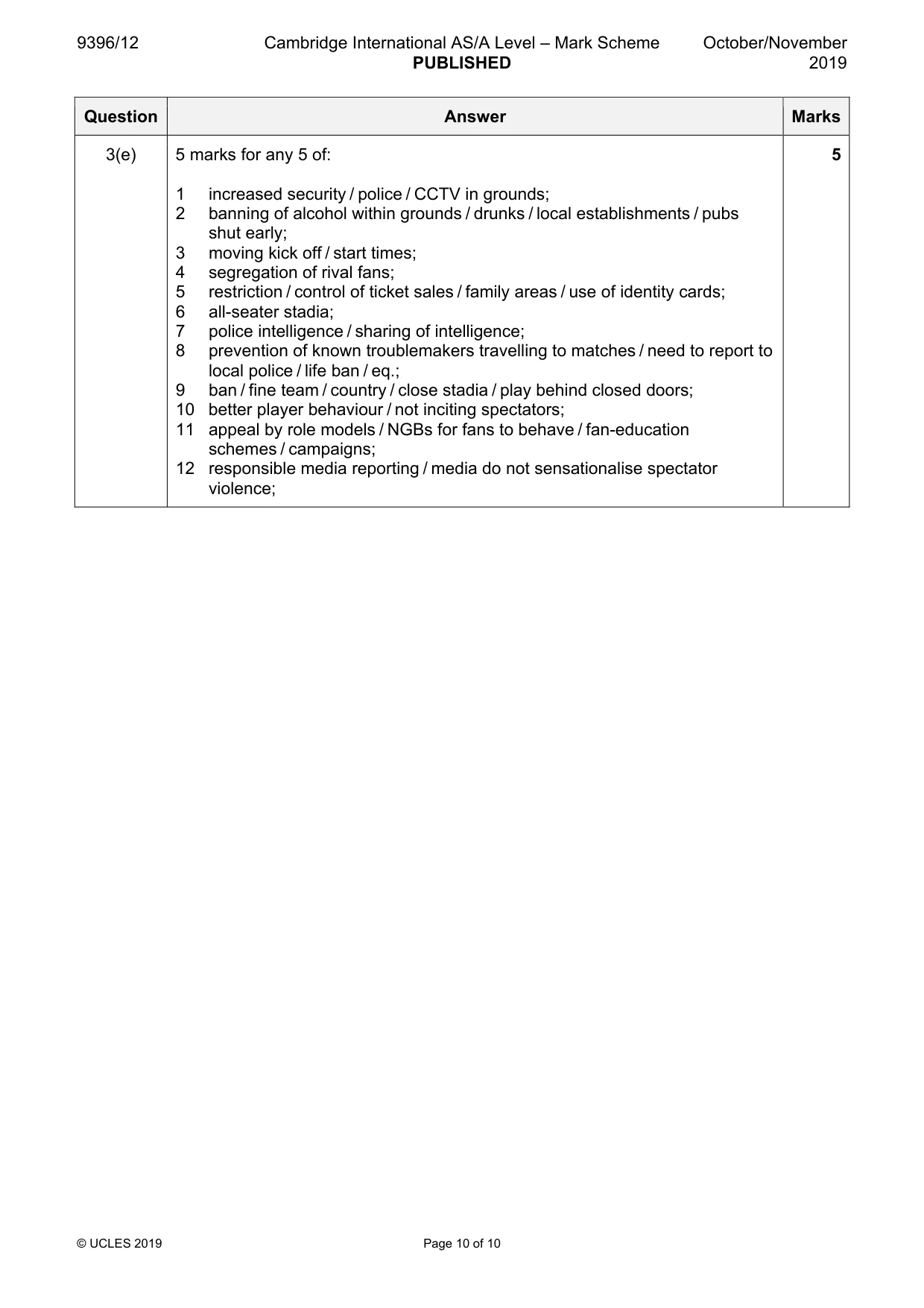
9396/12 Cambridge International AS/A Level – Mark Scheme PUBLISHED October/November 2019 © UCLES 2019 Page 10 of 10 Question Answer Marks 3(e) 5 marks for any 5 of: 1 increased security / police / CCTV in grounds; 2 banning of alcohol within grounds / drunks / local establishments / pubs shut early; 3 moving kick off / start times; 4 segregation of rival fans; 5 restriction / control of ticket sales / family areas / use of identity cards; 6 all-seater stadia; 7 police intelligence / sharing of intelligence; 8 prevention of known troublemakers travelling to matches / need to report to local police / life ban / eq.; 9 ban / fine team / country / close stadia / play behind closed doors; 10 better player behaviour / not inciting spectators; 11 appeal by role models / NGBs for fans to behave / fan-education schemes / campaigns; 12 responsible media reporting / media do not sensationalise spectator violence; 5
What you needed in this session
Cambridge’s own grade thresholds for 2019 Oct/Nov, Paper 1 · Variant 2. A higher threshold means an easier paper — the bar moves with how the cohort did.