Cambridge A Level Physical Education 9396 — 2019 Oct/Nov Paper 1 · Variant 3
9396/13/O/N/19 · 90 marks · ≈101 min
The question paper and its mark scheme, free to read here and free to download. This is Cambridge’s own paper, exactly as it was sat.
Question paper4 pages
Mark scheme9 pages
Answers below. Sit the paper first if you are practising.
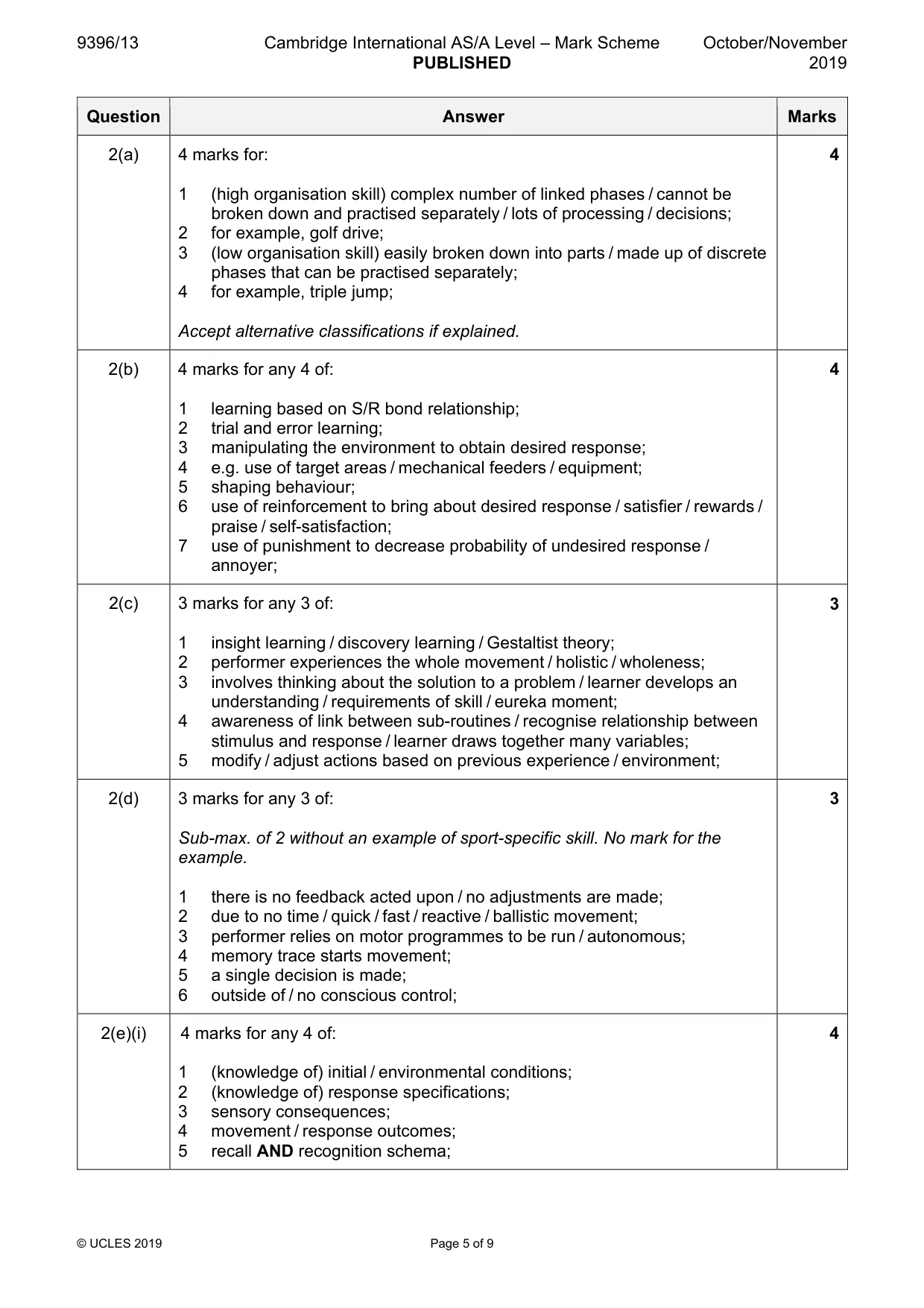
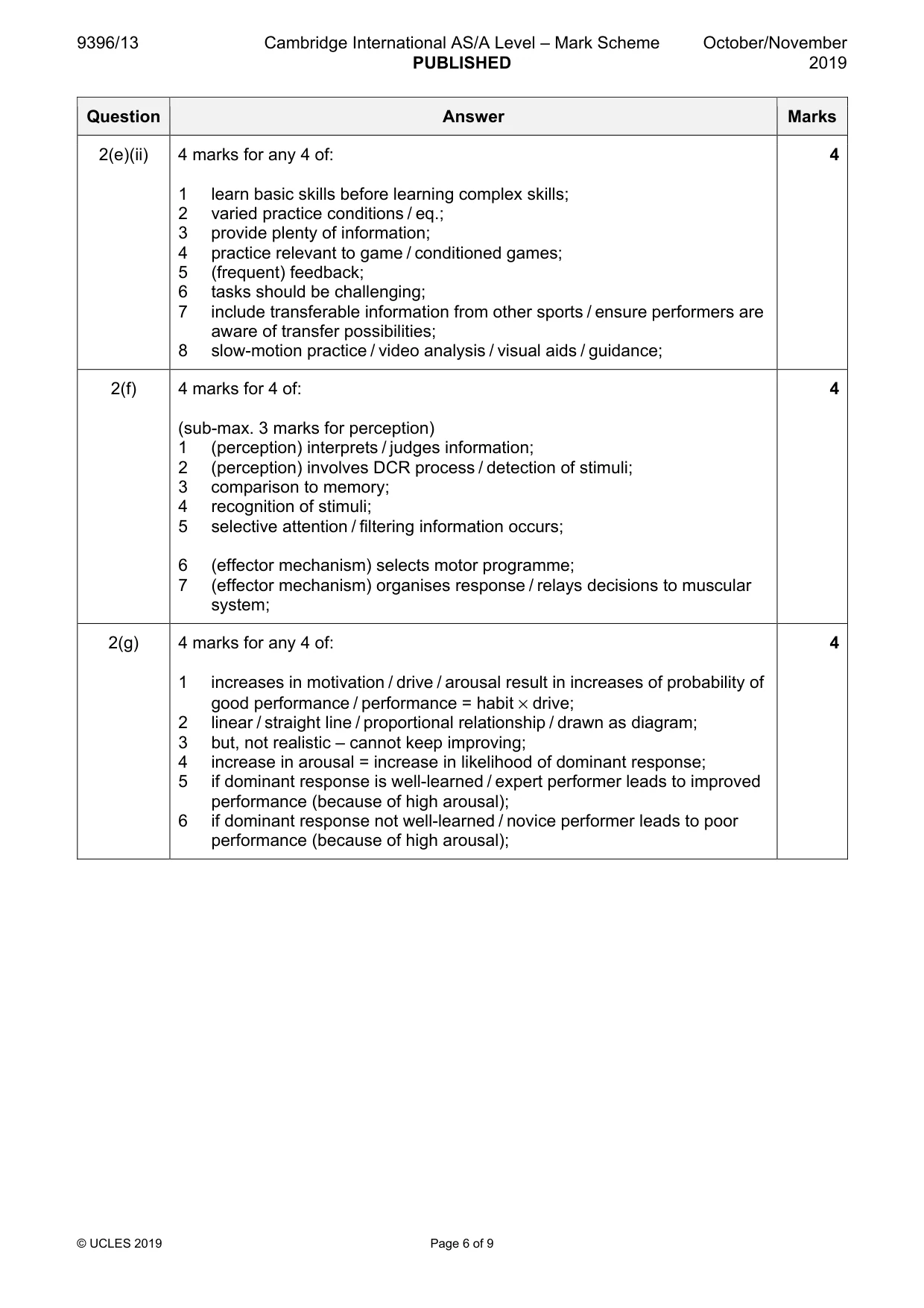
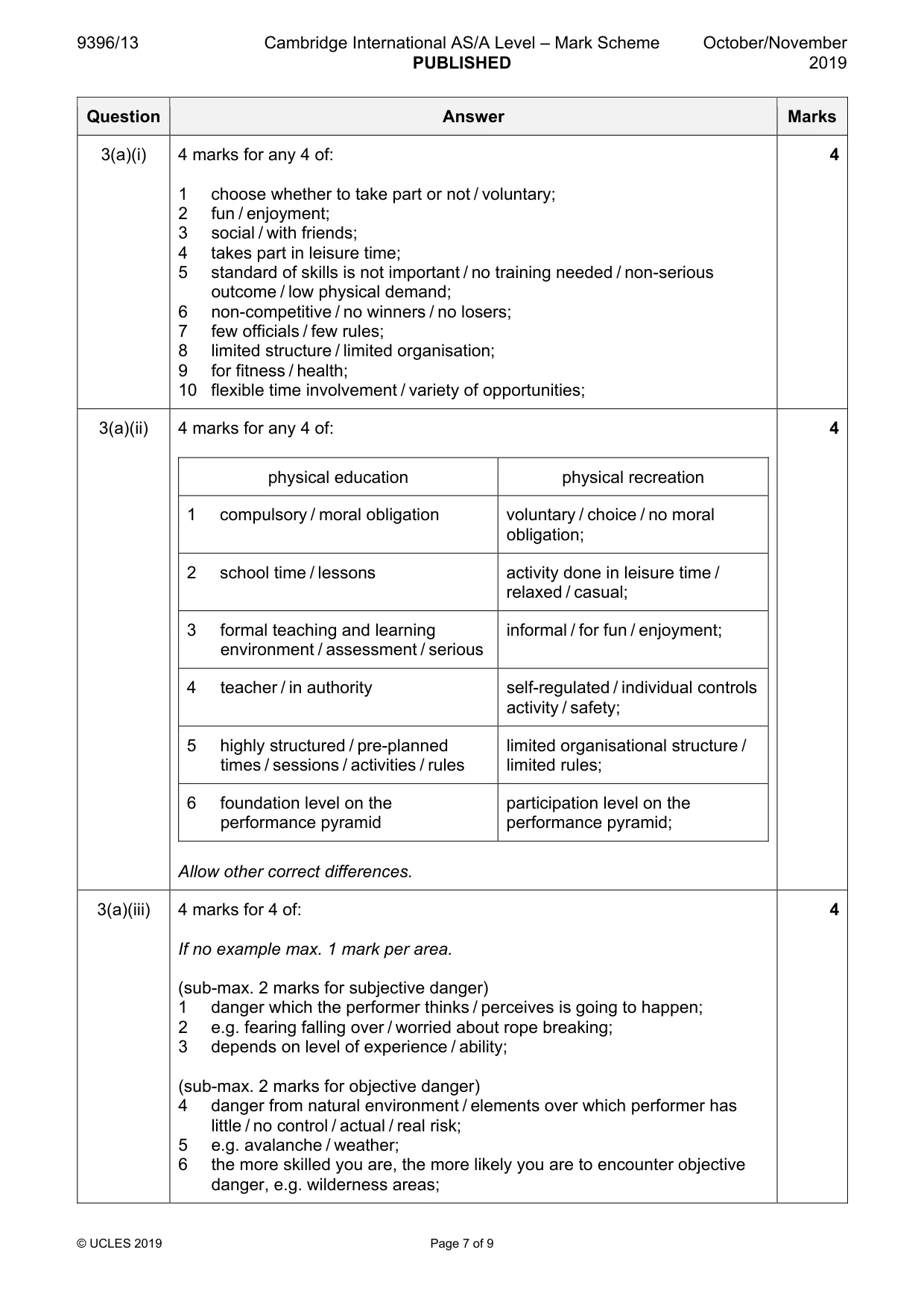
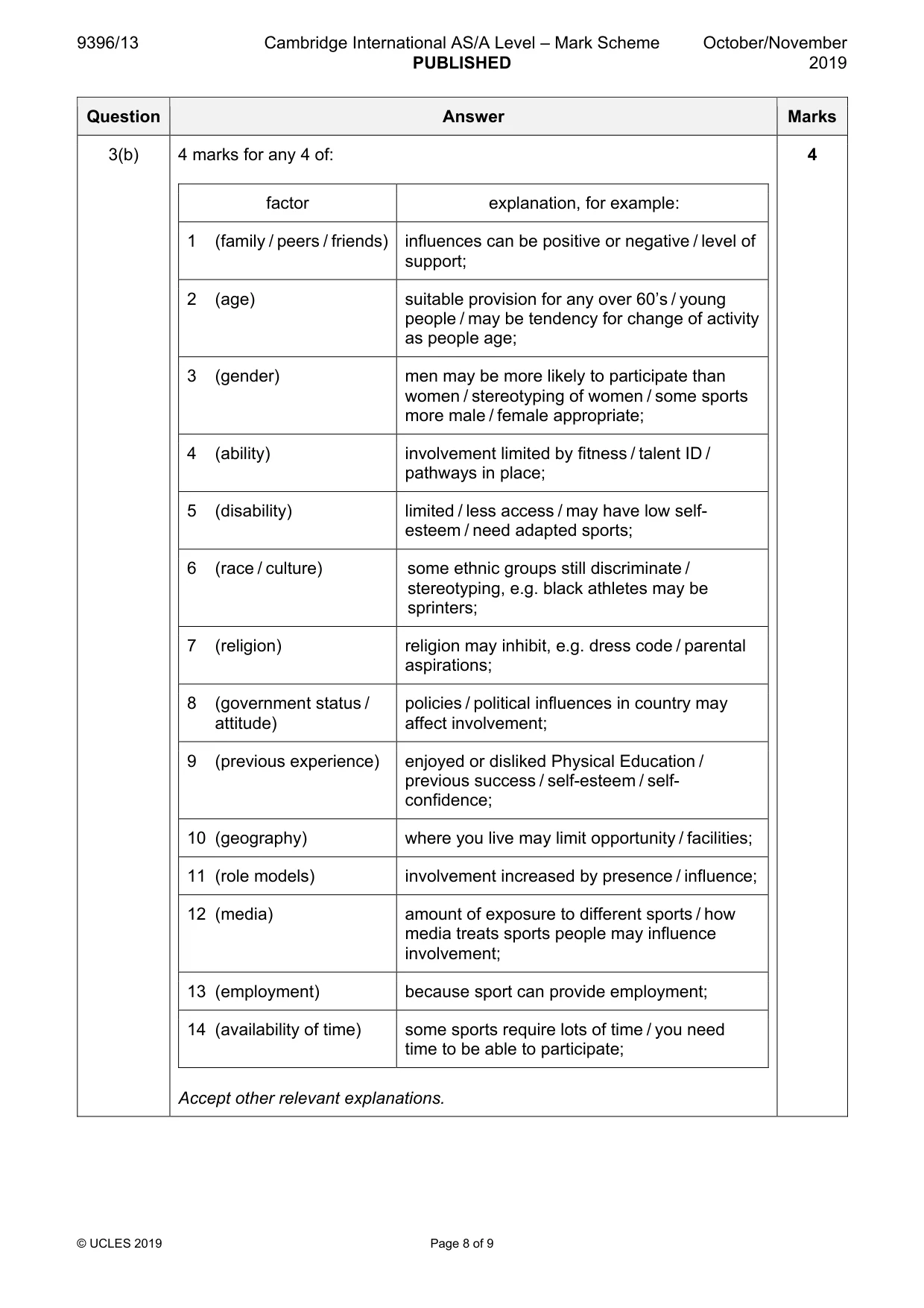
Paper as text
Question paper, page 1
This document consists of 4 printed pages and 1 Insert. DC (KS/CB) 162127/1 © UCLES 2019 [Turn over Cambridge Assessment International Education Cambridge International Advanced Subsidiary and Advanced Level * 6 7 8 8 5 7 2 7 0 4 * PHYSICAL EDUCATION 9396/13 Paper 1 October/November 2019 2 hours 30 minutes No Additional Materials are required. READ THESE INSTRUCTIONS FIRST An answer booklet is provided inside this question paper. You should follow the instructions on the front cover of the answer booklet. If you need additional answer paper ask the invigilator for a continuation booklet. Answer all questions. Electronic calculators may be used. You may lose marks if you do not show your working or if you do not use appropriate units. The number of marks is given in brackets [ ] at the end of each question or part question.
Question paper, page 2
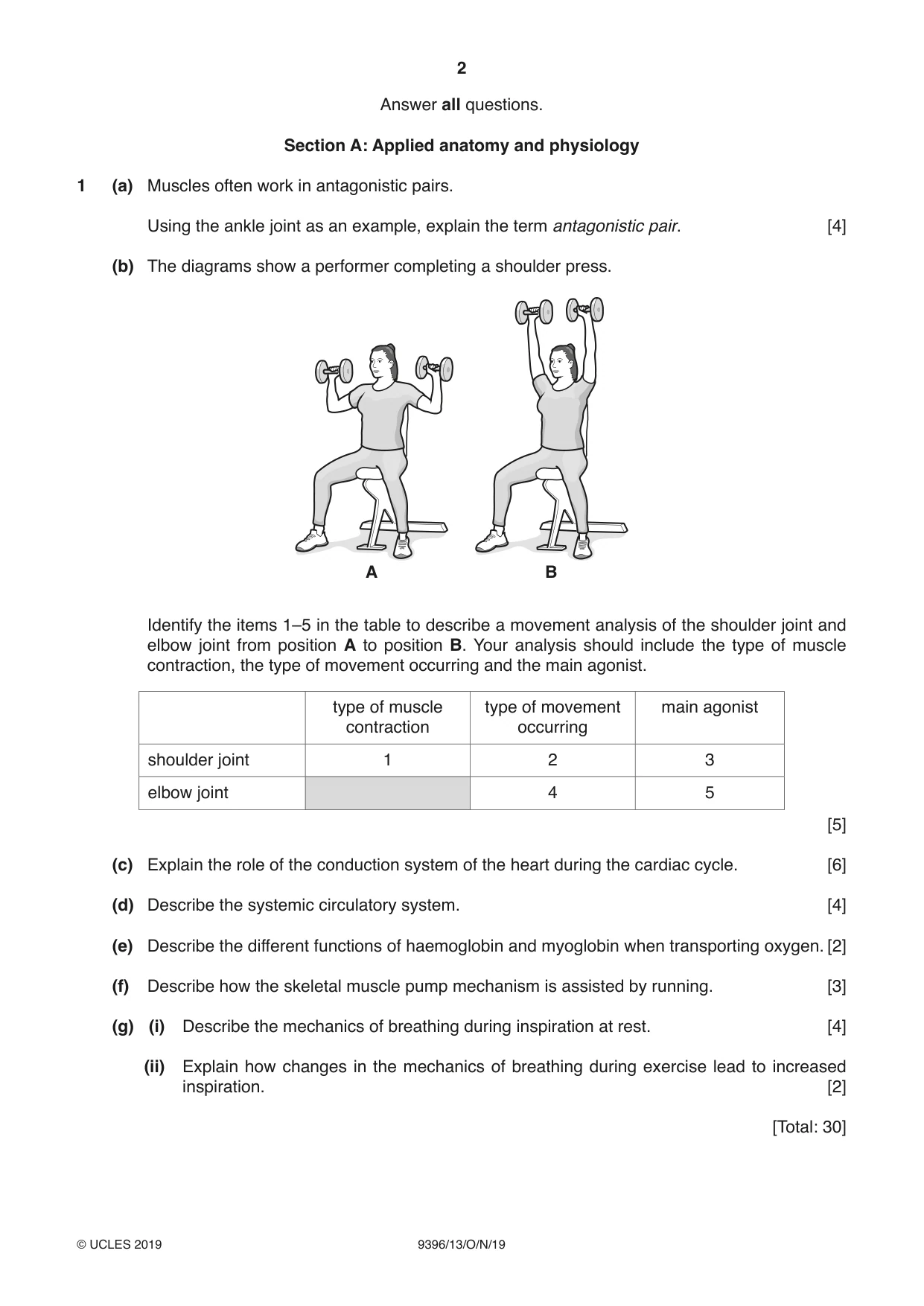
2 9396/13/O/N/19 © UCLES 2019 Answer all questions. Section A: Applied anatomy and physiology 1 (a) Muscles often work in antagonistic pairs. Using the ankle joint as an example, explain the term antagonistic pair. [4] (b) The diagrams show a performer completing a shoulder press. A B Identify the items 1–5 in the table to describe a movement analysis of the shoulder joint and elbow joint from position A to position B. Your analysis should include the type of muscle contraction, the type of movement occurring and the main agonist. type of muscle contraction type of movement occurring main agonist shoulder joint 1 2 3 elbow joint 4 5 [5] (c) Explain the role of the conduction system of the heart during the cardiac cycle. [6] (d) Describe the systemic circulatory system. [4] (e) Describe the different functions of haemoglobin and myoglobin when transporting oxygen. [2] (f) Describe how the skeletal muscle pump mechanism is assisted by running. [3] (g) (i) Describe the mechanics of breathing during inspiration at rest. [4] (ii) Explain how changes in the mechanics of breathing during exercise lead to increased inspiration. [2] [Total: 30]
Question paper, page 3
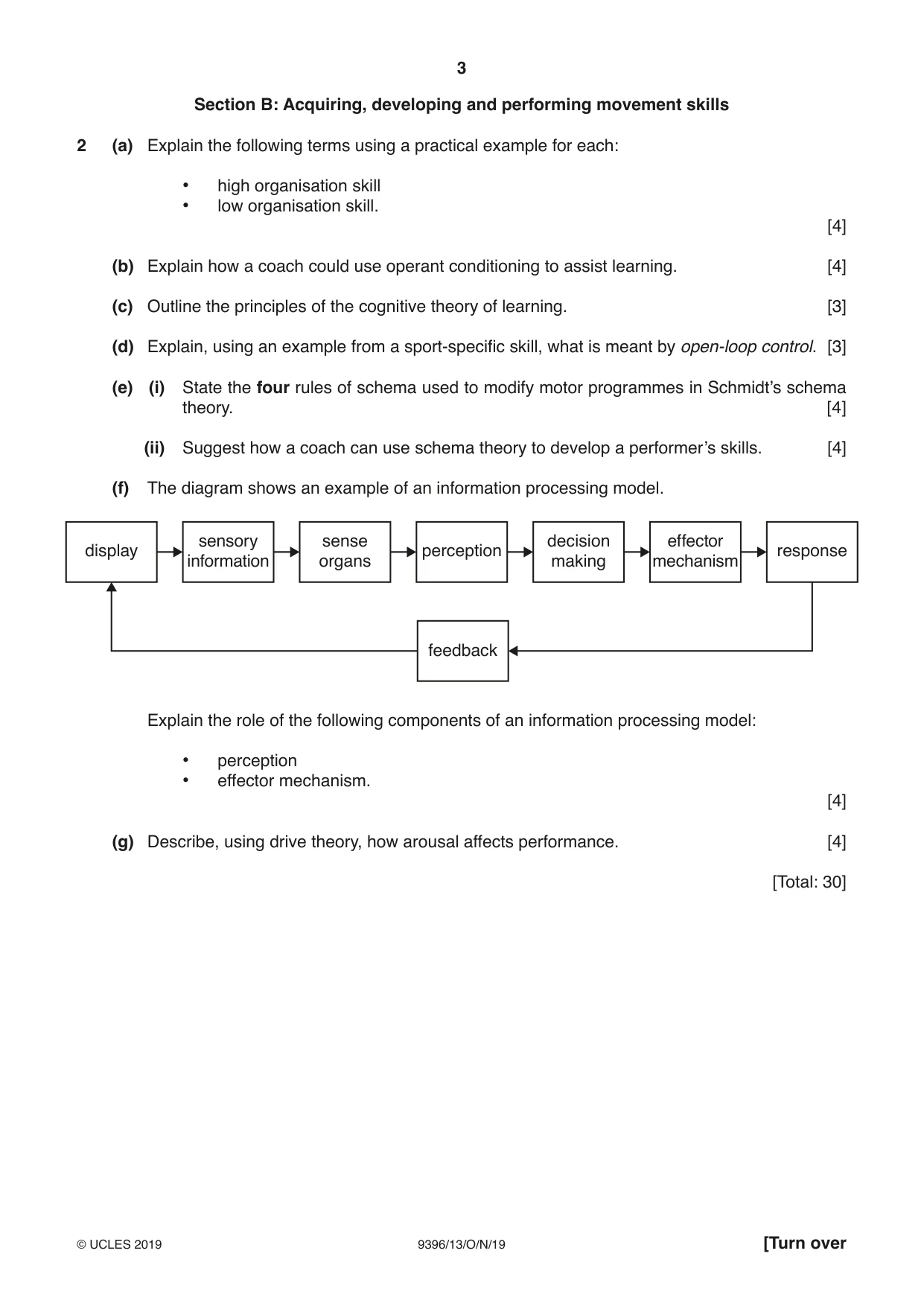
3 9396/13/O/N/19 © UCLES 2019 [Turn over Section B: Acquiring, developing and performing movement skills 2 (a) Explain the following terms using a practical example for each: • high organisation skill • low organisation skill. [4] (b) Explain how a coach could use operant conditioning to assist learning. [4] (c) Outline the principles of the cognitive theory of learning. [3] (d) Explain, using an example from a sport-specific skill, what is meant by open-loop control. [3] (e) (i) State the four rules of schema used to modify motor programmes in Schmidt’s schema theory. [4] (ii) Suggest how a coach can use schema theory to develop a performer’s skills. [4] (f) The diagram shows an example of an information processing model. feedback sensory information sense organs perception decision making effector mechanism response display Explain the role of the following components of an information processing model: • perception • effector mechanism. [4] (g) Describe, using drive theory, how arousal affects performance. [4] [Total: 30]
Question paper, page 4
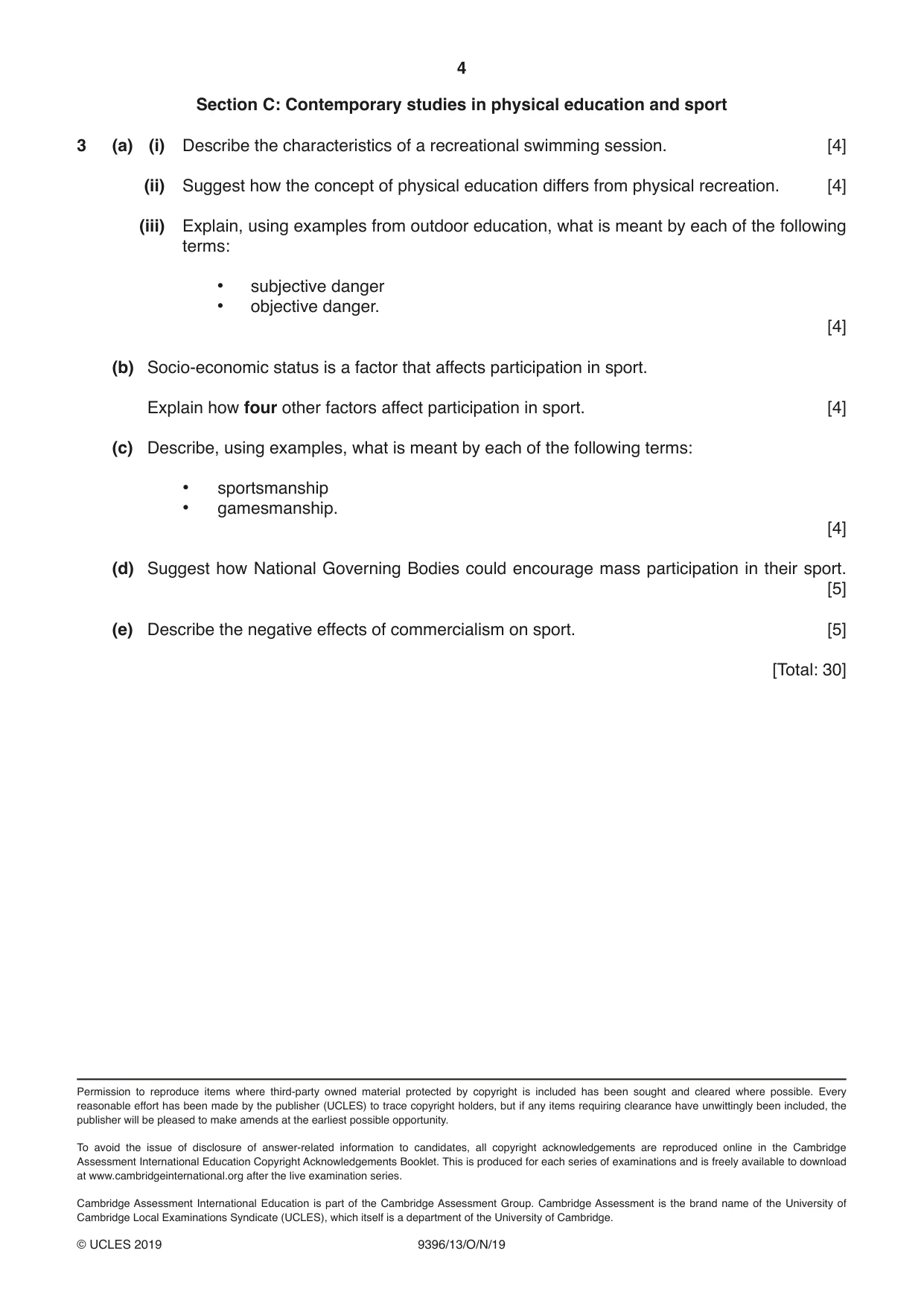
4 9396/13/O/N/19 © UCLES 2019 Section C: Contemporary studies in physical education and sport 3 (a) (i) Describe the characteristics of a recreational swimming session. [4] (ii) Suggest how the concept of physical education differs from physical recreation. [4] (iii) Explain, using examples from outdoor education, what is meant by each of the following terms: • subjective danger • objective danger. [4] (b) Socio-economic status is a factor that affects participation in sport. Explain how four other factors affect participation in sport. [4] (c) Describe, using examples, what is meant by each of the following terms: • sportsmanship • gamesmanship. [4] (d) Suggest how National Governing Bodies could encourage mass participation in their sport. [5] (e) Describe the negative effects of commercialism on sport. [5] [Total: 30] Permission to reproduce items where third-party owned material protected by copyright is included has been sought and cleared where possible. Every reasonable effort has been made by the publisher (UCLES) to trace copyright holders, but if any items requiring clearance have unwittingly been included, the publisher will be pleased to make amends at the earliest possible opportunity. To avoid the issue of disclosure of answer-related information to candidates, all copyright acknowledgements are reproduced online in the Cambridge Assessment International Education Copyright Acknowledgements Booklet. This is produced for each series of examinations and is freely available to download at www.cambridgeinternational.org after the live examination series. Cambridge Assessment International Education is part of the Cambridge Assessment Group. Cambridge Assessment is the brand name of the University of Cambridge Local Examinations Syndicate (UCLES), which itself is a department of the University of Cambridge.
Mark scheme, page 1
This document consists of 9 printed pages. © UCLES 2019 [Turn over Cambridge Assessment International Education Cambridge International Advanced Subsidiary and Advanced Level PHYSICAL EDUCATION 9396/13 Paper 1 October/November 2019 MARK SCHEME Maximum Mark: 90 Published This mark scheme is published as an aid to teachers and candidates, to indicate the requirements of the examination. It shows the basis on which Examiners were instructed to award marks. It does not indicate the details of the discussions that took place at an Examiners’ meeting before marking began, which would have considered the acceptability of alternative answers. Mark schemes should be read in conjunction with the question paper and the Principal Examiner Report for Teachers. Cambridge International will not enter into discussions about these mark schemes. Cambridge International is publishing the mark schemes for the October/November 2019 series for most Cambridge IGCSE™, Cambridge International A and AS Level components and some Cambridge O Level components.
Mark scheme, page 2
9396/13 Cambridge International AS/A Level – Mark Scheme PUBLISHED October/November 2019 © UCLES 2019 Page 2 of 9 Generic Marking Principles These general marking principles must be applied by all examiners when marking candidate answers. They should be applied alongside the specific content of the mark scheme or generic level descriptors for a question. Each question paper and mark scheme will also comply with these marking principles. GENERIC MARKING PRINCIPLE 1: Marks must be awarded in line with: • the specific content of the mark scheme or the generic level descriptors for the question • the specific skills defined in the mark scheme or in the generic level descriptors for the question • the standard of response required by a candidate as exemplified by the standardisation scripts. GENERIC MARKING PRINCIPLE 2: Marks awarded are always whole marks (not half marks, or other fractions). GENERIC MARKING PRINCIPLE 3: Marks must be awarded positively: • marks are awarded for correct/valid answers, as defined in the mark scheme. However, credit is given for valid answers which go beyond the scope of the syllabus and mark scheme, referring to your Team Leader as appropriate • marks are awarded when candidates clearly demonstrate what they know and can do • marks are not deducted for errors • marks are not deducted for omissions • answers should only be judged on the quality of spelling, punctuation and grammar when these features are specifically assessed by the question as indicated by the mark scheme. The meaning, however, should be unambiguous. GENERIC MARKING PRINCIPLE 4: Rules must be applied consistently e.g. in situations where candidates have not followed instructions or in the application of generic level descriptors. GENERIC MARKING PRINCIPLE 5: Marks should be awarded using the full range of marks defined in the mark scheme for the question (however; the use of the full mark range may be limited according to the quality of the candidate responses seen). GENERIC MARKING PRINCIPLE 6: Marks awarded are based solely on the requirements as defined in the mark scheme. Marks should not be awarded with grade thresholds or grade descriptors in mind.
Mark scheme, page 3
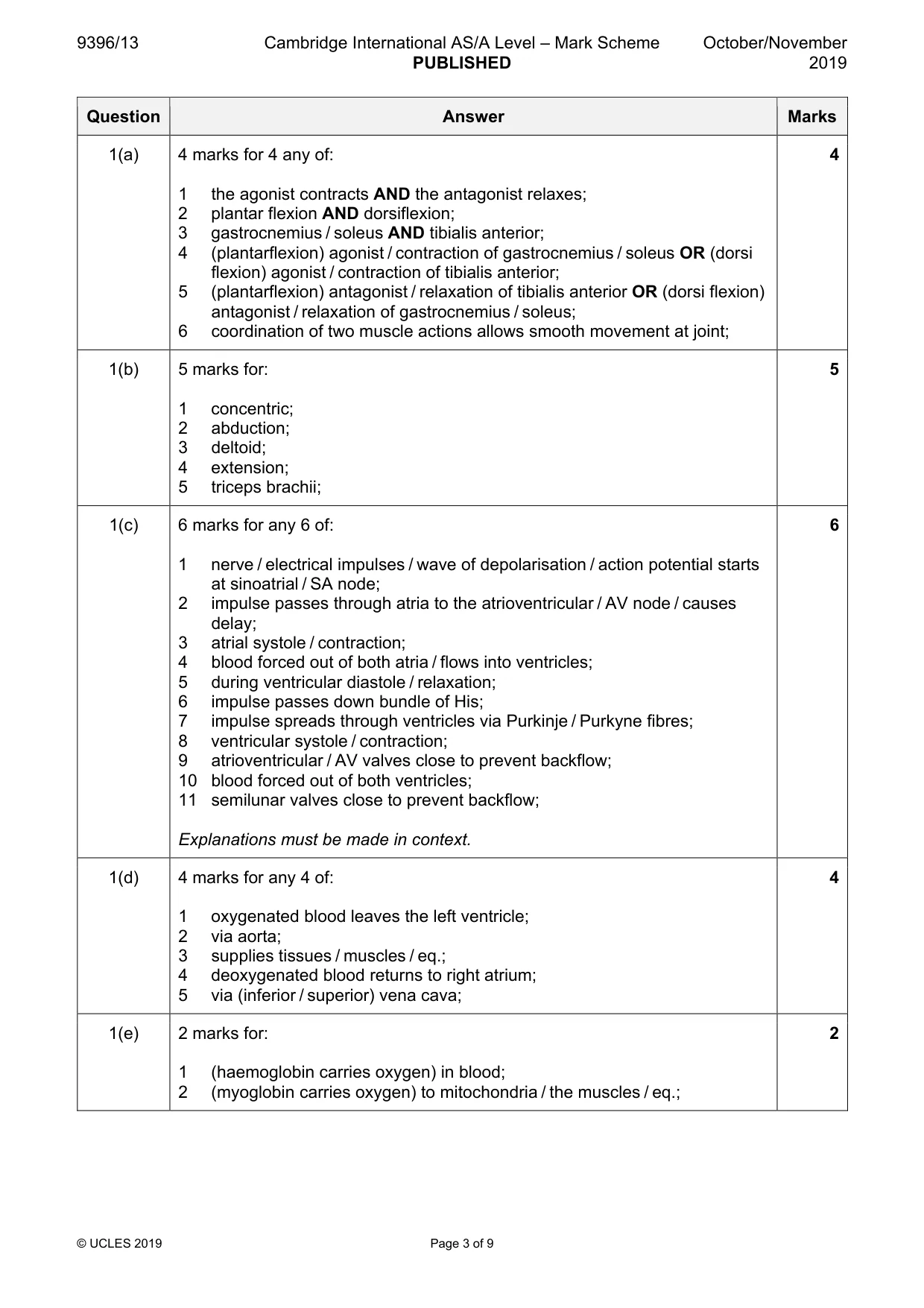
9396/13 Cambridge International AS/A Level – Mark Scheme PUBLISHED October/November 2019 © UCLES 2019 Page 3 of 9 Question Answer Marks 1(a) 4 marks for 4 any of: 1 the agonist contracts AND the antagonist relaxes; 2 plantar flexion AND dorsiflexion; 3 gastrocnemius / soleus AND tibialis anterior; 4 (plantarflexion) agonist / contraction of gastrocnemius / soleus OR (dorsi flexion) agonist / contraction of tibialis anterior; 5 (plantarflexion) antagonist / relaxation of tibialis anterior OR (dorsi flexion) antagonist / relaxation of gastrocnemius / soleus; 6 coordination of two muscle actions allows smooth movement at joint; 4 1(b) 5 marks for: 1 concentric; 2 abduction; 3 deltoid; 4 extension; 5 triceps brachii; 5 1(c) 6 marks for any 6 of: 1 nerve / electrical impulses / wave of depolarisation / action potential starts at sinoatrial / SA node; 2 impulse passes through atria to the atrioventricular / AV node / causes delay; 3 atrial systole / contraction; 4 blood forced out of both atria / flows into ventricles; 5 during ventricular diastole / relaxation; 6 impulse passes down bundle of His; 7 impulse spreads through ventricles via Purkinje / Purkyne fibres; 8 ventricular systole / contraction; 9 atrioventricular / AV valves close to prevent backflow; 10 blood forced out of both ventricles; 11 semilunar valves close to prevent backflow; Explanations must be made in context. 6 1(d) 4 marks for any 4 of: 1 oxygenated blood leaves the left ventricle; 2 via aorta; 3 supplies tissues / muscles / eq.; 4 deoxygenated blood returns to right atrium; 5 via (inferior / superior) vena cava; 4 1(e) 2 marks for: 1 (haemoglobin carries oxygen) in blood; 2 (myoglobin carries oxygen) to mitochondria / the muscles / eq.; 2
Mark scheme, page 4
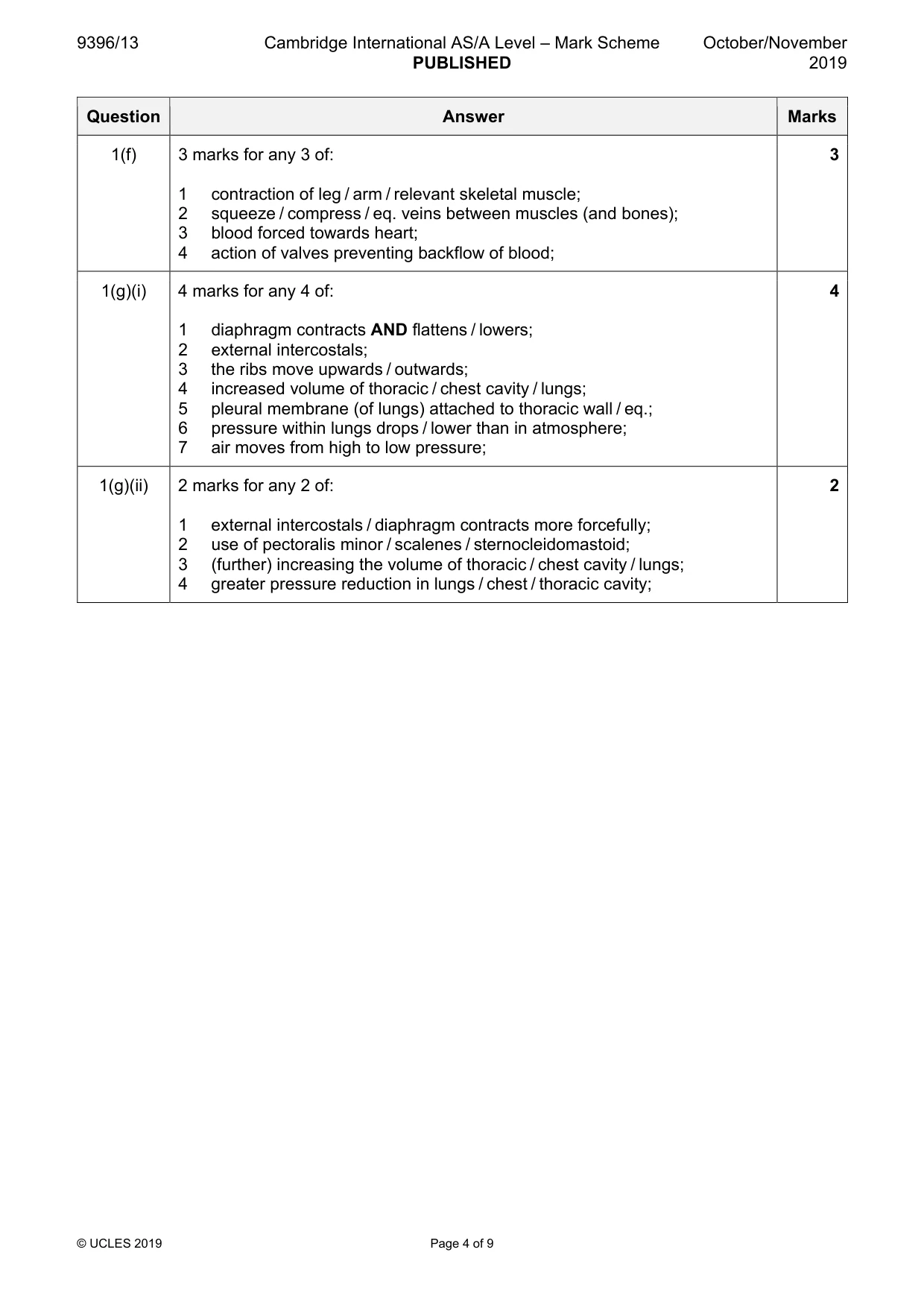
9396/13 Cambridge International AS/A Level – Mark Scheme PUBLISHED October/November 2019 © UCLES 2019 Page 4 of 9 Question Answer Marks 1(f) 3 marks for any 3 of: 1 contraction of leg / arm / relevant skeletal muscle; 2 squeeze / compress / eq. veins between muscles (and bones); 3 blood forced towards heart; 4 action of valves preventing backflow of blood; 3 1(g)(i) 4 marks for any 4 of: 1 diaphragm contracts AND flattens / lowers; 2 external intercostals; 3 the ribs move upwards / outwards; 4 increased volume of thoracic / chest cavity / lungs; 5 pleural membrane (of lungs) attached to thoracic wall / eq.; 6 pressure within lungs drops / lower than in atmosphere; 7 air moves from high to low pressure; 4 1(g)(ii) 2 marks for any 2 of: 1 external intercostals / diaphragm contracts more forcefully; 2 use of pectoralis minor / scalenes / sternocleidomastoid; 3 (further) increasing the volume of thoracic / chest cavity / lungs; 4 greater pressure reduction in lungs / chest / thoracic cavity; 2
Mark scheme, page 5
9396/13 Cambridge International AS/A Level – Mark Scheme PUBLISHED October/November 2019 © UCLES 2019 Page 5 of 9 Question Answer Marks 2(a) 4 marks for: 1 (high organisation skill) complex number of linked phases / cannot be broken down and practised separately / lots of processing / decisions; 2 for example, golf drive; 3 (low organisation skill) easily broken down into parts / made up of discrete phases that can be practised separately; 4 for example, triple jump; Accept alternative classifications if explained. 4 2(b) 4 marks for any 4 of: 1 learning based on S/R bond relationship; 2 trial and error learning; 3 manipulating the environment to obtain desired response; 4 e.g. use of target areas / mechanical feeders / equipment; 5 shaping behaviour; 6 use of reinforcement to bring about desired response / satisfier / rewards / praise / self-satisfaction; 7 use of punishment to decrease probability of undesired response / annoyer; 4 2(c) 3 marks for any 3 of: 1 insight learning / discovery learning / Gestaltist theory; 2 performer experiences the whole movement / holistic / wholeness; 3 involves thinking about the solution to a problem / learner develops an understanding / requirements of skill / eureka moment; 4 awareness of link between sub-routines / recognise relationship between stimulus and response / learner draws together many variables; 5 modify / adjust actions based on previous experience / environment; 3 2(d) 3 marks for any 3 of: Sub-max. of 2 without an example of sport-specific skill. No mark for the example. 1 there is no feedback acted upon / no adjustments are made; 2 due to no time / quick / fast / reactive / ballistic movement; 3 performer relies on motor programmes to be run / autonomous; 4 memory trace starts movement; 5 a single decision is made; 6 outside of / no conscious control; 3 2(e)(i) 4 marks for any 4 of: 1 (knowledge of) initial / environmental conditions; 2 (knowledge of) response specifications; 3 sensory consequences; 4 movement / response outcomes; 5 recall AND recognition schema; 4
Mark scheme, page 6
9396/13 Cambridge International AS/A Level – Mark Scheme PUBLISHED October/November 2019 © UCLES 2019 Page 6 of 9 Question Answer Marks 2(e)(ii) 4 marks for any 4 of: 1 learn basic skills before learning complex skills; 2 varied practice conditions / eq.; 3 provide plenty of information; 4 practice relevant to game / conditioned games; 5 (frequent) feedback; 6 tasks should be challenging; 7 include transferable information from other sports / ensure performers are aware of transfer possibilities; 8 slow-motion practice / video analysis / visual aids / guidance; 4 2(f) 4 marks for 4 of: (sub-max. 3 marks for perception) 1 (perception) interprets / judges information; 2 (perception) involves DCR process / detection of stimuli; 3 comparison to memory; 4 recognition of stimuli; 5 selective attention / filtering information occurs; 6 (effector mechanism) selects motor programme; 7 (effector mechanism) organises response / relays decisions to muscular system; 4 2(g) 4 marks for any 4 of: 1 increases in motivation / drive / arousal result in increases of probability of good performance / performance = habit × drive; 2 linear / straight line / proportional relationship / drawn as diagram; 3 but, not realistic – cannot keep improving; 4 increase in arousal = increase in likelihood of dominant response; 5 if dominant response is well-learned / expert performer leads to improved performance (because of high arousal); 6 if dominant response not well-learned / novice performer leads to poor performance (because of high arousal); 4
Mark scheme, page 7
9396/13 Cambridge International AS/A Level – Mark Scheme PUBLISHED October/November 2019 © UCLES 2019 Page 7 of 9 Question Answer Marks 3(a)(i) 4 marks for any 4 of: 1 choose whether to take part or not / voluntary; 2 fun / enjoyment; 3 social / with friends; 4 takes part in leisure time; 5 standard of skills is not important / no training needed / non-serious outcome / low physical demand; 6 non-competitive / no winners / no losers; 7 few officials / few rules; 8 limited structure / limited organisation; 9 for fitness / health; 10 flexible time involvement / variety of opportunities; 4 3(a)(ii) 4 marks for any 4 of: physical education physical recreation 1 compulsory / moral obligation voluntary / choice / no moral obligation; 2 school time / lessons activity done in leisure time / relaxed / casual; 3 formal teaching and learning environment / assessment / serious informal / for fun / enjoyment; 4 teacher / in authority self-regulated / individual controls activity / safety; 5 highly structured / pre-planned times / sessions / activities / rules limited organisational structure / limited rules; 6 foundation level on the performance pyramid participation level on the performance pyramid; Allow other correct differences. 4 3(a)(iii) 4 marks for 4 of: If no example max. 1 mark per area. (sub-max. 2 marks for subjective danger) 1 danger which the performer thinks / perceives is going to happen; 2 e.g. fearing falling over / worried about rope breaking; 3 depends on level of experience / ability; (sub-max. 2 marks for objective danger) 4 danger from natural environment / elements over which performer has little / no control / actual / real risk; 5 e.g. avalanche / weather; 6 the more skilled you are, the more likely you are to encounter objective danger, e.g. wilderness areas; 4
Mark scheme, page 8
9396/13 Cambridge International AS/A Level – Mark Scheme PUBLISHED October/November 2019 © UCLES 2019 Page 8 of 9 Question Answer Marks 3(b) 4 marks for any 4 of: factor explanation, for example: 1 (family / peers / friends) influences can be positive or negative / level of support; 2 (age) suitable provision for any over 60’s / young people / may be tendency for change of activity as people age; 3 (gender) men may be more likely to participate than women / stereotyping of women / some sports more male / female appropriate; 4 (ability) involvement limited by fitness / talent ID / pathways in place; 5 (disability) limited / less access / may have low self- esteem / need adapted sports; 6 (race / culture) some ethnic groups still discriminate / stereotyping, e.g. black athletes may be sprinters; 7 (religion) religion may inhibit, e.g. dress code / parental aspirations; 8 (government status / attitude) policies / political influences in country may affect involvement; 9 (previous experience) enjoyed or disliked Physical Education / previous success / self-esteem / self- confidence; 10 (geography) where you live may limit opportunity / facilities; 11 (role models) involvement increased by presence / influence; 12 (media) amount of exposure to different sports / how media treats sports people may influence involvement; 13 (employment) because sport can provide employment; 14 (availability of time) some sports require lots of time / you need time to be able to participate; Accept other relevant explanations. 4
Mark scheme, page 9
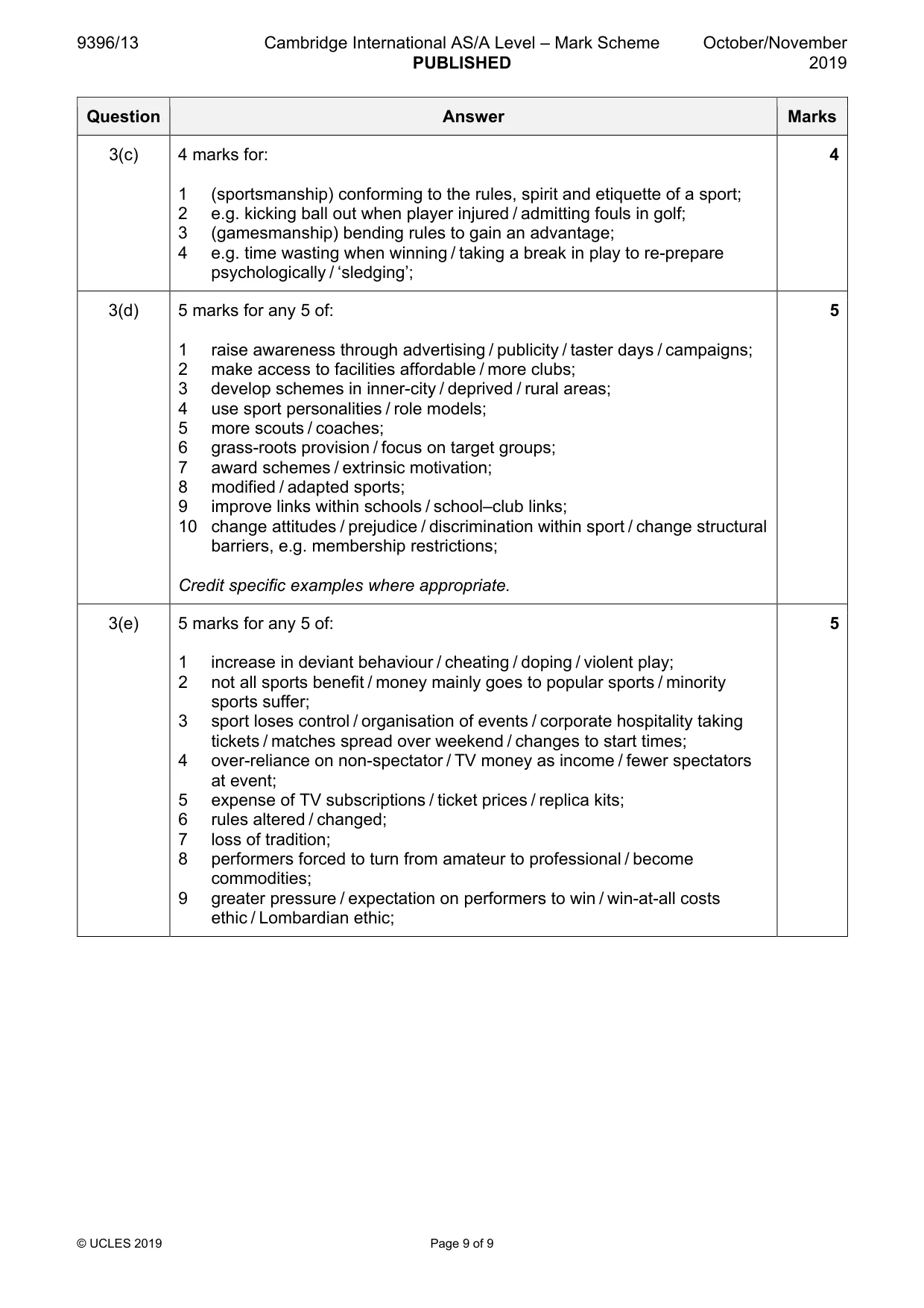
9396/13 Cambridge International AS/A Level – Mark Scheme PUBLISHED October/November 2019 © UCLES 2019 Page 9 of 9 Question Answer Marks 3(c) 4 marks for: 1 (sportsmanship) conforming to the rules, spirit and etiquette of a sport; 2 e.g. kicking ball out when player injured / admitting fouls in golf; 3 (gamesmanship) bending rules to gain an advantage; 4 e.g. time wasting when winning / taking a break in play to re-prepare psychologically / ‘sledging’; 4 3(d) 5 marks for any 5 of: 1 raise awareness through advertising / publicity / taster days / campaigns; 2 make access to facilities affordable / more clubs; 3 develop schemes in inner-city / deprived / rural areas; 4 use sport personalities / role models; 5 more scouts / coaches; 6 grass-roots provision / focus on target groups; 7 award schemes / extrinsic motivation; 8 modified / adapted sports; 9 improve links within schools / school–club links; 10 change attitudes / prejudice / discrimination within sport / change structural barriers, e.g. membership restrictions; Credit specific examples where appropriate. 5 3(e) 5 marks for any 5 of: 1 increase in deviant behaviour / cheating / doping / violent play; 2 not all sports benefit / money mainly goes to popular sports / minority sports suffer; 3 sport loses control / organisation of events / corporate hospitality taking tickets / matches spread over weekend / changes to start times; 4 over-reliance on non-spectator / TV money as income / fewer spectators at event; 5 expense of TV subscriptions / ticket prices / replica kits; 6 rules altered / changed; 7 loss of tradition; 8 performers forced to turn from amateur to professional / become commodities; 9 greater pressure / expectation on performers to win / win-at-all costs ethic / Lombardian ethic; 5
What you needed in this session
Cambridge’s own grade thresholds for 2019 Oct/Nov, Paper 1 · Variant 3. A higher threshold means an easier paper — the bar moves with how the cohort did.