Cambridge A Level Physical Education 9396 — 2021 May/June Paper 3 · Variant 3
9396/33/M/J/21 · 3 questions · 90 marks · ≈101 min
The question paper and its mark scheme, free to read here and free to download. This is Cambridge’s own paper, exactly as it was sat.
Question paper4 pages
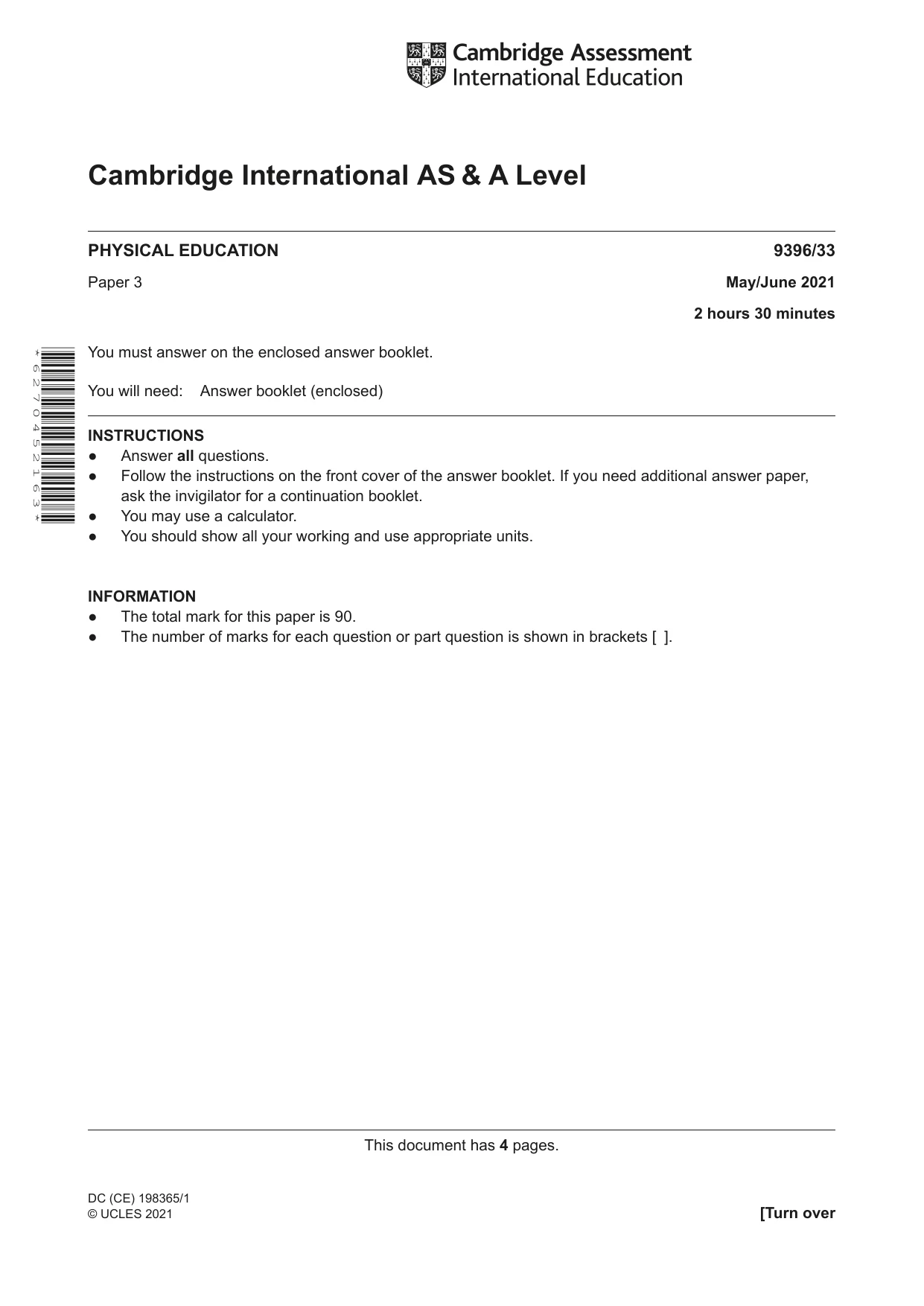
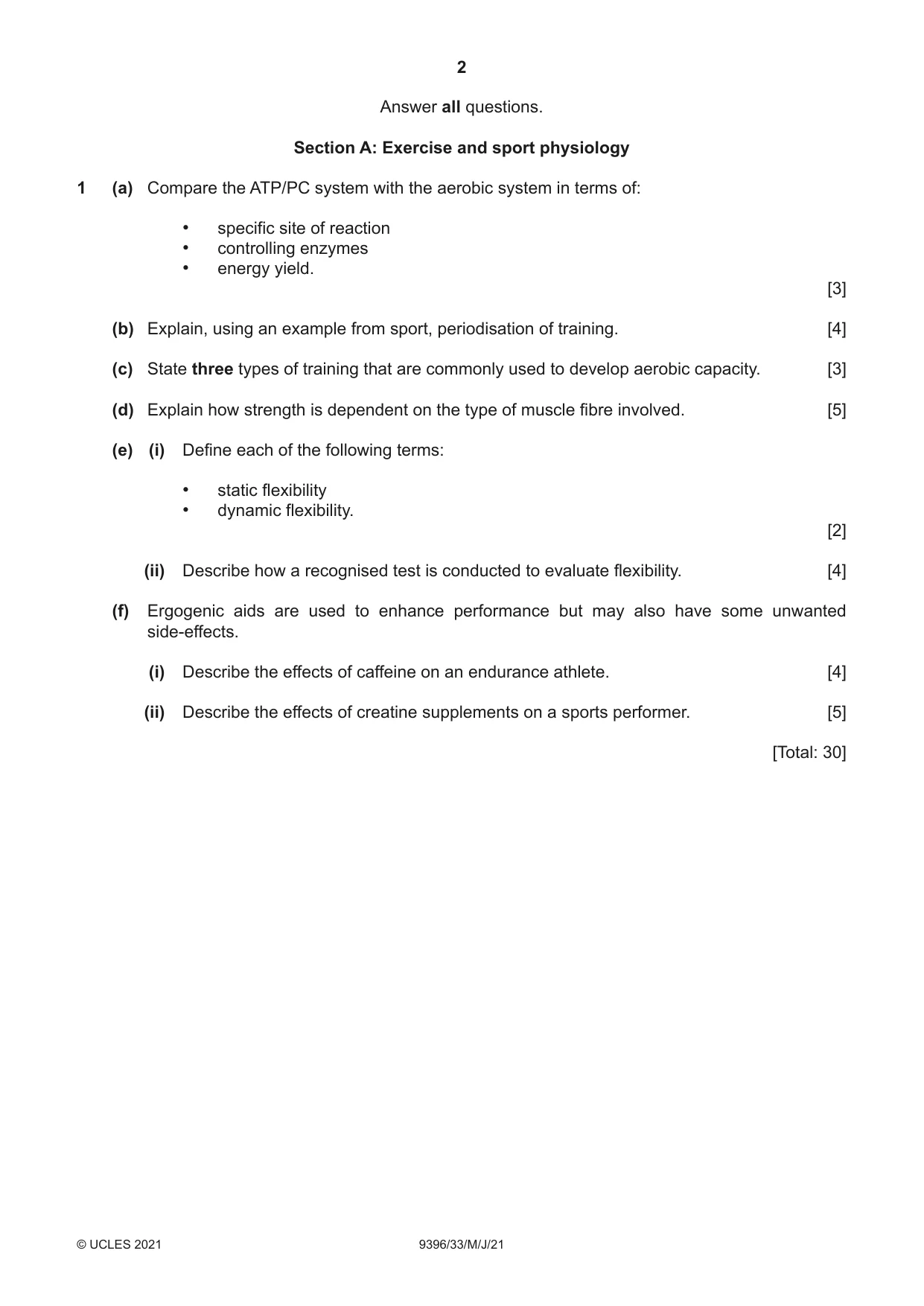
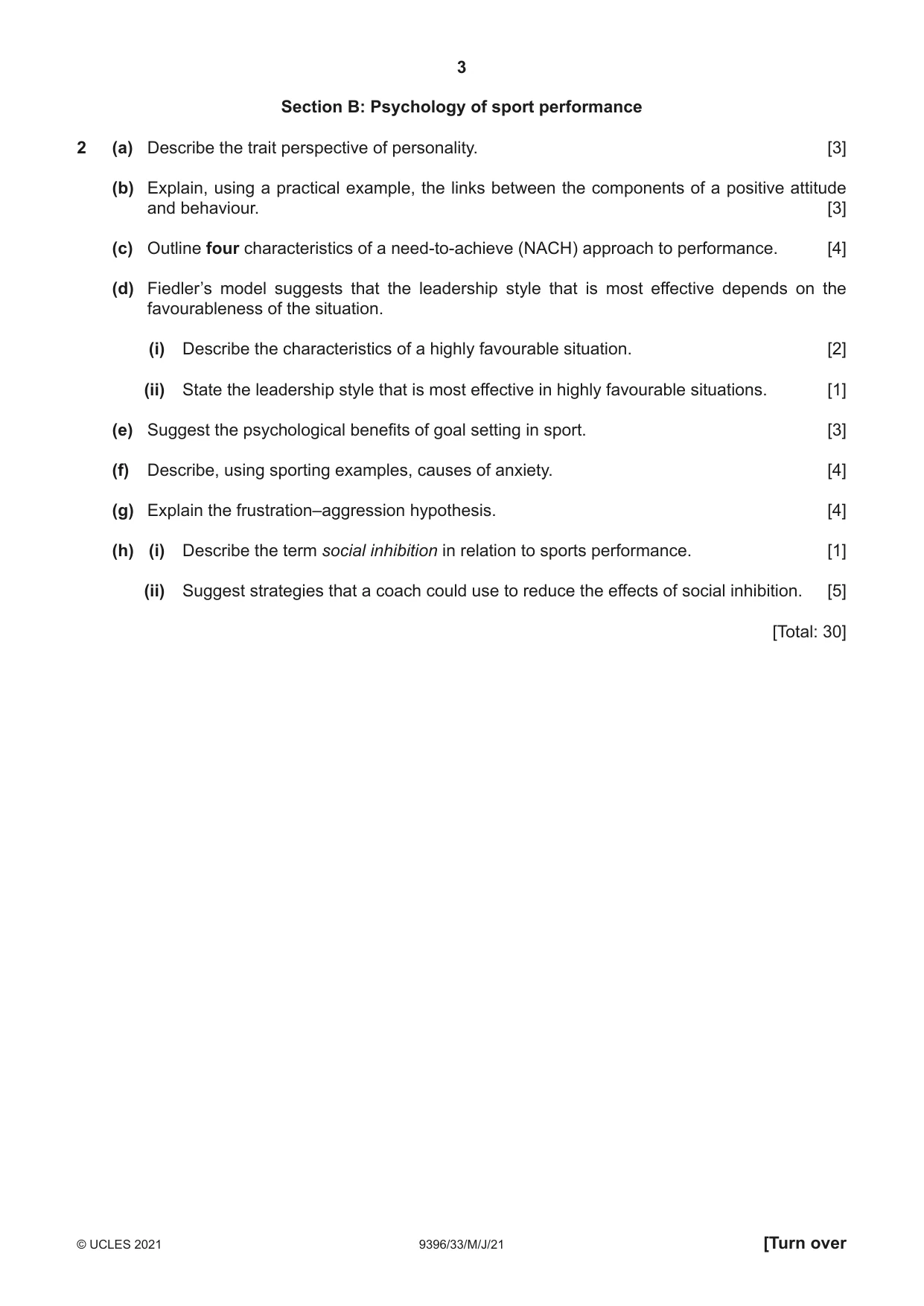
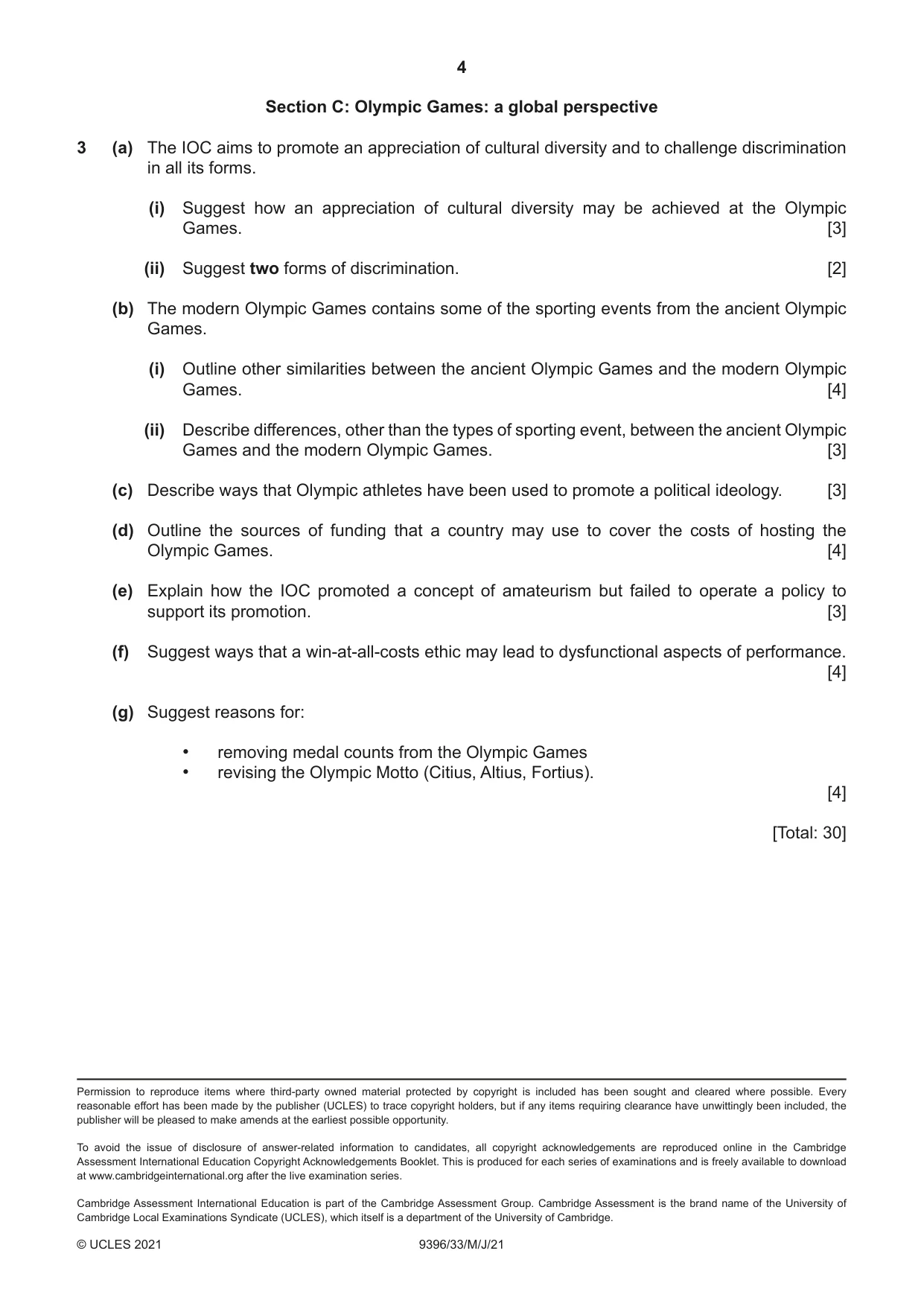
Mark scheme14 pages
Answers below. Sit the paper first if you are practising.
Questions as text
Q1 · Compare the ATP/PC system with the aerobic system in terms of: • specific site of…
1 (a) Compare the ATP/PC system with the aerobic system in terms of: • specific site of reaction • controlling enzymes • energy yield. [3] (b) Explain, using an example from sport, periodisation of training. [4] (c) State three types of training that are commonly used to develop aerobic capacity. [3] (d) Explain how strength is dependent on the type of muscle fibre involved. [5] (e) (i) Define each of the following terms: • static flexibility • dynamic flexibility. [2] (ii) Describe how a recognised test is conducted to evaluate flexibility. [4] (f) Ergogenic aids are used to enhance performance but may also have some unwanted side‑effects. (i) Describe the effects of caffeine on an endurance athlete. [4] (ii) Describe the effects of creatine supplements on a sports performer. [5] [Total: 30]
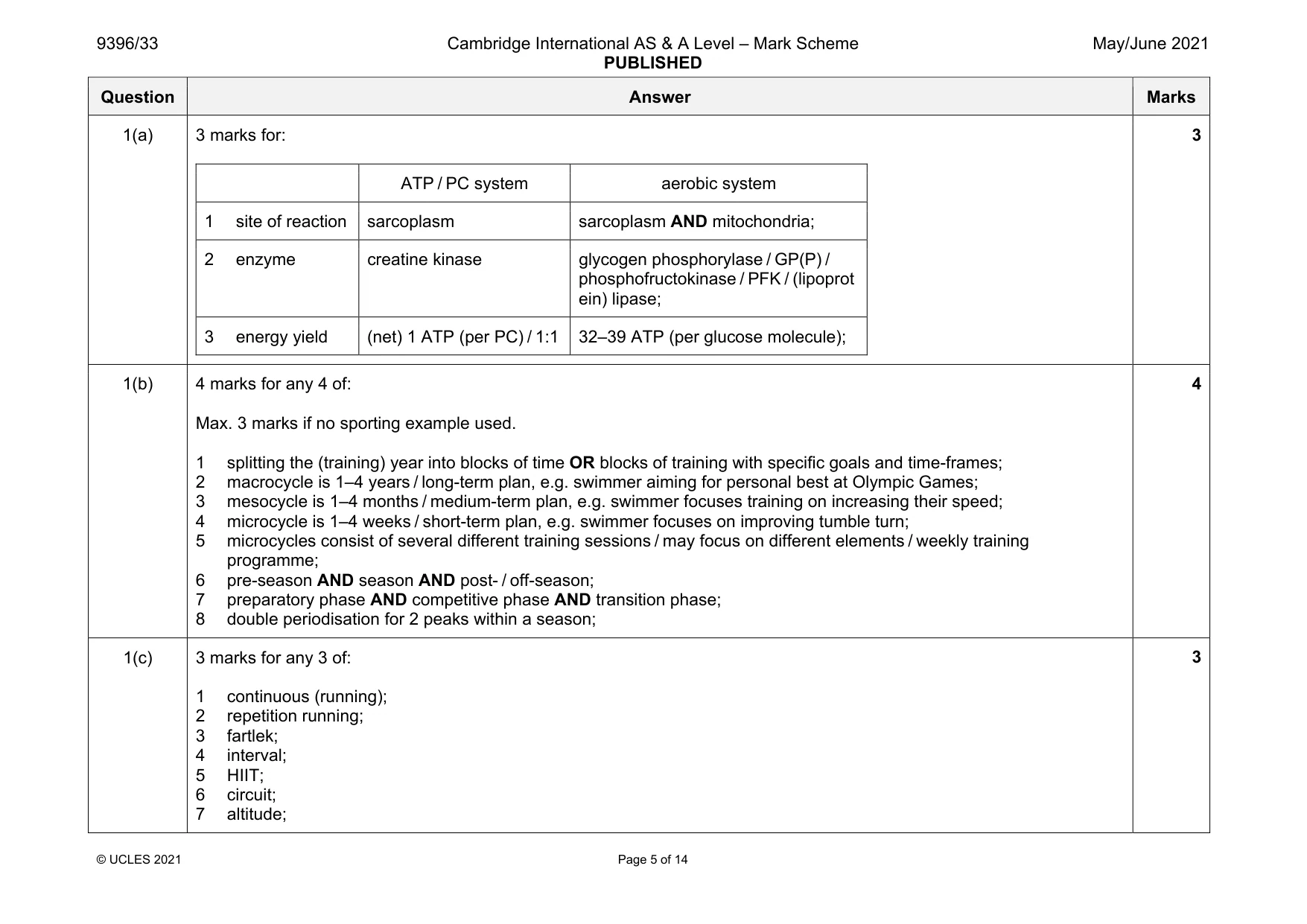
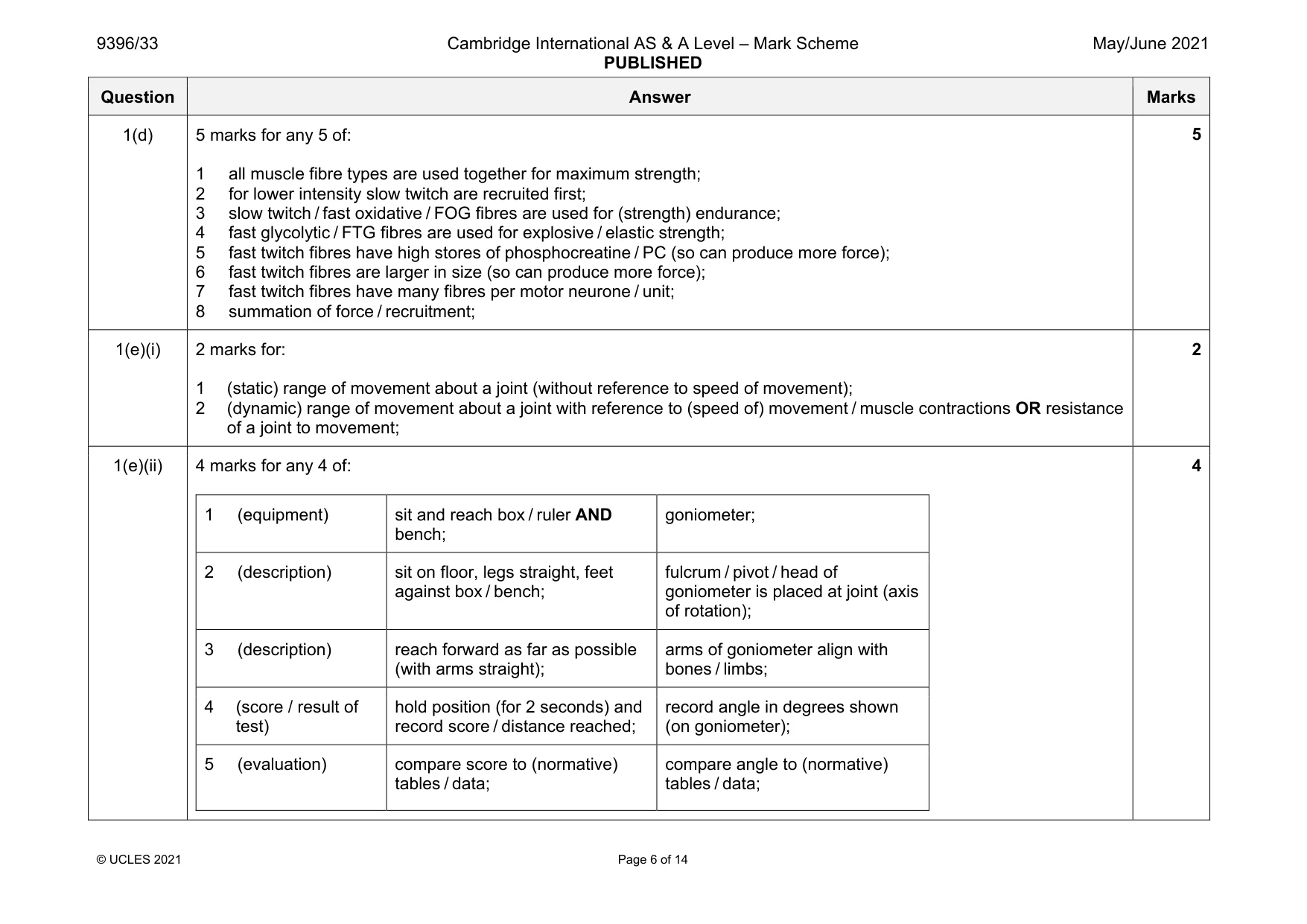
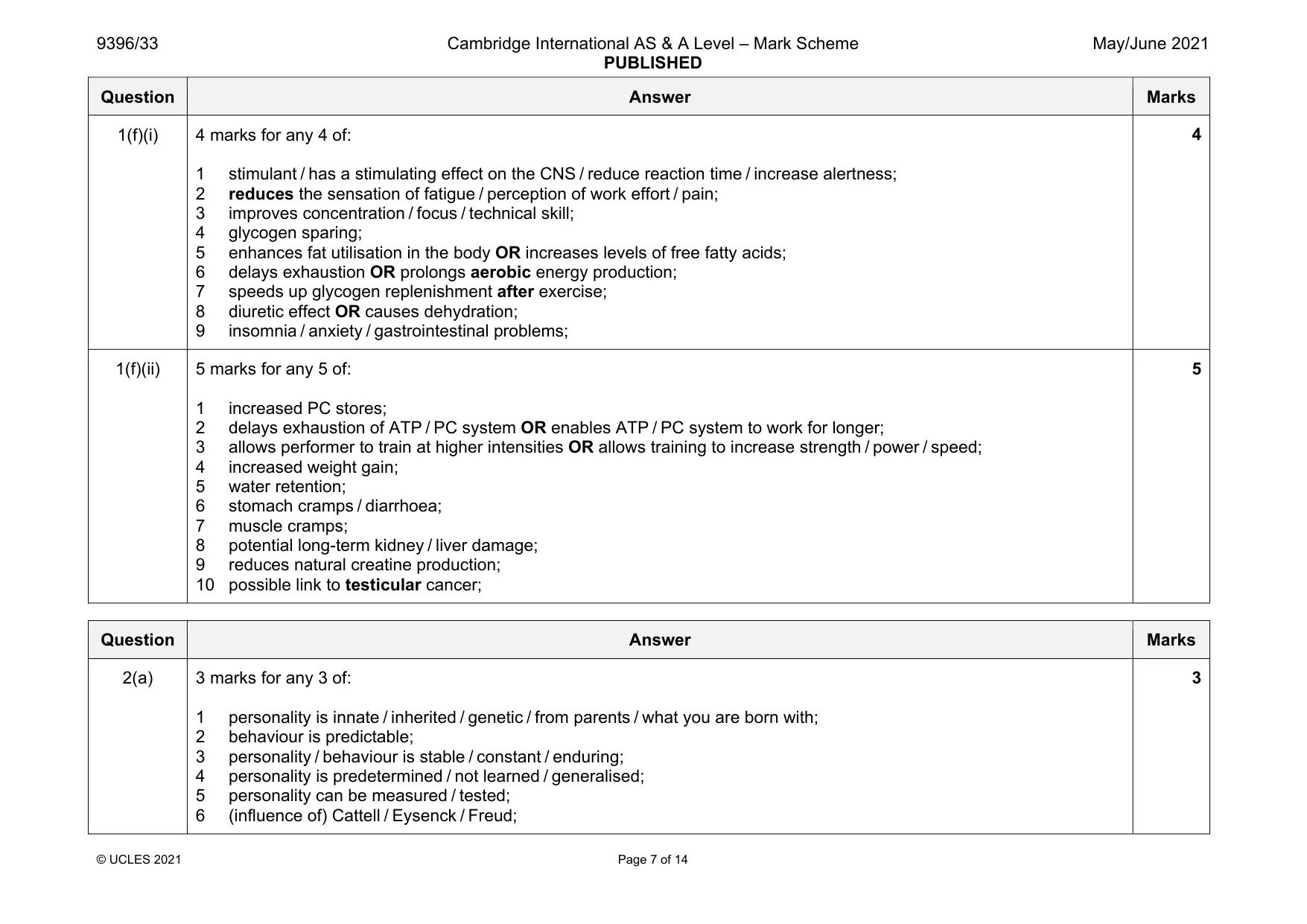
Mark scheme: 1(a) 3 marks for: ATP / PC system aerobic system 1 site of reaction sarcoplasm sarcoplasm AND mitochondria; 2 enzyme creatine kinase glycogen phosphorylase / GP(P) / phosphofructokinase / PFK / (lipoprot ein) lipase; 3 energy yield (net) 1 ATP (per PC) / 1:1 32–39 ATP (per glucose molecule); 3 1(b) 4 marks for any 4 of: Max. 3 marks if no sporting example used. 1 splitting the (training) year into blocks of time OR blocks of training with specific goals and time-frames; 2 macrocycle is 1–4 years / long-term plan, e.g. swimmer aiming for personal best at Olympic Games; 3 mesocycle is 1–4 months / medium-term plan, e.g. swimmer focuses training on increasing their speed; 4 microcycle is 1–4 weeks / short-term plan, e.g. swimmer focuses on improving tumble turn; 5 microcycles consist of several different training sessions / may focus on different elements / weekly training programme; 6 pre-season AND season AND post- / off-season; 7 preparatory phase AND competitive phase AND transition phase; 8 double periodisation for 2 peaks within a season; 4 1(c) 3 marks for any 3 of: 1 continuous (running); 2 repetition running; 3 fartlek; 4 interval; 5 HIIT; 6 circuit; 7 altitude; 3 Question Answer Marks 1(d) 5 marks for any 5 of: 1 all muscle fibre types are used together for maximum strength; 2 for lower intensity slow twitch are recruited first; 3 slow twitch / fast oxidative / FOG fibres are used for (strength) endurance; 4 fast glycolytic / FTG fibres are used for explosive / elastic strength; 5 fast twitch fibres have high stores of phosphocreatine / PC (so can produce more force); 6 fast twitch fibres are larger in size (so can produce more force); 7 fast twitch fibres have many fibres per motor neurone / unit; 8 summation of force / recruitment; 5 1(e)(i) 2 marks for: 1 (static) range of movement about a joint (without reference to speed of movement); 2 (dynamic) range of movement about a joint with reference to (speed of) movement / muscle contractions OR resistance of a joint to movement; 2 1(e)(ii) 4 marks for any 4 of: 1 (equipment) sit and reach box / ruler AND bench; goniometer; 2 (description) sit on floor, legs straight, feet against box / bench; fulcrum / pivot / head of goniometer is placed at joint (axis of rotation); 3 (description) reach forward as far as possible (with arms straight); arms of goniometer align with bones / limbs; 4 (score / result of test) hold position (for 2 seconds) and record score / distance reached; record angle in degrees shown (on goniometer); 5 (evaluation) compare score to (normative) tables / data; compare angle to (normative) tables / data; 4 Question Answer Marks 1(f)(i) 4 marks for any 4 of: 1 stimulant / has a stimulating effect on the CNS / reduce reaction time / increase alertness; 2 reduces the sensation of fatigue / perception of work effort / pain; 3 improves concentration / focus / technical skill; 4 glycogen sparing; 5 enhances fat utilisation in the body OR increases levels of free fatty acids; 6 delays exhaustion OR prolongs aerobic energy production; 7 speeds up glycogen replenishment after exercise; 8 diuretic effect OR causes dehydration; 9 insomnia / anxiety / gastrointestinal problems; 4 1(f)(ii) 5 marks for any 5 of: 1 increased PC stores; 2 delays exhaustion of ATP / PC system OR enables ATP / PC system to work for longer; 3 allows performer to train at higher intensities OR allows training to increase strength / power / speed; 4 increased weight gain; 5 water retention; 6 stomach cramps / diarrhoea; 7 muscle cramps; 8 potential long-term kidney / liver damage; 9 reduces natural creatine production; 10 possible link to testicular cancer; 5
Q2 · Describe the trait perspective of personality
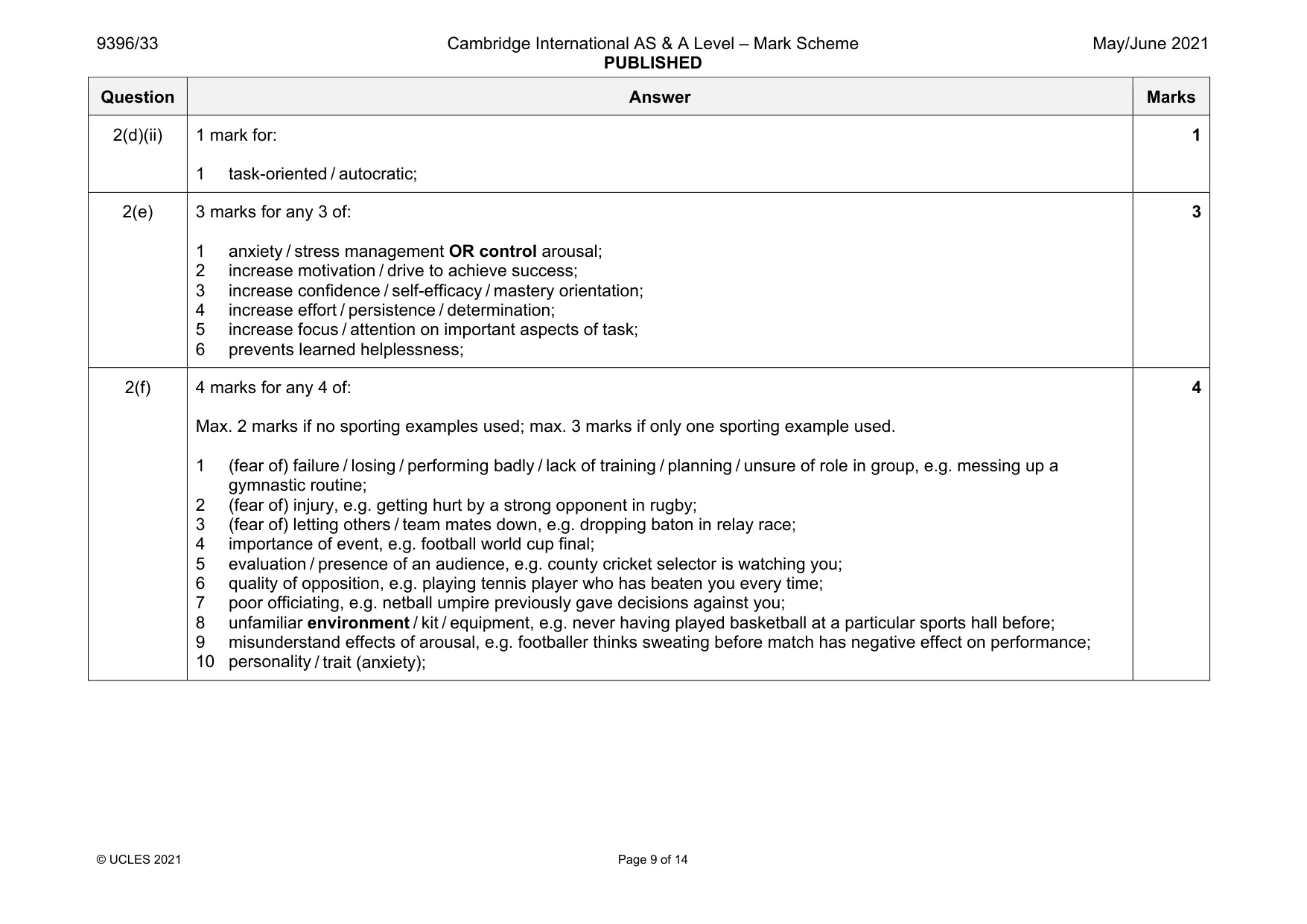
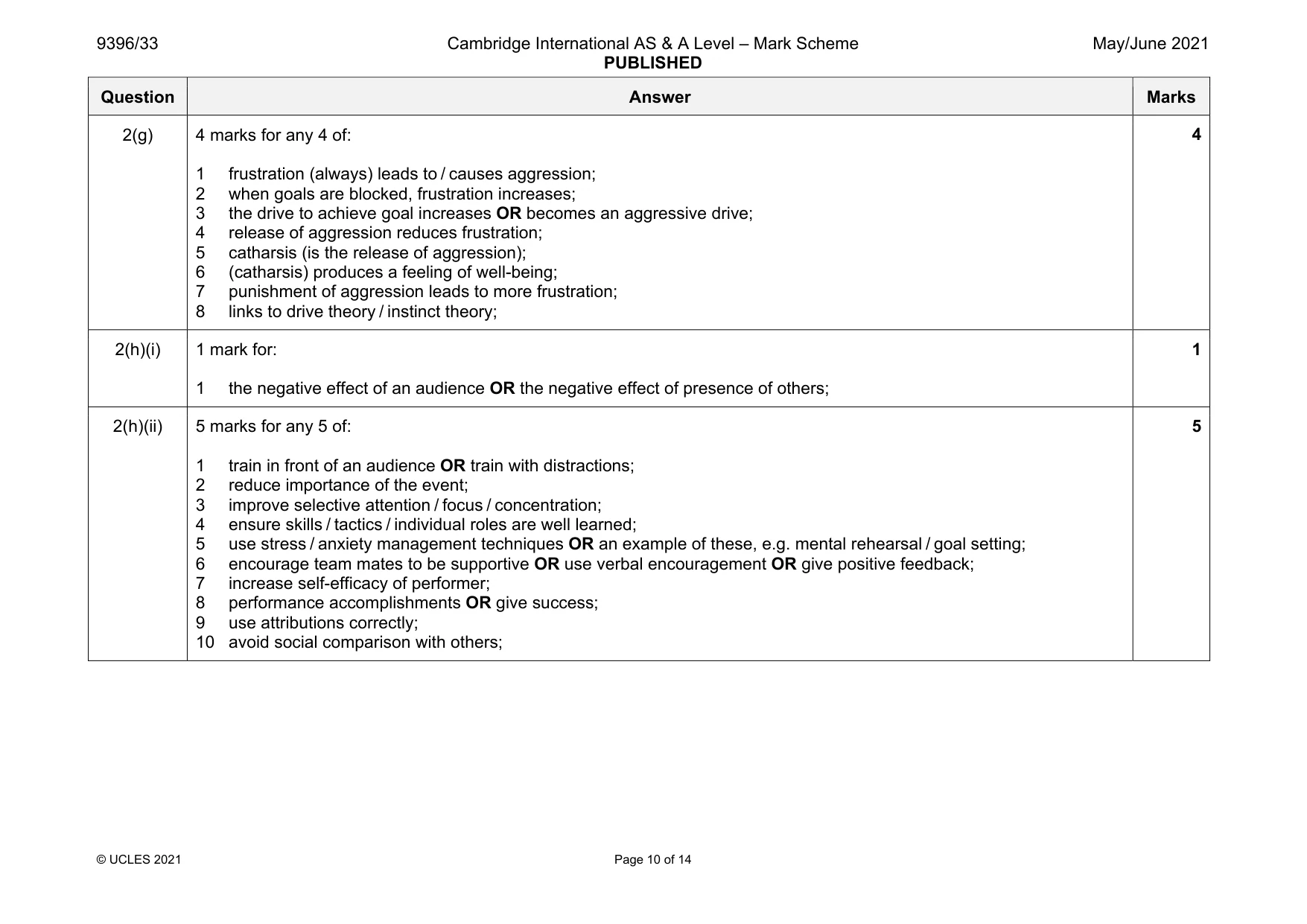
2 (a) Describe the trait perspective of personality. [3] (b) Explain, using a practical example, the links between the components of a positive attitude and behaviour. [3] (c) Outline four characteristics of a need‑to‑achieve (NACH) approach to performance. [4] (d) Fiedler’s model suggests that the leadership style that is most effective depends on the favourableness of the situation. (i) Describe the characteristics of a highly favourable situation. [2] (ii) State the leadership style that is most effective in highly favourable situations. [1] (e) Suggest the psychological benefits of goal setting in sport. [3] (f) Describe, using sporting examples, causes of anxiety. [4] (g) Explain the frustration–aggression hypothesis. [4] (h) (i) Describe the term social inhibition in relation to sports performance. [1] (ii) Suggest strategies that a coach could use to reduce the effects of social inhibition. [5] [Total: 30] Section C: Olympic Games: a global perspective
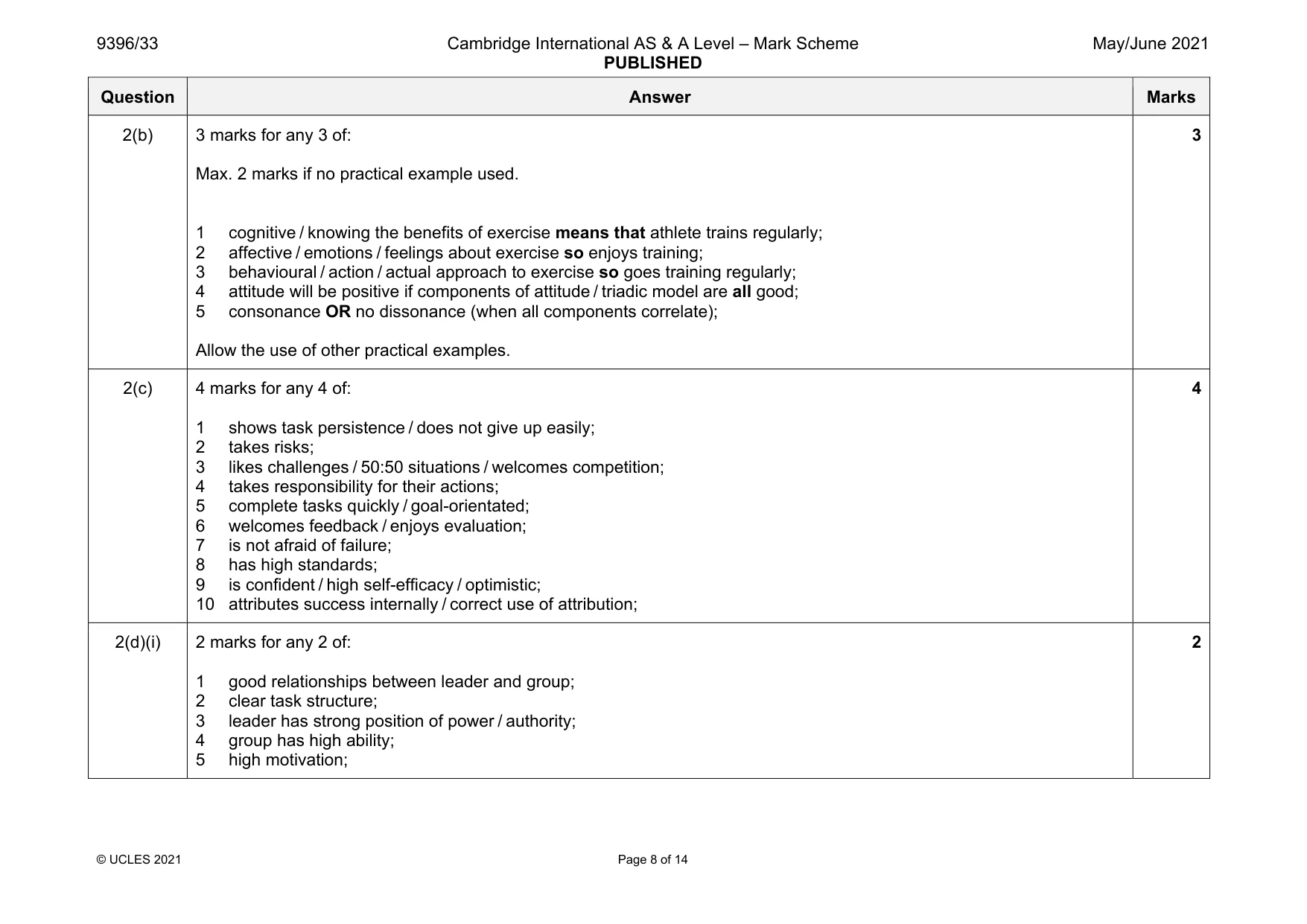
Mark scheme: 2(a) 3 marks for any 3 of: 1 personality is innate / inherited / genetic / from parents / what you are born with; 2 behaviour is predictable; 3 personality / behaviour is stable / constant / enduring; 4 personality is predetermined / not learned / generalised; 5 personality can be measured / tested; 6 (influence of) Cattell / Eysenck / Freud; Question Answer Marks 2(b) 3 marks for any 3 of: Max. 2 marks if no practical example used. 1 cognitive / knowing the benefits of exercise means that athlete trains regularly; 2 affective / emotions / feelings about exercise so enjoys training; 3 behavioural / action / actual approach to exercise so goes training regularly; 4 attitude will be positive if components of attitude / triadic model are all good; 5 consonance OR no dissonance (when all components correlate); Allow the use of other practical examples. 3 2(c) 4 marks for any 4 of: 1 shows task persistence / does not give up easily; 2 takes risks; 3 likes challenges / 50:50 situations / welcomes competition; 4 takes responsibility for their actions; 5 complete tasks quickly / goal-orientated; 6 welcomes feedback / enjoys evaluation; 7 is not afraid of failure; 8 has high standards; 9 is confident / high self-efficacy / optimistic; 10 attributes success internally / correct use of attribution; 4 2(d)(i) 2 marks for any 2 of: 1 good relationships between leader and group; 2 clear task structure; 3 leader has strong position of power / authority; 4 group has high ability; 5 high motivation; 2 Question Answer Marks 2(d)(ii) 1 mark for: 1 task-oriented / autocratic; 1 2(e) 3 marks for any 3 of: 1 anxiety / stress management OR control arousal; 2 increase motivation / drive to achieve success; 3 increase confidence / self-efficacy / mastery orientation; 4 increase effort / persistence / determination; 5 increase focus / attention on important aspects of task; 6 prevents learned helplessness; 3 2(f) 4 marks for any 4 of: Max. 2 marks if no sporting examples used; max. 3 marks if only one sporting example used. 1 (fear of) failure / losing / performing badly / lack of training / planning / unsure of role in group, e.g. messing up a gymnastic routine; 2 (fear of) injury, e.g. getting hurt by a strong opponent in rugby; 3 (fear of) letting others / team mates down, e.g. dropping baton in relay race; 4 importance of event, e.g. football world cup final; 5 evaluation / presence of an audience, e.g. county cricket selector is watching you; 6 quality of opposition, e.g. playing tennis player who has beaten you every time; 7 poor officiating, e.g. netball umpire previously gave decisions against you; 8 unfamiliar environment / kit / equipment, e.g. never having played basketball at a particular sports hall before; 9 misunderstand effects of arousal, e.g. footballer thinks sweating before match has negative effect on performance; 10 personality / trait (anxiety); 4 Question Answer Marks 2(g) 4 marks for any 4 of: 1 frustration (always) leads to / causes aggression; 2 when goals are blocked, frustration increases; 3 the drive to achieve goal increases OR becomes an aggressive drive; 4 release of aggression reduces frustration; 5 catharsis (is the release of aggression); 6 (catharsis) produces a feeling of well-being; 7 punishment of aggression leads to more frustration; 8 links to drive theory / instinct theory; 4 2(h)(i) 1 mark for: 1 the negative effect of an audience OR the negative effect of presence of others; 1 2(h)(ii) 5 marks for any 5 of: 1 train in front of an audience OR train with distractions; 2 reduce importance of the event; 3 improve selective attention / focus / concentration; 4 ensure skills / tactics / individual roles are well learned; 5 use stress / anxiety management techniques OR an example of these, e.g. mental rehearsal / goal setting; 6 encourage team mates to be supportive OR use verbal encouragement OR give positive feedback; 7 increase self-efficacy of performer; 8 performance accomplishments OR give success; 9 use attributions correctly; 10 avoid social comparison with others; 5
Q3 · The IOC aims to promote an appreciation of cultural diversity and to challenge…
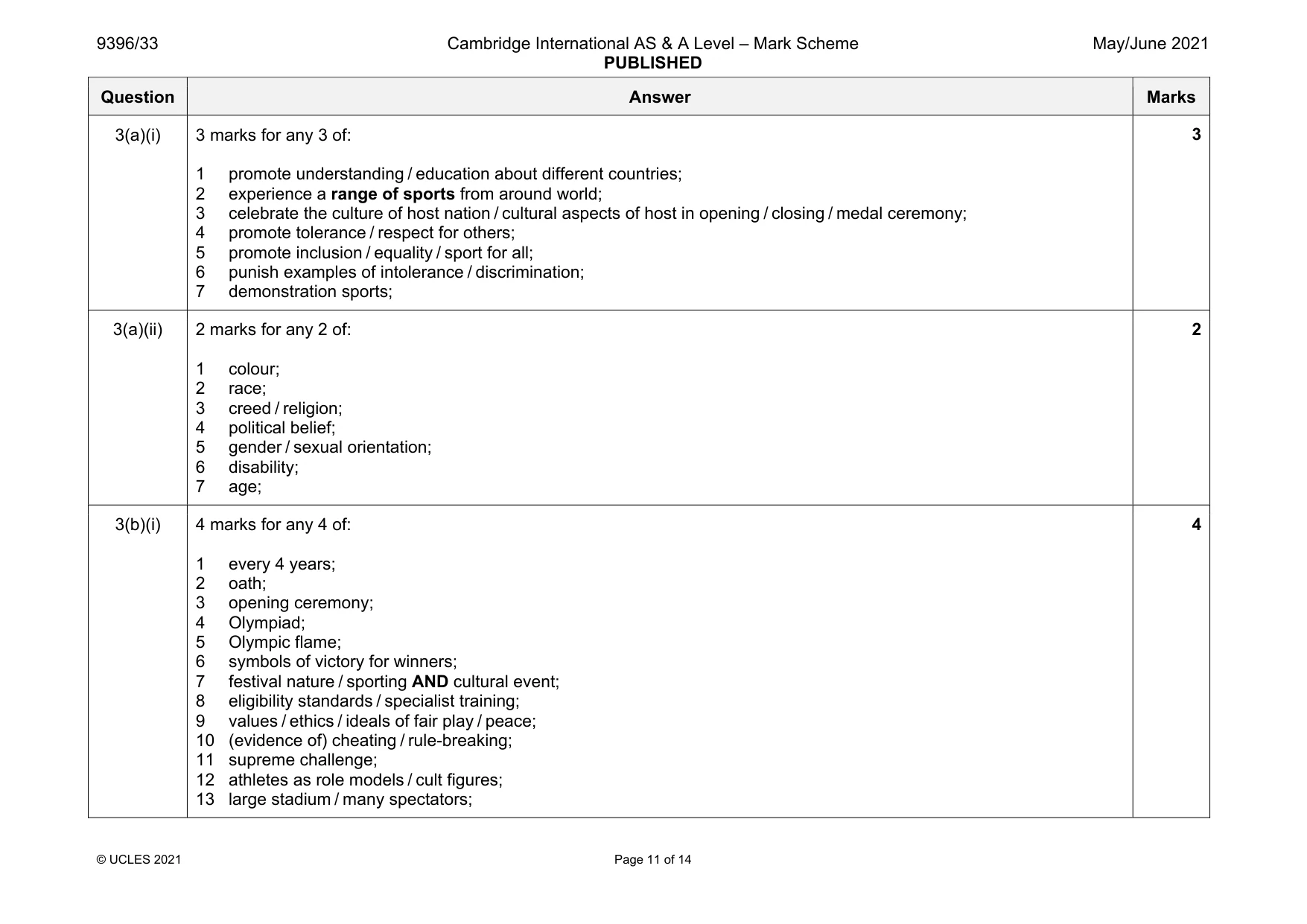
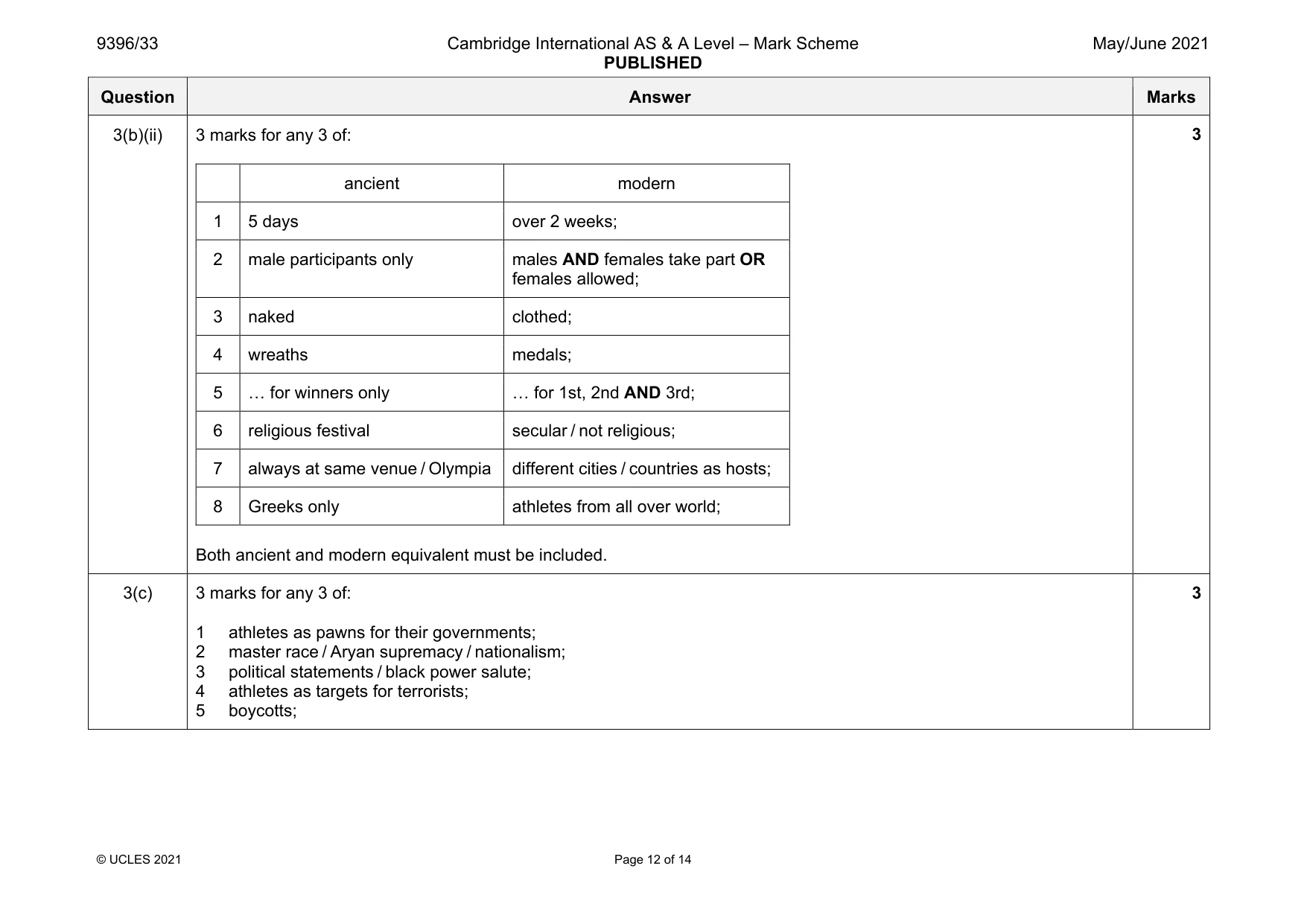
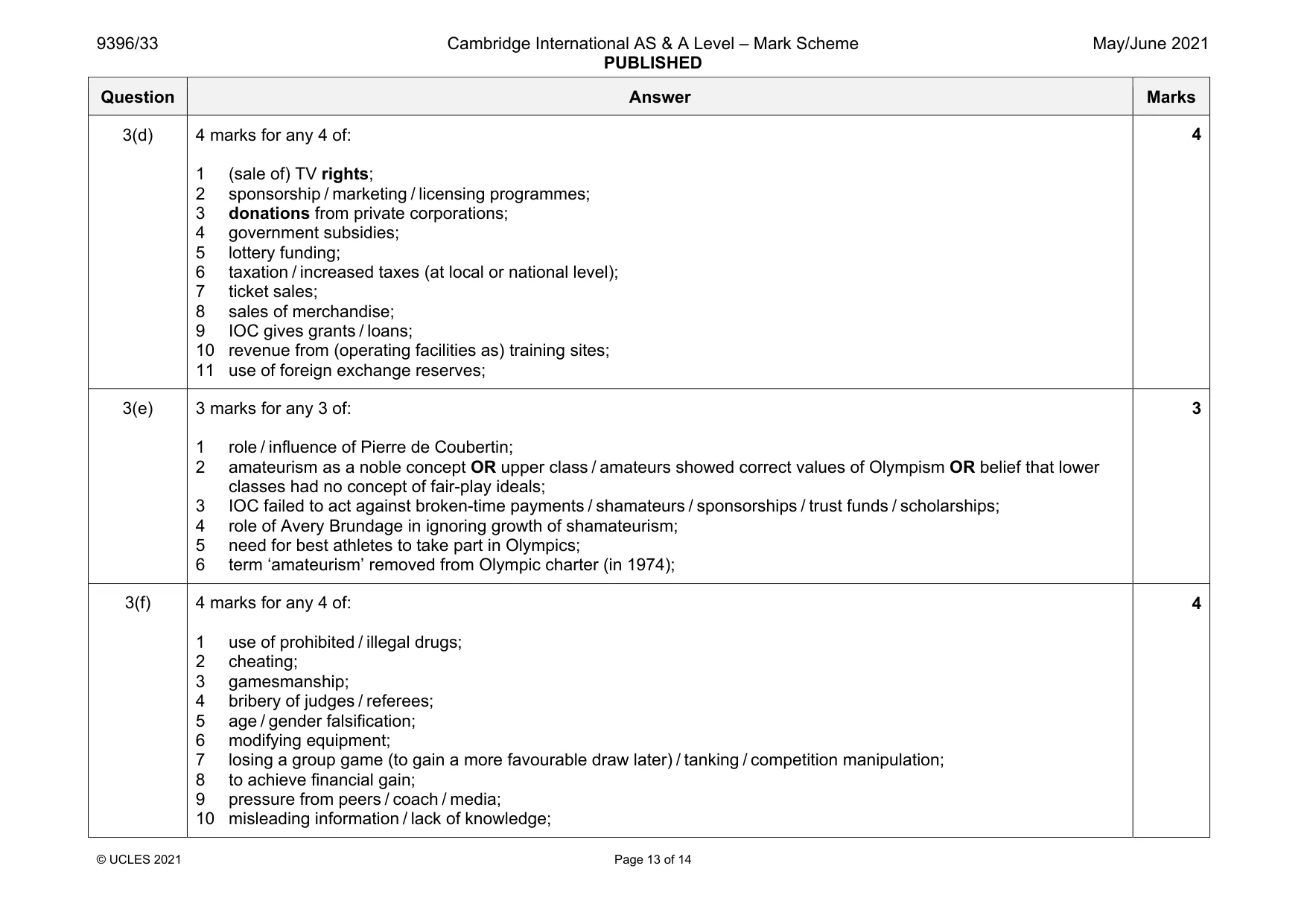
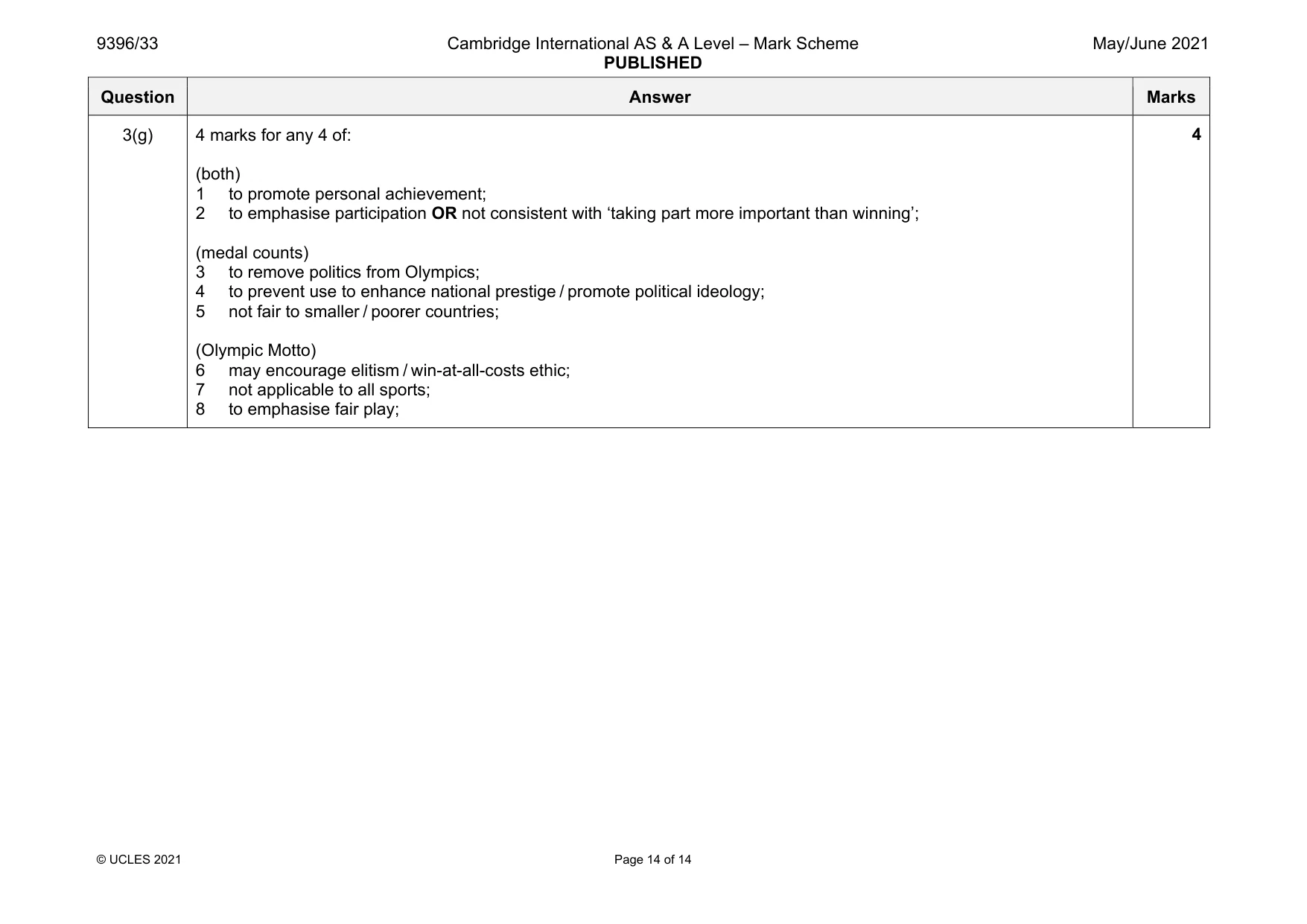
3 (a) The IOC aims to promote an appreciation of cultural diversity and to challenge discrimination in all its forms. (i) Suggest how an appreciation of cultural diversity may be achieved at the Olympic Games. [3] (ii) Suggest two forms of discrimination. [2] (b) The modern Olympic Games contains some of the sporting events from the ancient Olympic Games. (i) Outline other similarities between the ancient Olympic Games and the modern Olympic Games. [4] (ii) Describe differences, other than the types of sporting event, between the ancient Olympic Games and the modern Olympic Games. [3] (c) Describe ways that Olympic athletes have been used to promote a political ideology. [3] (d) Outline the sources of funding that a country may use to cover the costs of hosting the Olympic Games. [4] (e) Explain how the IOC promoted a concept of amateurism but failed to operate a policy to support its promotion. [3] (f) Suggest ways that a win‑at‑all‑costs ethic may lead to dysfunctional aspects of performance. [4] (g) Suggest reasons for: • removing medal counts from the Olympic Games • revising the Olympic Motto (Citius, Altius, Fortius). [4] [Total: 30]
Mark scheme: 3(a)(i) 3 marks for any 3 of: 1 promote understanding / education about different countries; 2 experience a range of sports from around world; 3 celebrate the culture of host nation / cultural aspects of host in opening / closing / medal ceremony; 4 promote tolerance / respect for others; 5 promote inclusion / equality / sport for all; 6 punish examples of intolerance / discrimination; 7 demonstration sports; 3(a)(ii) 2 marks for any 2 of: 1 colour; 2 race; 3 creed / religion; 4 political belief; 5 gender / sexual orientation; 6 disability; 7 age; 2 3(b)(i) 4 marks for any 4 of: 1 every 4 years; 2 oath; 3 opening ceremony; 4 Olympiad; 5 Olympic flame; 6 symbols of victory for winners; 7 festival nature / sporting AND cultural event; 8 eligibility standards / specialist training; 9 values / ethics / ideals of fair play / peace; 10 (evidence of) cheating / rule-breaking; 11 supreme challenge; 12 athletes as role models / cult figures; 13 large stadium / many spectators; 4 Question Answer Marks 3(b)(ii) 3 marks for any 3 of: ancient modern 1 5 days over 2 weeks; 2 male participants only males AND females take part OR females allowed; 3 naked clothed; 4 wreaths medals; 5 … for winners only … for 1st, 2nd AND 3rd; 6 religious festival secular / not religious; 7 always at same venue / Olympia different cities / countries as hosts; 8 Greeks only athletes from all over world; Both ancient and modern equivalent must be included. 3 3(c) 3 marks for any 3 of: 1 athletes as pawns for their governments; 2 master race / Aryan supremacy / nationalism; 3 political statements / black power salute; 4 athletes as targets for terrorists; 5 boycotts; 3 Question Answer Marks 3(d) 4 marks for any 4 of: 1 (sale of) TV rights; 2 sponsorship / marketing / licensing programmes; 3 donations from private corporations; 4 government subsidies; 5 lottery funding; 6 taxation / increased taxes (at local or national level); 7 ticket sales; 8 sales of merchandise; 9 IOC gives grants / loans; 10 revenue from (operating facilities as) training sites; 11 use of foreign exchange reserves; 4 3(e) 3 marks for any 3 of: 1 role / influence of Pierre de Coubertin; 2 amateurism as a noble concept OR upper class / amateurs showed correct values of Olympism OR belief that lower classes had no concept of fair-play ideals; 3 IOC failed to act against broken-time payments / shamateurs / sponsorships / trust funds / scholarships; 4 role of Avery Brundage in ignoring growth of shamateurism; 5 need for best athletes to take part in Olympics; 6 term ‘amateurism’ removed from Olympic charter (in 1974); 3 3(f) 4 marks for any 4 of: 1 use of prohibited / illegal drugs; 2 cheating; 3 gamesmanship; 4 bribery of judges / referees; 5 age / gender falsification; 6 modifying equipment; 7 losing a group game (to gain a more favourable draw later) / tanking / competition manipulation; 8 to achieve financial gain; 9 pressure from peers / coach / media; 10 misleading information / lack of knowledge; 4 Question Answer Marks 3(g) 4 marks for any 4 of: (both) 1 to promote personal achievement; 2 to emphasise participation OR not consistent with ‘taking part more important than winning’; (medal counts) 3 to remove politics from Olympics; 4 to prevent use to enhance national prestige / promote political ideology; 5 not fair to smaller / poorer countries; (Olympic Motto) 6 may encourage elitism / win-at-all-costs ethic; 7 not applicable to all sports; 8 to emphasise fair play; 4
What you needed in this session
Cambridge’s own grade thresholds for 2021 May/June, Paper 3 · Variant 3. A higher threshold means an easier paper — the bar moves with how the cohort did.