Cambridge A Level Physical Education 9396 — 2023 Oct/Nov Paper 3 · Variant 3
9396/33/O/N/23 · 3 questions · 90 marks · ≈101 min
The question paper and its mark scheme, free to read here and free to download. This is Cambridge’s own paper, exactly as it was sat.
Question paper4 pages
Mark scheme14 pages
Answers below. Sit the paper first if you are practising.
Questions as text
Q1 · Describe the stage of the aerobic system in which hydrogen atoms are split
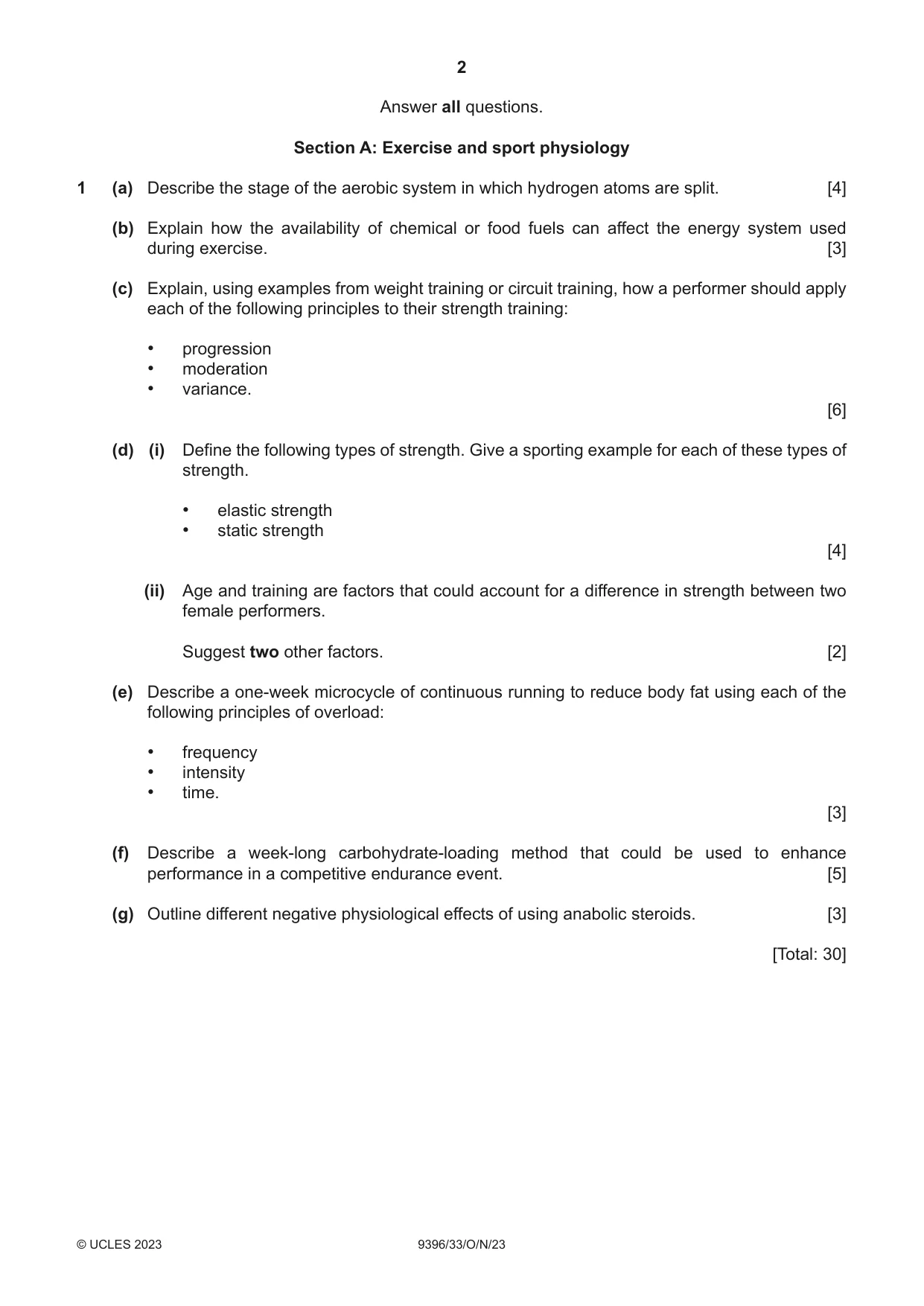
1 (a) Describe the stage of the aerobic system in which hydrogen atoms are split. [4] (b) Explain how the availability of chemical or food fuels can affect the energy system used during exercise. [3] (c) Explain, using examples from weight training or circuit training, how a performer should apply each of the following principles to their strength training: • progression • moderation • variance. [6] (d) (i) Define the following types of strength. Give a sporting example for each of these types of strength. • elastic strength • static strength [4] (ii) Age and training are factors that could account for a difference in strength between two female performers. Suggest two other factors. [2] (e) Describe a one-week microcycle of continuous running to reduce body fat using each of the following principles of overload: • frequency • intensity • time. [3] (f) Describe a week-long carbohydrate-loading method that could be used to enhance performance in a competitive endurance event. [5] (g) Outline different negative physiological effects of using anabolic steroids. [3] [Total: 30]
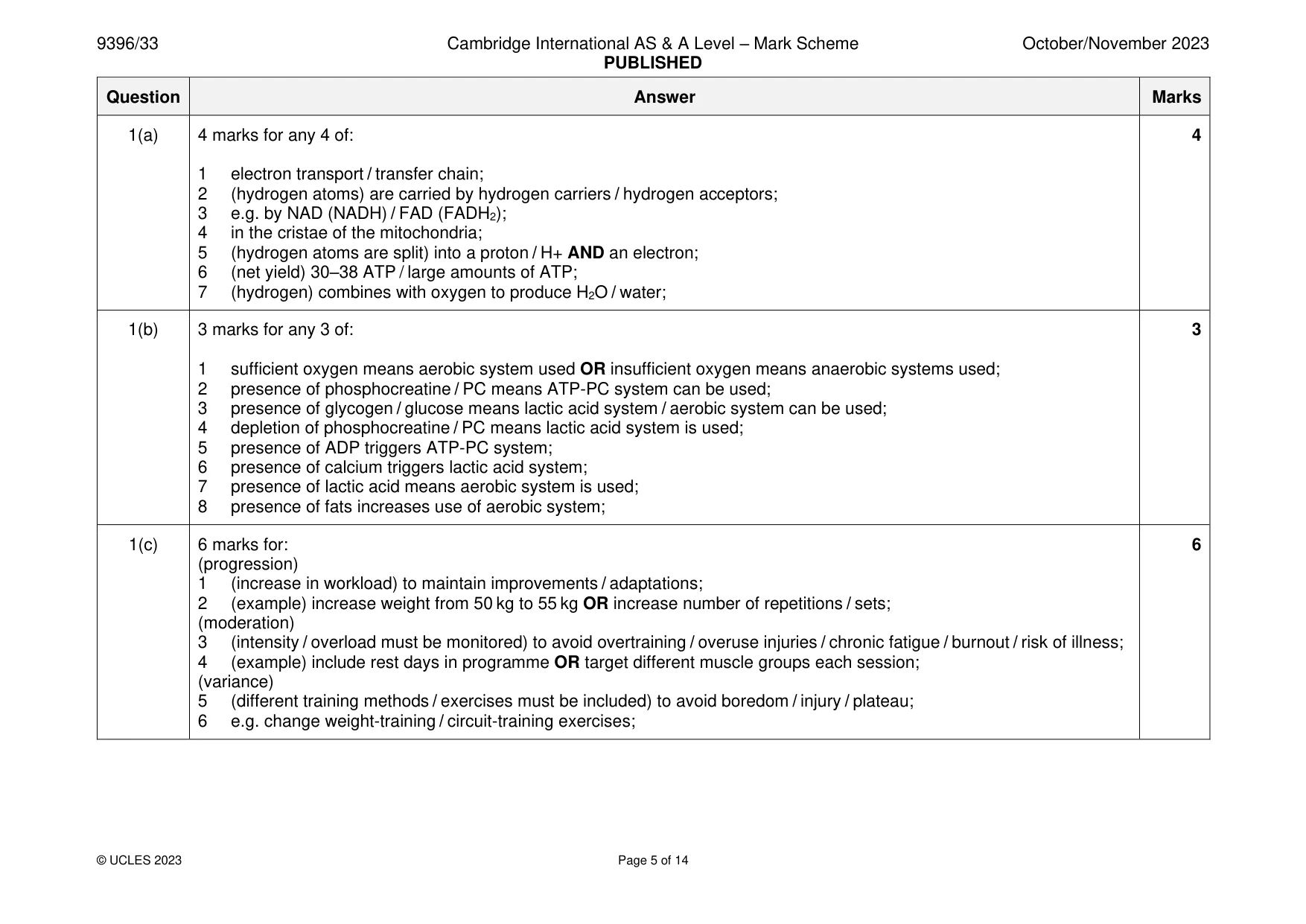
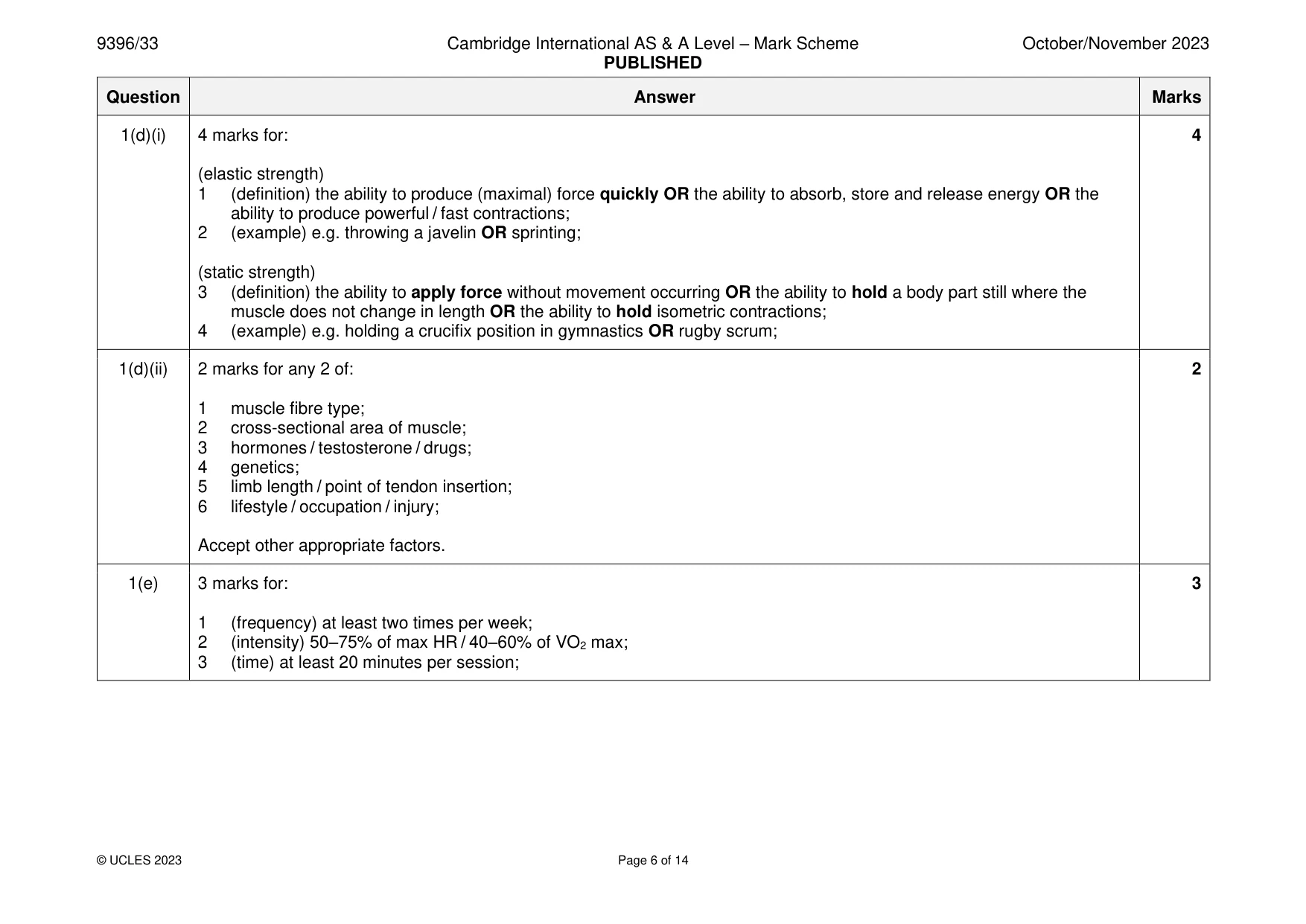
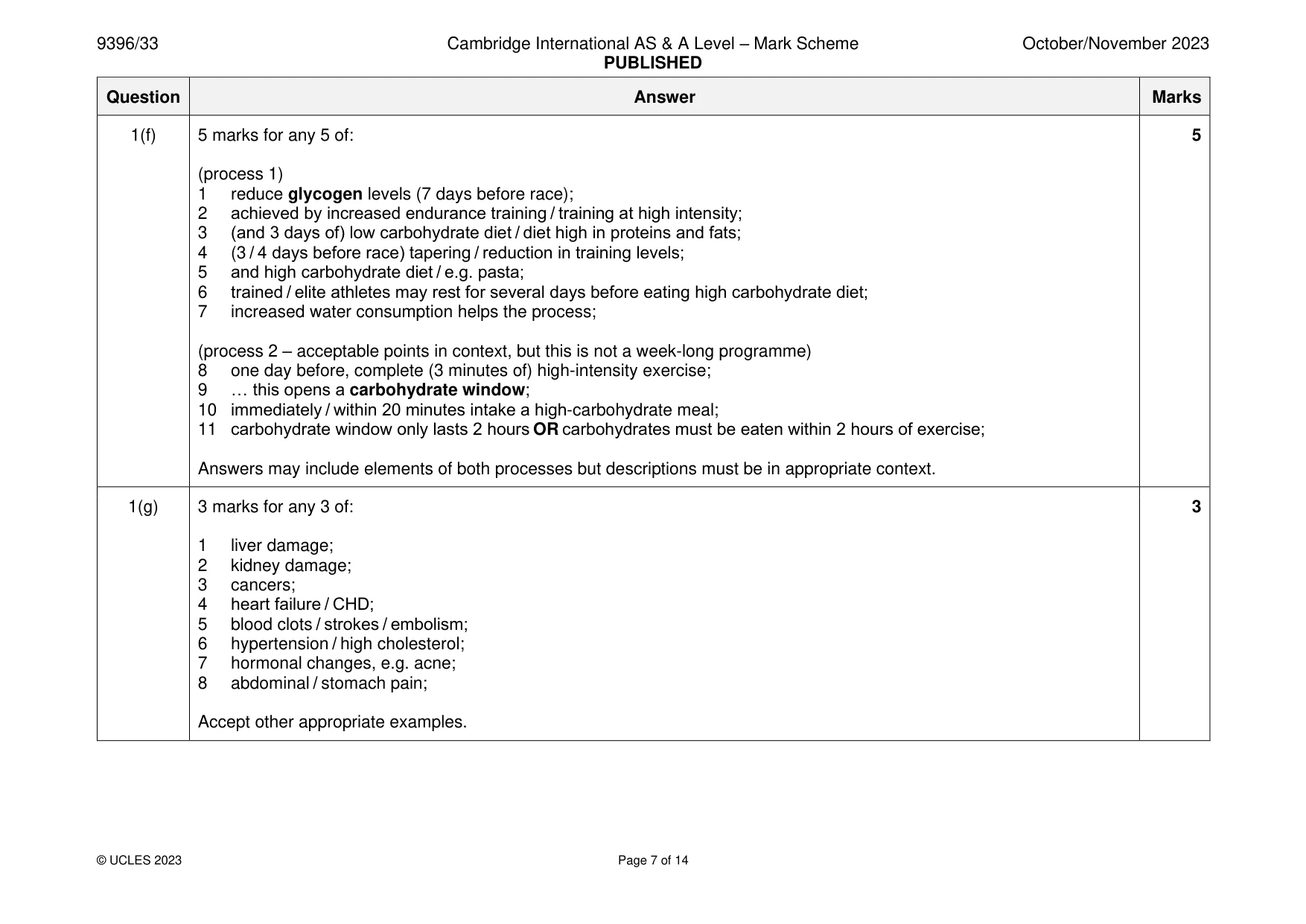
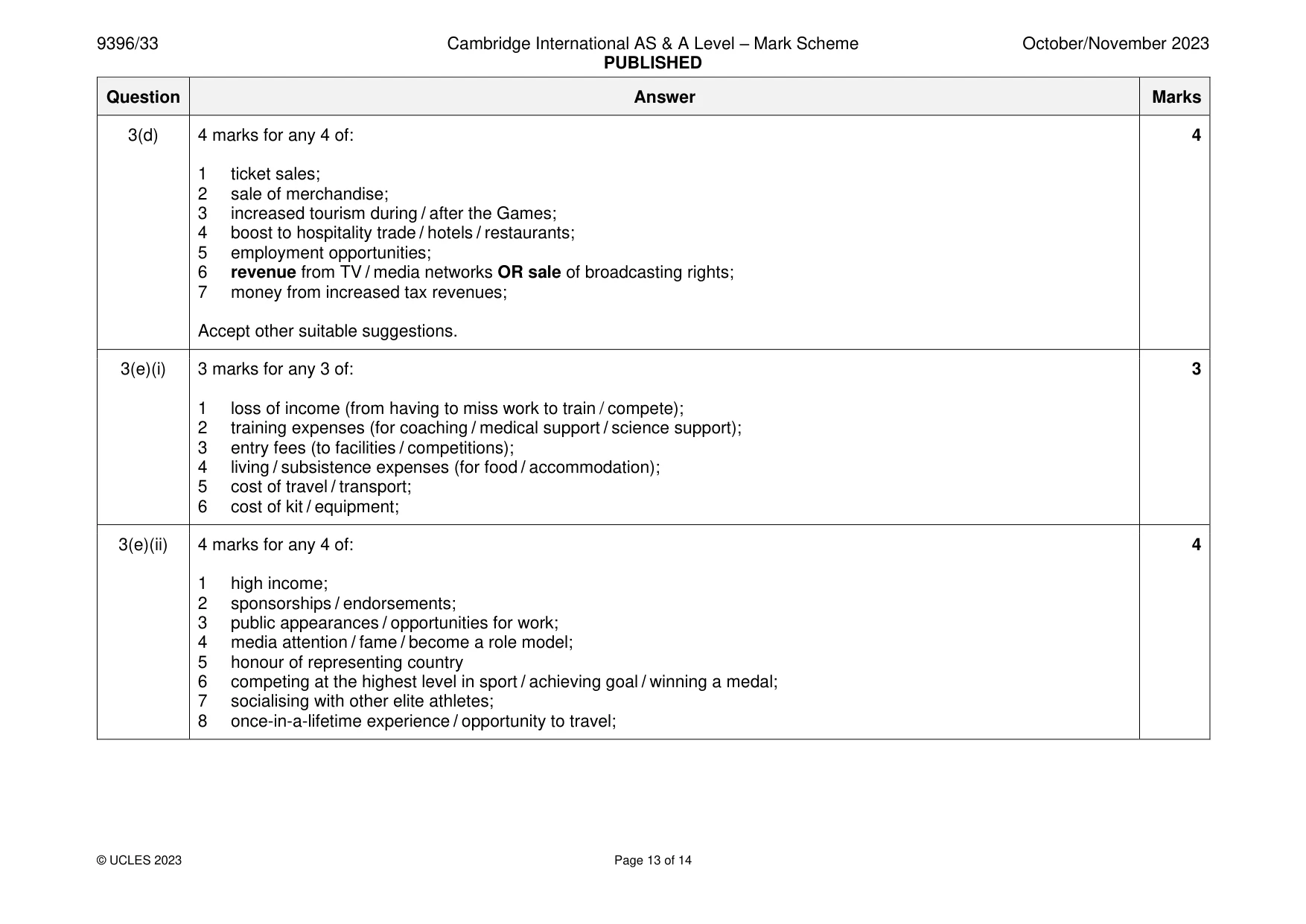
Mark scheme: Question Answer Marks 1(a) 4 marks for any 4 of: 4 1 electron transport / transfer chain; 2 (hydrogen atoms) are carried by hydrogen carriers / hydrogen acceptors; 3 e.g. by NAD (NADH) / FAD (FADH2); 4 in the cristae of the mitochondria; 5 (hydrogen atoms are split) into a proton / H+ AND an electron; 6 (net yield) 30–38 ATP / large amounts of ATP; 7 (hydrogen) combines with oxygen to produce H2O / water; 1(b) 3 marks for any 3 of: 3 1 sufficient oxygen means aerobic system used OR insufficient oxygen means anaerobic systems used; 2 presence of phosphocreatine / PC means ATP-PC system can be used; 3 presence of glycogen / glucose means lactic acid system / aerobic system can be used; 4 depletion of phosphocreatine / PC means lactic acid system is used; 5 presence of ADP triggers ATP-PC system; 6 presence of calcium triggers lactic acid system; 7 presence of lactic acid means aerobic system is used; 8 presence of fats increases use of aerobic system; 1(c) 6 marks for: 6 (progression) 1 (increase in workload) to maintain improvements / adaptations; 2 (example) increase weight from 50 kg to 55 kg OR increase number of repetitions / sets; (moderation) 3 (intensity / overload must be monitored) to avoid overtraining / overuse injuries / chronic fatigue / burnout / risk of illness; 4 (example) include rest days in programme OR target different muscle groups each session; (variance) 5 (different training methods / exercises must be included) to avoid boredom / injury / plateau; 6 e.g. change weight-training / circuit-training exercises; 1(d)(i) 4 marks for: 4 (elastic strength) 1 (definition) the ability to produce (maximal) force quickly OR the ability to absorb, store and release energy OR the ability to produce powerful / fast contractions; 2 (example) e.g. throwing a javelin OR sprinting; (static strength) 3 (definition) the ability to apply force without movement occurring OR the ability to hold a body part still where the muscle does not change in length OR the ability to hold isometric contractions; 4 (example) e.g. holding a crucifix position in gymnastics OR rugby scrum; 1(d)(ii) 2 marks for any 2 of: 2 1 muscle fibre type; 2 cross-sectional area of muscle; 3 hormones / testosterone / drugs; 4 genetics; 5 limb length / point of tendon insertion; 6 lifestyle / occupation / injury; Accept other appropriate factors. 1(e) 3 marks for: 3 1 (frequency) at least two times per week; 2 (intensity) 50–75% of max HR / 40–60% of VO2 max; 3 (time) at least 20 minutes per session; 1(f) 5 marks for any 5 of: 5 (process 1) 1 reduce glycogen levels (7 days before race); 2 achieved by increased endurance training / training at high intensity; 3 (and 3 days of) low carbohydrate diet / diet high in proteins and fats; 4 (3 / 4 days before race) tapering / reduction in training levels; 5 and high carbohydrate diet / e.g. pasta; 6 trained / elite athletes may rest for several days before eating high carbohydrate diet; 7 increased water consumption helps the process; (process 2 – acceptable points in context, but this is not a week-long programme) 8 one day before, complete (3 minutes of) high-intensity exercise; 9 … this opens a carbohydrate window; 10 immediately / within 20 minutes intake a high-carbohydrate meal; 11 carbohydrate window only lasts 2 hours OR carbohydrates must be eaten within 2 hours of exercise; Answers may include elements of both processes but descriptions must be in appropriate context. 1(g) 3 marks for any 3 of: 3 1 liver damage; 2 kidney damage; 3 cancers; 4 heart failure / CHD; 5 blood clots / strokes / embolism; 6 hypertension / high cholesterol; 7 hormonal changes, e.g. acne; 8 abdominal / stomach pain; Accept other appropriate examples.
Q2 · Describe three differences between the characteristics of Type A personalities and the…
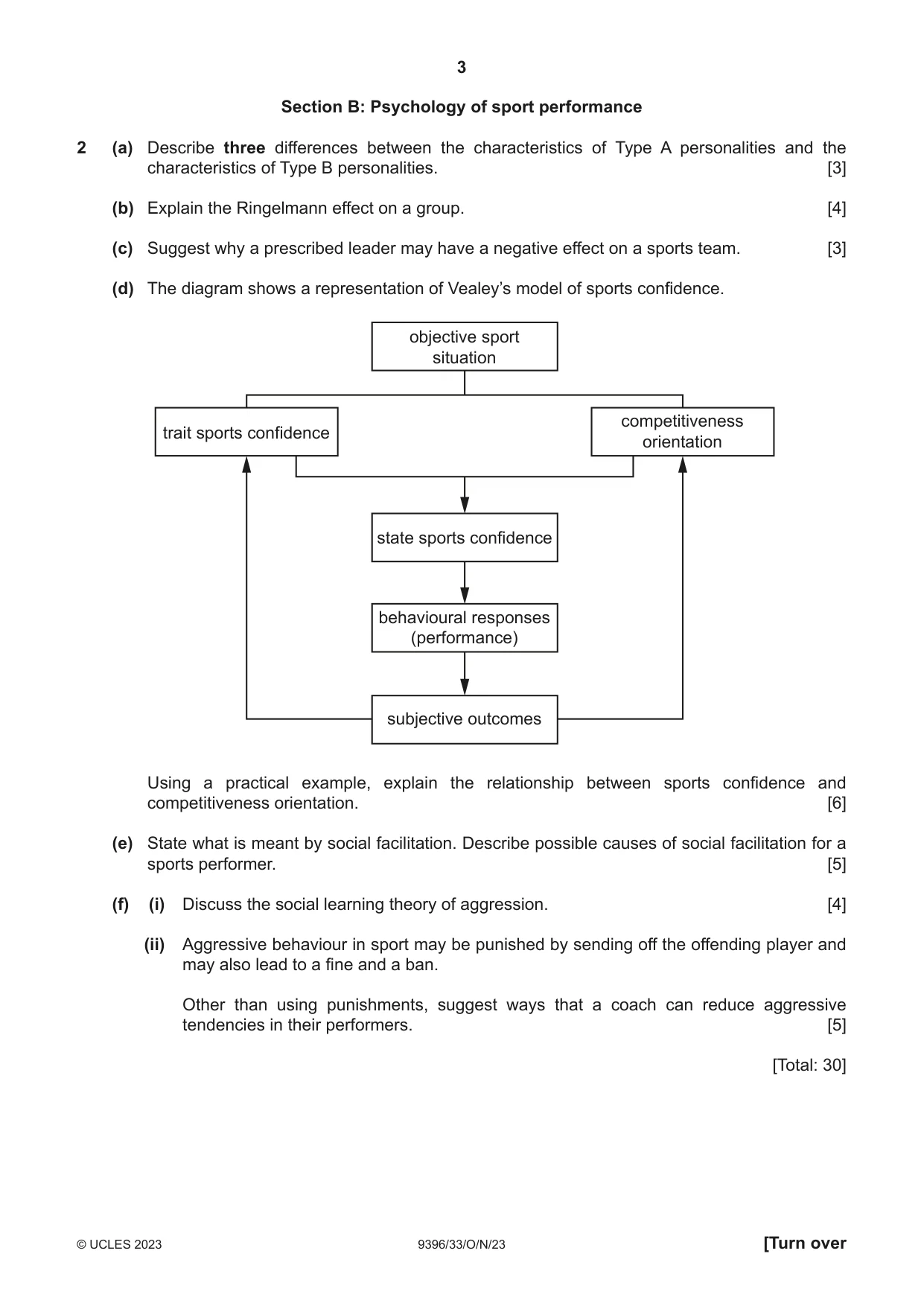
2 (a) Describe three differences between the characteristics of Type A personalities and the characteristics of Type B personalities. [3] (b) Explain the Ringelmann effect on a group. [4] (c) Suggest why a prescribed leader may have a negative effect on a sports team. [3] (d) The diagram shows a representation of Vealey’s model of sports confidence. objective sport situation competitiveness trait sports confidence orientation state sports confidence behavioural responses (performance) subjective outcomes Using a practical example, explain the relationship between sports confidence and competitiveness orientation. [6] (e) State what is meant by social facilitation. Describe possible causes of social facilitation for a sports performer. [5] (f) (i) Discuss the social learning theory of aggression. [4] (ii) Aggressive behaviour in sport may be punished by sending off the offending player and may also lead to a fine and a ban. Other than using punishments, suggest ways that a coach can reduce aggressive tendencies in their performers. [5] [Total: 30] Section C: Olympic Games: a global perspective
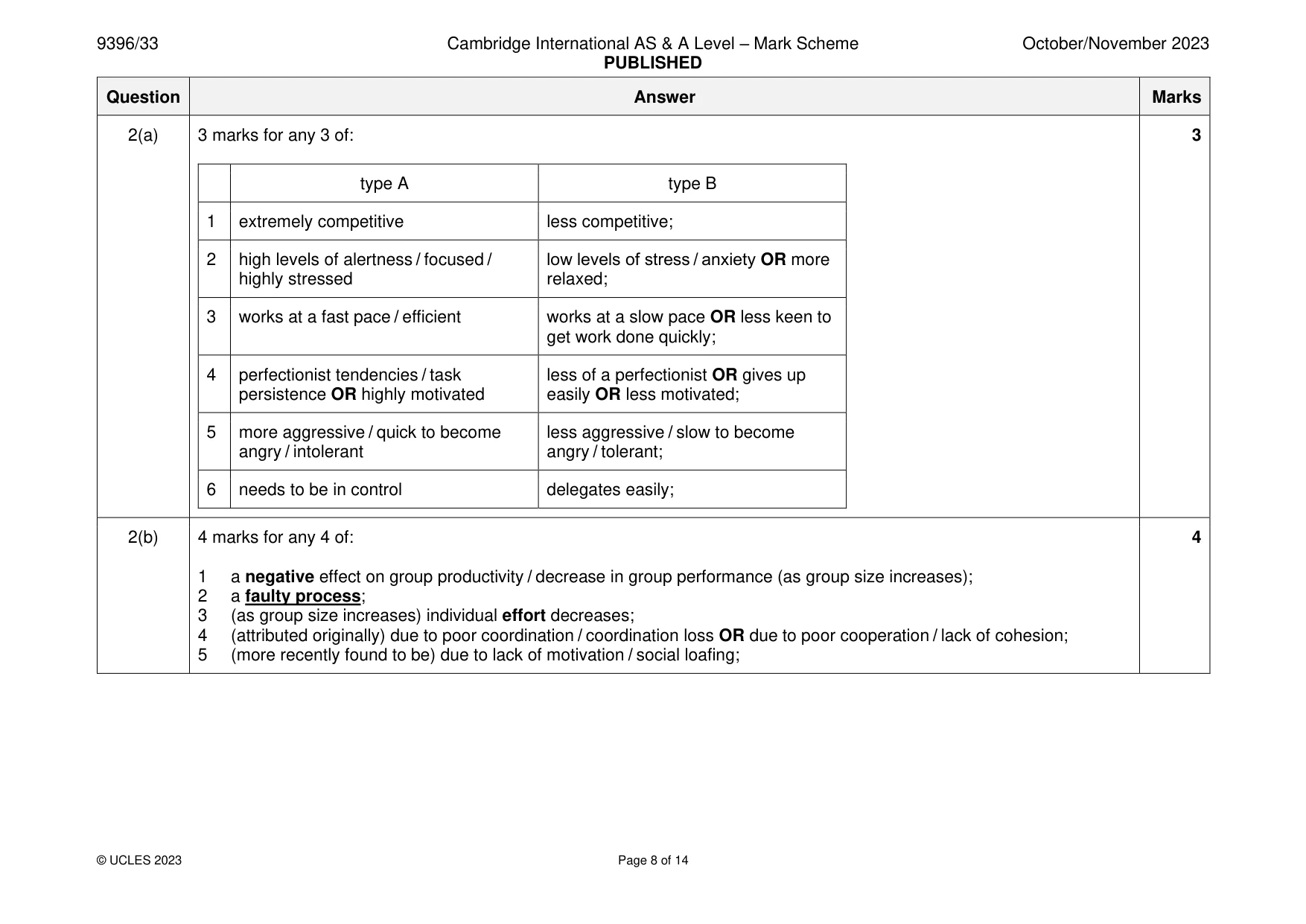
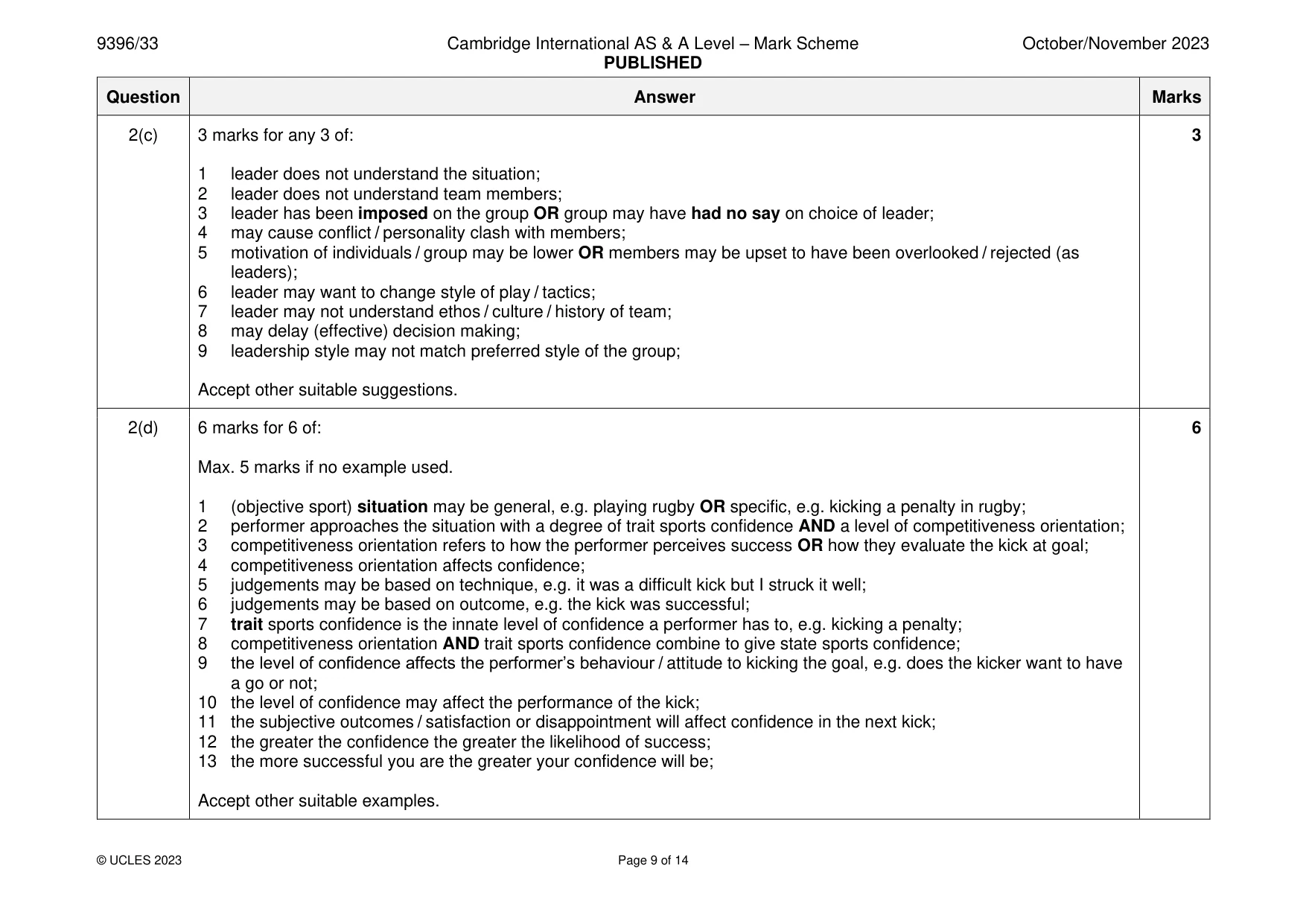
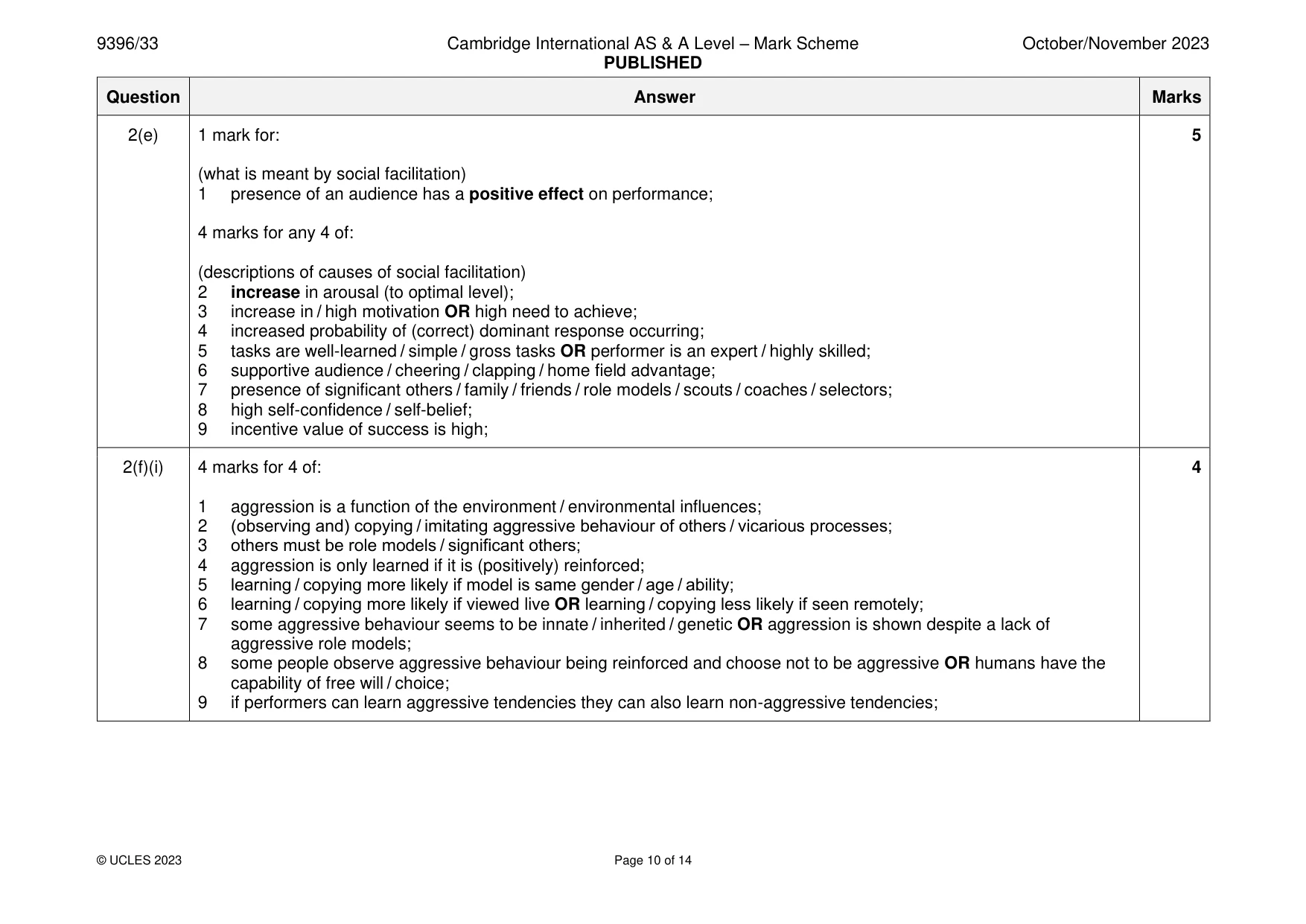
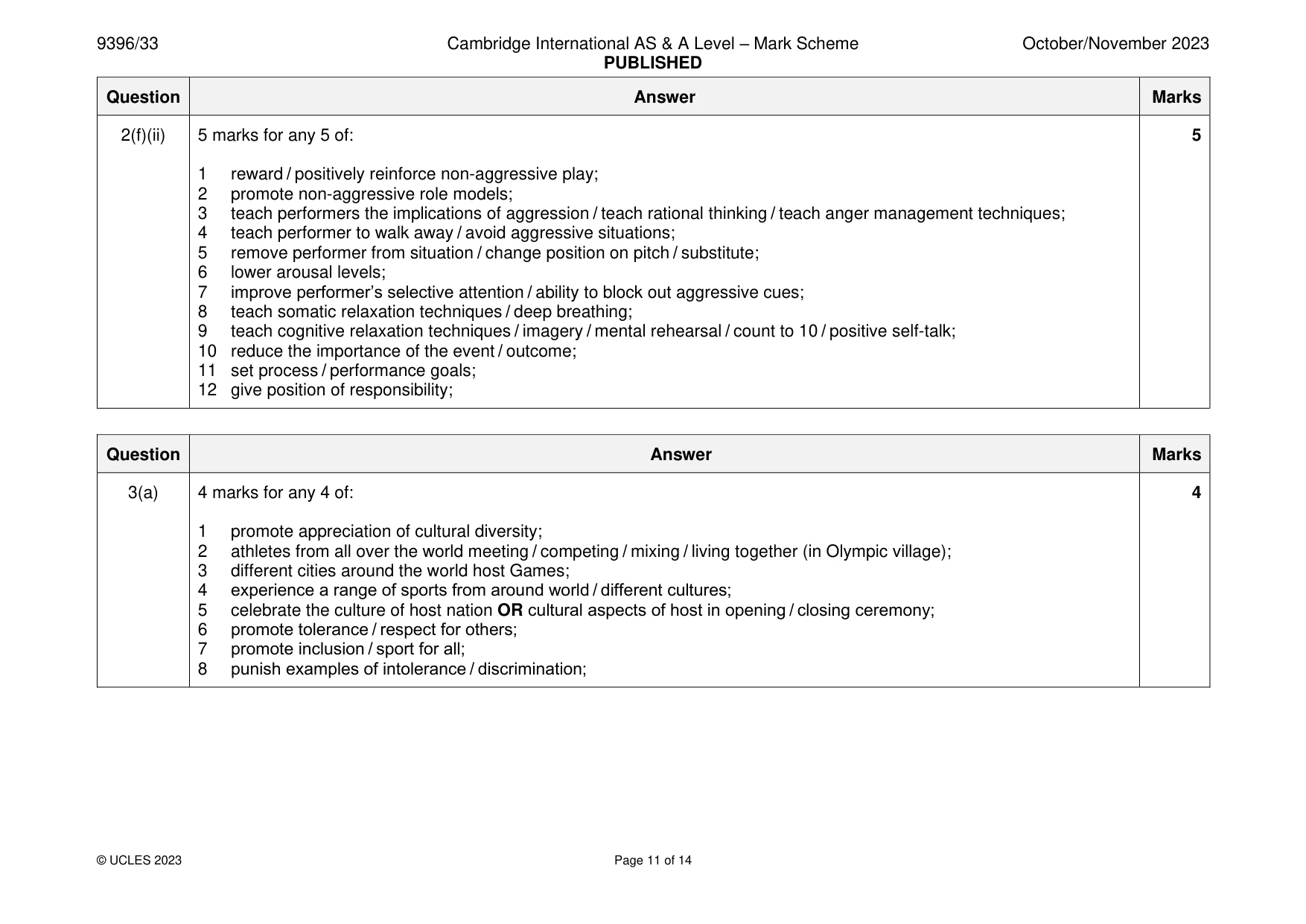
Mark scheme: 2(a) 3 marks for any 3 of: 3 type A type B 1 extremely competitive less competitive; 2 high levels of alertness / focused / low levels of stress / anxiety OR more highly stressed relaxed; 3 works at a fast pace / efficient works at a slow pace OR less keen to get work done quickly; 4 perfectionist tendencies / task less of a perfectionist OR gives up persistence OR highly motivated easily OR less motivated; 5 more aggressive / quick to become less aggressive / slow to become angry / intolerant angry / tolerant; 6 needs to be in control delegates easily; 2(b) 4 marks for any 4 of: 4 1 a negative effect on group productivity / decrease in group performance (as group size increases); 2 a faulty process; 3 (as group size increases) individual effort decreases; 4 (attributed originally) due to poor coordination / coordination loss OR due to poor cooperation / lack of cohesion; 5 (more recently found to be) due to lack of motivation / social loafing; 2(c) 3 marks for any 3 of: 3 1 leader does not understand the situation; 2 leader does not understand team members; 3 leader has been imposed on the group OR group may have had no say on choice of leader; 4 may cause conflict / personality clash with members; 5 motivation of individuals / group may be lower OR members may be upset to have been overlooked / rejected (as leaders); 6 leader may want to change style of play / tactics; 7 leader may not understand ethos / culture / history of team; 8 may delay (effective) decision making; 9 leadership style may not match preferred style of the group; Accept other suitable suggestions. 2(d) 6 marks for 6 of: 6 Max. 5 marks if no example used. 1 (objective sport) situation may be general, e.g. playing rugby OR specific, e.g. kicking a penalty in rugby; 2 performer approaches the situation with a degree of trait sports confidence AND a level of competitiveness orientation; 3 competitiveness orientation refers to how the performer perceives success OR how they evaluate the kick at goal; 4 competitiveness orientation affects confidence; 5 judgements may be based on technique, e.g. it was a difficult kick but I struck it well; 6 judgements may be based on outcome, e.g. the kick was successful; 7 trait sports confidence is the innate level of confidence a performer has to, e.g. kicking a penalty; 8 competitiveness orientation AND trait sports confidence combine to give state sports confidence; 9 the level of confidence affects the performer’s behaviour / attitude to kicking the goal, e.g. does the kicker want to have a go or not; 10 the level of confidence may affect the performance of the kick; 11 the subjective outcomes / satisfaction or disappointment will affect confidence in the next kick; 12 the greater the confidence the greater the likelihood of success; 13 the more successful you are the greater your confidence will be; Accept other suitable examples. 2(e) 1 mark for: 5 (what is meant by social facilitation) 1 presence of an audience has a positive effect on performance; 4 marks for any 4 of: (descriptions of causes of social facilitation) 2 increase in arousal (to optimal level); 3 increase in / high motivation OR high need to achieve; 4 increased probability of (correct) dominant response occurring; 5 tasks are well-learned / simple / gross tasks OR performer is an expert / highly skilled; 6 supportive audience / cheering / clapping / home field advantage; 7 presence of significant others / family / friends / role models / scouts / coaches / selectors; 8 high self-confidence / self-belief; 9 incentive value of success is high; 2(f)(i) 4 marks for 4 of: 4 1 aggression is a function of the environment / environmental influences; 2 (observing and) copying / imitating aggressive behaviour of others / vicarious processes; 3 others must be role models / significant others; 4 aggression is only learned if it is (positively) reinforced; 5 learning / copying more likely if model is same gender / age / ability; 6 learning / copying more likely if viewed live OR learning / copying less likely if seen remotely; 7 some aggressive behaviour seems to be innate / inherited / genetic OR aggression is shown despite a lack of aggressive role models; 8 some people observe aggressive behaviour being reinforced and choose not to be aggressive OR humans have the capability of free will / choice; 9 if performers can learn aggressive tendencies they can also learn non-aggressive tendencies; 2(f)(ii) 5 marks for any 5 of: 5 1 reward / positively reinforce non-aggressive play; 2 promote non-aggressive role models; 3 teach performers the implications of aggression / teach rational thinking / teach anger management techniques; 4 teach performer to walk away / avoid aggressive situations; 5 remove performer from situation / change position on pitch / substitute; 6 lower arousal levels; 7 improve performer’s selective attention / ability to block out aggressive cues; 8 teach somatic relaxation techniques / deep breathing; 9 teach cognitive relaxation techniques / imagery / mental rehearsal / count to 10 / positive self-talk; 10 reduce the importance of the event / outcome; 11 set process / performance goals; 12 give position of responsibility;
Q3 · One of the aims of the International Olympic Committee (IOC) is to promote international…
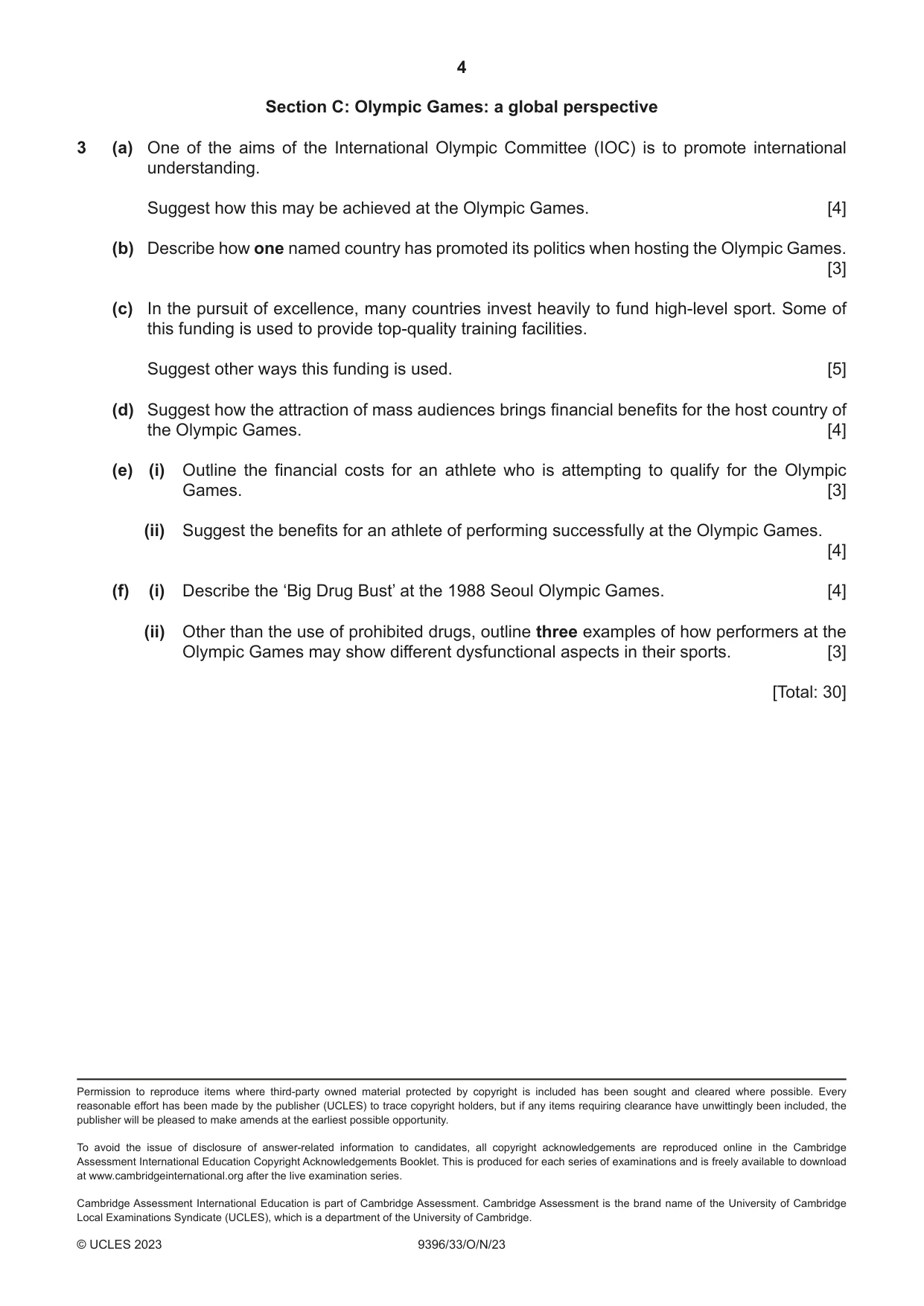
3 (a) One of the aims of the International Olympic Committee (IOC) is to promote international understanding. Suggest how this may be achieved at the Olympic Games. [4] (b) Describe how one named country has promoted its politics when hosting the Olympic Games. [3] (c) In the pursuit of excellence, many countries invest heavily to fund high-level sport. Some of this funding is used to provide top-quality training facilities. Suggest other ways this funding is used. [5] (d) Suggest how the attraction of mass audiences brings financial benefits for the host country of the Olympic Games. [4] (e) (i) Outline the financial costs for an athlete who is attempting to qualify for the Olympic Games. [3] (ii) Suggest the benefits for an athlete of performing successfully at the Olympic Games. [4] (f) (i) Describe the ‘Big Drug Bust’ at the 1988 Seoul Olympic Games. [4] (ii) Other than the use of prohibited drugs, outline three examples of how performers at the Olympic Games may show different dysfunctional aspects in their sports. [3] [Total: 30]
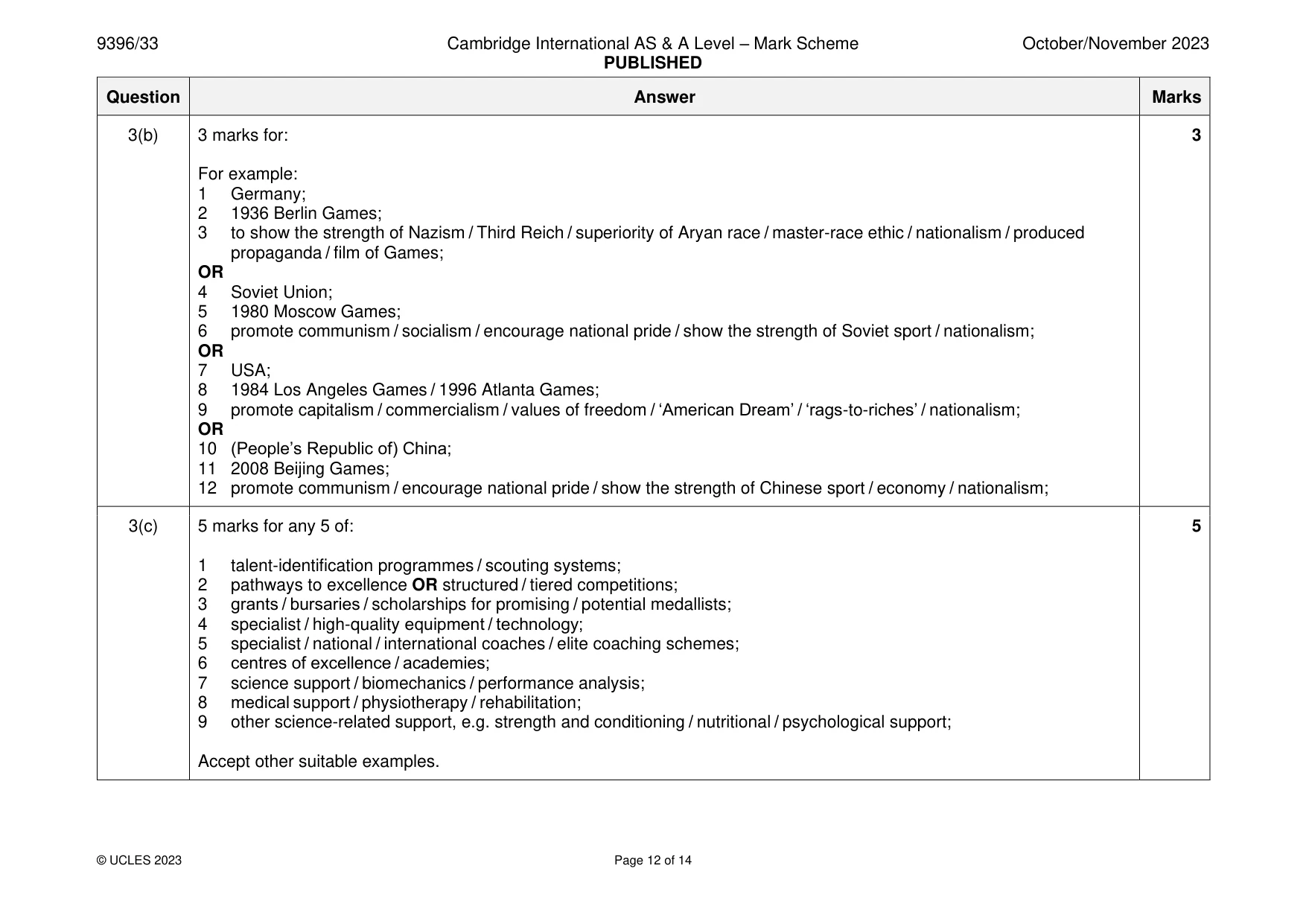
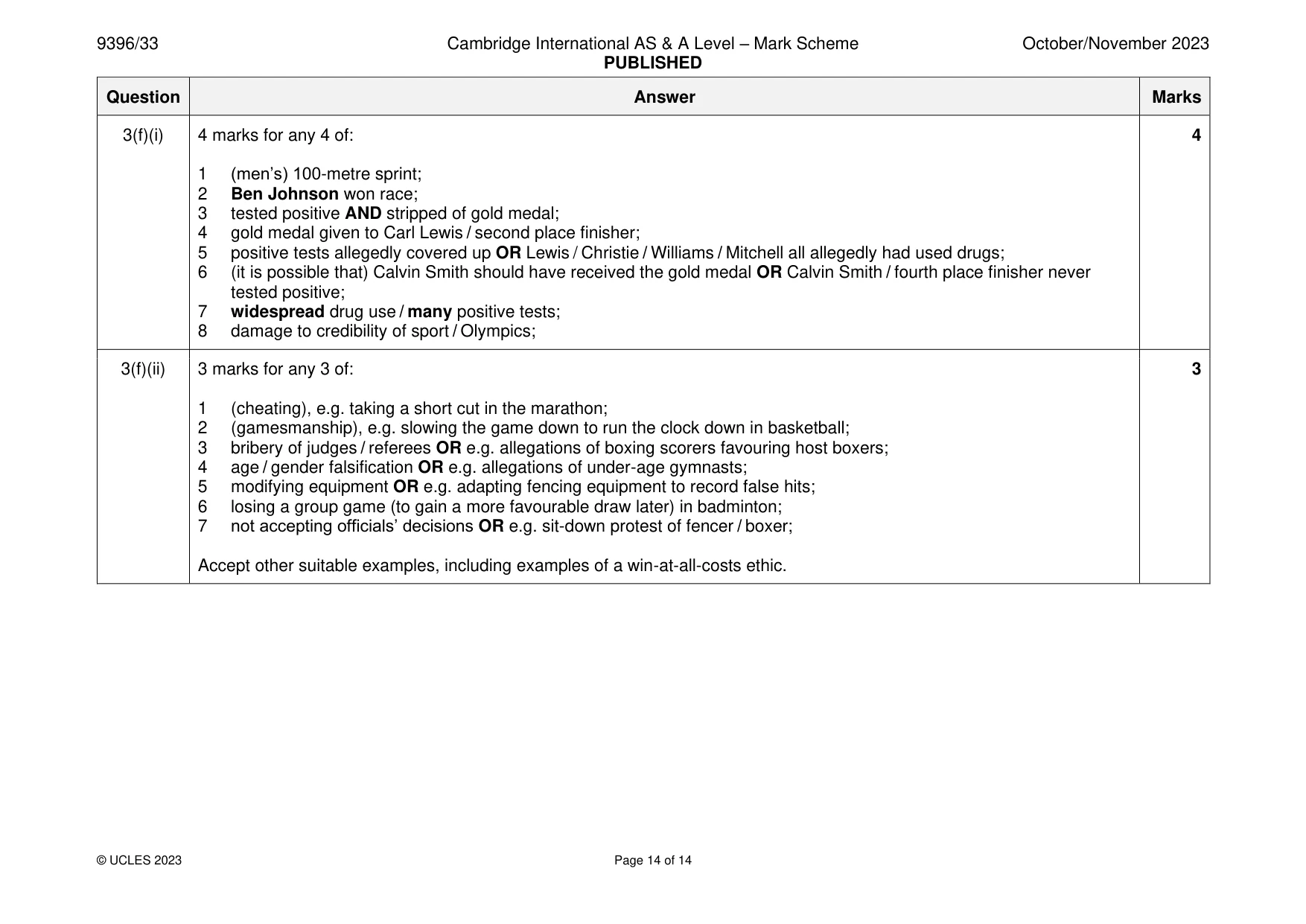
Mark scheme: 3(a) 4 marks for any 4 of: 4 1 promote appreciation of cultural diversity; 2 athletes from all over the world meeting / competing / mixing / living together (in Olympic village); 3 different cities around the world host Games; 4 experience a range of sports from around world / different cultures; 5 celebrate the culture of host nation OR cultural aspects of host in opening / closing ceremony; 6 promote tolerance / respect for others; 7 promote inclusion / sport for all; 8 punish examples of intolerance / discrimination; 3(b) 3 marks for: 3 For example: 1 Germany; 2 1936 Berlin Games; 3 to show the strength of Nazism / Third Reich / superiority of Aryan race / master-race ethic / nationalism / produced propaganda / film of Games; OR 4 Soviet Union; 5 1980 Moscow Games; 6 promote communism / socialism / encourage national pride / show the strength of Soviet sport / nationalism; OR 7 USA; 8 1984 Los Angeles Games / 1996 Atlanta Games; 9 promote capitalism / commercialism / values of freedom / ‘American Dream’ / ‘rags-to-riches’ / nationalism; OR 10 (People’s Republic of) China; 11 2008 Beijing Games; 12 promote communism / encourage national pride / show the strength of Chinese sport / economy / nationalism; 3(c) 5 marks for any 5 of: 5 1 talent-identification programmes / scouting systems; 2 pathways to excellence OR structured / tiered competitions; 3 grants / bursaries / scholarships for promising / potential medallists; 4 specialist / high-quality equipment / technology; 5 specialist / national / international coaches / elite coaching schemes; 6 centres of excellence / academies; 7 science support / biomechanics / performance analysis; 8 medical support / physiotherapy / rehabilitation; 9 other science-related support, e.g. strength and conditioning / nutritional / psychological support; Accept other suitable examples. 3(d) 4 marks for any 4 of: 4 1 ticket sales; 2 sale of merchandise; 3 increased tourism during / after the Games; 4 boost to hospitality trade / hotels / restaurants; 5 employment opportunities; 6 revenue from TV / media networks OR sale of broadcasting rights; 7 money from increased tax revenues; Accept other suitable suggestions. 3(e)(i) 3 marks for any 3 of: 3 1 loss of income (from having to miss work to train / compete); 2 training expenses (for coaching / medical support / science support); 3 entry fees (to facilities / competitions); 4 living / subsistence expenses (for food / accommodation); 5 cost of travel / transport; 6 cost of kit / equipment; 3(e)(ii) 4 marks for any 4 of: 4 1 high income; 2 sponsorships / endorsements; 3 public appearances / opportunities for work; 4 media attention / fame / become a role model; 5 honour of representing country 6 competing at the highest level in sport / achieving goal / winning a medal; 7 socialising with other elite athletes; 8 once-in-a-lifetime experience / opportunity to travel; 3(f)(i) 4 marks for any 4 of: 4 1 (men’s) 100-metre sprint; 2 Ben Johnson won race; 3 tested positive AND stripped of gold medal; 4 gold medal given to Carl Lewis / second place finisher; 5 positive tests allegedly covered up OR Lewis / Christie / Williams / Mitchell all allegedly had used drugs; 6 (it is possible that) Calvin Smith should have received the gold medal OR Calvin Smith / fourth place finisher never tested positive; 7 widespread drug use / many positive tests; 8 damage to credibility of sport / Olympics; 3(f)(ii) 3 marks for any 3 of: 3 1 (cheating), e.g. taking a short cut in the marathon; 2 (gamesmanship), e.g. slowing the game down to run the clock down in basketball; 3 bribery of judges / referees OR e.g. allegations of boxing scorers favouring host boxers; 4 age / gender falsification OR e.g. allegations of under-age gymnasts; 5 modifying equipment OR e.g. adapting fencing equipment to record false hits; 6 losing a group game (to gain a more favourable draw later) in badminton; 7 not accepting officials’ decisions OR e.g. sit-down protest of fencer / boxer; Accept other suitable examples, including examples of a win-at-all-costs ethic.
What you needed in this session
Cambridge’s own grade thresholds for 2023 Oct/Nov, Paper 3 · Variant 3. A higher threshold means an easier paper — the bar moves with how the cohort did.