Cambridge A Level Physical Education 9396 — 2011 Oct/Nov Paper 1 · Variant 2
9396/12/O/N/11 · 90 marks · ≈101 min
The question paper and its mark scheme, free to read here and free to download. This is Cambridge’s own paper, exactly as it was sat.
Question paper4 pages
Mark scheme9 pages
Answers below. Sit the paper first if you are practising.
Paper as text
Question paper, page 1
This document consists of 4 printed pages. DC (LEO/SW) 41108 © UCLES 2011 [Turn over UNIVERSITY OF CAMBRIDGE INTERNATIONAL EXAMINATIONS General Certificate of Education Advanced Subsidiary Level and Advanced Level READ THESE INSTRUCTIONS FIRST If you have been given an Answer Booklet, follow the instructions on the front cover of the Booklet. Write your Centre number, candidate number and name on all the work you hand in. Write in dark blue or black pen. You may use a soft pencil for any diagrams, graphs or rough working. Do not use staples, paper clips, highlighters, glue or correction fluid. Answer all questions. At the end of the examination, fasten all your work securely together. The number of marks is given in brackets [ ] at the end of each question or part question. * 9 9 6 6 7 5 3 6 2 1 * PHYSICAL EDUCATION 9396/12 Paper 1 October/November 2011 2 hours 30 minutes Additional Materials: Answer Booklet/Paper
Question paper, page 2
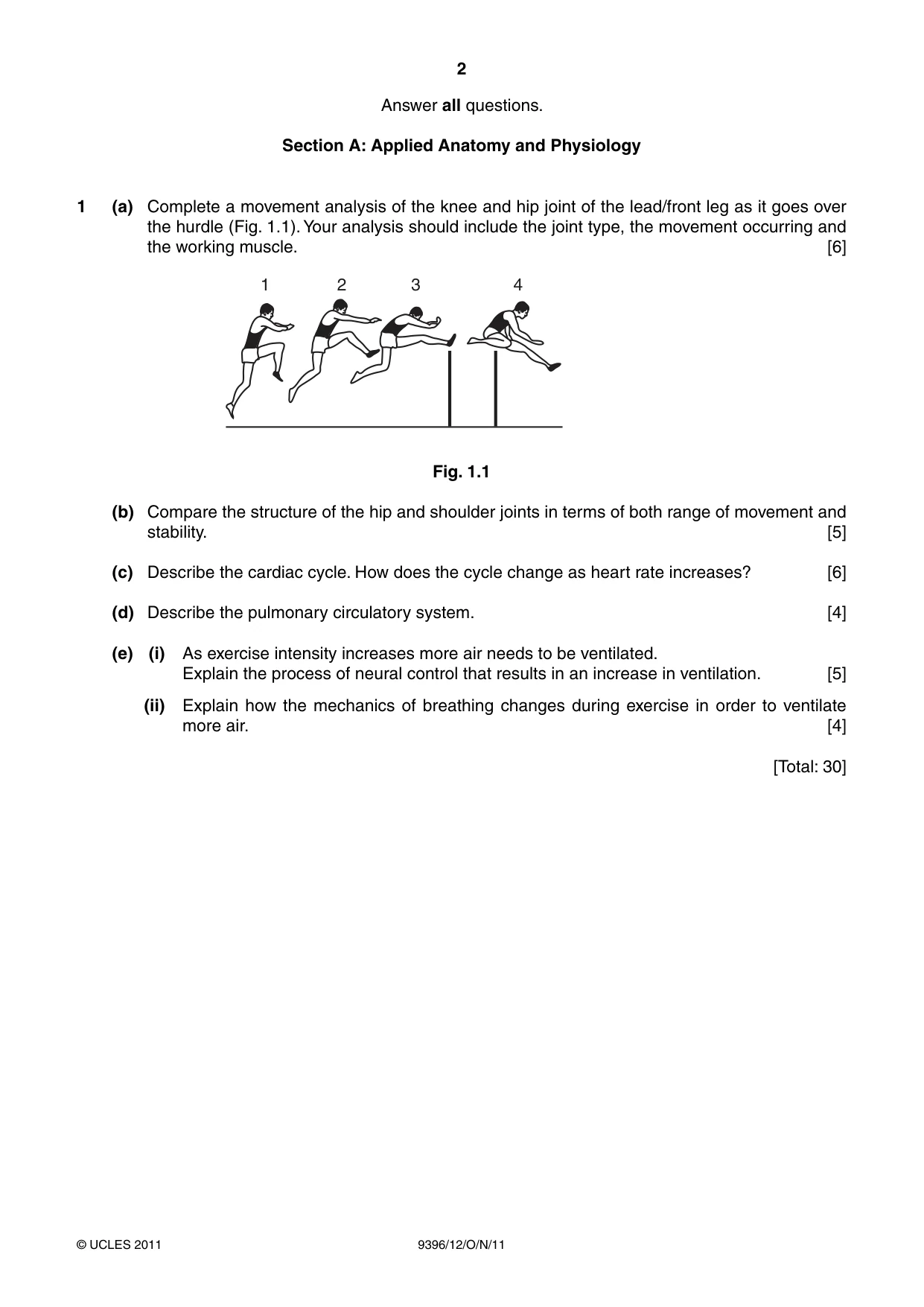
2 9396/12/O/N/11 © UCLES 2011 Answer all questions. Section A: Applied Anatomy and Physiology 1 (a) Complete a movement analysis of the knee and hip joint of the lead/front leg as it goes over the hurdle (Fig. 1.1). Your analysis should include the joint type, the movement occurring and the working muscle. [6] 1 2 3 4 Fig. 1.1 (b) Compare the structure of the hip and shoulder joints in terms of both range of movement and stability. [5] (c) Describe the cardiac cycle. How does the cycle change as heart rate increases? [6] (d) Describe the pulmonary circulatory system. [4] (e) (i) As exercise intensity increases more air needs to be ventilated. Explain the process of neural control that results in an increase in ventilation. [5] (ii) Explain how the mechanics of breathing changes during exercise in order to ventilate more air. [4] [Total: 30]
Question paper, page 3
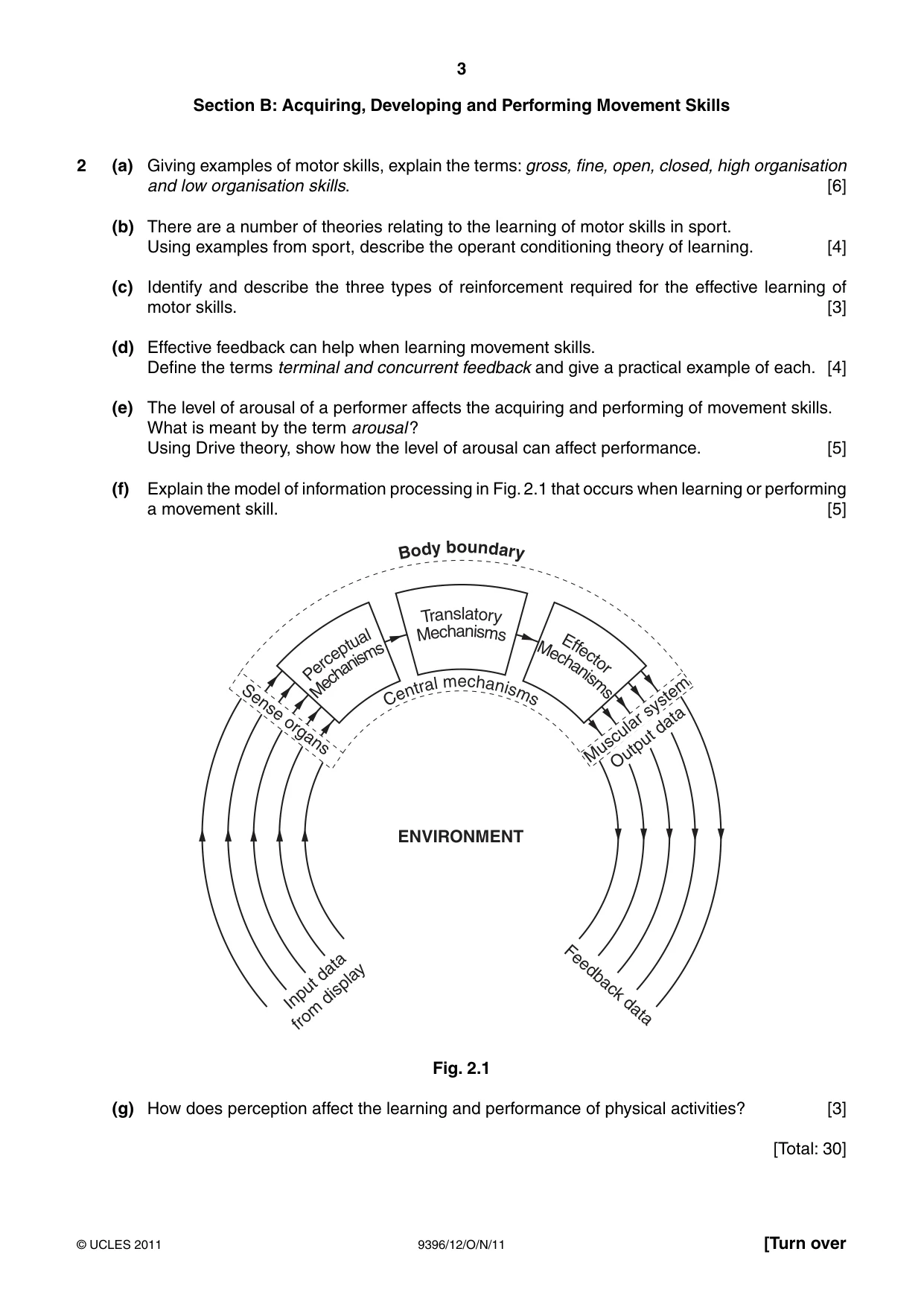
3 9396/12/O/N/11 © UCLES 2011 [Turn over Section B: Acquiring, Developing and Performing Movement Skills 2 (a) Giving examples of motor skills, explain the terms: gross, fine, open, closed, high organisation and low organisation skills. [6] (b) There are a number of theories relating to the learning of motor skills in sport. Using examples from sport, describe the operant conditioning theory of learning. [4] (c) Identify and describe the three types of reinforcement required for the effective learning of motor skills. [3] (d) Effective feedback can help when learning movement skills. Define the terms terminal and concurrent feedback and give a practical example of each. [4] (e) The level of arousal of a performer affects the acquiring and performing of movement skills. What is meant by the term arousal ? Using Drive theory, show how the level of arousal can affect performance. [5] (f) Explain the model of information processing in Fig. 2.1 that occurs when learning or performing a movement skill. [5] Ef fe ct or Tr an sl at or y Pe rc ep tu al M ec ha ni s m s M ec ha ni s m s M ec ha ni s m s C e n tr a l m e c h a n is m s Bo dy b ou nd ar y Input data from display Sense organs Feedback data ENVIRONMENT Output data Muscular system Fig. 2.1 (g) How does perception affect the learning and performance of physical activities? [3] [Total: 30]
Question paper, page 4
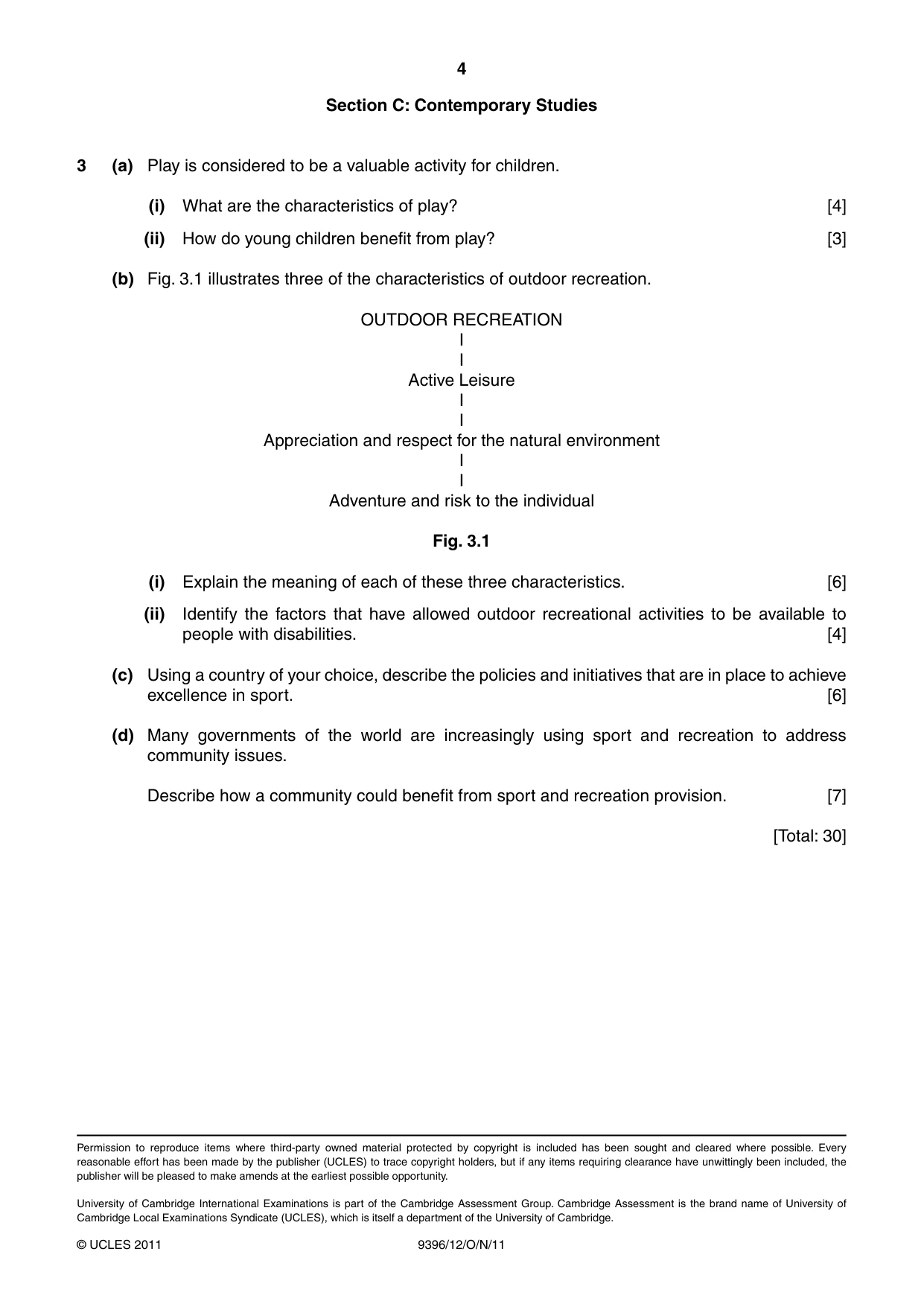
4 9396/12/O/N/11 © UCLES 2011 Section C: Contemporary Studies 3 (a) Play is considered to be a valuable activity for children. (i) What are the characteristics of play? [4] (ii) How do young children benefit from play? [3] (b) Fig. 3.1 illustrates three of the characteristics of outdoor recreation. OUTDOOR RECREATION I I Active Leisure I I Appreciation and respect for the natural environment I I Adventure and risk to the individual Fig. 3.1 (i) Explain the meaning of each of these three characteristics. [6] (ii) Identify the factors that have allowed outdoor recreational activities to be available to people with disabilities. [4] (c) Using a country of your choice, describe the policies and initiatives that are in place to achieve excellence in sport. [6] (d) Many governments of the world are increasingly using sport and recreation to address community issues. Describe how a community could benefit from sport and recreation provision. [7] [Total: 30] Permission to reproduce items where third-party owned material protected by copyright is included has been sought and cleared where possible. Every reasonable effort has been made by the publisher (UCLES) to trace copyright holders, but if any items requiring clearance have unwittingly been included, the publisher will be pleased to make amends at the earliest possible opportunity. University of Cambridge International Examinations is part of the Cambridge Assessment Group. Cambridge Assessment is the brand name of University of Cambridge Local Examinations Syndicate (UCLES), which is itself a department of the University of Cambridge.
Mark scheme, page 1
UNIVERSITY OF CAMBRIDGE INTERNATIONAL EXAMINATIONS GCE Advanced Subsidiary Level MARK SCHEME for the October/November 2011 question paper for the guidance of teachers 9396 PHYSICAL EDUCATION 9396/12 Paper 1 (Theory), maximum raw mark 90 This mark scheme is published as an aid to teachers and candidates, to indicate the requirements of the examination. It shows the basis on which Examiners were instructed to award marks. It does not indicate the details of the discussions that took place at an Examiners’ meeting before marking began, which would have considered the acceptability of alternative answers. Mark schemes must be read in conjunction with the question papers and the report on the examination. • Cambridge will not enter into discussions or correspondence in connection with these mark schemes. Cambridge is publishing the mark schemes for the October/November 2011 question papers for most IGCSE, GCE Advanced Level and Advanced Subsidiary Level syllabuses and some Ordinary Level syllabuses.
Mark scheme, page 2
Page 2 Mark Scheme: Teachers’ version Syllabus Paper GCE AS LEVEL – October/November 2011 9396 12 © University of Cambridge International Examinations 2011 Section A Anatomy and Physiology 1 (a) 6 marks in total Knee joint Joint type Movement occurring Working muscle 1. hinge 2. extension 3. rectus femoris/vastus medialis/ vastus intermedius/ vastus lateralis *not accept quadriceps Hip joint Joint type Movement occurring Working muscle 4. ball and socket 5. flexion 6. ilio psoas/adductor brevis/adductor magnus [6] (b) 5 marks in total sub max 3 from: shoulder joint sub max 3 from: hip joint 1 the socket on the scapula (the glenoid fossa) is small and shallow making the joint less stable/greater ROM 2 the joint capsule is very loose (allowing separation between the two bones) and is less stable 3 the head of the humerus (is not as ball like as the head of the femur), therefore it does not sit as deeply into the glenoid fossa so is less stable 4 the shoulder joint is stabilised by the rotator cuff muscles but these are not as strong as the muscles surrounding the hip/it is relatively easy to dislocate the shoulder joint 5 the socket on the pelvis (the acetabulum) is deep and cuplike in shape making the joint more stable 6 a rim of fibro cartilage adds depth to the acetabulum/adding to stability of socket 7 the head of the femur is very spherical and fits snugly into the acetabulum which aids stability 8 this limits range of movement. 9 the joint is supported by (five) ligaments, (in particular the iliofemoral ligament (the Y ligament) is extremely strong and helps stability) 10 the hip joint is surrounded by large muscle group that aid stability, e.g. gluteus maximus 11 both joints are ball and socket joints and their structural arrangement allows for more types of movement than other joints and a greater ROM. [5]
Mark scheme, page 3
Page 3 Mark Scheme: Teachers’ version Syllabus Paper GCE AS LEVEL – October/November 2011 9396 12 © University of Cambridge International Examinations 2011 (c) 6 marks in total sub max 5 marks from: 1 cardiac cycle lasts approx. 0.8 secs/systole 0.3 secs/diastole 0.5 secs 2 during atrial diastole blood enters both atria 3 as ventricular pressure is lower than atrial pressure (ventricular diastole) 4 the AV valves open/tricuspid, bicuspid 5 blood flows from atria to ventricles 6 atria contract 7 AV valves close/tricuspid, bicuspid 8 ventricles contract (ventricular systole) 9 as pressure builds SL valves open 10 blood moved out of the heart into the aorta/pulmonary artery 11 SL valves close sub max 1 mark from: 12 less time for filling during diastole as HR increases 13 ventricular filling becomes active process 14 diastolic phase shortens [6] (d) 4 marks in total 1 de-oxygenated blood leaves the right ventricle 2 via the pulmonary artery 3 oxygenated blood travels to the left atrium 4 via the pulmonary veins [4] (e) (i) 5 marks from: 1 respiratory control centre/medulla oblongata controls respiration 2 it can increase the rate of breathing 3 it can increase the depth of breathing 4 chemoreceptors/detect an increase in hydrogen ions/lowering pH/increase acidity 5 chemoreceptors/detect changes in PO2/concentration O2 6 chemoreceptors/detect increases in PCO2/concentration CO2 7 baroreceptors detect changes in blood pressure 8 proprioceptors in the muscles detect movement 9 (all) stimulate RCC/medulla oblongata to increase rate and depth 10 MO/RCC stimulates the inspiratory respiratory muscles/diaphragm and external intercostals 11 MO/RCC stimulates the expiratory respiratory muscles/abdominal muscles/internal intercostals [5]
Mark scheme, page 4
Page 4 Mark Scheme: Teachers’ version Syllabus Paper GCE AS LEVEL – October/November 2011 9396 12 © University of Cambridge International Examinations 2011 (ii) 4 marks from: 1 during inspiration the volume of the lungs needs to be expanded further 2 so that the pressure is further reduced 3 so that more air enters the lungs 4 therefore more muscles are stimulated 5 sternocleidomastoid/pectoralis minor/scalenes 6 expiration becomes active 7 abdominal muscles/internal intercostals are stimulated [4] [Total: 30]
Mark scheme, page 5
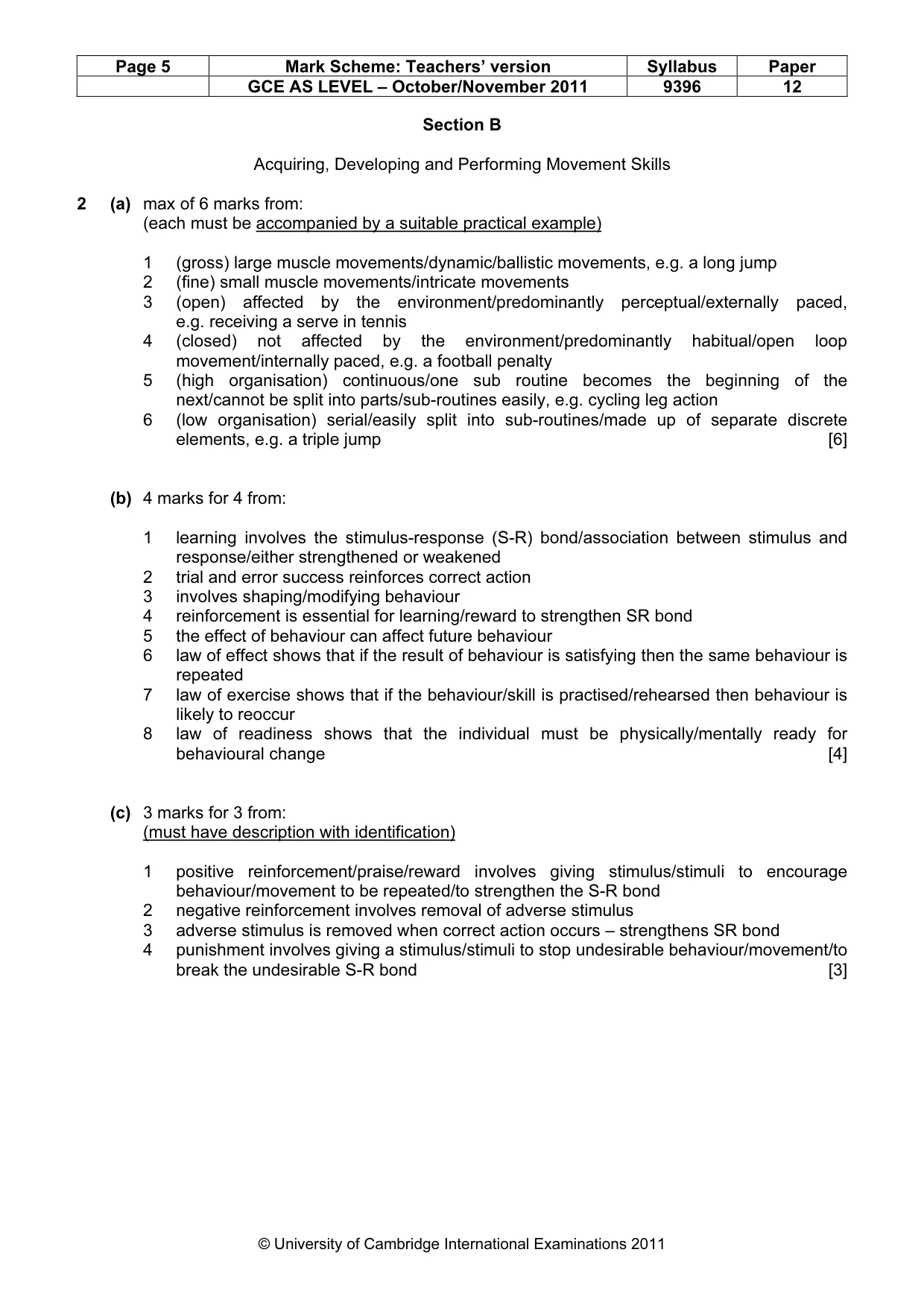
Page 5 Mark Scheme: Teachers’ version Syllabus Paper GCE AS LEVEL – October/November 2011 9396 12 © University of Cambridge International Examinations 2011 Section B Acquiring, Developing and Performing Movement Skills 2 (a) max of 6 marks from: (each must be accompanied by a suitable practical example) 1 (gross) large muscle movements/dynamic/ballistic movements, e.g. a long jump 2 (fine) small muscle movements/intricate movements 3 (open) affected by the environment/predominantly perceptual/externally paced, e.g. receiving a serve in tennis 4 (closed) not affected by the environment/predominantly habitual/open loop movement/internally paced, e.g. a football penalty 5 (high organisation) continuous/one sub routine becomes the beginning of the next/cannot be split into parts/sub-routines easily, e.g. cycling leg action 6 (low organisation) serial/easily split into sub-routines/made up of separate discrete elements, e.g. a triple jump [6] (b) 4 marks for 4 from: 1 learning involves the stimulus-response (S-R) bond/association between stimulus and response/either strengthened or weakened 2 trial and error success reinforces correct action 3 involves shaping/modifying behaviour 4 reinforcement is essential for learning/reward to strengthen SR bond 5 the effect of behaviour can affect future behaviour 6 law of effect shows that if the result of behaviour is satisfying then the same behaviour is repeated 7 law of exercise shows that if the behaviour/skill is practised/rehearsed then behaviour is likely to reoccur 8 law of readiness shows that the individual must be physically/mentally ready for behavioural change [4] (c) 3 marks for 3 from: (must have description with identification) 1 positive reinforcement/praise/reward involves giving stimulus/stimuli to encourage behaviour/movement to be repeated/to strengthen the S-R bond 2 negative reinforcement involves removal of adverse stimulus 3 adverse stimulus is removed when correct action occurs – strengthens SR bond 4 punishment involves giving a stimulus/stimuli to stop undesirable behaviour/movement/to break the undesirable S-R bond [3]
Mark scheme, page 6
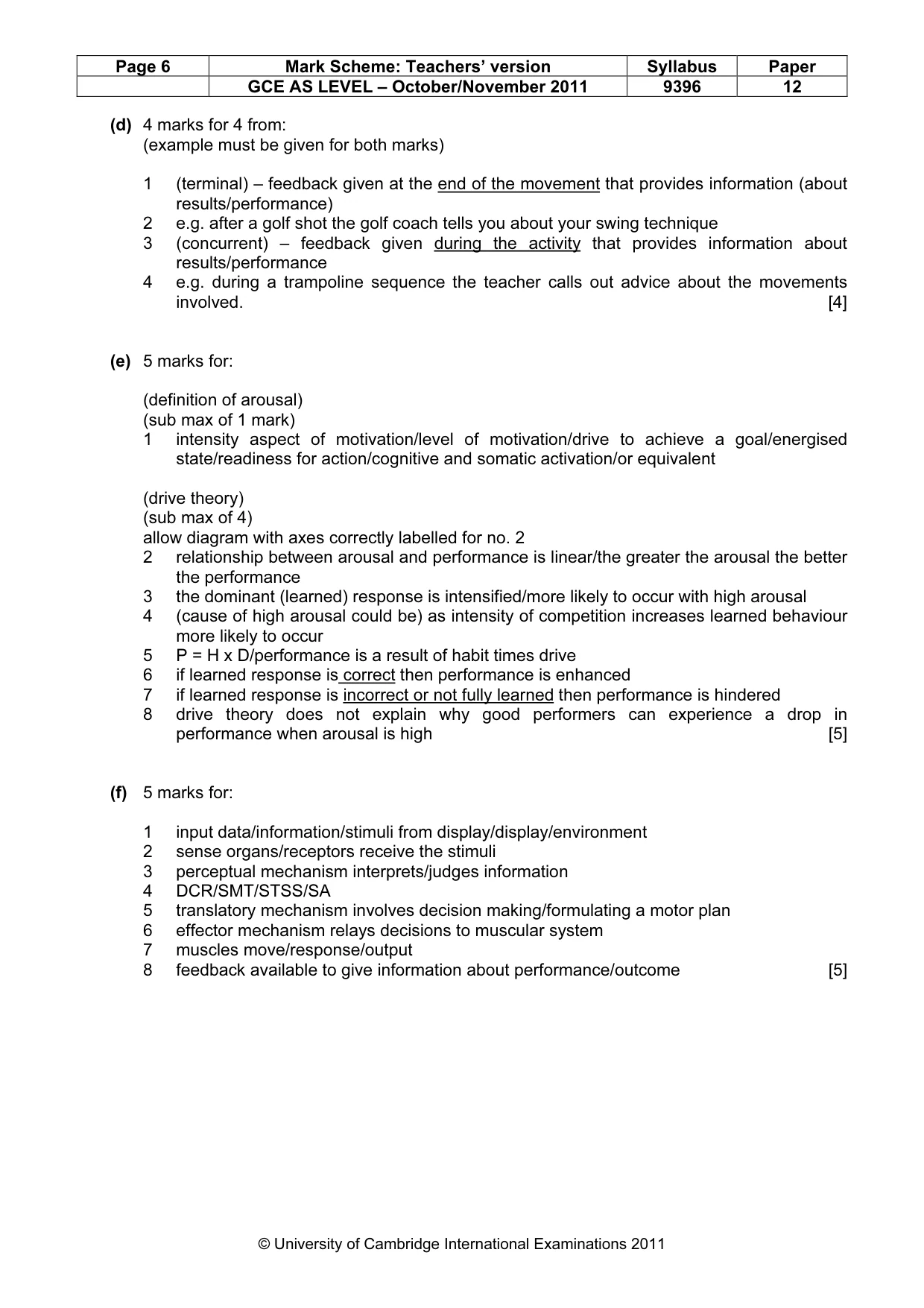
Page 6 Mark Scheme: Teachers’ version Syllabus Paper GCE AS LEVEL – October/November 2011 9396 12 © University of Cambridge International Examinations 2011 (d) 4 marks for 4 from: (example must be given for both marks) 1 (terminal) – feedback given at the end of the movement that provides information (about results/performance) 2 e.g. after a golf shot the golf coach tells you about your swing technique 3 (concurrent) – feedback given during the activity that provides information about results/performance 4 e.g. during a trampoline sequence the teacher calls out advice about the movements involved. [4] (e) 5 marks for: (definition of arousal) (sub max of 1 mark) 1 intensity aspect of motivation/level of motivation/drive to achieve a goal/energised state/readiness for action/cognitive and somatic activation/or equivalent (drive theory) (sub max of 4) allow diagram with axes correctly labelled for no. 2 2 relationship between arousal and performance is linear/the greater the arousal the better the performance 3 the dominant (learned) response is intensified/more likely to occur with high arousal 4 (cause of high arousal could be) as intensity of competition increases learned behaviour more likely to occur 5 P = H x D/performance is a result of habit times drive 6 if learned response is correct then performance is enhanced 7 if learned response is incorrect or not fully learned then performance is hindered 8 drive theory does not explain why good performers can experience a drop in performance when arousal is high [5] (f) 5 marks for: 1 input data/information/stimuli from display/display/environment 2 sense organs/receptors receive the stimuli 3 perceptual mechanism interprets/judges information 4 DCR/SMT/STSS/SA 5 translatory mechanism involves decision making/formulating a motor plan 6 effector mechanism relays decisions to muscular system 7 muscles move/response/output 8 feedback available to give information about performance/outcome [5]
Mark scheme, page 7
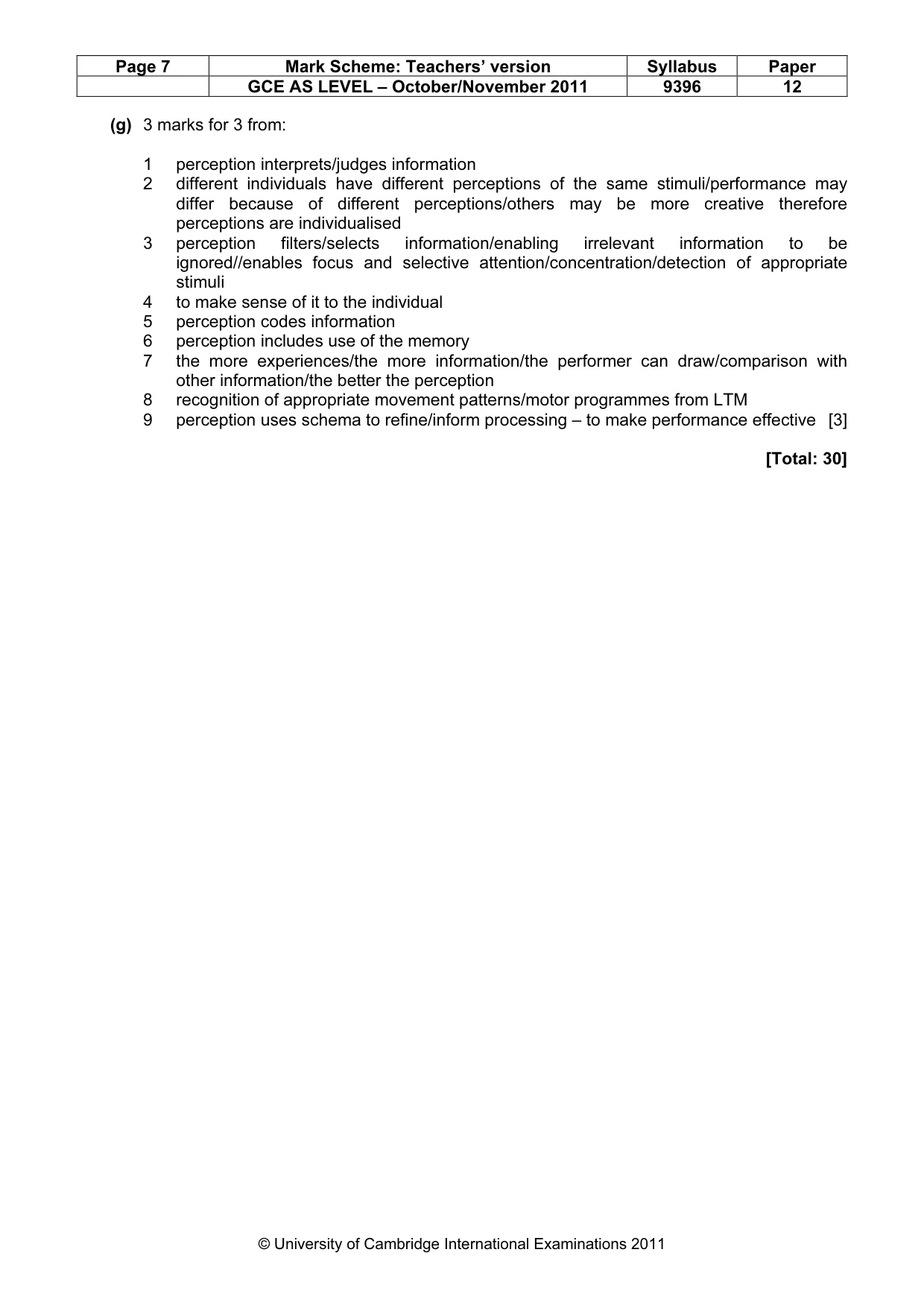
Page 7 Mark Scheme: Teachers’ version Syllabus Paper GCE AS LEVEL – October/November 2011 9396 12 © University of Cambridge International Examinations 2011 (g) 3 marks for 3 from: 1 perception interprets/judges information 2 different individuals have different perceptions of the same stimuli/performance may differ because of different perceptions/others may be more creative therefore perceptions are individualised 3 perception filters/selects information/enabling irrelevant information to be ignored//enables focus and selective attention/concentration/detection of appropriate stimuli 4 to make sense of it to the individual 5 perception codes information 6 perception includes use of the memory 7 the more experiences/the more information/the performer can draw/comparison with other information/the better the perception 8 recognition of appropriate movement patterns/motor programmes from LTM 9 perception uses schema to refine/inform processing – to make performance effective [3] [Total: 30]
Mark scheme, page 8
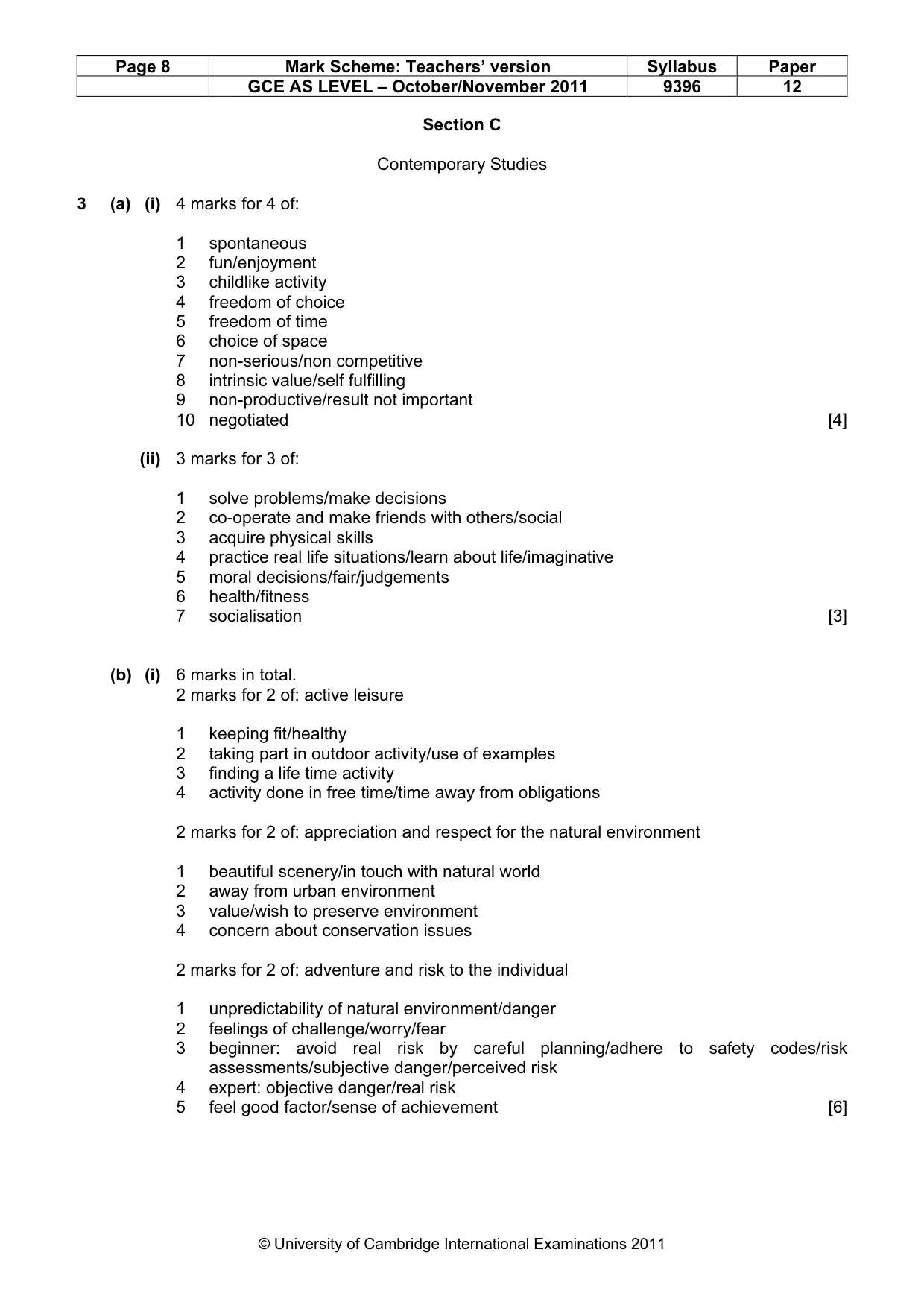
Page 8 Mark Scheme: Teachers’ version Syllabus Paper GCE AS LEVEL – October/November 2011 9396 12 © University of Cambridge International Examinations 2011 Section C Contemporary Studies 3 (a) (i) 4 marks for 4 of: 1 spontaneous 2 fun/enjoyment 3 childlike activity 4 freedom of choice 5 freedom of time 6 choice of space 7 non-serious/non competitive 8 intrinsic value/self fulfilling 9 non-productive/result not important 10 negotiated [4] (ii) 3 marks for 3 of: 1 solve problems/make decisions 2 co-operate and make friends with others/social 3 acquire physical skills 4 practice real life situations/learn about life/imaginative 5 moral decisions/fair/judgements 6 health/fitness 7 socialisation [3] (b) (i) 6 marks in total. 2 marks for 2 of: active leisure 1 keeping fit/healthy 2 taking part in outdoor activity/use of examples 3 finding a life time activity 4 activity done in free time/time away from obligations 2 marks for 2 of: appreciation and respect for the natural environment 1 beautiful scenery/in touch with natural world 2 away from urban environment 3 value/wish to preserve environment 4 concern about conservation issues 2 marks for 2 of: adventure and risk to the individual 1 unpredictability of natural environment/danger 2 feelings of challenge/worry/fear 3 beginner: avoid real risk by careful planning/adhere to safety codes/risk assessments/subjective danger/perceived risk 4 expert: objective danger/real risk 5 feel good factor/sense of achievement [6]
Mark scheme, page 9
Page 9 Mark Scheme: Teachers’ version Syllabus Paper GCE AS LEVEL – October/November 2011 9396 12 © University of Cambridge International Examinations 2011 (ii) 4 marks for 4 of: 1 developments in technology/inventions/equipment 2 equal opportunities/legislation/funding/facilities 3 organisations/policies/agencies set up to help disabled/campaigns 4 more coaches/helpers/support for disabled/role models 5 increased understanding of benefits of activity for disabled/media help 6 greater understanding of capabilities of disabled [4] (c) 6 marks for 6 of: (must relate to a country) max 4 marks if no country identified 1 description of Government policies/initiatives/schemes/relating to talent ID and talent development 2 description of pathways in place to achieve excellence/organisation of sport 3 provision for funding/grants/sponsorship/scholarships 4 provision of facilities/local/regional/national/equipment/technology 5 provision/education of coaches 6 provision of centres of excellence/schools/universities/academies 7 provision of medical/sport science support 8 description of policies/showing attitudes towards excellence 9 wider participation base/school programmes/give more reaching top of pyramid [6] (d) 7 marks in total: 1 lowering crime rate 2 social control/involvement of individuals in worthwhile activity 3 improve health and fitness of the community 4 reduce cost of health care 5 improve pride in community/image 6 improve integration/races 7 acquire physical skills 8 produce more elite performers 9 provide employment/more income 10 happiness/mental fitness 11 creating/improving/infrastructure [7] [Total: 30]
What you needed in this session
Cambridge’s own grade thresholds for 2011 Oct/Nov, Paper 1 · Variant 2. A higher threshold means an easier paper — the bar moves with how the cohort did.