Cambridge A Level Physical Education 9396 — 2011 Oct/Nov Paper 1 · Variant 3
9396/13/O/N/11 · 90 marks · ≈101 min
The question paper and its mark scheme, free to read here and free to download. This is Cambridge’s own paper, exactly as it was sat.
Question paper4 pages
Mark scheme10 pages
Answers below. Sit the paper first if you are practising.
Paper as text
Question paper, page 1
This document consists of 4 printed pages. DC (CW/SW) 35183/1 © UCLES 2011 [Turn over UNIVERSITY OF CAMBRIDGE INTERNATIONAL EXAMINATIONS General Certificate of Education Advanced Subsidiary Level and Advanced Level READ THESE INSTRUCTIONS FIRST If you have been given an Answer Booklet, follow the instructions on the front cover of the Booklet. Write your Centre number, candidate number and name on all the work you hand in. Write in dark blue or black pen. You may use a soft pencil for any diagrams, graphs or rough working. Do not use staples, paper clips, highlighters, glue or correction fluid. Answer all questions. At the end of the examination, fasten all your work securely together. The number of marks is given in brackets [ ] at the end of each question or part question. * 8 1 4 0 2 7 6 0 7 6 * PHYSICAL EDUCATION 9396/13 Paper 1 October/November 2011 2 hours 30 minutes Additional Materials: Answer Booklet/Paper
Question paper, page 2
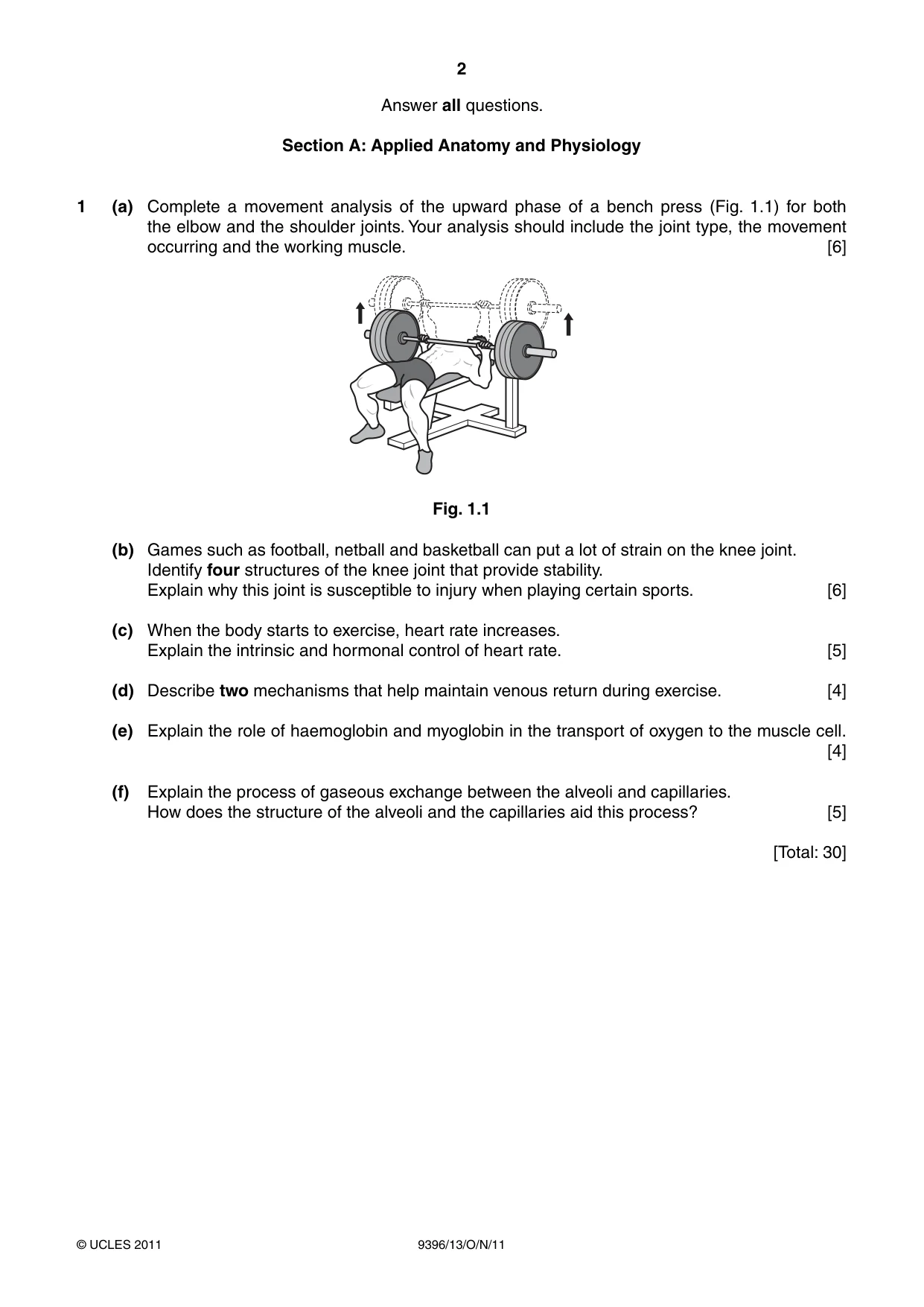
2 9396/13/O/N/11 © UCLES 2011 Answer all questions. Section A: Applied Anatomy and Physiology 1 (a) Complete a movement analysis of the upward phase of a bench press (Fig. 1.1) for both the elbow and the shoulder joints. Your analysis should include the joint type, the movement occurring and the working muscle. [6] Fig. 1.1 (b) Games such as football, netball and basketball can put a lot of strain on the knee joint. Identify four structures of the knee joint that provide stability. Explain why this joint is susceptible to injury when playing certain sports. [6] (c) When the body starts to exercise, heart rate increases. Explain the intrinsic and hormonal control of heart rate. [5] (d) Describe two mechanisms that help maintain venous return during exercise. [4] (e) Explain the role of haemoglobin and myoglobin in the transport of oxygen to the muscle cell. [4] (f) Explain the process of gaseous exchange between the alveoli and capillaries. How does the structure of the alveoli and the capillaries aid this process? [5] [Total: 30]
Question paper, page 3
3 9396/13/O/N/11 © UCLES 2011 [Turn over Section B: Acquiring, Developing and Performing Movement Skills 2 (a) Using practical examples describe four different characteristics of skilful performance. [4] (b) Give three characteristics of an open skill. [3] (c) Motivation to learn movement skills can be affected by drive reduction. Explain the concept of drive reduction. [4] (d) Bandura’s observational learning theory is one way of describing the learning of movement skills and involves the following elements: Attention retention motor reproduction motivation. Describe each of these elements of observational learning. [4] (e) Explain how the short term memory and the long term memory are used in performing movement skills. [4] (f) Using a practical example explain what is meant by closed loop control when learning or performing movement skills. [5] (g) How would a coach or teacher use their knowledge of schema theory in their coaching or teaching? [6] [Total: 30]
Question paper, page 4
4 9396/13/O/N/11 © UCLES 2011 Section C: Contemporary Studies 3 (a) (i) Explain the term leisure. [4] (ii) How can a school physical education programme help to prepare children to use their leisure time effectively? [3] (b) (i) Explain why some elite performers are prepared to take illegal performance enhancing drugs. [5] (ii) Identify the strategies which could be put into place to reduce the problem of drug taking in sport. [5] (c) There is a suggestion that international sport should be free of politics. Explain the reasons why a government may choose to become involved in international sport. [5] (d) Explain the factors which may influence an individual’s participation in sporting activity. [8] [Total: 30] Permission to reproduce items where third-party owned material protected by copyright is included has been sought and cleared where possible. Every reasonable effort has been made by the publisher (UCLES) to trace copyright holders, but if any items requiring clearance have unwittingly been included, the publisher will be pleased to make amends at the earliest possible opportunity. University of Cambridge International Examinations is part of the Cambridge Assessment Group. Cambridge Assessment is the brand name of University of Cambridge Local Examinations Syndicate (UCLES), which is itself a department of the University of Cambridge.
Mark scheme, page 1
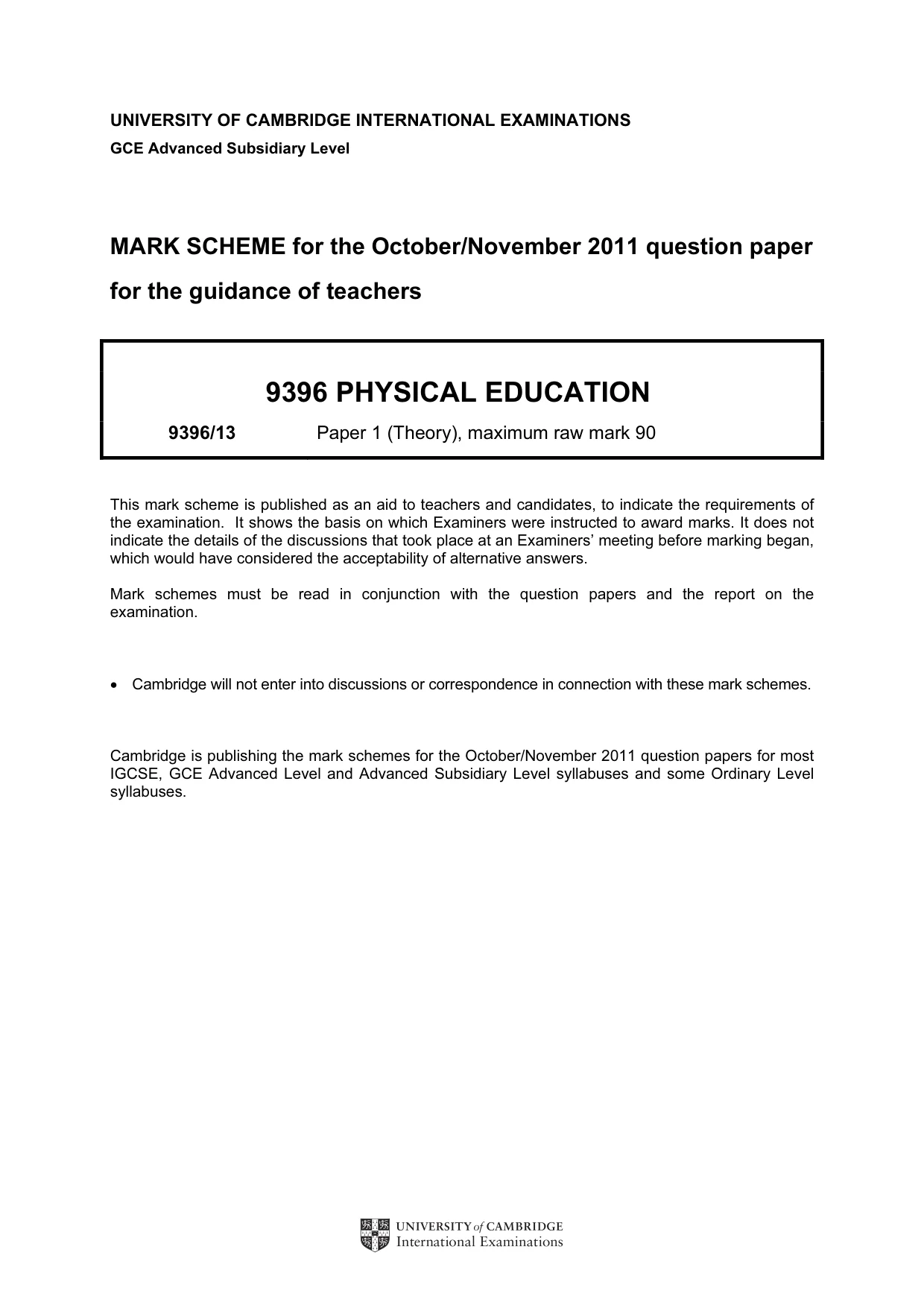
UNIVERSITY OF CAMBRIDGE INTERNATIONAL EXAMINATIONS GCE Advanced Subsidiary Level MARK SCHEME for the October/November 2011 question paper for the guidance of teachers 9396 PHYSICAL EDUCATION 9396/13 Paper 1 (Theory), maximum raw mark 90 This mark scheme is published as an aid to teachers and candidates, to indicate the requirements of the examination. It shows the basis on which Examiners were instructed to award marks. It does not indicate the details of the discussions that took place at an Examiners’ meeting before marking began, which would have considered the acceptability of alternative answers. Mark schemes must be read in conjunction with the question papers and the report on the examination. • Cambridge will not enter into discussions or correspondence in connection with these mark schemes. Cambridge is publishing the mark schemes for the October/November 2011 question papers for most IGCSE, GCE Advanced Level and Advanced Subsidiary Level syllabuses and some Ordinary Level syllabuses.
Mark scheme, page 2
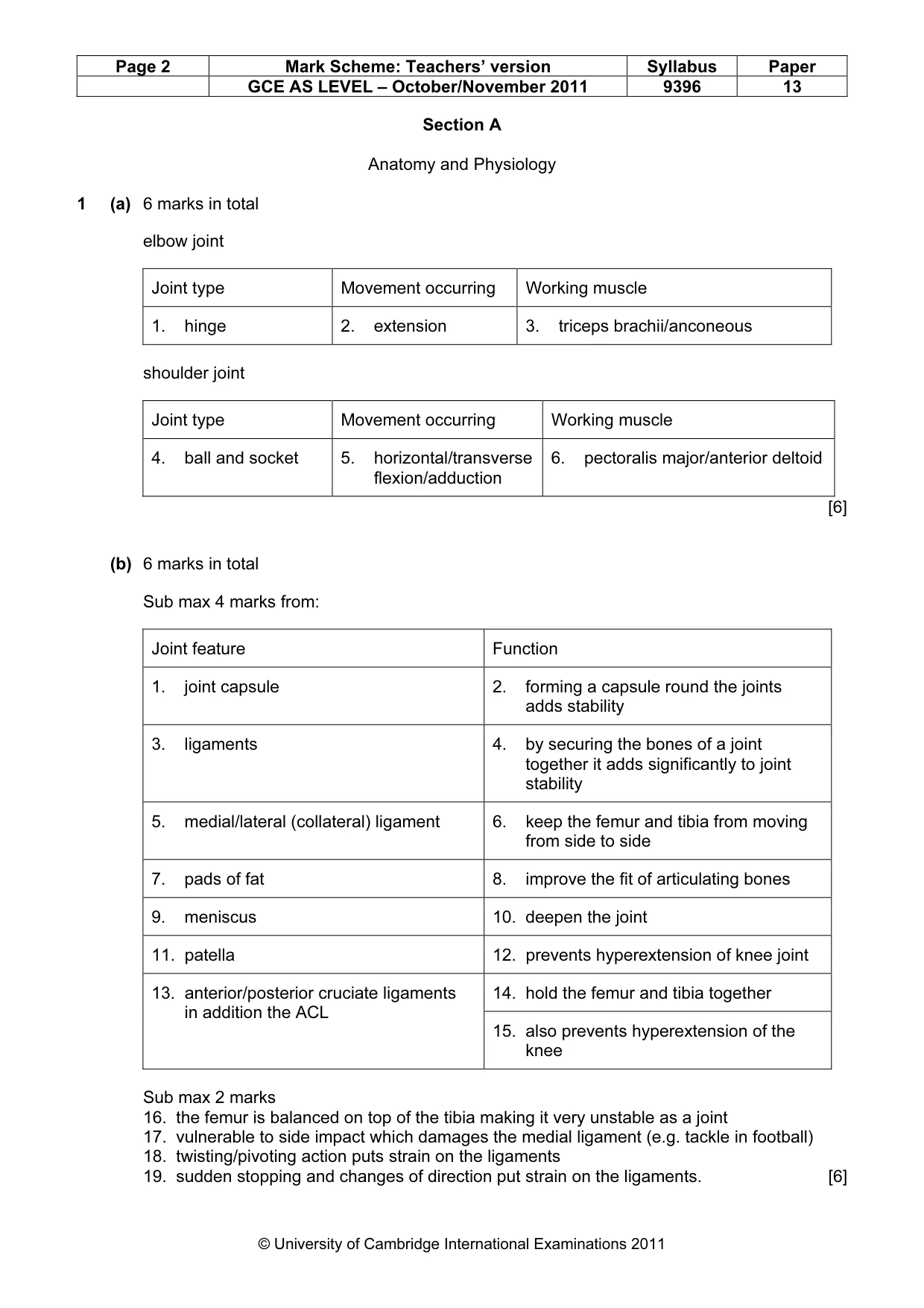
Page 2 Mark Scheme: Teachers’ version Syllabus Paper GCE AS LEVEL – October/November 2011 9396 13 © University of Cambridge International Examinations 2011 Section A Anatomy and Physiology 1 (a) 6 marks in total elbow joint Joint type Movement occurring Working muscle 1. hinge 2. extension 3. triceps brachii/anconeous shoulder joint Joint type Movement occurring Working muscle 4. ball and socket 5. horizontal/transverse flexion/adduction 6. pectoralis major/anterior deltoid [6] (b) 6 marks in total Sub max 4 marks from: Joint feature Function 1. joint capsule 2. forming a capsule round the joints adds stability 3. ligaments 4. by securing the bones of a joint together it adds significantly to joint stability 5. medial/lateral (collateral) ligament 6. keep the femur and tibia from moving from side to side 7. pads of fat 8. improve the fit of articulating bones 9. meniscus 10. deepen the joint 11. patella 12. prevents hyperextension of knee joint 14. hold the femur and tibia together 13. anterior/posterior cruciate ligaments in addition the ACL 15. also prevents hyperextension of the knee Sub max 2 marks 16. the femur is balanced on top of the tibia making it very unstable as a joint 17. vulnerable to side impact which damages the medial ligament (e.g. tackle in football) 18. twisting/pivoting action puts strain on the ligaments 19. sudden stopping and changes of direction put strain on the ligaments. [6]
Mark scheme, page 3
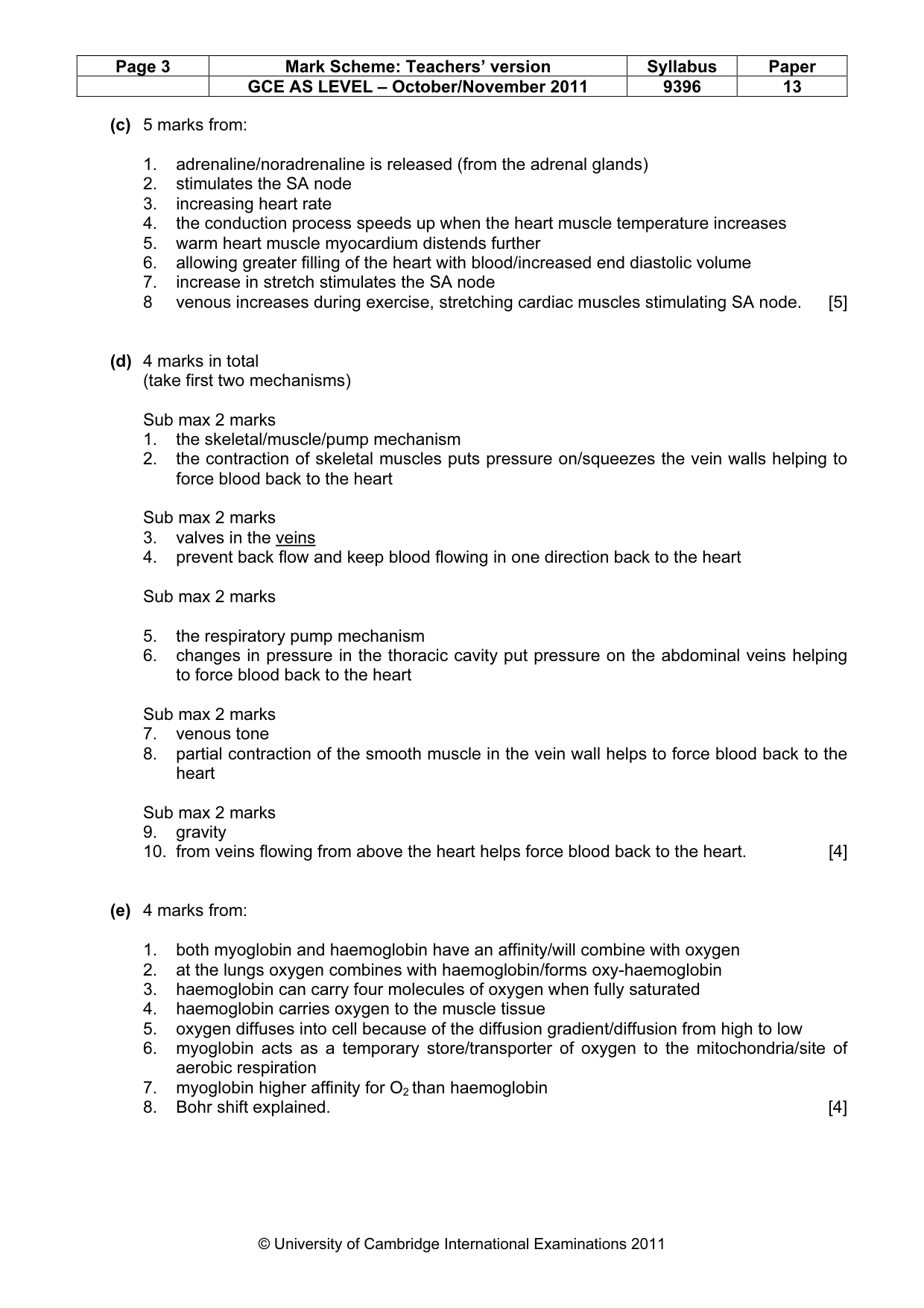
Page 3 Mark Scheme: Teachers’ version Syllabus Paper GCE AS LEVEL – October/November 2011 9396 13 © University of Cambridge International Examinations 2011 (c) 5 marks from: 1. adrenaline/noradrenaline is released (from the adrenal glands) 2. stimulates the SA node 3. increasing heart rate 4. the conduction process speeds up when the heart muscle temperature increases 5. warm heart muscle myocardium distends further 6. allowing greater filling of the heart with blood/increased end diastolic volume 7. increase in stretch stimulates the SA node 8 venous increases during exercise, stretching cardiac muscles stimulating SA node. [5] (d) 4 marks in total (take first two mechanisms) Sub max 2 marks 1. the skeletal/muscle/pump mechanism 2. the contraction of skeletal muscles puts pressure on/squeezes the vein walls helping to force blood back to the heart Sub max 2 marks 3. valves in the veins 4. prevent back flow and keep blood flowing in one direction back to the heart Sub max 2 marks 5. the respiratory pump mechanism 6. changes in pressure in the thoracic cavity put pressure on the abdominal veins helping to force blood back to the heart Sub max 2 marks 7. venous tone 8. partial contraction of the smooth muscle in the vein wall helps to force blood back to the heart Sub max 2 marks 9. gravity 10. from veins flowing from above the heart helps force blood back to the heart. [4] (e) 4 marks from: 1. both myoglobin and haemoglobin have an affinity/will combine with oxygen 2. at the lungs oxygen combines with haemoglobin/forms oxy-haemoglobin 3. haemoglobin can carry four molecules of oxygen when fully saturated 4. haemoglobin carries oxygen to the muscle tissue 5. oxygen diffuses into cell because of the diffusion gradient/diffusion from high to low 6. myoglobin acts as a temporary store/transporter of oxygen to the mitochondria/site of aerobic respiration 7. myoglobin higher affinity for O2 than haemoglobin 8. Bohr shift explained. [4]
Mark scheme, page 4
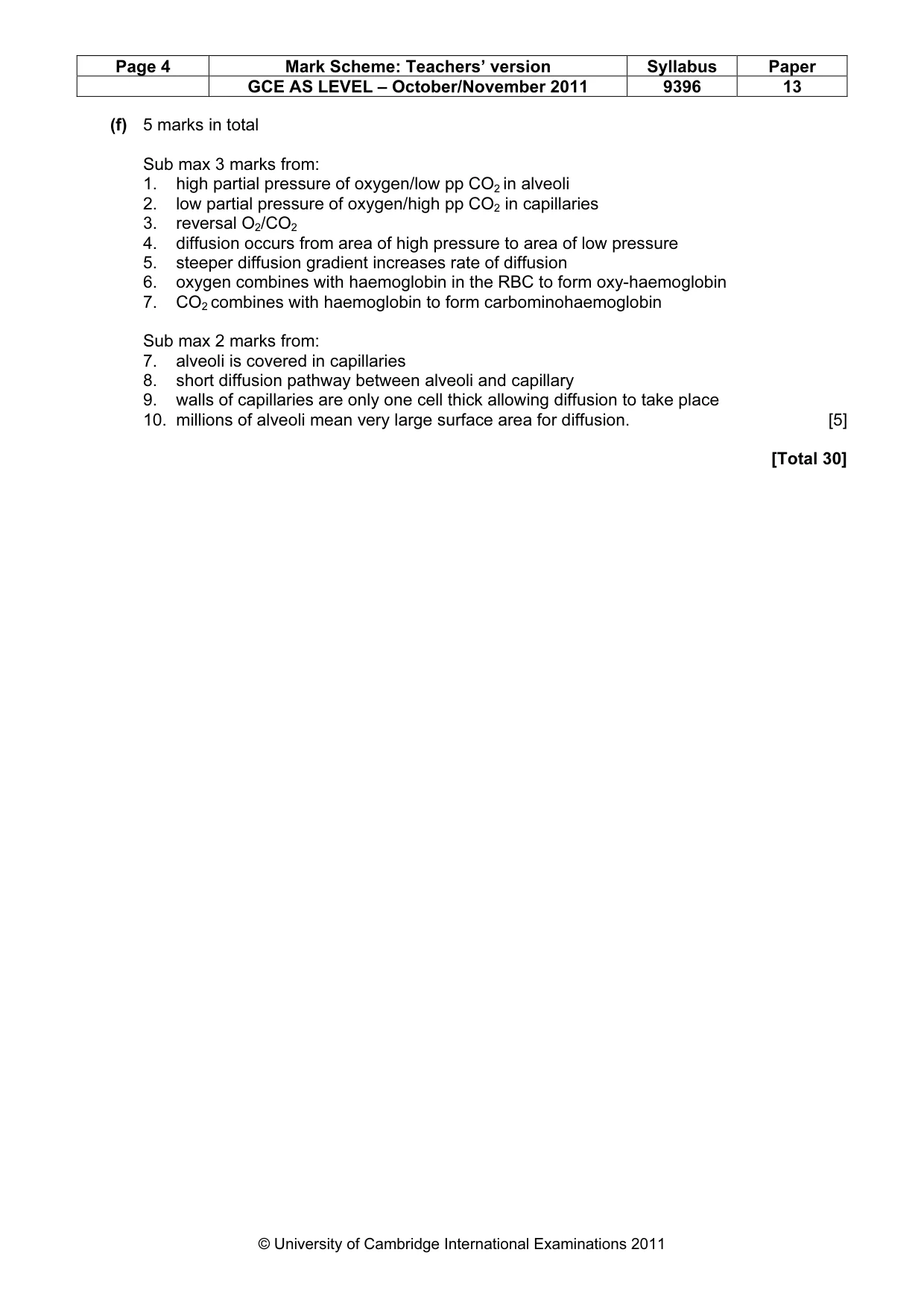
Page 4 Mark Scheme: Teachers’ version Syllabus Paper GCE AS LEVEL – October/November 2011 9396 13 © University of Cambridge International Examinations 2011 (f) 5 marks in total Sub max 3 marks from: 1. high partial pressure of oxygen/low pp CO2 in alveoli 2. low partial pressure of oxygen/high pp CO2 in capillaries 3. reversal O2/CO2 4. diffusion occurs from area of high pressure to area of low pressure 5. steeper diffusion gradient increases rate of diffusion 6. oxygen combines with haemoglobin in the RBC to form oxy-haemoglobin 7. CO2 combines with haemoglobin to form carbominohaemoglobin Sub max 2 marks from: 7. alveoli is covered in capillaries 8. short diffusion pathway between alveoli and capillary 9. walls of capillaries are only one cell thick allowing diffusion to take place 10. millions of alveoli mean very large surface area for diffusion. [5] [Total 30]
Mark scheme, page 5
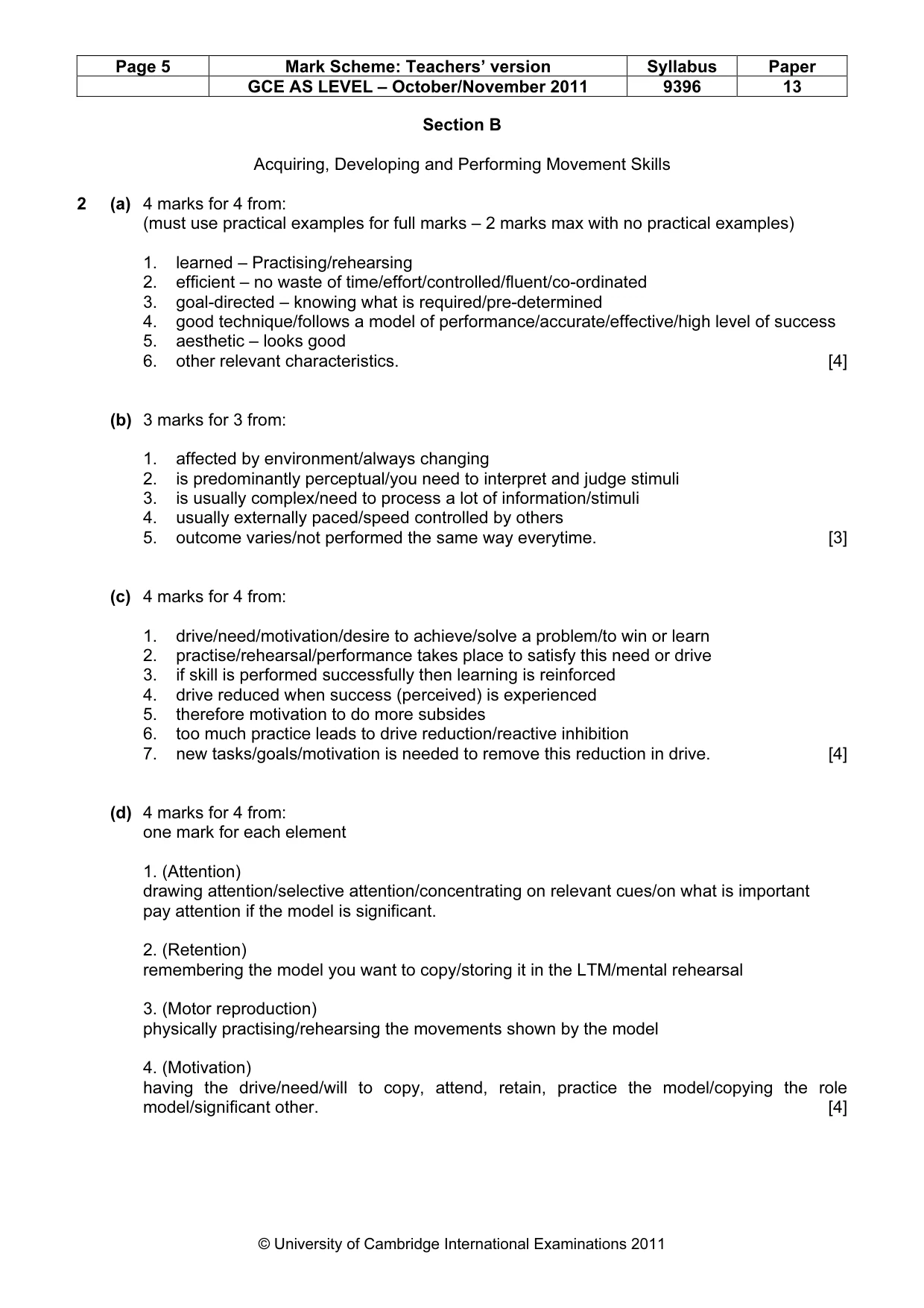
Page 5 Mark Scheme: Teachers’ version Syllabus Paper GCE AS LEVEL – October/November 2011 9396 13 © University of Cambridge International Examinations 2011 Section B Acquiring, Developing and Performing Movement Skills 2 (a) 4 marks for 4 from: (must use practical examples for full marks – 2 marks max with no practical examples) 1. learned – Practising/rehearsing 2. efficient – no waste of time/effort/controlled/fluent/co-ordinated 3. goal-directed – knowing what is required/pre-determined 4. good technique/follows a model of performance/accurate/effective/high level of success 5. aesthetic – looks good 6. other relevant characteristics. [4] (b) 3 marks for 3 from: 1. affected by environment/always changing 2. is predominantly perceptual/you need to interpret and judge stimuli 3. is usually complex/need to process a lot of information/stimuli 4. usually externally paced/speed controlled by others 5. outcome varies/not performed the same way everytime. [3] (c) 4 marks for 4 from: 1. drive/need/motivation/desire to achieve/solve a problem/to win or learn 2. practise/rehearsal/performance takes place to satisfy this need or drive 3. if skill is performed successfully then learning is reinforced 4. drive reduced when success (perceived) is experienced 5. therefore motivation to do more subsides 6. too much practice leads to drive reduction/reactive inhibition 7. new tasks/goals/motivation is needed to remove this reduction in drive. [4] (d) 4 marks for 4 from: one mark for each element 1. (Attention) drawing attention/selective attention/concentrating on relevant cues/on what is important pay attention if the model is significant. 2. (Retention) remembering the model you want to copy/storing it in the LTM/mental rehearsal 3. (Motor reproduction) physically practising/rehearsing the movements shown by the model 4. (Motivation) having the drive/need/will to copy, attend, retain, practice the model/copying the role model/significant other. [4]
Mark scheme, page 6
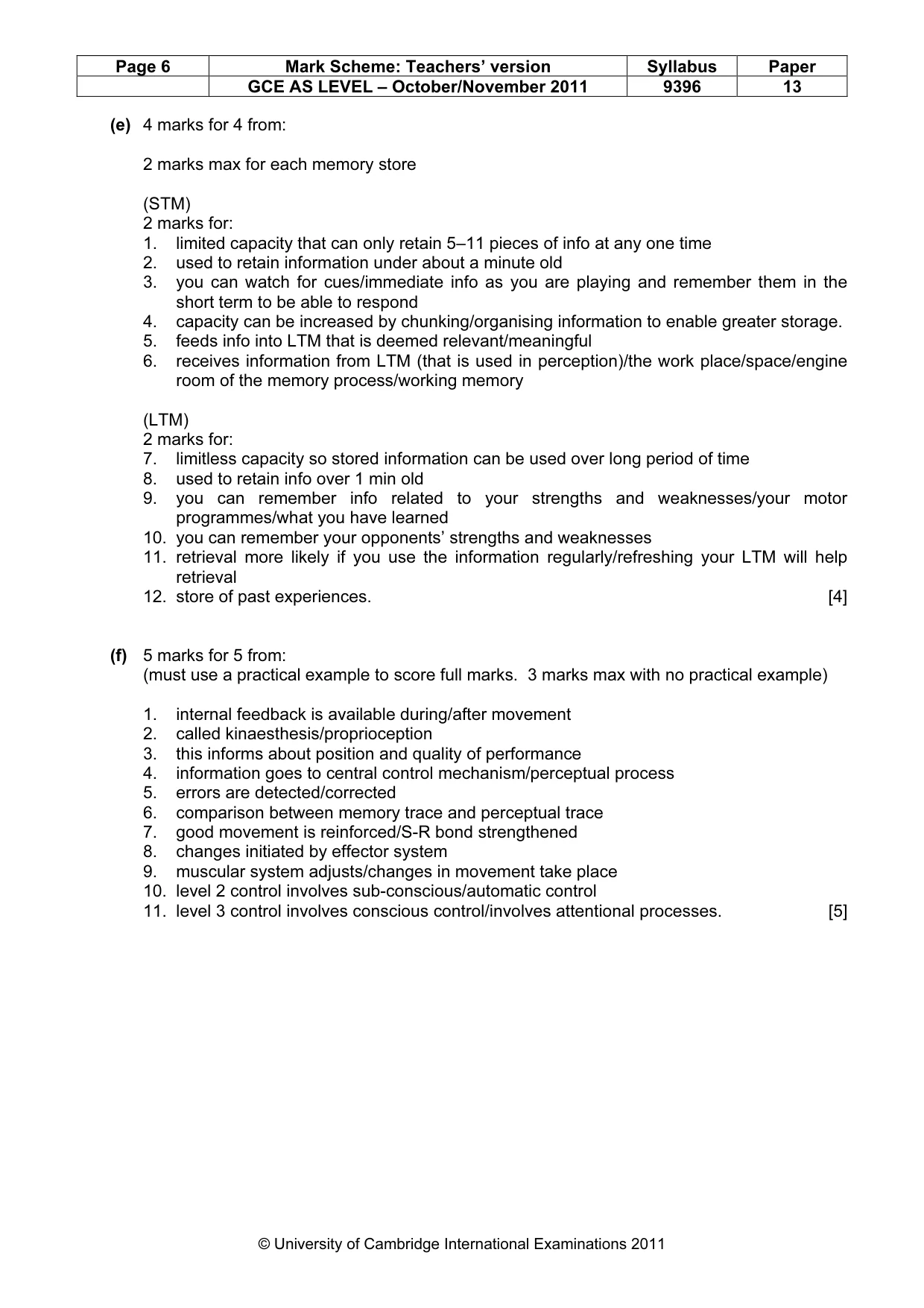
Page 6 Mark Scheme: Teachers’ version Syllabus Paper GCE AS LEVEL – October/November 2011 9396 13 © University of Cambridge International Examinations 2011 (e) 4 marks for 4 from: 2 marks max for each memory store (STM) 2 marks for: 1. limited capacity that can only retain 5–11 pieces of info at any one time 2. used to retain information under about a minute old 3. you can watch for cues/immediate info as you are playing and remember them in the short term to be able to respond 4. capacity can be increased by chunking/organising information to enable greater storage. 5. feeds info into LTM that is deemed relevant/meaningful 6. receives information from LTM (that is used in perception)/the work place/space/engine room of the memory process/working memory (LTM) 2 marks for: 7. limitless capacity so stored information can be used over long period of time 8. used to retain info over 1 min old 9. you can remember info related to your strengths and weaknesses/your motor programmes/what you have learned 10. you can remember your opponents’ strengths and weaknesses 11. retrieval more likely if you use the information regularly/refreshing your LTM will help retrieval 12. store of past experiences. [4] (f) 5 marks for 5 from: (must use a practical example to score full marks. 3 marks max with no practical example) 1. internal feedback is available during/after movement 2. called kinaesthesis/proprioception 3. this informs about position and quality of performance 4. information goes to central control mechanism/perceptual process 5. errors are detected/corrected 6. comparison between memory trace and perceptual trace 7. good movement is reinforced/S-R bond strengthened 8. changes initiated by effector system 9. muscular system adjusts/changes in movement take place 10. level 2 control involves sub-conscious/automatic control 11. level 3 control involves conscious control/involves attentional processes. [5]
Mark scheme, page 7
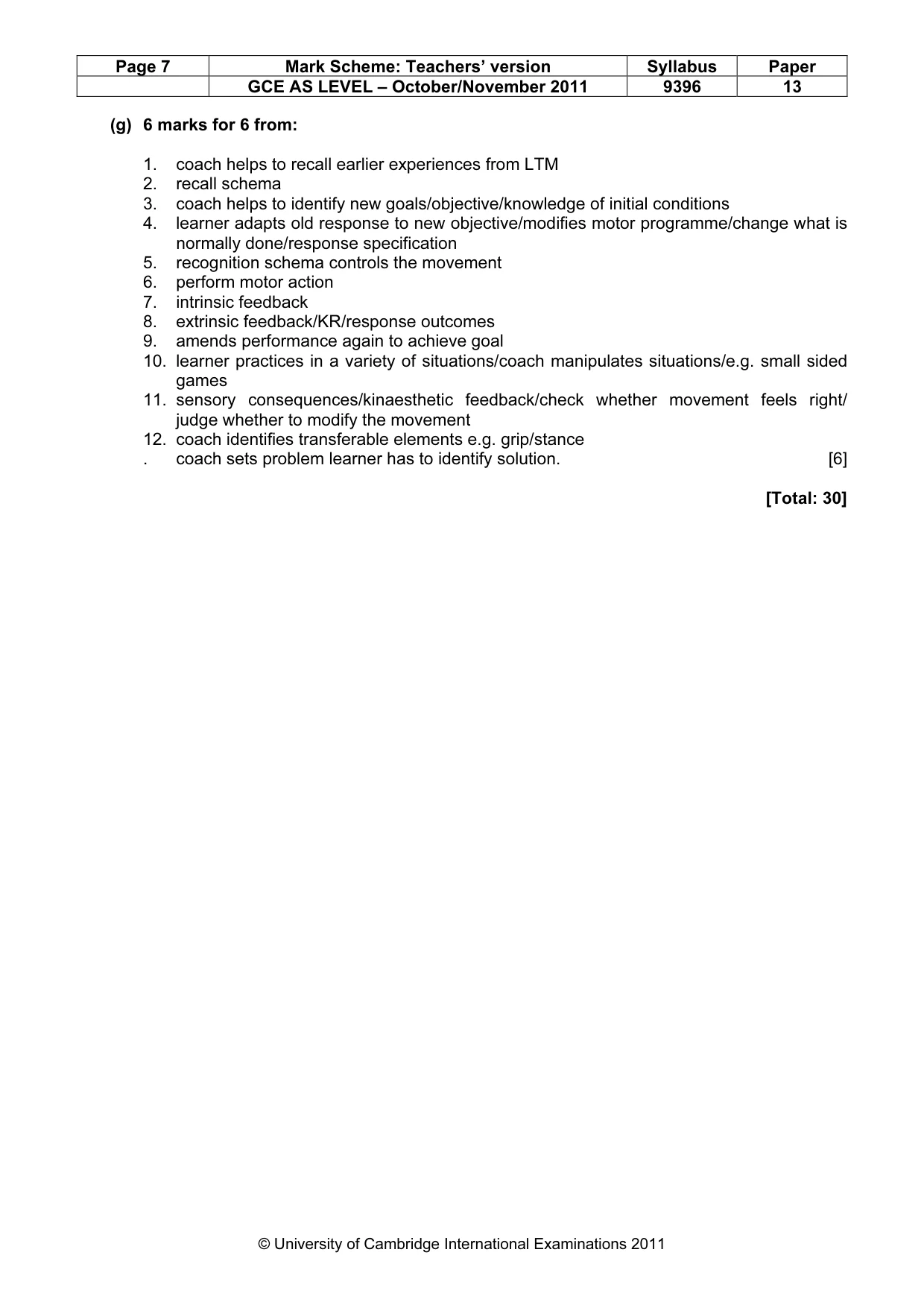
Page 7 Mark Scheme: Teachers’ version Syllabus Paper GCE AS LEVEL – October/November 2011 9396 13 © University of Cambridge International Examinations 2011 (g) 6 marks for 6 from: 1. coach helps to recall earlier experiences from LTM 2. recall schema 3. coach helps to identify new goals/objective/knowledge of initial conditions 4. learner adapts old response to new objective/modifies motor programme/change what is normally done/response specification 5. recognition schema controls the movement 6. perform motor action 7. intrinsic feedback 8. extrinsic feedback/KR/response outcomes 9. amends performance again to achieve goal 10. learner practices in a variety of situations/coach manipulates situations/e.g. small sided games 11. sensory consequences/kinaesthetic feedback/check whether movement feels right/ judge whether to modify the movement 12. coach identifies transferable elements e.g. grip/stance . coach sets problem learner has to identify solution. [6] [Total: 30]
Mark scheme, page 8
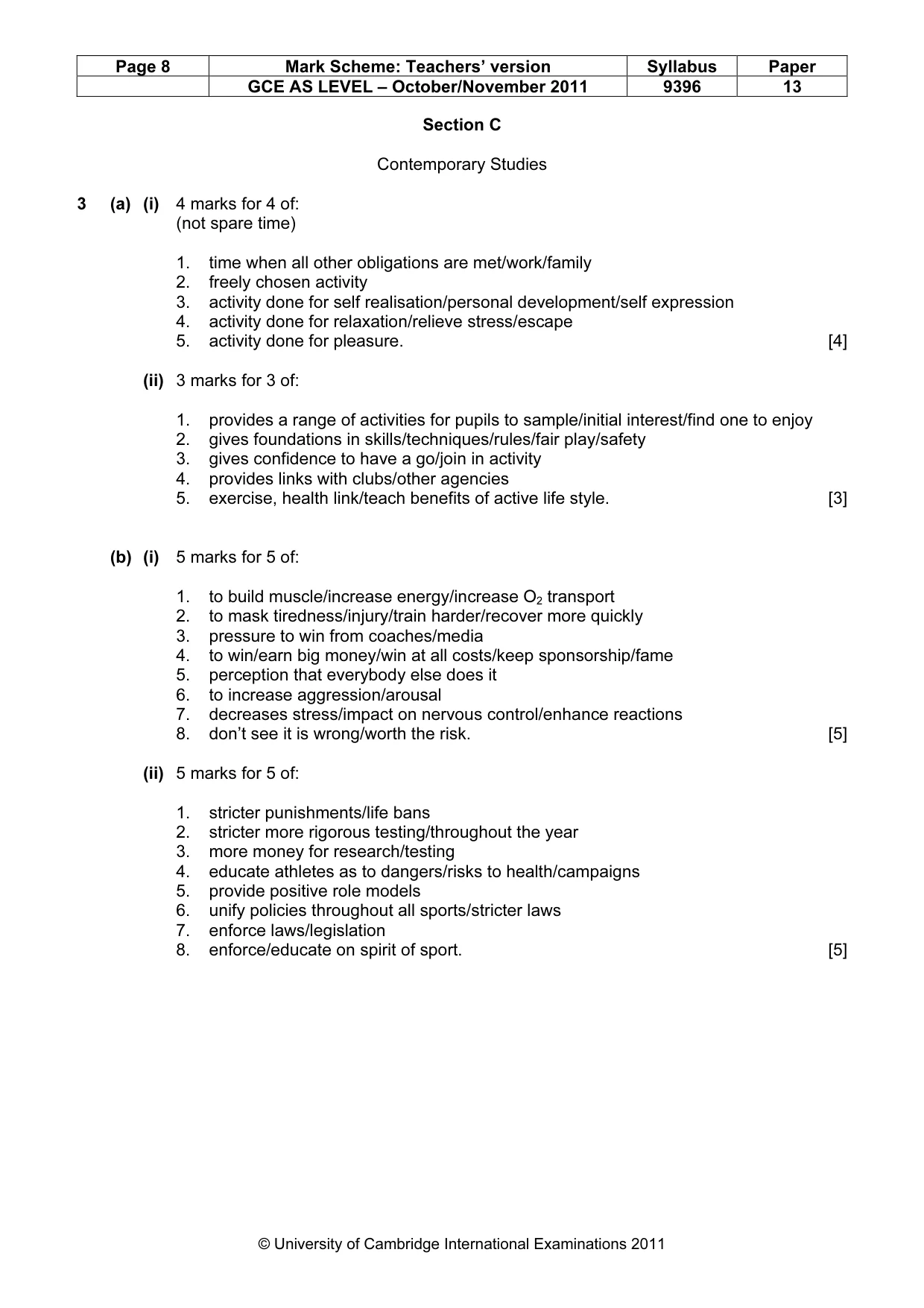
Page 8 Mark Scheme: Teachers’ version Syllabus Paper GCE AS LEVEL – October/November 2011 9396 13 © University of Cambridge International Examinations 2011 Section C Contemporary Studies 3 (a) (i) 4 marks for 4 of: (not spare time) 1. time when all other obligations are met/work/family 2. freely chosen activity 3. activity done for self realisation/personal development/self expression 4. activity done for relaxation/relieve stress/escape 5. activity done for pleasure. [4] (ii) 3 marks for 3 of: 1. provides a range of activities for pupils to sample/initial interest/find one to enjoy 2. gives foundations in skills/techniques/rules/fair play/safety 3. gives confidence to have a go/join in activity 4. provides links with clubs/other agencies 5. exercise, health link/teach benefits of active life style. [3] (b) (i) 5 marks for 5 of: 1. to build muscle/increase energy/increase O2 transport 2. to mask tiredness/injury/train harder/recover more quickly 3. pressure to win from coaches/media 4. to win/earn big money/win at all costs/keep sponsorship/fame 5. perception that everybody else does it 6. to increase aggression/arousal 7. decreases stress/impact on nervous control/enhance reactions 8. don’t see it is wrong/worth the risk. [5] (ii) 5 marks for 5 of: 1. stricter punishments/life bans 2. stricter more rigorous testing/throughout the year 3. more money for research/testing 4. educate athletes as to dangers/risks to health/campaigns 5. provide positive role models 6. unify policies throughout all sports/stricter laws 7. enforce laws/legislation 8. enforce/educate on spirit of sport. [5]
Mark scheme, page 9
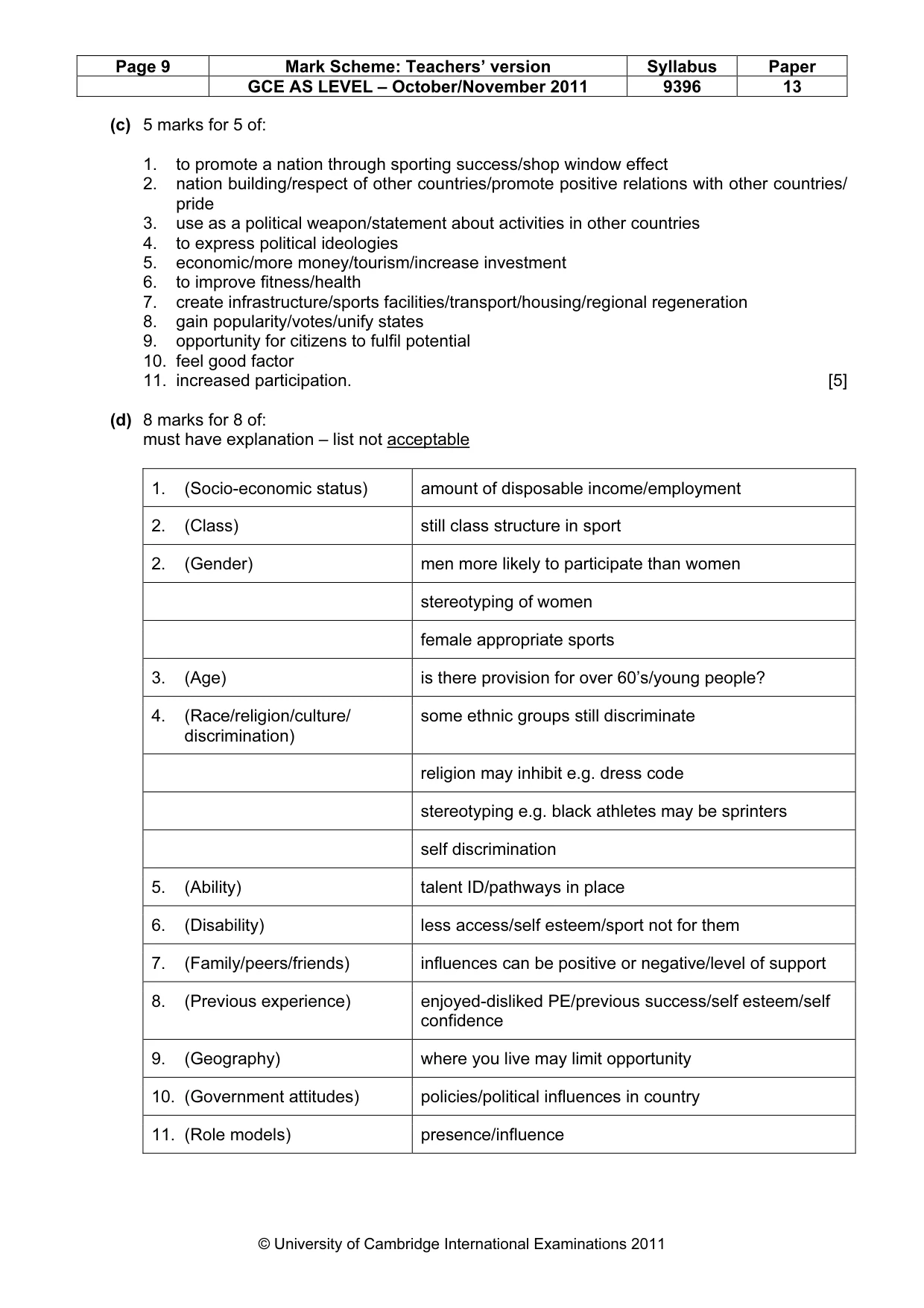
Page 9 Mark Scheme: Teachers’ version Syllabus Paper GCE AS LEVEL – October/November 2011 9396 13 © University of Cambridge International Examinations 2011 (c) 5 marks for 5 of: 1. to promote a nation through sporting success/shop window effect 2. nation building/respect of other countries/promote positive relations with other countries/ pride 3. use as a political weapon/statement about activities in other countries 4. to express political ideologies 5. economic/more money/tourism/increase investment 6. to improve fitness/health 7. create infrastructure/sports facilities/transport/housing/regional regeneration 8. gain popularity/votes/unify states 9. opportunity for citizens to fulfil potential 10. feel good factor 11. increased participation. [5] (d) 8 marks for 8 of: must have explanation – list not acceptable 1. (Socio-economic status) amount of disposable income/employment 2. (Class) still class structure in sport 2. (Gender) men more likely to participate than women stereotyping of women female appropriate sports 3. (Age) is there provision for over 60’s/young people? 4. (Race/religion/culture/ discrimination) some ethnic groups still discriminate religion may inhibit e.g. dress code stereotyping e.g. black athletes may be sprinters self discrimination 5. (Ability) talent ID/pathways in place 6. (Disability) less access/self esteem/sport not for them 7. (Family/peers/friends) influences can be positive or negative/level of support 8. (Previous experience) enjoyed-disliked PE/previous success/self esteem/self confidence 9. (Geography) where you live may limit opportunity 10. (Government attitudes) policies/political influences in country 11. (Role models) presence/influence
Mark scheme, page 10
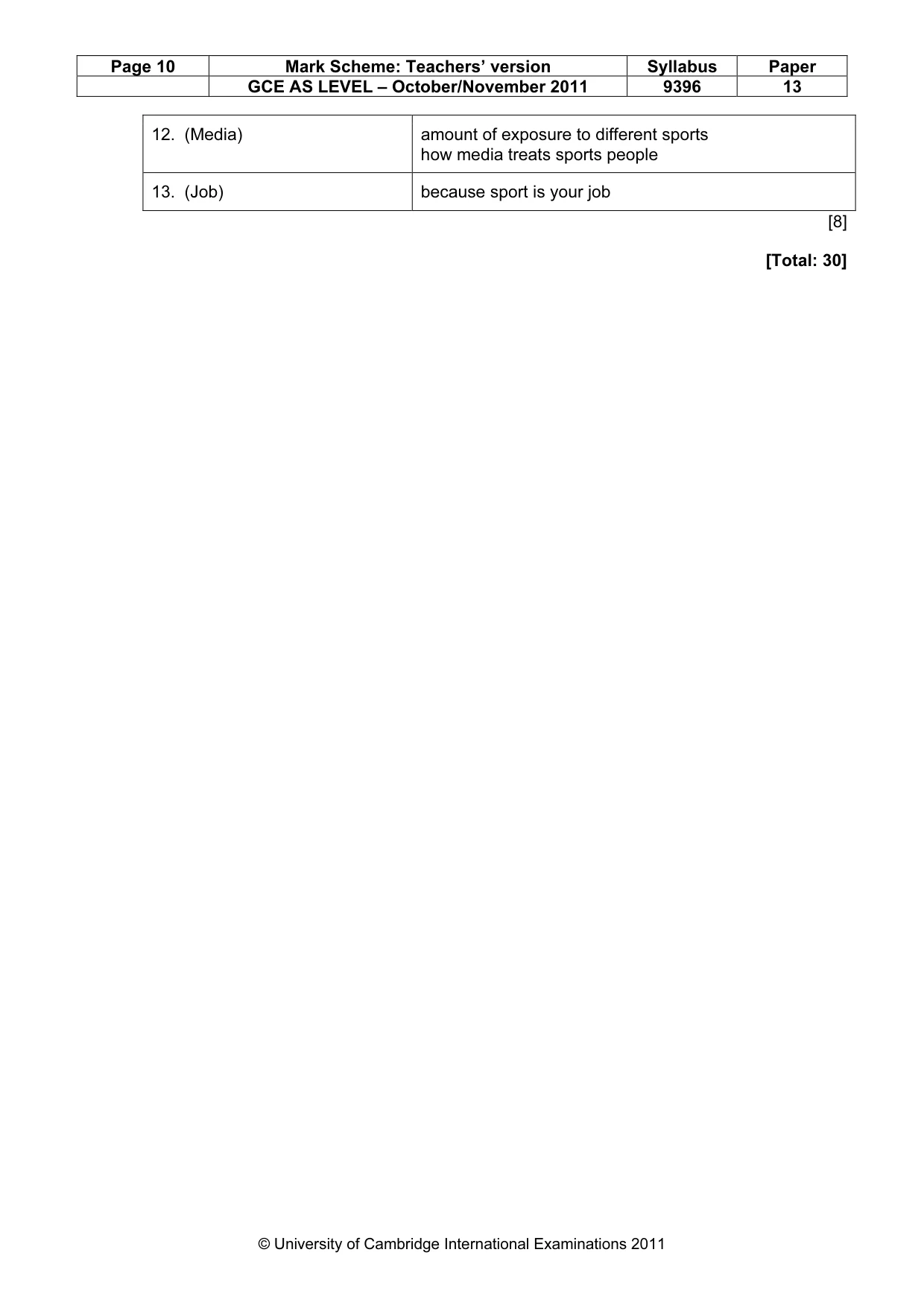
Page 10 Mark Scheme: Teachers’ version Syllabus Paper GCE AS LEVEL – October/November 2011 9396 13 © University of Cambridge International Examinations 2011 12. (Media) amount of exposure to different sports how media treats sports people 13. (Job) because sport is your job [8] [Total: 30]
What you needed in this session
Cambridge’s own grade thresholds for 2011 Oct/Nov, Paper 1 · Variant 3. A higher threshold means an easier paper — the bar moves with how the cohort did.