Cambridge A Level Media Studies 9607 — 2023 May/June Paper 4 · Variant 2
9607/42/M/J/23 · 3 questions · 60 marks · ≈68 min
The question paper and its mark scheme, free to read here and free to download. This is Cambridge’s own paper, exactly as it was sat.
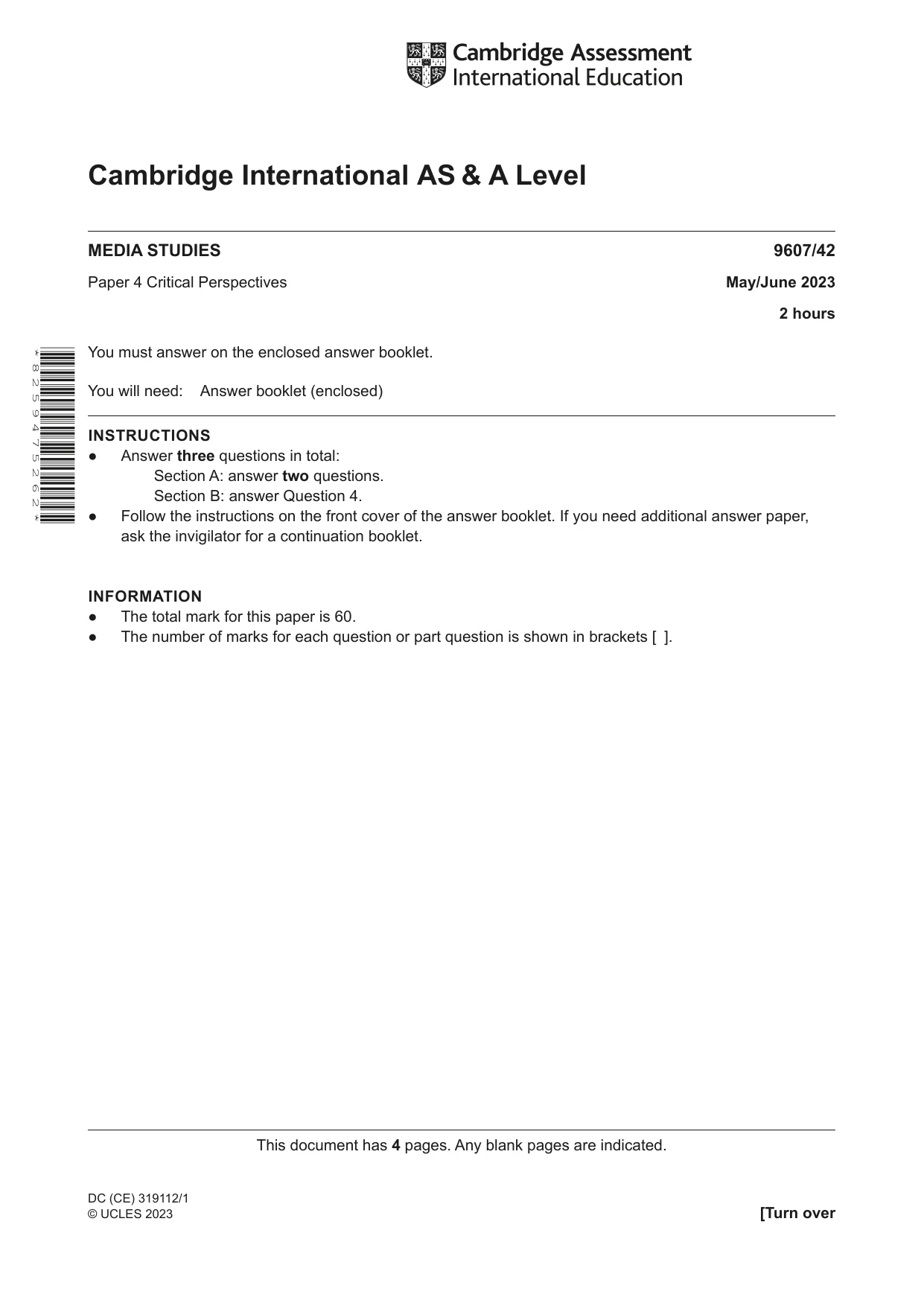
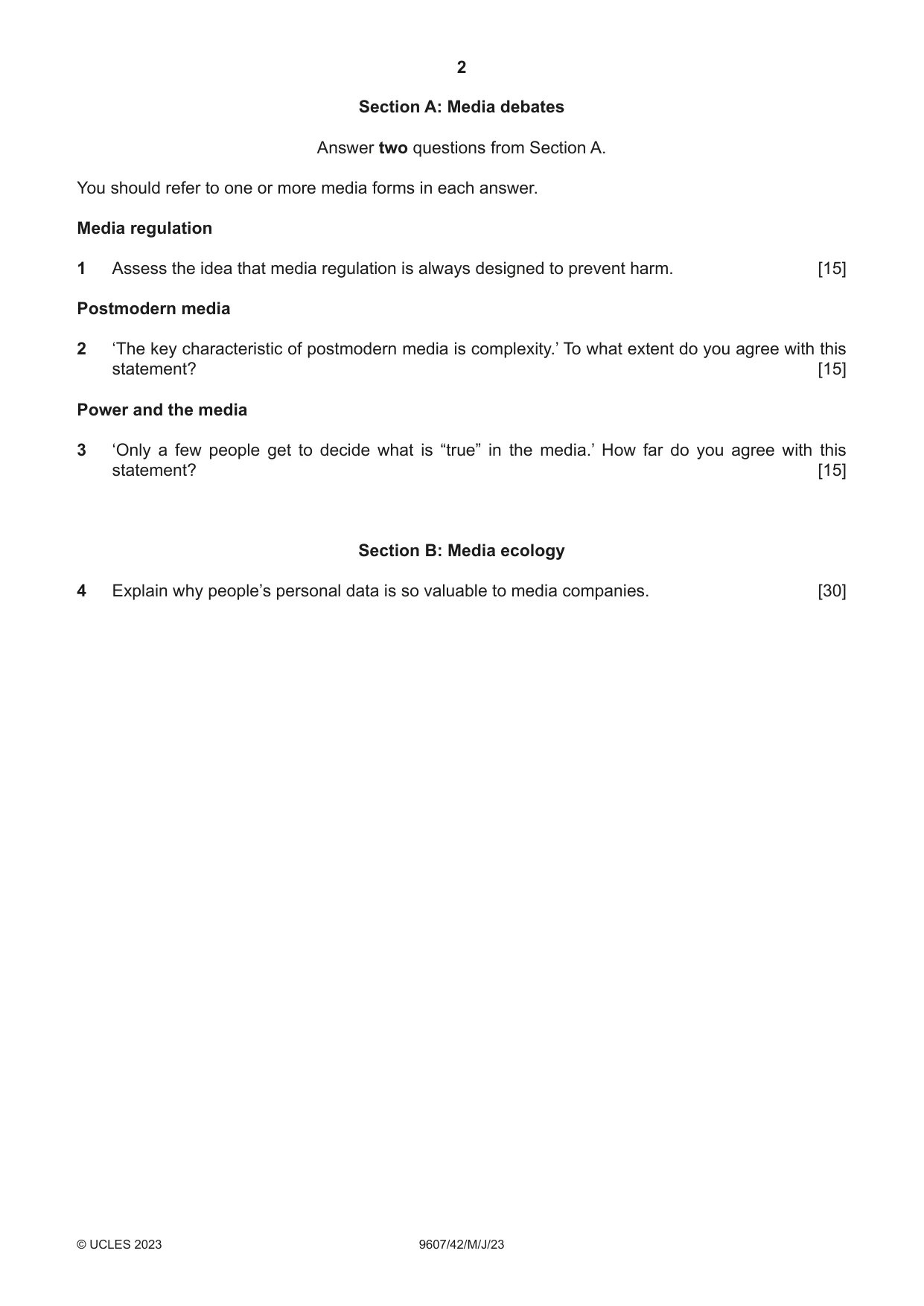
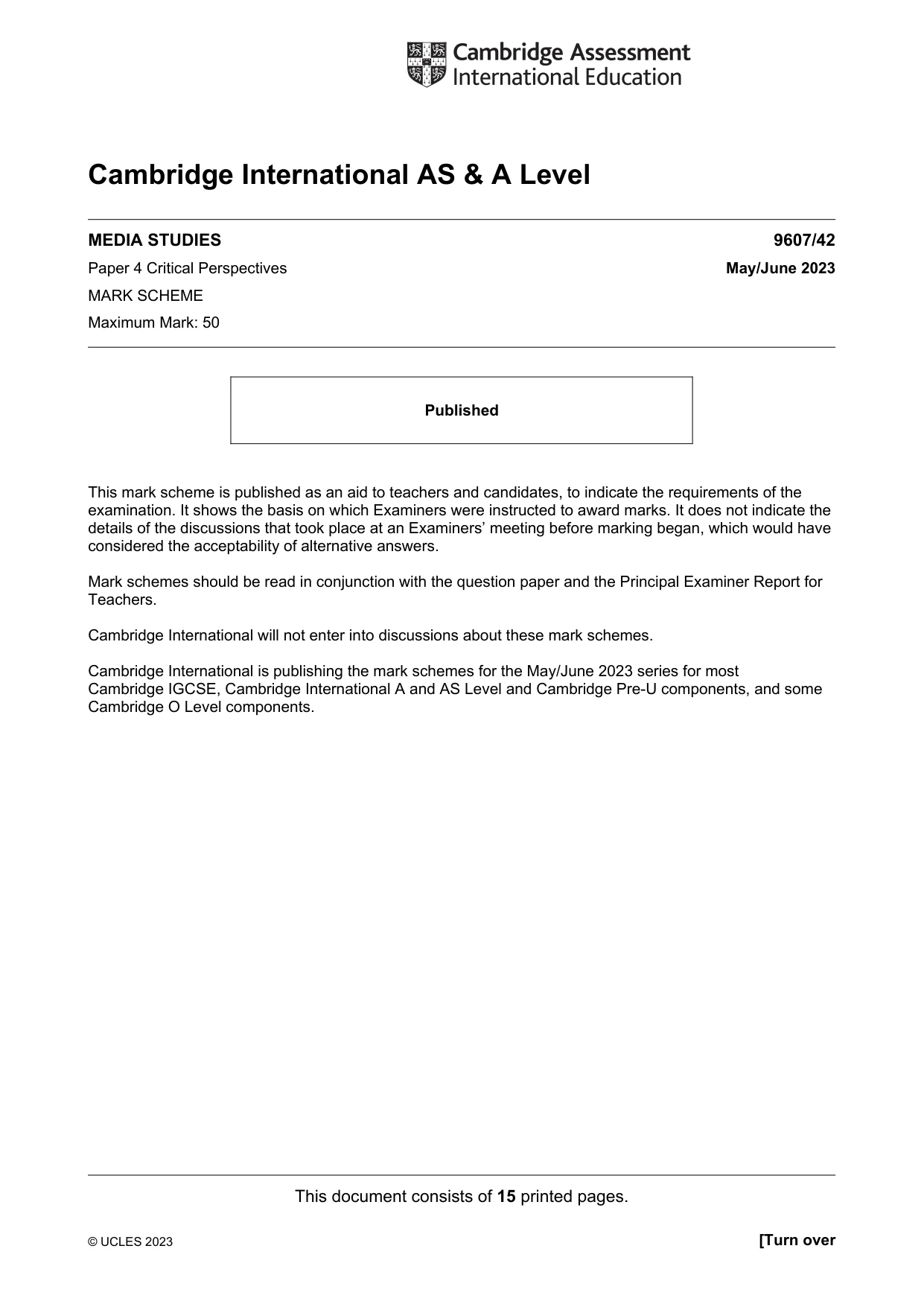
Question paper4 pages

Mark scheme15 pages
Answers below. Sit the paper first if you are practising.
Questions as text
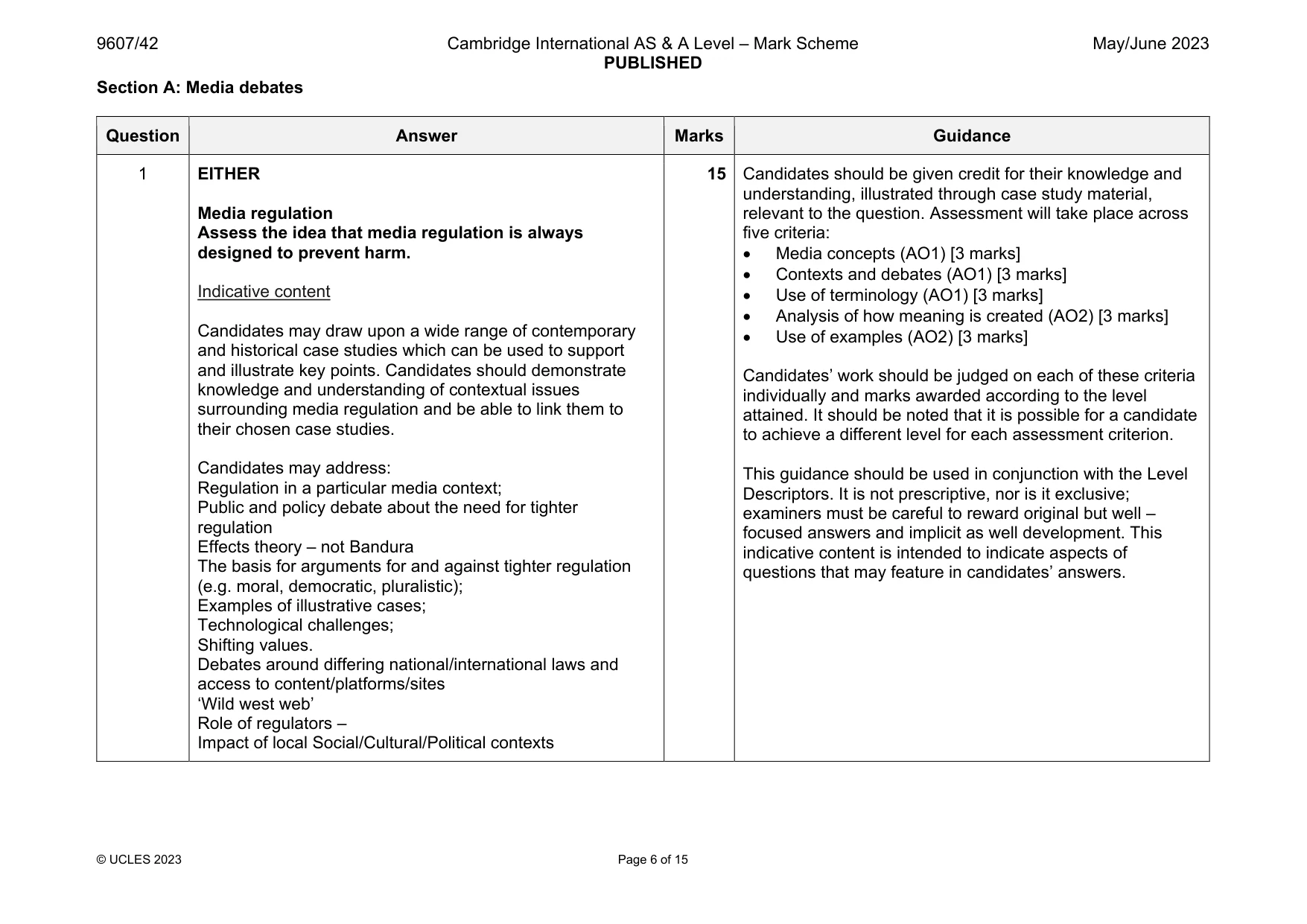
Q1 · Assess the idea that media regulation is always designed to prevent harm
1 Assess the idea that media regulation is always designed to prevent harm. [15] Postmodern media
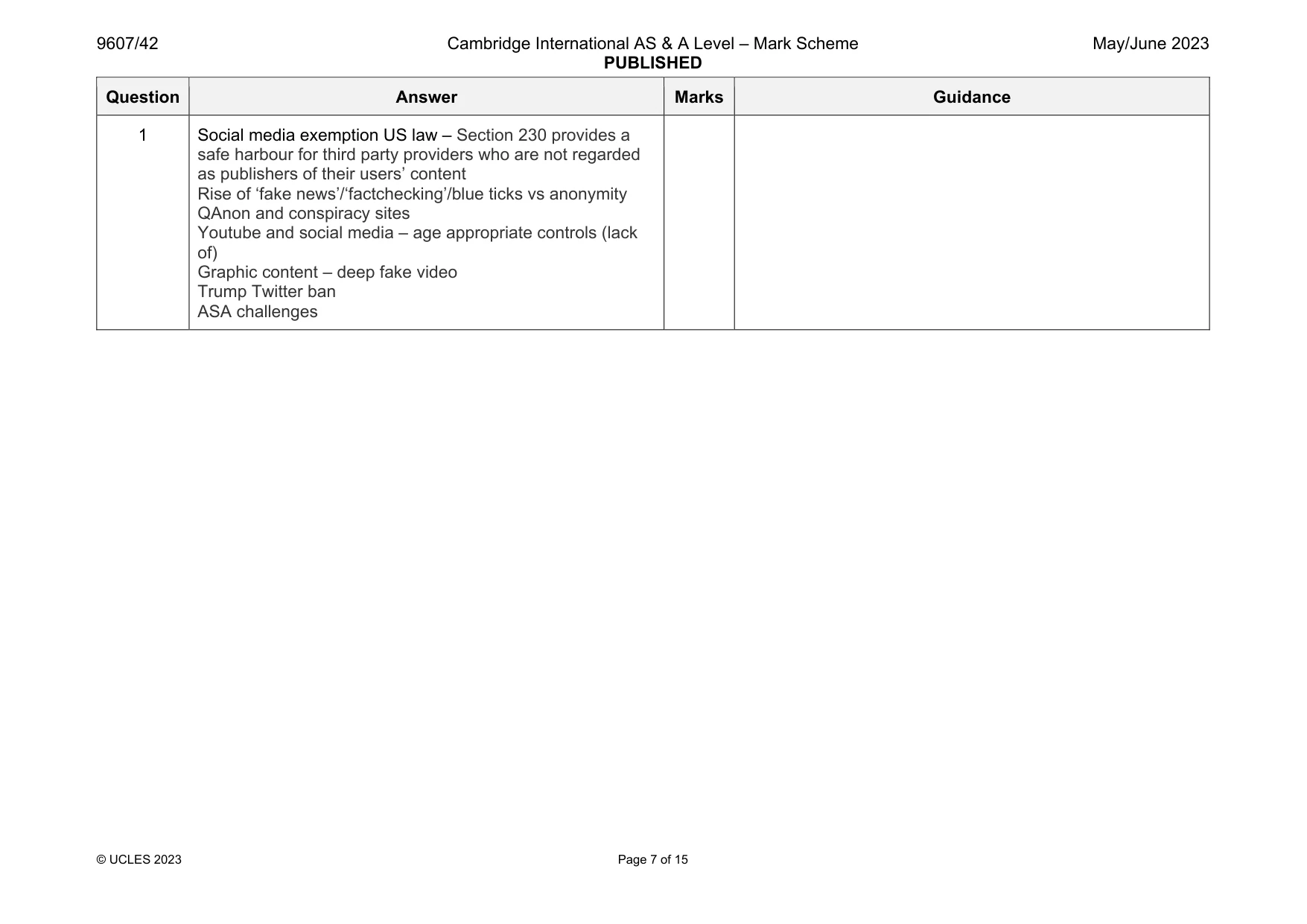
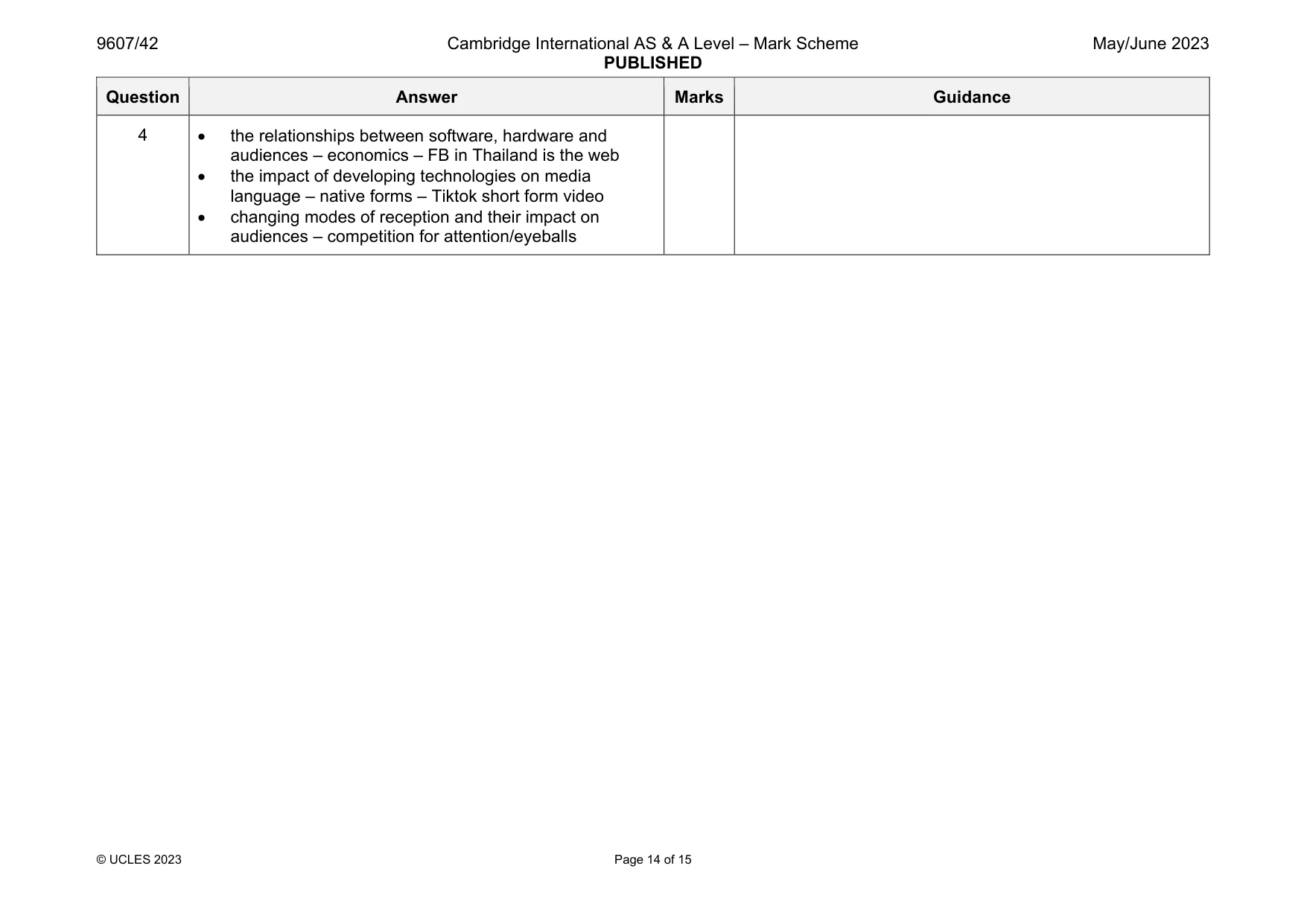
Mark scheme: 1 EITHER Media regulation Assess the idea that media regulation is always designed to prevent harm. Indicative content Candidates may draw upon a wide range of contemporary and historical case studies which can be used to support and illustrate key points. Candidates should demonstrate knowledge and understanding of contextual issues surrounding media regulation and be able to link them to their chosen case studies. Candidates may address: Regulation in a particular media context; Public and policy debate about the need for tighter regulation Effects theory – not Bandura The basis for arguments for and against tighter regulation (e.g. moral, democratic, pluralistic); Examples of illustrative cases; Technological challenges; Shifting values. Debates around differing national/international laws and access to content/platforms/sites ‘Wild west web’ Role of regulators – Impact of local Social/Cultural/Political contexts understanding, illustrated through case study material, relevant to the question. Assessment will take place across five criteria: Media concepts (AO1) [3 marks] Contexts and debates (AO1) [3 marks] Use of terminology (AO1) [3 marks] Analysis of how meaning is created (AO2) [3 marks] Use of examples (AO2) [3 marks] Candidates’ work should be judged on each of these criteria individually and marks awarded according to the level attained. It should be noted that it is possible for a candidate to achieve a different level for each assessment criterion. This guidance should be used in conjunction with the Level Descriptors. It is not prescriptive, nor is it exclusive; examiners must be careful to reward original but well – focused answers and implicit as well development. This indicative content is intended to indicate aspects of questions that may feature in candidates’ answers. Question Answer Marks Guidance 1 Social media exemption US law – Section 230 provides a safe harbour for third party providers who are not regarded as publishers of their users’ content Rise of ‘fake news’/‘factchecking’/blue ticks vs anonymity QAnon and conspiracy sites Youtube and social media – age appropriate controls (lack of) Graphic content – deep fake video Trump Twitter ban ASA challenges
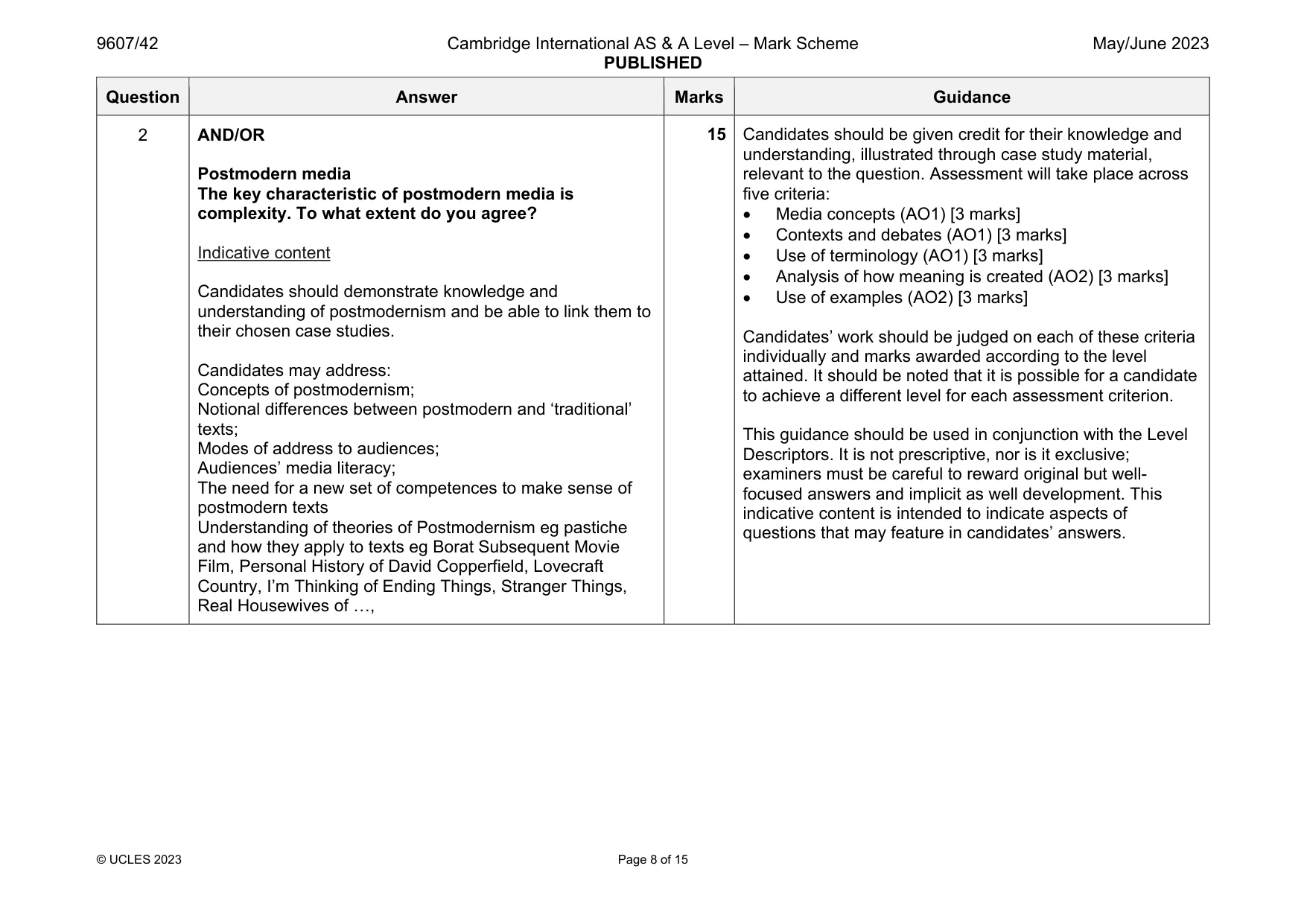
Q2 · ‘The key characteristic of postmodern media is complexity.’ To what extent do you agree…
2 ‘The key characteristic of postmodern media is complexity.’ To what extent do you agree with this statement? [15] Power and the media
Mark scheme: 2 AND/OR Postmodern media The key characteristic of postmodern media is complexity. To what extent do you agree? Indicative content Candidates should demonstrate knowledge and understanding of postmodernism and be able to link them to their chosen case studies. Candidates may address: Concepts of postmodernism; Notional differences between postmodern and ‘traditional’ texts; Modes of address to audiences; Audiences’ media literacy; The need for a new set of competences to make sense of postmodern texts Understanding of theories of Postmodernism eg pastiche and how they apply to texts eg Borat Subsequent Movie Film, Personal History of David Copperfield, Lovecraft Country, I’m Thinking of Ending Things, Stranger Things, Real Housewives of …, understanding, illustrated through case study material, relevant to the question. Assessment will take place across five criteria: Media concepts (AO1) [3 marks] Contexts and debates (AO1) [3 marks] Use of terminology (AO1) [3 marks] Analysis of how meaning is created (AO2) [3 marks] Use of examples (AO2) [3 marks] Candidates’ work should be judged on each of these criteria individually and marks awarded according to the level attained. It should be noted that it is possible for a candidate to achieve a different level for each assessment criterion. This guidance should be used in conjunction with the Level Descriptors. It is not prescriptive, nor is it exclusive; examiners must be careful to reward original but well- focused answers and implicit as well development. This indicative content is intended to indicate aspects of questions that may feature in candidates’ answers.
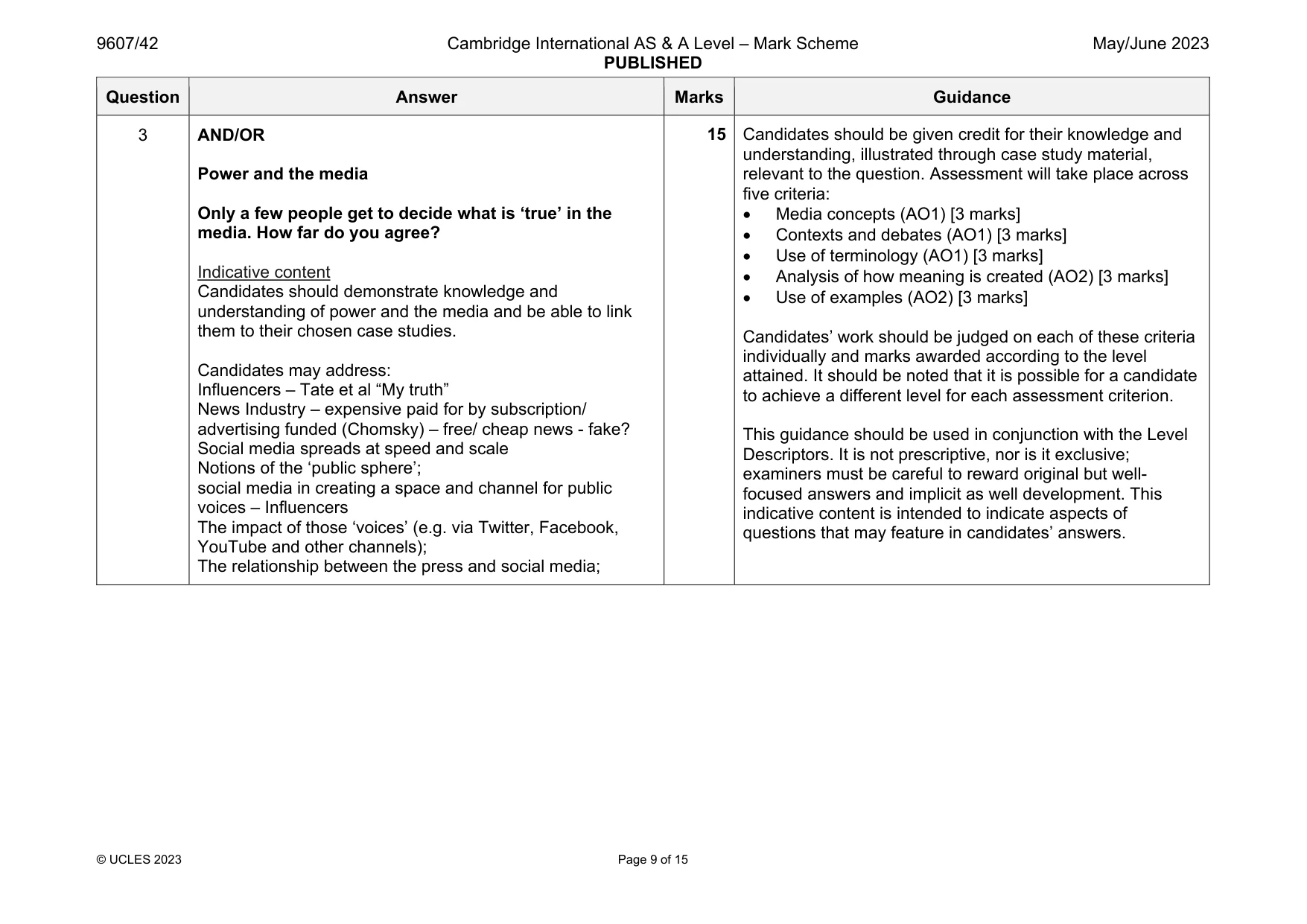
Q3 · ‘Only a few people get to decide what is “true” in the media.’ How far do you agree with…
3 ‘Only a few people get to decide what is “true” in the media.’ How far do you agree with this statement? [15]
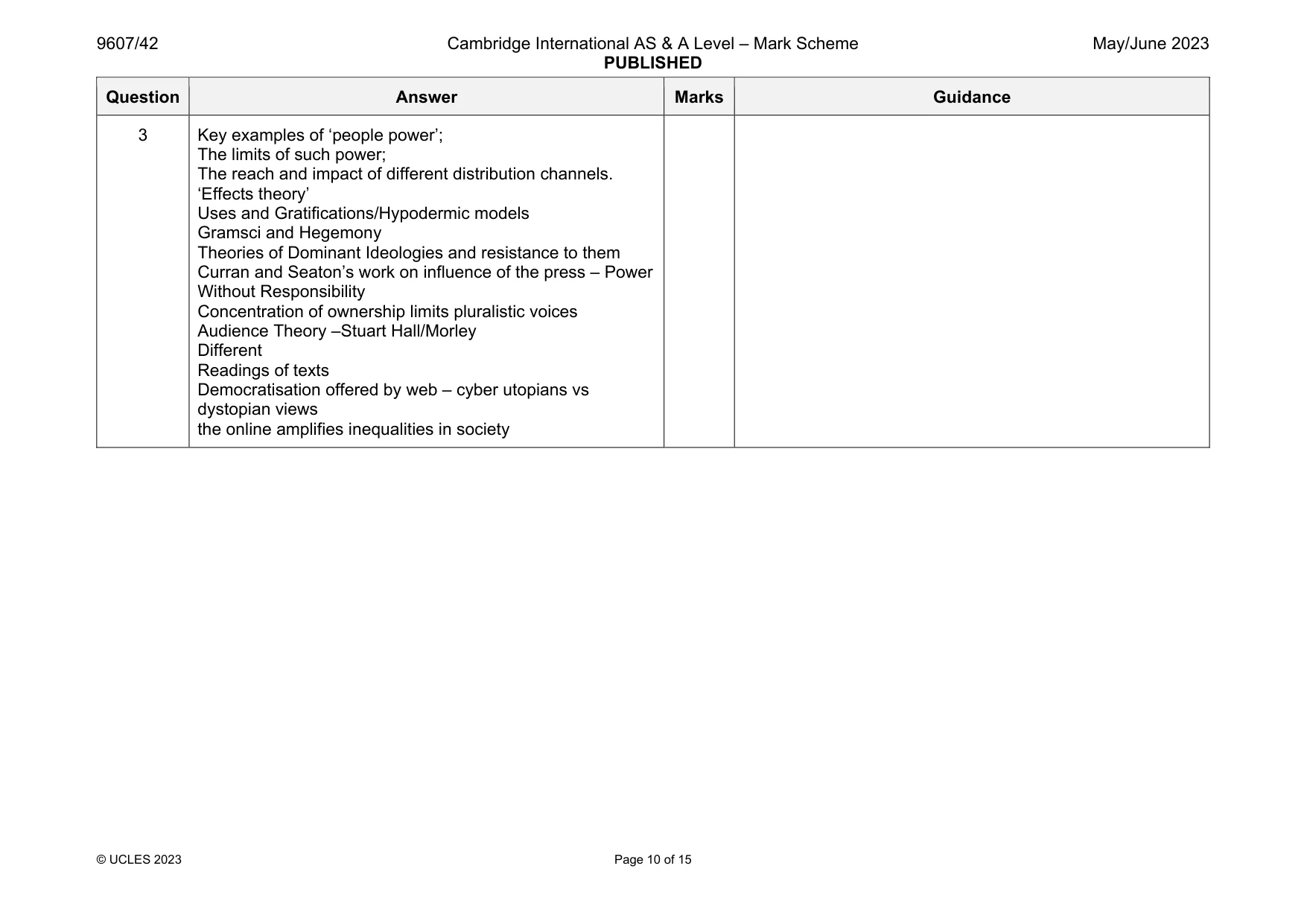
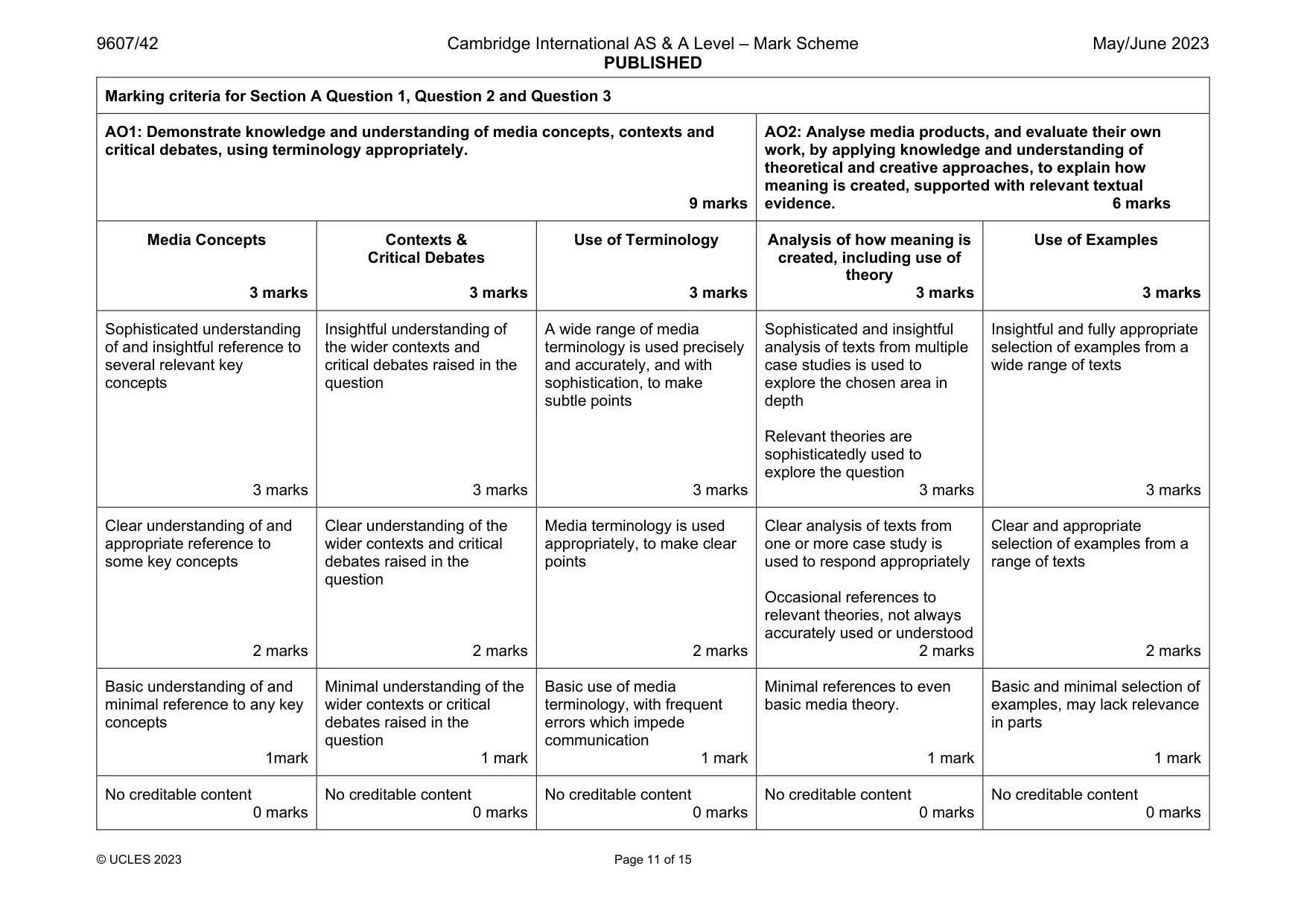
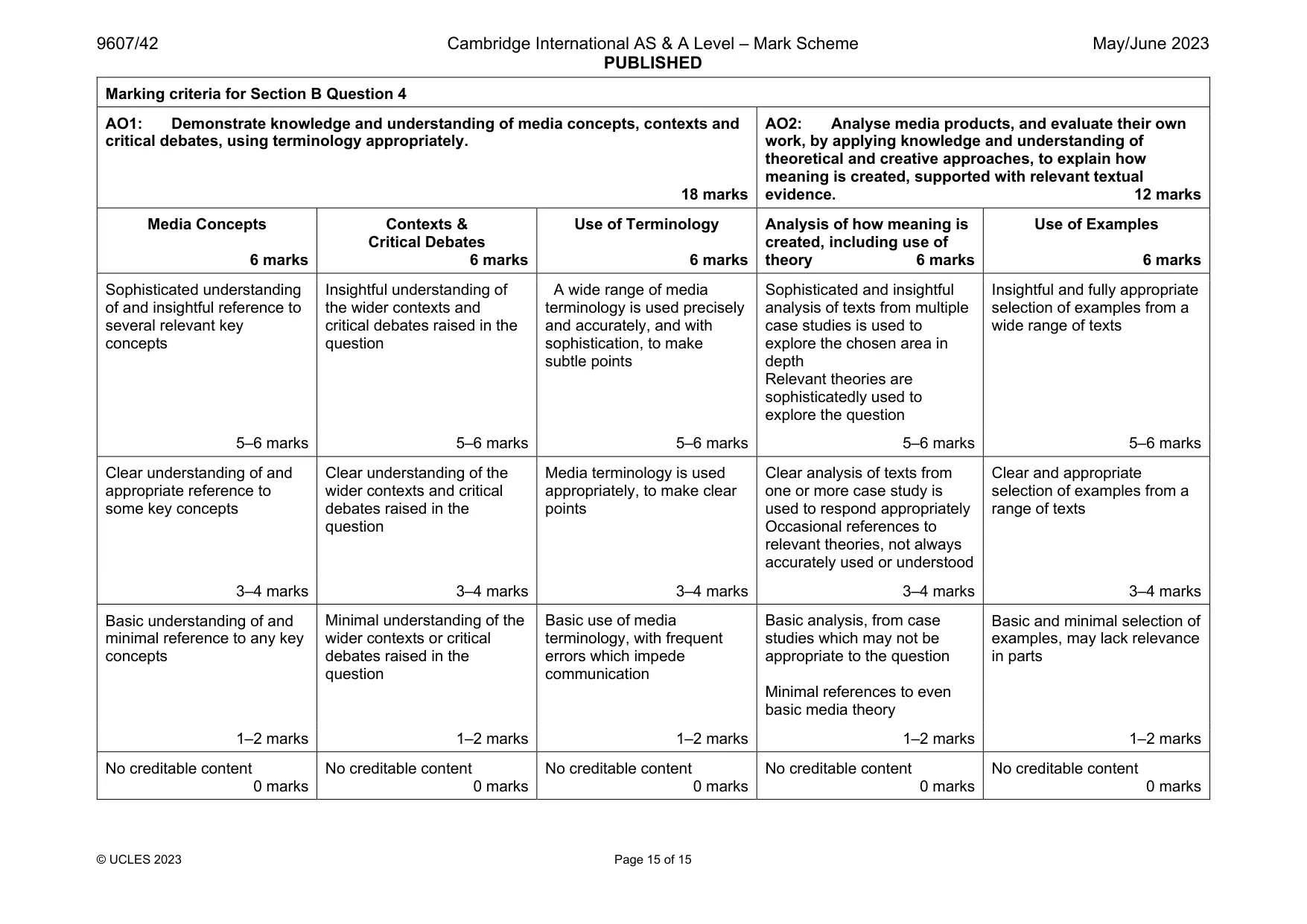
Mark scheme: 3 AND/OR Power and the media Only a few people get to decide what is ‘true’ in the media. How far do you agree? Indicative content Candidates should demonstrate knowledge and understanding of power and the media and be able to link them to their chosen case studies. Candidates may address: Influencers – Tate et al “My truth” News Industry – expensive paid for by subscription/ advertising funded (Chomsky) – free/ cheap news - fake? Social media spreads at speed and scale Notions of the ‘public sphere’; social media in creating a space and channel for public voices – Influencers The impact of those ‘voices’ (e.g. via Twitter, Facebook, YouTube and other channels); The relationship between the press and social media; understanding, illustrated through case study material, relevant to the question. Assessment will take place across five criteria: Media concepts (AO1) [3 marks] Contexts and debates (AO1) [3 marks] Use of terminology (AO1) [3 marks] Analysis of how meaning is created (AO2) [3 marks] Use of examples (AO2) [3 marks] Candidates’ work should be judged on each of these criteria individually and marks awarded according to the level attained. It should be noted that it is possible for a candidate to achieve a different level for each assessment criterion. This guidance should be used in conjunction with the Level Descriptors. It is not prescriptive, nor is it exclusive; examiners must be careful to reward original but well- focused answers and implicit as well development. This indicative content is intended to indicate aspects of questions that may feature in candidates’ answers. Question Answer Marks Guidance 3 Key examples of ‘people power’; The limits of such power; The reach and impact of different distribution channels. ‘Effects theory’ Uses and Gratifications/Hypodermic models Gramsci and Hegemony Theories of Dominant Ideologies and resistance to them Curran and Seaton’s work on influence of the press – Power Without Responsibility Concentration of ownership limits pluralistic voices Audience Theory –Stuart Hall/Morley Different Readings of texts Democratisation offered by web – cyber utopians vs dystopian views the online amplifies inequalities in society Marking criteria for Section A Question 1, Question 2 and Question 3 AO1: Demonstrate knowledge and understanding of media concepts, contexts and critical debates, using terminology appropriately. 9 marks AO2: Analyse media products, and evaluate their own work, by applying knowledge and understanding of theoretical and creative approaches, to explain how meaning is created, supported with relevant textual evidence. 6 marks Media Concepts 3 marks Contexts & Critical Debates 3 marks Use of Terminology 3 marks Analysis of how meaning is created, including use of theory 3 marks Use of Examples 3 marks Sophisticated understanding of and insightful reference to several relevant key concepts 3 marks Insightful understanding of the wider contexts and critical debates raised in the question 3 marks A wide range of media terminology is used precisely and accurately, and with sophistication, to make subtle points 3 marks Sophisticated and insightful analysis of texts from multiple case studies is used to explore the chosen area in depth Relevant theories are sophisticatedly used to explore the question 3 marks Insightful and fully appropriate selection of examples from a wide range of texts 3 marks Clear understanding of and appropriate reference to some key concepts 2 marks Clear understanding of the wider contexts and critical debates raised in the question 2 marks Media terminology is used appropriately, to make clear points 2 marks Clear analysis of texts from one or more case study is used to respond appropriately Occasional references to relevant theories, not always accurately used or understood 2 marks Clear and appropriate selection of examples from a range of texts 2 marks Basic understanding of and minimal reference to any key concepts 1mark Minimal understanding of the wider contexts or critical debates raised in the question 1 mark Basic use of media terminology, with frequent errors which impede communication 1 mark Minimal references to even basic media theory. 1 mark Basic and minimal selection of examples, may lack relevance in parts 1 mark No creditable content 0 marks No creditable content 0 marks No creditable content 0 marks No creditable content 0 marks No creditable content 0 marks
What was in this paper
The subtopics covered by these 3 questions, and how many questions each got. Open one in a new tab to see every Cambridge question on it.
What you needed in this session
Cambridge’s own grade thresholds for 2023 May/June, Paper 4 · Variant 2. A higher threshold means an easier paper — the bar moves with how the cohort did.